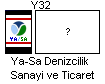
YA-SA DENIZCILIK SANAYI VE TICARET.
The funnel logo’s shades follow the company website, with photographs showing sky blue for the lighter shade and very dark green. The lettering appears to combine the three principal colours: YA in dark blue, the slash in light blue and SA in green. The observations include port-side photographs of Yasa H. Mulla and Yasa Kaptan Erbil and a starboard view of Yasa Aysen.
Also known as Ya-Sa Shipping Industry & Trading S.A., the company was founded by Yalçin Sabanci in May 1999. Operating concerns included Ya-Sa Gemi Isletmeciligi ve Ticaret, formed in 2002, and Ya-Sa Tankercilik ve Tasimacilik, formed in 2006. Yasa Tankercilik Isletmeciligi was also listed as a manager in 2011–2012.
Turkey, Istanbul.
YABUKI KAIUN K.K.
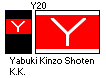
US Navy 1961 records the funnel and flag; no verbal design is supplied.
The concern is listed as Yabuki Kinzo Shoten in 1953–1954, Yabuki Kinzo Shoten K.K. in 1958–1959, and Yabuki Kaiun K.K. by 1963–1964.
Japan, Tokyo.
YACIMIENTOS CARBONIFEROS FISCALES.
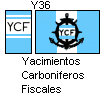
La Marina Mercante Argentina 1961 shows a blue flag with a vertical white band. Overall is a badge of a black anchor and ship’s wheel surmounted by a blue panel with a broad horizontal white band bearing black YCF. The same reference supplies the funnel illustration.
Yacimientos Carboniferos Fiscales, or YCF, was a state-owned mining company formed on 6 August 1958 with a shipping section. The document also records the name Oilfields Carboniferous Rio Turbio. Its 1961 fleet differs from the later register listing. Privatised in 1994, apparently as Yacimientos Carboniferos Fiscales Empresa del Estado, it promptly entered liquidation.
Argentina, Buenos Aires.
YACIMIENTOS PETROLIFÉROS FISCALES.
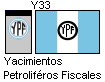
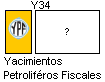
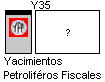
The flag is blue with a white circle bearing two black rings. The outer ring edges the circle, while the inner surrounds black YPF lettering shaped to fit it.
Y34 is an alternative funnel. Talbot-Booth omits the white circle and places the emblem directly on yellow; Merchant Ships 1942 notes this error.
The funnel comes from the Mitchell collection; no separate verbal comparison is supplied.
Yacimientos Petroliféros Fiscales, also known as YPF, Argentine Government Tankers or Fiscal Petroleum Fields, was formed on 3 June 1922 to handle state-owned tankers. Following financial difficulties it was privatised in 1991, with the government retaining 5 per cent. That holding was sold to Spain’s Repsol in 1999; Repsol subsequently took over the reduced company and merged it into Repsol YPF. Lloyd’s records the 1999 change in its December 2007 edition, although earlier entries inexplicably give formation in 2000.
Argentina, Buenos Aires.
YAHATA KISEN K.K.
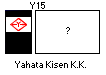
Observed on Omi Maru on 1 July 1990, the funnel is black with a broad white band bearing a red diamond frame. A very narrow horizontal red band is interrupted by white at the centre, where a red Y is placed. No flag is noted.
Laurel Island, owned by Yahata Trader, was seen at Wellington on 13 June 2002 with Iino Kaiun’s funnel, but an orange-red rather than ordinary red band. Possible Iino or Kawasaki connections were considered, but Alan Watt knew of none. Panam Trader was recorded with an unidentified funnel in the separate As Flown material.
Yahata Kisen was formed in 1963. Yahata Trader, established in 1983, was a named subsidiary for which it also acted as agent.
Japan, Namikata.
YAHYA SHIPPING CO.
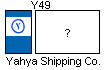
The funnel follows Osama’s photograph of 9 August 2009; no separate verbal design is supplied.
Yahya operated Camelia by at least 7 July 1982. Equasis records it as owner of Osama from 27 May 2007, although Lloyd’s still lists Sea Rose Maritime in August 2008. Rosanoski considers the changed funnel markings apparent confirmation of the transfer.
Syria, Tartous.
YAMAGATA YUZABURO.
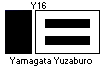
The flag comes from a 1902 chart published in Fune to Hata in 1994; the funnel is taken from a 1903 chart.
Documentary images — company attribution uncertain
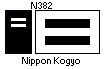
The later funnel and flag are supplied through Alan Watt. Their company-name context and the flag’s continued use after the change to Nippon Kogyo remain uncertain.
Do not assert shared use across name change.
The concern became Nippon Kogyo by 1910. The name under which the later funnel was recorded is unclear, and continuation of the flag after the change is assumed.
Japan.
Yamamoto Kisen K.K. (1).
YAMAMOTO KISEN K.K. (1).
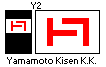
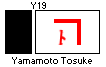
The earlier Y19 uses the proper kana To, for founder Yamamoto Tosuke, and is traced to 1901. The later Y2 uses a stylised form. Alan Watt identifies Y2 as the post-war version, while Jordan indicates replacement of Y19 by 1939. Merchant Ships 1942 references Y19 in its fleet list but does not reproduce it in the funnel section; a monochrome Konzan Maru photograph appears to support that design.
The Osaka company originated as Yamamoto Tosuke, also recorded as Yamamoto Toshi in hiragana on a 1903 sheet. It operated before the Second World War and continued until about the mid-1960s.
Japan, Osaka.
YAMAMOTO KISEN K.K. (2).
The Yokohama concern appears in registers from 1963–1964 to 1996–1997.
Japan, Yokohama.
YAMAMOTO KISEN K.K. (3).
The Aki-gun concern is recorded from 1963–1964 to 1973–1974.
Japan, Aki-gun.
YAMAMOTO KISEN K.K. (4).
Lloyd’s gives formation in 1976, although a Matsuyama company already appears in 1970–1971 and 1973–1974. Rosanoski raises the possibility of two companies in the town. The 1978–1979 listing includes a vessel otherwise associated with the Saiki concern, separated again in 1980–1981.
Japan, Matsuyama City.
YAMAMOTO KISEN K.K. (5).
The Saiki company was formed in 1966, with ships held through named subsidiaries. It is also recorded as Yamamoto Kisen Co. Ltd. and was listed as an agent by 1996–1997.
Japan, Saiki City.
YAMAOTO KISEN K.K. (6).
The Mihara concern appears in 1980–1981 and 1985–1986; its vessel had been placed under the Matsuyama entry in 1978–1979.
Japan, Mihara.
YAMAMOTO KISEN K.K. (7).
The Nagahama concern is recorded in Lloyd’s 1985–1986.
Japan, Nagahama.
Uncertain Yamamoto identity
A joint venture with Nippon Yusen is recorded, but the source does not establish which Yamamoto company was involved.
Keep the explicit scope label independent; no alias or company identity is inferred.
YAMASHITA KISEN K.K.
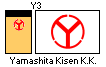
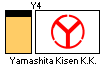
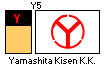
Loughran confirms the buff funnel colour. The change from Y4 is dated to 1937, when Choko Maru carried Y5, apparently an unrepeated experiment; Y3 was used instead with a stylised Mon-shaped Y. Jordan’s monochrome photograph of Yosida Maru No. 1 confirms Y3. Stewart 1957 shows only small ring segments, and FOTW’s flag is taken from Stewart.
Kamesaburo Yamashita formed Yokohama Sekitan Shokai in 1901; Lloyd’s gives the name as Yobohama Sebitan Shobai. The concern became Yamashita Gomei Kaisha in 1911, Yamashita Kisen K.K. in May 1917, later Yamashita Kisen Kogyo, and then reverted to Yamashita Kisen. It owned steamships from 1904 and merged with Shinnihon Kisen about 1964 to form Yamashita-Shinnihon.
Marunouchi Kaiun was managed by the company and Uwayima, also given as Uwajima Unyu, was an associate. In November 1925 Yamashita joined Kawasaki Kisen and Kokusai Kisen in forming JAL.
Japan, Tokyo.
YAMASHITA-SHINNIHON KISEN K.K.
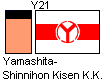
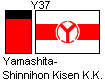
Brown 1978 and 1982 show a red funnel, as does Mitchell without qualification. The WSS Central Record instead confirms a light buff-orange-pink, lighter than Mitsui orange and somewhat like Bibby pink. The recorded orange-buff is RGB 255, 155, 112. Brown’s narrower red band in the flag is considered incorrect: the bands should be equal.
FOTW also attributes the Y21 flag design to Amagasaki Isaburo, citing a 1916 example published in Fune To Hata in 1994. This is retained as a separate historical attribution, not evidence of a corporate relationship.
Y-S Line was formed by the merger of Yamashita Kisen and Shinnihon Kisen in 1964. Nissho Shipping and Yuyo Kaiun joined the group that year. In 1989 it merged with Japan Line to form Navix Line.
United Orient Shipping and Agency was established in December 1969 with Azuma Shipping and Soviet Far-Eastern Shipping. The document also lists Yamashita Shin-Nippon Kisen, tentatively identified with this company, in the November 1979 Oasis Container Express consortium with Kawasaki Kisen, Nippon Yusen, Mitsui O.S.K. and Showa Kaiun.
Japan, Tokyo.
YAMAZAKI KISEN K.K.
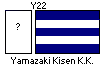
The flag comes from an actual example dated 1916 and published in Fune To Hata in 1994. Alan Watt confirms it against a 1926 chart.
YANG MING MARINE TRANSPORT CORPORATION.
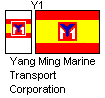
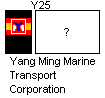
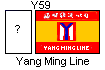
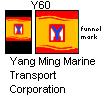
FOTW describes a red-yellow-red flag in approximately 1:3:1 proportions, with a central red square, blue Y and interrupted white M. Rosanoski considers Brown’s panel imperfect and the yellow a golden shade. The black Y1 funnel is probably an uncoloured printing error; the observed Y25 version is confirmed by YM Comfort’s 2 November 2005 photograph, with golden yellow and a black funnel base.
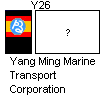
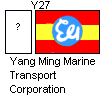
Mitchell supplies Y26’s funnel and places the Y27 object beneath a funnel drawing. Rosanoski assumes Y27 is a flag but allows that it could instead be another funnel-band version.
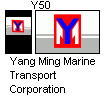
The Hamburg flag variant is horizontally divided white over pearl grey, with a narrow white stripe at the grey area’s upper edge. Its central red rectangle contains a blue Y over two white halves of an M. On YM Utility’s funnel, the white-grey division curves like a wave, with another narrow grey curve above, tapering at its ends and widening slightly between. Port and starboard views agree, and enlarged photographs, including YM Ultimate, show that the design continues around front, back and corners.
Y51 follows YM Cultivation’s photograph of 7 July 2006, when the ship was owned and operated by Yang Ming.
The full-size flag adds YANG MING LINE in white sans-serif letters to the lower red stripe and white Chinese characters to the upper stripe, presumed by the contributor to give the same name. The example offered on eBay measured approximately 0.93 × 1.40 m.
Y60 follows a starboard photograph of YM Rightness dated 2 September 2011, accessed through shipspotting.com in September 2013.
The company explains Yang as the sun and Ming as a combination of sun and moon, conveying brightness, clarity or enlightenment. Its square YM logo has a Y rising from base to top to signify innovation, while the M represents grandeur, width and firmness. The stated values are teamwork, innovation, honesty and pragmatism; red signifies sincere service and grey the core values. A supplementary wave flowing left to right represents sea transport, concern for the oceans and marine ecology, and continuing improvement.
Yang Ming Line was established on 28 December 1972, although Lloyd’s gives 1973. Reconstituted from the Nationalist portion of China Merchants Steam Navigation, it appears to have operated alongside that name until the two merged in 1995. The website records government shareholding falling below half, while the cited Lloyd’s entries continue to describe government control; these statements are retained without resolving their different contexts.
The group’s shipping interests included YML Shipping Enterprise and Kuang Ming, formed in 1999, with Chinese Petroleum recorded as an associate. Yang Ming participated in the AAOY consortium until its dissolution on 1 July 1991. A share swap with Taiwan Navigation was announced on 9 February 2007. Vessel names changed from the Ming prefix to YM.
Taiwan: Taipei, later Keelung.
YANGTZE RIVER TRANSPORT CO.
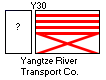
The certificate shows a white field with four red stripes in the upper half and a red saltire below, touching the lowest stripe. Miles Li identifies the design as a highly modified form of 長, from 長江, the modern Chinese name of the Yangtze River, and places it in the practice of modified-ideogram flags in Japan and Japanese-controlled areas.
The company’s flag appears on a share certificate issued in 1943 during the Japanese occupation of Shanghai.
China.
Yantai Ping Yang Shipping Co. Ltd.
Documentary images — company attribution uncertain
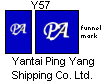
The funnel is documented by Lin Yang’s starboard photograph of 19 September 2007 and Shun Yang’s port-side photograph of 15 March 2010. Both ships were registered to An Yang Shipping. With no photographs of other group ships found, Rosanoski could not determine whether the A in PA referred specifically to that subsidiary.
An Yang ownership versus Yantai management does not resolve livery user.
Formed in June 2000, Yantai Ping Yang appears as an owner and manager with vessels under its own name and named companies.
China, Yantai.
YARA INTERNATIONAL ASA.
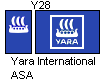
Norsk Hydro granted Hydro Agri the rights to its Viking-ship logo during the demerger, as Hydro replaced that emblem from January 2004. The funnel is confirmed by photographs of Oscar Viking and Polar Viking in 2005. Yara’s website shows the flag flown ashore and the company logo.
Yarrgas I was photographed with the Viking-ship logo bearing white YARA and a separate black YARA hull legend. Yara Gas II, photographed in June 2013 without a funnel, carries a white-bordered logo panel on the railing above the bridge.
Yara was formerly Norsk Hydro’s Hydro Agri business, demerged and listed on the Oslo Stock Exchange on 25 March 2004 after the name change was announced in December 2003. Its fleet was acquired by BW Gas in 2006 and time-chartered back. Hydroship had become Yaraship in 2004; in 2006 the renamed vessels passed to BW Green Gas. Rosanoski considers a wider transfer of the former Hydro fleet likely from Yarrgas I’s markings, despite incomplete register changes. Yara subsequently appears as a chemical company.
The company explains Yara through Norse language and runes: Jar suggests cultivated land through jardar, and Jara, the twelfth rune, means the year, often a good harvest. The account connects it with English year and German Jahr. Y replaces J for ease of pronunciation and also recalls English yield.
Norway, Oslo.
YARDIMCI SHIPPING GROUP.
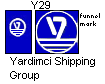
The funnel follows Elevit’s port-side photograph of 25 March 2013. On long-term charter, CEC Action carried a plain blue funnel after removing the Yardimci logo, without adopting CEC’s emblem. Clipper Beaufort, on a similar charter, was photographed in Clipper colours in June 2003.
Sevket Yardimci founded the corporation, originally dated to 1976 and later to 1974 on its website. It traded as Sevket Yardimci ve Ogullari Kollektif Sirketi until 1991. Shipbuilding became its core business in 1993 alongside shipowning; the source names brothers Kemal, Saban, Servet and Hüseyin as owners.
Operating concerns included Ayder Tankers and Yardgem Shipping, both formed in 2005, and Moliva Denizcilik, formed in 1997. Moliva took vessels formerly listed under the group and Yardimci Denizcilik ve Ticaret. The latter had originated as Rize Degirmcilik in 1982 and changed name in 1989; by 2000 most of its remaining vessels were under Moliva.
Turkey, Istanbul.
YBARRA & COMPAÑIA S.A.
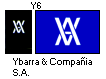
The flag is blue with intertwined white A and V; the black funnel carries the flag emblem. The Worlds Merchant Fleets 1939 instead describes two X shapes joined centrally by a horizontal line. Some illustrations are indistinct, while Ocean Ships identifies the intertwined letters; its monochrome Cabo San Vincente photograph appears to show a single design.
Earlier references list Ybarra & Compañia S en C. Hamburg Süd acquired half of Ybarra y Cia. Sudamérica in 1989 and the remainder in December 2005, when the brand was absorbed into Hamburg Süd.
Spain, Seville.
YEOWARD LINE LTD.
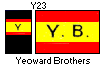
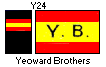
The flag is red-yellow-red with Y.B. lettering. An enamelled Avoceta badge acquired on a 1928 Canary Islands cruise has gold letters, whereas the company website shows black; the contributor considers gold probably an enamelling choice. FOTW portrays equal bands. Sources vary over dots and hyphens: several Brown and Talbot-Booth illustrations omit dots, LJC 1930 adds hyphens after both letters, and Merchant Ships allows dots or a black hyphen between them. A monochrome Ardeola photograph confirms the funnel.
LJC 1909 supplies this funnel and flag variant; no separate verbal comparison is given.
The proposed original name Yeoward Bros and Bonny is offered as a possible explanation of the initials. Avoceta, whose badge supplies flag evidence, was built in 1923 and sunk by a submarine in 1941.
Richard Yeoward began chartering in 1894 and established Yeoward Brothers in 1898. The 1920 change to Yeoward Line appears to have created a shipping subsidiary, since Lloyd’s continued to identify Yeoward Brothers as operator. Later sources record Yeoward (Shipping) as a Liverpool ship and forwarding agency, a Yeoward Brothers holding company at Widnes, and Yeoward Boatyards at Salcombe for motorboat services.
United Kingdom, Liverpool.
YICK FUNG SHIPPING & ENTERPRISES CO. LTD.
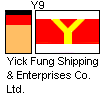
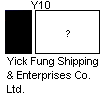
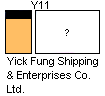
Older vessels, including Ho Fung in December 1965, carried Y10. Newer Cheung Chau and Venice had light-buff funnels with black tops of varying width; Venice later had no black top.
Mitchell records dark buff from a Liverpool sighting in 1968. A 9 May 2006 photograph of Yick Lee confirms that shade, retained after its transfer into COSCO (HK). FOTW’s flag follows Josef Nüsse’s table flag.
Formed in 1960, Yick Fung began with about six tramps registered in London. Fenton’s account describes it as becoming a front for the People’s Republic of China in the 1970s because European owners were reluctant to sell to Communist buyers; ships used the Sea suffix. It became part of COSCO (HK) Shipping on 1 November 1994.
Hong Kong.
Yildirim Foreign Trade & Marketing Inc.
Yilmar Denizcilik Nakliyat ve Ticaret Ltd. Sirketi
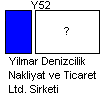
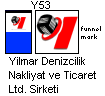
The funnel follows YM Jupiter’s starboard photograph of 8 April 2007.
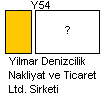
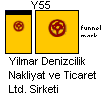
YM Pluto’s port-side view and YM Mercury’s starboard view show this version. The blue can look almost black in the photograph but is confirmed as blue by other views.
Unlike the very dark blue version, Amisos’s port- and starboard-side photographs of 16 May 2013 show a black funnel.
Cansu’s funnel differs from Y52. Rosanoski suggests this may relate to its classification as GC rather than the YM vessels’ CT classification. YILMAR appears on the hull; the original photograph date is written “8.9.9005”.
Garip, another GC vessel, has a funnel ring and a design that may incorporate a Y. YILMAR is again displayed on the hull.
Yildirim Group began in Samsun in 1963 as a construction-material trader. Yildirim Foreign Trade & Marketing began operations in 1989, although Lloyd’s gives formation in 2000. The group restructured in 2009, invested in CMA CGM in 2010, and became Chemfleet’s majority shareholder in 2012. Yilmar Shipping and Trading was launched in 2000 for ownership, management, chartering, agency and broking; the register dates the operating company to 2002.
Turkey, Istanbul.
YINSON HOLDINGS BERHAD.
The funnel follows PTSC Lam Kinh’s port-side photograph of 18 December 2013. The document also reproduces the company logo.
Yinson Holdings was incorporated on 9 March 1993, with origins in Yinson Transport (M) Sendirian Berhad in 1984. The earlier business acquired Sama Setuju in stages in 1986 and 1988 and became Yinson Corporation Sendirian Berhad. A further name change dated 4 February 1995 is questioned because it is absent from the company’s milestones page.
The marine businesses included Yinson Marine Services, incorporated in July 2007 for chartered vessels and lubricants; Yinson Shipping, formed in June 2008 for shipping and forwarding; and Yinson Power Marine Sebdirian Berhad, formed in September 2008 for marine transport. Yinson Tulip, incorporated in January 2010, undertook bareboat leasing, and Yinson Offshore, formed that April, time-charter and trading work. The source lists these as wholly owned except Power Marine, with a 65 per cent holding, and also records Yinson Power Ship Management.
Malaysia, Johor Bahru, Johor.
YOKOHAMA SENKYO K.K.
The flag incorporates a stylised S for Senkyo and D for its English equivalent, Dock. Alan Watt also supplies the funnel illustration.
Yokohama Dock Co. originated as Yokohama Senkyo Kaisha in June 1891 and was incorporated in December 1893. Nippon Yusen took over in September 1896. The company merged into Mitsubishi Jukogyo on 29 August 1935.
Japan.
YORK AGENTS INC.
The funnel was noted on Midlake in December 1967; no verbal design is supplied.
York Agents operated York from 1964 to 1968 and Midlake from 1966 to 1970. Both passed without name changes to Navegacion Nevgas, retaining the same agents. American Bulk Carriers is listed as agent in 1970–1971.
USA, New York.
YORKSHIRE COAL & STEAM SHIP CO. LTD.
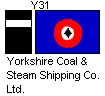
The funnel and flag appear in Lloyd’s, Griffin and Reed; no verbal design is supplied.
Alexander Meek formed the concern in 1873 to carry Yorkshire coal to Germany, although the source’s history heading gives 1875. It also carried general cargo. Following Meek’s death in 1894, its steamers and those of Humber Steam Shipping were amalgamated with Goole Steam Shipping. The company was subsequently revived; H.W. & C.M. Ezard became managers, and operations continued into the 1920s. Edwin Hunter, built for Goole & West Riding in 1914, passed to Yorkshire Coal & Steam Shipping in 1918 and was sold in 1926.
United Kingdom, Goole.
YOSHIDA SABUROUYEMON.
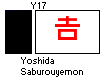
The flag comes from a 1902 chart published in Fune to Hata in 1994 under Yoshida Saburoemon. The funnel comes from a 1903 chart using Yoshida Saburouyemon.
YUNG TA NAVIGATION CO. LTD.
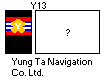
The company funnel, noted on Tung Ching in October 1965, is yellow or buff with a broad white band edged blue above and red below, bearing red YT.
Documentary images — company attribution uncertain
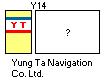
Tung Ming’s funnel is black with a broad blue band carrying a narrow blue-white-blue triband. Overall is a yellow five-petalled heraldic rose charged with a white Y. Rosanoski considers it apparently a charterer’s funnel.
Charterer identity unknown.
Yung Ta is recorded in Lloyd’s from 1966–1967 through 1985–1986.
Taiwan, Taipei.
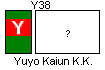
Yuyo Kaiun K.K. (1)
YUYO KAIUN K.K. (1)
Japan, Osaka.
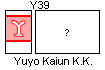
YUYO KAIUN K.K. (2)
Japan, Tokyo.
YUYO KAIUN K.K. (3).
Mitchell’s two funnel portrayals are unclear. His line drawings of Yuyo Maru and Yuyo Maru No. 2 show yellow funnels with red bands, presumed to bear a white Y.
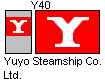
The house flag is red with a characteristic white serifed Y. It appears in the website logo and a bow photograph of Freia Spring, with a funnel detail of Freja Breeze. Eugene Ipavec’s FOTW image uses dark red, for reasons Rosanoski could not establish. Y40’s funnel follows Yuhsho’s 30 July 2007 photograph; that vessel also appears to fly the flag in the 2007 view and a Port Botany photograph of 30 March 2011.
The third account traces the business to Morita Kisen, established in Osaka on 25 June 1948. It joined the Yamashita-Shinnihon group in May 1964 during government consolidation, moved to Tokyo in October 1966, and established Tokyo Kinkai Yuso in October 1969. The name became Yuyo Steamship in July 1970, although Lloyd’s still used Morita Kisen in 1973–1974. Chemical transport began in April 1982; Nippon Oil Tanker became the largest shareholder in March 1991, and headquarters moved to Yokohama in November 1997. Later registers place it under Navix and then Mitsui O.S.K. before again listing it independently.
A merger with Nissho Shipping was agreed for 1 April 2012. Both belonged to the JX Group: JX Tanker held 38.7 per cent of Yuyo and JX Nippon Oil & Energy held 71.7 per cent of Nissho. The announcement says one company would be absorbed into the other without specifying the surviving identity in this account.
Japan, Tokyo; later Yokohama.
Yuyo Kaiun K.K. (1) and (2)
The Osaka concern recorded in 1973–1974 appears to be combined with the Tokyo Yuyo Steamship listing by 1978–1979; the document retains these as its first two identities.
Keep the explicit scope label independent; no alias or company identity is inferred.