D&S MARINE SERVICE LLC.
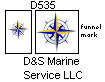
The funnel illustration and logo follow a portside photograph of Anna Michael dated 15 May 2013.
The company operated from at least 2005, with Sylvia LeBoeuf.
USA, Houma LA; formerly recorded at West Creek NJ.
The funnel illustration and logo follow a portside photograph of Anna Michael dated 15 May 2013.
The company operated from at least 2005, with Sylvia LeBoeuf.
USA, Houma LA; formerly recorded at West Creek NJ.
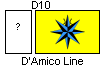
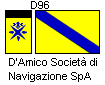
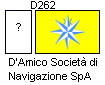
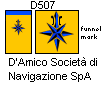
The yellow design has a black-and-light-blue compass-card emblem with projecting ornaments above it. It appears in a 1977 advertisement and as a website logo; the apparent grey border in the advertisement may be artistic licence. Rosanoski questions whether it was an actual sea flag, a shore flag or only a logo. Brown instead records a yellow flag with a narrow blue bend.
The funnel was recorded on Giovanella d’Amico in March 1963 and Marinella d’Amico in August 1964. A Medi Baltimore photograph confirms the emblem: star points and upper design are divided black or dark blue and deep sky blue, with the narrow upper pieces black or dark blue. Mitchell supplies no detailed rendering.
Photographs of High Endeavour and High Peace document this funnel. Some tops are black, as on Medi Sydney. Star colours vary: Cielo di Milano appears light and dark blue rather than blue and black, unless the photograph’s colours have been altered.
Ciro, Salvatore and Antonio d’Amico left Fratelli d’Amico Armatori to establish d’Amico Società di Navigazione in 1952, though Lloyds gives 1951. It developed as a shipping holding group with related navigation services, including Telemar and Sirius Ship Management. The source also lists Italia Line as an alias. The tanker-focused d’Amico International Shipping was listed in Milan in 2007.
The operating structure included d’Amico Dry, formed in 2002 from Medimax’s bulk and dry-cargo activities; Navimed, formed in October 2002 from SIUS; and the Medbulk service, inaugurated in 1993. It included d’Amico International and Luxembourg holding interests, shipping companies in Singapore and the UK, a German ship-management company formed in 2005, and d’Amico Shipping Italia formed in 2007. Ishima, founded in Singapore in July 2005, takes its name from International Ship Management. Italia di Navigazione was sold to CP Ships in August 2002. Seabright held an interest in Anglo Canadian Shipping.
The Irish d’Amico Tankers business was wholly owned by Luxembourg-based d’Amico International Shipping. A 2005 alliance with Glencore/ST Shipping traded vessels under the Glenda Management brand, with Glenda International Shipping formed as a shipowning venture in 2007. The source also gives a Dublin incorporation for Glenda International Management on 19 January 2004 and a Singapore management listing, which are retained as differing records.
Vessels were held through name companies. The website describes Anthony and Paul Maritime as bareboat charterers of Cielo di Parma and Cielo di Singapore, while Lloyds identifies them as owners under Cogema. Santa Monica Shipping and Cielo di Genova also appear under Cogema. These ownership and chartering descriptions are not silently reconciled.
Other interests included Adrianavit Sud, Telemar, Cogema, Med Pacific Express with Italia di Navigazione, Ocean Crew Management, Sirius Ship Management and SIUS with its Madeira business. Mida Maritime was formed in 2005 with Mitsui, with holdings of 51% and 49%. Fleet names commonly ended in d’Amico or began with Cielo, later also High.
Italy, Rome.
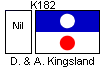
The flag is divided horizontally blue over white, with a white disc on blue and a red disc on white.
The Kingsland brothers operated the Empire Line between New York and Liverpool and the Third Line of New Orleans Packets from at least 1846, entering the China trade by 1851. Mystic Seaport also records the Liverpool service of D. & A. Kingsland & Sutton in 1840. America was built for Empire in 1846 and advertised under the Third Line in 1847; its 1859 Brigham Line appearance did not seem connected to Kingsland. The source also notes Liverpool sailings as Black Star Line.
USA, New York.
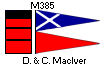
The livery was also used by British & North American Royal Mail Steam Navigation. LJC gives it under David MacIver & Co., while Griffin 1895 separates the companies and their liveries. Loughran draws wider funnel bands.
The names apparently refer to David and Charles MacIver, involved in forming British & North American Royal Mail Steam Navigation, the Cunard forerunner. Loughran identifies them as predecessors of David MacIver, Sons & Co.
UK, Liverpool.
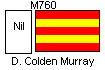
The flag follows Mystic Seaport’s private-signal record 4.1.4.
D. Colden Murray operated sailing ships. The namesake bark was reported arriving at New York in the New York Times of 3 April 1862, having left Nantes on 8 February.
USA, New York.
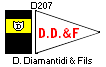
Russia, Taganrog.
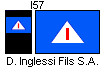
The funnel also appears on associated ships care of Frinton Shipbrokers, including Alberta and Heracles. The US Navy reference assigns the livery to Navigation de Samos and shows light blue, which Rosanoski regards as probably correct, noting its later use on Samos Steamship funnels.
The Inglessis family of Samos moved from a winery, cigar factory and tanneries into tramp and coastal shipping. The company account dates its foundation to 1875 and first passenger steamer to 1900, with a switch to cargo vessels in 1945. After wartime losses the family resumed operations at Piraeus. The brothers moved to London in 1954 and founded Frinton Shipbrokers, with the third generation entering the business.
The family joined the Pegasus Ocean Services consortium in 1963, placing the fleet under its control while continuing some independent purchases. Disagreement over Pegasus led Stamatis H., Nikos G. and Antonis D. Inglessis back to Greece in 1991 to found Samos Steamship. Earlier register interests included Navigation de Samos and Vesta Maritime; the last ship in the older Navigation de Samos listing, Samos, was broken up in 1968.
Greece, Samos and Piraeus.
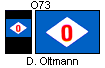
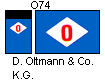
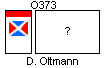
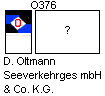
Brown 1982’s notes say that some vessels had adopted this funnel. The FOTW flag follows Brown 1995.
Mitchell assigns this funnel to D. Oltmann of Brake.
Mitchell assigns it to Roland von Bremen, listed under D. Oltmann Seeverkehrges mbH & Co. K.G. in 1985–86.
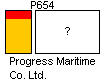
Mitchell gives this funnel for Progress Maritime of Limassol without naming a vessel; Rosanoski found no further company information.
Mitchell’s Oltmann card also shows Ceylon Shipping and Ohlrogge funnels without explaining the connections. A 2013 company photograph shows the logo on a superstructure panel of an unnamed chartered vessel, presumably retaining its charterer’s funnel.
Lloyd’s gives a 1923 foundation, amended in 2005 to 1871. By 1978–79 the fleet was divided between Brake and Bremen. Two companies, D. Oltmann Seeschiffahrt and Reederei D. Oltmann, were liquidated in 2005, while D. Oltmann GmbH & Co. continued; the 2013 website calls it D. Oltmann Reederei GmbH & Co. K.G.
Associated interests included Bremer Seebäderdienst and a transocean passenger service established on 19 January 1954, later known as Transocean Tours. Schlüssel Reederei was recorded with D. Oltmann in its name in the 1950s, but the precise connection is uncertain, possibly management or agency. One of Schlüssel’s founders, Herbert Drewes, is recorded as owner of D. Oltmann Seeschiffahrt in 2000.
Germany, Brake and Bremen.
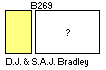
The funnel is yellow or buff. No flag is given.
The exact D.J. & S.A.J. partnership and claimed 1935 formation/1953 renaming are not established by the returned evidence, which also names D.J. Bradley and D.J. Bradley Jr. Keep the partnership's identity under review rather than merge it automatically with later management.
The business was formed in 1935 and renamed Thomas Watson (Shipping) in 1953. D.J. Bradley continued as manager for that company in the 1958–74 records. Fleet names began with “Lady”, followed by a name beginning with “S”.
U.K., Rochester.
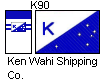
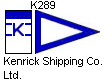
The initial flag was a white pennant with a blue border.
The later flag is a diagonal white-and-blue biband with a blue K on white. In the blue fly is a white Southern Cross of four larger seven-pointed stars and one smaller five-pointed star; a larger white seven-pointed Commonwealth Star occupies the blue hoist. Despite the New Zealand company identity, these are the Australian stars. Rosanoski presumes that they represent the trans-Tasman area of operation.
D. M. Kenrick formed Kenrick Shipping Co. in 1954 to operate Ken Wahi on the trans-Tasman trade. After one voyage the business was reconstituted as Ken Wahi Shipping Co. in the same year, but the venture remained unsuccessful and the vessel was sold in 1955.
New Zealand, Wellington.
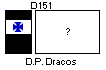
Panagiotis D carried a black funnel with a broad white band bearing a blue cross paty.
D.P. Dracos is listed in 1958–59 and 1963–64, with Jason Shipping & Trading Corporation and later Victoria Steamship as agents.
U.K., London.
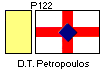
The funnel is yellow or buff. The white flag has a red cross charged wholly at the fesse point with a blue diamond.
Greece, Athens.
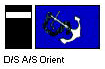
The funnel is black with a white band. The flag is blue with a white foul anchor set at an angle, recorded as “Pbd”.
Orient began acquiring Norden shares in 1946 under an agreed arrangement and held a majority by about 1955. Motortramp in turn held the majority of Orient. In the 1994 merger, Orient continued as the operating company but adopted the name Dampskibsselskabet Norden A/S.
Denmark.
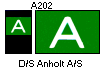
The flag is green with a white “A”. The funnel is black with a green band bearing a white “A”.
Do not conflate Rederiet Anholt, D/S Anholt and the later Liberian Anholt Shipping Corporation. The Torm ownership statement and exact historical identity require confirmation.
Owned by Torm Shipping Co., D/S Anholt ceased operations in 1963.
Denmark, Copenhagen.
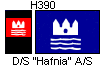
The earlier Hafnia was acquired by D/S Norden in 1921. Most vessels listed under its name in 1917–18 had been owned from new by P.L. Fisker and were probably acquired when that concern’s shipping operations entered liquidation in 1910. Finlandia, however, is recorded as acquired and renamed by P. Brown Jr. in 1912. P. Brown operated Hafnia, whose vessels used the suffix ia.
Denmark, Copenhagen.
Keep the explicit scope label independent; no alias or company identity is inferred.
Livery for the period of Christensen’s operation is recorded under that company; what followed is unclear.
The later Hafnia appears to have been a T.C. Christensen subsidiary, with its two 1942 vessels attributed to Christensen. Later continuity and the change of domicile leave the relationship unclear. In 1966–67 part of the former fleet was under Hafnia and the rest under D/S A/S Hafnia Odense Möbel-og Taeppelager & Nytorv Möbel-og Taeppelager, Ålborg A/S at Frederikshavn. In 1970–71 the name appears as D/S A/S Hafnia Partrederi. Vessel names used the suffix sund.
Denmark: Copenhagen, later Skoelskör.
Keep the explicit scope label independent; no alias or company identity is inferred.
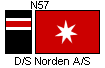
Sources also assign this livery to Peter Brown or P. Brown Jnr & Co., Norden’s operators, but Rosanoski identifies the flag with Norden. Company photographs show a plain red flag with a star. Star proportions vary, squat in Brown and much slimmer in Nüsse; Rosanoski takes colour and size from the website. The black funnel has a red band edged by narrow white stripes. Brown 1995 makes the band unusually broad, while Nord Sound and Nordeuropa photographs support the earlier, more normal proportions.
Gutterman’s blue-white-red-white-blue flag description, with an eight-pointed star and approximate 3:1:6:1:3 stripes, is questioned by Rosanoski: he thinks a combined flag-and-funnel name logo was mistaken for a flag. Andersen rejects a suggested Maersk connection, pointing to Norden’s earlier foundation. Rosanoski also rejects the Helsingoeske flag assigned in Lloyd Reedereiflaggen and distinguishes Brown’s probable own red flag with white B from the flags of companies it operated.
Mads Christian Holm founded Norden on 11 February 1871 and managed it until his death in 1892; he also founded Helsingør Shipyard in 1881. Norden acquired Danmark in 1917 and Hafnia in 1921. Orient began buying Norden shares by agreement in 1946 and held a majority about 1955, with Motortramp controlling Orient. Their 1994 merger retained Orient as the operating company under the Norden name. Norden ceased to be Motortramp’s operating company in 2000 and no longer had a majority shareholder.
Norden Shipping (Singapore) was formed in 2007. With Interorient, Norden established Norient Product Pool, operating from January 2005, then Handy Bulker and Post-Panamax Bulker pools in 2009 and 2010. Ships generally used Nord-prefixed names.
Denmark, Copenhagen; headquarters moved to Hellerup on 8 June 2008.
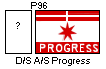
The flag and its shades follow Josef Nüsse’s website. Rosanoski notes that the modern company altered it slightly, but the adoption date and its use by Progress Ugland are unknown.
The company is dated to 1904 and presumed to be the D/S A/S Progress formerly associated with Marius Nielsen & Söhn, whose livery it used. Around 1960 O. Amsinck appears as operator from the same address, disappearing from the records by the early 1970s. Shipowning seems to have ceased in the later 1980s, before D/S Progress reappears in the late 1990s. It managed Seaheron, a Freja-Gruppen subsidiary, and operated through Progress Ugland, a joint venture with Ugland International Holdings formed around 1999.
Ole Andersen rejected a suggested Maersk connection and reported an apparent failure in summer 2000, followed by an unsuccessful proposed management buy-out. Rosanoski nevertheless found continuing Lloyds entries through Progress Ugland, while stressing that the continuity of company identity was assumed.
Denmark, Copenhagen.



Talbot-Booth’s V244 has dots after the letters in Merchant Ships 1942 and 1944. These sources specify blue without expressly calling it light blue.
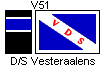
James Dignan’s V51 comes from Sampson’s Dumpy Book, which likewise does not specify light blue. Brown 1958 shows the same version.
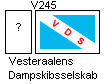
V245 represents an actual flag exhibited in Hamburg: celestial blue, edged white, with a white diagonal ribbon bearing red VDS. Schneider’s observation gives evidence for the later sky-blue shade.
Skipet’s five variants are V247, a dark-blue swallowtail with white VDS; V248, a square dark-blue flag with a white border and a white diagonal from the upper hoist bearing red VDS; V251, dark blue with a white diagonal and red VDS; V249, sky blue with a white border and diagonal, bearing sky-blue VDS separated by sky-blue dots; and V250, sky blue with a white border and diagonal bearing red VDS. No dates are assigned to the sequence.
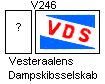
Norske Rederiflagg 1952 supports the last Skipet pattern, but with a wider white band, represented by V246.
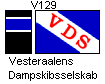
V129, from Brown 1951 and 1982 and Stewart 1963, is blue without a border and has a wider white diagonal band.
Sources vary in blue shade, white borders, diagonal-band width and endpoints, lettering, dots and proportions. Skipet gives five undated flags and depicts a light-blue funnel band throughout; Rosanoski cautions that darker flag portrayals may reflect other publications rather than established changes. Black-and-white photographs support the funnel design but cannot resolve its blue shade.
Richard With founded the company on 10 November 1881. Its Vesterålen sailing on 2 July 1893 from Trondhein to Hammerfest began the Hurtigruten service, later associated with the Bergen–Kirkenes coastal route. In 1987 it merged with A/S Ofotens D/S to form Ofotens og Vesteraalens Dampskibsselskab ASA, or OVDS.
Norway, Stokmarknes.
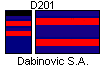
The flag has five horizontal blue and red stripes in approximate proportions 1:1:2:1:1. A Kumbor photograph dated 24 February 2014 supports the funnel but with only a narrow black top. Mitchell omits the black top and uses a lighter sky blue.
Dabinovic was formed in 1956. Its major operating company, Dabinovic (Monaco) SAM, began as Bozo A. Dabinovic and changed its name in 1983; it is listed as managers in 2011–12.
Switzerland, Geneva.
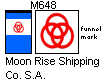
The funnel follows starboard Yomoshio and portside African Ibis photographs dated 14 July 2007 and 30 July 2008. It also appears on Moon Rise’s African Kingfisher under Misuga management. Rosanoski distinguishes it from Misuga’s logo and tentatively associates it with Moon Rise or its underlying Japanese/Korean interests. Mitchell had attributed the same marking to Nagashiki Kisen from Jupiter Island, for which Nagashiki acted as agent. The companies may be related and share it, but the appropriate attribution is not established.
Moon Rise, Nagashiki and manager relationships do not prove shared corporate use.
Dae Ah managed Mutsushio for Moon Rise Shipping from delivery on 24 January 2002, although Lloyds then placed Moon Rise under Nagashiki Shipping. Later records likewise list Dae Ah as manager for Moon Rise and other companies. The underlying ownership relationship is unclear.
South Korea, Busan.
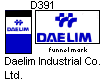
The funnel follows photographs of DL Sunflower dated 11 January 2010 and Hongbo at Sydney on 27 September 2010. Hongbo is presumed to be a charter under Daelim management through DL Shipping.
Daelim Industrial was formed on 1 October 1939 and is described as originally a tug owner. Daelim Corporation is dated October 1994 on the website, but 2003 in Lloyds; it acquired Hallim Transportation in November 2001 and launched its first vessels in October 2003. It merged with Daelim H&L in November 2008. DL Shipping was formed on 31 March 2005 and began business on 1 May, based at Pusan/Busan.
South Korea, Seoul.
The funnel follows a starboard photograph of the chartered Oriental Harmony dated 26 January 2013.
Daewoo Logistics separated from the Daewoo Logistics Team through an employee buyout in 1999. It was listed as an international shipping agency and freight forwarder in 2000, when it established Korea Merchant Marine. In 2004 it registered as an ocean-going Korean-flag general carrier, including car, tanker and cement services. Lloyds lists it as managers in 2011–12.
South Korea, Seoul.
Helena’s port-side photograph of 11 September 2005 and starboard photograph of 3 August 2004 show mirrored markings, facing forward on both sides.
The company was formed in 1978 and run by a husband-and-wife partnership. The operating subsidiary Engström Shipping was established at Lysekil in 1991. Registers record both ownership and management roles.
Sweden, Lysekil.
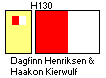
H130 is reconstructed from the brief funnel description in The Worlds Merchant Fleets 1939. It shows a yellow or buff funnel with a panel of the vertically red-and-white flag. These colours apparently continued with Henriksens Rederi, although sources disagree on their order.
The business operated as D/S A/S Henriksen & Kierwulf, subsequently becoming Dagfin Henriksen or Henriksens Rederi A/S.
Norway, Oslo.
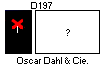
Listed as Oscar Dahl & Cie. in 1953–54 and 1958–59, the business appears as Dahl & Cie. from 1963–64 through 1985–86. Merchant Ships suggests a possible connection with A/S Thor Dahl.
France, La Rochelle.
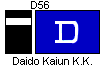
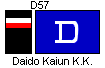
Rosanoski considers this funnel apparently incorrect.
Known as Daido Line, Daido Shipping or United Ocean Transport, the company was formed in 1930 but did not own ships until about 1936. It merged with Nitto Shosen on 1 January 1964 to form Japan Line.
Japan, Kobe.
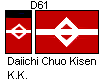
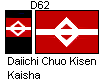
The livery is attributed to Daiichi Chuo and its Liberian subsidiaries. D62 was recorded on Peking Maru in February 1963 and confirmed by NJK as the correct funnel. Later photographs show Bright Nextage at Wellington on 17 January 2005 and Dream Ocean on 16 February 2014. The flag follows the company website.
Alan Watt explains the reported red funnel base as partial sightings that hid a black base. Nevertheless, the JSA chart and Japanese funnel website show that version without a black top.
Mitchell’s yellow design on the funnel band is considered incorrect; the design should be white.
Japan, Kobe; later Tokyo.
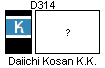
Mitchell appears to base this funnel on Tomei Maru, with an accompanying line drawing and the source notation “491/1965”.
Daiichi Kosan was established in September 1963 according to the website, while Lloyds gives 1971. Later directory changes of address and identifier are assumed to concern the same company.
Japan, Tokyo.
First Marine Service is variously dated January 1963 or January 1965. The later account traces it to Daiichi Chuo Sobi, formed in Osaka in 1965 and renamed First Marine Service in June 1975; Lloyds instead names Daiichi Hakuyo Sobi as the predecessor. It merged with Yaesu Kaiun in July 2010 and became Daiichi Chuo Marine in October. The Kosan section also lists Toa Shoji among operating companies, but the overlapping Kosan/Kosen/First Marine records are not fully clear.
Keep the explicit scope label independent; no alias or company identity is inferred.
Daiichi Chuo, also called The First Central Shipping Co., was formed by merging Daiichi Kisen and Chuo Kisen on 10 October 1960, with origins dated to 1933. The head office moved from Kobe to Tokyo in June 1964.
The source notes that the company websites did not mention a Mitsui O.S.K. connection, although Lloyds listed the business under Mitsui and later named Mitsui O.S.K. among major shareholders alongside Sumitomo interests.
The group included Daiichi Kosan, Daiichi Senpaku, First Marine Service, Fuso Senpaku, Izumi Kisen and Koyo. Overseas companies were established in Singapore in June 1966, New York in December 1970 and the UK in March 1998. Other affiliates included Apollo Shipping, Daiichi Chuo Systems, Hoei Shipping, Kashima Jitsugyo and Yaesu Kaiun.
Maranaw Luzon Shipping was a Manila joint venture dated November 1975, although Lloyds later gives 1984 and places it under First Marine Service. A reported 10% Hunter Towage holding is only assumed to belong to this company because of the similar name.
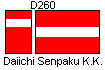
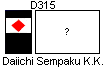
The flag and funnel appear on the company website. Asano Exelsior’s funnel is presumed to be another company’s colours, probably the affiliated Daiichi Chuo Kisen, rather than a separately established Daiichi Senpaku scheme.
Daiichi Senpaku was formed at Kobe on 1 October 1958, mainly for cement shipments. A trade-name change is recorded in March 1961, and the business moved to Osaka in April 1978. It appears under Mitsui O.S.K. in 1998 and Daiichi Chuo Kisen in 2008, with joint-venture interests. Rosanoski is unsure whether the early Daiichi Sempaku entries refer to the same company.
Japan, Kobe; later Osaka.
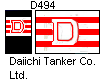
The funnel follows a Sulphur Genesis photograph dated 23 June 2012. The flag is based on the website logo; its D apparently lacks the white edging separating it from the red bands on the funnel.
Formed on 30 May 1961 in Shinbashi, Daiichi Tanker launched its first tanker, Sankei Maru, that September. Associates included Daiichi Marine from April 1985, Panama-based DT Chemicam from December 1998, and Palm, acquired in September 2004. Daiichi Kaiun, formed in 1986, is listed as an operating company. Mitsui & Co. is recorded as owner.
The Nanjing Yangyang Dongyi Tanker joint venture was formed in 2005 with Daiichi Tanker holding 5%, Nanjing Yangyang Chemical Transport & Trade 51% and Tokyo Marine 44%.
Japan, Kobe; Tokyo.
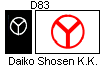
The Y stands for the founder, Yabuki.
Established in 1943 as a joint venture with Yabuki Yamashita, Daiko absorbed Merchant Marine Co. and in 1966 merged with Baba Kisen to become Baba-Daiko Shosen. Yabuki Tei is recorded as representative in 1952.
Japan, Osaka.
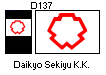
The Kaizo Maru record shows ten extensions, but Alan Watt specifies five cogs. He identifies the emblem as the outlined kanji for Dai, stylised into a mon form.
Japan, Tokyo.
The tanker company’s separate account gives formation in 1953, apparently as Asahi Unyu, rather than the 1957 separation. Part of the fleet appeared under Daikyo Tanker by 1978–79 and all by 1980–81. Alan Watt gives an April 1986 merger into Cosmo Sekiyu, while Lloyds names Cosmo Tanker and prints the date as “1.4.985”.
Japan, Tokyo.
Daikyo Oil was formed in September 1939 by merging eight Niigata refiners and traders. Its tanker operation was separated as Asahi Unyu, or Asahi Oil Transportation, in June 1957 and renamed Daikyo Tanker in August 1966. The refining departments merged into Cosmo Sekiyu in April 1984, with shipping following two years later according to Alan Watt; Lloyds gives 1 April 1986 for the parent merger.
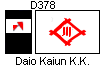
The flag logo comes from the company website. The funnel is based on photographs of the chartered Daio Excelsior, with DAIO PAPER on the hull and the flag logo on the forward superstructure. Its connection with the funnel mark is unclear: that mark is absent from the company and parent websites but appears on owned vessels under Misuga, which apparently has a different flag.
Funnel user unresolved; preserve definite flag attribution separately in the note.
Daio Kaiun undertook land and sea transport and warehousing associated with Daio Paper. One account describes it as part of that group; its own website names Daio Paper as a customer. The website dates establishment to 1 November 1985, while Lloyds gives 1988 as Taio Kaiun and a change to Daio in 1991. The parent paper business began in 1943 as Taio Paper Manufacturing and became Daio Paper in 1990.
Operating companies listed include Jupiter Corporation, formed in Tokyo in 1988, and Misuga Kaiun.
Japan, Iyo-Mishima, the Shikohu office; head office Tokyo.
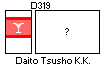
Mitchell’s funnel is probably based on Yuyu Maru, noted in Lloyds 1992–93.
The source’s light-red specification is “266-102-102”, retained as printed rather than silently adjusted.
Oriental Wisteria, the sole vessel listed in 2007, appears in photographs in the colours of associated New Shipping Kaisha.
Also called Daito or Daitoh Trading, the company was formed on 28 August 1947. Maruha is named among its major shareholders and as owner in Lloyds. The shipping records list it as owner or manager at different dates.
Japan, Tokyo.
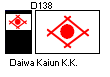
Recorded as Daiwa Navigation on Daiko Maru in July 1965 and Daisei Maru in July 1963, the funnel is black with a broad white band bearing a red circle within a fork-ended diamond frame. The white flag bears the same red symbol.
This Osaka company is recorded in 1963–64 and tentatively identified in 1970–71 by its location. Several companies bore the name.
Japan, Osaka.
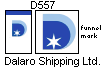
The funnel follows a portside photograph of Sea Prospect dated 5 July 2013. The shipowning affiliate’s website shows vessels in charterers’ colours.
Established in Stockholm in 1981 as Dalarö Oil & Shipping A/B, the company moved its head office to Limassol in 2010. Dalarö Agency remained its general agent in Sweden. The in-house Sea Shipping Holding, formed in 2005, owned and supplied most of its chartered tonnage.
Cyprus, Limassol.
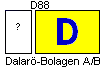
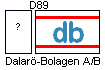

The earlier cap-badge flag is yellow with a dark-blue D. Rosanoski corrected his first rendering, D88, in 2013: the badge actually has a square D, shown in D556.
The later flag is white with two narrow red horizontal bands and lighter-blue db letters between them. The Swedish Cap Badges site also shows a slightly different version of this second design.
Sture Persson formed Dalarö Rederi A/B, apparently beginning with Sinbad, built in 1949. Lloyds records it under Persson in the 1950s and as Dalarö-Bolagen under Ingmar Matsgård by 1963–64. A website instead describes development into DB Tankers specialising in chemicals. The later management listings appear to concern related vessels, but common ownership is only presumed. Trading appears to have ended in the mid-1970s.
Sweden, Stockholm.
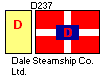
Managed by Lucas & Co., Dale operated colliers in Australian waters from 1896 to 1899.
U.K., Bristol.
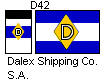
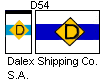
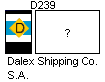
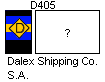
Mitchell presents this as the main, presumably first, funnel.
The funnel follows Constantinopuolis on 25 July 2006. Blue shades vary: Marabou appears darker in October 2013, though less dark than the flag, and has no black top. Mitchell’s second funnel uses darker blue; Nüsse’s newer table-flag image uses a softer sky blue.
The funnel follows Polyhronis on 19 July 2005.
Mitchell records a funnel without black top and with the diamond wholly inside the blue band for Emil of Aeolian Maritime in 1977–79, associated with Dalex Ship Management. Lloyds instead lists Armada Marine. The vessel had previously been Largo of Sounion under Dalex agency, so Rosanoski suggests either unchanged markings or a widened band enclosing the diamond.
Conbulk does not appear to use its own livery; the ships are in charterers’ colours.
George Dalacouras formed Dalex in 1968 according to the website, or 1969 according to Lloyds. His sons later participated in the business, with Vassilis and Michalis listed as directors in 2013. The group included Dalex Shipping, Dalex Brokers and Zenith Travel; Mitchell associates it with J. Dalacouras.
Dimitris Dalacouras established Conbulk with George Bamiotis in 2004. Lloyds also dates Conbulk to 2004, while another source gives a Liberian incorporation in October 1986. Conbulk is recorded as technical manager for Palmosa vessels. Rota Shipping, formed in 1996, also appears as an operating company before disappearing from that listing in 2005.
Greece, Piraeus.
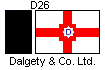
The blue D in this livery differs from that on the agency flag.
Dalgety’s Australasian operations dated from 1858. The English joint-stock company was incorporated on 29 April 1884 by consolidating existing firms. Dalgety London took over London operations in 1956–57. The 1961 merger with New Zealand Loan & Mercantile Agency formed Dalgety & New Zealand Loan; reorganisation in 1970 produced Dalgety Ltd. with locally incorporated trading businesses. Later Australian changes led to Dalgetys Farmers in 1983 and LFD under ANZ in 1993, with pastoral interests sold to Wesfarmers.
Primarily a shipping agency, Dalgety also operated steam tenders and Kintore on the Australian coast from 1903 to 1930. It participated in Yarra Shipping Agencies with Burns, Philp. Burns, Philp’s takeover of the shipping-agency operations was announced on 10 June 1993.
UK, London.
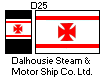
The funnel is black with a broad band of the flag.
The white flag has two narrow red horizontal bands near the top and bottom, with a red cross paty between them.
The company is indicated as formed about 1939.
U.K., London.
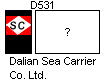
The funnel follows Seiyo Goddess, photographed from the port side at Singapore on 11 June 2011. Its lettering is black, unlike the blue lettering in the company logo.
The company website traces the business to Dalian Sea Carrier Shipping Agency Ltd. in 1999, renamed Dalian Sea Carrier Co. Ltd. in May 2003. Rosanoski gives the Chinese-name translation as “Dalian Kai Ship Management Cop. Ltd.” Its activities include shipping and management, chartering, ship construction and trading. Lloyds first gives formation in 2000, later amended to 1998. It lists the company as a major operator in the Chinese government fleet in 2008 and as managers only in 2011–12.
China, Dalian.
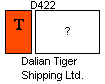
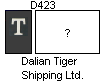
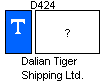
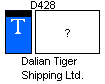
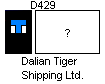
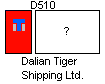
Eastern Star belonged to Eastern Shipping (HK) Co. Ltd., a one-ship minor operating company in Hong Kong. The funnel colour may be a reddish air/sea rescue shade; Rosanoski compares it with the later D510 illustration.
Hope Star belonged to Hope Star Shipping (HK) Co. Ltd. The funnel base appears dark grey but could be black.
This funnel follows Oriental River of Oriental River Shipping S.A., photographed on 19 September 2008.
Silver River of Silver River Marine S.A., photographed on 31 December 2009, has a black funnel top and a narrower top to the T than D424. Rosanoski considers the lettering difference probably insignificant: apart from the black top, this was the only pair of vessels he found with essentially the same funnel.
The funnel follows Ocean Star of Tiger Marine Ltd., photographed on 22 June 2010.
Eastern Star, photographed from the port side at Lyttleton on 21 October 2011, shows a different funnel from D422. The red still appears to be an air/sea rescue shade, similar to the lifeboat, suggesting that D422 should also have a similar shade.
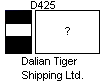
Pac Star was photographed on 29 July 2005 while in the IHC Pool. It is unclear whose colours the funnel represents.
Owner, manager or charterer paint identity unresolved.
Lloyds initially dates formation to 2000, amended to 1999 in 2005. Another account calls it a private limited company formed in January, with Rosanoski tentatively supplying 1999. Lloyds lists it as a major operator in the Chinese government fleet in 2003, later with vessels under its own name and minor operating or vessel-owning companies, and as managers only in 2011–12.
China, Dalian.
The flag is dull blue with a white logo in the centre: the outline of a shield containing an anchor, displayed horizontally.
A photograph of a TESO passenger ferry on its journey to Constanta showed a blue flag with DAMEN in white. Rosanoski expected the lettering to have breaks like the website logo and possibly different proportions; these details were not confirmed.
Damen Marine Services’ flag is described in Duwvaart as yellow with the Damen emblem in black. The book’s black-and-white illustration stretches the emblem into a rectangular shape.
No exclusive fleet-wide use or unrecorded corporate equivalence is asserted.
A model of a new tug range in a Damen magazine showed the D439 design on its funnel. Rosanoski found no evidence of an actual tug owned under the Damen name, so its use as a company funnel remained unestablished.
The Damen brothers established the business in 1927. Jan’s son Kommer later became chairman. Rosanoski tentatively identifies its predecessor as Scheepswerf Gebr. Damen of Hardinxveld-Gissendsam, listed in Wyt’s Digest in 1960.
Damen Marine Services B.V., based in Hardinxveld-Giessendam, developed from workboat chartering begun in the early 1960s, with a Marine Service Division formed in 1974. Its specialities include assistance at dredging, civil engineering and offshore sites. The group’s listed subsidiaries include Koninklijke Matschappij de Schelde, with Bodewes Binnenvaart N.V. an associate.
Netherlands: Hoogezand, Bergum & Gonnchem; Gorinchem on the company website.
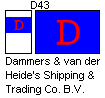
Mitchell’s funnel has a narrow black top and an apparently orangy-red letter. The FOTW flag follows Brown 1995.
Later Seatrade use and related-company variants are not inferred.
After the acquisition the ships appear to have used Seatrade livery.
I. Dammers founded Dammers & van der Heide’s Shipping & Trading Co. B.V., which became a large independent reefer operator. In 1972 it acquired Belgian Fruit Lines through N.V. Holding un Beleggingsmij Oceanica. After Dammers died late in 1988, his heirs invited bids for the company and its 18 ships; Seatrade Groningen acquired it in 1989.
Dammers & van der Heide Shipping & Trading (Antilles) Inc. was established in Curacao in 1964 as a general ship agent, manager and broker. It became Dammers Shipagencies Inc. on 27 December 2006, within the Dammers Group. Separate group companies included Dammers Shipmanagement Inc. for financial and fiscal ship management, Dammers Seamanagement Services Inc. for projects and liner agency, and Curline Inc. and Sealine Inc. as liner agents.
The fleet listings changed over time: smaller and older Antilles vessels were disposed of in 1980–81, larger vessels were included with the Rotterdam fleet in 1985–86, and both companies appeared again with divided fleets in 1996–97. Rosanoski understands the late-1980s Seatrade acquisition to have included the parent, with vessels entering Seatrade’s fleet or Dammers Ship Management N.V., formed in Curacao in 1994. That company remained listed as a Seatrade operating company and later as managers only.
Netherlands, Rotterdam; Curacao, Dutch West Indies [Netherlands Antilles].
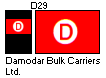
Mitchell shows a black D.
Formed in 1966, Damodar Bulk Carriers closed during 1996. Its chairman was then also managing director of V.M. Salgaocar & Brother Pvt. Ltd. The listed fleet interests included that firm, Salgaocar Engineers Pvte Ltd. and Salgaocar Shipping Co. Pvt. Ltd. Vessel names began with Damodar, replaced by Vishal for acquisitions from 1994.
India, Bombay.
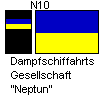
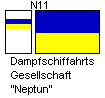
The Neptun flag is horizontally blue over yellow. Sloman’s flag replaced it after the takeover, while the N10 funnel continued with a version of Robert Sloman’s flag bearing five-pointed stars.
Nüsse initially attributed the Neptun flag to the successor before correcting it back. His earlier proportions are 5:3, changed on the newer website to 1.2:1.
Neptun was formed in 1873. It was associated with Norddeutscher Lloyd and participated in the Unigas International pool. Merchant Ships 1949 lists services as suspended, but Lloyds records ownership and operation again in 1953–54. Sloman bought 75% in 1973; the change to Sloman Neptun Schiffahrts-Aktiengesellschaft is dated both 1973 and 1974.
Germany, Bremen.
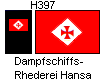
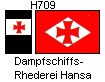
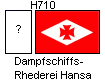
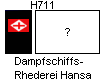
This reconstruction follows a verbal description which specifies only a red cross. An Iron Cross was used as a guess, not as an established detail.
The flag is red with a white lozenge containing a red cross patty. Rosanoski notes that Schneider’s H710 elongates the diamond and reduces the cross relative to the cited source, which should resemble H709.
The funnel panel is described as a representation of a red flag with a white lozenge containing a red cross.
Registered in 1881 by Hamburg merchants and shipowners including Carl Laeisz and August Bolten, Hansa began its Hamburg–Antwerp–Quebec service in August 1883. It cooperated with Canadian Pacific Railway to offer passage and onward rail travel through Canada to the United States. Hamburg America bought its fleet and goodwill in March 1892, renaming the ships but retaining the Hansa Line name for the Quebec–Montreal service. Advertised trade names in 1893 included Brazilian Mail Service, changed within days to Hamburg, Antwerp & Havre Mail Service. This Hamburg concern is distinct from Deutsche Dampfschiffahrts-Gesellschaft Hansa of Bremen.
Germany, Hamburg.
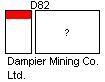
The same funnel is given for Cliffs Robe River Iron Associates Pty. Ltd., represented separately as C1095.
Dampier Mining operated tugs and later became BHP Minerals. Lloyds lists it in 1978–79 and 1988–89; the 1973–74 tug listing is under its associate Cliffs Robe River Iron Associates Pty. Ltd.
Australia, Melbourne.
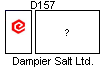
This emblem is recorded for Norma M, sold in the mid-1970s but not located in Lloyds. It is the emblem of Comalco, a wholly owned Rio Tinto subsidiary renamed Rio Tinto Aluminium on 6 November 2006. Rosanoski uses that link to explain the emblem and supposes that the P&O involvement came later.
Dated company use and shared adoption remain unknown.
Dampier Salt was registered on 8 November 1967 and made its first shipment to Japan in April 1972. Rio Tinto held 64.9% of the shares in the account consulted in 2006.
The tug-owning history has conflicting dates and names. The Log records a change from Texada Mines Pty. Ltd. to Dampier Salt (Operations) Pty. Ltd. on 26 April 1979, and the sale of Quobba in November 1987 to Mermaid Marine Charters, which renamed her Mermaid Warrior in January 1988. Lloyds nevertheless continues to list Quobba under Dampier Salt until at least March 1998, gives a formation date of 1984 and later places the company under P&O towage and shipping interests.
Australia, Subiaco; later Perth.
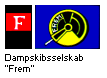
The black funnel has a broad red band bearing a white F. The blue flag has a yellow circle containing a black ship’s telegraph, with the white word FREM replacing the letter commands.
Denmark, Copenhagen.
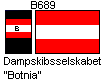
Botnia was liquidated in 1912, with its ships acquired by A/S D/S Torm.
Denmark, Copenhagen.
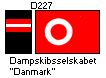
Lloyds 1904 shows the O centred on the flag.
Peter Brown (P. Brown Jnr. & Co.) was listed as operator in 1912. D/S Norden A/S acquired Danmark in 1917.
Denmark, Copenhagen.
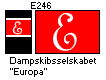
Europa appears in Lloyds’ 1937–38 telegraphic-address list.
Denmark, Copenhagen.
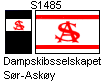
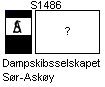
Skipet supplies S1485’s funnel and flag; Steamers of the Fjords supplies the S1486 funnel. The original provides no verbal comparison of the variants.
Formally constituted on 21 June 1924, the company merged into Rutelaget Askóy-Bergen A/S in 1950.
Norway, Bergen.
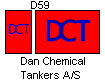
A photograph of Danchem East on 1 August 2005 confirms this funnel, though the touching letters are thicker and seem separated by narrow dark outlines. A photograph of Dancherm West on 27 May 2007, under Clipper charter with a Clipper flag and the letters painted out on a plain red funnel, shows that the outlines resulted from letters welded to the funnel.
The FOTW flag follows Brown 1995.
Formed in 1991, the company appears as Dan Chem Tankers in Brown 1995. Lloyds lists it as an operating company of BR Marine in 2003 and Fabricius Marine, associated with Erria, in 2006. By April 2007 the last vessel, Danchem East, appears under R/O K/S Neptun 1, formed in 2006 under BR Shipmanagement, also associated with Erria.
Denmark, Copenhagen.
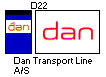
The funnel is blue with a narrow black top and a white band bearing red lower-case dan. An attachment to the top of the d is described as angled “Pbds” back towards the hoist.
The flag is white with red lower-case dan.
Lloyds lists Dan Transport Line as manager for one company in 1980–81.
Denmark, Copenhagen.
The funnel follows Lucas in a photograph taken on 5 June 2010.
Dan-Tug was formed by mariners and divers Klaus Dresler and Klaus Kristensen. Its website listed the tugs Lucas and Mads in 2011. Equasis dates ownership of Lucas from 24 April 2007 and that name from 1 October 2007; Rosanoski did not locate Mads there.
Denmark, Fredericia.
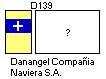
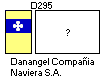
D139 is recorded for Alcibiades in February 1967, associated with Ch. Astras in the Bill Black–NJK collection. Mitchell gives D295 for the same vessel.
Danangel is listed in Lloyds in 1966–67, with P. Wigham Richardson & Co. Ltd. as agents.
U.K., London.
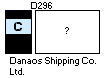
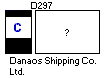
Eagle Quest, in the fleet in the mid-1990s, had a black funnel with a broad light-blue band and what appears to be a black C for Coustas, though a crane partly obscures it and it could be D for Danaos. Roberto C on 20 April 2005 instead has a white band with a definite blue C, apparently a replacement design. The D297 funnel was also noted on Maria C at Sydney on 21 September 2006.
NJK suggested that plain reddish-brown, perhaps dried-blood-coloured funnels on CMA CGM Kalamata and CMA CGM Elbe in June 2004 represented Danaos ownership. Rosanoski disagreed, proposing instead that these colours applied to those ships and CMA CGM Komodo while chartered to CMA CGM for its contribution to the joint Sunda Express (Sundex) service with Norasia and China Shipping. He did not extend that theory to the other partners’ ships.
Dimitris Coustas formed Danaos in 1963. John Coustas later controlled the business and was managing director by 2005; Rosanoski presumes him to be Dimitris’s son. Lloyds first lists Danaos Compañia Naviera S.A. under Kratigos Shipping agency, and later Danaos Shipping Co. Ltd., initially under Roumeli Shipping and subsequently in its own name.
Greece, Piraeus.
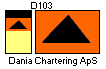
Rosanoski did not use the website illustration’s colour shades, recorded as orange RGB 255,112,86 and black RGB 69,38,58.
Founded in 1972 as Dania Shipping Association A/S, the company took the Dania Chartering name in 1992. It operated for several companies and later acted as manager, with Dania used as the second part of vessel names. Svendborg Enterprise was listed as manager in 1998; by 2000 the sole vessel appeared under that manager’s ownership. Mitchell’s “Husted & Anderson” probably refers to B. Husted-Andersen, whose Suzanne Dania was among the operated vessels.
Denmark, Copenhagen.
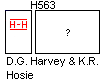
Daniel Gavin Harvey and Keith Richard Hosie operated the trawler Ohau from 1993.
New Zealand, Nelson.
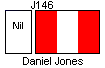
Several associated ships had their own signals: Atlantic, American, Francis, Ganges, Mary and Spartan. A painting of Nantucket signals from 1840–50 assigns this flag to Henry, whereas Nantucket Signals lists Henry as a Daniel Jones vessel without a separate flag.
Daniel Jones was a whaler and agent from 1822 to 1845.
USA, Nantucket.

The flag was white with a blue border and a red ring. Rosanoski thinks the ring probably represented O, matching the fleet’s names.
Daniel Reese worked at sea as a marine engineer in 1903–06, returning to Christchurch in 1907 to join Reese Brothers. The shipping operations ran around the First World War into the mid-1920s, with ships and their owning companies using O-prefixed names. Rosanoski questions an account that begins with Opihi: she was held in 1918–24, whereas Orepuki’s ownership under D. & T. Reese and then a single-ship company extends from 1916 to 1925.
New Zealand, Lyttelton.
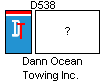
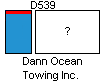
The funnel follows Allie B from the port side on 26 April 2007 and Colonel from starboard on 20 May 2013. On Colonel’s short, dumpy funnel the attached letters are so large that the D extends over the red top and white band.
Ruby M has a blue D and red T within a red ring on the white superstructure, as seen in a port-side photograph.
This family-owned business was founded in 1960. Its maritime roots extend to Captain Clay Johnson’s wood-burning sternwheelers on the Kisasimmee River and Lake Okeeschobee in 1880. By the 2013 website account, management included fourth- and fifth-generation family members. Lloyds lists Dann Towing Co. in 1988–89 and Dann Ocean Towing Inc. from 1992–93.
USA, Tampa FL.
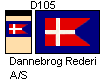
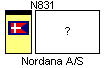
The house flag has a split Dannebrog on blue. Stewart’s illustrations incorrectly end the white cross in a V: other sources square off its end. Funnel photographs normally show the flag tails pointing aft on both sides, although Merchant Ships 1949 points the tail forward. The band generally encircles the funnel but sometimes breaks at the front. Rosanoski rejects Reed’s placement of the band immediately below the black top; Lloyds 1904 and 1912 omit the black top. His colour shades follow the WSS history rather than the website.
The size and form of the flag on the funnel vary. Nordana Monika at Newcastle on 29 May 2010 has it occupying the full band width; Charlottenborg also shows a large flag with aft-pointing tails, while Naesborg on 9 April 2006 has a smaller one. Nordborg on 25 October 2007 confirms the flag and funnel, but the flag panel appears larger than on Nüsse’s table flag. Skodsborg, Christiansborg and Lilleborg photographs show no tails; some flags fill the band depth. Rosanoski suggests possible use of the merchant flag rather than ensign, or differences for associated-company vessels.
Stjerneborg, photographed from the port side on 4 December 2013, carries NORDANA on the hull but effectively a Dannebrog funnel. Equasis records Dannebrog management from 1 January 2007 to 23 April 2010. Rosanoski presumes continued chartering, with the earliest photograph dating from 2008.
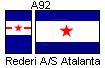
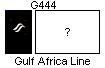
The Gulf Africa Line funnel follows Aalborg on 6 June 2010, chartered from the parent company. A starboard photograph on 15 November 2011 shows the same design.
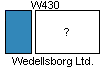
Marienborg, a Wedellsborg/Nordana ro-ro photographed on 15 May 2010, has the same funnel as the hydrofoil Klampenborg. Rosborg instead carries Dannebrog colours.
The managed Høneborg and Skakkeborg show the Dannebrog funnel; Skjoldborg’s band looks lighter. Bunkerful Depot’s Smut has a dark funnel with a broad lighter band edged white, possibly after her 1926 sale. Robert has a medium-coloured funnel with a narrow white band, and Tuborg seems similar with a wider band. Silkeborg has a medium-coloured funnel, black top and white band with the Danish ensign. Rask’s darker broad band may be wartime colours; Uranienborg’s Second World War funnel is plain and light. Fredensborg has a light funnel, black top and broad dark band with a white H, possibly under charter.
Rosanoski considers the D162 design attributed to Dannebrog Steam Ship Co. unsupported by the WSS history, possibly arising from the funnel’s pale yellow colour.
C.K. Hansen formed A/S D/S Dannebrog, registered on 9 February 1883, and remained managing owners until a 1967 reorganisation. Hansen returned to shipbroking and was sold to The East Asiatic Co. in 1969, becoming Alfragt. The shipping interests passed to management by Baron Ebbe Wedell-Wedellsborg and Christian Kjellerup Hansen, also partners in Weco-Shipping I/S. Dannebrog took the name Dannebrog Rederi A/S in 1970. Later websites identify Johan Wedell-Wedellsborg as owner, while giving different durations for family control.
The group absorbed A/S D/S Atlantic in 1912 and A/S D/S af 1896 and A/S D/S Neptun in 1918. Vendila, acquired from Svendsen & Christensen in 1963, merged into Dannebrog in 1972. Other interests included Rederi A/S Atalanta (1953–59), possibly a charterer; Borgships Inc., formed in Monrovia in 1965; Dantank, formed in 1952 and recorded as sold in 1968; and A/S Kjøbenhavns Bunkerful Depot, formed in 1911 and sold in 1967. A 2013 organisation chart again shows Dantank as a Dannebrog subsidiary.
Galborg Pte Ltd. of Singapore operates Gulf Africa Line, a time-chartered liner service between Mexico, the USA and Southern Africa. Nordana began in 1957 as a Fearnley & Eger–DFDS joint service, its name combining Norwegian and Danish origins and surviving Fearnley & Eger’s withdrawal. DFDS sold Nordana in 1983, presumably to Dannebrog. The precise relationship is not consistently shown: Nordana’s website presents it separately, although its Wedellsborg subsidiary is listed under Dannebrog. Nordana Project & Chartering began in 1998 as an independent division. Weco, formed in 1965, later served as the chartering broker for Dannebrog’s tankers; its later holding-company identity and Australian connection are tentative in the source.
Dannebrog also managed the one-ship companies Høneborg (1907–13), Skakkeborg (1907–11) and Skjoldborg (1907–13). Fleet names commonly ended in borg and were described as Danish cities or, later, castles.
Denmark, Copenhagen; Rungsted Kyst from 1969.
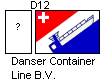
Danser began as a barge operator in 1982, transporting containers on European inland waterways through Danser Containerline, Danser Benelux and Danser Switzerland. It acquired Eurobarge from Koninklijke Nedlloyd Groep in 1999. The 2013 account lists ten owned barges and about forty chartered vessels. Lloyds gives formation in 1990, which Rosanoski supposes refers to the seagoing operation. Danser Vision B.V. was formed at the same address in 2006.
Netherlands, Sliedrecht.
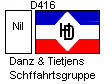
This version follows the company logo with equal blue, white and red bands and a diamond space for interlocked dark-blue HD initials, the H higher than the D. Rosanoski treats it as a rendering of the group logo, not proof of a separately used group flag.
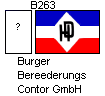
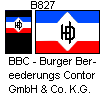
Nüsse’s table flag has black initials with the H lower than the D, and darker blue than the D-T Bereederungs flag. It also appears as number 492 on seeman-fischer.de.
This livery follows Gloria in a photograph dated 17 February 2006.
Precise monogram rendering, shades and exclusive company use remain qualified.
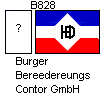
The adjacent number 493 has red-white-blue bands, a slightly smaller diamond and overlapping HD letters, with the D slightly smaller and the white band apparently narrower. Turning it upside down and over yields another possible variant, not an established correction.
Exact company and orientation remain unconfirmed.
Specific livery user not established.
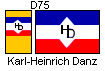
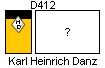
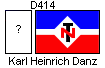
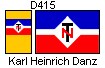
Dutch & German Coaster Fleets describes a black-topped funnel with a black HD monogram. The FOTW flag follows Brown 1995. Rosanoski regards the HD monogram as an early Karl Heinrich Danz device, probably Heinrich Danz rather than initials for the later partners. An old funnel drawing places separate black H and D letters diagonally within a white diamond, unlike the merged letters in the flag.
D414 follows Flaggen und Schornsteine 1957, although its letter proportions do not exactly match the book. Rosanoski cannot reconcile the initials in that source or the D415 livery.
Precise monogram rendering, shades and exclusive company use remain qualified.
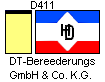
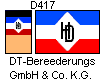
Oland photographs from 2009 show a narrower logo than D416, with the D larger than the H: the H’s top extends just above the D, while the D extends farther below. The white band is wider and the blue on the superstructure panel is a dark sky shade, lighter than Nüsse’s table flag.
Montemar Europa on 12 January 2006 shows darker blue and red on the funnel than on the flag. Funnel bands are equal, while the flag’s white band is slightly narrower and its D lower than the H. Rosanoski also notes differences in the superstructure panel and warns that painted versions are guides, not definitive flag specifications. CMA CGM Tobruk in August 2008 has a panel with a narrower white band and blue resembling the dark sky.
Precise monogram rendering, shades and exclusive company use remain qualified.
A BBC letterhead dated 3 December 1997 shows a blue-white-red flag with a diamond space and touching black letters read by Mertens as HED. Rosanoski instead sees H with a shortened outer leg, the D crossing its inner leg, and no E. Mertens suggested initials from Hans Rudolf Tietjens and Reinhard Danz; Rosanoski disputes this because the monogram predates their partnership. The chronology and relative heights of the letters remain uncertain.
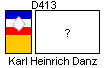
Mitchell’s card includes D412 and, below it, the Containerships charter funnel C1194 and D413. D413 has no explanation, though Rosanoski considers a possible connection with D75.
A 2009 Gloria photograph supports a possible later form: the outer leg of H is a little taller than D but shorter than its inner leg, their bases align, and the white band is slightly wider. It remains unclear whether BBC used its own variation, since another BBC vessel shows the D-T Bereederungs panel.
Danz & Tietjens Schiffahrtsgruppe is a group name rather than an incorporated company. Both families had long maritime connections with Burg. Karl-Heinrich Danz expanded after the Second World War; Lloyds dates his business to 1962, although a 1957 fleet book already lists him as owner of Klaus Turowsky, built in 1955 and then operated by Joh. Thode. Reinhard Danz and Rudolf Tietjens formed Danz und Tietjens Schiffahrts K.G., dated 1982 by the website and 1985 by Lloyds. A later comment calls it the 1989 company. Jan Mertens dates family co-operation to 1969, a statement Rosanoski could not relocate on the website.
BBC – Burger Bereederungs Contor GmbH & Co. K.G., formed in 1995, initially managed group ships and later appears independently in Lloyds. DT-Bereederungs GmbH & Co. K.G., formed in 2001, took over the Danz & Tietjens trading operation in 2003. The family group operated container ships and bulk carriers and provided management, chartering and related services.
Germany, Burg i Dithmarschen and Hamburg.
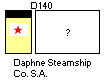
Daphne’s funnel is that of the agents: yellow or buff, with a black top and a white panel bearing a red star.
Daphne is listed in Lloyds from 1958–59 to 1966–67, with Lykiardopulo & Co. Ltd. as agents.
U.K., London.
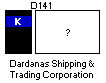
The funnel recorded for Hera in May 1965 is black with a blue band bearing a white K. The Bill Black–NJK record uses “Dardonos” and associates it with E. Constantinou.
Dardanas is listed in Lloyds from 1966–67 to 1973–74, with Aharnai Shipping Inc. as agents. The NJK collection also names Anthony J. Randolph as agent.
USA, New York NY.
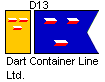
The blue swallow-tailed flag bears three darts, each horizontally divided white over red, arranged two above one.
Dart was formed in 1968 by Bristol City Line, Compagnie Maritime Belge and Clarke Traffic Services. The Bristol City Line interest passed to C.Y. Tung, while Canadian Pacific acquired a third interest in February 1981, which Rosanoski identifies as presumably Clarke’s. CMB withdrew in the mid-1980s. The C.Y. Tung group, by then Orient Overseas Container Line, eliminated the Dart title in July 1988.
A separate account gives the start of operations with chartered tonnage as 1969 and cessation by 1980. It also dates acquisition of owned ships managed by CMB to 1963, before the stated formation; Rosanoski’s recorded chronology is not reconciled.
UK, London.
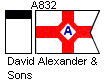
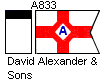
The predecessors’ livery was retained, though sources vary slightly in their flag diamonds. Brown generally uses the Grove Line (Glasgow) name, except in 1951. The livery note writes the former partnership as “Alexander & Muir”.
LJC 1930 shows a deeper split in the flag’s tail.
David Alexander had been a partner in Alexander & Arthurs and then Alexander & Mair, which ceased trading in 1918 with a fleet using “grove” suffixes. He formed Grove Line (Glasgow) in 1924; it was wound up in 1947.
UK, Glasgow.
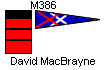
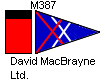
The earlier livery was also used by David Hutcheson. Iona’s monochrome photograph appears to show a red funnel with equally narrow top and two bands; the bands were based on funnel strengthening bands.
The blue pennant has overlapping red-over-white saltires. Sources vary considerably in their extent, from roughly the first third to about two-thirds of the field. Harnack gives a particularly long pennant.
David MacBrayne and David and Alexander Hutcheson formed David Hutcheson & Co. in 1851, taking over Glasgow & Islands Steamship. Glasgow & Lochfyne and Glasgow & Highland followed in 1857. The Hutchesons retired in 1876 and 1878; the name became David MacBrayne in 1879 and Ltd. in 1905. Reformed in 1928 as a Coast Lines–LMS joint venture, it reverted from David MacBrayne (1928) Ltd. in 1935 or 1936. Campbeltown & Glasgow was absorbed in 1937 and McCallum, Orne on 1 January 1948.
The Scottish Transport Group took the LMS share in January 1969 and Coast Lines’ share in July. One account dates the Caledonian MacBrayne merger to 1973, with a malformed full date in the text, while the later company account dates the change to 1969. The David MacBrayne name subsequently became dormant; Lloyds gives 1979.
The name returned in the 2006 reorganisation for the Clyde and Hebrides service beginning in October 2007. Caledonian Maritime Assets retained ships and ports while CalMac Ferries became the operator. David MacBrayne resumed an active group role in 2009, with Scottish Ministers as sole shareholder. NorthLink, formed with Royal Bank of Scotland in 2000, became wholly owned in 2006.
The Western Isles services centred on Oban, with the Royal Route from Glasgow and later Gourock to Tarbet and Ardrishaig for onward connections. Its Clyde steamers lasted to the end of the 1969 season, when Lochfyne was withdrawn. Many vessels used Loch names, and the company also operated for the Secretary of State for Scotland.
The joint Clyde Cargo Steamers venture initially retained its constituent liveries. It became the MacBrayne subsidiary Clyde & Campbeltown in 1937, passed to the British Transport Commission in 1953 and sold its last ship in 1958. Its later names were Caledonian Steam Packet (Irish Services) and British Transport Ship Management (Scotland), transferring to the Scottish Transport Group in 1969.
UK, Glasgow.
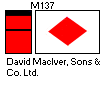
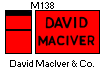
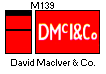
The red funnel has a black top and a narrow black band. The early flag is red with black DAVID over MACIVER, followed by a red flag bearing white DMcI&Co with the c enhanced. The later flag is white with a red diamond. Loughran dates the principal-partner name to about 1880, its replacement by company initials to the 1890s and the diamond flag to after the First World War, although the bibliography also lists it in 1909 and 1912 sources.
The concern followed D. & C. MacIver, although contemporary source names and liveries are confused. It acquired Beaver Line Associated Steamers in 1894 and sold it to Elder Dempster in 1898. Lloyds records a merger into Royal Mail Lines in 1932, under David MacIver & Co.; other forms include David Maciver and David Mciver.
UK, Liverpool.
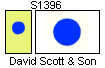
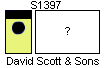
Lloyds 1882 gives a slightly different name. Rosanoski cannot establish whether this is the David Scott & Son listed in 1904 as operator of Albany Shipping Co., which has another livery.
UK, Dundee.
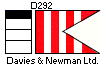
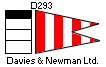
This livery closely resembles that used earlier by Lane & Macandrew Ltd.
Davies & Newman had subscribed to Lloyds since 1922 and is listed in Merchant Ships 1942 and 1944 as managing on behalf of the Admiralty. Associated companies include the Paris-based Compagnie Française de Navires Ci[s]ternes, linked with Vimont & Cie., and Compagnie Ha[r?]vraise de Magasinage et de Transport.
U.K., London.
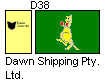
The funnel bears a map of Tasmania beside DAWN above SHIPPING, with the initial letter of each word taller than the others.
The announced flag was the “Fighting Kangaroo”: green, with a yellow kangaroo having a red eye and wearing red boxing gloves. It was the battle flag of Australia II, winner of the 1983 America’s Cup, and became a popular Australian symbol. Rosanoski’s later comment leaves its intended house-flag status unclear. Howard Smith’s Express also flew it in November 1990 as an Australian symbol. FOTW presents the design as the “Boxing Kangaroo”.
A.H. Agencies & Sales formed Dawn Shipping in 1984 to run a Bass Strait cargo service using oil-rig tenders, but the service never commenced.
Australia, Launceston.
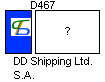
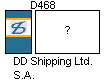
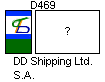
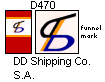
The funnel follows DD Leader.
The funnel follows DD Fidelity in a photograph taken on 12 December 2006.
The funnel follows DD Vigilant.
The funnel follows Doris at Sydney on 16 September 2011.
DD Progress appears in a photograph of 18 May 2007 with a bright light-blue funnel and white band, but the symbol’s colours cannot be made out. DD Vigour has a similar design with darker blue, in line with D467; DD Success also has a darker-blue funnel with a white band.
Lloyds records DD Shipping under Russian Federation government control, initially dating formation to 2002 and later amending it to 2001. The website calls Vladivostok a branch and also lists DD Shipping Pte Ltd. in Singapore and DD Shipping Ltd. S.A. in Panama. Vessels are listed under individual owning companies.
Russia, Vladivostok.
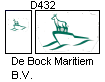
The later funnel follows Smaragd from the port side on 23 June 2010 and starboard on 2 July 2010, again with the emblem pointing forward. The flag follows Saffier on 17 July 2010.
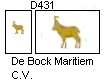
The earlier funnel follows Smaragd: port-side funnel and flag on 24 March 2007, and starboard funnel on 18 August 2005 with the emblem pointing forward. The clearest flag photograph, dated 10 December 2006, also shows the Wagenborg manager’s flag and a third flag unidentified by Rosanoski.
De Bock Maritiem B.V. was formed in 2007. Its fleet was held through Smaragd C.V., formed in 2002 as De Bock Maritiem C.V. and renamed in 2007.
Netherlands, NJ Alkmaar.
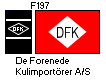
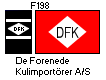
The Merchant Ships sources show the funnels as alternatives but provide no flags. Rosanoski assumes the flag also applies to F198.
Also called United Coaling Co., the concern owned steamships from 1924. It operated A/S Dampskibsselskab D.F.K., which later became the listed operator. Most ship names ended in ia.
Denmark, Copenhagen.
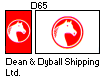
The funnel is red with a white ring enclosing a white horse’s head facing aft.
The flag is white with a red ring enclosing a red circle, surmounted by a white horse’s head facing the fly.
Dean & Dyball Shipping is listed in Lloyds in 1985–86 and 1992–93.
U.K., Poole.
Dearborn is recorded with a black funnel.
Rosanoski suggests connections with Dearborn Marine Service Corporation of Freeport, Texas, and Dearborn 204 Inc. and Dearborn 206 Inc. of New Orleans, Louisiana, as listed in Lloyds.
USA.
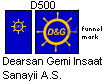
The funnel follows Sakarya from the port side on 5 July 2008 and starboard on 17 July 2012. Contributor Gwén reported crew information identifying the logo with Dearsan. Rosanoski objects that it is not the shipyard’s logo: D fits, but &G does not. He suggests a possible partner, perhaps involved in financing, while finding no candidate among the managers.
Possible partner identity and company use remain unresolved.
Dearsan Shipyard was established in 1980 and began a chemical-tanker building project in September 2006. Rosanoski finds indications of an ownership interest in Sakarya, Dumlupinar, Cevdet A and Cansu Y, which share a funnel livery and Chemfleet technical management. Shipspotting identifies Dearsan as owner, while Equasis and Intertanko list registered owners based in Valletta, Malta.
Turkey, Istanbul.
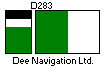
A photograph and Mitchell line drawing of Roebuck confirm the funnel. Burrell depicts an olive-green shade and states that a new colour was adopted to conceal the ships’ origins, although the text specifies no exact shade.
Empire Transport Co. Ltd. was renamed Dee Navigation in 1975, also appearing as Dee Navigation Co. Lloyds lists Shaw Savill & Albion as operator in 1978–79, whereas the Furness Withy history places it under Furness Withy (Chartering). The last ships were sold in 1982.
A separate Mitchell note dates the formation of Furness, Withy’s General Shipping Division, managing all subsidiaries, to June 1997.
U.K., London, assumed from the association with Shaw Savill & Albion Co. Ltd.
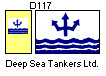
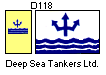
Two yellow or buff funnel forms are recorded, one bearing the flag emblems and the other a panel of the flag.
The flag has six alternating white and blue wavy horizontal bands. The upper white area occupies most of the field and bears a blue trident head, with the remaining bands representing the sea below.
Stewart 1963 names Shell Canadian Tankers Ltd. as managers.
Canada, Toronto.
Formed in 1958 as Del Bene S.A. Compania de Navegacion, the cargo-shipping company changed its name in 1983. Lloyds records it as manager and later owner and agent, with ships held in its own name and through a separate vessel-owning company.
Argentina, Buenos Aires.
Mitchell shows this funnel in line drawings of four vessels.
The funnel uses a version of the Del Monte shield, first used on a can label in 1909. Lerida Carrier on 23 April 2007 has an apparent yellow copyright C in a ring below the shield’s right-hand base as viewed. Algeciras Carrier on 9 September 2005 and the chartered Star Leader on 28 June 2013 do not show it. Granada Carrier at New Plymouth on 6 September 2003 places it above the shield’s right-hand corner. Above the shield is a yellow flower symbol comprising two separate leaves and a separate bud.
The Del Monte brand dates from 1886. California Packing Corporation became Del Monte Corporation in 1967 and acquired West Indies Tropical Fruit Company in 1968. After a 1979 merger with R.J. Reynolds Industries, Del Monte Tropical Fruit and Del Monte Foods became separate businesses in 1989. Nabisco sold the fruit company to Polly Peck in October 1989; it continued independently after Polly Peck failed in 1992. The website dates the Fresh Del Monte Produce Inc. name to 1993 and its then-current ownership to 1996.
Lloyds provides a separate shipping-company sequence: formation in 1971 as West Indies Fruit Co., followed by Del Monte Banana Co. and successive Fresh Fruit names. Its account was later amended to place the Del Monte Fresh Fruit International Inc. name in 1987. Network Shipping Ltd., formed in 1990, managed the shipping interests through individual owning companies and charters. By 2011–12 the registered owners appear under Norbulk Shipping U.K. management.
Global Reefer Carriers was announced in September 1993 as a joint venture between Transportacion Maritima Mexicana and Fresh Del Monte shareholders, managed by TMM for refrigerated transport. TMM announced sale of its 49% in June 1996, apparently to its partner. Del Monte also acquired Horn-Linie, described as fully integrated in 1997, although later websites still showed it separately under Network Shipping.
USA: San Francisco CA, Miami Springs FL and Coral Gables FL; also Hamilton, Bermuda in the cited 1992–93 and 1998 listings.
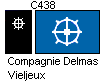
C437 has a small square at the wheel’s centre and a larger wheel on the flag. The larger wheel continues in C438, later with a blue core. The FOTW rendering of C437 also has a blue core and follows information from a Sandy Hook poster for Medea, about 1920.
Exact dates, wheel shapes and shades remain qualified.
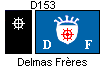
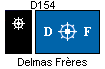
Reed omits the wheel’s central core on the flag. Rosanoski considers omission of the core on the small funnel emblem probably an error of scale.
Exact dates, wheel shapes and shades remain qualified.
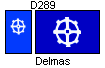
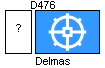
A reported 1989 change to the wheel’s teeth may concern the straight-sided outer spokes seen in a 2005 company-website funnel photograph. Rosanoski uses that photograph for D289 as a probable modern version, with flag blue assumed to match the funnel. The date and precise shade remain uncertain: straight-sided teeth already appear in a 1961 source, while an earlier website funnel image has angled teeth. Candeias’s dark-blue flag follows repeated use in Publico’s Carga e Transportes supplement; he suggests the shade may be flexible in marketing. Sache also notes white trucks and containers with an inverted blue logo.
Exact dates, wheel shapes and shades remain qualified.
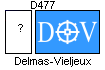
The earlier Delmas-Vieljeux flag has white V and D letters flanking the wheel, as on the Medea poster. Sandy Hook was the pseudonym of painter Georges Taboureau; the poster is the documentary basis cited by Jan Mertens.
Exact dates, wheel shapes and shades remain qualified.
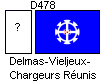
A table flag offered on German eBay in January 2008 places a tiny Chargeurs Réunis flag within the Delmas wheel. It relates to the association under which Delmas-Vieljeux operated 24 ships in 1979, but whether this flag ever flew aboard ships is unknown.
Do not claim this was flown on ships.
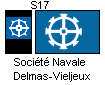
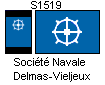
The Nüsse-based design differs slightly and is placed nearer the hoist. A black-and-white photograph of Maurice Delmas confirms the related S16 funnel with the flag design. Stewart 1953 and 1957 show a narrow black funnel base, effectively a very broad blue band with the emblem at its top; Rosanoski considers this unlikely.
Exact dates, wheel shapes and shades remain qualified.
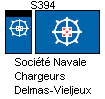
Five red stars reflect the Chargeurs Réunis interest before its 1985 sale.
Exact dates, wheel shapes and shades remain qualified.
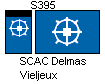
Exact dates, wheel shapes and shades remain qualified.
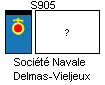
Mitchell gives this funnel for “free flag subsidiaries”; its emblem appears to be a circle surmounted by a cross.
Specific subsidiary is unknown; parent attribution must not be asserted.
The white emblem is a water-mill wheel, despite its resemblance to a ship’s wheel. It derives from the arms of Mulhouse and recalls the founders’ origins there. Rosanoski uses the then-current blue throughout his illustrations.
Mitchell calls S395 the new colours but leaves the year incomplete. For both it and S17 he omits the wheel’s outer spokes and central panel.
Mitchell records an Australia-New Zealand Direct Line version under “Direct Line”, without emblems on the panels.
Franck and Julien Delmas founded Delmas Frères in 1867, joined by their elder brother Emile in 1871 and Franck’s son-in-law Léonce Vieljeux in 1896. Accounts differ over the subsequent names: the Armateurs account gives Compagnie Delmas Frères et Vieljeux in 1919, Compagnie Delmas-Vieljeux in 1935 and Société Navale Delmas-Vieljeux in 1947, while another dates the Delmas Vieljeux name to 1910. Coal and raw-material transport from La Rochelle preceded international shipping. Merchant Ships dates steamship ownership from 1879, whereas other accounts call the 1925 service the first shipping line.
Chargeurs Réunis involvement produced Société Navale Chargeurs Delmas-Vieljeux (SNCDV) in 1971. Chargeurs sold its 37% in January 1985. The Armateurs account dates the Société Navale et Commerciale Delmas-Vieljeux name to 1985, while Lloyds places it in a 1991 amalgamation with L. Martin & Cie., followed that year by SCAC Delmas Vieljeux (SDV). Lloyds dates Bolloré control to 1991 and the Delmas name to 1996; an FOTW account instead places the hostile Bolloré takeover in 1996.
Delmas acquired Chargeurs shipping interests in January 1988 according to Mitchell, and Guinea Gulf Line’s share capital in April 1989, although its continuing activity was unclear after its last ships had been sold in 1979. Other interests included Denis Frères in the 1980s, Compagnie Africaine de Dragage, Delmas ANZDL and a reported Maurel & Prom acquisition around 1980 that Rosanoski could not confirm on that company’s website. The Société Africaine de Transports connection is assumed from its flag emblem. CMA CGM’s acquisition is variously dated 2005, September 2005 and 5 January 2006.
The technical-operation lineage is separately traced from 1988 through the 1992 combination of Navale et Commerciale Havraise Peninsulaire, Euronavis Gestion et Affretement de Navires, Navale Delmas Afrique and Delmas Conteneurs as Navale Delmas International. It became Maritime Delmas Vieljeux the same year and Delmas Armement in 1994, later appearing as Delmas Armement Technique.
Recorded interests include Rickmers Linie, Société Navale Caennaise, America Africa Europe Line, Gazocean and Australia New Zealand Direct Line, apparently wholly controlled. Delmas bought 40% of Sofrana Unilines S.A. in 1987 and formed Sofrana Unilines New Zealand jointly with Société Francaise de Navigation in 1989. It also operated for Compagnie du Chemin de fer de Paris à Orleans and Compagnie Commerciale de l’Afrique Equatoriale Française, and managed Compagnie Navale Guynaise in 1952.
France: La Rochelle, Paris, Puteaux and Le Havre in successive sources.
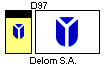
Louis Delom is separately recorded as owner or operator of Société Nouvelle de Cabotage, associated with Compagnie Maritime France-Afrique, for Ville de Mostaganem in 1933–38. Later Lloyds entries list him as agent for Delom & Compagnie.
France, Sete.
The company’s formation is dated 1938 by the Armateurs website, or 1934 as Delom et Compagnie by Lloyds. It became Delom S.A. in 1972. Louis Delom acted as agent; CMA CGM held a minority share by 2004. Vessel names began with Cap.
France: Paris and Sete in Lloyds; Marseille on the website.
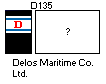
The funnel is black with a broad white band containing two narrow blue bands near its upper and lower edges, and a red D between them. It is recorded for California Sun of Gamps Marine Financing Ltd., under the same agency, and Ocean Queen in August 1973.
Delos Maritime is listed in Lloyds 1963–64 with Pacific Steamship Agency Inc. as agents. The Bill Black–NJK collection records an association with Adrian Maritime.
USA, New York NY.
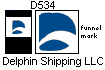
The funnel was first seen on Dorado from the port side on 15 March 2013. A lightened close-up made the band appear buff, but a more distant photograph showed white against the distinctly buff superstructure; Rosanoski therefore assumed discolouration. Initially he attributed it to registered owner Dorado Shipping LLC, whose address and management links pointed to Eagle interests although the ship was not in Eagle’s listed fleet and lacked its badge. By November 2013 the photograph had been identified as Delphin, and a starboard photograph of Leo on 16 October 2013 supported that attribution.
Delphin was founded in 2009 as a Marshall Islands company, emerging from a five-year alliance between Sophocles Zoullas, associated with Eagle Bulk Shipping, and Kelso Investments, which had also backed Eagle Bulk’s public offering.
USA, New York.
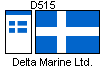
The funnel and flag are shown in a port-side photograph of Voe Jarl. A starboard photograph of Voe Chief on 10 February 2013 shows that the cross intersection on the funnel’s flag panel is towards the front on both sides, so the starboard side displays the reverse of the flag.
Established in 1985, Delta Marine operates and charters tugs and workboats. Lloyds lists it as owner and manager by 2011–12.
UK, Lerwick, Shetland.
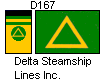
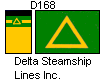
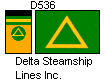
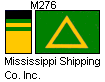
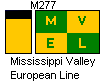
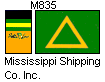
Brown 1951 omits the black funnel top. Rosanoski questions this variant: Jordan gives D167 for 1939, while a black-and-white Delorleans photograph is unclear and may instead resemble M276, also supported by Talbot-Booth 1942.
Stewart 1953 and 1957 indicate that the funnel’s yellow body differs from the separating band and attribute the livery to both Mississippi Shipping Co. and Delta Line.
Mississippi Shipping Co. was formed on 24 March 1919. Commonly known as the Delta Line, it officially adopted that name in 1962. Rosanoski tentatively traces an earlier Mississippi Valley European Line title through Brown’s 1929 and 1934 listings. Transcontinental Bus System acquired a majority by August 1967 and 97% by 1968; renamed TCO Industries, it merged into Holiday Inns in January 1969. Holiday Inns sold Delta to Crowley in December 1982, and Crowley sold it to United States Lines in 1985, where the fleet was absorbed.
USA, New Orleans LA.
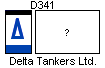
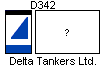
The earlier funnel follows Delta Captain in a photograph dated 8 September 2005.
Port- and starboard-side photographs of Delta Captain on 7 November 2008 show the later funnel, mirrored on starboard so that the triangle’s vertical side faces aft on both sides. Rosanoski considers it likely that the design was changed between 24 July and 1 October 2008 to avoid resemblance to Marmaras Navigation.
Delta Tankers was formed in 2006 and is associated with Marmaras Navigation. Lloyds lists it as agent in 2008 and manager in 2011–12.
Greece, Piraeus.
The funnel follows Deltamar IV from starboard on 10 July 2011.
Deltamar operates the barge Deltamar II and tanker Deltamar IV at Bahia Blanca. It is associated with Bomin Deutschland GmbH & Co. K.G., part of the Bominflot group. Rosanoski finds no apparent connection with similarly named companies in other countries.
Argentina, Buenos Aires.
This livery follows Reynaert from the port side on 18 October 2009, with a clearer funnel view from a port-side photograph of Vlaanderen I.
The funnel follows Buckingham from starboard on 3 June 2013.
Dredging International’s house flag is white with six black dredging scoops arranged as a turning circle or paternoster.
No exclusive fleet-wide use or unrecorded corporate equivalence is asserted.
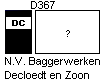
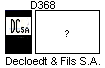
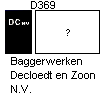
Mitchell’s D368 apparently follows Vlaanderen XVIII. D369 is based on Vlaanderen XXI, but its status as a funnel design is doubtful: he does not place the emblem on a funnel illustration, and the ship’s line drawing has an all-black funnel. The emblem might instead have been on the hull.
The funnel follows Vlaanderen I on 22 May 2006.
D369 may represent hull marking rather than funnel; preserve this explicitly.
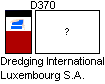
Photographs of Reynaert from port and Pallieter from starboard show the emblem on an undefined white disc attached to the funnel band. The ships subsequently used DEME group livery.
Later DEME livery does not change this historical allocation.
DEME, expanded in the source as Dredging, Enviromental & Marine Engineering N.V., was formed in April 1991 as holding company for Dredging International and Baggerwerken Decloedt. Its capital was controlled by Ackermans & van Haaren and CFE, the latter controlled by the French Vinci group.
Baggerwerken Decloedt en Zoon, based in Ostend, is dated 1876 by Lloyds or active since 1875 by the group website. Dredging International was formed in September 1974 by merging Ackermans & van Haaren’s dredging division, established in 1852, with Société Générale de Dragge, established in 1930. Rosanoski rejects Lloyds’ 1905 establishment date for Dredging International.
Later operating companies included DEME Building Materials (2000), Société de Dragage Internationale in France (2004), Dredging International Asia Pacific in Singapore (1997), Dredging International Luxembourg (1997), International Seaport Dredging in India (2004), and Tideway in the Netherlands (1992). Hydro Soil Services is dated both 2004 and 1985, the latter as a joint venture of Dredging International and SMET Boring.
Belgium, Zwijndrecht.
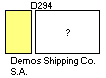
Mitchell records this funnel for the sole vessel Delmos, built in 1954, and supplies a line drawing. Another report in the NJK collection differs and associates a vessel of that name with John Livanos.
Demos versus other reported period/use remains unsettled.
Demos Shipping is recorded in Lloyds from 1973–74 to 1980–81, with Kenneth F. Owen as agent in the later editions.
Greece, Piraeus; later U.K., London.
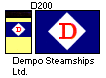
Dempo Steamships is listed in Lloyds from 1966–67 to 1992–93. Vessel names began with Jagat.
India, Goa; later Bombay.
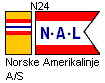
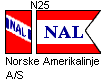
The flag is an approximately 2:3 red-white-red Spanish-style horizontal triband with a full right-angled triangular swallowtail cut, bearing blue condensed sans-serif N·A·L. Sources vary in the punctuation: some Brown editions put dots at baseline and Brown 1995 omits them. A Bergensfjord photograph shows the blue funnel band narrower than the white bands, themselves narrower than the red.
Skipet dates adoption of this funnel version to after 1988.
Den Norske Amerikalinje, also Norwegian America Line or NAL, was formed on 27 August 1910 and began its maiden voyage on 4 June 1913. Merchant Ships gives establishment in 1913 and, in another edition, 1931, which Rosanoski considers an apparent typing error.
Unprofitable operations prompted restructuring at the end of the 1970s. In 1980 the two cruise ships passed to Norwegian American Cruises, a venture with Leif Hoegh in which NAL held 90%; it was sold to Trafalgar House in 1983 and joined Cunard. By 1983 NAL’s fleet was entirely chartered. Shipowning resumed with car carriers in 1986, followed by bulk operations from 1989 to 1993. Øivind Lorentzen’s car-carrier business was acquired in August 1987. NAL participated in NOSAC and was associated with Trinity Bulk Carriers. Its Scandinavian East Africa Line subsidiary operated to Madagascar from 1921 to 1981 before sale to Deutsche Afrika Line. Wilh. Wilhelmsen acquired NAL in 1995; Lloyds dates the merger into Wilhelmsen Lines to 1996. Ship names commonly ended in fjord.
Norway, Christiana, later Oslo.
Although the cited sources illustrate only funnels, Jordan describes the panel with white letters as a house flag.
The Brazilian website documents this livery as of 1950.
Mitchell omits dots after the letters and gives them the same shade as the funnel.
The Skipet illustration appears to make the letters, with dots, a deeper yellow than the funnel.
Den Norske Syd-Amerika Linje was a holding company chartering vessels as required from its constituent owners: Bergenske, J. Ludwig Mowinckels Rederi and Fred Olsen. Skipet gives operations from 1914 to 1979, but its Fred Olsen section gives 1914–76. The line participated in the Josal consortium in the 1970s. Mitchell records the sale of its services and name to W. Wilhelmsen and Axel Axelson Johnson in 1980, while Bryggan describes a joint venture under the Josal name.
Norway, Oslo.
The first funnel is black with a broad band of diagonal blue-white stripes, described as “Pbd”. The second is black with a broad blue band bearing diagonal white panels, also “Pbd”, and is recorded as the initial result of the Silver Line amalgamation. Loughran mentions the company under Silver Line but gives the bands as “Pbds”.
The flag has five diagonal blue-white bands, described as “Pbd”.
Dene is recorded in the 1939 fleet account and as Dene Ship Management Co. Ltd. in Ships & The Sea 1942. Accounts differ on its combination with Silver Line: one says Dene was amalgamated into Silver Line, another that Silver Line became its wholly owned subsidiary.
U.K., London.
A written description gives a white flag with red edges and a central red star, and the Belem image from the Museum of Salorges is described as showing Crouan’s colours in her original state. The first FOTW rendering, C731, followed the written description. Rosanoski cited Randier and Lacroix for a white flag with a red border and a six-pointed red star towards the hoist, leading to its replacement by C732.
Another Belem picture shows a red house flag with a large white star, unlike the written description. It also shows a blue-over-red triangular registration flag identified as Lorient South, although Belem was registered at Nantes, and the French merchant ensign. Ivan Sache suggests either a family-period flag change or a flag of a later owner. The picture’s origin and flag attribution are not established by its association with the 1896–97 maiden voyage.
Crouan versus later owner and private versus corporate use remain unresolved.
The business traces to Denis Crouan, who returned from Belém to Nantes and became a shipowner in the mid-nineteenth century. After his death in 1891, his son Fernand succeeded him and the business became Denis Crouan Fils. Fernand traded in cocoa and sugar; after his death in 1905 his son-in-law Mr. de Lagotellerie succeeded him, before liquidation in 1906. The source notes uncertainty in the earlier vessel/operator records and a Denis Crouan reference connected with an 1899 voyage.
France, Nantes.
The earlier funnel follows Bulk Flower from the port side on 8 February 2011. Chem Violet also shows the design, whereas Chem Daisy apparently carried Transinsular charter markings, separately recorded as T702.
The later flower emblem was first drawn from a poor Bulk Flower photograph and its colours clarified from Chem Violet photographs. Purple for one petal remains an assumption. The change falls between 6 October 2011 and 20 July 2012. The petals reverse on starboard so that red and green face aft on both sides, while D reads normally on each side. Rosanoski identifies the emblem as a flower from the vessel names.
The Cicek family’s shipbuilding activity began in the 1960s as GAYE Ltd. Celal Cicek established Deniz Industry Co. (Deniz Endustrisi A.S.)/Cicek Shipyard on 1 July 1977. Its activities include construction, repairs and ship management; it also built vessels for its own account.
Turkey, Istanbul.
Mitchell appears to use an air/sea rescue orange-red shade. The ship later carried the colours of Sukru Deniz ve Ortaklari Kollektif Sirketi.
Formed in 1988, Deniz-Ay is listed as a vessel-owning company under Sukru Deniz ve Ortaklari Kollektif Sirketi. Its sole vessel, Deniz-Ay, was broken up in October 2009.
Turkey, Istanbul.
The funnel follows Samsun from the port side on 14 June 2007. The logo also appears on the hull.
Deval Shipping Group is a major shareholder. Denizciler acquired Ankara and Samsun on 31 December 2004 and is listed in Lloyds 2011–12.
Turkey, Istanbul.
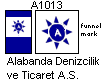
The funnel follows Alabanda. A 2004 photograph shows the same livery as after the 2005 transfer, leading Rosanoski to suggest that A represents the registered owner rather than another associated company.
The inference that A denotes registered owner is Rosanoski’s qualified reasoning; exclusive corporate emblem ownership not established.
Vessel and company allocation remain uncertain.
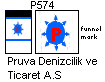
Port- and starboard-side photographs show Pruva’s P funnel, traced back to 2007. Rosanoski similarly links the letter to its registered owner and initially supposes continuous use. By 26 March 2013 a different funnel had appeared; management had changed to Cerba Denizcilik around July 2011, though the registered owner had not changed, so he tentatively associates the new livery with the manager.
Do not extend to the changed 2013 livery or assert owner-wide exclusive use.
Mitchell places D433 as the main funnel, though his line drawings simply show black with a broad white band. D434 appears at the foot of the card without a direct company reference and may relate to Ata, listed in 1973–74. Both suggest a possible plain red swallow-tailed flag.
Formed in 1952 and also called Maritime Anonim Company by Mitchell, Denizcilik held its fleet through Yildiz Deniz Tasimaciligi A.S., formed in 1986 at the same Istanbul address.
In 2003 sister ships Alabanda and Pruva were registered to companies bearing their respective names, both subsidiaries of Yildiz within Denizcilik. In August 2005 Alabanda and its registered owner moved to Cerrahgil Denizcilik Nakliyat ve Ticaret A.S. without a name change. Rosanoski saw no apparent corporate connection with the former group. Pruva remained under the original ownership.
Turkey, Istanbul.
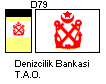
The livery appears to have had multiple users. Brown 1982 attributes it to D.B. Denizcilik Nakliyati T.A.S.; Brown 1995 indexes both companies but labels the illustration Denizyollari Isletmesi Mudurlugu, also called Turkish Maritime Lines. Rosanoski notes that Lloyds instead identifies Turkish Maritime Lines with Turkiye Denizcilik Isletmeleri.
The funnel is yellow or buff with a black top and a broad band of the flag. The white flag bears two red foul anchors crossed in saltire, surmounted by a small crescent and angled star. Brown 1958 angles the star towards the upper hoist.
Also known as the Turkish Maritime Bank, Denizcilik Bankasi held a fleet managed through several operating bodies, including Denizyollari, Gemi Kurtarma, Izmir, Liman, Sehir Hatlari and Istinye Tersanesi, later also Trabzon, Giresun and Van Golu. Walford Lines managed one vessel in the 1950s. A partnership with D.B. Deniz Nakliyati T.A.S. is recorded in the 1970s. By 1992–93 the management bodies appear as owners under Turkiye Denizcilik Isletmeleri.
Turkey, Istanbul.
Dennison Sands is recorded operating the dredger Trochus, carrying sea sand upriver in Queensland. The Compendium instead records Queensland government operation from 1956 and Steelcraft Engineering of Brisbane from 1993. Rosanoski could not locate Dennison Sands and supposes an unregistered private operation before 1993.
Australia.
The business appears to have originated as William Dennison, listed in 1958–59, and later William Dennison (Shapsinay) Ltd. It is recorded through 1992–93, when it managed parts of the Onesimus Dorey and James Fisher fleets as well as another company. Rosanoski assumes a separately listed William Dennison Ltd. to be different.
U.K., Shapsinay; later Kirkwall.
The funnel follows Densa Seal from starboard on 5 October 2013 and Densa Dolphin from port on 3 January 2014. The latter appears a darker blue.
Densa Shipping Industry & Trade S.A. was established on 22 December 2008, choosing to operate as a shipping business rather than an investment company. Lloyds lists it as managers only in 2011–12.
Turkey, Istanbul.
The funnel follows Cape Bruny at the Launceston ship graveyard in Tasmania. It appears to retain the colours previously used under Hobart Tug & Lighterage Co. Pty. Ltd.
Derwent Tug is listed in Lloyds from 1970–71 through 1985–86. Brambles acquired it in 1982.
Australia, Hobart.
Mitchell shows three funnels without explaining their sequence. D560’s symbol is unidentified; the stars and “D” of D561 are explicitly white. No further interpretation of D562 is supplied there.
D563 is based on Petrolia Desgagnes from port on 7 May 2003 and Maria Desgagnes from starboard on 27 March 2012. The design is mirrored so that the diagonal band faces forward on both sides. Both were managed by Desgagnés Tankers. Rosanoski suggests that the design might distinguish that manager, but also considers a connection with Mitchell’s D562 and the possibility of an older, more general group livery.
D559 is shown on Bella Desgagnes on 30 September 2013. Its painted flag uses at least two blues to suggest light on a waving flag. Camilla Desgagnes acquired the panel between photographs of 4 June 2004 and 19 July 2005. Rosaire A. Desgagnes also shows it; Sara Desgagnes was photographed on 5 September 2010 with the same design but a broad black top.
The group flag is described as dark blue, with a slanting yellow stripe in the fly and white “DESGAGNES” across the centre, with an accent on the “E”. The yellow stripe also appears on some hulls and funnels. A Camilla Desgagnes photograph dated 31 July 2009 supports it. The original text calls this flag D568; the current gallery contains D558, and no new equivalence between those numbers is asserted.
The business originated at Les Éboulements in 1866 with Captain Zéphirin Desgagnés and the schooner Mary-Ann. Its first motorized schooner, Mont St-Joseph, was built in 1934; by 1957 the brothers Joseph-Arthur-Zélada, Roland and Maurice were trading as Transport Desgagnés. Transport Desgagnés Inc. is separately dated to 1975 and absorbed Les Armateurs du St. Laurent and les Chargeurs Unis in 1987.
Louis-Marie Beaulieu bought a majority interest in 1987. Relais Nordik was acquired in 1989; Croisières Nordik operated from 1994 to 1996. Petro-Nav was formed with Nicolas Gravino and Richard Carson in 1996 to expand bulk-liquid operations, and Desgagnés Transarctik followed in 2001 for Eastern Canadian Arctic services.
Canada, Charlevoix, Quebec.
The skipet depiction of B376 makes the blue flag bands wider than the white. Rosanoski takes this flag to accompany that source’s B378 cruise-ship funnel. The same source shows two black funnels with three white bands; the motor-ship version doubles the white-band width and reduces the black gaps.
B379 is a red burgee with blue upper and lower borders, two white bands and white “BDS” above a white star on the red field. Some published illustrations place the letters in a straight row. The associated funnel is black with three white bands.
Loughran says the letters were always arched, making the straight-letter B379 and B378 depictions incorrect. B377 is described as the original flag, although Griffin’s earlier publication of B376 makes the sequence confusing; the arch in Lloyds’ B377 is barely discernible. Jan Oskar Engene found arched letters in photographs of actual flags and suggested that straight lettering came from printed logos showing a waving flag, rather than proving a real variant.
Ridley Tugs adopted the B377 funnel as its final version, having varied its funnels with important contracts.
Meteor and Venus are described with an orange funnel, while skipet calls this cruise-ship version buff. A Collectors Corner cap badge colours the flag’s letters and star yellow with white edging, unsupported elsewhere. Engene’s account gives a black funnel with three white rings, later changed to yellow with three white rings, tentatively in the 1960s.
B785, with a waving flag painted on the funnel, is assigned to ships on the England route from 1966 to 1975.
Founded in 1851, the company participated in the Coastal Express service, the Be-No-Ve cooperation and the Royal Viking Line, co-founded in 1971. Its partnership with Fred Olsen became Fred Olsen-Bergen Line in 1975 and ended in 1986. It merged with Kosmos in 1984, took over Norway Line in 1987, and the company and subsidiaries were bought by RoNoTro in 1988. The notes separately place Norway Line’s takeover by Kosmos in 1989.
Norway, Bergen; also known as Bergen Line.
Jordan describes the funnel emblem as a couped cross resembling a plus sign, which Rosanoski considers an error. Talbot-Booth’s 1936–38 records use the manager’s name, C. From Holm.
Also called Danish Petroleum Co., the business is recorded as a steamship owner from 1891. C.F. Holm distributed Standard products before the First World War; World Tankers dates establishment of Dansk Petroleum A/S to 1922. Jordan lists it as a Standard Oil of New Jersey subsidiary managed by C.F. Holm. Rosanoski suggests that it had become Dansk Esso A/S by 1953–54, linking the records through Essodan.
Denmark, Copenhagen.
Lloyds 1904 shows an ordinary rectangular flag; the 1912 version is square. Sources also assign the livery to the operator P. Brown Jnr. & Co., and Lloyd Reedereiflaggen adds a reference to D/S Norden. Rosanoski identifies the company as Det Helsingorske Dampskibsselskab. The flag is white with a red border and a dark-blue five-pointed star.
Klaus-Michael Schneider’s H648 FOTW illustration has a black star and cites Lloyds 1912, page 80, No. 908. Rosanoski states that the original star is dark blue and the correct number is 910.
The company is listed under H.C. Nyholm as operator in 1904 and P. Brown Jnr. & Co. in 1912 and 1917–18.
Denmark, Copenhagen.
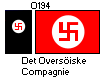
The company appears in Lloyd’s 1937–38 telegraphic-address list.
Denmark, Copenhagen.
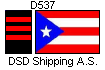
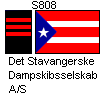
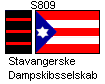
Earlier sources show narrow funnel bands widely separated. Later published S808 versions reduce the gaps, while Stavanger Breeze in September 1998 has red bands slightly broader than the intervening black.
Flag sources differ over equal bands versus narrower white. The 2004 company image has narrower white bands, but 2010 images show wider white bands and one squarer form. The FOTW rendering uses bright blue.
Rosanoski considers this flag derived from a website logo without correcting its angled perspective.
Stavanger Blossom’s July 2013 photograph supplies the funnel. Current website flags have wider white bands but differ in star shape.
Fjordveien supports this funnel; the six-headed-arrow design is painted on the side superstructure.
Fjordveien’s April 2004 photograph provides this funnel. The associated website-logo flag has brighter blue than S1391, and the logo also appears on the superstructure.
Norled’s logo combines its name with the Stavangerske flag.
Stavanger’s traders’ association founded DSD on 12 February 1855 through public subscriptions. Initially a local ferry concern, it later expanded into wider transport, particularly after 1989. It became wholly owned by Folke Hermansen, who headed the group from that year.
DSD Shipping was formed in 1989 to manage the parent’s tankers, while Nor-Cargo Stavangerske handled integrated transport and forwarding. The ferry business became Stavangerske, variously dated to 1989 or 1990 under Rogaland names, with a 2003 name change. It joined Tide in 2007. The source traces the later wholly owned ferry operation to Norled from 2011–2012; the name combines NOR, referring to Norway and the north, with LED, the safe fairway.
DSD also participated in the consortium forming Coastal Express Service.
Norway, Stavanger.
Brown’s star edging is unclear and may reflect print misalignment, with part black and part white. Talbot-Booth 1936 and Ships & The Sea 1936 omit edging; Talbot-Booth 1937 resembles Brown.
The 1930 brochure shows a red flag with a white-edged eight-pointed blue star. The later DSND website version has a smaller star and narrower edging.
The Wilhelmsen funnel followed takeover and is confirmed on Kong Ring. Merchant Ships may indicate continued use of the old company flag; otherwise Rosanoski presumes Wilhelmsen’s flag. Stewart’s funnel bands are considered too far apart.
The funnel has three blue bands, the middle narrower, separated by very narrow strips of black.
The company dates from 1854, although Merchant Ships gives steamship ownership from 1853. It operated Norway–Hamburg shipping and ferry services until 1964. Wilh. Wilhelmsen took it over around 1936, though a 1930 brochure already appears to show that funnel. Following limited shipping activity, it revived as an investment company in 1985, turning towards offshore oil around 1990; the source records Siam Industries involvement in 1993. Merger with Ugland Offshore in 1995 formed DSND Ugland Offshore, renamed DSND Subsea in 2000.
Norway, Christiania, later Oslo.
Mitchell also shows a white shield edged black with red DS. It presumably relates to Detlef Schmidt, whose line drawing shows a yellow funnel.
Schmidt began with Annemarie, then built Detlef Schmidt in 1955 and sold her in 1978. Later registers place him under Zerssen & Co.’s operation.
Germany, Rendsburg.
The illustration shows blue-red-blue horizontal bands, without the DSR flag’s blue fly stripe, and a yellow griffin-like emblem referring to Rostock. FOTW places it on the Deutfracht page but also describes it as a jack used by the successive DSR/Deutfracht companies in 1952–89. Roland Bentin objects that the illustrated emblem is far from the correct design.
The table-flag evidence gives dark blue-red-dark blue bands in proportions 1:3:1. A white border, slightly overlapping the blue stripes, encloses a stylised griffin’s head and an F-shaped wing, resting on a white horizontal stripe extending from the border’s right side. The cited use is 1970–74. Whether the griffin also faced the hoist on the reverse is unknown.
Rosanoski calls both this design and its company attribution guesswork. Mitchell’s funnel appears under “Bulk Schiffahrts” for Deutsche Seereederei with bright-blue bands, whereas the FOTW flag photograph appears dark blue and obscures the emblem’s lower part. A linked photograph is called DSR’s first flag, which Rosanoski questions as possibly Deutfracht; another source dates its use from 1 October 1971.
Obscured symbol and Deutsche Seereederei/Bulk attribution unresolved.
Deutfracht was the short-lived separate operation for tankers, bulk carriers and other specialised vessels taken from Deutsche Seereederei. One account dates its origins to the 1960s; another describes the 1970–74 company as a merger of VEB Internationale Befrachtung in Berlin with the specialised shipping interests at Rostock. It rejoined Deutsche Seereederei on 1 January 1974 as VEB Deutfracht/Seereederei, using the DSR abbreviation and old DSR flag. The successor became Deutsche Seereederei Rostock GmbH in 1990.
Germany, Rostock.
Gluckauf in 1886 is recorded with a black combined DAP monogram, the A larger than the other letters. No flag is recorded for that stage.
This funnel and flag were adopted a few years later. R stands for W.A. Riedemann, a leading figure in the company’s formation; his Waried operation used a similar livery.
The funnel is also a Waried variant; Jordan’s lack of an alternative suggests its use by DAPG. The FOTW flag variant, with a shorter R, is blue-yellow-red vertically, with red R in the yellow stripe, following the 1897 Deicken and Behrmann supplement.
The FOTW description gives a black-yellow-red vertical tricolour with a large red R in the yellow band, linked to Lloyds 1912 number 653. An earlier comment says blue rather than black; Rosanoski questions whether this was a misquotation or a later alteration. The quoted Loughran account explains R as Riedemann and says that, after Esso’s mark replaced his on the ships, the flag continued for years and occasionally thereafter in his memory.
A source note numbered D177 describes black B. (possibly an erroneous D) above API above G.
DAPG became a Standard Oil affiliate shortly after 1888 through Wilhelm A. Reidemann. Standard Oil of New Jersey disposed of its stock in 1917 but evidently reacquired it, since later sources describe a subsidiary with a 94% holding in 1940. After the First World War, most surviving tankers returned to Standard; reluctance to re-register a large German fleet led to Baltische-Amerikanische Petroleum Import in Danzig in 1919, associated in the source with Waried. Rosanoski questions Merchant Ships’ 1928 formation date as possible confusion with Waried. The company was subsequently absorbed into Esso, with indications that Waried had absorbed its shipping interests.
Germany, Hamburg.
The combined company used the Deutsch-Australische funnel, its own flag for Dutch East Indies services, the Deutsch-Australische flag for Australia and the Kosmos flag for South America. After Hapag’s takeover the funnel bands continued in reduced form on Hapag’s yellow funnel, reported until 1987. The component companies’ flags also continued in use.
Deutsch-Austral & Kosmos was formed on 22 June 1921 by merging the Deutsch-Australische and Kosmos companies. Accounts differ over Hugo Stinnes Linien: one gives absorption in 1924, another a merger on 30 January 1926. Hamburg-Amerika took over the combined concern on 24 November 1926. Hapag retained the DDG Kosmos name for its west-coast services to North and South America until the Second World War.
Germany, Hamburg.
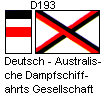
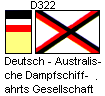
The white flag bears a red-and-black saltire formed by overlapping diagonals. The diagonal from upper hoist to lower fly lies above the other; both are red in their hoist halves and black in their fly halves. Jan Mertens links the colours to the contemporary German national flag rather than Australia. The funnel and flag continued under the merged company and after Hapag’s takeover.
This post-takeover livery places the former funnel bands on Hapag’s funnel, while the original component flags continued to fly.
The Merchant Ships 1942 funnel was prepared from a verbal description.
Also known as DADG and German Australia Line, the company is dated 1888 in the main account, with Hamburg–Australia sailings beginning in July 1889. Passenger service ended after a few years, leaving cargo operations. Another reference places F. Laesz’s involvement in its formation in 1871. It merged with Kosmos on 22 June 1921 as Deutsch-Austral & Kosmos Linien; Rosanoski stresses that the combined company, rather than the original alone, was taken over by Hamburg-Amerika in 1926.
With Hansa and Tyser it formed United Tyser Line in 1910, operating until the First World War.
Germany, Hamburg.
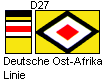
DAL Karoo on 16 September 2004 shows the charterer’s colours only at the top of a tall black funnel base. Rosanoski treats small band-colour differences in Griffin and Reed as printing effects. Later sources attribute this livery under the changing Deutsch-Afrikanische and Deutsche Afrika-Linien names.
DAL Stellenbosch on 26 January 2014 provides the funnel, while other photographs differ in band proportions or yellow shade. Camera effects may explain some differences, though Lloyds 1912 has a distinct buff and Talbot-Booth indicates darker yellow. The yellow house flag has a black-white-red lozenge stopping short of the edges. The National Maritime Museum example is dated 1955–67. Schneider reports use of both this flag and John T. Essberger’s white flag with a blue E.
Brown 1995 shows a white funnel, which Rosanoski considers probably a printing error because it appears in the yellow-funnel section. The FOTW flag follows Brown.
Mitchell apparently places the free-flag companies under Transocean Liners Reederei colours.
Deutsche Ost-Afrika Linie began in 1890 after a German parliamentary subsidy for African trade. The cited founders include C. Woermann, F. Laeisz, August Bolten and Hansing & Co. Woermann supplied two initial ships and gained substantial board influence despite a 2.5% holding. The companies’ African services were closely co-ordinated. A 1907 agreement joined Woermann and Hamburg-Amerika; Eduard Woermann sold his interest in 1916 to Hamburg-Amerika, Norddeutscher Lloyd and Hugo Stinnes. Stinnes withdrew in 1921. Some references give an 1845 origin, apparently belonging to Woermann, or an anomalous 1888 passenger-management date.
Ownership passed to the German Reich during the 1934 reorganisation. One account says Hermann Reemtsma bought the company in 1941 and later gave it to John T. Essberger, while another dates Essberger’s takeover directly to 1941. Wartime losses led to a reported end in 1947, followed by resumed operations as Deutsche Afrikanische Schiffahrts GmbH, probably around 1950, the date Lloyds gives for Deutsche Afrika-Linien GmbH & Co.
Scandinavian East Africa Line was acquired in 1981, and other interests included control of Barbican Bridge, an association with Aquarius-owned Dal Mob Shipping, and the Hamburg-Bremer Afrika Linie venture with Woermann. South African trade was pooled with Safmarine/CMBT as Safdal. Mitchell records sale of the “title” to CMB in April 1990, while a 2014 account still describes traditional African and Indian Ocean services within the Deutsche Afrika-Linien/John T. Essberger group.
Germany, Hamburg.
The red flag has three arrowheads directed towards the centre; the funnel repeats the pattern beneath a black top. Rosanoski identifies this FOTW rendering as upside down and its Hamburg-Deutsche Atlantik company label as incorrect, explaining that Kludas intended the design to cover the original and successor names.
A table flag found by Scott Swendsen shows two arrowheads at the top. Rob Raeside redrew its photograph for publication. Rosanoski could not confirm the resulting proportions because the original photograph was unavailable.
The marcollect table flag, measuring 25 by 15 cm, has narrow white bands at the top and bottom, details not mentioned in the other comments.
Hamburg-Atlantik Linie was formed on 6 January 1958. Scotland was bought that month, renamed Hanseatic and entered service on 20 July. Philipp F. Reemtsma joined in August, when the registered company became Hamburg-Atlantik Schiffahrts GmbH while retaining the older trading name. Expansion led to the inaugural meeting of Deutschen Atlantik-Schiffahrts GmbH & Co. in December 1965. Accounts attribute the founding variously to Vernicos Eugenides, Axel Bitsch Christensen with Nicos Eugenides, or Christensen and Vernicos together.
After Hanseatic’s destruction by fire at New York in September 1966, Shalom became the replacement Hanseatic in 1967. Kludas describes a charter, while another account calls it a purchase. Financing and objections to the Israeli vessel’s transfer to German colours led to the new management company Hanseatic Schiffahrts-Gesellschaft. Financial problems brought a decision to dissolve in October 1973, with the fleet sold in 1973–74. Another account dates closure to December 1973 and attributes it to the 1974 oil crisis; Rosanoski leaves the accounts unreconciled.
In 1991 Dirk Moldenhauer, formerly captain of the last Deutsche Atlantik ship, acquired the logo rights and established Hanseatic Tours, using the earlier livery and ship names.
Germany, Hamburg.
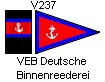
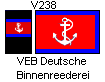
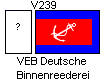
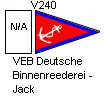
VEB Deutsche Binnenreederei used the V237 bow pennant and V238 flag. Its funnel anchor slopes, unlike the anchors on the flags.
The conflicting FOTW renderings describe red with a central white anchor and blue borders at top, bottom and fly, following the DSR arrangement. Lomantsov worked from old notes of Meyers Neues Lexikon rather than the book itself and warns that proportions, ratio or anchor cable may be wrong. Moerbitz Keith preferred that reference to memory, while suggesting 1:4:1 bands by comparison with Weisse Flotte Potsdam.
In 1945 vessels still flew their individual shipping companies’ flags. AGB’s 1946 A950 livery appears to have been a funnel only.
DOS vessels carried a white triangle, point upwards, on a red bow stripe. The emblem also appeared on pennant and flag. Rosanoski notes that the source site’s image names identify D398 as the pennant, whereas Mertens’s description labels the other illustration a pennant.
DSU’s arms accompanied the D400 pennant and D401 flag, which became the integrated fleet’s colours on 5 January 1953.
SOAG vessels displayed a hammer-and-sickle emblem or red star. The burgee is white with a red border and red five-pointed star. The rectangular flag is white with red borders on three sides, excluding the hoist, and a central red five-pointed star. Mertens dates SOAG’s foundation to 1946 and its transfer to DSU to 1952, differing from the main chronology.
The inland-shipping organisation originated with Generaldirektion Schiffahrt in 1945, followed by Arbeitsgemeinschaft Binnenschiffahrt (AGB) in 1946. AGB’s “Green Fleet” name came from the colour of the ship’s passport. Sowjetischen Staatlichen Oderschiffahrts A.G. (SOAG), the “Red Fleet”, is dated 14 March 1947 in the principal account. Deutsche Oderschiffahrtsgesellschaft (DOS) and Deutsche Schiffahrts- und Umschlagszentrale (DSU) were formed in 1949; their fleets were integrated under DSU on 5 January 1953. They merged in 1957 as VEB Deutsche Binnenreederei, operating merchant vessels on national and European inland waterways. Accounts give its successor A.G. as 1989 or 1990 and report the disposal of ships to private owners.
Germany [East Germany or German Democratic Republic].
Schneider observed the flag at the Rödingsmarkt office on 15 January 2007. Rosanoski considers the anchor cable reversed in D402 and prefers D403, comparing the indistinct company logo with Baltic Lloyd’s website image.
The website supplies separate flag logos for Deutsche Binnenreederei/DBR Lloyd, Elbe Rijn Lloyd, Elbe Saale Lloyd, Odra Lloyd and Thames Rhine Lloyd.
Deutsche Binnenreederei A.G. is dated 1989 as successor to VEB Deutsche Binnenreederei. After 1990 it also had Rostock and Hamburg locations, and by the 2008 account had joined the Odratrans group. Baltic Lloyd Schiffahrt-Spedition-Logistik was formed on 7 August 1997, though another listing refers to new owners from 2000. Related companies and ventures included Elbe Rijn Lloyd, Elbe Saale Lloyd (abandoned in 2005), DBR Lloyd from 2005, Odra Lloyd, Rhine Thames Lloyd and Säschisch Tscheechische Elbe Schiffahrt, with a recorded DBR Lloyd interest in Schiffahrtsgesellschaft Regensburg.
Germany, Berlin.
The Hamburg flag is white with a black winged inverted triangle in black, red and gold, its point between D and B. Rosanoski’s 2004 account describes black letters. Mertens’s later photographic account instead specifies red initials and long, thin wings, explaining that small originals had caused errors in the earlier drawing. Eugene Ipavec’s D443 replaced Jarig Bakker’s rendering.
The livery follows the chartered Wangerooge, of the Warrings family, on 8 April 2012. DB AutoZug’s Wangerooge branch then appeared to be Deutsche Bahn’s only remaining ferry operation. This later observation follows an earlier note that the small Warrings-owned Wangerooge service seemed to have ended before the merger and that its former flag was unknown.
The Hamburg railway shipping division was the larger of the two West German rail-ferry operators. It appears under Eisenbahndirecktion Hamburg and later Bundesbahndirecktion Hamburg, with a 1990 merger into Deutsche Bundesbahn recorded by Lloyds. Rosanoski questions the Hannover wording in the merger account.
Germany, Hamburg-Altona.
Keep the explicit scope label independent; no alias or company identity is inferred.
Germany, Oldenburg.
Keep the explicit scope label independent; no alias or company identity is inferred.
Germany, Wittmund.
Keep the explicit scope label independent; no alias or company identity is inferred.
The Münster division’s vessel later appears under Schiffsdienst und Inselbahn Wangerooge, listed in Wittmund in 1985–86 as manager for Bundesminister für Vekehr-WSV.
Keep the explicit scope label independent; no alias or company identity is inferred.
Ralf Stelter reports that Baltic railway ferries wore the German state ensign rather than the civil ensign because they belonged to Deutsche Bundesbahn.
Deutsche Bundesbahn was formed on 7 September 1949 as the Federal Republic’s state railway, headquartered in Frankfurt under the Federal Transport Ministry. The principal account dates its combination with East Germany’s Deutsche Reichsbahn as Deutsche Bahn A.G. to 1 January 1994; Lloyds instead gives a 1990 merger, and a separate entry gives formation in 1987. Ferry services combined in 1993 as Deutsche Fahrgesellscahft Ostsee. Deutsche Bahn later participated in Scandlines and reorganised its logistics activities, including the Stinnes acquisition, variously dated 2002 or 2003.
DB Logistics subsequently owned EVAG, Emder Verkehrsgesellschaft A.G.
Germany, Hamburg.
A photograph dated 1985 apparently shows the Conti flag on the vessel identified as Sellebrunn, formerly Dorthe. Accounts differ on when the name changed: one gives Dorthe under Conti in 1985–90, whereas Lloyds shows Sellebrunn by 1988. The yellow part of the emblem looks like a rounded hose-like tool. The FOTW illustration follows Brown 1995 under Deutsche Conti Schiffahrtsgesellschaft.
Exact relationship and shared use remain unproved.
The operation originated in a subsidiary founded in 1968 by the Hamburg grain house Deutsche Conti. Lloyds later lists Deutsche Conti-Handelsgesellschaft and Deutsche Conti Schiffahrtsgesellschaft at the same address, with their vessels subsequently under the latter. Rosanoski suggests that they were effectively the same or that one merged into the other. The Schiffahrtsgesellschaft was taken over by Wilhelm Mahnke in 1992 and renamed Interscan Schiffahrtsgesellschaft.
Germany, Hamburg.
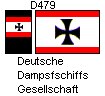
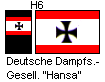
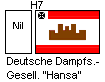
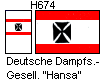
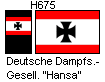
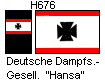
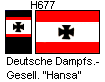
The original flag symbolised the Hanseatic spirit in the old German Empire’s colours: red with a very broad white horizontal band carrying a brown castle, and a small white canton as deep as the upper red band, containing a black Iron Cross. It was used until 1883.
The later flag is a red-white-red triband with a wider centre bearing a black cross formy, clear of the edges, described as the Hanseatic cross. The National Maritime Museum specimen, dated about 1955–67, places the cross slightly towards the hoist. Rosanoski considers ordinary red appropriate, with no source specifying the pink of the earlier FOTW illustration.
The cross shape varies across sources; a black-and-white photograph of Reichenfels confirms a thin Iron Cross form. Stewart’s H6 has narrower red bands, closer to D479. Reed’s omission of Hansa from the D479 name is considered probably an error.
DDG Hansa, also called Hansa Linie, was founded by Bremen merchants led by Oltmann Johan Dietrich Ahlers on 3 December 1881. It exchanged capital with Norddeutscher Lloyd in 1928 but subsequently became independent again. Bankruptcy is recorded in 1980, with a September filing, while another passage describes operations ending in the later 1980s and Lloyds still lists it as manager in 1985–86.
Hansa participated in Atlantica Line, United Tyser Line from 1910 until the First World War, Offshore Supply Association from 1966 and VTO-Hansa-Off-shore with NVG. A reported majority holding in Atlas Levante during the mid-1950s and sale to Hamburg Süd in 1967 conflicts with other accounts of the seller. The claimed operation of Havenbedrijf Mabesoone’s Schelde is also inconsistent between register entries. Ships were named for castles, commonly ending in fels. The subsidiary Project Carriers, later Hansa-Linie, briefly continued the colours, including on Titan Scan. Its operations entered the 1989 Mammoet-Hansa Linie venture with Mammoet Transport, renamed Mammoet-Hansa in 1992.
Germany, Bremen.
The flag is vertically red and white with a central blue disc surrounded by six blue five-pointed stars in two partial arcs. Griffin places the upper and lower stars nearer the dividing line. Other evidence gives six-pointed stars, including the 1902 chart and a 1907 Rhakotis painting, while Lloyds 1912 has five points. The flag continued after the 1921 merger and Hapag’s 1926 takeover; any cosmological meaning remains an unanswered question.
Schneider’s FOTW variant has four-pointed stars with extensions, based on a Kludas placard. Rosanoski’s magnified inspection instead finds five-pointed stars on that placard, with their top points directed outwards and lower pairs parallel to the circle.
The funnel follows Kludas’s Uarda drawing. The accompanying flag has six-pointed stars and light sky blue; another volume uses duller mid-blue. The tiny ship-drawing flag is too small for reliable detail.
Kludas’s livery chart uses darker blue with six-pointed stars, all upright. Other illustrations vary in star angle and blue shade.
Flaggenbuch 1928 does show four-pointed stars, angled like Xs and placed closer to the circle.
Massary 1930 uses lighter blue and six small squares near the circle instead of stars.
DDG Kosmos was founded on 28 November 1872 by Knöhr & Burchard Nachfolder and H.H. Eggers for trade between Germany and South America. It acquired the rival Hamburg-Pacific fleet in 1898 and merged with Deutsch-Australische on 22 June 1921 as Deutsch-Austral & Kosmos Linien.
Germany, Hamburg.
The flag has five unequal horizontal bands, blue-white-light blue-white-blue. Simple fish shapes occupy the central band, outlined black except for the central red fish, which have white outlines and carry the white letters DFFU. Rosanoski takes the shades from the website image: blue RGB 78,64,173, light blue 84,158,197 and red 243,2,23.
Formed in 1985, Deutsche Fischfang-Union is listed in Lloyds in 1992–93. Samherji h/f managed one vessel in the 2000 account.
Germany, Cuxhaven.
The funnel follows Mecklenburg-Vorpommern and Sassnitz, whose hulls also carry HANSA in two shades of blue. Mitchell uses one blue shade for the letters and calls the livery Vogelflug Linie.
DFO was formed on 1 April 1993 when Deutsche Bundesbahn and Deutsche Reichsbahn combined ferry services, only part of the latter’s fleet being transferred. It was owned by Deutsche Bahn. The rail-ferry links dated to Gedser–Warnemünde in 1903 and the German–Swedish Königslinie in 1909. Its Trelleborg–Sazznitz service with Svenska Statens Järnvärgar operated as TS-Line and later Hansa. On 21 July 1998 DFO and Scandlines A/S merged as Scandlines A.G., following co-operation with Danish and Swedish partners.
Germany, Rostock.
Rosanoski points out that the source’s J has a horizontal arm at the top. The two FOTW renderings document the differing treatment.
This one-ship company transported its own herring barrels. Jakob Ekkenga was built in 1956 and sold in 1968; the quoted FOTW account instead spells the vessel Jakob Eidenga.
Germany, Emden.
D190 has plain letters. Lloyds 1904 and 1912 show plain funnel letters but ornate flag lettering as in D189, whereas German sources use ornate lettering on both. Other sources pair D190-style flags with the D189 funnel form. A Tenedos photograph confirms a full band joining around the funnel, with part of an apparently plain L visible. Jordan instead describes black DLL letters on a red-white flag; Rosanoski regards this as erroneous because other sources give white letters on a black circle.
Several sources give this funnel to Atlas Levant-Linie while distinguishing its own flag. D189 later appears under Bock, Godeffroy, apparently from 1956. Sampson also mentions buff funnels without saying whether they were plain or carried a flag band. The livery was replaced by Hamburg Süd’s in 1967.
The FOTW rendering has thin, plain white letters on a central black disc, over a red-white diagonally quartered field. The accompanying description says DL, which Rosanoski marks as questionable. The US Navy version uses an oval rather than a circle.
DLL was formed on 6 September 1889, with F. Laeisz involved. In 1910 it amalgamated with Bremer Dampferlinie Atlas and acquired A.C. de Freitas’s fleet and the Adria Line from H.C. Horn, although another account describes acquisition of Heinrich C. Horn without naming Adria. Hapag gained control and absorbed the company, variously dated during the First World War, 23 December 1919 or early 1920. Norddeutscher Lloyd also became associated in the 1920s.
A new Deutsche Levante-Linie Hamburg A.G. was formed on 5 July 1935 under the shipping reorganisation, joining Atlas Levante Linie in Deutsche Levante-Linie GmbH with a two-thirds holding. Bock, Godeffroy & Co. took it over in 1942 and was itself acquired by the Oetker group in 1956. DLL participated in the Nah-Ost-Gemeinschaft consortium from 1962. Some accounts say the name ended in 1970, while the later merger with Atlas to form Deutsche Nah-Ost Linie is dated 1973.
Germany, Hamburg.
Nah-Ost-Gemeinschaft (NOG) began in 1962 to reduce costs in Middle Eastern shipping. Bühne’s account names Argo Nah-Ost-Linie, Deutsche Orient-Linie and Transmarin, describing competition and unsuccessful negotiations with Oetker, followed by an NOG shipping company. A contemporary account instead describes a five-company combination including Atlas and Deutsche Levante, chartering their fleets and ending on 31 December 1967.
Deutsche Nah-Ost-Linien (DNOL) was established on 1 April 1973 by merging Deutsche Levante and Atlas Levante. It apparently continued as a charterer. The other partners sold to Hamburg-Süd between 1984 and 1986, leaving Oetker with full ownership. DNOL and its agencies and staff were incorporated completely into Hamburg-Süd on 1 July 1999.
Germany, Hamburg.
Mitchell’s small drawing shows a yellow circle outlined blue, with either blue DR letters or their blue outlines. Beside it is an indistinct panel, perhaps a funnel or the national colours, apparently black above red and yellow. Rosanoski cannot determine its form from the small image.
Captioned for Sassnitz alone in 1959–60, the white flag is edged horizontally with blue-white-blue. At the hoist a blue disc carries yellow serifed DR letters, with a black-red-yellow parallelogram wing extending towards the fly; its stripes do not touch. The description calls the disc yellow-edged, but the illustration instead has a yellow ring separated from blue by white and outlined black externally. A ship photograph supports the narrow funnel bands but does not reveal the emblem; a website funnel rendering seems to join the tricolour stripes, possibly an effect of size.
Captioned from 1960 for all Reichsbahn ferries, this version replaces the tricolour wing with three yellow stripes enclosed and separated by grey holding lines.
A starboard photograph of Sassnitz shows the circle towards the front. Unlike D451, the yellow panels are not outlined and connected into one unit, and the yellow is a darker gold.
A ferry source describes a white funnel with black top and stylised DR motif.
The FOTW rendering numbered D448 in the source uses a blue-and-golden railway wheel with a wing.
The railway originated in 1920 as Deutsche Reichseisenbahnen, was reorganised as Deutsche Reichsbahn-Gesellschaft in 1924, and continued in the Soviet sector as Deutsche Reichsbahn after German control resumed in 1949. It became directly subordinate to the GDR Transport Ministry. Another account gives formation in 1950. The East German railway operated about ten ferries between Rostock or Sassnitz and Sweden or Denmark. Accounts date merger into the federal railway to 1990 or 1994; ferry services combined with Deutsche Bundesbahn’s in 1993 as Deutsche Fahrgesellscahft Ostsee.
German, Greifsswald; later Sassnitz.
The funnel later became that of Senator Line. The FOTW flag follows Brown 1995.
Jane’s records passenger-ship and reefer funnels with and without black tops; the accompanying flag is assumed. Moerbitz Keith recalls only blue borders at top and bottom after joining DSR in 1974 and suggests a merger-related change. Rosanoski counters that blue-red-blue tribands with white DSR already appear in Stewart 1963 and Brown 1978/1982; Stewart uses equal bands. A photograph in Jahrbuch der Schiffahrt 1965 shows D234 without a black top and with light-medium-blue bands.
This reconstruction for 1952–74 has blue-red-blue bands in proportions 1:3:1, white DSR in the red, and a blue fly stripe as wide as the horizontal blue bands, with overall ratio 2:3. Moerbitz Keith’s account rests on long service and recollection. Bentin challenges the design, and Rosanoski finds no supporting source; he does not regard it as proved.
This yellow-letter reconstruction is attributed to Scharnow’s 1988 Lexikon Seefahrt. Rosanoski explicitly disputes the citation: his 1981, 1984 and 1988 editions show D234, not this image. He asks that the reconstruction be marked unproved pending better evidence.
The shared DSR/Deutfracht jack is triangular and bears a black griffin referring to Rostock. Moerbitz Keith questioned twelve former DSR members about its direction and redrew it using Schwoon’s GDR-era Rostock city-flag griffin as a close model.
This flag belongs to the agency VEB Deutsche Schiffsmaklerei, sole representative of inland and foreign vessels calling at GDR seaports. Rosanoski includes it for convenience only and finds no indication of a connection with the shipping company.
Keep the explicit scope label independent; no alias or company identity is inferred.
The blue-red-blue pattern was common to civilian GDR maritime organisations. Moerbitz Keith did not know its designer or meaning and only supposed blue to represent water and red the working class.
DSR-Senator/Senator used a white flag with a stylised S of three lines, two dark blue and one red; Brown 1995 shows the central line in lighter blue. DSR Schiffahrts livery apparently varied.
Deutsche Seereederei was founded in 1952 as the GDR’s major state merchant-shipping company, reaching about 200 ships in the late 1970s. Tankers and bulk carriers were separated into Deutfracht in the 1960s and reunited with DSR in 1974 as VEB Deutfracht/Seereederei. Reorganisation as Deutsche Seereederei Rostock GmbH in July 1990 began privatisation, followed by sale to Horst Rahe and Nikolaus Schues in June 1993. A separate Mitchell note instead records a 1990 sale to BGS Group; the accounts are not reconciled.
The fleet was subsequently divided among bulk, coastal, ferry and vessel-owning companies under Reederei F. Laeisz management. Rosanoski records a later division between Schues’s shipping and ferry interests and Rahe’s tourism and property businesses, with inconsistent 1998/1999 dating. The liner business had already merged with Senator in 1994 as DSR-Senator, jointly owned with Bremer Vulkan. Financial difficulties led Hanjin to acquire 80% in 1997; the name became Senator Line on 1 July 2000. Rosanoski rejects a contributor’s account placing its formation in 1998.
The continuing DSR group diversified, with Arkona and DSR Schiffahrts co-ordinating cruise and maritime interests. Cruise ships were disposed of in 2001–02, three passing to P&O, while Arkona bought the A’ROSA river fleet from Seetours in December 2003. Other relationships included the Baltafrica service with Polish Ocean Lines from April 1967, Scandlines participation and TR-Line association in 1992–96. A partnership with Interorient begun in 2003 as Reederei Hansa became Interhansa in 2004, with Hugo Stinnes Linien handling liner activity; the Stinnes shipping interests were sold in 2008.
Germany, Rostock.
The eagle on the house flag gave rise to the Adler/Eagle names. Bonsor describes a black funnel with white over red bands, but a black-and-white Schiller photograph seems to show a black top, very broad white band and red extending to the base. The flag bears a black eagle; Rosanoski calls his image format a guess.
The company, also known as Adler Linie or Eagle Line, was formed on 16 January 1872 when groups planning Deutsche Dampfschifgfahrtsgesellschaft Atlantic in Berlin and Hamburger Lloyd in Hamburg combined. Ferdinand and Carl Laeisz were involved. Operations began on 12 September 1873; after the last sailing on 5 May 1875, the business was sold to Hamburg Amerika Linie.
Germany, Hamburg.
Blue and red were the basic colour combination of East German maritime organisations, according to Volker Moerbitz Keith.
The organisation took over Elbe shipping from Sowjetische Verwaltung in 1950 and became VEB Fahrgastschiffahrt “Weiße Flotte” in 1956.
Germany, Dresden.
This funnel follows Askabat from starboard on 23 March 2006 and Baku from port on 30 September 2005. Lady Serra, photographed on 1 March 2013 under Deval Transport management, has a variation: D touches the circle at upper left and lower right, and the upper red area appears brownish red compared with the brighter lower area.
This funnel follows Alican Deval in port- and starboard-side photographs from March 2006.
No exclusive fleet-wide use or unrecorded corporate equivalence is asserted.
After 1973 Ali Haydar Deval and his brother formed separate companies. Ali Haydar’s Deval Denizcilik owned ships from 1976, when Hikmet Deval was built.
Keep the explicit scope label independent; no alias or company identity is inferred.
The family business originated in 1881 with Captain Hasan Deval trading by wooden sailing boat between Russia and the Ottoman Empire. He moved from Rize to Istanbul in 1910; his son Captain Ismail Hakki took over during the Turkish Independence War. Sailing vessels continued until the first steamship purchase in 1952. Lloyds separately dates formation to 1959 and the change from Orhan Deval ve Ogullari Kollektif Sirketi to Deval Shipping & Trading in 1983.
The group operated through Deval Denizcilik ve Ticaret and Deval Transport, chartering its tonnage through Levant Shipbroking & Chartering. Its interests included Turkish Cargo Lines, Denizciler Tourizm ve Denizcilik, Eregli Shipping and Marine Tug, founded in 2001.
Turkey, Istanbul.
Troy-D’s funnel band bears a large white shield. At its top is a yellow scroll inscribed DEVINE, with lettering colour unspecified. A smaller red shield contains a yellow lion guardant; above it is a red helm surmounted by a rampant lion of unspecified colour. Below is “Nothing without effort”, presumably on a scroll, with colours again unspecified.
The funnel follows Weela in dryberth on the company website. Photographs also show a green flag with an indistinct yellow charge, possibly a kangaroo, and a blue flag with unreadable white lettering.
Registered in Brisbane on 18 December 1992 as Devine Shipping Pty. Ltd., the business became Devine Marine Group, comprising shipping and marine-salvage companies. It bought Troy-D in 1995. After grounding on 1 November that year, she was refloated and laid up until preparation in 2006 for scuttling as a dive ship in 2007.
Australia, Sydney.
The flag has alternating wine-red and deep-blue quarters with a central white rectangle. Loughran explains the five rectangles as bales of wool, four greasy and one clean; Griffin makes the white panel smaller. The flag continued at Pangbourne after the clipper firm, which never moved into steam, ceased shipping.
Devitt & Moore began as shipbrokers loading for Australia in 1836 and entered shipowning by 1863 with City of Adelaide, technically managed for a syndicate in which Joseph Moore Snr held a quarter share. After Thomas Henry Devitt’s death in 1860, the partners’ sons Thomas L. Devitt and Joseph Moore Jr joined the firm. It carried passengers and cargo between Britain and Australia, mainly under sail, until the end of the First World War. Devitt & Moore’s Ocean Training Ships Ltd. was formed in 1909; Medway, the last ship, was sold in 1920, and the firm was voluntarily wound up in 1931. William Crosby & Co. acted as agents.
The training tradition continued at Pangbourne Nautical College, founded by Sir Thomas L. and Philip Devitt. Sources date its foundation to 1916 or 1917, while a later recollection places it after the disposal of the ships in the 1920s.
UK, London.


The Log describes a red flag with a blue cross edged yellow and then white, the blue broader than the yellow, and white DSFCo lettering. Sea Breezes instead has plain DSFC. An actual flag offered at auction in 2007 provides the basis for D350. Rosanoski allows a possible historical change but suggests that the answer may combine the letter style with DSFC.
Ewen William Alison and his brother Alexander floated the company in August 1881, with operations beginning on 3 October. It took over an earlier Auckland & North Shore Ferry company in September 1881 and the assets of a new namesake formed by George Quick in 1886. Takapuna Tramways & Ferry was absorbed in 1927. The Auckland Harbour Bridge brought the service to an end around 1959, with about £1 million compensation for lost business.
New Zealand, Auckland.
This flag is shown in the 1922 Yearbook of the Central Committee of French Shipowners.
Justin Devès established Bordeaux trade with Senegal in 1810 and was joined by his brothers Bruno and Edouard in 1821. After Justin’s death in 1866 the concern became Devès & Chaumet. The quoted name “Devès & Chaumet Gustave” is questioned by Rosanoski, who identifies Gustave Chaumet as the merchant and shipowner. By 1921 it was a powerful French trading company in Senegal, operating steam barges there and seagoing vessels including Macina, built at Glasgow in 1897.
France, Bordeaux.
The house flag is described as unchanged since DFDS began, though its white cross varies in size and Nüsse’s table flag places it towards the hoist. Merchant Ships 1942 gives a very broad red funnel band; photographs vary in band width and sometimes show a vessel-name pennant at the foremast.
To distinguish the common black-and-red funnel, a white cross in a blue circle was added from 1 January 1967; Mitchell dates it to December 1966. It initially served both passenger and cargo ships, as confirmed by Tor Scandinavia in July 1986. Later sources distinguish it as the cargo funnel. The company history says freight vessels retained black and red with a white cross until 1992, when dark blue with a white-ringed cross replaced it.
The company decided in 1985 to paint passenger ships white with a white cross and racing stripes in three blue shades, inspired by Scandinavian World Cruises’ Scandinavia. Rosanoski dates adoption to May–June 1986 and relates it to DFDS Seaways. Admiral of Scandinavia confirms the funnel. Duke of Scandinavia, formerly Dana Anglia, has the stripes lowered towards the base because the funnel top is open for ventilation; photographs confirm light, middle and dark blues.
This livery is given for DFDS Transport and DFDS Baltic Line, including Dana Cimbria.
The Seaways table flag is white with a blue circle near the hoist containing a white cross paty, red DFDS above SEAWAYS, and a light-blue over dark-blue band along the bottom. It matches the ship colour scheme, but Rosanoski is unsure whether it was flown at sea or refers to the service rather than the later company.
Service versus 2000 subsidiary remains open; table flag does not prove use at sea.
Tor Flandria confirms the funnel. The related website flag has a white cross within a white ring on an angled blue panel, beside blue DFDS above TOR LINE. FOTW’s image is labelled DFDS Scandinavian Seaways, while Rosanoski links the website version to the Norwegian DFDS Tor Line A/S.
A/B versus A/S corporate allocation unresolved; no equivalence asserted.
No exclusive fleet-wide use or unrecorded corporate equivalence is asserted.
Swedish Tor Line was formed by Rederi Transoil and Rederi Rex, its name combining their initials. Lloyds gives 1966, while a former manager dates inception to 1965. Bratt-Götha and KNSM joined as the service expanded from England to Holland; Salén acquired Rex in 1967. After brief co-operation with Sessan, Tor was sold to DFDS in 1981 and continued under the Danish flag. Lloyds dates the DFDS Tor Line name to 1999, but a July 1986 photograph already shows it on Tor Scandinavia. A proposed North Sea Line merger in 1999 apparently did not occur.
Keep the explicit scope label independent; no alias or company identity is inferred.
Tor’s original white funnel and flag carry a black-and-white target above two blue wavy sea lines. A 1981 Tor Britannia close-up shows two narrow inner rings, one close to the broad outer ring; the sea appears very dark blue. Tor Neerlandia in June 1986 has a very narrow funnel top. Later DFDS versions add the company reference. Brown’s T106 angles both cross and large lettering, whereas Nüsse angles only the panel and keeps cross and letters upright. Rosanoski’s proposed 1999 adoption date sits alongside its inclusion in Brown 1995.
Keep the explicit scope label independent; no alias or company identity is inferred.
DFDS inherited Koch & Henderson’s black funnel with a red band and its blue flag with a white cross. Prior instead used a red flag with a white star. A Carl Neumann painting of the fleets assembled in Copenhagen in 1862 shows the white cross on blue. Why that flag was chosen is uncertain; the company account suggests that Tietgen may have seen national symbolism after Denmark’s 1864 defeat.
From 2010 DFDS adopted a common dark-blue funnel for freight and passenger ships, with a white cross inside a white circle. The modernised logo is specified as Pantone 2955.
The source records three funnel-blue measurements: light RGB 140,200,200, middle 0,153,204 and dark 0,0,128.
Det Forenede Dampskibs-Selskab was formed in 1866 from a foundation fleet of nineteen ships belonging to Koch & Henderson, H.P. Prior and The General Danish Steamship Company. The shortened legal name DFDS A/S is dated 1970 by Lloyds and Rosanoski, or 1971 in another account. Its services appear under several English names, including United Steamship Company and Scandinavian American Line.
After the unsuccessful 1982–83 New York–Miami passenger service, restructuring concentrated DFDS on northern Europe and disposed of Mediterranean and American activities. Investments included Tor Line, North Sea Line from January 1999, Lithuanian LISCO in 2001 and Lys-Line, with its first majority acquisition variously dated 2002 or 2003 and full ownership in 2005. DFDS sold Dan Transport in 2000 and acquired Norfolkline in July 2010, integrating its ships and routes into DFDS Seaways. Earlier disposals included Nordana in 1983 and Mols-Linien in 1984. Lauritzen remained a controlling shareholder; Clipper’s holding reached 15% in 2009.
Lisco Baltic Service emerged from Lithuanian Shipping’s reorganisation in June 2001 and became AB DFDS Lisco. The Lys-Line business later became DFDS Logistics. DFDS Seaways began as a service on 25 June 1971, distinct from the company formed in 2000. Tor Line companies were also established in Oslo in 1998 and Harwich in 2001.
Denmark, Copenhagen; later Esbjerg.
Both funnels follow starboard photographs of DHT Ann in June 2013, dated 14 June for D583 and 8 June for D584. Rosanoski attributes the apparent colour difference to photographic manipulation and considers the white version correct. He suggests that D583 enhanced staining as though it were the base colour, while D584 was also cleaned up to emphasise white; the unusually deep-blue skies reinforce his concern.
DHT Maritime Inc. was formed and listed on the New York Stock Exchange in 2005, acquiring tankers on long-term charter. In March 2010 the newly formed Marshall Islands corporation DHT Holdings became its publicly held parent. That year the business began moving from a leasing model to operational shipowning, including a wholly owned Oslo management company, DHT Management AS.
Marshall Islands, with corporate headquarters in Hamilton, Bermuda.
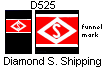
The funnel follows Atlantic Muse from the port side at Botany Bay on 7 June 2012.
The funnel follows Alpine Mystery from the port side on 29 March 2013 and is closer to the company logo.
Diamond S was formed in October 2007 as a partnership between First Reserve Corporation and Craig Stevenson Jr.’s Pecos Shipping LLC, with DSS Holdings LP as holding company. Stevenson had previously controlled OMI until its sale. The partnership ordered tankers in 2010 for 2012 delivery and bought thirty tankers from Cido in 2011. A 2014 source identifies W.L. Ross & Co. as the largest shareholder.
USA, Greenwich CT.
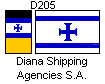
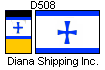
The flag is white with two horizontal blue stripes and a blue cross patty in the centre, also shown by Brown 1995.
The funnel follows Norfolk from the port side on 19 April 2011.
Simeon P. Palios formed Diana Shipping Agencies in 1972. The website dates Diana Shipping Services to 1986, initially managing second-hand ships and newbuildings from 1996; Lloyds gives different formation dates, later amended to 1987. Diana Shipping Inc., formerly Diana Shipping Investment Corporation and dated 1999 by Lloyds, owns and operates dry-bulk carriers. Agencies initially managed its fleet, transferring commercial and technical responsibilities to Services on 12 November 2004. Diana Shipping Inc. acquired Services on 1 April 2006.
Greece, Piraeus.
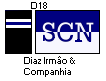
Brazil, Espírito Santo.
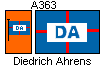
Mitchell presumably based his funnel illustration on the line drawing of Elli Ahrens.
Ahrens owned Dietrich Ahrens, built in 1938, and sold the last vessel, Elli Ahrens, in 1971. Lloyds records Kapitän Dietrich Ahrens in 1953–4, separate vessels for Dietrich Ahrens and Dietrich Ahrens Jr. in 1958–9, the younger name alone in 1963–4 and Diedrich Ahrens from 1966–7. The fleet used full family names.
Germany, Brake.
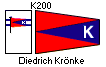
The funnel and flag follow Brown 1978.
The registers list Diedrich Krönke from 1953–54, as manager only in 1970–71, and Klaus-Dieter Krönke in 1973–74.
Germany, Drochtersen uber Stade.
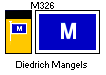
M326 is documented by Brown 1978.
Diedrich Mangels appears in the 1958–59 and 1963–64 registers and later under Wilhelm Tietjen’s management in 1973–74.
Germany, Grunendeich; Stade also recorded.
Diesel Services operated Hiahd in the potato trade from 1949 to 1957 and appears in Lloyds in 1953–54 and 1956–57.
Australia, Adelaide.
B712 follows both sides of Warfleth, photographed on 25 February 2008 and 21 September 2006. In the starboard view the device faces forwards while the pole angles aft. The green appears darker, as suggested by the flag image, but the diamond frame’s size is unclear because that image is not a normal rectangle.
Dieter Blanke is recorded as manager of m.s. “Warfleth” Blanke Schiffahrts K.G. from 1988–1989, following the owning-company entry in 1985–1986.
Germany, Elsfleth; Warfleth; Berne.
Dileship Co. Ltd. was formed in 1962, with D. Lecanidis as managing director. It acted as shipping agent and was associated with Dileship Marine Corporation.
Greece, Piraeus.
Mitchell records the funnel for Portatissa, listed under Dileship Co. Ltd.’s agency in 1992–93. A photograph of Grigorpan on 1 February 2006 confirms the design but without a black top.
Dileship Marine Corporation was formed in 1987 and operated as agent. Its director appears as D. Lekandis in Lloyds and D. Lekanidis in Mitchell. It shared a Piraeus address with Dileship Co. and later an Athens address with associate J.G. Goumas. The latter partnership formed Equinox Maritime; both groups also participated with Lauritzen- and Nomikos-associated interests in Meridian Bulk Carriers, formed in 2000.
Greece, Piraeus; later Athens.
The Log’s verbal description stresses narrow white funnel bands but does not specify unequal flag bands.
Dilmun was listed under Gray, Mackenzie as operator in the 1960s and later under Macdonald Hamilton management. It held the Inchcape South Pacific Marine Division’s assets and business, sold to Howard Smith around 1 March 1988, including Bulk Transportation (P.N.G.) and a 45% Pacific Towing interest. The Log says Dilmun became wholly owned by Howard Smith, but Rosanoski distinguishes the original UK Ltd. from the new Australian Pty. Ltd. A later account has the Australian company managing ships owned by Dilmun UK, suggesting continued separate existence for a time.
UK, London; Australia, Brisbane; later UK, Hull. Mitchell gives Bandar Abbas.
Although the flag seems to depict a funnel, NJK’s confirmed sightings lacked a P. Mitchell gives this unlettered funnel for Afros Shipping.
The funnel follows Vitality in a photograph dated 25 July 2009. Nüsse’s later table-flag image uses a sky-blue funnel shade.
Founded in 1947 as Dioryx (Hellas) Shipping & Trading Co. Ltd., the business changed its name in 1979. Mitchell associates it with J. Sandakis. It acted as agent, including for Afros Shipping; Liquimar Tankers Management, formed in Athens in 1995, is listed as an operating subsidiary.
Greece, Athens.
The funnel follows Faycan. The blue in its symbol differs from the logo’s shade.
Petrogás dates the start of operations to 1967, while Lloyds gives formation in 2000. It is associated with Compañia Espanola de Petroleos S.A.
Spain, Santa Cruz de Tenerife, Canary Islands.
The D’Alesio group flag is a triangular blue–red–blue horizontal triband. The company website also supplies the logo and funnel.
D’Alesio Oil Services appears in the 1980s records, with Gaetano d’Alesio S.a.S. as agents.
Italy, Livorno.
Dalmare was formed in 1978 as Dalmare di Navigazione S.p.A.
Italy, Palermo; Livano.
Italy, Leghorn; Livorno.
Keep the explicit scope label independent; no alias or company identity is inferred.
Gaetano D’Alesio began as a shipping agent in 1930, built fishing boats during the Second World War and became a shipowner in 1947. Lloyds dates company formation to 1942. The group operated its own fleet and included Geostar Shipping, formed in Curaçao in 1991, and Dalmare. It also participated in Petrotank with the Pietro Barbaro Group.
The funnel is black with a white band. The blue flag has a narrow red diagonal band, described as Pbds, bearing three white stars. Stewart shows the stars angled.
The company was operating in 1939 and appears in the 1963–64 and 1970–71 registers.
Italy.
USA Houseflags attributes this flag to Dixie Offshore Carriers. Rosanoski assumes that it refers to this company, though the operation appears to be tug-based.
Offshore Carriers and Dixie Carriers relationship unresolved.
Houston investors bought River Terminals Corporation in 1948, a petroleum carrier between Houston and New Orleans and cotton carrier down the Mississippi. It became Dixie Carriers, acquired by Kirby in 1969 and incorporated into Kirby Inland Marine in 1998. Lloyds later gives a 1993 formation date for a Kirby vessel-owning company of the name; Dixie Leader subsequently appears in Kirby Inland Marine’s fleet.
USA, Washington.
The funnel follows Lady Demet from starboard on 17 February 2014 and is based on the Deval group’s design.
DMY built Lady Demet and Lady Begum in 2012 for operation by the Deval Shipping Group.
Turkey, Istanbul.
The flag is white with a blue initial-letter logo slightly towards the hoist and two lines beneath, apparently wavy. The small original and animated website image leave the line shape uncertain.
The Dobson brothers formed the business in 1993 after selling their UK-based marine-refrigeration concern and entering shipowning. Initially managing only their own ships, it developed into a substantial third-party manager. The 2012 account says it no longer owned any vessels under its management and remained privately held without outside shareholders. Headquarters were in Cyprus, with passenger-ferry operations managed from Dublin. Dobson Line was a trading name; the Polish operation, listed as DFM Ltd. at Gydnia, is also described as Dobsol Fleet Management.
Cyprus, Limassol.
The lettering colour is disputed. Rosanoski argued for blue rather than the FOTW rendering’s black, using the Maatschappij and Nüsse images; Martins-Tuválkin read them as purple and identified Kabel Ultrabold type. Rosanoski accepted the purple appearance but suggested reproduction effects, without proof. Nüsse’s later image shows blue letters and a more yellow vessel. A 5:3 proportion is suspected, though the white flag’s edges are unclear against the white background.
Martins-Tuválkin interpreted the paired drawings as a flag intended to read correctly on both sides and redrew obverse and reverse separately. Rosanoski disagreed: he understood both to have the vessel pointing towards the fly and considered a single layer sufficient. The intended construction remains unresolved.
B. van der Laan Sr was a principal and manager in Dock Express’s formation. In 1992 Dock Express and Wijsmuller Transport established United Yacht Transport. They agreed in 1993 to combine as Dockwise, effective on 1 January 1994. Rosanoski questions a retrospective description of Dock Express as a Royal Vopak division, since Vopak was not formed until 1999; Van Ommeren appears to have owned it earlier.
Netherlands, Rotterdan; later Rhoon.
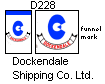
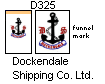
Mitchell apparently links the funnel with Athol, one of the original two ships. He shows dark blue with a black top and a second version in lighter blue without the black top.
Mitchell apparently links this funnel to Alita, one of the two vessels used when operations restarted.
This livery reflects the Clipper connection. The scroll carries red DOCKENDALE, following Clipper Fantasy at Wellington on 10 December 1999 and Clipper Flamingo on 21 June 2000.
DS Vanguard, managed for Campbell, has a narrow top matching the crane colour, an anchor between Gothic D and S, and a blue-outlined scroll with red DOCKENDALE. DS Regent has no funnel top; its unclear funnel colour is assumed white.
George T.R. Campbell incorporated Dockendale in June 1973, naming it after his birthplace, a Scottish farm. It became dormant in 1974 with its two ships bareboat-chartered, later resumed operations and moved to Nassau. It traded as DOCKSHIP. A 1993 joint venture divided technical management to Dockendale and chartering/commercial work to Clipper. Ships also managed for Campbell used DS prefixes; by 1996–97 many vessels had Clipper added as the first part of their names. Leslie Fernandes took full ownership on 1 January 2008 and sold 40% to Torben Jensen of Clipper, while Clipper separately dates an investment to 2007. Mortimer & Co., formed in Nassau in 2001, was an operating company.
Bahamas, Nassau.
The livery derives from Wijsmuller’s with a changed letter. A photograph marking Transshelf’s acquisition shows a vivid-blue flag with a large white disc containing black D. Super Servant 3 appears to carry the D211 funnel aft, though a different-looking structure near the bridge creates uncertainty.
The funnel follows Blue Marlin. Some vessels, including Mighty Servant 3 on 3 June 2005, have a narrow black top; its limp flag may be D211 but cannot be identified confidently.
Black Marlin at Sydney on 15 February 2009 supplies the funnel. The new logo, launched on 20 March 2007, represents a chain link, mirrored D and safe harbour-to-harbour movement. The company assigns solidity, reliability, professionalism and safety to blue, and passion, pride and innovation to orange. A white area was added to blue funnels to display it. The flag is white with the logo above blue DOCKWISE, photographed aboard ship in the November 2007 Dockwiser.
The funnel follows Super Servant 4.
The funnel follows Yacht Express on 8 June 2010.
Knight is described with a blue funnel and white panel bearing a black-white-blue horizontally banded upright oval and black TyCan or TvCon, both angled “Pbds”.
Dockwise began on 1 January 1994 by combining Dock Express Shipping and Wijsmuller Transport, following an agreement in September 1993. Heerema and Van Ommeren held the interests through those companies. A 2001 combination with Offshore Heavy Transport moved headquarters to Breda. The group developed heavy transport, yacht transport and engineering businesses under a Bermuda holding company. The yacht venture originated with United Yacht Transport in 1992, though its own first-shipment claim reaches back to 1987. Later operating interests included Dockwise Shipping and former Wijsmuller service companies.
Heerema and Wilh. Wilhelmsen agreed to a 3i buyout in December 2006. Dockwise merged with Sealift in 2007, with the website saying Sealift was renamed Dockwise Ltd. and the business listed in Norway, rather than the announced Dockwise Sealift name. Fairstar was acquired in July 2012. Boskalis launched its takeover in November 2012; Dockwise became part of Boskalis in March 2013, with compulsory acquisition of the remaining shares scheduled for April.
Belgium, Meer; later Netherlands, NJ Breda, the stated headquarters.
Megisti was recorded in July 1965 and July 1966 with a yellow or buff funnel, its black top separated by a broad blue band edged white above and below.
The company is listed in Lloyds 1966–67 with Savos Zervos as agent.
Greece, Piraeus.
DANE was established by local interests in 1979, though Lloyds gives 1980. It floated on the Athens Stock Exchange in 1994, with trading suspended during financial difficulties in 1997. Anek acquired 41.8%, bringing it into the Anek group. The company entered liquidation at the end of 2005.
Greece, Rhodes.
The National Maritime Museum’s flag is dated 1955–67.
The Hong Kong management company was sold to Acomarit on 22 June 1991 and became D.S. Marine Ltd.
Hong Kong.
Dodwell Shipping is separately listed as agent in 1985–86.
Hong Kong.
The international trading house originated as Adamson & Co. in 1858 and became Dodwell & Co. in 1898. It operated in Canada, Ceylon, China, Hong Kong, Japan and the USA as well as London. Inchcape acquired it in 1972, and it became part of Cornes & Co. in February 2003.
U.K., London.
The original flag was green with a yellow circle above a yellow wavy line.
The logo was redesigned in 1986 with a bright-yellow sunburst, described by Dole as signifying freshness, quality, wholesomeness and good taste. The O is surmounted by a yellow sun with a white core: Nüsse shows 17 narrow rays, Brown 11 broader ones. A slight “Pbd” angle in the Nüsse flag may be a scanning effect. C1439 is from Nüsse’s newer website; D111 includes his table flag.
The Mitchell funnel may represent the yellow sunburst, though the centre of the o is shown yellow.
The funnel is supported by a starboard photograph of Tropical Morn dated 1 January 1994.
The funnel had changed to this form by 3 June 2003 aboard Dole Africa. Dole Europa supplies the emblem and port and starboard funnel photographs from 2009 and 2013; a starboard photograph of Dole America dated 8 January 2006 shows the flag.
Dole Fresh Fruit International began in 1976 as Intercontinental Transportation Services, acquired Willy Bruns’s fleet in 1978 and adopted the Dole name in 1991. Lloyds dates its change to Reefership Marine Services to 2000; the latter’s website instead gives incorporation in 1999 and says its technical staff had managed Dole’s fleet since 1986. It provided Dole’s operations, logistics and transport services.
Costa Rica, San Jose; also Miami, USA.
Keep the explicit scope label independent; no alias or company identity is inferred.
James Dole founded the Hawaiian Pineapple Company in 1901. Castle & Cooke acquired 21% in 1931 or 1932 and the remainder in 1961, retaining the Dole brand. Castle & Cooke’s earlier origins lay in an 1851 department-store partnership which entered the Hawaiian sugar industry and invested in Matson in the 1910s. It bought 55% of Standard Fruit & Steamship in 1964 and later acquired the whole company. The accounts differ in their corporate chronology: Lloyds dates Castle & Cook Inc. to 1975 and its Dole name to 1991; another account gives an intervening Dole Fresh Vegetables name in 1989. The cited Dole timeline says Castle & Cooke was acquired by Philipp Astheimer & Sohn in 1975, the latter becoming Dole Fresh Fruit Europe in 1988. The real-estate business was separated as Castle & Cooke in 1995 or 1996. D.H. Murdock took Dole private in 2003.
Other operating interests included Dole Fresh Fruit Co., formed at Boca Raton in 1987, Dole Ocean Cargo Express, which advertised shipping services, and Sea Treasure Inc., formed at San Diego in 1974 and listed with one vessel in 1998.
USA: Astoria, Oregon; Honolulu; San Francisco; later Westlake Village, California.
The original funnel was probably black, followed by D77 and then D76. Loughran says D76 and its flag became the company’s livery on formation but still illustrates D77 under its name. D77 appears in a black-and-white photograph of President Garfield, taken over in August 1923. An undated company pamphlet confirms D76; Merchant Ships in 1942 and 1944 describes its funnel as probably discontinued.
Robert Dollar, a sawmill owner dissatisfied with shipping schedules, bought his first vessel in 1895 and incorporated the Dollar Steamship Co. on 15 August 1900. The line acquired seven government president ships in 1923, beginning its presidential naming tradition, and Pacific Mail Steam Ship Co. in 1925. Control passed to his son Stanley in the late 1920s; Robert died in 1932. In August 1938, after the US Maritime Commission judged the business financially unsound, the government took control and renamed it American President Lines. The owning concern was The Robert Dollar Co.
American Mail Line was acquired in 1922 and sold to American President Lines in 1938. Dollar also held 25% of United States Lines from 31 October 1931 until selling to International Mercantile Marine on 5 July 1934.
USA, San Francisco.
Two funnels are recorded: a black funnel with a blue-edged white circle containing a red diamond and white L; and a white funnel with a blue top and a blue ring enclosing the red diamond and white L. Faralis was noted in January 1967 in association with W.R. Lovett of Jacksonville. The diamond’s horizontal points may extend beyond and behind the ring.
The company is listed in Lloyds in 1958–59, 1963–64 and 1966–67, with Suwannee Steamship Co. as agent.
USA, Jacksonville, Florida.
The funnel is red with a black top and a narrow black band. It was recorded for Evanelia II in 1966, though the month is unclear in the source notation “t/66”.
The line is listed in Lloyds in 1958–59, 1963–64 and 1966–67.
Greece, Piraeus.
Corporate name and livery allocation unresolved.
Incorporated in Liberia in 1969, the company is described as a ship charterer with Ioannis Chandris as manager/director in 1983. It apparently remained active when the source was consulted in 2011. Rosanoski provisionally identifies it with Dominion Services International Inc. of Monrovia, associated with J.D. Chandris and Macreefer in 1985–87; he did not find that concern in Lloyds 1985–86.
Greece, Piraeus; Liberia, Monrovia.
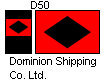
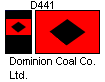
The red flag with a black diamond was used by Black Diamond Steamship, Dominion Coal and Dominion Shipping. Lloyds 1912 gives D441 for Black Diamond as well. Rosanoski rejects the classification of Dominion Shipping as British: Donaldson’s involvement did not displace its Canadian identity.
Brown 1926 instead shows a yellow flag with a black diamond and black BDSC in the corners for the Montreal Black Diamond company. Rosanoski believes this is a misattribution of the American Black Diamond Steamship Corporation’s flag.
Dominion Shipping was a Canadian concern, recorded as a steamship owner from 1915 and apparently originating with Dominion Coal or Dominion Steel. Dominion Coal had been formed in 1893. The related steel and coal interests came under British Empire Steel Corporation in 1920–21; after financial collapse, Dominion Steel & Coal Corporation took over the properties and the former holding company ceased in May 1930. Dominion Shipping’s named companies included Rose Castle Steamship and Wassis S.S.; Black Diamond Steamship was associated with the group. Donaldson Bros. & Black took control in 1934, but Rosanoski questions whether this meant ownership or management alone. Dominion Coal remained an agent, and the Canadian address continued. The last ships were sold in 1965.
Canada, Sydney, Nova Scotia.
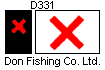
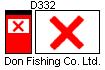
The John Wood group’s funnel is described as red with a black top and the house flag. A later account supports that description for Don Fishing but gives no flag detail. Rosanoski assumes the flag remained unchanged and appeared as a panel on the funnel; the passage labels this funnel D322.
Recorded in 1917–18 under John S. Doeg, Don Fishing was based at Fleetwood when it bought Persian Empire in 1943. It was a Boston Deep Sea Fisheries subsidiary by 1949, explaining Basil A. Parkes’s management of part of its fleet. Rosanoski presumes a later takeover by John Wood Group (Aberdeen), which managed some vessels in 1973–74. By 1985–86 Don Fishing operated companies formerly listed under that group and part of the John Wood Group & George Craig & Sons fleet.
Kinlochbervie Fish Selling Company is recorded as a subsidiary. Don Fishing Co. (Peterhead), linked here by name rather than an established corporate relationship, is separately listed as an operator and later manager, including joint ventures.
U.K., Aberdeen.
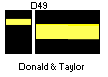
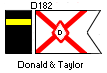
The funnel is black with a yellow band.
Two flags are described. One is a white swallowtail with a red saltire extending only to the line of the point; a white diamond edged red bears a black D over the saltire. The other is black with a yellow horizontal band.
U.K., Glasgow.
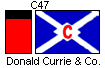
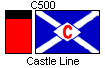
The funnel is recorded for 1872–1900 and then for Union-Castle. Lloyds 1904 and Reed 1912 name Donald Currie & Co. alongside Union-Castle’s livery.
Loughran outlines the flag diamond in blue.
Rosanoski questions the omission of the saltire in this Liverpool & Hamburg version. The post-1900 illustrations name Donald Currie & Co. as managers.
Donald Currie’s Castle Line began in 1862, also known as Castle Packets or Currie’s Calcutta Castles, with a sailing service to India. The opening of Suez in 1869 undermined the Cape route, but Currie’s interest in Leith, Hull & Hamburg Packet Co. gave access to vessels chartered to the failed Cape & Natal Steam Navigation Co. He redeployed them on the Cape service and competed with Union Steam Ship at the request of Cape merchants and the colonial government. Steamships entered the service in 1872, and the mail contract was shared from 1876. The Castle Mail Packet name is dated 1876 or 1881.
When the mail contract expired in 1900, Union’s assets passed to Castle in March and the business was reconstituted as Union-Castle Mail Steamship Co. Donald Currie & Co. continued through Liverpool & Hamburg Steamship Co., subsequently operated by Currie Line.
UK, London.
Bonsor gives D51 from 1878, D52 from 1935 and D51 again from 1954. Anchor-Donaldson ships flew the Anchor flag at the foremast and the Donaldson flag at the mainmast. Merchant Ships nevertheless assigns D52 to all the companies in its 1949 account.
Griffin shows a tapered swallowtail with a black letter, a version Rosanoski found unsupported elsewhere.
A common group livery was differentiated for certain services by pennants above the house flag. Corson assigns D51 to Anchor-Donaldson. Several Brown editions show dots after the letters of D53, while Harnack does not give Donaldson South American Line a separate livery. FOTW’s original black “D” for D51 was replaced by a corrected illustration.
A painting of Marina of 1870 shows an early funnel resembling Allan Line’s, believed to have been replaced around 1878. The text calls it B218, while the bibliography identifies D218; the numbering is not reconciled here. A yellow-“D” badge from Captain Cook may be connected with Donaldson’s New Zealand Government management, but Rosanoski found no account of such a flag. His notes give management from 1950 in one place and 1951–1960 in another, and leave any connection with a separate sailing-vessel sighting unresolved.
Donaldson Brothers was formed in 1854 and began shipowning in 1855 under John and William Falconer Donaldson. It became a limited liability company in August 1913 and the managing firm Donaldson Brothers & Black Ltd. in 1938. Withdrawal from shipping and probable voluntary liquidation were announced on 5 January 1967; liquidation was subsequently confirmed. Certain assets were to pass to a new Donaldson Line Ltd., with a later subsidiary formed to receive assets and be sold to Ulster Steamship Co. Ltd.
Donaldson Line Ltd. dates from August 1913. The South American combination with the Glasgow company is dated to 1919 in one account and 1920 in another, under joint Donaldson and John Black management. Anchor-Donaldson was formed in September 1916 from the passenger fleets of Anchor Line and Donaldson Brothers, taken over completely in 1935 as Donaldson Atlantic Line Ltd., and wound up in 1954.
United Kingdom, Glasgow.
The funnel is based on a port-side photograph of Dong Bang No. 101.
The funnel is based on a port-side photograph of Dongbang Giant No. 3 dated 17 December 2013.
The company was formed in 1983 as Dong Bang Forwarding. Lloyds’s later name-change entry repeats the same name on both sides of a supposed 1995 change; Rosanoski interprets it as the change from Forwarding to Transport Logistics. A separate major operating-company listing dates Dong Bang Transport Logistics to 1995 at another Seoul address. Dong Bang Shipping was formed in Busan in 1992.
An acquisition announced on 28 March 2012 increased the holding in Kwangyang Marine to 58.85%.
South Korea, Seoul.
The livery follows a photograph of Calorius dated 18 December 2009. A Danish ensign largely obscures the house flag, but the visible hoist shows the beginning of the logo lettering.
DONG Energy was formed in July 2006 by merging DONG, Elsam, ENERGI E2, Nesa, Copenhagen Energy and Frederiksberg Forsyning. DONG originated on 27 March 1972 as Dansk Naturgas, becoming Dansk Olie og Naturgas on 2 December 1973. Its investment in EnergiGruppen Jylland in 2003 brought an Elsam interest, increased to about 24% in August 2004. The DONG–Elsam merger was announced that December and received European competition approval in March 2006. Elsam’s shipping activities became Dong Energy Generation.
Denmark, Fredericia.
The white funnel bears a shield divided vertically red and blue, with an overall white flying horse facing dexter. The white swallowtail flag carries the same shield.
Formed in 1975, Dong Young was owned equally by China Navigation and Cho Yang Shipping. Its Pegasus Container Service in the Australia–South Korea trade ceased in January 1991. The fleet operated under its own name and single-ship subsidiaries; Swire (Korea) managed one vessel in the 1978–79 listing.
South Korea, Seoul.
Tasman Viking’s funnel used the same Brunswick green as its hull. The letters lay within the outline of a fish swimming aft; their white colour is assumed rather than specified.
A starboard photograph at Wellington on 18 February 1997 shows a dark olive-green hull and funnel top. The inaccessible port side is assumed to mirror the starboard arrangement, with the fish still pointing aft. A green band remained visible on the gallows; RJT noted the unusual need to view the starboard side, with the port side facing aft.
Donker Marine was incorporated on 12 September 1988 and is described as a fishing and marine-equipment company.
New Zealand, Motueka; also listed at Nelson.
The funnel follows Mount McKinney on 27 December 2007. UPC on the hull identifies the operator, United Product Tankers.
Mount Ranier carried a panel at the funnel base showing the Philippine flag above smaller German and Polish flags side by side. Rosanoski suggests these may represent crew nationalities.
Donnelly began as Donnelly Shipmanagement in 1995 and adopted the Donnelly Tanker Management name in 2003. Also known as DTM, it was listed as an operating company of Hartmann Schiffahrts that year. Its vessels used Mount or Summit as the first part of their names.
Cyprus, Limassol.
The funnel follows a starboard photograph of Northern Ocean dated 20 June 2012, with the company website supplying the logo.
Omega af Donso, formerly Neste’s Rankii, appears in an unclear photograph dated 2 November 2004 to retain Neste’s N374 colours. By 29 October 2005 the logo had disappeared, leaving a plain blue funnel. Since that was also a Neste livery at the time, Rosanoski suggests a possible Neste charter.
The business originated with Kristen Andreasson, who began selling oil to motorised fishing vessels in the Gothenburg Archipelago in 1907. Later generations developed a group of marine businesses, including bunkering with Alpha. Associated Kristensson Shipping bought Northern Ocean in 2006, and Kristensson family members were involved in Donsö Bunkerservice management. Equasis records a change of Northern Ocean’s registered ownership in 2010, with Furetank as manager. Omega af Donso was bought in 2000 and sold in 2006; Lloyds listed Donsö Bunkerservice under B&N Hornet management and elsewhere as a name company of Kristen Kristensson.
Sweden, Donsö.
Bikan, purchased on 1 February 2008, is shown with this funnel in a photograph dated 19 July 2008. The logo’s owner is unknown. The ship was presumably chartered and was managed by Fair Shipmanagement; a possible connection with the vessel’s name is only speculation.
Bikan carried this other funnel at Newcastle on 18 November 2009 while chartered to BHP Billiton for four to six months from October. The identity represented by the logo remains unclear.
Neither Doosan, manager nor charterer ownership of these devices established.
The Doosan group originated as Park Seung Jik Store in 1896, becoming Doosan Store in 1925. Lloyds dates Doosan Corporation to 1946, a date Rosanoski did not find on the company website. It became an operating holding company in 2009. Its fleet was listed under Doosan Capital, a finance business founded in 1995 as Yonhap Equipment Installment Finance, acquired by the group in December 2006 and renamed in May 2007. Ship leasing was among the activities of its first overseas subsidiary, established in China in February 2007.
South Korea, Seoul.
The flag logo is documented on the company and group websites. Santiago Dotor recalled seeing the symbol used by other companies but could not identify them.
A Mitchell funnel, presumed to be Santa Rita’s for the managed Naviera Providencia, is blue with a broad white band and a bluer E. Rosanoski notes that it fits neither company.
Dorchester Maritime was formed in 1975 and based in the Isle of Man from 1986. A Schulte group ship manager, it entered a joint partnership with Atlantic Marine on 1 January 2007, covering ship management, personnel and marine engineering services. Atlantic Marine became Dorchester Atlantic Marine Ltd. Partnership, while Dorchester Maritime became Dorchester Atlantic Maritime Ltd.; the latter subsequently entered a Schulte-named company.
U.K., Douglas, Isle of Man.
Eliza’s funnel was noted in April 1965 with its letter initially read as O, giving D147. In September 1967 it was recorded as a black block D, shown in D148.
Benora’s March 1965 funnel appears to be that of agent Quiny Chuang of Hong Kong. Its colour may be a shade of red.
Quiny Chuang versus Doreen identity of the design unresolved.
Doreen was listed under agents Fuji Marden & Co. (H.K.) in 1966–67 and under its own name in 1970–71.
Hong Kong.
Founded in 1875 as a steel producer, Dorman, Long expanded into bridge building. Its work included Sydney Harbour Bridge, dated from 1923 in the source and opened in 1932. Three ships were built to carry stone for the approaches and became redundant between 1928 and 1930. The company joined British Steel in 1967.
U.K., Middlesbrough; also Darlington.
Golden World at Lyttelton on 11 December 1985 and We Carrier there on 3 June 1987 carried this funnel; later Golden Lucy 1 photographs also show it. The device appears to be a D partly obscured by two waves. JLL reported both blue and red upper portions among vessels managed by Daiei Tankships. The logo was subsequently confirmed as Dorval’s through an archived website.
The 1986 Golden Glory observation showed a deeper black top touched by an attached, deep-red or red-brown emblem. It was initially reported as wholly red, producing D488, but re-examination established that only the upper D had changed colour: the intended form was D489 with the deeper black top. D489 also follows a Golden Glory sighting at Lyttelton on 3 February 1987. Its assumed ownership by Chemical World Navigation was not independently located in the consulted listings.
Port and starboard evidence comes from Golden Denise at Bluff on 29 September 2010 and Golden Dominique on 16 April 2008.
Mitchell’s funnel presumably follows his line drawing of Golden Star.
This may be based on Golden Daiei, the only vessel Mitchell lists under the heading, but Rosanoski considers it more likely intended as D487.
T. Sato and E.V. Vine began preparations in 1969 for a chemical-tanker service between the Far East and Australia–New Zealand. Dorval Tankships was established in Melbourne in May 1970, followed by a Tokyo branch in January 1971 and Dorval Kaiun in August 1973 for acquisition and management. Lloyds initially gave 1981 as its formation year, later amending this to 1973. Houston and London businesses followed in 1980 and 1985, with Pusan and Dalian operations in 1997 and 2000. Dorval Kaiun became the group’s core when it took over vessel operations in October 1997. Most ships used Golden as their first name; the source also records Singapore shipping and tankship companies.
A 51/49 Sinochem–Dorval joint venture, Dorval SC Tankers, was announced on 10 April 2010. The website consulted in July 2012 gave an establishment date of 12 March 2012, with associated ship-management, Melbourne and Houston companies.
Australia, Melbourne; Japan, Tokyo.
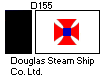
The funnel was recorded for Inchdouglas and confirmed by a photograph in the NJK Collection.
Incorporated in 1883 with origins in the 1850s, Douglas Steamship was reported being wound up in 1976. Douglas Lapraik & Co. operated it in the post-war listings. Earlier vessels used Hai names, followed after the Second World War by Inch names.
A Williamson & Co. connection is noted for “nchearn” in 1965–66, though Lloyds lists the vessel under Douglas Lapraik. Rosanoski found no connection between the two companies beyond their shared Inch naming pattern.
Hong Kong.
Dovar is recorded as a charterer of a D’Amico vessel during the 1960–80 period, without precise dates. The ship is called Paolo D’Amico in the Mitchell-based note and Paola d’Amico in Rosanoski’s later comment. The former note dates its construction to 1957 for D’Amico Società di Navigazione.
USA, New York.
The original livery has the hiragana for the do of Dowa. The funnel changed in the early 1970s, but the flag’s fate is unknown. Kushiro Maru was also seen with a plain black funnel and the Nissho Kisen flag in March 1963, probably at Hong Kong; Rosanoski suggests its band had been painted out.
Alan Watt’s funnel has an upright D. Port and starboard photographs of Balsa 88 and Antilles VII support the illustrated form. The flag is treated similarly, keeping the D’s base level rather than exaggerating the logo’s angles. The website showed a less angled logo in 2011 than in 2008.
Mitchell indicates dark blue, but uses the same shade for Hiong Guan’s H5, which appears lighter. Rosanoski therefore uses a medium blue for D343.
Many Dowa ships used Hiong Guan’s H5 funnel, including Balsa 8 in July 1986; Mitchell also lists it as an alternative.
Dowa’s website dates its establishment by Fumio Takigawa to 25 March 1957; Lloyds gives 1958. Dowa Kaiun became Dowa Line in 1979. Dowa Line America followed in 1981 and Bulk Fleet Chartering in the USA in 1987. Fumio died in 2006; Kazuo Takigawa is subsequently named president and chief executive.
Operating subsidiaries included Hiong Guan Navegacion and its Tokyo company, formed in 1988. Fleet names included Balsa with numbers, Antilles with Roman numerals, and Century or ID prefixes.
Japan, Tokyo.
North Sands was built in 1960 as a floating test bed for a new engine. Its markings used the Cross of St. Cuthbert with special permission from the Bishop of Durham, whose see the saint had founded.
William Doxford & Sons was founded in 1840 and based at Pallion from 1870. The founder’s four sons managed it after his death in 1882. Acquisition of Sunderland Shipbuilding, Dry Docks & Engineering in 1961 accompanied the Doxford & Sunderland Shipbuilding & Engineering name; this became Doxford & Sunderland in 1966. Court Line acquired and renamed it Sunderland Shipbuilders in 1973. Court Line’s collapse brought public ownership in 1974. Privatisation and merger with Austin & Pickersgill formed North East Shipbuilders in 1986, but the yard closed within two years.
U.K., Sunderland.
The fund vessels show several variations, while many chartered ships carry charterers’ funnels and names, including Hyundai and Front. Cape-named ships generally have buff funnels with the logo on a broad white band edged light blue. Other forms place the logo on plain white, between narrow light-blue bands, in light blue on a broad white band on a light-blue funnel, or in green on a green-based funnel. Early vessels show ordinary light-blue DS letters on black or very dark blue.
DS Performer and DS Power supply the early lettered form. DS Power’s earliest photograph, dated 28 November 2005, is unclear; lettering is confirmed in a photograph posted on 1 July 2006. The base remains uncertain between black and very dark blue. Its owning company was confirmed as DS-Fonds No. 111.
The funnel follows a starboard photograph of DS Accuracy dated 16 January 2010.
DS Blue Ocean was photographed on 2 June 2007, one day after takeover, still carrying RBD Constantia on its bridge board. Rosanoski presumes an earlier black funnel base was subsequently changed to white. DS Wave, in the same fund, also used this form.
DS Blue Ocean’s later form is shown starboard in October 2007 and port-side on 25 September 2010.
The green form follows DS Promoter on 7 August 2013 and DS Warrior on 17 February 2014. An initial theory that it retained Sanko’s funnel with a replaced logo was later doubted: DS Venture appears to show the form first in 2011, followed by DS Promoter and DS Progress in 2012 and DS Warrior in 2013.
Cape Charles and Cape Hatteras show dark yellowish buff, whereas Cape Henry and Cape Spencer show light buff. Apart from these shade differences and a sometimes more bluish panel, Rosanoski regards it as the common Cape-vessel funnel.
DS Vision supplies the funnel, but the band marking is assumed because it is obscured.
Founded in 1960 as a fund investor, Dr. Peters adopted the DS-Fonds brand in 1977; DS stands for Dynamism & Security. Shipping funds began in 1990. Jürgen Salamon became a shareholder in 1987 and sole owner and manager at the turn of 1989–90; his family remained partners after his death in November 2012. DS Schiffahrt was incorporated in Hamburg in 1999 and merged with Magellan Shipping in 2005, although Lloyds gives a formation date of 2001. It handled vessel acquisition, commercial and technical management for the funds. DS-Rendite-Fonds and the tanker manager DS Tankers also appear in the shipping structure.
DS Tankers says it was formed to manage tankers owned by the group, but Rosanoski could not establish its precise corporate relationship: neither website explicitly claimed a parent–subsidiary connection.
Germany, Dortmund.
Port and starboard photographs of Lisa D show mirrored bands at the rear of the funnel while the lettering reads normally on both sides. The port photograph is dated 27 March 2007.
Drabert was formed in 1997.
Germany, Oldenburg.
Vessel identity and location remain uncertain.
Neither vessel has a funnel. D579 depicts a Popeye character on blue and appears connected with the second vessel, Alaska Primero. Rosanoski suggests its raised aft decking as the possible location. D580 is the logo on that vessel’s white superstructure above a blue hull. The source relates the marks to photographs, including one dated 16 October 2010, but does not establish D579’s location confidently.
Drag-Sur began in 1993 and acquired the hopper Josefa Perez. Salvador Higuera Corta Society S.L. acquired 50% in 2001.
Spain, Algeciras, Cadiz.
The livery follows Boa Vista I. A starboard photograph dated 11 September 2005 shows the lower extension of D ending vertically although the letter and rear funnel edge slope. In a port photograph dated 23 September 2006, the end aligns with the vertical forward funnel edge. That view also shows the flag, but not clearly enough to confirm its proportions, especially those of the letter.
Dragaport was formed as an engineering and civil-construction company in 1999, or 2000 according to Lloyds. It sold its two large dredges in 2007. Rosanoski could not establish whether it retained two hopper barges or continued operating.
Brazil, Rio de Janeiro.
Comet Brilliance was noted in October 1965 with a green funnel and broad white band bearing a green star.
Comet Victory was noted in September 1966 with the same green funnel and broad white band, but a blue star.
Dragon Steamship is listed in 1966–67 and 1970–71, with Ocean Freighting & Brokerage Corporation as agent.
USA, New York.
The flag is white with a red D. The yellow or buff funnel has a black top and a panel of the flag.
Drake was listed in Lloyds 1963–64 under Lykiardopulo & Co. management, with Merchant-prefixed vessel names. The NJK Collection records it as obsolete in 1964.
U.K., London.
The funnel follows a starboard photograph of DCI Dredge XXI dated 19 September 2013; the company website supplies the logo.
DCI was established in 1976 to dredge India’s major ports, according to its website. Lloyds 2008 instead gives 1990, although earlier listings already record the company. It was listed under the Indian government, and the website describes government divestment of shareholding.
India, Calcutta; Visakhapatnam.
The emblem symbolises a grab dredging spoil from the seabed.
This funnel apparently follows Volvox Zelandia.
The flag combines parts of the ACZ and Dredging designs.
This funnel is based on Volvox Delta.
Dredging VO2 combined Van Oord Dredging and Van Ommeren interests, with Volvox-prefixed vessels. It was listed as Dredging V.O. 2 N.V. in 1973–74 and as Dredging VO2 International in 1992–93. Rosanoski interprets the later register history as a probable merger: a 1990 name-change sequence runs through ACZ Marine Contractors to Van Oord ACZ, while the fleet later appears under Van Oord ACZ Material, formed in 1993 with the ACZ reference number.
Netherlands: Utrecht, later Odijk and Gorinchem.
The company website’s flag is red with a thin white border and a white diamond bearing a black D. The funnel follows a starboard photograph of Maike D dated 2 June 2009.
Thetis D has a darker buff funnel than D552. Because the funnel is to port, its port-side logo sits on a white base equivalent to the superstructure; to starboard the logo is on the main superstructure. Both are attached white panels, so the flag’s white border merges into the background and the field appears plain red.
The two company-named vessels are assumed to show Drevin’s own markings, although they too may have been chartered. Other fleet vessels were chartered out, one visibly in APL colours.
Kapitän Rainer Drevin bought Sabine D in 1983 and ran the business alone until his son Mark joined in 2003. Later ships included Motivation, chartered as Tiger River to APL, and Mastery, chartered as X-press Hoogly. The management company appears in Lloyds alongside the Drevin Bereederung Rainer operating concern, dated 2003.
Germany, Cuxhaven.
Regional Endeavour used D37 from about 1974 before soon adopting the more elaborate D184. The latter has a globe of blue-grey lines, partly surmounted by an A with black uprights and a dark-blue wavy line. The source does not specify the internal globe-line colour; Rosanoski renders it black from the original black-and-white hatching.
Registered on 25 May 1970 as Regional Holdings, the company became Drillships and was listed as such in the 1970s. It later became Londish Real Estate and was deregistered on 1 August 1993.
Australia, Sydney.
Founded in 1826, Drogheda Steam Packet had its ships taken over by the Lancashire & Yorkshire Railway in September 1902.
U.K., Liverpool; [Ireland], Drogheda.
The black funnel bears a red-white-red triband. Reed makes the white narrow and Talbot-Booth wider; Rosanoski favours equal bands as national colours on a state organisation. The flag is a red swallowtail with a square point, a white cross of the same width as that point, and a gold crown above gold DSB in the canton. Brown 1958 and 1982 omit the square point and taper the horizontal cross arm towards the fly. Some sources add dots after the letters; Rosanoski follows Flaggenbuch in omitting them.
Owned by DSB Rederi, DSB Ferries held its fleet through Scandlines, formed jointly with SweFerry in 1996 and merged into Scandlines A.G. in 1998. Cat Link managed one vessel.
Denmark.
A second flag, labelled D23 in the source, is white with a blue vertical anchor interrupted by a white break bearing blue DSB, and a blue crown above.
Danish State Railways began a Funen–Jutland ferry route in 1872. As fixed road-and-rail links reduced the government’s strategic ferry interest, DSB Rederi became an independent company in 1995, wholly owned by the Ministry of Transport. One account retains the Danske Statsbaner name until 1996 and gives Scandlines Danmark in 1997; others describe a Scandlines combination in 1997–98. DSB managed Øresund services, acquired a half interest in Cat-Link in 1996 through purchases from Holyman and minority holders, and bought shares in SFDS af 1991 that August. Its operating subsidiaries included DSB Ferries and Øresund.
Denmark.
Northern Star’s black funnel is based on a website photograph dated 5 August 2000.
Formed in 1980 and owned by E.I. Du Pont de Nemours, Du Pont (U.K.) held one vessel through D.U.K. Shipping, also formed in 1980. Marine Management Services was listed as manager in 1998, followed by V. Ships Management in 2000.
U.K., Stevenage.
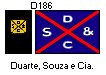
The Brazilian website supplying the design covers liveries in 1950.
Brazil, Rio Grande do Sul.
Mitchell supports this funnel with line drawings of four Rath-prefixed vessels.
Some ships of associated Celtic Coasters also appear to have used this funnel.
Dublin Shipping was formed in 1970 and acquired its first vessel, Rathmines, in 1972. Part of the Jones Group, it was taken over by Gearbulk on 28 March 1998.
Ireland [Eire], Dublin.
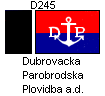
The flag is red over blue with white D and P flanking a white anchor. Larousse 1930 gives thin letters and an unfouled anchor, each half the flag’s height, spaced across the middle three fifths of its length. Talbot-Booth keeps the letters clear of the anchor flukes; a 1936–37 travel brochure places them above the flukes and resembles D246. The sources assign D245 to cargo ships and D246 to passenger ships, with Merchant Ships 1944 saying cargo vessels gave up D245 about 1939. D246’s black funnel top is narrow in Jordan but medium in the cited photograph of Kralji Aleksandar I.
Isaiæ’s more elaborate version retains the red-over-blue field, anchor and DP. Differences in the emblem’s proportions may reflect artistic licence. Heimer suggests that a later Brown illustration could simply repeat an older flag, though use until 1955 was possible. Rosanoski instead relates its use to the company’s 1947 nationalisation. Heimer also interprets the colours as deriving from the Croatian tricolour; these explanations remain attributed rather than resolved.
Also known as Ragusa Steam Navigation, Ragusea and Dubrovnik Steamship Line, the company is dated to 1880 in Heimer’s account, 1888 in Larousse Commercial and 1893 as a steamship owner in Merchant Ships. Several shareholding concerns combined as Dubrovačka Parobrodska Plovidba; the 1938 change to Dubrovačka Plovidba signalled an intention to buy motor vessels. Napried and Unione joined after the First World War. In 1939 it operated 14 coastal and 11 intercontinental ships. During the Second World War its ocean-going ships served Allied convoys, while Italy seized coastal vessels, most of which were destroyed. Nine ships survived; they were nationalised and allotted to Jugolinija at Rijeka in 1947. Atlantska plovidba, established in 1955, is described as its successor and uses a similar flag.
Yugoslavia, Dubrovnik.
The company later used Hall Bros. livery, shown in a black-and-white photograph of Melbrook.
J.A. Billmeir bought the company in 1954, and Hall Bros. acquired it in October 1964. Westford’s acquisition is dated 1954 in one reference and apparently 1955 in another. The company continued in Hall’s register listings through 1970–71.
U.K., Liverpool; Newcastle.
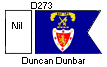
The design is based on the family arms, with the black motto SUN SPE. The motto scroll surmounts a key and sword in saltire above a yellow-and-red torse. The shield’s white part carries yellow six-pointed stars in the upper corners, red stars in the upper centre and base, and two diamonds at the sides, yellow above red. Its red part bears a yellow lion rampant facing the hoist, with a yellow increscent in the canton.
A commodore’s true pennant bearing a dog’s head is also mentioned as flown above the house flag. Its colours and whether it preceded or followed D273 were not established.
Dunbar was a prominent sailing-ship operator in the India and China trade, developing the largest British fleet between 1810 and his death. Loughran dates the death to 1860, while The Colonial Clippers gives 1862.
U.K., London.
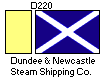
Founded in the early nineteenth century as Tay & Tyne Shipping, the company was taken over by Dundee, Perth & London Shipping in 1917.
U.K., Dundee.
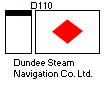
The flag is white with a red diamond and the funnel white with a black top. The livery follows Machan’s apart from a funnel variation.
W.N. Machan is listed as owner or manager.
U.K., Dundee.
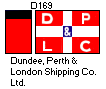
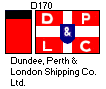
A black-and-white photograph of Dundee in Merchant Ships 1942 appears to show a plain funnel; the same photograph looks very dark in the 1944 edition.
The company was formed in 1826 by amalgamating Dundee & Perth Shipping, dating from 1798, and Dundee & Perth Union Shipping, founded in 1819; another source traces origins to 1777. It acquired Dundee & Hull Shipping in 1857, Dundee & Newcastle Steam Shipping in 1917, then Kirkaldy Shipping and Thomas Cowan in 1920. A managing interest in Aberdeen, Newcastle & Hull Steam followed in 1929. It also acquired Falkland Islands Shipping, and held Brussels Steam Ship jointly from 1962 to 1964.
Vessels used Scottish place names. Lockett Wilson managed part of the fleet in the 1960s; Dundee, Perth & London in turn managed Cambridge (Tankers) in 1970–71.
U.K., Dundee.
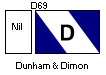
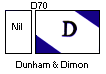
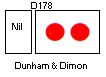
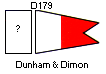
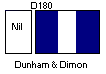
The Commercial Line flag is blue with a white diagonal band described as “Pbd”, bearing a black D. The two depictions differ in band width, one very broad; the source does not establish which is correct.
The Savannah flags are white with two red circles side by side, and a tapered white-and-red biband swallowtail.
The Glasgow flag is blue with a slightly narrow white vertical band.
Dunham & Dimon operated sailing packets, using Commercial Line for Charleston, Savannah Line for Savannah and Glasgow Line for Glasgow.
USA, New York.

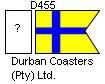
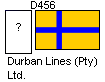
Caltex 1959 shows a yellow swallowtail with a blue Scandinavian-style cross, reproduced as D455. D456 is rectangular and has no stated source. Rosanoski questions it because Oram’s statement that the website flag was correct apparently referred to the earlier swallowtail, not a new rectangular design.
Rosanoski also questions the offset cross in Caltex. US Navy 1961 places the centre of a slightly narrower cross halfway between hoist and fork. Flag images on an ashtray and cufflinks support this arrangement, though the fork may be shallower.
Berea’s September 1973 photograph supplies the funnel. The top is rendered black, although it might appear very dark blue in the photograph.
The Durban agents and managers, King and Sons, Dunn & Company, were purchased by the Grindrod family in 1976. The agency originated in 1881 in connection with the Bullard King fleet and White Cross Line. Otto Siedle became joint owner in 1897 and sole proprietor in 1911; the Dunns joined in 1952.
Keep the explicit scope label independent; no alias or company identity is inferred.
The same ashtray also depicts the agents’ flag, here named King & Sons, Gunn & Co. (Pty) Ltd.
Keep the explicit scope label independent; no alias or company identity is inferred.
Durban Coasters appears to have begun in 1956 with Congella and changed its name to Durban Lines in 1961, supported by the register and Berea’s ownership change. Syd Oram disputes that a Durban Coasters company existed and describes Durban Lines as part of the Mosenthal Group, serving Mozambique, Mauritius and Reunion before absorption into Unicorn. Rosanoski counters that Grindrod bought an interest in 1970 and full ownership in 1974, before Mosenthal’s 1976 collapse. The initial stake is variously stated as 30% or 32%, possibly through Unicorn.
South Africa, Durban.
An undated photograph of Acamar under Han Star ownership supplies this funnel.
Clover Star, also under Han Star, is shown starboard on 16 June 2003.
An undated port-side photograph of Cebu Star supplies this form; the vessel belonged to Orient Star Shipping, formed in 2002.
Donghae Star, built in 2012 for Eastern Star Shipholding, is shown port-side on 11 February 2014. The form also appears on Subic Star, Limay Star in September 2008, and Lingayen Star in February 2009. Lingayen Star still had a plain black funnel on 25 October 2007, shortly before its recorded 1 November name change, which Rosanoski treats as a changeover period.
Dusung was formed in 1998 and managed ships through name companies, generally incorporating Star. Acamar was managed by Dusung from January 2000 under Shinhan Capital ownership, changing registered owner to Han Star Shipholding in July 2002. Most other vessels also had Star as their final name. The 2011–12 listing still includes Hamal, although the source says it was broken up in December 2001.
South Korea, Seoul.

Two flags were used together: a pennant with a blue hoist half and a fly half divided horizontally red over white, and a blue flag.
Dutch & Daland was a whaling firm operating sailing vessels.
USA.
The red flag has a white diamond bearing two blue triangular objects.
Dutch Dredging was formed in 1980 and associated with Baggerbedrijif de Boer.
Netherlands, Sliedrecht.
Ice Traveller’s starboard photograph dated 5 April 2013 supplies the funnel.
The source also records Dynagas’s D586 funnel from Yenesei River, photographed starboard on 15 March 2014 and port-side on 3 January 2014. Lena River’s bow badge, photographed on 11 February 2014, differs from the funnel logo.
Dynagas offered in-house ship management from 2004 according to its website, while Lloyds dates it to 2006 at the same address.
Keep the explicit scope label independent; no alias or company identity is inferred.
Dynacom, also known as DTM, dates its foundation as an oil-tanker manager to 1991 on its website. Lloyds instead gives Dynacom Ltd. in 1993, renamed Dynacom Tankers Management in 1994.
Greece, Athens.