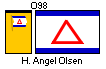
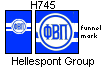
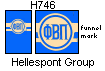
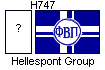
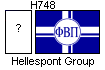
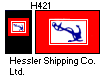
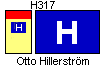
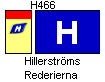
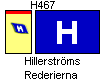
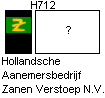
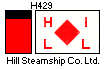
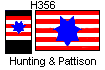
Angelus carried a yellow or buff funnel with a narrow black top and a flag shown flying from a brown pole. The flag is blue with a very broad white horizontal band containing a red triangular frame. A separate flag was not observed: it is inferred from the funnel panel. The illustrated funnel yellow has been darkened to make the panel’s white clearer.
H. Angel Olsen managed I/S Angelus, described by Rosanoski as probably a subsidiary.
Norway, Oslo.
H. CLARKSON & CO. LTD.
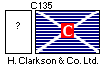
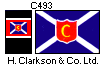
The flag is blue with a white saltire, surmounted by a red shield edged white and bearing a yellow “C”. Mitchell’s small funnel illustration omits the letter and white edging; Rosanoski thought that image size probably explained the omissions.
C135 apparently derives from the company website logo, but the small original image was too unclear to establish its details confidently.
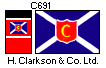
C691 is sourced to LJC. No separate written explanation of its differences is given.
Founded in 1852 as a shipbroking business, Clarkson was floated on the London Stock Exchange in 1986 and expanded into shipping services and shipowning. Denholm companies managed much or part of the fleet at different periods, providing context for the Glasgow reference.
United Kingdom, London. A Glasgow attribution is qualified by Rosanoski as probably reflecting the Denholm connection.
H. DAMHOF.
image by Jarig Bakker, 17 November 2005
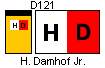
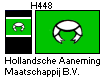
Mitchell shows this funnel on the card naming Carebeka as managers.
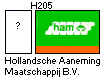
Mitchell shows this funnel on the card naming Poseidon as managers. The FOTW flag follows Brown 1995.
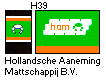
Hoop Navigation Ltd. is shown with a different, though similar, funnel.
H. Damhof operated from at least 1938, when the first Hoop was built for him. Lloyds variously lists H. Damhof and H. Damhof Jr., with Carebeka as manager in 1966–67 and Poseidon as operator in 1978–79. By 1992–93 the sole remaining Hoop was listed under Hoop Navigation Ltd., formed in 1987, with Poseidon as manager. Rosanoski considers this an indication of Damhof’s probable demise, although Miramar records only the ship’s sale in 1997 and no ownership change while it retained the name Hoop.
Netherlands, Delfzijl.
H. Doughty & Co.
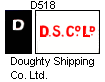
Doughty Shipping Co. Ltd.
H. Doughty left Maclean, Doughty & Co. in 1900 with four steamers and managed the Doughty Shipping Co. Ltd. The business ended in 1919.
U.K., West Hartlepool.
H. Folmer & Co.
H. FOLMER & CO.
image by Ivan Sache, 27 November 2003
The funnel follows an oblique photograph of Danica Sunbeam, leaving the exact letter shape unclear. Rosanoski takes the red shade from the website flag, whereas FOTW uses ordinary bright red.
Partrederi Orient
The company account dates its foundation by Helge Folmer in Copenhagen to 1955 as a coaster-chartering and agency business; Lloyds later gives 1968 despite earlier register entries. The second generation, Captain Jørgen Folmer and Uffe M. Jensen, extended the business into managing ownership.
Managed concerns included Partrederi Orient, Partrederi Petit Folmer and Rederiet Knud Staerke. Mitchell associates United Shipping Agencies, apparently for Unifeeder. Danica became a common vessel-name prefix from the 1980s.
Denmark, Kobenhavn.
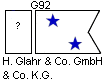
H. GLAHR & CO. GMBH & CO. K.G.
image by Santiago Dotor, 11 November 2003
Mobil draws the stars larger than Brown. Nüsse’s older website shows the G92 table flag; Rosanoski thought the newer image might show a different version, called A5 in his note, but questioned whether its background merely concealed the swallowtail, judging by the lower star’s position.
The family account dates its transport-logistics activity to 1950. Heinrich Karl Glahr founded H. Glahr & Co., beginning as agents and acquiring a first ship in 1959, the year Lloyds gives for formation. The concern participated in New England Express Line in 1969. Jan Hinrich Glahr subsequently ran his business under the same flag. An independent Glahr & Co. was founded at Potsdam in 2000 for logistics, with the Bremen concern as its maritime partner.
In Lloyds April 2006, the last vessel, Xpedition, remained under Sun Bay Shipping but appeared within the Anders Wilhelmsen group.
Germany, Bremen.
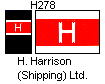
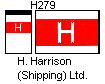
H. HARRISON (SHIPPING) LTD.
Brown omits the forked end of H278’s funnel H, probably because of the small image. Talbot-Booth shows it for H278 but not H279, adopted in 1938 when four motor vessels were built. Near the end the company came under S. William Coe management, and Brown 1951 records Coe’s colours.
Harold Harrison separated from John Harrison in September 1920 to form the concern. A November 1923 joint venture with Edward T. Lindley, Striver Shipping, was short-lived. All ships had been sold by 1940; a December 1952 meeting was advertised to hear the winding-up result.
United Kingdom, London.
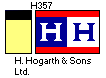
H. HOGARTH & SONS LTD.
image by Phil Nelson, 11 April 2000
From 1918 Hogarth ships flew the Scottish saltire, blue with a white diagonal cross, at the foremast to distinguish their “Baron” names from those of the former Austro-Hungarian Lloyd Austriaco. The practice continued after that need passed. Following the 1968 management amalgamation into Scottish Ship Management, the saltire remained as a stem jack, while the ships used the management company’s house flag.
Hugh Hogarth founded the privately owned business at Ardrossan in 1866 as a sailing-ship operator. Its general-tramping fleet used “Baron” names and included Hogarth Shipping, registered in 1898, Kelvin Shipping, registered in 1903, and Iberia Shipping, registered in 1924. The related shipbrokers Hogarth Sons & Co. were registered in 1963. A holding in Lyle Shipping through Hogarth Shipping was later sold, and management passed to Scottish Ship Management.
U.K., Ardrossan; later Glasgow.
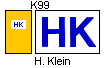
H. Klein.
H. KLEIN.
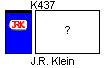
K99 follows Brown 1971. Mitchell’s plain-white funnel is presumed to be a blank, while his drawing of Coria has a yellow-based funnel.
J.R. Klein, Engel Klein owner
Photographs of Engel Klein confirm Mitchell’s touching letters but add a narrow black funnel top absent from his version.
Coria was bought in 1960, transferred to J. R. Klein in 1973 and sold in 1982 according to Miramar; Lloyds instead uses J. K. Klein for Coria. H. Klein operated under Wijnne & Barends. Reina was bought in 1976 and sold in 1979, while Rini is mentioned without acquisition detail.
A J. R. Klein of Stadskanaal owned Engel Klein, built in 1979 and sold in 1983. Rosanoski could not establish whether this was the same person; Mitchell lists him separately from H. Klein.
Netherlands, Delfzyl.
H. Krogh-Hansen.
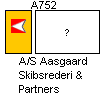
A/S Aasgaard Skibsrederi & Partners
Mitchell supplies the funnel and a line drawing for the sole vessel, Precosia. Rosanoski could not locate the vessel in Miramar.
This suggests Rosanoski's unlocated Precosia is a spelling error, but the scan's original institutional provenance was not established. Keep identity/country provisional and consult the original register rather than declaring a contradiction.
Krogh-Hansen appears in Lloyds 1970–71 as operator for A/S Aasgaard Skibsrederi & Partners.
Norway, Tönsberg.
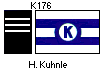
H. KUHNLE.
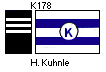
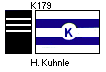
Brown 1926, 1929 and 1934 draw K178’s funnel gaps wider, as in K179, while Stewart 1963 gives K179 the K178 spacing.
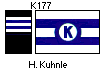
Four funnel forms are recorded: black with three white bands separated by equal black widths; the same with wider black gaps; black with a five-stripe white-and-blue band; and blue with three white bands separated by slightly wider blue gaps.
The first three flags have five alternating white-and-blue horizontal stripes and a white circle carrying a blue K. The circle is respectively black-edged, unedged, or surrounded by a thick blue ring without a separately defined edge. The fourth flag is white with two narrow blue stripes separated by an equal white gap, overlaid by the ringed circle and blue K.
Halfdan Kuhnle operated as H. Kuhnles Rederi A/S in Jordan’s account, and appears as H. Kuhnle in the post-war registers through 1970–71.
Norway, Bergen.
H. M. GEHRCKENS GMBH & CO.
image by Jorge Candeias, 4 May 2004
image by Klaus-Michael Schneider, 25 August 2008
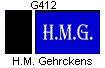
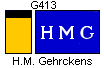
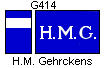
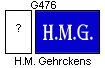
The blue flag bears H.M.G. The illustration uses the ornate FOTW lettering, apparently derived from Rehm; other sources simplify the letters or omit dots. Lloyd Reedereiflaggen 1933 assigns it to both Gehrckens and Nautik.
Stewart 1963 places dots after the letters.
Schneider’s company-history-based image has minor differences in the letters.
The Gehrckens flag appears on Railships II on 1 July 1995, apparently alongside Railship’s own flag. Some vessel websites call Gehrckens managing owner, but Rosanoski found no independent confirmation of ownership.
Heinrich Martin Gehrckens began shipbroking in 1830 and became a shipowner in 1860, according to the company history. Lloyds dates formation to 1883, when steamship ownership began. A direct southern Finland service opened in 1901, with ships trading to West Africa in winter; the fleet survived the First World War intact. Subsidiary Nautik merged into the parent in 1939. Shipowning apparently ended in 1985, but the concern continued managing Railship vessels until their transfer to Finnlines and was still recorded as a private company in 2009.
Gehrckens joined the Teamline consortium in 1966; the venture closed in 1970.
Germany: Hamburg, later Lübeck in Lloyds.
H. PARCHMANN & CO. REEDEREI.
image by Klaus-Michael Schneider, 12 Apr 2007
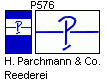
The white flag is divided horizontally by a thin blue line, overlaid by a blue underlined P in a white field.
The company began in 1957 and sold the last of its fleet in 1963.
Germany, Bremen.
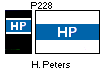
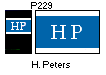
H. PETERS.
Flaggen & Schornsteine indicates medium blue and a narrower blue flag band than the other representation.
The company is recorded from 1953–54 through 1985–86, later as a manager operating partly through subsidiaries. Ships used Peters as their final name.
Germany, Hamburg.
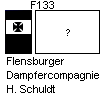
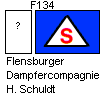
H. SCHULDT.
Lloyds 1904 also assigns this livery to Flensburger Dampfercompagnie; the 1912 edition adds Ozean Dampfer-Aktien-Gesellschaft.
Talbot-Booth attributes the funnel to H. Schuldt with Flensburger Dampfer Co. in parentheses.
Flaggen & Schornsteine indicates a lighter blue. A photograph of Glücksburg suggests a brighter blue and gold base, while the partly obscured flag appears to have a large triangle. The website image looks medium blue. Talbot-Booth and the Mobil chart extend the livery to the related Flensburger, Deutsche Orient, Fruchtreederei and Ozean companies.
Rosanoski questions the merit of this flag.
Flensburger Dampfercompagnie Harald Schuldt & Co.
A different Merchant Ships account dates Flensburger Dampfer Co. to 1897 and Ozean Dampfer Co. to 1870, recording their amalgamation in 1936 and use of the Flensburger subsidiary title under Harald Schuldt until 1938. These dates differ from the anniversary history and remain explicit.
Keep the explicit scope label independent; no alias or company identity is inferred.
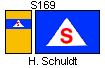
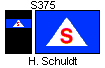
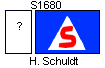
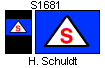
Heinrich Schuldt selected a blue flag with a white isosceles triangle and a red S at its centre. The source relates the triangle to a Masonic model.
The recorded blue is RGB 000, 080, 160.
Heinrich Ferdinand Johannes Schuldt founded a freight, clearing, commission and forwarding business at Flensburg on 5 January 1868; court registration followed later that month. He entered shipowning in 1876 with a share in Minna, fully owned by year-end. The business also held interests in Flensburger Schiffsbau-Gesellschaft and Flensburger Dampfschiffahrtsgesellschaft von 1869. Hermann Schuldt joined in 1895 and became a partner; Harald entered in January 1919 and became a partner in 1923. Heinrich died in July 1924.
The family-financed Flensburger Dampfercompagnie is dated to 5 March 1896 in the anniversary account. After the First World War, ship names changed from family names to Schleswig-Holstein landscapes and castles, eventually all ending in burg. Ozean-Dampfer Aktiengesellschaft is dated to 1905, with Ozean-Linie beginning in 1908 and Hugo Stinnes taking a share in 1921. The company moved to Hamburg on 1 May 1933.
Deutsche-Orient Linie was founded in 1934, though its name was initially withheld in deference to service partners. Fruchtreederei Harald Schuldt followed in 1937 with a Hamburg fruit importer’s participation. Post-war fruit shipping resumed as Deutsche Orient Line in 1950. The company joined the Nah-Ost-Geneinschaft consortium in 1962, which became Deutsche Nah-Ost Linie in 1973; its investment continued until 1985. Ozean-Linie resumed in 1958 and ended in 1984 when the last ship was scrapped.
Limited partnerships financed vessels from the 1970s, followed by Norddeutsche Vermögensanlage financing for some container ships in the 1990s. The business was sold in January 2000 to the Norddeutsche Vermögen Group’s NRG subsidiary. H. Schuldt and its Engineering Consulting & Management subsidiary, also called ECAM, were merged into Norddeutsche Reederei H. Schuldt in 2002. The website gives 30 June and Lloyds 1 July; the website nevertheless continued to list H. Schuldt as a separate entity.
Other activities included supervising shipbuilding and marine insurance under Herm. Schuldt. As Deppe Linie, H. Schuldt offered a joint weekly container service with Lykes Lines between Northern Europe, the United States and the Caribbean.
Germany, Flensburg; Hamburg from 1933.
H. VOGEMANN GMBH.
image by Santiago Dotor, 11 Nov 2003
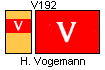
V192 remains in use with a black top, documented on Voge West and chartered Voge Voyager. Photographs of Voge Enterprise in May 2012 vary between dark buff and definite yellow, which Rosanoski relates to lighting adjustments. Lloyd’s 1912 labels this livery Vogemann Linie.
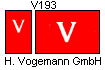
V193’s funnel comes from Voge Katja at Newcastle in February 2008. That photograph looks dark red, while others show a brighter shade closer to the flag. The V has a thicker dexter arm; the flag version has serifs at the top ends, and Rosanoski suggests the funnel version may formerly have matched, though it no longer does.
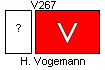
Santiago Dotor’s V267 flag, based on the company website, is criticised in the source for adding a black outline to the V and omitting its upper serifs. The original illustration and this explicit correction remain together.
Johann Heinrich Vogemann founded H. Vogemann on 22 April 1886. His sons Heinrich and Richard succeeded him, Richard becoming sole proprietor by the end of the Second World War. The later business remained privately owned by managing partners, with no named current partner connected to the original family. It re-entered shipowning and management in 2001; Rosanoski suggests chartering or broking activity between the late 1950s and that return. Vessel names usually begin Voge.
Germany, Hamburg.
H.B. BLACK & CO. PTY. LTD.
The funnel is recorded for Malaita in the company’s phosphate service in 1919; the vessel was laid up in 1921.
H.B. Black owned Glaucus from 1916 to 1927. The company was deregistered on 30 October 1940.
Australia, Melbourne.
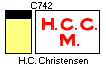
H.C. CHRISTENSEN.
Talbot-Booth also attributes the livery to Petersen but differentiates Christensen’s funnel by a narrower top and omits the dot after M.
Rosanoski notes that FOTW’s H.C.C. Christensen entry instead shows Store Nordiske Telegraf Selskab’s flag.
Merchant Ships records A/S H.C. Christensens Dampskibsselskab under Alfr. Petersen of Marstal. Petersen also operated D/S N/S Emanuel, although the funnel indexes place that company under Christensen.
Denmark, Marstal.
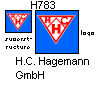
H.C. HAGEMANN GMBH & CO. K.G.
The vessel H C Hagemann I has no actual funnel. This image follows the logo painted on its superstructure, shown in starboard photographs of 4 July 2013.
Architect Heinrich Carl Hagemann founded the company in 1869. Its construction activities included water and port works, engineering, bridges, steelwork and industrial construction.
Germany, Hamburg.
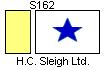
H.C. SLEIGH LTD.
H.C. Sleigh
The white flag bears a blue star, recalling the early Blue Star Line trading name. US Navy 1961 attributes the livery to H.C.S. Coasters.
The Log calls the funnel yellow, while Mitchell shows orange in two line drawings, leaving the shade uncertain.
Harold Crofton Sleigh began his Melbourne business in November 1895, advertising Melbourne–Western Australia sailings as Blue Star Line. The brief Australian Transport venture with John McIlwraith was sold to AUSN in 1897. Sleigh returned to shipowning in May 1924; after his death in 1933 his son Hamilton succeeded him. Golden Fleece was the petroleum trade name. The later public company originated in 1947 as Golden Fleece Petroleum, subsequently H.C. Sleigh and Caltex Properties. Maritime subsidiaries included Singapore Navigation, formed in 1950, Kowloon Navigation, formed in 1957, and Dominion Navigation, which took over Singapore Navigation’s fleet.
Sleigh’s 1959 bid for Adelaide Steamship failed, as did a later Ampol bid for Sleigh and a proposed Boral merger. Caltex became a substantial shareholder and partner in Australian Tanker and Botany Bay Tanker; Sleigh sold those tanker interests in 1982. Dominion Far East Line and Flinders Shipping were ventures with Jardine, Matheson. Shipping interests faded around 1980. The later holding concern became Petersville Sleigh under Adelaide Steamship control and acquired an interest in Howard Smith in 1988.
Australia, Melbourne.
Keep the explicit scope label independent; no alias or company identity is inferred.
H.C.S. Coasters
H.C.S. Coasters used H.C. Sleigh’s livery.
H.C.S. Coasters was incorporated in August 1933, liquidated and reformed in 1936. Although Hamilton Sleigh and nominees held its shares, Rosanoski’s account identifies Union Steam Ship of New Zealand as the real owner from the outset, with Sleigh interests as nominees and operators. H.C. Sleigh itself is stated not to have held an interest. Sleigh acted as managing agent until August 1972, when Union took direct control and the company became Abel Tasman Shipping.
Australia, Melbourne.
Keep the explicit scope label independent; no alias or company identity is inferred.
H.C. STULCKEN & SOHN.
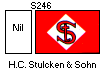
The sailing-ship flag is red with a white diamond bearing a red S surmounted by a red t. No funnel is recorded.
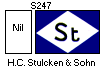
Heinrich used this flag in 1868: blue with a white diamond throughout, bearing black St.
Germany, Hamburg.
H.E. HANSEN-TANGEN.
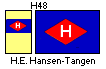
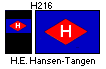
The earlier flag is blue with a red diamond containing a white H. H216 has a black funnel with a broad band of this flag, though the flag itself is assumed to apply. H48 has a yellow or buff funnel with the same broad flag band.
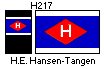
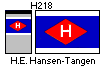
The later flag is white with a very broad blue horizontal band, a red diamond and white H. H217 carries it as a broad band on black; H218 uses grey with a black top. A version seen on Katerina in April 1965 lacked the black top.
The concern is dated to 1870 and operated through vessel-owning subsidiaries. Registers also use Yngv. Hansen-Tangen and H.E. Hansen-Tangen P/R, with management and ownership roles varying over time.
Norway, Kristiansand S.
H.F. CORDS & CO.
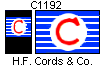
Mobil’s flag has blue bands wider than the white bands; this difference cannot be discerned on the funnel band. Its funnel has seven blue and six white bands, with an undefined circle.
Mitchell’s funnel appears to have equal-width bands, six white and five blue, and a circle outlined in black.
The first vessel, Ursula-C, was built in 1962. The company is recorded in 1963–64, as owners and operators in 1966–67, and as operators only in 1978–79.
Germany, Hamburg.
H.H. DANSHIP A/S.
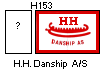
The flag is white with a red border and a red stylised oared galley without a mast, between red HH letters and the red inscription DANSHIP AS. The colour shades follow the website image.
H.H. Danship was formed in 1986 and operated through vessel-owning subsidiaries.
Denmark, Svendborg.
H.H. WUBBE NACHFOLGER.
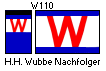
The funnel is blue with a black top and broad white band, bearing a red W that touches the band’s upper and lower edges. The blue flag has a very broad horizontal white band with the red W likewise extending to its top and bottom.
The manager operated through named ship companies and an operating subsidiary, m.s. Mars Kustenmotorschiff Reederei Theilen-Fanselauthoms, formed at Rostock in 1992. The source gives formation of Wubbe as 1784 but Rosanoski considers this unlikely and suggests 1984; the suggested correction is not established.
Germany, Hamburg.
H.J. Condon
H.J. CONDON.
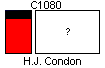
H.J. Condon operated Reliance in 1904–13.
Australia, Hobart.
H.J. HELD.
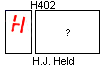
Lloyds dates H.J. Held’s formation to 1994, while Miramar records Panda as bought in 1993 and sold in 2001. Held appears under Wagenborg Shipping as manager and later as a minor operating company.
Netherlands, Delfzijl.
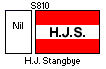
H.J. STANGBYE.
image by Ivan Sache, 24 January 2004
Stangbye operated sailing ships.
Norway, Christiania.
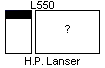
H.P. LANSER.
L550 is documented by the Mitchell collection.
H.P. Lanser was formed in 1988, bought the vessel renamed Afhankelijk that year and sold it in 1998. The 1998 register places it under Poseidon Chartering’s management.
Netherlands, Grafhorst.
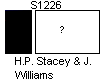
H.P. STACEY & J. WILLIAMS.
Stacey and Williams operated the tug Ready from 1931 to 1934.
Australia, Sydney.
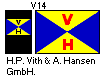
H.P. VITH & A. HANSEN GMBH.
V14’s funnel and flag are documented in US Navy 1961 and Stewart 1963. No separate written design description is supplied.
The company appears in Lloyd’s from 1958–1959 to 1970–1971, the latter listing it as a manager for one named ship company.
Germany, Flensburg.
H.P. VITH.
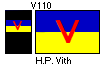
V110’s funnel and flag are documented by the Mobil Livery Chart, Flaggen & Schornsteine, US Navy 1961, Stewart 1963 and Brown 1978. No separate written design description is supplied.
H.P. Vith appears in Lloyd’s from 1958–1959 to 1970–1971, managing between one and four companies in the cited editions.
Germany, Flensburg.
H.R. LANCEY SHIPPING CO. PTY. LTD.
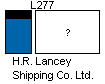
L277 is documented in The Log, February 1986.
H.R. Lancey Shipping operated in the late 1930s.
Australia, Woolloomooloo.
HAAKON OSNES.
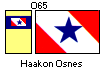
The funnel is yellow or buff with a broad blue band carrying a panel of the flag. The red flag has a broad white diagonal band, described as “Pbd”, bearing a blue star.
Haakon Osnes managed Havfrost A/S, recorded as a one-ship company in 1970–71.
Norway, Ålesund; Ulsteinvik in Brown 1978.
HABILITAS SHIPPING CO. LTD.
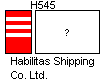
Habilitas owned Golden Reefer from 1984 to 1988. It may have been a Comninos Enterprises subsidiary: Comninos managed the vessel, and Mitchell also places its funnel on the Comninos card.
Cyprus, Limassol.
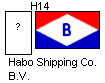
HABO SHIPPING CO. B.V.
image by Jorge Candeias, 21 February 1999
Habo operated as shipbrokers and agents from 1973.
Netherlands, Rotterdam.
HACHIUMA KISEN K.K.
Documentary material — company attribution not established
Actual Hachiuma/Pegasus vessel use remains unconfirmed.
Hachiuma Kisen
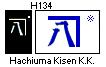
It is unclear whether both sides of the flag carried the same device. It does not show through the cloth in the photograph dated about 1916; notes from 1930 place the small device at the hoist and reverse the upside L with the hoist at left. The Yokohama Maritime Museum catalogue’s 1916 view places the hoist at right, an early Japanese practice; if both sides were identical, its small device would lie at the fly when viewed with the hoist at left. Alan Watt states that sources showing the design black are in error.
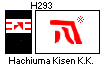
Alan Watt dates this new funnel to about the 1970s. Rosanoski considered a connection with the formation date given by Lloyds more likely, here printing that date as 1982. It is unclear whether the flag continued in use.
Hachiuma began as the shipping department of Hachiuma Co. in 1878, with Hachiuma Steamship founded on 7 January 1925. It joined Nippon Yusen Kaisha in 1964. Lloyds gives a 1981 formation date which Rosanoski could not explain from the company history. Operating interests included Galaxy Shipping in Singapore, formed in 1989, and Trans-Asia Shipping in Malaysia, established in 1974 according to the company but dated 1978 by Lloyds, which gives a 49% interest with the balance held in Malaysia. Pegasus Maritime was also listed as a subsidiary.
Japan: Hiogo-Ken, Nishinomiya and Kobe in successive sources.
Keep the explicit scope label independent; no alias or company identity is inferred.
Pegasus Maritime
Pegasus began in 1982 as Pine Crest Shipping, becoming Pegasus Enterprise in 1992 and appearing as Pegasus Maritime by July 2000. Lloyds places it under Nippon Yusen Kaisha.
Japan, Kobe.
Keep the explicit scope label independent; no alias or company identity is inferred.
Hachiuma / Pegasus livery evidence
Royal Forest wore Nippon Yusen Kaisha’s funnel at Wellington on 7 February 2004. Website photographs suggest this was normal for the company’s own vessels, with the exception of the passenger vessel Palausport under T.S. Marine Corporation, formed in 1990. The operated vessels belonging to Pegasus may have used H404, but the views were unclear.
Keep the explicit scope label independent; no alias or company identity is inferred.
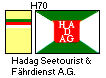
HADAG SEETOURIST & FÄHRDIENST A.G.
HADAG appears as operator in Lloyds 1970–71 and as owner by 1973–74, including vessels previously listed under the operated company. It initially held a 50% interest in Centrumlinjen Redefri A/B.
Germany, Hamburg.
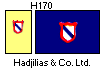
HADJILIAS & CO. LTD.
The funnel is yellow or buff with the flag’s shield. The flag is blue with a white shield bordered red and a narrow blue diagonal band described as Pbd. Stewart 1957 associates the company with Rex Shipping and Grenehurst liveries, perhaps indicating managed companies.
Hadjilias & Co. is listed in the Greek section of the 1939 fleet account with a London address, later becoming Hadjilias & Co. (Agencies). It managed Hadjilias family interests in Athens and Syra and Nereus Steam Navigation, although another account places Nereus under E.E. Hadjilias. Grenehurst Shipping was a subsidiary and Stylehurst possibly another; Compañia Naviera Hesperia used its address.
United Kingdom, London.
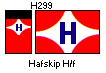
HAFSKIP H/F.
Hafskip appears in Lloyds’ shipowner listings from 1963–64 through 1985–86.
Iceland, Reykjavik.
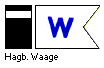
HAGB. WAAGE.
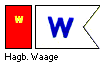
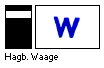
The source describes an earlier red funnel with a yellow W and a later black funnel with a white band. The flag is white with a blue W, shown as a swallowtail by Brown 1951 and rectangular by other sources. Rosanoski assumes a change and pairs the swallowtail with the first funnel to make the illustration; this pairing is an editorial reconstruction, not directly demonstrated by the cited sources.
Waage managed Rederi A/S Ruth and Waages Tankrederi A/S and II A/S, probably subsidiaries. Ships beginning R were under Ruth and those beginning S under the tanker concerns; the latter appear to have been absorbed into Ruth by 1970, based on the surviving Symra.
Norway.
HAGLAND SHIPPING A/S.
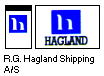
The funnel is white with a black top and a blue panel bearing a white h formed by two similarly shaped strokes. The flag is white with the funnel emblem above the black inscription HAGLAND.
Formed in 1984 as R.G. Hagland Shipping, the company adopted its later name in 1987 and operated through subsidiaries. These included Mira Bulk, formed in 1987, Hagland Bulk in 1992 and Michelle in 1994.
Norway.
HAI AN SHIPPING CO. LTD.
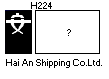
The funnel was noted on Nan An of the managed company. It is black with a narrow white band and an overall white emblem which appears to include two crossed elephant tusks. No flag was noted.
Hai An is recorded in Lloyds in 1963–64 and 1970–71. It managed Compañia Nav. Peace Lda S.A., which Rosanoski identifies as a subsidiary from the vessel names.
Hong Kong.
HAIN-NOURSE MANAGEMENT LTD.
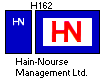
The funnel is blue with combined white HN letters, confirmed in black-and-white photographs. The flag is white with a blue border and combined red HN letters.
Hain-Nourse brought together P&O group managements. One account describes the merger of Hain Steamship and James Nourse; another includes Asiatic Steam Navigation. Management and operation of the Hain and Nourse fleets passed on 17 February 1964, although a further formation date of 1 October 1965 is recorded for Hain-Nourse Ltd. It also managed vessels for British India, Charter Shipping and P&O. Later operated by P&O Ferries, it changed its own name to P&O Ferries, with the fleet transferred by the 1980–81 listing.
United Kingdom, London.
HAINAN P O SHIPPING CO. LTD.
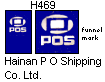
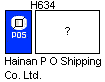
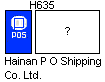
The H634 funnel follows POS Sydney on 18 March 2011. The oblique view makes the reported oval look circular; the logo suggests that the central design should be a square P, like H635. It looks black in the photograph, but JB describes dark blue, with photographs suggesting a dark sky-blue shade. JB’s drawing gives a dark blue funnel, white oval, dark blue rectangle and white letters underneath.
Xiang Shui Wan at Port Botany on 1 August 2011 had exhausts rather than a funnel, with the panel painted on the superstructure below the bridge. Its central charge is possibly a P. The blue panel may be an attached piece with white cut-outs and small joins at the top left and bottom right as well as the base and top right. A normal funnel on POS Hongkong on 10 January 2012 confirms the form.
Also known as Hainan Pan Ocean Shipping, Hainan POS and P O Shipping, the carrier is dated 2008 in an account crediting Captain Li Kelin, formerly of CSCL and COSCO, with its foundation and government and Yangpu Port backing. The company account instead dates it to January 2009 as a wholly Hainan-government-owned carrier established by Hainan Yangpu Economic Development Zone. It developed domestic services and routes to Australia and Vietnam, launched the China-Australia Express in May 2010 and began a Shanghai–USA service on 21 August 2010. Its Shanghai operations centre included the wholly owned Hainan P O Shipping Agency.
China, Shanghai.
HAITONG SHIPPING & TRADING CO.
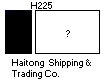
A plain black funnel was noted on Dairen. No flag was noted.
Country unknown.
HAKKO MARINE & CORP.
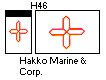
The funnel is white with a black top and a cross, clear of the edges, made from four orange-red chain links. The white flag carries the same cross. Lyttelton observations of Sanwa Fontaine on 6 July 1985 and Ebisu Fontaine on 15 January 1987 record the orange-red shade.
Formed in 1978, Hakko operated through subsidiaries, including Daio Kogyo as a separate operating company and Greatsail Shipping, formed in 1993 as shipowner. Hakko Shoun K.K. is also used in connection with the Ebisu Fontaine sighting, although the source of that name is not recorded.
Japan.
HAKON A. REUTER.
image by Phil Nelson, None
image by Jarib Bakker, 17 August 2005
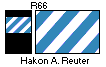
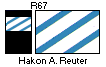
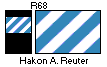
The precise flag design is uncertain. Stewart’s R66 is nearly supported by the Collectors Corner cap badge, but that badge has no white at the upper hoist or lower fly. US Navy 1961 shows white with three narrow blue diagonal bands. Talbot-Booth 1942 and 1944 instead show four white and three blue bands of equal width, running from upper hoist to lower fly. Jordan does not specify the band direction. Rosanoski takes the blue shade from Collectors Corner and suggests that the number of diagonal bands on a funnel band depends on the available width.
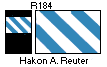
Bryggan shows this livery for Sigrid Reuter, naming Rederi A/B Reuter but listing the vessel under Rederi A/B Reut. Its funnel band ends in blue diagonals without white remaining in the corners.
Hakon A. Reuter operated Rederi A/B Reut and Reuters Handels A/B. The company is recorded in Jordan’s 1939 fleet account and later registers through the early 1960s. Reut subsequently appears as Rederiet A/B Reut under Gösta Reuter.
Sweden, Kungsbacka; Onsala is also suggested, with a question mark.
HALCO INC.
The original black funnel with a white diamond frame and white H was used in 1912–18.
The later black funnel bore a white chevron band with a white H above, giving rise to the Wishbone Fleet name. By the 1950s this design appeared on a red flag.
Brown 1982 calls this livery recently adopted. The funnel is blue with a broad black top separated by a white chevron band, with a white H above. The corresponding flag has unequal horizontal black and blue areas, black the larger, divided by a narrow white chevron, again with the white H above.
Other flags were a red pennant bordered white with a blue H, and red rectangular flags bearing HALCO in white or black. The white-lettered version is recorded with proportions of 2:1.
Hall Corporation of Canada adopted the Hall Corporation (Shipping) 1969 name on entering deep-sea trades after the St Lawrence Seaway opened; the name was shortened to Halco. A further reference dates adoption of the Halco name to 1980. The Royal Bank of Canada took over in 1986, operating the concern as EnerChem Transport.
Canada: Montreal and Westmount, Quebec, in successive listings.
HALCYON LIJN N.V.
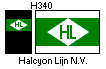
Sources differ over the width of the flag’s green band, broad in Brown and very broad in Harnack. Pre-war sources consistently show black letters; Wij Varen Weer in 1946 and later sources show green. Rosanoski discounts Harnack’s later black lettering as unupdated material rather than reliable evidence of the change date. Stewart 1963 extends the diamond across the full depth of the broad flag band but not the funnel band; some other funnel illustrations do extend it throughout, probably depending on funnel width. Vlaggen en Schoorstenen shows a double-sided flag. The FOTW H178 version also has a very broad green band.
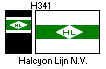
Rosanoski considers this funnel suspect; its source is Wij Varen Weer, 1946.
Wyt’s Digest, Op de Lange Deining and the De Blauwe Wimpel chart show equal flag stripes. Wyt’s Digest 1960 indicates a lighter green. Rosanoski suspected that Wyt’s was the origin of the equal-band portrayals.
Halcyon was a steamship owner from 1917 and is recorded under Vinke & Co.’s control. Before the Second World War it belonged to Baron H.H. Thyssen-Bornemisza’s TB-Gruppe; that relationship appears to have continued, as the Baron is credited with merging it into Fritzen-Halcyon. Ships used place names ending in burg or two-word Stad names, the latter system continuing in the post-war account.
Netherlands, Rotterdam.
HALCYON STEAMSHIP CO. INC.
image by Joe McMillan, 18 October 2001
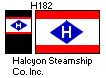
Halcyon appears in Lloyds from 1963–64 through 1970–71, with Halcyon as the first element of its vessel names.
USA, New York.
HALE VETE.
V220’s funnel is documented in The Log, May 1994; no separate written design description is supplied.
Hale Vete acquired the sole vessel Tofua in 1978. Rosanoski considers it apparently still trading in 2008 despite its disappearance from Lloyd’s; the cited register entries are for 1985–1986 and 1988–1989.
Tonga, Nukualofa.
Halfdan Ditlev-Simonsen & Co. A/S.
HALFDAN DITLEV-SIMONSEN & CO. A/S.
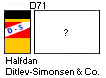
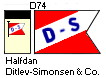
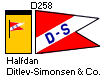
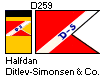
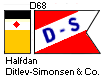
Jordan describes a yellow funnel, with Halfdan’s red band separated from the black top by a narrow yellow band. The other two companies have the same general arrangement without the narrowness specified. Rosanoski interprets the stated house flag on red as the white diagonal and letters on the red band.
Slides show an almost white pale-yellow funnel, including Valeeta on 13 August 1968. Other Skagerak and website photographs support darker yellow. The port-side slide has the Brown 1958 flag form with a mast; Valeeta’s starboard view reverses the diagonal, described as Pbds, but rearranges the letters to read normally.
Brown 1951 and 1958 use a Pbds diagonal, while sources from Stewart 1963 use Pbd. Rosanoski suspects a flag interpretation based on the starboard funnel view instead of port. The black top became narrower, specified in Ocean Ships 1967. A US Navy note calls the angled emblem D268, although the source list uses D258.
OLAF DITLEV-SIMONSEN JR.
Olaf Ditlev-Simonsen Jr. is separately listed as operator, owner and manager from 1939 through 1985–86, initially at the same address as the related businesses.
Norway, Oslo.
SVERRE DITLEV-SIMONSEN & CO.
Sverre’s business was formed in 1929 in partnership with his father Olav, who left in 1934. Skips A/S Eidsiva was formed on 2 June 1930. Sverre was succeeded by his son Per in 1953; later interests moved towards offshore oil exploration, though the business appears to have remained a disponent owner until 1987.
Norway, Oslo.
EIDSIVA REDERI ASA.
The website traces Eidsiva to 2 June 1930, with cargo ships sold in 1973–74 before offshore exploration activity. Lloyds instead dates A/S Eidsiva to 1993 and the Eidsiva Rederi ASA name to 1996. Rosanoski suggests that 1993 marks a return to mainstream shipping.
Norway, Oslo.
Documentary material — company attribution not established
Brown 1951 gives a common livery for Halfdan, Olaf Jr. and Sverre; the Norwegian museum source also supports shared Halfdan/Sverre colours. A Skagerak photograph confirms D68 for Olaf Jr.
Halfdan Ditlev-Simonsen & Co.
Olaf Ditlev-Simonsen helped his eldest son Halfdan establish shipping interests in 1914, with Halfdan Ditlev-Simonsen & Co. formed on 14 June. Reorganisation in 1982 was followed by the Management A/S name in 1983 and the later A/S name in 1994. The operator and manager used vessel names beginning with V. Interests included Pacific Orient Express, described both as a joint venture and wholly owned, and D/S Venship, formed with Wah Kwong.
Norway, Oslo; later Billingstadsletta and Asker.
Keep the explicit scope label independent; no alias or company identity is inferred.
Ditlev-Simonsen’s Rederi A/S
Ditlev-Simonsen’s Rederi A/S appears separately as operator for one company in 1963–64 and 1966–67.
Norway, Oslo.
Keep the explicit scope label independent; no alias or company identity is inferred.
Eidsiva Rederi ASA — separately referenced E514
The FOTW Eidsiva illustration from the company website is described as out of kilter.
Keep the explicit scope label independent; no alias or company identity is inferred.
HALFDAN GRIEG & CO. A/S.
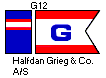
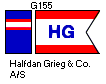
The funnel is blue with a white band edged red above and below.
The red swallowtail has a broad white horizontal band bearing blue HG.
The other flag version replaces HG with a blue G on the same red-and-white swallowtail design.
The concern appears in Lloyds from 1963–64 through 1980–81. It formed I/S Norway Supply Ships with P. Smedvig and is associated with Grieg Group Shipping through Joachim.
Norway, Bergen.
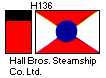
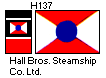
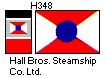
Hall Brothers (1).
HALL BROTHERS (1).
image by Phil Nelson, 10 April 2000
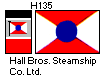
The house flag was added to some funnels in 1937. Jordan and Ocean Ships note the funnel flag without distinguishing the illustrated versions. After the acquisition of Duff, Herbert & Mitchell, Melbrook appears in Hall colours in a black-and-white photograph.
A black-and-white photograph of Bretwalda gives the impression of a black funnel base. Talbot-Booth shows the funnel flag pointing aft.
Brown 1982 notes that this livery was no longer likely to be seen.
The Newcastle business originated in 1847, acquired its first steamships in 1870 and was reconstituted in 1897. It operated Hall Bros. Steamship and acquired Duff, Herbert & Mitchell in October 1964. Shipowning ceased in August 1979 with voluntary liquidation.
United Kingdom, Newcastle.
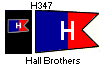
HALL BROTHERS (2).
image by Joe McMillan, 27 August 2001
Lloyds lists this flag under George E. Billings of San Francisco. It is tapered in Lloyds 1912; Rosanoski identifies FOTW’s conventional swallowtail as an erroneous rendering. Attribution to the Puget Sound Hall Brothers remains a suggestion.
The separate Puget Sound Hall Brothers built the five-masted schooner George E. Billings in 1903 and apparently also operated a fleet. The schooner was named after the fleet manager. Ned Smith suggested that a flag listed under George E. Billings might represent Hall Brothers; archivist Robert Ross separately confirmed encountering a photograph of the named vessel.
USA, Puget Sound.
HALL LINE LTD.
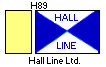
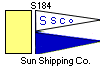
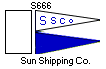
S666 is ascribed to Hall Line. Griffin’s very pale yellow in S184 may explain the white in S666; Griffin shows letters of equal size except for a smaller o with a dot beneath.
Lloyds 1904 notes the change from H89 to H88 while still naming R. Alexander & Co. as manager. Following the Ellerman takeover, Hall retained its flag but adopted the group funnel and flew the Ellerman pennant above it. Brown 1951 omits the flag’s letters; Talbot-Booth and Ships & The Sea 1936 and Brown 1958 show black letters. The 1942 and 1944 sources describe the H88 funnel as very deep pink-buff.
Accounts date the business to 1862 or to Robert Alexander’s partnership with Liston Young in 1864. Young left in 1868, after which Alexander moved from London to Liverpool. Sun Shipping was formed in 1874, or 1862 in another source, and remained the official Hall Line name for a long period. In 1883 the fleet was divided among Sun Shipping, Alexander & Radcliffe and Robert Alexander & Co.; the partnership ended in 1885. Hall Line Ltd. was registered in 1899 to take over Sun’s fleet. Robert Alexander & Co. continued operating until Ellerman’s takeover in 1901; London, Liverpool & Ocean Shipping held 50% by that year’s end. Montgomerie & Workman remained a subsidiary until reconstruction within the Ellerman group in 1920. Hall managed part of Ellerman’s fleet and continued until incorporation into Ellerman City Liners in 1973. Ships used Hall as the second element of their names.
United Kingdom: Liverpool, with Glasgow also given in Brown 1926.
Hallands Angbats Aktiebolaget.
HALLANDS ANGBATS AKTIEBOLAGET.
image by Jarig Bakker, 8 August 2005
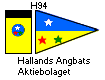
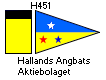
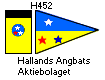
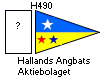
A photograph of Hansa, sold in 1941, confirms the funnel. Rosanoski treats its yellow as matching the flag.
Brown 1951 shows a green star on flag and funnel as H94. Brown 1958 instead shows a second white star on the funnel and a blue one on the flag as H452. Its smaller white flag star is probably a printing problem.
The Collectors Corner cap badge supports a sky-blue upper part and shows stars grouped towards the hoist, the upper white star apparently a little larger, with red and what Rosanoski reads as dark blue below. The lower star’s colour is not entirely clear.
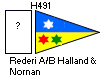
Rederi A/B Halland & Nornan — 1931 timetable flag
The Halland & Nornan timetable of 1 June 1931 shows six-pointed stars. Jan Mertens describes a green star at the bottom and suggests a combined house flag after the merger, replacing Nornan’s pennant. Rosanoski questions that interpretation: the merger may have been only a joint service, the company history does not mention it, and the early Halland flag is unknown to him. He also questions the green, since blue printed over yellow can look green. The six-pointed stars differ from later Halland sources.
Merger versus joint service and lower green/blue star remain qualified.
Founded in 1850, Hallands mainly carried passengers between Göteborg and Lübeck. Bröstrom acquired it in 1924. A reported 1928 merger with the small-cargo operator Rederi A/B Nornan produced A/B Halland & Nornan, but Rosanoski notes that only Hallands appears in the 1937 register and questions how long the combination lasted. The Frederikshavn–Göteborg service, taken over in 1924, passed to Rederi A/B Göteborg–Frederikshavn Linjen in 1935. Post-war competition ended the trade, although the name survived within the group. Harry Trapp operated it in the 1950s; Tirfing held 81% at the end of 1964.
Sweden: Halmstad and Gothenburg.
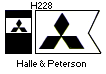
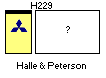
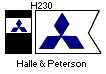
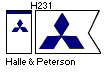
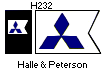
HALLE & PETERSON.
Rosanoski suspects an error in the emblem colours, considering dark blue the intended colour.
Trollvind, a tanker, had the white funnel with a narrow blue top and three blue diamonds.
Dry-cargo vessels showed a black funnel with a panel of the blue-diamond flag. The flag used with the illustration is not independently quoted, but Rosanoski considered it likely from the panel.
The shared emblem consists of three diamonds arranged as a triangle with points touching. Funnel forms include yellow or buff with a narrow black top and blue diamonds; black with a broad white band and black diamonds; and blue with a broad white band and blue diamonds. The swallowtailed white flag is recorded with either black or blue diamonds.
Halle & Peterson is recorded in the 1939 fleet account and Lloyds 1963–64.
Norway, Oslo.
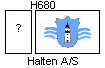
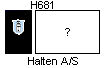
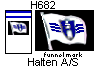
HALTEN A/S
The flag’s shield may be light blue or white. Funnel images suggest blue, with the tower also apparently blue rather than black, but the details are unclear.
The funnel follows a photograph of Feed Halten on 10 December 2009.
Feed Balsfjord’s funnel is shown to starboard on 5 February 2011 and to port on 23 December 2010, with EWOS on the hull. The flagpole points forward on both sides, mirrored to starboard. The blue is dark, apparently including the tower. On 4 April 2008, soon after renaming from Aldor Ingebrigtsen, the funnel was deep yellow with black band and top and CTG appeared in white on the hull, presumably the earlier colours.
Feed Fiskaa’s narrow funnel makes the panel almost a band. The emblem was absent in a photograph posted on 6 November 2010, shortly after acquisition on 1 or 4 November. Formerly Briese’s Tornator, it presumably had the previous logo painted out.
Feed Stavanger is documented to port on 1 April 2011 and to starboard on 23 September 2009. On the starboard side the flagpole points aft, so it is not mirrored. The blue is lighter and the shield again blue.
No photograph was found for Feed Tromso. Feed Trondheim, acquired on 30 October 2008 and possibly previously chartered, initially showed a green hull with white S+B and a white funnel with narrow light-blue top and base. In 2009 the hull letters disappeared; by 3 June the funnel had a black top and was otherwise white.
Halten was founded in Trondheim in 2005 for fish carrying. The website described eight vessels, with six listed in April 2012. Some were under Ulvan Personal and others under Strand Shipping, the latter connection unclear. Registers successively place Halten under Berge Rederi, Transmar and Ulvan Personal. The vessel Halten became Feed Halten on 1 February 2008.
Norway, Trondhein (source spelling).
HALUL OFFSHORE SERVICES CO. WLL.
The funnel follows Halul 21 on 16 January 2006. The emblem appears to depict an oil rig with HALUL in white at its base. White forms at the top are unclear and appear to differ from the company logo.
Halul Offshore Services, or HOSC, was formed jointly by Qatar Navigation and Qatar Shipping in 2001. Lloyds lists it as a Qatar Shipping operating company in 2008 and under its own name in 2011–12.
Qatar, Dubai (as recorded by Rosanoski).
HAMAGUCHI KISEN K.K.
The flag follows the 1916 material reproduced in Fune To Hata in 1994. Alan Watt reports that by the 1926 publication the H was entirely on red, with and without serifs; Rosanoski was unsure of the precise meaning of that description.
The 1916 chart names the concern Hamaguchi, with Komajiro tentatively read as the following name.
Japan.
HAMANE KISEN K.K.
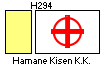
The flag follows the 1916 material reproduced in the 1994 Fune To Hata. Alan Watt confirms that the + is slightly thicker than the O.
Recorded as Hamane Shoten in the 1942 material and Hamane Kisen in the 1950s, the company traded until about 1960 according to Rosanoski. Alan Watt gives Hamane Kishitaro as the name apparently referring to the 1916 chart.
Documentary images — company attribution uncertain
image by Klaus-Michael Schneider, 17 April 2009
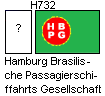
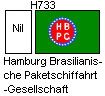
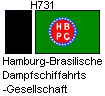
The FOTW illustration is green with a red disc towards the hoist, containing white HB above PG and surrounded by a thin rope. Schneider notes that the cited Kludas account names the steamship company, yet the flag has P rather than D, perhaps for Paketfahrt. Rosanoski says the cited illustration should instead look like H731.
This attribution is an assumption: Rosanoski considers that Mathies wrongly assigned the flag to Hamburg-Brasilische Dampfschiffahrt-Gesellschaft and that Kludas repeated the error.
Packet, passenger wording and steamship attribution remain disputed.
Founded in 1852, the company operated sailing ships in 1853–70 and was liquidated in 1871. Its directors were J.F. Grotz and Johs. Limprecht, later Grotz alone, with Krotz, Vidal & Co. subsequently named and August Bolten as shipbroker. Rosanoski distinguishes it from Hamburg-Brasilische Dampfschiffahrt-Gesellschaft, noting that Bonsor uses the packet company’s German name in error while correctly translating the steamship company’s English name.
image by Klaus-Michael Schneider, 1 September 2008
image by Klaus-Michael Schneider, 11 April 2009
The earliest funnel was black. Buff funnels were introduced in 1900 for the Cap liners, while cargo ships retained black. The white funnel with red top subsequently became standard across the group. Sources disagree over its adoption: 1911, about 1912, 1913 and 1914 are all given. The black funnel’s start is likewise dated 1871 or 1872.
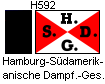
Some early flags have stops after the letters. Lloyds 1904 and 1912 and illustrated posters or postcards show them, while Griffin, Reed and other period images omit them. Schneider’s H592 follows a pre-1914 poster; another poster in the same book has no stops. Kludas reproduces both forms, including dotted examples associated with the company’s beginnings, an 1890 poster and a 1920 postcard, but an undotted 1897 menu. Rosanoski leaves open whether this reflects actual flags or artistic licence. Schneider confirms that his drawing reports a source and does not prove that a real dotted flag existed.
This funnel is not confirmed elsewhere. Its apparently black top may represent dark red, since black-and-white photographs produce a similar impression.
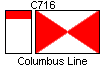
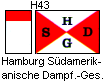
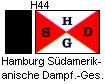
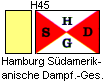
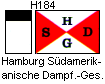
The company flag has black HSDG letters in the respective red and white quarters, beginning at the top, and photographs confirm an actual lettered flag. Brown 1958 angles the letters slightly, described by Rosanoski as Pbds. The funnel was observed on Columbus America at Wellington on 11 November 1998 and Columbus Canada on 10 December 1999; the latter’s other flag was subsequently recognised as the Liberian registry ensign. Samoa Shipping Services used the Hamburg Süd flag with its own funnel.
Bremen-registered vessels used this funnel, with the key added around 1936–37.
The plain red-and-white saltire-quartering appeared on the Hamburg Süd website as a brand logo and was initially illustrated as a possible group or Columbus flag. Its use as an actual flag was unclear. Former Columbus and Hamburg Süd deck officer Wolf Spille stated that the ships always flew the lettered HSDG flag and that the unlettered logo occurred on stationery and the postage meter. The plain FOTW images were removed or replaced by the lettered form. Rosanoski stresses that later comments referred to the earlier unlettered illustrations; the pale red in the Columbus rendering probably came from a website shade. Columbus did not have a separate house flag.
This illustration is attributed to the marcollect source on the Hamburg Süd page.
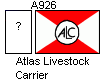
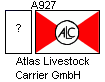
Atlas Livestock Carrier
The source records that the incorrectly shown A926 illustration was changed to A927 on FOTW in July 2010.
Vessels operated for Rudolf A. Oetker with Santa names wore Oetker’s funnel, while Horn Line’s Cap vessels had a different version of that company’s funnel. A black-and-white photograph of Columbus Victoria appears to show a dark–white–dark horizontal flag as well as the German tricolour.
Hamburg-Südamerikanische Dampfschiffahrts-Gesellschaft was formed by eleven Hamburg merchant houses in November 1871 under Heinrich Amsinck. The date is given as 29 November or 4 November. William Milburn and Ferdinand and Carl Laeisz are also recorded among the founders; an account calling August Bolten a co-founder in 1891 conflicts with this chronology. The company absorbed Hamburg-Brazil Steam Navigation around 1871. After losing its entire fleet in the First World War, it resumed with chartered ships in 1920; the Second World War again cost the fleet through sinking or reparations. The names HSAL, HaSü and HaSüd also occur.
Oetker’s initial interest is dated 1936 in one account and 1934 in another. Complete control is likewise dated 1955 or 1952. The company became an oHG in 1950 under Herbert Amsinck and John Eggert; Lloyds records the Eggert u. Amsinck name from 1952. Tanker operations and expansion in refrigerated shipping through Rudolf A. Oetker began in 1952. In 1973 it merged with Dr. August Oetker Schiffahrts u. Beteiligungs while retaining its identity. A K.G. date of 1981 is given, but register references leave the precise name-change date unclear.
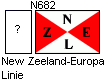
Expansion included Bock, Godeffroy and Deutsche Levante in 1956 and Atlas Levante in 1967. The Levante interests became Deutsche Nah-Ost Linie in 1973 and were incorporated into Hamburg Süd in 1986. New Zealand Europe Line began in 1975; Atlas Livestock Carrier, established in 1976, closed after its only ship made one voyage. A half-interest in Ybarra y Cia. Sudamérica was acquired in 1989, followed in 1990 by Furness Withy, Rotterdam Zuid-America Lijn and Havenlijn. Laser Lines’ acquisition is dated 1990 or 1991. Aliança and South Seas Steamship interests followed in 1998, South Pacific Container Lines assets in 1999, Crowley American Transport in 2000, certain Ellerman services in 2003 and Costa Container Lines from 1 December 2007. The source also records a Senator shareholding and the short-lived Companhia de Navegaçao Cruzeiro do Sul venture with Hamburg-Amerika, formed in 1905 and apparently sold a year later.
Columbus Line revived a North America–South America service in 1957, followed by the North America–Australia/New Zealand container trade in 1963. It was essentially a trade name; most of the former fleet passed to Columbus Shipmanagement, formed in 1998. Columbus sold its half of Samoa Shipping Services in 1995 and later operated South Seas services with Hamburg Süd. Other interests included the Overseas Freezer Operations reefer division and Royal Mail Lines. The Columbus and Crowley brands were replaced by Hamburg Süd from 1 January 2004, although another Columbus reference gives early 2005. Ellerman’s brand followed in January 2005 and Ybarra’s in December 2005 when the remaining shares were acquired; Aliança remained a regional brand. Fleet names included Cap, Santa, Polar and Columbus.
Germany, Hamburg.
HAMBURG-AMERIKA LINIE.
image by Jorge Candeias, 27 December 2004
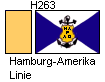
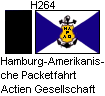
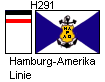
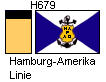
Bonsor dates adoption of the H264 funnel to 1856, when the company became a steamship owner. The buff H263 funnel was used by express steamers from 1889, express and mail steamers from 1902 and all steamers from 1909. Kludas gives H264 for other steamers in 1889–1900 and likewise H263 for all from 1909. LJC 1885 shows a red anchor on the flag.
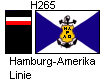
This funnel is associated with the Atlas service from New York to the West Indies, with dates around 1901–09 despite the Atlas acquisition being dated 1902. It was also the Deutsch-Austral & Kosmos funnel, probably retained on their vessels until the 1927 change; those companies kept their own flags. Rosanoski therefore questions its appearance as an alternative in the US Navy 1961 source.
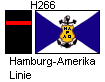
LJC 1909 assigns this funnel to the Atlas service. Rosanoski considers it suspect, noting the earlier Atlas red funnel band and two recorded variations.
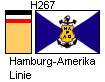
Adopted in 1927, this funnel combined Hamburg-Amerika buff with the Deutsch-Austral top. A colour photograph of Stuttgart confirms the form, whose top also reproduces the pre-Nazi German flag. Brown 1934 omits the white band, apparently a printing error. The livery was also recorded for Kosmos and Deutsche-Australie and retained by Hapag-Lloyd, although one source dates it only to 31 December 1969. Rehm shows a blue anchor on the flag.
The Brazilian source records this livery for 1950.
Kludas assigns this livery to steamers in the Riviera service.
The flag’s central anchor includes a rope, a detail omitted by many publications. Jörg Karaschewski supplied a detailed illustration of the centre.
Hamburg-Amerika, or HAPAG, originated as Hamburg-Amerikanische Packetfahrt Actien Gesellschaft on 27 May 1847. Ferdinand Laeisz and August Bolten are recorded among its founders. Expansion included the Eagle or Adler interests, dated 1857 or 1875 in different accounts, and Carr-Union, dated 1886 or 1883. It acquired Stettiner Lloyd in 1886, later renamed Scandia Line, Kingsin in 1898, de Freitas’ South American trade in 1900, Atlas in 1902 and Deutsch-Austral & Kosmos in 1926. Albert Ballin, who joined in 1886 and became general director in 1899, had owned Nordseelinie, acquired in 1904. Lütjens & Reimers was acquired in 1920 and retained its name, receiving the harbour tugs and small craft during HAPAG’s reconstruction.
The group’s international interests included Deutsche Levante, whose takeover is variously placed before and during the First World War or in 1920; Italia, controlled from 1899 to 1905; and Ligure-Brasiliana, acquired in 1912 or 1913, renamed Transatlantica Italiana in 1914 and lost in 1915 through the war. Emder Verkehrsgesellschaft was established in 1913 to represent HAPAG and develop Emden business. Other interests included a joint controlling holding with NDL in Unione Austriaca, a Holland America holding until 1915 and half of Russian East Asiatic in 1904–06. The Hamburg Süd joint venture Cruzeiro do Sul began in 1905 and was apparently sold a year later. A half-share in Horn-Linie was acquired with Compagnie Générale Transatlantique after its owner’s death in 1961. The African-line accounts record Woermann agreements and shareholdings in differing years and the later government reorganisation; the source describes Deutsche Ost-Afrika and Woermann regaining independence in 1935.
HAPAG was a founding member of the North Atlantic Steamship Lines’ Association in 1892 and later participated in Atlantic Container Lines and Eurosal. Hapag Lloyd Union was formed with Norddeutscher Lloyd in 1930, and a wartime amalgamation as Deutche Amerika Linie is recorded in October 1942. The companies apparently separated again after the war, later forming Hapag-Lloyd Container Line and finally merging as Hapag-Lloyd A.G. on 1 September 1970, backdated to 1 January. Fleet names included German towns and cities.
Germany, Hamburg.
Hamburg-Brasilische Dampfschiffahrt-Gesellschaft.
Documentary images — company attribution uncertain
Rosanoski considers the flag probably misattributed by Mathies, its letters suggesting the separate packet company, under which it is repeated as an assumption. Kludas continued the attribution but added a funnel which Rosanoski considers probably correct because the flag’s supposed source company used only sailing ships.
Funnel/flag combination and packet versus steamship flag unresolved.
The company was formed on 3 November 1855, with Hansing, N.O. Bieber, Jach. David Hinsch, Anth. Schröder and F. Laeisz represented in the directorate and Knöhr & Burchard acting as agents and probably the driving force. It went bankrupt in 1858. Rosanoski notes that Bonsor mistakenly uses the packet company’s German name while correctly giving Hamburg Brazilian Steam Navigation as the English translation.
Germany, Hamburg.
HAMBURG-BREMER AFRIKA LINIE GMBH.
image by Jarig Bakker, 21 January 2005
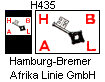
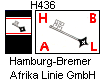
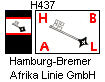
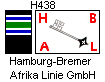
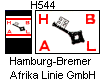
The FOTW flag follows Brown 1926, although its company name is incorrectly given as Hamburg-Bremen Afrika Linie.
H438 shows Woermann’s funnel. Merchant Ships 1942 says vessels may wear Deutsche Ost-Afrika or Woermann colours while retaining their distinctive flag. Since the publication already depicts the Woermann funnel, Rosanoski considers that its warning must also concern the H437 form.
Brown and Talbot-Booth show smaller flag letters and a longer key shaft.
Menzell renamed Chinesische Küstenvaart-Gesellschaft in 1906 when its vessels were no longer needed by Woermann. The first steamer departed in January 1907, but competition with Woermann proved financially unsuccessful. Sale to Norddeutscher Lloyd is dated 1924 or 1925. By the 1939 account the company was jointly owned by Woermann and Deutsche Ost-Afrika, presumably following the government’s 1934 shipping reorganisation, and operated by Woermann.
Germany, Bremen.
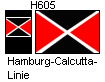
HAMBURG-CALCUTTA-LINIE A.G.
Hamburg-Calcutta-Linie, or HCL, was created in 1880 with Carl Laeisz as chairman, P.G. Hübbe and Robert Kirsten, later joined by A. Häger. It was liquidated in 1897 after an acceptable offer for the steamers. Another account describes it as an A. Kirsten subsidiary operating in 1888–97 and dates liquidation to February 1897.
Germany, Hamburg (assumed).
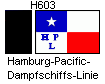
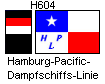
HAMBURG-PACIFIC-DAMPFSCHIFFS-LINIE A.G.
image by Klaus-Michael Schneider, 8 April 2009
The flag is described as derived from Chile’s national flag, but with a white lower hoist quarter bearing dark blue HP above L in a triangular arrangement. Mathies also shows this form.
The Ships List version angles the letters. Rosanoski was unsure of the underlying source, since the linked memorabilia site did not display its flags to him; its accuracy therefore depends on that unidentified evidence.
Hamburg-Pacific, or HPDL, originated on 13 April 1886 as a partnership controlled by A. Kirsten, initially with four steamers, and was generally called the Kirsten-Linie. It became a corporation in January 1888; another account gives a renaming in 1892. Albert Ballin served on the executive committee and may have invested, but Kirsten controlled the concern. In 1898 rival Deutsche Dampfschiffahrts Gesellschaft Kosmos took over its vessels.
Germany, Hamburg (assumed).
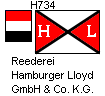
HAMBURGER LLOYD GMBH & CO. K.G. (REEDEREI).
The funnel follows RHL Aurora at Lyttelton on 16 November 2011 and RHL Conciendo at Botany Bay on 5 August 2013. The vessels have short container-ship funnels, so the apparently equal colour widths may not indicate proportions for a conventional funnel. The flag follows a panel on Reinbek’s railings on 12 July 2013. A starboard photograph of Barmbek on 26 April 2011 appears to show it flying at the bow, although the lettering is not visible.
RHL Reederei Hamburger Lloyd was founded by Hamburg shipowners and merchants for management and chartering. The company gives 2007, while Lloyds dates formation to 2006. Hansa Hamburg Shipping International is listed as an associate.
Germany, Hamburg.
HAMBURGER MINERALÖL-WERKE ERNST JUNG.
image by Klaus-Michael Schneider, 4 April 2009
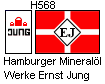
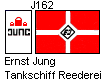
H568 is associated with Claere Jung. Its funnel letter is more clearly a G than the C-like form in the US Navy’s J162, but the symbols’ meaning is unclear. The Navy gives Ernst Jung Tankschiff Reederei as the company, also reported as Friedrich Jung’s owner, while Lloyds uses Hamburger Mineralöl-Werke Ernst Jung.
Ernst Jung created the shipping and oil-importing concern after the First World War. Shipping recommenced after the Second World War with Claere Jung, named for his wife and built in 1953; Miramar records the vessel under Hanseatische Tank. Jung died in 1967.
Germany, Hamburg.
HAMILTON SHIPPING CO. LTD.
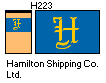
Hamilton’s distinctive livery, unlike that of the group’s other vessels, was retained after transfer. The funnel is yellow or buff with a narrow black top and broad blue band bearing an ornate yellow H in black-letter style. The flag is blue with the same yellow H, confirmed as matching the funnel band. The funnel photograph dates from August 1967.
Hamilton Shipping owned the tanker Hamilton and was a subsidiary managed by Evan Thomas Radcliffe. The vessel was transferred within the group to Anthony Radcliffe S.S. Co. in 1968.
Bermuda, Hamilton.
HAMM SCHIGGAHRTS K.G.
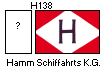
The flag is red with an oversized white diamond extending throughout, bearing a black H. Colour shades follow the website image.
Germany, Drochtersen.
HAMMANN & PRAHM REEDEREI.
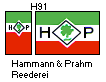
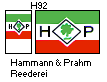
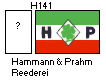
The website variant has a white diamond edged black, containing the green clover and stem, on the green-white-red tricolour between H and P. No funnel is shown for it. Rosanoski suggests the corresponding funnel would use the same design if the flag version is correct; this remains an inference.
Both funnel forms are recorded in use. One is red with a green top, separated by a broad white band. Across it is a white diamond without a defined edge, a black diamond frame enclosing a green leaf above a short green wavy horizontal baton, with black H and P on either side. The second funnel is white with a broad band of the flag. That flag is a green-white-red horizontal tricolour with an overall white diamond and black diamond frame enclosing a green clover leaf and stem; H and P stand on the white band.
Formed in 1985, the concern operated vessels under its own name and subsidiaries. Brown also names it Hamman & Prahm GmbH & Co. K.G.
Germany, Wischhafen.
Hammoud Shipping & Trading Co.
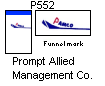
Prompt Allied Management Co. / PAMCO
This funnel follows Captain Yusef in a photograph of 22 August 2005.
Renamed Crystal Wave in 2007, the vessel was photographed to port on 13 August 2008. On its narrower upper funnel the mark matches the logo, though the lettering looks black beside the blue hull emblem. A starboard view shows the emblem facing forward. Captain Abdullah’s wider funnel allows a longer forward-facing hull emblem, so the lettering does not extend across its full length.
A port-side view of Captain Abdullah on 9 July 2010 shows the P red and taller than the other letters, unlike the logo. The emblem faces forward, with lettering adjusted to remain readable, and its hull line appears to extend to the funnel’s end. Photograph quality is imperfect, but Rosanoski considers this an apparent change.
The brokerage and agency business was founded at Tartous in February 1994 as Almajd Shipping. It became the partnership Liliana Maritime in 2000, then Hammoud Shipping & Trading in 2002 when the Hammoud family bought out the other partners. It was associated with the ship manager Prompt Allied Management, or PAMCO. PAMCO’s own account likewise traces it to Al Majd Shipping in 1994 as charterers, whereas Lloyds gives formation in 2003; the relationship and differing dates are retained as recorded.
Syria, Tartous.
Hamzah Shipping Co.
Documentary images — company attribution uncertain
The funnel follows Safi to starboard on 6 October 2011 and Aalaae J to port on 23 November 2008. Rosanoski presumes it may be a common managers’ funnel used where the actual owners had none of their own.
Hamza/Hamzah/Hazma identities and actual livery proprietor unresolved.
Safi had acquired the J of the source’s J206 by January 2013, after its manager changed to GMZ. Soumaya-J already carried the J209 funnel in June 2008, before Hamzah’s management. A small change to its J after the 2012 ownership and management changes might support the suggestion that J refers to the ultimate owner. Rosanoski leaves this interpretation open.
Hamzah appears to have begun operating in 2010 and is listed as manager in 2011–12. Its relationship to the similarly named Beirut concern is unclear. The fleet apparently used Mare Maritime Agency for chartering.
Management records link the company with Safi, Aalaae J, Soumaya-J, Schooner and Letfallah III around 2010. Safi passed to GMZ Ship Management in November 2012. Aalaae J moved to Medmarine ownership and ISM Group management in 2012; Schooner passed to Medline under Mediterranean Navigation management that November. Letfallah III had moved from ISM Group management in March 2010, with ISM Group remaining ISM manager. Soumaya-J is distinct from the similarly named vessel listed under Jendi; in November 2012 it passed to Manessa Martitime and Global Management & Trading.
Syria, Tartous.
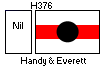
HANDY & EVERETT.
image by Joe McMillan, 18 October 2001
The flag illustration follows a painting of David Crockett.
The nineteenth-century sailing-ship firm shared ownership of David Crockett with Laurence Giles & Co. and other New York interests until its sale in 1883. Built in 1853, the vessel is described as one of the fastest California clippers.
USA, New York.
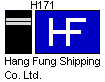
HANG FUNG SHIPPING & TRADING CO. LTD.
The blue is specified as dark, and the funnel bands as silver.
Incorporated in July 1959 to conduct Simsmetal’s shipping interests, Hang Fung sold its last vessel in August 1963. Stewart & Co. acted as agent.
Hong Kong.
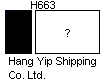
HANG YIP SHIPPING CO. LTD.
The funnel probably follows Chickasaw, the only vessel Mitchell mentions.
Formed in 1984, Hang Yip bought South Bay that year. Its second vessel, Chickasaw, was sold in 1998. Lloyds lists it as a vessel-owning company under Orient Ship Management.
Hong Kong.
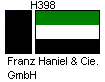
HANIEL.
image by Klaus-Michael Schneider, 29 April 2007; sighting 26 April 2007
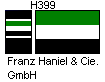
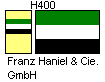
The house flag is a plain horizontal green-white-black tricolour in the recorded flag references. A black-and-white photograph of Franz Haniel XXIII around 1913 appears to show it at the foremast, though the colours and identity must be assumed from that view. A handwritten note in the US Navy source limits the flag to barges, with seagoing ships using Oldenburg-Portugiesische’s flag. Rosanoski notes plain black funnels on the Elbe vessels and tentatively suggests Tazacorte as a late user of the flag. Schneider nevertheless observed a Haniel flag on a Haren vessel at Hamburg on 26 April 2007, after Imperial’s takeover. His suggestion that Imperial used former companies’ flags is based on observation rather than a documented general rule.
The funnel has a broad white band carrying the flag across its full width. The flag itself is not separately given and is assumed to apply.
Daniela Stemmer reports a version with a cock, described as a mistaken allusion to Hahn, and asks when the flag began. She distinguishes the business’s 1756 foundation from shipping around 1830; the flag’s starting date is not established.
A photograph supplied by Jan Mertens shows a non-shipping variant at a miners’ procession on the Prosper Haniel slag heap: black above white and green, with a symbol in the white stripe. A Rhine–Prussia colour explanation is reported. Mertens instead suggests Prussian white and black with green for Gutehoffnungshütte, but expressly as his own theory.
The business traces its origin to Han Willem Noot’s packing-house charter of 10 February 1756. Jacob W. Haniel took over in 1772, followed after his death by Aletta and later her sons Gerhard and Franz. Coal trading and forwarding expanded into shipbuilding in 1829 and shipowning around 1830. The heirs formed Franz Haniel & Co. in 1870; Franz Haniel & Cie. GmbH followed in 1917, separating management from the family’s interests. After the Second World War the family regained sole ownership by the late 1950s. Haniel Reederei became a separate company in 1972, and Franz Haniel & Cie. a holding company in 1980.
Sea-shipping involvement through Oldenburg-Portugiesische is dated 1882 or 1895. The holding reached nearly 100% in 1952 and was sold in 1995 or 1996. Haniel acquired Dutch chemical-barge operator Wijnhoff & Heuvelman in 1991 and had held shares in Niedersächsische Verfrachtungsgesellschaft since its formation in 1917, with later majority status presumed. The forwarding business combined with Thyssen in 1989, and Haniel sold that interest in 1998. It sold 51% of the shipping holding to Imperial on 1 January 2000 and the remainder on 30 December 2002; Haniel Reederei became Imperial Reederei in mid-2003.
Germany, Diisburg-Ruhort (source spelling).
Hanjin Group.
HANJIN SHIPPING CO. LTD.
Hanjin Shipping Co. Ltd.
image by Jorge Candeias, 10 February 1999
Hanjin Shipping Co. Ltd.
Hanjin Construction
South Korea, Inchon.
Keep the explicit scope label independent; no alias or company identity is inferred.
Hanjin Heavy Industries & Construction
South Korea, Busan.
Keep the explicit scope label independent; no alias or company identity is inferred.
Hanjin Merchant Marine
Hanjin Merchant Marine is assumed to belong to the group; the source records it separately in the 1988–89 and 1996–97 registers.
South Korea, Busan.
Keep the explicit scope label independent; no alias or company identity is inferred.
Hanjin Overseas Tanker
Hanjin Overseas Tanker was established in Singapore in June 2007 to focus on chemical and clean products.
Singapore.
Keep the explicit scope label independent; no alias or company identity is inferred.
Hanjin Ship Management
Hanjin Ship Management is listed as a manager in 2011–12.
South Korea, Busan.
Keep the explicit scope label independent; no alias or company identity is inferred.
Hanjin Shipping
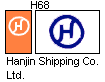
Mitchell identifies this as the original funnel.
Mitchell calls this new colours and also places it on the Ace Consortium card, indicating use by 1989.
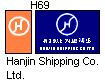
The funnel is confirmed on Hanjin Calcutta and Hanjin Irene. Some photographs, including Hanjin Oslo on 14 October 2013, show a bright, almost red air-sea-rescue shade. The white flag bears a blue logo: a thick ring containing an H joined to the ring by semicircular forms, described as giving a yin-yang impression.
The flag has two lines of white lettering, Korean above HANJIN SHIPPING CO. LTD. It was suggested to be a table flag, although Louis considered that unlikely.
South Korea, Seoul and Pusan.
Keep the explicit scope label independent; no alias or company identity is inferred.
Hanjin Transportation
South Korea, Seoul.
Keep the explicit scope label independent; no alias or company identity is inferred.
Group and Hanjin Shipping
Choong-hoon Cho founded Hanjin Transportation in 1945 as the group’s first firm, although Lloyds gives 1977. Container operations began in 1972 through Daejin’s regional feeder service. A joint feeder operation with Sea-Land in 1977 led to Hanjin Container Lines that year. Its merger with Korea Shipping Corporation on 3 December 1988 formed Hanjin Shipping. Rosanoski identifies the alternative Lloyds description of the merger partners as incorrect.
Keep the explicit scope label independent; no alias or company identity is inferred.
Hanjin Shipping and operating interests
Hanjin acquired a majority in DSR-Senator in 1997; reports give changing or differing figures from over 65% through 70%, 75% and 80%. One account also prints February 1977 for the 75% purchase, conflicting with the stated 1997 acquisition. Keoyang’s interest is given as 90% acquired in March 1995 or 48.6% in another account. Hanlim, formed in 1982, bought Korea United’s ships and business in May 1985; Lloyds describes a 1988 Korea Shipping merger retaining Hanlim’s name and bankruptcy in 1995. Rosanoski could not reconcile its place in the group history. Hanjin helped found Ace Consortium on 1 January 1989 and participated in the Australia Southeast Asia service, later Service A Plus. Ships commonly used Hanjin names.
Keep the explicit scope label independent; no alias or company identity is inferred.
Construction and heavy industries
Hanjin Construction merged into Hanjin Heavy Industries & Construction in 1999. The latter traces its origins to 1937 and successive mergers.
Keep the explicit scope label independent; no alias or company identity is inferred.
HANKYU FERRY K.K.
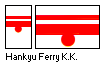
Both funnel and flag are white, with a narrow red band above a wider red band and a narrow white gap between. An undefined red circle hangs from the broader lower band.
Hankyu Ferry was formed in 1968. The source also records a joint undertaking of Shin-Nipponkai Ferry, Hankyu Ferry and Kanko Kisen formed in 1990.
Japan.
HANNARA SHIPPING CO. LTD.
The funnel follows a port-side photograph of Han Symphony at Singapore, dated a5.6.2011 in the source.
Hannara’s foundation is dated 1994 in the business reference and 1997 by Lloyds. It is recorded as manager in 2011–12.
South Korea, Seoul.
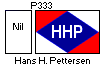
HANS H. PETTERSEN.
image by Ivan Sache, 14 January 2004
Pettersen is recorded as a sailing-ship operator in Lloyd’s 1912.
Norway, Arendal.
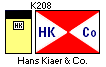
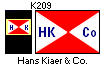
HANS KIAER & CO. A/S.
K208 has black funnel letters.
Lloyds 1912 shows black letters on both the funnel and flag of K209.
The firm appears as owner and manager in the 1953–54 to 1963–64 registers.
Norway, Drammen in Lloyds 1904; Fredrikstad in 1953–54.
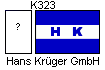
HANS KRÜGER GMBH.
image by Klaus-Michael Schneider, 30 Mar 2009
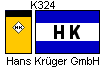
Rosanoski finds the FOTW K323 rendering inconsistent with its cited 1956 source: the original has black letters and a broader white band, represented by K324.
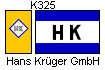
US Navy’s K325 has white funnel letters outlined in black.
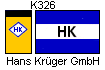
K326 is retained from Stewart 1963, Brown 1982 and Mitchell.
The company website dates formation to 1946, while Lloyds gives 1950, matching the acquisition of Annemarie Kruger. Registers distinguish Hans Krüger and partnership interests. In 2005 assets were pooled in the merger forming K & K Schiffahrts with the Knüppel connection.
Germany, Hamburg.
Hans Mogensen.
Skips AS Fortuna
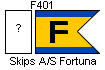
The flag follows skipet.no.
Hans Mogensen operated from 1964 to 1972, beginning as Mogensen & Torsnes and forming Skips-A/S Fortuna in 1965. The company operated Folias from 1965 until its discontinuation in 1972; the register also spells it Skibs A/S Fortuna.
Norway, Bergen.
HANS PETERSON & SÖHNE GMBH & CO. K.G.
image by Klaus-Michael Schneider, 17 Jul 2012
Mitchell’s funnel emblem resembles that recorded for Gebrüder Peterson. He also shows another emblem without saying where it was used. P640’s flag is sourced from the funnel image.
Westermuhlen photographs from 2005 and 2007 show the funnel from both sides; Westerdeich in April 2006 has no black top. The P slopes backwards in all cases. Company photographs and Nüsse’s table flag provide flag evidence.
The FOTW version is white with blue stripes along the upper and lower edges. A central blue shield, bordered yellow, contains a white P. Its blue is darker and the shield more curved; the cited shipowners’ association link no longer leads to the company, leaving uncertain whether that was the original version.
Mitchell’s separately referenced P641 is assigned to Schiffahrtskontor Rendsburg with darker blue as R423.
Hans Peterson, born in 1914, first commanded Adele in 1941. On 22 July 1948 he bareboat-chartered her from Adele Hagenah and began independent operation, renaming her Magdalene after his wife. With Emil Jess and Karl Schlüter he founded Schiffahrtskontor Rendburg in 1970 to charter the three fleets; it later belonged solely to the Peterson family. Hans died on 8 January 1977, shortly before delivery of the first ocean-going vessel. Sons Klaus-Dieter and Bernd succeeded him; after Bernd’s death in June 2010, Martina joined her uncle in management.
The later register account dates Hans Peterson & Söhne to 1984 and its change to Reederei Hans Peterson & Söhne GmbH & Co. K.G. to 1994. Earlier Hans and Gebrüder Peterson entries operated through Schiffahrtskontor Rendsburg; the later concern appears as its operating company and manager.
Germany: Elsdorf-Westermühlen, Krs. Rendsburg, Rendsburg and Horslen. The 1978–79 Edmonds WA, USA entry was a register mix-up with a namesake company.
HANS SEMPER.
Jorge Candeias notes that the livery uses the principal colours of the Amazonas flag, but cautions that the resemblance may be coincidental. His source is a house-flag chart of about 1950.
Brazil, Amazonas.
HANS UTKILEN.
The white funnel has a black top and a broad band of the flag. The flag is blue with a yellow stylised Viking ship.
The business was formed in 1940 and appears as Hans Utkilen Partrederi in the 1963–1964 and later Lloyd’s listings.
Norway, Bergen.
HANS-ERICH AHRENS.
Mitchell attributes the funnel to Erich Ahrens, but Rosanoski distinguishes it from the separate company of that name because Mitchell identifies Martha Ahrens. No line drawing is given. The flag reference is derived from the funnel.
These leads agree with the local record but their underlying evidence could not be independently established. Wikipedia mirror is not counted as a second source. A738 flag is derived from a funnel, not a witnessed flag.
Hans-Erich Ahrens operated Martha Ahrens, built in 1965 according to one source or 1966 in Lloyds, and sold in 1975. He is listed in Lloyds 1970–1 and 1973–4.
Germany, Bützfleth.
HANS-ERICH LÜDTKE.
The flag is blue over red with a white diamond extending from top to bottom and bearing a black L. The yellow or buff funnel has a broad band of the flag.
Hans-Erich Lüdtke appears in registers from 1963–64 to 1973–74.
Germany, Rendsburg.
HANS-HINRICH VON RÖNN & HEINZ MOJE K.G.
The flag is light blue with a dark-blue ring enclosing a dark-blue and white compass-rose star. White vR, shaded dark blue, appears in the canton. Shades follow the website image; no funnel is given.
Germany, Drochtersen.
HANS-HINRICH VON RÖNN.
The flag is light blue with a dark-blue ring enclosing a dark-blue and white compass-rose star. White vR, shaded dark blue, is placed in the canton. Shades follow the website image; no funnel is described.
Lloyd’s records one vessel in 1970–1971 and later a fleet under a single-ship subsidiary.
Germany, Stade; later Drochtersen.
HANS-PETER FUNCK.
Germany, Wischafen.
HANSA HEAVY LIFT GMBH.
The funnel follows HHL Richards Bay to port on 25 December 2011 and HHL Tokyo to starboard on 1 July 2011. The starboard emblem is mirrored, in line with the logo.
Hansa Heavy Lift, or HHL, was set up in 2011 after Beluga Shipping’s insolvency, with Oaktree Capital Management’s support.
Germany: Bremen, then Hamburg from the beginning of 2012.
HANSA MARE REEDEREI GMBH & CO. K.G.
The funnel base merges quickly into white superstructure on Mare Lycium and Mare Britannicum. A light cream appearance on the latter is attributed to lighting. Mare Internum gives clearer confirmation, although its port-side bridge superstructure extends alongside the funnel, making the black top appear at first to be the whole funnel. Mare Adriaticum’s port-side view confirms the colours. The company website supplies a logo and actual flag photograph; Nüsse records a table flag.
The management company was founded on 23 December 1991 and its first vessel partnership on 14 January 1992, although Lloyds gives formation in 1994. Ships were held as individual companies offering shares to private and institutional investors. Harro Kniffka left joint management at the end of 2000 but retained half through Hanseatic Lloyd Holding; the holding later remained with his family. Rosanoski presumes Dr. Meier-Hedde was the other co-owner. Lloyds records the company under Schlussel Reederei and later independently.
Germany, Bremen.
HANSA TANKERS A/S.
The funnel follows a starboard photograph of Mid Nature on 28 November 2012; company and recruitment-site logos provide the accompanying reference.
Registered on 11 May 2010 and founded by key Tailwind Shipping shareholders, Hansa Tankers is an independent commercial operator of chemical tankers through chartering and pools, with offices in Bergen and Singapore. Its managed Singapore subsidiary, Hansa Tankers Pte., is listed under Tailwind Shipping in the Tailwind group.
Norway, Bergen.
HANSA TREUHAND SCHIFFSBETEILIGUNGS A.G. & CO. K.G.
The company logo and HS Scott photograph of 22 June 2007 show the line portion in mid to sky blue. A similar shade is assumed for the flag, although the website photograph and flag panels on CSCL Yantian and CMA CGM Newton look darker. An observation of HS Bizet at Port Botany on 5 September 2007 describes dark blue, a mid-blue canton with white Maltese Cross and horizontal lines possibly light green. These differing observations remain uncertain.
HS Elektra on 31 December 2007 shows the flag as a narrower band, about 2:1 rather than 3:2, occupying the whole funnel side. The white band extends around the rear; the image shade also varies.
Created in 1983, Hansa Treuhand oversaw shipping projects from planning and shipyard orders through management, chartering and sale. Its mainly container fleet also included reefers, tankers and cruise ships. Technical and management work was largely handled by Hansa Shipping and Leonhardt & Blumberg, alongside external managers. The group included maritime consultancy, shipbuilding and chartering companies, Sea Cloud and River Cloud cruise interests and Shanghai Edward Shipbuilding. Lloyds initially gave a 1997 formation date, later amended to 1983, and reversed an erroneous listing of Hansa Treuhand under Hansa Shipping. Hansa Shipping itself is dated 1995 in the website account and 2000 by Lloyds, with Hansa Shipmanagement dated 1995.
Germany, Hamburg.
HANSE BEREEDERUNGS GMBH & CO. K.G.
The company website shows the flag as a logo and actual flag. Funnels appear to be in charterers’ or Columbia Shipmanagement’s colours.
Documentary images — company attribution uncertain
This funnel is given for Sunny Maribella, one of several similarly named vessels held by companies for which Hanse acted as agent. A common ownership connection is possible, but the ships may instead have belonged collectively to an unidentified party.
The funnel is ascribed to Hanse Bereederungs of Singapore and possibly associated with Edgar Leicher of Aquarius Seereederei; neither identification was located in Lloyds.
Mitchell apparently connects the funnel with Hanse but gives neither an explanation nor a vessel.
Ultimate owner/livery proprietor unresolved.
Singapore Hanse versus Aquarius connection unresolved.
No definite company or vessel attribution available.
Formed in 1976 as Hanse Bereederungs-Gesselschaft, the concern’s name changed in 1993, with differing legal forms recorded later. It acted as exclusive chartering and operating agent for the container fleet of Schoeller Holdings and Bengal Tiger Line, and handled vessel sales and purchases. Schoeller is described as owner or associate in successive registers; Columbia Shipmanagement is an affiliate. Operating interests included South Pacific Shipping and Hanse Shipping. The latter, formed in 1986 at the same address, took over Antilla Shipping and Isebek, the last vessel under Knöhr & Burchard. From October 2008 the vessel was Stolt Pelican under Stolt Pelican B.V.
Liberia, Monrovia in the 1978–79 listing; Germany, Hamburg in 1985–86.
HANSEATIC CRUISES GMBH.
image by Klaus-Michael Schneider, 21 May 2009
After the sale the vessel retained its name and initially its livery, but the funnel eventually changed to Hapag’s, with new paint noted on 10 June 2011. Use of the flag may have been brief: the earliest photograph found, dated 28 June 2006, already shows Hapag’s flag. Schneider describes the Hanseatic flag as the Deutsche Atlantik design with proportions 19:15, compared with a 25 by 15 cm HAL example. Rosanoski also notes narrow white strips at top and bottom on the latter which other descriptions omit.
Hanseatic Cruises, also known as Hanseatic Tours, was formed in 1993 by Dirk Moldenhauer, formerly a Deutsche Atlantik captain. He bought Society Adventurer and acquired the rights to the Hanseatic name and colours; no other direct link is known. The 1995 passenger-liability record names Hanseatic Tours Reisedienst, Hanseatic Cruises and registered owner Bunnys Adventure & Cruise. Hapag-Lloyd’s acquisition is dated 1997, although The Log gives 1996. A later travel company of the same name may still have operated, but the connection is unknown.
Germany, Hamburg.
HANSEATIC LLOYD A.G.
The flag is white, with the sinister half of a red H extending from the hoist beside blue LL letters.
Switzerland, Bottighofen.
HANSEATIC SCHIFFAHRT UND SCHIFFSMANAGEMENT GMBH.
image by Santiago Dotor, 11 November 2003
The flag is described as red with a white disc and outlined H. Rosanoski considers the FOTW proportions incorrect: a photograph of Hanseatic Trader on 8 January 2007 shows a normal rectangular flag.
Hanseatic Scout’s starboard funnel and Hanseatic Spring’s port-side funnel show mirrored logos so that the depicted flag points forward on both sides. The blue shading emphasises the flag’s folds and, like the H’s shading, changes sides, as a close view of Hanseatic Trader on 5 June 2013 shows.
Formed in 2000, the concern belongs to the Bremer Lloyd group and appears in 2011–12 as Hanseatic Schiffahrt GmbH & Co. K.G., a ship manager. Vessel names begin with Hanseatic.
Germany, Bremen.
HANSEATIC SHIPPING CO. LTD.
image by António Martins, 17 January 2007
image by António Martins, 17 January 2007
Brown describes the flag as blue with a red disc carrying blue HSC letters. Website flag images show both red and orange discs.
Mitchell’s main funnel has pencilled letters presumed to be blue, but the small lower letter is H rather than C.
Mitchell associates this funnel with Atlantic Marine Line, which Rosanoski could not locate.
The FOTW version uses burnt yellow instead of red and was labelled a possible former flag. Rosanoski’s archived website evidence shows an actual flag at the building and red or orange elsewhere on the page, while a shadowy background flag has a yellow disc. He therefore suggests artistic licence rather than an established historical change.
Hanseatic was formed in 1972 as a ship manager with the House of Schulte behind it and holding 25%; Mitchell instead dates formation to the 1980s. Hanseatic Chartering followed in 1976. Operating interests included Vigor Tankers at Manila, formed in 1995, and Two Star Shipping at Limassol, formed in 1999. The company became Bernhard Schulte Shipmanagement (Cyprus) in 2008.
Cyprus, Limassol.
HANSEATICISCHE REEDEREI EMIL OFFEN & CO.
The black funnel bears a broad red band edged white above and below, with a black Iron Cross edged white. One description has the cross touching the band’s top and bottom; another makes it extend throughout. The flag is red with a black Iron Cross throughout, edged white.
Emil Offen’s concern appears in successive shipowner and manager listings and participated in the consortium forming Europa Afrika-Linie.
Germany, Hamburg.
HANSEATISCHE AFRIKA-FIENST.
The funnel is blue with two widely separated white bands. The flag is a blue swallowtail with a white star in the upper hoist and another in the lower fly.
Germany, Hamburg.
HANSEATISCHE HOCHSEEFISCHEREI A.G.
image by Klaus-Michael Schneider, 5 April 2009
The retained flag is white with red stripes at the top and bottom. Its central shield has a white key on red for Bremen and a white chief bearing a red cross pattee, topped by a yellow mural crown with three turrets.
A comparison in the source, numbered A596, has a narrower white band but still shows yellow turrets on the shield.
Founded on 26 September 1929 through a merger including Bremerhavener Hochseefischerei, the company was acquired by Rudolf A. Oetker in 1959. The fishing group, including Kohlenberg & Putz and Reederei Söhle, agreed to cooperate with Nordsee in 1968 while remaining independent. Gemeinnützige Hochseefischerei, also identified in the source as Gemeinwirtschaftliche Hochseefischerei, was taken over in 1970; its vessels passed to Söhle in 1972. With fishing no longer viable, the last two vessels were sold to China in 1985.
The Werse logo provides context for the funnel, documented on MCL Alger on 21 April 2009.
Formed in 1995 as Kapitän Peter Hansel, the concern became Reederei Peter Hansel in 1997 and Hansel Schiffahrts-und Bereederungs in 1999. By 2007 the fleet was listed under Werse Bereederungs, formed in 2006 at the same address.
Germany, Münster.
Hapag-Lloyd A.G.
HAPAG-LLOYD A.G.
image by Jorge Candeias, 10 February 1999
image by Jarig Bakker, 17 February 2006
image by André Coutanche, 9 September 2003
image by Klaus-Michael Schneider, 7 March 2009; sighting 21 April 2007
The merger combined Hamburg-Amerika’s funnel markings with Norddeutscher Lloyd’s flag. Accounts describe black-white-red funnel tops and buff bases, with Bremen and Europa initially retaining NDL funnels. Loughran assigns Europa and, from 1973, harbour tugs to H189. Flags of the World places H188’s flag emblem towards the hoist. Wolf Spille records continued use of the NDL flag until 1986, when cognac-yellow funnels and a stylised HL flag were introduced.
H9’s flag is confirmed by a Wellington photograph of 6 September 1996. It is white with blue and orange vertical hoist bands; Rosanoski corrects an earlier rendering’s red to orange and raises its emblem from the overly low position caused by a furled reference flag. The funnel was observed on Europa in 1987 and on later vessels. C. Columbus is described as having a blue top; black areas on other modern ventilated tops may not represent a separate livery. The arrowhead design points forward on both sides, as it also does in H189. Cruise vessels generally wore H9 apart from Hanseatic, which changed in 2011.
André Coutanche observed this design on launches taking Europa’s passengers ashore at Kirkwall. He distinguished it from the differing flag then shown on the company website and identified it with the modern flag on another reference site.
The upright orange flag has blue across its upper quarter, with a blue company logo and black Hapag-Lloyd inscription at the bottom. Schneider observed it at Hamburg’s Alster lake on 21 April 2007. Marcus Schmöger questioned whether banner was the correct term, suggesting Knatterflagge or Hochformatflagge.
Hapag-Lloyd Container Linie GmbH
image by Santiago Dotor, 11 November 2003
The orange flag has a blue hoist bar with the logo and name low on the orange field. Nüsse attributes it to Hapag-Lloyd Container Linie. Rosanoski suspects shore use because the small, low-positioned emblem and lettering would serve poorly at sea; its existence is nevertheless documented.
Hapag-Lloyd was formed on 1 September 1970 by merging Hamburg-Amerika Linie and Norddeutscher Lloyd. Preussag’s September 1997 acquisition is given as 69% in one report and 99.2% in another; complete ownership is dated June 2002, when Preussag became TUI. CP Ships was acquired in 2005. In 2008 Hamburg investors led by Klaus-Michael Kuehne and the city government bought Hapag-Lloyd after a Neptune Orient Lines bid lapsed, with TUI taking back a 33% stake.
The shipping group included Contship and the Europa and Hanseatic cruise interests; Hanseatic’s acquisition is dated October 1996 or 1997. Hapag-Lloyd Australia followed Seabridge Australia’s demise in 1993. Container Linie is dated 1996 or 1 January 1997 and merged into Hapag-Lloyd on 24 July 2006. Cruise-management and Seetouristik companies followed in 1997 and 1998. Tug operations passed to Transport & Service after its 1994 formation. CP Ships USA became Hapag-Lloyd USA in 2007. Rickmers became wholly owned in 1987. Roland Linie and Unterweser freight ventures became wholly owned in 1975; the latter interest was sold to Linhoff in 2001. The half-interest in Horn-Linie was sold to Compagnie Générale Maritime on 1 January 1975.
Partnerships included Bolivian Shipping Line with the Bolivian government, Frontier Cruises with Mitsubishi, NYK and Salen Lindblad interests, Eurosal, the Grand Alliance marketing group operating from 1998, the NZESA conference and Seabridge NZ. Acadian Offshore Services is listed as an associate. A 1967 Hapag-Lloyd Container Line arrangement is also recorded, presumably as a service before the later corporate merger.
Germany, Hamburg.
HAPPY CRUISES.
Gemini’s Quail funnel, photographed on 20 April 2009, carried the group logo without its lettering and the vessel’s name below in angled dark-blue letters.
The Happy Cruises funnel is documented on Gemini to port on 17 March 2010 and to starboard the following day, again with the ship’s name beneath. Ocean Pearl lacked its name on the funnel. Its fish looks red in one photograph, which Rosanoski attributes to possible camera confusion between orange and red.
Quail Cruises was established by former Pullmantur executives after Royal Caribbean bought that concern. It operated Gemini, renamed on 26 March 2009, and adopted Happy Cruises between October 2009 and January 2010. Difficulties included Pacific’s seizure in 2009. Operations stopped abruptly on 24 September 2011. Globalia held 20%.
Spain, Valencia.
HARA SHOSEN K.K.
The concern appears as Hara Shoji in wartime sources and Hara Shosen in post-war registers. Rosanoski describes its later operation as post-war to the late 1960s. Vessel names mainly used Shinsei Maru with a number, replacing the earlier Sinsei spelling.
Japan, Osaka.
HARADA KISEN K.K.
The funnel appears on the 1903 sheet.
This livery is also recorded under Goshi Kaisha Harada Shoku. The flag follows the 1916 material reproduced in Fune To Hata in 1994.
The source traces Harada to Harada Jujiro before about 1910, subsequently amending the account to formation in 1894 as Goshi Kaisha Harada Shokai. The 1910 sheet still uses Harada Jujiro. Associated with Osaka Shosen from 1938, Harada lost its three pre-war ships in the Second World War and presumably ceased or may have been incorporated into Osaka Shosen.
Japan, Osaka.
HARALD JACOBSEN SHIPPING A/S.
The yellow or buff funnel has a black top and a flag panel. The red flag bears a white cross whose vertical arm bulges at the sides, with a blue crosslet at the intersection.
Lloyds 1970–71 records one vessel held through a company named after it.
Norway, Oslo.
HARALD SIETAS.
The flag is derived from the funnel recorded in Mitchell’s collection.
Harald Sietas operated Adelheid and then Holger Sietas from 1965 to 1974.
Germany, Pinneberg; Mitchell gives Hamburg.
HARALD ØSTERVOLD A/S.
The funnel follows H. Ostervold’s photograph of 25 February 2010. Osterbris, under Olav H. Østervold, has the same marking without a black top.
Documentary images — company attribution uncertain
Bergen Surveyor’s photograph of 1 January 2006 shows this version, apparently while chartered to Wavefield Inseis. Rosanoski notes that Wavefield’s logo differs, so these do not appear to be its colours; the charter may nevertheless help explain the difference from S1440.
Scan Resolution’s photograph of 25 February 2006 is presumed to show Shipman’s correct company colours.
Charter does not identify mark; Shipman allocation uncertain.
No direct proof of exact company mark.
Formed in 1955, the concern’s operating companies included Nils Olai Østervold, established in 1979, Olav H. Østervold in 1985, Tor Østervold and Shipman in 1994. In 2008 Shipman was incorporated into Norfield Offshore, whose formation consortium included the Østervold family.
Norway: Austevollshella and Torangsvaag, later Torangsvaag alone.
HARBECK & CO.
image by Joe McMillan, 18 October 2001
Harbeck was a mid-nineteenth-century sailing-ship firm.
USA, New York.
HARBEQUES PTY. LTD.
Registered on 19 August 1976, Harbeques bought Mulgi in 1977 for cruising and charter work. It later became M.J. Charters and was deregistered on 10 July 1999.
Australia, Sydney (inferred in the source).
HARBOR SHIPPING & TRADING S.A.
The funnel follows Chios Joy, one of several vessels held by individual companies under Harbor’s agency. The same markings were found on Chios Liberty, Chios Pride, Chios Sailor and Agios Loukos. Chios Liberty’s apparently dark blue is attributed to poor light. The design also appears to have formed the basis of Captain Martin’s first funnel while that vessel was under Harbor’s agency, until 16 June 2011.
Harbor Shipping was formed in 1990 and appears as manager and later agent in Lloyds.
Greece, Khios (Chios).
HARBOUR CRUISES PTY. LTD.
Legal objections required the original regal crown on the funnel to be replaced by an Earl’s coronet.
Harbour Cruises operated Sydney Queen from 1960 to 1972.
Australia, Sydney (assumed in the source).
HARBOUR LIGHTERAGE PTY. LTD.
H460 is said to be possibly based on W.J. Alexander’s livery after that fleet’s 1929 takeover, but Rosanoski questions it because Alexander’s funnel was H349.
Leveret wore H522 during a period when the company’s funnel design varied between vessels.
BJ and Engadine used this further variation.
The company register dates Harbour Lighterage to 14 December 1899. A separate operational history traces Harbour Land & Transport to two Sydney Ferries subsidiaries merged in 1918, also operating as Harbour & Rivers Lighterage in 1918–20. Ship operation began in 1932 with the opening of Sydney Harbour Bridge. The later name sequence includes Harbour Land & Transport Pty. in 1937, Harbour Lighterage & Showboat in 1951, Harbour Lighterage Ltd. in 1958 and Pty. Ltd. in 1974. Operations ceased with the fleet offered for auction in September 1992, although management continued. Liquidation in 1998 was followed by restoration to the register in 2002 and deregistration on 30 June 2003.
Ownership passed on 1 April 1968 to the Waratah/Adelaide Steamship and J. Fenwick groups in equal partnership; a later account gives Adelaide Steamship and Brambles as the equal owners. Bailey & Jorgenson was taken over in 1974, and Rozelle Lighterage & Storage is also recorded among the owned or managed interests.
Australia, Sydney.
HARBOUR LINE LTD.
The funnel follows Mitchell’s line drawing of Ely Harbour.
Harbour Line apparently began in 1955 with Castle Harbour and Hamilton Harbour, using Harbour as the second element of ship names. It was operated by Mollers and later used Moller Line (UK) as agent. Rosanoski assumes the Bermuda company is the same concern; Golden Cape’s recorded Moller ownership suggests that Harbour Line may have been a subsidiary.
United Kingdom, London; Bermuda, Hamilton, in the 1970–71 listing.
HARDANGER SUNNHORDLANDSKE D/S.
image by Jarig Bakker, 12 September 2005
Lloyds 1904 splays the letter ends into three points on H and two on S. A photograph of Lyderhorn instead shows pointed H ends and two-pointed S ends. Mitchell draws the funnel letters black, presumed by Rosanoski to mean white. Early ships had a white band between red reinforcing hoops, explaining the narrow red lines. Granvin still showed the funnel in 2003, presumably retained after sale to Foreningen Fjordabåten in 1988. Folgefonn’s photograph confirms the flag except for its swallowtail.
Both liveries are recorded for Vøringen, owned from 1891 to 1951.
The source dates this funnel’s use from 2004.
Documentary images — company attribution uncertain
Whether funnel and flag coexisted under HSD remains unproved.
These liveries are undated. Rosanoski assumes the flag to be early but allows that it may postdate the 1930 name change. H640 is assigned to Hardangeren, inherited in 1880 and retained until 1950; a photograph suggests the funnel may have survived from its original owner. H641 is assigned to Søndhordland, also inherited in 1880 and sold in 1949, but a 1930s photograph shows it with H28, suggesting its earlier funnel was not retained.
HSD was constituted on 23 October 1880 after the July agreement to unite the Hardangeren partnership and Søndhordlandske D/S. Lloyds initially gave 1890, later amending it to 1880. Hardangeren’s predecessor dates from 1868 or 1869, and Søndhordlandske from 1872. Det Vestlandske was acquired in February 1883, Hordalands in 1923 and Midthordlanske in 1961. The name became Hardanger Sunnhordlandske in 1930. Vest Trafik followed in 2000 and Bergen-Nordhordland Rutelag in 2001 or 2002. The Gaia merger and Tide succession are dated 2006 or 2007 in different accounts, with one specifying November 2006. Det Stavangerske held a substantial interest.
Norway, Bergen.
HARMS BERGUNG TRANSPORT & HEAVYLIFT GMBH & CO. K.G.
image by Jarig Bakker, 23 November 2005
image by Eugene Ipavec, 19 August 2008
image by Eugene Ipavec, 19 August 2008
The white flag carries a black hook-like logo. Table-flag evidence is supplemented by photographs of Magnus showing flags in use; Primus’s funnel is documented in July 2007. Ron Lahav compares the emblem with hooks used on dockers’ poles for shifting cargo and interprets it as representing expertise in handling bulky loads. This is his explanation of the emblem.
The Brown-based FOTW image is described as blue with a yellow axe, its blade pointing down.
A blue-and-yellow table flag, offered with an explicit Smit association, repeats the object which the seller calls an anchor. Mertens interprets it as a Smit variant retaining the Harms reference. He found no photographs of actual use and leaves its introduction date open, noting that Loughran 1995 already shows a somewhat altered blue-and-yellow form.
The concern traces its origins to 1851 and the Beckedorf diving business. Ulrich Harms took an interest in 1951, became owner in 1962 and held full ownership by 1969. Smit bought it in 1972. The Harms name remained until 1997, when it became Smit International (Germany), before Albrecht and Meyer bought it in 2001 and restored the name. Register accounts also use Ulrich Harms, Harms Salvage and Harms Bergung before the later Transport & Heavylift title.
Germany, Hamburg.
HARMSTORF.
image by Klaus-Michael Schneider, 1 June 2007; sighting 2 April 2007
The flag is light blue with white stripes at the top and bottom and a central white serifed H, observed outside the company’s Hamburg building in April 2007. It appears to have remained in use until the 2010 change. Funnel evidence includes a 1972 Hamburg sighting and photographs of Suzanne in 2009 and Florence in 2008 with a narrow black top; Florence also confirms the flag and its painted panel.
The funnel comes from an unidentified 2004 website photograph and could represent a charter.
A photograph of Florence on 6 May 2010 shows H744 replacing the earlier funnel, confirmed again in June 2011. It appears to coincide with the 2010 name change. The later website flag is white with an H apparently dark blue; the 2011 vessel photograph may also show it flying.
Mitchell’s Bernice Navigation funnel is associated with Paula Lee in 1982–84, when Harmstorf acted as agent.
The archive combines several legal entities, gives 1950 for A.F. Harmstorf and describes the 2000 event both as renaming and new formation. The claimed 1976 return under tonnage tax is not corroborated. Preserve original account pending resolution.
The family’s shipping activity goes back to the nineteenth century; A.F. Harmstorf & Co. is dated to 1950. After 1954 most vessels were built at family-owned Schlichting, Büsumer and Flensburger yards. Until 1996 ships were named for Elbe and Weser sandbanks. The source records management returning from Cyprus to Germany in 1976, associated with tonnage tax. The older fleet was sold by the mid-1990s. Thomas Harmstorf and Thomas Meier-Hedde founded the modern concern in 2000 as Reederei Alnwick Harmstorf. After Harmstorf retired in August 2010 it traded as Reederei Harmstorf & Co. Thomas Meier-Hedde and subsequently became a Schlüssel subsidiary. The separate Cyprus company, formed in 1989 and renamed Harmstorf Shipmanagement & Engineering in 1996, possibly still operated in 2013.
Germany, Hamburg.
HARREN & PARTNER GROUP.
Funnel photographs of Hanse Explorer and CFS Palamedes show bluish shades, possibly better described as turquoise. Nüsse records table flags, while an actual flag on the company website appears to have different proportions, perhaps 4:3, and is probably the group flag.
CFS Panabo, photographed between 2002 and its 2004 sale, shows a greenish shade, a narrow top apparently formed by a cowl and a narrow black band.
H719 appears to place the logo within a panel frame or possibly a border; its unequal distance from the edges and purpose are unexplained. Nüsse separately records the Caribbean Feeder Service flag as C1331.
This funnel follows Pancaldo in a port-side photograph of 21 January 2014.
The source’s C1333 funnel is documented on Korsoer and Patria, with green shades reversed on Patria so the darker lies above. These Combi Lift-associated markings differ from that company’s other recorded funnel and presumably concern Harren-owned vessels. EIT Palmina, with COMBI-LIFT on its blue hull, appears to have a black funnel and the darker symbol above, recorded as C1412. Ownership and the boundary between funnel and hull colour remain qualified.
Peter Harren founded the shipping business in 1989 with the purchase of Orion III. Ship-management departments were reorganised in 2001; Lloyds gives 1991 and later 2002 for the holding company, which Rosanoski presumes relates to restructuring. Operating interests included Ems-Fracht, Harren & Partner Schiffahrts and the Ship Management company dated 2000. HARPA was formed in 2000 to pool chartering, and H&P Logistics & Engineering in early 2007. The Condock acquisition is dated December 2007 or 2008 and added dock ships, listed under H&P Dockschiff Verwaltungs.
Caribbean Feeder Services was established in 1999 with US and Jamaican partners. K/S Combi Lift followed in 2000 as a joint venture with J. Poulsen Shipping. In 2011 Harren entered offshore oil-production work through Offshore Installation Group with Global Mooring Services and Goldman Sachs Capital Partners.
Germany, Haren/Ems.
HARRIS & DIXON SHIPBROKERS LTD.
Reed 1891’s flag diamond appears black but has a red tinge at one side.
The livery is also ascribed to Century, Cornhill, Brinkburn, Lunsford, Crescent Navigation and Golden Cross Line in successive sources, and to Gracechurch by Mitchell. Reed 1912 separates the funnel bands by an equal width of funnel and uses a smaller flag diamond, as do Brown’s 1926–34 editions; later Browns use an intermediate diamond size.
The business began with Goland Burton’s London coal-factor office in 1797. His nephew James Bentley became a partner in 1810; John Harris joined, followed by James Dixon in 1830. Bentley’s retirement in 1846 left Harris & Dixon. Lord Wimborne bought the concern in 1919; entry into oil in 1921 developed into tanker ownership and chartering. Independently owned from 1996, it later concentrated on broking and chartering. Venus Steam Shipping was acquired in 1905. Managed companies included Refast and Zubi, while R. Lapthorn later managed Harris & Dixon’s own shipping interest.
United Kingdom, London.
HARRISONS (CLYDE) LTD.
The funnel is red with a black top, inherited from Alan C. Gow. The white swallowtailed flag has three very narrow vertical wavy blue bands separated by equal widths of white, overlaid by a red H. The bands are explained either as the three founding partners or as the River Clyde.
Formed in 1956, Harrisons (Clyde) traced its interests to Alan C. Gow, later Gow, Harrison. It became Stirling Shipmanagement in 1995. Managed ships or fleets included Dornoch, Nile, Aiden, Bibby Transport, Burnett, Carlton, Cardigan, Enterprise Nationale de Transport Rontier d’Acconage, de Transit et de Consignation Maritime, Monarch, Orient Bulk Carriers, Scotts, Stirling, Stolt-Nielsens Offshore and Western Ferries. Aiden later became Stirling Marine; Western Ferries appears successively with Argyll and Clyde qualifiers.
United Kingdom, Glasgow.
HARRO KRUSE.
Harro Kruse
The yellow or buff funnel bears a panel of the white flag with combined red HK letters.
Kruse is recorded in Lloyds 1963–64 and 1970–71.
Germany, Rendsburg.
HARROW S.A. COMPAÑÍA NAVIERA.
A starboard photograph of Alamo II on 9 May 2012 shows the arrowhead pointing aft. The port side is presumed to follow the illustrated form, but a ladder obscures it in the available photographs.
The tug company bought Alamo II in 2011.
Argentina, Buenos Aires.
HARRY AHLF.
A guestbook recollection is insufficient independent historical corporate evidence. Searches also returned Robert Ahlf's Cuxhaven fishing concern, which is a different entity and must not be merged.
Thüringen was built in 1950 for Max & Mariechem Leib and appears under their name with Karl Peters & Co. as agent in Lloyds 1953–4. The register later uses Max Leib & Harry Ahlf in 1956–7, Harry Ahlf u. Mariechem Leib in 1958–9 and Harry Ahlf alone from 1963–4. Thüringen collided in the Kiel Canal on 10 September 1970 and was broken up in October 1971. A later vessel, Buchholz, has its service dates written as “19691971” in the source.
Germany, Hamburg.
HARRY BORTHEN & CO. A/S.
The flag is blue with a white diamond bearing a blue “B”; the diamond either reaches the edges or stands clear of them. Three funnel forms are recorded on yellow or buff: a blue band with the white diamond and blue “B”; the flag flying straight from a black-outlined white pole; or the flag flapping from that pole. Stewart shows it straight, whereas Brown shows it flapping and slightly “PBd”.
Harry Borthen operated through named shipowning subsidiaries and also acted as manager and agent for other companies. Jordan records two single-ship companies; Lloyd’s lists management activity between 1958–59 and 1992–93, and an agency in 1985–86.
Norway, Oslo.
HARRY BRATT.
The earlier pennant is white, edged blue, with blue “H.B.”, documented in 1937–38 and supported by a Collectors Corner cap badge.
The 1942 and 1944 references replace the white field with yellow, indicating a later change.
Harry Bratt operated from Göteborg before the Second World War and is recorded through 1944.
Sweden, Gothenburg.
HARRY BRÖHAN.
Harry Bröhan
The flag is a diagonal red-white-blue triband, described as “Pbds”, with a narrower zigzag white band. Touching red “HB” lies along a line described as “Pbd”. Website-derived shades are red R220 G000 B000 and blue R068 G034 B160. No funnel is given.
Harry Bröhan was formed in 1971, operating through named single-ship companies and acting as agent for shipowning partnerships.
Germany, Jork.
Harry Persson.
Rederi A/B Allan
The earlier funnel presumably belongs to Allan. The later account gives a different funnel under Persson’s name.
The separately referenced P380 has a yellow P on the funnel. US Navy 1961 gives a yellow flag with a broad blue horizontal band bearing a white P.
Persson operated from the 1930s to about 1960, with Allan the sole vessel shown in the post-war register. Talbot-Booth’s 1942 and 1944 books place him as operator of Rederi A/B Allan; Rosanoski presumes the later operation was the same ship under Persson’s own name.
Sweden, Landskrona.
HARTEL SHIPPING & CHARTERING B.V.
This funnel follows Hoogvliet to starboard on 5 May 2013.
The source’s H568 funnel follows Oostvoorne to port on 23 July 2008 and Westvoorne to starboard on 17 September 2007. Westvoorne has a darker buff base. Both have an attached panel whose white edging is narrower than on the flag.
John Hartman and John Brobbel formed Hartel in December 1990 as a broker. It entered ship operation five years later and subsequently controlled time-chartered vessels. Hartman retired at the end of 2007, leaving Brobbel sole owner.
Netherlands, Oostvoorne.
Hartman Shipping B.V.
Documentary images — company attribution uncertain
H778 is based on a starboard photograph of the original Barentzee arriving for scrapping on 23 November 2013. The hull bore “SHIPPING.DK”; another photograph showed the charterer’s flag. Rosanoski cautions that the funnel may also belong to the charterer, Shipping.dk A/S.
H779 is based on portside photographs of Pacific Dawn. The funnel is plain blue, with the logo on the superstructure. Rosanoski again warns that a charter may make the funnel misleading as a company identification.
Funnel proprietor not established.
Do not attribute whole panel to charterer or Hartman from one component.
Hartman Shipping was formed in 1995. It appears under Wagenborg Shipping as manager in the 1996–97 register and under its own name in 2001–02.
Netherlands, Urk.
HARTMANN SCHIFFAHRTS GMBH & CO. K.G.
image by Jorge Candeais, 2 March 1999
Sources differ slightly in the shape and colour of the letter. H8’s funnel is confirmed by a photograph of Gaschem Isa dated 20 September 2006, although the blue is darker, described as deep sky. On Cosco Karachi, photographed on 23 May 2009, the horizontal strokes of the “h” stop short of the funnel edges, perhaps because the wider funnel preserves the logo’s proportions. Josef Nüsse’s H8 table flag includes the hoist sleeve, onto which the design apparently does not extend.
H644 is Jorge Candeais’s FOTW illustration of 2 March 1999, published as “Hartmann Reederei”. Rosanoski identifies it with Hartmann Schiffahrts, originally Alfred Hartmann, dating from 1981.
Mitchell’s H645 funnel appears to derive from Jan Luiken. The vessel was listed as Deepsea Carrier before becoming Jan Luiken; sources disagree on the date of the name change. A photograph dated 20 August 1991 shows a white funnel with a grey-and-blue quartered shield, a narrow black iron cross, and indistinct charges in the first and fourth quarters.
H739’s funnel is based on a starboard photograph of Germania at Singapore on 10 June 2011. On Frisia Aller, photographed on 28 June 2013, the blue merges into white lower down, which Rosanoski treats as superstructure. A panel there repeats the funnel design rather than the Nüsse H739 flag. That flag is based on a table flag on Nüsse’s new website.
A change of funnel logo in 2008 was reported by Captain Ted. The group adopted a common corporate design based on a modified “Hartmann-h”, with different logos for maritime services, the holding company and non-maritime services. The individual companies retained their legal and organisational independence.
Originally known as Alfred Hartmann, the company was founded by Captain Alfred Hartmann at his home in Emden and moved to Leer in 1982. Lloyds first gave 1987 as its formation year, later amending this to 1981. The present headquarters was built in 1985. Atlas Reederei A.G., unrelated to the earlier company of that name, began operations in 2002 as the group’s advisory holding company and became Hartmann A.G. on 1 August 2008. Dr. Niels Hartmann succeeded his father as chairman.
The independent family group brought together maritime services, offshore support, chartering, ship management and related businesses. Its shipping interests included Hartmann Reederei, Hartmann Offshore, Intership Navigation, GasChem Services, United Bulk Carriers, United Offshore Support, Ems Offshore Services, Maritime Transport & Logistik and Mini Container Pool. United Container Carrier was established at Leer in 2004 to manage the group’s container and part of its multipurpose fleet commercially. Athena Marine and Donnelly Tanker Management also appear among the operating companies. Hartmann Asia Container Line was based in Singapore.
Feederlines was based at Groningen: Lloyds gives 1996 as its formation year, while its website says it was founded in 1995 within the Hartmann Group. Hartmann Logistik likewise has conflicting dates: Lloyds gives 2006, but the company account states that Dr. Niels Hartmann formed it in 2004 and that it became Hartmann Offshore in 2005.
Germany, Leer.
HASTINGS DISTRICT CO-OPERATIVE DAIRY CO. LTD.
H561 is based on a written description of a tall funnel with a black top and two white bands. The body colour is uncertain: the description says “perhaps red”.
The company built Willirie in 1908 to collect cream and milk along the Hastings River and its Maria and Wilson tributaries. She also ran excursions when free from this work, until sold in 1920.
Australia, Sydney (?).
HASTSHIPPING A/B.
Mitchell shows H462 for Blue Stone and H464 for Red Stone. H464 has no charge on the diamond, but a dot may indicate the detail on H462, which appears on a separate card. One Mitchell image suggests that the charge is the company logo, probably in blue.
The Bryggan photograph of Lill-Nina and its accompanying logo differ again, as represented by H463. The charge on the diamond is not clear.
Hastshipping operated from at least 1983, when it bought Lill-Nina; that vessel was sold in 1988. It also appears as Hast Shipping A/B.
Sweden, Ahus.
HATRICK STEAMSHIP CO.
The flag is blue with a red cross and the yellow letters “HSSCo”.
Alexander Hatrick, born in Australia in 1858, came to Wanganui in 1875 and entered inter-colonial shipping in 1889, later concentrating on the Wanganui River. He died on 30 July 1918. The company continued under family control, with his youngest son Ronald eventually taking over and changing its name to Wanganui River Services, probably in 1928. After the river road opened in 1934, buses displaced the ageing steamers. Ronald died on 15 April 1964, marking the end of the service in the cited account.
Other cited accounts give different company dates: The Log says it was formed in 1891 and ceased in 1928, while Koeke Junction gives 1898–1918.
New Zealand, Wanganui.
HATVIG LARSEN.
Hartvig Larsen
The flag is blue with a broad white horizontal band bearing a blue L. No funnel is recorded.
The one-ship owner appears in Lloyds List of Shipowners 1963–64 but not 1970–71.
Norway.
HAV SHIP MANAGEMENT A/S.
H699 is based on a portside photograph of Hav Marlin dated 21 June 2009 and a starboard photograph of Hav Snapper dated 28 April 2010.
HAV Ship Management was formed in 1999 with the purchase of Baltica HAV. A Norwegian limited holding company specialising in short-sea shipping, it owned and chartered vessels through HAV Shipping and HAV Chartering. Oslo Bulk Pte. Ltd. bought a 50 per cent share in 2010.
Norway, Bergen.
HAVEN LIJNEN N.V.
H251’s funnel is based on a portside photograph of Thameshaven and a black-and-white starboard photograph from approximately 1980. Josef Nüsse’s table flag is labelled “Havenlijn” on both his old and new websites.
A Brazilian website showing liveries for 1950 assigns Haven Line the plain “U” associated with Van Uden’s V112 livery.
Rosanoski tentatively identifies this company with the Haven Line established in the 1920s for services to the east coasts of North and South America, especially La Plata. The cited Van Uden account says that it stopped operating its own ships in 1985 and sold the loading rights to Hamburg Süd. A separate Hamburg Süd account gives 1990 as the acquisition date. Lloyds later lists Haven Lijnen under the agents Van Uden’s Scheepvaart en Agentuur Mij.
Thameshaven was built in 1971 for Havenlin Rotterdam B.V., also identified in the cited discussion and Lloyds as Haven Lijnen N.V. Accounts differ on her laying-up: one gives late 1983, another 24 December 1982 followed by sale in 1984.
Netherlands, Rotterdam.
HAVENBEDRIJF MABESOONE N.V.
Rosanoski states that FOTW incorrectly assigns Stewart’s flag to Rederiet Erik Winther.
Mabesoone appears under Bureau Maritime H.G. Ahlers in the 1958–59 to 1966–67 registers. Schelde is placed in Deutsche Dampfschiffahrts-Gesellschaft “Hansa”’s fleet in 1970–71; a later cross-reference remains although Schelde and the reciprocal entry are absent.
Belgium, Antwerp.
HAVERS LINES PVT. LTD.
The emblem is a tower.
India, Calcutta.
HAVILA SHIPPING ASA.
H735 is based on a starboard photograph of Havila Force dated 16 July 2006 and a portside photograph of Havila Fortune dated 10 February 2013. The latter vessel has no funnel, with the logo placed on the superstructure.
Per Saevik became captain of his father’s fishing boat in 1963, a fishing-boat owner in 1975 and an offshore-vessel owner in 1981, beginning the development of a major Norwegian offshore business. The modern Havila Shipping ASA was formed in 2003 within the Havila group through Havila A.S. Lloyds originally gave 1998 as the formation year, later amending it to 2003 and recording the change from Havila Shipping A.S. to Havila Shipping ASA in 2005.
The operating companies Havila Supply ASA and Havila Supply Ships A.S. are both recorded as formed in 1998. The fleet used “Havila” as the first part of its vessel names.
Norway, Fosnava[a]g.
HAWAIIAN TEXTRON INC.
Hawaiian Textron was a short-lived attempt by the Textron conglomerate to challenge Matson Navigation’s dominance of the Hawaii trade just before Hawaiian statehood. The FOTW account, quoting Rene de la Pedraja, says that the promoters disregarded the failures of earlier challengers. Textron soon withdrew to concentrate on its other businesses.
USA, San Francisco CA.
HAWKES BAY HARBOUR BOARD.
The N567 funnel was also used by the Hawkes Bay Harbour Board.
The flag is green over blue, separated by a narrow white horizontal band. Over all is a white circle, without an outline, bearing a red ship’s wheel. H508’s funnel colours come from a photograph of Maungatea, but the bow-on view does not show the design.
The board originated under the Napier Harbour Board Act of 21 October 1875. It had become the Hawkes Bay Harbour Board by at least 1931, although Lloyds 1953–54 still lists it as Napier Harbour Board. Under the port and waterfront reforms of 1988–89 it became Port of Napier Ltd. in 1989.
New Zealand, Napier.
HAY & CO.
image by Al Fisher, 9 Feb 1999
image by Ivan Sache, 6 March 2004
The FOTW flag apparently derives from the logo on the company’s former website. Al Fisher’s illustration of 9 February 1999 was replaced by Ivan Sache’s on 6 March 2004; the change merely brightened the red.
Hay & Co.’s website dates its foundation to 1844. A fuller account traces it to William Hay (Jnr) & Co., formed by brothers William and Charles Hay in 1842, becoming Hay & Co. after their father William joined them in 1843. The business included boatbuilding, fishing, whaling, shipowning and shipping agency, alongside wholesale and retail trade.
After William and Charles left, their father continued with his other sons George and Arthur James. Following his death in 1858, those sons formed a partnership. William Irvine was a partner from 1859 to 1883. George died in 1890 and was succeeded by his nephew Alexander Cunningham Hay; the account records James Arthur’s death in 1896. The firm became Hay & Co. (Lerwick) Ltd. in 1922. It helped establish Ocean Incape (Shetland) Ltd. in 1972 to supply oil rigs, withdrawing in 1979.
The company became part of John Fleming & Co. before its purchase by OBC Group in April 1999, after which it traded as OBC Hay.
UK, Lerwick, Shetland Islands.
HAYLES BRISBANE CRUISES PTY. LTD.
In 1982 the boat livery changed to blue upper decks with the “Flying H” logo.
The Hayles business grew from Robert Hayles’s interests in Queensland. Born in 1843, he emigrated to Brisbane in 1863 and bought the ferry Bee in 1899. Magnet, acquired in 1907, began the fleet’s “M” naming practice. His sons were active in the business, and Hayles Magnetic Island Pty. Ltd. was formed in 1922. Boat and hotel operations were separated in 1946, and Harry Sullivan’s tug and passenger business was acquired in 1973.
The Brisbane branch was sold in August 1985. The company registered in 1946 as Hayles Cruises later became Hayles Brisbane Cruises and then Southern Ferry Services, deregistered in 1994. Hayles also operated in other Queensland ports: the Cairns company became Far Northern Ferry Services, and the Townsville company became Northern Ferry Services.
In 1988 Dreamworld Productions, owned by John Longhurst, took over the Hayles business and replaced its name with Great Adventures. This was unsuccessful; it was sold to a Gold Coast developer in 1989 and then to a Japanese company in 1990, entering receivership before the latter sale was completed in 1991.
Australia, Brisbane [assumed].
HAYS SHIPS LTD.
The funnel is based on a photograph of Kommandor Iona dated 17 July 2006.
Lloyds originally dated Hays Ships’ formation to 1985, later changing it to 1979. DSND acquired it in October 1999, and it appears as an operating company of Ugland International Holdings. Hays Shipping A/S is listed as an associate. Rosanoski connects the earlier Danish agency and later British management entries through vessels whose names begin “Kommandor”.
Denmark, Havneby; later UK, Great Yarmouth, Carnwath and Aberdeen.
Headlam & Sons.
HEADLAM & SONS.
image by Phil Nelson, 7 April 2000
Griffin assigns R210 to Rowland & Marwood Steam Ship Co. Ltd., associating it with Rowland & Marwood and J. Rowland.
Lloyds associates R211 and R212 with Christopher Marwood. The livery resembles Bennett Steamship’s, but Rosanoski considers the square R212 flag the correct version. This red-cross flag, used for Rowland & Marwood’s Steamship Co., was changed by June 1934 following War Office instructions to stop using the red cross. Talbot-Booth places R212 under Headlam & Sons.
The H100 FOTW flag was illustrated by Phil Nelson from Stewart 1963.
T. Marwood & Sons
A black-and-white photograph of Runswick shows a broad funnel band.
Headlam & Sons was formed in 1890 and owned steamships from 1914. Accounts also give the names Headlam & Rowland and Robinson & Rowland, and record a merger with T. Marwood & Sons of Whitby. The business operated Headlam & Sons Steamship Co., registered in 1929, and Rowland & Marwood’s Steamship Co., dated 1890. Loughran nevertheless says the latter had been managed by Headlam since 1886, a discrepancy marked by Rosanoski. The ships engaged in general tramping and used Yorkshire place names.
U.K., Whitby.
HEBEI OCEAN SHIPPING CO. LTD.
H494 is based on Hebei Star, but photographs show small variations across the fleet. Hebei Arrow has a broader, lighter-blue band and smaller letters. Hebei Explorer has a dark-blue band with letters almost touching its upper and lower edges; the funnel’s shade is unclear in the digitally enlarged photograph. Hebei Prince has a light-blue band on a light-buff funnel.
On Hebei Progress the band’s upper edge rises towards the front, levels across it and presumably slopes down on the starboard side. Hebei Rainbow has a narrow black top and a sloping funnel top, with the band’s upper edge at the same angle. Hebei Pearl, seen at Newcastle, Australia, in December 2007, has a narrow light-blue funnel top as well as a light-blue band.
H495, based on a photograph of Hebei Lion in October 2004, appears to be an alternative or early version.
Hebei Ocean Shipping, or HOSCO, was formed in June 1980 by Hebei Province’s government and China Ocean Shipping Co. as the latter’s Hebei Branch. It became Hebei Ocean Shipping Co. in May 1994. After a large loss in 1996, China Ocean Shipping withdrew its capital in September 1997; a further loss in 1997 was followed by profit in 1998. Restructuring established Hebei Ocean Shipping Co. Ltd. on 18 January 2001. A further restructuring approved on 23 December 2005 withdrew all state-owned shares. North China Lines is listed as an associate. Lloyds amended its earlier formation date of 1983 to 1980.
China, Tianjin/Tientsin; later Qinhuangdao, Hebei.
HECKSHER & SØN.
The source appears to show the canton as slightly less than a quarter of the field.
Samuel Siegfried Heckscher founded the shipbroking business S. Heckscher on 2 June 1797. His sons Ludvig Adolph and Moritz Gustav succeeded him after his death in 1843. When Ludvig Adolph’s son Carl Joseph became a partner in 1865, the firm became Hecksher & Søn. It entered managing shipownership in 1882. After Carl’s death in 1890 ended the male line, senior staff continued the firm, with P.L. Fisker as managing owner.
A Rotterdam–Philadelphia liner service began in 1902 as the Cosmopolitan Line. By 1909 a financial crisis in the USA had brought difficulties, and the six steamship companies were liquidated. The firm became Heckscher & Søn’s Eftf., concentrating on shipbroking and later agency work. Shipownership resumed in 1969, apparently only briefly. In 1984 it became Hecksher Linieagenturer A/S, described in the cited account as part of a Danish-owned group.
Denmark, Copenhagen.
Hector C. Dracoulis.
Documentary images — company attribution uncertain
The blue flag has a very broad white horizontal band bearing a blue star; the black funnel carries a broad band of the flag. Attributions vary: Jordan gives the funnel to the Heirs of George A. Dracoulis, while Brown 1943 and 1951 and Ships & the Sea 1941 name G.C. Dracoulis.
Do not equate Hector C., G.C., heirs or manager.
The concern appears in Lloyds in 1953–54 and 1958–59, and without an address in 1963–64. Jordan records G.C. Dracoulis with Dracoulis Ltd. as manager.
Greece, Athens.
Hector Whaling Co. Ltd.
HECTOR WHALING CO. LTD.
image by Al Fisher, 6 Feb 1999
image by Ivan Sache, 8 March 2004
H1 reverses the version Brown 1951 gives for A/S Hektor and is probably connected with Bugge & Krogh-Hansen. The pre-war Bugge flag was diagonally blue over white, divided from lower hoist to upper fly; after the war the dividing line appears to have changed to upper hoist–lower fly, although Brown still shows A/S Hektor with the earlier version. Rosanoski suggests that the management connection explains the US Navy’s blue-and-white flag for Hector, despite reports that Hector used red and white from its inception. A photograph of Hektoria agrees with none of the illustrated versions.
H22, shown by FOTW under United Whalers, is supported by Stewart’s 1953–57 edition. Loughran’s H23 instead reverses the colours to white over red, divided from upper hoist to lower fly, and also assigns this to Hector Trawlers. Rosanoski regards the latter attribution as apparently incorrect: photographs of Bransfield and Thule support H22, with Thule’s starboard funnel appearing as a mirror image. A drawing of Bransfield agrees, whereas a Thule drawing suggests U78.
Rosanoski warns that apparent changes may partly reflect reporting errors. Bugge, and apparently Hector, used mirror-image designs on the starboard funnel face; deriving a flag from that side alone can reverse a diagonal design. He considers the FOTW version correct, but explicitly qualifies that judgement.
United Whalers Ltd.
Talbot-Booth’s 1942 funnel-only illustration suggests another version, with the colours reversed from Loughran’s. No U78 flag is actually shown: extending its funnel panel to a flag is expressly conjectural. Rosanoski notes that this would agree in format with the associate Hektoria Ltd.
After reconstruction, Clan Line livery was adopted. Ocean Ships 1967 distinguishes Scottish Tanker Co. colours for tankers from Clan Line colours for cargo ships.
Hector Whaling was formed in the early 1930s as a British holding company associated with N.R. Bugge. Rosanoski questions the statement that it bought A/S Hektor, suggesting instead that Hektoria’s transfer to Hektoria Ltd. placed the vessel under British ownership. United Whalers was a subsidiary whose fleet was absorbed in the later 1950s; Hector Trawlers was an associated company. Bugge & Krogh-Hansen managed the whaling interests until their sale to Japan about 1960, with Kyokuyo named as purchaser.
Clan Line acquired the Hector company name in June 1961 and reconstructed it as a subsidiary. It subsequently appeared under Cayzer, Irvine & Co. until disappearing in the early 1970s.
UK, London.
HEDLAND MARINE SERVICES PTY. LTD.
H556 is the original funnel. The white band seen in H557 was added in 1980, when the hull colours also changed.
Hedland Marine Services was registered in Western Australia on 11 November 1974 as a joint venture between Adelaide Steamship Co. and Howard Smith. Its tug fleet transferred to BHP Transport in 1994. Register entries also place it under Adelaide Steamship Industries as operator.
Australia, Port Hedland, WA (assumed).
HEDWIG HENNING.
Brown 1971’s H165 omits the “J”, suggesting that it was dropped from the later livery.
Documentary images — company attribution uncertain
image by Klaus-Michael Schneider, 11 Apr 2009
Schneider’s H620 FOTW flag has a black upright lozenge containing a white “H”, overlaid by a red “J” twice its height. Rosanoski confirms that the source lozenge is taller, while warning that other proportions are uncertain. Mitchell’s H619 funnel is unclear, showing only the diamond on its flag in black. Rosanoski suggests that the “J” referred to Johann.
Initials do not prove legal identity or father/son succession.
Johann P. Henning appears at Stade in 1953–54. By 1958 the fleet was divided between Johann at Königreich/Leeswig and Hedwig Henning at Hamburg. Hedwig Henning, built for Johann in 1955, transferred to Hedwig in 1958 and was sold in 1967, ending the latter’s operation. Wilhelm Pekholtz appears as manager. Rosanoski considers a family relationship probable, specifically suggesting father and son, but does not establish it.
Germany, Stade; later Hamburg.
Heerema Engineering Services B.V.
HEEREMA ENGINEERING SERVICES B.V.
Documentary images — company attribution uncertain
image by Jarig Bakker, 3 Mar 2005
H252 is based on a photograph of Husky flying the flag. Its red-orange shade varies between photographs, some appearing more orange. Jarig Bakker’s FOTW illustration probably derives from Maatschappij vlaggen en schoorstenen, but Rosanoski could not use the source link when he checked it.
Exact operating entity and colour uncertain.
Heerema Marine Contractors Nederland — named flag
A Husky photograph of 23 March 2010 shows a white flag with the logo apparently near the hoist and possibly black writing in the fly, though this may be shadow from creases. The charge appears to be the full Heerema Marine Contractors panel with lettering beneath. Another photograph, dated 2 September 2009, seems to show a square flag with no fly marking; Rosanoski allows that it could instead be a worn rectangular flag.
No exclusive fleet-wide use or unrecorded corporate equivalence is asserted.
The website logos distinguish the divisions by colour: orange for the group, red or possibly air/sea-rescue red-orange for Marine Contractors, and yellow for Fabrication. The Nüsse table flag is red.
Nüsse’s H52 table flag is labelled only “Heerema”, but appears to represent the Marine division.
The Heerema group originated with Pieter Schelte Heerema’s construction company in 1948; Lloyds separately gives 1963 for the engineering company. Its activities included drilling and offshore construction. HeereMac was formed with McDermott in 1988, and Heerema Fabrication Group followed in 1990 to manage fabrication activities. The HeereMac venture ended in 1997, although its successor still appeared under both partners in the cited registers.
The operating-company account dates Heeremac Vof to 1994 and records two name changes in 1998, first to Heerema Marine Contractors Vof and then to Heerema Marine Contractors Nederland B.V., based at Leiden. Heerema Marine Contractors Amngold B.V. is separately listed at Luanda, Angola.
Heerema’s links with Wijsmuller included a 75/25 cooperation agreement in 1989 that pooled heavy-lift vessels repurchased from banks. Heerema bought the 25 per cent interest in 1991, described in the source as giving it 50 per cent in Wijsmuller. Wijsmuller Transport and Dock Express formed United Yacht Transport in 1992, then agreed to combine as Dockwise in 1993; Lloyds dates the Dockwise joint venture with Van Ommeren to 1 January 1994. At the end of 2006 Heerema and Wilh. Wilhelmsen agreed to sell Dockwise Transport to 3i. INTEC Engineering, acquired in 2000, was sold to WorleyParsons in April 2008.
Netherlands, The Hague [s’Gravenhage], later Leiden; Switzerland, Fribourg, also Villars-sur-Glane.
Preserve the original prose, but do not illustrate or link it to the withheld GIF(s): H52. Source reference codes do not establish an image association.
HEINO BEHRMANN.
The flag is diagonally quartered black, white, white and red, with black “H” and “B” respectively on the white quarters.
The business began under Heinrich Behrmann and changed its name in 1986. The single vessel was placed under a partnership by 1985–1986, with direct ownership of a new vessel recorded in 1992–1993.
Germany, Krautsand; Drochtersen.
HEINR. & AUG. LEBBIN GMBH & CO.
image by Klaus-Michael Schneider, 9 Apr 2009; observation 25 April 2007
The white flag has a centred red cross expanding into a red diamond. Within this is a smaller white diamond cotised blue, with thin blue stripes along the middle of the cross arms. The white diamond contains a blue, somewhat Gothic L. Klaus-Michael Schneider observed it at Billwerder Bucht, Hamburg, on 25 April 2007.
Heinrich and August Lebbin founded the concrete business in 1920, operating as Lebbin Beton. With branches in several German cities, it carried concrete in its own ships.
Germany, Hamburg.
Heinrich Bischoff Reederei.
HEINRICH BISCHOFF REEDEREI.
Rosanoski rejects Marine News’s white base below the band and Mitchell’s shortened cross as incorrect.
Esso assigns this livery to Heinrich Bischoff Reederei. The funnel cross is presumed to match the flag cross.
Heinrich Bischoff Schiffahrts- u. Hafenbetriebs GmbH — captioned variant
Rosanoski considers B880’s vertical cross-arm too wide: the flag should agree with B879.
FOTW indexing and cross proportions remain qualified; no exclusive use claimed.
The basic funnel colour changed from black to yellow around 1959.
The starting date is unclear, but Claus Bischoff was acquired in 1949. Mitchell dates the end of shipowning to 1962 because of financial difficulties, while the vessel record gives sale of the last ship, Christina Bischoff, in 1963. Heinrich Bischoff Schiffahrts u. Hafenbetriebs GmbH was listed at the same address.
Germany, Hamburg.
HEINRICH BLOCK.
The 1957 source shows a white–green–white horizontal triband, approximately 1:3:1, with red “HB” in a central white lozenge. The FOTW rendering makes “B” taller, but Rosanoski attributes that to distortion of the scan: the letters are equal in height, with the break at the bottom of “B” curving below the base. B822 represents his reading of the original.
The US Navy version is close to B822, but its “B” has a slightly different base curve.
Brown 1971 gives a green flag with the diamond extending throughout and ordinary red “HB”, without a break at the bottom of “B”.
Mitchell’s funnel uses letters like B234, without the separated base of “B”.
This appears to have been a post-war coastal-shipping company. Its last vessel, Klaus Block, was sold in 1983, after which Klaus Heinrich Block acted as agent for a partnership vessel for a couple of years; Albatros was sold in 1985.
Germany, Hamburg.
HEINRICH C. HORN.
image by Jarig Bakker, 25 Oct 2003
image by Klaus-Michael Schneider, 5 Apr 2009
The house flag is horizontally blue over red with a white H over both colours. Larousse Commercial Illustré describes the H as one-third of the flag’s height and the funnel as black with the flag forming a band. H96 was also used by the later Horn-Linie. The letter’s size varies between illustrations and funnel photographs: Rosanoski favours the normal-sized H but doubts that the differences had significance, suggesting funnel width as an explanation.
For the post-war Heinz Horn flag, Rosanoski considers the red band in H589 too wide compared with its cited marcollect source. He favours approximately half the field, as represented by H590: the US Navy version is slightly wider, while Flaggen & Schornsteine 1957 and Esso 1958 are slightly narrower. The funnel illustrations nevertheless show broad red bands.
NJK shows H590 on vessels with Cap- names used by Hamburg Sudamerika or Rudulf Oetker, attributing the livery to Horn Line.
The Schleswig and Lübeck companies used the same livery. Lloyds illustrated both companies in 1904 and 1912, with the latter edition placing them side by side.
The business began in Schleswig in 1864. One account describes coal trading from the outset; others identify a match factory, with coal and coke trading added in 1869. Heinrich Christian Horn entered shipowning in 1879 by buying the Schleischiffahrt service on the River Schlei. A share-owning shipping partnership followed in 1882, expanding from a single vessel to a second in 1888. By 1906 the fleet of 21 steamers was described as Germany’s largest private fleet.
A parallel company, Dampfschiffs Rhederei Horn A.G., was established in Lübeck in 1901–02. Its interests included Fruchtdampfer A.G., associated with an attempted Baltic expansion in 1904, and a majority holding in Flensburger Dampfercompagnie von 1869. The latter’s shares were exchanged for three new steamers, although Rosanoski finds the subsequent control unclear. The Lübeck company passed to Norddeutscher Lloyd in 1926. Accounts also differ over the 1910 sale to Deutsche Levante Linie: one specifies the Adria Line, another appears to say H.C. Horn itself.
After the First World War most ships were surrendered as reparations, the Schleischiffahrt was relinquished, and the partnership moved from Schleswig to Flensburg. It moved again to Hamburg in 1933. Henry Horn began a Caribbean liner service in 1920; entry into passenger services in the 1920s brought the Horn-Linie trading name. The principal fleet generally used Horn as the second part of ship names, while the Lübeck fleet also used single names and Horn prefixes.
Henry Horn died in 1937 and was succeeded by Heinz Horn. Erich Müller-Stinnes, a shareholder from 1933, had established Westindisches Schiffahrtskontor GmbH with Heinz in 1934 as corresponding shipowner for the Horn vessels. The Second World War left the business without ships or buildings and with substantial debt. Heinz transferred his shares to Müller-Stinnes on 27 August 1949; Westindisches Schiffahrtskontor became Horn-Linie OHG in 1951.
Heinz Horn made another start in refrigerated shipping in 1956 as Reederei H.C. Horn, operating 19 small reefers between 1957 and 1961. Rudolf A. Oetker became a partner in 1960 and took over the ships; Heinz filed for bankruptcy in 1969. Lloyds still listed Heinrich C. Horn as operator for H. Christian Horn Reederei’s Luise Horn in 1970–71; the ship was sold in 1970.
Germany, Schleswig; subsequently Flensburg and Hamburg.
Heinrich Felter.
Heinrich & Werner Felter
image by Klaus-Michael Schneider, 11 April 2009
The FOTW rendering has a thicker F than the 1957 source from which it was drawn.
Werner Felter
The concern began with Annchen Felter, bought in 1952 and sold in 1964. Registers distinguish Heinrich Felter from Heinrich & Werner Felter at different addresses in 1956. By 1963–64 the latter appears under Werner Felter, and in 1966–71 Heinrich & Werner Felter and Werner Felter are listed as operators at the same address.
Germany, Lübeck-Travemünde.
HEINRICH HANNO & CO. B.V.
The orange flag has a broad white diagonal band described as Pbds. A blue vertical anchor, cotised and edged white, overlaps the lower orange field and is surmounted by blue HANNO lettering shaded orange. The o has a white centre.
A second flag is green with a white horizontal band. An overall white H is outlined and shaded green, with an undefined white edging against the green bands; green anno letters continue the name on the white band. The date 1900 appears in white at the base.
Founded in 1900, Heinrich Hanno became Hanno Shipping in 1998. Arklow acquired it around March 2000, and it became Arklow Shipping Nederland in 2002. The fleet was held through subsidiaries, with Hanno-OAM Shipping recorded as manager.
Netherlands, Rotterdam.
HEINRICH HIRDES GMBH.
image by Eugene Ipavec, 5 May 2011
image by Santiago Dotor, 27 Mar 2006
H715 is a horizontal white-black-white triband with large white “HH” on the black band. Sara Townsley reported this flag at an agricultural business in Baden-Wurttemburg whose name had no “H”; Jörg M. Karaschewski identified it as Heinrich Hirdes’s house flag.
Jan Mertens’s table-flag evidence gives broader initials, evenly spaced rather than close together, as in H714. A photograph of an actual flag also supports this version.
Documentary images — company attribution uncertain
H716 is drawn as a conventional pennant, but the source shows a vertically hanging flag, described by Klaus-Peter as a special pennant banner of Heinrich Hirdes Berlin. Rosanoski assigns it here with a qualification: the letters “NL” on the flag do not agree with the name.
Legal entity/date and conversion to a horizontal flag unverified.
Heinrich Hirdes founded a construction company at Duisburg in 1912, initially undertaking water supply, drainage, earthworks and foundations. It became a STRABAG subsidiary in 1978 and moved its headquarters to Hamburg in 1982. Boskalis acquired it on 1 October 1991. Lloyds separately gives formation in 1981, which Rosanoski presumes refers to the shipping activity. The source also records Heinrich Hirdes Wasser- und Tiefbau at Duisburg as founded in 1996.
Explosive-ordnance disposal began in 1978 and was separated in the 2005 restructuring as Heinrich Hirdes Kampfmittelräumung, headquartered in Hamburg with a Berlin branch.
Germany, Grindelberg; Hamburg is also given.
HEINRICH HOLST.
image by Klaus-Michael Schneider, 11 Apr 2009
Schneider’s FOTW illustration makes the “H” letters larger than the 1957 source. Rosanoski considers an upright funnel emblem more likely because that source does not depict a waving flag, though the illustration’s angle leaves room for doubt.
Mitchell gives H625 black letters, but Rosanoski thinks white more likely. Its flag is angled and waving; he cautions that angled flag artwork does not necessarily establish an angled emblem on the funnel.
Heinrich Holst began with Rita Holst, built in 1955, followed by Edith Holst, bought in 1969 and sold in 1974.
Germany, Butzfleth, Stade.
HEINRICH HUGO SCHÜTT.
image by Klaus-Michael Schneider, 14 April 2009
Schneider’s S1476 flag has a smaller star than the 1957 source, represented by S1477. Mitchell attributes the S1477 funnel to H.H. Schütt.
The business apparently began with Hugo. Anita Schutt was built in 1954; the ship index records transfers to Reederi Heinrich Schütt in 1957, Anita Schütt in 1961 and Heinrich Hugo Schütt in 1969, without a name change, before sale outside these owners in 1983. Later register entries place the business under Küstenschiffahrt Bauer & Hauschildt’s operation, management or agency.
Mitchell also attributes Sea Elbe to Schütt, while the ship index records Christ Schütt from 1979 until sale in 1994. Mitchell gives 1980 rather than 1979 for the vessel.
Germany, Wewelsfleth.
HEINRICH KROMMINGA.
Heinrich Kromminga
The funnel is yellow or buff with a black top and a flag panel. The flag has diagonal quarters of white, blue, red and white, with a black K overall.
Kromminga is recorded in Lloyds 1970–71.
Germany, Leer.
HEINRICH KÄHLER.
Heinrich Kahler
The yellow or buff funnel bears the flag flying straight from a pole. The flag has blue and red diagonal quarters with a white saltire, surmounted by a defined white circle containing a narrow black ring and blue K.
Heinrich Kähler is recorded in Lloyds 1963–64 and 1970–71.
Germany, Kaseburg in Lloyds and Brake in Brown.
HEINRICH OSSENBRÜGGEN.
image by Klaus-Michael Schneider, 12 April 2009
The FOTW drawing describes a white flag with a red-white-black border, approximately 2:1:1, and a double-width O overlaid by a serifed H. Rosanoski corrects the outer border and letters to blue rather than black, as shown by the quoted German source and US Navy 1961. The original FOTW rendering remains represented by O319 alongside the documentary versions.
Ossenbrüggen appears to have owned only Bishorst, built in 1953. Miramar records a sale that same year, but Rosanoski questions it because Lloyd’s and Die Deutsche Handelsflotte still list the original ownership later in the decade. The vessel appears to have been sold by its end.
Germany, Altendeich/Haseldorf.
HEINRICH PIEPER.
The flag is blue with a white P. The funnel is yellow or buff with a broad band of the flag.
Pieper appears in the 1963–64 and 1970–71 shipowners’ registers.
Germany, Bremen.
HEINRICH POPPEN.
Heinrich Poppen
Poppen is recorded in 1963–64 and 1966–67 under manager Peter Döhle.
Germany, Leer.
HEINRICH SCHMIDT REEDEREI.
The first funnel is yellow or buff with a blue seven-pointed star.
The second is yellow or buff with a black top and a white band. A red and blue saltire on the band is overlaid by an indistinctly outlined white circle containing a blue seven-pointed star.
The third is yellow or buff with a black top and a saltire extending across it, broken at the centre by the ground colour and a blue six-pointed star. This six-pointed description is retained despite Rosanoski’s general note treating six-pointed renderings as incorrect.
The white flag has a red and blue saltire, with blue over red; the source codes the red diagonal Pbd and blue Pbds. Stewart gives a broader saltire. Stewart and Brown 1943 and 1978 show six-pointed stars, which Rosanoski rejects. Flaggen & Schornsteine suggests a lighter blue, while Lloyd Reedereiflaggen also attributes the livery to Flensburger Schiffsparten Vereinigung.
The firm appears as Heinrich Schmidt GmbH in the 1939 account and later as Heinrich Schmidt Reederei. Its operating subsidiary Flensburger Schiffsparten Vereinigung A.G. is subsequently listed as Flensburger Reederei A.G.
Germany, Flensburg.
HEINRICH SIETAS & SÖHNE OHG.
image by Klaus-Michael Schneider, 14 April 2009
Mitchell attributes the funnel to Sietas Schiffahrts and lists Nanna.
Heinrich Sietas built Anna Sietas in 1951 and transferred her to Heinrich Sietas & Söhne in 1963. The last vessel was Nanna, whose fate is not given. Register entries continue to 1980–81.
Germany, Hamburg; later Grunendeich.
HEINRICH VON BARGEN & SOHN O.H.G.
The grey version is dark grey or black with a broad white band, a grey-rendered hoist shield with three pairs of black batons, and grey HvB in the fly. Rosanoski doubts the grey, suggesting that it could be black or derive from a black-and-white source. Band proportions and shield details remain inconsistent.
The described funnel is yellow or buff with a black top and a shield of four wavy white and green bands, three upright forms in the upper white band and white HvB in the upper green. The green flag has a broad white horizontal band, a hoist shield with three pairs of black horizontal batons in its lower white band, and red HvB in the fly. The descriptions are not uniform across sources: Brown outlines the shields blue and varies the flag shield to white with two narrow green waves and an indistinct chief charge. Mobil shows a green shield, gold letters on a green wavy band, and a white chief with three blue ticks; its flag letters are gold and its lower shield band appears to carry the three pairs of batons.
The company appears in Lloyd’s 1963–1964 and 1970–1971 as owner and manager of two single-ship subsidiaries or partnerships.
Germany, Wischafen.
HEINZ BAUMANN.
The flag has horizontal white-over-red halves with a black “B” overall. On the blue funnel it is depicted flying straight from a white pole.
Several exact-name, location and FOTW searches did not locate useful independent evidence. Actor, road transport, and unrelated personal records were rejected. Germany remains a source assertion, not independently verified. The local Heinz Baumann record is internally coherent and cites Lloyd's 1963–1971 and Brown 1978 for a German coastal owner.
Heinz Baumann is recorded in Lloyds 1963–1964 and 1970–1971.
Germany, Oberndorf, Oste; Lubeck.
HEINZ FREESE.
Rosanoski took the colour shade from the website image.
Formed in 1988, Heinz Freese was a fleet-management concern owned by Wilhelm Tietjen Berfrachtungsges. Its fleet was held through shipowning subsidiaries.
Germany, Drochtersen.
HEINZ MOJE K.G.
The illustrated colour shades follow the website image.
Heinz Moje K.G. was formed in 1995 with its fleet under two shipowning subsidiaries: Schiffahrtsgesellschaft m.s. Deneb Heinz Moje K.G., dated to 1981, and m.s. Maris Heinz Moje K.G. Nüsse also identifies the latter as m.s. Maris Deneb Bereederungs GmbH & Co. K.G. of Bremen. Rosanoski presumes a connection with the Heinx Moje involved in founding Elbdeich Bereederungsgesellschaft.
Germany, Drochtersen.
HEINZ SIEGHOLD.
image by Klaus-Michael Schneider, 14 April 2009
The FOTW flag is white with green borders on three sides, approximately twice as wide at the hoist and absent at the fly. Rosanoski corrects its company name from Heinz Siegbold and says the lettering should be as in S1481.
The NJK copy of the US Navy source gives Max Sieghold without comment; Rosanoski presumes that copy was altered.
Mitchell uses the incorrect name Hans Siegold and connects it with the vessel “Max Siegold” [sic].
Heinz Sieghold’s operation began with Hinrich Sieghold, built in 1957 for its part-ownership company, followed by Max Sieghold, sold in 1973. The vessels came from Sieghold-Werft, founded by Max Sieghold, who built his first trawler in 1928 and the coaster Cornelia Sieghold in 1951. After Max died in 1955, his brother Heinz took over, followed by Max’s sons Heinz and Gralf. The yard closed on 30 September 1988.
Germany, Bremerhaven.
HEINZ-ALFRED JUNGCLAUS.
An unclear May 2000 photograph may show a white funnel base with a long grey exhaust rising above it. The source-only W433 flag appears to relate to the unidentified German owners after the sale.
Jungclaus appears in Lloyds from 1978–79, at one point under Wilhelm E. F. Schmid management. The second and last known vessel, Grauerort, was owned from early 1995, sold to German owners in May 2005 and passed to Harlingen Shallow Shipping in 2007.
Germany; Hamburg and later Osten.
HEINZ-HUGO SCHILDT.
The funnel is yellow or buff, bearing the flag flying straight from a pole. The flag is diagonally quartered white, red, blue and white, with a white H on the red and a white S on the blue.
Schildt appears in the 1963–64 and 1970–71 registers.
Germany, Stade; Hamburg in Brown.
HEIWA KISEN K.K.
image by Phil Nelson, None
image contributed by Alan Watt, 23.6.2002
The H83 funnel is recorded for Kowa Maru in February 1963. Phil Nelson’s FOTW flag derives from Stewart 1963.
At an unspecified date the flag changed to a design with only a white “H” on the red band. The replacement flag H272 is credited to Alan Watt.
Heiwa Kisen, also given as Heiwa Kisen Kaisha Ltd., was formed in 1944 and became part of Kawasaki Kisen. Mimatsu Kisen, formed in 1990 at Hinase, is listed as an operating company.
Japan, Tokyo.
HELGE W. WINCK.
image by Jarig Bakker, 16 August 2005
Bryggan assigns W311 to I.W. Winck of Walhall in 1951–1954, although the photograph does not clearly show the funnel. Rosanoski’s later comment calls the vessel I,H. Winck, sold in 1954 and replaced by a namesake in 1955. The differing initials remain as recorded.
A monochrome photograph of Oswin, associated with Walhall in 1903–1918, shows the W184 funnel; Brown and other fleet books also document it.
W183’s funnel and flag come from Brown 1958 and US Navy 1961, with Mitchell and Collectors Corner as additional sources.
Carl W. Winck operated Rederi A/B Walhall and was succeeded after the Second World War by Helge W. Winck, who also briefly operated Rederi A/B Wanadis. The concern is also called Wincks Rederier, and ships mainly bore family names. Operations ended about 1970.
Sweden, Helsingborg.
HELIKON SHIPPING ENTERPRISES LTD.
The funnel is based on a photograph of Elikon dated 24 January 2006. A photograph of Mystras at Lyttelton on 15 February 2004 shows a fully black funnel top.
Helikon Shipping Enterprises was formed in 1961. It appears as an agent, including for Valmonte Compañia Naviera.
UK, London.
HELLAS FLYING DOLPHINS MARITIME S.A.
The blue flag bears a dark-grey dolphin and three lines of lettering: white “HELLAS”, smaller white “FLYING”, and larger red “DOLPHINS”. The white letters are outlined in black and the red letters in white.
Part of the Minoan Group, Hellas Flying Dolphins acquired 54 per cent of G.A. Ferries from the Agoudimos family in 1999, selling it back in October 2002.
Greece, Piraeus.
HELLENIC COAST LINES CO. LTD.
The funnel is brown or dark buff, with a black top; its exact shade is unclear. The flag is blue with a yellow trident in the canton, its orientation recorded as “Pbd”. Rosanoski suggests a connection with Hellenic Mediterranean Lines from their similar liveries, but notes that a 1993 photograph of that company shows dark yellow rather than the published shade.
Greece, Piraeus.
HELLENIC INTERNATIONAL LINES S.A.
image by Ivan Sache, 3 October 2010
Jan Mertens describes a 1968 brochure flag as blue, with a large white diamond whose left and right points touch the flag edges. The diamond bears blue sans-serif “HIL”; thin white horizontal stripes lie near the upper and lower edges.
Ivan Sache’s FOTW illustration derives from the second brochure, with the diamond contained within the field. Rosanoski initially confused the two brochure versions and corrected his account the following day.
Rosanoski questions whether either brochure flag was ever flown. In the earlier brochure the diamond’s upper and lower points may not touch the white bands, and those bands might be flag edges rather than internal stripes; alternatively they are stripes wider than the surrounding blue margins. The apparently later brochure, effective 3 May 1968, clearly places narrow white bands within the field. He preserves these as differing possible interpretations, not a settled design history.
Constantine Angelis planned Mediterranean cruises with Elizabeth A, formerly San Andres, but the vessel was laid up at Piraeus without the intended refit and then sold. The source gives conflicting dates: its initial account says she was bought in 1967 and sold in 1968, while Rosanoski’s FOTW comment gives purchase in 1968 and sale the following year. Brochures advertised sailings in 1968–69.
A company of the same name in the registers bought a vessel in 1968, calling her first Arcadia and then Kalymnos, and sold her in 1972. Rosanoski considers that this may have been the same company, but does not establish the connection.
Greece, Athens.
HELLENIC LINES LTD.
image by Ivan Sache, 3 October 2010
Rosanoski tentatively connects the flag’s “E” with the Greek name Ελληνική, “Hellenic”. Ivan Sache’s FOTW illustration comes from Josef Nüsse’s table flag; it was placed under Hellenic International Lines in error. Rosanoski identifies it instead with Hellenic Lines of Piraeus.
Pericles G. Callimanopulos founded Hellenic Lines in 1934. It remained in family hands, with the Gregory Callimanopulos Group, named for his son, recorded as owner. Pericles died in 1979. The company went into voluntary liquidation in January 1984, and its last vessel, Hellenic Sea, was sold in 1988.
Greece, Piraeus.
HELLENIC MEDITERRANEAN LINES CO. LTD.
The funnel is yellow or buff with a black top and a narrow blue band. A 1993 photograph of Cynthia 1 supports the type, though the band could be black. Brown’s shade may be darker still, brown or dark reddish. The flag is a blue pennant with a yellow cross and a yellow trident in the canton, oriented “Pbd”.
The apparent advertising pennant is blue with a yellow cross edged in white. It carries blue “HELLENIC MEDITERRANEAN LINES” along one cross arm and “HML” along the other, arranged to read when hung vertically. The initial letters of the full name and all three initials are larger, sharing the “M”. A yellow trident edged in white occupies the canton, angled “Pbd”.
Hellenic Mediterranean Lines was formed in 1890. It managed Compania Armadora de Sudamerica, Compañia Naviera Tasmania and Isthmian Navigation, with Tasmania recorded under its management in 1955–61. Later listings describe it as agent for several single-ship companies.
Greece, Piraeus.
HELLENIC SLOPS CO. LTD.
H504 is based on a distant photograph of Ecomaster dated 30 June 2007. One part of the emblem is green; the darker part appears blue, but its exact colour is unclear. Another distant photograph, of Slops X on 1 April 2006, may show the whole emblem in one blue shade, with both it and the funnel a medium blue.
Hellenic Slops was formed in 1994 and appears first as manager, later as agent. Its vessels initially used “Slops”, usually followed by a number, and later the prefix “Eco”. Rosanoski suggests a possible link with Mantinia Shipping because they shared a Piraeus address, but notes that Lloyds states no connection.
Greece, Piraeus.
HELLENIC STAR SHIPPING CO. S.A.
The flag is yellow with a white circle bearing slightly overlapping blue “HS”, positioned as “Pbd” in the source.
Hellenic Star Shipping was formed in 1987. It appears as manager for four single-ship companies in 1992–93, and later as agent for eight and then twelve such companies.
Greece, Athens.
HELLESPONT GROUP.
image by Ivan Sache, 13 November 2003
Frixos V. Papachristidis
Papachristidis
H431 is also assigned in the source to Frixos V. Papachristidis and Hellespont Tankers.
H747 is based on the company website logo recorded on 26 October 2004, in a darker blue. The outer bases of the Greek letters appear shorter, but this may be an effect of the waving flag; they could be equal. Ivan Sache’s H748 FOTW image derives from the same website design, with the first Greek letter drawn slightly differently.
H745 is based on a starboard website photograph and a starboard view of Hellespont Centurion. Photographs show varying blue shades, some dark, which may reflect image processing rather than a livery difference.
In the portside photograph of Hellespont Challenger used for H746, the superstructure and normally white funnel bands appear pale yellow or cream.
P652 comes from a very small source whose details are unclear. The company name is absent and Rosanoski estimates the attribution from its apparently alphabetical position. The band and emblem appear black.
P137 bears the Greek letters Phi, Beta and Pi. Rosanoski suggests a possible connection with Basil Ph. Papachristidis; the FOTW description instead calls them the founder’s initials. The flag has a white disc edged blue at the centre of the cross, charged with the blue letters. Brown places the emblem towards the hoist and makes the narrow blue band broader than another account, which describes very little white below it. The funnel’s shade follows the website images.
Hellespont Steamship Corporation
Hellespont Steamship Corporation, based in Piraeus, later specialised in sub-10,000-deadweight-tonne IMO2 oil/chemical tankers and handymax bulk carriers. It was wholly owned by Hellespont Marine Services. The source names J. Anastasidis and Frixos V. Papachristidis as associates.
Keep the explicit scope label independent; no alias or company identity is inferred.
London companies and Seatramp
The London business began in 1981 as Papachristidis Agencies (UK). Its 1984 merger with Nephele Maritime Agency formed Papachristidis (UK), renamed Papachristidis Ltd. in 1988. The separate London-based Papachristidis Ship Management Services appears in the registers as manager. Seatramp Tankers, dated 1988, was later listed among Papachristidis Ltd.’s operating companies.
Keep the explicit scope label independent; no alias or company identity is inferred.
Management and crewing companies
Hellespont Hammonia was formed at Hamburg in 2005. Hellespont Ship Management, also at Hamburg and presumed by Rosanoski to be connected with it, became the group’s core organisation, managing ships under the German tonnage-tax system and wholly owned by Hellespont Marine Services. Manila Shipmanagement & Manning, or MANSHIP, supplied crews from Manila; Hellespont Offshore in Singapore provided offshore ship management and crew services.
Keep the explicit scope label independent; no alias or company identity is inferred.
Canadian and Greek Papachristidis companies
The Canadian business appears successively as Papachristidis Co., Papachristidis Shipping, Papachristidis Maritime and Papachristidis (Canada), at Montreal or Westmount. A separately listed Papachristidis Shipping company operated from Piraeus.
Keep the explicit scope label independent; no alias or company identity is inferred.
The source’s separate P16 account identifies a Greek “Pi” and uses a medium blue because the shade is uncertain. A record for Eleftheroupolis in January 1967 shows the ring touching the blue funnel base, which Rosanoski considers unlikely.
Phrixos B. Papachristidis moved from Greece to Canada in 1930 and became a shipowner in 1946 as Papachristidis Co. Ltd. He sold the Great Lakes fleet in 1972, ending the group’s ownership of Canadian-flag vessels. During the difficult mid-1980s market, major customers ended long-term charters prematurely. Hellespont expanded its commercial and technical management, becoming a provider of transportation services through Seatramp Tankers and Probulk Carriers. Remaining charters and the market’s improvement from 1986 preserved its financial stability. It subsequently concentrated on tanker expertise, disposing of bulk carriers and forming Hellespont Tanker Fund in 1988. Hellespont Shipholdings is identified as controlled by Alexander Papachristidis-Bove. The fleet uses “Hellespont” names.
Group companies are recorded in Greece (Piraeus), the UK (London), Germany (Hamburg), Canada (Montreal and Westmount), Manila and Singapore.
HELLYER BROTHERS LTD.
image contributed by David Warwick, 18.9.01
The flag is blue with a white “H”.
Hellyer Brothers amalgamated with Associated Fisheries Trawling in 1963. Part of the fleet moved to Grimsby as Northern Trawlers, while the remainder continued as Hellyer Brothers. Lord Line was acquired in 1966. Management interests included Northern Fishing Co. (Hull), Prince Fishing Co. and parts of the British United Trawlers (Hull) and Hudson Brothers fleets.
U.K., Hull.
HELMER LUNDSTRÖM AB OY.
L565 follows Sabina photographed to port on 16 June 2013.
Helmer Lundström was registered on 17 August 1988.
Finland, Nivelax.
HELMER STAUBO & CO.
This funnel is given as an alternative. Some book indexes refer to a cream funnel without identifying the company alongside the actual illustration. Sources also differ over the diamond’s size.
Steamship ownership is dated from 1915; later registers generally describe the firm as managers.
Norway, Oslo.
HELMSHIP GMBH.
H147 records Northern Transporter at Lyttelton on 16 September 1991, with what was taken as a stylised “H” in royal blue. Its shade and the position of the shading differ from Nüsse’s H148, suggesting that one may be upside down. JLL also reported Hunte at Grimsby on 5 September 1990 with a black letter and blue shading. The discrepancy was raised but not resolved.
Helmship was formed in 1990 and appears as manager and agent, with a fleet held through named subsidiaries. It is omitted from the cited July 2000 register.
Germany, Brake; Deinste is also given.
HELMSING & GRIMM (GMBH & CO).
The funnel is white with a black top joined along an indented line; the number of indentations varies between depictions. The flag is a white pennant with a blue circle. John C. Helmsing used the parent’s livery, while Rigaer Schnelldampfer and Russische-Baltische added emblems to the basic funnel and used their own flags. Mitchell also shows the funnel for Baltmed Shipping.
Rosanoski identifies the FOTW flag attributed to “Helmsig & Grimm” as an error: the Stewart illustration used there belongs to Svenska Lloyd, or Swedish Lloyd.
Helmsing & Grimm was formed in 1836, with a change to the name form recorded in 1983. Its ships were held through subsidiaries. Associated subsidiary and management interests included John C. Helmsing, Rigaer Schnelldampfer Gesellschaft, Russische-Baltische Dampfs. Ges., Helmsing & Co. and Merkur-Reederei.
Germany.
HELMUT BASTIAN REEDEREI.
The flag is dark blue with a yellow sawfish extending beyond a rope circle of the same colour. Its design is said to derive from the badge of Bastian’s Second World War naval unit. The Mobil chart makes the funnel’s rope ring white, which Rosanoski considers probably a printing error.
Helmut Bastian founded the business in 1947 after obtaining a blasting licence from Bremen’s American military government to fill bomb holes and clear harbour debris. An ammunition ship became its first vessel. The business expanded into Atlantic and Mediterranean liner and tramp services. Bastian also became general manager of shipbrokers Rabien & Stadtlander in 1960. His son Rolf joined a company in 1976, which Rosanoski thinks may mean Rabien & Stadtlander rather than the shipping concern. Accounts give liquidation in 1988 or bankruptcy in 1989.
The first newly built ship, Antwerpen, is dated 1952 by Lloyds and 1953 by Miramar. Hebastion Maritime was associated, with part of its fleet also shown under Helmut Bastian’s operation.
Germany, Bremen.
Helmut Thimm & Co. K.G.
Seereederei Nereus GmbH
The funnel and flag are recorded by Esso, Flaggen & Schornsteine and US Navy 1961; the original supplies no separate verbal design description.
Helmut Thimm operated in shipping in 1954–1965 and was an agency by 1974. Najade of Seereederei Nereus was owned from its 1954 construction until sale in 1958 without a name change. Lloyds records the concern as an operator from 1956–1957, initially using the spelling Helmet.
Germany, Hamburg.
HELMVILLE LTD.
The yellow or buff funnel has a black top. It is recorded for Medina Princess, written as “Madina Princess” in the cited record.
Helmville appears in Lloyds 1963–64.
U.K., London.
Helsingborgs Hamn A/B.
HELSINGBORGS HAMN A/B.
H118’s white flag bears what Rosanoski takes to be a stylised “H”. The Collectors Corner cap badge suggests a darker, brighter blue than Kullen’s funnel and the website logo; Rosanoski favours a softer shade consistent with those sources. The funnel is based on a company website photograph of Kullen.
Bogser Team Oresund A/B
A photograph of Kullen dated 16 August 2006 shows the manager’s livery. The white flag has two blue wavy lines and black “BOGSER TEAM ORESUND AB”, with the words decreasing in size. Beneath them, a black outlined hook joins a black chain drawn straight to underline the bottom words.
The city-owned Port of Helsingborg operator was formed in 1988 by merging Skåneterminalen with the municipal port administration. The tugs had earlier appeared under Helsingborgs Ångships and Helsingborgs Ångslups, and later under Helsingborgs Bogser. From around the mid-1990s they were managed by Bogser Team Oresund.
Sweden, Helsingborg.
HELSINGFORS ÅNGFARTYGS A/B.
Victor Ek is named as owner or manager in 1912. Helsingfors Ångfartygs was absorbed by Finska Ångfartygs in 1920.
Finland, Helsingfors.
HEMISPHERE SHIPPING CO. LTD.
image by Jarig Bakker, 23 December 2005
The funnel is described as yellow, confirmed by Mitchell’s 1965 Liverpool sighting, and may be the manager’s livery. Jarig Bakker’s FOTW flag is based on Brown 1995.
Hemisphere Shipping appears under Ocean Tramping in 1963–64, although Lloyds later gives a formation date of 1976. In 1973–74 its fleet was listed with Nan Yang Shipping, also operated by Ocean Tramping; when Hemisphere reappeared in 1978–79 it had different vessels. Rosanoski considers whether the date reflects two companies of the same name, but leaves the identity uncertain. Later entries place it under Ocean Tramping, COSCO (HK) Shipping and China Ocean Shipping (Group). Ocean Tramping and Peninsular Shipping are recorded as associates; a subsidiary relationship with Ocean Tramping is only suggested.
China, Hong Kong.
HEMISPHERE STEAMSHIP CORPORATION.
image by Phil Nelson, 26 November 2006
The flag is blue with a broad white horizontal band bearing a blue “H”. Mitchell records a black “H” on the funnel at Liverpool in October 1966, on a card for Åke Hogberg without an explained connection. Rosanoski notes the similar funnel recorded there for Hemisphere S.S. Co., without the “C”. The blue shade is unknown; the illustration was coloured to make the funnel bands clearer.
Hemisphere Steamship appears in the 1966–67 and 1970–71 registers with A/B Bellis of Stockholm as agent. Rosanoski interprets Brown’s Liberian location as referring to the registration of the sole vessel.
Sweden, Stockholm; Liberia, Monrovia is also given by Brown.
HEMPEL SHIPPING GMBH.
Victor Hensen still carried the old R10 funnel on 28 October 2010, but a maintenance photograph of 21 March 2011 shows the change to H673. Aurelia was still flying the R10 flag in a photograph dated 27 June 2011.
Hempel Shipping, also styled HS Hempel Shipping, was formerly RS Research Shipping. Founded by Christoph Hempel, it was a privately owned environmental and marine-services contractor. The name-change date is not given. Equasis records Hempel as Aurelia’s ISM manager from 9 June 2009 but as ship manager from 18 February 2002; Rosanoski suggests that the earlier entry does not preserve the former company name.
Germany, Bremen.
HEMSLEY BELL LTD.
The flag is blue with two conjoined white fusils extending across it, each edged red and bearing respectively a blue “H” and “B”. Two funnels are recorded: black with a white band, and buff with a black top and a red-edged white diamond bearing blue “HB”. Brown 1958 gives both without explaining their conditions of use.
U.K., Southampton.
HENCKEL & SCHANDER A/B.
The US Navy 1961 flag is blue, with a white “H” above a white “S”.
Henckel & Schander traded as owners and operators during the 1950s.
Sweden, Gothenburg.
HENDERSON & MACFARLANE LTD.
image by Eugene Ipavec, 1 May 2009
image by Eugene Ipavec, 1 May 2009
The illustrations differ in saw size, tooth count and tooth direction. The 1966 Encyclopedia describes a reversal of the Circular Saw Line’s teeth in the later Henderson & Macfarlane flag; Rosanoski questions both the implication that these were separate origins and the evidence for a deliberate reversal. H527 follows the Encyclopedia, while H528 follows Flude’s shipping history, where the upper teeth curve towards the fly. Flude’s separate Henderson’s Mill cover shows a red saw with the upper teeth pointing the other way.
The Log depicts very small, almost indistinguishable teeth, apparently without curvature. Sea Breezes reverses their direction and omits the central hole. Rosanoski finds the available online ship paintings too small to settle the detail.
H769 is supported by a black-and-white starboard photograph of Emu about 1900, with the saw teeth curving forward.
Anthony G. Flude relates the flag’s origin to the mate of Spencer, bought in 1852. Asked why the company had no flag, Henderson jokingly suggested a circular saw, prompted by the kauri timber cargo from his mill. The mate painted a blue saw on the brigantine’s gig against a white background; Henderson adopted it as the house flag, later also used on steamer funnels.
Ian Farquhar’s account instead dates adoption to 1845 and records an important dispute after the 1898 sale. Henderson maintained that the family had retained the company name and flag. Pacific Islands valued the recognisable trademark, initially using it by permission for individual voyages and at its Sydney office; a saw on a white band two-thirds up the funnel served as a charterer’s mark. Henderson withdrew general permission on 8 January 1900, except for current voyages of Archer and Titus. An agreement on 26 July 1901 allowed Pacific Islands to use the flag at the stations and islands within its purchased business areas, while Henderson could use it elsewhere. It remained in use, principally on letterheads rather than at sea, until 1977; the funnel colours were probably confined to 1898–1902.
One comparison counts sixteen teeth against twenty in the other illustration. Farquhar reports no fixed number, with versions ranging from seventeen to twenty-six.
Henderson & Macfarlane began as an Auckland partnership trading from 1842, initially in hotels. Its shipping venture became the Circular Saw Line in 1852. Accounts differ on the start of shipping: the main history places its expansion in 1845, while Rosanoski’s later comment gives 1847. After John Macfarlane’s death in 1860, his brother Thomas and youngest son joined the business; Thomas Henderson retired in 1882.
The island business was sold to Pacific Islands Co. in 1898, initially continuing separately before the announced transfer of the North and South Pacific businesses that September. Pacific Islands had emerged from J.T. Arundel’s restructuring in 1897. Its subsequent interests passed through sales of plantations and, in 1902, the arrangement with Jaluit Gesellschaft that created Pacific Phosphate. Henderson & Macfarlane gradually disposed of its ships and became an agency business by 1903.
The Auckland company was incorporated on 27 March 1914 and sold to Burns, Philp in 1938. It continued in shipping and later travel agency, becoming dormant in August 1977. It was struck off in 1997, with the sources giving different dates, 24 April and 30 June.
New Zealand, Auckland.
HENDERSON & MCINTOSH.
Reed 1912 lists the livery only under Dunedin Steamship Co.
Henderson & McIntosh formed Dunedin Steamship Co. in 1884. It entered voluntary liquidation in 1889 and was succeeded by a second company of the same name, wound up in 1918.
UK, Leith.
HENR. HANSEN.
image by Ivan Sache, 14 January 2004
Henr. Hansen operated sailing ships.
Norway, Lillesand.
HENRICH BIORN JR. A/S.
The FOTW rendering from Lloyd’s 1912 was incorrectly attributed there as Heinrich Bjorm A/S, according to Rosanoski.
Henrich Biorn Jr. was a sailing-ship operator.
Norway, Kragero.
HENRIKSENS REDERI A/S.
Brown 1958’s H127 shows a yellow or buff funnel with a band vertically divided white-red and bearing a counterchanged “H”. The flag has the same white-red division and counterchanged letter.
Stewart’s H128 uses the same white-red flag, but depicts it flying from a pole on the yellow or buff funnel instead of as a band.
Brown 1978’s H129 reverses the colours to red-white, on both the funnel band and the flag, again with a counterchanged “H”. Rosanoski thinks this is probably the correct version if it follows the predecessor’s livery, but leaves the conflicting sources unresolved.
Henriksens Rederi derives from Dagfinn Henriksen & Haakon Kierulf. It appears under Dagfin Henriksen as manager in 1963–64 and under its own name in 1970–71; several flag books also use the manager’s name.
Norway, Oslo.
HENRY & STELLA DREWES.
The white flag has a blue diamond throughout, bearing white HD. The yellow or buff funnel has a black top and the flag depicted flying from a pole.
Henry Drewes appears in Lloyds 1963–64; Henry & Stella Drewes is listed in 1970–71 under Küstenschiffahrt Bauer & Hauschildt management and under its own name in 1973–74.
The flag logo remained on the company website in September 2008, with the blue described by Rosanoski as a dark sky shade, “Scottish”.
Do not equate the partnership and later limited company.
Henry Abram Ltd. was established in 1899, with the company website claiming a background in ship ownership and management dating to the 1780s. Henry Abram was a master mariner who bought his first ship in 1900; she was lost the following year. Abram & Addie subsequently managed Kyle Shipping Co. Ltd., with the source also describing them as owners. The firm became Abram, Addie & Cousins in 1905 and reverted to Abram & Addie in 1913.
Abram S.S. Co. Ltd. was formed in 1919 for coastal services. Its last ship was sold in 1922, and it was wound up in 1927. Thereafter Henry Abram Ltd. handled ship delivery and the movement of indivisible loads.
United Kingdom, Glasgow.
HENRY BLOHM.
Germany, Stade.
Henry Breuer.
HENRY BREUER.
The flag is divided horizontally blue over green with white “HB” overall. The website-derived shades are blue R000 G088 B169 and green R000 G163 B055. The yellow or buff funnel has a black top and a broad band reproducing the flag.
Henry Breuer was formed in 1981 and operated through named subsidiaries. Jan Breuer is listed as an operating subsidiary in 2000.
Germany, Stade.
JAN BREUER.
Jan Breuer was formed in 1998, with one ship under a named subsidiary.
Germany, Hammah.
Jan Breuer’s flag has the same blue-green division with white “JB”; no funnel is given. Its lower half looks greenish-grey in the website image, recorded as R126 G130 B102, but Rosanoski suspects it should be a darker green because the reproduced shades differ from B218.
HENRY FREDERICK JAMES EASTICK.
A starboard photograph of Lydia Eva dated 21 August 2012 shows the funnel device mirrored so that the staff points forward on both sides. A 1930 port photograph and an old Herring Searcher photograph confirm the funnel. The 1930 view also shows a dark flag with large white SD, whose identity is unknown. Actual flying use of the funnel flag remains unclear: the only photographs found were dated 4 February 2011, suggesting that it existed but not establishing its earlier use.
A cap badge offered as H.F. Eastick’s shows a possible alternative flag. The seller described it as old outfitter stock acquired during the 1980s.
Eastick operated fishing vessels by 1928, when he acquired Herring Searcher. Lydia Eva was built in 1930 for Great Yarmouth herring fishing and named after his daughter. It was withdrawn in December 1938 and sold in January 1939; Herring Searcher followed on 31 May 1939. These were his last two vessels.
U.K., Gorleston.
HENRY GERDAU K.G. GMBH & CO.
The blue flag bears a slightly curved yellow arrow pointing downwards towards the hoist, its alignment recorded as “Pbds”. The shades follow the website image. No funnel is given.
Formed in 1952, the concern held its fleet through shipowning subsidiaries. Register entries show a change from direct ownership to management of a vessel held in partnership. Fleet managers included Peter Dohle, Küstenschiffahrt Bauer & Hauschildt and Planet Schiffahrts.
Germany, Hamburg.
HENRY LAMONT & CO.
Reed attributes G273 to Glasgow, Greenock & Liverpool Steamers, while another title is Glasgow, Liverpool & Birkenhead Steamers. Rosanoski considers these apparent service names evidence that Gilchrist used Lamont’s livery. Fenton assigns what appears to be Lamont’s saltire-bearing flag to Gilchrist’s nineteenth-century livery, with the saltires later removed. Rosanoski suggests that dropping them may instead have given Gilchrist a separate flag. Although Fenton first dates the plain version to 1912, Rosanoski finds it illustrated by 1885.
L292 and L293 preserve the versions in Griffin 1895 and LJC 1909 respectively.
Lloyds 1912 assigns Gilchrist’s plain G272 flag, without saltires, to Lamont.
Henry Lamont owned vessels employed by Robert Gilchrist & Co., which took them over in 1910.
UK, Glasgow.
HENRY P. LENAGHAN & SONS LTD.
Henry P. Lenaghan & Sons Ltd.
The funnel is yellow or buff. The white flag has a red diamond between blue I and L, with a smaller B above and H.P.L. in similarly small letters below. Stewart omits the stops after the lower letters.
The concern is also recorded as Irish Bay Lines.
UK, Belfast.
HENRY W. PEABODY’S AUSTRALIAN LINE.
The line was one of the companies operating clippers from the United States to Australia during the gold rush of the 1850s. The Peabodys were prominent in Salem and Boston shipping and participated in several firms; the FOTW account identifies this as the only one for which its contributor had found a house flag.
USA, Boston.
HERBERT BEHRENS.
The flag is white with a blue ring enclosing a red “B”.
Herbert Behrens is recorded in Lloyds 1963–1964 and 1970–1971.
Germany, Estebrügge; Buxlehude; Drochtersen.
HERITAGE EXPEDITIONS NEW ZEALAND LTD.
H585 is based on a photograph of Professor Khromov dated 12 March 2010 in Spirit of Enderby colours. The emblem is attached to the funnel, with a separate rectangular panel below reading “Heritage Expeditions”.
Rodney Russ formed Heritage Expeditions in 1985 to promote awareness and conservation through responsible expedition travel. The cited account describes a family-owned operation making Antarctic expeditions with a polar research vessel. Professor Khromov was marketed as Spirit of Enderby; Rosanoski considers this a marketing name, not a formal renaming.
New Zealand, Christchurch.
HERLOF ANDERSENS REDERI A/S.
In Skipet’s version the letters do not touch the top and bottom edges of the white band.
Master mariner Herlof Andersen entered the coal trade in 1924 and shipping in 1929 with Listo. He managed the training ship Sorlandet from 1934 and Skibs A/S Storesand from 1946 to 1963. Storesand had been founded by Peder Ausland in 1928; Yngvar Nielsen became its manager in 1963 and its shipping ended in 1965. Herlof’s son Ragnar replaced him in 1961 in the account of the family business.
The last vessel was acquired and renamed Herland in 1960, became Concordia Herland in 1964 and was sold that year.
Norway, Kristiansand.
HERM STOLTZ & CIA.
The Brazilian source presents this livery for 1950.
Brazil, Rio de Janeiro.
HERMANN BUSS GMBH & CIE.
The source numbers three flag forms without explicitly pairing those numbers with image IDs. Version 1 is a horizontal black-red-blue triband with white HB overall; its funnel is buff with a black top and the flag flying from a pole. Version 2 is white with an intertwined white H edged blue and a larger blue B, flanked by black-red-blue triband panels. Its white, black-topped funnel carries intertwined white H and larger blue B, with a black-red-blue triband extending forward only. Version 3 has a narrow horizontal black-red-blue triband interrupted at the centre by the same intertwined letters, separated from the band by the white field.
Formed in 1967 as Reederei Hermann Buss, the company changed name in 1988. Its fleet was held through name subsidiaries and operating subsidiaries, including Medstar Shipmanagement Ltd., formed in 1996 at Limassol, and Reider Shipping B.V., formed in 1999 at Winschoten. It also managed separate one-ship companies and partnerships and had a joint venture with Briese Schiffahrts GmbH & Co.
Germany, leer.
HERMANN BÖGEL.
The black flag has two horizontal white stripes, with a shield between them divided per bend. Schneider describes a red field with a white Bremen key and a white field with a black cross formy modified from the Vegesack arms. Rosanoski objects that the key should be black, as in B947, and regards the width of the white bands as guesswork.
Bögel built Maja in 1951. His last vessel, Padua, belonging to Partenreederei m.s. “Padua”, was sold in 1974.
Germany, Bremen.
Hermann Dauelsberg GmbH & Co.
Documentary material — company attribution not established
Two funnel forms are recorded: yellow or buff with the flag flying from a pole, and yellow or buff with a band of the flag. NJK reported in 2002 that the D63 funnel had never been sighted.
The flag is white with two narrow blue horizontal bands towards the top and bottom, and a black D between them.
Formed in 1857, Dauelsberg acted as shipowner and manager. By 1998 and 2000 Lloyds lists its fleet under eight one-ship subsidiaries.
Germany, Bremen.
HERMANN RAHMSTORF.
The 1953–54 register names Captain Hermann Rahmsdorf; later entries from 1970–71 use Hermann Rahmstorf.
Germany, Hamburg.
HERNING SHIPPING A/S.
H782 is based on port and starboard photographs of Else Marie Theresa, dated 18 June 2009 and 17 October 2011 respectively.
Herning Shipping was formed in 1963 and traded as Tankskibsrederiet Herning until 2008, with Herning Shipping also used earlier. Mitchell associates it with Peder Lysgaard. From 1 May 2012 it was under the same management as Nordic Tankers. Herning Shipping Asia was based in Singapore, and the fleet used “Theresa” as the second part of vessel names.
Denmark, Herning.
Hess Corporation.
Hess Tankship Co.
image by Joe McMillan, 18 October 2001
image by Joe McMillan, 18 October 2001
Joe McMillan’s H379 FOTW image derives from the US Navy’s 1961 publication.
McMillan’s H380 is based on Stewart & Styring 1963. FOTW names Hess Oil Co., while the source names Hess Tankship Co.
The website shows a logo or possible flag, but no clear edge: Rosanoski cannot tell whether the field is green, has white edging, or is simply a logo on a white sheet.
Leon Hess began selling residual refinery oil as heating fuel in 1933, expanding into exploration, refining and retailing. The company bought its first ship in 1948. A merger with Cletrac in 1962 created Hess Oil & Chemical Corporation, which became publicly listed; the 1969 acquisition of Amerada Petroleum formed Amerada Hess. It became Hess Corporation in 2006. John B. Hess succeeded Leon on his retirement in 1995; Leon died in 1999.
On 12 November 2013 Aegean Marine Petroleum announced its intended purchase of Hess’s US East Coast bunkering business, with completion expected in the final quarter of 2013.
Shipping interests included Hess Oil Virgin Islands Corporation at St. Croix and Sheridan Transportation, with an apparent interest in Matco Tankers through Amerada Exploration. Earlier ships used “Hess” names; by the 1992–93 register only tugs remained, with “Bay” as the second name.
USA, Perth Amboy NJ; later Port Reading NJ and New York.
Hessler Shipping Co. Ltd.
HESSLER SHIPPING CO. LTD.
The Log depicts the anchor in black, though its black-and-white hatchings leave the intended colour uncertain. Because Tompkins explicitly specifies the red frame, Rosanoski thinks the black anchor is probably intended. The livery appeared in Australian waters on two ships registered in Sydney during 1907–13.
Hessler & Co.
Jacob Hessler formed the company in partnership with Furness, Withy in 1901. The fleet transferred to Furness, Withy in 1907. Hessler & Co. reappeared as managers in 1917 and lasted until 1927, while Hessler Shipping remained under Furness, Withy. Another account describes three managers within ten years before the Furness, Withy connection.
U.K., West Hartlepool.
HETHERINGTON & RYLANCE LTD.
Hetherington & Rylance owned steam-powered coal lighters and coal hulks on the Brisbane River. Belle is recorded in 1909 and Centipede in 1923–35; the company was registered on 1 April 1913. Rosanoski identifies the principals tentatively as mine operators John W. Hetherington and P.D. Rylance, with a connection to Rylance Collieries & Brickworks through Rylance’s wife’s inheritance of the New Chum Mine.
Australia, Brisbane.
Hetherington Kingsbury Pty. Ltd.
HETHERINGTON KINGSBURY PTY. LTD.
Rosanoski notes that H507’s funnel is not supported by Mitchell’s two line drawings.
Hethking Steamships Pty. Ltd.
H506’s flag is quartered white and blue, with combined blue “HK” in the canton, standing for Hetherington Kingsbury. A Mitchell drawing of Cobargo supports the H506 funnel.
The shipping agency is dated 1951. Hetherington Kingsbury Pty. Ltd. was registered in 1967, while a separate agency entry gives 1988. It and sister company McArthur Shipping & Agency were part of Meware’s International Shipping Division; the later cited account places HKSA in the Sturrock Grimrod Maritime Group. Through Hetherington Kingsbury (NZ), it was a founding member of Tasman Express Line.
Hethking Steamships began in 1954 and operated until the late 1970s, with deregistration in 1995. Hetherington Kingsbury operated Hethking and Ocean Transport and later managed Segment Holdings. A coastal-shipping account calls the former companies’ ships Hetherington Kingsbury vessels and appears to make the same connection for Segment’s Poolta, but Rosanoski qualifies that reading.
Australia, Ultimo.
HIBISCUS LTD.
The yellow or buff funnel with a black top is recorded for Bermuda Hibiscus in March 1965.
Unknown.
Hibtrade-Seacargo Navigation Ltd.
Documentary images — company attribution uncertain
Rosanoski assumes this Mitchell funnel belongs in the company’s context. Mitchell’s two ships are absent from the cited Hungarian website, but both sources mention Balance Reefer Services, providing the suggested connection.
Correct bank and relationship to Hibtrade unproved.
Hibtrade International was formed in 1989 by the Hungarian Foreign Trade Bank, with 51 per cent, and the Hungarian International Bank, with 49 per cent, to place ships under the Hungarian flag. Hibtrade-Seacargo, also Hibtrade-Seacargo Hajózási KFT, managed the vessels as a joint venture between Hibtrade International and Chemolimpex. All had left the Hungarian flag by the end of 1993.
Hungary, Budapest.
HIGHRICH LOGISTICS CO. LTD.
H773 is based on a starboard photograph of Long Lucky dated 6 June 2013.
H774 is based on a portside photograph of Long Cheer dated 21 March 2014.
Highrich Logistics, also known as Haicheng Logistics, was incorporated in Hong Kong on 27 July 2009. The cited 2013 account records four vessels, including Long Lucky, Long Glory and Long Bright. Long Lucky was built in January 2012 for Long Lucky Shipping, care of Highrich.
China, Qingdao; Hong Kong is also given.
HIGO KISEN K.K.
The flag comes from a 1902 chart republished in Fune to Hata in 1994; the funnel derives from a 1910 publication.
Higo Kisen merged in February 1911 to form Kyushu Kisen, which later became Kyushu Shosen.
Japan.
HIJAZI & GHOSHEH CO.
H611 is based on a photograph of Bader III dated 8 March 2008.
The Kenoz photograph of 17 March 2005 used for H613 shows a larger emblem. Its poor quality leaves open whether the funnel has a black base, making the white area a very broad band.
H612, from an Almawashi photograph dated 18 September 2006, appears to retain a former owner’s funnel with the emblem painted out. The vessel had been Mawashi Al-gaseem from 1982, listed under Saudi Livestock Transport & Trading and apparently acquired by Kuwait Saudi Co. for Livestock Meat & Fodder in 1998. She was arrested and sold for debts in 2005. A management link with the Saudi company might explain the overpainted logo, but neither its date nor the failure to repaint in Hijazi & Ghosheh colours is established.
Hijazi & Ghosheh began in early 1985 trading frozen cattle, poultry and fish. It entered shipowning with Bader in 1992. The group’s owner is identified in the cited account as “Mr. Essam H.”; another listing describes its business as investment.
Jordan, Amman.
HIJOS DE ASTIGARRAGA.
The funnel is black with a broad white band. Two narrow blue bands lie towards its top and bottom, with blue A surmounting H between them; their form is otherwise undefined.
The 1939 fleet account lists the ships under Compañía Naviera Bachi.
Spain, Bilbao.
HILLCONE STEAMSHIP CO.
image by Joe McMillan, 19 October 2001
Hillcone was a small Pacific operator with tankers, recorded by Jordan in 1939 and in registers through the 1950s. The FOTW account describes operations into the early 1960s. Sources use Steamship Co., Co. Ltd. and Corporation.
USA, San Francisco CA.
HILLERSTRÖM & CO. A/B.
The Collectors Corner cap badge shows a blue flag with a white saltire, overlaid by a white circle without an outline and bearing a blue “H”.
Hillerström & Co. appears to derive from Ture Hillerström, operating from the early twentieth century. Both names occur at the same address, with ownership and operating roles varying in the registers. Rosanoski describes them as fading from the records in the mid-1960s.
Sweden, Malmö.
HILLERSTRÖM-REDERIERNA.
image by Phil Nelson, None
The blue flag with a central white “H” originally belonged to Corfitzon’s Helsingborg company, hence the letter. Lloyds also gives it to Luggude; Reed lists it under Corfitzon. It later became widely recognised as the Hillerström flag.
H247 represents the earlier funnel, black or dark blue with a white “H”, used until around the Second World War.
H117 is shown for both managed companies and for Carl Otto and Folke; Collectors Corner assigns it to Rederi A/B Helsingborg. Jordan describes a plain funnel with the flag but supplies no detail.
H316 appears on Collectors Corner cap badges and in Phil Nelson’s FOTW illustration from Stewart 1963, under Otto Hillerström. Rosanoski says that the later separate Folke and Carl Otto businesses apparently both used this flag.
Rosanoski thinks Bryggan’s H466 emblem probably derives from a starboard view. Delos photographs from 1952–71 show a yellow funnel with a narrow top that looks black but is probably red. The blue flag slopes diagonally, with no clear pole; H467 is considered a more likely portside interpretation, but the displayed flag remains assumed. Rhodos and Milos seem to have white funnel bases and narrow red tops, though their sides are hidden; Andros and Lemos confirm yellow with narrow red tops.
H650 is based on the Eros model at the RÅÅ Museum för fisk och sjöfart.
Otto Hilding Hillerström began operations in 1896. On Nils Christian Corfitzon’s death in 1913, he took over Corfitzon’s companies, vessels and livery. Corfitzon had begun shipowning in 1890, moved into steam with Rederiaktiebolaget Helsingborg in 1895 and also formed Rederi A/B Luggude. A separate museum account gives 9 January 1896 for the company it discusses. Hillerström reorganised the business as Rederi A/B Helsingborg in 1921. An association with Bernhard Ingelsson’s Transmarin led to Transhill.
Otto remained in charge until 1960 and died in 1965, with his sons Folke and Carl-Otto inheriting the business. Their fleets, separately listed at the same address, were advertised in 1957 as the Australia-West Pacific Line. They combined under Hillerström-Rederierna in the early 1970s. Gradual liquidation from the mid-1960s ended with the last ship sold by 1975.
Sweden, Helsingborg.
HILMAR REKSTEN.
Reksten appears in the 1939 and later registers as manager and owner. He participated in the consortium forming Anglo Nordic Bulkships (Management) and managed part of Audun Reksten’s fleet. Many ships were named after Roman emperors, with names ending “ian”. By 1980–81 the fleet was listed under Rederiet Johan Reksten, later Reksten Management.
Norway, Fjøsanger, per Bergen.
HIMALAYA SHIPPING CO. LTD.
Himalaya Shipping appears in the cited registers from 1978–79 to 1996–97.
India, Calcutta.
Hin Leong Trading (Pte) Ltd.
Ocean Tankers (Pte) Ltd.
O230 is based on Ocean Moonbeam at Sydney on 2 June 2007 and is described as matching the company website logo exactly. Photographs of Ocean Seal and Ocean Globe show minor differences in the core of the emblem.
Lim Oon Kuin formed Hin Leong in 1963, with the name meaning “Prosperity”. Beginning as a one-truck diesel dealer, it expanded into oil trading, bunkering, lubricants, transport and storage, acquiring its first vessel in 1968. Ocean Tankers, formed in 1978, is described both as a shipping alliance and as an operating company of Hin Leong. It chartered out tankers and also owned tugs, ferries and passenger launches. Hin Leong Marine International appears separately with “Ocean”-named ships; later registers place some of these under Ocean Tankers’ agency. The source names Chia Kow Teck as managing director, with Lim later listed jointly.
Singapore.
HIND, ROLPH & CO.
image by Ivan Sache, 24 January 2004
Hind, Rolph & Co. operated sailing ships.
USA, San Francisco, CA.
HINDMAN TRANSPORTATION CO. LTD.
The funnel is black with a broad red band bearing a white diamond and, over all, a black “H”.
Hindman Transportation appears in the 1963–64, 1970–71 and 1978–79 registers.
Canada, Owen Sound Ont.
Hinode Kisen K.K. (1).
HINODE KISEN K.K. (1).
The Tokyo company changed its funnel in the 1930s. Brown shows a blue flag, which Rosanoski attributes to printing restrictions; Alan Watt confirms the field as purple. The flag resembles that of Toyo Kisen.
The Japanese Shipowners Association chart’s broad H133 funnel band is confirmed by a photograph of Aizu. Its website translation reads “Hinode Yusen”, assumed by Rosanoski to mean the same company. Mitchell also gives this funnel to Maruni Shokai, recorded as an associate between 1978–79 and 1985–86.
The Tokyo company was formed on 25 November 1912 and listed on the Tokyo Stock Exchange in May 1949. It joined the Showa group in April 1964 under the shipping-industry reconstruction law, entered the NYK group following NYK’s acquisition of Showa Line in October 1998, and became wholly owned in February 2001 through an equity swap. It changed its name to NYK Hinode Line in July 2002. The source also records joint ventures with Toyo Kisen, Nippon Yusosen, Daiwa Shosen and Nippon Kisen.
Japan, Tokyo. The source explicitly marks the Osaka entry for this company as incorrect.
HINODE KISEN K.K. (2).
Mitchell assigns H420 to Sunny Hawk of Sunny Hawk Maritime, an agency company in Lloyds 1985–86; earlier the ship was owned by the Osaka Hinode. Rosanoski warns that Mitchell confuses the Tokyo and Osaka companies.
The Osaka company was formed in 1961 and later used T & M Navegacion, formed in 1983. Its general-cargo vessels carried “Hinode Maru” and later also “Tomiwaka Maru” names with numbers. The last vessel Tomiwaka was sold in 2006.
Japan, Osaka.
HINODE KISEN K.K. (3).
The Kure company appears in the 1963–64 and 1973–74 registers with fishing vessels named “Hinode Maru” followed by numbers.
Japan, Kure.
HINODE KISEN K.K. (4).
The Imabari company is recorded in Lloyds 1973–74.
Japan, Imabari.
HINOMARU KISEN K.K.
image by Phil Nelson, None
Phil Nelson’s FOTW illustration derives from Stewart 1963 but uses proportions of 2:1, for which Rosanoski finds no explanation.
Hinomaru appears to have ceased independent shipownership by 1970, continuing for a time in a joint venture with Nippon Yusen Kaisha. Several vessels were named “Hino Maru” with a number.
Japan, Tokyo.
HINRICH WITT GMBH.
Mitchell shows a wider white ring surrounding a small red circle on the funnel, with the lettering in black pencil. Flaggen & Schornsteine 1957 gives a darker W on the flag. The FOTW flag is attributed there to Heinrich Witt GmbH.
The funnel and flag are documented by US Navy 1961 and Stewart 1963; no separate verbal comparison is supplied.
Operations are said to have begun in 1951 with the purchase of Carsten Witt; the last vessel, Hinrich Witt, was sold in 1972. The company is described as an Adolf Wiards subsidiary, but Lloyd’s continued to list Carsten Witt under Wiards until the ship sank in 1960. Hinrich Witt appears as an operator in Lloyd’s 1970–1971.
Germany, Hamburg.
HINRICH WITTE.
Mitchell depicts Eva Witte’s funnel and outlines the W in black. Whether the actual letter had this outline is unknown.
Hinrich Witte operated Eva Witte, built in 1958 and disposed of following a collision in 1977, and Ronnebeck, built in 1971. Ronnebeck is listed under the operator Brink & Wölfel in Lloyd’s 1978–1979; the source does not give its subsequent fate.
Germany, Bremen.
HIONG GUAN NAVEGACION CO. LTD.
H5 is based on Dowa’s Balsa 8 in July 1986. Alan Watt also noted many Dowa vessels in these colours. Mitchell records H5 for Balsa 32, apparently using a darker blue, with Watt’s drawing intermediate in shade. Balsa 51 appears in Dowa colours, consistent with its listed Dowa management.
Hiong Guan appears as manager and agent, and as a major operating company of Dowa Line with ships held through named companies.
China, Hong Kong.
HIROUMI KISEN K.K.
image by Phil Nelson, None
Phil Nelson’s FOTW illustration derives from Stewart 1963. Rosanoski calls its 2:1 proportions incorrect, with no explanation for their use.
Hiroumi operated from before the Second World War until the late 1970s. Earlier records use Hiroumi Syozi or Hiroumi Shoji. Vessel names began with “K” and ended in “Maru”, changing to a “T” initial by 1970.
Japan, Osaka.
HISTRIA SHIPMANAGEMENT SRL.
H707 is based on portside Histria Coral and starboard Histria Ivory photographs. A poor photograph of Histria Sun in December 2006 may show a blue flag with the emblem, but is insufficient to establish it.
H708 derives from port and starboard photographs of Histria Peria in March and April 2011. The contributor mcole suggests that it updates the earlier logo, noting that the contemporary website showed none.
Gheorghe Bosinceanu and colleagues from Romania’s leading state-owned shipping company began Tanker Ship Management in Constanta in September 1992. The Histria group developed a network covering management, chartering, operation, crewing, repairs and maintenance, with Histria Shipmanagement as its flagship. Lloyds separately gives 1994 as the formation date and lists Histria Shipping & Trading and Tanker Shipmanagement under distinct entries. TSM is recorded as an alias.
Romania, Constanta.
Hjalmar Bang & Co.
HJALMAR BANG & CO.
Carib Shipping Co.
Loughran places the original C566 livery under Carib Shipping, managed by Bang; Rosanoski interprets the later organisation and livery as based on Bang. Charter work brought several funnel schemes, including C567. B393 was adopted in 1976, incorporating two reversed “C”s into a traditional anchor to form a logo of Bang’s initials.
Hjalmar Bang acted as agent for Carib Shipping Co. Inc. and later manager of Carib Shipping Co. A/S, which Rosanoski describes as a slight name change. The associated companies appear to have been subsidiaries, with ships using Bay as their second name.
Denmark, Copenhagen.
HJALMAR BJÖRGES REDERI.
Stewart shows a larger star than Brown, and its funnel “B” is slightly slanted, described as “Pbds” in the source.
The business is listed as Hjalmar Björge, a ship manager, from 1958–1959 and under Hjalmar Björges Rederi by 1978–1979.
Norway, Oslo.
HJALMAR RÖED & CO.
The flag is quartered diagonally in blue and red, with a white saltire overlaid by a red diamond outlined black and bearing a white R. Two black funnels are described: one shows the flag fluttering from a white pole, the other a panel of the flag.
Finnskog in April 1965 was recorded with a circle rather than a diamond; the observation was amended for Finneid in July 1965. No flag was observed.
Hjalmar Röed was listed as a ship manager and later also as an owner.
Norway, Tönsberg; later Teie.
HJELME OG HERLØ DAMPSKIBSSELSKAB (A/S).
The company was created in September 1911. The 1944 transition to Øygardsbåtane LL, associated in the source with Øygarden & Sotra Rutelag, is described as a renaming in one account and a merger in another.
Norway, Bergen.
HOBART TUG & LIGHTERAGE CO. PTY. LTD.
Cape Bruny retained the same funnel colours at the end of its Derwent Tug association. The colours continued after the Brambles takeover.
The company was formed in 1956 after operating under other names from 1946. Brambles took it over in August 1982, reportedly after a name change. The 1980–81 register lists its sole tug Cape Bruny under Derwent Tug Co., leaving the precise name-change sequence unclear.
Australia, Hobart.
HOCHSEEFISCHEREI BREMMERHAVEN GMBH & CO. K.G.
The flag is red with a very broad white horizontal band bearing a blue wave-like symbol. Its identification as a wave is assumed.
Germany, Bremmerhaven.
HOKKAIDO GYOGYO KOSHA K.K.
The funnel is recorded for Jinyo Maru in September 1966, under the Taiyo joint venture.
Also called Hokkaido Fisheries, the company appears in registers from the late 1950s to the early 1990s. It participated in joint ventures with Tokyo-based Taiyo Gyogyo and also acted as manager.
Japan, Sapporo.
HOKO SUISAN K.K.
H240, recorded for Ohtsu Maru in April 1965, has a green funnel with a black top separated by a broad white band bearing a red “H”. The flag is white with a red “H”.
Eniwa Maru at Lyttelton on 21 September 1985 showed H241: a black funnel with a white panel edged green and a stylised “H” formed by double green lines. The flag is green with a white frame enclosing an “H” formed by green lines edged white. The observation describes the flag panel as square on a rectangle.
After docking, Eniwa Maru was seen at Lyttelton on 9 November 1986 with H242, a green funnel and white panel carrying the double-green-line “H”. The same later flag is associated with this version.
Hoko Suisan, or Hoko Fishing, was formed in 1947 and operated ships under its own name and single-ship subsidiaries, also acting as agent.
Japan, Tokyo.
HOKODATE KOKAI GYOGYO K.K.
The funnel, noted on Meiyo Maru in September 1965, is black with a white circular emblem enclosing a white K. The flag is white with a red circular emblem enclosing a red K.
Hokodate Kokai Gyogyo appears in Lloyds’ shipowner listings from 1963–64 through 1992–93.
Japan, Hakodate.
HOKOKU SUISAN K.K.
Recorded for Eiko Maru in July 1963, the funnel is red with a narrow black top and a white ring wholly enclosing a white “H” without an outline.
Also known as Hokoku Marine Products, the company appears in the cited registers from 1963–64 to 1985–86.
Japan, Tokyo.
HOKUSEI KAIUN K.K.
image by Phil Nelson, None
For Sorachi Maru, the white funnel bands are separated by an equal-width gap, with a broad white ring around the central black circle and star. Alan Watt instead describes equal white-black-white bands with a thin white “O”; the US Navy shows them corresponding to the flag.
Phil Nelson’s FOTW flag derives from Stewart 1963 but uses unexplained 2:1 proportions.
Hokusei Kaiun was formed in 1951 and is recorded as owner and operator, with later joint ventures. Rosanoski’s 2003 comment states that it remained in operation then.
Japan, Tokyo.
HOKUYO SUISAN K.K.
The black funnel has a broad white band bearing a red diamond frame around a red symbol. The flag repeats the red frame and symbol on white. The funnel is recorded for Shinyo Maru in November 1964 and for Kinyo Maru.
Hokuyo Suisan appears in registers from 1963–64 to 1985–86.
Japan, Tokyo.
Holcim.
HOLCIM (NEW ZEALAND) LTD.
Mitchell also shows N572 for Westport, probably an initial New Zealand livery before M287. Its lettering is unclear; the principal word may be “GUARDIAN”, suggesting an uncertain Guardian Cement connection.
The Milburn flag is blue with a white ring enclosing a white centre, interrupted by a blue horizontal panel edged black and bearing yellow “MILBURN”. The ring carries blue “PORTLAND” above and “CEMENT” below. The funnel emblem has the white ring edged blue. M287 was recorded on Milburn Carrier at Lyttelton on 24 October 1988 and confirmed on Westport in 1997; Mitchell records its use under the earlier New Zealand Cement Holdings name.
M288 was recorded on Westport during docking in January 2002, ahead of the anticipated renaming and addition of the new logo. Whether Milburn Carrier II also briefly used this funnel is unknown.
H509 is based on Milburn Carrier II at Wellington on 17 October 2002. Rosanoski’s later comment reports no flag seen flown by the ships since the Holcim renaming.
The New Zealand business traces its origins to Milburn Lime & Cement, registered in Otago in 1888. It merged in 1963 with New Zealand Cement, which had begun at Westport in 1958, to form New Zealand Cement Holdings. Shipping began in 1967. The company became Milburn New Zealand on 1 June 1988 and Holcim (New Zealand) on 23 September 2002.
New Zealand, Dunedin; later Christchurch and Westport.
Holcim group
Holcim originated at Holderbank in Canton Aargau in 1912. Holderbank Financière Glaris became Holcim in May 2001. It acquired Aggregate Industries, including Ronez, in March 2005.
Switzerland.
Keep the explicit scope label independent; no alias or company identity is inferred.
Holcim (New Zealand) interests
Accounts differ on the Swiss group’s acquisition of control. One records an initial investment in 1971 and control in 1998 through Zealhoff Holdings, followed by a bid that reached 92.3 per cent; the company account says 52 per cent was bought in 1977. Buller Port Services was a subsidiary, and a quarter-share in China’s Golden Cat Cement is recorded.
Keep the explicit scope label independent; no alias or company identity is inferred.
PT Holcim Indonesia
The document also lists PT Holcim Indonesia, formed in 1971 and based at Jakarta.
Keep the explicit scope label independent; no alias or company identity is inferred.
Westport made her delivery voyage under Tunnel Portland Cement, probably the British company in which Holcim had an interest. The source describes a white-and-red diagonally quartered flag with a green “T”, although Mitchell’s funnel drawing uses black pencil for the letter. Rosanoski suggests financial reasons for the ownership arrangement, without establishing them.
HOLLAND AMERICA LINE INC.
image by Jarig Bakker, 28 Nov 2003
image by Jarig Bakker, 26 Feb 2006
image by Jarig Bakker, 28 Nov 2003
image by Jarig Bakker, 26 Feb 2006
image by Jarig Bakker, 26 Feb 2006
image by Jarig Bakker, 26 Feb 2006
The original flag used Rotterdam’s green-white-green horizontal stripes with “NASM” on the white band. A company pamphlet confirms dots after the letters, though other sources omit them. The original N27 funnel also drew its bands from Rotterdam’s colours. In 1898 N28 replaced it to avoid confusion with American Line’s black funnel and white band during the Spanish-American War. Green funnel bands are generally narrower than the white, but Brown 1951 and 1958 makes them equal. Stewart 1957’s blue band is considered a probable printing error.
The National Maritime Museum’s N718 example, dated about 1951, measures 1447.8 by 2438.4 mm. Its design is recorded as used from 1873 to 1971. The FOTW NASM drawings differ in font and punctuation: the original Al Fisher credit was later carried over to replacement drawings before Jarig Bakker’s name appeared. Rosanoski questions whether dots may have disappeared around 1950; their actual chronology remains uncertain.
The 1971 corporate flag was orange with three elongated panels stacked diagonally, their sides slanting from lower hoist to upper fly. Earlier illustrations show blue-white-blue, but the company history and Doug Newman specify aqua-white-aqua, a stylisation of the old green-white-green stripes. The design was nicknamed the “slug” logo. Bilderdyk, launched on 1 December 1971, is identified as the first ship to wear it; Bonsor instead dates the change to 1972. H657 replaced the earlier H655 FOTW drawing after Newman’s comments. One website suggests a double-sided flag.
Nüsse’s H254 table flag differs: it has a white field, a darker central panel and more flowing panel corners. Maatschappij vlaggen en schoorstenen renders the emblem in green teal.
H391 belongs to the Holland-Inter-America service linking Atlantic ports in North and South America with Van Nievelt, Goudriaan. The service began around 1949–50, and Holland America withdrew in winter 1959–60. Its funnel had a narrower green band and a broader white band containing a white star on a blue disc.
Newman dates replacement of the “slug” flag to 1983, alongside the new Nieuw Amsterdam. The orange flag carried the revived logo of Nieuw Amsterdam II towering over Henry Hudson’s Halve Maen. He describes a black logo within an oblong border, while Rosanoski thinks his photograph of the actual flag shows a circle. Brown and a company-history passage describe blue rather than black; the disagreement is retained. H658 superseded H656 following Newman’s comments. The revived logo and “Ocean Liner Service” wording accompanied the return to the Holland America Line name, projecting continuity with the liner era although the passenger operation remained cruises.
Rosanoski’s Nieuw Amsterdam observations in January 1999 show both funnel emblems facing forward, unlike Brown’s aft-facing ships. The flag’s ships face the fly. He also rejects the website’s depiction of the funnel emblems facing aft and of the flags as double-sided.
The blue-white-blue house flag was adopted on 30 October 2000, using the Nieuw Amsterdam and Halve Maen logo in blue. Newman associates the change with the new Amsterdam. Norman Martin confirmed the triband aboard Volendam and at Half Moon Cay in November 2003, while Albert S. Kirsch recalled orange flags on cruises in 1997–2000. H659 later replaced the H345 FOTW drawing after Newman’s comments. A Rotterdam photograph may show the emblem nearer the hoist, but Rosanoski is uncertain.
Port and starboard funnel photographs confirm that the vessel bows face forward on both sides, making the starboard image a mirror of the port view rather than following the flag obverse.
HAL Holding / HAL Investments
HAL Holding and its Rotterdam subsidiary HAL Investments trace their history to NASM, but Rosanoski finds no indicated connection with the contemporary cruise company. HAL Investments continued using the old NASM flag as a logo. The source records interests in Dockwise and Anthony Veder; these belong to the investment business and are not merged here with the cruise line.
Keep the explicit scope label independent; no alias or company identity is inferred.
Newman records all four historical house flags being flown at some commemorative events, including ship christenings. He was unsure whether HAL Investments actually flew the NASM flag rather than simply using it as a logo.
Plate, Reuchlin & Company was founded by Antoine Plate and O. Reuchlin on 8 February 1871. The joint-stock Nederlandsche-Amerikaansche Stoomvaart Maatschappij, or NASM, incorporated it on 18 April 1873. Its Rotterdam–Americas services made it known as Holland America Line. Sources agree that Holland-Amerika Lijn became an official name in 1896, but differ over whether the formal company title changed then or in 1971. Rosanoski distinguishes the name’s established use from the later change recorded by Loughran and Lloyds.
Harland & Wolff and International Mercantile Marine acquired major interests in 1902. The accounts differ on proportions and repurchase dates: the museum account gives Dutch repurchase in 1916, while Bonsor gives Hamburg-Amerika and Norddeutscher Lloyd each 25 per cent, sold back in 1915, and IMM’s 50 per cent sold back in 1917.
The passenger trade became Holland America Cruises in 1969, and transatlantic passenger service ended in 1971. The cargo division was sold to Broström, dated 1973 in one passage of the company history and 1975 elsewhere. Cruises then became the sole focus. Westours was partly acquired in 1971 and fully acquired in 1977; sources disagree whether the original stake was controlling or a minority. Consolidation with the Alaska tour business accompanied the 1983 move to Seattle and the Holland America Line-Westours name. Carnival’s purchase is dated November 1988 or, on completion, 17 January 1989. The Westours name was dropped in 2002. Lloyds gives a different sequence for the American company: formation as Holland America Cruises in 1976, Holland America Line in 1984 and Holland America Westours in 1992.
The wider shipping interests included the Europa-Canada service, fully acquired from joint ownership with Rotterdam Lloyd in 1963; Atlantic Container Line from 1965; Combi Line from 1972; and the Holland-British India venture from 1919. Other recorded interests included Transoceaan, Emder Verkehrsgesellschaft, the Nordatlantische Dampfer-Linien-Verband, Vereenigde Nederlandsche Scheepvaartmaatschappij, Smit-Lloyd and Westminster Gravels. Windstar was acquired in stages in 1987–88; HAL Antillen and Wind Surf appear as operating companies. The associated French business became Holland-America Line (France) in 1951.
Passenger liners adopted the “dam” suffix in 1883. Cargo names used “dijk” from 1900, changing to “dyk” from 1921–22.
Netherlands, Rotterdam; headquarters moved to Stamford, Connecticut, USA, in 1978 and to Seattle in 1983.
Holland Bulk Transport B.V.
HBT (MN 10/77).
Both funnels are black with white “HBT”. H131 stacks the letters vertically, while H132 places them together horizontally; the choice depended on the individual funnel’s size.
The red flag has a white cross with a blue diamond wholly contained at its centre. An NSU pennant was flown above it. The source describes the flag as the reverse of Smit-Lloyd’s.
Holland Bulk Transport, or HBT, was formed in late 1969 to combine the tramp, tanker and bulk interests of N.V. Nederlandsche Scheepvaart Unie.
Netherlands, Amsterdam.
HOLLAND CANADA LINE B.V.
The blue flag has a large blue “H” edged and shaded white. Blue “C” and “L”, also edged and shaded white, occupy its respective legs. Beneath is white “HOLLAND CANADA LINE B.V.”, with the initial letters of the first three words taller than the others.
Joon Shipping & Trading took over Holland Canada Line in 1989.
Netherlands, Rotterdam.
Holland Ship Service B.V.
General Shipping & Chartering Services V.o.F. / Genchart
image by Jarig Bakker, 21 Dec 2005
Brown’s notes give both G75 and G76 funnels as applicable. Bakker’s FOTW flag is shown under Genchart and comes from Brown 1995.
Holland Ship Service was formed in 1981. Genchart, later GenChart B.V., appears as its operating company and was apparently a joint venture with Multiver Holding. Except for two earlier GenChart ships with “Steel” names, the later fleet used “Green” as its second name. Beluga acquired GenChart in 2003, and the fleet was listed under Beluga Genchart. Five ships then appeared under CEC Shipmanagement NL, formed in January 2004 for that purpose. In 2005 CEC’s name incorporated Holland Ship Service, but Rosanoski leaves the precise connection unclear: the ships retained their names, a “G” in the livery and “GREENFLEET” on the hull.
Netherlands, Rotterdam.
HOLLANDSCHE AANEMERSBEDRIJF ZANEN VERSTOEP N.V.
The company built Henrrik Zanen in 1970. Boskalis acquired it in 1985, with integration dated February 1989 in Mitchell’s account and reflected in later registers. It also formed Westralian Dredging jointly with Australian Shipbuilding Industries at Jervoise Bay.
Netherlands, The Hague / ’s Gravenhage; later Leidschendam.
HOLLANDSCHE AANEMING MAATSCHAPPIJ B.V.
The symbol is a crab. Rosanoski does not know whether the differing letter colours in H39 and H205 are significant.
H449 is based on a starboard bow photograph of HAM 308. The view is imperfect but shows the basic design; if a green band is present, it must be extremely dark.
Known as HAM or HAM International Dredging Contractors, the company is dated 1909 by the Van Oord account and 1911 by Lloyds. It belonged to Hollandsche Beton Groep. In February 1991 it merged with Royal Volker Stevin’s dredging interests, whose fleet was incorporated into HAM. The agreement at the end of 2001 to merge HAM and Ballast Nedam Baggeren created Ballast Ham Baggeren. Its interests also included Westham Dredging, formerly Westminster Dredging Australia, formed jointly with Boskalis in 1959.
Netherlands, The Hague / ’s Gravenhage; later Rijswijk.
Hollandse Vrachtvaart was amalgamated into Holland Bulk Transport in 1970 and reactivated as a shipowner in 1987. It later appears as a P&O Nedlloyd company under Noordzee Veerdiensten’s management. Earlier it had managed part of Koninklijke Paketvaart’s fleet. The July 2000 register deletes the company after its sole vessel transferred to a named subsidiary of P&O North Sea Ferries. Ships associated with it used “Hollands” as their first name, though apparently not held in its own name.
Netherlands, Amsterdam.
HOLLMING OY SHIPPING.
Chemical tankers with “Crystal” names were under Crystal Pool. Finnoak wore Finnlines colours while on charter, and a photograph of Ahtela dated 4 August 2008 shows Navirail colours.
Hollming began as a shipbuilder in 1945. Its website dates the shipping division to 1980, Mitchell gives 1989, and Lloyds gives 1992 for Hollming Oy Shipping. Shipping was managed through subsidiaries, including Crystal Pool, founded in 1994 and sold in February 2007.
Finland, Helsinki.
HOLM & WONSILD.
image by Phil Nelson, 24 June 2000
image by Jarig Bakker, None
Some pre-war sources omit the flag’s white border, but most support the bordered H248. Rosanoski considers H249’s flag apparently erroneous. Nelson’s H248 FOTW image derives from Stewart; Bakker’s H249 from Brown 1926.
A black-and-white photograph of Asbjorn appears to show seven points on the funnel star, against Talbot-Booth’s eight. Rosanoski allows that there may have been a change, though none is recorded. Mitchell’s H249 funnel has only six points.
The shipbrokers established Rederiet Myren in 1891. The concern was taken over by Det Östasiatiske Kompagni in 1973; Mitchell records voluntary liquidation in May that year.
Denmark, Copenhagen.
HOLM SHIPPING CO. LTD.
image by Jonathan Dixon, 20 April 2005
H308 replaces the green quarters with red. Although Stewart and Sea Breezes present this as an earlier flag, supposedly replaced about the 1960s, Rosanoski says that account lacks local support and calls the red version entirely incorrect. H307 remained in use despite the takeover. His comparison with an actual flag also disputes the proportions of the published FOTW image.
The Richardson and Canterbury ships took Holm’s flag from the start of their 1969 charter, with funnels repainted at annual surveys. The livery continued on Holmdale after her sale in 1990; Celtic Pacific retained the funnel until she sank on 27 October 1991.
The Holm Window installed at St Paul’s Cathedral, Wellington, in 1970 includes the company flag beside the Southern Cross. Beverley Shore Bennett designed the window and Roy Miller made it; its three ships represent stages of the company’s development.
The company’s origins are described differently in the sources. Mitchell gives 1880; the Wellington museum account dates Holm Shipping to 1927, while registration is recorded on 3 December 1926. Ferdinand Holm’s early vessels were held through single-ship companies, partly owned with his sons. Syndy Holm helped found Dunedin-Wanganui Shipping in 1921, though Merchant Ships gives 1922. The companies were combined in Holm Shipping in 1926. The source also records Holm & Co. at Wanganui in 1923.
The museum account links Ferdinand with Maoriland Shipping, named Maoriland Steamship in Union Fleet. Union acquired half of that concern in 1908 and the remaining half in 1915. The source calls Ferdinand Dutch in one account, but Ian Farquhar identifies him as Swedish; the disagreement is preserved.
Union gained an interest in Holm during the 1930s Depression and controlled it by the 1950s, while Holm continued trading independently. On 1 October 1969 it took over the Richardson and Canterbury Steam Shipping fleets on bareboat charter; ownership transferred on 1 March 1972, with Union taking management. Those ships kept their names alongside the “Holm”-named fleet. The last Holm-owned vessel transferred in 1981, and the company was sold and renamed Super Luggage Stores in 1982.
New Zealand, Wellington.
HOLMENS BRUK A/B.
H481 is based on a photograph of Halsta III, recorded for 1954–89.
The group originated as a paper mill in 1633 and also operated tugs. Its shares were floated in Stockholm in 1907; the Norrköping mill closed in 1986. Holmens Bruk merged with Mooch Domsjö and Iggesunds Bruk in 1988 to form MoDo Domsjö, renamed Holmen in 2000. The maritime records name C. Wahren as operator and later Bengt Arnesjo as manager.
The funnel is yellow or buff with a broad band of the flag. The blue flag bears a black-edged white diamond containing a black “H”. The diamond nearly reaches the upper and lower edges; Brown 1982 makes it touch them, while Stewart places it well inside the field.
Earlier listed as C. Holscher’s Kustvaartbedrijf, the concern later used Holscher Scheepvaart-Bedrijf and finally Holscher Scheepvaartbedrijf (Holscher Shipping) B.V. It managed several companies, including Liberia’s Gloria Navigation Line. Some early managed concerns appeared to be subsidiaries on the evidence of vessel names.
Netherlands, Rotterdam.
HOLSTEN REEDEREI LENTH & CO.
image by Klaus-Michael Schneider, 4 Apr 2009
The flag derives from Schleswig-Holstein’s blue-white-red horizontal tricolour, with a large black serif “H” edged yellow. Schneider’s H578 makes the letter much thicker than the original source. Mitchell omits the yellow edging from the funnel’s “H”.
The company began shipowning in 1952; its last vessel was broken up in 1960. Registers also use Holsten Reederi GmbH and Holsten Reederi Lenth & Co.
Germany, Kiel.
HOLWERDA SHIPMANAGEMENT B.V.
The earlier blue funnel has a black top and a white six-pointed star bearing a black “H”. Its blue flag repeats the star and letter and adds white “SVK” in the canton.
The later funnel and flag are blue with a stylised white “H”. Rosanoski bases the shades on the website image.
The company was formed in 1955 as Scheepvaartkantoor Holwerda, becoming Holwerda Scheepvaart in 1983 and Holwerda Shipmanagement in 1987. It managed ships held through named subsidiaries and other companies; Vertom managed one vessel for it.
Netherlands, Heerenveen.
HOLY HOUSE SHIPPING A.B.
H749 is based on port and starboard photographs of Amalia. The starboard emblem is mirrored so that the bird faces forward on both sides.
Lloyds dates the company to 1994 as Norman International, renamed Holy House Shipping that year. A 2013 account separately describes more than thirty years of work in the reefer industry; the source does not explain that longer history. Registers list the concern as manager, with ships held through named companies.
Sweden, Stockholm.
Holyhead Group.
HOLYHEAD GROUP.
A stylised chain link forming an “H” was adopted in 1971, shown in white against different background colours for the group’s companies.
U.K., Holyhead.
HOLYHEAD SALVAGE CO. LTD.
The source does not establish whether a funnel marking accompanied the Holyhead Salvage flag.
Holyhead Salvage appears in Lloyds 1970–71; by 1973–74 its sole vessel was listed under Holyhead Towing.
U.K., Anglesey.
HOLYHEAD TOWING CO. LTD.
Holyhead Towing used H301 from 1965 to 1971. H300, adopted in 1971, outlines the funnel emblem in black. Whether the unoutlined emblem of H302 is a subsequent change is unclear.
Holyhead Towing bought its first tug in 1965 and appears to have succeeded Holyhead Salvage. Vessel names began “Afon”.
U.K., Holyhead.
HOLYMAN PTY. LTD.
Patrick Shipping Pty. Ltd.
H502 is based on a photograph of Fitzroy River dated 25 September 2004.
P440 is based on a photograph of Searoad Tamar.
Holyman was registered on 30 December 1993. Another account dates its formation to March 1994 through a management-led purchase of TNT Shipping & Development’s shipping and new-business interests. These included the William Holyman company and Hydrolines. Lang Corporation bought Holyman in December 1999 and later became Patrick Corporation. Holyman adopted the Pty. Ltd. name in 2004.
The Australian Union Shipping interests were acquired effective 3 September 1997, including Coastal Express Line, Union Stevedoring and Union Bulkships. Coastal Express became Holyman Coastal Express, then Holyman Shipping and Patrick Shipping. Rosanoski disputes Lloyds’ placement of Holyman Coastal Express under ANL. SeaRoad Holdings acquired Patrick Shipping in March 2007; later entries put the ships under Commonwealth Bank ownership and SeaRoad Shipping management.
The wider interests included Enterprise Trading, Express Navigation, Holyman Ferries and Holyman Ports, with purchase of Townsend Deliveries announced in 1995. Holyman bought 75 per cent of Cat-Link in September 1994, though another account dates establishment to 1995; a 1996 sale of part of that interest created equal ownership with DSB Rederi, later Scandlines. It also held interests in Catalina Agencies, Catalina Clipper, Condor Ferries, Queensland Bulk Handling and Queensland Commodity Exports. Holyman Sally, formed in September 1996 with Silja on a two-thirds/one-third basis, took over the UK–Belgium Sally Ferries and Regie voor Maritiem Transport services from March 1997.
Australia, Sydney.
HONG KONG HAI BAO SHIPPING CO. LTD.
H789 is based on portside photographs of Ren Da dated 1 May 2012 and a starboard view of Wen De dated 13 February 2014. Wen De does not show the dark-blue base, a difference noted in the contemporary comment.
The company was launched in June 2009 as a joint venture between Baosteel Group and China Shipping (Group). Its first vessel, named “Red Da” in the source’s historical account, was launched on 18 June 2010. Lloyds lists the company as manager.
China, Hong Kong.
HONG KONG MARITIME CO. LTD.
Hong Kong Maritime Co. Ltd.
image by Jorge Candeias, None
Hong Kong Maritime is documented from at least 1999. Its listed services include freight forwarding, containerised freight, agency, consultancy, shipbroking and stevedoring.
China, Hong Kong.
HONG KONG MARITIME INC.
Hong Kong Maritime owned Taichung 2 from 1980 until the vessel was broken up in 1982. Rosanoski therefore suggests that it was a name company.
Panama.
HONG KONG MING WAH SHIPPING CO. LTD.
image contributed by Josef Nüsse, None
image by Ivan Sache, 25 August 2002
Mitchell identifies H520 as the original funnel and reports H250 for Ming Yu. The date attached to the latter is printed as “19863/1983,” and cannot be read as an unambiguous date.
Rosanoski considered the Nüsse table flag, reproduced on FOTW as H660, to be upside down. His comparison was with Pacific Emerald’s funnel at Wellington on 30 November 2002; a starboard photograph of Pacific Endeavour dated 19 September 2006 showed the same arrangement. FOTW changed the company heading but left the image unchanged after his comment.
New Activity showed a different funnel on 23 February 2009. Rosanoski thought it probably belonged to a charterer and recorded it separately as an unidentified livery.
Hong Kong Ming Wah was established as a professional shipowner and manager on 8 January 1980 by renaming the shipping branch of China Merchants Steam Navigation. The account identifies this as the Hong Kong branch of the Chinese People’s Shipping Company. China Merchants remained the listed owner.
The company helped re-form Associated Maritime Company (Hong Kong), a manager historically associated with C.Y. Tung’s group, under its existing name. Its joint interests with Orient Overseas included Associated Maritime and Island Navigation Corporation International. It also participated in Transocean Grabbulk Pool, formed in 1992. Later Lloyds entries place its fleet under operating and name companies.
China, Hong Kong.
HONG LAM MARINE PTE. LTD.
H777 is based on a portside photograph of Destine at Sydney on 20 September 2013.
Hong Lam Marine was formed in 1981 and appears as shipowner, manager and agent in successive Lloyds registers. Hong Lam Ship Management, at the same address, was formed in 1997. Both companies were listed as major operating companies of SK Shipping in 2000 and 2006. By December 2006 Hong Lam Marine was listed in its own right, with Hong Lam Ship Management among its major operating companies.
Singapore.
Hong Sin Steamship Co. S.A.
Hong Sin Steamship (HK) S.A. [0618716]
Mitchell assigns the funnel to Formosa Star.
Lloyds lists Hong Sin Steamship Co. S.A. in 1980–81, with Wetar as its sole vessel; the ownership period is given as 1974–81. A separate entry names Hong Sin Steamship (HK) S.A. and Formosa Star. Rosanoski questions the associated chronology: Miramar assigns Formosa Star’s acquisition to Formosa Plastic in 1977, although the company was not formed until 1980. The vessel was broken up in 1984.
Taiwan, Kaohsiung.
HONGKONG BORNEO SHIPPING CO. LTD.
Formed in 1960, the company became Hongkong Borneo Services Co. Ltd. in 1986 and reverted to Hongkong Borneo Shipping Co. Ltd. in 1992. Lloyds names Lai Fook Kim Bros. Sendirian Berhad as owner. The formation account prints the earlier name as “Hongkong Borneo Borneo Shipping Co. Ltd.”; a 1970–71 entry uses “Hong Kong Botneo Shipping Co. Ltd.”
The business acted as manager and agent, with its later fleet held through name subsidiaries: one in 1998 and three in 2000.
China, Hong Kong.
HONGYUAN MARINE CO. LTD.
H786 is based on a portside photograph of Hong Virtue at Singapore on 16 June 2011. A separate photograph of Hong Express showed “HYMCO” on the hull.
Lloyds lists Hongyuan Marine as a ship manager in 2011–12.
China, Ningbo.
HOPKINS, JONES & CO. LTD.
Hopkins, Jones & Co. formed Hazelwood Shipping Co. Ltd. in 1903 and sold it to Humphries (Cardiff) Ltd. in 1916.
UK, Cardiff.
HORDALANDS DAMPSKIBSSELSKAB,
Hordalands Dampskibsselskab was formed in January 1904, managed by Lars R. Lerøen from a head office in Lerøy. Hardanger Sunnhordlandske D/S took it over in 1923.
Norway, Bergen.
HORIZON LINES INC.
The livery derives from Sea-Land Service. H470 is based on a starboard photograph of Horizon Pacific from May 2006 and a portside view of Horizon Crusader dated 6 May 2007. What appears to be an “r” is an “h” for Horizon; on the ships the “h” is thinner than the “L”, unlike the company logo.
The account describes Horizon Crusader as part of the Sea-Land reserve fleet and expresses uncertainty about that fleet’s continued existence after Sea-Land itself ceased to exist.
Horizon Services Group was formed in 2001 during CSX Lines’ restructuring to operate separately from CSX. The source records its sale to The Carlyle Group in February 2003, marked “[sic]”, following the change of name to Horizon Lines; Lloyds likewise dates the rename from CSX Lines to 2003. Castle Harlan bought the business in July 2004, and it became public in 2005.
A restructuring effective 1 September 2007 placed transport and logistics operations under Horizon Lines LLC and Horizon Logistics LLC. Lloyds dates Horizon Lines LLC’s formation to 2006. Most ships carried Horizon as the first part of their names, and the later fleet was listed through operating and name companies.
USA, Kenilworth, New Jersey; Charlotte, North Carolina.
Horn-Linie (GmbH & Co).
HORN-LINIE(GMBH & CO).
image by Klaus-Michael Schneider, 5 Apr 2009
image by Jarig Bakker, 25 Oct 2003
H95 continued the flag previously used by Heinrich C. Horn. A photograph of Horncap confirms the funnel.
The version with a diamond frame was adopted about 1977–78. The house flag was flown at the mainmast, with the European flag at the fore.
H234 is confirmed by a photograph of Hornwind dated April 1987.
By the time of Rosanoski’s 2010 comment, the website again showed the original two-band flag with an H as its logo. He could not establish whether it was actually flown, as no flag was visible in the photographs he had available.
The post-war Horn-Linie began as a maritime agency in 1949 and became a shipowner in 1951. Accounts disagree about its origins: the company website names H.M. Stinnes, while the FOTW account names Erich Müller-Stinnes, who had acquired shares in Heinrich C. Horn in 1933 and formed Westindisches Schiffahrtskontor with Heinz Horn in 1934. Heinz transferred his shares on 27 August 1949, and Westindisches Schiffahrtskontor became Horn-Linie OHG in 1951. Lloyds initially treated it as a new company, but in 2004 traced its history back to Heinrich C. Horn in 1864. Rosanoski questions a categorical claim that it was not a successor. Other recorded names include Horn Linie GmbH and Schiffahrts Kontor Horn Linie O.H.G.
The growing fleet operated jointly with Compagnie Générale Transatlantique, which later became a shareholder. Following Müller-Stinnes’s death in 1963, Hamburg-Amerika Linie and Compagnie Générale Transatlantique held equal shares. On 1 July 1975 the business divided into Reederei Horn-Linie and Schiffahrtskontor Horn-Linie: Hapag-Lloyd and Compagnie Général Maritime held the shipping company, while the latter alone held the brokerage and Baltic service. Hapag-Lloyd sold its share in 1978. In 1997 Horn-Linie became part of Del Monte’s Global Refer Carriers; the website also describes Del Monte acquiring an interest in the late 1990s and full integration in 1997.
A 2009 report announced the end of operations after Horncap and Hornbay’s final South American voyages, departing on 10 and 17 October, with the ships moving to the Costa Rica–UK/Belgium banana trade. Rosanoski interprets this as a change of trade rather than closure: the business was still listed under Del Monte’s Network Shipping in June 2010. Horn-prefixed ship names were characteristic of the earlier fleet; other names appeared in later registers.
Germany, Hamburg.
Horn.
Documentary images — company attribution uncertain
The flag is a blue swallowtail bearing a gold horn surmounted by a gold three-leaved plant. Rosanoski describes the identity as a complete mystery, with no leads found at the time of his account.
Horn emblem alone does not establish company identity.
Sweden, Stockholm.
Hornbeck.
HORNBECK OFFSHORE LTD.
The Aberdeen business began in 1982 as Seaboard Offshore (Diving and Pollution) Ltd., became Seaboard Offshore Ltd. in 1983, Hornbeck Offshore Ltd. in 1995 and Tidewater Marine North Sea Ltd. in 1996. Its vessels used Seaboard as the first part of their names.
UK, Aberdeen.
HORNBECK OFFSHORE SERVICES INC. (2)
H497 is based on portside and starboard photographs of Freedom Service dated 27 April 2008 and 21 May 2013. Rosanoski suggests that these may be the usual colours of the barge-pushing tugs in Hornbeck Offshore Transportation; Patriot Service also showed them.
Sea Service, in the same division, showed H498 in photographs dated 5 January 2006 and 27 April 2008. The animal head faces forward on both sides, with the starboard emblem appearing as the usual mirror image.
H499 is based on portside and starboard photographs of HOS Trader dated 14 and 15 May 2006, again with the head facing forward. Photographs of other supply vessels indicate that this was their standard livery. On vessels without a funnel the logo appeared on the superstructure.
The later business, also known as HOS, was formed in June 1997 from LEEVAC Marine and Hornbeck Offshore Services. The website calls its initial name HV Marine Services; Lloyds gives Hornbeck-Leevac Marine Services. The website dates the change to Hornbeck Offshore Services Inc. to June 2002, while a later Lloyds account gives Hornbeck Marines Services Inc. Rosanoski stresses that this company was independent of Tidewater: misleading register entries were clarified in 2007–08. In July 2013 a small tug-and-barge fleet was sold to Genesis Marine.
The later group included Hornbeck Offshore Operators, Hornbeck Offshore Services LLC, and businesses in Mexico and Trinidad & Tobago. Its tug-and-barge operation became Hornbeck Offshore Transportation LLC in 2002, having previously been Leevac Marine LLC. Register accounts disagree on the latter’s formation date, giving 2003 in one account and 1998 in another.
USA, Mandeville and subsequently Covington, Louisiana.
Original Hornbeck companies
The original Hornbeck Offshore Services was formed in 1981, followed by Hornbeck Offshore Operators in 1982. Several related companies appeared at the same address, with agency and management functions passing between Services and Operators. Ship names commonly began with HOS. Operators and its Services subsidiary were absorbed by Tidewater in March 1996. Rosanoski distinguishes them from the independent Hornbeck business formed the following year.
USA, Galveston, Texas.
Keep the explicit scope label independent; no alias or company identity is inferred.
Horng Dar Marine Enterprise Co. Ltd.
HORNG DAR MARINE ENTERPRISE CO. LTD.
image by Jarig Bakker, 2 December 2005
Horng Dar Navigation Co. S.A.
Mitchell appears to base H434 on Chin Ching, with the notation “1989/66”. Rosanoski records an association with Chien Hwa Ship Co., which he could not locate in Lloyds.
The same note discusses a further Mitchell funnel for Chin Dar, with the notation “1988/65”; that illustration is retained as source context rather than added to the eligible image group.
Horng Dar Marine Enterprise was formed in 1975. Its fleet was later held through Horng Dar Navigation Co. S.A., formed in 1977. It also acted as agent for that company and for Horng Dar Marine Enterprise Co. S.A., previously listed separately at a different address. Although absent from Lloyds Shipowning Groups from December 2003, it apparently remained in operation in January 2006.
Taiwan, Kaohsiung.
HORNSTEDT & GARTHORNE.
Hornstedt & Garthorne built Penelope in 1871 and sold her in 1888.
UK, Hull.
HORST-EBERHARD EBERHARDT.
image by Jarig Bakker, 13 January 2006
Rosanoski considers Brown’s flag reversed. The manager’s actual design is white with a black diagonal from upper hoist to lower fly, overlaid by a black-edged white circle bearing red E. It appears derived from Leth’s corresponding flag with L replaced by E. Photographs of Paul and Otto show a sloping pole and fluttering flag facing forward, with the pole’s lower end nearest the front of the funnel. Otto’s flying flag confirms the diagonal direction. Paul’s starboard view is too distant to read the letter: a normally readable letter there would be inconsistent with the pole unless double-sided, and Rosanoski suggests artistic licence may have led to Brown’s error.
German references show one L form for Leth, while Stewart gives a straight L and Brown 1982 a spine leaning towards the fly. The later E’s meaning is unresolved, though Rosanoski links it tentatively to Eberhardt-named investors, companies and vessels in the Leth and Peters fleets.
The business was formed in 1989 and appears as a name-company subsidiary of Leth & Co., managed by Carl F. Peters. Its last listed vessel, Paul, was sold in 2005. Rosanoski distinguishes the given name Horst-Eberhard from the surname Eberhardt, correcting Brown’s extra t in the former.
Germany, Bargteheide.
HOSEI KISEN K.K.
H691 is based on a portside photograph of Wave Friend dated 28 June 2012. The same funnel appeared on Hosei Maru No. 28, suggesting to Rosanoski that it belonged to the parent company, with Wave Friend registered under Ocean Friend Corporation. Pacific Friend lacked the logo in a photograph dated 9 January 2007, possibly while on charter. Ocean Friend retained H691 on 5 August 2007 despite hull markings indicating charter to Thor Shipping.
Hosei Kisen appears in Lloyds from 1978–79 and was listed as an operating company of Daisan Kaiun in 1998. Its later fleet included ships in its own name and through Ocean Friend Corporation Ltd., a Panamanian company registered in Hong Kong on 17 January 2006.
Japan, Kamo.
HOULDER BROTHERS & CO. LTD.
image by Al Fisher, 31 Jan 1999
image by Ivan Sache, 6 March 2004
Illustrations vary in the cross’s size and exact shape; funnel photographs confirm a large, squat form. The livery appears under both Houlder Brothers and Houlder Line. Alexander Shipping flew its own flag below the Houlder flag. Furness-Houlder Argentine Lines flew its own pennant above the Houlder flag, itself changed to a pennant; both used Houlder’s funnel. The Brazil website’s illustrations cover the livery in 1950.
Houlder Brothers
Houlder Brothers’ formation is dated to 1849 by Loughran and to 1856 by The Ships List. Furness, Withy acquired half the company in 1911. In the group’s 1970–71 reorganisation Houlder became one of four managing shipowning subsidiaries; a General Shipping Division took over management of all subsidiaries in June 1977. The company was reported insolvent on 19 May 2004.
The group acquired Buenos Ayres Great Southern Railway in 1935 and an interest in Alexander Shipping before the Second World War. Accounts differ on the latter: one dates control to 1946, another gives a substantial holding in 1937 and full control in 1947. Its other interests included Empire Transport, British Empire Steam Navigation, Ocean Gas Transport, Ore Carriers and Warwick Tanker; it absorbed Capper, Alexander & Co. and held a founding five per cent interest in Hadley Shipping. Houlder was also a founding member of Seabridge Shipping in 1965.
The Federal-Houlder-Shire service joined Federal Steam Navigation, Houlder and Turnbull, Martin. Its formation is variously dated to 1904 and 1906, with origins in the New Zealand & South African Steamship Co. established by Federal and Houlder about 1902. It became Federal & Shire Line in May 1912 after N.Z.S. Co. bought Houlder’s Australasian business. Furness-Houlder Argentine Lines was another joint interest.
Houlder operated fleets for its subsidiaries and other companies, including parts of the Furness, Withy and Nile fleets, Wm. France Fenwick, Pacific Maritime Services and Vallum Shipping. It apparently absorbed South American Saint Line, with St. Merriel listed under Houlder Line in 1970–71. Renfrew Navigation’s connection appears to have been through Furness, Withy; its British Prince is recorded as a Prince Line war loss. Furness Lines managed part of Houlder Line’s fleet. Grange was characteristic as the last part of ship names; the original naming plan used first letters drawn from “Houlder”.
U.K., London.
Keep the explicit scope label independent; no alias or company identity is inferred.
Houlder Offshore
Houlder Offshore appears under Houlder Brothers from 1978–79, then in its own right in the 1980s. Orient Overseas sold it to China Merchant Holdings, according to the 1988 account. By 1992–93 it was Houlder Offshore Services Ltd. under Stena Offshore.
U.K., London.
Keep the explicit scope label independent; no alias or company identity is inferred.
Stewart’s 1953 and 1957 editions also show Hadley Shipping’s livery under the Houlder Brothers name.
Houston Line (London) Ltd.
Documentary material — company attribution not established
image by António Martins-Tuválkin, None
image by James Dignan, 18 October 2003
Griffin shows the main cross stopping short of the flag’s edges, with a smaller circle at the centre of the Union Flag cross. Brown 1943 and Stewart 1957 also show a small circle comparable to H203.
Liverpool Shipping 1960 shows narrow funnel bands, separated by a wider interval, and the main cross as wide as the Union Flag’s principal cross, without the latter’s vertical fimbriation. A black-and-white photograph of Halizones confirms the Clan Line funnel. An actual house flag likewise has the main cross no wider than the Union Flag’s principal cross. Rosanoski nevertheless remains uncertain because most published sources show the main cross wider; he also regards the Union Flag panel in the FOTW illustration as too small.
H353 was adopted in 1935, adding Clan Line’s two red bands to the black top. The Clan Line funnel followed in 1936, or in the same year according to Mitchell. The accompanying Merchant Ships account says Clan Line’s flag flew at the foremast and a “Houlder flag” at the mainmast; that wording is retained as a source discrepancy.
Rosanoski considers H354’s funnel bands incorrect and its flag apparently an incorrect rendering of the British & Commonwealth flag.
H414 is questioned because Mitchell says that Clan Line colours were already in use by 1935.
The British & Commonwealth burgee was flown above the house flag, with Clan Line’s flag at the fore. Since the Houston name continued as a shipowner into the early 1980s, Rosanoski suggests that the house flag may also have remained in use.
R.P. Houston & Company was formed at Liverpool in 1880 to carry Argentine frozen meat to Britain, adding passenger services in 1885. Its ships passed to the newly formed British & South American Steam Navigation Company in 1898. A 1904 agreement ended Houston’s passenger competition with Union-Castle to South Africa, with Union-Castle buying one of its ships. Robert Houston sold to Clan Line in 1918, but the ships retained their names and livery. The South American services went to the Royal Mail Group in 1926, and the company became Houston Line (London) Ltd. in 1932.
Houston joined British & Commonwealth in 1956. One account says it had disappeared as a separate company by 1970, but Rosanoski marks that date with “[sic]” and notes the name’s continued use into the early 1980s. Cayzer, Irvine managed the fleet. Thesen’s Steamship was acquired in 1920; accounts differ on its subsequent transfer, giving a sale to Mitchell Cotts in 1936, direct Clan Line control in 1935, or management only. Houston’s H-initial names commemorated Greek deities and Roman heroes, supplemented by Clan and Shire ships transferred from other group fleets.
U.K., Liverpool; later London.
HOVERINGHAM GROUP LTD.
Mayes describes the funnel colour as orange-brown.
Listed as Hoveringham Gravels in the 1960s and early 1970s, the company appears as Hoveringham Group by 1978–79. Its vessels carried Hoveringham followed by a Roman numeral.
U.K., Nottingham; later London, with Milwall also given.
HOWARD FUEL CORPORATION.
Recorded on Beaver in June 1967, the funnel is black with a broad green band edged white above and below. It bears a white H with a shortened sinister leg and a red disc beneath that leg. No flag is noted.
USA, Brooklyn, New York.
Howard Smith Ltd.
HOWARD SMITH INDUSTRIES PTY. LTD.
image by Jarig Bakker, 20 February 2005
Western Port Tug Services
Howard Smith
Captain William Howard Smith arrived in Australia in 1854 and initially operated as Melbourne Steam Ship Co. From 1884 the business was William Howard Smith & Sons, becoming Howard Smith Co. in 1901. The ships passed to Australian Steamships in 1913, while the holding company became Howard Smith in 1914. Australian Steamships became Howard Smith Industries in 1964. Withdrawal from shipowning, operations and management was announced in November 1995, with management withdrawal expected by June 1996. The tug interests passed to Adsteam in 2001, ending the shipping involvement; Wesfarmers acquired the group that year.
Expansion included Melbourne Steam Ship in 1961, Swan River Shipping in 1968, R.W. Miller, James Patrick and shipbuilding interests. North British Maritime, acquired from 1987, brought United Towing, Humber Tugs, Boston Deep Sea Fisheries, Maritime Ship Management, Norbrit Liners, Klondyke and Cochrane. Dilmun was bought in 1989 and sold in 1996. Medway Towage was bought in 1991, while Alexandra’s acquisition is variously dated December 1992 and 1994. The New Zealand management company became Silver Fern Tankers in 1996. Coal & Allied and Petersville Sleigh were significant shareholders at different stages.
Howard Smith was a founder of Associated Steamship Companies in 1901 and joined Associated Steamship Owners in 1921, withdrawing from the latter in 1960. Later collaborations included ABHO with Adelaide Steamship and Brambles, the Batman tug consortium, Bulkships interests, National Terminals and National Stevedoring with Australian National Line. The ANL Sunpool shipping venture lasted from January 1993 to October 1994. The source cautions that many tug references to Howard Smith were registered under Howard Smith Industries.
Towage, salvage and port-service partnerships extended across Australia and Papua New Guinea. They included Weipa and Western Port with McIlwraith McEacharn, and numerous Adsteam ventures: Fremantle, Gladstone, Hedland, North Queensland, Stannard, Stirling, United Salvage, Waratah and others. P&O’s Medina interest was bought out by Howard Smith and Adsteam in December 1996. Pacific Towing was held through Dilmun, and Pacific Tug was acquired jointly with Adsteam.
Australia, Melbourne until 1928; then Sydney.
Keep the explicit scope label independent; no alias or company identity is inferred.
Howard Smith Industries
Some sources give the livery under Australian Steamships, the shipping arm from 1913 to 1964, and others under Howard Smith. Rosanoski places the shipping comments under Howard Smith Industries, the later name.
This funnel began with the tanker Howard Smith in 1969 and became fleet-wide.
The funnel combines the basic colours of the original joint-venture partners Howard Smith and McIlwraith McEarchan.
Express flew the green fighting-kangaroo flag at Lyttelton on 26 November 1990: a yellow kangaroo with red eye and boxing gloves, the battle flag of Australia II, the 1983 America’s Cup winner. Separately, a drawing of Gabo shows a flag panel on the funnel.
The shipping arm is dated to 1920. Its interests included Intercontinental Shipping and R.W. Miller Tanker, Cawby, later Gladstone Tug Services, Melbourne Tug Services, and the P&O venture Offshore Maintenance Services. South Seas Towage was formed with Burns Philp. Managed fleets included Bass Express, Coal & Allied, Intercontinental, Pomace, Portland Smelter and Coastal Tankers from November 1994. Rosanoski rejects a later register’s description of Coastal Tankers as an operating subsidiary.
Australia, Sydney.
Keep the explicit scope label independent; no alias or company identity is inferred.
Howard Smith (UK)
Howard Smith (UK) became Adsteam Harbour in 2001 and Svitzer Eastlands in 2007. Humber Tugs became Howard Smith (Humber) in 1996, Adsteam Humber in 2001 and Svitzer Humber in 2007. Alexandra became Howard Smith Towage in 1995, with its London subsidiary renamed in 1996; Adsteam acquired and renamed the towage business in May 2001.
UK, Hull.
Keep the explicit scope label independent; no alias or company identity is inferred.
HOWLAND & ASPINWALL.
image by Joe McMillan, 19 October 2001
The flag was still recorded as Lloyd Aspinwall’s private signal in Lloyd’s Register of American Yachts for 1972.
Loughran specifically distinguishes the second and third quarters. Rosanoski initially wondered whether this was a misinterpretation of South Street’s description of white quarters with narrow blue lines forming squares and a white cross. A painting of Sea Witch confirms H284, using a lighter blue, though the painting’s United States ensign canton is also lighter.
The business originated as G.G. & S. Howland, established before 1826 by Gardner G. and Samuel S. Howland for trade with Cuba, later extending to England, Le Havre and the Mediterranean. William H. Aspinwall joined in 1832. Accounts disagree about his relationship to the Howlands, calling him either their brother-in-law or a nephew, and about the reorganisation and rename, variously placing changes in 1834, 1836 or 1837. The younger William Edgar Howland succeeded his father Gardner in the partnership.
Howland & Aspinwall became a leading New York house in the China trade. Rainbow entered the tea trade in 1845, and Sea Witch made the Hong Kong–New York passage in 74 days 14 hours in 1849. The partners helped establish Pacific Mail Steamship to connect Panama with San Francisco, dated to 1848 in the FOTW account and 1847 in South Street. Aspinwall later established the Panama Railroad, with its Atlantic terminus at Aspinwall, now Colon. The USA Houseflags account gives the company’s operating period as 1832–95.
USA, New York.
HOYLAND & CO.
image by António Martins, 18 Sep 2006
The postcard source shows Hoyland Line’s flag as a horizontal black, red and gold triband, identical in design to Germany’s flag.
The original flag showed a red lion rising from a wreath and had been changed by the beginning of the twentieth century.
The business began in 1891 as G.M. & E.A. Hoyland, later Hoyland & Co. Its first ship, Grafton, was registered under Equitable S.S. Co. Ltd.; two more followed under the Hoyland name. Trading ceased after the last vessel, Sardonyx, was lost in November 1900. In 1905 E.A. Hoyland and C.W. Harrison registered Phoenix under Phoenix S.S. Co. Ltd., selling her in 1911.
UK, London.
Hoyo Kaiun K.K.
HOYO KAIUN K.K. (3).
Hoyo Kaiun (1)
The Tokyo company was formed in 1954. Lloyds used macrons over both vowels in Hoyo through 1970–71, omitting them thereafter. Heiwa Kisen operated part of its fleet, and a later entry records a joint venture.
Japan, Tokyo.
Keep the explicit scope label independent; no alias or company identity is inferred.
Hoyo Kaiun (2)
The Wakamatsu-Ku company is recorded in Lloyds 1970–71.
Japan, Wakamatsu-Ku.
Keep the explicit scope label independent; no alias or company identity is inferred.
Hoyo Kaiun (3)
Mitchell records the funnel for Kumul Express, identified in the source as “5932/1983” and noted in Lloyds 1985–86.
The Mihara/Kasaoka company appears in Lloyds from 1980–81 through 1988–89.
Japan, Mihara; later Oaza Kasaoka and Kasaoka-cho.
Keep the explicit scope label independent; no alias or company identity is inferred.
Hoyo Kaiun (4)
The Hokkai-gun/Aza Seki company appears from 1980–81 through 2001–02 and also acted as agent.
Japan, Hokkai-gun; later Aza Seki.
Keep the explicit scope label independent; no alias or company identity is inferred.
Hoyo Kaiun (5)
The Namikata/Hashihama/Imabari company was formed in 1982 and is listed under Nippon Yusen Kaisha ownership.
Japan, Namikata; later Hashihama and Imabari.
Keep the explicit scope label independent; no alias or company identity is inferred.
Hoyo Kaiun (6)
Another company is recorded in 1992–93 for Hoyo Maru.
Japan.
Keep the explicit scope label independent; no alias or company identity is inferred.
Hoyo Kaiun (7)
The Onishi company appears in the 2001–02 and 2005–06 registers.
Japan, Onishi.
Keep the explicit scope label independent; no alias or company identity is inferred.
HS Bereederungs GmbH & Co. K.G.
HS Schiffahrts GmbH & Co. K.G.
The funnel is based on a portside photograph of Maria Schepers dated August 2008. A starboard view of Karin Schepers on 25 May 2008 shows a mirror image, with the “flap” angled forward.
HS Bereederungs was formed in 2000 by brothers Kapitän Hans-Bernd Schepers and Heino Schepers. Its major operating company, HS Schiffahrts GmbH & Co. K.G., followed in 2003 at Haren-Ems. Rosanoski suggests Heinrich Scheper as a possible forerunner, citing an earlier Helena Schepers and a later vessel of the same name in the company’s fleet.
Germany, Haren-Ems.
HUBBARD & CO.
image by Joe McMillan, 19 October 2001
The flag comes from Private Signals of the Merchants of New York, published about 1850 and reproduced in The Clipper Ships. Peter Hans van den Muijzenberg questioned whether it might instead be a Dominican Republic pilot flag. Joe McMillan considered the contemporary merchants’ chart sufficient evidence for Hubbard’s attribution. Rosanoski adds that the source shows a swallowtail, so the FOTW rendering is incorrect in outline.
USA, New York.
Huddart Parker Ltd.
HUDDART PARKER LTD.
image by Jarig Bakker, 16 Aug 2004
image by Jonathan Dixon, 27 Oct 2005
H109 was used from 1876 to 1 January 1912. The earlier flag had additional white “&” and “Co.” lettering in the upper and lower quarters. These were removed for the simpler flag after the company went public.
Passenger vessels used H107 and cargo ships H108. Both The Log and Jordan specify yellow for the funnel colour.
The National Maritime Museum flag is dated about 1951 and measures 711.2 × 1066.8 mm.
Batman tug consortium operated by Huddart Parker
Batman’s A741 funnel combines the colours of the owning consortium.
Huddart Parker originated in 1876 as a coal-importing and merchant business established by descendants of T.J. Parker and Captain Peter Huddart. It became a steamship owner in 1884. Originally Huddart Parker & Co. Pty. Ltd., it became a public company on 1 January 1912 as Huddart Parker Ltd.; the registration is dated 8 December 1911. The fleet passed to McIlwraith McEacharn in 1961.
Union Steam Ship was a major shareholder by 1959. The 1961 takeover account places Huddart Parker Industries under Boral Gas, with the shipping interests sold to McIlwraith McEacharn in exchange for shares. Huddart Parker’s own interests included Bay Steamers, James Paterson from 1929, and the Gippsland concerns. It acquired one-third of the Holyman companies in 1909, later reduced to a quarter and sold to Union in 1962. Ritch & Smith was acquired jointly with Adelaide Steamship about 1928. Tasmanian Steamers, formed jointly with Union in 1921, passed wholly to Union in 1961.
Huddart Parker helped form Associated Steamship Companies in 1901 and Associated Steamship Owners in 1921, participating in the cooperative arrangements of the coastal fleets. It also joined the founding Bulkships consortium in 1958 but had withdrawn by 1963. The tug Batman was built in 1954 for a consortium including Huddart Parker, Australian Steamships, James Paterson and Melbourne Steamship; Huddart Parker was listed as operator, and the later ownership lay with McIlwraith McEacharn and Howard Smith.
Pre-war Brown illustrations do not show edging between the white panel and the cross. Rosanoski could not determine whether this represented an actual change in the flag.
Hudig & Pieters is documented by a letter dated 1 November 1866 and as shipowners and brokers in 1897. Merchant Ships gives an establishment date of 1916; Rosanoski’s explanation of that date is incomplete. The company operated Lusitania Lijn’s Netherlands–Portugal freight service as part of CPL, later appearing as B.V. Luistania Lijn CPL, and managed N.V. Eiram III. A FOTW account describes a family relationship, and apparently a bitter feud, with Hudig & Veder.
Netherlands, Rotterdam.
HUDIG & VEDER N.V.
image by Jarig Bakker, 23 Oct 2003
The flag is white, with a blue five-pointed star in the canton and H&V below. Sources differ in lettering and blue shade; Rosanoski uses Nüsse’s table flag as the basis for H102 and H3. The De Blauwe Wimpel chart version reproduced on FOTW had bright-blue lettering, while another FOTW version used darker blue and a different typeface. Rosanoski argues that the Hudig & Veder and associated company flags are the same, while the preceding comment had found no relationship. His comment names “Maatschappij Zeeland”, whereas the surrounding discussion and register account use Zeevaart; this difference is preserved.
A starboard photograph of Haringvliet dated 15 July 2013 confirms H102’s funnel.
A black-and-white photograph of Themisto confirms a funnel identified in the text as “H2”; that source identifier is retained without adding an image association.
A later company logo uses the ampersand as a connector, anchor or “schakel”, with lines spreading from it. Its colour is described as steely blue with nautical water colours; the account does not establish this as a shipboard flag.
The history begins in 1795 with Hudig & Blokhuyzen, formed by John [Jan] Hudig and his brother-in-law as liner agents. It owned ships by 1829. After Blokhuyzen’s retirement Hudig joined J.R. Veder in 1857; the business traded as Hudig & Veder from 1903, owning ships through Maatschappij Zeevaart and acting as agent. The Fontein family entered in the 1920s and acquired full control as the Hudig and Veder families withdrew between 1964 and 1980. The business developed into logistics and chartering, with Hudig & Veder Chartering later based at Rhoon and the 2013 fleet apparently chartered.
Its operated companies included Maatschappij Zeevaart, Motorboot Maats. Bynia, Maatschappij Vriesvaart and Scheepvaartbedrijf Zodiak. Ship names characteristically ended in o. John Hudig & Son retained the Rotterdam Lloyds agency acquired in 1818 but ceased to be related to Hudig & Veder in 1993. The P&I department was bought by its manager Henk Jan Mulder in October 2001, retaining the Hudig & Veder name without a financial connection.
Netherlands, Rotterdam.
HUDSON BROTHERS TRAWLING LTD.
The flag is a white swallowtail with a blue H extending from top to bottom and having splayed ends. No funnel is given.
Hudson Brothers appears in Lloyds from 1963–64 through 1978–79. The change of vessel names to Ross by 1970–71 indicates a Ross Group takeover. The company had earlier managed one vessel for Ross Trawlers, while Charleson-Smith Trawlers, also printed as Charleston-Smith, managed Hudson Brothers. By 1978–79 Hellyer Brothers managed most of the fleet and British United Trawlers one vessel.
U.K., Hull.
HUDSON RIVER DAY LINE.
H386 is the company’s funnel-and-flag illustration. The flag is sourced to National Geographic under the name Hudson Day Line and was reproduced on FOTW; no additional written design description is supplied.
Hudson River Day Line ran daytime riverboat services between New York City and Albany. FOTW gives an operating period of 1863–1980; Rosanoski’s preliminary note remains open-ended after 1958 rather than establishing that as a closure date.
United States, New York.
HUDSON RIVER LINE.
image by Joe McMillan, 22 October 2001
The Reed-derived flag may be an earlier flag of the Day Line, according to the FOTW comment. The relationship is not established categorically.
USA, New York.
HUDSON RIVER NAVIGATION CO.
image by Joe McMillan, 19 October 2001
The flag has an elaborate central red monogram. Although the FOTW account calls it the company’s initials, Rosanoski points out that it contains no R.
Hudson River Navigation was formed in 1902 by merging the People’s Line and Citizens Line. It operated steamboats between New York and the Albany area and was known as the Night Line because of its upstream departure times, distinguishing it from the Day and Evening Lines. The source gives its operating period as 1902–39.
USA, New York.
HUDSON STEAMSHIP CO. LTD.
image by Phil Nelson, 11 April 2000
Brown 1926 shows a red flag with a white H. By 1929 Brown shows the blue version, which remains in later sources; Brown 1982 says it is unlikely to be seen again.
ABC Coastal Cargo Ships defines the H159 funnel as dark blue, with a black-and-white photograph of Hudson River confirming a very broad band. Other references assign this funnel to John Hudson Fuel & Shipping.
Documentary images — company attribution uncertain
John Hudson (London) Ltd.
image by Al Fisher, 9 February 1999
image by Ivan Sache, 6 March 2004
The original FOTW rendering used a faded pinkish red, replaced in 2004 by brighter red and blue. Phil Nelson considered H20 likely to be an earlier version. Rosanoski instead suggests that the striped flag might belong to the company dated to 1980, but could not judge because the illustration’s source had not been given.
Exact entity and period remain uncertain.
John Hudson’s London coal business was established in 1905 to handle the London trade of Charles Hudson, Pearson & Fearney of Newcastle. Samuel Williams acquired control after Charles Hudson’s death that year. The Newcastle business, later J. Hudson (Tyne & Wear), was not included. Unable to charter ships during the war, the London company became a shipowner in 1915. Hudson Steamship Co. Ltd. was formed in April 1920 to take over the ships. Its continental and coastal colliers commonly carried Hudson followed by a geographical name. Harold Harrison’s coal business was acquired after the Second World War.
By the mid-1960s the business also appears as John Hudson Fuel & Shipping, moving from coal towards oil, and its address shifted between London and Brighton. Thornhope Shipping, formed in 1974, was probably a subsidiary and was later listed as such. The subsequent history is unclear: Lloyds dates a Hudson Steamship company to 1980, which could represent either the old concern or a successor. Rosanoski’s 2004 account suggests acquisition by Mosvold in 1988; a later note instead cites a February 1998 Thornhope acquisition and assumes, without direct confirmation, that Hudson was acquired at the same time. A Hudson website found in 2007 supplied only a London address and email contact.
UK, London; Brighton also appears in later registers.
HUELIN-RENOUF SHIPPING LTD.
image by Jorge Candeias, 07 Mar 1999
Mitchell’s funnel shows an apparently black H, contrasting with blue on the flag. Later photographs seem to confirm a difference, though it may be one of blue shade.
The letters in H81 are interpreted as a stylised HR.
The FOTW H724 rendering showed a black letter. Rosanoski corrected this to blue from the company website; both image and comment were subsequently removed from FOTW.
The 2005 website confirms H21, but a fold obscures whether the diamond reaches the flag’s edges or nearly does so.
H725 is based on portside and starboard views of Huelin Endeavour dated 3 June 2011 and 22 April 2012. The starboard emblem is mirrored, with the pole angled forward and the reverse of the flag visible. The H looks black but could be dark blue, whereas the actual flag appears sky blue. The website clarified the flag in December 2012.
The company began in 1935 as Channel Island Services Ltd., handling sea freight for J.W. Huelin & Co., shipping agents, brokers and road hauliers. Following their amalgamation it adopted the Huelin-Renouf Shipping Services trading name in 1972. It operated its own vessels from 1982 and took over Torbay Seaways early in 1990. The vessel-naming tradition recalled a nineteenth-century clipper; Huelin Endeavour joined in September 2009. Trading ceased at the close of business on 19 August 2013, with winding-up steps announced the following day.
UK, Channel Islands, St. Helier, Jersey.
HUGH BLAIK & CO.
Reed 1891 attributes the livery to Arrow Line.
Hugh Blaik operated the New York–Leith service as the Arrow Line.
U.K., Leith.
HUGH CRAIG & CO. LTD.
The funnel is yellow or buff, with a broad red band beneath the black top. Rosanoski treats Brown 1926’s apparent tiny yellow delta triangle on the band as a printing error, and likewise the black edging below the red band in Stewart 1963.
The flag is blue with a very broad white horizontal band bearing a red C enclosing a small blue circle.
The company is recorded in Lloyds in 1953–54, 1958–59 and 1963–64, and in ABC Coastal Cargo Ships.
U.K., Belfast.
Hugh Evans & Co.
Hill Steamship Co. Ltd., Hugh Evans operation
Hugh Evans became a shipowner in 1899, apparently operating as Hill Steamship, which entered voluntary liquidation in 1911. Witherington & Everett adopted that name in 1920. Evans owned or operated Liverpool & Maranham Steamship and formed Jetsam Shipping around 1911. Most ship names began Hill.
U.K., Liverpool, with a London office from 1909.
HUGH ROBERTS & SON.
image by Phil Nelson, 11 April 2000
The size of the R differs between sources.
Hugh Roberts & Son owned steamships from 1878 and operated through The North Shipping Co. Ltd. from 1908, with vessel names beginning North. Hindustan Steam Shipping, associated with Common Bros., offered for North’s share capital in December 1963; by March 1964 more than 90% of shareholders had accepted. Lloyds subsequently listed North under Common Bros.
U.K., Newcastle.
HULL & NETHERLANDS STEAM SHIP CO. LTD.
The flag is said to derive from Cork Steamship, although Rosanoski doubts the description of that earlier flag as a pennant. Reed and Griffin confirm the design for W. & C.L. Ringrose without establishing which version. The buff funnel was used from 1894 to 1935, then replaced by Associated Humber Lines colours. The Ships List gives white letters on the band, which Rosanoski considers should be black; Talbot-Booth continued to show the old funnel until the 1944 volume noted the change.
Talbot-Booth shows H371 with a normal point.
C.L. Ringrose and W.H.H. Hutchinson formed the company on 1 March 1894. Accounts trace it to Cork Steamship or W. & C.L. Ringrose; the claim that it absorbed Hull Steam Packet is qualified by Rosanoski as possibly a misinterpretation. It included Hutchinson’s shipping interests. North Eastern Railway acquired it in 1908 and became part of London & North Eastern Railway in 1923. Associated Humber Lines managed the shipping interests from 1935; accounts differ on whether fleet ownership transferred then or the company joined the group in 1957. Early S-initial bird names were replaced from the 1907 newbuildings by names ending in Abbey.
UK, Hull.
HULL GATES SHIPPING CO. LTD.
image by Jarig Bakker, 15 August 2004
Stewart 1953 and 1957 combine the H158 flag with the H157 funnel.
Mitchell shows the H with a longer leg towards the hoist of the panel.
Coastal Ships 1967 specifies a narrow black funnel top. The National Maritime Museum flag reproduced on FOTW is dated about 1951; its dimensions are printed in the source as “1016m x 1371.6”, with the unit left unresolved.
Hull Gates Shipping
Hull Gates, also printed as Hullgates in early accounts, is recorded from 1942 through 1985–86. Craggs & Jenkin, later S.F. Craggs & Co., operated the fleet before Fred Parkes Shipping acquired the company and operated part of it. Vessel names ended in gate. Rosanoski considers the stated Basil A. Parkes association an apparent confusion with Fred Parkes; the Glynwood Navigation subsidiary relationship is inferred from a vessel name.
U.K., Hull; later Grimsby.
Keep the explicit scope label independent; no alias or company identity is inferred.
Hull Gates Shipping Management
Hull Gates Shipping Management appears at Grimsby in 1985–86 as manager for four companies. Its Lloyds number suggests that it was a rename of Fred Parkes Shipping.
U.K., Grimsby.
Keep the explicit scope label independent; no alias or company identity is inferred.
The 1973 and 1975 coastal-ship references instead give Fred Parkes Shipping’s funnel.
HULL STEAM PACKET CO.
Originally the strengthening hoops on black funnels were picked out in different colours, with individual combinations identifying vessels. The funnels later became plain black, and ships flew combinations of flags before a house flag was settled. Under Brownlow, Lumsden the system used three flags for the managers and one for the owners. A single design followed under Brownlow, Marsdin, as the name is spelt in the livery account. After the Wilson takeover the markings disappeared about 1878.
Hull Steam Packet was formed in 1821 and eventually taken over by Thomas Wilson, Sons & Co. Another account says it was absorbed by Hull & Netherlands Steam Ship, which Rosanoski regards as a possible misinterpretation. Its successive managers were Brownlow, Pearson; Brownlow, Lumsden; and Brownlow, Marsdon.
U.K.
HUMBER FERRIES CO.
The funnel illustration is based on the ship images in Haws.
The source accounts disagree about the start and railway takeover. Haws suggests formation in 1836 with the introduction of steamers, and takeover by Manchester, Sheffield & Lincolnshire Railway in 1846, although Falcon’s details give 1845. The other cited account dates steam ferries to 1841 and railway purchase to 1848.
UK.
HUMBER STEAM SHIPPING CO.
John Taylor formed Humber Steam Shipping in 1875. Haws dates its absorption by Goole Steam Shipping to 1895. Another account places the amalgamation of these companies and Yorkshire Coal and Steam Shipping after Alexander Meek’s death in 1894, making 1894 a possible alternative.
UK, Goole.
HUMBER TUGS LTD.
A new flag was adopted while existing tugs initially retained their old colours; newbuildings received a new funnel livery. The first described combination is a white funnel bearing the flag, a blue swallowtail with a white hoist band one-sixth of its width. Blue H and T are placed vertically in the hoist, and a white star on the blue field contains a black U.
The second combination has a white funnel with a black top and a red square panel, containing a black diamond extending across the panel and a white S. The flag is a red pennant with a black diamond touching its top and bottom edges and bearing the white S.
Humber Tugs was formed in 1973 by amalgamating United Towing and J.H. Piggott & Son. It became part of North British Maritime Group, acquired by Howard Smith in May 1987, and was renamed Howard Smith (Humber) Ltd. in 1996. Associate Svitzer UK closed it effective 31 December 2008.
U.K.
HUMPHRIES (CARDIFF) LTD.
The Log records this livery for Hazelwood’s Westborough, managed by Humphries (Cardiff), without establishing which company owned the livery.
T.B. Humphries formed Globe Shipping in 1915 and acquired Hazelwood Shipping from Hopkins, Jones & Co. in 1916. The business moved to London in 1934, when Humphries resigned. Globe and Hazelwood went into voluntary liquidation in 1940.
UK, Cardiff; London from 1934.
HUNDESTAD-RØRVIG FAERGEFART A/S.
Nakkehage’s funnel is very narrow, so the oval logo appears on the superstructure rather than on the funnel. The photographic references include 29 August 2012 and a second date printed as “29.8.20112”.
Isefjord likewise carries the logo on a panel attached to the superstructure. The narrow funnel itself is plain white with a red top.
The Nielsen brothers began the service across the mouth of Isefjorden in 1918 with Korshage, forming Aktieselskabet Korshage in 1928. Five employees bought the company in April 1980, soon reduced to four, and continued in their existing jobs. In 1991 retiring shareholders were replaced by a wider group of current workers, bringing the number to ten; the 2013 account records six shareholders.
Denmark, Rørvig.
HUNG, GILBERT YIM FAI.
A black funnel is recorded for Folk On. No flag is noted.
Unknown.
HUNGARIAN LEVANT STEAMSHIP CO. LTD.
In the Lloyds 1912 scan, the scroll reads “TENGERRE MAGYAR”, with InterTran translating the first word as “sea”. Black letters above the anchor stock appear to be MKT, possibly MLKT or MIKT. The vertically divided shield appears crowned and similar in design, possibly also in colour, to arms on naval flags; Rosanoski compares it with the Vice Admiral illustration cited in his note.
A black-and-white photograph of Honvéd broadly confirms the funnel.
The company was operating by 1897, with a bond or share certificate dated 25 August that year, and another share offer in 1923. A source without a recorded citation dates its foundation to 1897 and describes a post-war reorganisation as the Italian Societá di Navigazione Mar. “Levante”. The cited registry account identifies a Fiume subsidiary, Levante S.A.N., formed in 1921, and Levante Magyar Gõzhajózási RT operating in 1928–35. Rosanoski warns that the English and Hungarian versions do not appear to identify the same entities consistently. The Honvéd account gives 1928–35, while the fleet summary says sold in 1934.
Austro-Hungarian Empire, Budapest in the 1904 context; Hungary in Lloyds 1917–18.
HUNTER RIVER NEW STEAM NAVIGATION CO.
The house flag is white with a blue border and a blue couped cross.
Local Hunter River farmers, including James Dickson, formed the company. One account gives incorporation in 1852; others date formation to 1854 or 1855. It merged into Newcastle & Hunter River Steamship in 1891, with one account placing the start of the new company in early 1892. A separate cited statement prints 1 January 1882, an unresolved contradiction in the source chronology.
Australia, Morpeth.
HUNTER TOWAGE SERVICES PTY. LTD.
The flag, first noted in early 1995, is white with red HTS lettering. Rosanoski suggests that red and white reflect the Japanese interests, rather than asserting a confirmed symbolism. The funnel carries the BHP logo in navy charcoal.
Hunter Towage was registered on 13 July 1993 as Notran (No. 192) Pty. Ltd., later taking its operating name; Lloyds instead gives formation in 1994. It was a joint venture with 60 per cent held by Broken Hill Pty. and the balance shared by Daiichi Chuo Kisen, Kawasaki K.K., Navix Line and Nippon Yusen Kaisha. Later entries place it under Svitzer, and it was absorbed into Svitzer Australia in 2008. Voluntary winding-up deregistration followed on 21 August 2009.
Australia, Newcastle.
HUNTING & SON LTD.
image by James Dignam, None
Griffin 1883 assigns H356 to Hunting & Pattinson. Rosanoski regards it as incorrect because Merchant Ships says that the livery had remained unchanged since 1874.
Published band counts differ. Reed 1912 and Loughran 1979 show eleven flag bands; Loughran also shows eleven on the funnel, while Reed shows seven. Rosanoski treats these as incorrect, allowing that printing may explain some omissions. Stewart 1963 shows thirteen bands but makes the white bands narrower than the red, also judged incorrect. Mitchell shows thirteen funnel bands. The H105 band count and star form follow a cap badge supplied in July 2008; other sources vary in star shape.
The FOTW flag has a squat star.
Ships chartered from Trelleborgs Ångfartygs Nya Aktiebolag carried a panel of Hunting colours on their funnels.
The business began as Hunting & Pattison in 1874. Dissolution of the partnership in 1891 produced Hunting & Son, which became a limited company on 31 December 1926. The group acquired Stag Line in 1981 through Hunting Gibson, later appearing as Hunting Stag Management. James Fisher bought Hunting in July 1982. Its last vessel, Thamesfield, was registered under Fisher in July 1984, and the Newcastle office closed and moved to Barrow in March 1985.
Campbell’s (Newcastle), with Ayrshire Navigation and Northern Mercantile & Investment, was bought in 1959. The group also operated Hunting Steamship, Eden Tankers and Northern Petroleum Tank Steam Ship, the latter apparently becoming Northern Petroleum & Bulk Freighters. Hunting helped found Seabridge Shipping in 1965. The field suffix was characteristic across the operated fleets, which included tanker tramps.
UK, Newcastle.
HUNZE LLOYD B.V.
The livery is documented by portside and starboard photographs of Hathor dated 18 June 2008 and September 2011. A flag photograph from 14 October 2009 shows most of the emblem, though its ring is indistinct. The logo painted forward on the vessel establishes the starboard funnel version as the normal orientation and the portside version as its mirror image, according to Rosanoski.
Hunze Lloyd is named as managing owner of Hathor, delivered in April 2007. Joop van Dis is listed as owner from August 2004. Equasis records Hathor Beheer B.V. as the vessel’s registered owner from 1 January 2008, care of Hunze Lloyd, with Hunze Lloyd as manager.
Netherlands, Midwolda.
HUON CHANNEL & PENINSULAR S.S. CO.
A house-flag design is recorded, but its colours could not be confirmed, so Rosanoski did not illustrate it.
The company operated from 1900 and merged with James Rowe & Sons in 1931 to form Huon Transport. The two had already established Bass Steamship as a joint venture in 1920.
Australia, Hobart.
HUSSEY & MURRAY,
Hussey & Murray operated sailing ships on a New Orleans and Liverpool service. Other records describe the firm as South Street retailers and as agents.
USA, New York.
HVISTENDAHLS REDERI A/S.
Jordan describes a yellow funnel with a black top and a blue-and-white emblem, presumed by Rosanoski to mean the illustrated design. Stewart omits the black top.
Formed as Yngvar Hvistendahl in 1928, the company adopted the Hvistendahls Rederi name in 1984. It managed several companies over the years, with the 1998 fleet held through a name subsidiary. It was omitted from the July 2000 register account.
Norway, Tönsberg; Torod also given.
HYDROUSSA COMPAÑIA NAVIERA S.A.
Mitchell shows H587 with a black top and a lighter blue. A separate Bill Black/NJK account describes Hydroussa’s funnel first as black with a broad white band, then corrects it to blue and associates it with G.A. Embirocos, apparently Embiricos, suggesting dark blue. Mitchell makes no Embiricos reference.
The company owned Hydroussa, built in 1955 and broken up on 7 December 1976. Western Shipping Corporation acted as New York agent in 1956–57, while later London entries name S.G. Emiricos, with the source supplying an alternative spelling.
Panama and New York, USA; London, UK, also given in later records.
HYDROUSSA SHIPPING CO. S.A.
The blue circle contains white CZK lettering shaped to fit the circle. Mitchell shows black letters on the funnels, but Rosanoski considers white more likely. A table flag is documented on Josef Nüsse’s former website.
Formed in 1981, Hydroussa Shipping was associated in Mitchell’s account with Z.L. Cambanis and deep-sea tramping; Mitchell spells the name Hydrousa. Lloyds lists it variously as Co. Ltd. and Co. S.A., chiefly as agent. Its last vessel, Angelika T, was sold in 1997.
UK, London; later Greece, Athens.
HYOPSUNG MARITIME CO. LTD.
The funnel was recorded on An Dong and Korean Prince at Lyttelton on 16 December 1974.
The company was formed in 1960 as Hyopsung Shipping Corporation, also printed as Hyop-Sung or Hyop Sung. It became Hyopsung Maritime in 1978 and passed to Korea Marine Transport ownership in 1984. Register entries also record management of other companies.
South Korea, Pusan; Busan also used in the registers.
HYPROC SHIPPING COMPANY.
H401 is based on a photograph of Ramdane Abane.
A distant photograph of Oued Gueterini dated 6 April 2007 leaves the narrow band’s colour uncertain. A later starboard view shows a narrow green-red band. Rosanoski presumes that this is an alternative funnel.
The company logo’s anchor appears to be topped by an oil drop.
Hyproc originated in the 1982 break-up of Compagnie Nationale Algérienne de Navigation as Société Nationale de Transport Maritime des Hydrocarbures et des Produits Chimiques, abbreviated SNTM-HYPROC. It was formed under the decree of 14 August 1982 and became a joint-stock company in 1995. The change to Hyproc Shipping Company is dated to 2004 by Lloyds and 2003 by the company website.
Originally listed under Algerian Government ownership, it became wholly owned by Sonatrach in October 1997. From December 2001 Sociéte de Valorisation des Hydrocarbures held it on Sonatrach’s behalf, also described as Hydrocarbons Valorisation Company/SVH.
Algeria, Arzew; head office transferred to Oran on 8 March 2005.
Hyundai Corporation.
HYUNDAI CORPORATION.
H443 comes from an uncaptioned company photograph of a full-sized corporate flag, fringed gold except at the hoist. The reverse is visible, and Rosanoski assumes mirrored faces; otherwise the triangles would be reversed, with the second, orange triangle towards the fly. The inscription’s meaning and the reason for the orange triangle could not be established.
H444 is a gold-fringed table flag from the same uncaptioned gallery. Only the last five parts of its non-English inscription are fully visible, with apparently at least two more concealed. Its precise connection is unclear.
H441 is another gold-fringed corporate table flag. Its smaller black lettering reads “HEAVY INDUSTRIES CO. LTD.”
Hyundai Corporation was formed on 8 December 1976. Its listed shipping interests included Hyundai Merchant Marine, Hyundai Engineering & Construction and the associated Halla Maritime. Engineering & Construction began as Hyundai Construction in 1977 and took its later name in 1981. Hyundai Heavy Industries, formed on 23 March 1972, became independent of the group in February 2002, taking over Hyundai Samho Heavy Industries and Hyundai Mipo Dockyard. Other listed interests included marine development, shipbuilding and banking companies; Rosanoski explicitly assumes, rather than confirms, some of the bunkering, mining, petroleum and Singapore shipping connections.
South Korea, Seoul.
HYUNDAI MERCHANT MARINE CO. LTD.
Hyundai Heavy Industries — corporate table flag
No exclusive fleet-wide use or unrecorded corporate equivalence is asserted.
Samho Heavy Industries — partially visible company-name table flag
Prefix, precise date and actual shipboard use remain unverified. Do not restore hidden letters.
Documentary material — company attribution not established
Entity and flag date unknown.
Hyundai Merchant Marine
Jorge Candeias describes H346 as quite dubious. Rosanoski thinks it derives from an animated flag-like appendage on the website heading: during its movement the stripes change from red-white-red-blue-white-blue to blue-white-blue-red-white-red, with the whites described as narrow. Actual photographed flags are chiefly fringed and lettered corporate or ceremonial examples.
The funnel has a cream ground and the company’s overlapping triangles. An initial sighting recorded only a green triangle, later corrected to include yellow projecting behind on the left, which can be difficult to distinguish against the funnel colour. Hyundai No. 14 and Hyundai No. 202 confirmed the arrangement. Mitchell’s black rear triangle is regarded by Rosanoski as a visibility problem against his yellow ground. The source’s first-sighting and correspondence dates are inconsistent and remain in traceability.
H442 is a gold-fringed table flag with smaller English lettering “HYUNDAI MERCHANT MARINE CO. LTD.” beneath the main script. Rosanoski describes the latter as Japanese-style, while allowing that the difference from H444’s Korean may instead be written versus printed styles. A partly visible full-sized fringed flag appears to be the same design, with a mirrored reverse.
A staff account says the flag and logo changed on 1 March 2006. The flag is a horizontal blue-orange-red tricolour with white divisions between the stripes. The logo consists of a yellow equilateral triangle partly covered by a green one, with the redesigned yellow area enlarged and a stated green-to-yellow ratio of 8.5:1. The funnel is described as white with the logo at its centre.
Rosanoski suggests that a working flag before 2006 would more likely omit corporate fringe and lettering, leaving the triangles on white, unless H346 was the earlier flag. This remains conjectural. The Cyber Customer Service Centre also displayed its own website flag.
Hyundai Merchant Marine, or HMM, began on 25 March 1976 as Asia Merchant Marine, known as the A Line. Rosanoski rejects the apparent September 1983 rename date in The Log in favour of the company website’s 9 August 1982. It also traded as Hyundai Line. Its car-carrier division became Eukor Car Carriers in a joint venture with Wallenius and Wilhelmsen. Services included the short-lived Angel Line with Sofrana-Unilines in 1986 and the New World Alliance with APL and MOL. It established a Cyber Customer Service Centre in 2001. Early ship names began with Asia or Korea.
South Korea, Seoul.
Keep the explicit scope label independent; no alias or company identity is inferred.
HYUNDAI GLOVIS CO. LTD.
H706 is based on a starboard photograph of the chartered Cary Rickmers and a portside photograph of Glovis Mercury dated August 2008.
H770 comes from a portside photograph of Glovis Madonna dated 12 October 2013. A lowered crane almost entirely obscured the lettering; the photograph was soon removed from the website.
Part of Hyundai Motors Group, the company was formed in February 2001 as Hankook Logitech. It became Glovis in June 2003, was listed on the Korean Stock Exchange in December 2005 and adopted Hyundai Glovis in November 2011. Its logistics services include ocean, air and inland transport, storage, packaging and supply-chain management; auto-parts recycling was added in 2011.
South Korea, Seoul.
“Hera” Schiffahrts & Transportgesellschaft mbH.
"HERA" SCHIFFAHRTS & TRANSPORTGESELLSCHAFT MBH.
image by Klaus-Michael Schneider, 28 Apr 2009
The flag is a horizontal tricolour of yellow, red and white, with white “HERA” centred on the red stripe.
Brown 1958 lists H787 as Brink & Wölffel (Hera Nav. & Transport Co.), while identifying the company correctly in its index.
Hera began with Maria Althoff, built in 1951 and sold in 1957. A replacement of the same name was sold in 1967 as the company’s last vessel. The registers place it under Friedr. Dahm and later Brink & Wölffel as operators.
Germany, Munster.
“HOLLAND- WEST AFRICA LIJN” N.V.
The flag has equal red-over-blue horizontal bands and a white diamond bearing black “HWAL”. Most books extend the diamond to the field edges, whereas Nüsse’s is nearly full-sized and uses different lettering. Op de Lange Deining’s Beninkust cigarette card shows blue letters.
Holland-West Africa Lijn was a joint service of Vereenigde Nederlandsche Scheepvaart-Maatschappij and Hollandsche Stoomboot Maatschappij, with ships also provided by Koninklijke Hollandsche Lloyd. Stoomvaart Maatschappij Nederland transferred its interest to Vereenigde Nederlandsche on 1 January 1968. Hollandsche Stoomboot appears to have withdrawn around the mid-1960s. The service disappears from Lloyds in the early 1970s, but may have continued using the constituent companies’ own vessels.