V


V. AZARIAN & CO.

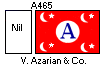
A465

The flag is red with a white disc bearing a blue “A”. Each corner has a white crescent angled towards the port side and a star. Loughran suggests that these emblems refer to the family’s Levantine origins. There was no funnel livery, the vessels being sailing ships.

V. Azarian & Co. operated sailing ships.

USA, Boston, Mass.

V. GREIBE.

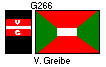
G266

V. Greibe operated as Dampskibsselskab Jylland.

Denmark, Esbjerg.

V. L. ENTERPRISE CO. LTD.

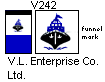
V242

V242 comes from V L Enterprise photographed on 4 February 2008. The same colours were used by subsidiaries, as seen on Chutipa 3 of Chutipa Marine Oil Co. Ltd.; Rosanoski did not retain that photograph. The company website supplied the logo.

The company website gives establishment in 1992, with the local-calendar date printed as “27.8.2534”, while Lloyd’s gives 1993. Associated companies were Chutipa Marine Oil Co. Ltd. and Platinum Marine Group Co. Ltd. Their website foundation dates, 2003 and 2005, differ from Lloyd’s 2002 and 2007 respectively.

Thailand, Bangkok.

V. PICCONE.

P523

Piccone operated Pilot from 1920 until she was wrecked on 2 April 1933.

New Zealand, Napier.

V. Ships Group.

V. SHIPS GROUP.

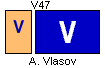
V47
image by Jarig Bakker, 14 July 2004
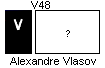
V48
V116
V133

V48 is the earlier SITMAR funnel in Jordan. Post-war photographs show V47, described as yellow with a large dark blue “V”, becoming usual on SITMAR vessels with “Fair” names. Mitchell also shows yellow; Stewart adds a very narrow black top. The blue flag bears a white “V”. The livery was used by Navigation & Coal Trade, Alva and Alvion, connected with Navcot, and is confirmed for cargo vessels. Jarig Bakker’s FOTW image of 14 July 2004 was headed with the earlier Società Italiana di Servizi Marittimi name, which Rosanoski identifies as a confusion with Vlasov’s Trasporti company.

The website logo was suggested as a possible flag by Dov Gutterman in October 2003, although Rosanoski considered that unlikely. Mitchell provides supporting illustration evidence and shows V116’s funnel on Porer without a black top. V133 is based on the website logo and is also shown by Mitchell; its status as an actual flag remains qualified.

Blackfin Shipping Ltd.

B776

B776 is assigned to Sunny Blossom of Blackfin Shipping Ltd., managed by V. Ships (UK). Its basic livery resembles Laurin Maritime (America), under which the vessel later appears, but omits the white “L” on the red disc and edges the disc black rather than white. The registered owner apparently changed in 1995 without a ship-name change.

Mid-Atlantic Transportation Corporation

M649

M649 is assigned to Indira Mahal, owned by Mid-Atlantic Transportation Corporation from 1988 to 1991 and presumably managed by a V Ships company.

KS Sydships IV

S1294

S1294 is assigned to Golconda I, owned by K/S Sydships IV during 1988–1995 and listed under V Ships (UK) management in 1992–1993.

Around 1970 SITMAR ceased owning its fleet directly, with vessels registered through group companies; Rosanoski suggests it may then have acted as charterer, but is unsure whether the company or only the brand continued. Sitmar Cruises Inc. was established in 1980 and sold to P&O in 1988, later becoming Princess Cruise Lines Liberia Inc. in 1991. The source disputes an account placing a swan-logo replacement immediately after Boris’s death: it may confuse the cruise-company transition. A swan “S” was reportedly on Fairstar shortly before P&O’s takeover. Rosanoski expected corresponding flags for the swan and dolphin funnel logos, but had no confirmed flag evidence.

The V Group originated with Alexandre Vlasov, who left Russia for Bucharest with his family in 1917 and entered shipping through the coal industry. He became a minor partner in Romania Prima Societate Nationale de Navigazione Maritima in the late 1920s and a major shareholder in 1933. Renamed Alexandre Vlasov Societate de Navigazione in 1934, it continued trading under its earlier name. That year he also formed Societe Commerciale et d’Armement S.A. (SCOMAR) in Greece; its last vessel, Olga, was broken up in 1968.

British expansion brought Campden Hill Steam Ship Co. Ltd. in 1936, The Alva Steamship Co. Ltd. in 1937 and the managers and brokers Navigation & Coal Trade Co. Ltd. An Alexandria business founded in 1934 later became Overseas Shipping & Coal Trade Co. Ltd. Moving to Italy, Vlasov formed Società Italiana Trasporti Marittimi SpA (SITMAR) at Milan on 10 April 1938. That acronym had previously belonged to Società Italiana de Servizi Marittimi, wound up in 1931; the two must not be confused. During the war he moved to Argentina and formed Compañia Argentina de Navegacion de Ultramar S.A. and subsidiary Compania Sud Americana de Export & Import in 1941. SITMAR lost its fleet in the war; Alvion Steamship Corporation was also temporarily shipless. Navcot Corporation followed in New York in 1949, and the group headquarters moved to Genoa in 1952.

After Alexandre’s death in 1961, Boris Vlasov took over and moved the headquarters to Monaco. Sources give 1983 for formation as Vlasov Group and 1984 for V Group, followed by the names Vlasov Services Corporation and, in 2001, V. Ships Group. The frequently cited 1938 origin instead corresponds to SITMAR’s formation. Half was sold to management in 1986; from 1994 the stated holdings were Vlasov 40%, senior management 40% and G.E. Capital 20%. CBPE acquired 45% in 2003. Boris died in 1987, after which family control diminished.

Astramar SpA, formed in 1985, was later sold to Princess Cruises. Sitmar Cruises was sold to P&O, dated 1989 in one history but 1988 in other passages; the remaining group concentrated on cargo ships, tankers and ship management. V. Ships Leisure returned to cruise activity in 1993, marketed through Phoenix Reisen under the Albatross name. A Silversea joint venture with the Lefebvre family is also described, but Rosanoski expressly questions the claim that it subsequently became wholly owned by the Vlasov heirs. Expansion in management services included Celtic Marine in October 1998, VSL Shipbroking in 1999, SSM & BCI and Andhika JVC in 2000, Acomarit in January 2001, AMA/Clancey Sons & Stacey in 2002 and International Tanker Management Holdings in 2009.

The group combined ship management, commercial and agency services, leisure-vessel management and corporate financial services; later organisation distinguished Ship Management, Leisure and Manpower Services alongside Marine Services and Capital. Operating interests included Alva Steamship through Sitmar, Massoel Gestion and Silver Line. SITMAR’s ships later appeared in individual Fairland, Fairline, Fairsea, Fairstar and Fairwinds companies under Shipping Management S.A.M.; the listings associate these with Fairland, Fairsky, Fairsea, Fairstar and Fairwind, with differing Fairsky allocations. These are retained as corporate listings rather than treated as separate livery histories.

The regional management companies evolved through several mergers and name changes. Navcot became V. Ships USA in 1989 and merged with International Marine Carriers in 1996 as V Ships Marine, renamed American V Ships Marine in 1999. V Ships Management was formed in October 1998 from Celtic Marine and Shipping Management S.A.M., becoming V. Ships Monaco S.A.M. in 2001; another listing instead connects Shipping Management with a 2001 Leisure renaming. Acomarit became V. Ships Switzerland in 2001, its Singapore operation became V. Ships (Asia) in January 2002, and the UK businesses merged at Glasgow in 2001. V. Ships Cyprus originated in 1990 and altered its name in 2002; Dubai was formed in 1994 and Florida in 1997. V. Ships Leisure, separately dated 1993, merged with Martinoli SAM in August 2005. The source’s overlapping Shipping Management, Monaco and Leisure succession accounts are not silently reconciled.

Joint interests included China International Shipmanagement, formed in February 2006 by V Ships (Asia) and China Shipping Container Lines; Fraser Yachts Worldwide, acquired with Azimut/Benetti in September 2004; and Mideast Ship Management, formed in Dubai in 1996 with The National Shipping Co. of Saudi Arabia. V. Ships Norway was formed in Oslo in 1989 with L. Gill-Johanessen A/S; a later account records Close Bros. holding 45%. Unicom Management Services (Cyprus) and Bahamas Fast Ferries Services also appear as interests or associates.

Romania, Bucharest, and Italy, Milan in the earlier sources; London for A. Vlassov in Brown; Monaco, Monte Carlo in the 1998 listing.
V.O.F. WARBER.

W451

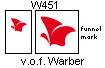
W451 comes from Warber’s starboard side on 6 July 2011. A less clear port-side photograph of 3 March shows the same orientation.

Warber was built in 2010 for captain-owner Albert Visser through v.o.f. Warber, chartered through Wijnne & Barends and managed by the owner.

Netherlands, Lemmer.

VAASAN LAIVA O/Y.

V40
V41

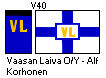
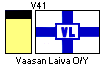
The two versions are sourced to the US Navy 1961 and Brown 1978. Pacific Shipper of 18 April 1977 printed a black-and-white flag image under Hanseatic–Vaasa Line, corresponding to V41/V40.

Vaasan Laiva appears in sources from 1939 and in Lloyd’s through 1966–1967. Brown 1978 calls it Vaasan Laiva O/Y-Alf Korhonen. Paul Eriksson was listed as manager in 1953–1954; Rosanoski considers him the apparent owner, since vessels shown under Vaasan or individual ship companies appear among the companies he managed.

Finland: Vaasa; Helsingfors in Lloyd’s 1953–1954.

Vacuum Oil Co. Inc.

VACUUM OIL CO. INC.

V119

The US parent’s flag carries the “gargoyle” trademark with black “GARGOYLE” in a shallow arc above it, intersected by a red line. Brown 1929 and 1934 support Loughran’s lettered version. Rosanoski’s V119 corrects the attribution of an unlettered FOTW image to Loughran; he considers the letters the distinction between the US parent and British subsidiary.

Vacuum Oil was formed in 1866 and began tanker operations in 1914. It acquired Waldhams Oil Corp and White Star Refining Co. In 1931 it merged with Standard Oil Co. of New York to form Socony-Vacuum Corporation, cross-referenced to Mobil Oil Corporation.

USA, New York.

VACUUM OIL CO. LTD.

V134
image by Jarig Bakker, 19 October 2003 for V134

The British flag omits the lettering. Jarig Bakker’s V134 of 19 October 2003 followed All about Ships & Shipping 1938, including extra black marks. Rosanoski considers those marks misleading: Talbot-Booth’s 1936–1938 books omit them, as do the US-parent versions with lettering. FOTW later replaced V134 with V135, removing the marks, apparently in response to his comments, though the date is unknown. A black-and-white photograph of Pegasus of Rederi A/B Transoil appears to show the Vacuum funnel.

The British Vacuum Oil Co. Ltd. appears as a Lloyd’s subscriber from 1890. Sources describe a 1938 takeover or merger with Standard Transportation Co. Ltd., but Rosanoski notes confusion between the similarly named New Jersey and New York Standard Oil interests and the Hong Kong and New York companies. Lloyd’s still lists Vacuum under Stephenson Clarke in 1953–1954, with a name change effective by 1958–1959; the accounts are not reconciled.

UK, London.

Vacuum Reederei GmbH

Esso 1956 assigns Vacuum Reederei GmbH the Mobil Oil A.G. in Deutschland livery, cross-referenced as M697; FOTW makes the same assignment under German shipping flags.

Keep the explicit scope label independent; no alias or company identity is inferred.

VAGLIANO.

V26

The flag is blue with a white saltire. The funnel is black with a broad band of the flag.

The Vagliano family were Greek grain merchants in the U.K., operating a Russian-registered fleet before the First World War.

Greece/Russia/U.K.

VAL MANAGEMENT CO. LTD.

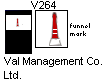
V264

Sol Trader retained the previous Sletringen Bulk A/S funnel, cross-referenced to Berge Rederi A/S. Port and starboard photographs in 2006 confirm it, and it was still in use on 19 February 2008, although that later photograph was not retained.

Val Management bought Sletringen on 1 September 2005 and renamed her Sol Trader. The crew left in April 2009, after which the Slovenian Ministry of Transport looked after the ship. A judicial sale was announced on 16 February 2011 following deletion from the St. Vincent registry; it was not expected to cover the debts.

Croatia, Rijeka.

VALDEMAR SKOGLAND A/S.

Valdemar Skogland A/S

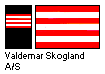
The black funnel has a broad band of the flag, which consists of seven horizontal red-and-white bands. Stewart shows nine flag bands, judged by Rosanoski to be an error because its funnel agrees with the other sources.

Valdemar Skogland was principally recorded as a fleet manager, though the 1963–64 register also gives one owned vessel. Managed interests included Anglo, Mammy, Transport and Notos.

Norway, Haugesund.

Vale S.A.

The metals and mining group originated in 1942 as Companhia Vale do Rio Doce, implementing a Brazilian government takeover of American and British mining and railway interests in Minas Gerais under a wartime agreement. Navegação Vale do Rio Doce S.A. was formed as its shipping arm in 1962, while Lloyd’s 1998 gives 1969 as a formation date. Rosanoski records the name Companhia Vale do Rio Doce Vale from 2003 and Vale S.A. from November 2007, with a new group logo. “Vale” means “valley” in Portuguese. Docenave is also recorded as an alias.

Seamar Shipping Corporation was incorporated in Liberia in 1967 to provide international flexibility while managed in Brazil by the Docenave Group. Operating companies included Seamar-Services de Apoio Maritimo Ltda., formed in Rio de Janeiro in 1985; Servomar Transporte E Apoio Maritimo Ltda., formed in Salvador in 1986; and Vale do Rio Doce Navagaçáo S.A. Log-In Logistica Intermodal S.A. is listed as a subsidiary. Wilsea Shipping Inc. was formed in 1983 as a joint venture with Wilh. Wilhelmsen ASA.

Brazil, Rio de Janeiro.

VALE STEAMSHIP CO. LTD.

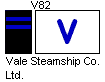
V82

V82’s funnel and flag are documented in Lloyd’s and Reed 1912. Reed attributes the livery to the operators.

Vale Steamship operated through Andrew Crawford, Barr & Co. from 1904. When that partnership ended in 1916, Barr, Crombie & Co. succeeded it and appear as operators in Lloyd’s 1917–1918.

UK, Glasgow.

VALENTINE CHEMICAL CARRIER INC.

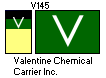
V145
image by Joe McMillan, 30 November 2001

The US Navy illustration extends the funnel’s “V” onto the black top, which Rosanoski considers probably incorrect. Joe McMillan’s FOTW flag image of 30 November 2001 follows that reference.

Valentine is listed as operators in 1963–1964, including part of Charles Kurz & Co. Inc.’s fleet. By 1966–1967 it appears as owner of a vessel previously listed under Kurz, and remains recorded in 1970–1971.

USA: Oradell, then Newark, New Jersey. FOTW gives Philadelphia from the US Navy reference, possibly the vessel’s home port.

VALENTINO GENNARINO S.R.L..

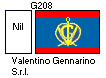
G208

Within a rope ring tied at the bottom is an anchor whose long flukes reach the ring. A G lies over the anchor and is distinguished from it.

The company provided consultancy and surveying services.

Italy.

VALLES STEAMSHIP (CANADA) INC.

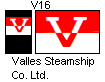
V16
image by Ivan Sache, 25 August 2002
image contributed by Josef Nüsse, None

The funnel was noted on Silver Peak in February 1967 and at Rotterdam in 1972. Other vessels showed a red base and black top at New York in 1972, and plain black was also seen. Photographs of Seaservice, Seaheritage and Seabridge confirm the principal funnel; on Seabridge the white bridge obscures its black base. Silver Peak was not located in Lloyd’s.

Ivan Sache’s FOTW flag image of 25 August 2002 follows Josef Nüsse’s table flag, listed under Hong Kong on Nüsse’s websites. Brown 1982 and 1995 and Marine News 2008 also document the livery.

The Valles group originated in Shanghai as the customs brokers Tai Chong Cheang under C.S. Koo. The website places its beginnings around the turn of the twentieth century or in the 1910s, while Lloyd’s gives 1910. It became a shipowner in 1926 and moved to Hong Kong in 1949. The website dates Valles Steamship’s Hong Kong registration to 1950, with C.S. Koo holding one-third and his eldest son K.M. Koo two-thirds; other accounts give 1933 and name Tai Chong Cheang S.S. Co. as managers. These dates and relationships remain disputed.

The website says Tai Chong Cheang ceased to exist and its two ships brought from Shanghai were sold for scrap because their classification papers had been lost. Lloyd’s nevertheless continued to list Tai Chong Cheang and Ching Hai into the early 1990s. Rosanoski asks whether the old name was used by new owners, the Chinese Government or the Koo family, without resolving the question. C.S. Koo died in 1972, leaving K.M. Koo in sole command. A later Tai Chong Cheang Steamship (HK) Ltd. listing names K.H. Koo as managing director.

The business relocated to Canada on 1 August 1995 and remained privately owned and managed by the Koo family. The source uses both Ltd. and Inc. for the Canadian name. Another Hong Kong Valles company, formed in 1995, briefly appears with newbuildings in Lloyd’s 2003 before those ships transfer to the Canadian listing in 2004. Orient Steamship and Tai Chong Cheang Steamship (HK) are recorded as associates, with possible integration of Orient activities. Ships were held in individual companies, mainly Liberian. The “Silver” prefix dates from Silver Shelton in 1965, with “bulker” also used and tankers generally prefixed “Sea”.

China, Shanghai until 1949, then Hong Kong; Canada, Vancouver after relocation in 1995.

VALLUM SHIPPING CO. LTD.

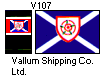
V107

A black-and-white photograph of Iron Ore confirms the funnel. Ocean Ships describes its flower emblem as a red rose; the funnel and flag are also documented in Lloyd’s 1963 and Brown 1978.

Listed as Vallum Steamship Co. in 1958–1959 and Vallum Shipping Co. Ltd. thereafter, the company was managed first by Common Brothers Ltd. and later by Houlder Brothers & Co. Ltd. Vessel names used “Iron” under Common Brothers and also the prefix “Ore”.

U.K.: Newcastle, later London.

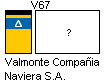
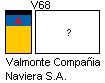
VALMONTE COMPAÑIA NAVIERA S.A.

V67
V68

V67 was noted on Captain Minas in January 1966, and V68 on the same ship at Long Beach in July 1967. Bill Black’s record in the NJK Collection names M. Diacakis of London as owner.

Valmonte acquired Captain Minas in 1961. Miramar dates her scrapping to 1969, although Lloyd’s still lists her in 1973–1974. Helikon Shipping Enterprises Ltd. acted as agents.

UK, London.

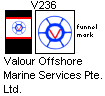
VALOUR OFFSHORE MARINE SERVICES PTE. LTD.

V236

V236’s funnel comes from a photograph of Kendrick at Sydney on 20 March 2010. The company website supplied the logo.

The business was established in Taiwan in 1986, moving to Singapore and registering there in 1992.

Singapore.

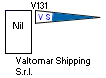
VALTOMAR SHIPPING S.R.L.

V131

Dov Gutterman reported the house flag on the company website on 4 November 2003. The original provides no separate written design description.

Valtomar Shipping acted as ships’ agents.

Italy.

VALÉRY FRÈRES ET FILS.

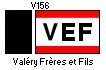
V156
image by Ivan Sache, 15 February 2004
V157
image by Ivan Sache, 15 February 2004

Both funnel-and-flag versions derive from Armements Marseillais, No. 17. Ivan Sache supplied the FOTW images on 15 February 2004. The document does not give a separate written chronology for the two designs.

The business began in 1835 as Joseph et Frères Valéry, formed by Jean-Mathieu, Joseph and Jean Valéry. Joseph, Jean-Mathieu’s son, joined in 1854, when it became Valéry Frères et Fils. In 1883 F. Morelli reorganised the remaining fleet as Compagnie Insurlaire de Navigation, which lasted until 1891; the ships were sold to Compagnie de Navigation Fraissinet in 1892.

France, Marseilles.

VAN DE GRAAF & MEEUSEN WATERTRANSPORT B.V.

V286
image by Eugene Ipavec, 16 April 2009

The flag is red with a very large white disc containing the company logo: a red mid-channel buoy symbolising safe water, flanked by thin black serif “G” and “M”. Jan Mertens describes the buoy as slightly tilted, suggesting a bobbing movement. Eugene Ipavec supplied the FOTW image on 16 April 2009; the archived company website also showed the house flag.

The inland-shipping business arose from a merger of Van de Graaf’s Amsterdam and Meeusen’s Rotterdam freighting offices, intended to strengthen their position after abolition of the official goods clearing exchange. FOTW dates this to 1996, while the company-history passage prints 1 January 1966 for the merger of Beheer en Beleggings Maatschappij J.H. van de Graaf B.V. and W.L. Meeusen B.V. New premises at Ridderkeerk, as that passage spells it, opened on 17 October 1997. Willem van Driel’s barges, personnel and customers were acquired on 17 March 1998.

The group listed J.H. van de Graaf Beheer en Beleggingsmaatschappij, W.L. Meeusen, Van de Graaf & Meeusen Holding, Projects and Rivertransport, Amsterdam Barge Services, Phoenix, Red Bull, Ridderkerk Barge Services, W. van Driel’s Stoomboot & Transportondernemingen, Starling Barge Service and Mover, all B.V. companies.

Netherlands, Ridderkerk.

Van Den Herik’s Aanemingsbedrijf.

VAN DEN HERIK'S AANEMINGSBEDRIJF.

V307

The company website supplied the logo. V307’s funnel comes from a starboard photograph of Christophorus on 2 June 2013.

The company traces hydraulic-engineering work to bank protection in the 1940s, while Lloyd’s gives formation in 1982. Sounding and surveying were added in the early 1990s. Its equipment included dredgers, hopper and elevator barges, crane ships and pontoons.

Netherlands, Sliedrecht.

VAN HATTEM & BLANKEVOORT N.V.

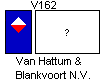
V162
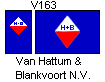
V163

V162’s funnel comes from Mitchell, and V163’s funnel and flag from Brown 1982, No. 475. The original gives no separate written explanation of the design differences.

The company merged into Volker Stevin Groep in 1971. Its name varies in the sources: Rosanoski takes Van Hattem & Blankevoort from the Van Oord website, while Mitchell and Brown use Van Hattum en Blankevoort and Lloyd’s has further variants. These spellings are not treated as separate identities.

It was associated with Rheinische Tiefbau-Gesellschaft m.b.H. and was a part-owner of Australian Dredging & General Works Pty. Ltd.

Netherlands, Beverwijk; Mitchell gives Amsterdam.

VAN NIEVELT GOUDRIAAN & CO. B.V.

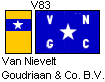
V83
image by Jarig Bakker, 22 October 2003
image contributed by Josef Nüsse, None
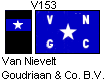
V153
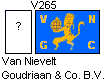
V265
image contributed by Jan Mertens, 24 September 2008
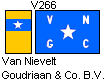
V266
image contributed by Josef Nüsse, None

V265 is the original flag image supplied by Jan Mertens in September 2008 from a 1995 NiGoCo publication.

The V83 funnel’s yellow comes from Mitchell, who also gives a dark blue. Brown 1982 uses a lighter blue for the flag and funnel band. Josef Nüsse’s old website table flag corresponds to V83, while the new site shows the lighter V266 shade; the company website also supplies V266. Jarig Bakker’s V83 image follows the De Blauwe Wimpel house-flag chart of April 1956.

V153 is labelled Holland-Zuid-Amerika Van Nievelt-Goudriaan & Co. on an undated flag-and-funnel chart.

Known as NiGoCo and Rotterdam South American Line, the company was formed in January 1905. It helped establish Frachtcontor in 1905, selling its interest in 1907, and was a co-founder of Vereenigde Nederlandsche Scheepvaartmaatschappij in 1920. From 1928 it operated the Rotterdam-Zuid Amerika Lijn service.

It acquired A. Kirsten & Co. GmbH in 1963 and became a Hamburg Chicago Line partner; that line was liquidated in 1971. Steenkolen Handels Vereniging acquired all NiGoCo shares in 1968. In 1971 it formed Greek Holland Shipping with Theologitus and also had the Liberian subsidiary Galaxy Shipping & Trading Corporation. Other interests included a Hamburg company, Naviera Artola, the Portugal Lijn freight service within CPL and an apparent Phoebus Shipping joint venture with Africa Europe Shipping Line. Vessel names commonly began “Al” or ended “N”.

The company entered liquidation in 1991 and sold its last three ships in 1993. J.C. Goudriaan revived it in 2001 as the company printed “Nievelt Gourdriaan & Co. Shipping Company B.V.” in the source. Van Nievelt Goudriaan & Co. Agenturen B.V. was formed as a wholly owned subsidiary in April 2004, and a shipping-services subsidiary was planned. The source’s 2007 archived website remained unchanged from that earlier account.

Netherlands, Rotterdam.

Van Ommeren.

VAN OMMEREN.

M701
V1
image by Jarig Bakker, 1 January 2005
V4
image by Al Fisher, 11 February 1999
image contributed by Josef Nüsse, None
V5
image by Jarig Bakker, 15 October 2003
image contributed by Josef Nüsse, None
V101
V169
V194
Van Ommeren Clipper Shipping BV
V235
image by Jarig Bakker, 1 January 2005

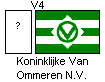
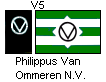
The familiar flag has green and white horizontal bands, with a black “V” inside a black ring on a white diamond. The black funnel carries a white “V” and ring. The livery was used by Crawford and Medomsley by 1948, with Langleescot entering service in it in 1947, and is also assigned to “De Maas”. Sources vary: the funnel V may sit wholly inside the ring; the flag diamond may be black-edged or extend to top and bottom; bands may be equal or have differing widths. Stewart gives two narrow white bands and a broad central green one, while Jahrbuch der Schiffahrt makes green wider than white. The green shade is uncertain; Nüsse’s flags are dark and dull. Photographs confirm the V5 funnel on Ivinghoe Beacon, and Mitchell records it at Glasgow in 1964. It continued under Van Ommeren Clipper, with a variation.

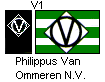
V1 is documented in Brown 1926 and Lloyd Reedereiflaggen under Phs. Van Ommeren’s Shipping Business. A captain’s account, relayed by the contributor averheijden, describes this version after the London company’s takeovers. Jarig Bakker supplied the FOTW image on 1 January 2005.

V4 represents the green-ring and green-“V” version. Rosanoski associates the change broadly with the succession of corporate names but gives no precise adoption date. Nüsse’s table flags show both black and green emblems with equal bands. Al Fisher’s original FOTW image of 11 February 1999 came from the company website; it was apparently replaced by a Jarig Bakker chart-based image after Rosanoski’s comment.

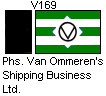
V169 is shown for the management of N.V. Stoomboot Maatschappij “De Maas” in Almanacco Marine Mercantili 1925.

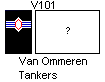
V101 comes from Mascarin, later Treguier, of the 1986 Van Ommeren Tankers and Socatra venture involving Umoil and Soflumar. Lloyd’s lists the vessel for both Socatra and Van Ommeren under the long ownership title. Rosanoski therefore also records the image as S1621 under Socatra; this is retained as a cross-reference, without changing the present association.

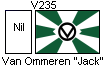
V235 is the unidentified variant reported from a 2006 Marktplaats offer: a black Van Ommeren emblem on a white diamond, with six green and six white rays, the upper central ray white. The diamond projects into the horizontal green rays. The offered flag measured about 40 by 60 cm. Jan Mertens could not establish whether it was formally Dutch or which company used it.

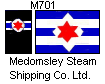
Medomsley used F. Carrick’s livery until around its wartime change to Buries Markes, then adopted its own M701 design. Rosanoski tentatively links that change with the disputed 1943 or later Van Ommeren takeover.

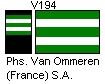
V194 is documented in La Marine Marchande Française 1980 and the Mitchell collection; no separate written design description is supplied.

Belvedere Shipping Ltd.

B670

Mitchell assigns B670 to Belvedere Shipping Ltd., a Liberian-flag concern listed in 1980–1981 under Van Ommeren Marine Agency in London.

French operation

The French operation, listed in Paris and Dunkirk, merged with Société d’Armement Fluvial et Maritime in 1987 as Soflumar Van Ommeren (France) S.A., became Van Ommeren Tankers in 1992, passed to Broström in 1998 and was renamed Broström Tankers SAS in 2000.

Keep the explicit scope label independent; no alias or company identity is inferred.

Van Ommeren began in 1839 as a shipping and forwarding agent, expanding into deep-sea and inland shipping, tank storage, stevedoring and distribution. It owned steamships from 1892, registering each separately. N.V. Tank Kustvaart and N.V. Phs. Van Ommerens Scheepvaartbedrijf began operating as N.V. Verenigde Tankkustvaart on 15 September 1948. Van Ommeren gained full ownership on 1 May 1970; the last ship was sold on 27 March 1973. A statutory change of 17 December 1982 made the company Van Ommeren Shipping, later a B.V.

Accounts differ over the British acquisitions. One dates purchase of Crawford Shipping and Medomsley shares to 1 January 1943; another places Medomsley under Buries Markes during the war and Van Ommeren by 1951. Roger Jordan instead describes H.G. Mann taking management of Crawford and Medomsley in 1942, shared directors with Buries Markes, Phs. van Ommeren joining their boards in 1946, and purchase by Van Ommeren (London) in autumn 1947. Medomsley’s origins are traced to Frederick Carrick around 1906, interruption after a 1919 ship loss, renewed trade in 1924 and liquidation in 1942. The differing acquisition dates remain unresolved.

Philippus van Ommeren merged with Ceteco International in 1987, becoming Van Ommeren-Ceteco, Koninklijke Van Ommeren-Ceteco in July 1989, Royal Van Ommeren in 1994 and Van Ommeren Agencies Rotterdam in 1997. It concentrated on shipping and tank storage from 1990. It became a major Broström shareholder in 1995; in 1998 the tanker businesses were combined in Broström Van Ommeren, including Van Ommeren Tankers, Iver Ships and United Tankers. The source variously describes a 40% Iver holding sold in 1998 and full Iver ownership from September 1997; it gives Van Ommeren a 50% Brovo interest. In 2000 the parent resumed the Broström name, Van Ommeren Tankers became Broström Tankers SAS and Iver Ships lost the Van Ommeren prefix. The former holdings were sold by Vopak in 2002. Van Ommeren merged with Koninklijke Pakhoed in October 1999 as Koninklijke Vopak. Other interests included Chemgas, jointly formed in 1985 and sold in 2003; a 58.2% Nordic Tank holding, tentatively dated 1995; and Dock Express, apparently acquired before joining Heerema’s Dockwise venture on 1 January 1994.

In February 1996 Van Ommeren announced sale of 51% of its shipping business to Nesbic and 2% to management. A July 1999 dry-bulk combination proposed Clipper holding 40% and the other partners 30% each, with Van Ommeren operating ships above 35,000 dwt and Clipper those below. The business became Van Ommeren Clipper Shipping in 2000. Clipper subsequently acquired the remaining holdings, with the December 2003 transaction described as effectively giving full control, and VOC became Clipper Bulk. Rosanoski considered the independent Van Ommeren shipping identity effectively finished.

The group’s earlier operations included Stoomboot Maatschappij “De Maas”, part of the consortium controlling Vereenigde Nederlandsche Schepvaartmaatschappij, and Internationale (Riviertanksscheepvart) Maatschappij, cross-referenced to P.A. Van Es. Regional companies operated in London, Hamburg, Geneva, Hong Kong and Bremen, with Van Ommeren Marine Management in London. Dredging V.O. 2 was another interest.

Van Ommeren Binnenvaart became Vopak Barging Europe in 2000; its listed 1995 formation is preceded by a 1992–1993 register entry. The Belgian operation began in 1972 as Stevedoring & Transport, became Van Ommeren Tankvaart Belgie in 1995 and Vopak Barging Belgium in 2000. The Stamford US shipping company, formed in 1992, later changed from Inc. to LLC and came under Vopak. Singapore’s Gas Shipping One and Two were formed in 1997; One later became Vopak Gas Tankers One.

Netherlands, Rotterdam.

Van Oord Groep.N.V.

VAN OORD N.V.

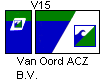
V15
image contributed by Josef Nüsse, None
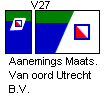
V27
image by Jarig Bakker, 17 November 2005
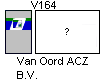
V164
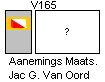
V165
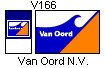
V166
image by Jarig Bakker, 22 May 2006
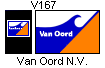
V167
image contributed by Josef Nüsse, None
V312

V27 is divided by a slanting line: green and blue horizontal stripes at the hoist and a white fly bearing the square company logo. The white-over-red hoist-diagonal element represents Utrecht’s city flag. Jarig Bakker’s image of 17 November 2005 follows Brown 1995. Rosanoski notes a possible small alteration to the earlier ACZ flag.

The panel on V164’s white oblong appears to show V15, but could be V27: the detail in the white part of the source drawing is effectively absent.

V15’s funnel is confirmed by Volvox Iberia; Josef Nüsse supplies the table flag. Mitchell records the flag panel as resulting from a 1991 ACZ–Van Oord amalgamation, differing from the 1990 history, but does not specify its use.

The later flag is white, with a large orange triangle at the fly facing a blue wave from the hoist. Actual flags also carry the company name in white. Photographs of Saga and Pelican initially left a possible blue border uncertain; Volvox Scaldia later showed that the border was not part of the design. V166’s funnel top is dark blue, while other photographs appear black as V167, although some may show a very dark blue. A close-up of Volvox Scaldia appears black; Pelican’s close-up more clearly shows dark blue. V167 also comes from Volvox Scaldia and Anna photographs. Bakker supplied the FOTW flag image in May 2006, and Nüsse provides a later table flag.

V165’s funnel comes from Mitchell; the document supplies no separate design description.

V312 comes from a port-side photograph of Jan Leeghwater on 25 June 2013.

Lloyd’s traces ACZ from Aanemers Combinatie Zinkwerken B.V. in 1973 to ACZ Marine Contractors in 1983 and then, in 1990, Dredging VO2 International and Van Oord ACZ. Rosanoski disputes that sequence because Dredging VO2 is already recorded in 1973–1974: he considers it acquired in 1990 and renamed Van Oord ACZ Material B.V. in 1993. Van Oord N.V. resulted from the Ballast Ham Baggeren and Van Oord ACZ merger effective 19 December 2003, although the overview gives 2004.

Later operating companies included Van Oord Nederland at Gorinchem and Van Oord Ship Management at Rotterdam, Ballast Ham Dredging DO Brasil, Ballast Nedam Bagger-en Exploitatiemaatschappij, Brewaba Wasserbaugesellschaft Bremen, Exploitatie Maatschappij Maritiem, Nederlandsche Overzee Baggermaatschappij and Van Oord India. Brewaba was formed in 2002, NOB in 1992 and the Mumbai company in 2006. Dredging V.O. 2 was a joint venture with Van Ommeren.

Netherlands: Gorinchem, later Rotterdam.

Van Oord Groep

Govert van Oord began his business in 1868; it became Gebr. Van Oord in 1919 and joined ACZ in 1990 as Van Oord ACZ. Lloyd’s separately dates Van Oord Groep to 1992. Group operating interests included Ballast Ham Dredging India and Westham Dredging, in which Boskalis held half; by 2005 Westham’s vessels appear under Boskalis Australia.

Netherlands: Zuilichem, later Gorinchem.

Keep the explicit scope label independent; no alias or company identity is inferred.

VAN SHIPPING CO. LTD.

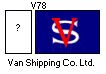
V78
image contributed by Josef Nüsse, None

The flag is blue with a white “S” surmounted by a red “V”, sourced to Josef Nüsse. No funnel is given.

Formed in 1966, Van Shipping appears as agents in the 1985–1986 and 1992–1993 listings, and with a fleet under a name subsidiary in 1998. Rosanoski considered the vessels connected from their names; the company was absent from the July 2000 listing.
China, Hong Kong.

Van Uden Group B.V.

VAN UDEN GROUP B.V.

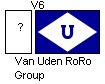
V6
image by Jorge Candeias, 16 February 1999
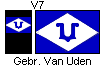
V7
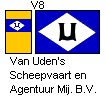
V8
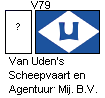
V79
image contributed by Josef Nüsse, None
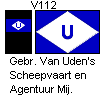
Gebr. Van Udens Scheepvaart en Agentuur Mij
image by Jarig Bakker, 1 February 2001
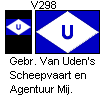
V298
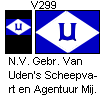
V299
image by Jorge Candeias, 16 February 1999
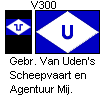
V300
V302

V7’s diamond touches the hoist and fly but not the upper and lower edges. Company website images instead seem to place the diamond just within the field, illustrating the differing source portrayals.

V112 has a plain “U” and is attributed to Haven Line by a Brazilian livery website. Jarig Bakker’s FOTW image of 1 February 2001 follows the De Blauwe Wimpel chart of April 1956.

V299, used by the container service, is dark blue with a white lozenge and a dark blue “U” with small horns below, giving it a hand-drawn appearance. Jorge Candeias supplied the image on 16 February 1999. The website and contributor accounts connect this version with Van Uden Atlas Container Service; its appearance on a Moroccan-flags page prompted discussion of the Dutch–Moroccan service relationship.

V6 is the roll-on/roll-off version, with a conventional serif “U” without horns in the white lozenge on dark blue. Candeias also supplied this image on 16 February 1999. Rosanoski tentatively links it to UMEC and an earlier form of the original company name. It was also reproduced as a VACS version on the Moroccan-flags page.

V79 is Josef Nüsse’s table-flag version, absent from the company website. Its blue follows Nüsse’s newer website.

Other documentary variants remain separately illustrated: V298 in Brown and other interwar/post-war references, V300 in Merchant Ships 1942 and 1944, V8 in Brown 1982 and V302 in Brown 1995. The narrative does not establish individual design-change dates for them.

Atlas Container Services

A390
image by Jorge Candeias, 16 February 1999

A390 is the Atlas version: horizontal black, yellow, red, yellow and green stripes, the red much broader and containing a white square-shaped capital “A”. Atlas was based in Casablanca and described as a sister company of Marbar, while Van Uden was in Rotterdam. Candeias’s image followed the website material reported by Dov Gutterman; Rosanoski identifies a probable surviving archived panel.

Two Van Uden brothers from Brabant established an inland-transport brokerage in Rotterdam in 1848. After the Franco-German War of 1870–1871, they concentrated on Rhine shipping, barges, tugs, storage and transhipment. Ocean chartering and brokerage followed around 1900. The website dates acquisition of the first seagoing steamer, Veerhaven, to 1904, while Merchant Ships gives steamship ownership from 1905. Ships were registered individually and usually named after Rotterdam ports, ending in “haven”.

Liner services to the east coasts of North and South America developed in the 1920s, particularly the La Plata service, which became Haven Line. Rhine activity gradually declined as transport and logistics grew, and container services began in the early 1980s. The company stopped operating its own Haven Line ships in 1985 and sold loading rights to Hamburg Süd. Lloyd’s records name changes from Gebr. Van Uden’s Scheepvaart en Agentuur Maatschappij in 1979 and to Van Uden Group B.V. in 1996. Operating companies included Van Uden Maritime, formed in 1986, and Van Uden Marine & Engineering Consultants, or UMEC, formed in 1996.

Van Uden Atlas Container Service (VACS) was a partnership with Moroccan Atlas. Atlas withdrew following the service’s apparent 2003 takeover by Comanav. Van Uden took the service wholly over from 1 October 2008 as Van Uden Maghreb Service (VUMS).

Netherlands, Rotterdam.

VAN WOERDEN.

V65

The flag is white with a very broad green vertical band, interrupted by a narrow white horizontal band curving in a lower arc and carrying black “BVW”. No funnel is given.

Josef Nüsse labels the company “van Woerden Botlek (RT)”; Rosanoski could not explain the lettered suffix.

Netherlands.

Vanguard Enterprise Co. Ltd.

Documentary images — company attribution uncertain

S1103

S1103, also recorded under Mitsui OSK Lines, is based on Baizo photographs from 2005 and 2008. JB initially described the “E”-like logo as very dark green, while photographs looked black, and later confirmed black with a Port Botany photograph of 19 February 2008. The same logo was recorded on the earlier Zorca. Rosanoski suggests it could instead be a stylised “V” or “VE”, reflecting Vanguard’s beneficial ownership, and perhaps explaining its retention after listing under Asahi Marine. This interpretation remains tentative.

Solar Japan operation/ownership change does not establish mark origin.

Fairway Express, listed under a Vanguard name company, appears in orange Mitsui colours in photographs.

Vanguard was formed in 1982. Solar Japan Co. Ltd. is described as a 2003 joint venture, with Solar Shipping & Trading S.A. named as the other partner in one account and Asahi Tanker in another. Asahi was the principal shareholder and reportedly made Solar Japan wholly owned in 2007. The source also lists Solar Japan under both Mitsui OSK Lines and Vanguard, including a 1998 citation that precedes its stated formation; this chronology is not reconciled.

Japan, Tokyo.

VANUA NAVIGATION LTD.

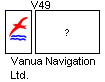
V49

The funnel design has two blue wavy sea lines beneath the bird, as described in The Log, February 1988.

Vanua Navigation was formed in 1977 by the Co-operative Federation and Sofrana-Unilines S.A. It entered receivership on 20 March 1990, completed on 24 November that year.

Vanuatu, Port Vila.

VARKAN GROUP.

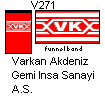
V271
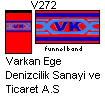
V272
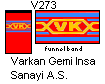
V273

V272 comes from a starboard photograph of Varkan Ege. Lloyd’s names Varkan Ege Denizcilik Sanayi ve Ticaret A.S. as owner under Veysel Vardal Gemicilik Denizcilik ve Ticaret A.S. management.

V271 comes from a port-side photograph of Varkan Arkdenz on 19 July 2013.

V273 comes from a starboard photograph of Varkan Marmara on 26 February 2012. The vessel is listed under Varkan Gemi Insa Sanayi A.S., managed by Chemfleet.

The group is also recorded as Varkan Akdeniz Shipping A.S. and Varkan Tankers. Varkan Akdeniz Gemi Insa Sanayi A.S. was established by Kale Shipping A.S. for shipbuilding and management, owning the vessel named Varkan Arkdenz in the source. Lloyd’s places it under CSM Denizcilik Ltd Sirketi, or Chemfleet, as managers.

Turkey, Istanbul.

Varna Shipping & Trading (VST Varna) JSC.

VST.

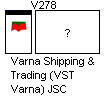
V278
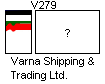
V279

V279 is documented on European in port and starboard photographs from 2006. Both sides have the same orientation, with the bump aft on the starboard side. European and Katyaz, also called Katy Z, were the first two vessels registered to European Maritime Co. Ltd., then moved to separate ship companies in 2006. European retained V279, while Katyaz seems always to have used V278; the reason is unclear.

V278 comes from a port-side photograph of Arabella, dated “31.120.2006” in the original. It appears to have been used by most of the fleet.

Orion Shipping Ltd.

O351

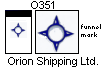
O351 comes from Denny Z on 3 August 2012 under Orion management. Previously she carried V278 under Varna management. The star’s points are divided vertically into white and blue halves, with the blue appearing dark. The changed funnel does not by itself prove a corporate relationship.

VST was founded by Captain Vesselin Genov in 1998 according to its website, initially as shipbrokers, later expanding into chartering, management and marine consultancy; Lloyd’s gives formation in 2001. Subsidiaries included the agency Vesem Ltd. and property company Vestro Ltd., both established in 2001, Blue Sea Marine Services in 2002 for maintenance, repair, supply and manning, and Recorda Control Services in 2004 for inspection and surveys.

Rosanoski suggests a possible operating connection with Orion Shipping Ltd. of Varna through Denny Z, but the evidence is indirect. Orion had a different address; Denny Z changed managers on 7 July 2010 while retaining the same registered owner.

Bulgaria, Varna.

Varnima Corporation International S.A.

VARNIMA CORPORATION INTERNATIONAL S.A.

V115

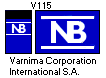
V115’s funnel is based on the livery recorded for Nicos J. Vardinoyannis. Brown 1995, No. 719, supplies the funnel and flag.

Formed in 1965 as Varnima Shipping Agency Ltd., the company changed name in 1976. Rosanoski considers it founded by Nicos J. Vardoyannis, with descendants continuing the business. Athens-based operating subsidiaries included Avin International Corporation of Panama S.A., Avin International Bunkers Supply S.A. formed in 1982, Avin Liners Co. S.A. formed in 1980, and Kriti Episkopi Shipping Co. formed in 1995.

Agency clients included G. and N.J. Vardinoyannis, Varnibros Corporation, Varnima Corporation, Varnikos Corporation, Varnicos Primero, Secundo and Tercero, and Varnicos Corporation S.A. These are retained as separately named clients rather than merged into the agency’s identity.

Greece: Piraeus, later Athens.

VARNIMA CORPORATION.

The separate Varnima Corporation is listed from 1966–1967 to 1978–1979, with successive agents Seka S.A., Varnima Shipping Agency Ltd. and Vim Navigation Inc.

Greece, Piraeus.

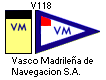
VASCO MADRILEÑA DE NAVEGACION S.A.

V118

V118’s funnel and flag come from Brown 1995, No. 911; the Untzidien Banderak website also records the flag. No separate written design description is supplied.

The company appears in Lloyd’s from 1958–1959 to 1980–1981. Vessel names commonly began “Valle de”.

Spain, Bilbao.

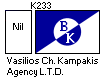
VASILIOS CH. KAMPAKIS AGENCY L.T.D.

K233

The flag follows the company website. Rosanoski notes that the FOTW rendering uses a bright blue.

V. Kampakis formed the private company in 1987 as a shipping agency, brokerage, forwarding and customs-broking business.

Greece, Thessaloniki.

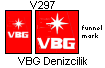
VBG Denizcilik Sanayi Ticaret A.S.

Documentary material — company attribution not established

V297

V297, used by all group members, is based on a port-side photograph of Gizemdeniz Sultan on 7 November 2006.

The company website dates V.B.G. Shipping to 2000, comprising VGB Denizcilik Sanayi Ticaret A.S. and Garanti Denizcilik A.S., both established in 2000, and Fenerbahçe Denizcilik A.S., established in 2001. Lloyd’s instead gives 2003 for VBG.

Lloyd’s also records Fenerbahçe Denizcilik Ltd. Sti. as formed in 2004 at the same address. By 2011–2012 both this company and Garanti were listed under VBG management.

Turkey, Istanbul.

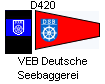
VEB DEUTSCHE SEEBAGGEREI.

D420
image by Eugene Ipavec, 17 January 2010
D421
image by Eugene Ipavec, 17 January 2010

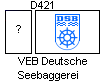
The 1952–60 flag was a red truncated pennant with a blue shield at the hoist. White elements in the shield comprise an eight-spoked steering wheel, DSB above it, and a wavy line underlining the letters.

In 1960–70 a rectangular white flag was used, with the shield outlined blue and two interrupted wavy lines.

Deutsche Seebaggerei, or German Maritime Dredging (DSB), existed from 1952 to 1969. A merger effective on 1 January 1970 replaced it with VEB Bagger-, Bugsier- und Bergungsreederei (BBB).

German Democratic Republic.

VEB Fischkombinate Rostock & Sassnitz.

VEB FISCHKOMBINATE ROSTOCK & SASSNITZ.

D360
D361
D362
image by Volker Moerbitz Keith, 7 February and 30 October 2001; illustration note also includes 2002
D363
image by Jens Pattke, 3 February 2002
F200
image by Eugene Ipavec, 8 March 2009
F318
F319
F320
image by Eugene Ipavec, 8 March 2009
F321
F322
image by Eugene Ipavec, 8 March 2009
M597
image by Eugene Ipavec, 16 April 2009
R297
image by Eugene Ipavec, 18 March 2009

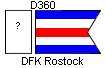
The 1946–50 flag is International Code C with a right-angled cut in the fly and approximate proportions 3:2. The cited regulation of 17 November 1946 required German and ex-German vessels under Allied Control Authority to fly it at the masthead, prohibiting a stern ensign or bow jack.

DFK Rostock’s 1950–52 emblem appears to read VEREINIG VOLKSEG BETR. D FISCHW, expanded as Vereinigung Volkseigener Betriebe der Fischwirtschaft. The white flag field is assumed from an emblem-only source.

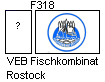
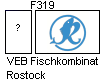
The website dates F318 to 1952–55 and F319 to 1955–59. Both are shown as emblems rather than actual flags, so the white fields are assumed.

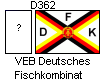
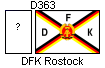
The 1959–62 flag is white with German black, red and gold diagonals forming a saltire, the ascending diagonal in front. Black letters D, F and K occupy the hoist, top and fly. It lacks a state emblem, despite that emblem’s introduction on state and merchant flags in 1959.

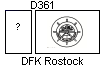
The later DFK flag adds the GDR emblem at the centre. One version keeps the emblem wholly on the saltire; the other has a larger emblem extending beyond the crossing, which Rosanoski considers incorrect in its source. Introduction is given as 1962, with the website dating D363 to 1962–70, though a later FOTW label calls it “Flag 1973”. The common DFK flag is reported for both fleets.

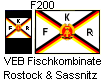
This Rostock version uses FKR, explained by VEB Fischkombinat Rostock. The website gives 1970–90, whereas the FOTW account begins in 1973. The 1978 change to VEB Fischfang Rostock apparently did not alter the initials.

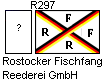
The post-1990 Rostocker Fischfang-Reederei flag has a white field with two diagonals in national colours, the ascending one in front, and no GDR emblem. Black R, F, F and R occupy hoist, top, fly and bottom; Fischfang is split to make the arrangement symmetrical.

Mecklenburger’s white flag likewise has national-colour diagonals, ascending in front, with black sans-serif M at the hoist, H above and F at the fly. Its date follows the differing 1991/1993 company accounts.

Sassnitz’s version has the saltire and state emblem with FKS initials. It is dated 1962–90 in one account and introduced in 1973 in another. The name changed from VEB Fischkombinat Sassnitz to VEB Fischfang Sassnitz in 1978.

Peches Industrielles

P469

Rostocker Kühltransport-Reederei GmbH

R298
image by Eugene Ipavec, 16 April 2009

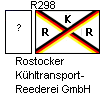
Rostocker Kühltransport’s white flag carries the same overlapping national-colour diagonals and black R, K and R at hoist, top and fly.

Sassnitzer Seefischer e.G.

S1197

State fleets and successors

Deutsches Fischkombinat, founded in 1950, operated nearly 200 ocean-going fishing vessels in fleets based at Rostock and Sassnitz. Rostock had stern-trawling factory ships and carriers, Sassnitz smaller factory ships and trawlers. After reunification Rostock’s fleet was privatised, but Rosanoski rejects the claim that the whole organisation’s fleet was dissolved, noting that Sassnitz remnants remained government-controlled. Rostock became Rostocker Fischfang Reederei in 1990 and Mecklenburger Hochseefischerei in 1992 in one account; acquisition by Parlevliet & Van der Plas is dated 1998 or late 2000.

Keep the explicit scope label independent; no alias or company identity is inferred.

Rostock successors

Other accounts place the Mecklenburger change in 1991 or 1993. Rostocker Fischfang-Reederei is given a foundation date of 15 November 1990. Rostocker Kühltransport-Reederei, a refrigerated-cargo successor, is dated 1991 but was not located in Lloyds.

Keep the explicit scope label independent; no alias or company identity is inferred.

Other associated emblems

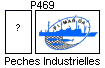
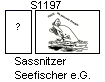
Peches Industrielles, dated 1982, appears to have been a Moroccan joint venture. Rosanoski tentatively expands its flag lettering as Peches Industrielle Maroc Republique Demokratique Allemande. The connection with Sassnitzer Seefischer e.G. is unclear.

Keep the explicit scope label independent; no alias or company identity is inferred.

The Peches Industrielles emblem is dated 1982; F321 is given for 1962–90. S1197 is associated with Sassnitzer Seefischer, but its relationship is unclear. These sources show only emblems, and Rosanoski assumes white flag fields.

Germany [East], Sassnitz and Rostock.

VECTIS TRANSPORT LTD.

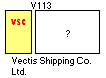
V113

V113’s funnel is documented in Marinart British Coaster Fleets 1975 and British Coastal Ships, Tugs & Trawlers 1975; no separate written design description is supplied.

The company is recorded as Vectis Shipping Co. Ltd. from Lloyd’s 1953–1954, and as Vectis Transport Ltd. in 1978–1979 and 1980–1981.

U.K., Newport, Isle of Wight.

VEGA-REEDEREI FRIEDRICH DAUBER & CO. K.G.

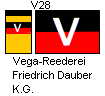
V28
image by Jarig Bakker, 17 Jan 2006
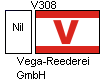
V308
image by Klaus-Michael Schneider, 23 Mar 2007

The earlier V308 flag is illustrated by Klaus-Michael Schneider. The FOTW account attributes its white and red colours to the Austrian imperial and royal officers who founded the company after the First World War.

V28’s flag is horizontally divided black over red with a white “V”. Its funnel is confirmed in photographs of Vega Sachsen, 29 June 2012, which also shows a flag panel on the superstructure, and Vega Stockholm in March 2007.

Vega-Reederei was formed in Vienna in 1919 by Augustin Karl, Hermann Rigele and Georg Ludwig Ritter von Trapp, officers with Austrian naval or merchant service backgrounds. Their plan to operate a 6,000-ton deadweight schooner from Trieste was frustrated by the Allied decision to confiscate the imperial and royal merchant navy. A Hamburg branch opened in 1922 under general manager Friedrich Dauber. In 1937 the Austrian officers resigned, Dauber became sole owner and the headquarters moved to Hamburg, continuing as Vega-Reederei Friedrich Dauber.

After Dauber’s death in 1965, Uwe Brügge, an authorised signatory since 1951, became sole owner. His sons Arend and Torsten became joint owners on his death in 1996. Andreas Güttler and Daniel Velte joined as partners in 2006, and Arend’s son Arne became general manager in 2007. Later register names include Vega-Reederei Friedrich Dauber GmbH & Co. K.G. and Vega-Reederei GmbH & Co. K.G. Reederei Hans August Sabban is recorded as an operating company; Mitchell associates the business with Brügge & Sabban.

Originally Austria, Vienna; subsequently Germany, Hamburg.

VELA INTERNATIONAL MARINE LTD.

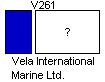
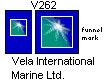
V261
V262

V261 is the plain funnel seen on Capricorn Star on 29 January 2006 and again on 8 May 2011. Gemini Star and Hydra Star also showed it. Rosanoski suggests that this plain design was confined to the VLCCs.

The company website showed product tankers with “Vela” in white on the hull and the logo within a narrow white frame on the funnel, represented by V262 from a photograph named Zauruk Star. The listed examples include Altair Star, Zaurak Star, Altarf Star, Alnasl Star and Aldebaran Star. The small photograph suggests an upper fly half matching the funnel blue and a green lower portion, with a white star: possibly two shades rather than the blended colours of the logo.

Vela was established in 1984 as a Saudi Aramco subsidiary to transport its oil, initially run from the Dhahran headquarters. It acquired four mid-1970s tankers from Petromin Tankers & Mineral Shipping Co., outsourcing technical management before developing into an integrated shipowning and operating company. Tanker chartering and scheduling moved to London in the early 1990s. In 2002 Dubai became the headquarters and the London and Saudi Arabia teams relocated there.

The company website derives Vela, Latin for “Sails”, from the constellation associated with Argo and the story of Jason. It connects the star theme with Star Enterprises, the Saudi Aramco–Texaco refining and marketing partnership dated in the source to 1968, and states that all Vela-owned ships were named after stars in the Vela constellation.

Saudi Arabia, Dhahran; later United Arab Emirates, Dubai.

VENDERS NAVIGATION.

V69

The NJK Collection records the funnel for Venders in March 1965, with the company identified only as a care-of address. It is red with a black top and a white “V”. No flag is noted.

Unknown.

VENEZOLANA TRANSPORTE DE QUIMICOS S.A.

V23

The funnel is white with a black top and a large red panel bearing a white “V” throughout. The flag is white with a large red rectangle bearing a white “V” throughout.

Venezuela.

VENIZELOS A.N.E. S.A.

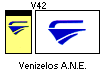
V42
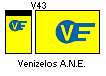
V43
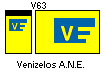
V63
V64

Rosanoski treats the funnel yellow as matching the flag. Bill Black records V43 as superseded about 1968. V63’s funnel is associated with Arion of Ariate Compania Naviera S.A. in April 1964, but its flag is assumed. V64’s funnel is recorded for Nikitas Roussos of Maritime Carriers Ltd.; the position of its flag is unknown.

The source describes four funnel versions, all with black tops: yellow with a blue circle and three diminishing tails bearing a yellow V; yellow with a blue panel and three diminishing tails bearing a yellow V; yellow with an angular, projecting blue panel bearing a yellow V and two white batons pointing towards the fly; and yellow or buff with a blue symbol of three shapes. The first two corresponding flags are yellow with the respective blue circle or panel and tails and a yellow V. The third described flag is white with the blue three-shape symbol. These numbered descriptions are retained collectively without inventing a separate ID-to-number correspondence.

The registers list Venizelos S.A. as a manager from 1963–1964, Venizelos A.N.E. from 1970–1971, and later Venizelos A.N.E. S.A.; Brown 1978 uses N.K. Venizelos. Managed companies included Toro Shipping Corporation, Ariate Compañia Naviera S.A. and Maritime Carriers Ltd., with agency relationships also recorded for the latter two. Venizelos Shipping (Agencies) Ltd. is named as the company’s agent.

Greece, Athens; subsequently U.K., Sidcup.

Ventouris.

MASTROGIORGIS SHIPPING CO. LTD.

M500
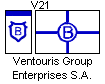
V21
image by Jarig Bakker, 13 October 2005
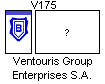
V175
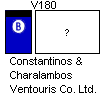
V180
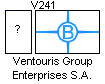
V241
image by Ivan Sache, 11 February 2009

Lloyd’s traces Mastrogiorgis from Constantinos G. Ventouris in 1961 through Constantinos & Charalambos Ventouris Co. Ltd. in 1975 to Mastrogiorgis Shipping Co. Ltd. in 1991. Rosanoski questions the middle stage: the 1975 name appears instead to have been Ventouris Group Enterprises S.A., with Constantinos & Charalambos appearing after 1985–1986. Ferries 2004 gives a different account, dating Mastrogiorgis to 1983 under George Ventouris. These accounts remain unresolved.

Greece, Piraeus.

A.K. VENTOURIS INC.

V19
image by Jarig Bakker, 5 October 2005
V178
V179

A.K. Ventouris’s formation is variously placed in the 1980s, in 1988 as AKB Ferries and A. Ventouris Inc., and in 1993 as A.K. Ventouris Shipping Co. It largely ceased ferry operations in 1996, apart from a freight service primarily for stock. In 2002 it obtained the Cycladic inter-island route with chartered Panagia Tinou, apparently through the newly formed C-Link Ferries M.C. Apostolos K. Ventouris acquired Anek Lines’ 18.92% controlling stake in NEL Lines in May 2005. C-Link and NEL formed a consortium in March 2006, and C-Link later appears as a NEL operating company.

Greece, Athens.

PETROS VENTOURIS.

V177

Mitchell assigns V177 to Agios Fanourios, 494 tons, built in 1949.

The Petros concern traded as Dimitrios Ventouris & Sons until 1984, Petros & Antonios Ventouris until 1988, then Petros Ventouris. By 1992–1993 Antonios and Petros appeared separately at the same address; Antonios’s absence from the later major-vessel listings is attributed to the small size of his vessels.

C.G. VENTOURIS.

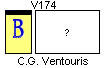
V174 appears to belong to Agios Georgios, 1,682 tons, built in 1956 and sold in 1984, the sole vessel listed under this owner. Mitchell includes it on a card for C. Ventouris of Limassol with mainly ferries and Kimolos, leaving the attribution qualified.

KLEVOULOS VENTOURIS.

V181

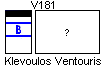
Mitchell assigns V181 to Ventouris Shipping Co. under K. Ventouris management, the latter confirmed by Lloyd’s. The letter is pencilled and its colour unclear; blue is Rosanoski’s suggestion, not a confirmed colour.

VENTOURIS BROTHERS.

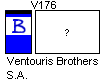
Mitchell assigns V176 to Poliagos. Lloyd’s 1985–1986 instead places the vessel under Ventouris Group Enterprises with Panagia Odigitria Shipping Co. Ltd. as registered owner. Mitchell also mentions Melas & Constantinas, possibly the brothers; the relationship is not established.

Documented shared associations — Ventouris Sea Lines historical flag/funnel / Mastrogiorgis retained funnel

V22
image by Jarig Bakker, 13 October 2005

Documentary images — company attribution uncertain

V174
V176

Specific owner/ship unknown.

Brothers identity not established.

Ventouris family

Five Ventouris brothers established a series of Greek ferry businesses, all active by the mid-1980s. Parts collapsed in the mid-1990s, while Ventouris Ferries survived on international and domestic routes. Ships appear to have passed between family companies, sometimes changing livery without the changes always being officially recorded. The source describes George Ventouris’s continuing concern as separate from the financial difficulties of other family members.

Greece.

Keep the explicit scope label independent; no alias or company identity is inferred.

Other separately recorded Ventouris concerns

Greece, Piraeus.

Keep the explicit scope label independent; no alias or company identity is inferred.

Mastrogiorgis and operating companies

Ventouris Group Enterprises, controlled by George Ventouris and trading as Ventouris Ferries, appears in the registers before its stated 1987 formation date, later under a new company number. Its website contact was Wavelord Navigation Co. Ltd., formed in 2000. Ventouris Ferry Co. was formed in 1983 and renamed Ventouris Ferries Shipping Co. in 1993; Ventouris Lines was formed in 1993, Ventouris Sea Lines in 1988, and V Bulkers S.A. in 2003. Sea Lines is reported bankrupt in 1996. As it did not own its vessels, they could pass to other operators while retaining old funnel markings.

Keep the explicit scope label independent; no alias or company identity is inferred.

Other Ventouris concerns

The document also records C. Ventouris & Sons Coastal Lines, C.G. Ventouris under agents Kykladiki Aktoploia, Cleovoulos Ventouris, Klevoulos Ventouris, Ventouris Brothers and Ventouris Shipping Co. Ltd. Cleovoulos’s Kimilos later appears under Constantine G. Ventouris. Rosanoski notes a possible connection between that vessel and the similarly named Kimolos under Ventouris Brothers, but does not establish it. These separate register identities are retained.

Keep the explicit scope label independent; no alias or company identity is inferred.

Mastrogiorgis

Mitchell first identifies V180 with C.S. Ventouris; Rosanoski notes the vessels under the designated company in Lloyd’s 1988–1989 and considers this probably the cargo-vessel funnel.

M500 comes from Aghios Efstathios, supported by a photograph of Fanara on 22 August 2006.

Keep the explicit scope label independent; no alias or company identity is inferred.

Ventouris Ferries

The Ventouris Ferries logo agrees with V21, also confirmed on Polaris under Wavelord and Kimolos in the ferry service. Mitchell shows V21 without a blue top for the vessel he names Hyrda, corrected by Rosanoski to Ydra; the company attribution is also uncertain. The vessel was acquired by Ventouris Ferries in 1990, registered to Mastrogiorgis in 1991 and sold in 1996; a black-and-white photograph shows a very narrow top. For V175, Mitchell specifies a black top and ferry use. Siren confirms an orle with a shield shape differing from V21, its outer edge thicker than the orle.

The Ventouris Ferries flag is white with a thin blue cross, centred on a blue “B” within a blue ring. The B is the Greek V, common to family-company liveries other than A.K.’s. V241 amends the blue shade of the earlier V21 flag using the Ellade Viaggi photograph; the funnels may likewise have used a lighter blue.
Keep the explicit scope label independent; no alias or company identity is inferred.

Ventouris Sea Lines

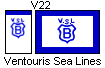
The V22 funnel appears on laid-up Georgios Express on 23 June 2006 with dots after V and S; Agios Georgios on 24 June lacks those dots. Mitchell shows a black top. Agios Georgios still carried the old funnel under Mastrogiorgis in 2006, though Rosanoski considered the Sea Lines flag probably historical by then.

Keep the explicit scope label independent; no alias or company identity is inferred.

A.K. Ventouris

The initial A.K. design used an “AKV” logo. A Panagia Tinou photograph dated 1987–1990 apparently shows V19 with a narrow red top, though the waves cannot be made out. Those dates conflict with the stated company formation, and the vessel may have been used while still listed under an associated company. The later livery replaced AKV with a red V above a blue circle containing two white horizontal lines in its lower half. Rosanoski could not establish whether this produced a new flag.

Keep the explicit scope label independent; no alias or company identity is inferred.

A.K. Ventouris / C-Link

V178 comes from Panagia Psariani on 21 January 2006 under C-Link; its Ventouris logo is taken as evidence of ultimate ownership, but no flag is evident. V179 comes from Anna V, probably in 1992–1997, with “A.K. VENTOURIS” on the hull. Panagia Thalassini under C-Link shows a version without a funnel top.

Keep the explicit scope label independent; no alias or company identity is inferred.

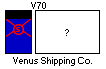
VENUS SHIPPING CO.

V70

The funnel is recorded for Constantia S in January 1967 and associated with J. Singrassides by Bill Black in the NJK Collection. No separate written design description is supplied.

Unknown.

VERBOON FISHERIES LTD.

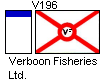
V196

The flag was painted on the deckhouses rather than flown. It is white with a red saltire, surmounted by a red ring enclosing a white centre bearing a black “V” and two horizontal black lines. The Log shows the lines detached, but Rosanoski suggests they might be parts of an F in a combined “VF” logo.

The Verboon brothers operated prawn trawlers.

Australia.

VEREENIGDE NEDERLANDSCHE SCHEEPVAARTMAATSCHAPPIJ N.V.

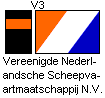
V3
image by Al Fisher, 6 February 1999

The width of the funnel band varies in the sources, sometimes narrow. Ocean Ships calls it broad, although Rosanoski finds the photographed band only average. Some sources show orange as yellow or red; he regards orange as correct and attributes these alternatives to printing limitations. Wyt’s Digest 1965 and Op de Lange Deining suggest a lighter blue than later sources. The livery continued briefly after the 1970 merger. Al Fisher’s FOTW flag, drawn from Stewart 1959, originally showed red; it was amended to orange on 25 October 2003.

Also known as United Netherlands Navigation Co. or VNS, the company is dated by Loughran to 1908 as a holding company, while other sources give 1920. Rosanoski suggests that 1920 may mark the start of operations. The 1920 partnership comprised Nederland, KNSM, JCJL and KPM of Amsterdam, and KRL, HAL, Nigoco and van Ommeren of Rotterdam. Merchant Ships records the consortium under the corresponding full corporate names.

David Steamship Co. was a subsidiary in 1920. VNS managed the Holland Afrika, Holland-Oost-Azië, Holland-Australië, Holland-Britisch-Indië and Holland-West Afrika concerns. It held a joint interest in Holland-West Afrika with Hollandsche Stoomboot Maatschappij, and received Nederland’s interest effective 1 January 1968. Fleet names used the suffix “kerk”, later also “fontein” and “kust”.

In 1970 VNS merged with Koninklijke Rotterdamsche Lloyd N.V. and Stoomvaart Maatcappij Nederland N.V. to form Nederlandsche Scheepvaart Unie N.V.; the fleet subsequently came under Koninklijke Nedlloyd B.V.

Netherlands, The Hague.

VEREENIGDE OOSTINDISCHE COMPAGNIE.

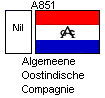
A851
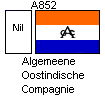
A852
image by Mark Sensen, 14 November 1996
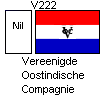
V222
image by Mark Sensen, 14 November 1996
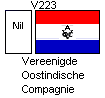
V223
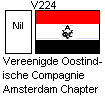
V224
image by Mark Sensen, 19 November 1996
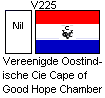
V225
image by Jarig Bakker, 28 Mar 2003
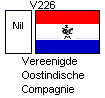
V226
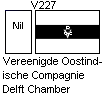
V227
image by Mark Sensen, 19 November 1996
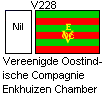
V228
image by Mark Sensen, 19 November 1996
V229
image by Mark Sensen, 19 November 1996
V230
image by Mark Sensen, 19 November 1996
V231
image by Mark Sensen, 19 November 1996
V232
image by Mark Sensen, 30 July 1998
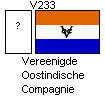
V233

V233 comes from Loeser’s website and V222 from Mark Sensen’s FOTW illustration. The source discusses an orange, white and light blue flag with a black VOC monogram on the white stripe in connection with Hudson’s Half Moon in 1609. For Van Riebeck’s arrival at Table Bay on 6 April 1652, the cited account assumes that the old orange-white-pale-blue company flag flew alongside the red-white-blue national flag; Rosanoski explicitly questions how safely that can be assumed without definite records.

V223 and V224 are Amsterdam variants with the small letters A and OC. The Flag Book of the United States suggests that Hudson may also have carried the Amsterdam chamber flag, with red, white and black stripes, distinct from the company’s orange-white-blue flag. This possible use is not asserted as certain.

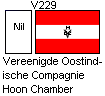
Sensen’s V227 has the small letters D and OC, V228 E and OC, and V229 H and OC, representing the respective chamber variants.

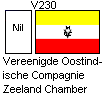
V226 is Loughran’s Middelberg company flag; V230 is Sensen’s FOTW illustration for the chamber named Middleburg in that passage.

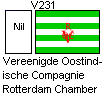
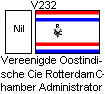
V231 and V232 have the small letters R and OC. A Ludolf Backhuysen painting of Rotterdam harbour shows a yacht with a white flag bearing the Rotterdam cypher and red-white-blue stripes along the top and bottom. Jos Poels records similarly striped white flags for administrators of naval admiralties; the suggestion that this was a VOC Rotterdam administrator’s flag remains tentative.

V225, Bakker’s Cape flag made using Sensen’s images, is expressly labelled doubtful. Bakker cites Ensiklopedie van Suidelike Afrika, 1967, as suggesting flag use after 1652, while Sensen says that the small-c Cape cypher is known but its use on flags is not. Andre van de Loo notes that Brownell describes the VOC cypher with a small C for Cabo and separately mentions company flags, without explicitly combining the two. Pama also illustrates the cypher. Early drawings use Cabo, offering a reason for C rather than K. Van de Loo had found no evidence of the combined cypher on land or ship flags; possible use by a travelling governor or Cape-based ships is only his supposition. Whitehorn drew attention to another web version, and the Cape-specific cypher should not be treated as a general East Indies emblem.

The AOC versions are disputed. Loughran gives Algemeene Oostindische Compagnie, a “Universal East India Co.” founded before 1609, and associates it with the later Tweede Westindische Compagnie; Rosanoski questions the relationship. The design has a large black A with O and C at the ends of its crossbar. Sensen presents A852 as another VOC version, with A interpreted either as Amsterdam or Algemeene. Whitney Smith explains AOC readings as misread upside-down VOC monograms. Rosanoski points out that simply inverting the monogram would reverse the C as well. Bakker had not seen an AOC monogram in his observations of seventeenth-century art and regards Van der Laars’s apparent A as an inverted V with a small V between O and C. Loughran’s red-topped A851 is assigned to Hudson in 1609–1621, although his own account says orange continued until 1650; Rosanoski therefore argues that the illustrated colour should be A852. Loeser instead calls A851 a modern variant. D. Prothero supplied an A851 example from an anonymous 1813 flag book edited by Brightly and Childs.

The later correspondence does not settle the question. Peter Hans van den Muijzenberg found Algemeene references in the VOC Surat registers, including outgoing messages naming Governor-General Petrus Albertus van der Parra on behalf of the Netherlands and its “algemeene Oost Indische compagnie”. He rejects Rosanoski’s suggested “commonly known as” interpretation on historical capitalisation and grammatical grounds. Rosanoski clarifies that he meant a shortened general company name, not a C for “commonly”, and continues to question the orientation needed to produce AOC. An online text dates the establishment of algemeene Oost Indische Compagnie to 20 March 1602, the same foundation date used for VOC. He therefore raises, without resolving, whether Algemeene was an original name replaced by Vereenigde at or soon after formation, or whether a separate minor company existed. Unless an original flag or logo can be found, he regards the AOC design as suspect.

Documentary images — company attribution uncertain

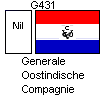
G431

Loughran assigns G431 to Generale Oostindische Compagnie of Amsterdam, reportedly taken over by the Batavian Republic in 1798. Rosanoski assumes a VOC connection from the large V but finds the presumed small letters GCO inconsistent with the stated name.

General-name usage corroborated; this exact monogram not verified.

The VOC monogram combines a large V with a smaller O on its left leg and C on its right. The company flag used the Dutch orange, white and blue stripes with the monogram; the upper stripe changed to red between 1630 and 1660. Chamber flags could use town colours, the VOC cypher and the town’s initial above it. Other cyphers had Z for Zeeland above, sometimes also M below.

The Vereenigde Oostindische Compagnie, VOC, is also called the Netherlands or United East India Company. Its chartered foundation is dated to 20 March 1602, uniting earlier trading ventures under pressure from Van Oldenbarnevelt. Six chambers—Amsterdam, Middelburg, Delft, Rotterdam, Hoorn and Enkhuizen—raised capital and supplied members to the Heren Zeventien. Amsterdam had eight seats, Middelburg four and the other chambers one each, with one reserved for the Staten Generaal. Meetings alternated between six years in Amsterdam and two in Middelburg.

The predecessors included the Amsterdam Compagnie van Verre, founded in 1592, and the Oude, Brabantse and Vereenigde Compagnie te Amsterdam; the Middelburg and Veere companies merged as the Vereenigde Zeeuwse Compagnie in 1600. Rotterdam’s Magellanse and Rotterdamse companies were founded in 1598. The voyages of De Houtman, Van Neck and Van Warwijck helped establish the feasibility and profitability of the trade, whereas several other expeditions failed. De Moucheron’s separate venture also failed; the source suggests that he may later have founded a company in France.

The source describes a government-sponsored monopoly on Asian trade for 21 years, with accounts at ten-year intervals, and Asian headquarters at Ambon from 1610 to 1619. It dates bankruptcy and cessation to 17 March 1798 and formal dissolution to 1800, with possessions and debts passing to the Batavian Republic; the territories became the Dutch East Indies. Bakker’s quoted account instead ends the company in 1806. It also dates the Middelburg and Veere companies’ entry to 1601, before the stated 1602 foundation. These discrepancies are retained.

Bakker distinguishes Hudson’s 1609 VOC voyage from his later voyage for London merchants. Amsterdam merchants interested in his discoveries were refused a monopoly by the VOC; competing Hudson River ventures merged in 1614 as the Compagnie van Nieuw Nederland, receiving a four-year monopoly, and became part of the West Indische Compagnie in 1621.

Netherlands, Amsterdam.

VEREINIGTE ELBESCHIFFAHRTS GESELLSCHAFT A.G.

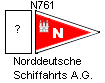
N761

The marcollect table flag is identified with Norddeutsche Schiffahrts-A.G. Its emblem is the Hamburg castle. Whether the border continues along the hoist is unclear.

The business began in Dresden in 1883 with towboats and barges serving the Elbe’s coal and general-cargo trade. One account names Carl Böhme’s Dampfschleppschiffahrts Gesellschaft Elbe und Saale; another calls the original concern Dampfschleppschiffahrts-Gesellschaft Vereinigte Schiffer. Böhme acquired Elbe-Saale Dampfschiffahrts-Gesellschaft in 1893 and Handelsgesellschaft Gebrüder Tonne in 1895. The 1903 merger with Deutsche Elbschiffahrts Gesellschaft formed Vereinigte Elbeschiffahrts Gesellschaft; the same year also brought the Austrian Nordwest-Dampfschiffahrts-Gesellschaft.

Before the First World War the company had more than 3,000 bargemen and 500 vessels. Government support helped post-war recovery, and acquisitions extended its passenger and packet trade. Motorised barges followed in 1928, a river-sea ship in 1935 and tank barges in 1937. The cited account names Deutsche Böhmische Elbeschiffahrt and Sächsisch-Böhmische Dampfschifffahrt as subsidiaries. Rosanoski cautions that its continuing-fleet description conflicts with other sources reporting cessation in 1980.

After the First World War the former Austrian company’s equipment passed to Czechoslovakia. A joint venture with Neue Deutsch-Böhmische-Elbschiffahrts began in 1924; another with Neue Norddeutsche Flußdampfschiffahrt followed in 1926, though the ending of the first is uncertain. The latter companies merged in 1929 as Neue Norddeutsche und Vereinigte Elbeschiffahrt A.G. of Hamburg. A further joint operation with Neue Deutsch-Böhmische-Elbschiffahrts is recorded in 1937. Interests included Schlesische-Dampfer-Compagnie-Berliner Lloyd and 94% of Elblagerhaus A.G. After the Second World War few ships remained and Soviet-zone branches were expropriated.

The company became Norddeutsche Schiffahrts-A.G. in 1951. Burmester initially held 25%, gaining a majority through Reedereien Gebrüder Burmester und Matthias Burmester in 1961. It converted to a limited company in 1965 and was declared bankrupt in 1980.

Germany, Dresden.

VERENIGD SCHEEPVAART BEDRIJF. V.S.B.

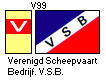
V99

V99’s funnel and flag come from Brown 1982, No. 758. No separate written design description is supplied.

V.S.B. is recorded in Lloyd’s from 1973–1974 to 1980–1981, managing two companies in the first of those editions.

Netherlands, Rotterdam.

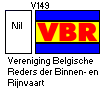
VERENIGING BELGISCHE REDERS DER BINNEN- EN RIJNVAART.

V149
image by Jarig Bakker, None

V149 is illustrated by Jarig Bakker from material supplied by Jan Mertens and the cited Kantoor Binnenvaart webpage. No separate written flag description is provided.

The name is rendered in the source as Association of Belgian Shipowners of Inland and Rhine Navigation.

Belgium, Schoten.

Vergottis Ltd.

VERGOTTIS LTD.

V33
V88
V89

Jordan shows V88 for managed or agency companies, with the letter on a white square panel. Brown 1943 instead uses the Adelphi Vergottis livery for Aegeon, Ionian and Myrtoon, which Jordan places under Vergottis Ltd.

V33’s funnel is recorded for Vercharmian of Vergocean Steamship Co., associated with Adelphi Vergottis in the NJK Collection.

V89 is recorded as sighted at Lyttelton on 5 March 1977 and documented by Brown 1982 and 1995.

Jordan records Vergottis as manager and agent in 1939. Later Lloyd’s listings alternate between Vergocean Steamship Co. Ltd. and Vergottis Ltd., including Vergottis as Vergocean’s manager; some Vergocean vessels used “Verg” names. Rosanoski tentatively identifies the later Vergottis (London) Ltd. by its address. Managed or agency concerns included Hermes, Oceanverg, Aegeon, Ionian, Markettos and Myrtoon, and Andreas Ch. Vergottis of Cephalonia.

U.K., London.

VALIANT SHIPPING CO. (LONDON) LTD.

Valiant Shipping Co. (London) Ltd., formed in 1968 and listed as an agent, is described as a subsidiary. Loughran credits it with absorbing Larrinaga Steamship Co. in 1974, but Marine News attributes the takeover announced in November 1974 to Vergocean. The conflicting attribution remains unresolved.

U.K., London, at the same address.

Vergocean Steamship Co. Ltd.

V34

A livery similar to V34 is shown for Compañia de Navegacion Cristobal S.A. Bill Black records its funnel under Adelphi Vergottis with various subtitles and on Ionian Commander in April 1965. Rosanoski notes that it differs from Jordan and Brown 1982 and that he could not locate the ship in Lloyd’s.

No exclusive fleet-wide use or unrecorded corporate equivalence is asserted.

Documentary images — company attribution uncertain

V86

Brown 1982 assigns V86 to Adelphi Vergottis of Piraeus. This original attribution is retained alongside the existing document grouping.
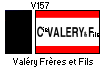
No shared use inferred from competing publications.

Vermilion Overseas Management Co. Ltd.

VERMILION OVERSEAS MANAGEMENT CO. LTD.

Vermilion was formed in 1976. Rising Hong Kong costs led to the separation and transfer of ship-management operations to the Philippines in November 1994, when VOM (Manila) Corporation was founded.

China, Hong Kong.
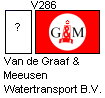
VOM (MANILA) CORPORATION.
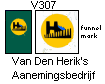
V137
image by Jarig Bakker, 24 October 2003
V138

Jarig Bakker’s V137 illustration used the red border of the company logo. Rosanoski objects that the flag should apparently be plain white, with larger and more widely spaced letters. The original illustration and the criticism are both preserved.

V138 is the flag image taken from the company website. The document supplies no additional separate verbal description.

VOM is separately recorded as formed in 1994, appearing as a manager in Lloyd’s 1996–1997 and later with its fleet under named ship companies.

Philippines, Manila.

VERMONT SHIPPING LTD.

V303

V303 is based on a starboard photograph of Anfat on 24 August 2012. No separate written funnel design description is provided.

Formed in 1993, Vermont appears as a manager in Lloyd’s 1996–1997 and subsequently with a fleet under its own name and ship companies. Vessel names use the prefix “An”.

China, Hong Kong.

VERTOM SCHEEPVAART EN HANDELSMAATSCHAPPIJ B.V.

V80
V81

V80’s funnel and flag are documented by Brown 1995, No. 664.

V81 depicts a green stylised ship incorporating “VERTOM”, all letters except the first in a lighter shade. Rosanoski considers the design too complicated to be a sea flag; the example comes from Josef Nüsse’s website.

Formed in 1974, Vertom operated through shipowning and operating subsidiaries. Explorer Shipping Pte. Ltd. and Franklin Shipping Pte. Ltd. were formed in Singapore in 1996, each with one vessel, and omitted from the July 2000 list. The source records partial-fleet management relationships with Rialto Shipping, Holwerda Shipmanagement and Kapitan Siegfried Bojen-Schiffahrtsbetrieb. Mineralalien Schiffahrt Spedition und Tran sport GmbH is described as a sister company.

Netherlands, Rotterdam.

VIADORA COMPAÑIA NAVIERA S.A.

V72

V72’s funnel is recorded for Antiparos by the NJK Collection. No separate written design description is provided.

Viadora appears in Lloyd’s 1963–1964 under United Shipping & Trading Co. of Greece S.A. as operator and later in its own name, with Global Chartering & Brokerage Inc. as agent. The 1970–1971 entry reads Viadoro; Rosanoski is unsure whether this is an error, since another company of that name appears in 1973–1974.

Greece, Piraeus.

VIAÇÂO BAIANA DO SÂO FRANCISCO.

V31

V31’s funnel and flag come from the Brazilian website’s livery coverage for about 1950, band 11. No separate written design description is supplied.

The company appears to have been operating in 1919, although Rosanoski cautions that the translation of the cited Bahia source is unclear.

Brazil, Bahia.

VICK FUNG SHIPPING & ENTERPRISES.

V73

The NJK Collection records a black funnel on Ho Fung in September 1965. No flag is noted.

Unknown.

VICKERS OCEANICS LTD.

V52

The flag is white with a blue stern trawler above the blue outlines of two fishes, symbolising Pisces; together they form a stylised crown. The yellow or buff funnel bears the flag emblem. Brown 1982 notes that the livery had become unlikely to be seen.

Owned by Vickers Ltd., Vickers Oceanics used converted stern trawlers for oil-industry research and as mother ships for Pisces miniature submarines. The fleet’s sale is reported in Marine News, September 1979.

U.K., Barrow; London is also given.

VICTOR SCHUPPE.

S1616
S1617
image by Klaus-Michael Schneider, 17 April 2009

Schneider’s FOTW rendering, S1617, differs slightly in its lettering from the Kludas source represented by S1616.

Schuppe acquired the wreck of the passenger ship Sierra Salvada and renovated her as Peer Gynt in 1923. Economic difficulties ended the venture in 1925.

Germany, Stettin.

VICTORIA CRUISES.

V269

V269 comes from a starboard photograph of an unnamed vessel, apparently showing a dragon facing aft. Rosanoski therefore assumes it faces forward on the port side. A blue oval contains “VICTORIA” over “CRUISES”: predominantly capitals, with taller first letters but dotted lower-case i characters as tall as those first letters. The funnel is taken as white despite looking light grey in the photograph; the dragon and lettering appear pale buff yellow.

The American company began operating in 1993, with its first sailing in 1994, offering Yangtze River tourist cruises on vessels with names beginning Victoria. Its website described it at the time as the only American cruise line on the Yangtze.

USA, New York.

VICTORIAN LIGHTERAGE PTY. LTD.

V210
V211

The red funnel with a black top, V210, came from J.W. Alexander Ltd. and was adopted shortly after the loss in 1936 of the acquired vessel J.W. Alexander.

V211 was associated with Swiftness, acquired in 1937: two narrow, widely separated white bands on a black funnel. One account says the bands were added after acquisition; another says the ship was acquired in those colours and subsequently received V210. The source marks this discrepancy rather than settling it.

Incorporated in Victoria on 19 November 1911, the company entered voluntary liquidation after a shareholders’ vote on 19 March 1956. The process lasted five years, with the final meeting on 1 March 1961 and deregistration on 7 June 1961.

Australia, Melbourne.

VICTORIAN SHIPPING CO. PTY. LTD.

V221

V221’s funnel comes from The Log, February 1997; no separate written design description is supplied.

The company operated Palmer from 1920 to 1924 and ceased trading after disposing of her. It was deregistered on 22 June 1927.

Australia; Melbourne is assumed from registration in Victoria.

VICTORY CARRIERS INC.

V91
image by Joe McMillan, 30 November 2001
V148

V91 is documented by US Navy 1961 and illustrated for FOTW by Joe McMillan. Mitchell shows a wider funnel band.

V148’s funnel and flag come from Stewart 1963, No. 353. No separate written comparison beyond the band-width note is supplied.

Victory Carriers is recorded in Lloyd’s from 1953–1954 and associated with the Onassis Group; the NJK Collection gives its address care of Alexander Onassis Shipping Corporation. Most vessel names ended in Victory. Joe McMillan believes it was among the companies begun after the Second World War with surplus Victory ships, but presents this as his belief rather than established company history.

USA, New York NY.

VICTORY TANKERS A/S.

V274

V274 comes from a port-side photograph of Nina Victory, dated “16.;6.2012” in the source, and a starboard photograph of Emma Victory on 7 July 2011.

Victory Tankers was established in September 2010 as a private limited company under EGD Shipholding A/S. EGD Holding’s shipping and property investment business is linked by the company enquiry address, although the website did not explicitly state the relationship. Emma Victory A/S is a subsidiary owning Emma Victory, managed by Champion Tankers. Nina Victory A/S appears to be another subsidiary, owning Nina Victory under the same manager.

Norway, Bergen.

VIETNAM NATIONAL SHIPPING LINES.

V188

V188 comes from Vinalines Glory on 6 September 2007 and is described as the normal Vietnamese merchant-shipping funnel. Rosanoski does not expect its smaller star, compared with other funnels, to have any significance.

Vietnam National Shipping Lines, or Vinalines, is also recorded as Tong Cong Ty Hang Hai Vietnam and Tong Cong Ty Hang Hai Viet Nam. Established by the Prime Minister’s decision of 29 April 1995, it reorganised shipping, stevedoring and service enterprises previously controlled by the Vietnam National Maritime Bureau and Ministry of Transport. Operations began on 1 January 1996. Lloyd’s initially gave 1996 as formation, later amending it to 1995. The source’s charter-decree date reads “22.11.2995” and is retained as an unresolved transcription in the evidence.

State-owned capital in joint-stock and joint-venture companies was transferred to Vinalines in 2001. In 2002 operations were placed under five member companies: Vietnam Container Shipping, Transport & Petroleum Supply, Saigon Maritime, Vatcach Port and Danag Port Services. Saigon Service & Export Joint Stock Co. followed in 2003. The website’s member fleet included Vietnam Ocean Shipping, Vietnam Sea Transport & Chartering, Vietnam Shipping, Falcon Shipping, Vietnam Sea & River Transport Corporation, Northern Ocean Shipping and Vinalines Shipping.
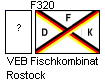
The register also lists Hanoi Maritime Holding Co., or Marina Hanoi, formed in 2002; Vinalines Shipping Co., formed in 2001; Vinashin Ocean Shipping; and Vinashin Petroleum Investment & Transport. International Labour Cooperation Co. became International Shipping & Labour Cooperation Joint Stock Company from 1 July 2007. Vietnam Shipping Co. later appears as Vinaship Joint Stock Co.

Saigon Maritime was owned by Vinalines before privatisation in 2002; Vinalines retained a 14.58% stake.

Vietnam, Hanoi.

VIETNAM OCEAN SHIPPING JOINT STOCK CO.

V187
V212
V213
V214
V268

All Mitchell line drawings show the V213 funnel.

V187 comes from Golden Star on 8 September 2006.

Most company website photographs show V212 with a broad band, confirmed on Dai Minh on 25 November 2008.

V214 comes from a port-side photograph of Dai Minh on 10 April 2009, where the band looks bluish grey and was reported as a recent change.

V268 comes from a port-side photograph of Vega Star on 6 May 2012.

The source subsequently labels a Dai Minh photograph at Singapore on 21 June 2011 as V322. Its band looks light blue, leading Rosanoski to consider V214’s grey impression probably false. V322 is retained as a source reference without adding it to this entry’s verified image associations.

VOSCO was established on 1 July 1970 as Vietnam Ocean Shipping Co., under government control, and later appears as a major operating company of Vietnam National Shipping Lines. Lloyd’s briefly gave formation in 1988 before amending it to 1970. The joint-stock name dates to 2008, with operations under it beginning on 1 January according to the website; the original date is printed “1.1.2-008”. Vietnamese names are recorded as Cong Ty Van Tai Bien Vietnam and Cong Ty Co Phan Van Tai Bien Vietnam.

Vietnam, Haiphong, also written Hai Phong.
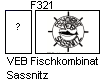
VIETNAM PETROLEUM TRANSPORT JOINT STOCK CO.

V204
V205
V243

V204 is based on port- and starboard-side photographs of Petrolimex 1.

The narrative identifies V205 from Petrolimex 10 at Port Botany on 18 November 2008, supplied as JB evidence. The source list instead prints V206; that discrepancy is retained without adding or changing an image association.

V243 comes from Petrolimex 16 on 28 October 2010.

The livery uses Petrolimex’s logo with a changed colour for the P; the passage does not specify the replacement colour.

Vipco, also recorded as Cong Ty Van Tai Xang Dau Duong Thuy 1, originated with Vietnam Petroleum Transport Co. on 22 July 1980 under the Vietnam National Petroleum Import-Export Corporation. It was re-established on 31 March 1993 and transformed into the joint-stock company founded on 2 December 2005, beginning operations on 26 December. Lloyd’s instead gives formation in 1986. The source records 51% government ownership and association with Petrolimex, or Vietnam National Petroleum Corporation.

Vietnam, Hai Phong City.

VIETNAM SEA TRANSPORT & CHARTERING CO.

V183
image by Eugene Ipavec, 28 December 2007

The funnel is based on Vien Dong 5. VTC Sky on 28 September 2007 shows an alternative with a narrow black top, straight upper and lower edges to the oval, and a darker red closer to the website flag logo; Rosanoski finds no apparent reason for these differences on similarly sized funnels. The flag logo is horizontally red over blue with an overall yellow V whose dexter arm is thicker. António Martins-Tuválkin comments that its overall scheme is based on the Vietcong flag.
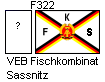
Vitranschart, or Cong Ty Van Tai Bien Va Thue Tau Vietnam, has conflicting foundation accounts. Lloyd’s traces it to South Vietnam Sea Transport & Chartering, SOVOSCO, in 1963, with the later name adopted in 1983, amended in a subsequent edition to 1976. The company website instead gives 25 June 1975. The concern is recorded under government control and later as part of Vietnam National Shipping Lines, with Mercury Shipping Co. Ltd. among its ship companies.
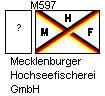
Vietnam, Ho Chi Minh City.

VIKEN SHIPPING A/S.

V280

V280’s funnel comes from a starboard photograph of Utviken on 26 February 2009; its flag source is the company website. Rosanoski notes that the photographed fleet appears mainly in charterers’ colours.

Tom C. Steckmest founded Viken in 1993 according to its website; Lloyd’s gives 1994. He and his immediate family were majority shareholders in a group engaged in shipowning, management, agency and property. A grandson of Haakon Wallem, he acquired the family interests in Wallem Steckmest & Co. AS in 1993 from his father Arne and Rita Steckmest’s other sons. That company subsequently held only property interests, while Viken’s fleet was on long-term charters.

Rita Steckmest had continued Haakon Wallem’s Norwegian shipowning business. Ownership described in the website account as leaving the family in 1968 was bought back in 2006 by Viken and co-investors, including Wallem’s senior management; Rosanoski considers this passage apparently to concern the non-Norwegian shipping interests. Viken and Nigel Hill’s Clearwater Marine Investments developed the Woodstreet businesses together. Amsterdam-registered Woodstreet Investments BV owned Wallem Group Limited, while Woodstreet Inc. and Woodstreet Shipholdings AS owned and operated vessels and provided maritime asset management.

Viken Ship Management A/S originated in a 2002 split of Vista Ship Management within the same group. It became Wallem Shipmanagement Norway A/S in 2006 and was listed under Wallem Group in 2007. Viken Marine A/S was formed in 2007 at the Bergen address.

Norway, Bergen.

Viking Line ABP.

VIKING LINE ABP.

V18
image by Jarig Bakker, 13 August 2005

FINLANDSHAMMEN A/B.

Finlandshammen A/B was formed in 1986 and used Ålandsfärjan on Viking Line’s summer Kapellskär–Mariehamn service. SF Line acted as agent. Rosanoski suggests a possible relationship to the Finnish Ålandsfärjan company from the vessel and date, but does not establish it. The ship later appears under Viking Line ABP in 2005.

Sweden, Stockholm.

SF LINE A/B.

S644

S644 is the SF Line flag supplied by Collectors Corner; no separate verbal design description is given.

SF Line formed part of the Vikinglinjen consortium; its fleet used names ending in “ella”.

Finland, Mariehamn.

Viking Line

The consortium’s ships, including SF Line’s, used V18. Rosella photographs confirm the funnel. Coastal Ships & Ferries describes red with a black V on a yellow diamond edged white and a black top, but its Cinderella photograph appears to show the black only as the funnel exhausts. The FOTW flag is illustrated by Jarig Bakker from the Bryggan website.

Finland, Mariehamn.

Keep the explicit scope label independent; no alias or company identity is inferred.

Viking Line origins

Gunnar Eklund began service as Rederi Vikinglinjen A/B on 1 June 1959 with the 1924-built Viking, between Galtby, Mariehamn and Gräddö, later using Kapellskär from 1960. Disagreement over concentrating on ferries or adding dry-cargo ships and tankers led Eklund and other ferry advocates to form Ålandsfärjan A/B in 1963. The original company became Rederi A/B Solstad, later owned by Rederi A/B Sally.

Keep the explicit scope label independent; no alias or company identity is inferred.

Viking Line / SF Line

Ålandsfärjan became SF Line A/B and subsequently Viking Line ABP. In autumn 1966 Ålandsfärjan, Rederi A/B Slite and Solstad formed marketing company Vikinglinjen AB OY, later Viking Line Marketing AB OY, adopting Slite’s red colour scheme of 1965. Sally left the consortium in 1988 and Slite in 1993; the marketing business then became wholly owned by SF Line and Viking Line ABP became the group parent. In 1988 Finska Angfartygs A/B and Axel Axelson Johnson exchanged their interests for full control of Sally. Lloyd’s separately dates Viking Line A/B, Vikinglinja O/Y, to 1991 and SF Line’s renaming to 1995; Rosanoski notes disagreement with the website account.

Keep the explicit scope label independent; no alias or company identity is inferred.

VIKING SUPPLY SHIPS A/S.

V100
image by Jarig Bakker, 20 January 2006
V154
V155
V182

Brown assigns the livery to Bendt Rasmussen. Rosanoski considers the emblem of V155 and V100, under Rasmussen ownership, to represent an oil gusher. V100’s FOTW flag is by Jarig Bakker from Brown 1995.

V154 comes from Viking Staffa on 30 November 2005.

V182 comes from Viking Arran. The photograph makes the panel look very light grey, narrowly bordered white, with the emblem also outlined white; Rosanoski treats that appearance as misleading photographic evidence.

Following Vroon’s takeover, the announced rebranding at dry dock was to red and white colours with a large white V on each side of the hull.

Viking Supply Ships began in 1974 as the marketing organisation for Skibs A/S Excelsior, Bendt Rasmussens Rederi. Christen Sveaas and others acquired all Excelsior shares in 1989 and renamed it Viking Supply Ships. The fleet was sold in 1997 and the company became Kistefos A/S in 1998, with a new Viking Supply Ships established at Arendal to receive the offshore operations. The Viking Group moved to Kristiansand S. in January 2000. Another source note places Kistefos ownership presumably from 1995, and the later relationship through Rederi Transatlantic is described as apparent.

Saevik Supply ASA was formed in 1981; Trico Marine Operators acquired all its shares in November 1997. Viking Supply Ships (U.K.) Ltd., formed in Aberdeen in 1991, became Saevik Supply Ships (U.K.) Ltd. in 1997 and was sold to Trico in 1999, the source giving the subsequent name Trico Supply Management A/S.

CAM Shipping was bought from Armamento D.Tripcovich in February 1995 and renamed Viking Standby. In 2002 it merged with BUE North Sea to form BUE Viking, a joint venture with BUE Marine. Viking obtained full ownership in August 2004 and renamed it Viking Offshore Services on 1 June 2005. Vroon bought the business in 2007, after which it appears as Vroon Offshore Services and vessels exchanged the Viking prefix for VOS.

VSS was also associated with numbered K/S Viking Supply Ships companies; fleet names used Viking as their second element. Rederi Transatlantic announced a new VSS management structure on 21 January 2013.

Norway: Kristiansand S., Arendal and subsequently Kristiansand S.; later Denmark, Copenhagen.

VILLAIN & FASSIO E COMPAGNIA INTERNAZIONALE DI GENOVA SOCIETÁ RIUNITE DI NAVIGAZIONE S.P.A.

V54
image by Jarig Bakker, 14 July 2004
V55
V57
V58
V75
image by Jarig Bakker, 14 July 2004

V54 is described as the original livery. Bakker’s earlier-version flag from Loughran is the Fassio pattern with blue V&F on white.

V55’s funnel is described as narrow bands, presumably of equal width. Rosanoski considers V55, V57 and V58 probably representations of the same funnel, but their slight colour differences prevent certainty. Loughran says the V58 funnel and flag were adopted in the mid-1960s, with an additional funnel band.

The NJK Collection calls V75 the proper funnel version. Bakker’s later flag from Loughran is white with a red St George’s cross and the old company flag in the canton.

Documentary images — company attribution uncertain

V56

Rosanoski regards V56 as highly suspect because its initial has no apparent relevance; the illustration remains associated with the document without treating that doubt as resolved.

Do not reinterpret W or invent another company.

Villain & Fassio appears in the registers from 1937–1938, under the longer combined name by 1953–1954, with vessels bearing Fassio family names. It participated in the Atlantica Line consortium from October 1971 according to Marine News. Loughran instead names “Fassio” Società di Navigazione S.p.A.; Rosanoski notes that Lloyd’s no longer showed that company operating by then.

Italy, Genoa.

VIMONT & CIE.

C879
S924
V158
image by Ivan Sache, 19 February 2004
V159
image by Ivan Sache, 19 February 2004
V160
V161

Lloyd’s 1904 and 1912 identify a sailing-ship company and use “Co.” rather than “Cie”. The bands look equal in the 1904 V161 version, while the red is wider in the 1912 V158. Rosanoski suggests that differing band widths may arise from fitting many stripes into a fixed-size drawing.

V159, from Armements Marseillais, is described as seven red and six white horizontal stripes, with red twice the height of white.

V160 is sourced to Grands Voiliers Française; no separate written comparison is provided.

S924 and C879’s funnels and flags are sourced to Armements Marseillais, No. 27. Their existing associations are retained without assigning undocumented individual differences.

Vimont began in 1900 with two sailing ships carrying oil. In August 1922 it formed Société Anonyme d’Affrêtement et d’Armement for cargo shipping. The business apparently became Compagnie Française de Navires Citernes in 1929 and ceased operations in 1934; Rosanoski notes that Bois uses both Compagnie and Société. Davies & Newman Ltd. is listed as an associate under the tanker-company name.

France, Marseilles.

VINASHIN OCEAN SHIPPING CO.

V184

V184 is based on a starboard photograph of Vinashin Pacific taken on 14 November 2007.

The document also refers to a portside photograph of Vinashin Sun as V320. That reference is preserved, but V320 is not an additional image in this article’s verified gallery.

Vinashin Ocean Shipping is described as a subsidiary of Vietnam Shipbuilding Industry Corporation, whose account includes establishment on 31 January 1996. The shipping company is separately dated to 2001. It appears as Vinashin Shipping & Marine Service Co. in 2003, as Vinashin Ocean Shipping Co. in 2005, and as an operating company under Vietnam National Shipping Lines in 2006; the later entry lists it as owner and manager in its own name.

Vietnam, Hanoi.

VINASHIP JOINT STOCK CO.

V185
V186
V263

V185, described as the standard Vietnamese merchant-shipping funnel, comes from a starboard photograph of My An on 26 November 2005.

V186’s funnel comes from a port-side photograph of Chuong Duong on 24 November 2007 and its flag from the company website logo. Vinaship Gold’s starboard photograph in August 2009 shows the reverse side of the V flag with the pole slanting forward.

V263 comes from My Thinh’s starboard side on 13 October 2009. The pole points forward and the flag is shown from the reverse: the bird’s longer wing points to the fly and its head towards the hoist.

Vinaship, also recorded as Cong Ty Van Tai Bien III, was formed in 1989 as Vietnam Shipping Co. It was reorganised in 1997 to address operational and management problems. A member of Vietnam National Shipping Lines, it became Vinaship Joint Stock Co. in 2006. The website dates incorporation to 21 October, ministerial approval to 24 October and the business-registration certificate to 27 December 2006; these separate dates are preserved.

Vietnam, Haiphong.

VINAVE-EMPRESA DE NAVEGACAO MARITIMA LDA.

V24

The funnel is white with a black top and a blue V, with a blue, flapping flag-like panel above its sinister arm. The flag is white with the same emblem.

Formed in 1985, Vinave operated ships in its own name and through subsidiaries. Corina Investments Ltd. was formed in 1991 and Marship Investments Ltd. in 1993.

Portugal.

Vingatank Rederi A/B.

VINGATANK REDERI A/B.

V171

Arthur Sture Johansson

J117

J117 is presumably based on Vingavag and V171 on Vingasjö, which Mitchell shows in line drawings. V171’s flag design seems to include a black V on blue, but the drawings are too unclear to reproduce the flags confidently.

Vingatank was formed in 1979, apparently as Arthur Sture Johansson, although the addresses differ slightly. By 1985–1986 Johansson’s ships were listed under Vingatank; by 1988–1989 they had been placed in single-ship companies and managed by Vingatank. Part of the business became Rederi Swedia A/B, whose first vessel Vingasjö is linked to the same Donsö address.

Mitchell records United Tankers A/B’s acquisition of Vingatank in 1991; Rosanoski considers it apparently later disposed of.

Sweden, Donsö; later Gothenburg.

VINNEN GEBRÜDER GMBH.

V50
image by Klaus-Michael Schneider, 28 Mar 2007

Loughran and Meyer show the same flag. Schneider’s FOTW illustration follows Meyer, who reproduces a 1913 painting of Henriette showing it. The V may have been outlined black; that detail remains uncertain.

The Bremen sailing-ship firm ceased operations in 1908, transferring its ships to Aug. Bolten Wm. Miller’s Nachfolger, under whose name they were registered in Hamburg. Gustav Ulrich Vinnen and Carl Vinnen established Vinnen Gebrüder GmbH at Hamburg in 1913, receiving six sailing vessels from Bolten. The shipping business ended with the last sale in 1927 and the company was dissolved in 1952. Rosanoski suggests that the same brothers may have been involved in both firms, but Mathies does not record the 1913 re-establishment. No connection with F.A. Vinnen & Co. is apparent.

Germany: Bremen for the earlier concern; Hamburg for the later company. The sources differ in their labels.

VINTI FREIGHTERS (LONDON) LTD.

V76

Recorded for Marucla in April 1967, the funnel is black with a broad white band edged blue at top and bottom and bearing a blue V. No flag is noted.

The London company acted as agent for Vinti Freighters Ltd. of Cyprus. Bill Black associates the livery with E.N. Vintiades of Genoa and with the agency companies.

U.K., London.

VIRTUE NAVIGATION CORPORATION.

V77

The funnel is black with a broad blue band bearing a white V, recorded for Grand Virtue in September 1967 and Hanang in 1967 by Bill Black in the NJK Collection. No flag is noted.

Unknown.

VISSER SHIPPING CO. B.V.

V270

V270’s funnel, photographed on 21 March 2012, has the owner’s panel on a black base; Rosanoski takes both panel and mermaid figure to be other than white, without specifying the shade. A photograph of 20 July 2012 shows a house flag reproducing the panel in the same proportions, flown alongside NedNor’s flag.

Steven Visser owned Marfaam, “Mermaid”, named on 19 November 2011 for the captain-owner and sailing from Lemmer. Boomsma Shipping handled management, with NedNor B.V. responsible for commercial management.

Netherlands, Lemmer.

VITA MANAGEMENT S.A.

V318
V319

V318 comes from port and starboard photographs of Vitaopride in April 2006. A starboard photograph of Vitahorizon on 23 May 2012 shows a black top and a much wider white band; Vitaglory has a narrower band. In both cases the letters appear unchanged in size.

V319 comes from the Mitchell collection; the document supplies no separate written description.

Vita is a private company registered in Panama on 12 July 1974 according to the cited company record; Lloyd’s gives formation in 1968. Mitchell apparently attributes its foundation to “Vassilatos & Tenes”. Directors are listed as Dionysios, Nikolaos and Gerasimos Vasilatos and Nikitas Tsenes, while other sources name CEO Panagiotis Tsenes and managing director Captain Dionyssios Vassilatos. The differing spellings are retained. Vessel names begin with Vita.

Greece, Piraeus.

VIUVA PEDRO OSÓRIO & CIA. LTDA.

V92

The Brazilian website covers liveries around 1950. Rosanoski finds what appear to be black letters inside the blue circle, possibly LTA with a shorter A; the reading remains uncertain.

Brazil, Rio Grande do Sul.

Vlassopulos.

N. & J. VLASSOPULOS LTD.

V130

The agency funnel is recorded on Stala’s Laertis in January 1967. Brown 1978 assigns the livery to Vlassocean de Navegaçion S.A.; Brown 1982, NJK and Mitchell supply additional references.

The original source list also cites Christies J55 as funnel evidence. That associated image is retained without inventing a separate design description.

Nicos S. and John S. Vlassapulos are recorded as directors. The London agency appears as Vlassopulo Brothers Ltd. in 1958–1959 and later under several N. & J. Vlassopulo/Vlassopulos forms. Clients included Altos Mares, Ganadera Sudamericana, Stala, Transmarina Armadora and Vlassocean de Navegaçion, with London representation also for George Carras, Loucas Matsas & Sons, Ulysses Shipping Agency, Philip N. Vlassopulos and Vlassopulos Shipping Enterprises.

U.K., London.

Preserve the original prose, but do not illustrate or link it to the withheld GIF(s): J55. Source reference codes do not establish an image association.

PHILIP N. VLASSOPULOS.

Philip N. Vlassopulos is recorded in 1953–1954 to 1963–1964, using Vlassopulo Brothers and then N. & J. Vlassopulo as London agents. Rosanoski considers the latter forms likely misspellings of Vlassopulos.

Greece, Ithaca.

VLASSOPULOS SHIPPING ENTERPRISES S.A.

Vlassopulos Shipping Enterprises used N. & J. Vlassopulos as London agent and itself acted as agent for Stala Compañia Naviera S.A.

Greece, Piraeus.

VODOHOD.

V283

V283 comes from a starboard photograph of Semen Budenny on 29 July 2012.

Vodohod, «ВОДОХОДЪ», operates river cruises as successor and general partner to Volga Flot Tour Ltd. of JSC Volga Shipping. Its routes include the Volga, Don and Kama, the Moscow and Volga Don canals, the Volga-Baltic waterway, north-western rivers and Lakes Ladoga and Onega. The cited material documents activity in 2012–2013; a possible reference back to 2 February 2010 is unclear.

Russia, Moscow.

VODOMAR D.O.O.

V144
image by Željko Heimer, 4 November 2003

V144 is illustrated by Željko Heimer from the company website located by Dov Gutterman; FAME cites the same source. No separate written flag description is supplied.

Captain Davor Tijan formed Vodomar in 2001 as a shipbroker and agent.

Croatia, Rijeka.

VOGT & MAGUIRE LTD.

V136
image by Ivan Sache, None

V136 is illustrated by Ivan Sache from company website information supplied by Dov Gutterman. Rosanoski notes that the FOTW image uses bright blue rather than the website logo’s dark blue; an agent’s website also reproduced the original image.

Vogt & Maguire worked as charterers, shipbrokers, port agents and ship operators, with liner services through Vogt & Maguire Liner Ltd. In 2003 Ivan Sache described the business as more than a century old. Lloyd’s records a fleet under a ship company and management by Regal Agencies Corporation.

U.K., London.

Volker Stevin Baggermaatschappij Nederland B.V.

VOLKER STEVIN BAGGERMAATSCHAPPIJ NEDERLAND B.V.

V61
V128

Mitchell shows V128’s funnel band as orange and also assigns it to Volker Dredging (U.K.). Below the flag’s red AV logo, the small black inscription is “ESTD 1854”, with D smaller and underlined. Geopotes VII confirms the funnel.

V61 is confirmed on Pelican at Lyttelton on 13 October 1990. Mitchell shows a blue funnel top; Josef Nüsse supplies table-flag photographs.

New Zealand Dredging Ltd.

N405

By 24 June 1997 at Wellington, Pelican under New Zealand Dredging had lost the funnel logo. N405 is presumed to be V61 without the emblem; the narrow black top is identified as a cowl.

The business originated with Adriaan Volker in 1854. Van Hattem & Blankevoort and Boele & v. Eesteren formed the Stevin Groep in 1971, and Adriaan Volker Groep merged with Stevin in 1978 as Koninklijke Volker Stevin N.V., also described as Volker Stevin Dredging. Lloyd’s gives a 1915 starting date which Rosanoski suggests may belong to Stevin Baggeren. The dredging fleet merged into Hollandsche Aaneming Maatschappij in February 1991. The construction business continued and merged with Kondor Wessels in 1997 as Koninklijke Volker Wessels Stevin N.V., retaining the Koninklijke designation.

Subsidiaries included Australian Dredging & General Works, jointly held with the Van Hattum/Van Hattem concern, and New Zealand Dredging. The latter operated Pelican, arriving in New Zealand in 1988 on a five-year charter for the Timary, Tauranga and Taranaki harbour boards. Volker Dredging (U.K.) was an associate, tentatively identified with the Brett Group joint venture linked to Britannia Aggregates. Several fleet names used Geopotes followed by Roman numerals.

Netherlands, Rotterdam.

VOLKMAR BAUME.

B96

The white funnel has a flag panel. The flag is green with a white straight-line logo combining “vb” and extending throughout. The “v” resembles a tick: a short horizontal stroke at mid-height descends to the base, then rises to the top. Its rising stroke forms the angled stem of the “B”, whose bowl starts at the same height as the tick’s opening stroke and descends to the base.

Country agrees, but the first-name discrepancy and the exact link between the directory entity and the Brown flag require review rather than assuming a spelling correction.

Germany, Hamburg.

VOYAGES OF DISCOVERY LTD.

V287
V309

The Discovery funnel is documented by port- and starboard-side photographs dated 11 June 2005 and 29 February 2004 at Wellington. The narrative calls it V287, while the source list prints V297; the verified V287 association is retained with that inconsistency recorded.

V309 comes from Voyager photographs of 8 July and 5 November 2013, showing port and starboard sides respectively.

The business originally offered educational cruises for schoolchildren. All Leisure Group acquired it in 1997 and redirected it towards adults, while Lloyd’s dates Voyages of Discovery Ltd. itself to 2003. Its owner All Leisure Holidays Ltd., formed in 1983, was under All Leisure Group, whose other operators included Swan Hellenic, Hebridean Island Cruises and Discover Egypt. The group announced acquisition of Page & Moy Travel Group in May 2012. Voyages of Discovery appears under V Ships Leisure SAM management in Lloyd’s 2011–2012.

UK, Burgess Hill.

Vroon B.V.

VROON B.V.

V25
V281
V282

V25’s funnel appears with a narrow black top on VOS Southwind. Nüsse’s table flag places the emblem slightly towards the hoist.

V281 comes from Canadian Express at Wellington on 25 June 2000. Its very dark blue appears black except when caught by the sun; the funnel V is wider than that on Nüsse’s flag.

V282 comes from a port-side photograph of VOS Sympathy on 24 January 2006 and is considered an alternative Vroon Offshore Services funnel.

Cargo Express Navigation Inc. — Guernsey Express

C1327

Mitchell shows C1327 in his Guernsey Express line drawing.

No exclusive fleet-wide use or unrecorded corporate equivalence is asserted.

Documentary images — company attribution uncertain

L527

No exact ship/company identity for bull mark.

Livestock Express BV — Cormo Express LE funnel

L528

No exclusive fleet-wide use or unrecorded corporate equivalence is asserted.

The Iver Ships A/S funnel, referenced as I152 in the source, and vessel names continued as a brand under the Broström agreement from 1 January 2006. This is contextual evidence, not an additional image association.

Mitchell leaves both unnamed. L528 appears on drawings including Cormo Express with “LIVESTOCK EXPRESS” on the hull; L527 is drawn alongside, suggesting an association without establishing more.

Founded by the Vroon family at Breskens and dated by Lloyd’s to 1890, the business initially traded in coal, fertilisers and agricultural products. Its first dry-cargo ship was built in 1952, followed by expansion into several shipping markets. The register distinguishes P. Vroon, Vroon’s Handel & Scheepvaart Onderneming, Vroon N.V./B.V. and Vroon Shipping (Liberia) Ltd.; the entries were combined under Vroon B.V. by 1985–1986.

Operating businesses included Cargo Express Navigation, whose Panama and Manila domiciles differ between references, and Livestock Express B.V., commercially managed by Dens Ocean Transport & Shipping’s Belgian and Australian companies. Rooney Shipping & Trading of Fremantle became Vroon Pty. Ltd. in 2004.

Vroon acquired Telco Marine in 1993 and Seaworx from SvitzerWijsmuller on 23 July 2004, combining them as Vroon Offshore Services B.V. In 2007 it acquired Viking Offshore Services, subsequently Vroon Offshore Services Ltd., and announced the acquisition of Società Armamento Lavori Marittimi. Other Vroon Offshore Services entities are recorded at Singapore and Genoa. The former Viking vessels were to receive Vroon’s red and white colours, a large white V on each hull side, and VOS names at dry docking.

Vroon’s Iver Ships A/S holding fell from 51% to 40% in November 1996 and later rose to 50%. Broström acquired the remaining shares effective 1 May 2005 but allowed Vroon to use the Iver Ships brand from 1 January 2006. Iver Ships B.V., formed in 2007 at Breskens, then operated as a Vroon chartering subsidiary with Iver vessel names and the retained logo. Vroon was also a joint owner of MPI Offshore and, through it, MPI Workboats.

Netherlands, Breskens.

VTG A.G.

V217
V218

The two FOTW illustrations have no stated source and may have been derived from logos. Rosanoski notes that this would suggest blue rather than black charges and considers them more likely to concern the later, non-shipping VTG A.G. than the earlier shipping business.

A historical flag already recorded in 1952 is described as blue with the former logo in white: a circle containing “VTG”, with a much larger central “T”, and three horizontal wing stripes to its right, decreasing in length downwards. The whole emblem, rather than the circle alone, is centred. A combined VTG-Lehnkering logo also existed; the account does not establish a separate image match for this description.

A photograph shows Boltentor in Offshore Supply Association livery. The following source note adds “Now in Tidewater colours” without a date.

VTG originated in 1951 as the state-owned Vereinigte Tanklager & Transportmittel GmbH and was sold to Preussag in 1961. Its work included wagon hire and inland shipping. The source dates the Lehnkering combination to 1998 in one account and 1 October 1988 in another; it records a demerger and the VTG A.G. name in 2004. Hapag Lloyd’s holding rose from 80% in 1999 to 100% in 2002. VTG was a founding member of Offshore Supply Association in 1966, and the later supply-boat company passed into the O.I.L./Tidewater sphere.

Germany, Hamburg.

VTN SHIPPING GROUP.

V310

V310 comes from a starboard photograph of Mongolia on 12 July 2013.

Incorporated in Cyprus in November 2006, VTN was a subsidiary of Farahead Holdings Ltd. within a group also including Frontline, SeaDrill, Arcadia Petroleum and Golar LNG. VTN Holdings’ subsidiaries comprised VTN Shipping Ltd., Thistle Marine Co. Ltd. and VTN Ship Management Co. Ltd. of Cyprus, and VTN Shipping Inc. of Liberia. Its activities covered shipowning, chartering and management.

Cyprus, Limassol.

VULICA SHIPPING CO. LTD.

V311

V311 comes from a port-side photograph of H A Sklenar on 6 October 2013.

Vulica was formed in 1990. The 2011–2012 register lists it under Wilhelmsen Ship Management Ltd.

USA: Passadena TX, later Houston TX, Birmingham AL and Stafford TX.

VUURBORG SCHEEPVAART B.V.

V277

V277 comes from Namai’s port side on 21 April 2007 and starboard side in June 2006. Amy was also observed with the same funnel, although that photograph was not retained.

E.L. Vuursteen and W. Heins owned Vuurborg, building Amy in 1989 under Wagenborg Shipping management and selling her in 2006. Amy was placed under Scheepvaartbedrijf Amy CV in 1996. Namai, built in 1998, was registered to Scheepvaartonderneming Emdi CV, a limited partnership, with Wagenborg as manager and Vuurborg as ISM manager. Both ships shared the HV funnel, which Rosanoski tentatively interprets as the partners’ initials.

Netherlands, Delfzijl.

VW-Nyki Shipping B.V.

VW-NYKI SHIPPING B.V.

V215

In 2006 Ivy flew a white flag with the VW Nyki logo, while most ships were seen with the NS flag. Rosanoski suggests V215 was the founding VW-Nyki company’s flag and perhaps initially also used by Nyki Shipping. The photograph does not clearly show the small word SHIPPING; the website logo makes it so small and faint that a closer view would be needed to decide whether it was present.

Nyki Shipping BV

N622
image by Eugene Ipavec, 6 Feb 2009

N622’s funnel comes from Elm on 2 June 2009 and its flag from Birch on 10 December 2006. Ipavec’s FOTW version, based on Mertens’s information, has different proportions, recorded as 360 by 216.

VW-Nyki was founded in 2003 according to its website to consolidate technical management and operating skills for specialised coasters. Lloyd’s gives 2005, which Rosanoski suggests may be confusion with Nyki Shipping B.V., incorporated in September 2005 to bring together Anglo Dutch Management Services and VW-Nyki. VW recalls Van Wingerden’s earlier involvement; Nyki combines the founders’ surnames, S. Nijveen and G. Kieboom. Pro-Nyki Shipmanagement is also recorded at the same address.

A December 2010 forum report described most of the fleet under arrest at Hull over unpaid crew wages. A separate report dated 27 April 2012 also recorded the fleet under arrest.

Netherlands, Rotterdam; subsequently PG Rhoon.

VÄRMLANDS REDERI A/B.

V103
V104

The V103 flag version comes from a cap badge, with Collectors Corner as the source. Its funnel is recorded in Ships & The Sea 1942 and Merchant Ships 1942 and 1944.

Brown 1958 supplies the V104 funnel and flag; the source gives no separate written description of their differences.

Formed in 1917 by the merger of canal boat owners as Ángfartygs Aktiebolag Karlstad, the company became Värmlands Rederi AB in 1918. Joseph Bergendorff of Ahlmarks Lines AB became correspondence owner.

Axel F. Olsson is recorded as manager in 1942 and Bengt Rejmer in 1953–1954.

Sweden, Karlstad.

“Vesna” D.D. za Plovidba.

"VESNA" D.D. ZA PLOVIDBA.

V143
image by Zeljko Heimer, 20 October 2004

The flag bears a white oval containing the red letter V in Latin and Cyrillic script. Heimer’s illustration is sourced to Isaiæ’s Pomorski obièaji i tradicije and Pomorski leksikon.

The Maritime Bank established Vesna at Dubrovnik in 1921 to operate transatlantic tourist services. It first rented Garibaldi and acquired Beograd in 1927, followed by Zagreb. The cited account says that neither of the latter ships was used and that the company was dissolved. Heimer notes disagreement between the lexicon’s Dubrovnik and Isaiæ’s Sušak; Rosanoski adds that Lloyd’s 1937–1938 telegraphic addresses place the company in Sušak.

Yugoslavia, Sušak; the alternative source gives Dubrovnik and is filed under Croatia.

“VICTOR” PANAMANIAN STEAMSHIP CO. S.A.

V74

The funnel recorded for Los Hermanos is green with a narrow black top and a white emblem described as a Gothic V. Bill Black’s two drawings differ, and Rosanoski finds neither like a German Gothic V; the illustrated version is a further intermediate interpretation. No flag is noted.

The company appears in Lloyd’s 1963–1964 with Corner Banca S.A. as agent, and in 1966–1967 with Compagnia Marittima Carlo Cameli.

Switzerland, Lugano; later Italy, Genoa.