Q


QATAR NAVIGATION (QSC).
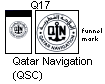
Q17

The funnel follows Al Khor on 3 June 2006, with the logo referenced to the company website.

Formed in 1964 as Qatar National Navigation & Transport Co. Ltd., also QNNTC, the company adopted Qatar Navigation in 2005 and subsequently the name Milaha. It and Qatar Shipping formed Halul Offshore Services in 2001. Qatar Navigation’s approximately 15% interest in Qatar Shipping became full ownership in April 2010.

Qatar, Doha.
Qatar Shipping Co. SPC.

QATAR SHIPPING CO.SPC.

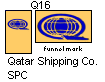
Q16

The funnel follows Dukhan in a starboard photograph of 15 October 2006. Mesaieed’s portside photograph at Singapore on 6 November 2011 appears lighter and creamish, but Rosanoski notes that the sky suggests light adjustment to the photograph.

Known as Q Ship or QSC, Qatar Shipping was formed in December 1992 and began commercial operations in February 1994; Lloyds instead gives 1994 as formation. Its website stated in 2007 that it comprised 96% of Qatar’s shipping fleet. Qatar Navigation acquired it fully in April 2010, having previously held about 15%, alongside Qatar Petroleum’s approximately 18%. The two shipping companies had formed Halul Offshore Services jointly in 2001.

Qatar, Doha.

QATARGAS.

Q24

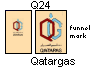
The funnel follows a starboard photograph of Dakhan taken on 8 March 2013, with the logo referenced to the company website.

Established in 1984, Qatargas acted as a charterer. Qatargas Operating Co. Ltd. was formed in July 2005 to own and operate assets on behalf of shareholders.

Qatar, Doha (assumed).

QUADRANT BEREEDERUNGSGES. MBH.

Quadrant Bereederungsges. mbH

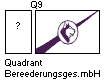
The white flag has a narrow black diagonal band, described as “Pbds”, tapering towards the fly. Over it is a white circle edged black containing a black-and-white dog’s head facing the fly. Colour shades follow the website image; no funnel is given.

Quadrant was formed in 1998 with a fleet held through operating subsidiaries. These included m.s. “Husky Racer” GmbH & Co. K.G., formed in 1998, and m.s. “Husky Runner” GmbH & Co. K.G., formed in 1996 at Jork. The image website instead names Husky Racer Martens Schiffahrts K.G. of Jork.

Germany, Hamburg.

QUARRIES PTY. LTD.

Q1

The register dates Quarries to 17 April 1934 and follows it through several name changes to Boral Construction Materials Group. Another history describes a 1935 joint venture combining small hard-rock quarries and river-gravel operators on the New South Wales south coast and around Sydney, financed by the Bank of New South Wales. Blue Metal & Gravel was its marketing company, later becoming BMI in 1978 and joining Boral Gas. That account leaves Quarries’ own fate unclear; Rosanoski tentatively suggests it faded away, despite the register’s name-change history.

Quarries bought the State Metal Quarries assets in December 1936, including Bombo, built in 1930. Requisitioned for naval service in February 1941 and returned in July 1947, she sank on 22 January 1949. Rosanoski identifies The Log’s April 1949 date as incorrect.

Australia.

QUEBEC STEAMSHIP CO. LTD.

Q14

Furness, Withy acquired the company’s goodwill in 1919. Bermuda & West Indies Steamship Co. Ltd. was formed in 1920 or 1921 to take over its assets.

Canada, Quebec.

QUEBEC STEAMSHIP LINES LTD.

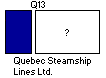
Q13

Mitchell’s line drawing of Dingwall’s Walton shows a dark buff funnel.

The company was renamed from Constantine Line (Canada) Ltd. in 1948. Joseph Constantine Steamship Line owned it under the earlier name, but continued ownership after the change is unclear. In 1953–54 Quebec is recorded as manager for Dingwall Shipping and Montreal’s Ivor Shipping, whose vessels used names beginning Ivor.

Canada, Montreal.

QUEENSHIP NAVIGATION LTD.

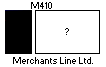
M410
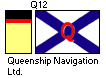
Q12

Stewart 1963 shows a larger Q.

Merchant Ships 1944 gives British Channel Islands Shipping’s funnel. Rosanoski thinks its flag probably also applied at that stage.

Originally Merchants Line, the company became British Channel Traders in 1943 and Queenship Navigation in 1947. Coast Lines controlled it, with British Channel Islands Shipping as manager from 1943.

U.K., London.

QUEENSLAND PHOSPHATE LTD.

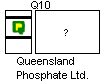
Q10
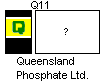
Q11

The funnel is recorded for Korean Count in 1977. A September 1978 observation uses Count, said to be the same vessel. Rosanoski tentatively identifies the 1974-built Count, but did not find her under the stated owner Cho Yang Shipping.

The emblem is a stylised green Q surmounted by a smaller yellow P.

Registered at Southbank, Victoria, on 9 June 1972 as Queensland Phosphate Pty. Ltd., the company later became Queensland Phosphate Ltd., WMC Fertilizers Ltd., WMC Fertilizers Pty. Ltd. and Southern Cross Fertilisers Pty. Ltd. It operated chartered tonnage in the late 1970s. WMC took over the former owner BH South in 1980 and is recorded with an 83.55% holding.

Australia, Melbourne.

Queensland Shipping Co. Ltd.

Documentary images — company attribution uncertain

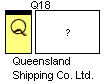
Q18

Mitchell’s line drawing and a photograph of Twinhorse on 21 August 1960 support a black funnel. Rosanoski nevertheless finds the origin of Mitchell’s funnel illustration unclear, since no other ship is named. Twinfox had an entirely different funnel under Mutual Shipping.

Corporate relationship and observation date unproved.

The source traces Benrinnes, bought in January 1959 and renamed Twinbear, under Great Southern Steamship management. Renamed Kuala Tregganu in 1962, she reached Osaka for breaking in January 1963. Beaconsfield became Twinhorse in 1958 and was disposed of in 1964. Ownership evidence differs: Mitchell gives Queensland Shipping for Twinhorse, while Miramar gives Gibson Shipping, and Rosanoski found neither in the relevant Lloyds entry. Miramar also gives Great Southern as owner of Twinbear/Kuala Trengganu. Gibson of Macau and Great Southern also appear successively with Gibson, later Twinfox, before Mutual Shipping ownership.

Bahamas, Nassau; Mitchell gives UK, London, presumably from Twinhorse’s registration.

QUEENSLAND STEAM SHIPPING CO.

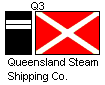
Q3
image by Jonathan Dixon, 5 August 2005
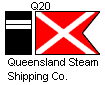
Q20

The funnel was black with two white bands, following British India. Bob Tompkins’s article shows a rectangular red flag with a white saltire, a “virtual reversal” of British India’s colours. The word virtual was omitted in the printed text, allowing a different interpretation because British India’s flag was swallowtailed and its saltire did not reach the fly. Article proofs confirmed the rectangle; a black-and-white Warrego photograph appears to support it. Mac McKellar likewise describes a white St Andrew’s cross on red.

The BIShip website instead shows a red swallowtail with a white saltire, but could not identify its source. Rosanoski conjectures that it may derive from World Ship Society records repeating the shortened “reversal” description. He favours the rectangular evidence while retaining the uncertainty; other websites show rectangles but have unknown sources.

Documentary images — company attribution uncertain

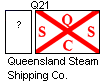
Q21
image contributed by JLL, 14 March 2010

Flaggenbuch 1905 supplies this version for Queensland Steam Navigation Co. Rosanoski considers it likely to be the same company, allowing for possible translation differences in the name and lettering.

Do not equate companies from initials/translation conjecture.

QSS was formed in 1881, registered in London with British India Steam Navigation, Charles Parbury, James Burns and McIlwraith Mc Earcharn among its shareholders; Burns is separately identified as controlling shareholder. In 1887 its operations combined with Australasian Steam Navigation in Australasian United Steam Navigation. Rosanoski distinguishes the latter’s registration on 12 March from QSS’s winding-up and sale on 23 May. He questions an account describing a Burns Philp origin under the name Queensland Shipping Co.

Australia, Brisbane.

QUEENSLAND TUG & SALVAGE CO. PTY. LTD.

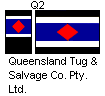
Q2
image by Jarig Bakker, 5 October 2005

Rosanoski presumes that the later Adsteam Harbour-Brisbane operation used Adsteam colours.

The company originated on 1 November 1954 as MacKay & Co. Pty. Ltd., later Queensland Tug Co. Pty. Ltd., and adopted Queensland Tug & Salvage in March 1984. Howard Smith and Adelaide Steamship acquired it jointly in March 1978, also described as a 50:50 formation. It later became wholly owned by Adsteam Marine and traded as Adsteam Harbour-Brisbane around the start of the century.

Its salvage subsidiary began as the shelf company Zalamouni, registered on 24 May 1988 and acquired on 29 June. After the name QTS-Salvage, it became United Salvage on 15 September 1988, with Marine Pacific as a subsidiary.

Australia: Brisbane, Hamilton and Newstead in successive registers; Mitchell gives Adelaide.

Queensway Navigation Co. Ltd.

Documentary material — company attribution not established

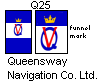
Q25
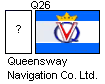
Q26

The funnel follows Vemaoil XXIII in a portside photograph of 14 September 2013. A moving website display of an unnamed vessel suggests that some funnels may follow the company logo more closely.

The flag is an assumed possibility based on the website panel logo, not evidence of a flown flag. The narrative calls it Q25 while the bibliography identifies the logo-derived flag as Q26.

Queensway was established as a privately owned shipmanagement company in 1990. Lloyds initially gave 1991, later amended to 1990.

Rosanoski presumes a connection with Vema Oil of Gibraltar because its website shows a Queensway-managed vessel. Vema Oil is identified as a subsidiary of Greece-based Macoil International; that evidence does not establish ownership of Queensway.

Greece, Piraeus.