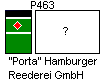
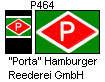
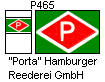
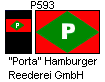
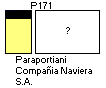
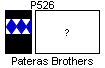
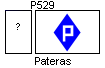
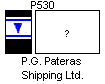
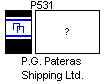
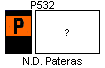
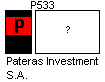
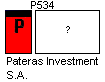
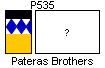
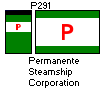
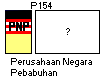
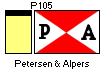
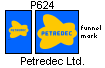
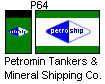
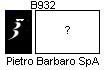
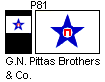
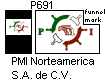
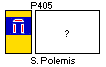
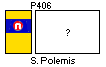
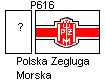
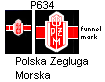
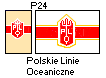
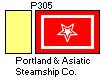
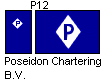
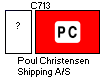
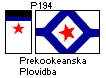
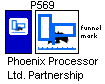
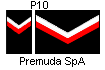
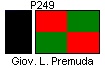
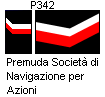
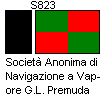
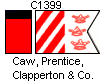
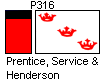
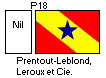
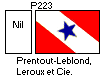
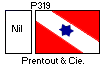
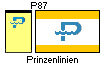
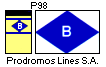
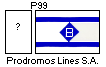
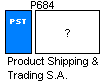
Mitchell’s Fisser & van Doornum card labels the funnel “Portia Hamburger”, presumably a misspelling of the company name: Rosanoski found no ship of that name. No line drawing accompanies it.
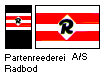
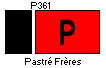
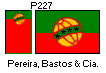
The flag is red with a green lozenge touching the edges and bearing a white capital P.
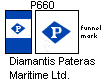
Rosanoski considers P465 apparently miscoloured: the funnel should be black as in P464. Whether the diamond spans its width depends on the width of the funnel.
FOTW identifies Porta as a subsidiary of Fisser & van Doornum. Lloyds gives the same address, and Flaggen & Schornsteine groups the companies together and gives Fisser & van Doornum as the correspondence address. Both ships were sold in 1964.
Germany, Hamburg.
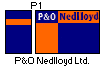
P & O Nedlloyd.
P & O NEDLLOYD LTD.
The shared container-ship funnel was dark blue with a medium-width orange band. The full livery change, especially hull colours, was to take four years as ships docked for maintenance. Pegasus Bay confirmed it at Wellington in November 2000. P&O Nedlloyd Marita appeared in December 2003 with the normal funnel and a Blue Star flag painted on the superstructure; the next two ships in its Reederei Blue Star class, Adriana and Regina, instead appeared with Blue Star funnels early in 2004.
The British operation acquired Blue Star in February 1998, apparently replaced in 2002 by Reederei Blue Star, and took over Tasman Express’s trans-Tasman trade and charters in February 1999. Those ships still used their old funnels in December. Ellerman & Bucknall was sold to Grindrod in 2001. Other interests included Port Line, Australia Asia Express, Swire ventures, Charante and Orchid Holdings with Keppel.
U.K., London.
P&O NEDLLOYD B.V.
The Dutch operation included Noordkaap and Brazil’s Oceanica AGW, or Mercosul Line. Its wholly owned Blue Star Ship Management took over the parent’s ship management on 1 February 2005.
Netherlands, Rotterdam.
P&O and Nedlloyd formed their joint container operation on 1 January 1997, incorporating P&O Containers and establishing British and Dutch companies. The Dutch company was a renaming of Nedlloyd Linjen. Nedlloyd became principal owner in 2004, with P&O retaining 25% after the transaction described in the source; John Fredriksen and Einar Rasmussen acquired nearly 12%. P&O’s sale is recorded as completed in 2005, and the company merged into A.P. Möller in February 2006. It participated in the Grand Alliance from 1998.
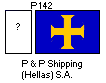
P & P SHIPPING CO. (HELLAS) S.A.
The company is listed in 1992–93 and 1996–97 as manager for one company.
Greece, Piraeus.
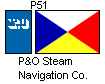
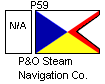
P&O Steam Navigation Co.
P&O STEAM NAVIGATION CO.
image by Jorge Candeias, 23 February 1999
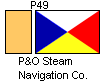
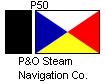
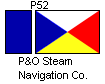
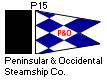
The house flag’s blue and white quarters represent Portugal’s royal house, and red and yellow Spain’s. The blue is royal blue, taken from an actual flag. The early livery combined a black hull, buff deck housing and black masts and funnels. The black cargo-ship funnel is dated 1835–1972 and confirmed by Pando Gulf in May 1971. Reed 1891 incorrectly prints the blue flag panel black. A later commercial logo shows the flag waving above bold P&O letters.
From 1971 the funnel became light blue with a white P&O monogram, confirmed by Piako and Westmoreland photographs. Gandara still showed that shade in February 1996 despite the reported 1992 colour change.
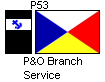
Reed 1912 assigns this funnel to the P&O Branch Service.
This appears to be an advertising flag rather than one used at sea. Nüsse catalogued examples under Dutch locations, with differing country placement on the later website.
Legal entity and shipboard use unproved.
P&O Containers — Tokyo Bay green funnel
P&O Containers Ltd.
Approved QA2 mapping retained.
P&O Ferries — earlier ferry-operations mark
No single subsidiary identity inferred.
P&O Cruises Australia — Pacific Sun
Pacific Sun used P432 in June 2005 before adoption of the later P381 logo. Pacific Sky photographs show that later emblem mirrored between the sides and the P&O house flag still flown despite Carnival registration.
No historical ownership equivalence from brand.
Parent company
U.K., London.
Keep the explicit scope label independent; no alias or company identity is inferred.
P&O Australia
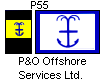
P&O Australia was formed in 1961. Its offshore, port and stevedoring interests included Beaufort, Brisbane Wharves, O&G Stevedoring, Carpentaria and Asian Terminals, the latter formed with Filipino interests in January 1996. International Offshore Services was revived with Farstad in December 1997. Offshore Maintenance Services was a venture with Howard Smith, renamed from International Offshore Maintenance Services in 1984. Accounts differ over the ownership and disposal of New Zealand Offshore Services. The later source places the Australian operation under DP World, with P&O Polar Australia as a subsidiary.
Australia, Melbourne and Sydney.
Keep the explicit scope label independent; no alias or company identity is inferred.
P&O Maritime Services
P&O Maritime Services is dated to 1991 as Australian Offshore Services. Its interests included half of Carpentaria Management Services from 1999 and the Offshore Maintenance Services venture. The source also records purchase of Burns, Philp Shipping Holdings shares in June 1999 while describing a resulting 50% holding.
Australia, Melbourne.
Keep the explicit scope label independent; no alias or company identity is inferred.
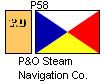
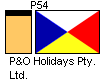
Passenger ships used the buff P49 funnel from 1931, confirmed on Oronsay in 1972; Strath Services used the same livery. Fair Princess at Wellington in February 2000 had a P54 variation, light buff with a narrow black top, possibly a consequence of funnel design.
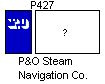
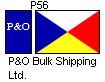
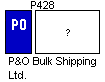
Brown 1995 gives P56 to both P&O Containers and Bulk Shipping. Mitchell dates a change from Brunswick green to Euro blue to April 1992. Tokyo Bay illustrates the green P429; Baluchistan in July 1993 may illustrate the new colour as P427, although Mitchell’s examples are P428 for the bulk and container businesses.
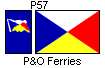
The original P&O Ferries funnel is P430, with the house flag added in 1982 in the source-only P431 version. P57 was adopted across ferry divisions in September 1987. Brown shows a white pole, but vessel photographs show only white edging along the hoist to distinguish the flag from the same-coloured funnel background. The starboard emblem is mirrored, with two waves along its upper edge and three below.
Mitchell shows three additional, unexplained funnels: black with one broad white band; black with two white bands, possibly British India but with a wider intervening gap; and white with a narrow black top. Towage Services adopted a funnel incorporating the house flag within a circle.
Brodie McGhie Willcox and Arthur Anderson became partners in 1822. With Captain Richard Bourne they began the London–Spain–Portugal Peninsular service in 1836 or 1837. A Royal Charter of 31 December 1840 incorporated the Peninsular and Oriental Steam Navigation Co.; the source explains why its name has neither Ltd. nor plc. Expansion brought Blue Anchor’s Australian service in 1910, British India in 1914 with control separately dated 1919, New Zealand Shipping and Federal in 1916, Hain and Nourse in 1917, Union Steam Ship of New Zealand in November 1917, Orient and Khedivial interests in 1919, General Steam Navigation in 1920 and Moss-Hutchinson in 1935. Blue Anchor became the P&O Branch Service, wound up in 1936.
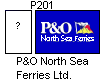
The trans-Pacific Orient & Pacific service began jointly with Orient in 1958 and became P&O-Orient in 1960. Cargo subsidiaries were combined in the General Cargo Division in 1971, followed by Strick in 1972. The group tanker organisation is variously dated 1961, 1962 and 1966; Trident entered the Bulk Shipping Division in 1971. General Cargo joined Bulk Shipping in March 1983. Bulk ventures included Associated Bulk Carriers, Panocean-Anco, Lauritzen-Peninsular Reefers and the Anglo Nordic combination. Coast Lines was acquired in 1971, retaining individual liveries until P&O Ferries in 1975. European Ferries followed in 1987; North Sea operations were reorganised in 1997 and Irish Sea operations in 1998. Full ownership of P&O Stena in late 2002 brought the P&O Ferries and P&O Ferries Ship Management names.
Overseas Containers, a consortium from 1965, became wholly owned in mid-1986 and P&O Containers in January 1987. It merged equally with Nedlloyd’s container business in January 1997. P&O sold its joint-venture interest in 2004 while retaining a 25% interest in the reorganised concern; disposal of the holdings was completed in 2005. Princess Cruises was acquired in 1974 and Sitmar later joined the cruise interests. The cruise demerger is described as occurring in 2001, following a 2000 proposal and listing. Carnival acquired P&O Princess in April 2003, retaining P&O cruise brands under licence in Britain and Australia. P&O itself was sold to Dubai Ports World in March 2006.
P&O STENA SHIP MANAGEMENT LTD.
The blue flag carries the two partners’ flags shown fluttering. Stena’s is the version with only S, without ship or wave. Photographs confirm the funnel and flag; the starboard funnel appears to show the same arrangement as the port side, unlike P&O’s mirrored emblem.
Formed in 1998, the venture was held 60% by P&O and 40% by Stena. P&O bought the remainder in late 2002 and renamed it P&O Ferries Ship Management. P&O Stena Line, previously P&O European Ferries (Dover), became P&O Ferries at the same time. The operating companies included Stena Equipment & Aircraft Leasing.
U.K., Dover.
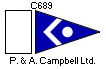
P. & A. CAMPBELL LTD.
The funnel is white with a black cowl top; Brown 1982 consequently shows a narrow black top, as does Mitchell.
P. & A. Campbell began shipowning in 1885 and became limited in 1893. Known as the White Funnel Fleet, its paddle steamers served the British coast. It absorbed ships of Bristol Channel Passenger Boats’ Red Funnel fleet in 1911, though whether all or only part is unclear, and W.H. Tucker’s Yellow Funnel fleet in 1922. European Ferries acquired the company in the 1970s. Operations ceased in February 1981.
U.K., Bristol; Cardiff is recorded in 1958–59.
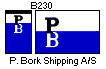
P. BORK SHIPPING A/S.
Brown 1978 shows the bottom of “P”, where it overlaps “B”, white with a black outline.
Denmark, Copenhagen.
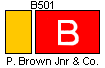
P. BROWN JNR & CO.
Lloyd’s 1912 gives P. Brown Jnr & Co. a red flag with white “B”, which Rosanoski considers likely to be the operator’s own.
Other sources and FOTW assigned operated-company flags to Brown: Norden’s N57 and Det Helsingorske’s H351. Rosanoski rejects these as Brown’s own flag, distinguishing the operator from the companies with their separate liveries.
The business began as Peter Brown and is recorded as a steamship owner from 1893. Peter Brown and P. Brown Jnr & Co. operated for companies including Danmark, Hafnia, Norden and Det Helsingorske Dampskibsselskab.
Denmark, Copenhagen.
P. HENDERSON & CO.
image by Jarig Bakker, 30 June 2003
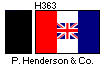
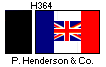
The order of the tricolour’s stripes was reversed following French objections. Former Henderson employee Brian Dickson gives the account that France originally allowed the tricolour in recognition of the company carrying French troops from Marseilles to the Crimea, then requested reversal to signal flag “T”, red at the hoist, to prevent confusion. This is retained as Dickson’s explanation.
Stewart and Brown show equal-width stripes; Griffin does likewise for H364 and also assigns that livery to the Irrawady Flotilla. LJC and Loughran give H363 a wider white stripe. Reed 1912 does so for its British & Burmese and Burmah Steamship entry, but not its Henderson Line entry. Bakker’s H363 FOTW illustration derives from Harnack 1938.
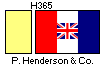
H365’s funnel was used on the West Indian service. The source does not give a flag; the flag shown with it is assumed to apply.
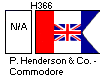
P. Henderson & Co., or Henderson Line, was founded by a member of the Henderson family connected with Anchor Line and the shipbuilders D. & W. Henderson. It operated British & Burmese Steam Navigation, formed in 1908, and apparently also Burmah Steamship. Albion Line, formed in 1856, was sold and merged into Shaw Savill & Albion about 1882. Henderson controlled the Irrawady Flotilla and was associated with La Platense Flotilla.
Elder Dempster acquired the business in 1951 and later operated part of the fleet. By 1970–71 British & Burmese remained listed under Ocean Steamship through Roxburgh, Henderson & Co. Henderson also operated for the Ministry of Transport. Fleet names referred to Burma or Africa.
U.K., Glasgow.
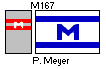
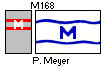
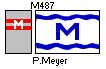
P. MEYER.
Merchant Ships presents these three funnels as alternatives.
M487 follows a monochrome photograph of Havtjeld.
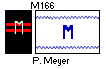
M166 follows Brown 1943.
The further variants are retained from Brown, US Navy, Stewart, Jordan and Mitchell.
Sources differ in the widths of the red funnel bands and the number of waves in the flag bands. Rosanoski considers M487 probably the most accurate. A later passage says the livery formed the basis of a new design following a name change, despite the earlier rejection of that corporate renaming.
P. Meyer operated vessels under companies apparently serving as name subsidiaries, with Hav-prefixed ship names. Rosanoski rejects the register’s claim of a 1977 renaming to A/S Havtor, identifying Havtor as a principal operated company rather than a new name for Meyer.
Norway, Oslo.
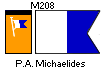
P. MICHAELIDES.
Nicos of Ritalex carried an orange funnel with a narrow black top and a flag painted flapping from a white pole. The flag is a vertically divided white-blue swallowtail; its independent use is assumed.
Michaelides is recorded as manager for Compañia Naviera Ritalex in 1978–79, the latter probably a subsidiary.
France, Marseilles.
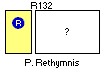
P. RETHYMNIS.
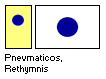
The funnel, recorded on Vasilios R. and Aghios Spyridon in October 1966, is yellow or buff with a blue circle containing a white R. No flag is recorded.
Unknown.
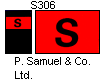
P. SAMUEL & CO. LTD.
P. Samuel registered the Nora S.S. Co. in 1907, initially using one-ship companies before consolidation under Universal S.N. Co. Kestell S.S. Co. was registered in 1915 to buy two second-hand ships; in 1916 its interests passed to P. Samuel & Co. with Kestell Brothers. Kestell was liquidated in 1923, followed by consolidation under Universal S.N. Co., which went out of business in 1925.
UK, Cardiff; later London.
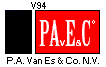
P.A. VAN ES & CO. B.V.
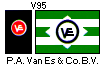
The earlier flag is red with white “P.A.vE.&Co.”; letter sizes vary between sources. Jarig Bakker’s FOTW image follows the Dutch house-flag chart issued with De Blauwe Wimpel in April 1956.
In 1961 the company adopted a flag reflecting the Van Ommeren connection: green and white horizontal bands with a white diamond, black ring and stylised black “VE”. Rosanoski describes six bands, while Jarig Bakker describes five equal stripes. The disagreement is preserved rather than silently choosing a count.
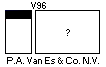
V96’s funnel is documented in ABC Foreign Coastal Freighters, about 1959, page 51; no separate design description is supplied.
P.A. Van Es was a steamship owner from 1850 and appears first as an N.V., later as a B.V. It belonged to Phillipus Van Ommeren N.V., with Rheinische Tankreederei GmbH listed as a subsidiary. Managed companies included British & Continental Steamship Co. Ltd. and N.V. Verenigde Tankkustvaart. Vessel names commonly ended in “singel” in the late 1950s and used the prefix “Bree” in the 1960s.
Netherlands, Rotterdam.
P.D. GRAM & CO. A/S.
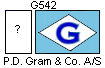
The flag follows the company website logo, but Rosanoski explicitly regards its colours as suspect.
Peter D. Gram formed the concern in 1982. Known also as PDG&Co, it arranges and manages private equity, with shipping concentrated on car carriers through Gram Car Carriers and some small LPG vessels. OSM handles technical management; the account records a 20% OSM interest held by the owners. The company website describes joint ownership by Gram and Kim Steimler, while a separate source gives Arne Blystad a 40% holding. These ownership descriptions are not reconciled.
Norway, Oslo.
P.D. MARCHESSINI & CO. LTD.
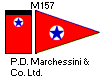
The livery changed around the end of the 1950s. Both versions have a red funnel with black top and a red pennant, each bearing a white disc. The earlier disc contains a blue ball; the later contains a blue star. Marine News contains the star within the disc, while NJK’s San Basileo record extends it to the edge. Subsidiaries used the same livery.
The registers identify a Hong Kong Far East concern and an address relationship with Compañia Maritima San Basileo. Subsidiaries included Bedford Overseas Freighters, formed in 1947, and San Basileo of Panama. Marchessini became bankrupt early in 1976 and was bought by Ta Peng Lines.
USA, New York NY; London also recorded.
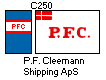
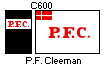
P.F. CLEEMANN SHIPPING APS.
Rosanoski takes the colour shades from the website image.
The business is recorded as manager in Merchant Ships 1942 and 1944. Later Lloyd’s entries alternate between management and ownership, using P.F. Cleeman in 1963–64 and P.F. Cleemann by 1985–86; the cited records continue through 1996–97. It managed Aabenraa Rederi A.S. and part of Chr. P. Barsøe A/S’s fleet in 1970–71 and 1973–74, followed by the whole fleet in 1978–79.
Denmark, Aabenraa.
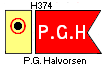
P.G. HALVORSEN.
P.G. Halvorsen operated passenger services from Bergen and Stavanger to Newcastle in 1890–92, ending with the company’s liquidation.
Norway, Bergen.
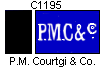
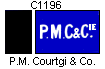
P.M. COURTGI & CO.
Courtgi’s ships used the Ottoman flag.
Courtgi came from Mytilene and established the Aegean Navigation Co. in Istanbul in the 1880s. By 1890 it was the city’s second-largest company. It operated as Navigation à Vapeur “Egée”, used Greek seamen from Galaxidi and owned coal mines in Heraclee.
Turkey, Constantinople.
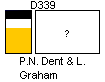
P.N. DENT & L. GRAHAM.
P.N. Dent and L. Graham owned Verao in 1958–59.
Fiji.
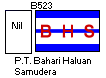
P.T. BAHARI HALUAN SAMUDERA.
This confirms a named entity but does not establish the 1999 shipping identity and historical domicile. Filename reads Hahuan while the document title and external report read Haluan; original filename retained.
Rosanoski describes the company as apparently an agency business.
Indonesia, Jakarta.
P.T. BERLIAN LAJU TANKER TBK.
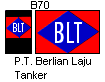
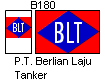
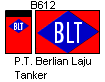
Mitchell gives B612 as an alternative funnel to B70. No flag is shown with it; Rosanoski assumes the same flag applies.
NJK confirmed both funnels in 2001, but by May 2007 reported seeing only B70 for some time.
The diamond’s horizontal extent appears to depend on funnel width. Frabandari at Sydney on 19 June 2006 had a dark-blue diamond touching the top and bottom of a mid-red band but occupying only about one-third of its width. A starboard photograph of Chembulk Wellington similarly shows the diamond touching the band’s upper and lower edges without spanning its full width.
Berlian Laju Tanker, or BLT, dates its establishment to 1981 as PT Bhaita Laju Tanker, adopting PT Berlian Laju Tanker in 1988. Lloyd’s instead gives formation in 1989. In 1990 it became the first Indonesian shipping company listed on the Jakarta Stock Exchange. BSG Corporation was its holding group.
The group owned Indigo Pacific, Diamond Pacific and Asean Maritime. Gold Bridge Shipping originated as a venture between Ocean Tramping and BSG, with BSG taking full control in 1995. Chembulk Tankers was acquired in December 2007. The BLT Chembulk Group announced on 4 November 2010 consolidated commercial management of BLT’s own chemical tankers, PT Banyu Laju Shipping, Gold Bridge Shipping and Chembulk Tankers.
GBLT Shipmanagement companies were established in Singapore in 2002 and Glasgow in 2004. The Singapore tug operator Pan Union, formed in 1987, was bought late in 1997. Other interests recorded were 50 per cent of PT Berlian Limatama, formed in 1996, and 20 per cent of Malaysian Merchant Marine, acquired in 1997.
Indonesia, Jakarta.
P.T. CAKRA BAHANA.
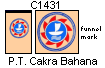
The funnel follows a portside photograph of the company’s own Surya Putra Jaya at Singapore on 17 June 2011. Managed vessels appear to use different colours.
Formed in 2005, P.T. Cakra Bahana is listed as an owner and manager in 2011–12.
Indonesia, Jakarta.
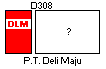
P.T. DELI MAJU.
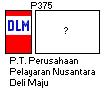
P.T. Perusahaan Pelayaran Nusantara Deli Maju
The funnel follows Kabanjahe. It had a narrow black top between 1995 and 2000, subsequently removed.
The separately referenced D309 funnel apparently comes from Delima 116, although Rosanoski could not locate that particular number in Lloyds.
The company appears in Lloyds from 1973–74 under Deli Madju and later the fuller P.T. Perusahaan Pelayaran Nusantara Deli Maju, with both Maju and Madju spellings in subsequent editions.
Indonesia, Belawan, Sumatra; later Medan, Sumatra.
P.T. DJAKARTA LLOYD.
image by Ivan Sache, None
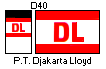
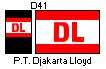
The flag is red-white-red with red DL letters centred in the white stripe. Brown 1978 and 1982 show narrower red funnel bands than Stewart, while FOTW uses wider red bands. Rosanoski considers flag-like proportions likely.
A suggested link with Nedlloyd/Rotterdamsche Lloyd and an alteration of its red-white-blue colours to resemble Indonesia’s flag is explicitly only a contributor’s guess.
Formed in 1951 as P.N. Djakarta Lloyd, the company adopted P.T. in 1974. It was Indonesian government-owned and participated in the ANRO consortium. A proposed 1998 merger with Pelayaran Nasional Indonesia and P.T. Pelayaran Bahtera Adhiguna does not appear to have occurred.
Indonesia, Jakarta.
P.T. PELAYARAN NASIONAL INDONESIA.
image by Ivan Sache, 10 December 2003
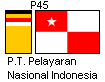
The funnel follows a starboard photograph of Kelud dated 21 December 2013, managed for the Government, and is also confirmed by a photograph of the company-owned Fudi, not retained. The flag is quartered red and white, with a white star in the centre of the first quarter. The FOTW account regards its colours as evidently taken from the national flag.
PELNI, Indonesian National Shipping, traces its origins to Yayasan Penguasaan Pusat Kapal-kapal, or Pepuska, incorporated in 1950. The account says the Netherlands Government had previously refused conversion of its company into a private concern. P.T. Pelni was formed on 28 April 1952, with Pepuska dismissed or possibly closed. It describes a change from public to Government company in 1961, a return to private status in 1975 and further status changes later that year, in 1988 and in 1999.
Lloyd’s instead gives formation in 1963, amended in its 2008 edition to 1989. A 1998 proposal to merge with P.T. Djakarta Lloyd and P.T. Pelayaran Bahtera Adhiguna apparently did not take effect.
Indonesia, Jakarta.
P.T. PELAYARAN SAMUDERA “ADMIRAL LINES”.
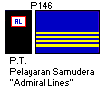
The funnel is black with a white panel edged red and bearing blue block letters AL. NJK reported a variant on Amtra VII at Singapore in which the panel appeared as a flying flag without a pole. The flag is blue, with four narrow yellow horizontal bands in the lower half, separated by equal widths of blue; the lowest yellow band is wider. The original attribution to Admiral Shipping Lines of Manila was corrected by NJK.
Formed in 1969 as P.T. Perusahaan Pelayaran Samudera Ampera Lines, the company changed its name in 1973. Owned by the AA Group, it operated under its own name and through Three Star Navigation, formed in 1991.
Indonesia, Jakarta.
P.T. PERUSAHAAN PELAJARAN “ARAFAT”.
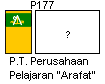
The funnel noted on Ambulombo in September 1966 has a broad green band bearing a stylised A formed by a white pair of compasses above yellow anchor flukes and shaft.
Rosanoski suggests operation from about 1961 to 1979. Miramar assigns Ambulomobo in 1961–65 to the Indonesian Government and Gunung Djati in 1959–79 to A. Holt & Co., but confirms Arafat’s acquisition of Tjut Njak Dhien from the Government in 1965, retaining her until 1979. Two Arafat register entries appear in 1978–79; one, comprising vessels acquired from Compañia de Navegacion Abeto, disappears in 1980–81.
Indonesia, Djakarta.
P.T. PERUSAHAAN PELAYARAN ANGKUTAN PERTAMBAMBANGAN.
image by Jarig Bakker, 2 November 2005
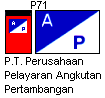
The funnel was noted on Takari I. Mitchell’s colouring suggests that the blue may be lighter.
Founded in 1974, the company is also styled A.P. Container Service. Register entries shorten or vary its expanded name.
Indonesia, Jakarta.
P.T. PERUSAHAAN PELAYARAN NUSANTARA BAHARI.
P.T. Perusahaan Pelayaran Nusantara Bahari
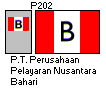
The flag is red with a broad white vertical band bearing a black B. The grey funnel carries a panel of the flag.
The company is recorded in Lloyd’s 1978–79, 1985–86 and 1992–93.
Indonesia, Jakarta.
P.T. PERUSAHAAN PELAYARAN NUSANTARA,
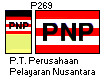
Founded in 1969 and also called Panurjwan, the company belonged to Samudera Indonesia. Part of the fleet was managed by CUMAWIS, under its successive expanded names. Ships used Darpo-prefixed names.
Indonesia, Jakarta.
P.T. PERUSAHAAN PELAYARAN SAMUDERA KHUSUS ARPENI PRATAMA OCEAN LINE.
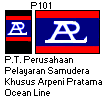
The red flag has a very broad blue horizontal band bearing large white APL letters combined into a single unit. The black funnel carries a very broad band of the flag.
Arpeni Pratama Ocean Line was formed in 1975, operating under its own name and through subsidiaries. Banyu Laju Shipping, formed in Jakarta in 1994, is listed as an operating subsidiary; on 4 November 2010 it became part of BLT Chembulk Group in a consolidation of commercial management.
Thome managed the vessel of Graciela Shipping, while Universal Marine managed Kent Carriers’ vessel.
Indonesia, Jakarta.
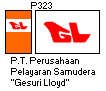
P.T. Perusahaan Pelayaran Samudera “Gesuri Lloyd”.
Documentary material — company attribution not established
image by Ivan Sache, 1 November 2003
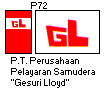
The stylised GL letters form the silhouette of a ship sailing towards the flag’s hoist. Company website images suggest an orange funnel, possibly an air/sea-rescue shade, and letters of equal height.
The website dates formation to 1964 through a merger of P.T. Gamarco, Speed Nusa, Pendawa Veem and Gesuri Lloyd; Lloyd’s gives 1967. The Indonesian firm is absent from the 1970–71 register, but Gesuri Lloyd (Liberia) of Hong Kong owns Gelora, a name later used by it. Rosanoski suggests a possible connection with other Gesuri Lloyd firms, including a Panamanian company with a form of the livery. Three same-address register entries in 1978–79 subsequently appear as one.
Management interests included Indobaruna Bulk Transport and Mitsui O.S.K. Line Indonesia.
Indonesia, Jakarta.
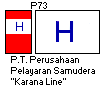
P.T. PERUSAHAAN PELAYARAN SAMUDERA “KARANA LINE”.
The white flag bears a blue H. The red funnel has a broad band of the flag.
Founded in 1967, Karana Line first appears in the cited registers in 1978–79. Island Navigation Corporation (Ship Management) managed one vessel in 1985–86, and Orient Overseas Container Line one in 1992–93.
Indonesia, Jakarta.
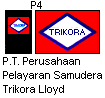
P.T. Perusahaan Pelayaran Samudera “Trikora Lloyd”.
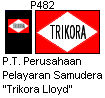
P.T. PERUSAHAAN PELAYARAN SAMUDERA "TRIKORA LLOYD".
image by Jarig Bakker, 2 November 2005
The later website version, P482, has no blue frame around the diamond and uses black letters. A separate funnel drawing supports this arrangement. Either Brown’s P4 is incorrect or a change occurred; Rosanoski does not resolve which.
P.T. Trikora Lloyd was founded in 1964 according to the group website, while Lloyd’s gives 1967. Rosanoski suggests that the latter may mark the beginning of shipowning. Financial difficulties apparently led to rescue by the Bimantara group, formed in 1982 by Bambang Trihatmojo, President Suharto’s second son. The last vessel, Mandiri Jaya, was sold in 2003; the company continued in agency activities. Rosanoski suggests that leaving shipowning explains the shorter later name.
Indonesia, Jakarta.
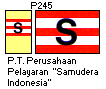
P.T. PERUSAHAAN PELAYARAN “SAMUDERA INDONESIA”.
Brown 1995 gives bands of equal width.
Darpo Tiga was noted at Singapore on 10 November 1969 with the Perusahaan Negara Pelabuhan funnel.
Founded in 1969, Samudera Indonesia operated through several companies, including Palihota Dayaka Lines and Perusahaan Pelayaran Nusantara. Its Jakarta ship-management company began in 1994 as Samudera Denholm Ship Management and adopted Samudera Indonesia Ship Management in 2003. The Singapore operator Samudera Shipping Line was formerly Samudera Indonesia (S) Sendirian Berhad. Tankindo Perdana, formed in Jakarta in 1982, operated partly through Singapore’s Foremost Maritime, formed in 1995.
The group also acted as agent for Pali Hota Dayaka. Hapag-Lloyd and later Samudera Shipping Line managed parts of its fleet. Many ships used Sinar-prefixed names.
Indonesia, Djakarta.
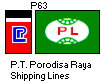
P.T. PORODISA RAYA SHIPPING LINES.
The red funnel has a black top separated by a narrow white band and bears combined PL letters in blue and white. The green flag has a white horizontal oval with red PL letters. A wheel-like white ring arc, edged and divided into segments by green lines, extends above and below the oval.
The company is recorded in 1978–79, 1985–86 and 1992–93.
Indonesia, Sabang; later Jakarta.
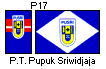
P.T. PUPUK SRIWIDJAJA.
The top of the shield bears PUSRI.
Also known as PUSRI, the company was formed in 1976.
Indonesia, Sumatra & Jakarta.
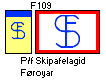
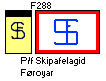
P/F SKIPAFELAGID FØROYAR.
image by Ivan Sache, 1 December 2003
The FOTW F288 image derives from the former Faroe Ship website. If that image was the same as the later Eimskip logo, Rosanoski considers the FOTW version more rounded, resembling F109 but occupying less height.
Also known as Faroe Ship, the company was formed in 1919. Z. Niclasen was its operator in the 1950s. Eimskip acquired it in 2004.
Denmark, Torshavn, Faroes Islands, as classified in the source.
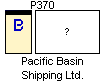
PACIFIC BASIN SHIPPING LTD.
Handy Prince at Lyttelton on 8 July 1990 had a pale yellow funnel, probably cream affected by rust, and a light-blue combined P and B. Handy Islander in August 1998 and Sulu Warrior in March 1999 showed light cream or whitish funnels and thin lettering. Oak Harbour in August 2005 was yellowish with thin lettering and no black top. Later Champion Bay, Chatham Island and Mount Adams photographs show different funnel shades and thicker letters of varying brightness. Clearwater Bay in May 2013 had light buff, a large thick letter and no black top, apparently while chartered. NJK read the colour as white, leaving possible display or photographic effects unresolved. Mitchell uses the name Pacific Basin Handy Bulk Carriers.
Pacific Basin began in 1987 as an investment and management business. The company account describes Pacific Basin Bulk Shipping’s 1994 listing, acquisition and privatisation in 1996, and a new Pacific Basin Shipping formed by former staff in 1998, listed in Hong Kong on 14 July 2004. Lloyd’s instead traces successive names from Tadcester through Pacific Basin Agencies and Pacific Bulk Shipping to Pacific Basin Shipping. It records a venture between Christopher Buttery and Bocimar, bought by management and new shareholders in 1991. A later register correction says the post-1998 Pacific Bulk Shipping was not connected with PNSL, contrary to the earlier listing.
Operating interests included Hong Kong agencies and management companies. The International Handybulk Carriers pool was established in 2001, with partners including Torm, Wah Kwong, Sinotrans and others. A majority interest in IndoChina Ship Management was acquired in 2000 in a Jardine Matheson venture; dry-bulk management remained within Pacific Basin while other management transferred to Epic as ICSM. Towage began in 2007 with a business described as Australian harbour towage, although Rosanoski wonders whether the acquisition was New Zealand’s Sea-Tow.
Hong Kong; Hamilton, Bermuda, in Lloyd’s 1996–97; Hong Kong, China, in the later register.
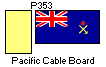
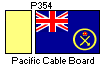
PACIFIC CABLE BOARD.
image by Miles Li, None
The board’s ships were granted a Blue Ensign bearing crossed cable-laying implements beneath a royal crown. Rosanoski reads the implements as an arrow and mallet and treats the flag as an ensign rather than a house flag. The funnel is confirmed by a black-and-white Iris photograph. The 2003 account says withdrawal of the ensign in 1929 was probable, while the later account describes it as obsolete on winding-up.
Britain, Canada, New Zealand and Australia formed the public board in 1901 to establish a westward cable link to Australia without crossing foreign territory. In 1929 it was wound up and its assets combined with the Eastern Telegraph companies as Imperial and International Communications, renamed Cable & Wireless in 1934.
U.K., London.
PACIFIC COAST STEAMSHIP CO.
image by Joe McMillan, 19 August 2001
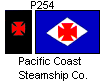
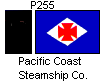
A 1916 timetable provides a flag image, but its black-and-white ship photographs do not confirm the P254 funnel.
Charles Goodall and Chris Nelson began supplying water to San Francisco ships in 1860, or the 1860s, and developed coastal shipping. New capital and restructuring created Pacific Coast Steamship in 1877, with control later passing to eastern investors. Goodall and Perkins had bought into Salinas in 1867 and were still agents in 1901. The company acted as shipping agent for Oregon Improvement. Its acquisition of West Coast Steamship is dated 1889 in one account and the early 1900s in another. In 1916 it was sold to Hubbard F. Alexander and merged into his Admiral Line as Pacific Steamship. The account says the Congress fire was used to justify a sale already agreed two weeks earlier.
USA, San Francisco, California.
PACIFIC DIRECT LINE.
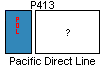
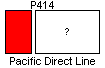
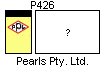
Socofl Stream provides only the starboard view. Its port side carried what is presumed to be Australia Pacific Direct Line’s marking, with very small letters, under an arrangement described as a matter of convenience rather than a joint venture.
Southern Moana’s starboard photograph of 29 September 2007 is treated as a mirror image of the company logo. If that assumption is wrong, the portside emblem would face the other way.
Southern Lily, photographed on 27 December 2007, had a different funnel. It was chartered from Pacific International Lines; Rosanoski suggests that company’s band may simply have been omitted.
Southern Pearl NZ’s starboard photograph of 12 August 2008 shows a PDL panel replacing the former Thorco panel, with the rest of the funnel unchanged. The ship apparently carried that charter name from 31 January 2008 to 3 March 2011. The starboard emblem is presumed mirrored, making the port side correspond to P415.
Pacific Direct Line, or PDL, was a family shipping concern founded by Bill Ravel, Jean Ravel and Jean-Pierre Varnier. Its origins are traced to the Ravel Group’s Moana service between Noumea, Fiji and Wallis-Futuna in 1966. Members became founding shareholders and directors of Sofrana-Unilines in 1968. The French company was registered at Mata Utu and listed as a subsidiary of Singapore’s PDL International. Pacific International Lines acquired an undisclosed significant stake in 2006, apparently connected with its purchase of McKay Shipping. Vessels often had Southern-prefixed names.
Wallis Islands [Wallis & Futuna Islands], Mata Utu.
PACIFIC FAR EAST LINE INC.
image by Joe McMillan, 8 November 2001
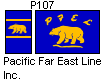
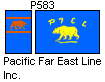
The blue flag bears a golden bear below script PFEL lettering; ship names ended in Bear. Mariposa confirms the funnel, with the bear apparently facing forward on both sides. The source compares it with California Maritime Academy’s Golden Bear II funnel, distinguished by the academy’s sky-blue field. Mitchell gives orange bands and bear, while The Log does not mention ground beneath the flag’s bear. These passages and the bibliography alternate between P107 and P197.
Stewart and US Navy differ in brown, yellow and orange colouring, and show the funnel bear walking aft, contrary to a portside Monterey photograph showing it forward. Stewart’s early fluttering flags leave the ground line uncertain, but the 1963 version has a definite initial wiggle. Rosanoski used the blue of an actual flag for this illustration without claiming that US Navy specified the same shade.
An actual flag offered on eBay has all letters and charges outlined in black and a straight ground line.
Joe McMillan’s FOTW drawing follows US Navy, but its device is larger and the intended blue remains uncertain.
The source notes straight-line lettering as the main difference, although the narrative prints P596 while the corresponding bibliography lists P586.
Thomas E. Cuffe formed PFEL in July 1946 to carry cargo between California and the Far East using surplus wartime ships. It had thirty-one vessels by 1949 and a strong military-cargo business. After his death on 22 December 1959, Ralph K. Davies gained control. The account attributes later difficulties to investment in LASH rather than container ships. Davies sold to Consolidated Freightways in 1969, and the Alioto family acquired control in 1974, with John Alioto becoming president. Monterey and Mariposa had joined the passenger operation in October 1970. Preliminary bankruptcy proceedings in January 1978 became full bankruptcy in June; all but one vessel were auctioned in 1979. Lloyd’s nevertheless still listed the company in 1980–81.
USA, San Francisco.
Pacific Forum Line Ltd.
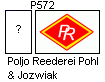
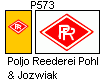
PFL (NZMN 58/4 2012 P285).
image by Jarig Bakker, 11 January 2006
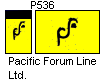
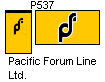
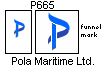
The funnel was confirmed on Forum Samoa and Forum New Zealand at Lyttelton in 1985. Some supplied vessels retained their previous funnels. The company pamphlet’s cover uses P265, while an inside page shows the alternative without black edging outside the emblem’s white outline.
The website and table flag support that alternative, with a more golden yellow in the table flag. Forum Samoa II in September 2007 appears deep gold, its funnel design unedged, while the flag has black outlined in white. Forum Rarotonga in January 2006 shows yellow on both funnel and flag.
Forum Fiji’s starboard photograph of 19 May 2002 shows a sloping logo.
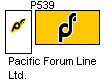
Forum Fiji II in December 2003 has a slanted emblem, apparently outlined yellow, on a white funnel; its flying flag is golden yellow with an upright emblem.
Forum Fiji III appears first with plain sky blue and then plain golden yellow funnels during a colour change. An April 2007 photograph confirms the upright logo with a narrow black orle.
The later Forum Fiji funnel change predates the 2012 takeover, appearing in a February 2012 photograph and a clearer port view in October 2013. The earlier photograph may show the different P658 flag, but its size is insufficient for certainty; the blue bands could be parts of a narrow border.
This possible flag is reconstructed from the later website logo.
PFL was formed in 1977 by a Pacific island and New Zealand consortium and began trading in 1978. Members had equal votes, though New Zealand, Fiji and Papua New Guinea effectively controlled it. The source’s country list and stated total of twelve do not reconcile. Western Samoa bought the line outright in early October 2012; the contemporary account says it then neither owned nor operated vessels, which Rosanoski tentatively interprets as chartering without management. Neptune Pacific bought 50% in September 2013. The parent remained in Apia and the New Zealand operating arm in Auckland. Joint services with Sofrana included Pacific Express and the New Zealand Papua New Guinea Express formed in August 1993.
Western Samoa, Apia; Samoa in the company website.
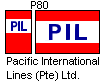
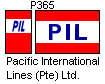
Pacific International Lines (Pte) Ltd.
PIL.
image by Ivan Sache, 31 August 2002
The flag follows an actual example seen at Wellington on 7 March 2003, preferred to Nüsse’s table flag with thicker letters. Funnel photographs show lettering thinner than on the flag. Kota Gunawan in October 2005 illustrates P365, with letters angled “pbds” on a narrow funnel. Ivan Sache’s FOTW flag from Nüsse uses bright-blue letters.
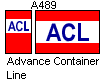
Advance Container Line
image by Ian MacDonald, 31 July 2006
Advance Container Line uses the shared flag format with ACL replacing PIL. Its funnel is confirmed by Selatan Datang and Kota Petani photographs.
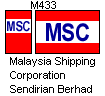
Malaysia Shipping Corporation Sendirian Berhad
image by Ian MacDonald, 28 August 2006
Malaysia Shipping uses a related format with its own initials; Salam Panjang confirms the funnel.
Other related companies substitute PEL for Pacific Eagle and PMS for Pilindo Megah Selatan. The striped logo portion is shown by Mitchell without identifying it as a flag. Srimongkol’s funnel letters may be angled, but the oblique photograph is unclear; Selatan Megah supplies another documented funnel. Southern Lily entering Auckland in December 2007 had a plain red funnel.
Y.C. Chang, also known as Tee Woon Tiang, and friends founded PIL in 1967. It grew from coastal ownership and operation into a major Asian shipping concern, adopting Pacific International Lines (Pte) Ltd. on 3 June 1971.
Related operations included feeder and regional specialist Advance Container Line; Malaysia Shipping Corporation, formed in 1974 with Chang as chairman; Pacific Eagle and Pacific Seatran, both formed in 1992; and Jakarta’s Pilindo Megah Selatan, formed in 1996. Further operating companies included Eastern Maritime (Thailand), PIL (UK) and PST Management. PIL bought half of Blue Funnel (Sea) in February 1981 and a significant Pacific Direct Line stake in 2006, apparently connected with McKay Shipping. Its ships generally used Kota names; the source gives several translations but does not identify the intended meaning. Subsidiaries used Sea, Salam, Pacific and Sri prefixes.
Singapore.
PACIFIC ISLANDS TRANSPORT CO. LTD.
A light-blue band was added to Mamaku’s former Anchor Shipping & Foundry funnel. The same marking is also recorded under A.R. Rusden.
Captain Athol Richard Rusden owned the company, which held Mamaku for nine months in 1973, between Lloyd’s register printings. Sea Breezes calls it Pacific Islands Trading Ltd.
Vanuatu, Port Vila.
PACIFIC LINE PTY. LTD.
Sea Breezes describes the funnel without specifying the direction of its diagonal line.
Pacific Line operated Rigon from 1977 to 1980. Lloyd’s lists Pacific Line at Nukualofa, Tonga, in 1978–79 and Pacific Line Pty. Ltd. at Port Moresby in 1980–81, under different identifiers.
Papua New Guinea, Port Moresby.
Pacific Mail Steam Ship Co.
PMSS (FOTW).
image by Jarig Bakker, None
image by Joe McMillan, 8 November 2001
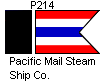
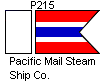
The early flag was a long tapering red swallow-tailed pennant with narrow white borders above and below and white P.M.S.S.Co. lettering decreasing in size. Its occasional use is dated before 1867 in one passage and before 1868 in another.
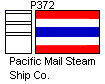
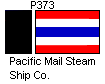
Grace retained the house flag after the 1916 takeover while changing the ships’ traditional black colours. LJC 1885’s P214 flag colours are described as a printing error. The later FOTW image follows Manning and Lloyd’s.
Griffin and Reed domicile these versions in London. Rosanoski considers the Reed P372 funnel colouring incomplete.
The source also reproduces a company seal dated 1848–1925 and the funnel and mast flags from an 1868 lithograph of Japan.
Pacific Mail was incorporated on 12 April 1848 to carry mail from Panama to California, with William Henry Aspinwall a founder. Another source gives 1847. The service benefited from the 1849 Gold Rush, expanding to eighteen steamers within five years and twenty-three in 1869. It bought Atlantic Mail in 1865, but the transcontinental railway, technological competition and loss of subsidised Australasian mail contracts weakened it. Southern Pacific acquired control in 1893. Restrictions on railway-owned ships using the Panama Canal contributed to fleet sales, and Grace took control in 1916.
The Dollar family acquired the Pacific Mail name, flag and goodwill from Grace in 1925, using them occasionally after integration into its own operation. One account describes this as a rename to Dollar Line. Ownership passed to American President Lines with the 1938 government rescue of Dollar, by which time Pacific Mail largely existed on paper. It was formally closed in 1949.
USA, Seattle in Loughran; San Francisco in Lloyd’s 1904.
PACIFIC MICRONESIAN LINE.
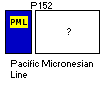
Gunnars Knot carried a blue funnel with a yellow panel bearing black PML letters. No flag was noted.
Unknown.
PACIFIC NAVIGATION OF TONGA LTD..
Pacific Navigation Co. Ltd.
Pacific Navigation Co. Ltd.
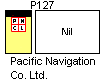
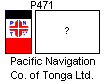
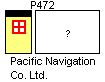
Sea Breezes assigns the funnel to Tonga Pacific Navigation with the panel slightly lower, clear of the black top, and red letters. The Log does not give the letter colour. The panel suggests a flag, but none was observed.
Mitchell gives this funnel for Tauloto II, also associated with P127.
The Log supplies this funnel; Mitchell also places it under Reef Shipping.
Further Mitchell material includes an unnamed-vessel funnel and Haomataka, registered as Ha-amotaha, on both Reef and Tonga Pacific cards. Its fourth-quarter marks look like three dots, probably stars, but the evidence is unclear and letter colours are unspecified.
The source traces the business from Tonga Shipping Agency, active by 1960, through Pacific Navigation Co. to Pacific Navigation of Tonga, or PNT. Pacific Navigation is also recorded as charterer of Tauloto II. A separate account dates Tonga Pacific Navigation’s formation to 1972, with government, Copra Board and Produce Board shareholders. Olovaha, built that year, appears under the government by 1985–86. In 1987 regular ferries served Tonga’s three main island groups.
Tonga, Nukualofa.
Pacific Orient Express Line.
POE
US Navy lists P377 for Norway and P376 for Sweden. The pamphlet supplies a flag and shows Ditlev-Simonsen funnels, including Vigan in 1954. It describes Ditlev-Simonsen as sole owner despite Transatlantic vessels also appearing in the timetables.
POE was operated by Halfdan Ditlev-Simonsen of Norway and Transatlantic of Sweden. Vilja is recorded in the service from 1948, and a surviving timetable covers January–August 1954.
Norway, Oslo; Sweden, Gothenburg.
PACIFIC PEARL NAVIGATION CO. LTD.
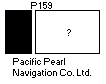
Pearl Light was noted in May 1965 with a black funnel. No flag was recorded.
Unknown.
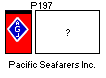
PACIFIC SEAFARERS INC.
The funnel is red with a narrow black top and an elongated upright blue diamond edged white. A white G stands between smaller white A above and J below. The diamond should be thinner than drawn. Colours are broadly reversed from the associate’s livery, and the shared agency suggests a connection with the initials, without fully explaining them. No flag was noted.
Recorded in Lloyd’s 1963–64, Pacific Seafarers used J.J. Georgelis as agent and was associated with Seafarers Inc.
USA, New York.
PACIFIC SHIPOWNERS CORPORATION.
Silver State and Silver Lane were recorded with black funnels. No flag was noted.
Unknown.
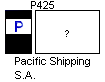
PACIFIC SHIPPING S.A.
Mitchell apparently based this funnel on the sole vessel Switzerland, using Sea Breezes of December 1968.
Pacific Shipping is recorded in 1963–64 and 1970–71 under agents I.R.U.F.A. International Reederei und Fracht-Agentur HmbH.
Germany, Hamburg.
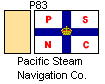
PACIFIC STEAM NAVIGATION CO.
image by Jarig Bakker, 24 August 2004
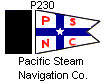
The proposed early flag used a Chilean star as a courtesy to the intended trading country. Loughran describes a tapered swallowtail, changed to a rectangle with a crown before the first June 1840 voyage following receipt of a Royal Charter. The charter is dated January in the red-duster account and February in Loughran. The red-duster illustration is presented as another original version.
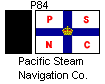
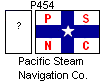
The house flag is white with a blue St George’s cross, a central royal crown and red P, S, N and C in the quarters. Some sources add a raised o after C, sometimes with a dot. Lloyd’s 1904 omits letters, treated as an error or possibly a joint-service variant. Larousse’s crown has a white base in Rosanoski’s reading, although the contributor calls it yellow-and-red; a Brazilian source narrows the cross into a cross paty. The drawings largely follow a circa-1951 museum flag, 1397 × 1778 mm, whose very dark blue cross looks black. Crown details changed over time, but the accounts disagree: Loughran has a St Edward crown replaced under Edward VII and restored under Elizabeth II, while other passages reverse those labels. The pale-buff funnel was adopted after the 1910 Royal Mail takeover, though sources also call it yellow or golden and photographs sometimes suggest a darker shade.
William Wheelwright promoted PSNC after failing to raise American capital, incorporating it in London on 27 September 1838. Chile entered service in 1840, and the headquarters moved to Liverpool as merchants there became the principal shareholders. PSNC helped establish Orient Steam Navigation for the Australian trade in 1877, drew closer to it after the 1898 depression and sold its Australian interests to Royal Mail in 1905. Royal Mail acquired PSNC itself in 1910. The charter was extended in perpetuity in January 1922, subject to retention of the name and Liverpool office. The Kylsant collapse brought a period of separate operation before Royal Mail reacquired the shares in 1938. Furness Withy’s full takeover is dated 1965, or 1964 by Loughran. Its General Shipping Division consolidated subsidiary management in 1977.
Operations ended in 1984 according to one account and 1985 in another. The document also records participation in the European–South American Eurosal consortium, listing its founding partners and later additions in 1987.
U.K., London originally; Liverpool from about 1843.
PACIFIC STEAMSHIP LINES LTD. INC.
Pacific Steamship Co. Inc.
image by Joe McMillan, 19 August 2001
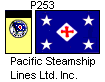
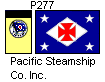
The flag derives from Pacific Coast Steamship’s red cross on a white lozenge, adding four white admiral’s stars on a blue field. A timetable confirms the format, although other sources vary its proportions. The funnel’s lifebelt-like ring reads THE ADMIRAL LINE above and PSSC upright below. Brown 1943 places the flag on the yellow funnel within a white ring; a black-and-white H.F. Alexander photograph does not clearly show the ring.
Talbot-Booth and Rimmington use a narrower cross, perhaps intended as cross paty but appearing closer to a cross couped. Jordan does not detail the funnel emblem.
The Admiral Line was a trading name for Hubbard F. Alexander’s companies. The source dates the Pacific Steamship combination to 1916 and its reorganisation as Pacific Steamship Lines to 1933. Admiral Oriental Mail Line was separately organised in late 1920 for foreign trade; the Dollar family gained control in September 1922, leading to American Mail Line. Accounts of the parent’s end differ: bankruptcy in November 1936 and suspension in June 1938, cessation in 1936, and a 1930s purchase by Alaska Steamship are all recorded. Later registers nevertheless list Pacific Steamship Lines and name companies, with American President Line as controller. Admiral Laws was sunk in June 1944.
USA, Tacoma, Seattle and San Francisco in the cited sources.
PACIFIC TOWING (PNG) PTY. LTD.
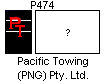
The website photograph shows a royal-blue funnel with attached letters, which therefore have no white edging.
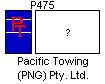
Taralga used this funnel.
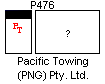
Pacific Salvor used this funnel.
The company website dates incorporation to 28 February 1977, originally under John and Teunis Korevaar with Jas Hill at Lae. Wallacia’s addition in 1980 made it a joint venture with Marine Pacific (PNG); Steamships bought the Korevaar share about 1985. Another account describes a late-1970s Stannards, Korevaar and Inchcape venture, while Lloyd’s gives 1981. Later sources place it with Svitzer and Steamships, and within United Salvage. Howard Smith’s holding through Dilmun is recorded as 45% and later 50%.
Papua New Guinea, Port Moresby.
PACIFIC TOWING SERVICES LTD.
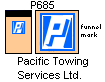
The funnel follows Pacific Ranger II’s port side on 17 February 2014 and starboard side on 15 April 2007.
Pacific Towing Services was established in 1964 as a private company.
Canada, Vancouver.
PACIFIC TUG PTY. LTD.
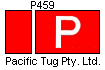
The Log describes a red flag with a white P.
The Brisbane tug operator was run by Con Peter and owned by the Peters brothers until its acquisition by Adelaide Steamship and Howard Smith in 1987. The source identifies two possible registration histories: a 1978 Pacific Tug later renamed Pacific Marine Engineering and deregistered in 2002, or a 1982 Brisbane Marine Services & Agencies which passed through the Heavy Lift (Australia) name to Pacific Tug and was still operating at Victoria Point. It does not establish which applies to this livery.
Australia, Brisbane.
PACIFIC-JAVA-BENGAL LINJE.
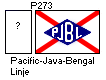
The line was formed in 1931 by merging Java-Pacific Linje and Java-Bengla Linje, under a consortium of Nederland, Rotterdam Lloyd and Koninklijke Paketvaart.
Netherlands.
Pacifica Shipping (1985) Ltd.
PACIFICA SHIPPING (1985) LTD.
The initial funnel, used in 1983–85, was photographed on Spirit of Free Enterprise. Its P was shortened between August and October 1983 while the wave stayed in place; the funnel’s boundary with the superstructure was difficult to define. Chief Officer Dereck Boyes designed an early royal-blue flag with a narrow yellow horizontal band and a block P rising from it. A possible smaller bow-like shape may instead be a smudge on a carbon-copy drawing. The flag flew over the Christchurch office but the ship declined to fly it, and its official status is doubtful. Rosanoski’s later reconstruction rests on sparse records of an actual flag he had handled.
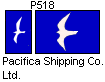
A dark-blue funnel with a white flying bird was painted in January 1985; the new flag was first seen on 5 February. The funnel bird is viewed obliquely from above, showing its head, with the lower wing appearing shorter. Its upper wing originally almost touched the funnel top. The flag bird was more curved, seen directly from above and set nearer the hoist, confirmed by an actual flag. Spirit of Progress in November 1993 shows more space above the bird and a mirrored starboard emblem, flying forward on both sides. The bird is called a seagull in The Log, though shipboard informants were uncertain.
After the Skeggs acquisition the Pacifica flag was flown with the Skeggs flag, initially above it. Skeggs flags were temporarily absent while replacements were made in 1986 and again in 1989, but recorded in late 1990. They ceased being flown by the ships after January 1991 surveys while remaining at the office. Later photographs show both possible orders, suggesting no fixed precedence. By 1999 a Heino Winter flag was also flown following a sale-and-charter-back arrangement described first as three ships and then as one.
The shore flag seen in August 1991 is white, in 1:2 proportions, with a blue panel carrying white pacifica lettering. The panel’s top follows the raised outline of the middle letters. A white bird outlined blue flies from its fly end, viewed from below and one side, with the nearer upper wing longer and the side of its head visible. The ships used reversed colours, observed in September 1991 as P520, also apparently 1:2.
Mitchell supplies an unnamed line drawing; the funnel’s vessel source is unknown.
Pacifica Fishing Co. Ltd. — Cordella1991
Cordella carried this funnel at Lyttelton on 1 October 1991 without a flag. In January 1992 the funnel was plain royal blue and pacifica had been removed from the bridge, for an unexplained reason before the recorded September sale.
No fleet-wide exclusivity or inferred formation history.
A November 1995 Wellington shed photograph shows a slightly different bird in the logo.
R.B. McKenzie and Norwegian partner Andresen, Finne formed Pacifica Shipping Co. on 26 February 1982, beginning operations from Lyttelton on 31 May 1983. Union Shipping’s South Sea Shipping acquired 24.9% in June 1983 and increased it to 57.4% in August 1984. Skeggs bought the business in November 1985, dated 1 November in one account and 7 November in others. Pacifica Shipping (1985) was registered in February 1986; the earlier company’s name became Canterbury Shipping in April. Pacifica remained outside the wider Skeggs sale in 1989, and the trawler Cordella came under its operations, probably through Pacifica Fishing, before sale in 1992. Pacifica Transport Group was formed in 2005.
New Zealand, Christchurch, later Lyttelton; Dunedin in the companies register.
PACIFICIC & ATLANTIC CORPORATION.
The funnel is black with a broad blue band edged in white carrying a white couped cross and a white reversed gamma-like device. The flag repeats the emblem on a very broad blue band across black. The markings are traced to Pabroco’s Macedonikos in March 1993, then on yellow with a black top, and Aronikos in 1994. The reversed gamma may form a symbolic P. Other vessels reportedly had a blank blue band with narrow yellow and white borders. Imabari Glory confirmed the illustrated funnel at Wellington on 22 June 1999.
The company was formed in 1994 by Nikolas D. Pateras and acted as agent for individual ship companies. Lloyd’s initially lists Pabroco as owner, later showing independence. Alex Giannakopoulos is identified as controller and managing director.
Greece, Piraeus.
PACIFICO ARGENTINA S.A.
The flag is white with a black circle edged red and containing yellow PA letters.
The one-ship company owned Magallanes from its purchase in 1961 until sale in 1967.
Argentine, Buenos Aires.
Pack & Kahn Inc.
HUSDON WATERWAYS CORPORATION.
This may show the same funnel from starboard as a mirror image, though Rosanoski does not establish why. Tak Shipping uses the same format.
The associated company is listed under Transeastern’s agency in 1963–64 and under Ocean Shipping & Trading by 1985–86.
USA, New York.
Documentary material — company attribution not established
Transerie of Hudson Waterways carried the Pack & Kahn funnel, also apparently the origin of Tak Shipping’s design.
Pack & Kahn
Howard Meade Pack and Jospeh Kahn established Transeastern Associates in 1950, or the early 1950s, by purchasing a Liberty ship, probably Transpacific under Tak Shipping. They bought Seatrain in 1965 and merged Transeastern into it in September 1966. Their later shipbuilding activity had closed by 1981.
USA, New York.
Keep the explicit scope label independent; no alias or company identity is inferred.
PAKISTAN NATIONAL SHIPPING CORPORATION.
White PNSC letters stand above two white wavy sea lines. Brown 1982’s notes specify additional Arabic-style lettering above them, absent from Brown 1995. The funnel derives from National Shipping Corporation’s. Ocean Ships calls its bands yellow, but photographs of Bhairab and Karotua appear to show white.
The government-owned corporation was formed in 1979 by merging National Shipping Corporation and Pakistan Shipping Corporation.
Pakistan, Karachi.
PAKISTAN SHIPPING LINE LTD.
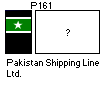
Bagh-E-Karachi was noted in October 1967 with a black funnel and a broad green band edged white, bearing a white star. No flag was observed. Rosanoski identifies Brown 1978’s use of Pakistan Steam Navigation’s livery as erroneous.
Listed in 1970–71 and 1973–74, the company apparently merged into Pakistan Shipping Corporation, under which its vessels appear in 1978–79.
Pakistan, Karachi.
PAL MYRVÅGNES.
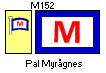
The flag is white with a blue border and a red M. The yellow or buff funnel bears the flag shown flying from a pole.
Pal Myrvågnes appears in Lloyds’ 1970–71 list of shipowners.
Norway, Tjørvag.
PALESANO CO. INC.
The ship retained the funnel used as Ghent Trader under Chamberlain Shipping, listed as owner and manager from November 2007. Its basic livery came from the earlier Stamos ownership under Fafalios, with the emblem removed. The two photographs show Ghent Trader on 19 April 2009 and Ostsee Merchant on 23 January 2011 respectively.
Palesano dates from 3 May 2010 and bought Ostsee Merchant on 1 June that year.
Panama, Panama City.
PALESTINE SHIPPING CO.
image by Klaus-Michael Schneider, 12 June 2007
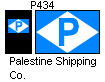
The flag is light blue with a central white lozenge containing a light-blue capital P.
Palestine Shipping, or Palco, was founded by Arnold Bernstein in 1935 and encountered financial difficulties and a creditors’ settlement in 1937. The FOTW account calls it Hevrat Eretz-Yisrael Le’Sapanut and identifies Tel Aviv as the first Hebrew liner.
British Mandate of Palestine, Haifa.
PALGRAVE, MURPHY (SHIPOWNERS) LTD.
image by Jarig Bakker, None
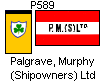
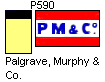
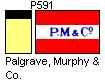
The flag is a red-white-red horizontal triband with P.M. (S) LTD on the white band. The Amsterdam harbour chart identifies it with Holland Ireland Line and City of Waterford. Rosanoski relates the lettering to Palgrave, Murphy (Shipowners), probably the wider group, while Turn of the Tide assigns it to Palgrave, Murphy Ltd.
The firm originated in 1835 as W.B. & C. Palgrave, with the Murphys joining later. Its fleet was taken over by British & Irish Steam Packet in 1937, and it also operated as Saorstat & Continental. After the Second World War the group expanded stevedoring, road transport and agency work. It held a small initial share in Irish Shipping from March 1941 until transfer in October 1943; Irish Shipping in turn acquired 40% in 1964. One account says Palgrave Murphy ceased in 1967, while another records a December 1969 merger with Limerick Steamship to form Hibernian Transport’s Ireland–Britain–Continent container service. Ships were named for ports served.
Ireland, Dublin.
PALIZADA COMPAÑIA NAVIERA S.A.
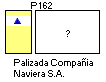
Periolos was noted in November 1963 with a yellow or buff funnel and a broad white band carrying a blue triangle. No flag was recorded.
Recorded in Lloyd’s 1963–64, Palizada used Tropis Shipping as agent.
U.K., London.
Pallas International A/B.
Rederi AB Pallas — historical flag/funnel
US Navy shows a white flag with a yellow star containing a blue P. The funnel P is also blue. Continued use by Pallas International is presumed.
No exclusive fleet-wide use or unrecorded corporate equivalence is asserted.
Hjalmar Sjosten operated Rederi A/B Pallas, recorded in 1956–57 and 1958–59. Annika was bought in 1958, following an earlier vessel. By the early 1960s she appears to have been sold, and Pallas International replaced the earlier names in Lloyd’s 1963–64 before itself disappearing. Rosanoski assumes Sjosten was the owner and continued through Pallas International.
Sweden, Gothenburg.
PALM LINE LTD.
image by Jarig Bakker, 4 February 2002
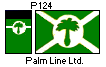
The flag derives from Lever Brothers’ original design. The funnel was also used after the Second World War by the German associate Ölhandel und Trasnport GmbH.
Palm Line was formed in 1949 to take over Lever Brothers’ shipping interests, including United Africa interests according to Loughran. Liverpool Shipping instead lists United Africa as owner, a discrepancy noted by Rosanoski. The fleet included general-cargo ships and tankers, with West African names followed by Palm.
U.K., London.
PALM SHIPPING & TRADING CO. PTY. LTD.
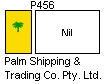
The original funnel had a green palm tree. A more colourful design and a flag were introduced later, but the subsequent livery was not illustrated in the cited series.
The company operated Greyville from 1970 to 1973 after buying her from Durban Lines without renaming her. It ceased when the sole vessel was sold in 1973. Cooper Brothers acted as agents in the later register.
Australia, Sydney and Milson’s Point; subsequently Papua New Guinea, Port Moresby.
PALMALI GEMI HIZMETLERI VE ACENTELIK LTD. STI.
Palmali Group of Companies
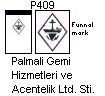
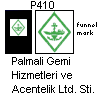
Indian Ambassador supplies this funnel, while Riroil 3 in September 2006 shows no black top. The starboard emblem is assumed to have a mirrored portside counterpart, with the ship’s bow forward on both sides.
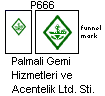
The green version is confirmed by port and starboard Masalli photographs in May and July 2013, mirrored so that the bow points forward on both sides.
Portside Ilandag in May 2006 and starboard Murvodag in December 2006 likewise show mirrored forward-facing ships.
This flag is only a conjectural reconstruction from a very small, indistinct photograph outside the company building.
Palmali Group began as agent in 1998 and soon entered shipowning. Lloyd’s first lists Palmali Co. in Rostov-na Donu, formed in 2000 and described there as Russian-government controlled, with an Istanbul operating company formed in 2002. Later entries reverse the principal and operating-company arrangement, placing the Russian company beneath Istanbul. The Turkish company adopted the heading’s name, translated as Palmali Shipping Services & Agency, in 2005.
Turkey, Istanbul.
PALTRANS SHIPPING A/B.
image by Jarig Bakker, 24 October 2005
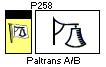
Nüsse’s double-sided table flag bears the name in ornate script and was probably used only in that form.
As charterers, Paltrans used differing basic funnel colours. Mitchell’s enlarged drawing faces the opposite way, matching the flags. His line drawings appear to link the funnel to Anund and Jorund, while Gerlin and Domar have white funnels. The P258 FOTW flag follows Brown 1995.
Paltrans, also Pal Line, began on 1 April 1977 as a local shipbroker in Västerås and Södertälje with three partners. B&N Nordsjöfrakt acquired half in 1999 and increased this to 75% in 2000. One account dates full ownership to January 2004; another places acquisition of the remainder after Transatlantic’s formation. Following B&N’s merger with Gorthon, the company became Transatlantic European Services in 2005.
Sweden, Västeras.
PAN AMERICAN PETROLEUM & TRANSPORT CO.
image by Joe McMillan, 25 August 2001
The emblem combines P and t. The orange may be deep yellow, and wartime sources show the funnel letter black. Jordan’s “black with emblem” description may refer to the Standard Oil operator rather than Pan American. Stewart’s letter is slightly more ornate than the FOTW drawing.
Standard Oil of Indiana acquired control of Pan American Petroleum in the 1910s and of Pan American Petroleum & Transport in 1925, or 1927 in another account. Reported stakes differ, with 90% in 1929 and 83% in 1930. Pan American had acquired half of American Oil in 1923. In 1925 Mexican Petroleum properties passed from the Dohemy interests to Pan-American Eastern, controlled by a syndicate dominated by Standard Oil of Indiana. That account also includes British Mexican Petroleum, whereas Merchant Ships says it went to Anglo-American Oil, a conflict Rosanoski retains. The fleet was absorbed into American Oil through the 1954 merger.
Lago Petroleum was acquired in 1926, with the remaining 3% obtained in 1930, and sold to Standard Oil of New Jersey in 1932. Pan-American Foreign’s fleet passed to the same group in 1937. Ship names used Pan, changing to Amoco after the 1954 merger.
USA, New York; Wilmington, Delaware, in Brown 1951.
PAN AMERICAN STEAMSHIP CO.
Sylvania supplies the funnel observation, described in the original as “Grey with a narrow red funnel.” No flag was noted.
The company probably ceased in 1962 when its sole vessel transferred to the parent Onstad group.
Unknown.
PAN AUSTRALIA SHIPPING PTY. LTD.
The funnel was seen on Boomerang I at Sydney on 17 March 2006, one day before the recorded service commencement. A distant photograph confirmed the principal details; the document does not supply a written colour or geometry description.
Pan Logistics established the company for a coastal service between Melbourne and Fremantle. It was registered on 15 July 2005, announced the “Boomerang service” in December and began operating on 18 March 2006. It entered voluntary administration on 3 October 2006 and was offered for sale; the source still recorded it in administration in November 2008.
Australia, Melbourne.
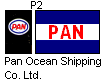
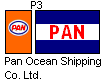
Pan Ocean Shipping Co. Ltd.
PAN OCEAN SHIPPING CO. LTD.
image by Ivan Sache, 18 December 2003
Mitchell gives the funnel logo a more oval shape with horizontal upper and lower sides.
The orange funnel base was adopted in 1997. New Accord and New Diamond showed slightly angled letters, recorded as “Pbds”. Although initially thought orange, the lettering remained red, confirmed by New Laurel in 2003 and Pos Brave in 2004. The website flag is dark blue.
DAEYANG SHIPPING CORPORATION LTD.
Pan Ocean
Pan Ocean Bulk Carriers was formed in May 1966. Government-led shipping rationalisation brought mergers with Global Shipping, Sam Ick or Samick Lines, Bowoon and, in one account, Sammi, with the Pan Ocean Shipping name effective from 1 April 1984. Other acquisitions or affiliations included Global Enterprise, Heung-A, Dae Yang and Boyang, the latter’s precise identity uncertain. The company emerged from receivership in May 2002. STX Shipbuilding became principal shareholder in 2004 and the name changed to STX Pan Ocean, also styled STX PanOcean.
South Korea, Seoul.
Keep the explicit scope label independent; no alias or company identity is inferred.
Daeyang and Global Enterprise
South Korea, Seoul.
Keep the explicit scope label independent; no alias or company identity is inferred.
POS Shipmanagement
POS Shipmanagement began on 1 July 1997 and absorbed Pan Ocean’s marine-division organisation and staff in January 2003. It merged with STX Corporation on 25 October 2005, becoming STX POS Ship Management as a branch.
South Korea, Pusan.
Keep the explicit scope label independent; no alias or company identity is inferred.
Daeyang
Mitchell appears to give both funnels for Daeyang Prosperity, sold in 1987. Rosanoski could not locate the vessel in Lloyd’s and suggests it may have been chartered.
The Daeyang account describes a 1984 amalgamation with Haewoo, but later amends its origins to 1974 without identifying which company that date concerns. Mitchell dates Pan Ocean’s acquisition to September 1985. A later name-company entry appears under Daeyang Shipping Co. without explanation.
Keep the explicit scope label independent; no alias or company identity is inferred.
Global Enterprise
Global Enterprise is dated to 1986, contradicting the 1984 purchase in Pan Ocean’s account. It disappears from the 2005 register, with its name-company vessel transferred to Heung-A; the fate of its tug is uncertain.
Keep the explicit scope label independent; no alias or company identity is inferred.
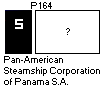
PAN-AMERICAN STEAMSHIP CORPORATION OF PANAMA S.A.
Liqilady was noted in December 1966 with a black funnel carrying a white block S. No flag was recorded.
Recorded in Lloyd’s 1966–67, the company used Capt. J.F. Swensen as agent.
USA, New York.
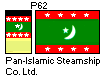
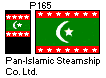
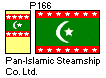
PAN-ISLAMIC STEAMSHIP CO. LTD.
An uncited variation gives a yellow increscent and star on the green band. The P166 funnel source supplies no flag; application of the P165 flag is assumed.
Formed in 1951, Pan-Islamic used Safina-E-prefixed ship names.
Pakistan, Karachi.
PANAGUA STEAMSHIP CORPORATION.
The funnel is yellow or buff with a narrow black top and a black band surmounted by an undefined black circle. It was noted on Esther and later on Gem at New York without the black top, identified as Harkna’s insignia. No flag was recorded.
Panagua is recorded in 1963–64 with A. Willard Ivers as agent and in 1970–71 with Erich K. Harkna.
USA, New York.
PANALPINA GROUP.
image by Jorge Candeias, 6 March 1999
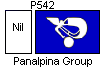
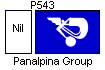
The emblem adopted with the 1954 name symbolised a common global identity. The name initially referred to haulage links “conquering” the Alps between northern and southern Europe, later representing worldwide operations. The logo depicts a winged human figure standing on a disc and holding what may be a sail. P542 follows the website logo; the FOTW drawing differs in small details and probably uses the same source.
The logistics and forwarding group had roots in Rhine shipping. Its then parent entered forwarding in 1935, followed by acquisitions in the 1940s and adoption of the Panalpina name in 1954. The Ernst Goehner Foundation bought 40% in 1969 and became sole shareholder through further acquisitions in the 1980s. The Norwegian Overseas Shipping group joined in 2005. The source names the headquarters company as Panalpina World Transport (Holding).
Switzerland, Basel.
PANAMA CANAL (FRENCH THEN USA INVOLVEMENT).
image by Joe McMillan, 11 November 2001
This signal flag was used by Canal Zone Government ships from 1915. Rosanoski regards Whitney Smith’s attribution to the Panama Canal Co. as erroneous, noting Smith’s separate reference to government ships. Flag Bulletin shows possible stops after the letters.
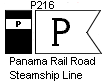
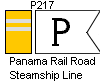
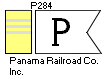
Ships & The Sea assigns the P217 funnel to large passenger ships. Its proportions were reconstructed from a verbal description, and application of the flag was assumed. Talbot-Booth gives P216 under Panama Rail Road Co. Inc., notes the change to P217 and records P283 under Panama Line or Panama Railroad Co. Inc., apparently without connecting the accounts.
A white swallowtail bearing a black P on a cap badge was tentatively identified by Rosanoski as the Panama Railroad Steamship Co. flag.
For the separately cited P168, US Navy 1961 shows a normal black funnel top; the NJK collection omits the top and gives greyish, possibly silver, bands. Rosanoski suggests that later Authority tug markings may retain earlier designs, explaining their variety.
William H. Aspinwall and partners proposed an isthmus railway in 1848. The Panama Railroad Company was chartered in New York on 7 April 1849, built the line in 1850–55 and operated connecting steamships. The French canal undertaking failed in 1889; American construction resumed in 1904. The canal opened on 15 August 1914 under the treaty arrangements establishing the Canal Zone.
The French undertaking began chartering Atlantic steamers in 1889 as the Columbian Line, bought ships in 1894 and adopted Panama Railroad Steamship Co. in 1896. The United States purchased the French assets, including the ships. Generally called the Panama Line from the late 1930s, it belonged to the Canal Zone government. Eisenhower ordered the last two ships into reserve in December 1960, but Kennedy released Cristóbal in April 1961 for government cargoes; the service continued until 1981.
Lloyd’s records a change of name from Panama Railroad Co. Inc. to Panama Canal Co. in 1952. The Panama Canal Commission succeeded the Canal Company in 1979, according to the historical account, and the Autoridad del Canal de Panamá succeeded it on 31 December 1999. Lloyd’s instead dates the Commission name to 1981 and the Authority to 2000, also giving an unexplained 1893 foundation. The railway passed to Panama in 1979 and to a private joint venture in 1998.
PANAMA CANAL AUTHORITY.
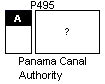
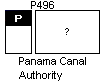
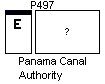
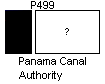
These varied tug funnels may survive from the previous administration, although the website photographs may themselves be historical. P499 represents Lider. P495 is shown on Alianza in April 2005; P496 on Paz has the vessel’s initial on a deep black top. P497, for Esperenza, varies this arrangement.
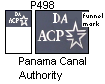
Darién carries the current logo straightened from its website form, with the first two letters of the vessel’s name above it. The short funnel could be described as entirely grey. Other photographs show a plain double initial on a grey top, including LS on Los Santos.
The treaty signed on 7 September 1977 provided for transfer of the canal to Panama. From 1 October 1979 the Panama Canal Commission, a new United States agency, operated and maintained it. The Autoridad del Canal de Panamá (ACP) was formed on 14 May 1997 and succeeded to the waterway on 31 December 1999.
Panama, Panama City.
PANAMA MAIL STEAMSHIP CO. INC.
Panama Mail Steamship Co. Inc.
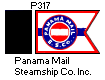
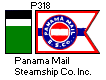
The funnel is Grace Line’s, confirmed by a black-and-white photograph of Santa Clara.
Formed in 1925, Panama Mail was operated by Grace Line and remained recorded in 1944. Its ships used Santa-prefixed names.
USA, San Francisco.
PANAMA PACIFIC LINE.
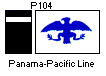
The earlier livery followed American Line: a black funnel with a white band and a white flag bearing the displayed eagle from the American Arms in blue. FOTW distinguishes the flag from United States Lines by its outlined eagle with blue details, rather than a solid blue bird. Loughran dates adoption of United States Lines colours to 1935; Bonsor records California wearing its funnel on charter in 1936, followed by the other two New York–California ships.
The line was formed in 1914, apparently as an International Mercantile Marine subsidiary, for an intercoastal passenger service begun in 1915. Canal closures caused by slides stopped the service after a few voyages; the intervening activity is unclear. Sailings resumed in 1923. Three vessels passed to American Republics Line in 1937. Loughran names United States Lines as owner.
USA, New York.
PANAMANIAN ORIENTAL STEAMSHIP CORPORATION.
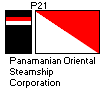
The funnel is black with a red-white biband. The flag has diagonal red-white halves, described in the source as “Pbd”.
Dorinthia was observed with a plain black funnel in February 1967, but was recorded as belonging to Vega S.S. Co. Ltd., another company under the same managers.
Recorded in 1963–64 and 1970–71, the company was managed by Wheelock Marden & Co. Ltd.
Panama.
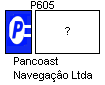
Pancoast Trading S.A.
Pancoast Navegaçâo Ltda
The drawing follows a portside photograph of Mimosa K dated 9 June 2011. A starboard photograph shows the oval in the same orientation, but with the two white bands extending towards the stern.
Founded in 1997, Pancoast sought grain and sugar contracts of affreightment from Central America and the east coast of South America. It appears as an agent operating through Kristen Marine, Roxana Shipping and Pancoast Navegaçâo, the last founded in Rio de Janeiro in 2002.
Greece, Athens.
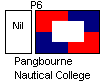
PANGBOURNE NAUTICAL COLLEGE.
The college continued to use Devitt & Moore’s flag, presumably after the company ceased shipping.
The college was founded in 1916 according to Loughran, or in 1917 according to the other account, by Sir Thomas L. and Philip Devitt of Devitt & Moore. Philip continued to fund and run it, followed by his son Sir Thomas Gordon Devitt. Following the shipping company’s winding-up, the college became The Devitt & Moore Nautical College Ltd. in 1931, a non-profit private company administered by governors. Much nautical training gave way to academic studies in 1969, when it became Pangbourne College; it became co-educational in 1996.
UK, near Reading.
Panocean Etc.
PANOCEAN SHIPPING & TERMINALS LTD.
Panocean Shipping & Terminals was formed in 1969 by Ocean Steam Ship and P&O Steam Navigation. It established Panocean Lloyd Tankschiffahrt with Lloyd A.G. in 1971 and merged with Anco Shipping in 1976 to form Panocean-Anco.
PANOCEAN STORAGE & TRANSPORT LTD.
Panocean Storage & Transport is recorded in the late 1970s and early 1980s. It planned to sell its ships and concentrate on storage.
PANOCEAN-ANCO LTD.
Panocean-Anco resulted from the 1976 merger. Stolt-Nielsen began marketing the fleet in 1982, and Anco ceased operations in 1983.
Documentary images — company attribution uncertain
Panocean Shipping & Trading
Mitchell uses the name Panocean Shipping & Trading. Rosanoski is unsure where this came from and suggests that Shipping & Terminals may have been intended, since the emblem fits the other written description.
Corporate existence does not resolve exact T-device allocation.
Documentary material — company attribution not established
Panocean Storage & Transport Ltd.
The funnel is described as red with a white emblem resembling a “T”, presumed to be P246. The symbol represents pipelines with drops of vegetable oils and fuel, the cargoes carried. Sources assign the livery to Panocean Shipping & Terminals and Panocean-Anco; the latter continued using it after the merger.
United Kingdom, London. The source treats the following as separate companies sharing an address.
PAPAYANNI & CO.
Most sources show the flag as in P77. The version in P78 and P263 follows an actual National Maritime Museum flag from the Ellerman & Papayanni period. After the takeover the flag was retained beneath Ellerman’s pennant. P263 represents the post-1901 livery; Lloyd’s 1904 shows its replacement by that recorded under the Ellerman name.
Also called Papayanni Steamship Co. or Papayanni Line, the company is dated to the 1840s, with one source specifying 1840. FOTW instead gives 1855 for Papayanni Brothers. It became limited in 1897 and was taken over by Sir John Ellerman in 1901, continuing under its own name until Ellerman & Papayanni Lines Ltd. was formed in 1928.
U.K., Liverpool.
PAPUA NEW GUINEA SHIPPING CORPORATION PTY. LTD.
The flag bears what is assumed to be a red bird of paradise. The white band is narrower than the red and black bands. The black band rises to a point in its middle wave, unlike the other rounded waves of both colours. An unattributed second illustration also shows this feature, with the beginning of the three bands sloping slightly downwards.
Registered in New South Wales on 15 September 1977, the company became bankrupt and was taken over by Steamships Trading Co. in 1988. It was deregistered on 9 April 2002. Chief Container Lines is listed among its interests.
Papua New Guinea, Port Moresby.
PAPUAN LINER SERVICES PTY. LTD.
The flag is red, bordered yellow along the top and bottom, with a white diamond bearing the black letters PSL.
The Log describes joint ownership by Swiss Aluminium and Karlander (Australia). Another account makes it a subsidiary of Australian Territory Liner Services, established by Karlander and Nabalco, registered in November 1969 and deregistered in January 1982. Karlander managed the service.
Safia and Sariba were bought in 1970. Sariba was sold in 1973; Safia is said to have become Tauloto II in 1974, although the latter name appears under Karlander from 1973 until sale in 1979. Rosanoski therefore suggests operation in 1970–79, while register references continue into 1980–81.
Australia, Sydney.
PARAGON SHIPPING INC.
The funnel drawing follows Crystal Seas in April 2007. The main band appears reddish, probably an air/sea-rescue shade, and the narrow white bands appear edged black. Kind Seas in November 2010 shows a dark blue funnel, again with an orange tint to the red, and confirms the narrow black bands.
Golden Seas in June 2013 shows bright orange/red sea-rescue colouring without black bands. The photographer attributes the funnel to the managers, Allseas Marine.
Michael Bodouroglou formed Paragon in April 2006, acquiring ships through Inovation Holdings S.A. Allseas Marine, controlled by Bodouroglu in the source account, provided commercial and technical management for the time-chartered fleet. Rosanoski notes that the websites imply only a business relationship, despite shared contact details. Eurocarriers is also listed as an associate.
Marshall Islands; Greece, Athens.
PARAKOU SHIPPING LTD.
The funnel follows a photograph of Pretty Scene at Botany Bay on 14 July 2010. Shades vary: Pretty Jewelry appears bright golden yellow in March 2010. Rosanoski also notes that a website logo’s colour appeared blue on one monitor and purple on another.
Founded in 1985 by chairman C.C. Liu, Parakou began with ship management, chartering and second-hand purchases. It started building new vessels in 1990 and diversifying in 1993.
The source also records the associated Parakou Shipmanagement Pte. Ltd. in Singapore.
China, Hong Kong.
PARAPORTIANI COMPAÑIA NAVIERA S.A.
The funnel noted on Paraportiani in January 1967 is yellow or buff with a black top. No flag was noted.
Recorded in 1966–67, the company used George Th. Sigalas as agent.
Greece, Piraeus.
PARAÍBA ADMINISTRAÇÂO DO PORTO DE CABADELO.
The livery is taken from the Brazil website’s material for about 1950.
Brazil, Paraíba.
PARGAS KALKBERGS A/B.
The company is recorded in Lloyd’s 1953–54.
Finland, Pargas.
PARK STEAMSHIPS LTD.
The logo is a stylised PS; Mayes specifies dark green for the funnel.
Park is recorded from 1970–71 to 1980–81. Turnbull, Scott Management managed it in 1970–71 and the whole fleet in 1978–79 and 1980–81. In 1973–74 management was divided between Turnbull, Scott and Denholm Maclay.
U.K., London.
PARLEVLIET & VAN DER PLAS B.V.
Mitchell’s funnel presumably has an emblem between the letters, probably a fish, though it could be the swan.
The funnel follows portside and starboard photographs of Helen Mary dated 19 August and 24 December 2013.
Dirk Parlevliet and the brothers Dirk and Jan van der Plas founded the business in 1949 to buy and sell herring. Expansion abroad led to a fishing company, whose first trawler entered service in 1959. Lloyd’s gives 1963 as the formation date. After several locations, headquarters settled in Valkenburg in March 2002.
Doggerbank Seefischerei was established at Bremerhaven in 1986. The website dates acquisition of Mecklenburger Hochseefisscherei at Rostock to 1998, whereas the operating-company account gives late 2000. Atlantic Seafood, at the same address, is dated to 1984.
Netherlands, Katwijk; later Valkenburg.
PAROBRODARSKO ACKIONARSKO DRUŠTVO "PROGRES".
image by Zeljko Heimer, 20 October 2004
Jordan does not define the blue of J98’s funnel band. Rosanoski assumes the shade shown by FOTW for P326’s flag and also applies it to the latter funnel band.
Jordan’s 1939 account records Jugoslavenska Komercijalna Plovidba d.d. with one vessel. Merchant Ships 1942 and 1944 use Parobrodarsko Ackionarsko Društvo “Progres” for a larger fleet including that vessel.
Yugoslavia, Sušak.
PAROBRODARSKO PREDUZECE N. A. DUBOKOVIC.
image by Zeljko Heimer, 8 and 18 October 2004
Isaiæ shows a blue-over-red bicolour with intertwined white NAD initials for the interwar period. The family did not recall this flag, but remembered similar cyphers as metal ornaments on steamship funnels. Heimer suggests it might have been used in Yugoslavia when the Croatian tricolour was discouraged, but also allows that it may never have been used.
Family documentation and recollection instead identify the Croatian tricolour as the house flag. A ceremonial version added the family arms in the canton for festivities and important visitors; it is preserved in the family archives in Jelsa.
Established in 1851, the Dubokovic company developed Jelsa’s port and a large merchant sailing fleet, described as the largest in Dalmatia. Some vessels crossed the Atlantic, and the firm trained cadets for the Trieste maritime authorities. It was known as Niko i Ante Dubokovic, NAD or simply Dubokovic. The founding family account names Ivan and his son Niko. The business continued until nationalisation after 1945.
Austro-Hungarian Empire, later Yugoslavia; Jelsa, island of Hvar.
PAROPLOVIDBA DUBA.
image by Zeljko Heimer, 19 October 2004
The emblem has a foul anchor with a black cable, surmounted by a white P between and linked to smaller white Z and O. The contributor could not establish the company’s history or the meaning of ZPO.
Yugoslavia, Split; the sources place it under Croatia.
PARRY BROTHERS LTD.
The Log gives a white flag bearing a red P. Rosanoski considers 1983 the probable official date of the change to Sea-Tow.
Parry Brothers operated tugs and barges. One account begins with a small vessel carrying farm produce from Mahurangi to Auckland in the 1920s. A registration dated 18 July 1930 is assumed to concern this company, although the original name is not given; another account dates formation to 1933.
The former USS Kohi was acquired in 1948, or 1947 in the Compendium, and sold by 1963. The business was sold and became Sea-Tow, but dates differ: the late 1970s, 1980 and 1 February 1983. Herenui and Kopere transferred to Sea-Tow.
New Zealand, Auckland.
PARTENREEDEREI A/S RADBOD.
Partenreederei A/S Radbod
The flag has five horizontal white and red bands, with an unoutlined white diamond across the red bands bearing a flowing black R. The black funnel carries a broad band of the flag.
The company was associated with Fisser & Van Doornum.
Germany, Hamburg.
PARTREDERIET BRODRENE AARSETH.
The funnel is apparently based on a line drawing of the first vessel, Aril, built in 1961.
Modern Brødrene Aarseth fish-export businesses and unrelated people or boats were excluded. Lack of online evidence does not contradict the Norway assignment. The source consistently identifies Partrederiet Brødrene Aarseth of Torvastad and its vessels Aril and Ronita. Exact-name, vessel and location searches did not return a usable independent match.
Partrederiet Brodrene Aarseth appears in Lloyds 1978–9 under the operators Lorentz Storesund & Sonner, in 1980–1 under its own name, and in 1985–6 under the managers Jorgen Brunvall. Its last vessel, Ronita, was sold in 1986.
Norway, Torvastad.
PASMINCO LTD.
During Zincmaster’s October 1990 refit, the TNT bands were replaced by a reddish-orange ball and lines. The ship was apparently chartered from TNT Bulkships Operations.
A 1980s photograph shows the owned vessel Anson in the managers’ North Western Shipping & Towage colours, separately referenced as N547.
Pasminco was described as the world’s largest lead and zinc miner. Pasminco Ltd. was registered in 1956 as Ez Industries Ltd. The separate Pasminco Australia registration dates to 1916, originally “Electrolytic Zinz Company of Australia Pty. Ltd.” in the source, subsequently Electrolytic Zinc Company of Australasia, Pasminco Australia and Zinifex Australia. Voluntary administration began on 19 September 2001. Following arrangements executed on 4 October 2002, Zinifex was formed to acquire parts of the group, with the balance wound up.
Century Zinc is listed as a subsidiary; North Western Shipping & Towage appears as the shipping manager.
Australia, Melbourne.
PASTRÉ FRÈRES.
image by Ivan Sache, 8 February 2004
The Pastré family were merchants who became shipowners to carry their trade. In the Armements Marseillais account, five brothers ran the business with their mother after their father’s death; after the brothers died, shipping ceased with the sale of Yémen in 1862. The fleet list and the French maritime-flags website give 1854–62.
Rosanoski explicitly notes a conflicting account in Les Marseillais dans l’histoire. It gives Jean-Baptiste Pastré’s dates as 1804–1877 and describes his Alexandria trading post, while Joseph, Eugène, Paul and Jules established businesses across North Africa and Europe. Their fleet comprised large sailing ships and two smaller steamers at Alexandria and in the Red Sea. They bought a Port-de-Bouc shipyard and Languedoc mines in 1855. Three brothers died in 1869, after which the company moved its shipping activity to West Africa.
France, Marseilles.
PATAGONIA WELLBOATS.
The funnel follows a starboard photograph of Patagón VII dated 24 September 2013, recorded as owned by Patagonia Travelling Service.
Founded on 16 September 1991, the company began its fleet with the general-cargo Caroline in December 1995, followed by Annegiena in September 1996 and Orion in 1998. Live-fish transport began with Patagonian in June 1999 and Patagonian II in August 2000.
Rosanoski notes an unclear connection with Empresas Patagonia. Lloyd’s separately records Patagonia Salmon Farming for Caroline and Annegiena, and Patagonia Travelling Service for Patagonian Express and later Patagon IV and Patagon V. Although the latter was omitted in 2011–12, the website still showed seven vessels, Patagón through Patagón VII, in October 2013.
Chile, Puerto Montt.
Pateras.
PATERAS.
Pateras Brothers Ltd.
image by Jarig Bakker, 8 January 2005
The Caltex book of 1959 gives a white house flag with a blue diamond charged with a white P, for Pateras ships sailing under Greek and Liberian flags.
Jordan describes a row of blue diamonds on the white funnel band. Merchant Ships 1942 depicts two and a half diamonds, touching and extending throughout.
Mitchell assigns this funnel to Pateras Brothers of Chios and lists Constantis, shown in Lloyd’s 1966–67 under Pateras Brothers’ London agent.
Mitchell gives this funnel for P.D. Pateras, presumably Nikolas D. Pateras, with Pateras Brothers managing. The listed ships are Stravinsky in 1989–91 and Rembrandt in 1988–92.
This funnel was noted on Argonaftis of the agency company The Oceanfaring Co. in September 1966.
Mitchell records the Comar Shipping Agency funnel on the N.J. Pateras & Sons card.
Mitchell supplies two funnels for P.G. Pateras Shipping without explaining the difference.
Both are given for “Pateras Investment Corporation [sic]”. P533 is linked to Anny Pateras in 1987–88; Lloyd’s 1988–89 gives Lagonia as owner and Pateras Brothers as manager.
This funnel follows a portside photograph of DP Proteus dated 11 October 2013.
Pateras Brothers / N.D. Pateras
The N.D. Pateras family account traces its Oinoussai ancestry to Ioannis Pateras (1770–1840), through Michael, Markos and the sea captain Ioannis (1858–1930). The latter’s sons Vassilios, George and Nikolas acquired steamships. After Nikolas died in 1953, his sons Ioannis and Diamantis established Pateras Bros. in 1957. Nikolas D. Pateras joined in 1986, took over management in 1992 and formed Pacific & Atlantic Corporation in 1994. Lloyd’s records the older company becoming Pabroco in 1992.
Keep the explicit scope label independent; no alias or company identity is inferred.
Diamantis Pateras
The Diamantis branch traces its origins to John Constantine Pateras in 1868. His sons Constantine, Nicolas and Diamantis inherited a debt-free freighter, became shareholders in another ship in 1876 and made a joint purchase in 1886. They separated amicably after the First World War. Diamantis and his eldest son John bought a vessel in 1923; in 1937 the family joined the Lemos family in Lemos & Pateras. Costas D. Pateras established Nautilus Shipping in New York in 1948.
After Diamantis died in 1951, his six sons—John, Panagos, Pandelis, Stephanos, Costas and Nicolas—left Lemos & Pateras and began Diamantis Pateras Ltd. on 1 January 1952, becoming shipowners two years later. Nautilus Petroleum Carriers followed in New York in 1958. The group helped found the Oinoussuan Shipping Co-Operation in May 1968. Leandros Shipping’s Piraeus office became the shipping headquarters in 1969, with London acting as exclusive agents. The two Nautilus companies were dissolved during the 1975 oil-trade recession. Later management passed through Leandros and Kyvernitis; Diamantis Pateras Maritime acts as commercial and financial manager.
Keep the explicit scope label independent; no alias or company identity is inferred.
Other recorded branches
The source also records numerous distinct Pateras businesses in Greece, London, Constantinople and Switzerland. These include N.J. Pateras & Sons, P.G. Pateras Shipping, Pateras Investment and Pateras Maritime. Their register appearances are preserved separately in the source ledger; the shared surname does not establish a single corporate succession.
Keep the explicit scope label independent; no alias or company identity is inferred.
The separately referenced P141 flag is reported in a lighter blue, without establishing whether its funnel changed too. P14 appears on ships represented by the Diamantis group; Kyvernitis was observed with a normal blue funnel at Lyttelton on 24 April 1985. Nüsse gives Kyvernitis a flag bearing P and Leandros a table flag whose diamond does not reach the edges. The latter may be a company variant, but also better matches the funnel-band design said to be reproduced on the flag. Brown 1995 assigns P14 to Leandros with D. Pateras in brackets. The funnel was also noted on Kalliopi Pateras of Zepagas in June 1963.
Mitchell’s separately referenced La Plata funnel, L428, shows an apparent connection with its agent N.J. Pateras & Sons.
Saretap Shipping is also listed under Pateras Bros. S.A. as an agency company, but with an unconnected livery.
PATRIARCH STEAMSHIP CO.
The New York company operated its sole vessel from purchase in 1965 until sale in 1971. The name is given as Patraic Sky in the initial account and Patriarch Sky in Rosanoski’s later comment. Joe McMillan’s reference calls the company “of Monrovia”, leading him to suggest a United States-owned firm operating under the Liberian flag; this remains an attributed assumption.
USA, New York NY.
PATT MANFIELD & CO. LTD.
The flag is blue with a white vertical anchor, its cable arranged as an enclosing ring. No funnel was noted.
Founded in 1960, Patt Manfield operated through name subsidiaries. With Keihin & Co. it took over Everett Steamship Corporation on 1 January 1981. It acted as agent for Sunbeam Navigation; Barber Ship Management Sendirian Baerhad managed one of its ships.
China, Hong Kong.
PATTERSON BROTHERS SHIPPING CO. LTD.
An angled bow photograph of Princess Ashika dated 31 August 2008 supports the funnel, though Rosanoski did not retain the photograph.
Ovalau was acquired in 1983. Mihara probably joined at the same time, since she appears in Lloyd’s 1985–86, although the Compendium gives acquisition in 1993. The fuller Patterson Brothers Shipping Co. Ltd. name makes better sense of the livery lettering than the shorter register form.
Fiji, Levuka; later Suva.
PD Ports PLC.
PD Teesport
The funnel follows starboard and portside photographs of Cleveland County from 2012. The flag source is a company table-flag photograph in Forward Link.
Heortnesse’s April 2013 portside photograph shows a top absent from a clear starboard view in March 2008, apparently a definite change.
Mitchell provides no details for the separately referenced T690 funnel, though three of five line drawings show green funnels. British Harbour Craft describes the Authority’s funnels as dark blue-black, wording Rosanoski finds unclear.
The ports and logistics business traces its origins to the Tees Conservancy Commissioners, formed in 1852. They became Tees & Hartlepool Port Authority in 1966. Privatisation in 1992 divided ownership equally between Powell Duffryn, 3i and Humberside Holdings; Powell Duffryn took full control in 1995 and was acquired by Nikko Principal Investments in 2000. Lloyd’s separately gives formation in 1880 and a 2003 change to PD Teesport.
A new PD Ports plc acquired PD Ports Group from Nikko in 2004. The house magazine also records a line’s collapse early that year following the cessation of distribution arm Forestwood, with Baltic–Howden sailings then arranged between TTS and PD Port Services. Babcock & Brown Infrastructure acquired the business in 2006, a date whose source was not recorded, and sold it to Brookfield Asset Management in November 2009.
Earlier Powell Duffryn shipping interests included the wartime Normandy Shipping joint venture with Stephenson Clarke, wound up in 1922. Accounts of the Stephenson Clarke holding give ownership from 1928 and a full-subsidiary period beginning at the malformed date “19986”; the holding fell to 40% in 1992 and was sold in mid-1994.
UK, Middlebrough.
Peaceful Universe Shipping Co. Ltd.
Great Ocean Shipping Co. Ltd.
The funnel follows a portside photograph of Sea Pilot at Singapore on 9 June 2011. The registered owner was Great Ocean Shipping, care of managers Peaceful Universe. The letters are presumed to derive from the ship’s name.
Also styled PU, the company was formed in 2002 and formerly called Peaceful Universe International Shipping Service Co. Ltd. Its 2013 website described ownership, chartering, management and agency activities, listing seven owned ships but omitting the two managed ships in Lloyd’s 2011–12. Lloyd’s had previously listed it as a major operating company of the Government of The People’s Republic of China.
China, Qingdao.
Pearl Kasper Shipping Co. Ltd.
PEARL KASPER SHIPPING CO. LTD.
Inter-Island Shipping Co. Ltd.
Pearl Kasper
The blue flag has a white diamond extending throughout, with PSCoK at its points. A rumour associated the funnel’s white band with an Anchor Shipping & Foundry interest in Pearl Kasper.
Pearl Kasper was incorporated as a private company on 29 March 1947. The last two coastal ships were sold in 1966. It was struck off on 6 March 1984, but not deregistered.
Keep the explicit scope label independent; no alias or company identity is inferred.
Inter-Island Shipping
Inter-Island used a similar livery, with the flag letters ISCoI.
The subsidiary Inter Island Shipping was incorporated at Nelson on 10 October 1951, though Lloyd’s 1953–54 locates it at Picton. It took over Collingwood Shipping in 1960 and was struck off on 29 February 1984, without deregistration.
Keep the explicit scope label independent; no alias or company identity is inferred.
Both liveries derive from black-and-white hatchings whose letter colours are unspecified; black is assumed. A photograph of Ranginui confirms the I195 funnel, and the blue shade used for the flags is assumed from a funnel photograph. Sea Breezes gives funnel bands wider than the tops and an enhanced o; The Log’s band is narrower.
New Zealand, Nelson.
PEARLS PTY. LTD.
The registration is dated 30 April 1956 and deregistration 5 February 1985, provided that the separate references to Pearls Pty. Limited and Pearls Pty. Ltd. concern the same company. Lloyd’s records the business from 1966–67 to 1985–86, with Minter, Simpson & Co. as agents in 1970–71.
Australia: Melbourne, Hobart and Perth in successive registers.
PECHORA RIVER SHIPPING CO.
The flag bears the Cyrillic letters ПРП.
The company operated passenger and cargo services on the Pechora. A Russian government resolution of 20 August 2002 proposed privatisation of its 25.5% holding. Lloyd’s 2005–06 lists the company under Palmali Shipping management.
USSR, Pechora; subsequently Russia.
PEDRO MIGUEL COMPAÑIA NAVIERA PANAMENA S.A.
The funnel noted on Pedro Miguel in May 1966 is green with three narrow yellow bands, separated by equal widths of green. No flag was noted.
Recorded in 1963–64 and 1970–71, the company used Corner Banca as agent in the earlier register and Carlo Cameli in the later account.
Switzerland, Lugano; later Italy, Genoa.
PEGASUS OCEAN SERVICES LTD.
The funnel is blue with a broad band showing the white flag and its blue winged horse. Athlon was observed at Lyttelton on 9 August 1986 with a narrow black top; correspondence confirmed the band as the flag. The funnel was still seen on Levant in June 2001, recorded under Arran Shipping & Trading.
Formed in 1963 by the Ingelssis, Peraticos and Andrianopoulos families, Pegasus managed their individual and joint shipholdings. The Angelicoussis-Efthimiou and Yannagas families joined briefly. By the mid-1980s the arrangement seemed to have outlived its usefulness: Andrianopoulos withdrew first, followed by Inglessis.
Recorded agencies included Alberta Shipping, Monarca and Omonia. Vesta Maritime shared its address. Later the firm appears as an owners’ representative, including for Aran Shipping & Trading.
U.K., London.
PEGGY NAVIGATION CO. S.A.
The funnel noted on Loyal Allies in March 1965 is yellow or buff with a broad red band bearing a white L. White edging above and below the band is itself defined in red against the funnel ground. No flag was noted.
Recorded in Lloyd’s 1966–67, Peggy Navigation is associated with agents China Marine Investment and, in the NJK account, Associated Maritime Industries.
Hong Kong.
PEHRSON & WESSEL A/S.
US Navy shows the letters in blue.
Founded in 1867, Pehrson & Wessel is recorded as a general-tramping operator in Jordan’s account and later as an owner. Rosanoski suggests that it subsequently ceased shipowning while remaining in the industry.
Norway, Drammen.
Peirce Brothers.
PEIRCE BROTHERS.
image by Jarig Bakker, 14 January 2005
Italy: Messina; Messina, Naples and Genoa; later Naples.
The document combines Peirce Brothers, Walter F. Becker and the earlier Sicula Americana. Evidence for the 1919 company cannot establish identity or succession of all earlier entities.
WALTER F. BECKER.
Walter F. Becker apparently traded as the Creole Line.
Italy, Turin and Genoa.
The document combines Peirce Brothers, Walter F. Becker and the earlier Sicula Americana. Evidence for the 1919 company cannot establish identity or succession of all earlier entities.
SOCIETÀ DI NAVIGAZIONE À VAPORE SICULA AMERICANA.
The illustration was added to Lloyd’s 1904.
Italy, Messina; later Naples.
The document combines Peirce Brothers, Walter F. Becker and the earlier Sicula Americana. Evidence for the 1919 company cannot establish identity or succession of all earlier entities.
PELJESAC MARITIME ASSOCIATION.
Captain B. Ivankovic’s 1870 oil painting of the barque Eber shows the association’s flag at the foremast, bearing AMS for Associazione Marittima di Sabioncello. The letters are assumed black. A red banner naming Eber flies at the mainmast; the mizzen carries a large Austro-Hungarian flag and four signal flags.
The association was formed in 1865.
Croatia, Orebic.
PENINSULAR & OCCIDENTAL STEAMSHIP CO.
image by Joe McMillan, 12 November 2001
The flag is a blue-and-white lozengy burgee, with red P&O initials on the central white lozenge. China illustrated on steamship.net instead shows blue initials. FOTW’s earlier British attribution showed black letters; Joe McMillan corrected the company’s nationality to American.
Ships & The Sea 1938 notes the change to this funnel.
This American P&O combined the ships of Henry Plant’s Plant Line, founded in 1885, and Henry Flagler. Their Florida railways ended at Tampa and Miami, respectively, and both sought to extend services by cruises to Havana. The source records steamship ownership from 1898, earlier names Plant Steamship Line and Florida East Coast Steamship Co., and the Peninsular & Occidental period as 1900–1967.
The line prospered until post-war air competition eroded passenger and cargo traffic. By 1949 only one small ship remained. The Cuban Revolution and subsequent United States embargo ended the Cuban tourist trade; the company continued for a few years in the Miami–Bahamas cruise market.
USA, Jacksonville FA; later Miama FA.
PENINSULAR NAVIGATION CORPORATION.
The funnel noted on Jacqueline Someck is yellow or buff with a black top. No flag was noted.
Lloyd’s 1963–64 lists the company as an agent for Southern States Navigation Corporation.
USA, New York NY.
PENINSULAR SEAROAD TRANSPORT PTY. LTD.
The 1995 note refers to a more maintenance-free design in connection with this funnel, but its wording does not clearly establish the sequence of adoption or replacement.
The register account gives a 7 June 1983 incorporation as Nineteenth Marsupial Pty. Ltd., followed by the names Peninsular Searoad Transport and Peninsular Princess. It also gives a separate 27 May 1994 registration as Peninsular Princess, subsequently renamed Peninsular Searoad Transport; the relationship between these sequences is not explained.
Peninsular Princess operated across the entrance to Port Phillip Bay from 1987. The company remained listed as owner and manager in 2005–06. Sea Management Corporation is recorded as an associate.
Australia, Queenscliffe VIC, or Melbourne.
PENINSULAR SHIPPING CO. LTD.
image by Jarig Bakker, 23 December 2005
Some vessels may have had narrow black tops or entirely black funnels in the 1960s, although the source was not recorded. Mitchell partly supports the variation, but his top does not appear narrow.
Peninsular appears under Ocean Tramping in 1963–64. By 1973–74 its remaining fleet was shown as part of Nan Yang, also operated by Ocean Tramping. It reappeared in 1978 with different ships, later again under Ocean Tramping management. Rosanoski compares its career with Ocean Tramping’s, though ending sooner.
Hemisphere Shipping and Lian Soon Agencies are also listed as associates.
Hong Kong.
PENN SHIPPING CO. INC.
image by Joe McMillan, 12 November 2001
image by Joe McMillan, 1 December 2001
US Navy 1961 presents the livery under Webb & Knapp. FOTW records both names, while its contributor states that he could not explain why the real-estate firm had a shipping fleet. The source also includes a website photograph of Penn Transporter’s funnel.
Penn Shipping
Penn Shipping appears as an operator by 1958–59, later also an owner, and remains recorded in 1980–81. It operated Penn Tanker; vessels generally had Penn-prefixed names until the later 1970s.
Webb & Knapp is recorded in connection with hull insurance, leading Rosanoski to suggest that shipping may have been an offshoot of its other interests. The real-estate firm was controlled from 1949 by William Zeckendorf, who went bankrupt in 1965. The precise relationship is not established.
USA, New York.
Keep the explicit scope label independent; no alias or company identity is inferred.
Penn Tanker
Penn Tanker was operated by Penn Shipping in the 1960s and early 1970s. Ogden Marine became its agent, with vessels adopting Ogden-prefixed names by the 1978–79 register. Omi Corporation appears as manager in 1985–86 and 1988–89.
USA, New York.
Keep the explicit scope label independent; no alias or company identity is inferred.
PENT-OCEAN STEAMSHIPS PVT. LTD.
Recorded from 1970–71 to 1985–86, Pent-Ocean managed Tolani Private in the earlier register. Its ships initially had Samudra-prefixed names; later acquisitions retained their existing names.
India, Bombay.
PENTLAND FERRIES LTD.
The funnel follows a starboard view of Pentalina dated 3 April 2013.
Andrew Banks founded the privately owned family company in 1997. It operates between Gills Bay in Caithness and St. Margaret’s Hope on South Ronaldsay, Orkney.
UK, St. Margaret’s Hope, Orkney.
PENTOW MARINE (PTY.) LTD.
Pentow was formed on 1 January 1982 as a joint venture between South African Marine Corporation and Murray & Roberts. It amalgamated with Land & Marine & Salvage Contractors South Africa in 1987, retaining its name. The owners sold to Smit International in September 1999; the company became Smit Pentow Marine that year and Smit Marine South Africa in 2002.
Operating companies included J.R. Tug and W.W. Tug, both formed in Johannesburg in 1994.
South Africa, Cape Town; also recorded at Maitland.
Per Henriksen.
Documentary material — company attribution not established
The flag is blue with a white-outlined shield and a white upright winged anchor. The anchor has five plumes and three white wavy lines crossing its shaft halfway down. Rosanoski’s blue was taken from the website image but made less dark; Brown shows light blue, while the later Nüsse table-flag image looks black. These appearances are not resolved into confirmed separate colours. The funnel is based on a portside photograph of Mercandian Supplier II in 1986.
H772 is credited to Mitchell’s collection, without a separate written description of its design.
Per Henriksen ordered Mercantic in 1962 and established an agency business while she was being built. In 1966 he created the Mercandia shipping organization; agency remained its main activity while shipowning expanded over the following twenty years. Lloyds gives formation in 1963. All shipping activities were sold at the beginning of the new millennium. Henriksen also founded the 1996 ferry operation Sundbroen, sold and renamed HH-Ferries in 1997 and sold to Stena in 2001. He died on 16 July 2008.
Denmark, Dragör and Copenhagen; also recorded as Mercandia Shipping.
PER LODDING.
The red flag has a white horizontal oval bearing a blue L; Brown 1926 gives a black letter. The black funnel has a broad band of the flag.
Per Lodding appears in the 1963–64 and 1970–71 registers, with vessels under joint ventures previously listed as name subsidiaries of predecessor Trygve Lodding. The fleet-management concerns include Skibs-A/S Nordhaw, Osthaw and Sydhav.
Norway, Oslo.
PERALTA CARRIERS CORPORATION.
The funnel, noted on William R. Adams in June 1973, is white with a broad blue band bearing a white eight-pointed star charged with a red P. No flag was noted.
Recorded in 1970–71, 1978–79 and 1985–86, the company used Peralta Shipping Corporation as agent.
USA, New York NY.
PEREIRA, BASTOS & CIA.
The Brazil website covers the livery around 1950. The “equator” appears to bear four black stars.
The company is recorded in Lloyd’s from 1953–54 to 1963–64.
Brazil, Rio de Janeiro.
PERL SHIPPING CO. LTD. A/B.
image by Ivan Sache, 15 July 2005
The house flag bears an L, thinner in the Collector’s Corner version. Rosanoski identifies the operator as Per, not Perl, Liljegren of Landskrona, correcting the earlier account’s name and location.
Mitchell’s line drawings show black funnels except for Grimland, which has a yellow funnel with a green band; he supplies no separate funnel drawing.
Per Liljegren began operating in the mid-1960s, initially through one-ship partnerships. Perl Shipping appears to date from 1970, when Stolt Castle and Stolt Crown were built; Rosanoski infers from their names that they were chartered to Stolt-Nielsen. The company appears under its own name in 1973–74. One source dates sale of the last vessel, Sonette, to 1977; Mitchell records Liljegren’s bankruptcy in February 1978 and the sale of completed ships and those on order.
Sweden, Landskrona.
PERMANENTE STEAMSHIP CORPORATION.
image by Joe McMillan, 12 November 2001
Henry J. Kaiser’s steamship business grew from his shipbuilding activities at Permanente Metals, established before the Second World War. The FOTW account places its activity from the late 1940s into the 1960s; Lloyd’s references extend through 1970–71. Ships used Permanente-prefixed names.
USA, Oakland CAL.
Persian Shipping Services (London) Ltd.
PERSIAN SHIPPING SERVICES (LONDON) LTD.
Iranian Lloyd — Mitchell source allocation
Mitchell’s I219 is assigned to Iranian Lloyd. Rosanoski thought that the same livery probably served Persian Shipping Services and that Mitchell’s orange might represent the dark buff shade.
No exclusive fleet-wide use or unrecorded corporate equivalence is asserted.
Naviran — Cyrus1968 observation
Possible retained John L. Manta colours not asserted as shared use.
Documentary images — company attribution uncertain
P5 was noted for “Persian Ferdowski” in April 1964 under Iranian Lloyd. The vessel is called Persian Ferdowsi in the ownership records, whose attribution to owner or agent differs.
Company role and exact mark ownership unclear.
A black-and-white photograph of Persian Roxana suggests a dark buff funnel, with “PERSIAN SHIPPING SERVICES” on the hull. A photograph of Naviran’s Cyrus in August 1968 shows N574; the colours may have survived from her time as John L. Manta, which would support the dark buff interpretation. Mitchell instead places John L. Manta under Iranian Shipping Lines S.A. and illustrates a yellow funnel with a black top, I220. Those vessels had come from Iranian Lloyd and may have retained its colours, but Rosanoski questions the yellow.
Persian Shipping Services (London) Ltd. acted as agent for Iranian Lloyd Co. Ltd., and the records of the two companies appear to be intermixed. John L. Manta was bought in 1961 and sold in 1967, becoming Naviran S.A.’s Cyrus II; Persian Roxana was bought in 1964 and sold in 1967. Lloyds lists Persian Ferdowsi under Persian Shipping Services, whereas Miramar assigns its ownership from 1962 to 1965 to Iranian Lloyd. Rosanoski also records an association with Iranian Shipping & General Supplies.
United Kingdom, London.
PERTAMINA.
Mitchell records this funnel for the state-owned oil and gas industries and tanker fleet under variants of the expanded Pertamina name. Rosanoski notes similarity to the separately referenced P176, recorded for Permina on the Pertamina-owned Utin, possibly chartered by that company.
This funnel follows a portside photograph of Gede at Singapore on 18 June 2011.
Pertamina was formed in August 1968 by amalgamating Permina and Pertamin, the latter established in 1961. Lloyd’s 1957 foundation date refers to Permina, Perusahaan Negara Pertambangan Minjak Nasional.
The Indonesian state oil and gas concern appears under several expanded names and register identities. Two Pertamina entries were combined by 1980–81. A shipping and communications directorate is recorded as formed in 1981; domestic supply and exploration/production directorates also appear as operating companies. P.T. Pertamina Tongkang, dated to 1989, was later listed as a major operator.
Indonesia, Djakarta.
PERTH METROPOLITAN TRANSPORT TRUST.
The letters were shaded black and white, but the source does not establish their order or orientation. Rosanoski notes that the detail is too small to reproduce at this illustration size.
The urban transport body, referred to as MTT and MPTT, operated Duchess II on Swan River cruises from 1982 to 1991.
Australia, Perth.
PERUSAHAAN NEGARA PELABUHAN.
The funnel is yellow or buff with a black top, separated from the ground by five red-and-white bands bearing PNP overall. The letters are assumed black by comparison with the similar Samudera colours. It was noted on Darpo Tiga at Singapore on 10 November 1969 and on Darpo Lima. Darpo Tiga’s recorded ownership by Samudera Indonesia indicates a charter in Rosanoski’s account. No flag was noted.
Indonesia, Djakarta.
Pescanova S.A.
PESCANOVA S.A.
Noted on Villalba in May 1964, the device is a red ring enclosing a white P outlined red, superimposed on a red fish-hook with apparently a blue fish on it. The actual device is smaller than drawn.
Mitchell lists only Coruna, so this funnel may be based on her, but he supplies no line drawing.
Pesqueros de Altura S.A.
The funnels differ in their lettering: black in P511 and blue in P512.
Senor Jose Fernandez Lopez founded Pescanova in 1960; the name means “new fishing” in Galacian. His son Manuel Fernandez de Sousa-Faro took charge in the early 1980s, and shares were first publicly traded in 1985. After selling its last directly owned vessel, the group continued managing through subsidiaries and was represented in 21 countries in the website account.
Operating companies included Argenova in Buenos Aires, Boana, Eiranova Fisheries at Bantry, Pesqueros de Altura and Pesqueros Vasco-Gallega at Vigo, Jego Quere in Lorient and Sea Harvest at Saldanha. Pesqueros de Altura originated in 1945 as Pesqueros Amfa, formerly at Santander; Pesqueros Vasco-Gallega dates to 1927. Sea Harvest began in 1966 and changed from a private to the stated limited-company name in 1993. Newfishing and Pescamar are also listed as subsidiaries.
The flag source is a chart of house flags dated about 1950.
Brazil, Piauí.
Peter Deilman Reederei GmbH & Co. K.G..
PETER DEILMAN REEDEREI GMBH & CO. K.G..
This funnel may have been based on Nordhafen, operated for a partnership in 1975–83.
Deutschland still had the old livery on 16 May 2011, while a photograph on 5 June notes the new funnel mark. The new flag was captured in July. The logo appears the same on both funnel sides, but its background panel is reversed so that it faces forward on each side.
Blue Funnel Cruises
Mitchell and a 1983 photograph show Princess Mahsuri’s funnel. A cited account identifies the insignia as that of Straits SS Co., described there as a Blue Funnel sister company. Rosanoski finds no evidence for that connection: the flag-like resemblance, with a thicker cross, may be coincidental. He also knows of no connection to Alfred Holt’s Blue Funnel Line.
The old flag is documented by a Nüsse table flag and a company video. A slanted version, called D6 in the source, is shown by Deutschland at Wellington on 29 January 1999, with port- and starboard-side photographs confirming the funnel.
Formed in 1973, the company offered ocean and river cruises. Founder Peter Deilmann’s twin daughters Gisa and Hedda later owned and ran it. Difficult economic conditions led to the river-cruise division entering administration and river cruising ending after the 2009 summer season.
Berlin, managed by Peter Deilmann, was chartered to Singapore-based Blue Funnel Cruises in October 1982 and renamed Princess Mahsuri. She returned to her owners in November 1984 and resumed her original name.
Germany, Neustadt; Mitchell gives Lubeck.
Peter Döhle Schiffahrts-K.G.
PETER DÖHLE SCHIFFAHRTS-K.G.
image by Jorge Candeias, 18 February 1999
image contributed by Josef Nüsse, None
The versions differ in edging widths and diamond shape. D9 is supported by Amanda on 3 August 2008. An Aglaia photograph dated 15 July 2013 appears to show a very dark-blue funnel, distinguishable from black lettering and bridge board, although other photographs appear black. D481 has an elongated horizontal diamond from the company website. Nüsse’s D483 table flag resembles D9 with narrower white bands.
Finesse’s starboard funnel on 14 November 2012 appears to have a Döhle panel attached over a former Beluga panel, with the funnel changed from white to black. Rosanoski suggests this reversible arrangement may reflect a Döhle charter from April 2011 while Beluga retained ownership.
Hammonia Reederei GmbH & Co. K.G.
image by Klaus-Michael Schneider, 21 April 2009
A white flag has vertical black stripes at the hoist and fly edges. Above centre is an unoutlined shield-like logo: three red rectangular Hamburg towers, the outer two topped by red six-pointed stars, over a blue field separated by a white wavy line. Beneath it, black serif capitals read HAMMONIA over the slightly smaller REEDEREI.
Hammonia was established in 2003 by Döhle and HCI, with General Electric joining later. It managed containerships for closed-end funds and the fleets of HCI Hammonia Shipping and Capitalships. It shared the Hamburg location with Döhle and Hellespont; Döhle maintained its management.
Peter Döhle began in 1956 as a trusted owners’ agent providing coaster chartering, operation and accounting. Lloyds identifies the original concern as Robert Bornhofen K.G., renamed Peter Döhle in 1962 and Peter Döhle Schiffahrts-K.G. in 1973. Its own fleet later included larger vessels. Rosanoski notes an apparent connection with Robert Bornhofen Reederei through a shared address. The business became part of Menzell & Döhle’s agency group, alongside Menzell, Paul Günther, Ernst Glässel and NEPTUMAR.
Operating companies included Döhle (IOM), formed as Midocean Maritime in 1994 and renamed in 2001; Gemini Shipmanagement, formed in 1998 and formerly connected with Schulte; and Globehelier, formed in 2004. Döhle held just under 21% of HCI Capital and was a major shareholder in Independent Container Line. In January 2012 P.D. Döhle (IOM) and a Yangzijiang subsidiary agreed four Isle of Man single-ship ventures.
Germany, Hamburg.
PETER F. HEERING.
image by Phil Nelson, None
The US Navy, Stewart and FOTW versions show a seven-pointed star with two points at the bottom. Phil Nelson’s FOTW image derives from Stewart 1963.
Peter F. Heering operated Cherry Heering Line, with later register entries under the line’s name. The fleet used the family name and later “Heering” as the first part of vessel names. Brown 1978 refers to H.F. Heering.
Denmark, Copenhagen.
PETER HISS.
image by Klaus-Michael Schneider, 11 Apr 2009
Rosanoski notes that the letter in Schneider’s FOTW illustration is smaller than in the original 1957 source.
Peter Hiss began with Anki Henrici, built in 1955 and sold in 1958. Dorothea Hiss was bought through a partnership in 1957 and transferred to another partnership that year. The registers also use Peter Hiss Sen.
Germany, Burgstaaken/Isle of Fehmarn.
PETER MADSEN REDERI A/S.
image by Ivan Sache, 27 November 2003
The FOTW illustration follows the website logo’s bright blue. Nüsse’s flag instead has dark blue, which Rosanoski considers consistent with the Grete Fighter funnel photograph.
Formed in 1954, Peter Madsen specialises in marine construction, including dredging, stone works, pipe and cable laying, and pile and sheet-pile driving.
Denmark, Birkhede pr. Ry; Sanatdrievej and Hojbjerg also recorded.
PETER SCHAA.
Peter Schaa appears in registers from 1953–54 to 1973–74, variously as owner and manager. Peter Schaa Srn. is separately recorded at the same address and later as manager for one company.
Germany, Leer.
PETER WITTHEIM.
The funnel illustration comes from the Mitchell collection; no verbal design is supplied.
The concern is described as J. Peter Witthein in the account of Julianka, built in 1951 and sold in 1970. Register entries from 1953–1954 to 1970–1971 use Peter Wittheim, with the forms Kapitän Peter and Kapitän Joh. Peter. The fate of two other ships is not given.
Germany, Heiligenstedten B/Itzehoe.
PETER Y. BERG.
The flag has diagonal white and blue halves, divided diagonally (described as “Pbds” in the source), with a small blue “B” in the canton. A Lyttelton sighting on 1 April 1979 recorded a black dividing line. The blue funnel has a black top separated by a broad red band edged white above and below, bearing the flag flying from a white pole.
Peter Y. Berg is recorded as a ship manager in the 1978–1993 registers.
Norway, Drammen.
PETERSEN & ALPERS.
The funnel is yellow or buff with a black top. The flag has diagonal red-and-white quarters, with black P and A respectively on the white quarters.
The family tug business traces its foundation to Michael Christian Petersen on 6 September 1793. His son Johann Michael succeeded in 1818 and worked with Andreas Heinrich Alpers. Jan Petersen established Petersen & Alpers in 1859, entered it in the commercial register on 22 June 1877 and ordered the first tug in 1879. His son-in-law Wilhelm Theodore Stratmann became sole owner on 1 January 1913.
The company changed to a limited partnership in 1937, described in the source as Peters & Alpers K.G. It became a joint partner of Atlantic-Rhederi F. & W. Joch in 1960 and a general partner in 1965. The name became Petersen & Alpers GmbH & Co. K.G. on 30 April 2003.
Germany, Hamburg.
PETREDEC LTD.
The funnel follows portside photographs of Wincanton at Newcastle on 8 June 2012 and Nijinsky on 11 July 2013.
Petredec began in 1980 as an LPG trading and shipping venture between United States-based Petrolane and Saudi Arabia’s Redec. Its first long-term charter arrived in 1981, first tanker purchase in 1987 and acquisition of Caribgas with its fleet in 1989. Following Petrolane’s acquisition by Texas Eastern and subsequent divestment of overseas operations, management acquired interests in Petredec, later also buying Redec’s holding. In early 2005, 30.3% was sold to the National Shipping Corporation of Saudi Arabia to support expansion. Lloyd’s initially dated formation to 1992 before amending it to 1980.
Oceanic Management began in 1981 as Maritime Financial Services, became Oceanic Services in 1983 and Oceanic Management in 1990, based in Miami. It later appeared as a Petredec operator, disappearing after its last vessel Sargasso was broken up in 2008. Other operators included London’s Petredec Services, formed in 1987, and Singapore’s Petredec Services (Asia), formed in 2006.
Bermuda, Hamilton.
PETROLEUM SHIPPING SERVICES CO. INC.
A plain black funnel was noted on Searaven and Uranus. No flag was noted.
Recorded from 1963–64 to 1978–79, the company used Esso International as agent in the earlier registers and Esso Asia Services in 1978–79.
USA, New York NY; later Singapore.
PETROMIN TANKERS & MINERAL SHIPPING CO.
image by Jarig Bakker, 14 December 2005
Mitchell does not show a black funnel top.
Also called Petroship, the company began in 1971 with the purchased Taiba and Hiraa, built that year, presumably for it. By the 1996 register its four ships appear under Vela International Marine without name changes. The acquisition is mentioned on Vela’s website, though not explained in the cited register or Miramar entries.
Saudi Arabia, Jeddah.
Petrostar Co. Ltd.
PETROSTAR CO. LTD.
image by Jarig Bakker, 14 December 2005
Abdullah Abbar & Ahmed Zainy Cold Stores
Mitchell gives the D as cream, but makes no comment on the band, whose displayed yellow is therefore assumed. The letter’s meaning is unknown. The funnel apparently derives from Al Moshtaree, for which he supplies a line drawing.
Abdullah Abbah & Ahmed Zainy Co.
The funnel follows a photograph of Al Basdmalah I, acquired in 1994. A January 2007 photograph suggests she remained aground from 2000, though she was still listed as the sole ship in August 2008.
Formed in 1974, Petrostar operated tankers from the Abbar & Zainy Building. The associated Abbar & Zainy concern operated ferries, while the Cold Stores business operated freezer ships. Abdullah Abbar & Ahmed Zainy Cold Stores, formed in 1975, appears as a minor Petrostar operator, managed successively by Cayzer, Irvine Shipping, CI Shipping and London Ship Managers. Abdullah Abbah & Ahmed Zainy Co., formed in 1994, is listed as a name company.
Saudi Arabia, Jeddah.
PETROTANKERS S.A.
One funnel, noted on De Baif in the late 1960s, is grey with a narrow black top and a white panel edged blue, bearing three equal-sized red stars in a diagonal described as Pbds. The other is black with a similarly edged white panel and three red stars of descending size on a diagonal described as Pbd. Rosanoski suggests that the equal star sizes would also affect the flag, although the descriptive flag section records none noted.
The company is recorded in Lloyd’s 1963–64 and 1970–71.
France, Paris.
Petrovietnam.
PETROVIETNAM.
The company explains the emblem as a stylised flame with a V at its base, its edges suggesting Vietnam’s shape. The flame represents the national oil and gas industry and energy resources; the name signifies the corporate foundation. Blue represents a safe environment for oil and gas operations, while the flame brings in the national flag’s colour.
The photographed flag has a very narrow white outline around the emblem.
Petrovietnam, officially Vietnam Oil & Gas Corporation, was formed in 1975 and wholly owned by the Vietnamese Government. Its fleet operated through companies including Petrovietnam Transportation, established at Ho Chi Minh City on 27 May 2002 to develop a tanker fleet, although Lloyd’s gives 2003. Technical Services Marine and the later Technical Services Corporation also appear within the group.
Vietnam, Hanoi.
PETROLEUM TECHNICAL SERVICES CO. MARINE.
Vietnam, Vung Tau.
Petroleum Technical Services Co. / PTSC
Petrovietnam Transportation Co.
Hercules M’s funnel has a triangle narrowly edged red along its diagonal sides. A gold half-anchor forms P with a white T. The ground colour apparently survives from her previous identity as Kamari under Cardiff Marine.
Poseidon M, the first vessel, has the triangle mirrored so its point faces the bow on both sides, while the emblem is not mirrored. The colours derive from her previous identity as Yannis M of Eastern Mediterranean Maritime. The description uses a 2006 starboard photograph and an earlier portside view.
Petroleum Technical Services
The funnel follows a photograph of Viet Gas.
PTSC Marine is dated to 1999. Its operating company Petroleum Technical Services arose in 1993 from Petroleum Service, formed in 1986, and Geophysical & Petroleum Technical Services. The latter is dated to 1989 with origins in Geophysical Group No. 36 in 1976; another Lloyd’s account instead gives formation in 1992 and a 1993 name change. Oil & Gas Co. (1) merged with PTSC in 1994. The name became Petroleum Technical Services Corporation in 2008.
Keep the explicit scope label independent; no alias or company identity is inferred.
Petróleos de Venezuela S.A.
PETRÓLEOS DE VENEZUELA S.A.
Mitchell’s panel may include a white oil drop.
Both represent starboard views of Adaro: P680 from 7 August 2007 and P681 from 12 July 2009.
PDV Marina S.A. / artwork caption PDV Marine S.A.
P508 follows Guanoco’s port side on 25 October 2006; P509 follows her starboard side on 29 June 2009.
The logo derives from a sun-shaped ornamented petroglyph on the Guarataro stone at Caicara del Orinoco, associating the sun’s energy with the company. Its website colour changed between visits on 15 March and 4 April 2007.
PDVSA was created on 31 August 1975, the day after the Nationalization Law, although Lloyd’s gives formation in 1976. Its fourteen subsidiaries took over nationalised oil-company assets, with Creole, Shell and Mobil becoming Lagoven, Maraven and Llanoven. Successive consolidation left Lagoven, Maraven and Corpoven in 1986; restructuring announced in July 1997 replaced them with new business divisions operating from January 1998.
PDV Marina, formed in 1992, took over Lagoven’s fleet. Rosanoski corrects the claimed acquisition of Cities Service Tankers to its successor Citgo Petroleum, already out of shipping. PDVSA had held 50% of A/B Nynäs Petroleum since 1985. Following vulnerability during the 2002–03 strike, when the fleet was fully leased, the Government decided to buy tugboats from Cuba.
Venezuela, Caracas; Falcon.
PETRÓLEOS MEXICANOS S.A..
Jordan describes a black funnel with the house flag. US Navy 1961 omits red from the flag while retaining it on the funnel panel; Rosanoski treats this as a printing error.
Mitchell does not state where these funnels applied.
The funnel follows a starboard photograph of Pemex 397 dated 16 September 2009.
Pemex was incorporated in 1938 when fourteen Mexican oil companies were nationalised, including Compañia Mexicana de Petróleo El Águila. The source describes Government control of the majority shareholding. PMI Comercio Internacional was formed in the 1980s as its international commercial arm.
Mitchell records a renaming as Flota Petrolines Mexicana S.A., but Rosanoski found no corroboration.
Mexico, Mexico City; also recorded at Veracruz.
PHILADELPHIA & READING TRANSPORTATION LINE.
image by Joe McMillan, 14 November 2001
The Reading Railroad established the line to carry anthracite coal from northeastern Pennsylvania through Philadelphia to New York and New England. Lloyd’s names Reading Co. as owner.
USA, Philadelphia; Port Richmond PA.
PHILADELPHIA & SOUTHERN MAIL STEAMSHIP CO.
image by Joe McMillan, 14 November 2001
The source identifies this as a nineteenth-century company.
USA.
PHILADELPHIA TRANS-ATLANTIC LINE.
image by Joe McMillan, 14 November 20
Lloyd’s 1904 names Chas. M. Taylor’s Sons as owner.
USA, Philadelphia.
PHILIPPINE ACE LINES INC.
The white flag has a blue horizontal oval ring enclosing a yellow steer’s head, with three red stars in an arc above it. The funnel is yellow or buff with the same emblem on a white oval edged blue. Nara was noted in 1967 with a black top and a bright yellow ground.
The company was formed in 1957.
Philippines, Manila.
PHILIPPINE PRESIDENT LINES INC.
The flag is a blue-white-red horizontal triband with red PPL letters on the white. The funnel is red with a blue top, separated by a broad white band bearing red PPL. President Aguinaldo was observed in June 1964 with the blue described as dark.
Founded in 1961, the company later operated through Philippine Passenger Lines, formed in 1994.
Philippines, Manila; also recorded at Hong Kong.
PHILIPPINE STEAM NAVIGATION CO.
US Navy 1961 names Pacific Steam Navigation, which Rosanoski considers an entirely incorrect attribution.
Documentary images — company attribution uncertain
Sources assign these funnels to Everett. Mitchell describes one as the funnel when Everett traded as Philippine Steam Navigation. Rosanoski also records it under Everett as E181 because its precise ownership is unclear.
Do not equate companies or alter approved Everett record.
The company appears under Everett Steamship Corporation as operator in 1942, shares its address in 1953–54 and is shown under Everett as agent in 1963–64. It remains recorded in 1988–89.
Philippines, Manila.
PHILIPPINES, MICRONESIA & ORIENT NAVIGATION CO.
The website flag bears what appears to be a white sail.
PM&O Line was founded in 1978 and incorporated in 1979. It appears to have used chartered tonnage.
USA, San Francsico CAL.
PHILLIP H. FOLGER.
Loughran assigns the flag to Val Hussey and P.H. Folger. An 1840–50 watercolour of Nantucket whaling signals shows it for Harvest, whose ownership by the two parties is confirmed by Nantucket Signals.
Nantucket Signals gives this flag for Phillip H. Folger with Val Hussey & Brothers and also for Samuel B. Folger. Rosanoski suggests kinship and joint agency may explain the shared use.
This version is assigned to Phillip H. Folger alone.
Some associated vessels, including Ploughboy, Martha, Montano and Indus, had their own flags.
Nantucket Signals associates Phillip H. Folger with whalers in 1826–39, Samuel B. Folger with other ships in 1828–37, and P.H. Folger with Val Hussey & Brothers as joint agents for Harvest in 1825. A separate genealogical note describes Philip Folger, born in February 1827, as a ships’-stores merchant in 1875 and dying in 1897, with Samuel as father. Those dates cannot fit the earlier agency activity, so the genealogical identity remains unestablished.
USA, Nantucket.
PHILLIPS PETROLEUM CO.
image by Joe McMillan, 14 November 2001
The 66 name is explained by a remark that a car using Phillips fuel was travelling at 66, rather than 60, miles per hour. This occurred on U.S. Highway 66, envisaged as the axis of the distribution network. The shield, shaped like the U.S. highway route marker rather than interstate or state signs, had been used since 1927. Brown 1982 records the livery under Philtankers.
Phillips was formed in 1917 by two brothers who had struck their first oil well in 1905. Shipping appears under Philtankers in the registers, later managed or represented by Phillips. Polar Tankers was acquired from Atlantic Richfield in April 2000, also described as the Arco Alaska acquisition; the FOTW account records five tankers serving Alaska. Other interests included Phillips China, formed in 1997, and Tosco, acquired in September 2001. The company amalgamated to form ConocoPhillips in 2002.
USA, Martinez CA; later Bartlesville OK.
PHOCEAN SHIP AGENCY LTD.
image by Jarig Bakker, 21 February 2006
The white flag bears a blue Greek e, based on the owner’s initial. The funnel is silver, confirmed by the written MN 1970 account despite its white illustration, and by a 1993 photograph of Miss Marietta attributed to Navegadora Transpacifica.
The registration is dated 11 April 1946, while Lloyd’s gives formation in 1947. Phocean acted for Mascot Motorship by 1963–64; shipowning apparently began with Mister Michael, built in 1974. Later operations ran through Navegadora Transpacifica.
The ownership account names J. Eustathiou, apparently following M.N. Eustathiou; Joanna Eustathiou is recorded as managing director in 2008. Navegadora Transpacifica’s stated 1993 formation conflicts with its appearance as Marquimar’s agent in 1980–81.
Greece, Piraeus; UK, London. The business was British-based although most ships sailed under the Greek flag.
PHOEBUS D. KYPRIANOU.
Dimos in September 1966 had a black funnel with a broad white band edged blue above and below, bearing combined blue PK letters. No flag was recorded.
Kyprianou is recorded in Lloyds 1963–64, 1970–71 and 1978–79.
Lebanon, Beirut; later Cyprus, Limassol.
PHOENIX COMPAÑIA DE NAVEGACION S.A.
The funnel noted on Fenix is yellow with a black top, separated by a white-green-white triband. No flag was noted.
The company is recorded in 1963–64 with Combined Argosies as agent.
USA, New York NY.
PHOENIX ENERGY NAVIGATION S.A.
Phoenix Alpha was photographed at New York in February 2005 after acquisition and renaming on 1 March 2004. The funnel may be inherited, but no earlier photographs were located.
Phoenix Beta, also acquired and renamed on 1 March 2004, shows a modification of the former Ceres Hellenic funnel in May 2005: the forward parts of three white bands merge into one.
This subsequently became the funnel of both original ships. Phoenix Beta had changed by summer 2005, confirmed in May 2006; Phoenix Alpha shows it in May 2007.
The newbuilding programme begun in 2008 used this funnel, documented by Phoenix Light in April 2010 and Phoenix Strength at Sydney in December 2011.
The logo is presumed to depict a stylised phoenix rising.
Founded in 2004, the company is recorded as agent for name companies.
Greece, Piraeus.
PHOENIX NAVIGATION CO.
The funnel noted on Tefcros in April 1967 is yellow or buff with a black top. No flag was noted.
The company is recorded from 1963–64 through 1973–74.
Lebanon, Beirut.
PHOENIX REEDEREI GMBH.
The flag is a black-red-blue horizontal triband with a blue bird rising from fire on black ground towards a red circle.
A Southampton photograph dated 29 August 2001, with Addi L named in the source layout, appears to show a broad white funnel band carrying the emblem, possibly in one colour, above a narrow, possibly red band. The separate funnel field gives no description.
Formed in 1995 and owned by Krey Schiffahrts, Phoenix operated through name subsidiaries and later Pavinco Shipping, formed at Nicosia in 1999.
Germany, Leer.
PHOENIX REISEN GMBH BONN.
Albatros photographs show varying blue or pale shades. Her actual black funnel sits within a three-sided surround, open aft, which can appear to be one structure from forward. The source also notes such a surround on “Anadea”. Maxim Gorkiy flew the flag at Wellington on 17 February 1999. Only REISEN and an initial g were initially legible in the small lettering; the website later established REISEN GMBH BONN. Correspondence describes the turquoise funnel with ball and gull.
Amadea’s blue funnel likewise sits in a three-sided surround. Its shades vary with light but appear greener than Albatros’s. The flag was not flown in the cited views. Artania shows the same funnel in December 2013.
Alexander von Humboldt alternated six-month charters with Abercrombie & Kent, presumably explaining the absence of the emblem in June 2005. Application of the flag is assumed.
The emblem was subsequently added facing the wrong way, shown in September 2005. Another ship of the same name had the P389 funnel in September 2009.
The drawing follows Maxim Gorkiy’s starboard side in February 2007; the port view is assumed. On long-term charter, she had previously retained Sovcomflot colours.
Phoenix began operating cruises under its own brand in 1988 with the chartered Maxim Gorkiy, initially in her owner’s colours. The second ship, Albatros, first carried Phoenix colours with a turquoise funnel and logo. Chartering explains differing funnel tops and ground colours.
Germany, Bonn.
PHOENIX TANKERS PTE. LTD.
The funnel follows a portside photograph of Phoenix Advance at Botany Bay on 17 June 2012.
Incorporated on 25 October 2006, Phoenix took over crude-tanker spot chartering previously handled by its parent Mitsui O.S.K. Lines. Its first ship, Phoenix Vanguard, was bought on delivery on 29 October 2007. It acquired MOL’s LPG tanker business in 2011 and held half of the LPG Global Transport pool, formed on 15 August that year. With MOL and Maersk Tankers it established a VLCC pool operated by Nova Tankers, beginning on 6 February 2012 with offices in Singapore, Copenhagen and New York.
Singapore.
Pickands, Mather & Co.
Pickands Mather Steamship Co.
image by Joe McMillan, 14 November 2001
The use of this flag is unclear. Ships listed under Pickands, Mather, including Herbert C. Jackson, show Interlake funnels, suggesting no separate company funnel. The flag appears on a jug made in 1953. A 1966 sugar bowl made for Pickands Mather Steamship–Interlake carries the group logo with orange instead of red. The website assigns the flag to Pickands-Mather Steamship for 1883–1966.
Samuel Mather, Jay Morse and Col. James Pickands formed a pig-iron and coal partnership in 1883, initially holding two small mines and a wooden steamer. It expanded into Great Lakes docks and shipping, consolidating its vessel companies as Interlake Steamship in 1913. Rosanoski rejects the website’s 1966 end date for the parent because later registers continue to list it.
One account dates incorporation to 1960, acquisition by Moore McCormack Resources to 1973 and sale to Cleveland-Cliffs to 31 December 1986. Another records Delaware incorporation on 30 March 1973; FOTW places the Cleveland-Cliffs merger in the 1990s. Interlake was sold in 1987 to former chairman James Barker, described as becoming Mormac Marine Group. A management-led acquisition of coal-sales and lake-forwarding businesses in 1992 established companies continuing as the Pickands Mather Group.
USA, Cleveland OH; Duluth Min.
PICKMAN, STONE & SILSHEE.
The more commonly used flag has blue-white diagonal halves, described as Pbd. The company operated sailing vessels, with no funnel.
The second flag is white, with a blue triangle extending throughout from the hoist. Both versions were used.
The firm was established before 1800 and lasted until 1898.
USA.
Pietro Barbaro Group.
PIETRO BARBARO GROUP.
White Point on 4 November 2006 appears to show a change from P368 earlier that year, possibly at a survey because the paint looked fresh. The funnel appears black; larger symbols look thinner and longer than the logo, while the two small upper ones seem to touch. The oblique view and distant photographs leave the colour uncertain, and Rosanoski allows that this may actually be P621.
PB Tankers Srl
P621 is documented by Indian Point on 12 April 2011 and Iron Point on 17 July 2008.
Possible resemblance to other group markings does not establish shared use.
Other source references describe P367 on an unnamed vessel and P368/P369 on White Point, North Point and Black Point. Their logo combines “P” and “B”: the “P” appears in narrow black outline, with the lower curved front of the “B” added in darker blue. A poor-quality P369 flag photograph in the STX publication instead suggests equal blue shades and a blue “P”.
The Barbaro family’s shipping group, represented by brothers Alfredo and Gianni, worked in oil transport and logistics. Its account describes more than 150 years of activity, later two centuries, while Lloyds dates Pietro Barbaro SpA to 1992. The brothers left Finaval in 2001 to set up Piertro Barbaro Shipping according to the website, but later Lloyds entries still identify them as Finaval’s president and chairman and place PB Tankers under Finaval.
Their ventures included Somocar and Bulkitalia with Coe & Clerici, Novamar International with Marnavi, Seachem with Livanos, Petrotank with Premuda and D’Amico, and Nord Est with D’Alesio interests. A Rome-based Kingship venture with London’s Kingfish Services was announced in July 2003. Pietro Barbaro River Shipping was formed with a majority holding in 2005 for Russian river oil transport.
Prime Shipping, based in Samara, operated in the Volga–Don sea-river tanker market from 2006. A Russian account dates its emergence from Burren Energy to June 2005, while Lloyds gives formation in 2006. PB Tankers was formed in 2005 and appears alongside Prime Shipping under Pietro Barbaro in the later registers.
Ítaly, Rome & Palermo.
PIKE WARD LTD.
image by Eugene Ipavec, 17 April 2009
The website drawing shows a green flag with a central white six-pointed star. No photograph had been found in the cited account.
A 2005 photograph shows Tarway with a light sky-blue funnel, but Rosanoski did not retain it, presuming the colours had changed after 1987.
George Perkins Ward and Thomas Pike established the shipbroking and agency partnership in 1876. George’s son Pike Ward joined in 1881 and became founding director of Teignmouth Quay Company in 1886. Later partners included Captain Toby from 1925 and William H. Jackson from 1946; Cyril Boyne and David Copeland continued after Jackson’s death in 1966. Stephen Boyne joined after Copeland retired in 1988.
Bartlett Brothers (Hauliers) was acquired in the 1970s for dredging work for the Harbour Authority, beginning with Tarway in 1980. The website calls this a continuation of vessel ownership, apparently originating with the partnership’s Three Brothers. Associated British Ports bought Teignmouth Quay Company and took over the docks in 1987.
UK, Teignmouth.
PILBARA HARBOUR SERVICES PTY. LTD.
This funnel was noted on Norma M when sold to Pilbara in the mid-1970s.
The blue flag has a yellow triangle issuing from the hoist, bearing a blue tug and blue PHS letters arranged vertically along the hoist.
Registered on 21 August 1974, Pilbara provided services including tug operations until around the late 1990s and subsequently became Pilbara Bus Services. The source names CRA Group and Hamersley Iron as owners in different accounts. Liquidation was proposed in 1995, although register references continue in 1996–97.
Australia, Dampier; Perth.
PIMC0 SHIPPING CO. LTD.
The funnel is blue with a black top and a simple squat yellow anchor. No flag is given.
Papua New Guinea.
PINE STEAMSHIP CO. LTD.
The funnel noted on Abiko in October 1965 is green with a black top. No flag was noted.
The company is recorded in 1966–67 with World-Wide Shipping as agent.
Hong Kong.
PIONEER GRAVELS (QLD) PTY. LTD.
Registered on 3 July 1900 as Wm. Collins & Sons Ltd., the company became Wm. Collins & Sons Pty. Ltd. and subsequently Pioneer Gravels (Qld). It belonged to Pioneer International, which the source records as delisted on 29 December 1989 and acquired by Hanson Pty Ltd., a Hanson plc subsidiary, on 24 May 2000.
Australia, Toowong.
PITCAITHLY BROS.
The Log dates purchase of the tug John Anderson for Lyttelton ferry and excursion work to 1902. The Compendium of Australasian Merchant Ships instead gives ownership in 1907–10.
New Zealand, Christchurch.
Pittas Family.
PITTAS FAMILY.
G.N. Pittas Brothers & Co.
The emblem is the Greek pi. Mitchell assigns the funnel to Chios Navigation under G.N. Pittas Brothers and associates it with Sparto, though Lloyd’s places that vessel under Lemos & Pateras agency. Eurobulk still used it on John P in July 2006, possibly for Cyprus-registered vessels while others used E311.
Mitchell gives equal bands, but the photograph of Doric Challenge in May 2005 shows blue slightly narrower.
This funnel was noted on Demetrios in April 1967. Her registered company was under Chios Navigation agency; Eurobulk’s history describes assistance with management in 1964–68. Rosanoski presumes a subsidiary relationship.
The design is documented on Pantelis at Lyttelton in September 2011 and by a drawing of Artemis at Port Botany in December 2006.
CMA CGM Telopea was photographed at Port Botany in March 2011 with the owner’s band forming the funnel top. Built in 2007, she had successively been Cala Pancaldo on Costa Container charter, with buff funnel and CCS colours as a broad top; MSC Cameroun, retaining those colours; and Artus, in Zeppenfield buff with a black Z. A June 2013 photograph of Em Psara confirms the portside view.
Under George Pittas the five-pointed star symbolised the union of brothers George, Ioannis, Fraggoulis, Dimitrios and Aristides. It later formed the basis of Eurobulk’s emblem on managed ships.
The family history begins with Nokolaos F. Pittas of Chios and the first fully owned vessel, believed to be Ypapanti, built in 1873. He commanded and managed her, with brothers and relatives as crew. Around the turn of the century he separated from his brothers and adopted Nikolaos F. Pittas & Sons; the first steamship followed in 1906. After his death in 1913 the company was renamed for his eldest son George. Aristides opened a shore office in Romania in 1926. Most of the fleet was lost in the Second World War, after which Dimitrios and Aristides led the return to management.
Nikos, son of Aristides, led the next generation through London’s Lusi and Carras Shipping offices in 1948–60. In 1960 Nikolaos A. and John (Ioannis A.) Pittas joined Isidore C. and Dimitrios C. Caroussis in founding Chios Navigation, managing bulkers and tankers. The source suggests operations had shifted to Piraeus by 1985 while London remained owners’ representative, although Lloyd’s dates Chios Navigation (Hellas) to 1989. From 1978 the fleet increasingly used Doric-prefixed names.
In 1991 John’s sons Aristides and Nicos, with cousin Aristides, joined Petros Pappas of Oceanbulk and moved family interests towards Piraeus. An amicable split in late 1994 led to Eurobulk at Athens; Lloyd’s dates formation to 1995. The website’s later account names three founders, Aristides, Nikos and Manolis, all John’s sons. Euroseas was formed in the Marshall Islands on 5 May 2005 to consolidate family shipowning, with Eurobulk managing vessels on spot and period charters and in pools.
PITTSBURGH STEAMSHIP DIVISION, UNITED STATES STEEL CORPORATION.
image by Joe McMillan, 14 November 20
The funnel was noted as shiny aluminium. A Boatnerd account dates adoption of silver with a black top to about 1905, using a photograph of the whaleback James B. Nielson, tentatively dated between 1905 and 1913. The vessel left the fleet in 1927 as J.T. Reid and was scrapped in 1936.
A black-and-white photograph of Governor Miller confirms the funnel. The early house flag is an elongated swallowtailed pennant, described as bearing fourteen white stars along the top and bottom edges. A platter dated 1912–24 supports it, though its taper is less pronounced or absent. A photograph captioned Pittsburgh Fleet Flag, 1960 shows another star beside P, apparently inverted upper-border stars and a trapezoidal rather than triangular field for the letter. A flapping flag on Cason J. Callaway has a bordered end, but its taper and star count remain unclear: eight seem visible below, while seven above leave gaps for more.
During the reorganisations of the 1960s, the long-used red-white-blue swallowtail with a large white P gave way, according to the Boatnerd account, to light blue with a central white USS-in-a-circle emblem.
Incorporated as Pittsburg Steamship Co. on 10 November 1899, the fleet became part of United States Steel in February 1901 and was popularly called the Steel Trust Fleet. The historical account credits Andrew Carnegie with founding it to carry Mesabi iron ore to mills on Lakes Michigan and Erie. One source dates its conversion to a US Steel division to 1 July 1951, lasting until 1 July 1967; FOTW gives renaming in 1953 and consolidation with other Great Lakes fleets in 1981. Lloyd’s uses Pittsburgh Fleet by 1966–67 before placing the ships under Great Lakes Fleet.
USA, Cleveland OH.
PITTWATER BOAT CRUISES.
The business name was registered in New South Wales on 7 September 1988 and was recorded as removed in July 2009. The Log records Stockton operating north of Sydney in 1992, presumably the vessel listed as owned by G. Davey from 1978.
Australia, Sydney (assumed).
PKL A.S.
The funnel follows a starboard photograph of Prangli dated 21 December 2011. Later vessels such as Janet have exhausts without a funnel and display a single blue panel with white PKL letters on the superstructure.
PKL began towing operations on 1 May 1992 with vessels chartered from the Port of Tallinn. A Latvian joint venture begun in 2002 merged with Ventspils operator Ostas Flote in 2008 as PKL Flote, described as Latvia’s largest tug company and listed at Riga. A 2013 photograph caption identifies PKL as part of Alfons Håkans.
Estonia, Tallinn.
PL SHIPPING CO.
The funnel follows a starboard photograph of Commodore dated 20 October 2013. The markings were previously recorded under Primal as P457, apparently in a darker blue, though that difference may result from camera resolution.
PL Shipping belongs to the PL Group, with Holborn Bulk as its commercial arm. The website dates its first ship purchase to 2007. Another account describes launch by Grigoris Papadopoulos and his nephew George Lambrakis in 2011, three years after beginning shipowning, with vessels managed by Primal Shipmanagement.
Greece, Athens.
PLANTOUR & PARTNER GMBH.
The funnel follows Hamburg photographs from port in June 2013 and starboard in May 2012.
The company trades as Plantours Kreuzfahrten and is recorded as operating the cruise ship Andrey Rubev from 2011.
Germany, Bremen.
PLISSON & CIE.
Brown 1926 names only Plisson & Cie., whereas Brown 1929 names only Compagnie des Chargeurs Française.
Plisson operated Compagnie des Chargeurs Française and Compagnie des Chargeurs Marocains. Société Plisson was controlled by Compagnie Générale Transatlantique by 1919; the firm and Chargeurs Française remain recorded in 1937–38.
One account makes Plisson the partner of Compagnie Générale Transatlantique in founding Compagnie Générale d’Armements Maritimes in 1916. Other sources, including Randier, instead identify Chargeurs Reunis as that partner.
France, Paris; Bayonne.
PMI NORTEAMERICA S.A. DE C.V.
The funnel follows a portside photograph of Kukilcan dated 21 February 2014.
Incorporated on 13 January 1993, PMI Norteamerica was a joint-venture partner with Shell Oil at the Deer Park Refinery through Deer Park Refining Limited Partnership. It belongs to PMI Comercio Internacional, formed by Petroleos Mexicanos in the 1980s. The group conducts international crude-oil, petroleum-product and petrochemical business.
Mexico, Mexico City.
Pnevmaticos, Rethymnis.
Documentary images — company attribution uncertain
The white flag has a blue circle. A yellow funnel with a blue circle is assumed to have accompanied it, although the unrecorded original source supplied no funnel. Rosanoski regards the livery as the managers’ and probably incorrectly ascribed to this firm.
Do not present assumed funnel as established company use.
The firm is recorded in 1963–64 and 1970–71 under managers Kassos Steam Navigation.
Greece.
PNSL Holdings Berhad.
PNSL SHIP MANAGEMENT SENDIRIAN BERHAD.
An unclear pencil drawing may relate to the AA symbols.
PNSL Holdings
Formed as Diperdana Corporation Berhad in 1996, the holding company became PNSL Holdings in 1997. The source names Petroleum Nasional as owner and records acquisition by Malaysia International Shipping Corporation in 1999. It corrects an earlier Pacific Basin Bulk Shipping association: the new company formed after 1998 was not related to PNSL.
Malaysia, Kuala Lumpur.
Keep the explicit scope label independent; no alias or company identity is inferred.
PNSL Ship Management
The separate ship-management account dates PNSL Berhad to 1982, trading as Perbadanan Nasional Shipping Line until 1996 and becoming PNSL Ship Management Sendirian Berhad in 1997. The Malaysian Government sold 60% to private interests in October 1994; later registers give Malaysia International Shipping Corporation as owner. Most ships used Pernas-prefixed names.
Malaysia, Kuala Lumpur.
Keep the explicit scope label independent; no alias or company identity is inferred.
POCAHONTAS STEAMSHIP CO.
image by Joe McMillan, 14 November 2001
image by Joe McMillan, 14 November 2001
The funnel letter colours are assumed because the black-and-white hatchings are unclear.
Rosanoski rejects Brown 1951 as the stated source of this FOTW flag.
Formerly Pocahontas Navigation, the company was a Pocahontas Fuel subsidiary carrying coal coastwise, chiefly from Norfolk to New England. Its home port is variously given as Salem, Norfolk and New York. It operated before 1915 and after 1961, with register references continuing to 1966–67.
USA, New York; Salem MAS.
POE SHIPPING PTE. LTD.
The funnel follows a portside photograph of Pioneer Success dated 17 December 2013; the source also records the group logo.
POE Shipping belongs to the Hong Hang Group, which began as a hardware company in 1973. The group also includes Hong Hang Hardware, Pioneer Offshore Enterprises, Pioneer Floating Dock and POE Marine. POE Shipping appears in the cited registers from 2001–02.
The FOTW design follows a report of a blue swallowtail with yellow upper and lower borders and yellow P+C in the centre, consistent with the elongated website logo. The earlier wording instead described a yellow flag with blue lettering and borders; Rosanoski notes that this may have concerned another company before the description was amended.
Mitchell’s image is treated as a flag because of its proportions and the possible use of managers’ flags. However, it occupies his usual funnel position and could represent a short, long funnel; the interpretation is uncertain.
Baltic Forest Line
The funnel follows Baltic Sailor portside in March 2009 and starboard in January 2007, with the same orientation. The flag follows Baltic Skipper in July 2008. Baltic Sailor photographs show differing flags, presumed to be charterers’ rather than a change to the retained owner’s funnel.
No exclusive fleet-wide use or unrecorded corporate equivalence is asserted.
Documentary images — company attribution uncertain
An actual flag photograph added to the website in 2004 shows dark blue, more regular proportions and a shallow swallowtail. Both logo and photograph remained online. Rosanoski suggests either a change by 2004, apparently before neska’s takeover, or separate lighter-blue shipping and darker-blue shore-logistics flags, without deciding between them.
Exact operating entity/time unknown.
Baltic Merchant in April 2007 carries an unidentified blue flag with a white diamond throughout and a light-blue design. A Baltic Sailor photograph from February 2005 confirms the diamond’s white border.
Pohl Shipping was formed in 1982. Lloyd’s 2003 describes it as a chartering agent and time-charterer, not a ship manager, whereas Mitchell gives managing owners, agency freight and liner contractors. The group’s former holding company, J.P. Lange Söhne, originated as a grain mill in 1727 and had long used ships for transport. Edgar H. Kummerfeldt, owner of Pohl & Co., acquired it in 1967 and developed integrated logistics for forest products, paper and other industries.
The group included Pohl & Co., founded in 1952, Pohl Shipping and shipowner Baltic Forest Line, dated to 1997. Pohl Logistics took over the holding functions in 2000, with J.P. Lange remaining a shareholder and property owner. Baltic Forest Line collapsed in early 2004 following cessation of distributor Forestwood; its ships apparently passed on charter to Pool Carriers while retaining their funnels. By 2005 Pohl was part of the neska group. Other recorded operators included Heinz Corleis, Heinrich Mahler and Jan Nagel.
Germany, Hamburg.
POINT SHIPPING CO. (PTY) LTD.
image by Jarig Bakker, 02 Jan 2005
The Caltex account describes a green-yellow diagonal flag, “per fly diagonal”, with black PSC lettering.
Recorded in 1958–59, Point Shipping later appears under operators Grindrod, Gersigny & Co. through 1970–71.
South Africa, Durban.
POLA MARITIME LTD.
The funnel follows portside and starboard photographs of Pola Atlantic. The starboard view is dated 18 May 2012; the portside date is printed 28.9.20123.
Established in 2006 to build handysize dry-bulk vessels, the group took delivery of two ships and formed Pola Maris N.V. at Antwerp as its chartering arm in 2010.
Cyprus, Nicosia.
POLAR SICULA S.P.A.
The funnel noted on Polluce is black with a broad white band bearing a yellow seven-pointed star. No flag was noted.
The company is recorded in Lloyd’s 1963–64.
Italy, Palermo, Sicily.
POLAR TANKERS INC.
The livery derives from Atlantic Richfield’s, with a replacement emblem on the funnel band. The drawing follows Polar Adventure on the company website: three white vertical panels appear on the side and four aft. The ship flies a blue flag with an indistinct white emblem, apparently C-shaped.
Phillips Petroleum bought the former Arco Marine in April 2000, and the company was renamed Polar Tankers. It became part of ConocoPhillips upon the merger on 30 August 2002. Polar replaced Arco as the ships’ name prefix.
USA, Long Beach CA.
POLARIS MARITIME LTD.
The first three vessels came from Target Marine, possibly influencing two funnel designs, though the ownership confusion limits what can be inferred from the markings. P501 follows Pietari Bruin on 24 December 2007; P502 follows Pietari Bright.
Polaris Maritime was incorporated in October 2005. The source places Aurica and Pietari Bruin under Russian fruit trader Sorus, with Polaris Shipping as technical manager, but notes uncertainty about ownership. Baltic Reefer Lines, whose BRL letters appeared on hulls, is described as an agency established in 1998 and elsewhere as a Russian private company registered in 2002. Many vessels used Pietari, Finnish for Petersburg or St. Petersburg. Following the 2008 downturn, vessels were laid up and sold or scrapped, leaving the operation’s fate unclear.
UK, London.
POLARIS SHIPPING & TRADING LTD.
The funnel follows portside and starboard photographs of Perge from 2011 and 2009 and is also shown on Letoon.
This funnel follows a portside photograph of Patara dated 4 December 2007.
The website dates establishment to 1987, with shipowning, management, chartering and broking activities. Lloyd’s gives 2001, which Rosanoski presumes may mark the start of shipowning.
Turkey, Istanbul.
POLARIS SHIPPING CO.LTD.
The funnel follows a portside photograph of Solar Orion at Newcastle on 5 January 2013.
A small group of professional shipping investors formed the privately held company on 12 July 2004. It began with Stellar Ace and Stellar Bay, remaining a small operation until 2006.
South Korea, Busan; Seoul.
POLARUS STEAMSHIP CO. INC.
image by Joe McMillan, 14 November 2001
Stewart shows a notably short, broad pennant. The FOTW image is said to derive from US Navy 1961, but Rosanoski did not find it there.
The company is recorded in 1953–54 with Polarusoil, acquired in 1948.
USA, New York.
Polascamar SRL.
Medpol Shipping Ltd.
Mitchell assigns the funnel to Larvikstone on a V Ships Group card. Lloyd’s first places it with managed company Medpol Shipping, later treated as a name subsidiary; Rosanoski queries whether this is Medpol Ltd. Sirketi of Cyprus. V Ships also appears as manager for part of the business in 1992–93.
Formed in 1991, Polascamar appears as a manager and later with vessels under name companies. A 2012 reference suggests it was still operating.
Italy, Genoa.
Polderman.
POLDERMAN.
The funnel follows Bravo’s starboard side on 15 April 2007. Rosanoski suggests that the sloping top and apparent white spear above P would point forward on the port side, but alternatively there may be no spear-like emblem, only P.
Sleepdienst en Bergingsbedrijf L. Polderman of Hansweert bought the inland tug Bravo in March 1983, retaining her name. The source then dates transfer to J.P.T. Polderman-Albrechts to 4 April 2004, followed inconsistently by a February 2002 transfer to E. and H.G. Polderman of Schore, Leen Polderman’s son and daughter. E. Polderman may be E. Polderman Holding B.V. The earlier firm is also recorded with Roompot.
Netherlands, Schore.
Polemis Family.
POLEMIS FAMILY.
P405 and P406 are family-level funnel references from Mitchell’s collection. The source supplies no separate written design account for either.
COMPAÑIA COMERCIAL TRANSATLANTICA S.A.
Theonymphos was observed with the Spiros Polemis, Sons funnel but no letter on it.
New York, later London and Piraeus, are recorded for Compañia Comercial Transatlantica.
L. & W. SHIPPING AGENCY S.A.
The device is a Greek pi with a slanting, wavy top; its dexter vertical arm is taller. It appears on both funnel and flag.
L351 derives from Cargo Endurance in 2005. Mitchell omits the black top and makes the two pi legs equal, a difference left unresolved.
POLEMBROS SHIPPING LTD.
The Polembros funnel resembles the Greek-pi design recorded for Spiros Polemis, Sons. A Fawley sighting in April 1984 may concern P404, whose blue band may have been intended to be lighter.
P403 is sourced to Mitchell, without a separate verbal design description.
The same source section cites P270 and a P400 funnel photographed on Milos on 30 April 2007. These remain textual references, not additional images in this gallery.
Piraeus and London are both recorded, with Piraeus again in the later entry.
SPIROS POLEMIS, SONS LTD.
P187 was noted on Theomitor of Montezuma Compañia Armadora and on Spiros Polemi, whose company was unknown. P188 was noted on Panocean Faith, also of unknown company. Theonymphos had nothing within the circle. P187 resembles the design published for Polembros Maritime.
United States, New York.
REMI MARITIME CORPORATION.
Remi Maritime Corporation
The R120 funnel comes from Monte Verde on 22 July 2005. Its symbol appears to be a stylized Greek pi. Brown assigns a slightly different flag to Seacrest, but a Seacrest website logo supports this version.
SEACREST SHIPPING CO. LTD.
Nüsse records a slightly different flag under Remi Maritime. Rosanoski considers that version the one Brown should show, on the evidence of Seacrest’s website logo; he does not erase the conflicting illustration.
United Kingdom, London.
Polembros Maritime Co. Ltd.
The Polemis family came from Andros. Adam and Spiros are described as Greek nationals in shipping; A. Polemis is recorded as owner of Argo Shipyards, Salamis, formed in 1959. Mitchell’s S. Polemis vessels were held under separate companies. The following company accounts are therefore kept distinct.
Compañia Comercial Transatlantica was represented successively by Spiros Polemis, Sons, Windward Shipping and L. & W. Shipping Agency. L. & W. is associated with A.S. Polemis. Polembros Shipping was formed in 1974, with Adam L. Polemis recorded as proprietor and Spiros Polemis, Sons as an associate. Its Polembros Maritime operating company continued to appear in registers after being noted as no longer existing on 1 November 1999. Spiros Polemis, Sons also represented Montezuma Compañia Armadora; its ships were held under several companies.
Remi Maritime, with Leonidas Polemis recorded as a manager, represented Seacrest in Greece and was later listed as its operating company. Seacrest, directed by Spyros M. Polemis, represented shipping interests from London with offices through Remi in Greece and Belmar Agencies in New York. Its formation is given as both 1961 and 1973. The source mentions L. Polemis and Anna Polemis without specifying their corporate roles.
L. & W. Shipping Agency and Remi Maritime are recorded at Piraeus, Greece.
POLINNIA SOCIETÀ DI NAVIGAZIONE PER AZIONI.
This funnel was noted on Polinnia in April 1964.
The company is recorded from 1963–64 through 1985–86. Brown names Lauro Line as owner; Lloyd’s 1985–86 gives Achille Lauro as agent. Brown 1978 misspells the name Polinia.
Italy, Palermo, Sicily.
POLISH AMERICAN NAVIGATION CORPORATION.
image by Grzegorz Skrukwa, None
Bonsor specifies only a white eagle on a red diamond. Rosanoski therefore questions the yellow and other details of the FOTW depiction.
The company was formed in 1919 and ceased in 1922.
USA, New York.
POLISH BRITISH STEAMSHIP CO. LTD..
Polsko Brytyjskie Towarzystwo Okretowe S.A.
Polsko Brytyjskie Towarzystwo Okretowe S.A.
A black-and-white photograph shows Warszawa with an Ellerman funnel.
Formed in 1929 as Polsko Brytyjskie Towarzystwo Okretowe S.A., the company adopted the English name in 1938 and later became part of Gdynia-Amerika Linje Zeglugowe Spólka Akcyjna. The source describes Polish Government ownership through Zegluga Pólska, but elsewhere gives only part ownership, possibly reflecting joint management with Ellerman’s Wilson Line.
Poland, Gdynia.
POLJO REEDEREI POHL & JOZWIAK.
image by Klaus-Michael Schneider, 11 Apr 2009
image by Klaus-Michael Schneider, 12 Feb 2011
image contributed by Neale Rosanoski, 12 Feb 2011
The earlier scan-based FOTW version shows a white flag with a red lozenge, yellow and red edging and white PR letters. Rosanoski’s comparison with another image from the same source finds no yellow and says the letters should stand upright rather than angled, an apparent display problem in those editions.
The corrected upright version is supported by US Navy 1961, which also gives the funnel a black top. Mitchell omits lettering from the funnel diamond, presumed to be an error.
Franz Jozwiak and Georg Heribert Pohl began boatbuilding as Pohl & Jozwiak on 15 April 1900, assisted financially and with work by salvager Theo Beckedorf. The firm became an OHG in 1910 and acquired a 51% involvement in Gebr. Beckedorf’s salvage operation in 1931. Reconstruction in 1950 preceded formation of Poljo Reederei with two vessels completed in 1952 after launch in 1944. Shipowning lasted until 1962; a third vessel, bought in 1956, had been sold in 1961.
Ernst Wernicke became an equal co-owner in 1965 and managing director in 1966. Following the deaths of Hans-Herbert Pohl in 1974 and Herbert Jozwiak in 1979, he became sole owner. Bankruptcy proceedings began in March 1988; operations continued under administration until another petition in December 1995 apparently ended them.
Germany, Hamburg.
POLLARD STEAMSHIP CO.
image by Joe McMillan, 14 November 2001
USA, San Francisco.
POLSKA ZEGLUGA BALTYCKA.
The funnel is specified as deep cream. Brown’s flag version has a narrower red band.
Polish Baltic Shipping is recorded from 1978–79, under Polish Government control and operating through its own and name companies. It managed a vessel for Polska Zegluga Morska in 1992–93.
Poland, Kolobrzeg.
Polska Zegluga Morska.
POLSKA ZEGLUGA MORSKA.
image by Jarig Bakker, 27 Jan 2006
image by Jens Pattke, 3 Feb 2002
This funnel was used from 1951 to 1955.
The design applied in 1962 and is confirmed by a starboard photograph of Podlasie in July 2012.
The funnel follows Szare Szeregi’s starboard side in April 2013 and Ziemia Cieszynska’s port side in June 2013.
The flag dates from 1957.
All lines of the shield are straight.
Jane’s states that some funnels may be dark blue.
Rosanoski considers the main field colour of the FOTW P613 incorrect and identifies P612 as the appropriate version from the cited Lexikon source.
Unity Line Sp Zoo / Unity Line Co. Ltd.
Some Unity ferries supplied by Euroafrica used its funnel. For the Unity design, the angle appears the same on both sides but placement varies with funnel shape. On Polonia’s short portside funnel the panels occupy the full depth and touch the aft sloping edge; the starboard panels sit forward, touching the front edge. Skania’s starboard panels appear centred on a separate, undefined attached panel.
Known as Polish Steamship Co. or Polsteam, the Government-controlled concern was formed in 1951 following the merger of Zegluga Polska and GAL, taking part of the former’s fleet. The Grupa PZM structure introduced in 1992 created operating companies, but most were eliminated by the late 1990s after the arrangement proved unsuccessful. The group remained, returning to profit in 2000 after five years.
Recorded operators included Euroafrica, Polsteam-Zegluga Szczecinska and Zegluga Pólska. Oceantramp, Shortramp and Tankers are separately dated to 1993 as joint ventures with Zegluga Polska, rather than the history’s 1992 restructuring. Unity Line was formed with Euroafrica in May 1994 for ferry services.
Poland, Szczecin.
POLSKIE LINIE OCEANICZNE.
The funnel letters are PMH.
The funnel letters are PMO.
Jane’s defines the funnel colour as deep cream.
Polish Ocean Lines was formed in 1951, taking part of the post-war fleet of Gdynia-Amerika Linje Zeglugowe Spólka Akcyjna. It remained under Polish Government control and operated through its own and subsidiary companies.
Pol-America began in 1982 as Polskie Towarzystwo Okretowe, adopted its later name in 1993 and subsequently went bankrupt, the source printing the year as 19999. Pol-Levant dates to 1994 and Pol-Asia to 1999. Baltafrica was formed in April 1967 with Deutsche Seereeederei. Euroafrica managed part of the fleet.
Poland, Gydnia.
POLSKIE TRANSATLANTYCKIE TOWARZYSTWO OKRETOWE S.A.
Polish Transatlantic Shipping Co. was formed in 1930 and had become Gdynia-Amerika Linje Zeglugowe Spólka Akcyjna by 1936.
Poland, Gdynia.
POLYAR TANKERS A/S.
The funnel follows Larvik in March 2006. She flew Bergshav’s flag, and Bergshav was among the recorded technical managers. Cyclops Ships and World Tankers Management used the same funnel as Polys Hadji-Ioannou-controlled companies.
Formed in 1993, Polyar commercially managed tankers controlled by Polys Haji-Ioannou, whose Norwegian tanker management began that year. The family had owned ships since the 1950s and acquired its first tanker in 1969. An earlier website account also mentioned a controlling interest in Stelmar Tankers, deleted in the update. Polyar Shipping, formed at Piraeus in 2006, appears as an operating company.
Norway, Oslo.
PONCION RODRIGUES E COMPANHIA.
The livery is documented in a house-flag chart of about 1950. The letters are P.R.&C.
Brazil, Piauí.
PONTOPOROS SHIPPING CORPORATION.
The funnel noted on Telemon in April 1965 has a band bearing a Greek Lambda.
Mitchell’s funnel presumably derives from Pontoporos, for which he supplies a line drawing.
The company began with Pontoporos, bought in 1953, and may have ended with Telemon. Agents were N.J. Pateras & Sons in 1963–64 and Alcyone Navigation Agency (Hellas), also referenced as Alnav Naftiliaki, in 1978–79.
UK, London; later Greece, Piraeus.
Pool Carriers Schiffahrtsgesellshaft mbH & Co. K.G.
Documentary material — company attribution not established
The ships apparently retained their owners’ funnels while flying the charterer’s flag. Rosanoski’s drawing is a guess from the logo and apparent flags on Baltic Sailor and Baltic Carrier. The first photograph’s letters do not seem slightly slanted as in the second and the logo.
Founded in January 2004, Pool Carriers specialised in operating, contracting and time-chartering modern coasters in European trade. Its vessels apparently were all chartered, including Baltic Forest Line ships and Bente. For Bente, the source distinguishes Team Shipmanagement as ISM manager from the registered owner Erste Marlink Massenguttrans and ship manager Marlink Schiffahrtskontor, despite a photograph caption naming Team as owner.
Germany, Hamburg.
POPE & TALBOT INC.
image by Jarig Bakker, 24 August 2004
image by Jarig Bakker, 24 August 2004
The website dates use of this flag to 1849–1916 and 1930–61.
Stewart and US Navy show conventional star shapes with horizontal arms. Stewart assigns P221 to Pacific, Argentine & Brazil Line. Jordan’s black funnel with an emblem on a white band is presumed to represent the same design.
The flag follows a National Maritime Museum example dated about 1951 and measuring 1193.8 by 1752.6 mm.
Loughran relates the design to McCormick Steamship, attributing the foundation of both businesses to C.R. McCormick.
Pope & Talbot appears as a lumber-company operator in 1939 and took over C.R. McCormick’s companies in 1946. It managed McCormick Steamship, Pacific, Argentine & Brazil Line, Portland Steamship and Silverado Steamship. Pacific, Argentine & Brazil is later listed as a same-address subsidiary using the same vessel-naming system and livery.
USA, San Francisco CA.
Poros Shipping Corporation.
Documentary images — company attribution uncertain
This funnel was noted on Marna and said to apply to all companies under Stathatos agency, but Rosanoski finds that generalisation unsupported. With no observation date, it may belong to the beginning of the agency or a previous owner or manager.
Mitchell also gives this funnel for Marna without a date. His line drawing omits the black top.
Dates and retained livery unresolved.
The company is recorded in 1966–67 through 1973–74 with Stathatos & Co. as agent.
U.K., London; Mitchell gives Monrovia.
PORT AUTHORITY OF JAMAICA.
Port Maria photographs from January 2014 show the logo on a circular plate attached to the funnel. The close-up makes the blue look dark; a starboard view corrects that impression.
Established by the Port Authority Act in 1972, the statutory corporation regulated and developed Jamaica’s ports and shipping as an agency of the Ministry of Transport and Works. Its first vessel appears to have been the tug Montengo Bay, built in 1979. Lloyd’s initially had separate Government/harbour-authority and Port Authority entries at the same address, combined by 2001–02.
Jamaica, Kingston.
PORT DREDGING LTD.
Ngamotu was observed at Lyttelton on 16 October 1991 with a buff funnel. The letters were darker blue than the bright-blue dashes. The dashes formed narrow, slightly S-curved slants, per bend sinister on the port side and per bend on starboard.
The private company was incorporated on 31 May 1991 and registered on 5 June. It entered liquidation on 9 July 1996, completed on 21 December 1999, although a register reference continues to 2001–02.
New Zealand, Auckland.
PORT LINE LTD.
image by Phil Nelson, 9 April 2000
image by Ivan Sache, 30 December 2001
image contributed by Ted Harrison, None
At the first board meeting on 28 January 1914 the new company adopted Tyser’s house flag and Corry’s buff funnel with black top. Hulls followed Tyser’s grey, with white superstructure and masts. After the First World War the Cunard funnel with two narrow black bands was adopted.
Rosanoski presumes the change from P311 to P113 followed the shortening of funnels, as at Cunard. NJK recalls a possible vessel with three funnel bands.
Talbot-Booth gives no reason for the differences between these funnels.
Cross widths differ between sources. Rosanoski standardised other versions but based P113 on the National Maritime Museum flag, dated about 1951 and measuring 1016 by 1803.4 mm. Phil Nelson’s Stewart-based FOTW version has narrow crosses; Ivan Sache’s version, redrawn from Ted Harrison’s menu-card image, has a broader cross and saltire, consistent with LJC 1966.
The earlier Port Line name originated with Anglo-Australasian Steam Navigation. On 23 January 1914 the interests of James P. Corry, Thos. B. Royden, G.D. Tyser and Wm. Milburn combined as Commonwealth & Dominion Line, also known as C & D Line. Cunard acquired it in June 1916 through an initiative associated with Thomas Royden, who was a director of both concerns. Tyser and Milburn became major Cunard shareholders, but the acquired company retained operational autonomy.
Initially styled Cunard Line Australasian Service, Commonwealth & Dominion Line, it unofficially adopted Port Line in 1936. The main account dates the official name to 18 November 1937; Jordan gives 11 November, while Lloyd’s gives 1935. In September 1978 Australian activities passed to Associated Container Transportation (Australia), removing the Port Line name there; separate ship identity also disappeared that year.
The name nevertheless remained in later registers as a P&O Nedlloyd name company, disappearing in August 2005 when its last vessel, P&O Nedlloyd Kobe, transferred to SG Equipment Finance (September) of Société General.
Port Line joined the ACT consortium in 1966 and, with Blue Star, established Blue Star Port Line (Management), or Blueport, in March 1968. Actanz followed in March 1969 to manage the remaining conventional Port, Blue Star and Ellerman cargo fleets; joint conventional services and Blueport ceased in 1974. Other ventures included Compass Line with Blue Star in 1969, Crusader from 1958 until September 1972, and the Montreal-Australian-New Zeland consortium, whose formation dates vary from 1932 to 1936. Milburn’s Port-prefixed naming system spread to all ships in 1916, with Australasian port names following it.
UK, London.
PORT NELSON LTD.
The Nelson Harbour Board was formed under an Act of 20 October 1900. Port Nelson Limited was registered on 29 September 1988, with shares held equally by Nelson City Council and Tasman District Council.
New Zealand, Nelson.
PORT OF ANTWERP AUTHORITY.
The livery follows tug 74 in July 2012. On the funnel, Port of Antwerp appears beneath the logo in very small letters following a shallow arc along the emblem’s base.
Also called Havenbedrijf Antwerpen, the authority became an independent municipally owned company in 1997 according to its website, having previously been managed by the city’s mayor, aldermen and council. Antwerp remained sole shareholder. Lloyd’s instead gives formation in 1995, with earlier authority references extending to 1973–74.
Belgium, Antwerp.
PORT OF BRISBANE CORPORATION.
Brisbane was photographed at Newcastle on 21 February 2010 with the logo and lettering on a white panel attached to the funnel band.
Queensland’s Government assumed responsibility for Brisbane’s port in 1859. The Harbours & Marine Department was divided in 1971, and the Brisbane division became the Port of Brisbane Authority in 1976. It was corporatised as Port of Brisbane Corporation in 1994 under the 1993 Government Owned Corporation Act. On 1 July 2007 it changed from a statutory to a company government-owned corporation. The Government announced its intended sale in 2009.
Australia, Brisbane.
PORT OF GEELONG AUTHORITY.
These colours were used immediately after the war and were subsequently replaced by the livery identified in the source as G180.
The source heading dates Geelong Harbour Trust to 1905, while The Log gives operations from 1903, which Rosanoski marks with sic. Towage passed to Howard Smith in September 1979 as Geelong Port Services. The trust became Port of Geelong Authority in 1981 and was privatised on 1 July 1996, sold to TNT and Infrastructure Investment Corp.; Toll later bought TNT’s interest. The residual shell authority was abolished on 10 December 1997, its remaining assets and liabilities passing to the SECV.
A joint stevedoring company with the Waterside Workers’ Federation was confirmed in 1988.
Australia, Geelong.
PORT OF NAPIER LTD.
The funnel follows Maungatea in a photograph dated 5.4.20008 in the source. A February 2008 photograph of the new Ahuriri shows two rusted outlets instead of a funnel.
Port of Napier was incorporated on 30 September 1988, with the website dating its formation from Hawkes Bay Harbour Board under port reforms to 1989. Hawke’s Bay Regional Council held 92% and horizons.mw, formerly Manawatu Wanganui Regional Council, 8%.
New Zealand, Napier.
PORT OF TAURANGA LTD.
The arms have a white chief with two fourteenth-century Viking sails, assumed black, separated by a red four-star Southern Cross. The base has a blue triangle with gold balls, whose number is unspecified, and three white waves.
This short-lived logo appeared on a dark-blue funnel that could look black in some light. Rosanoski suggests it could represent the bay widening beyond the Mount.
Kaimai’s portside photograph from January 2006 shows the band, but a July 2009 starboard view does not. The difference may relate to funnel construction: Te Matua shows the band on both sides in photographs from 2003 and 2008.
Port origins are traced to pilot Captain T.S. Carmichael in the 1860s. Tauranga Harbour Board was formed in 1912 and became Bay of Plenty Harbour Board on 24 August 1970. Port of Tauranga Ltd. was incorporated on 25 July 1988. Its first vessel was apparently Mount Maunganui of 1960.
The 1999–2000 accounts give the regional council 55% through Quayside Holdings and Infratil 24.6%. Northport, equally owned with Northland Port Corporation, began trading in July 2002.
New Zealand, Tauranga; Mt. Maunganui.
PORT OTAGO LTD.
New Era’s September 1988 photograph is poor: it is unclear whether the emblem follows the separately referenced O13 funnel or flag form, and the colour appears greyish without certainty.
This funnel follows New Era in August 2008.
This funnel follows Karetai in July 2008.
The former Board’s flag, last flown in the early to mid-1980s according to James Dignan, has OHB initials shaped into an anchor on a plain field.
Two of three photographed vessels have raking funnels with the base of the top at the same angle. Otago has exhaust uptakes rather than a funnel.
Otago Harbour Board was constituted by the provincial council and gazetted on 30 June 1874. It became Port Otago Ltd. from 1989 when the harbour boards were abolished under the Port Companies Act.
New Zealand, Dunedin.
PORT PHILIP SEA PILOTS PTY. LTD.
The funnel shade, apparently cream, was taken from a very poor website photograph. Wyuna was the last vessel to carry the livery, since the launches have no funnels.
Captain George Tobin received the first pilotage licence on 17 June 1839. Independence from the Victorian Government in 1854 led to three one-vessel pilot companies; their number rose to seven, fell to three by 1857 and to two in 1861. Steam pilotage began on 1 January 1901 with a single company. Sea and harbour pilots amalgamated in 1957. Following Wyuna’s sale in 1979, only launches were used.
The partnership dissolved on 1 July 1989 and a private company began trading, with shares restricted to pilots. A separate register account dates incorporation to 20 May 1985 and records a change to Seasafe and back to Port Philip Sea Pilots.
Australia, Williamstown.
PORT PHILLIP FERRIES LTD.
Formed in 1946 to revive pre-war excursions between Melbourne, Queenscliffe and Sorento, the company was in receivership by 1949. Registered as Port Phillip Ferries Pty. Ltd., it was deregistered on 31 July 1951.
Australia, Melbourne (assumed).
PORT TARANAKI LTD.
The white Westgate flag, photographed in 1994, was roughly 1:2. Its hoist panel was teal or dull green, with narrow black rings and a red cross with half-arrowheads on the left side only. The rings thickened unevenly towards the fly, suggesting the Taranaki coastline against the lighter sea; the cross represented compass points. The fly bore the black name Westgate. The funnel follows Rupe at New Plymouth on 19 April 2003.
The new flag combines the identifying name with a Mount Egmont/Taranaki graphic. Approved logo colours are PMS 1795 red and black, with Port at 45% black and the west gate at 60% black. Photographs outside the port building in January and February 2010 confirmed the flag. Its head was wrapped round the pole: Rosanoski estimated about 2.5:1, while his later account describes the proportions as unchanged from Westgate’s. The funnel follows Tuakana on 3 May 2009.
The original New Plymouth Harbour Board was formed in 1875 and lasted until 1954. Westgate Transport Ltd. was incorporated on 30 November 1988 and changed its name to Port Taranaki Ltd. on 30 September 2005. It was owned by Taranaki Regional Council.
New Zealand, New Plymouth.
PORTLAND & ASIATIC STEAMSHIP CO.
image by Joe McMillan, 14 November 2001
Portland & Asiatic was a subsidiary of the Oregon Railroad and Navigation Company, itself owned by the Oregon Short Line Railroad, which belonged to the Union Pacific Railroad. Its route ran from Portland to San Francisco and onwards to the Far East.
USA, San Francisco.
PORTLAND SHIPPING CORPORATION.
Corinthic was observed in July 1965 with this funnel and no flag. The funnel is yellow or buff with a black top, separated by a broad blue band bearing a vertical yellow-and-black bicoloured panel.
Recorded in Lloyds for 1963–64, the company had Syros Shipping Co. as its agents.
The funnel is white with a black top and a wavy green-over-red bicoloured band. The white flag has a narrow green-over-red band, wavy at the hoist and straightening towards the fly, with the black name Portline above it in the fly.
Portline was formed in 1985 to replace the state lines C.T.M. and C.N.N., both in liquidation. Originally owned equally by the Portuguese Government and private funds, it was fully privatised in June 1991. Its fleet operated in its own name and through shipowning subsidiaries.
These included Portline European S.A. and Portline Universe S.A., both formed in 1988, Equisteer Marine S.A., formed in 1989, and Steer Shipmanagement Services Ltd. and shipowning companies. Sociedad de Construcoes Soares da Coasta managed the vessel owned by Equisteer Marine.
Portugal.
PORTS OF AUCKLAND LTD.
Daldy’s funnel has a blue circle depicting what Rosanoski presumes to be Rangitoto Island on the sea.
Tamaki’s funnel in a photograph of 28 January 2005 has a blank shield, for an unexplained reason.
Ports of Auckland was formed from Auckland Harbour Board in 1988 and began business that October. By the website account consulted in 2009, it was wholly owned by Auckland Regional Holdings. It operated North Tugz, described as commencing on 1 October 1999 to provide pilotage and tug services at Marsden Point and marine services at Auckland.
Another account dates North Tugz Ltd., a joint venture with Northport Ltd., to 2005. Ports of Auckland held 27.5% of United Containers and 19.9% of Northland Port Corporation, which partly owned Northport. Infratil had held 1.4% of Ports of Auckland in the earlier newspaper account.
New Zealand, Auckland.
PORTUSCALE CRUISES.
The funnel follows a portside photograph of Porto taken on 11 September 2013, with the logo referenced to the company’s Facebook page.
Formed on 27 February 2013, Portuscale bought four vessels from the defunct Classic International Cruises, identified as Arcalia Shipping Co. Ltd. It is also recorded as SCMA/Portuscale Cruises.
Portugal, Lisbon.
Poseidon Chartering B.V.
POSEIDON CHARTERING B.V.
image by Jorge Candeias, 12 March 1999
image by Jarig Bakker, 1 October 2003
The flag apparently adopted with the 1996 name change is dark blue with a white lozenge and blue P, without edging around the lozenge. Rosanoski corrected an earlier FOTW description of a black-edged lozenge with a black P; Jarig Bakker amended the illustration on 1 October 2003. Josef Nüsse’s table flag confirms the dark blue. Mitchell’s square panel of the emblem presumably represents the funnel rather than a flag.
Mitchell shows the crescent and star black, but Rosanoski assumes they should be white.
Coastal Sky Shipping Ltd.
Fairstar Shipping Ltd.
Hoop Navigation Ltd.
The earlier flag is described as white with a blue wing-like emblem bearing a white decrescent and star. Mitchell gives the corresponding P34 funnel a lighter blue shade.
Mitchell’s funnels represent vessels of one-ship companies managed by Poseidon: Merak of Coastal Sky Shipping Ltd., Kim of Fairstar Shipping Ltd. and Hoop of Hoop Navigation Ltd., respectively. The same passage also records Tell of Tell Shipping Ltd., referenced separately as T668.
The company website dates its formation by T. Sleeboom to 1954. Lloyds instead gives 1960 for B.V. Scheepvaartbedrijf “Poseidon”, although the company appears in the 1958–59 register as N.V. Scheepvaartbedrijf “Poseidon”. It became Poseidon Chartering B.V. in 1996. Rosanoski believed it still operated, although its activity was unclear and its website appeared to have been dismantled after April 2004.
Netherlands, Delfzijl.
Poseidon Schiffahrt GmbH
POSEIDON SCHIFFAHRT GMBH
image by Jarig Bakker, 12 December 2007
image by Jarig Bakker, 12 December 2007
The earlier flag has a black-white-red-black striped field with a white diamond outlined in black, bearing K.I.A. above two crossed black hammers. The 1955 name change brought a change of livery.
Brown 1982 shows a white flag with a black diamond containing a white circle. A narrow white band extends from the circle to the field; the circle bears black VC. Rosanoski relates this to the Veba-Chemie name recorded by the late 1970s.
The company originated in Königsberg on 17 April 1899 as Kohlenimport- und Steinkohlenbrikettfabrik A.G., founded by August Schwanfelder and Hans Rosenkranz. Schwanfelder left in 1909. Hugo Stinnes joined in 1919 and took over in 1920, when Rosenkranz left. Coal-importing developed into shipowning in the 1920s, with a Memel branch transporting coal for Stinnes’s factories; that branch closed five years later for unknown reasons. Frachtcontor held 40% from 1920 until the 1925 merger.
As Kohlen-Import A.G. (K.I.A.G.), it took over a tug from Hugo Stinnes and Joseph Abelmann. Poseidon GmbH and Artus barge companies were also formed as Koholyt A.G. subsidiaries. The fleet expanded following permission in 1921 to buy back what the source calls wartime “rehabilitations”. Consolidation in 1924 brought the name Kohlen-Import & Königsberger Reederei. After Stinnes’s death and the group’s collapse, the ships were placed under Reederei Kohlen-Import & Poseidon-Schiffahrs A.G. Königsberg on 24 July 1925. Existing names were retained, with later ships named after geographical landmarks.
War forced a move to Nordenham in 1944 and then Hamburg. The Stinnes family subsequently left the A.G. but retained KIA/Poseidon and Midgard Reederei. Associated-company ships were managed with Fritz Ivers as freight forwarder. F. Ivers & Co., founded in Stettin on 10 December 1931, moved to Lübeck in 1945 and managed the Baltic ships. A later subsidiary note prints the move as 1845. For Transbaltica, F. Ivers was the correspondence shipowner; Cosima-Poseidon Schiffahrt GmbH acted for the Cosima shipowners. This tax-saving company had never belonged to Hugo Stinnes A.G. and had its own flag and funnel.
The 1955 name was Poseidon Schiffahrts GmbH. Later names included Veba-Chemie Poseidon Tankschiff GmbH and Veba Poseidon Schiffahrt GmbH, owned 60% by Veba Oel and 40% by Stinnes Reederei. Lloyds gives inconsistent formation dates of 1926 and 1996 for these later identities. Rosanoski tentatively connects the return to Poseidon Schiffahrt GmbH with the sale of Stinnes holdings from 1999. Also known as Poseidon Lines, it ceased shipowning during the 1970s–1980s, chartered through Frachtcontor Junge & Co., and from 2002 acted only as commercial tanker manager. A 50% Frachtcontor interest acquired in 1972 was transferred to the Stinnes Group in 1991; France Shipmanagement managed part of the fleet in the 1998 account.
Germany, Königsberg; Hamburg from 1945.
POSEIDON SCHIFFAHRT A.G.
The Lübeck shipping operation reappeared under the Poseidon name in 1976, first with F. Ivers, then as an OHG and an A.G. The separate A.G. account dates formation to 1981 and identifies Veba Poseidon as owner and manager, with Veba Oel given as owner in 2000. Poseidon joined Mathies and Ernst Russ in forming Team Lines in 1991. The sale to Finnlines is dated 1997, although one German account says 1999; a 54% Railship interest passed to Finnlines in 1997. The A.G. became FG-Shipping in 1998, reverted to Poseidon in 1999 and became Finnlines Deutschland A.G. in 2001. The archive account instead dates a Finnlines Germany name to 2000. Frachtcontor continued in freight forwarding, and the Poseidon name remained in management.
Germany, Lübeck.
Documentary material — company attribution not established
image by Jorge Candeias, 21 February 1999
image by Jorge Candeais, 21 February 1999
The later flag replaces the diamond with a white shield spanning all four black-white-red-black stripes. It bears crossed black mining tools beneath the black name POSEIDON. Brown 1995 attributes it to Veba Poseidon Schiffahrt GmbH. Mitchell labels the funnel Poseidon Schiffahrt O.H.G. and omits the lettering, probably because the illustration is small.
FOTW presented this as a possible variant alongside P9 for Poseidon Schiffahrt A.G.; the source records its subsequent deletion. Rosanoski does not establish which flag the A.G. actually flew.
Definite company remains unknown.
Jordan’s 1939 account gives the Stinnes funnel, separately referenced as S62, for Kohlen-Import und Poseidon and the Stinnes companies it operated.
POT SCHEEPVAART B.V.
image by Eugene Ipavec, 17 March 2009
The white flag has a bright green horizontal stripe along the bottom and a central rectangular logo formed by touching stylised initials: a black P and green S. The same design appears on the funnel. In photographs of Doggersbank on 6 July 2013 and Steenbank on 27 July 2006, the letters seem to angle slightly inwards towards the top, possibly following the funnel’s aft rake. Scheldebank was photographed flying the flag on 21 August 2011.
The separately referenced P332 funnel derives from a verbal description of a wide band, attributed simply to “Pot”. Rosanoski assumes this covers both P. Pot and H. & P. Pot & Zn.
Daniël Pot founded the business in 1918. His grandson Peter Pot was director in the account consulted by Rosanoski; Wagenborg supplied crews and chartering, and most ships were named after sandbanks. Lloyds separately dates Pot Scheepvaart B.V. to 1973, with a change to Pot Scheepvaartbedrijf C.V. in 1986 and an undated return to the B.V. name.
Register entries distinguish several Pot owners and businesses, including Daniël, Hendrik & Pieter Pot, D. Pot & Zn., P. Pot, Pot Scheepvaart Bedrijf and Rederij Pot. Wagenborg and later Amasus appear as operators or managers.
Netherlands, Delfzijl.
POUL CHRISTENSEN SHIPPING A/S.
Poul Christensen founded the family shipbroking business in Nakskov on Lolland in 1918. Its activities included towage. It became a limited company in 1982, initially owned by the founder’s family; the 2004 website records managing director Borys Krejniuk holding 90% through BFK Holding, with senior brokers holding the remainder.
Denmark, Nakskov; Copenhagen (Holte) from 1988.
POWELL, BACON & HOUGH LINES LTD.
The livery combines the founders’ colours. The funnel has Hough’s black base, one white band from Bacon and Powell’s chevron changed to red. The flag combines Bacon’s white field, Hough’s red saltire and Powell’s blue letters.
Formed in 1913 by the merger of John Bacon Ltd., F.H. Powell & Co. and Samuel Hough Ltd., the company became Coast Lines Ltd. in 1917. It is also named Bacon, Powell & Hough Lines Ltd.
U.K., Liverpool.
POWER STEAMSHIP CO. LTD.
Merchant Ships 1942 records James Power & Co. as operators. Rosanoski could not establish whether this was the same company managed after the Second World War by O. Gross & Sons Ltd.
U.K., London.
POWERGEN PLC.
Powergen was formed in 1990. Its ship managers were Jebsens Ship Management (London) Ltd. of the Jebsens S.A. Group in the earlier accounts, and Lothian Shipping Services (London) Ltd. in July 2000, operating from the Jebsen address.
U.K., London.
PRATIBHA SHIPPING CO. LTD.
The funnel follows a starboard photograph of Pratibha Indrayani at Singapore dated 8 June 2011. Rosanoski took the S to be blue and the vessel outline black, but explicitly calls both guesses because the details are thin and small.
Pratibha Shipping was formed in 1995.
India, Mumbai.
PRECIOUS SHIPPING PUBLIC CO. LTD.
The funnel follows Nipha Naree at Wellington on 5 May 2004 and Sujitra Naree on 29 August 2013, with a narrow black top. Latika Naree, photographed on 6 June 2013, has the same format but narrower letters and a light green funnel.
Boontrika Naree’s starboard photograph of 24 November 2012 shows slightly different, larger lettering.
Precious Shipping, also known as PSL, was formed in December 1989, began operations in March 1991 and was listed on the Stock Exchange of Thailand on 16 September 1993. Ships use Naree as the second part of their names. Its wholly owned technical-management subsidiary, Great Circle Shipping Agency, is described as established and beginning operations in 1988; Lloyds instead gives 1989 for its establishment.
Thailand, Bangkok.
PREKOMORSKA PLOVIDBA D.D.
image by Zeljko Heimer, 19 October 2004
The flag was retained virtually unchanged on the change of company name. FOTW attributes this illustration to the earlier Ugarsko-hrvatsko company.
Also called Overseas Navigation Co. Ltd., the company traces its steamship ownership to 1899 in Sušak, the Croatian-governed part of Rijeka. Croatian owners from Rijeka, the coast and Zagreb established Ugarsko-hrvatsko dionièarsko društvo za slobodnu plovidbu, given by Lloyds as Società in Azioni Ungaro-Croata per la Navigazione Libera. It had six ships in 1914. The change to Prekomorska Plovidba apparently occurred around 1923; FOTW places it after the First World War, a detail not confirmed by Merchant Ships.
Yugoslavia, Sušak; FOTW places the company under Croatia.
PREKOOKEANSKA PLOVIDBA.
image by Zeljko Heimer, 16 June 2001
The funnel was observed on Bar in April 1965.
Controlled by the Yugoslav Government, the company appears in registers from 1963–64. Liquidation was announced in May 1992, but Rosanoski notes that it evidently continued operating. The fleet was recorded under single-ship companies and at times in its own name.
Yugoslavia, Bar in 1963–64; Serbia & Montenegro, Bar in December 2003.
Premier Pacific Seafoods Inc.
Phoenix Processor Ltd. Partnership
The funnel follows Ocean Phoenix on 25 November 2010. Its initial attribution to Premier Pacific was questioned by mcole, who identified the vessel logo and Phoenix Processor partnership. Subsequent supporting information from NDR led the photographer to change the caption.
Lloyds dates the company to 1988 as ProFish International Inc., renamed Premier Pacific Seafoods in 1993. Its website instead describes a 1993 formation as marketing and management company for Ocean Phoenix. Rosanoski notes that this omits the earlier company, whose contact details it took over.
On 6 January 2010 Supreme Alaska Seafoods, operator of Excellence, and Phoenix Processor Ltd. Partnership, owner and operator of Ocean Phoenix, announced a merger. Supreme Alaska took 50% of Phoenix Processor; Premier Pacific was to manage both vessels and market their product. Rosanoski considers Lloyds’ 2008 omission of Phoenix Processor as owner incorrect in light of the other sources.
USA, Seattle, WA.
PREMUDA S.P.A.
image by Jarig Bakker, 19 September 2005
image by Ivan Sache, 13 February 2005
Premuda Societa di Navigazione per Azioni
image by Jorge Candeias, 6 March 1999
image by Jarig Bakker, 18 December 2004
The early flag was quartered red and green. Rosanoski notes that Lloyds 1904 and 1912 reverse the arrangement shown by FOTW, giving red and green rather than green and red.
The Brown 1926 illustration is attributed to G.L. Premuda. Željko Heimer suggested a relationship with the Premuda family of Lussinpicolo, but Rosanoski identifies the linked company as Società de Navigazione a Vapore Eredi Matteo Premuda & Co., a different company with a different flag, and leaves the connection in question.
The modern design is black with white and red chevrons. The website version was initially questioned as possibly only a logo, its black-white-red-black bands forming a roughly horizontal V. Brown 1995 shows a narrower, unstaggered chevron whose ends are level towards the upper hoist and fly. FOTW replaced the earlier P342 illustration with P10 from Brown.
Four Skies in July 2007 shows the bicoloured band running straight round the back of the funnel. Four Shinano on 19 January 2012 shows the mirrored starboard design, with its high point forward, corresponding to the website logo. Four Smile on 23 February 2006 shows the straight band joining at the front. Rosanoski regards these photographs as making P342 more likely to be the actual flag.
Premuda’s history is traced to Giov. L. Premuda, recorded at Trieste by 1904, and Navigazione a Vapore G.L. Premuda, founded in 1907 and managed by the Tripcovich family. Listed at Trieste in 1918 and later Milan, it is described as Italy’s first publicly listed shipping company. The fleet was completely destroyed during the Second World War and reconstruction began only in 1957. Lloyds separately gives a 1975 formation as Premuda Società di Navigazione per Azioni, renamed Premuda S.p.A. in 1996.
Control passed to Nai Genova of the Lolli-Ghetti Group in 1973 through an operation by Gefina which brought Generali into the shareholding. A Rosina-family-coordinated group took control in 1980, followed by the Montanari group through Cispa in 1988. In 1990 control passed to Navigazione Italiana, with a syndicate involving Assicurazioni Generali and Duferco Italia Holding. Its agreement was extended to the end of 2007; an earlier account had given 2001. In August 2008 Investimenti Marittimi held 75.47%, its own partners being Navigazione Italiana (60%), Generali (30%) and Duferco (10%).
International expansion began with Premuda International in 1991 and the purchase of Fermar’s tanker branch in 1995, followed by reorganisation in 1996. Premuda Tankers handled ship management and Premuda (Monaco), formed in 1996, the fleet’s commercial activity; the earlier website account gives Navigazione Italiana a 27% holding. Navale Spartivento, formed in 1982, was an operating company for which Premuda also acted as agent. The group had an interest in the Petrotank consortium.
Accounts of Premuda Tankers differ. The website says Almare di Navigazione was bought in October 2000, renamed Premuda Tankers and incorporated into Premuda in 2004. Lloyds still lists Almare in 2003–04 and instead identifies Premuda Gestioni, formed in 1996, as renamed Premuda Tankers in 2002. Sider Navi was a joint venture with the Romeo Group and Duferco Italia Holding, with IUD selling its share in May 2007. Its formation is variously placed in 2005 and 2006.
Italy, Genova.
PRENTICE, SERVICE & HENDERSON.
Reed 1912 is unclear about the funnel’s base colour.
Thomas Prentice and Mr. Clapperton formed Prentice, Clapperton & Co. in 1882. It became Caw, Prentice & Clapperton in 1886 and, after A.C. Henderson joined in 1900, Prentice, Service & Henderson. It operated the Direct Line of Steamers to the West Indies and subsequently the Crown Steamship Co. Ltd. Thos & Jas. Harrison acquired it for the Crown Line in 1920.
UK, Glasgow.
PRENTOUT-LEBLOND, LEROUX ET CIE.
image by Ivan Sache, None
image by Ivan Sache, None
image by Ivan Sache, 12 December 2004
Lloyds 1904 and 1912 show a red flag with a white bend bearing a blue star angled slightly towards the upper hoist, so that its top point faces the beginning of the red fly area. A black-and-white poster confirms the format.
Ivan Sache replaced this earlier FOTW illustration with P223 after receiving the Lloyds evidence.
Rosanoski questions the significance of the name and number of star points shown by this source, particularly because its accompanying poster confirms P223.
Compagnie Rouennaise used a similar white-band flag with an upright star between upright blue C and R. Lloyds also shows a similar flag with S and B for Société Bretonne de Navigation of Nantes, but gives no evidence of a relationship with the Rouen companies.
Henri Victor Prentout (1850–1915) used his wife’s name in business as Prentout-Leblond. In 1890 he and M. Bonniface formed H. Prentout-Leblond et E. Bonniface. Leroux replaced Bonniface in 1900, and the company became H. Prentout-Leblond E. Leroux & Cie. in 1904. It acquired Société Bayonnaise de Navigation in 1911 and transformed it into Société Anonyme des Voiliers Normands. Prentout-Leblond also created Société Anonyme des Navires Mixtes in 1913.
When Prentout-Leblond retired in 1914, Heuzey replaced him in Leroux et Heuzey, which mainly operated steamships after the war. Heuzey et Chastellain apparently succeeded in 1925, operating Compagnie des Transports Maritimes et Fluviaux, and became J. Chastellain & Cie. in 1950. The earlier business also operated as Compagnie Rouennaise de Transports Maritimes. Chastellain retained the flag in a slightly different form.
France, Rouen; Paris in the 1937–38 register.
PRIMA SHIPPING GROUP.
Casandra’s starboard photograph of 23 July 2004 shows the funnel under Rederi A.B. Grönqvist. Its poorly displayed flag might be blue with a conventional white G, or follow the logo; the blue shade is unclear in dull light. A photograph of 24 April 2007, after transfer to Prima, shows no change and a darker sky-blue shade. The panel and G slope with the funnel, making the letter appear upright when the panel is straightened.
Cleopatra’s funnel has a diamond touching the top and bottom of the band but not its sides, preserving equal-length sides, with a slanted G. The blue shade is uncertain.
Carissa on 11 July 2012 has a definitely light, bright blue funnel. The broad panel almost forms a band, leaving only a small gap at its ends; the black top is narrow. The flag, shown in the website and company brochure, is blue with a white diamond touching its edges and a blue italic, sans-serif G matching the logo.
Leif Grönqvist and his son Christian founded the family-operated logistics, shipping and chartering business in 1987. The family’s maritime history goes back to Runar Grönqvist’s first vessel in 1947. Rederi A.B. Grönqvist of Voolahti, owned by Leif and Christian, is variously dated 1994 and 1988 in Lloyds. Prima Shipping A.B. is similarly dated 2001 and later 1987. Prima took over Grönqvist’s last vessel, Casandra. In 2011 it became sole owner of Port of Tolkkinen Oy, originally acquired jointly with the Meriaura Group.
Finland, Porvoo.
Primal Shipmangement Inc.
PRIMAL SHIPMANGEMENT INC.
Vertigo, photographed on 27 February 2006, and Alfie had the same basic funnel but a red P on the white band. Their registered owners were Vertico Maritime and Alfie Navigation respectively.
PL Shipping / PL owning-family fleet, formerly managed by Primal
The funnel follows Miltiades; Miltiades II on 2 April 2009 lacked the black top. Assimina, Miltiades and Miltiades II, owned respectively by Assi Navigation, P.L. Maritime and Milton Shipping, shared the marking while Primal acted as agent. The emblem may incorporate Greek pi, but Rosanoski qualifies that interpretation. Assimina II on 11 May 2012 also lacked the black top; Rosanoski considers the photograph’s attribution to Silverin Shipping erroneous. The marking later appeared as source-only P662 of PL Shipping, formed in 2011 by a family operating since 2007, whose ships Primal managed. Its blue appears darker, possibly only because of camera resolution.
Sider Pink, registered to Shine Navigation, had a different pink funnel with a blue S. Rosanoski suggests a possible link to the registered owner but does not regard it as established.
Formed in 2000, Primal is recorded first as an agent and later as a ship manager. Managing director Nicholas Papalios was possibly related to the Papalios family that may have been connected with Aegis Shipping; Rosanoski leaves both links uncertain.
Greece, Athens; Piraeus in December 2006.
PRIMEBULK SHIPMANAGEMENT LTD.
The funnel follows a starboard photograph of Seaglass II taken on 6 December 2009, with the logo referenced to the company website.
PrimeBulk is described as an independent shipmanagement company, relatively new in the 2009 report cited by Rosanoski.
Greece, Athens.
PRIMLAKS B.V.
The blue funnel bears a panel of the flag. The flag is white with a crown divided vertically blue and red above a blue P intertwined with a reversed red P. Five very small black stars form a horizontal row between the legs of the letters.
Primlaks was formed in 1979, with its fleet held through a named subsidiary. Univan Ship Management Ltd. is recorded as manager in the 1998 and 2000 accounts.
Netherlands, ‘s Gravenhage; Rotterdam in 1985–86.
PRIMORSK SHIPPING CORPORATION.
The funnel follows the starboard funnel of Prisco Alexandra photographed on 18 August 2009, with the logo referenced to the company website.
PRISCO originated in the Oil Tanker Division of the Far Eastern Shipping Company, reorganised as the Nakhodka-based Oil-Tanker Fleet Department on 1 October 1969. It became the independent Primorsk Shipping Company on 1 January 1972, although the registers initially show control by the Far-Eastern Shipping State Corporation. On 24 September 1992 PRISCO became the first public corporation in the Russian shipping industry. Shipping within the later group was conducted through JSC Primorsk Shipping Corporation.
Sinchart Shipping became PRISCO (Singapore) Pte. Ltd. in 2002. Primorsk and John Swire & Sons formed PRISCO Swire Offshore Pte. Ltd. jointly in 2005.
Russia, Nakhdko.
PRINCE KAIUN CO. LTD.
The funnel appears to derive from a vessel labelled Prince Yamato, which Rosanoski identifies as Prince Yamamoto, built in 1981 and listed under Towa Senpaku’s agency. The globe bears a darker blue G, with a red arrowhead rising on the sinister side.
In the 2008 observations, one of four ships carried Eastern Car Liner colours and another NYK colours.
Formed in 1963 as Prince Kaiun K.K., the company became Nissan Prince Kaiun K.K. in 1977 and Prince Kaiun Co. Ltd. in 2001. Eastern Car Liner Ltd. was a major operating company.
Japan, Kobe in Lloyds; Tokyo in Mitchell.
PRINCE LINE LTD.
The original funnel is associated with James Knott. Loughran says unequal bands were adopted after the Furness, Withy takeover, while the flag remained unchanged. Rosanoski therefore questions the P67 and P68 flag versions in the 1885 and 1909 LJC charts. The emblem is the Prince of Wales feathers.
Rosanoski assumes Lloyd Reedereiflaggen shows this version, although its taper is not evident. The wartime Ships & The Sea and Merchant Ships accounts also attribute it to Rio Cape Line.
Accounts differ on the early chronology. The FOTW history gives foundation in 1884 and incorporation as Prince Lines in 1885; Merchant Ships describes origins as Jas. Knott & Co. with sailing ships, and dates steamships and Prince Line to 1882. Furness, Withy bought the company in 1916. The cited FOTW account connects the sale with the wartime deaths of Sir James Knott’s three sons.
Furness, Withy formed Rio-Cape Line in 1917 from the four remaining ships of James Gardiner & Co.; it merged back into Prince Line in 1954. By the 1960s Prince was leasing ships as needed. Container shipping followed in the 1970s before amalgamation with Manchester Liners.
Furness, Withy formed a General Shipping Division in June 1977 to manage its subsidiaries. Register accounts also show Shaw Savill & Albion operating part and later all of Prince’s fleet. British Prince, operated by Houlder Bros. and listed under Renfrew Navigation, is nevertheless recorded as a Prince Line war loss. Ships generally had Prince as the second name, though other names appear by 1963.
U.K., Newcastle; London from 1919.
PRINCE RUPERT FISHERMEN’S CO-OPERATIVE ASSOCIATION.
Isaac Vanderhorst dates the flag illustrated in Historic Flags of the West Coast probably to the early 1960s. By the late 1970s the co-operative had adopted the International Co-operative rainbow flag.
The association was formed on 9 January 1931 and its flag was used aboard members’ boats. A merger with North Island Trollers’ Co-operative Association, investigated in 1937, was completed on 1 December 1939. Operations were suspended in 1991 and J.S. McMillan took over the assets in 1994; Rosanoski infers that the association was absorbed.
Canada, Prince Rupert.
PRINCESS CRUISES INC.
image by Jarig Bakker, 10 October 2005
image contributed by NDR, None
image contributed by NDR, None
Loughran’s 1979 flag is white with a head, complete with eye, and light-blue and green flowing hair pointing towards the hoist, with black PRINCESS CRUISES below. Rosanoski suggests it may predate the P&O takeover. Marinart instead describes a white princess’s head with dark- and light-blue hair. Later observations also cast doubt on Loughran’s direction of the face.
Brown 1995 supplies this flag version. The logo is described as having wavy blue and green hair. A Ruby Princess photograph shows an apparently all-dark-blue logo without an evident eye on a white bow jack, but possibly a trace of green; Rosanoski therefore tentatively identifies it as P36. A postcard grouping four ships similarly uses a blue-and-green central logo despite dark-blue logos on the vessels.
Sky Princess at Wellington on 11 February 1999 flew a large, eyeless flag design with purple rather than blue, alongside the P&O flag. Her funnel had a very dark green top and very dark blue logo; the two sides were mirrored, both faces looking aft. Louis Loughran called the flag an original version, perhaps meaning under P&O, but had seen all-blue flags on Regal Princess and Crown Princess at Vancouver in 1997. P&O archivist Stephen Rabson said blue had prevailed for several years without a definite starting date. Rosanoski suggests old stock might explain Sky Princess’s flag.
The accounts do not fully agree on shades. Loughran later described dark-blue hair and mid-blue funnel tops. RJT’s observation of Italia at Sydney on 19 November 1969 confirms the face aft on the port funnel and towards the fly on the flag, with light-to-mid green and dark blue; he wondered whether sunlight had bleached the flag’s blue to purple. Italia’s funnel shape left no top band, while other observed ships had very dark blue tops and the green also changed to dark blue. Postcards variously show no top, a black top or, on Fair Princess, a blue top.
Pacific Princess in The Love Boat provides both funnel and flag evidence. The funnel top appears green in some scenes and blue in others, sometimes within the same episode. Rosanoski leaves open whether this reflects trials or misleading video colour, rather than establishing a definite sequence.
The website calls the emblem the “seawitch” logo. Coral Princess on 4 August 2011 has a mirrored starboard emblem facing aft, in a darker sky-blue shade matching the then-current logo. The modern funnel, mainly slats and vents, is presumed entirely white. Sea Princess on 9 July 2013 has a darker blue, though not as dark as the original.
The first vessel, Princess Patricia, retained Canadian Pacific colours on her forward funnel; the after funnel was plain buff with a black top. Italia, traded as Princess Italia from 1967 without changing her registered name, initially retained Crociere d’Oltremar colours. The Princess logo appeared in 1968, first on Carla C, traded as Princess Carla.
Stanley MacDonald founded Princess Cruises in 1965 as a charterer. P&O acquired it in 1974 and operated it as a division under P&O Lines. Sitmar was acquired in 1988, becoming Princess Cruises Liberia Inc.; Lloyds dates the separate Princess company to 1994. The main accounts place the demerger of P&O’s cruise business into P&O Princess in October 2000, followed by its merger with Carnival on 17 April 2003 as Carnival Corporation & plc. Rosanoski’s sources also give 2001 for P&O Princess’s formation, while one passage places the demerger in October 2003, contradicting that sequence. P&O Cruises continued as a licensed brand in Britain and Australia.
P&O Princess acquired a majority in AIDA Cruises in 1999 and the remainder in 2000. It launched A’ROSA in Germany in 2002, later a brand of Arkona, and Ocean Village in Britain, scheduled to start in May 2003 and continued under Carnival. The later Princess Cruises Lines Ltd., formed in 2000, is recorded in Hamilton, Bermuda, and Santa Clarita, with Valencia, California, given in 2011–12.
Operating companies included Astramar of Genova, founded by V. Ships in 1985 and sold in 1989, whose fleet later passed to other subsidiaries; COROT Shipping Corporation of Madeira, formed in 1998; and FPP of Tahiti, formed in 2002.
USA, Los Angeles, California; later Santa Clarita, California.
PRINCIPAL MARITIME MANAGEMENT LLC.
Princimar Faith at Port Botany on 19 June 2011 shows letters in Times New Roman. Princimar Joy on 13 April 2011 has a slightly thinner M and a V that does not reach the base.
Apollo Management established Principal Maritime in 2010 to manage vessels owned by Veritable Maritime Holdings. Both were Apollo portfolio companies. The ships had names beginning Princimar and participated in a pool operated by Stena Bulk.
USA, Southport, Connecticut.
Prins Line.
PRINS LINE.
The first flag is blue with a yellow lion statant. Brown 1978 may also attribute it to Lion Ferry, but Rosanoski finds the wording unclear.
Prins Line was formed by a German consortium and Lion Ferry A/B for the Harwich–Hamburg service. The Germans handled marketing as Prinzen Linien. Following Lion Ferry’s liquidation in 1981, the line was sold to DFDS.
Prinzenlinien’s funnel follows the same yellow-or-buff form. Brown describes a yellow flag with a very broad white horizontal band bearing the P, without specifying band widths. Rosanoski takes the yellow bands to be narrower than the white. Mobil does not support this variant, showing P86 instead.
Prinzenlinien was the German subsidiary of Prins Line.
Germany, Hamburg.
Documentary material — company attribution not established
The second flag is blue with a very broad yellow horizontal band bearing the stylised P.
The funnel is yellow or buff with a narrow black top and a stylised P whose wavy lower horizontal stroke is separate from its vertical stem. Brown 1982 gives the funnel a paler yellow than the flag.
PRITIPAUL SINGH INVESTMENTS INC.
The funnel follows the starboard side of Alejandra C photographed on 1 August 2012.
Pritipaul Singh Investments, abbreviated PSI, was operating by at least 2007.
Guyana, Demerara.
PRODROMOS LINES S.A.
The relationship between the two flags is unknown. The B apparently stands for G. Bodassakis.
Formed in 1969, Prodromos acted as ship manager and agent, including through Shipping Agencies Prodromos Ltd. That subsidiary was formed in 1969 as Prodromos Shipping Co. S.A. and renamed in 1988. Management interests included Lebanesa Limitida S.A.
E. Carapiperas and S. Marinakis are given as owners in 1976; by April 2001 E. Tsoukalas was chairman and Spyridon Marinakis managing director. Brown apparently identifies the B in the livery with G. Bodassakis, whom Rosanoski presumes to be the ultimate owner, but the Greek B/English V correspondence adds uncertainty.
Greece, Piraeus.
PRODUCT SHIPPING & TRADING S.A.
The funnel follows Ariel in a starboard photograph of 2 February 2014, showing blue with white PST. Rosanoski considered La Boheme still to be awaiting this change.
The former Omega funnels were initially retained. Most had ONE painted out in white, leaving red funnels with white bands; Juniper 1 and Juniper 4 instead had black panels over the letters. Rosanoski presumed these were different responses to removing the former logo. These red funnels could belong to the Woodstreet period, Product Shipping’s interim period, or both. Website fleet pictures and Ariel’s photograph suggested eventual adoption of blue funnels with white PST, possibly as refits occurred.
The eight ships became, respectively, Meliora Cogito, Morgane, La Boheme, Lorelei, Ariel, Elan Vital, Res Cogitans and Okyroe from Juniper 1 through Juniper 8. This cross-reference identifies the vessels in the livery discussion.
Incorporated in 2013 as part of the Oceanbulk Group, the company focused on oil and chemical tankers, while also being certified for bulk carriers and container ships.
Rosanoski traces eight former Omega Navigation vessels through an apparent sale in March–April 2013 to Juniper-named owning companies under Woodstreet management. Woodstreet belonged to Clearwater Marine Investments. In late August the vessels were renamed again, with PST Energy 1–8 Shipping LLC owning companies and Product Shipping as manager. Whether the second change was a sale or charter was unclear; Rosanoski explicitly calls the reconstruction circumstantial.
Greece, Athens.
PROGRESSIVE BARGE LINE INC.
The funnel mark is shown in two basic colours, with a scroll apparently carrying a three-part motto whose wording is unclear. Freedom’s starboard photograph of 1 January 2014 supplies the funnel; the dark purplish base is clearer in a photograph of 12 March 2010.
The flag follows a company website photograph.
The family business traces its origins to Rebel Enterprises in 1974, with Doris Boffone as majority owner. Liberty Towing followed in 1977 under Doris Buffone Jr. and Blanche Buffone, buying its first vessel. Progressive Barge Line followed under the same majority owners; the account connects 1996 with purchase of its first barge. Warren and Terry Buffone became owners in 2007. The business specialised in bunkering and line-haul movements from Corpus Christi to Mobile from 1977.
USA, Westwego, LA.
PROMPT SHIPPING CORPORATION LTD.
The flag has horizontal white-red-blue-red-white bands, with blue wider than any other band. The black funnel carries a broad band in the same arrangement.
Hong Kong.
PROSPERITY NAVIGATION CORPORATION LTD.
Evergreen was observed with a black funnel. No flag was noted.
Taiwan Chung Hsing S.S. Co. Ltd. acted as agent.
Taiwan, Taipei.
PROTEUS TANKER CORPORATION.
Constantine’s funnel, observed in October 1965, had a format similar to Niarchos. Rosanoski suggests a possible connection beyond the agency relationship, without establishing it.
Agents were Niarchos (London) Ltd. in the earlier registers and International Operations S.A. of the Niarchos Group from 1973–74.
U.K., London in 1970–71; Greece, Athens in 1973–74.
PROVIDENCE SHIPPING CO.
Mitchell records Providence for Commodore Charles H. Smith, although Rosanoski did not locate it in Lloyds. Grängesberg-Oxelösund Trafik A/B, later Gränges A/B, held 50%, selling to the other shareholders after deciding in June 1978 to withdraw from shipowning.
Liberia, Monrovia.
PROVIDENCE SHIPPING CO. LTD.
Michipicoten was observed in May 1965 with a dark red, almost maroon funnel, a black top and a grey P extending over both top and base. No flag was noted.
The company is recorded in Lloyds for 1970–71, with a Great Lakes connection noted by NJK.
Bahamas, Nassau.
PROVMAR FUELS INC.
The funnel follows Hamilton Energy on 10 April 2007; Know Your Ships gives a greenish teal shade. The website’s possible house flag is a turquoise swallowtail bearing red PROVMAR / FUELS / INC., with the P larger than the other letters. Rosanoski found no vessel photograph showing it actually flown, so it may be only a flag-shaped logo.
The company website dates Provmar to 1984 as a joint venture between Upper Lakes Shipping and Canada Steamship Lines. Lloyds gives 1985.
Canada: Hamilton, Toronto and St. Catherines, Ontario, in successive register entries; Hamilton again in 2008.
PRUDENTIAL LINES INC.
Prudential Lines Inc.
image by Joe McMillan, 14 November 2001
image by Jarig Bakker, None
image contributed by NDR, None
Brown 1958 and Loughran 1979 place the cross’s intersection closer to the hoist.
Around 1968 Prudential adopted a blue pennant with a large yellow P, providing the basis for the merged company’s flag.
The Prudential-Grace version, separately referenced as P307, adds a yellow-outlined four-pointed star radiating from the P to the flag’s edges. Brown 1978 instead describes a white P and does not record the earlier 1968 change. Only some ships had black funnel tops; a black-and-white photograph of Santa Magdalena apparently shows none.
Stephan Stephanidis founded Prudential in 1933 as a tramp company with one old freighter. Its services centred on the United States and Mediterranean, and during the Second World War it operated ships as a War Shipping Administration general agent. Spyros P. Skouras joined in 1954; Skouras Lines is subsequently recorded as owner and as an agency connection. Prudential also operated Postal Steamship Corporation and marketed cruises as Prudential Cruises.
The Grace Line combination is variously dated 1969 and September 1970. Rosanoski distinguishes the 1969 Skouras takeover from the later merger as Prudential-Grace Lines. The Prudential name returned in September 1974. One account gives Chapter 11 bankruptcy in 1986 and scrapping of the remaining fleet in 1988.
The end of operations is not consistently described. Another account places recurring financial difficulties from the mid-1950s into the late 1990s and cites a precarious position in 1998. Rosanoski’s later fleet account instead records a barge carrier sold in 1989 and two cargo ships arriving at breakers in 1991, by then owned by Vessels Charters Inc.; an earlier sale and possible charter-back are suggested.
Early ship names began Eastern; later ships used Victory, probably reflecting the class, while new ships adopted Prudential names.
USA, New York.
PRZEDSIEBIORSTWO POLOWOW DALEKOMORSKICH I USLUG RYBACKICH “ODRA”.
The funnel and flag emblems are similar and probably intended to match, but Rosanoski could not determine which was correct. The funnel has a vertical yellow oblong with rounded corners and what may be a stylised single-masted sailing boat. The flag’s colours are unspecified and assumed to follow the funnel. Its uncertain central emblem is a ring enclosing a possible single-masted boat with a fish-shaped hull; whether it is coloured or merely black outline on white is unclear.
The Polish Government-owned enterprise appears as PPIUR “Odra” in 1958–59 and PPDIUR “Odra” in later registers, before the full name is given.
The funnel emblem’s inner circle can be black. The outer edging of the flag emblem is assumed blue, but is not specified. Jane’s version of the emblem differs slightly.
Also called Deep Sea Services & Fish Handling Co. and Transocean Fishing Enterprise, the enterprise was controlled by the Polish Government. Its fleet operated in its own name and through subsidiaries. Termofrachrt Sp.Z.O.O., formed in 1994 at Szczecin, operated through Powisle Transocean Co. Ltd., likewise formed there in 1994.
Poland, Gdynia; later Szczecin.
PRZEDSIEBIORSTWO ROBOT CZERPALNYCH I PODWODNYCH SPÓLKA Z.O.O.
This Polish Government-owned harbour-craft operator appears in registers from 1953–54. By 1992–93 it was divided into the Gdansk enterprise and Przedsiebiorstwo Robot Czerpalnych i Podwodnych “Dragmar” at Szczecin. The later records cited here follow the Gdansk company, styled Spólka z.o.o. by July 2000.
Poland, Gdansk.
PRZEDSIEBIORSTWO USLUG MORSKICH.
Also recorded as Port-Service and P.U.M., the enterprise was owned by the Polish Government and appears in the cited registers from 1980–81.
Poland, Gdynia.
PUERTO RICO TOWING & BARGE CO.
The funnel is confirmed by a photograph obtained from the company website.
An affiliate of The Great Lakes Group, identified with The Great Lakes Towing Co., the company began operations in 1997.
Puerto Rico, San Juan.
PUGET SOUND FREIGHT LINES INC.
P268 was used before 1970, when P267 replaced it.
Brown 1982’s index incorrectly names Puget Sound Tug & Barge, although the image itself is correctly labelled.
Puget Sound Freight Lines was operating by 1929, when it issued bonds, and is identified as owned by Crowley Maritime in Loughran. Its later businesses were Puget Sound Truck Lines, Nickel Plate Express and the consolidated freight operation Pacific Terminals. By the accounts consulted in 2013 only Pacific Terminals remained, the first two having been sold to Haney Truck Line.
USA, Seattle, Washington.
PUGET SOUND NAVIGATION CO.
image by Joe McMillan, 14 November 2001
The flag is red with a black disc. Lloyds 1904 also attributes the livery to Alaska Steamship, which conflicts with an account of first adoption in 1928. Rosanoski identifies the latter event with Alexander Marshall Peabody taking control and restoring the Black Ball name. The Canadian Black Ball Ferries continued this version after 1951. Black Ball Transport’s later flag adds a white border around the disc, thin enough to be missed at a distance; Rosanoski suggests this explains Brown 1982 showing the unbordered version.
Another account says Joshua Green’s wife designed a blue flag with a red star on a white diamond, later used by the Puget Sound Maritime Historical Society. Green had opposed the Black Ball flag, leaving Alaska Steamship vessels to fly it; Rosanoski identifies the other design as the separately referenced Inland Navigation flag I102. The Black Ball flag returned to Puget Sound vessels in 1928, and Black Ball Transport adopted a new flag in 1952.
Puget Sound Navigation, also PSN or the Black Ball Fleet/Line, was formed in 1898 as an inland-water subsidiary of Alaska Steamship. Alaska acquired control of La Conner Trading & Transportation on 2 May 1903, consolidating its operations with PSN while La Conner retained its identity. Charles Peabody became president of the enlarged operation; Joshua Green’s La Conner holding brought him an interest in PSN. Reorganisation followed in 1908, and PSN acquired control of Inland Navigation in 1923.
After Charles Peabody’s death on 12 August 1926, Green sold his holding to the Peabody family and resigned as president in 1927. Alexander Peabody became president and general manager in 1928, restoring the Black Ball trade name. The last major competitor was forced out after a strike in 1935. Traffic manager R.J. Acheson bought the road-transport subsidiary Black Ball Transport Service in 1936.
Washington State Ferries took over the ferry system on 1 June 1951. The accounts differ on the purchase announcement or offer, dating it 30 December 1949 and 30 December 1950. Before the transfer, Alexander Peabody formed the Canadian subsidiary Black Ball Ferries, which continued until BC Ferries took it over in 1961. Mitchell separately describes PSN as ending bankrupt.
The later Black Ball Transport relationship is disputed within the source. One history describes Black Ball Freight Service forming Black Ball Transport in 1952 and being sold to ROCOR International in 1973. Ken Bennett presents Black Ball Transport as the continuation of the surviving Port Angeles service and records its transfer to the University of Oregon Foundation in 2004. Rosanoski rejects legal continuity with PSN, describing inspiration rather than a legal connection. He also rejects a 1913 formation in that account in favour of 1898.
USA, Seattle, Washington.
PULLMANTUR S.A.
Between 2001 and 2008 the funnels shared an arrows-across-a-globe logo, with the company name and logo on the hulls, but colours varied. Oceanic, Sky Wonder, Oceanic II and Zenith had white hulls and blue funnels, represented by P627 from Oceanic photographs. R Five, Blue Dream and Blue Moon had black hulls and white funnels, represented by P626 from Blue Dream on 20 November 2005. Pacific had both hull and funnel white.
Holiday Dream had a white hull and blue funnel with red stripes. Its photograph of 17 June 2004 appears to show five bands separated by very narrow lines, presumably the underlying blue, which look like one broad red band at a distance. In the photograph the shade looks purplish.
From 2008 a new logo, a white circle with red ñ, accompanied red funnels and white hulls with small Pullmantur lettering aft. The account says this livery was fleet-wide by 2010, except that Pacific Dream lacked the circle and ñ. Zenith and Oceanic photographs provide this version; a contributor describes the change from the globe to the letter.
A new blue livery began with Empress in winter 2012–13, combining a blue-and-white hull and blue funnel. Empress and Sovereign had changed by the 2013 account while Zenith initially remained red and white. Zenith’s photograph of 8 November 2013 shows its two horizontal tubular funnel sections and joining saltire, formerly red with a white logo circle, all dark blue, with the light-blue logo across the circle.
Horizon’s photograph dated 21 February 2013 shows the new logo only partly fitted on the starboard side and not yet on the port side. The waves attach in two parts; the left parts of the upper two waves were still missing. The funnel looks nearly black.
Pullmantur is dated to 1971 in Lloyds. Cruise operations began in the late 1990s as an offshoot of the Madrid travel agency, with its own cruises from 2000. Royal Caribbean acquired it through the parent company in 2006. Pullmantur Ship Management, formed in 2004, appears as an operating company in the later registers.
Spain, Madrid.
PURPLE GEM SHIPPING LTD.
The funnel follows a starboard photograph of Purple Gem on 14 June 2013.
Purple Gem was built for the company in 2009. The 2011–12 register lists it under Besiktas Shipping Group’s management.
Malta, Valetta.
PURVIS MARINE LTD.
The funnel panel is an attached, defined piece. Anglian Lady on 20 December 2004 appears to have lighter blue within it, whereas Reliance on 13 November 2006 shows a uniform shade. The Great Lakes chart’s blue flag has white serifed PML within a single cartouche whose border also seems white. The company logo has a double cartouche and the company name below the initials. Reliance was photographed with an unidentified red bow flag in September and November 2006, while a May photograph shows the house flag instead.
Avenger IV shows the double-bordered funnel and flag in Know Your Ships and a photograph of 6 August 2007. Rosanoski found only single frames on other available close-up views.
Know Your Ships assigns this version only to Yankcanuck. A photograph of 26 May 2002 confirms the funnel, with another showing the flag at the foremast.
Purvis Marine was formed in 1967.
Canada, Sault Ste Marie, Ontario.
PURVIS SHIPPING CO. LTD.
image by Phil Nelson, 7 April 2000
Brown 1951 gives Purvis its own flag, with different flags for Tavistock and Aviation & Shipping but a common funnel.
Stewart 1953 and 1957 also attribute this version to Ascot and Aviation & Shipping; Brown 1958 likewise attributes it to Aviation & Shipping.
The registers first show Noel W. Purvis as operator in 1953–54 and Purvis Shipping Co. Ltd. by 1958–59. It operated for The Aviation & Shipping Co., Ascot Shipping and Tavistock Shipping. Compañia de Navegacion Meridional and Compañia de Navegacion Candra used its address, indicating associations in the source.
U.K., London.
PUTFORD ENTERPRISES LTD.
Documentary images — company attribution uncertain
Exact vessel/date unconfirmed.
Mitchell’s differing funnel is apparently associated with Blue Flame 1, originally held by Britannia-Putford Enterprises, which may explain its difference from P31. The narrative calls it P138 while the bibliography identifies the Mitchell illustration as P338.
Formed in 1957, Putford later used names beginning Putford for most ships. Its relationships included Warbler Shipping and ventures with Looker Fishing and Boston Deep Sea Fisheries. Boston-Putford Offshore Safety is dated 1987 in partnership with Britannia Marine, but a later account gives 1984, possibly relating to the Boston venture. Britannia-Putford Enterprises later appears as Linegift Ltd. & Putford Enterprises Ltd., dated 1989.
Boston-Putford managed part of the fleet and was sold to Seacor Smit in April 2000. Most of Putford’s fleet apparently passed to Seacor Marine by December 2003, with the last vessel following by April 2004. Tees & Hartlepool Port Authority had earlier operated part of the fleet.
U.K., Paignton; Lowestoft in 1973–74.
PYMAN, BELL & CO.
The business began as a George Pyman branch opened by employee Thomas Bell, distinct from the Liverpool Thomas Bell. Bell and James Pyman became partners in 1873, when it adopted the Pyman, Bell name; it operated independently from about 1885. The first vessel is given as Douglas, with the source recording an 1833 build for G. Pyman. Its last vessel, Sweethope, was sold in 1929 according to British Ocean Tramps, or 1930 according to Miramar.
UK, Newcastle.
PYMAN, WATSON & CO.
Reed 1901 and 1912 omit the dots after the flag letters.
George Pyman and Thomas Edward Watson formed this branch of the Pyman businesses in 1874. The colliery proprietors became shipowners and sold out to Reardon Smith early in 1917. Their first ship, Spray of 1872, is attributed by Miramar to Middleton & Watson but by The Steam Collier Fleets to Pyman, Watson.
UK, Cardiff; London & Cardiff in Lloyds 1917–18.
PYRAMID VENTURES CORPORATION.
The white funnel has a narrow black top and, well below it, a narrow yellow band. Between them is a yellow triangular frame subdivided to enclose the respective black letters PCV. Rosanoski enlarged the emblem beyond the source’s scale to make its details visible. No flag was noted.
Unknown.
Pyrsos Shipping Co. Ltd.
PYRSOS SHIPPING CO. LTD.
The funnel follows Atermon on 6 February 2007.
Mitchell provides this as an alternative without further detail.
Ariston Navigation Corporation
The funnel follows port and starboard photographs of Anemone dated 12 February 2012 and 11 August 2013.
The funnel follows Ardennes in a starboard photograph of 25 February 2014.
Pyrsos Managing Co.
Pyrsos Shipping was formed in 1962. Michael M. Xylas became managing director after holding that position at Faros Shipping. Ships initially had names beginning A. Pyrsos acted as agent for Aegaleo Shipping, later replaced in that role by Astron Maritime at the same address. The group website consulted in 2010 concerned land transport and forklift activities.
Pyrsos Managing Co. apparently began in 1989 at a different Piraeus address. Its operating companies later included Ariston Navigation, formed in 2002 and owned by John Xylas, and Melissa Naftiki Eteria, formed in 2003. Melissa took over the remains of Hercules Shipping, the former Greek state-controlled cement-shipping subsidiary that had come under Lafarge. The later registers follow Melissa and, separately, Ariston as manager.
Greece, Piraeus.
PYXIS MARITIME CORPORATION.
This funnel follows Northsea Beta on 20 June 2012.
This funnel follows Navig8 Loucas at Singapore on 13 June 2011. Rosanoski suggests the difference from the other version may reflect photographic resolution or the paint used.
Founded in May 2007 to manage and operate tanker and chemical vessels, Pyxis was incorporated in the Marshall Islands with technical operations in Athens. Its vessels were chartered out.
Greece, Athens.
PÉREZ Y CIA.
image by Jorge Candeias, 10 March 1999
Sources vary both letter shape and the width of the red band. The Spanish house-flags website shows a slightly wider band than the FOTW version. Lista Oficial 1954 gives equal bands, with smaller, squarer letters; Rosanoski explicitly corrects his earlier description of a broad band to equal. The company website likewise shows three bands of similar or equal width.
Angel Bernardo Pérez founded the business in 1853 with a Santander ship agency and the brigs Teresa and Tersicore trading to Cuba. It passed from father to son; Jaime Pérez-Maura developed the later group, with his widow Elena García Botín becoming chairwoman after his death in 1994. Coastal shipping operated from 1917 to 1966. The group also undertook stevedoring, chartering, insurance, storage and freight logistics, with later headquarters in Madrid and Barcelona. Register names include Hijos de Angel Perez y Cia., Pérez y Cia. Soc. en C. and Hijos de Angel B. Pérez y Cia.
Spain, Bilbao; later Santander.
“POLENA” SOCIETÀ DI NAVIGAZIONE.
The blue flag bears a white P. The black funnel carries a broad band of the flag.
Recorded in the 1963–64 shipowners’ register, Polena is listed as associated with S.A. di Navigazione Corrado in Merchant Ships 1942.