The funnel varies slightly from Cargo Ships El Yam’s design. Its seven-branched candelabrum is the Menorah.
El Yam appears gradually to have taken over Cargo Ships El Yam’s fleet between the 1970–71 and 1973–74 listings. Maritime Oversea acted as operator and later agent. Most ship names began Har.
Israel, Tel Aviv; later USA, New York.
E-HSIANG STEAMSHIP CO. LTD.
Eastern Mariner’s funnel marking is a red panel bearing a white diamond throughout, charged with a blue M. The surrounding description gives yellow or buff but also says “with a a black funnel”, leaving the exact black area unclear.
The company is recorded in Lloyds in 1963–64, 1970–71 and 1978–79.
Hong Kong; later Taipeh, Taiwan.
E. ATKINS.
E. Atkins operated sailing ships in 1850.
USA, Boston.
E. Bacon & Co. Ltd.
Arctic Steam Fishing Co. Ltd.
Lloyds makes the white band slightly narrower than the red bands. Olsen’s 1911 flag has its star angled towards the hoist.
Historical qualifications remain; no exclusive fleet-wide use asserted.
Documentary images — company attribution uncertain
The funnel colour is conjectural because the source is a monochrome copy without colour information. It looks lighter than the black examples, but Rosanoski allows that it could be red, matching the flag’s red bands, which are narrower than the white.
Connection with the later company and funnel colours remain uncertain.
Lindsey Steam Fishing Co. Ltd.
A photograph of Liberia supports the funnel rendering.
Historical qualifications remain; no exclusive fleet-wide use asserted.
Edwin Bacon began with sailing smacks, progressing to steam and then diesel trawlers. The business continued trawler work until the mid-1980s, subsequently trading as a general and manufacturing engineering company. It operated through Lindsey Steam Fishing and Arctic Steam Fishing, the latter documented at least from Verbena’s construction in 1897. Registers list both under Edwin Bacon in 1917–1918 and Lindsey alone in 1963–1964. Rosanoski assumes that E. Bacon Jr. was connected.
UK, Grimsby.
E. D. PIKE & CO. PTY. LTD.
The timber merchants registered in New South Wales on 15 October 1908 as E.D. Pike & Co. Ltd., later becoming a proprietary company. Lloyd’s gives Edwin D. Pike & Co. in 1917–18. They used their own vessels until 1939, the last being Patonga. Deregistration followed liquidation on 30 March 1995.
Australia, Sydney.
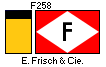
E. FRISCH & CIE.
image by Ivan Sache, 16 February 2004
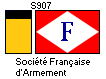
Reed identifies this livery simply as Em. Frisch & Cie.
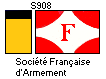
Armements Marseillais describes the funnel as yellow-orange and uses the name Socíeté Française d’Armement E. Frisch & Cie. Rosanoski considers the shortened company name in FOTW incorrect.
Formed in 1893, E. Frisch operated as Société Française d’Armement and sold its last ships in 1934. By 1919 Compagnie Générale Transatlantique controlled it, according to the account using the name Société Marseillaise d’Armement E. Frische & Cie.
Pavillon attributes participation in the 1916 Compagnie Générale d’Armements Maritimes joint venture with Compagnie Générale Transatlatique to Frisch, but other sources name Chargeurs Reunis as CGT’s partner.
France, Marseilles.
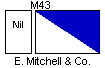
E. MITCHELL & CO.
The illustration follows Loughran 1979, 2(b).
E. Mitchell & Co. was a whaling concern, recorded in the Whale Fishery register of 2 December 1820 and mentioned in the Sacremento Daily Union of 6 February 1852.
USA, Nantucket.
E. V. HÖVELING & MEYER.
image by Klaus-Michael Schneider, None
image by Klaus-Michael Schneider, 29 May 2012
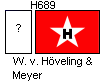
H689 was identified from an undated H. Carly flag chart published after March 1889 and before April 1899.
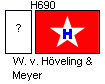
H690 shows a red flag with a central white five-pointed star containing a blue capital H, from Deicken und Behrmann’s summer 1897 supplement. Rosanoski notes that either the two sources differ over the H’s colour or one is incorrect.
Rosanoski tentatively expands the name as E. von Höveling & Meyer.
Germany.
E.A. KARAVIAS LTD.
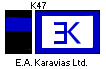
The funnel is black with a broad blue band. It was confirmed on St. Jude in April 1967 and noted for an Asimi Maritime vessel. St. Constantine, under Karavias (London) agency, showed a similar funnel in December 1971. The white flag has a blue border and a blue EK monogram, with the E reversed so that the letters share a spine.
Greece, Piraeus.
E.A. MOEIRA AGENTES DE NAVEGAÇÃO S.A.
image by Jorge Candeias, 3 January 1998
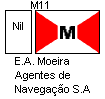
The company logo incorporated its flag. The joint T&M logo showed this and Transinsular’s flags on crossed poles, according to Candeias.
E.A. Moeira was recorded as a shipbroker and port agent, apparently still operating in July 2011. It and Transinsular formed T&M Agentes de Navegação, which began activity in June 1988; Moeira’s interest was bought out at the end of 1994. Its 12.5% stake in Transinsular had been acquired by CMB in 1993.
Portugal, Perafita.
E.A.K. BOS.
The funnel follows a starboard photograph of Jeanette dated 10 August 2012. Anet’s funnel is not visible in the photograph consulted, but the company logo appears on her bow and she flies Wagenborg’s flag.
E.A.K. [Egbert] Bos owned Anet and Jeanette through Anet Shipping C.V. and C.V. Scheepvaartonderneming Anet, with both ships chartered to Wagenborg Shipping B.V. Jeanette had been bought as Anet in 2007. She is also listed under Scheepvaarftbedrijf Van Dam, which Rosanoski presumes operated such companies for their owners. Wagenborg managed the ship. The source gives both 1 November 2009 and 1 April 2010 for her renaming. A new Anet was built on 11 March 2010, managed by Wagenborg and captained by Egbert Bos.
Netherlands, Delfzijl.
E.B. Aaby's Rederi A/S.
E.B. AABY'S REDERI A/S.
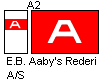
Some sources show the “A” on the A2 flag with a normal top.
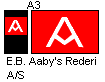
The form of the “A” varies in the accounts of A3: Brown’s 1951 and 1958 editions show a flat top, while the 1982 and 1995 editions show a downward-forked horizontal arm. Brown’s 1926 and 1934 editions show the A3 flag with a funnel resembling A4.
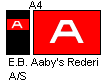
A photograph of Dicto shows the A4 funnel.
Mitchell records A610 for Dryso, built in 1972 and of 21,178 tons. The source lists her in Aaby’s fleet from Lloyds 1980–1 to “1992-7”, after which she was sold. There is no date or stated reason for this funnel; Rosanoski suggests a charter as the logical explanation, rather than an established fact.
I/S Norexim Shipping Co.
N539 is recorded for I/S Norexim Shipping Co., which Aaby's operated and which appears in Lloyds from 1978–9 to 1985–6.
Founded in 1861, the company traded as E.B. Aaby until 1937 and owned steamships from 1901. Vessel names ended in “o”, a practice which changed in the late 1980s.
Knutsen Aaby Tank K/S was formed in 1990 with Knutsen O.A.S. Shipping A/S to operate Dicto. Her sale was reported in July 1998, and the joint venture was absent from Lloyds in July 2000. Aaby also participated in the Saga Forest Carriers consortium, identified with Saga Shipholding (Norway) A.S., until 1995.
Norway: Drammen in 1917–8; Oslo in 1937–8.
E.D. HURLBURT & CO.
image by Joe McMillan, 22 October 2001
image by Joe McMillan, 22 October 2001
H548 is identified as the European Service flag.
The contemporary merchants’ chart distinguishes flags for the Apalachicola, Mobile and Pensacola lines, serving those Gulf ports. Mystic Seaport’s corresponding private-signal records are dated 1850.
Founded in 1825, the company is also spelt E.D. Hurlbut & Co. in FOTW and Clipper Ships & Yachts. It became an important coastal carrier of raw cotton from Gulf ports to north-eastern mills. By 1846 it operated thirteen vessels, with a sailing every ten days. In the late 1850s it expanded to Antwerp and Le Havre. Other records identify it as agent for Apalachicola and New York & Mobile packets and owner of Francis A Palmer, launched in 1854.
USA, New York.
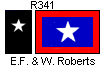
E.F. & W. ROBERTS.
image by Ivan Sache, 30 April 2008
Beginning as E. Roberts, this concern operated sailing ships. Astrakana was bought in 1890 and operated through the Astracana Sailing Ship Co.; the source uses those different spellings. It managed Glenholm Ship Co. in 1899–1901 and owned Alagonia, built in 1895. The Maskinonge record is associated with 1912–22 and Lloyds lists William Roberts & Son in 1917–18.
Its ships also worked the Australian coast on long-term charter. On 24 October 1898 its four-masted Andorinha was involved in a major Brooklyn fire, apparently originating aboard and spreading ashore and to another vessel. The contemporary report put the loss at $300,000.
U.K., Liverpool.
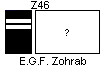
E.G.F. ZOHRAB.
The funnel is documented in Log, November 1997; no verbal design is supplied.
The source gives an operating period of 1906–1926. Zohrab owned Admiral from 1913 to 1918 and Pilot from 1913 to 1919. In 1924 he formed Awarua Shipping with the Hamilton family.
New Zealand, Wellington.
E.H. Harms GmbH & Co. Car Feeder Service.
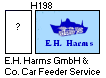
E.H. HARMS GMBH & CO. CAR FEEDER SERVICE.
The flag has a dark-blue ship partly surmounted by a white motor-vehicle car carrier outlined dark blue, with E.H. Harms in dark blue at the base.
Elbe-Ferry GmbH & Co. K.G.
The blue differs in the Elbe-Ferry image. The circle’s upper half has fifteen narrow blue lines, represented only approximately at the image’s size. The ring bears CUXHAVEN above and BRUNSBUTTEL below in white, both upright, with narrow curved white double-headed arrows on either side. Elbe-Ferry GmbH & Co. KG appears beneath in dark blue.
Formed in 1984, E.H. Harms operated through vessel-owning companies, including subsidiaries at Madeira and Dg-Leasing (Mediterranean) in Cyprus. Elbe-Ferry, formed in 1999, was also listed. Stargate Shipmanagement managed part of the fleet.
Germany, Bremen.
E.J. Gerhardt Schifffahrt & Verwaltung GmbH.
E.J.GERHARDT SCHIFFFAHRT & VERWALTUNG GMBH.
image by Klaus-Michael Schneider, 29 March and 27 March 2009
Website flags have an oval with straight top and bottom sides and slanted letters. The funnel uses the flag colours but upright lettering, showing its construction more clearly. Photographs of flying flags appear to show both upright and slanted letters, but Rosanoski considers them inconclusive because the flags are flapping.
The short funnel comes from Holger Gerhardt on 14 December 2008. The flag is seen on Irmgard Gerhardt on 12 August 2005 and Christina Gerhardt on 23 May 2006.
Ernst J. Gerhardt worked as crewman and captain in his parents’ shipping business before buying his first ship in 1973. A larger vessel followed in 1977, chartered to TG ELBIA. He established his Minden company in 1984, chiefly for inland tanker shipping. In 2003 he and Martin Deymann formed Tankschiffsreederei Gerhardt & Deymann; despite Intermares joining, the unsuccessful co-operation ended in 2006.
Germany, Minden.
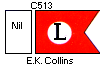
E.K. Collins
E.K. COLLINS.
image by Joe McMillan, 18 September 2001
image by Joe McMillan, 18 September 2001
C512 served the Dramatic Line’s Liverpool service and C513 the New Orleans service.
Edward Knight Collins joined his father’s firm, Israel G. Collins & Son, before operating as E.K. Collins by 1830. The partnership date is printed as 1925 in Rosanoski’s account, inconsistent with the surrounding chronology. The Dramatic Line served Liverpool in 1836–50 and was nicknamed the Theatrical Line because its ships were named for artists and dramatists. A New Orleans service began in 1837. Collins became a steamship owner in 1850, when the sailing fleet dispersed, operating the Collins Line, also named New York & Liverpool United States’ Mail Steamship Co. The company failed in 1858; Collins died in 1878.
USA, New York.
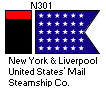
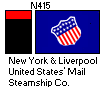
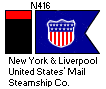
NEW YORK & LIVERPOOL UNITED STATES’ MAIL STEAMSHIP CO.
image by Joe McMillan, 18 September 2001
The steamship line changed its flag about 1855. Rosanoski’s copy of Bonsor makes both versions burgees, or swallowtailed flags, and does not say that the shield on the second flag was angled.
Rosanoski considers the rectangular FOTW rendering incorrect because Bonsor specifies a burgee, unless the 1975 reprint changed the earlier editions. The funnel is assumed to apply; it was not supplied in that flag source.
The New York & Liverpool United States’ Mail Steamship Co. was formed in 1848. Sources date the start of operations to 1849 or 1850, with the latter account giving an operating period ending in 1858.
USA, New York.
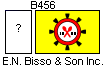
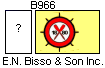
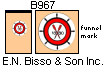
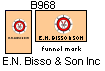
E.N. BISSO & SON INC.
The central device includes two red paddles between black “18” and “80”. The FOTW rendering centres it, whereas the original website places it towards the hoist; the later website uses a slightly different emblem still closer to the hoist.
On J S Bisso the funnel’s shade is uncertain between buff and yellow. The wheel spokes narrow inwards, and the paddles have red blades and brown handles.
Vera Bisso appears buff in one photograph and yellow in another, leaving the colour uncertain. It was the only photographed vessel Rosanoski found with the name beneath the emblem.
E.N. Bisso operated tugs and derricks mainly on the Mississippi River.
USA, Metairie, Louisiana, for the corporate office; New Orleans, Louisiana, for fleet operations.
E.P. ATKINSON & SONS LTD.
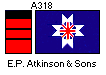
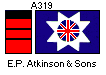
The funnel is red with a black top and two widely separated narrow black bands. The source gives two flag portrayals: white with a blue cross fourché containing a circular Union Flag wholly at its centre; or white with an angled blue eight-pointed star bearing a Union Flag roundel.
E.P. Atkinson & Sons operated as Ouse S.S. Co. Ltd. in the 1953–54 and 1958–59 registers. Ships & The Sea instead uses the name A.W. Atkinson.
U.K., Goole.
E.P. SHIPPING & TRADING B.V.
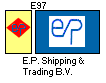
The yellow or buff funnel has a red diamond bearing combined blue stylised ep. On the flag, the same blue lettering occupies a white square panel on a blue field.
The fleet was held through two single-ship companies in 1998, reduced to one in the 2000 listing.
Netherlands, Rockanje.
E.R Newbigin Ltd.
Newbigin Steam Shipping Co.Ltd.
image by Phil Nelson, 7 April 2000
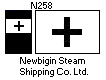
Formed in 1896, E.R Newbigin was inactive in 1918–22 and sold out in the early 1960s. It operated for Newbigin Steam Shipping Co. Ltd., formed in 1907, and High Hook Shipping Co. Ltd. By 1963–64 Lloyd’s lists it under Hunting & Son Ltd. as operator.
U.K., Newcastle.
E.R. SCHIFFAHRT GMBH & CIE K.G.
image by Santiago Dotor, 11 November 2003
The letters stand for Erck Rickmers. E99’s funnel is documented aboard E.R. Durban and E.R. Malmo; Nüsse supplies the table flag.
E.R. Albany on 26 December 2012 supplies the funnel, with a flag panel also on its superstructure. E.R. Wilhelmshaven confirms that the bands continue around the funnel.
The website flag is horizontally white-blue-white in proportions 1:4:1, with white E.R. centred on the blue.
E.R. Schiffahrt was formed in 1998 as a manager, with origins in the Rickmers family; it appears as an owner in Lloyds from 2004. Nordcapital announced that it would operate independently from 2008, encompassing the group’s shipping activities while retaining close collaboration. From 2012 Blue Star Holding combined its activities with the Komrowski companies.
Operating and associated interests included Katharinen Schiffahrt, formed in 2007, E.R. Offshore, and OSM Schiffahrt, founded jointly by OSM and Nordcapital in January 2007.
Germany, Hamburg.
EAGLE BULK SHIPPING INC.
The website logo has blue globe lines and yellow beak and talons. Kittiwake at Lyttelton on 7 November 2007 shows orange colouring, while Kite at Singapore on 4 July 2007 shows yellow; the eagle is mirrored between sides to face forward. Later photographs mostly show yellow, though Harrier and Hawk I appear red or orange, possibly owing to the camera. Sparrow on 11 October 2013 shows an entirely black-and-white version.
Goldeneye on 6 September 2012 has a forward-facing blue eagle and blue globe with lines on a white circle, with yellow beak and talons. The dark-blue funnel can appear black at a distance or in poor light.
Eagle Bulk was formed in 2005, apparently in November, as a Marshall Islands corporation headquartered in New York and described as the largest US-based Handymax owner. Sophocles Zoulas, also found as Zoullas, was chairman, president and chief executive. The holding company operated through subsidiaries managed by Eagle Shipping International (USA). It completed acquisition of Anemi Maritime Services and the fleet from its Greek parent, connected with the Tsangaris family, in August 2007. Delphin Shipping is also listed as an associate.
USA, New York.
Eagle Oil & Shipping Co. Ltd.
EAGLE OIL & SHIPPING CO. LTD.
image by Neale Rosanoski, 31 May 2005
image by Jarig Bakker, 12 August 2004
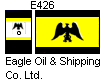
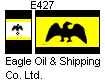
Rosanoski combined photographic funnel evidence with Loughran’s flag. San Leopoldo shows small eagle legs over a zero-like O. The flag’s eagle differs around the legs from that on the funnel; Rosanoski allows that the funnel lettering or practical execution could account for the difference.
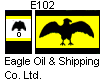
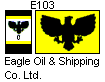
LJC 1930 uses buff for both flag and funnel. Larousse describes a yellow flag with thin black horizontal edges and a standing black eagle with outstretched wings. Mertens estimates each edge at one-fifth of the height and the eagle at half the height and two-thirds of the width, apparently without an object beneath it.
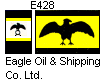
The museum flag, dated 1935–50, has the eagle’s wings displayed and elevated. This resembles the later form associated with the 1957 change, creating a dating difficulty. A similar website flag is undated and may relate to wartime material, but that connection is uncertain. US Navy 1961 shows the raised-wing form without black upper and lower edges.
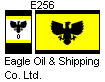
This flag reconstruction follows a letterhead dated 15 July 1914.
Eagle Tanker Co. Ltd.
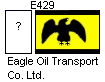
San Bernado, recorded as owned in 1912–23, supports this funnel. The photograph may indicate that the elevated-wing flag existed earlier than the proposed 1957 change, or that it belonged specifically to Eagle Tanker. T seems to have been added from 1913; earlier vessels show only the eagle, possibly under the Mexican company.
A parallel fleet operated through Eagle Tanker in Nassau, described in Rosanoski’s comment as a post-war operation. World Tanker Fleets says its oil fleet was chartered to Shell from 1919, with Shell holding a minority interest until acquisition of Canadian Eagle’s assets in July 1959 and full fleet control from 1 January 1960.
Bahamas, Nassau.
The two fleets had slightly different funnel markings. Earlier photographs show eagles with wings displayed and inverted, the head facing the viewer’s right on both sides and on the flag. An O, or later an appropriate T, stood below the bird. Some drawings give legs to the O or place the bird directly on the letter, but photographs do not support all these details. John S. Styring stated that the eagle design was materially altered early in 1957.
Shell’s flag replaced Eagle’s from 1 January 1960. San Gregorio was the first funnel conversion that month; the remaining 22 vessels were to change when dry-docked. Rosanoski cautions that his reconstructions combine photographic and printed evidence, and that painted funnel emblems may differ through simplification and individual execution.
Lord Cowdray, formerly Weetman Pearson, formed Eagle Oil Transport in 1912 to export oil for Compañia Mexicana de Petróleo “El Águila”. Shell took over the concerns in April 1919 and retained the British shipping company after the Mexican business was nationalised in 1938. The Eagle Oil & Shipping name dates to 1930 or 1931. Vessels generally had San names, mostly ending in o, and the company also operated for Anglo-Mexican Petroleum. The Canadian Eagle Group’s assets passed to Royal Dutch and Shell in July 1959, with operational integration into Shell Tankers at the turn of 1959–60. Sources variously call this a 1959 merger or 1960 absorption; Lloyds dates the Shell Tankers (U.K.) name to 1962 and still lists Eagle in 1963–64.
U.K., London.
EAGLE STEAMSHIP CO. S.A.
Aurora’s funnel was noted as silver or aluminium; the description gives grey or silver with a narrow black top.
Eagle Steamship is listed in 1963–64, 1970–71 and 1978–79, with Phoenix Maritime Agencies as agent.
USA, New York.
EARL STEAM FISHING CO. LTD.
The illustration derives from a black-and-white copy of Olsen’s Fisherman’s Almanac 1911. Rosanoski guessed both the blue shade and the unspecified funnel base: assuming black for the latter, he used lighter blue for contrast.
Cecelie was bought in 1911 with Alick Black as manager. Sir Alec Black is also recorded with Norland in 1937–39. After his death on 28 June 1942, Thunderstone passed to the Public Trustee in February 1943 and was sold; Fane was sold after wartime requisition in 1945. Rosanoski infers that Black was more than a manager and that the company effectively ended with his death.
U.K., Grimsby.
EARN LINE STEAMSHIP CO.
image by Joe McMillan, 6 October 2001
Alfred and George E. Earnshaw of Philadelphia and Joseph R. Foard of Baltimore established the line early in 1885 to carry Cuban iron ore to North Atlantic ports. It initially operated in Alfred’s name, then as a limited partnership, becoming Earn Line S.S. Co. Ltd. in 1887 and reincorporating in New Jersey in 1892. George succeeded Alfred as president after his death in 1896. Although based in Philadelphia, the company used English registration, as recorded for Earnmoor in 1887–89. It petitioned for receivership in 1913.
USA, Philadelphia; U.K., London.
EAST & WEST STEAMSHIP CO. (1961).
Fausta’s red funnel has two narrow white bands separated by a very narrow strip of the red ground.
The company is listed in Lloyds in 1963–64 and 1970–71.
Pakistan, Karachi.
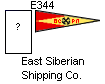
EAST SIBERIAN SHIPPING CO.
The flag bears two crossed black anchors separating the red letters BCPП.
The company provided passenger and cargo services on Lake Baykal and the Upper Angara. Rosanoski tentatively connects it with the East Siberian Shipping Administration and later OJSC East-Siberian Shipping, which is credited with converting Nikolay Eroschenko in 2004. A 34.6% state stake was auctioned on 25 January 2002.
USSR, Irkutsk; later Russia.
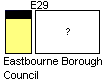
EASTBOURNE BOROUGH COUNCIL.
The council bought Wellington Harbour Ferries in 1913 and operated the service until 1948. Vessels were registered in the name of the Mayor, Councillors & Burgesses of the Borough of Eastbourne.
New Zealand, Eastbourne.
Eastern & Australian Steam Ship Co. Ltd.
EASTERN & AUSTRALIAN STEAM SHIP CO. LTD.
image by Neale Rosanoski, 31 May 2005
image by Jarig Bakker, 5 August 2004
image by Klaus-Michael Schneider, 24 October 2010
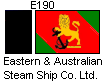
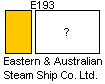
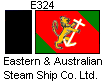
The 1885 Journal of Commerce changes the shield to an anchor and shows a rampant lion still facing the fly. Its anchor is white rather than black; Rosanoski cautions that the sources vary in both portrayal and colour.
The form shown from Lloyds 1904 onwards is supported by a photograph of an actual flag supplied through the Flag Institute in 2003. Lion and anchor details vary slightly between sources.
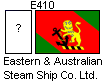
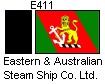
Chitral and Cathay used this funnel from 1961 to 1975.
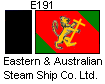
The National Maritime Museum dates this flag to about 1955–67.
Two diagonal dividing lines form green triangles and a red parallelogram. Within the red is a yellow lion rampant guardant holding a white anchor, standing on a black-and-white bar.
Eastern & Australian Mail Steam Ship Co. Ltd.
image by Neale Rosanoski, 31 May 2005
Griffin’s original flag has a lion rampant guardant facing the fly and holding a shield with black EA above M.
The Eastern & Australian Mail Steam Ship Co. began on 3 May 1873. It resolved to wind up in August 1880 and was replaced by Eastern & Australian Steam Ship, though another source gives 1875 as formation. Antony Gibbs & Sons became major shareholders by 1884. A further voluntary liquidation in June 1894 allowed reconstruction under the same name in July. The source also records an Australian registration in 1907 and deregistration in 2002 following notification of cessation in 2001.
The 1919 takeover is attributed either to Australasian United Steam Navigation or its British India owners, bringing the line into P&O. It was reformed on 1 November 1946 with equal interests held by P&O, Union Steam Ship of New Zealand, British India and Australasian United. P&O subsequently acquired the latter’s share and Union’s in September 1966. The company formed Australia Japan China Line with China Navigation and Australia-West Pacific Line.
After its last ships were sold in 1975, the business handled manning and operations for Australia Japan Container Line. It apparently became The Eastern & Australian Steamship Co. (M.S.) in 1983 and joined P&O Swire Containers’ ship-management division in 1998.
U.K., London; later Australia, Sydney.
EASTERN AFRICA NATIONAL SHIPPING LINE LTD.
image by Jarig Bakker, 15 March 2004
image by Jarig Bakker, 15 March 2004
The flag incorporated the colours of the four participating countries. E89 was replaced by E90 in 1968, with a corresponding funnel change. The later flag’s blue disc has a white ring bearing black ANSLE clockwise from the top; within it are Uganda’s crested crane, Tanzania’s torch, Kenya’s shield and Zambia’s yellow eagle. Loughran’s official drawing specifies 6 by 4 feet. The funnel omits the national badges, retaining a plain blue disc, white ring and lettering.
The emblem inside this funnel’s diamond is unclear.
A monochrome photograph of Mulungushi shows a dark, probably black funnel with two white bands separated by a narrow strip of what is probably the funnel ground.
The governments of Kenya, Uganda, Tanzania and Zambia jointly formed the line, registered at Dar-es-Salaam on 19 May 1966. Operations and East African Conference membership began on 27 June. Southern Line acted as operator and later agent. The company became bankrupt in 1980.
Kenya, Mombasa.
EASTERN BULK CARRIERS A.S.
The company website supplies the flag logo. Bulk Avenir’s funnel is documented starboard on 7 September 2007 and port-side on 12 May 2012.
Eastern Bulk Carriers was formed in 1998 as Otto Tidemand’s privately owned company; he and his family were also major Belships shareholders. The Australian operation was established at South Yarra, Victoria, in 2005 after acquiring Eureka Bulk Shipping. The business owned a majority interest in Bulk Avenir, operated between ten and twenty vessels and commercially managed Stove Rederi. Rosanoski deduces the abbreviation EBC.
Norway, Lysaker.
EASTERN CANADA TOWING LTD.
Point Halifax shows a version of Cory’s colours with CORY on the diamond, apparently peculiar to this company.
After Svitzer’s takeover the new owner’s funnel and a combined flag were adopted. The flag incorporates the ECTUG acronym with small Svitzer over Wijsmuller lettering. Funnel versions differ: Point Vim has a sky-blue base and darker-blue cross, while Point Halifax on 6 February 2009 carries the S1173 version with a very light buff band.
The former Foundation Maritime tugs initially continued under their own names after sale, before the business became Eastern Canada Towing, or ECTUG, dated to 1972. Later vessels used Point prefixes. The company was part of Cory Towage and subsequently Svitzer; it also managed for Cargill Grain.
Canada, Halifax.
EASTERN CAR LINER LTD.
image by Jarig Bakker, 19 November 2005
Koushun was observed with this funnel at Lyttelton on 12 June 1990 despite being listed under Libero Panama ownership and Kasuga Kaiun agency, suggesting management or charter use. Estrella Eterna at Wellington on 22 July 2000 likewise had a different owner, Unitra Maritime, but JLL confirmed the colours and flag as Eastern Car Liner’s. NJK confirmed the funnel on later sightings.
The flag on the Hong Kong shipping-companies website differs from the confirmed E197 version; Rosanoski suggests it might be a shore flag.
Eastern Car Liner was formed on 11 May 1977. It appears at different dates under its own name and as an operating company of Nissan Prince Kaiun, later Prince Kaiun. Listed shareholders included Mitsui O.S.K. Lines, Tatsumi Shokai, Everett Orient Line, Kamigumi and Futaba Kaiun, alongside financial and insurance interests.
Japan, Tokyo.
Eastern Group of Telegraph Companies.
EASTERN GROUP OF TELEGRAPH COMPANIES.
image by Rob Raeside, None
image by Klaus-Michael Schneider, 18 September 2008
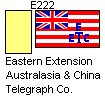
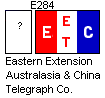
[2] EASTERN EXTENSION AUSTRALASIA & CHINA TELEGRAPH CO.
image by Klaus-Michael Schneider, 18 September 2008
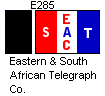
[4] EASTERN & SOUTH AFRICAN TELEGRAPH CO.
Eastern Extension Australasia & China Telegraph Co.
E284 is dated 1873–1902 and E222 to 1902–35. The later flag resembles Eastern Telegraph’s with an additional blue E above ETC. It is generally ascribed to Eastern Extension Telegraph, apart from the Brown 1943 index.
The company was formed in 1873 from British India Extension, China Submarine Telegraph and British Australian Telegraph. Another account places its combination with Eastern & Associated in 1872, preceding that formation date; Rosanoski explicitly questions the sequence.
U.K., London.
Keep the explicit scope label independent; no alias or company identity is inferred.
Eastern & South African Telegraph Co.
Formed in 1879 as part of the group, the company owned ships until 1913 and then used other group vessels. It entered Imperial & International in 1929, though another account records an earlier association merger.
U.K., London.
Keep the explicit scope label independent; no alias or company identity is inferred.
Eastern Telegraph Co.
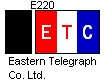
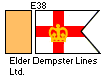
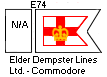
The early flag is a vertical red-white-blue triband with ETC, white on the coloured stripes and red on white. Cableships dates its use to 1872–1902, although the successor design appears in Griffin 1895.
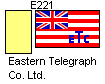
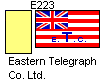
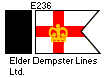
The later house flag follows the old East India Company ensign with blue ETC in the fly. Lloyds 1904 spreads the letters farther apart and adds dots, while its 1912 version returns to the other arrangement. The ships used the Red Ensign, and Cable & Wireless livery replaced the group’s colours from 1939.
John Pender formed Eastern Telegraph in 1872 by combining Falmouth, Gibraltar & Malta, Marseilles, Algiers & Malta, Anglo-Mediterranean and British India Submarine Telegraph. The group’s companies appear to have kept separate identities while operating together. Eastern formed African Direct in 1885, acquired Direct Spanish that year and controlled West African from 1889. It also held half the Commercial Pacific Cable venture formed in 1901. Vessels passed to Imperial & International Communications in 1929.
Keep the explicit scope label independent; no alias or company identity is inferred.
Eastern & Associated Telegraph Companies
The associated group combined Eastern and Eastern Extension with Eastern & South African, African Direct, West African, Europe & Azores, West Coast of America, River Plate, Pacific & European and Société Anonyme Belge de Cables Télégraphique. Its members apparently retained individuality until the 29 September 1929 Imperial & International merger. Rosanoski treats this association as apparently equivalent to the Eastern Group.
Keep the explicit scope label independent; no alias or company identity is inferred.
U.K., London.
Eastern Marine Services.
EMS.
The company website supplies the logo, and a port-side photograph of Ems Defender dated 10 February 2013 supplies the funnel panel.
Eastern Marine Services, or EMS, was operating by 2010, chartering vessels and supplying personnel for offshore energy and marine-construction projects.
U.K., Lowestoft.
EASTERN MEDITERRANEAN MARITIME LTD.
image contributed by Josef Nüsse, None
Botany Tradewind confirms the funnel. Seaguardian on 28 May 2005 appears to have the cross stop at the top, but that upper structure is a ventilation lattice. The blue is so dark that it is often reported as black.
Nüsse’s table flag appears to be a banner rather than a sea flag. It reads EASTERN over MEDITERRANEAN over MARITIME LTD. Its depicted funnel is not assumed to exist exactly as shown.
Eastern Mediterranean Maritime (London) Ltd.
A London company of the same name is recorded as formed in 1971; its subsidiary relationship is assumed.
Keep the explicit scope label independent; no alias or company identity is inferred.
Known as EastMed, the company’s website dated its establishment in Liechenstein to 1972, operating in Athens and beginning independent activities in January 1991. Rosanoski found that date puzzling. Lloyds instead gives formation in 1990 by Athanasios Martinos after leaving the family firm Thenamaris. Sources name the controlling principal as Thanassis Martinos and the managing director as Athanasios J. Martinos.
Greece, Athens.
EASTERN PACIFIC SHIPPING PTE.LTD.
Osaka Tower’s port-side photograph dated 8 February 2014 shows the same funnel as Tanker Pacific Management, although shades may differ. The company website supplies the logo.
Eastern Pacific was a dormant ship-management company revived to manage containerships, PCTC and dry-bulk vessels. Its website was dated 2013. It was associated with Tanker Pacific Management (Singapore), both overseen by Quantum Pacific.
Singapore.
EASTERN SHIPPING LINES INC.
The funnel was recorded for Eastern Galaxy, listed by Lloyds as owned by a managed company.
Eastern Shipping Lines was formed in 1957. It operated as owner, manager and agent, with vessels under its own name and name companies.
Philippines, Manila.
EASTERN STEAMSHIP CO. LTD.
The funnel is black with a broad yellow band. Two pennants form the house flag: the upper is horizontally blue over yellow; the lower is vertically yellow at the hoist and blue at the fly. Sources differ over the lower division. Griffin and Flags of the World show equal halves, Reed gives yellow the greater area, and Rosanoski favours the Lloyds and Journal of Commerce form with yellow about one-third and blue two-thirds. The Duke of Devonshire print appears closer to 40:60. A website’s plain black funnel is rejected by Rosanoski because the contemporary sources agree on the banded form.
The 1873 Duke of Devonshire print confirms the double pennants at the mainmast but shows another, unidentified mizzen flag. Its emblem may be a crown or castle. Rosanoski suggests, explicitly as theory, that a trials illustration might show the builder’s flag, related to the Furness Railway’s blue flag with a white crown and FR in the lower corners.
Eastern Steamship was established in 1871 to import jute from Calcutta and became known as the Duke or Ducal Line through its Duke-named ships. The jute trade appears to have ended in 1881. J.B. Westray became manager in 1880 and, with E.S. Dawes, acquired a majority interest in 1885. Ships were chartered to New Zealand Shipping and British India; six were taken by British India Associated late in 1882, and a Queensland trading agreement followed in 1884. Duke of Sutherland also made a Colonial Line round voyage to Australia in 1883.
Accounts differ over a British India purchase and amalgamation with Australasian United. Rosanoski favours continued separate ownership, with charters or management potentially confused with purchase, but preserves the conflicting takeover accounts. The final Ducal service is dated 1902, while one source gives winding-up in 1905 rather than 1902.
U.K., London.
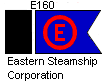
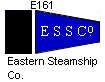
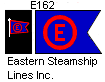
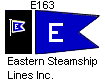
EASTERN STEAMSHIP CORPORATION.
image by Joe McMillan, 6 October 2001
image by Joe McMillan, 6 October 2001
image by Joe McMillan, 6 October 2001
image by Joe McMillan, 6 October 2001
image by Joe McMillan, 6 October 2001
image by Ivan Sache, None
image by Eugene Ipavec, 27 July 2010
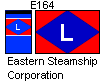
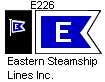
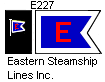
E162’s funnel flag is unclear, appearing to show black E on a red circle; Rosanoski assumes it follows the house flag. The change to E163 is noted belatedly in Ships & The Sea 1938. National Geographic and Brown 1951 show a plain blue burgee with white E, while retaining a white-bordered flag on the funnel.
Merchant Ships adds a normal blue swallowtail with white border and white E, with red E used briefly beforehand. Its funnel illustration appears tapered although the separate flag does not, suggesting a possible connection with the unbordered blue burgee.
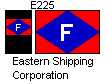
Fraser’s flag is red with a blue lozenge throughout and white F. A Queen of Nassau postcard supports the funnel and uses the Eastern Shipping Corporation name, also found on a postcard posted in March 1956.
An Evangeline postcard shows a brighter, lighter blue funnel version. The flag shade remains uncertain and is retained as the original guess.
Lovett retained the flag design but changed F to L in 1962. A monochrome New Bahama Star postcard has the diamond and funnel base darker than the band; colour cards differ, one dark blue and an Ariadne card supporting the illustrated form. The flag’s shade is unknown.
Mitchell’s form probably follows New Bahama Star and Evangeline drawings. Rosanoski allows possible changes rather than forcing agreement with the other version; the comparison is labelled E364 in the original note.
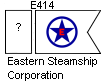
After the Gotaas-Larsen takeover, the flag used its blue five-pointed star within a blue ring on white, with a red sans-serif E added at the star’s centre. An offered flag was said to have flown aboard Emerald Seas, Bahama Star and Ariadne. Mertens considered it probably swallowtailed but sought confirmation; Rosanoski questioned the illustrated 1:2 proportions against the reported 3:5. Another actual flag from Emerald Seas is rectangular, 4 by 6 feet, represented as E413. Ashtray logos provide further evidence, including E414. The rectangular and possible swallowtail forms remain distinct.
Charles Wyman Morse formed Eastern Steamship on 8 October 1901 from six New England coastal lines, including Boston & Bangor, Portland Steam Packet and International Steamship. New York–New England services later expanded into Florida winter cruises. Bankruptcy followed Morse’s financial collapse in 1907. Reorganisation as Eastern Steamship Corporation and the formation of Eastern Steamship Lines are variously dated in the sources, which give 11 December 1911 and a further reorganisation on 30 January 1917. Metropolitan and Maine Steamship joined under New York, New Haven & Hartford Railroad ownership; Dominion Atlantic’s marine interests followed in 1912. Bankruptcy in November 1914 led to the railroad disposing of its stock. The recovered business acquired Old Dominion in 1923 and also operated for Nova Scotia Steamship.
Wartime suspension was followed by a brief return to Nova Scotia summer cruising. Operations stopped again in 1954 and liquidation followed in 1956. F. Leslie Fraser, also written Frazer, bought the name; the flag account dates his purchase to 1954. Vessels moved to Panamanian registry, first under McCormick and then Eastern Shipping Corporation, though Eastern Steamship Corporation also appears. Lovett, variously W.K. or W.R., bought the line in 1962. Gotaas-Larsen’s acquisition is reported in 1969 and dated 1970 elsewhere. The business became Eastern Cruises in 1981 and joined Western Cruise Lines and Sundance as Admiral Cruises in 1983. The source identifies Royal Caribbean as a later corporate descendant. Associated ship companies included Miami S.S., Ariadne Shipping and apparently Evangeline Steamship, though Ariadne’s listed subsidiary status is not supported by the consulted Lloyds entries.
USA: Portland, Maine; Boston, Massachusetts; New York; later Miami, Florida.
EASTERN TRANSPORTATION CO.
image by Joe McMillan, 6 October 2001
The company is listed in Lloyds 1953–54.
USA, Baltimore, Maryland.
EASTMOUNT SHIPPING CORPORATION.
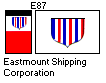
The white flag bears a shield of eleven vertical blue, white and red stripes. The red funnel has a black top separated from the base by a broad band of the flag.
Eastmount is listed in Lloyds 1970–71, with Westmount Shipping Corporation as agent.
USA, New York.
EASTON, GREIG & CO.
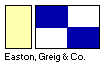
The funnel is yellow or buff; the flag is quartered blue and white.
Easton, Greig managed S.S. Glensloy Co., recorded with Glenluss in the 1920s.
U.K.
Eastwind Group.
EASTWIND GROUP.
Mitchell may have based this funnel on EW Kilimanjaro, the only vessel named on his card, but he supplies no line drawing.
The funnel follows a starboard photograph of EW Hastings; the archived company website supplies the logo.
Eastwind Maritime was founded in 1987 by American and Japanese shipping professionals, with executives and employees as shareholders. Based principally in New York and Tokyo, the group owned and commercially managed reefer and freezer vessels, including long-term charters and joint ventures. Eastwind Transport was its commercial operating subsidiary, Eastwind Ship Management in Singapore supplied technical and crew management, and Eastwind Ltd. acted in Japan. Lloyds records the latter’s change from Tofu Maritime in 1987. Multiship was the South American agent. Other interests included Eco Shipping with Lauritzen Cool, Norbulk (Hellas) with Norbulk, and the ReeferShip consortium. Register entries place Eastwind Maritime S.A. both within and at the head of the group at different dates, with formation given as 1987 or 1988.
The Marshall Islands corporation filed for Chapter 7 bankruptcy on 24 June 2009.
USA, New York.
EASYGROUP (UK) LTD.
The funnel follows a photograph of easyCruiseOne dated 29 November 2005.
Formed in 2004 and owned by Stelios Haji-Ioannou, Easygroup operated as easyCruise.com and was listed as agent for EasyCruise Ltd. in 2006.
U.K., London.
EBBESEN REDERI CO.
Ebbesen is listed as manager for two companies in Lloyds 1958–59.
Norway, Oslo.
EBERHARD WOERL.
Mitchell supplies both funnel illustrations and identifies W429 as an alternative, although Rosanoski believes only one vessel was involved.
Eberhard Woerl operated Zeta, built in 1965 according to Lloyd’s. Entries are noted in 1966–1967 and 1973–1974; Rosanoski could not locate the vessel in the Miramar Ship Index.
Germany, Elsfleth.
EBS MANAGEMENT A/B.
Mitchell’s card later acquired a pencilled Ellinor reference. The vessel is confirmed in the company and register records, but the available image does not confirm funnel colours or markings.
A later website photograph of Saxen shows a buff funnel with narrow black top and what appears to be a black panel with a white circle.
With family roots in fishing and shipping early in the twentieth century, brothers Elon, Bengt and Ture Johansson began the business in 1947 by investing in the coaster Wallmor. Per-Arne joined in 1963 and, with a cousin, formed EBS-Line in 1993, taking over Torline’s liner traffic. Management services began in 1994; the company left the liner trade in 1997 and became EBS Management in 2000. Elon Johansson’s Elizabeth is confirmed by the company website. A possible connection with the earlier Bengt Johannson of Skarhamn remains uncertain.
Sweden, Skarhamn.
ECHO SHIPPING A/S.
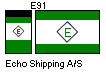
The green flag has a broad white horizontal band bearing a black diamond frame enclosing a green E. The funnel repeats the green and white-band design with a black top.
Echo Shipping was formed in 1989 and listed as manager for one company in 1992–93. Wilson Ship Management (Bergen) appears as its manager in 2000.
Norway, Stavanger.
ECO SHIPPING.
The funnel follows Glacier at New Plymouth on 19 April 2003.
ECo was a Norwegian-based reefer pool established jointly by Eastwind and Cool Carriers, both contributing ships. Cool Carriers became LauritzenCool, later NYKLauritzenCool, and increased its ECo interest. Armada Shipping, ECo and Arctic Reefers co-founded ReeferShip in 2002. Rosanoski suggests the Norwegian location reflected Cool Carriers’ then Höegh ownership, but in 2006 he could not establish whether Eastwind remained in the pool or precisely who operated it.
Norway.
ECONOMOU & CO. LTD.
Economou was listed as an agent from 1953–54 through 1966–67, with G. Economou named as a director in 1958. Its agencies included Monrovia Shipping, Monrovia Tanker and Monrovia Tramp Shipping.
U.K., London.
Ecuadorian Line..
ECUADORIAN LINE..
The logo was registered in 2007 to Fruit Shippers of Nassau, described elsewhere as the Noboa family’s London holding company. Provincia del Guayas was seen at Lyttelton on 25 August 1990 with royal-blue colouring and angled funnel letters; the flag’s letters are presumed similarly angled. Baltic Sea and Indian Ocean photographs also support the funnel.
Flota Bananera Ecuatoriana S.A.
Ecuadorian Line Inc., USA
A New York agency was established in 1974 at Staten Island. The later website gives Miami, suggesting two US locations served through Antwerp, though the precise shipping arrangements are uncertain. Rosanoski understands the vessels as managed by Trireme while trading under the Ecuadorian Line brand.
Keep the explicit scope label independent; no alias or company identity is inferred.
Flota Bananera Ecuatoriana
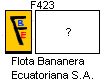
Mitchell labels this funnel Flota Bananera Ecuadoriana Israel and bases it on Rio Amazonas. Lloyds instead lists Rio Amazonas and Islas Galaopagos under Flota Bananera Ecuatoriana of Guayaguil, with government investment in the fleet noted by another source. By 1992–93 the vessels appeared under Naviera del Pacifico, managed by Ecuadorian Line.
Keep the explicit scope label independent; no alias or company identity is inferred.
Ecuadorian Line managed Bonita’s refrigerated fleet supplying Europe from Antwerp, with Rome and Zagreb offices. The operation grew from Leon Van Parys’s switch from Congolese to Ecuadorian bananas in cooperation with Exportadora Bananera Noboa. Pacific Fruit businesses developed the Italian and northern European markets; Sundrop branding ended in 1976 and northern sales were consolidated at Antwerp after the Hamburg office closed in 2003. The Belgian Ecuadorian Line was formed in 1988 and renamed Trireme Vessel Management in 1996; it was described as a Pacific Fruit Italy subsidiary.
Belgium, Antwerp; USA, New York and Miami, Florida.
EDDIE STEAMSHIP CO. LTD.
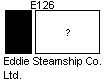
The common funnel was recorded on Kally and Waywiser’s Hwa Lee, and on Silvana under an agency company called Alexander in the NJK record but identified by Rosanoski as Alexandra Navigation Corporation. Agency listings later pass through W.H. Eddie Hau and Eddie Steamship (HK). Mitchell shows the funnel on all six of his vessel drawings despite different owning companies.
Lloyds dates Eddie Steamship to 1927, with W.H. Eddie Hsu controlling the wider group. Recorded operations begin with Polly in 1954; earlier activities are unknown. The company operated Oriental Navigation and later appears as an operating company of Waywiser Marine Shipping Agency. Eddies Shipping Agency in New York was associated. A 2009 comment reports severe financial difficulties for Hsu.
Taiwan, Taipei.
EDINBURGH TANKERS PLC.
image by Jarig Bakker, 20 November 2005
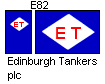
This funnel is Ben Line’s.
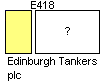
Mitchell shows the funnel in dark blue.
Ben Line and B.G.S. Investments formed Edinburgh Tankers on 12 November 1986 for product and chemical tankers. Edinburgh Talla was bought and renamed in 1987; the last vessel, written as Edinburg Fruid, was sold in 1996. Denholm managed the fleet in the 1990s. The company’s last accounts were filed in March 1997 and its status is recorded as dissolved.
U.K., Edinburgh; London.
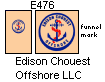
EDISON CHOUEST OFFSHORE LLC.
Kobe Chouest’s port-side photograph dated 10 February 2013 supplies the funnel, with the company website providing the logo.
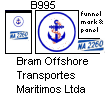
Documentary images — company attribution uncertain
Exclusive Bram or shared Chouest use not established by the unlettered motif.
Bram Offshore attribution, uncertain
Blue Shark’s starboard funnel on 10 April 2013 omits the logo lettering and has a lower panel reading NA 2260, possibly a registration number. Baker Hughes, the charterer, has its logo aft on the hull. Attribution to Bram Offshore is uncertain: Lloyds places the vessel under Nautical Ventures with Edison Chouest management. Bram’s building shows a plain foul anchor beside its name, whereas website vessel photographs show a ring and anchor, sometimes with lettering, and changing lower-panel characters. Most funnels appear buff or yellow.
Keep the explicit scope label independent; no alias or company identity is inferred.
Edison Chouest began in 1960 as Edison Chouest Boat Rental and is also known as ECO. Lloyds initially gave 1985 as formation, later amending it to 1960. Boat Rentals and Offshore names appear separately in early listings; the Offshore LLC form is recorded by 2000.
Operating companies included Alfanave in Rio de Janeiro, formed in 2003, with Bram Offshore as a name company dated to 2007; Chouest Offshore Services, formed in 1997; and Delta Towing at Houma, formed in 2001.
USA, Galliano, Louisiana.
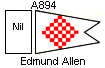
EDMUND ALLEN.
Edmund Allen is identified as a whaler.
USA, Fairhaven, Massachusetts.
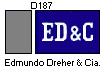
EDMUNDO DREHER & CIA.
The Brazilian website supplying the livery covers 1950 designs.
Edmundo Dreher is listed in Lloyds from 1953–54 through 1966–67.
Brazil, Rio Grande do Sul; Porto Alegre.
EDWARD BATES & SONS.
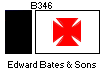
The funnel is black. The flag is white with a red cross paty, shown by LJC 1885 as a large, narrow cross.
Edward Bates & Sons bought half of Thos. & Jno Brocklebank in 1911 and sold the holding to Cunard in 1919. Rosanoski questions Jordan’s statement that Brocklebanks entered the Cunard group in 1911, reasoning that it would require Bates already to have belonged to that group; he does not establish that condition.
U.K., Liverpool.
EDWARD ECCLES.
Edward Eccles
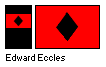
The flag is red with a black fusil. The black funnel has a broad band of the flag.
U.K.
EDWARD MOLTENIUS.
image by Joe McMillan, 31 October 2001
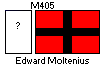
The flag follows the chart Private Signals of the Merchants of New York.
Edward Moltenius operated around 1855.
USA, New York.
EDWARD T. LINDLEY.
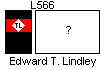
L566 is documented in Merchant Ships 1942 and 1944.
Lindley became an owner after the sale of John Harrison, in which he had been a partner, in 1920. A short-lived joint venture, Striver Shipping, was formed with H. Harrison in November 1923. His last ship, Nutfield, was sold to the Ministry of War Transport in December 1942 as Empire Nutfield, laid up and scuttled in 1946. Rosanoski presumes that Lindley continued to manage it until then, when his shipping interest ended.
UK, London.
EFCARRIERS CO. LTD.
Mitchell appears to base this funnel on his line drawing of Athenian.
Efcarriers is recorded in the 1953–64 registers. Ceres Shipping acted as operator and later agent, with Frangos Brothers as London agent in 1953–54. Its last vessel, Athenian, was sold in 1965.
Liberia, Monrovia; Panama; U.K., London.
EFFJOHN INTERNATIONAL O/Y A/B.
The blue flag has a double, very narrow white frame near the edge, enclosing a white symbol.
Effjohn developed from the Effoa and Johnson cruise and ferry interests. A 1987 joint venture, Rederi A/B Effjohn, acquired control of financially troubled Rederi Sally, completing the purchase in 1988 in exchange for Viking Line holdings. Mitchell dates ship pooling to January 1989 and entry into cruising that June, including Commodore, Europe and Crown cruise lines. Other accounts date the main Effoa–Johnson–Sally merger to 1990, with Effjohn O/Y as holding company and Effjohn International holding the fleet. Ferry interests included Silja, Wasa, Sally, Sea Wind, Jacob and Anedin; listed operators also included Sembawang Shipmanagement. Nordstjernan held 40%. Lloyds records the change to Silja O/Y A/B in 1995.
Finland, Helsinki.
EFFLUENTS SERVICES LTD.
Brown shows pale green. A Haweswater photograph likewise shows light green and a white band, but no lettering is visible.
The source also records a Humber Star photograph dated 17 July 2000.
Formed in 1970, Effluents Services apparently continued in business after leaving shipping with Humber Star’s sale in 2009.
U.K., Stockport; later Macclesfield.
EFNAV CO. LTD.
image contributed by Davidships, 3 December 2013
The funnel is documented on Spitha’s starboard side on 3 October 2013 and Danae’s port side on 27 June 2011. A letter dated 17 May 2010 supplies the logo and heading. Davidships suggests that E may stand for Phillipos Efstathiou, without asserting the identification as certain.
Efnav was formed in 1995 and is listed at different dates as manager and agent.
Greece, Piraeus.
EFSHIPPING CO. S.A. PANAMA.
The white stylised EF combines the letters, with E formed as a horizontal anchor whose arrowhead bears a blue circle. An early-1980s photograph of Aristidis confirms the funnel.
Formed in 1979, Efshipping operated, managed and acted as agent for several companies. The Greek Shipping Directory uses the form Efshiping Co. S.A. (Panama).
Greece, Piraeus.
EFTHYMIADIS LINES.
The white funnel has a narrow blue top and a blue K placed on a rounded E as one emblem. The white flag carries that emblem within a narrow blue border.
Rosanoski tentatively identifies the line with Constantine S. Efthymiadis of Piraeus, listed in 1963–64 and 1970–71, noting that Greek has no C in its alphabet.
Greece.
EGERIA SOCIETÀ DI NAVIGAZIONE PER AZIONI.
Egeria’s funnel, noted in August 1964, is blue with a black top and a white circle bearing black E.
The concern is listed in 1963–64 and 1970–71, and as Egeria S.p.A. di Navigazione in 1978–79.
Italy, Palermo, Sicily.
EGIL NÆSHEIM.
Egil Næsheim operated from 1916, forming Egil Næsheims Rederi A/S in 1963 according to Skipet. The last ship, Varodd, was sold in 1975, and the company was liquidated in 1982. Lloyds uses several name forms and records Næsheim as operator for the rederi company in later editions.
Norway, Haugesund.
EGIL ULVAN REDERI A/S.
Mitchell shows a black U, probably from With Junior, although no drawing identifies the basis. Rosanoski presumes white was more likely.
With Junior’s port and starboard photographs show an air-sea-rescue orange matching the hull. The website-based flag uses a softer orange, though both may in fact have used the brighter shade.
The family business dates to 1919. Its first steel vessel, With Junior in 1966, began a fixed coastal route system using ships small enough to reach most coastal docks. Lloyds gives a 1987 formation, presumed by Rosanoski to refer specifically to Egil Ulvan Rederi A/S rather than the earlier family operation.
Ulvan Personal, formed in 1995 at the same address, managed Feed-named vessels owned by Halten, which used that company’s livery.
Norway: Knarriasgsund, near Trondheim, and later Trondhein, preserving the source’s location spellings.
Egon Oldendorff OHG.
EGON OLDENDORFF OHG.
image by Jorge Candeias, 21 February 1999
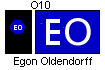
Sources vary in the size of the flag lettering. Rosanoski doubts O10’s funnel because Jordan records O9 before the Second World War. Mitchell shows a white band on O9, which Rosanoski attributes to differences in funnel height.
Both flag and funnel were confirmed on Margaret Oldendorff at Wellington on 4 October 2000. Nüsse’s later table-flag photograph gives a better blue than his earlier website image.
Oldendorff Carriers GmbH & Co. K.G.
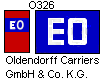
The funnel follows Johann Oldendorff, photographed on 5 October 2004.
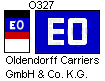
Harmen Oldendorff, photographed on 5 February 2007, supplies this livery; the flag’s O appears squared.
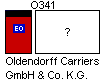
Ernst Oldendorff at Newcastle on 19 August 2011 shows a funnel changed from O8 since June 2010, and a definitely squared O on the flag. Rosanoski initially questioned whether the apparent white funnel base was actually superstructure. A starboard photograph of Carl Oldendorff at Brisbane on 16 May 2013 disproved that suggestion by showing a separate funnel structure. Although that photograph looks very pale grey, other photographs confirm a white base.
Egon Oldendorff became a partner on 19 February 1921 in the Hamburg shipping firm he had joined nine months earlier as a trainee. Renamed Lilienfeld & Oldendorff, it passed wholly to him by the end of that year. The source records a 1936 name change from Nordische Dampfer-Reederei (Lilienfeld & Oldendorff) m.b.H. His son Henning became chief executive in 1980 and majority shareholder after Egon’s death on 9 May 1984. The family holding company retained full ownership of its shipping and other investments.
Concept Carriers, a steel-parcelling and bulk operator established in 1995, merged with Egon Oldendorff Carriers in January 2001 as Oldendorff Carriers, based in Lübeck. Peter Twiss became chief executive in 2003.
The group included Singapore and Hong Kong companies formed in 1966 and 1986, and Rhenania Shipping Corporation. Flensburger Schiffbau-Gesellschaft, acquired in March 1990, was sold to management and investors in December 2008. Other interests included the conveyor-belt self-unloader pool with CSL International in Boston and participation in Atlantica Shipping in Oslo. Rosanoski notes an apparent joint venture with what became OXL, bought out in 2007. Most ship names were family names.
Germany, Hamburg and Lübeck.
Egon Stjerna.
Rederi A/B Egon
image contributed by NDR, None
The cap badge shows a blue pennant edged yellow except at the hoist, with a star assumed to be yellow. The star looks darker than the edging, so its actual colour is uncertain.
Egon Stjerna is recorded as a Malmö shipbroker in 1942–1943 and as operator of Rederi A/B Egon in the 1953–1954 and 1956–1957 registers.
Sweden, Linhamn; Malmö for Rederi A/B Egon in the cap-badge source.
EGYPTIAN INTERNATIONAL SHIPPING CORPORATION.
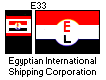
The flag is a horizontal red-white-black triband with an overall white circle bearing black E above black L. The L has a white, black-outlined extension reaching the upper letter. The black funnel carries the flag on a broad white band edged red above and below.
The company was formed in 1978, with Nippon Unpasha holding 50%.
Egypt.
EGYPTIAN TANKER CO.
ETC Ramsis’s port-side photograph is also presumed to show charter colours, possibly with a logo omitted from the panel.
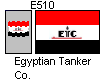
ETC Isis at Botany Bay on 2 May 2013 and a starboard ETC Ramsis photograph from January supply the funnel evidence. Detail is unclear: ETC appears simplified, perhaps more ornate like the hull letters, with an oil drop above T and a tanker outline below. The flag is an assumption from the funnel panel, using the full logo rather than its simplified rendering.
ETC Isis in April 2011 had TEN on the hull and a Tsakos funnel without T, suggesting a charter, presumed to Tsakos Energy Management.
ETC’s website dates foundation as a joint-stock free-zone company to December 2006; National Navigation gives 2009 and a 2% capital contribution. MIDTAP held 13%. Other shareholders included Kuwait Egyptian Holding, Egyptian General Petroleum, Petroleum Marine Service, National Bank of Egypt and Misr. Banque. Thome Ship Management appears as manager in 2011–12.
Egypt, Cairo.
Eicke Schiffahrts K.G.
EICKE SCHIFFAHRTS K.G.
image contributed by Josef Nüsse, None
Allegretto’s port and starboard photographs show the funnel device mirrored to face forward. Its flag, also photographed at the bow, has a black bird’s head with white markings. Another flag and OAM.DE hull lettering presumably relate to a charterer. Nüsse supplies the table flag.
Winfried Eicke Bereederungs GmbH & Co.
Kornett on 1 July 2007 has this funnel and the E98 flag painted on the superstructure; Laura Ann uses the same arrangement.
Eicke was formed in 1990 and appears as an operating company of Rhein-Maas-und-See before later listings under its own name. Winfried Eicke Bereederungs, formed in 2005 at the same address, was an operating company.
Germany, Delve; later Heide.
EIDE MARINE SERVICES A/S.
The website-derived flag logo has black lettering, though blue glints are visible, while subsidiary logos and funnels use blue. The funnel follows Eide Transporter on 12 March 2007. Eide Trader at Newcastle on 3 September 2008 shows the same arrangement with a black top, apparently the usual funnel.
Eide Master supplies the funnel; the flag is based on its funnel logo.
This funnel follows a photograph of Eide Rex.
The group traces its origin to George Eide’s wooden fishing-vessel business in 1922. Its later holding company, Barge Invest, controlled marine technology, contracting, marine services, flotel and accommodation companies; the website names Johannes G. Eide as group founder and owner. Another account says John, or Johannes, Malvin Eide started Eide Contracting and Eide Shipping in 1982, with possible involvement by a brother, reorganising them as Eide Marine Services in 1992–93. Lloyds instead dates Marine Services to 1994 and Barge Invest to 2005. Fleet names mainly begin Eide.
Norway, Hoylandsbygd.
EIDE SHIPPING A/S.
Eide Junior’s photograph dated 30 March 2006 shows the funnel under Eide Shipping ownership. It remained unchanged in 2008 after the vessel was listed under Eide Maritim.
Eide Shipping was registered in August 2000, with Eide Junior recorded from January that year. A translated company account connects it with Odd Eide & Sons, active in maritime chartering since 1935. Lloyds gives 1984 as formation, which Rosanoski presumes belongs to the earlier same-named business absorbed into Eide Marine Services in 1992–93. The later Eide Shipping operated through Eide Maritim, formed in 2006.
Norway, Hoylandsbygd; later Harstad.
Eimskip ehf.
EIMSKIP EHF.
image by H.M., 9 December 2002
image by Rob Raeside, 1 October 2013
The new logo combines two connected Es, blue and silver, representing the relationship between Eimskip’s service and its customers. The company links blue with Iceland and the ocean, silver with valuables and capital goods, specifying Pantone 2935 and 877. Photographs appear brighter sky blue and grey, which Rosanoski attributes provisionally to light and material. The small Icelandic slogan is transcribed GREID LEID, with a bar through each D’s vertical; the transcription may have been inferred from the logo.
The later flag replaces the Icelandic slogan with grey COOL CHOICE IN LOGISTICS. Raeside reports confirmation of its use after contact with the company in 2013.
Skogafoss’s port-side photograph from July 2005 is described as showing the new funnel colours.
The company’s photograph carousel shows a blue variant with greyish lettering and no slogan. Its accompanying explanation repeats the interconnected E design and the blue/ocean and grey-silver/value associations.
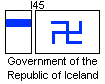
H/f Eimskipafelag Islands / Iceland Steamship Co. historical parent operation, preserving the Government caption for I45
image by Jarig Bakker, 23 October 2003; 14 August 2004
image by Ivan Sache, None
image by Ivan Sache, None
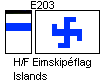
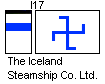
The original flag was white with a blue cross described variously as a fylfot, swastika or Hammer of Thor. Brown’s early form is squat; later editions show elongated arms, suggesting a possible design change. Brown 1943 gives I45 a black funnel top. Jörg Karaschewski’s original table flag, obtained from Iceland in December 1991, has a thicker cross than the published I45 and I17 drawings. Talbot-Booth reverses the cross’s direction, which Rosanoski initially presumed erroneous.
E203 represents the thicker form. Karaschewski cited a card showing the company’s 1926 office building as evidence of the old emblem, though Rosanoski notes a left-handed version at the entrance. The museum’s flag, dated about 1951, prompted a reversed-or-upside-down explanation; the card and a 1930 poster subsequently disproved that theory. A Selfoss photograph shows a conventional 2:3 flag, and Bruarfoss confirms the funnel. Al Kirsch distinguishes the half-length arms as a fylfot.
The date at which the old flag disappeared is disputed. Company-linked accounts say it was no longer displayed after the Second World War, and the official history dates replacement of Thor’s hammer as the logo to 1989. Against the post-war claim, Guðjón Arngrímsson recalls the flag being flown while he sailed in the ships in 1963–69, and Ned Smith identifies a Selfoss photograph as no earlier than 1999. Mertens later thought that photograph had been changed. These recollections, photographs and statements are retained without imposing one cessation date.
The source supplies only a light-blue funnel; the corresponding flag is assumed.
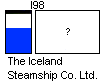
Eimskip was founded on 17 January 1914, with its first vessel arriving in April 1915. It traded as H/f Eimskipafélag Islands, the Iceland Steamship Company, with Lloyds recording use of the English name from 1985. Fleet names mainly end in foss. Early Brown editions classify the livery under Iceland’s government, and Mitchell describes a wholly government-owned national line. The later structure distinguishes the Eimskip transport subsidiary from its parent Hf Eimskipafélag Íslands, whose activities also included aviation. In May 2005 Avion acquired the 94.1% holding of Burdarás, with plans to buy the remainder.
Expansion included Norway’s Coldstore & Transport Group, controlling interest acquired in 2004 and the remainder in 2005, with Eimskip Norway merged into it. The Faroese Skipafelagid Føroyar was acquired in 2004 and combined with Eimskip Denmark in March 2005. In 2006 Eimskip formed Euro Container Line with Wilson, acquired Kursiu Linija in stages and established Containerships Group with Container Finance on a 65/35 basis.
Iceland, Reykjavik.
EINAR A. HANSEN.
image by Jarig Bakker, 13 August 2005
image contributed by Jan Mertens, 10 July 2005
image by Jarig Bakker, 13 August 2005
image by Jarig Bakker, 13 August 2005
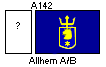
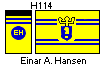
The Allhem flag follows a cap badge, with the shield apparently lighter blue than its surrounding field.
The funnel paired with the Collectors Corner flag is assumed to apply.
Stewart shows the shield white with a black edge, apparently a printing problem.
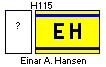
Brown 1978 shows a yellow field, apparently replacing the earlier white near the end of operations.
The shield bears a crowned griffin’s head, also described as an eagle head, above a six-pointed star on blue. A crest presentation adds the line name below and three trident tines above; these features belong to that logo presentation.
A Hansen cap-badge flag appears yellow with two narrow blue horizontal bands near the top and bottom and black lettering between.
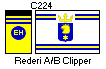
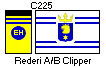
Einar Hansen, founder of the Allhem publishing house in 1932, invested in shipping after the Second World War through A/B Allhem. Stella Polaris was placed under the new Rederi A/B Clipper in 1950, making Clipper the centre of his shipping activity. Hansen and Kockum formed Malmoil in the late 1950s, with Hansen as operator. He began winding down shipping in the late 1960s, selling the last vessel in 1973. Jan Mertens separately gives foundation in 1946 and a 1964 Incres merger, but Rosanoski could not verify the date or explain the Incres reference; Mertens’ suggested oil-price reason for closure is also qualified.
Sweden, Malmö.
EINAR BAKKEVIG.
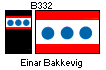
The flag is red with a broad white horizontal band bearing three blue discs in a row. The funnel is black with a broad band showing the flag. The same livery is attributed elsewhere to T. Dannevig & Co. or T. Dannevig A/S, neither name having been found in Lloyds by Rosanoski. The U.S. Navy source gives equal-width flag stripes.
Einar Bakkevig managed fleets for A/S Laboremus and for A/S Gittre & A/S Laboremus. Rosanoski assumes that Brown’s E. Bakkevig of Oslo refers to the same company.
Norway, Oslo.
EINAR HÖVDING.
Einar Hovding
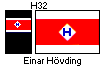
Brown 1995 assigns the livery to Einar Hövding; the 1978 and 1982 editions give Hövding Skipsopphugging. The funnel is black with a broad red band edged white, bearing a small white diamond charged with a blue H. The white flag has a broad horizontal red band with the same white diamond and blue H.
Lloyds records Einar Hövding alongside Hövding Skipsopphugging at the same address. By 1970–71 Einar acted as fleet manager while the associated concerns appeared as shipowners; later entries continued to show his management of Hövding Skipsopphugging. Other managed interests included Arne Frantzen, A/S Sandnessjoen Slip & M/V and I/S Syver, the last previously listed under Hövding Skipsopphugging.
Norway, Oslo.
EINAR LANGE.
Einar Lange
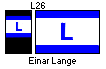
The black funnel has a broad white band edged blue above and below and bearing a blue L. The blue flag has a very broad white horizontal band containing a blue L.
Einar Lange was formed in 1929. The 1998 account records one ship operated through Einar Lange Management A/S; Noble Road S.A., formed in 1988, is also listed as a subsidiary.
Norway.
Einar M. Gaard A/S.
EINAR M. GAARD A/S.
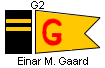
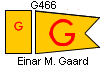
Rosanoski considers this funnel likely to belong to the partnership, citing a Gardhav drawing with a black funnel.
Mitchell’s alternative has a taller G of varying width. His repeated listing of Gardvik near this version appears to identify the vessel source.
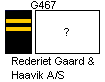
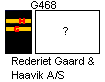
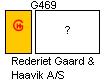
Rederiet Gaard & Haavik A/S
Formed in 1946, Einar M. Gaard ceased in 1971 when its last ship, Gardegg, was sold. From 1954 it operated jointly with Sigurd Haavik, initially with Gardhav, sold in 1962. The partnership is dated 1954–1965 by Skipet. Gardoy and Garvik also appear under the combination, but the sources differ on ownership and disposal: Miramar dates Gardoy’s sale to 1966 and Garvik’s breaking-up to 1964, while later Lloyds lists Gardoy under Gaard and Vikfrost operated for Haavik. Haavik was independently listed by 1970–71.
Norway, Haugesund.
EINAR RASMUSSEN.
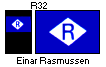
The flag is blue with a large white diamond bearing a blue R. The black funnel carries a broad band of the flag.
Formed in 1936, the business held its fleet through Rasmussen Maritime Services A/S and subsidiaries. That company was formed in 1985 as Rasmussen Management and renamed in 1996. Einar Rasmussen also managed Kristiansands Tankrederi. Recorded interests include 20% of Navion, 33.9% of Ugland Nordic Shipping, and nearly 12% of P&O Nedlloyd acquired jointly with John Fredriksen.
Norway.
EINAR S. HAVER.
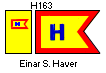
The flag is a yellow swallowtail with a red border and a blue “H”. The funnel is yellow with a panel of the flag. Rosanoski assumes that the funnel yellow is the same shade as the flag.
Einar S. Haver appears as fleet manager for Skips A/S Einar S. Haver in the 1963–64 and 1970–71 registers; Rosanoski regards the latter as a subsidiary.
Norway, Stavanger.
EINAR SAANUM.
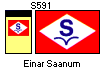
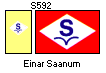
Einar Saanum managed Skibs A/S Agnes, whose ships used rona as a name, prefix or suffix.
Norway, Mandal.
Eitzen Group.
EITZEN GROUP.
image by Jarig Bakker, 4 February 2005
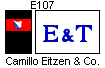
The funnel design dates from 1896, when UTO introduced Zurich’s arms on a red belt, combining Norwegian colours with a Swiss symbol in recognition of Swiss shareholders. Capital raised through Tschudi’s Swiss connections was important from 1895 to 1936, and vessels used Swiss geographical names until the Second World War.
The revived Camillo Eitzen business adopted a new identity in November 2003, combining E for Eitzen and C for Camillo. A square frame and blue-and-white emblem on red retained historical elements. The website’s funnel drawing showed a band while its photograph showed a panel. A drooping table flag later appeared closer to the ordinary company logo than to the earlier flag-logo drawing.
Sichem Rio supplies the port view, with NJK confirming that the band extends around the funnel. Sichem Singapore confirms the starboard form.
Sichem Defender on 3 May 2007 has a red funnel with black top, confirmed by other photographs and presumed to reflect charter use.
Siteam Neptun’s starboard photograph dated 16 August 2012 supplies this charter funnel.
Eitzen Chemical
Eitzen Chemical was incorporated on 15 June 2006 and took over the chemical division on 5 October. Another register account dates it to 2004 and describes the October 2006 combination of Songa and Sichem. Mosvold Chemical was acquired in March 2007. Chemical operations included the Copenhagen, Singapore, Spain and shipholding companies.
Keep the explicit scope label independent; no alias or company identity is inferred.
Captain Camillo Eitzen founded the business in Christiania, now Oslo, in 1883. It became Camillo Eitzen & Co. when Captain Henry F. Tschudi joined in 1894, and Tschudi & Eitzen in 1936. Both founders had served as captains for Gustav Conrad Hansen. Steamship ownership dates from 1896. Axel C. Eitzen and Felix H. Tschudi divided the group in 2003, effective 25 November, into Camillo Eitzen & Co. and Tschudi Shipping. Camillo Eitzen, trading as CECO, was the holding company for the Eitzen Group.
Expansion after the split brought Bergesen’s Igloo Pool, Navale Française, Naviera Quimica and Gibson Gas into the group in 2004, followed by Fouquet Sacop, Sigas Kosan, Songa Shipholding and Blystad Shipmanagement interests in 2006. The source also places KIL’s acquisition in 2001 in one account and 2004 in another. Naviera Quimica became Eitzen Chemical (Spain) in 2005, Songa Shipholding became Eitzen Chemical Shipholding in 2006, and Blystad Shipmanagement became B Shipmanagement. Fouquet Sacop was sold to Sea-Invest in 2007. The remaining TESMA interest was acquired in 2005; in April 2006 it combined with Strømme to form Eitzen Maritime Services. Different accounts describe the remaining Sigloo interest acquired in 2005 as 49.25% or 17.5%.
A 93.1% Orion interest was acquired in September 2007, and bulk operations were listed as Eitzen Bulk Shipping in December 2009. CECO sold its 74.5% holding to Ultragas in 2010. Jaccar bought 40% of Eitzen Ethylene Carriers in 2010 and another 40% in 2011, after which Eitzen decided to sell the balance. Jaccar also acquired Eitzen Gas through Greenship Gas. Earlier gas cooperation included the 2006 Norgas pool with I.M. Skaugen and an ethylene venture with Solvang. The group website was replaced by Eitzen Chemical’s in March 2012.
Norway, Lysaker.
EIWA KAIUN KABUSHIKI KAISHA.
The funnel is black with a yellow band. The white flag has a red E throughout its fly half.
Eiwa is noted as a charterer in 1965 and listed in Lloyds 1966–67.
Japan, Osaka.
EKONER ENERJI SANAYI VE TICARET A.S.
Emanet’s starboard and port photographs from July and June 2011 supply the funnel; the company website supplies the logo. Lloyds names the registered owner Ekoner Enerji Denizciklik Tasimacilik Sanayi ve Ticaret, while Equasis gives Ekomar Denizciklik Tasimacilik, incorporated in July 2009. The latter was listed in Istanbul care of Hay Gemi Isletmeleri.
Ekoner was established in 2009 as an energy company in the Kahramanmaras Kagit group. Its website also uses Ekonca Energy Industry & Trade Co. Ltd.
Turkey, Istanbul.
EKTANK A/B.
image by Jarig Bakker, 24 October 2005
image contributed by Josef Nüsse, None
Brown shows equal star points, but Nüsse’s table flag, funnel emblems and a ship photograph confirm a compass-style star with the four diagonal points shorter. The company website shifts the emblem towards the hoist, whereas the table flag and ship photograph centre it. A narrow white edge apparently visible in Nüsse’s image is disproved by an Ek-River photograph, which confirms a golden flag shade. The funnel is lighter buff; Ektarus appears pale yellow.
Ek-River flew Fortum’s flag in July 2003, possibly on charter. Mitchell gives a black-topped funnel with the star in a black-outlined white circle under Hans Yngve Johnsson, but under Ektank shows no top and a blue circle, apparently from Ek Cloud. Rosanoski assumes these minor differences to be mistakes.
The family business began with a tanker partnership in 1967 and acquired a wholly owned tanker in 1968. Lloyds instead records formation in 1970 as Rederi A/B Ekjford, with Ekfjord also appearing in the listings. Hans-Yngve Johnsson operated and managed the concern; later Ektank held and managed ships under its own name and other companies.
Sweden, Donsö; Gothenburg.
El Grupo Arisona.
EL GRUPO ARISONA.
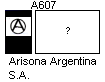
La Marina Mercante Argentina 1961 assigns this livery to both companies. The flag is blue with a white cross bearing a blue star at the centre. The precise shade of the funnel band is unclear.
Arisona Argentina S.A.
US Navy 1961 shows the funnel ring touching the top and bottom of the band.
Historical qualifications remain; no exclusive fleet-wide use asserted.
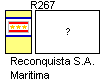
Reconquista S.A. Marítima
The funnel panel bears three yellow stars.
Historical qualifications remain; no exclusive fleet-wide use asserted.
Aristotle Onassis formed the Buenos Aires group through Arisona S.A., established on 31 December 1942, and Reconquista S.A., established on 23 May 1952 at the same address. Arisona Argentina S.A. began operations with the purchase of Mogotes in 1956. Rosanoski describes the declining attraction of Argentinian registration after the Second World War; the last vessel left the Argentine flag in 1967. Reconquista is later listed under Central American Steamship Agency Inc. of New York.
Argentina, Buenos Aires.
ELBCLEARING BESITZGESELLSCHAFT GMBH & CO. K.G.
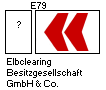
The white flag has two red chevrons pointing towards the hoist. Shades follow the website image.
Germany, Stade.
ELBDEICH BEREEDERUNGSGESELLSCHAFT MBH & CO. K.G.
image by Eugene Ipavec, 22 September 2009
The website drawing has seven alternating dark-blue and red horizontal stripes with a large white sans-serif E across the central five. The arms appear to stop short of the outer stripes, but their precise ends are unclear. Elbmarsch’s funnel is documented in June 2007 and in a January 2014 close-up.
Candelaria del Mar, later Elbmarsch, is photographed flying this flag at the bow on 15 September 2007. The distant view provides actual-flag evidence.
Peter Frese, Peter Hinsch, Heinz Moje, Peter Söhl and Robert Vöge founded Elbdeich in 2004. Elbdeich Schiffsbeteiligungen followed in 2005 to admit further investors. The company held half of H & H Bereederungs and participated in ED Bereederungs. Early register entries emphasise newbuildings; by 2011–12 it was listed as manager.
Germany, Drochtersen.
ELDER DEMPSTER LINES LTD.
image contributed by Jan Mertens, 19 May 2004
The crowned flag derives from African Steam Ship’s 1852 Royal Charter. The website’s drawing and actual flag differ in crown colouring; comparison with the museum flag dated about 1951 suggests a crown change. E38 is also assigned in early sources to African Steam Ship, Belge Maritime du Congo and Imperial Direct West India Mail.
The Ships List dates African Steam Ship’s A469 funnel to 1852–64, followed by A468 to 1932. It gives E38 for Elder Dempster in 1887–90 and E236 for the contradictory period “1890-1889”. Only funnels are supplied for parts of this chronology; corresponding flags, explicitly E236’s, are assumed.
Reed shows a more tapered flag with a smaller cross and crown.
This is the fleet commodore’s flag, possibly no longer in use by the 1970 account.
Elder Dempster Agencies Ltd., possible offshoot
The agency flag is a white swallowtail with a red St George’s cross and a golden crown at the intersection. Candeias stylised the crown because the small source image also appeared stylised.
The agency may have been a Nigerian offshoot, inferred by Rosanoski from its FOTW placement.
Nigeria.
Keep the explicit scope label independent; no alias or company identity is inferred.
Griffin gives the British & African livery B74 for Elder Dempster, probably because it acted as managing agent. Liverpool Shipping describes the funnel as yellow, alternatively white and green, without specifying the circumstances. Rosanoski bases the illustrated yellow shade on an Owerri photograph.
MacGregor Laird founded African Steam Ship under a Royal Charter dated 7 August 1852, initially in London and later Liverpool. Alexander Elder and John Dempster, formerly with Laird’s agents, established their own firm in 1868, or 1869 in one source. Alfred Lewis Jones joined in 1879 and controlled it by 1884. Elder Dempster progressively took over African Steam Ship around 1890–91 and managed British & African from its early years until takeover in 1900. A shipping company was formed in 1898 or 1899. Following Jones’s death, the Kylsant interests took control in 1909–10 and formed Elder Dempster & Co. Ltd.; the fleets retained separate identities.
After the Kylsant collapse, Elder Dempster Lines was reorganised in 1931–32; a later register gives 1933. It retained African Steam Ship’s flag. A holding company followed in 1936, becoming Liner Holdings in 1953. Ocean Steam Ship managed the business in 1936–43 and again later. Ocean acquisition is dated 1965 in one source, with integration announced in April 1967. Sale to Delmas Vieljeux is dated 1989 or 1990, although the continued Ocean subsidiary listing in 1998 suggests the corporate shell may have remained separately.
The group developed numerous associated services. Beaver Line was acquired in 1898 and sold to Canadian Pacific in 1902 or 1903. Imperial Direct West India Mail began in 1901 and ended in 1911; Mersey Towing was also sold to Canadian Pacific in 1903. Glen Line was acquired in 1911 with McGregor, Gow retaining management, British & Burmese in 1951 and Guinea Gulf in 1965. The Canadian Elder Dempster company dates from 1945 or 1946. Other interests included Elders & Fyffes, which later separated, and West African lighterage and mail services. The Congo concern later associated with Compagnie Maritime Belge had fallen to a 20% interest by 1911. Fleet names chiefly commemorated West African places or prominent figures.
U.K., Liverpool.
ELDER-PRINCE MARINE SERVICES PTY. LTD.
The funnel was recorded for Cooma and replaced by Stannard Brothers colours after the 1986 takeover.
Prince Launch Services became Elder-Prince Marine Services in August 1969. Adelaide Steamship and Howard Smith Industries bought it equally on 1 January 1986. It became Stirling Marine Services in August 1988.
Australia, Fremantle.
ELEFSIS SHIPPING AGENCY.
The flag illustration follows the company website but uses a lighter blue.
The agency’s website in 2004 described 25 years in business.
Greece, Elefsis [Eleusis].
ELEGAN GROUP.
Typhoon’s port-side photograph at Singapore on 13 June 2011 shows four differently coloured crescents with elegan lettering. Poor light leaves the shades unclear. Whether the vessel was owned or chartered is uncertain: Equasis gives Royal Maritime as registered owner and Mistral Shipping & Trading of Istanbul as manager.
Istemi Turanligil founded Elegan in 1989. Among its varied businesses were yacht design and building, and Coral Shipping, a Delaware company active from 2004 in shipowning and international maritime trade.
Turkey, Istanbul.
Eletson Corporation.
ELETSON CORPORATION.
image by Jorge Candeias, 17 February 1999
image contributed by Dov Gutterman, None
image contributed by Josef Nüsse, None
Angistri in July 2005 confirms the narrow black funnel top. The table flag shows the funnel and part of the superstructure: a blue funnel with a white band and blue star, surmounted by black-outlined white Eletson. Rosanoski suggests that a simplified flag representation may have originated from the funnel image.
The flag is light blue-white-light blue with a five-pointed star in the white band, which is about four times wider than each blue band.
Cappadocia Maritime Co. Ltd.
Mitchell gives this funnel for Vassilis, listed in 1973–74.
The Brown-derived flag, called E894 in the source, is white with a funnel charged with white ELETSON outlined blue, above several L-shaped forms.
The separate T393 source reference appears to follow Maria T, but Rosanoski did not locate the vessel in the consulted registers.
Eletson was formed in 1966 by Vassilis G. Hadjieleftheriadis with two sons and two sons-in-law. A separate founder list names “Gregory Apostolos”, Vassilis Hadjieleftheriadis, John Karastamtis and Erric Kertsikoff. Eletson Maritime Services became Eletson Corporation in 1982. London’s Eletson Maritime followed in 1983, Eletson Holdings in 1985 and Eletson Maritime in New York in 1986.
Mediterranean Shipping Agency is listed as an associate without explanation. Eletson acted for Cappadocia Maritime, apparently a Tsoneles–Hadjieleftheriades joint venture.
Greece, Piraeus.
ELHAWI SHIPPING CO. LTD.
image by Jarig Bakker, 14 December 2005
Documentary images — company attribution uncertain
Mitchell probably bases the funnel on Asia Shams. Equasis dates that name to 1984–86, while Mitchell gives a sale in 1968, which Rosanoski thinks may mean 1986. The vessel was not found in Lloyds 1985–86, and its letters may indicate another company.
Do not substitute any company based on initials.
Elhawi is listed from 1978–79, first as Elhawi Shipping and later as Elhawi Shipping Co. Ltd., acting as owner and operator.
Saudi Arabia, Jeddah.
ELIAS .E. HADJILIAS.
The funnel is yellow or buff with a white panel bordered blue and bearing a red saltire. The panel may represent the flag.
Elias E. Hadjilias is recorded as fleet manager for Nereus S.N. Co. of Syra, but the 1939 fleet account instead gives Hadjilias & Co. Ltd.
Greece, Athens.
ELIAS HASKET DERBY.
Originally only the white flag was used; the pennant was added later.
Elias Hasket Derby operated sailing ships, with thirteen vessels recorded by 1760.
USA, Salem.
ELIZALDE & CO. INC.
The funnel is brown, or brownish red, with a black top. The flag is red with a vertical yellow band.
Elizalde owned and acted as general manager of Manila Steamship Co. Inc., according to a 1947 advertisement and accompanying comments. Brown’s 1951 association is less specific, described by Rosanoski as probably management or ownership.
Philippines, Manila.
Ellerman Lines PLC.
ELLERMAN & BUCKNALL STEAMSHIP CO. LTD.
image by James Dignan, 12 October 2003
image by Rob Raeside, None
ELLERMAN & PAPAYANNI LINES LTD.
image by Rob Raeside, None
image by Ivan Sache, 4 December 2005
ELLERMAN CITY LINERS.
The City Liners logo flag was adopted in December 1974. NJK’s Lyttelton sighting of 11 November 1979 shows both flags dark blue and no stops after JRE. The main flag has separate dark-blue, white and orange panels: white frames on the outer panels, none on the middle, and blue ELLERMAN. In the Loughran version the white borders join and the lettering is black. Rosanoski prefers the sighting’s arrangement in light of Brown 1995, but allows an intervening change. Brown 1995 apparently drops the pennant.
Ellerman City Liners was formed in January 1973 in the group reorganisation, incorporating Bucknall. It appears in the consulted registers through 1985–86.
UK, London.
ELLERMAN'S WILSON LINE LTD.
image by James Dignan, 12 October 2003
image contributed by Jan Mertens, 20 December 2007
image by Rob Raeside, None
image by António Martins-Tuválkin, 19 May 2010
Documentary material — company attribution not established
image by Rob Raeside, None
image by James Dignan, None
image by Rob Raeside, None
Ellerman Lines
Most constituent companies initially retained their liveries with the Ellerman pennant above. The group pennant is blue with white JRE, with or without full stops; the National Maritime Museum examples have none. Sources show both a triangular 2:3 form and longer pennants. Many attribute the pennant alone to Papayanni; Rosanoski suggests that much of the fleet may have been based there, while other subsidiaries wished to display their origins. In 1904 Ellerman adopted the admired Alexandra Towing funnel colours with permission, distinguishing them by removing the narrow black line between white and buff. Most sources show yellow, but Ships & The Sea and Merchant Ships describe a very deep pinkish buff. Photographs support the band proportions.
The earlier funnel was Bibby pink buff, also described as salmon pink. Lloyds 1904 records its replacement.
John Reeves Ellerman, Christopher Furness and Henry O’Hagen bought Frederick Leyland’s fleet in 1892. When the Leyland business was sold to J.P. Morgan in 1901, Ellerman remained its chairman but retained 20 ships, agreeing not to compete in the main North Atlantic trade. These ships formed London, Liverpool & Ocean Shipping. After acquiring Papayanni and half shares in City Line and Hall Line, Ellerman transferred these interests to that company, which became Ellerman Lines in early 1902.
The source also dates London, Liverpool & Ocean Shipping’s formation to 1900, with half of City Line acquired that year and half of Hall Line in 1901; another passage dates the City Line holding to 1901. City Line, Hall Line and Westcott Laurence retained their names. Other acquisitions included Coverley & Westray, the Westcott and Laurance fleet, Bucknall in 1908 and Thomas Wilson, Sons in 1916. Montgomerie & Workman, acquired in 1920, had been City Line’s London agents and part of Hall Line; it became nominal owner of ships until 1936. Mosgiel Steamship followed in 1958.
The January 1973 reconstruction placed most shipping interests in Ellerman City Liners. Before its sale, the group belonged to charitable trusts established by the late Sir John Ellerman and his widow’s Marine Holdings. David R. and Frederick H. Barclay’s Shirespell bought it in 1983. A subsequent management buy-back used Endobrand, supported by financial institutions. Trafalgar House acquired the shipping interests in June 1987 and combined them with Cunard as Cunard-Ellerman; most container interests subsequently passed to P&O.
Certain Ellerman services passed in 2003 to the company named “Humburg-Süd” in that passage. Ellerman remained a brand until 1 January 2005, when it was incorporated into Hamburg Süd.
Operating subsidiaries included Ellerman Line, Bucknall, Papayanni and Wilson. The group helped form Associated Container Transportation in 1966 and Atlas Line with Blue Star in 1967. Actanz, formed in March 1969, brought its remaining conventional cargo ships together with those of Port Line and Blue Star under Blue Star Port Lines management. Ellerman also participated in the subsequently dissolved PAD consortium, held interests in ACT (A) and Ben Line Containers, and used City of ship names.
UK: Liverpool, Glasgow and London.
Keep the explicit scope label independent; no alias or company identity is inferred.
Ellerman & Bucknall
Bucknall retained its former livery with changed flag letters and the Ellerman pennant above: white JRE on blue, over a blue flag with red E&B in three white diamonds, replacing BSL. The blue is dark. The original lavender funnel had a band equal in depth to the top and Bucknall’s Teeth, intended to show three from any angle. Rosanoski dates this funnel to the 1930s, but Merchant Ships 1949 gives 1945. City names and the Ellerman funnel appeared in the early 1930s; the flag lasted until the 1970s reorganisation. American Indian Line is credited with the earlier funnel, though ships may also have worn Ellerman colours.
The fleet commodore swallowtailed both the houseflag and Ellerman pennant. Rosanoski presumes proportions comparable with the museum’s c.1951 houseflags: pennant 660.4 × 1752.6 mm and flag 1143 × 1778 mm; the museum supplies measurements without an image.
Bucknall was acquired in 1908 and renamed Ellerman & Bucknall in January 1914. It merged into Ellerman City Liners in 1973. A later source records acquisition from P&O Nedlloyd by Grindrod & Co. in 2001.
Norton, Lilly advertised American & African, American & Manchurian, American & Australian and American-Mediterranean-Levant services around 1919–27, apparently naming them with Edward Lloyd. The American & Indian service originated in 1894 with Bucknall Brothers and Edward Lloyd, resumed on 16 January 1919 after the Armistice, and ceased in 1930. Joint ventures included Canadian City Line with McLean Kennedy and MANZ Line with N.Z.S. Co. and Port Line in 1937. South African ship names beginning with K gave way to City of names.
UK, London.
Keep the explicit scope label independent; no alias or company identity is inferred.
Ellerman & Papayanni
Papayanni retained its blue pennant with white P&Co below the Ellerman pennant, although several sources show the group pennant alone. Phil Nelson describes Helvetica lettering extending about two-thirds of the fly, with the o half the C’s height and aligned at its top. Jarig Bakker distinguishes the 216:324 houseflag from approximately 108:360 group pennants and describes a later pair of equal long pennants, JRE above P&Co. The museum’s c.1951 pair differs: upper 711.2 × 1803.4 mm, lower 1143 × 1905 mm, with enhanced lower-case lettering. Talbot-Booth’s 1949 blue rectangle with white P is unsupported by other sources.
A cigarette card labelled Papayanni Line, Liverpool, supplies this livery. The funnel’s base colour is uncertain.
Ellerman acquired Papayanni in 1901. Liverpool Shipping gives 1928 for the formation of Ellerman & Papayanni, while another passage suggests the name changed at the 1901 takeover. The company entered Ellerman City Liners in 1973. Its ships’ ian suffix had earlier been used by Bibby and Leyland.
UK, Liverpool.
Keep the explicit scope label independent; no alias or company identity is inferred.
Ellerman’s Wilson Line
Wilson retained its livery with the group pennant above, including after 1973. Sources vary in the stops after JRE, the red ball’s size and the white flag’s shape. The usual tapered swallowtail contrasts with the museum’s rectangular swallowtail. Dignan’s Sampson-derived illustration omits the group pennant, although Sampson includes it; another image located by Mertens shows equal long pennants, stopped initials and a small ball. The museum’s c.1951 measurements are 660.4 × 1778 mm for the pennant and 1168.4 × 1828.8 mm for the houseflag. Rosanoski’s separate comment gives the upper hoist as 600 mm, summarising roughly 1:3 for the group pennant and 2:3 for the houseflag, with the former’s hoist about half the latter’s. An Aberdeen measured drawing records 8 ft × 4 ft 2 in.
An unidentified postcard collection labels this Wilson Line and shows its funnel. Two approximately 1:3 pennants touch at their hoists: plain dark blue above, white with a central red disc below. Rosanoski suggests a date around the 1916 takeover, with lettering probably omitted from the upper Ellerman pennant. The source also illustrates this livery as W444.
Thomas Wilson, Sons was acquired in 1916 and renamed Ellerman’s Wilson Line in 1917, although Phil Nelson gives 1919 for the acquisition. Operations remained largely separate. All but the North Sea services entered Ellerman City Liners in 1973; competition and declining trade led to the sale of the remaining ships by 1978.
Wilson held 9% of Associated Humber Lines in February 1957 and joined the England-Sverige Linien consortium formed in the mid-1960s. Nearly all its ship names ended in o.
UK, Hull.
Keep the explicit scope label independent; no alias or company identity is inferred.
Ellerman Lines and Ellerman City Liners
The post-reorganisation flag derives from an advertising logo based on the buff funnel, broad white band and black top. On blue are three horizontal oblong panels with ends sloping per bend sinister: the upper towards the fly, the centre towards the hoist, and the lower centrally placed. They may represent containers. Loughran and Brown 1982 show black, white and yellow panels, connected by white edging; the centre has a black frame and angled black ELLERMAN. A contemporary drawing reportedly from an actual flag instead shows separate dark-blue, white and orange panels, white edging on the outer panels and blue lettering. Brown 1995 shows separate red, white and blue panels, with white edging on the outer panels and blue lettering. These may represent changes or differing interpretations of sightings.
Keep the explicit scope label independent; no alias or company identity is inferred.
ELLIOTT STEAM TUG CO. LTD.
The livery remained in use until 1965. Its emblem represents towing hooks on a bar. On the funnel, the pole is slightly angled, described as Pbd, with the flag flapping. A source records the Dick & Page flag on Gaselee & Son (Felixstowe)’s funnel; Rosanoski presumes this is the same flag.
One account traces the company to the Dick & Page tugs in the 1860s, apparently followed by J. Page as tug owner. The National Archives reference instead gives an establishment date of 1949.
Elliott amalgamated into Ship Towage (London) in 1950, although the fleet was listed under associate William Watkins until Lloyds 1966–67. The 1953–54 register calls it Elliott Steam Tug Co. (1949) Ltd.; later editions omit the year. Dick & Page and J. Page remain recorded associates.
U.K., London.
ELMAR SHIPPING CO. S.A.
image contributed by Josef Nüsse, None
The funnel from African Trader’s photograph, dated 6 September 2005, is a lighter blue than the table flag.
Mitchell gives this funnel for Sunny at Rotterdam in April 1991; Lloyds 1992–93 confirms the vessel as an agency ship.
Elmar was formed in 1971 and is listed as an operator in 1978–79 and an agent in 1985–86. Mitchell associates Athanassios Marcopoulos with it without explaining the relationship.
Greece, Athens and Piraeus.
ELMIRA TANKERS MANAGEMENT S.A.
A starboard photograph of Liquid Era on 16 December 2007 supplies this funnel, attributed to the agent by its agreement with the logo.
Documentary images — company attribution uncertain
Liquid Era’s photograph of 4 June 2006 supplies this funnel. Equasis lists Bernina Maritime as registered owner and Elmira Shipping & Trading as ship manager from 1 April 2005. Management changed on 1 December 2007 and returned on 22 June 2008. Rosanoski attributes the funnel to the agent in the absence of other leads.
No exclusive company use or equivalence with Elmira Tankers established.
The source reproduces the company logo and a separate Elmira Shipping & Trading logo designed by Nikos Perialis, dated 11 April 2009. Rosanoski finds no apparent livery use for the latter.
A photograph of Liquid Power on 5 September 2012 supplies a further funnel: the narrative labels it E361, while the Sources list gives E461.
Elmira Tankers Management was formed in 2008, apparently replacing Elmira Shipping & Trading at the same address. The predecessor began as a charterer and was registered in Liberia with executive offices in Greece. Lloyds first gives its formation as 1997, later amending it to 1996.
The predecessor appears as agent in the 2000 and 2008 registers; the 2011–12 entry lists managers only.
Greece, Athens.
Elsam A/S.
Documentary material — company attribution not established
image contributed by Josef Nüsse, None
Mitchell apparently bases this funnel on Elsam Jylland, although his line drawing shows a plain blue funnel.
Calorius supplies the funnel, whose emblem Rosanoski thinks probably maps its eastern Denmark territory. Port and starboard photographs confirm the funnel. A limp, distant flag shows only a white field and apparent lettering; the table flag supplies a separate flag source.
Elsam began in 1956 as a partnership of seven Jutland-Funen electricity utilities. It entered shipping with Erik L in 1980. The source records a 1990 change to I/S Elsam, separation of electricity trade and production from network operation from 1 January 1998, and merger of the Elsam companies as Elsam A/S on 1 January 2000.
The sale of Elsam Fyn in 2001 was described as the end of its shipping business, but Rosanoski understands this to concern the large bulk carriers: tugs and cargo barges remained owned. A DONG merger was announced in December 2004 and the Dong Energy name in July 2006.
The register records Elsam Kraft A/S from 2003. Its successor is variously called DONG Energy Generation A/S or Dong Energy A/S; Elsam was one of six energy companies merging into Dong Energy in 2006. It provided chartering management for Erria, while Rederiet Fabricius managed part of its fleet.
Denmark, Fredericia.
EMALIA SHIPPING A/S.
Mitchell associates Emalia with Global, identified as 1834/1968. Rosanoski did not locate the company in Lloyds.
Panama.
Emanuel Högberg.
EMANUEL HÖGBERG.
Emanuel Högberg joined O.A. Brödin in 1908, became manager of Rederi A/B Fredrika in 1923 and formed its subsidiary A/B Manhem. He joined Svea’s board in 1933 and became chief executive in 1934. He led Stjärnbolagen, a group of Swedish families represented through holding companies in Stockholm, Gävle and Malmö, which acquired over half Svea’s shares, apparently during the 1930s. The source is unclear whether he remained chief executive or later served only on the board until Johnson’s takeover. His interests included Rederi A/B Amphion, possibly in partnership, and Fredrika; Erik Högberg’s role in the latter appears to reflect a family connection.
Emanuel managed Svea and Rederi A/B Saturnas; Brown also lists Malmö Rederi A/B, which Rosanoski could not confirm in Lloyds. The later account spells the tanker company Saturnus and describes its formation in 1939 as a Svea–Kooperative Förbundet joint venture. It became wholly owned by Svea in 1956 and lasted until the Johnson takeover in 1975.
Sweden, Stockholm.
CURT HÖGBERG.
Curt Högberg, at the same Stockholm address, appears as an operator from 1963–64 through 1970–71. His companies included Rederij A/B Expresslinjen, Rederi A/B Staffan and Svea. By the mid-1960s he was operating Svea, although the source leaves the extent of the Högbergs’ ownership uncertain.
Sweden, Stockholm.
Stockholms Rederiaktiebolag Svea
Emanuel Hogberg
image by James Dignan, None
The managed companies had their own liveries. H688 represents Stockholms Rederiaktibolag Svea’s flag, not a separate personal house flag of Emanuel Högberg: Rosanoski stresses that it belonged to Svea and pre-dated the First World War. He also considers the Stewart-derived FOTW rendering incorrect, referring readers to his separate Svea discussion for the detailed criticism.
EMARAT MARITIME LLC.
The funnel follows a port-side photograph of Dubai Angel on 30 April 2011, supported by the same design on Dubai Crown’s starboard side on 18 March 2011. The flag is presumed from the website image.
The starboard photograph of chartered Dubai Faith supplies this variant, presumably a panel placed on a black funnel.
Emarat Maritime, or EML, dates its formation to 1990, initially trading agricultural products. It acquired a bulk carrier in 2001 and its first tanker in 2006. Lloyds instead gives 2004 as formation year and Dubai Ambition as the first vessel under a name company; Rosanoski suggests that earlier operations may have used charters.
On 1 June 2008 Emarat and Oasis Maritime Service s LLC combined commercial and technical/crew operations while continuing to own and operate separately. The 2011–12 register lists Emarat as manager only.
United Arab Emirates, Dubai.
Emarine Ltd.
Documentary material — company attribution not established
The funnel is documented by Sancte Ioseph’s port-side photograph of 18 July 2012 and a logo close-up of 8 December 2013.
The Polidano Group established Emarine as a dredging company, operating from at least 2006 and appearing in Lloyds 2011–12.
Malta, Luga.
Embiricos.
EMBIRICOS.
image by Jarig Bakker, 25 December 2004
image by Jarig Bakker, 9 January 2005
image by Jarig Bakker, 16 February 2005
image by Klaus-Michael Schneider, 25 March 2009
This document combines several family branches and legal entities across jurisdictions. A single first-country value of Greece is incomplete for all linked images; entity-specific attribution is required.
Family context
Those Fabulous Greeks describes an Embiricos shipping tradition exceeding a century by 1971, branches in America, England and France, and control of half the Greek merchant fleet during the First World War. The Coulouthros family formed part of the clan. George Embiricos, brother of André, married Petros Goulandris’s daughter and later joined the Goulandris brothers in Orion Shipping & Trading.
Keep the explicit scope label independent; no alias or company identity is inferred.
Embiricos Shipping Agency
Embiricos Shipping Agency operated in London and changed its name on 1 May 1991 to Ebiricos Shipbrokers Ltd., transferring ship management to the new Andros Maritime Agencies. A 2010 search records Embiricos Ship Brokers in London.
Keep the explicit scope label independent; no alias or company identity is inferred.
A. Embiricos
A. Embiricos was based at Brãila, or Ibrail, Roumania. Of the two vessels listed in 1917–18, Constantinos Embiricos, built in 1903, was sunk in 1917; Rosina, built in 1904, was sold in 1925.
Keep the explicit scope label independent; no alias or company identity is inferred.
Embiricos Brothers
Embiricos Brothers, at Athens and Syra, owned and operated National Steam Navigation Co. of Greece, with M. Embiricos in London as agent.
Keep the explicit scope label independent; no alias or company identity is inferred.
G.M. Embiricos Sons
Georges M. Embiricos of Athens in the 1917–18 register was probably G.M. Embiricos Sons, listed at Andros in Lloyds 1904.
Keep the explicit scope label independent; no alias or company identity is inferred.
A.A. Embiricos
London’s A.A. Embiricos bought Emmanuel in 1916 and sold it in 1917.
Keep the explicit scope label independent; no alias or company identity is inferred.
S.G. Embiricos
S.G. Embiricos operated from Athens with a London agent of the same name. Merchant Ships describes G.S. and N.S. Embiricos as steamship owners from 1899, using mainly family names for their ships. The heirs appear at Athens in the 1950s; later registers list the London concern as operator or agent. Mitchell identifies it as Stavros G. Embiricos.
Keep the explicit scope label independent; no alias or company identity is inferred.
Maris A. Embiricos
Brown 1926 and 1929 give this livery under London’s Byron S.S. Co., operated by M. Embiricos.
Schneider’s Talbot-Booth-derived flag outlines the red circle in black. The book does show this edging, but Rosanoski thinks it may be a printing device rather than part of the design.
Maris A. Embiricos was established in 1928 for general tramping. Merchant Ships places him in Paris under Greece; other registers give Paris and Athens, then New York under Central American Steamship Agency. Jordan calls him Embiricos Line, which Rosanoski presumes distinct from Embiricos Lines.
Keep the explicit scope label independent; no alias or company identity is inferred.
G.A. Embricos
Rosanoski did not locate G.A. Embricos in Lloyds.
Keep the explicit scope label independent; no alias or company identity is inferred.
Embiricos Brothers and associated source attributions
Mitchell gives this funnel for Addoulis Shipping of Fanagusta, associated with A.M. Embiricos, without naming vessels. Talbot-Booth attributes the livery to National Steam Navigation.
Keep the explicit scope label independent; no alias or company identity is inferred.
G.M. and S.G. Embiricos
Lloyds 1912 records the transition from G.M. Embiricos Sons’ livery to S.G. Embiricos. The latter’s flag is white with blue E; NJK calls the funnel letter light blue, which Rosanoski presumes also applies to the flag, although other sources do not distinguish the shade. Brown’s E is squatter with longer arms; Caltex’s is slightly taller and narrower. The sources place S.G. Embiricos at Athens or Piraeus.
Keep the explicit scope label independent; no alias or company identity is inferred.
Embiricos Lines
Lloyds 1912 places Embiricos Lines at London, Athens and Greece; Rosanoski suggests it may comprise Embiricos Brothers and A.A. Embiricos. National Steam Navigation’s 1926–27 and 1934 timetables show the same flag, linking the source accounts.
Keep the explicit scope label independent; no alias or company identity is inferred.
G.A. Embiricos
The G.A. Embiricos funnel is recorded for Opportunity of Compañia Maritima La Empresa and Hydroussa of Hydroussa Compañia Naviera. Hydroussa initially appears black, suggesting dark blue; Mitchell instead gives a lighter blue with a narrow black top, labelled H587. The two Panamanian companies used the same agents, suggesting a connection.
Keep the explicit scope label independent; no alias or company identity is inferred.
Embiricos Shipping Agency and S.G. Embiricos
Mitchell supplies E200 and apparently an alternative, E370, with a Greek Epsilon. The latter also appears for Marfeliz Compañia Naviera under S.G. Embiricos.
Keep the explicit scope label independent; no alias or company identity is inferred.
Associated vessel-company attributions
In connection with Stavros G. Embiricos, Mitchell gives A911 for Amadores Atlanticos and the untraced Nicky; D392 for Doris Compañia Naviera’s Doris, owned in 1954–73 but listed under S.G. Livanos’s London agency; and D393 for Doriefs Compañia Naviera’s Doriefs, dated 1958–80 but not found in Lloyds.
Keep the explicit scope label independent; no alias or company identity is inferred.
Ships & The Sea attributes the livery to P.W. Wessels Wwe. A black-and-white photograph of Johann Wessels confirms the funnel.
The business originated with Peter Wichmanns Wessels in 1859 and merged into Emder Schlepp-Betrieb in 1994, remaining a Wessels family concern. The former name nevertheless continued in Lloyds at the same address. Most ships were named after family members.
Germany, Emden.
EMDER SCHLEPP-BETRIEB GMBH.
image by Eugene Ipavec, 3 August 2008
The flag derives from Emden’s city flag, replacing the arms with initials. Radbod’s 2007 photograph confirms the livery; Langeoog shows the flag more clearly while still wearing the Ems-Schlepper funnel. Peter Wessels in March 2010 likewise retained its old funnel with the new flag. Its forward superstructure displayed the two predecessors’ flag emblems with the new one between them.
The flag image was adapted from a German eBay example, offered by shipflag with approximate dimensions of 15 × 24 cm.
Emder Schlepp-Betrieb was formed in 1994 by merging Ems-Schlepper and Emder Bugsier-und Bergungsgeschaft P.W. Wessels Wwe., and remained a Wessels family business. The latter continued to appear at the same address in Lloyds 2005–06, while Equasis showed no ownership change for Peter Wessels in October 2010. The earlier Ems-Schlepper fleet appears under ESB in the 2001–02 register.
Germany, Emden.
EMDER VERKEHRSGESELLSCHAFT A.G.
image by Klaus-Michael Schneider, 5 April 2009
image by Klaus-Michael Schneider, 5 April 2009
An actual table flag largely confirms Schneider’s first version with a black anchor, but differs in the shield frame’s colour and clearly shows a fouled anchor. The Marcollect example also shows the foul, less distinctly.
The alternative has a red, unfouled anchor. Schneider considers this perhaps erroneous; Rosanoski regards it as doubtful but worth recording because it appears in Esso 1956 and 1958 and Flaggen & Schornsteine 1957, around the period of Lauting’s ownership.
The funnel panel has six sides and no stops after its letters. All sources show stops after the letters on the flag.
Emder Verkehrsgesellschaft, also called Emden Transport, was formed on 21 April 1913 to represent HAPAG at Emden and promote local business. Another account traces EVAG to nineteenth-century South American coffee and tobacco imports. Überseeverkehr was formed in 1950. Privatisation began in 1954 with Holland America Line and Hugo Stinnes acquiring shares alongside the German government. WTAG became the main shareholder in May 1959; EVAG helped form Glücksburger Reederei and was wholly owned by Rhenus by 1985.
Later accounts give differing company names and affiliations. The website describes a 2007 change to EVAG Emder Verkehrs und Gesellschaft mbH and uses Emder Verkehrs und Automotive Gesellschft mbH. Bühne’s account calls it Emder Verkehrs AG, a DB-Schenker company: EVAG remained with Schenker while Rhenus passed to Rethmann. Its later activities included brokerage, agency, logistics and port services.
EVAG became a shipowner after the Second World War with the former naval vessel Lauting. Registers also show operating and management roles, including Glücksburger vessels and its own ship operated by W. Vollert. An Ems-Schlepper interest is recorded around 1936.
Schneider reported in June 2010 that he believed the company had been dissolved, but Rosanoski records the matter as unresolved in June 2011.
Germany, Emden and Hamburg.
EMERAUDE JERSEY FERRIES.
image by Jorge Candeias, None
Documentary images — company attribution uncertain
Earlier companies and later ferry operation cannot be equated by vessel/name links alone.
Mitchell attributes the funnel to Emeraude Maritime. The FOTW houseflag derives from the logotype and still needs confirmation as an actual flag. Rosanoski considers a Le Marin 2002 image, via Pavillon Compagnies Françaises, a possible basis for E57, with its green suspect. The continued existence of the illustrated funnels is also uncertain.
Les Bateaux de la Côte d’Emeraude began in 1904, taking its name from northern Brittany’s Emerald Coast. It operated local Normandy and Brittany services, including Saint-Malo–Dinard. Emeraude Ferries was incorporated as a subsidiary in 1977; Emeraude Lines became the brand in 1988. The 1990 incorporation joined Les Bateaux de la Cote d’Emeraude with Société des Bateaux de la Cote d’Emeraude, Les Vedettes Blanches. Portbail–Jersey operator JPF was absorbed in 1991 and Carteret–Jersey operator SMCJ in 1992.
Sogestran bought the company in 2003, when the name changed to Emeraude Jersey Ferries. Earlier register links to Emeraude Industrielle et Maritime and Emeraude Maritime are less certain: Rosanoski calls the Atlantique-based connection vague.
Operating companies included France’s Société Sofinaball, formerly a managed company, and Sea Express Lines, formed in Paris in 1998.
France: Paimpol, Concarneau, Nantes and St. Malo are recorded in successive registers.
EMIL & CIA.
The Brazilian chart records the livery around 1950.
Brazil, Rio Grande do Sul.
EMIL & WERNER MEYBURG.
The white flag has a broad blue horizontal band, a white circle and a red M. The yellow or buff funnel has a black top separated by a broad band of the flag.
Meyburg is recorded in the 1963–64, 1966–67 and 1970–71 registers.
Germany, Rendsburg.
EMILE SAVOIE.
Savoie operated Sorana del Mar from 5 November 1971. Unsuitable for the New Caledonian coastal trade, the vessel was laid up for some time before being sold in 1974.
New Caledonia, Noumea.
EMIRATES SHIP INVESTMENT COMPANY LLC.
The company website shows original logos, including the CCU period, and a later logo; archived pages place the change between May and December 2009.
Eships Quest’s starboard photograph of 29 April 2006 supplies this funnel; a logo had been added by 3 February 2007.
A starboard photograph of Eships Agamid supplies this version.
This later version is documented on Eships Agamid’s starboard side on 26 October 2010 and Eships Falcon’s port side at Sydney on 14 March 2013.
ESHIPS was formed in 1996 as Combined Cargo UAE LLC and renamed Emirates Ship Investment Company in 2005. It expanded from ship investment into operation. Original shareholders were Oman & Emirates Investment Holding, Abu Dhabi Investment Company and UAE Offsets Group, later replaced by Mubadala. By December 2009 two equal shareholders, Invest AD and Mubadala, held it ultimately for the Abu Dhabi Government.
The 2006 and 2008 registers place the fleet under name companies; the 2011–12 entry lists managers only.
United Arab Emirates, Abu Dhabi.
EMIRATES TRADING AGENCY LLC.
Pearl of Jebel Ali’s photograph shows a white E dissected by very narrow blue horizontal lines, two through each section. The small illustration instead uses equal-width white and blue lines, a limitation of its scale.
Emirates Trading Agency was formed in 1992 and appears as ship manager, with fleets under operating or name companies. It belonged to ETA-Ascon, the diversified group established in 1973 as a joint venture with Al Ghurair. Lloyds places it under Star Maritime in April 2008, but lists it independently without mentioning that connection in August.
West Asia Maritime was an associate. The Chennai operating company ETA Ship Management, formed in 1997, became EC Ship Management in 2006 and was deleted after its sole ship, Coastal Pride, was sold. Another source attributes EC’s formation to West Asia Maritime.
Marine Logistics Solutions (Marsol), formed at Dubai in 2005, established Marsol Shin Yang with Shin Yang Shipping in 2008. The venture used WM ship names; many earlier Emirates Trading Agency ships began Pearl of.
United Arab Emirates, Dubai.
EMPIRE CHEMICAL TANKER HOLDINGS INC.
Empire Mataram’s photograph supplies the funnel. A photograph of Mykinis on 10 September 2010 shows the second image in yellow rather than orange.
Empire was incorporated as a private limited company in the Marshall Islands. Equasis lists it as ship manager, with Malibu’s registered owner at the same address. The vessel had become Empire Malibu on 1 February 2009 and Malibu on 1 April 2010.
Greece, Piraeus and Athens.
EMPIRE NAVIGATION INC.
Rosanoski considers the emblem interpretable as either a bird or a whale’s tail.
Mr. Sirius’s starboard photograph of 13 June 2013 supplies this funnel.
Sues Rajan’s starboard photograph of 25 June 2013 shows brighter colours.
Empire Navigation was established in February 2009 as a ship manager and appears in that role in Lloyds 2011–12.
Greece, Athens.
EMPRESA COMÉRCIO E NAVEGAÇÃO FLUVIAL DE JOÃO LUÍS DA SILVA.
The livery comes from a Brazilian houseflag chart dating from about 1950.
The designation Empresa Comércio e Navegação Fluvial means Trade and River Navigation Corporation.
Brazil, Piauí.
EMPRESA DE NAVEGACION MAMBISA.
The triangle contains a small white star.
Cuba, Havana.
EMPRESA DE NAVEGAÇÂO ALIANÇA S.A.
image by Joseph McMillan, None
image contributed by Josef Nüsse, None
image by Joseph McMillan, None
image contributed by Josef Nüsse, None
Loughran explains the colours as indicating German involvement and the interlocking circles as the two hemispheres connected by the fleet. He calls the funnel base buff, while the website image looks yellow. Rosanoski initially questions whether the flag forms the funnel top or merges into a narrow black top. The February 2001 website image shows the flag forming the top and a blue triangle replacing the letter. Nüsse’s flag dated 1993 confirms the triangle, but has a wider white band with the emblem confined to it.
The Nüsse-derived illustrations distinguish the old flag from the 1993 version. Hamburg Süd continued the Aliança brand after the sale, apparently including the livery; Rosanoski found no announcement of its absorption into the main brand through June 2010.
Empresa de Navegaçâo Aliança, or ENA, was formed in 1950 according to Lloyds, or in 1951 by Carl Fischer, a German who had arrived in Brazil in 1928. Its initial coastal services reflected the maritime trade then open to private enterprise in Brazil.
Hamburg Süd acquired the container and bulk operations in 1998, placing them in Aliança Transportes Maritimos, renamed Aliança Navegaçáo e Logistica in 2000. Rosanoski found conflicting indications about the old company’s survival: a business listing still described maritime activity, but its contacts differed and the later website concerned only the successor. It may have ceased to exist.
Early registers list Otto Renlinger as operator, first at Santos and then Rio de Janeiro. A 1970–71 entry separates the company’s new address from the old address used for Aliança & Navegaçâo Mercantil. Scan Bras is recorded as a joint venture.
Brazil, Rio de Janeiro.
EMPRESA DE NAVEGAÇÂO DO AMAZÔNIA S.A.
The basic flag had been used by Amazon Steam Navigation and Companhia Brasileira de Navegação do Rio Amazonas, which Rosanoski thinks may have been a subsequent Brazilian subsidiary or a change of domicile. The 2002 company logo may indicate continued flag use.
The separate E6 source illustration shows a flag flapping from a pole described as PBdS, within a circle bearing black EMPRESA DE NAVEGACA [sic] above and DO AMAZONICA below, the lower words upright. The flag carries blue ENESA at the same angle as the line beneath. Rosanoski suggests this funnel design may derive from the website logo and questions whether funnels remained relevant to the catamaran service.
ENASA serves Amazon ports between Belém and Manaus. Its predecessor began in 1852 as Companhia de Navegação e Comércio do Amazonas, a private firm subsidised by the imperial treasury. British investors bought it in 1872 as Amazon Steam Navigation, retaining government support. Federal nationalisation in 1940 combined shipping with Pará port administration as SNAAPP. In 1967 the ports and shipping separated, the latter becoming ENASA.
The Pará government account describes state ownership, while Lloyds records control by the Brazilian Government. The predecessor also managed a government vessel in 1953–54.
Brazil, Para.
EMPRESA DERMERVAL RODRIGUES.
The livery comes from a Brazilian houseflag chart dating from about 1950.
Brazil, Piauí.
EMPRESA DO LIMPOPO A. COUTO LTDA.
image by Jarig Bakker, 28 December 2004
The original Empresa do Limpopo became Empresa do Limpopo A. Couto in 1911 and merged into Navique E.E. Empresa Mocambicana de Navegaçáo in 1980. Its ships had names beginning with L.
The city name changed from Lourenço Marques to Maputo after Mozambique’s independence. Registers also use Empreza, which Candeias notes may reflect contemporary spelling rather than the modern Portuguese empresa.
Mozambique, Laurenco Marques, later Maputo; Mitchell gives Lisboa.
EMPRESA FLOTA CUBANA DE PESCA.
Empresa Flota Cubana de Pesca
The funnel is white with a black top and a broad band displaying the flag. The blue flag has two narrow, evenly spaced white horizontal bands meeting a red square at the fly, which contains a white star. Two further white vertical bands of the same width are described without further definition: one near the hoist extends from the upper horizontal band to the flag’s base, and the other connects the horizontal bands at the centre. Narrow blue vertical lines divide each horizontal white band, helping form white F and C.
The Cuban Government owned the company, listed in Lloyds in March 1998.
Cuba, Havana.
EMPRESA FLOTA FLUVIAL DEL ESTADO ARGENTINO.
The funnels appear to be alternatives. The E321 flag is blue with a white oval containing black EFFDEA, the letters rounded to follow the oval.
EFFDEA was formed on 26 November 1958 as general manager for Flota Argentina de Navegación Fluvial and Administración General del Transporte Fluvial, the latter established on 2 May 1944. The government company subsequently operated harbour services, ferries and tugs, eventually retaining only tugs. Its address and fleet match the earlier Flota Argentina listing. Lloyds’ later formation date of 1990 conflicts with this account.
Argentina, Buenos Aires.
EMPRESA FLUVIAL DO BAIXO SÂO FRANSICO.
The source website records the livery around 1950.
Brazil, Alagoas.
EMPRESA HONDURENA DE VAPORES S.A.
The livery is based on United Fruit’s and the funnel appears typical of its subsidiaries. Mitchell shows darkish buff rather than yellow, and also supplies the U34 United Fruit funnel with its white diamond inside the band. His Southampton sighting in July 1979 is not assigned to either version; Rosanoski thinks it probably concerns E7.
The United Fruit subsidiary appears in Merchant Ships 1944 and in 1950s registers under Agencia Maritima Hondurena, later under its own name. It acted as agent for Balboa Shipping and is listed as owner and operator in 1980–81.
Honduras, Tela; later USA, New York.
EMPRESA INDUSTRIAL E NAVEGAÇÃO FRANKLIN VERAS & CIA.
The livery comes from a Brazilian houseflag chart dating from about 1950.
Industrial e Navegação is translated in the source as Industrial and Navigation Corporation.
Brazil, Piauí.
EMPRESA LINEAS MARITIMAS ARGENTINAS S.A.
Documentary material — company attribution not established
image contributed by Josef Nüsse, None
The light-blue flag bears a white saltire and a vertical dark-blue fouled anchor in Nüsse’s version. Brown 1982 and 1995 instead show a plain black anchor without cable. Rosanoski favours Nüsse because the design appears to combine those of the predecessor companies. His illustration lightens the website’s purplish field to accord with national colours. Ocean Ships does not specify the blue shades, but its funnel carries a flag, shown flapping in NJK and La Marina Mercante Argentina.
ELMA, the Argentine National Line, was government-owned. It combined Administration General de la Mercante del Estado, or Flota Mercante del Estado, with Flota Argentina de Navegacion de Ultramar. Lloyds dates the amalgamation to 1961; La Marina Mercante Argentina gives formation on 30 September 1960.
The line folded after financial losses in 1992–97, attributed in the source to strikes and other causes.
Argentina, Buenos Aires.
EMPRESA MARITIMA DE TRANSPORTES S.A.
Blue Star’s funnel was noted in May 1965. It is black with a white-bordered red circle bearing a white-edged blue four-pointed star. No flag was recorded.
The company appears in Lloyds 1963–64; Overseas Consolidated is recorded as its agent.
USA, New York NY.
EMPRESA MARITIMA DEL ESTADO.
image contributed by Josef Nuesse, None
The yellow or buff funnel bears a blue-white-red triband. Brown’s blue pennant has a diagonal white band edged red, described as Pbd, bearing a blue star.
The Nuesse pennant has a tapering white diagonal panel edged red towards hoist and fly, with narrow field-blue fimbriation separating red from white, and a blue star on the white. Rosanoski combines it with the funnel on the assumption that the funnel is undisputed, conditional on this flag being correct. The illustrated shades follow the website.
Empremar was the Chilean Government Merchant Marine and appears in the consulted registers from 1963–64.
It joined the Eurosal consortium in 1987 with Peru’s CNP. The existing consortium comprised Johnson Line, Armement Deppe, Compania Naviera Marasia, Compania Sud-Americana de Vapores, Hapag-Lloyd, Lineas Naviera Bolivianas, Koninklijke Nedlloyd Groep, Pacific Steam Navigation and Transportes Navieros Ecuatorianos.
Chile, Santiago and Valparaiso.
EMPRESA NAVEGAÇÂO LLOYDE PARANAENSE S.A.
The Brazilian website records the livery around 1950. A flag appears on the funnel but is not separately illustrated. The stop after L is above its horizontal arm.
Brazil, Paraná.
EMPRESA NAVIERA DE CUBA S.A.
The funnel is grey with a black top separated by a white band. The blue flag has a broad red horizontal band bearing three white stars in a row, charged respectively with blue E, N and C.
Cuba, Habana.
Empresa Naviera Elcano S.A.
EMPRESA NAVIERA ELCANO S.A.
Castillo de San Perdo’s photograph of 21 September 2010 shows a horizontally elongated funnel diamond. Books give it greater height to accommodate the letters at small scale. The company’s close-up shows lighter blue and no border to the diamond.
Castillo de Gomaz shows a distinct blue edge to the lozenge, much narrower than the lettering. The website logo also shows this version, perhaps indicating a change.
Port and starboard photographs of Castillo de Monterreal in 2011 and 2012 appear to show a stylised E inside a ring, presumably a new logo not yet reflected on the website. Recoleta also wears it, while other ships retain the old livery.
Earlier printed flags omit the red border at the hoist. The website logo has a narrow red hoist border, thinner than the other two sides; its yellow edging merely indicates flag edges. Rosanoski leaves the red border’s validity open, suggesting it may explain the fully bordered website version E400.
The second flag is white with a red shield bearing a gold tower. It appears as a second livery in both quoted Lista Oficial de Buques editions. The banderakitxasaon website version differs slightly in the castle.
Mureloil / Mureoil S.A., separate joint venture
Mureloil joint venture
Bahia Tres’s port and starboard photographs of 27 May 2009 supply the joint venture’s funnel. The flag reference derives from the funnel and company logo.
Bilbao’s Mureloil was a 60/40 joint venture with Naviera Murueta, with both partners managing it and its two vessels. The source also calls it Mureoil and dates formation to 2003. It provided bunkering services; one vessel was chartered to the European Maritime Safety Agency and the other to REPSOL for pollution response.
Keep the explicit scope label independent; no alias or company identity is inferred.
ENE was founded by the National Institute for Industry as Empresa Nacional Elcano de la Marina Mercante, originally for both shipbuilding and ship operation. The website dates formation to 1942; Lloyds gives 1944. It was named for Juan Sebastian Elcano, who completed the Magellan expedition’s circumnavigation in 1522 after Magellan’s death. The functions separated in 1964, leaving the company in shipping, and privatisation in 1997 brought the present name.
The purchasers were Remolcadores a Nosa Terra, Naviera Murueta and Sociedade Portuguesa de Navios e Tanques, the last a Jose de Mello unit. The first two acquired its holding in 1998. A later source places Elcano in Nosa Terra XXI.
Operating companies included Empresa de Navegaçâo Elcano, formed in Rio de Janeiro in 2002, and Empresa Naviera Petroleraatlantica, ENPASA, formed in Buenos Aires in 2001.
Spain, Madrid.
Empresa Naviera Santa S.A.
Documentary material — company attribution not established
image by Jarig Bakker, 16 December 2005
image by Ivan Sache, 24 March 2001
image contributed by Josef Nüsse, None
A distant, indistinct photograph of Santa Rita seems to favour the E322 arrangement: a gap separates the two red segments, with N inside it but not touching them. Nüsse’s table flag has recorded proportions of 303 × 165.
Mitchell draws E and S in ordinary black pencil, although Rosanoski thinks they may be intended as white; Mitchell does not say so. His Santamar II line drawing shows the basic funnel without the letters.
Mitchell gives this funnel with Santa Lucia’s line drawing and records Rotterdam, July 1990.
Roberto Leigh owned and controlled Empresa Naviera Santa and also owned and operated Santa Lucia Compañia Naviera Santa. Registers from 1980–81 to 1992–93 show ownership, management and agency roles.
Peru, Lima.
EMPRESA NAVIERA SEVILLA S.A.
The funnel is yellow or buff, with a black top separated by a blue-yellow-red triband. Below it are blue NS on a line described as Pbd. The white flag contains a yellow rectangle bearing blue NS.
The company appears in the consulted 1963–64 and 1970–71 registers.
Spain, Seville and later Madrid.
EMPRESA POLICULTORA.
The website records the livery around 1950 and apparently supplies no funnel.
Brazil, Bahia.
EMPRESA SALINEIRA DE NAVEGAÇÂO FLUVIAL DE DELBÂO RODRIGUES & CIA.
The cross is that of the Order of Christ. The illustration comes from a Brazilian houseflag chart dating from about 1950.
The opening words of the name are approximately translated as Saline Enterprise of Fluvial Navigation, referring to salt exploitation.
Brazil, Piauí.
EMPREZA INTERNACIONAL DE TRANSPORTES LTDA.
The funnel is described as black, although a September 1970 observation suggests grey. It has a green-white-green triband with the white broader. Across these bands is a white circle, otherwise undefined, bearing a vertical green fouled anchor. Green EI and TL flank it on the white band. No flag was recorded.
The company appears in the 1963–64 and 1970–71 registers.
Brazil, Santos.
EMPREZA NACIONAL DE NAVEGAÇÂO “HOEPCKE” S.A.
The website dates the livery to about 1950.
The company appears in Lloyds from 1953–54 to 1985–86. The US Navy and Brazilian website use the spelling Empresa.
Brazil, Florianopolis, Santa Catharina, also recorded as Santa Catarina.
Empros Lines Shipping Co. Special S.A.
Documentary material — company attribution not established
image contributed by Josef Nüsse, None
Anassa Ioanna’s starboard photograph of 16 May 2013 confirms the funnel. Its letter refers to chairman and founder George Dracopoulos, under whose name Brown 1971 records the livery. NJK instead shows a yellow funnel on Armenistis in April 1964 with P. Dracoulis, and an April 1967 sighting associates Athanassiades B. Dracoulis. Christies gives a dark-blue panel, while the 2013 photograph suggests the lighter shade despite a darker contemporary website. Mitchell confirms a Birkenhead sighting in 1969.
The initial website-derived flag used brighter blue. Sache amended it to shade 196 in November 2009 following a website change; Nüsse supplies a table-flag source.
The family’s shipping interests began in the nineteenth century with George P. Dracopoulos and grain merchant Ambanopoulos owning the barque Philadelphos, built in 1868. George’s son Markos became owner and master of Empros in 1914. The company account says Markos’s son George M. founded Empros Lines in 1950 using insurance proceeds from Empros, lost in the First World War. It also says the name honoured his father’s Avance: both Avance and the Greek empros mean forward. Rosanoski notes the absence of the company and its first Avance from the early registers consulted.
Lloyds originally gives 1959 for Empros Shipping’s formation and 1966 for the change to Empros Lines Shipping Co. Special, but later changes the formation year to 1950; the longer name already appears in the 1963–64 entry. Piraeus-based Empros Shipping Management was formed in 1995.
Greece, Piraeus and later Athens.
EMS Shipping & Trading GmbH.
Documentary material — company attribution not established
image by Santiago Dotor, 11 November 2003
The flag’s quarter colours are those of East Frisia, reflecting the company’s locations at Wilhelmshaven, Emden and Leer. The earlier website displayed the flag logo.
Kapitän Heiko Luikenga formed EMS Shipping & Trading in 1984, according to the website; Lloyds gives 1995. It was brokering for German owners by 1987 and became exclusive broker for Fehn Bereederungs when that company formed in 2003. Both participated in newbuilding orders from 2006. EMS Chartering was established in 2009 for transport logistics and exclusive Fehn chartering. Registers also describe EMS as a Fehn operating company, with its sole vessel subsequently listed under Fehn.
Germany, Leer.
EMS-FRACHT SCHIFFAHRTS GMBH & CO. K.G.
The flag follows a flapping image on the agent’s website. Rosanoski warns that it may be inaccurate, especially because the two funnels are inconsistent.
Emstal’s port-side photograph of 29 March 2006 and starboard photograph of 8 March 2009 supply this funnel.
Rheinstal’s starboard photograph of October 2007 supplies this funnel.
Ems-Fracht was formed in 1982. Rosanoski links the 1988–89 Ems-Trans Emstal partnership to it through a telephone number. Miramar records continued ownership while Emstal became OPDR Douro in 1995 and Portline Runner in 2002. Lloyds later lists Ems-Fracht under Harren & Partner management and as an operating company, but a financial connection is unclear. By 2011–12 it appears independently as manager.
Germany, Haren/Ems.
EMS-SCHLEPPER A.G.
image by Jarig Bakker, 4 September 2005
Ems-Schlepper means Ems Towage, explaining the initials. Mitchell’s tug section treats the E11 band as a panel and gives E387 as the main funnel. His German section gives E386 without E, which Rosanoski assumes should be present.
Documentary images — company attribution uncertain
Flaggenbuch 1928 attributes this livery to A.G. Ems rather than Ems-Schlepper, and omits it from the 1934 update.
Ems-Schlepper versus A.G. Ems unresolved.
Ems-Schlepper, or ESAG, was formed in 1924 by participants including Bugsier, WTAG and Lehnkering. Rosanoski qualifies the identification of Bugsier because he found no confirmation in the sources consulted. EVAG acquired an interest around 1936. The company merged into Emder Schlepp-Betrieb in 1994, with its fleet listed there by 2001–02.
Germany, Emden.
EMSTANK GMBH.
image by Santiago Dotor, 11 November 2009
The flag has large white italic E and T within black outlines. Its field is divided diagonally into black upper and lower triangles and light-blue hoist and fly triangles edged white. The white narrows towards the centre, where the triangle tips meet. The top and bottom edges have black outer and narrower white inner stripes. Emstank 8’s starboard photograph of 11 July 2009 shows the flag.
Emtank 12’s port-side photograph of 7 August 2008 supplies the funnel. The initials are upright on the funnel and on the website drawing, perhaps for readability. A table flag and real-flag sightings provide additional evidence.
The bunkering business was formed in 1978 after Schulte & Bruns’s bankruptcy. Existing staff and fleet were taken over by Emder Bugsier P.W. Wessels with half the interest, and Frisia Handels- und Transport and Jade Dienst with a quarter each. Frachtkontor Junge acquired Jade Dienst’s shares in 1985, Wessels’s in 1988 and the remainder on 27 October 1989. Boniflot took ownership from 1 July 2002. Rosanoski qualifies the asset account as apparently including Emstank.
Germany, Emden.
ENERGY SHIPPING SPA.
Company-owned Sunflower E’s port-side photograph of 17 November 2010 supplies this funnel. On the starboard side the panel is reversed, its broad end still forward, but e remains readable as on a double-sided panel.
A port-side photograph of chartered Energy Ivy supplies this funnel.
Chartered Sundaisy E’s port-side photograph of 1 November 2011 supplies this version.
Energy Shipping was formed in 2001 from Energy Coal’s shipping department. Shareholders included Energy Coal, Italiana Coke, Ascheri and Messina. It chartered bulk cargoes including coke, clay and fertiliser, and built its first vessel, Sunflower E, in 2009.
Italy, Genova.
ENERMAR TRASPORTI ISOLE SARDE S.R.L.
image by Ivan Sache, 18 October 2003
The company website supplied a starboard funnel view and flag logo in February 2005. Rosanoski interprets the funnel as dark red, possibly brownish.
The company appears in the 2003 and 2004 registers. Its operating company TRIS EneRmaR was formed at Genova in 2002; the latter’s single vessel subsequently appears under the principal.
Italy, Genova.
Engco Invest A/B.
A/B P.J. HAEGERSTRAND.
image by Neale Rosanoski, 8 July 2006
Haegerstrand’s flag is blue with a gold horizontal oval containing PJH. Rosanoski reads the letters as black, but allows that they may be dark blue. The website logo and the painting of Peru supply the evidence. Peru, built in the firm’s foundation year of 1859, belonged to it from 1876 to 1897; its foremast flag is white edged blue with black 15, and the houseflag flies at the main.
Town architect and shipowner Per Johan Haegerstrand founded the firm in 1859. His son-in-law A.F. Lagerholm became joint owner in 1894; Haegerstrand died in 1905. The Gävle-owned firm later became a general shipping agency under Engco. Its interests included HML Shipping, Söderhamn Shipping, Stefan Trybom, Ivar Lundh and Team Lines. A later register records Österströms acquiring 30%.
Sweden, Gävle.
HML Shipping A/B
Engco Invest
Torsten Engwall of Stefan Trybom formed Engco Invest in 1988 and served as its chief executive as well as Trybom’s chairman. Principal owners included Gävle Sjöfarts, Win Hotels and STOC Petrea/Regina Partrederi. Engco held 51% of Rederi Nordship and all of P.J. Haegerstrand, taking control of the latter on 1 January 1988.
Sweden, Gävle.
Keep the explicit scope label independent; no alias or company identity is inferred.
Stefan Trybom
Rosanoski records that the website image colours were not used.
Sweden, Gävle.
Keep the explicit scope label independent; no alias or company identity is inferred.
HML Shipping
The HML Shipping website also supplies a flag logo.
HML Shipping was formed in 1995 by merging Haegerstrands in Gävle, Axel E. Madsen of Söderhamn, founded in 1896, and G.E. Lindgren & Son of Norrsundet, founded in 1905. It provided shipbroking, port and forwarding agency services.
Keep the explicit scope label independent; no alias or company identity is inferred.
Stefan Trybom and Nordship
Wholly owned by Haegerstrand, Stefan Trybom acted as shipbroker, charterer, agent and Nordship chartering broker. In 1976 it initiated a pool of eight small companies for Baltic and North Sea coastal trades in competition with Dutch and German owners. The vessels shared a flag and Nord names. The name came from Nordship, which Trybom and a Finnish colleague had operated as Norrlandslinjen between Finland and Sweden in the 1960s. Jacob Engwall inherited 60% in 1985 and was succeeded by Torsten. Engco’s interests also included Nordking, Poolship and the bunker firm Beta Olje & Kol.
Successive registers place the pooled ships under several partnerships and managers. By 1992–93 Trybom managed what appeared to be the original fleet, although two possible renamings were inferred from tonnage and building year. The Nord fleet subsequently appeared under Rederi Nordship, with Trybom managing part of it. By April 2005 the remaining operating company Sandra appeared under Arnesen ShipBrokers, and Trybom was no longer listed as managing part of Nordship.
Keep the explicit scope label independent; no alias or company identity is inferred.
Haegerstrand historical paintings
The painting of Ares appears to show a swallowtailed flag, but its emblem is indistinct. Australia seems to carry a white foremast flag edged red with blue charges, and a long white mainmast flag edged red above and below with blue lettering; its black funnel has an indistinct white panel or shield. Gustavvasa’s foremast flag is white edged red except at the hoist, bearing 73., probably blue; its long mainmast pennant is blue edged gold except at the hoist, with white GUSTAFVASA.
Drott carries four mainmast flags: the lower three may be signals, while the upper appears white with a blue bendlet sinister and yellow charges. Its black funnel has a white band with a blue bendlet sinister. Thetis shows only signal flags and a black funnel with a narrow white band, below which there appears to be a gold G inside a gold ring.
Keep the explicit scope label independent; no alias or company identity is inferred.
ENGINEERING SRL.
The funnel follows Taunus photographs, with the same marking present in images back to March 2006 and on the other two ships. Rosanoski found no direct ownership connection with Engineering beyond the Lloyds grouping. The cited photograph is dated 25 November 2011 despite an access date of 27 March 2011.
Engineering was formed in 2002 after Technoship closed. Owned by the Enoizi family, it provided technical management and consultancy for tankers, chemical carriers and bulk carriers. A December 2006 announcement proposed T&E Marine with Thome Shipmanagment: Thome would supply crews, Engineering would handle bulk carriers and chemicals up to IMO II, and more specialised management would come from Singapore with Italian coordination.
Vessels operated through three Lugano companies: Taunus Shipping, formerly Agriculturaland, renamed in December 2002; Jutul Shipping, formerly Les Coupoles, renamed at the same time; and Hulder Shipping, formerly Astralago, renamed in September 2004. Lloyds places the fleet under name companies.
Italy, Piangipane.
Engvall.
Documentary images — company attribution uncertain
image by Neale Rosanoski, 9 February 2007
A Collectors Corner cap badge shows a blue flag with a yellow Shield of David enclosing a yellow E. Rosanoski could find nothing about the named company and calls the attribution a mystery.
Engvall identity unknown; no Engwall inference.
Sweden, Gävle, as attributed by Collectors Corner.
ENI SPA.
The group used the six-legged dog associated with Mattei and Agip, dated in the source to 1952, with revisions in 1972 and 1998. In the later corporate image the dog emerges from a black-bordered yellow panel into a yellow square divided by a narrow red horizontal line from the ENI lettering below. It was shortened to match the lettering’s length. LNG Elba’s 2007 photograph supplies the funnel; the vessel belonged under the minor operating company LNG Shipping, formed in Milan in 2005.
Ente Nazionale Idrocarburi was established in 1953 with Enrico Mattei as first chairman and remained under Italian government control. It became a joint-stock company under a 1992 law, with shares first issued in 1995. The source describes the AGIP merger as beginning in 1997 and completing in 2002, also recording Snam’s absorption in 2002 and AgipPetroli’s in January 2003. The tanker interests of the Gas & Power maritime division passed to Carbofin in September 2003 as Carbofin Energia Trasporti.
Operating interests included Gas & Power in Milan, SAIPEM in Italy and France, and SNAM. The ACT Operators joint venture of Agip, Texaco and Chevron, formed in 1989, later became CACT Operators with Eni, Chevron and Texaco.
Italy, Rome.
ENQUEST PLC.
Enquest Producer’s port-side photograph of 1 August 2013 supplies the funnel. Its short white base may be separate or align with superstructure, so Rosanoski allows interpretation as a blue-based funnel rather than one with a deep blue top.
The oil and gas development and production company began stock-exchange dealings on 6 April 2010, after announcing its intention on 4 March. Assets were demerged from Petrofac and Lundin Petroleum before trading began, and the company thereafter operated independently.
UK, London.
ENSIGN EXPRESS SHIPPING LTD.
image by Jarig Bakker, 10 December 2005
The double-E mark originated as the new owner’s desk doodle. The flag is vertically blue-white-blue with black italic EE in the centre. Brown does not specify the blue shade, so E108 reflects the artist’s choice. Ships in Focus, quoting Loughran, specifies light blue: E502 is official, while E503 is also reported. The source notes slight differences in letter and band sizes from E108, using W502 at that point.
Documentary images — company attribution uncertain
Mitchell’s Ensign Shipping account shows a plain dark-blue funnel with black top, followed by a flag on a pole and the words on dark blue. Rosanoski presumes the flag belongs on that funnel, but its B and M do not fit the names in the company history.
Device owner and actual flown-flag status unresolved.
Ensign Express was incorporated on 23 May 1978 and initially lay dormant as a Tower Shipping subsidiary; Mitchell suggests it may have been known as Ensign Shipping. When Tower withdrew from shipping in 1983, Ted Deadman organised a management-style buy-out through Ensign, which began trading under its new management that December. After a late-1980s downturn, attempts to sell the company in 1990 failed. Tower Julie and Fordonna were sold, the office closed, and River Dart passed to G.T. Gillie & Blair management. The company was dissolved on 22 July 2003.
UK: London, Ramsgate from 1987, and later Sevenoaks.
ENTERPRISE COMPAÑIA NAVIERA S.A.
The funnel is black with a red band and a rounded white rectangular panel bearing black S. It was recorded for Enterprise; a June 1963 sighting of Confidence places the panel edges at the edges of the band. No flag was recorded.
The company appears in Lloyds 1963–64. Recorded agents are Cargo Maritime and P.G. Troianos.
France, Paris.
ENZIAN SHIP MANAGEMENT A.G.
The emblem apparently refers to Enzian, the mountain flower called gentian in English. Alessia’s starboard photograph supplies the funnel. Celine’s port-side photograph of 27 May 2006 shows a lighter shade than other ships and indicates that the design was already used under the earlier company name.
ESM’s website traces the management business to Hansjuerg Grunder and partners at Bern in 1998, with a Schlieren office from 2002 and a move to Zürich in 2011. Registers date Enzian Shipping to 1999, initially under Carisbrooke. The historical account places its incorporation into SCL Reederei in 2003. Lloyds then records Enzian Shipping’s assets and activities as frozen in April 2006 and a new Enzian Ship Management company, shown as its parent. Later entries place both under SCL, while the website presents a single history under the Zürich management name. Its work included technical, commercial and crew management, insurance and claims.
Switzerland, Schlieren and later Zürich.
EON CORPORATION.
Chance’s funnel is black with a very broad green band bearing a large white E. No flag was recorded.
Eon appears in Lloyds 1963–64.
South Korea, Seoul.
Epic Shipping Pte. Ltd.
EPIC SHIPPING PTE. LTD.
Elba’s photograph of 15 February 2008 shows a funnel that looks black at a distance but appears dark blue on closer inspection. The flag seems lighter, matching the clearly lighter middle bar of E.
Ennerdale shows dark blue in April 2008 but the E395 version in January 2011, duller under overcast skies. Rosanoski suggests a change of shade; St Martin’s April 2009 photograph shows the lighter blue more clearly.
International Gases Inc.; Miyake under documented Epic bareboat charter/management
Miyake’s January 2013 port-side photograph shows the former Gas Zael’s Stealth funnel with its logo painted out. Equasis gives International Gases as owner from March 2011 and Epic as manager; Lloyds instead lists Stealth Maritime. Epic’s website includes the ship under charter, while Stealth’s October 2012 chartered-fleet update omits it.
Epic was formed in 2004 when founders and senior management established an independent tanker ownership and management business, spun out of Pacifc Basin before the latter’s Hong Kong listing as a dry-bulk owner and operator. The website contact is Epic Shipping (Chartering). Epic Ship Management was renamed from ICSM in 2007, previously listed under IndoChina Ship Management Holdings. The UK company was formed at Ruislip in 2006.
Singapore.
EPIROTIKI CRUISE LINE LTD.
Epirotiki Cruise Line
Both funnel and flag are blue with a short-armed yellow cross pomme.
Also called Epirotiki Steamship Navigation, the company changed from Epirotiki Lines to Epirotiki Cruise Line in 1995 and merged with Sun Line in 1996 to form Royal Olympic Cruises. Carnival bought 49% in February 1995, the remainder belonging to the Potamianos family and Paris Katsoufis of Dolphin Cruise Line; in April the family bought out both other interests.
Elysian Cruise Line was a joint venture, and Andreas Potamianos held shares in Monarch Classic Cruises. Managed companies included Epirotiki Steamship and the George Potamianos concern.
Greece, Piraeus.
Keep the explicit scope label independent; no alias or company identity is inferred.
Epirotiki Steamship Co.
The blue pennant bears a yellow cross pomme and vertical yellow EPIROTIKIS LINES at the hoist. Rosanoski suggests an advertising model, noting a straight-line treatment without curves. No funnel is given.
Epirotiki Steamship was formed in 1967, later appearing as a one-ship Royal Olympic subsidiary, apparently through the merger. Epirotiki Lines is listed as its manager.
Cyprus, Nicosia; later Greece, Piraeus.
Keep the explicit scope label independent; no alias or company identity is inferred.
George Potamianos company
The funnel is yellow or buff with a black top and broad blue band bearing a yellow cross pomme. The blue flag has the same cross and yellow corner letters HA and the Greek Gamma and Pi. A similar livery is recorded for New Epirotiki Steamship Navigation Petros Potamianos.
The George Potamianos concern is recorded in the 1939 fleet source and later registers, managed by Epirotiki Lines and subsequently a one-ship Royal Olympic subsidiary, again apparently through the merger.
Greece, Piraeus.
Keep the explicit scope label independent; no alias or company identity is inferred.
Equipos Marinos S.A.
Documentary images — company attribution uncertain
Huntingdon’s funnel is recorded under the name Equipos Maritimos. It is green with a black top separated by a broad white band carrying green EM. No flag was recorded.
No rename or equivalence established.
The company appears in Lloyds 1963–64.
Venezuela, Maracaibo.
EREĞLI DENIZCILIK A.S.
Cape Eregli’s port-side photograph of 11 May 2008 and Cape Istanbul’s starboard photograph of 24 July 2011 supply the funnel. Neither establishes the letters’ colour clearly; the port-side view also leaves the blue wavy mark’s shape indistinct.
The website dates formation by Turkish shipowners to 2004; Lloyds gives 2006 and lists the company under Akmar Denizcilik. Deval Shipping Group was a shareholder. Cape Eregli appears as owned until November 2009, with Cape Istanbul among the recorded newbuildings; Rosanoski could not consistently trace the latter in the consulted registers.
Turkey, Istanbul.
ERHARDT & DEKKERS.
image by Jarig Bakker, 18 October 2003
ED stands for Erhardt & Dekkers; Bakker records flag use from 1901 to 1987 under Wijklijn. Zonnewijk’s black-and-white photograph confirms a narrow funnel saltire and supports a band rather than the panel shown in some sources, although the band does not extend right around. Wyt’s Digest assigns the livery to two or three subsidiaries, while Op de Lange Deining names Wijklijn.
Erhardt & Dekkers owned steamships from 1903 and registered vessels under companies including Stoomvaart Maatschappij Oisterwijk and Stoomvaart Maatschappij Wijklijn. Ship names ended in wijk. Dutch sources often attribute the shared livery to these subsidiaries rather than to Erhardt & Dekkers.
Netherlands, Rotterdam.
ERICH AHRENS.
The retrieved evidence does not securely link the 1952–57 Hamburg owner of Anni Ahrens and Ingeborg Ahrens to the earlier Rostock record. Later Johann Erich Ahrens at Stade is not assumed identical. The specific period and A1126 attribution remain for register review.
Erich Ahrens built Anni Ahrens in 1952 and bought Ingeborg Ahrens in 1955, selling both in 1957. He is recorded in Lloyds 1953–4 and 1956–7.
Germany, Hamburg.
Erich Drescher.
Documentary material — company attribution not established
The sources differ over the width of both the funnel and flag bands.
Erich Drescher is recorded from 1958–59 through 1996–97, also as Erich Drescher Schiffahrt K.G. and Reederei Erich Drescher. Later listings describe management and agency work for one company. Associated Containership Erich Drescher K.G. was also based in Hamburg. Early vessel names mainly ended in torf.
Germany, Hamburg.
ERICH HOLST.
Mitchell shows black lettering on the funnel’s flag. A black-and-white starboard photograph shows a mirrored flag position, with its pole forward but the letters reading normally. The black funnel top is little more than a rim.
Alteland II is recorded as bought in 1965 and sold in 1972. Another account divides ownership between Erich Holst in 1965–69 and Irma & Heino Holst of Hamburg in 1969–72.
Germany, Hamburg.
ERICH PAETSCH.
The blue funnel has a broad white band bearing the flag flying from a blue pole. The white flag has a very narrow blue horizontal band and narrow blue border. An overall white diamond, edged blue and reaching top and bottom, carries a red P. The original qualifies the blue elements as “undefined”.
Erich Paetsch is recorded in Lloyd’s 1963–64 and 1970–71.
Germany, Brake.
ERICH SANDKAMP.
image by Klaus-Michael Schneider, 13 April 2009
Rosanoski identifies S1471 as an incorrect rendering of the quoted 1957 source. The S should be yellow, as in S1472. Both illustrations remain available, with the error explicitly distinguished.
Erich Sandkamp took over the sailing vessel Wilhelm Schiermann after Kapitän Heinrich D.W. Sandkamp’s death in an unspecified year in the 1940s, selling her in 1951. Kapitän Erich Sandkamp is listed with Ingrid in 1953–54; by 1956–57 the vessel was under Johs. Thode, also named as correspondence agent in the 1957 German fleet source. Ingrid was apparently sold in 1959.
Germany, Tornesch-Esingen/Uetersen.
ERIE & WESTERN TRANSPORTATION CO.
image by Joe McMillan, 26 August 2001
The anchor’s crossbar bears ANCHOR LINE.
Variants were white with a red anchor, usually diagonal; two appear in the 1909 supplement to Flaggenbuch 1905.
Known as the Anchor Line, Erie & Western was a Pennsylvania Railroad subsidiary. One account gives incorporation on 21 June 1865, another in 1867. Great Lakes Transit took it over on 1 April 1916.
USA, Buffalo NY.
Erie Sand & Gravel Co.
ERIE SAND & GRAVEL CO.
J. S. St. John’s 1991 and February 2006 photographs show a very narrow black funnel top. Mitchell and some Know Your Ships editions attribute the funnel to Erie Navigation; the 2006 edition uses Erie Sand & Gravel before reverting in 2007.
Richard Reiss also appears in these colours. Earlier Know Your Ships editions attribute the funnel and flag more broadly to Erie Sand & Gravel and Erie Navigation; the 2003 edition restricts the funnel to Richard Reiss.
Erie Sand Steamship Co. — ESS historical design
image by Ivan Sache, 15 October 2005
Mitchell apparently bases the funnel on J F Schoellkope Jr of Erie Sand Steamship. Sache’s flag is orange with black ESS inside a downward-pointing black triangular border, supported by a rigid or painted panel on Richard Reiss’s superstructure. Rosanoski suggests that the funnel shield might therefore have a straight, rather than Mitchell’s curved, top.
Flag reconstruction from a rigid panel and shield-top shape remain qualified.
Documentary images — company attribution uncertain
This is given as an alternative for J S St John, placed under Erie Sands Steamship by Know Your Ships but under Erie Sand & Gravel by Lloyds. Rosanoski accepts the funnel corresponding to E335 but doubts the flag combination.
Company allocation and flag pairing unresolved.
Documentary Richard Reiss livery with tentative flag reconstruction
Richard Reiss’s December 1998 photographs reveal a black funnel base beneath a very broad orange band, although the base is inconspicuous in one view. A fluttering flag is too indistinct to establish; its reconstruction follows the superstructure panel and E334, without certainty.
The Richard Reiss funnel is photographed. The fluttering flag could not be read and was reconstructed from a superstructure panel; it is not a verified flag depiction.
Flying flag not legible; reconstructed flag remains tentative.
ESG is dated to 1930 by Lloyds, but a January 2003 acquisition announcement calls it 115 years old, implying 1888. Lloyds dates Oglebay Norton’s purchase to January 2002; the other account places an agreement in principle in January 2002 and announcement a year later.
Related companies included Erie Motor Ship, Erie Navigation and Erie Sand Steamship, the last dated to 1942. The acquisition included Erie Navigation and Erie Sand Steamship.
USA, Erie PA.
ERIK BANCKS REDERI A/B.
The earlier flag is blue with a narrow yellow diagonal band from upper hoist to lower fly, a white star in the upper fly and white “B” in the lower hoist. Loughran dates the livery change around the Second World War, but Rosanoski notes the earlier version’s continued appearance in Brown 1951.
Rosanoski considers the replacement flag post-war. Collectors Corner shows black letters, while the cap badge suggests that blue letters may simply be a very dark shade.
The name is reported as changing from Erik Banck around the Second World War. Erik Back is listed under Percy Banck in 1953–1954 and 1958–1959, and under Erik Bancks Rederi in 1963–1964, with Percy as manager.
Sweden, Helsingborg.
ERIK G. MÖLLER.
US Navy attributes the funnel both to the operator and to Rederi Hamstad. Rosanoski therefore considers that Hallandskust might also have used it.
Erik G. Möller is recorded as an operator in 1953–64 for Rederi A/B Hallandskust and Rederi A/B Halmstad. A company of the latter name had earlier operated Fortunatus and Halmstad in connection with J. Lindelöf, but Rosanoski could not establish whether it was the same concern.
Sweden, Halmstad.
ERIK HÅKANSON.
A black-and-white photograph of Harding appears to show a black funnel with a plain band, probably red or a lighter blue.
Erik Håkanson is recorded as operator for Rederi A/B Hasting, also found as Rederi A/B Hastings. Harding was bought in 1951 and wrecked on 23 December 1954. Rosanoski could not establish whether this company was the same as the one subsequently listed under Carl Otto Hillertsröm’s Hillerström-Rederierna.
Sweden, Helsingborg.
ERIK KEKONIUS.
Mitchell appears to base the funnel on three vessels whose second name was Bratt. Two are recorded under Adolf Bratt & Co. in Lloyds 1958–59, supporting the stated takeover connection.
Kekonius apparently entered shipping by taking over G. A. Bratt and Adolf Bratt & Co. The 1958–59 to 1966–67 registers list operations for A/B Billingsfors-Langed, Lion Steamship and Rederi A/B Götha, with the first two connected here to Lion Ferries.
Sweden, Stockholm and later Gothenburg.
Erik O. Brödin.
Rederi A/B Poseidon (Lloyds 1953-4).
The B188/B606 flag is given as an alternative. Brown assigns B188 to both motor and steamships and links it with Disa; other sources use Brodin Line or Poseidon. Brown’s funnel circle is larger than Stewart’s. The Bryggan and FOTW attribution to O.A. Brodin may identify the wrong Brödin, since flag books give Erik O.; Rosanoski notes their apparent connections but does not resolve the identity fully.
Documentary images — company attribution uncertain
No exclusive fleet-wide use or unrecorded corporate equivalence is asserted.
Precise connection to B607 remains qualified.
The tug funnel B607 corresponds to Neptun’s N122. Merchant Ships 1944 shows Neptun’s N66 flag under E. Brodin, possibly linked to that tug operation. The preceding source sentence calls the tug funnel B507, a differing identifier retained in traceability.
The Brodin Line operated through several companies. Dharwar was bought on 26 January 1906 under Nya Rederi AB Dharwar. Rosanoski rejects an account assigning Gefle directly to O.A. Brödin: it belonged to Gefle Ångf. Aktiebolag, in which Brödin had an interest. Disa originated in Gävle in 1898 under O.A. Brödin, who moved to Stockholm in 1914; O.A. subsequently became A/B Erik Brödin. The related names and nearby addresses indicate connections among the Brödin concerns, without fully explaining them.
Erik operated through Bur, Disa, Kare and Poseidon. By about 1970 Lars Brödin appears to have succeeded him, and Salénsrederierna absorbed the concern in 1971; Disa and Poseidon are listed under Salén in 1973–74.
Sweden, Stockholm.
ERITREAN SHIPPING LINES.
Eritrean Shipping Lines was formed in 1993. Registers show management and a fleet under its own name and a name company.
Eritrea, Asmara.
ERMA SHIPPING CO. LTD.
image by Jorge Candeias, 20 February 1999
Candeias could not establish the flag from the website graphic. Possibilities were white with blue lettering, white with ERMA grading from blue above to red below, or white with both lettering treatments. His drawing selects the blue-letter version.
Eastern Russian Maritime Agency describes itself as the first private maritime agency established at post-Soviet Vladivostok in 1992, formed by shipping officers, economists and lawyers as a non-vessel-owning container carrier. Later Lloyds entries record a fleet under its own name and a name company, and give the Russian Government as controller.
Russia, Vladivostok.
Ernst Abrahamsen.
ERNST ABRAHAMSEN.
K/S Bravik A/S
In the Bravik discussion Mitchell’s funnel has a black pole, with its angle recorded as “Pbds” in the source. The note also treats “Nersens” and “Nersnes” as probable variants of Noersnes.
Skipet shows two liveries under three operating names without assigning each individually; Rosanoski bases his allocations on Mitchell. Mitchell records B772 under Ernst Abrahamsen as well as under K/S Bravik A/S, a managed company, and elsewhere records A827 under Abrahamsen.
Ernst Abrahamsen moved to Gjeving in August 1984. A vessel account dates the takeover by ERA Shipping Activities A/S to October 1989, but Rosanoski notes that the new name already appears in Lloyds 1985–6 at the same address. Both final ships were sold in 1989. The associated names include ERA Shipping Activities A/S, KS Bravik AS and KS Samskip & Co., with the last two appearing as operated companies.
Norway: Noersnes in Lloyds 1970–1; Gjeving in 1988–9.
Ernst Glässel GmbH & Co. K.G.
ERNST GLÄSSEL GMBH & CO. K.G.
image by Klaus-Michael Schneider, 9 April 2009
image by Klaus-Michael Schneider, 9 April 2009
US Navy attributes this livery to both Glässel & Co. and Bremer Reederei Merkur.
The flag is white with a dark-blue lozenge bearing the company logo: a white ship within a white capital G. It was observed at Alster Lake, Hamburg, on 17 February 2009.
Bremer Reederei Merkur GmbH, earlier company
image by Klaus-Michael Schneider, 9 April 2009
Gustav Ernst Glässell, from Hamburg shipbroking, was a Roland Line director in 1905 and later a leading figure at Norddeutscher Lloyd after its takeover. Following the slump and his departure from the board in 1932, he operated his own home and export business in Bremen by 1934. The firm dates its international transport and liner-agency work from 1932 and joined Menzell & Döhle Holding in January 2000.
The concern traded in oil and petroleum. It built Midlum in 1938 and acquired the tanker Rekum in 1939; its last vessel, Medlum, built in partnership in 1957, was sold in 1967. Glässel operated for Bremer Reederei Merkur, which built Gloria in 1952 and bought Fatima in 1956, selling them in 1961 and 1960 respectively. Rosanoski distinguishes this Merkur from the later concern founded on 5 May 1983.
Germany, Bremen.
ERNST JACOB (GMBH & CO. K.G.)
Photographs of Max Jacob and Cordula Jacob show the white saltire continuing around the funnel’s front and rear as narrow bands above and below the blue. Mitchell gives sky-blue, while a photograph appears darker under dull conditions. Josef Nüsse provides a table-flag example.
Documented shared associations — NorthMan / Nordische Reedereigesellschaft Jacob — documented N flag
N758 is also assigned to Nordische Reedereigesellschaft Jacob Produkten-Carrier, managed by Ernst Jacob in the 1978–79 to 1996–97 registers. It was previously recorded as N2 with a wider saltire.
Documentary images — company attribution uncertain
Mitchell appears to connect the Nordischer Transport funnel with Fjord Land in 1989–94. Lloyds 1996–97 lists that ship under Ernst Jacob management for Partenreederei m.s. Fjord Land. Rosanoski suggests a possible connection with the likewise managed Fjord Manager and Fjord Trader of Flensburger Ubersee Schiffahrtsgesellschaft Jacob, but did not locate Nordischer Transport.
Identity and spelling of transport company unresolved.
Ernst Jacob began in 1951 and changed its name to Ernst Jacob GmbH in 1996. The group owned and managed ships, generally bearing Jacob as their second name. It formed the wholly owned Ernst Jacob Shipmanagement in September 2005 for third-party management; Lloyds places that company in Hamburg. NorthMan handled crewing and appears to Rosanoski to be a subsidiary, though the website did not explicitly say so. Hansa Hamburg Shipping International is listed as an associate.
Germany, Flensburg.
ERNST RUSS GMBH & CO. K.G.
image by Jarig Bakker, 11 September 2005
image by Jorge Candeias, 24 May 2004
image by Jorge Candeias, 25 May 2004
The star recalls Martha Russ’s wish at the company’s foundation: “May a lucky star guide us on our way”. The white flag has red ER, vertically centred but slightly towards the fly, and a six-pointed red star in the canton.
Most sources from Lloyds 1904 to the Second World War show six points. German sources from Massary 1930 show five, as does Brown 1943. Brown omits the flag in 1951, returns to six points in 1958 with two points vertical, and uses five again in 1978. The size of the letters also varies.
The white flag has narrow red stripes near its upper and lower edges, a red five-pointed star near the hoist and red ER. Brown records the bands from 1982, before the 1992 name change. The funnel is confirmed on Helena Russ, with full-sized and table flags also photographed on the company website.
Brown notes that some flag-of-convenience vessels omit the funnel letters and others carry the markings on white funnels with black tops. R24 is confirmed on Pauline Russ and Louise Russ. Nüsse also supplies a table flag.
Mitchell labels this funnel “free flag” colours, without further explanation.
The newer white flag has one narrow red stripe near the top, red ER centred in the lower four-fifths, and a small red five-pointed star near the upper-left extremity of the E. Rosanoski found no such flag in the website’s event photographs but considered funnel-band photographs from 1996 and December 2006 evidence for the design. The funnel is documented on CSAV San Antonio on 30 December 2006.
The company unveiled a new corporate design in April 2003, which Rosanoski presumes produced R259. Martha Russ shows the flag panel attached across the full height of the funnel band. The flag is confirmed by a company photograph and Nüsse’s table example; apparent off-centre placement of its red bar is tentatively attributed to the sleeve.
This swallowtail appears as a small, probably paper decoration at the April 2003 celebrations. It seems double-sided because the reverse reads like the obverse. Its use as an actual flag is doubtful.
A separate note calls a photographed flag R323 and questions whether folds at both edges conceal the red band’s ends. That numbering is retained as source context rather than assigned to another eligible image.
Ernst Russ established a shipbroking and chartering company on 17 February 1893. It advertised the Hamburg-Finnland and Hamburg-Russland lines in 1898 and became a shipowner in 1899. A 1933 office board names Reederei Ernst Russ trading as Hamburg-Rhein Linie; Merchant Ships records Schiffahrt-und-Assekuranz Gesselschaft E. Russ until 1939. The business used Ernst Russ until the 1992 change to GmbH & Co. Ships mainly bore family names.
Mitchell records acquisition of Bernhard Howaldt and an association with Ahlers, although the latter’s website history does not mention it. Jarl Malmros is also listed as an associate. Ernst Russ and Laeisz established Afrikanische Fruct Compagnie jointly in 1912. In 1991 Ernst Russ, Mathies Reederei and Poseidon formed Team Lines.
The 1968 account describes tanker and large overseas-ship interests alongside liner services to Canada and the “Big Lakes”, West Africa, western Norway and Sweden.
Germany, Hamburg.
ERNST SCHLIEMANN'S TANKSCHIFF REEDEREI.
image by Klaus-Michael Schneider, 4 April 2007
The flag ring may be more oval than circular, while the funnel emblem appears circular. Schneider’s flag image has a thicker ring and letter.
The first ship was built in 1956 and the last vessel sold in 1963. A.F. Harmstorf & Co. is listed as operator in 1958–59; the 1963–64 entry remains under that operator although the sole vessel is shown with new owners.
Germany, Hamburg.
ERNST-AUGUST VON ALLWÖRDEN.
The white diamond bears a black diamond frame enclosing a stylised blue T and the small black letters AVA. Colours follow Nüsse’s image; an agent’s website supplies further flag evidence.
The company appears as an agent in Lloyd’s 1988–1989 and later with a fleet under named ship companies.
Germany, Drochtersen.
ERRIA A/S.
image by Ivan Sache, 27 November 2003
The monogram interlaces geometrical J and F.
The fleet used various funnels. Website images might suggest a plain flag with the emblem, but Calorius appears to fly the illustrated flag. The first website funnel is unidentified; the second is Sea Rose’s, with F384 a Can Gio variation. Both vessels are attributed to Saigon Shipping. Company PDF documents may show a darker flag blue. Greenland Saga’s white funnel with a dark band and white K is presumed to be in charterer’s colours.
After the Fabricius Marine and Erria logo changes, Erria Julie supplies the starboard funnel view. Erria Mie’s January 2008 photograph confirms a black top.
Lykes Hunter, registered to the Fabricius name company Olga Shipping, is presumed from its name to have been chartered to Lykes. Its July 2005 photograph nevertheless shows a buff funnel with a narrow black top.
Jan Fabricius began his shore-based shipping business in 1984. The website dates Rederiet Fabricius’s formation for ship management to 1992, while Lloyds gives 1994 and later 1993. It combined technical management with part ownership of small vessels, and gained wider shareholders through a 2002 stock-exchange listing. BR Marine joined in 2005, prompting the Fabricius Marine logo, and Rederiet Jens Jakobsen was acquired in 2006. The Erria name and logo followed on 20 April 2007.
The website places acquisition of Ibex Maritime in 2007, although Rosanoski also records an announcement dated September 2009 beside a 2008 Lloyds reference. Erria Tankers and Erria Asia were formed, the latter for South-East Asian activities. Operating interests included BR Shipmanagement and Dan Chemical Tankers. The Sea Saigon venture, formed in 2003 with Saigon Shipping, was held 49/51. Elsam handled chartering management. Rosanoski considers the company principally a technical manager despite owner listings.
Denmark, Marstal.
ERRIA SHIPPING PTY. LTD.
The flag is horizontally blue-white-blue, with a very broad central white band bearing a red E.
The company was formed on 24 April 1969 as Weco-Shipping Australia and later renamed Erria Shipping. It operated an Australia–Japan parcel-tanker service from 1973 to about 1987. Following voluntary winding-up it was deregistered on 6 September 2007. A connection with Danish Weco-Shipping is possible.
Australia, Sydney.
ERSHIP SAU.
Guardo’s 1991 port-side photograph and La Rabida’s starboard view confirm the earlier funnel.
The funnel changed between September 2006 and July 2007. SAC Malaga’s port-side photograph of February 2010 and starboard photograph of July 2007 show the same arrangement on both sides.
Ership arose from the merger of Transportes, Aduanas y Consignaciones and Auxiliar de Transportes Maritimos after their principals, Sociedad Anónima Cros and Union Española de Explosivos, combined as Ercros. The website dates Ership to 1989; Lloyds gives 11 January 1990. It became Ership SAU on 11 June 2004.
Its activities included shipowning, stevedoring, agency, chartering and freight services. Sources record Union Expolsivos Rio Tinto ownership and the Alvargonzalez family’s progression from a minority stake to full private ownership. Lloyds dates Alvargonzalez’s majority holding to 1972, before the stated Ership formation, and full ownership to 2002; this chronology is not reconciled.
Spain, Madrid; Mitchell gives Bilbao.
ERSTE DEUTSCHE WALFANG GESELLSCHAFT.
image by Klaus-Michael Schneider, 9 October 2009
The flag is divided by a saltire into white and green, with red E at the top, D at the hoist, W at the fly and G at the bottom. Talbot-Booth does not specify the funnel letters’ colour. Schneider reports seeing Jan Wellem’s original flag at Hamburg’s Internationales Maritimes Museum on 24 September 2009.
EDWG, the First German Whaling Company, is dated to 1935 in one account, formed by Henkel and later converted to a limited company in Hamburg. Bühne instead describes Henkel acquiring shares from Bremerhaven and Wesermünde in 1935 and renaming an earlier Deutsche Walfang concern. A possible predecessor was Deutsche Walfang-Gesellschaft Sturmvogel, established at Lüderitzbucht in 1912, but the origin is uncertain. Württemberg was converted and renamed Jan Wellem in 1936, whaling with eight other vessels in 1936–39; another account dates the start of whaling to 1937.
With all ships lost after the war, whaling did not resume. Its expertise passed to Aristoteles Onassis, who also withdrew in 1954. EDWG continued as manager for Henkel’s Globus and Meridian companies, established in 1951, until dissolution and absorption by Globus in 1956. The consulted Lloyds record nevertheless includes an operator entry in 1958–59.
Germany, Hamburg and Westermünde.
Erste Nordtank Hamburg GmbH.
Documented shared associations — Nordtank partnership vessels — documented common funnel; no holding-company attribution
The common funnel apparently belongs to the owning partnerships rather than the investors, charterers or managers, but Rosanoski cannot identify a confirmed common holding company. Other Harbour-named ships have different funnels and ownership systems, so the shared name does not establish participation. The illustration follows Harbour Pioneer’s starboard view and Harbour Progress’s port-side photograph of 5 February 2012. A later close-up of Harbour Pioneer reveals detail lost in small or distant images.
Logo proprietor and Erste holding role remain unproved; other Harbour-named vessels must not be added by name similarity.
Erste Nordtank was formed on 10 September 2007 but appears not to have owned a ship. Rosanoski uses it provisionally for investment partnerships associated with BS Invest and BS Treuhand, linked to Bernhard Schulte. The initial vessels are Harbour Fashion under Fünfte, Harbour First under Achte, Harbour Pioneer under Vierte and Harbour Progress under Dritte Nordtank Hamburg. Erste appears in the original financial structure but is replaced by Dritte in the vessel records. Its possible role as holding company is not established.
The investment papers list numbered Nordtank partnerships and proposed vessels with Northern Tank names, apparently changed before completion, under what Rosanoski takes to be Clipper charters. Harbour Fountain also uses the funnel and belongs to Siebte Nordtank Hamburg.
Germany, Hamburg.
ERVEN R.J. KAJUITER.
The funnel and flag follow Brown 1971.
R. J. Kajuiter built Celebes in 1947; it passed to Erven R. J. Kajuiter in 1959 and was sold in 1966. Roelof Jan was built for R. J. Kajuiter in 1957 and sold in 1970. Rosanoski assumes a similar transfer to Erven but found no record of it. Lloyds places the ships under Wijnne & Barends and records Erven under that operator in 1966–67 and 1970–71.
Netherlands, Gröningen.
ESCHEN & MINOR CO.
image by Joe McMillan, 6 October 2001
The company operated sailing ships.
USA, San Francisco.
ESL Shipping Oy.
Documentary material — company attribution not established
Hesperia’s starboard photograph of 5 April 2008 and Kallio’s port-side photograph of 11 January 2014 supply this funnel.
The source also compares E208, confirmed by a black-and-white photograph of Kaisaniemi, and E243, attributed by Mitchell to WDM Preston in 1969. Rosanoski questions that name and suggests it may instead refer to a sighting at Preston.
ESL, an Aspo subsidiary, dates the start of operations to 1949. Lloyds gives formation in 1951 as Etelä-Suomen Laiva and a 1994 change to ESL Shipping. Registers record ownership and management roles.
Finland, Helsinki.
ESPERANZA COMPAÑIA NAVIERA S.A.
Adamas, associated with Adam. Lemos, had a yellow or buff funnel with a narrow black top and a blue band bearing a white cross.
A subsequent change replaces the blue band with a blue panel bearing the white cross, retaining the yellow or buff base and narrow black top. No flag was recorded.
The company appears in Lloyds 1963–64. Interocean Tramping and Carras are recorded as agents.
U.K., London.
ESSAR SHIPPING LTD.
Alan Watt noted the flag in Ceylon in 1986. The funnel was not mentioned and is assumed to accompany it.
Nand Ekta at Lyttelton on 9 November 1989 showed this livery. The flag marking was uncertain between green, blue and black, and its vertical lines were narrower than the others. A report of a Ceylon sighting on 14 April 1989 confirms blue.
The Ruia family’s business dated to the nineteenth century. Nand Kishore Ruia formed the Essar Group in 1956; after his death in 1969, sons Shashi and Ravi entered shipping through Essar Bulk Cargo Carriers. One account describes acquisition of Karnataka Shipping in 1983 and renaming the bulk-carrier company as Essar Shipping in 1984. Lloyds instead gives formation in 1972, originating with Karnataka and changing name after the 1983 merger. South India Shipping was acquired in 1992 according to the main account, or 1991 in the subsidiary entry, and merged with effect from 1 January 1996.
A May 2011 report describes a demerger of Essar Shipping Ports & Logistics into Essar Ports and Essar Shipping.
Fleet and management interests included Essar Coastal, Hadfield Shipping, Essar Sisco Ship Management, South India Shipping, Essar Steel and Essar International; Essar Constructions & Carriers was an associate. Ship names initially began Nand, later including Essar tugs and a Hadfield cargo series named Prime followed by Roman numerals.
India, Madras and Mumbai.
ESSE EXPERT SHIPPING SERVICE GMBH & CO. K.G.
Founded in 1975 and affiliated with Rickmers in 1997, ESSE provided sale-and-purchase inspections, damage surveys and condition assessments, alongside newbuilding specifications, supervision and maintenance-system work.
Germany.
ESSEX LINE LTD.
image by Jarig Bakker, 16 December 2004
Lloyd Reedereiflaggen also assigns the livery to four sister companies; Talbot-Booth records it under Meldrum & Swinson.
The business began in 1909 with H. Meldrum’s Essex S.S. Co.; Merchant Ships spells the name H. Medrum. Meldrum & Swinson followed in 1911. One account dates reconstitution as Essex Line to 1917, while Merchant Ships gives 1920. Essex Transport & Trading was formed in 1925 and operating by 1926. Meldrum & Swinson operated both companies. Operations ceased in 1946.
Associated Essex Chase S.S. Co. owned Chasehill in 1915–16 with Meldrum & Swinson as manager. Fleet names began Essex.
U.K., London.
Esso Group.
ESSO GROUP.
image by Joe McMillan, 9 October 2001
image by Jorge Candeias, 21 January 2005
image by Jarig Bakker, 7 December 2003
image contributed by Neale Rosanoski, None
image by Joe McMillan, 9 October 2001
image by Jarig Bakker, 20–23 October 2003
image by Jarig Bakker, 20 October 2003
image by Klaus-Michael Schneider, 17 November 2010
image by Klaus-Michael Schneider, 17 November 2010
image by Klaus-Michael Schneider, 17 November 2010
image by Jarig Bakker, 9 December 2003
image contributed by Neale Rosanoski, None
image by Jarig Bakker, 16 August 2005
Only the funnel is documented; the flag is assumed.
Group history
After the Standard Oil Trust’s 1911 break-up, Standard Oil of New Jersey became the centre of the international Esso group. Overseas affiliates remained autonomous until 1939 and became full subsidiaries with Esso names after the war. Esso Shipping existed separately from 1950 to 1958. The parent became Exxon in 1972, while Esso remained the name and brand outside the USA and survived in some American shipping subsidiaries. The shipping arm became Exxon Shipping in the late 1970s. Humble, in which Standard Oil had acquired half the interest, became Exxon Co. USA in 1973. Rosanoski disputes a published claim of control by a California Standard Oil company.
Keep the explicit scope label independent; no alias or company identity is inferred.
International group
Associated concerns included Creole Petroleum, Compañia Transportadora di Petroleos, La Columbia, Østlandske Petroleum, Panama Transport and Skouras Lines. Compañia de Petroleo Lago was probably formerly Standard Oil of Venezuela. The Canadian organisation included Imperial Oil and McColl-Frontenac interests; its later register entry disappeared after sale of the sole vessel.
Keep the explicit scope label independent; no alias or company identity is inferred.
British and Bahamas companies
Britain’s Anglo-American Oil, dating from 1888, became Esso Petroleum on 6 April 1951, adopting the Esso brand introduced in 1935. It became Esso Marine U.K. in 1988 and presumably participated in the 1999 formation of International Marine Transportation. Separately, Esso International Shipping (Bahamas), formed in 1983, became Petroleum Shipping in 1994 and Standard Marine Services in 1998.
Keep the explicit scope label independent; no alias or company identity is inferred.
Scandinavian companies
Dansk Esso appears to have succeeded Det Danske Petroleums, linked through Essodan. The Norwegian concern dates from 1893 as A/S Norske Esso and became Esso Norge in 1985. Sweden’s business originated in an 1896 merger of Krook, Åhrberg & Co. and Falkman, Möller & Co.; it became Svenska Petroleum Standard in 1934 and Sveska Esso in 1951. Statoil acquired it with the chemicals business in March 1985.
Keep the explicit scope label independent; no alias or company identity is inferred.
German company
Hamburg’s former Waried Tankschiff Rhederei became Esso Tankschiff Reederei on 13 July 1956 and was sold on 23 October 1985.
Keep the explicit scope label independent; no alias or company identity is inferred.
Belgian and Dutch companies
The original American Petroleum business comprised Dutch and Belgian branches, despite its name. Rosanoski places their separation after the First World War, probably following Standard Oil of New Jersey’s takeover. The Belgian company became Standard American Petroleum in May 1939 and transferred its two ships to Panama Tanker in 1940. It resumed after the war as Esso Standard (Belgium), became Esso Belgium around 1970 and ceased shipowning in the mid-1990s. The Dutch branch passed through Standard Amerikaansche Petroleum and Petroleum Industrie Maatschappij before becoming Esso Tankvaart Maatschappij in the late 1950s, continuing shipping into the later 1980s. Sources disagree on the intervening dates and exact names.
Keep the explicit scope label independent; no alias or company identity is inferred.
French company
In France, Standard Oil of New Jersey formed l’Économique in 1920, joining la Pétroléenne of the Fenaille and Despeaux families that year. Association with Etablissements Andre et fils brought the Standard Française des Pétroles name in 1936, followed by Esso Standard in 1952.
Keep the explicit scope label independent; no alias or company identity is inferred.
Argentine company
Esso S.A. Petrolera Argentina was formed on 24 April 1937. Registers also use Esso Transportadora de Petroleo. Two Petromar-named vessels were intended for the new Petromar shipping company, dated to 1961; the companies merged in 1971 under the Esso name.
Keep the explicit scope label independent; no alias or company identity is inferred.
Common group livery
The common flag is white with red Esso inside a blue oval ring. Loughran draws the ring extending throughout the field. A 30 November 1951 company letter to Harnack confirms the livery for Esso Transportation, Esso Petroleum and most New Jersey affiliates, with measured drawings. The museum’s 1966–67 flag measures 1727.2 × 2667 mm; its wording says oval where Rosanoski specifies an oval ring. Many affiliates used this shared livery, including Creole, Panama Transport, the Argentine concern, La Columbia, Skouras, Humble, Lago and Petrolea. Most continued using the group flag.
Keep the explicit scope label independent; no alias or company identity is inferred.
Group flag chronology
McMillan places Esso under the New Jersey Standard Oil account. Rosanoski thinks the oval-ring flag dates from the post-war group and found no source showing it under the Standard Oil name, though pre-war Hong Kong funnels bore the logo and might imply overseas flag use. The earlier flag was diagonally red and blue with a central white S. McMillan questions whether Talbot-Booth’s California attribution makes it a SoCal flag; Rosanoski instead identifies it as New Jersey’s from Brown 1929–43 and Loughran. A reported 1938 adoption might be readoption after use of the Standard Shipping flag from 1927; Rosanoski suggests resemblance to Stanvac could have prompted a return to the older design.
Keep the explicit scope label independent; no alias or company identity is inferred.
Dansk Esso
Dansk Esso used the group flag with its own funnel, although Marinart 1975 indicates the common E12 funnel.
Keep the explicit scope label independent; no alias or company identity is inferred.
Later group funnels
Esso Eastern Marine changed from E12 to E36 in early 1987. Brown 1995 distinguishes E37 funnels for British-flagged vessels and E36 for foreign-flagged vessels.
Keep the explicit scope label independent; no alias or company identity is inferred.
Svenska Esso
The unusual Swedish livery is linked by Bryggan to Esso Stockholm, but photographs of that ship and Esso Gothenburg show only the normal group funnel and no readable flags. Rosanoski cannot establish its origin. The black rather than blue ring may result from scanning; the other located company flag source is a cap badge with the ordinary group flag. The source dates transfer to Dansk Esso variously to 1970 and 1971.
Keep the explicit scope label independent; no alias or company identity is inferred.
Belgian lineage
The Belgian flag retained the original saltire design through changes of lettering and oval. The earlier American Petroleum flag was white with Dutch national colours running from upper hoist to lower fly and Belgian colours from lower hoist to upper fly, beneath a white diamond with black APC. Most sources outline the diamond black; Talbot-Booth does not. Reed’s A.P.Co., with raised o and a stop beneath it, seems incorrect to Rosanoski. After the war blue Esso replaced the lettering. He does not establish whether the Belgian company retained its own flag until the end or adopted the common group flag.
Keep the explicit scope label independent; no alias or company identity is inferred.
Esso Tankschiff Reederei
The German company retained Waried’s flag after changing its funnel markings. Loughran describes its replacement only as recent. Esso’s publication and Flaggen & Schornsteine draw a smaller R. Mertens notes a related black-white-red tricolour at Biedenkarken, questioning how the variants relate.
Keep the explicit scope label independent; no alias or company identity is inferred.
German-source variants
Bühne says the illustrated emblem was used on the funnel, giving a table flag as an example, while the German company retained Waried’s flag and foreign Esso companies used the newer flag. He dates a black-to-blue funnel oval change to about 1966, conflicting with Brown 1958. His account appears also to date adoption of E444 to around 1966. Rosanoski could not locate the cited source image for E445.
Keep the explicit scope label independent; no alias or company identity is inferred.
Dutch flag lineage
The Dutch branch initially used a white flag with a green bend and a diamond carrying black APC. As Standard Amerikaansche Petroleum it adopted an Esso-related version with red SAPC vertically at the hoist. Further changes followed the Petroleum Industrie Maatschappij and Esso Tankvaart names. The sources disagree on chronology and naming; the original P61 reference is retained for comparison.
Keep the explicit scope label independent; no alias or company identity is inferred.
Esso Tankvaart Maatschappij
The Esso Tankvaart flag appears in an acceptance ceremony after the De Hoop yard pennant is lowered. Cureau notes its similarity to Standard Française des Pétroles’ flag.
Keep the explicit scope label independent; no alias or company identity is inferred.
Netherlands Antilles
The white flag places the company logo towards the fly and red ETNA vertically at the hoist, for Esso Tankers Nederlandse Antillen. No funnel is shown; its association is assumed.
Keep the explicit scope label independent; no alias or company identity is inferred.
Unconfirmed variant
A drawing in Harnack’s files may be proposed or presumed. The company’s 1951 letter instead confirms E12. Rosanoski suspects this variant, also attributed to Esso Petroleum and other affiliates, may stem from the museum’s incorrect verbal description.
Keep the explicit scope label independent; no alias or company identity is inferred.
USA; International.
ESTABLECIMIENTOS ARGENTINOS DE BOVRIL LTDA.
The flag is blue with a white diamond bearing a red cross paty inside a black orle. White corner panels carry the respective black-outline letters EABL. Rosanoski enlarged these panels to show the letter shapes; in the source illustration they are about half the size.
The company was formed on 31 March 1909 for river transport of refrigerated produce and live cattle, apparently as a subsidiary of the Bovril Company formed in 1899. Its Argentine operations supplied the beef-product business. Post-war Lloyds entries place ship ownership with Argentine Estates of Bovril in London; Rosanoski is uncertain about the pre-war arrangement and tentatively records a later takeover by the firm he calls Uniliver.
UK, London; Argentine, Buenos Aires.
Estonian Shipping Co. Ltd.
ESTONIAN SHIPPING CO. LTD.
Brown says the Estonian ensign replaces a houseflag, but incorrectly orders its bands black-blue-white. Rosanoski instead combines the website houseflag with Brown’s funnel on an assumed basis. FOTW correspondence calls the blue cornflower.
The website photograph shows a blue houseflag with white ESCO in the company’s lettering style.
Kurske’s July 2005 photograph confirms the funnel, but the actual band is narrower than the illustration, where it was widened to make the lettering legible.
Mitchell’s drawing may concern E271 or, more probably, E272, which is assigned to the period after independence in 1991.
Mitchell places E287 on the Nordström & Thulin card and E288 under the company heading, indicating use during the joint-venture period.
Keep the explicit scope label independent; no alias or company identity is inferred.
Donata’s black-and-white photograph suggests a dark funnel with a narrow black top, white band and a broader darker band carrying a white emblem. The caption attributes operation to Estonian Shipping, but Lloyds places ownership under Deseos, a Navimar subsidiary. Rosanoski considers the attribution suspect.
ESCO, also recorded under AS or Ras Essti Merelaevandus, was formed in 1940 and belonged to the Soviet merchant fleet until 1991. Ownership transferred to Estonia on 11 September 1991, followed by state-company reorganisation on 14 December, its celebrated anniversary. Privatisation began with ESCO Holding’s 70% purchase in July 1997 and was completed in 1999.
Tschudi & Eitzen acquired a majority on 6 June 2001 and full control on 8 October 2002. ESCO continued under Tschudi Shipping after the partners separated. The source dates that reconstruction variously to November 2003 and 2004, with another passage saying November 2013 beside an earlier register citation.
Samskip acquired half of T&E ESCO Container Lines in February 2003. A strategic change brought sale of the RORO subsidiary to Scandlines in May and ESCO Eurolines to Mann & Son in July. The container company became TECO Lines on 28 January 2004; Samskip’s remaining half was bought back for Tschudi in September 2006. Reval Logistik was acquired outright in August 2005 and became Tschudi Logistics in February 2007.
EstLine began as a joint venture with Nordström & Thulin on 7 December 1992, although Lloyds gives 1994; ESCO bought the partner out in December 1997. Other interests included Mos Shipping, Tallink Finland, ESCO-NSB Shipbrokers and the Tesma Estonia management venture. The 1993 EMINRE cooperation with INREKO developed Tallinn–Helsinki passenger services, transferred to Hansatee in 1995 with ESCO holding 49%. ESCO also bought half of Meloodia in 1994 and 31% of Regina Baltica in 1996.
By the 2011–12 register, vessels still claimed on the website were managed by Tschudi companies, including Kurske under Tschudi Lines Baltic Sea. Rosanoski suggests direct shipowning or management had ended, but leaves ESCO’s continuing role uncertain.
Estonia, Tallinn.
ESVAGT A/S.
Esvagt Observer’s photograph supplies the funnel and flag, supported by the company logo.
Local investors formed ESVAGT in 1981 according to the website, while Lloyds gives 1982 and initially calls it Esbjerg Vagtskibsselskab. Svitzer held 75%, and later registers place it under SvitzerWijsmuller with its own fleet and a joint venture.
Denmark, Esbjerg.
ETA ASCON & STAR GROUP.
Star of Abu Dhabi’s April 2010 photograph shows a very dark-blue funnel with the orange line behind the letters. Star of Sawara and other associated Star vessels share it. Similar broken-star logos appear for ETA Star Holdings, ETA Star International in different colours, and the Indian manning agency. The precise corporate owner of the logo is difficult to establish, so Rosanoski provisionally assigns it to the group’s shipping division. Other group vessels may carry different colours: the uncertainly named Star of Rbd is described in Italian colours on long-term charter.
ETA Ascon began in 1973 as a contracting business within Al Ghurair. Shipping interests included Trading & Shipping from 1976, the Emirates Port Services venture, ship sale and purchase, Marine Logistic Solution and anchor-handling services. Emirates Trading Agency was associated within the group. Star Maritime in Singapore dates its formation to 18 August 2005, while Lloyds gives 2008, which Rosanoski interprets as the arrival of ships under its control. Registers first place it under Emirates Trading Agency and later independently.
Newbuildings Star of Dubai, Star of Emirates and Star of Sawara were listed under Emirates Trading Agency, but registered owners and managers differed on completion. Agency records for Star of Abu Dhabi give Primavera Montana as owner, Emirates Trading Agency as disponent owner and MK Shipmanagement as manager. Star of Sawara’s Japanese ownership and management suggest a charter to the ETA group, possibly involving Star Maritime.
United Arab Emirates, Dubai.
ETELÄ-SUOMEN LAIVA O/Y.
image by Phil Nelson, None
Kaisaniemi’s black-and-white photograph confirms the funnel.
Mitchell gives a funnel for WDM Preston in 1969; Rosanoski doubts the name and suggests the entry may record a sighting at Preston.
Suomi ja meri shows thicker white bands on the flag.
The company appears in the consulted registers from 1953–54 through 1992–93.
Finland, Helsinki.
ETERNITY SHIPPING AGENCIES LTD.
Eternity was formed in 1978 and worked in ship management, chartering, local agency and crewing. Registers show agency and fleets under operating or name companies. The operating company Sincerity Shipping Agencies was formed in Hong Kong in 1989.
Hong Kong; China in the later register.
ETESIEN SHIPPING LTD.
Panormos’s funnel, noted in November 1972, is black with a white-blue-white triband. No flag was recorded.
The company appears in Lloyds 1978–79.
Cyprus, Nicosia.
ETON FISHING CO. LTD.
Carthusian’s black-and-white photograph confirms the funnel.
The Gillard family formed Eton during the Second World War, with George Gillard managing it until its 1959 sale to Boston Deep Sea Fisheries. Recorded operators were Sir Fred Parkes and later Basil A. Parkes. Ocean Steam Trawling was an associate. Ships were named after famous schools.
U.K., Hull.
EUGENE HERBOSCH.
The funnel is white with black “EH”; the flag is green with white “EH”.
Belgium.
EUGENIA ARMADORA S.A.
Ea’s livery was recorded at Lyttelton on 7 January 1972. The white funnel has a dark-blue top and a dark-blue panel bearing orange D; the flag is dark blue with orange D.
The company appears in Lloyds 1978–79, with Islamar Compañia Maritima as agent.
Greece, Piraeus.
EUKOR CAR CARRIERS INC.
Asian Beauty’s 2005 photograph confirms this funnel.
Asian Chorus in December 2005 shows a lighter yellow-buff shade.
Asian King’s port-side photograph of 15 August 2012 shows a darker version, affected by rust.
Eukor was formed in December 2002 from Hyundai Merchant Marine’s car-carrier division. Wilh. Wilhelmsen and Wallenius each held 40%, with Hyundai Motor Group holding 20%; the source also names KIA among the acquisition participants. Eukor Shipowning Singapore was formed in 2006, with later register entries under both Wallenius Marine Singapore and Wilhelmsen.
South Korea, Seoul.
EUPHRATES & TIGRIS STEAM NAVIGATION CO. LTD.
The funnel was the same as British India’s, but the source does not establish whether it preceded that company’s investment.
Owned by London’s Lynch Brothers, the company operated in the 1860s. In August 1878 Thomas Lynch agreed to a capital arrangement giving British India Steam Navigation 40%. Gray, Mackenzie was an associate. Brunel was bought in 1920 and sold in 1924.
UK, London.
EURASIA INTERNATIONAL (CHINA) LTD. PARTNERSHIP.
image contributed by Josef Nüsse, None
image by Klaus-Michael Schneider, 26 April 2009
The table flag is blue with a yellow disc containing linked blue E and A sharing their left stroke. Nüsse’s newer site gives a better blue. The company website prominently displayed Bernhard Schulte’s flag rather than this one.
The group site suggests another possible flag, labelled E228 in the narrative: a green disc lit from the upper hoist like a sphere, with three parallel red shells over the hoist half of its northern hemisphere.
EICLP originated in 1981 as the third-party manager Eurasia Shipping & Management, a venture of Bernhard Schulte, Oak Maritime (Canada) and August Bolten. It became Eurasia International (China) in 1999 and Bernhard Schulte Shipmanagement (Hong Kong) in 2008. Registers associate it with Schulte from 1988 while continuing to call it a joint venture; full Schulte ownership is confirmed in the 2003 entry.
China, Hong Kong.
Euro Marine Carriers B.V.
EMC.
Later City of Lutece photographs confirm this funnel from 2004 onwards, including the July 2006 source view. The flag comes from City of Amsterdam’s photograph of 12 May 2007.
Compagnie Européenne de Transport Automobile par Mer / CETAM
City of Lutece, chartered to CETAM, wore its logo in November 2003.
EMC was established by Nissan Senyosen in 1990 to charter car carriers. It cooperated with CETAM, which began operations in 1999, including a weekly Santander–Southampton ro-ro service.
Netherlands, Amsterdam.
EURO-BALTIC SHIPPING SERVICES LTD.
image by Jarig Bakker, 4 November 2003
The logo-derived flag has very dark-blue EB, initially taken as black but found blue by Rosanoski.
The actual website photograph shows a white 1:2 flag bearing a smaller green flag flapping from a pole, above blue EURO-BALTIC and smaller green SHIPPING SERVICES. Website funnel views are Opus to starboard and Oscar to port.
The website dates establishment to 8 August 1994, while Lloyds gives 1997 and later also calls the company Euro-Baltic Shipping Services OU. United Marine Management was formed in November 2005 after separation of the operational department and subsequently held the fleet listing. Rosanoski could not establish whether Euro-Baltic continued. Earlier registers give Estonian government control, omitted in December 2007. Seatrade Services, formed in 2005, changed from operating company to independently listed associate.
Estonia, Tallinn.
EUROAFRICA LINIE ZEGLUGOWE SP ZOO.
Amber’s photograph supplies the funnel; the reason for its bands is unclear.
Magdalena in March 2006 has EuroAfrica on the hull and apparently retains an original plain funnel base colour.
Szczecin’s March 2006 photograph shows an attached panel, with outlines of the previous Polish-style shield still visible. Its blue is brighter than E300’s.
Inowroclaw’s March 2006 photograph apparently shows the emblem panel placed over the previous design.
Alexander in December 2005 has a diamond apparently angled slightly, described as pbds. The website uses it only as a link button.
Alexander’s later port-side view is labelled new colours. The colours extend halfway around the funnel and reverse, so Inowroclaw’s starboard view confirms yellow on the viewer’s left on both sides. The yellow-blue division and diamond are slightly angled, described as pbds; the yellow seems greenish.
Euroafrica Shipping Lines, also abbreviated EAF, was formed on 1 September 1991 from Polish Ocean Lines’ Szczecin division, established in 1970, after restructuring and privatisation. The source questions whether the change from Polskie Linie Oceanicne Euroafrica occurred in 1991 or 1997. Later registers place it under Polska Zegluga Morska and also list Euroafrica Services and a Cyprus company at Limassol.
Amber and Inowroclaw served the joint Polfin ro-ro route. Rederi Amber, formed at Rissa in 1992, sold Amber in 1998 to a venture involving Brax Shipholding, with Euroafrica continuing as manager. Unity Line was a venture with Polska Zegluga Morska.
Poland, Szczecin.
EUROATLANTIC CONTAINER LINE S.A.
The illustrated colour shade follows the website image.
ECL apparently began operations on 1 September 1998 as a chartering concern. Rosanoski considers a possible consortium, while sources call it a subsidiary or affiliate of Compañia Sud-Americana de Vapores. A later account describes EuroAtlantic Container Lines as recently fused with the CSAV Group.
Chile, Valparaiso.
EUROCARRIERS S.A.
The website uses the double-M emblem as Eurocarriers Group’s funnel logo, confirmed on Christos in March 2006 and other fleet photographs. Allseas Marine uses the emblem upside down.
One account dates Eurocarriers to 1994, co-founded by Michael Bodouroglou, who served as co-managing director and sold his interest in 2006. Lloyds first gives 1995, later changing to 1991, also supported by the former website and the successor’s account. Liberian incorporation is dated 6 April 1994. All business transferred to Odysea Carriers at the same address on 1 January 2007, although Eurocarriers remained in Lloyds that December and another directory suggested continued operation.
Associates included Allseas Marine, at the same address, and Paragon Shipping.
Greece, Athens.
Euroceanica Investments B.V.
EUROCEANICA INVESTMENTS B.V.
image by Jorge Candeias, 4 March 1999
The flag is white with a greyish-blue E whose middle bar crosses a green globe-like device and ends in an arrow. Photographs of Euro Ambra and Euro Skye leave the shades uncertain; the distant Euro Skye flag is barely legible. Rosanoski allows that different colours might distinguish the Italian or Swiss company from the UK concern, rather than choosing one interpretation.
Euroceanica (UK) Ltd.
Euroceanica (UK)
The associated London shipowner Euroceanica (UK), formed in 2004, bought Finaval’s chemical-tanker fleet in 2005 and Crystal Pool at the start of 2007. Its chemical tankers and bulk carriers used Euro names.
Keep the explicit scope label independent; no alias or company identity is inferred.
Euroceanica Investments appears to be a finance company linked to Rimorchiatori Riuniti, with mainly Italian corporate and private shareholders and interests in bulk carriers and tankers.
Switzerland, Geneva, as identified by Rosanoski from the company’s telephone details.
EUROCHEM SCHEEPVAART B.V.
image contributed by Josef Nüsse, None
The blue funnel has a white circle bearing the flag emblem. The flag has an unequal vertical division: white with a blue delta-shaped triangle extending from the fly. On the white is a brown ship’s wheel beneath a chemical flask partly filled with blue liquid. A narrow white edge separates flask and wheel. Loughran instead makes the wheel red.
Eurochem operated as a charterer.
Netherlands, Amsterdam and Maarssen.
EURONAV N.V.
Cap Romuald’s starboard photograph of 15 August 2012 and port-side photograph of 25 May 2012 supply this funnel.
TI Guardian’s port-side photograph at Singapore on 9 June 2011 shows the logo after Equasis’s recorded Euronav management period ended in November 2008. Rosanoski suggests either a retained logo or, more probably, a charter to Euronav; the registered owner was TI Guardian K/S.
Documentary images — company attribution uncertain
image by Ivan Sache, 7 July 2004
The white flag bears a blue disc containing a red cross edged white. Sache identifies the cross with the parent Compagnie Maritime Belge; the French attribution concerns Euronav SAS. Rosanoski notes that Armateurs attributes only the cross to the parent.
SAS versus N.V. and shared complete-flag use not established.
Euronav began in 1995 as a CMB–Compagnie Nationale de Navigation venture for crude-oil tankers. It succeeded the Isle of Man’s European Navigation Company, then within the Worms-owned CNN group, acquiring vessels, management companies and goodwill. One account dates full CMB ownership to 1999; the company history places it with CMB’s acquisition of CNN in 1997.
A 2004 demerger separated the crude-oil business into Euronav N.V., owning Euronav Luxembourg, with CMB retaining 16.7%. In March 2005 TankLog agreed to merge its fleet with Euronav and became the second-largest shareholder at just over 20%. Euronav Ship Management Hellas followed that November to manage the acquired ships, largely staffed from Ceres Hellenic.
The French Euronav SAS dates to 1993, with an office at Saint Herblain. Wholly owned France Shipmanagement managed vessels and was renamed Euronav Ship Management SAS in 2006. Other operating companies included Euronav Luxembourg and the Piraeus management concern.
Belgium, Antwerp.
EURONAVES S.A.
Euronaves S.A.
The red funnel has a broad blue band edged white above and below, bearing a yellow E shaded black. The middle arm extends through the spine towards the hoist, and the letter slopes in the direction described as Pbds.
Spain, Bilbao.
EUROPA SHIPPING CORPORATION.
Marathon’s funnel closely resembles that associated with North Atlantic Shipping Agency. No flag was recorded.
Europa owned Marathon from 1960, renaming it Marathonian in 1967 and retaining it until sale in 1974. Recorded agents were Tropis Shipping, then Pegasus Ocean Services and North Atlantic Shipping Agency.
UK, London.
EUROPA-CANADA LINIE GMBH.
The funnel is recorded for Seven Seas, with a black-and-white photograph documenting its charter period.
Europa-Kanada was formed in 1955. Seven Seas began its initial voyage on 30 April that year under charter from Caribbean Land & Shipping and was taken over in summer 1956. Holland America and Koninklijke Rotterdamsche Lloyd jointly owned the concern until Holland America took full ownership in 1963. It became ECL Shipping Company in 1966 and closed in 1967.
Germany, Bremen.
EUROPA-LINIEN A/S.
image contributed by Josef Nüsse, None
image contributed by Josef Nüsse, None
The later M-to-GT change is tentatively placed at the 1975 renaming. Gedser’s 1976 starboard postcard and Travemünde’s port-side photograph show the funnel, the latter with a narrow black top. The table flag’s skewed shield and letters may indicate horizontal-banner display, but no sleeve is visible.
The 1986 red livery changed the formerly blue-over-red panel to red, retaining white letters. Travemünde’s postcard supplies the version; Mitchell adds a black top and separates the letters side by side. Whether its flag also changed is unknown.
The blue funnel has a broad white band with a black chain-link emblem and GT, presumably following the 1987 GT-Link name. Mitchell reads EE and frames it with rounded E-like forms; Rosanoski follows Falstar Link’s postcard, including a narrow black top. The double-sided flag has its emblem towards the hoist. Nüsse places it under the Swedish owner Sea-Link, which Rosanoski regards as a mistaken attribution.
A Travemünde postcard gives this apparent alternative funnel, labelled GT-Link colours.
Travemünde Link’s postcard supplies another alternative.
Rostock Link’s postcard supplies the Europa funnel, with the same view confirmed to port. A July 1995 Falstar Link photograph seems to show a white flag with the funnel emblem in blue; Rosanoski calls this strongly likely, not definite.
The early yellow funnel had a black top and the houseflag. Gedser’s 1963 postcard suggests the Moltzau & Christensen colours; later Gedser and Travemünde postcards show an M on a shield or panel. Rosanoski suggests this may be specific to Moltzau Line, with the flag probably unchanged.
Moltzau Line began the Gedser–Travemünde service in 1963. A more detailed account dates formation by Regnar Moltzau to 23 October 1962, with headquarters in Berlin, following his Sundbusserne activity from 1956. Nordö’s 1973 interest is variously given as 34% or 49%. One chronology changes the name to Gedser-Travemünde Ruten in 1975, while another places a Nordö share sale to Jan Lockert and that change in March 1995. Mitchell additionally records DFDS acquiring 36% in 1980.
GT-Linien became the marketing name in 1986. Bankruptcy on 18 January 1987 was followed by Sea Link’s purchase on 6 March and the GT-Link name. Europa Linien followed in 1991, though its status as only a brand or also a company name is unclear. One account gives a 1996 sale to Scandlines; the more detailed chronology records sale to DSB on 1 June 1996 and transfer and integration into Scandlines on 1 January 1997.
Denmark, Gedser.
EUROPA-WEST INDIES LINJEN B.V.
image contributed by Josef Nüsse, None
The white flag has a blue six-sided frame enclosing a six-sided figure. A horizontal white line divides both through the centre; further white lines cut the frame at top and bottom on the sinister side. These white divisions are described as undefined. The white funnel carries the same emblem.
The second white flag repeats the emblem with small blue EWL below towards the fly. Rosanoski thinks this probably a shore flag.
Netherlands, Rotterdam.
European Ferries Ltd.
EUROPEAN FERRIES LTD. (1)
LJC 1966 attributes the livery to Townsend Car Ferries.
European Ferries group
UK; Ireland, Dublin, also appears in the register context.
Keep the explicit scope label independent; no alias or company identity is inferred.
Separate European Ferries register entry
The source separately records European Ferries Ltd. at Dublin in Lloyds 1973–74, without further history.
Ireland, Dublin.
Keep the explicit scope label independent; no alias or company identity is inferred.
The group traced its origins to Townsend Brothers in 1956 and stock-exchange listing in 1962. George Nott Industries became European Ferries in October 1968, following the July announcement of its intention to acquire Otto Thoresen Shipping.
P&O acquired 20% in 1985, took over in January 1987 and reached full ownership in April. The group companies became P&O European Ferries, distinguished by port names.
Subsidiaries included Atlantic Steam Navigation, acquired in 1971 or January 1972; P. & A. Campbell in the 1970s; Monarch Steamship in October 1973; Stanhope Steamship; and Townsend Thorensen Car Ferries. Townsend Car Ferries is also listed as an associate.
EUROPEAN GAS CO. LTD.
H.A. Brightman formed the company in 1916, and H.A. Brightman & Co. managed it. The remaining fleet was sold in 1937 according to British Ocean Tramps.
U.K., North Shields.
EUROPEAN NAVIGATION CO.
Mati’s February 1966 funnel is yellow or buff with a black top. Rosanoski assumes its attribution to this company, which he did not find in the earlier Lloyds consulted. No flag was recorded.
The company appears in Lloyds 1978–79. Recorded agents are Comercio y Servicios Marittimos and Consignaciones Agencias y Transitos.
Spain, Santander.
EUROPESE WATERWEG TRANSPORTEN B.V.
image by Jarig Bakker, 21 March 2006
The white flag bears a blue emblem like a stylised V lying on its side, also used on funnels. The blue shade is not established by the black-and-white Duwvaart source; the light blue follows website and FOTW evidence. A comment describes a centred version versus one shifted to the hoist, but Rosanoski disputes the latter reading: he sees Duwvaart’s emblem towards the fly and not extending throughout the field.
EWT was formed on 1 January 1968 by merging Rotterdam’s Handels & Transport Maatschappij Vulcan, founded in 1910, and Nederlandse Rijnvaart Vereniging, founded in 1920. SHV held an interest. ThyssenKrupp Veerhaven took it over in 2003.
Netherlands, Rotterdam.
EUROSHIPPING CORPORATION.
Ioannis’s December 1967 funnel is associated with M.G. Livanos. It is black with a broad white band. Near its top and bottom are pairs of very narrow blue stripes, each pair separated by an equally narrow white stripe; a blue L occupies the space between the pairs. No flag was recorded.
The company is listed in 1970–71 and 1978–79 under General Marine Agency.
U.K., London.
EUXINE SHIPPING CO. LTD.
The National Maritime Museum flag is dated about 1951 and measures 863.6 × 1371.6 mm.
The earlier Euxine appears in sources from 1937–38 through 1973–74, with Scottish Ship Management as operator in the later entries. Ship names began He. Rosanoski finds no apparent connection with the namesake formed in 1993 under Maramas Navigation.
U.K., London.
EVALEND SHIPPING CO. S.A.
image contributed by Josef Nüsse, None
The initials apparently refer to Evangelos Lendoudis. Patriot’s port-side photograph at Wellington on 7 May 2001 and Aviator’s starboard view supply the funnel. Amyntor’s February 2014 photograph looks dark blue, a colour confirmed by its photographer; Rosanoski nevertheless suspects colour adjustment because the sky looks excessively bright. Nüsse’s table flag has gold fringe on three sides and is unlikely to be a sea flag.
Evalend was formed in 1973 within the Evalend Group, with registers recording ownership, management and agency roles. Operating company Navihouse was formed in Athens in 1991. Associate Evalend Shipping Tankers was renamed from Maregulf International in 2004.
Greece, Athens.
EVAN THOMAS RADCLIFFE & CO. LTD.
Lloyds and Reed also attribute this livery to D. & C. Radcliffe, with Reed additionally naming Thomas Radcliffe & Co.
Stewart also attributes this version to Nailsea Shipping and E.R. Management. Brown 1951 includes both R145 and R143.
The source describes two funnels: black with two narrow white bands separated by an equal-width black interval; and yellow or buff with a black top and a blue band bearing a yellow fleur-de-lis. Two red flags have a white anchor between white T above and R below, all angled together, with the orientations recorded separately as “Pbd” and “Pbds”. A third flag is blue with a yellow fleur-de-lis. Jordan calls the device the Prince of Wales emblem, but Rosanoski identifies it as a fleur-de-lis and cites its heraldic association with a sixth son.
Also written Evan Thomas, Radcliffe & Co., the business appears as E.R. Management with a fleet through subsidiaries. Named companies include Bantham, Hamilton, Hector, Nailsea, Anthony Radcliffe and Strath. The registers variously identify it as manager and owner.
U.K., Cardiff.
Evangelos P. Nomikos Corporation.
EVANGELOS P. NOMIKOS CORPORATION.
image contributed by Josef Nüsse, None
image contributed by Josef Nüsse, None
image by Jarig Bakker, 4 January 2005; 7 January 2006
The funnel diamond touches the top and bottom of the band, confirmed by Pelagia’s port photograph. The correct colour is orange according to Brown and Fenton; Mitchell’s drawing appeared red but scanned orange.
Nüsse’s older table-flag photograph has a definitely red quarter, while the newer website shows orange. Rosanoski regards the red version as doubtful and probably an imaging fault.
Bakker’s initial Caltex-based flag is quartered per saltire dark yellow-white-green-blue. The later joint comment with Rosanoski corrects dark yellow to orange, matching Brown’s 1971, 1982 and 1995 editions and Fenton’s 1976 article.
Panaghiotis was recorded in October 1965 with the funnel numbered S542 in the narrative, described as used by agency vessels. She belonged to Valiente Compania Naviera under Southern Steamships (London).
Schneider’s US Navy-based descriptions give the two Johannesburg companies the same saltire-divided flag: green above, light orange below, blue at the hoist and white at the fly. Rosanoski notes yellow in the illustrations where orange is described. Schneider questions the connection with Evangelos P. Nomikos; van den Muijzenberg asks for further confirmation and notes that the New Zealand namesakes are different.
Formed in 1930, the company appears as Evangelos P. Nomikos Commercial & Maritime Enterprises and later E. Nomikos Corporation. The Caltex account calls it the Nomikos Group, including Southern and Northern Steamships of Johannesburg and Greek-, Liberian- and American-flag ships. Rosanoski could not trace Nomikos Group as a separate company and cautions against treating the several Nomikos businesses as connected merely through the name.
Southern Steamships owned President Steyn, bought in 1955; Northern Steamships had President Brand, built in 1953 and sold in 1970. Both later operated through Southern Steamships (London), whose last two ships were sold in 1979, though it continued as UK representative. Southern Shipping & Towing operated in South Africa shortly after the war. Rosanoski places the group’s shipowning and operating involvement after the war, while allowing earlier agency activity.
Greece, Piraeus.
Everett Steamship Corporation S.A.
Documentary material — company attribution not established
image by Jarig Bakker, 1 February 2006
Sources also assign these funnels to Philippine Steam Navigation. Mitchell says Everett used E339 when trading under that name, but Rosanoski leaves the precise ownership of the livery unresolved. E181 has a blue-edged panel with a diamond over the saltire.
Mitchell attributes this livery to Everett Steamship; Bakker’s Brown-derived flag is published with a Japanese domicile, subject to Watt’s wider qualification.
Actual Everett/Philippine shared use remains disputed.
Everett-Orient Line
Everett-Orient Line was formed in 1955. Registers variously place it at San Francisco, Manila, Kobe and Hong Kong; Watt again disputes the Japanese domicile. It held shares in Eastern Car Liner and appears as an Everett operating company, although Mitchell suggests a trading name.
Keep the explicit scope label independent; no alias or company identity is inferred.
Everett Star Line began as L. Everett in 1917 and became Everett Steamship Corporation in 1935. Early records show it operating Philippine Steam Navigation at the same address, followed by ownership, management and agency roles. Keihin and Patt Manfield acquired it on 1 January 1981. Early ship names joined a Christian name and Everett into one word.
Philippines, Manila; registers also give Kobe, Japan, which Alan Watt disputes as merely the northern terminal. Mitchell gives Panama.
Evergreen Marine Corporation (Taiwan) Ltd.
EVERGREEN MARINE CORPORATION (TAIWAN) LTD.
image by Jarig Bakker, 2 December 2005
image by Neale Rosanoski, 11 January 2006
image by Eugene Ipavec, 9 May 2009
image by Neale Rosanoski, 11 January 2006
image by Eugene Ipavec, 9 May 2009
Brown’s star may represent a change, but Rosanoski thinks it more likely inaccurate: the four main points should be longer. Ever Racer and Ever Decent photographs confirm E280’s funnel, with a matching flag assumed. The website supports the colour shades.
Ever Gaining’s December 2005 funnel shows the later logo, also found on a white table flag and the website. Rosanoski thinks a general change likely but does not establish sea-flag use. Funnel green varies: Ever Apex’s starboard photograph looks nearly black at a distance, contrasting with bright-green bridge top and logo, while Ever Delux shows it more clearly.
Ital Oceano’s port-side photograph of August 2006 supplies the funnel. Ital Ottima at Port Botany in May 2007 has a brown globe, which Rosanoski thinks may be weathering.
Keep the explicit scope label independent; no alias or company identity is inferred.
Hatsu Marine
Hatsu Smart’s photograph of 4 April 2006 supplies this funnel.
Keep the explicit scope label independent; no alias or company identity is inferred.
Evergreen Line began with Dr. Chang Yung-fa on 1 September 1968, according to the company history; Phil Nelson instead gives 1969. Affiliates included Evergreen International in Panama and Uniglory in Taiwan. Apart from the first vessel, ship names began Ever.
Evergreen International Corporation in Taiwan was formed in 1995. The London UK-flag operator Hatsu Marine began in January 2002 and became Evergreen Marine (UK) in 2007. Lloyd Triestino was acquired from Finmare in October 1998 and renamed Italia Marittima on 1 March 2006. The group controlled a 37.96% Uniglory holding before its 2002 merger into Evergreen International Storage & Transport. Other register associations include Hong Kong and Singapore concerns, some inferred by Rosanoski from fleet names.
Services included Australia Southeast Asia and its later Service A Plus grouping, and the Medway Mediterranean–Far East venture with Lloyd Triestino from 1993.
Taiwan, Taipei and Luchu.
EVGE Group.
(1) HOME LINES INC.
(2) NIVER LINES SHIPPING CO. S.A.
image contributed by Josef Nüsse, None
Documentary material — company attribution not established
image by Jarig Bakker, 7 January 2006
image contributed by Josef Nüsse, None
Home Lines
The Home Lines funnel initially lacked the narrow blue top, added on formal formation of Home Lines; otherwise the livery had accompanied the trade name from the start. Stewart also assigns it to Mediterranean Lines.
Home Lines began as Panamanian Lines trading under that name, with Argentina sailing from Italy to South America on 13 January 1947. Other vessels were chartered, including from South Atlantic Lines, then 55% owned by Swedish American. Declining emigration brought North Atlantic service in 1949 and withdrawal from South America in 1950. Around then, Swedish American disposed of its South Atlantic interest and the companies combined as Home Lines. Another vessel account calls Panamanian Lines Mediterranean Lines from 1949 and dates sale to Home Lines to 1952. A Greek-government arrangement placed a ship under National Hellenic American Line in 1954 until sale after the 1965 season. Home Lines left the North Atlantic trade for cruising in 1964.
Panama, with agents and later offices recorded in Italy, Switzerland, Greece and the USA.
Keep the explicit scope label independent; no alias or company identity is inferred.
Niver Lines
Nüsse’s table flag has lettering that may be black or dark blue.
Niver traces its roots to wooden-barge building in Greece and Turkey, followed by timber importing, agency and shipowning. A Mediterranean agency network and Broström/Swedish Orient management contract followed. Headquarters moved to Switzerland in 1945 and the Greek company operated at Glyfada from 1995, participating in a six-partner weekly east-coast South America–Mediterranean service. SolNiver joined Swedish Orient with Scan Orient/Niver.
Greece, Athens and Glyfada; Switzerland from 1945 in the company account.
Keep the explicit scope label independent; no alias or company identity is inferred.
Société de Gestion Evge and Afromar
Société de Gestion Evge was formed in 1939 and became Reefer & General Ship Management in 1991. It acted for Home Lines, Afromar and Oceanways; later entries include Greek South American Line. Afromar apparently began in 1969 under Nicos Vernicos-Eugenides, with Swiss and Greek offices and reefer/container interests. Its last ship, Serifos, was broken up in 1996.
Switzerland, La Tour de Peilz/Vevey, and Greece, Piraeus and later Athens.
Keep the explicit scope label independent; no alias or company identity is inferred.
Group origins
Evgenios or Eugenios Eugenides developed a network of shipping businesses around the Scandinavian Near East Agency, dated to 1907 in Istanbul. Accounts place its move to Piraeus in 1922, 1923 or 1925, with incorporation there in 1925; another gives the EVGE group’s formation as 1908. Wartime operations moved through Egypt and South Africa to Argentina, managing Broström interests. Post-war accounts variously describe a 1947 move to Vevey and return to Greece in 1949. Eugenides died in 1954 and Nicos Vernikos-Eugenides succeeded him, with Leonidas Demetriades-Eugenides later leading the family group. Nicos was also behind Hamburg-Atlantik’s formation. One account’s claim of a 1907 Swedish Orient agency is questioned by Rosanoski against that line’s 1911 formation.
Keep the explicit scope label independent; no alias or company identity is inferred.
Evge management liveries
One account gives the upper funnel band as lighter blue and records occasional incorrectly black-painted tops. Flora’s May 1967 observation instead gives the lower band lighter, corresponding to A719, under Oceanways and associated with N. Vernicos-Evgenides.
The double E stands for founder E. Eugenides. Rosanoski presumes that interpretation also applies to G86.
Keep the explicit scope label independent; no alias or company identity is inferred.
EVRIPOS SHIPMANAGEMENT INC.
The funnel follows Ioannis Theo’s starboard photograph of 16 April 2011 and Maria’s port-side photograph of 26 September 2007.
Evripos was formed in 2002 and appears first as agent, later as manager in Lloyds.
Greece, Athens.
EWALD OTTENS.
image by Klaus-Michael Schneider, 30 March 2009
The upper quarter contains a black hammer and mallet, identified by the source as the mining symbol.
Ewald Ottens was involved in shipping and coal. Emmy Ottens was bought in 1951, and the last vessel, Harald Ottens, was broken up in 1971.
Germany, Cuxhaven.
EXCEL MARITIME CARRIERS LTD.
Mitchell gives this funnel for Ismineta, initially the Limassol company’s sole vessel; whether it was vessel-specific is unclear. Angela Star in August 2005 has a similar funnel with black top and broader band, shortly after acquisition, perhaps before the logo was added.
Variants differ in blue shade, top, band width and the M/V lettering. Angela Star in February 2008 looks very dark blue or possibly black, with a still darker top, broad band, thick M just touching V, and only outer serifs on V. Smart has a black top, sky-blue base, narrower band and letters, with a serifed V merging into M. Emerald has no top and a funnel darker than the letters. Marybelle’s M does not touch V. Usually the letter tops align; Ismanaki without a black top is the typical illustrated form, also seen on Elinakos.
Maryville’s logo apparently supplies the group livery, including Bird’s vessels. Santa Barbara’s November 2008 funnel initially appeared black with a possible blue tinge; Iron Brooke’s March 2009 photograph confirms very dark blue. A separate website flag logo is recorded.
Management and operating companies
Maryville Maritime provided technical management, with ships held through separate companies. Point Holdings held shipowning subsidiaries and Excel also held 75% of Oceanaut at the end of 2007. Sources date Maryville’s formation to 1987 or Liberian establishment on 9 August 1983, with acquisition by Excel on 31 March 2001. It had absorbed Marytank in February 1998. Registers separately list a Limassol Maryville before its vessel appears under the Greek management company.
Keep the explicit scope label independent; no alias or company identity is inferred.
Excel records incorporation on 2 November 1988, while the company account dates B+H Maritime Carriers to February 1989. After it ceased operations and sold assets, it was acquired in October 1997 as a vehicle for access to US capital markets, renamed Excel in May 1998 and resumed operations. Gabriel Panayotides and his family held control. Quintana’s acquisition was announced in January 2008 and completed on 15 April; it became the operating subsidiary Bird Acquisition Corporation.
Bermuda, Hamilton.
EXMAR N.V.
image by Ivan Sache, 3 December 2005
image by Jarig Bakker, 1 December 2005
The website flag is blue with a white lozenge containing a red serifed E. Brown 1995 instead gives a larger plain E. Lady Margaux and Eeklo photographs confirm a plain E on the funnel, although Coastal Ships & Ferries had called the funnel colours unconfirmed. The Eeklo photograph’s stated June 2013 date conflicts with the March 2004 access date in the note.
Exmar was formed in 1981 for the Saverys family’s gas shipping, with its first newbuilding that year. A 1986 venture with Christian Haaland and Bergesen ended in 1987; Metromar with Frontline’s Metrogas followed in 1988 and ended in the early 1990s. After focusing on Exmar, the family acquired CMB control in 1991 through a reverse takeover, making Exmar its gas division; another account dates full CMB subsidiary status to 1992. The gas and offshore business was demerged in June 2003, with Exmar separately listed from 23 June. Sources variously name CMB and Saverys-controlled Almabo as owner.
Exmar took 30% of Transinsular on privatisation in 1990, with CMB becoming sole owner in 1993. The Lauritzen Kosan venture changed from Exmar Kosan to Unigas Kosan in November 2005. Exmar withdrew from the sector while retaining four jointly owned vessels; Lauritzen-Kosan bought the remaining interest in mid-2006.
Belgium, Berchem and Antwerp.
EXPEDO SHIPPING CORPORATION GROUP.
New Constellation’s starboard photograph at Singapore in June 2011 makes the black section look possibly very dark blue, but other photographs, including June 2013, appear black. New Champion confirms the port-side arrangement.
HSU Pang-You, P.Y. Hsu, founded the group in 1951; ship-management services began in 1961, including long-term tanker charters to major oil companies. Expedo supervised its first Japanese newbuilding in 1976 and later owned and operated tankers, bulkers and general-cargo ships.
Expedo’s London company, formed in 1961, and Monaco office are described as managing offices for the Marshall Islands corporation. The Monaco concern dates from 1974 as Compañia Mojo, later Consolidated Navigation, and took the Expedo name in 2005. A possible connection to the Consolidated Navigation represented by London in the 1960s is not established. The register also lists Hong Kong’s Expedo Marine Management and the Canadian management company, formed in 1992. Rosanoski presumes a shift of fleet listings from Hong Kong to Monaco related to Hong Kong’s return to China.
Monaco, Monte Carlo, with offices also in Toronto, Shanghai, Taipei and Manila.
EXPRESS MARINE INC.
The funnel is based on a port-side photograph of Freedom taken on 19 January 2012.
Express Marine describes itself as a family-owned and operated company with over a century of operations on the Delaware River.
USA, Camden, New Jersey.
EXXON CORPORATION.
image by Jarig Bakker, 17 September 2005
Loughran shows a white flag with a narrow black frame enclosing the red stylised EXXON name above a thick blue underline. Loughran’s livery is attributed to Exxon Transportation Co.
Later Brown editions show horizontal white and blue fields, the white occupying three-quarters of the flag and bearing the red stylised EXXON name. Brown 1982 attributes this livery to Exxon Transportation Co.
Ata’s website provides an indication of the possible blue shade of the funnel; Ocean Ships 1982 is also cited.
Standard Oil Co. (New Jersey), usually styled Standard Oil Co. of New Jersey, became Exxon in 1972. The merger into Exxon Mobil Corporation took effect on 30 November 1999.
Shipping operations included Exxon Shipping Co. in Houston, previously Exxon Co. U.S.A. following the 1973 change from Humble Oil & Refining Co. Exxon Transportation was listed in Houston, or Wilmington, Delaware, by Loughran, and later under Exxon Shipping’s management. The Hong Kong company changed from Exxon Storage & Wharfage to Exxon Ltd. SeaRiver Maritime was formed in Houston in 1993 and subsequently became an ExxonMobil operating company. Petroleum Shipping became Standard Marine Services in 1998, with a fleet under Esso companies, and merged into International Marine Transportation in 1999.
USA, Flemington, New Jersey, and New York.
ExxonMobil Corporation.
EXXONMOBIL CORPORATION.
image by Eugene Ipavec, 27 March 2006
Eugene Ipavec reported a white flag bearing the company name in red, observed on a deep-water drilling ship in a television documentary.
SeaRiver Maritime Inc.
SR Wilmington’s July 2005 funnel photograph shows blue so dark that it appears black in some photographs. A very narrow black top was disregarded in the illustration, with the red treated as the top proper.
Exxon Corporation and Mobil Oil Corporation agreed in 1998 to form Exxon Mobil Corporation. Following shareholder and regulatory approval, the merger was completed on 30 November 1999.
International Marine Transportation combined Standard Marine Services of Exxon and Mobil Shipping Co. in 1999. SeaRiver Maritime also continued from Exxon as an operating company.