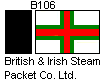
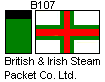
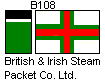
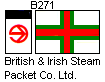
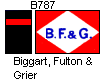
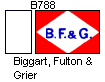
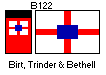
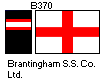
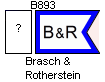
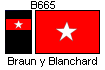
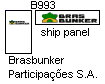
Sources vary in the relative widths of the flag’s cross arms, from equal widths to a very narrow green arm. Rosanoski places the actual proportion between these extremes, at about 2:3 green to red. B107’s funnel was adopted after the First World War. B108 is dated either to 1937 or about 1945; references to Leinster and Munster in 1938 support the earlier date. A photograph of Leinster confirms a narrow funnel band, rather than Loughran’s wider version.
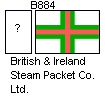
An earlier FOTW rendering, B884, had a pinkish-red cross; a later rendering used red. The B108 illustration was subsequently replaced by Jarig Bakker’s version from the National Maritime Museum flag, dated about 1955 and measuring 1092.2 × 1752.6 mm.
The Gaelic “e” emblem was adopted in January 1967, with Innisfallen the first vessel to receive the new funnel. A blue flag with a white Gaelic “e” was designed afterwards but never worn as a house flag. Leinster briefly used it as a stem jack early in 1967.
A slightly different Gaelic “e” was adopted on the funnel in July 1967 and retained by cargo vessels after the passenger ships changed again in 1975. Loughran shows it overlapping the black top; Mayes does not describe the emblem.
Brown 1995 gives three progressively darker blue funnel bands. Mitchell starts with grey, followed by light and dark blue; a photograph captioned “Muntster”, dated 2 June 1990, seems to show a greyish-blue inner band. The livery was replaced by that of Irish Continental.
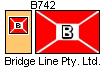
The passenger funnel identified in the source as B272 was adopted early in 1975. It bears “B+I” above “LINE”, with white letters shaded blue and no outline around their outer white edges; the smaller plus sign is blue.
British & Irish Steam Packet Co. was established on 27 July 1836. It was re-formed under the name British & Irish Steam Packet Co. (1936) Ltd., reverting to the earlier name in March 1939. The reorganisation is described as acquiring the existing company and City of Cork Steam Packet, Michael Murphy, Palgrave Murphy and Dundalk & Newry Steam Packet. Another account dates the City of Cork acquisition to 1946 rather than the 1937 reorganisation.
Coast Lines ownership is dated to 1936 by FOTW, though Rosanoski notes an earlier listing under it in 1925. Sale to the Irish Government is dated 1966 by Loughran and 1965 by FOTW. The company became B&I Line plc in the late 1980s and was acquired by Irish Continental in 1991 or 1992 according to differing accounts. In 1995 the group standardised its image, ending B&I references and introducing new colours and a logo.
Ships had Lady names until 1937–1938, when new motor ships prompted a change to Irish county names, often by dropping the prefix.
Ireland, Dublin.
B & S SHIPPING CO. LTD.
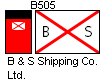
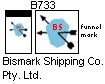
Merchant Ships 1942 dates adoption of a new livery to formation in 1934–1935, differing from the 1933 date in the history. A photograph of St. Elwyn confirms a narrow saltire on the funnel panel.
B & S Shipping was formed in 1933 to manage St. Quentin Shipping, apparently as a partnership of directors G.B. Bailey and R.G.M. Street. It also operated for South American Saint Line and Triton S. S. Co., and acquired Shakespeare Shipping from Glover Brothers after the Second World War. Operations ceased on Street’s death in 1961. Rosanoski doubts the conflicting claim that Barry Shipping was renamed B & S, noting instead Jordan’s account that Barry became South American Saint Line in May 1939. He likewise considers a listing of South American Saint Line as B & S’s owner to reverse their roles.
Ships carried names beginning with St.
UK, Cardiff.
B + H Ocean Carriers Ltd.
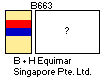
B + H Equimar Singapore Pte. Ltd.
This funnel is documented by Bonnie Smithwick on 29 August 2005 and a sighting of Sachuest at Newcastle on 10 October 2007.
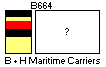
B + H Maritime Carriers
Mitchell uses this funnel on most of his line drawings, including three ships built between 1973 and 1975 which Rosanoski did not locate.
The source traces an origin in Arvid Bergvall Jr & Co. A/S of Oslo in 1974, renamed Bergvall & Hudner in 1982. It later appears with its fleet under B + H Equimar Singapore.
The related B + H names are not presented as a single unambiguous corporate sequence. Formation is variously given as 1987, April 1988 and, for B + H Ocean Carriers, 2004. Registers move from B + H Ship Management to B + H Maritime Services and then B + H Ocean Carriers. Mitchell describes B & H Maritime Carriers of Nassau as founded by Michael Hudner and Arvid Bergvall to buy second-hand ships, trade them and sell at a profit. Rosanoski also notes that Excel Maritime, formerly B+H Maritime Carriers before 1998, occupied the same building.
Operating companies listed include B + H Equimar Singapore, formed in 1995; B + H Management, formed in 1993 in Hamilton; Roymar Ship Management, formed in 1992 in Yonkers; and SMT Shipmanagement & Transport.
USA, New York, N.Y.; Stamford, Conn.; later Bermuda, Hamilton.
B&N NORDSJÖFRAKT A/B.
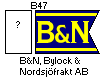
B76 is presumed to be the original livery. A photograph of Storon dated 15 October 1992 confirms the funnel, although the ampersand is obscured and appears not to be of the same height as the other letters. Mitchell omits it, assumed by Rosanoski to be an error. Brown 1995 shows a white swallowtail with a very broad blue horizontal band carrying white “B&N”. A new logo and funnel markings were introduced in 1995.
Both square-cut and swallowtailed versions are reported from photographs and the company website. Rosanoski suggests that different versions may relate to different companies in the group. Nüsse associates one with Sea Partner and shows a swallowtail with lighter, mid-blue colouring and white instead of yellow. His B257 reference offers no explanation of the lighter shade.
Neva Trader photographs show an apparently black funnel.
The funnel follows Capricorn on 22 October 2005 and appears to have been used on Moerman vessels.
The funnel follows a photograph of Falcon dated 21 April 2001.
The Tofton photograph is labelled B592 in the livery passage but B292 in the Sources list. Its apparent design may be caused by sunlight on a distant funnel. The associated company-website flag is rectangular and appears brighter blue than FOTW’s B46. The photograph date is written 31.3.2995 in the original.
B&N was formed on 1 January 1990 by merging A/B Nordsjöfrakt and Bylock Group, initially as B &N, Bylock & Nordsjöfrakt and renamed B&N Nordsjöfrakt in 1998. The company account dates acquisition of Gorthon Lines from Bilspedition to 1990, while Mitchell gives 1991 for both formation and acquisition. Svenska Orient Linien was acquired in 1993. Mitchell also records acquisitions of Oceania Rederi and Transforest in 1992.
Moerman was acquired in 1994 according to the company history, but in 1996 according to Lloyds. A group-wide B&N identity was introduced in 1995, when Transbulk was also acquired. In 1997 Gorthon was spun off to shareholders and 75% of Svenska Orient Linien sold to the public. B&N acquired half of Paltrans and 75% of Hornet Shipmanagement in 1999, increasing those stakes to 75% and full ownership respectively in 2000. It bought back 33% of Gorthon’s equity, carrying 39% of the votes, in June 2001.
Sea Partner’s history is less clear. Formed in 1992, it became B&N Sea Partner in 1995 and traded as Sea Partner from August 1997, with B&N, Gorthon and Swedish Orient holding 40%, 30% and 30%. The company narrative instead places divestment in 1998. Subsequently Sea Partner Sweden, it became Gorthon Fleet Services in 2001 and a full Gorthon subsidiary, then Transatlantic Fleet Services in 2005.
A half-owned Gorthon-B&N Transatlantic company was formed in April 2004. A full merger was proposed that October, creating Rederi A/B Transatlantic on 1 April 2005. B&N Transbulk was divested in the second quarter of 2005.
Sweden, Skarhamn.
Preserve the original prose, but do not illustrate or link it to the withheld GIF(s): B292. Source reference codes do not establish an image association.
B. AYMAR & CO.
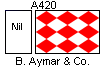
The sailing-ship company had no funnel livery. Its flag illustration follows the chart Private Signals of the Merchants of New York.
Benjamin Aymar founded the company in 1821; it operated for nearly half a century.
USA, New York.
B. BORGHORST.
Mitchell supplies a line drawing of the vessel, there named Margareta-B, without detailed funnel information.
Borghorst built Magareta-B in 1966 and sold it in 1974. Mitchell names the manager as Nagenborg, which Rosanoski considers probably an error for Wagenborg; the registers place the vessel under E. Wagenborg’s operation.
Germany, Haren-Ems.
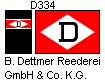
B. DETTMER REEDEREI GMBH & CO. K.G.
image by Jarig Bakker, 10 September 2006
D.T. 48 on 19 October 2007 shows a long, squat funnel that elongates the diamond. The flag follows the company logo and photographs, with the diamond very nearly reaching the flag’s edges.
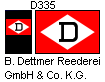
D.T. 83 on 1 August 2008 omits the narrow white panels. Although the photograph is unclear, its squat funnel and diamond seem closer to normal proportions. The flag follows Spandau D.T. 61 on 8 March 2007 and has the diamond just within the field.
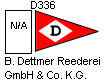
Klaus-Michael Schneider observed the flag at the mast and this pennant on the prow at Hamburg’s Billwerder Bucht on 6 April 2007.
Dettmer Logistics
The white Logistics flag carries italic, sans-serif DETTMER above LOGISTICS, shifted apart, with D and L red and the other letters black. Four grey arrows curve from above the first word, behind the name, and join in a shadowed arrowhead pointing to the second. A thin grey line divides the words and supports the small GmhH & Co. KG inscription beside DETTMER. A bowed grey line completes the ovoid outline; an interrupted vertical grey line suggests a crosswire or globe. Some details are difficult to see in the photograph but clearer in the logo. Rosanoski cautions that the website image may be a panel rather than a flag.
The related firm began as Dettmer Lagerhaus GmbH & Co. KG in 1967, became Dettmer Container Packaging (DCP) in 1968 as container activity grew, and adopted the Dettmer Logistics name in 1998. It expanded in Germany, Great Britain and Belgium.
Keep the explicit scope label independent; no alias or company identity is inferred.
Nürnberg photographs show two Dettmer D flags and two similar flags with several unreadable black initials. Mertens notes that the funnel usually resembles the house flag, which is also often painted on the steering cabin.
Bernhard and Wilhelm Dettmer began Nordwestdeutscher Frachtverkehr B. Dettmer & Co. in Bremen on 1 August 1947. Initially charterers, they soon became shipowners and developed a major family-owned European inland-shipping business. One directory describes a division of Elb.
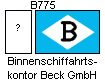
Binnenschiffahrtskontor Beck is listed as an associate, possibly illustrated by a vessel carrying the Dettmer mast flag and Beck flag as a jack.
Germany: Bremen, Hamburg and Dusiburg in the cited sources.
B. HUSTED-ANDERSEN.
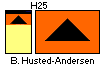
The funnel colour is printed as “Bluff”, with a narrow black top separated by an orange band bearing a black triangle. The flag is orange with a black triangle.
Denmark.
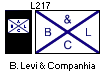
B. LEVI & COMPANHIA.
Jorge Candeias notes that the flag uses the colours of Israel, while allowing that the resemblance may be coincidental. His source is a house-flag chart from about 1950.
Brazil, Amazonas.
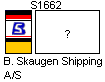
B. SKAUGEN SHIPPING A/S.
Formed in 1990 and owned and managed by Brynulf Skaugen, the company’s operating interests included Color Line, Color Line Marine, Larvik Line and B. Skaugen Holding. It acquired 44% of Mosvold Shipping in September 1994. In 1995 it took 10% of the Jahre-Wallem joint venture, which briefly became Jahre-Skaugen-Wallem before reverting to Jahre-Wallem in 1996. That concern had begun as Westcot Norway in 1989, a 60:40 venture of Jørgen Jahre Shipping and Wallem; its sole vessel Cascade was sold in 2003. By August 2008 B. Skaugen was deleted from Lloyds and the Color Line companies were under Color Group.
Norway, Oslo.
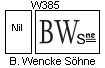
B. WENCKE SÖHNE.
image by Klaus-Michael Schneider, 22 March 2007
The white flag bears black serifed BW, an S half that size, and still smaller lower-case ne with a double underline.
Robert M. Sloman the elder brought Bernhard Wencke from Bremen to Hamburg in 1851 to establish a dock. Wencke founded his own sailing-ship concern in 1857. After his death in 1868 it took its final name, B. Wencke Söhne. Friedrich Wencke died in 1905, directing in his will that the company be discontinued; Rosanoski’s heading dates the company to 1857–1906.
Germany, Hamburg.
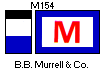
B.B. MURRELL & CO.
The flag is white with a blue border and red M, the same design shown for Metcalfe Shipping, formed in 1929 at West Hartlepool. The blue funnel has a black top separated by a very broad white band.
U.K., West Hartlepool.
B.H. HALVORSEN.
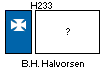
Snefjeld, owned by the managed company, was noted in April 1964 with a blue funnel bearing a white cross paty. No flag was noted.
B.H. Halvorsen managed D/S A/S Storfjeld, considered probably a subsidiary in the 1963–64 account.
Norway, Bergen.
B.J. Sutherland & Co. Ltd.
B.J. SUTHERLAND & CO.LTD.
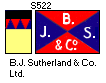
The funnel is yellow or buff with a black top separated by a broad band of interlocking red and blue triangles. The flag is diagonally quartered red and blue with white B.J.S.&Co., the small o raised with its stop beneath. Lloyds, Reed and Brown 1926–1934 outline the letters in black. Talbot-Booth omits the stops and o. Some sources make the red triangles smaller than the blue.
Formed in 1892, the concern withdrew from shipowning between the wars and finally ceased in 1955. Sutherland Steamship is recorded as its subsidiary.
U.K., Newcastle.
B.M. CORRIGAN & CO. LTD.
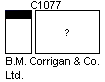
The company owned Mokau from 1905 to about 1918 and is listed in Lloyds 1917–18.
Australia, Sydney.
B.U. CAPPONI & GIOVANNI FRENO.
Austro-Hungarian Empire, Lussinpiccolo.
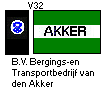
B.V. BERGINGS-EN TRANSPORTBEDRIJF VAN DEN AKKER.
The circle on the funnel contains a blue diving helmet. Brown 1995, No. 14, supplies the funnel and flag V32.
The company appears from the 1970–1971 Lloyd’s listing under several forms of its salvage and transport name. Smit Tak B.V., within Smit International, is listed as owner in 1998–2000, followed in 2003–2004 by the concern printed as Unie Van Reddring - en Sleepdienst N.V.
Netherlands, Vlissingen; Brown 1995 instead gives Glasgow.
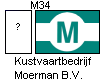
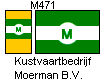
B.V. KUSTVAARTBEDRIJF MOERMAN B.V.
image by Jarig Bakker, 13 February 2006
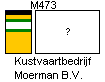
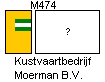
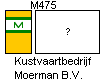
The website flag and Nüsse’s table flag provide versions of the design, the latter appearing more teal.
Bakker describes horizontal green-white-green bands with a central white disc and green M. On 26 March 2010 Nico de Ruijg confirmed that the company still existed, its flag was unchanged and no funnels then carried its house style.
Mitchell records these funnel versions without specifying which vessels used each. Some vessels in his notes could not be located under Moerman in Lloyds.
Under B&N the company appears to have used that group’s funnel and, after the 2005 merger, Transatlantic colours. The apparent white top in one version may result from a non-level funnel edge above a level blue band rather than a different design.
Moerman was formed in 1975. B&N Nordsjöfrakt acquired it in 1994 according to the website, or 1996 in Lloyds. The register first describes a 1996 rename to B&N Kustvaartbedrijf Moerman, later distinguishing a B&N holding company from the operating B.V. Kustvaartbedrijf Moerman. It became part of Rederi A/B Transatlantic after the group’s formation on 1 April 2005. Moerman’s website says it again worked independently under its former logo from 2005, although subsequent registers continued to place it in the group.
Netherlands: Rotterdam, Schiedam and Ridderkerk.
B.V. LUSITANIA LIJN CPL.
image by Jarig Bakker, 3 Mar 2005
image by Jarig Bakker, 3 Mar 2005
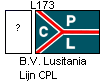
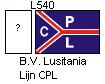
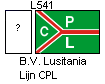
Nüsse’s old and new table-flag images show a field described as teal or turquoise, with blue or green predominating according to reproduction.
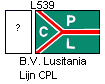
Bakker’s first FOTW rendering has a dark-blue field divided Czech-style by a red Y edged white, with CPL on the three blue areas.
The amended version follows Schuller’s statement that the principal colour was green, not blue.
A pennant appears at Lingegas’s christening on 27 February 1981; a monochrome flag version is painted on Merwegas’s bow in the same year.
Lusitania Lijn began as Hudig & Pieters’ Netherlands–Portugal freight service within CPL. Later records associate it with Merwegas, possibly as agent rather than manager, and Nedfreezer from 1983 to 1992. Schuller also names Lingegas and manager P. Mandemaker. Van den Muijzenberg suggests CPL denoted cooperation between Cornelder Lijn, Van Nievelt Goudriaan’s Portugal Lijn and Lusitania Lijn. Portugal Lijn apparently withdrew in 1962, but he cannot establish whether the remaining partnership continued or only the initials survived.
Netherlands, Rotterdam.
B.V. NETHERLANDS MARITIME AGENCIES.
image by Jorge Candeias, 14 March 1999
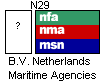
The flag is a horizontal greyish-green, dark-red and blue tricolour, with white letters towards the hoist in each stripe. The FOTW contribution also refers to Marco Shipping Netherlands, which Rosanoski could not locate.
NMA specialised in semi-submersible and heavy-lift project cargo, liner and tramp agency services, and international cargo brokerage. It managed Lash Carriers of Central Gulf Lines and later operated through NMA Maritime & Offshore Contractors, formed in 2001 at Houston.
Netherlands, Rotterdam.
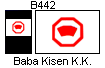
BABA KISEN K.K.
Baba Kisen K.K. (1)
Baba Kisen was formed in February 1937 and merged into Baba-Daiko Shosen in 1966.
Japan, Tokyo.
Keep the explicit scope label independent; no alias or company identity is inferred.
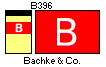
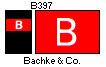
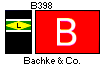
BACHKE & CO. A/S.
B398 is given as an alternative to B397, but Rosanoski considers it suspect because no reason for the difference is available.
The local statement that steamship ownership began in 1898 conflicts with the detailed fleet history's 1891 CONTEST and 1896 GERD entries under Bachke interests. B398's unexplained alternative funnel is expressly suspect in the local source and remains an image review case.
Bachke & Co. was a steamship owner from 1898, later appearing in the registers as both owner and manager. Most vessel names ended in “id”.
Norway, Drontheim; Trondheim.
BACONG SHIPPING CO. S.A.
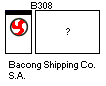
The funnel recorded for Southern Cross in September 1966 is white with a narrow black top and a black ring wholly enclosing a red symbol. No flag was noted.
The pipeline Philippines country follows the Manila manager. External histories explicitly place the Bacong owner in Panama. Two ships used SOUTHERN CROSS in different sequences, so the September 1966 funnel context needs vessel-specific review.
Bacong Shipping is recorded in Lloyds 1963–1964.
Philippines, Manila, care of Southern Industrial Projects Inc.
Bagger-, Bugsier-Und Bergungsreederei GmbH.
BAGGER-, BUGSIER-UND BERGUNGSREEDEREI GMBH.
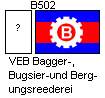
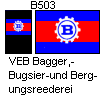
The flag follows the blue–red–blue DSR design, with a white “B” surrounded by a white cogwheel at the centre.
Lexikon der Seefahrt instead shows a solid white cogwheel containing a blue ring around a blue “B”.
FOTW labels these renderings “BBB variant flag” and “BBB bright blue flag”.
Lotsen-, Bugsier- und Bergungsdienst / LBB
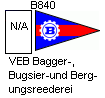
The Lotsen-, Bugsier- und Bergungsdienst funnel was used from 1964 to 1969.
A photographed flag provides tentative evidence for a further variation: a broad red middle stripe, pale-blue outer stripes and a comparatively small B-and-cogwheel emblem on a disc darker blue than the stripes. The auction description gives dimensions of 40 × 64 cm and states that the flag had been used aboard ship.
BBB operated ocean-going dredgers, tugs, icebreakers and rescue ships. VEB Deutsche Seebaggerei and Lotsen-, Bugsier- und Bergungsdienst were amalgamated into VEB Bagger-, Bugsier und Bergungsreederei, dated 1969 in one account and effective 1 January 1970 in another. It became a limited-liability company in 1990, applied for bankruptcy in 1992 and had its harbour-towage operations bought by Fairplay in 1993. The successor, BBB Schlepp- und Hafendienst, retained both the BBB abbreviation and the existing logo charge.
Germany, Rostock.
BAGGERMAATSCHAPPIJ HOLLAND B.V.
Mitchell draws the “C” and lines in black but specifies white markings. He gives no explanation of the “C”; Rosanoski doubts a connection with Cosmos, the only vessel named, because there is no accompanying ship drawing.
Baggermaatschappij Holland was formed in 1980. The sources differ on its acquisition by Boskalis: Dredgepoint gives November 1985, while Lloyds dates the company and its subsidiary Holland Dredging Co. (Irl) joining the group to 1 April 1996. Its last dredger, Nautilus, sank on 30 November 2006.
Netherlands, Hardinxveld-Giessendam; Papendrecht is also given.
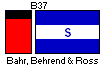
BAHR, BEHREND & ROSS.
The funnel is red with a black top.
The flag is blue with a white horizontal band bearing a blue “S”.
U.K., Liverpool.
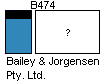
BAILEY & JORGENSEN PTY. LTD.
This lighterage company was taken over by Harbour Lighterage in 1974 and deregistered on 4 March 1983.
Australia, Sydney.
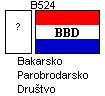
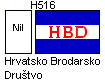
BAKARSKO PAROBRODARSKO DRUŠTVO.
The earlier flag, assigned by FAME to 1875–1878, is shown in a painting of the bark Ban Mažuranic reproduced in an encyclopaedia. It has blue–white–blue horizontal stripes with red “HBD” in the centre stripe, flown at the mainmast while the Dual Monarchy ensign is carried separately.
The later illustration reconstructs a description of a Croatian national tricolour with “BBD” in its white stripe. Heimer expressly warns that the reconstruction may be incorrect. The initials appear to correspond to Bakarsko Brodarsko Društvo, Bakar Shipping Co., rather than exactly the steamship-company heading. Use is placed in the second half of the nineteenth century, probably ending towards its close. The house flag is distinguished from the Austro-Hungarian ensign flown at the stern.
Bakar, east of Rijeka (Fiume), remained under Croatian rule while Rijeka was under direct Hungarian rule. Hrvatsko Brodarsko Društvo, the Croatian Shipping Company or Society, was established in 1875 with the sailing ships Ban Mažuranic, Hrvat and Bakaran. Its first steamship, Grad Bakar, was built in 1878, when the company became Bakarsko Parobrodarsko Društvo, or Bakar Steamship Co. The port’s importance declined after the direct railway to Rijeka was built in the late 1880s.
Austro-Hungarian Empire, Bakar.
BAKER-WHITELEY TOWING CO.
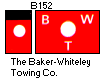
The funnel is red with a black top and a white disc.
The red flag has a small white disc between white “B” at the upper hoist, “W” at the upper fly and “T” at the base.
The company is recorded in Lloyds from 1963–1964 through 1992–1993, with “The” included in the title in only some editions.
USA, Baltimore.
BALATONI HAJÓZÁSI ZRT.
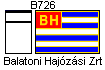
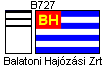
The flag has seven horizontal stripes, blue–white–blue–white–blue–white–blue. A red canton spans the upper three stripes and about 40% of the flag’s width, bearing yellow “BH”. Yellow outlines, possibly embroidered, edge the stripes and canton except at the hoist. Photographs confirmed these outlines, absent from the earlier rendering.
The earlier illustration was based on an advertisement showing the same seven stripes and red BH canton without the yellow outlines. It was later replaced on FOTW by B726.
The funnels differ in their number of bands: B726 follows Csobánc and B727 Helka. The reason for the difference is not given.
A fleeting film view prompted a suggestion that the company flag had been flown at the stern. The contributors questioned this interpretation and distinguished the house flag from the Hungarian national ensign. Rosanoski notes that the company website’s 2009 flag photograph appeared to show a halyard, without establishing whether it was aboard or ashore; the other vessel photographs showed the Hungarian flag as ensign and sometimes stem jack, but not this company flag.
Balatoni Shipping began on 21 September 1846 with the launch of the steamboat Kisfaludy on Lake Balaton. Also widely recorded as Balatoni Hajózási Rt., it was described as a Mahart subsidiary and a yacht club. The 2009 account gives 26 motor passenger ships serving 22 lake ports, including the Szántórév–Tihanyrév ferry linking the northern and southern shores, as well as marinas.
Hungary, Siófok.
BALBOA SHIPPING CO. INC.
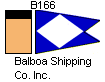
The funnel was based on the owners’ livery and is confirmed by a photograph of Platano. The sources nevertheless differ over which United Fruit version applied: Rosanoski considers that subsidiaries appear to have used the plain U35 funnel, while Ships & the Sea gives the alternative and Merchant Ships 1942 and 1944 specify U34, supported by Mitchell.
Balboa Shipping is recorded under United Fruit in 1937–1938, later under Honduran agents and under Fyffes management in 1985–1989. Its ships flew the Panamanian flag and had names beginning with A.
USA, New York; Panama Canal Zone, Balboa. The source also lists Tela, Honduras, but marks that attribution as suspect.
BALBOA TRANSPORT CORPORATION.
The funnel was Caltex’s. Loughran states that the livery was superseded; Rosanoski considers the replacement apparently Texaco’s.
Balboa Transport was owned by Caltex and appears in registers from 1958–1959 through 1980–1981, with California Texas Oil acting as agent. Most ships had names beginning Caltex.
USA, New York.
BALCHART EESTI OU.
Porhov and Roel are recorded with plain white funnels. Roel appears in that condition in a photograph dated 10 August 2006 after carrying charterers’ colours in 2005; Porhov later received Keystone Logistics’ logo. Rosanoski suggests that plain white may represent the company colours when no other markings are supplied.
This corroborates the 2001 company described in part of the archive, while the archive also reports a 1993 formation and several Balchart group affiliates. The earlier Balchart Estonia identity and full fleet continuity remain unresolved.
Balchart Eesti, also recorded as Balchart Estonia Ltd., provided chartering, brokerage, ship-management and port-agency services within the Balchart Group. Lloyds gives formation in 1993, while a credit report gives May 2001. Group histories are likewise inconsistent, giving 1998, 1999 and 2001. The group operated in St. Petersburg, Tallinn and Riga; the St. Petersburg member was established in May 2005 and described as financially independent.
Estonia, Tallinn.
BALEARIA EUROLINEAS MARITIMAS SAU.
E231 follows a portside photograph of Isa de Botafoc.
The flag is turquoise blue, specified as RGB 68/142/149, with italic white capitals “BALEÀRIA” beneath a white ship image. The accent is drawn as a small horizontal line. Klaus-Michael Schneider observed it in Palma de Mallorca’s Eastern Harbour on 26 May 2009. The funnel follows Martin I Soler on 29 April 2013; Rosanoski notes that this and a later Avemar Dos photograph may indicate a somewhat bluer shade.
Buquebus documentary context
For Buquebus, Mitchell provides a monochrome funnel drawing. Rosanoski places the company logo on the hull and describes no proper funnel mark, but a colour scheme over the after hull, citing Eladia Isabel and Silvia Ana L.
Keep the explicit scope label independent; no alias or company identity is inferred.
The register history begins with Fletamentos de Balaeres S.A., formed in 1985 and renamed Eurolines Maritimas S.A.L. in 1998. The company account describes Eurolines Maritimes beginning operations under the Balearia brand in July 1998, led by former Flebasa executives, captains and officers. Later registers use Balearia Eurolines Maritimas SAU.
Major operating companies listed include Buquebus Espana, formed in 1997 in Cadiz, and Los Cipreses, trading as Buquebus, formed in 1984 in Montevideo.
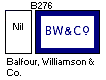
The flag is white with a blue border and large blue “BW&Co”, the “o” raised. LJC raises it only halfway and omits the dot. The company’s sailing vessels had no funnel livery.
U.K., Liverpool.
Ballande & Fils.
BALLANDE & FILS.
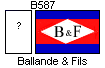
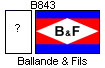
The flag on a 1914 book cover has vertical blue–red–blue stripes in approximately 1:4:1 proportions, with a white lozenge on the red stripe bearing black “B & F”. Rosanoski notes that the FOTW rendering incorrectly extends the lozenge to the flag’s sides relative to the book, while also questioning the accuracy of the book itself.
The family’s maritime business originated in Bordeaux. Armand Ballande sent his first ships to Port-de-France, later Nouméa, in 1863. His son Louis obtained a colonial resupply contract in 1887 and operated mixed passenger-and-cargo sailing vessels between Bordeaux, Papeete and Nouméa. The family later invested in New Caledonian nickel mining as well as vineyards. A separate account describes earlier business in Chile before expansion into Asia and the Pacific.
Ballande developed maritime subsidiaries including Société des Voiliers de Nouméa and Compagnie Navale de l’Océanie. Accounts describe parts passing to Messageries Maritimes in 1930 and Ballande & Fils coming under Société Anonyme Calédonia in that year, followed by Société Le Nickel by 1933. Hauts Fourneaux de Nouméa was associated; a connection with Comptoirs Français des Nouvelles Hebrides is only assumed from livery similarity.
Compagnie Navale et Commerciale de l’Océanie
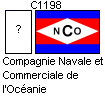
A bond reproduced by Numistoria shows the Compagnie Navale et Commerciale de l’Océanie flag with “NCO” in place of “CNO”. Rosanoski also records a pavillon website rendering without a stated source.
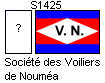
Société des Voiliers de Nouméa
The Voiliers de Nouméa flag is described as similar to the CNO flag but with “V.N.” replacing “CNO”.
Related maritime companies
Compagnie Navale et Commerciale de l’Océanie was created in 1911 by merging Voiliers de Nouméa and J.H. Tandonnet & Frères. Saint Joseph, built in 1912, inaugurated a New Caledonia service in 1914 and was sold in 1915. Compagnie Navale de l’Océanie is described as both a Ballande subsidiary and, in another reference, an associate.
Other recorded interests include Union Commerciale et de Navigation Calédonienne, operating from 1882 to 1935, and Compagnie Wallisienne de Navigation, still described as a maritime subsidiary in 2005.
Keep the explicit scope label independent; no alias or company identity is inferred.
France, Bordeaux; New Caledonia, Noumea.
Ballast Ham Baggeren B.V.
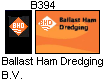
BALLAST HAM BAGGEREN B.V.
The funnel follows Iguazu in September 2005. The flag image appears to contain two orange shades, but Rosanoski cautions that scanning may be responsible and the field may in fact be one shade. On the diamond, the letters sit above two wavy lines, the upper extending only partway across.
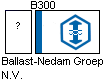
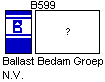
Ballast-Nedam Groep N.V.
The emblem is a blue hexagonal frame around a vertical double-headed blue arrow. Two horizontal bars cross it: the upper straight and the lower formed from three downward arcs. Both are blue over the field and white over the arrow.
The business originated as De Ballast in 1877, later Amsterdamse Ballast. Its 1969 merger with Nedam formed Ballast Nedam Dredging. Ballast Nedam Baggeren was established as a group subsidiary in 1992. It joined Hollandsche Aaneming Maatschappij (HAM) to form Ballast Ham, also called Ballast Ham Dredging, with respective shares of one-third and two-thirds. The company history dates the merger to 2001; a January 2002 announcement refers to agreement at the end of 2001, while Lloyds gives 26 January 2001.
Ballast HAM and Van Oord were integrated under the Van Oord N.V. name on 19 December 2003. The announced ownership structure brought together MerweOord, NPM Capital and Royal BAM Group, with proposed ordinary-share stakes of 47.6% and 30.9% for MerweOord and NPM respectively.
Related operations included Ballast Nedam Bagger-en Exploitatiemaatschappij, formed in 2000; Anglo Dutch Dredging, formed in 1995; and a half-share in Westham Dredging. Later Ballast Ham companies in India, formed in 2004, and Brazil, formed in 2006, were recorded under Van Oord.
Netherlands, Ijssel; Rotterdam.
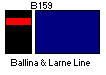
BALLINA & LARNE LINE.
It used the plain blue Pollexfen flag but a different funnel: black with a red band.
The line belonged to Pollexfen Line [C.W. Pollexfen].
U.K., Liverpool.
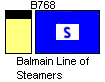
BALMAIN LINE OF STEAMERS.
The flag is blue with a white panel bearing a blue “S”. The colours are recorded for Balmain in 1892–1904 and South Australian in 1898–1904.
Balmain Line was Andrew Sneddon’s trading name for a passenger service between Sydney and Newcastle. He sold out to B. Einerson & Partner in 1904.
Australia, Wallsend.
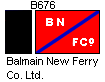
BALMAIN NEW FERRY CO. LTD.
The Log gives a red flag with a narrow blue diagonal band from lower hoist to upper fly, white “BN” in the upper hoist and “Co.” in the lower fly. Rosanoski separately notes that Sydney Ferry Fleets supplies shading but not colours.
Balmain New Ferry acquired Balmain Steam Ferry in 1900; that predecessor had been formed in 1882 and absorbed J. Watson & Partners in 1887. Hunter’s Hill & Lane Cove Steam Ferry followed in 1906. Sydney Ferries took over Balmain New Ferry in 1917.
Australia, Sydney.
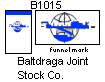
BALTDRAGA JOINT STOCK CO.
The funnel follows a portside photograph of Gibraltar dated 6 August 2013.
These names may represent related entities, but the exact JSC/Limited succession and the company identity behind Gibraltar were not independently resolved. The directory extraction omits the company heading near the 1996 passage; it is not treated as proof of that date.
Baltdraga, also recorded as A/O Baltdraga, was formed in 1996 and listed as controlled by the Government of the Republic of Russia in 1998. It managed the hopper dredger Professor Goryunov, buying her in July 2011 and renaming her Gibraltar.
Russia, St. Peterrsburg.
Baltic Line A/S,
BALTIC LINE A/S (1),
The source itself questions whether the Finnish flag and Bergen-based Norwegian operator are the same entity. A matching name and Baltic route are insufficient to choose a country.
Baltic Line A/S (1)
The blue in the FOTW illustration is described as greyish blue.
Finland.
Keep the explicit scope label independent; no alias or company identity is inferred.
Norwegian namesake: relationship unconfirmed
Rosanoski separately records a Bergen Baltic Line, apparently chartering Baltic Sea, Baltic Trader and Baltic Star, associated with Nygard Shipping. Bergen Shipping owned it and Nor Lines had signed an acquisition agreement. Its Finnish trade and subsidiary Baltic Line Finland O/Y suggest a possible connection with the illustrated Finnish company, but Rosanoski found no website image to confirm this.
Keep the explicit scope label independent; no alias or company identity is inferred.
The flag follows Deutsche Binnenreederei’s design with white serifed “B” in the upper hoist and “L” in the lower fly of the red field. Rosanoski considers the anchor in the FOTW rendering reversed: the cable on Baltic Lloyd’s website hangs the other way, as in B811. He records that the subsequent exchange did not address his specific point about the cable.
Baltic Lloyd was established in 1997 as a Deutsche Binnenreederei subsidiary for a regular Rostock–Moscow liner service. Rolf Kroeger and Manfred Reining took it over on 1 March 2000. The website consulted by Rosanoski mentioned shipping but no current vessel ownership.
Germany, Rostock.
BALTIC OFFSHORE.
The funnel follows a portside photograph of Pleijel dated 19 July 2012.
Baltic Offshore was formed in 2006 as a private, independent company working with submarine cables.
Sweden, Kalmar.
BALTIC REEDEREI GMBH.
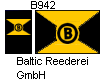
A878 visibly names Atlantic-Rhederei GmbH and is a wrong image mapping. That local mapping error does not itself disprove the coherent Baltic company text; B942 remains source-only. The source coherently describes a Bremen Baltic Reederei associated with Veleda in the 1950s. Targeted searches did not provide a reliable independent company identification; a period newspaper PDF was unreadable and its screenshot returned 404.
Baltic Reederei had Veleda built in 1953 and sold her in 1960. Gottfried Steinmeyer & Co. is listed as operator in 1956–1957.
Germany, Bremen.
BALTIC SHIPPING CO.
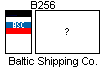
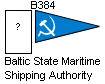
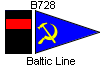
The early pennant is blue with a white hammer and sickle. FOTW’s amended account dates adoption to 30 July 1923 and use to 1926, replacing an earlier suggestion that it lasted into the 1990s. Rosanoski cites authorisation by a decree of 29 August 1924 and abolition on 15 January 1926, emphasising that it belonged to the Maritime Shipping Authority.
A yellow-emblem depiction appears in Brown and is labelled incorrect by FOTW. Jarig Bakker also notes it in [wed26]. James Dignan comments that the hammer resembles a claw hammer, or possibly a cross-pein Warrington hammer, rather than the usual Soviet sledgehammer.
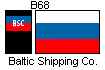
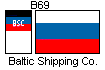
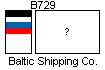
Later liveries use the Russian ensign as a house flag. Funnel lettering and band colours vary, and some ships have panels instead of bands. Konstantin Simonov appears to carry letters only on the blue band. B729’s bands are described for Australian visitors; Mitchell gives B68’s letters as white/gold.
Baltic Shipping (BSC), also recorded as Baltiyskoe gosudarstvennoe morskoe parohodstvo and Baltic State Sea Steamship Co., dates its foundation to 1835. Under Soviet administration it was known as Baltic State Maritime Shipping Authority and came under Sevzapflot. Later accounts record privatisation and independence from the Ministry of Merchant Marine, yet Lloyds continued to describe Russian government control. Receivership in 1996 and bankruptcy in 1997 were followed by continuing register entries.
The later account describes ship management through London-based Baltic Reefers, operating via its St. Petersburg agent Baltic Shipping Ltd. Other recorded operating companies include Pan Ocean Ship Management (UK), formed in 1996, and Baltec, formed in 2002.
USSR, Leningrad; Russia, St. Petersburg.
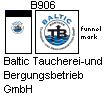
BALTIC TAUCHEREI-UND BERGUNGSBETRIEB GMBH.
The funnel follows a portside photograph of Wind Express dated 22 June 2012.
The company undertook diving, hydraulic engineering and maritime services. It was owned by Eyk-Uwe and Jens-Olaf Pap from the early 1990s, in the period when Rostock’s Bagger-, Bugsier und Bergungsreederei entered bankruptcy in 1992. The source gives approximate operating histories of more than fifteen and more than nineteen years.
Germany, Rostock.
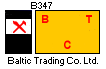
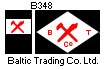
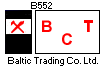
BALTIC TRADING CO. LTD.
Overseas Oil & Transport also used the flag; its funnel is not defined in that reference.
The National Maritime Museum flag is dated about 1951 and measures 1219.2 × 1879.6 mm. Brown 1958 separates the torch’s flame from its stem, whereas the surviving museum flag does not.
Baltic Trading was formed in 1925, although Lloyds records subscription from 1924. It controlled and operated for Overseas Oil & Transport and also operated for Western Oil Shipping.
U.K., London.
BALTIC TRADING LTD.
The funnel follows Baltic Cove on 23 May 2011. Baltic Breeze in July 2013 appears darker blue in both funnel and band, but Rosanoski cannot distinguish a paint difference from photographic effects.
B926 follows a starboard photograph of Baltic Panther dated 26 July 2011.
Genco Shipping & Trading formed Baltic Trading for the dry-bulk spot market and was to serve as manager. Incorporated in October 2009 and trading from New York, it issued its prospectus on 30 November; delivery of the purchased fleet was expected by October 2010.
Marshall Islands, Majuro.
BALTIMAR APS LTD.
Baltimar Saturn’s black funnel at Wellington on 22 April 2000 had a green “B” edged black and four green wavy horizontal lines. The upper three green bands were narrower than the lowest and the intervening white bands. Black edged the top of the upper band and the bottom of the lowest, the latter as a straight line.
A later starboard photograph of Baltimar Saturn shows a thin black wave separated above three green waves, with a straight black baseline separated below. That baseline is slightly wider than the green lines and has an upward bump where it meets the bottom curve of the “B”; it matches the letter’s black edging in width. Baltimar Orion appears to have only two green waves between the upper wave and straight baseline, though the colours are unclear. Rosanoski allows that these may be small changes or painters’ variations.
Nüsse’s flag has a smaller device, with black waves where the funnel has green and a more turquoise green in the lettering.
Mitchell’s funnel appears to have been based on distant views.
Baltimar was founded in 1982, with Baltimar Overseas established in 1988. It helped set up Southern Oceans Container Line with J. Jasyasuriya, gained greater control after his withdrawal and closed the service on 29 December 1994.
Denmark, Vedbaek; Humlebaek.
BALTIMORE MAIL STEAMSHIP CO.
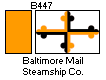
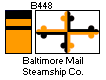
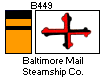
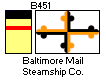
The flag is a variation on Maryland’s state flag: white with a cross botonny quartered golden orange and black.
Brown 1943 uses yellow in this version.
This rendering was drawn from a verbal description specifying a buff funnel and orange-and-black cross but not the position of the funnel band or the size of the flag’s cross.
Roosevelt Steamship and International Mercantile Marine formed Baltimore Mail, incorporated on 7 July 1930. It ceased business in 1938 and came under United States Lines’ operation. Rosanoski considers that its later listing probably represents a name company. Ships had City of names.
USA, Baltimore.
BALTISCHE REEDEREI GMBH.
The flag’s pattern was inspired by Sweden’s colours and the new Bolten house flag.
August Bolten established Baltische Reederei in 1913 to maintain the Sweden service. Rosanoski notes a company of the same name in a contemporary directory but cannot establish a connection.
Germany, Hamburg.
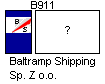
BALTRAMP SHIPPING SP. Z O.O.
Port and starboard photographs of Olza dated 21 June 2012 show the emblem on a slightly oblong white panel without a defined edge, wholly within the depth of the white band. It sits aft of an opening ventilator panel on both sides. Rosanoski suggests that the design may be intended to occupy the whole band, with the available space determining its actual position.
Baltramp began in 1992 with Ruciane, sold in 2000. The 2012 company account describes five ships named after Polish rivers. Registers use several forms, including Baltramp S-Ka z o.o., Baltramp Shipping Co. Ltd. and Baltramp Shipping Sp z o.o.
Poland, Kolobrzeg; Szczecin.
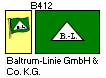
BALTRUM-LINIE GMBH & CO. K.G.
Baltrum-Linie is recorded in registers from 1978–1979 to 1996–1997. Ships have Baltrum names followed by Roman numerals.
Germany, Baltrum.
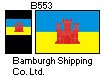
BAMBURGH SHIPPING CO. LTD.
The National Maritime Museum flag is dated 1955–1967 and measures 914.4 × 1422.4 mm. Mitchell apparently sighted the funnel at Glasgow in September 1972.
Marinart Bulk Carrier Fleets instead gives the Sheaf Steam Shipping funnel, identified in the source as S303.
Bamburgh Shipping was formed in December 1956, owned 51% by Sheaf Steam Shipping and the remainder by British Steel Corporation. W.A. Souter & Co., later Souter Hamlet, operated it. It was included in the 1976 sale to Ben Line, and later ships received Ben names.
U.K., Newcastle.
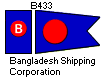
BANGLADESH SHIPPING CORPORATION.
NJK confirmed the recorded livery in September 2005. Mitchell shows a black funnel top.
The government-owned corporation was formed in 1972 according to Lloyds; Mitchell gives 1973, following independence from Pakistan. Most ship names began Banglar.
Bangladesh, Dhaka [Dacca]; Chittagong.
BANNO TRANSOCEANIA CO.
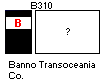
The funnel is black with a broad white band bearing a red “B”, recorded for Marie Bakke, Incharran and Inchstaffa. No flag was noted.
Exact-name and broader variant searches did not establish an independent company identity or country. Unknown is not a usable country. Unrelated Transoceania businesses and Japanese people named Banno were rejected; no country guessed.
Unknown.
BARBER INTERNATIONAL.
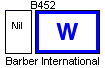
The FOTW illustration shows a bordered flag in bright blue. Rosanoski interprets the original website logo as the ordinary Wilhelmsen flag, white with a blue “W”, with the apparent border merely highlighting the edges, like the drawn flagpole. He notes its lighter blue compared with the letter and does not regard it as secure evidence of a separate bordered flag.
Pipeline country is blank despite a coherent local distinction between Hong Kong registration and Kuala Lumpur operations. The 1975 operating history belongs to Barber Ship Management, while the register dates Barber International to 1990. FOTW's US placement is not supported for this company. B452 may mistake a decorative logo border for a flag element.
Barber International describes itself as a ship-management business originating with Wilh. Wilhelmsen and operating independently from 1975, although Lloyds continued to list it within the Wilhelmsen group. Barber Lines had been established in 1969 by Wilhelmsen, Fearnely & Eger and A.F. Klaveness, with Wilhelmsen later taking full ownership. The international management organisation had its registered head office in Hong Kong and operating head office in Kuala Lumpur, with offices worldwide. Rosanoski treats a possible origin in Barber Steamship Line as guesswork, not established succession.
Barber International and Barwil Agencies amalgamated from 1 January 2005. The source distinguishes several management entities: the Lysaker company formed as Barber International in 1987 and renamed Barber Ship Management in 1994; the Hong Kong operation relocated to Kuala Lumpur in August 1995; and the Singapore company. The Malaysian and Singapore businesses received Wilhelmsen management names in 2008.
BARBER STEAMSHIP LINES INC.
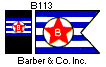
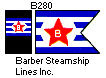
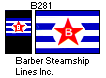
The early livery is recorded under New York & Oriental Steamship. Early flag sources outline the central white circular area in black. Merchant Ships 1942 combines the B113 funnel with the B280 flag; James Chambers vessels in the Dodwell-Castle service also used the B113 funnel.
Talbot-Booth’s B280 and Loughran’s B281 omit a letter from the funnel star. Rosanoski assumes this reflects the small illustrations rather than the actual marking. Talbot-Booth uses light blue for B280 and reports that its flag could sometimes be a swallowtailed pennant.
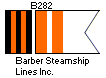
Loughran dates a funnel change to 1 December 1969 and a flag change to early 1970, called B281 in the source’s livery note. The later FOTW comment describes the 1970 flag as a swallowtail divided vertically orange and white, the orange further divided by a narrow white vertical band.
The company originated in 1902 as Barber & Co. Inc., operating New York & Oriental Steamship, whose registered office was in Liverpool but operations were based in New York. From the 1930s it is recorded as operator of American West Africa Line. Dodwell Castle Line was a joint service with James Chambers & Co. Under Wilhelmsen ownership, Barber became an agency company and was renamed Wilhelmsen Lines (USA) from 1 January 1989.
Rosanoski was unable to establish direct shipowning from Lloyds and considered that later activity may have been chartering or agency work. He also suggested, tentatively, that it was the beginning of Barber International.
U.K., Liverpool; USA, New York.
BARHOUM MARITIME CO.
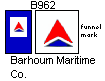
The funnel follows Schooner on 20 September 2006. The emblem appears consistent across ships with different registered owners. It is the same as O304, recorded for Ahmed Abdulrazzak Osman [Unimarine Management], but Rosanoski knows of no connection between them.
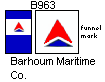
B963 follows a starboard photograph of Barhom dated 23 May 2010.
Barhoum Maritime was formed in 2002 and operated as a ship manager. It shared a website with Thalatta Shipping Agency, which acted as ship agent. Registers also use the spelling Barhom. Island Navigators Management of Beirut is listed as an associate.
Syria, Tartous.
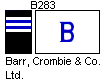
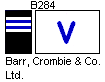
BARR, CROMBIE & CO. LTD.
Robert Barr and D.L.C. Crombie formed the company after A. Crawford, Barr & Co. dissolved in 1916. Following Gryfevale’s loss in 1917, they owned no ships until forming Barr Shipping Co. in 1924. Sir William Reardon Smith & Sons acquired the fleet in July 1941 according to Merchant Ships, or 1942 according to British Ocean Tramps. Barr, Crombie continued operating Ministry ships until 1947.
UK, Glasgow.
BARRAD SHIPPING CO.
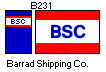
The flag is red with a broad white horizontal band bearing blue “BSC”. The funnel is blue with a broad band showing the flag.
Barrad is recorded in 1970–1971 with Netherlands Antilles Ships Management Corporation of Curaçao as fleet manager, listed for this company only.
Lebanon, Beirut.
BARRETT & UPTON.
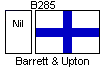
The flag is associated with both Barrett & Upton and J.W. Barrett & Sons. A painting of whaling signals from 1840–1850 places it beside a ship whose name is unclear, possibly United States. Napolean is separately recorded as having its own flag.
Barrett & Upton were whalers in 1828–1842, also involving J.W. Barrett & Sons.
USA, Nantucket.
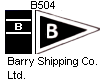
BARRY SHIPPING CO. LTD.
Barry Shipping was registered in 1926 and taken over in 1938 by Lewis, Hall & Co., associated with B. & S. Shipping. Lewis, Hall is also listed as operator in Brown 1934. Merchant Ships and Jordan say Barry was renamed South American Saint Line in May 1939; another account says B. & S. Shipping, but Rosanoski finds that chronology contradictory because the same writer dates B. & S.’s formation to 1934–1935. Walter T. Gould was associated at one time.
UK, Barry.
BARU DELTA MARITIME INC.
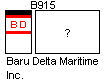
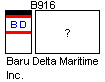
The funnel follows Ocean King D on 22 June 2012 and Ocean D on 6 October 2005. Ocean D’s upper red band is wider than the lower, whereas Maru D showed equal bands.
Panormitis D photographs from 2007 and 2009 leave the letters’ colour unclear, though dark blue appears more likely than black. Of four ships found, it was the only one without red letters. Its stern name combined red and blue lettering, whose significance Rosanoski could not explain.
Baru Delta was formed in 1994 to take over the activities of Baru Seri, which ceased operating. It was subsequently listed as a manager and agent.
Greece, Piraeus.
BARU SERI INC.
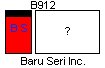
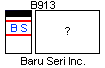
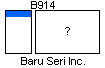
Mitchell gives B912 for the company, B913 in a drawing of Baru Trust and B914 for Baru Hope. Baru Luck is drawn without letters, although Mitchell also specifies a lettered funnel in a drawing.
Baru was bought in 1974, with the registers subsequently recording Baru Shipping and then Baru Seri as manager. Baru Seri ceased in 1994 and its activities passed to Baru Delta Maritime. The vessels were held by one-ship companies under its agency; Rosanoski infers from their names that Baru Seri was probably the ultimate owner.
Greece, Piraeus.
BASS STEAMSHIP CO.
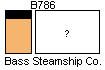
The funnel was dark buff, also describable as light brown.
James Rowe & Sons and Huon Channel & Peninsular Steam Ship formed the company jointly to operate the ferry Bass in 1920–1932.
Australia, Hobart.
BASS STRAIT SHIPPING CO. PTY. LTD.
Registered on 28 July 1959, Bass Strait Shipping operated Blythe Star from 1960 until she sank on 13 October 1973. The company was deregistered on 2 August 1988.
Australia, Melbourne.
BAUM & CO. GMBH & CO. K.G.
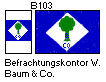
The flag is blue with a white diamond bearing a green tree, a blue ampersand on its trunk and blue “CO” beneath. The emblem plays on Baum, German for tree. Brown extends the diamond throughout the flag; Nüsse attributes the flag to Nordenhamer Bereederungs. The funnel is white with a broad band showing the flag.
Ships under Nordenhamer companies also carried managers’ liveries. Steersman is shown in P&O Bulk colours in 2001 and full Fisher livery in a photograph dated 6 May 2005. Chartsman had a plain blue Fisher-style funnel in 1998; from 2002 she is recorded under a Fisher subsidiary with the Fisher name added.
The business was formed in 1973 as Befrachtungskontor W. Baum & Co. and renamed in 1989. It operated through name companies and Nordenhamer Bereederungs, formed in 1988. Some Nordenhamer companies were managed by James Fisher; Baum also managed the Eberstein partnership. The register separately records a same-named Elsfleth concern, without establishing its relationship.
Germany, Nordenham.
BAY STEAMERS PTY. LTD.
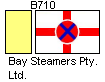
The flag is white with a red cross, surmounted by a red disc edged white from the cross and bearing a blue saltire.
Bay Steamers, owned by Huddart Parker, operated Melbourne ferries including Weeroona in 1911–1942 and Hygeia in 1911–1931. The service did not resume after the Second World War. Bay Steamers Ltd. was deregistered on 31 March 1944, although Lloyds had used the Pty. Ltd. form.
Australia, Melbourne.
BAYDELTA MARITIME INC.
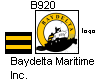
Delta Billie’s short funnel emerges from the white superstructure, with the logo below it. Rosanoski suggests describing the white base as merging into the superstructure, with black and yellow bands above. The rendering uses photographs dated 12 February and 28 September 2012, the latter supplying close detail of the logo.
Captains Ron Charlesworth, Jack Going and Steve Ware left their work as San Francisco bar pilots in 1993 to buy Bay & Delta Towing, a private company serving the area since 1982. They renamed it Baydelta Maritime.
USA, San Francisco, Calif.
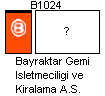
BAYRAKTAR GEMI ISLETMECILIGI VE KIRALAMA A.S.
The earlier funnel follows an undated starboard photograph of Tayfun Bayraktar, but the poor image leaves the “B” shape unclear. Absence of the website address on the hull offers only a tentative dating guide; the site began in 2000.
The later scheme appears on the same ship in December 2005 and is documented by port and starboard photographs of Orhan Bayraktar. Rosanoski attributes the apparent red in the portside photograph to camera or film reproduction.
Captain Arif Bayraktar began in the 1920s with machine work repairing pistons and maintaining shafts, leading to construction of a small coaster. The company website gives formation in 1945. It dates establishment of an industrial factory for building its own steel ships to 1976, yet says that ambition was achieved in late 1975; the source leaves the sequence inconsistent.
Registers give further company dates and names: formation as Bayraktar Gemicilik Kollektif Sirketi Sadan Bayraktar ve Kardesleri in 1983, later Bayraktar Denizcilik ve Ticaret and then Bayraktar Gemi Isletmeciligi ve Kiralama. One entry gives formation in 1997 followed by a 1983 name change, which Rosanoski suspects should be reversed. Sadan Bayraktar is recorded for Arif Kaptan, described by the company website as its second steel-built vessel.
Turkey, Istanbul.
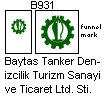
BAYTAS TANKER DENIZCILIK TURIZM SANAYI VE TICARET LTD. STI.
The funnel device is a cogwheel enclosing a bow view of a ship. It is documented by Haci Fatma Ana on 1 August 2012 and a portside photograph of Habip Barrak, called Habip Bayrak in the introductory line.
The corporate and chamber pages were inaccessible. The retrieved vessel account gives a ship registration, which alone cannot prove the company’s jurisdiction or full legal scope. Retained as review pending direct corporate/registry evidence.
Baytaş Tanker was established in December 2010 within the Çeksan Shipyard group to operate group vessels and provide technical and crew management. Haci Fatma Ana, the first fleet vessel, entered service in February 2011.
Turkey, Istanbul.
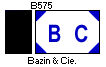
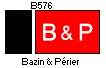
BAZIN.
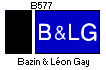
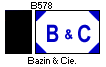
Armements Marseillais gives two versions; Rosanoski considers B578 the more appropriate, without specifying a reason.
Cousins Charles and Auguste Bazin, merchants of French origin who returned from Switzerland in 1824, founded Marseilles’ first steam-shipping company in 1831. Théophile Périer, founder of his own navigation company in 1836, joined in 1846, creating Bazin & Périer. In January 1854 it merged with Léon Gay’s Compagnie Générale de Navigation à Hélice, founded in 1852, to become Bazin & Léon Gay. Fraissinet bought the company in 1865.
France, Marseilles.
BD-Shipsnavo GmbH & Co. Reederei K.G.
BD-SHIPSNAVO GMBH & CO. REEDEREI K.G.
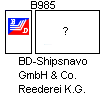
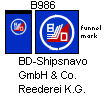
Jette, photographed on 11 June 2011, carried B987. Renamed BBC Wisconsin in October 2012, she adopted B985, documented in April 2013. The website-derived B985 flag differs from the funnel colours, notably using magenta rather than red.
Christian D photographs show another version, with differences including the shapes of the letters.
Marneborg, chartered to Wagenborg, combined that company’s funnel with a circular BD-Shipsnavo logo outlined white. The flag flown forward had lighter blue than the funnel and magenta rather than red, matching the logo. The narrative calls this B998, while the Sources list gives B988.
Documentary images — company attribution uncertain
Exact vessel and livery attribution remain uncertain.
Heinrich Dopp — historical owner livery
No precise vessel or end date is inferred.
Mitchell may have based a funnel called D592 in the prose on Maria D, but the drawing is too small to define it. Marselborg, chartered to Nordana, carried the Dannebrog funnel identified as D162.
The Dopp family’s shipping business continued through second and third generations. Bernhard Dopp took over a small coaster from his father; the source identifies Bernhard Schepers as bought in 1970 and sold in 1985, followed by the new Maria D in 1986. BD-Navis Bereederungs was formed in 1992 and changed to BD-Shipsnavo GmbH & Co. Reederei K.G. on 5 April 2000. An earlier Lloyds account instead dates formation to 1994. Rosanoski notes that Maria D was not shown under B. Dopp in later Lloyds entries, although Miramar dates her sale to 2007.
Germany, Haren (Ems).
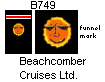
BEACHCOMBER CRUISES LTD.
Viti’s funnel face was orange, shading to yellow at the edges. The source does not explain the gradation and its monochrome hatching cannot reproduce it, so neither can the illustration. A white awning just below the bands separated the face from the rest of the funnel.
Beachcomber Cruises operated Viti from 1975 and is recorded as owner and manager in 2005–2006.
Fiji, Lautoka.
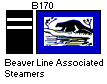
BEAVER LINE ASSOCIATED STEAMERS.
The predecessor’s livery was retained: a black funnel with two narrow white bands separated by a gap equal to their width, and a white flag with a blue border enclosing a black-and-white river scene of a beaver building a dam. Merchant Fleets Canadian Pacific shows a blue pennant above the flag.
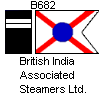
Country remains REVIEW: Canadian predecessor identity and Canadian services do not independently establish this reconstructed company's jurisdiction. UK court winding-up alone is not decisive proof of incorporation. The sources distinguish 1894 liquidation from 1897 reconstruction. B682 is an unrelated British India Associated Steamers image.
Loughran dates Beaver Line Associated Steamers to 1894 as a reconstruction of the insolvent Canada Shipping Co.; another source calls the predecessor Canadian Steamship Co., which Rosanoski finds less well supported. The Ships List instead dates the change from Canada Shipping to Beaver Line Associated Steamers to 1897, under D. & C. MacIver management, and says it folded in 1899, with Elder Dempster resuming the service. Loughran describes a David MacIver subsidiary sold to Elder Dempster in 1898; the sale went through British & African Steam Navigation. Canadian Pacific absorbed it on 23 February 1903.
Canada.
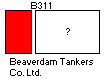
BEAVERDAM TANKERS CO. LTD.
The red funnel was recorded for Jack in February 1967. No flag was noted.
The USA/Norway source locations are both retained. The JACK February 1967 owner/manager attribution and Liberia/Panama vessel-specific alternatives remain unresolved by the existing evidence.
Beaverdam Tankers is recorded with Olga Konow Inc. as agent in 1963–1964 and Magnus Konow & Co. in 1970–1971.
USA, New York; Norway, Oslo.
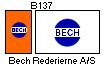
BECH REDERIERNE A/S.
The business is recorded as Wilh. Chr. Bech from 1953–1954, later Wilh. Chr. Bech Rederi & Skibsmaeglerforretning and Bech Rederirne A/S. It acted mainly as manager, with ownership also recorded. Horsens Shipping A/S is given as an alternative name.
Denmark, Horsens.
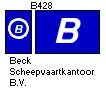
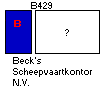
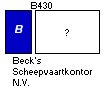
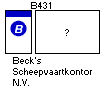
BECK SCHEEPVAARTKANTOOR B.V.
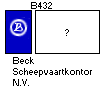
The funnel is described as bright blue with a small letter.
These are recorded as alternatives. B431’s letter colour is unspecified and assumed to be white.
Alert at London on 12 May 2001 confirms B428’s royal-blue funnel. Rosanoski considers B432 probably the same funnel and therefore expects a similarly shaped italic letter on its flag. The small design derives from a monochrome photograph of Velox.
Beck was formed in 1958 and operated through name companies, with the registers using several forms of its name. Carisbrooke Shipping took it over on 4 September 2003 and renamed it Northern Ship Management in December.
Netherlands, Groningen.
BELFAST & KOROIT STEAM NAVIGATION CO. LTD.
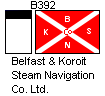
A State Library of Victoria picture of Casino suggests a possibly silver funnel. Flags in that picture have larger letters.
Belfast & Koroit was formed in 1882 and sold out to Howard Smith in 1939. Melbourne Steamship held shares. The company was deregistered on 29 December 1947.
Rosanoski separately notes a later same-named Pty. Ltd. company at a St. Kilda address, registered in 1992 as Bramidge Pty. Ltd.; the source does not establish continuity with the earlier company.
Australia, Port Fairy.
BELFAST STEAMSHIP CO. LTD.
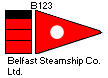
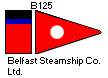
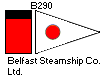
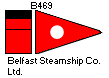
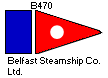
Griffin 1895 reverses the usual flag colours, showing a red disc on a white pennant. Rosanoski considers this an error because no other cited source supports the version.
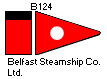
B125 is the Burns & Laird funnel, recorded on one vessel operating in those colours; Harnack 1938 describes it as a recent change. A 1959 letter from John S. Styring instead says that the illustrated funnel had been altered in 1946. Harnack’s later working note specifies red with a black top and no white band, suggesting an error in the 1959 edition.
The P&O short-sea passenger funnel scheme dates from 1973. Marinart reports it on some ships, with others possibly adopting it in 1976. Rosanoski suggests surveys and repainting as the explanation and assumes, without source confirmation, that the company flag still applied.
The company originated as Belfast Steam Packet in 1824, with a new Belfast Steamship company registered in 1851. It acquired Langtry & Herdman in 1859 and came under Coast Lines in 1919. Also known as Ulster Imperial Line, it absorbed the Belfast, Mersey & Manchester fleet in 1960.
Managers included Johnson, Grainger & Co., then Coast Lines and P&O Ferries. By 1980–1981 its fleet was completely absorbed into P&O Ferries, although a later register still listed the company as manager. Early ship names began Ulster and ended in ic.
U.K., Belfast.
BELFAST, MERSEY & MANCHESTER STEAMSHIP CO. LTD.
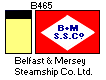
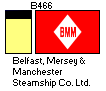
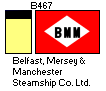
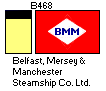
The earlier flag had a larger white diamond with blue “B+M” above “S.S.Co.”. Sources differ over red, blue or black lettering in the later flag; the FOTW rendering shows red.
The funnel is not specified for B466. Mitchell suggests a darkish yellow or buff. Rosanoski questions the colour interpretation attributed to Sampson 1957, since the 1959 monochrome hatching indicates black lettering.
The National Maritime Museum flag is dated about 1955 and measures 1219.2 × 1828.8 mm.
Formed in 1883 as Belfast & Mersey Steamship, the company is also recorded as Belfast & Manchester, that name being dated from 1929 in the FOTW account. Coast Lines acquired it in 1945 from managing owners Samuel Lawther & Sons of Belfast and John J. Mack & Sons of Liverpool. Its services merged with Belfast Steamship’s in 1960.
U.K., Belfast.
BELFRANLINE SOCIÉTÉ ANONYME.
Caribia was recorded in June 1966 with a black funnel, a broad red band edged white above and below, and white block letters “BF”. No flag was noted.
Belfranline is recorded in Lloyds 1963–1964.
Belgium, Antwerp.
BELGIAN FRUIT LINES S.A.
Brown shows larger flag letters than Stewart.
Photographs of Frubel Maria and Frubel Prinses Paola show no stops after the funnel letters. A portside photograph of Frubel Europe dated 26 July 1967 confirms this version.
Belgian Fruit Lines was formed in 1947 exclusively for banana exports. Its ships were operated by UBEM; Frubel Monica was built in 1949 and the last ship, Frubel America, sold in 1981. N.V. Holding un Beleggingsmij Oceanica, a Dammers subsidiary, acquired the company in 1972.
Belgium, Antwerp.
BELGO-IBERIAN MARITIME S.A.
Brown 1978 shows equal-width flag bands and a funnel. Rosanoski finds the funnel unexpected because the company website mentions no ship operations. The flag rendering follows the website image.
Belgo-Iberian Maritime was formed in 1966 as a shipping agent and broker.
Belgium, Antwerp.
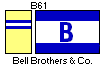
BELL BROTHERS & CO.
The funnel is yellow or buff with a blue–white–blue triband. The flag is blue with a broad white horizontal band bearing a blue “B”; Talbot-Booth shows a normal triband.
U.K., Glasgow.
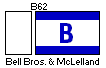
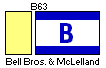
BELL BROTHERS & MCLELLAND.
LJC 1885 gives a white funnel. The flag is blue with a broad white horizontal band bearing a blue “B”.
The second funnel version is yellow or buff, although Griffin’s colour is unclear. Griffin also makes the flag’s “B” black.
U.K., Glasgow.
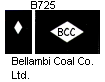
BELLAMBI COAL CO. LTD.
The house flag was black with a white diamond bearing black “BCC”.
Bellambi Coal was formed in 1888 and ceased shipping in 1953. Sir Frederick George Waley is identified as its founder or owner, the precise relationship being uncertain.
The company records cited by Rosanoski give registration as The Bellambi Coal Co. Ltd. on 1 March 1923, followed by The Bellambi Coal Co. Pty. Ltd., A&B Coal Co. Pty. Ltd., Shell Coal (Dartbrook) Pty. Ltd. and Anglo Coal (Dartbrook) Pty. Ltd. They also give deregistration of The Bellambi Coal Co. Ltd. on 27 August 1925; the relationship between these entries is not resolved.
McIlwraith McEacharn sold its interest in 1986. Mount Pleasant Coke Pty. Ltd. was acquired from Howard Smith.
Australia, Wollongong; Sydney.
Belships ASA.
BELSHIPS ASA.
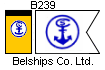
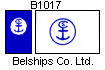
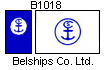
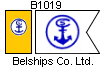
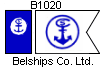
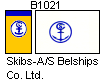
B239 is a white swallowtail with a blue circle containing a blue anchor beneath a blue “C” surrounding a blue “S”. Stewart 1953 and 1957 identify the livery with Christen Smith & Co.
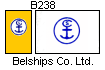
Brown 1958 gives B238 for Christen Smith & Co. and records a change from B238 to B1018.
Stewart 1963 places B1017’s flag emblem towards the hoist.
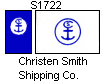
Christen Smith & Co. / Christen Smith Shipping Co.
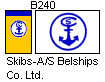
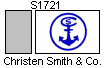
The photograph of Belpareil shows S1721’s otherwise plain funnel with a very narrow black top. Brown 1951 records its replacement by B240.
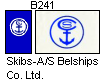
The photograph of Belnor shows a ring and charges apparently black or darker blue than the funnel base. A 1998 starboard photograph of Belanja makes the whole design appear very dark, almost black. The narrative labels this funnel and Nüsse’s table flags “B421”, whereas the Sources list gives B241; that numbering discrepancy is retained without assigning a new relationship.
The company website dates Belships to 1918, when former naval officer Christen Smith established the business. The early shipping crisis left its first two vessels idle, but transporting assembled locomotives opened a specialised heavy-lift trade. Other accounts give establishment in 1920, or origins in 1926 followed by the 1935 amalgamation of Rederiet Belmoira A/S, Rederiet Belnor A/S and Rederiet Belpareil A/S as Skibs-A/S Belships Co. Ltd. The website describes restructuring in 1935 and public listing in 1937. Belships ASA became the name in 1996.
Christen Smith died in 1940, and the company was under Allied control during the Second World War. The Lorentzen brothers Jørgen Johannes, Axel and Frithjof subsequently managed it. Accounts place the family’s entry variously in 1935 or 1937–1938. After disagreements in 1959, James Stave Lorentzen, Jørgen Lorentzen and Otta Greg Ti[e]deman took the company as their share. The Tidemand and Stove Lorentzen families later controlled the Belstove Group. The livery continued to use the initials associated with Christen Smith Shipping Co.
Heavy-lift business declined in the 1960s; the last heavy-lift vessel was sold in 1972 as Belships moved into dry and tanker cargoes. The 1970s crisis led to withdrawal from tankers, followed by renewed growth later in the decade. The website also mentions a 1960s joint shipping pool with Western Bulk Carriers, which Rosanoski supposes may mean a predecessor.
Belships participated in the consortium forming Western Bulk Carriers in 1986, although another cited account gives 1982. Acquisition of I.M. Skaugen’s 24 per cent interest in November 1991 brought its share to 55 per cent. A later account gives Belstove a 44.4 per cent interest in Western Bulk Shipping. An agreement announced in November 2000, before litigation, provided for a demerger and the creation of a new shipping company from various assets.
Belstove Management became Belships Management A/S in 1996. The Singapore management company began in 1984 as Northsouth Shipmanagment, became IUM Singapore in 1999 and Belships Management Singapore in 2000. The Tianjin management and consultancy company was formed in 2006. Belchem Singapore was established on 7 January 2004 as a joint venture with Chemtrans Overseas (Cyprus).
Norway, Oslo.
BELUGA SHIPPING GMBH.
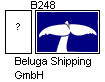
The company website showed B771 flown beneath the Bremen State flag with the Middle Coat of Arms, subsequently replacing the illustration with B1032. B1032 is dark blue with the white tail fin of a diving whale.
A small flag at the bow of Beluga Constitution may be B248, but is too small for certainty; possible white waves suggest a combination of variants. Comparison with B1032 raises the possibility that B248’s border was merely background in the Nüsse scan.
B769 follows Beluga Sensation on 22 October 2007. The same funnel appears in a photograph of six deck and wheelhouse units at the builder’s yard dated 5 May 2005.
B770 follows Beluga Elegance on 27 October 2005.
B1033 follows a starboard photograph of Beluga Flirtation. The design is on a superstructure panel, allowing more room and a different rendering.
Beluga was established in December 1995, began cargo operations in 1996 and started acquiring vessels in 1997–1998. Lloyd’s instead gives formation in 1998.
GenChart B.V. was acquired in 2003 and renamed Beluga GenChart B.V. Beluga Bereederungs was formed in 2005 and renamed Beluga Fleet Management that year. A September 2010 report described an intended takeover of Intermarine LLC; it does not establish completion.
Oaktree Capital Management held 49.5 per cent on 3 March 2011. Beluga was declared insolvent that month, with insolvency proceedings against Beluga Chartering opened on 1 June. The cited account expected the company to cease at their conclusion and records the establishment of Hansa Heavy Lift.
Germany, Bremen.
BENDT RASMUSSENS REDERI.
Benoil carried this funnel in 1958, possibly obsolete by 1960. No flag was noted; Rosanoski thinks R79 probably applied, except that the breaks were not shown.
Brown 1958 also attributes this version to Skibs A/S Excelsior and gives a slightly stylised R. Stewart places the break and letter nearer the hoist. Skipet shows the funnel’s flag emblem upright on a white staff, without flapping.
Brown 1982 also assigns this livery to Viking Supply Ships, although Brown 1995 gives Viking a separate design. Benoil was observed on 20 June 1963 with this funnel but a narrower, straight band.
Established on 15 August 1946 as Skipsaksjeselskapet Excelsior, the company later became Bendt Rasmussens Rederi. Initially mainly a tanker business with Ben-prefixed names, it left that market in 1973 for offshore supply vessels. Viking Supply Ships was established in 1974 as a marketing organisation, though Lloyds gives 1973 and suggests a wider role. In 1989 Christen Sveaas and others bought all Excelsior’s shares and renamed it Viking Supply Ships A/S; the register reflects that change in 1992–93.
Norway, Kristiansand S.
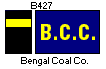
BENGAL COAL CO.
India, Calcutta.
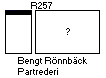
BENGT RÖNNBÄCK PARTREDERI.
The funnel follows Polar in August 1967.
Manne Rönnbäck began by leasing Anna in 1925 and became a tug owner in 1935. His sons took over in 1951 as Bröderna Rönnbäcks Rederi. With the acquisition of a new Nestor in 1972, the name became Rederi A/B Nestor. Wiréns Rederi took over in 1982; the source also describes Nestor as its subsidiary.
Sweden, Kalix.
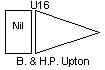
BENJAMIN & HENRY P. UPTON.
The flag U16 is documented by Loughran 1979 and Mystic Seaport’s Directory of Private Signals flown by American Sail.
Benjamin and Henry P. Upton were sailing-ship owners. Ganges was registered on 5 October 1839 with Frederick G. Ward, her master, as a fellow owner. From 8 June 1842 Benjamin, Benjamin Jr. and Henry P. were registered as owners until 12 October 1843.
USA, Salem.
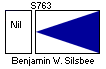
BENJAMIN W. SILSBEE.
image by Joe McMillan, 20 November 2001
The flag rendering is based on an 1848 painting of Sooloo.
Later known as Silsbee, Stone and Pickman, the firm was one of Salem’s longer-lived sailing-ship owners, associated with the first home of the US China trade. The source gives a qualified period from the 1790s to 1893.
USA, Salem, Massachusetts.
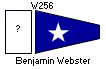
BENJAMIN WEBSTER.
image by Joe McMillan, 2 December 2001
Joe McMillan’s FOTW flag image follows Flaggenbuch 1905. No separate written design or company history is given.
USA, Portland, Maine.
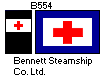
BENNETT STEAMSHIP CO. LTD.
The Army Council prohibited the markings in 1931 because use of the red cross was forbidden under the Geneva Convention Act of 1911. After years of dispute, the flag field and funnel band were changed to very pale buff, scarcely distinguishable from white at a distance. FOTW records occasional sightings of the red cross into the 1960s. The design was the same as that used by Headlam & Sons before 1934. Sources differ on the cross’s thickness; Reed 1891 leaves the white flag without its device, which Rosanoski considers unfinished.
John Bennett founded the company in 1873; it was later owned by his son John B. Bennett. Also known as Bennett’s Line or Bennett’s Red Cross Line, it lost its fleet during the Second World War and ceased shipowning in 1946. The Mitchell account says it continued as a shipping agent, was acquired by General Steam Navigation and ceased trading in 1969. Loughran records a service under the name and flag apparently lasting into the 1960s. Another account instead says the company ceased on John Bennett’s death in 1946.
U.K., Goole.
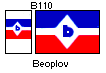
BEOPLOV.
The flag is a horizontal blue–white–red triband in proportions 5:3:5, with an undefined white diamond over all bearing a blue lower-case “b”. The white funnel has a very broad band of the flag.
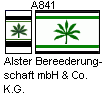
A841’s funnel comes from a starboard view of Alsterbach; Rosanoski thought its unusual proportions probably resulted from the charter. The flag has a green leaf with black veins between two horizontal green stripes. Klaus-Michael Schneider considered it probably a chestnut leaf, having seen the flag at the company building on Hamburg’s Außenalster on 22 August 2008. Eugene Ipavec questioned how recognisably the drawing represented a chestnut leaf.
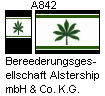
A842 combines a photographed funnel with a rectangular website image presumed to represent the flag. Both use darker green than the FOTW image, and the website name differs. Zillertal is recorded with the A842 funnel on 30 September 2011.
ASC “Alster Ship” Chartering GmbH & Co. K.G.
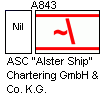
The other flag, A843, is white with two horizontal red stripes enclosing a half red “A”, with a wavy line in place of its crossbar. Schneider also observed this at the company building on 22 August 2008.
Also known as BAS, Alstership was a second-generation Krohn family business providing technical management for cargo ships. The family entered shipping in the mid-1970s, and the management operation served the international market from 2001.
The related chartering company ASC “Alster Ship” is dated to 1991 in one account and 1992 in another. Its served fleet flew the Netherlands flag and was registered at Delfzijl. Rosanoski records the fleet as chartered from Rederij K&T Holland, formed at Farmsum in 2001, whose ships were managed by Flagship Management at the same address.
Germany, Hamburg.
BEREEDERUNGSGESELLSCHAFT BERND BARTELS MBH.
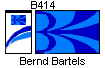
Nüsse’s flag was initially interpreted as blue and black, but a 2004 photograph of Zenit shows a funnel panel with two shades of blue. Mitchell omits the lines below the panel and makes its field white; Rosanoski suggests either a later addition of the lines or a distant view in which the pale blue was not discerned. A 2011 photograph of Coneste shows the flag panel on the superstructure rather than the black funnel, suggesting to Rosanoski that the vessel may have been chartered out.
The business is dated to 1985 in Lloyds and later recorded as an operating company of Walther Möller, also listed as owner. It appears separately as a manager in 2011–2012. Rosanoski additionally records a company registration dated 17 March 2008; the source does not equate that registration with the earlier foundation.
Germany, Jork.
BEREEDERUNGSGESELLSCHAFT M & H FUNCK.
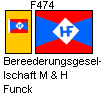
A port-side photograph of Mana on 5 June 2013 supplies the funnel. Rosanoski assumes a flag from its panel, which appears to have a white pole alongside; no such flag is seen flying on the ship.
Monika Friederike Funck and Heiyo Richard Funck GbR acquired Mana in September 2008. The concern appears in Lloyds 2011–12 as manager.
Germany, Wischhafedn, as spelt in the source.
BERENGER & CIA.
The livery is taken from a Brazilian website’s record of liveries in 1950.
Brazil, Rio de Janeiro.
BERGE BULK LTD.
The funnel illustration follows a starboard photograph of Berge Bureya dated 16 June 2011.
James Marshall established Berge Bulk in 2007. Headquartered in Bermuda and operating from Singapore, it was no longer part of the BW Shipping Group.
Bermuda.
Berge Rederi A/S.
BERGE REDERI A/S.
B890 follows Titran on 26 April 2011 and the newer Sletringen on 16 June 2013. The latter vessel is also photographed in September 2006 under Sletringen Bulk. The funnel logo is black, rather than the blue of the company logo.
Sletringen Bulk A/S
S1542 follows the first Sletringen, in service under that name in 2000–2005, photographed on 21 July 2005. Rosanoski concludes that only this first vessel bore the design. Its earlier funnel as Mina Nare under unidentified Spanish owners is unknown. It retained S1542 after its 2005 sale as Sol Trader to Val Management.
Anne Gunn, Oddvar and Magne Berge founded the business in 1997 as Magne Berge Fraktebåtrederi A/S, renamed Berge Rederi that year. Its beginnings were the purchase of the renamed OptiMar and its employment by BioMar. Based on Hitra, the company traded in northern Europe and the Baltic.
Sletringen Bulk, formed in 2000, merged with Berge Rederi in 2007. The owners listed in 2012 were Knarrlagsund Holding, owned by Magne and Ann Gunn Berge; Øivind Berge Holding, owned by Øivind and Monica Berge; and Frøya Skipsinvest, owned by Robert and Jørn Erling Larsen. Transmar was the management company.
Norway, Kverva; Knarrlagsund.
BERGE SIGVAL BERGESEN.
A variation of the logo also appears on General Ore International Corporation funnels. The green shade is assumed to match Bergesen d.y. ASA. Rosanoski disputes Mitchell’s attribution of Viking Princess’s funnel to Sig. Bergesen d.y. & Co.: Berge Sigval Bergesen bought the vessel in 1964, and it was scrapped after a severe fire in 1966.
The page principally concerns the father’s group. It does not independently establish the precise domicile or 1957 formation of the son’s separate enterprise; do not conflate the two men.
Established in 1957, Berge Sigval Bergesen specialised in bulk carriers and operated the charter business Sigship, avoiding the tanker trade pursued by his father. Most ship names began “Sig”. Financial difficulties arose in 1967, and his father Sigval Bergesen took over the vessels and contracts in 1970.
Norway, Stavanger.
BERGESEN D.Y. ASA.
Merchant Ships 1942 and 1944 give B515 as an alternative funnel of the Stavanger company Sigval Bergesen. Rosanoski regards this and the combined fleet’s flag attribution as confusion between the two companies.
Jordan describes a white funnel with black top, diagonal light-green stripe and house flag, but the arrangement is unclear. A monochrome photograph of Charles Racine appears to show the flag on a lighter band within a very deep black top.
The house flag is a white swallowtail, described as 3:4, with a green diagonal stripe and a black monogram combining “B” and half an anchor. Sources differ on stripe width: Brown 1958 is widest and Stewart narrowest. Except in Stewart, it touches the lower hoist corner. Rosanoski gives a consistent angle of 40 degrees, with the stripe’s upper intersection varying by width and its sinister edge generally halfway along. B85 follows Nüsse’s flag. Two Collectors Corner cap flags differ in green shade and the “B” position relative to the bendlet and fly. The livery survived the 1986 name change.
A rectangular flag was added to FOTW in December 2013 on the reading that Nüsse showed a rectangle while the former company logo showed a swallowtail. Rosanoski rejected that interpretation in March 2014: the faint background concealed the swallowtail, which remained discernible. Rob Raeside acknowledged the transparency problem and proposed a correction. Peter Hans van den Muijzenberg’s commentary notes that the funnel flag reverses on the starboard side to fly from stem to stern, while the anchor-B remains in obverse. The funnel’s swallowtail tapers, but he is uncertain whether actual flags did so; he also suggests light-green areas might indicate gaps rather than fabric.
B604 follows the company website. Havsol on 13 January 2001 shows its funnel and a flag panel whose green stripe meets the upper and lower edges rather than the corners used by other sources. The flag is indistinct but appears consistent with the website. Berge Boston on 12 July 2005 and a portside view of Berge Nice, listed under The Green Tankers, provide further funnel confirmation.
The later commentary describes World-Wide’s flag as white with a blue border and a centred, shortened red stripe bearing a white “W”. It records the replacement of funnel flags by dark-blue funnels with the BW logo and apparently corresponding changes from “Berge” to “BW” ship names. These successor observations are not assigned to the earlier illustrations.
Most sources date Sigval Bergesen d.y. & Co. to 1935, when Sigval left his father’s business after a family disagreement and bought his first tanker. Lloyd’s and World Tanker Fleets instead give 1918; Rosanoski suggests this relates to Sigval and his brother Ole becoming partners in their father’s firm. “D.y.” means “the younger”. After the German invasion on 9 April 1940, most activities moved to Oslo, while the fleet remained registered at Stavanger.
In 1947 Sigval introduced “Berge” ship names in memory of his great-grandfather Berge Bergesen. His grandfather’s last vessel had been green, and he adopted that colour throughout the fleet, which became known as the Green Tankers.
The company took over the main shipping activities of his son Berge Sigval Bergesen, including a partnership with Hugo Neu Corporation. The company account dates this to 1967; another account is read by Rosanoski as implying 1970. Grandsons Petter C.G. Sundt and Morten Sigval Bergesen assumed management in 1976 because of Sigval’s ill health. A subsequent inheritance dispute was decided in their favour in 1981.
The business became a publicly listed company as Bergesen d.y. ASA on 9 September 1986. It retained the name after merging with A/S Havtor Management in January 1996, after which it operated for the Igloo Pool. Scantank Offshore was acquired in 1999.
The family sold its shares to World-Wide Shipping in 2003. Rosanoski also records an April 2005 acquisition by the Sohmen-family interests, followed by deregistration and consolidation under Bergesen Worldwide. After disposal and demerger of non-gas interests, the name became Bergesen Worldwide Gas ASA on 3 October 2005; the new holding company was listed on 25 October. The later commentary describes the group’s 2005 rebranding as BW.
Other interests included Rosenberg Merkaniske Verkstad, acquired from Kvaerner; Marco Shipping, a 1979 joint venture with International Shipholdings; and a 51 per cent stake in Krupp Seeschiffahrt acquired on 28 September 2001. A venture with Exmar and Christian Haaland in 1986–1987 may have involved this Bergesen company, but Rosanoski is not certain.
Norway, Stavanger; Oslo.
BERGSHAV MANAGEMENT A/S.
Brown 1995 shows white–red–white horizontal bands, with white only along the upper and lower edges, and an open white “B”. Rosanoski considers the white bands in the Brown-based FOTW rendering too wide.
The website-based rendering shows a red flag with an apparently thin white border and a stylised white “B”, similar to the Ugland flag. Rosanoski considers its white hoist and fly edges additions for contrast with the background, rather than part of the flag. Its “3”-like “B” has the right general form but is drawn too thin.
B812 follows a photograph of Larvik dated 7 March 2006. Rosanoski describes the actual flag as combining Brown’s white bands at top and bottom with the website’s form of “B”, correcting the proportions of both earlier renderings.
The funnel references include Myre, SPT Conqueror at Botany Bay on 8 August 2010, Bertina on 8 May 2012 and Coal Glory on 16 February 2014.
SPT Challenger and SPT Champion were observed with the Polyar Tankers funnel, P547. Their inclusion in that fleet list possibly indicates ultimate ownership by Polys Haji-Ioannou; it does not establish it.
Bergshav began as Bergshav A/S in 1988 according to Lloyd’s, or in 1989 through a demerger of A/S Uglands Rederi according to its website. It took over the Nortank Carrier pool in 1992 and Arnt J. Morland on 1 October 1998, becoming Bergshav Management in 1999.
Its interests included ResidenSea, later sold to a consortium of the apartment owners.
Norway, Grimstad.
BERGÉ Y COMPAÑIA S.A.
Jorge Candeias’s 1999 rendering, attributed to Bergé Marítima, changed an oval to a circle in the belief that the original shape resulted from perspective. Jose María Puerta of Bergé Marítima subsequently confirmed that the device was indeed an oval, not a circle.
Bergé y Cia. began in 1870 as a stevedore and port agent. The shipping account starts with Cantabrico, built in 1967 and sold in 1971. Diversification into industrial equipment imports and car distribution began in 1979. By the 2013 website account, Bergé Infrastructures & Logistics was the division responsible for port operations, logistics and shipping.
Spain, Santander and Bilbao.
BERLINER KRAHN GESELLSCHAFT RICHARD IHLE.
The blue pennant has white stripes alongside its edges, carrying red zigzag lines, and a white “BKG” inscription in the centre. The source is the summer 1897 supplement to Deicken und Behrmann’s Neuen Monatsheften.
This was apparently a Berlin crane company.
Germany.
BERMUDA & WEST INDIES STEAMSHIP CO. LTD.
Most sources show or imply Furness Lines livery, while the cited sources allocate B31’s funnel and Merchant Ships 1944 confirms use of the flag. A monochrome photograph of the company’s only vessel, Nerissa, shows a dark funnel with a very broad white band bearing a saltire, consistent with C.T. Bowring’s livery.
Raw country is UK, Hamilton, Bermuda; the historical owner address supports Bermuda. The pipeline's United Kingdom category obscures that territorial jurisdiction, while British group management is a separate issue. Retain review for the jurisdiction convention and exact entity registration rather than silently converting either label.
The company was formed in 1920 or 1921 to take over Quebec Steamship’s assets. It belonged to the Furness Withy Group and was managed by Furness, Withy & Co.
U.K., Hamilton, Bermuda.
BERMUDA LINE.
The same source explicitly says US nationality is uncertain because Manning supplies no home port. Pipeline USA is therefore not independently established. Do not infer Bermuda jurisdiction from the trading name either.
USA, as classified in FOTW; the attribution is uncertain because Manning gives no home ports.
BERNARD HOWALDT.
image by Klaus-Michael Schneider, 29 Mar 2009
The blue in H281 and H282 follows the lighter sky shade shown in Flaggen & Schornsteine.
The FOTW illustration H661 uses a lighter blue than its source in Deutsche Reedereien und ihre Erkennungszeichen.
Bernard Howaldt acquired Edith Howaldt in 1927 and established a shipping company in his name. The wider operating period is given as 1919–74, with the earlier date apparently referring to his initial activities. His son Klaus moved the business to Hamburg in 1951. Later registers divide the fleet between Bernhard Howaldt Reederei and Howaldt Schiffahrts K.G.; Seereederei Howaldt K.G. also appears. Mitchell records a takeover by Ernst Russ GmbH & Co. K.G.
Germany, Flensburg; later Hamburg.
BERND BECKER K.G.
Bernd Becker was formed in 1973 and is recorded as manager, agent and later owner, with a fleet under name companies.
Germany, Jork.
BERNDT ABRAHAMSSON,
Berndt Abrahamsson operated Windrover from 1980 to 1984 and Windraider from 1983 to 1984.
Sweden, Göteborg.
BERNHARD HANSSEN & CO.
The yellow or buff funnel has a broad white band edged red above and below and bearing a blue cross clear of the edges. It was noted on Aramis and Porthos in November 1964. No flag was noted.
Bernhard Hanssen appears as a ship manager in the 1963–64 and subsequent Lloyds listings.
Norway, Flekkefjord.
BERNHARD OHL.
image by Klaus-Michael Schneider, 12 April 2009
The flag is a blue-white-red horizontal tricolour, Schleswig-Holstein’s colours, with a white, black-edged lozenge containing black BO. Schneider describes the lozenge as touching the flag edges. Rosanoski notes that the FOTW image does not do so, that its border and letters are thicker than the source, and that the O should be squarish, as in O308.
Bernhard Ohl owned Anne Ohl, built in 1950 and sold in 1969.
Germany, Ulsnisstrand; Ulsnis/Schlei near Schleswig.
BERNUTH, LEMBCKE CO. INC.
Bernuth, Lembcke was a family business combining creosote importing and shipping. Jordan describes it as owner of Adellen Shipping, while Merchant Ships calls it the controller.
USA, New York.
BERT BERGSTRÖMS REDERI A/B.
The funnel follows a photograph of Frej dated to 1962–1975.
UNAVAILABLE_EXTERNAL_EVIDENCE. No identity, historical country or image verification asserted; retained for later manual research. The named Tugboat Lars source could not be retrieved. Repeated searches for the exact company and Bert Bergström with vessel/location terms did not provide independently retrievable supporting evidence.
Walter Bergström started the business in the 1940s. His son Bert and Bert’s wife Anna Karolina took over after 1951, continuing until the end of the 1980s.
Sweden, Båtskärsnäs.
Bertil Magnusson.
BERTIL MAGNUSSON.
image by Jarig Bakker, 19 January 2005
The same livery appears under Concordia, the Waller names, Magnusson and Castella. Some sources draw a decrescent, but the cap badge supports a C. Rosanoski considers Brown 1958’s white C a printing error for yellow. The lower stroke is not always emphasised. Mitchell gives the funnel base yellow for Magnusson and Castella but orange for Concordia. Bakker’s C1258 follows Brown 1926.
Rederi A/B Unda
image contributed by NDR, None
Unda’s separate flag is diagonally quartered red above, green below and white at hoist and fly, with blue U in the hoist. Talbot-Booth gives this in 1937 and 1938 but later appears to assign the Concordia flag to Unda.
The operation originated with Justus A. Waller, a steamship owner from 1888, followed by Per Waller and then Bertil, also written Birtel, Magnusson in the 1950s. It worked in tramping, oil and petroleum trades through Concordia, Castella and Unda, formed respectively in 1888, 1931 and 1902. Wilhelm Rogatius Lundgren was a Concordia co-founder. Operations ceased in the late 1960s; Concordia revived in the late 1970s, came under Stena and became Stena Rederi in 1987. Rosanoski presumes Stena colours followed.
Sweden, Gothenburg.
BERTRAND JACOBSEN.
image by Ivan Sache, 27 December 2003
Ivan Sache’s FOTW rendition from Lloyds 1912 uses a bright-blue letter.
Jacobsen was a sailing-ship operator.
Norway, Arendal.
BESIKTAS SHIPPING GROUP.
The funnel follows a starboard photograph of Besiktas Zealand dated 18 April 2012.
Besiktas Shipping Group was formed in 1972, with management experience dating to the 1960s when its small tankers served oil companies. Shipbuilding began in 1999. The Kalkavan family were the major shareholders of the holding group, which included shipping, shipyard and tourism and property businesses.
Besiktas Denicilik Tasimacilik Sanayi ve Ticaret A.S. was formed in 1995 and renamed Besiktas Likid Tasimacilik Denizcilik Ticaret A.S. in 2006.
Turkey, Istanbul.
BEST POWER HOLDINGS (HK) LTD.
The funnel follows a portside photograph of Wanisa on 9 December 2013. The vessel was built in 2012 and was apparently under charter.
HKTDC categorizes this business under real estate. The maritime charter of Wanisa and Jia Li alias have not been independently connected to this legal company, so name and location agreement alone do not verify the maritime identity.
Best Power Holdings was incorporated on 22 August 2003 as a local, non-group company. It was also known as Jia Li Holdings (Hong Kong) Ltd.
China, Hong Kong.
BG GROUP PLC.
The British Gas funnel continued in use on Methane Arctic and on chartered vessels such as Golar LNG’s Methane Princess.
The source dates British Gas plc’s formation to 1987, its change to BG plc to 1997 and BG Group plc to 1999. The October 1999 financial restructuring created BG Group as the new parent. Demerger of the transmission and distribution business as Lattice Group in October 2000 left BG Group as the global natural-gas business.
Ship names began “Methane”.
U.K., London.
BHP Billiton Petroleum Pty. Ltd.
BHP BILLITON PETROLEUM PTY LTD.
B614 follows Iron Yandi on 10 October 2005. Rosanoski considers the new colours apparently to be the former design with the BHP logo removed.
BlueScope Steel Ltd.
Iron Monarch, apparently on charter, provides the B613 funnel reference on 12 June 2005. All letters are capitals, with “B” and “S” taller than the others.
A new BHP Billiton logo was introduced in 2001. BHP Steel adopted a logo in 2002 and was listed on 15 July 2002 after demerger. The source says the BHP Steel name was retained for two years before BlueScope Steel, while quoting a BlueScope account dating its new identity to March 2002. That account describes movement and new colours, with the logo’s shape representing flat steel products.
Koppers Shipping continued to use its own colours. Pacific Triangle, owned by Triangle Bulk Shipping within BHP Transport & Logistics, supplies the separately referenced T464 funnel.
Pioneer, formerly MRS Pioneer, was recorded under E.D. & F. Man Bulk Services before transfer to Refined Sugar Shipping, formed in 2005. Its funnel became blue with a narrow black top separated by a broad white band. The band carried a blue and gold oval containing a white sugar-cane plant, with large blue “SUGAR” forwards above smaller unreadable words.
The source describes the 2001 merger of Broken Hill Pty. Co. and Billiton as forming BHP Billiton Petroleum Pty. Ltd., officially listed on 29 June 2001.
A joint venture announced on 18 July 2001 established Teekay Marine to service the BHP Billiton fleet, with Teekay owning 70 per cent and BHP 30 per cent. The source records Teekay Shipping Australia buying out BHP’s interest, but literally dates this “7/2994”. A 2004 report announced withdrawal from shipowning through sale of the last six bulkers, although three remained in later registers.
Rosanoski also records the addition of Rio Tinto after acquiring Alcan. The ownership notes list Utah International as owner while explaining that Broken Hill had acquired Utah in 1984 and that it became part of BHP Billiton through the merger; these statements are retained without reconciling their relationship.
Operating interests included BHP Billiton Minerals, formed in 2004; BHP Billiton Petroleum Ltd., renamed from BHP Petroleum in 2001; and BHP Transport & Logistics. The group also had an interest in Australian LNG Ship Operating through BHP Petroleum.
Australia, Melbourne; Perth.
Bibby Line Ltd.
Documentary material — company attribution not established
The original colours were a salmon-pink funnel with black top and a plain red flag. Lloyd’s 1882 shows B805’s funnel yellow for T. Bibby & Sons, which Rosanoski thinks should be the pinkish buff of B195. LJC 1909’s two narrow black funnel bands are suspect; Reed 1901 is unclear and seems to place a narrow green band below the black top. Leyland retained the original colours after 1873. Rosanoski considers continued publication of the plain red flag through 1926 out of date.
The later flag is red with the Bibby crest: a yellow hand holding a dagger, with yellow and black mantling in the National Maritime Museum description. Flags of the World editions from 1961 show the torse yellow and red. Loughran dates addition of the crest to shortly after 1889, to avoid confusion with the signal-code explosives flag; another explanation was to dissociate the company from a revolutionary cause. The museum dates the addition to 1926 to avoid association with the Bolshevik flag. Rosanoski preserves these differing accounts. The funnel remained pinkish buff with a black top, confirmed on Hertfordshire on 30 January 2009. Minor book variations in the hand and dagger details are not treated as separate designs.
FOTW first placed the flag among Manx companies, later moving it to the U.K. Rosanoski attributes the confusion to the Isle of Man subsidiary and emphasises the Liverpool company’s identity. He also states that there is no connection with Cunard.
Rosanoski considers B498’s flag apparently erroneous.
B497’s funnel applied to Oxfordshire and Devonshire, described as available for trooping in Merchant Ships 1959, though not so identified in the 1963 edition.
B4 is the fleet commodore’s swallowtail flag, confirmed flying on Staffordshire.
The source comments that the modern fleet appears to have no funnels. A later FOTW contribution says Bibby Financial Services seems to use the old Bibby Line flag; this is retained as a related group observation rather than a new image assignment.
John Bibby began in 1807 in the merchant partnership Highfield & Bibby, became John Bibby & Co. in 1817 and established a regular sailing line in 1821. After his murder in 1840, sons James and John took over, although John withdrew from shipping. Frederick Richard Leyland became a partner in 1859 and acquired control in 1873, trading under his own name. Rosanoski distinguishes this original company from the later Bibby Line.
The revival is dated 1880 by the company website, with James and nephew Arthur Bibby, but Rosanoski favours 1889 because Lancashire and Yorkshire were built that year. Liverpool Shipping gives Arthur W. and Herbert Bibby with J. Bibby as founders of Bibby Brothers & Co. The later business became Bibby Line Ltd. in 1931.
Between the wars, trooping contracts and passengers to India and Burma were central to the business, supplemented by Mediterranean cruises. The Burma and Ceylon trade did not recover after the Second World War. Compensation for lost trooping contracts helped the move into bulk and liquefied-petroleum-gas carriers. Bibby Line became the marine division of Bibby Line Group, with chemical and gas carriers, offshore construction and floating accommodation vessels.
Britain Steamship was acquired in the 1960s, bringing its interest in Seabridge, a consortium formed in 1965 from which Bibby later withdrew. Bristol City Line was acquired in 1972. Bibby Transport was managed successively by Harrisons (Clyde) and McIlwraith McEacharn. Manx Ship Management, formed in 1987 according to Lloyd’s or 1985 according to the website, became Bibby International Services (IOM) in 1991. A 1997 joint management venture with T&J Harrison ended when Bibby sold its share in 2003.
Other interests included a half-share in Botany Bay Shipping Holdings, announced in 1990, and 25 per cent of Foreland Shipping, formed in 2011. Fleet names traditionally used English shires; some later began “Bibby”.
U.K., Liverpool.
BIBOLINI SOCIETÀ DI NAVIGAZIONE S.P.A.
The earlier flag was blue with a white “B” alone. Brown 1958 also assigns this livery to Transoceanica Genovese and Unione Ligure Armamento without explanation.
The later flag is blue with a central white “B” flanked by two white stars. It also appears in connection with Gruppo Carboflotta, including Carbofin and Carbonor, and Carlo Canepa of Carbocoke was observed with the B10 funnel in October 1965. Sache’s rendering angled the stars, apparently through interpretation of a fluttering flag image; Rosanoski says regular sources show them upright. The suggestion that “B” represents a founder or former owner is explicitly an assumption in the FOTW account.
The company originated before the Second World War as Giovanni B. Bibolini. Sources also use G.B. Bibolini Ingegnere Armature and Compagnia di Navigazione Bibolini. It split after the senior Bibolini’s death in 1955 and ceased shipowning sometime between 1985 and 1992.
Rosanoski records associations with Carbocoke, Sicilarma, Sicilcarbo, Società di Armamento Sicula Sarda, Scorpio and Unione Ligure Armamento. A Carbogas connection is only inferred from a vessel’s “Bibolini” name. The precise relationship with the “Carbo” companies is unclear and may have involved chartering. Unione Ligure Armamento, formed in 1952, had Carbofin as a shipping subsidiary; Carbonor was subsequently identified as a Carbofin single-ship owning company formed in 2000.
Italy, Genoa; Palermo; Pesaro; later Palermo again.
BIEN DONG SHIPPING CO.
B661 follows the chemical tanker Vinashin Energy at Port Botany on 19 October 2007.
B662 follows a photograph of the container ship Vinashin Mariner.
Also called Cong Ty Van Tai Bien Dong or BISCO, the company was formed in 1996 according to the earlier Lloyd’s entry, revised to 1995 in the later register. It was a subsidiary of Vietnam Shipbuilding Industry Corporation, Vinashin.
Vietnam, Hanio; Ho Ch Minh City.
BIGGART, FULTON & GRIER.
The Log includes the livery because one of the company’s vessels traded on the Australian coast in 1894–1897.
The business began in 1888 as Biggart & Fulton, becoming Biggart, Fulton & Grier in 1907. It owned one vessel and managed two as West of Scotland S.S. Co. Ltd. The name became Biggart, Fulton & Roy in 1914, and business ceased in 1916.
U.K., Glasgow.
BIJAN FOROOHARI SCHIFFAHRTS GMBH & CO.
Germany, Stade.
BILBAO SHIPPING S.A.
Spain, Bilbao.
BILLNERS KOLIMPORT A/B.
The Collectors Corner cap badge shows a blue swallowtail edged white except at the hoist, bearing white “BK”.
Billners Kolimport operated from 1920 to 1978 and managed Rederi A/B Sylvia’s Silesia in 1936–1939. Merchant Ships also calls it Kulimport Billner. Ships attributed to it by Mitchell appear under Rederi Billners A/B in Lloyd’s, suggesting a connection. Rosanoski tentatively proposes a post-war move from coal shipping into tankers through that company, whose operations seem to have ended at about the same time.
Sweden, Gothenburg.
BILLNERS REDERI A/B.
Brown 1951 and 1958 omit the white hoist border, perhaps because observers mistook it for a sleeve. The Bryggan website associates B178’s livery with Mary Billner.
Managers are listed as Alb. Billner in 1953–1954 and Kjell Billner thereafter. Many ships bore family names. A connection with Billners Kolimport is possible but not established.
Sweden, Gothenburg.
BILMAR SHIPPING CORPORATION.
The funnel is blue with a narrow black top, separated by a broad white band bearing a black “B”. No flag is recorded.
A modern Panamanian Bilmar Shipping S.A. listing has no demonstrated connection and is rejected as proof. The US agent address alone cannot verify US owner jurisdiction.
Orion Shipping & Trading acted as agent. Bilmar was apparently one of several companies operating former Andros Shipping vessels, with similar funnels distinguished by their initial letters.
USA, New York, NY.
BINNENSCHIFFAHRTSKONTOR BECK GMBH.
The flag is celestial blue with a central white diamond bearing a black serifed “B”. Klaus-Michael Schneider saw it as a jack on a Dettmer ship at Billwerder Bucht on 13 April 2007. Information supplied by a DTG captain on 1 April 2009 enabled identification, and Schneider amended his illustration to make the “B” serifed.
The inland-shipping company is also recorded as BKB Binnenschiffahrtskontor Beck. An initial account described its founder as a former Dettmer member who had established his own subsidiary; later information said the owner’s father was a senior Dettmer employee. Rosanoski questions the word “subsidiary”. A Dettmer flag on the observed ship’s mast suggests a connection, but he leaves open whether it concerned the company or that vessel.
Germany, Hamburg-Eidelstedt; Hamburg.
BINNY SHIP MANAGEMENT PVT. LTD.
B736’s funnel follows Nirmal Gautum on the company website.
B737 follows NirmalSangeeta. The “B” is not discernible in the photograph but may be present, small or faint.
The official PDF was inaccessible. The retrieved secondary page contradicts itself on incorporation date (27 December versus 27 April 1989) and labels the company public while the archive uses Pvt Ltd. Its hospital-industry code is also anomalous. Group, Indian manager and BVI shipowner must not be conflated.
V.B. Verma began Binny Shipping in 1988 as a management service, acquiring its first vessel in 1995. Lloyd’s instead gives formation in 1989 as Binny International and a 1998 change to Binny Ship Management, or BSM. The group comprised BSM and its wholly owned British Virgin Islands subsidiary Binny Shipping. Ship names began “Nirmal”.
FOTW initially placed the flag under the British Virgin Islands because of the subsidiary’s website, later moving it to India. Rosanoski distinguishes the Mumbai management business from its offshore subsidiary and considers India the likely origin of the flag.
India, Mumbai.
Bintang Mas Shipping Group of Companies.
BINTANG MAS SHIPPING PTE. LTD.
The Bintang vessels carried a device on a blue funnel band, initially reported as indistinguishable. B650 follows Bintang Seria’s port side on 25 June 2003. A starboard view of Bintang Belait on 19 July 1999 appears to mirror it, but the white dividing sector seems larger and the panel’s dark blue is indistinct, giving the impression of the band’s blue.
Bintang Mas Shipping, or BMS, was formed in 1985. Its operating companies included Mercury Line and Fair Seaway Maritime, the latter formed in Sarawak in 1999. A Mercury-prefixed vessel appears before the register places it under Mercury Line, suggesting an earlier relationship.
Singapore.
This is a composite group document with Singapore, Malaysian and Indonesian entities. The local 1985 formation, the operator’s 1959 business heritage and the 1984 registry lead refer to potentially different events. The precise group membership and each legal entity remain unresolved.
MERCURY LINE SENDIRIAN BERHAD.
Mercury vessels originally had red funnels with blue bands; later the red top became black. M525 is confirmed by Mercury Jade on 4 March 1993 and Mercury Pearl on 6 September 1999.
M479 follows Mercury Crystal.
Mercury Line was formed in 1987 and is listed under Bintang Mas ownership from 2000. Its ship names began “Mercury”.
Malaysia, Miri, Sarawak.
This is a composite group document with Singapore, Malaysian and Indonesian entities. The local 1985 formation, the operator’s 1959 business heritage and the 1984 registry lead refer to potentially different events. The precise group membership and each legal entity remain unresolved.
Fair Seaway Maritime Sendirian Berhad
Panel outline and exact charter role remain qualified.
This is a composite group document with Singapore, Malaysian and Indonesian entities. The local 1985 formation, the operator’s 1959 business heritage and the 1984 registry lead refer to potentially different events. The precise group membership and each legal entity remain unresolved.
Standard Shipping Agencies Pte. Ltd.
No exclusive fleet-wide use or unrecorded corporate equivalence is asserted.
This is a composite group document with Singapore, Malaysian and Indonesian entities. The local 1985 formation, the operator’s 1959 business heritage and the 1984 registry lead refer to potentially different events. The precise group membership and each legal entity remain unresolved.
Group
The group website lists Bintang Mas Shipping and Megastar Shipping as liner operators, Bintang Marine Services as stevedore and port agent, Winstar Shipping as tug and barge operator, Winstar Logistic as forwarder, and PT Wanamas Puspita for storage in Batam. Megastar was established in Singapore in 2000. Links also lead to Standard Shipping Agencies, but the connection is not explained.
Singapore, presumed.
Keep the explicit scope label independent; no alias or company identity is inferred.
Standard Shipping Agencies reference
The website photograph referenced to Standard Shipping Agencies appears to show Mercury Star, supported by a photograph dated 28 June 1999. Although the design is on an attached panel, the intended appearance may simply be a logo on a white band. The group relationship remains unclear.
Keep the explicit scope label independent; no alias or company identity is inferred.
BIRGER PEDERSEN & SÖN.
The flag is red with a white P. One funnel version is black with a broad band of the flag; the other is yellow or buff with a black top and the same broad flag band. Brown’s editions give the first version and Stewart 1963 the second.
The business operated through Birger Pedersen & Söns Rederi A/S, recorded in Lloyd’s 1963–64.
Norway, Haugesund.
Birka Line Abp.
BIRKA LINE ABP.
B253 follows Baronessan and the two Prinsessan vessels in the 1971–1987 fleet. The mixed-case lettering is too indistinct to decide between “Linien”, “Line” and “Linie”, unlike the later all-capital form.
B255 was used by Birka Queen, owned in 1992.
B254 follows Birka Paradise’s port side. Its funnel widens towards the base, with the vertical bands angling to follow the shape.
The blue shades for B84, B255 and B254 follow website photographs. B419, apparently from Birka Princess, and B420 are based on Collectors Corner flag badges.
The FOTW rendering B1009 is described as white with a blue-outlined crowned fish and diagonal blue, green, yellow and red stripes at the “top hoist fly”. Rosanoski identifies the green stripe as an error: Brown 1995 does not show it, and the flag should follow B84. The accompanying funnel is labelled “Aland Linien”.
Birka Cargo Ab Ltd.
B1008’s funnel follows Birka Carrier’s port side and Birka Exporter’s starboard side. The flag appears on Birka Exporter in a photograph dated 9 June 2013.
Birka Line was formed in 1971 and operated cruises, often marketed as Ålandslinjen during the 1970s. Birka Paradise was marketed through the wholly owned Birka Cruises subsidiary, alongside the freight business Birka Cargo. One account dates subsidiary status under Rederi A/B Eckero to 28 May 2008; another gives 28 May 2007, following an increase from 42 to 57.9 per cent ownership.
United Shipping, previously under Gustaf Erikson, was purchased outright in January 2002 and renamed Birka Cargo on 1 January. Its formation is dated 1991 or 1990. It became Eckerö Shipping on 19 April 2013.
Finland, Mariehamn.
BIRT, TRINDER & BETHELL.
The Federal livery comprises a red funnel with a black top and a panel of the flag. The flag is white with a red cross surmounted by a blue rectangle.
The principals were Federal Steam Navigation directors, and some vessels were registered in their names in the early 1900s, explaining the shared livery.
U.K., London.
BISHOPSGATE SHIPPING CO. LTD.
The funnel is black with a broad blue band carrying diagonal white batons, described as “Pbd”, with a red “B” replacing the central baton. No flag is recorded, though Rosanoski suggests Silver Line’s flag was probably used.
Company identity is supported; a directly evidenced historical domicile was not established in the returned material. British shareholders and a later purchaser are insufficient by themselves to establish the company's jurisdiction. Do not confuse the nineteenth-century Bishopsgate Steam Ship company.
Silver Line owned the company, apparently from around the late 1960s judging by ship names. It managed one vessel in the 1970–1971 register and all by 1978–1979. Ship names used the “Silver” prefix.
U.K., London.
BISMARCK SHIPPING CO. PTY. LTD.
The company operated Papuan Liberty from 1971 to 1980 and was listed under agents Cox Johnston & Co. in 1973–1974. The later register spells its name Bismark Shipping.
Papua New Guinea, Port Moresby.
BISMARK MARITIME PTY. LTD.
The funnel follows a portside photograph of Lihir Express, dated in the source to 21 May 2013.
The archive also describes an Australian address and a Pty Ltd form. PNG operations are corroborated, but legal continuity, Australian entity relationship and competing foundation dates remain unresolved.
The owner is identified as Hamish Sharp.
Papua New Guinea, Lae; Australia, Reedy Creek, Queensland.
BISSMARK-LINIE K.G.
A painting of Malmö dated 1900 confirms the sky-blue shade, but the forward portside view cannot establish whether the funnel bands end aft in the swallowtail shown in B959.
The flag is a horizontal blue-over-yellow swallowtail with a red serifed “B” centred in the main body, excluding the tails.
Mitchell places the horizontal arm of the funnel’s “B” on the blue; Rosanoski doubts that the distinction is significant.
The country/city concatenation is repaired to Germany, retaining the exact Hamburg-Altona raw text. The 1898 origin, GmbH/KG succession and postwar fleet continuity remain unestablished.
The line bought Malmö in 1908 and sold it in 1909. Halmstad, built in 1909, was broken up in 1957 and replaced by Nordwald, built that year for P/R Nordwald and sold in 1963. C.E. Goltermann Succrs managed the line in the 1917–1918 register.
Germany, Hamburg-Altona.
BISSO TOWBOAT CO. INC.
The funnel follows a portside photograph of Capt Jos Bisso dated 2 July 2010.
Captain Joseph Bisso bought his first tug in 1890. His son Captain William A. “Billy” Bisso succeeded him and founded New Orleans Coal Company in 1908. It became the port’s largest ship-coaling and colliery business and merged with Bisso Towboat in 1922. The company survived the Depression as New Orleans’s only remaining ship-towing firm. After Billy’s death in 1963, his daughter Cecilia Bisso Slattern and grandson Captain William A. “Billy” Slatten led the reorganised company. William Jr. and Scott joined their father in the mid-1980s.
USA, New Orleans, Louisiana.
BJARNE RUUD-PEDERSEN A/S.
The funnel is yellow or buff with a broad band based on the flag. The blue swallowtail has a very broad white horizontal band bearing blue R-P. US Navy 1961 omits the swallowtail, which Rosanoski considers an apparent error; The Worlds Merchant Fleets 1939 records no funnel.
Bjarne Ruud-Pedersen acted as a fleet manager. Listed concerns include I/S Eskimo, I/S Essex, I/S Essi Camilla, I/S Essi Karl & Co., I/S Essi Kristine and Skibs A/S Ruped & Co.
Norway, Oslo.
BJORKLID’S FERJEREDERI A/S.
Bjorklid’s is recorded from 1980–1981 in ownership and agency roles. Its ferries used names ending “varre”.
Norway, Tromso.
BJORN G. BRAATHEN.
The funnel is divided vertically blue and white, with a black top and a counterchanged panel. A reversed white “B” joins an ordinary red “B”, set at a slight angle described as “Pbds”. The flag is a vertical blue-white bicolour with the same joined, angled letters overall.
Bjorn G. Braathen is recorded as fleet manager for Skips A/S Braaholt in 1963–64 and 1966–67.
Norway, Oslo.
BKS BINNENSCHIFFAHRTSKONTOR SOMMERFELD GMBH.
image contributed by Klaus-Michael Schneider, 21 April 2009; sighting 13 March 2007
A white saltire divides the flag into red and blue, with a central white disc containing a red capital S. Klaus-Michael Schneider saw it at Billwerder Bucht in Hamburg in March 2007; Jan had also seen it in Berlin in 2006. Initially unidentified, it was later assigned to the company, whose website supplies the flag. No funnels were apparent on the current inland craft.
Rudolf Sommerfeld founded this family inland-shipping company in 1991, beginning with the chartered Dortmund and developing a fleet of more than twenty ships and eight barges. It acquired the bankrupt Jöhnk Werft repair yard in 2006. Operations focused on northern German waterways, the Lower Elbe–Magdeburg area, the Weser and canals, rather than the Rhine itself. Binnenschiffahrtskontor means Inland Navigation Office.
Germany, Buxtehde.
BLACK BALL FERRIES LTD.
The company retained Puget Sound Navigation’s livery, but with a black funnel top. B752 follows John Iversen’s computer drawing of Quillayute, supported by a photograph of Kahloke on the same website.
Alexander Peabody of Puget Sound Navigation established this Canadian subsidiary in 1951 before the Washington State takeover of the American ferry operation. The source also lists Alaska Steamship as an associate. British Columbia Ferry Authority bought Black Ball Ferries in October 1961.
Canada, Victoria, British Columbia.
Black Ball Line (1).
BLACK BALL LINE (1)
BLACK BALL LINE (2).
Documentary material — company attribution not established
British Black Ball Line
Baines appropriated the American name and red flag with a black ball without permission. Loughran shows a tapered swallowtail, but paintings leave the exact taper uncertain. Rosanoski suggests British flags may have been longer and narrower, about 5:2 against the American 5:3. B844 is supported by Lubbock’s James Baines illustration and other paintings, including Lightning, the James Baines tender and Ocean Chief. The 1862 Netherby passenger ticket is particularly decisive for Rosanoski’s conclusion that the field was red.
A white swallowtail with a black ball was reported in FOTW and illustrated by other websites, sometimes with a larger ball. Rosanoski rejects the white field: Loughran shows red, and the paintings and passage ticket provide stronger support. The purported Loughran-based white rendering is therefore erroneous in his account.
James Baines began shipowning in 1851. James Baines & Co. of Liverpool and T. M. Mackay & Co. of London built a substantial Australian trade, buying American clippers and Canadian ships and later investing in iron ships and steam. The principal shareholders included Baines, Thomas Miller Mackay, John Taylor and Joseph Greaves. In 1864 the line joined other shipping interests in the Australian and Eastern Navigation Company; the source gives differing lists of participants, including White Star, Gibbs, Bright & Co. or Eagle Lines, and Wilson, Pilkington & Co.
Heavy investment, declining emigration from 1865 and disappointing Queensland business strained the partnerships. The proposed joint-stock enterprise collapsed amid a share-allocation scandal, while the failure of their lender in 1866 forced extensive ship sales. Thomas Harrison bought several clippers, including Lightning, Champion of the Seas and Donald McKay, and chartered them back to the restructured Baines, Taylor & Co. and T. M. Mackay, Son & Co. Attempts to sustain Australian services and extend to Cape Town and Indian ports did not overcome the shortage of traffic and expensive finance. The firms suspended payment on 28 April 1871.
U.K., Liverpool.
Keep the explicit scope label independent; no alias or company identity is inferred.
American Black Ball Line
American sources show three forms: an ordinary red swallowtail with a black ball, a tapered swallowtail and a rectangular flag. Mystic Seaport gives B444 as the original 1816 form, B363 as an alternative and B555 for the Marshall period after 1836. Rosanoski’s later summary instead says “post 1816” for the rectangular form and twice prints “red ball”; these discrepancies are retained in the original record rather than silently reconciled. He cautions that ball size and flag proportions may reflect artists or makers rather than distinct historical designs.
A painting of Fidelia by Samuel Walters supports the tapered form. One cited account says the black ball on crimson was chosen in 1816 from the US Navy “Meatball” emblem as a sign of efficiency. Sources also describe a black ball on the sails, but differ in placing it below the foretopsail’s close-reef band or on the foresail.
The rectangular design continued with Charles E. Peabody, Benjamin Marshall’s grandson, as Alaska Steamship’s first flag and subsequently with Puget Sound Navigation. The later ferry flag with a white-edged black ball is recorded separately in the discussion; these later companies are not merged into the two original lines.
The American Black Ball Line, later called the Old Line, pioneered scheduled New York–Liverpool sailings rather than waiting for full cargoes. Sources date its foundation to 1816, 1817 or 1818. South Street names Isaac Wright & Son, Benjamin Marshall, Francis and Jeremiah Thompson, with a November 1817 prospectus and operations from January 1818. Another account attributes formation in 1816 to Charles H. Marshall. Rosanoski explicitly declines to resolve the dates because the quoted accounts do not establish their underlying authority.
Benjamin Marshall soon left shipping, and Jeremiah Thompson failed in the 1827 crash. South Street records sale of the original line on 29 January 1834 and transfer of control to Goodhue & Co. and others in 1836, followed by Captain Charles H. Marshall’s management and purchase of Goodhue’s interest. The flag sources also distinguish the earlier line from its Marshall period.
Closure is variously dated 1878 or 1879. Ruth Major suggested survival to 1881 because her relative W.W. Urquhart sailed in Isaac Webb, which she believed sank that year. The Palmer vessel list instead places the ship under Charles H. Marshall & Co. after the line’s dissolution and dates its loss to 25 October 1880. The conflicting accounts remain distinct.
USA, New York.
Keep the explicit scope label independent; no alias or company identity is inferred.
BLACK BALL TRANSPORT INC.
Acheson obtained Alexander Peabody’s permission to adapt the Black Ball flag by adding a thin white ring around the black ball on red. Coho on 24 August 2007 confirms the flag, with a generously sized emblem.
Rosanoski identifies B364’s flag as an error.
R.J. Acheson bought the road-transport business associated with Puget Sound Navigation in 1936 and formed Black Ball Transport as a subsidiary in 1952, although Lloyd’s gives 1955. Coho was built in 1959. Rosanoski’s follow-up corrects earlier accounts: Acheson died in 1963, and his widow Lois continued the business, selling only the trucking operation to ROCOR International in 1975.
Lois Acheson retained the ferry business until her death in 2004. The source describes a $21 million bequest to the University of Oregon and apparent majority shareholding through a trust preventing sale for at least ten years. The operating name became Black Ball Ferry Line in spring 2008. Rosanoski distinguishes it from the Canadian Black Ball Ferries and from Puget Sound Navigation’s Black Ball Line.
USA, Seattle; Bellevue; Port Angeles, Washington.
BLACK DIAMOND LINE.
The flag was yellow with a black diamond.
Captain W.R. “Bully” Williams formed the line for the coal trade. By 1874 it handled 60 per cent of Wellington’s inward trade. Williams established Wellington Coal Co. and bought Koranui Coal Mine; with the advent of steam he became New Zealand’s largest shipowner. The business was sold to Union S.S. Co. of N.Z. on 1 August 1885.
New Zealand, Wellington.
Black Diamond Lines Inc.
BLACK DIAMOND LINES INC
The later flag is yellow with a black diamond and no letters. It appears under Black Diamond in Brown 1934 and on the May–June 1939 timetable, which confirms a generously sized diamond. Brown 1934 makes it nearly reach the edges and suggests an orange shade, Stewart a darker yellow, and the USA Houseflags website ordinary yellow. Mitchell also assigns the funnel to Black Diamond Steamship Corporation. The FOTW source was corrected from Stewart 1963 to Stewart 1953.
The source explicitly acknowledges uncertain aliases and succession. The pipeline's single company label covers distinct legal entities and periods. US country agrees; unexcluded B351/B446 attribution needs temporal/legal disambiguation. The confirmed duplicate A429 was not researched.
American Diamond Line — Brown 1929 design
Brown 1929 instead shows American Diamond’s flag quartered diagonally in yellow and black.
Later corporate rename chronology remains open; this is a dated livery panel.
The source explicitly acknowledges uncertain aliases and succession. The pipeline's single company label covers distinct legal entities and periods. US country agrees; unexcluded B351/B446 attribution needs temporal/legal disambiguation. The confirmed duplicate A429 was not researched.
The earlier yellow flag with a black diamond and black letters in its corners is identified by Rosanoski with Black Diamond Steamship Corporation. Brown 1926 attributes it to the Canadian Black Diamond Steamship Co., which he regards as mistaken; Talbot-Booth gives it to American Diamond. Talbot-Booth records deletion of the letters in 1938 but continues illustrating them in 1942 and 1944, probably through oversight.
J.E. Dockendorff formed Black Diamond Steamship Corporation in 1918. After two unsatisfactory purchases from the United States Shipping Board, New Britain proved suitable for transatlantic service in September 1919. The corporation then managed the Board’s American Diamond Line between New York and Rotterdam and Antwerp, with more than twenty government-owned vessels by 1921. In the account Rosanoski cites from René de la Pedraja, profits were diverted while the government absorbed the line’s losses.
American Diamond was offered for sale in 1929 and acquired by Black Diamond Steamship Corporation in 1931 after preference was given to existing operators. Accounts differ on whether American Diamond became Black Diamond Lines Inc., continued as a service name, or whether the latter name instead replaced the corporation’s. The May–June 1939 timetable names Black Diamond Lines as owner/operator of American Diamond services. Rosanoski leaves the corporate naming unresolved.
Dockendorff ceased as principal executive in 1934, when New Britain was sold. Wartime neutrality restrictions forced changes in chartering arrangements; fleet disposal is variously dated 1940, 1941 or during the war. Post-war operations depended on chartered tonnage after unsuccessful attempts to obtain government assistance, and competition ended vessel operations in the mid-1950s.
Fleet names began “Black”, followed by a bird’s name.
USA, New York.
BLACK DIAMOND STEAMSHIP CO. LTD.
The company’s flag was red with a black diamond, as shown by Griffin, Reed and Lloyd’s. Lloyd’s 1912 also gives the livery to Dominion Coal.
Brown 1926 instead gives a yellow flag with a black diamond and black “BDSC” in the corners. Rosanoski considers this a mistaken attribution of the American Black Diamond Steamship Corporation flag to the Montreal company; FOTW repeated the error before the red flag replaced it.
Hugh McLennan, Geo. Mathieson Kinghorn and others applied to incorporate Black Diamond Steamship in 1881. It later belonged to Dominion Coal, established in 1893. The company was still operating in 1925 and probably ended with Coban’s loss in 1928, although that vessel’s ownership at the time is unclear.
Morwenna and City of Sydney are recorded as operated in 1914, but vessel records give St. Lawrence Shipping as owner from 1912. Rosanoski suggests chartering as a possible explanation.
The livery was shared with Dominion Coal and Dominion Shipping. Rosanoski emphasises Dominion Shipping’s Canadian identity despite Donaldson Bros. & Black taking control in 1934, presumably as managers, apparently until after the Second World War. Its last vessels were sold in 1965.
Canada, Montreal.
BLACK ROBIN SHIPPING LTD.
The funnel follows Rangatira on 20 March 2009; the emblem appears to be a clover leaf.
Black Robin was registered on 22 November 2001, with Leslie Shipping and Chatham Diesel Supplies holding equal principal interests and Antony Wayne Anderson the remainder. It entered receivership in 2010. The account describes reformation as South East Shipping early in 2012, while the register dates that company to 12 October 2011. By August 2013 the registrar was proceeding to remove Black Robin after finding it no longer traded.
New Zealand, Timaru; later Christchurch.
BLACK SEA SHIPPING CO.
The company originally used USSR colours. Brown assigns B101’s funnel to passenger ships and B102 to cargo ships, with the Ukrainian ensign as the flag.
Brown’s trident has its base separated from the prongs. Rosanoski’s rendering instead agrees more closely with Arkadia, also spelt Arkadiya, photographed on 10 September 1997, and a Fremantle description under its former name Azerbaydzhan on 20 February 1993, which calls the band mid-blue.
FOTW also records flags photographed during the company’s 175th-anniversary celebrations in Odessa; no separate illustration relationship is established by that note.
Also called BLASCO or Chernomorskogo Morskogo Parohodstva, the company was listed under the USSR before 1990. It apparently originated as the Black Sea–Azov State Maritime Shipping Authority. The Black Sea–Azov Commercial Fleet became the Black Sea Shipping Administration in 1930 and was reorganised under the USSR Ministry of Sea Transport in 1954. Its Novorossiysk tanker branch, formed in 1964, became independent on 29 January 1967. Lloyd’s gives formation in 1833, while the original History heading says 1883.
The Government of Ukraine controlled the company. Operating companies included Black Sea Shipping Management, formed in Odessa in 1995, and the London company formed that year as Blasco UK, renamed Ocean Agencies in 1996.
Ukraine, Odessa.
Black Sea–Azov State Maritime Shipping Authority.
BLACK SEA –AZOV STATE MARITIME SHIPPING AUTHORITY.
The pennant is blue and red with a yellow hammer and sickle. Lomantsov’s updated account dates adoption to 30 July 1923 and use until 1926, superseding his earlier suggestion of survival into the 1990s from magazine sightings. Rosanoski cites abolition on 15 January 1926, but also notes a possibly relevant decree adopting a pennant on 29 August 1924 and abolishing it on 26 January 1926. The conflicting dates are not resolved; the illustration follows the updated account rather than the earlier dark-blue version.
After the revolution of 1917–1921, the surviving fleet came under Moscow’s Central Administration for Sea Transport in 1922. The agency was later called the State Black Sea–Azov Commercial Fleet, becoming the Black Sea Shipping Administration in 1930 and being reorganised under the USSR Ministry of Sea Transport in 1954. Rosanoski deduces a connection with the later Black Sea Shipping Co. The Russian name is given as Chernomorsko-Azovskoe gosudarstvennoe morskoe parohodstvo.
USSR.
BLACK STAR LINE LTD.
The flag has horizontal green–red–yellow–red–green stripes in proportions 1:1:4:1:1, with a black star centred on the yellow stripe. Volta River in July 1994 provides funnel confirmation.
Mark Sensen distinguishes this Ghanaian line from the American Black Star Line of 1919–1923, whose flag he identifies as the source of the black star on Ghana’s national flag.
Black Star Line was formed in 1957 as Ghana’s national shipping company, initially owned 60 per cent by Ghanaian interests and 40 per cent by Zim Lines. It was government-controlled and also recorded as the State Shipping Corporation. Ships were named after rivers, lakes and lagoons. The fleet was sold in 1998.
Ghana, Accra; Tema; later Accra again.
BLACKBALL COAL CO. LTD.
The flag is yellow with a small black circle. Chartered vessels retained the colours until their sale in 1942. A report on Ngakuta specifies a pale-yellow funnel with a more brownish ball. Photographs support that design, while Ngatoro and Ngahere appear to have a very narrow black top, possibly only discolouration.
The archive combines similarly named mining and shipping entities, London and Christchurch/Wellington locations, and later vessel ownership transfers. Retrieved evidence supports the New Zealand business but does not establish the legal domicile of every named company or the full succession.
Blackball Coal Mines began in 1886. Blackball Coal Mining Co. of N.Z. was formed in 1892 to take it over and supply its owner, New Zealand Shipping. After difficulties it was reorganised as Blackball Coal Co. in 1896. Sea transport began with chartering and shipowning followed in 1900; Dingadee S.S. Co., a London subsidiary, acquired one vessel in 1903.
From 1 April 1922, coal shipments passed to Union Steam Ship, both businesses then being in the P&O group. Union acquired the hulks and chartered the colliers. The latter passed to George Mann & Co. in 1923 and the two survivors to Blackball Coal Mines Pty. Ltd. in Wellington in 1927, remaining under charter. Difficulties with the mines and labour led to liquidation in 1941, and the colliers were sold to Union on 31 January 1942.
Accounts differ on the corporate structure: one places Blackball Coal Co. in London and Blackball Coal Mines as a Wellington Union subsidiary; Sea Breezes instead describes a Christchurch parent and a Dunedin subsidiary, dates the fleet from 1907 and gives both the livery.
New Zealand, Christchurch.
BLAIRDALE SHIPPING LTD.
Lama Forest was observed at Lyttelton on 2 November 1988 flying the flag above J. & J. Denholm’s management pennant. The funnel colours date from at least 1982. B11 is reported for black-hulled vessels.
B12 is reported for green-hulled vessels and was seen on Lantau Trader in 1981. A yellow-band report was subsequently corrected to white by NJK. Use of the same flag is assumed.
Documentary images — company attribution uncertain
Mitchell gives B545 for Asian Forest. NJK suggests it may be charterer’s markings.
Mitchell records B546 for Lama Forest in November 1988. Rosanoski supposes this could be B11 with paint missing; charterer’s markings are another possibility.
Charterer identity and missing-paint interpretation remain uncertain.
Blairdale is listed under Denholm Ship Management and later Denholm Ship Management (Overseas). Thos. & Jas. Harrison provided the funds to buy it from Charles Connell in 1986. Its last vessel, Lantau Trader, was sold in 1995.
Hong Kong.
BLAKES HOLIDAY BOATING.
The FOTW rendering follows the company website, but Rosanoski considers the website flag longer and possibly swallowtailed.
Blakes operated boating holidays.
U.K., Barnoldswick.
BLANDFORD SHIPPING CO. LTD.
Bideford was reported with a black funnel in May 1964, later amended to blue for the jointly owned Blandford. The banner was more rectangular, with the letter touching the spears and no spears visible behind it. Rosanoski presumes a dark blue.
B917 uses Mitchell’s lighter blue. Mitchell also colours the narrow diagonal panel line blue, whereas US Navy makes it black.
The Skipet source indicates a base colour similar to Fred Olsen’s funnels, without dating the change.
Documentary images — company attribution uncertain
Mitchell gives this funnel for “Bredford Inc”, apparently a company name that Rosanoski could not identify; he found no ship named Bredford. Its exact attribution remains uncertain.
Company identity and connection to Blandford are not established.
Blandford was Fred Olsen’s British-flag subsidiary for entry into the tanker trade in 1929. Rosanoski first finds its vessels in the 1953–1954 register and suggests earlier chartering. The 1962 Blandford was jointly owned with Fred Dessen and Fruit Lines, though only Blandford Shipping appears in the later entry. Fred Olsen retained and restructured the company in 1979, with bulk carriers in Norway’s Star Pool. Ships were transferred in the 1980s to Hong Kong registration under Stamford Shipping, which Rosanoski had not located.
U.K., London.
BLOMS BOGSERTJÄNST A/B.
The funnel follows port and starboard photographs of Thor. Smaller vessels without funnels carry the logo in blue on their white superstructures. The letters appear blue in the portside view but black in the other views.
Uno Blom formed the company in 1983.
Sweden, Grums.
BLOOMFIELD STEAMSHIP CO.
Bloomfield operated from 1946 to 1968. States Marine Corporation took it over and discontinued the Bloomfield trading name in 1968.
USA, Houston, Texas.
BLRT GRUPP A.S.
B1054 follows port and starboard views of Gala. The device is on a superstructure panel; there is no actual funnel.
Operations began in 1912, with the decision on 12 June to establish the Russo-Baltic Shipbuilding Yard. Baltic Shipyard was established as a stock company in 1995, and the group became BLRT Grupp in October 2001, with businesses in several European countries.
Estonia, Tallinn.
BLUE CONTAINER LINE S.A.
The white flag has combined black “BCL”, interwoven with a light-blue, scarf-like wavy cloth whose thickness is emphasised in dark blue. Beneath is a narrow dark-blue horizontal panel bearing white “BLUE CONTAINER LINE S.A.”.
Greece, Piraeus.
BLUE FLAG NAVIGATION LTD.
The flag is plain blue. No funnel is recorded.
Blue Flag Navigation was formed in 1981 and is recorded in management and agency roles. Its operating subsidiary London Tanker Management was formed in London in 1994 and acted as agent for single-ship companies.
Greece, Piraeus.
BLUE LAGOON CRUISES LTD.
The emblem is placed on the superstructure rather than the funnel. Rosanoski supposes that it represents a lagoon.
Captain Trevor Withers founded Blue Lagoon Cruises in 1950 and sold it to Captain Claude Millar in 1966.
Fiji, Lautoka.
BLUE PACIFIC CHARTER PTY. LTD.
The funnel is based on the verbal description “mid-blue with a black band around the top”.
The company was registered in Queensland on 14 July 1960 and bought Blue Pacific that year. Cruises began on 15 April 1961 and had ceased by the vessel’s auction on 18 July 1964, though the sale was not completed until 1965. The company was deregistered on 4 March 1986.
Australia, Brisbane.
Blue Sea Shipping Monaco S.A.M.
Documentary images — company attribution uncertain
B991 is taken from a portside-aft photograph of BSS Pride dated 1 May 2013; a broadside view would presumably alter the apparent emblem. The vessel changed from Elmira Tankers’ E461 colours between 2 May and 2 November 2012 while registered ownership remained with Pride International Maritime. Rosanoski therefore considers the new manager the more likely source of the livery, though an owner’s design is also possible. His suggestion that BSS chartered the vessel is expressly a guess. BSS Force, formerly Liquid Force, still showed Elmira’s colours on 28 October 2012.
Specific emblem user is unconfirmed; management identity alone is insufficient.
Trading as B.S.S. Monaco, the company became manager of BSS Pride on 18 August 2012, after its 1 August rename from Liquid Pride. Alexandros Politos-Kalenteris is listed as managing director from September 2012.
A contributor, davidships, suggests that BSS was a Monaco spin-off from Elmira, led by its former commercial director, named Alexandros Politis-Kalenteris in that comment. This is a proposed relationship rather than an established company history.
Monaco, Monte Carlo.
Blue Star Line Ltd.
BLUE STAR LINE LTD.
B471 was the original livery, derived from the first two ships’ former Shaw Savill & Albion colours with a star added.
The original flag lacked the white disc, which was added in September 1928 in the change from B150 to B149. The earlier design appears on a menu dated 1 April 1927, with the star very near the upper edge. Rosanoski says Stewart is wrong to make the star smaller than the full disc.
The later flag is a red burgee with a five-pointed blue star on a white disc. A reading of Brown 1940 gives a fork angle around 60 degrees, outer taper around 5 degrees and disc diameter approximately equal to the distance between the tips. Wellington Star at Wellington on 13 December 1998 confirms flag and funnel. The white funnel band is broader than the black beneath it, also evident in photographs of Arandora Star; Brown and Talbot-Booth often make the bands nearly equal, whereas Loughran is closer.
Starman Shipping Ltd.
Starman Shipping
Starman’s heavy-lift emblem represents a man lifting a beam. It incorporates part of the Blue Star emblem, while the beam carries Sloman’s four stars.
Keep the explicit scope label independent; no alias or company identity is inferred.
Former ACT vessels continued in Blue Star colours under P&O Nedlloyd, with America Star described as the last of these, handed to breakers on 19 February 2003. The colours subsequently continued with Reederei Blue Star, possibly as an accommodation pennant rather than funnel colours. A wheel badge shows a non-tapering swallowtail, unlike the cap badge; it is retained as badge evidence, not proof of a separate flag in use.
Blue Star originated in 1909, or 1910 in Merchant Ships, with Vestey Brothers and Union Cold Storage. It was formally registered as Blue Star Line on 28 July 1911, with ships registered in 1912–1913. Until 1920, vessels generally belonged to single-ship companies. The business became Blue Star Line (1920) Ltd., dropping the date in 1929 or 1930, and was made public around 1926. The Vestey interests sold the company, subsidiaries, name and livery to P&O Nedlloyd in 1998; the sale was announced on 9 February and completed on 2 April.
Star Reefers was excluded from the sale. That operation began on 1 January 1989 to combine the reefer fleet with Overseas Freezer Operations, later becoming a partnership with Hamburg Süd interests, described as a 1998 joint venture with Rudolf A. Oetker. It was sold to Swan Reefers in July 2001. Blue Star Line itself apparently ceased soon after the P&O sale and was replaced in 2002 by Reederei Blue Star.
Operating businesses included Austasia, formed in 1952 or 1953; Blue Star Australia; the Blue Star PACE operations; and Blue Star Ship Management, formed in 1974. Related Vestey acquisitions included Frederick Leyland’s goodwill and services, without ships, in 1935, Lamport & Holt in 1944 and Booth Steamship in 1946.
Blue Star joined the Associated Container Transportation consortium in 1966 and later acquired the North American ACT(A) interests while P&O took the others. Atlas Line was formed with Ellerman in 1967. Blue Star Port Line (Management), or Blueport, was incorporated on 10 March 1968; Actanz brought the remaining conventional cargo ships of Port Line, Blue Star and Ellerman together in March 1969. Compass Line was another 1969 venture with Port Line. Joint conventional services and Blueport ended in 1974.
Other ventures included Calmedia with Italian shippers in 1965, whose shares later passed to Raffaello Orsero; Crusader Shipping, dated 1957 or 1958; ScanStar, incorporated into Johnson Scanstar in April 1972; Star Offshore Marine Services with United Towing; and the Starman heavy-lift venture with Sloman Neptune. Pacific Coast Shipping was believed to be controlled by Blue Star and held Southland Star and New Zealand Star after their transfer to Suva registration.
Early ship names began “Brod”, after Evelene Brodstone. “Star” names began with Albion Star in 1920. Passenger liners initially lacked the suffix, acquiring it in 1929 as names were divided into two words and the fleet was brought into the “Star” pattern.
U.K., London.
Blue Star Maritime S.A,
Blue Star Ferries S.A.
The logo background appears orange or gold according to screen or camera. B944 follows Blue Star Patmos’s port side on 9 August 2013; Blue Star Naxos photographs look more orange. A starboard view of Blue Star 2 on 9 August 2013 shows a mirror image, with the star also angled aft.
The Strintzis family sold a controlling interest to Attica in 1999, and the company traded as Blue Star Ferries. The Strintzis name was removed from hulls in 2003 as a separate, unconnected Strintzis Ferries operation was anticipated. Lloyd’s initially records the 2004 rename as from Blue Star Ferries to Blue Star Maritime, then corrects it to a change from Strintzis Lines Shipping, which had traded as Blue Star Ferries. Blue Star remained an Attica subsidiary.
Greece, Athens.
BLUEBIRD MARITIME CO.
The precise Bluebird–Koufos–Loucas Nomikos relationship remains source-only. Vessel flag or earlier Greek owner cannot establish this company's country. No contrary country is assigned.
The funnel recorded for Mastromitsos in January 1967 is yellow or buff, with a broad blue band bearing a white diamond and red “K”. It differs slightly from the version shown for Nick D. Koufos. No flag is recorded.
The owner is recorded as D.N. Koufos, probably Nick D. Koufos. Loucas Nomikos acted as agent.
Greece, Piraeus.
Preserve the original prose, but do not illustrate or link it to the withheld GIF(s): B328. Source reference codes do not establish an image association.
BLUMENFELD.
Sources agree on a black ring except for Marine News, which gives an undefined white circle. The hammer and mallet are generally black; Massary gives red handles and Lloyd Reedereiflaggen yellowish-brown ones. The small letter is usually upper-case “D” in British sources and lower-case “d” in German sources, Talbot-Booth and US Navy. Some place a horizontal bar beneath it. Lloyd’s 1912 adds dots after the large “B”s; the German cigarette cards instead give two lines below “d” and a dot after it, but no dots after the “B”s. Mathies gives two lines and no dots.
Brown 1958 uses a small “O” instead of “D”, naming Bernard Blumenfeld below the picture but Blumenfeld Reederei in the index.
Massary also assigns B796 to Nordeutsche Kohlen-Kokewerke, but omits the red tool handles in that rendering. Both funnels have a narrow white band separating the flag band from the black base. Lloyd Reedereiflaggen again differs by giving golden-brown handles.
Brown 1943 labels B797 “Bd. Blumenfeld”; Ships & The Sea uses a small “d” on the funnel instead of “D”.
The Esso, Flaggen & Schornsteine and US Navy sources assign B798 to Bd. Blumenfeld GmbH; the Marine News rendering appears in R.S. Fenton’s article.
Rosanoski presumes the lower part of B799’s funnel triband should be black, merging into the base.
B321 is recorded for Erik Blumenfeld.
Bernard Blumenfeld began in the coal trade in 1902. After the Second World War his son Erik rebuilt the business around shipping and fuel. Shipowning appears to have ended with the sale of Erik Blumenfeld in 1965, although another account places Blumenfeld Reederei’s end around 1960. Norddeutsches Kohlen und Cokes-Werke was a subsidiary; family names were used for vessels, including those of operated companies.
Germany, Hamburg.
BLUMENTHAL & BÖSE.
The company is recorded as owner of Drott, built in 1904 and renamed in 1914, and bought the renamed Magdalena Blumenthal in 1909. The latter was broken up in 1922, but Rosanoski considers ownership probably to have ended during the First World War because the company is absent from the 1917–1919 register.
Germany, Altona; Hamburg.
BLYTH DRY DOCKS & SHIPBUILDING CO. LTD.
Brown uses ordinary blue, while Rosanoski considers Loughran’s version more likely because of the Moller connection. Blyth Adventurer was nevertheless observed with a darker blue, recorded as 196.
The company belonged to the Mollers (UK) Group, with fleet management by Moller Line (UK).
U.K., Blyth; London.
BLYTH TUG CO. LTD.
The original black funnel bore a large white “D”, which Rosanoski takes to imply Dinsdale’s major interest. Retained after the 1923 takeover, it is photographed in 1956 and recorded in use until 1958.
A white Maltese cross on black replaced the “D”, indicating Lawson-Batey control. The source dates B759 from 1958, with photographs also showing a plain black funnel as an intermediate form.
Hillsider received the actual Lawson-Batey funnel in 1962. B760 is recorded in 1962–1984, probably overlapping for a time with B759.
Captain George Dinsdale entered tug ownership in partnership in 1857, operating Earl of Beaconsfield as Blyth Steam Tug Co. His nephew William joined around 1899. By 1913 the tugs belonged to Alexander Watt, John Thompson, William Thompson, Mary Ann Thompson and Robert Bell, while retaining the company trading name.
Lawson-Batey agreed to take a majority interest in May 1923. Blyth Tug Co. was incorporated on 9 July and received the tugs on 16 July. Lawson-Batey sought full control from 1970 and achieved it in December 1976. A strike stopped operations in 1984; the company became dormant, the office closed on 30 November, and it was struck off on 8 June 1988.
U.K., Blyth.
Blæsbjerg & Co.
Documentary material — company attribution not established
Blæsbjerg & Co.
The sea-green funnel has a narrow black top and a broad band of the flag. The flag is blue with a white lower-case “b” at the fly, touching the upper, lower and fly edges.
The business appears as Blæsbjerg & Co. and later Blæsbjerg & Co. K/S. Most ship names ended “Scan”, as did those of Niels Blæsbjerg, Blæsbjerg Scheepvaart and Blaesbjerg (Holland), suggesting associations without establishing their precise nature.
Denmark, Århus; Copenhagen; later Århus again.
Keep the explicit scope label independent; no alias or company identity is inferred.
Niels Blæsbjerg
Niels Blæsbjerg is listed as an operator in the 1966–1973 registers.
Denmark, Copenhagen; Århus.
Keep the explicit scope label independent; no alias or company identity is inferred.
Blæsbjerg Scheepvaart B.V.
Blæsbjerg Scheepvaart is listed as an operator in 1973–1974.
Netherlands, Rotterdam.
Keep the explicit scope label independent; no alias or company identity is inferred.
Blæsbjerg (Holland) B.V.
Blæsbjerg (Holland) is listed as an operator in 1978–1980.
Netherlands, Rotterdam.
Keep the explicit scope label independent; no alias or company identity is inferred.
BLÆSBJERG MARINE A/S.
The colour shades follow the website image. Ole Andersen suggested inspiration from the Plimsoll line.
Blæsbjerg Marine was formed in 1990 as a ferry company. It appears to have been absorbed into Scandlines, where Ask is subsequently listed.
Denmark, Aarhus.
Bocimar.
BOCIMAR N.V.
Ocean Ships cites a vessel that Lloyd’s places under Bocimar S.A.; the B648 funnel appears on Mitchell’s UBEM card. These source relationships are retained without reassignment.
Ahlers and CMB are recorded as shareholders from 1975, with CMB’s 40 per cent raised to full control in 1984. The original owner is identified as Almabo. Lloyd’s dates merger into CMB to 1984.
Belgium, Antwerp.
Chronology requires REVIEW: the document says founded 1981 but elsewhere records CMB involvement in 1975; official biographical material already places Marc Saverys at Bocimar in 1975. Acquisition dates vary by source and entity. A 1998 venture sold in 1991 is impossible. B586 belongs to a Luxembourg subsidiary, not Belgium; B648's UBEM attribution is unresolved.
BOCIMAR S.A.
Rosanoski considers B197’s shades probably incorrect and says they should agree with B648.
Belgium, Tamise.
BOCIMAR BELGIUM S.A.
Bocimar Belgium was formed in 1990 and owned by CMB through Bocimar International. The source also records a Pacific Basin Agencies joint venture, but gives formation in 1998 and sale in 1991, an unresolved chronology.
Belgium, Antwerp.
BOCIMAR INTERNATIONAL N.V.
The website flag appears to be a version of B197, while Sache’s FOTW rendering uses a brighter blue. Bakker and Sache suggest a possible connection with Temse’s traditional blue and yellow, explicitly without evidence. Rosanoski doubts it because Antwerp is the actual base and the blue shade differs.
B883 follows CMB Weihai on 5 November 2011. CMB Jialing on 16 June 2012 instead shows B197’s shades; Rosanoski suggests paint availability or camera rendering as possible explanations.
Bocimar International was formed in 2001, wholly owning Bocimar Lux, Bocimar Belgium and CMB Japan. Vessel-owning ventures included partners Wah Kwong of Hong Kong and Oak Maritime of Taiwan.
Belgium, Antwerpen; Temse in the FOTW account.
Chronology requires REVIEW: the document says founded 1981 but elsewhere records CMB involvement in 1975; official biographical material already places Marc Saverys at Bocimar in 1975. Acquisition dates vary by source and entity. A 1998 venture sold in 1991 is impossible. B586 belongs to a Luxembourg subsidiary, not Belgium; B648's UBEM attribution is unresolved.
BOCIMAR LUXEMBOURG S.A.
Funnels recorded for Veselius and Ensor have a black letter on a definite dark-blue base.
Bocimar Luxembourg is listed in 1992–1993 under managers Aemas Luxembourg.
Luxembourg, Luxembourg.
Chronology requires REVIEW: the document says founded 1981 but elsewhere records CMB involvement in 1975; official biographical material already places Marc Saverys at Bocimar in 1975. Acquisition dates vary by source and entity. A 1998 venture sold in 1991 is impossible. B586 belongs to a Luxembourg subsidiary, not Belgium; B648's UBEM attribution is unresolved.
Documentary material — company attribution not established
Chronology requires REVIEW: the document says founded 1981 but elsewhere records CMB involvement in 1975; official biographical material already places Marc Saverys at Bocimar in 1975. Acquisition dates vary by source and entity. A 1998 venture sold in 1991 is impossible. B586 belongs to a Luxembourg subsidiary, not Belgium; B648's UBEM attribution is unresolved.
Group history
The source gives differing accounts of Bocimar’s origins and acquisition. One dates formation by the Saverys and Cigrang families to 1981, with the name combining Boel, Cigrang and Maritime, and CMB acquisition to 1986. Other accounts place CMB’s first interest in 1975 and complete absorption in 1982 or 1984. The Saverys interests were subsequently focused in Exmar until a June 1991 reverse takeover brought CMB under family control, with Bocimar as the dry-cargo division.
Keep the explicit scope label independent; no alias or company identity is inferred.
BOCK, GODEFFROY & CO.
The livery had previously belonged to Deutsche Levante Linie and was subsequently attributed to Bock, Godeffroy.
Bock, Godeffroy took over Deutsche Levante Linie in 1942 and operated it. The company was itself acquired by the Oetker Group in 1956.
Germany, Hamburg.
BODEWES BINNENVAART B.V.
Bodewes Binnenvaart
The striped flag is documented on Aviso II, delivered in May 2005. Mertens had not found a flag or pennant using the familiar stylised-ship logo.
The pennant adapts the rectangular flag, with the names sloping to fit the triangle. Although the auction photograph is dark, Mertens confirms from personal observation that the upper stripe and lower word are orange, not red. The offered specimen measured 0.30 by 0.95 metres.
Founded in 1896, the Millingen shipbuilder specialised in inland shipping and is identified with Damen Shipyards. Mertens explicitly distinguishes it from other Bodewes businesses.
Netherlands, Millingen.
Keep the explicit scope label independent; no alias or company identity is inferred.
Bodewes Shipyards
The Hoogezand company was founded in 1812. Rosanoski presumes it was the Bodewes concern involved in the Nescos consortium, without establishing that identification.
Netherlands, Hoogezand.
Keep the explicit scope label independent; no alias or company identity is inferred.
BOELE DREDGING CONTRACTORS B.V.
The flag is green with a white horizontal band and a black cogwheel over all. Its white centre contains a black “B” within a black ring. No funnel is given.
Founded in 1953 as Rederij Joh. Boele, the company adopted its later name in 1994. V.O.F. Banjaard was formed in 1988 as a joint venture with Scheepvaart en Agentuur Mij.-Osterlee.
An announcement dated 6 September 2003 gives Ballast Ham Dredging’s takeover of sand-exploitation and trading assets as effective from 1 October 2002. A relationship with T. Boele, formerly of Boele & Oosterwijk, is suggested by the source and forum images, but is not firmly established.
Netherlands, Krimpen a/d Lek.
BOGSER A/B SVEN.
Kalle’s photograph of 16 September 2005 supplies the funnel.
The company began with the tug Sverre in 1954. Kalle was bought in 1975, sold in 1977 and reacquired a few years later. Later registers place the concern under Röda Bolaget, then SvitzerWijsmuller and Svitzer, using both Bogser A/B Sven and Sven Bogser name forms.
Sweden, Gothenburg.
BOGSERINGS A/B STORMKING.
image contributed by NDR, None
The flag has five vertical stripes, three blue alternating with two white, as shown on the cap badge. Photographs of Stormprincess in 2005 and March 2007 show one blue vertical funnel band from the side and two others placed fore and aft. Rosanoski presumes the later photograph shows a vessel no longer working but retaining the colours.
Stormking apparently began tug operations in 1966 with Stormboy, taking over Motorbogserbåtaren and the newly named Stormflood. It was acquired by Göteborgs Bogsering & Bärgnings, though the timing is uncertain: the notes suggest acquisition by at least 1973, while a contributed account says probably the mid-1970s. Stormgirl was bought in 1974 and transferred to the parent in 1976.
Sweden, Göteborg.
BOGSERINGSBOLAGET GUSTAFSHÖG, BJÖRKMAN & CO.
Gustafshög appears to have a plain funnel in a black-and-white photograph. Other vessels’ colour photographs show black funnels with broad white bands.
Hugo Hörnberg, Thure Björkman and Egon Stedtlund, neighbours and fellow workers at Umeå Flottningsförening, formed the company in 1952. In 1980 all tugs except the original Gustafshög were disposed of. Björkman retained that vessel privately, and his widow Karin sold it in 2000.
Sweden, Umeå.
BOGSERINGSBOLAGET W. ANDERSSON & CO.
The funnel is based on a photograph of Per-Viktor, bought in 1951.
Viktor Andersson and Nils Noreus began a Holmsund partnership in 1902 with Viktor. It ended in 1904, when Viktor and his brothers Jakob Arvid and Anders Ludwig formed P.V. Andersson & Co. By 1912 tug work predominated over passenger carriage. Reorganised as Bogseringsbolaget Nord on 5 March 1917, the company sold all its vessels by 1918. The towing interests appear to have passed to Umeå Skärgårds Fabriks & Handels A/B, with P.V. Andersson heading a new fleet from 1920.
Bogseringsbolaget W. Andersson & Co. was registered on 22 March 1923. Viktor stepped back and his son Victus became executive director. After Victus died on 7 March 1959, Olof Algur Wiestål, formerly Andersson, succeeded him; Rosanoski queries whether he was Victus’s brother.
Algur Andersson and Klas Hållander had also formed Holmsunds Bogseringsbolag in 1930. Their partnership dissolved in 1943. Other family members had joined, and in 1944 the sons adopted the name Wiestål; the company became Holmsunds Bogseringsbolag, Wiestål & Anderson. Its last vessel was bought in 1961, liquidation followed in 1969 and the final ship was sold in June 1970.
Sweden, Holsmund.
BOLAND & CORNELIUS.
Post-war sources give American Steamship’s livery under Boland & Cornelius. Rosanoski disputes the FOTW reference first to Talbot-Booth and then to Stewart 1953, noting that the latter illustrates American Steamship’s flag.
John James Boland and Adam Edward Cornelius founded the business in 1904 according to two cited sources, or in 1903 according to American Steamship.
American Steamship was formed in 1907 and later sold to GATX. Rosanoski thinks Boland & Cornelius may also have been acquired, since it appears as a non-shipping associate. The firm operated American Steamship’s vessels until 1980 and also part of Bethlehem Steel’s fleet.
USA, Buffalo, New York.
BOLTON STEAM SHIPPING CO. LTD.
Bolton Steam Shipping
The flag is red with a white diamond extending to the edges and red “FB”, the letters about one-third of the flag’s height in the quoted 2:3 rendering. Sources disagree over punctuation: many omit dots, Stewart places periods after both initials, and Merchant Ships 1944 has a single mid-height dot between them. Brown’s quoted account gives a black funnel. The suggestion that periods were dropped as a design improvement is van den Muijzenberg’s interpretation, not an established chronology.
Marinart and Ocean Ships assign this funnel to the subsidiary Bolton Bulk Carriers but do not mention a black border to its diamond. Mitchell omits both border and letters, with a Glasgow sighting in May 1968 that might instead refer to B440.
The company apparently began in 1885 as Bolton & Kenneth, later Frederic Bolton & Co. trading as Bolton Steam Shipping. It acquired Glover Brothers in 1943 and operated North Yorkshire Shipping vessels, subsequently listed under Bolton itself. Ships were named after painters beginning with “R”. Carnival acquired Bolton through Nosira Shipping in 1982 and sold both companies to Mountleigh in September 1987.
U.K., London.
Keep the explicit scope label independent; no alias or company identity is inferred.
Bolton Maritime Management
Bolton Maritime Management appears to have been established during Carnival ownership to manage Bolton and Nosira. Those companies seem to have left shipowning soon afterwards; by 1992 the manager is listed for an unrelated company. Rosanoski found no later continuation.
U.K., London.
Keep the explicit scope label independent; no alias or company identity is inferred.
Bombay Steam Navigation Co. (1953) Ltd.
BOMBAY STEAM NAVIGATION CO. (1953) LTD.
Stewart angles the flag’s star “Pbd”, as recorded in the source.
Bombay Steam Navigation Co. — Griffin 1895 historical company
Griffin’s earlier flag carried the ship’s name.
Vessel name on flag is retained; no later use inferred.
The first company began in 1845 and suspended operations in 1863. Bombay Coast & River Navigation was formed that year and lasted until 1868. The former manager, Mr. Shepherd, formed a second Bombay Steam Navigation company in 1869. A third followed in 1906 after negotiations with Killick, Nixon & Co., which became manager. Later registers use Bombay Steam Navigation Co. (1953) Private Ltd.
Most ship names ended “vati”, after Indian river goddesses, while others commemorated their consorts. The vessels were commonly called “Shepherd’s Steamers”.
India, Bombay.
Bomin Deutschland GmbH & Co. K.G.
K.G. Bominflot Bunkergesellschaft für Mineralöle mbH & Co.
The former Bominflot flag is red with a central black lozenge bordered yellow and white, bearing white “BOMINFLOT”. Schneider observed it at Sandtorhafen, Hamburg, on 22 June 2010.
The later flag is white with three waves in German national colours, black–red–yellow, above black italic “BOMINFLOT”. Schneider observed it at Alsterarkaden on 21 April 2007. Bominflot 5 on 12 June 2007 provides obverse and reverse flag photographs; the black “funnel” is an exhaust. The source dates the logo’s US filing to 30 October 2001 and first use to 4 May 2004, but cannot precisely date the website change.
No exclusive fleet-wide use or unrecorded corporate equivalence is asserted.
Mabanaft GmbH & Co. K.G.
No exclusive fleet-wide use or unrecorded corporate equivalence is asserted.
Mabanaft
M772 is the flag of the Hamburg parent Mabanaft, documented on its website; no further verbal design description is supplied.
Keep the explicit scope label independent; no alias or company identity is inferred.
Bominflot began in 1976 as a German–Russian venture supplying bunkers, lubricants and spare parts to the Soviet fleet under centrally organised Morflot contracts. After 1991 it became a worldwide trading business. The group, including Deltamar, later belonged to Mabanaft, the international trading division of Marquard & Bahlis. The Bomin name and Bomin Deutschland holding company were announced on 1 June 2012.
Germany, Hamburg.
BOMVU ORE SHIPPING CO. LTD.
B322 is recorded for Sigtug. Sigbarge in February 1966 instead carried General Ore International’s funnel. No flag is recorded.
Berge Sigval Bergesen acted as agent, and General Ore International is recorded as an associate.
Bermuda, Hamilton.
Bona Shipholding Ltd.
BONA SHIPHOLDING LTD.
BONA SHIPPING A/S.
Bona Shipping A/S
Bona Shipholding
Teekay Fulmar in 2003 confirms adoption of Teekay’s livery.
Bona was established for Leif Höegh’s combined-carrier and tanker activities in response to US oil-pollution legislation. Sources date formation to 1992 or 1993. It took control of Smedvig Tankships in October 1995 and amalgamated with it in 1996 without changing its name. Höegh reduced its holding in July 1997, and Teekay Shipping (Canada) bought the company on 29 March 1999.
The company appears to have ceased in 2005 as ships passed to new Teekay owning companies. “Bona” names had already given way after the takeover to names ending “Spirit” or beginning “Teekay”.
Bermuda, Hamilton.
Keep the explicit scope label independent; no alias or company identity is inferred.
Bona Shipping
Bona Fountain provides photographic confirmation of B5’s funnel.
Bona Shipping was formed in 1993 to manage most of Bona Shipholding’s fleet. It became Teekay Shipping (Norway) in 1999.
Norway, Oslo.
Keep the explicit scope label independent; no alias or company identity is inferred.
BONYAD SHIPPING COMPANY.
B651 follows Saba on 19 January 2006. BSLE Empress, formerly Bosco Jumbo, retained Bonyad colours without a black top in March 2006 after rechartering to BSLE Malta.
Persia’s September 2006 photograph supplies B653, but its colour may be a lighting effect: the funnel may actually be dark blue as in B652 from February 2007. In the latter, the emblem appears definitely orange.
The agency must not be substituted for the target Bonyad Shipping Company/BOSCO. The precise parent identity, 2000 establishment, Qeshm management relationships and similarly named European shipping businesses remain unresolved. No regulatory designation is attributed to the target on the basis of the agency’s record.
Rosanoski questions the expansion of BSLE as Bonyad Shipping Lines Europe in the BSLE Performer photograph record, since the linked Vogt Maguire material does not mention Bonyad. A separate reference gives the group logo for Bonyad Shipping Lines (Europe). The relationships are not silently equated.
Bonyad Shipping, or BOSCO, was formed in 2000. It operated through Qeshm Ship Management, KISH Marine Services and Bonyad Ship Agency. Qeshm was formed in 2004 and subsequently listed as Bonyad Qeshm Ship Management.
Iran, Tehran.
Booker Group.
GEORGE BOOKER & CO.
Chandler separately dates George Booker & Co. to 1832 and its incorporation into the combined company to 1900.
U.K., Liverpool.
BOOKER LINE LTD.
Booker Brothers, McConnel & Co.
The original section dates Booker Brothers, McConnel & Co. to 1900, a further merger with Booker Brothers to 1930, and eventual development into Booker Line. It managed Arakaka Steamship and Booker Line.
U.K., Liverpool.
Keep the explicit scope label independent; no alias or company identity is inferred.
Booker Line
Earlier sources attribute the shared Booker livery to Booker Brothers, McConnell, and Ships & The Sea also gives its funnel to Arakaka. The National Maritime Museum flag is dated about 1955. A Mitchell note tentatively dates adoption to 1961, despite the earlier sources; the inconsistency is preserved.
The history describes a 1960s change from buff with a black top to blue with a white band and red “B”, numbered B50 in the document. Rosanoski concludes that B52 apparently did not exist, although it remains among the accepted images and its sources are retained.
The document also cites the history Booker Line 1835–1978 as support for the separately referenced B1069 flag.
The Liverpool–Georgetown service was called Liverpool Line from 1867, becoming Booker Line in 1911. Other notes trace a Booker Brothers business to about 1837 and give 1897 as a possible name stage. Reorganisation in 1950 made Booker Brothers (Liverpool) the parent of Booker Line and the Demerara and trading subsidiaries. Shipowning withdrawal was announced in November 1982, excluding Booker Shipping (Demerara).
Related companies included S. William Coe, Coe Metcalf, Booker Ship Finance and the Demerara and Trinidad shipping concerns. Coe Metcalf was sold to James Fisher in August 1984. Booker Merchantmen is described as formed in 1961 for sugar importing, while the broader history calls it a 1960s company-name change.
U.K., Liverpool; Georgetown, British Guiana.
Keep the explicit scope label independent; no alias or company identity is inferred.
Group history
The group account traces its origins to the Booker brothers’ first ship in 1835 and the export of Demerara sugar to Britain. George, Richard and Josias are identified as the brothers. John McConnell joined as a clerk in 1846 and formed his own company in 1874; the accounts place their merger as Booker Brothers, McConnell & Co. in 1900. Shipping later gave way to distribution and food wholesaling.
Keep the explicit scope label independent; no alias or company identity is inferred.
BOOMERANG RESEARCH & FISHERIES CO. PTY. LTD.
The funnel emblem contains three boomerangs, representing the three major shareholders.
The vessel evidence does not name its owning company. No adequate external identification of Boomerang Research & Fisheries Co. Pty. Ltd. was retrieved. The local Australian attribution and 1969/1975 chronology remain source-only; the unrelated 2008 UK market-research company was rejected. Multiple independent searches of the company name, Ocean Banquet successor and Miss Boomerang were attempted. A Fisheries Research and Development Corporation report confirms Miss Boomerang fishing in Shark Bay in 1977.
One account dates the company to late 1975, when West Australian businessmen formed a consortium to salvage and operate the former Japanese tuna long-liner Miss Boomerang. Registration records instead begin on 8 October 1969. The company later became Ocean Banquet Pty. Ltd. and was deregistered on 24 July 1990.
Australia, Fremantle.
BOOMSMA SHIPPING B.V.
B907 appears to be the original livery, still on Frisiana in 2012 although the flag had changed. Its flag follows Frisian Summer on 8 April 2009. The blue shade is unclear and may be the same as B908.
B908 follows both sides of Frisian Ocean in 2012. Its flag follows Frisiana on 10 August 2011; vertical letters at the fly are visible but too small to identify. Rosanoski suggests “SHIPPING” as a logical reading, not a confirmed inscription.
Most photographs also show NedNor’s flag, sometimes flown below the company flag.
The family’s inland-shipping history dates to about 1936, when Anne Boomsma’s parents carried freight under sail in Endeavour. Anne and his wife Regina formed the company around 1967 while living and working aboard Frisiana. Their first coaster was bought in 1980.
The fleet included directly owned and captain-owned vessels, with commercial management by NedNor, in which Boomsma held a half-share.
Netherlands, Sneek.
Boral Gas Ltd.
BORAL GAS LTD.
B656 is supported by an undated line drawing of Boral Gas.
The Boral flag is white with black “BORAL” above a rectangular panel divided horizontally yellow over green. It was also used by Liquified Gas Carriers (Fiji).
Origin Energy Contracting Ltd.
Origin Energy’s flag is white with the first two words of the company title in differing colours. Rosanoski personally saw and photographed it on Pacific Gas in 2003. The livery is also recorded for Boral Gas at Port Botany on 28 August 2007.
Bitumen & Oil Refineries (Australia) was formed on 4 March 1946, with Caltex initially holding 40 per cent, and became Boral in 1964. The Gas Supply Co., formed in 1926 and acquired in 1963, was renamed Boral Gas in 1975–1976. This fuller account distinguishes the subsidiary’s name change from the shorter note that presents Boral Gas as a continuation of the original company.
Liquefied Gas Carriers was formed in 1968 in equal partnership with Botany Bay Shipping; The Gas Supply Co. bought out its partner in October 1971. Liquefied Gas Carriers (Fiji) followed in 1971–1972, 70 per cent held by Gas Supply and 30 per cent by Fiji Gas, in which Boral acquired half ownership in July 1972. Rosanoski suggests Lloyd’s 1968 formation date reflects entry into shipping.
Huddart Parker Industries and James Paterson were acquired, but their shipping interests went to McIlwraith McEacharn in exchange for shares. Boral’s energy business was separated from building materials into Origin Energy Contracting in 1999, with shareholder approval in February 2000.
Australia, Sydney.
BORCHARD LINES LTD.
The earlier FOTW rendering was described as white with a wind-rose of a blue cardinal-point star and a red intercardinal-point star, the colours reversed from Fairplay’s emblem. Rosanoski warns that this description belongs to the superseded, incorrect version, not its replacement.
B765 replaces B28 in FOTW. Its funnel follows the chartered Ruth Borchard on 6 May 2013, after the vessel’s February change of name and registered owner. Most chartered vessels appear to retain their own colours or their basic form. The old website comments must not be read as a reliable description of the corrected B765 flag.
The group traces its history to the nineteenth century and its liner service to 1933, initially with two ships between Budapest and the eastern Mediterranean. Gracechurch Container Line was acquired in 1989. The 2001–2002 source lists Borchard as a charterer. Rosanoski suspects a family connection with Fairplay’s Richard Borchard, but found no direct evidence beyond the similar flag.
U.K., London.
BORE LTD.
Some vessels on Finland Sydamerika Linjen used that service’s livery.
Brown 1971 and 1982 use light blue, whereas the Collectors Corner badge supports the illustrated shade. Merchant Ships notes that some ships used A/B Mare’s funnel. Seagard’s port side on 12 October 2013 confirms retention of the old Bore band by the modern company, here without a black top. The vessel had retained its former Bror Husell cream-buff funnel base after the Rettig merger, repainting it Bore yellow between 9 and 25 May 2009 according to photographs. Passaden on 2 September 2006 confirms the flag.
Bore was founded in 1897 as Höyrylaivaosakeyhtiö Bore, with Dr. Hans von Rettig a major shareholder. Lloyd’s also gives Hoyrylaive Bore O/Y followed in the same year by O/Y Bore Line A/B. From 1918 it cooperated with Finska Ångfartygs and Stockholm’s Svea in Sweden–Finland passenger services as De Samseglande, ultimately leading to Silja Line, dated 1957 or 1958 in the cited accounts.
The Finland–South America service opened in 1926. Bore withdrew from passenger shipping to concentrate on freight between Finland, the continent and England in 1980. The source dates sale of the Silja shares to 1980, but another note gives withdrawal in 1978 and places the Silja consortium itself in 1926; these chronologies are not reconciled.
The Rettig merger is dated 31 December 1986 or 1987. Bore Line operations passed to Finnlines under a 1991 agreement, with other accounts giving November 1991 or January 1992 for acquisition. A supposed 1988 reformation is questioned by Rosanoski because the name was already in use. Rettig’s remaining shipowning division operated as Bore Shipowners; the source records consolidation as Rettig Group Bore in 2006 and incorporation as Bore Ltd. in 2011.
Other entries record Bore Line AB becoming Strömma Turism & Sjöfart in 1999, Rotterdam-based Bore Shipowners B.V. formed that year, and agency for Hans von Rettig Rederi. These related name and management records are retained without treating every entry as the same legal entity.
Finland, Abo (Turku); Helsinki.
BORGESTAD-REIM SHIPPING A/S.
The company continued using Chr. J. Reim’s livery.
Chr. J. Reim and A/S Borgestad formed this joint venture in 1989. A later register dates its rename to Borgestad ASA to 1994, but Rosanoski notes the old name still appears in March 1998; by July 2000 the new name is used.
Norway, Porsgrunn.
Bornholmstrafikken.
Documentary material — company attribution not established
B228’s shades follow the website and Nüsse’s table flag; Povl Anker photographs confirm the funnel. Ole Andersen explains the dashes as alluding to Bornholm’s parallelogram shape.
B678 is associated with the ownership-structure change of 1 May 2005, although Hammerodde photographs already show it in April. The corporate-image specification shows a square flag with a central stripe half the field’s width, alongside long-pennant and vertical-banner forms. The specified shades are not exactly those seen on the funnel.
Bornholmstrafikken developed from the government takeover of the “66” company. The fleet acquisition is dated 1974 in Marine News, while the company account gives the 1973 takeover under Act No. 272 and subordination to the Danish Ministry of Transport. Conversion to a state-owned stock company is dated 1 May 2005 by the website, but Ole B. Larsen gives January 2004.
A 2007 venture with Clipper acquired Scandlines Sydfynske and operated the Samsø–Hou route as Nordic Ferry Services from October 2008. In January 2011 Clipper established Danske Færger through merger of Bornholmstrafikken, Sydfynske and Nordic Ferry Services.
Denmark, Rönne, Bornholm.
BOSKALIS.
The flag is common to the group. Nüsse’s old and new website versions differ in the blue shade; the house flag is also documented for Bos & Kalis at Sliedrecht, later Papendrecht.
The later flag adds a white stylised crown and the company name in the lower-hoist blue triangle. A specimen offered in December 2007 measured 0.90 × 1.40 m. Jan Mertens reported in April 2008 that most of the fleet would transfer to the Cyprus flag while the Dutch company retained its Papendrecht seat; the vessels had previously used eight flags.
The funnel follows portside and starboard photographs of Seaway, dated July 2003 and 16 November 2012.
Mitchell’s Westminster Dredging card shows two devices apparently also used as hull logos. The first appears in a starboard photograph of Boskalis Ursa dated November 1999.
Boskalis began at Sliedrecht in 1910 when a group of companies established a dredging business. Family-company partners Kobus [J.J.], Bertus [E.D.] and Wout Kalis registered WDCo., Westminister Dredging Co. Ltd., in Britain in 1933. Boskalis became public in the early 1970s and received the Royal or Koninklijke designation in 1978.
The operating company is separately dated to 1968 as Bos & Kalis Baggermaatschappij B.V., renamed Boskalis Westminster Aannemera B.V. in 1982 and Baggermaatschappij Boskalis B.V. in 1986. Register entries also use Boskalis Westminster Baggeren B.V. Aannemingsbredrijf Oosterwijk B.V., acquired in 1969, became Boskalis Oosterwijk; “Oosterwijk” was dropped in 1981.
Acquisitions included Breejenbout in 1985, Zanen Verstoep in 1988, and in the 1990s Heinrich Hirdes, Baggermaatschappij Holland, Terramare, Juslenius, Dragapor, Skanska’s dredging activities, the Mexican state dredging fleet and PVW equipment, alongside a 40% Archirodon interest. Wasa’s dredging business and Blankevoort followed in 2006. Boskalis merged with Smit Internationale at the beginning of 2010. Its November 2012 Dockwise bid combined its 22% holding with HAL Investments’ committed 31%; Dockwise joined the group in March 2013.
Operating companies and interests extended through Boskalis B.V., Boskalis Australia, Dragomar in Rome (formed 2005), Boskalis International in Kazakhstan (2000, with a 50% Dragamex interest), Singapore (1999), Boskalis Nordic, Boskalis Offshore in Norway and Boskalis Sweden (2005). The source also lists Boskalis Westminster Baggeren (formed 1988), Boskalis-Archirodon VOF (2004), Heinrich Hirdes, Westminster Dredging, Westminster Offshore (1990) and Zinkcon Dekker. The latter began in 1984 as B.V. v/h J.M. Dekker & Zoon and is recorded as renamed Zinkon Dekker in 1993. Northwood, formed in 1960, was listed independently without a connection from April 2005; the Westham venture appears to have ended in 2004.
A Jan De Nul venture was formed in 2006 as Jan De Nul Dredging Ltd./Boskalis Westminster Middle East Ltd. Lamnalco (Sharjah), established jointly with Aliriza Organisation in 1992, later appears as Lamnalco Sharjah and Lamnalco Ltd.
Netherlands, Papendrecht; the group originated in Sliedrecht.
BOSTON & PHILADELPHIA STEAMSHIP CO.
The company operated a coastal service.
USA, Boston.
BOSTON DEEP SEA FISHERIES LTD.
The funnel is cherry red; one source mentions no top, while another gives a black top as an alternative. The flag design is loosely based on Boston, Lincolnshire’s arms, sable with three coronets. The National Maritime Museum specimen is dated about 1955 and measures 863.6 × 1371.6 mm.
The company was founded on 7 August 1885 as North Sea Trawler Owners, later becoming Boston Deep Sea Fishing and Ice Co.; Rosanoski suggests 1894 for that change, the formation date given by Lloyd’s. Founded by Sir Fred Parkes, it was controlled by the Parkes family by 1918, with his son Sir Basil A. Parkes prominent in its operation. After liquidation it was reformed as Boston Deep Sea Fisheries. Jarig Bakker’s account dates the end of operations to 1979 following 200-mile limits and EEC quotas, but Rosanoski records North British Maritime Group ownership from October 1983 and sale of the assets and business to Britannia Marine on 21 December 1987.
Its acquired fishing businesses included St. Andrew’s (1939), Don Fishing (1949), F. & T. Ross (1954), Eton Fishing (1959) and Robins Trawlers (1961). Fleetwood Tankers is also listed as a subsidiary. A joint venture with Putford Enterprises is recorded in 1985–86.
Sir Fred and Sir Basil Parkes operated parts of the fleet, with V.A.W. Green, William H. Kerr, R.S. Prior and Allantone Supplies also listed at different dates. The company operated for Looker Fishing, Parbel-Smith, F.B. Parkes, Pelagic Trawling and Pentode. Most vessel names began with “Boston”.
U.K.: Boston, Hull, Fleetwood, North Shields and Lowestoft are recorded at different dates. Fleetwood is dated from 1918 or 1923.
BOSTON PUTFORD OFFSHORE SAFETY LTD.
Brown attributes this funnel to Putford Enterprises. Mitchell shows a broader band and a different version for that company. Some Boston Putford vessels retained B538, as a photograph of Putford Guardian confirms.
Other “Putford” vessels added the Seacor logo below the band. The B626 emblem combines an apostrophe and a comma formed by a circle with an “S” throughout. The cited Putford Provider photograph concerns a ship registered under Stirling Offshore, within the associated Seacor Marine International group. These vessels broadly retained their original colours, although Putford Terminator and Putford Voyager had distinct versions recorded under their registered companies.
Boston Putford was formed in 1987 as a Britannia Marine and Putford Enterprises joint venture. Lloyd’s later dates formation to 1984, which Rosanoski thinks probably refers to the earlier Boston Deep Sea Fisheries–Putford Industries venture.
Seacor Smit purchased the company in April 2000 with most of Putford Enterprises’ fleet; Vector Offshore was apparently absorbed, and two former Vector companies appear under Boston Putford. The parent became Seacor Holdings in 2004. Boston Putford managed part of the Putford Enterprises fleet. Its own vessels generally began with “Putford”, but that prefix also occurred among other Seacor companies.
U.K., Lowestoft; Mitchell gives Great Yarmouth.
Botany Bay Shipping Group Pty. Ltd.
BOTANY BAY MANAGEMENT SERVICES PTY. LTD.
The earlier flag is a blue pennant bearing a white map of Australia with red “BB”. The blue is kept consistent with the funnel shade. Photographs of Botany Trust and Botany Treasure confirm the funnel without a black top, with the globe angled slightly forward on both sides. Botany Trust belonged to an Abo Shoten subsidiary and was managed by Botany Bay Management Services.
Mitchell attributes this funnel to Abo Shoten K.K. The flag illustration follows Brown 1995.
The document combines a 1963 company, a 1981 holding company and a separately incorporated 1989 manager while also describing a 1991 name change. Legal continuity remains unresolved. B404 also has an Abo Shoten funnel attribution.
Botany Bay Shipping Group
Botany Bay Shipping Holdings Pty. Ltd. was registered on 6 April 1981 and renamed Botany Bay Shipping Group Pty. Ltd. Bibby Line acquired a 50% holding in February 1990. Rosanoski also records ownership by, or association with, Abo Shoten. In 1998 the company entered a management pool with Solt Nielsen.
Australia.
Keep the explicit scope label independent; no alias or company identity is inferred.
Botany Bay Management Services
The management company was initially a charterer. Lloyd’s describes Botany Bay Shipping Co. (Australia) Pty. Ltd. as renamed Botany Bay Management Services in 1991. The registry account separately records the former company as registered in Western Australia on 29 October 1963 and deregistered on 14 February 2008; Management Services was registered as Verune Pty. Ltd. on 13 October 1989 and subsequently renamed.
Rosanoski presumes this was the Botany Bay Shipping Co. jointly forming Liquefied Gas Carriers in 1968, whose interest was bought by The Gas Supply Co. [Boral Gas] in October 1971. Vessel names initially began with “Botany”, but later varied.
Australia, Sydney.
Keep the explicit scope label independent; no alias or company identity is inferred.
BOTANY BAY TANKER CO. (AUSTRALIA) PTY. LTD.
The white flag has a yellow ring enclosing a star, red above and blue below, interrupted across the middle by the white field bearing black “BBTC”. The star combines Caltex’s red with Sleigh’s blue. A photograph of John Hunter confirms the funnel but shows a very narrow black top.
Multiple searches found FOTW text authored by Rosanoski, not independent corroboration. Other results concern unrelated modern tankers. Retain the source country without claiming external verification; ownership versus long-term chartering is unverified. The local record coherently describes the Australian Caltex/Sleigh tanker venture and its later names.
The company was registered in Sydney on 27 February 1970 as a Caltex Oil (Australia)–H.C. Sleigh venture, with holdings recorded as 65/35. Sleigh sold its interest in 1982. The company became Caltex Tanker Co. (Australia) in July 1983 according to The Log; Lloyd’s gives 1985, which Rosanoski considers late. It subsequently became Australian Tankships, with a merger recorded in 1996. Although listed as shipowners, the company was described to Rosanoski as a long-term charterer.
Australia, Melbourne.
Botelho Shipping Corporation.
BOTELHO SHIPPING CORPORATION.
The NJK funnel for Maria Rosello is described as light green. Rosanoski records the colour as R081, G255, B133, though the prose labels the illustration B233 while the Sources list identifies B323.
Botelho Shipping Corporation was formed in 1960. Fairmont Shipping (H.K.) and Fairmont Shipping (Canada) managed different portions of the fleet. Transporte Navieros Inc., formed in 1987 and previously listed under Fairmont Canada, appears as a named company. A Transocean Transport joint venture is also recorded. By December 2004 the fleet had apparently been sold, with three ships located under Precious Shipping.
Associates included General Shipping for Botelho Bulk Transport, later Aboitiz Jebsen Bulk Transport, and Magsaysay Lines, later Magsaysay Maritime Corporation.
Philippines, Manila.
BOTELHO BULK TRANSPORT CORPORATION.
Brown assigns this version to Botelho Bulk Transport. The green is uncertain: Mitchell’s pasted-over funnel rendering is teal, but most of his line drawings do not follow it.
Botelho Bulk Transport Corporation is recorded from 1970 to 1980 and at a different address from Botelho Shipping Corporation.
Philippines, Manila.
Mitchell also shows the Transocean joint-venture funnel T397 under Botelho Shipping. Poor photographs of Tiger Durban and Tiger Falcon reveal only black funnels with a white band and a logo.
BOTVID OHLSSON.
Botvid Ohlsson
The first version, sourced to the US Navy, has a yellow or buff funnel with three white bands separated by equal widths of the ground; a blue O just touches the outer bands. Its white flag has two yellow horizontal bands, narrow outer white bands and a blue O reaching the outer upper and lower edges of the yellow bands. Brown’s second version gives the funnel a black top and three much narrower white bands separated more widely, overlaid by a blue O. Its flag is white with two yellow horizontal bands and an overall blue O.
Ohlsson appears in the 1963–64 and 1970–71 Lloyds shipowners lists and managed I/S Frito, named for its vessel.
The funnel is recorded for Nukutoa, owned from 1965 to 1969.
The current accepted register chronology distinguishes the earlier company from the later (1970) Ltd name. B697 is explicitly a 1965–1969 Nukutoa observation. Publish that earlier observation separately; do not imply ownership by the later named legal entity. The legal-continuity question remains open.
The retrieved evidence identifies the earlier company, but does not establish its legal relationship to the specifically named (1970) Ltd entity. The original linked livery is for Nukutoa before 1970. This scope mismatch requires review, not an unsupported assertion that the later company owned the earlier vessel.
The company is listed as Bougainville Trading Co. in 1966–67 and 1970–71. By 1973–74 it appears as Bougainville Trading Co. (1970) Ltd. under operators Steamships Trading Co.
New Guinea, Rabaul.
BOURBON.
Bourbon Charisma carried a panel of the group logo on her superstructure near the exhausts in July 2005. A similar panel appeared on Abeille Bourbon’s funnel that September, suggesting common branding for new vessels.
A new logo was adopted in 2002. The company described a blue sea background and its traditional red, symbolising force, passion and commitment, with a “B” monogram to appear on the flag. Two website versions left the intended form unclear to Rosanoski. A photograph of Abeille Bourbon on 13 January 2006 confirms use of the new marking on the funnel.
The Bourbon Group began in Reunion’s sugar industry in 1948. Rosanoski records a 1996 takeover of Les Abeilles and Setaf-Saget, while Setaf-Saget’s website calls the relationship a partnership. Havila Supply was acquired in 2002 and renamed Bourbon Offshore Norway. That year the group shortened its name to Bourbon and moved to Paris. Subsidiaries included Delba Maritime Navegaçáo and Somarsal. Its wholly owned Surf SAS, also described under Compagnie Chambon, participated with Sociedad Nacional de Combustiveis de Angola in Sonasurf Internacional, Sonasurf Angola and Sonasurf Jersey.
Reunion until 2002, then Paris, France.
Bourbon Offshore Norway
Lloyd’s dates Bourbon Offshore Norway’s formation to 2003 and lists four named companies. Vessel names began with “Bourbon”.
Norway, Fosnavaag.
Keep the explicit scope label independent; no alias or company identity is inferred.
Bourbon Offshore Norway apparently used the group logo, although its own website also showed a distinct logo.
BOWATER STEAMSHIP CO. LTD.
The emblem is a play on the company’s name. The funnel is yellow or buff with a vertical blue oblong carrying short horizontal white lines, described as “in pale Pbds”, surmounted by a black winged, bird-like arrow pointing towards the fly. The flag is a blue swallowtail with a series of slightly curved, short horizontal lines and the same black arrow. Sources vary between nine and fourteen lines; Stewart and Brown show a slight angle, Loughran a marked one.
Bowater’s managers are recorded as Furness, Withy from 1939 and Cayzer, Irvine in 1966–74. Its colours ceased with the sale of the last ship on 20 May 1977.
U.K., London.
Bowen Tug & Bunkering Pty. Ltd.
Bowen Tug & Barge Pty. Ltd.
B708 follows Lydia, whose funnel seems separate from the white superstructure, although the lettered base may have been treated as superstructure by the company. B709 follows Taralaga, photographed on 5 February 2009.
The short funnel follows Edi at Botany Bay on 18 June 2010. She was the latest vessel, built in 2009.
Sunrise has two narrow aluminium or steel exhaust pipes rather than a conventional funnel. Her markings lie on the white superstructure: a red band broken centrally by black “BTB”, with the “T” taller than the other letters.
Bowen Tug & Bunkering was formed on 2 December 1971. Its associate Merg Pty. Ltd., formed on 19 July 1972, subsequently became Bowen Tug & Barge.
Australia, Brisbane.
BOWKER & KING LTD.
B200’s lettering is shown in blue.
The diamond’s border and lettering differ between sources. Coastal Ships omits a red border and gives blue letters; Brown shows black letters, apparently supported by Mitchell. Marinart specifies a red border and blue lettering. A monochrome photograph of Beresford seems instead to show a black funnel with a white band, leaving the appearance uncertain.
Bowker & King was formed in 1884 and merged into Crescent Shipping on 1 July 1989. Its owner is recorded as Hays Marine Services, or Hays Wharfage by Mitchell. It provided coastal and industrial tank services around Britain, beginning short-sea tanker activities in 1988. Mitchell dates transfer of the ships and management to Crescent to 1990. Fleet names began with “B”.
U.K., London.
BOX SHIPS INC.
The funnel follows a starboard photograph of Box Trader dated 12 July 2011; the company website supplies the logo reference.
Box Ships was formed in May 2010 for container transport using chartered tonnage and management by Allseas Marine S.A.
Greece, Voula.
BOYANG LTD.
The flag is the same as one attributed to Fullwin Marine, but Rosanoski knows of no connection. Funnel evidence suggests differences in the blue shade and relative sizes of the red and blue portions: the blue forms a half-circle, while the smaller red portion appears curved at the ends. These details vary in portside Khana and starboard Seedleaf and Torah photographs. Khana has a black funnel top.
Boyang was formed in 1980. Its operating subsidiaries included Boyang Maritime, established in Pusan in 1997 and renamed Boyang Maritime Kyeong Shin Deep Sea Fisheries in 1999; Dhara Marine, formed in Pusan in 1995; and Khana Enterprise, formed in Tokyo in 1984. Khana Marine, established in Pusan in 1983, apparently took over from two previously listed companies by 2006.
South Korea, Seoul; later Pusan.
BOYAZIDES.
Rex Shipping Corporation
The funnel was recorded on Cleanthes of Good Wind Steamship Corporation in July 1965 and described as applying to all Boyazides-owned vessels. Marine News also documents the flag.
Brown 1982 continued to show B60 under the old name.
The livery broadly continued through the name changes. The flag’s “B” derives from the Greek form Boyazides. The funnel letter was dropped, as in R21 and the Capital Management Services funnel C1175 photographed on Atticos in 2005, but returned in the “new colours” photographed in June 2006 as C1176. Rosanoski presumes the flag may also have continued, if still used.
C1174 follows Olga V photographed on 10 December 2007.
L. Boyazides, Brothers & Co. was formed in 1906, becoming Thrasyvoulos L. Boyazides in 1934 and Rex Shipping Corporation in 1957. Thrasybule Voyazides and L. Th. Voyazides are alternative renderings; Rosanoski explains the difference through Greek “B” corresponding to English “V”.
Capital Management Services S.A. was formed in 1997, or registered in Liberia in 1998 according to another account. It first occupied a different Athens address, then moved to Rex’s address as Rex disappeared from the listings. Both are recorded as agents, with shipownership taken to be indirect.
Greece, Athens.
BOYD & HINCKEN.
South Street gives B367 a shorter middle tail than the other rendering, although it remains longer than the upper and lower tails.
B368 is attributed to the Second Line of Havre Packets, dated 1823–1850s by USA Houseflags. The FOTW versions use different letters without explaining the distinction; the accompanying reference identifies B368 with the second line.
Boyd & Hincken traded as the Havre Line. Crassous & Boyd, comprising Dominick Crassous and John J. Boyd, were initial agents for the first Havre packets, originating in 1822. After Crassous retired, Boyd acted alone for the regular line organised in February 1823, before Edward Hinken joined him. They were also agents for the second line, begun about 1825. FOTW records operation from 1823 to at least 1851.
USA, New York.
BOYO KISEN K.K.
Boyo Kisen is recorded in Lloyd’s from 1963–64. “Orange” later became prevalent as the first part of vessel names.
Japan, Yanai; later Hiroshima.
BP Group of Companies.
BP PLC.
BP’s Helios mark was adopted in 2000 after the mergers bringing together British Petroleum, Amoco, Atlantic Richfield and Burmah Castrol. The green, yellow and white sunburst, named for the Greek sun god, represented oil, gas and solar energy and recalled a 1920s marble motif at the London headquarters. Lowercase “bp” accompanies it. FOTW labels B854 current and B855 former; the latter is described as a white, yellow, dark- and light-green flower on white with “bp” above. Rosanoski saw the flag over buildings, but Trevor Hall states that BP Shipping did not use Helios as its flag.
UK, London.
BP CLYDE TANKER CO. LTD.
BP Clyde Tanker used a flag similar to the main 1955–68 design, but with a yellow diamond, green orle and red lion rampant. Loughran places the lion over the orle; smaller drawings are less clear. After deep-sea ownership ceased, its tugs and small craft changed to the group flag and the older funnel recorded as B25.
BP FRANCE.
BP France was previously Société Maritime des Pétroles BP and is listed as manager in 1988–89 and 1992–93.
France, Paris.
BP OIL UK LTD.
PB SHIPCARE.
Malaysia, Kuala Lumpur.
BP SHIPPING LTD.
British Tanker’s original triband with “BTC” lasted until 1926, when a St George’s cross flag with a central green diamond and golden lion passant guardant replaced it. In 1955 the lion became red and rampant. B559’s funnel was used until 1968. The National Maritime Museum specimen, dated about 1955–67, measures 914.4 × 1422.4 mm. Sources differ on whether the livery change coincided with the company’s renaming; World Tankers puts the new markings in January 1955 but the name change in June 1956.
In 1968 the BP shield on white, bordered green, replaced the lion flag, with a corresponding funnel marking. British Norness confirms the funnel in May 1982. Mitchell ends this livery in 1983, whereas NJK gives 1990.
Mitchell dates this funnel to 1983–94, while World Tankers gives 1990–95, followed by restoration of the B25 funnel.
Documentary material — company attribution not established
B201 was flown at New Zealand service stations. Rosanoski saw B561 ashore in Wellington on 3 August 2000. Because its logo was the only one on the shipping website pages, he assumed it probably flew at sea; this remains an assumption, qualified by Hall’s explicit rejection of Helios as BP Shipping’s flag.
British Petroleum
The group originated in William Knox D’Arcy’s 1901 Persian concession. Burmah Oil financed exploration from 1905, and success in 1908 led to Anglo-Persian Oil’s formation with Burmah holding 97% of its ordinary capital. The British Government became a shareholder in 1914, retaining only a minute holding by 1987. Anglo-Persian became Anglo-Iranian in 1935 and British Petroleum in December 1954. The British Petroleum name had belonged to a German company acquired in 1917.
UK, London.
Keep the explicit scope label independent; no alias or company identity is inferred.
BP (Aden)
U.K., London.
Keep the explicit scope label independent; no alias or company identity is inferred.
BP Amoco
UK, London.
Keep the explicit scope label independent; no alias or company identity is inferred.
BP Australia
Australia, Sydney; later Melbourne.
Keep the explicit scope label independent; no alias or company identity is inferred.
BP Benzin-und Petroleum
Germany, Hamburg.
Keep the explicit scope label independent; no alias or company identity is inferred.
BP Clyde Tanker
BP Clyde Tanker was operated by BP Tanker and subsequently ceased to own deep-sea vessels.
UK, London.
Keep the explicit scope label independent; no alias or company identity is inferred.
BP Exploration
UK, London.
Keep the explicit scope label independent; no alias or company identity is inferred.
BP Gas Tankers
Denmark, Viby.
Keep the explicit scope label independent; no alias or company identity is inferred.
BP Handel Maatscahppij Nederland
Netherlands, Amsterdam.
Keep the explicit scope label independent; no alias or company identity is inferred.
BP International
U. London.
Keep the explicit scope label independent; no alias or company identity is inferred.
BP (Kwinana)
Australia, Kwinana.
Keep the explicit scope label independent; no alias or company identity is inferred.
BP Medway Tanker
UK, London.
Keep the explicit scope label independent; no alias or company identity is inferred.
BP New Zealand
BP New Zealand was formed in 1946 and bought Europa Petroleum Products in 1972. It participated in the New Zealand Oil Consortium, jointly owned Coastal Tankers and held an interest in Liquigas.
New Zealand.
Keep the explicit scope label independent; no alias or company identity is inferred.
BP Oil Hong Kong Trading
Hong Kong.
Keep the explicit scope label independent; no alias or company identity is inferred.
BP Oil Supplies
Australia, Fremantle.
Keep the explicit scope label independent; no alias or company identity is inferred.
BP Oil UK
Loughran dates BP Oil’s formation to 1 January 1976, when the Shell Mex & BP coastal fleet split. Lloyd’s gives a different lineage from Anglo-Iranian Oil (China), renamed BP (China) in 1952, BP Refineries in 1968, and BP Oil and BP Oil UK in 1989. Rosanoski explicitly finds this inconsistent with the earlier register evidence and Loughran. Later vessels began with “Border”.
UK, London.
Keep the explicit scope label independent; no alias or company identity is inferred.
BP Petroleum Development
UK, Aberdeen.
Keep the explicit scope label independent; no alias or company identity is inferred.
BP Pratihba Shipping
India, Bombay.
Keep the explicit scope label independent; no alias or company identity is inferred.
BP Refinery (Llandarcy)
UK, Llandarcy.
Keep the explicit scope label independent; no alias or company identity is inferred.
BP Shipping
British Tanker was formed in 1915. The change to BP Tanker is dated 1955, but World Tankers specifies 1 June 1956, distinguishing it from the parent’s December 1954 decision. BP Shipping followed in 1981, dated January by World Shipping and May by Mitchell. It became BP Amoco Shipping in 1999 and reverted to BP Shipping by December 2003. British Petroleum Tankers is also recorded as an alias.
UK, London, Hemel Hempstead and Aberdeen.
Keep the explicit scope label independent; no alias or company identity is inferred.
BP Singapore
Singapore.
Keep the explicit scope label independent; no alias or company identity is inferred.
BP Skip Afrika
Iceland, Reykjavik.
Keep the explicit scope label independent; no alias or company identity is inferred.
BP Tankskibsredereit
Denmark, Copenhagen.
Keep the explicit scope label independent; no alias or company identity is inferred.
BP Thames Tanker
UK, London.
Keep the explicit scope label independent; no alias or company identity is inferred.
BP Trading
UK, London.
Keep the explicit scope label independent; no alias or company identity is inferred.
BP Tyne Tanker
UK, London.
Keep the explicit scope label independent; no alias or company identity is inferred.
Group succession
British Petroleum acquired 25% of Standard Oil of Ohio in August 1969, a majority in 1978 and full ownership in June 1987, forming BP America. The 60/40 Amoco merger took effect on 1 January 1999 as BP Amoco. Atlantic Richfield merged into it on 18 April 2000, and the name became BP plc in 2001.
Keep the explicit scope label independent; no alias or company identity is inferred.
British Petroleum interests
The earlier group’s shipping interests included BP Gas Tankers, BP Shipping, BP Medway Tanker and BP New Zealand. Coastal Tankers was a joint venture; Kuwait Oil began in 1934 with Gulf Oil, with the British partner subsequently taking control. Shell-Mex & B.P. served the coastal trade until 31 December 1975. BP held 50% of Stolt Nielsen from 1977 to 1987. Listed associates included Association Petroliere, Australasian Petroleum, Wm. Cory & Son, Mil Tankrederi and Société Maritime des Pétroles B.P.
Keep the explicit scope label independent; no alias or company identity is inferred.
BP Amoco and BP plc interests
Later operating companies included BP America, BP Amoco Corporation, BP Angola (formed 2004), BP Oil Shipping USA (1999), BP Oil UK and BP Shipping. BP Exploration Operating had been BP Petroleum Development until 1994. BP Shipping’s Offshore Group business and ships reportedly went to Gulf Offshore N.S. in 1993, but Rosanoski thinks it restarted in 2004. Joint ventures included Abu Dhabi Marine Operating, formed with Abu Dhabi National Oil in 1977, and Alaska Tanker, formed in 1999.
Keep the explicit scope label independent; no alias or company identity is inferred.
Other recorded operating companies
The source records BP (Aden) from 1958–59 to 1980–81, BP Benzin-und Petroleum from 1963–64 to 1973–74, and BP Exploration from 1958–59 to 1963–64. BP Australia is recorded from 1963–64 and later under Associated Steamships management in 1988–89 and 1992–93.
BP Handel Maatscahppij Nederland appears in 1985–89. BP International used a register number formerly assigned to BP Trading and was managed by BP Shipping. BP (Kwinana) is listed in 1958–64. BP Medway Tanker was formed in 1967 and is recorded through 1980–81.
BP Singapore is listed from 1973–74 to 1985–86, and BP Skip Afrika in 2011–12. BP Thames Tanker was registered in 1964 with British Petroleum, Kenilworth Oil and Ship Mortgage Finance as original shareholders. BP Trading’s register number passed to BP International in 1985–86, with Trading assigned another number. BP Tyne Tanker appears in the 1970–81 records.
Keep the explicit scope label independent; no alias or company identity is inferred.
Danish tanker companies
BP Tankskibsrederiet became BP Gas Tankers in 1988. The Danish concern subsequently appears as manager and with a fleet under a named company.
Keep the explicit scope label independent; no alias or company identity is inferred.
Other source sections
Other separate source sections record BP Oil Hong Kong Trading as manager in 1988–89; BP Oil Supplies in 1966–67; BP Petroleum Development in 1985–86; BP Pratihba Shipping as manager in 1996–97; BP Refinery (Llandarcy) in 1963–64 and 1978–79; and PB Shipcare as manager in 2011–12.
Keep the explicit scope label independent; no alias or company identity is inferred.
BP (Kwinana) used British Tanker’s B222 livery. The transfer of its vessels to the Persian Gulf in 1954 fits Rosanoski’s BP chronology, though the name does not.
BP Oil initially used a white flag with a red vertical band at the fly and a green shield with gold “BP” on the white area. This apparently lasted only briefly: Brown 1982 shows the main white, green-bordered version.
The lion flag’s return is dated 1984 by the National Maritime Museum, but Trevor Hall places readoption in the mid-1990s, when the BP shield was also removed from the funnel. Hall describes the restored funnel as red with black top and white, green and white bands, reflecting Iran’s national colours. Rosanoski connects the 1989 corporate-identity revision with Brown 1995’s green flag and gold-outlined shield enclosing gold “BP”. Hall objects that the revised shield should be less pointed and the letters slightly sloping.
British Resource was photographed during repainting almost entirely grey except for the shield; the source’s date is incomplete. The funnel triband’s green stripe is about twice the width of the white stripes in British Hawthorn and British Esteem photographs. Rosanoski’s paragraph calls this B561, although the source list assigns the relevant funnel evidence to B25. Hall stresses that corporate identity rules prescribed green and yellow standards rather than alternative brown or gold shades.
BP Thames Tanker and BP Tyne Tanker used the parent company’s livery.
BRADNEY & BINNS.
The funnel was deep red. Onewa, the longest-serving vessel, wore the colours from 1910 until her 1941 disposal, showing their retention by J.H. Bradney & Sons. She was taken over by the RNZN in 1941.
Captain James Henry Bradney (1853–1936) and his brother-in-law Ernest Charles Binns formed Bradney & Binns in 1884 with the launch Despatch. The firm operated in the Hauraki Gulf and was succeeded by J.H. Bradney & Sons in 1934.
New Zealand, Auckland.
BRAMBLES INDUSTRIES LTD.
The Shipping Division flag is white with narrow black bands at top and bottom and a block-like “B” leaning slightly towards the fly, its normally curved parts drawn with straight lines. Mitchell instead curves the angled “B” and specifies no funnel colours. B706 adds two small red-outlined arrows to the funnel; Rosanoski notes that their detail cannot be shown properly at the illustration’s size.
Walter Bramble arrived in Sydney in 1858, established a Hunter River butcher’s business in 1875 and moved to Newcastle in 1877. Transportation followed, with W.E. Brambles & Sons opening a Newcastle–Sydney carrier service in 1890. The private company was formed in 1925, including shipping agency and stevedoring activities. Walter’s son Walter succeeded him in 1930. The company was registered and stock-exchange listed in 1954, renamed Bramble Industries in 1958 according to the account, and moved its headquarters to North Sydney in June 1959.
The marine division developed with Fenwick’s acquisition, dated to the late 1960s or early 1970. Two Papua New Guinea ventures began in 1971 and wound down by 1980. Port Jackson & Manly Steam Ship was acquired in 1972; its ferry service passed to the New South Wales Government in 1975. Hobart Tug & Lighterage and Derwent Tug were acquired in 1982.
ABHO was a venture with Howard Smith and Adelaide Steam lasting from 1977 to 1982. Harbour Lighterage was shared equally with Adelaide Steamship; Brambles held 50.01% of Tidewater Port Jackson Marine. Wallace Tugs was held through Fenwick. Eurotainer also entered a venture with Ermewa’s CCR. A 1996–97 refocusing brought disposal of Fenwick and Wallace’s Sydney towage interests and the Tidewater holding. Brambles Ship Management, formed in 1999, and Shipping Division, formed in 1984, were bought by Toll Transport on 1 November 2002 and merged into Toll Shipping.
Australia, Sydney.
BRANCH LINES LTD.
Marine Industries’ livery was used until the mid-1950s. The later flag is blue, described by NJK as a lighter shade, with narrow white horizontal bands near the top and bottom. Between them is a red maple leaf bearing a white “B”. The white funnel has a black top and a broad band reproducing the flag.
Branch Lines is recorded from 1958–59 to 1978–79. It belonged to Marine Industries, which also acted as agent, and was later sold to Davie Shipbuilding.
Canada: Sorel Qu., Montreal, Tracy Qu., and Sy. Josef de Sorel, Qu. are recorded at different dates.
BRANDER & MABRY.
Brander & Mabry was a nineteenth-century sailing-ship company.
USA, New York.
BRANTINGHAM S.S. CO. LTD.
The funnel is black with a broad white band edged red above and below. The flag is white with a red cross.
U.K., Newcastle.
BRASCH & ROTHENSTEIN.
The flag is a white swallowtailed pennant with a blue border and central black “B & R”. It is documented in the summer 1897 supplement to Deicken und Behrmann’s Neuen Monatsheften.
Germany.
Braun y Blanchard.
Documentary material — company attribution not established
Lloyd’s 1904 and 1912 show a small star on both funnel and flag. Merchant Ships 1942 and 1944 enlarge the funnel star while leaving the flag star relatively small.
Maurico Braun, from Talsen, Russia, began as a store owner in 1892 and entered a shipping partnership with John Blanchard. His marriage on 5 January 1895 linked him to José Menendez’s family. The account also connects the business with José Nogueira’s estate, inherited by Sarah Braun and administered by her brother Maurico. Rosanoski expressly warns that the translated succession and death references may be unreliable. Steamship ownership is recorded from 1896.
Compañía Marítima de la Patagonia [Comapa] is described as arising from Braun y Blanchard at the end of the nineteenth century. A merger agreed on 19 June 1908 with the Menéndez-Behety interests formed Sociedad Anónima de Importación y Exportación de la Patagonia, Menéndez, Braun, Blanchard y Cía. Ltda., later Sociedad Anónima Importadora y Exportadora de la Patagonia. Another joint venture with Sociedad Anonima Ganadera y Comercial Menéndez y Behety formed Compañía Chilena de Navegacíon Interoceánica on 1 December 1929.
Chile, Punta Arenas, Valparaiso and Magallanes are recorded at different dates.
BRAVANTE.GROUP.
Bravante combines “BRA” from Brazil and “AVANTE”, Portuguese for forward, also recalling “bravura”, bravery. Its logo uses the triangles of “A” and “V” and represents a ship’s reflection at sea. B993 follows Mar Limpo II photographed on 7 August 2012. This is a logo on white superstructure near exhausts, not a conventional funnel. The vessel belonged to Petrosantos, possibly Petro Santos, whose relationship to the group is unclear.
The archive combines a 1950 group origin, several operating entities and a later holding-company/rebranding history. The legal scope and inconsistent subsidiary formation dates are not resolved by a single group-level history.
The separately referenced Serra Nevada funnel N801 was first interpreted as dark buff; further examination led Rosanoski to favour subdued orange rather than a bright tanker orange.
Bravante, formerly Brasbunker, developed a specialised bunker-fuel fleet and its own shipyard, with maritime transport, offshore logistics, shipbuilding, repair and environmental-response activities. The group is dated to 1950 and remained a family business for more than fifty years before BTG Pactual acquired a minority interest in 2010. Navegação São Miguel is said to have been acquired in 1965, and Linave, later Skymar, in 1976. The Bravante name and identity were launched on 10 September 2012.
Navegação São Miguel’s own origins are contradictory: Lloyd’s gives 1985, whereas an archived company account gives May 1968 and operations from January, presumed by Rosanoski to mean 1969. Isaias is recorded under its ownership in 1988–89, while Miramar dates purchase and renaming as Albamar to 1989.
Brazil, Rio de Janeiro.
Brave Maritime Corporation Inc.
BRAVE MARITIME CORPORATION INC.
Port and starboard photographs of Brave NV on 15 June 2006 show mirrored funnel designs, with the first “wave” nearest the bow. A May 2006 Lancelot photograph confirms the design.
B547 follows Brave NV at Newcastle on 8 November 2008.
STEALTH MARITIME CORPORATION S.A.
The website logo differs from the Afrapearl funnel photograph, particularly in its black top and the emblem’s size relative to the cross arms. The emblem is said to represent a USAF B2A bomber.
STEALTHGAS LTD.
Gas Legacy’s July 2006 funnel shows gradual alteration of the previous marking. The vessel had changed from Arago on 26 September 2005; later photographs confirm completion of the conversion.
Geneve Butane Ltd. — Gas Courcheval recorded-owner context
No exclusive owner-origin claim; exact V hue varies.
Documentary images — company attribution uncertain
Mitchell’s Puma funnel was initially assumed to concern Mountain Peak Maritime, with A. Vareltzis associated. In view of B703, Rosanoski thinks it was probably intended as the same design.
Actual user of the emblem remains unresolved.
Matrix Gas Trading Ltd. — Gas Shanghai recorded-owner context
No exclusive fleet-wide use or unrecorded corporate equivalence is asserted.
Brave Maritime
Brave Maritime was formed in 1987 and belonged to the Vafias Group. It is recorded as agent and later manager, with Stealth Maritime and Stealthgas as operating companies.
Greece, Athens; Mitchell gives Piraeus.
Keep the explicit scope label independent; no alias or company identity is inferred.
Stealth Maritime
Stealth Maritime was formed in 2000 and is listed first as agent, later as manager.
Greece, Athens.
Keep the explicit scope label independent; no alias or company identity is inferred.
Stealthgas
Stealthgas was formed in 2004 as an LPG shipper. On 26 February 2014 it was announced that Michael Dell had acquired 9.8%.
Greece, Athens.
Keep the explicit scope label independent; no alias or company identity is inferred.
Gas Shanghai, of Matrix Gas Trading, appears with the orange funnel M462. As Gas Courcheval in May 2005 she carried G307: its “V” looks blue in the original image but violet in the resulting photograph. Rosanoski allocated the colours to the registered owner while suggesting that the letter might concern the group owners, without establishing this.
The S1150 logo is supported by the website and photographs of Gas Defiance at Port Botany in September 2008 and Gas Evoluzione in August 2007.
Brax Shipping HB.
Brax Shipholding Rederi A/B
Nüsse’s table flag is a dull-yellow swallowtail, with a black-outlined anchor between black-outlined “B” and “S”. No funnel is given because the company chartered vessels out rather than operating them.
Braxinvest’s subsidiaries included Brax Shipping HB, described as a 55%-owned independent operation established in January 1982 for shipbroking and chartering, and Brax Shipholding Rederi A/B, which chartered out owned and part-owned ships. Lloyd’s initially dated both to 1990, later distinguishing 1982 for Shipping and 1990 for Shipholding. The operation subsequently appears to have been confined to chartering out.
Sweden, Gothenburg.
BRAY SHIPPING CO. LTD.
The livery is also attributed to E.J.B. Mavroleon or B. & E. Mavroleon. B163’s funnel was noted on Elli and Aghi Sophia of Marformento Compania Naviera. Rosanoski considers B163 the probably correct version of Brown 1995.
Brown’s printed version is red with two narrow white horizontal lines and a central blue disc described as “slightly tarred”. Rosanoski regards the appearance as a probable printing error and prefers B163.
Vasileois Emmanuel Mavroleon founded Bray Shipping in 1946; incorporation is dated 17 August. His son Elias Vasileios entered the business in 1970. The company acted as agent for Marfomento Compania Naviera and was described in 1977 as a newcomer managing flag-of-convenience companies, associated with London’s Greek shipping families and chaired by B.E. Mavroleon. It was still listed as a shipbroker in 2013.
UK, London.
BREMA REEDEREI GMBH.
The white flag has a red saltire edged with white and blue. A central white disc contains a black anchor whose top extends beyond the disc, flanked by black “B” and “R”.
Brema built Hemelingen in 1956 and sold her in 1960.
Germany, Hemelingen; Bremen.
BREMEN OVERSEAS CHARTERING & SHIPPING GMBH.
The funnel follows a portside photograph of African Wind dated 21 June 2012, with the company website providing the logo reference.
The family-owned company, also known as BOCS, was founded in 1990 to provide a regular conventional liner service between northern Europe and West Africa. Rosanoski takes its absence from Lloyd’s as indicating a chartering role.
Germany, Bremen.
BREMER BEREEDERUNGSGESELLSCHAFT MBH & CO. K.G.
The white flag has a central white lozenge outlined celestial blue. Inside are italic “BB”, underlined, with “G” slightly lower. The description follows the Verband Deutscher Reeder reference.
The company website version differs: the blue outline is edged white where it crosses the blue band, and the bands have equal widths.
BBG was established in 2002 with Conti Reederei as a shareholder. It took over all Ganymed Shipping management contracts and activities on 1 January 2003.
Germany, Bremen.
BREMER HELGOLAND-DIENST GMBH.
The funnel appears silver. The white flag is divided by a green and red saltire, using Helgoland’s three colours. At the centre is a red, cotised shield with a white key, modifying Bremen’s small arms.
Selected source pages could not be retrieved. The large museum history concerns a wider and mainly earlier Helgoland service history and was not accepted as proof of this GmbH. Formation, public shareholding and disposal chronology remain unconfirmed.
The service was launched on 9 October 1959, with Bremen State owning two-thirds. Bremerhaven was taken over on 29 May 1960. She capsized at Bremerhaven in 1965 and was sold to Italy.
Germany, Bremen, assumed by Rosanoski.
BREMER LLOYD GROUP.
The white flag has a central dark-blue circle containing a red and dark-blue silhouette of a ship’s prow. Nüsse supplies the table-flag reference; the funnel follows a portside photograph of BBC New York.
The group comprised Hanseatic Schiffahrt und Schiffsmanagement, SOL Chartering, Stargate Shipping and Bremer Lloyd Reederei. It is recorded as manager of BBC New York from 20 March 2009.
Germany, Bremen.
BREMER REEDEREI EILEMANN & BISCHOFF GMBH.
The livery was later reused by Bremer Reederei E & B, associated with Briese Schiffahrts, with a slight difference in the direction of the flag on the funnel. During the Bruno Bischoff period the vessels appear to have used that company’s livery.
Eilemann & Bischoff built Bremer Roland in 1952. The 1957 German fleet reference retains this company name, while Lloyd’s 1958–59 lists the ship under Bremer Reederei Bruno Bischoff & Co., apparently at the same address.
Germany, Bremen.
BREMERHAVENER HOCHSEEFISCHEREI A.G.
The FOTW account describes white with red stripes along the top and bottom, a central shield bearing Bremen’s white key on red, and a white chief with a red cross pattee. A yellow three-towered mural crown surmounts the shield. It says Hanseatische retained the livery. Rosanoski points out that Lloyd’s 1912 B804 does not match those colour specifications.
The concern is also recorded as Hochseefischerei “Bremerhaven” and in a combined title with Hochseefischerei “Vorwärts”. It operated by at least 1914 and merged into Hanseatische Hochseefischerei on 26 September 1929. Rosanoski assumes a connection with the “Vorwärts” company listed under Herm Schütte in 1917–18.
The FOTW version reproduces the website logotype as the whole flag, whereas Brown 1995 uses it as a charge. Ivan Sache explicitly says this logo-based flag requires confirmation.
Rosanoski identifies the lower logo stripe as red, R255 G008 B008, supported by Barfleur and Normandie photographs, though orange-red might describe it. Brown and Coastal Ships & Ferries call it orange. Barfleur’s emblem seems slanted and Normandie’s upright, perhaps because of the photographic angles; Brown shows a slight angle. An artist’s impression depicts the starboard funnel without mirroring the port design. The funnel top is described as a cowl on Val De Loire.
B345 is double-sided and is probably an advertising flag.
Brittany Ferries
Alexis Gourvennec, a local farmers’ trade-union leader, founded the company in 1972 with local administrative support. It became Brittany Ferries in 1974 and was mostly owned by the Region Bretagne, departments and municipalities. B.A.I., Armement Roscoff Bretagne-Angleterre-Irlande and B.A.I.S.A. Brittany Ferries are also recorded names.
Operating companies included Channel Island Ship Management and Société Economique Mixte d’Armement Naval du Calvados [S.E.N.A.C.L.], formed in Caen in 1985. Truckline Ferries France was acquired in 1984 according to Ships Monthly, or July 1985 from Compagnie Gémérale Maritimes and Worms according to Lloyd’s.
France, Morlaix, Quimper and Roscoff at different dates.
Keep the explicit scope label independent; no alias or company identity is inferred.
Channel Island Ship Management
Channel Island Ship Management was formed in 1994. It managed Channel Island Ferries, formed in 1985 and previously listed under British Channel Island Ferries.
Channel Islands, St. Helier, Jersey.
Keep the explicit scope label independent; no alias or company identity is inferred.
BREYDON MARINE LTD.
Breydon Marine is recorded in Lloyd’s from 1978–79 through 1992–93.
U.K., Great Yarmouth.
BRIDGE LINE PTY. LTD.
The funnel marking first appeared on Ursus early in 1989. Jim Freeman described B742 as buff with a white oblong bearing the flag, outlined black. The Log instead outlines it white. NJK photographs also record B743 and B744, showing that chartered vessels retained their original base colours.
The flag is red with a narrow white saltire, surmounted by an undefined white oblong bearing a black-outlined and shaded “B” with “black eyes”.
This supports the service/business relationship, but a British parent’s ownership and Australian routes do not prove the subsidiary’s incorporation. The two separate Bridge Line companies and Iscot/Tominglee name chains in the archive remain unresolved.
The chartering concern was registered in New South Wales as Iscot on 29 April 1987, becoming Bridge Line and then Blue Star Line (Asia), before deregistration on 24 March 2003. Blue Star acquired a holding in 1989 and appears ultimately to have absorbed it. Rosanoski presumes it was unrelated to Tominglee, registered in December 1990, which also became Bridge Line after the intermediate name Bridge Line Marketing and was deregistered in April 2002.
Australia, Sydney, assumed from registration.
BRIDGESTONE EKIKA GAS K.K. & NIPPON YUSEN KAISHA.
The funnel was noted on Bridgestone Maru in October 1965. “BS” is enclosed in the keystone frame.
The joint venture appears in 1963–64 as Bridgestone Liquified Petroleum Gas Co. Ltd. & Nippon Yusen Kaisha, and in 1966–71 under Bridgestone Ekika Gas K.K. Alan Watt explains “Ekika” as “liquefied”.
Japan, Tokyo.
BRIDGEWATER NAVIGATION CO. LTD.
The funnel is documented for Bridgewater Navigation, but no flag record is known.
Bridgewater Navigation grew from the canal serving the Duke of Bridgewater’s mines. Rosanoski’s accounts differ in their chronology: one connects work begun by Mersey & Irwell Navigation in 1724 with completion in 1776 and transfer to the Bridgewater Trustees in 1844; another dates the Trustees’ purchase of Mersey & Irwell to 1845. Bridgewater Navigation was formed in 1872 and acquired both canal undertakings. The Manchester Ship Canal legislation of 6 August 1885 required their purchase within two years; the sale was completed in 1887.
UK.
Briese Schiffahrts GmbH & Co. K.G.
BRIESE SCHIFFAHRTS GMBH & CO. K.G.
Brown’s straight-spined emblem in B940 is judged incorrect by Rosanoski, who finds the website logo supports Nüsse’s B78 table flag. Kurt Paul photographs confirm B78’s funnel. Accum has a narrow black top and the logo attached to a white funnel, so the black outline does not appear.
Saxum displays the emblem reversed in a July 2006 photograph, despite being listed as a Briese-owned vessel.
B616 is probably intended to represent B78.
Mitchell’s B617 follows Bingum, built in 1982 and managed for what Rosanoski regards as a named company.
B620 follows Osterland in August 2005. The flag was not flying and is assumed.
EMS OFFSHORE SERVICE GMBH & CO. K.G.
LEDA SHIPPING GMBH.
L322 appears to concern Amke, built in 1986. Mitchell lists the ship under Briese & Luikenga but labels the drawing Leda Schiffahrts; Lloyd’s places her under Leda Shipping.
Bremer Reederei E & B GmbH
Bremer Reederei E & B funnels retain different base colours according to ownership. On Bremer Reeder’s starboard funnel the pole is at the sinister end so the letters read normally. Rosanoski assumes the port flag keeps the same angle, with the pole moved to the other end. Nüsse’s formerly unidentified flag was later recognised as the original Eilemann & Bischoff flag.
B619 follows the chartered Bremer Unitas in February 2005. The flag is seen only on the funnel.
Bremer Anna’s port and starboard views show the letters reading normally on the starboard side, as though on a double-sided flag, with the pole forward. This was a chartered vessel; no separate flying flag was seen.
Flag reverse and exact predecessor name qualifications remain.
Documentary images — company attribution uncertain
No vessel is associated with B623; Rosanoski presumes it concerns a joint venture.
Bremer Uranus’s lettering is indistinct. Because the funnel flag is horizontal, Rosanoski assumes it is not the Bischoff flag. No separate flying flag is shown.
Unclear photograph cannot substantiate the drawn lettering.
Exact venture and vessel remain unknown.
Leda Schiffahrts K.G.
No exclusive fleet-wide use or unrecorded corporate equivalence is asserted.
Documentary material — company attribution not established
Briese
Naval architect Kapitän Roelf Briese formed the business in 1983. The group included BBC Chartering & Logistic, Bera, Briese Agency in Danzig, Briese Nederland, Briese Schiffahrts Verwaltungs, ECL, EPAS, Neptun Ship Management Transport, SSC Ships Service & Consulting and SEC, spanning management, agency, stevedoring, construction and engineering. Dutch operations included Briese Nederland, formed in 1996, and Briese Shipping, formed in 2000. Rosanoski treats managed companies as subsidiaries or joint ventures, records a Herman Buss venture, and notes Fehn Bereederung’s involvement with the vessels and adjacent address.
Germany, Leer.
Keep the explicit scope label independent; no alias or company identity is inferred.
Ems Offshore Service
Germany, Leer.
Keep the explicit scope label independent; no alias or company identity is inferred.
Ems Offshore Service Beteiligungs
Germany, Leer.
Keep the explicit scope label independent; no alias or company identity is inferred.
Leda Shipping
Leda Shipping was formed in 1984 as a wholly owned manager and operator. The registers also list Leda Schiffahrts K.G. at the same address.
Germany, Leer.
Keep the explicit scope label independent; no alias or company identity is inferred.
Bremer Reederei E & B
Bremer Reederei E & B operated in the timber trade using Briese and outside-chartered ships. Vessels had previously been operated by Bruno Bischoff, with the transition apparently between 1998 and 2000, possibly connected with Samskip’s 1998 takeover. Rosanoski presumes an earlier connection to Bremer Reederei Eilmann & Bischoff but does not establish the exact succession.
Keep the explicit scope label independent; no alias or company identity is inferred.
Ems Offshore
Ems Offshore was the group’s tug operator, with names beginning “Ems”. Its website treated Ems Offshore Service Beteiligungs as part of the same operation, although Lloyd’s gave the companies different addresses.
Keep the explicit scope label independent; no alias or company identity is inferred.
BBC Chartering & Logistic had no livery of its own in this account: chartered and group vessels wore their owners’ colours.
E292 follows Ems Tug in August 1992, possibly during repainting, since the black area rises unevenly forward. Later photographs show E184, also documented on Ems Pull, including the flag and both sides of the funnel.
The flag is divided into black above, red at hoist and fly, and blue below, with a black-rimmed white disc containing stylised black “eos”; the “s” crosses the rim. Earlier website artwork looked purple below, but photographs and the updated logo support blue. Rosanoski points out that Ipavec’s E397 needs a break between “E” and “S”, as seen in the actual flag and website versions. He finds no connection with the similarly flagged EMS Shipping & Trading, whose later activity centred on EMS Chartering, formed in 2009.
BRIGHT NAVIGATION INC.
B589 follows Alwine Oldendorf during her change to Dimitrios S in January 2006. The nameboard was blank in the photograph although the renaming had taken place. Blue shades vary between photographs; Rosanoski suggests a dark sky-blue at this stage from a Georgios S view.
By a photograph of Dimitrios S on 7 March 2008, the “S” had changed to the B952 form.
By 17 March 2011 the funnel had changed again to B953, documented in port and later starboard photographs of Dimitrios S.
Current website evidence alone does not establish continuity with the document’s 2002 Stefanou enterprise or historical legal jurisdiction.
Bright Navigation was formed in 2002 under the Stefanou family and is recorded as agent, later as manager.
Greece, Piraeus.
BRIGHTON ELECTRICITY UNDERTAKING.
B506’s flag is explicitly conjectural, reconstructed from a monochrome Henry Moon photograph. It appears similar in tone to the funnel base, though Rosanoski assumes the band colour. The funnel confirms a wider “B” than the other letters, possibly explaining their invisibility on the flag. A pennant above it is probably white with the ship’s name.
The other source’s Henry Moon photograph shows a design consistent with B506, but the funnel colour is disputed and may have been a combined or teal shade.
The undertaking began as Hammond Electric Light & Power in 1881, becoming Brighton & Hove Electric by 1894, when Brighton Corporation took it over. It became a steamship owner in December 1936, with Stephenson Clarke operating the vessels, and was nationalised on 1 April 1948 into the British Electricity Authority.
U.K., Shoreham.
BRIMO REDERIJ.
The flag is green with a white diamond extending to the edges and bearing a black “B”. The funnel is yellow with a panel reproducing the flag.
Multiple exact and variant searches did not locate useful independent evidence. Results about unrelated Brimo businesses or a U.S. official named Brimo were rejected. No alternative country or identity is guessed. Rosanoski gives Brimo Rederij of Delfzijl with a Brown 1978 flag reference; the local text is coherent.
Netherlands, Delfzijl.
Brink & Wölffel.
Christian Jürgensen
The flag is divided vertically corn-yellow and blue, with blue “C” on the yellow and yellow “J” on the blue. The FOTW illustration is published on the J. Jost page.
Rosanoski finds no indication that Brink & Wölffel had its own livery. Brown’s illustration concerns managed Hera Schiffahrts & Transportges, while Mitchell attributes the operated Amisia company’s A983 funnel to Brink & Wölffel. Operated companies could therefore retain separate colours.
Brink & Wölffel is recorded as owner and operator from 1956–57 and later operated through Christian Jürgensen, Brink & Wolffel, subsequently Christian Jürgensen, Brink & Wölffel Schiffahrt GmbH & Co. The source describes connections with J. Jost.
Germany, Flensburg.
Brinkman Marine Services B.V.
BRINKMAN MARINE SERVICES B.V.
Mitchell also labels B680 V. [U?] Brinkman. Rosanoski suggests the emblem might be a “U” superimposed on a stylised “B”.
Scheepvaart & Handelsonderneming Alliance BV
Photographs of Alliance in 1986 and May 2000 show retention of her original markings through ownership and name changes.
Mitchell’s A218 is presumed to depict Alliance too. It suggests very dark blue, although his line drawing shows black.
The concern began as Scheepvaart & Handelsonderneming Brinkman, became Brinkman Beheer in 1980 and Brinkman Marine Services in 1989. It was still apparently involved in shipping and chartering in 2007.
Alliance was built in 1979 for a named Groningen company managed by Brinkman. Sale to Galliard Shipping is dated 1987 or 1994 in the source, with management retained. Watersource Shipping acquired her on 18 June 2001, again under the same management, before she left the operation on 10 November 2003.
Netherlands, Groningen.
BRIQUETTE UNION A.G.
Vessel, place and dates align with the archive, but its company name Briquette Union AG differs from Briket Union Import AG. No corporate record establishing these as exact aliases was retrieved. The match remains provisional.
Briquette Union operated on inland waterways and owned Ursula Union XII, built in 1958 and sold in 1967.
Switzerland, Basel.
BRISBANE TUG & STEAMSHIP CO. LTD.
The flag is blue with a red cross paty. The new owner retained the funnel livery in 1952.
The company was formed on 28 August 1903 as Brisbane Tug Co. and renamed Brisbane Tug & Steamship on 3 November 1911. Moreton Bay Development acquired it in 1952.
Australia, Brisbane.
BRISE SCHIFFAHRTS GMBH.
The earlier white flag has Altona’s arms towards the hoist and italic blue “BRISE” above “Schiffahrt” towards the fly. Coastal Ships & Ferries 1999 leaves funnel colours unconfirmed. Agat was photographed apparently on charter but not wearing the charterer’s colours.
An orange-pennant logo appeared on the website by December 2004. Nüsse’s later table-flag image places it on a blue rectangle, yet copies as the pennant B1005; the 2010 crew newsletter also shows a pennant. Rosanoski does not know whether B1005 existed as a physical flag, although some website portrayals omit the background panel.
The funnel follows starboard and portside photographs of Cembay, which also has a flag panel on the superstructure. Another photograph is listed under Baltrader Shipping.
The blue flag contains an orange right-angled triangle. Near the hoist, a blue disc overlays it and contains a white compass rose with an orange-tinted north point. Schneider observed this flag above the Hamburg harbour-area office on 10 April 2009.
Horst Clemmesen established BRISE as a shipbroker in 1985, originally in Altona before moving to Hamburg. Lloyd’s initially gave 1994, later amending the formation date to 1985. Scan-Shipping was formed in Rostock in 1990 to complement Foresta Shipping’s forest-products agency, established in 1989. Ship management began in 1993, followed by the cement trade in 1995, when Kai-Erikl Clemmesen joined. Baltrader was formed in 1997 and BRISE became a container-vessel owner in 1998.
The company account dates BRISE Bereederung to 2000. Lloyd’s instead describes a 2001 renaming before treating Bereederung as the operating company of BRISE Schiffahrts. Group functions included BRISE chartering and operation, Baltrader cement shipping, Bereederung inspection and Iona Shipmanagement crewing in Limassol. Iona’s name reflects its shareholders’ Scottish roots and family ties.
Germany, Hamburg.
BRISTOL SAND & GRAVEL CO. LTD.
The archive’s business origin in 1906 and alleged 1962/1966/1977 amalgamation can involve predecessors or ownership rather than legal incorporation/dissolution. A retrieved historical link to F. E. Peters and the dredger operator was not established, so the present legal-register match is not sufficient to verify the full historical identity.
The steamship-owning company was formed in 1906 and operated by F.E. Peters, later W.H. Socketts. Lloyd’s dates its amalgamation with F. Bowles & Sons to form British Dredging (Shipping) to 1977, while also giving 1966 for formation; Mitchell dates the merger to 1962. British Dredging is already listed as operator in 1970–71, and the remaining vessel appears under it by 1978–79.
UK, Bristol.
BRISTOL STEAM NAVIGATION CO. LTD.
B475’s flag, with red “SBNC”, appears in nineteenth-century references and was repeated in early twentieth-century books, but its actual use is uncertain after the loss of records. The funnel lasted until about 1938 or the Second World War, followed by wartime grey.
After the war the funnels were plain black until the 1946 adoption of B481 for the first motor ships.
Milo’s unconventional funnel, incorporated into the buff wheelhouse in 1952, created an unintended buff appearance, while subsequent ships continued with black funnels. Loughran presents buff versions as experimental. A brief late-1950s experiment used blue letters, abandoned when the shade became bright blue. Marinart gives B482, although its Apollo photograph appears black, corresponding to B481. ABC lists both as alternatives and writes “B.S.N.Co”.
B480 shows blue funnel letters.
B481 and B478 show black funnel letters. Loughran calls the marked area a panel, although some sources depict bands. James Dignan’s B481 flag uses black lettering read from Sampson’s monochrome hatchings.
Flag sources differ over black or blue lettering and “BSNC” versus “BSNCo.”, the latter with an enhanced “o” and dot beneath. Loughran attributes blue flag letters to misreading the funnel experiment. Rosanoski observes that blue letters already appear in Reed 1912, suggesting difficulty distinguishing dark blue from black; the “o” variation remains unexplained.
The company’s origins are dated to 1821 or about 1822. One account begins with War Office Steam Packet Co., named for its government contracts, becoming Bristol General Steam Navigation in 1836 and Bristol Steam Navigation in 1877. Another dates registration as Bristol Steam Navigation to 23 August 1836 under James Hillhouse. Steamship ownership is also separately dated from 1840.
The company belonged to Lovell’s Shipping & Transport Group, and vessel names ended in “o”. Many records were destroyed by fire in 1951. It ceased around the early 1980s.
U.K., Bristol.
BRITANNIA AGGREGATES LTD.
Both funnels follow Britannia Beaver, but base colours, emblem colours and placement differ. In the May 2007 B715 photograph, an annulet reads “BRITANNIA” above and “AGGREGATES” below. Inside are a helmeted head and shoulders above a round shield with the Union Flag design, separated by a thin trident whose central prong forms the last “I” in “BRITANNIA”. Head and shield are dark green and white; trident, letters and annulet lines look black. Four pale-yellowish, slightly wavy lines interrupt the annulet on each side. The base is dark buff, and the green upper part is about as wide as the white band. The attached emblem casts shadows.
Britannia Aggregates was formed as a Brett Group joint venture. The earlier account puts it in the late 1980s without identifying the partner, while a later reference identifies Brett and Volker Dredging in 1990, agreeing with Lloyd’s formation date.
UK, Canterbury.
BRITANNIA BULK PLC.
The funnel follows Enforcer II at Sydney on 2 October 2007, with the website supplying the logo reference.
Britannia Bulk, also BBL, was organised in Britain in 1999 and began operations in 2004; Lloyd’s gives 2004 as formation. It provided dry-bulk transport focused on the Baltic while also trading worldwide.
UK, London.
BRITANNIA STEAM TOWING CO. LTD.
Full Swansea history pages failed retrieval and the official 1935 gazette exceeded retrieval size limits. Archive commentary supports the Swansea connection but does not resolve the proposed Britannic/O. T. Richards identity; retained for review.
Rosanoski thinks this was probably O.T. Richards’ Britannic Steam Towing, recorded during the Second World War. Britannia appears in Lloyd’s from 1953–54 to 1966–67 and was taken over by Alexandra Towing in 1962. Most tug names ended in “forth”.
U.K., Swansea.
BRITISH & AFRICAN STEAM NAVIGATION CO.
Griffin 1895 also attributes the B74 livery to Elder Dempster.
Rosanoski considers the B73 flag an apparent error.
British & African, also called the British & African Line, was formed in 1868 with John Dempster and Alexander Elder among its founders and began operations in January 1869. Merchant Ships instead gives 1858 and an early amalgamation, which Rosanoski assumes refers to Elder Dempster. Elder Dempster acted as managing agent from 1869 and bought the concern in 1900. It apparently re-registered that September as British & African Steam Navigation Co. (1900) Ltd.
Beaver Line was acquired in 1898. Compagnie Belge Maritime du Congo was formed as a subsidiary on 24 January 1895, with the holding subsequently diluted.
U.K., Glasgow.
BRITISH & COMMONWEALTH HOLDINGS PLC.
Group companies kept their funnels and individual flags, with the group flag flown alongside or above them. G.H. Watt recalls the individual flag always below the group flag on the mainmast. Clan-named ships used their individual name tartans in place of the red background on company stemjacks until the practice ended in 1966–67 because of cost. World depicts a royal-blue group flag with the saltire extending 60%; Rosanoski disputes its black diamond outline from film evidence and judges proportions nearer 2:3 than 1:2. The National Maritime Museum B558 specimen is dated 1955–67 and measures 1270 × 1778 mm.
British & Commonwealth Shipping was formed early in 1956 from Union-Castle, Clan Line and the Bullard King group, following the October 1955 proposal with Clan contributing 60% of assets and Union-Castle 40%. Individual management, routes and colours remained, but competition within the group ceased and cargoes were interchanged. Union-Castle managed Reina del Mar in its colours from 1964 and purchased her in 1973; a joint South African mail service with South African Marine began in 1966.
Air competition, containerisation and fuel costs undermined traditional South African services. The group combined operations with South African Marine as International Liner Services in October 1973. It was a founding Overseas Containers participant in 1965 and sold its approximately 20% interest to P&O in 1986. Safmarine holdings fell to 21% in 1983, with a 9% Safren holding later recorded. Sources date withdrawal from shipowning to 1982 or disposal of the last ship by 1986. The Holdings name replaced Shipping on 5 January 1987, and liquidation followed in June 1990. A 1987 proposal would reduce Caledonian Investments’ holding from 31.3% to 4.9%.
U.K.
BRITISH & CONTINENTAL STEAMSHIP CO. LTD.
The FOTW rendering centres the cross between hoist and fork, following Sampson; LJC 1930, Lloyd Reedereiflaggen 1933 and Brown 1951 also place it nearer the hoist. Most other Brown, Talbot-Booth and Stewart versions centre it as on a rectangle, nearer a deeper fork. St. George’s earlier flag was white with a red cross; Cork initially used a swallowtailed version with the cross midway between hoist and fork.
British & Continental was formed in 1922 when Cork Steamship’s agents in Liverpool, Glasgow, Belfast, Antwerp and Rotterdam rescued its threatened business. The lineage is traced through Cork, reconstructed in 1844, to St. George Steam Packet of 1822. Rosanoski identifies St. George’s Sirius as the first steamer to cross the Atlantic without sails in 1838.
Mitchell dates cessation as a shipowner to 1968, but omits Tartar Prince, still listed in 1970–71 under operator P.A. Van Es.
U.K., Liverpool.
BRITISH AMERICAN TRANSPORTATION LTD.
The group funnel is green with a narrow black top separated from the base by a very broad white band. A green ring encloses a circle divided green and red by a narrow white S-like line; white “B” lies on green and white “A” on red. No flag is noted.
The company is recorded in 1963–64 and 1970–71 under owner British American Oil. Associates included Ship Repairs & Supplies and Venport Tankers.
Canada, Toronto.
BRITISH BULKERS INC.
The funnel follows a starboard photograph of Lord Wellington at Singapore on 13 June 2011; the website supplies the logo reference.
British Bulkers was established in 1999 to operate and manage bulk carriers and other cargo vessels. It also operated the Philippine ship-management agency Interorient Maritime.
Greece, Athens.
BRITISH CHANNEL ISLANDS FERRIES.
British Channel Islands Ferries is listed as a manager in 1992–93 and was subsequently purchased by the Condor group. Commodore Shipping is recorded as an associate. It managed Channel Island Ferries, linked in the source to Channel Island Ship Management and Brittany Ferries.
U.K., Poole; Weymouth is given by Brown.
BRITISH CHANNEL ISLANDS SHIPPING CO. LTD.
Rosanoski records the house flag as unchanged throughout the company’s successive names and Coast Lines ownership.
Incorporated in 1899 as London & Channel Islands Steamship, the company became British & Channel Islands Shipping in 1936 and British Channel Islands Shipping in 1937, when Coast Lines acquired it. Commodore Shipping bought the business and goodwill in 1969.
Islands Shipping was formed as a subsidiary in 1947. Cheesewright & Ford were earlier managers. From 1943 the company operated Merchants Line, renamed British Channel Traders, which became Queenship Navigation in 1947; by 1953–54 no connection was shown. Vessel names used “Queen” as their second word.
U.K., London.
BRITISH COLUMBIA FERRY SERVICES INC.
The first house flag, described as used from 9 June 1960, was green, apparently 1:2, with the provincial dogwood flower. Its centre should be yellow, not the green in an earlier FOTW rendering. The early funnel’s flagpole is upright and black-outlined in Loughran, angled in Brown; Rosanoski confirms the angle but not the pole colour. The base was light blue rather than Loughran’s ordinary blue, and the starboard emblem was mirrored. Queen of the Islands and Queen of Vancouver photographs support the version.
From spring 1986 the fleet adopted red, marine blue and white. A Queen of Sidney photograph documents the funnel. The company later described the dogwood as its symbol for 43 years, with the emblem unchanged for 25, before retiring the flag to the maritime museum in Victoria in 2003.
B157’s funnel is tentative, taken from a small 2000 website photograph. The blue band seems broader than the red and intervening white, possibly with a narrow black top. Another view suggests bands turning down at the forward edge. The associated earlier FOTW dogwood rendering had a green centre and was later replaced.
B863 follows the photographed dogwood version used for the B41 funnel. Rosanoski presumes its angled emblem arose from treating a level emblem on an angled background as the flag’s geometry.
The new wave flag was introduced in April 2003, dated 1 April in one contribution and 2 April in the company account. The white wave on Pantone 541 blue symbolises white ships on blue seas. The specification gives 914 × 1829 mm and construction to CAN/CGSB-98.1-92. Rosanoski initially believed the wave should begin at the lower hoist, but records that Zachary Harden’s 2011 photograph disproved this. Harden saw the centred wave almost reaching each corner, at 1:2 proportions, ashore at Tsawwassen and Swartz Bay and aboard the vessels. The source also describes horizontal waves on funnels; the earlier suggestion that this addressed seasickness was only speculation.
BC Ferries began service on 15 June 1960 following Premier W.A.C. Bennett’s July 1958 announcement of a provincial ferry undertaking. Early titles included B.C. Highways and Bridges Toll Authority Ferries and British Columbia Toll Authority Ferry System. As British Columbia Ferry Authority it bought Gulf Islands Navigation on 1 September 1961 and Black Ball Ferries that October. It became the Crown corporation British Columbia Ferry Corporation on 1 January 1977 and took over the Provincial Ministry of Transportation & Highways ferries in October 1985.
The 2003 restructuring created British Columbia Ferry Services Inc. as an independent company, with the no-share-capital B.C. Ferry Authority holding its single voting share. The account gives 2 April for the new company and flag, but another passage gives 20 October for the name change. Rosanoski rejects Lloyd’s attribution of this change to 1977. Many ships were named “Queen of”, or used another royal title.
Canada, Victoria.
British Dredging Aggregates Ltd.
BRITISH DREDGING AGGREGATES LTD.
British Dredging (Shipping) Ltd. — historical B92/B94 variants
Rename versus new-company history and later fleet reuse remain explicitly unresolved.
The flag’s upper half represents a heap of spoil against the sky; the lower half depicts the channel dredged through sand. B92 is the original funnel, with most vessels changing to B93 by 1973 according to Loughran and some to B94. Mitchell shows B94 without lettering. The sequence appears later to end with B91.
The company grew from F. Bowles & Sons and Bristol Sand & Gravel, but the merger chronology conflicts. Lloyd’s gives 1966, then a 1977 amalgamation as British Dredging (Shipping) followed by the Aggregates name that year. Mitchell gives 1962 for the original merger, then asset disposals in the late-1970s recession and a new Aggregates company in 1978. Registers already list Shipping in 1966–67, combine fleets in 1978–79, split them into three companies in 1980–81, and combine Aggregates and Builders & Merchants vessels by 1985–86.
Grafton acquired British Dredging plc in 1998. The plc then sold its 50% Aggregates joint-venture holding to partner RMC. In 1999 the company became RMC Aggregates (South Wales). Many vessel names began with “Bow”, inherited from F. Bowles & Sons.
UK, Cardiff; London is also recorded.
BRITISH GAS PLC.
A monochrome Methane Princess photograph confirms C538, with the gap between funnel bands apparently narrower than the bands. The funnel continued after the British Gas Corporation name change.
Brown records both flag versions in use, but Rosanoski finds the funnel situation unclear.
Methane Arctic confirms the narrow spacing between bands and continued use under BG Group.
The shipping record begins with Conch Methane Tankers under Shell Tankers management, followed by British Gas Corporation and British Gas plc. The source records joint Shell–Royal Dutch and Continental Oil ownership for the earlier tanker concern, a role in the consortium preceding Matco Tankers, and the Singapore subsidiary British Gas Asia Pacific, formed in 1996. In February 1997 shareholders approved the demerger creating Centrica for customer supply and renaming British Gas as BG plc. Lloyd’s treated BG as a trading name and continued British Gas until changing to BG Group in August 2004.
UK, London.
British India Steam Navigation Co. Ltd.
BISN.
The BI flag is a white burgee with a red St Andrew’s cross. Accounts of a flagmaker misunderstanding Scottish instructions are explicitly unauthenticated and differ: one says blue was intended, another white on blue mistaken for St Patrick’s red on white. Saltire width and distance from the fork vary. Brown 1940 is described with arms 3:14 of the hoist and a white border 4:14, the observer questioning the relative widths. Larousse 1930 gives an approximately quarter-depth fork and saltire arms about one-quarter of flag height. Rosanoski rejects versions taking the saltire to the fly points. The National Maritime Museum specimen, dated about 1951, measures 1676.4 × 2590.8 mm; another actual flag offered in 2006 measured 67 × 116 cm.
Film and monochrome photographs show a very narrow gap between the two white bands on the black funnel, identified as a funnel hoop. The accompanying livery account gives black hulls with a narrow white band, red boot-topping and stone-coloured kingposts and topmasts. Passenger ships received white hulls with a black line from 1955.
Troopships are described with buff funnels and white hulls with a dark-blue band. B117 is attributed to Dunera and Nevasa as passenger, school and cadet ships available for troop service, but Rosanoski expressly says Ocean Ships 1967 disproves the Nevasa attribution.
The fleet commodore’s flag adds a red ball in the white hoist area. It was first flown by Captain Carre aboard Rohanna in Penang Harbour in 1926. After fleet absorption, the cadet ship Uganda alone continued to fly the flag. The museum specimen, dated about 1951, measures 939.8 × 1320.8 mm.
British India Associated Steamers Ltd.
British India Associated Steamers Ltd.
British India Associated Steamers used a white swallowtail with red saltire and a large central blue disc. Jan Mertens doubted the swallowtail, but Rosanoski cites Lloyd’s 1882 under “British India Association”. A Jumma model confirms the funnel; the related historical account names the ship Jumna.
Mazagon Dock Co. Ltd.
Mackinnon Mackenzie & Co. (Private) Ltd.
Mackinnon, Mackenzie adopted the BI funnel on entering shipowning in 1975.
British India Associated Steamers
British India Associated Steamers is dated 1873 in one account, but registration in May 1885 in another. Its first ship, Jumna, was built in 1886; the fleet joined BI in 1903.
Keep the explicit scope label independent; no alias or company identity is inferred.
British India & Queensland Agency
British India & Queensland Agency was incorporated in London in 1885 as an equal partnership of Mackinnon, Mackenzie, Gray Dawes and McIlwraith McEacharn to manage BI and Queensland Steam Shipping in Australia. Following Australasian United’s registration on 12 March 1887, BI & QA became overall managing agents.
Keep the explicit scope label independent; no alias or company identity is inferred.
Other subsidiaries
Arracan Flotilla was purchased in 1928; Rosanoski supposes it supplied small craft or lighters where ships could not berth, but no flag is documented. Eastern Coal was formed in 1901, with Rosanoski regarding it as probably a mining concern without livery. Garden Reach Workshops was formed with P&O on land acquired in 1865 and sold in 1960. Its quoted date is August 1816, which Jan Mertens suggests should be 1916. Rosanoski treats it as a non-shipowning subsidiary.
Keep the explicit scope label independent; no alias or company identity is inferred.
Mazagon Dock
Mazagon Dock was formed jointly by BI and P&O at Bombay in April 1915, incorporating dockyard facilities used since 1700. It was sold to the Indian Government in 1960.
Keep the explicit scope label independent; no alias or company identity is inferred.
Fleet and associate
BI vessel names mostly ended in “a” and were Indian or Oriental. Associate Mackinnon, Mackenzie, formed in 1847, entered shipowning in 1975.
Keep the explicit scope label independent; no alias or company identity is inferred.
Calcutta & Burmah adopted the Burmese peacock, documented on company crockery and in a Cape of Good Hope depiction. The copied badge is described as the only surviving C&BSN device. The early flag image has nine horizontal stripes, four lighter, and a large double-rimmed disc with a peacock in his pride; colours are unknown and its identification as a swallowtail is doubted. The account later describes a Britannia crest backed by the British lion, one paw on a globe.
Mazagon Dock is shown without a house flag but with a funnel carrying the P&O and BI flags together.
British India, or BISN, originated in William Mackinnon’s Calcutta & Burma[h] Steam Navigation company in 1856, with Mackinnon, Mackenzie soon acting as managing agents and Gray, MacKenzie associated with formation. Glasgow registration is dated 24 September, while the Companies House account gives incorporation on 29 September. British India Steam Navigation followed in 1862, described either as a renaming or a new company registered in Scotland on 28 October.
The company amalgamated with P&O in 1914 but retained its name; another account gives P&O control from 1919, which Rosanoski finds contradictory. The boards separated in 1957. BI preference stock was cancelled or converted in 1969, and absorption into P&O is dated 1971 or 1972. The last registered ship, Dwarka, was scrapped in 1982.
The wider network included Nederlandsche Indische Stoomboot Maatsachappij, formed in 1866 or 1867; a 40% Euphrates & Tigris interest acquired in August 1878; Queensland Steam Shipping (1881); Australasian Steam Navigation, acquired in 1886 and merged with Queensland into Australasian United in 1887; a controlling Ceylon Steamship interest in 1895; Apcar, bought in 1912; and Archibald Currie, bought in 1913. Eastern & Australian was acquired through Australasian United in 1919, with BI holding 25% of the reconstituted 1946 company. Control of Asiatic Steam Navigation dates from 1935. A 40% Mackinnon Mackenzie holding was later sold to A.B. Dubash. The source also lists a Ducal Line acquisition in 1885, which Rosanoski doubts.
UK, London.
BRITISH MARINE PLC.
The funnel follows a starboard Clementine photograph at Singapore on 7 June 2011 and a portside Gwendoline view. On Gwendoline the emblem lies towards the aft end of the band, for no explained reason.
British Marine began in 1999 as Verney Services. On 1 February 2007 it amalgamated with Ocean Bulk Carriers, retaining the British Marine name as the Ocean Bulk Group’s shipping interests transferred to it. The group operated owned and chartered vessels. Operations moved from London to a Singapore subsidiary in November 2008.
UK, London.
BRITISH METHANE LTD.
The blue shades in these versions are uncertain.
British Methane is recorded in 1963–64 and 1966–67 under Stephenson Clarke management.
U.K., London; Brown gives Nassau, Bahamas, which Rosanoski suggests may concern the vessel registry.
BRITISH MEXICAN PETROLEUM CO. LTD.
The archive contains incompatible 1920 formation, Anglo-Mexican naming, Weir control and American oil-company ownership accounts. Retrieved text confirms the business but does not settle legal succession or domicile. It is insufficient to normalize the whole composite history as one verified company.
The company is dated to 1920 and is said to have begun as Anglo-Mexican Petroleum & Tanker. Its ownership accounts conflict: The Ships List places it under Andrew Weir in 1930 and later Anglo-American Oil; Plowman gives Anglo-American acquisition in 1925 from Pan-American. Edward L. Dohemy’s October 1930 statement instead describes an American-British venture half owned by Pan American Petroleum & Transport. Another account records acquisition by Pan-American Eastern, controlled by a Blair-led syndicate dominated by Standard Oil of Indiana. Later references place it under Anglo-American control and Standard Oil of New Jersey ownership.
British Mexican held a controlling interest in British Equatorial Oil and Lago Petroleum. In 1924 it jointly formed Lago Oil & Transport with Lago Petroleum, holding 51%; the same British interests apparently participated in both founders. It took over Beacon Transport in 1936–37 and operated Lago Shipping. Early ships used the “Inver” prefix, linked in the source to Lord Inverforth’s ownership. By the end of the Second World War it is grouped with the British Esso fleet and described as involved in bunkering.
UK, London.
British Nuclear Fuels PLC.
BRITISH NUCLEAR FUELS PLC.
B815 follows European Shearwater on 19 June 2002. The top occupies about half the actual funnel but was enlarged in the illustration to show the design, which remains indistinct in the photograph.
Pacific Nuclear Transport Ltd.
Pacific Nuclear Transport Ltd.
Pacific Nuclear Transport Ltd.
Pacific Nuclear Transport Ltd.
Mitchell dates this funnel to 1990. The Brown-derived FOTW flag is light, bright green.
P555 follows Pacific Egret on 19 July 2010.
Pacific Nuclear Transport
Pacific Nuclear Transport, or PNTL, is dated to 1975 or 1979. The earlier account gives BNFL a 75% holding with Tokyo Electric Power involved in carrying irradiated fuel from Japan to Britain. A 2005 release names BNFL, Cogema and Japanese nuclear companies; by 2008 International Nuclear Services was majority shareholder, with Areva and Japanese companies also involved. Ten Japanese companies formed the Overseas Reprocessing Committee. PNTL continued operating in 2010, with vessel names beginning “Pacific”.
Keep the explicit scope label independent; no alias or company identity is inferred.
BNFL was formed in 1971 as the government-owned British Nuclear Fuels Ltd., becoming a public limited company in 1984. Reorganisation on 1 April 2005 renamed the operating concern British Nuclear Group Sellafield and created a new holding company using British Nuclear Fuels plc. It announced disposal of British Nuclear Group in March 2006 and ceased operating in May 2009, remaining to settle pension and disposal obligations. James Fisher managed its shipping.
UK, Warrington.
BRITISH PHOSPHATE COMMISSIONERS.
The flag is red with a circle divided horizontally blue-white-blue, the white band bearing black “B.P.C.”. The cream funnel with light-blue top is dated to Triaster’s commissioning in 1955. Stewart also attributes B690 to A.H. Gaze.
US Navy 1961 gives blue letters instead of black. Rosanoski assumes the flag’s blue should be darker than the funnel top although the source shows them alike.
The British Phosphate Commissioners were formed in 1919 or established in 1920 by Britain, Australia and New Zealand to mine phosphate on Nauru, Ocean Island and Christmas Island. Rosanoski’s later account gives British and Australian shares of 42% each and New Zealand 16%. The Pacific Phosphate rights and assets were acquired in 1920. The Nauruans purchased assets in 1967, followed by nationalisation as the Nauru Phosphate Commission in June 1970.
The last two ships were disposed of in 1974 and 1977: Tri-Ellis was sold and Triadic broken up. “Tri” referred to the tripartite agreement. Christmas Island functions ended in 1981, and the participating governments wound up the Commissioners’ affairs by agreement on 9 February 1987. Fleet operators included A.H. Gaze, James A. Bissett and L.E. Ravenscroft.
Australia, Melbourne; the ships were registered in London.
British Railways Board.
BRITISH RAILWAYS BOARD.
Original company liveries initially continued after nationalisation. The new house flag was announced on 15 February 1949: navy blue with white diagonals edged dull red and then white, and a central blue disc bordered white-red-white. The badge is a yellow lion astride a red-and-white wheel. Proportions were 12:7. Brown 1958 instead shows a red lion, and wheel colours vary. Mitchell records an added rampant lion on the Scottish Region funnel in 1962 without illustrating it; Haws gives unchanged London Midland funnels through 1964.
Lord Warden’s port funnel and Duke of Lancaster’s starboard funnel document B169. Its flag blue is called British Rail blue and described as pale in Marine News, although the FOTW adjustment uses a darker shade.
Mitchell dates B1050 to 1967, but Rosanoski judges its funnel arrows reversed.
The double-arrow consists of two-way traffic arrows on parallel lines representing tracks, designed by Design Research Unit. Land flags have a flame-red field and shipping flags blue, both with white arrows. Nick Job specifies Rail Red/Flame Red/Azo Orange BS 361 C 593 and Rail Blue BS 361 C 114. The ordinary logo has its top arrow pointing right, but the Corporate Identity Manual requires the flag’s top arrow to point towards the staff. With the hoist at the viewer’s left this reverses the familiar logo, and is intentional. Several flag books and FOTW labels therefore present or identify the reversed versions incorrectly.
Job’s corrections specify length-to-height 2:1, the thinner negative form of the symbol and the staff-pointing top arrow. His earlier red was too light and the blue insufficiently dark or green. Rosanoski stresses that the manual shows single-sided flags: the pole changes sides in a reverse view, but the upper arrow still points towards it. Thus a version labelled “Wrong Version” may actually be correct, while the displayed 1965–199X red version points towards the fly.
British Rail Western Region
Mitchell assigns B1052 to the period after nationalisation and B1053 from 1969 because the vessels remained owned by Fishguard & Rosskare Rail & Harbour Board. His text says their red funnels retained white “RF”, but his drawing shows “FR”.
Roy Stilling recalled, without locating the reference, a reversal intended to resemble “S” for Sealink. Peter Daniells disputes that explanation, saying the funnel emblem was reversed on one side to point its top towards the bow and aid recognition of the ship’s direction. He distinguishes the blue-and-white flag from the white-on-red funnel panels retained until sale.
Railway fleets passed to the British Transport Commission under the 1947 Act and nationalisation on 1 January 1948. London & North Eastern’s fleet divided into Eastern and North Eastern regions; London, Midland & Scottish became London Midland and Scottish regions, and Great Western became the Western Region. The organisation later became British Railways Board. A Scottish transport group was to take over Highland and island services shared with David Macbrayne under the 1968 Act. Sealink is recorded under the 1969 Act, presumed by Rosanoski to have been a trade name. Société Anonyme de Navigation Angleterre-Lorraine-Alsace was acquired in 1977. The fleet transferred to Sealink U.K. on 1 January 1979; sale to British Ferries took effect on 27 July 1984, apparently within Sea Containers’ Sealink British Ferries.
The corporate-identity accounts generally date the British Rail name and double-arrow mark to 1965. Two contributors instead recall 1969; the disagreement is retained.
UK, London.
British Shipowners’ Co. Ltd.
BRITISH SHIPOWNERS' CO. LTD.
B847 shows a lion statant guardant, apparently replaced by a black Britannia, although Loughran does not mention the lion. Britannia varies between editions, including the direction she faces. LJC 1885 includes the flag twice, once with a funnel, and Reed 1901 gives a fuller but indistinct representation.
James Beazley & Co. formed the company in 1864. Its first steamer was built in 1878, and Gracie, Beazley became managers in 1895. The last sailing ship was sold in 1900; voluntary liquidation followed in 1906.
UK, Liverpool.
BRITISH STEEL PLC.
The flag is blue with a white “S” made from two horizontal hooks that do not touch. The blue funnel carries the same emblem.
British Steel acquired Dorman, Long in 1967 and held 49% of Bamburgh Shipping. Its fleet included Ore Carriers and vessels under registered owners. Ropner Shipping Services, later Ropner Ship Management, and Furness Withy managed portions of the fleet.
U.K., London.
BRITISH TANKER CO. LTD.
The original flag is red with a horizontal white band expanded into a central circle and black “BTC”, the “T” larger. Loughran shows black edging between red and white; other references omit or do not stress it, leaving its correctness doubtful. B852 is the alternative without edging. The livery began in 1915, with its end variously dated 1925, 1926 or 1927.
A postcard version makes the central “T” resemble an inverted anchor with curved parts. António Martins-Tuválkin calls the crossbar curved; Rosanoski instead identifies the flukes, perhaps bent to fit the circle, and notes the narrower white band. Without an original source for the postcards, he regards the version as doubtful.
The later design incorporated Iranian national colours and a yellow lion passant guardant as a compliment to Iran’s government. Its adoption is dated 1926 or 1927 and replacement to 1955. Photographs show the green funnel band about twice as broad as either white band; Rosanoski rejects additional black edging in Stewart. A proposed early BP shield on the funnel is unsupported by photographs and other sources. World Tankers places that marketing change in January 1955, before the June 1956 renaming. The lion became red and rampant in the replacement livery. The museum’s B222 specimen, dated about 1951, measures 838.2 × 1219.2 mm.
British Tanker was formed on 30 April 1915, although Merchant Ships gives 1916, and became public in 1925. Its parent Anglo-Persian Oil, formed in April 1909, became Anglo-Iranian in 1935 and British Petroleum in December 1954. The British Government had acquired just over 50% under the 1914 legislation. Ships were chartered to Anglo-Iranian. The tanker company’s change to BP Tanker is dated 1955 or 1 June 1956; British Petroleum Tankers is also recorded as an alias.
Burmah Oil’s tanker company was an associate. British Tanker acquired Petroleum Steamship from Lane & Macandrew in June 1917 and also operated for the Ministry of Transport. Vessel names began with “British”, starting with British Emperor in 1916.
UK, London.
BRITISH TELECOM INTERNATIONAL.
Only the former British Telecom cable ships Sovereign, Iris and Monarch were permitted to wear the defaced Blue Ensign in this account. Other British-registered Global Marine Systems ships wore the Red Ensign.
The cable fleet originated under H.M. Postmaster General’s Engineering Department. In 1969 the General Post Office became a government-owned corporation with Posts and Telecoms divisions, and the cable ships went to Telecoms. Prothero’s account dates privatisation as British Telecoms to 1981. The cable ships were sold to Cable & Wireless in 1994, and its marine division passed to Global Crossing in 1999 as part of Global Marine Systems.
U.K., London.
BRITISH TRANSPORT DOCKS BOARD.
The 1960 livery had a plain blue funnel and a blue flag with a broad horizontal oval divided red and pink. White “BRITISH TRANSPORT” over larger “Docks” lay at a slight angle described as “Pbds”. In 1966–67 it was replaced by a blue flag with a white stylised mooring bollard, outlined except at the base where the lines curve out. This emblem also appeared on the blue funnel.
The Board derived from the Docks & Inland Waterways Executive. Its corporate establishment is dated to the Transport Act 1962, although the register already uses British Transport Docks Board in 1958–59. Reconstitution under the 1981 Act took effect on 31 December 1982 as Associated British Ports Holdings; Lloyd’s gives the transition to Associated British Ports as 1983.
It managed for the Department of Conservancy and one Costain-Blankevoort dredging vessel.
U.K., London.
BRITISH WATERWAYS BOARD.
Flags of the World dates the original Docks & Inland Waterways Executive flag to 1949. The museum specimen is dated 1955–67 and measures 1295.4 × 1828.8 mm.
A change around 1970 brought the wave-symbol livery, with varied funnels. Regent’s Canal pleasure craft and tugs used B563 and B564; British Coastal Ships, Tugs & Trawlers assigns B563 to Gloucester, Goole and London vessels.
B566 is assigned to Bristol and Avonmouth by Coastal Ships and to Gloucester by ABC British Tugs.
Both references assign B567 to Fort Augustus, described in the source as East Coast of Scotland.
B565 is given for the Hull tugs.
The Board derived from the Docks & Inland Waterways Executive and was responsible for canals, inland waterways and small ports including Sharpness and Weston Point. It is listed as British Transport Waterways in 1958–59 and British Waterways Board from 1963–64. Vessel names began with “Severn”.
U.K., London; Gloucester by 1970.
BRITISH YUKON NAVIGATION CO. LTD.
The depicted flag is white with a red saltire and blue “B” above, “Y” at the hoist, “N” at the fly and “Co.” below. Rosanoski objects that the rendering does not correctly show the saltire’s thickness or position.
B935 follows Klondike II in July 2008 and an actual-flag photograph. Its funnel is presumed to retain original colours. Another view under Parks Canada shows buff with a narrow yellow-black top bicolour, which Rosanoski assumes is not original.
The flag is white with a red saltire between red “BYNCo”. On the funnel it flies from a white pole outlined black. Whether the red letters represent a change or a Brown error is unknown.
BYN Co. was established in 1900 as the White Pass & Yukon Route railway’s river division, running between Whitehorse and Dawson City. It operated Alcan Highway buses after the Second World War. Klondike II’s last regular Upper Yukon run is dated 4 July 1955, while another passage gives her final arrival at Whitehorse in August. Shipping apparently resumed with the combined tanker and cargo ship Frank H. Brown in 1965, linking Vancouver and Skagway with rail to Whitehorse and onward road distribution. Highway trucking became cheaper in the 1980s, when the railway ceased operating.
Canada, originally Whitehorse; later Vancouver.
BRODARSKO ACKIONARSKO DRUŠTVO "OCEANIA".
image by Željko Heimer, 21 November 2004
Ships & the Sea 1936 states that the O on funnel and flag became more oval, a form shown from Talbot-Booth 1937 onwards. Merchant Ships draws the flag character like a zero but notes that it may sometimes be more circular.
Oceania was formed in 1917 by combining small eastern-Adriatic shipping societies, with headquarters in Trieste and Sušak, and was allotted entirely to Yugoslavia after the First World War. It lost most of its twelve ships in the Second World War and wound up in 1947. Rosanoski records conflicting details: Merchant Ships says it amalgamated into Jadranska Plovidba in 1922 but still lists it separately, while nationalisation into Jugoslavenska Linijska Plovidba is associated with 1947 and Dinara’s transfer with 1946.
Yugoslavia: Sušak, Belgrade, then Sušak in the cited registers.
BRODOGRADILIŠTE "CRES" ZANATSKO PROIZVODNO I USLUZNO PODUZECE.
The funnel illustration follows a starboard photograph of Pernat dated 14 July 2013.
Brodgradilište Cres developed from the two small shipyards Chiole and Craglietto in April 1947. A shipping department was established in 1966 and a floating dock acquired on 28 February 1984. The business was controlled by the Croatian government and is listed as owners and managers through 2011–12.
Yugoslavia, Cres; later Croatia, Cres.
BROEKHOVEN B.V.
Brown notes that the band is sometimes yellow, the alternative shown as B26.
Documentary images — company attribution uncertain
The FOTW “Broekhoven blues” rendering places white “BROEKHOVEN” beneath the design. Rosanoski finds no supplied evidence linking it to this company beyond its placement immediately after B24.
Company identity and provenance remain unknown.
The company was formed in 1973 as J.P. Broekhoven and shortened its name in 1979. It merged into Ballast Nedam Dredging in 1989, apparently retaining a named-company identity. Later listings place it under Ballast Ham and, by August 2004, Van Oord Groep.
Netherlands, Zeist.
BROEN SHIPPING A/S.
The flag is a white pennant with a black circle containing a red square throughout. The white funnel has a narrow black top and the flag emblem.
Broen Shipping is recorded in Lloyd’s 1970–71.
Denmark, Assens.
BROERE SHIPPING B.V.
Brown 1982 and 1995 show broader funnel bands and larger letters than the earlier references. Flag diamonds and letters are likewise largest in these editions, smallest in Stewart and intermediate in Brown 1958. Dutch Pilot and Dutch Aquamarine photographs confirm the livery with a darker blue funnel, which Rosanoski considers the normal shade.
During Koninklijke Vopak ownership the ships used K159, documented on Dutch Pilot on 4 July 2001.
The Broere brothers began in road transport in 1922, moving through barging into coastal shipping. Lloyd’s dates Gebr. Broere to 1940, with the fleet beginning in 1951. Tankvaart Dordrecht was acquired and its ships integrated. The company became Broere Shipping in 1994.
Tenneco acquired the business in 1968 and Pakhoed in 1988. It became Vopak Chemical Tankers in 2000, reverted to Broere Shipping in 2004 after John T. Essberger’s February acquisition, and was renamed John T. Essberger B.V. in 2009.
Operating subsidiaries included Gebr. Broere (Curaçao), Broere International Shipping and Broere Binnentankvaart, formed in Dordrecht in 1997.
Netherlands, Dordrecht.
Broken Hill Pty. Co. Ltd.
BHP.
The pale-blue and black funnel colours are dated to 1919 and reputedly derived from Essington Lewis’s St. Peter’s school colours. Funnel-band widths differ between references; photographs support the illustrated form. Flag diagonal-band widths range from Stewart’s broad band to narrow versions. Some references give blue letters, but the museum specimen confirms black; punctuation also varies. The specimen is dated about 1955–67 and measures 1219.2 × 1828.8 mm.
A steel-ladle emblem was added in 1975, perhaps to distinguish the colours from Wilhelmsen’s. Loughran places it wholly over the bands, The Log only partly. It was soon removed.
Iron Whyalla introduced the corporate-logo livery in April 1985, although Mitchell gives 1987. The flag has the logo on white. It combines “b”, “h” and “p”, loosely recalling Australia’s outline, in charcoal and turquoise blue. Charcoal was common to the group, whose other divisions varied the second colour. Brown calls the darker shade charcoal blue, while the FOTW rendering uses brighter blues. Rosanoski records charcoal blue as R000 G000 B075.
The in-port stem jack is blue with a red oval crossed by a white diagonal band bearing black “BHP”. It was seen on Iron Arnhem at Lyttelton on 22 September 1978.
BHP was registered in Melbourne on 13 August 1885. Shipping beginnings are dated variously to 1917, 1919 or 1927, with its own Newcastle shipping organisation established in 1921. The company announced withdrawal from trans-Tasman shipping in February 1999, officially became BHP Ltd. in 2000 and merged with Billiton in 2001.
Australia, Melbourne; later Perth.
BHP PETROLEUM PTY. LTD.
B695 follows a Griffin Venture verbal description: cream-white funnel with a light-blue and red logo. No black top is mentioned, but a distant monochrome photograph seems to show one. B696, given for three rigs, uses red in place of turquoise and usually hull grey in place of charcoal. Rosanoski thinks it may be another reading of B695, assuming a light grey could be mistaken for light blue. The later comment describes the Petroleum logo as red and grey.
Groote Eylandt Mining Co. Pty. Ltd.
Tasman, built in 1968 and sold late in 1969, used this funnel with its bands farther apart than B287.
Documentary material — company attribution not established
In 1994 the group standardised the logo in dark charcoal, with funnel changes over two years beginning with Hunter Towage tugs. Tranztaz Trader and Iron Flinders photographs confirm the funnel and flag. Australian-flag ships subsequently lost the black funnel top; the later description calls the logo charcoal grey rather than navy. A new BHP Billiton logo was announced in 2001, which Rosanoski presumes led to a new flag.
Iron Spencer tried a navy-charcoal or charcoal-grey funnel with white logo in July–August 1994 because white funnels were difficult to maintain. The experiment was abandoned in favour of B80. Rosanoski assumes no black top. Iron Chieftain also provides photographic evidence; Belyando and Broadsword are described with black funnels and white logos reversing the standard colours.
BHP Petroleum
BHP Petroleum was formed in 1985, acquired Pacific Resources, held 50% of the Jabiru field and participated in the LNG Phase venture. Vessel names ended in “Venture”. By December 2003 its fleet was listed under BHP Transport & Logistics.
Australia, Melbourne, Darwin and Perth at different dates.
Keep the explicit scope label independent; no alias or company identity is inferred.
BHP Transport & Logistics
BHP Transport changed from a division to a wholly owned subsidiary on 1 June 1988, receiving fleet ownership that November–December and integrating Utah’s marine operations. “Pty.” status is separately dated to December 1993; Transport & Logistics became the name in 1999. Listed operations included BHP International Marine Transport, E.D. & F. Man Bulk Services and Koppers Shipping.
Transport’s ventures included equal partnerships with Kawasaki Steel in Blue Ocean Bulk and K Line in Green Ocean Bulk. Hunter Towage’s partners are described differently: one account names Port Waratah Coal Services, another BHP’s 60% and four Japanese shipping companies. BHP acquired one-third of Wilhelmsen Lynn Elder in 1991 and participated with Wilhelmsen and the Lynn family in WLB Shipping, later selling its interest to Wilhelmsen.
Australia, Melbourne.
Keep the explicit scope label independent; no alias or company identity is inferred.
Group shipping interests
Australian Iron & Steel was acquired in 1935, when Howard Smith also became a substantial shareholder; that holding was later sold. Shipping-related interests included the BHP Petroleum companies, the 1989 half-owned Shell venture Australian LNG Ship Operating, Associated Stevedores acquired in 1993, and International Marine Transport Lines, renamed BHP International Marine Transport in June 1990. Port Waratah Stevedoring was formed in 1923, became wholly owned in 1960 and was renamed BHP Stevedoring in late 1994 or 1995. BHP Transport Ship Management Services was formed in 1997. Capricornia Pacific and County Shipping were Hong Kong subsidiaries; the group also held Groote Eylandt Mining and acquired Utah International, including Utah Marine.
Other interests included Blue Ocean Bulk Shipping with Kawasaki Steel, Hunter Towage, Koppers Australia and Koppers Shipping, Merchants & Miners Transport, North West Shelf Shipping, Port Kembla Stevedoring & Agency and Tugs Pty. The Koppers Australia holding was sold in 1997, although Koppers Shipping remained listed under BHP Transport. North West Shelf ships, operated through Australian LNG, used “Northwest” followed by an “S” name; the main fleet used “Iron”.
Keep the explicit scope label independent; no alias or company identity is inferred.
Brokerage & Management Corporation.
Marine Management Services M.C.
United Resolve and United Star photographs confirm M53. Mitchell dates it from the 1991 name change, but also draws it on Trade Light, which he records as sold in 1985, leaving the change date uncertain.
Sealion Shipping Ltd.
The Sealion funnel follows Toisa Invincible and Toisa Vigilant. Where there is no funnel, the panel is on the superstructure. The lion’s shade varies: greenish on Toisa Independent and darkish brown on the source’s Tosia Defiant.
Brokerage & Management
Brokerage & Management is dated to 1962 as a private shipping agency, while Lloyd’s gives 1965. Its owner and chairman was Gregory Callimanopulos, son of Hellenic Lines’ Pericles. Gregory began with Hellenic in 1956, left to establish Trade & Transport, returned as managing director in 1973 after his father’s riding injury and took full control on his father’s death in 1979. Hellenic collapsed in 1984. He entered the offshore industry through Toisa in 1989, acquiring the Australian TNT Sealion fleet.
Keep the explicit scope label independent; no alias or company identity is inferred.
Marine Management Services
Trade & Transport is dated to 1970 by Lloyd’s and 1960 by the company account. It became Marine Management Services in 1991, with the Piraeus concern taking over the personnel, premises and ship-management business.
Keep the explicit scope label independent; no alias or company identity is inferred.
Sealion Shipping
Sealion Shipping was formed in 1975, became TNT Sealion after TNT’s July 1985 takeover, and reverted after sale to Trade & Transport in November 1989. The operation used the trading name Trade Offshore International and was based in Farnham.
Keep the explicit scope label independent; no alias or company identity is inferred.
A Trade Lines funnel sighting was linked to G. Callimanopoulos but appears to predate the stated formation, so Rosanoski thinks it relates to common ownership rather than the proposed company identification. Mitchell’s separate T663 appears to place small “G” and “C” on either side of “T” and is attributed to C.P. Callimanopoulus.
USA, New York, NY.
BROMLEY SHIPPING PLC.
Union Pearl had a narrow grey exhaust rather than a conventional funnel and was photographed flying Union Transport’s flag. The source writes the photograph date as 11/2206.
Bromley Shipping was incorporated on 16 December 1986; Lloyd’s gives 1987, under the Government’s Business Expansion Scheme with a London Stock Exchange flotation. Mitchell records liquidation and Union Transport’s complete takeover in 1992, although another reference says it remained operating. The last vessel entered Union Transport’s fleet by 2000, and Bromley reappeared as an operating-company listing in 2006 with Union Pearl, formerly Bromley Pearl. Ship names began with “Bromley” followed by gemstones.
UK, Bromley.
BROMPORT STEAMSHIP CO. LTD.
Rosanoski presumes that Lever Brothers’ ownership explains the extra “L” in the flag.
The retrieved debate establishes identity and activity, but parent association alone is insufficient to independently establish the company’s exact historical corporate domicile.
Bromport was formed in 1916 as a Lever Brothers subsidiary and disposed of its last vessel in 1923.
UK, Liverpool; Port Sunlight.
BROR HUSELL CHARTERING A/B LTD.
Coastal Ships & Ferries 1999 describes H312’s funnel as cream, without mentioning a separate top.
H763 is based on portside and starboard photographs of Seagard, the latter dated 4 August 2005.
Bror Husell Chartering, also known as BHC, is dated to 1964 by Bore’s account and to 1966 by Lloyds. Lloyds records an earlier name, Bror Husell Rederier, and a 1983 change printed as Bror Huseel Chartering. On 23 August 2005 the shareholders announced agreement to sell to Oy Rettig Ab Bore, with completion expected by the end of October. Bror Husell had held the majority interest. The company merged into Bore in January 2007 and its name ceased to be used.
Finland, Mariehamn.
Broström Group.
BROSTRÖM A/B.
Red and blue bands recur throughout the group, usually with a white company initial. The colours are said to represent early metal cargoes and the Gota Alv; another story attributes the first flag to a red-and-blue striped skirt belonging to Axel’s wife. Loughran’s discussion concerns Tirfing and related group markings. Some earlier books instead assign Ferm’s F177/F179 livery to Axel Broström & Son.
No flag is given specifically for B531; Rosanoski assumes the group flag applies.
B48 may be a website logo reproduced as a flag rather than a design actually flown. Rosanoski initially questioned whether the full-lettered logo flag was intended for shore advertising.
The 2000 graphics combined the traditional Broström flag with Vopak’s green. Nüsse’s flag places the full logo and “BROSTRÖM” on a broad white horizontal band between narrow blue bands. Bro Alexandre photographs show a dark-blue funnel with a dark-grey, possibly black top; later photographs confirm the blue despite misleading lighting. Bro Grace photographed in June 2005 confirms that the full flag was flown at sea, resolving Rosanoski’s earlier doubt for this version.
B611 follows chartered Vega Spirit in January 2006, with a further Seto Eagle report. Seto Eagle belonged under the former Iver Ships operation; an Iver connection for the chartered vessels is presumed.
BROSTRÖMS TENDER SERVICE A/B.
US Navy attributes the Tender Service livery to Tirfing.
Broström
Axel Broström bought his first sailing vessel in 1865 and participated in Hermes Steamship from 1874, Ferm from 1883 and the Axel company around 1884. Ferm briefly bore the name Freya. Tirfing was formed in 1890; steamship ownership is separately dated from 1881. Dan became a partner in February 1898 as Axel Broström & Son, succeeding Axel after his death in 1905. Dan died in a car accident in July 1925. Tirfing’s change to Broströms Rederi is dated 1976 or 1978, alongside the 1978 reorganisation.
The liner business went to Transatlantic in 1984 as Transocean, taking the Svenska liveries with it. Following financial difficulties, ASEA acquired Broström in 1988, reportedly to offset tax against its debts; Shipinvest bought it in January 1992. In December 2004 Shipinvest announced distribution of its 10.8 holding to its shareholders. Maersk’s acquisition is reported in March 2009.
Sweden, Kristineham; Gothenburg from 1882.
Keep the explicit scope label independent; no alias or company identity is inferred.
Broström Ship Management
Ferm International Ship Management was formed in 1993 and renamed Broström Ship Management in 2000.
Sweden, Gothenburg; later Skarhamn.
Keep the explicit scope label independent; no alias or company identity is inferred.
Broström Tankers
United Tankers became Broström Tankers on 1 March 2000; a later source also lists United Tankers as its subsidiary.
Sweden, Gothenburg.
Keep the explicit scope label independent; no alias or company identity is inferred.
Broströms Tender Service
Broströms Tender Service was formed in 1952 and managed by Filip Lindahl.
Sweden, Gothenburg.
Keep the explicit scope label independent; no alias or company identity is inferred.
Tanker development
Broström agreed in 1995 to acquire Erik Thun’s shares and the Källson family’s United Tankers shares, making United Tankers a subsidiary that December. Sale of its Nordic Tank holding brought Van Ommeren into Broström’s shareholding. Acquisition of Van Ommeren Tankers and 40% of Iver Ships in 1998 made Van Ommeren the largest shareholder, and the parent became Broström Van Ommeren Shipping, or Brovo. A new Erik Thun partnership followed in 1999. In 2000 the parent became Broström A/B, United Tankers and Van Ommeren Tankers became Broström Tankers A/B and SAS, and Van Ommeren Iver Ships became Iver Ships. Royal Vopak sold its Broström shares in 2002. Broström raised its Iver holding to 50% in 2003 and bought the remainder effective May 2005, allowing Vroon to use the Iver brand from January 2006. Nordtank was acquired in 2005, with Furetank co-operation, and renamed Broström Tankers Denmark that October.
Keep the explicit scope label independent; no alias or company identity is inferred.
Group relationships
The group’s interests included Albatros, Bunkeroljor, Ferm, August Leffler, Motortank, Tirfing, Timex and the Svenska America, America-Mexico, Orient and East Asiatic lines. The Svenska America holding grew from 4% in 1926 to 33% in 1942; Transatlantic briefly took control during the war before Broström regained it. Management and agency work included Navigare, Atlanttrafik, the Svenska lines and United Tankers. Broström took over Holland-America’s Atlantic Container Line interest in 1975, became sole Atlanttrafik owner in 1981 before its sale, participated in Southern Shipping and shared vessels with Donsötank. Its Transatlantic consortium interest was sold in 1988. In 2005 it entered Dunya co-operation and sold its Seawise Australia and Nordic Bulkers interests. Later tanker operations were based in Sweden, France and Norway, with the Norwegian company subsequently shown under a Bahamas parent.
Keep the explicit scope label independent; no alias or company identity is inferred.
Fleet
From 2000 the fleet adopted “Bro” prefixes, although later exceptions occurred.
Keep the explicit scope label independent; no alias or company identity is inferred.
BRP REDERI AB.
The funnel follows a portside photograph of Fox Luna dated 8 July 2013, with the company website supplying the logo reference.
The family business began with Johan Peterson and his brothers in 1907, fishing until 1921 and then carrying cargo until 1944. Joel succeeded in 1935, followed by his sons Jan and Lennart in 1968. Jan continued alone from 1994 until handing over to Gunnar, Bertil, Magnus and Mattias in 2002. The registered company is dated to 1997 as Bunkerpojkama i Goteborg AB and renamed BRP Rederi AB in 2003.
Sweden, Vastra; Gothenburg is also recorded.
Bruno Bischoff Reederei GmbH & Co. KG.
BRUNO BISCHOFF REEDEREI GMBH & CO. KG.
The company flag appears as a logo on the St. Petersburg website and is documented by Nüsse’s table flag. Schneider’s later rendering uses normal proportions from Flaggen und Schornsteine 1957.
B624 follows the starboard side of Bremer Makur on 17 June 1986 and the port side of Bremer Wappen on 9 February 1995. On the former, the flag points forwards and its letters read normally, as though double-sided.
The FOTW version has proportions closer to 2:1 and shallow triangles at top and bottom. Its red is described as dark, whereas Nüsse’s flag shows ordinary red.
Documentary images — company attribution uncertain
B625 follows both sides of Bremer Roland in 2005–2006. The vessel flies a dark-blue flag with unreadable white words and has “SAMSKIP” on the hull, but the precise attribution of the markings is unclear. Lloyd’s lists a Bremer Roland owning company; another account later names Barney Marine, possibly as charterer, which might explain the changed colours.
Barney Marine, registered owner and charterer alternatives remain open.
Europe Caspian Shipping Line
The same website gives a similar flag logo for Europe Caspian Shipping Line, for which the St. Petersburg company was general agent.
No exclusive fleet-wide use or unrecorded corporate equivalence is asserted.
The source’s B20 cross-reference is assigned to Bremer Reederei Bruno Bischoff & Co. Mitchell shows a slightly fluttering flag with its pole sloping “Pbd”. On the chartered Bremer Saturn, no pole is visible: the starboard flag is slanted, with normally readable letters, suggesting a double-sided device. Rehm omits the black funnel top.
Lloyd’s dates formation as Van [possibly von] Bruno Bischoff Reederei to 1959 and a name change to 1981, although the register chronology already lists Bremer Reederei Bruno Bischoff & Co. in 1956–1957 and “Bremer”-named newbuildings from 1954. A connection with Bremer Reederei Eilemann & Bischoff is suggested by absorption of its sole vessel by 1958–1959.
A St. Petersburg forwarding company was established in 1993. Samskip acquired the business in 1998. Between 1998 and 2000, “Bremer” vessels appear under Bremer Reederei E&B within Briese; Rosanoski suggests a connection with the takeover. The later decline of the “Bremer” naming pattern also appears to coincide with Samskip ownership.
Germany, Bremen.
BRUNSWICK STEAMSHIP CO.
USA, New York.
BRUSSELS STEAM SHIP CO. LTD.
Merchant Ships 1942 identifies B488 as the original funnel.
The FOTW illustration is based on Sampson (1957); Phil Nelson also notes Stewart 1964.
Founded in 1873, the company became limited in 1913. Its ships bore “City of” names. It was acquired in 1962 by Dundee, Perth & London & London Shipping Co. Ltd. and George Gibson & Co. Ltd., then sold in 1964 to Barbamihalis Corporation of Panama.
U.K., London.
BRUUSGAARD, KIÖSTERUD & CO.
Griffin gives this flag for sailing vessels, with an enhanced “o”; the illustration instead follows the Collectors Corner cap badge. Reed shows a wider blue cross and omits the white after the blue funnel stripe.
Lloyds 1912 and Stewart show equal funnel stripes, while the illustration follows black-and-white photographs of Hermelin and Hermion in Merchant Ships 1942. Jordan does not specify stripe widths. Brown 1926 omits the white after the red stripe, and Brown 1929 is unclear.
Bruusgaard, Kiösterud & Co., also known as BK, began in 1888 managing vessels owned by several companies. These interests were merged into a limited company in 1909. Merchant Ships dates steamship ownership from 1896 and the name subsidiary Bruusgaard, Kiösteruds Skibsaksjelskap A/S from 1902. The company acquired Thoresen & Co. in Hong Kong in 1922 and became one of the largest shipowners before the 1929 crash.
Arne Teigen gained control after 1971. Thoresen International managed most of the fleet in 1978–79 and all of it in 1980–81, also acting as agent. Ship names began with “H”. Most assets were distributed to shareholders in 1984, leaving a small bank balance and the Oslo Stock Exchange listing. Several name changes and involvement in a dwelling platform and a diving company followed in 1985–88. In 1988 the company moved to Bergen and became Nomadic Shipping ASA.
Rosanoski records the founding of Norse Oriental Line with A/S Thor Dahl around 1984 but also gives withdrawal from the partnership in 1957. Those dates are inconsistent and remain unresolved.
Norway, Drammen; later locations recorded are Hong Kong and Bergen.
BRYGGEN SHIPPING INTERNATIONAL A/S.
The flag follows the website image. The funnel follows a starboard photograph of Bryggen; a starboard photograph of Vaagen dated 22 April 2009 shows the upper blue waves touching the panel.
Listed as Bryggen Shipping & Trading A/S in December 2003, the company’s formation date was initially given as 2003, then amended to 1988 in August 2008. It appears as a manager only in 2011–12.
Norway, Bergen.
BRÖDERNA LUNDQVIST REDERI A/B.
L349 follows a monochrome Stacke photograph.
The tugboat website dates Stacke’s purchase to 4 October 1955 and sale to 1973. Lloyds continues to list it as the company’s sole vessel in later editions. Rosanoski regards the website account as more reliable but leaves the discrepancy explicit.
Sweden, Stackgrönnan; Skelleftea also recorded.
Bröderna Wiberg Rederi A/B.
BRÖDERNA WIBERG REDERI A/B.
W320 comes from Orion about 1979–1980; the source’s sentence about what it replaced is incomplete.
Wiberg Shipping AB — Jason / Wiberg Supplier variants
W322 is Jason’s funnel in 1987–1990, the vessel being listed under Wiberg Shipping. W321 comes from Wiberg Supplier in the same period and has a minor difference, not verbally specified.
Corporate succession and variant dates not inferred.
The separate W319 reference, from Granö in 1973, appears to show the original funnel. It remains documentary context outside this entry’s eligible image group.
The business originated with Werner Wiberg’s acquisition of a tug in the 1910s. His sons Sture, Thor, Gunno and Hugo began the shipping concern in 1946 and are said to have bought Anny in 1956; the same website also gives 1856 under Partrederiet Sture Wiberg, an unreconciled date. On 29 December 1969 the company became Bröderna Wibergs Rederi AB. Wiberg Shipping appears separately at the same address from 1988–1989, later managing Kronö for Röda Bolaget.
Sweden, Husum.
BRÖRING OIL TRANSPORT GMBH.
The flag has unequal horizontal wavy bands, with the last yellow band straight, and dark-blue “BOT” at a slight angle described as “Pbds”. Rosanoski calls it six bands but lists only light blue, yellow, white, light blue and yellow, then describes the lettered area as “white-yellow=white”; that sequence remains unresolved. Recorded shades are light blue R000 G140 B189, dark blue R000 G000 B122 and yellow R244 G224 B001. No funnel is given.
The company is also identified as BOT.
Germany, Cuhaven.
BRØDRENE OLSEN A/S.
Collectors Corner reproduced this flag in its unidentified section.
Jordan does not detail the flag on the funnel or establish whether or how it is shown flying.
Brown 1951 assigns O370 to steamships and O371 to motorships.
Loughran appears to show a very slight flap in the flag.
Brødrene Olsen was formed in 1911. Alf Gowart-Olsen chaired the family firm from 1932 until his death in 1972; the last ship, Kongshav, was sold in 1978. Registers also use A. Gowart Olsen, A.C. Olsen and A. Gowart-Olsen alongside the company name. Through Alf Gowart-Olsen the firm was associated with Solvang from its 1936 foundation, with the relationship recorded as continuing to 1987. It managed Stavanger Tankrederi.
Norway, Stavanger.
Brøvigs Rederi A/S.
BRØVIGS REDERI A/S.
Brown 1951 and 1958 show the ornate B regarded as correct by Rosanoski; other sources use an ordinary B. A photograph of Randi Brøvig confirms the ornate letter and shows an off-white funnel. The funnel panel’s blue appears lighter than the flag’s, probably through fading.
The FOTW flag follows Brown 1995, under “Th Brovig”.
Merchant Ships 1949 states that the flag is unknown.
The funnel and flag are placed together for convenience; the skipet source does not pair them.
K/S Brøvig-DOF Pipecarriers
Brøvig-DOF Pipecarriers
This funnel is given for K/S Brøvig-DOF Pipecarriers, managed by Brøvig Offshore A/S in Lloyd’s 1996–97. Rosanoski notes that photographs found so far instead show DOF ASA colours.
Keep the explicit scope label independent; no alias or company identity is inferred.
Gunder Christian Brøvig founded the business in 1889 as G.C. Brøvig; it became Th. Brøvig in 1916. Merchant Ships 1944 instead gives a formation date of 1905. Ships were mostly named after members of the Brøvig family. The Norwegian K/S system was reintroduced in the early 1980s, but heavy losses led to its abandonment and the last vessel’s sale in 1992. Sole owner Tharald Brøvig restructured the group that year, renaming Th. Brøvig as Brøvigs Rederi A/S.
After restructuring, investment in public and private companies became the principal activity, alongside chemical and product shipping through Brøvigtank A/S. The later parent, Gezina A/S, was an Oslo-based private equity investor controlled by the founder’s great-grandson Tharald Brøvig, with ownership subsequently recorded as Tharald and his daughters Thea and Ina. Brøvigtank managed and operated the vessels. Lloyd’s lists Gezina as formed in 2006 and Brøvigtank as formed in 1936 [sic]; by August 2008 Brøvigtank controlled the fleet apart from newbuildings and Gezina’s one ship.
GulfMark Offshore Inc. acquired Brøvig Supply Ships ASA and K.S. Brøvig Supply in 1998; they were amalgamated as GulfMark Norge A.S. Other interests included Vibro Shipping A/S, formed in 1988; Brovig Ship Management A/S, formed in 1987; and Brøvig Shipping & Trading A/S. Brøvig Offshore ASA, formed in 1989, became Brøvig ASA in 2000 and Crystal Production ASA in 2003. It was associated with District Offshore ASA [DOF ASA] in the 2000 listing. Farsund Shipping A/S was a 1991 joint venture with A/S Mosvolds Rederi.
Norway, Farsund.
BRÜMMER & SCHULZ.
The flag is blue with a white vertical anchor, including one shackle, between white “B” and “S”. The colour follows the website image: blue R057 G032 B126. No funnel is given.
In March 1998 Brümmer & Schulz was fleet manager for the single vessel of Partenreederei m.s. “Steinkirchen”, a name subsidiary of Sal-Schiffahrtskontor Altes Land GmbH & Co. The vessel was reported sold in August 1998.
Germany, Steinkirchen.
BSLE MALTA LTD.
BSLE Express had a light buff funnel on 11 December 2005, although its name dated from 6 December 2004. Later sightings retained this B654 funnel, for reasons Rosanoski could not explain.
B655 derives from BSLE Performer on 7 June 2007 and BSLE Prestige in March 2007. The funnel was taken to be very dark blue, but could be black. Rosanoski favoured blue because of the Cyprus Maritime connection. The Bonyad group logo mentioned in the source does not settle the disputed identification.
BSLE Energy had a plain blue funnel on 5 February 2006. Its recent name change, dated 16 January, suggested that repainting might still be in progress.
BSLE Malta Ltd. was formed in 1992 by international shareholders to develop conventional services between Europe and the Middle East, becoming an international break-bulk carrier. Rosanoski records the Genoa agency connection and a possible charter relationship with Cyprus Maritime Co. Ltd. He questions the expansion “Bonyad Shipping Lines Europe”, which appears in a photograph’s attribution but is not supported by the linked company account.
Malta, La Valetta.
BT (MARINE) LTD.
BT (Marine) Ltd. is recorded in 1992–93 as managing one company. Ship names began with “C.S.”.
U.K., Southampton.
BUCKLIN & CRANE.
Bucklin & Crane operated in the China and California clipper trade in the mid-19th century.
USA, New York according to FOTW; Loughran’s text gives Boston, though not beneath the illustration.
Bucknall Steamship Lines Ltd.
BUCKNALL STEAMSHIP LINES LTD.
The original flag was red with white “H.B&S”. Loughran also places dots after B and S.
The British & Colonial flag was blue, divided by four white diamonds bearing the red letters “BCSN”.
The funnel diamonds, known as “Bucknall’s Teeth”, were adopted with British & Colonial Steam Navigation Co. Ltd. Three were visible from any angle according to Loughran, though LJC 1909 shows only two. Funnel colours continued after Ellerman’s 1908 takeover.
Bucknall Nephews & Co.
Bucknall Nephews used a white flag with a broad red border and red B. Loughran’s statement that the original funnel and flag were retained in 1890 may therefore refer only to the funnel.
Henry Bucknall & Sons became charterers in 1850 and shipowners in 1857; the account cited by Phil Nelson traces the business itself to 1740 and gives Henry Bucknall & Co. as its name by 1880. In 1890 the manufacturing and shipping interests separated. Bucknall Nephews & Co. [Norton Line] took the manufacturing interests but retained shipowning until 1910. Bucknall Brothers formed British & Colonial Steam Navigation Co. Ltd. in 1891 according to Loughran, or 1892 in the alternative account.
The shipping interests were reconstructed and consolidated as Bucknall Steamship Lines Ltd. in 1900. Ellerman Lines Ltd. acquired the company in 1908; it became Ellerman & Bucknall Steamship Co. Ltd. in January 1914. The archival account cited by Nelson gives the later name as Ellerman & Bucknall (Steamships) Co. Ltd.
Edward Lloyd of Bucknall Brothers formed the American & African Line in 1893. The American & Indian Line began in 1894 and resumed after the 1918 Armistice under Ellerman & Bucknall.
U.K., London.
BUE Marine Ltd.
BUE Caspian Ltd.
The flag follows a 2001 photograph of Cygnet. Ownership at that date is unclear, though the vessel appears to have been under BUE Caspian Ltd.’s control.
The archive describes a 1981 BUE Ships business renamed following a 1991 buyout. The retrieved legal-name chain is different; transfer of the earlier business to the 1991 company has not been independently established. Caspian subsidiaries must retain their own jurisdictions.
BUE Viking Ltd.
For BUE Viking, a photograph of Viking Crusader shows a blue funnel with the logo on a panel and “VIKING” replacing “MARINE”. Panel and lettering colours are indistinct: the panel and VIKING may be yellow or white, while BUE and the small logo panel may be blue or black. Dark-blue hulls with a dark-yellow strip and wheelhouse differed from BUE Marine’s dark-blue hulls and white housing, but do not resolve the panel colour.
Keep the explicit scope label independent; no alias or company identity is inferred.
BUE Marine’s funnel is described as white with the company logo.
Founded in 1981 as BUE Ships Ltd., the company became BUE Marine Ltd. late in 1991 after a management buyout from British Underwater Engineering. Topaz Energy & Marine Ltd. acquired the entire shareholding on 15 July 2005.
BUE Caspian Ltd., formed in 1992 and based at Boyuk Gala Baku, Azerbaijan, and BUE Kazakhstan Ltd., formed in 2004 and based at Manggyshtau Oblysy, Khazakhstan, operated in the Caspian Sea.
BUE North Sea Ltd., formed in 1999, amalgamated with Viking Standby Ltd. on 25 September 2002 to form the BUE Viking Ltd. joint venture. BUE’s 50% share was sold to Viking Supply Ships A/S in August 2004. The company became Viking Offshore Services Ltd., then Vroon Offshore Services Ltd. in 2007.
BUE Offshore Vessels, assumed to be an account name, was also listed at Leith. Earlier ship names began with “British”; later names included “Bue”. The managed companies apparently remained subsidiaries up to the 1992–93 listing.
UK, Edinburgh (Leith).
BUGGE & OLSEN A/S.
Nils Magnus Bugge and O.P. Olsen founded Bugge & Olsen AS in 1894. Its sailing ships and later steamships principally carried lumber and ice blocks to continental ports. P. A. Johannessen, founded in 1856 to serve domestic coastal ships at Larvik, shared the firm’s administration for several years before the two were joined as Bugge & Olsen AS. On 1 January 2003 it became a subsidiary of Høyergruppen AS, Porsgrunn; the later business was shipbroking, agency and stevedoring.
The 1953–54 register lists Eftf. [successors of] Bugge & Olsen as an operator for one company.
Norway, Laurvig; FOTW gives Larvik.
BUGSERBOLAGET GOLIATH.
Bugserbolaget Goliath
The grey funnel has a black top and depicts the flag fluttering from a white pole outlined black. The flag is red with a narrow white diagonal band, described by the source as Pbds, bearing the black inscription GOLIATH at the same angle.
Denmark, Aalborg.
BUGSIER- UND REEDEDIENST UWE VON AHN.
Nüsse’s flag is white with a detailed black compass device. Its centre is a black four-pointed star with a white circle bearing a black A, whose flat extended top straddles a small black v at the base. Nüsse gives no funnel. Rosanoski questions the circle in the Schwingeflair funnel photograph and notes that the Windrose website’s flag differs, without providing a resolved alternative description.
Captain Erich von Ahn founded the towing and roadstead-service business in 1975; his son Captain Uwe continued it. Bugsier-u. Reededienst von Ahn GmbH was entered in the Tostedt commercial register on 10 January 2011.
Germany: Stade, apparently the port address; Düdenbüttel is considered more precise. Nüsse gives Staderand/Düdenbüttel.
BUGSIER-, REEDEREI UND BERGUNGS GMBH & CO. K.G.
The earlier flag used “VBFG”, replaced by “BRBA” after the 1919 name change. Letters are white on the red quarters; on the white quarters, blue or black is disputed. The company website and non-German sources show black, while Josef Nüsse’s flag has definitely blue letters. Rosanoski’s later note excepts Massary and Hamburg Tugs from the German sources showing blue.
The funnel band is confirmed by a black-and-white photograph of Friedenau; Norderau has a broader band, while Massary shows a narrow one. Tugs named Bugsier followed by a number carry that number in white below the band, confirmed for Bugsier 19 in March 2006. Earlier photographs show black numbers on the white bridge structure; the change appears to have occurred after 1970.
The company began on 6 January 1866 as Aktiengessllschaft Vereinigte Bugsir-Dampfschiff-Gesellschaft, formed by sailing-ship owners to assist vessels to their berths. Hamburg Tugs attributes its foundation to B. Wencke. It developed into Hamburg’s largest towage company, expanding through mergers into salvage as well. Merchant Ships also records tramp operations and steamship ownership from 1889.
The 1898 merger with Leichter Gesellschaft formed Vereinigte Bugsier und Frachtschiffahrts Gesellschaft, with F. Laeisz also involved. The company became Bugsier-Reederei-u. Bergungs A.G. on 1 May 1919 and acquired Nordischer Bergungs-Verein’s share capital in 1923. One later livery account gives an 1886 origin instead of 1866; that discrepancy remains in the source.
The Schuchmann family acquired a majority between 1921 and 1926, with Behrend Schuchmann taking over management in 1926; Hamburg Tugs instead names Wilhelm Schuchmann as the majority acquirer that year. The GmbH & Co. change is dated to 1988 in Lloyd’s, while the company website gives operation as Bugsier-, Reederei und Bergungsgesllschaft mbH & Co. K.G. from 6 November 1995. The A.G. name persisted in register listings through 1996–97. Transport und Service GmbH & Co. K.G. was acquired in stages, 80% in 1994 and the remainder in 2004, then integrated.
Bugsier is identified as an Ems-Schleppers A.G. founder in 1924, though Rosanoski found no confirmation in its website or Hamburg Tugs. A connection with Schiffshandel jeglicher Art Behrend-Janssen Schuchmann is also suggested, supported by some sources and similar flag quarters but not established by Lloyd’s.
Germany, Hamburg.
BUKSÉR & BERGING A/S.
Portside photographs of John (B640) and Haabull (B644) appear to show the panel reversed; Rosanoski considers the John arrangement presumably an error.
The funnel follows a portside photograph of Bruse; another photograph appears to show the original flag flying. Bought in 1996, Bruse transferred in 2003 to Bogser & Bärgning I Sverige A/B, care of Bukser & Bjergning A/S.
The funnel follows a starboard photograph of BB Worker, with a later portside view also recorded. No flag was flying; the panel was used to depict the website image. Its dull dark blue was made more definite in the illustration. The website flag has an ascending diagonal partition and differently placed Bs, the lower B encroaching on the white triangle. Mertens could not determine whether it also overlapped the upper initial, and had found no photograph of the flag flying, calling it a flagoid. Rosanoski subsequently noted a connected BB logo on a tug and a Norwegian-site version using orange rather than red, suggesting a possible gradual change; an August 2005 photograph still showed the original flag.
The skipet livery is recorded under the original name Bugser og Bergningsselskapet.
The B1 design, discussed in the document as earlier livery, is confirmed by a portside photograph of Balder in August 2005. Bjønn’s starboard panel is raked and mirrored, with white aft. On modern tugs the panel extends beyond the short funnel: Belos has it partly on the black funnel and partly on the white superstructure, while Boxer has a black-outlined panel wholly on the white, opening for ventilation.
One company-website photograph of Bison shows a different logo including H, of unknown significance; other photographs show its normal funnel.
Buksér og Berging, commonly BB, is described as the Neptun Group’s largest company. Earlier names include Bukser & Bjergningsselskapet A/S and Bukser og Bjergning A/S. Jan Oskar Engene explains Bjergning as an older spelling meaning salvage; Peter Hans van den Muijzenberg translates the later name as “Towing and Salvage Ltd”.
A 1987 merger involving Scan Tugs and several Norwegian owners, including Bukser & Bjerning A/S, ended Scan Tugs. Röda Bolaget A/B was apparently included and was sold to Svitzer in 1999. Mitchell describes Scan Tugs as a collaboration between Röda Bolaget, Neptun Transport & Marin Service and Bugser & Bjernings A/S.
Norway, Oslo; Hovik is recorded in 1992–93.
BULCOM LTD.
The funnel follows a portside photograph of Tangra dated 17 February 2013.
The exact legal continuity from Bulcom Trading and the archive’s 1994 formation remain unresolved; a registry-derived lead for HE55992 instead reports 1993 and a similarly named Bulcom-C is a separate candidate.
Lloyd’s initially dated the company to 1999, then amended its formation to 1994 as Bulcom Trading Ltd., renamed Bulcom Ltd. in 2004. It is listed as a manager only in 2011–12.
Cyprus, Limassol.
BULK CARGO HANDLING SERVICES LTD.
U.K., Liverpool.
BULK OIL STEAMSHIP CO. LTD.
The livery’s mauve is attributed to a First World War decoration won by James W. Cook: the earlier account calls it the Military Cross, but Rosanoski’s 2004 contribution calls it the Victoria Cross. The decoration is therefore unresolved. Mauve proved difficult to reproduce: US Navy 1961 shows blue, while Talbot-Booth and Brown 1943 show brown. Ivan Sache’s replacement flag is white-pink-white. Talbot-Booth attributes the livery to J.W. Cook & Co. Ltd. The funnel colours were gradually replaced by Cory’s after the takeover.
A black-and-white photograph of Pass of Balmaha confirms the funnel and appears to show the flag at the jackstaff. A separate mast flag seems to have two letters, the first U; it is not identified further.
James W. Cook & Co. Ltd., formed in 1909, established Bulk Oil Steamship Co. Ltd. in 1921. Its ships had “Pass of” names. William Cory & Son Ltd. acted as agent and acquired the fleet in 1958. The company apparently continued initially, with absorption into Cory’s fleet recorded by the mid-1960s and in Lloyd’s 1966–67.
U.K., London.
Bulk Partners Ltd.
Bulk Commercial Services
The funnel follows a portside photograph of Bulk Discovery, dated 1 May 2011 in the source.
No exclusive fleet-wide use or unrecorded corporate equivalence is asserted.
Documentary images — company attribution uncertain
Owner versus manager livery is unresolved.
Searoll Navigation S.A. / Seamar Management S.A.
The funnel follows a starboard photograph of Bulk Trader, IMO 8309426, dated 19 November 2010. Searoll Navigation S.A. was its registered owner from 28 July 2010 to 30 August 2011, with Seamar Management S.A. as manager. Because the mark differs from Seamar’s logo, Rosanoski assumes it belongs to the owner, described as a Marshall Islands company.
Keep the explicit scope label independent; no alias or company identity is inferred.
Bulk Partners specialised in dry-bulk transport through subsidiaries acting as principals and partnering agents for shipowning interests, using owned and time-chartered vessels. The company website is dated 2009.
Americas Bulk Transport arranged chartered tonnage; Bulk Commercial Services supplied management services; Denmark-based Nordic Bulk Carriers A/S handled cargo contracts and fleet building; and Phoenix Bulk Carriers (US) LLC provided seaborne dry-bulk transport. Seamar Management S.A. of Athens provided technical management for company-owned vessels.
USA, Brazil, Denmark & Greece.
BULK TRADING CO. LTD.
San Francesco was recorded in April 1967 with a blue funnel and a broad black top, described as “as for Holt”. Rosanoski assumes this comparison means a similar blue shade. No flag is noted.
Targeted company and ship searches produced no useful independent corroboration. Modern bulk companies and unrelated San Francesco results were rejected. Malta remains the original assertion, not an externally verified country. Local document coherently records Bulk Trading Co. Ltd., Valletta, Malta, and a 1967 SAN FRANCESCO funnel, citing a contemporary register/collection.
The company is recorded in Lloyd’s 1966–67.
Malta, Valleta.
BULK TRANSPORTATION (PNG) PTY. LTD.
The archive instead gives formation in 1975 and ownership through Gray MacKenzie/Dilmun. The retrospective list does not date the individual acquisition, and could contain a chronology compression or a distinct corporate relationship. Ownership and exact company identity require further evidence; no unsupported conflict is imposed.
Formed in 1975, Bulk Transportation belonged to Gray, MacKenzie & Co. through Dilmun Navigation Co. Ltd. and passed through the 1988 sale to Howard Smith Ltd. Its last vessel, Petro Trader, was sold in 1988, though the company continued to appear under Dilmun in later registers. Macdonald Hamilton & Co. Pty. Ltd. managed it in 1985–86; by 1996–97 Dilmun was the manager, and the March 1998 listing treated it as a Dilmun operating company.
Papua New Guinea, Port Moresby.
Bulkships (Management) Anglo Nordic Ltd.
Anglo Nordic Bulkships Ltd. — Brown 1982 livery attribution
The flag is white with narrow red and blue horizontal bands near the top and bottom respectively, each separated from the edge by its own width. Between them are black “AN” letters joined at their adjoining bases. The funnel is black with a broad band of the flag. Brown 1982 assigns the livery to Anglo Nordic Bulkships Ltd.
QA1-0130 distinguishes separate registered management and shipowning companies. Current r002 still treats the names as aliases, and the image remains under the Management heading. The accepted r003 explicitly attributes the livery to Anglo Nordic Bulkships Ltd. in Brown 1982. Withhold r002 and the definitive Management-company allocation; retain the image and r003 as qualified Brown 1982 documentary evidence without asserting company equivalence.
The source title reverses the name order and treats management company, shipowning company and Anglo Nordic Shipping as aliases. These require entity-level separation before attaching A194 to one legal company. Companies House overview fetches failed; accessible company records and failures are logged.
U.K., Glasgow.
Bulkships Ltd.
BULKSHIPS LTD. (1)
The flag is yellow with a blue circle edged red bearing B. The letter’s colour was assumed for the illustration because the source’s black-and-white drawing does not specify it.
Mitchell appears to base the funnel on Zincmaster, for which he gives a line drawing, attributing it to Bulkships (Australia) Pty. Ltd.
The Australian Bulkships was formed on 27 June 1958 by a consortium of shipping companies. The named founders are Australasian United Steam Navigation, Huddard Parker, Melbourne Steamship, Adelaide Steamship and McIlwraith McEacharn; one account says six companies, while Mitchell names only three, including Bitumen Oil Refineries Ltd. Howard Smith participated through its Melbourne Steam Ship subsidiary. By 1963 the first two named founders had withdrawn. Adelaide and McIlwraith ultimately held equal shares after buying Melbourne’s remaining interest in 1968. TNT increased its holding to 50% in July 1974, leaving each at 25%; Adelaide sold out early in 1977 and McIlwraith in January 1981. Wholly owned by TNT, the company became TNT Bulkships Ltd. on 28 January 1982.
Associated Steamships Pty. Ltd. became a subsidiary through a share exchange on 9 August 1968. Bulkships Container Pty. Ltd. and Bulkships Zinc Carrier Pty. Ltd. were formed on 5 November 1970. TNT Shipping (NZ) Ltd. followed in 1971, owned 51% by Bulkships and 49% by TNT. Atlas Transport Pty. Ltd. was acquired in 1975, liquidated and merged with ASP Container Express in February 1978; its earlier majority holding had passed through Adelaide and McIlwraith to Associated Steamships. Bulkrail was formed in February 1976. The 32.25% interest in R.W. Miller (Holdings) Ltd., held early in 1972, was sold to Atlantic Richfield in 1978. Bulkships Container later became TNT Bulkships Operations Pty. Ltd.
Other listed subsidiaries include Atlas Offshore, Holyman Transport, Hull Investments, Princess Properties, acquired in 1980, and Timur Carriers. Altramar Shipping Int. B.V., Altramos Shipping Int. B.V. and Best Shipping Pte. Ltd. appear without noted sources; Rosanoski also questions the Altramar name.
Australia, Melbourne.
The parliamentary PDF retrieval was throttled and the detailed archive page failed. The catalogue alone does not prove that its company is the Australian operator, and the original document contains several related Bulkships companies. Precise jurisdiction and corporate succession remain unverified; FOTW text attributed to Rosanoski was rejected as circular.
BULKSHIPS LTD. (2).
The separate Panama entry is recorded for Benefit, assumed to be vessel 5364190, renamed in 1970 and sunk on 29 February 1972.
Panama.
The parliamentary PDF retrieval was throttled and the detailed archive page failed. The catalogue alone does not prove that its company is the Australian operator, and the original document contains several related Bulkships companies. Precise jurisdiction and corporate succession remain unverified; FOTW text attributed to Rosanoski was rejected as circular.
BULLARD, KING & CO. LTD.
Most sources give the central flag panel square, as in B349. B350 follows the National Maritime Museum flag, dated about 1951, whose panel corners are more angled; the flag measures 1168.4 × 1727.2 mm. Most sources put a dot beneath the o, but Reed 1891 and the Sampson-based FOTW image omit it. Harnack omits it beneath the fleet entry but includes it in the coloured illustrations.
Funnel-band colours vary: Reed gives black; Brown 1926, 1929 and 1934 and Mitchell give red; Ships & The Sea 1942 and the teeships account give chocolate. Rosanoski treats Lloyds 1904’s white top as a printing error. A black-and-white photograph of Umgeni confirms the funnel.
The British & Commonwealth Shipping Co. burgee was flown above the house flag.
Samuel Bullard and David King founded the company in 1850, initially with small sailing ships trading from the Thames to the Mediterranean. The White Cross Line was established around 1860. Trading as Natal Direct Line, later Natal Line or Natal Line of Steamers, it moved into steam in 1879 and adopted Zulu ship names beginning “Um” from 1883. In 1919 it became a limited company and Union-Castle subsidiary, retaining its identity and colours until full takeover in 1949. It entered British & Commonwealth Shipping in 1956. A change to Springbok Line Ltd. was announced in December 1959, and its last ships were absorbed into that line in 1960.
U.K., London.
BULLI COAL MINING CO.
The flag was blue with a white cross, charged wholly at the fesse point with a red diamond.
The company was operating by at least 1860. One account dates its first ships to 1863 and the last ship’s loss to 1882, while Rosanoski’s FOTW contribution says it entered shipping in 1873. Tenders for the mining property and equipment were called in 1893; the company was liquidated in 1894 and George Adams bought the mine in March 1895.
Australia, Bulli, now a suburb of Wollongong; the flotilla account gives Illawarra.
Bulls Tankrederi A/S.
Jørgen Jahre Shipping A/S
The funnel-band charge looks like a white and red H bearing a black J, although no connection explaining H is apparent. Rosanoski considers another J colour likely but unrecorded; white seems unlikely because it would merge with the uprights.
The foundation is dated to 6 July 1934, by Anders Jahre, Gustaf B. Bull and the Oslo shipbroker Lorentzen; Lloyd’s instead gives 1938. Rosanoski suggests, without establishing, a connection between Lorentzen and the present Lorentzen & Stemoco. Anders Jahre’s tanker fleet was registered under Bulls in 1939. Earlier operation as managers only is inferred from the lack of Lloyd’s entries. Jørgen Jahre Jr. is named as proprietor in 2000; a later account describes an international private holding company with shipping-service interests.
Financial difficulties in 1992 led Nordstöm & Thulin to finance a 50/50 venture with Bulls, Nord-Jahre Tankers Inc., formed that September. A later register records a 25% Nord-Jahre interest. Bulls is also reported to have become Jahre Tankers. It was deleted from Lloyd’s in August 2008, though still recorded with 22.5% of Thor Dahl Management A/S.
Jørgen Jahre Shipping A/S, formed in 1986, operated for Bulls. Jørgen Jahre was Anders Jahre’s nephew and a partner in his company from 1947. In 1996 Jørgen Jahre Shipping joined Tom Bergesen and A/S Thor Dahl Shipping to form Jahre Dahl Bergesen A/S; this became Thor Dahl Management A/S in 2005.
Jahre-Wallem began as Westcot Norway early in 1989, a 60/40 venture of Jørgen Jahre Shipping and Wallem Shipmanagement. It became Jahre-Wallem Management in 1992; B. Skaugen Shipping took 10% in 1995, bringing the name Jahre-Skaugen-Wallem until 1996, then Jahre-Wallem A/S. Its sole vessel Cascade was sold in 2003; it later held 25% of Thor Dahl Management. A 1987 source also places Bulls in the Saga Forest Carriers consortium, but the later website does not name it among the 1991 pool founders.
Norway, Sandefjord.
BUNKEROLJOR A/B.
The flag is the same as that of sister company Rederi A/B Albatross, except for a darker blue according to the Collectors Corner cap badge.
Also called Bunker Oil Co., Bunkeroljor supplied bunkers from 1938 and became a shipowner in 1962 with the 219-ton tanker Bunker, retained in the 1960s–70s account. It belonged to the Broström group, with ownership described as Broström Trading Co. or Broström Lines Agency. Broström Oil A/B, which ceased bunkering trade on 31 December 2003, may have been its successor.
Sweden, Gothenburg.
BURDICK & COOK.
Griffin shows dots after the letters.
Burdick & Cook was formed in 1879 and traded until 1932.
U.K., London.
BUREAU FRÈRES ET BAILLERGEAU.
The FOTW image follows Lloyds 1912. Rosanoski notes that its accompanying name “Baillargeau” is an error.
The company operated sailing ships in 1901–21 and is also recorded as Compagnie Bureau Frères et Baillergeau and Bureau-Baillergeau. Family links with L. Bureau & Fils are considered probable.
France, Nantes.
BURIES MARKES LTD.
The livery resembles the parent company’s. Lloyd’s describes the flag as white edged blue, with a gold ear of corn on a red diamond and red BM. Stewart 1957 pairs it with the Montships funnel, but other sources give Montships its own flag, so Rosanoski interprets this as group-flag usage.
Buries Markes was founded in 1930 as a chartering company and became a shipowner after Louis Dreyfus acquired it in 1938; Merchant Ships 1944 gives 1938 as its formation date. It was the Dreyfus group’s British-flag arm. Argentinean ship names, many beginning “La”, acknowledged Saceif, the Buenos Aires cereal subsidiary that financed La Pampa. A 25% founding member of Gearbulk in 1968, Buries Markes sold its interest to Kristian Jebsens Group in 1990. It apparently ceased operating on its own account that year after selling eight bulk carriers, taken over by Kristian Gerhard Jebsen in the Gearbulk pool. La Lona, described as its last vessel, was broken up on 3 August 1999.
Montship Lines Ltd. is listed as a subsidiary, presumably on behalf of Louis Dreyfus. Buries Markes (Ship Management) Ltd. was a later London associate. Accounts of control over Medomsley Steam Shipping and Andrew Crawford differ. One places Medomsley under Buries Markes during the Second World War and with Van Ommeren by 1951; another dates Van Ommeren’s share acquisition to 1 January 1943. Roger Jordan instead describes H.G. Mann taking over both companies’ management in 1942, with shared directors and premises, Phs van Ommeren joining their boards in 1946, and Van Ommeren (London) buying both in autumn 1947. Their status as subsidiaries or associated companies is not settled.
UK, London.
BURMA NAVIGATION CORPORATION.
The funnel is blue with a narrow black top and a broad intervening red band bearing white BNC. The flag has horizontal red and blue divisions in proportions 2:1, with white BNC on the red.
The same design has yellow BNC on both funnel and flag. It was observed on Inn Ma at Lyttelton on 29 July 1990; JLL recognised the flag from Multitank Ascania on 30 May 1989. Rosanoski suggests the white lettering may be a printing effect, expressed in the original as “a printing blue”.
Formed in 1987, Burma Navigation used several fleet managers. The 1992–93 list includes Christian F. Ahrenkiel, Ahrenkiel Shipping (H.K.), Escobal Japan, Fuji Shoun, Kotani Steamship, Navix Ship Management and K.G. Reederei Roth. Later listings also name Lasco Shipping, Navix Line and Navitco, each for individual ships or part of the fleet.
Myanmar, Yangon.
BURMAH OIL PLC.
Documentary images — company attribution uncertain
Loughran dates adoption of this funnel to the early 1930s, though Rosanoski finds no confirmation in other sources. Mitchell shows black letters on the funnel diamond.
Exact early Tankers identity and date remain disputed.
The later livery is described as the “petrol-pump” sign. The white flag bears a red-white-blue triband panel with pointed top and bottom edges and black “Burmah” on the white band. Marinart gives the livery without describing the sign; Ocean Ships specifies only the panel colours. B491 is recorded for Burmah Endeavour, delivered in 1977 and chartered to Exxon in 1978, with other fleet use apparently earlier according to Marinart.
Burmah Oil lost its Burmese oilfields through nationalisation in the 1950s, then diversified through Burmah Oil Trading and acquired Lobitos Oilfields in the early 1960s. The source describes it as partly owned by Anglo-Persian Oil, in which the British Government held an interest. Phil Nelson’s account also credits Burmah with financing prospecting in 1905 and providing 97% of Anglo-Persian’s funding after the 1908 discovery; it became a large BP shareholder in the 1950s.
The tanker company’s origin is inconsistent: Merchant Ships gives a 1940 name change, probably for the shipping division, while Loughran dates its formation to the 1950s, Bahamas-based and London-managed. Other listings place it in Glasgow or New York. It controlled Anglo-American Shipping & Trading and was associated with British Tanker. The source separately lists Burmah Oil Co. (1954) at Rangoon, Burmah Oil Co. (Burmah) at Glasgow, Pakistan Trading at Chittagong, Pipe Lines at Chauk, and Burma Oil Trading at London. Denholm and Bowring companies appear as operators in later records.
Subsidiaries included Castrol NZ and Lobitos Oilfields. Burmah-Shell Oil Storage & Distributing Co. of India was a Mumbai joint venture. In his 2004 comment Rosanoski considered the Shell venture in the 104-ton Lady Myrtle its apparent remaining shipping involvement. Later fleet names commonly began “Burmah”.
UK, Glasgow; London is recorded in 1985–86.
BURMAH STEAM SHIP CO.
The emblem combined an arrow and an ink-bottle; Loughran says its significance was lost with the owners.
The company existed in the later 19th century. Rosanoski tentatively identifies it with the company named for Pyah Pekhet in a December 1876 newspaper report. The vessel was built in 1875 and sank after a collision on 13 January 1889.
UK, Greenock.
Burmeister & Wain Holding A/S.
A/S Burmeister & Wain’s Skibsbyggeri
No exclusive fleet-wide use or unrecorded corporate equivalence is asserted.
Burmeister & Wain Energy A/S
The website supplies the logo and flag identified as Burmeister & Wain Energy A/S.
No exclusive fleet-wide use or unrecorded corporate equivalence is asserted.
Documentary images — company attribution uncertain
Maritime Invest versus Rederiet Hamlet allocation unresolved.
Hamlet shipping interests
Mitchell gives this funnel for Hamlet Alice, recorded as owned in 1977–93. Rosanoski could not find the vessel in Lloyd’s and suggests it may have been chartered.
Keep the explicit scope label independent; no alias or company identity is inferred.
B&W’s origins date to 1843, with Hans Heinrich Baumgarten and Carl Christian Burmeister. Baumgarten retired in 1861 and William Wain joined as co-owner in 1865. The business divided into shipbuilding and diesel-engine production, B&W Diesels A/S. The holding company is described as apparently a reformation of the shipbuilding business. Under administration from June 1995, it applied for voluntary liquidation and was ordered wound up in 1996.
Burmeister & Wain Energy A/S at Lyngby continued operating. The source describes Burmeister & Wain’s Skibsyggeri, formerly Maskin-og Skibsbyggeri, as reformed in 1971 and becoming independent in 1980 as BWSC, Burmeister & Wain Scandinavian Contractor A/S, building power plants. It records sale to Götaverken and then Mitsui Engineering and Shipbuilding in 1990. A small fleet is noted, and shipbuilding is believed to have ended in 1996. Motor-og Maskinfabrik af 1971, founded on 25 January 1971, was sold that year.
Shipping interests included London-based Hamlet Maritime Invest Ltd., formed to operate newbuildings, and Copenhagen-based Rederiet Hamlet. Mitchell uses Hamlet Investment Co., Copenhagen, so Rosanoski cautions that the comments may concern Rederiet Hamlet instead. Acquisition of W.A. Souter & Co. Ltd. was announced on 8 March 1977.
Denmark, Copenhagen.
BURNETT STEAMSHIP CO. LTD.
Rosanoski regards B212’s flag as suspect: Talbot-Booth alone shows a vertical triband. A photograph of Gosforth confirms a broad funnel band. Marinart’s bulk-carrier volume lists the fleet under its owners without a separate funnel; its UK and Commonwealth freighter volume gives various funnels under Burnett Chapman Ship Management.
Burnett & Co. was founded in 1891 by the brothers J.W. and Norman, with shipowning dated to 1891 or, in another source, 1892. Burnett Steamship Co. Ltd. was formed in 1900 and reformed around 1928 as Burnett & Co. (Newcastle) Ltd. Register listings continue through 1980–81.
Federal Commerce & Navigation Co. Ltd. took a controlling interest. Chapman & Willan was acquired in May 1974 according to Mitchell, but a later account dates acquisition for Federal Commerce to 1975. Burnett-Chapman Ship Management Ltd. was formed to manage the combined fleet. Harrisons (Clyde) managed part of the fleet, while Burnett managed Resolute Shipping Ltd.
U.K., Newcastle.
BURNS & LAIRD LINES LTD.
The company initially combined Burns’s flag with Laird’s funnel. B225’s funnel was adopted in 1929, followed by B223 in 1936. Merchant Ships calls the blue band pale, while Mitchell shows dark blue. Brown 1951 also gives the B223 funnel for Belfast Steamship Co.; a ship of that company is recorded using it.
The lion and globe vary in size and placement between sources. Rosanoski’s illustrations follow the National Maritime Museum flag, dated about 1955–67 and measuring 1219.2 × 1828.8 mm, with the emblem towards the hoist.
Burns & Laird was formed in 1922 by amalgamating G. & J. Burns and Laird Line; the merger also included Ayr Steamship Co. It belonged to Coast Lines from formation and acquired Sligo Steam Navigation in 1936. Ship names used “Laird” or “Royal”. Coast Lines passed to P&O in 1971, but Burns & Laird retained its identity until incorporation into P&O Ferries in 1975.
U.K., Glasgow.
Burns, Philp Shipping Holdings Ltd.
BURNS, PHILP SHIPPING HOLDINGS LTD.
The holding company is recorded in 1998 with operating companies Burns, Philp (PNG), Western Tug & Barge and Carpentaria Management Services, plus the South Seas Towage joint venture with Howard Smith Industries. The source says P&O Maritime Services acquired all shares in June 1999 but also says this made P&O a 50% shareholder; the relationship of those statements is not resolved.
Australia, Brisbane.
BURNS, PHILP & CO. LTD.
Early Lloyds and Brown sources omit the two narrow white bands edging the chequered funnel band, but a black-and-white photograph of Bulolo confirms them; Jordan describes two white rings. Lloyds 1904 shows a wider white flag band. The green device queried in the FOTW account is identified by Rosanoski as a thistle. Its B493 form follows Lloyds 1904.
Brown from 1943 and post-war Stewart editions show vertical flag bands. Rosanoski considers this mistaken because Australian nautical sources record no change. The thistle in Stewart 1957 and 1963, US Navy 1961 and LJC 1966 follows B495 rather than B494; LJC gives it a blue top. Stewart later amended the blue funnel chequers shown in B495 without comment.
Burns, Philp & Co. was formed in April 1883 from a Burns–Philp partnership dated to 1876. Sir James Burns opened a Townsville store and took Robert Philp into partnership with funds he lent him. The account gives the store year as “1972”, despite then dating entry into shipping to 1873 and the move to Sydney to 1878. Burns was managing director from 1883 to 1923. The company held a controlling interest in Queensland Steam Shipping and the subsequent Australasian United Steam Navigation in 1886. Other sources date steamship ownership to 1894 or sailing operations to 1873; Rosanoski questions the latter account. Many early ship names began with M. Rank Group Australia is named as the later owner.
Shipping-related acquisitions included Henderson & Macfarlane in 1938, held through Burns Philp (New Zealand), Howard Smith & Patrick Travel in January 1985, and Anchortank Australia from Allied Petrochemicals. Terminals Pty. Ltd. was also owned. Dalgety’s Australian shipping-agency business was acquired in 1993 and combined as Burns Philp Shipping Agencies, then sold to Adsteam Marine in 1998. Southwest Pacific Container Line was formed through the PNG, South Sea and Vanuatu subsidiaries; the main account dates its termination to September 1984.
The 50/50 P&O venture Western Tug & Barge became Century Group; Burns Philp later sold its share to P&O (PNG). Conaust interests were sold to P&O Australia in July 1987. Shares were acquired in Consolidated Stevedores companies in 1984. The 50% Five Star Shipping & Agency venture with China Ocean Shipping was sold to that partner in 1994. A 49/51 NYK venture began on 1 July 1991. Other joint operations included Panda Shipping with Stateships from September 1988 and Yarra Shipping Agencies with Dalgety. Management included Carpentaria Shipping Services and Southern Oceans Container Line.
Australia, Sydney.
BURNS. PHILP (NEW HEBRIDES) LTD.
This company is recorded in Lloyd’s 1958–59.
New Hebrides, Vila.
BURNS, PHILP (PNG) LTD.
This funnel was used by four landing craft built in 1981 for Burns Philp (PNG) Ltd.
Recorded as Burns, Philp (New Guinea) in 1963–64 and later Burns, Philp (PNG), the company was 68.3% owned by Burns, Philp & Co., with the balance held by Investment Corp. of New Guinea and the Public Officers’ Superannuation Board. An attempted sale to those shareholders failed in November 1988. It was a Southwest Pacific Container Line part-owner; this section gives commencement as August 1993 but cites August 1983.
Papua, New Guinea.
BURNS, PHILP (SOUTH SEA) CO. LTD.
Recorded from 1942 through 1973–74, Burns, Philp (South Sea) was another Southwest Pacific Container Line part-owner. Its section also gives August 1993 commencement with an August 1983 reference.
Fiji, Suva.
BURNS, PHILP (VANUATU) LTD.
Owned by Burns, Philp & Co., the Vanuatu company is listed as an agent in 1988–89 and 1992–93 and as a Southwest Pacific Container Line part-owner. Its section dates that service to August 1993, differing from the main company account.
Vanuata, Port Vila.
BURNS, PHILP SHIPPING AGENCIES (PNG).
This operation acquired sundry Century Shipping Agencies.
BURNS, PHILP SHIPPING AGENCIES PTY. LTD.
The company combined Burns Philp Shipping and Dalgety Shipping operations.
Australia.
BURNS, PHILP TRUSTEES CO. LTD.
Burns, Philp Trustees is recorded in Lloyd’s 1985–86.
Australia.
CARPENTARIA MANAGEMENT SERVICES.
Carpentaria Management Services was formed in 1996; P&O Maritime Services acquired 50% in 1999. Its name company, Carpentaria Shipping Services, had been formed in 1994 as a 50/50 venture of Burns Philp and The Aboriginal & Torres Strait Islander Commercial Development Corporation. P&O acquired 50% in 1999.
Australia, Sydney.
Documentary material — company attribution not established
BURRELL & SON.
The FOTW image follows Brown 1926, with the company incorrectly captioned “Burrell & Sons”.
Sir William Burrell and his brother George inherited their father’s Forth & Clyde canal-barge business. William entered shipowning with a half-share in 1866, initially using the 64th-share system. After a fleetless interval in 1904, new orders were placed under single-ship companies in 1905. Ships gradually adopted the prefix Strath. The last were sold in 1921 on his retirement.
U.K., Glasgow.
BW SHIPPING GROUP LTD.
The funnel follows a photograph of Helice. A partly obscured flag’s visible blue upper hoist suggested a flag based on the funnel, subsequently confirmed by the company’s table flag. The funnel blue is very dark, appearing almost black at a distance.
Group-level evidence does not establish whether the document’s BW Shipping Group Ltd., Bermuda holding company and operational subsidiaries are the same legal entity. Retain China/Hong Kong source values without overwriting them.
World-Wide Shipping’s acquisition of Bergesen d.y. ASA in 2003 led to formation of Bergesen Worldwide Ltd. in Bermuda on 29 October that year. Restructuring in 2003–04 and further reorganisation in 2005 brought the BW brand, combining gas, tanker, dry-bulk and offshore operations. BW Shipping Group was renamed from World-Wide Shipping Group.
Bergesen d.y. became Bergesen Worldwide Gas ASA in 2005, then BW Gas ASA in 2007. BW Gas announced acquisition of Yara International’s fleet in April 2006, time-chartering it back. Offshore operations similarly adopted the BW name. World-Wide Shipping Managers became BW Shipping Managers on 28 November 2005. Other listed operations include BW Maritime in France and Singapore and The Green Tankers. Berge Bulk Ltd. was established independently, outside the group, in 2007.
China, Hong Kong; Beijing is recorded in 2007.
BYRON WHALING CO. PTY. LTD.
The company is recorded as operating from 1952 to 1962, though another account dates establishment to November 1954.
Australia, Sydney.
BYZANTINE MARITIME CORPORATION.
The funnel is based on a portside photograph of Neveska Lady at Sydney on 25 November 2011 and a starboard photograph of Mercini Lady from January 2007. Rosanoski also records a Fotini photograph attributed by marine-marchande.net to Colonial Navigation Cie. Inc. of the USA; that download was not retained.
Formed in 1972 and known as BMC, Byzantine was principally a ship-management company with a small to medium-sized bulk-carrier fleet serving North American grain trades. It was associated with International Chartering Services Inc. from 1976; Mitchell also associates M. Stafilopatis. Register roles vary from ownership and operation to management and agency.
Greece, Piraeus.
ÜBERSEE REEDEREI.
U288 is the funnel of the vessel’s previous owner, Robert Bornhofen Reederei, under which she was Isla Fernandina. Rosanoski presumes it was retained after that company ceased operations.
The company is recorded in connection with Fernandina in 1985–1986, although the cited Miramar entry supplies no owner name.
Germany, Hamburg.
ÜBERSEE-REEDEREI A.G.
image by Klaus-Michael Schneider, 1 April 2012
U284 places the company initial on the former German national, later merchant-ensign, colours black, white and red. A Flaggenbuch replacement page gives Bremen, superseding the crossed-out Geestemünde page. Klaus-Michael Schneider’s FOTW image of 1 April 2012 was based on an image tentatively credited to Neale Rosanoski. Jan Mertens noted similarities with a post-war company’s name and flag, but no firm link between the two was established.
Also called Ocean Transport Co. A.G., the company was formed at Geestemünde on 23 November 1921 by Bremen merchants backed by Rabien & Statlander. It moved to Bremen in 1927. A 1936 company-law change imposed a minimum capital requirement; rather than increase capital, it became a partnership and transferred its assets to Rabien & Statlander. The vessels Rhön and Eifel were wartime casualties, the latter accidentally sunk in 1945 while carrying British ammunition. Miramar lists Eifel under Rabien & Statlander from acquisition in 1929, indicating a relationship before the 1936 transfer.
Germany: Geestemünde, later Bremen; Massary gives Wesermünde (Bremerhaven).
ÜBERSEE-REEDEREI GMBH.
image by Klaus-Michael Schneider, 6 April 2009
Klaus-Michael Schneider’s U285 illustration of 6 April 2009 follows the 1956 German reference: an eight-striped Bremen flag with a black “Ü” in a white rectangular panel joined to semicircles above and below. Rosanoski finds the portrayal slightly inaccurate. In the source version U286, also shown in 1957 and 1958, the oval panel is shorter and only partly enters the lowest red band.
The US Navy 1961 version U287 has a narrower oval placed towards the fly, which Rosanoski likens to a comic face. It misspells the company “Übersse”; an earlier line in the document also prints the source year as 1861.
The earlier Übersee-Reederei A.G. flag has “U” on a national triband. For comparison, Rabien & Stadtlander’s older flag appears in Lloyd’s 1904 and 1912, with a change between Flaggenbuch 1928 and its 1934 update. The later Flaggenbuch panel and lettering are smaller than those in the table-flag-based FOTW image. These are documentary comparisons, not proof of a relationship.
The post-war company operated Eifel from her construction in 1952 until 1960, when ownership was placed under Reederei “Eifel” GmbH & Co. K.G. of Bremen. The vessel was sold in 1963.
A connection with the pre-war Übersee-Reederei A.G. remains conjectural. Rosanoski notes that the earlier concern was controlled by Rabien & Stadtlander, whose second Eifel had been acquired in 1929 and lost in 1945; an earlier Eifel had been owned in 1924–1926. Reuse of the vessel and company names, and a Bremen-based flag, might indicate continuity, but each was also open to general use. He suggests Rabien & Stadtlander could have participated in post-war partnership financing, without claiming proof. He also mentions another Eifel in 1985–1986 under an incompletely identified Übersee Reederei, whose backers he did not know.
Rabien & Stadlander, as named in this passage, dated from 1871 and was still operating when Rosanoski wrote. He questioned its placement under Helmut Bastian on FOTW: Bastian had become general manager and his son Rolf managing director, but financial involvement between the parties was unclear. This does not establish a corporate link to either Übersee company.
Germany, Bremen.
‘BARCLAY’.
Barclay
The flag is divided vertically. Its first half is divided horizontally, white over red; the second half is a blue pennant.
Entity scope is unresolved: owner, vessel dates and independent US connection were not established. Barclay Curle shipyard and unrelated Barclay businesses are not accepted matches.
Barclay was a sailing vessel.
USA.
“Brodospas” d.d.
"BRODOSPAS" D.D.
The flag is a blue-white-blue triband with a disc overall containing a red annulet and link rings. Isaić’s printed links are very dark blue, as in B525; the company logo shows them black. Heimer suggests printing may explain the difference and takes the black logo as supporting the black-link flag version, although the website did not show an actual flag. B526’s funnel follows Brodospas Moon in June 2008. Rosanoski does not identify what the emblem represents.
Brodospas’s website dates foundation to 1947 to clear wartime obstructions from Croatian ports, shipyards and routes. Lloyd’s instead gives 1954 as “Brodospas” Poduzece za Spasavanje i Tejlenje Brodova, renamed in 1990 to the offshore, towage and salvage title and in 1997 to “Brodospas” d.d. Its specialised fleet undertook maritime rescue and oceanographic work. The website says it was privatised, while Lloyd’s continued to list Croatian Government control. Dalmacija-Kvarner Shipping in Rijeka, formed in 1995, is recorded as an operating company.
Yugoslavia, Rijeka and later Split; subsequently Croatia, Split.