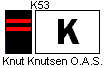
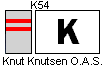
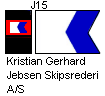
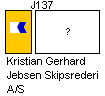
The buff funnel has a broad flag band. The white flag bears a very broad red horizontal band with white KAP letters.
Owned by Karlander Skibs, the line operated chartered ships in the Far East, New Guinea and South Pacific. The source says operations ceased on 1 March 1989 because of mounting debts, but cites The Log for May 1971.
Norway, presumed from the owner’s country of registration.
K-SHIPS SRL.
The funnel is based on Korsaro’s port side in the cited photograph.
Blanc, the Garre family’s Genoese holding company with shipbuilding interests, diversified into petrochemical transport through a small fleet managed by K-Ships. Francesco Russo ran fleet management. Names began K, including Kasmir, Karina and Kasaro; the source notes Martinoli Consulting ownership for these vessels.
Italy, Genoa.
K. & M. SHIPBROKERS LTD.
The funnel resembles Amfitriti’s, leading Rosanoski to presume a connection with J. P. Katsoulakos as well.
K. & M. was incorporated on 10 January 1962. A liquidator was appointed on 30 April 1969, although Lloyds still records the company in 1970–71 and 1973–74. It acted as agent for Amfitriti Compania Naviera.
UK, London.
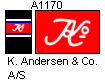
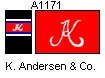
K. ANDERSEN & CO. A/S.
A1171 is a red flag with a white stylised “AK”. Rosanoski thinks the FOTW version probably came from Brown 1926.
The registers associate K. Andersen with Gerona, built in 1914 for A/S Geroma and sold in 1931. They later list Mimona, built in 1922, acquired and renamed in 1947 by Skibs A/S Miimona and sold in 1959, although she is absent from Lloyds 1956–7. These ship and owning-company spellings are retained as given.
Norway, Fredrikstad; written Fredriksstad in Lloyds 1917–18.
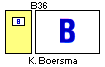
K. BOERSMA.
The flag is white with a blue “B”. The yellow or buff funnel carries a black-outlined panel of the flag.
Managers are listed as N.V. Scheepvaartbedrijf “Gruno” in 1963–1964 and Ripmeester & Co. in 1970–1971.
Netherlands, Rotterdam.
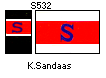
K. SANDAAS.
The funnel is black with a broad red band edged white above and below and bearing a blue S. Jordan instead records a black letter. The flag is white with a broad red horizontal band and a blue S.
K. Sandaas operated through the name subsidiary Rederi K/S Kragerò, recorded in registers from 1953–54 to 1963–64.
Norway, Kragerò.
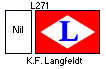
K.F. LANGFELDT.
image by Ivan Sache, 1 February 2
Ivan Sache’s FOTW flag follows Lloyds 1912.
K.F. Langfeldt is recorded as a sailing-ship operator in Lloyds 1912.
Norway, Christianssand.
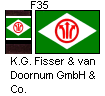
K.G. Fisser & van Doornum GmbH & Co.
K.G. FISSER & VAN DOORNUM GMBH & CO.
image contributed by Josef Nüsse, None
image by Jarig Bakker, 27 September 2005
image by Klaus-Michael Schneider, observed 1 May; illustrated 10 May 2009
image by Klaus-Michael Schneider, 29 March 2009
image by Klaus-Michael Schneider, 22 April 2011
The German sources use a more ornate font and include a white dot after F.
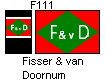
Brown attributes F111 to the managed Dammtor partnership. Jordan calls the funnel marking a bend rather than band and gives F&D. Other sources keep the diamond within the band and flag, while Rehm omits white band edges. FOTW describes a red flag with a green lozenge touching the edges and white F&vD, but Rosanoski notes that its cited source actually keeps the lozenge within the field, closer to F467 apart from font.
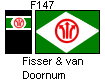
The flag is green with a white lozenge enclosing a red ring and a symmetrical group of three arrows, two bent. Stewart and Mobil extend the lozenge throughout the field, whereas Brown and Nüsse leave it just short of the edges; Stewart’s funnel lozenge touches top and bottom. An earlier FOTW image uses light bright green, but Schneider’s observed table flag gives the darker field Rosanoski considers correct.
This version adds the company name in white serifed capitals along the lower edge, based on an observed table flag.
Mobil gives a circle rather than a diamond on the funnel, supported by Carl Visser in December 1963 and Kronoborg’s October 2013 port-side photograph. Mobil also attributes it to Fisser K.G. and Reunert; Mitchell apparently notes it for Felucca Marine.
Criterion Marine Co. Ltd.
This funnel is assigned to Cosa of Criterion Marine from 1985, another Cyprus-registered vessel whose company moved from agency listing to a Fisser name-company listing.
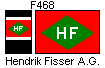
Hendrik Fisser A.G.
image by Klaus-Michael Schneider, 29 March 2009
The recorded Collectors Corner cap badge has the diamond extending across the flag. FOTW also extends its lozenge, but Rosanoski states that the cited 1956 source instead keeps it within the edges, as in F468.
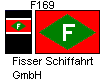
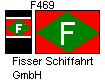
Fisser Schiffahrt GmbH
image by Klaus-Michael Schneider, 29 March 2009
Brown and FOTW extend the diamond throughout funnel and flag. FOTW describes red with a green lozenge and white F, but Rosanoski again says the cited source does not extend the diamond throughout.
Fisser K.G., documented successor name to Hendrik Fisser
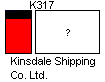
Kinsale Shipping Co. Ltd.
The funnel belongs to Kinsale, registered in Cyprus under Kinsale Shipping in 1986–2003, later listed as a Fisser agency and then name company.
Group history
Carl Fisser and Christoph van Doornum founded the Emden business on 2 October 1879 in coal and timber, with shipping links through British coal and Scandinavian timber imports. Fisser bought out his partner in 1900. His sons Hendrik and Carl developed shipowning, beginning with Konsul Carl Fisser in 1925. A Hamburg office opened in 1938 and became headquarters. After wartime losses and reparations, rebuilding began in October 1949. Dr. Frank Fisser introduced liner agency and a Klöckner joint venture in the 1960s; a partnered building programme and pool followed in the 1970s. The family regained full control late in the 1980s, and Michael and Christian succeeded Frank. Fastbox handled container-feeder pool business, and IC Shipmanagement was formed in Limassol in August 2001.
Keep the explicit scope label independent; no alias or company identity is inferred.
Related companies
The records distinguish Fisser & van Doornum, Hendrik Fisser, Fisser Schiffahrt and later Fisser K.G. Family names characterised some ships, while Fisser & van Doornum, Porta and Reunert used tor endings. Associated or operated concerns included Gemeinwirtschaftliche Kohlen Handels, Nicolai Tankreederei, Porta, Radbod and Reunert; subsidiary status is asserted in FOTW but other sources describe correspondence or operating relationships. A Transatlanta connection is only possible. Later associates included Österreichischer Lloyd/Krohn, with Edmund Halm and Kompass as operating companies; Kompass’s remaining vessel came directly under Fisser in 2006.
Keep the explicit scope label independent; no alias or company identity is inferred.
Chartered tonnage may vary in basic funnel colour while normally retaining the described band.
Germany, Emden and Hamburg.
K.G. Paul Heinrich GmbH & Co.
K.G. PAUL HEINRICH GMBH & CO.
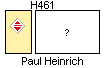
Mitchell records H461 for Frauke at Garston in 1964.
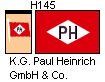
H145 is supported by starboard photographs of Annette and a port view of Gloria. On both sides the white flagpole angles slightly forward, while the lettering reads normally, as if the depicted flag were double-sided. Slight ripples appear along its upper and lower edges. Nüsse’s table flag has a small diamond, unlike the funnel depictions, where its top and bottom points extend almost across the available height.
SAL Schiffahrtskontor Altes Land
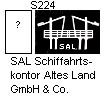
Mitchell describes the pole’s angle as “Pbds”; the original notation is retained without expanding its meaning.
Paul Heinrich’s company was formed in 1949. Its ships appeared at different times under Robert Bornhofen and Peter Döhle as operators. Later entries bring together vessels formerly listed under Klaus Heinrich, Hans & Claus Heinrich and SAL. In 2000 the source names Kapt. Paul Heinrich as proprietor, H. Heinrich as chairman and Kapt. Klaus Heinrich as managing director.
Operating companies included Elbe City Jet Schnellfahren, formed in Hamburg in 1996; Hans & Claus Heinrich, formed in 1988 at Steinkirchen; and M.S. “Paula” Hans und Claud Heinrich K.G., formed there in 1992.
SAL-Schiffahrtskontor Altes Land, also at Steinkirchen, was initially dated 1981 in Lloyds, later amended to 1980. From 2001 it was under the Heinrich and Rolner families’ joint management and ownership. A register note describes SAL-Altes Land as the shipbroking side without managed vessels, whereas the company website states that it provided agency, technical management, operation and crewing services.
Germany, Hamburg; later Steinkirchen.
K.G. PROJEX-SCHIFFAHRTSGESELLSCHAFT MBH & CO.
The dark-blue flag has two very narrow, wavy light-blue horizontal bands near the top and bottom, with white PX between them. The funnel is dark blue with the flag emblems.
Formed in 1981, Projex held its fleet through subsidiaries.
Germany, Hamburg.
K.G. REEDEREI ROTH GMBH & CO.
The white funnel has a red top separated from it by a broad band carrying the flag design. The flag is blue with a narrow white cross and a small white diamond containing a red R. The diamond has no separate outline; Brown shows it small on both flag and funnel.
Formed in 1987, Roth operated through name subsidiaries and Manico Shipping Co. Ltd., established at Limassol in 1997. Uniteam Marine managed one vessel. Roth itself managed a vessel for Burma Navigation Corporation and also acted for Pro Line Ltd. & Co. GmbH.
Germany, Hamburg.
K.K. BLUE HIGHWAY LINE.
N335 was taken from a published design dated 1990. The Mitsui funnel was assumed to accompany it, rather than independently established.
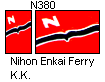
Alan Watt and Rosanoski describe the N335/N336 flag portrayals as incorrect. Brown’s N336 has a stepped white-black-white band of equal widths and a smaller white “N” in the upper hoist. The reported intended design, shown as N380, has a wider black band, curves representing a bird, and a thicker, angled “N”.
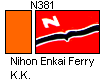
N381 is sourced to Alan Watt, but no separate written account of its differences is supplied.
The source refers to an M380 funnel apparently worn by Oarai Maru in 1987, soon replaced by the parent’s orange. The original number is retained without assuming it means N380.
Formed in 1972 as Nippon Enkai Ferry K.K., the company became K.K. Blue Highway Line in 1990 and continued as a Mitsui O.S.K. Lines subsidiary. It was dissolved in March 2001, with most assets and business rights passing to the newly formed MOL Ferry Co. Ltd., despite later register listings.
Japan, Tokyo; also recorded as Japan Coast Ferries Co. Ltd.
K.K. KYOKUYO.
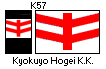
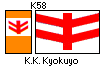
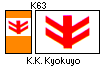
The original black funnel base changed after the war. A May 1985 Lyttelton observation of Daishin Maru No. 3 showed a shortened emblem on the funnel band, initially prompting thoughts of a changed flag or old flag stock. Watt later insisted that K57 is the correct flag and the others poor renderings, while K58 is the correct funnel. Photographs were lacking to establish the full spread of the earlier emblem. The design was described in NZMN as a red dragonfly and a modified Ki character, altered to kyo; Watt rejected the dragonfly explanation, which Rosanoski notes conflicts with the article’s language adviser.
Brown’s K63 has a more acute V shape, perhaps affected by funnel size. Rosanoski retains it because it differs substantially from the other renderings. Mitchell’s similar marking for Kyoei Kaiun may reflect Kyokuyo’s management of part of that fleet; the apparent yellow base could represent yellow-orange. That related image remains recorded as K416.
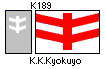
The emblem also appeared on differently coloured chartered funnels, including white on plain grey as K189.
Kyokuyo Hogei, translated as Polar Seas Whaling, was formed on 3 September 1937 by the Sumatra enterprise established in 1918 and dissolved in 1945. It became K.K. Kyokuyo in 1971. Ayukawa Hogei was absorbed in March 1951 and Taiheiyo Kaiun formed the preceding month; Olympic Whaling was bought in March 1956 and Hector Whaling in 1960. Whaling interests passed to Nippon Kyodo Hogei in 1976 and deep-sea trawling ended in 1993, although Lloyds 2000 still listed fishing vessels. Akitsu Shipping became Kyokuyo Shipping on 1 October 1995, and Kyokuyo Suisan was formed in 1997. Kyokuyo also managed part of Kyoei Kaiun’s fleet.
Japan, Tokyo.
K.K. NAKATA GUMI.
The funnel is recorded in photographs of Morning Haruka, including one dated 24 October 2006.
Morning Express had a plain red or orange funnel in a 14 March 2006 photograph; Rosanoski presumes that she was on charter.
The website logo also appears on the Nakata Mac building. Photographs of another activity show a red emblem on white, suggesting, but not establishing, different divisional colours.
Shigeru Nakata founded the business in April 1932 in the ship-paint industry. It incorporated as the Nakata group and moved its head office to Onomichi in November 1961, opening operations in Singapore in March 1974. The website dates entry into shipping to 1980 and establishment of the chartering section to March 1982; Lloyds instead gives 1977 as the company’s formation. The name was modified in April 1991.
The shipping interests included Nakata Mac Corporation, formed in 1991 and listed at Tokyo. Yuyo Kaiun managed part of the fleet in 1988–89.
Japan, Onomichi.
K.K. Uyeno Unyu Shokai.
Documentary material — company attribution not established
The Japanese funnels website assigns U142 to Uyeno Transtech Co. Ltd. Mitchell records it under “Ueno” Unyu Shokai K.K.; the JSA funnel chart of about 1992 is also cited. The original group association is retained without equating the company names.
Uyeno Chemical Unyu K.K.
Uyeno Chemical Unyu K.K. was formed in 1963, listed first in Tokyo and later Yokohama. Kyokko Tanker K.K. managed part of its fleet; Rosanoski identifies “Kyoko” in the 2000 listing as an error.
Keep the explicit scope label independent; no alias or company identity is inferred.
Uyeno Kosan K.K.
Uyeno Kosan K.K., based in Yokohama, is listed from 1996–1997 and operated Eiwa Unyu K.K.
Keep the explicit scope label independent; no alias or company identity is inferred.
Uyeno Transtech Co. Ltd.
Uyeno Transtech Co. Ltd., Tokyo, was formed in 1998.
Keep the explicit scope label independent; no alias or company identity is inferred.
Formed in 1961 as Uyeno Unyu Shokai Gomei Kaisha, the company became K.K. Uyeno Unyu Shokai in 1978. Its operating companies included Fukuei Kaiun K.K., Kyokko Tanker K.K., Kyokuto Tanker K.K., Uyeno Chemical Unyu K.K., Uyeno Kosan K.K. and Uyeno Transtech Co. Ltd. The Australian Uyeno Stolt joint venture began in 1986; NYK apparently took Uyeno’s share in 1996, when it became Stolt NYK Australia Pty. Ltd.
Japan: Yokohama, with Tokyo in the 1980–1981 listing and no address in 1992–1993.
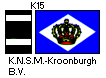
K.N.S.M.- KROONBURGH B.V.
The funnel is black with two white bands, one towards the top and one towards the bottom. The blue flag has a white diamond bearing a crown proper.
Netherlands.
K/S A/S AASLAND & CO.
Lloyds lists A/S Aasland & Co. in 1970–1 and K/S A/S Aasland & Co. in 1973–4. Its vessel is given as Unni, built in 1956, whereas Mitchell records Aasavaer, built in 1972. Rosanoski did not find either vessel in Miramar Ship Index.
Norway, Haugesund.
K/S Combi Lift
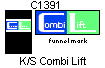
K/S COMBI LIFT.
K/S Combi Lift
The funnel is taken from a starboard photograph of Combi Dock I on 27 May 2008.
Some vessels apparently owned by Harren & Partner use this funnel. The source also mentions C1442 under that company.
Combi Lift was formed as a joint venture between Harren & Partner and J. Poulsen Shipping, dated to 2000 by Harren & Partner and to 2002 by Lloyd’s. Poulsen handled commercial matters and Harren & Partner the technical work, engineering and crewing. The register initially places it under Poulsen, with its single-ship owning companies later under Harren & Partner’s management.
An August 2013 announcement described combination of activities with Condock Befrachterungs from the beginning of September. Rosanoski infers that both would retain their separate identities.
Denmark, Korsoer.
KA SHIPPING LTD.
The funnels remained unchanged after the 2008 sales. K444 is documented on Anicia in May 2008 and June 2013. The oddly shaped emblem might represent a flag, but Rosanoski treats it as a panel because no staff is visible.
Formed as Ability Shipping in 2006, the company became KA Shipping in 2007. Ability was sold to Saffron Companies on 1 July 2008 and Anicia to Sustain the following day, retaining their names and M. Hammestad management. The source also records Jönsson Nova charter markings in this fleet context.
Cyprus, Nicosia.
KADMILOS COMPAÑIA MARITIMA S.A.
The funnel is recorded in the Mitchell collection.
The company operated Kadmilos from purchase in 1967 to sale in 1973. Lloyds lists C Ventures as agent.
Panama in Mitchell; USA, New York, in Lloyds 1970–71.
KAGOSHIMA KISEN K.K.
The flag comes from a 1902 chart reproduced in Fune to Hoto in 1994 and is also shown by FOTW for Kagoshima Yusen. Alan Watt dates the funnel to 1901–10.
The name had become Kagoshima Yusen by 1910. Rosanoski presumes this was the same company, changing in English equivalent from Kagoshima Steamship to Kagoshima Mail Steamship.
Japan, Kagoshima.
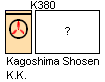
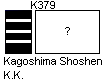
KAGOSHIMA SHOSEN K.K.
K380 is based on a photograph of Yakashima Maru No. 2 bearing 11 January 1972, possibly a service date rather than the date taken. A black-and-white photograph in MN is dated 18 August 1991.
Documentary images — company attribution uncertain
Mitchell gives K379 for Kagoshima Shoshen K.K., which may be the same company. Rosanoski found no company under that spelling, and the card lists no ships.
Company identity unverified.
The first vessel recorded here is Tachigama Maru, built in 1923 for Tokyowan Kisen and apparently acquired without a change of name. Kagoshima Shosen appears in Lloyds from 1953–54 to 2001–02; a 2010 website reference apparently still shows the jetfoil Toppy operating.
Japan, Kagoshima.
Kahn Scheepvaart B.V.
KAHN SCHEEPVAART B.V.
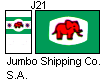
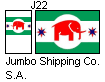
Fairload at Lyttelton on 22 May 1985 carried J22 on its funnel and a similar flag. The white flag band appeared to occupy half the area; the elephant had tusks, a small tail and a white line around the neck outlining the head. Nüsse’s table flag confirms the detail, but the original sighting only assumed that the elephant faced the hoist. Mitchell’s funnel has no stars.
A Jumbo Navigation N.V. booklet supplied J21; that company possibly owned Fairload. Some photographs showed Fairplay Schlep. Reederei Richard Borchard markings, explaining the stars connection. No drawing recorded the elephant’s direction or shape. Brown 1995 reverses the elephant, presumably reflecting a later development. Rosanoski considers the livery common to the group, apart from the Willemstad company’s J213.
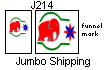
J214 is based on Fairload’s port side in August 2013 and starboard side in June 2010.
Jumbo Scheepvaart Maatschappij (Curaçao) N.V.
image by Jarig Bakker, 5 Apr 2005
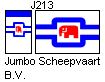
The Willemstad company’s flag is white with three blue-white-blue horizontal stripes interrupted by a blue-bordered white square containing a red elephant. Mitchell’s associated funnel lacks a blue top.
Kahn’s Scheepvaart en Handelmaatschappij N.V. was formed in 1956, when Stella Prima was purchased, and became Kahn Scheepvaart B.V. in 1974. Jumbo Shipping was established in 1968 as a family heavy-transport business.
The registers distinguish Kahn’s operating companies from Jumbo’s owning and agency companies. Jumbo Scheepvaart Maatschappij N.V. appears for Daniella, while Jumbo Scheepvaart Maatschappij (Curucao) N.V., formed in 1969 at Willemstad, absorbed the two listed fleets by 1980–81. Geneva-based Jumbo Shipping Co. S.A., formed in 1968, became the principal management and agency listing. Its fleet was placed under Kahn Scheepvaart in December 2003, although Jumbo remained a manager in later registers. Kahn Heavy Lift also appears separately in the group records.
Netherlands, Rotterdam; Jumbo Shipping is also described as based in Schiedam.
KAIAPOI SHIPPING & TRADING CO. LTD.
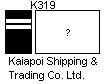
The Log describes a white flag with a narrow black cross and the black letters KSTC in the quarters.
K319 is based on a black-and-white photograph of Kairaki in 1911.
John Sims and others formed the company in 1906. Sims had owned several coastal vessels out of Kaiapoi and retired in 1908. F. L. Parnham is named as manager in Lloyds 1917–18. The company closed in 1927.
New Zealand, Kaiapoi.
KAIEI MARINE CO. LTD.
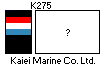
Mitchell places the funnel on the Tokyo Marine K.K. card without explaining the relationship.
Kaiei Marine is recorded as a tug company in Lloyds 1985–86 and 1988–89.
Japan, Kitakyushu.
KAIPARA STEAM SHIP CO. LTD.
The 1907–43 flag was blue with a red cross between the white letters KSSCo.
For the company’s second life from 1962, the flag became white with a blue saltire and the same letters in blue.
Formed in 1907, Kaipara was absorbed by Northern Steam Ship Co. in 1943 and ceased shipowning. It reappeared in 1962 with Onehunga, chartered back to Northern, although Rosanoski questions whether this was a reconstitution. Lloyds 1966–67 lists Onehunga under Fletcher Industries, while the Australasian compendium gives Kaipara for 1962–68; Lloyds 1963–64 places Northern’s entire fleet under Kaipara.
Union Fleet 2001 gives a different formation date, 28 November 1930, and says that the dormant Fletcher Holdings company was renamed Tasman Union in 1971.
New Zealand, Helensville.
KAISHO KAIUN K.K.
Mitchell bases the funnel on Eisho Maru and supplies a line drawing of the vessel.
Formed in 1973, Kaisho Kaiun appears as Kaisho Shipping Co. Ltd. from Lloyds 1985–86. In July 2000 it is listed as an operating company of Kawasaki Kisen, with the fleet under individual companies.
Japan, Tokyo.
KAITOKU KISEN K.K.
The funnel is recorded in the Mitchell collection.
Kaitoku Kisen is recorded in Lloyds 1980–81.
Japan, Anan.
Kalkavan.
KALKAVAN.
The number of funnel bands varies with funnel width, and their depth with funnel height. K433 is based on Ecem Kalkavan, under Kalkavan Shipmanagement, and Mert Kalkavan, under Arif Kalkavan Ogullari. Irem Kalkavan in May 2006 shows three white and three red bands, with the funnel’s rear slope running into another white band. Related versions are recorded under Cesur-Cebi Kaptanoglu.
A1124 is based on a portside photograph of Necla Abla. The original gives the malformed date 29.112.2012.
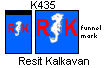
Mitchell assigns K435 to Resit Kalkavan, but his drawing of its only noted ship, Denizati, shows a yellow funnel.
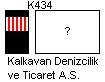
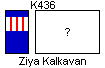
K434 and K436 are retained from the Mitchell collection; the source supplies no separate verbal description for them.
Ziya Kalkavan
Ziya Kalkavan Kollektif Sirketi was formed in 1947. Its operating companies included Altin Kalkavan Denicilik Ticaret ve Sanayi A.S., formed in 1987; Ercan Denizcilik, formed as Kalkavan Transport Denizcilik Ticaret Sanayi A.S. in 1975 and renamed in 2003; and Cagatay Denizcilik ve Ticaret, formed in 1988. The source says Ercan was no longer used for ship operations.
Keep the explicit scope label independent; no alias or company identity is inferred.
Kasif Kalkavan and Turkon
Kasif Kalkavan ve Ortaklari’s listed operating companies included Hakmar Denizcilik, formed in 1983, and Rize Denicilik, formed in 1958. Hamburg-based Kalkavan Ship Management was formed in 2005 and appears under Kasif from 2007. Turkon is dated to 1970 by Lloyds, but its website says the Kasif Kalkavan Group formed it on 3 March 1997, beginning operations on 9 April.
Keep the explicit scope label independent; no alias or company identity is inferred.
Resit Kalkavan
Resit Kalkavan was formed in 1964 and became Resit Kalkavan Denizcilik ve Ticaret Ltd. Sirketi in 1981.
Keep the explicit scope label independent; no alias or company identity is inferred.
Arif Kalkavan and Ako
Ako Denizcilik Grubu was established by Arif Kalkavan in 1955 and expanded by his sons Necdet, Cafer and Cetin into international general-cargo shipping from the 1980s. Its companies were Ako Shipping, Arkal Shipmanagement and CCK Shipping, with a shipyard at Yalova. Rosanoski identifies Arif Kalkavan Ogullari Shipping as part of it through the fleet list. Lloyds separately records an Arif Kalkavan Shipping Group formed in 2007, with Arkal, Cesur-Cebi Kaptanoglu and Arif Kalkavan Ogullari among its operators.
Keep the explicit scope label independent; no alias or company identity is inferred.
Other recorded companies
Other dated interests include Karas Huseyin Kalkavan-Aydin Insaat, formed in 1985, and Necati Kqalkavan ve Ogullari, formed in 1980. Sadan Kalkavan Group appears as an operating company of Akmar Denizcilik in July 2000.
Keep the explicit scope label independent; no alias or company identity is inferred.
Possible associate
Kasif Denizcilik’s two ships wear K433 colours, although Rosanoski allows that they may be chartered. Dr. Taylan Kalkavan is identified as its managing director.
Keep the explicit scope label independent; no alias or company identity is inferred.
Rosanoski’s sources describe the Kalkavan family as pioneers in Turkish shipping and port operations, with routes linking Istanbul, Shanghai and Europe. The family also held major interests in the Besiktas Shipping Group.
Turkey, Istanbul.
KALLIANIS BROS. SHIPPING S.A.
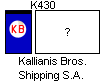
K430 is based on KBS Lucky’s starboard side in June 2012.
Captain Dimitris Kallianis returned to shipowning in 2009 with his sons George and Ionnis. Dimitris and his brother Vassilis had formed Kallianis Compañia Naviera in 1969 at Piraeus, becoming involved in broking during the 1980s and controlling two to five bulkers at a time. Georgios K was apparently acquired in 1997 and sold in 2002, when the family withdrew from direct ownership while retaining small interests in other Greek-controlled vessels. In the 2009 report George also said Vassilis intended to revive the earlier company’s ownership activities.
Greece, Athens.
KAMBARA KISEN K.K.
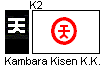
The NJK funnel for Tensya Maru No. 10 has a top extension. Alan Watt calls it wrong, yet says all his 1963–66 sightings had that extension; Rosanoski explicitly notes the contradiction. Watt also reported a new flag, seen only in black and white, with the dark funnel device as bands on a light field, probably red on white.
A photograph of Chijin shows a wider version of K2.
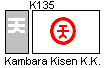
K135 was noted in February 1962 on the chartered Miko Maru No. 2 of Yami-Mishi Kisen. The flag was not observed.
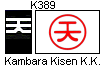
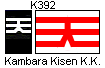
Triple Ever shows the emblem extending slightly around the back and front of the funnel. Rosanoski suggests that a fixed-size emblem may appear as bands or as a symbol according to funnel width. The company website supplies the new K392 flag.
K389 is recorded by US Navy 1961, photographs and Mitchell.
Documentary images — company attribution uncertain
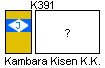
Early photographs of Ijmuiden Maru, built in 1986, show K391; later ones show plain yellow. Rosanoski presumes charterers’ colours but could not identify the charterer.
Charterer and date unknown.
Katsutaro Kambara began shipping in 1903 with coal carriers at Chitose-mura, Namakuma-gun, Hiroshima. Setonailai Senpaku was founded in June 1944, becoming Kambara Kisen in November 1948 and moving its head office to Tokyo. The office moved to Numakuma-gun, Hiroshima-ken, in 1995. Later establishments included Dolphin Pacific (Saipan) in 1984, Astra Shipmanagement in 1994 and Kambara Kisen (China) Shipping in 2003. Registers alternate Kambara and Kanbara; by August 2007 the company is listed under Tsuneishi Holdings.
The company history dates Kambara Marine to 1978, whereas Lloyds gives 1988; it too appears under Tsuneishi in 2007. Other operating subsidiaries included Ichikawa Kisen, Wakamatsu Kaiun and Kambara (Uruguay), formed in 1981 at Montevideo. A&K Shipping was established in October 1997 as a joint venture with Azuma Kaiun. The source also identifies affiliation with the Tsuneishi Shipbuilding Group.
Japan, Tokyo.
KAMIGUMI G.K.
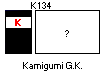
The black funnel has a broad white band bearing a red K. It was noted on Shinei Maru No. 8 in March 1963 and Shin-ei Maru in February 1965. No flag was recorded.
Kamigumi is recorded in Lloyds 1963–64 and 1966–67.
Japan, Kobe.
KAMIYA DENBEI.
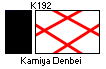
The flag comes from a 1902 chart reproduced in Fune to Hata in 1994. The funnel is taken from a 1901 chart.
Japan.
KAMO COLLIERY CO. LTD.
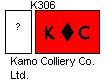
image by Eugene Ipavec, 31 March 2009
K306’s colours were supplied through Jan Mertens, with an FOTW image by Eugene Ipavec.
Coal mining at Kamo began in 1875. A railway to Whangarei, completed in 1882, overcame the difficulty of carrying coal to the wharf over unmetalled roads. Kamo Colliery operated Waitaki from 1883 to 1887; the mine closed in 1955.
New Zealand, Auckland.
KANAZAWA NIHEI.
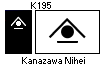
image by Phil Nelson, 04 February 2002
FOTW’s flag, dated 1916 and based on an actual example, comes from Fune To Hata, published in 1994.
The 1910 chart names Kanazawa Nihei, while FOTW uses Kanazawa Kisen.
Japan.
KANEMATSU GOSHO K.K.
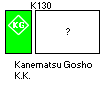
The green funnel bears a white diamond frame enclosing white KG letters. It was noted on the chartered Tajima Maru in July 1970. No flag was recorded.
Kanematsu Gosho is recorded in Lloyds 1970–71.
Japan, Tokyo.
Kangaroo Island Sealink Pty. Ltd..
Documentary material — company attribution not established
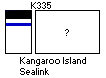
The funnel is sourced to The Log, August 1993.
The private South Australian ferry company is described as founded by Peter March, with the current business dated to 1989. The source records Malaysian Mbf Group ownership in 1989–94 and a 1994 sale involving staff and island residents, but flags the account’s wording. The Log instead announced in March 1996 that a consortium including Coach Lines of Australia would buy the operation from Mbf. The business name was registered in November 1990 and deregistered in June 1996; a separate company registration is dated 9 December 1998 as EOE (No, 113) Pty. Ltd., subsequently Mbf Sealink and then Kangaroo Island Sealink. In 2004 the business acquired Auckland’s Subritzky Shipping, renaming it SeaLink Travel Group.
Australia, Adelaide.
KANSAI KISEN K.K. (1)
image by Phil Nelson, None
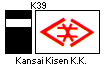
K39 is the original funnel, still used for deep-sea ships according to Alan Watt.
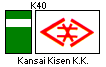
K40 was used for ferries from the 1950s to the 1970s. Mitchell bases it on Murasaki Maru, 3137/1960, with a line drawing; the FOTW flag follows Stewart 1963.
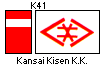
K41 has been used on ferries since the 1970s; Mitchell also records it.
Kansai Kisen (1)
Kansai Kisen, also Kansai Steamship Co. Ltd., was formed in 1942. Kurushima Dock supported it during financial difficulties in July 1978. By 1988–89 the first register entry had moved to Tokyo and appeared as manager and agent, while its former fleet, mainly ferries, was listed under Kansai Kisen Kaisha in the Mitsui OSK Lines context at Osaka. Rosanoski’s March 2003 comment nevertheless describes Kansai Kisen as still independent. Later registers show a fleet through individual companies.
Japan, Osaka; later Tokyo.
Keep the explicit scope label independent; no alias or company identity is inferred.
Kansai Kisen (2)
The document separately records another Kansai Kisen K.K. at Kobe in Lloyds 1988–89, without establishing its relationship to the first.
Japan, Kobe, for the separate second register entry.
Keep the explicit scope label independent; no alias or company identity is inferred.
Victory Ace was photographed in April 2002 with a plain orange funnel, probably on Mitsui charter. Mitchell shows a red funnel for the car carrier Glory Pegasus, recorded as scrapped in 1995; Rosanoski could not locate the vessel in Lloyds and thinks the colour probably represents Mitsui orange.
KAPAL MANAGEMENT (PTE) LTD.
image by Jarig Bakker, 4 November 2005
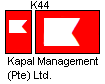
The FOTW flag follows Brown 1995.
Kapal Management was formed in 1975 and belonged to Keppel Corporation. Its interests included Orchid Holdings, formed jointly in 1978 by Keppel Shipyard and P&O Nedlloyd. In 2004 Keppel announced its withdrawal from shipowning and the sale of ten ships to Interorient Navigation. Rosanoski considers this the apparent explanation for Kapal’s disappearance from the August 2004 register, having located four vessels under new names.
Singapore.
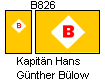
KAPITÄN HANS GÜNTHER BÜLOW.
Mitchell shows a narrow black funnel top for the last vessel.
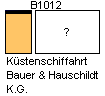
Operations began with Hildegard Bülow, built in 1950 and replaced by another vessel of the same name built in 1962. The 1973–74 record places the firm under Küstenschiffahrt Bauer & Hauschildt K.G., although another note says it is referenced but not shown.
Germany, Kollmar bei Glückstadt; later listings give Hamburg-Altona and Hamburg.
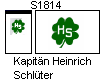
KAPITÄN HEINRICH SCHLÜTER.
The funnel is documented in port and starboard photographs of Mistral; a further starboard photograph also shows the flag flying.
Heinrich Schlüter acquired and renamed Mistral in 1998. She was placed under Mistral Shipping Co. Ltd., formed in 1999 as a name company of RMS Lübeck. Later registers list Heinrich Schlüter, dated to 1991, first as an operating company of Wilhelm Pekholtz and then of RMS Lübeck, which remained manager in 2011–12.
Germany, Munsterdorf.
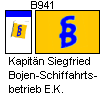
KAPITÄN SIEGFRIED BOJEN-SCHIFFAHRTSBETRIEB E.K.
The funnel follows Oslo’s port side on 4 November 2010 and starboard side on 18 October 2009. On starboard the flag is mirrored and angled, with the pole still forwards and lettering readable, as the reverse of a double-sided flag. Unlike the unidentified website vessel, Oslo’s “S” does not extend over the spine of “B”. The flag follows the company logo.
Bojen became a captain in 1962 and a shipowner in 1966, building a family business that developed into a shipping company. The website also calls it Bojen Holding GmbH & Co. K.G.; Lloyd’s gives formation in 1994.
The operating company Bojen MS “Tallin” K.G. was formed in 1997.
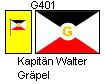
Esso and Flaggen & Schornsteine attribute the livery to Gloria Reederei GmbH. Mitchell shows the flag slightly fluttering on the funnel, with its pole upright. Schneider’s FOTW flag follows the 1956 Esso source under the Gloria name.
Other operator-source allocations do not prove exclusive Gloria use or corporate equivalence.
Walter Gräpel appears as operator for Gloria Reederei’s Gundula, built in 1954 and sold in 1966. Later registers distinguish Walter & John Gräpel, associated with Gloria and Gerlinde, from Walter Gräpel alone with Gloria. Two successive Gerlinde vessels are recorded: the first acquired in 1958 and sold in 1965, the second acquired in 1965 and sold in 1974. Gloria Reederei appears at Hamburg in 1958–59 and as Gloria Reederei, Gräpel & Co. at the same Stade address by 1963–64.
Germany, Stade.
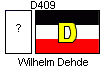
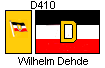
KAPITÄN WILHELM DEHDE.
image by Klaus-Michael Schneider, 8 April 2009
The D in the FOTW illustration does not exactly match the source.
Dehde operated Helga Dehde, built in 1956; Rosanoski found neither her subsequent history nor fate. Lloyds lists the business in 1956–57, and as Kurt Dehde in 1966–67 and 1970–71.
Germany, Bützfleth.
Kappa Maritime Ltd.
KAPPA MARITIME LTD.
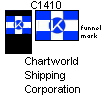
C1410 is based on Mindoro Star’s port side in October 2013.
Chartworld Shipping Corporation
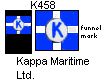
K458 and C1411 are recorded in the Mitchell collection without separate verbal descriptions.
Kappa Maritime was formed in 1974 and represented the UK operations of Pantelis “Lou” Kollakis. His father had moved from Greece to Wales, exporting coal and importing bananas; Lou and George eventually took over the family shipping business. Lou returned to Greece in 2008 to direct it from there. His Chartworld Shipping Corporation was formed to manage bulk carriers. Based at Piraeus, Chartworld had been known as Charterwell Maritime S.A. before 1983; it appears under Kappa in March 1998 and independently in July 2000.
A further Charterwell Maritime S.A., formed in 1993 at Athens, appears as a major operating company in August 2008 and as a manager in 2011–12.
UK, London.
KAPT. WERNER POTT SCHIFFAHRTS K.G.
The red flag has a very broad horizontal white band bearing a white shield outlined in black, with two red chevron-like bands. The shades follow the website image. No funnel is given.
Germany, Drochtersen.
KAPTAN GROUP OF COMPANIES.
C1430 is based on photographs of Minanur Cebi from both sides, including a starboard view dated August 2006.
Kaptan Demir Celik began in iron and steel at Karabük in 1964 and bought its first ship in 1993. Shipping is handled through Cebi Denizcilik ve Ticaret, acquired in 2006 apparently from Pegasus Denizcilik. Nur Gemicilik ve Ticaret handles chartering and shipbroking.
Turkey, Istanbul.
Kaptanoğlu Holding.
KAPTANOĞLU HOLDING.
K394 is based on Ece Nur K at Sydney in May 2011, Puli in July 2013 and Loya in April 2011. The black portion is aft on both sides, following the logo, although the K differs. A photograph of Cenk Kaptanoglu makes the black areas appear blue; Rosanoski presumes a photographic or lighting effect.
K396 is based on Eylul K in June 2008.
K395 is preserved from the Mitchell collection.
Marama Denizcilik A.S.
M710 represents Marama Denizcilik and is based on Cenk Y in May 2005.
Rosanoski suggests that Mitchell may have confused the funnel colour, which can look bright orange in certain light.
The family’s shipping operations began in 1904 with Haci Ismail Kaptanoğlu’s father. Haci Ismail established his own company in 1940 and was joined by his sons Engin, Gündüz and Cengiz. Lloyds gives a separate corporate chronology: Kazim Kaptanoğlu ve Ortaklari Kollektif Siketi was formed in 1971 and became H. I. Kaptanoğlu Shipping Group in 1996. Registers distinguish Ismail, Kazim and related companies; Ismail’s fleet passed to Ismail Kaptanoğlu ve Ogullari by 1980–81. Shipping was handled through Haci Ismail Kaptanoğlu Shipmanagement & Trading and K. Tankerering & Shipmanagement.
Operating companies included Cenk Denizcilik and Gunes Tankercilik, both formed in 1992; Kaptanoğlu Denizcilik ve Ticaret, formed in 1982; and Marama Denizcilik, formed in 1994. In April 2008 the former H. I. group’s operating companies appeared under Seda Denizcilik ve Ticaret, previously a minor operating company. Seda’s formation date was initially given as 1989 and later changed to 1985.
Turkey, Istanbul.
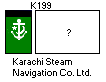
KARACHI STEAM NAVIGATION CO. LTD.
The NJK funnel was noted on Pakistan Promoter.
K199 is preserved from US Navy 1961.
Karachi Steam Navigation is recorded in Lloyds from 1953–54 to 1966–67.
Pakistan, Karachi.
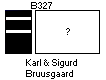
KARL & SIGURD BRUUSGAARD.
The funnel is recorded for Ailsa, 519/65, in the NJK Collection.
Karl & Sigurd Bruusgaard managed A/S Acadia and A/S Bruusgaard in the 1958–59 and 1963–64 listings. Karl Bruusgaard and Sigurd Bruusgaard were at the same address.
Norway, Drammen.
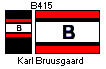
KARL BRUUSGAARD.
Sources differ over the width of the black bands. The illustration follows the cap badge shown on the Collectors Corner website.
The fleet was held through name subsidiaries in the 1939 material, with Karl Bruusgaard also listed as an owner in 1942. From 1953–54 to 1963–64 the firm appears as manager only, for two companies. Ship names began with “M”. Karl & Sigurd Bruusgaard and Sigurd Briisgaard are recorded at the same address.
Norway, Drammen.
Karl Meyer Reederei GmbH & Co. K.G.
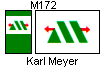
KARL MEYER REEDEREI GMBH & CO. K.G..
image by Jarig Bakker, 17 December 2005
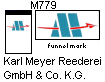
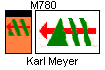
The white flag has a stylised green M pierced by a red double-pointed arrow.
The photographic funnel record follows port and starboard views of Halland.
Karl Meyer began a Wischhafen haulage business in 1947, carrying bricks for Hamburg’s reconstruction. Shipping began in 1956 and became a separate company in early 2002; the group also worked in environmental and disposal services. The source records the change to Karl Meyer A.G. in mid-2002, acquisition of Helgoland Fracht-Kontor in January 2008 and formation of Karl Meyer Shipping International that April. Lloyds gives differing formation dates, initially 1994 and later 1981.
Germany, Wischhafen.
KARL PETERS & CO.
image by Klaus-Michael Schneider, 30 Mar 2009
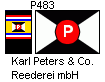
Shipowning began in 1952, with operations through name companies and Peter-prefixed vessel names. The last ship, Peterzwei, was wrecked on 2 October 1957.
Germany, Hamburg.
KARL-HEINZ BAASE.
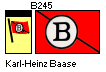
The flag is red with a very narrow black diagonal band angled towards the port side and, overall towards the hoist, a white disc bearing a black “B”. Brown places a smaller disc centrally. The funnel is yellow or buff with a black top and depicts the flag flying from a white pole. Rosanoski notes that the pole in the illustration is shown black only for contrast.
Karl-Heinz Baase is recorded in the registers from 1978–1979, operating through name subsidiaries and an operating subsidiary. The latter is listed as Hans-Peter Hinrich Hauser, formed in 1983 and based in Hohn.
Germany, Nubbel.
KARLANDER NEW GUINEA LINE LTD.
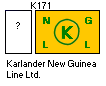
The funnel is that of A/S Karlander, yellow or buff. The first flag is yellow with a green ring enclosing a green K and green NGLL letters in the field corners. It comes from a verbal description, so its proportions may be incorrect.
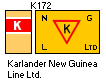
The second flag is yellow with a downward-pointing red triangular frame enclosing a black K. Black NGLLTD letters occupy the corners, with TD smaller.
The line was owned by Egil Paulsen, associated with A/S Karlander and operated as charterer only.
Unknown.
KARLSTADS HAMNSTYRELSE.
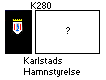
The funnel is based on Triton photographed on 10 March 1981. The oblique view does not clearly show the shield detail.
Karlstads Hamnstyrelse bought the tug Triton in 1968 and sold it in 1983. Lloyds uses Karlstads Stad in 1970–71 and Karlstads Hamnstyrelse from 1973–74.
Sweden, Karlstad.
KARTA OCH OAXENS KALKBRUK A/B.
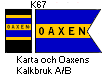
The flag is a blue swallowtail with a yellow horizontal band, slightly narrower than either blue area, bearing black OAXEN letters. Black-and-white tug photographs confirm the funnel, with its blue bands slightly broader than the central yellow. The flag is also shown on a cap badge.
The Stockholm tug concern operated from around 1916 to 1964. The source records Oaxen IV for 1916–39 and Oaxen V11 as sold in 1964. Albert Rothstein managed the company in the 1950s registers.
Sweden, Stockholm.
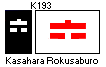
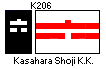
KASAHARA SHOJI K.K.
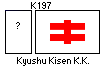
The 1901 and 1930 charts agree with K193. FOTW uses the 1902 chart reproduced in Fune to Hata in 1994, but shows a wider top and an equal gap at the bottom.
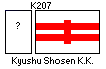
The 1910 and 1926 charts show K206, except that the 1910 lower band has a wider gap. Alan Watt suspected an early version had changed before 1910. The device appears to stylise the lower half of the first kanji of Kasa.
The business originated as Kasahara Rokusaburo and was incorporated as Kasahara Shoji K.K. by 1926.
Japan, Osaka.
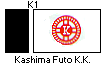
KASHIMA FUTO K.K.
The funnel and flag follow Brown 1995.
Kashima Futo appears in Lloyds from 1970–71 to 1996–97. Its tugs used numbered Shin Kashima names until the 1985–86 register, when varied names appeared.
Japan, Kamisu.
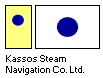
KASSOS STEAM NAVIGATION CO. LTD.
The flag is white with a blue circle. The funnel is yellow; the original calls its device a “blace circle”, without clarifying that wording. An unidentified source assigns the flag, and presumably the funnel, to Pnevmaticos, Rethymnis, but Rosanoski thinks the manager’s colours were probably attributed to the owner in error.
Kassos is recorded as a manager of Pnevmaticos, Rethymnis in Lloyds. The 1970–71 cross-reference is present but Rosanoski could not find the corresponding entry. The Worlds Merchant Fleets 1939 lists Rethymnis & Kulukundis as manager or agent for Kassos.
Greece.
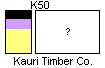
KAURI TIMBER CO.
The funnel band is described as mauve.
Although registered at Melbourne, Kauri Timber operated the iron paddle tug Lyttelton from Auckland, New Zealand, from 1912 into the 1920s. Rosanoski tentatively identifies it with The Kauri Timber Co. Ltd., deregistered on 15 June 1927.
Australia, Melbourne.
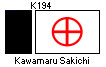
KAWAMARU SAKICHI.
The flag comes from a 1902 chart reproduced in Fune to Hata, dated here to 1904. Alan Watt calls it a common design, the sixth occurrence he had noted. The funnel is taken from the 1903 sheet.
Japan.
Kawasaki.
KAWASAKI JUKOGYO K.K.
Shozo Kawasaki began shipbuilding at Tokyo in April 1878. Kawasaki Hyogo Zosensho was formed in 1881 and moved to Kobe in 1886; the joint-stock Kawasaki Zosen, or Kawasaki Dockyard, followed on 15 October 1896. The company later appears as Kawasaki Heavy Industries. It formed Kawasaki Kisen in 1919, participated in the establishment of Kokusai Kisen that year and joined the K Line service in 1921.
Japan, Kobe.
KAWASAKI KISEN K.K.
Kawasaki Kisen K.K.
Kawasaki Kisen K.K.
image by Jorge Candeias, 16 June 2006
image by Jarig Bakker, 14 February 2005
image by Peter Hans van den Muijzenberg, 2 January 2008
image by Jorge Candeias, 16 June 2006
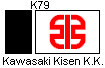
K79 is the parent company’s flag, used by the group. Its funnel was adopted in 1919 and replaced that August. Jorge Candeias’s FOTW flag replaced Al Fisher’s earlier image, which had been mislabelled Kawasaka Kisen.
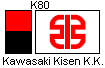
K80 replaced the initial funnel in August 1919.
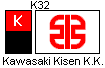
The K174/K32 funnel dates from the 1921 K Line joint service. The red flag with a white K shown as K174 by several interwar sources was, according to company confirmation, never used. Brown 1926 brackets the participating companies, but Rosanoski says Kokusai had its own livery and was included because of the joint service. Lloyd Reederieflaggen instead attributes the disputed flag to Kokusai. FOTW retains it among erroneously reported images.
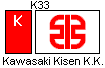
The company also denied that K33 ever existed. Rosanoski suggests that an obscured narrow funnel base caused the error. Nevertheless, Ships & The Sea 1936 says K174 replaced it, and US Navy 1961 and the Japanese Shipowners Association reproduce it. Those documentary discrepancies remain explicit.
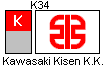
Watt originally dated K34 to new motor vessels in the 1950s, spreading later through the fleet. Its appearance in Merchant Ships 1942 led him to correct the date to before 1942, probably the late 1930s. The deep red top did not shrink on shorter funnels; the base became shallower. Stewart 1963 shows a smaller red top, although still larger than usual. Later photographs document K34 on Ems Highway, Alessandro Volta and Greenwich Bridge, the last presumably chartered from the Doun Kisen ownership context.
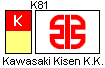
Watt places K81 with associates in the 1950s and 1960s, adding the top to their normal funnels. Rosanoski notes a pre-war use not mentioned by Watt. A black-and-white Holland Maru photograph shows a different arrangement: base and black top separated by a white and unidentified lighter-coloured biband. Watt suggests a possible misreading of Talbot-Booth’s grey base.
FOTW presents K383 among erroneously reported images. No documentary source is given or known to Rosanoski.
Kawasaki Kisen Kaisha, also Kawasaki Steamship and K Line, was formed at Kobe in April 1919. The K Line joint service began in 1921 with Kawasaki Zosen and Kokusai Kisen, taking its name from the three K initials; the latter two later reduced their capital involvement. JAL followed in November 1925 with Kokusai and Yamashita, and the Kawasaki North Pacific Express Line in January 1926. Shares were publicly listed in January 1950. An agreement with Iino was signed on 20 December 1963 and the merger followed in April 1964, retaining the K Line name. The domestic division became Kawasaki Kinkai Kisen in May 1966; the US affiliate became K Line New York in April 1967. Seven Seas Cruise Lines was established in September 1989. Many vessel names end in kawa.
Japan, Tokyo and Kobe.
Interests recorded under Kawasaki Jukogyo
The parent-company section also records Blue Ocean Bulk Shipping as a 50–50 venture of BHP Transport and Kawasaki Steel, and a 49% interest in Orient Sea Highway Services.
Keep the explicit scope label independent; no alias or company identity is inferred.
Operating companies
Kawasaki Kinkai operated short-sea and coastal services. K Line Europe originated in 1956 as Kawasaki (London); K Line LNG Shipping (UK) was formed in 2006 and K Line Singapore in 2002. Stargate Shipmanagement was formed at Bremen in 1999. K Line Ship Management, formerly Overseas Maritime Agency, is dated to 1972 by Lloyds but to 1987 by Mitchell, despite a 1985–86 register listing. Its 1994 renaming accompanied a merger with Kawasaki Kisen’s maintenance division; it apparently absorbed Union Shipping by 2000. Taiyo Kaiun and Kobe Nippon Kisen merged into Taiyo Nippon Kisen in July 2000. Other dated operators include Taikyo Kaiun, formed in 1988; Taiyo Marine Management, 1994; TNKC (Manila), 2002; and Veritas Maritime, 1990.
Keep the explicit scope label independent; no alias or company identity is inferred.
Other recorded group relationships
The source also lists Escobal Japan, Heiwa Kisen, Iino Kaiun, Iino Marine Service, Kaisho Shipping, Kobe Sanbashi, Nippo Kaiun and Nippon Kisen. Daito and Naigai Unyu appear as associates, with Naigai later listed as an operator. Canopus Maritime, formerly a Kobe Nippon company and formed in New York in 1976, passed to a Barber Ship Management listing in August 2004.
Keep the explicit scope label independent; no alias or company identity is inferred.
Joint ventures
Joint services and ventures included Eastern Searoad with Australian National Line, 1969–29 February 1996; Oasis Container Express, formed in November 1979 with Nippon Yusen, Mitsui O.S.K., Yamashita Shin-Nippon and Showa Kaiun; Andes Express, formed in February 1981 with Nippon Yusen and CCNI; and K-S Shipping with Sinotrans Liaoning in October 1994. Orient Sea Highway was formed in November 2003 with China Ocean Shipping holding 51% and Kawasaki Kisen 49%. K Line Offshore followed in November 2007 with C. H. Sörensen Management.
Keep the explicit scope label independent; no alias or company identity is inferred.
KC MARITIME LTD.
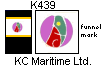
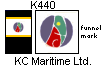
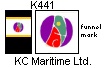
The funnels carry the same logo, but paint shades or camera effects vary, chiefly in the main circle’s background; other colours are also uncertain. K439 follows Darya Shanthi’s starboard side in April 2008, K440 Darya Ma’s port side in March 2013, and K441 Darya Noor’s starboard side in May 2007.
KC Maritime was formed in 1999 when Chelleram Shipping was restructured into Chelleram Shipping (Hong Kong) and KC Maritime. The Mumbai subsidiary KC Maritime (India) had previously been Chelleram Shipping (India). Rosanoski notes that the 2011–12 register apparently directs the registered owners to the managers named as Anglo Eaqstern Ship Management (India).
China, “Hong Long”, as written in the source.
KEANYEW SHIPPING CO. S.A.
Gitana was noted with a black funnel. No flag was recorded.
Keanyew is recorded in Lloyds 1963–64.
Hong Kong.
KEITH HOLLANDS SHIPPING CO. PTY. LTD.
Keith Hollands began operations with Katoora in 1960. Its last vessel, Maluka, was sold in 1974, and the company was deregistered on 18 October 1983.
Australia, Cairns.
Keith Ramsay Ltd.
KEITH RAMSAY LTD.
The Log attributes a white flag with a red cross and red KRSCo distributed among the quarters to Keith Ramsay’s operation of Dunedin & Invercargill S.S. Co. Rosanoski questions Co rather than A for Agencies, allowing for variable trading names, and notes that the flag might also have served other operated companies such as Southern Steam Shipping.
Dunedin-Invercargill Shipping Co.
Sea Breezes gives the service’s company as Dunedin-Invercargill Shipping Co., operating in 1873–1906, and illustrates its own red pennant with a white cross and white DISCo in the quarters, decreasing in size. This leaves the relationship between the two flags and company names uncertain.
Keith Ramsay entered shipowning in 1870 and traded through Keith Ramsay Shipping Agencies, associated with the Dunedin–Invercargill service. He died in 1906 and was succeeded by his son Keith Stuart Ramsay. The business held interests in steamer companies, including Southern Steam Shipping and Invercargill Shipping, and operated Southern’s Kotare. It became a limited company in May 1931, with dates of 12 and 31 May in the accounts. Trading is described as continuing to 1978, while the company register records striking off on 22 August 1984.
New Zealand, Dunedin.
Keller Shipping Ltd.
KELLER SHIPPING LTD.
The flag is white with a blue diamond frame containing a red K extending throughout, as shown by US Navy 1961 and Nüsse’s table flags.
Nautilus S.A./A.G. and Nautilus Line
Nautilus’s blue flag bears a red seahorse. Rosanoski considers it likely that this livery continued with the brand after Keller’s takeover.
Villars at Southampton in August 1996 appears to have a blue funnel with a white emblem, possibly corresponding to T572. Mitchell appears to link T572 with Anzere through a line drawing.
Keller Shipping was formed in 1945. Rosanoski dates its apparent shipping activity from 1953 to 1998 and later records consultancy, surveying and Lloyds agency work. Its operating subsidiary Compagnie de Navigation Transocéanique Suisse, formed in 1951 at Geneva, appears under several variants of that name. Its last vessel, Villars, was sold in 1998. Mitchell’s suggested connection with Alpina Reederei is unsupported.
Nautilus A.G. of Glarus operated ships for the Swiss Government from 1941 according to the history, or 1940 in Rosanoski’s FOTW comment, buying them after the war. Financial difficulties in 1953 brought Keller management and a takeover in 1954, including Nautilus Line. The Nautilus brand continued: Montana was chartered to it after purchase in 1956, and Aegean Glory after building in 1978. Keller and Nautilus therefore appear together despite differing registered ownership.
Switzerland, Basle.
KELVIN SHIPPING LTD.
Mitchell shows a lighter blue than photographs of Kelvin Fortune at New Plymouth on 24 January 1993, although the photographs are backlit. Mitchell joins the K’s lower arm to the upper arm; the photograph shows both joining the spine.
Lloyds 1992–93 lists Kelvin Challenge, Endeavour, Enterprise, Fortune and Resource as separate one-ship companies, all managed by Acomarit (U.K.). Each vessel shared its company’s name.
U.K., Glasgow.
KENNEDY HUNTER N.V.
image by Ivan Sache, 10 November 2003
The FOTW flag follows the company website.
The shipping agency was formed in 1806 and taken over by Conti 7 in 1999.
Belgium, Antwerp.
Kent Line International Ltd.
Documentary material — company attribution not established
K103 is supported by Nüsse’s table flag and a photograph of the chartered Kent Mariner in November 2006.
Kent Pioneer in February 2008 shows equal funnel bands. Kent Trader in September 2005 instead has black lines outlining two narrow white bands; both vessels were chartered.
Mitchell also assigns the Irving funnel I50 to the operation.
K. C. Irving bought Elkhound in 1934 and Kent Line was incorporated in 1946. Lloyds gives 1994 for the formation of Kent Line International, which Rosanoski presumes distinguishes it from Kent Line Ltd. Both appear under Irving Oil; by December 2003 the International fleet is listed under Kent Line Ltd., later an operating company of J. D. Irving. Tropical Shipping acquired the container division in September 2001.
Canada, Saint John, New Brunswick.
KEOYANG SHIPPING CO. LTD.
The symbol is a stylised K.
The company was established on 23 April 1990 as Daejoo Shipping, becoming Keo Yang Shipping on 1 November. Its sole shareholder was the POSCO Educational Foundation. A tramping licence followed in June 1991, merger with Youngil Shipping in October 1993 and registration of Kooje Shipping’s agency business in June 1994. Hanjin bought 90% and took over management in March 1995; the company was designated part of the Hanjin Large Business Group in April 1999. Lloyds initially gave 1983 as the formation date but amended this to 1990. ASP Ship Management and Hanjin managed portions of the fleet in 2003.
South Korea, Seoul.
Kerr Norton Marine.
KERR NORTON MARINE.
image by Jorge Candeias, None
FOTW presents K11 under Kerr Steamships/Kerr Norton Marine.
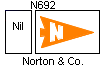
Norton Lilly International and its documented earlier Norton flag
The company website supplies original and current Norton Lilly flags, but does not identify the corporate name under which the original was used.
John Norton began Norton & Co. as a ships’ agency, booking a kerosene cargo to South America in 1841. It became Norton Lilly & Co. in 1907. Norton Lilly International allied with Kerr Steamship in 1993 and acquired it in 1994 to form Kerr Norton Marine, also described as Kerr Steamships. Rosanoski’s 2010 directory research found agencies across Canada and the USA without identifying a headquarters.
The account also mentions Strachan Shipping Agency in spring 2002, but the sentence leaves the event incomplete. It traces Strachan to the Savannah stevedoring and agency company founded in 1886 by Captain Frank Garden Strachan and George P. Walker; J. Schley Rutherford and H. W. Thurber III acquired its agency business in 1999.
Canada, with offices also in the USA.
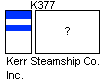
KERR STEAMSHIP CO. INC.
The funnel is recorded by Jordan and the wartime Ships & The Sea and Merchant Ships publications.
H. F. Kerr and A. E. Clegg formed Kerr Steamship in 1916. The cited history gives incorporation in 1977, a date Rosanoski marks sic, while the Inc. form already appears in Lloyds 1937–38. In 1939 it operated the tanker Alfred Clegg for Panama’s Maritime Trading, identified as a subsidiary. Clegg helped originate Christensen Canadian South African Lines in 1947, with Kerr acting as agent. Norton Lilly acquired Kerr in 1994, merging it into Kerr Norton Marine.
USA, San Francisco and New York.
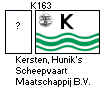
KERSTEN, HUNIK’S SCHEEPVAART MAATSCHAPPIJ B.V.
The canton device appears to be a circular black-and-white seascape bordered by very small black lettering. Its largest feature is a swallowtailed flag on a pole, described with the original notation Pbd. That flag appears white with a cross throughout and a letter in each quarter.
The company managed Cork Fenit Line after Hibernian Transport Companies went into liquidation. Southern & Western Shipping Ltd. (Ireland) Ltd. subsequently replaced it; the 1971 report calls the firm Kersten Hunik & Co.
Netherlands, Rotterdam.
Keymax Group.
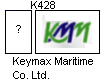
Keymax Maritime Co. Ltd. — KMM flag
K428 is sourced to the flag logo on the COSCO-Keymax website. The original also retains Keymax Maritime and MK Shipmanagement logos for context.
No exclusive fleet-wide use or unrecorded corporate equivalence is asserted.
Kikuyo Maritime was established in December 1991 to supply Filipino seafarers to Japanese owners and provide ship management. Management was later separated into MK Shipmanagement, dated by its website to December 1995. Kikuyo became Keymax Maritime in October 1999, concentrating on crewing and training. Lloyds instead describes a 1999 amalgamation with Mitoyo Shipping and later changes the formation date to 2000.
Keymax Group is dated to 2004. Earlier registers placed Kikuyo and MK under Inter Pacific Lines, giving their formation as 1992 and 1996 respectively. MK Shipmanagement (HK), formed in 2002, joined that listing in 2005. In 2007 the operators moved under Keymax Group; by 2008 Mecco, formed in Tokyo in 2004, was added and MK Shipmanagement (HK) removed.
Keymax Maritime was one of three shareholders forming TOSCO KEYMAX International Ship Management, whose opening ceremony took place on 16 June 2006.
Japan, Tokyo.
KEYSTONE LOGISTICS.
K419 is based on a photograph captioned Porhov, taken on 28 June 2012.
Keystone Logistics was formed in autumn 2008 for cargo forwarding, chartering and ships’ agency services. Its website describes Porthov without defining the relationship; Rosanoski considers a charter apparent. Most website photographs show a plain white funnel, possibly Balchart Eesti colours, while one may show an indistinct mark.
Russia, St. Petersburg.
KG L & R LÜTJENS & REIMERS GMBH & CO.
image by Jorge Candeias, 16 Dec 2004
image by Klaus-Michael Schneider, 13 June 2007; observation 2 April 2007
The flag is a white–red–white vertical triband with black serif L, & and R centred on the respective stripes. Accurat photographed on 1 January 2005 confirms the livery and a black ampersand, with white bands slightly broader than red, approximately 2:1.5:2. A monochrome advertisement from October 1926 also supports the flag, though the note calls it H505. The Massary funnel image is poor.
L504 is retained from Nüsse’s other table-flag example.
Schneider saw a table flag with a white ampersand at Neumühlen on 2 April 2007, while the company vessels he could see used black.
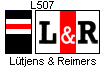
Hamburg Tugs gives equal-width funnel bands for L507; its 1989 publication establishes the variant by that date.
Brake and Grohn appear in Unterwesser markings.
Known informally as Left and Right, Lütjens & Reimers was founded on 8 October 1837 by lighterman Hans Hinrich Lütjens and merchant Amandus Reimers and registered in 1866. HAPAG acquired it on 24 January 1920, retaining its name and transferring harbour tugs and small craft to it during 1920–23. A name change is recorded in 1988. The later tug concern was wholly owned by Unterwesser Reederei and part of the Linnhoff group; Nüsse’s account dates Hapag-Lloyd ownership to 1994.
Germany, Hamburg.
KHALIFEH SHIPPING LINE CO.
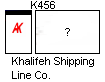
K456 is based on Abou Karim I’s starboard side in September 2013.
Khalifeh I began cattle imports in 1992. The company account dates Khalifeh Shipping Lines to 2002 as the group’s ship-management structure, which Rosanoski presumes followed individual vessel-owning companies. Lloyds instead gives 2007. Founder Hussein Mounir Khalifeh died in a plane crash in 2009.
Lebanon, Saida.
KHEDIVIAL MAIL LINE S.A.E.
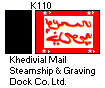
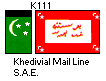
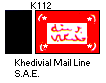
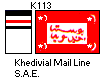
The flag is white with a red border, normally carrying a white crescent and star in each corner, and a red Arabic inscription on the field. The inscription changes with company names: five versions are recorded, though Rosanoski thinks the last three probably intend the same wording. Corner devices vary in position and are absent in Brown 1926. Stewart 1957 turns the fly crescents outwards with horns towards the lower hoist and uses a broader border, almost a red flag with a white panel. Its script differs slightly from Brown’s.
Three funnel forms are described: plain black; green with a black top, a white crescent pointing downwards to the right and three white stars in an angled triangle; and white with a black top and red-white-black horizontal bands. Stewart 1957 shows both the plain-black and green versions.
The sources successively use Khedivial Mail Steamship & Graving Dock Co., Khedivial Mail Steamship Co. and Khedivial Mail Line. P&O acquired interests in 1919.
U.K., London in Reed 1912; Egypt, Alexandria in Brown 1951.
KIAMA ROAD METAL CO. LTD.
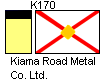
The flag is white with a narrow red saltire surmounted at the centre by a yellow diamond.
Kiama carried quarry stone from Kiama to Sydney from 1902. The quarry had been Carson’s and then Salmon & Deene’s before purchase by the New South Wales Government in 1911 as Kiama State Metal Quarry, including the steamer. One record dates the purchase to 1 September 1911 and the sale of the State Metal Quarries to Quarries Ltd. to 12 February 1936. Another vessel account gives a transfer to Bellambi Coal in 1932.
The Log instead places the vessel’s government takeover around the late 1920s, differing from the 1911 evidence.
Australia, Sydney.
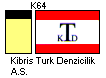
KIBRIS TURK DENZICILIK S.A.
The funnel is yellow or buff with a black top. The red flag has a broad white horizontal band carrying black KTD letters joined at the base by their serifs. K and D are very small, while the T is very tall.
Turkey, Mersin.
Kie Hock.
Documentary material — company attribution not established
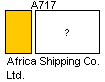
A717 is apparently based on Lydia, linked with Asia Selatan. Rosanoski identifies it tentatively with the former Tong Hoo, bearing Lydia from 1966 until scrapping in 1968, and presumes it ended under a named subsidiary.
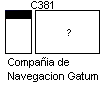
C381 is given for Galula of Compañia de Navegacion Gatun, presumed Singapore-based and recorded as a Kie Hock agency. Galula carried the name in 1964–65 during continuing Kie Hock control through several renamings.
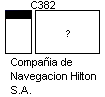
C382 comes from an unnamed vessel of Compañia de Navegacion Hilton, listed under Asia Selatan agency from 1966–67 to 1996–97.
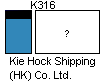
K316 is retained from the Mitchell collection.
Kie Hock Shipping (1971) Pte. Ltd. was incorporated on 27 November 1970 to take over the earlier Singapore company’s assets and liabilities. The source gives its trading commencement as 1.1.171, an incomplete year. It was wound up on 26 May 1978, although later registers continued to list it in differing capacities. Tay Hock Gwan and his nephew Tay Beng Chuan were the managing and executive directors. Separate register entries cover Kie Hock Shipping (HK), Kie Hock Shipping (1975) HK at the Singapore address, and Kie Hock Shipping Sendirian Berhad at Port Kelang.
The winding-up account names twelve Panamanian companies: Compañia Naviera Thompson, Africa Shipping, Gammewah Enterprises, Tali Shipping, Compañia de Navegacia Laiton, Holley Shipping, Karingo Shipping, Kadima Shipping, Benteng Enterprises, Sahaka Enterprises, Salama Shipping and Gambela Enterprises. Tali was an older subsidiary formerly based in Hong Kong and later Somalia.
Asia Selatan Enterprises was a subsidiary of Kie Hock and itself held Africa Shipping, wound up in May 1978, with some vessels transferred to Honduran companies. Asia Selatan also acted for Compañia de Navegacion Hilton. Kie Gwan was formed in February 1978 and later appears at Port Kelang. Tong names were associated particularly with the Hong Kong fleet, while the Singapore ships briefly used An; both had returned to Tong by 1973–74 before the convention faded.
Singapore, Hong Kong and International.
KIELER VERKEHRS A.G.
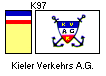
The yellow or buff funnel has a blue top separated by white and red bands. The white flag bears a shield over two black anchors in saltire. The shield has blue, white and red horizontal bands carrying respectively yellow KV, black AG and a yellow K.
The company is recorded in Lloyds 1963–64 as Kieler Verkehrsaktiengesellschaft, Abt. Schiffahrt, with a differently spelt form in 1970–71.
Germany, Kiel.
KIEPE.
image by Jarig Bakker, 23 Oct 2005
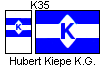
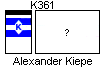
Alexander Kiepe’s livery continued under Hubert Kiepe as K35, reproduced by FOTW from Brown 1995. Mitchell separately associates K361 with Alexander and the vessel Alexander. The source’s change-of-name sentence is incomplete and its 1984 date conflicts with the earlier register appearance.
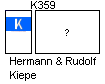
Mitchell gives K359 for Hermann & Rudolf Kiepe, recorded for Heimar in 1967–75. His card instead names Herm Kiepe, which Lloyds places under Kiepe-Schepers.
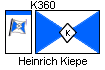
Mitchell gives K360 for Heinrich Kiepe and Thea K, 200/1960. The flag was derived from the funnel, rather than separately observed. A 2005 photograph of the later Heljo shows a yellow-and-blue diagonal marking on the superstructure and a blue flag with a diamond, neither clearly readable and neither identified as K360.
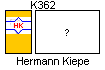
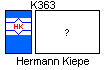
Mitchell gives K362 and a second funnel K363 for Hermann, written Herman on the card. K363 may relate to Marga Kiepe, 290/1951. Lloyds lists three Haren-Ems owners of that name, one owning the vessel.
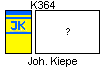
K364 is given for Joh. Kiepe and Heljo, owned in 1966–79. Mitchell places the owner at Haren-Ems, while Lloyds 1978–79 gives no domicile.
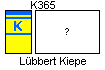
K365 is recorded for Lübbert Kiepe and Harun, 425/1967, confirmed in Lloyds 1970–71.
Several presumed family members appear as mainly single-coaster owners from Lloyds 1953–54. By 2005–06 only Heinrich Kiepe Schiffahrts remained in that listing, its Heljo being sold in 2006, apart from the continuing Kiepe-Schepers connection treated separately under Schepers.
Germany, Haren-Ems.
KIHLBERG-REDERIERNA A/B.
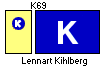
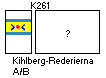
K69 is a blue flag with a white K, shown by Brown 1978 and on a cap badge labelled Kihlship. Mitchell gives the funnel a lighter blue.
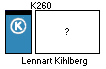
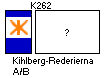
Of Mitchell’s five Lennart Kihlberg funnels, K260 appears earliest and is definitely linked to Kihlberg. K261 resembles Kalmarsund markings. K262 is assigned to Coppelia, listed in 1985–86 as managed for P/R for m.t. Coppelia.
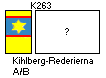
K263 is also retained from the Mitchell collection.
Collectors Corner’s supposed second Kihlship flag is Kalmarsund’s K68, confirmed by company correspondence. Nüsse received that flag from Swedish Gulf Line twice in the early 1990s, most recently March 1993, and reported the emblem on funnels. Rosanoski considers that the livery was retained or taken over with former Kalmarsund ships, rather than proving a separate original Kihlberg design.
Lennart Kihlberg operated principally as Kihlberg-Rederierna, with register entries from 1958–59. Associated operations included Rederi A/B Fjord, Rederi Eystrasalt, Kihlbergs Fartysgagentur, later Kihlship, and part of Kalmarsund’s fleet. Fartysgagentur also acted for Sören Petterson. Swedish Gulf Line appears to have been acquired in the mid-1970s, though Rosanoski allows that only the name was taken over or reused. It later acted as owner and agent, retaining Kihlberg’s former telephone number in 1992–93.
Sweden, Gothenburg.
KILLICK & POLLEXFEN.
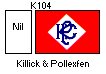
The flag, shown for Ashleigh Brook Line, is red with a white diamond containing ornate intertwined K and P letters. No funnel is given.
The company is associated with Ashleigh Brook Line; the source does not distinguish ownership, management or agency.
U.K., Liverpool.
KIMBERLEY KING ISLAND TRADING PTY. LTD.
The funnel is sourced to The Log, February 1990.
The company operated from 1959 to 1968 according to The Log and appears in Lloyds 1963–64 and 1966–67.
Australia, Currie.
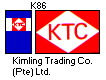
KIMLING TRADING CO. (PTE) LTD.
The funnel is blue with a broad white band bearing a flag panel through the band’s full depth. The red flag has a white diamond throughout containing red KTC letters.
Kimling appears in Lloyds in 1966–67, 1970–71 and 1978–79, with Kimling Trading Co. Ltd. among the forms used.
Singapore.
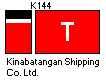
Kinabatangan Shipping Co. Ltd.
Concordia Kinabatangan Shipping S.A. — Tawau Bay, February 1963
The funnel is red with a black top separated by a narrow white band, and the flag is red with a white T. The livery was noted on Semporna Bay in August 1964, whose actual ownership was unknown, and Tawau Bay in February 1963. The latter belonged to Concordia Kinabatangan Shipping, at the same address.
Semporna Bay company, exclusive use and relationship to Kinabatangan remain unknown.
The company appears in Lloyds from 1963–64 to 1973–74, with United China Shipping as agent.
Hong Kong.
Kinay Group.
Documented shared associations — Alfa Star funnel / Alfamarin website logo — documented common design
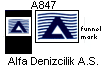
A847 is based on Alfa Star in November 2005. The dull photograph gives muted design colours consistent with the website, while an August 2003 photograph has indistinct lines but a clearly lightish-blue main emblem.
Website images for Alfamarin and Mariner in May 2000 may be flags or merely logos. The field boundaries are unclear, including whether a white border is present.
Sinomar website photographs show a blue funnel on Alfa Dragon and green funnels on Alfa Sun, Afa Moon and Alfa Twilight. Their unreadable circular badge might resemble Kamenit’s Yardimci marking, but no connection was found.
Ali Riza Kinay established a ships’ agency at Bandirma in 1946. UNM, later Hasat, followed in 1979 for foreign trade, and Alfa Shipping in 1982 as the brokerage arm. The first vessel, M Engin, was acquired in 1986; a ship-management operation was planned in 1991. Newbuilding replaced reliance on chartered or second-hand vessels from 1996, beginning with Hassat. The founder died in 2002, and chartering and brokerage became Kinay Chartering in 2005. Alfa was the main shipowning company, directly and through subsidiaries. Other interests included Alfamarin, which owned Alfamar in 1992–97, Hasatmar Ship Management and Mariner Shipping.
Rosanoski tentatively identifies Alfa Shipping with Alfa Denizcilik, dated by Lloyds to 1994 and recorded for Alfa Star, owned in 1994–2006. It later appears under Hasatmar Gemi Isletmeciligi, which Lloyds dates to 2001. Mariner Dis Gemicilik is dated to 1982 and appears for M. Engin.
Sinomar Deniz Isletmeciligi, formed in 2006, used Kinay web and email addresses and Alfa ship names. Rosanoski considers these indications of a connection, though the Kinay website did not mention it.
Turkey, Istanbul.
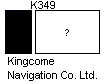
KINGCOME NAVIGATION CO. LTD.
The funnel is preserved from the Mitchell collection.
Kingcome was formed in 1914 and acquired by Washington Corporation in 1997, becoming associated with Seaspan International. Seaspan’s history says Kingcome was amalgamated into it in 1999, although the name continued in later Lloyds listings.
Canada, Vancouver.
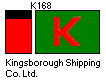
KINGSBOROUGH SHIPPING CO. LTD.
The funnel is red with a black top; the green flag bears a red K. Talbot-Booth assigns the livery to P. D. Hendry but also names Kingsborough in the 1942 index.
Kingsborough belonged to P. D. Hendry & Co.
U.K., Glasgow.
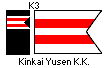
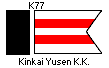
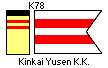
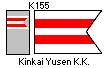
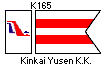
KINKAI YUSEN K.K.
K77 was used until about 1930.
K78 served the Kobe–Keelung route in the 1920s.
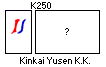
K3 was used from about 1930 to about 1970, followed by K155. Watt and US Navy show K3’s emblem as a full-width band, as Watt also does for K155. Brown extends it only part-way aft, while Talbot-Booth 1942 and 1944 show a panel and an alternative Nippon Yusen funnel. The Japanese Shipowners Association confirms the K3 band but puts its tail to the viewer’s left, presumably a starboard view.
Watt gives K165 for Blue Zephyr and Sabrina, both built in 1990, saying red is forward on both sides. Rosanoski notes that this does not fit the illustrated design unless it is a starboard view.
Mitchell assigns K250 to Blue Zephyr, consistent with Watt’s vessel observation but differing in design.
K249 is retained from the Mitchell collection.
Harnack 1934 and 1938 lists Kinkai under Nippon Yusen without mentioning a separate livery, despite the variants recorded by Watt.
Kinkai Yusen, the Near Seas Mail S.S. Co., became financially separate in 1922 and was formed in 1923 as Nippon Yusen’s short-sea subsidiary. It was absorbed back in 1939 and re-established in 1949. Nippon Yusen’s near-seas and domestic coastal services were transferred to it in 1969; later registers continue to place it under Nippon Yusen.
Japan, Tokyo.
KIRBY CORPORATION.
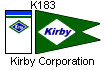
K183’s funnel is based on City of Louisville’s port side in December 2013; its flag is sourced to USA Houseflags.
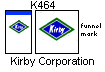
K464 is based on Volunteer’s starboard side in February 2014.
John Henry Kirby formed Kirby Petroleum in 1921. After sale of its producing properties in 1956, the remainder merged with three oil and gas companies as Kirby VanSyn Petroleum, reverting to Kirby Petroleum in 1957 and becoming Kirby Industries in 1967. Dixie Carriers was acquired in 1969. Restructuring under Kirby Exploration followed in 1974, with public ownership in 1976. Sale of the oil and gas assets in April 1988 focused the business on marine transport; Kirby Corporation became the name in 1990.
Expansion brought Alliance Marine in 1986; Alamo Inland Marine and Brent Towing in 1989; International Barge Lines in 1991; Ole Man River Towing, Scott Chotin and South Texas Towing in 1992; and Guidry Enterprises and Chotin Transportation in 1993, alongside AFRAM Carriers and Dow transport assets. Sabine Towing was held from 1992 to 1998. In 1998 Kirby sold offshore barges, ships and harbour tugs and renamed Dixie and the other marine subsidiaries Kirby Inland Marine. Hollywood Marine merged into it in October 1999, bringing a history of acquisitions including Alamo Barge Lines, Stellman, Ellis Towing, Arthur Smith, Koch Ellis and Mapco.
Further purchases included Cargo Carriers, Union Carbide and part of Coastal Towing in 2002, with management of Coastal’s remaining fleet; SeaRiver Maritime’s fleet in 2003; American Commercial Lines’ black-oil fleet in 2005; and the rest of Coastal in 2006. Previously leased barges were purchased from Cypress Barge Leasing, Midland Marine, Siemens Financial and OFS Marine One in 2007–08. Penn Maritime was acquired in December 2012.
Dixie Offshore Transportation, formed in 2003 at Belle Chasse, appears as Kirby Ocean Transport in 2011–12. Lloyds dates Houston-based Kirby Inland Marine to 1993 and later uses LP rather than Inc.
USA, Houston, Texas.
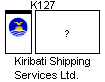
KIRIBATI SHIPPING SERVICES LTD.
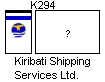
Nei Matangare has K294 without the sun. Moanaraoi, photographed in September 2007, appears without the black top or blue band; its blue circular device is obscured. Enlargement only suggests possible white stars above and beside the bird.
Documentary images — company attribution uncertain
The Tetauu image is too small to establish detail, particularly the number of wave bands. It appears to show a bird and rising sun and is described as a variation of Kiribati’s sun-and-frigate-bird design.
Exact operator and wave details uncertain.
The Shipping Corporation of Kiribati was formed in 1980 and became Kiribati Shipping Services, or KSSL, in 1992. Tetauu was formerly the Japanese Crane South, detained for operating within Kiribati territorial waters and renamed in 1995. The Log calls the operator Kinbari Shipping Services, which Rosanoski considers a likely misprint. Registers place Tetauu under the Kiribati government in 1996–98 and under Singapore’s Kosiam Trading in 2001–02, suggesting a subsequent sale.
Kiribati, Tarawera in Lloyds 1980–81 and Betio in 1985–86.
KIRKCALDY, FIFE & LONDON SHIPPING LINE.
The funnel and flag follow Lloyds 1912.
Lloyds 1912 names Stocks, Turnbull & Co. as operator. The cited history says that concern was incorporated in 1910, had previously been London & Kirkcaldy Steamship Co., and was acquired by Coast Lines in 1918. Merchant Ships 1942 instead gives H. L. Stocks & Co.
U.K., Kircaldy, as written in Lloyds reference.
KIRTON & EARNSHAW LTD.
The funnel is sourced to The Log, February 1990.
The coal operators bought Excelsior Mine in 1905 and built Conjola in 1920; the vessel sank on 21 July 1927. The Compendium gives their Belbowrie ownership as 1922–25 and Shoalhaven S.S. ownership in 1925–27, whereas The Log says Kirton & Earnshaw sold it in 1927.
Australia, Sydney, assumed by Rosanoski from Conjola’s registration.
Kitanihon-Oi Kaiun K.K.
KITANIHON-OI KAIUN K.K.
The post-war US Navy and Brown depictions make the second horizontal red band and the two vertical strokes wider than the white spaces, while the other red horizontal bands are narrower. The vertical strokes are farther apart, at one-third and two-thirds of the flag’s length. Rosanoski does not decide whether this represents a design change or flags of companies whose relationship remains uncertain.
KITANIHON KISEN K.K.
A separate Kitanihon Kisen entry appears in registers of the 1970s and is later combined under Kitanihon-Oi Kaiun. It is retained here as a separate source identity rather than proof that the companies were identical.
Japan, Tokyo.
Kita Nippon Kisen K.K. / North Japan Steamship — historical source panel
The FOTW illustration, derived from a design dated 1916, has equal bands. Talbot-Booth’s funnel markings likewise have equal widths, but the top white band on the black funnel continues across rather than breaking.
No assertion of legal continuity with Kitanihon-Oi or identical postwar use.
The device combines a stylized kanji for “Kita” above the first kanji of “Nippon”. Their adjoining strokes merge into the thicker band. Alan Watt describes a break in the top funnel band and notes that pre-war photographs show four thin white bands, the uppermost broken. He regarded a post-war change as apparent, while noting errors in published depictions, including a red funnel design in a 1930 source.
The source records steamship ownership from 1914. Kita-Nihon and Kita Nippon are transliteration variants of North Japan, but Rosanoski is not certain that every later register entry represents the same company. One account places the addition of “Oi” and adoption of “Kaiun” in 1953, although later books and registers do not consistently show it. Some vessels and the livery suggest continuity; differing addresses and overlapping names leave the relationship unresolved. Osaka Shosen Kaisha managed part of the fleet.
Japan: Karafuto, later Tokyo; the Kitanihon-Oi entry is also recorded at Adogawa before Tokyo.
KIWI SHIPPING LTD.
The funnel is sourced to The Log, August 1986.
Kiwi Shipping was registered on 26 March 1985 by a consortium of McKay Shipping, Geo H. Scales and Norwegian interests. It acquired Kiwi for a Cook Strait ro-ro service, but the service proved impractical and the ship was immediately sold. Liquidation ran from 10 July 1992 to 8 March 1993, followed by striking off. Rosanoski distinguishes it from the similarly named company in Lloyds 1985–86.
New Zealand, Wellington.
Kiyo Kaiun K.K. (1)
KIYO KAIUN K.K. (2)
Kiyo Kaiun (1)
Lloyds dates the Osaka company to 1980, but Rosanoski traces it through vessels to at least 1963. He attributes the later date to an erroneous combination with the Shimonoseki entry in 1978–79, corrected in 1980–81.
Japan, Osaka.
Keep the explicit scope label independent; no alias or company identity is inferred.
Kiyo Kaiun (2)
Mitchell’s funnel is listed in the original Tokuyama section.
The Tokuyama company was formed in 1971 and likewise combined erroneously with the Shimonoseki entry before reinstatement. It appears in Tokuyama Group’s 2000 report for transport and warehousing, then is replaced in 2001 by Tokuyama Logistics. Rosanoski presumes continuity, supported by the latter’s cement-carrier work, while noting another company of the same name. Lloyds dates Tokuyama Logistics to 2001 and later places the fleet under it.
Japan, Tokuyama.
Keep the explicit scope label independent; no alias or company identity is inferred.
Kiyo Kaiun (3)
The Shimonoseki entry wrongly incorporated the Osaka and Tokuyama companies in 1978–79. It was corrected in 1980–81 and appears again in 1996–97 after intermediate omissions.
Japan, Shimonoseki.
Keep the explicit scope label independent; no alias or company identity is inferred.
Kiyo Kaiun (4)
A separate Namikata company appears in Lloyds 2001–02 and 2005–06.
Japan, Namikata.
Keep the explicit scope label independent; no alias or company identity is inferred.
KJELL OVE SÖDERBERG.
A 1969 photograph of Stor-Erik supplies the funnel.
Lars Olof Söderberg bought the tug Stor-Erik on 5 August 1968 and transferred her to Kjell Ove Söderberg on 15 September. Kjell Ove sold her at auction on 18 March 1970.
Sweden, Kramfors.
KLAUS BLANCK.
B1056’s funnel and flag follow Hela, with a starboard funnel view dated 9 August 2007 and portside photographs.
B1055 follows Fredo: the starboard funnel on 6 July 2013, and the portside funnel and flag on 7 May 2013.
Photographs of Beta in 2008 show the funnel logo removed and Rhein-Maas-und See Schiffahrtskontor’s logo on the superstructure, which Rosanoski interprets as evidence of an RMS charter.
Klaus Blanck’s business was formed in 1991. Its operating company Willem Blanck was established in Freiburg in 1997; by 2011–2012 Hela was listed under Willem Blanck und Bernd Blanck.
Germany, Öderquart.
Klaus Boyksen.
Documentary images — company attribution uncertain
Anton/Klaus relationship and flag succession remain open.
The local Anton Boysken, Klaus Boksken and Frieda Boyksen references may involve spelling errors and separate generations. No independent link to Klaus's 1970s fleet/livery was established; unrelated modern namesakes were rejected.
The register records Kapitän Anton Boysken in the 1960s, Anton Boysken in 1970–71 and Klaus Boksken in 1973–74, under manager Peter Döhle. Rosanoski suggests a possible connection with Anton & Wwe Frieda Boyksen of Rodenkirchen, listed in 1953–54, but does not establish it.
Germany, Brake.
KLAUS GRUBE.
The funnel is yellow or buff with a broad white top bearing the flag. The flag is a horizontal biband, whose colours are not specified in the text, with a white diamond issuing from the hoist across the field and overall black CG letters.
Klaus Grube appears in Lloyds’ 1970–71 List of Shipowners.
Germany, Pinneberg.
KLAUS JURGENS SCHIFFAHRTS UND VERWALTUNGS G.M.B.H.
The white funnel has a narrow blue top and a blue diamond over a shortened red saltire. The diamond contains white KJ letters, the J lacking its sinister arm. The white flag similarly bears a red saltire beneath the blue diamond and initials.
The company began as Klaus Jurgens in 1978 and adopted its later name in 1995. Ships were held through individual companies, including Birgit Jurgens, formed in 1993, and Antje Jurgens, formed in 1996.
Germany.
KLAUS MIMIETZ.
The flag is a horizontal blue-white-red triband with an overall white shield, edged black, bearing a red M. The funnel is yellow or buff with a broad band of the flag.
Germany, Rendsburg.
KLAUS SPECK GMBH.
The flag is blue with a yellow lion passant. No funnel is given.
Formed in 1970, the company operated through one-ship subsidiaries. Later Lloyds and Nüsse records use the spelling Claus Speck.
Germany, Flensburg; later Hörsten.
KLAUS-HEINRICH LÜHRS SCHIFFAHRTS K.G.
The flag is diagonally quartered green and red, with a black-outlined white saltire surmounted by a black-outlined white disc and black L. Shades follow the website image. No funnel is given.
Germany, Wischhafen.
KLÖCKNER GMBH,
The charge is probably crossed hammers, interpreted in the iron-and-steel context.
Klöckner 41 was built in 1962 and became Rhenus 146 under Fendel Stinnes in the same year. Rosanoski suggests the owner may have belonged to the Klöckner & Co. steel and metal distribution group.
Germany, Dbg Ruhort.
KNIGHTSBRIDGE TANKERS LTD.
All five ships on the company website show the same funnel as Chelsea in April 2004. Rosanoski considers that they appear to have retained Shell colours.
Knightsbridge, or KTL, was incorporated in Bermuda on 18 September 1996. Five newly bought vessels were chartered to Shell from February 1997 to March 2004, with a seven-year renewal right that Shell did not exercise. Although liquidation was threatened, the company continued, with Frontline Management (Bermuda) managing the fleet on time charters and the spot market. Golden Ocean acquired a 10% holding in 2010.
Bermuda, Hamilton.
Knud I. Larsen A/S.
KNUD I. LARSEN A/S.
image by Jarig Bakker, 29 November 2005
The recorded shades follow an unidentified website image but are lighter. Brown 1995’s narrow white edging to L91’s letters may be shading or a printing misalignment, since the opposite side appears darker where red overlaps blue. Jarig Bakker’s FOTW image follows Brown.
L359 is based on Anne Sif on 20 July 1998. Rosanoski presumes an all-blue funnel, although its lower part is white with the superstructure in this photograph. Nüsse supplies a table flag.
L358 preserves Brown 1982’s version.
Rederi I/S Sif
Rederi I/S Sif, an operated company in the 1960s and 1970s, used S230. Similar numbered Sif companies were presumably subsidiaries. Brown 1971 gives the flag smaller letters.
Knud I. Larsen was formed in 1957. Following receivership it was reformed through KiL Management in October 1998 as KiL Shipping. KiL Management had been formed at Vedbaek in 1994 and closed with the parent’s receivership; KiL Singapore, formed in 1996, continued under the successor. I.M. Frellsen Shipping is listed as an associate.
Denmark, Copenhagen; later Vedbaek.
KNUT BERGQUIST.
US Navy 1961 shows a blue swallowtail with a yellow “B”. Talbot-Booth gives a different pre-war funnel, so the flag may represent a later development.
Knut Bergquist operated before and after the Second World War, into about the mid-1950s. He managed Rederi A.V Vinga in 1939.
Sweden, Gothenburg.
KNUT LUNDGREN & CO. A/B.
Mitchell’s oil-drop emblem appears to contain a black human-like figure with arms and legs, but a pointed, more animal-like face. Bituma had been on long-term charter to Johnson Shipmanagement from 1986, and a photograph shows the funnel later associated with TSA. Margot and Margita apparently used related liveries originating with J.A. Johansson; these are discussed separately under TSA.
Knut Lundgren managed Margot in 1988–89 and Margita by 1992–93; both later appear under TSA Tanker Shipping. Mitchell also associates Bituma, whose intervening history is unclear. Rosanoski thinks Lundgren ceased ship management by 1996–97 and may then have owned Rederi A/B Brevik, subsequently sold to Sirius in December 2006, but the translated ownership account is uncertain. Agency and tanker-chartering activity continued.
Sweden, Gothenburg.
Knutsen O.A.S. Shipping A/S.
KNUTSEN O.A.S. SHIPPING A/S.
image by Jarig Bakker, 26 September 2005
image by Jarig Bakker, None
image by Ivan Sache, 1 December 2003
K309 was the original livery, replaced by K227 in 1912. The latter flag is white with a large, plain black K.
The funnel changed to K53 in 1929. Photographs confirm bands separated by their own width, while Talbot-Booth leaves a wider gap. Stewart 1963 joins the K’s angled arms directly to its vertical and shows K53 and K54 as alternatives; it specifies silver or aluminium for K54.
The new flag probably dates to the 1984 change of owners, with the funnel basis unchanged. Brown’s K20 panel makes the lowest blue lines progressively wider downwards, reversing the website logo’s order.
Anna Knutsen’s port side and Kristin Knutsen’s starboard side confirm the K229 funnel. Its flag is Rosanoski’s adaptation of the website logo, made rectangular rather than square in line with Brown, but with the lower bands narrowing downwards.
Ivan Sache’s website-logo image K228 was later removed from FOTW and replaced by K20.
K310 and its alternative K311 were adopted in 1982 according to Skipet.
Skips A/S Marie Bakke
Mitchell gives M588 as the original colours of the operated Skips A/S Marie Bakke, with M589 applying from 1929.
Knutsen traces its origins to the founder’s first vessel in 1896 and steamship ownership to 1897. North Sea trading and fishing expanded into tankers and liner services between Europe and South America, then the Orient. Tanker investment in the early 1970s led to financial difficulty during the late-decade crisis. The company name changed from Knut Knutsen O.A.S. in 1982, and the family left in the 1984 reorganisation. The 2004 history names Jens Ulltveit-Moe and Trygve Seglem as principal owners; Seglem acquired Ulltveit-Moe’s shipping assets in 2008. A Jo Tankers pool arrangement began in 2000. Bakke and Knutsen names characterised the fleet.
Operating companies included Singapore’s Heritage Carrier, formed in 1997; Knutsen Management at Aalesund, formed in 2006; and Vibran Shipping. Knutsen Aaby Tank was a 1990 joint venture with E. B. Aaby for Dicto, later sold.
Norway, Haugesund.
KNÖHR & BURCHARD NACHFOLGER (GMBH & CO.).
image by Jorge Candeias, 2 May 2004
The flag is white with a blue disc near the centre. Lloyd Reedereiflaggen includes Schlüter & Maack with the company, and US Navy 1961 shows a small disc. Jörg M. Karaschewski confirms receiving an original table flag.
Rosanoski considers the K8 funnel likely erroneous.
The fleet probably used Columbia colours by 1996. A September 2006 photograph shows Isebek in UCT, United Chemical Transport, colours in the Schoeller Holdings context.
The firm is traced to 1814 in the cited company history and contributor testimony, while Lloyds gives 1923. It co-founded Deutsche Dampfschiffahrts-Gesellschaft Kosmos on 28 November 1872. By the 1990s its chemical tankers were managed by Columbia Shipmanagement through registered owning companies. In August 2008 the last vessel, Isebek, under Antilla Shipping, appears with Hanse Shipping, linked by address and telephone to Hanse Bereederungs.
Germany, Hamburg.
Knüppel.
KNÜPPEL.
Mobil gives a biscuit shade and no black funnel top. Mitchell’s July 1976 Goole sighting probably concerns Heinrich Knüppel, for which he supplies a drawing. His Peter Knüppel drawing instead has a black base, at odds with K297; Rosanoski wonders whether charter periods explain it.
Mitchell gives K297 for Hans-Hermann’s Peter Knüppel, possibly for that vessel alone.
K298 is assigned to Markus Knüppel at Lubeck and the vessel written Hildegarrd Knüppel. Rosanoski cautions that Markus may not be connected with the Hamburg owners.
K300 is documented on K-Storm’s starboard side in November 2008 and K-Stream’s port side in April 2006. K-Storm also has the flag painted as a panel on its superstructure.
K299 is retained from the Mitchell collection without a separate verbal description.
The business originated with Captain Johannes Knüppel in 1924. Registers distinguish Johannes, Anna and Hans-Hermann, Hans-Heinrich, and Markus rather than proving a single concern. Hans-Hermann Knüppel Schiffahrtskontor was formed in 1971 and appears under Johs. Thode in later years. Another Hans-Herman entry, also dated to 1971, became Knuppel Schiffahrts-GmbH & Co. K.G. in 1997. K & K Schiffahrts was formed in 2005 by pooling the assets of Knüppel Schiffahrts and Hans Krüger and appears as an operator in 2008.
Germany, Hamburg; Markus Knüppel is separately placed at Lubeck in the livery account.
KORNELIUS OLSEN.
The emblem is a K within an O. Rosanoski rejects Jordan’s white O on a white band as erroneous and notes that Jordan gives blue funnel bands instead of green.
The first funnel is black with a broad white band carrying a black O. The second is yellow or buff with a black top and a broad white band edged in green, bearing a red ring enclosing a red K. The flag is white with narrow green horizontal bands near the top and bottom, and a yellow triangle extending from the hoist containing the red ring and K.
Kornelius Olsen managed a small fleet through separate companies. Jordan describes two name subsidiaries; Lloyd’s lists them as managed companies, with one or two recorded at different dates.
Norway, Stavanger.
KR. KNUDSEN.
K145 was noted on Skjelbred. The funnel is yellow or buff with a very narrow black top and a red panel bearing a white-edged blue cross. A white circle at the crossing contains blue OS letters.
K146 uses a black funnel with the same panel. It was noted in October 1964 on a vessel tentatively named Truth, agreeing with Lloyds Calendar. No flag was recorded.
Unknown.
Kristen Kristensson.
KRISTEN KRISTENSSON.
Sweden, Donsö.
REDERI DONSÖTANK A/B.
image by Jarig Bakker, 12 January 2006
Evinco confirms D95, but without white edging to the T on the funnel. Website photographs suggest a darker buff base and mid-maritime blue. Nüsse’s table flag has a grey T, its crossbar over the D and its vertical beneath, apparently narrowly edged white. Badge colours are uncertain, and the company logo does not settle the edging.
The FOTW rendering follows Brown 1995. Rosanoski corrects Brown’s black T to grey and specifies the over-and-under relationship of T and D, while retaining uncertainty over the narrow white edge.
D300 is retained from the Mitchell collection.
Donsötank’s website gives family registration in 1953, while Lloyds gives 1954, presumed by Rosanoski to mark the start of shipowning. It entered a strategic partnership with United Tankers in 1992 and cooperation with ESL in 2004. Some vessels were partly owned with Broström.
Sweden, Donsö.
Kristensson interests
Kristen Kristensson is dated to 1953 and recorded as Donsötank’s operator from the 1950s. Later entries include Kristen Kristensson P/R and Lars Borje Kristensson. Donsö Bunkerservice remained active with family management after sale of Ömega af Donsö, despite disappearing from the group register.
Keep the explicit scope label independent; no alias or company identity is inferred.
KRISTEN MARINE S.A.
The funnel is based on a photograph of Mariner II.
Kristen Marine began ship management in 1995. Lloyds initially dated formation to 1998 but amended this to 1995. The registers associate it with Roxana Shipping at the same address; by April 2008 both are operating companies of Pancoast Trading.
Greece, Piraeus and later Athens.
Kristian Gerhard Jebsen Skipsrederi A/S.
KRISTIAN GERHARD JEBSEN SKIPSREDERI A/S.
image by Ivan Sache, 1 December 2003
image by Jarig Bakker, 26 September 2005
Rhodos Cement in January 2005 confirms J15. Iceland Cement in May 2005 instead has rescue-orange funnels, without an explanation on the company website. Ivan Sache’s original website-based FOTW flag uses brighter blue; Jarig Bakker later replaced it with a Brown 1995 rendition.
Mitchell appears to associate J137 with Gas Lion, presumably on charter.
K457 shows Mariana III’s port funnel on 26 November 2013.
SKS OBO HOLDING LTD.
SKS Tweed’s starboard funnel appears light turquoise, with touching square-cornered letters and pointed S ends. SKS Segura’s port view instead shows ordinary letters separated from one another, as on the company logo.
SKS OBO Holding was formed in 1997, while SKS became the operating brand for OBO and tanker companies under KGJS. Richard Redding explains its origins in a 1991 pool of ten OBOs: seven from Sovecomflot, one from KGJS and two from Sinochem, operated by Pelican Shipping in London. That pool ended in 1995, but KGJS retained SKS as a trade name. A new fleet began in 1996, and all operations moved to Bergen from 2010. Vessels use SKS as their first name.
Bermuda, Hamilton.
Gearbulk Shipowning vessels and ships with Arrow as their second name use Gearbulk colours; Mitchell includes the source-only G1 on the Jebsen card.
Family-owned KGJS was founded by Kristian Gerhard Jebsen in 1967, initially managing two coastal vessels. Its interests expanded to Gearbulk, Canadian Transport, OBO Shipowning, Bulk Trading Group and SKS Obo. Gearbulk is recorded as a 60/40 venture with Mitsui O.S.K.; Rosanoski reads the 2000 register as apparent complete acquisition, although Gearbulk Holding is still listed as an associate in 2008. A fifty per cent Flumar interest is recorded, with acquisition dated 2005. The wholly owned cement operation included Singapore ownership and management and Bergen fleet management companies.
Norway, Bergen.
KRISTIAN GJÖLBERG JR.
Lloyds lists Kristian Gjölberg in 1953–54 and Kristian Gjölberg Jr. in 1973–74 and 1978–79. The concern managed A/S Norsk Hvalfangst, apparently a subsidiary, and its vessels bore Finnhval names followed by Roman numerals.
Norway: Oslo and later Bergen.
KRISTIAN STEENSEN.
The funnel is blue with a black top and a yellow band bearing black KS between two black horizontal batons. The flag is diagonally quartered blue and yellow, with black K and S respectively on the yellow quarters.
Steensen is recorded in 1963–1964, with Adolph Andersens Eft. as agents.
Denmark, Randers; later Aarhus.
KRISTINA CRUISES OY.
K420 was one of two flags flown, its circular badge also appearing on Kristina Regina’s bow. Rosanoski regards it as the original design on the evidence of Mitchell’s R410 funnel.
The second flag appears to be K422, partly obscured in one photograph. Its letters may match the funnel’s greenish turquoise or be blue as in K421. Kristina Regina generally shows greenish turquoise; Kristina Katarina can appear bluish, perhaps through lighting, paint or another cause, and a May 2013 view shows dark sky blue. Mitchell’s dark-blue K421 seems incorrect to Rosanoski.
The ships also fly a stem jack, apparently blue with a gold bird above, or holding, a white anchor crossed with an unidentified white device. The details remain uncertain.
The family business traces its island ferry origins to Keijo Partanen, whose son Mikko and daughter Anu ran the later cruise company. The original prints the earlier decade as 19050s, so no corrected decade is supplied here. The company website dates formation to 1985; Lloyds gives 1986 as Rannikkolinjat, renamed Kristina Cruises in 1991.
Finland, Kotka.
KROLL-SCHIFFAHRT GMBH.
image by Ivan Sache, 29 Apr 2006
image by Klaus-Michael Schneider, 8 April 2009; sighting 30 April 2007
image by Neale Rosanoski, None
Ivan Sache’s FOTW rendering follows links supplied by Jan Mertens. Rosanoski considers both its blue shade and K shape incorrect.
Schneider supplied a variant based on a flag observed at Billwerder Bucht, Hamburg, on 30 April 2007. Rosanoski finds the illustrated K smaller than the actual letter and the blue slightly too light.
K388 is Rosanoski’s interpretation with the letter drawn correctly in his judgement; he allows that its blue may be slightly too dark.
Günther Kroll bought his first inland barge in 1961. Horst became part-owner in 1974, and the present company name dates from 1979. Günther left in 1994, after which Horst and Barbara led the business; Jan-Matkus joined in 2002. Inland transport, particularly building materials, remained its principal work.
Germany, Seevetal-Maschen.
KRONOS MARITIME AGENCY S.A.
The funnel and flag follow Brown 1995.
Kronos Maritime Agency was formed in 1947 and is recorded as an agency business.
Greece, Piraeus.
KRONOS SHIPPING S.A.
Dynamis in April 1965 had a blue funnel with a yellow band, K151.
Angelic in May 1965 and Dynamis in August 1966 showed K152: blue with a black top separated by a yellow band. This is described as the regular funnel and associated with V. Pateras.
Documentary images — company attribution uncertain
K153, yellow or buff with a black top separated by a fairly broad blue band, was seen on several vessels probably under charter. No flag was recorded.
Charterer identity unavailable.
Kronos appears to have acted as agent, with vessels recorded care of the company.
Unknown.
Krupp Seeschiffahrt GmbH.
KRUPP SEESCHIFFAHRT GMBH.
image by Jarig Bakker, 21 Jan 2005
Brown 1926 shows a red-white-red flag with bands about 1:5:1 and three black rings on the white. The livery commentary calls them intertwined, unlike the corporate trademark account’s explicit description of superimposed rings. Its 1926 publication establishes use before 1930; later sources resume after the war.
The post-war ring flag is recorded in US Navy 1961 and Brown 1995 and by Nüsse’s table flag. Herkules VI confirms the K121 funnel, with a slight variation associated with its inland-vessel form.
Friedrich Krupp — early London/Essen source variants
image by Eugene Ipavec, 15 Dec 2009
image contributed by Neale Rosanoski, 11 Dec 2009
image by António Martins, 1 Aug 2008
image by Eugene Ipavec, 15 Dec 2009
image contributed by Neale Rosanoski, 11 Dec 2009
The earliest documented flag is divided diagonally into black upper and lower quarters and white side quarters, with a red oval carrying white FK for Friedrich Krupp. Lloyds 1882 gives London and Essen and a larger oval, K340, which Rosanoski favours over Griffin’s smaller K341. Mertens cites an 1891 Griffin edition; Rosanoski located 1883 and 1895 and suggests the latter may reprint 1891 with additions. The colours are identified with contemporary German national colours.
Reed 1891 reverses the initials to KF and calls the firm Krupp Bros. Rosanoski considers this probably an error.
Reversed initials and source name variations retained; no unrecorded separate Krupp Brothers entity invented.
The black flag with a white saltire is the second design, documented in Reed 1901 and Lloyds 1904 and 1912 for Krupp’s Rotterdam forwarding and shipping concern. Rosanoski tentatively links the change to Friedrich Alfred’s succession in 1887, without establishing an adoption date. Reed 1912 makes the central circle a vertical oval. The 1933 register links Bremen with the Rotterdam company; Massary 1930, K345, probably follows an earlier chart. Mertens interprets the Dutch connection as Rhine traffic.
Reversed initials and source name variations retained; no unrecorded separate Krupp Brothers entity invented.
The three-ring emblem represents seamless railway tyres patented by Alfred Krupp. Its original design consists of three superimposed double rings, explicitly not interlinked. It was registered on 9 December 1875 following the 1874 trademark law. A solid-black version was registered on 9 October 1934 and used after protection of the open form ceased in 1994, until the Thyssen merger.
The Krupp industrial business originated in Essen in 1810 or 1811 according to the differing accounts. Alfred Krupp established a shipping agency in Holland in 1859 and acquired Dutch shipping in 1873; Friedrich Alfred expanded into shipbuilding and steam shipping in 1896. A Kiel wharf was also rented that year. The group became Friedrich Krupp GmbH in 1968, later joined Hoesch and merged with Thyssen on 17 March 1999.
The group’s logistics activities were consolidated under Nestrans in 1990, including Krupp Binnenschiffahrt, Panopa and Schiffahrts- und Spedititionskontor. Mannesmann’s shipping and forwarding companies followed in 1991, Schulte & Bruns in 1995, J. H. Bachmann in 1996 and Bouwer Shipping & Chartering in 1999.
Krupp Seeschiffahrt is dated to 1958 in Lloyds, with its first ship launched in 1957; Rosanoski’s later commentary uses about 1957. It became Fried. Krupp Reederei und Brennstoffhandel Geschaftsbereich Seeschiffahrt in 1965, Fried. Krupp GmbH Reederei und Brennstoffhandel-Seeschiffahrt in 1972, Krupp Handel GmbH Seeschiffahrt in 1981 and Krupp Lonrho GmbH Seeschiffahrt in 1988. Lonrho withdrew in August 1993 and the Krupp Seeschiffahrt name returned. Bergesen acquired 51% in September 2001; the company became Neu Seeschiffahrt in 2002. The source also records Atlas-Elektronik as an operating subsidiary, with Schall operated for STN Atlas Electronic.
Germany, Bremen and Hamburg in successive registers.
KSS LINE LTD.
Mitchell calls the emblem red and lists it under Korea Chemical Tankers. Gas Columbia at Newcastle on 1 January 2007 was reported with orange markings. The website photograph initially looks red, but its logo is dull orange; Rosanoski uses an air/sea-rescue orange shade, supported by a Gas Dream photograph. The meaning of C is unknown, possibly an original founder’s connection or Chemical in the former name.
U261 is based on Ulsan Maritime Agency’s flag logo on the KSS website. Jin Yang is also represented there by a logo.
The company website dates Korea Chemical Carriers to December 1969, its merger with two other Korean firms and renaming as Korea Special Shipping to June 1984, and the KSS Line name to July 1997, though its preview says 1999. Lloyds gives conflicting accounts: formation in 1984 through a 1986 amalgamation, or a 1971 Korea Chemical Carriers absorbed after 1985; the July 2000 register dates the KSS name to 1989. Fleet names progressed from Chemicarry numbers through some Reefer numbers to mainly Gas names.
Subsidiaries included liner operator Dong Long Line, land transporter Dong Long Transport, Yosu agent Jin Yang Shipping and Ulsan Maritime Agency. The Yosu firm is explicitly distinguished from the Seoul company of the same name.
South Korea, Seoul.
Preserve the original prose, but do not illustrate or link it to the withheld GIF(s): U261. Source reference codes do not establish an image association.
KUANG MING SHIPPING CORPORATION,
K417 is based on KM Yokohama’s port side in March 2012 and Medi Taipei’s starboard side at Lyttelton in April 2011.
Yang Ming established Kuang Ming Shipping Agency in May 1990 for its Taiwan forwarding business. It became YML Shipping Enterprise in June 1993 and Kuang Ming Shipping Corporation in November 1999, acquiring two container ships for intra-Asian services. Operations were suspended in July 2002 under group strategy. Kuang Ming’s website dates the bulk-business restart to October 2007 and formation of Kuang Ming (Liberia) to July 2008; Yang Ming’s bulk operation transferred on 1 October 2008. Public listing followed in September 2010. Rosanoski rejects Lloyds’ 1999 foundation date in favour of this earlier history.
Rosanoski considers the then-current fleet chartered, judging from KM Yokahama as named in the history note.
Taiwan, Keeling until August 2009, then Taipei.
Kubanriver Shipping Co.
Don-Kuban State River Steamship Co. — historical pennant
image by Victor Lomantsov, 12 Aug 2000
A pennant was authorised by decree on 29 August 1924, without further detail in the note. Victor Lomantsov’s FOTW flag was based on 1970s magazine evidence; he dates adoption to the 1920s and thinks use continued into the 1990s. Riverships supplied no flag in the 2009 consultation.
No verified modern Kubanriver use or succession.
The company is dated to 1856 and appears as Kubanskoye Rechnoye Parokhodstvo. Rosanoski assumes continuity from the FOTW name Don-Kuban State River Steamship Co., Dono-Kubanskoe gosudarstvennoe rechnoe parohodstvo. It operated passengers and cargo on the Kuban and river-sea services on the Black Sea, under Russian government control in the later registers.
USSR; later Russia, Krasnoda, as written.
KULU TANKER CORPORATION.
Kulu had a grey funnel with a black top and blue-white-blue horizontal bands. The white flag bears a blue cross and an unoutlined blue circle containing a yellow K. The letter represented the vessel’s name: South African Marine Corporation tankers under Safecover used the same basic format.
Lloyds 1978–79 lists Kulu Tanker without an address, under agents Safecover (London).
U.K., London, explicitly an assumption in the original.
Kulukundis.
KULUKUNDIS.
Both funnel versions were used concurrently. Brown 1951 assigns the same flag as Counties Ship Management, which Rosanoski regards as suspect because other sources show a pennant. He nevertheless leaves open its use, since the cited article does not clearly say whether every component used it. Most vessels managed by Rethymnis & Kulukundis used the funnel; although derived from family colours, those original colours apparently did not apply directly to this company.
The Kulukundis family came from Kassos. Elias bought his first ship in 1835; his great-grandson Manuel moved to Britain in 1920 and formed Rethyminis & Kulukundis with his cousin in July 1921. Registers distinguish Kulukundis Shipping Co. and M. E. Kulukundis & Others under Rethymnis & Kulukundis. Acadia Overseas Freighters was a subsidiary in 1949, and Kulukundis Shipping partnered with Constantine Scarvelis for two vessels.
Greece.
KUMIAI SENPAKU K.K.
The yellow-based funnel has a stylised red K between two faint bands, the upper adjoining a black top. Photographs variously suggest red, pink, darker yellow or orange bands: Cape Sentosa in April 2007, Brilliant River in March 2008, Neuttino in July 2013 and Bulk Costa Rica in February 2014 supply the comparisons. A red C within a white circle appears on the stems of Garden City River and Lion City River. Initially unexplained in Rosanoski’s correspondence, it was later linked by JB to the agricultural federation’s support.
Mitchell’s K277 and K278, the latter with a white core to the design, may be intended as K276. Several vessels in his drawings wear charterers’ colours.
Toyoshige Shiraishi founded Kumiai in March 1972 with initial newbuildings supported by Kawasaki Kisen charters. The company also had support from the National Federation of Agriculture Co-operative Association. Kumiai Naviagtion (Pte) Ltd., as spelt in the source history, was formed at Singapore in 1995.
Garden City River was built for the Singapore company and time-chartered to K Line Singapore. Lion City River was initially reported as building for K Line but ended with Kumiai, suggesting a relationship without establishing how ownership changed.
Japan, Tokyo.
KURIBAYASHI SHOSEN K.K.
The Japanese Shipowners Association gives the funnel for both Kuribayashi Steamship and Kuribayashi Kinkai Kisen. K240 also follows Merchant Ships 1944 and US Navy 1961.
Mitchell lists K241 under Kuribayashi Syosen, apparently for the 1990 Shinsei Maru of Kuribayashi Kinkai Kisen.
Kuribayashi was formed in 1917 and is also known as Kuribayashi Steamship Co. The related Kuribayashi Kinkai Kisen was formed in 1973. Later registers describe operations through joint ventures.
Japan, Muroran and later Tokyo.
KURUSHIMA MARINE K.K.
Mitchell apparently records the funnel for North Wind.
Kurushima Marine was formed in 1979 under Jinyu Kaiun and specialised in refrigerated tonnage chartered to international fruit carriers. The registers variously separate owning and agency entries, with North Wind appearing under them. Atlantic Overseas Marine, formed in 1982, was a related named company. Rosanoski considers operations apparently ended after its San Diego was sold in 1997.
Japan, Hakata and later Matsuyama.
Kusakabe Kisen K.K. (1)
KUSAKABE KISEN K.K. (1)
KUSAKABE KISEN K.K. (2).
Kusakabe Kisen (1)
K156 follows US Navy 1961.
A different funnel on Bansei Maru in the late 1960s was identified as an unknown charterer’s and moved by Rosanoski to the As Worn record B340.
The earlier company appears in the 1953–54 to 1966–67 registers. Rosanoski suggests links with K. Kusakabe at Amagasaki in 1917, whose ships bore Bansei Maru names, and with the 1937–38 company. A translated website dates a Kobe foundation by Kiyuutarou Kusakabe to 1917.
Japan, Kobe.
Keep the explicit scope label independent; no alias or company identity is inferred.
Kusakabe Kisen (2)
K239 follows the Japanese Shipowners Association chart of about 1992.
The second company was formed in 1972 and later listed as a major operating company of Mitsui O.S.K. Its final recorded vessel, Rokko Maru, disappeared with the company from the December 2007 listing.
Japan, Kobe.
Keep the explicit scope label independent; no alias or company identity is inferred.
KUSTVAART HARLINGEN B.V.
The funnel is based on both sides of Terschelling, photographed in 2007 and 2013; Rosanoski allows that the blue may be duller. The flag on Harns in October 2007 appears to have its lower line extending as far towards the hoist as the upper, unlike the shorter lower line on the funnel.
Kustvaart Harlingen, translated on its website as Coastal Shipping Harlingen, was started by four captain-owners: Robin Switnyk, Roelof Rientjes, Johan Oomens and Arno Boere. Lloyds 2011–12 lists it as manager.
Netherlands, Harlingen.
KUWAIT COAST LINE CO. WLL.
The funnel is retained from the Mitchell collection.
Kuwait Coast Line acquired Port Said Coast and Ahmadi Coast in 1970 from Alomar Mechanical Engineering, which had bought and renamed them in 1968. Kuwait Coast was also acquired, and probably Salmia Coast. Two ships were scrapped in 1974 and Kuwait Coast sank in 1976; Salmia Coast’s fate is unknown. Mitchell names Alkulaib & Alomar as managers, while Lloyds lists F. H. Hamza, A. M. Kulaib or Khulaib, and later Muhamed Abdul Aziz Alomar as operators.
Kuwait.
KUWAIT OIL TANKER CO. S.A.K.
image by Jarig Bakker, 18 August 2004
K62 was noted on Al Saabiyah in April 1965 and Kazimah in November 1955, with the funnel device entirely yellow.
K61’s lower black band, and possibly the red, may be wider than the upper black band, although Rosanoski allows a printing effect.
The National Maritime Museum flag has red, white and black horizontal stripes, the white broader, with central gold Arabic letters on green. The museum dates it to 1955–67 and gives dimensions of 990.6 by 1371.6 mm. Rosanoski notes a slight difference in which side carries some red detail.
K427 is based on Dar Salwa’s starboard side in September 2012.
K425 is retained from Brown 1971.
Brown shows the emblem yellow with apparent red edging.
KOTC’s company history gives foundation in April 1957 by Kuwaiti investors, while Lloyds gives 1959. The government acquired 49% in 1976 and full control in June 1979. With Kuwait Petroleum Corporation’s formation in January 1980, KOTC assumed its transport role. The company briefly used Kuwait Oil Tanker Co. (Sharjah) in 1990 before reverting in 1991.
U.K., London; Kuwait, Safat; later Kuwait and London in the cited registers.
KUWAIT SHIPPING CO. (S.A.K.).
image by Ivan Sache, 05 May 2012
Salimiah in April 1967 and a black-and-white photograph confirm the funnel, including the K overlapping the central white band. Mitchell’s 1968 Liverpool observation confines the K to that band. He also gives a related funnel to Kuwait Foreign Trading & Investment, with a much wider central white band, narrower outer white and a non-overlapping K. Qaroah is recorded in that context under P&O General Cargo management in 1980–81, but Rosanoski cannot establish whether the funnel continued in use. The FOTW flag, from Nüsse, uses K where the United Arab Shipping version has A.
The Kuwait government formed the company in 1965, operating it as a free-enterprise concern. Rosanoski connects the 1977 new-company reference with United Arab Shipping, under which the fleet appears in Lloyds 1978–79.
UK, Liverpool in Lloyds; Kuwait in Brown.
Kyodo Senpaku Kaisha K.K.
Documentary images — company attribution uncertain
Mitchell associates Nisshin Maru No. 3, 23107/47, but his line drawing has a black funnel with a broad red band. Rosanoski could not find either company or vessel in Lloyds.
Precise period, predecessor and artwork discrepancy unresolved.
Mitchell describes a major whaling concern with two mother ships and twelve catchers formerly from Norway’s Kosmos in the Anders Jahre context.
Japan.
KYODO SHOSEN K.K.
K244 follows the Japanese Shipowners Association chart of about 1992.
Documentary images — company attribution uncertain
Mitchell gives Kyodo Shoshen of Tokyo without naming vessels; Rosanoski assumes it is the same company.
Name equivalence alone does not prove livery allocation.
Kyodo Shosen appears in Lloyds from 1956–57 and later as a major operating company of Mitsui O.S.K. Lines.
Japan, Tokyo.
KYOEI KAIUN K.K.
Mitchell places Kyokuyo beneath the funnel attribution. Since Kyokuyo operated part of Kyoei’s fleet in Lloyds 1980–81, Rosanoski considers that K416 may be its marking, perhaps on yellow rather than Kyokuyo’s yellow-orange base.
Documentary images — company attribution uncertain
Mitchell’s Akashia Maru has R385, assumed to be an unknown charterer’s livery and placed by Rosanoski in Unidentified Liveries as No. 128.
Charterer identity unknown; no Kyoei company attribution.
Kyoei Kaiun was formed in 1963. Operating interests included Donan Sekiyu, or Donan Oil, formed in 1978 at Hakodate; Kyowa Kaiun; and Tokyo-based Kitanippon Marine.
Japan, Tokyo.
KYOEI TANKER K.K.
The flag is white with two narrow horizontal red bands and a broader vertical red band. Rosanoski corrects FOTW’s earlier substitution of the Kyokuyo Hogei flag. Printed sources put the horizontal bands closer together, while the company website spreads them equally.
Lloyds dates Kyoei Tanker to 1949, while Alan Watt also gives 1937. The company belonged to Nippon Yusen and participated in joint ventures with it and Shinwa Kaiun, the Nippon Yusen venture being dated to 1970. World Tankers Management handled part of the fleet in July 2000.
Japan, Kobe and later Tokyo.
Kyokuyo Kaiun K.K. (1).
KYOKUYO KAIN K.K. (3).
K256 is listed in the Kitakyushu section and sourced to Mitchell.
The separately listed Kitakyushu company appears in registers from 1970–71 to 1996–97.
Japan, Kitakyushu.
Documentary images — company attribution uncertain
Rosanoski considers K31 probably a mistaken rendering of the Kyoei Tanker flag, possibly transposed from Stewart. It is retained as the source’s disputed illustration, not asserted as an authenticated Kyokuyo flag.
Do not force Kyoei attribution from suspected source error.
Uncertain FOTW attribution
The first source section concerns an uncertain FOTW attribution under the English name Kyokuyo Shipping. Rosanoski could find no convincing company candidate for the flag and suspected confusion with Kyoei Tanker.
Japan.
Keep the explicit scope label independent; no alias or company identity is inferred.
KYORITSU KISEN K.K.
The funnel and flag are recorded by US Navy 1961, Stewart 1963, Merchant Ships and FOTW.
Kyoritsu appears in Merchant Ships 1942 and 1944 and in post-war registers through 1966–67. Its vessels used the prefix kyo. Rosanoski’s earlier suggestion of a post-war foundation is explicitly corrected in the source by the wartime listings; cessation in the later 1960s remains an apparent conclusion.
Japan, Tokyo.
KYOSEI KISEN K.K.
The black funnel has red, yellow and blue horizontal bands edged white above and below. The white flag bears three interlocking rings in a horizontal row, blue, yellow and red.
Kyosei Kisen appears in Lloyds 1953–54 and 1970–71.
Japan, Kobe.
Kyowa Kaiun K.K. (1)
KYOWA KAIUN K.K. (1)
image by Jarig Bakker, 8 September 2005
Brown and FOTW incorrectly call the company Kyowa Kisen, or Steamship, rather than Kaiun, Shipping. Brown uses identical blue for flag and funnel; a May 2010 Kyowa Hibiscus photograph shows funnel bands differing from the flag logo but matching the hull bearing white KYOWA LINE. Mitchell uses a darker blue.
FSM Line Ltd.
image by Eugene Ipavec, 14 April 2011
FSM Line’s flag follows Kyowa’s blue-white-blue horizontal pattern, substituting red FSM LINE lettering on the central stripe.
Western Pacific Shipping Co.
Western Pacific’s flag has green-white-green horizontal stripes and green WP LINE lettering in the middle.
Kyowa Shipping, or Kyowa Line, was formed on 29 June 1974 for Japan–Fiji trade, carrying canned goods outward and copra homeward. It began with St. Sultana, which Rosanoski could not locate in Miramar, and launched its first owned vessel, Sewa Treasure, in 1991. Alan Watt instead gives an apparent 1979 foundation and activity from 1980, mainly with chartered Kyowa-prefixed vessels.
The line established FSM Line at Pohnpei in 1994, began its Paradise Service to Papua New Guinea in 1995, set up Marianas Steamship Agencies at Guam in 1996 and Western Pacific Shipping at Koror, Palau, in 1998. A 2000 alliance placed fleet management with Toritec of Tokyo. Panama-based Pacific Line Trading is also listed as an associated shipowner.
Japan, Tokyo.
KYOWA KISEN K.K. (1)
The actual Kyowa Kisen flag described by Rosanoski is white with three blue horizontal bands interrupted by a white square containing a red K. Brown’s other flag, K13, belongs to Kyowa Kaiun, whose name translates as Shipping rather than Steamship.
Separate Hakata register context
A separately catalogued Hakata Kyowa Kisen, derived from another register entry, appears as manager for Nissen in 2000 and as its operating company in 2006. This is retained as a distinct record, not proof that all similarly named firms are identical.
Keep the explicit scope label independent; no alias or company identity is inferred.
Kyowa Steamship was formed in 1948. The registers intermittently combine its fleet with similarly named entries. Rosanoski suggests a late-1990s Nissen takeover from later management and address evidence, while a 2013 source calls it a Shinwa Naiko subsidiary. Eisho Kisen, formed in 1979, is recorded as a major operating subsidiary; Eisho’s Green Spanker Shipping appears under Nissen in July 2000. Rosanoski considers the company still operating even if its former colours had probably ceased.
Japan, Fukuoka.
KYUSHU SHOSEN K.K.
image by Phil Nelson, 04 February 2002
FOTW’s K197 follows Fune To Hata, published in 1994, with a flag dated 1916 and based on an actual example. Rosanoski nevertheless considers this version apparently incorrect.
K207, supplied by Alan Watt, is identified in the source as the correct alternative.
Kyushu Shosen, also Kyushu Mercantile, originated in February 1911 when Mitsuyama Kisenbu and Higo Kisen merged as Kyushu Kisen. The company became Kyushu Shosen in May 1928 and is later recorded as a ferry operator.
Japan, Nagasaki.
KYUSHU YUSEN K.K.
image by Phil Nelson, None
FOTW’s flag comes from Fune To Hata, published in 1994. Its accompanying 1910 date refers to the company’s origins, not an established flag date. The 1926 and 1930 charts show Tsushima Shosen with the flag attributed elsewhere to Fujino Rintaro, which Watt considers evidence of an unidentified error.
Kyushu Yusen, or Kyushu Mailship, originated as Tsushima Shosen in 1910 according to Alan Watt. It became Kita Kyushu Shosen on 15 August 1920 and Kyushu Yusen in 1935. Lloyds’ 1920 formation date had led Rosanoski initially to question continuity with the earlier name. Later registers record ferry operations.
Japan, Fukuoka.
KYVERNITIS SHIPPING CO. LTD.
The table flag appears to be based on that of Diamantis Pateras.
Kyvernitis was formed in 1995 and took over Pateras group management from Leandros Shipping. Lloyds also records it as agent.
Greece, Athens.
KÜSTENSCHIFFAHRT BAUER & HAUSCHILDT K.G.
Mitchell appears to have based this funnel on the general carriers Fjordtrader and Nordfjord, for which he provides line drawings.
Bauer & Hauschildt was formed in 1952 and worked in ship chartering. In 1978 it designed the Condock vessel type; a series of nearly identical sister ships followed through 1984 alongside conventional tonnage. Condock Befrachtungs-Gesellschaft was subsequently formed, but Rosanoski cannot determine whether this was a name change or a separate company receiving the shipping business. Registers list Condock Befrachtungs and Reederei Heinz-Georg Voge as major operating companies and Condock Reederei Bauer under its agency; another Bauer & Hauschildt management entity appears briefly at the same address.
Germany, Hamburg.
Åke Högberg.
Documentary images — company attribution uncertain
Mitchell apparently relates H468 to a free-flag Hemisphere S.S. Co. One of the vessels, Aphrodite, appears in Lloyds 1973–74 under Partrederi for m.s. Aphrodite. Mitchell also shows the separate Hemisphere Steamship Corporation funnel without explanation; Rosanoski notes its similarity except for a black H, which he thinks should probably be blue.
No verified company allocation.
A photograph of Amphion from 1953–59 shows a black funnel with a white circle and an indistinct emblem, possibly a star. This conflicts with other information for a vessel apparently built for the Högberg family’s Rederi A/B Amphion. NJK suggests that the photographed livery may be Caltex’s.
Åke Högberg, apparently Emanuel Högberg’s brother, appears in Lloyds from 1953–54 through 1970–71. He operated Rederi A/B Ceres and other companies, with later entries listing him as operator only.