M. & T. DEYMANN GBR.
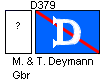
Martin Deymann became an inland-waterways shipowner in 1992 with the purchase of Aviso II. He and Tanja Kappen formed M. & T. Deymann in 2002.
Germany, Harem/Ems.
Martin Deymann became an inland-waterways shipowner in 1992 with the purchase of Aviso II. He and Tanja Kappen formed M. & T. Deymann in 2002.
Germany, Harem/Ems.
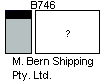
The funnel colour is described as pale blue-grey.
No adequate independent company evidence was retrieved. An M. Bern & Co vessel lead does not prove identity with this exact Sydney company; unrelated Swiss search results were rejected. Original Australian attribution, 1954–1960 operations and livery description remain source-only. Independent searches attempted the exact M. Bern Shipping name, Maurice Bern, Smithtown/Nestlé context, and the original Flotilla Australia source. The original website was inaccessible.
Maurice Bern’s company operated from 1954 to 1960. It carried cargo for Nestles from Smithtown to Sydney between 1954 and 1959, when Nestles decided rail transport was more reliable.
Australia, Sydney.
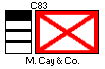
The funnel is white with a black top and two widely separated narrow black bands. The flag is white with a red border into which a narrow red saltire merges.
The archive locates M. Cay in Bristol and dates the purchase of steamers to 1875 and merger to 1880. Port, business and legal-successor differences are unresolved; the vessel history does not establish the complete partnership succession.
M. Cay was junior partner in Crisp & Cay in 1863. By 1875 Crisp had left and Cay bought two steamers. In 1880 the business merged into Cay, Hall & Co., changing its funnel markings but retaining the flag.
U.K., Bristol.
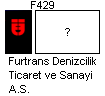
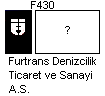
F429 comes from a port-side photograph of Ceren Ürkmez on 6 July 2011.
F430 comes from a starboard photograph of Behice on 1 January 2007.
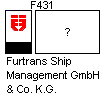
F431 is based on Reecon Wolf at Tuzla in a port-side photograph supplied in December 2012, and starboard photographs dated 15 June 2012. Rosanoski notes that this version seems common to the German company.
Faruk Ürkmez returned from work in Germany in 1969 and established a business mainly trading in steel. He entered shipping in 1979 by acquiring 70% of a company building a coaster. The website dates completion to 1980, while Miramar gives Ömer Bey as built in 1982 and sold in 1992; the initial company’s identity is unknown. The website dates the Furtrans Shipping Group to 1978, whereas Lloyd’s gives 1981 for the group in this entry. Its activities included shipowning, management and building.
Furtrans Shipping & Trade Inc. appears as a group operating company formed in 1992, later styled Furtrans Denizcilik Ticaret ve Sanayi A.S. or Furtrans Shipping & Trading A.S. The source also records Furtrans Ship Management GmbH & Co. K.G. in Hamburg and Furtrans Tanker & Ship Management S.A.S. in Nice as managers in 2011–2012.
Turkey, Istanbul.
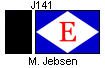
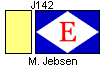
Lloyds 1904 notes that some steamers used a yellow funnel, a qualification omitted in 1912. FOTW presents the sourced J142 flag as Michael Jebsen’s other flag, but Rosanoski cautions that M. Jebsen need not mean Michael and treats the Hamburg firm as unrelated to the Apenrade company. The flag’s E remains unexplained.
M. Jebsen of Hamburg operated from at least 1887, when Else was built. Germania, sold in 1915, was the last ship Rosanoski traced, although the company still appears in Lloyds 1917–18. Other named vessels include Cyrill, Alexandere SS and Ella. Rosanoski distinguishes this company from M. Jebsen of Apenrade, which appears separately in both Lloyds 1904 and 1912.
Germany, Hamburg.
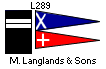
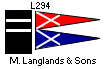
Griffin’s main entry shows the L294 funnel, but its supplementary replacement with L289 suggests that the former was an error. Reed also gives the livery for Glasgow & Liverpool Steamship.
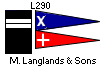
L290 is retained from LJC 1909.
The original Glasgow & Liverpool Royal Steam Packet flag bore the arms of Glasgow and Liverpool surmounted, probably meaning ensigned, by a crown.
Known as the Royal Line, Langlands originated in the 1820s, with the Glasgow & Liverpool Royal Steam Packet Co. formed in 1836. It absorbed Glasgow & Stranraer Steam Packet after 1857, Galloway Steam Navigation in 1877 and Aberdeen, Leith & Moray Firth Steamship in 1914. Coast Lines took over in 1919.
UK, London and Glasgow.
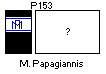
The funnel was noted on Megara in April 1966, recorded as owned by Acres Shipping Co., care of G.C. Calafatsis. It is black with a broad white band containing two very narrow blue bands near its upper and lower edges. Between them is a squat blue M surmounted by an undefined blue Greek Pi. No flag was noted.
Greece (assumed).
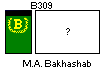
The funnel recorded for Asma B is green with a narrow black top and a yellow “B” within a yellow laurel wreath. No flag was noted.
M.A. Bakhashab is recorded in Lloyds in 1963–1964, 1970–1971 and 1978–1979.
Saudi Arabia, Djeddah [Jeddah].
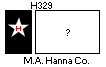
Manse also assigns this funnel to National Steel. A black-and-white photograph of Charles S. Price, sunk in 1913, confirms it.
The concern appears as M.A. Hanna, then Hanna Mining and later M.A. Hanna again in successive registers. It managed Hanna Coal & Ore, later Hanna Mining, National Steel, Hanna Furnace and Skar Ore Steamship. Carryore, for which it also acted as agent, was sold with its subsidiary to Algoma Central in 1986.
USA, Cleveland, Ohio.
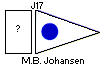
The flag is a white pennant with a blue circle. No funnel is noted.
Norway.
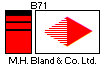
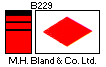
Sources vary in the gaps between funnel bands and the extent of the top, and in the flag diamond’s exact shape and proportions.
Brown 1978 and 1982 show the diamond altered so that its dexter half consists of nineteen alternating red and white horizontal stripes. The FOTW rendering uses more lines for artistic effect; this is not evidence of another historical variant.
Records of M.H. Bland date to about 1810; the first steamer was owned in 1860. It traded as Bland Line into the 1970s, possibly becoming Bland Ltd. by 1980 and apparently ceasing in the later 1980s.
Ship names initially began “Gibel”, meaning “Hill”, later “Mons”, with both forms subsequently recorded.
Gibraltar.
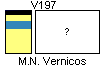
V197’s funnel comes from the Mitchell collection; no separate written design description is supplied.
The concern appears in Lloyd’s 1953–1954 and seems to have operated only Popi, bought in 1930 and sold in 1956 according to the Miramar Ship Index.
Greece, Piraeus.
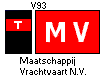
The Brazilian website calls the company Haven Line and depicts the livery around 1950 with more ornate letters. Wij Varen Veer, Scheepsbouw en Scheepvaart 1946 and Stewart show white dots after the flag letters; all versions remain documented under V93.
The concern probably began operating in 1929, when Tela was acquired and Tara built. Associated with N.V. Nederlansche Zeerederij and controlled by Steenkolen Handelsvereeniging, it changed name in 1938 to “Vrachtvaart” Naamlooze Vennootschap Maatschappij. Later continuity is uncertain: Rosanoski tentatively connects the 1973–1974 N.V. Vrachtvaart entry under Vermaas management with Telana, which sank on 5 August 1977. Fleet names began with T.
Netherlands, Rotterdam.
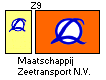
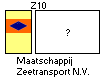
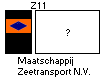
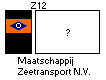
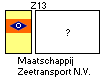
The pre-war information is unclear. Jordan describes a black or yellow funnel with an orange band bearing a blue diamond, whereas its monochrome Prins Willem Van Oranje photograph appears to show Anthony Veder’s funnel. Talbot-Booth gives a separate treatment.
The house flag is orange with intertwined blue capitals OL and a white area inside the O, according to the FOTW description citing A.J.J. Mulder.
Brown 1958 gives Veder’s livery. Rosanoski considers the Veder flags shown elsewhere by FOTW applicable until the 1958 sale; these remain documentary cross-references rather than additional images in this entry.
Anthony Veder, his mother and relatives incorporated the company in 1937, called Maatschappij Zeetland in the cited website account, and operated as Oranje Lijn. Veder sold the line in 1958. Anthony Veder N.V. had been manager; later registers list Zeetransport as manager of Transatlantisch Scheepvaarbedrifij A. Veder.
Oranje Lijn joined Cunard, Compagnie Générale Transatlantique and Olsen & Ugelstad in the Trans-Atlantic Lakes Line consortium, formed on 1 March 1968.
Netherlands, Rotterdam.
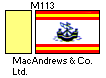
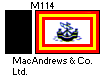
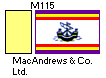
The early version has a black funnel and a white flag with a red–yellow–red border and a black-and-white ancient sailing ship. LJC 1909 widens the yellow relative to red, matching Spanish proportions. Its ship has a hull flat at the waterline; yard position varies, and small flags fly from the fore and aft castles.
The later recorded flag places yellow–red–yellow bands at top and bottom around the ship. Its funnel is yellow according to The Worlds Merchant Fleets, or buff in Stewart.
Loughran records purple replacing a colour during the Spanish Civil War, but the sequence is unclear. The discussion says purple–yellow–red and questions whether the order instead matched republican red–yellow–purple or differed at top and bottom; the separate flag description says purple–red–yellow. The illustration follows an assumed arrangement, reversed at the base, rather than a securely documented order.
MacAndrews was formed in 1770. Royal Mail Lines acquired it in the 1910s, followed by United Baltic in 1935 and CMA CGM in 2002 as part of the Andrew Weir sale. Its long Iberian trade explains the Spanish colours in its flag.
UK, London.
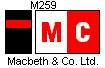
The livery was also used by the Sydney branch in 1902.
G.A.A. Macbeth began the concern in 1882. It became Macbeth & Gray in 1884, Macbeth & Co. in 1901 and Macbeth, Blackwood & Lawrie in 1920. Blackwood retired in 1929. The source also records an Eastwood S.S. sale to W.A. Young but questions the sentence’s meaning and whether it refers to Eastwood itself.
UK, Glasgow.
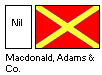
The flag is red with a yellow saltire. No funnel is recorded.
Macdonald, Adams & Co. operated sailing ships.
UK.
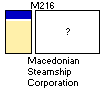
Agathopolis was recorded in October 1965 with a yellow or buff funnel, a blue top and a very narrow white separating band. No flag is noted.
Unknown.
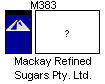
The emblem represents two overlapping piles of sugar. Their colour is unclear from monochrome hatching and is assumed grey; dark-blue shading matching the funnel is said to give an M-like effect.
MRS was registered on 6 January 1992 and is described as a Mackay Sugar Co-operative–E.D. & F. Man joint venture from 1994. Its acquisition by CSR, anticipated in 1997 and announced on 28 February 1998, formed Sugar Australia with CSR holding 50 per cent and the other partners 25 per cent each. MRS Pioneer appears under E.D. & F. Man Bulk Services in the 1998 register.
Australia; Mackay is assumed from the place of registry.
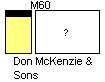
Most website tugs lack conventional funnels. Cape Don has an exhaust-topped structure carrying the logo, represented by M728; Cape Arid carries it on the superstructure.
M60 is retained from The Log, May 1991.
Don Mackenzie began Mackenzie’s Tug Service, followed by his son Hugh and then Hugh’s son Sean. Mackenzie Marine & Towage retained the trading name, with Harbour Towage and Bareboat Charter divisions. Cape Le Grande, built in 1972, also held an excursion-ferry licence and was replaced in 1985 by Cape Le Grand II. Registers use several family and company-name forms; the possible Mackenzie Marine entry with Sea Breeze is not firmly linked.
Australia, Esperance; Scotland, Lossiemouth also recorded.
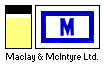
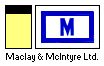
The white flag has a blue rectangular frame enclosing a blue M. The funnel is yellow or buff with a black top; a second version inserts a white separating band. The Worlds Merchant Fleets specifies yellow, and a 1969 reference records the livery for Glasgow United Shipping.
Maclay & McIntyre was formed in 1886 and lasted until 1958. It managed Glasgow Navigation, Glasgow United Shipping and the Induna, Livingstonia, Magdala and Mombasa steamship companies.
UK, Glasgow.
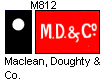
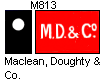
The two variants are retained from Griffin and Reed.
Maclean, Doughty developed from Groves, Maclean, whose three principals held shares in its eight vessels. British Ocean Tramps gives 1882 for the change, but the James Groves history records the ownership-name change only in 1888, making that date uncertain. Doughty withdrew in 1900 to form H. Doughty & Co., while W. Maclean continued independently. The source does not explain Groves’ departure.
UK, West Hartlepool.
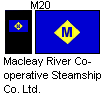
The Log describes a blue flag with a yellow diamond bearing a blue M.
The company operated Tamban for the Macleay Farmers Co-op Society in 1915, apparently selling it that year, although 1924 is also given. Another account uses MacLeay Farmers Co-op Society of New South Wales and gives the ship’s span as 1914–1936, when it was hulked; the acquisition date by North Coast S.N. is unknown.
Australia.
M363 is documented by The Log, November 1988.
Macquarie Plant Pool was registered on 10 June 1966 and owned barges for a sea-spoil disposal project in 1967–71. It became Mount Industrial Servicesd and was deregistered on 8 May 1984. The Log lists Citrus Australia as owner.
Australia, Sydney (?)
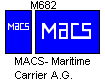
Bakker’s M682 follows Brown 1995. Rosanoski questions Brown’s straight lettering and darker blue rather than treating them as established historical variants.
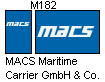
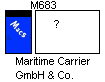
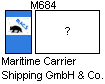
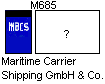
The rhino is linked in Mitchell’s account to the African trade. Diamond Land photographs confirm the funnel and angled letters. Nüsse’s table flag and the company logo support the letter slant and a lighter sky blue than Brown’s version. Grey Fox shows a darker funnel than flag, whereas Purple Beach shows both in the lighter shade. Flag photographs do not clearly resolve the lettering, and Nüsse’s old and new images differ in blue.
Mitchell places M683 on the Africa Europe Shipping Line card, possibly in association with Raimol.
Further Mitchell funnel versions are retained. The source cautions that chartered tonnage can have differing basic funnels.
Felix Scheder-Bieschin Senior founded the Hamburg operation in 1970. The Altendorf company, dated 1987 by Lloyds, appears to be its holding company, while the operating subsidiary is separately dated 1980 in the register. MACS incorporated Africa Europe Shipping Line’s service in 1983 and pooled services with SAGES in 1992. Its container and break-bulk routes linked north-west European and Portuguese ports with South Africa. MACs Cross Trading, established in 1996, specialised in break-bulk shipping; the group was held by a family partnership.
Switzerland, Altendorf; Germany, Hamburg.
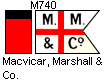
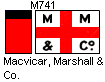
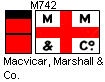
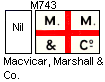
The four associated variants retain the LJC, Griffin, Reed and Lloyds evidence.
Macvicar, also recorded as McVicar, Marshall managed Thomas B. Royden’s India trade before continuing independently as Palace Steamship. It is recorded managing Buckingham by 1888 and built Bellands in 1891. Lloyds 1917–18 calls the operated concern Palace Shipping. All ships were sold to Scindia, tentatively dated around 1920.
UK, Liverpool.
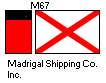
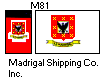
The earlier livery combines a red funnel with black top and a white flag bearing a red saltire; US Navy 1961 assigns it to the agency company Cia. Globo de Navegacion. The later white flag bears a red shield with nine yellow couped saltires around a white central square containing a black displayed eagle. Beneath is a yellow scroll inscribed A.P. MADRIGAL in black. On the red, black-topped funnel, an irregular white panel accommodates the shield and scroll.
Madrigal began in 1915 as Madrigal & Co. and changed its name in 1949. Founder Vincente Madrigal assigned the shipping interests to his son Antonio. Later registers show a name subsidiary, Madrigat Transport, formed in 1996, and an agency relationship with Compania Globo de Navegacion.
A separate cited account describes Madrigal Shipping Lines as a privately held St. Leonards, Australia-based shipbuilder and shipowner within an international Madrigal Group.
Philippines, Manila.
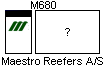
M680 follows Ice Bird photographed to port on 2 May 2009. Ice Ranger’s starboard view on 12 December 2008 confirms the emblem but has no black funnel top.
Maestro Reefers, MRAS and sometimes Reefership A/S, handles commercial chartering and operations. The privately held Maestro Group was established in 2005, active in bulk, reefer, ro-ro and shipmanagement. Its Limassol management concern appears with Armada fleet vessels in 2007 and the whole fleet in 2008.
Rosanoski considers the livery on Ice Rose by 20 May 2006 evidence of earlier Maestro management, although DFM or Dobson Fleet Management was still named and had an unrelated logo.
Denmark, Copenhagen.
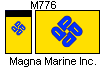
The website supplies the flag. Panoria photographed to starboard on 6 July 2009 and Pansola to port support the funnel; Pansola’s photograph shows a lighter blue.
Magna Marine dates itself to 1990, while Lloyds gives 1991. It belongs to the Panagopulos group, founded by Pericles S. Panagopulos in 1971, and is involved in bulk-carrier ownership and management. Superfast Ferries, formed in 1994, appears as an operating company before its later listing under Attica Holdings, then also controlled by Panagopulos.
Greece, Athens.
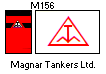
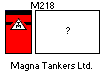
A funnel was recorded on Magna in May 1965. Both variants are red with black top and band, the band surmounted by a triangle separated from it by funnel colour. The first has narrow top and band and black T above M; the second bears the flag’s stylised black T rising from M. The white flag has a red diamond frame enclosing that black monogram.
Magna Tankers appears in the 1970–71 register with Magnus Konow & Co. as agent.
Liberia, Monrovia; Norway, Oslo also recorded.
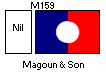
The flag is divided vertically blue and red with a white disc over all. No funnel is recorded.
Magoun & Son operated sailing ships in the mid-nineteenth century.
USA, Boston, Mass.
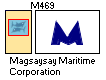
The website flag’s M is dark blue. The later funnel appears shared with Fairmont and is confirmed by Masaya photographed on 11 November 2005.
Mitchell’s M470 appears associated with Pacific Pride, which Rosanoski could not locate in Lloyds.
Vessel identity and date unresolved.
Established in 1948 as Magsaysay Lines, the company became Magsaysay Maritime Corporation in 1998. Don Ambrosio Magsaysay and Robert C.F. Ho organised holding company A. Magsaysay; Miguel A. Magsaysay joined them, and he and Ho helped form United Philippine Lines in 1958. Later ventures included Triumph Shipping with Meiji Kaiun and Mitsui in 1972–74 and Mannex with Meiji Kaiun. Crew manning developed in the 1970s.
National Marine, formed in 1985, is described as acquired in 1986, with the acquisition partner named Fairmont in one account and Fenwick in another. NMC bought Neptune Orient’s Lorenzo Shipping holding in 2005. Other recorded relationships include Transocean Transport, Botelho Shipping and Fairmont Shipping (HK).
Philippines, Manila.
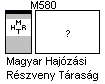
M581 follows a photograph of Debrecen.
The Hungarian Danube-Sea Shipping Foundation was formed in 1999. It bought Kassa and converted it into the museum ship Debrecen in 2006.
Hungary, Budapest.
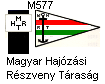
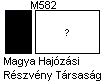
Szent Gellért supplies M582. A flag painted on its side is presumed to be the Hungarian tricolour, perhaps with B in the white for the manager.
A separate Hungarian Navigation Co. operated Szent Gellért in 1937–40 under Felix Brózik. Merchant Ships continues to list it, although the register website says the vessel became Panamanian Carola in 1940.
Hungary, Budapest.
The predecessor account begins with the Hungarian Railways’ navigation company in 1888 and MFTR in January 1895. Following financial difficulties after the First World War, MFTR joined Danube operating cooperation in 1926, expanded in 1927. Its shares passed to the treasury and Hungarian State Railways in 1935–36. Shipping resumed in 1945, but the fleet transferred gradually to the Hungarian-Soviet MESZHART, founded in March 1946. Soviet withdrawal in 1954 preceded the Hungarian Shipping Company’s establishment on 1 January 1955.
After the communist period, MAHART became a holding company with separate activities. Ocean shipping ended in 2003, the Free Port company became a public limited company, and river freight was privatised as DDSG Duna-Cargo in 2004. Lloyds also reports bankruptcy in 2000, without reconciling it with subsequent entries. The source separately records DTRT in 1936–64, Cenam as an operating company, an AMAL interest and Balatoni Hajózási as subsidiary.
Hungary, Budapest.
Keep the explicit scope label independent; no alias or company identity is inferred.
Passenger subsidiary MAHART PassNave was formed on 1 January 1994. It was 51 per cent state-owned and 49 per cent investor-owned in 2005; by 2008 the holdings were MASPED 84 per cent, MM Operational & Consulting 10 per cent and Employees Holding 6 per cent.
Keep the explicit scope label independent; no alias or company identity is inferred.
MFTR’s original funnel is black with a white band. Website illustrations show flags which cannot be made out.
Körös and Dunaföldvár photographs show a white band fitted around their narrow paddle-steamer funnels and wider than the funnel itself. The funnel appears mainly grey, perhaps white, with a very narrow black top and small black base. Other photographs show an ordinary band with lettering.
Keep the explicit scope label independent; no alias or company identity is inferred.
Mitchell and Soviet Bloc leave space above and below the letters on the white band; Pannon Sun in the 2003–04 fleet supports letters touching both edges.
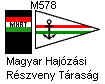
Sache describes a white pennant with the Hungarian national flag running its full length and a black anchor towards the hoist. It flew above the Budapest building and appeared as a logo on a blue rectangle. He tentatively likened its role to an unofficial civil ensign; this is an interpretation, not an established status. The original flag reference is numbered H578.
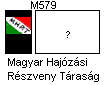
Mitchell dates M580 to 1970 but supplies no period for M579.
Keep the explicit scope label independent; no alias or company identity is inferred.
Dunaujvaros’s bow flag appears to be a horizontal triband with a broad white centre bearing DTRT; red above and green below are presumed from the monochrome photograph.
Keep the explicit scope label independent; no alias or company identity is inferred.
Two vessels named Anna Firmbach supply the funnel versions, with a change dated 1988. M671 is assumed to be the older version and one vessel presumably replaced the other. The company website supplies the flag.
MSG was formed on 12 November 1916 as Mainschiffahrts-Genosswenschaft eG by eleven independent owners pooling their shipping. Initially serving the Rhein and Main, it expanded across Europe and into logistics through subsidiaries and associates. Anna Firmbach is recorded among its vessels.
Germany, Würzburg.
McMillan’s flag follows the 1909 update to Flaggenbuch 1905. Lloyds shows a plain P.
Also known as Portland Line, Maine Steamship was formed in 1868 and merged into Eastern Steamship in 1911. The FOTW account recalls it as a north-eastern coastal line, with that recollection qualified.
USA, New York.
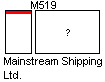
Hakula’s December 1998 views show mirrored sides, with the emblem’s tails aft on both. A January 2003 photograph retains this funnel.
Hakula’s photograph of 5 June 2007 shows the changed M519 funnel.
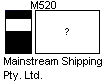
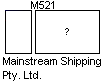
Ikuna’s photographs in December 2003 and January 2006 supply M520. A note says it retained the former Wallarah funnel, but Rosanoski questions this because the last traced owner, Coal Operations Australia, had a logo on the band.
Ikuna changed to M521 while drydocking in Singapore in 2006; its black cowl is barely noticeable.
Mainstream was formed in 1998 by the group named Intercontjental in the source when Sandra Marie’s manning costs became unviable. The vessel became Hakula under Tongan registry, managed by Intercontinental Ship Management and later Inco Ships.
Ikuna appears under Mainstream Shipping Pty. Ltd. and the same managers. Rosanoski associates the companies by name resemblance; the exact relationship is not established.
UK, West Maling; Tonga also recorded.
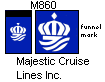
After the 1986 acquisition the ship retained much of its final Commodore appearance but received dark-blue funnels with the Majestic logo. Scientology-related symbols were painted on both hull sides, with three decorative ribands towards the stern. M860 follows a starboard photograph dated 22 January 2010.
Freewinds was acquired for the Church of Scientology in September 1986 through a network involving San Donato Properties, Flag Ship Trust and Majestic Cruise Lines. Majestic operated the ship for Flag Ship Service Organization, which conducted courses aboard. The accounts differ in their immediate purchaser and owner descriptions. They say Majestic’s responsibilities were transferred in 1993 and the company dissolved, yet one account says it continued billing visitors, and later Lloyds entries retain the name.
A separate cited Florida registration gives incorporation on 12 January 1989 and inactive status, while another listing records involuntary dissolution. Lloyds later places San Donato’s vessel under International Shipping Partners. The source does not reconcile these entities and dates.
USA, Clearwater FL.
Ocean Majesty and Ocean Monarch photographs supply M547. The emblem may be a stylised swan; the mirrored starboard version faces forward and also resembles a flowing S. Ocean Majesty flies the company flag as a bow jack in 2005. Its indistinct mainmast flag may belong to charterer Page & Moy.
An undated company photograph of Ocean Majesty shows the M564 funnel emblem aligned with the flag design, unlike the other photographs Rosanoski found.

In 2008 Ocean Majesty carries Page & Moy’s logo with what appears to be Well travelled people beneath, probably in blue but possibly black. The lettering is absent from an October 2009 photograph.
The company describes formation in the late 1980s and Ocean Majesty as its first acquisition in 1989, while Lloyds gives 2002. Earlier management appears under Shipping & Commercial, renamed Trading & Commercial in 1995; Equasis puts Majestic in charge from November 2003, but the corporate relationship is not otherwise established. Controlled by Lou Kollakis, Majestic operated Ocean-prefixed vessels mainly chartered to other lines, with Monarch Classic Cruises as a subsidiary.
Page & Moy’s acquisition by All Leisure was announced in May 2012.
Greece, Athens.
The flag follows a 1904 chart reproduced in Fune to Hata in 1994; the funnel comes from a 1901 chart.
Japan.
Janusha was observed with a narrow black funnel top. The emblem is described as a red cup flower.
Malabar operated coastal steamships from 1928, with G.P. Aiyer & S.G.V. Iyer recorded as managers or agents. Vessel names began with Ja, commonly Jan, with J also recorded.
India, Bombay.
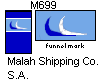
The Al Maha photograph appears to show an added light-blue panel accommodating a second white symbol. Its white edging is extremely narrow, narrower than the black funnel rim. It may continue around the back, but sunlight makes the light blue appear white there.
As Stefanie M, also written Stephanie M, the vessel appears to carry just the blue symbol on a white band. The September 2007 photograph is distant, however, so light blue and the white part of the device may simply be invisible; the dark part remains towards the funnel’s front.
Equasis records Malah as owner and manager after the vessel’s September 2005 purchase, with Maritime Safety taking management in January 2006. It became Stefanie M in March 2007. Premier Marine and ISM Group appear in 2010, followed by Malah and Malah Maritime Services again in January 2011. The source uses several vessel and company spellings, including Al Malaha, Al Maha and Al Malah.
Syria, Tartous.
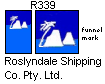
The Log attributes Maasmond’s funnel to Roslyn Shipping Co. Pty. Ltd. on the Norfolk Island service. Its emblem matches the separately referenced Lord Howe Shipping L417, but the funnel and emblem colours differ. Rosanoski questions the livery allocation because the ownership evidence conflicts and the Lord Howe reference does not readily fit the Norfolk service.
Do not infer same company or shared livery from motif alone.
The relationship between Reid, Roslyndale Shipping and Lord Howe Shipping is unclear in the records. Roslyndale is described as acquiring Kuri Pearl in 1984 and Sitka in 1986, the latter first chartered for Lord Howe and then used for Norfolk Island. Maasmond, bought in June 1989, and Norfolk Guardian in July 2000 are described as successors on the service. Lloyds instead variously lists Reid as owner, manager or agent, with Lord Howe Shipping as manager. Its 2001–02 entry has Sitka II replacing Maasmond, presumably after the latter’s February 1996 loss. Sitka’s return to her original name is dated either 2000 or 2002.
Australia, Sydney.
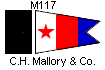
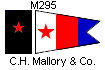
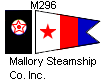
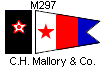
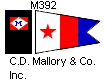
Charles H. Mallory’s flag passed through several company-name attributions. The funnel was initially black, later adding the flag’s star, present by LJC 1885. McMillan records later private-signal variations among descendants: white–blue–red with a blue star in the hoist for Philip R. Mallory, and red–white–blue with a red central star for H.R. Mallory.
Flag-area proportions differ. Brown gives half the field to white and extends blue slightly beyond the fork; Talbot-Booth begins blue at the fork, gives red about the same width, and leaves the remainder white. Other versions, including M296, make white larger than either coloured area. Rosanoski tentatively connects the differences with Clifford’s restrictions on use of the original identity.
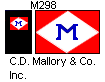
Talbot-Booth says Clyde-Mallory relinquished the old flag to C.D. Mallory in 1935. Rosanoski guesses that the interim 1932–35 flag was the design later seen as a funnel panel and used by Marine Transport. M298 follows Jordan’s black funnel with house flag, but its flag and period are assumed. Ships & The Sea 1938 records the change to M392, whose funnel mark continued alongside the restored old flag.
M117 and M297 retain the Griffin/Loughran and Lloyds variants.
The Mallory family’s maritime business began in 1816 with Charles Mallory’s sailmaking, shipbuilding, whaling and trading interests. After Union wartime charters, Charles Henry concentrated on regular Galveston–New York services from 1866, while the Mystic interests retained yards and sailing ships until their eventual disposal in 1876 and 1885. New York & Texas Steamship took ownership of the maritime assets in 1886, with C.H. Mallory managing them; both were commonly called Mallory Line.
After Charles Henry’s death, Elihu Spicer and then Henry Rogers Mallory led the line. The October 1906 sale to Charles W. Morse made it part of Consolidated Steamship Lines, followed by Atlantic Gulf & West Indies after Consolidated’s 1908 failure. The trade name and flag survived, and the name became Clyde-Mallory in 1932. Clifford Day Mallory separately operated under the family name in 1919–41 but could not legally use Mallory Line.
Clifford operated government tramps and later services before entering tankers in 1923–24. His business controlled and operated several ship companies, with C.D. Mallory Corporation and Maltran absorbing others in 1934. The family’s final withdrawal is variously dated 1940 or Clifford’s death in 1941; reorganisation as Marine Transport Lines is described in 1941 or 1942. The purported Mallory Transport Lines predecessor name is not supported by the cited company website.
USA, Mystic CT; later New York, NY.
Bakker’s FOTW flag follows the Bryggan website.
Trelleborgs Ångfartygs became Malmros in 1968. Financial problems in the 1970s led to sale of the last ship in 1980 and liquidation of shipping interests, including Atlanttrafik, in 1981. The company reorganised as an investment concern.
Sweden, Trelleborg.

The first FOTW rendering mistakenly used Onstad’s flag and a blue ground before its lettering was corrected. Rosanoski then specified a black disc, supported by the cap badge and other sources; the Bryggan version appears very dark blue.
Later funnel photographs prompted M511. Three of four examples have slanting letters and one upright, with a shallow V in M. The cap badge’s V is also shallower than most published versions but deeper than the funnel’s. Its B differs from the funnel letter, whereas tugboatlars gives the same B on flag and funnel.
Malmö Towage was formed in 1874 and acquired by Göteborgs Bogserings & Bärgnings in 1938, entering the Broström group. Registers name Gösta Åkesson and later Sven Lundkvist as managers before listing it independently.
Sweden, Malmö.

The flag is a yellow swallowtail with a small blue canton bearing a yellow cross and a red M on the field. Brown and the cap badge support the rendered placement. US Navy puts M lower and centrally, partly beneath the canton, which Rosanoski considers incorrect. Mitchell’s funnel appears associated with Sirius, but that ship’s relationship is uncertain.
Malmö Rederi operated tankers registered in 1946–65 and was, or became, a Svea subsidiary. Baltica’s history suggests a 1956 takeover. H. Arhusiander and later S. Lecander are recorded as operators. Brown and Mitchell associate Eman Högberg, but Lloyds does not; two of the named ships instead appear linked with Svea through Saturnus.
Sweden, Malmö.
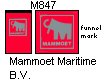
The blue elephant or mammoth is stylised as M. The flag shades follow Nüsse’s website; the funnel yellow is assumed to match. Nüsse’s later site attributes the table flag to Mammoet Transport.
M847 follows Jumbo photographed to port on 16 June 2012.
M144 Shipping/Transport table-flag attribution remains qualified; no exclusive use claimed. Article3715 remains unchanged.
Mammoet’s heavy-transport beginnings are dated variously to 1971, 1972 and 1973, with Gebr. Goedkoop among the founders. Shipping and group histories diverge: KNSM acquired a half-interest in Goedkoop in 1975 and sold it to Wijsmuller in 1979; Lloyds later lists Mammoet Shipping under Nedlloyd and records Spliethoff’s majority acquisition in January 1995. Mammoet-Hansa was a joint venture with Hansa-Linie. The shipping business became BigLift, dated 2000 by Lloyds but linked to the 2001 group takeover in another account.
Van Seumeren acquired the heavy-transport group in 2001 and retained Mammoet’s name. SHV ultimately became sole owner in 2011 after an earlier 75 per cent holding, although a register note says increased by 75 per cent rather than to it. Mammoet Maritime developed from the 1985 merger of Scheffer and Goedkoop activities, and the later group also included salvage. Road Cargo and Ferry Transport continued using similar names and logos despite reduced or ended group ownership.
Netherlands, Amsterdam.
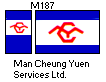
Dawn Justice at Hong Kong in September 1971 had a black funnel with a broad white band edged blue above and below. Red CC was surmounted by a wider red M.
The later blue funnel has a broad white band bearing a red stylised CM. The flag repeats a broad white horizontal band on blue with the same red emblem.
Formed as Man Cheung Yuen Shipping in 1962, the concern took the Services name in 1978. F.W. Chambers appears as agent, Longitude Transport as a later name subsidiary and Barber Ship Management as manager.
UK, London; later Hong Kong, subsequently recorded as China, Hong Kong.
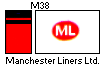
The white flag bears a red horizontal oval with white ML; oval size varies between sources. The funnel is red, specified as dark red by Hornsby, with black top and black band.
Manchester Liners absorbed Prince Line and became one of Furness, Withy’s four managing shipowning subsidiaries in the 1970–71 reorganisation. Furness, Withy formed a General Shipping Division in June 1977, though Mitchell does not list Manchester among its companies. A later note dates its inclusion in Furness Withy (Shipping) to 1 June 1982, citing a 1981 publication.
Loading brokers Gough & Crosthwaite were acquired in May 1968, a 12.2 per cent Charles Hill holding is recorded, and the company managed one vessel for Nile Steamship.
UK, Manchester.
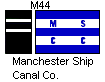
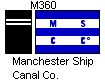
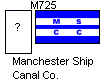
Lloyds 1904 gives an enhanced small o in M360’s flag lettering.
Loughran gives wider white than blue bands and consequently larger letters. Rosanoski presumes his later Brown versions correct this.
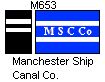
The flag repeats the two funnel bands with the company initials added. Bakker follows the National Maritime Museum example. Its recorded dimensions are 1016 by 1879.6 mm, but the transcribed date range is the inconsistent 1955–1867.
M653 is retained from merseysideviews and British Steam Tugs.
The funnel livery predates the canal, coming from Bridgewater Navigation, acquired in 1887. It remained on the dredging fleet after Carmet undertook towage. Some sources widely separate the funnel bands; M.S.C. Daphne’s monochrome photograph shows very narrow bands separated by an equal width of funnel and what appears to be a large, thin white X.
Parliament authorised the company in August 1885, requiring acquisition of the Bridgewater Canal and Mersey & Irwell Navigation. Construction began in November 1887 and the canal opened on 1 January 1894. The company escaped nationalisation. Highams acquired control in 1987; the interest passed to Peel, with full ownership by 1994 and transfer into Peel Ports in 2004.
The M.S.C. vessel prefix began in 1927, followed later by names progressing alphabetically.
UK, Manchester.
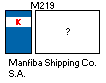
Mitera Maria was recorded in December 1967 with a blue funnel, broad white band and red K, associated with Kaminis Brothers. A black top is possible. No flag is noted.
Manfiba appears in the 1970–71 register with Loucas Nomikos (England) as agent.
UK, London.
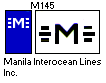
The blue funnel has a white M between three white horizontal batons on each side. The white flag repeats the motif in black, with the middle baton longer than the others. Brown 1978 extends the funnel batons to the edges; later editions under the Micronesian name contain them and appear to make them equal in length, possibly because of illustration-size limits.
Manila Interocean was formed in 1967. Rosanoski suspects a connection or identity with Micronesian Interocean of Saipan from their liveries, but does not establish it.
Philippines, Manila.
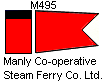
M495 is documented by The Log, May 1996.
Backed by Manly Municipal Council, residents and coal owner John Brown, the co-operative competed with Port Jackson using chartered vessels, mainly tugs with passenger certificates. It forced fares down; with that objective achieved, shareholders accepted Port Jackson debentures and joined the combined Port Jackson concern. Operations ceased in May 1896.
Australia, Sydney.
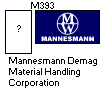
The flag is recorded in Candeias’s FOTW illustration.
USA.
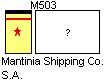
Mantinia and the Hellenic Carriers group share the livery, with vessel-specific yellow shades and band sizes. Narrow bands appear to sit above rear ventilation slats. M503 follows Salamis, later Brave, but the recorded photograph, access and rename dates are inconsistent.
Hellenic Sea has a wider band below its high ventilation panel and darker yellow than Hellenic Blue, which has a narrow band and no top. A Newcastle observation calls the red dark, while other photographs show ordinary red. These comparisons are retained without adding the source-only H505 illustration.
Konstantinos Diamantis founded Mantinia in 1971. Hellenic Carriers is described as an affiliate and, in earlier registers, an operating company; later Hellenic Shipmanagement shares Mantinia’s address but Lloyds does not state a connection in those entries.
Greece, Piraeus.
The later portside photograph is dated 27 April 2010. Its narrative label is M763, while the source list and accepted image use M762.
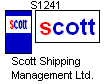
Manx Lion’s May and December 2009 photographs supply the two funnel sides, with the t tops slightly taller and angled towards the viewer’s right in the port view. A hazy December 2007 photograph suggests the flag repeats the funnel band, apparently in 2:1 proportions.
Scott-to-Manx relationship and precise flag reconstruction remain qualified.
Scott Shipping Management describes independent shipowning, operation and management from late 1998, while Lloyds gives 1999 or 2000. The website later became Manx Ocean Crewing’s, and Equasis names Manx as Manx Lion’s manager from November 2009, but the website does not explain the change or relationship. Lloyds earlier places Scott under Schiffahrtskontor tom Wörden, then independently. Ocean Marine Management of Oldendorf is named as an affiliate.
Isle of Man, Port Saint Mary [UK].
M849 follows Sinbad 1786 photographed on 23 July 2011. The colour appears very dark charcoal or black, with some grey apparent.
Manx Tankers owned Sinbad 1786 from 12 April 2010 to 22 June 2012 and appears under Univan Ship Management in the 2011–12 register.
China, Hong Kong.
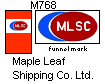
M768 follows Maple Harmony photographed to starboard on 14 November 2010 and is also recorded on Maple Mighty, Maple Glory and Maple Pioneer. The website distinguishes apparent parent and shipping-company logos.
Maple Fortitude supplies M769 in port and starboard views from 2011–12. The white separation is clearer, and the red oval background is just discernible in the more distant starboard image.
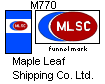
M770 follows Maple Crown and Maple Pearl. Maple Crown’s March 2010 photograph shows an unmarked white band; the next cited view, February 2012, has the logo. Its January 2013 photograph/access dates are reversed in the note.
MLSC traces its origins to Zhangan Shipping in 1956. Its restructuring as Taizhou Maple Leaf Shipping in 2000 accompanied entry into shipbuilding. Further Taizhou Jiaojiang and Hong Kong shipping companies followed in 2002; the separately incorporated Maple Leaf Shipping company is dated 16 May 2002, although Lloyds gives 2007. The shipbuilding company is dated 2006 or December 2005. The precise relationship between these starting dates remains qualified.
Vessel names begin with Maple.
China, Taizhou, Zhejiang.
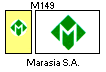
The white flag has a green diamond bearing a white M extending across it. The funnel carries a white disc with a green diamond and white M. Its ground is described as yellow or “bluff”; the final word “without” leaves the M’s extent in the funnel description unclear.
Marasia appears in the 1970–71 register.
Spain, Madrid.
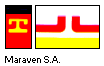
The red funnel has a black top and a yellow stylised T resembling a bollard. The flag is white over yellow, with white occupying three-quarters of the field. A narrow red band on the white divides centrally, its ends pointing upwards.
Venezuela, Caracas.
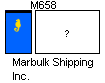
M658 follows Ambassador photographed on 6 March 2005, with a further company-logo reference from algonet.
Marbulk was formed in 1994 under Upper Lakes. Upper Lakes sold half to Algoma Central in 1997 and the remaining half to CSL on 12 May 2000. Later registers place it under CSL, while the website describes it as an MCI subsidiary.
USA, Salem MA; later Beverly MA.
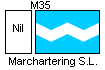
The flag is recorded in Gutterman’s FOTW illustration.
Marchartering was incorporated on 14 January 1993, described by the source as a limited partnership. It appears to have worked in sea and coastal freight transport and forwarding. The cited company listing records it as extinguished, without supplying a closure date here.
Spain, Madrid.
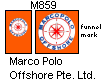
M859 follows Valour photographed to port on 17 December 2013; the corporate publication supplies the group logo.
Marco Polo’s activities include ship chartering from at least 2007, tug and barge operations, shipyards established in 2005 and an offshore business from late 2010. Marco Polo Offshore is part of the group. A 49 per cent interest in PT Pelayaran Nasional Bina Buana Raya was acquired in 2012.
Singapore.
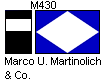
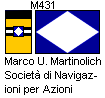
The flag is blue with a white diamond throughout. Rosanoski’s 2011 comment identifies a later FOTW page error: the diagonally quartered red-and-white flag belonged to Capponi & Freno, not Martinolich.
The post-war concern continued to use the same flag, as recorded by US Navy 1961 and Stewart 1963.
Brown shows a narrower funnel band than the other version discussed.
Heimer’s account describes the Martinolich shipbuilding background at Mali Lošinj: Nikola built Leone and Imperatrice Elisabetta, described as the largest vessels in their respective local and Adriatic contexts. Iron shipbuilding began in 1885, and Marko built 71 ships. The steamship company was established in 1911 with seven steamships and is said to have closed in 1937.
The registers trace Marco U. Martinolich & Co. through the later Società Anonima title. Martinolich apparently relocated to Trieste and resumed shipowning after the Second World War, appearing in late-1950s and 1960s records as Società di Navigazione per Azioni. Carlo Martinolich, the last ship, was sold in 1970.
Austro-Hungarian Empire, Lussinpiccolo; Yugoslavia after the First World War; later Italy, Trieste.
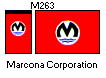
The funnel was recorded on San Juan Prospector of San Juan Carriers in December 1967.
Utah Construction and Cyprus Mines formed Marcona in 1955. Its shipping companies included Marcona Transporter and Marcona Conveyor; it also acted for San Juan Carriers. Marcona was used as the first part of vessel names.
USA, San Francisco CA.
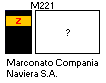
Zannis was recorded in September 1963 with a black funnel, broad yellow band and red Z. Rosanoski suggests that, if this stood for the vessel, the later Orontes might have displayed O; this is unconfirmed. No flag is noted.
Marconato appears in the 1963–64 and 1970–71 registers with Victoria S.S. as agent.
UK, London.
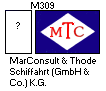
M309 is retained from Nüsse’s flag collection.
MTC was formed in 2001 by merging MarConsult Schiffahrtskontor and Johs. Thode. The merger ceased on 30 June 2003. Operating companies included Johann Kahrs, Walter Meyer Schiffahrts and Reederei Uwe Suhr.
Germany, Hamburg.
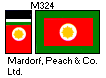
The emblem is a sixteen-pointed star with alternating long and short points, described as the familiar Sunblest sun design associated with an ABF trademark. The first two vessels came from Blue Star, explaining the similar funnel arrangement.
Mardorf, Peach was a grain broker owned by Associated British Foods. G.T. Gillie & Blair operated part of the fleet, as did agency subsidiary Weston Shipping. Vessel names mainly came from the Weston family.
UK, London.
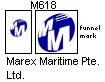
M618 follows Joni Breeze at Sydney on 18 May 2009.
Formed in 1999, Marex appears in the 2000 register as a major operating company of Koyo Kaiun Asia. It is listed again with a newbuilding in 2008.
Singapore.
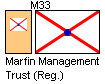
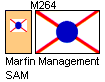
Rosina Topic, owned by Termar Navigation, was recorded with M33 on 11 July 1964.
Bakker’s M264 follows Brown 1995.
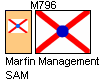
Olga Topic’s 2006 and 2009 views supply M796. The funnel-panel ball is lighter than the flag’s, a difference also seen on other ships. As the flag was poorly spread, its illustration was based on the funnel panel and its proportions may be wrong.
The earlier T194 funnel may appear on Olga Topic in a monochrome photograph. The cross is not visible, but the bow-quarter view shows separate panels spanning much of the funnel’s width rather than a continuous band. Jordan does not specify a cross paty.
Ant. Topic established the concern and moved from Yugoslavia after the Second World War. Its origins are dated 1925, with shipping activities from 1926 in another account. Marfin Management Trust (Reg) became Marfin Management SAM in 1982. The earlier operated concerns included Slobodna Plovidba Topic of Susak and Ilirija of Zagreb; later vessels traded through Compañia. Naviera Terma and Termar Navigation.
Italy, Trieste and Yugoslavia, Susak; later Monaco, Monte Carlo.
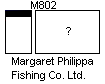
The May 2005 portside photograph at Auckland supplies M802, probably unchanged from Anton’s ownership.
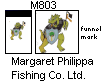
Port and starboard photographs from August 2008 and March 2011 supply M803. The source presumes its cartoon character to be peculiar to this vessel.
The company was incorporated on 29 September 2003, equally owned by Michael Friar and Eric Robin Lloyd. It operated from Napier and is also described as an Auckland fish supplier. By 2012 it had ceased business and was being removed from the register. The trawler Margaret Philippa, previously owned by Anton’s Trawling from 2000, was apparently bought unchanged in name in 2003; Lloyds continued to list Anton’s as manager.
NZ, Napier; Auckland also recorded.
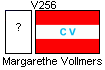
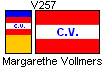
The initials suggest to Rosanoski that the livery may originally have belonged to Claudius, with Margarethe perhaps his widow or sister retaining it; this is conjecture. Schneider’s V256 flag differs from the cited V257 source: the letters are too small and too light blue, and the dots are missing. An undated black-and-white Gretchen Vollmers photograph shows no letters on the plain white funnel band, a narrow top, and no evident red bands; the base and top look similarly dark.
Gretchen Vollmers was built on 15 June 1950 for M. Vollmers of Uetersen, passed to Claudius Vollmers and then to Margarethe in April 1952, and was sold in October 1961. M. may have been Margarethe, though Rosanoski also suggests Gretchen might have been M.’s wife. A Claudius Vollmers of Westerronfeld built Hannchen Vollmers in 1955 and sold it in 1968, but the source does not establish his connection to Margarethe.
Germany, Moorrege.
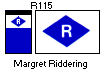
The blue funnel has a black top separated from it by a broad band carrying the flag design. The flag is white with a blue diamond containing a white R.
Germany, Haren/Ems.
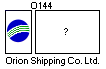
The green lines are curved throughout.
Orion Shipping was formed in 1989 jointly by Chiyoda Kisen, Showa Yusen and Okada Shosen, becoming Mari-Tech in 1992. Later listed under Nippon Yusen Kaisha, it managed part of NYK’s fleet and participated in a joint venture with it. TMM absorbed the company on 15 February 2001.
Japan, Tokyo.
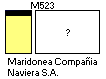
Mitchell records the funnel for Casseres with a line drawing, whereas Lloyds lists only Cardona. The source does not reconcile the vessel references.
Maridonea appears in the 1970–71 register under Compagnie Maritime et Commerciale as agent.
France, Paris.
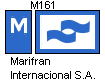
Nüsse’s flag is white with a blue border and blue logo. The funnel follows Mitchell’s Antartico line drawing, but its colour shades are assumed to match the website flag.
Marifran was formed in 1962 and originally specialised in carrying grain to Brazil and mineral ores to Argentina. Louis Dreyfus Armateurs held control until its sale to Augustea Finance took effect on 7 July 2000. Shipowners until the mid-1990s, the company continued in management and operation; the later directory lists it under Augustea Shipping Services.
Argentina, Buenos Aires.
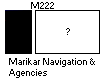
Habib Marikar was recorded in March 1967 with a black funnel. No flag is noted.
Unknown.
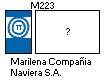
The funnel of Marilena P. is blue with a very broad white band. A blue annulet touches the band’s upper and lower edges and encloses a blue Greek pi. No flag is noted.
A.M. Nomikos acted as agent. Marilena P. was associated with S. Papanicolaou in May 1965.
Greece, Piraeus.
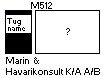
The tugs carry their names in black on the white funnel band. Tug, Ted, Leif and Tom are recorded.
Kenneth Avelin formed the company in 1986, beginning tug operations around 1995. Its fleet also included a ferry.
Sweden, Farsta; subsequently Stockholm.
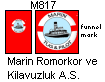
The funnel follows a portside photograph of Orkinos on 29 June 2010. The view is too distant to establish whether its logo matches the website version or is simpler. The central background appears dark, and the vessel in the design may be white.
Also known as Marin Tug and Pilot, the company is described as established in 1998 by members of the Turkish maritime community to serve Turkish ports, with each shareholder limited to 45 per cent. A second account names Deval Shipping Group of Companies as founder in 2001 and a shareholder; the dates are not reconciled.
Turkey, Istanbul.
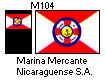
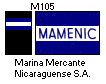
The first livery has a black funnel with a blue-white-blue triband. Its blue flag has a white horizontal band bearing blue MAMENIC lettering; the colour shades follow the website image.
The second livery uses a broad band of the flag on a black funnel. The flag is diagonally quartered red and white, with an overall blue-edged white circle bearing a red cross paty throughout. At its centre is a blue-edged yellow circle with a black upright anchor. The white quarters of the larger circle carry black MAMENIC and LINE above, and CENTRO and AMERICA below, the latter lettering upright.
MAMENIC appears in the 1963–64 and 1970–71 registers.
Nicaragua, Managua.
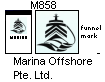
The funnel follows Marina Genesis in a portside photograph dated 4 December 2013. Beneath the logo is large MARINA lettering. There may be very small OFFSHORE GROUP lettering below it, but the mark could instead be a wavy line or a smudge.
Marina Offshore held the Maritime Port Authority of Singapore’s public licence to provide towage in the port from 1998. The registers list it as owner and manager.
Singapore.
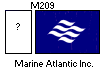
The flag is blue with a diamond-shaped logo of white and blue wavy horizontal lines. No funnel description is given.
Formed in 1980 as CN Marine, the company gained independence from Canadian National Steamships on 1 January 1985. It became Marine Atlantic in September 1986 after all ties were cut. Bay Ferries, formed in 1997 at Charlottetown, Prince Edward Island, is listed as an operating subsidiary; Sandford Ship Management managed one vessel.
Government policy changes and the Confederation Bridge transformed operations in 1997. The bridge’s opening on 30 May ended the Cape Tormentine–Borden route. On 1 April a private company took over the Saint John–Digby and Yarmouth–Bar Harbor services. At year-end the Labrador coastal freight and passenger service, including the Lewisporte–Goose Bay vehicle ferry, passed to the Government of Newfoundland and Labrador. Coastal Transport, serving Grand Manan Island, also passed to a private operator, while the Newfoundland Dockyard assets moved towards private sale.
By the end of 1997 the fleet consisted of Caribou, Joseph and Clara Smallwood, and Atlantic Freighter. Marine Atlantic’s remaining mandate was the year-round Port aux Basques–North Sydney service and the seasonal alternative between North Sydney and Argentia.
Canada, Moncton, New Brunswick.
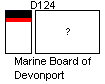
This funnel was used by the dredger Port Frederick, built in 1983.
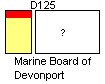
This funnel was used by the tug Gawler, built in 1967.
The board operated from 1 January 1867 to 10 December 1986, initially as Mersey Marine Board, renamed Devonport Marine Board in 1941 and known from about 1981 as Port of Devonport Authority. Lloyds also uses Devonport Harbour Trust in 1956–57 and continues listing the Authority in 1992–93 and 1996–97.
Australia, Devonport.
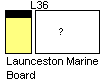
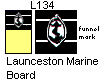
James Wallace was bought from Wallace Tugs with its funnel unchanged, suggesting that both operators used the same colours.
James Wallace also wore L134 during part of its career, unlike the other vessels.
The Marine Board was formed in 1857. Rosanoski records a later Port of Launceston Pty. Ltd. and an apparent Port of Launceston Authority period of 1968–2005. From 1 January 2006 all Tasmanian ports came under the newly formed Tasmanian Ports Corporation.
Australia, Launceston.
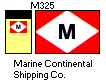
The funnel and flag are recorded in Brown 1978, no. 433.
Panama.
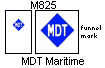
The funnel follows port and starboard photographs of Sea Force. Rosanoski distinguishes these from a website image showing the Maritime logo at the funnel base: matching smoke and crew positions led him to conclude that the logo had been added to the same photograph and did not document the vessel’s actual marking.
Marine Diesel Traders, or MDT, was formed in 1988 on the Brisbane River. MDT Maritime supplied tugs and barges to various industries, while MDT Power supplied marine engines. Maritime activities formed a major part of the business from 2009. The company was registered in Queensland on 4 September 1992 and Western Australia on 8 December 1992.
Australia, Murarrie, Queensland.
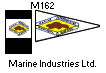
The white pennant has a yellow diamond within a white scroll outlined in black, extending throughout except at the fly. Black upright inscriptions read MARINE and INDUSTRIES above, MONTREAL and QUEBEC below; a brown beaver occupies the yellow centre. Stewart’s version does not extend the diamond to the hoist. The black funnel has a broad band of the flag. Branch Lines used this livery until the mid-1950s.
Marine Industries appears in the 1963–64 and 1970–71 registers. Its operating subsidiary Branch Lines, for which it also acted as agent, was sold to Davie Shipbuilding.
Canada, Montreal.
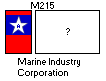
Agency vessels used a red funnel with a very broad blue band bearing a white star and a blue initial taken from the vessel’s name. The illustrated Ally of International Union Marine carried A; that company’s Gilia carried G, and Ekberg of Marine Development & Supply carried E. No flag is noted.
Marine Industry acted as agent for Cosmos Shipping Corporation, International Union Marine Corporation and Marine Developments Supply.
Hong Kong.
Marine Pacific served Port Moresby, Lae, Suva and Lautoka. It was a fifty-fifty venture of Adsteam Marine and Howard Smith, through United Salvage, a subsidiary of their joint venture Queensland Tug & Salvage.
Australia, assumed by the source.
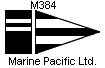
The funnel and flag are recorded in The Log, May 1997.
The Fiji company is listed as Marine Pacific in the 1996–97 register, managed by Howard Smith Industries. Its interests included Pacific Salvage Partnership, a joint venture with Salvage Pacific.
Fiji, Suva.
The PNG company is listed under Howard Smith Industries as operator in 1992–93 and 1996–97. The source names Inchcape Group as owner and records a joint venture formed with Pacific Towing (PNG) in 1980.
Australia, Sydney.
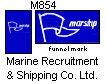
Photographs of Omskiy 14 show the funnel pennant mirrored between sides, with its pole pointing forward on each. The lettering nevertheless reads normally on the starboard side.
Also known as Marship, the company gives its establishment date as 7 April 1991. Lloyds records differ: Marship’s formation was first given as 1995, then amended to 1990; Marine Recruitment & Shipping was initially dated 2000, also later amended to 1990. The registers trace the fleet from Marship Shipping to Marine Recruitment & Shipping in April 2005, with the latter listed as managers only by 2011–12. Government control is recorded under the Republic of Russia and later the Russian Federation.
Russia.
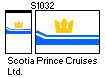
Nüsse records the flag under Marine Trading A/B.; the associated funnel illustration follows a photograph.
A postcard from the Prince of Fundy period shows a blue funnel with a narrow black cowl top.
Marine Trading was formed in 1981. Initially listed as agent, including for Scarlett Line and Transworld Steamship, it later operated through Transworld as a name company. Prince of Fungy Cruises is the register’s spelling for the manager; the source explicitly marks that form as sic.
The associated Scotia Prince service linked Portland, Maine, and Yarmouth, Nova Scotia. Lion Ferries established the summer route in 1970 and sold it in 1982 to Baron Stig Leuhusen, who established Prince of Fundy Cruises as a subsidiary of Panama-based Transworld Steamship and acquired Scotia Prince. After his death in 1996 the estate offered the company for sale. A group led by Mathew Hudson bought the shares in August 2000 and renamed it Scotia Prince Cruises. Court and other records describe the cruise company as incorporated in Bermuda, with Scotia Prince on bareboat charter.
Toxic mould closed the Portland terminal after the 2004 season. Scotia Prince was laid up in December and offered for charter or sale. She subsequently undertook Mediterranean charter work and, from mid-September 2005, a six-month charter as a floating hotel after Hurricane Katrina. The later account records her laid up at Toulon.
Sweden, Halmstad.
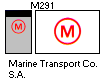
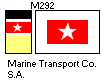
The first funnel is yellow or buff, with a black top separated by a broad red band edged white above and below and bearing a white star. The flag is white with a red panel and white star.
The second funnel is grey with a black top and a red ring enclosing a red M. Its white flag carries the same ring and letter. Rosanoski regards this Brown livery as apparently short-lived: Urania had recently been sighted on the Mersey in the December 1970 account, while the company does not appear in Lloyds 1973.
Marine Transport is recorded from 1953–54 to 1970–71. Rethymnis & Kulukundis acted as agent in 1953–54, followed by Maragonis Navigation Agency, also identified as owner.
Panama; subsequently UK, London.
The first French concern, also known as Matracor, was formed in 1968. Its successive managers included Compagnie Navale des Petroles, Total Compagnie Francaise de Navigation and Total Transport Maritime, under which it became a name company. Its vessels had cloud names; the last vessel’s sale is reported in June 1998.
France, Paris.
A second concern of the same name is listed in Paris as managers only in 1988–89.
France, Paris.
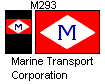
The flag illustration follows company website information. Website photographs suggest a black funnel with a broad band of the flag.
The American Marine Transport Corporation emerged from the June 1998 combination of Marine Transport Lines and OMI. Richard du Moulin’s account traces his group’s purchase of Marine Transport Lines in 1989, followed by the OMI transaction: OMI acquired Marine Transport Lines, spun off its international business into a new OMI Corporation and renamed the remaining Delaware corporation Marine Transport Corporation. The source dates completion to 17 June 1998 and describes Marine Transport as the eventual successor to the Mallorys.
The American group included Marine Transport Lines, Intrepid Shipping, derived from OMI’s US-flag business, and MTL Petrolink, formerly OMI Petrolink. In 1999 a venture with Stolt-Nielsen bought two US-flag chemical tankers from Occidental Petroleum. Mormac’s ocean bulk businesses joined in 2000: crude-oil tanker management was combined with Marine Transport Lines, product tankers were pooled, and the government-vessel operation remained separate. Crowley acquired Marine Transport on 7 February 2001. Other interests recorded include Marine Transport Management, OMI Offshore Marine Services and Amazon Transport, the latter formed jointly with Bergesen in 1986.
The position after 2008 is unclear. By December 2012 Rosanoski found no continuing account beyond Crowley’s acquisition reference and MTL Petrolink’s Gulf of Mexico operations; the former company link no longer connected.
USA, Weehawken, New Jersey.
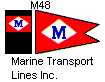
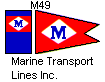
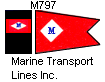
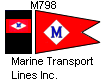
M48 is recorded by Stewart and Brown and in McMillan’s FOTW illustration.
M798 follows the US Navy reference.
M797 follows Brown 1971.
M49 follows Stewart 1963.
Marine Interests Corporation, a managed company and probably a subsidiary, used the MTL livery. The Oswego subsidiaries appear to have used a different emblem, also seen on Trinity Marine Corporation’s funnel.
Marine Transport Lines, or MTL, succeeded C.D. Mallory & Co. One account places its organisation later in 1941, after Clifford D. Mallory Jr.’s death on 7 April; Rosanoski’s 2004 comment instead calls it a 1942 reorganisation. Richard du Moulin traces the predecessor businesses to the Mallory family at Mystic in 1816, through whaling, shipbuilding, California-bound clipper services, steamships and tankers. His account says the family withdrew in 1940, a chronology Rosanoski notes does not entirely agree with the 1941 account.
MTL merged with the Trinity/Oswego Group in 1958. One account dates GATX’s purchase to 1970, whereas du Moulin places it in the conglomerate era of the 1960s. The company became publicly traded in 1983 and formed Union Marine Transport with Union Carbide. In late 1989 du Moulin led a private buy-out through Intrepid Acquisition Corporation. The June 1998 OMI combination produced Marine Transport Corporation after OMI’s foreign business was spun off; the original Marine Transport Lines remained among its subsidiaries.
The later company was part of Crowley, with Intrepid Ship Management as a subsidiary. Earlier operations included Marine Transport Management, MTL International Ship Management and MTL Ship Management. The numerous Oswego companies were managed by the principal and flew the Liberian flag. C. Rowbotham & Sons (Management), acquired in 1985, was sold to P&O in two halves in May 1990 and January 1993.
USA, New York; subsequently Secaucas and Weehawken, New Jersey.
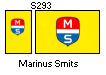
The yellow flag bears a shield divided horizontally red over blue, with a narrow white horizontal band. A white M occupies the red and a white S the blue. The yellow or buff funnel carries the same shield.
Marinus Smits was listed from 1963–64 to 1992–93. Fleet managers included Kamp’s Scheepvaart ed Handelmaatschappij, later Genchart and its owner Holland Ship Services. Some of the 1985 fleet appeared by 1992–93 under one-ship companies managed by Genchart.
Netherlands, Rotterdam; later Rodovre, Denmark.
Mitchell records this funnel on the Nordström & Thulin card, describing an investment company buying second-hand tonnage cheaply and apparently connected with its managing director R. Bergman.
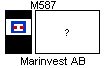
M587 follows Northern Bell on 16 October 2007. Rosanoski identifies the markings as Marinvest Shipping’s: the ownership chain ran through LR Shipholding, Skagerack Invest and LR Shipping Two. Thome were ship managers, not the owners represented by the marking.
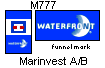
The Marinex photograph shows a double marking: below Marinvest’s band is Waterfront Shipping’s logo. Its light-blue globe area represents lines in the main blue shade and white, and the small terminal dot is an R in a circle, denoting a registered trademark.
Lars Mossberg established Marinvest in 1988, joined by Per Johansson in 1990. Investors brought in during 1997 created LR Shipholding in Bermuda, which formed Skagerack Invest and a 75 per cent-owned LR ICE Shipholding. Marinvest Shipping held 40 per cent of LR Shipholding. The register’s 2004 formation date is queried by Rosanoski, who suggests it may mark the start of shipowning. The group also had two ventures with Methanex through Waterfront Shipping.
Sweden, Gothenburg.
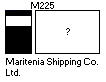
Gull was recorded in April 1964 with a black funnel and broad white band. No flag is noted.
Maritenia appears in the 1963–64 register and subsequently under its managers. Interprogress Import & Export acted as agent. Fleet management was divided between Jadranska Slobodna Plovidba and Jugoslavenska Tankerska Plovidba, with one vessel each, and Mediteranska Plovidba and Slobodna Plovidba, with two each.
Germany, Hamburg.
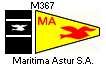
M367 follows Brown 1958, no. 177.
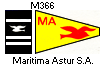
M366 follows Brown 1982, no. 143.
Maritima Astur is recorded in the Spanish vessel list of 1954 and successive Lloyds registers through 1985–86.
Spain, Gijon.
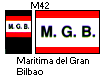
The funnel is black with a broad white band edged red above and below and bearing black M.G.B. lettering. The red flag has a very broad white horizontal band with the same black letters.
Portugal.
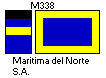
The funnel and flag follow Brown 1995, no. 744.
Formed in 1958, Maritima del Norte later operated through its name subsidiary Maritima del Norte Corporation, formed in 1988. D. Jesús Sendagorto of Santander managed part of the fleet in the 1970–71 account. Vessel names mainly began with Sierra.
Spain, Madrid.
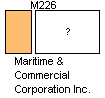
The NJK collection records Antiope with a buff funnel. Mitchell also records Astrolobe, but the company’s own card shows a black top, supported by a line drawing of Aubade.
The company is recorded under successive agents: Société Anonyme Maritime et Commerciale in 1963–64, Anglo-Swiss Maritime in 1970–71, Burls, Gordon & Rolland in 1980–81 and Acomarit Services Maritimes in 1988–89. Vessel names began with A.
Switzerland, Geneva; subsequently UK, London.
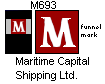
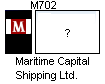
Birch 4, photographed on 5 October 2010, retained her earlier Singapore Grace colours. The band appeared white with a red panel, differing from the grey shown in a website funnel photograph. Another Birch 4 photograph, dated 2 October, confirms grey.
African Glory on 18 March 2011 shows a white band. The ship apparently was chartered to MUR Shipping, while her registered owner remained a Maritime Capital subsidiary. Rosanoski leaves open whether photography explains the difference or both band colours were used.
Maritime Capital Shipping, or MCS, was founded in 2006 by Mark Harris and Meei Wong. Incorporated in Bermuda on 30 April 2007, it acquired Maritime Capital Shipping (HK), wholly owned by Mark Malcolm Harris, on 20 July. Maritime Capital Shipping (Holdings), a British Virgin Islands company controlled by members of the Restis family, acquired the outstanding shares on 7 May 2010. Seanergy took 51 per cent on 28 May and the remaining 49 per cent in September; full acquisition was announced on 16 September 2010.
Rosanoski initially presumed that disposal of the fleet meant cessation, but the later African Glory evidence identifies a subsidiary still operating after the takeover.
China, Hong Kong.

The three ships were immediately chartered out, so the company markings did not appear until their charters ended in 1977. The flag is green with a white diamond throughout bearing black MC lettering.
Tsvi Rosenfeld formed Maritime Carriers New Zealand in 1972 according to the historical and registration accounts, with registration on 1 January. Rosanoski’s later FOTW comment instead dates its formation as a New Zealand subsidiary of the Netherlands operator to 1971. Withdrawal from shipping was announced on 26 November 1982, and the company was struck off on 29 April 1992.
New Zealand, Auckland.
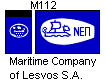
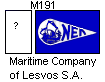
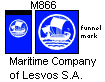
The blue flag has a white oval-like shape bearing a blue outlined ancient sailing ship and blue NEΠ letters. Brown identifies the final letter as Greek pi.
Nüsse’s table flag suggests lambda as the last letter instead.
Mitchell shows a plain blue funnel with an oval badge beneath, the vessel drawn as a simple single-masted galley. A Mytelene portside photograph dates from 25 May 2008. Panagia Parou’s starboard view of 26 January 2014 mirrors the emblem so that the bow points forward on both sides; its mast and general design lean forward, unlike the earlier upright form. Whether this marks a general change is unclear.
NEL Lines was formed in 1972, although an earlier Lloyds entry gives 1973. Public listing followed in 1995. ANEK acquired an interest in 1999, and NEL bought 42 per cent of MedLink in 2000. Arisvi Shipping and Irina Shipping were incorporated in 2001, selling their ships in 2003.
The source gives different figures for ANEK’s holding: 16.5 per cent in the company history, 20 per cent in Lloyds and 18.92 per cent in the Ventouris acquisition account. The website history says Edgewater acquired ANEK’s holding in 2005; another account names Apostolos K. Ventouris as the purchaser of the controlling stake. NEL and C-Link Ferries established a consortium in March 2006, when NEL also announced C-Link’s purchase. GA Ferries was acquired in 1999, with another reference specifying a 54 per cent holding.
Greece, Piraeus and Mytilini.
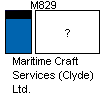
The small funnel follows the tug identified in the source as MSC Anie.
MCS Ailsa’s larger funnel accommodates a panel. Its top contains the logo and black wording below, but the details are unclear: the logo may be wholly black or partly blue. A narrow orange funnel top matches the bridge edging.
MCS Marlene differs in having a black funnel top and a lower panel.
MCS Maestro has no funnel: the illustration is a superstructure logo, seen on both sides and also at the aft end of the superstructure.
Most vessels have exhausts or no funnel. The blue may be darker than illustrated: the photographs vary and were mostly taken in dull light.
Trading from 1977, Maritime Craft Services supplied tugs, workboats and pontoons for dredging and construction. Its specially designed MCS Lenie entered the fleet in late 1997.
UK, Largs.
The funnel follows a portside photograph of Imor on 7 July 2012, with the website logo as reference.
The Institute is a research and development unit supervised by the Ministry of Maritime Economy. It operated Imor, built in 2005; the source identifies the registered owner as Morski Instytytut Rynacki, the Sea Fisheries Institute in Gydnia.
Poland, Gdansk.
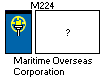
M224 is recorded for Ocean Ulla and for Aurelia at New York in August 1973. The latter was listed under Nautical Tankers Corporation at Maritime Overseas’ address; the ownership context remains qualified.
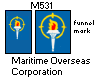
Mitchell’s M531 is a pasted cutting from an unidentified source, not his drawing.
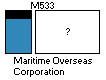
Mitchell identifies M533 with free-flag ships, supported by his notation and drawing for Kazuk of Harmony Tanker.
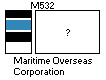
No vessel is explicitly identified for M532. A line drawing suggests a possible connection with Northern Star, but shows a black funnel base with a white-blue-white triband.
Mitchell marks M534 “OSG” but gives no source.
Vessel and company unverified.
No verified OSG or MOC allocation.
Maritime Overseas, or MOC, acted as ship agent and broker, with a general services agreement with Overseas Shipholding Group dated 31 December 1969 and amended on 1 January 1994. The source records it still operating in 2007. Its associated concerns appear to fall into two groups: the Israeli El-Yam companies, with their own livery, and Ocean Transportation with other single-ship companies under free flags. Many vessels in the latter group changed from Ocean or other names to Overseas names around the 1969 agreement. Rosanoski regards the 1963–64 listing of Ocean Ulla under MOC ownership as apparently incorrect, since surrounding editions place her under Ocean Transportation.
Agency clients included “El Yam” Bulk Carriers (1967), Luckenbach Overseas, Mayflower Steamship, Ocean Transportation, Overseas Shipping and Overseas Tankers.
USA, New York.
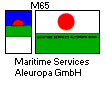
The funnel is white with a broad blue top bearing, at its base, a red half-sun rising above a narrower green band. The flag is horizontally divided white over green. A red circle occupies the white half; small black MARITIME SERVICES ALEUROPA GmbH lettering lies on the green near the division.
Founded in 1980, Aleuropa operated through single-ship subsidiaries. It is recorded as an operating company of Rudolf A. Oetker and subsequently taken over by it.
Germany.
Mitchell shows a black funnel for Maritime Services, in the context of the Nordbalt record.
Germany is recovered from the original Germany Bremen field. The exact older manager and its connection to the vessel remain unestablished; the later Rhenus namesake is not substituted.
Maritime Services is listed as operator in 1973–74 and later as agent. Mitchell records Nordbalt of Adamello Shipping care of Maritime Services; the source cites the Miramar Ship Index for Adamello’s ownership from 1971 to 1980.
Germany, Bremen; subsequently Elsfleth.
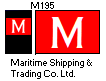
The flag is red with a white M, and the black funnel has a broad band of the flag. Merchant Ships 1944 instead gives W.J. Tatem’s funnel; Michalinos’ livery replaced the company colours in 1964.
Originally controlled and managed by W.J. Tatem, the company later came under Michalinos management, first for part of the fleet and then the whole. Michalinos bought several ships in 1964, when Maritime Shipping & Trading ceased to operate as a shipowner.
UK, London.
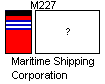
The funnel is recorded for Navigator in the NJK collection and for Adamantia in Mitchell’s collection, the latter vessel under Adamantia Shipping Corporation in 1966–70.
The company is listed as operator in 1963–64 and 1966–67. Navigator belonged to the operated Compañia Maritima Unidad, while Maritime Shipping acted as agent for Adamantia Shipping Corporation. Both funnel records associate the concern with William Mallas of New York.
USA, New York.
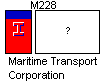
Ionia’s funnel was recorded in November 1966. The T has white and blue shading, with the blue aligned with the funnel top.
Apparently a single-ship company, Maritime Transport owned Ionia from 1966 until her breaking-up in 1970. Ionic Shipping Agency acted as agent.
USA, New York.
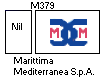
The flag follows the company website and FOTW. Bakker’s July 2004 illustration replaced Gutterman’s earlier image.
Marittima Mediterranea was formed in 1954 as an agency company.
Italy, Augusta.
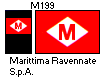
The funnel and flag are recorded in Brown 1978, with further funnel evidence in Mitchell’s collection. The FOTW flag follows company website information.
Established in 1929 from a shipping company dating to 1907, Marittima Ravennate had become a ships’ agency by the 2003 website account.
Italy, Ravenna.
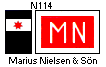
Stewart’s version appears as a white flag with a red panel bearing the letters.
The firm appears in registers from 1937–38 to 1963–64 and operated for D/S A/S Progress. In 1963–64 Progress is instead under O. Amsinck, leaving the relationship uncertain. Rosanoski suggests Nielsen may have ceased managing its ships and later operated through Progress, noting the vessels’ Nielsen names.
Denmark, Copenhagen.
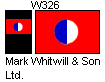
W326 is also attributed to Great Western Line or Great Western Steam Ship in early references, Avon S.S. in MN, and Severn Shipping in Stewart and Mitchell.
Mitchell assigns W327 to Mark Whitwill for Severn River and dates its sale to 1957. Under Severn River Shipping he assigns W326 to the same vessel and gives 1965, leaving the discrepancy unresolved.
Established in 1871, Whitwill was principally an agency and brokerage concern but also owned ships and operated Great Western Line to North America. After an absence from the registers, Great Western reappeared in 1890 as Great Western S.S. Co., liquidated in 1905. Mark Whitwill died in 1903. Sporadic ownership was followed by purchase of two ships in 1934 under Avon S.S. Co., renamed Kelston S.S. Co. in 1937. Wartime operations used M.O.T. vessels; Avon Venturer was bought in 1950 and sold in 1958.
Mitchell dates the end of shipowning to 1958, apparently connected with Avon Venturer’s sale, but the 1963–1964 register names Whitwill as operator for Severn Shipping. Rosanoski leaves that relationship unclear. The document also records an increased William Sloan shareholding in 1858, earlier than its stated establishment date.
UK, Bristol.
The funnel is recorded in Mitchell’s collection.
The company operated Markab from 1978 to 1986 and was associated with Heinrich Jüngerhans, identified with Jüngerhans Maritime Services.
Germany, Haren/Ems.
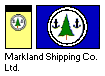
The funnel is yellow or buff with a black top and the flag emblem. The blue flag has a black-edged white circle with a second black ring near its edge, forming an annulet. Within it is a green tree between two small black upright anchors. The Worlds Merchant Fleets describes ground beneath the tree, whereas Brown’s version lacks the ground and shows the double-ring edging.
Markland was controlled by Mersey Paper, as recorded in The Worlds Merchant Fleets 1939.
Canada, Liverpool, Nova Scotia.
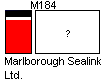
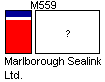
M559 follows a written description specifying a dark-blue funnel top.
M184 follows the illustration in The Log, August 1986.
Incorporated on 24 December 1982, Marlborough Sealink is described as a Blenhein/Picton consortium established late in 1984 for a Wellington–Picton service beginning in March 1985. South Pacific Navigation operated the vessel, and A.S.D. Marine Services acted as agent. The High Court ordered the company wound up for substantial debts in November 1985; it was struck off on 23 September 1993 after liquidation.
New Zealand, Picton.
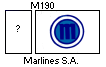
The flag is recorded on Nüsse’s website.
Sidra Shipping Enterprises changed its name to Marlines in 1983. The company acted as agent only.
Greece, Piraeus.
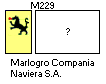
The yellow or buff funnel bears a black fork-tailed dragon standing on its hind legs, facing forward and breathing red fire. No flag is noted.
Marlogro is recorded in 1963–64 with G.E. Malroleon Shipping Enterprises as agent.
UK, London.
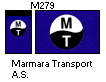
The blue flag bears a circle divided horizontally by a wavy line, white above black, with M and T respectively counterchanged. The blue funnel has a black top and the same emblem.
Marmara is recorded from 1963–64. By 1992–93 it was listed as manager only for vessels previously shown as owned.
Turkey, Istanbul.
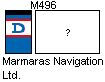
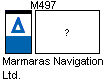
M496 appears to relate to Mitchell’s drawings of Kallipolis, Ellispontos and Nikaia. The first two are listed under separate managed companies; Nikaia was not traced.
The photographic evidence varies in blue shade: Maria D is too distant to establish it, Aigaion shows sky blue, while Marigo P and Anatoli show very dark blue.
The Prigipos photograph shows a yellow funnel with a narrow black top, but the port-bow view is unclear.
Marmaras appears earlier as Diamantides Maritime; the reported 1983 formation date apparently refers to a name change. Sources give differing controller and managing-director names and spellings: Dimantis or Diamantis Diamantides, A. Tzanes and E. Tsanes; the later Lloyds managing director is M.A. Zouila. An operating company, Diamantides Maritime Inc., was formed in 1988 at Piraeus, and Delta Tankers is recorded as an associate.
Greece, Piraeus.
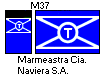
The livery is V. Tsakiroglu’s. The blue flag has narrow white horizontal bands near the top and bottom. Between them is a white saltire whose arms match the bands’ width. Over its centre is a blue circle, edged white without a defining outline, bearing a white T. The funnel is blue with a black top separated by the flag design.
The concern belonged to V. Tsakiroglu. Brown’s index calls it Marmaestra Compania Naviera; Rosanoski notes that one of the two name forms is a misspelling without deciding which.
Panama.
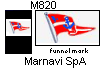
Ievoli Fast on 1 April 2013 shows a thick blue I. in the canton and a thick blue anchor. The smaller flag emblem on Ievolki Red has a very thin anchor, nearly invisible in small photographs and looking black except for its thicker blue flukes. On Ievoli Gold, the letter and anchor appear outlined in white.
The house flag is a red pennant with a white cross, a blue anchor at the centre and blue I. in the upper hoist, identified as standing for Ievoli.
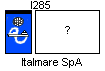
Mitchell’s funnel has a globe above a ship and a white symbol. His four vessel drawings, including Marina di Cassano, show blue funnels.
Exact Italmare legal entity and relationship to Marnavi unresolved.
The family history dates the concern to 1910, founded by Dominico Ievoli, grandfather of the later president Domenico Ievoli. Domenico was chief shareholder, with sons Attilio and Gennaro as vice-presidents. Lloyds instead gives formation in 1980, previously Italmare.
Gennaro & Domenico Ievoli bought Gennaro Ievoli and Rita Ievoli in 1971. The former passed to Società Marritima Siciliana in 1976 and to Italmare as Lido in 1977; Rosanoski tentatively dates the shipping start to that purchase. The register links Marnavi to the earlier Italmare through Dimar, but also records a Sorrento Italmare connected through Marina di Cassano. The relationship between the two Italmare entries is unclear. Marnavi’s interests included Novamar International of Milano in association with the Pietro Barbaro Group.
Italy, Naples.
Al Farabi’s funnel emblem is on a circular plate attached to the panel. Rosanoski identifies the Gazocean fish at the base, two crossed arrows pointing down, the star frame and white panel of Compagnie Marocaine de Navigation, and the wreath of Office Cherifen des Phosphates. The arrows’ meaning is unclear. A 12 June 2004 photograph also shows MARPHOCEAN on the hull.
Maroc Phosphor Ocean, also known as Marphocean, was formed in 1976 jointly by Compagnie Marocaine de Navigation, Gazocean Armement and Office Cherifen des Phosphates. The later registers place it under Compagnie Marocaine de Navigation and subsequently under Gaz de France and CMA CGM Holding.
Morocco, Casablanca.
M230 was recorded on Golfo di Napoli in September 1967, owned by the managed Compagnia Generale di Navigazione.
M231 is recorded by Stewart 1963 and US Navy 1961.
Lloyd Sardegna’s flag is white with a blue cross, a red L in the first quarter and a red S in the fourth. The funnel follows Isola Della Stelle on 25 May 2005, with lloydsardegna.it in blue on the hull.
Marsano’s earlier flag was white with a red cross centred towards the hoist and a blue M over the sinister arm.
The register dates Andrea Marsano & Sons to 1976 and its change to Marsano Armatori to 1981, but Rosanoski marks the formation date sic: Andrea Marsano is already listed in 1953–54, and the Marsano Armatori name appears in 1978–79. Moby bought the company, including Compagnia Sarda di Navigazione Marittima, in September 2006.
The operating chain ran through Compagnia Sarda di Navigazione Marittima to its shipowning subsidiary Lloyd Sardegna Compagnia di Navigazione, formed in 1990 at Cagliari. In August 2007 the register omitted the intermediary and listed Lloyd Sardegna directly under Marsano. Compagnia Sarda’s reported 1964 formation also conflicts with its appearance in the 1963–64 register. Luigi Pa, the last vessel, changed ownership to Moby in July 2011, although a July 2007 photograph already shows MOBY cargo on her hull.
Italy, Genoa.

The flag is a white pennant with a small light-blue circle at the hoist, taken from a Collectors Corner cap badge. The funnel follows a photograph of St. Erik.
This ferry company was operated by various people in the 1950s and early 1960s: Einar Johansson, C.B.V. Brännberg and L.B. Olsson appear successively in the registers.
Sweden, Marstrand.
The flag is blue with a white stylised M resembling a zigzag. The blue funnel has a black top and the same white emblem.
Also known as Marti Shipping & Trading, the company was formed in 1980. It operated through name subsidiaries and Ermar Deniz Tasimaciligi, formed in 1985 at Istanbul. By the July 2000 register Marti was listed only as fleet manager, including for Akdeniz Gemi Isletmeciligi.
Turkey, Istanbul and Ankara.
Sea Bright on 18 March 2006 confirms the funnel, although the flying flag is indistinct. The funnel’s M is more ornate and has a shallower V than Nüsse’s table flag. Its blue is a definite mid-blue, also reported by JB.
Formed in 1995, Martime operated through name companies and later also under its own name. Containerschiffsreederei H.-W Jannsen is listed as owner in the earlier accounts; although subsequently omitted, Rosanoski notes that the two companies retained the same address and managing director.
Germany, Elsfleth.
Sources also attribute the livery to the operated company Heimdal.
Martin Carl operated as A/S D/S Heimdal, with records under that company name from the 1937–38 telegraphic-address listing. Carl Wahren A/S is also associated with the funnel in Merchant Ships 1942 and 1944.
Denmark, Copenhagen.
The funnel is sourced to The Log, May 1996.
Martin Kennedy and Maurice O’Connor operated in partnership in 1885–86.
New Zealand.
FOTW first displayed O6 without a source or author, subsequently credited it to Ivan Sache, and then replaced it with his O186 version from Lloyd’s 1912. Rosanoski suggests that the original yellow diamond may have been an illusion introduced by scanning.
Martin Olsen operated sailing ships.
Norway, Porsgrund.
The white funnel carries a panel of the flag. The flag is horizontally divided blue over red, with a horizontally elongated white M above a tall white S.
Martin Stutz is recorded in the 1963–1964 and later Lloyds lists, with D. Oltmann as fleet manager.
Germany.
The funnel follows Karina at Istanbul in December 2005. The document also supplies the Martinoli & C. logo as reference.
Martinoli Consulting was formed in 2002. It and Martinoli & C., a technical consultancy and surveying business dating to 1946, were separate Martinoli Group companies at the same address. Consulting merged most activities into Martinoli & Co. but remained active. Its fleet had previously appeared under name companies with Petroships as agent; the later Kasaro evidence suggests operation by K-Ships, presumably on charter.
Italy, Genoa.
M359’s flag was adopted with the name change on 1 September 1993. The A letters have no horizontal bars, taking inverted-V forms, and U and H share a vertical line.
The original emblem combines the circle, maru, with HA from Hayashikane, accounting for the name Maruha. The T1 funnel was probably introduced for Shinsei Maru in 1905. Watt suggests the T2 variation resulted from a raised welded device whose fixings were painted white instead of black. The end of the first symbol within the ring is wrongly shown pointing forward in the Watt articles; the Chiyo Maru No. 3 photograph confirms the other sources’ orientation.
T3 was used by non-fishing and non-whaling vessels. T3 and T230 appeared across tanker, cargo and reefer subsidiaries, but their individual allocation could not be established. Watt suggested that the variation might follow trade or service rather than company, possibly even changing by voyage: a Bansha Maru No. 31 photograph, the vessel name itself tentative, shows two bands painted out black. Jinyo Maru’s September 1966 funnel is identified with Hokkaido Gyogyo Kosha. One account dates a new livery to 1 January 1993 while retaining the funnel.
Ikujiro Nakabe founded Hayashikane Shoten in 1880, with incorporation as Hayashikane Shoten K.K. in 1924. One account traces the fishing and whaling interests through Nishi Taiyo Gyogyo Tosei in 1943 and Taiyo Gyogyo in December 1945, with the parent adopting that name in September 1947. Lloyds instead gives Taiyo Hogei’s formation in 1943 and the change to Taiyo Gyogyo in 1948. Maruha became the formal name on 1 September 1993, after long informal use.
Direct shipping ended on 31 March 1997, with reefer operations passing to Reefer Express Lines Pacific from 1 April. The wider group retained fishing operations, while New Shipping Kaisha handled chemical tankers. Earlier expansion included the purchase of Tosa Whaling in 1918 and reefer and shipping ventures with Fairfield Maxwell, alongside Amaltal Taiyo’s New Zealand venture of 1986–93. The later holding-company structure is recorded under Maruha Group.
Japan: Osaka initially, Shimonoseki from 1904 and Tokyo from June 1949; Merchant Ships uses Simonesekin.
Mitchell assigns the illustrated funnel to Maruni, corresponding to Hinode Kisen’s H133 version. His drawing of Wakasugisan Maru, however, shows a yellow funnel with a black top.
Maruni apparently began with Kofuku Maru in 1957. It was associated with Hinode Kisen, including an agency role for their joint venture. The last ship was sold in 1995, but a 2009 account still records the company in the oil and gas industry.
Japan, Fukuoka.
The chartered Kinsei Maru No. 11 carried a black funnel with a white band and red M. The flag is white with a red M.
The company is recorded in registers from 1963–64 to 1973–74. Kinsei Maru No. 11 of Kanao Kisen was on charter to the concern, called Maruraku Shoun in that account.
Japan, Tokyo.
The earlier records show Maruta’s red emblem on a white band, with a blue funnel base and black top.
Chem Taurus on 7 July 2009 is listed with Shenlong as registered owner, Maruta as manager, Ace Tankers as operator and Fairfield-Maxwell as group owner. Rosanoski identifies the emblem as Maruta’s, while explicitly offering his explanation as a theory. The ship had been Chembulk Casablanca under Maruta’s name subsidiary Lukia Maritime, then Fairchem Danube under Shenlong from 2006. A 2007 photograph apparently showed Fairfield-Maxwell colours without the emblem. The later Chem Taurus name and Ace operation may explain the return of Maruta’s emblem as an owners’ mark. Rosanoski distinguishes Ace’s usual red funnel with a stylised white A, and notes that the photographed emblem is not Fairfield-Maxwell’s.
Maruta Sangyo, also listed as Maruta Industries, is dated to 1969 in an earlier register and to 1958 in later editions. Rosanoski disputes the stated 1989 change from Uzushio Kaiun because the Maruta name appears by 1973. The concern operated chemical carriers, with its fleet apparently chartered out in the 2009 account. Singapore-based Hailong Maritime, formed in 1996 and apparently renamed Shenlong in 1997, was listed under Maruta until reassigned to Fairfield-Maxwell in 2007 without explanation.
Japan, Imabari.
Adrian Maris carried a black funnel with a broad red band edged white above and below and bearing a white M. No flag is noted.
Marvalor is listed in 1963–64 with Morland Navigation (London) as agent.
UK, London.
Almar’s funnel was recorded in December 1967, associated with Z. & G. Halcoussis.
Marveras owned Almar from 1962 to 1976. Victoria Steamship acted as agent in the register accounts.
UK, London.
The flag follows the chart Private Signals of the Merchants of New York.
Mason & Thompson was a mid-nineteenth-century firm.
USA, New York.
The funnel is white with a black top, taken from a photograph of Al Masooma at London dated 26 January 1988. No flag was sighted.
Masouma is dated to 1996 in the register account, with its fleet under a name subsidiary.
UK, London.

The original red flag bears a white M with an elongated first leg and a white attachment hanging from it, plus a small white cross couped in the upper hoist. It formed the funnel band, confirmed on Unterwalden at Wellington on 14 December 2001; the cross was forward on the starboard side too.
Arosa’s July 2008 portside photograph and a company website starboard view show the M666 variant; the latter puts the cross aft. The only discernible flying flag appears to be the Swiss ensign.
Martigny’s May and June 2007 photographs show the cross forward on both sides.
The later funnel follows Sarine on 30 January 2010 and Aargau at Newcastle on 6 March 2011, with the company logo as reference.
Rosanoski suggests that funnel-design changes may have followed the name changes and may have produced new flags, but he had not seen evidence confirming later flags.
The management concern was formed as Massoel Gestion Maritime in 1995 and is recorded as renamed Massoel Gestion in 2003; a separate account dates the management change to July 2002. On 17 May 2007 it combined with Liverpool’s Meridian Marine Management to form Massoel Meridian, managing Massoel-operated ships. Earlier registers place the concern under Acomarit and then V. Ships.
The group structure places the shipping companies and Massoel Maritime under Massoel Maritime Holding. Massoel Maritime provided investment, trading and ship-management services, with Liverpool and Manila subsidiaries. The later website identifies Massoel Ltd. as head office while retaining Massoel Maritime Holding as holding company.
Switzerland, Geneva.
The funnel follows Onego Mistral on 2 July 2012. Rosanoski describes the markings as derived from Intership Navigation’s.
Captain Eugen-Henning Adami founded Mastermind in 1999, principally as a shipowner, later expanding into management through Mastermind Shipmanagement. Rosanoski tentatively dates the management company to 2010. The group held a substantial interest in Navinvest Holdings, specialising in ship ownership. Adami’s earlier managing-director role at Intership Navigation provides a recorded connection between the concerns.
Cyprus, Limassol.
The funnel lettering derives from the original partners. Loughran shows a panel rather than a band; Mitchell likewise shows a panel on the Mobil card, having originally recorded the funnel under Phoenix Shipping and later added Matco Oil. Ocean Ships 1982 instead indicates use of Mobil’s funnel. Bakker’s flag illustration follows Brown 1995.
Matco originated in 1975–76 as a partnership of Mobil Products North Sea, Amerada Exploration, Texas Eastern (UK) and British Gas. Its vessels bore Matco names and appeared under Mobil management. Later records list Matco Tankers as a name company of Mobil Shipping, and then of International Marine Transportation in the Exxon Mobil group. Matco Clyde, the last vessel, was broken up in 2004.
UK, London.
Manthos II of Alexandros Marcantonakis was recorded with a white funnel, blue top and broad blue band. No flag is noted.
Marcantonakis managed apparently family-owned vessels and traded under Marcantonakis Lines, also written Marcantonakos in one entry. Compañia San Giovanni and Compañia Santa Kalliopi are recorded as associates.
Greece, Piraeus.
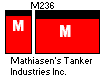
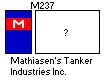
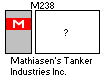
Brown 1958 shows a flag with a black band at the top, matching the red, black-topped funnel and white M. Rosanoski considers this possible, while noting evidence for a plain-red flag instead.
The alternative flag is red with a white M. Later blue or grey funnels carried a red band and white M, supporting the plain flag design; it probably also applies to the Prairie Grove variants.
Prairie Grove is recorded with M237, changing to M238 by the New York sighting of October 1973.
Mathiasen’s was a small independent tanker operator, with nine ships totalling 93,000 gross tons in 1949. The registers later record it as owner as well as operator.
USA, Philadelphia, Pennsylvania.
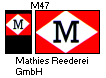
M344 is recorded in Lloyds 1904 and 1912 and in the German flag references.
M47 follows Brown, with additional funnel evidence in Merchant Ships and ABC Foreign Coastal Freighters.
M346 is recorded in several later references and by Collectors Corner.
M345 follows Flaggen & Schornsteine and US Navy 1961.
The sources vary in the shape of the M. Rosanoski tentatively associates one livery with the Mathies companies sharing the Reederei address, while Johannes Ick retained its own.
Steamship ownership began in 1887 as L.F. Mathies & Co. The later registers distinguish Mathies Reederei and L.F. Mathies & Co. at different addresses, adding Mathies Reederei Schwedendienst at the former address. Rosanoski leaves their relationship unclear: Flaggen & Schornsteine separates them, and their vessel-naming systems differ.
The 1942 account gives joint control by Johannes Ick, Sartori & Berger and Robert Sloman Jr. from 1934, though the individual entries name only Sloman as controller. Later records list Johannes Ick and Mathies Schiffahrts as subsidiaries, the latter formed in 1988. Mathies, Ernst Russ and Poseidon jointly formed Team Lines in 1991. Sloman also managed part of the fleet.
Germany, Hamburg.
Registers first name Georg Behrmann in 1953–1954 and 1958–1959, later giving Mathielde Behrmann. Wilhelm Pekholtz is listed as manager. The heading uses Mathilde.
Germany, Krautsand.
The flag is white with a central red M. Matsas Star on 21 June 2006 confirms the funnel, although all strokes of the M appear equally thick.
Company photographs confirm M45. Bakker’s Brown-based flag is attributed to Loucas Matsas & Sons Shipping.
M241 is recorded for Stelios M.
Amazon’s portside photograph of 18 June 2006 supplies the funnel, while Nüsse’s table flag supplies the flag.
M845 follows Sache’s World Salvage Directory-based flag illustration.
Website photographs suggest M45 was the original funnel, seen in the monochrome Aghios Ferorgios image and first recorded for Keravnos, built in 1921. Adrias II in 1952 appears to have a probably red funnel, black top, two narrow white bands separated by a broad gap, and a white cross paty in the gap. Marigo Matsas II shows a very broad red band; other photographs mix M45 and M36 with varying sizes and M forms.
Loucas K. Matsas established the towage and salvage concern in 1880 at Piraeus. Its first tug, Aghios Georgios, was built on Samos. General cargo operations began in 1955, followed by a regular Aerkista–Ediposa ferry line in 1959. The company built what its history calls the first Greek deep-sea salvage tug in 1970. George L. Matsas joined in 1980 and later became president.
The registers distinguish several Matsas concerns. Loucas Matsas & Sons and Loucas G. Matsas appear separately, the latter becoming Loucas G. Matsas Salvage & Towage Maritime in 1982. The later structure places this company and Loucas G. Matsas (Hellas) under Loucas G. Matsas Marine Enterprises, with Loucas Matsas & Sons Maritime operating beneath the salvage and towage concern. These related listings should not be treated as a single unchanged company title.
The salvage account records Gulf operations during the Iran–Iraq war, firefighting aboard Anafi, cargo removal from Esperanza III at Mumbai, and recovery of crew members and pollutants from the capsized Dystos off Euboia.
Greece, Piraeus.
The funnel changed from M91 to M90 in the early 1930s. Talbot-Booth 1936 shows a black M on M90, while Ships & The Sea 1936 records a change to blue. Oceanic Steamship also used the funnel, retaining its own flag in Stewart’s 1963 account.
Lillian Low, the founder’s wife, designed a red flag with a blue M inside a white circle surrounded by seven white stars. Sources differ over whether the stars remain upright or turn around the circle. A photographed swallowtail has smaller stars, and Merchant Ships also records a former burgee shape. Website colours are maritime blue and golden yellow, but monochrome photographs and the FOTW flag suggest that a darker blue may have prevailed. Mariposa and Monterey appear to have differed slightly, with the M on an intermediate-shaded circle that also seems striped.
Ships & The Sea assigns M290 to Oceanic Steamship and M299 to Matson Steamship and Matson Navigation.
Captain William Matson began the enterprise in 1882, sailing Emma Claudina from San Francisco to Hilo. Matson Navigation’s incorporation is separately dated 9 February 1901. After Matson’s death in 1917, leadership passed to Lurline and William P. Roth. Alexander & Baldwin acquired a minority interest in 1908 and made Matson a subsidiary in 1969. Non-shipping assets were divested in 1959; passenger vessels were sold in 1970 as operations concentrated on Pacific Coast–Hawaii freight.
Expansion included Oceanic Steamship in 1926 and Inter Island Steam Navigation in 1928. Los Angeles Steamship is described as merged in 1930 in one account and purchased on 1 January 1931 in another. Oceanic & Oriental, a venture with American-Hawaiian, ended in 1937. The source rejects a reported acquisition of Matson by Pacific Far East Line as apparently confusing the passenger-vessel sale with the company itself. Cargo vessels received Hawaiian names from 1938, later commonly beginning with Hawaiian.
Matson Intermodal System, formed in 1987, became Matson Logistics in 2003 and was rebranded in 2011. The later structure places Matson Navigation beneath Matson Inc., with Matson Logistics and Matson Terminals below Navigation.
USA, San Francisco.
Preserve the original prose, but do not illustrate or link it to the withheld GIF(s): M290. Source reference codes do not establish an image association.
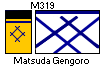
The flag follows the 1902 chart republished in Fune to Hata in 1994. Watt notes that FOTW’s lines are not exactly parallel, contrary to the 1901 chart. The funnel band and charge are blue.
The 1901 chart names Matsuda Gengoro, while FOTW uses Matsuda Seiichi.
Japan.
M368 follows Merchant Ships 1944.
M369 follows Brown and US Navy references; the blue funnel-band shade is taken from Mitchell.
Formed in 1922, Matsuoka was consolidated into International Energy Transport, associated with Mitsui O.S.K. Lines, in April 1989.
Japan: Hiogo-Ken in Merchant Ships, Kobe in Lloyds and Osaka in Mitchell.
A watercolour of Nantucket whaling signals from 1840–1850 has an indistinct two-part name which may read Matt Crosby. The flag is also recorded for Lima as a ship signal flown concurrently, attributed to Crosby’s principal ownership of the vessel. American, Navigator and Washington had separate ship flags; these are not treated as additional Crosby company variants.
Matthew Crosby, who lived from 1791 to 1878, is recorded as a whaling shipowner from 1834 to 1856 and as owner of American. Some vessels in which he was involved also used their own flags.
United States, Nantucket.
The normal funnel is black with a broad green band bearing a white circle and green T.
Filtric in April 1965 carried the same arrangement with a very narrow black mourning band crossing at the foot of the T.
Tertric in January 1967 had a broad blue band instead, retaining the white circle and green T.
No flag is noted.
P. Wigham Richardson acted as agent. The funnel observations are associated with V. Tricoglou.
UK, London.
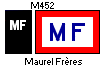
The flag follows Brown 1926, with further evidence in Lloyds 1912 and Pavillon Compagnies Maritimes Françaises. The FOTW illustration appeared on the Maurel & Prom page.
France, Bordeaux.
Brown 1978 shows a rectangular flag; Ipavec’s FOTW illustration is described as a variant.
The BISN-site flag is a white swallowtail completely edged blue, with a red diamond touching the blue borders and a blue M inside.
Mitchell also places M552 on the J. Rogers & Co. card, while qualifying the vessels as Mauritius Steam Navigation’s.
The company’s foundation is tentatively dated to 1965. It is described as a P&O associate, with Rogers & Co. managing vessels and British India, later P&O, operating them. Rosanoski leaves the precise BISN connection unclear. Rogers was a Port Louis concern dating to 1899, entering shipownership in 1932 through Colonial Steamships. A 1996 venture joined Mauritius Steam Navigation, Rogers and Indian Ocean Bulk Carriers to own two ships, but appears to have been short-lived. The company may have continued in abeyance.
Mauritius, Port Louis; a London address under British India Steam Navigation as agent is also recorded.
US Navy 1961 records N823 under Nueva Vista Compañia Naviera, listed under Mavroleon agency.
The funnel is recorded for Finnamore Valley of Falaise Ore Carriers.
M853 follows Brown 1971 and the NJK collection.
The buff funnel shade is based on London & Overseas Freighters. Sources vary in the M and lion forms; the black lion is explained through the Greek “mavroleon”. Traditional Traders had its own livery.
The Mavroleons were a Kasos maritime family from at least the mid-nineteenth century. Two third-generation branches are described: Vasileios Emmanuel and Vasileios Elias. In 1965 Vasileios Emmanuel formed Mavroleon Brothers in London with participation by his brother Mimis and sons Emanuel and Nikolaos, who succeeded him. London operations ceased in 1987, with Nikolaos continuing from Piraeus. Vasileios Elias had founded Bray Shipping in 1946, joined by his son Elias Vasileios in 1970.
The family also had strong British connections: Basil Mavroleon established London & Overseas Freighters with the Kulukundis brothers. Mavroleon Brothers (Ship Management) appears in the registers from 1963–64. Traditional Traders Shipping was a subsidiary, while a connection with Agua Clara Compañia Naviera Panamena is only suggested.
Greece.
The flag is blue with a white diamond bearing red MC. The yellow or buff funnel has a black top and a broad band of the flag.
Recorded as Max Clausen in 1963–64, the owner appears as Max Claussen in subsequent Lloyd’s listings through 1992–93.
Germany: Rendsburg in Lloyd’s 1963–64 and Westerronfeld in 1978–79.
The blue flag has a white horizontal band bearing a stylised red M. The funnel is blue with a broad white band and the same red letter, with nicks in the band’s upper and lower edges aligned with it.
Formed in 1978 as Mavrakakis Shipping, the company changed to Mayamar that year. It is recorded as manager and later as agent for name companies.
Greece, Piraeus.
McMillan’s FOTW flag follows Stewart & Styring 1963, but its M has a shallower V than Stewart’s illustration.
The company operated the tanker Mayflower, built in 1961 and sold in 1966 to Overseas Oil Carriers. Maritime Overseas acted as Mayflower Steamship’s agent and also managed the buyer.
USA, New York.
The funnel is red with a black top separated by a white-red-white triband. The website image suggests unequal band widths, with red possibly narrower. The white flag bears the funnel and black MCALLISTER BROTHERS lettering across its base, the M, A and B taller than the other letters. Loughran 1979 instead makes only the c shorter, a treatment not supported by his later Brown editions.
McAllister Brothers is recorded from 1958–59 through 1992–93. Associated concerns at the same address included McAllister Lighterage Line and McAllister Towing & Transportation.
USA, New York.
The funnel and flag are recorded in the Talbot-Booth and Ships & The Sea references, with further funnel evidence in Merchant Ships.
Formed in 1929 by the merger of M. Orme & Son and John McCallum & Co., the company was acquired by David MacBrayne in 1947.
UK, Glasgow.
Fraser/Eastern common design does not prove this allocation.
The first funnel is green with a black top and broad red band. A white diamond touches the band’s edges and bears a white F, as the original description states. The red flag has a green diamond throughout with a white F.
The second funnel is blue with a broad red band edged white above and below, carrying a blue diamond and white F. Recorded as McCormick Shipping Co., it is assumed to belong to this concern.
Eastern Shipping acted as agent and Eastern Steamship as operator. Watt identifies the later Japanese addresses and Eastern Shipping K.K. references as erroneous, amended back to Miami from 1986, with no connection to the Tokyo company.
USA, Miami, Florida; Panama in US Navy 1961. The Tokyo listing is identified as an error in the source.
The livery formed the basis of Pope & Talbot’s. McMillan’s National Geographic-based flag has a larger emblem than the illustration based on Loughran. He tentatively recalls a “fat star” variant, while National Geographic shows the usual form. The Brazilian reference dates its livery to 1950, after the stated takeover.
Charles R. McCormick’s shipping developed from the lumber business, with Cascade Steamship dating to 1904. The FOTW account describes coast-wide service by 1916 and formal incorporation of McCormick Steamship in 1921. It relates the purchase of Pope and Talbot in 1925, rapid expansion to 45 vessels by 1928 and failure to meet the purchase debt, after which the former Pope and Talbot owners repossessed both businesses. Shipping continued under the McCormick name until 1939 in that account, matching the end of its management of Pacific Argentine Brazil Line and Portland Steamship.
Loughran’s account differs: it describes McCormick as also founding Pope & Talbot and dates the takeover of the McCormick companies to 1946. The source retains these differing histories.
USA, San Francisco, California.
The funnel was recorded for J. Ray McDermott (Aust.) vessels, with MCDERMOTT in the upper arc and INC. below.
The document supplies website logos, including one from the maritime-activities site, suggesting that it might appear on later vessels or platforms; actual use is not confirmed.
The business originated in 1923 when R. Thomas McDermott secured a wooden drilling-rig contract and asked his father J. Ray to supervise construction, naming the concern after him. It moved within Texas and later to New Orleans, developing shipping platforms in the late 1940s. One account dates the change from J. Ray McDermott & Co. to McDermott Inc. to 1980; Lloyds dates formation to 1946 and the name change to 1981.
In the 1983 reorganisation, the Panamanian international subsidiary, established in 1959, became parent of McDermott Inc. and its subsidiaries. Rosanoski disputes a separate register account that dates McDermott International to 1972 as Oceanic Contractors and its renaming to 1981, since McDermott International already appears before 1972.
Marine interests included Construcciones Maritimas Mexicanas, a venture presumed to be with Protexa, and HeereMac, formed with Heerema in 1988. McDermott sold its half of HeereMac in 1997, though both groups continued to list successor Heerema Marine Contractors Nederland. The submarine-cable concern apparently became ETPM Deepsea, a partnership with Groupe GTM that GTM ended in February 1998. The group also included McDermott Subsea Constructors and J. Ray McDermott Holding. Acquisition of Secunda International’s assets, including the parent of Secunda Marine Services, was announced in July 2007. Fleet names gradually adopted Jaramac followed by Roman numerals.
USA: Houston, Texas; Anchorage, Alaska; and New Orleans, Louisiana, in successive register references.

The flag is red with a white horizontal band bearing blue MSSCo lettering.
McGregor operated from 1889 to 1905. Orewa was bought in 1900 and Claymore operated from 1902, the latter recorded as owned by W.A. McGregor. Both ships were sold to Settlers Steam Ship in 1905.
New Zealand, Auckland.
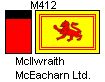
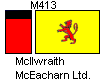
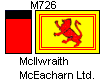
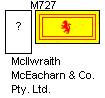
The early Scottish Line flag resembles the Scottish Royal Standard: yellow with a red lion rampant inside a red frame.
Talbot-Booth omits the frame, while noting that the flag once had a Scottish-style border.
Brown’s editions from 1943 restore a double frame but make the lion passant. A 2008 photograph of Alltrans confirms the funnel.
Stewart and The Log likewise show the double frame but retain the lion rampant.
The National Maritime Museum flag is dated about 1951 and is the basis of Bakker’s FOTW illustration.
Andrew McIlwraith and Malcolm McEacharn formed their partnership in London on 1 February 1875 according to one account. Another dates formation to 1884 and the Melbourne office to 1885. Trading as the Scottish Line, the concern later became McIlwraith McEacharn Ltd. in 1927. It eventually appears as an operating company of ASP Pacific Holdings.
The company helped establish Queensland Steam Shipping and British India & Queensland Agency, and participated in the Australian coastal owners’ associations. Associated Steamship Companies began in 1901 and formally lasted until 1910; Associated Steamship Owners followed in 1921. By the end of 1961 the latter comprised McIlwraith McEacharn and Adelaide Steamship. The company acquired James Paterson and the shipping interests of Huddard Parker in 1962. Its shipping merger with Adelaide Steamship was agreed in 1963 and operated from January 1964 as Associated Steamships, initially 60:40 and equalised in October 1967. By about 1975 the combined concern had become a tanker-management business.
Later interests included Bulkships, whose remaining holding was sold to TNT in January 1981, and ASP Ship Management with ANL on a 40:60 basis. Tug ventures with Howard Smith included Melbourne, Weipa and Western Port services, the last subsequently bought out by Howard Smith. Swan River Shipping was a long-standing associate.
UK, London, and Australia, Melbourne.

The 1986 written record describes a vertical red-white-bright-blue triband. On white is a block M with sloping outer sides: the upper half white edged black and the lower portion divided horizontally with zigzag edges into red, white and blue. The flag was not drawn until 2008 and may be inaccurate; the original recording files had been destroyed. Later logos retain the basic M shape but change the colouring and place wavy lines below it, so Rosanoski considers the old flag probably superseded.
McKay was established in 1977 by Holm & Co.’s former manager with J. Lauritzen backing, recorded as 49 per cent. Primarily a port agent, it participated in the Kiwi Shipping and Tasman Express consortiums and in Omniport Napier with McLay Holdings and CMT Systems. Pacific International Lines later acquired the company.
New Zealand, Auckland.
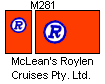
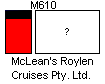
The flag is deep orange rather than red, although the shade could be mistaken for either. Towards the hoist is a blue-edged white circle bearing a slightly slanted blue R. The funnel shares the deep-orange shade; an earlier luggage label, dated about 1955, appears yellow.
J. Burne recorded Helian at Strahan Harbour. The vessel had been under Roylen from 1974, but the distant location and absence from Lloyds 1985–86 suggest that the observation may post-date disposal, with the logo removed. The funnel colour is also open to confusion.
Date/owner and colour uncertain.
The Barrier Reef cruise operator was registered in Queensland on 26 June 1960 and voluntarily deregistered on 24 February 2009.
Australia, Mackay.
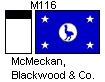
The blue flag has a white circle containing a blue emu and a white star in each corner. A monochrome painting of Albion shows the flag without discernible stars, while the funnels have three narrow bands.
Known as the Blue Emu Line, the partnership of James McMeckan and John Blackwood began in 1852. It formed the Adelaide, Melbourne & Otago Steamship Company in 1856 and ceased operations in 1878, with the fleet acquired by Union Steam Ship of New Zealand.
Australia, Melbourne.
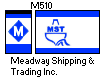
The flag follows the company website. Funnel photographs of Delzourke on 9 February 2007 and Delmar on 31 March differ in blue shade: Delzourke agrees with the website, while sunlit Delmar appears sky blue. A later Sydney observation of Delzourke describes dark blue.
The website dates Meadway to 1989, founded by partners associated since 1975. Earlier Lloyds entries give formation as Navitrade Shipping in 1983 and renaming in 1991, with the date subsequently amended to 1989. The company is listed as manager and later agent. Its original fleet had bird names.
Greece, Piraeus and later Athens.
Dilovasi VIII’s August 2008 funnel photograph shows an M that looks blackish but is judged more likely very dark, dull blue. The superstructure carries black MEDMARINE above DILOVASI and VIII. The document also provides website logos, including an apparently newer holding-company version.
The separate source-list entry records M807 from photographs.
The second photographic record cites Med Baltic on 27 July 2011 and Med Atlantic on 21 December 2012, but repeats the M806 number.
Med Marine Holding was established in 1995 as a private towage and pilotage provider affiliated with Turkish Cargo Lines. The Hakan Sen-owned group later undertook chemical-tanker construction for intended charter through London. Lloyds separately dates Med Marine Towage & Escort Services to 1998 and its change to the Pilotage & Towage Services title to 2004. Omur Gemi Kurtarma, formed in 1995, appears as an operating company.
Turkey, Istanbul.
The emblem is two-coloured. FOTW also records a lighter-yellow version under D’Amico Società di Navigazione a.r.l. of Rome, whose connection to the principal d’Amico concern is only suggested.
Med Pacific Express was the commercial name of the container-service venture between D’Amico Societa di Navigazione and Italia di Navigazione. Four ships, two from each partner, served the Mediterranean, Central America and North Pacific, including Venezuela, Mexico, the USA and Canada. From April 1996 two feeder vessels, one from each partner, extended the service to the South Pacific coasts.
Italy.
The white flag has blue MSL letters angled as “Pbds” in the source, with a reflected version below in white edged blue, angled “Pbd”. The funnel is white with a blue top and the flag emblem.
The company appears in the 1970–71 list of shipowners.
Greece.
The yellow or buff funnel has a black top separated by a broad red band bearing a blue M. The flag is diagonally divided red and white, described as “Pbds”: on red is a white anchor angled “Pbd”, and on white the red MEDIMAR name follows a “Pbds” line.
Medimar is recorded in the 1953–54 register.
Malta, Valetta.
Mitchell assigns M822 to the company but uses M823 in his Laura Erre drawing. Rosanoski suggests that the first might simply be unfinished, with the blue base not filled in.
This Medimar owned Ieranto from 1983 to 1987, Laura Erre from 1986 to 1989 and Lina Erre from 1987 to 1989. Rosanoski finds no apparent connection with the Medimar said to have been renamed from Società Mediterranea di Navigazione in 1982, suggesting that the registers may have confused two concerns and that the other name change could have occurred later.
Italy, Naples.
Dimitri was recorded in June 1966 with a yellow or buff funnel bearing a blue M. No flag is noted.
Unknown.
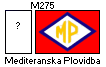
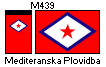
The earlier flag had a red star in its white lozenge and is recorded under Korculansko-pelješka plovidba.
From the early 1990s, initials replaced the star in the white lozenge. Heimer’s account draws on references and his Adriatic observations and photographs of summer 2004.
Established in 1955 as Korculansko-pelješka plovidba, the company later operated as Mediteranska Plovidba. The registers record government control, operation of part of Maritenia Shipping’s fleet and later management of part of its own fleet by Korkyra Shipping.
Yugoslavia, Korčula; later Croatia. Mitchell gives Rijeka.
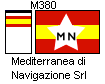
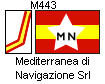
The funnel follows an archived starboard photograph of Metauro, built in 1991. Rosanoski assumes the conventional banding preceded the modern version; the red bands appear narrower than the yellow.
The source list records M443’s funnel from photographs and its flag from the company website.
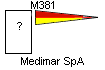
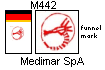
The pennant is identified with Medimar, the older company, while the accompanying rectangular flag belongs to Mediterranea di Navigazione Srl. Bakker’s illustration replaced the original website image.
Red Dragon photographs from 19 June 1989 supply M442. The vessel was built for Petrogas after the concern entered LPG trading.
No exclusive fleet-wide use or unrecorded corporate equivalence is asserted.
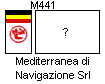
Mitchell identifies the charge as a shrimp and links it to Red Dragon and Petrogas Shipping & Finance, although the Mediterranea company title is unconfirmed. If based on Red Dragon, the bands differ from the photographs.
Exact date/entity and reconstruction unresolved.
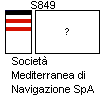
The website card flag presumably belongs to the original 1967 company. Rosanoski suggests that it continued through subsequent title changes until Medimar adopted the pennant, but the website does not give complete legal names.
Mitchell’s S849 is not supported by his vessel drawings. Rosanoski suggests its two red bands may need yellow between them, as in M380.
S849 band colours and rename timing remain qualified.
The later Metauro photographic paragraph cites starboard and July 2011 portside views, but labels them M433.
The Cagnoni family history begins in 1908, when Andrea and Pietro operated clippers and motorsailers between the Yugoslav coast and northern Adriatic Italian ports, establishing Società Romagnola in 1909. An earlier website account instead dates the Ravenna–Cherso–Fiume–Trieste service to 1910. The fleet was nationalised during the Fascist period and shipping ceased at the start of the Second World War. Paola Cagnoni and his son Giorgio re-established shipping in 1960 as Romagnola di Navigazione, later Società Mediterranea; Ravenna was completed in 1964. Andrea’s forwarding concern had meanwhile traded coal and oil products. The later account records Paola’s death in 1998 and Giorgio’s departure in 2007, with another Paola taking over.
The registers distinguish Società Mediterranea, dated to 1967 and later called Medimar, from Mediterranea di Navigazione Srl, dated to 1987. Both were operating companies of Casa di Spedizioni Rag. Andrea Cagnoni, with the fleet wholly under Mediterranea by the 2003 listing. The reported 1982 Medimar name change is not confirmed by the website; Rosanoski suspects confusion with a separate Naples concern and considers a later change possible.
Italy, Ravenna.
M397 follows the Liverpool Journal of Commerce 1885.
M398 follows Griffin 1895.
M399 is recorded in Reed, Lloyds and Bonsor, with McMillan’s FOTW flag based on Flaggenbuch 1905. FOTW places the company in its USA section at New York.
The company operated from 1878 to 1905 under Phelps Brothers & Co. as managers.
UK, Liverpool.
M251 is recorded for Martha in December 1967 and associated with Eleftheriadis and Pappas. Martha belonged to Stavros Eleftheriades, while Evangelos belonged to the joint venture.
E278 is recorded for Stavros E and also assigned to the agency by Mitchell. Rosanoski treats it as an alternative recording of the same basic design and colours as M251.
E279 is attributed to the combination of Stavros Eleftheriades and Pappas Shipping Agency, again as a variation of the same basic design and colours.
The agency is listed as manager and later agent for Stavros Eleftheriades and the Eleftheriades–George Pappas venture. Later references use El-Pa Maritime, apparently combining their names, though the register also retains the earlier title and an E-Par entry at the same address. Mitchell associates the agency with Eletson Maritime without explanation.
Greece, Piraeus.
The yellow flag has a black circle enclosing a yellow m standing on a wavy line above sc. The funnel follows the same design, with black top and band, but their spacing and the ground shade vary. MSC Insa places the band nearer the top; MSC Benedetta has a narrow top and closely placed band. MSC Serena has a narrower band, and MSC Brasilia differs slightly at the wavy line’s ends. MSC Immacolata has a narrow black top and equally narrow band separated by an equal width of deep golden yellow. Other accounts range from cream, including cream lettering in Ocean Ships, through yellowish buff to darker buff. The pale MSC Antonia photograph makes the funnel appear white, while its flying flag can still be recognised as yellow.
Brown’s version places the wavy line between the two levels of letters rather than supporting the m. Rosanoski found no evidence that this logo arrangement was used; FOTW labels the illustration a former flag.
M189 follows MSC Kiwi at Wellington on 22 March 2001.
M261 was reported for MSC New Plymouth in February 2002, apparently during a colour change connected with her Leonhardt & Blumberg charter. A later Wellington photograph shows M89.
Chartered MSC Togo shows a similar funnel with a deep black top, tending to look white in photographs.
M591 follows the chartered MSC Chile of F. Laeisz on 28 August 2005.
Schneider records a flag used from 2008: yellow with a central black m above a black wavy line and black sc below, without the roundel.
The corresponding yellow banner places the same black emblem at the upper end.
Ocean Ships describes the funnel ground but does not specify the lettering colour; its monochrome MSC Lirica photograph confirms the arrangement.
The cruise flag is white with a very dark-blue compass rose of twelve direction marks. Its white central disc bears the MSC logo in the same near-black blue. The 2003 Lirica introduction brought the new compass branding, explained by the company as placing passengers centrally and representing the horizons towards which it sailed. MSC Opera supplies the funnel photograph; another unnamed vessel shows a narrow black top. MSC Sinfonia dressed overall in 2005 with alternating white-ground flags and reversed dark-blue versions, hung from their upper edges as banners. Rosanoski suggests that a proper reversed variant may therefore exist, but does not confirm it.
MSC was formed in Italy in 1970 and moved its headquarters to Switzerland by at least 1980. It remained privately owned by the Aponte family.
Its operations included Aliscafi SNAV and the Italian concern Mediterranean Shipping Co. Srl, formed in 1981, with Navitalia beneath it. The cruise division began in Naples with the 1987 purchase of Star Lauro and was officially launched as Mediterranean Shipping Cruises in 1995. The German company began operating on 1 July 2006; separate ship-management concerns are recorded in Hong Kong and Limassol.
Rosanoski tentatively identifies MSC as the Mediterranean Shipping concern reported to hold a majority stake in Ferryways.
Italy, Sorrento; later Switzerland, Geneva.
The blue flag bears a white circle with a black M. The blue funnel has a black top and the same emblem.
Medorient is listed as agent only in 1985–86.
Germany, Hamburg.
The stylised tree on the funnel panel consists of a stump and five separate chevron stripes, all pointing upwards and unconnected.
UK, London.
The white flag has a very broad red horizontal band containing a white diamond extending across the band. A black M encloses a smaller black M, with double black wavy horizontal lines above and below. The colour shades follow the website image. No funnel is given.
The concern was formed in 1986, with its fleet under name subsidiaries.
Germany, Buxtehude.
The FOTW flag follows Brown 1995.
K455 is based on a starboard photograph of Tara Kaptanoglu.
The company is dated to 1954 as Mehmet Kaptanoğlu Muessesesi & Durgut Kaptanoğlu ve Ortaklari Kollektif Sirketi, becoming Mehmet Kaptanoğlu Denizcilik ve Ticaret Ltd. in 1981. Registers also use Turgut and differing arrangements of the former name; by 2011–12 the company is listed as manager.
Earlier records distinguish several Mehmet Kaptanoğlu entries. Pietra Ligure was bought in 1947, renamed Nil and sold in 1962; it subsequently appears under the apparently related Ismail Kaptanoğlu entry. Mehmet Kaptanoğlu ve Kardesleri is recorded for Yilmaz, while Mehmet and Kazim Kaptanoğlu share that firm’s address in later registers. Mehmet Kaptanoglu, bought in 1963, transferred to Mehmet Kaptanoğlu Denizcilik ve Ticaret in 1976. Its earlier owner’s address matched Ismail Kaptanoğlu, suggesting a connection rather than proving a single company identity.
Turkey, Istanbul.
Formed on 1 May 1911 as a Mitsui Marine Department affiliate intended to buy and build ships, Meiji initially carried Mitsui Mining coal. It established Taisho Kaiun at Dalian in 1914, absorbed Goshu Kisen in 1943 and Taisho Kaiun in 1944. Post-war government control ended in April 1950, after which owned vessels were time-chartered to Mitsui. In the 1963 restructuring it joined Mitsui OSK as an exclusively contracted carrier. Tohmei Shipping became the commercial-management core in January 1984.
Japan, Kobe; Tokyo in the later register.
Maybaru was formed in July 1989, an earlier register date of 1995 subsequently amended. Registers place it successively under MMS, Mitsui O.S.K. and Meiji, although the March 2004 MOL annual-report list did not include it.
Singapore.
Keep the explicit scope label independent; no alias or company identity is inferred.
The band widths differ between references. Stewart makes white narrower, with the others equal; Brown makes yellow widest, then blue, then white. Watt likewise judges yellow wider than blue and white narrower again, allowing for optical effects. Nelson’s FOTW illustration follows Stewart.
Meiji Kaiun is also called Meiji Shipping. Interests included Mannex with Magsaysay and Triumph Shipping with Magsaysay and Mitsui in 1972–74; vessel names used the Mei prefix. Rosanoski’s 2003 comment tentatively suggested that the company had not survived the century’s end, but the document’s later register entries again list it under Meiji Group. It too was absent from the cited March 2004 MOL list.
Japan, Kobe and Tokyo.
Keep the explicit scope label independent; no alias or company identity is inferred.
Meikai Marine Services originated in July 1974 and was renamed MMS in November 1985, handling technical and tanker management. Its operating companies included Maybaru, Melodia Maritime and Mikom Transport. MMS established an Indian officer-recruitment and training agency at Mumbai in October 2001, later renamed MMS Maritime India and relocated to New Delhi; the relocation year is malformed in the original. The March 2004 MOL list did not include MMS, despite its register grouping.
Japan, Tokyo.
Keep the explicit scope label independent; no alias or company identity is inferred.
The group website dates NEOM’s Singapore ship-management business to August 1997, while the register gives 1998. It later operated through name companies.
Singapore.
Keep the explicit scope label independent; no alias or company identity is inferred.
The funnel and flag are recorded in Brown 1982 and 1995.
Meimon was formed in December 1970. The register’s 1972 formation date probably reflects the Nagoya–Shin-Moji service beginning in May that year. In November 1984 it and Taiyo Ferry established K.K. Meimon Taiyo Ferry; the three companies merged under that name in March 1986. Vessel names began with Ferry.
Japan, Kyoto and later Osaka; the 1978–79 register also gives France, Etel.
The funnel is recorded in The Log, May 1995.
Melbourne Ferries received a Melbourne Harbor Trust licence in October 1909 and operated Planet from 1910 to 1919.
Australia, Melbourne, assumed in the source.
M575 is recorded for the suction dredger A M Vella as the Victorian Public Works Department colours.
The funnel was retained on the name change. A blue Australian ensign with white crossed anchors in the fly was sometimes flown, but Tompkins questioned whether it was a house flag in the strict sense. Li’s illustration has 2:1 proportions; his account dates adoption to 1877 and, citing Flags of the World, says it lacked an Admiralty warrant and was probably no longer used. Rosanoski notes that the reference actually describes an assumed takeover from the preceding state department on 1 January 1877. With the fleet reduced to hoppers, he presumed the funnels extinct and considered any new corporation flag likely to have changed.
The Trust is dated to 1877 in one account; Li distinguishes establishment in 1876 from becoming operational in 1877. It became the Port of Melbourne Authority in 1978. The later accounts differ between a 1995 name change and restructuring on 1 March 1996 into Melbourne Port Corporation and Victorian Channels. From 2003 it was Port of Melbourne Corporation.
Australia, Melbourne.
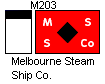
The flag is red with a central black diamond and white MSSCo letters in the field’s corners.
This unincorporated company was the name under which Captain William Howard Smith, founder of Howard Smith Ltd., operated until 1883.
Australia, Melbourne, by association in the source.
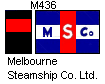
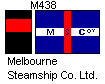
The white and red bands are described as broad, with dark blue. The flag combines earlier Black Eagle and Norton, Graham & Co. flags. The Log gives MSCo, with blue M and Co and a slightly larger white S; the o is not enlarged. A mid-1930s menu and possibly an actual flag instead show all-blue lettering. Marine News shows equal-height black letters and an enlarged o, but its monochrome hatching and lack of colour specification make the black uncertain. Earlier Williams and Lonsdale drawings also show very broad funnel bands.
York Syme used M437 in 1961, with Melbourne Steamship half-owning and presumably managing the tug.
Dignan’s Sampson-based flag shows a blue S, while the underlying monochrome source does not establish that colour.
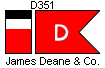
James Deane’s earlier flag was a red swallowtail with a white D. Williams, operated by Deane from 1872 to 1885, passed to the new company.
The livery continued on tugs after the passenger vessel sale and before Howard Smith’s takeover. One passage dates the last ship’s sale to September 1959; another gives Duntroon’s sale as 1960.
The company originated as Melbourne Coal, Shipping & Engineering following agreement in 1884, with formation also dated 1885. Hugh R. Reid, James McIntyre, James Deane and David York Syme combined businesses including James Deane & Co., Melbourne Coal and Hobson’s Bay Floating Dock, with Syme as manager. It became Melbourne Shipping in June 1893, was reconstructed in 1895 and took the Melbourne Steamship name in April 1896. Nelson instead gives formation by merger in 1895 without a supporting source. Howard Smith acquired the company in 1961.
The company participated in coastal shipping associations and was a founding Bulkships consortium member in 1958. It shared in the consortium that built the tug Batman in 1954 and held a half-interest in York Syme. Bay Engineering Services was a subsidiary; other interests included Austral Wire Ropes and Belfast & Koroit Steam Navigation.
Australia, Melbourne.
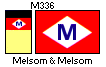
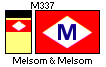
The sources disagree over the funnel variants’ use: Loughran assigns M337 to whalers and M336 to tankers, while Ships & The Sea assigns M336 to whalers. For M336, some illustrations make the diamond extend across the band; the Polarsol photograph appears to keep its horizontal extent within the band, agreeing with Stewart, although the vertical alignment is unclear. Jordan does not specify band position, and the flag diamond’s size also varies.
Melsom’s fleet operated through Hvalfangerslsk Globus and Hvalfangerslsk Polaris, their partnership and Rederi A/B Polaris. The whalers mainly used Globe or Pol names followed by Roman numerals.
Norway, Nanset per Larvik.
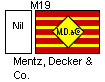
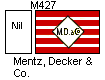
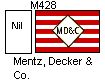
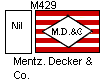
Sache’s FOTW image appears yellowed, probably as a scanning effect according to Rosanoski’s recollection of correspondence.
M427 follows Lloyds 1904 and 1912.
M428 follows Hamburg’s Segelschiff 1795–1945.
M429 follows the company website, which also supplied an enlargement of the C.
Formed on 1 April 1896, Mentz, Decker operated sailing vessels until 1910, then became a shipbroker and shipping correspondent. The business was still operating in the 2004 website account.
Germany, Hamburg.
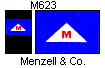
A company website image, possibly a painting, confirms the livery but appears to show a larger triangle.
H.F. Menzell founded the concern in 1895 with J. Harlin of Hong Kong and P. Buschmann of Shanghai. Its ships traded in the South China Sea and between Europe and West Africa. The associated Chinesische Küstenfahrt concern was taken over in September 1901 and became Hamburg-Bremer Afrika Linie in 1906. Other recorded associations included Hanseatische Dampfer Compagnie, “Transatlantica” Rhederei and Menzell Linie. In 1932 Menzell moved into liner agency work; the later company formed part of Menzell & Döhle.
Germany, Hamburg.
Uraga of Fairisle was recorded in November 1965 with a white funnel, narrow black top and a blue shield. A white circle within the shield bears a blue M with outward-sloping sides. The livery is assumed to be the agent’s. No flag is noted.
The company acted as agent for Fairisle Investment.
Bahamas, Freeport.
The white funnel bears a large blue M and a small blue F at the same height. It is recorded on Brave Merchant and Dawn Merchant as the managers’ livery.
Mersey Docks & Harbour bought half of Merchant Ferries in June 1993. Its owner Cenargo acquired Norse Irish Ferries in October 1999; the businesses continued separately until NorseMerchant Ferries was launched in February 2001. Merchant Ferries is recorded as manager for Cenargo Navigation.
UK, Belfast.
The illustrations differ between a normal swallowtail and a tapered version. Talbot-Booth stated in 1938 that the flag had become tapered but retained older artwork in later books. Since the tapered form also appears earlier, Rosanoski leaves open whether an actual change occurred or observations of a flying flag produced the variations. Lettering differs in dots and the sizes of the ampersand and o; most sources show a small raised o after C, whereas the USA Houseflags site and FOTW omit it.
Known as M&M, Merchants & Miners operated from 1852 to 1948, with steamship ownership recorded from 1854. Founded to connect Baltimore and Boston, it expanded after the Civil War to Providence and Savannah and later to Miami. Nathaniel Winsor & Co. was acquired in 1907. By 1929 the fleet numbered eighteen ships. After wartime requisition, shareholders chose to scrap the old vessels and dissolve rather than rebuild the fleet.
USA, Baltimore.
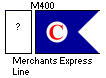
McMillan’s FOTW flag follows steamship.net, recorded as no longer available.
Owned by Randolph M. Cooley, the line operated around the 1850s.
USA, New York.
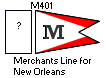
The FOTW flag follows Manning 1874.
USA, New York.
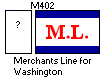
The FOTW flag follows Manning 1874.
USA, New York.
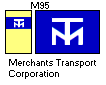
The blue flag has a white T over a smaller but equally broad M at its base, the letters joining into a single undivided unit. The yellow or buff funnel has a broad band of the flag.
The company appears in the 1970–71 register with Global Bulk Transport as agent.
Panama in Brown; USA, New York, in Lloyds.
Nüsse’s table flag supplies Sache’s FOTW illustration under Hong Kong. Mitchell also associates the flag with Mercury Shipping Co., without this document establishing the precise relationship.
A Nedlloyd subsidiary, Mercury Shipmanagement is recorded in a Philippine training venture in 1990 and in the Singapore bareboat charter of Nedlloyd Main in September 1991. Mitchell dates its transfer from Hong Kong to Singapore to 1992.
Hong Kong and Singapore.
No confirmed vessel-to-company livery allocation; QA2 mappings retained.
M382 combines Mitchell’s funnel evidence with Bakker’s FOTW flag.
Mitchell’s M527 may relate to Mercury Star of Ace River, shown as managed in 1992–93. M528 has no comparable vessel clue. Rosanoski retains both under Mercury because the evidence is unclear.
The Nedlloyd funnel is also shown, relating to managed vessels.
These may relate to Chandan Star of Star One Shipping and Hirand Star of Star Two Shipping. Mitchell’s line drawings, however, show red and black funnels respectively, so the proposed link may not hold.
P407 is linked to Sun Valley of Porpoise Shipping. The same card also includes the flag given elsewhere for Mercury Shipmanagement.
The Hong Kong concern operated, managed and acted as agent for vessels, initially with Mercury names. Its address was Nedlloyd House, and it later managed some Nedlloyd ships, but the relationship to Mercury Shipmanagement and Nedlloyd is not fully explained. Rosanoski disputes Bakker’s 1971–77 operating period, suggesting 1997 may have been intended; liquidation is recorded in 1997.
Hong Kong.
Keep the explicit scope label independent; no alias or company identity is inferred.
The second concern appears under Goulandris-associated agents: United Operators Shipping Agencies, then Andriaki Shipping and N.J. Goulandris. Its successive recorded locations are New York, Piraeus and London.
USA, New York; later Greece, Piraeus, and UK, London.
Keep the explicit scope label independent; no alias or company identity is inferred.
The Vietnamese concern is listed under Vietnam Sea Transport & Chartering and, in one edition, Anglo Caribbean Shipping. A later entry calls it a name company formed in 1986, although it already appears in the 1985–86 register.
Vietnam, Ho Chi Minh City.
Keep the explicit scope label independent; no alias or company identity is inferred.
Meri has no funnel. The illustration instead represents the bright light-sky-blue bridge-side structure, with a white band encompassing the windows and carrying the logo. A further logo sits directly on the blue superstructure front, where its lettering and upper line are white and its lower line dark blue. Port and starboard photographs date from 28 April 2013.
The group began in 1986 when Jussi Mälkiä and friends started with a single tug. It later acquired a dry-cargo ship and established the ship-management concern VG-Shipping, followed by logistics company Petrotrans in 2001. Meriaura specialised in demanding project cargo, industrial bulk and raw materials.
Finland, Turku.
Airisto of the managed company carried a black funnel with a broad blue band edged white above and below, bearing a white M. No flag is noted.
Meritoimi is listed as manager for Airiston Laiva in 1963–64.
Finland, Åbo.
Mermaid Carver’s website photograph shows no visible logo, possibly because of her small size.
Mermaid Chieftain may have a black funnel top separated from the band, unlike M607.
M605 follows the website photograph of Mermaid Commando, acquired in 1992.
M606 follows Mermaid Searcher, owned from 1988 to 1990. Mermaid Sentinel is separately recorded without a black funnel top.
M607 follows a Mermaid Warrior photograph.
M602 is given for Mermaid Marine Australia without a named vessel. The contemporary account notes hulls ranging from emerald green to mid-blue, which Rosanoski suggests might bear on other funnel colours.
Website photographs show varied funnel colours, mostly based on the company logo. Mermaid Achiever has an orange funnel with an attached badge apparently painted over and unreadable.
James Carver established Mermaid Marine in 1982, with its main operating base at Dampier and another at Broome. The registers distinguish Mermaid Marine Charters, Mermaid Marine Offshore, Mermaid Marine Vessel Operations, Mermaid Marine Group and Mermaid Marine Australia; vessels moved between these recorded names. The source presumes the local Mermaid Marine Pty. Ltd. unrelated to the earlier Queensland company of that name.
Australia, Fremantle.
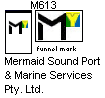
Withnell Bay has no funnel and carries the logo on its superstructure. The enlarged but blurred panel beside the M appears yellow above, descending into a yellow Y. Beneath the Y arms, the panel is green nearest the M and blue on the opposite side, with a yellow outline.
Registered in Western Australia on 1 December 1980 as Woodside Exploration, the company became Mermaid Sound Port & Marine Services and was a Woodside Petroleum subsidiary.
Australia, Perth.
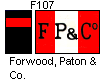
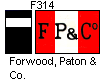
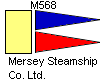
Loughran records F107 as an alternative marking.
G.P. Forwood & Sons is connected through Amazon in 1872–78.
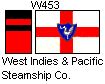
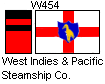
Reed 1891 also attributes W453 to R.C. Lambert.
These variants remain as recorded in Lloyds, Griffin and Loughran.
The Mersey Steamship name first appears in 1871 with West. Accounts differ over the master, William or J. Forwood, and the management sequence involving Forwood, Paton and later Leech, Harrison & Forwood. Arthur Bower and William Bower Forwood also managed West Indian & Pacific Steamship, probably the concern absorbed by Leyland in 1900. The business traded under several names, including Morocco, Canary Islands & Madiera Line and Atlas Steamship in America. Forwood Brothers formed Dartmouth Coaling in 1907; bankruptcy is dated 1907 in one account and liquidation in 1908 in another, with the shipping activities sold to Royal Mail.
UK, Liverpool.
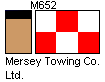
The flag was Canadian Pacific’s, shown identically by Lloyds 1912 and also recorded for Mersey Towing by the National Maritime Museum. Bison’s photograph supports the funnel, although the shade is unclear and may be more yellowish.
Apparently established by Elder Dempster in 1901, Mersey Towing was sold to Canadian Pacific Railway on 6 April 1903. Subsequent records show Canadian Pacific as manager or owner of the vessels. Bison remained in service until 1946.
UK, Liverpool.
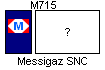
Tellier, the sole ship, retained the funnel marking in photographs from 1977 onwards. The M’s central V ends in a point, and the letter is lighter blue than the very dark-blue funnel.
The original flag is white with a red triangle in each corner and a central blue M, modelled on Messageries Maritimes. Tellier still carried it as a funnel marking in 2009.
M716 is retained from Sache’s FOTW illustration.
M718 follows La Marine Marchande Française.
The FOTW description calls Randier’s flag black with a blue M. Rosanoski’s comparison of the original instead finds a dark-blue field and lighter-blue M, again with a pointed central V. Its place in the company’s history remains unexplained.
Messigaz was formed in 1974 jointly by Messageries Maritimes, Gaz de France and Gazocean, holding 73, 15 and 12 per cent respectively. Gaz de France acquired the Messageries share in 1993, giving it full control through its ownership of Gazocean. A separate 1994 foundation date is presumed by Rosanoski to relate to that ownership change.
France, Paris.
Monochrome photographs support the funnel, with its V appearing shallower. The flag is the same as that recorded for B.B. Murrell & Co., also of West Hartlepool.
John Metcalfe, son of Tom of Metcalfe, Simpson & Co., formed this family concern in 1929, with the first ship delivered in October. After his death in August 1971, sons Tom and John Ovington succeeded him; Tom died in May 1975. The shipping business also appears as Metcalfe Shipping. Furness, Withy acquired it in 1980.
Rosanoski assigns the reported 1896 association with Anders Andersson Thore to the predecessor, Metcalfe, Simpson & Co., rather than this later company.
UK, West Hartlepool.
Lloyds 1904 places the livery under A.A. Thore; the 1912 account records its shared use. The Bryggan site and FOTW also show it under Thore Rederierna.
Formed in 1903, the company lost its last ship to torpedo attack in 1917. Partner Tom Metcalfe’s son John later formed Metcalfe Shipping. The firm owned, chartered and managed steamers under British and Swedish flags, trading with A/B Thore in a relationship the 1978 account describes as continuing.
UK, West Hartlepool.
The flag is yellow with a blue M. The funnel is yellow or buff with a blue M, its yellow assumed to match the flag.
Greece, Piraeus.
The flag is white with a green stylised M logo.
Metro Meat transported live sheep and carcasses in chartered ships. Registered on 5 October 1926, it later became Romet and was deregistered on 30 July 2007.
Australia, Adelaide.
The earlier Metropolis funnel was still recorded on 16 November 2011, changing by 6 December 2012. As N. Kazantzakis under Minoan Lines, the ship had a red funnel with a white circle when sold in 2001. Her colours as Ming Fai Princess before January 2007 are unknown, though Rosanoski suggests the basic arrangement may have continued.
The later funnel follows a starboard photograph of 15 October 2013.
Metropolis Cruise was incorporated on 12 January 2007 and later appears under Hopewin Ship Management.
China, Hong Kong.
The annulet carries red METROPOLITAN above and COMPANY below, both words upright.
Metropolitan supplied bunker fuel to ships in Boston harbour.
USA, Boston.
The funnel was recorded on Zakynthos for National Shipping & Trading and associated with M. Theodoracopoulos. Its narrow red band behind the star was initially missed, also in the June 1986 Mando V sighting. It was noted on Marianna at Lyttelton on 5 January 1988, though that vessel had no black funnel top.
Owned by National Shipping & Trading, Metropolitan acted as agent. Named clients included Metropolitan Bulk Carriers, Metropolitan Marine Transport, Metropolitan Navigation and Metropolitan Product Carriers.
Greece, Piraeus.
McMillan’s FOTW flag follows Reed 1896.
Metropolitan operated from 1866 to 1911, providing Boston–New York and later San Francisco–Los Angeles services. Charles W. Morse took it over in 1905, but his shipping empire collapsed two years later, leaving Metropolitan bankrupt. Eastern Steamship absorbed it in 1911.
USA, New York.
The funnel follows Celina Star in a starboard photograph of 5 August 2012, with the company website logo as reference.
Formed in 1996, Metrostar handled technical and commercial functions, subcontracting chartering to its London affiliate Metrofin Shipping. The registers list it as agent only.
Greece, Athens.
The funnel apparently follows a Metz Italia line drawing, while Candeias’s flag follows the historical Metz website.
Metz Italia’s starboard photograph supplies M800, though the letters look more black than dark blue.
The source list records this funnel from a photograph.
Metz Beirut appears to replace the light blue with the darker hull blue, but the bow angle and obscured base prevent a clear reading. Metz Canada appears to show lettering alone; any light-blue bands may simply disappear with distance and lighting.
The Constantza Star photographic paragraph is labelled L336, differing from the source list’s L350.
The Metz group began shipping in 1972, with common feeder operations from 1976 using two small coasters. MCL originally referred to Mediterranean Container Lines; later group descriptions distinguish MCL Feeders, Metz Container Line as principally a container provider, and Metz Ship-Management, initially serving group ships and later third parties. Green Feeder was another container operator. The group also undertook agency and forwarding through affiliates in Beirut, Montreal and Constanza.
The register traces operations through Libanfracht and Metz Container Line, later placing Constantza Star under Metz Shipping Services, formerly Metz Shipmanagement, beneath MC Lines Shipmanagement at Limassol. Constantza Star was sold in 2007. Metz Maritime of Beirut is separately dated to 1998.
Lebanon, Beirut.
The funnel is grey or silver with three red bands separated by narrow gaps. White MH letters extend over them, edged red across the funnel-coloured gaps, with the flag emblem above. The white flag bears three overlapping red panels, angled as “Pbds” in the source and edged white with black definition; a blue M is above and a blue H below.
Operations began in 1962 but were short-lived.
Unknown.
M505 is recorded in Mitchell’s collection.
Mitchell apparently links M506 to Sun Field, although the 1992–93 register places the vessel under Dojima as agent.
Mibae merged with Dojima Senpaku in 1992 to form News Maritime, associated with Nichimen. Rosanoski tentatively dates Mibae to 1966, a date given for the later company that must refer to a constituent. Before the merger Mibae managed for Dojima, itself an agent and manager for other concerns.
Japan: Tsuha-gun, Hyogo; later Kobe and Osaka.
The HJH table flag and photographed flag differ in blue shade, possibly because of colour adjustment. The photograph has 2:1 proportions rather than the table flag’s 5:3, with smaller charges.
Fitnes and Beltnes photographs show narrow black lines edging the blue funnel band above and below, easily lost at a distance.
The flag has yellow block mibau lettering whose tops extend into the yellow area and are outlined blue there. Below is the white inscription MINERALIEN FÜR DIE BAUINDUSTRIE. Unlike the logo, the flag’s dividing line between its two bands is not straight.
Mibau Holding was formed in 2003 jointly owned by Heidelberg Zement and Hans-Jürgen Hartmann. The longer-established Stema/Mibau business supplied mineral building materials through its quarries, terminals and transport fleet. Technical management of the Mibau-Stema fleet passed to Hartmann’s newly formed HJH Shipmanagement on 14 November 2006, although Lloyds dates HJH to 2007. Stema Shipping at Aabenraa is another listed operating company. Nüsse attributes the Mibau table flag specifically to Mibau Baustoffhandel, described as a dredging company.
Germany, Cadenberge.
Greece, Piraeus.
The white pennant is edged blue except at the hoist and bears a blue G, slightly askew. Rosanoski adds the notation “on an angle Pbd.” No funnel is described.
The concern appears as M. Gigilinis & D. Kalkassinas in 1970–71, Michael Gigilinis in 1978–79, and Michael Gigilinis Shipping Co. in 1992–93, then listed as managers only.
Greece, Thessaloniki.
The funnel is red with a black top and white K. The red flag has a more ornate white K.
Greece.
Brown’s Karageorgis flag is reproduced by FOTW. Roula was photographed with the funnel in February 2012, long after Karageorgis had apparently disappeared from Lloyds around 1998. Rosanoski questioned whether this signalled a revival. Sources disagreed over ownership, naming Kristen Marine or Bon Corp, with Nane Shipping Management managing the vessel; other Nane-associated ships had different funnels. He left open whether separate owners, rather than a revived Karageorgis company, explained the markings.
K123 combines the funnel seen on Messiniaki GI at New York in August 1973 with Nüsse’s similar table flag. Mitchell gives black funnel letters. Rosanoski considers the diamond in the FOTW rendering misplaced and probably too small: allowing for a possible hoist sleeve, the table flag’s diamond may extend nearly throughout, touching the fly.
Mitchell’s passenger-ship funnel is based on Mediterranean Sea, with a line drawing. Rosanoski suggests it may be intended as K30.
K30 was used by passenger vessels, including Mediterranean Sky in a poor photograph. Brown identifies the flag with Michail A. Kargeorgis Lines Corporation; FOTW calls it Karageorgis Lines.
Mitchell assigns P515 to Pacific & Gulf Carriers Corporation, listed as a managed company in Lloyds 1985–86.
The business was formed in 1934 and appears in registers as owner, operator, manager and later agent. Michail A. Karageorgis Lines Corporation was based at Piraeus; the UK company was incorporated in London on 6 July 1976 and was subsequently dissolved. The last vessel for which the company acted as agent was Mediterranean Sky, arrested at Patras in August 1996, beached leaking at Eleusis in November 2002 and capsized and sunk by January 2003.
Greece, Piraeus.
The flag is light blue with a white M, forming a broad band on a black funnel. Brown specifies light blue; Marine News does not state the shade.
Michalinos managed part, then all, of Maritime Shipping & Trading’s fleet. It bought several vessels in 1964, after which that company ceased shipowning. Other managed concerns included Michalinos Maritime & Commercial and United Merchants Shipping; Michalinos itself is listed as owner as well as manager by 1966–67.
UK, London.
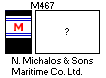
Merchant Ships describes the flag border as pale blue and gives the same shade for the funnel bands. The funnel was recorded for Leonidas Michalos in September 1965. Mitchell’s vessel listings overlap with the associated Michalos concern.
Steamship owners from 1889, formerly Michalinos Brothers, the concern originated from Chios and controlled ships owned by C.N. Michalos and M. Carivalis. Michalinos & Co. managed it, and it also acted as agent for Michalos interests. N. Michalos & Sons shared its Greek address and London agents.
Greece, Piraeus.
Keep the explicit scope label independent; no alias or company identity is inferred.
Mitchell supplies M467, but three of the vessels mentioned under this concern also appear under Michalinos Maritime & Commercial.
N. Michalos & Sons is separately recorded from 1963–64 to 1970–71, with Victoria Steamship as agent. The document notes its shared address and agency with Michalinos Maritime & Commercial.
UK, London; later Greece, Piraeus.
Keep the explicit scope label independent; no alias or company identity is inferred.
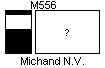
The funnel follows Mozart in a photograph dated 26 September 2008. The debinnenvaart website gives no flag.
Michand was involved in inland and sea shipping.
Belgium, Antwerpen.
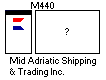
Mitchell uses a lighter blue in one drawing; Rosanoski initially suggests a shade matching the Yugoslav flag. NJK subsequently confirms the M440 shade from several sightings. The funnel resembles Brown’s Tankerska Plovidba design, although Mitchell gives a different one for that company.
The company appears from 1973–74, with Agemar and later Jadranska Linijska Plovidba as agents and Jadranska Slobodna Plovidba as manager. By 1996–97 the fleet was listed under Jadroplov International Marine Transport. Mitchell describes it as a Panamanian free-flag concern formed in 1990 during the civil war, but Rosanoski points out that this conflicts with the earlier register trail.
Italy, Venice; Yugoslavia, Split; later Croatia, Split.
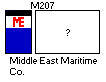
Bluesea of Bluesea Corporation was recorded in September 1967 in charterers’ colours: a blue funnel with a black top separated by a broad white band bearing joined red ME letters. No flag is noted.
The company is recorded in 1963–64, with Filippotis Brothers identified as owners.
Greece, Piraeus.
The funnel is described as black with a black top separated by a white band, used from 1904 to 1923.
One white flag bears a red dragon; the other has a red legless dragon, or serpent, on a red rope torse.
George Hudson formed the railway in 1844. Morecambe–Belfast steamer services began in 1853, but direct vessel ownership followed later: the account cites statutory authority in July 1896 while the fleet list points to 1904. Heysham–Belfast sailings began in 1904. Midland had joined the Barrow Steam Navigation consortium in 1867 and took over its fleet in 1907. It passed to the London, Midland & Scottish Railway on 1 January 1923.
UK, Derby.
M721 was used before the 1961 merger and again from 1995, confirmed by the later company website. HSD colours were used from 1962.
The other website variants remain as recorded by skipet.no.
M722 follows Steamers of the Fjords.
Lars Rossland founded the company at Os on 14 March 1889. It merged with Bjørneselskap on 2 March 1892; that predecessor had been formed in June 1866 and began business in October. Midthordlandske merged into Hardanger Sunnhordandske in 1961, with the route closing in 1970. Re-established in 1995, it became involved in preserving Bjørnen with owners from Tysnes and Os.
Norway, Bergen.
The funnel is confirmed by Fate on 12 January 2007. The document distinguishes Carmar’s website logo from the Mihei-site flag; the FOTW illustration was sourced through Gutterman, although Rosanoski found only a logo, not a flag, on the cited Carmar site.
Captain Andrian Mihei founded Carmar as a shipping agency in 1990 according to Bakker, while the website gives 1991. In April 1993 he established Mihei Shipping & Trade. Bakker describes him as the first Romanian private shipowner of a dry-cargo vessel, Irina M.
Romania, also written Rumania; Constantia.
The black funnel has a green band edged yellow above and below, overlaid by a yellow-edged green shield with yellow BP lettering. Marine News shows equal band widths and equates the design with Société Maritime des Pétroles B.P., whereas Loughran’s later version differs. The livery was also used by the closely involved Norsk Braedensolje. The flag is blue with a black-edged white circle and black MIL letters; US Navy instead shows a grey flag.
Mil was associated with BP and later listed under Svend Foyn Bruun as manager.
Norway, Oslo.
The funnel is recorded in The Log. The source states that the firm never had a flag, nor even a letterhead emblem.
Henry Miles II began shipbuilding in 1895, placing those interests and a timber mill in his sons Thomas and Josiah’s names. Towage began in 1896 with purchased vessels, extending to Harrington in 1905 and later Port Macquarie. The firm changed from T. & H. Miles to H. Miles & Sons in 1931 and traded until Henry Miles III and Bill retired in 1968. The registers also use Henry Miles Jr. & Malcolm M. Miles.
Australia, Forster.
The funnel follows a starboard photograph of Clara dated 6 October 2012. Chartered from Johann M.K. Blumenthal GmbH & Co. K.G., the vessel retained that company’s funnel with its B replaced by Mina Shipping’s logo.
The flag is based on the funnel emblem; the source does not establish it as a separately observed flag.
Mina Shipping was established to operate in the Middle East and North African market. It was active by 2010, chartering Alimar, and appears to have been a chartering concern only.
UAE, Dubai.
The black funnel has five alternating white-red bands. The red bands are interrupted by white bearing a red M with a red line joining the bottoms of its legs. NJK recorded the funnel on two vessels in March 1965, possibly with a narrower gap between the bands. No flag is noted.
The company is listed in Lloyds for 1963–64 and 1970–71.
Japan, Kagoshima.
A colour picture of Etelka, apparently relating to her arrival on 12 December 1892, shows a red flag with a white diagonal and three stars. The stars are indistinct; Rosanoski considers black likely. He identifies the same funnel design in a black-and-white photograph dated around 1910 and concludes that the markings belonged to Mineral Oil Refinery Co., with Photogen as managers. The flag’s descending diagonal appears rising on the funnel, possibly because the photograph shows the starboard side.
The earlier FOTW discussion identified the vessel as Etelka through Maurizio Grbac and Marijan Zuvic, but remained uncertain whether the flag ground was red or blue. Heimer questioned the initial black interpretation and tentatively suggested red, white and perhaps blue stars; Sumner explained that contemporary photographic emulsions could darken bright colours. A later Pittaluga flag had a red diagonal with white stars on blue. A possible inherited relationship was suggested, not established; Lloyds 1912 gave Pittaluga no house flag. FOTW subsequently presented the material under Photogen, retaining the red-or-blue qualification rather than Rosanoski’s later colour-picture conclusion.
Mineral Oil Refinery Co., also recorded as Köolajfinomitó gyár reszvénytársaság and under other Hungarian refinery names, was founded on 7 October 1882 and registered on 13 October. It was formed by the Hungarian General Credit Bank and ultimately Rothschild. Etelka, built for the Fiume refinery in 1892, arrived on 12 December and is described as the first and only Austro-Hungarian tanker. Photogen Transport Co. Ltd. managed her from 1896; she was sold in 1909.
After the First World War, the refinery assets passed to Nederlandsche Petroleum Maatschappij Photogen of Amsterdam, described as apparently a front for the Austro-Hungarian concern. The accounts refer to the transfer after 1918 and to Photogen ownership from 1920. The Dutch company’s majority shareholder was the Hungarian General Credit Bank. Its position in a neutral country enabled a joint Hungarian-Italian company, Raffineria di OliiMinerali Societa Annonima, or Romsa, to be formed at Rijeka on 28 April 1922. An agreement of 19 April 1923 enabled Italian state shareholder control. Following Rijeka’s incorporation into Italy on 27 January 1924, crude oil arrived again in July, and production resumed in August, when Romsa’s headquarters moved from Rome to Rijeka.
Austo-Hungarian Empire, Fiume, later Rijeka.
The darker shade is supported by a starboard photograph of Lady Doris dated 11 February 2014, though the photograph is duller. Bakker’s FOTW flag follows Brown 1995 and appeared in the Singapore pages.
The funnel follows a portside photograph of Cornelia dated 3 June 2012. Schneider’s flag illustration uses the Verband Deutscher Reeder homepage.
The funnel is photograph-based and the flag follows the company website illustration.
The website logo and flag illustration reverse the chequer arrangement relative to one another. The version painted on the superstructure agrees with the logo; Rosanoski notes the unexplained difference.
MST was founded in 1985 by Jürgen W. Ruttmann; his son Mattias M. Ruttmann succeeded him as managing director in 2009. It was associated until 2000 with Singapore’s Mineral Shipping (Pte) Ltd., formed in 1978. Lloyds listed MST as that fleet’s owner representative in 1998, as its operator by December 2003 and as manager only in 2011–12. Vertom Scheepvaart en Handelsmaatschappij B.V. is described as a sister company.
Germany, Schnaittenbach.
The website logo uses two blues, rather than the black seen in the funnel design; Minerva Grace’s bow carries the funnel version on a white circle. Photographs of Minerva Joanna on 28 June 2006 and Minerva Anna on 16 March 2006 support M733. A later starboard photograph of Minerva Joanna, dated 22 November 2012, makes both the funnel top and diagonal look very dark blue. Rosanoski leaves open whether this is the actual colour or photographic distortion.
Minerva Xanthe, photographed to starboard on 24 April 2011, provides the version with a very dark blue top. The illustration deliberately lightens it to make the distinction clearer.
This funnel follows a photograph of Minerva Alexandra dated 29 May 2005.
The funnel and flag are recorded in Marine News, November 2008.
Andreas J. Martinos established Minerva Marine in 1996 after leaving the family firm Thenamaris, which remained listed as an associate. Minerva moved from the Thenamaris building in 1998. It formed Minerva Manning Agency at Odessa, Ukraine, in 2007 and was listed as manager only by 2011–12. Ship names mainly began with Minerva.
Greece, Athens.
The red flag has a white diamond extending to the edges and bearing a blue Chinese character. The black funnel carries a broad band of the flag.
Ming Sung is recorded from the 1963–64 register through the 1990s. Rosanoski considers it probably connected with Ming Sung Industrial Co. of Canada Ltd., based at Charlottetown, Prince Edward Island. In 1992–93 it appears under Ming Sung Industrial Co. (Hong Kong) Ltd., subsequently Ming Sung Shipping Co. (Hong Kong) Ltd. by March 1998; it was not noted thereafter.
China: Hankow in Lloyds 1963–64; Chungking in Brown 1958.
These two funnel versions are recorded in the Mitchell collection.
Ocean Glory’s portside funnel photograph of 19 June 2007 carries letters corresponding to registered owner Bright Fortune Navigation S.A. The narrative calls the illustration B596, while the source list and accepted association use B956.
Oceqan Angel’s funnel, photographed to port on 20 July 2008, relates to Confidence Shipping Inc. The C is explained by the owner’s name, but Rosanoski notes that the D does not fit the pattern.
Ocean Peace’s starboard photograph of 24 January 2008 has letters corresponding to Ocean Flower Navigation S.A.
Ocean Splendor’s starboard photograph of 6 June 2013 has letters corresponding to Oceanlink Navigation S.A.
Tropical Star’s portside funnel at Singapore on 8 June 2011 is described as bearing letters for Tropical Beauty Navigation S.A.; this remains comparative document context.
Mingtai was formed in 1967. Its fleet was listed both directly and through shipowning companies in 1998, through name companies by 2008, and under Mingtai as manager only in 2011–12.
Taiwan, Taipei.
The funnel follows starboard photographs of MCP Paphos dated 15 May 2010 and a portside photograph of MCP Nicosia. MCP Bilbao and MCP Nicosia wore pool colours. AO used its own funnel, while MCP Linz retained Österreichischer Lloyd’s funnel with an MCP panel on the superstructure.
Mini Container Pool, or MCP, was formed by several partners in July 2005. Its vessels were delivered between 2007 and 2010, and the website described it as a Hartmann Group member. From vessel names Rosanoski identifies participants as AO Schiffahrt, Hartmann Schiffahrts including Feederlines, Intership Navigation and Österreichischer Lloyd Ship Management.
Cyprus.
The grey funnel has a black top and a broad white band edged red above and below, bearing a horizontal sequence of red diamonds. Rosanoski assumes that the diamonds continue around the funnel, with the number visible depending on its size and the viewing angle. The flag is a white pennant with two very narrow, well-separated red horizontal bands and three red diamonds in a line between them.
Rosanoski describes this as apparently a governmental body.
Italy, Rome.
The Brown 1995 flag was illustrated for FOTW by Jarig Bakker. On Pasiphae Palace the funnel circle sits aft of centre to avoid the air vents. Olympia Palace appears to have surrounding exhaust pipes rather than a green funnel top; Ikarus Palace has no top. A portside photograph of Festos Palace dated 9 August 2013 shows a more ornate circle, silver or light grey like the exhausts.
This appears to be an advertising banner. Josef Nüsse’s table-flag photographs show the field more clearly on the later version of his website.
Minoan Lines was formed in 1974. A joint service with Strintzis Lines, responding to Superfast Ferries competition, is dated to 1995 and ended in December 1996, with both operators remaining independent. The same account also gives 1985 for the decision to merge; the conflicting date is left unresolved.
Attica acquired 10.14% of the share capital in February 2005. In February 2008 Grimaldi’s subsidiary Atlantica SpA di Navigazione acquired 26.71% from Sea Star Capital in addition to the group’s existing 3.05%, making it the principal shareholder. Grimaldi’s later website describes a majority holding from early 2008 and an eventual 87% interest.
Related operations included Minoan Cruises, formed in 1995, and Minoan Lines Highspeed, formed in 1997 as Minoan Lines Highspeed Ferries Naftiki Eteria and renamed that year. Minoan Lines Highspeed and Ceres Hydrofoil Joint Service jointly formed Minoan Flying Dolphins in 1999. Hellas Flying Dolphins Maritime is listed as a subsidiary.
Greece: Piraeus; later Iralion, Crete, Athens and Piraeus.
M795 comes from a starboard photograph of Henriette. A later starboard photograph, taken on 24 July 2012, shows the black funnel top painted out; the precise date of that alteration is not given.
Minor A/S began on 1 February 1994 as a consultancy for shipowners and yards and later became an agent for Baltic shipyards. New owners redirected it towards shipping and aggregate trading in 2001. It bought 33% of Hans Nielsen Handels & Konsulentfirma A/S in May 2002, placing trading there while Minor concentrated on ownership, agency and broking. Acquisition of the remaining 67% was agreed on 1 November 2007. The Danish company became Minor Danmark A/S on 1 September 2008. Minor Rederi A/S was registered at Torshavn on 20 May 2008 as owner of Henriette, time-chartered to Minor A/S.
Norway, Karmsund; the separate shipowning subsidiary was registered in the Faroe Islands.
The funnel follows a photograph of Xin Bo Lin 3 at Singapore on 29 March 2012.
Mintai owned the bulker Xin Bo Lin 3 from her completion on 28 March 2011 and was recorded as a one-ship company. Its name may have been Shinsi Mintai Shipping Co. Ltd. A connection with Hong Kong Mintai Shipping Co. Ltd., registered on 7 April 2010 and associated with Hao Yin Dao, is unclear.
China, Shishi, Fujian.
The funnel was recorded for Leonidas, whose period is given as 1953–69, and associated with D.C.N. Condylis.
Miramonte was a one-ship company, listed under agents N.J. Goulandris in 1956–57 and again recorded in 1966–67.
UK, London.
The funnel recorded for Miranda is red with a white M. No flag is noted.
Miranda was listed in Lloyds 1963–64 under managers Sartori & Berger.
Germany.
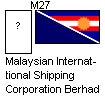
The star has fourteen points, and the blue at the hoist is darker than that of the bands. Jorge Candeias’s FOTW illustration was supplied through Dov Gutterman, citing the CRRM server and MISC website.
Brown 1982 and 1995 show only the other flag’s sinister half: five horizontal blue-red-white-red-blue bands with an overall golden fourteen-pointed star. The livery is confirmed by Bunga Terati at Wellington on 9 August 2003, with the funnel shades better shown by a portside photograph of Bunga Kantan Dua on 3 June 2006. Mitchell omits the black funnel top. Ian MacDonald supplied the FOTW flag version.
Established in 1968 as Malaysian International Shipping Corporation Berhad, MISC was a joint venture between the Malaysian Government and private entrepreneurs. It went public in 1987 and diversified into shipbuilding, repair and engineering in 1991. The name changed to Malaysia International Shipping Corporation Berhad in 1995 and MISC Berhad in 2005, when a new corporate identity was launched. The Government’s holding was sold to Petroleum Nasional Berhad in 1997.
Acquisitions included Konsortium Perkapalan in March 1998, the PNSL group in 1999 and Neptune Orient Lines’ tanker arm American Eagle Tankers, announced in 2003 and rebranded AET Inc. Ltd. in 2006. Petronas Tankers was a major operating company. Other interests included a 36% holding in Jumbo Line, the Global Alliance in 1996, the Grand Alliance by 2005 and the IMC Transasia joint venture formed in 2002.
Most ship names began with Bunga.
Malaysia: Kuala Lumpur, with Port Kelang recorded in 1973–74.
The funnel bands are silver or grey.
This livery is also attributed to Colonial Steamship Ltd.; the band colours are uncertain.
Jarig Bakker’s FOTW flag follows Brown 1995. The original narrative labels it M535, differing from the accepted M355 identifier; the source list also uses M536 in a separate funnel reference.
The business operated as Scott Misener Steamships, subsequently Misener Transportation, Misener Shipping from 1978 and finally Misener Holdings. The register history traces the managed company back to Colonial Steamships, later becoming the principal operation. A separate reference records Misener Shipping’s change to Misener Shipping Agency Inc. on 15 March 1984 and continued activity in 1990.
Economic difficulties placed the fleet in the Great Lakes Bulk Carriers consortium from 1991 to 1994. In 1994 the company was surrendered to its principal creditor, the Canadian Imperial Bank of Commerce.
Canada: Port Colborne, Ontario; later St. Catherines, Ontario.
The white circle contains a landscape of a red rising sun above three yellow mountains or pyramids.
Misr Petroleum was formed in 1964 and owned by the Egyptian Government.
Egypt, Cairo.
Bakker describes the flag as bright green with a central quasi-triangle containing an intricate device, following Brown 1995.
The triangle has a rounded base. Its emblem appears to be a gold ring with seven projecting legs, the first, fourth and seventh longer, enclosing a yellow M with curved legs and two rings between them. The device is edged green, with a yellow Arabic inscription below. Aburdees, photographed to starboard on 31 May 2002, confirms the green shade. A portside photograph of Dahab from 1999 appears light-adjusted and somewhat darker.
Mitchell depicts the emblem separately as well as on the funnel, but uses a conventional shield. Rosanoski finds this surprising given the otherwise accurate emblem; the collection includes three line drawings, among them Aburdees.
MISR Shipping was formed in 1983 and merged with National Navigation Co. in 2004. Egyptian Navigation held 40%, Alexandria Shipping Agencies and Canal Shipping Agencies 19% each, Martrans 17% and National Bank 5%. Egyptian Navigation was also listed as an associate.
Egypt, Alexandria.
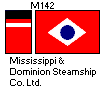
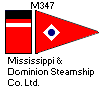
Canada is believed still to have worn Dominion funnel colours when she left Liverpool for the last time on 13 August 1926. Reed 1912 shows two M347 versions: one with a white band separating the red from the funnel top, the other with a larger flag emblem combining features of the two flags. Bonsor distinguishes the rectangular flag’s large diamond from the pennant’s smaller one.
Formed in 1870 as Liverpool & Mississippi Steamship Co., the concern was reorganised as Mississippi & Dominion Steamship Co. Ltd. on 29 August 1872 and known from about that time as Dominion Line. Flinn, Main & Montgomery managed it until Richards, Mills & Co. purchased it in December 1894. It then became associated with British & North Atlantic Steam Navigation Co. International Mercantile Marine acquired it in 1902, retaining its identity.
The White Star-Dominion Line Joint Service name came into use around 1910. By 1914 all ships were registered to British & North Atlantic; Dominion again became an owner during the war, before ownership passed to Leyland in 1921. Its Avonmouth trade had gone to African Steamship Co. in 1894.
U.K., Liverpool.
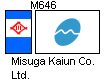
The company website supplies the logo and flag. The funnel follows a photograph of Daio Papyrus, with the logo coming from Daio Kaiun. Mertens could not establish the emblem’s meaning: he suggested that its crack might be a stylised character, later comparing it with a written lower-case m, possibly for Misuga. These remain suggestions.
Misuga is a ship-management concern in the Daio Paper group. Its website dates establishment to 3 December 1994, while Lloyds gives 1997. The website also records shipowning through an overseas subsidiary, which Rosanoski presumes to be Misuga Kaiun Holland B.V., a Rotterdam management company established in 2009. Misuga Kaiun (HK) Ltd. is separately listed as a Hong Kong management operation.
Japan: Iyo-Mishima; later Tokyo.
The recorded variants follow Nantucket Signals and Loughran. Associated vessels Obed Mitchell and Zone had separate ship flags.
Joseph Mitchell, Samuel Mitchell and S. & J. Mitchell were whalers in 1828–37. Rosanoski presumes a connection because they shared a house flag.
USA, Nantucket.
Stewart and Marine News show Saint Line retaining its own funnel while using Mitchell Cotts’ flag, apparently well after the Second World War. Mitchell confirms the old funnel for pre-war vessels but gives the post-war ships in Lloyds 1958–59 a light brownish-buff Mitchell Cotts funnel. Bakker’s FOTW flag illustration follows the 1959 Caltex book.
Mitchell Cotts Kenya was established in 1926 to supply coal bunkers to ships, later expanding into ship agency, freight forwarding and trading. The East African company was listed at Nairobi.
Keep the explicit scope label independent; no alias or company identity is inferred.
The South African company, established in 1895 and listed at Cape Town, was recorded as owner or manager for Thesen’s Steamship Co. It was acquired by Grinrod, Gersigny & Co. in 1969. Stevedoring operations subsequently merged with Grindrod’s. Shipping and transport operations merged with the Grindrod Group on 1 July 1987 to form Grindrod Cotts (Pty) Ltd., becoming Gridrod Limited (Pty) Limited in 1988.
Keep the explicit scope label independent; no alias or company identity is inferred.
Mitchell Cotts operated internationally, with businesses in Africa and Asia. Acquisitions of the U.K. parent were followed by localisation of the group’s companies. The concern is recorded as a Lloyds subscriber from 1899 and as a shipping manager in the 1939 account.
Sun Shipping, established about 1915, was a subsidiary; Mitchell Cotts managed both it and Saint Line.
South Africa, Durban; U.K., London.
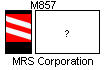
Japan, Osaka; Tokyo from April 1874.
Keep the explicit scope label independent; no alias or company identity is inferred.
Japan, Ngasaki.
Keep the explicit scope label independent; no alias or company identity is inferred.
Japan, Tokyo.
Keep the explicit scope label independent; no alias or company identity is inferred.
Mitsubishi Kisen Kaisha merged with Nippon Koku Yubin Jokisen Kaisha on 18 September 1875 as Yubin Kisen Mitsubishi Kaisha, then with Kyodo Unyu Kaisha on 29 September 1885 to form Nippon Yusen Kaisha. Mitsubishi again owned ships by 1895. They passed with the independent trading section to Mitsubishi Shoji in 1918. The shipping division became independent in June 1943 on merging with Okazaki Honten Kisen-bu, then merged with Sankyo Kaiun in August 1945 as Mitsubishi Kisen. It emerged as Kyokuto Kaiun in April 1949 and Mitsubishi Kaiun that June, merging into Nippon Yusen Kaisha again in April 1964. Nippon Koseki Yuso was a joint venture.
Japan, Tokyo and Osaka.
Keep the explicit scope label independent; no alias or company identity is inferred.
Japan, Tokyo.
Keep the explicit scope label independent; no alias or company identity is inferred.
Reports of a grey funnel are considered probably the effect of coal dust.
Japan, Tokyo.
Keep the explicit scope label independent; no alias or company identity is inferred.
Japan, Tokyo.
Keep the explicit scope label independent; no alias or company identity is inferred.
The website traces Mitsubishi Logistics to Tokyo Warehouse, established in 1887 by Koichiro Kawada and five other Mitsubishi executives, renamed Mitsubishi Warehouse in 1918 and given its later English name in 1996. Lloyds instead gives a 1977 foundation as Mitsubishi Soko or Mitsubishi Warehouse & Transportation and a 1997 name change.
Japan, Tokyo.
Keep the explicit scope label independent; no alias or company identity is inferred.
Japan, Tokyo.
Keep the explicit scope label independent; no alias or company identity is inferred.
Japan, Tokyo.
Keep the explicit scope label independent; no alias or company identity is inferred.
Japan, Tokyo.
Keep the explicit scope label independent; no alias or company identity is inferred.
Japan, Tokyo.
Keep the explicit scope label independent; no alias or company identity is inferred.
Shin Mitsubishi Jukogyo used the group flag. Watt distinguishes dockyard-tug funnels at Kobe in the 1950s from those of the 1960s and 1990s, numbering them M323 and M324 in this document.
Japan, Kobe; later Tokyo.
Keep the explicit scope label independent; no alias or company identity is inferred.
The group’s shipping origins are traced to 1870 and the Tosa Clan’s Tsukumo Shokai. Watt gives Yataro Iwasaki’s foundation of Tosa Kaisei Shosa on 9 October, its renaming as Tsukumo Shokai on 18 October, Mitsukawa Shokai in January 1872 and Mitsubishi Shokai in March 1873. The shipping division became Mitsubishi Kisen Kaisha in May 1875. Merchant Ships instead gives origins in Tokio & Osaka Co. in 1868 and Yubin Kisen Kaisya in 1871; these accounts are not reconciled. The non-shipping organisation became Mitsubishi Sha in March 1886, Mitsubishi Goshi Kaisha in December 1893, K.K. Mitsubishi Sha in December 1937 and Mitsubishi Honsha in February 1943, before the post-war group emerged.
Keep the explicit scope label independent; no alias or company identity is inferred.
Later shipping operations included Diamond Tanker, established at Singapore in April 2005, Diamond Star Shipping in May 2011, MC Marine from 1998 and MRS Corporation. Group interests included Frontier Cruises, the Mitsui joint venture Japan Australia LNG (MIMI), and Sakhalin Energy.
Keep the explicit scope label independent; no alias or company identity is inferred.
The shipbuilding concern became Mitsubishi Zosen in October 1917, drawing on activity begun in 1880. Independent as Mitsubishi Jukogyo from April 1934, it absorbed Yokohama Senkyo in August 1935. It split in January 1950 into eastern, western and central companies, later named Mitsubishi Nippon Jukogyo, Mitsubishi Zosen and Shin Mitsubishi Jukogyo. They reunited in June 1964 as Mitsubishi Jukogyo, although Lloyds continued to list some old names afterwards.
Keep the explicit scope label independent; no alias or company identity is inferred.
Mitsubishi Kogyo is separately recorded in the 1953–54 and 1978–79 registers. Mitsubishi Kogyo Cement, also Mitsubishi Mining & Cement, is associated with a 1 December 1956 foundation date, which Rosanoski assumes refers to the original company. Its fleet, formerly using Ryoyo Maru with numbers, passed to Mitsubishi Materials by 1996–97 and then to Mitsubishi Kagaku Butsuryo by 2000. The latter, also Mitsubishi Chemical Logistics, was formed in 1996 as a wholly owned Mitsubishi Chemical subsidiary.
Keep the explicit scope label independent; no alias or company identity is inferred.
Mitsubishi Koseki Yuso, or Mitsubishi Ore Transport, dates its establishment to 26 January 1959; Lloyds first gave 1960 before changing to 1959. Shareholders included Nippon Yusen, Mitsubishi Corporation, Mitsubishi Heavy Industries and Tokio Marine & Nichido Fire Insurance. Ship names mainly began with Santa.
Keep the explicit scope label independent; no alias or company identity is inferred.
Mitsubishi Shintaku Ginko, also Mitsubishi Trust & Banking Corporation, is recorded from 1970–71 and under managers Doei Unyu by 1988–89.
Keep the explicit scope label independent; no alias or company identity is inferred.
Watt cautions against tying illustration titles too closely to dates. He first assigned M126 to the period before 1885 and later extended it to about 1911, with the later group livery used under several company names from around then. M15 is confirmed for Mitsubishi Kaiun by Stewart, Merchant Ships and Mitchell. After the 1964 NYK merger, group colours reappeared in the shipping sections of other Mitsubishi companies.
Keep the explicit scope label independent; no alias or company identity is inferred.
The red three-diamond emblem on white is a canting design: Mitsubishi means three diamonds. Kariyasu traces it to the three-leaf mon of the founding Iwasaki family. He distinguishes companies bearing the Mitsubishi name, which use the diamond flag, from group members such as Tokio Marine, Kirin Brewery and NYK, which use other flags.
Keep the explicit scope label independent; no alias or company identity is inferred.
Mitchell assigns this funnel to Pyumei Maru, which Rosanoski could not locate in Lloyds.
Keep the explicit scope label independent; no alias or company identity is inferred.
Diamond Aspire photographs of 22 November 2008 and 29 July 2009 indicate a blue funnel top and logo, although they initially look black. Pacific Virago at Sydney on 2 September 2009 and Pacific Leo on 22 April 2010 look black too, but blue tinges and lighting lead Rosanoski to assume blue rather than establish a separate colour.
Keep the explicit scope label independent; no alias or company identity is inferred.
The funnel follows chartered Diamond Champ at Sydney on 9 October 2008.
Keep the explicit scope label independent; no alias or company identity is inferred.
Diamond Star Shipping’s funnel follows Cygnus Ocean, built in 2013 and photographed to port on 7 September that year, with Mitsubishi recorded as manager.
Keep the explicit scope label independent; no alias or company identity is inferred.
This funnel appears on refrigerated tuna carriers including Tuna Queen, Yakushima, Lady Tuna, Satsuma, Harima 2 and Tuna Princess. Its white bands become horizontal aft and rise on the starboard side as a mirror image. Attribution was initially considered through Alavanca, Star Navigation, Yamane and manager Shinko Kaiun. Rosanoski later favoured a charterer: the colours occurred across ownership groups and on Harima 2 before Shinko was recorded as manager. Lady Tuna was identified with operator MRS Corporation, a wholly owned Mitsubishi company operating ultra-low-temperature transport vessels. On 29 November 2013 Rosanoski therefore tentatively reassigned the livery; he did not establish that every photographed ship shared that operator.
Keep the explicit scope label independent; no alias or company identity is inferred.
The heavy-industries companies used group colours in the 1960s. Mitsubishi Ore Transport is recorded with M15 and the Mitsubishi logo; Mitsubishi Logistics is only presumed to use M15.
Keep the explicit scope label independent; no alias or company identity is inferred.
A Tokyo company appears as Mitsui Busan Kaisha in 1963–64 and Mitsui Bussan K.K. from 1970–71 through 1978–79.
Japan, Tokyo.
Keep the explicit scope label independent; no alias or company identity is inferred.
A separate entry is recorded at Shimoneseki City in 1973–74.
Japan, Shimoneseki City.
Keep the explicit scope label independent; no alias or company identity is inferred.
The first Mitsui Bussan Kaisha entry refers the reader to Mitsui Sempaku K.K.
Keep the explicit scope label independent; no alias or company identity is inferred.
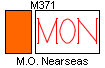
M.O. Nearseas originated in 1966. The register account records its 1988 change to Mon Lines and the 1990 merger with Fuji Steamship to form M.O. Seaways. In July 2001 the Seaways operation and Navix Kinkai’s near-seas division became Mitsui OSK Kinkai.
Keep the explicit scope label independent; no alias or company identity is inferred.
Nihon Enkai Ferry became Blue Highway Line in 1990. On Blue Highway’s dissolution in March 2001, most assets and business rights passed to Shosen Mitsui Ferry, which began business that July and became MOL Ferry in 2005.
Keep the explicit scope label independent; no alias or company identity is inferred.
The flag follows the MOL website. A photograph of Miyashio dated 19 April 2006 shows no funnel of the illustrated form; Rosanoski conjectures that a funnel would have been green with a white G. The tug instead has a flag panel on its white superstructure and a substantial green mast structure bearing a white 27.
Green Kaiji is described as a tug company founded in April 1969 and moved from Tokyo to Nagoya in April 1989; Lloyds instead gives a 1993 formation date.
Keep the explicit scope label independent; no alias or company identity is inferred.
The flag logo is recorded on MOL’s International Marine Transport page and was reported by Mertens; FOTW supplied no illustration in the cited account.
International Marine Transport was renamed from Baba-Daiko Steamship in 1989. Mertens reports a 58% MOL holding, explicitly citing Wikipedia.
Keep the explicit scope label independent; no alias or company identity is inferred.
The website flag was illustrated by António Martins-Tuválkin from Mertens’s report. Its device is described as orangey on white, possibly interpretable as gold.
Mitsui Kinkai Kisen’s formation is dated 1945 by Lloyds, with absorption of Niigata Shosen Soho in 1966; the website appears instead to date an independent division to July 1943. Its translated later history is unclear.
Keep the explicit scope label independent; no alias or company identity is inferred.
Ipavec’s FOTW flag differs from the website logo, which appears as a complete panel on a vessel’s superstructure; Rosanoski questions the altered portrayal. N566 uses the normal Mitsui funnel colours and a flag taken from the Nihon Tug-Boat logo.
Nihon Tug-Boat is dated to November 1967 as a joint formation by Tokyo Kisen and MOL. The translated account also mentions 1992, a 1999 name change and a merger without a clear sequence.
Keep the explicit scope label independent; no alias or company identity is inferred.
FOTW describes a green flag with a white disc and a large red S, with no discernible serifs. The letter colour is unclear on the photographed container logo. A small website vessel photograph shows a white funnel with a dark top and a broad band presumed to be the flag; the source qualifies both the vessel identification and band interpretation.
Sanwa Marine carried on ship agency, cargo booking, brokerage, registration and towage, as well as container rental. Lloyds dates it to 1987; Mertens gives an apparent 1936 foundation and a Shinjuku, Tokyo base.
Keep the explicit scope label independent; no alias or company identity is inferred.
The funnel shade may be air-sea-rescue orange, as observed on Rere Moana at New Plymouth on 11 May 2003. Watt says the colour resulted from failure to agree a shade at the merger and rejects M75, maintaining that only M76 applies. Mitchell nevertheless shows M75, including a black-topped version for Mitsui Leasing & Development. M76 is supported by LNG Pioneer on 20 March 2014 and Cypress on 24 December 2002. Shosen Mitsui Ferry used the group funnel with its own hull logo, a rising sun with seven wavy rays.
Keep the explicit scope label independent; no alias or company identity is inferred.
Bakker’s illustration, sourced to All about Ships & Shipping (1959), is described as three horizontal white-red-white bands in approximate proportions 2:3:2, with white charges on the red band. Rosanoski explains that the merged flag incorporates the partners’ marks: three red bars represent Mi or Mitsu, meaning three, and the white squashed-X symbol is the kanji O.
Keep the explicit scope label independent; no alias or company identity is inferred.
A new group logo was announced on 22 March 2007 for use from 1 April. It uses the familiar MOL initials in deep blue, symbolising the sea. The flag version comes from the Mikami flag website.
Keep the explicit scope label independent; no alias or company identity is inferred.
M.O. Nearseas used the group funnel with its own flag until its renaming as K.K. M.O. Seaways, when it adopted the parent flag.
Keep the explicit scope label independent; no alias or company identity is inferred.
For Solar Japan-related Baizo, photographs show the E-style funnel logo as black. A Port Botany observation initially called it very dark green, but the observer later confirmed black with a photograph dated 19 February 2008. The same logo was recorded for the earlier Zorca. This remains comparative source context under the document’s S1103 reference.
Keep the explicit scope label independent; no alias or company identity is inferred.
MOL adopted its alligator logo in 1967 for worldwide door-to-door container service. It was designed by illustrator Ryouhei Yanagihara.
Keep the explicit scope label independent; no alias or company identity is inferred.
Mitsui O.S.K. Lines, or MOL, was formed in 1964 by amalgamating Mitsui Senpaku and Osaka Shosen Kaisha. Its Japanese name reverses the order as Osaka Shosen Mitsui Senpaku Kabushiki Kaisha. The merger contract is dated 19 December 1963, although that reference names Mitsui Kinkai Kisen as the partner rather than Mitsui Senpaku. On 1 April 1999 MOL merged with Navix Line, retaining its own name.
Management operations underwent further reorganisations. International Energy Transport, formed in April 1989 from Matsuoka Kisen and Sawayama Steamship, became MOL Tankship Management in April 2006. MO Ship Management, created in 1990 from International Fleet Management and Orange Shipmanagement, became MOL Ship Management in 2007. Navix Marine (S), formed in 1995, became MOL Shipmanagement Asia in 2000 and MOL Tankship Management (Asia) in 2006. Azalea Maritime at Oud-Beijerland, cooperating with MOL from 1991 but given a 1999 starting date in Lloyds, became MOL Ship Management (Europe) in 2008. The London tanker-management company separately adopted the Europe suffix in 2006.
Other shipping interests included stakes in Arabian Marine Operating and Saudi Arabian Shipping, Burmah Gas Transport, Daiichi Chuo, Eastern Car Liner and Gearbulk. The initial Gearbulk investment is dated May or June 1991 and later reached 40%. A reported half-interest in Skaarup is dated December 1990 or January 1991. Joint ventures included Asia PetroChem Shipping, Sinotrans-MOL from 2004, Solar Japan and several towing and liner operations. MOL participated in New Zealand Unit Express from 1969, Oasis Container Express from November 1979 and the Global Alliance by January 1996. Meiji joined the group as an exclusively contracted carrier during the July 1963 shipping reorganisation.
Japan, Tokyo.
An earlier plain funnel was soon changed. M101 initially survived the change of company name, and black-and-white photographs in Jordan confirm its form, although some sources leave a wider gap between the bands.
The M100 funnel was adopted in the 1950s, with Watt showing no black top. Merchant Ships 1959 calls it greenish-grey; the 1959 and 1963 editions illustrate M101 while describing M100 without a black top.
The three bars represent Mi or Mitsu, meaning three. Kirsch explains the enclosing square as a stylised kanji for a well, read i, giving Mitsui the sense of three wells. FOTW replaced Phil Nelson’s Stewart-based flag with Bakker’s National Maritime Museum version. The museum flag, dated 1955–67, has central bars thicker than the surrounding frame; the source labels it M110 in the narrative but M100 in the source list.
The Mitsui shipping business originated as Mitsui Bussan Kaisha in July 1876, carrying coal from Muke colliery to Shanghai, with shipowning from 1878. Mitchell instead gives 1879 and the name Mitsui Steamship Co.; Merchant Ships dates steamship ownership from 1895. An unlimited partnership from July 1893, it created a shipping section in June 1898, a department in April 1903, and became joint-stock in October 1909. Shipping became independent as Mitsui Senpaku in December 1942, merging into Osaka Shosen Mitsui Senpaku, generally Mitsui O.S.K. Lines, on 1 April 1964.
Ship names commonly ended their first element in san, followed by Maru. Jordan’s attribution of Taiyo Kogyu and Toyo Kaiun operations is not supported by Talbot-Booth’s differing listings.
Japan, Kobe on formation; later Tokyo.
The flag follows a 1902 chart reproduced in Fune to Hata in 1994. The funnel comes from a 1903 chart.
Japan.
The FOTW flag follows Stewart 1963.
Also recorded as Miyachi Steam Ship Co. Ltd., the concern appears in Merchant Ships from 1942 and remained listed in 1973–74. Rosanoski considers that it ceased in the mid-1970s.
Japan, Kobe.
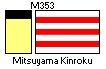
The flag follows a 1902 chart reproduced in Fune to Hata in 1994; the funnel comes from a chart supplied by Watt.
This funnel and flag follow the 1910 chart.
The 1903 chart calls the concern Miyama Kinroku, while the 1910 chart uses Mitsuyama Kinroku. Watt considers the latter probably the correct transliteration, although the kanji can be read both ways.
Japan.
The Tsukumi company’s formation date was recorded as 1951 and later amended to 1940. Registers alternate between Miyazaki Sangyo and Miyazaki Sangyo Kaiun, at times listing both at the same address. Its operating companies included Hokoku Marine, formed in 1996, and Miyazaki Sangyo Kaiun, formed in 1965. These entries are not used to collapse the separately numbered companies.
Japan, Tsukumi.
Japan, Imabari.
Japan; no more specific location is supplied.
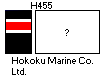
H455 comes from a photograph of Eagle I. The vessel had been Iwato, was renamed on 2 February 2004 and reverted to Iwato on 20 February 2006. This suggests a charter period, so the funnel may belong to the charterer rather than the owner.
Livery proprietor during temporary name uncertain.
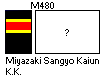
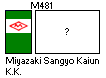
M480 appears to be based on Miyahiro Maru.
M481 is assigned to Miyakiri Maru, with no apparent explanation for the different funnel.
Different vessel liveries do not imply same universal design.
The Imabari company is recorded as an operator in the 1960s; a third Miyazaki Sangyo entry appears in 1978–9. The source does not establish their relationship to the Tsukumi business.
Keep the explicit scope label independent; no alias or company identity is inferred.
The white flag has a blue frame enclosing a blue kidney shape, edged by yellow string loosely tied at the base, and bearing a white M. The yellow or buff funnel has a black top and three very narrow blue bands, separated by equal widths of the ground and interrupted for the flag emblem. Brown 1978 instead gives black bands and merges the emblem’s edging into the yellow funnel.
Miño is listed in Lloyds 1970–71.
Spain: Madrid in Lloyds; Bilbao in Brown 1978.
R235 contains the funnel and flag sourced to Armements Marseillais. The flag was reproduced on FOTW; no additional written description of its design is supplied.
Mme. Régny née Bernadac operated from 1838 until 1844. Ivan Sache’s translation gives the precise end date as 1 December 1844, but Rosanoski notes that the underlying account appears to state only the year.
France, Marseilles.
The website logo incorporates signal flags I and R, described by Rosanoski as “I am altering my course to port” and “the way is off my ship”.
The marine-survey concern originated as Dykfoto, founded by Ola Oskarsson in 1976. It expanded as the limited company MMT A/B in 1988 and bought its first vessel, Triad, in 1996. In 2011 it merged with NetSurvey Ltd. after six years of cooperation. Equasis recorded it as MMT Shipman A/B.
Sweden, Västra Fröunda.
Bakker’s FOTW flag follows Brown 1995.
The funnel follows a photograph of Kampe.
The funnel follows Mo in 1969. The lettering colours are unclear; the circle may have a black outline or merely appear so because it is attached to the funnel.
Hornea provides this version, with the same uncertainty about lettering colour and the apparent circle outline.
Mo & Domsjö operated tugs, its first vessel being Mo, built in 1912. It bought Gideå-Husums A/B in 1905, absorbed Robertsfors Bruks A/B on 21 December 1934 and acquired Bure A/B in 1965. Lloyds initially listed it under Carl Kempe, then Erik Kempe, and under its own name from 1973–74.
Sweden: Norrbyskär, Stockholm and Hernösand; later Örnskoldsvik and Domsjö.
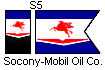
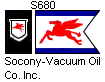
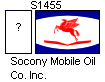
Oriental Tankers, later Oriental Trade & Transport from 1940, was controlled through the Socony-Vacuum and Standard Oil of New Jersey interests and is recorded with Esso-group funnel colours.
Keep the explicit scope label independent; no alias or company identity is inferred.
The Pegasus emblem originated among Standard Oil Trust companies in the late nineteenth century. Vacuum registered a white Pegasus in South Africa in 1911, while Standard Oil of New York used red Pegasus in Japan and Indonesia from 1920. A new red version followed the merger and appeared with the Mobil logo from 1954. In 1965 the design became bolder and reversed to face the fly. Rosanoski distinguishes this history from a simple transfer of the emblem from Vacuum.
Keep the explicit scope label independent; no alias or company identity is inferred.
S2 was used from 1931 to 1944. Its similarity to other flags prompted replacement. Sources vary in the shape of the S and also attribute the livery to Standard Transportation of Hong Kong or Standard Vacuum Transportation.
Keep the explicit scope label independent; no alias or company identity is inferred.
Shabonee first flew the replacement flag on 30 August 1944; Satucket’s funnel was recorded in the house magazine in August 1946. S680 appears to be a variant of S3 and was also used by long-chartered Tankers Navigation vessels. FOTW describes a white swallowtail with blue edges and red Pegasus, but Rosanoski notes that the cited sources show S3 rather than that precise version. He suggests a possible distinction between shore flags and the tapered sea-going form. The 1955 name change preceded the 1957 livery change.
Keep the explicit scope label independent; no alias or company identity is inferred.
Mobil Fuel first wore the 1957 livery. A stylised wing-like device below Pegasus is interpreted as a heavily stylised V, a surviving reference to Vacuum. McMillan’s US Navy-based flag has a deep fork, whereas an actual flag photographed for Rosanoski has a shallow one. Mobil Apex confirms the funnel; Tatarrax also has blue below the white band, while Mobil Meridian, Mobil Power and Mobiloil omit blue. US Navy turns the funnel Pegasus aft.
Keep the explicit scope label independent; no alias or company identity is inferred.
The postcard-based FOTW version is rectangular, with dark-blue outer bands, a much larger white centre and a red Pegasus over a broad red V. Martins-Tuválkin reads curved band boundaries. Rosanoski argues that the apparent curves represent a flapping flag and that the upper band is straight. He also notes that a very shallow swallowtail could be mistaken for a rectangle. The postcard’s Socony Mobile spelling is retained as source evidence.
Keep the explicit scope label independent; no alias or company identity is inferred.
From 1964 Mobil lettering took precedence over Pegasus on some funnels, gradually spreading, although Sylvan Arrow still carried Pegasus alone in February 1965. The flag did not change. Loughran places the shield frame inside the white shield. The livery also appears for Iberian Tankers, Kurze Marine and Kurz Tankers.
Keep the explicit scope label independent; no alias or company identity is inferred.
The later sea-going burgee dates from June 1967, and Mobilgas first wore the new funnel on 1 November. Shore flags were rectangular. The M302 logo dates from 1965. Later Brown editions turn Pegasus back towards the hoist in M3, contrary to the 1967 version described by Marine News and Loughran. Mitchell gives the funnel panel sharp corners and a sky-blue ground. The fleet references show M3 except on Al Haramain and Saudi Glory, which have black funnels with a white-and-green design; Petroleum Transport International is also associated with this livery.
Keep the explicit scope label independent; no alias or company identity is inferred.
Mitchell dates this funnel version to 1990.
Keep the explicit scope label independent; no alias or company identity is inferred.
FOTW presents this flag under Mobil Shipping & Transportation. McMillan considers that it might still have been used after the Exxon merger because the 2001 directory seemed to retain that company’s separate identity.
Keep the explicit scope label independent; no alias or company identity is inferred.
The German sources use a lighter blue. Schneider describes a white swallowtail with celestial-blue upper and lower stripes and a red Pegasus almost filling the white band. The same 1956 source also assigns the livery to Vacuum Reederei. The narrative calls the FOTW illustration M607, while the source list uses M697.
Keep the explicit scope label independent; no alias or company identity is inferred.
A Royal Arrow photograph suggests a further funnel change: a blue panel with white lettering, possibly MST for Mobil Shipping & Transportation, and a small red device above, possibly Pegasus. Both readings remain uncertain.
Keep the explicit scope label independent; no alias or company identity is inferred.
Mobil originated in the 1931 merger of Vacuum Oil and Standard Oil of New York as Socony-Vacuum Corporation, becoming Socony-Vacuum Oil Co. Inc. in 1934, Socony Mobil Oil Co. in 1955 and Mobil Oil Corporation in 1966. Jordan instead treats the Oil Co. as a subsidiary of the Corporation. Mobil acquired Superior Oil in 1985. Its agreed 1998 merger with Exxon took effect on 30 November 1999 as Exxon Mobil Corporation.
Rosanoski rejects the alternative account deriving the principal company from Standard-Vacuum Transportation. Standard-Vacuum Oil was a distinct 1933–62 Asia-Pacific joint venture between Standard Oil of New Jersey and Socony-Vacuum.
National shipping operations shared the livery but had different names. The Australian business began as Vacuum Oil in 1904 and changed to Mobil names in 1962–63. The London Vacuum successor operated Vacuum Pioneer through Stephenson Clarke. The French operation’s change from Socony-Vacuum Francaise is dated 1955 in Lloyds but appears later in Marine News and the register sequence. Mobil Shipping, formed as Sovosco Transportation in 1954 and renamed in 1955 and 1957, and Mobil Shipping & Transportation, formed in 1963, merged into International Marine Transportation on 15 December 1999. New Zealand interests included Atlantic Union’s marketing venture and Coastal Tankers.
USA, New York; later Fairfax, Virginia.
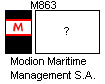
The funnel follows a starboard photograph of Minoan Euro dated 20 May 2008. The outer arms of the M slope slightly outwards.
Owned by Myron Tsatsakis, Modion managed and operated dry-bulk carriers. Its principal had worked as a sea captain and sale-and-purchase broker before developing shipowning interests during the 1970s downturn. One directory describes the business as established since 1970, while Lloyds dates Modion Maritime Management to 2000. Tsatsakis Shipping & Trading, formed in 1979, was recorded at the same address.
Protank Management is listed as a subsidiary. Rosanoski presumes it to be the Protank in which Heidmar acquired 25% in 1989.
Greece, Piraeus; Kifissia on the company website.
Mogens Hvalso Holm owned Hildur in 1984–90. The later register entry places it under Friis & Frederiksen’s management.
Denmark, Roskilde; later Odense.
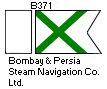
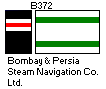
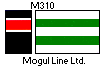
Brown 1929, 1934 and 1943 vary the white bands above and below the red funnel band. The 1929 and 1934 flags have relatively wider, still narrow green bands nearer the centre, separated by a narrow white space. In 1943 the bands are more nearly equal, with the central white narrower; the old company name is retained.
Brown 1951 makes the central white flag band wider. Jordan, Talbot-Booth, Brown, US Navy and the Liverpool Journal of Commerce show equal funnel-band widths, supported by a black-and-white photograph of Islami; Stewart gives narrower white bands. US Navy and Merchant Ships 1942 and 1949 retain a flag closer to B372. M310 follows the later Brown 1982 version.
This earlier version follows Griffin 1895 and Flagmaster 110.
Founded in 1880 as Bombay & Persia Steam Navigation Co., the concern traded as Mogul Line from 1913 and adopted the name officially in 1938 or January 1939. P&O owned it through Asiatic Steam Navigation from 1913 until 60% was sold to the Indian Government in 1960. Managing agents included Turner, Morrison and later Scindia Steamships (London). It managed Chowgule Steamship after the Government’s 1974 takeover. Merger into Shipping Corporation of India was announced for April 1984, then August 1985, but finally took place on 30 June 1986.
India, Bombay.
Recorded in Lloyds 1973–74, Hammoud apparently operated only Maria A.
Lebanon, Beirut.
The funnel follows Eternal Sea photographed to port on 28 February 1981. Mitchell associates it with Konstantinos Skiadas. Rosanoski leaves open whether it identified the individual registered owner, Allouette’s group or Skiadas Shipping & Trading. The HMC lettering discussed in the correspondence was presumed to identify an unknown charterer; comparison with Irini SK’s markings was unavailable.
Moineau, registered on 18 May 1977, appears to have been a one-ship company. Miramar records its purchase of Elsa S.K. in 1978, her renaming as Eternal Sea in 1980 and breaking up in 1983; another account dates both transfer and renaming to 1978 and spells the name Elsa E.K. Lloyds 1980–81 places her under operator Allouette Shipping Corporation. The source connects Constantinos or Konstantinos Skiadas with Moineau and the wider operation, but does not establish every ownership relationship.
Greece, Piraeus; Panama in the Greek Shipping Directory 1983.
The early flag reflected DFDS ownership: blue with a white cross paty bearing a red M. Mai Mols’s short funnel appears to have a narrow band overlapped by the emblem, whereas Mads Mols’s larger funnel has a wider band containing it. Postcards make the band look orange; Rosanoski presumes red, giving Danish colour usage as his reason rather than direct confirmation.
The later blue flag has a white diamond frame and golden parallel diagonal panels. Its logo belongs to DIFKO. Mette Mols on 10 March 2005 provides the funnel photograph. Nüsse’s table flag and Sache’s FOTW illustration record the flag; Andersen associated the snowflake-like emblem with the investment company.
Port and starboard photographs of Mette Mols dated 7 October 2005 provide this funnel version. The emblem first appeared biscuit-coloured on Nüsse’s site but seems golden on the company website. Nüsse also supplied table-flag photographs, and Wilson illustrated the FOTW version.
This funnel version is recorded in the Mitchell collection.
Mols-Linien was formed in 1966, although Mitchell dates DFDS’s controlling acquisition to February 1965. DFDS sold it to J. Lauritzen in 1984; Lauritzen sold to Dansk Investeringsfond af 1.Juli 1976, or DIFKO, in June 1988. Scandlines took 40% in January or February 1999. In December 2007 Clipper, described on its website as acting with Bornholmstrafikken, acquired Scandlines’ then 30% stake; Lloyds attributes the holding to Clipper alone. Vessel names commonly had an M initial followed by Mols.
Denmark, Ebeltoft.
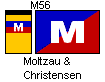
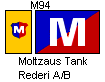
Jordan calls M351’s funnel band dark red, as Ships & The Sea does for M352.
Merchant Ships 1942 and 1944 give these funnels as alternatives.
The ferry house flag is described as blue over red, divided diagonally, with a white sans-serif M and proportions 2:3. The M signifies Moltzau. Øen distinguishes the separate Sundbusserne website logo from a house flag, saying that to his knowledge it was only a logo.
Gedser appears with M54 in a 1963 postcard and M94 in 1968. The livery apparently changed with the 1975 Gedser-Travemünde Ruten name. Mitchell gives M94 a black top under that name, but a 1976 photograph shows the new colours. Bakker describes the M94 flag as diagonally blue over red with a white M.
Sundbusserne’s ferries served Helsingør–Helsingborg, the meaning of HH. They moved from Norwegian to Swedish registry in September 2001 while remaining a Moltzau subsidiary, according to Øen.
Keep the explicit scope label independent; no alias or company identity is inferred.
Moltzau appears also to have been involved in forming Moltzau Line, later Gedser-Travemünde Ruten.
Keep the explicit scope label independent; no alias or company identity is inferred.
Established in 1930, Moltzau & Christensen operated tankers through Moltzau’s Tankrederi. Ferry operations appear to have begun in the mid-1960s through A/S Rendal, using Sundbuss names. After withdrawal from tankers in the 1970s, the ferries eventually passed to the Tankrederi company. Sundbusserne was established at Helsingør around 1990 as manager. Ragnar Moltzau lost the business to Axel Camillo Eitzen after the 2008 crisis, following a loan secured on the company.
Norway, Oslo.
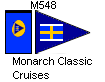
The proposed Ocean Countess colours appear on a postcard. The ship was intended for Piraeus cruises in 2007 after returning from charter in 2006, but was chartered out again; Rosanoski considers this livery apparently never used.
The funnel follows a photograph of Ocean Countess. The website logo and an actual flag provide the flag reference, with proportions appearing to be about 13:10.
Monarch Classic Cruises, or MCC, launched in early July 2006 as a chartering operation backed by Lou Kollakis, with Andreas Potamianos, Elysian Cruises and European Classic Cruises identified as partners. Simplon names Majestic International Cruises as owner.
Greece, Piraeus.
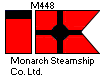
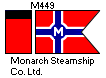
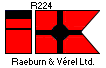
Early sources attribute this livery to Raeburn & Vérel alone. Reed 1912, using Monarch Line, can be read as showing the cross and circle grey rather than black; sources also vary in the circle’s size.
The National Maritime Museum flag is dated about 1955–67 and measures approximately 1219.2 by 1828.8 mm. Bakker’s FOTW version follows the museum.
This version follows Griffin 1895, No. 156.
After the 1973 takeover the owner’s livery appears to have been used. Mitchell’s Townsend Thoresen variant presumably belongs to the period of Townsend Car Ferries management.
Monarch was operated by Raeburn & Vérel, steamship owners from 1880, with Monarch’s connection apparently dating from 1902. Its tramp ships used Monarch as the second word of their names. European Ferries acquired the company in October 1973, after which it operated ferries, and it passed with that group to P&O in 1987. Operators and managers included Harrisons (Clyde), Townsend Car Ferries, Atlantic Steam Navigation and later P&O European Ferries companies.
U.K., Glasgow.
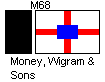
Wigram retained the predecessor’s flag after the 1843 split; Frederick Green’s successors placed the blue panel behind the cross in their version. The flag is associated with Sir Edward Paget under Green & Wigram in 1824. It was given to Federal Steam Navigation in 1896, presumably by Hughes. One version of the origin legend tells of an officer climbing to the masthead and attaching the tail of his blue coat to the centre of the cross.
Money, Wigram & Sons apparently followed the 1843 division of Wigram & Green. An alternative 1788 foundation by Robert Wigram may instead refer to the predecessor business. Allan Hughes of loading brokers Allport & Hughes gained control in 1882 and later acquired the remaining assets after the ships were sold. The source gives both 1884 and 1894 for that acquisition. Allport & Hughes amalgamated into Birt, Potter & Hughes in 1895; the latter was involved in forming Federal Steam Navigation, to which ships passed in 1895–96.
UK, London.
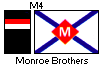
Brown 1951 and Stewart 1957 also attribute the livery to Kyle Shipping; Stewart 1963 assigns it solely to Kyle. Brown 1982 considered that the markings were unlikely to be seen again.
Originating as Monroe, Rutherford & Co., the concern owned steamships from 1912. It operated Rena Shipping until about 1934 and managed vessels for Kyle Shipping, Monroe Brothers Ltd. and St. Vincent Shipping.
U.K., Liverpool.
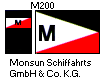
The black funnel has a diagonal white-red biband, described in the source as “Pbds”, with an overall black M. The flag is horizontally black over red, with a white triangle extending from the hoist throughout and bearing a black M.
Monsun was listed in 1970–71 as manager of two one-ship partnerships.
Germany, Hamburg.
The red flag has a white diamond bearing black MBS letters. The black funnel carries a broad band of the flag.
Germany, Hamburg.
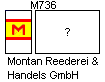
Schneider’s FOTW flag follows the 1956 German reference. Rosanoski considers its rendering inaccurate and says it should resemble M735.
This funnel and flag follow US Navy 1961.
This funnel version follows the Mitchell collection.
The company built Fina in 1952 and Antonia in 1953. Antonia was wrecked on 2 July 1964; neither vessel is recorded as disposed of in the cited history, although the company is absent from Lloyds 1963–64. Earlier registers use Montan-Reederei GmbH and Montan-Reederei & Handelsges. mbH.
Germany, Hamburg.
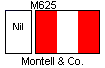
The flag is recorded by Loughran and Mystic Seaport’s Directory of Private Signals flown by American Merchant Sail.
Montell operated the sailing ship Carrier Dove, built in 1855 and lost in 1876. Mystic Seaport records Montell & Co. in 1850 and F.T. Montell in 1852.
USA, Baltimore.
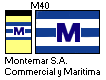
The blue shades differ between sources. The company website showed a single dark blue, also used in Candeias’s 1999 FOTW version. Nüsse’s table flag has a definitely brighter royal-blue letter; Stewart instead shows a black letter. Two 1998 FOTW versions have light-blue bands, one with a light-blue M and the other with a dark-blue M. Rosanoski considers a single-colour version most likely but does not dismiss the observed table-flag difference.
Montemar operated from 1951, originally using mar as a ship-name suffix. A small group of Uruguayan businessmen owned it until European investors joined in 1996; CSAV took a majority holding in 1999. Montemar merged with Companhia Libra de Navegaçâo in 2003. Johannes Solstad had managed part of its fleet; after the mid-1990s register listings it appears to have used chartered tonnage only.
Its Pan-American Independent Line began an East Coast United States–East Coast South America service in May 1991, described by the company as the trade’s first independent non-conference service. It entered a vessel-sharing arrangement with Zim and the former NSA lines in August 1998. Montemar had also become the largest single partner in an October 1997 consortium with Blue Star, P&O Nedlloyd and Contship, joined by CSAV in September 1998.
Uruguay, Montevideo.
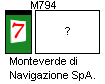
Schiano explains the 7 as a personal lucky number associated with casino and lottery winnings, carried into the company logo. Hermana photographs to port on 17 October 2011 and starboard on 1 July 2012 show the panel’s long vertical edge forward on both sides, while the 7 reads the same way on each.
Captain Nicola Schiano and Pasquale Siringo founded Monteverde in 1980. After nearly thirty years transporting packaged, bulk and container cargo at Naples, the family company entered shipping in 2009 with Hildago. The account connects its name with Schiano’s grandfather’s Montemare concern and Monte di Procida.
Italy, Napoli.
The original funnel was that of Canadian National Steamships. Constituent companies also used their own funnels with the consortium flag. The briefly owned post-war Ottawa Valley used M262.
Playing cards appear to support this version.
An actual flag supplied through David Warwick and a FOTW photograph provide this version. Colour analysis suggests very dark blue in one and black in the other, leaving the ground uncertain despite the predecessor flag’s blue-and-red account.
A 1930s photograph of Canadian Scottish suggests a normal rectangular flag, but the image was recoloured from black-and-white and its colours are unreliable.
Sir Thomas Royden of Port Line presented the former Indra Line flag of Thos. B. Royden, with a maple leaf added in the central diamond. Farquhar’s account implies blue and red colours and an untapered flag.
MANZ Line was registered in August 1936 as a venture of Commonwealth and Dominion, later Port Line, Ellerman and Bucknall, and New Zealand Shipping. Merchant Ships instead gives formation in 1935, while Jordan lists Canadian National Steamships as owner. The line took over the Canadian Government’s commercial shipping operation and ten purchased ships. Service resumed in 1945 after wartime interruption and ceased in July 1971. Trinder, Anderson managed its post-war Ottawa Valley.
Canada, Montreal.
Stewart 1953 and 1957 combine this funnel with the Buries Markes flag, possibly as a group flag, although other sources indicate a separate Montship flag already existed.
Montcalm in September 1960 supports this funnel while operating for Montship-Capo Lines, a joint venture between Buries Markes and Gestioni Esercizio Navi Sicilia of Palermo.
Montship, also called Mont Ships, was formed in 1945 by the Canadian brothers named Laws or Lawes in the sources. Louis Dreyfus, already a half-share partner, took the entire fleet in 1956, apparently through Buries Markes. Montreal Shipping was the initial manager. The history of Marchport, later Mont Clair, records transfers among March Shipping, Canadian Shipowners and Montship between 1946 and 1952, with Buries Markes eventually managing. Montship sold its last ship in 1971.
A website describes Montreal Shipping or Montship Inc. as founded in 1925 and owned by its directors and officers. Rosanoski considers a possible connection with Montreal Shipping Inc. of Stephenville but does not establish that these identities are the same.
Canada, Montreal.
Ocean Mars was recorded at Lyttelton on 20 December 1971 with a blue funnel, black top and yellow circle. No flag is noted.
Singapore.
The funnel follows Orca K photographed to port on 22 October 2012. The K in the emblem is unexplained, and the company connection remains qualified in the original account.
No identification with Cairo Moon Shipping; origin of K and exclusive use unknown.
The company website in 2012 described nearly three decades of operation and included Moon Joy Shipping in the group. Rosanoski could not locate it in Lloyds and cautions that identification with Moon Joy Shipping Co. Ltd. is only assumed; Equasis placed the registered owner and manager at Monrovia, Liberia.
Egypt, Cairo.
The funnel follows The Log, November 1985, illustration 125(11).
The company operated Moorah, built in 1945 as a wartime trawler, from the 1940s and is recorded in Lloyds through 1966–67. The Log reverses the company’s wording to Moorah Shipping & Trading Co. Pty. Ltd.
Australia, Brisbane.
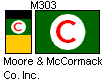
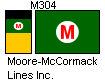
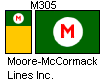
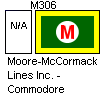
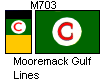
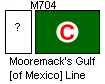
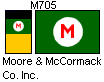
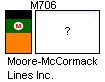
The early C flag appears in Brown 1926 and 1929 for Moore & McCormack, with later references also naming Mooremack Gulf Lines and Honolulu Steamship. Talbot-Booth’s Gulf attribution and circle size differ from McMillan’s FOTW rendering. Rosanoski first considered Commercial Steamship as an explanation of C, but found no corroboration; Commercial South American Line, operated by Moore McCormack by 1920, is another possibility. The letter’s origin remains unresolved.
This funnel is assigned by Talbot-Booth to Commercial S.S. Co. of New York under Moore & McCormack. Rosanoski suggests, without establishing it, that this might be Commercial South American Line.
The M flag begins in Brown 1934 and National Geographic of September 1934. Both it and earlier designs appear under American Scantic Line. The basic flag is green with a white circle and red M, but green shade, circle size and the depth of the M’s central V vary. Photographs of Uruguay show a deep V and Brazil a shallow one. Talbot-Booth gives Mooremack Gulf Lines the American Scantic funnel, while promotional material shows normal M304 colours.
Ocean Ships records this as an alternative funnel.
The fleet commodore used a yellow-bordered flag. Sache’s illustration uses light green; Rosanoski observes that this could be acceptable if the company did not insist on precise shades and letter forms.
Mitchell’s version is supported by several line drawings, leaving the precise colour shade uncertain.
A flag photographed on the 1997 reunion cruise has a large white disc and a broad M. Another actual flag, supplied by Robert Tucker from his grandfather Charles Tucker’s belongings, differs in the M’s central V. A photograph on the same site shows deep-V funnel lettering but a shallow-V flag. Rosanoski leaves open whether these were formal changes or tolerated variations.
A further funnel-and-flag colour photograph is retained in the original document, but its source was not recorded.
Albert A. Moore and Emmet J. McCormack established the business in 1913, with 9 July given as the date; Lloyds instead dates Moore & McCormack Co. Inc. to 1916. Common names included MM, MML and Mormac. It acquired American Scantic Line in 1927. Control of American Republics was briefly obtained in 1926–27, with full control or management from 1938; that September the name became Moore-McCormack Lines. Pacific Republics was acquired in 1940, Pacific-Argentine-Brazil in 1956 or 1957, and Robin Line in 1957. Pacific Republics was sold to Grace in April 1966. Cargo-ship names commonly used Mormac from 1938 or 1939.
The acquisition of Picklands, Mather and Interlake Steamship in April 1973 accompanied diversification into energy. The accounts describe a Resources name change in 1974, or formation of Resources as parent with Lines a subsidiary in February 1974. The Lines fleet and trades went to United States Lines in December 1982, becoming United States Lines (S.A.). The tanker arm, established as Moore-McCormack Bulk Transport in 1973, was sold to former chairman James R. Barker in early 1987 and renamed Mormac Marine Transport within Mormac Marine Group. Interlake also passed to Barker in 1987. One account says Resources retained one ship until bankruptcy in 1998; another records its purchase by Southdown in 1988. The source also places a late-1980s energy collapse before the 1982 fleet sale, leaving its causal chronology contradictory.
USA, New York; later Stamford, Connecticut.
The Log indicates a dark-yellow funnel.
The company owned Mootah in 1948–49 and operated her between Launceston and Melbourne until about 1949–50.
Australia.
Moran tugs are identified by the white M on their black funnels, confirmed by Alice Moran photographed to starboard on 8 February 2013. McMillan had not seen the illustrated house flag flying from the tugs. Rosanoski suggests that the single-M flag relates to the corporation as distinct from the Transportation company.
Scott Turecamo’s photograph confirms this livery and shows the flag flying, although its details are indistinct. The swoosh appears reddish purple.
The Mariners’ Museum holds a dark-blue rectangular Moran Towing & Transportation flag donated by Eugene Moran in 1944. It measures 46 by 75 inches, with white block lettering M. T. & T. Co., eighteen inches high and 2¼ inches thick. Rosanoski considers this wording specific to the Transportation company.
Moran originated in 1860 when Michael Moran bought a half-share in Ida Miller in New York Harbor. Moran Towing & Transportation operated the corporation’s fleet and many small subsidiary companies, reappearing as the group’s New York operator in the early 1990s. In 1998 Moran Towing Corporation and Moran Towing & Transportation amalgamated with Turecamo of Savannah, Turecamo Maritime and White Stack Maritime under the Moran Towing Corporation name.
Regional operations included Florida, Maryland, Texas, Pennsylvania and Virginia. The Maryland, Pennsylvania and Virginia companies took Moran names in 1988 from Curtis Bay concerns. Moran also established Ocean Salvors jointly with Crowley Maritime.
USA, New York; later Greenwich, Connecticut.
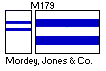
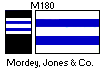
The flag is white with two narrow blue bands near the upper and lower edges. Reed’s funnel is white with two widely separated blue bands; Loughran’s is black with a broad band of the flag.
The company operated around the end of the nineteenth century.
U.K., Newport.
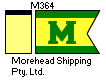
The funnel and flag follow The Log, November 1988, illustration 147(3).
Morehead is recorded from 1978–79 through 1996–97. Atlas Barge of Brisbane managed part of its fleet.
Papua New Guinea, Lae.
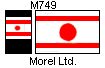
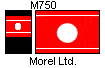
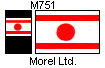
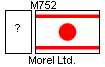
The supplementary Griffin 1895 version M747 presumably records a minor change from M746.
Lloyds 1904 and 1912 also assign this version to P.E. Morel of Cardiff.
Brown 1926 gives the R.E. Morel livery as Morel & Co.
The black funnel carries a broad white band, bordered red and then white, with a red disc. Allende’s black-and-white photograph appears to give equal outer white and red band widths and a disc of similar or slightly greater diameter. A cap badge supports the flag, but with a disc slightly narrower than the red bands. Rosanoski criticises Dignan’s FOTW rendering for a smaller disc and red bands only as broad as the outer white: Sampson is closer to M751. Van den Muijzenberg describes a 2:3 white flag with inset red bands along the upper and lower edges and a central red disc about one-third of the height, noting a slightly larger disc in Dignan’s version.
Rosanoski regards this flag as suspect. It might reflect a late change, but he considers that Marine News should then have mentioned it.
Almanacco Marine Mercantili shows a smaller flag disc.
William G. Morel Steamship & Co. operated Bertholey through Bertholey Steamship from 1896 to 1899; a family connection is possible, not established.
Keep the explicit scope label independent; no alias or company identity is inferred.
R.E. Morel & Co., recorded at another Cardiff address, operated Breynton Steamship and St. Andrews (Cardiff) in 1917–18.
Keep the explicit scope label independent; no alias or company identity is inferred.
Philip and Thomas Morel moved from Jersey to Cardiff in 1841, exporting coal as shipbrokers and owning or part-owning sailing ships from 1869. In 1876 they partnered with brother-in-law John Angel Gibbs as Morel Brothers & Co. and acquired their first steamer, although Merchant Ships places steamship ownership before 1875. Ships were held through several single-ship companies. After family deaths and disagreements the fleet declined between 1904 and 1914. One account records a 1919 change to Morel Shipping Trust and three reparation steamers after the fleet had disappeared by 1920; another dates Morel Ltd.’s renewed acquisition of ships to 1921. The last ship, Jersey Mist, was sold in 1956 and the company wound up that year, though some sources place cessation by 1957.
UK, Cardiff; later London.
Koopa retained the previous owner’s funnel.
Registered on 9 October 1951, Moreton Bay Development acquired Brisbane Tug & Steamship in 1952. Koopa operated from February 1952 until withdrawal in May 1953, although the Compendium records ownership through 1958.
Australia, Brisbane.
The flag is horizontally blue over red with overall white MTB letters.
Registered in Queensland on 17 July 1975, Moreton Tug & Barge operated Kiandra and Kyogle. The fleet was absorbed into Riverside Coal around the end of the 1980s; Rosanoski infers a possible 1979 start from the reported ten-year operating period. The registered company later became Riverside Industrial Sands, within the Riverside Marine group.
Australia, Brisbane.
This funnel is recorded for Fortis, owned from 1958.
This funnel version follows The Log, February 1989.
The records give different origins for Moreton Tug & Lighter: registration on 15 April 1955, but a joint formation by Adelaide Steamship and Stannard Bros in 1972, or by Adsteam Marine, Inchcape and Marine Plant Holdings. The company became North Queensland Marine Towage in 1984. A separately recorded Moreton Navigation company was registered on 27 June 1951 and deregistered in 1988. Rosanoski also records possible operation of the hulk Lady Loch from 1935 to 1962, although the Compendium dates her hulking to 1936. Centipede’s conversion to a motor lighter is dated 1958 or 1960.
Australia, Brisbane; later Townsville.
Maria M and Libera provide photographic evidence for this funnel. The M also appears in Medcare’s logo, and the same marking occurs on vessels managed by Morfini, Medcare or Millenia. Rosanoski notes an apparent change in the letter’s shape but does not establish a separate ownership attribution from the shared design.
Electa, photographed to starboard on 18 March 2011, has additional lower lettering indicating sponsorship or finance by UniCredit Corporate Banking. Identification with the particular UniCredit company is presumed.
This funnel version follows the Mitchell collection.
The company was formed in 1962 as Marfini Srl – Trasporti Marittimi and is said to have changed to Morfini SpA in 1991, although register entries use SpA earlier and Srl in 1992–93. A. Morfini & Figli, operating Tina M, may be connected, but the source leaves this unclear. Later management companies included Medcare Shipping and Millenia Maritime at separate Athens addresses.
Medcare’s website dates its establishment to 1997, incorporated in Panama and registered in Greece, while Lloyds gives 1998. It managed Morfini name companies from at least 2000 and also acted as an agent in its own right. Millenia appears from 2006. Rosanoski suggests that common ownership might explain their shared M emblem, but the website does not confirm his proposed relationship.
Italy, Bari.
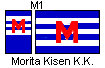
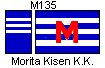
The flag’s outer blue bands appear broader than the others. Japanese publications from 1953 show a funnel M, but Yuyo Maru was recorded without it in March 1963 and with it in April 1965. Watt describes M1’s letter shape as wrong and its lower white band as wider. Rosanoski notes that the original NJK drawing’s V extended only through the second blue band and assumes a treatment like M135, while acknowledging that the correction is unclear.
The company website dates Morita Kisen’s establishment to June 1948; it became Yuyo Kaiun by the 1978–79 register. Rosanoski questions that starting date because Yuyo Maru is recorded as lost to a mine on 22 July 1945.
Japan, Osaka.
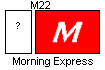
Candeias’s FOTW illustration was described as maritime shipping. Rosanoski found no further trace of the concern.
Hong Kong.
The flag is blue with white MWR. No funnel is given.
Formed in 1974, the concern held its fleet through named subsidiaries, with three one-ship companies recorded in 1998 and 2000. France Shipmanagement managed one vessel in 1998 and Wesnav one in 2000.
Norway: Oslo, later Lysaker.
This funnel follows the Mitchell collection.
Both versions are recorded for Anne Søbye, owned by the namesake company from 1972 to 1984.
Date/colour variations retained; A956 later Ann Charlott ownership not conflated.
Mitchell assigns the funnel to Ann Charlott. The ship was Ann Bach after acquisition in 1967 and became Ann Charlott in 1970, with registered ownership changing from Rederiet Ann Bach to Rederiet Ann Charlott I/S.
Date/colour variations retained; A956 later Ann Charlott ownership not conflated.
Cavima, owned by Dodge Overseas from 1982 until breaking up in 1988, provides this funnel.
Date/colour variations retained; A956 later Ann Charlott ownership not conflated.
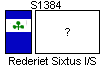
Mitchell shows M677 only as an emblem, without locating it on the vessel, and M678 as a funnel. Rosanoski suggests that the former may have appeared on the superstructure, but also leaves open different vessels or ownership periods: the register changes from Rederiet Amulet to P/R Maria.
Mitchell attributes Søren Pridolf to Rederiet I/S Svancke, while Lloyds 1973–74 gives Mortensen & Lange as owner.
Exact company allocation unresolved; do not transfer the whole combined proposal.
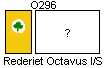
The funnel is recorded for Octavus, built in 1971 and sold in 1980, under Rederiet Octavus I/S.
Date/colour variations retained; A956 later Ann Charlott ownership not conflated.
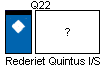
Mitchell and the 1978–79 register record Quintus and its namesake company, but Rosanoski did not locate the vessel in Miramar.
Date/colour variations retained; A956 later Ann Charlott ownership not conflated.
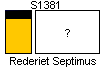
Septimus supplies this funnel; its registered-owner name varies between Rederiet and Partrederiet forms.
Date/colour variations retained; A956 later Ann Charlott ownership not conflated.
Date/colour variations retained; A956 later Ann Charlott ownership not conflated.
S1383 is assigned to Sixtus of Rederiet Sixtus I/S. S1384 is recorded only against the ship at Montrose in October 1975, not explicitly as an alternative company funnel, so Rosanoski questions its allocation.
The document also records Rederiet Ty Line’s funnel for Dorthe Ty and Jette Ty, with differing register coverage. This remains source-only comparative context.
One account dates Mortensen & Lange to 1961 under Rino Lange, who formed Hansen & Lange with Torben Palle Hansen in 1976; the two also formed Elite Shipping that year. Mitchell instead describes a foundation by Hans Mortensen about fifty years before his planned June 1988 retirement, when Finn Ollendorff bought his interest. The accounts are not reconciled. Copenhagen Reefers and its fleet were acquired in March 1990, and Mortensen & Lange merged into Armada Shipping in 1995.
Denmark, Copenhagen.

W315 remains among the associated illustrations, but its album entry supplies no separate written design description.
Father/son or common surname does not establish business identity.
The US Navy flag is blue with a broad white horizontal band and a blue “W”. The Collectors Corner cap badge has a wider white band; its letter initially looks narrow and red, but Rosanoski thought this might result from the gold outlining and could be reconciled with the blue-letter version. The colour remains unclear even when enlarged.
The registers name Morgan Wedlin in 1937–8, as an operator in 1953–4 and owner in 1958–9, and Mortimer Wedlin in 1963–4. Morgan lived from 1883 to 1954 and his son Mortimer from 1915 to 1986. Rosanoski suspects a connection with the later Morgan Wedlin & Son A/B port agency and considers shipowning to have ended in the early 1960s. A reported Lehmann Nordic Group connection was not confirmed on that group’s website.
Sweden, Helsingborg.
Preserve the original prose, but do not illustrate or link it to the withheld GIF(s): W135. Source reference codes do not establish an image association.
The funnel is recorded for Koonya in 1896–98.
Moruya was formed about 1890 and apparently ended with the sale of its last vessel in 1904.
Australia, Sydney.
The flag bears the Cyrillic letters МРП; the document also preserves the company and Mosturflot website logos.
Ruza 3’s line drawing supports this funnel.
The funnel follows Amur 2512 photographed on 13 July 2005.
Port and starboard photographs of Sormovskiy 3030 in 2007 show mirrored markings: the flag’s upper point faces forward on both sides.
Moscow River Shipping, also recorded as MRSC or Mosturflot, traces its origins to 1857, while Lloyds gives a 1994 formation. It carried passengers and cargo on the Moskva, Oka, Moscow–Volga canal and Upper Volga lakes, with river-sea services on the Azov, Black and Mediterranean seas. Government ownership was recorded; a 21.3% holding was proposed for privatisation in 2001 and remained for sale in 2003.
Western Shipping, or A/O Zapadflot, renamed from Western River Shipping in 1994, was taken over in 2002. Mosturflot Cruise Company was another operating concern.
USSR, Moscow; subsequently Russia.
An 1862 image of the brig Elite at Blankenese shows a white foremast flag with a red saltire, probably the house flag; a red name pennant edged white; and a Danish ensign with a cypher. Danmarks Skibsliste 1883 describes the company’s Kontor-Flag as white with a red diagonal cross. Van den Muijzenberg expects that design to have applied in 1862 but notes that the lists do not reach back that far. The illustrated diagonals may be unequal, although the written description does not say so. Schneider tentatively associates the cypher with Mediterranean trading and a distinguishing mark for the Knights of Malta, while acknowledging their earlier disappearance.
Moses & Sön, G. Melchior was a Copenhagen-based Jewish family import concern.
Denmark.
The combined signal joined Moss’s red pennant, with MH added, to Hutchison’s blue-white-red vertical tricolour with a natural-coloured thistle in the white stripe. The pennant carries a white Maltese cross with M and H on either side; one account leaves a possible blue or white border unclear. Marine News dates first use to 7 April 1934 and says all ships flew the pennant, with the double signal for Mediterranean service. Stewart instead assigns the combined flags to the Spanish Peninsula fleet and the pennant alone to Mediterranean vessels. Brown 1951 and another account restrict the combination or tricolour to French ports. These differences remain unresolved. Sources also vary between a long pennant and one closer in shape to the companion flag.
The National Maritime Museum flag is dated about 1955, with dimensions 863.8 by 1855.8 mm; it provides Bakker’s FOTW version.
The line retained its livery after the 1972 P&O reorganisation.
Moss Hutchison was formed in 1934 by amalgamating Moss Steamship and J. & P. Hutchison. Initially owned by Royal Mail, it was acquired by General Steam Navigation in 1935 and thereby entered the P&O group. It joined P&O’s General Cargo Division in the 1972 reorganisation; its fleet ceased to exist in 1979.
UK, Liverpool, Glasgow and Manchester.
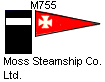
The two funnel-and-flag versions are documented in the contemporary flag books and later references listed below.
James Moss began by chartering a sailing vessel in 1815. He partnered with Thomas Hampson in 1823; after their dissolution in 1833, he joined his nephew William Moss and Richard Spencer as James Moss & Co. The first steamship was built in 1849. Following William’s death, the surviving partners registered Moss Steamship Co. Ltd. in 1873, with James Moss & Co. continuing as manager.
Royal Mail Steam Packet acquired both companies in 1916 and used Moss Steamship to purchase J. & P. Hutchinson in 1919. After the Kylsant crash the concern was wound up and re-registered as James Moss & Co. (Moss Line) Ltd., merging with J. & P. Hutchison in 1934 as Moss Hutchison Ltd.
UK, Liverpool.
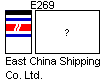
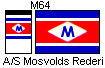
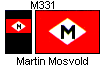
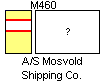
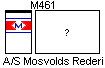
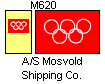
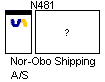
Brown 1943 gives a red flag with a white diamond and black M, a version Rosanoski found unsupported elsewhere. Merchant Ships records the funnel as an alternative.
Merchant Ships assigns this funnel to tankers; a corresponding flag is assumed rather than supplied.
Five linked Olympic-style rings distinguish these colours. Merchant Ships assigns M333 to fruit vessels, supported by Mosfruit, while World Tanker Fleets also connects the ring design with the tanker fleet. Stewart spreads the linked rings more widely. A red flag with white rings is supported by several sources; Merchant Ships 1949 instead shows white with red rings in M334.
A 17 October 1960 letterhead shows the red flag with five white rings. The Skipet collection preserves further versions under Mosvolds Rederi, and Moody gives the M335 and M333 funnels as alternatives.
Obo Harrier has a black funnel top, while Obo Osprey has none. The emblem resembles an S on its side.
Bakker’s Brown 1995 flag probably applied to both Farsund and Kristiansand companies. Rosanoski suggests that it may reflect a group image change during the 1980s–90s, without establishing a date.
Moshill provides the photographed funnel; Rosanoski considers that a similar flag might have existed. Mitchell adds narrow separated black bands above and below and wider blue bands, although his Moster drawing does not show the black bands.
These funnel versions are preserved from the Mitchell collection.
A website connection with Kristiansands Dampskipsselskab could not be substantiated by Rosanoski.
Keep the explicit scope label independent; no alias or company identity is inferred.
Mitchell also records Central Gulf colours on bareboat-chartered vessels.
Martin Mosvold bought his first ship in 1910. Glastad-family investors participated, and the later business divided between Farsund and Kristiansand. Rosanoski’s reconstruction dates tanker ownership and A/S Mosvolds Rederi to 1927, with the tanker operation moving to Farsund in 1932; another account calls 1927 the beginning of Martin’s shipowning altogether. Neptun Shipping amalgamated with Mosvolds Rederi in 1954. After Martin’s death in 1956, his son Torrey controlled the principal fleet. Rosanoski distinguishes the eventual Farsund A/S Mosvolds Rederi from Kristiansand’s Mosvold Shipping, while acknowledging that the operating and shipowning entities are difficult to disentangle. The Farsund fleet was broken up in 1999–2002.
Mosvold Asia was established at Hong Kong in the mid-1980s with Mega-prefixed tankers. Thornhope Shipping was acquired in February 1988. B. Skaugen took 44% of Mosvold Shipping in September 1994; a Bermuda shipping company was demerged from the group’s drilling and shipping activities in 1995. Frontline’s accepted offer in May 2001 brought its holding to 97%, with Mosvold continuing as an operating company. Other interests included Hudson Steamship, Mosvold Chartering, Nor-Obo chartered tonnage and the later Mosvold Drilling, in which Seadrill acquired 40% in December 2005.
Norway, Farsund and later Kristiansand S.

The early flag is a blue swallowtail with a white M. Sache’s Lloyds-based version has a narrower letter than Bakker’s Brown 1926 version. Sources also give several spellings of Enhörning’s name.
After the 1918 management change, Loughran records blue with narrow yellow horizontal bands near the top and bottom, and between them a white circle bearing a red cross paty. Brown 1929 and 1934 attribute this directly to E.A. Enhörning.
Loughran dates the concern to 1896 under manager Gustaf Pettersson, succeeded by E.A. Enhörning in 1918. Lloyds 1912 instead records Arvidson, whose initial varies between G.A. in the register summary and C.A. in Sache’s report. Motala and Enhörning still appear separately in the 1937 telegraphic addresses, leaving their continued relationship unclear.
Sweden, Stockholm; Sundsvsal1 as printed in the Brown reference.
Atlantic Antares was recorded in July 1965 with a yellow or buff funnel bearing a broad blue band and yellow star. The source considers it possibly a variation of Island Navigation’s funnel. No flag is noted.
Motorship Tankers is recorded through 1978–79, with Island Navigation as an earlier agent and Associated Maritime later.
Japan, Tokyo; subsequently U.K., London.
The funnel follows The Log, August 1993, illustration 101(1).
The company operated Palmerston from 1888 to 1928.
Australia, Sydney.
The dark-blue flag has a red-white-dark-blue border, with white MPC lettering at the bottom of the central field and a white Hamburg harbour emblem above. Schneider saw it near Hamburg’s Dammtor Station in July 2010. FOTW tentatively calls it a former Steamship flag; Rosanoski considers a group flag more likely.
A white saltire divides the flag into red hoist and fly quarters and dark-blue upper and lower quarters; the red quarters are edged dark blue. The upper quarter holds the white harbour emblem, with white M at the hoist, P below and C at the fly. The emblem resembles Hamburg’s castle, its top transformed into a trident and an anchor portion added below. Schneider observed the flag at Hamburg Neumühlen on 11 May 2012. The funnel follows Rio Thomson photographed to port on 1 February 2014.
The family-owned MPC group traces its origins to the separate Múnchmeyer and R. Petersen companies of 1846, merged in 1972 as MPC Münchmeyer Petersen & Co. Its activities extended across investment, shipping and shipbuilding, commodities and machinery. MPC Capital was formed in 1994 and MPC Marine Trading in 1998. The Steamship division is dated 1999 on its website and 2000 in Lloyds; a Groningen Steamship B.V. was formed in 2003. Other operating interests included Baltic Capital and the Material Estate Consulting company, and the group held 40.8% of HCI Capital.
Germany, Hamburg.
This is a superstructure logo on MPI Resolution, recorded on the company website. The source explicitly states that there are no actual funnels.
The other superstructure logo follows MPI Sancho Panza photographed on 19 August 2013.
Mayflower Resolution was built in 2003 and ready for European service early in 2004. After Mayflower Energy went into administration, managers backed by Mizuho International acquired her, with the new ownership becoming MPI Offshore and the vessel MPI Resolution. On 31 March 2006 she and associated equipment entered a company jointly owned by Vroon and the original management team. MPI Workboats subsequently operated purpose-built aluminium wind-farm support catamarans.
UK, Stokesley.
This funnel follows black-and-white photographs of Aldinga in 1883–96 under Vickery and Havilah in 1884–1900 under Mount Kembla Coal & Oil.
Five Islands is recorded with this funnel in 1909–27.
Mt. Kembla Coal & Oil was formed in 1878 and dissolved on 8 July 1913 to allow Mt. Kembla Collieries to be formed the following day. The latter was dissolved on 31 August 1948 after AIS acquired its assets. Ebenezer Vickery of Sydney was associated with ownership, some vessels being registered to him as Mount Kembla Coal Co. The source also records shipowning continuing until 1927, when the last ship was transferred to the Collieries company. Mount Kembla herself operated in 1885–1912.
UK, London, with Australian shareholdings.
The owners’ flag was flown as a stem jack on the same occasion.
Delphin wore this funnel and flag at Wellington on 7 March 2004 while chartered to Delphin Seereisen.
MTC was formed in 1996 and held its fleet through Dolphin Maritime, formed in 1998.
Germany, Hamburg.
MTM Singapore’s photograph reveals narrow blue bands separating white from red, previously missed in distant views. MTM Hong Kong on 22 May 2013 omits the black funnel top. The flag follows an indistinct photograph of Chembulk Rotterdam at Wellington on 6 May 2003. JLL reported that Chembulk vessels usually flew it; Rosanoski leaves open whether this also meant the parent’s ships.
SG Pegasus at Botany Bay supplies this funnel. The register lists her ownership care of MTM from 1 April 2011, but the website offers no corroborating connection, nor an apparent link to other SG-named ships.
The MTM group was formed in 1980 for chemical- and product-tanker ownership and operation alongside brokerage. It opened a Westport branch in 1981, became a ship operator in 1982 and an owner in 1987. Bulk-carrier activity began through Strategic Bulk Carriers in 1995; brokerage was sold in 1997. MT Maritime acted as the South-East Asian commercial arm, with MTM Ship Management providing crewing and technical management. The management company dates itself to 1988, while Lloyds gives 1989. Chembulk Tankers was spun off in 2007. Megaports Agencies had begun as M.T. Maritime Agencies in 1985 and was renamed in 1997.
Singapore.
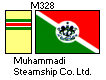
The flag’s arms comprise an upright foul anchor topped by a crescent and star and surmounted by a crown, with two rampant lions as supporters. Below is a white scroll outlined black, inscribed THE [?] MUHAMMADI STEAMSHIP CO.; the first word is uncertain in the source.
Muhammadi is recorded in Lloyds from 1953–54 through 1973–74, with ship names beginning Al.
Pakistan, Karachi.
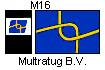
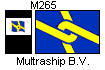
The flag is described as blue with two yellow half-links. Rosanoski regards Brown’s M16 as reversed and M265 as the likely obverse, supported by the company logo, Nüsse’s table flag and a photograph of the flying flag on Multraship Commander. The photographed side is the reverse; a double-sided construction could change that reading, but he considers it unlikely. Funnel panels are mirrored so that the emblem faces forward on both sides, which he suggests caused the Brown confusion. Multratug 7 confirms the portside version; Multratug 4 shows a more angled, flapping flag panel with a yellow mast forward. Website and table-flag blues vary.
Multratug 3’s portside photograph of 26 July 1999 shows a plain white band on what is actually the mast; the emblem panel is on the superstructure instead.
The Muller family’s business undertook harbour, coastal and deep-sea towage, salvage and services for dredging, marine contracting and offshore operations. Multraship and Multratug were formed in 1990, with tug names using Multratug and a number. Multraship acquired Bourgas Tug Service in July 2005. On 7 August 2008 it announced a partnership with Fairplay, which took 50% of Muller Maritime Holding, while the existing family board and management continued.
Netherlands, Terneuzen.
Both versions derive from the website logo. Rosanoski straightens it for M417, whereas the FOTW version straightens the outer flag edges but leaves the device angled as a stylised M. The December 2007 website shows black where white had appeared, possibly because the logo was placed on a black background.
NJK recalled a funnel seen some years earlier but could not identify the vessel.
Formed in April 1997, Multinational was an operating company of Singa Ship Management. It appears to have been included in Tailwind’s acquisition of Singa on 28 July 2006 and was subsequently listed under Tailwind.
Philippines, Manila.
The dark-blue flag bears white sans-serif MN initials above two staggered white waves, the upper below M and the lower below N. MULTINAUT runs vertically in white along the fly. The website portrayal has a broad white border; photographs, including Kistroom, show actual flags.
Multinaut describes itself as the first inland-waterway transport company incorporated immediately after the Main–Danube Canal opened in 1992. It was a subsidiary of Imperial Reederei Gruppe.
Austria, Vienna (Wien).
National Geographic and the FOTW illustration show a tapered swallowtail. Rosanoski found Lloyds, Brown and Talbot-Booth instead showing an ordinary rectangular swallowtail.
This earlier funnel-and-flag version follows Lloyds 1904.
Walter D. Munson’s Havana sugar and molasses business began chartering ships for the United States trade in 1873. The FOTW account dates his move to New York to 1882, purchase of three steamships to 1893 and incorporation as Munson Steamship Company to 1899. Merchant Ships instead records steamship ownership from 1884 under W.O. Munson. Cuban sugar remained the main cargo despite expansion towards South America. Declining profitability and unsuccessful Bahamas and Bermuda cruise ventures were followed by Depression-era bankruptcy in 1934 and repossession of vessels in 1938. The FOTW account says shareholders dissolved the company in 1939; Merchant Ships records a May 1939 reorganisation and renaming to Munson Line Inc.
USA, New York.
M539 is based on African Orchid at Newcastle on 23 February 2008, a charter from Hanseatisches Beteiligungs Contor. The lighter blue looked mauvish.
African Blue Crane, chartered from Orient Line Y.K., also shows a mauvish shade in the logo.
African Eagle, chartered from Dockendale, was photographed on 2 July 2007 with a pale yellow-buff funnel; a close-up supports this shade.
African Falcon on 29 September 2008 has a slightly darker funnel and different blues, recorded as M619.
M494 comes from a portside photograph of African Eagle on 23 June 2012. The source does not describe further differences in words.
MUR Shipping Holdings B.V. was the shipping division of a joint venture between Mittal Steel South Africa and Macsteel International Holdings. Its head-office move to Dubai was announced on 25 February 2007. MUR stands for Metall und Rohstoff, the South African commercial operation recorded as manager. The sources separately date MUR Shipping A.G. to 1994 and the Dutch MUR Shipping B.V. to 1995. The fleet was described as chartered or owned, although Rosanoski found no direct ownership in Lloyds, which later listed MUR as managers only.
United Arab Emirates, Dubai, with Dutch and South African corporate entities distinguished in the company account.
A red whale was added to the original colours and placed on the hull, as shown by a black-and-white photograph. Ferry Muroto photographed on 27 July 1999 supplies the funnel and whale reference.
Muroto began with Muroto Maru, built in 1953. Its ferry service linked Kobe on Honshu with Shikoku until major causeway and bridge construction in the 1990s. Registers disagree over Ferry Muroto’s later ownership, some naming Kochi Sea Line. The last vessel was sold in 2002.
Japan, Muroto.
The flag is based on the Murray River Ensign: a red cross charged with five white stars, a white first quarter with MSTC letters, and four alternating white and blue horizontal bands in each of the other quarters. The letter colour is not defined by the black-and-white hatching; black is assumed.
Registered on 13 April 1970 and deregistered on 13 April 1992, the company operated the paddle steamer Canberra on the River Murray.
Australia, Echuca.
The flag appears in colour on Virgo’s bill of lading dated 16 May 1871. Van den Muijzenberg identifies it tentatively as the line’s flag because the agents are named only in small print. His reconstruction is red with two lengthwise yellow stripes, the yellow somewhat narrower than the red, about 3:4. Standard red and yellow were used because the printed colours’ accuracy was unknown. Mystic Seaport records the same or an equal-striped version for several concerns, including Dempsey & Murray and D. Colden Murray; this does not establish a common company identity.
Murray & Ferris acted as agents for Murray’s New York Steamship Line, which van den Muijzenberg considered the same as Murray’s Line. Craig Valentine described a service carrying supplies to Nassau and Cienfuegos, possibly also Savannah, and said his great-grandfather Sophus Valentine part-owned Cleopatra with the concern. Whether the names covered an agency, an owning line or both remained under discussion. A surviving bill of lading records Virgo sailing from Savannah to New York in 1871.
USA, New York.
US Navy 1961 draws the funnel’s “A” almost touching the red bands.
One of the early ships was Ileri, acquired in 1948 and broken up in 1968; the other final vessels, Kerempe and Yoroz, were broken up in 1969. Lloyds records the full company name in 1953–4 and 1966–7. Brown uses Aldikacdi Vapura Idarehanesi, while Mitchell shortens it to Aldikacti Sirketi.
Turkey, Istanbul.
The funnel was recorded for Twinfox in September 1966.
Mutual was a one-ship concern owning Twinfox from 1961 until her scrapping in 1967. The ownership account places it in Panama, with Gibson Shipping of Macau managing until 1965 and Van Engineers of Hong Kong thereafter; Lloyds calls those firms agents.
China, Macau; subsequently Hong Kong.
The flag is an unequal blue-white-blue vertical triband swallowtail. The first and largest blue section has a white saltire; overall is a gold bird with a white head flying towards the hoist, beneath an arc of nine gold stars. Martins identifies the blue-and-white pattern as signal letters Mike and Alpha, the company’s main initials. Candeias thought the indistinct bird more like a seabird than a hawk; Rosanoski suggests a raven, linking this to the recurring ship name Corvo. Corvo’s funnel photograph of 26 July 2007 shows the white band slightly broader than the yellow.
The company history dates Mutualista to 27 December 1920, formed by merging Empresa Micaelense de Transportes Maritimos and Empresa de Navegação Açoreana. Grupo Bensaude acquired it from Parceria Geral de Pescarias on 28 October 1950. Lloyds instead gives a 1927 formation as Mutualista Açoreana Sarl and the present name from 1990.
Portugal, San Miguel in the Azores; later Lisbon.
Carousel and Sundream photographs from 2002 show the later design mirrored with the red portion aft on both sides. A small red circle sits over the Y, and the funnel is short with a sloping front.
Carousel postcards show mirrored Sun Cruises funnel markings, with the sun pointing aft on both sides. The two bands seem to fade aft, either following the logo or merging into the dark-blue funnel; the photographs are unclear.
David Crossland acquired Pendle Travel Services in 1972; it became Airtours in 1986 and a public company in 1987. Cruises began in 1994 through Sun Cruises, using Palma as a base and initially buying ships with their former owners retained as managers. Lloyds separately dates Airtours’ formation to 1994. The parent became My Travel Group in 2002. Carnival took 29.6% in April 1996 and partnered in the Costa purchase in 1997; Rosanoski rejects an account naming Royal Caribbean for these transactions. Airtours later sold its half of Costa to Carnival and also acquired Direct Holidays and Direct Cruises.
Financial difficulties led to the cruise fleet’s sale in 2004 and charter-back arrangements; the account says Sundream remained in service until May 2005, while Lloyds calls Seawing the last vessel sold in 2004. My Travel’s merger with Thomas Cook was announced on 12 February 2007 and took effect on 19 June.
UK, Rossendale.
The established flag is red with a very broad blue horizontal band bearing five white stars. The livery continued through the name changes; Mandalay’s February 1990 portside photograph confirms the funnel.
Candeias’s FOTW variant has no stated source. If correct, it would indicate a later change, but Rosanoski does not establish that.
This version follows Nüsse’s table flag, reproduced by Sache with a bright-blue shade.
Formed in 1959, the line successively used Burma Five Star Line, Union of Burma Five Star Line and Burma Five Star Shipping Corporation before becoming Myanma Five Star Line in 1989. Earlier Lloyds accounts begin instead with the Union of Burma name. The Government-controlled national carrier operated under the Ministry of Transport; a later website records transfer to a private limited company without a date in this document.
Burma, Rangoon; subsequently Myanmar, Yangon.
Photographs of Athinoula and Mathios confirm the funnel on vessels described as agency ships, whose owning companies Rosanoski considers apparently Mykonos name companies. The A probably refers to managing director D.M. Apesakis or his family, but the family ownership is assumed. Christies shows a black top.
Formed in 1972, Mykonos is variously recorded as operator or agent. A source found Mathios described as owned by Mykonos and managed by Mathymyr, reversing the roles suggested by the register’s registered-owner entry. Rosanoski presumes continuity between earlier and later entries from the repeated Mathios name, without treating that as certain.
Cyprus, Nicosia; subsequently Greece, Piraeus and Athens.
Keep the explicit scope label independent; no alias or company identity is inferred.
A separately listed Mykonos company appears in 1992–93 under agents Polembros Maritime.
Greece, Piraeus.
Keep the explicit scope label independent; no alias or company identity is inferred.
The Gulf Princess funnel follows the Mitchell collection.
Mitchell records this namesake for Gulf Princess, sold in 1988.
Panama, possibly the ship’s registry rather than company domicile.
Keep the explicit scope label independent; no alias or company identity is inferred.

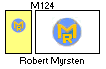
US Navy 1961 gives Robert Myrsten a white flag with a blue M.
Brown 1982 shows a white flag with a light-blue circle containing a gold M above a smaller gold R. A cap badge confirms the light blue, contrasting with the darker Volo badge.
Carl Bertil Myrsten and his sister Inga Gattberg formed Rederi A/B Slite in 1947. Co-operation with Vikinglinjen began in 1965 or 1966, followed by the Viking Line marketing company in 1966. Slite remained involved with Viking Line during the 1980s, but financial over-extension led to its last vessels being auctioned in 1993.
Rederi A/B Slite: Slite, later Stockholm and Nacka.

Another badge, attributed to Myrstens Rederier or Myrstens Rederierna, may simply render the preceding lettering differently, or may deliberately distinguish Carl Bertil Myrsten’s Slite operation. Nüsse attributes this flag to Slite. Slite used Viking funnel colours and probably the Viking flag, although the Myrsten flag may also have flown.
No proof of deliberate company differencing or shared use.
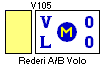
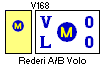
Collectors Corner gives the flag a royal-blue shade.
Mitchell attributes this funnel to Robert Myrsten. Bakker’s flag image follows the Bryggan account of Volo.
V106 paired flag is assumed in source; manager-use qualification preserved.
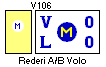
The NJK funnel is recorded for Othem of R. Mysten [sic]. Its accompanying flag is assumed rather than shown; the vessel belonged to Rederi A/B Volo.
The Othem funnel is recorded by NJK. The paired flag was not shown and is explicitly assumed; do not claim verified combined use or corporate equivalence with the manager.
V106 paired flag is assumed in source; manager-use qualification preserved.
The Myrsten interests originated with Johan Niclas Myrsten of Slite in 1867. His sons Gustaf and John formed Rederi A/B Volo in 1910; it operated until around the end of the 1950s. Register entries appear under successive family members, including John, G. and Robert Myrsten, then Myrstens-Rederierna in 1973 and A/B Robert Myrsten in 1978. Robert and Carl Bertil Myrsten were listed separately by the late 1950s, apparently initially at the same address.
Sweden: Gothernburg, Stockholm and later Skarhamn.
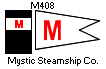
The letter’s shape varies between sources; post-war sources attribute this livery to the Mystic Steamship Division.
The connection of this funnel is unclear. Talbot-Booth does not link his two illustrations, associating the other funnel with Koopers. This one may relate to tug operations, which he does not mention.
Exact activity/company allocation unconfirmed.
Mystic carried coal from railroad piers in New York Harbor, Philadelphia, Baltimore and Newport News in colliers and barges. Its tug fleet was commercially known as the Boston Tow Boat Company. Koppers Coal & Transportation Co., originally Koppers Coal Co., owned the concern through Eastern Gas & Fuel Associates. Post-war registers call it the Mystic Steamship Division of that organisation; Mystic Steamship Corporation appears in 1966. The omission of its fleet in the 1963–64 register appears erroneous. Mystic also acted as agent for Atlantic Bulk Trading Corporation.
Mystic belonged to the American Steamship Owners’ Association, which existed from 1919 to 1938 and apparently represented established Atlantic-coast liner companies.
USA, Boston, Mass.
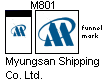
The funnel follows a portside photograph of Eny identified as Myungsan Ltd. and starboard photographs dated 11 November 2011, during Myungsan’s involvement with the vessel. An earlier photograph, dated 1 February 2007, shows what Rosanoski assumes to be Chang Sung Shipping Co. Ltd.’s logo.
Myungsan managed Eny from 2 September 2007 and became her owner on 1 June 2012, according to Equasis. Lloyds lists the company as owner and manager in 2011–12.
South Korea, Seoul; Busan in Lloyds 2011–12.
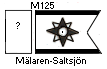
The flag is recorded by Collectors Corner.
Sweden, Stockholm.
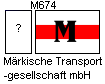
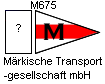
Small barge photographs suggest an upright M, unlike the left-leaning appearance of the waving illustration. An advertisement showing the flag flat confirms an upright letter: its left diagonal and right leg are much thicker, about half a horizontal stripe’s width. The lower serifs match the illustration, but the upper ones point only outwards. The letter occupies about two-thirds of the flag’s height, larger than illustrated.
Bakker also observed the design as a pennant. Mertens notes that this form can coexist with a rectangular flag in inland shipping.
Also called Brandenburg Transport Co., Märkische was established on 1 August 1990 after the fall of the GDR and became a subsidiary of Imperial Reederei Gruppe.
Germany, Berlin.
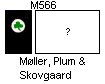
Mitchell attributes the funnel to Møller & Skovgaard.
Møller, Plum & Skovgaard operated Holka in 1970–71.
Denmark, Rønne.
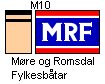
Engene tentatively suggested MRF for a flag with horizontal blue, white and red bands, noting that many Norwegian house flags use these colours. Rosanoski notes that the comment had been moved from another context; it is not a firm attribution.
Founded in 1920 as Møre Fylkes Ruteselskap (MFR), the company became Møre og Romsdal Fylkesbåtar (MRF) in 1949. It merged with Fylkesbaatane Sogn og Fjordane A.S. to form Fjord1 Nordvestlandske A.S., and took the name Fjord1 MRF A.S. in 2005.
Norway, Molde.
The flag is divided by a saltire into blue and white, with a central white disc edged black and white containing a black hammer and mallet, identified as mining symbols. The reproduced version has a thinner, more horizontally oval ring than the source illustration.
The company bought and renamed Raffelberg in 1951, selling her in 1962. Kahlenberg was built for it in 1951 according to Die Deutsche Handelsflotte, although Rosanoski did not find that vessel in the other cited registers.
Germany, Mülheim-Ruhr.
Antonio carried a red funnel with a narrow black top and a white circle bearing a black M. No flag is noted.
The concern appears in registers from 1963–64, later as Messana S.p.A. di Navigazione. Sogimar is listed as manager in 1978–79.
Italy: Messina and Palermo, Sicily; later Naples.