F. & G. CARPENTER.
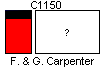
F. & G. Carpenter acquired Reliance in 1916 and are said to have operated it for thirty years. The Compendium instead records transfer to F. Carpenter in 1919, leaving the ownership-name sequence unresolved.
Australia, Melbourne.
F. & G. Carpenter acquired Reliance in 1916 and are said to have operated it for thirty years. The Compendium instead records transfer to F. Carpenter in 1919, leaving the ownership-name sequence unresolved.
Australia, Melbourne.
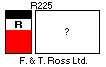
By 1975 the company’s sole remaining vessel was reported in Boston Deep Sea Fisheries colours.
Beginning as shopkeepers and merchants, F. & T. Ross became ships’ chandlers and trawler owners in the 1930s. The source records vessel operations from 1946 until the Boston Deep Sea Fisheries takeover in 1954. Later registers list Basil A. Parkes as operator. Ships were named after inventors.
U.K., Hull.
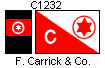
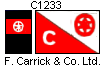
The flag’s ring varies in thickness. Brown 1929 and 1934 and LJC 1930 show a thicker ring than C1232, but not as thick as C1233, with the star clear of it. Brown 1943 instead shows a narrow ring touched by the star.
Jordan describes a white six-pointed star within a white circle, presumably meaning a ring. Talbot-Booth’s funnel is unclear until Ships & The Sea 1942, which distinctly shows a narrow white ring touched by all six points, unlike Lloyds 1912.
Medomsley retained Carrick livery until about its wartime transfer to Buries, Markes, then adopted its own design, catalogued separately as M701. Rosanoski associates this approximately with the disputed 1943 or later Van Ommeren takeover.
Frederick Carrick built Medomsley in 1906 and soon registered Medomsley Steam Shipping Co. Ltd. After the ship’s loss in 1919, trading resumed in 1924. His son succeeded him on his death in 1930, later deciding to sell; voluntary liquidation followed in 1942. The reincorporation appears to concern Medomsley rather than the Carrick company. It passed through H.G. Mann, head of Buries, Markes, to Phs. Van Ommeren (London). The acquisition is dated both 1 January 1943 and autumn 1947. Fleet names used the prefix Langlee.
UK, Newcastle.
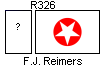
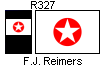
The earlier FOTW illustration is white with a central red disc containing an inverted white five-pointed star.
Rosanoski’s comparison with Lloyds 1904 and 1912 and Massary 1930 shows the star point should be upwards, making the earlier illustration upside down. The correction is represented by this version.
Reimers owned Hermine from 1895 to 1913. His inclusion in Massary 1930 led Rosanoski to presume some post-war operation as well.
Germany, Hamburg.
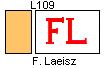
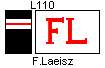
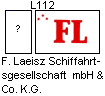
L110 was also used by Afrikanische Frucht-Compagnie Laeisz & Co. Its funnel is corroborated by Ships & the Sea and Jordan’s photograph of Pelikan. Griffin adds stops after the letters. Merchant Ships 1942 notes that vessels, presumably those of Afrikanische Frucht Compagnie, sometimes wore Jamaica Banana Producer’s colours. The National Maritime Museum’s flag, No. 288, is dated 1955–67.
L112 is white with red serifed FL in the centre and three red five-pointed stars in the canton, one above two. Prager dates its introduction to December 1989 and derives the stars from the family arms. The company website explains them as commerce, insurance and shipping. Klaus-Michael Schneider nevertheless reported that headquarters used the old flag without stars, while the company page showed the starred version.
L109 is corroborated by Piro at Newcastle on 24 September 2010. The ship was managed by Reederei F. Laeisz, and vessels in the associated Hamburgische Seehandlung fleet wore their managers’ funnel colours. Esso’s 1956 and 1958 charts and Flaggen & Schornsteine also assign L109 to Afrikanische Frucht Compagnie Laeisz. During the 1960s vessels were seen in Geest Line colours. An emblem thought to be the family arms appeared on Piro’s superstructure.
F. Laeisz began in 1824 as a hat-making business, entered import and export trade by 1832 and built its first ship, the brig Carl, in 1839. Ferdinand Laeisz helped found HAPAG in 1847. His son Carl encouraged further investment in ships; one account places him in the business in 1852, another makes him a partner by 1851. The sailing fleet became the Flying P Line, both for its speed and its P-prefixed names. The naming tradition began with Pudel, recalling the “poodle” nickname given to Carl’s wife because of her curly hair.
Ferdinand and Carl participated in numerous shipping enterprises, including Hamburg Süd, Adler-Linie, Kosmos, Hamburg-Calcutta-Linie, Bugsier, Woermann, Gebrüder Schiller, Hamburg-Brasilianische, Hansa and Deutsche Levante. Carl is credited with founding Deutsch-Australische in 1871, though The Log gives 1888, and with involvement in Woermann’s formation in 1886, against the website’s 1885. He was also involved in Deutsche Ost-Afrika in 1890.
Laeisz acquired a majority interest in Afrikanische Frucht Companie in 1907. Carl’s sons Herbert Ferdinand and Erich Ferdinand joined in 1912; Herbert died in the First World War and Erich ran the business between the wars. The firm owned steamships from 1914 and used the name Reederei F. Laeisz GmbH until January 1939. Rosanoski records the loss of the entire fleet to the USSR in 1945. Afrikanische Frucht-Compagnie later appears as Afrikanische Frucht-Compagnie Laeisz & Co.
N.W. Schües joined in 1961 and became a general partner in 1972. The shipping business became F. Laeisz Schiffahrts GmbH & Co. in 1982. In 1993 Nikolaus W. Schües and Horst Rehe acquired Deutsche Seereederei Rostock; its fleet and Laeisz’s were brought together under Reederei F. Laeisz, formed in Rostock in 1994. The partners divided their interests in 1999, with Schües retaining Reederei F. Laeisz and Euroseabridge. Euroseabridge’s ships had moved to individual ship companies in 1997; Scandlines acquired its ferry services on 10 August 1999.
The group’s related businesses included shipping consultancy Deutsche Schiffahrt, insurance through F. Laeisz Versicherung, container chartering through Martini Chartering and ship finance through Hamburgische Seehandlung, founded with MM Warburg in 1995. The source dates Martini’s formation both to 1995 and 1996. It likewise gives 1999 in one account and 2009 in another for the 90% Hamburgische Seehandlung holding, with 46% recorded in 2004.
Germany, Hamburg.
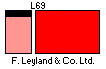
L69 has a pinkish-buff funnel with a black top and a plain red flag, attributed to the Bibby business during Leyland’s control.
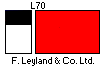
L70 instead has a white funnel with a black top and the plain red flag.
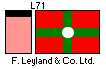
L71 has a red flag with a green cross and a white circle at its intersection. The pinkish-buff funnel is assumed because Loughran gives no change of shade. Rosanoski is uncertain whether the red flag was altered to avoid confusion with the explosives signal, and questions direct ship operation in part of this period.
Frederick Richards Leyland became a partner in the original Bibby Line in 1859 and took control in 1873, trading under his own name despite a dispute over retaining Bibby. After his death in January 1892, interests including John Ellerman, Christopher Furness and Henry O’Hagen acquired the fleet as Frederick Leyland & Co. The Furness association led to Wilson’s & Furness-Leyland in 1896; West India & Pacific was acquired in 1899 and Frederick Leyland (1900) Ltd. followed.
International Mercantile Marine took control in 1902. Rationalisation brought withdrawal from Mediterranean services, ship transfers to Ellerman and later withdrawal from New York. The two remaining passenger ships went to Red Star in 1927. The last ship was sold in 1935, with goodwill and services, but no ships, sold to the Vesty/Vestey group. The source distinguishes later holding-company interests involving Blue Star and the 1944 purchase of Lamport & Holt from the earlier end of the operating fleet.
UK, Liverpool.
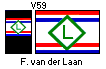
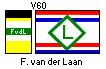
The earlier funnel is yellow or buff with a black top and a white–green–white triband, bearing white “FvdL” on the green. The second, adopted in the mid-1960s, is black with a broad band of the flag. The flag has seven horizontal bands, red–white–blue–white–red–white–blue, with the central white occupying most of the field. Overall is a white diamond edged green, touching the top and bottom bands and bearing a green “L”.
F. Van Der Laan operated through the Rotterdam subsidiary Offshore Marine Service in the 1963–1964 account. The business appears subsequently under Van der Laan’s Scheepvaart & Handel Mij. in Lloyd’s 1970–1971.
Netherlands, Groningen.
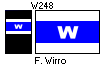
Brown 1926 records the funnel and flag; the FOTW illustration follows that source. No separate verbal design is supplied.
Estonia, Reval (Tallinn).
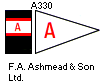
The flag is a white pennant with a red “A”. The funnel is black with a broad white band edged red above and below and bearing a red “A”.
F.A. Ashmead & Son is recorded in Lloyds from 1953–54 to 1980–81.
U.K., Bristol.
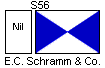
S56, illustrated by Jorge Candeias, is quartered per saltire white and blue. Bakker resolves the difficult original caption as “E.C. Schramm & Co., Bremen”.
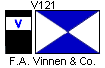
V121’s funnel and flag come from Rehm 1956 and 1967. Rosanoski considers the flag suspect without giving a further explanation.
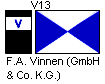
V13’s funnel is documented on Merkur Sea. On Merkur Sky at Port Botany on 10 October 2011, only an exhaust rises from the bridge area; a white panel edged narrowly black at top and bottom bears a blue V. Rosanoski interprets this as the funnel-band panel rather than the customary house-flag panel. Josef Nüsse supplies table-flag examples, and Bakker’s FOTW flag comes from Brown 1995.
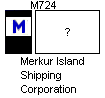
Brown notes that associated free-flag vessels may carry the managing company’s initial on the funnel without altering the house flag. Rosanoski considers this a possible explanation for Mitchell’s M724, assigned to Merkur Island Shipping and Merkur Island, built in 1981 and sold in 1982. The source identifies a Panama connection but leaves the ownership detail incomplete.
The company website traces the business to E.C. Schramm & Co., founded in Bremen in 1819, and its renaming by Friedrich Adolf Vinnen in 1912. Lloyd’s instead gives formation in 1918 and continued use of the Schramm name until 1920. Loughran’s statement that it operated only sailing ships and did not survive into the steamship era is qualified by Rosanoski as applying only to the specific name. The business became part of Hause Wünsche in 1980 and Wünsche Handelsgesellschaft International in 1993. Friedrich Adolf was the great-grandfather of managing director Michael Vinnen. No connection with Vinnen Gebrüder is apparent.
Germany, Bremen.
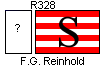
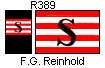
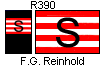
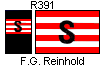
The S is positioned differently from the FOTW version. Brown 1943 places it slightly out of alignment, touching the bottoms of the first and third red bands.
The US Navy source gives differing proportions for the R letters on funnel and flag relative to the bands.
The FOTW flag has seven stripes, four red and three white, with a very large black S. Earlier contributors could not explain the letter; Wolf Siedler later identified it as the family initial.
F.G. Reinhold is recorded building Sophie in 1882. According to Wolf Siedler, the Siedler family owned the Baltic-oriented company for many decades, with his grandfather Hans-Günther its last owner. As the Soviet army approached, he moved the family and remaining business first to Lübeck and then Hamburg. The company was dissolved in the 1960s after wartime and Cold War disruption of its trading relationships. Its last vessel, Sankt Johann, was broken up in 1964.
Germany, Danzig; later Hamburg.
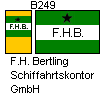
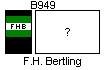
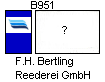
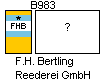
The flag reported in 1956–1957, when the company operated Ursula Heinemeier, was a horizontal green–white–green triband. The white stripe bore black serifed “F.H.B.”, including the dots; a black five-pointed star stood centrally in the upper green stripe.
Mitchell’s B983 funnel is presumed to be based on his line drawing of Ursula Heinmeier, as the vessel name is spelt in that passage.
The later flag is white with three waves, light blue above blue above very dark blue, and “Bertling” in very dark-blue italics at the lower fly. It was observed above the company building on 21 March 2007 and is also documented by Nüsse’s table flag. The funnel follows starboard and portside photographs of Algarve, which appear to show the same logo on both sides.
B950 follows Atacama in January 2007 and a portside photograph on 17 October 2008, with the same appearance on both sides.
Solent’s portside funnel photograph reverses the emblem, while a starboard photograph dated 14 April 2009 shows the usual form. Rosanoski therefore considers the portside display apparently erroneous.
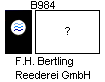
Mitchell apparently based B984 on Julia Two, named thus in 1984–1988, but does not identify the owner and Bertling is absent from the register for that period. The described charge consists of three blue waves, dark and light, suggesting the later Bertling design.
Vessel ownership and actual emblem user remain unconfirmed.
Friedrich Heinrich Bertling established F.H. Bertling in 1865, aged 23. Shipping lines formed in 1881 and 1885 served St. Petersburg and Riga. Around 1900 the Riga-Lübeck Schiffahrtsgesellschaft was established with the Hanseatic [Hansestadt] Steamship Corporation, and a river steamship company was added in 1900. The business expanded into chartering, forwarding, warehousing and other port services. C.W.L. Heinemeier succeeded the founder in 1916.
After the Second World War the company recovered rapidly in the 1950s, establishing Baltic and Mediterranean services. Ursula Heinemeier was bought in 1955 and sold in 1967. A logistics division followed in 1974; shipowning appears to have resumed in 1997.
Bertling represented Mediterranean Shipping Co. until 30 June 2006, when MSC opened its own Hamburg branch. The later flag report describes the companies as still apparently working together and sharing a building.
Germany, Lübeck; Hamburg.
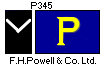
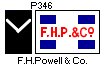
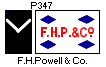
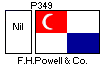
The canton charge appears to be a decrescent; Rosanoski thinks this flag applied to sailing ships.
This livery is also attributed to Liverpool, Bristol & London S.S. Co. by several sources, together with the separately referenced P348 version.
The shape of the P varies between sources. Loughran uses a plain letter in MN and a more ornate one in his own book.
The company originated as Swainson & Cram, becoming Cram, Powell & Co. after a merger in 1830. When the Crams withdrew around 1850 it became the Powell Line. Steamships followed in the early 1850s, and from the 1860s several ships had names ending in “ful”. In 1913 it merged into Powell, Bacon & Hough Lines Ltd.
U.K., Liverpool.
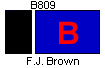
Olsen’s 1911 Almanac gives the flag colours but prints in monochrome; the funnel colours in the illustration are therefore conjectural.
F.J. Brown operated by 1899, when Ulysses was purchased. She was the only vessel listed in 1917–18 and was sold on 27 February 1925.
UK, Grimsby.
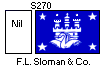
The blue flag bears a white swan before a white castle, with a small white circle above each outer tower and a white star in each corner. Rosanoski suggests that its five-pointed stars may be connected with the later Sloman Neptun flag. No funnel is given.
F.L. Sloman was a sailing-ship concern associated with Robert M. Sloman.
Germany.
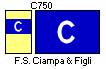
Italy, Piano di Sorrento.
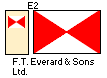
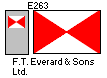
Sources differ between a panel and band on the alternative funnels. Photographs and plans support a band in the earlier E1 comparison, while Sincerity shows a panel occupying the side’s full width without extending around. Mitchell gives bands for both. Asperity in March 1983 has a yellow-cream funnel with the narrowest black top; Brown 1978 also gives E2 a narrow black top.
Only this alternative funnel is documented; the flag is assumed.
The business began with sailing barges in 1880, trading as F.T. Everard until 1922. The source names the founder F.T. Eberhar[d]t, later changed in response to hostility towards German-sounding names during the First World War. Publications vary the initials. In 1980 Everard absorbed Comben Longstaff while retaining its own name; County Ships, apparently a Comben subsidiary, initially continued under Everard management.
Acquisitions included J. Wharton in 1952, J. Hay in 1956 and Glen in 1961. Other recorded operating or management relationships included Clydesdale Shipowners, Scottish Navigation and County Ships. West River Shipping is listed without a defined relationship. Ship names commonly ended in ity.
U.K., London.
Keep the explicit scope label independent; no alias or company identity is inferred.
Everard Shipping appears separately from 1953–54 and later as a managed company of F.T. Everard & Sons Management.
U.K., London.
Keep the explicit scope label independent; no alias or company identity is inferred.
The joint F.T. Everard & Sons and Cattedown Wharves entry appears in registers from 1958–59 to 1970–71.
U.K., London.
Keep the explicit scope label independent; no alias or company identity is inferred.
The management company appears from 1973–74, with Commercial Acquisitions and Scottish Navigation among its companies. It held 27.5% of Short Sea Europe, formed in 1989, and managed that company and fleets or parts of fleets for Blue Circle, Clydesdale, Onesimus Dorey, James Fisher, Hadley, J. Hay and Scottish Navigation.
U.K., London and Greenhithe.
Keep the explicit scope label independent; no alias or company identity is inferred.
Lahav compares the flag with HSBC’s and wonders about common ownership, but establishes no connection. Sache notes the similar Swire flag, distinguished by a central vertical blue stripe.
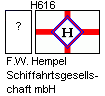
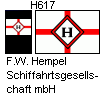
The flag is white with a centred red cross and a central white diamond framed in red, containing a black “H”. Schneider’s FOTW H616 description gives the diamond’s red frame a blue outline; Rosanoski states that the original source outlines it in black.
The US Navy 1961 version has no outline, so the diamond frame merges with the cross.
The company began with Diamant, bought in 1954 and sold in 1964 without a name change. Register entries first place it under Rabien & Stadlander, then under its own name. Mitchell also appears to call the vessel Brilliant while recording Diamant.
Germany, Bremen.
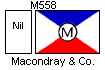
Mystic Seaport attributes the flag to the Hong Kong Line.
Captain Frederick William Macondray established the concern with Jamis Otis and R.S. Watson in 1849. Beginning as a commission house, it became the largest commercial house in San Francisco according to the cited account. It owned Canion; Mystic Seaport records it in 1860.
USA, San Francisco.
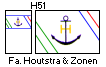
The funnel is white with a broad band displaying the flag, edged blue above and below.
The white flag has two very narrow green bands in the lower hoist and narrow red and blue bands in the upper fly, both pairs described as placed “Pbd”. The bands in each pair are separated by a much wider white interval. Between the pairs is a black vertical anchor surmounting a small gold H.
Netherlands.
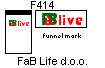
The funnel is based on a photograph of Pop Reefer taken on 28 July 2012.
Founded on 7 January 1996, FaB Live’s main activity was producing aluminium doors and windows. Its maritime connection was importing cement from Greece in its own Pop Reefer.
Montenegro, Podgorica.
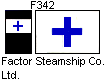
The company owned Factor, built in 1903 and sold without a change of name in 1917. Lloyds 1912 gives Evans Fawcus as operator; the 1917–18 register names E. Fawcus of Newcastle-on-Tyne as owner.
UK, Newcastle-on-Tyne; the company is also recorded in London.
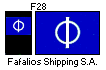
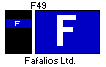
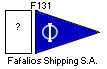
Stewart, the US Navy source and Mitchell attribute this funnel to D.J. Fafalios or Fafalios Ltd. of London. Jordan identifies its letter as the Greek F. Photographs of Despina in September 2008 and Amazon in June 2009 confirm the funnel.
Stewart assigns this livery to Waverley Oversea Freighters. Rosanoski considers the letter to represent its manager or owner, using English letters for the British operation and Greek letters for Greek operations, as with other Greek companies based in Britain.
Nüsse’s table flag is square-tipped in Rosanoski’s illustration. A FOTW rendering treats the design as a triangular pennant, apparently assuming that Nüsse’s images were cut short; Rosanoski notes that this assumption is not stated.
Brown’s F500 version is a blue flag with a white Φ, the Greek letter PH or F. Brown 1971’s attribution of this livery to Lyras Bros. is considered probably erroneous.
The Fafalios family of Vrontado, Chios, has been active in shipping since the mid-nineteenth century. Between the wars it settled in Cardiff, establishing the ship-supply company Meandros with Stavros G. Livanos; Meandros managed the family’s steamships. After the Second World War the family collaborated with Athenasios Anastasiou in Homeric Maritime Agencies in New York and opened a Piraeus office. Most post-war ships were Greek-registered with Greek crews, supported by offices in Chios, Piraeus, London and New York.
Fafalios Ltd. was formed in 1948. The London company operated through Waverley Oversea Freighters; later registers link it to Fafalios S.A. of Piraeus. Demetrios & Stamatios Fafalios were separately listed at Vrontados, Chios.
Greece, Chios.
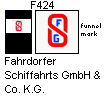
The funnel follows port- and starboard-side photographs of Merit, dated 2006 and 4 September 2007 respectively.
Formed in 1989, the company traded as Wolfgang Schmidt until becoming Fahrdorfer Schiffahrts GmbH & Co. K.G. in 2000.
Germany, Fahrdorf.
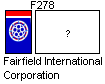
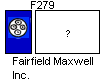
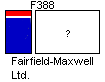
Apparently a group livery, the funnel logo has a red circle bordered white, overlaid by a compass star. Its eight main points are halved dark blue and light blue, and the eight minor points are dark blue. Above this is a blue circle edged white containing five white rings. The design is documented by Fairchem Filly’s port side in November 2009 and Fairchen Maverick’s starboard side in June 2013.
Mitchell attributes this funnel to Fairfield Oil Co., also mentioning Fairfield Maxwell Inc. Rosanoski presumes its simplified detail represents the current logo, possibly based on Oriente Canary and Fairfield Archer, for which Mitchell provides blue-funnel drawings.
Fairchem Danube’s funnel is recorded from both sides in 2007. The ship was listed under Shenlong Maritime and may have been chartered, perhaps explaining the initially absent logo; it seems that the logo was never added.
Fairfield International was formed in 1981. Lloyds places Fairfield-Maxwell under it, but the group structure is not fully established: Rosanoski suggests it may be the holding company, noting that the fleet appeared under Fairfield Industries in 2011–12. Fairfield-Maxwell was founded in 1957 by Kay Sugahara, a Japanese-American who died in 1988, and remained owned by the New York-based Sugahara family. Its interests included ocean transport, seismic data and petroleum exploration.
Keep the explicit scope label independent; no alias or company identity is inferred.
Fairfield Industries, incorporated in 1976, was a geophysical company with London and later Houston and Sugar Land locations. It became Fairfieldnodal in 2010.
Keep the explicit scope label independent; no alias or company identity is inferred.
Fairfield Chemical Carriers was established in 1996 with Fairfield Maxwell Group as principal investor. Its Wilton, Antwerp and Singapore companies handled commercial operation, while Fairfield-Maxwell Services, formed in 1972, managed the fleet. In 2001 Fairfield Chemical Carriers and Iino Kaiun Kaisha established Allied Chemical Carriers.
Keep the explicit scope label independent; no alias or company identity is inferred.
Fairfield Japan originated with Fairfield-Maxwell’s Tokyo liaison office in 1970, becoming Olympic International in 1977 and Fairfield Japan in 2002. An earlier Lloyds account gives formation as 1983, subsequently amended to 1977.
Keep the explicit scope label independent; no alias or company identity is inferred.
The group’s Maruha joint ventures included Great American Lines and Reefer Express Lines, the latter formed in 1968.
Keep the explicit scope label independent; no alias or company identity is inferred.
USA, New York.
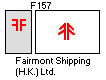
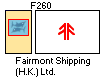
Rosanoski suggests that the funnel lettering in Mitchell should follow the flag. Nüsse’s table flag appears cream through discolouration, whereas FOTW and the Magsaysay website confirm white. The top is taken as open, following the table flag.
The current photographed funnel is shared with Magsaysay and mirrored on the two sides: the upper fish faces aft on both. The illustration follows Eboni on 10 April 2005.
Founded by Dr. Robert C.F. Ho, the company began in 1973 as Fairmont Shipping Agencies and took the Fairmont Shipping (HK) name in 1978. It carried commercial cargo with offices in Hong Kong, Vancouver and the UK.
Its associates included Magsaysay Lines, later Magsaysay Maritime Corporation. Fairmont Shipping (Canada), formed in Vancouver in 1995, operated through Transporte Navieros of Manila, formed in 1987; later the Canadian fleet was under China Coastal Lines, while Transporte Navieros appeared under Botelho Shipping. Fairmont also managed Botelho and Transocean Transport fleets.
China, Hong Kong.
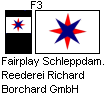
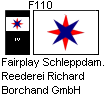
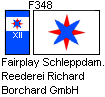
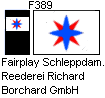
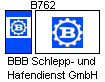
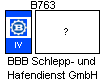
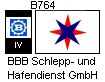
The traditional white, brown and black scheme changed to blue and white towards the end of the 1990s. F110 records a white Roman numeral at the funnel base, apparently a later feature; some tugs instead use ordinary numbers. Chartered Borchard Line vessels lack the numeral. Fairplay IX shows F3 in August 1992 and later the blue F348, but a lifeboat hides the funnel base in both photographs. Mitchell’s F3 may concern chartered non-tugs. Fairplay XII and photographs in Hamburg Tugs support a lighter blue shade for F348.
Flaggen & Schornsteine reverses the stars’ directions, angling the rear red star, in line with the Atid company versions. Rosanoski considers Fairplay’s livery the apparent basis of those Atid liveries.
Fairplay traces its origins to Pauls & Blohm, formed in 1877 and merged with Carl Tiedemann on 25 November 1905. Richard Borchard, who had joined Tiedemann in 1897, became a partner, bought out the others in 1924 and renamed the company in 1926. The company website instead describes establishment by Borchard in 1905 and separation of stevedoring and towage in 1920. After his death on 12 January 1930, Lucy Borchard became owner and manager. In August 1938, anti-Jewish business laws forced transfer to a trust; the family moved to London and established Fairplay Towage. The Hamburg company was returned to Lucy and her son Kurt in 1949, and the British towage company dissolved in 1950. Kurt succeeded Lucy after her death on 4 February 1969.
Germany, Hamburg.
Keep the explicit scope label independent; no alias or company identity is inferred.
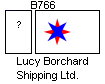
The website shows the Borchard flag apparently elongated, with the emblem towards the hoist.
Lucy Borchard Shipping was the Israeli agent for various companies. Its owning Borchard family had been involved in shipping to and from Israel since 1933.
Israel, Tel-Aviv.
Keep the explicit scope label independent; no alias or company identity is inferred.
The group acquired Rostock’s BBB in 1993, retaining its initials and emblem as BBB Schlepp- und Hafendienst. It bought the marine activities of Szczecin’s Porta Holding in 2003, renamed Project Zegluga, and took half of Belgium’s Unie van Redding- en Sleepdienst with Smit in 2004. In 2008 it exchanged that holding for a major Smit shareholding, acquired Port-Hol of Swinoujscie and, through Fairplay B.V., took 50% of Muller Maritime Holding, with Multraship’s family management continuing.
Keep the explicit scope label independent; no alias or company identity is inferred.
The tugs generally carry Fairplay, adopted in 1905, followed by a Roman numeral.
Keep the explicit scope label independent; no alias or company identity is inferred.
Carl Tiedemann’s separate business began on 11 May 1879 in towage, stevedoring and port shipments, buying its first tug in 1895. Stauerei und Bugsiererei Carl Tiedemnn was formed in 1900, with nephew John Rehr becoming partner in 1909. After wartime ruin and Tiedemann’s death in 1919, Rehr, his wife Emmy and her brother Carl Schramm rebuilt it. Following another wartime disruption, the concern developed primarily as stevedores, later expanding into container repair. Hans Vorberg and Michael Hanauer, Rehr’s grandson, succeeded the earlier generation. Hamburger Hafen- und Lagerhaus acquired 40% in 1988 and sold out in 1999, when Carol Zehle took 67.1%.
Keep the explicit scope label independent; no alias or company identity is inferred.
The shared star emblem links Fairplay with Borchard Lines and Lucy Borchard Shipping through the family history. FOTW formerly showed a different Borchard (UK) version, subsequently replaced by F3, supported by the website flag logo. Nüsse also supplies a table flag.
Keep the explicit scope label independent; no alias or company identity is inferred.
BBB retained the B-in-a-gearwheel emblem. A table flag shows a white field with a central blue square bearing the emblem in white. An initial suggestion that this white flag might be confined to office use was answered by Rosanoski’s Fairplay II photograph of 30 April 2008 showing it afloat. The photograph’s initially indistinct emblem was confirmed by an actual-flag image supplied to FOTW.
Fairplay IV is photographed with B764 in August 1993 and B763 in June 2001. Previous Fairplay colours may explain use of the Fairplay flag in this context; the BBB initials and existing logo were retained after the 1993 takeover.
Keep the explicit scope label independent; no alias or company identity is inferred.
For Carl Tiedemann, T537 was reconstructed from a website illustration using logo colours, perhaps making the blue too dark. Schneider’s T538 has a white field, a red four-pointed star directed at 0, 100, 200 and 300 gon, overlaid by a blue four-pointed star at 50, 150, 250 and 350 gon, with a white T in its centre, all enclosed by a blue C; a full circle is 400 gon. Rosanoski notes that the C is uneven and its source unquoted. The cap-emblem-derived T539 has a larger red four-pointed star, smaller blue star rotated 45 degrees and white serifed T. Its C is unclear, apparently intended to enclose the stars, and the published colours may need to be darker or brighter.
Keep the explicit scope label independent; no alias or company identity is inferred.
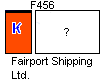
The funnel follows a starboard photograph of Taisetsu on 9 April 2009, supported by sightings of two other vessels whose photographs were not retained. The K is assumed to represent the owner.
Fairport was formed in 1994 and participated in the Alpha Reefer Transport pool. A private company listed at Glyfada, a suburb of Athens, may not be the same concern.
Greece, Piraeus.
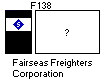
Thimar S, observed in June 1967 and associated with Sigalas, had a black funnel with a broad white band carrying a blue diamond charged with a white S. No flag was noted.
Listed in Lloyds in 1963–64, Fairseas used World Seas Shipping as agent.
USA, New York.
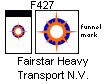
The funnel follows a port-side photograph of Fjord on 9 February 2008.
The Dutch company was listed in Oslo. The source records incorporation in July 2005, but also formation as Fairmont Heavy Transport in 2003 and renaming to Fairstar in 2007. Two purchased semi-submersible barges entered service in March 2008 and May 2009. Listed under Société Anonyme Louis Dreyfus et Cie, it was acquired by Dockwise in July 2012 after a three-month contest; Rosanoski presumes Louis Dreyfus was the seller.
Netherlands, Rotterdam.
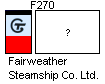
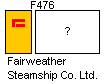
Photographs of Top Wing’s port side in July 2009 and Top Rich’s starboard side in December 2005 record this funnel. Its lettering does not match the named principal or the Panamanian single-ship owners. Rosanoski suggests it might relate to ship names or a charterer, noting that the principal may not be the true owner.
Top Fair in March 2011 and Kang Yao in June 2013 show F476. Kang Yao’s name weakens the suggestion that the lettering represents Top, but an earlier photograph from October 2001 showed her in F270 colours, so this may simply represent a change of livery.
Corporate ownership of either design and continuity between them unproved.
Fairweather is recorded as incorporated in Hong Kong on 24 July 1981, although Lloyds dates formation to 1986. It undertook shipping agency and freight forwarding. A company of the same name was incorporated in Panama on 30 July 1999; the source does not establish their relationship.
China, Hong Kong.
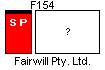
The funnel initials came from Sirenia Pearl. The vessel apparently later passed to R.W. Willis, who left the funnel unchanged.
Fairwill was registered on 21 December 1955 and deregistered on 9 June 2002 under voluntary liquidation.
Australia, Adelaide and later Warwick.
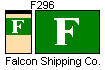
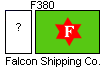
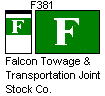
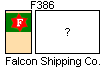
The original flag is green with a large white serifed F, seen in the cloth outside the head office as well as in the website drawing. A helmet logo is lighter, corresponding to the source’s F371 reference; this older form still appeared in the website’s 2011 photographs and at deliveries probably dated 2008. Sturdy Falcon’s September 2006 funnel was very light yellow, without a black top. Speedy Falcon in September 2008 had a more conventional but tall F, a very broad band and a narrow black top.
The later flag retains a white F on green, but places the letter on a red six-pointed star formed from two equilateral triangles, with a point downwards. The green is lighter and more yellowish in the revised website logo. Its actual shade remains uncertain: some funnel photographs suggest darker green, some website photographs the brighter shade, and the images-section logo is duller. The website change occurred between 6 June and 4 September 2007.
The towage subsidiary apparently retained the plain green flag with white F. Falcon 62 is photographed in November 2005, and website photographs, including a 2006 view of the tug flying the flag, support continued use of the old design.
Sturdy Falcon shows this new funnel mark on 5 June 2011. Photographer Geir Vinnes reported Speedy Falcon still carrying the old mark in November 2010, but Sturdy Falcon carrying the new one in December; he therefore suggested that updating began late in 2010.
Falcon Shipping, a state-owned subsidiary of Vietnam National Shipping Lines, was established on 28 February 1995. Lloyds initially gave 1998, later amending this to 1995. In December 2006 it became Vietnam Petrol Shipping Joint Stock Company, operating as shipowner, operator, charterer, broker and agent. The Vietnamese name appears as Cong Ty Van Tai Dau Khi Viet Nam, later Cong Ty Co Phan Van Tai Dau Khi Viet Nam.
The Ho Chi Minh City subsidiary Falcon Towage & Transportation Joint Stock Co., Công ty Cổ phần Lai dắt và Vận tải Chim Ưng or T&T Falcon, was founded on 15 November 1999. By the December 2007 register all the parent company’s ships included Falcon in their names.
Vietnam, Ho Chi Minh City.
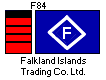
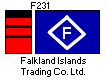
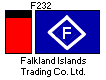
Mitchell’s funnel accompanies a line drawing of Lafonia. No flag is given there; Rosanoski assumes the flag is not in dispute.
The company appears in Lloyds as Falkland Islands Co. in 1937–38 and 1953–54, and as Falkland Islands Trading Co. by 1958–59. Mitchell calls it Falkland Islands Shipping Co. and records acquisition by Dundee, Perth & London Shipping Co.
UK, London.
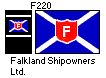
While associated with Bruun & von der Lippe it used that company’s B541 funnel. Rosanoski considers the same funnel to have continued under Anton von der Lippe.
Falkland Shipowners is associated with Bruun & von der Lippe in the Merchant Ships funnel index. Lloyds lists Anton von der Lippe as operator in 1953–54, and J. & J. Denholm (Management) in later editions through 1970–71.
UK, London.
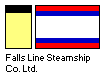
Reed lists the livery under both Falls Line and Wright, Graham & Co. The funnel is yellow, or buff, with a black top. The flag has five horizontal bands, red, blue, white, blue and red, with the white occupying half the field.
Indradeo was managed by T.B. Royden & Co. in 1902–07. Renamed Falls of Moness, she was managed by Wright, Graham & Co. of Glasgow in 1907–13.
UK, Glasgow.
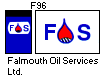
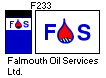
Mitchell does not supply a flag with this funnel; Rosanoski assumes the flag applies.
The bunkering concern began operations in 1986; Lloyds records formation as Falmouth Oil Services in 1987 and the change to Falmouth Oil Services (1994) in 1994. Fleet names began with Falmouth.
UK, Falmouth.
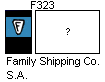
The company is associated with Antonios Catsogeorgis in Mitchell and with Michael A. Vergitsis in the Shipspotting reference. Lloyds lists it as owner and operator in 1980–81, then as Family Shipping Co. S.A. Panama, manager and agent, in 1985–86.
Greece, Piraeus.
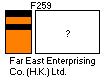
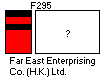
Fareast Victory’s January 1999 photograph supports the funnel, but the colour is not clear and could be rust.
NJK reports a basically red funnel in recent years; an indistinct photograph of Fareast Cheer may support this.
Known as Farenco, the company is described as founded in Hong Kong in 1949, specialising in shipping and later logistics; Lloyds instead gives 1953. A 1955 magazine account calls it the principal Hong Kong company used by Communist China. Following reorganisation of parent China Resources (Holdings), Farenco (Holdings) became China Resources Logistics on 1 January 2001.
Wah Tung Shipping Agency was listed as an associate and then joint venture, apparently disposed of by 2003. NJK reports ship names usually beginning with C, although Rosanoski could not match this to Lloyds and wondered whether these were chartered vessels.
China, Hong Kong.
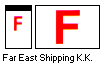
The funnel is white with a black top and a red F. The flag is white with a red F.
Also listed as Far Eastern Shipping Co. Ltd., the company was formed in 1966. It owned one vessel in its own name in 1970–71, while the later fleet was held through subsidiaries. These included Aqumarine Marine Panana, Topmaster Shipping, Viking Asia and Viking Carriers; Techno Marine managed some subsidiary fleets.
Japan.
A plain black funnel is recorded for Tung Lee and for Cherry Victory in September 1966. No flag was noted.
The company appears in registers from 1963–64 to 1985–86, with Eddie Steamship as agent in the latter edition.
Taiwan, Taipei.
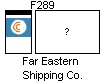
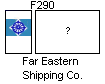
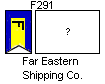
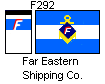
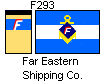
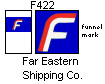
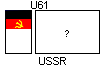
Soviet flag and funnel colours continued after the fall of communism; the company website shows Admiral Makarov with the U61 Soviet funnel.
Mitchell derives F289 from Ships Monthly, February 1994. F290 appears to have a four-pointed white star carrying a darker-blue ship’s wheel: the number of inner spokes is unclear and only four outer spokes are visible. The three Mitchell funnels appear to accompany the Russian tricolour.
The flag derives from a company website logo and table flag, with actual examples visible in a May Day parade photograph. F292’s black top varies in depth in photographs of Kapitan Khlebnikov in January 2002 and Sinegorsk in June 2006. Kapitan Khlebnikov in January 2007 shows F293, also seen on Magadan, indicating that these icebreakers differ from the rest of the fleet.
Fesco Diomed’s port side on 6 August 2009 shows a darker-blue funnel band, perhaps normal for funnels rather than flag bands, and emphasises the curved top of the f’s upright.
Kapitan Khlebnikov and Magadan show similar colours, while Krasin has a lighter hue. Other ships have a white funnel base and black top, with the blue band touching the top on a few vessels.
Far Eastern Shipping, FESCO, traces its origins to Moskva’s first voyage in April 1880 for Dobrolflot, Imperial Russia’s Voluntary Fleet. In 1924 the fleet was reconstituted as Sovtorgflot’s Far Eastern division and renamed Far Eastern Shipping Co. in 1934. The company account dates conversion from a state enterprise to the open joint-stock FESCO PLC to 1992. Its Russian name appears as Dal’ne Vostochnoye Morskoye Parakhodstvo and Dalnevostochnoye Morskoye Parokhodstvo.
The company was originally under the Far-Eastern Shipping State Corporation until 1990. Accounts of independence differ: Mitchell gives 1991 and Lloyds the 1990s, while other registers continue to list Russian government ownership and a report records an auction sale in February 2006.
FANAL linked Australia and North America’s west coast, while FAROL, Fesco Australia Roll-On Roll-Off Line, served Australia–Japan. Associates included Nikolay Malakhov Shipping. United Orient Shipping and Agency was established in December 1969 with Azuma and Yamashita-Shinnihon; FESCO-Wallem Ship Management was formed jointly with Wallem in Hong Kong in 2006.
USSR and later Russia, Vladivostok.
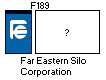
The funnel is based on Far Eastern Express at Lyttelton on 17 June 2003.
The company resulted from the 1987 amalgamation of Grain Union Transport Corporation and Far Eastern Silo Corporation. Lloyds also gives formation in 1990, which Rosanoski presumes refers to the shipping side. Ships were held in its own name and through a named subsidiary.
Taiwan, Taipei.
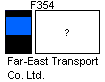
Mitchell illustrates this funnel and also reports a red base, without stating whether the blue band applies to that version.
Charterers’ colours appear to be usual. Pelander at Wellington on 16 July 2002 carried an NYK funnel, although earlier registers had listed Barber as manager.
Formed in 1981, Far-East Transport appears as agent and manager, with a fleet held through separate companies.
Japan, Tokyo.
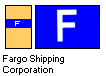
The funnel is buff with a blue band bearing a white F. The flag is blue with a white F.
USA.
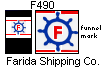
The funnel follows port- and starboard-side photographs of Lady Farida dated 3 February 2013 and 7 January 2014 respectively.
The company bought the vessel renamed Lady Farida on 20 November 2012.
Egypt, Damietta.
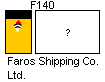
The funnel carries a torch with a red flame, recorded for Alkyone and “Anaz” in 1967 in association with M.M. Xylas. Rosanoski identifies “Anaz” as probably Anax and notes differences in the recorded Alkyone owning-company name and Xylas’s initials. The suggestion that this funnel applied to all agency companies is contradicted by other agencies using different funnels. It is probably connected with the Pyrsos funnel seen on Akritas on 10 April 1982: that ship was listed as operated by Pyrsos but also managed by Faros.
Faros acted as shipbroker and agent. Michael M. Xylas formed the Astron Maritime/Faros companies and was managing director of Faros and subsequently Pyrsos Shipping. Associates included Aegaleo Shipping; agencies included Alma, Amazon and San Gabriel Compañia Maritima.
UK, London.
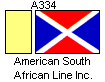
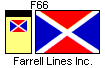
The Ships List gives the buff A334 funnel for 1925–46 and F66 for 1946–2000, but Merchant Ships dates the change to 1941 and shows both forms, without a black top on its later version. Jordan describes a yellow funnel bearing the flag panel, whereas other panel sources show F66 with a black top, confirmed in African Comet’s black-and-white photograph. City of New York’s photograph is inconclusive but tends towards A334, making Jordan’s panel description for that date questionable. Farrell retained American South African Line’s livery, listed under both names in Stewart.
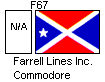
This is the fleet commodore’s flag, noted by Loughran as unusual for a non-British company.
The livery appears to have ended with P&O Nedlloyd’s takeover. Ocean Ships 2004 lists the service as Farrell Mediterranean Express/USA, apparently in P&O Nedlloyd colours, although vessel names continued until the Möller takeover.
Farrell originated as the America-South African Line, ASAL, created by the United States Shipping Board and managed by John J. and James A. Farrell. Accounts differ: one gives creation in 1922 and operations from 1926; others give formation in 1925, 1926 or, in Merchant Ships, 1936. The change to Farrell Lines is variously dated 1947 and 1948. A history of the US merchant marine identifies James A. Farrell Jr as owner and dates the incorporation of his brother John’s Argonaut Line into American South African Line to 1940.
Farrell acquired American Export Lines in 1978, retaining American Export Service for US east-coast services to Europe. Accounts give January or 28 March for the acquisition, with Mitchell recording 21 ships transferred in 1980. Rosanoski elsewhere questions an unsupported FOTW statement about the 1940 Argonaut merger, so the source’s treatment is not uniform.
P&O Nedlloyd acquired Farrell on 7 July 2000; the claim that it ceased operations then is rejected by Rosanoski. A family-ownership account extending to this takeover differs from Mitchell’s statement of acquisition by Lykes in 1989. In the P&O transaction, FLI Ships was spun off to independent E-Class Holdings and renamed E-Ships, while Farrell became P&O Nedlloyd’s subsidiary. Farrell subsequently came under A.P. Möller.
Most ship names began with African.
USA, New York and later East Rutherford, New Jersey.
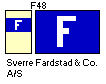
Norway, Ålesund.
UK, Aberdeen.
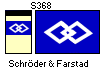
Formed in 1956 as Sverre Farstad & Co., the company became Schröder & Farstad in 1965, apparently in partnership with Ole Schröder, later associated with Osco Shipping Services. It reverted to Sverre Farstad & Co. A/S in 1975 and became Farstad Shipping ASA in 1993. Seaforth Maritime’s fleet was purchased in June 1989.
Keep the explicit scope label independent; no alias or company identity is inferred.
An offshore-supply partnership with P&O Maritime Services was announced in October 1997. P/R International Offshore Services, formed that year, began as a 50% partnership with P&O and became wholly owned, with most vessels managed by Australian Offshore Services. Rosanoski presumes P&O’s involvement was through International Offshore Services Ltd. The source also credits Farstad with participation in the 1949 pool that became Anco Shipping, a date preceding its stated formation.
Keep the explicit scope label independent; no alias or company identity is inferred.
The Aberdeen company began as Loch Offshore in 1985. Following takeover in 1989 it became Farstad U.K., then Farstad Shipping Ltd. in 1994. Farstad ASA held 80% and the former owners 20%. The company managed part of the Norwegian parent’s fleet and held ships through Farstad (I.O.M.), formed in 1993.
Keep the explicit scope label independent; no alias or company identity is inferred.
Apparently belonging to the Schröder & Farstad period, this design incorporates Ole Schröder’s flag. The pale-yellow funnel has a black top and broad blue band bearing two interlocking white diamond frames. The blue flag carries the same white frames.
Keep the explicit scope label independent; no alias or company identity is inferred.
The later funnel is pale yellow with a broad blue band and white F; the flag is blue with a white F. Team Carrier at Lyttelton on 4 February 1992 initially suggested pale yellow for both funnel and letter, but subsequent correspondence confirmed a pale-yellow funnel and white letter. Saga Sea confirms this, with a very narrow black top.
Keep the explicit scope label independent; no alias or company identity is inferred.
The British company’s funnel is white with a black top, a blue diamond frame above two wavy horizontal batons, and the black name FARSTAD below. Its flag is blue with a white F.
Keep the explicit scope label independent; no alias or company identity is inferred.
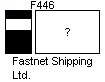
Tug photographs show a black funnel with a fairly broad white band of variable width. Bargarth has no visible funnel logo; the company name appears on panels aft of the bridge, apparently also without the logo. Fastnet Tern, a windfarm support vessel without a funnel, carries the logo on its bridge superstructure in an April 2013 photograph.
Fastnet was a privately owned marine plant-hire and services company operating tugs and dredgers. Its website in 2013 claimed over fifty years’ experience and a six-tug fleet.
Ireland (Eire), Waterford.
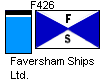
The website logo is also seen flown as a house flag. Shetland Trader’s port-side photograph of 3 May 2007 shows both funnel and flag. A November 2012 photograph of Verity is accompanied by a comment that this funnel appears on all newer vessels, but Rosanoski finds no apparent difference and leaves its meaning unclear.
Formed in 1994, Faversham Ships was initially listed under F.T. Everard & Sons Management, then in its own name, with ships held directly and through separate companies.
UK, Faversham, later Ryde and East Cowes, Isle of Wight.
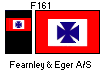
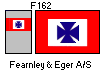
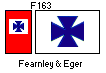
The source describes three funnels: black with a red band and a white panel bearing a blue cross paty; grey with the same band and panel; and red with a white panel and blue cross paty. The first two accompany a red flag with a white panel and blue cross paty. The third accompanies a white flag bearing a blue cross paty. Rosanoski explicitly considers F163 apparently incorrect; the variants are therefore retained as differing documentary evidence.
Thomas N. Fearnley founded the business in 1868 and was joined by his cousin Engelhardt Eger in 1872. Company interests included Christiania D/S, formed in 1881, D/S Garonne in 1883, and Fearnley & Eger Inc. in New York in 1940.
Fearnley & Eger was a founding member of Barber Line and later withdrew. It joined Wilh. Wilhelmsen in Norwegian Africa and Australia Line in 1911, with Wilhelmsen assuming full management in 1920, and in taking over Norway Mexico Gulf Line around 1913–14. From 1911 it also collaborated with Transatlantic and Wilhelmsen in Sydafrikalinjen; that trade ended in the late 1980s under Nordic anti-apartheid sanctions. During the Second World War it joined Transatlantic and Det Bergenske in Scandinavian West Africa Line, serving the Portuguese colonies. Oostzee was acquired in May 1972, with all its shares passing to Holland Navigation on reformation in 1982. Fearnley & Eger was also a founding 25% participant in Irish Continental Line in 1973.
Norway, Christiana and Oslo, as recorded by the sources.
Rosanoski considers that the funnel band probably has a third green ring forward.
Federal Arab Maritime, Famco, was formed in 1977 and jointly owned by the Libyan, Egyptian and Syrian governments. Ship names began with A.
Egypt, Alexandria.
Preserve the original prose, but do not illustrate or link it to the withheld GIF(s): F185. Source reference codes do not establish an image association.
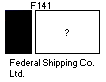
Kota Ba’hru was recorded with a plain black funnel. No flag was noted.
The company is listed in Lloyds for 1963–64.
Hong Kong.
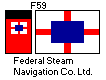
The red is described as deep red. LJC 1909 depicts the funnel panel as a band between top and base; Cambridge’s black-and-white photograph confirms the funnel. Book of Flags adds a black line below the panel, while Westmoreland appears to carry it at the top of a darker broad band. Reed also assigns the livery to Birt, Trinder & Bethell without explaining a connection. The flag originated with Wigram & Green in 1824 and passed through Money Wigram & Sons to Federal, dated by Merchant Ships to 1896. A museum flag is dated about 1955–67 and measures 1,143 by 1,752.6 mm. Five First World War prizes managed by New Zealand Shipping used plain black funnels. In 1966 Federal’s funnel was selected as a common design with New Zealand Shipping. P&O integration in 1971 brought replacement of the flag and gradual adoption of P&O funnels.
Federal Line originated in Money Wigram & Co., controlled from 1882 by Allan Hughes of its loading brokers Allport & Hughes. After the ships were sold in 1894, Hughes acquired the remaining assets. He had begun shipowning through Meteor Steam Navigation, renamed King Steam Navigation in 1895. That year Allport & Hughes, John Potter & Co. and J. Gavin, Birt & Co. combined as Birt, Potter & Hughes, which financed and managed Federal; Hughes’s ships were transferred to Federal in 1895–96. Mitchell instead gives formation as 1882.
New Zealand Shipping acquired Federal in January 1912 and P&O gained control in July 1916. Most of the New Zealand Shipping fleet transferred to Federal ownership in 1966–67. Absorption into P&O General Cargo Division is dated 1971 or 1973, although Federal remained listed as owner through at least 1980–81.
Federal and Houlder established New Zealand & South African Steamship around 1902, leading to the Federal-Houlder-Shire service with Turnbull, Martin in 1904. It became Federal & Shire in May 1912 after New Zealand Shipping bought Houlder’s Australasian business. Other interests included Australind Steam Shipping, Avenue Shipping, Dolphin Line and Overseas Containers. Avenue was formed in September 1954 by New Zealand Shipping and Birt, Potter & Hughes. Lauritzen-Peninsular Reefers began with the Lauritzen group in 1971 and ended in 1983 when P&O withdrew from the reefer trade.
Fleet names were English counties.
UK, London.
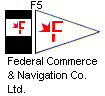
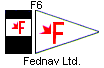
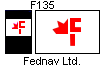
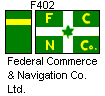
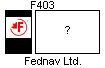
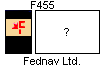
Mitchell shows a wider funnel band.
Rosanoski considers Loughran’s flag version probably incorrect; the accompanying text makes no mention of it.
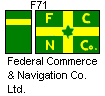
Brown 1982 attributes this version to Federal Commerce & Navigation. It appears based on the earlier livery but omits the break in the F.
Photographs of Arctic in April 2005 and both sides of Federal Mackinac confirm this funnel and flag. The company describes the logo, first designed in 1967, as incorporating part of a Canadian maple leaf and a stylised red F. Some ships retained the older colours, including Federal Mattawa in June 2013.
Federal Mackinac’s port side in October 2009 and Federal Baffin’s starboard side in May 2007 show the later funnel. The flag apparently remained unchanged but is indistinct. Federal Polaris still carried F135 beside Federal Progress in F403 in February 2008, suggesting gradual replacement. The new trademark was first used on 1 October 2003 and registered in the USA on 26 March 2004. Federal Agno in May 2013 appears to have a cream band, but other photographs show white.
The funnel follows a starboard photograph of the chartered Federal Ems on 10 April 2012.
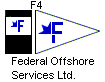
Canada, Montreal.
Keep the explicit scope label independent; no alias or company identity is inferred.
Federal Commerce & Navigation was formed in 1944 and merged into Fednav in 1984. Registers apparently show a reconstituted Federal Commerce & Navigation (1974). Its subsidiaries included Burnett Steamship, through which Chapman & Willan was acquired in 1975, or 1974 in other sources, and Federal Offshore Services. It also joined the Arctic Transportation consortium formed in 1973.
Canada, Toronto and later Montreal.
Keep the explicit scope label independent; no alias or company identity is inferred.
Federal Offshore Services appears as a manager in 1978–81 under Federal Commerce & Navigation. Rosanoski tentatively identifies Fednav Offshore Inc., listed in 1988–89 after an omission, as its revival.
Canada, Halifax in Loughran and Quebec in Lloyds.
Keep the explicit scope label independent; no alias or company identity is inferred.
Fednav resulted from the 1984 amalgamation of Federal Commerce & Navigation and Fednav Ltd. The privately owned group included Fednav International, its ocean-freight division formed in 1996, and Federal Atlantic Lakes Line, a Montreal cargo-liner service. Canarctic, associated since 1976, joined in 1996 as owner and operator of Arctic, adding Umiak I in 2006. The group also included Federal Marine Terminals, land transport and technical services.
Keep the explicit scope label independent; no alias or company identity is inferred.
Fednav was a founding member of the St. Lawrence Seaway Management Corporation formed for the authority’s privatisation, and held 50% of CSL Group. It increased its Navios holding from half to full ownership in August 1986 by acquiring United States Steel’s share, then sold a significant minority to Citicorp in 1989. Mitchell separately records a 50% interest acquired in United States Steel Corporation; the source does not explain how that statement relates to the Navios transaction.
Keep the explicit scope label independent; no alias or company identity is inferred.
A Scottish firm designed the emblem known within the company as the “spanner”, combining F and C with a stylised maple leaf. Red was used for the parent and blue for Federal Offshore Services, replacing an earlier livery. F5 continued as the basis after the Fednav merger. The offshore company’s parent-derived livery was adopted in 1974.
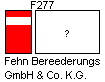
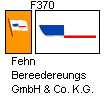
Fehn Sun in May 2006 retained essentially the funnel seen when she was Apollo Fox in August 2004, although the earlier band had blue letters. As most vessels appeared chartered, the livery may belong to a charterer.
The funnel follows a photograph of Fehn Mistral. The flag illustration is derived from the funnel.
Formed in 2003, Fehn took over management from initial member Kapitän Jann Abrams, who apparently remained chief executive. Ems Shipping & Trading appeared as an operating company, with its sole vessel and owner later listed directly under Fehn. A move next door to Briese and P&I information suggesting Briese’s role in the vessels lead Rosanoski to propose a possible connection.
Germany, Leer.
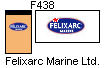
The company logo includes the Adsteam star. The funnel follows Gray Mammoth’s port-side photograph, dated 10 February 2013 in the source but with an earlier February 2011 access date. The flag is photographed on Gray Salvor on 11 February 2009; that vessel had no funnel and displayed the logo on its white superstructure.
Founded in 1964, Felixarc was a family-oriented salvage, dredging-support and marine-contracting business. It became an Adsteam Marine subsidiary and apparently passed with that group to Svitzer. Lloyds 2011–12 lists Svitzer Marine as manager.
UK, Lowestoft.
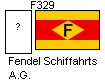
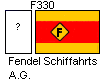
The website associates F329 with Karlsruhe 7, built in 1933 and renamed Rhenus 50 that year without ownership change, and with other Rhenus-connected vessels. Rosanoski’s suggestion that all vessels effectively used Rhenus colours from 1943 is explicitly described as pure deduction.
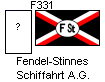
The Fendel-Stinnes flag retains the Stinnes colours in a different arrangement: a black field with a saltire divided lengthwise white over red, and a central white oval outlined black containing F St. The photographed linen example measured 1 by 1.60 m and was printed on both sides.
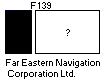
An actual house flag, measuring 80 by 150 cm, is described as horizontal yellow, red and yellow in proportions 1:2:1. A central yellow diamond touching the upper and lower edges bears a black sans-serif F. The nearby source note labels the supplied image F239.
Josef Conrad Fendel acquired his first vessel in 1875, and the business became Fendel Schiffart A.G. in 1899. Mergers in 1912 produced Baden and Prussian groups, including Badische A.G. and Rheinschiffahrts A.G., the latter formerly Fendel. The Baden interests established Rhenus Transport with Mannheimer Lagerhaus-Gesellschaft in Frankfurt in 1912. The groups formed an operating association in 1929 and merged as Fendel Schiffahrts in 1943.
Hugo Stinnes was the principal shareholder at the 1943 merger, when the company was described as Germany’s largest inland-waterways concern. Fendel held substantial interests in Rhenus, Bremen-Mindener and shipyards. It remained recorded as vessel owner after the war: Rhenus 103, built in 1958, did not pass to Rhenus ownership until 1965.
Fendel joined Vereinigte Stinnes Rheinreedereien and Bremen-Mindener in Fendel-Stinnes Schiffahrt, pooling Stinnes inland-shipping activities near Duisberg. The merger is dated 1971 in one account and 1973 by Jan Mertens. In 1976 it became part of the Rhenus-WTAG group of common interest.
Germany, Mannheim.
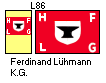
The red flag has a white shield containing a black bollard, with white H, K, L and G in the field’s corners. The yellow or buff funnel carries a broad band of the flag. Colour shades follow the website image.
An earlier Hermann und Ferdinand Lühmann entry is assumed to relate to this company. Ferdinand Lühmann K.G. appears under Peter Döhle’s management in 1966–67, under its own name as manager in 1970–71 and also as owner by 1973–74. Döhle continued to manage part of the fleet.
Germany, Cuxhaven.
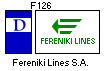
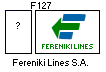
The funnel is blue with a broad white band bearing a blue D. Both flag versions are white, with a green arrowhead pointing towards the hoist between two parallel bars of diminishing size, and the green name FERENIKI LINES below. Brown gives green bars; Nüsse’s version has blue bars.
Owned by Thomas A. Demsiris, Fereniki managed fleets held through single-ship companies in the 1985–86 and 1992–93 registers.
Greece, Piraeus.
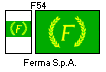
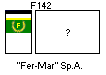
The livery was shared with Ferchim S.r.L., called Ferchem by Brown and listed at the same address. The funnel is white with a broad band of the flag. The flag is green with a yellow F, angled “slightly Pbds” in Rosanoski’s notation, between two yellow laurel leaves.
Fermar was named Ferruzzi until 1985 and probably originated in Carlo Ferruzzi’s Ravenna concern. Accounts of its later ownership and merger differ: Lloyds dates merger with Bulkitalia to form Coeclerci Armatori to 1996, while the Coeclerici website gives 1994 and records purchase of the Ferruzzi-Montedison fleet that year. Another source states acquisition in 1995 by “Premda SpA”.
Bulkitalia began in 1984 as a joint venture between Ferruzzi and Coe & Clerici, which bought out Ferruzzi in 1987. Vittorio Giuliani Ricci is listed as manager for Ferruzzi in 1973–74.
Italy, Ravenna.
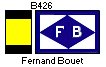
France, Caen.
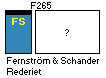
The concern appears in Lloyds 1953–54 under operator Henckel & Schander A/B.
Sweden, Gothenburg.

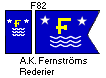
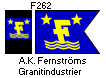

Collectors Corner’s second flag corresponds to F82. The colours of its stars and waves are unclear and do not seem identical to the letter. Mitchell’s funnel differs: a lighter blue, closer to F81, a plain “F”, two small triangles instead of stars and two wavy lines rather than three.
F262 comes from the Bryggan website; its flag illustration was credited to Jarig Bakker.
A second flag has a lighter blue field and a slightly ornate “F”. The US Navy source supports it under Erik Fernström, although its letter is not entirely clear.
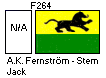
The stem jack is a horizontal yellow-over-green bicolour with a black animal on the yellow. The animal appears to be a horse.
Stewart shows a similar flag with an erect letter and white stars and waves. A cap badge also shows this version, though the colours of the stars and waves are not clear.
The business originated in 1885 with Alfred Fernström and A.K. Fernströms Granitindustrier. It entered shipowning around the turn of the century and sold its last vessel in 1946. Erik K. Fernström decided to return to shipping in 1950, ordered a ship in 1951 for delivery in 1954, and also became a charterer. He sold the company to Skansen Lejonet in 1968; its name continued and he briefly remained in management. The source gives the final ship sale as 1977, while another account dates the last sale by Fernströms Rederi A/S to December 1976.
Sweden, Karlshamn.
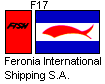
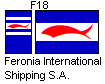
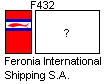
The emblem relates to the company’s initials.
The flag is confirmed flying on Nyanga offshore Gabon in the mid-1990s. Cariboo was also recorded at Lyttelton in November 1989 and February 1990.
Photographs of Moon Fish’s starboard side and Angel Fish’s port side show the fish facing forward on both sides.
Feronia, known as FISH and later SEACOR-FISH, operated oil-rig supply vessels with fish names. It was originally a Compagnie Navale Worms subsidiary. Seacor acquired control in 1994, although Lloyds still places it under Compagnie Nationale de Navigation in 1998, then under Seacor Smit in 2000. In 2001 it became Seacor Marine (West Africa) SAS.
France, Paris.
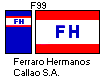
The funnel is blue with a broad band of the flag. The flag is red with a broad white horizontal band bearing the blue letters FH.
Listed in the 1963–64 and 1970–71 registers, Ferraro managed Cabotaje Peru and Vera Cruz Compañia Naviera. The earlier register also lists Compania Maritima Santa Maria and Naviera Peru Panama under its management.
Peru, Callao.
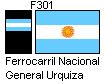
La Marina Mercante Argentina 1961 assigns the Argentine state ensign with the Sun of May as a house flag. Rosanoski questions whether the photographed masthead flags were really ensigns: the ferries lacked a suitable stern staff, and the flags are visible but their detail cannot be resolved. The distinction therefore remains moot. The book shows equal funnel bands, but Carmen Avellaneda’s black-and-white photograph gives the white band greater width than the blue.
Ferrocarril Nacional General Urquiza, rendered National Rail General Urquiza, was formed on 21 October 1948 as one of six state railway companies following nationalisation of British and French railways that February. It also operated ferries. The fleet passed to Empresa Ferrocarriles del Estado Argentino in 1964, presumably through a railway amalgamation, and in 1979 was sold to Satecna, apart from one vessel ending service.
Argentina, Buenos Aires.
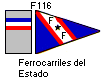
The grey funnel has a blue, white and red triband. The flag is a blue pennant with a narrow white diagonal band, edged red, carrying a black star between two black Fs above and below it along the band. Rosanoski specifies the diagonal as “Pbd”.
Chile, Santiago.
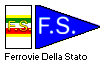
The white funnel has a green, white and red triband edged yellow above and below. Yellow letters F.S., outlined black, extend across the triband. The flag is a blue pennant bearing white F.S.
The company is identified as Italian State Railways.
Italy.
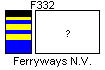
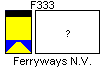
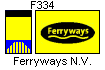
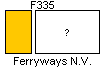
Anglian Way had been chartered as Thomas Wehr in 2000–01 in Wehr colours. On renaming in 2001, yellow “Feryways” lettering was added to the hull and the Wehr logo removed from the funnel.
An October 2006 port-side photograph shows the earlier yellow bands combined into one broad band. An oddly shaped yellow base seems to create a low, irregular blue band, but this occurs only on the outer port side; a starboard photograph shows an ordinary all-blue base. The latter photograph makes the funnel look black or very dark blue, unlike the hull.
Flanders Way’s port-side funnel, documented by 2003, has nine yellow vertical bands. The source describes two central flat-topped bands and the others with sloping tops, decreasing in height from the next pair, which begin level with the central pair. Starboard photographs show a plain blue base. A flag was photographed aboard on 17 June 2006, but its details are unclear: the illustration is inferred from the logo, and its wavy underline may not be present.
Ostend Way carries this funnel, as does Ipswich Way, so the variations were not simply a separate scheme for each vessel. An April 2006 photograph also shows a flag, still indistinct.
Formed in 1999, Ferryways officially began on 5 January 2000. Its shareholders were EWerfinvest, D&W Agencies and Mast (UK), with the main office at Ipswich as Ferryways (UK). After a brief venture with Sammarinas Shipping Lines, it entered a venture with Mediterranean Shipping Co., which held a majority stake; Rosanoski takes this to mean Mediterranean Shipping Co. S.A.
A Cobelfret group company bought the shareholders out on 1 June 2007. Flanders Way, Anglian Way, Ipswich Way and Ostend Way were transferred to Cobelfret subsidiary RoRoCo. Ferryways UK entered insolvency that month, with staff dismissed, and Ferryways subsequently filed for bankruptcy. Searoad Stevedores, which held exclusive rights to its Oostende ro-ro berths, had also been acquired.
Belgium, Oostende.
Registered in October 1994 as JSC Fertex Transport, the company undertook freight forwarding, stevedoring, chartering and ship agency.
Lithuania, Klaipeda.
The funnel follows starboard photographs of European Stars and a port-side photograph of Mistral.
George Poulides launched Festival Cruises in 1994 with The Azur. It traded in America as First European Cruises or Festival Cruises (First European), with operations through London and New York companies. A proposed P&O purchase announced in May 2000 was abandoned that year because of low cruise-line share values. The account dates collapse to the end of 2003 and final cessation to May 2004. Ships were sold to other operators: Azur became Royal Iris for Mano Marime, still under Festival Shipping & Tourist Enterprises’ agency.
Greece, as given for the owner.
Greece, Piraeus.
Keep the explicit scope label independent; no alias or company identity is inferred.
Formed in 1990, Festival Shipping & Tourist Enterprises acted as manager and agent for ships operating as Festival Cruises.
Keep the explicit scope label independent; no alias or company identity is inferred.
Cape Araxos was recorded with a black funnel carrying a white, blue and white triband.
Tropis Shipping Co. acted as agent.
UK, London.
F471 is white with celestial-blue “FIDO” lettering towards the fly and a blue disc at the hoist. Four white, slightly rising lines cut into the disc from the fly side. It was seen at the same Aurich flea market on 1 May 2009.
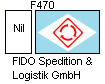
F470 is very light blue, with a central white lozenge. Inside is a red-edged diamond with rounded points, containing a red ring formed by three arrows, resembling a recycling emblem. Schneider saw the table flag at a flea market in Aurich on 1 May 2009. He relied on the seller for its FIDO attribution and was unsure both of the identity and of whether it was the older flag.
Company identity and age remain unverified.
The company was insolvent, with final distribution in 2008. Klaus-Michael Schneider suggested a possible connection with Fisser & van Doornum, based on “FI-DO”, but repeatedly emphasized that it was uncertain. Rosanoski found no mention of a connection on the Fisser & van Doornum website.
Germany, Leer, Eastern Frisia.
Fijian Trader’s funnel was blue with a black top. No flag is recorded.
With its head office in Sydney, the company operated Fijian Trader from 1962 until she was wrecked in October 1964.
Fiji, Suva.
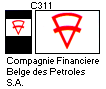
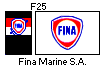
The earliest livery has a black funnel with a broad white band carrying a red shield frame surmounted by a red upper arc. The flag is white with the same red frame and arc. The livery changed with the first company-name change.
The later Fina Marine funnel adds a blue anchor, its angle given as “Pbds”, beneath the red shield. The funnel remains black with red and white bands, and the shield is edged white and blue with a white circle and blue FINA. The accompanying white flag carries the shield without the anchor. The source places this alteration after the later name change.
An intermediate black funnel has red and white bands carrying a white circle edged blue and charged with the shield-frame and bar symbol. Its shield arc lacks lettering, confirmed in a black-and-white model photograph of Laurent Mecus; Loughran omits the blue outline. Corresponding white flags have a red-edged white triangular shield and red upper arced bar carrying PETROFINA in black or white. A later funnel replaces that emblem with a red shield edged white and outlined blue, containing a white circle with blue FINA; its flag is white with that shield. The source assigns some intermediate versions to Fina France, and describes the Purfina-Transports funnel as slightly different.
The concern originated in 1920 as Compagnie Financière Belge des Petroles, later Petrofina. Fina Marine appears in the registers by 1985–86, subsequently as manager. The source records acquisition by Compagnie Française des Pétroles in 1999.
Operating subsidiaries included Antwerp’s Purfina-Armement and Société Purfina-Maritime. Associates included Compagnia Marittima Palermitana and Purfina-Transportes, identified with Fina France.
Belgium, Brussels and Antwerp.
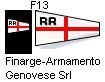
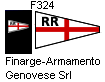
The pennant has a squared-off point, confirmed by a larger 2009 website image after Rosanoski had questioned the shape. RR presumably refers to Rimorchiatori Riuniti. A.H. Paraggi in November 2005 has the cross filling the squared end, agreeing with the website logo, while the February 2008 photograph shows a narrower cross occupying one-third of it, represented by F13. Rosanoski withdrew his proposed correction to the flag, considering the narrow version possibly the painter’s licence; another website funnel photograph shows a cross not quite filling the end. A starboard view shows the pennant facing forward but leaves letter orientation unclear. A.H. Portofino carries F324 but apparently flies the Rimorchiatori Riuniti International Shipping & Investment flag.
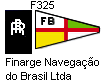
The Brazilian FB pennant has yellow at the lower hoist, green at the upper fly and black FB at the upper hoist. A.H. Giorgio P’s January 2013 photograph shows this flag panel on the superstructure, with the parent Rimorchiatori Riuniti emblem above. Rosanoski interprets the upper emblem on its black background as a funnel substitute where only exhausts are present; it remains the parent’s marking. The lower panel can represent Navegação do Brasil historically and Apoio Maritimo at the photograph’s date, since the website retained both logos. The 2011 description had found no actual flag photograph, only the painted panel.
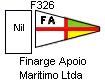
The other Brazilian variant has FA, with the national colours in the fly, green above yellow.
Finarge was formed in 1981, although an earlier Lloyds entry gave 1984 before amendment. Wholly controlled by Rimorchiatori Riuniti, it operated offshore vessels and deep-sea tugs and developed overseas, particularly in Brazil. Registers show changes from Finarge-Finanziaria Armamento Genovese to the later Finarge-Armamento Genovese name.
Keep the explicit scope label independent; no alias or company identity is inferred.
Finarge Navegaçao do Brasil was established in Rio de Janeiro in December 2003 to manage newbuildings. Finarge Apoio Maritimo followed in 2008 as local agent and owner of A.H. Giorgia P. The source records transfer of the vessel’s registered ownership from the former to the latter on 27 September 2012. By 2013 the website no longer mentioned Navegaçao do Brasil but showed both FA and FB flag versions under Apoio Maritimo. Rosanoski presumes the former company had ceased, without establishing this.
Keep the explicit scope label independent; no alias or company identity is inferred.
Italy, Genova.
The Mitchell funnel is probably based on Isola Azzurra.
The company website shows both funnel and flag. Isola Blu in 2004 appears to have a lighter-blue N, perhaps because the photograph was manipulated.
Isola Bianca’s port side in October 2007 and starboard side in March 2011 document this funnel.
Neverland Soul’s August 2007 starboard view has a sloping rear face that makes the side white more conspicuous. Rosanoski suggests the logo may be intended to fill a square based on the band’s upper edge. There is a gap between the red and the funnel edge, while the N reaches the forward edge, the lower triangle and the band’s top.
The funnel follows a port-side photograph of Neverland.
Neverland Dream’s August 2012 starboard view has two red triangles extending to the sloping rear edge. Their separation into two parts is also confirmed on the port side, where they reach the forward edge.
Established in 1985, Finaval underwent recovery after financial difficulties with Giovanni Fagioli and a new owner. The source dates its rebirth to June 2004, also calling it a 2005 rebirth; Rosanoski regards “Nouva Finaval” or “New Finaval” as a description rather than a demonstrated new name. Restructuring brought gas tankers, laid-up chemical tankers and consolidation in oil transport. Fingas was acquired on 7 February 2005 and incorporated on 1 November. Negotiations to sell the chemical fleet first named Camillo Eitzen, but a later report named Euroceanica (UK).
Fluvio Padana began in 1982 as Minitankers, with two name changes in 1993; its fleet later reduced to tugs and apparently was disposed of. PB Tankers was also listed as an operating company. Finaval Offshore was incorporated in November 2007 and began operating in 2008, but its relationship to an earlier company of that name is unclear. Pietro Barbaro Group’s interest may have ended when the brothers left in 2001, although Lloyds continued listing Gianni and Alfredo in senior roles in 2005.
Italy, Rome.
Mitchell’s funnel appears to refer to Turchese while under Navigazione Beta.
The website-derived funnel’s band was enlarged in the illustration for clarity.
Italy, Savona.
Keep the explicit scope label independent; no alias or company identity is inferred.
Italy, Cagliari and later Savona.
Keep the explicit scope label independent; no alias or company identity is inferred.
The Bertani family controlled Finbeta. The company account traces it to Ceser Bertani’s Trasporti Maritima Bertani, formed in 1937, renamed Navigazione Beta in 1969 and Finbeta in 1989. Lloyds had earlier dated Navigazione Beta’s formation to 1970. Rosanoski notes that Trasporti Maritima Bertani continued to be listed separately after the supposed 1969 change, so the sequence is not straightforward; its sole vessel later appears under Navigazione Beta.
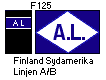
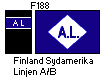
Attributions vary between Birger Krogius, Finland-Amerika Linjen, Atlanta and Oceanfart. Most Brown editions leave unclear whether the flag diamond extends throughout; Brown 1978 gives light blue for both funnel band and flag and omits dots after the flag letters. Stewart and several Talbot-Booth editions place a small white o above A, making Å, but Styrbjörn E:son Lindberg corrected FOTW’s letters to A L. His father Jarl Erick B:son Lindberg had served as mate and captain until 1955, and his brother also as mate. A Brazilian source for 1950 shows dots after the funnel letters, and a black-and-white photograph of Bote IX confirms the funnel.
Also called Suomen Etalä-Amerikan Linja, the service involved Angfartygs A/B Bore and Birger Krogius, with Rederi A/B Atlanta and A/B Oceanfart. Finska Ångfartygs held an interest and had absorbed the fleet by the 1970–71 register.
Finland, Helsingfors.
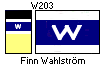
W203’s funnel and flag come from Stewart 1963, No. 789; no separate written design description is supplied.
Finn Wahlström is recorded as a manager for one company in Lloyd’s 1953–1954, 1958–1959 and 1963–1964.
Norway, Oslo.
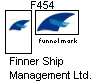
Red Fin’s starboard photograph of 17 May 2013 and port-side photograph of 6 June confirm a mirrored design, facing forward on both sides.
Established under Yilmaz Ulusoy’s leadership, Finner added shipowning and management to existing maritime activities. A building programme began in May 2010, with deliveries late in 2011.
Turkey, Istanbul.
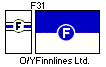
F30 passed from the earlier Finnlines/FG-Shipping operation to the group, but Rosanoski could not establish its use across subsidiaries with their own colours. Stewart shows light blue and places the flag’s blue circle and letter towards the hoist. The company said the device should be central, despite observations supporting Stewart. Circle size also varies. Several sources depict an oval on the funnel, while Merchant Ships shows the funnel letter within a black ring.
Sources make white funnel bands narrow and blue bands broad, but photographs of Aurora and Kotkaniemi show less difference, as with F31. Black funnels were used by cargo ships and white by most passenger and ro-ro vessels. Finnpartner’s apparently broad black top is actually a grille around the exhausts. A Finnlink website image is presumed to show F31 with its narrow lines indistinct, unlike the black funnel on the main Finnlines page.
Finland, Helsinki.
Keep the explicit scope label independent; no alias or company identity is inferred.
Finland, Helsingfors.
Keep the explicit scope label independent; no alias or company identity is inferred.
Finncarriers was established by Finska and Finnlines: the account gives 1975, while another dates effect to 1 January 1976. Managed by FG-Shipping, it also managed part of Finska’s fleet and merged into Finnlines in 2001. Oceania Rederi was sold to B&N Norsjöfrakt in 1992. Finnanglia Ferries was a joint service with United Baltic, while Laser Lines and RoSa involved Johnson and Wilhelmsen; Johnson bought out the other Laser interests in 1989.
Finland, Helsinki.
Keep the explicit scope label independent; no alias or company identity is inferred.
Germany, Lübeck.
Keep the explicit scope label independent; no alias or company identity is inferred.
The earlier operating concern was formed in autumn 1947 to manage Merivienti vessels, beginning a US liner service in 1948. The source also calls its original name O/Y Baltic Chartering, changed to O/Y Finnlines in 1953 and FG-Shipping on 6 June 1989. Enso-Gutzeit owned part or all of Finnlines before selling 75% in 1982. Vessels in Finncarriers traffic passed to EFFOA and Neste, and the Finncarriers interest was relinquished to EFFOA. Atlantic Gulf Service operated with Swedish America Line; many ship names began with Finn.
Keep the explicit scope label independent; no alias or company identity is inferred.
EFFOA separated freight from passenger operations in 1989, producing Finnlines Group while passenger interests went to Eftjohn. Freight activities, management, stevedoring, port interests and shares in Railship and Huolintakeskus were grouped together, and the company was listed on 2 July 1990. Bore Line was acquired from Rettig, which received 10% of Finnlines; Bore’s operations joined Finncarriers in 1992. The remaining Huolintakeskus shares were acquired in 1995 and exchanged for a stake in Bilspedition Transport Logistics, increased to 37% by 1997. That holding was exchanged through Stinnes for Poseidon, subsequently Finnlines Deutschland.
Keep the explicit scope label independent; no alias or company identity is inferred.
Finncarriers and FG-Shipping were incorporated into the parent at the start of 2001, while the Finnsteve and A.E. Erickson port operations combined. Finnlines bought the rest of Team Lines in 2001, having held 31.8%. Finnlink, formed by shareholders for Finland–Sweden lorry and rail-wagon traffic, became wholly owned by 1997; its formation is dated 1988 or 1989. Nordö-Link was acquired in 2002, and TransRussiaExpress was a joint venture. Finnlines Deutschland’s change from Poseidon is dated 2001. A Grimaldi bid subsequently brought a controlling 46% interest.
Keep the explicit scope label independent; no alias or company identity is inferred.
Railship became a subsidiary through the Poseidon acquisition. A separate note says it became a “10% subsidiary” with the last 6% acquired in December 1998, before absorption by 2003; that percentage is retained as an unresolved source inconsistency.
Keep the explicit scope label independent; no alias or company identity is inferred.
Finncarriers’ earlier funnel is Finska’s, with two white bands separated by a wider interval of funnel colour. Finnanglia partners were said to use their respective liveries, but the Finncarriers contribution is given as F30 or F31.
Keep the explicit scope label independent; no alias or company identity is inferred.
Coastal Ships & Ferries attributes F211 to Finncarriers, yet its listed Finnpartner carries F31 with FINNCARRIERS-POSEIDON on the hull. Rosanoski therefore assumes F211 applies to Poseidon-chartered ships. The wavy blue, white, red and black band also appears as a TransRussia Express website logo.
Keep the explicit scope label independent; no alias or company identity is inferred.
Loughran gives F31 to passenger and ro-ro ships, F32 to Finnstar and F33 to Finnjet; Mitchell more generally assigns F32 to ferries and ro-ro vessels. Finnjet’s photograph confirms F33 with a vertically oval ring. Mitchell shows both F and ring black, but the photograph has a blue F; the apparently black ring may be affected by lighting.
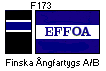
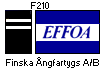
Brown 1982 gives dark-blue flag bands and a central white band bearing blue EFFOA. Mitchell depicts broader white funnel bands, dating the funnel from 1976 and its replacement by Finnlines F30 to 1980.
Pollux’s black-and-white photograph confirms this funnel. Brown 1995 also attributes it to the Finncarriers joint venture.
The earlier F172 funnel is confirmed by Baltic’s black-and-white photograph. Several flag sources omit the small o above A. Two notes labelled F178 in the original record a missing dot after the second A and lighter flag bands in some sources. A/B Turret used a variation of F172.
Known as FÅA, EFFOA, Finland Line or Finland Steamship, the company’s Finnish name was Suomen Höyrylaiva O/Y. Captain Lars Krogius founded it in 1883, and it absorbed Helsingfors Ångfartygs in 1920. Its passenger interests merged with Johnson Line under Effjohn between July and October 1990. Rosanoski rejects a reported 1982 change to Effjohn International, favouring 1990 from later Lloyds evidence, while Mitchell gives 1 January 1989.
Interests included Finland Amerika and Finland Sydamerika lines, Merivienti, and a 40% Railship stake later transferred to Finnlines. Finncarriers was formed jointly with Finnlines effective 1 January 1976. The company participated in Silja Line and Streamline. A consortium bought 66% of Sally Vessel Mangement in 1987; Effjohn, formed with Axel Axel Johnson, acquired the balance in 1988 in exchange for its Viking Line holding.
The company acquired a majority in salvage concern Suomen Pelastusosakeyhtiö Neptun in 1916, later taking full ownership and renaming it Oy Neptun in 1976. The operating concern merged into Hangon Hinaus in 1983, while a new Neptun company provided maritime and salvage consultancy, later becoming Neptun Maritime (Finland).
Managers included Lars and Birger Krogius, with Finnlines managing part of the later fleet. Ships were mainly named for stars or planets.
Finland, Helsingfors.
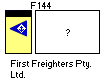
Wendy H, observed in April 1966 and associated with G. Contomichalos, had a yellow or buff funnel with a black top. It bore a blue pennant panel, hoist aft, containing a white diamond charged with a blue upright anchor. No flag was noted.
Unknown.
The funnel follows a port-side photograph of FSL Hamburg taken on 22 January 2014.
FSL Trust was constituted on 19 March 2007 to provide lease financing for international shipping. Sponsored by FSL Holdings and managed by FSL Trust Management, it reported a diversified fleet of 25 vessels in the 2014 website account.
Singapore.
The funnel was recorded for Ever Happiness in September 1966, with a shorter middle arm in that observation and Mitchell’s rendering. The present illustration follows Ever Shining’s starboard side in October 2013 and Ever Blessing’s port side. NJK confirmed the funnel but reported no flag observation.
Ever Strength carried this funnel under First Navigation Corporation, for which First Steamship acted as agent. Rosanoski also notes a connection in the vessel’s name.
Formed in 1963, First Steamship belonged to a group whose activities included department stores, shipping and investment. First Steamship S.A., also formed in 1963 and based at the same address, was a major operating company; Associated Shipping Corporation was an associate.
Taiwan, Taipeh.
The Log records Fish Protein Concentrate (Tasmania) operating in 1973, renamed Fish Protein Concentrate (Triabuna) in 1975 and closing in 1978. A registry reference separately gives Fish Protein Concentrate formation on 1 January 1931 and deregistration in 1974; the source does not explain how that record relates to the later operation.
Australia, Hobart.
The three white bands on funnel and flag are said to represent the original three partners. Sources vary in the gaps between funnel bands and treatment of the o. F222 is attributed to Manchester-London Steamers by Brown and Talbot-Booth, while F223 is assigned to that company by Marine News and to Fisher, Renwick & Co. by LJC.
The business began in 1876 as Fisher, Harbron & Renwick, becoming Fisher, Renwick & Co. and entering shipowning in 1877. Fisher, Renwick Manchester-London Steamers was formed in 1901 and acquired by Coast Lines in 1939, while Fisher, Renwick & Co. continued in road transport.
UK, Newcastle.
Haws gives this funnel for 1896–1964, with a white FR monogram added in 1964. British Railways livery followed in 1965–70.
The undertaking began as Fishguard Bay Railway & Pier Co. on 29 June 1883, jointly owned by Great Western and Irish Great Southern & Western railways, and took the Fishguard & Rosslare name on 31 July 1894. Haws states that its status survived 1948 railway nationalisation, with London Midland taking over routes, ports and ships on 1 January 1950 and ownership passing to British Transport Commission and C.I.E. control in 1962. Other sources describe a Fishguard Harbour Authorities joint venture and a 1923 amalgamation of Fishguard & Rosslare Railway with Great Western; their relationship to the Haws account is not explained.
UK, Rosslare, as classified by Haws.
The funnel follows a photograph of Brennholm dated 1 July 2012.
Lars-Einar Sandtorv and his elder brother founded PR Brennholm and later PR Havdrøn, buying their first fishing boat in 1972. The business divided in 1994, when Lars-Einar re-established PR Brennholm. It became a corporation in 2005 with him as majority shareholder. The 2002 Brennholm was replaced by a new vessel of that name in 2007 and sold.
Norway, Bergen; Hjellestad.
The published flag-like logo is divided diagonally into black hoist and fly quarters and red upper and lower quarters. Five white six-pointed stars, each resting on two points, occupy the centre and the four quarters.
Maha Avanti’s port-side funnel has the two stars on blue closer to the centre than those on red. The stars are smaller than in the earlier form but larger than in F442.
The website funnel photograph has smaller stars spread evenly around the centre. The flag is based on an indistinct Maha Avanti photograph, apparently showing very small stars near the centre and blue quarters that look black, presumed to be a lighting or camera effect. Maha Marie Jose shows the same funnel without a black top; the source gives the malformed photograph date 19.89.2007.
NJK confirms this funnel for Maharani.
A website banner instead shows a blue triangular sail with five five-pointed stars in a diamond arrangement. The contact-page impression appears to show all stars alongside one another.
The group traces its origins to H.H. Dhunjibhoy & Co., shipbuilders and repairers from 1890 to 1948, followed by South East Asia Shipping. The liner and agency business closed in 1981 under pressure from containerisation, with owning-department staff moving to Five Stars management; another account dates Indian operations to 1985. South East Asia’s last vessel, Maharani, was broken up in 1977. Five Stars Shipping and Five Stars Tankers merged on 4 October 2002. In 2005 the group returned to ownership through Five Stars Bulk Carriers with a financial partner, then formed Five Stars Chartering in mid-2006. It managed Five Stars Bulk Carriers and SKS Transnational fleets.
Lloyds lists Great Offshore as an operating company, but Rosanoski questions this because neither company website mentions the relationship.
India, Bombay and Mumbai.
The Skipet source does not date use of these two liveries.
The funnel follows Lygra on 29 March 2006.
The funnel follows Fjord Norway on 27 July 2005.
Bergensfjord’s February 2008 photograph shows what appears to be a black top, but this is a lattice protecting the exhaust. A May 2009 photograph adds a symbol, represented by F400. Rosanoski assigns that later marking to the parent because of the fjordline.no hull logo, while F399 had been allocated to the subsidiary in line with Danish registration. These are the source’s attribution choices, not evidence of different vessels.
Fjord Line was formed from Rutelaget Askøy-Bergen in 1993, initially as a subsidiary before merging with it in 1995; Lloyds gives 1995 as formation. It was subsequently acquired by Bergen Nordhordland Rutelaget. The Bergen–Newcastle route was bought from Color Line in 1998. Master Ferries merged with Fjord Line on 1 January 2008 according to the detailed notes, although a Lloyds heading gives 2005.
Operating companies included Fjordline Danmark, formed at Hanstholm in 2008, and Master Ferries Holding, formed at Kristiansand S in 2006.
Norway, Bergen.
The funnel follows Fjordtank’s port side, with a stated photograph date of 10 July 2003 but an earlier access date of 26 June 2003.
Key Fighter’s February 2011 funnel appears to alter the E carried as Jacobus Broere in John T. Essberger’s fleet into an F by blanking out the lower part. The ship was renamed on 2 February, with Key Shipping care of Fjord Shipping as registered owner and Sea Tank Chartering as manager. A March photograph may show the letters painted out, although the band is partly hidden; by June the funnel carried STC. Rosanoski regards the F as probably a quick post-sale alteration, not an official company marking. The fleet appears mainly chartered out, with no established owners’ colours found.
The company website dates its beginning to 1994, managing Fjordglimt for local investors, while Lloyds gives 1995. It developed into a manager of ships held through single-purpose companies. It apparently operated as or through Fjord Tankers at the same address. Fjordtank’s ownership and management moved between Fjord Tankers, Utkilen and Fjord Shipping during 2000–10; Rosanoski suggests a possible charter-back after Utkilen’s purchase.
Norway, Måløy.
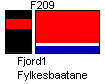
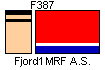
Bergensfjord in October 2007 shows the Fylkesbaatane funnel retained under Fjord1, with the parent company’s flag.
The other component likewise retained its original funnel while adopting the common flag. Eira’s September 2010 photograph confirms this funnel.
Formed at Florø on 9 May 2001 by merging Fylkesbaatane i Sogn og Fjordane and the Møre og Romsdal concern, Fjord1 Nordvestlandske became the parent of Fjord1. Sogn og Fjordane county held 59% and Møre og Romsdal 41%. The operating companies became Fjord1 Fylkesbaatane and Fjord1 MRF in 2005, based at Florø and Molde respectively.
Norway, Florø.
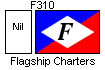
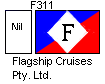
The FOTW account describes a blue and red diagonally divided flag with a white diamond clear of the edges and a black italic F, based on a company wedding-package photograph.
The other website logo makes the diamond touch top and bottom, with its sides misaligned with the field division. The two websites vary in diamond size and apparent blue shade. Rosanoski doubts whether an actual flag exists and, if it does, whether the F is italic, since its upright aligns with the image edges.
Operating from 1982, the company arranged Sydney Harbour charters for vessel owners. Flagship Charters appears to be a trading name, while its other website identifies Flagship Cruises Pty. Ltd.; Rosanoski describes the business as essentially a booking centre.
Australia, Sydney.
Ionian Spirit’s port side on 3 August 2013 documents this funnel.
The archive combines Agoudimos family branches and Greece/Liberia entries. Greek operations do not establish every subsidiary's legal jurisdiction, and Flanmare must not be equated automatically with the separate G.A. Ferries enterprise. Entity and image attribution remain open.
The archive combines Agoudimos family branches and Greece/Liberia entries. Greek operations do not establish every subsidiary's legal jurisdiction, and Flanmare must not be equated automatically with the separate G.A. Ferries enterprise. Entity and image attribution remain open.
Ionian Sky in summer 2004 and Penelope A show A726. Penelope A’s squatter funnel has a very broad white band, making the small black portion difficult to see, perhaps explaining F327. Two A336-format flags appear aboard, but blue lettering cannot be resolved. Mitchell attributes the funnel under variant spellings of Agoudimos and also Flandermar, and records a GA logo on ferry funnels and hulls.
The ferries carried AGOUDIMOS LINES on their hulls in 2009.
Agoudimos Lines is the family ferry business within a maritime group trading as Flanmare. One account dates formation by Alexandros Agoudimos to 1967; Rosanoski also traces an apparent origin through Gerassimos Agoudimos and Alex, acquired in 1972. Flandermar appears in the 1978 register, with the later Flanmare concern linked by a vessel despite a different address. Lloyds first gives Flanmare’s formation as 1988, later 1978, which Rosanoski interprets as Flandermar’s start followed by a 1988 name change. Ferries were held through single-ship companies, including Aegean Islands Shipping, formed in 2004. GA Ferries was separately established in 1988 by a branch of the family.
Greece, Piraeus.
Ships of the Hong Kong company appear to use charterers’ colours.
The Hong Kong ship manager was formed in November 1994 and belonged to Noble Group. Rosanoski considers that it also apparently owned ships for charter and may have served as a shipping investment company. Fleet Management Europe was formed in London in 2005.
China, Hong Kong.
Keep the explicit scope label independent; no alias or company identity is inferred.
The Russian company’s funnel follows Alkor’s starboard side on 22 June 2009.
The separate Moscow company was formed in 2004 and controlled by the Russian Federation government, with vessels held through separate companies.
Russia, Moscow.
Keep the explicit scope label independent; no alias or company identity is inferred.
The funnel is that of Boston Deep Sea Fisheries, apparently the owner.
Fleetwood Tankers appears under Sir Fred Parkes in 1958–59, followed by Basil A. Parkes, styled Sir Basil in 1980–81.
UK, Fleetwood and later Kingston-upon-Hull.
FEDG began Flensburg Fjord services in 1866 on merchant Friedrich Mommse Bruhn’s initiative. Competition from a Sonderburger company in 1873 proved unsustainable, and the concerns combined two years later as Flensburg-Ekensunder & Sonderburger Dampfschiffs-Gesellschaft. After the First World War, Flensburg remained German while Norsdschleswig opted for Denmark; the company reverted to the Flensburg-Ekensunder name from 1920. The earlier combined name is recorded in Lloyds and on emergency currency. Hermann Bruhn, the founder’s son, liquidated the company in 1934, and Förde-Reederei replaced it in 1935.
Germany, Flensburg.
The flag is white with black F, D and G and the year 1869 in the corners, surrounding a crowned shield based on Flensburg’s arms. The shield is divided vertically on gold: two blue half-lions on the dexter side show tails but no rear legs, and a red brick tower occupies the sinister side. Early images and Lloyds 1912 put the lettering close to the corners; later versions distribute it more evenly, perhaps reflecting a post-war change. Rosanoski notes differences from the actual city arms, so describes the emblem as based on them.
Also called Flensburg Steam Shipping Co., the company had H. Schuldt among its shareholders from 1872. One account says Dampfschiffs Rhederei Horn acquired a majority, failed to dissolve it and exchanged the shares for three steamers, followed by a 1920 repurchase of Irmgard Horn for Caribbean trade. Rosanoski finds this unclear: the exchange counterpart is unstated, vessel accounts differ on construction and sale dates, and continued Horn control is only a possibility. The company bought the renamed Sexta in 1936 and sold her in 1938.
Germany, Flensburg.
The source describes blue with an approximately one-seventh yellow area, tentatively at the hoist, and an approximately one-third yellow circle containing three abstract blue fish swimming towards the fly. The FOTW source provided a description without an image.
Also identified as Flensburger Fishing Society.
Germany.
The shipbuilder dates its foundation and first delivered vessel to 1872. H. Schuldt held a minority interest. Egon Oldendorff acquired it in March 1990 and sold it to management and investors from Hamburg’s Orlando Management at the end of December 2008.
Germany, Flensburg.
The livery derives from Heinrich Schmidt, whose flag is also said to have been used. Both funnel versions are yellow or buff with a blue seven-pointed star, one adding a black top. The flag is divided into diagonal quarters of blue, white, white and red.
Formed in 1922, the company appears in the 1939 source under Heinrich Schmidt. Rosanoski suspects an unrecorded split: Heinrich Schmidt’s namesake vessel later appears under Flensburger Reederei and Heinrich Schmidt, while Neptun-named ships remain with Schiffsparten-Vereinigung. Later operating subsidiaries included Baltic Bereederund and Flensburger Befrachtungskontor Uwe C. Hansen.
Germany, Flensburg.
The Untzidien Banderak emblem is a stylised bird, with black F and M in the triangular base.
Mitchell gives this funnel, although all three accompanying vessel drawings show yellow funnels.
The separate shipowning companies used their own funnels. Actinia Shipping’s marking, seen on Team Anemonia and Team Actinia, appears to represent Actinia equina, described by Rosanoski as a marine worm or anemone.
The funnel follows Nautilus of Iceport Shipping.
Morevest’s Matteos I, called Matheosi in Lloyds, shows an M with a shallow central v above one wavy line in April 2008.
Morevest’s Markos I, called Markosi in Lloyds, instead has an M with a deep v and two wavy lines, recorded in May 2007.
Both Uniward ships share a U over two wavy lines, photographed on Loukas I, called Loukasi in Lloyds.
Known as Marflet, the company was formed in 1958. Consultores de Navegacion, formed in Madrid in 1998, was an operating company. Adoption of Team names by two ships leads Rosanoski to suggest that Consultores may have joined Team Tankers in 1999.
Spain, Ceuta and later Madrid.

New Zealand, Wellington and later Auckland.
Keep the explicit scope label independent; no alias or company identity is inferred.
The white flag has a blue panel within a blue orle, bearing a white ff logo. Rosanoski records it aboard Otago Bucaneer at Lyttelton on 21 April 1990, with a funnel observation dated 11 May 1986. The cited correspondence dates precede the stated sightings.
New Zealand, Auckland.
Keep the explicit scope label independent; no alias or company identity is inferred.
Fletcher Challenge was formed in January 1981 from Fletcher Holdings, Challenge Corporation and their jointly owned Tasman Pulp & Paper. A decision to dismantle it in December 1999 led to separate companies in 2001, with shipping activities under Fletcher Building. Golden Bay later appears under Fletcher Concrete & Infrastructure, managed by its Golden Bay Cement division.
Keep the explicit scope label independent; no alias or company identity is inferred.
Maritime interests included Golden Bay Cement, owned from April 1998, Kaipara Steam Ship and Tasman Asia through Tasman Pulp & Paper. A Northern Steam Ship connection is only suggested through Kaipara. Deepwater fishing went to Sealord in September 1990, while inshore interests went to a Skeggs Seafoods/Maori Development Corporation venture. The Kailis & France holding was sold effective January 1991. Fletcher also held Liquigas shares and became a major New Zealand Orient Line shareholder with Ahrenkiel, later holding 57% of Tasman Orient.
Keep the explicit scope label independent; no alias or company identity is inferred.
Fletcher Fishing was registered on 29 August 1980 and became Fifeshire Fishing on 17 November 1990 after the Sealord sale. The existing logo was to stand for Fifeshire Fishing thereafter.
Keep the explicit scope label independent; no alias or company identity is inferred.
Uraba had a yellow or buff funnel with a black top. No flag was noted.
Lloyds lists the company in 1963–64 with Carl Axel Janson as agent.
Panama.
Registered on 3 June 1968 as a joint venture of H.C. Sleigh and Jardine, Matheson, the company became Flinders Shipping Co. Ltd. in 1972–73. Mitchell records acquisition by Australian National Line in 1976. Registry evidence gives deregistration on 19 May 1986, but also a second same-named company deregistered on 23 May 1985. A later directory lists a Flinders Shipping agency at Alexandria, NSW; the source does not establish continuity between these records.
Australia, Melbourne.
A joint shipping group formed on 13 June 1969 led to the 1970 amalgamation of Flinders Island Shipping, formed in 1956, and Strait Shipping, formed in 1953, as Flinders Strait Shipping. Flinders Island’s first ship entered service in 1963. Financial difficulties were reported in 1992, and deregistration is dated 10 July 1999.
Australia, Launceston.
The earlier flag has intertwined yellow FG on blue. Rosanoski says the blue should be lighter sky blue and the letters thinly outlined black, confirmed by Nüsse’s table flag. He questions the particular F shape. Flintermaas supplies port and starboard funnel photographs in October 2006, although the starboard date is malformed as 123.10.2006. The old logo remained in an archived April 2005 page.
F158 outlined/table version versus F461 colour/detail variant; retain original drawing qualifications.
Flinter Bay’s October 2008 port-side logo is on a square panel attached to the band. Red-looking areas are presumed orange affected by the camera. Flinterbirka confirms the starboard arrangement. Flintermare in January 2012 has a narrow white r, possibly an unfinished painting guide rather than the completed letter.
Both funnel references cite Flintercarrier’s starboard side on 26 July 2008; F459 appears darker blue. Its flag reference is Noorderkroon in August 2008, while another actual-flag photograph, though poorly spread, appears to place the emblem towards the hoist.
An orange table flag has the logo in light blue and white and the company name in white towards the fly. The cited example measured about 10.5 by 15.5 cm. Rosanoski accepts the rendering for the table flag but questions that placement for a sea-going flag. He suspects an association with the holding or financial side, without verification.
The blue version is seen on Noorderkroon’s bow. Rosanoski questions the published rendering because the likely photograph shows the charge centred or slightly towards the hoist. He suggests it belongs to the shipping side, matching white and orange on a blue funnel band, with orange lettering sometimes appearing red in photographs.
Shared branding does not prove each complete variant used by every named company; table versus ship use retained.
The later corporate colours are blue and orange. The logo forms a stylised F while spelling Flinter in Morse: F dot-dot-dash-dot, L dot-dash-dot-dot, I dot-dot, N dash-dot, T dash, E dot and R dot-dash-dot. It appears in archived website material from July 2005.
Flinter Aland appears to fly a charged white flag at the mainmast, perhaps the second flag in the referenced forum photograph; its identity is not established.
Flinter began with Flinterborg, with company formation dated 1989 and operations 1991 in different accounts. Founders Bert Otto and Jan van Niejenhuis, the latter formerly a Wagenborg director, initially used Wagenborg’s chartering services, explaining borg in the vessel names. Flinter came from the Otto family’s sailing boat. Around 2000 the business took chartering into its own hands and established Flinter Groep. It acquired Ancora, with accounts differing between a majority stake in 2000 and takeover in 2002; Ancora’s own formation is given as 1997 or 1998. The companies adopted the common Flinter name and moved to Barendrecht in September 2006. Bart Otto succeeded to management as the next generation entered the business.
The group combined chartering, ship management and investment in separately owned ships, with external investors and limited partnerships; the interview gives a rule of 25% Flinter participation. Maas Participaties and Flinter Participaties handled management and investment roles under the group. Flinter Management absorbed Ancora in 2007 and Flinter Groningen on 1 October 2007. Other listed businesses included Flinter Shared Services, Flinter Shipping, African Oil Express and Seawins. The Antwerp Ancora company is dated 1999 in one account and 2002 in another.
Netherlands, Groningen, Paterswolde and, from 2006, Barendrecht.
The illustrated colour shades are taken from the website image.
Flomerca participated in the consortium forming Steamline in the 1970s and 1980s.
Guatemala.
The flag is blue with a white saltire and a horizontal white oval bearing red FANU. Stewart gives the oval a blue outline, F22; Brown a red outline, F21; and the US Navy no outline, F73. Brown incorrectly assigns its version to Dodero according to Rosanoski. The US Navy funnel is light blue but its note specifies a dark-blue flag. Harnack prints blue F.A.N.U rather than red letters; John Styring pointed out the error on 29 December 1959. A 1961 agent’s reply said the title change had brought no livery change, but its letterhead was entirely blue and white, including F.A.N.U. Rosanoski suspects this caused the colour error. Harnack remained doubtful in 1962, asking about an earlier state-fleet flag with RP instead of FANU.
FANU’s formation is dated 5 August 1949 in La Marina Mercante Argentina, while another account gives 1951 to take over the Dodero group’s ocean-going fleets. It came under Empresa Nacional de Transportes in 1952. Rosanoski rejects a simple 1957 renaming from Compañia Argentine de Navegación Dodero because FANU was already operating in 1951, favouring a takeover or government merger. The source gives July and December 1957 in different passages. In 1961 FANU combined with the state fleet to form Empresa Lineas Maritimas Argentinas. Government control is described as probable.
Argentina, Buenos Aires.
The US Navy flag is light blue with a narrow white saltire, surmounted by an undefined white oval bearing red FA, with the letters slightly askew.
FANF resulted from the 1949 nationalisation of the Dodero river fleet; La Marina Mercante Argentina gives formation on 5 August. With obsolete vessels and efforts to modernise, it combined in 1958 with Administración General del Transporte Fluvial as Empresa Flota Fluvial del Estado Argentina, according to the website account. The transport administration traced back to a Ministry of Public Works river service in 1944 and a decree of May 1945. Lloyds initially included these vessels in the government fleet, then listed FANF separately in the 1960s, Flota Mercante del Estado Argentino in the early 1970s and later EFFDEA. The various sources therefore present different organisational labels.
Argentine, Buenos Aires.
Paraguay’s state merchant fleet, Flomeres, operated on the Paraguay and Parana rivers connecting the landlocked country with the sea. It was formed under a law of 27 June 1945 and began operations in 1946; a later Lloyds entry gives 1994, which Rosanoski questions.
Paraguay, Asuncion.
Keep the explicit scope label independent; no alias or company identity is inferred.
The Argentine fleet flag is blue with a white foul anchor. Rosanoski assumes light blue but allows that it may have been mid-blue; Brown also lists it as Argentine State Merchant Fleet.
Argentina’s state fleet, FME, replaced foreign tonnage lost to its ports during the Second World War. An account gives an agreement on 25 August 1941 to acquire sixteen Italian ships, while stating that they entered the Argentine flag on 7 July; the fleet decree followed on 16 October and operations on 1 November. Eight ships were bought outright and the others repurchased by Italy after the war. German, Danish, French and Romanian vessels were also acquired. Merchant Ships instead traces formation to Compañia Argentina de Navegación Lloyd Argentina in 1940 and reformation as FME in 1942. The fleet came under Empresa Nacional de Transportes in 1952 and merged into Empresa Lineas Maritimas Argentinas in 1961, or 1962 in Rosanoski’s later comment.
Argentine, Buenos Aires.
Keep the explicit scope label independent; no alias or company identity is inferred.
The emblem is a light-brown ship’s wheel surrounding a black field with Venezuela in yellow, Colombia in blue and Ecuador in red. Around it is the white name FLOTA MERCANTE GRANCOLOMBIANA, completed below by three small white stars. Most sources show a red wheel, but Rosanoski follows Nüsse’s natural-wood colour and qualifies the lettering and stars as partly conjectural. Mitchell’s scan suggests brown rather than the black appearance of his drawing, and his funnel has a narrow black top.
Brown 1958 reverses the flag colours to white charged with a small blue pennant with a slightly curved hoist, without fine emblem detail. The wheel in this version is yellow, outlined black.
Manizales’ September 2012 starboard funnel belongs to Maraesco. The M, rather than Navesco’s N, is supported by the vessel specification from Naviera Murueta.
Navesco’s funnel follows Manzanares in March 2013. Pera in April 2005 shows an attached panel without a defined outline.
FMG followed conferences in 1946 to establish a fleet for Colombia, Venezuela and Ecuador, with initial capital shares of 45%, 45% and 10%. Operations began in 1947, also the formation year given by Lloyds. Colombia’s participation came through the National Federation of Coffee Growers and National Coffee Fund. Venezuela withdrew in 1953, leaving Colombia with 80% and Ecuador’s Development Bank 20%. The company was in liquidation in 1998. Rosanoski presumes continuation through Navesco, although the accounts differ: one dates Navesco to 12 December 1980, while Lloyds gives Transportadora Colombiana de Graneles, Granelco, formed in 1982 and renamed Navesco in 1997.
Keep the explicit scope label independent; no alias or company identity is inferred.
Maraesco of Funchal, Madeira, was an equal joint venture of Navesco and Naviera Murueta, established for Manizales, launched on 2 December 2011.
Keep the explicit scope label independent; no alias or company identity is inferred.
Many fleet names began with Ciudad de.
Keep the explicit scope label independent; no alias or company identity is inferred.
Colombia, Bogata.
The black funnel has a narrow white band near the top. At its base, two blue sea waves edged white lie beneath white flopEC and an oil drop in yellow, blue and red; the EC is angled “Pbds”. The black flag has a narrow white border, widened at the bottom to carry black flota petrolera ecuatoriana, and repeats the waves, name and national-coloured oil drop.
The funnel follows Chimborazo’s port side on 27 May 2013.
Mitchell provides no explanation; Rosanoski suggests the funnel may derive from his drawing of Santiago.
Aztec appears to be the only one of these Panamanian-company ships using this funnel, hence its attribution to Pegasus. Port and starboard photographs supply the evidence.
A May 2012 report places a new national brand on the superstructure of the tanker named “Cotppaxi” in the source, below a black funnel with a light-blue band logo and white FLOPEC.
Flopec was formed in 1972, initially owned 55% by Transnave and 45% by Japanese interests, and nationalised after six years. Its first ships were bought in 1973. The source gives legal establishment on 26 March without a clear year; Rosanoski asks whether this refers to 2012. Decree 1117 made it La Empresa Püblica Flota Petrolera Ecuatoriana.
Flopec managed ships through Panamanian companies: Pegasus Oil Shipping for Aztec, Pisces for Zaruma and Pollux for Pichincha. Polaris also held interests in Maya and Inca and two LNG tankers, with Flopec participating alongside other carriers. The companies were incorporated in March and April 2006; the first register note spells Pegasus “Pegusus”.
Ecuador, Quito.
Mark proprietor unresolved; source F262 versus actual F261 code discrepancy retained.
Blue Peak’s February 2005 funnel photograph, taken in dull light, shows a greyish-blue panel apparently shaped as a solid B with a white P. Rosanoski suggests the letters may represent the ship’s name rather than a charterer.
Formed in 1992, Flying Leaf undertook shipowning and management. Vessel names began with Blue.
Hong Kong; China in the later register.
The flag comes from the website logo. The funnel is that of the vessel owners, illustrated from OPDR Las Palmas on 26 May 2005.
FOCS Container Service was formed in April 2003 after the Tenerife-based FOCS Canary Container Service had been bought from Fred Olsen by Oldenburg-Portugiesische Dampfschiffs-Rhederei in September 2000. Registration and headquarters moved to the UK, and the service used OPDR vessels.
UK, Felixstowe.
The funnel follows Sara’s starboard side on 8 February 2014.
Focus is an independent technical manager of sea-going vessels. Its stated roots go back to 2005, apparently through UniSea Shipping, and its website news begins in February 2008.
Netherlands, Sneek.
Fong Kuo No. 819’s funnel has letters darker blue than the funnel base or logo, interrupted by a white fish outline. The source dates the photograph 14 October 2011 but its access 5 March 2011. It also records an Equasis address as Kachsiung City, China, differing from the company’s Country section.
Established at Kaohsiung in 1964, Fong Kuo specialised in distant-water tuna fishing, initially managing longliners operating mainly from Mauritius. In 1983 it built what the source describes as Taiwan’s first American purse seiner.
Taiwan, Kaohsiung.
The funnel is black with a broad white band bearing a red F. No flag was noted.
The company is listed in Lloyds 1966–67.
Hong Kong.
Fensfjord’s port- and starboard-side photographs document the funnel, the latter dated 26 June 2013. The flag comes from Bergfjord on 17 December 2006.
Brothers Roy and Hans Petter Fonnes, both formerly captains, formed the company and bought their first vessel in 1997. Wagenborg handled chartering.
Norway, Fonnes.
The funnel was observed on Dona Linda in October 1965.
Apparently a single-ship company from 1964, Fontana’s vessel was sold in 1967. Miramar names Gibson Shipping as owner, while NJK described Gibson as agent at the sighting; Lloyds 1966–67 lists Van Engineers as agent.
China, Macau by the Gibson association, and Hong Kong in Lloyds.
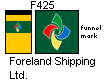
The funnel follows Hurst Point’s starboard side and Eddystone’s port side, the latter photographed on 5 January 2007.
The source gives incorporation on 3 March 1999 and establishment in 2001 to build and operate six ro-ro vessels. The original equal shareholders were Andrew Weir, Bibby, Hadley and James Fisher, with independent London management. A later website account gives Hadley 75% and Andrew Weir the remainder, presumed to be its original quarter. Initially A.W.S.R. Shipping, the company became Foreland Shipping in 2005; later registers place it under Andrew Weir’s management.
UK, London.
The funnel follows Fu May at Newcastle in February 2008.
Formed in 1990, Foremost was founded by James S.C. Chao as a brokerage and agency concern. Ship names used May as their second word.
USA, New York.
The company operated tugs.
Denmark, Copenhagen.
The funnel follows portside and starboard photographs of Caroline S dated 29 May 2012 and 28 June 2005.
The association owned the vessel from 10 August 1994. Named Caroline Samsø on 15 August 1994, it became Caroline S on 16 January 2002 and changed from a freighter to a museum and cruising ship. Operation passed from Asociation Caroline Samsø to Asociation Caroline S. Recorded managers include William Nielsen & Co. and later JMB Bjerrum & Jensen ApS.
Denmark, AEroskobing; Svenborg is recorded later.
Canada, Vancourver, as spelt in the source.
The funnel is yellow or buff with a black top and a broad band of the flag. The blue flag has two very narrow white horizontal bands near its upper and lower edges. Between them, white FT is formed from two Ts with angled uprights, the second shorter and its crossbar meeting the first to form the F. Rosanoski gives the upright angle as “Pbd”.
Det Bergenske Dampskibsselskab was involved in the company; the source’s date notation is unclear.
Norway, Bergen.
FPMC B 102’s starboard side and Formosaproduct Alpine’s port side document this funnel in 2011. Mitchell shows its panel as a band, understandable because photographs sometimes show it occupying almost the whole funnel width.
Formosabulk Clement at Newcastle in March 2008 shows different colouring from its earlier F305 appearance. Rosanoski initially considers a ship-specific trial or camera fault, noting that Formosa 6 remained unchanged, but Formosa Thirteen’s October 2013 starboard photograph also shows this version.
Formosabulk No. 4 appears with a plain funnel in photographs recorded in October 2007 and February 2008, while Formosabulk No. 2 under the same shipowning company carries the logo.
The company website gives foundation in 1980, while Lloyds dates it to 1981, when the first ships were acquired. Associated Formosa Plastics Shipping and Formosa Plastics Transport, at the same address, later appear as managed companies. Vessel names used Formosa as a first word or prefix.
Taiwan, Taipei.
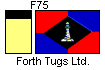
The emblem is a white lighthouse detailed in black. Thomas and Mitchell record the funnel under Grangemouth & Forth Towing, with Thomas’s attribution supported by a drawing of Elie.
Grangemouth & Forth Towing Co. was formed in 1895 by the amalgamation of A. McKay and Forth Towing Co.; Rosanoski also records its joint formation by Clyde Shipping Co. and Cory Towage. It became Forth Tugs in March 1977.
Following the takeover of Cory Towage in 2000, it was incorporated into the Wisjmuller fleet.
UK, Grangemouth.
Master Fouad K in July 1965 had a yellow or buff funnel with a white ring enclosing red-and-white quarters, overlaid by a green tree. DEM LINE appeared on the hull, so Rosanoski allows that the funnel may be the charterer’s. No flag was noted.
DEM charterer versus Khayat livery not established.
The company is recorded in Lloyds 1963–64 and 1970–71.
Lebanon, Beirut.
Rosanoski presumes that the funnel marking derives from Captain Jan Wandelaar, the main character in the television series. The photograph was taken on 7 May 2005.
Built in 1916, the tug Furie was bought in 1918 by Holmen Bruks & Fabriks of Nooköping, Sweden, and served as Homen III until its sale in 1969, when it became Holmvik. AVRO bought it in 1976 for the television series Hollands Glorie, in which it portrayed Jan vand Gent and then Furie. After filming it passed to Heise Trading Co. of Zaandam, and the Foundation bought it in February 1978. By 2005 it was billed as Holland’s last seagoing steam tug, operating as a sailing museum with inland cruises.
Netherlands, Maassluis.
The funnel is drawn from a photograph of Foundation Alice. Rosanoski regards the colours as reasonably certain but allows a slight possibility that the central colour differs from the ground, to which it would be very close.
Foundation Maritime was formed in the 1930s by the Foundation Company of Canada, a construction business dating from the early twentieth century. Its fleet operated mainly from Halifax until the ships were sold in the 1960s and attention returned to building. The tugs initially retained their names after sale. Rosanoski records a takeover by MIL Tug & Salvage and the subsequent name Eastern Canada Towing in 1972.
Most vessels had Foundation as the first word of their names.
Canada, Halifax.
The emblem is a stylised gabian, the Provençal word for seagull. Armements Marseillais specifies light blue, supported for the funnel by a photograph of Michaelis. The Nüsse flag suggests a change, while a company website logo might indicate reversed flag colours. Victoria has a different funnel, probably because it was on charter.
Pavillon may show this flag, but with shorter waves placed beneath the bird towards the fly; it does not identify its source.
FS Philippine in April 2005 confirms the funnel, though without a black top. A starboard photograph of FS Vanessa shows the bird flying forwards: the flag illustration therefore shows that side rather than the port side.
Founded by coal merchants in the 1920s, the concern entered shipping in 1930 through Société Auxiliaire des Consommateurs de Produits Petroliers (SACOP), formed by the Ambroggi family, spelt Ambrogi in FOTW. The fleet was lost during the Second World War and operations resumed in 1946. A new associate brought a change of name in 1950, recorded as Fouquet SOCAP. After 1965, Société Maritime et Commerciale de Monaco (SOMARCO) was established in Monaco for trade with the USA. A restructuring in 2002 left Fouquet Sacop Maritime responsible for management and crewing and Fouquet Sacop as shipowner.
The business was sold in March 1998 to Sociéte Financière Neptune, owner of Gaz Atlantique. Eitzen Group acquired it in 2006 as part of Eitzen Chemical and sold it in 2007 to Sea-Invest N.V. Sea-Invest’s subsidiary Ghent Coal Terminal had already become a shareholder in 2005, replacing Matignon.
France, Marseilles.
A red flag bears a small central white lozenge containing two crossed black tools, tentatively described as mining tools.
Schneider describes the variant as containing a black hammer and mallet, mining symbols referring to the company’s coal-depot origins. He saw the flag image with the website address in Hamburg-St.Georg on 30 March 2009.
Frachtcontor, also recorded as Frachtkontor, began on 7 April 1905 as Frachtcontor GmbH, formed by Robert Loesener and Van Nievelt Goudriaan & Co. Its shipbroking and chartering work became closely tied to coal supply. In 1907 Deutsche Kohlen-Depot, an association including Hamburg Amerika Linie, Norddeutscher Lloyd and Sloman, acquired the Van Nievelt interests to represent its members in buying and shipping coal, chiefly for their African services. Rheinisch-Westfälisches Kohlen-Syndikat also became a shareholder; the two organisations were equal owners by 1910.
The concern helped found Seereederei “Frigga” and Poseidon Schiffahrt in 1920. Its Poseidon interest ended in 1925 with the merger forming Kohlenimport und Poseidon Schiffahrts A.G. Westfälische Transport Aktien-Gesellschaft joined as a shareholder in 1921, when Baltische Frachtkontor and Hedwigshütte were also established with Frachtcontor participation. In 1924 the operating business became the limited partnership Frachtcontor Junge & Co., with Erwin Junge and Friedrich Brüggermann as general partners. The original GmbH survived until 1971 as a holding company, retaining its Frigga stake until 1965.
When the Allies ordered Rheinisch-Westfälisches Kohlen-Syndikat wound up in 1954, its shares passed to Montana Verwaltungs. Montana acquired Deutsche Kohlen-Depot’s shares in 1964 and bought out Westfälische Transport in 1966. Poseidon of the Stinnes Group acquired half in 1972. Frisia Handels-und Transport was acquired in 1974. Rhenus acquired the other half in 1984 along with Poseidon; Stinnes directly acquired Poseidon’s holding in 1991, and the 1996 merger with Rhenus left Stinnes sole owner. Frachtcontor became a private GmbH in 2000 and passed to Schenker in the 2003 Deutscher Bahn takeover of Stinnes. Management, Atalanta and other shipping partners bought it in 2007.
The company provided ship management through associated Poseidon Schiffahrt. In 2008 its tanker department combined with John T. Essberger’s tanker-broking team as Frachtcontor-Essberger Tanker Brokers, based at Frachtcontor’s Hamburg headquarters.
Germany, Hamburg.
The funnel is documented in a port-side photograph of Jona taken on 1 July 2013.
Founded in October 2012, Frachtschiff-Kontor brought together F. Laeisz, Norddeutscher Reederei H. Schuldt, Rickmers Reederei and lawyer Jan Duken to restructure vessels threatened with insolvency. Ships were bought and traded on a revised financial basis, with management supplied by one of the three shipping partners. The name, roughly “freight ship counting office”, recalls Deutsches Segelschiff-Kontor, which saved part of the German merchant fleet from bankruptcy after the First World War.
Germany, Hamburg.
The flag symbols are the Greek letters gamma and phi.
Also known as Fragline, the business was formed in 1957 as Fr. Fragoudakis S.A. and became Fragmar Shipping Corporation in 1986. It was listed as an agency, acting through an operating subsidiary.
The Athens subsidiary Avondale Navigation Co. was formed in 1986. It was not connected with the earlier British company of the same name.
Greece, Athens.
NH stands for N. Højgaard. The funnel is documented in a starboard photograph of Havrakt taken on 26 June 2013.
The company, also called Frakt & Sand, appears in Lloyds from 1988 as Frakt & Sandolan and later as Frakt & Sandsoelan. Its part managers included Niclas Hojgaard of Glyrar and Alvur Hojgaard of Saltangara.
Faero Islands: Saltangara, later Runavik.
The funnel is documented on Fret Aquitaine in a photograph dated 12 January 1998.
The funnel is documented on Fret Sologne on 31 May 2000. Rosanoski assumes the flag still applies, using a flag logo on the Louis Dreyfus website.
Also recorded as Fr. E.T. and Fret, the company was restructured in 1997 after Compagnie Meridionale de Navigation withdrew. Louis Dreyfus and Navale Française formed it into a joint venture; it subsequently became wholly owned by Louis Dreyfus Armateurs.
France: Paris and Montpellier are recorded.
Rosanoski notes that the Vrolijk Group appears to use several funnels. This one is documented on Prins Bernhard, port side on 6 December 2013 and starboard on 24 December 2013.
France Pélagique was established on 1 October 1988 by Antoine Dhellemmes and Cornelis Vrolijk according to the cited maritime-cluster account. Lloyds instead dates the joint venture between Armement Dhellemmes and Cornelis Vrolijk’s Visserij Maats. to 1989. By 2013 the company managed the freezer trawlers Prins Bernhard and Sandiette.
France, Paris.
The flag is taken from Pavillon’s reproduction of the Franship website image, retrieved through the Wayback archive.
France Shipmanagement, also known as Franship, was formed in 1987 as a joint venture involving Nouvelle Compagnie de Navigation, Société Française de Transports Pétrolièrs and Compagnie Morbihannaise et Nantaise de Navigation. Gaz Atlantique was among its name companies. It became a wholly owned French ship-management subsidiary of Euronav and was renamed Euronav Ship Management SAS in 2005.
France: Nantes, later Saint-Herblain.
The original 1918–1920 livery continued Sunderland Towage’s colours.
The 1920–1977 livery combined Sunderland Towage and Anchor Steam Tug colours; the funnel survived until 1986. Merchant Ships specifies light-blue bands and a dark-blue anchor, while Mitchell shows a black anchor. F337 is the starboard view, mirrored on the port side as F339; a Hendon postcard confirms the starboard arrangement. The flag appears on Cullercoats. Brown 1951 and 1958 omit the narrow black band beneath the funnel band.
Eppleton Hall, bought by the San Francisco Maritime Museum in May 1969, carries added red M and Z letters. Whether they represent the new owners is unclear.
Tugs chartered to Tyne Tugs used its funnel colours. Those transferred to Wear Tugs in 1978 retained their funnels but flew Lawson-Batey’s flag; Brown 1982 instead shows Wear Tugs retaining the full livery, with the F337 funnel style.
Formed on 1 March 1918 as a William France, Fenwick subsidiary, the company took over Anchor Steam Tug in July 1920 and thereafter advertised as Anchor Tugs or the Anchor Line of Tugs. British Steam Tugs instead describes the 1918 formation as an amalgamation of Sunderland Towage, Anchor Steam Tug and John E. Dawson. Later acquisitions included Coulson in 1925, Brown Tug in 1930, Irwing Steam Tug in July 1934, Redhead & Dry’s in May 1944, the Lambton, Hetton & Joicey towage operations in November 1945, and R.L. Cook in 1947.
The company joined the Tyne Tugs co-operation, dated 1958 by Mitchell but effective from 1 January 1959 in the detailed account. Tug ownership remained unchanged, with vessels chartered to the new concern. France, Fenwick continued under its own name; Rosanoski distinguishes the Tyne operation from the Sunderland section. Later Lloyds listings name Lawson-Batey as operator.
It joined the consortium buying Joseph Crosthwaite (Tugs) in July 1933 and later increased its interest to half through the Redhead & Dry’s acquisition and a share transfer. The passage gives an inconsistent later date for that increase; Crosthwaite was wound up in 1950.
Jessel Securities acquired the parent and subsidiary in April 1968. Unsuccessful sale attempts in 1969 and 1975 were followed by Jessel’s voluntary liquidation in January 1976. Lawson-Batey bought the tug assets in May 1977 and incorporated them into Wear Tugs.
UK, Newcastle.
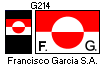
G214 brings together the company’s funnel and flag. Its sources include Brown, Lista Oficial de Buques de Espana and Stewart; the FOTW flag image was based on Stewart. The original text gives no further design description.
The company is recorded under the operation of Francisco Garcia in 1953–4 and again in 1958–9. Rosanoski supplies no definite establishment or closure date.
Spain, Santander.
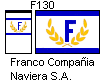
The funnel is documented on Anita in a photograph dated 31 January 2005.
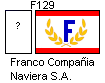
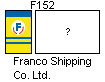
Aglaia was recorded with this funnel in January 1967 under A. Frangistas & Others. The laurel branches are red in the NJK account but gold in Christies. Mitchell assigns the funnel to the agents.
Company equivalence, flag allocation and laurel colour remain unresolved.
Nüsse shows two flags, possibly distinguishing agents from managers.
Dr Achilles Frangistas formed the Franco Shipping Group in 1948 and acquired its first ship in 1951; Lloyds dates formation to 1951.
Rosanoski assumes Franco Shipping Co. and Franco Compañia Naviera are the same concern, noting their Athens addresses and the transfer of fleet listings to the latter name. By 1998 Franco Shipping Co. of London was listed as owners’ representative for Franco Compañia Naviera.
Associates included Akirama Compania Naviera and the Athens agency Tabac Corporation, formed in 1979.
Greece, Athens.
Rosanoski suggests that this funnel may explain Mitchell’s attribution of E.L. Frangos livery to Eleni E.F.
The sole vessel, Eleni E.F., was sold in 1974. Mitchell names Elias Frangos as manager, but Rosanoski finds no support for this in Lloyds.
Greece, Piraeus.
Mitchell states that the blue sometimes extends to the deck. Rosanoski suggests a connection with the funnel shown for Franga Compañia Naviera.
The 1983 Greek Shipping Directory couples Elias Frangos & Son Shipping with Elfrangos Compañia Naviera, naming Elias Frangos and Marcos El. Frangos as managing directors. Mitchell identifies the concern as manager of Franga Compañia Naviera, but Lloyds 1973–74 does not support this.
Greece: Chios, later Piraeus.
G. Matarangas acted as agent.
Greece, Piraeus.
Greece: Chios, later Piraeus.
For N. Frangos, Rosanoski refers to Good Faith Shipping Co.
P.S. Frangos was listed as a manager in Lloyds 1985–86 and 1988–89.
Greece, Piraeus.
The concern was later listed under agents Frangos Prokopous and Koinopraxia Epivatochimatagogon Salaminos.
Greece, Piraeus.
Agia Trias of Compañia Marcielo Naviera was recorded with this funnel and a mourning band in July 1966 and April 1967.
The 1958 directory lists Frangos Brothers as managers and agents, with Stamatios M. Frangos among the directors. Rosanoski notes an apparent association with Ceres Shipping, at the same address.
UK, London.
Greece, Chios.
Keep the explicit scope label independent; no alias or company identity is inferred.
The usual funnel is black with a broad white band carrying four shortened chevrons alternating red and blue. Both sides point forward; a left-pointing drawing represents the port side. The flag is a white forked flag, described as 2:3, with blue borders along its fly-wise edges and four red-and-blue chevrons towards the hoist. Bars and intervening spaces are equal in width and occupy nearly the whole depth. The chevrons and fork are right-angled. Most sources extend the fork across the full fly rather than only the white band; Talbot-Booth is the principal exception. Poor printing leaves the gap beside the last chevron uncertain. The museum flag is dated 1955 and measures 1,498.6 × 1,828.8 mm.
Rosanoski rejects Reed 1912’s funnels because the World Ship Society history records only the black funnel with band and chevrons. London & Paris remains less clear: two illustrated ships carry the Strick funnel, one appears yellow with a black top and another plain black. Reed assigns A166 to that company.
Talbot-Booth 1936 incorrectly staggers the chevrons, placing the blue ones higher.
The commodore’s flag is a white tapered swallow-tail with a red cross and four red-and-blue chevrons in the canton. The Caltex-derived rendering staggers the chevrons.
The World Ship Society history assigns the shared funnel to subsidiaries except La Tunisienne Steam Navigation, Cory & Strick and North Devon Steamship, which had their own liveries. London & Paris is unresolved.
Frank Clarke Strick, a Swansea coal exporter and shipbroker, founded the line in 1885. The sources date shipowning to 1887 and steamship ownership to 1895. La Commerciale, Anglo-Arabian and Persian, and Anglo-Algerian companies combined as Strick Line on 1 January 1913. P&O acquired the business in 1919; it subsequently became Strick Line (1923), reverting to Strick Line in 1946.
The line was absorbed into P&O in 1972 and is said to have ceased in 1974, although it continued in Lloyds through 1980. Rosanoski understands that the flag ceased use in 1972, with the name retained for registered ownership into the early 1980s.
Associated concerns included the Anglo-Algerian companies; Anglo-Arabian & Persian, formed in 1892; London & Paris, formed in 1889; Dwina, formed in 1905; La Commerciale and La Tunisienne; and the Serbistan and Shahristan companies, formed in 1922. Cory & Strick (Steamers), formed in 1928, became United British Steamship in 1943.
U.K., London.
The house flag is horizontally divided white–green–white, with fimbriation, and carries a green-on-white logo: a stylised F, which Mertens thought resembled a V, above small waves. The logo is shifted towards the hoist, correcting an earlier centred depiction. Dennis-F supplies the funnel reference; its yellow top is a cap not apparent in photographs of other vessels.
The company also flies a similar pennant, with the logo nearer the hoist. An auction example was approximately 0.50 by 0.75 m; Rosanoski also cites a photograph of Colin-F.
Active in freighting since the early 1900s, Fransbergen operated owned and chartered push-navigation vessels and barges, and also sold sand and gravel.
Netherlands, Massbracht.
The dark blue flag has a white FH initials logo. Rosanoski notes that the FOTW image coincides with the Mobil chart’s H630, although its stated 1957 source should correspond to H631. Mobil also shows very dark blue.
Mitchell shows dark blue letters on this funnel.
For Semper, Esso 1958 gives a darker blue in S1478, as for H631. Rosanoski notes that the S1479 FOTW image should follow S1478 according to its cited source.
Franz Hagen began in 1950 with the purchase of Otto Porr. Vessels were named for members of the Porr family; the last, the partnership-owned Marabu Porr, was sold in 1979. Anneliese Porr, built in 1952 and sold in 1961, appears under Semper Schiffarhrts at the same address, although the relationship is otherwise unclear. Another vessel, spelt Anneleise Porr in the account, was built for Hagen in 1963 and sold in 1975.
Germany, Hamburg.
Massary 1930 and Lloyd Reedereiflaggen 1933 show white with narrow blue horizontal stripes near the top and bottom and blue FLN between.
Brown 1934 gives a blue-white-blue horizontal triband with black FLN. The white stripe is slightly wider and the letters are large and broad.
Talbot-Booth’s 1937–44 versions follow the wider-white-stripe arrangement but use a different, ornate letterform. Jordan’s red rather than blue funnel bands are treated by Rosanoski as an error.
Brown 1943 makes the flag stripes equal and the black letters smaller and closer together.
Esso and Flaggen & Schornsteine use ornate lettering, but the letters are black. Rosanoski identifies FOTW’s N608 portrayal as incorrect against its stated source, whose black lettering also appears in the 1957 and 1958 editions and Stewart 1963.
The US Navy version makes the white stripe wider still.
Originally Nimtz & Henning, the firm became steamship owners in 1901. Its last vessel, Selma Nimtz, was sold in 1963.
Germany, Stettin, subsequently listed at Hamburg.
The FOTW image was taken from the online Lloyds 1912 chart under a reading of Fratelli A.A.G. (or O?) Semides. Rosanoski identifies the title as Fratelli A. & G. Semidei.
Fratelli A. & G. Semidei operated sailing ships; Fratelli means Brothers.
Italy, Genoa.
The red funnel has a black top and a white band surmounted by a white circle without a defined outline. A green F is superimposed on a smaller, squatter green B. The red flag has a white diamond bearing the same green letters.
Rosanoski suggests that this was previously Fratelli Barretta fu Domenico, as recorded in the 1963–64 and 1970–71 Lloyds lists.
Italy, Brindisi.
Both sources show a white flag with a red cross. Reed 1912 gives a white funnel with a black top; Lloyds 1912 instead gives a green funnel with a red top separated by a broad white band.
Italy, Genoa.
Brown 1951 misplaces the illustration under Sociedade Portuguesa de Navios Tanques and omits d’Amico from its index. The white-disc emblem resembles an H whose horizontal arm extends beyond the sides, topped by a slanting roof.
Earlier website images support this flag and logo form, but with a smaller white disc. The source compares disc size and notes that Brown’s later editions centre the cross; its comparison passage uses the inconsistent reference D169.
Photographs confirm the funnel but show narrower red bands: very narrow on Mare Nostrum, somewhat wider on Mare Adriacum. The white circle also varies, appearing smaller on Scorpius.
The FOTW rendering after the Caltex book shows a yellow flag with a blue Maltese cross and blue centre disc. Rosanoski points out that the company website and most sources make the centre white.
The company website dates the business to 1936, founded by Masssimino Ciro d’Amico and his eldest son Giuseppe to support their timber trade. Six other sons joined. Lloyds gives formation in 1941. In 1952 Giuseppe, Oronzo, Vittorio and Carlo remained with the company, while Ciro, Salvatore and Antonio formed d’Amico Società di Navigazione.
Many vessel names began with Mare.
Italy, Rome.
Recorded for Aldebaran D in the NJK material, the black funnel has a broad red band bearing a white D. The flag is a red pennant with a white D whose ends are extended.
Country unknown in the original.
The flag lettering differs between renderings. Rosanoski considers Audun Haglo’s version possibly correct, but the website logo and funnels show the F’s middle arm shorter than the top and a squared D. Brown 1995 slants the letters and uses a different typeface, which he regards as probably wrong. An earlier FOTW image mistakenly reproduced d’Amico’s flag and was subsequently corrected. The website flag is dark blue, while ship funnels use mid-blue; the darker D498 flag follows the logo without independent support.
The F D Gennaro funnel photograph differs slightly from F D Vittorio Raiola, where both letters have level bases. F D Honourable has no funnel: blue letters with level bases are placed on the white superstructure.
Mitchell records this funnel for Pan Fir, with the vessel period given as 1990–93.
P645 follows Miss Simona on 18 September 2010. P646 follows Miss Benedetta on 3 May 2013, though the photograph’s lighter blue may reflect lighting or image adjustment. The flag follows the website graphic: a dark- and light-blue triband with a white anchor flanked by white G and D. Rosanoski corrects a FOTW description which calls the field simply blue.
Perseveranza’s formation date was amended from 1979 to 1969, supported by its website. Giuseppe D’Amato’s family owned 86%, with Giuseppe as president and sons Umberto and Angelo on the board.
Ships Surveys & Services is dated 2003 in Lloyds but 1985 on its website, which describes ship-management services for Fratelli D’Amato, Perseveranza and Aurora Shipping.
Keep the explicit scope label independent; no alias or company identity is inferred.
White Dolphin, under Dolphin Tanker Srl, provides this funnel. Port and starboard photographs show the dolphins mirrored so that they face forward on both sides.
Keep the explicit scope label independent; no alias or company identity is inferred.
The Primrose funnel photograph is described as wrongly allocated to Perseveranza. Its narrative reference is G545, while the bibliography lists G543; that numbering discrepancy remains unresolved.
The group traces its origins to 1870, while Lloyds gives formation in 1923. Fratelli D’Amato SpA is described as taking that form in the second half of the twentieth century. Directory names at Torre del Greco include Umberto, Michele and Captain Antonio D’Amato before Fratelli D’Amato. The wider shipowning family was also associated with Deiulemar, D’Amato di Navigazione and Di Maio & Partners; Guiseppe D’Amato is described as its eldest member and as a former director of Fratelli D’Amato.
Associated operating companies included Interservice, formed at Savona in 1997, and Gorgonia di Navigazione, formed in Naples in 1998 and controlled by D’Amato di Navigazione. The latter began as Societa D’Amato di Navigazione SrL in 1991 and became a SpA in 1999.
Italy, Naples.
Website photographs confirm a black funnel with a normal-to-broad white band. The website flag image analyses as dark blue, but elsewhere looks definitely black to Rosanoski.
The Neri group’s history began with Titi Neri’s operations in 1905. The website still described an active business in 2004 despite omission from Lloyds 1996–97.
Italy, Livorno.
The registers list Fratelli Neri from 1937–38, Fratelli Neri e Sgarallino in 1985–86 and Fratelli Neri S.a.s. from 1988–89, apparently combining the separately listed concerns. Its fleet consisted of tugs and small tankers.
Italy, Leghorn (Livorno).
Fratelli Neri S.a.s. Gestione Rimorchiatori appears separately from 1978–79 through 1985–86.
Fratelli Tito e Alfredo Neri is separately listed in 1980–81 and 1985–86.
Italy, Leghorn.
Keep the explicit scope label independent; no alias or company identity is inferred.
Tito Neri appears separately from 1953–54, with his fleet under Comm. Tito Neri by 1980–81; the latter entry continues in 1985–86.
Keep the explicit scope label independent; no alias or company identity is inferred.
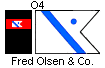
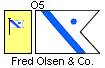
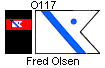
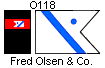
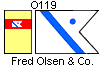
The original funnel is identified by TheShipsList. Nüsse’s table flag indicates dark sky blue; a sunlit example looks lighter. Although the later website photograph can look rectangular, the very pale greenish background within the swallowtail remains visible.
Brown 1951 assigns O4 to steamships and O3 to motorships; Harnack distinguishes black and grey hulls respectively. TheShipsList describes a broad red band on O4. O3 was adopted in the 1930s in pale yellow, while Jordan calls both O3 and O119 yellow. The flag was known as the “bone and billet”, or “bone and biscuit”. Early sources show O118’s flag flying aft on a funnel assigned to grey-hulled ships, although Talbot-Booth also assigns O3 to grey hulls. Black Watch confirms O3; a starboard view of Breñas shows a mirrored emblem with its tail aft. Jordan records O119 as an alternative.
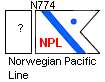
The source places this flag under Norwegian Pacific Line but records no further established detail.
Legal relationship to Fred Olsen not established.
Westfal-Larsen supplied the funnel base and bands for the Fred Olsen Interocean Line partnership.
Black Watch photographs from August and September 2005 show a mirrored flag emblem pointing forward on both sides, slightly wavy and apparently on a panel attached to the funnel. The broad red band’s position varies with funnel shape: it lies lower on Black Watch but occupies most of Balmoral’s funnel in February 2011. A lighter blue in one Balmoral photograph appears to result from colour manipulation.
No exclusive fleet-wide use or unrecorded corporate equivalence is asserted.
Do not silently repair ambiguous code or assign from proximity.
Mitchell gives no explanation for these funnels. The Fred Olsen-Bergen Line O346 funnel was actually pale yellow with the partner’s three white bands; its illustration was darkened to make those bands more visible.
The Mediterranean joint venture with Ole R. Thoresen used two yellow bands on paler buff; omission from Merchant Ships 1959 suggests subsequent use of Olsen’s O3. Mitchell’s Tidero Star entry has orange T over R beside its funnel, but their relationship is unknown. The Spanish Líneas flag repeats the Norwegian design in red and yellow. Ferry photographs are too unclear to establish whether its funnel equivalent is that flag on yellow.
The Olsen family’s shipowning began at Hvitsten in 1848 with Fredrik Christian Olsen, followed by his brothers Petter in 1852 and Andreas in 1860. Petter’s son Thomas Fredrik, known as Fred, ordered his first steamship in 1897 and moved to Oslo in 1898. He acquired the Ganger Rolf Rouen route in 1900, Færder’s Grange mouth route in 1901, Østlandske Lloyd’s Newcastle and Antwerpen routes in 1906, and Norden’s Holland route in 1912. He also developed Scandinavian–South American and Norwegian–Baltic services, taking part in Norwegian South America Line in 1914. His sons Rudolf and Thomas became partners in 1914 and 1922 and continued the firm after his death in 1933. The main account dates the Fred Olsen & Co. name to 1916; Lloyd’s instead gives an 1886 formation and a 1907 name change, which Rosanoski questions.
Otto Thoresen was absorbed in 1921, apparently continuing under its own name, and Jeløylinjen’s German services were acquired in July 1923. The tanker trade began in 1929 through British subsidiary Blandford Shipping, a joint venture with Fruit Lines. A partnership with Bergenske predated the Second World War. The Nordenfjeldske service bought in 1951 became London’s Nor-Med Lines. A joint Newcastle service with Bergenske began in 1966, used the Fred Olsen-Bergen Line title from 1975 and ended in 1986. Other relationships included the Mediterranean venture with Ole R. Thoresen, participation in Den Norske Syd-Amerika Linje, the 1966–70 Interocean venture with Westfal-Larsen, and Star Shipping from 1970 to 1988.
Passenger services developed from the 1950s into Fred. Olsen Cruise Lines, recorded as formed in 1989. Kristiansands D/S was acquired in 1968. The ferry routes and ships passed to Color Line in January 1991 according to Mitchell, or in 1990 according to Color Line. The source also records the sale of North Sea Line for merger with Tor Line, but its date is incomplete. In Spain, Ferry Gomera was formed in 1974 and renamed Lineas Fred Olsen in 1994. The Moroccan interests included Comarit and a majority stake acquired in Compagnie Marocaine de Navigation in 2009; the account says both interests were sold to Moroccan investors that year. After the tanker fleet’s 1972–73 sale, Ganger Rolf and Bonheur re-entered tankers in 1986, consolidating them into Bermuda’s First Olsen Tankers in 1993, later First Olsen.
Rudolf died in 1951 and Thomas in 1969. Thomas’s son Fred, a partner from 1955, managed the companies until his daughter Anette S. Olsen took over Fred Olsen & Co. in 1994. The family firm provided administrative services to Bonheur and Ganger Rolf, whose activities were closely co-ordinated on a 50:50 basis. Their interests extended to drilling, production, renewable energy and cruises. Aker had been majority-owned for about seventy years before its sale in the mid-1980s. Aker Drilling, bought in 1976, became Dolphin Services and then Dolphin; Rosanoski notes that the register’s chronology conflicts with earlier editions. Red Band became Fred Olsen Marine Services in 2005. Bonheur’s incorporation is variously given as 1897 and 1903; Ganger Rolf’s is 1895.
Norway, Hvisten, then Christiania and Oslo.
British Coastal Ships confirms a black outline around the oval and assigns the funnel to Hull Gates Shipping Co. Ltd.
Recorded as an operator in 1978–79 and 1980–81, Fred Parkes acquired Hull Gates Shipping and acted as its operator and agent. The Lloyd’s number suggests that it became Hull Gates Ship Management Ltd.
U.K., Grimsby.
The flag is also attributed to Lexington, a vessel recorded under both company names, although Nantucket Signals does not show her using it. Another vessel in which Sanford was involved, Rambler, had its own flag.
Frederick C. Sanford was active as a whaler during 1838–1847 and as Field & Sanford during 1848–1852. Rosanoski tentatively identifies him with the Frederick C. Sanford who lived from 1809 to 1890. Loughran gives the names as F.C. Sandford and Field & Sandford; both spellings are associated with nineteenth-century Nantucket.
USA, Nantucket.
The meaning of the P on the flag is not recorded.
The company operated sailing ships.
USA, New York.
The partners appear to have retained separate liveries under Green & Anderson. Rosanoski traces the earlier flag to Green & Wigram, owners of Sir Edward Paget in 1824. At the 1843 split, Wigram carried it to Money, Wigram & Sons, while Frederick Green’s version placed the blue panel behind the cross.
Frederick Green, known as Blackwall Line, was formed in 1843 by Richard Green’s successors after the split with Wigram. A sailing-ship partnership with Anderson, Anderson is dated to 1874 and called both Anderson & Green and Green & Anderson, though formal combination appears not to have occurred until 1919. The two firms jointly founded Orient Steam Navigation on 12 February 1878; Rosanoski distinguishes this joint venture from accounts calling it a merger. Sir Kenneth Anderson and Sir Frederick Green alternated annually as Orient chairman until the Greens sold their interest to Lord Inchcape in 1919, bringing P&O control. Anderson, Green & Co. Ltd. then became shipbrokers.
UK, London.
Rosanoski states that the USSR funnel colours were derived from this company and cites a black-and-white photograph in Marine News as confirmation.
J110 is recorded in Lloyds 1912.
J111 is recorded in Merchant Ships 1942 and 1944.
Frederick Jones began shipowning in 1907; his business became known as Abbey Line by the late 1920s, with vessels named after abbeys. Sources date Abbey Line to 1907 or Abbey S.S. Co. to 1909. Melrose Abbey’s 1907 company became Melrose Abbey Shipping in 1909. One account says shipowning continued until 1971 before investment activity under Jones’s son, but Lloyds entries cease much earlier, and British Ocean Tramps places the last vessel’s lay-up in 1957 and sale in 1960.
U.K., Cardiff.
The funnel is yellow or buff with a black top and a white horizontal oval with straight sides, containing a blue crossed Z. The red flag carries the same white oval and blue crossed letter.
Frederik F. Zimmer is listed as a manager in Lloyd’s 1958–1959.
Norway, Oslo.
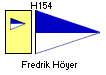
The funnel is yellow or buff with a panel of the flag. The flag is a pennant divided horizontally blue over white.
Fredrik Höyer appears as fleet manager in Lloyds 1963–64 and 1970–71, managing three single-ship companies in the former register and two in the latter.
Norway, Skien.
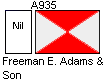
Freeman E. Adams & Son. acted as whalers and agents from 1865 to 1869.
USA, Nantucket.
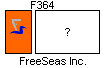
Free Impala on 9 October 2008 shows an apparently grey F and sky-blue S. Free Goddess carries a similar funnel in a photograph of 4 February 2009.
Two photographs of Free Maverick on 16 April 2010 show a distinctly darker blue. The F looks white in one and grey in the other, leaving open whether wear has altered an originally white letter. Comparing the other vessels and company logo, Rosanoski suggests the darker blue may be a painting error. The ship was managed by Free Bulkers and included in the FreeSeas website fleet.
Established in April 2004 in the Marshall Islands as Adventure Holdings S.A., the independent shipping company adopted FreeSeas Inc. on 27 April 2005 while maintaining its principal office in Piraeus. It went public in December 2005 and underwent a capital-increasing reconstruction in January 2007.
George Gourdomichalis and his brother, named Efetathios D. or Stathis in the sources, were co-founders of FreeSeas and of its management company Free Bulkers. The latter’s foundation is given as 2003 in the narrative but 2004 in Lloyds. The brothers sold their shares in January 2007 and established G. Bros Maritime and G. Lines. Fellow co-founder Ion G. Varouxakis owned Free Bulkers and served as FreeSeas chairman, chief executive and president.
Greece, Piraeus.
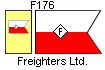
The Log shows a swallowtail divided horizontally white over red, with a small white diamond outlined in black over the division and bearing a black F.
Freighters became a shipowner in 1948. Its sole vessel, Merilyn, was wrecked on 24 November 1958.
Rosanoski tentatively identifies it with a business registered on 8 February 1946 as Frighters Ltd., later Freighter Industries and Froltons Holdings, still active in Melbourne’s truck and trailer industry in 2008.
Australia, Port Adelaide.
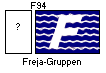
The blue flag has six narrow white wavy horizontal bands and a white F extending from the first to the sixth band. Rosanoski describes the F’s angle as “Pbds” and states that the website image’s colour shades were not used. No funnel is given.
Formed in 1988 as Galleon Shipping ApS, the group changed its name in 1993. Its subsidiaries included K/S Freja Scandic, formed in 1996, and Freja Tankers, formed in 1991. Freja Tankers held vessels through shipowning subsidiaries, with D/S Progress and later Goliat Shipping appearing as managers.
Denmark, Copenhagen.
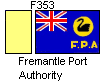
The new authority’s flag dates from 27 November 1964. It is a Blue Ensign with the Union Flag in the canton and, in the fly, a yellow circle containing a black swan swimming towards the hoist. Yellow F.P.A appears beneath the circle. The livery is recorded for Challenger in 1965–1976.
Fremantle’s port began with the Swan River Colony in 1829. The city was named after Captain Charles H. Fremantle, who arrived in HMS Challenger and took possession in King George IV’s name on 2 May that year. Fremantle Harbour Trust was formed in 1902 and became Fremantle Port Authority on 27 November 1964. The name Fremantle Ports first appears in its history in 2001, suggesting a change between 15 May and 26 October.
Australia, Fremantle.
The 1970 funnel combined the founders’ colours. The two companies had jointly bought Wilga in 1955 and subsequently built tugs for joint ownership.
New colours, described as bright, replaced the earlier funnel around the mid-1980s. Hull colours changed too: previously separate schemes had distinguished the two owners’ tugs and those held jointly.
Formed in 1970 to operate Adelaide Steamship and Swan River Shipping tugs at Fremantle, the concern was later listed as a joint venture of Adelaide Steamship Industries and Howard Smith Industries. It was recorded as deregistered in 2008, without a closing date.
Australia, Fremantle.
White Castle was photographed at Wellington on 9 August 2003. The funnel was initially unidentified; subsequent information connected it with a charterer, while RGT suggested a Japanese-owned reefer concern.
Atlantic Erica on 23 December 2011 shows a variation: its two bands are hidden in a side view but run around the back, and other photographs also show them at the front. They look dark blue or black in shadow, but other views confirm the normal light-blue shade.
Shinano Reefer at Sydney in June 2007 had blue bands stopping short of the funnel ends. JB later identified the markings as Fresh Carriers’. The vessel was managed by Faith Maritime; because the detail did not agree with Lloyds, Rosanoski assumes a charter. A photograph of the chartered Copinhue at Wellington on 20 August 2004 confirms this version.
Use on Haro Verdy, photographed loading kiwifruit at Tauranga on 19 August 2011, appears to confirm that the funnel belongs to Fresh Carriers rather than Faith Maritime. The ship had carried K.K. Kyokuyo colours on 17 March 2011. Rosanoski presumes Fresh Carriers acted as charterer.
Fresh Carriers was formed in Japan in April 2001. Nippon Suisan’s 2004 financial statement lists it among companies excluded through “selloutor liquidation”, without distinguishing which applied. It was a Japanese Shipowners Association member by June 2007. Although one directory describes trucking and courier services, other references identify it as a shipping company and an operator in fruit transportation.
Japan, Tokyo.
The flag is diagonally quartered white, black, red and white, with a black D in each white quarter. Rosanoski takes the shades from the website image, recording red RGB 226,1,43 and black RGB 52,35,57.
Formed in 1971, Friedhelm Dede managed vessels held through individual companies and partnerships. Lloyds lists two one-ship subsidiaries in 1998 and 2000. Klaus Wilhelm tom Wörden, associated with Schiffahrtskontor tom Wörden, managed part of the fleet.
Germany, Hamburg; later Jork.
The flag is white with a red-bordered white diamond containing a black capital D. Mobil’s chart makes the diamond touch the top and bottom of both flag and funnel band. Website-animation black marks above and below the flag were identified as shadows, not flag elements. A separate black-and-white website flag showed a vertical chevron and central D.
The funnel follows Ganges, with a thinner diamond frame, about the letter’s stroke width, and top and bottom points apparently extending throughout. The photograph’s angle prevents determination of whether D has serifs. The flag follows Nüsse’s table flag rather than those funnel proportions.
Mitchell gives no explanatory information for this funnel. The flag is reconstructed from it with support from the former website description, but Rosanoski explicitly calls the portrayal a guess.
Detjen began in April 1948 as charterers and shippers, receiving its first newbuilding in 1952. Lloyds initially used 1952 as the formation date, later amended to 1948, and dates the Deutschland name to 1994. The fleet was sold in 2002–03: nine container ships went to ER Schiffahrt in 2002 and Sea Bright apparently followed in 2003, leaving the agency business. A 2007–08 directory lists Detjen Schiffahrt Ltd. in Limasssol under Mathies Detjen as ship manager and a Hamburg Detjen company as broker and charterer. A Gazocean recovery-plan interest is also recorded.
Germany, Hamburg.
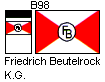
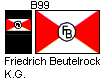
Brown places B98’s funnel among white funnels, suggesting that its lack of black is intentional rather than a printing omission. Mitchell provides basic support for this interpretation.
Founded in 1935 as Friedrich Beutelrock K.G., the business became Friedrich V. Beutelrock GmbH & Co. K.G. in 1977, while the original name continued as an operating company. Other subsidiaries were Reederei Lubeca, formed in Lübeck in 1985, and Lubeca Marine Management (HK), established in Hong Kong in 1995. The last vessel, Annemarie B, was sold in 2007.
Germany, Lübeck.
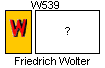
Mitchell mentions Pioner, 500/1982, without a line drawing. Rosanoski considers that vessel probably an erroneous reference to an earlier Pionier of Reederei Wolter & Co.; the funnel presumably comes from another source.
No documented ship or source for exact mark.
Friedrich Wolter bought the renamed Ilse Wolter in 1955 and sold his last vessel, Alk, in 1987. The register at one stage places his ships under Küstenschiffahrt Bauer & Hauschildt before listing him again under his own name.
Germany, Drochtersen.
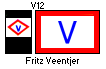
The funnel is black with a broad white band bearing a red triangular frame enclosing a blue “V”. The flag is white with a red border and a blue “V”.
Germany, Moormerland.
Rosanoski doubts the funnels shown by Jordan and Stewart.
The letter follows the website image, supported by photographs of Gertud Fritzen and Susanne Fritzen. Most photographed vessels appear to use this funnel.
Balbina carries a different funnel, also seen on Mozart, Recife and Yemanja. Rosanoski assumes the T refers to Thyssen-Bornemisza, but notes that the website’s Fritzen ownership was not located in Lloyds. The same funnel is shown for August Thyssen-Hütte under Frigga. Balbina was eventually chartered to a Japanese oil company.
The tanker Seestern also has a different funnel in the website photographs.
The concern originated in 1823 as Emder Dampferkompagnie Nuebel & Fritzen and divided into Nuebel and Fritzen in 1925. One account dates the takeover of W. Kunstmann at Stettin and adoption of Johs. Fritzen & Sohn to 1936; Jordan instead records a 1938 reconstitution from Kunstmann and Lex[z]au, Scharbau of Emden. Financial difficulties led to acquisition by the Thyssen-Bornemisza Group in 1963 and the name Fritzen Schiffsagentur und Bereederungs-GmbH.
The fleet passed to Suisse-Outremer in 1979, at the end of the decade’s withdrawal from shipping. The remaining tug and agency services later disappeared. A further account records merger into Fritzen-Halcyon Line and subsequent liquidation of the ships. Johs Fritzen & Sohn continued to appear as a managed concern; early vessel names were those of the Fritzen family.
Germany, Emden.
The Front Sky photograph could not establish whether there was a dash beneath the funnel T, but NJK confirmed it from other photographs. The website logo gives the underline as green. Ocean Ships instead describes a white funnel with a light-blue f symbol on a vertical dark-blue rectangle.
This funnel is documented in a starboard photograph of Front Alpha.
Front Symphony, a 2001 newbuilding, appears to show a changed design while the website retained the older logo. Its symbol looks black in that photograph, but a port-side view of Front Vanadis shows green. Rosanoski suggests different shades may have been tried before a light version was adopted.
The wavy-edged symbol is recorded from Front Champion on 12 August 2005 and Front Brabant on 1 October 2003. Rosanoski’s later comment distinguishes straight-sided and bumpy emblems but revises his confidence in Front Champion: enlarging the photograph leaves its lines unclear, so some vessels may have wavy forms and others straight ones.
Frontline originated in Uddevalla Shipping, formed in 1986 to take over the marine assets of Uddevallavarvet after the yard closed in 1985. Lloyds dates the change to Frontline A/B to 1990, later amending this to Frontline Ltd. Another account gives incorporation in 1985 and a 1998 merger with London & Overseas Freighters, acquired in 1997, as the creation of the Bermuda corporation. A May 1997 decision moved the domicile from Sweden to Bermuda, while Lloyds instead describes closure of the Swedish company, a Bahamas holding company and transfer of shipping operations to Frontline Management in Norway. The accounts are retained as differing descriptions of the reorganisation.
The Swedish Government privatised Uddevalla Shipping in 1989, with Bilspedition, Nordstrom & Thulin, insurers and public investors participating; acquisition of Sven Salen altered the shareholdings later that year. John Fredriksen gained control in 1996 through Hemen. A later source places Frontline within Farahead Holdings of Cyprus.
Acquisition of ICB Shipping was agreed in September 1997, became effective in September 1999 and was fully integrated early in 2000, closing the Stockholm operations. Fox Maritime came with ICB. Frontline acquired Golden Ocean after its 2000 bankruptcy and demerged it in December 2004. Golden Ocean Management and Golden Ocean Services formed part of that involvement. Golar Management (UK), formerly Osprey Maritime (Europe), was acquired in July 2001 and later became a Golar LNG operating company. Frontline also approached General Maritime about a merger.
Other interests included Mosvold Shipping, acquired in May 2001; Seatankers Management; Naviera Quimica, acquired through Seatankers and sold to Eitzen in July 2004; and Northern Offshore Management, which acquired Singapore’s Jet Drilling in 2001. The listings also include Seadrill and Seadrill Management. Metrogas’s 1988 Metromar joint venture with Exmar ended in the early 1990s. Ship Finance International was formed in October 2003 to buy Frontline crude-oil tankers and charter them back long-term to Frontline Shipping.
Frontline Management appears in both Swedish and Norwegian listings. Teamship is recorded as an associate. Alliance Chartering was a co-operative agreement with OMI, and Frontline held a quarter interest in Nanny with Onstad Shipping.
Originally Stockholm, Sweden; later Hamilton, Bermuda.
Originally ship names appeared in white on the blue funnel band. Before 1955 the F105 funnel, with PETROBRAS in blue on a diamond, was adopted, while the flag remained unchanged until June 1973. A new livery then incorporated the national green, yellow and blue.
Mitchell dates this funnel to 1963, differing from the 1973 livery chronology. Nüsse’s original website flag appears grey–blue–orange rather than green–blue–yellow, with an indistinct emblem. Loughran shows a green hexagon in the fly.
For the separately discussed F493 rendering, Joseph McMillan interpreted the grey-green in Nüsse’s image as national-flag green, based on his observations of Petrobras stations. Rosanoski attributes the misleading appearance to scanning quality.
Known as Fronape, Frota Nacional de Petróleiros was the shipping arm of Petróleo Brasileiro. Lloyds first records it operating for Conselho Nacional de Petroleo, whose address Rosanoski links to Petrobras from 1954. It subsequently managed much or all of the Petrobras fleet. Mitchell records a new title and colours in 1963 without identifying the title. Fronape merged into Petrobras Transporte in 2000. Sources sometimes intermingle the Fronape and Petrobras names and liveries.
Brazil, Rio de Janeiro.
Nüsse’s flag appears grey rather than green, but the company website confirms green and shows flags for both companies.
Formed in 1951 as L. Figueiredo Navegaçâo, the company became Frota Amazonica in 1976 and Frota Oceânica e Amazonica in 1996. Also known as FOASA, it took over the fleet of Frota Oceânica Brasileira by the 1998 Lloyds listing.
Brazil: Rio de Janeiro and Belem are recorded.
The company website shows the flag back to front. Nüsse’s F24 image does not identify the hoist, but the wider gap beside the red F than beside the white F leads Rosanoski to conclude that the white sector includes the hoist. If F63 is correct, he suggests that the funnel should also be affected.
Frota Oceânica Brasileira is recorded from 1970–71 until its fleet appears under the combined company. Vessel names began with Frota.
Brazil, Rio de Janeiro.
Fugro Explorer’s port side on 6 December 2006 shows a panel attached to the funnel, without a defined outline.
Fugro Leidschendam, photographed on 14 December 2013, shows the name alone in white on the red hull.
Fugro was founded in 1962 as Ingenieursbureau voor FUnderingstechniek en GROndmechanica Fugro. The company history dates acquisition of offshore geotechnical specialist McClelland Engineers to 1987, although Lloyds applies the Fugro-McClelland name to the 1962 foundation. Offshore survey company John E. Chance & Associates followed in 1991, and Fugro floated in Amsterdam on 7 April 1992. Robertson & Jason was acquired in 2002 and Thales GeoSolutions in 2003.
The maritime group included Singapore’s Fugro-McClelland, formed in 1990 and renamed Fugro Singapore in 1993, then Fugro Marine Services in 2005. Fugro Survey Pte., separately formed as Thales Geosolutions (Singapore) in 2001, adopted its Fugro name in 2004. Fugro Survey Ltd., formed in 1988, absorbed Fugro-UDI and Svitzer Towing in 2003 after the Svitzer acquisition on 1 July. Other operating companies included Houston’s Fugro-McClelland Marine Geosciences, formed in 2001; Bremen’s OSAE, formed in 2000 and renamed Fugro OSAE after acquisition in August 2006; and Fugro Geonics, formed in 2007 at Navi Mumbai.
Netherlands, Leidschendam.
The black funnel carries a broad band of the flag. The flag has five alternating horizontal white and blue bands: the first blue band occupies half the field and bears a white F, while all the other bands are narrow and equal in width.
The company is also recorded as Fuji S.S. Co. Ltd.
Japan, Tokyo.
Also known as Fuji Transportation, this company was formed in 1959. Its parcel tankers used Fuji Maru No. followed by a numeral.
Japan: Osaka and Niigate, also spelt Niggate in the source.
The separate Okayama company is recorded in Lloyds from 1978–79 to 1988–89. Its vessels used Kozan Maru No. followed by a numeral.
Japan, Okayama.
The funnel is documented in a starboard photograph of En Shun taken on 20 May 2013.
Established in November 1992 as a limited-liability company, Fujian Anda appears in Lloyds as an operating company of the Government of the People’s Republic of China and later under its own name.
China, Quanzhou, Fujian Province.
The flag derives from a 1902 chart republished in Fune to Hata in 1994.
Alan Watt gives the operating period as 1901–1910.
Japan.
The flag comes from a 1902 chart said here to have been published in Fune to Hata in 1904. Alan Watt states that a similar flag was retained after the name change, and also appeared in 1926 and 1930 sheets for Tsushima Shosen, which later became Kyushu Yusen.
Fujino Rintaro became Tsushima Unyu by 1910.
Japan.
Brown’s version differs from a sighting of Tocho Maru at Lyttelton on 14 April 1989 in the endings of the side points and thickness of their framing lines.
Photographs of Fuji Maru on 29 July 1999 and Fugaku Maru on 25 July 2000 confirm the funnel. White FUJITRANS appears beneath the panel, with the J descending below the other letters. Fuji Maru’s photograph appears to show a black top, but Alan Watt states there was none. He also advises a lighter blue than originally drawn; Rosanoski adjusted it and presumes the same shade applies to F74.
Formed in 1952 as Fujiki Kaiun Kaisha, the company became Fujitrans Corporation in 1995. It joined Toyota Motor Corporation in founding Toyofuji Kaiun in 1964. Singapore subsidiary FK Logistics was formed in 1989; Kagoshima Senpaku managed one vessel.
Japan: Hakodate, later Nagoya.
The funnel is documented on Petro Venus in a photograph dated 16 February 2005.
Lloyds originally gives formation in 1970, later amending it to 1969.
Japan: Oaza Takenoura, Yonozu; later Saiki.
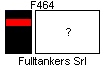
The funnel is documented in a starboard photograph of Venus G taken on 2 April 2006.
Formed in 1998 as Fullships, initially listed as a manager at Ravenna, the company became Fulltankers in 2002 and was recorded as an owner at Napoli. It merged into Gestioni Armatoriali on 1 June 2006.
Italy, Napoli.
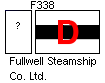
The house flag is divided horizontally white–black–white, with a large red D over all; only small white segments appear within the initial.
Ernest Thomas Dinsdale began shipbroking as E.T. Dinsdale & Co. in 1920 and formed Fullwell Steamship the following year. The depression forced him out of business in 1928.
UK, Sunderland.
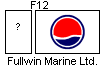
The white flag has a central disc with a blue outer border and white inner border. Inside is an asymmetrical yin-yang-like form, with a larger red field above a smaller blue field, separated by a narrow white wavy division. The same flag is apparently used by South Korea’s Boyang, but Rosanoski knows of no connection between the companies.
No identity or shared corporate use established.
Lloyds dates formation as Full Wind Navigation to 1976, followed by Fullwind Maritime in 1979 and Fullwin Marine in 1987. The company-registration source instead gives 24 September 1975 and records it as struck off on 10 March 2006.
Hong Kong.
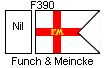
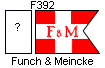
McMillan depicts a white swallowtail with a red cross bearing the firm’s initials in yellow. The stated source is a ship painting in The Clipper Ships, which Rosanoski could not find in the Time-Life book of that title.
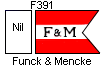
No name equivalence inferred; contemporary catalog identification needed.
Mystic Seaport has 1850 entries under both Funck & Mencke and Funch & Meincke, noting the differences. The company is also recorded operating in 1861.
USA, New York.
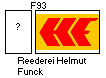
Listed initially as Helmut Funck, the concern appears as Funck Schiffahrtskontor GmbH in Lloyds 1992–93 and 1996–97.
Germany, Wischafen.
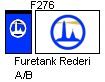
Fure Sun’s port and starboard photographs show mirror-image funnel emblems, with the main beam and smaller erection both aft. The beam reaches the ring, with the aftward part travelling farther and ending wider. A photograph of the ship on 26 October 2011 supplies the flag, which appears to use the same design. Website logos vary in darkness and whether the charges touch the ring; differing funnel colour in photographs may reflect resolution adjustments. The flag in an office photograph is too small to confirm detail.
The Höglund family’s concern was formed in 1956, formerly trading as Karl Höglund. Its website traces family roots to the eighteenth century and describes third-generation management. The group included Furetank Rederi, shipowner Sp/f Nolsö Shipping and Furetank Chartering.
Furetank and Michael Hjortböl owned Nordtank Shipping, sold to Broström in 2005 and later renamed Broström Tankers Denmark.
Sweden, Donsö.
Tugs and similar craft used a black funnel.
Excursion vessels used a light-buff funnel, the livery varying with service.
The blue flag has a black crown outline and white F and R in the respective lower corners.
Formed on 23 May 1844, Furness Railway obtained permission to own vessels in 1862 and took over Coniston Railway. It joined the consortium forming Barrow Steam Navigation in 1867 and merged into the London, Midland & Scottish Railway on 1 January 1923.
UK, Barrow-in-Furness.
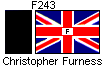
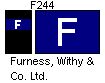
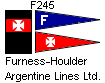
Burrell dates adoption of the early livery to 1877 and its use to the end of the brothers’ partnership in 1882. The black funnel continued until Lord Furness’s death in 1912; an earlier proposed change after Manchester Liners’ formation was reversed following R.B. Stoker’s objections. The Ships List gives the black funnel a longer span, 1870–1912.
Christopher’s 1882 flag was the Union Flag defaced at the cross centre by a white square, with a blue border and blue F according to Bonsor. About 1886 naval authorities at Halifax objected to use of a national ensign, prompting the blue flag with white F, although Bonsor dates that flag to 1878.
Reed 1891 shows the panel border and F in black. The FOTW rendering is based on Graham Bartram’s 3:5 variant.
Merchant Ships describes a white rectangle with a black letter defacing the Union Flag. Reed’s panel does not occupy the entire central area of the cross.
The blue flag with white F is documented on Newcastle City, built in 1883. Originally Furness Line colours, the livery continued under Furness Withy and also appears for Neptune, Norfolk & North American and Gulf Line. Rosanoski considers FOTW’s assignment to German agents Gläfcke & Hennings an error.
The Ships List dates this funnel to 1912–1920 and describes it as “blue with a blue band containing a white F”.
Burrell dates this funnel’s adoption to about 1913; Bonsor supplies no adoption date.
Bonsor dates the funnel to 1921, while The Ships List gives use from 1920 to 1999. It follows Prince Line’s pattern without the Prince of Wales feathers. The livery is also assigned to Bermuda & West Indies, although some sources give that company a separate funnel while retaining the Furness flag. Prince and Rio Cape, Houlder and Manchester Liners retained their own liveries; Rosanoski interprets Loughran’s claim that Prince adopted the Furness funnel as referring only to its format, since the feathers remain.
The tapered swallowtail has a circle and white F in the canton. Adoption is variously dated 1946 by Burrell, 1949 in the Talbot-Booth-based account and 1951 by Bonsor; Rosanoski rejects 1951 because Merchant Ships already showed it in 1949. The National Maritime Museum specimen is dated about 1951 and measures 1143 by 1879.6 mm. Harnack’s ordinary rectangular swallowtail is considered wrong: a 1952 sailing schedule says its shape should match Prince Line’s. Later colour plates correct it, but fleet-list images retain the error. Bermuda & West Indies and Johnston Warren also used this livery.
Burrell dates this livery to 1980, but does not specify the funnel, whose application Rosanoski assumes.
The flag was adopted about 1980. Its funnel association is assumed. A later animated website flag logo suggests the flag may still have been in use, though no flag was apparent on the photographed chartered ships.
Used from about 1971 as a land flag only, this bears the group insignia nicknamed the “drunken fork”.
Marinart describes a dark-red funnel for Furness Withy and Johnston Warren. It may be F7 with its lower black section hidden by a shorter funnel.
The funnel is documented on chartered Furness London, port side in November 2010, and Triton Stork, starboard on 16 October 2008.
The Argentine joint venture used two pennants, the upper blue with white F at the hoist, the lower red with a white Maltese cross at the hoist. They derive from the constituent companies’ flags. Harnack’s 1959 fleet list still shows this version.
The National Maritime Museum dates its double-pennant specimen to 1951; each pennant measures 914.4 by 2641.6 mm.
Furness-Houlder Argentine Lines was a joint venture with Houlder Brothers, dated 1914 or 1915. Rosanoski suggests that full acquisition of Houlder in 1968 marked its end.
Keep the explicit scope label independent; no alias or company identity is inferred.
Thomas Furness’s chandlery business was joined by his brother Christopher, who became a partner in 1872. The brothers became shipowners in 1878, although Burrell records earlier vessel interests and chartering. They separated in 1882, Christopher taking the shipping business. He bought into Edward Withy’s shipyard in 1883 and acquired it outright in 1884. A London office opened in 1890, and on 16 September 1891 the Hartlepool and London Furness concerns combined with Edward Withy as Furness, Withy & Co.
Early expansion included Direct Scandinavian & American’s ships in 1884 and the unfinished Halifax Steam Navigation vessels in 1885, subsequently operated in partnership under the Halifax name, probably to protect subsidies. The Wilson-Furness service began about 1885, certainly by 1887. Christopher participated in the 1892 disposal of F. Leyland’s fleet, and Furness managed and later bought the Chesapeake & Ohio railway’s British steamship subsidiary, absorbed in 1913. Wilsons & Furness-Leyland was formed in 1896 and sold in 1901 or 1902. Manchester Liners was founded in 1898, when the Canadian & Newfoundland service rights were also acquired. Furness-Allan and Hessler followed as joint services or ventures in 1901.
Gulf Line was bought in 1902 and wound up in 1929. Management of Neptune Steam Navigation began in 1906, followed by purchase of its fleet, Agincourt and Norfolk & North American in 1910. Half of Houlder Brothers was acquired in 1911, with full control in 1968; London Welsh, also acquired in 1911, was sold to Coast Lines in 1922. Furness and British Maritime Trust bought George Warren’s White Diamond company in 1912 and formed George Warren & Co. (Liverpool) in 1922. Johnston was half acquired in 1914 and wholly in 1916. Manchester Liners, initially a substantial Furness investment, came under control in 1970 and was taken over by Furness Withy (Shipping) on 1 June 1981.
Prince Line was bought in 1916, Rio Cape formed in 1917 and Bermuda & West Indies in 1921. Cairn interests were acquired in 1928, although a later 1967 report describes a 15% holding and an offer for the balance. C.T. Bowring’s Red Cross Line followed in 1929. Sources date control of Shaw Savill to 1933 or acquisition of its share capital to December 1935. Johnston, Warren and Neptune combined as Johnston Warren Lines in 1934. A large Royal Mail holding acquired in 1937 became full ownership in 1965, bringing Pacific Steam Navigation. Bowater management began in 1939 and Kaye, Son was acquired in 1973. Group listings also include British Empire Steam Navigation and Alexander Shipping through Houlder, Empire Transport and Quebec Steamship.
Furness helped found Overseas Containers in 1965 and joined Seabridge’s consortium. Reorganisation in 1971 made Furness Withy essentially a holding company, with ship management divided between Shaw Savill, Pacific Steam Navigation, Houlder Brothers and Manchester Liners; Prince Line operated under Shaw Savill. A General Shipping Division followed in June 1977, effectively ending the subsidiaries’ separate operations apart from registration names. Metcalfe Shipping was acquired in 1980, when the Tung Group bought Furness. Tung sold it in November 1990 to Hamburg-Sudamerikanische through Shaw Savill Holdings and Kenwake, placing it effectively under Rudolf A. Oetker.
Rosanoski rejects the claim that the group survived only in name. In 2008 Furness Withy (Chartering) was an Oetker-owned dry-cargo operator and broker in London and Melbourne, centred mainly on the Australian business established in 1971. Furness-Houlder Shipbroking and Furness Withy Bunkers also continued. Earlier listings record participation in Gazocean’s recovery plan. Fleet names included London and Pacific prefixes and a More suffix. The register sequence includes Furness Withy (Shipping), formed in 1980, and a return to the Furness, Withy name in 1998.
UK: West Hartlepool, later London and Redhill. Bonsor places the London move in 1891; Burrell gives 1916 after a brief Liverpool period.
Japan; no locality given.
Japan, Kagoshima.
The JSA chart names Fuyo Kaiun Kaisha. Its telephone number points to the Kawasaki company, although Rosanoski thought Osaka might seem more logical.
Japan, Kawasaki.
Japan, Tokushima.
Japan, Namikata.
Japan, Hakata.
Japan, Yoshiumi.
Japan, Shimizu.
Historical telephone/source-company verification still needed.
The funnel is documented in a port-side photograph of Rich Duke II taken on 5 July 2013.
Mitchell shows four other funnels, probably those of charterers. Two appear to be Mitsui and Kawasaki, listed as major customers on the company website in 2013; the other two remain unidentified in Rosanoski’s Japanese livery material.
The Osaka company was formed on 30 September 1974. Its operating companies included Dojima Kaiun, formed in Osaka in 1986.
Japan, Osaka.
Keep the explicit scope label independent; no alias or company identity is inferred.
A port-side photograph of Weltrust at Singapore on 16 June 2011 supplies the funnel, with Welhero confirming the design.
The concern began with Welhero and Weltrust, both built in 2010, and was listed as manager in Lloyds 2011–12.
China, Fuzhou.
The Elders & Fyffes funnel is described as pale creamy buff and confirmed in a black-and-white photograph of Changuinola. The blue flag carries a white diamond with E & F: Larousse gives blue, sans-serif characters with a smaller ampersand, while Sampson shows black letters and a slightly larger diamond. Diamond size and lettering vary across sources.
The 1969 livery used the United Fruit funnel and a blue swallowtailed burgee with a yellow triangle based on the hoist. Fyffes appears in white on a navy-blue oval. Brown 1978 and 1982 extend the yellow along the top and bottom, unlike Loughran’s true triangle, which the museum specimen confirms. Brown 1982 still labels it Elders & Fyffes, which Rosanoski regards as erroneous. The museum dates its specimen to 1955–1967, in tension with the stated 1969 adoption.
The livery is documented on Jarikaba, port side, in a photograph tentatively dated June 2001. Mitchell describes the funnel as darkish buff.
The funnel appears on Star Quality, port side on 24 August 2013, and on Star Best, starboard without a funnel top on 5 August 2007.
Fyffes originated with E.W. Fyffe Son & Co. in 1888. Shipping began in 1901 through the Imperial Direct West India Mail Service, followed in 1902 by Elders & Fyffes as a separate concern floated by Alfred Lewis Jones of Elder Dempster. It later broke that parent connection. United Fruit acquired the business in 1910 according to one account, or 1913 according to Mitchell, while its own identity was retained. Surrey Shipping was formed as a subsidiary in 1959.
Also known as Fyffes Line, the concern became Fyffes Group in May 1969. Fruit Importers of Ireland acquired it in 1986, bringing the name FII Fyffes, although Lloyds dates that change to 1988. It became Fyffes plc in 1990. Elders & Fyffes (Shiplease) was an associated company; fleet names drew on Spanish or South American places.
The managed fleet appears to have entered the Great White Fleet in 1990, and Mitchell records transfer of management to Marine Management Services in 1993. A photograph of Jarikaba in Fyffes colours, apparently from June 2001, suggests continued chartering rather than ownership.
The source records a property spin-off in May 2006 and a fresh-produce spin-off on 2 January 2007, describing a subsequent focus on banana importing through Total Produce. The company’s own cited statement instead lists production, procurement, shipping, ripening, distribution and marketing of bananas, pineapples and melons.
UK: Manchester, Garston, London and Southampton are recorded; the later source places Fyffes in Dublin, Ireland.
The flag derives from an early nineteenth-century Norwegian signalling system in which a white flag carried the registration town’s letter. Bergen’s letter was X, retained in the company flag. Red borders descend from the borders subsequently added to these white town flags, commonly in red and blue. Black-and-white illustrations confirm the funnel; its band originated between two reinforcing hoops.
A new website flag logo seen in December 2004 appears to be the Fjord1 Nordvestlandske design.
The concern originated as Nordre Bergenhus Amts Dampskibsselskab in 1858 according to Steamers of the Fjords; Skipet gives 1857 in its text but 1858 in the heading. The name changed in 1919, while Lloyds gives formation as 1920. A 2001 merger with Möre og Romsdal Fylkesbåtar formed Fjord1 Nordvestlandske, leading to the name Fjord1 Fylkesbaatane in 2005 according to Lloyds; Skipet dates that change to 2000.
Operating company Ice Reeferes was formed in 2000 at Fløro.
Norway: Bergen, later Floro.
Talbot-Booth’s 1937 and 1938 sources attribute the livery to Joel Fänge.
Collectors Corner supplies a cap-badge flag. Jordan describes a blue funnel without mentioning a top.
The livery suggests origins in Joel Fänge’s business. After the Second World War the concern apparently divided between Yngve Fänge and Birger L.P. Påhlsson, who held the ships previously listed by Jordan and shared an address; Jan-Erik Fänge also appears at that address in later registers. Mitchell nevertheless lists Fänges & Påhlsson’s Rederi A/B. The name is also recorded as Fänges & Pålssons Rederier.
Sweden, Helsingborg.
The photographs of Agersofaergen and Sejofaergen in August 2005 show differing funnel emblems, though the former is indistinct. The narrative calls the first image F172, while the source list gives V172; it also gives differing photograph references for Sejofaergen. These inconsistencies are retained without changing the two verified image associations.
Lloyd’s records Vestsjællands Amtskommune at Soro from 1996–1997 and Færgeselskabet Vestsjælland A/S as its manager in 2005–2006. Sejerøfærgen of Sejero managed part of the Amtskommune fleet in 2001–2002.
Denmark, Skaelskor.
The funnel anchor is slightly angled.
The flag is blue with a yellow standing anchor. A black-and-white photograph of Kollund confirms the funnel and flag.
Mitchell includes this second funnel on the company’s card, but its capacity is unclear. Rosanoski treats the card’s principal funnel under FRS instead.
Förde versus FRS usage unresolved.
The company website dates formation to 1935, when about 100 Flensburg merchants established Förde-Reederi to maintain services on the Flensburg Fjord after Flensburg-Ekensunder Dampfschiffsgesellschaft ran into difficulties. Lloyds instead gives 1938.
It combined with Seetouristik to form Förde Reederei Seetouristik (FRS). The sources differ on the date: Lloyds gives 1990, the company website 1991 and Mitchell 1993. Förde-Reederei subsequently acted as parent company, with vessels listed under FRS.
In 1999 it joined A.G. Ems, Wyker Dampfschiffahrts Rederei and A.G. Reederei Norden Frisia in establishing CAT NO. 1.
Germany, Flensburg.
The FRS flag has a yellow field with stylised italic initials FRS, coloured green above blue along an ascending diagonal described as “per ascending saltire”. Mitchell shows the funnel letters upright and attributes the funnel to Förde-Reederei. Rosanoski assumes it belongs to FRS and allows that the letters might slope as on the flag.
Nüsse records this table flag for FRS Iberia; the website logo is used by both FRS Iberia and FRS Maroc.
The funnel is documented on Tanger Express, port side on 26 January 2014 and starboard on 6 January 2014.
Tanger Jet II has a white-and-red funnel. A plain version was recorded on 4 November 2007; on 3 April 2008 the white area carried a Bahamian flag flying from a painted pole, and by September 2008 the civil flag of Morocco. Rosanoski interprets the painted flag as replacing a flown merchant ensign. His earlier description tentatively identifies a Moroccan emblem and a small gold canton charge. The illustration is based on port and starboard photographs from September 2008 and 19 June 2009.
Förde-Reederei and Seetouristik formed FRS in 1990 according to Lloyds, or 1991 according to the company account, to operate Germany–Denmark passenger services. These “Butter Trips” allowed passengers to buy duty rations until their abolition in 1999. The partners combined all their shipping in 1998. From a regional passenger operator, FRS developed into an international ferry and vehicle-transport group, with bus services as well. Weiße Flotte, acquired in 1991, and its subsidiary Reederei Hidddensee belonged to the group.
FRS Iberia was based at Cadiz, with FRS Maroc at Tangier. The latter was the trading name of Ferrys Rapidos del Sur, the travel agency formed for fast ferry services across the Straits of Gibraltar, and a subsidiary of FRS Iberia. Other operating companies included A.S. Nordic Jet Line, formed in 1998 at Tallinn, and Romo-Sylt-Linie, formed in 1987 at Flensburg.
Germany, Flensburg.
The association exists to preserve and sail Salondampfer Alexandra, whose identification Rosanoski marks with a query.
Germany, Flensburg.
Listed as “Fassio” Società Anonima di Navigazione in the 1950s, the company appears as “Fassio” Società di Navigazione S.p.A. by 1963–64. Loughran includes it in the consortium forming Atlantica Line, but Rosanoski warns that this may confuse it with Villain & Fassio.
Italy, Genoa.