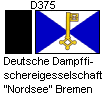
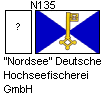
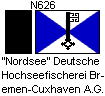
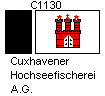
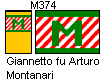
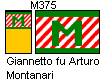
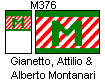
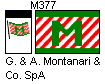
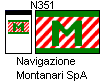
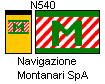
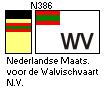
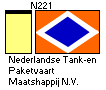
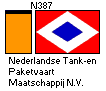
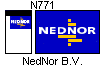
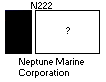
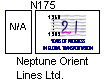
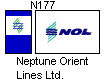
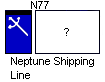
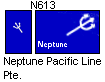
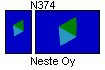
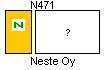
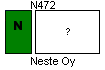
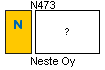
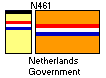
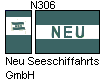
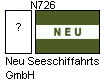
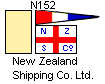
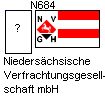
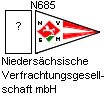
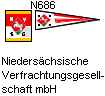
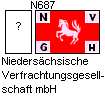
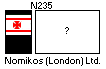
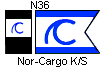
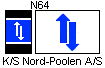
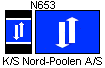
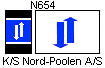
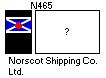
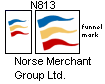
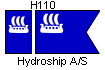
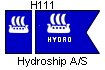
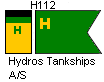
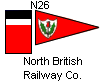
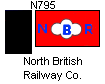
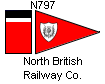
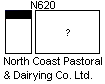
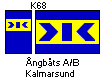
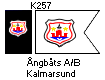
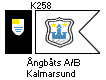
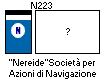
Rosanoski assigns the D375 livery in Lloyds Reedereiflaggen to "Nordsee" Deutsche Hochseefischerei Bremen-Cuxhaven A.G. and cross-refers to N626.
Nüsse’s second website gives the table flag a different shade of blue.
Cuxhavener Hochseefischerei A.G.
Founded on 23 April 1896 as Deutsche Dampffischereigesellschaft "Nordsee" Bremen, the company became "Nordsee" Deutsche Hochseefischerei Bremen-Cuxhaven A.G. after a merger with Cuxhavener Hochseefischerei and a change of shareholders on 7 November 1928. It became "Nordsee" Deutsche Hochseefischerei A.G. on 7 December 1938 and a GmbH owned by Deutsche Unilever and Dresdner Bank in 1959. Seeadler Cuxhaven, Deutsche See Bremerhaven and Cuxhavener Hochseefischerei became subsidiaries in 1972. Unilever held 99% in 1982, and the company became Nordsee GmbH in 1995.
The later business is described as a major German fast-food company, owned by Deutsche Unilever until 1997 and subsequently largely controlled by the Apax investor group.
Germany: Nordenham, later Bremerhaven and Cuxhaven.
N & T ARGONAUT A/B.
image by Jorge Candeias, None
The flag is blue with the white letters NTA, according to the Josef Nüsse collection. Nüsse’s table flag is recorded on both versions of his website.
N & T Argonaut was formed on 13 February 1998 by the merger of Nordstrum & Thulin and Argonaut A/B. It was owned by Helmut Sohnen, son-in-law and heir of Y.K. Pao of World-Wide Shipping. The company was removed from the Stockholm exchange in 2000 following a takeover; its ships were renamed and placed under Singapore’s World-Wide Shipping Managers, which the source dates to 2001.
Sweden, Stockholm.
N. Cotzias Shipping Group.
Documentary images — company attribution uncertain
Mitchell’s layout does not make clear whether the design beside the Gulf Maritime name is intended for Aban Shipping as A765 or G407.
Exact Aban/Gulf allocation unresolved.
Company and vessel allocation not established.
Charterer versus Cloud use remains unsettled.
Central Shipping Lines
No exclusive fleet-wide use or unrecorded corporate equivalence is asserted.
Gulf Maritime Ltd.
No exclusive fleet-wide use or unrecorded corporate equivalence is asserted.
GB Lines — Gulf Coast charter livery
No exclusive fleet-wide use or unrecorded corporate equivalence is asserted.
Rosanoski doubts C1097, finding no explanation for its A and noting Mitchell’s Takoradi address rather than Tema. C1098 has fitting lettering and an outlined elephant; Fanti and Annabel are noted, with a line drawing of Fanti showing this funnel.
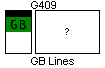
Mitchell’s G408 shows a C above a larger L. Under Gulf Maritime he also gives G409 for GB Lines and Gulf Coast, recorded in 1972–76, and G410 for Cloud Shipping and Gulf Ipswich, recorded in 1973–77. Rosanoski considers the latter apparently part of the same charter.
The source also reproduces the Cotzias website logo and a panel placed by Mitchell under Gulf Maritime without an indication of its use.
Nicholas D. Cotzias opened a shipbroking office on Syros, then known as Syra, in 1893 and moved to Piraeus in 1912. He was succeeded by John N. Cotzias and then Nico J. Cotzias. The business continued as shipping consultants in 2011.
The 1981 directory lists a five-vessel fleet, with London offices in the group’s name and as Gulf Maritime Ltd. N.J. Cotzias appears as manager or director, while registered owners differed: Annabel under Central Shipping Co. of Tema, Ashanti under Tema Steamship, City of Tema under Meridian Ocean Lines of Ghana, Cloud under Aban Shipping of Limassol, and Fanti under Central Shipping Lines of Tema. The recorded vessel periods are respectively 1980–83, 1977–83, 1978–87, 1977–84 and 1978–83. Mitchell associates Aban with Gulf Maritime and describes Cotzias as charterers to GB Lines. In 1985–86 N. Cotzias (Shipping) Co. is listed as agent for Gulf Maritime (Cyprus).
Greece, Piraeus.
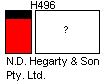
N. D. HEGARTY & SON PTY. LTD.
As the ferry fleet was progressively reconditioned, funnels were replaced by uptakes and the colour scheme fell out of use.
N. D. Hegarty & Son was registered on 17 October 1945. Stannard Bros. Launch Services took it over in 1978, and it subsequently became Stannard Marine. A later report records an agreement for purchase by Captain Cook Cruises. Port Lincoln Tugs was formed jointly with Adsteam Marine.
Australia, Sydney.
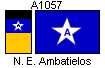
N. E. AMBATIELOS.
Nicholas Eustache Ambatielos acquired Nikolaos in 1917. On 17 July 1919 he agreed to buy nine ships being built in Hong Kong from the British Government. Delivery delays cost him charters; instead of renegotiating, he pursued damages in a prolonged and ultimately fruitless legal battle. Rosanoski describes the loss of his reputation and fortune, with his ships sold in the mid-1920s.
The dispute eventually reached the International Court of Justice on 9 April 1951. On 19 May 1953 it found that Britain was obliged to arbitrate. Hearings began on 25 January 1956, followed by a majority decision on 6 March 1956.
Greece, Argostoli.
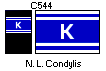
N. L. Condylis
N. L. CONDYLIS.
U.K., London.
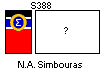
N.A. SIMBOURAS.
Ekali was recorded with a red funnel and black top separated by a broad blue band edged white above and below. A yellow ring extends over the top and base, enclosing blue charged with a white Greek sigma. No flag was noted.
Unknown.
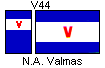
N.A. VALMAS.
The funnel was noted on Rinoula in April 1965 as a charterer’s livery. The sketch’s medium-to-light blue was annotated “a little darker”. Rinoula belonged to Compañia Naviera Maraventura S.A., under Lemos & Pateras agency, from purchase in 1959 until scrapping in 1967; Rosanoski presumes another Valmas connection. Mitchell enlarges the band considerably and the letter correspondingly.
N.A. Valmas is recorded as a Piraeus shipowner in October 1959, taking delivery of Antonius V through Compañia Naviera del Egereo S.A. in January 1960 and selling her in February 1961. Marianna was bought in June 1963, with Valmas based at Athens and Lemos & Pateras Ltd. of London as managers, and sold in February 1966. Rosanoski tentatively identifies him with Nikolaos Valmas in the 1973–1974 Lloyd’s listing.
Compañia Naviera Lanada S.A. is recorded as an associate, apparently on the evidence of its vessel Valmas, the funnel style and use of “B”, which the source explains as Greek for “V”.
Greece, Piraeus.
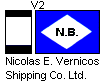
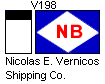
N.E. Vernicos Shipping Co. Salvage & Towage.
N.E. VERNICOS SHIPPING CO. SALVAGE & TOWAGE.
image by Jarig Bakker, 6 September 2005
image by Peter Hans van den Muijzenberg, 2 October 2008
Brown 1995’s V2 flag is blue with a white diamond and black “N.B.” Rosanoski challenges the black letters using the company website: an early vessel’s flag has red NB on a white diamond, fully or nearly throughout, represented by V198. The same flag appears on Argonaftis’s Alexander I on 15 September 2006. V198’s livery also comes from an unidentified vessel on the company website.
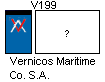
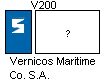
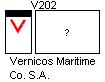
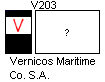
Vernicos Maritime Co. SA — Mitchell source panel
V199 may derive from Scaplake, 3,899 tons, built in 1953; Mitchell’s line drawing shows only the funnel’s base colour.
Mitchell shows V200 only as a panel. A possible connection with European Independence remains unconfirmed, with ownership absent from the cited Miramar entry.
Mitchell records both funnels on a card originally headed Ultramarine Shipping Co. S.A. European Liberty was operated by Vernicos Maritime in 1980–1981, with a line drawing supporting V202. V203 may relate to Pigeon of agency company Zamora Navigation Co. Ltd., although its drawing looks like V202, perhaps simply omitting the black base. Mitchell also assigns V202 to Acropolia Maritime Co. S.A. of Monrovia.
V199/V200 vessel association tentative; V202 also recorded for Acropolia, V203 possible Zamora use. No exclusivity or identity equivalence asserted.
Documentary images — company attribution uncertain
V201 may relate to Flora Athanassiadi, with indistinct markings on its star. Mitchell connects it with “Hambury & Spillopoulos”; Miramar instead places Flora Athanassiadi under F.T. Athanassiades in 1964–1966, previously Irene under Hambury Spiliopoulos in 1963–1964. If the sighting is correct, Rosanoski considers the funnel a carry-over from the latter ownership.
No definite Vernicos partnership or shared use established.
The family business originated in mid-nineteenth-century Constantinople as Bosphorus, founded by Emmanuel N. Vernicos of Sifnos. It carried people and petroleum barrels across the Bosphorus in rowing and sailing boats, acquiring its first cargo ship in 1906. His son Nicolas E. Vernicos gave the business its later name; Lloyd’s dates Vernicos Shipping Co. Ltd. to 1901. It moved to Sifrnos after the First World War and established its Piraeus headquarters in 1928. After the fleet was sunk in the Second World War, Emmanuel, Dimitri, Constantine and Alexander helped rebuild it; the website account describes fourth-generation management.
The concern works with Maritime & Commercial Co. Argonaftis S.A. of the Latsis Group. The registers distinguish Nicolas E. Vernicos Shipping Co., Vernicos Shipping Co., later Demitros & Constantine Vernicos, and D.C. & A. Vernicos, initially operated by Costas Vernicos and later by Nicolas E. Vernicos. Vernicos Maritime Co. S.A. appears as an operating company. Its quoted chronology says both “formed 1978” and “until 1949 traded as N.E. Vernicos”; the contradiction is not resolved.
Alfa-Vita Salvage & Towage was formed in 1988. Its partnership with the Vernicos Group on 8 July 1989 produced Alpha-Vernicos Salvage & Towage, renamed Nicolas E. Vernicos Salvage & Towage in 1994. Millennium Shipmanagenment S.A. was formed in 1999 at the same Piraeus address. In 2000 Vernicos Maritime and Gourdomichalis Naftiki Eteria jointly formed Free Ships S.A.
Greece, Piraeus.
N.G. KYRIAKIDES.
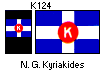
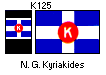
K124 has a black funnel with a broad band of the flag. Its sources give no flag separately; Rosanoski’s accompanying flag is an explicit assumption.
The other funnel has the flag band edged white above and below. The flag is blue with a white cross overlaid by a red circle containing a white K.
The 1939 fleet account lists the Heirs of Nicholas G. Kyriakides, probably a predecessor of N. G. Kyriakides Shipping Co.
Greece, Piraeus.
N.J. GOUMAS.
Marmina was recorded in January 1967 with a yellow or buff funnel, a narrow black top and a white band bearing a blue star. No flag is noted.
N.J. Goumas is listed in Lloyds 1963–64.
Greece, Piraeus.
N.J. NOMIKOS.
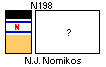
The yellow or buff funnel has a black top and broad white band containing two very narrow blue stripes near its upper and lower edges, with a red N between. It was recorded on Agias Trias of Compañia Marcielo Naviera in July 1965 and Leandros’s Evangelos in April. The latter observation recorded M, treated by Rosanoski as a notation error. No flag is noted.
Lloyd’s 1963–64 uses N.J. Nomikos as the address for N.J. & L.I. Nomikos and L.J. Nomikos & Others. Leandros Compania Marittima is listed as a subsidiary and subsequently under Nicholas J. Nomikos’s agency, after P. Wigham Richardson.
Greece, Piraeus.
N.L. & G. Griswold.
N.L.& G. GRISWOLD.
image by Joe McMillan, 17 October 2001
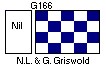
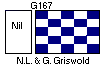
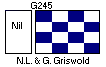
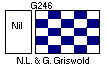
The flag is a blue-and-white chequerboard, described as resembling the modern N signal flag but with five blocks per horizontal row rather than four.
The number of checks is disputed. Rosanoski prefers the chart-supported G167. A painting of Challenge’s maiden voyage shows G245 at the foremast and a long white swallowtailed name pennant with red CHALLENGE at the main. One lithograph of the 24 May 1851 launch shows G246 and a rectangular name pennant; another in South Street instead shows G167. The accompanying South Street description counts thirteen blue and twelve white squares, called the name pennant in Rosanoski’s wording, leaving the descriptions inconsistent.
Nathaniel Lynde Griswold, previously in a New Orleans merchant partnership with John L. Griswold, established the shipping concern with his brother George. The FOTW account dates it to 1822, while South Street records a flour business in 1796. Beginning with West Indian routes, it expanded into the China tea trade and California gold-rush trade, operating clippers including Challenge. The initials were jokingly expanded as no loss and great gain. Rosanoski rejects the houseflag website’s ordering of the name as N. & L.G. Griswold.
USA, New York.
N.M. Paterson & Sons Ltd.
N.M. PATERSON & SONS LTD.
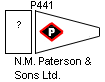
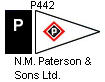
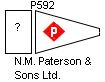
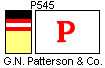
Two flags photographed hanging from a ceiling have stitched, slightly rounded ends. P592 is white and triangular, with a relatively small red diamond near the hoist containing a white sans-serif P. P441 replaces it with a larger black diamond bordered red, again with a white sans-serif P. Their design-change date is unknown. Rosanoski suggests that their points may have been shortened to clear people passing beneath, since published sources from 1948 through 2000 show pointed pennants.
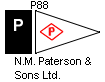
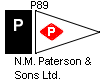
The funnel follows Mantadoc, whose white base is presumed to be superstructure, with a visible door. Stewart’s white pennant has a red diamond frame enclosing a red P. Rosanoski suspects that this follows an old website logo and may never have existed as a flag.
Ship photographs are too small to establish the diamond colours, though black and red seem present and favour P441. Labradoc shows a long-tailed pennant in August 1998. Paterson, Cartierdoc in May 1990 and Ontadoc in April 1998 initially appear to fly rectangles, but slight taper and a frayed fly, especially on Ontadoc, suggest pennants that have lost their tails.
Know Your Ships shows a narrow white fimbriation between the black inner diamond and red border. This may derive from Mantadoc’s logo on white superstructure. Another logo on the same vessel’s black hull adds an outer white border around the red. The websites also displayed differing logos, so these versions do not establish separate flag designs.
POLARIS NAVIGATION.
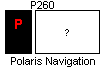
Norstar’s funnel P was painted bright red.
In 1988 Kingdoc (2) was sold to the Paterson-owned offshore company Polaris Navigation and renamed Norstar. She traded internationally on the eastern seaboard and in the Caribbean for two years under a foreign flag and crew.
Unknown.
N.M. Paterson & Sons
Norman McLeod Paterson moved to Fort William in 1908 and established a grain business, although another source dates its formation to 1912 and Lloyd’s gives 1921. N.M. Paterson & Co. became limited in 1915 and owned ships before Paterson Steamships was formed on 10 February 1926. Following Paterson’s appointment to the Senate in 1940, Donald handled grain and John shipping. The two companies amalgamated as N.M. Paterson & Sons on 21 July 1950, retaining separate grain and steamship divisions.
Paterson died on 11 August 1983, aged 100. Canada Steamship bought the remaining fleet in early 2002, although another account gives the last two vessels as sold to Purvis Marine. Family control continued under a grandson, with the name changing to Paterson GlobalFoods in 2004. Subsidiaries included Polaris Navigation and Western Engineering Service, active from January 1927 to late 1993. Ship names generally combined Canadian places with DOC, meaning Dominion of Canada; exceptions were Patterson in 1953, Senator of Canada in 1957 and Paterson in 1985.
Canada, Fort William; Thunder Bay, Ontario.
Keep the explicit scope label independent; no alias or company identity is inferred.
A reported desk pennant bore a white P in a red diamond and the dates 1908–1983, identified in the reply as the company’s 75th anniversary. Another enquiry described a red outer diamond, white inner diamond and P; its identification as a Paterson pennant was tentative.
N.R. Bugge A/S.
N.R. BUGGE A/S.
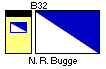
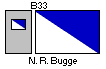
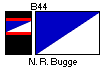
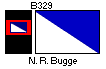
The dark-blue shade was observed on Pacific Current at Lyttelton on 16 February 1988. Rosanoski describes a mirror-image starboard marking, with a panel divided “Pbds blue-white”, like B329 and B32, but also calls the view with blue aft “starboard” when comparing it with B114. The conflicting side descriptions remain unresolved. The B32 flag is recorded for Benguela in the NJK Collection.
A/S Hektor
N.R. Bugge is recorded as a manager in the 1939 material, apparently becoming Bugge & Krogh-Hansen by 1953–54. Later listings use Skibs A/S N.R. Bugge, N.R. Bugge and N.R. Bugge A/S, with ownership and management roles varying through 1992–93.
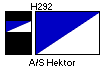
The firm was associated with Hector Whaling Ltd. and managed A/S Hektor, Hector Whaling Ltd. and United Whalers Ltd., as well as other companies and partnerships. Rosanoski disputes the report that A/S Hektor was sold to Hector Whaling Co. in the early 1930s, considering that it refers only to Hektoria’s sale to the new British subsidiary Hektoria Ltd.
Norway, Tonsberg.
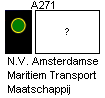
N.V. AMSTERDAMSE MARITIEM TRANSPORT MAATSCHAPPIJ.
A271 was recorded on Alkamar. Wyt’s Digest assigns the company the same livery as Amsterdamsche Olietransport’s A393; only the yellow charge on the circle is absent from A271. Rosanoski considers it likely that this charge was not apparent at the sighting.
Purmerend was built in 1957, and the last vessel, Buenavista, was sold in 1984. The registers place the company under Vereenigd Cargadoorskantor, later spelled Verenigd Cargadoorskantor B.V., as operator.
A Shell-history website lists five vessels, including Purmerend but not Buenavista, with Amsterdamse Maritiem as owner; Rosanoski therefore presumes Shell chartered them. Its inclusion of Mariquita, a name used from 1929 to 1949 for a vessel otherwise called Shelspra under Shell companies, would imply pre-war operation if the website’s allocation is correct.
Netherlands, Amsterdam.
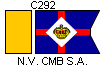
N.V. CMB S.A.
N.V. CMB S.A.
C292 continues the livery used under the earlier company name. Brown 1982 makes the diamond smaller and omits its squared point; Rosanoski considers that incorrect against company flag images. The website itself, however, shows differing diamond sizes. FOTW presents this flag under the former name.
A table flag offered on German eBay in January 2008 measured 15 by 22 cm and was white with stylised blue CMB. Rosanoski found no such flag in the cited company presentation and general-meeting material, although C292 and Bocimar colours appeared and the lettering format matched.
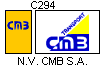
CMB Transport — Brown 1995 branded livery
Small company photographs appear to confirm the C295 funnel, although Coastal Ships & Ferries 1999 leaves the funnel colours unconfirmed. The narrative refers to C285 for letters meaning CMB Transport, possibly identifying CMB Transport S.A.; the Sources list instead uses C295 for Brown’s corresponding notes.
Exclusive company use and precise corporate transition remain qualified; no parent/Transport equivalence.
The company took the CMB name in 1977 from Compagnie Maritime Belge (Lloyd Royal) S.A., retaining it in the 1984 amalgamation with Armement Deppe, Bocimar and Methania. In June 1991 Société Générale de Belgique sold its 49.5 per cent stake to the Saverys-controlled Almabo and Exmar interests. Another account describes the transaction as a reverse takeover through the sale of Exmar to CMB. Ahlers had also held a stake during the 1980s, disposing of it by the early 1990s. During the later 1990s operations moved into independent subsidiaries and CMB became a holding company. After divesting cargo-handling and insurance interests, it concentrated on Bocimar’s dry-bulk, Euronav’s tanker and Exmar’s gas-shipping activities.
The gas-shipping and offshore businesses were demerged as Exmar on 20 June 2003, with separate trading of its shares from 23 June. Euronav’s tanker business was demerged on 30 November 2004, leaving Bocimar within CMB. Lloyd’s nevertheless continued to list Exmar among the operating companies in later editions. Petrobulk Carriers had been sold to Osprey in early 1997. Hessenatie, acquired in 1988 or 1985 according to differing sources, merged with Noord Natie in 2002; CMB’s resulting 60 per cent Hesse-Noord Natie interest was sold to PSA in stages in 2002–03. NAVIGA insurance was sold in 2002.
The company acquired the Deutsche Ost-Afrika, Woermann and Transocean titles in April 1990, with the first and last apparently later passing to John T. Essberger. Dafra was acquired in March 1990, retaining its title under CMB control. CMB Transport was formed in January 1991 for liner operations. Sources differ over Safmarine’s initial purchase: 49 per cent in August 1991 or 50 per cent in 1995; the remainder was sold in 1998. Transinsular, acquired in 1993, was sold by 1999, ending CMB’s liner interests. Its Canada Maritime share was sold to Canadian Pacific in February 1993, and it withdrew from Dart in the mid-1980s. Euronav Luxembourg began as a 1995 venture with Compagnie Nationale de Navigation and became wholly controlled in 1999, although Lloyd’s still called it a joint venture. The CNN acquisition is variously given as 54.4 per cent or 90 per cent in 1998, with disposal of a 92.5 per cent holding recorded in 1999.
Bocimar’s ownership chronology also differs: one account gives full ownership in 1982 and absorption in 1984, another acquisition in 1986. Later operating entries include Bocimar Belgium and Bocimar International. The management businesses included Franship Offshore, G-Tec, Navimer and Tecto companies in Belgium, Cyprus and Luxembourg. Tecto Belgium is dated from 1991 as Antwerp Technical Services, renamed in 1995; the source records formation of Exmar Shipmanagement from Tecto and Antwerp Technical Services in 2006. CMB controlled Union de Remorquage et de Sauvetage, later Unie van Redding - en Sleepdienst, and its interests included Unigas Kosan and an increased Wah Kwong stake of 27.8 per cent in May 1999. ABT-Stocatra was sold in 1995.
Belgium, Antwerp.
N.V. CORNELDER'S SCHEEPVAART MAATSCHAPPIJ.
image by Jarig Bakker, 17 Sep 2007
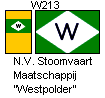
Wyt’s Digest 1965–67 shows the Westpolder livery, referenced in the source as W213. The FOTW flag illustration follows the 1966 edition.
Cornelder’s operated from 1917 to 1967, chiefly as a management company. The associated businesses listed are Algemeene Nederlandsche Scheepvaart Maatschappij (1917–22), Cornelder’s Scheepvaart Bedrijf (1922–29), Stoomvaart Maatschappij “Westpolder” (1929–67), Motorvrachtschip “Magna Pete” (1948–58), Cornelder Lijn and Constantine Linie. Through Constantine Linie it participated in the CPL freight service. Rosanoski cautions that these dates appear to describe the companies’ existence, not necessarily their periods under Cornelder management. Westpolder was also listed under C.W.H. Van Dam, and Cornelder appears as operator in 1958–59 but not in 1966–67.
Although this company ended in 1967, the Cornelders family remained active in Rotterdam and in Asia and Africa. Jarig Bakker reported a 65% holding in Royal Burgers Group in 2007; a 2000 report describes Cornelder Holding as a major shareholder in the Burger Group. Bakker found a logo for the later company but no flag.
Netherlands, Rotterdam.
N.V. EIRAM III.
image by Jarig Bakker, 22 October 2003
Eiram III is listed in 1953–54 and 1958–59 under Hudig & Pieters’s Algemeene Scheepvaart Maatschappij management.
Netherlands, Rotterdan [as written].
N.V. HOLLANDSCHE STOOMBOOT MAATSCHAPPIJ.
Many sources show dots after the letters, while canton and letter sizes vary. A black-and-white photograph of Zaanstroom confirms the funnel.
Hollandsche Stoomboot, also called Holland Steam Ship Co., began as a steamship owner in 1885. It was fully absorbed into Nederlandsche Scheepvaart Unie in 1959 through acquisition of the remaining shares. It jointly operated Holland-West Afrika Lijn with Vereenigde Nederlandsche Scheepvaart-Maatschappij and managed part of Stoomvaart Maatschappij Nederland’s fleet and No[o]rdzee Veediensten. Vessel names used the suffix “stroom”, meaning river.
Netherlands, Amsterdam.
N.V. HOUTVAART.
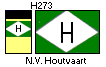
Talbot-Booth’s 1936 and 1937 editions assign H273 to Vinke & Co. A black-and-white photograph of Yssel confirms the funnel diamond.
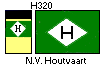
Bovens shows H320’s funnel diamond extending across the full band.
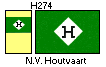
Wij Varen Weer shows H274’s flag diamond extending to the edges.
The flag apparently began with a diamond extending to the edges of the field, changing in the 1950s to a smaller diamond. Brown 1978 shows a further alteration, with small outward extensions to the vertical strokes of the H.
N.V. Houtvaart was formed in 1910 and managed by Vinke & Co., also listed as Vinke & Zonen. The FOTW account gives the management period as 1910–72, while the register list continues through 1973–74. Ships were named after Dutch rivers.
Netherlands, Rotterdam.
N.V. REEDERIJ "AMSTERDAM".
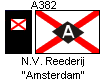
A black-and-white photograph of Amstelhof confirms the funnel. Brown 1958 shows its panel as a band, which Rosanoski notes could be its appearance on a narrow funnel.
Formed in 1941, the company acquired its first vessel in 1946. It also appears as N.V. Rederij “Amsterdam”. Ships used the prefix “Amstel”, and the company managed part of Stoomvaart Maatschappij “Nederland”’s fleet in the cited 1958–70 registers.
Netherlands, Amsterdam.
N.V. SCHEEPVAART MAATSCHAPPIJ SURINAME.
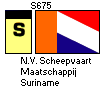
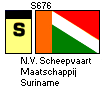
The Dutch-style flag appears on the April 1956 De Blauwe Wimpel chart. Flag Bulletin dates it to 1956 and records consideration of a change in 1975 because its colours followed Dutch tradition. Rosanoski regards the diagonal Dutch-colour triband as no proof of a corporate relationship.
The later flag replaces blue with green, apparently following Suriname’s independence. Brown 1995 also narrows the orange and white bands, though Rosanoski considers those differences possibly insignificant.
The company was operating by 1953 and continued to appear in registers through 1996–1997. Its early addresses were in both Suriname and the Netherlands, but only the Suriname address appears from the later 1950s. A contributor suggested a Vereenigde Nederlandse Scheepvaartmaatschappij connection; Rosanoski found no supporting evidence.
Suriname, Paramaribo, and Netherlands, Amsterdam.
N.V. SCHEEPVAART-ONDERNEMING KUSTVERKEER.
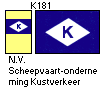
The yellow or buff funnel has a broad band of the flag: blue with a white diamond containing a blue K.
Kustverkeer was managed by W. H. James & Co.’s Scheepvaart & Handel Maatschappij in the 1953–54 to 1970–71 registers.
Netherlands, Rotterdam.
N.V. SCHELDTE TOWAGE CO. S.A.
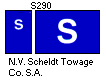
Both funnel and flag are blue with a white S. Brown 1995 shows a rather square-shaped letter.
Ahlers entered towage in the 1960s through Scheldt Towage. Lloyds connects the company with Schelde Sleepvaartbedrijf, but later separate references leave Rosanoski uncertain whether all entries denote the same entity. Control was subsequently acquired by Unie van Redding-en Sleepdienst.
Individual vessels were managed by VTG Reederei Offshore and Ostend Towage. Smit International is recorded as an associate.
Belgium, Antwerp.
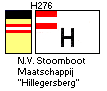
N.V. Stoomboot-Maatschappij “Hillegersberg”.
N.V. STOOMBOOT-MAATSCHAPPIJ "HILLEGERSBERG".
image by Jarig Bakker, 31 January 1999
Stewart and Wyt show a smaller canton outlined in black. The “H” is placed in the lower fly by Wyt and FOTW, but smaller and centrally by Stewart.
Hillegersberg was one of the companies managed by Vinke & Co., with management dated 1905–68 in the cited account. Its ships, using the suffix “berg”, transferred to the associated Oostzee company in the mid-1960s. Later register references place the vessels under Oostzee, including its Curaçao company.
Netherlands, Amsterdam; Rotterdam is also given.
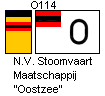
N.V. STOOMVAART MAATSCHAPPIJ "OOSTZEE".
The flag is white with a red-black-red triband in the upper hoist quarter, representing Amsterdam, and a black O in the lower fly. The yellow funnel bears the same triband. Sources vary in band widths: black often looks wider, though it is also shown narrower on the funnel. Captain Eldert Dobbenga’s sketchbook calls the flag the company, Oostzee or Vinke flag.
Oostzee, also called East Sea or Baltic S.S. Co., was formed in 1897 and managed by Vinke from 1897 to 1985. Its name reflected the fleet’s initial Baltic timber trade. Operations included tramping and regular services, among them Independent Gulf Line between Hamburg–Le Havre and Brownsville–Savannah ports. Fearnley & Eger acquired the company in May 1972. Mitchell records a 1982 reconstitution with all shares taken by Holland Navigation and wholly Dutch ownership. Hillegersberg’s fleet appears to have been absorbed; a Curaçao Oostzee company held some former Hillegersberg vessels, and Singa Ship Management was an associate.
Netherlands, Amsterdam; Rotterdam in Brown 1926.
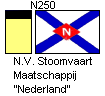
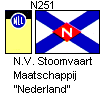
N.V. Stoomvaart Maatschappij “Nederland”.
N.V. STOOMVAART MAATSCHAPPIJ "NEDERLAND".
image by Jarig Bakker, 1 February 2001
Black-and-white photographs confirm this funnel.
Ships in the Nedlloyd Lijnen service used an NLL logo on a diamond or circle overlapping the funnel top and base. Although a joint flag was designed, owners apparently continued to fly their own. Brown shows equal-sized funnel letters; a Neder Eems photograph instead confirms that they vary with the circle’s outline.
Merchant Ships 1959 records this funnel only for Oranje. The accompanying flag is assumed rather than supplied by that source.
S.M.N. was also called Nederland Line and various Nederland Royal Mail forms. Sources give formation as 1822 in the Rhein trade, 1870 or 1871. Nederlandsche Scheepvaart Unie was formed in 1908 as a holding company for shares in Nederland and Koninklijke Rotterdamsche Lloyd. In 1970 Nederland merged with Rotterdamsche Lloyd and Vereenigde Nederlandsche Scheepvaart Maatscahhpij under Nederlandsche Scheepvaart Unie; the fleet came under Koninklijke Nedlloyd.
Nederland co-founded Phoenix in 1888 and Java-China-Japan Lijn in 1902. Its joint services and interests included Java-Bengal from 1906, operated from 1908, Java-Pacific in 1915, Java-New York in 1916, and Silver Java Pacific with Silver Line from 1930. It participated in Koninklijke Paketvaart with Rotterdamsche Lloyd and in the consortium controlling Vereenigde Nederlandsche Scheepvaartmaatschappij. Its Holland West Afrika interest transferred to the latter on 1 January 1968. The Nedlloyd Lijnen joint service with Rotterdamsche Lloyd originated in April 1963; a Nederland Lloyd predecessor is suggested only by the livery.
Netherlands, Amsterdam.
N.V. STOOMVAART MAATSCHAPPIJ “NOORDZEE”.
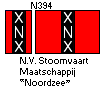
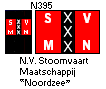
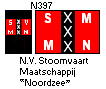
Brown 1926 and Talbot-Booth’s 1942–44 accounts give SMMN in the corners.
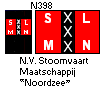
Brown 1929 gives SLMN.
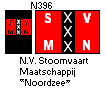
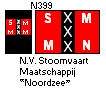
Brown 1934 and 1943 give SVMN. The source also says Brown 1943 has black funnel letters, labelling that funnel N395, while the source list assigns the 1943 version to N396. Jordan leaves letter colours unspecified and gives SM and MM vertically on the two sides.
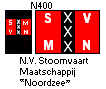
Wij Varen Weer 1946 gives SVMN on the flag, plausibly Stoom Vaart Maatschappij Noordzee, but SMVN on the funnel. This inconsistency prevents Rosanoski treating the interpretation as certain.
The flag appears based on Amsterdam’s arms. Before the war it had a central black vertical stripe with three white Xs and white initials in the red corners. A 1956 Dutch flag chart instead describes the central stripe as bearing XNX. Rosanoski considers changing or unreliable reports more likely than a secure sequence of designs.
Also called North Sea Steamship Co., Noordzee operated steamships from 1916 until the mid-1960s. It was managed by N.V. Gebr. Scheuer and used lo as a ship-name suffix.
Netherlands, Amsterdam.
N.V. Stoomvaart Maatschappij “Westpolder”.
N.V. STOOMVAART MAATSCHAPPIJ "WESTPOLDER".
image by Jarig Bakker, 1 February 2001
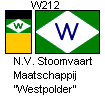
The flag and funnel were also used by Cornelder’s. Op de Lange Deining omits a funnel top and uses a blue letter. Talbot-Booth 1942/1944 instead describes a green letter on the funnel panel without illustrating the flag; Rosanoski presumes the flag would normally match. Jarig Bakker’s FOTW flag follows De Blauwe Wimpel’s April 1956 chart.
ABC’s funnel panel and Wyt’s Digest 1960 give a black W. Rosanoski suggests that the various colours may represent a very dark shade, without deciding which. A photograph of Oranjepolder confirms an extremely narrow black funnel top separated from the band. Wyt’s 1965–1967 and subsequently FOTW place this version under Cornelder’s.
Mitchell appears to record W243’s funnel from a London sighting in July 1960, but names no vessel.
Cornelder’s managed Westpolder in 1929–1967 according to the cited account, although the wartime books name C.W.H. Van Dam. Vessels used the suffix polder.
Netherlands, Rotterdam.
N.V. VERENIGDE TANKKUSTVAART.
image by Jarig Bakker, 1 Feb 2001
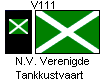
The V111 flag is illustrated by Jarig Bakker from the Dutch house-flag chart accompanying De Blauwe Wimpel, April 1956. The funnel and flag also appear in Wyt’s Digest, US Navy 1961 and Stewart 1963; Mitchell supplies funnel evidence. No separate written design description is given.
N.V. Tank Kustvaart and N.V. Phs. Van Ommerens Scheepvaartbedrijf began operating as N.V. Verenigde Tankkustvaart on 15 September 1948. Phs van Ommeren became sole owner on 1 May 1970 by acquiring 224 shares. The last ship was sold on 27 March 1973, and a statutory amendment on 17 December 1982 changed the name to N.V. Van Ommeren Shipping. The registers also record management by N.V. P.A. van Es & Co.
Netherlands, Rotterdam.
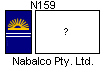
NABALCO PTY. LTD.
The source records a New South Wales Nabalco Pty. Ltd., registered on 2 April 1964 and later named Alcan Gove Pty. Ltd., and a Queensland company registered on 30 August 1966 as Wenlock Bauxite Pty. Ltd., later Nabalco Pty. Limited and voluntarily deregistered on 13 April 2007. Nabalco Shipping Pty. Ltd. in New South Wales was deregistered on 1 June 1984.
The mining company chartered Seaway Queen from 1975 to 1978 to carry material to its Gove Peninsula bauxite mine. It is also described as a co-founder of Papuan Liner Services, although Rosanoski notes conflicting information.
Australia, Brisbane.
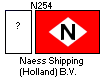
NAESS SHIPPING (HOLLAND) B.V.
image by Jarig Bakker, 14 October 2003
Bakker’s flag image, based on the company website, shows the diamond outlined in black.
Funnels appear generally to have followed the owners’ colours. Mitchell records red with a black top for Lancelot Star, managed for Lancelot Shipping Corporation, and Petrobulk Pioneer, managed for Petrobulk International Corporation. His company card also places an N within a diamond in a square panel, suggesting possible funnel use of the flag design, but this is not established.
Lloyds dates Naess Shipping to 1932, whereas the company website gives 1973 for its management business. Register entries describe it successively as operator and manager, with ships held through name companies.
Netherlands, Amsterdam, later Diemen.
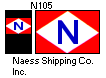
NAESS SHIPPING CO. INC.
image by Joe McMillan, 2 November 2001
Wyt attributes a similar livery to Nederlandse Norness Scheepvaart Maatschappij N.V.
Naess Shipping, also recorded as Naess & Co. Inc., managed ships for Nederlandse Norness Scheepv. Maats. N.V. and Alliance Shipping Co. S.A. It was acquired by Zapata Marine Services in 1973 and became part of Zapata Naess Ltd.
McMillan inferred from Naess’s membership of the American Committee for Flags of Necessity that it used flags of convenience rather than the US flag. Its absence from the successor Federation of American-Controlled Shipping suggested to him that it had ceased business by that body’s formation in 1974; these are inferences, not separate confirmation of registry or closure.
USA, New York.
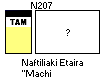
NAFTILIAKI ETAIRA “MACHI”.
Elpis was recorded with this funnel in April 1967. It is yellow or buff with a black top, separated by a broad white band bearing the black letters TAM. No flag is recorded.
Unknown.
NAFTOMAR SHIPPING & TRADING CO. LTD.
image by Ivan Sache, 12 November 2003
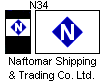
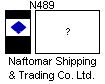
Brown places the diamond almost against the upper and lower edges of both the funnel band and the flag. Christies extends the funnel diamond throughout the band; a Gaz Baraka photograph shows an equal-sided diamond touching its top and bottom. Nüsse’s table flag is dark blue, company images appear medium blue, and the FOTW image uses bright blue.
Naftomar was incorporated in Beirut in 1972 and later moved to Piraeus. It acquired its first dedicated vessel in 1977 and specialised in transporting petroleum products. Lloyds gives 1977 as its foundation date and records it successively as operator, manager and agent. Interunity Management was listed as an associate in 2000 but not mentioned in 2003.
Greece, Athens.
NAFTOTRADE SHIPPING & COMMERCIAL S.A.
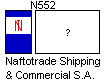
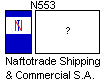
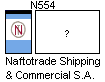
This funnel comes from Naftobulk II, photographed on 13 April 2004.
Naftocement III, photographed on 19 July 2008, has the T beneath the N, unlike the website logo.
A 20 June 2008 photograph of Naftocement XV at Sydney shows the ring and T in a khaki shade, with the T again beneath the N. A later source photograph of Naftocement III shows these elements as grey; the welded-on emblem casts shadows.
The website logo has a blue T over a red N within a grey or silvery ring. Its animated ring rotates; the recorded image captures it part-way round.
Nicos Varvates founded Naftotrade in 1989 to transport cement. Its website uses both NaftoTrade and Naftotrade; Lloyds initially lists Nafto Trade as manager and later agent.
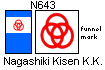
Mitchell attributes this funnel to Nagashiki, apparently from Jupiter Island, which Lloyds records under Moon Rise ownership and Nagashiki agency. The design continued on Moon Rise vessels after their listing under Dae Ah. It may therefore belong to Moon Rise/Dae Ah, or be shared through possible ultimate Nagashiki ownership. In a 2014 note on African Kookaburra, Rosanoski distinguishes it from the Misuga logo: Misuga managed that vessel, while other Moon Rise ships under Dae Ah used the same funnel.
No claim of exclusive Moon Rise ownership of design, Misuga use or corporate equivalence.
Nagashiki Kisen was formed in 1958, when its first vessel, Wakashio Maru, was built; the cited ship index does not name her owner. Lloyds later lists Nagashiki Shipping Co. Ltd., formed in 1997 at the same address, and combines the names from 2005.
Moon Rise Shipping appeared as a Nagashiki agency company in 1985–86 and later as a name company, before being listed under Dae Ah Shipping of Busan in 2007. Mutsushio had been ordered with Nagashiki as prospective manager but was delivered on 24 January 2002 under Dae Ah. An account of African Sanderling’s 2008 hijacking describes layered ownership involving Moon Rise, South Korean capital and Japanese owners, with the ship on long-term lease to MUR Shipping. Rosanoski presumes that the unspecified Japanese owners were Nagashiki; he does not establish this conclusively.
Japan, Hiroshima, later Kasaoka.
NAGASHIKI KOGYO K.K.
Mitchell mentions Nagian Mercury but supplies no line drawing; Rosanoski could not locate that vessel.
Japan, Kasaoka.
NAGATA SANJURO.
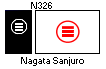
The flag comes from a 1902 chart reproduced in Fune to Hata in 1994. Fujinagata Zosensho used the same colours; the funnel is recorded for 1901 and 1910.
Nagata Sanjuro founded Fujinagata Zosensho.
Japan, Osaka.
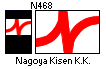
NAGOYA KISEN K.K.
Nagoya Kisen was formed in 1948. Lloyds records Showa Kaiun as owner in 1998 and 2000, and Nippon Yusen Kaisha in 2003 and 2005.
Japan, Nagoya.
Naikai Eisen K.K.
NAIKAI EISEN K.K. (2)
image by Jarig Bakker, 1 November 2005
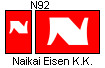
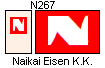
Brown’s N92 has inward-curving sides to the letter; Watt states that the uprights should be straight, as in N267. The N267 funnel is the early version.
Bakker’s FOTW flag follows Brown 1995.
Original Matsuyama entry
Japan, Matsuyama.
Keep the explicit scope label independent; no alias or company identity is inferred.
Tug-company entry
Japan, Kobe, later Matsuyama.
Keep the explicit scope label independent; no alias or company identity is inferred.
The original Matsuyama entry appears in Lloyds in 1963–64 and 1973–74. In 1978–79 it is combined with the Kobe entry, described as a tug company. The later listing places the company at Matsuyama.
Naikai Kenzai K.K.
NAIKAI KENZAI K.K. (1)
Naikai Kenzai (1)
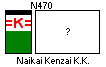
The funnel is noted for Naikai Maru No. 12, which Rosanoski did not locate in Lloyds.
The Okayama concern appears in Lloyds from 1980–81 to 1996–97, with an omission in 1992–93. Subsequently its vessels were too small for Lloyds Shipowning Groups.
Japan, Okayama.
Keep the explicit scope label independent; no alias or company identity is inferred.
Karatsu namesake
A separate Karatsu namesake is listed in 1992–93.
Japan, Karatsu.
Keep the explicit scope label independent; no alias or company identity is inferred.
NAKAJIMA KISEN K.K.
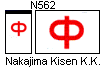
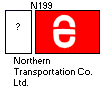
A photograph of Jinwa, launched in 2006, shows the funnel and flying flag. The flag is white with a red phi-like sign, described as an ö fully closed on the left. Although the company’s drawing is square, the photographed flag is rectangular; flags appear at the mast and bows.
Nakajima Kisen was formed in 2004 by privatisation of a publicly owned transport operation. It runs ferries on the Inland, or Seto, Sea between Honshu, Shikoku and Kyush.
Japan, Matsuyama.
Nakamura Kisen K.K.
NAKAMURA KISEN K.K. (1)
image by Phil Nelson, None
Principal Kobe company
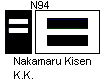
Mitchell’s Asakirisan Maru reference confirms the principal Kobe attribution for Rosanoski; Brown’s Osaka location appears incorrect. Mitchell also shows this funnel on the agency vessel Mount Ranier. Many ships in his drawings have European names, suggesting chartering.
The principal Kobe company appears in Lloyds from 1953. Rosanoski tentatively connects it with a 1978–79 joint venture with Sankyu Unyu Kiko and the later Tokyo-based owner, manager and agent, both associated with Unkai Maru. Financial difficulties in 1985 led to attempted restructuring, bank foreclosure and bankruptcy on 25 February 1986.
Earlier correspondence described the Kobe operation as lasting until the early 1970s; Rosanoski’s later note connects previously separate entries, extending the account. The source warns that Nakamura Kisen is a common company name.
Japan, Kobe; Brown gives Osaka.
Keep the explicit scope label independent; no alias or company identity is inferred.
Nakamura Kisen (2)
The Ochi-gun namesake is listed in 1966–67 and 1973–74.
Japan, Ochi-gun.
Keep the explicit scope label independent; no alias or company identity is inferred.
Nakamaru Kisen (3)
Nakamaru Kisen is separately listed at Tokyo in 1973–74.
Japan, Tokyo.
Keep the explicit scope label independent; no alias or company identity is inferred.
Nakamura Kisen (4)
Another Kobe entry is listed in 1973–74.
Japan, Kobe.
Keep the explicit scope label independent; no alias or company identity is inferred.
NAKAMURA USHITARO & 1 OTHER.
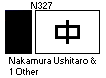
The flag is taken from a chart dated 1902, published in Fune to Hata in 1904 according to this source. The funnel comes from a 1903 chart.
Japan.
NAKANO KAIUN K.K.
Founded in 1953, Nakano Kaiun is also recorded as Nakano Lines Ltd. Lloyds lists it as agent in 1985–86, owner and agent in 1992–93, and manager in 2005–06.
Japan, Tokyo.
Nakano Kisen K.K.
NAKANO KISEN K.K. (1).
image by Phil Nelson, None
Nakano Kisen (1)
The first company appears in Lloyds from 1953–54 to 1970–71 and seems to have ceased in the early 1970s.
Japan: Tokyo, with later references to Moji or Kobe and then Kitakyushu.
Keep the explicit scope label independent; no alias or company identity is inferred.
Nakano Kisen (2)
A second entry is recorded from 1963–64 through 1985–86.
Japan, Moji, later Kitakyushu.
Keep the explicit scope label independent; no alias or company identity is inferred.
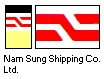
NAM SUNG SHIPPING CO. LTD.
The flag is white with two red horizontal bands interrupted by white. The upper red band connects to the lower on what Rosanoski calls a Pbd angle, forming a z-like design. The yellow or buff funnel has a black top separated by a broad band of the flag.
Nam Sung was formed in 1959. Its fleet included ships under its own name, a disponent owner and the one-ship subsidiary Sun Angel Navigation S.A., formed in 1993.
South Korea, Pusan (Busan), later Seoul; Lloyds also gives a Tokyo address.
NAMA SHIPPING.
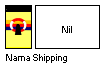
The funnel is yellow with a black top and a golden-yellow, red and blue triband, overlaid by a white-and-red lifebelt. A black form, described as an “oblisk”, overlies the lifebelt’s lower half.
Nama Shipping operated Jan-Dirk from 1975 to about 1988.
Papua New Guinea.
NAMURA KISEN K.K.
image by Phil Nelson, None
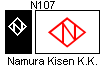
Namura Kisen appears in Lloyds from 1953–54 to 1973–74 and ceased in the mid-1970s. A joint venture with Nippon Yusen Kaisha is recorded in 1963–64.
Japan, Tokyo, later Osaka.
NANTAI LINE CO. LTD.
image by Jarig Bakker, 16 February 2006
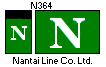
Nantai Line was formed in 1968 and is probably the Nantai Enterprise Co. Ltd. listed in 1970–71 and 1973–74. A newspaper account says creditors drove it out of business in September 1999, but Rosanoski presumes some survival, possibly only through its Indonesian subsidiary.
P.T. Nantai Lines was formed in 1996 and listed at Bandar Lampung, later Panjang. The source also records Nantai Line (S) Pte. Ltd. of Singapore.
Taiwan, Keelung, later Taipeh.
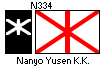
NANYO YUSEN K.K.
image by Phil Nelson, 4 February 2002
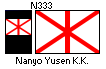
The FOTW flag follows a 1916 source reproduced in the 1994 publication Fune To Hata.
Nanyo Yusen, also called South Sea Mail Steamship Co. Ltd., was a steamship owner from 1916. It survived the Second World War and became Tokyo Senpaku K.K. about 1950. Merchant Ships 1942 instead records a change to Nanyo Kaiun in 1936; Watt rejects that account, explaining a transfer of certain trades between companies rather than a simple renaming.
Japan.
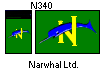
NARWHAL LTD.
Loughran identifies the emblem as a narwhal. Neither Marine News nor Loughran shows a black funnel top.
Narwhal Ltd. is recorded in Lloyds 1970–71.
Bahamas, Nassau.
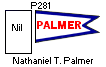
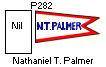
NATHANIEL T. PALMER.
image by Jarig Bakker, None
image by Jarig Bakker, None
Both examples are white tapering swallow-tailed pennants. Palmer has blue borders except at the hoist and red PALMER lettering; N.T. Palmer reverses those colours, with red borders and blue N.T.PALMER.
Palmer operated schooners from 1894. He used no company house flag, placing a large black P on the foresail instead. Individual ships, often named for family members, had their own flags.
USA, Bath.
NATHANIEL WINSOR & CO.
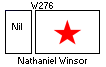
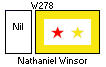
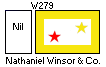
The FOTW illustration derives from a clipper card at tenpound.com; the document also identifies a Dashing Wave clipper card.
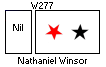
Joe McMillan describes a variant with two stars: a red star in the hoist with one point down and a black star in the fly with one point up.
Mystic Seaport dates the Regular Line flag to 1850.
Loughran attributes the flag to Nathaniel Windsor & Co.; Rosanoski identifies Winsor as the correct spelling.
Winsor’s Regular Line served Norfolk, Savannah, Mobile and New Orleans, and later San Francisco. Its New Orleans service was also called the Crescent Line, after the Crescent City; the Savannah service was the Dispatch Line. Merchants and Miners purchased the company in 1907.
The account credits Nathaniel Winsor Jr. (1775–1839) with moving the family business to Boston and establishing the line in the 1840s. These dates are inconsistent in the original account.
USA, Boston, Massachusetts.
NATIONAL BENZOLE CO. LTD.
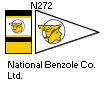
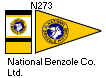
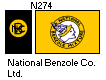
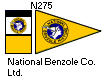
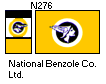
The original funnel is black with a yellow circle containing stylised black NBC initials. The initials were replaced between the wars by Mercury’s winged-helmeted head.
Authorities show differing versions of the Mercury funnel. Loughran says the pennant was adopted shortly before the merger, but Rosanoski finds that chronology reversed in the displayed N275 and N276 illustrations. Stewart uses a black circle; Talbot-Booth’s 1942 N273 funnel has the head facing forward, and US Navy shows a yellow helmet with white wings.
Funnel version 2 is yellow or buff with a black top, separated by yellow, white, yellow and black bands. The yellow bands are very narrow and the white broad; the latter carries a black ring enclosing a yellow Mercury head detailed in black.
Funnel version 3 uses the same banding with a blue disc bearing Mercury’s white head, detailed black, inside a yellow ring outlined in black. The ring reads NATIONAL above and BENZOLE MIXTURE below in black. Version 4 retains this emblem on a broad white band edged black below, without the narrow yellow bands.
Funnel version 5 is yellow or buff with a black top and broad white band. A yellow ring surrounds a separate black disc bearing Mercury’s white head, detailed in black.
Flag version 1 is yellow with a white circle bearing Mercury’s white head, detailed black, within a black-outlined yellow ring inscribed NATIONAL above and BENZOLE MIXTURE below.
Flag version 2 is a white pennant with a black ring enclosing a yellow Mercury head detailed in black.
Flag version 3 is a yellow pennant with a blue disc bearing Mercury’s white head, detailed black, inside the yellow, black-outlined ring inscribed NATIONAL and BENZOLE MIXTURE.
Flag version 4 is yellow with a white ring enclosing a black field bearing Mercury’s white head, detailed black.
National Benzole’s fleet was absorbed into Shell-Mex about 1960.
UK, London.
NATIONAL INSTITUTE OF WATER & ATMOSPHERIC RESEARCH.
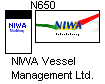
Tangaroa’s 14 May 1997 photographs show dark-blue NIWA lettering above the smaller Taihoro Nukurangi on an attached white funnel panel whose edge is not defined. The larger letters slope more than the smaller ones. The white superstructure carries the website-style rainbow logo, with the smaller lettering definitely black.
Tangaroa also flew a flag whose design differs from the website logo. Its coloured form widens and narrows towards the fly, passing through green, yellow and red with lighter merging areas. Beneath it are smaller Taihoro Nukurangi letters, apparently black in several photographs but possibly dark blue in another. The lettering has the same differing degrees of slant as on the funnel.
Kaharoa’s funnel is small and unsuitable for an attached panel. A starboard photograph of 6 September 1996 shows a brown superstructure panel with black NIWA FISHERIES RESEARCH lettering. By 14 May 1997 the port side carries the flag design without its small lettering.
NIWA was established in 1992 as a Crown Research Institute operating as a stand-alone company. The Ministry of Agriculture & Fisheries’ Fisheries Research Division transferred to it in 1995. NIWA Vessel Management was formed in 1996 to own and charter vessels for scientific research; the transfer of Tangaroa and Kaharoa was reported in July that year.
New Zealand, Auckland.
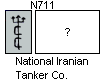
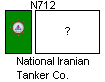
NATIONAL IRANIAN TANKER CO.
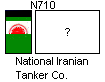
The funnel emblem appears to be a red rising sun within a half-ring.
Mitchell attributes this funnel to storage tankers used for floating storage in the Middle East Gulf.
Sarvestan’s January 2010 photograph shows a very pale, mottled-blue circle without letters. Susangird’s 24 May 2008 photograph is unclear but has the same very light blue background, apparently with lettering at the base.
The company’s website logos are based on the National Iranian Oil Co. emblem.
NITC’s website dates its establishment to 1955, when foreign tankers were banned from carrying Iranian export oil to outside markets. It merged with the National Iranian Oil Co. in 1970, then registered in 1975 as an independent shipping company wholly owned by that organisation. Lloyds instead gives a formation date of 1986, and records it under the Government of the Islamic Republic of Iran in 2000.
Iran, Abadan, later Tehran.
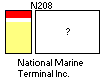
NATIONAL MARINE TERMINAL INC.
The funnel recorded for Westgate in February 1966 is yellow or buff with a red top separated by a white band. A 1968 report instead gives a brown top. No flag is recorded.
National Marine Terminal appears in Lloyds in 1963–64 and 1970–71.
USA, San Diego, CAL.
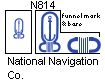
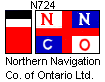
NATIONAL NAVIGATION CO.
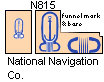
Wadi Alarish’s starboard photograph of 2 June 2013 shows an apparently off-white funnel.
This funnel follows a starboard photograph of Wadi Feran dated 8 March 2012.
National Navigation Co. (NNC) dates its establishment to 1981 as an Egyptian-capital company supporting development of the commercial fleet, buying ten ships in 1985. Lloyds gives 1983 as its formation date and identifies Government control.
Lloyds records absorption of MISR Shipping in 2004. The company website describes a 2003 merger with MARTRANS, the forwarding business established in 1957, but also records acquisition of 70% of MARTRANS in October 2005. It reports acquiring 90% of Egyptian Navigation Co. in 2005 and contributing 25% of the capital of the National Co. for Shipping Petroleum, or Egyptian Tanker Co., established in 2009.
Egypt, Cairo.
NATIONAL OCEANOGRAPHIC COUNCIL.
Discovery was noted in June 1963 with a yellow or buff funnel. No flag is recorded.
The Council is recorded in Lloyds 1963–64.
UK, Wormley.
NATIONAL POWER PLC.
National Power PLC
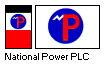
The flag is white with a blue circle bearing a large red P. A small white N touches its upper dexter side and is angled Pbds, in Rosanoski’s notation. The funnel is red with a black top separated by a broad band of the flag.
UK, London.
NATIONAL SAND & MATERIAL CO. LTD.
The company operated the dredger Charles Dick from her construction in 1922 until she was broken up in 1976. Lloyds lists the operation under J.D. Payne in 1953–54 and under National Sand & Material’s own name, at the same address, in 1966–67.
Canada, Toronto.
NATIONAL SHIPPING CORPORATION OF THE PHILIPPINES.
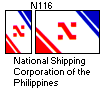
The flag is a diagonal blue, white and red triband, with the outer colours cotised and the white band broader. The white carries a stylised red N formed by an elongated Z-like figure between small red squares towards the upper fly and lower hoist. The funnel carries the flag.
The corporation was formed in 1984. It acted as agent for National Development Co., later listed as its operating subsidiary. Wan Hai Lines acquired the management right in March 1994. The corporation apparently ceased, with its deep-sea fleet taken over by Trans-Pacific Lines, formed in 1999.
Philippines, Manila.
NATIONAL SHIPPING CORPORATION.
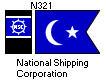
The funnel is confirmed by the NJK record for Abasin.
National Shipping Corporation amalgamated with Pakistan Shipping Corporation in 1979 to form Pakistan National Shipping Corporation.
Pakistan, Karachi.
NATIONAL STEAM SHIP CO. LTD.
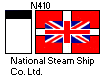
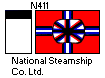
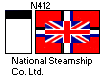
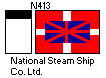
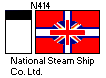
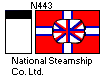
The main cross appears edged blue and then outlined black. The panel cross may represent a Union Flag, but seems to have a black cross and saltire edged red or blue, except for the horizontal arms, which have blue on both sides.
Bonsor gives blue edging to the main white cross. Lloyds explicitly outlines it in black, whereas LJC 1909 does not.
An illustration of Italy seems to place the flag emblem wholly on the cross’s central intersection. Holland confirms the funnel.
The National Line was formed in 1863 as National Steam Navigation Co. and began operations in 1864. It became National Steamship Co. Ltd. in 1867. Atlantic Transport bought its fleet and goodwill early in 1896; the company entered voluntary liquidation in 1914.
UK, Liverpool, later London.
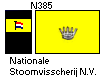
NATIONALE STOOMVISSCHERIJ N.V.
Nationale Stoomvisscherij appears in Lloyds from 1953–54 through 1966–67.
Netherlands, Ymuiden.
Nauru Pacific Line.
NPL
image by Jarig Bakker, 18 December 2005
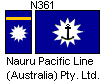
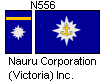
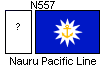
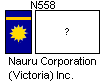
The flag is dark blue with a white twelve-pointed star containing an anchor; the funnel follows the national flag’s arrangement. Dark blue represents the ocean, the narrow yellow funnel band the equator, and the white star Nauru’s position just south of it, with twelve points for the island’s tribal groups. The Log specifies a black anchor. Rosanoski recorded blue anchors and a gold funnel band on Rosie D in 1983 and Eigamoiya in 1989, but considered that distance and an expectation of matching the dark-blue field might explain his observations. Eigamoiya had a black funnel top before her Lyttelton survey.
Brown 1995, under Nauru Corporation (Victoria) Inc., gives a yellow anchor and unequal star points, with the quarter points longer. Rosanoski doubts the unequal points in view of funnel photographs and the star’s tribal symbolism.
Pedersen’s blue flag with a central white twelve-pointed star and yellow anchor was reported as a civil ensign. The FOTW discussion identifies it instead as the shipping company’s house flag. Rosanoski allows that anchor colours might have changed, but favours black. A yellow-anchor version on the Oceania Shipping Forum has no stated source.
Nauru Pacific Line (NPL) began about 1969 following independence and later operated from Melbourne. Its Government-owned ships were initially registered to the Nauru Local Government Council. Ownership registrations moved to Nauru Corporation (Victoria) Inc. in 1979–80; Nauru Pacific Line (Australia) Pty. Ltd. managed them. The subsidised line ceased as owner towards the end of 1992. Eigamoiya left Melbourne for her Greek buyers on 25 March 1993 still in NPL colours and flying the Nauran flag. Another account says the name disappeared in 1998; the Victorian corporation was deregistered on 14 October 2008.
Nauru; later Melbourne, Australia.
Naval Engineering Dynamics Ltd.
Aegean Constellation Inc.
Of three one-ship companies found in Lloyds, Mitchell associates a funnel only with Adamastos of Aegean Constellation Inc. Whether the others shared that marking or used separate designs is unclear.
Naval Engineering Dynamics was involved from 1971 in buying, rebuilding and operating vessels that had suffered major damage. Lloyds lists it as operator in 1978–79 and agent in 1985–86.
Greece, Piraeus.
Naval.
Documentary images — company attribution uncertain
image by Jorge Candeias, 6 January 1998
Candeias reports this flag among other “text flags” on a single pole. He felt it might be Portuguese but had no factual basis for that suggestion. Rosanoski notes that it may not even be maritime.
No company, country or maritime use established.
Portugal, as classified in the original document.
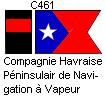
NAVALE ET COMMERCIALE HAVRAISE PÉNINSULAIRE.
image by Jarig Bakker, 3 January 2005
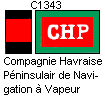
At Ville de Valance’s launch on 30 August 1882, the described flag has dots after the letters. Their precise shapes remain uncertain. Lloyd Reedereiflaggen attributes it to Société d’Exploitation de la Cie. Havraise Péninsulaire de Navigation à Vapeur; Mitchell uses that name for the Ville de Manakara funnel while noting the later Navale et Commercial Havraise Péninsulaire name.
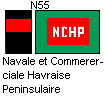
Talbot-Booth and Harnack omit dots after the flag letters. Merchant Ships 1942, 1944 and 1949 show a broad funnel band, supported by a black-and-white photograph of Ville de Tamatave. Rosanoski presumes that the band subsequently narrowed with smaller funnels.
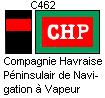
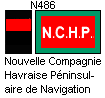
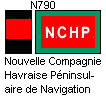
This design was retained from the preceding company name. Most sources include dots after the letters, but Nüsse’s table flag does not. The funnel band may be wider than illustrated. An Ile de la Reunion photograph confirms the flag.
Bakker’s FOTW flag follows Scott’s 1959 Caltex book.
Documentary images — company attribution uncertain
The LJC 1885 flag is uncertain. Cureau did not recognise it and found it unlike the familiar red flag with green border and white CHP letters. Rosanoski notes that the later CHP design appears in Griffin 1895, while an account of an 1882 launch seems to contradict the LJC flag unless it had an earlier connection.
Earlier/different company versus erroneous chart remains unresolved.
NCHP, also called Nochap, traced its origins to Eugéne Grosos’s Le Havre–Spain service of 1865, later extended to Algeria and Italy. The statutes of Compagnie Havraise Péninsulaire de Navigation à Vapeur were deposited in Paris on 16 March 1882. Another account gives an 1884 name including H. Grossos. Rosanoski cautions that a version omitting Péninsulaire may confuse it with Compagnie Havraise de Navigation Corblet.
By 1898 the company was described as France’s fifth-largest fleet, with sixteen ships. Compagnie Générale Transatlantique acquired it in 1915. Accounts link financial difficulties to the period around Togo’s loss in 1918 and the subsequent creation of Nouvelle Compagnie Havraise Péninsulaire. Worms controlled the company by 1939.
The date of the Nouvelle name remains disputed. Cureau, citing Randier, gives 1939, when financing difficulties led first to fleet management by a leasing company and then transfer to a newly constituted company. Rosanoski points out that Talbot-Booth already used the name and flag in 1936 and Lloyds the name in 1937–38. A fleet list beginning in 1931 may suggest an earlier starting point, but does not fix it. He offers an alternative reading in which the new company anticipated a financial crisis; the correspondence does not resolve the chronology.
Absorption of Compagnie Nantaise des Chargeurs de l’Ouest is dated 1968 by one account and February 1969 by Mitchell. The resulting Compagnie Havraise et Nantaise Péninsulaire had the subsidiaries Navale et Commeciale Havraise Péninsulaire, Eurotramp and SNCO. NCHP merged into Navale Delmas International in 1992.
France: Havre, Paris, Marseilles, Dunkirk and again Paris in successive sources.
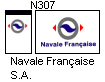
NAVALE FRANÇAISE S.A.
Nüsse records a table flag. Photographs of Tour Margaux from both sides confirm the funnel and flag. Their apparent grey funnel colouring is shown to be shading by another portside photograph of Pointe du Cormoran.
Navale Française was formed in 1994 through the amalgamation of Société Finisterienne de Cabotage and Navale Transports Vinicoles LEDUC. The former had itself combined with Compagnie Generale d’Armements Maritimes in 1990. The latter brought together Leduc, formerly Leduc Fils et Cie. until 1979, and the wine-transport concern whose names had passed from Transports Maritimes Vinicoles to Transports Maritimes Vinicoles Algeriens in 1959, back in 1964, and to Navale Transports Vinicoles in 1976.
Tankafrica was taken over in August 2002. Lloyds subsequently places Navale Française under ERMEWA Maritime and then Eitzen, recording ownership of 51% by Compagnie Ruy Investissment and 49% by Eitzen before the latter acquired the balance in June 2006. Eitzen’s website instead dates its acquisition to 2004, placing it within Eitzen Chemical. Navale Française also participated in France Euro Tramps, apparently later selling its interest to Louis Dreyfus Armateurs.
France, Montpellier, later Puteaux.
Navalis Gruppe.
NAVALIS GRUPPE.
image by Peter Hans van den Muijzenberg, 30 August 2009
image contributed by Neale Rosanoski, 29 August 2009
image by Klaus-Michael Schneider, 30 March 2009
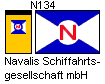
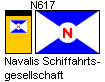
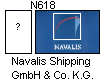
Nüsse’s table flag has diagonal blue and white quarters, with an overall white circle containing a red N. Mitchell records the funnel under R. & G. Rahmann, apparently from Navalis, but his line drawing omits the panel. Rosanoski doubts whether the blue ring in the funnel illustration should appear and suggests that the panel ought to reproduce the flag. The ship’s naming dates differ between sources, and he could not locate her in Lloyds.
The company history page’s 1972 panel shows the quartered design with a somewhat smaller N than Nüsse’s flag. Van den Muijzenberg followed the unmodified flag for his funnel reconstruction, without having seen the funnel itself. Rosanoski preferred that rendition as more likely while retaining Mitchell’s alternative; panel proportions and shades remain uncertain.
Schneider describes a blue flag with a light-blue squarish tressure enclosing a red bow and a blue triangular object, with white NAVALIS lettering below. Rosanoski questions whether the underlying image was a website link panel rather than an actual flag. It might represent the group, but no flag sighting confirms it. He also notes that the website shows a white portside bow where this image has light blue.
The Navalis group comprises Navalis Shipping, founded in 1972 for chartering and operation; Navalis Invest for finance; and Schiffahrtskontor tom Wörden as shipowner and manager. The 2009 account names Klaus tom Wörden as owner and dates addition of a container feeder to 1985, followed by expansion into freighters and feeder ships.
Nüsse identifies the original ownership as Rahmann and tom Wörden. Rosanoski found only Angermanland listed under Navalis’s own name in Lloyds, managed by tom Wörden and carrying its funnel colours; he distinguishes that listing from the wider group.
Germany, Oldendorf.
NAVEGACION CARIBE “A. GRAUBARD S.A.”.
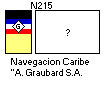
Adolpho Frederico is recorded with a yellow or buff funnel, a black top and a broad blue, white and red triband. A white diamond outlined in black bears a black G. No flag is recorded.
The NJK note suggests that this one-ship concern was obsolete by 1964–65, but leaves the associated B.U. notation uncertain.
Unknown.
Navegacion Nevgas S.A.
Documentary images — company attribution uncertain
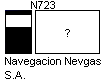
The funnel follows an undated black-and-white Midlake photograph. Because her previous owner is recorded with a black funnel, Rosanoski assumes that this version belongs to the Nevgas period, although her name was unchanged. The band may be silver, looking different from the white superstructure.
Date and previous-owner retention unresolved.
Navegacion Nevgas acquired York from York Agents in 1968 and sold her in 1970; it acquired Midlake in 1970 and sold her in 1974. Both retained their names. Sea Lord, acquired from Sea Lord Shipping without renaming, was with the company in 1973 and broken up in 1974. American Bulk Carriers acted as agent.
USA, New York.
NAVEGAÇÁO CATABRINENSE LTDA.
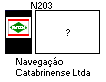
The funnel is black with a broad white band carrying an outlined white panel bordered red above and below. A generously proportioned green diamond bears white NAVECAL lettering. The panel suggests a flag design, but no flag is recorded.
Brazil.
NAVEGAÇÁO MERCANTIL S.A.
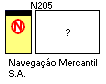
The funnel is yellow, with the alternative shade printed as “biff”, and has a black top. A red ring encloses a white field wholly charged with a red N; JLL’s note suggests that the field inside the ring may instead be yellow. No flag is recorded.
The company appears in Lloyds from 1963–64; by the 1985–86 edition it is named Empresa de Navegaçáo Mercantil S.A.
Brazil, Rio de Janeiro.
NAVEGAÇÁO MINUANO S.A.
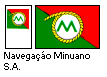
The flag is divided diagonally red and green, described as Pbd. An overall white circle is edged with a yellow rope whose loose end extends towards the upper hoist. Inside is a green M with angled outer legs. The white funnel carries a large panel of the flag.
Navegaçáo Minuano was formed in 1982.
Brazil.
NAVEGAÇÁO SANTISRA LTDA.
The funnel is blue with a black top. No flag is recorded.
Brazil.
NAVEGAÇÁO SAVONIA S.A.
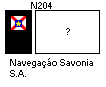
The funnel is black with a white panel bearing a red saltire, overlaid by a blue panel containing a yellow star. No flag is recorded.
Navegaçáo Savonia is listed in Lloyds from 1963–64 through 1985–86.
Brazil, Rio de Janeiro.
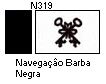
NAVEGAÇÂO BARBA NEGRA.
The cited Brazilian website records this livery for 1950.
Brazil, Rio Grande do Sul.
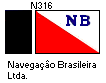
NAVEGAÇÂO BRASILEIRA LTDA.
The cited Brazilian website records this livery for 1950.
Brazil, Rio de Janeiro.
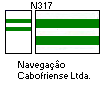
NAVEGAÇÂO CABOFRIENSE LTDA.
The cited Brazilian website records this livery for 1950.
Brazil, Rio de Janeiro.
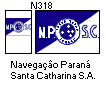
NAVEGAÇÂO PARANÁ SANTA CATHARINA S.A.
The cited Brazilian website records this livery for 1950. The ring bears a three-word legend, and its centre appears to contain a constellation of four white five-pointed stars.
Brazil, Rio de Janeiro.
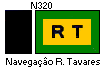
NAVEGAÇÂO R. TAVARES.
The cited Brazilian website records this livery for 1950.
Brazil, Rio Grande do Sul.
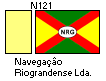
NAVEGAÇÂO RIOGRANDENSE LDA.
Navegaçâo Riograndense appears in Lloyds from 1953–54 through 1973–74.
Brazil, Porto Alegre; the later Country entry also gives Grupo 1103.
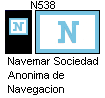
NAVEMAR SOCIEDAD ANONIMA DE NAVEGACION.
La Marina Mercante Argentina 1961 shows a white flag with a narrow light-blue border and an N of the same shade. US Navy 1961 makes the flag square. Brown 1978 instead gives a rectangle with a broader border and a thin, widely spread N; its funnel panel is also rectangular.
Navemar S.A. was formed on 16 July 1948 and lasted until the mid-1980s.
Argentina, Buenos Aires.
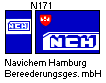
NAVICHEM HAMBURG BEREEDERUNGSGES. MBH.
The blue funnel has a broad white band bearing a white panel outlined in blue. Its white NCH letters are outlined and shaded blue.
The flag is blue with a red shield in the canton bearing a white three-towered castle. Along the base a white panel extends to the fly, with white NCH letters outlined and shaded blue. Its upper hoist corner is angled Pbds, in the original notation.
Navichem was formed in 1989 and liquidated in 1993. Owned by Chemikalien Seetransport GmbH, it held a vessel through a one-ship name company; Sinbad Shipping A/B is listed as manager.
Germany, Hamburg.
NAVICON S.A.
image by Jarig Bakker, 25 September 2005
Mitchell’s funnel, apparently based on Navipor, has no indicated letter on its circle.
Brown 1995’s burgee has three tapering white and red horizontal stripes and a central red disc bordered black, with a black stylised N. The Spanish house-flag site also shows this red version.
Another FOTW image is triangular, with white, gold and white triangular divisions and a white disc towards the hoist bearing a black circular-form N. The Spanish site gives a similar yellow version with the ring and letter blue.
Rosanoski suggests, without confirmation, that the red version might be for shipping and the yellow for another use, such as ashore. Astui instead asks whether the company’s two ships, Navicon and Navipor, each had their own flag.
A 30 August 2003 Navipor photograph shows a black funnel with a broad white band, apparently charged with something possibly red within a ring. The small photograph is inconclusive; Rosanoski suggests a possible charter.
Navicon was incorporated on 20 July 1979. Its last vessel, Navipor, was sold in 2004, and a 2013 company record lists it in liquidation after thirty-four years. Lloyds identifies Auxoil as an associate. Rosanoski questions a claimed connection with Grupo Trasmediterránea, finding neither register nor company-website support for membership of that group.
Spain, Madrid.
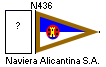
NAVIERA ALICANTINA S.A.
The emblem is a yellow turreted tower with black NASA lettering on either side.
Naviera Alicantina is recorded in 1985–86 and 1988–89 under agents Naviera Murueta.
Spain, Madrid.
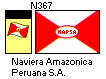
NAVIERA AMAZONICA PERUANA S.A.
The flag shown on the funnel has a yellow circle bearing a red A.
Also called Peruvian Amazon Line, the company appears in Lloyds from 1973–74 through 1996–97.
Peru, Lima.
NAVIERA ANGEL ALVAREZ S.A.
Also recorded as Angel Alvarez, the company appears in Lloyds from 1953–54 to 1973–74. Its last vessel, Lolina, is absent from the 1978–79 register and is recorded by Miramar as broken up in 1980.
Spain, Aviles.
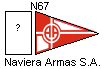
NAVIERA ARMAS S.A.
image by José Manuel Erbez, 29 November 1999
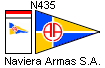
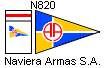
Erbez’s 1999 flag was used more often as a logo than as an actual flag. FOTW later replaced it with N435 without explanation.
The funnel shows a flag depicted as flying, recorded on Volcan de Taburiente’s port side and Volcan de Teneguia’s starboard side. Shades vary between photographs, perhaps because of camera resolution. The corresponding flag is assumed from the emblem rather than observed flying.
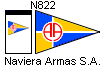
Volcan de Tejeda’s starboard funnel has the flag pointing forward as a mirror image; here red becomes the senior band. Again, the corresponding flying flag is assumed.
A portside photograph identifies this different funnel on Volvan de Tejeda; it also appears on Volvan den Tauce in 2008. The reason for the difference is unknown.
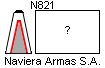
Here the emblem is a plain triangular panel rather than a pennant depicted as flying.
Antonio Armas Curbelo founded the concern, beginning with wooden-hulled boats, sailing vessels and motor sailers. Lloyds initially dated it to 1960, but later amended this to 1941, agreeing with the company website. It traded as Antonia Armas Curbelo S.A. until 1997 according to Lloyds. His son Antonio Armas Fernández succeeded as chairman. The company operates between the Canary Islands and entered the passenger and freight market in 1995.
Armas participated in the consortium behind the 2002 purchase of the business that became Acciona Trasmediterrànea.
Las Palmas, Canary Islands, and Huelva, Spain.
NAVIERA ARTOLA S.A.
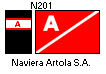
The funnel is black with a broad white band edged red above and below and bearing a red A. The flag is red with a very narrow white diagonal band, described as Pbds, and a white A in the canton. Untzidien Banderak gives the same flag to Naviera Arenas, which Rosanoski did not locate in Lloyds.
Naviera Artola participated in the consortium forming Gasnaval in 1980 and later sold its interest. Its acquisition by Van Nievelt Goudriaan was reported in March 1988.
Spain, Bilbao, later Las Arenas.
NAVIERA AZNAR S.A.
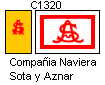
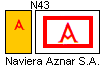
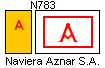
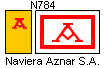
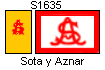
Lloyds 1904 and 1912 and Brown 1929 attribute this livery to Sota y Aznar; Brown 1934 names Sir Ramon de la Sota and also Compañia Naviera Sota y Aznar. Brown’s flag frames are thicker, with a narrower white outer edging.
The Marina Mercante en el País Vasco version has a more compact letter. Rosanoski suggests that it remains in use by the Ibaizabal Group, where it appears as a website logo.
Compañia Naviera Sota y Aznar was formed on 1 March 1906 by merging twenty-five companies under directors Ramon de la Sota and Luis Maria de Aznar. An extraordinary meeting adopted the Naviera Aznar trading name on 10 January 1939; Jordan dates the change to May 1939. Eduardo de Aznar, also behind Argus Steamship, controlled the company.
Relations between the Republican Sota and Nationalist Aznar families deteriorated through the 1930s financial crisis and the Civil War, with the Aznars gaining control of the fleet. Following the 1939 name change, most ships exchanged the Basque Mendi suffix for the Castilian Monte prefix. The concern became part of what is now the Ibaizabal Group. Sources describe disappearance in 1983 or the early 1980s amid financial and industrial difficulties, but Lloyds still lists it in 1985–86 and Miramar indicates fleet disposal about 1985–86.
Spain, Bilbao.
NAVIERA BILBAINA S.A.
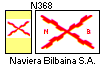
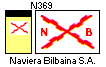
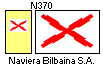
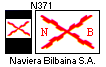
The emblem’s shortened, notched saltire is described as raguly. N370 differs slightly from the other versions in its notches.
Naviera Bilbaina appears in Lloyds from 1953–54 through 1992–93 and formed part of what became the Ibaizabal Group.
Spain, Bilbao.
NAVIERA CHILENA DEL PACIFICO S.A.
image by Jarig Bakker, 6 February 2006
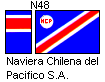
Bakker’s FOTW flag follows Brown 1995.
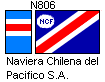
Alerce’s starboard photograph of 15 May 2013 shows this funnel, with the ship apparently on charter. A portside Roble N photograph shows the same dark-blue shade as the flag; the funnel blue appears to vary.
The company photograph shows a wider red flag stripe, but its fly end is hidden and has been assumed to finish as in N48. The letters are assumed dark blue although they look almost black. A partly obscured Alerce flag in 2007 appears to have a narrow red band; a poorly extended Roble N flag seems to show the wider version.
Nachipa was founded by Arturo Fernández Zegers, who progressed from scrap-iron trading to shipowning with the converted dredger Huelén through Compañia Fernández Figuetti. He joined Ivor Davis and other investors in 1947; the company was authorised on 30 June 1948, acquired Don Thompson and began carrying coal along the Chilean coast.
Fernández founded Naviera Peruana del Pacifico in 1954 to transport petroleum along Peru’s coast, continuing until nationalisation of that industry in the early 1970s. In the mid-1960s he formed the Intermar brokerage joint venture with Artura Larrain. He died on 15 February 1999.
Valparaiso; the original Country entry reads Chilel.
NAVIERA DAVILA S.A.
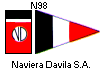
One funnel version is red with a black top separated by a broad white band. A second adds a white circle below the separating band, bearing black ND letters curved to follow the circle.
One flag is a vertical black, white and red triband pennant. The other has five horizontal red and white bands narrowing towards the point.
Lloyds records Joaquin Davila y Compania from 1958–59, Naviera Joaquin Davila y Compania from 1978–79 and Naviera Davila in 1992–93. Motopesqueros de Altura Reunidos managed some vessels.
Spain, Vigo; Madrid in Brown 1995.
NAVIERA DE EXPORTACION AGRICOLA S.A.
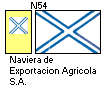
The flag is white with a blue saltire voided white; the yellow or buff funnel carries a panel of it. Brown instead shows a solid saltire on the funnel, while US Navy makes both funnel and flag saltires solid. Both sources extend the funnel panel into a band.
The company appears in Lloyds from 1958–59 through 1978–79.
Spain, Madrid.
Naviera del Atlántico S.A.
NAVIERA DEL ATLÁNTICO S.A.
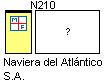
El Baztan was noted in April 1965 with blue M and F lettering on the funnel.
Naviera de Galicia S.A.
Cedeira’s 5 February 2007 photograph shows this funnel. A stern view retains black, white and black bands at the rear; as Algra, apparently chartered to Intersee, she had shown those bands around the whole funnel on 31 August 2006. Equasis records a sale on 1 March 2007, and Rosanoski interprets the mixed appearance as a gradual change of colours.
This funnel follows Cedeira’s 11 January 2011 photograph.
Founded in 1963, Naviera del Atlántico is later listed with its fleet under Naviera de Galicia (Navigasa), formed in 1980 at La Coruna.
Spain, Madrid.
NAVIERA DEL NALON S.A.
The flag is white with narrow red horizontal bands near the top and bottom. Between them is a red diamond wholly charged with a white N.
The black funnel carries a broad band of the flag.
The black funnel has a broad white band edged red above and below, bearing the flag emblem.
Founded in 1930 as Joaquin Velasco Martin, the company adopted its later name in 1951. Naviera Petrocost managed one vessel.
Spain.
NAVIERA DEL ODIEL S.A.
image by Jarig Bakker, 1 September 2005
Lista Oficial editions of 1961, 1962, 1966 and 1972 and the earlier Untzidien illustration show black letters and a grey funnel base.
Brown 1995 instead gives white letters and an entirely black funnel, with the flag’s white lettering confirmed by the company website. In response to Rosanoski’s enquiry, Astui reviewed photographs: most lettering was indistinct or seemed dark, but one view clearly showed white letters, and all funnels were entirely black. He therefore favoured Brown’s version.
Rosanoski leaves open whether the discrepancy reflects a change or errors in earlier sources, cautioning that website artwork may also take liberties.
The source dates formation at Huelva to 21 February 1956, although Lloyds gives 1959. The name comes from one of the two rivers meeting the sea at Columbus’s departure point. After appointment as Sea-Land’s Spanish general agent, the company made agency its main activity in 1969 and transferred sixty ships to another owner, retaining smaller-scale vessel operations. It acquired a majority of Compañia Trasatlántica Española in 1994 and later formed part of Grupo Odiel. Lloyds lists it under Vapores Suardiaz in 2004; by 2005 its remaining vessels appear under new owners, suggesting an agency-only business.
A 1998 report describes provisional privatisation of Barreras shipyard to a consortium in which Naviera del Odiel held 50%.
Spain: Huelva, Madrid, Gijon and again Madrid in successive registers.
NAVIERA ESTELAR S.A.
Rio Miera was noted in April 1965 with a yellow or buff funnel. Its panel is diagonally quartered white and red, overlaid by a blue circle wholly bearing a white star. No flag is recorded.
Naviera Estelar appears in Lloyds 1970–71 with Fernando M. Pereda as agent.
Spain, Santander.
NAVIERA EXTRAMAR S.A.
The flag is divided horizontally black over red with an overall white E. The red funnel has a broad black top, with a white E extending over both colours.
Founded in 1969, Naviera Extramar held its fleet through the operating subsidiary Senatrade Trading International of Madeira and the one-ship company Eiffel Shipping, both formed in 1994. Brown omits Naviera from the name.
Spain.
NAVIERA F. TAPIAS S.A.
The dark red follows the Spanish house-flag website. The funnel is based on starboard photographs of Sandra Tapias on 17 January 2002 and Nuria Tapias in January 2002.
Fernando Tapias formed the company in mid-1991 by renaming Naviera Maersk Espana, established in 1988, after A.P. Möller sold that subsidiary and its ships. The Spanish house-flag website calls it Naviera Fernández Tapias. Teekay acquired the company on 30 April 2004.
Naviera F. Tapias became Teekay Shipping Spain in 2004, while Naviera F. Tapias Gas, formed in 2001, became Naviera Teekay Gas. Servicos Auxiliares de Puertos had been acquired in mid-1992 and sold in August 1998 to Grupo Boluda and Ibaizabai.
Spain, Madrid.
NAVIERA FORESTAL AFRICANA S.A.
Munisa was noted in April 1964 with a green funnel and narrow black top. No flag is recorded.
Naviera Forestal Africana appears in Lloyds in 1963–64 and 1970–71.
Spain, Madrid.
NAVIERA HUMBOLDT S.A.
The black funnel has two red bands with a very narrow gap. An unoutlined black circle overlies them, containing a white H above two slightly wavy white lines; the H extends above the circle.
This flag has twelve alternating white and red horizontal bands and a black vertical hoist band one-third of the flag’s width. The black band bears a white H above two slightly wavy white lines.
The alternative flag is red with two narrow white horizontal bands, overlaid by an unoutlined white diamond bearing a black H above two slightly wavy black lines.
Naviera Humboldt is listed in 1998 as fleet manager for Main Shipping Corporation, a one-ship name company of Afmar Shipping. It is absent from the July 2000 register.
Peru, Lima.
NAVIERA LUIS DE OTERO S.A.
image by Jarig Bakker, 11 February 2006
Bakker’s Brown 1995-derived flag is a green burgee with a yellow disc bordered white and a red L.
The source traces inception to Blas de Otero Geonaga on 14 March 1886, followed after his death by his widow’s Viusa de Blas de Otero y Cia. The name became Blas de Otero Mureta in 1940; Luis de Otero Atucha was absorbed in 1967, and Naviera Luis de Otero S.A. adopted in 1972. The 1991 merger with Churruca Hermanos created OCH Maritime, which disappeared in 1994.
A separate fleet account begins with Lacquering, bought in 1938. Lloyds distinguishes Luis de Otero y Mureta and Luis de Otero Atucha at the same address before the later Naviera name. Miramar records Breton’s ownership change from Atucha to Naviera in 1977 and the sale of Breton and Eslava in 1993, although neither appears in Lloyds 1985–86. The company also joined the consortium forming Eurobulk in 1985.
Spain, Bilbao.
NAVIERA MALLORQUINA S.A.
The blue pennant has a white frame enclosing a white horizontal oval. Red NM letters have their outer legs shortened to follow the oval. The white funnel has a narrow blue band interrupted by a flag panel extending above and below it.
Naviera Mallorquina is recorded in Lloyds in 1963–64 and 1970–71. Later sources list associations with Compañia Trasmediterrànea and Acciona Mediterrànea.
Majorca, Spain.
NAVIERA MOÑTANESA S.A.
Naviera Moñtanesa appears in Lloyds from 1966–67 through 1985–86.
Spain, Santander.
Naviera Murueta S.A.
NAVIERA MURUETA S.A.
image by Jorge Candeias, 14 February 1999
image by Jarig Bakker, 25 September 2005
Bakker’s flag has five horizontal red and white stripes in approximate proportions 1:2:1:2:1. A central white square contains a black diagonal towards the fly, with a red N at upper left and M at lower right. The diagonal is black rather than Brown 1995’s blue.
Candeias’s version similarly has five red and white stripes and a central white N/M panel, with red letters and a dark-blue bar. Rosanoski notes that the early company website logo’s diagonal looks black rather than dark blue.
Laida’s starboard and Laudio’s portside photographs show a thinner red band and an M with a shallow central v. The related flag rendition follows the early website image. A later logo may indicate a changed M, but Rosanoski considers an overlooked drawing difference more likely because the photographed funnels are consistent.
Atlantico Shipping SL
Atlantico Shipping’s funnel appears on Bouga in a starboard photograph dated 14 April 2012; Barizo has the same marking.
Naviera Murueta, or NM, dates from December 1967 according to the company website; Lloyds amended its earlier 1969 formation date to 1967. It operates across the maritime sector and has close ties with Astilleros de Murueta. Although absent from Lloyds 2011–12, its website still lists a fleet.
Murueta acquired 41.5% of Atlantico Shipping in February 2007 and managed its two ships. It held 15% of Empresa Naviera Elcano following the November 1997 privatisation tender, and 40% of their Mureoil joint venture. Maraesco of Madeira is a joint venture with Navesco, whose entry carries that operation’s livery.
Spain, Bilbao.
NAVIERA NICARAGUENSE S.A.
Rosanoski states that Nüsse incorrectly attributes this flag to Lineas Navieras Bolivianos S.A.M. The colour shades follow the website image.
Also called NANICA, the company appears in Lloyds from 1985–86 through 1996–97.
Nicaragua, Managua.
NAVIERA NUEVAMAR S.A.
Granefors was noted in September 1966 with a black funnel and broad white band edged green above and below. No flag is recorded.
Naviera Nuevamar is recorded in Lloyds in 1963–64 and 1970–71, with E. Ciurlo & Co. as agent in the earlier edition.
Italy, Genoa; later Switzerland, Lugano.
NAVIERA OCEANICA S.A.
The blue flag has a white ring enclosing a circle divided horizontally white over green, with the white portion outlined green. Squared N and O letters occupy the respective halves in counterchanged colours. The blue funnel carries the same emblem.
Naviera Oceanica is listed in Lloyds 1992–93.
Spain, Las Arenas.
NAVIERA PACIFICO C.A.
The emblem has a white globe outlined and lined blue. A blue line extends upwards from the fly side and downwards from the hoist side, with stylised red NP lettering over the globe. Small black NAVIERA PACIFICO lettering runs around its hoist and upper sides. The shades follow the website image.
Naviera Pacifico is listed in 1985–86 and 1988–89 under managers Transerz Reedereikontor.
Venezuela, Caracas.
NAVIERA PANAMERICANA S.A.
Rosanoski interprets La Marina Mercante Argentina 1961 as showing a deep-gold flag with a small blue star, distinctly different from the yellow used for other flags in that source.
Naviera Panamericana was formed on 28 January 1960 for shipping between Argentine and Brazil. Lloyds placed it at Panama in 1966–67 but corrected this to Buenos Aires in 1970–71. Don Segundo Sombra still appeared in that later register, although another source, under her Camp Defiance name, records sale in 1966.
Argentine, Buenos Aires.
NAVIERA PENINSULAR S.A.
The flag is a horizontal red, white and blue triband. Six six-pointed stars occupy the white band in two groups of three, one at each end: a single star nearest the edge and a pair, one above the other, further inward. The white funnel carries the flag as a panel, with its white band undefined against the ground.
Founded in 1974, Naviera Peninsular held ships directly and through subsidiaries formed during 1993–96: Med Line Navigation, Tala Transportes Maritimos, Valente Transporte Maritimos, Azumar Transportes Maritimos and Peary Maritime. Lalemant managed Peary’s vessel interests.
Spain.
NAVIERA PETROGAS S.A.
The flag is blue with a white saltire. At its centre a red circle wholly bears a white P. The black funnel has a broad white band carrying a flag panel.
Naviera Petrogas appears in Lloyds from 1970–71 through 1992–93.
Spain, Ceuta, later Madrid.
NAVIERA PINILLOS S.A.
image by José Manuel Erbez, 16 December 1999
Naviera Pinillos was formed in 1940. In 1986 it amalgamated with Naviera Lagos, Nueva Naviera and Compañia Frutera while retaining its own name. Grupo Boluda acquired 87% in 1987 according to Lloyds; another source gives 98%. The company was renamed Boluga Lines in 2008, as printed in this account.
Its operating companies included Naviera Rocio, formed in 1999, and Maritima Montsettat, formed in 2000, both at Las Palmas de Gran Canaria.
Spain: Cadiz, Madrid, Las Palmas de Gran Canaria in the Canary Islands, and again Madrid in successive sources.
NAVIERA PROA S.A.
The funnel is recorded for Proa Europa in April 1964.
Naviera Proa appears in Lloyds 1963–64 and 1970–71, with an omission in 1966–67.
Spain, Bilbao.
NAVIERA QUIMICA S.A.
The funnel is based on a distant Camaron photograph dated 18 June 2005, so its design may not be exact. The associated flag is inferred from the funnel emblem rather than observed; its blue shade follows the sky in the photograph.
Naviera Quimica was formed by Naviera Vizcaina and Tomas Ruiz de Velasco. Lloyds gives 1969, but Rosanoski rejects that date because Marine News already mentions it in July 1967. Seatankers Management of Cyprus acquired it from Tomas Ruiz de Velasco in May 1989; Seatankers was later listed under Frontline.
Eitzen acquired the business from John Fredriksen on 1 July 2004. The source records the resulting Eitzen Chemical (Spain) and EMS Ship Management (Spain) operations, with the company’s name change dated 2005.
Spain, Bilbao, later Las Arenas and Marbella (Malaga).
NAVIERA RIVADELUNA S.A.
Naviera Rivadeluna apparently took over Angel Riva Suardiaz’s fleet in 1970, a conclusion Rosanoski bases on Maestrin. Lloyds lists the company through 1996–97, later as agent.
Spain, Madrid.
NAVIERA SANTA CATALINA S.A.
The flag is white with a thick red border and a blue saltire. The black funnel carries a flag panel.
Naviera Santa Catalina is listed in Lloyds in 1963–64 and 1970–71.
Spain, Gijon.
NAVIERA UNIVERSAL S.A.
image by Ivan Sache, 31 August 2002
The funnel letters are probably white, but Mitchell drew them in ordinary pencil on a small image without specifying their colour. The shades follow the website image.
Naviera Universal, also called Uniline, was formed in 1975. Later registers describe management operations and a fleet held through name companies.
Peru, Lima; Mitchell records Panama with Peruvian interests.
NAVIERA VIZCAINA S.A.
Intzidien Banderak shows a smaller N on the flag.
Naviera Vizcaina was founded in 1957, became Repsol Naviera Vizcaina in 1989 and reverted to its earlier name in 1996. W.W. Marpetrol is recorded as owner. It formed Naviera Quimica in partnership with Tomas Ruiz de Velasco, reported in July 1967.
Spain, Bilbao.
NAVIG8 SHIPMANAGEMENT PTE. LTD.
Fr8 Venture’s portside photograph shows a symbol blue lighter than the funnel ground.
Fr8 Adria’s July 2006 photographs show the logo blue matching the funnel. Fr8 Spirit and Fr8 Endeavour also carried this version.
This funnel follows Fr8 Endurance’s starboard photograph of May 2008.
Fr8 Pride’s portside photograph of 27 June 2006 shows a funnel matching the superstructure shade. By 26 October 2008 she had adopted F449’s design, with a wider gold band, while the superstructure remained unchanged.
The funnel and flag are recorded on Navig8 Stealth in a portside photograph dated 27 June 2008 and a starboard view of 23 March 2011.
Navig8 Strength’s starboard photograph of 15 September 2013 appears to show black for both funnel and logo. Rosanoski had thought the colour very dark blue and remains unsure after comparing other photographs.
The source dates Fr8 Shipmanagement to 2005 and gives 2008 for its change to Navig8, although the Navig8 name already appears in the cited August 2007 register. The company website says the current business was formed in March 2007 by Fr8’s former management. It controlled product tankers and, with joint-venture partners, undertook shipowning, chartering, commercial and technical management and risk management, operating five product-tanker pools.
Singapore.
NAVIGATION & COAL TRADE LTD.
Stewart also attributes this livery to Alva Steamship, which Rosanoski considers more appropriate as shipowner rather than manager. NJK suggests that the black funnel top and Vs should be blue; Rosanoski finds other support for blue lettering, but not for a blue top.
Rosanoski questions the merit of Brown 1951’s flag rendition.
The livery was that of Vlassov, referenced as V47 in the original.
In 1937 Alexandre Vlasov decided to form two British companies: Alva Steamship as shipowner and Navigation & Coal Trade as manager and broker. The management relationship is recorded in the 1939 fleet account and Lloyds 1953–54. Societá Italiana Transporti Marittimi Societá Anonima is listed as an associate.
A further source note gives registration in 1938 under Navigation & Coal Trade’s management and transfer of the last two steamers to a Bermuda associate in 1958, without explicitly restating the registered company’s name.
UK, London.
Navigation Maritime Bulgare.
NAVIGATION MARITIME BULGARE.
image by Francisco Santos, 3 June 2003
The Bălgarski Morski Flot flag appears on a 1992 stamp depicting Varna and is recorded by Brown under Navigation Maritime Bulgare. Mitchell gives the funnel a wider band.
Rodopi’s emblem was added between 30 August 2011 and 28 June 2012. A 26 September 2013 Trapezitza photograph shows only the lion mirrored, with its head facing forward on both sides.
Jane’s describes this funnel as dark buff.
Bulet State Economic Enterprise / separately described tanker operation
Navibulgar, also rendered Navbulgar, originated in September 1943 through combination of the Varna and Bourgas branches of the state Sea Coastal Navigation enterprise, formed in August 1941. After wartime administrative changes, the Société Commerciale Bulgare de Navigation à Vapeur was nationalised in March 1947 and merged with it that June as Navigation Maritime Bulgare. The source describes the November 1948 nationalisation as making the company the sole shipowner in the Black Sea region, incorporating state, co-operative and private small owners. Bulcan’s container service began on 1 May 1983.
Another account dates foundation to 15 September 1947. In the 1970 reorganisation, passenger ships went to Balkantourist, tankers to Bulgarski Tanker Flot or Bulet, and dry-cargo ships to Navigation Maritime Bulgare. Bulfrakht handled chartering and Bulgarski Turgovski Flot controlled deployment; inland and fishing fleets had separate organisations. The tankers subsequently passed under Navibulgar management. Rosanoski treats the relationship with the earlier Bulgarski Morskoi Flot/Inflot organisation as probable and notes varied translations of the passenger-line name.
The registers retain Bulgarian Government control while recording British Orient Holdings’ acquisition of 43.7% in 2000. A 2003 FOTW contribution was uncertain whether privatisation had occurred; Rosanoski’s 2007 account still described Government control.
S.O.M.A.T., also listed as S.M.A.T., has formation dates of 1981 and, in a later register, 1967. Its ferry department, Intershipping, became independent on 4 December 2003, while its bulkers were placed under Navibulgar name companies.
Bulgaria, Sofia, later Varna.
NAVIGATIONSSKOLANS SEGELSÄLLSKAP.
Rosanoski takes this to be a navigation school.
Sweden, Gothenburg.
Navigazione a Vapore “Napried”.
NAVIGAZIONE A VAPORE "NAPRIED".
image by Zeljko Heimer, 16 October 2004
Heimer’s flag follows Lloyds 1912, under Napried. FAME traces its colours to the Croatian tricolour and Dubrovnik’s red-and-blue barry arms, describing it as the origin of a family of Dubrovnik house flags whose variations continued in use.
Established in 1894, the company’s first ship was also called Napried, alternatively Naprijed. In 1912 it operated eight ships owned by captains Marinovic and Negini; Dubrovnik was added in 1913. After losing two ships in the First World War, it merged with Dubrovacka parobrodska plovidba in 1918.
Austro-Hungarian Empire, Ragusa, also identified as Dubrovnik.
Navigazione a Vapore “Unione”.
NAVIGAZIONE A VAPORE "UNIONE".
image by Zeljko Heimer, 1 January 2004
Lloyds 1904 attributes the flag to Navigazione Unione. Heimer’s version follows information and scans from Lloyds 1912, where it is called Unione; the letters presumably stand for Unione Ragusa.
Unione was established in 1890 as a caratist society led by Ivan Racic for overseas shipping. Of seven cargo ships in 1907, it retained four and transferred three to Slobodna plovidba Ivo Racic i drugovi. It had fourteen cargo ships in 1914; Lloyds 1917–18 lists Giovanni Jelich as operator. In 1918 it merged with Dubrovacka parobrodska plovidba.
Austro-Hungarian Empire, Ragusa (Dubrovnik); Lloyds lists Austria, while FOTW groups the port under modern Croatia.
NAVIGAZIONE ALTA ITALIA S.P.A.
Rosanoski notes that Brown 1934 gives equal bands for the flag identified here as version 3 in N286. The La Creola pennant should likewise have equal bands, as in N288; an illustration was adjusted to fit its lettering. Lloyds Reedereiflaggen does not fully detail the badge.
The three recorded funnels are: blue with a black top and the first flag’s badge; blue with a black top alone; and black with a blue top.
Flag version 1 is a vertical blue, yellow and blue triband. The yellow bears a crowned badge with a yellow rampant lion on blue within a rope ring.
Flag version 2 is a green, red, white, red and green horizontally striped pennant, with black LA CREOLA lettering on the white.
Flag version 3 is a vertical blue, yellow and blue triband with a broader yellow centre. Its badge is a black outline of a crowned ring inscribed NAVIGAZIONE ALTA ITALIA and enclosing a rampant lion.
Also known as Creole Line or La Creola, Navigazione Alta Italia is dated by Lloyds to 1906, although the source also records it in Lloyds 1904. Luigi Capuccio & Co. appears as owner or manager in that earlier edition, and Compagnia Marittima Carlo Cameli in later registers. G. & A. Montanari acquired the majority interest in 1997.
The source lists Navigazione Società Anonima Odero and later Petrol Navi, formed in 1989, as name subsidiaries, with Jo Tankers managing the latter.
Italy, Turin, later Genoa.
NAVIGAZIONE DI CABOTAGGIO SPA.
The funnel follows Quercianella’s starboard photograph dated 16 June 2012.
The business originated in 1947 when Ettore Castaldi chartered his tanker Splendor to Esso Standard Italiana, then expanded the fleet and Livorno bunkering activities. His son Mario joined in 1960 and succeeded him in 1967. Mario’s son Ettore and son-in-law Sandro Quaratesi joined in 1990; the company remained family-owned.
Lloyds dates P.G. & M. Castaldi to 1965 and its change to Navigazione di Cabotaggio SpA to 2004. The intervening register entries trace vessels through Cabotaggi SpA, Cabotaggi Srl, Meridionale di Cabotaggio and Navigazione di Cabotaggio Srl. In 1998 the latter two appeared as minor operating companies under Castaldi, later as name companies; by 2005 the fleet was under Navigazione di Cabotaggio’s own name.
Italy, Leghorn; later listed as Livarno.
Navigazione Generale Italiana.
NAVIGAZIONE GENERALE ITALIANA (1).
image by Jarig Bakker, 12 July 2004
NAVIGAZIONE GENERALE ITALIANA (2).
image by Jarig Bakker, 12 July 2004
Historical NGI, 1881–1932
Lloyds depicts the first quarter as a landscape with black grass and a small leafless black tree.
The lion sits full-length on the ground, looking to Rosanoski more like a puppy, with a black sprig towards the hoist.
NGI was formed in 1881 by amalgamating Palermo’s Ignazio & Vincenzo Florio with Genoa’s Società per la Navigazione a Vapore Raffaele Rubattino, as Società Riunite Florio Rubattino. It acquired Raggio & Co. and Rocco Piaggio & Figli in 1885, then La Veloce in 1901, liquidating the latter in 1924. Most ships passed to the newly formed Società Nationale [Nazionale] del Servizi Marittimi in 1910. NGI gained control of Lloyd Italiano in 1910 and absorbed it in 1918.
Control of Italia Società di Navigazione à Vapore was acquired from Hamburg Amerika Linie in 1905, 1906 or 1907 according to different references. It merged into Transoceanica in 1917. Transoceanica and Societa Commerciale Italiana di Navigazione, with their fleets, were absorbed by NGI in 1921.
NGI merged into Italia Flotte Riunite in January 1932. Government reorganisation in 1936 led to Società per Azioni di Navigazione Italia from 1 January 1937.
Italy, Rome.
Keep the explicit scope label independent; no alias or company identity is inferred.
Ferry-company namesake, constituted 1996
The modern company’s flag includes a map of Sicily. Studying the website image, Rosanoski favours dark blue rather than black for the field division, and white rather than yellow for the cross on the map; N457 records that reassessment of the N456 version.
The separate Messina ferry company was constituted on 19 February 1996. Filomena Matacena had previously appeared under Società Navigazione Generale Insurlare. The website suggested an association with Tourist Ferry Boat; both fleets were later recorded as operating and owned through its joint venture with Caronte Shipping.
Italy, Messina.
Keep the explicit scope label independent; no alias or company identity is inferred.
NAVIGAZIONE GENERALE SICILIANA.
Luisito, recorded as Lusito in the observation, was noted in January 1967 with a black funnel and broad white band bearing a very narrow red band. No flag is recorded.
The company appears in Lloyds in 1963–64 and 1970–71.
Italy, Palermo, Sicily.
NAVIGAZIONE LIBERA DEL GOLFO SRL.
Brown 1995 attributes this livery to vessels operating from Naples.
Brown 1995 attributes this livery to vessels operating from Sorrento.
NLG’s website dates the Aponte family’s services to 1953 and formation of Navigazione Libera del Golfo SRL to 1981.
Rosanoski traces apparent origins through Antonio Savarese of Vico Equense and Luigi Aponte of Sorrento, later Giovanni fu Luigi Aponte. Linda appears under Navigazione Libera del Golf from the 1978–79 register, and Italia Ponte under Navigazione Libera del Golfo by 1985–86. The Navigazione Libera del Golfo name itself is already listed in 1958–59 under Savarese & Aponte, before the website’s corporate formation date.
Italy, Naples.
NAVIGAZIONE LIBERA TRIESTINA S.A.
image by Jarig Bakker, 13 July 2004
image by Jarig Bakker, 13 July 2004
The Ships List dates the N289 funnel to 1907–35 and the buff N290 funnel to 1936–37.
Early flag books show white charges and later ones yellow. Lloyds 1912 and Brown 1926 and 1929 have white charges and no anchor chain. Larousse first shows a chain, supported by a timetable brochure; that brochure also suggests a darkish-buff funnel. A postcard with yellow charges seems, from an accompanying timetable, to date about April 1933. The yellow version appears in Brown 1934 and 1943 and Talbot-Booth from 1936.
Talbot-Booth makes this flag square. Bakker’s postcard-based version retains the unresolved colour question.
Registered at Trieste in 1906, Navigazione Libera Triestina operated worldwide cargo services. Its fleet transferred to the Italian flag when Trieste became part of Italy in 1918. Passenger services to New York began in 1921 and a Genoa–Naples–Gulf of Mexico service in 1927. In 1937 the fleet was divided between Italia and Lloyd Triestino in the Government shipping reorganisation. Post-war Lloyds entries continue through 1963–64; Rosanoski leaves open whether the concern regained independence or another company adopted its name.
Austria-Hungary, Trieste until 1918; then Italy, Trieste, with Venice recorded in 1963–64.
NAVIGAZIONE MONTANARI S.P.A.
image by Dov Gutterman, 23 July 2002
Although labelled as a funnel illustration, M372 is the sail marking adopted in 1896.
Valle di Aragona’s 19 January 2007 funnel photograph has twelve diagonal red bands, the first and last occupying the corners, rather than the thirteen expected from the flag logo. Valtellina at Sydney in July 2008 has thirteen, with the first occupying a corner. Vallesina shows only nine, not occupying the corners. The flag follows company website images.
Valdaosta’s May 2004 photograph shows an apparent alternative with eleven diagonal bands. Its corresponding flag is assumed.
For versions from 1940 onwards, flag use is assumed. Mitchell’s source-only N445 funnel, attributed to G. & A. Montanari, likewise has no separately recorded flag.
Ships listed under Gestioni apparently use the same colours.
Captain Giovanni Montanari founded the business in 1889. Captain Arturo succeeded him after the First World War, followed by Giannetto, assisted by Attilio and Alberto. Attilio was chairman in the 1960s and 1970s. In 1997 the holding company G. & A. Montanari acquired a majority of Navigazione Alta Italia; merger of four group companies and adoption of the Navigazione Montanari name accompanied expansion in crude-oil, gas, chemical and product carriers.
The register history contains several family concerns and changing roles. Bruno & Eredi Arturo Montanari, formed in 1949, became Beam Gestioni in 1996. Giannetto fu Arturo and G.A. Montanari interests were incorporated into G. & A. Montanari e C. SpA di Armamento. Navigazione Montanari appears before its separately stated 1987 formation, with registration-number changes and apparent confusion with Montanari Armemento; Rosanoski relates these tentatively to restructuring. Beam first held Navigazione as a subsidiary, but the roles later reversed, while G. & A. Montanari remained owner.
The group controlled Premuda from 1988 to 1990. It also participated with Stargas in Medgas Pool, which broke up and was restructured in 2003 after Stargas’s financial difficulties.
Italy, Fano, later Genova.
NAVIGAZIONE TOSCANA SPA.
image by António Martins-Tuválkin, 9 June 2008
The funnel follows a portside black-and-white photograph of Porto Azzurro, bought in 1949 and scrapped in 1973.
The flag is white with black NT initials without serifs, following a 1940 Spanish source.
Giuseppe Orlando founded Navigazione Toscana in 1914 to provide subsidised services to the Tuscan Archipelago. Routes linked Livorno or Piombino with Elba and islands including Capraia, Pianosa and Giglio, generally weekly or twice weekly. The concession was renewed after the First World War and newer ships introduced. The commandeered fleet was lost in the Second World War, requiring older replacements to maintain the island services. A further concession ran from 1963 to 1973; the headquarters moved to Rome in 1969 and later Naples. The company was wound up in 1983.
Another source describes the state-owned company as renamed Toremar, Toscana Regionale Maritimma, in 1975. Lloyds 1978–79 still lists both companies in different towns, while its 1980–81 edition combines their fleets under Toremar at Leghorn. Porto Azzuro is also described as bought by shipowner Cameli for Società Anonima Navigazione Toscana.
Italy, Livorno (Leghorn), later Rome.
Navigia Shipping Holding Ltd.
NAVIGIA SHIPPING HOLDING LTD.
The funnel follows Aalderdijk’s portside photograph dated 4 March 2013.
Navigia Shipping B.V.
The registers place Navigia Shipping Holding, dated to 1996, under Rudolf Schoning, with Navigia Shipmanagement as its operating company. Shipmanagement is dated to 1999; Navigia Shipping B.V. is first dated to 1998, later amended to 1996, and associated with the independent WMS Shipping.
A February 2013 statement records the Court of Groningen’s bankruptcy decision of 12 February for Navigia Holding B.V. and certain subsidiaries, alongside restructuring of the organisation. Some group ships were affected by bankruptcy while others formed part of the restructuring.
Netherlands, Groningen.
NAVIGO SHIPMANAGERS.
image by Ivan Sache, 1 December 2003
image by António Martins, 17 January 2007
The later FOTW description gives an approximately 1:2 flag quartered diagonally red and blue, with a white square diamond nearly touching the top and bottom, charged with a black N. Rosanoski questions its origin: the cited pages showed only a link logo, not a flag, and the linked company site supplied no confirming image. He therefore leaves this reconstruction unexplained.
A group website image suggests that the diamond may be elongated vertically.
Founded in 1985 as Navigo Management Co., the company became Navigo Shipmanagers in 2000. It operated within the Schulte Group. Its absence from Lloyds 2011–12 leads Rosanoski to presume inclusion in the group’s 2008 ship-management merger.
Cyprus, Limassol.
NAVIMER S.A.
Navimer was formed in 1987. Later registers identify N.V. CMB S.A. as owner and Naviglobe as manager, with vessels held directly and previously also through a name company.
Luxembourg, Mertert.
NAVION ASA.
The funnel follows Navion Scandia’s photograph of 29 March 2004, which the image source recorded against Rasmussen Maritime Services.
Navion was formed in 1997, owned 80% by state-run Statoil Norge and 20% by the Rasmussen group. It apparently became wholly owned by Statoil before Teekay acquired it on 7 April 2003. In 2004 it became Teekay Norway A/S.
Norway, Stavanger.
NAVIOS MARITIME HOLDINGS INC.
image by Dov Gutterman, 11 October 2003
image by Ivan Sache, None
This charterer’s funnel was sometimes seen with a narrow black top, making the blue portion a band.
Photographs of Navios Aurora and Navios Mercator confirm this funnel and, for Rosanoski, its blue shade.
Mitchell records this as a charter funnel on his Krupp Reederei und Brennstoffhandel card.
Rosanoski notes an apparent recent flag change from the company’s March 2004 website image. His rendition keeps the website’s blue rather than the FOTW shade.
The website’s alternative funnel may be white rather than Mitchell’s silver. The pale base might actually belong to the superstructure, in which case the funnel would be N420 rather than a distinct version.
Navios Libra II’s July 2012 portside photograph makes the bands look silver, while Navios Hios’s March 2011 starboard view shows definite grey.
The company website traces Navios’s origins to the early twentieth century and incorporation in 1954 as a wholly owned United States Steel subsidiary carrying iron ore from Venezuela and Canada to the USA. Lloyds instead dates Navios Corporation to 1953 and Navios Maritime Holdings to 2003. Fednav acquired US Steel’s remaining 50% in August 1986, taking full ownership; Citicorp Capital Investors acquired a significant minority in 1989. International Shipping Enterprises became owner on 26 August 2005, the year the website says Navios became public. Another website statement calls it a private independent company without explaining that chronology.
Navios operated through chartering and management as well as shipowning. Levant Maritime International, formed in 1998 at Piraeus, became Navios Shipmanagement in 2003. Other operations included Navios Handybulk and Navios International at Stamford. All outstanding shares in Antwerp’s Kleimar were acquired on 5 February 2007.
USA, Stamford CT, later Norwalk CT.
NAVIRAIL OÜ.
The funnel follows an Ahtela photograph dated 29 June 2008.
American, Estonian and Finnish investors founded Navirail for transport between northern and central Europe. Operations began in spring 2008. From 15 June 2009 the account records Ahtela, owned by Hollming Oy Shipping and operated by Steveco.
Estonia, Tallinn.
NAVITANK N.V.
The funnel comes from a Venus photograph. Mertens notes a flag logo, but the FOTW contribution supplies no separate flag image and links to the funnel.
Navitank is an inland-shipping company formed in 1968 and later part of the Imperial Reederei group.
Belgium, Antwerpen.
NAVIX LINE K.K.
Nichibu Maru at Lyttelton on 31 July 1990 had a faded orange or red funnel with a narrow black top. Her owner, Eishen Senpaku, had no established relationship with Navix in this account, so the funnel attribution is uncertain. The observed flag N had a square top, but the illustrated design follows information supplied by Navix to JLL, who confirmed a pinkish-red shade.
Watt instead describes the funnel as deep plum and the flag as a lighter cerise.
Navix began operations on 1 June 1989 through the merger of Japan Line and Yamashita-Shinnnihon Steamship. It later merged into Mitsui OSK Lines under the Mitsui name, following the merger announcement reported in January 1999.
Its maritime interests included Navix Marine, formed in 1990 as Navix Ship Management by combining Cosmos International Shipping and Shimco International, and renamed in 1992. Navix Marine Singapore followed in 1995; both subsequently came under Mitsui OSK. Nippon Liner Systems became wholly owned. The wider network included Nissho Shipping, Tamai Steamship, Tokyo Kinkai Yuso and Yuyo Kaiun, with a 10% holding in Hunter Towage Services.
Japan, Tokyo.
NAVIZAZIONE GEROLIMICH S.P.A.
Rosanoski suggests that the black letter may be correct as a continuation before a change to green, but the note repeats N283 and does not establish a precise variant chronology.
The earliest listed version has a plain black funnel and a red flag with a white diamond bearing black NGA letters.
A second version adds a broad red funnel band with a white diamond and black G; the red flag likewise has a white diamond with a black G.
A third version retains those funnel and flag arrangements but changes the G to green.
The company apparently originated as Navigazione Generale Austriaca-Gerolimich & Co. It later appears as Navigazione Generale Gerolimich & Compagnia Società in Azioni and Navigazione Gerolimich S.p.A. Its absorption into Camili di Navigazione was reported in April 1973.
Austria, then Italy, Trieste.
Navrom Roumanian Maritime & Fluvial Navigation.
NAVROM ROUMANIAN MARITIME & FLUVIAL NAVIGATION.
image by Jarig Bakker, 28 December 2005
This funnel is recorded for tugs.
This funnel is recorded for passenger craft and confirmed by a photograph of the river steamer Maramures, showing use on inland vessels too.
The flag has horizontal blue, yellow, white and red bands, with an upright yellow anchor between yellow NR letters in the blue. The funnel bands may be narrow, separated by white so that they lie above and below the lettering. Bakker’s version was briefly replaced during the FOTW discussion and then restored.
Mitchell supplies no indication of the source for this funnel.
The local document combines the 1955 maritime/fluvial undertaking, the later Constanța maritime business and post-1990 successors. Retrieved institutional evidence does not resolve the whole legal succession, while the broader historical PDF was inaccessible. Romania is supported as business location; composite identity remains under review.
Baza De Aprovizionare Tehnico Materiala
Mitchell does not explain the funnel’s extensions; Rosanoski notes that the listed fleet otherwise consists of conventional ships, mainly general cargo vessels.
No exclusive fleet-wide use or unrecorded corporate equivalence is asserted.
The local document combines the 1955 maritime/fluvial undertaking, the later Constanța maritime business and post-1990 successors. Retrieved institutional evidence does not resolve the whole legal succession, while the broader historical PDF was inaccessible. Romania is supported as business location; composite identity remains under review.
NAVROM Tulcea / Enterprise Oceanic Fisheries
No exclusive fleet-wide use or unrecorded corporate equivalence is asserted.
The local document combines the 1955 maritime/fluvial undertaking, the later Constanța maritime business and post-1990 successors. Retrieved institutional evidence does not resolve the whole legal succession, while the broader historical PDF was inaccessible. Romania is supported as business location; composite identity remains under review.
Documentary images — company attribution uncertain
Mitchell assigns this funnel to Plopeni on the NAVRON card without dates to establish its period. Rosanoski considers a charter likely, citing a May 1997 bareboat charter to Euroship Management as an example rather than a proven match.
Charterer and observation date unknown.
The local document combines the 1955 maritime/fluvial undertaking, the later Constanța maritime business and post-1990 successors. Retrieved institutional evidence does not resolve the whole legal succession, while the broader historical PDF was inaccessible. Romania is supported as business location; composite identity remains under review.
Romanian-Libyan Joint Stock Co.
The emblem apparently derives from a shield also shown by Mitchell, although that shield’s wheel lacks the horizontal spoke ends. Mitchell describes a 1992 retitling as Compania de Navigate Romline; Rosanoski instead understands Romline to have taken over the joint-venture vessels, while qualifying whether it was a joint venture at all.
Alleged rename not established.
The local document combines the 1955 maritime/fluvial undertaking, the later Constanța maritime business and post-1990 successors. Retrieved institutional evidence does not resolve the whole legal succession, while the broader historical PDF was inaccessible. Romania is supported as business location; composite identity remains under review.
Societatea de Navigare Soviet-Romano / Sovrom Transport
Mitchell attributes this funnel to Sovrum Transport, also called Societatea de Navigare Soviet-Romano.
No exclusive fleet-wide use or unrecorded corporate equivalence is asserted.
The local document combines the 1955 maritime/fluvial undertaking, the later Constanța maritime business and post-1990 successors. Retrieved institutional evidence does not resolve the whole legal succession, while the broader historical PDF was inaccessible. Romania is supported as business location; composite identity remains under review.
Uzimportexport
No exclusive fleet-wide use or unrecorded corporate equivalence is asserted.
The local document combines the 1955 maritime/fluvial undertaking, the later Constanța maritime business and post-1990 successors. Retrieved institutional evidence does not resolve the whole legal succession, while the broader historical PDF was inaccessible. Romania is supported as business location; composite identity remains under review.
Post-split maritime Navrom
The post-split maritime Navrom operated a small general-cargo fleet and another special-type vessel. It filed for bankruptcy in 1999, with ship sales completed early in 2006.
Keep the explicit scope label independent; no alias or company identity is inferred.
Photographic context
The photographed paddle steamer Tudor Vladimirescu retained her original hull, engine and paddles despite rebuilding in the late 1950s. After lay-up and an interrupted refit, rebuilding was completed in 2003 for government protocol use. Danes dates the flag photograph after 1990 because the stern ensign lacks Communist arms, and suggests 1990–93 or after 2003 in view of her service history.
Keep the explicit scope label independent; no alias or company identity is inferred.
A blue flag with a red central portion and yellow anchor found in a river-company PDF was identified by Danes as Galatzi county’s flag. The older Navrom flag appears on Tudor Vladimirescu. Rosanoski interprets it as the common Communist-era shipping-authority flag and initially expects these versions to have ended about 1990, but Danes’s dating of the photograph demonstrates a post-1990 context. The correspondence does not resolve the exact end of use.
The post-war predecessor Sovrom Transport was established as a joint Soviet–Rumanian enterprise in July 1945 and gathered surviving sea and river shipping in 1946. It was dissolved in 1954. The source dates establishment of Navigatie Maritima si Fluviala NAVROM to February 1955, also recording names such as Navegacul Romana and Navrom Constanta.
The Government fleet was divided into Romline, maritime Navrom and Petromin in 1990 according to Lloyds, or 1991 in another account. Although described as privatisation, a 1998 report suggests these companies were still state-owned. River shipping became the separate CNFR Navrom, based at Galati with a Constantza branch. Fishing came under Navrom Tulcea and is reported to have failed in 1990. Earlier register categories also distinguish harbour craft, cargo shipping and brokerage operations; Rosanoski warns against treating all later Navrom names as one company.
Rumania, Bucharest, later Constantza.
NEDERLAND LLOYD.
The illustration appears to combine Koninklijke Rotterdamsche Lloyd’s black funnel with the Nedlloyd Lijnen logo and Stoomvaart Maatschappij Nederland’s flag.
Rosanoski considers Nederland Lloyd a possible forerunner of N.V. Nedlloyd Lijnen, based on the livery.
Netherlands, Rotterdam.
NEDERLANDSCHE INDISCHE STOOMBOOT MAATSCHAPPIJ.
image by Jarig Bakker, 4 June 2006
A Sumbawa image dated about 1880 shows a white flag with a red saltire and blue NISM letters in the quarters. The ship also has a long blue name pennant with white SUMBAWA lettering.
Also called Netherlands India Steam Navigation Co. or Netherlands Steam Navigation Co., the concern was formed in 1866 or 1867 by British India Steam Navigation following a Dutch Government mail contract requiring the Dutch flag. It was nominally Dutch, but more than 90% of the capital was British and effective management lay with British India.
The FOTW contribution refers to operations under the company in 1863, earlier than those formation dates, and describes East Indian produce being sent via Singapore, bypassing Batavia, before shipment to the Netherlands.
Netherlands, Batavier, Java, as recorded in the source.
The Dutch Stanvac-related flag has a white field with blue KOLONIALE lettering enclosed by bulging red lines. Unlike the related design, these lines extend to the flag’s edges. The Kombuispraat flag plate identifying NKTM is described as pre-war, a dating Mertens considers credible.
Standard Oil of New Jersey’s Netherlands branch formed Nederlandsche Koloniale Petroleum Maatschappij in 1912. The account describes a September 1933 merger of operations into the Standard Vacuum Petroleum Maatschappij joint venture, becoming Standard Vacuum Company, or Stanvac, in 1947.
Shipping began in 1926. The shipping company became Nederlandsche Koloniale Tankvaart Maatschappij on 7 January 1935, a change not noted by the cited registers, then Standard Vacuum Tankvaart Maatschappij on 23 June 1947. Van Uden signed over the tanker fleet in 1958. With Dutch ships no longer welcome in Indonesia the following year, the tankers were leased to Panama’s Petroleum Shipping Services. The name became Standard Vacuum Petroleum Transport in 1959 and Stanvac in 1960, by which time it no longer operated its own ships.
Netherlands, The Hague, also recorded as Gravenhaage.
The company is recorded as Bestevaer, with Bestevaar in Lloyds’ 1937–38 telegraphic list. Phs. Van Ommeren is named as manager in 1917 and C. Goudriaan & Co. in Brown 1926. Bestevaer, translated as Best father, was a nickname of the seventeenth-century Dutch admirals Tromp and de Ruyter.
The company originally used Alfred Holt’s livery. Several sources, including Handboek 1917, Kantoorvlaggen 1919, Brown 1943 and Scheepsbouw en Scheepvaart, show blue letters.
Rosanoski assumes dark-blue shades from the Holt connection and similarity of design. An Alcinous photograph seems to support the funnel colour, although the accompanying account may concern a pair of ships, one British-flagged under Holt. Brown 1951 shows blue letters with dots; the Flags & Funnels scrapbook has blue letters without dots.
Alfred Holt founded NSMO in 1891 so that Blue Funnel ships could sail between Amsterdam and Batavia (Djakarta) under the Dutch ensign. Following colonial administrative reorganisation, the ships passed entirely under Dutch control shortly after foundation. The registers use Ocean and Oceaan, and still list the Ocean Steam Ship Co. as manager in 1970–71. The company participated in Ben Ocean Service from early 1975.
Netherlands, Amsterdam.
NEDERLANDSE MAATSCHAPPIJ VOOR DE WALVISCHVAART N.V.
image by Jarig Bakker, 1 February 2001
Brown gives a larger canton, while Stewart 1953 and 1957 add dots after the letters. Sources after 1956 show equal canton bands and separated letters.
US Navy 1961 shows only a very large W, placed at mid-fly.
Bakker’s version follows the Dutch house-flag chart issued with De Blauwe Wimpel in April 1956.
Also called the Dutch Whaling Society, the company appears in Lloyds from 1953–54 through 1966–67 under managers Vinke & Co.
Netherlands, Amsterdam.
NEDERLANDSE TANK-EN PAKETVAART MAATSCHAPPIJ N.V.
image by Jarig Bakker, 1 February 2001
Wyt suggests a darker funnel colour for N387, probably also applicable to N221.
Westertoren confirms this funnel. The flag colour is guessed from an account that groups orange and yellow together; Rosanoski considers the result suspect.
Bakker’s flag follows the Dutch house-flag chart issued with De Blauwe Wimpel in April 1956.
Formed in 1954, the company was owned by Koninklijke Paketvaart Maatschappij and appears in Lloyds through 1970–71.
Netherlands, Amsterdam.
NEDNOR B.V.
Virage carries the NedNor funnel despite the company being operator rather than owner. The marking lies towards the rear, with the bridge roof extending into the forward area, so it is unclear whether a panel or band is intended. The flag is photographed on Frisian Ocean below Boomsma’s flag, again reflecting the operating role.
Marfaam flies NedNor’s flag as well as owner Visser Shipping’s flag and retains Visser’s funnel. Rosanoski finds a similar arrangement on Boomsma’s Frisian Ocean.
Øyvind Sivertsen established NedNor in April 2008 with Boomsma Shipping, each holding 50%. It provides commercial management in the short-sea sector for Boomsma vessels and other clients.
Netherlands, Groningen.
NEGROS NAVIGATION CO. INC.
The flag is white with a narrow red horizontal band interrupted by an unoutlined white circle bearing red NN letters. Their outer legs curve with the circle. The white funnel has a red band with the same unoutlined circular letter arrangement. JLL specifies that the inner legs of the Ns are longer than the outer ones and criticises an erroneous rendition repeated by Brown.
Negros Navigation was formed in 1933. It held vessels directly and through Nenaco (BVI), formed in 1996; Philippine Fast Ferry Corporation managed two vessels.
Philippines, Iloilo.
NEIL & PANDELIS LTD.
The white flag has a narrow blue horizontal band set below centre, interrupted by a white break shaped around red NP letters. The yellow or buff funnel has a black top separated by a broad band assumed to reproduce the flag. Brown, however, gives the two white areas equal widths.
UK, London.
Nejem Marine Group.
Fawzi Jamal / Al Amer vessel livery
Al Amer’s 16 August 2010 photograph shows this funnel. Her owner, Fawzi Jamal, was managed by and addressed care of Nejem. The A may refer to the ship’s name.
Nejem is a group of captains and marine engineers working as marine consultants and ship managers. Lloyds first gives formation in 2003, later amended to February 2000, which the company website confirms. Register names include Nejem Co., Nejem Co. Marine Services and Nejem Co. for Consultancies & Marine Services.
Syria, Latakia.
NELSON LOBO RODRIGUES.
The source records the livery for 1950. The canton devices appear to be six red stars.
Brazil, Rio de Janeiro.
NEMTAS NEMRUT LIMAN ISLETMELERI A.S.
The funnel is recorded on 26 Agustos in portside and starboard photographs dated 1 January 2014 and 20 June 2009 respectively.
Nemtas’s website dates its establishment as a port operator to 1981 and its association with Türkiye İş Bank to 1988; Lloyds gives formation as 1998. It expanded into brokering, chartering, warehousing, agency and shipbreaking, buying its first ship in the mid-1990s. The website gives both 2000 and 2001 for acquisition of 51% of Gemport Port & Warehousing Facilities, described as Turkey’s first private port.
Turkey, Izmir.
Nepco Dauntless Corporation.
Documentary images — company attribution uncertain
Nepco Dauntless, attributed in the observation to Whitehall International Investments, was noted at New York on 28 October 1991 with a green funnel, black top and white N. No flag is recorded.
Mark may be retained from prior owner; no exclusive corporate allocation.
Nepco Dauntless appears in Lloyds 1978–79, alongside the similar one-ship Nepco Bahamas Corporation. Trans-Oceanic Transport and Emerald Marine are recorded as agents in the respective sources.
USA, New York NY; Japan, Tokyo in Lloyds 1978–79.
NEPTUN TRANSPORT & SCHIFFAHRTS A.G.
The Flaggen auf dem Rhein 1952 illustration is also attributed to Aktien-Gesellschaft für Schiffahrt. Rosanoski’s blue shade is guessed.
Neptun was formed in 1920 and later took over, absorbed or formed Aktien-Gesellschaft für Schiffahrt as a subsidiary; the precise relationship is uncertain. It was still operating Express 42 in 1973.
Switzerland, Basel.
NEPTUNE MARINE CORPORATION.
Waywind is recorded with a plain black funnel. No flag is noted.
Taiship acted as agent. Similar vessel names suggest a possible further connection between the companies, but do not establish it.
Hong Kong, attributed by association with the agent.
NEPTUNE ORIENT LINES LTD.
image by Jarig Bakker, 28 January 2006
This flag has seven blue wavy bands.
Neptune Kiku at Lyttelton on 7 April 1985 confirmed the funnel, with the outer trident prongs half the height of the centre prong.
Bakker’s Brown 1995-derived flag is white with three wavy horizontal lines and what the source calls “green rain out of the fly”.
The apparent twenty-first-anniversary flag was seen on Neptune Sardonyx on 21 December 1989. Its centre has about seven slightly wavy grey lines, overlaid by 21 shading from dark blue to light mauve below. At the dexter side, black 1968 and 1989 dates are joined by black dashes. Beneath is the dark-blue inscription YEARS OF PROGRESS over IN GLOBAL TRANSPORTATION. Colours were indistinct on the worn flag.
Nüsse dates this flag’s design to 1989. It apparently led to the N174 flag and funnel, also attributed to N177 and said to have been adopted in 1992. Mitchell omits the upper blue, showing a very deep white top with the logo, which Rosanoski finds unlikely.
APL Maritime and other APL-named companies continued to use the APL funnel.
NOL was formed by the Singapore Government in December 1968. It expanded into oil and petroleum tankers in the early 1990s under AET and NAS. Following the 1997 APL acquisition and merger, APL became the main container-shipping brand and NOL the holding company. Tanker interests were divested in 2003. Temasek, the Government investment arm, made a mandatory takeover bid in 2004 and held 68% by November 2006.
Neptune Shipmanagement Services, formed in 1983, managed group ships; its tanker arm was divided in 2003, with Eagle Shipmanagement formed on 1 July. Neptank Bunkering Services, formed in 1989, became Neptank in 2000 and NMS Management in 2002. American Automar became APL Maritime in 2005 within the group, although the earlier Osprey-Acomarit identity links are unclear in the source. NOL also participated in Grand Alliance and invested in Lorenzo Shipping from 1980 until its sale in 2005.
Singapore.
NEPTUNE PACIFIC LINE PTE.
Only one of three ships was reported with a black funnel top in 1998. Capitaine Wallis photographs show a possibly sky-blue ground and smaller, shorter trident confined to the upper funnel, mirrored on the starboard side to point forward. Capitaine Tasman’s 14 January 2005 starboard view instead has a larger trident, possibly reaching the base, with its prongs facing aft.
A later portside Capitaine Tasman photograph suggests that the trident’s angle may have changed. Its outer prongs appear straight, unlike apparently rounded earlier versions, but the photographs are not close enough to settle this.
Scarlett Lucy’s 29 June 2009 photograph has a very small trident; the associated flag derives from the company website logo.
A website image shows a black funnel with a blue panel and white trident, apparently on a former vessel, possibly a previous charter.
The website flag design is blue with a white trident placed at an angle in the fly. Rosanoski notes that there is no evidence of an actual flag.
Captaine Cook’s 30 September 2007 starboard view has a sky-blue funnel and a fairly large but shorter forward-pointing trident.
NPL’s predecessor Neptune Shipping Line was established in 1997 by a former Sofrana executive for Australia, New Zealand and Pacific Island services. Its acquisition was announced in November 2007, with a report naming Fiji Water as buyer; the later website places Neptune Pacific Line in Roll International, also called Roll Global, and dates acquisition of the shipping line to December. The business operated across Australia, New Zealand and Fiji, with Australian agency operations at Sydney and NPT Agency in Fiji.
The records distinguish several related legal names. The New Zealand Neptune Shipping Agency, incorporated on 9 April 1997, became Berri Shipping Agency on 28 March 2008 and was in liquidation. Australian register material gives Neptune Shipping Line registration in 1998, while Lloyds dates it to 2000. The later fleet was held through Neptune Pacific entities, including a Singapore company formed in 2007. Rosanoski leaves the possible earlier Australian agency and Koumak identity connection qualified.
NPL announced acquisition of 50% of Pacific Forum Line on 10 September 2013.
Australia, Sydney, for the agency’s general manager; New Zealand, Auckland in the later register.
NEPTUNE STEAM NAVIGATION CO. LTD.
Lloyds 1912 gives the company the Furness Withy livery.
Established in 1891 and also known at one time as Columbia Steam Navigation, Neptune is recorded under managers W. & T.W. Pinkney, then Bolam & Swinhoe. The fleet and owning company passed to Bolam & Swinhoe’s management in 1903 according to British Ocean Tramps, with F.W. Bolam taking over in 1906. Financial difficulties led to Furness Withy buying the Baltimore–Rotterdam service and seven ships in 1906; the remaining concern followed in 1910.
Holland America began a competing Holland–Baltimore service in 1909, after which Furness sold the service to the Dutch line. In 1934 Furness combined Neptune, Warren and Johnston as Johnston Warren Lines. Neptune was liquidated in November 1934.
UK, Sutherland in The Ships List; West Hartlepool in Lloyds 1912.
NERDRUM SHIPPING LTD.
image by Phil Nelson, 9 April 2000
Nerdrum Shipping is recorded in Lloyds 1958–59 under operators R. Nerdrum Ltd.
UK, London.
NESSKIP H/F.
image by Jorge Candeias, None
Candeias’s earlier flag follows an animated image on the company website.
Documentary images — company attribution uncertain
image by Ivan Sache, 9 November 2003
The October 2003 website showed a white flag with a large blue diamond bearing a white N, differing from the earlier animation. This illustration combines that flag with Selnes’s funnel, but the funnel may belong to a manager rather than Nesskip. The website showed several other ships with different companies’ funnels, suggesting chartered tonnage.
Funnel proprietor unproved; do not assign entire composite to manager.
Captain Gudmundur Asgeirsson founded Nesskip in 1974 and was still identified as owner in the 2003 account. Its principal activity was bulk trade, later including fish-oil transport with the chemical tankers Frigg and Freyja. The website says group vessels were owned and operated by Cyprus-based companies. Its absence from Lloyds December 2003 led Rosanoski to suggest that it had become a charterer.
The registers list A/S Shipmanagement and later Osterreichischer Lloyd Ship Management as managers.
Iceland, Njardvik, later Reykjavik and Seltjarnes.
NESTE OIL OYJ
Mitchell leaves N476 undated; Rosanoski presumes it is an early funnel, possibly conflicting with N373.
Mitchell dates this version to 1970 and specifies a green N.
Mitchell dates this version to 1978.
Rankki’s November 1983 portside photograph may support N473, but poor light makes the funnel look greenish white and leaves the dark letter uncertain between black and blue. Another bow view with better colour appears yellow. An incomplete 1993 view looks like N374.
Mitchell dates this version to 1990.
Mitchell dates this version to 1992.
Futura’s September 2003 photograph shows the older colours still in use.
Tervi’s February 2005 New York photograph shows a dark-blue funnel with the basic Fortum logo, lacking the white tonal details in its green circle. The ship remained in the website fleet despite Citibank’s register ownership.
Sirri’s 18 June 2004 photograph appears to show that flag too, although only the beginning of the lettering is visible.
Tervi’s 28 October 2005 photograph records the new funnel and flag. Palva also shows this design in March 2006, but with a black funnel top.
Sirri’s August 2005 funnel apparently reflects the April reorganisation and shows where the earlier emblem was covered. Rosanoski links both new versions to that change.
This funnel follows Palva’s portside photograph dated 12 June 2013, on a later ship of that name than the N487 observation.
An Ek-River photograph appears to show a Fortum flag.
Neste was formed in 1948 and was under Finnish Government control. In 1998 it was combined with IVO under a holding company renamed Fortum that June; the new organisation took effect on 1 January 1999. The oil business became Fortum Oil & Gas, then Fortum Oil in 2004, while shipping operated as Fortum Shipping. Separation of the oil business in April 2005 created Neste Oil, with the fleet under Neste Oil Shipping; the oil company became shipping’s largest client.
Mitchell’s claim of Finnlines ownership from 1951 is considered suspect by Rosanoski, who finds no support in the company history and cites a later Finnlines formation. Other interests included Crystal Pool in 1994–95, half of Lacus, itself a half-shareholder in Concordia Maritime, and 50% of Nynäs Petroleum from 1989.
Finland, Helsingfors, later Esbo; Mitchell gives Naatali.
NESTOIL PLC.
Although labelled a funnel, this illustration is a hull logo photographed on floating dock hull 1269.
Nestoil was incorporated in 1991 to provide engineering, procurement and construction services to the energy and oil-and-gas industries.
Nigeria, Logos, as written in the source.
NETHERLANDS GOVERNMENT.
image by Jarig Bakker, 10 January 2005
This livery was used by emigrant ships to and from Indonesia after the Second World War. Bakker’s Caltex-based flag places the band entirely in the upper half.
The Government’s 70% holding in Stoomvaart Maatschappij Zeeland was sold to Stena in 1989; the source records the new name as Stena Loine Holland B.V.
NEU SEESCHIFFAHRTS GMBH.
image by Klaus-Michael Schneider, 31 March 2009
Amy N’s portside photograph of 5 September 2005 and Alfred N’s starboard view of 6 July 2004 show the same funnel design.
This funnel is recorded on Fritzi N at Port Botany on 23 August 2009 and George N in a portside photograph dated 22 May 2013.
Schneider describes an olive-green, white and olive-green horizontal triband with olive-green NEU centred on the white. His later contribution records a sighting at Außenalster in November 2009.
Neu Seeschiffahrts adopted its name in 2002 from Krupp Seeschiffahrt, in which Bergesen had acquired 51% on 28 September 2001. Later registers list it as an operating company of ThyssenKrupp and as a ship manager.
Germany, Hamburg.
NEUE DEUTSCH-BÖHMISCHE ELBESCHIFFAHRT A.G.
image by Eugene Ipavec, 16 April 2009
Ipavec’s flag follows information from Bakker based on Flaggen auf dem Rhein, 1952.
Documentary images — company attribution uncertain
Company use unconfirmed.
Michels gives two flags without explaining why. Rosanoski questions a version labelled N632 in his comment, especially because the listed fleet comprises only one vessel.
The New German-Bohemian Elbe Shipping Co. was founded at Dresden on 26 September 1907 and registered four days later for shipping, forwarding and shipbuilding. It co-operated with Deutsch[e]-Österreichische Dampfschiffahrt from 1918 and took it over in 1921. The source records a 1923 merger with Sächsisch-Böhmische Dampfschiffahrt and also names Rothenbüchere Maass & Lüdicke, Berliner Verkehr, Betriebsgesellschaft. After heavy wartime losses it moved to Hamburg in 1951, escaping East German nationalisation, and remained active in 1967.
A joint venture with Vereinigte Elbeschiffahrts Gesellschaft began in 1924 and apparently ended in 1926.
Germany, Dresden, moving to Hamburg in 1951.
NEUE SCHLEPPDAMPFSCHIFFSREEDEREI LOUIS MEYER.
The flag is blue with a white cross. The black funnel has a broad band showing the flag.
The company appears in Lloyd’s registers from 1963–64 to 1992–93.
Germany, Hamburg.
NEW EGYPT & LEVANT SHIPPING CO. LTD.
The funnel is red with a black top.
Brown’s flag is white with a red bull-like animal trotting towards the hoist and red ELSC in the respective corners.
Talbot-Booth’s version is a white swallowtail with a red horse trotting towards the hoist and red ELSCo in the respective corners.
Jordan lists the company under its Alexandria managers, T. Bowen, Rees & Co. Ltd. Brown also calls it New Egypt & Levant Steamship Co. Ltd.
Alexandria, Egypt, and Izmir, Asia Minor; Talbot-Booth gives London, U.K.
NEW ENGLAND FUEL TRANSPORT CO.
image by Joe McMillan, 2 November 2001
The flag’s central device appears to be a circle rather than a diamond.
USA, Boston.
NEW EPIROTIKI STEAMSHIP NAVIGATION “PETROS POTAMIANOS”.
The yellow or buff funnel has a black top and a broad blue band with a yellow cross pomme. The flag is blue with the same yellow cross and yellow NH and two Greek Pis in the respective corners. Rosanoski compares the livery with Epirotiki Steamship Co. “George Potamianos” and suggests that the rounded lower letters, resembling nn, are Greek Pis.
The company is listed in Lloyd’s registers for 1963–64 and 1970–71.
Greece, Piraeus.
NEW GUINEA EXPRESS LINES (AUSTRALASIA) PTY. LTD.
NEL used chartered tonnage. The source shows no separate flag, although one is indicated on the funnel. NGEL may also have appeared on the funnel.
Registered on 16 January 1969 as Refrigerated Express Lines (A/Asia) Pty. Ltd., the company adopted its operating title New Guinea Express Lines, or NEL, as its official name. This change was reported in May 1987. Voluntary liquidation was reported in February 1989; deregistration followed on 28 October 1993.
Its holding in Euro Pacific New Zealand Line increased from 20% to 25% in July 1988.
Australia, Adelaide; the source assumes the location from the previous name.
NEW HEBRIDES TRADING & SHIPPING CO. (PTY) LTD.
This one-ship company is recorded for 1951–62, with its ship sold in 1962. Lloyd’s lists it in 1953–54 and 1958–59.
New Hebrides, Port Vila.
NEW LEGEND GROUP.
Apparently the original funnel, this marking appears on New Legend Fortune in June 2008 and Xin Xiang He on 8 November 2008. The former was one of the COSCO co-operation ships, registered under New Legend International Shipping (Group) Ltd.; the latter belonged to Tianjin New Legend Shipping Co. Ltd.
New Legend Pearl’s photograph of 9 October 2010 shows what Rosanoski presumes is a new marking. Her owner was Tianjin Zhongyuda Logistics Co. and manager Tianjin Xinhai International.
Founded by Liu Bin in 1994, the business established Tianjin New Legend International Forwarding Agency Co. Ltd. in 1997, began time chartering in 2001 and became Tianjin New Legend International Marine Co. Ltd. in 2002. Tianjin New Legend Investment Co. Ltd. became the parent in 2003; the first owned ship followed in 2004. Restructuring early in 2007 formed New Legend Group with joint-stock subsidiaries. Two ships bought that year entered co-operation with COSCO. The group comprised the Tianjin investment company and Hong Kong’s New Legend International Shipping Group Co. Ltd.
Lloyd’s August 2008 entry identifies Tianjin Xinhai International Ship Management Co. Ltd., formed in 2005, with the fleet operated by Tianjin New Legend Shipping Co. Ltd. at the same address.
China, Hedong Qu.
NEW MEDWAY STEAM PACKET CO. LTD.
Brown gives a plain yellow or buff funnel and a red-blue vertical bicolour bearing a white horse forcené facing the hoist.
Stewart and The Book of Flags give a yellow or buff funnel with a flag panel. This flag reverses the stripes to blue-red and has the horse forcené facing the fly.
Rosanoski considers one flag version wrong, without deciding which.
General Steam Navigation Co. Ltd. acquired the company in December 1936, bringing it into the P&O Steam Navigation group. Lloyd’s lists it in 1963–64. A.H. O’Keefe appears as an associate in Brown’s index and is suggested as a possible owner.
U.K., Rochester.
NEW SHIPPING KAISHA LTD.
The funnel follows a photograph of the chartered Oriental Kerria dated 15 March 2006. Rosanoski interprets the central emblem as an arrowhead.
Formed in 1994, New Shipping Kaisha was listed initially as a manager and subsequently with ships held through named companies. Lloyd’s records Maruha Corporation as owner, though Rosanoski found no mention on Maruha’s website. The fleet included a tanker and chemical tankers, increasingly named Oriental followed by a flower. A 2006 report described Oriental Bluebird replenishing the Japanese whaling fleet and able to carry frozen whale meat; whether the chemical tankers carried fish-derived products was unclear.
Japan, Tokyo.
NEW SOUTH WALES GOVERNMENT.
image by Neale Rosanoski, 22 February 2004
image by Jonathan Dixon, 23 September 1999; 24 November 2001
State Transit Sydney Ferries
The Department of Main Roads operated Koondooloo in 1951–71, although Lloyd’s also lists her under Sydney Ferries Ltd. in 1953–54.
This short-lived funnel is variously dated to 1972 or 1974 and was replaced in 1975. The top is described as navy blue, while another source gives light blue. The NSW logo has the first and last letters ending in arrows curving back.
Adopted in 1975, the livery includes a blue flag with two half-arrows, white above light blue, pointing respectively towards hoist and fly. The shades are uncertain beyond a dark/light distinction. Sydney Ferry Fleets shows a larger but more compact logo.
The 1990 funnel is light cream and dark blue, though Rosanoski could not establish the emblem’s exact construction. The flag, adopted in 1991, combines elements of Sydney Ferries Ltd. and Sydney Harbour Ferries Ltd. with the New South Wales badge stripped of its lion. The stars have eight points; The Log gives them as yellow.
An earlier Lady Northcott photograph confirms a black funnel top, with a lighter-blue logo than N42 and black SYDNEY FERRIES lettering below. Lady Heron carries the logo on her forward superstructure, its lower right-hand lines detached and wavy, and flies a flag with white stars. Pasquin describes a white-ensign-like flag: a red cross bearing four white eight-pointed stars, with a blue canton containing a white-bordered red saltire and white S and F at left and right. Dixon’s Sydney Ferries correspondence identifies it as the State Transit Authority flag, but he questions that description in view of the initials. Rosanoski suggests the white stars may represent a change from the yellow stars reported for 1991.
This livery follows a photograph of Charlotte.
Lady Northcott’s photograph of 26 January 2006 shows her name in white capitals on the black funnel band. Queenscliff instead carries her name just above the logo on the funnel body, in letters presumed green; Rosanoski relates the placement to funnel height.
Government departments
Lloyd’s lists Government ownership and departmental operations, including Fisheries, Public Works, the Minister of Transport and port authorities. Fisheries appears under changing Agriculture and NSW Fisheries titles. Hunter Ports Authority was formed in 1988 at Newcastle. Newcastle Port Corporation is traced to the Maritime Services Board of New South Wales, formed in 1836, with the new name adopted in 1995.
Keep the explicit scope label independent; no alias or company identity is inferred.
Sydney ferry administration
The Sydney Harbour Transport Act of 1951 established the Sydney Harbour Transport Board. The source records a takeover of Sydney Ferries Ltd. on 1 July 1951 and operation as Sydney Harbor Ferries Ltd., but also cites an account in which the latter company owned Port Jackson & Manly services, operated by that company until Brambles disposed of its ferry interests.
Accounts differ over the successive authorities and dates. Rosanoski records reorganisation as the Public Transport Commission in December 1974, while the Commission itself had been established in 1972 for rail and bus services. Transfer to the Urban Transit Authority is dated both 1 July 1980 and 1983. One account dates the State Transit Authority’s replacement of the Urban Transit Authority to 1989; Lloyd’s records the title State Transit – Sydney Ferries from 1995. Sydney Ferries became a separate state-owned corporation in July 2004.
Keep the explicit scope label independent; no alias or company identity is inferred.
Coutanche saw a similar flag on a Sydney Harbour cruise liner in a BBC programme, but could not distinguish the devices beside the canton’s saltire.
Following complaints about tattered flags in November 2005, Sydney Ferries Corporation reported new red ensigns and company flags on all Freshwater-class Manly ferries. A later Blue Fin photograph appears to retain the N42/S32 cross-and-canton arrangement, though its details are obscured.
Australia, Sydney.
NEW WORLD FIRST FERRY SERVICES (MACAU) LTD.
The funnel is documented by Xin Chao photographs taken to port on 22 February 2000 and to starboard on 5 February 2014.
The corporate website explains italic lettering and orange, purple and green as expressing a dynamic, modern identity. The numeral 1 refers to the company name and its stated commitment to customers.
The source uses the abbreviation NWFF and describes ferry services inaugurated on 15 January 2000 under the joint ownership of Chow Tai Fook Enterprises and NWS Holdings. They served Hong Kong inner-harbour and outlying-island routes, with a special North Point–Joss House Bay service for the Tin Hau Festival. Lloyd’s lists the named company under Hongkong & Yaumati Ferry Co. Ltd. in 2001–02 and under its own name as managers only from 2005–06.
China, Kowloon, Hong Kong.
NEW YANGTZE NAVIGATION (SINGAPORE) PTE. LTD.
The funnel follows a starboard photograph of Yangtze Pioneer at Lyttelton on 21 December 2011.
This version follows a starboard photograph of Yangtze Nova on 2 March 2014.
Lloyd’s lists New Yangtze Navigation (Singapore) Pte. Ltd. as managers only in 2011–12. Rosanoski suggests a possible connection with New Yangtze Navigation (Holdings) Pte. Ltd., also in Singapore, but the directory cited does not state one.
A further possible connection is New Yangtze Navigation (Hongkong) Co. Ltd. That company was registered on 20 August 2007 as Qista Technology (HK) Co. Ltd., became Qista Industry Group Co. Ltd. on 13 March 2009 and adopted the New Yangtze name on 7 December 2010. Rosanoski also notes an apparent link with Changjiang National Shipping (Hong Kong) Co. Ltd., questioning whether it became owner at that time.
Singapore.
New York & Brazil Mail Line.
Documentary images — company attribution uncertain
image by Joe McMillan, 5 November 2001
Manning’s 1874 flag has a blue saltire and unexplained initials; he also assigns it to the Empire Line. McMillan notes the saltire’s resemblance to Rio de Janeiro’s city flag without establishing a connection. Griffin assigns the identical design to Ocean Steamship Co., or the Savannah Line, and Loughran identifies it as that company’s original flag with its managers’ initials. The managers are unnamed. Rosanoski suggests common management might explain the attributions, including Empire Line, but does not establish it.
Do not assert shared use from conflicting source allocations alone.
Manning uses the New York & Brazil Mail Line name, although the U.S. and Brazil Mail Steamship Company seems to have been the only line serving the route in that period.
USA, New York.
NEW YORK & CHARLESTON STEAMSHIP CO.
image by Joe McMillan, 5 November 2001
The flag is white with a red M. McMillan suggests a possible Morgan connection because Morgan served Charleston; Alderson also raises Quintard’s family connection as a possible explanation. Neither establishes the letter’s meaning.
Founded in 1875, the company ran wooden steamers in Charleston coastal services until 1885 and was better known as the Quintard or Charleston Line. George W. Quintard, Charles Morgan’s son-in-law, combined ironworks interests with steamship ventures. On dissolution, City of Columbia and City of Atlanta passed to the Alexandre Line; City of Palatka went to the Clyde Line under charter to the Ward Line.
USA.
NEW YORK & PACIFIC STEAMSHIP CO. LTD.
The company used its manager’s flag and a variation of the funnel. The funnel is green with a black top; the red flag has a white diamond bearing black GRACE within a black orle.
W.R. Grace & Co. established the company in 1893. It operated around the turn of the twentieth century under Grace Bros & Co. management.
U.K., London.
NEW YORK & PORTO RICO STEAMSHIP CO.
image by Joe McMillan, 5 November 2001
image by Joe McMillan, 5 November 2001
The usual flag was a red triangular pennant with yellow B, interpreted as Bull or Berwind. White B versions are also recorded, including National Geographic. Brown’s 1926, 1929 and 1934 funnels have a very narrow white band. Talbot-Booth likewise shows a narrow band in 1937–38, but Ships & The Sea in 1938 reports equal funnel bands and a white flag letter; Merchant Ships nevertheless continues to show a yellow letter in 1942 and 1944.
The C pennant is shown with a white letter by FOTW and a yellow one by Lloyd in 1904. McMillan associates C with Consolidated ownership, but Rosanoski points out that Lloyd 1904 and Flaggenbuch 1905 predate the stated 1907 takeover. He also questions the B chronology: adoption after Bull’s 1900 departure might favour Berwind. The meanings remain uncertain. Lloyd’s 1904 funnel already has equal bands.
The company grew from Archibald H. Bull’s New York–Puerto Rico sailing fleet, begun in 1873, and was incorporated in 1885 under the British flag. After Puerto Rico became a U.S. possession, extension of American cabotage privileges forced replacement of the British ships with American ones. The cost prompted shareholders to sell to John Berwind, whose all-or-nothing terms also forced Bull’s sale in 1900. Bull subsequently founded the Bull Line.
Berwind sold to Charles Morse’s Consolidated Steamship Lines in 1907. Following its failure in 1909, Atlantic, Gulf & West Indies Steamship Lines took over, retaining the company’s name and flag. The source also records a 1934 merger with Clyde Mallory Lines to form Agwilines Inc., apparently with separate identities maintained. In 1949 the Bull Line bought the Porto Rico Line and ended its independent identity.
The company also appears as operator for Atlantic Gulf & West Indies Steamship Lines and Coama Steamship Corporation.
USA, New York.
NEW YORK & WEST INDIES STEAMSHIP CO.
image by Joe McMillan, 6 November 2001
USA, New York.
NEW YORK, HAVANA & MEXICAN STEAMSHIP CO.
image by Joe McMillan, 5 November 2001
Also called the Alexandre Line and New York, Havana & Mexican Mail Line, the company provided the first regular steamship service between New York and Veracruz, later extending to other Mexican ports and Cuba. The Ward Line, James E. Ward & Co., purchased it in 1888.
USA, New York.
NEW YORK, PHILADELPHIA & NORFOLK RAILROAD CO.
image by Joe McMillan, 5 November 2001
Lloyd’s shows stops after the letters NYN.
USA, Philadelphia.
NEW ZEAFISH (NZ) LTD.
Sarfaq’s funnel follows a Wellington photograph of 23 August 1997. A shield with a walrus head towards the aft end of the port funnel is assumed to be a “fun emblem”.
A joint venture between New Zealand’s Harry Hansen and Denmark’s Bertel Kristensen, New Zeafish was formed on 20 December 1994. It entered receivership on 14 February 1997 and was struck off on 10 August 1999, when Island Fisheries (NZ) Ltd. held 75% and Harry William Alfred Hansen 25%.
New Zealand, Nelson.
NEW ZEALAND APPLE & PEAR MARKETING BOARD.
The Board’s logo appeared on chartered ships’ funnels, including E.W. Kilimanjaro; the base colour could vary between vessels. The flag photographed at the Wellington head office on 17 December 1997 is white, with a dark-green pear, red apple and black enza trademark. Rosanoski did not establish that a vessel ever flew it. The company website dates launch of the ENZA brand to 1992, but its timeline gives 1991.
Established by the New Zealand Apple & Pear Marketing Act in 1948, the Government board participated in shipping as a charterer. It became the New Zealand Apple & Pear Board in 1999 and was privatised as Enza Ltd., registered on 1 April 2000 with shares held by Turners & Growers Ltd. It merged with Turners & Growers in 2003.
New Zealand, Wellington.
NEW ZEALAND COASTER SERVICE LTD.
image by Jarig Bakker, 27 January 2006
The funnel was sighted on Northern Transporter at Lyttelton on 18 July 1991. Its arrow derived from the logo of proposed shareholder N.Z. Express Transport Ltd., which withdrew before operations began. The retained design suggested the Auckland–Lyttelton trade; concealing the arrowhead reveals the original E on the starboard side, while the port emblem is mirrored. The arrow pointed forward on both sides. The funnel, including its arrow outline, was royal blue; the flag sighted on 21 October 1991 was sky blue and had a closed arrowhead. A partner later suggested reversing the flag’s arrow towards the hoist, but Rosanoski saw no such change before the service ended.
Brown shows the starboard funnel, but its flag depiction differs from Rosanoski’s observations. Mitchell also reverses the arrow in the N161 port-funnel version. FOTW follows Brown’s flag, under the incorrect name New Zealand Container Services Ltd.; Brown itself uses the incorrect plural Coaster Services. Rosanoski stresses the singular Service and the closed arrowhead in N161.
German shipbuilder Gunther Buck and Christchurch businessmen Ross Fast and Brian McSherry formed the service in 1991. Its company had been incorporated on 21 July 1989 as Aquatic Adventures Ltd., changing name on 6 June 1991; it was struck off on 15 July 1998. The coastal service ran from July 1991 to March 1993. Other initially involved companies withdrew after a disagreement. South Pacific Shipping Ltd. is listed as a subsidiary.
New Zealand, Christchurch.
NEW ZEALAND FISHERIES LTD.
The funnel was silver.
The Evening Post records the business in 1904 as a syndicate not yet registered as a company; it also appears in a 1990 court case. It owned Taiaroa from 1953 to 1960. The Compendium also assigns Hautapu to it in 1947–72, although Rosanoski found no corresponding Lloyd’s record. Lloyd’s lists the company in 1956–57 and 1958–59.
New Zealand, Wellington.
NEW ZEALAND GOVERNMENT.
Ministry of Agriculture & Fisheries
Wairua used this funnel on the Ministry of Transport’s Bluff–Stewart Island ferry service.
Tangaroa’s 1972–84 DSIR funnel was light blue, with a darker-blue disc and a white three-masted barque, its mainsail partly furled. The emblem includes interrupted white rings. Correspondence led Rosanoski to revise his reading from one ring above and one below to two at each position, adding small white balls in the breaks.
Rosanoski saw Rapuhia’s dark-blue flag at Lyttelton on 25 May 1988: a white three-masted vessel with double arcs above and below. It belonged to the Marine & Fresh Water Science Oceanographic Institute, a DSIR division; Rapuhia was then contracted to New Zealand (CQX) Ltd. Bob’s earlier Tangaroa observation placed the ring breaks at four and eight o’clock rather than three and nine, with a small white ball in each. Rosanoski accepted that this might be more accurate than his own flapping-flag observation. Rapuhia’s funnel was not recorded; buff with a black top was only presumed.
Tangaroa was sighted at Lyttelton on 10 January 1992 with a bright royal-blue flag, three white curved lines of decreasing thickness and slightly angled white MAF in the lower fly. Flag proportions appeared to be 2:1, matching the funnel panel confirmed in a Wellington photograph of 11 April 1995. A pamphlet suggested Agriculture used a bright-green version, apparently not aboard ship, but Rosanoski retained no further record.
The flag reported on chartered Wanaka in 1986 is blue over green, with a large yellow disc about two-thirds towards the fly bearing a blue lower-case a. Its horizontal arm stops short of the vertical, which has a small nick. It was subsequently identified as Ministry of Agriculture and Fisheries, or MAFFish, with Wanaka on fisheries research charter in 1985–86. Green may signify agriculture and blue fisheries; an a could suggest agriculture, but no f could be discerned. The illustration is reconstructed solely from the verbal description, as the promised slide was never received. Wanaka retained a stone or dark-cream funnel with a teal-blue S.
Government vessels
Government departments and, from the 1970s, ministries operated ships. Besides Government ensigns, departmental flags were observed, although Rosanoski did not establish their formal status.
Keep the explicit scope label independent; no alias or company identity is inferred.
Agriculture and Fisheries
The Department of Agriculture originated in 1892 from the Stock and Agriculture branches of Crown Lands. Fisheries joined it in 1972 and transferred to a separate ministry on 1 July 1995; Agriculture retained the MAF acronym and logo. The source then records a merger with Forestry on 1 March 1998, but calls the resulting body the Ministry of Agriculture & Fisheries. A July 1996 newspaper report transferred Tangaora and Kaharoa to the National Institute of Water & Atmospheric Research.
Keep the explicit scope label independent; no alias or company identity is inferred.
New Zealand, Wellington.
New Zealand Offshore Services Ltd.
NZOS.
The funnel carried NZ above OS on Takapu and Toanui, chartered for New Zealand work from July 1983 until 8 July 1984. The insignia was painted out when they left Wellington on 22 July. The vessels belonged to Container Rentals Ltd., managed by Fednav of Montreal. Rosanoski found no evidence of other ships using this logo, although NZOS continued managing supply vessels as a Union subsidiary.
NZOS was registered on 25 August 1977. Ownership accounts differ: The Log describes Union Steam Ship control with a P&O Australia minority, later a 50:50 P&O (NZ)/P&O Australia arrangement. Union Fleet instead records initial holdings of 30,000 shares for Union and 20,000 for Australian Offshore Services, followed by full Union control in July 1991 and a management buyout on 12 February 1999. The registry records New Zealand Offshore Services Ltd. registered at New Plymouth on that latter date and still existing in March 2010.
New Zealand, New Plymouth.
NEW ZEALAND OIL CONSORTIUM.
The ships used the manager’s flag, mentioned but not illustrated in the cited source and confirmed by Lyttelton sightings. Funnel evidence includes photographs of Amokura and Kotuku, the latter also photographed on 11 August 1991.
The consortium began coastal trading in 1968. It was a joint venture of the New Zealand subsidiaries of Caltex Petroleum, Mobil Oil, Shell-Royal Dutch and British Petroleum. Union Steam Ship Co. of N.Z. managed it until 1994, when Coastal Tankers Ltd., cross-referenced to Silver Fern Shipping Ltd., was formed.
New Zealand, Wellington.
NEW ZEALAND RAILWAYS.
image by Jarig Bakker, 27 January 2006
Lake Wakatipu
For the lake steamers, Sea Breezes dates N666 to 1902–May 1959 and N667 thereafter to July 1962, but its illustration captions give N667 as 1952–62. Rosanoski instead suggests N666 began with the Government’s 1903 takeover of Antrim and Mountaineer. He rejects N18 as a replacement lake livery: it belonged to the rail ferries. Earnslaw still appears in N667 colours in an October 2009 photograph, after her 1981 sale to Fiordland Travel. No lake-steamer houseflag is established.
Keep the explicit scope label independent; no alias or company identity is inferred.
Rail ferries
The first rail-ferry flag is yellow with narrow green stripes near the top and bottom. Between them is a green-outlined shield or badge with green NZR, the Z larger. Its relative height differs between Brown and The Log; the drawing follows Aramoana’s funnel.
N17 was adopted in June 1970. Arahunga photographs and the Arahunga and Aratika models confirm its framed funnel panel from both sides. The flag’s lower panel was initially seen as almost-black dark blue, then judged black; Rosanoski bases it on an actual held flag. He identifies N668 as reversed.
NZR correspondence dates this funnel to 1985, with Arahunga and Aratika repainted that April, though The Log instead gives June 1984 for Aratika. Arahua carried it from construction. A model’s white funnel base, which would make the band white-black, is treated as an unrealised proposal or modelling error; a January 1987 photograph confirms a light-yellow base.
Keep the explicit scope label independent; no alias or company identity is inferred.
Corporate and service flags
FOTW correspondence recalls a white corporate flag with the logo above New Zealand Railways lettering, then larger or slanted logos without lettering. Mellor identifies a green-for-red version with ships. Rosanoski distinguishes the 1970 shipping flag’s orange upper panel and logo contained within the field: NZR correspondence confirms that road and general-service logos shared the design but differed in colour. He therefore interprets the green-panel and no-lettering versions as non-shipping services, without assigning them individually, and suggests lettered versions were advertising flags.
Keep the explicit scope label independent; no alias or company identity is inferred.
Interisland Line
N20’s flag was adopted in 1989 shortly before the N21 funnel. The emblem recalls Pelorus Jack, the dolphin famous for guiding steamers through the Marlborough Sounds in the early 1900s, between green hills and blue sea. Arahua photographs confirm N21’s starboard view. Rosanoski considers the symbol incorrectly proportioned in Brown’s flag, also reproduced by FOTW.
Keep the explicit scope label independent; no alias or company identity is inferred.
Corporate flag
A separate discussion of the 1989 corporate flag describes a slightly slanted logo with rounded corners and primary colours yellow, blue and black on white. The Interisland Line’s letter of 29 January 1990 confirms that its vessels flew this new corporate houseflag. Rosanoski reads the statement as describing a single Corporation-wide design.
Keep the explicit scope label independent; no alias or company identity is inferred.
Lynx
For the fast ferry Lynx, a January 1995 calendar and a photograph disagreed over the lower band sequence. The photograph showed blue above green, with the lowest band obscured and presumed green. NZR’s March reply confirmed the funnel arrangement, described in the source as having blue at the base, and explained that the poster used pre-production advertising artwork. It also confirmed continued use of the existing flag, from which Rosanoski inferred its application to Lynx.
Keep the explicit scope label independent; no alias or company identity is inferred.
Later corporate and Lynx observations
Tranz Rail flags photographed outside Wellington railway station in November 1995 hung from their top edges as banners; a conventional flag was photographed at the port entrance in October 1996. Both appeared about 2:1. Rosanoski’s recollection of a ferry flying one could not be supported by a surviving note. The source separately records Lynx starboard funnels in March and December 1997, with the latter’s port side confirmed in January 1998.
Keep the explicit scope label independent; no alias or company identity is inferred.
Interislander
Interislander retained this funnel through the 1995–96 ownership and identity changes. Aratere’s port view of January 1999 and Aratika’s starboard view of October 1997 show mirrored emblems pointing forward. The design places a white stylised dolphin, with a blue line through its centre, between green and blue representing hills and sea.
Rosanoski photographed this flag in a Wellington railway-station display case on 4 February 2003. He never saw it flown; it disappeared from view after the travel office closed.
Following the Toll takeover, Arahua introduced this blue, green and yellow funnel after refurbishment in September 2004. Photographs of both sides on 5 October show the upper form continuing round the front in two green, shallow waves before resuming reversed on the other side. Four lower forms continue as a single shallow V-shaped wave. Another light-blue form may lie at the base, mostly hidden by lifeboats. The ferries retained these colours after the 2008 Government buyback; Rosanoski had seen no new flag.
Keep the explicit scope label independent; no alias or company identity is inferred.
The Railways Department operated Lake Wakatipu vessels and, from 1962, the inter-island rail ferry link. Department and ferries became the Government-owned New Zealand Railways Corporation in 1982. The ferry service adopted Searail in 1984. Rail and ferry assets passed to New Zealand Rail Ltd. in October 1990, with land retained by the Government and leased back. The source gives incorporation as 28 October but the registry as 10 October. Tranz Rail Holdings acquired the business in September 1993; its principal interests were Wisconsin Central, Berkshire Partners and Fay, Richwhite. New Zealand Rail became Tranz Rail Ltd. in 1995, with the registry giving 19 October, and the ferry brand became Interislander.
Tranz Rail went public in 1996 and Fay, Richwhite sold out. Toll Holdings began buying shares in May 2003 and secured a takeover. The source records Toll NZ Ltd., or Toll NZ Consolidated Ltd. from 5 May 2004. The Government bought back the rail and ferry business in 2008, taking ownership on 1 July. The KiwiRail name is dated to 1 October by its website but 1 July by the registry; Interislander remained a division. Other accounts differ: Lloyd’s dates the Tranz Rail rename to 1996, Mellor dates corporatisation to 1991, and Lascelles describes Ontrack’s infrastructure role and a 70-year operating licence to Toll NX in 2006. These accounts are not reconciled.
New Zealand, Wellington.
NEW ZEALAND REFRIGERATING CO. LTD.
The flag is white with red NZCL in the corners and a blue R in the centre.
The company originated in 1889 as the Christchurch Meat Co., later becoming New Zealand Refrigerating Co. It was known on the coast from 1890; The Log records it to 1947, while the Compendium dates sale of its last ship, Kaiwaka, to 1954. Lloyd’s lists it in 1917–18 and 1953–54.
New Zealand, Christchurch.
NEW ZEALAND SHIPPING CO. LTD.
image by Jarig Bakker, 21 August 2004
Rosanoski considers N609 deliberate rather than a printing error because it is placed among red-and-white flags. He cannot determine whether Griffin’s black-and-white version represents N609 or N610.
The houseflag is white with a red St George’s cross and NZS Co in the quarters: N upper hoist, Z upper fly, S lower hoist and Co lower fly, with the o raised. Mertens describes blue sans-serif letters without a stop; LJC 1885 also omits the stop. The National Maritime Museum calls the letters black, which Rosanoski regards as erroneous; Brown and Loughran give blue. A red-white-blue vertically divided pennant flew above. Originally a ten-foot steam cornet indicating steam-assisted sail, it remained in use until August 1968. The buff funnel shade is confirmed by The Great :Liners Vol. 3.
Reported pennant proportions vary. Mertens describes one half the flag’s height, extending beyond it by about a fifth of the pennant’s own length; a New Zealand Line postcard shows about two-fifths the height and equal length. The museum specimen, dated about 1955–67, has a pennant of 711.2 × 2819.4 mm and flag of 889 × 1371.6 mm. The flag and pennant share a rope and toggle.
From 1 January 1966 NZS used Federal’s dark-red funnel as a common livery, retaining its own flag and, until August 1968, the pennant. Flags of the World 1961 omits N154’s pennant from the illustration but describes it in the text.
Five First World War prizes managed by NZS but owned by Federal used plain black funnels. Rosanoski suggests this may explain N611.
Known as NZS Co. or New Zealand Line, the company was agreed at a Christchurch meeting on 20 November 1872 and formed in January 1873. A London agency and later a London board developed, with financial control passing there in 1890. P&O took over on 1 July 1916. Most ships transferred to Federal Steam Navigation ownership in 1966–67, and further transfers left NZS without owned ships by 1969, though its management and flag continued. The source dates absorption into P&O’s General Cargo Division to October 1971; Mitchell instead gives 1974.
The subsidiary Blackball Coal Co. was formed in 1892. Federal Steam Navigation’s takeover was announced in January 1912, with its separate name and colours retained. Other interests included Avenue Shipping, formed with Birt, Potter & Hughes in September 1954, and the consortia for MANZ, Crusader Shipping and Associated Transportation & Overseas Containers. MANZ’s foundation is dated both 1936 and 1937; Crusader dates from 1958.
Canadian Australian Royal Mail Steamship Co. was formed with James Huddart on 17 March 1897. After a winding-up application in February 1898, NZS became liquidator and assumed management and ownership of the ships. Union Steam Ship took a majority in April 1901 and sole ownership in 1910. Rosanoski rejects a conflicting ShipsList account assigning control in 1910 to NZS, Shaw, Savill and White Star, noting disagreement within that website.
New Zealand, Christchurch, subsequently U.K., London.
NEW ZEALAND STEAM NAVIGATION CO.
The flag is diagonally quartered white and red with NZSNCo. The hatched monochrome source does not identify the letter colours. Rosanoski shows them black but suggests they might match the successor’s blue on white and white on red.
The coastal company’s dates conflict. The Log gives formation by Wellington interests in 1863 and replacement by New Zealand Steam Shipping Co. in 1871 with the same vessels; correspondence instead describes operation in 1863–70 and reformation late in 1870. Other sources give foundation in 1852 by Nelson merchants or in 1862, and a purchase by John Martin and Thomas Henderson in 1869. Rosanoski’s later summary therefore places it approximately from the 1850s to the early 1870s.
New Zealand, Wellington.
NEW ZEALAND STEAM SHIPPING CO.
The livery broadly retained its predecessor’s design, changing the letters and possibly their colours. The white-and-red diagonally quartered flag has NZCSC, blue on white and white on red. Rosanoski confirmed it from a painting of Wellington in the Wellington Maritime Museum on 4 November 1993.
John Martin and Thomas Henderson formed the company after buying New Zealand Steam Navigation in 1869. It served Onehunga, Wellington and Port Chalmers. Accounts of its end disagree: one records sale of the ships to Union Steam Ship in 1876, with Union Fleet dating the purchase to 23 June. Other sources describe operation from 1871 to 1882, liquidators appointed in 1879 and final ship disposal in 1882. Rosanoski’s later summary says formation about 1870 and liquidation about ten years later.
New Zealand, Wellington.
New Zealand Steel Mining Ltd.
Documentary images — company attribution uncertain
The former trawler Margaret J serviced ships loading Waipipi iron sand off Taranaki, with a circle-and-dots design. Rosanoski’s flag description gives white with a blue circle enclosing black dots. He questions Sea Breezes’ company identification, suggesting New Zealand Steel Ltd. and operations from around the early 1970s. Mitchell’s funnel probably derives from the same Sea Breezes source.
Exact corporate entity and date unconfirmed.
New Zealand Steel Mining was incorporated on 31 March 1979, renamed BHP New Zealand Steel Mining on 1 September 1992 and reverted on 1 May 2002. The registry lists Toward Industries Ltd. of Glenbrook as owner.
The broader steel enterprise originated with the Government’s New Zealand Steel Investigating Co. in 1958. New Zealand Steel Ltd. followed as a private company in 1965. The Government acquired a majority in 1986, increased it in 1987 and sold to Equiticorp that year. Helenus Corporation, comprising Fisher & Paykel, Steel & Tube, ANZ Bank (NZ) Group and BHP, acquired it in 1989. BHP bought out Fisher & Paykel and Steel & Tube in 1992 and the company became BHP New Zealand Steel Ltd. The source records public listing and the New Zealand Steel name in 2002, then Bluescope Steel in 2003.
New Zealand, Glenbrook.
NEW ZEALAND STEVEDORING & WHARFINGERING CO. LTD.
The white table flag has 1:2 proportions and very dark-blue lettering: a large squat S beneath a smaller nz edged by the white field, with small n.z. stevedoring below. All lettering except the large S is slightly angled. Rosanoski never saw a full-sized flag flying, though he thought one might have existed at the Auckland head office.
The business combined Union Shipping Group’s stevedoring interests with Seaport Operations of the Owens group in 1986. The Log describes an initial New Zealand Stevedoring Co. name and a 1987 change to New Zealand Stevedoring & Wharfingering. Union Fleet instead gives that latter name at formation on 1 November 1986, independence on 1 December 1987 and reversion to N.Z. Stevedoring Co. on 26 May 1989. Rosanoski associates the reversion with sale to Stevedoring Services of America, Seattle. Receivership is dated 10 March 1998 in the maritime account and 13 March in the registry; liquidation ended on 7 September 2004. The registry’s 18 September 1961 incorporation date also differs from the merger history.
Subsidiaries included Canterbury, Kaimai, Otago, Timaru, Waitemata and Wellington stevedoring businesses. Several shared the company’s collapse; Canterbury entered receivership on 23 February 1998.
New Zealand, Auckland, assumed in the source.
NEW ZEALAND TRAWLING & FISH SUPPLY CO. LTD.
The funnel colours were taken from a model of Nora Niven, built in 1906, examined at the Museum of Wellington City & Sea on 21 February 2000.
The company operated Nora Niven from 1907 to 1930.
New Zealand, Napier.
NEWCASTLE & HUNTER RIVER STEAMSHIP CO. LTD.
N349 was the original livery, changed in 1934. N348’s funnel uses the colours of the local 35th Battalion of the first AIF and is confirmed by a photograph of Malubinba.
US Navy 1961 shows the livery retained under the Southern Shipping name.
The flag combines those of the merging companies: white with a blue border, a red diamond and a blue cross couped. The cross ends reach the diamond’s corners.
Formed in 1891 by merging Newcastle Steamship and Hunter River New Steam Navigation, the company began operating on 1 January 1892. It effectively ceased operations in 1953, adopted Southern Shipping in 1956, with one source giving effect from 1 January 1957, and sold its last ship in 1961. It thereafter acted as agent or charterer but chiefly as an investment company, before a Sydney developer acquired and renamed it in 1968. Registry-derived accounts complicate the sequence: one records registration on 4 December 1891 under Southern Shipping, while another dates that name to 1 October 1965, which Rosanoski questions because Lloyd’s used it in 1958–59. The latter source dates Australian Development Corporation Ltd. to 4 March 1968 and its Pty. Ltd. form to 14 April 1974.
Australia, Sydney.
NEWCASTLE STEAMSHIP CO.
The flag is white with a red diamond. The funnel top was only a rim; on some vessels even this was white.
The company operated from 1874 to 1891, probably founded by C.J. Stevens. It merged with Hunter River New Steamship Co. to form Newcastle & Hunter River Steamship Co. Ltd. in 1891.
Australia, Newcastle, assumed in the source.
NEWCASTLE WALLSEND COAL CO.
Founded in 1858, the company bought Saxonia and Tasmania in November 1896 and sold its last ship in 1912.
Rosanoski suggests succession by Newcastle Wallsend Coal Co. Ltd., taken over by Wallsend Holdings & Investment Co. Ltd. on 1 October 1958, and apparently then by The Newcastle Wallsend Coal Co. Pty. Ltd., registered on 28 August 1958. The sequence is tentative; the purported later name change repeats the same Pty. Ltd. name in the source.
Australia, Sydney.
NEWLEAD HOLDINGS LTD.
The funnel follows starboard photographs of Newlead Tomi at Lyttelton on 2 June 2011 and Newlead Prosperity on 17 February 2011. The diamond is slightly angled.
NewLead was incorporated on 12 January 2005 as Aries Maritime Holdings Ltd. Recapitalisation late in 2009 brought new management and withdrawal from container shipping. The NewLead name was approved on 4 December and took effect on 21 December 2009. Another cited announcement calls the predecessor Aries Maritime Transport Ltd. The company owned and managed product tankers and dry-bulk ships, with technical management assigned respectively to Panama-incorporated Newlead Shipping S.A. and Newlead Bulkers S.A., both listed at Piraeus.
Associated Newfront Shipping S.A., formed in 2006 at the same address, appeared under the NewLead logo and handled dry-bulk ship management. Its listed operating company Newfront Shipping Asia Pte. Ltd. was also formed in 2006, at Singapore.
Bermuda, operating from Piraeus, Greece.
NEWMAN & DALE.
Newman & Dale began business in 1887 and entered liquidation in 1906. Apparently trading as Newman & Dale Steamship Co. Ltd., it was among the founders of Ilderton S.S. Co. Ltd. in 1903, cross-referenced by Rosanoski to Young, Steel & Co.
U.K., London.
NEWMAN SHIPPING & AGENCY CO. N.V..
image by Jorge Candeias, 31 March 1999
Candeias presents this as a possible flag, since the original may only have been a logo. His proposed white flag has a central green emblem of two adjacent lozenges forming an offset arrowhead-like shape. The logotype appeared in Carga e Transportes, the Monday supplement of Publico. Rosanoski found only the logo on the company website and building sign, with no such flag visible on the seven flagpoles in the building photograph.
Established in 1912 as Furness Shipping & Agency Cy., the company undertook agency work and charter broking.
Belgium, Antwerp.
NEWMAN, DALE & CO.
U.K., Newcastle.
NEWPORT SCREW TOWING CO. LTD.
The funnel is black with two widely spaced narrow white bands. The blue flag has a white cross and white NSTC in the respective quarters.
Listed by Lloyd’s from 1953–54, the company was under R. & J.H. Rea management by 1970–71. It amalgamated into Cory Ship Towage Ltd. towards the end of 1970.
U.K., Newport.
NEWPORT TANKERS CORPORATION.
The funnel, recorded for Achilles, is yellow or buff with a broad white-blue bicolour band bearing a red star. No flag is noted.
Lloyd’s lists Newport Tankers in 1963–64, 1970–71 and 1978–79, with Cargo & Tankship Management Corporation as agent in the earlier two registers.
USA, New York, NY.
NEWTON BROS. & CO.
The first funnel is black with a broad white band containing red triangles, points upwards and touching the band’s top. The accompanying red-white-blue horizontal triband pennant has a blue N in the white stripe near the hoist.
The second funnel is plain black. Its red-white-blue pennant carries a black N in the white stripe.
The firm began as Newton, Appleton & Co. and changed name before the First World War. Its funnel changed shortly before the war, while the source says the flag remained unchanged despite illustrating a different version.
U.K., Hull.
Niarchos Group.
NIARCHOS GROUP.
image by Jarig Bakker, 22 August 2004
The Niarchos family came from the Peloponnesse. Stavros Spyros Niarchos encouraged his Coumandaros uncles into shipowning in 1935. One account dates his own first ship to 1933; another gives a 60% interest in Maleas in 1938. He moved to London and then New York in 1940. After the war he formed North American Shipping & Trading with 75% American associates’ ownership to obtain U.S. T2 tankers, chartering them to a Panamanian company to avoid U.S. profit taxes. Headquarters returned to London in 1949, although most ships were still operated from New York in 1958 before a later transfer.
A-C Tankers was acquired from Standard-Vacuum, with charters transferred to World Tankers and ships sold before A-C was phased out in 1964. World names were generally used after the Second World War. Niarchos died in April 1996. The group’s final ship, World Serenity, was sold in December 2003 as the business diversified into property, refining, finance and banking. Niarchos (London) and New York’s Transoceanic Marine remained listed as owners’ representatives.
U.K., London.
AMERICAN OVERSEAS TANKER CORPORATION.
American Overseas Tanker Corporation was formed in 1947 with Niarchos financial support. Its ships were chartered to Panamanian Greenwich Marine, later bought by Panamanian World Tankers. Delaware Tanker Corporation, owned by American interests including Niarchos’s sister, took over the American company.
USA, New York.
COMAPAÑIA INTERNACIONAL DE VAPORES LTDA.
Lloyd’s lists this company in 1953–54 and 1958–59.
Panama.
HELLENIC SHIPYARDS CO. LTD.
The shipyard company appears from 1963–64 to 2000. Its agents are variously listed as International Operations, International Maritime Agencies and the Niarchos Group.
Greece, Athens, subsequently Piraeus.
INTERNATIONAL ,MARITIME AGENCIES CO. S.A.
Listed initially as agents and subsequently as owners’ representatives, International Maritime Agencies represented Hellenic Shipyards and Leander Tanker among other companies.
Greece, Piraeus.
INTERNATIONAL OPERATIONS S.A.
International Operations appears as agent from 1973–74, later as owners’ representative and by 2003 as the group’s operating agency arm. Its principals included Hellenic Shipyards, Leander Tanker, Proteus Tanker and numerous single-ship companies.
Greece, Athens, subsequently Piraeus.
Documentary material — company attribution not established
North American Shipping & Trading Co. Inc.
North American Shipping & Trading was 75% American-owned, including Niarchos’s sister, with Niarchos holding 25%. Its vessels were chartered to his Panamanian Compañia Internacional de Vapores.
USA, New York.
Keep the explicit scope label independent; no alias or company identity is inferred.
Group relationships
Operating companies included Hellenic Shipyards, International Operations and Panama Oceanic Lines. Pacific-Mediterranean Line was a 1946 joint venture with Ari Onassis and Costa Gratsos, dissolved about November 1947. Southern Shipping was a joint venture with S. Livanos.
Keep the explicit scope label independent; no alias or company identity is inferred.
Group livery
Sources vary in the N’s shape, the forms behind it and the treatment of the funnel bands. Photographs show lighter and darker blues, with dark blue difficult to distinguish against black. Aft steps may be sloping or vertical, perhaps following the funnel’s rake; some drawings extend the bands fully round. The group livery was probably used by subsidiaries apart from the two Greek International companies. Sources specifically confirm Neptune Tanker, Panama Oceanic Lines, Wickes S.S., World Tanker and Hellenic Shipyards.
Midway Shipping is recorded with the group funnel. Northern Conqueror in May 1965 lacked the N but retained the stepped bands; Northern Joy carried the letter in June, described as an exception. Northern-prefixed ships without N are identified in the source with North Pacific Shipping.
The funnel follows a late-1960s starboard photograph, probably of World News but possibly World Negotiator. The N’s aft stroke and the band ends slope with the funnel. Bands continue round the front, not the rear, and the blue is lighter than on the museum flag. Brown 1958 may show full-width bands, though its misaligned drawing is inconclusive. The museum’s Niarchos Ltd. flag is dated 1955–67 and measures 1219.2 × 1828.8 mm.
Stewart’s N143 bands stop short aft and slope as in N490; the source records the direction with the notation “pbds”.
World Produce’s photograph of 25 May 2000 confirms this funnel, but whether the band ends slope is unclear. Mitchell gives both sloping and non-sloping versions, one under International Operations.
Keep the explicit scope label independent; no alias or company identity is inferred.
International Operations and International Maritime Agencies
Mitchell depicts I142 twice, but his line drawings show only I143, supported by a World Crest photograph. He also indicates I143 for International Maritime Agencies.
Keep the explicit scope label independent; no alias or company identity is inferred.
Nichimen Corporation.
DOJIMA MARINE CO. LTD.
Dojima Marine was formed in 2001 and appears under Sojitz from December 2004.
Japan, Osaka.
NEWS MARITIME CO. LTD.
Nichimen formed News Maritime in June 1992 for ship purchase, chartering and management, through the amalgamation of Mibae Shosen and Dojima Senpaku. Shipbuilding was added in October 1999. Management operations passed to Dojima Marine in April 2001; in April 2004 News Maritime merged with Nissho Iwai Marine to form Sojitz Marine & Engineering. Lloyd’s later gives 1966 as a formation date, which Rosanoski attributes to a predecessor.
Japan, Osaka.
Documentary images — company attribution uncertain
Fleet/charter relationship cannot identify these marks.
Nichimen Corporation
Founded in November 1892 as Japan Cotton Trading Co., the company became Nichimen Co. Ltd. in April 1943 and Nichimen Corporation in June 1982. Integration with Nissho Iwai began on 1 April 2003 through Nissho Iwai-Nichimen Holdings, making both originals subsidiaries. They merged into Sojitz Corporation on 1 April 2004, which then merged with the holding company on 1 October 2005. Shipping operating companies included Dojima Marine and News Maritime.
Japan, Osaka.
Keep the explicit scope label independent; no alias or company identity is inferred.
Mitchell leaves the main funnel blank and gives two other images without explanation, near a Balkan Reefer note referring to Lauritzen. The sole Dandy I line drawing instead shows a Kawasaki funnel. Rosanoski’s text calls the two images B519 and N510; the source list gives N519 and N520.
NICHIREI CORPORATION.
The emblem is a stylised snow crystal enclosing the kanji Ni. The black funnel bears a white frame and symbol; the flag is white with the frame and symbol red. The livery is recorded on Sanwa Sempaku’s Sagami Maru, Mikawa Maru and Tosa Maru, presumed chartered.
Adopted in the early 1980s, the later funnel reverses to white with a black frame and symbol. Rosanoski assumes continued use of the earlier flag if a flag applied at all; neither livery’s flag use is detailed.
Formed in December 1942 as Teikoku Suisan Tosei K.K., translated as Imperial Marine Products Regulated, the company became Nippon Reizo K.K., Japan Refrigeration, in December 1945 and later Nichirei Corporation. A processed-food manufacturer with cold stores, it withdrew from refrigerated shipping in 1994.
Japan, Tokyo.
NICHIRO GYOGYO K.K.
image by Jarig Bakker, 30 August 2005
The emblem represents the kanji Ni and remained unchanged, though chartered vessels sometimes showed variations. Brown says the base funnel colour may vary while the band is generally retained; Rosanoski questions the account’s emphasis on chartered tonnage for a fishing company. Brown’s flag has a thicker central bar than its surrounding frame, unlike the versions noted on Haruna Maru No. 1 and No. 2.
Also called Nichiro Fisheries Co. Ltd., the company was founded at Hakodate by Ichiro Tamura in March 1914. It absorbed fishing and related businesses, including Kita Chisima Suisan and Kita Nippon Gyogyo in April 1943, but was never involved in whaling. Tamura separately founded Kobe’s Nippon Kisen in December 1915 for conventional shipping; it dissolved in 1921 and was reconstituted as Nippon Sangyo Kisen in February 1934. Rosanoski distinguishes it from the post-war Kobe company of the same Nippon Kisen name. Nichiro later formed part of Nichiro Corporation, whose business was split after a 1 April 2008 merger with Maruha producing Maruhanichiro Fisheries.
Japan, Tokyo.
NICHOLSON & MCGILL.
The flag is blue with a white saltire. No funnel is recorded.
The sailing-ship owners began in 1837 as W.M. Nicholson & Co., adopted the later name in 1867 and ceased business in 1912.
U.K.
NICHOLSON BROTHERS HARBOUR TRANSPORT PTY. LTD.
The funnel top was mid-brown.
Nicholson Brothers was operating by 1939, when it took over the Balmain ferries. Sydney Harbour Transport took over that service in 1966, and Stannard Brothers acquired Nicholson Brothers in the late 1960s. Vessel names used the prefix Pro.
Australia, Sydney.
NICOLAI TANKREEDEREI GMBH.
image by Klaus-Michael Schneider, 29 March 2009
Nicolai operated Nicola, built in 1953 and sold in 1963. Lloyd’s places her in the Fisser & van Doornum fleet, while Flaggen & Schornsteine lists Nicolai with Fisser & van Doornum as the correspondence company. Rosanoski considers that reference to have been misunderstood in the FOTW attribution, rather than establishing the asserted corporate relationship.
Germany, Hamburg.
NICOLAUS & CO.
Lloyd’s lists Nicolaus & Co. from 1953–54 through 1996–97. The Brazilian website calls it Empresa de N. Nicolaus.
Brazil, Para, subsequently listed at Belem.
NICOLL BROTHERS.
The flag is red with a white rectangle bearing a blue N.
Scottish migrants George Wallace Nicoll and his younger brother Bruce Baird operated from about 1877 through partnerships, joint ventures and individual ownership. They bought ships overseas, often selling them soon after arrival in Australia or transferring them between themselves, and moved from sail to steam. Bruce concentrated on the Richmond River and George on the Tweed, with intercolonial and island trades also undertaken. Bruce withdrew about 1899; George continued to 1905, advertising as Geo. W. Nicoll of the Nicoll Line of Coasting Steamers in 1900 and G.W. Nicoll Line in 1905.
Australia, Sydney.
NICOS .J. VARDINOYANNIS.
The funnel was noted on Ioanna V and Manuela in February 1966. Manuela belonged to Varnima Corporation, care of Varnima Shipping Agency. Its design appears related to Varnima’s: yellow or buff, with a black top separated by a broad blue band edged white, carrying combined white “NB”. No flag was noted.
Nicos .J. Vardinoyannis appears in Lloyd’s from 1970–1971 to 1978–1979 and seems to have formed Varnima Shipping Agency Ltd., cross-referenced to Varnima Corporation International S.A. The agency and later Vim Navigation Inc. are listed as his agents; he is also recorded as agent for Varnima Shipping Co.
Greece, Piraeus.
NIEDERELBE SCHIFFAHRTSGESELLSCHAFT MBH & CO. K.G.
image by Jarig Bakker, 27 November 2005
image by Klaus-Michael Schneider, 23 February 2007; sighting 28 May 2004
Nüsse’s old and new websites supply table-flag specimens.
Schneider’s table flag has a white central diamond and light-blue NSB with a larger S. He saw it in a Hamburg St. Pauli pub on 28 May 2004.
Buxsailor’s portside photograph of 27 July 2008 appears to show black letters, but blue is possible given the distance and poor angle.
Buxsailor’s funnel and flag on 2 June 2010 have equal-height letters. The July 2008 views instead show a deep-blue top with a white diamond and apparently black, also equal-height letters. Buxpower’s October 2009 starboard photograph shows the flag at the same angle without a pole.
The chartered Buxfavourite’s starboard photograph of 7 March 2012 shows blue so dark it appears almost black, a slightly longer S and a short funnel without a white base. Rosanoski suggests the funnel’s height may explain that absence. Buxstar’s port view of 29 July 2013 instead has a short funnel above white superstructure, equal-height letters and an S formed mainly from straight lines with short curves.
This funnel is recorded on Conti Equator to port on 6 May 2010 and to starboard on 9 December 2012.
Vessels generally retained owners’ markings; occasional plain dark-blue funnels were thought to occur.
A Buxcrown photograph dated 20 November 2005 supports a funnel numbered N737 in the text.
Schneider describes a blue flag with a white central diamond and black NSB, the S larger than N and B. His evidence was a door-plate image at Hamburg-Wilhelmsburg on 8 January 2007. The text labels it N644, while the source list includes N764.
NSB was formed in 1982. Lloyd’s initially gave 1987 but had amended it by 2003. Associates included Wilhelm Harms and Conti, later styled Conti Holding; NRG Norddeutsche Reederei Beteiligungsgesellschaft appeared as an operating company. A Conti-related party acquired shares during a period printed as 1992-2202 in the source.
Germany, Buxtehude from 1986.
NIEDERSÄCHSISCHE VERFRACHTUNGSGESELLSCHAFT MBH.
image by Klaus-Michael Schneider, 4 June 2007; 14 August 2010
image contributed by Neale Rosanoski, 14 August 2010
Schneider’s 2007 rectangular reconstruction from a website file was doubtful from the outset. It gave the diamond a black lower part; he also reported side plates with a more upright Lower Saxony horse in a red rectangle with concave sides, and a bow version with reversed horse and red letters. Rosanoski found the reversed horse only on Niedersachsen 9. He argues that the diamond base should be green, separated from the red upper part by a curved white line. In August 2010 Schneider agreed that the rectangular image was probably erroneous: he had observed pennants and a green base. An inland-shipping website apparently copied the reconstruction, which Rosanoski warns does not independently substantiate it.
Flaggen auf dem Rhein and Flaggen der Binnenschiffahrt support short pennants, perhaps shortened to fit the printed illustration space. They omit the white dividing line, possibly through printing limitations; the lower segment still forms a hill. One cited rendering is black below. A partially hidden marcollect table flag may also be a short pennant, but its obscured fly prevents certainty. The Rhein version shows all four horse legs.
Company photographs of Niedersachsen 21 and Niedersaschen 22 establish use of pennants. Jan Mertens supplied a pennant image in February 2006 and another from a 2007 auction, described as a newly made triangular mast flag about 120 cm long. Niedersachsen 22’s bow has red and white bands with a white-edged diamond on the red, the horse facing as on the flag, and pennant-like painted forms on both sides. The yellow funnel of Niederrsachsen 1 has a broad red-over-white band covering nearly all of it. Its partly obscured stern view appears to repeat the bow scheme: diamond edged white on red, letters white on red and black on white.
Michaels depicts an earlier flag, dated 1935: white with a very broad red cross bearing a white horse, and black NVGH in the small white quarters.
Mertens interprets the H as Hannover. Rosanoski had instead expected NVGH to abbreviate the company name and GmbH; Schneider supplies the fuller name ending Hannover. The differing explanations are retained.
Known by NVG, with NVGH on its flag, and translated as Lower Saxon Transportation Co., the company was founded on 3 July 1917 and registered on 2 August. Franz Haniel & Cie. was a shareholder. The source subsequently identifies it as an Imperial Reederei subsidiary in place of Haniel Reederei Holding.
Germany, Hannover.
NIELS WINTHER & CO. APS.
The website logo joins the letters, whereas the flag in the company booklet separates them; Rosanoski allows that the design may have changed. The copied website image appears blue.
The document refers W218, under Erik Winther’s name, to the Rederiet Erik Winther account for A/S Vestjysk D/S.
Niels Winther formed A/S Vestjysk D/S and the shipbroking firm in 1931. After his death in 1933 the brokerage was sold to his relative Chr. Struckmann, briefly becoming Niels Winther & Co. Eftf, and continued as agents and shipbrokers. The shipowning and operating activities are described separately under Rederiet Erik Winther.
Franck & Tobiesen acquired the company in 1973. Manager Ejvind Otto Jensen bought a quarter share in 1978, when the name became Winther & Co. ApS. His son Henrik Otto Jensen became sole owner and manager in 1993, with activities including agency, stevedoring and chandlery.
Denmark: Esbjerg, then Copenhagen in the 1930s; the company website gives Esbjerg.
Preserve the original prose, but do not illustrate or link it to the withheld GIF(s): W218. Source reference codes do not establish an image association.
NIESLEN CHARTERING A/S.
Nielsen Chartering A/S
Brown makes the design occupy most of the flag field and funnel band and shows only two wavy lines at the base. Rosanoski did not take his colour shades from the website image. Funnel base colours may vary on chartered tonnage.
Lloyd’s lists the company as managers only in 1985–86 and 1992–93.
Denmark, Svendborg.
NIEUWE ROTTERDAMSE SLEEPDIENST B.V.
The black funnel has a broad white band with a flag panel. The flag is gyronny of twelve, repeating white-red-white-blue, with a small central white disc outlined black. Loughran calls it based on the Dutch Merchant Jack; Rosanoski identifies that as an error and gives the Naval Jack instead, citing Kannik.
Owned by Smit International, the company appears as Nieuwe Rotterdamse Sleepdienst in 1970–71, with N.V. in 1973–74 and under the B.V. heading by 1985–86. It merged into Smit Harbour Towage in 1988.
Netherlands, Rotterdam.
NIGERIAN NATIONAL SHIPPING LINE LTD.
The green is specified as emerald. Flag proportions are 2:3, with the N occupying half the depth.
Formed in 1959 and owned by the Nigerian Government, the line used River as the first part of ship names from 1968.
Nigeria, Lagos.
NIHON SEKIYU K.K.
The funnel emblem initially reversed the flag colours, later changing to national red. It also appeared on chartered Shimazu Kaiun vessels.
The company originated as Y.S Nippon Sekiyu Kaisha in April 1888, became a limited company in November 1893 and later adopted the Nihon Sekiyu transliteration, trading as Nisseki. English names included Japan Oil and Nippon Oil. Tokyo Tanker was formed in 1951 as a joint venture with Caltex through Nippon Seikyu Suisei, later becoming wholly owned by Nihon Sekiyu; Rosanoski suggests shipping operations subsequently passed through it. In April 1999 the company merged with Mitsubishi Sekiyu into Nisseki-Mitsubishi. One report describes a merger of tanker interests, whereas Watt’s account appears to describe a full merger.
Japan: Niigata from April 1888, Kashiwazaki from November 1893 and Tokyo from 1914.
NIHON YUSOSEN K.K.
The yellow or buff funnel has a narrow black top and a blue lifebelt enclosing a blue T. Watt explains T as Tanker and the lifebelt as an adaptation of a Japanese mon.
The white flag with blue lifebelt and T was initially presented with doubts over the rival red version. Watt’s correction of 23 June 2002 identifies the blue flag as an error: the emblem should be red.
The corrected flag is white with a red lifebelt and red T.
Also called Nippon Oil Tanker Co. Ltd. and Nippon Yusosen K.K., the company merged into Showa Kaiun in 1964. Lloyd’s nevertheless continues entries through 1970–71, latterly as managers only, including management of Fuyo Shosen.
Japan, Tokyo.
NIHONKAI KISEN K.K.
The black funnel has a broad white band with two very red bands towards its top and bottom, and a red circle between. The flag repeats the funnel band.
Lloyd’s lists the company as Nihon Kisen Kaisha in 1963–64 and as Nihonkai Kisen in 1970–71 and 1978–79.
Japan, Tokyo.
NIHONKOKU YUBIN JOKISEN KAISHA.
The flag, established on 12 September 1872, uses a stylised nichi character for Japan, pronounced Nihon or Nippon. The funnel illustration was taken from monochrome evidence.
The Government-owned company is also called Japanese Mail Steamship Co., Nippon Koku Yubin Jokisen Kaisha and Japan National Mail S.S. Co. Watt traces it to Government-controlled Kaiso Kaisha in 1869, renamed in 1871. The Flag Bulletin dates formation to 12 August 1872 and dissolution to June 1875, with most ships transferred to Yubin Kisen Mitsubishi Kaisha. Watt’s earlier account gave a merger into NYK in 1875, but he subsequently confirmed the Flag Bulletin version.
Japan.
NIIGATA SHOSEN SOKO K.K.
A funnel observed on the former company vessel Shichifuku Maru on 31 March 1963 is assigned by Rosanoski to her owners at that time, Kokusai Gyogyo.
Listed in Lloyd’s from 1958–59 to 1966–67, the company merged into Mitsui Kinkai Kisen in 1966.
Japan, Tokyo.
NIKOLAOS ADAMAKIS.
The forum evidence was not independently corroborated in an authoritative historical source; it cannot alone establish VERIFIED identity and jurisdiction.
The business is dated to 1971 and appears as an agency in the Lloyds entries for 1985–6 and March 1998.
Greece, Piraeus.
NILE DUTCH AFRICA LINE B.V.
The white flag has blue lower-case nds, angled as recorded by the source’s notation “Pbds”, above smaller blue NILE DUTCH AFRICA LINE in Times Roman. No funnel is given.
Netherlands, Rotterdam.
NILS H. CARLSSON.
Sweden, Hallevik.
NILS HÖYLAND.
The basic funnel mark appears to have been used across the fleet. H704 is based on a portside view of Ocean Spirit dated 8 November 2001, attributed to Sartor Shipping, and supported by a photograph of Ocean Viking.
H705 comes from a portside photograph of Ocean Mainport, listed under Ocean Mainport Offshore.
The Höyland family shipping business had a long fishing tradition, with Sartor appearing as a fishing vessel in Lloyds 1970–71. Offshore operations began in 1974. Lloyds gives a formation date of 1986 for Nils Höyland, while the family account dates Karsten Höyland and Ove Gjerstad’s foundation of Sartor Shipping to 1988; Lloyds instead dates Sartor to 1990. Successive Nils Höyland register names and numbers differ, though Rosanoski assumes continuity from the common address.
On 19 July 2005 Sartor Shipping and Irish Mainport Holdings combined their North Sea operations in Ocean Mainport. Sartor bought the other half on 30 September 2008, and the account records the subsequent change to Atlantic Offshore in 2008. The listed operating interests included Ocean Mainport Offshore and Ocean Mainport Surveys, the latter formed in 2006 at Cork.
Norway, Bergen; later Steinsland.
NILS MALMBERG.
US Navy 1961 shows a yellow flag bearing a blue M.
Nils Malmberg operated in the 1950s and early 1960s.
Sweden, Simrishamn.
NILSSONS BOGSERBÅTAR A/B.
The funnel follows Storvik photographs from about 1968. A later photograph of Torefors, dated 6 October 1979, shows Wirén colours.
Tug operations began in 1952. The company was sold to Wiréns Rederi in 1978, appearing in Lloyd’s first as Nils Rune Nilsson and then as Nilssons Bogserbåtar under Wirén’s agency.
Sweden, Töre, moving to Stockholm in 1964; Lloyd’s later gives Nacka in 1978–79 and Pitea in 1980–81.
NIPPO KAIUN K.K.
Mitchell’s Myoken Maru line drawing has a blue funnel.
Formed in 1949, Nippo Kaiun acquired its first vessel, Taihozan Maru, in 1963. Kibitsu Maru, its last vessel, was deleted in 1997–98. Lloyd’s 1998 entry places it as a Kawasaki Kisen operating company with a single-ship subsidiary; it is omitted in 2000.
Japan: Yonouzo, subsequently Saiki; Oita prefecture is also given.
NIPPON CAR FERRY CO. LTD.
The red funnel has a blue bird, outlined white, soaring to sinister. The flag is a yellow-red vertical bicolour with increasing-size white NFC, essentially NF above C. A green segment runs from N to the upper edge; the red half fills the C’s curve, and the F’s tail descends level with the top of C.
Taiwan Car Ferry Co. Ltd. was formed as a subsidiary.
Japan, Tokyo.
NIPPON KAIYOSHA K.K.
The white funnel has a black top and two red bands separated by an equal width of white, with a larger gap above. A blue star with an undefined white edging lies over the bands. The white flag similarly has two red horizontal bands and an overall blue star edged white.
The company appears in Lloyd’s List of Shipowners for 1963–64 and 1970–71.
Japan.
NIPPON KISEN K.K.
image by Phil Nelson, None
This company is distinct from the earlier Kobe Nippon Kisen discussed under Nichiro Gyogyo. Listed from 1953–54, it merged into Kobe Nippon Kisen in 1994. Lloyd’s 1998 statement that Nippon Kisen had been renamed Muromachi Kaiun in 1953 is questioned by Rosanoski because both names occur in the 1953–54 register; he suggests another company of the same name.
Under ownership, the source also cites Kawasaki Kisen’s announcement of 21 June 2002 that its holding would rise from 99.8% to 100%.
Japan, Kobe.
NIPPON LINER SYSTEM LTD.
The dark-blue livery was sighted on Godwit at Lyttelton on 10 September 1989. The blue funnel has a broad blue band edged white above and below, bearing white NLS, slightly angled in the source’s “Pbds” notation. The N and L appear to share a leg, inferred from the missing sinister leg of N. The blue flag repeats the logo.
Also called Nihon Liner Services, the venture combined Japan Line and Yamishita-Shinnihon liner trades, formed on 19 July 1988 with effect from 1 October. It became a subsidiary of Navix Line, formed on 23 December to combine the principals’ remaining business. Rosanoski contrasts this account with correspondence naming Mitsui O.S.K. and Japan Line as partners. Nippon Yusen’s takeover is dated 1 October 1991 by NZMN but 1990 by NYK’s website.
Japan, Tokyo.
NIPPON SALVAGE K.K.
image by Ivan Sache, 24 June 2001
The version associated with Hotsu Maru in 1940 may have had a yellow funnel with black top, but the source does not give colours. Its suspect flag is green with a red diagonal bend and white letters aligned along the bend. Receipt of the background article added no further information.
Brown says both funnel versions apply. Watt identifies N151 as the earlier funnel and confirms N150 as the correct flag version. N150 uses Sache’s World Salvage Directory flag rather than Brown’s depiction.
Formed in 1934, the company is also listed as The Nippon Salvage Co. Ltd. and appears through the 2004 register references.
Japan, Tokyo.
NIPPON SHIO KAISO K.K.
Watt reports that Japanese books show the funnel bands on buff, without white, whether as bands or a panel. Their diamonds have slightly curved sides, including the smaller central diamond. Rosanoski therefore favours the US Navy N260 version, but Watt does not establish whether the small diamond is solid or a mascle.
N262 is dated approximately 1972–73. In June 1972 the chartered Kotoku Maru had a black funnel and the N262 flag as a bridge panel. A contemporary WSS record, represented by N263, instead gives a buff funnel with that flag as a panel.
Mitchell labels another funnel Nippon Shoku en Kaiso K.K.; Rosanoski assumes the names refer to the same company because he could not locate that name separately.
Also called Japan Salt Transportation Co., the company was mainly a charterer and is listed in Lloyd’s from 1953–54 to 1996–97.
Japan, Tokyo.
NIPPON SHOKU EN KAISO K.K.
Japan, Tokyo.
NIPPON SUISAN K.K.
image by Al Fisher, None
The emblem is a stylised kanji Ni of Nippon in traditional mon form, also described as Nichi, representing one sun or one day. The normal black funnel carries a white emblem; red emblems also appeared on white or cream funnels, with many chartered-vessel variations. A monochrome Hukusima Maru photograph confirms N84.
Rosanoski identifies this flag as a source error, apparently inferred from the funnel.
Also translated as Japan Marine Products, the company has conflicting foundation accounts. The detailed history traces an Osaka origin under Sanshin Gumi about 1907 and Nippon Suisan’s appearance as Shimonoseki trawler owners in March 1917, financed by Ichiro Tamura. Tamura had founded Tamura Kisen Gyogyo-bu in 1911 and Kyodo Gyogyo in 1919. Nippon Suisan was absorbed by Kyodo in November 1926, its name passing to Chuo Suisan Hambaisho, the sales company established in August 1920. Kyodo absorbed that company in January 1937 and became Nippon Suisan in March. Lloyd’s instead gives a 1938 rename, and a later register gives 1989 as formation.
The wartime name Nippon Kaiyo Gyogyo Tosei was adopted in March 1943; reversion is dated December 1946 by Watt but December 1945 by the company website. Whaling ended in 1976. Acquisitions listed by Rosanoski include Toyo Hogei in 1934, Nippon Godo Kosen and Nippon Hogei in 1936, and Shinko Suisan in 1938. His takeover list dates the original Nippon Suisan to about 1935, differing from the detailed succession account. In January 2001 the group acquired half of Sealord.
Shipping interests included Explotacion Pesquera de la Patagonia, formed in Buenos Aires in 1983, Nissui Senpaku, formerly Nissui Kaiun, and Tokyo’s Nissui Ship Management, formed in 2001. Hohsui is listed as a subsidiary. A 2004 financial statement excludes Fresh Carriers because of “sellout or liquidation”, without choosing between them.
Japan, Tokyo.
Nippon Yusen Kaisha.
NIPPON YUSEN KAISHA.
image by Phil Nelson, 3 March 2000; 5 May 2000
image by Jaume Ollé, None
image by Jarig Bakker, 16 September 2005
Nippon Yusen Kaisha; printed ID N750
Documentary images — company attribution uncertain
No definite Nissho or owner allocation.
NYK-Hinode Line Ltd.
N646 portside-only charter mark; opposite-side owner marking not conflated. Colour variants retained.
NYK Ship Management Co. Ltd.
N646 portside-only charter mark; opposite-side owner marking not conflated. Colour variants retained.
NYK Global Bulk Corporation
N646 portside-only charter mark; opposite-side owner marking not conflated. Colour variants retained.
The two red bands are variously explained as the founding companies or the katakana ni, the first syllable of Nippon and also meaning two. Another explanation links them to the postal flag. Rosanoski notes that the postal flag was adopted only in 1887, after NYK’s flag, and discusses the reverse claim: Nakajima Senjiro reportedly adapted the NYK ni into te for the Communications Ministry after seeing it in 1886. The Flag Bulletin bases a close-spaced original design on nineteenth-century advertisements and a 1940 account. Rosanoski questions the advertisements as authority for exact proportions. The company told him no specifications existed until 1939, allowing actual variations.
Keep the explicit scope label independent; no alias or company identity is inferred.
Early flag variants
The Flag Bulletin’s proposed early flag has equal bands except for a narrower central white stripe, contrasting with the five equal stripes in twentieth-century advertisements. Rosanoski considers the evidence insufficient to exclude an equal-band original.
Keep the explicit scope label independent; no alias or company identity is inferred.
Early flag and funnel
N14’s flag has five equal bands. Nelson’s FOTW version uses proportions 5:3 rather than 3:2. N14 is also identified as the original funnel, before bands were added in 1929. One account names the newly built Asama Maru as first to carry the banded design.
Keep the explicit scope label independent; no alias or company identity is inferred.
Published flag variants
Ollé’s unsourced flag has red bands narrower than the outer white bands but wider than the central white stripe.
The three white bands are equal, with narrower red bands.
Harnack’s fleet-list funnel appears to have red bands wider than white. Its flag has very narrow red stripes, a central white stripe about twice their width and much wider outer white areas. From 1938 Harnack’s separate colour-livery section instead shows N13.
The later Harnack fleet-list version widens the red flag stripes slightly and makes the central white stripe the same width. The narrative names Harnack 1938, while the source list cites the 1958 edition.
Brown 1971 shows a white flag with two narrow red stripes towards the top and bottom.
This flag repeats N730’s equal white bands and narrower red bands with a different funnel. Bakker’s FOTW image follows Brown 1995.
Keep the explicit scope label independent; no alias or company identity is inferred.
Standard livery
The funnel’s outer white bands are narrower than the intervening bands, while the flag’s five stripes are equal. Godwit at Lyttelton in December 1991, Tigris Leader photographs and Noshiro Maru’s portside view of October 2013 support the distinction. Some small published funnel drawings appear equal-banded; monochrome Yamagata Maru and Noto Maru photographs instead suggest a wider central white gap.
Keep the explicit scope label independent; no alias or company identity is inferred.
Passenger-vessel funnels
Asuka used this passenger-vessel funnel, with a mid-blue top in the cited photograph. Asuka II’s later funnel is black with a huge panel covering most of it except the top and back; a March 2006 view shows an earlier, more conventional treatment. Separately, Watt’s 2002 correspondence names Suwa Maru in March 1929 as the first vessel using N131, rather than Ships Monthly’s Kaga Maru. That statement is retained alongside the source’s Asama Maru account.
Keep the explicit scope label independent; no alias or company identity is inferred.
Car carriers
Orion Leader’s January 2012 funnel accompanies a blue hull marked NYK Line, traceable in photographs to 2005–06. The hull has diagonal bright-blue, light-blue and white stripes of decreasing width, mirrored so that white lies nearest the bow. Capricornus Leader showed the same arrangement; other car carriers, including Festa in 2007, had black funnels. Cassiopela Leader in September 2010 instead had a bright sky-blue funnel without a black top, and equal-width light-blue and white diagonal hull stripes.
Keep the explicit scope label independent; no alias or company identity is inferred.
Chartered vessels
World Navigator’s April 2011 photograph shows an added Waterfront Shipping logo at the funnel base, apparently while on charter. Scarlet Ibis under similar circumstances used N773 without that addition.
Keep the explicit scope label independent; no alias or company identity is inferred.
NYK Ship Management
Mitchell normally assigns N13’s flag to NYK Ship Management and its line drawings, but also shows N645 with a numeral 2 beside it and no further explanation.
Keep the explicit scope label independent; no alias or company identity is inferred.
NYK Global Bulk
NYK Global Bulk’s initial N647 funnel appears on Global Island. N648 adds white NYK GLOBAL BULK on the lower blue band, shown on Global Glory on 24 June 2009.
Ocean Paradise’s port funnel in January 2010 substitutes an NYK Global Bulk panel for United Ocean Enterprise’s marking. The owner’s marking remained to starboard, giving the chartered ship two different sides.
Keep the explicit scope label independent; no alias or company identity is inferred.
Humming Maritime
Rosanoski thinks this funnel more likely belongs to a charterer, naming Nissho Kaiun as the only known user of such a design. Humming Maritime, formed in 1989, appears as an NYK single-ship company managed by Denholm; the funnel attribution remains tentative.
Keep the explicit scope label independent; no alias or company identity is inferred.
NYK-Hinode
A ship’s plan suggests NYK-Hinode retained Hinode’s black funnel with a very broad red band. Website photographs show differing funnels on unidentified vessels. The apparent new flag derives from the website logo, whose letters were initially read as AA and later identified as HY.
Keep the explicit scope label independent; no alias or company identity is inferred.
Yusen marking
Musashi’s March 2010 starboard photographs show the funnel’s purple shade more clearly in one view than another. Bizen in June 2011 appears lighter, perhaps through camera effect; Iwami’s June 2013 port view is dark bluish. The meaning of Y is unexplained: Rosanoski notes the Yusen Building address and Yusen-named logistics businesses without establishing a connection.
Keep the explicit scope label independent; no alias or company identity is inferred.
Joint venture
Magellan Endeavour’s funnel is recorded from a portside photograph. Built in 2006, the ship was a joint venture of Serpent’s Mouth Carriers, an Iino company, and Turmills Maritima, an NYK company. The former is also recorded as Serpentis Mouth Carriers.
Keep the explicit scope label independent; no alias or company identity is inferred.
NYK, also called Japan Mail Steamship Co., was formed by the merger of Kyodo Unyu and Yubin Kisen Mitsubishi on 29 September 1885, beginning operations on 1 October. Initially half official and half private, it became wholly commercial in 1892 according to Watt; the company history dates joint-stock status and the Nippon Yusen Kabushiki Kaisha name to 1893. Its Near-Sea Department became Kinkai Kaisha in 1923; Dai-ni Toyo Kisen’s acquisition in 1926 brought San Francisco and South American west-coast routes, and Kinkai Yusen was acquired in 1939. Mitsubishi Shipping merged into NYK in 1964. Near-seas and domestic coastal services passed to Kinkai Yusen in 1969.
NYK expanded its international organisation through Hong Kong and Thailand in 1969, Singapore in 1983, North America in 1988 and Europe in 1989. A majority of Australian cruise company Dectar was acquired in 1991, alongside new Australian and New Zealand companies. Further European and Chinese establishments followed in 1993–95. Nippon Liner System’s acquisition is dated 1990 by NYK but 1 October 1991 by NZMN. Showa Kaiun was absorbed in October 1998, retaining the NYK name; Rosanoski rejects the 1990 date in an earlier FOTW account.
NYK Ship Management was formed in 1989 to manage the group’s foreign-flag fleet, with a Hong Kong management company also formed that year and a Singapore company in 2001. NYK Cruises dates from 2000 and NYK Global Bulk from 2004. Hinode Kisen became wholly owned NYK-Hinode Line in July 2002, responsible for the group’s conventional services. The Hinode directory note’s October 1978 Showa acquisition date differs from the main history’s 1998.
NYK participated in Oasis Container Express from 1979, Andes Express from 1981 and the Grand Alliance from 1998, as well as Australian services and the Saga Forest Carriers pool, tentatively dated 1991. Other interests included Stolt-Nielsen, NYKCOS Car Carrier and gas-shipping ventures NYK Amerteur with Gaz de France and Gazocean Armement. NYK Star Reefers ran as a joint venture in 2001–June 2003. NYKLauritzenCool was formed in 2005; NYK acquired Lauritzen’s half in 2007 and renamed the Stockholm marketing company NYKCool. Tata NYK Shipping was formed with Tata Steel on 21 March 2007.
Japan, Tokyo.
NIPPONKAI KISEN K.K.
The red flag has a broad white horizontal stripe bearing a red circle. The black funnel carries a broad band of the flag, edged white above and below.
Japan.
NIRINT SHIPPING.
The funnel follows a portside photograph of Zeelandia dated 26 September 2013.
Established in 1992, Nirint apparently chartered its vessels.
Netherlands, Rotterdam.
Nirvana Compañia Naviera S.A.
NIRVANA COMPAÑIA NAVIERA S.A.
Mitchell associates S. Savvas with the funnel and a King Sailor line drawing; Lloyd’s 1992–93 lists that vessel as managed by Nirvana.
Greece, Piraeus.
ORDER SHIPPING CO. LTD.
The funnel is shown on Elpida S to port on 5 September 2011 and Chrysoula S to starboard on 19 February 2014. Rosanoski identifies Nüsse’s table flag as displayed back to front, suggesting the S had been mistaken for an abstract symbol.
Mitchell’s funnel is presumed to derive from Sailor, although there is no line drawing. His associated name George Steratkitis could not be traced. Rosanoski suggests Captain George Skiathitis, listed as general manager, but stresses that linking either man, or S. Savvas, to the funnel’s S is conjectural.
Order is listed as formed in 1985 and as agent for Sailor in 1988–89. A different 1992–93 entry under Tsakos, for another vessel, may be a namesake. The later Order appears as Nirvana’s operating company and by 2011–12 as managers only. Most ships have S as the second part of their names.
Greece, Piraeus.
Nirvana and Order relationship
Lloyd’s initially describes Nirvana as formed in 1985 as Order Shipping, but by 2000 treats the names as separate companies, with Order operating for Nirvana at the same address.
Keep the explicit scope label independent; no alias or company identity is inferred.
NISA Navegación S.A.
NISA NAVEGACIÓN S.A.
The company website supplies this flag logo, with its blue shade uncertain. It also shows Navimag, Nisabulk and Cruceros Australis logos, which Rosanoski presumes represent subsidiaries without establishing their corporate relationships.
Mitchell uses a lighter blue than the later website, both on N748 and the N745 band. N748 may derive from Southern Lady.
Navimag Ferries
The Navimag website’s flag and Mare Australis bow pennant, together with Amadeo I’s flag photograph of 7 March 2009, supply these variants. Amadeo I confirms the port funnel, while Evangelistas shows the mirrored starboard design, with the flame pointing forward on both sides. The ships were NISA-owned and Navimag-managed; Rosanoski questions whether Naviera Magallanes had been renamed Navimag Ferries.
Navimag Carga S.A.
Copernico’s funnel follows a photograph of 12 January 2012. The cited register places the owning company at Las Condes and manager Navimag Ferries at Puerto Montt.
NISA traces its origins to José Menéndez Menéndez’s Punta Arenas trading and cattle-shipping activities from 1875. He bought Amadeo in 1892, the first steamship registered there. The company history dates NISA to 9 June 1961, when Julio Menéndez Prendez initiated liquefied-gas feasibility studies for CCNI, leading to an association with Gazocean and Naviera S.A. Interoceangas. Fuel traffic between Black Cape in Magallanes and San Vicente developed through 1983. Lloyd’s instead dates Interoceangas’s formation to 1962 and the Nisa Navegacion name to 1995.
NISA acquired 25% of SONAP in 1974 and another 25% in 1981, largely taking control before selling out in 1985. It acquired 17.5% of COMAPA in 1974 and largely controlled it by 1976, using it for Patagonian and Argentine business. Diversification into other shipping and tourism began in 1979. Compañia Maritima de Remolcadores, formed in Punta Arenas in 1987, is listed as an operating company. Navimag, or Naviera Magallanes, formed in 1979, is a possible subsidiary managing NISA-owned vessels. Gazocean continued to record an association after it disappeared from NISA’s own register entry.
Chile, Valpariso as written in the original, subsequently Santiago.
NISHI-NIHON KISEN K.K.
The white flag has two red bands interrupted by white, their ends angled in the source’s “Pbds” notation. A red N fills the break, equal in height to the combined band area. The white funnel carries the same design.
Japan.
Nissan Kisen K.K.
NISSAN KISEN K.K. (1)
image by Phil Nelson, None
Sources disagree over whether the red bands end straight or forked beside the letter. Stewart and, less clearly, US Navy show forked ends, while Watt gives straight ones; their presence on the funnel is uncertain. Funnel and flag lettering also differ. Watt traces the depiction to a 1953 Japanese book copied through Styring, considers the funnel more accurate from photographs, and questions the flag’s different S. A 1960s monochrome advertisement has a conventional letter.
Brown shows unbroken bands with a squared black S over them. Watt identifies N111 as incorrect.
This funnel was adopted after the Second World War. Its two bands represent ni in kanji and katakana; S may stand for the second syllable san or for steamship.
Nissan Kisen (1)
Reconstituted from Nippon Kisen in February 1934 as Nippon Sangyo Kisen, Japan Industrial Steamship, the company adopted the abbreviated Nissan Kisen name in November 1937. It merged into Showa Kaiun in 1964. Ryuun Kisen at Dairen is listed as an operating subsidiary, and vessel names used Ni as a prefix.
Japan, Tokyo; Kobe is given by Jordan.
Keep the explicit scope label independent; no alias or company identity is inferred.
Nissan Kisen (2)
The original separately records a Kita-gun namesake in Lloyd’s 1963–64 and 1973–74.
Japan, Kita-gun.
Keep the explicit scope label independent; no alias or company identity is inferred.
Nissan Senpaku K.K.
NISSAN SENPAKU K.K. (1)
Nissan Senpaku (1)
The Tokyo company was formed in 1958. Lloyd’s places it as a Showa Kaiun operating company in 1998 and under Nippon Yusen in 2000; later entries place its fleet under a single-ship company and then a joint venture.
Japan, Tokyo.
Keep the explicit scope label independent; no alias or company identity is inferred.
Nissan Senpaku (2)
The Kobe namesake is recorded in 1973–74.
Japan, Kobe.
Keep the explicit scope label independent; no alias or company identity is inferred.
Nissan Senpaku (3)
A further Japanese namesake is recorded in 1978–79.
Japan.
Keep the explicit scope label independent; no alias or company identity is inferred.
Nissan Senpaku (4)
The Onomichi company is listed in 1980–81 and in 1988–89 as owners and agents.
Japan, Onomichi.
Keep the explicit scope label independent; no alias or company identity is inferred.
Nissan Senyosen K.K.
NMCC.
image by Jarig Bakker, 20 October 2005
Recorded in the early 1970s, this funnel’s flag is confirmed by a company table flag. Some early sightings give a thin blue-and-white panel border and DATSUN lettering. Rosanoski treats Mitchell’s omission of the lettering as an error.
The badge resembles the Datsun car emblem. Loughran’s omission of flag lettering is presumed a printing error, but Watt identifies both N75 and N76 designs as incorrect. Bakker’s FOTW N75 is credited to Brown 1975, while the source list cites Brown 1995.
The grey funnel top dates from about 1984–85. Watt dates a new flag to 1969; Rosanoski did not subsequently see it flown and associates it with the grey-topped funnel by calculation rather than observation.
Atlantic Spirit’s photograph of 11 February 2009 supplies this funnel. Global Spirit, photographed on 16 March 2008, lacked a black funnel top. Both ships were chartered from World Marine.
City of Amsterdam’s photograph of 12 May 2007 shows Euro Marine Carriers funnel colours and flag, together with the flag of manager Anglo-Eastern Ship Management (UK).
Also recorded as Nissan Senyosen Unko and Nissan Motor Car Carrier, NMCC was established by Nissan Motor in 1965 according to its website, though Lloyd’s gives 1970. European transport began in 1970. World Transport followed in 1988, Nissan Carrier Europe in the Netherlands in 1989, and Euro Marine Carriers and the American World Logistics Service in 1990. The group combined chartering and operation with ship agencies, tug and stevedoring services. Lloyd’s later places NMCC under Mitsui O.S.K., with its fleet through Manx Car Carriers. Rosanoski could not establish whether the English name had been officially adopted.
Japan, Tokyo.
Nissen Kaiun K.K.
NISSEN KAIUN K.K. (1)
Nissen Kaiun (1)
Formed in 1963, the principal company is also listed as Nissen Kaiun Co. Ltd. Its operating interests included Kyowa Kisen, Nikko Kisen, formed in 1978, and Sun Lanes Shipping, formed in 1985. Green Spanker Shipping appears as a single-ship subsidiary, previously assigned to Eisho Kisen. Registry treatment of Nikko and Sun Lanes changes between operating-company and single-ship listings.
Japan, Oaza, Hakata, subsequently listed simply as Hakata.
Keep the explicit scope label independent; no alias or company identity is inferred.
Nissen Kaiun (2)
A separate 1980–81 entry names Sungrace. Rosanoski considers it likely to match the 1979-built Sun Grace, despite the ship index also recording a 1983 change to that name, and suggests this explains the company’s absence in 1985–86.
Japan.
Keep the explicit scope label independent; no alias or company identity is inferred.
Nisshin Kisen K.K.
NISSHIN KISEN K.K. (1)
image by Phil Nelson, 04 February; year not specified in source
Nisshin Kisen (1)
The original funnel has four white bands separated by equal widths of the funnel colour, possibly representing the four founders. Watt’s five-band flag drawing was subsequently acknowledged as erroneous and corrected to seven in his next instalment. Rosanoski reasons that a corresponding flag would have four red and three white equal stripes, while recording the conflicting five-band advice he had received.
This funnel was adopted shortly before the 1939 merger.
Nelson’s FOTW image, citing Fune To Hata and a flag dated 1916, gives unequal stripes. The photograph has a crease in the centre stripe, leaving uncertainty over whether it should be widened; the depiction makes the central white stripe equal to the red stripes and narrower than the outer white areas. Watt later confirms equal widths. Rosanoski’s earlier discussion preserves both the five-band claim and his expectation of seven from the funnel design.
The Japan-China Steamship Co. was formed in March 1907 by four companies including NYK and OSK and became a steamship owner in 1908. It merged into Toa Kaiun on 5 August 1939, although later Merchant Ships editions still use Nissin or Nisshin. Toa was dissolved by the Allies in 1946.
Japan, Tokyo.
Keep the explicit scope label independent; no alias or company identity is inferred.
Nisshin Kisen (2)
The Imabari namesake, also listed as Nisshin Kisen C. Ltd., was formed in 1981 and appears through 2011–12.
Japan, Imabari.
Keep the explicit scope label independent; no alias or company identity is inferred.
Nisshin Kisen (3)
Mitchell records an Osaka company for Hosho Maru, built in 1976, and a change of company name to Seacom Corporation in July 1990. Rosanoski could not locate it in Lloyd’s; the ship index confirms the vessel’s build and a 1988 vessel-name change but gives no owner.
Japan, Osaka.
Keep the explicit scope label independent; no alias or company identity is inferred.
NISSHO IWAI CORPORATION.
The flag photographed over a Wellington wharf shed on 8 November 1995 may be a shore version, with the name added below. Watt suggests its colours might also be shore-specific. The funnel was reported for Shosei Maru’s 1970 charter.
Nissho was formed in February 1928 as successor to Kobe’s Suzuki & Co., became Nissho Sangyo in July 1943 and reverted in January 1949. Its October 1968 merger with Iwai Sangyo formed Nissho Iwai Corporation. Earlier accounts give 1928 for the combined company or place the merger broadly between 1961 and 1973. Lloyd’s says it withdrew from shipowning early in 1986 after the Sanko failure, though Rosanoski notes apparent subsequent reversal. Integration with Nichimen through a joint holding company began on 1 April 2003; the businesses merged as Sojitz on 1 April 2004, followed by merger with the holding company on 1 October 2005.
In April 2002 the marine division combined with Kokusai Kisen, formed by Nissho in July 1963, and was spun off as Nissho Iwai Marine Corporation, NIMAC. It merged with NEWS Maritime in April 2004 to form Sojitz Marine & Engineering.
A separate Kokusai Marine company was formed in February 1974, renamed NIMAC Corporation in October 1986 and merged with Nissho Iwai Aerospace in September 2001 as NIASCO. Other interests included Catherine Hill Resources and a quarter share in Burmah Gas Transport. Cosco (H.K.) is listed as manager.
Japan, Tokyo.
Nissho Kaiun K.K.
NISSHO KAIUN K.K. (1)
Nissho Kaiun (1)
The flag is assumed to repeat the funnel band.
Also called Nissho Shipping Co. Ltd., the principal entry describes charterers only. Its historical livery reference is dated June 1965, with June 1956 also recorded in Watt’s correspondence. An April 2011 announcement planned a merger with Yuyo Steamship effective 1 April 2012; both were within the JX group, and the statement did not specify which would absorb the other.
Japan, Tokyo.
Keep the explicit scope label independent; no alias or company identity is inferred.
Nissho Kaiun (2)
One Osaka namesake is listed from 1958–59 to 1973–74.
Japan, Osaka.
Keep the explicit scope label independent; no alias or company identity is inferred.
Nissho Kaiun (3)
A second Osaka entry appears from 1963–64 to 1970–71.
Japan, Osaka.
Keep the explicit scope label independent; no alias or company identity is inferred.
Nissho Kaiun (4)
Another Tokyo entry appears in 1970–71.
Japan, Tokyo.
Keep the explicit scope label independent; no alias or company identity is inferred.
Nissho Kaiun (5)
The Ryugatake company appears in 1978–79 and as Nissho Shipping Co. Ltd. in 1985–86.
Japan, Ryugatake, Amakusa-gun.
Keep the explicit scope label independent; no alias or company identity is inferred.
NISSHO SHIPPING CO. LTD.
image by Ivan Sache, 12 April 2007
The flag is white with a very large red sans-serif N, seen at Golden Jupiter’s launch. The funnel is confirmed by Nichioh’s photograph of 27 October 2006 and is also recorded on Doniambo and Jules Garmier, chartered annually to Société Metallurgique Le Mickel. Stewart and Mitchell label the livery Nissho Kisen. Chartered Kushiro Maru was seen in March 1965 with the flag but a plain black funnel, possibly because the band had been painted out.
Formed in May 1943 as Nissan Kinkai, the company gained an ocean-tramp licence in October 1949 and became Nissho Shipping in March 1951. It joined the Nippon Mining group in March 1952, completed its first ocean tanker, Nichiya Maru, in January 1959 and entered the Yamashita Shinnihon group in May 1964 under the Government integration policy. Japan Energy acquired it from Navix in November 1989. Rosanoski identifies its Japanese name as Nissho Kisen, despite conflicting Kaiun references, using the tanker and group connections. He regards Lloyd’s later 1948 foundation, Mitsui association and claimed 2004 absorption as errors subsequently corrected in the 2006 entry.
Nissho Marine (Singapore) was established in October 1990. Odyssey Maritime followed in August 1996 according to the website, while Lloyd’s gives a 1997 merger of Nissho Marine and Nissho Trading & Transportation. Nissho Odyssey Ship Management was formed in June 2004; the website continues to list Odyssey separately despite Lloyd’s merger account. Nissho Trade & Marine Service originated in 1973 as Interworld Marine Services and took its later name in 1982, with tug and chartering activities.
Nissho Maritec appears as an operating company from 2007, sharing the company’s email address in Lloyd’s, though Rosanoski did not find it on the website.
Japan, Ura-mura, subsequently Tokyo.
NISSUI SENPAKU K.K.
image by Jarig Bakker, 8 September 2005
The livery adapts the parent company’s, with chartered vessels sometimes changing the funnel base colour. Toko Maru in June 1962 was reported very dark blue; Hokko Maru, Seiko Maru and Nanko Maro sightings instead gave light blue. Suruga Maru at Lyttelton on 17 May 1985 was light, bright blue. The earlier vessels were registered to Nippon Suisan, with Toko Maru and Seiko Maru later under Nissui.
Also called Nissui Shipping Corporation, the company began in February 1961 as Nissui Kaiun. Its change to Nissui Senpaku is dated 1 July 1978 by Lloyd’s and Watt, but 1 July 1976 by NZMN, which describes it as Nippon Suisan’s refrigerated-shipping division. Following declining results, dissolution arrangements began in April 2001; the company dissolved on 31 March 2005. Its last vessel, Sagami, is recorded changing hands that April without a name change.
Japan, Tokyo.
Nittetsu Kaiun K.K.
NITTETSU KAIUN K.K.
image by Jarig Bakker, 22 October 2003
N231 is described as the original funnel, associated with Zuiko Maru in June 1962; Rosanoski later could not relocate that observation in the cited Watt letter. N232 appears on the same vessel in 1965. No flag change is mentioned, though adding edging would align it with N162.
Rosanoski questions the white flag with a broad blue stripe bearing the diamond and letter, regarding it as an apparent mistaken inference from the funnel band. Watt likewise queries white bands on the flag.
N752 is effectively the N268 funnel, with uncertainty over the blue shade. Rosanoski favours a shade consistent with N518 and suggests the website logo shows a darker blue flag field.
The light-blue funnel was reported on NSS Endeavour at Newcastle on 3 August 2006 and confirmed by an NSS Grandeur photograph.
Nippon Steel Corporation
Mitchell associates this funnel with Chiribetsu Maru, whose line drawing is yellow. Rosanoski did not locate the ship under that name in Lloyd’s; the ship index records construction in 1986 and sale in 1995.
Known in English as Nippon Steel Shipping, the company has conflicting foundation and merger accounts. Lloyd’s dates Nippo Kisen to 1948 and the later name to 1991. The company website gives January 1957, entry into the Showa group in April 1964, Nippon Steel as leading shareholder in September 1983 and merger with Nippon Steel Shipping in December 1990. Mitchell instead gives July 1990, initially naming Nittetsu Kisen as partner; Rosanoski questions that because Nittetsu Kisen had merged into Shinwa in 1962, and notes Mitchell’s later correction to Nittetsu Kaiun. Another Lloyd’s entry gives Nittetsu Kaiun a 1953 formation date. The business carried steel materials, coal and ore for Nippon Steel. It merged with Shinwa in October 2010 to form NS United Kaiun.
Nippon Steel Corporation resulted from the March 1970 merger of Yawata and Fuji steel companies. Shipping affiliates included Hsin Chien Marine of Taipei, Nippo Marine and VINIC of Hai Phong. Lead Shipping, formed in Tokyo in 1988, became an operating company. Nippo Marine’s formation is dated 1978 in Lloyd’s but 2 August 2004 on the corporate website, which also gives a different president.
Japan, Tokyo.
NITTETSU KISEN K.K.
image by Phil Nelson, None
The design combines a Western N with two bands, ni meaning two in Japanese.
Also called Nittetsu Steamship, the company was formed in April 1950 during the break-up of Nippon Seitetsu. Nittetsu abbreviates the predecessor’s name. It merged with Toho Kaiun in February 1962 to form Shinwa Kaiun.
Japan, Tokyo.
NMA MARITIME HOLDING B.V.
This flag reference comes from the company website logo; the source preserves several archived logo versions without a further verbal design description.
The earlier Netherlands Maritime Agencies/Marco Shipping flag is a greyish-green, dark-red and blue horizontal tricolour, with white letters towards the hoist in each stripe. The source notes that Marco Shipping had not been located during earlier checks.
NMA specialised in semi-submersible, heavy-lift and project cargoes. One account dates foundation as NMA Maritime & Offshore Contractors to 1970; another gives group incorporation in 1971 as the European headquarters for International Shipholding and its Central Gulf and Waterman subsidiaries. Sold into private ownership in 1990, it continued as their general agent. The holding company’s businesses included NMA Maritime & Offshore Contractors and Marco Shipping Netherlands in Rotterdam, and a Houston NMA company formed in 2001.
NMA also acted for COSCO Shipping, spun off from COSCO Guangzhou in December 1999. Late in 2012 COSCO Shipping and NMA Maritime & Offshore Contractors formed COSCO Shipping Europe and COSCO Shipping Americas, marketing COSCO vessels as COSCO Heavy Transport.
Netherlands, Rotterdam.
NOBEL'S EXPLOSIVES CO. LTD.
The flag’s annulet reads NOBEL’S EXPLOSIVES COMPANY LIMITED. LIMITED is reversed in orientation around the ring so that it can be read normally; the script at either side reads Alfred Nobels.
Lady Isobel carried this livery under Australian registry from 1921 to 1926.
Alfred Nobel formed Nobel Industries in 1870. It merged into the new Imperial Chemical Industries in 1926 as the Nobel Division, which Rosanoski suggests explains the continuing Nobel’s Explosives listings through 1944.
U.K., Glasgow.
NOBLE CORPORATION.
Noble Phoenix’s port photograph of 9 January 2012 is poorly lit, but the emblem appears to match the website logo’s shades.
Noble Seillean’s port and starboard photographs of 15 January 2012 show a lighter blue, which Rosanoski does not expect to be significant.
Lloyd Noble and Art Olson bought a drilling rig in 1921 and separated in 1930. Noble expanded from drilling into production through Samadan Oil, named after his children and later Noble Energy. After his death in 1950, the businesses passed to the Samuel Roberts Noble Foundation, founded in 1945. Tax changes led the Foundation to divest during the 1960s, and Noble Energy and Noble Corporation became separate publicly traded companies. A second account instead describes Noble Drilling as a Noble Affiliates subsidiary distributed to shareholders in 1985.
The registers distinguish UK, Brazilian and American drilling and management companies. Noble Drilling Corporation at Sugar Land became the listed parent in 2007, with differing formation dates in successive entries. The Netherlands operation originated as Neddrill Nederland in 1976 and adopted the Noble Drilling name in 1997, although Lloyd’s 1998 entry still placed it under Nedlloyd.
Switzerland, Baar.
Noble Energy Inc.
Documentary material — company attribution not established
Noble Spirit, built in 2001 for Noble Shipholding and managed by MOL Tankship Management (Europe), began carrying methanol for Atlantic Methanol Production in May 2001. Noble Energy held 45% of that venture. Registered ownership changed to Greenlight Transport in 2011, with MOL management retained. The funnel used the old Noble Affiliates logo despite the 2002 company-name change. Its logo and panel were still black in October 2009 but blue by February 2010. N818 follows the February 2007 port photograph and N819 the 6 June 2013 port view. Rosanoski presumes continued AMPCO service from the company’s later ship photograph.
Lloyd Noble founded Samedan Oil in 1932, naming it after his children Sam, Ed and Ann. The source describes later ownership through the Samuel Roberts Noble Foundation and divestment during the 1960s. It also traces Noble Energy to Noble Affiliates, a holding company for Samedan, the trucking company B.F. Walker and, in an account Rosanoski questions, Noble Drilling. The latter account dates first public trading to 1972, disposal of Walker to 1984 and distribution of Noble Drilling to shareholders to 1985. It gives a 1992 formation date for Noble Energy and April 2002 adoption of that name.
USA, Ardmore, Oklahoma, until October 2000, then Houston, Texas.
NOLIS-SPA.
Tamgout’s earlier portside funnel is shown in a photograph downloaded in March 2011 and still recorded on 19 June 2012.
Tamgout’s portside photograph of 18 June 2013 shows the later version, the next posted photograph after the June 2012 view.
CEVITAL’s first maritime subsidiary describes itself as Algeria’s first private shipowner, established in 2000. Lloyd’s instead gives 2001.
Algeria, Alger.
NOMADIC SHIPPING ASA.
image by Jorges Candeias, None
Company photographs confirm the funnel, but the flag derives from a logo: its exact colours and use aboard ships are unconfirmed. One website funnel appears associated with a charter to Gustaf Erikson.
Rosanoski identifies the angled N in the FOTW image as incorrect.
The company website describes Nomadic as a continuation of Bruusgaard Kiøsterud, moved to Bergen and renamed in 1988; Lloyd’s instead gives a 1989 rename from Camar A/S. Green Reefers was the refrigerated-shipping division, with Green Chartering the chartering and operational arm, using owned, partner-owned and chartered ships. Green Management and Green Chartering are dated 1996 and 1997 respectively. The company became Green Reefers ASA in 2003.
Erik Thulin revived the Nomadic name in 2007 for ship sale-and-purchase and related projects. In autumn 2008 he and former colleagues Morten Hellesø and Osdd A. Hauge established Nomadic Chartering. The revived company retained the flag logo.
Norway, Bergen.
Nomikos Lines.
NOMIKOS (LONDON) LTD.
An alternative uses red for the funnel’s cross and narrow stripes. It is recorded for Marietta Nomikos and King Theras, which Rosanoski thinks probably means King Theseus, and for several related titles. A later NJK notation says blue is correct.
Nomikos (London), formed in 1937, acted as manager, agent and owners’ representative. Its principals included Hellenic Star, Markos P. Nomikos, Perseus Hellenic, Madame Cadio G. Sigalas & Others, Theseus Shipping, Kinetron Investments and Petros M. Nomikos. Asimi Maritime and Compañia Naviera Ritalex used its address.
U.K., London.
PETROS M. NOMIKOS LTD.
Petros M. Nomikos appears in Lloyd’s 1963–64 and 1970–71, with Nomikos (London) as owners’ representative.
Greece, Piraeus.
MARKOS P. NOMIKOS.
Markos P. Nomikos shared the Nomikos Line trading name and London representation and management. Its Monrovia-based subsidiary Atlantian Shipping had a vessel launched but neither named nor traded during 1975–79.
Greece, Piraeus.
Documentary material — company attribution not established
The black funnel has a broad white band with a blue cross paty between two narrow blue stripes. The white flag has narrow blue stripes near the top and bottom, with the blue cross between. Brown’s Petros version indicates a lighter blue than other accounts.
Nomikos Lines appears to have been the trading name of Markos P. Nomikos and Nomikos (London), sharing a livery also recorded for Petros M. Nomikos.
NOORDRIVER SHIPPING B.V.
The funnel follows a starboard photograph of Lieke taken on 24 February 2014.
Henk van Diest and Arnold Bruins founded Noordriver as a family business on 17 October 2007. It operated Baker Shipping Line from 2007 into 2009, then acquired a stake in Bente in 2009. Lloyd’s 2011–12 lists it as managers only.
Netherlands, Dordrecht.
Noordzee Veerdiensten B.V.
NOORDZEE VEERDIENSTEN B.V.
NORTH SEA FERRIES LTD.
The British North Sea Ferries also used Nor names and managed or acted for the Dutch company. Lloyd’s 1992–93 describes it as merged into Noordzee, possibly referring only to the fleet, since another entry dates amalgamation into P&O North Sea Ferries Ltd. to 1997. P&O Ferries is listed as manager.
U.K., Kingston-upon-Hull and London.
Documentary material — company attribution not established
Brown 1982 assigns N353 to North Sea Ferries, and Brown 1995 gives N362 under that name.
Noordzee Veerdiensten
Formed in 1965 and also called North Sea Ferries, Noordzee was within the P&O group. Management included Hollandsche Stoomboot and, for part of the fleet, the British North Sea Ferries company; Noordzee itself managed for Hollandse Vrachtvaart and P&O. Its ships used Nor-prefixed names. Lloyd’s dates the P&O North Sea Ferries B.V. name to 1987.
Netherlands, Rotterdam and later Rozenburg; U.K., Kingston-upon-Hull and London are also listed.
Keep the explicit scope label independent; no alias or company identity is inferred.
Nüsse’s flag differs from Brown 1995’s North Sea Ferries version by having the ship face the hoist.
NOR-CARGO SHIPPING A/S.
image by Jarig Bakker, 12 September 2005
image by Jarig Bakker, 26 September 2005
Nordvaer’s photograph of 14 July 2004 confirms the funnel and NOR CARGO hull lettering. Its sky-blue shade provides Rosanoski’s colour basis.
Skipet gives two Nord-Poolen flags, including a reversed-colour blue version with white arrows. Its hoist arrow points down and fly arrow up, unlike Brown. Because photographs support Brown’s funnel-arrow arrangement, Rosanoski favours the corresponding Brown flag while allowing that a blue-field version may have existed for an unknown purpose.
These funnels are shown concurrently for K/S Nor-Cargo and Nor-Cargo Holding. Skipet’s N657 flag logo differs slightly; Rosanoski interprets it as a combined nc shaped like a wave.
Nor Lines uses a red flag with a stylised white N matching the funnel. Nordkyn’s November 2008 photograph centres the logo on the red band, while Norvaer’s September 2007 view places it near the top; another Norvaer view has NOR LINES on the hull.
The business traces to the 1967 Be-No-Ve co-operation of Bergenske, Nordenfjeldske and Besteraalske. K/S Nord-Poolen followed in 1971 with Ofotens, Narvik and Nordlandske, becoming a shipowning limited partnership for the pool’s sixteen vessels in 1981. Nor-Cargo began as a North Sea line in 1979. RoNoTro bought Bergenske and associated shipping and road-carrier interests from Kosmos in 1988 and sold them to Nord-Poolen in 1989. Nord-Poolen became Nor-Cargo that September and the earlier Nor-Cargo became Nor-Cargo International; the two merged formally in 1993. Lloyd’s instead gives a joint foundation by Bergenske and Nordenfjeldske in 1989.
Headquarters moved from Trondheim to Oslo in 2000. Maritime activities were brought into Nor-Cargo Shipping in 2001, absorbing Stavangerske Linjefart and Møreutene and moving operations to Stavanger. The shipping sale and Nor Lines name are dated 2003 by Bring and 2004 by Skipet. Nor Lines chartered ships, including vessels apparently sold and chartered back, and handled Hurtigruten cargo. Nor-Cargo continued in logistics, collaborating until 2005 and joining Bring Logistics in 2008.
Norway: Trondheim, later Oslo; Bergen is also given.
NOR-OBO SHIPPING A./S.
The white, black-topped funnel bears an angled N with red outer legs and a blue central stroke. The white flag repeats it above small black NOR-OBO. The source records the angle as “pbds”.
Norway.
NORANDA ALUMINIUM HOLDING CORPORATION.
This funnel follows Bulk Cajun’s starboard photograph of 20 February 2014.
This version follows Bulk Patriot’s port photograph of 15 January 2012.
The mining and metallurgy business originated at Rouyn-Noranda in 1922 as Noranda Mines, became Noranda Inc. in 1984 and acquired and merged as Falconbridge in 2005. Falconbridge was subsequently acquired by Xstrata.
Apollo-related investment funds formed Noranda Aluminium Holding Corporation on 27 March 2007 to buy the aluminium business from Xstrata. Its Noranda Acquisition subsidiary completed the purchase on 18 May. The source later records the May 2013 Glencore–Xstrata merger.
Canada, Toronto; USA, Franklin, Tennessee.
NORASIA SCHIFFAHRTS GMBH.
image by Jarig Bakker, 27 September 2005
image contributed by Neale Rosanoski / NDR, 4 September 2009 comment; N179 credit date incomplete as 4 Sep 20
image contributed by Neale Rosanoski / NDR, 4 September 2009 comment; N179 credit date incomplete as 4 Sep 20
Brown’s blue flag has a white diamond framed black and a slanted black N with a narrow black outline separated from the letter by white. Rosanoski considers that incomplete: a funnel photograph and Nüsse’s table flag show the outline becoming shading on the appropriate sides.
Nüsse identifies the shaded-letter flag N179 with Norasia Shipping Services of Fribourg, presumed a subsidiary. In N180 the diamond’s inner frame and the redesigned N are blue; Nüsse assigns it to Norasia Services of Fribourg and shows a lighter blue field. Rosanoski reports no continued use of the old livery after the takeover, with owners’ funnels prevailing and CSAV flags shown at headquarters.
The website-based funnel enlarges the band and charge to clarify the letter. The letter appears upright, but the viewing angle may mislead.
Norasia Sun’s July 1994 funnel has a full-width diamond and the N of N60.
On newer vessels with little or no funnel, a blue-outlined white diamond and the N180 letter appear on the accommodation.
Candeias’s doubtful logo-based flag has a white inner and dark-blue outer frame around the field, with a bordered white lozenge and cut dark-blue N. Rosanoski considers the extra outer frame part of the graphic rather than the flag.
A related livery is also recorded for associated Arabian Maritime Lines.
Norasia was formed in Kiel in 1984, operating through single-ship companies and German managers, including Frigomaris. One manager’s Maltese subsidiary, Ganymed (Malta), may explain a Maltese attribution in FOTW. CSAV acquired the business in June 2000. Later sources differ over adoption of CSAV Norasia from Norasia Container Lines, giving 2003 or March 2006. The later business was headquartered in Hong Kong and apparently chartered rather than owned ships.
Germany, Kiel.
NORBULK LINE.
The white swallowtail has a border red above and blue below. A white ship’s wheel outlined black encloses a white N outlined red and a white B outlined blue. Both letters have white shading outlined black, except at the top of B. No funnel is noted.
Hong Kong.
Norbulk Shipping UK Ltd.
NORBULK SHIPPING UK LTD.
Formed in 1982 as Norbulk Shipping Agencies, the company adopted Norbulk Shipping UK in 1991. It was owned by Bermuda’s Norbulk Shipping Co. and operated through Norbulk (Hellas) and Norbulk Shipping NB, the latter formed at Saint John, Canada, in 2003.
U.K., London, subsequently Glasgow.
NORBULK (HELLAS) S.A.
The funnel follows a Swift-Favour photograph dated 13 March 2005.
The Greek company began in 1994 as Mayflower Shipmanagement and became Norbulk (Hellas) in 2004. It is also described as a Norbulk UK–Eastwind joint venture, and was renamed Eastwind (Hellas) in 2006.
Greece, Piraeus.
Nordane Shipping A/S.
NORDANE SHIPPING A/S.
NIELS CONRAD HANSEN.
Niels Conrad Hansen appears as manager in 1985–86. His association with Nordane is assumed from his name and the managed Stevns Hoj, rather than established.
Denmark, Svendborg.
NIELS CONRAD HØLJUND HANSEN.
The separately headed Niels Conrad Høljund Hansen appears under personal and partnership names from 1966–67 to 1996–97. By 1998 the tug Cape, or Cap, Stevns is under Stevns Charter & Towage.
Denmark, Thurø, subsequently Svendborg.
THH DENIZCILIK TICARET LTD. SIRKETI.
The Istanbul company was formed in 2005 with Diana Scan, formerly Stevns Pearly in this passage, through Stevns Pearl Ltd. Rosanoski suggests a connection with Nordane; by August 2006 the ship and registered owner appear under THH Shipping.
Turkey, Istanbul.
T.H.H. SHIPPING APS.
The website dates T.H.H. Shipping’s foundation as a broker to 1 September 1998 and its management work to 2003. Lloyd’s instead describes a 2005 rename from Tomchart. Its fleet included Nordane and Tomchart vessels and Wongobo Shipping’s Emba Soira, formerly Stevns Klint, with links to Stevns Charter & Towage. Thomas Højlund Hansen was on the chartering staff.
Denmark, Svendborg.
TOMCHART APS.
Tomchart appears with a single-ship company in 2004 and an operating company, THH Shipinvest II, in 2005–06. Its vessels were managed by T.H.H. Shipping and were listed under that company by August 2006.
Denmark, Svendborg.
Nordane Shipping
The source groups these businesses as apparently associated. Niels Højlund Hansen founded Nordane, whose registered shipping interests included Stevns Chartering, Stevns Line, Stevns Sea and Stevns Tramp. Stevns Charter & Towage is dated 1965 by the website but 1991 by Lloyd’s. By 2006 Nordane’s remaining tugs fell below Lloyd’s group tonnage threshold after Stevns Pearl became Diana Scan.
Denmark, Svendborg.
Keep the explicit scope label independent; no alias or company identity is inferred.
Nordane/Stevns
Photographs of Stevns Master, Stevns Klint and Stens Ocean show funnel-band widths from normal to very broad. The livery appears standard across Nordane ships registered to Stevns companies and presented together on the Stevns Charter & Towage website.
Mitchell uses dark blue, but Rosanoski cautions that a pen drawing may not establish a meaningful shade difference.
Keep the explicit scope label independent; no alias or company identity is inferred.
T.H.H. Shipping
The T405 drawing enlarges the shield for clarity. It follows Diana Scan on 5 January 2006, still in Stevns Pearl colours while operated by T.H.H. Shipping.
The T406 shield is likewise enlarged. Anna Stevns appears bright green in an October 2004 photograph but dark green in a close-up, leaving the shade uncertain.
Keep the explicit scope label independent; no alias or company identity is inferred.
NORDATLANTISCHE DAMPFER-LINIEN-VERBAND.
image by Klaus-Michael Schneider, 17 April 2007
The flag is vertically divided red and white, with a blue anchor crossed by a blue caduceus at the centre. Rosanoski presumes participants retained their own funnels; Hamburg-Amerika colours are shown here.
Known as Baltimore-Linie or NADL and translated as North Atlantic Steamship Association, the organisation operated from 1892 to 1904. Hapag, Norddeutscher Lloyd, Holland America and Red Star formed it to fix steerage fares and guarantee percentage shares based on the tonnage involved.
Germany, Bremen.
Nordatlantische Kohlen Schiffahrts GmbH.
NAKOS (FOTW).
image by Klaus-Michael Schneider, 31 March 2009
Also called NAKOS, the company began with Manfred Stansfield, acquired in 1956 and broken up in 1958. Lloyd’s lists it in 1958–59.
Germany, Hamburg.
NORDCAPITAL HOLDING GMBH & CIE. K.G.
The company website supplies the flag. Funnels presumably followed managers’ or charterers’ colours.
Erck Rickmers founded Nordcapital in 1992, continuing the family’s financing and partnership tradition. Lloyd’s gives 1998, which Rosanoski suspects confuses it with E.R. Schiffahrt. The group, owned by E.R. Capital Holding, concentrated on transport and energy. From 2008 E.R. Schiffahrt became independent, taking all group shipping activities while maintaining close collaboration. Katharinen Schiffahrt and the OSM joint venture, both formed in 2007, were then listed under E.R. Schiffahrt.
Germany, Hamburg.
NORDDEUTSCHE FLUSS DAMPFSCHIFFAHRTS GES.
image by Klaus-Michael Schneider, 29 May 2012; unidentified posting 4 June 2012
The red pennant has a white border along two sides and white NFDG lettering.
Germany.
NORDDEUTSCHE KOHLEN-UND COKES-WERKE A.G.
image by Klaus-Michael Schneider, 4 April 2009
Rosanoski corrects the FOTW scan-based depiction against the cited source: the lettering is NK&CW, including the ampersand. Brown adds stops after the letters, absent elsewhere; Mitchell omits the ampersand. The flag derives from Blumenfeld’s, and its apparently oval centre might be more circular, as Brown shows. Marine News specifies only the funnel, leaving continued use of the Blumenfeld flag implicit; Massary explicitly gives the same livery. A question about a Haniel connection arose from similar colours, but Rosanoski found no supporting relationship.
Nordcoke’s monochrome photograph confirms N672 sufficiently for Rosanoski to reject N673, though fine details remain too small to distinguish.
A Blumenfeld-family subsidiary, the company was operating by 1929 and its last ship was broken up in 1958. It acquired Hammonia in 1938; the ship index records sale in 1939, but Merchant Ships 1942 still lists her under her earlier name Clara Blumenfeld. Nordcoke, built in 1936, is likewise shown by the ship index as sold to Nordische Transport & Shipping in 1939, while Lloyd’s retains her under Norddeutsche through 1958–59. The source records Reederei Blumenfeld as operator and Bernhard Blumenfeld as owner.
The funnel, flag and logo come from the company website. The logo appears black but colour analysis gives dark blue.
NRG was formed in 1989 to prepare shipping funds and co-manage vessels of Norddeutsche Vermögen fund companies. It first bought a ship and placed a newbuilding order on its own account in 1992. Lloyd’s lists it under Niederelbe and records amalgamation into Norddeutsche Reederei H. Schuldt on 1 July 2002, though the website continued to show the companies separately.
Northern Vitality’s starboard photograph of 19 April 2013 shows the Norddeutsche Reederei H. Schuldt emblem. The website retains the original Schuldt flag logo, leading Rosanoski to think the flag was probably still used, though he had not seen it flown.
The investment group, translated as North German Investment, dates from 1975; Lloyd’s gives the company a 1984 formation date. It belonged to Dr. Bernd Kortüm and included Norddeutsche Reederei H. Schuldt. By 2011–12 the fleet appeared under managers rather than a separate investment-company entry.
Norddeutsche Reederei H. Schuldt was formed by combining H. Schuldt, Engineering Consulting & Management and NRG, dated 1 July 2002 by Lloyd’s and 30 June by the website. A further 1989 date refers to NRG. Separate predecessor listings continued on the website; consolidation brought the company into the group building in 2005. It joined the consortium forming Frachtschiff-Kontor in October 2012.
A photographic comment by hamburgship reports that Schuldt took over Karl Schlüter’s ships in 2007 and that the former owner, Jens Peter Schlüter, subsequently established another company with two second-hand Sietas type 168 feeders.
Germany, Hamburg.
Norddeutscher Lloyd.
NORDDEUTSCHER LLOYD.
image by Al Fisher, 3 February 1999
image by Jarig Bakker, 5 January 2005; 29 November 2006
image by Jarig Bakker, 5 January 2005; 29 November 2006
image by Jarig Bakker, 5 January 2005; 29 November 2006
image by Klaus-Michael Schneider, 14 June 2007
Norddeutscher Lloyd Frachtkontor Düsseldorf GmbH
image by Eugene Ipavec, 18 May 2009
Early houseflag
The early swallowtailed pennant is white with red stripes at the upper and lower edges, a double vertical chequer of twelve red and white squares at the hoist, beginning red at the upper hoist, and black N.D.Lloyd. The stripes match the squares’ width. Schneider’s N756 omits the stops that Rosanoski finds in the presumed Kludas source. Dates extend variously to 1866 or the early 1870s.
Keep the explicit scope label independent; no alias or company identity is inferred.
Published variant
Reed 1891 gives a blue flag with the crossed anchor and key between white NDLB. Rosanoski considers it suspect because no other source records it.
Keep the explicit scope label independent; no alias or company identity is inferred.
Houseflag
The familiar white flag has a blue anchor and key in saltire with an oak wreath, variously solid blue or blue-outlined. The key represents Bremen, the anchor the sea and the oak leaves traditional German power. Loughran dates adoption probably to 1870. Reed 1901 enlarges and shifts the emblem towards the hoist; Reed 1912 gives black charges. Brown 1958’s swallowtail is considered an error. A known 1897 armorial depiction differs in minor stylistic details from the later FOTW redraw.
Keep the explicit scope label independent; no alias or company identity is inferred.
Funnels
N342 is identified as the original funnel from 1858. Funnel-change dates conflict: Bonsor gives the later deep-buff treatment from 1881 on express steamers and 1889 fleet-wide, while Kludas’s account retains black until 1884, then light orange, described as yellow, first on fast steamers and later throughout. Bremen and Lindenstein photographs and Ships & The Sea support a dark buff shade.
Keep the explicit scope label independent; no alias or company identity is inferred.
Cargo-vessel funnels
A later light-orange funnel with black top is noted in the general account. N257 is assigned to some cargo ships by Talbot-Booth and to all cargo ships by Harnack; Donau is an example. Rosanoski suggests this cargo treatment ended around the Second World War.
Keep the explicit scope label independent; no alias or company identity is inferred.
Hapag-Lloyd transition
The merger-era accounts also differ. Kludas’s account dates Hapag’s yellow funnels from 1889 on fast steamers, 1900 on cabin passenger ships and 1909 on all ships, then says the merged company used NDL flag and funnel until 1972, introduced a blue logo on orange funnels that year and changed the flag in 1987. Former NDL seaman Wolf Spille instead describes the 1970 compromise as NDL flags with Hapag funnels, with cognac-yellow funnels and a stylised HL flag in 1986.
Keep the explicit scope label independent; no alias or company identity is inferred.
Commodore flags
The commodore flag is a white swallowtail with a black Iron Cross and central white disc bearing the company emblem in blue, based on the German naval flag. The small N755 reproduction substitutes a blue couped cross for the emblem, which Rosanoski says prompted a misunderstanding. Mertens’s cited flag for Commodore Leopold Ziegenbein appears all blue, including cross and emblem, and is described as awarded only once, in 1933. The differing evidence is retained.
Keep the explicit scope label independent; no alias or company identity is inferred.
Düsseldorf freighting office
Flaggen auf dem Rhein 1952 gives a black-on-blue version for Norddeutscher Lloyd Frachtkontor Düsseldorf GmbH, apparently for inland navigation. Mertens describes the combined anchor, key and a laurel wreath. He had not established whether it still flew.
Keep the explicit scope label independent; no alias or company identity is inferred.
North German Lloyd, NDL or NGL, was founded in 1857 and named by Hermann Heinrich Meier after Edward Lloyd’s coffeehouse. The four constituent businesses were Weser & Hunte Dampfschiffahrtsgesselschaft, Schleppschiffahrtsgesellschaft auf der Unterweser, Dampfschleppschiffahrtsgesselschaft auf der Oberwesser and Allgemeine Assekuranzanstaldt. The source dates their agreement to 26 November 1856, charter to 18 February 1857 and foundation to 20 February; steamship operations are variously begun in 1856 or services in 1858. Hamburg-Bremer Afrika Line and Dampschiff Reederei Horn were acquired in 1925 and 1926. A 1928 capital exchange with Hansa was later unwound. Hapag Lloyd Union followed in 1930; Merchant Ships records a 1942 amalgamation as Deutche Amerika Linie, apparently reversed after the war. The final Hamburg-Amerika merger took effect on 1 September 1970, backdated to 1 January, forming Hapag-Lloyd.
The group’s wider interests included Argo, Neptun, Seefahrt, Ozean, Bremen-Amerika, Deutsche Levante and Globus, with a Holland America holding until 1915 and joint control with Hapag of Unione Austriaca. It was a founding member of the 1892 North Atlantic association. Rosanoski distinguishes an 1893 Roland service from a later Roland Linie company, wholly acquired in 1925 and absorbed in 1959. Accounts of African interests differ: one dates Government control to 1934, another restored independence from NDL/Hapag control to 1935. Post-war vessel names often ended in stein.
Germany, Bremen.
NORDFJORD SHIPPING A/S.
The flag is quartered blue and red, with a white diamond extending throughout and bearing a red N. The funnel is black with a broad yellow band carrying a panel of the flag.
Norway, Oslo.
NORDIC AMERICAN TANKER SHIPPING LTD.
The funnel follows Nordic Freedom photographed from port on 1 January 2006. A starboard photograph of 8 December 2009 shows a mirror image, with the American colours facing forward on both sides. JB also photographed the vessel at Botany Bay on 11 December 2009. A port-side photograph of Nordic Vega dated 22 May 2013 omits the black funnel top.
Nordic American Tanker Shipping, or NAT, was incorporated on 12 June 1995 as a wholly owned subsidiary of Nordic American Shipping ASA to acquire three tankers for a seven-year BP time charter. Its bye-laws prohibited other acquisitions or business during that charter. Before expiry, shareholders resolved to continue as an active operating company from October 2004. Lloyds initially lists it as a Ugland Nordic name company formed in 1996, but its later independent listing gives 1995.
Ugland Nordic held 21.05% in 2000 and 18.8% in the later cited registers. The source identifies Scantic American Shipping Ltd. of Sandefjord as managers, owned by Nordic American chief executive Herbjørn Hansson.
Bermuda, Hamilton.
NORDIC CANADIAN SHIPPING LTD.
image by Jorge Candeias, None
The company website displayed a moving flag image without a flagpole. FOTW published it under Nordic Canadian Lines; Rosanoski identifies the company as Nordic Canadian Shipping Ltd. He compares the related Nordic American Tanker Shipping logo, which substitutes American for Canadian colours at the hoist, but leaves open whether that stationary logo represents a flag, although it appears on funnels.
Nordic Canadian specialised in engineering, building, converting and operating storage and shuttle tankers. Nordic Apollo and Nordic Laurita participated in Canada’s first offshore oil production from June 1992 on charter to PanCanadian Petroleum. The ships belonged within Ugland International Holdings of the Cayman Islands through its Norwegian subsidiary Ugland Nordic Shipping, formerly Nordic American Shipping. Rosanoski’s 2011 account describes Nordic Canadian as apparently still active in oil and gas exploration and development.
Canada, Nova Scotia; Halifax.
NORDIC HAMBURG SHIPMANAGEMENT GMBH & CO. K.G.
The funnel illustration follows a starboard photograph of Nordic Stani dated 29 July 2013.
Dr. Rowil Ponta, Richard Grube and Captain Henrik Jensen founded Nordic Hamburg in 2008 as ship managers. Lloyds 2011–12 lists it as managers only.
Germany, Hamburg.
NORDIC TANKERS A/S.
Photographs of Nordic Stockholm in May and July 2008 show what appears to be the earliest photographed funnel design. The starboard side mirrors the port side, with the comma’s point forward on both. The change to N834 occurred between 1 April 2009 and 18 July 2010; the archived website has a gap between 2007 and 2011.
Rosanoski considers apparent changes in the logo’s colour shades likely photographic effects. In poor light the comma on Nordic Nelly appeared black, but port and starboard photographs of Nordic Copenhagen show dark blue. The later starboard design is no longer a mirror image. A port-side photograph of Nordic Stockholm dated 22 July 2010 shows the flag flying.
This funnel version follows Nordic Stockholm photographed from port on 20 June 2013 and starboard on 31 August 2013.
Nordic Tankers originated in a Difko partnership established in 1984 for three product carriers delivered in 1986–87 on fifteen-year bareboat charters. One charterer bought a ship in 1991. When the remaining charters could not be continued in 2000, Nordic Shipping, becoming Nordic Tanker, placed the ships in A/S Torm’s pool. The account records a transfer of vessel ownership to Nordic Tankers after Denmark introduced tonnage tax in 2001, a joint bulk-carrier investment with Clipper in 2002, and diversification through a half-share in a chemical tanker in 2004. Nordic Seaarland Tankers B.V. was formed in April 2006 with Seaarland Shipping Management, owned by the Zacchello Group. Liquidation of the Difko partnership in May 2007 transferred Nordic Tankers shares to its original partners; a Copenhagen stock-exchange listing followed on 12 June.
Clipper, described as the largest shareholder, divested its tanker activities in 2010. The Nordic Womar Pool began operating with Womar on 1 February 2011. Lloyds lists Nordic Tankers as owners and managers and Nordic Tankers Marine as managers at the same address. The chemical-tanker activities were sold to a Triton-controlled company with effect from 30 April 2012; from 1 May Nordic Tankers and Herning Shipping shared ownership. The remaining listed company would supply six product tankers, become Nordic Shipholding, and pass management to Tankers Inc.
Denmark, Copenhagen.
NORDISCHE REEDEREI GMBH.
image by Klaus-Michael Schneider, 29 March 2009
image contributed by Klaus-Michael Schneider, 14 April 2009
The flag modifies the Schleswig-Holstein triband by widening the white stripe and placing a black capital N at its centre. Flaggen & Schornsteine 1957 also assigns the livery to A.H. Schwedersky Nachfolger. Schneider supplied an illustration under each attribution.
Nordische operated the single ship Annemarie, built for it in 1950 and sold in 1963. It shared premises with A.H. Schwedersky Nachfolger, Nordische Schiffahrts and Weichsel Dampfschiffahrt.
Nordische Reedereiges. Jacob mbH & Co. Prod.-Carrier K.G.
image by Jarig Bakker, 29 August 2005
The FOTW illustration follows Brown 1995. Rosanoski also records the same flag, with a thinner saltire, for NothMan GmbH, apparently Ernst Jacob’s crewing subsidiary.
Lloyds records the company under operator Ernst Jacob in 1978–79 and under the same firm as managers in 1985–86 and 1996–97.
Germany, Flensburg.
NORDISCHER BERGUNGS-VEREIN.
Nordischer Bergungs-Verein was founded in 1886. Bugsier-Reederei-u. Bergungs A.G. acquired shares in 1923.
Germany, Hamburg.
NORDISKE TELEGRAFSELSKAB.
The funnel, recorded for Store Nordiske, is yellow or buff with a black top; the NJK collection describes it as basically cream. No flag is recorded.
Country unknown.
NORDSEE TOURISTIK.
The flag has diagonal quarters of blue and white, with blue N and T respectively on the white quarters. Rosanoski takes the colour shades from the website image. No funnel is given.
Germany, Cuxhaven.
NORDSEELINIE DAMPFSCHIFFS-GESELLSCHAFT MBH.
image by Klaus-Michael Schneider, 8 April 2009; poster seen 9 August 2008
image by Eugene Ipavec, 16 November 2010
image by Eugene Ipavec, 16 November 2010
Schneider’s account of a poster in Hamburgmuseum describes quarters of green at the upper hoist, red at the lower fly and white, overlaid by a full-height white oval edged green and containing a green capital B. The ships had yellow funnels with black tops. He understood the company to have run a Hamburg–Nordeney–Borkum–Helgoland mail service early in the twentieth century.
Mathies’s black-and-white illustration differs from the museum poster. Assuming conventional heraldic hatching, Rosanoski reads the B as blue and the oval as a ring. The ring appears black, but the small illustration could not show a colour hatching clearly; Mathies provides no hatching key.
Lloyds 1904 gives Nordseelinie diagonal green and red quarters with a white oval bearing a red representation of the Hamburg castle.
Albert Ballin took over his father’s Hamburg emigration agency, Morris & Co., with his brother Joseph in 1874; Joseph left in 1877. Albert joined Hamburg-Amerika Linie in 1886 and became general director in 1899. He also developed a seaside-resort shipping service: the source gives both 1889 and 1899 for the formation of Ballin’s Dampfschiff-Rhederei-Gesellschaft, while recording its reorganisation as Nordseelinie in 1897. Nordseelinie operated three steamers to Helgoland, Wyk-auf-Föhr, Sylt, Amrun, Nordeney and Borkum, and was taken over by Hamburg-Amerika Linie in 1904.
Germany, Hamburg.
NORDSTRAND MARITIME & TRADING CO. LTD.
A port-side photograph of Ocala dated 22 June 2012 supplies the funnel. On the table flag, the upper of three p-like figures lies over the black trident haft and has a black background; at the same position on the funnel its background is blue, with the black haft showing only at the bottom p.
The starboard photograph of Celia shows a slightly different version: the N is more buff, the upper p-like figure shows the blue field, and the bottom of the second figure appears below and under the trident shaft.
Leyden photographed from starboard on 28 July 2008 carries a green funnel base and pale-yellow emblem. There may be narrow white edging to the emblem, but the photograph is too distant to determine it. The reason for the green base is unknown; by 6 August 2010 it had changed to the N183 version.
Nordstrand was formed in 1987. Lloyds lists it as managers in 1992–93, as an operating company of the Government of the Republic of Cuba in 1998, as agents in 2000, and as managers under its own name in 2011–12.
Greece, Piraeus.
Nordström & Thulin A/B.
NORDSTRÖM & THULIN A/B.
image by Jarig Bakker, 6 August 2005
Published flags vary in the thickness and spacing of the letters. Brown 1951 and 1958 show thin letters, while the 1982 and 1995 editions show larger, heavier ones. Rosanoski doubts these constitute real variants and suspects Bryggan reused Brown illustrations; he prefers Nüsse’s table flag as evidence. Brown 1958 assigns the colours to P.G. Thulin.
The Gotlandslinjen funnel follows a line drawing of Nord Gotlandia, given as 14900/1981.
Scandinavian Oil Tanks
This funnel is assigned to Scandinavian Oil Tanks without further detail.
Mitchell also illustrates a Marinvest funnel. Rosanoski describes Marinvest as a low-priced second-hand-tonnage investment company apparently connected with N&T managing director R. Bergman, and notes its later separate funnel.
Carl Daniel Nordström began the business in 1850. Carl Gustaf Thulin joined in 1861 and became joint owner five years later under the Nordström & Thulin name. Cooperation with Gustav B. Thordén followed in the 1930s. The source gives conflicting dates for the acquisition of Wallenius’s Argonaut interest: 1933 in the historical account, but May 1993 for a 22% holding in the register notes; Mitchell records 36% and first refusal on the remaining Wallenius stake. Helmut Sohmen, Y.K. Pao’s son-in-law and heir, acquired control in 1996. The Argonaut merger is dated 1997 in one account and 13 February 1998 in Lloyds, producing N&T Argonaut.
Other interests included 11.5% of Uddevalla Shipping at privatisation in early 1989, half of Bulls Tankrederi from September 1992, and 75% of the Nord-Jahre tanker fleet from June 1995, with Bulls as junior partner. Mitchell’s comments also suggest an interest in Rederi A/B Gotland.
Nordström & Thulin won a ten-year Gotland ferry concession beginning 1 January 1988 and operated it as Gotlandslinjen. The main account says the concession returned to Gotlandsbolaget at the end of that period; Mitchell instead gives the end of 1988. Estline was formed as a joint venture with Estonian Shipping in 1992. Following Estonia’s loss in 1994, N&T sold its half-share to ESCO in 1997.
Sweden, Stockholm.
Nordtank Shipping A/S.
NORDTANK SHIPPING A/S.
The funnel is based on the emblem on the company building. Mitchell shows a less detailed and slightly different version, presumed to represent the same emblem, and also a more detailed blue outline on a white panel. Rosanoski cautions that this panel may illustrate the emblem rather than a flag. Mitchell places NORDTANK SHIPPING beneath it in a single light-blue line, unlike the building lettering. The funnel appears to derive from Nordstar, but the tonnage and year in Mitchell differ from Lloyds’ identification.
P/R Candy
Mitchell places this funnel for Candy I, given as 961/1964, on the Nordtank card, suggesting a possible connection with P/R Candy of Middelfart. The connection remains unconfirmed.
Nordtank was founded in 1984 as charterers and operators, and Lloyds records it as managers from 1992–93. It operated for and was associated with Furetank. Furetank and managing director Michael Hjortböl owned the company before its sale to the Broström group in January 2005. It continued as a subsidiary and became Broström Tankers Denmark A/S on 5 October 2005.
Denmark, Holbaek; Mitchell gives Kobenhavn.
NORFIELD OFFSHORE A/S.
The funnel follows Reflect Resolution photographed on 3 September 2010. The N in the company logo appeared bluish on one screen and greenish on another; in the ship photograph Rosanoski reads and scans it as black.
Norfield was formed in 2008 through a restructuring of shipowning companies and the acquisition of Shipman A/S, associated with Harald Østervold; vessels were transferred to Norfield. Its founders were Fam. Østervold Holding, rooted in family fishing traditions and seismic-vessel management; Solhaug, an investment company involved in shipping, offshore operations and seismic companies; Sun Atlantic, an Irish investment company with Atlantic Dawn Group as its largest shareholder; and Wavefield Insels, a seismic company established in 2006 and acquired by CGG Veritas in 2008.
Norway, Totangsvåg.
NORFOLK & NORTH AMERICAN STEAM SHIPPING CO. LTD.
Lloyds 1912 gives the company the Furness, Withy livery, following the earlier livery recorded in Lloyds 1904.
Registered in 1893, the company was operated by Simpson, Spence & Young in the 1904 source and acquired by Furness, Withy in 1910. Later records divide the fleet between Furness, Withy and Shaw Savill & Albion as operators.
U.K., London.
NORFOLK & SOUTHERN STEAMSHIP CO.
image by Joe McMillan, None
USA.
NORFOLK ISLAND SHIPPING LINE PTY. LTD.
The tree in the funnel marking is a Norfolk Island pine.
A group of residents formed the company in 1988 to own Norfolk Trader. It was short-lived, apparently operating only that year.
Norfolk Island.
NORFOLK ISLAND SHIPPING.
The funnel follows Norfolk Guardian. A black panel is attached to the band; apparent grey in the earlier photograph may be faded black. A starboard photograph dated 26 March 2010 confirms black, with the panel still attached. Above the shield, ornate white script reads Norfolk Island Shipping; below it, ordinary white lettering reads M.V. NORFOLK GUARDIAN.
Norfolk Island Shipping began operating in May 1996 with tonnage chartered from Roslyndale Shipping, associated with Malcolm Burns Reid. Lloyds 2005–06 records it as managers only. The 2011–12 entry uses Norfolk Shipping Pty Ltd. under Lord Howe Island Shipping Co., but Rosanoski marks that company name as unsupported.
Australia, Harwood Island.
NORFOLK LINE B.V.
The flag is documented by a photograph on the company website. Ship photographs show the Maersk funnel.
The company history dates Norfolk Lijn’s foundation by Mr. Reemus to 1961 and the acquisition of Duke of Holland to 1969. Lloyds instead gives 1964 for Scheepv. Maats. Norfolk Lijn N.V. Reemus sold the business in 1973. The subsequent renaming is dated 1974 in the company account and 1975 in Lloyds. Unilever sold it to Maersk in late 1984 according to Lloyds, or 1985 in the company history. The name became Norfolkline in 1998.
Norfolkline Shipping was formed at s’Gravenhage in 2004. NorseMerchant Ferries was acquired with effect from 9 November 2005. The sale to DFDS was announced on 17 December 2009 and completed in July 2010, when routes and vessels were integrated into DFDS Seaways.
Netherlands, Scheveningen and Gravenhage.
NORFOLK WHALING CO. LTD.
Norfolk Whaling owned its sole vessel, Forsö, from 1956 to 1964.
Australia, Sydney.
NORGREEK SHIPPING CO. LTD.
The funnel recorded on Hilde Manita in March 1967 is yellow or buff, with a broad white band edged red above and below and bearing a red star. No flag is recorded.
Norgreek is recorded in Lloyds 1970–71.
Greece, Piraeus.
NORMAN & NILSSON.
The Collectors Corner cap badge gives a white flag with a blue circle containing gold N&N. The ampersand is shorter, and the outer strokes of the two Ns curve with the circle.
The firm is recorded as manager of the auxiliary sailing schooner Virve from 1947 until the vessel disappeared from Lloyds Register in 1955. Lloyds 1953–54 gives Normann & Nielsen Akt. in the vessel particulars, without an owners-section entry.
Sweden, Stockholm.
NORMAN INTERNATIONAL A/S.
Nüsse supplies the table flag. Mitchell’s principal funnel drawing is a black-and-white outline incorporating an M within an open-topped panel, with two wavy lines or chevrons below. He also associates it with Kloster Rederi, but Rosanoski observes that neither name fits the M.
Documentary images — company attribution uncertain
Mitchell places this illustration, also recorded as Unidentified 172, on the Norman card without references. The only listed vessel without Norman as its first name is Happy Norness, which bore that name from 1988 to 1991; the source does not establish a definite image-to-vessel identification.
Norman International operated from at least July 1987 and is recorded as managers in Lloyds 1988–89 and 1992–93. Mitchell shows a connection with Singa Ship Management. Norman Offshore Carriers, formed on 1 January 1989, was apparently a subsidiary. Bergshav took over management of fifteen ships in 1991, apparently belonging to Nortankers.
Norway, Oslo.
NORMANDY FERRIES LTD.
The blue flag bears a shield diagonally divided yellow and red, described in the original as Pbds. A black wyvern on the yellow faces the fly, and a black lion passant on the red faces the hoist, representing Wessex and Normandy respectively. The blue funnel has a black top and the same shield. Loughran specifies light blue for the funnel, which Rosanoski assumes also applies to the flag. Loughran’s upper shield is orange and Brown’s yellow; N148 uses gold as a compromise. P&O Ferries livery was adopted on absorption.
Normandy Ferries was formed in 1967 as a joint venture of General Steam Navigation, Société Anonyme de Gerance et d’Armament and Irish Shipping. Irish Shipping subsequently withdrew. The company became part of P&O Ferries in 1976, but Normandy remained a marketing name for the Dover–Boulogne service until 1980. Loughran also assigns its livery to Southern Ferries, formed in 1971 as a General Steam Navigation subsidiary.
U.K., London and Southampton.
Norna Maritime Ltd.
Documentary material — company attribution not established
A port-side photograph of Norna dated 29 January 2006 appears to show the logo with its band extending around the funnel. Although distant and blurred on enlargement, its colour appears definitely black to Rosanoski.
Documentary material — company attribution not established
The photograph posted as a mystery ship on 9 February 2007 was accepted by participants as Norbreeze. The emblem appears blue but could be black. A possible resemblance to the livery of Norna Shipping Corporation SAE of Alexandria, part of A.K. Naggar Group, is only a hypothesis: its website gave no connection with the Malta company, and the Norna N photographs were too indistinct to confirm it. If derived from that emblem, the design would represent a wave curling over the N.
Norna Maritime appears as proprietor of Norbreeze in demolition records and as a Malta-registered company with an annual return in February 2006. An address associated with Norna was care of Univan in Hong Kong. Other records give Norbreeze Shipping as owner of Norbreeze, managed by Univan, while shipowning details for Norna remained elusive. Rosanoski considered the trading association with Norna Maritime a likely explanation of the funnel attribution, pending confirmation.
China, Hong Kong, through an address care of Univan; Valetta, Malta, in the company returns.
NORSCOT SHIPPING CO. LTD.
Norscot Shipping Co. Ltd.; image also shows N464
The US Navy illustration shows a flapping flag panel on the funnel.
Rosanoski found no Lloyds listing and suggests Norscot may have been charterers. A possible H. Clarkson connection is inferred only from the livery. Mitchell links Norscot with Denholm through Leslie Gault, although Lloyds lists that vessel under Gallic Shipping, managed by Denholm (I.O.M.).
U.K., Glasgow.
NORSE MERCHANT GROUP LTD.
The funnel follows port and starboard photographs of Brave Merchant. The starboard design mirrors the port-side one, as in the logo, so the pennants face forward on both sides.
Cenargo, owner of Merchant Ferries, purchased Norse Merchant Ferries in October 1999 and operated the businesses separately until the February 2001 launch of Norse Merchant Ferries. Financial difficulties led to restructuring and the Norse Merchant Group name in 2003; Lloyds also gives 2000 as the group’s formation date. The group included the operating ferry company and, in a later listing, a restructured Cenargo International.
Norfolkline acquired the group for Maersk with effect from 9 November 2005 and integrated it into its operations. The ferry company became Norfolkline Irish Sea Ferries in 2006. The source places the subsequent DFDS takeover of Norfolkline in 2009. The group also took over Cenargo’s half-share in Proofband.
UK, Heysham.
Norsk Hydro ASA.
NORSK HYDRO ASA.
image by Jarig Bakker, 21 November 2005
H110 is blue with a white Viking ship at the upper hoist; H111 places it more centrally. A company photograph dated 15 March 2002 shows the H111 design on flags Rosanoski considers not intended for sea use.
Mitchell shows N504 in addition to H112 under a different name, noting Hydroship as an associate. N505 appears to represent Nordslandfjord, listed under Hydroship in Lloyds 1978–79.
Norsk Hydro-elektrisk Kvælstofaktieselskab was founded on 2 December 1905 to use Norwegian hydroelectric power in mineral-fertiliser production. It became Norsk Hydro ASA in 1971 and adopted Hydro as its general short name in 1993. Hydro Agri sold its ship agencies to Barwill in 2002 and was demerged as Yara International in March 2004. The Norwegian Government held 41% in the cited 2003–05 registers. Hydro subsequently combined its petroleum business with Statoil in 2007 and concentrated on aluminium.
Norway, Oslo.
HYDROGAS SHIP A/S.
Hydrogas III and Yaragas I photographs show plain black funnels but differing hull logos. The former has HYDRO beneath the Viking ship on blue, beside white HYDROGAS on orange or red. The later example has YARA on the blue panel and black YARA on the hull. Rosanoski suspects a transfer to Yara, but finds the vessel position unclear: they are not named in Yara’s BW Gas sale and still appear under Hydrogas Ship in April 2006.
Hydrogas Ship was formed in 1989. The register sequence changes the vessels’ Hydrogas names to Yaragas names after December 2004, although the next cited edition is written 4/1005.
Norway, Oslo.
Hydros Tankships / Hydroship shipping operation
Hydroship Services A/S
The shipping arm was formed in 1949 as Hydros Tankships and became Hydroship in 1976; Hydrotank was an alias. Rosanoski questions Loughran’s claim that Hydros became Norsk Hydro, reading it instead as the parent’s shipping subsidiary. Hydroship Services appears under both its own and its parent’s entries in 2004. A separate Hydroship name company formed in 1998 became Yaraship in 2004. Related operations included Norsk Hydro Produksjon, formed in 1986; Hydrogas, later Hydrogas Ship; and P/R Nordship, formed at Stabekk in 1985.
Norway, Oslo, later Porsgrunn.
Keep the explicit scope label independent; no alias or company identity is inferred.
The first trademark combined an ear of corn and electric-furnace symbol with three groups of wheat ears and B-and-E monograms for founders Birkeland and Eyde. Artist Thorolf Hornboe designed the first Viking ship in 1910; simplification began in 1913 because the detailed design reproduced poorly on fertiliser bags. Numerous interpretations followed. The modern silhouette, with three sail stripes and four shields, developed in 1972; Leif Anisdahl designed a more stylised version. Black and green referred to earth and fertility. Corporate colours were restricted to blue and white in 1976, and HYDRO was added in 1982. A 1992 initiative sought a uniform white ship and name on a blue square, with exceptions for Hydro Gas and Swedish Hydro Olje. A new symbol, presented on 11 December 2003 and official from 1 January 2004, abstracted the sails’ forward movement within a sphere suggesting international reach. Viking-ship rights passed to the demerged Agri business.
Rosanoski assumes H112’s yellow funnel matches the flag letter, with the colours reversed. The US Navy assigns it to the original Norsk Hydro-elektrisk name. Loughran describes its replacement by N503 in the early 1970s, retaining the general colours; Rosanoski cautions that these shipping liveries probably remained under Hydros rather than representing a parent-company rename.
NORSK OLJE A/S.
image by Jarig Bakker, 5 September 2005
Norsk Olje is recorded in Lloyds 1978–79 and 1988–89.
Norway, Oslo.
NORSUL INTERNACIONAL S.A.
The outer bands appear greyish green in the website image.
Norsul Internacional was incorporated in September 1995 by its sister company Companhia De Navegaçâo Norsul. It operated regular services specialising in forest products.
Brazil, Rio de Janeiro.
NORTH ATLANTIC & GULF STEAMSHIP CO. INC.
image by Joe McMillan, None
Brown leaves the relative widths of the funnel bands unclear; the US Navy illustration makes them equal.
Also known as Norgulf Line, the tramp company dates back at least to the late 1940s. Lloyds 1953–54 records a vessel bought and renamed in 1950.
USA, New York.
NORTH BRITISH RAILWAY CO.
image by António Martins-Tuválkin, 6 May 2010
This livery formed the basis of the Scottish services’ colours after the merger.
A postcard labelled North British Railway shows a red pennant with a black thistle on a white, black-edged ogival shield. A red pennant with a thistle on a white shield is also documented as the original flag of the London & North Eastern Railway’s Scottish Services.
North British Railway was formed in 1844 for the proposed Edinburgh–Berwick-on-Tweed line, opened in 1846. Its steamers also appear as Clyde Steamers. The company merged into the London & North Eastern Railway on 1 January 1923.
UK, Edinburgh.
NORTH COAST PASTORAL & DAIRYING CO. LTD.
The company used its sole vessel, Elaine, for only two years.
Australia.
NORTH COAST STEAM NAVIGATION CO. LTD.
image by Jarig Bakker, 17 January 2005
Some versions show the mark beneath the o as a dot. The FOTW flag follows Brown 1926.
The basis of this funnel is unclear. Rosanoski presumes a connection with Mitchell’s Bangalow drawing, but that drawing shows a black funnel.
North Coast was formed in 1891 by the merger of John See & Co. with Clarence, Richmond & Macleay Rivers Steam Navigation. It merged with Allen Taylor in 1920, with both firms retaining their individuality. It took over Langley Bros. in 1925–26, acquired Coastal Co-operative Steamship’s remaining fleet in 1929, and acquired Port Stephens Steamship in 1940. Lloyds 1953–54 lists it under manager J. Gordon. Voluntary liquidation followed in 1954, dated 1 May by Mitchell.
Australia, Sydney; Mitchell gives Port Darwin.
North Coast Tug & Lighterage Co. Pty. Ltd.
NORTH COAST TUG & LIGHTERAGE CO. PTY.LTD.
The company operated the small tug Iluka carrying sugar for CSR on the Clarence River from 1879 until about 1911.
Australia.
NORTH COAST WHALING PTY. LTD.
North Coast Whaling was registered in New South Wales on 20 August 1956 and apparently operated from 1957 to 1962. It shared an address with Norfolk Island & Byron Bay Whaling, Norfolk Whaling and S.G. White. Deregistration followed liquidation on 5 February 2003.
Australia, Sydney.
NORTH DEVON STEAMSHIP CO. LTD.
The funnel is black with a broad blue band bearing a block white S. No flag is recorded.
North Devon was formed in 1922 and owned by Frank C. Strick & Co.
U.K., assumed in the source.
NORTH EAST TOWING LTD.
image by Jarig Bakker, 9 September 2005
Owned by E.M. Svitzer, North East Towing towed colliery waste to sea. When the collieries closed, its fleet returned to the parent company.
UK, Newcastle; Great Yarmouth is also recorded.
NORTH LANCASHIRE STEAM NAVIGATION CO.
The livery is dated 1844–70. The flag is described as red with a white St George’s cross and a central green three-leaved shamrock, interpreted in the source as representing England–Ireland transport. Funnels were black with a white band; Haws specifies a thin band three-quarters of the funnel diameter below the top. The livery changed in 1870 when the railway companies could own vessels.
Rosanoski questions why Lloyds 1882 shows this livery when Haws appears to end the company in 1874, and why Haws does not mention the variant.
F. Kemp & Co. formed North Lancashire in 1840. Lancashire & Yorkshire Railway acquired a substantial holding in 1847. Haws describes the railway combination taking over the vessels in 1870, while North Lancashire remained operator and Kemp manager, followed by full title and management in 1874; Wyre’s ownership did not change until 1878. The North Lancashire name continued on voyage documents. Another account records its absorption of the recently formed Liverpool, Llandudno & Welsh Coast Steamboat company in July 1881.
UK, Fleetwood.
North of Scotland, Orkney & Shetland Steam Navigation Co. Ltd.
Documentary material — company attribution not established
Brown 1978 shows a narrow black top to the funnel. A black-and-white photograph of St. Clair in Merchant Ships 1942 shows a cowl top which appears black.
The company was formed by amalgamation in 1810, including Aberdeen, Dundee, Leith & Glasgow Shipping, and owned steamships from 1821. Coast Lines and later P&O Ferries are listed as owners; by Lloyds 1980–81 the fleet was incorporated in P&O Ferries. Ship names began with St., mostly commemorating North British saints.
U.K., Aberdeen.
NORTH PACIFIC STEAMSHIP CO.
image by Joe McMillan, None
Lloyds 1904 gives the blue version for the Eureka company; it also appears on an early-twentieth-century timetable covering American ports and on a letterhead dated about 1900. McMillan notes a resemblance to Great Northern’s flag with a white saltire, but expressly treats a corporate connection as speculation.
Documentary images — company attribution uncertain
image by Joe McMillan, None
image by Ivan Sache, None
Two German sources present versions of a chevron flag. Compared with the FOTW version, the Brockhaus 1902 plate has a wider, less sharply angled chevron whose top does not touch the flag’s upper edge. Brockhaus identifies North Pacific Steamship of Hong-kong. Rosanoski warns that these flags may therefore belong to an entirely different company from the American West Coast operator.
No inferred Great Northern or US-company relationship.
North Pacific succeeded California, Oregon & Mexican Steamship by purchasing its assets. Owned by Charles P. Doe, it operated steam schooners carrying coal and passengers on the American West Coast, calling at San Francisco, Eureka, Portland and Seattle. Crowley Launch & Tugboat acquired the business around the First World War and continued it.
USA, Eureka, later San Francisco.
NORTH TUGZ LTD.
A photograph of Bream Bay shows a black oblong with white NORTH above red Tugz. The T is the same height as the other letters.
North Tugz provided pilotage and tug services to the oil industry at Marsden Point from 1 October 1999 under Ports of Auckland, alongside Auckland marine services. A new North Tugz company began on 1 April 2003 to serve both oil and general-cargo berths at Whangarei and Marsden Point. It was formed by Ports of Auckland and Northport, itself a venture of Northland Port Corporation and Port of Tauranga. Lloyds instead gives a 2005 formation date for Northtugz under the New Zealand Government.
New Zealand, Whangarei.
NORTH WESTERN SHIPPING & TOWAGE CO. PTY. LTD.
The funnel follows Campbell Cove. The same livery is recorded on managed vessels Anson, of Electrolytic Zinc, and Mirembeena, for the Tasmanian State Government.
North Western Shipping & Towage, or NWS&T, was registered at Sandy Bay on 6 March 1969 and subsequently became Onedin Marine. The source describes it as still operating in 2008 and part of Tasports, formed on 1 January 2006 by merging Tasmania’s port companies under state-government ownership.
Australia: Balmain East, later Hobart and Glenorchy, Tasmania.
NORTH WESTLAND SHIPPING CO. LTD.
The Log depicts a red pennant with white NWSC letters.
North Westland was formed in 1950 and operated coastally until 1955, using Zephyr II from 1952. Renton Hardware held an interest in both North Westland and South Westland Shipping.
New Zealand, Hokitika.
NORTH-WESTERN SHIPPING JOINT STOCK CO.
image by António Martins, 18 October 2005
A pennant was authorised by decree on 29 August 1924, without further detail in the cited note. Lomantsov recalls SZRP rather than SSSR on photographs and in magazines of the 1970s, believed the design dated from the 1920s, and thought it continued into the 1990s. Heimer suggests SSSR may have been an erroneous reading rather than a genuine variant. FOTW subsequently replaced the earlier illustration with N582.
This flag bears the Cyrillic letters СЗРП.
Mitchell places the symbol only on the blue band, making it appear small and cramped. A black band defines the Russian tricolour; the symbol’s blue shade is unclear.
Mitchell’s version apparently follows Amur 2507, given as 3086/1985, alongside the Russian tricolour as ensign.
Skulptor Anikushin of North-Western Fleet shows the standard Russian funnel without the logo; Rosanoski suggests the logo had not yet been applied.
STK 1003 photographed on 24 August 1996 appears to have a dark-blue panel, but the distant view leaves the symbol’s shade unclear.
The main version follows Amur 2510 on 23 July 2006. Sheksna photographed from starboard on 21 September 2010 shows a version without the black top, while Amur 2520 on 17 June 1995 has a solid black symbol. Both Amur vessels belonged to North-Western Fleet.
This funnel follows Alexander Kuprin photographed in March 2007.
This version follows Valentin Pikul photographed on 30 July 2004.
The source also records one plain orange funnel and one plain black funnel without identifying the vessels.
The company originated on 30 January 1923 by decision of the Council of Labor and Defense, apparently as the Northwestern State River Shipping Authority. It is also recorded as North-West State River Steamship and A/O Severo-Zapadnoye Parokhodstvo. The North-Western River Shipping name changed to North-Western Shipping in 1992. Sources differ between December 1992 and 1993 for incorporation. Lloyds records Russian government control.
Operating companies included North-Western Fleet, formed at St. Petersburg in 1997; NWS Europe at Tilbury in 1998; Russochart at Hamburg in 1992; Vosnesenye Shipping at St. Petersburg in 1996; and Volga-Neva there in 2005, later listed as managers only.
USSR, Leningrad; later Russia, St. Petersburg.
NORTH-YAKUTIAN STEAMSHIP CO.
image by Victor Lomantsov, 9 September 2000
Lomantsov dates the flag to 1932–53. Crossed anchors occupy the centre, with СЯРП above and ГУСМП below. The inscriptions are transliterated S.Ya.R.P., the company abbreviation, and G.U.S.M.P., Main department of North Sea Ways. The later illustration enlarges the Cyrillic lettering.
The company is also identified as Severo-Yakutskoe rechnoe parohodstvo, Северо-Якутское речное пароходство.
USSR.
NORTHERN CHARTERING A/B O/Y.
Northern Chartering appears as managers in Lloyds 1953–54 and 1958–59. O.S. Nylund is given as owner.
Finland, Helsingfors.
NORTHERN LINES INC.
Northern Lines is recorded in Lloyds from 1966–67 to 1985–86. Many of its ships had names beginning Don or Dona.
Philippines, Manila.
NORTHERN NAVIGATION CO. LTD.
Northern Navigation Co. of Ontario was formed on 16 March 1899 by merging North Shore Navigation Co. of Ontario with Great Northern Transit. North Shore, established at Collingwood on 22 February 1890 and known as the Black Line, merged on 15 March 1899; Great Northern Transit dated from 1881. North-West Transportation of Sarnia, established on 5 March 1877, was absorbed in 1900. The company became Northern Navigation Co. Ltd. on 5 March 1910 and was acquired by Richelieu & Ontario Navigation on 26 June 1911. It joined the new Canada Steamship Lines on 17 June 1913 and became its semi-independent Northern Navigation Division on 4 December. Operations continued through the 1949 season, although the corporation was not dissolved until August 1983. Grand Trunk Railway was an associate. Rosanoski distinguishes this company from the British namesake associated with George Nisbet.
Canada, Collingwood, Ontario, then Sarnia after the name change.
NORTHERN SEAFOODS PTY. LTD.
Northern Seafoods operated Brewarrina as a refrigerated trader from 1973 to 1976. Lloyds also lists other vessels through the cited 1973–81 registers, but Rosanoski could not establish exactly when they were disposed of.
Australia, Brisbane.
Northern Steam Ship Co. Ltd.
NORTHERN STEAM SHIP CO. LTD. (1)
The Auckland flag is blue with a white saltire between red NSSCo letters, the o raised.
Alex MacGregor, also given as Captain Alexander McGregor, formed the Auckland company on 11 May 1881 to take over Auckland Steam Packet’s fleet and trade. The latter apparently followed Auckland & Thames Steam Packet, formed in March 1870 and reorganised in 1872; Auckland Steam Packet wound up at the end of 1877. Northern acquired Settlers’ Steam Ship in 1908 and absorbed Kaipara in 1943. Sea Breezes describes Kaipara returning to shipowning with Onehunga in 1962, but Lloyds 1963–64 places Northern’s whole fleet under Kaipara and later registers Onehunga under Fletcher Industries. Trading ended with Dido’s arrival at Whangarei on 8 December 1974. Fleet sale and liquidation were announced in April 1975, the last vessel was sold in May 1976, and a solvent voluntary-liquidation resolution followed on 1 October 1984. A later namesake derived from a company registered in 1996 and renamed in 2002; it was struck off in 2004 and restored in 2005.
New Zealand, Auckland.
NORTHERN STEAM SHIP CO. LTD. (2)
Lloyds gives the same livery for the Danish–Russian Steamship company under P. Mörch at Copenhagen. Reed 1912 shows a narrow cross paty.
The Russian company owned Graf Stroganoff from construction in 1903 until sale in 1906. Iwan Asbeleff is also recorded under Northern Steamship of Great Britain when seized by Britain in 1918. Poul Mørch managed the company in 1899, followed by A.P. Møller, alongside the Danish Russian Steamship company in which Møller invested.
Russia, St. Petersburg, later Petrograd.
NORTHERN STEAM SHIP CO. LTD. (3).
The Newcastle company was formed in 1900, owned and managed by G.N. Patterson. Its ships had names ending in well; the last was sold and the company closed in 1915.
UK, Newcastle-on-Tyne.
G.N.Patterson & Co.
NORTHERN TRANSPORTATION CO. LTD.
The flag is red with a white circular symbol resembling an e. No funnel is given.
Northern Transportation was formed in 1908. Specialist Marine Services managed part of its fleet in the 2000 register.
Canada, Edmonton, Alberta, later Hay River, NWT.
NORTHERN TRAWLERS LTD.
The flag is a black pennant with a blue border and blue N. No funnel is given.
Northern Trawlers appears in Lloyds 1963–64 and 1970–71; John A. Butt is given as manager in 1963–64.
U.K., Grimsby.
NORTHERN UNION STEAMBOAT CO. LTD.
The flag is white with a red cross and black NUSCo. lettering.
Northern Union operated Aotea and Sterling on the Kaipara River from about 1899 to 1907, after which both vessels passed to Kaipara Steamship. John Harrison was managing director.
New Zealand, Helensville.
NORTHERN WAIROA CO-OPERATIVE DAIRY CO. LTD.
The flag is white with a blue cross between red NWDCo letters in Rosanoski’s combined account of Sea Breezes and The Log. The black-and-white Sea Breezes illustration alone does not specify the lettering colour.
Northern Wairoa was incorporated on 9 April 1902 and apparently operated ships from 1910 to 1932. It merged with Northland Co-operative Dairy between 31 December 1986 and 1 February 1990. Following liquidation, it was struck off on 12 June 1998.
New Zealand, Mangawhare.
NORTHLAND NAVIGATION CO. LTD.
image by Phil Nelson, 29 April 2000
image contributed by RF, 16 July 2008
A cap badge supports the flag design. Nelson’s FOTW image has proportions of 409:216, whereas the badge appears to show ordinary flag proportions; Rosanoski records no original source for Nelson’s drawing.
The business began in 1944 as British Columbia Steamship and changed its name and house flag in 1954. It bought Union Steamships in 1959, withdrew from passenger and cargo services, and sold its ships in 1976. Later Lloyds editions still list Northland Navigation and Northland Shipping (1962) separately, so the end of services is not treated as a proven corporate dissolution.
Canada, Vancouver.
Northland Port Corporation (NZ) Ltd.
Northland Harbour Board
The later buff funnel is described as changing W to N on the transition from Whangarei to Northland Harbour Board, with the same uncertainty over blue. Rosanoski notes that this apparently logical succession disagrees with the Lloyds entries.
Whangarei Harbour Board
The source does not specify the blue shade, only that the letters match the band. Rosanoski envisages light blue from Northland rugby colours and the current logo, but does not establish it from the historical funnel evidence.
Whangarei Harbour Board appears to date from 1907 and is certainly documented by 1914. Northland Harbour Board was constituted in the early 1960s by amalgamating northern New Zealand ports. Northland Port Corporation was incorporated on 18 October 1988, purchasing the required assets from the subsequently disestablished board. It was publicly listed in 1992 with Northland Regional Council holding 72.3%; Ports of Auckland later held 19.9%. By the cited 2009 account it was an investment company. Northport, jointly owned with Port of Tauranga, began trading in July 2002 and handled all Whangarei port business at Marsden Point from April 2007. The source dates Northport’s North Tugz joint venture with Ports of Auckland to 2005.
New Zealand, Whangarei.
NORTHSEA BASE INVESTMENTS LTD.
Ice Base retained Interorient colours after the management change, replacing them between 1 March and 16 October 2010. An initial suggestion that the new colours belonged to B. Endeavour Shipping remained provisional; Scorpio’s website used Baltic Endeavour Shipping, possibly explaining the abbreviated B. A port-side photograph dated 16 May 2012 appears to show a light-grey funnel and a dark-grey star, neither shade certain, with a small blue central circle containing a white design, possibly a six-pointed star.
Baltic Marshall used Interorient colours until at least 26 February 2009, a plain yellow funnel by 8 August 2009, and the later emblem by 7 May 2011. N802 follows a starboard photograph dated 18 June 2012. Its management change to Scorpio in May 2009 explains the removal of Interorient’s mark, but not the later emblem. Davidships thought the Baltic Marshall, Merchant, Force and Faith sisters acquired it on transfer from the Norient Product Pool to Scorpio’s Handymax pool. Mcole recalled the emblem identified as Northsea Base Investments on Scorpio’s subsequently removed pool-partners page.
Northsea Base Investments, or NSBI, is listed by Lloyds as a minor Interorient operating company formed in 2008 at a separate Limassol address. Its logo appeared among Scorpio’s pool partners. Rosanoski therefore regarded it as a probable investment consortium connected with ships moving from Interorient to Scorpio management, but could not establish the funding relationship or whether it remained active. Ice Base was managed by Interorient until 16 April 2009, then by Scorpio.
Cyprus, Limassol.
NORTHWEST SHIPPING LINES & AGENCIES.
The funnel is grey with a white band bearing a red hibiscus and a square C formed from straight red, white and black lines. Rosanoski takes red for the hibiscus from the written description, although the hatching indicates blue. No flag is given.
Fiji.
NORTHWESTERN STEAMSHIP CO.
image by Joe McMillan, None
The FOTW flag follows the 1909 update to Flaggenbuch 1905. McMillan notes features resembling Great Northern’s flag, as with North Pacific’s 1912 flag; this is a design comparison, not proof of a corporate relationship.
Northwestern operated between Seattle, Vancouver and Alaska under Captain D.B. Jackson. It merged into Alaska Steamship in 1909 when its owners acquired that company. The dates associated with its purchase and ownership of Rosalie, given as 1895 to 1898, remain uncertain.
USA, Seattle.
NORTHWOOD (FAREHAM) LTD.
The funnel follows Norleader photographed from starboard on 26 October 1988. Mitchell shows a wider gap between the two white bands.
Northwood’s formation is dated 1920 in Dredgepoint and 1960 in Lloyds. It acquired Steel Welder in 1974. A joint venture of Westminster Gravels and Redland bought the company in 1997; Redland was subsequently acquired by LAFARGE. Lloyds 2003 lists Northwood as a Boskalis operating company.
UK, Portsmouth and Fareham.
NORTON LINE.
Norton Line was managed by Bucknall Nephews & Co., associated in the source with Bucknall Steamship.
U.K., London.
NORVAG SHIPPING A/S.
The red flag has a narrow blue horizontal band edged white above and below, overlaid by an undefined white circle bearing a red N. The red funnel similarly carries a blue band edged white and an overall white circle with red N.
Norway, Drammen.
NORWAY LINE A/S.
The funnel is supplied by Mitchell; the accompanying flag is derived from the funnel rather than separately documented.
Norway Line was formed in 1984 and operated Jupiter, formerly Black Watch, from 1986 to 1990. Mitchell records acquisition by Jahre Line in 1990. Skipet gives a takeover by Kosmos through Bergenske in 1987, followed by Kosmos of Sandefjord in 1989, which Rosanoski regards as supporting the Jahre connection. The company merged into Color Line on 1 October 1990.
Norway, Bergen and Dreggen.
NORWEGIAN SPECIALISED AUTO CARRIERS.
The white flag bears a blue circle containing a white lower-case n which nearly fills it. The black funnel carries the same blue circle and white n.
Norwegian Specialised Auto Carriers, or NOSAC, is called Nopal Specialised Auto Carriers by Nüsse. Wilh. Wilhelmsen acquired a half-share about 1983; Den Norske Amerikalinje was its pool partner from 1987. Rosanoski presumes a connection with Nosac (U.K.), recorded as merging into Wilhelmsen Lines.
Norway, Oslo.
NOTO ZENKICHI.
The flag comes from a 1902 chart republished in Fune to Hata in 1994; the funnel comes from a 1901 chart.
Japan.
NOVA STAR CRUISES LTD.
The funnel follows a port-side photograph of Nova Star dated 4 March 2014. Rosanoski reads dark blue in the newspaper photograph, though the other image appears black on his monitor.
The ferry Norman Leader was acquired in 2013 and renamed Nova Star for a proposed Portland, Maine–Yarmouth, Nova Scotia service. STM Quest, a joint venture of builder ST Marine and Quest Navigation, was to operate the service, with the vessel operated by Miami-based International Shipping Partners. The cited announcement scheduled commencement for 1 May 2014.
Canada, Nova Scotia, assumed from the company website.
NOVOCASTRIA SHIPPING CO. LTD.
The flag is white with two narrow blue horizontal bands towards the top and bottom and a blue cross paty between them. The black funnel carries a broad band of the flag design.
U.K.
NOVOKLAV INC.
The funnel follows a photograph of an unidentified vessel; the table flag appears in both Nüsse websites.
Novoklav was a joint venture of Novorossiysk Shipping and T. Klaveness, formed in 1989 and discontinued in 1995. The cited account calls it the first Soviet–Norwegian shipping joint venture, and another describes it as the world’s largest OBO pool. Rosanoski considers it apparently a chartering operation.
Norway, Oslo.
NOVOROSSIYSK SHIPPING CO.
image by Jorge Candeias, 26 February 1999
The white flag has nearly horizontal blue-white-blue stripes at the top and bottom, with a central knot-like blue-and-red device, compared by Candeias to the FIAV symbol; the blue is light. The funnel follows Taganrog at Wellington on 26 August 1998, with later photographs confirming both sides. The starboard design mirrors the port side so the curved red element points forward on each. The white band almost meets the black top at the front on Tilhoretsk and reaches it before the front on Moscow University; Twemryuk shows the normal arrangement.
Mitchell also assigns the SCF Group funnel to Novoship.
Documentary images — company attribution uncertain
Mitchell does not name the user of these colours; Rosanoski assumes the subsidiary Intrigue Shipping.
Exact mark allocation unverified.
Novorossiysk Shipping, also Novoship or NSC, gives its origin as the Black Sea Shipping tanker branch in 1964, separated on 29 January 1967 and registered as a joint-stock company on 10 November 1992. Other accounts differ: Lloyds initially gave 1932 before amending it to 1964, while Mitchell describes a 1960 split from Polasco and independence in 1991. Russian government control continued. In 2007 the state agreed to combine its Novoship holding with Sovcomflot while keeping the companies legally separate. Novoship joined the group in December as SCF Novoship, though its website retained the original name. Novoship (U.K.) was formed in London in 1992.
Interests included Novoklav, a joint venture with T. Klaveness; Intrigue Shipping and its subsidiaries; and Sochi-port. Novoship and Sovcomflot jointly acquired WW Marpetrol on 3 August 2006, subsequently shown as SCF Marpetrol.
Russia, Novorossiysk.
Noås Industri A/B.
Noås Nordmuddring A/B
image by Neale Rosanoski / NDR, 2 July 2007; 28 December 2008
image by Neale Rosanoski / NDR, 2 July 2007; 28 December 2008
Bure’s port funnel in November 1993 and Leam’s starboard funnel in June 2006 show the same emblem orientation, while Starkoddle’s starboard view mirrors it, placing the L-shaped element aft. Hallsta’s flag on 8 May 2006 has a dark, apparently black field and red logo without the L. Light through the cloth leaves its precise field shade uncertain.
Leam’s photograph of 2 April 2007 confirms a black flag with the full logo, including L towards the fly. Its port funnel, compared with the earlier starboard view, places L forward on both sides, unlike other vessels with L aft. The two flag observations therefore suggest either coexisting versions or a change; no definite sequence is established.
Ove Nordström and Sven Åström formed Noås in 1968. Åström left in 1975 and the company specialised in water works. It acquired Nordmuddring in 1976, Lunde in 1977 and Lundqvist & Söner in 1988. Tugs and other small vessels operated mainly through Noås Nordmuddring, also spelled Nordmuddringar in the source.
Sweden, Örnsköldsvik.
NS UNITED KAIUN KAISHA LTD.
The combined fleet appears initially to have retained its old colours. Diamond Orchid, added after the merger on 1 August 2011, supplies the funnel in a Botany Bay photograph dated 4 November 2011. A port-side photograph of NSS Grandeur at Newcastle on 24 September 2012 shows the flag flying.
NS United was formed in October 2010 by merging Shinwa Kaiun and Nippon Steel Shipping, also Nittetsu Kaiun. The group included Shinwa Naiko Kaiun and Shinwa Chemical Tanker at the same address. Lloyds 2011–12 lists NS United as managers only.
Japan, Tokyo.
NSC HOLDING GMBH & CIE. K.G.
image by Klaus-Michael Schneider, 14 July 2012; observed 11 May 2012
The flag has very light blue above very dark blue, separated by a white line, with a white five-pointed star at the upper hoist and white NSC at the lower fly. Schneider saw it at Hamburg Neumühlen on 11 May 2012. The funnel follows Pescara at Botany Bay on 27 June 2012. Andino shows a lighter or sky-blue top and an emblem panel on the superstructure.
Algarrobo’s earlier photographs show a square flag panel on the funnel’s after face and an angled-sided panel on the side superstructure, while the small funnel area itself is plain white. By the starboard photograph of 24 April 2013, the aft panel has gone, a rectangular panel with slanted letters appears on the funnel’s side, and a narrow black top has been added. The angled-sided superstructure panel remains.
This funnel follows Fernando photographed from port on 18 February 2014.
Roberto Echevarria and Dirk Rößler founded NSC in 2003 according to the company website; Lloyds gives 2004. The register also uses NSC Schiffahrtsgesellschaft and lists it as managers only in 2011–12.
Germany, Hamburg.
NUEVA MONTAÑA S.A.
The 1954 Spanish ship list records the company as Nueva Montaña S.A. del Hierro y del Acero.
Spain, Santander.
NUVAMAR S.A.
The funnel is recorded for Nuvamench.
Nuvamar is recorded in Lloyds from 1980–81 to 1988–89, with Jose Morales as agent in 1980–81.
Spain: Barcelona, Madrid and La Carona in successive registers.
NYKCOOL A.B.
The name and logo changed, but the funnel remained unchanged, as shown by Belgian Reefer photographed from starboard on 6 September 2009. Nüsse’s table flag appears to use a lighter blue than the funnel logo.
An announcement on 2 August 2007 recorded NYK Reefers’ purchase of J. Lauritzen’s half-share in the marketing company NYKLauritzenCool. With NYK now sole owner, the company became NYKCool. Lloyds 2011–12 lists it as managers only.
Sweden, Stockholm.
NYKLauritzenCool A/B.
Documentary material — company attribution not established
The original white flag has the blue-and-red emblem in the upper hoist, with LauritzenCool in red and blue across the centre below it. Nüsse’s table flag is double-sided, placing the emblem in the fly on the reverse. Crystal Pride at Wellington on 14 April 2002 confirms the funnel; River Phoenix shows a mirrored starboard emblem, with blue pointing forward.
The 2005 partnership change left the funnel unchanged but produced a new white flag with a larger central emblem and NYKLauritzenCool beneath in blue, red and blue. River Phoenix photographed on 8 March 2006 confirms it. The ship flag is one-sided, unlike the table flag; Rosanoski therefore leaves open whether the earlier sea-going flag also differed from its table version.
LauritzenCool was formed in 2001 by Lauritzen Reefers and Cool Carriers, with Rosanoski describing Lauritzen as apparently absorbing Cool Carriers. NYK Reefers joined the partnership in 2005, creating NYKLauritzenCool. An announcement of 2 August 2007 recorded NYK’s acquisition of Lauritzen’s remaining half-share and the change to NYKCool. The business participated in the 2002 ReeferShip consortium and increased its management holding in ECo Shipping.
Sweden, Danderyd and Stockholm.
ÅNGBÅTS A/B FERM.
image by Mark Sensen, 21 November 2000
Lloyd Reedereiflaggen shows the F reading normally on the reverse, suggesting a double-sided flag. Some 1930s sources list the livery under Axel Broström & Son. The 1942 and 1944 works show the F177 and F178 funnels as alternatives, while Ships & The Sea 1938 says the bands between the red on F178 should be blue, corresponding to F177. Jordan implies blue bands without naming them.
Ships & The Sea 1936 gives this as an alternative. Merchant Ships 1949 also assigns it to Angfartygs A/B Tirfing and places both companies under T.E.J. Broström Son, although Lloyds supports that management only for Ferm.
No flag accompanies this funnel in the source; Rosanoski assumes the company flag applies.
Founded in March 1883 as Freya Steamship, the company became Ferm Steamship a week later. Axel Broström held 18.3%, and it became the oldest company in the Broström group. Managers included Axel Broström & Son, T.E.J. Broström Son and later T.J. Höljer, also rendered Höijer. Ship names began with F.
Sweden, Kristinehamn, retained as registered home for its historical association, although Lloyds also gives Gothenburg.
ÅNGBÅTS A/B KALMARSUND.
image by Jarig Bakker, 15 August 2005
The early colours are noted for Kalmar, bought in 1921. Jarig Bakker’s FOTW rendering has yellow six-pointed stars; the indistinct Bryggan image appears to have five points.
Talbot-Booth 1937 and Ships & The Sea 1938 show a blue tower. Rosanoski notes the difficulty of portraying the detailed device at small size.
US Navy 1961 instead has a red castle with two outer towers, each surmounted by a yellow five-pointed star. The shield’s red border carries 22 white stars on the flag, but none on the funnel border.
The later flag is blue with a broad yellow horizontal band bearing a blue logo, apparently a stylised K. Collectors Corner labels a cap badge Type II Kihlship; Rosanoski’s badge note describes narrow shield edging without visible stars and an area appearing dark grey rather than white. Nüsse received table flags as Swedish Gulf Line Shipping, most recently in 1993, and vessel photographs showed the logo. A Kalmarsund letter of 9 January 1979 confirms that its letterhead showed the house flag and almost identical funnel mark. The funnel was reported on Cora in June 1976; Fenris in April 1981 had a lighter blue, black top and bands arranged as on the flag.
K259 is retained from the Mitchell collection.
Kalmarsund appears in Lloyds from 1917–18. Management was associated with J. Jeansson and later J. Birger Jeansson; by 1973–74 the fleet was divided between Kalmar and Gothenburg, with Kihlberg-Rederierna operating part. By 1980–81 vessels appeared under Kihlberg and associated companies without name changes. Rosanoski considers a takeover possible, but also allows that Kihlberg acquired only part of the fleet and retained its livery. By 1988–89 Swedish Gulf Line Shipping, apparently a Kihlberg subsidiary, acted as agent for the remaining ships.
Sweden, Kalmar and Gothenburg.
ÅNGFARTYGS AKTIEBOLAGET KARIN.
The flag was a white swallowtail with a blue K, recorded by Lloyds in 1904 and 1912, the Liverpool Chamber of Commerce sheet of 1909 and Reed 1912. The two source variants remain together.
Karin operated at Helsingborg around the beginning of the twentieth century.
Sweden, Helsingborg.
ÅNGFARTYGS AKTTIEBOLAGET KJELL.
US Navy 1961 shows a white flag with a blue K towards the hoist. Rosanoski suggests this placement may indicate an intended swallowtail.
The Collectors Corner cap badge shows a swallowtail like that of Ångfartygs A/B Karin.
Kjell operated from before the Second World War into the early 1960s, with H. Jeansson recorded as operator in the post-war registers.
Sweden, Stockholm.
“NEREIDE” SOCIETÀ PER AZIONI DI NAVIGAZIONE.
Polinice is recorded with a blue funnel and black top separated by a white band. Below the band is a white circle containing a dark-blue N, originally reported as red. No flag is recorded.
Nereide appears in Lloyds from 1963–64 through 1978–79.
Italy, Palermo, Sicily.
“NOVA GENUENSIS” S.P.A. PER L’INDUSTRIA ED IL COMMERCIO MARITTIMO.
The flag is quartered red, white, white and blue. The first quarter bears a blue cross; the fourth is voided white and bears a red cross throughout. The funnel is black with a broad orange band, although Talbot-Booth 1936 shows the band red.
Nova Genuensis appears in the cited Lloyds registers of the 1950s.