I. & P. MACY.
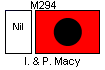
M294 is documented by Loughran 1979.
I. & P. Macy operated whalers.
USA, Nantucket.
M294 is documented by Loughran 1979.
I. & P. Macy operated whalers.
USA, Nantucket.
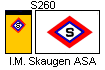
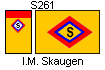
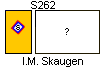
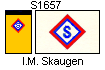
Rosanoski assumes that S261’s funnel and flag used similar yellow. Brown 1958 records the change from that flag to S263.
Skipet shows the funnel both with and without a black top. Nüsse’s table-flag photographs differ in apparent frame colour, dark blue on the old site and black on the new, but the company website confirms blue.
The flag association is qualified: Rosanoski expects a filled white diamond with a border, matching the funnel, rather than merely a diamond frame on the field. A vessel-flown flag is noted as S262.
SP Protector of Skaugen Petrotrans was photographed flying a flag whose S differs from the S260 table flag.
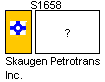
Mitchell appears to show a white ring with a solid white core above the cross. His line drawings omit the panel.
Isak Martinius Skaugen, a part-owner from 1912, formed D/S A/S Eikland in 1916. It later became I.M. Skaugen & Co., possibly in 1929 when oil carriage began. Morits Skaugen sr. joined in 1947 and became a partner with his two brothers in 1952. The business became I.M. Skaugen A/S in 1978. In 1990 the family business merged with Laboremus and Kosmos Shipping, passing through Eikland and I.M. Skaugen names to I.M. Skaugen ASA. It became I.M. Skaugen SE in 2007.
Skaugen took control of Kosmos in 1988 and restructured it as Kosmos Shipping in 1989. The Texas shuttle-tanker operation became Skaugen PetroTankers, later selling its fleet and chartering tonnage; Teekay took 50% in 2003. The source also records Skaugen Petrotrans’s 1991 change from Jahre Shipping USA. Norwegian Gas Carriers, later Norgas, developed from a five-owner pool in which Skaugen became the largest shareholder; its origin is dated 1982 by the website and 1993 by Lloyds. Other interests included Princess Carriers, the Eitzen Norgas pool, and the Hubei Tianen joint venture. Skaugen Marine merged into I.M. Skaugen in 1992, and Anders Jahre into IMS Marine Services in 2004.
Skaugen helped form Royal Caribbean with Gotaas-Larsen and Anders Wilhelmsen in 1968, selling its interest in 1988, when Pearl Cruises was formed with J. Lauritzen. It also participated in Viking Car Carriers with C.T. Gogstad and Dominion Steamship, and sold its 24% Western Bulk holding to Belships in November 1991. It operated Eikland and Salamis companies.
Norway, Risör; later Oslo.
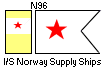
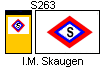
The company used its owner’s colours with a swallowtailed flag: white with a red star. The yellow funnel has a white band bearing a red star. The funnel colour is confirmed from the Smedvig funnel in The Worlds Merchant Fleets 1939.
Norway Supply Ships appears in Lloyds 1978–79 and 1985–86, owned and managed by Peder Smedvig.
Norway, Stavanger.
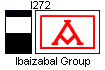
The website shows the flag used by Naviera Aznar, presumed still to be used by Ibaizabal. I272’s funnel is based on a starboard photograph of Montestena dated 31 October 2012. Its band is much wider than the tug fleet’s narrow bands, which follow the logo.
The group manages its own and third-party ships, with tanker and cargo operations through interests including Ibaizabal Tankers and Naviera Urbasa, and towage and salvage through Compañia de Remolcadores Ibaizabal. Naviera Altube also provides ship management. Its history traces to Eduardo Aznar de la Sota, also named Eduardo de Aznar, first Marquis of Berriz, who founded a first company in 1861 and Compañia Bilbaína de Navegación in 1882. Subsequent overlapping interests included the Sota y Aznar, Naviera Aznar and Vascongada concerns and a second Naviera Bilbaína. The Ibaizabal Group is dated to 1906, though Rosanoski finds its formal formation date unclear. Eduardo de Aznar also owned Argus Steamship.
Spain, Getxo-Bizkaia.
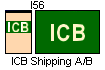
Nüsse’s table flag indicates dark green. NJK describes the funnel and lettering as pale cream, supported by the table flag, although a photograph of Front Comor, still in ICB colours after joining Frontline, appears white. The photograph confirms the dark green.
ICB Shipping was formed in 1986 and fully integrated into Frontline early in 2000. The ownership accounts differ: Lloyds July 2000 still gives Frontline a 68 per cent holding, while the website dates acquisition of the balance to September 1997. Fox Maritime was an operating company.
Sweden, Stockholm.
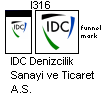
I316 is based on a portside photograph of IDC Falcon dated 4 July 2013.
IDC Shipping Industry & Trade was established on 23 November 2005 for chartering, agency and ship management. It is associated with Izmir Demir Çelik San. A.S., which operated Turkish-flagged ships between 1996 and 2007 and returned to shipowning in 2009.
Turkey, Izmir.
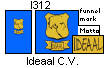
The funnel arms include a shield outlined as a face. I312 comes from photographs dated 5 July 2013; the photographic note spells the vessel’s name Ideal.
M. Vlietstra built Ideaal in 2011, with Amasus Shipping providing the chartering/management connection. The vessel was sold on 1 September 2013.
Netherlands, Sneek.
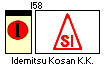
The letters derive from the founder’s name, printed in this note as Idemitso Sazo.
Japanese Shipowners Association material assigns the funnel to Munakata Kaiun. It appears much darker in later references than the earlier pale creamy yellow, a change supported by the JSA chart. A black-and-white photograph of Nissho Maru confirms the funnel arrangement.
A new Apollo visual identity was unveiled on 17 January 2006 for petroleum and energy activities, but the announcement made no mention of shipping, so its maritime use is not established.
Idemitsu’s origins lie in Idemitsu Shokai, founded on 20 June 1911. Lloyds gives Idemitsu Kosan’s incorporation as 1940 and formation as 1949. Alan Watt’s correction instead states that Idemitsu Sazo founded Shokai, which formed Kosan in March 1940, with Shokai wound up and its assets transferred in November 1947. The business originated in Moji.
Idemitsu Tanker and Munakata Kaiun were formed in 1962. The latter merged with Asahi Tanker’s sea operations in 2003. Idemitsu International (Asia), formed in Singapore in 1991, held ships through Orpheus Tanker, which later appeared under Idemitsu Tanker. The group also used other name companies and acted as agent. Early vessel names commonly used Koan Maru followed by a number.
Japan, Tokyo.
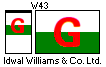
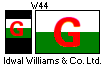
The livery appears common to concerns managed by Williams, including Graig and Glynafon and probably Garth. W43’s funnel is described as a white-green biband separated by white from the black top. Graigwerdd and Graigwen photographs show a very narrow black top and large G. W44 is the earlier documented version, without a separate verbal comparison. Jarig Bakker’s FOTW W43 is sourced to the Caltex book under Graig.
Graig Shipping was incorporated on 15 July 1919 and remained stock-exchange listed until the Williams family acquired the minority holdings in 1993, retaining plc status. The source report identifies Idwal Williams & Co. as full owner and records ventures with Clipper interests, a Confidence Group affiliation, and subsidiaries including Graig Ship Management, Graig (Bermuda), Garth Resources and Danwel. Sektau Shipping was formed in Hong Kong in 1981; a separate later note questions whether Graig still operated under its own name.
U.K., Cardiff.
Idwal Williams and George E. Williams were the principal founders of Graig Shipping in 1919, named after its first vessel. Idwal Williams & Co. also dates to that year. Basra Shipping was acquired in 1952 and renamed Glynafon Shipping as a wholly owned subsidiary. Idwal died in 1971 and was succeeded by Desmond, who diversified into travel and oil exploration. Management interests included Graig, Garth and Glynafon, with Graig, Garth and Glyn prefixes used for their ships. Graig Ship Management was formed in 1997.
U.K., Cardiff.
Keep the explicit scope label independent; no alias or company identity is inferred.
Coastal Ships & Ferries 1999 instead describes a white funnel with a narrow black top, blue C and diamond. Rosanoski connects it tentatively with Clipper-named vessels and Clipper Denmark, but that concern uses a triangle, leaving the comparison uncertain.
I156’s greenish-black shade follows Finland & Åland Funnels.
Funnel shades appear to vary between vessels. Portside and starboard photographs of Ajax underpin I266, but the colour is uncertain in both.
Turva’s portside photograph of 18 April 2007 leaves the shades unclear; a starboard view from the same date clarifies them.
Kemi 1’s starboard photograph of 22 July 2012 appears very dark blue and freshly painted, possibly indicating a change from the black seen in a 2009 portside view. Rosanoski also allows that colour manipulation may make the later photograph misleading.
The company was formed in 1993 for Baltic towage, icebreaking and relief operations. Ajax is recorded from 22 December 2003.
Finland, Turku.
The East German Nautical College operated two training ships from the 1960s until 1989.
Germany (East).
Breant chose the crowned iron anchor as his business emblem. Rosanoski attributes the flag to Iggesund, not to the owning Kihlberg company, despite the initial FOTW placement.
I16 is shown for Breant, built in 1979 and sold in 1981. The Bryggan vessel photograph does not show a black funnel top.
I150 follows the company logo, with photographs of Breant confirming its colour and design.
Iggesund’s shipping activity appears to have been a division of Iggesund Paperboard, tracing its origins to Isak Breant’s Iggesund mill. The foundation is variously dated 1685 and 1665. In 1988 A/B Iggesunds Bruk joined Holmens Bruk and Mooch Domsjö in the group later renamed Holmen in 2000. For shipping, the documented connection is the time charter of Lennart Kihlberg’s Breant from 1979 to 1981. Rosanoski found no indication on the later website that a shipping division still existed.
Sweden, Iggesund.
The funnel is confirmed by a photograph of Igloo Espoo dated 18 April 1988.
Igloo Pool was operated within the Havtor sphere. After Havtor merged with Bergesen in January 1996, Bergesen handled commercial operations. Eitzen acquired the pool in 2004 and established it as Sigloo Gas K.S. under Eitzen Gas.
Norway, Oslo.
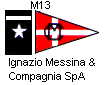
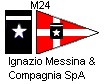
The house flag is a red pennant with a white cross and black CM monogram. US Navy 1961 confines the letters to the cross’s intersection; Brown makes them larger, and later Brown editions move the intersection nearer the hoist. Another historical illustration has the C encircling the M. Mitchell apparently saw the funnel at Malta in 1958.
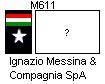
The alternative replaces the monogram with a black funnel panel bearing a white band above a white star. Rosanoski’s 2002 comment questioned whether this was an actual flag or merely a website navigation button; later website evidence showed both forms, leaving their significance unclear. Ogaden’s monochrome photograph confirms a large funnel star. On Jolly Smeraldo in April 2007, painted flapping flags face forward on both sides of the superstructure, with black cross outlines to port, white outlines to starboard and 1921 beneath the tail. The illustrated funnel panel’s rounded top and bottom are questioned in the source.
M611 is recorded for Jolly Blu.
Before the Second World War the company was authorised to fly a mail pennant on its North African service: vertically green-white-red, with a white P on green.
The register dates the concern to 1890 as Giuseppe Messina Tabuso, with the Ignazio Messina title from 1930 and joint-stock form from 1980. Website accounts differ: the father moved to Genoa and entrusted the business to Ignazio in 1921, the name changed in 1929, and conversion from limited partnership to joint-stock company occurred in 1975. From 1981 the family-controlled Finemme holding company owned Ignazio Messina outright. Jolly became the regular vessel-name prefix by the late 1970s, with famous names also used for container ships.
Italy, Genoa.
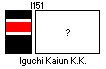
Mitchell’s funnel appears to be based on Mighty, identified in the source as “11035/1975”.
The Hiroshima company appears in Lloyds 1978–79 and 1980–81.
Japan, Hiroshima.
Keep the explicit scope label independent; no alias or company identity is inferred.
A separate Osaka listing appears in 1978–79, but Rosanoski considers it apparently erroneous because its sole vessel, Grace, is shown under the Hiroshima company in 1980–81.
Japan, Osaka.
Keep the explicit scope label independent; no alias or company identity is inferred.
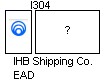
I304 is based on a starboard photograph of Diamond Sky dated 25 August 2013.
IHB Shipping was established in 2007 within Industrial Holding Bulgaria, principally for ship management. Lloyds lists it as manager in 2011–12.
Bulgaria, Varna.
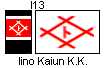
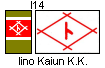
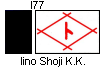
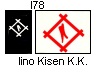
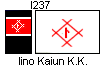
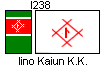
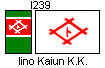
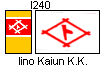
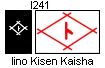
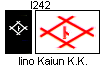
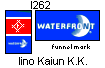
The early funnel chronology is uncertain. Various Iino companies may have shared a funnel which began plain black, gained white marks and later bands, possibly after the war. The records conflict: 1930 notes mention white marks, while photographs of pre-war tankers show black and Talbot-Booth 1944 gives both forms.
A photograph of the chartered Lord Byron appears to show the Iino funnel with very narrow white edging, an elongated and compressed band, and the internal branch pointing upwards. Rosanoski and Watt regard this as a likely painting error.
The emblem varies between sources, sometimes with the branch too high or the whole mark too small. Rosanoski treats I13 as representative and favours the website logo and the Laurel Island funnel for its form, while noting that a flag version might be slightly thinner. I13 came into use after the Second World War and was seen on Laurel Island at Wellington on 17 June 2002. The band looked orange-red to the observer, a reading Watt rejected. Chemroad Hope and Chemroad Oasis photographs also confirm the funnel, and NJK reports I13 for all its sightings.
The intervening funnel is described as very dark khaki, reportedly used in the 1960s before a return to I13, although Brown 1958 already shows it. Sources render it yellow or green. Mitchell shows green with a diamond frame and darker red inside than on the band, also mentioning a yellow basic colour. The Stewart-derived FOTW I240 flag was stretched to 2:1; Rosanoski says the internal vertical line should be straight rather than angled. The flag was also used by the dry-cargo Iino Kisen company.
I262 is based on a portside photograph of Tamiat Navigator dated 25 October 2011. The funnel base carries the charterer Waterfront Shipping’s logo.
The source also records Magellan Endeavour in a joint venture between Iino’s Serpent’s Mouth Carriers, alternatively Serpentis Mouth Carriers, and Nippon Yusen’s Turmills Maritima. Its separate funnel illustration is not part of this entry’s eligible image group.
Iino, also known as Iino Lines, traces its origins to Torakichi Iino’s Iino Shokai, founded at Maizuru on 1 January 1899 for coal stevedoring and barge transport. Liner operations began in 1915. Iino Shoji Kaisha was formed in 1918 and Iino Kisen Kaisha separately in 1922. The source calls the former a tanker company but questions this description because the first tanker is elsewhere dated 1928 or 1929. The companies merged as Iino Kaiun Sangyo in 1941, becoming Iino Kaiun in 1944 and listing on the Tokyo exchange in 1949.
After rebuilding from wartime losses, Iino separated its liner and dry-cargo operations in the 1964 shipping consolidation. The agreement with Kawasaki was signed on 20 December 1963 and took effect in April 1964 through a newly established Iino Kisen Kaisha, later merged into Kawasaki. Tankers remained with Iino Kaiun. Rosanoski’s 2003 account placed it within the Kawasaki group, but his 2010 correction says the company website supports only the liner-division connection; Lloyds stopped showing the wider relationship in 2008. Iino Marine Service was established in 1974, and shipping and property remained the principal activities.
Iino participated in the QIM Transport consortium in 2005 and in Allied Chemical Carriers, established jointly with Fairfield Chemical Carriers in 2001. A possible Yahata Kisen connection was raised from the charter of Laurel Island and shared Island ship names, but Alan Watt knew of no such relationship.
Japan, Kyoto; Tokyo in later references.
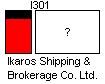
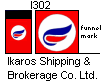
Ikaros, also known as ISBC, is dated to 1984 by Lloyds as Ikaros Shipping, becoming Ikaros Shipping & Brokerage in 1987. The company website instead gives foundation in 1985 by Captain John Christodoulatos. Mitchell names Ioannis Christodoulatos, and Lloyds later lists J. Christodoulatos as chairman and Panayiotis Christodoulatos as managing director.
The Ken prefix in ship names derives from the first purchase, the Japanese-built Ken Wave. The company account explains Ken as “Prefecture” in Japanese and a lucky or fortunate person in Chinese.
Greece, Piraeus.
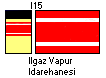
The funnel is yellow or buff with a black top and a broad band of the flag. The flag is red with two narrow white bands towards its upper and lower edges.
Rumania, Gatati, presumed from Brown 1951’s “Galata”.
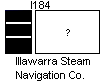
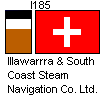
I185’s funnel is described as milk chocolate. The flag appears as a black-and-white logo in the company’s illustrated handbook of 1905.
The Log describes both liveries and confirms equal cross arms.
The company was known as the Pig & Whistle fleet, reputedly willing to wait for a pig but not a passenger. Its origins and succession are described differently in the sources. One account begins with Illawarra Steam Packet in June 1839 and a merger with Brisbane Water to form General Steam Navigation, followed by sale of the ships in 1842; that account prints the merger date as September 1939, inconsistent with its sequence. It also distinguishes Edye Manning’s separate operation from claims that he continued the earlier Illawarra concern.
Shoalhaven Steam Navigation and Kiama Steam Navigation emerged in the 1850s. Accounts variously date Kiama’s formation to 1852 or 1853–54 and their combination to 1856 or 1857. The April 1856 account describes Shoalhaven’s sale to R. Haworth, possibly for Manning, and explains that several later advertised names referred to Kiama. An October 1858 Act established the Illawarra Steam Navigation name, described either as a rename or an amalgamation. The business was incorporated as Illawarra & South Coast Steam Navigation in 1904.
The end is also disputed: accounts cite sale of the last three ships in 1951, voluntary liquidation in 1952, stock-exchange delisting in 1955, or sale of the last vessel in 1959. A separate liquidation reference prints 1 September 1995. These dates are retained as conflicting evidence rather than reconciled editorially.
Australia, Sydney.
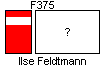
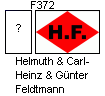
No exclusive fleet-wide use or unrecorded corporate equivalence is asserted.
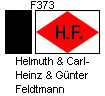
p009’s funnel allocation does not establish exclusive partnership ownership; this asset shows flag only.
Mitchell attributes this funnel to Helmuth Feldtmann but places green letters alongside the drawing.
Do not equate family operators or resolve contradictory initials by surname.
The FOTW version is based on the 1957 German shipping-flag source, but Rosanoski judges its letters too thick compared with F373. The quoted FOTW note places the company in Königreich, Jork, south-west of Hamburg, and labels the image F272. Mitchell attributes the F373 funnel to Carl-Heinz Feldtmann.
The family concern began with Ella Feldtmann, built in 1950 by Helmuth & Carl-Heinz Feldtmann. She passed to P/R Ella Feldmann in 1965 and, in the source’s spelling, Ilse, Jens & Ina Fledtmann in 1969. Registers show several family businesses and partnerships: Helmuth Feldtmann, Helmuth Feldtmann & Söhne, Carl-Heinz Feldtmann, and later Ilse Feldtmann and Ilse, Jens & Ina Feldtmann. A register reference to Heinecke & Co. is not followed through in that entry, although Mitchell records Heinecke as manager for Carl-Heinz.
Germany, Hamburg, later Stade and Hove.
I36 is documented by Nüsse’s table flag and NJK sightings. Rosanoski suggests that division into pools brought its replacement: the website showed a different flag shared by the pools, whose funnels differed.
Mitchell gives I135 as an alternative for Maritime Leader, sold in 1979 and possibly chartered. No flag is specified, so its application is only assumed.
I160’s funnel is based on Maritime Sirinant on 16 October 2006. Its letters are slightly angled, as are those on the website flag.
I276 is based on starboard Maritime Fidelity on 5 December 2012 and portside Maritime Hareshio on 11 August 2007.
The group says its diamond logo dates from International Maritime Carriers’ early nautical flag. The four points represent food, shelter, clothing and transportation.
Frank Tsao began a Hong Kong trading business in 1949, became a shipowner and co-founded Great Southern Steamship, dissolved in 1966. He founded International Maritime Carriers in 1966 and helped establish Malaysia’s national shipping line. The shipowning holding company was listed in 1972. IMC also restructured United Thai Shipping, later Unithai. Accounts differ on the move to Singapore: Lloyds gives the rename to IMC Shipping and relocation in 1991, while the group history places headquarters’ transfer in 1994. Frederick Chavalit Tsao succeeded his father as chairman in 1995, and the family took IMC Holdings private in 2002. Oriental Bulk Shipping followed in 2006. The IMC name derives from both International Medicine Company, founded in 1955, and International Maritime Carriers.
The wider business developed as IMC Pan Asia Alliance, with shipping operations organised through Transasia, Transworld and Transocean Grabbulk pools and Aurora’s tanker pool. Unithai remained the Thai arm. MSI Ship Management was formed in 2007 following the dissolution announcement for V. Ships (Asia) MSI. Grimstead Shipping is listed as an associate.
Hong Kong, 1949–96; Singapore in later references.
Keep the explicit scope label independent; no alias or company identity is inferred.
Photographs of Martime Jingan and other tankers show the Wawasan funnel; NJK confirms W74’s use by Aurora.
Aurora Tankers operated worldwide on fixed routes, spot business and contracts, pooling tankers owned by IMC and joint-venture partners. The website dates its formation to 1996, Lloyds to 1997. Its management of Wawasan-owned ships is described differently from Lloyds’ allocation of those vessels to Aurora name subsidiaries.
Malaysia, Kuala Lampur.
Keep the explicit scope label independent; no alias or company identity is inferred.
The website logo uses a darker red than the funnel seen on Maritime Master at Wellington on 8 March 2005.
IMC Transasia, also called Transasia Pool or Taspool, was formed in 2002 jointly by IMC and Malaysia International Shipping Corporation. Successive registers alternate between Transasia Pool and IMC Transasia.
Singapore.
Keep the explicit scope label independent; no alias or company identity is inferred.
Website photographs suggest that TGP flew the I160 IMC flag. Maritime Talent photographs confirm its separate funnel, although the exact red and blue shades are unclear.
Transocean Grabbulk Pool, or TGP, operated from 1992 as a joint venture with Hong Kong Ming Wah Shipping. It handled bulk carriers, apparently chartered.
Singapore.
Keep the explicit scope label independent; no alias or company identity is inferred.
Wawasan’s funnel follows the parent’s format. It was sighted on Selandang Kasa at Wellington on 6 November 1998 and on Selandang Mayang in December 2001. Selandang Mutiara showed the funnel with a black top and AuroraTankers on the hull. Maritime Gisela also carried it under Aurora. The website suggests a common group flag despite differing register ownership.
Wawasan Shipping began investing in liquid-bulk vessels in 1992 according to the website, while Lloyds gives formation in 1996, marked “[sic]” by Rosanoski. It also appears as a crew-management company. Its tankers were managed by Aurora, although Lloyds subsequently placed ownership under Aurora’s name subsidiaries.
Malaysia, Kuala Lumpur.
Keep the explicit scope label independent; no alias or company identity is inferred.
The fleet appears to have been chartered out under different funnel markings. Aoyama and Indigo Felicity both show I305 in the cited 2011 and 2013 photographs, but Rosanoski leaves open whether it belongs to IMECS, a common charterer or is coincidental.
Livery proprietor unknown.
The company website dates establishment by Itochu to 6 August 1987 and the change to Imex, rendered IMECS in English, to August 1993. Lloyds instead gives formation as IMS in 1988 and rename to IMECS in 1994. In February 2009 two overseas shipowning subsidiaries were combined into the group’s Panamanian IMS Inc.
Japan, Tokyo.
I317 is based on a portside photograph of HC Natalia dated 15 June 2013.
Founded in 2011, IMM operated heavy-lift and general-cargo ships. The eleven-vessel fleet was apparently chartered from, or operated for, HC-Chartering of Hanse Capital Group.
Germany, Ahrensburg.
The funnel is based on a starboard photograph of Hyogo, with a company photograph confirming the same arrangement on the port side.
Imoto Lines was formed in 1973 for coastal container shipping. Rosanoski considers it apparently mainly a charterer, while Equasis records Kyogo under owner and manager Imoto Shoun; Lloyds lists Imoto Shoun Kaisha.
Japan, Kobe.
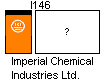
British Coastal Ships, Tugs & Trawlers 1975 gives I40 a black top, while ABC Coastal Cargo Ships makes it optional.
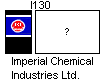
Mitchell gives I130 and I146 without explanation. I130 has only one wave, possibly because of space; the pencilled designs are assumed to represent white.
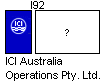
Only the funnel is recorded for I92, used by Kelvin while sub-demise-chartered by ICI Australia Operations in 1990. No flag is noted.
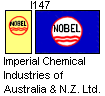
Taranui used I147, a parent-company variation with red ring and waves and the word NOBEL. The black-and-white hatching does not establish the letter colour, so Rosanoski shows black. The red rim of the flag’s circle is also assumed and may not apply.
Rosanoski suggests that a funnel identified in the text as “I141” was inherited from United Alkali, based on black-and-white photographs of Sodium and Barium. The source identifier is retained without adding an image.
ICI was formed in December 1926 by merging Brunner, Mond, Nobel Industries, British Dyestuffs and United Alkali. The constituent companies already had shipping interests: Brunner Mond was a steamship owner from 1889, United Alkali from 1880, and the river fleet dated to 1879, carrying materials between Liverpool and factories in Lancashire and Cheshire. United Alkali carried limestone from North Wales; absorbed cartridge-maker Kynoch also operated coasters. Nobel continued as an ICI division. Salt Union was acquired in 1935 and sold in 1992. ICI became part of AkzoNobel in 2008.
Shipping interests extended through the Alkali Division and companies in Australia and New Zealand. ICI Australia participated in the Australian Chemship Line consortium.
UK, London.
I208 is based on a photograph of Regal Empress.
Formed in 2002, Imperial Majesty operated Regal Empress from 2003 until 2009. The ship was replaced by Bahamas Celebration under the new Celebration Cruise Line, owned by the same company; Regal Empress was broken up.
USA, Pompano Beach, Florida.
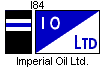
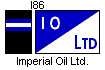
Rosanoski identifies the FOTW flag placed under E.B. Elsworth as Imperial Oil’s. Merchant Ships 1942 shows the livery under Imperial Oil Shipping while its funnel index names Imperial Oil. The FOTW rendering uses bright blue.
A photograph of Imperial Sarnia from the early 1980s confirms I87, including a black cowl. Ocean Ships and Marinart also give this funnel for the subsidiaries.
The National Maritime Museum flag is dated about 1951 and measures 1066.8 × 1778 mm. The FOTW museum-based version is dark blue; its comment contrasts Brown 1951’s thinner lettering and small-capital TD. The original note calls the image “I72”, retained in traceability.
Imperial Oil began at London, Ontario, in 1880 as Imperial Oil Co. Ltd., adopting Imperial Oil Ltd. in 1919. Accounts differ on Standard Oil’s control: the company history describes a majority-interest exchange for Canadian assets in 1887, while another reference dates control to 1898. International Petroleum was formed in 1914 for South American operations. Later subsidiaries included Caribbean Oil & Transport and Western Oil & Trading. The shipping business became associated with Esso Petroleum Canada, while Imperial continued as an integrated energy company under the Esso logo. The last vessel, Imperial Dartmouth, is recorded as deleted in 2003. Imperial became characteristic as the first part of ship names.
Canada, London, Ontario; Sarnia from 1912 and Toronto from 1916.
Keep the explicit scope label independent; no alias or company identity is inferred.
Imperial Oil Shipping used a similar flag with white I.O.S. and blue CO. LTD lettering, the initial letters of the latter group taller. A black-and-white photograph of Imperial confirms the funnel.
Imperial Oil Shipping is described as a 1937 change of name from Imperial Oil and later as reabsorbed into its Marine Division. The FOTW account places that incorporation in the late 1950s, while Lloyds 1956–57 already combines the fleet. Standard Oil of New Jersey is recorded as owner, with Tropical Oil an associate. H.J. Rahlves appears as manager. Earlier names ending in olite gave way by 1953 to Imperial followed by a Canadian place name.
Canada, Toronto; Halifax also recorded.
Keep the explicit scope label independent; no alias or company identity is inferred.
Imperial Pipe Line was formed in 1972 and absorbed into McColl-Frontenac Petroleum in 1994. It also used Imperial-prefixed ship names.
Canada, Calgary.
Keep the explicit scope label independent; no alias or company identity is inferred.
I214 reconstructs the animated website flag, rather than a flag Schneider had seen aboard ship: his Hamburg observations found Haniel flags and Imperial side plates. The white field has two greenish-blue parallelograms near the hoist, overlaid by an italic blue serifed I and then a white upward-pointing triangle or broad arrowhead. The fly inscription is in three italic lines: blue “Imperial”, green “Reederei”, then smaller green “Gruppe”.
I215’s funnel is based on portside and starboard views of Herkules XII and also appears on Herkules XVI. Timaja’s photographed flag seems to be the group flag, though a fold hides the word Gruppe. Its colours differ from the logo-based I214. Timaja is recorded under another owner, indicating chartering and possibly explaining other flags flown.
Rhein-Ruhr Bulk Terminal’s flag is white with its logo towards the hoist and underlined greenish italic capitals RBT. The cited marcollect example could no longer be found when Rosanoski checked it; the company logo remained documented.
I216 is the Imperial Logistics International flag, documented in a photograph of employees at a sporting event. It is distinct from the Reederei flag.
Shipboard use not established.
The shipping group’s origins lie in Haniel’s coal transport from Ruhrort to the Netherlands and southern Germany, dated to 1800. Haniel Reederei became a separate company in 1972. Haniel’s logistics interests merged with Thyssen in 1989, with Haniel withdrawing in 1998. Imperial acquired the ThyssenKrupp logistics interests in 1999, followed by 51 per cent of Haniel Reederei Holding in 2000 and the remaining 49 per cent on 30 December 2002. The shipping group adopted Imperial Reederei-Gruppe on 1 June 2003. The wider Imperial Logistics International business coordinated the South African parent’s logistics activities outside South Africa.
The group combined inland and short-sea shipping, tanker operations, chartering, container services and terminals. Its companies included Imperial’s Duisburg and Luxembourg operations, Niedersächsische Verfrachtungs, Wijgula, WGL, Navitank, the De Grave businesses, Transest, Walrhein, Donau Logistik, Alcotrans, Baris, Amadeus and BeKa. Rhein-Ruhr Bulk Terminal was the renamed Haniel Umschlag Industrie Logistik, acquired in 2000 and renamed in 2003. Imperial also acquired 65 per cent of Schiffahrts- und Speditionskontor in 1999.
Germany, Duisburg.
I269 is based on a portside photograph of Vasaland.
Imperial Shipping invested in ships and owned Swedish Orient Line. It bought the line with Navalmar in 2003 and became sole owner in 2006. Lloyds dates Imperial’s formation to 2007, which Rosanoski presumes refers to becoming a shipowner, and names Scanmer and Sequana Maritime as joint owners. Imperial Ship Management in Gothenburg supported the operations and also acted as shipbroker, with an associated management company and Medro Shipping among the listed interests. A later register places Imperial Ship Management under SOL Interessenter.
UK, London; Sweden, Gothenburg.
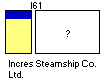
The original funnel was blue with a narrow black top, later changed to yellow or buff with a blue top. The source does not establish whether the blue top was as narrow as the former black one. No flag is noted.
Incres appears in Lloyds 1963–64, with Barber Steamship Lines as agent.
U.K., London.
Independence Maritime was a shipping agency and brokerage founded by Captain Harry Notias, who died in January 2007. His son Nicholas X. Notias, also known as Nicos, appears to have succeeded him. Rosanoski presumes from Mitchell’s livery entry that the firm may at some stage have chartered vessels; he also records an alternative agency association with Trojan Maritime.
USA, New York.
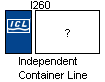
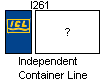
I260 is documented on Independent Accord in July 2012 and September 2017, with the starboard arrangement shown on Independent Concept in August 2007. A photographic comment questioned variation in both colour and lettering style; Rosanoski considers the lettering different from the logo only in colour.
Independent Action showed I261 with a black top in December 2005, while Independent Endeavour lacked that top in February 2006. A later Independent Venture photograph also informed the comparison. White and yellow versions do not appear to follow date or shipowner: Dohle charters carried both. Rosanoski tentatively suggests colour trials.
Independent Container Line, or ICL, was established in 1985 by Bill Gohike and Jesse Pope. Ownership passed in the early 1990s to German interests through Hamburg-based ICL Holding, with Peter Dohle among the shareholders. The vessels appear to have been chartered.
USA, Richmond, Virginia.
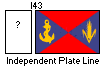
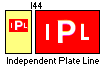
Rosanoski assumes that the two sources concern one company but warns that the different locations and flags may instead indicate unrelated companies.
Mitchell shows black lettering on the funnel and notes Plate Shipper.
Relationship between companies unproved.
Argentina, Buenos Aires, according to Nüsse; Panama according to Brown 1978.
Independent Tankships operated from 1948 to 1956 as part of San Francisco-based American Independent Oil, or Aminoil. Aminoil was a Kuwait-operating joint venture of Phillips Petroleum, Signal Oil & Gas, Ashland, J.S. Abercrombie, Sunray Mid Continental Oil, Globe Oil and Refining, and Pauley Petroleum.
USA, San Francisco and New York; Wilmington, Delaware, also given.
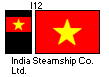
The flag’s star points upwards in Brown 1951 and 1958, LJC 1966, Nüsse, FOTW and US Navy 1961; the other cited sources show it pointing downwards. A black-and-white photograph of Indian Prestige confirms the funnel.
India Steamship was formed in 1928 and later controlled by KK Biria Group, as the name is printed in the source. It also managed other companies, including Texmaco. Ships initially used Indian as the first part of their names, with Ratna appearing later.
India, Calcutta; the later entry prints Kokata.
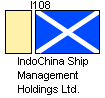
I108’s flag blue follows a website logo lighter than Jardine’s, although a dark-blue version later appeared on Meridian’s site. The funnel was sighted on Albany Sound at Wellington on 30 November 2002 and Cape York on 7 March 2003; Hawke Bay showed a darker version at New Plymouth on 25 April 2003. Rosanoski thinks it probably derives from Pacific Basin’s funnel without that company’s logo.
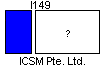
I149 is a possible alternative, based on Ennerdale on 6 January 2006. That single fleet example is not conclusive, though Ocean Logger showed the colours on 16 May 2003 while under the Hong Kong manager.
Chatham Island was subsequently seen in Pacific Basin colours on 22 September 2007.
IndoChina Ship Management Holdings was formed in 2000 as a Jardine–Pacific Basin joint venture. Pacific Basin took the majority interest that year, with the later split recorded as 67 per cent Pacific Basin and 33 per cent Jardine. Dry-bulk management remained within Pacific Basin; other management activities passed to Epic Shipping, trading as ICSM.
Jardine Ship Management (H.K.) became IndoChina Ship Management (H.K.) in 2001 and Pacific Basin Ship Management in 2004. The Liverpool-based UK company likewise took the IndoChina name in 2001, absorbed Bibby-Harrison Management Services on 29 May 2003 and became Meridian Marine Management in 2004. It is also described as an equal Epic–Bibby joint venture. Singapore’s ICSM Pte Ltd., formed in 2004, appears as Epic Shipping in the 2007 register without explanation.
China, Hong Kong.
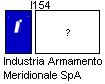
Mitchell’s INARME entry shows the main I stem upright with its dot angled, but his Grimaldi card gives a slight lean and dates the mark to 1994. Rosanoski rejects the implication there that INARME was simply a rename of Fratelli Grimaldi. Photographs show the I angled aft on the port side of Grande Francia and forward on the starboard side of Repubblica di Roma: the source explicitly describes the two as not mirror images.
Industria Armamento Meridionale, or INARME, was formed in 1992 and incorporated at Palermo. It was owned by Grimaldi Compagnia di Navigazione and Atlantica SpA di Navigazione, appearing first as a name company and later a major operating company within the Grimaldi group.
Italy, Naples.
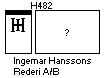
The funnel follows Spring. Photographs of Spring and the second Trafik show white funnels at an angle, leaving the exact lettering and colours unclear.
Dated photograph or contemporary livery key needed before company-specific assignment.
Other photographs show varying forms: the first Trafik has white with a black top separated by a lighter dark band; Spring appears dark with a narrow black top and a possibly edged band, lettering on both funnel and band. A colour view of Tye shows black with a white band bearing an inverted red delta triangle. The photographs lack dates, so ownership at the time cannot be established from them.
The company was formed in 1952 and liquidated in 1980.
Sweden: Båtskärsnas in the website account, Batsharnas in Lloyds.
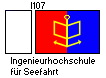
The flag uses the traditional DSR colours with a golden anchor and book at the centre, symbolising sailing and education. A professor at the academy designed it in the 1960s.
The East German Nautical Engineering College operated two training ships in the period from the 1960s to 1989.
Germany [East].
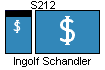
The Collectors Corner cap badge has a blue field with a white I over a white S.
Ingolf Schander appears in the 1956–57 and 1958–59 registers. Mitchell later lists Oddevold under Rederi A/B Schander for Ingolf N. Schander, but Rosanoski found no corresponding Lloyds entry.
Sweden, Gothenburg.
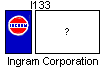
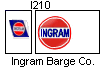
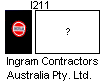
Mitchell shows I133 both with and without a narrow black top. The legend reads INGRAM; Rosanoski assumes the emblem should follow the logo, although Mitchell’s letters are black. Three other funnel forms appear in his drawings without explanation.
Lousiana Star’s photograph shows a blue funnel panel, less raked than on Mike Schmaeng. Other views look black, including Alice I Hooker, whose starboard panel points forward. City of Port Allen shows a plain black panel; its placement on the vessel’s starboard side may explain the missing emblem but not the colour. The flag on Geismar has the emblem towards the hoist. A fold obscures the fly, which may be swallowtailed.
The Log specifies a red outer ring but does not give the lettering colour.
Ingram’s shipping business developed from Wood River Oil & Refining, formed in 1938 by O.H. [Hank] Ingram and partners, with Wood River Oil Barge following in 1942. In 1946 Hank retained the terminal and barge business as Ingram Products, the beginning of Ingram Barge. His sons Frederic and Bronson succeeded him after his death in 1963. A 1978 division placed the barge business within Bronson’s Ingram Industries. Following Bronson’s death in 1995, Martha became chairman and their sons Orrin and John became co-presidents; the 1996 reorganisation left marine operations with Ingram Industries.
Barrett Lines brought dry-cargo barge work in the early 1960s, followed by offshore construction and ocean tug-barge petroleum transport later in the decade. Ingram acquired C. Rowbotham & Sons in 1970 and sold it in 1985. Expansion included Ohio Barge Lines and Mon-Valley, announced in December 1984; American Barge & Towing’s marine assets in 1989; Midland Enterprises, with Ohio River and Orgulf, in 2002; Riverway assets in 2005; and United Barge Line. The company history also dates the M/G Transport acquisition to “1944”, retained as printed. Tugs frequently carried family names.
USA, Nashville, Tennessee.
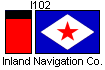
Joshua Green’s wife designed a blue flag with a red star on a white diamond. Green’s ships retained it while he remained involved, apparently even after absorption into Puget Sound Navigation. After Charles Peabody’s death in 1926 Green sold his holding; use ended when Alexander Peabody took control in 1928. Rosanoski records the flag’s later use by the Puget Sound Maritime Historical Society.
Inland Navigation originated as La Conner, also printed LaConner, Trading & Transportation, founded by Joshua Green and partners in the early 1890s. Green was in charge by 1900 and bought out Sam Denny in 1902. Alaska Steamship acquired control on 2 May 1903, and the business operated in conjunction with Puget Sound Navigation under Charles Peabody, while retaining an identity associated with Green. It was absorbed into Puget Sound Navigation in 1923. The date of the Inland Navigation rename is unknown, but Lloyds used it by 1912.
The original FOTW suggestion of an H.F. Alexander/Admiral Line connection was withdrawn after Rosanoski’s correction. He could find the similarly named International Steamship only on the eastern seaboard, not as an established identity for this Puget Sound concern.
USA, Seattle.
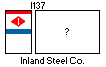
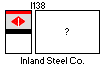
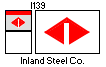
The chartered Adam E. Cornelius carried I138, with a black band about twice the depth of the red top, separated by silver or light grey.
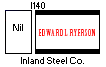
The company’s own ships show differences. Edward l. Ryerson’s lower band is hidden, but its red top appears broader and its silver possibly lighter than on the chartered vessel. Joseph L. Block’s lower band appears narrower than the red top. Edward l. Ryerson also supplies the flag evidence.
I140 is a secondary flag whose apparently black bands may be very dark blue.
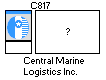
Central Marine Logistics’ website logo is oval, while Wilfred Sykes shows a circular funnel emblem. Its sinister half has twenty-one alternating blue and white bars. The main silver band is separated from the base by a narrow black, or possibly very dark blue, band. Joseph L. Block’s emblem appears more compressed.
No exclusive fleet-wide use or unrecorded corporate equivalence is asserted.
Rosanoski cannot establish whether I136 belongs to Inland Steel, as the source does not specifically name the company.
No definite legal entity.
Inland Steel was founded in 1893 and acquired in 1998, becoming Ispat Inland. The source also gives incorporation in 1917 and shipping activity from about 1924 through Inland Steamship, while Lloyds gives 1929. The Ispat acquisition led to sale of the three-ship fleet to the newly established Indiana Harbor Steamship to comply with the Jones Act. Central Marine Logistics was formed to manage it, and Inland Steel lettering was removed from hulls. Another cited corporate account describes the purchaser as Mittal. Earlier operation was through Hutchinson & Co.
USA, originally Delaware; Cleveland, Ohio, and later Chicago.
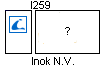
I259 is documented by portside and starboard photographs of Komarno from 2007 and 2009, while managed for Rederij Wessels. A 2010 photograph shows a blue flag with a white “cross party”, as described in the source, which Rosanoski could not connect with either party. Its absence from Inok’s website fleet may indicate chartering.
Inok was formed in 2000 as an independent ship-management and operating company, with the fleet listed through name companies.
Belgium, Antwerp.
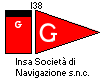
The funnel is red with a black top and a white G. The flag is a red pennant with a white G.
Insa appears in Lloyds 1963–64. The G refers to Giovanni Gavarone, whom Rosanoski considers probably the owner.
Italy, Genoa.
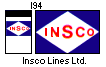
Insco Lines is recorded in Lloyds 1970–71.
USA, New Orleans, Louisiana.
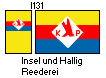
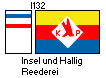
I131 is based on Adler Baltica and the website flag logo. The photographs confirm the basic arrangement, but neither lettering nor emblem can be read clearly.
I132 applies to the paddle steamer Freya, bought by Sven Paulsen in December 1999. General website photographs confirm the funnel; the centenary photograph of 21 April 2005 appears to add a badge below the red band. A flag is flown at the foremast, though its lettering is indistinct.
Formed in 1995, the company used Adler-Schiffe as its brand, with Adler characteristic of vessel names. Sven Paulsen appears as its operating company.
Germany, Westerland.
Sven Paulsen’s business is dated to 1996 in Lloyds, with Reederei Kurt Paulsen of Nordstrand among its operating companies. The latter’s register entries extend back to the 1970s.
Germany, Sylt-Ost; later Westerland.
Keep the explicit scope label independent; no alias or company identity is inferred.
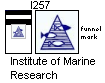
A portside photograph of G O Sars dated 1 July 2012 shows a dark-blue-and-white logo on a panel attached to the funnel, slightly overlapping its black band.
The Institute of Marine Research, named Havorforskningsinstituttet in the source, is part of the Norwegian Government and is dated to 1995 in Lloyds.
Norway, Bergen.
Noruega’s photographs show the logo on the superstructure rather than the funnel, which is plain white. The surrounding inscription reads “INSTITUTO DE INVESTIGAÇÁO” and “DOS PERCAS E DO MAR – IPIMAR”. Rosanoski suggests that the superstructure offered more room.
The institute, also called Ipimar, traces its origins to the Marine Biology Station created on 10 May 1919. It became autonomous in 1951, joined the National Institute for Fisheries Research in 1977 and was succeeded by Instituto Português de Investigação Marinha in 1992. In 2002 it combined with INIA in the agricultural and fisheries research institute; that body became part of the biological resources institute in 2007.
Portugal, Lisbon.
The grey is described as closer to silver.
Mitchell records I145 for Tal of Harvest Corporation and Rallytime of Lonelace, with their funnels shown in his drawings.
A Mitchell note headed “B144” names only Bruce Bangan of Bawaganship Corporation, with a blue funnel in the line drawing. The differing source identifier remains unresolved.
Inter Maritime Management was registered on 14 October 1966 and removed from the commercial register on 29 December 2005. Sources describe Bruce Rappaport as owner in the 1980s and the company as a subsidiary of Bank of New York–Inter-Maritime Bank in Geneva. Its Pertima Supply vessels were associated with Pertamina and later listed under P.T. Pertamina Tongkang. Lloyds says ship management ceased in 1984, yet later entries again record management and fleets under name companies.
Gulf Oceanic Shipmanagement, based in Singapore, is described as a 1984 joint venture with Univan. A separate account dates its amalgamation with Inter Marine Management Private Ltd. to 1981 to form Inter Maritime Management Private Ltd.; Rosanoski explicitly identifies this as contradictory. P.T. Goruda Shipping appears as agent.
Indonesia, Jakarta in the earlier register; Switzerland, Geneva in the later one.
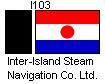
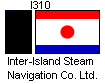
Thomas R. Foster founded the business as Thos. R. Foster & Co.; it was known as Interisland Steam Navigation from 1883 to 1947 and served the Hawaiian islands. It acquired control of rival Wilder’s Steamship in 1905 and merged with it. Matson took control in 1928.
USA, Honolulu, Hawaii.
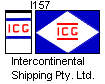
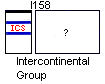
Sandra Marie’s flag, photographed at Wellington on 5 May 1998, is blue with a white diamond extending to the edges and red ICG between two horizontal lines. The initials stand for Inter Continental Group in The Log’s wording. The funnel has a very narrow black top incorporating the cowl, probably explaining its omission from The Log.
I158 is based on Lady Emily at Wellington on 12 December 1999. Tamdhu carried Scottish Shipowners & Management colours.
After Sandra Marie became Hakula, the funnel emblem changed but the bands remained. Rosanoski considers whether these were Cadwallader’s colours or a basic Intercontinental design also used by managed ships.
Peter Cadwallader formed Intercontinental with former Howard Smith management, initially managing Sandra Marie, named for his daughter. The company is dated to 1986. When Howard Smith withdrew from Australian ship management in 1996, Intercontinental formed its own management company. Rising Australian manning costs led to the Tongan Mainstream Shipping operation in 1998, when Sandra Marie became Hakula. Hakula and Ikuna were owned through Tongan subsidiaries; other ships were managed on normal management arrangements. The original Sandra Marie ownership account instead names Allco, which Rosanoski tentatively connects with financing.
The group also participated with Scottish Shipowners & Management in Lady Emily and Tandhu, spelt Tamdhu in the livery note. The arrangement appears to have been a joint venture with each side supplying one ship.
Australia.
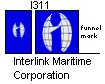
I311 is documented by the company website and a starboard photograph of Interlink Verity dated 24 October 2013.
Paul Gurtler established Interlink in 1979 to provide tonnage to commodity businesses, shipping companies and other users, under Mid-Atlantic Bulk Carriers management. All shipping investments had been liquidated by the first half of 2008. A new programme to build and operate bulk carriers began in the second half of 2009.
Bermuda, Hamilton.
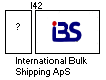
The illustration’s colour shades follow the website image.
The company is also identified as Interbulk.
Denmark, Fredensborg.
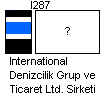
I287 is based on a portside photograph of Atlant dated 20 June 2012.
I288 comes from a portside photograph of Belize City dated 31 December 2005.
I289 comes from a starboard photograph of Belmopan dated 12 June 2006.
Corozal’s starboard photograph of 16 June 2008 shows the blue band fractionally narrower than the white, with the close-up comparison recorded as 10:9.
I291 is based on a starboard view of Maya Land dated 21 June 2005.
Orion’s starboard photograph of 24 April 2012 shows the blue band wider than the white, with the distant comparison recorded as 2:3. The same ship, renamed Eurasia on 1 October 2012, shows a 3:4 comparison in the March 2013 photograph.
Tobago’s portside view shows the bottom white band wider than the other two bands.
Tegucigalpa’s starboard view of 24 June 2010 shows blue slightly narrower than the white and black above it.
I295 is based on Toledo’s starboard photograph, dated 26 September 2005; the source’s website date is earlier and remains unresolved.
Trinidad’s portside view shows the upper white band slightly wider than blue, recorded as 9:8.
Regal’s portside photograph of 13 March 2013 shows equal bands.
Also known as International Shipping Group & Trading, the company operated as manager and agent. Its website dates formation to 1999, while Lloyds gives 2000. The fleet was held through name companies.
Turkey, Istanbul.
Jordan also records an alternative black funnel with an emblem on a yellow band. The Brazil website illustrations represent liveries in 1950.
International Freighting appears in the 1939 and 1953–54 references as manager for Cuba Distilling.
USA, New York.
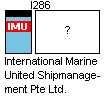
I286 is based on a portside photograph at Singapore on 11 June 2011. The bridge board reads Zhongbang, while Lloyds gives Zhong Bang.
The company was formed in 2007 and appears as a fleet manager, with ships held through name companies.
Singapore; later China, Fuzhou, Fujian.
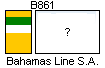
Mitchell’s B861 may be based on Florida Star, the only vessel he lists, although he supplies no line drawing.
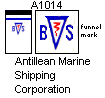
A1014 is based on Habib Express on 12 December 2005, with a blue hull and white ANTILLEAN LINE lettering. The photograph is unclear and the funnel band may be black rather than blue.
The later Habib Express photograph, dated April 2010, shows changed colours and a grey hull, with the superstructure flag still present. Rosanoski allocated the funnel to the International company after the vessel appeared in its register fleet. The prose prints “I1218” and refers to retained “B682” colours on older ships; these differing source identifiers remain in traceability.
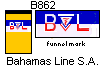
Carib Trader’s photograph of 22 February 2011 shows B862, indicating that at least some early markings survived the fleet transfer. Mitchell instead attributes B862, apparently from Regina Express, to a New York Bahamas Line, without linking it to Miami’s Bahamas Line S.A. and B681.
The flag painted on the superstructure is indistinct in the angled view. A container photograph gives a better view, but the triangle’s exact size and the proportions remain uncertain. Its separately referenced illustration is not added to this entry’s eligible group.
The business was initially handled through Bahamas Line. Its foundation is variously dated to 1947 and incorporation to 26 September 1984. Early ships included Titan, bought by Maderera Babun in 1958, and Lincoln Express and Omar Express, bought by T. Babun Selman in 1963. Between the 1998 and 2000 registers the fleet transferred to International Maritime Ships Agents at the same Miami address. That company is also variously dated to 1967 and incorporation on 9 June 1988. Jose Jesus Babun, Jose Babun-Selman and Sara C. Babun appear across related companies.
Habib Express carried Antillean Line lettering in 2005. Sara C. Babun is recorded as president of Antillean Marine, whose activities included freight, logistics and shipping. An Antillean Line trademark application by Antillean Marine Shipping in 1996 lapsed without a response.
USA, Miami, Florida.
Preserve the original prose, but do not illustrate or link it to the withheld GIF(s): B681. Source reference codes do not establish an image association.
Marinart describes the emblem as an O with a silver anchor through it.
Cities Service Tankers became International Ocean Transport in 1974. The later sequence, clarified in Lloyds, was Interocean Management, then Interocean Ugland Management in 1995 and Interocean American Shipping in 2005. Register entries show the transition from owner/operator to manager and agent.
USA, Philadelphia, Pennsylvania.
Gauntlet carried the livery after delivery in 1980. Strongbow had just been launched when the design was painted out following the takeover.
IOMS was registered in New South Wales on 21 March 1978 as Fizton Pty. Ltd., later taking the International Offshore Maintenance Services name. Formed by German interests, it was acquired in February 1981 as a P&O Australia–Howard Smith joint venture before operations began. The name became Offshore Maintenance Services Pty. Ltd. in 1984.
Australia, Sydney, assumed.
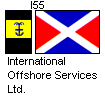
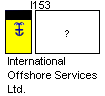
The funnel with its anchor-and-gusher emblem was retained, while the flag was later replaced by P&O Offshore Services’ flag, which also retained the emblem. Mitchell sighted I55 at Dundee in October 1974.
International Offshore Services began business in 1965 and was sold to Tidewater in 1974, apparently excluding the Bermudian vessels. The source records UK, French, Dutch, Liberian and Bermudian companies. Names commonly began with Lady, later changed in many cases to names ending in Tide. The Bermudian company also used Master for ships under its own control. A later ownership account describes a P&O–Farstad partnership, with P&O selling its share to Farstad.
UK, London.
Keep the explicit scope label independent; no alias or company identity is inferred.
A later Waterlooville company was formed on 20 June 1994 and listed as non-trading, with accounts filed through June 2005. Rosanoski presumes it was a shell or holding company, with operations through P/R International Offshore Services ANS. It is described as an equal P&O–Farstad partnership subsequently wholly owned by Farstad.
UK, Waterlooville.
Keep the explicit scope label independent; no alias or company identity is inferred.
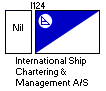
The website-derived flag shows an A-like symbol; one image makes its surrounding circle look oval, while another agrees with the I124 design.
ISCM operated as charterer and agent.
Norway, Sandefjord.
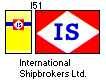
The yellow or buff funnel has a blue band surmounted by a panel of the flag. The red flag bears a white diamond extending to the edges, charged with blue IS lettering.
International Shipbrokers appears in Lloyds from 1963–64 through 1992–93 as fleet manager, managing between one and three companies in the listed years.
U.K., London.
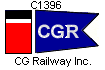
C1396 is based on a starboard photograph of Bali Sea from CG Railway’s website.
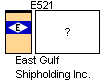
E521 comes from a portside photograph of EGS Wave. The source dates the photograph 15 April 2011 but its website reference 18 March 2011; this discrepancy is retained.
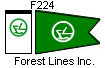
Website photographs suggest that the LASH ships used Forest Lines’ F224 colours while under LMS Ship Management.
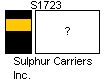
S1723 is based on Sulphur Enterprise on 14 December 2010. Built for Sulphur Carriers in 1994, she was sold on 28 August 2007 to ISC-Sulphur Holdings, a Capital One subsidiary, and leased back for ten years with an eight-year early-purchase option. Rosanoski found no earlier photographs to verify the funnel before the sale but thinks continued use likely because the original operator retained the ship on lease.
Energy Enterprise is reported with Central Gulf Lines’ funnel, and United Ocean Services continued its existing U344 livery. Those separately referenced illustrations are not added to this entry.
International Shipholding, or ISH, was formed in 1978 for the 1979 spin-off of Trans Union shipping assets, including Central Gulf Lines. It acquired Forest Lines’ assets in 1987 and Waterman in either October 1988 or 1989. Later expansion included a cement-carrier interest, CG Railway’s rail-ferry service from 2001, a quarter of Oslo Bulk in 2010, full ownership of Dry Bulk Holding in 2011 and United Ocean Services in 2012. The latter was to remain a separate operating unit.
CG Railway, founded in March 2000, operated Bali Sea and Banda Sea, listed under Gulf South Shipping ownership. The group also included East Gulf Shipholding, Forest Lines, LMS Shipmanagement, LCI Shipholdings and Sulphur Carriers. Lash Marine Services became LMS in 1997. NMA Maritime’s account gives a 1971 formation as the group’s European headquarters and sale in 1990, a chronology preceding the holding company’s stated foundation. Enterprise Ship Co., owner of Energy Enterprise, later appeared under LCI.
USA, New Orleans, Louisiana; headquarters moved to Mobile, Alabama, in 2006.
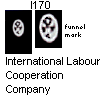
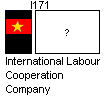
I170 comes from Thanh Ba’s starboard photograph of 2 December 2006, with an unclear emblem and unmarked hull.
Thanh Son’s photograph of 23 April 2007 shows I171 and INLACO SAIGON on the hull. Rosanoski describes the funnel as the usual one for vessels of the “Government of the Socialist Republic of Korea”; that wording is preserved as his statement, without changing this company’s Vietnam classification.
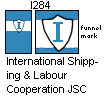
I284 is based on a starboard photograph of Inlaco Accord at Singapore on 9 June 2011.
The company, known as INLACO or INLACO Saigon, was established as International Labour Cooperation Company by the transport ministry decision of 27 February 1995. It became International Shipping & Labour Cooperation Joint Stock Company effective 1 July 2007, following the March decision. Lloyds initially gave formation in 1994, corrected to 1995 in 2007, and listed it under Vietnam National Shipping Lines. Vietnamese names recorded include Cong Ty Hop Tac Lao Dong Vol Nuoc Ngoai Phianam and Cong Ty Co Phan Van Tai Bien Va Hop Tac Lao Dong Quoc Te.
Vietnam, Ho Chi Minh City.
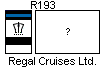
R193 is based on photographs of Regal Empress before her change of livery under Imperial Majesty. Beneath the emblem, possibly a stylised crown, magnification reveals dots which otherwise look like a line and may be words. Their meaning is unclear.
Lloyds dates International Shipping Partners to 1990, while the account of Clipper’s purchase of half its parent, International Maritime Services, on 18 June 2008 describes a group established twenty years earlier. ISP operated chiefly as ship manager through associated companies.
Its interests included Cruise Corporation, the Kosmas Group, International Shipping Partners A/S in Copenhagen, Premier Operations and Marine Management Services (International). Regal Cruises, formed in 1991, operated Regal Empress. The vessel was arrested for debts in April 2003 and sold at auction to Imperial Majesty Cruise Line.
USA, Miami, Florida.
A black funnel was recorded on Universal Skipper and Universal Mariner in 1967. No flag is noted.
The company appears in Lloyds 1970–71 as manager for Dalkeith Shipping.
Hong Kong.
The early website-derived flag appeared blue on a mainly greyish ground. By 31 July 2009 the logo was black on white. The archived early date is printed as “2.2.1001” and remains unresolved.
International Tanker Management, also called ITM and Intertanko in the source, was formed by Barber International on 27 May 1998 to specialise in tanker management. It acquired BSM Singapore and BSM Hong Kong’s Dubai branch on 1 January 1999. The account records the International Tanker Management Ltd. Dubai Branch name from June 1999, while later registers use Holdings. V. Ships took over in 2009.
The Singapore company was renamed on 15 March 1999. ITM Norway followed on 8 February 2000 and the German company on 15 March 2001. Transpetrol ITM was established on 21 March 2002 and became wholly owned by Transpetrol on 1 January 2005.
Bermuda; Dubai in the later website account.
The funnel is black with a broad band of the flag. The flag is red with a white frame enclosing white ITL lettering.
International Towing, also listed as ITL, appears in Lloyds 1985–86.
U.K., Preston.
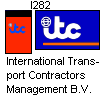
The earlier flag is horizontally white over orange, with a black joined itc logo in the upper hoist and a large stylised globe dotting the i. White edging separates the logo from the orange where they meet. An unused example offered for sale in 2008 was described as the old Haarlem model used in the 1970s and 1980s.
The funnel appears orange-red, of an air-sea-rescue shade which varies with the camera. Portside Sable Cape and starboard Simoon photographs confirm the arrangement.
The later blue flag has a large white ITC-and-globe logo aligned towards the hoist and an orange stripe across the lower field. The orange differs from the funnel’s redder shade. One photograph suggests the stripe stops short of the hoist; Mistral appears to confirm that it reaches the fly, while Meltemi seems to show it touching both vertical edges. These details remain uncertain across the views.
ITC began in 1973 as commercial and operational manager for Tschudi & Eitzen’s ocean tugs and barges. Ownership passed to Axel C. Eitzen and Felix H. Tschudi in early 1997, and to Felix’s Tschudi Shipping in 2003. Lloyds initially describes a 1996 rename from International Transport Contractors Holland to International Transport Contractors Management; later editions instead list both companies and date Management to 1997. On 13 December 2012 ITC became Tschudi Offshore & Towage.
Netherlands, Heemstede; Haarlem in another company reference.
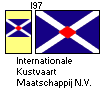
The company appears in Lloyds 1953–54 and 1958–59 under N.V. Scheepvaart-en Steenkolen Maatschappij management.
Netherlands, Rotterdam.
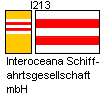
The flag is white with two horizontal red stripes. Schneider compares its pattern with a variant of the NYK flag.
Interoceana appears under Carsten Rehder in Lloyds 1953–54, then Heinrich von Dietlein in 1956–57, and in its own name in the 1958–59 and 1963–64 registers.
Germany, Hamburg.
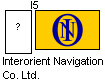
Rosanoski questions the I5 flag emblem against the website logo and Baltic Wind’s February 2006 funnel photograph, whose ring widths and N shape match the logo. I148’s flag is assumed to follow the funnel, with a table flag confirmed in Interorient News; its orange-yellow may be darker.
Although NJK’s earlier sightings were all in charterers’ colours, later photographs establish owners’ colours on Orient Accord, Baltic Swift, Ace Brave and Ocean Despatch. Mitchell shows I148 with a narrowish blue top.
Interorient, or INC, is described as incorporated in 1977 under chairman Adonis Papadopoulos and trading from 1979. Lloyds successively gave formation as 1980, 1977 and 1979; the later website supports 1979. It remained privately held and sold South Pacific Container Lines’ assets to Hamburg Süd in 1999.
The group combined ship management in Cyprus, Germany and the USA with crewing agencies in Russia, the Philippines, Latvia and Ukraine, and Cyprus-based forwarding and travel agencies. The Hamburg company was formed in 1995 and renamed in 2000; its later Germany-name change is printed as “2207” in the source. Interorient Marine Services followed in Limassol in 2007.
Interorient and Deutsche Seereederei extended their 2003 Reederei Hansa partnership through Interhansa in 2004, with liner services managed by Hugo Stinnes Linien. With D/S Norden it formed Norient Product Pool, operating from January 2005, followed by the Handy Bulker Pool in 2009 and Post-Panamax Bulker Pool in 2010. The equal-owned product pool changed its Danish company form from A/S to ApS in August 2008.
Cyprus, Limassol.
Chartered tonnage often retained a different funnel base colour while carrying the illustrated band.
Melfi Cristobal shows I164 as a panel on the superstructure. A separate photograph has a plain blue funnel, suggesting chartering.
I165 is based on Pinta in March 2007. Its flag is obscured in the distant view, but Patriot’s superstructure panel shows angled letters spaced more widely on a 2:1 field.
Wilhelm Mahnke took over the shares in 1992 and gave the company its Interscan name. The website dates its foundation to 1968, apparently referring to the predecessor, while Lloyds gives 1978 for Deutsche Conti Schiffahrtsgesellschaft before the 1992 rename. Interscan carried forest products, containers and other dry cargo in Europe and managed ships for closely associated owners. F. Laeisz held a twenty per cent interest.
Germany, Hamburg.
The funnel is documented on Annerdiep, with an apparently stylised ION logo. Mitchell instead makes all three letters vertical and breaks the second and third with slanting field-colour lines, omitting the second letter’s rounded shape.
Chartered ships appear to use charterers’ colours. The funnel-mark format was later used by Mastermind Shipmanagement, formed in 2010 by Eugen H. Adami, listed as Intership’s managing director in 2008.
Intership, or ISN, was formed in 1988 according to the website and corrected Lloyds entry; an earlier register gave 1989. A principally shipowning member of the Hartmann Group with a German background, it moved into its own headquarters in 1997. Athena Marine is associated in the source by common contact details, and participation in Mini Container Pool is inferred from employment of its ships. Owned vessels characteristically begin with A and end in diep.
Cyprus, Limassol.
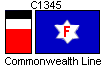
Lloyds 1904 assigns C1345 to the Commonwealth Line operated by W. Scott Fell & Co.
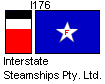
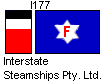
Scott Fell and Interstate used a blue flag with a white six-pointed star bearing a red F. The Log and Talbot-Booth support the six-pointed version I177; Marine News shows the five-pointed version I176, which Rosanoski considers apparently erroneous.
William Scott Fell began as a broker in 1882 and developed shipping and coal-contracting businesses after two bankruptcies. Coastal trading is dated to 1904, followed by ship sales and chartering. The establishment of Interstate is variously placed in 1914, 1920 and 1928; the last date may represent a rename rather than formation. Merchant Ships dates ownership from 1922 and the change from Ltd. to Pty. Ltd. to 1938. The fleet was disposed of by 1957, and the company was deregistered on 20 November 1981.
Australia.
I206 is based on Alfonsito photographed on 10 December 2007.
I207 comes from Askania on 17 March 2008. A later small website photograph shows a superstructure panel, possibly indicating that the funnel bands also formed a flag. The funnel then appears red with a narrow black top and a blue band occupying about a third of its height, broadly like I206, but the small bow view is unclear.
Intertrad, trading as ISC Lines, was established in 2001. Alfonsito, formerly Capelle’s Irene, was listed under its ownership and management from December 2005 to July 2006 and again from April 2007. Although absent from later Lloyds entries, the website described two ships and eight under construction.
Italy, Rome.
Intertrader was recorded in February 1967 with a buff funnel. The description gives yellow or buff with a black top; no flag is noted.
Unknown.
Pioneer Epos carried I265 in July 2008 and had changed to I264 by November 2011.
I264 is also documented on Pioneer Sea. The change to I263 was gradual: Pioneer Sky already carried it in October 2010. The dot over the I is often indistinct at a distance.
I263 is illustrated from Chem Bulldog on 4 August 2012.
Interunity, or IMC, dates its foundation to 1982, while Lloyds records formation in 1984 as Interunity Maritime Co. Ltd. and adoption of the management name in 1988. It became a major gas-ship operator, operating Naftomar’s LPG fleet for twenty-eight years and tankers for Hellenic Petroleum. Interunity Management Maritime Co., formed in 2002 at the same address, appears as an operating company in the 2008 register.
Greece, Athens.
I298 shows Intrepid Harvester’s port funnel on 6 February 2013.
I299 is the port funnel of Intrepid Reliance; the source’s photographic date is malformed as 223.3.2011.
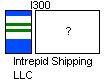
I300 shows Intrepid Canada’s starboard funnel in June 2013. Commentator mcole believed the ship to be associated with Intrepid, comparing its markings with Intrepid Harvester, but found no confirmation on the basic company website. Rosanoski identifies the markings in that comment as the two green bands.
Richard du Moulin and Mark Filanowski formed Intrepid Shipping in 2002 as ship managers. Du Moulin had left OMI in 1989 and founded an earlier Intrepid Shipping, then led the buyout of Marine Transport Lines. That Intrepid became MTL, which went public as Marine Transport Corporation in 1998 and was sold to Crowley in 2000. The new Intrepid followed.
Intrepid joined Bernhard Schulte, Sloman Neptun and Algoma Central in the Hanseatic Tankers product and chemical pool, announced in November 2007 for operation from July 2008. Bernhard Schulte (Hellas) in Athens provided commercial management.
USA, Stamford, Connecticut.
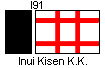
I91 reproduces the original funnel in a 1930 Japanese book. By 1953 the band was on a pale-blue funnel. Later sightings described light grey, blue or blue-grey, but Alan Watt’s November 1964 slide of Ken-ei Maru clearly shows light blue. Ken Zui later had a regular grey funnel. Watt placed an uncertain change between 1972 and 1996; Rosanoski notes that the 1961 US Navy book shows both colours, suggesting earlier alternatives.
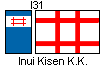
The mid-blue of I31 was chosen provisionally because the intended light shade was uncertain. Mitchell uses the name Inui Sempaku Kaisha Kisen, Hyogo, but Rosanoski believes its Ken-ei Maru line drawing represents the wrong company. FOTW’s flag by Phil Nelson follows Stewart 1963.
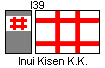
I39 is based on Ken Zui at Wellington on 23 August 1997. Rosanoski calls the funnel grey, although JLL described it as blue in correspondence. Its narrower logo may reflect funnel width. Ken Spring and Kiwi Queen show slightly wider marks, still narrower than Stewart and Brown.
Inui Kisen, also known as Inui Steamship Co. Ltd., was formed in 1919 and retained its name after merging with Wayo Kisen in 1968. Rosanoski considers FOTW’s reported 1964 merger with Kawasaki to be a confusion with Iino Kisen. The company continued under its own name as a Mitsui O.S.K. subsidiary.
Ship names used Ken as a prefix or first name. Alan Watt explains that the kanji for Inui can also be read as Ken.
Japan; Kobe in Jordan and Tokyo in Lloyds 2011–12.
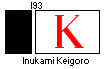
FOTW names the company Unugami Kisen and reproduces a flag dated 1916 from the 1994 book Fune To Hata, based on an actual flag. Alan Watt supplied a funnel from 1930.
Japan, Otaru.
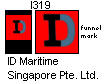
I319 shows Stamford Pioneer’s starboard funnel on 2 January 2013.
Most ships had ID-prefixed names and apparently carried Lauritzen charter colours. The document also records the ID Wallem logo.
Investeringsgruppen Danmark, or Investment Group Denmark, was incorporated in 1989 according to its website. It provided investment, fiduciary and corporate services for shipping, commonly using limited partnerships with ten owners and one hundred shares. ID Maritime in Singapore represented owners in dealings with managers, crews, yards and insurers. Lloyds instead dates the company to 2004, under the spelling Inverteringsgruppen Danmark; its 2008 operating companies were formed in 2007. Ships later appeared under investment names such as K/S Danskib 81. ID Shipping was listed as a manager, and Bidsted & Co. shared the group’s address with different telephone numbers.
ID Maritime and the Wallem Group established ID Wallem Shipmanagement in Hong Kong in 2009 to manage ID-owned vessels.
Denmark, Hellerup.
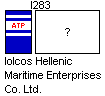
I283 is based on the port funnel of Iolcos Celebrity in September 2005 and the starboard funnel of Themis P at Singapore in June 2011. Rosanoski suggests that the blue may be dark sky-blue, or may vary with the paint used.
A further funnel photograph records Mary Gorgias on 7 October 2008.
Iolcos Hellenic, identified by ATP on the funnel, was founded in 1982 according to its website and acquired its first vessel in 1983. Lloyds dates formation to 1983 and names A. T. Patrakis as managing director in 2008. A bulk-carrier manager and operator, it formed the core of the Iolcos Group, with subsidiaries in the United Kingdom and the Philippines.
Greece, Athens.
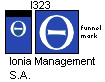
I323 is based on a portside photograph of Theo T taken on 25 February 2014. The document supplies no written description of the funnel’s colours or geometry.
Ionia was incorporated in Liberia with offices in Piraeus. Its company account dates formation to 1992 and the start of ship management to December that year; Lloyds gives 1993. It began with small chemical tankers, moved to medium-size tankers in 1994 and expanded to panama in 1997. It became a founding member of the Star Tankers Pool early in 1999 and received its first newbuilding, Theo T, in August 2003.
Greece, Piraeus.
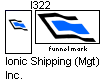
I322 shows Ionic Spirit’s port funnel on 11 February 2014.
Ionic Shipping managed Ionic Spirit from 11 April 2013. Equasis lists the vessel’s owner as Ionic Spirit Inc. from 22 April 2010.
Greece, Athens.
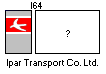
The funnel is grey with a broad red band edged in white above and below, bearing a white bird flying forward. The bird, recorded on Necip Ipar in August 1961, is intended as a seagull. No flag is noted.
Ipar Transport appears in Lloyds registers for 1963–64, 1966–67 and 1970–71.
Turkey, Istanbul.
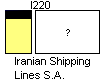
Mitchell shows a yellow funnel, supported by a line drawing of John L. Manta, which belonged to Persian Shipping Services (London) Ltd. Rosanoski doubts the yellow and suggests dark buff as a possibility, but only if the earlier funnel was retained; that continuity is itself conjectural.
Former-owner attribution and precise colour uncertain.
The fleet was acquired from Iranian Lloyd Co. Ltd., also identified as Persian Shipping Services (London) Ltd.; Rosanoski suggests a possible association. Shiraz was the first ship acquired in 1963 and the last disposed of in 1970. Pan Shipping Ltd. of New York appears as operator of one ship in Lloyds 1966–67 and as fleet operator in 1970–71. Mitchell calls the associate Pan Shipping Co. Ltd.
Iran, Tehran in Lloyds; Mitchell gives New York.
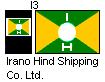
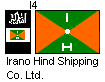
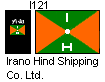
Hood’s flag seen at Lyttelton on 7 March 1985 was diagonally quartered green and orange, with white I and H in the green quarters and a small white central circle. Arabic script was added between Hood’s March and June visits. Noor’s script was smaller and different; its flag was not flown and was inferred from the funnel panel. Rosanoski records orange rather than yellow for Hood’s panel, although the observation labelled I4 is dated March in the livery note and June in the source list. I121 is also supported by a 1980s photograph of Noor and the company website.
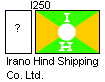
Brown 1995 shows green and gold quarters with a larger white circle. Jarig Bakker’s FOTW rendition I250 follows Brown but uses a different font and a light green shade without an explained reason.
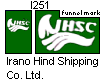
The website version appeared green and red rather than the orange recorded on Hood. Ivan Sache’s FOTW image follows that website evidence.
Hood photographed at Bluff on 11 May 1998 carried a different funnel and IHSC on the hull. Its very large attached logo projected beyond the forward edge of the funnel. Teen in February 2006 had a normally sized painted version. No flag was seen, but the website’s continued use of I121 suggested that it had not changed.
Irano Hind, or IHSC, was a joint venture between the Shipping Corporation of India and Arya National Shipping Lines, later IRISL, on a 49/51 basis. One account dates establishment to December 1974 and operations with a chartered ship to March 1975; other accounts give formation in 1975 or 1976. Management alternated between the two countries every two years. It became a shipowner in 1979. The quoted Iran Watch account records US restrictions in 2008 and UN restrictions in 2010. By July 2013 the Shipping Corporation of India described it as undergoing dissolution.
Iran, Tehran.
I6 adapts the 1959 Iraqi flag with green replacing black at the hoist. Loughran shows a white core to the star, carrying a yellow circle representing the sun.
Loughran dates replacement of the sun by the company initials to 1971, explaining them as the Hora, Iraq’s legendary bird. Mitchell dates the I46 funnel to 1974. The FOTW flag follows Brown 1995.
Formed in 1952, Iraqi Maritime Transport later became the Iraqi Government State Enterprise for Water Transport. It was listed in its own name in 1973–74 and under the government by 1978–79.
Iraq, Baghdad.
Nüsse attributes this flag both to Irgens Larsen and to Larsen & Taubro, so Rosanoski warns that its allocation may be incorrect. It is blue with a white-black-white-black target, the remainder obscured, surmounted by a yellow sixteen-pointed star. A white circle in the star contains a black ring around black LT, angled slightly “Pbds”, with the T’s top level with the L’s bottom. No funnel was noted.
No shared use by Irgens established; keep original file/caption unchanged pending approval.
Kvaerner Industrier owned the business from the end of 1988. Its shipping and management operations merged with Rederiet Helge R. Myhre on 1 June 1992 as Kvaerner Shipping, taking the Irgens Larsen name in 1995. After acquisition on 15 June 1998 it was merged into Swan Reefer, of Siem Industries.
Norway, Oslo.
The funnel is based on Taurus Two photographed on 31 December 2010, supported by a photograph of three Stars that Rosanoski did not retain.
Irika Shipping was formed in 2002, registered in Panama and operating in Greece. Lloyds 2008 lists it as an agent.
Greece, Piraeus.
Although illustrated sources give the funnel a fairly wide band, black-and-white photographs on the Bryggan website show it narrower. Mitchell lists the funnel under C. H. Abrahamsen. Phil Nelson’s FOTW flag follows Stewart 1963.
Clas Theodor Abrahamsen formed Iris in 1922; its last ship was sold in 1969. It also had a subsidiary on Åland. Lloyds 1953–54 names C. H. Abrahamsen as manager, and the 1966–67 register lists C. H. Abrahamsen and Olaf Öström of Mariehamn, Finland.
Sweden, Stockholm.
The funnel is yellow or buff, with a black top separated by a broad blue band bearing a white star. No flag is noted.
Syros Shipping Co. acted as agent. The funnel recorded on Captayannis is associated in the source with J. Paleocrassas.
U.K., London.
The black funnel carries a green-white-green triband. The flag is quartered green and red with a white rectangle over all.
The company is recorded in Liverpool Shipping 1960.
U.K., Liverpool.
The original white flag bore a red saltire and a black-and-white fleur-de-lis, representing Ireland and France on the Rosslare–Le Havre route. The funnel band represented the founding interests: green for Ireland, white for Norway and blue for Sweden.
Mitchell apparently presents I166 as the original funnel. I167 and I168 are not clearly identified; a drawing of Saint Colum I shows a plain red funnel.
Isle of Inishmore photographs support I2 but show no black funnel top. The panel’s uppermost and lowermost points are sharp, with its other two corners rounded. Brown 1995 makes the shamrock upright, but website flag views and the funnel panel show it angled. The FOTW rendition describes bright blue, green and blue horizontal stripes separated by narrow white stripes, with a white shamrock over all. EuCon uses the same flag.
I321 is documented on Oscar Wilde in port and starboard photographs. Another photograph shows the flag, apparently closer to 2:1 proportions.
A stylised shamrock replaced the original livery in 1978 to emphasise Ireland. The source describes a green flag with a white shamrock under I53, followed at an unspecified date by the later flag.
Irish Continental Line was an Irish–Scandinavian venture formed in 1972 according to the company and Marine News, or 1973 in Loughran and Mitchell. Its Rosslare–Le Havre ferry service began in 1973. Irish Shipping held half the shares, with Fearnley & Eger and Lion Ferry holding a quarter each. Mitchell records wholly private Irish ownership in 1987. The name became Irish Continental Group in 1988. B&I Line was acquired from the Irish government in 1992, although Mitchell gives 1991. In 1995 a standardised group identity replaced references to B&I. The group operated ferries as Irish Ferries and a container and terminal division including Eucon, Belfast Container Terminal and Dublin Transport Terminal. Marine News reported a $746 million management buyout in 2007.
A later Irish Continental Line Ltd., formed in 2007, appears under Irish Ferries management. Feederlink was sold to Unifeeder late in 2012.
Ireland, Dublin; Mitchell gives Cork.
The managed Dina Alliance carries the Mainport Holdings logo: a blue M on a white delta triangle, placed on a blue panel with MAINPORT in blue underneath. M819 is based on its port funnel on 1 April 2013.
C1305 is the starboard funnel of Celtic Banner on 29 August 2012.
Mainport Elm carries the subsidiary Mainport International Corporation’s white M on a blue delta triangle. Rosanoski says this apparently distinguishes owned vessels.
Mainport originated in Ronayne Shipping, formed by Finbarr Ronayne and his brothers in 1957. It diversified into stevedoring and logistics in 1964 and Celtic Sea oil exploration in 1970. Ronayne Shipping amalgamated with Cork agencies including Clyde Shipping and A. C. Horne in 1974. Rosanoski is unsure whether this Clyde Shipping was related to the Scottish company. Expansion involving Irish Shipping produced Irish Mainport Holdings in 1976, when James Scott & Co. was also acquired. Shipowning began in 1979 through Seahorse Ltd. The website dates Celtic Tugs’ launch to 1995, while Lloyds gives formation in 1993.
Group operations included Mainport International Corporation and Seahorse, formed in 1974 as Seahorse Offshore Services. Caspian Mainport and Ocean Mainport Surveys were formed in 2006. The Ocean Mainport offshore joint venture with Sartor Shipping began in July 2005; Mainport sold its half to Sartor in September 2008. Related companies included Ocean Mainport Rescue, formerly Havila Rescue UK and acquired in November 2006, and Ocean Mainport Scotland, formed in Aberdeen in 2007.
Ireland [Eire], Cork.
Reed 1901 also identifies I249 as the Lord Line.
Lloyds 1904 and 1912 and Reed 1912 likewise identify I248 as the Lord Line.
L493 is documented in LJC 1885.
Irish Shipowners, also known as the Lord Line, is described as formed by Thomas Dixon & Sons in 1879; another source gives 7 September 1883. It went into liquidation in 1917, selling its last two ships to the Ulster Steamship Co., G. Heyn & Sons. Lloyds 1917–18 still lists it under Thos. Dixon & Sons as operators.
UK, Belfast [Ireland].
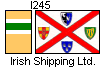
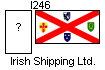
Loughran dates I244 to 1941–47; Mitchell gives the same period for the I247 funnel.
I245’s funnel is supported by a photograph of Irish Oak around 1965. The source labels a National Maritime Museum flag I245, dates it after 1947 and records dimensions of 889 by 1828.8 mm.
The original flag had company initials in its quarters, replaced in 1947 by the arms of the four provinces. I246 follows the National Maritime Museum, with shields also illustrated by Loughran, who gives flag dimensions of six by three feet.
Irish Shipping was incorporated on 21 March 1941. The Minister of Finance initially held 51 per cent, Grain Importers (Eire) 43.75 per cent, and Limerick Steamship, Palgrave, Murphy and Wexford Steamship 1.75 per cent each. Vessels were initially allocated to the three represented shipping companies, with Irish Shipping as manager and operator. Their shares passed to Grain Importers in July 1942 and then to the Minister in October 1943, making the government sole owner. Mitchell dates the first newly built ship to 1948. Ship management began in 1976. A provisional liquidator was appointed on 15 November 1984, and Mitchell dates liquidation to 1985.
The company acquired forty per cent of Palgrave, Murphy in 1964 and participated in the Normandy Ferries consortium before withdrawing. It formed Celtic Bulk Carriers with Sir William Reardon Smith in 1973. It also held half of Irish Continental Line, established with Fearnley & Eger and Lion Ferry, becoming sole owner in 1977. In 1976 it participated in the expansion that created Irish Mainport Holdings.
Ireland [Eire], Dublin.
Ruth Lake was recorded in February 1966 with a black funnel bearing a white I over a white O, combined as one design. No flag is noted.
Iron Ore Transport appears in Lloyds from 1963–64 to 1970–71, with Skaarup Shipping Corporation as agent.
USA, New York.
The house flag was the same as P. Henderson’s, but Reed 1891 gives Irrawady equal bands, unlike its rendering for Henderson.
Talbot-Booth 1937 and Ships & The Sea 1938 omit the white from the Union Flag in I114.
I115 is recorded in Reed 1912.
The company owned steamships from 1875, operating on the Irrawady in Burma. P. Henderson & Co. controlled it according to Merchant Ships 1942; the 1949 edition uses the past tense, although the companies still shared an address in 1953–54.
U.K., Glasgow.
Victor Lomantsov saw the I83 flag in magazines of the 1970s and believed it remained in use into the 1990s.
The riverships.ru flag is presumed to be post-Soviet. Its Cyrillic ИРП corresponds to IRP.
Rosanoski considers Mitchell’s funnel logically post-1991. The presumed successor name Irtysh River Co. appears instead to have become Irtysh Shipping Co.
Irtysh Shipping operated passenger and cargo services on the Irtysh and its tributaries, with Arctic river–sea shipping. It was still listed in 2009. The source records the Russian name Иртышское речное пароходство and the transliterations Irtyshskoe rechnoe parohodstvo and Irtyŝskoe reĉnoe paroqodstvo. Mitchell records Vasiliy Nazorov, built in 1967.
USSR in FOTW; Omsk, Russia in Mitchell.
A black-and-white photograph of Tafelberg confirms the I128 funnel; no flag is shown, and its application is assumed.
I129 has apparently wider spacing between its funnel bands. It is shown for Una, bought from Western Australia’s State Shipping Service in 1917 and fishing intermittently from Fremantle until scuttled in 1926; Rosanoski suggests that this may explain the different funnel. Jarig Bakker’s FOTW flag follows Scott’s Caltex book of 1959.
George Irvin and Charles Johnson founded the fishing business in 1910. Lloyds gives formation in 1952, which Rosanoski suggests may relate to a name change from Irvin & Johnson (South Africa) Ltd. Anglo-Transvaal Consolidated Investments, an Anglovaal subsidiary, gained control in 1949. In 2005 AVI held seventy-five per cent and a black empowerment consortium twenty-five per cent.
The fleet included tankers as well as fishing vessels and whalers, and the company operated for Kerguelen Sealing & Whaling. Operating company Alpesca was formed in Buenos Aires in 1986. Rosanoski lists Irvin & Johnson (Mossel Bay) and Irvin & Johnson Nordsee as presumed subsidiaries.
South Africa, Cape Town.
Brown 1982 assigns I50 to J. D. Irving. Mitchell lists the funnel under Kent Line and gives a version without a funnel top under Irving Oil Co.
I70 is recorded on Irvingstream in the NJK Collection.
A separate logo was adopted in 1982 for the wholly family-owned US oil operations, distinguishing them from the Canadian business then shared with Chevron. The website records a common new logo in 2004; Rosanoski wonders whether this refers to the Bluecanoe convenience stores launched in 2005.
The Irving businesses grew from James Durgavel Irving’s mills, stores and timber interests, expanded by his son Kenneth Colin Irving. K. C. Irving developed his own petrol business under the Primrose name and moved to St. John in 1924. The 1934 formation date given for Irving Oil refers to its tanker fleet. Chevron acquired forty-nine per cent to help finance the refinery opened on 20 July 1960. Arthur Irving took over when K. C. retired in 1971. The family bought back Chevron’s interest in 1988, despite its continued appearance in Lloyds 1998.
The shipping interests were recorded through Irving Oil, Atlantic Towing and Kent Line, also called Kent Line International. Lloyds dates J. D. Irving Ltd. to 1958 and, by 2006, lists it as controlling the group’s shipping interests, associated with Irving Oil.
Canada, Saint John, New Brunswick.
The black funnel bore a white outlined shield containing two interlinked, back-to-back Cs joined by a horizontal figure of eight. Shield shapes varied between tugs, and photographs show more rounded tops and bottoms to the Cs. The mark apparently remained in use throughout.
Around 1867 Anthony Irwing contracted to handle Culliford & Clark’s colliers. Although the tugs were registered under several individual names, they were treated as one operation and carried a common mark derived from Culliford & Clark. Anthony died in 1906 after establishing a partnership with James. The business traded as Anthony Irwing & Son from at least 1911, while tug ownership remained individual. Irwing Steam Tug Co. was incorporated in August 1926 and taken over by France, Fenwick Tyne & Wear in July 1934.
UK, Sunderland.
The blue flag has a white saltire with a red star at its centre and a white star in each of the four blue quarters. No funnel is recorded.
Isaac Rich & Co. operated sailing ships.
USA, Boston, Mass.
I82 is given as the first flag, used in 1939–62, while the associated funnel is attributed to Isbrandtsen Moller Line. Rosanoski cautions that their linkage may be incorrect. The I104 funnel was likewise assumed from a sighted FOTW flag. Joe McMillan recalled a similar flag with a light-blue canton and seven-pointed star, possibly ISMOLCO’s, corresponding to the Möller house-flag device.
Component association and exact company period unresolved.
Merchant Ships gives I82 and I33 as alternative Isbrandtsen-Moller funnels. The base colour is uncertain: Ocean Ships refers to tan, and Stewart 1957 indicates a shade darker than yellow.
Merchant Ships 1963 treats Isbrandtsen Steamship as an American Export division using that company’s funnel.
Sources differ over flag shape, star and cross position. Most place the cross intersection at the centre of an imagined rectangle, nearer the fork. Talbot-Booth, Brown 1958 and Loughran show an ordinary swallowtail with an eight-pointed star. Brown 1951 omits the swallowtail, while Stewart 1953 and 1957 show five points. The I34 FOTW rendition cites the 1961 US Navy book and Stewart editions.
Isbrandtsen originated in 1939, chartering Norwegian ships as the Isbrandtsen-Moller Line. The FOTW account describes Hans Isbrandtsen’s separate business following the break-up of ISMOLCO, his venture with A. P. Möller, and its principal Far Eastern trade. Hans’s son took over in 1953; the quoted account uses both Jacob and Jakob. Fleet names commonly began Flying or ended Heights. Registry records include Isbrandtsen Tankers and Isbrandtsen Agencies, with management for Aspin Steamship and Western Tankers and agency by Western Agency.
Accounts disagree over the American Export merger. One places American Export’s acquisition of operational control before a merger in October 1962 or May 1964. US Passenger Liners Since 1945 instead says Isbrandtsen acquired control of American Export in October 1960, with the combined company formed in October 1962 and renamed a year later. The companies separated again in 1973; Rosanoski found no apparent subsequent direct shipping involvement by Isbrandtsen.
U.S.A., New York.
The website flag drawing has a white field with a red circle enclosing what looks like a horizontal double arrow, using Japan’s national colours.
Ishizaki Kisen linked Hiroshima, Kure and Matsuyama, operating the Sea Max hydrofoil and a conventional vessel. The quoted 2008 account reports two Matsuyama routes closed in 1995 and another closure that year in response to fuel costs. It also reports a history exceeding 130 years and a Kintetsu connection, but Jan Mertens and Rosanoski could not corroborate the latter in the group’s company list.
Japan, Matsuyama.
Iran Fallahi at Lyttelton on 17 March 1986 had a silver-grey funnel with green occupying about its upper third. Its flag’s white band occupied about half the field. A green circle contained a white cargo ship sailing towards the fly, with green inscriptions around it and the green national arms above. The upper green band carried white script, initially thought to have five components. The inscriptions could not then be fully read. Rosanoski later revised I29 from a flag supplied by Dave Martucci in 2011, showing flowing script read by Albert S. Kirsch as Allah Akbar. The flag bore the English wording Islam Rep. of Iran. The count of script components remained uncertain.
I30 is based on Iran Mofid at Lyttelton on 17 May 1991. Its green upper band carried straight-line script, and the emblem’s English inscription read ISLAMIC REP. OF IRAN S.L. The vessel flew no flag: the published flag was reconstructed by assuming that the funnel repeated it. Rosanoski later doubted that assumption and recommended replacing the straight-line inscription with the flowing Allah Akbar found on the actual flag. He wondered whether both scripts represented the same words. The straight-line design had also appeared on an earlier company website. A later website funnel omitted the inscription. Iran Azarbayjan photographs show the I30 funnel, while Iran Bam has I.R.I. SHIPPING LINES and an extra white dash over part of the upper logo.
Brown 1995 shows equal flag bands and a green three-masted ship within a green ring, rather than a white ship on a solid green circle. Rosanoski records this as another reported variation but leaves open whether the simpler rendering reflects an actual change or the small illustration size. Iran Adalat photographed on 7 June 2004 supports the I28 funnel.
I252 shows Iran Akhavan’s starboard funnel on 29 November 2008.
I253 shows Iran Hesabi’s starboard funnel on 17 December 2005.
I254 shows Iran Teyfouri’s starboard funnel in July 2006, with a black emblem and the English inscription I.R.I. Shipping Lines.
I255 shows Iran Yazd’s starboard funnel on 21 March 2007. The ship emblem is definitely green; the inscriptions, including I.R.I. Shipping Lines, are assumed green from a slight tinge but could be black.
I256 represents a second actual flag found by Jonathan Dixon in December 2011, with I.R.I. Shipping Lines as the English text, confirming use of both logo wordings on flags. Rosanoski relates it to photographic funnel variants but questions its equal bands.
V260 shows Iran Hormuz 12’s starboard funnel on 9 February 2006.
IRISL Marine Services Engineering Co., based in Tehren, was formed in 1989 as Ship Supplier Co. It supplied ships, supervised maintenance and provided crew services.
Keep the explicit scope label independent; no alias or company identity is inferred.
Khazar Shipping Co., based in Bandar Anzali, was formed in 1993 as a wholly owned subsidiary.
Keep the explicit scope label independent; no alias or company identity is inferred.
The wholly owned Valfajre-8 Shipping Co. S.A., based in Tehran, is dated to 1988 in the earlier register and 1986 in the later one. Register forms include Valfajre Eight Shipping Co. and Valfarjre Shipping Co., with the former appearing as an operating company in 2008.
Keep the explicit scope label independent; no alias or company identity is inferred.
Numerous differing funnel designs were reported, without an established explanation. Some omit the upper inscription; variations in the English wording do not appear to correspond to its presence. Rosanoski’s later account also describes the Iran Mofid funnel as white with narrow white and red bands, although it elsewhere refers to a green band. That inconsistency is left unresolved.
IRISL began in 1967 under the original Arya National Shipping Lines name. Lloyds records its renaming as Iran National Shipping Lines in 1980 and Islamic Republic of Iran Shipping Lines in 1981. Mitchell instead places the Islamic Republic name in 1980 and a retitling in 1989, although the two forms quoted by Rosanoski appear identical. Ships characteristically used Iran as their first name.
IRISL Europe GmbH was formed in Hamburg in 2002.
Irano-Hind Shipping Co. Ltd. was established jointly with the Shipping Corporation of India on a 51/49 basis. Lloyds gives 1976; Rosanoski also records 1975 without a noted source.
Iran, Tehran.
The funnel is blue with a black top and yellow star, used for Tung’s tankers and bulk carriers. Hong Kong Pioneer was seen with dark blue but no black top in 1965, after an earlier black funnel; Hongkong Amber is another recorded example. The flag is black with a white diamond reaching the edges, bearing a black diamond frame around red ICN letters of diminishing size superimposed as one design. Ships of the associated Orient Overseas Container Line sometimes flew it.
C. Y. Tung’s principal subsidiary managed a fleet under flags of convenience. Island Navigation Corporation became Golden Peak Maritime Agencies in 1978 and Island Navigation (Ship Management) in 1983. The source records a 1994 amalgamation with Orient Overseas Management & Financed to form Island Navigation Corporation International, but also states a 1994 change to Associated Maritime Company (Hong Kong). These accounts are left distinct.
Management interests included Flint Shipping, Oceanic Tankers, Overseas Petroleum Carriers and numerous single-ship companies, including Chinese Maritime Transport and Karana Line. International Export Lines acted as agent.
Hong Kong in Lloyds; USA, New York in Loughran.
The blue funnel has a broad white band and a yellow seahorse over all. No flag is noted.
The company is associated with the Canadian Great Lakes and appears in Lloyds 1966–67.
Canada, St. John’s.
Komaiwai was noted in July 1963 with a yellow or buff funnel and blue top. The blue flag bears a white Shield of David enclosing a white C. Smaller white letters outside the shield are I at upper hoist, T at upper fly and Ltd at lower fly.
Island Transport is recorded in Lloyds 1963–64 and 1970–71.
Fiji, Suva.
Monarch had a black funnel.
After the Isle of Man Steam Packet Company dismissed its directors in 1835, some joined sympathetic shareholders to establish this rival company. They ordered Monarch at the end of that year. The venture collapsed and the vessel was sold at the end of an uncertain year recorded as 183?.
Isle of Man, Douglas, by assumption in the source.
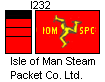
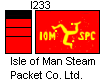
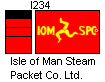
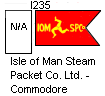
A painting of the first Mona’s Isle supports the I224 funnel and shows a blue foremast flag with an indistinct white emblem or wording.
The house flag’s red field bears the company letters and Manx triskelion, generally agreed to be yellow. LJC 1885 gives white letters, which Rosanoski considers a probable printing error. Sources divide over a small o after C and the direction of the kneeling knee. An unclear Lady of Mann photograph suggests the knee towards the hoist and a wholly yellow device, but the I112 arrangement is only a guess. Earlier FOTW descriptions gave UIOMSPCo in white or IOM and SPC without the o in yellow. Brown showed the knee towards the hoist until 1978, then towards the fly; Rosanoski could not establish whether this reflected actual changes. Spurs appear in the logo and Stewart illustrations, but their presence on flags is uncertain.
The I112 funnel comes from Ben-my-Chree. Photographs show it alongside the Lady of Mann funnel; a starboard view has the kneeling knee pointing aft, unlike a builder’s profile showing it forward as on the port side.
Rosanoski considers the I228 funnel a probable printing error.
LJC 1909 shows a flapping, angled flag with similarly angled letters. Rosanoski considers that unlikely and does not treat it as a separate variant.
A detailed photographed flag supplied the later I191 rendition and replaced the earlier FOTW description. The photograph offers clearer evidence of the legs and spurs.
The fleet commodore flies a swallowtail. Loughran’s I27, sighted on Ben-my-Chree, omits the small o. Eugene Ipavec notes that I190’s triskelion is ten per cent smaller and differently rotated than the house flag.
I189 is a printed flag flown on company buildings at Heysham and Liverpool in the 1990s. Its white field carries a red ring with yellow ISLE OF MAN above and STEAM PACKET COMPANY below, separated by yellow dots, around yellow legs. A yellow rope surrounds the ring, tied below in a FIAV-like knot with ends extending horizontally, twice on each side. Lupant illustrates the seal and a related version with large ISLE OF MAN lettering above and smaller company wording below. His colour description differs from the company website seal.
The company claimed to be the first with a red funnel and black top. Marinart allows two or three black bands. A Red Ensign defaced with the Man emblem was flown until the Admiralty ordered its discontinuance in 1933.
Vessels also flew name pennants. The photographed TYNWALD and LADY OF MANN pennants are white, edged red except near the staff, with red sans-serif names; the latter measures fifteen by five feet. The first Lady of Mann carried a similar pennant. Tynwald’s is tentatively assigned to Tynwald 6, operated in 1986–90, or possibly Tynwald 5 of 1947–74. A Mona’s Isle pennant in the State Library of Tasmania is similarly red and white, its red name sewn on. Jan Mertens suggests Mona’s Isle 6 of 1984–85, or possibly Mona’s Isle 5 of 1951–80; the meeting of its red edges at the unseen point is assumed.
The company grew from a meeting on 17 December 1829 and dates its formation as Mona’s Isle Company to 30 June 1830. Mona’s Isle entered service that August. The name became Isle of Man United Steam Packet Company in January 1832 and Isle of Man Steam Packet Company that July; limited-liability registration followed in 1885. It absorbed the Isle of Man, Liverpool & Manchester Company, or Manx Line, in 1887. The fleet principally used Manx names, and Isle of Man Line was an alternative designation.
The ownership record includes a Fisher interest and Sealink’s acquisition of forty per cent in January 1985. Mitchell mentions a five per cent Fisher acquisition but a ten per cent holding repurchased in March 1986, without clarifying the intervening change. Sea Containers gained control in 1996 after holding forty-one per cent. The company was sold to Montagu Private Equity in July 2003 and acquired in 2005 by investors including Macquarie Bank and Australian pension funds through the Manx holding company Steam Packet Group.
Isle of Man, Douglas [UK].
The funnel is recorded in Lloyds 1882, no. 634.
UK.
S1652 is based on La Dame de Sark photographed on 13 August 1970. A flag in the port view appears to have a blue band and may be I278.
I277 is documented in a September 2012 photograph labelled Bod marin de Seerk. André Coutanche’s observation in July 2000 describes a yellow-black-yellow horizontal triband with the two yellow lions of Normandy centred on the black band.
The company website photograph of Bon Marin de Serk appears instead to show blue in the flag’s centre band and in the funnel top and band, providing I278.
Owned by Sark, the company has operated the year-round Guernsey–Sark service since 1969. Its first vessel, recorded as Bateauu Morgat, was bought on 22 September 1969 and registered to Sark Shipowners. Renaming as La Dame de Serk was in progress that October and appeared on the ship in February 1970. It entered service on 2 March 1970, ran until 16 November 1974 and was sold in June 1975. Ile de Serk replaced it, apparently registered to the company itself.
Channel Islands, Guernsey.
The white funnel bears a light-blue pennant edged darker blue, with an upright white fish at the hoist and a very narrow white horizontal panel pointing towards the fly. The panel reads isnasa in black, with an undotted i. The flag is a blue pennant with the narrow white panel and the same black legend.
Spain.
The traditional flagship livery was white with buff funnel, masts and crane. Gry Maritha arrived in dark blue and white, adopted for Lyonesse Lady in 1991 and Scillonian III in 1992: blue hull, white upperworks and a blue-and-white funnel bearing the house flag. The unpopular blue hull lasted only that season. By 1993 Scillonian III was predominantly white again, retaining the blue-and-white funnel, house flag and blue crane, with white masts. During the 1998–99 refit the funnel and masts returned to buff, followed by the crane before the season’s end. A larger billowing house flag was then painted on the funnel. Gry Maritha later adopted lighter blue, while Lyonesse Lady retained its original colours, suggesting abandonment of a uniform ship livery.
The blue house flag has a white cross between red ISSCo letters, with the o enhanced.
The company was formed in 1920, principally by Scillonians. Its activities included sea services, Isles of Scilly Skybus, a St. Marys chandlery, travel agencies and Westward Airways, operator of Land’s End Aerodrome. Skybus aircraft carried the company house flag on their tails. Scillonian III retained the prefix RMV, Royal Mail Vessel, because mail other than letters continued to travel by sea. Lloyds lists H. J. Ward as fleet manager in 1963–64 and H. J. Thomas in 1970–71.
U.K., Isles of Scilly.
The Onomichi company appears in Lloyds 1966–67.
Japan, Onomichi.
The funnel and flag are documented in Brown 1982, no. 93.
The Kobe company appears in Lloyds from 1970–71 through 1980–81.
Japan, Kobe.
I236 is based on Icdas II’s starboard funnel at Botany Bay on 27 May 2011 and a port view three days later.
I275 shows Icdas 09’s port funnel on 27 June 2012.
The company is also recorded as ICDAS, IÇDAŞ and İçdaş Çelik Enerji Tersane ve Ulaşım A.Ş. The Aslan family founded its ship repair and servicing business in Haliç in 1880. It entered iron and steel in 1955 and became a steel producer in 1970. Lloyds dates formation to 1996, which Rosanoski presumes marks the shipping operation.
Turkey, Istanbul.
I303 shows Akdeniz’s port funnel. The photographic date is tentatively written as 25 August 2013, while the website citation is dated 4 August 2013.
The institution began on 5 December 1884 as the Merchant Navy Boarding School, Leyli Tüccar Kaptan Mektebi, at Heybeliada-Istanbul within the Ottoman-Turkish Naval Academy. It became the High Navigation School in the Republican era and was re-established in 1992 as Istanbul Technical University’s Maritime Faculty. Akdeniz was acquired on 2 July 1997 and served as its training vessel.
Turkey, Istanbul.
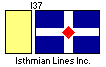
Jordan calls the funnel yellow, while Stewart 1953 and 1957 indicate a darker shade. Some sources show a large diamond. The USA Houseflags website dates the livery to 1910–56, and the NJK Collection records use of the States Marine funnel as well.
US Steel created Isthmian to carry its products overseas, initially under the UK flag. At the outbreak of the First World War the ships transferred to US registry to avoid British requisition or German commerce raiders. The operation reached eighty-five ships in 1949, but US Steel later found outside shipping contracts more economical. It sold the line to States Marine in 1956, which maintained the Isthmian identity and flag into the late 1960s. The company appears earlier as Isthmian Steamship and later as Isthmian Lines. Fleet names used City or Steel, then predominantly Steel. Global Bulk Transport was an associate at the same address.
USA, New York.
I199 is based on IT Intrepid’s starboard funnel on 21 October 2007; a port view shows the same arrangement.
I200 shows IT Interceptor on 13 May 2008.
IT International Telecom was formed in 1995 according to canadait.com. Lloyds gives 2005, apparently referring to the shipping side, with the fleet held through a minor operating company.
Canada, Kirkland.
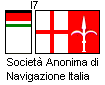
Photographs support the I7 funnel, but Ships & The Sea says the earliest funnels lacked black tops. The spacing of green and red bands varies between vessels, including Birmania and Maria. The US Navy book edges the flag’s white half in red.
The flag combines Genoa’s red cross with Trieste’s white pole-arm emblem on red. Rosanoski calls the latter a ranseur or spearhead and says no other source supports yellow for it; Al Fisher likewise notes Stewart’s white spear. The Observer description calls it a halberd, while John Ayer distinguishes a ranseur from an axe-headed halberd. A photograph of Leonardo da Vinci supports the I8 funnel, and the Brazil website’s 1950 livery has a broad red top. The earlier FOTW name Italia di Navigazione S.r.l. is discussed as the same line, although the initial caption questions the identification.
S. Caboto’s red funnel top is described as twice the width of the green band. Photographs show narrower diagonal bands at the aft end on both sides, with the green diagonal following the funnel’s rear edge before ventilation slats interrupt it. Rosanoski questions how far the apparent diagonal angle reflects the funnel’s taper.
The National Maritime Museum flag is dated about 1951 and measures 762 by 1219.2 mm. Its Genoa–Trieste design appears reversed. Jarig Bakker suggests that the museum may have misidentified a Lloyd Triestino flag; the attribution remains qualified.
I9 is recorded in Brown 1995, no. 420.
Italia, also known as Italia Line or Italian Line, originated in January 1932 as Italia Flotte Riunite, combining elements of Fratelli Cosulich, Lloyd Sabaudo and Navigazione Generale Italiana. Government reorganisation in 1936 produced Società per Azione di Navigazione Italia from 1 January 1937, taking parts of the Società Veniziana and Navigazione Libera Triestina fleets. It later became Italia di Navigazione S.p.A. Formerly within Finmare, it was privatised and appears under D’Amico in the later registers.
Italia and D’Amico operated Med Pacific Express. CP Ships acquired Italia in 2002, completed on 6 August, and announced in April 2005 that its brands would be unified under the parent identity. The remaining vessel appeared under D’Amico in Lloyds 2005, leading Rosanoski to presume that only the name had been acquired.
Italy, Genoa.
Klaus-Michael Schneider’s variant has a green-fimbriated cross and a simple red serifed I on the white star. Rosanoski considers a possible link between this version and German ownership, but rejects a neat ownership-based explanation for a later blue canton: Lloyds already shows blue in 1904, before the sale.
Lloyds 1912 shows a yellow flag with a black cross and blue canton bearing a white six-pointed star. Its red central character looks like a mirrored 6 or a handwritten capital I. A May 1905 sailing schedule supplies another I116 image.
Another pamphlet supports a yellow funnel and dark-blue canton matching the cross, consistent with Bonsor’s blue cross. Rosanoski suggests that dark blue could explain both the apparent colour similarity and the cross’s fimbriation. Bonsor calls the character I, though Rosanoski finds it reminiscent of a written T.
The Ancona illustration leaves the cross colour and fimbriation uncertain. Jan Mertens reads the canton as blue and the cross as black and fimbriated, with an elaborate I. He speculates that the six-pointed star might relate to Italy’s five-pointed star or have religious significance, without establishing either explanation. Jarig Bakker’s I280 replaced his I117 rendition in October 2006 by changing the character in the star.
Hamburg Amerika Linie established Italia on 6 May 1899. Navigazione Generale Italiana acquired its share capital in 1905 according to one account, or 1906 elsewhere in Bonsor. It continued as an independent subsidiary before merging into Transoceanica Società Italiana di Navigazione on 19 August 1917.
Italy; Genoa in Bonsor and Naples in Lloyds 1917–18.
The funnel is yellow or buff with a blue top and a white diamond bearing a green plant. The yellow flag has a blue border and the same white diamond charged with a green plant.
Italy.
A1190 is based on Uta’s port funnel in December 2013 and starboard funnel in March 2011. Since Rosanoski found no connection between the marking and the registered owner, he assumes it to be a charterer’s funnel.
Italteam acted as ship agent, broker and manager. It managed Uta for registered owner Gravel Shipping Co. The ship’s ADRICAL logo is associated in the source with the Rimini cement manufacturer, written as Adriacal Srl, formed in 1994.
Italy, Ravenna.
Phil Nelson’s FOTW flag appears under Itaya Goshi Kaisya from a 1902 chart reproduced in Fune to Hata in 1994, and also under Mitsui O.S.K. from Stewart 1963.
A June 1999 photograph of Lilac Ace, registered to Gemini Mermaid Line, suggests use of Mitsui O.S.K. livery since acquisition. The colour was noted as orange, though it appears red in the print; Rosanoski specifies rescue orange.
Itaya Shosen, also recorded as Itaya Syosen and Itaya Mercantile Marine, originated in Itaya Gomei Kaisha and was formed in 1903. The source records later names Itaya Shosen and Itaya Shoji before a return to Itaya Shosen in 1990, but Rosanoski questions the absence of the intermediate form in Lloyds. It managed Kurohime Kisen and later operated as a Mitsui O.S.K. subsidiary.
Japan; Otaru in Lloyds 1917–18 and Tokyo in 1978–79.
The funnel follows a photograph of Gina Iuliano and a sighting of Michele Iuliano at Newcastle, Australia, on 24 October 2006. Mitchell attributes it to Della Gatta S.p.A. and also refers to Juliano & Lembo Fontanamare S.p.A.
This funnel follows Filippo Lembo.
Formed in 1968, Iuliano & Lembo Della Gatta appears as manager and then agent for Compagnia di Navigazione Deiulemar S.p.A. Lloyds dates Deiulemar to 1970 and later lists it as an operating company with vessels under its own name and separate owning companies. It became Deiulemar Shipping S.p.A. in 2005. Gina Iuliano was earlier listed under Fontanamare S.p.A. of Cagliari, Sardinia.
Italy, Torre del Greco, of Naples.
The white flag bears a blue stylised IL, with the website logo appearing dark blue in June 2006. The company photograph does not clearly show whether the depicted flagpole belongs to the funnel mark; a very narrow, possibly blue funnel top may also be present. Oden appears to have worn Swedish government colours.
The company account dates Ivar Lundh to 1912, family-owned until 1956 and subsequently 75 per cent owned by Engco Invest with the remainder held by executives. Lloyds instead gives a 1981 formation and separately lists a Srab subsidiary under the same name. Its principal markets were the Baltic and North Sea; the source does not reconcile these duplicate identities.
Oden appears in the company’s own-name entry before moving under the Swedish Government, for which it had been built. A 2001 expedition source calls Lundh the formal owner, a relationship Rosanoski questions. The Srab entry concerns Arctica: its management listings changed, while Srab describes Lundh as time charterer and operator in 1998. Lundh later appears only as shipping agent in that entry.
Sweden, Stockholm.
Jordan and the wartime ship books suggest S. Holter-Sørensen used the C36 funnel across the controlled fleet. Brown 1951 lists it under Ivaran Lines, New York.
The Brazil website records I90 for 1950, and Josef Nüsse supplies a table-flag example.
Mitchell places I270 on Claus-Peter Offen’s card with the note charter ships. The Ivarans card instead shows an ordinary, tall and narrow C.
Founded in 1902 as Ivar An. Christensen, the business became Ivarans Rederi. S. Holter-Sørensen operated it in the pre-war record. Rosanoski tentatively suggests that wartime US east-coast and South American services were placed under New York-based Ivaran Lines, operated by Stockard Steamship. Claus-Peter Offen held twenty per cent according to Lloyds 2000.
CP Ships bought Ivarans in 1998, although a FOTW contribution in November 2001 reports a sale to Lykes Brothers within the preceding year. CP Ships announced withdrawal of its separate brands in 2005. Marine News says the unused Ivaran name was bought back by Eirik Holter-Sorensem for an initially slot-chartered Europe–South America service.
Norway; Christiania, later Oslo, and Lysaker in the cited registers.
B609 is given for Inver Swan at Fawley in January 1980. Line drawings of this and other vessels use the same funnel shade, suggesting that B140 may have been air/sea rescue orange/red.
This funnel is given for Iver Libra, 13031/1981, which Rosanoski could not locate in Lloyd’s and considered probably a charter in its original colours.
The company whose colours were retained is unknown.
Iver Bugge founded the business in 1927, operating as Skibs A/S Nanset. It became Iver Bugge Group in 1992 and Iver Ships A/S in 1993, although the contemporary company website gave 1991 as the formation date. Iver Bugge Management A/S appears alongside Iver Bugge in 1985–86; the listings were combined by 1988–89.
The firm joined the consortium forming Anco Shipping Ltd. Ships originally had names beginning with S, then Anco names in the consortium. The later Iver names are dated to the 1980s in World Tanker Fleets, but Rosanoski notes them already in Lloyd’s 1978–79.
Norway, Larvik.
Broström and Vroon vessels appear to have used different funnels. Vroon’s Iver ships continued with the tick logo also shown for Iver Ships B.V. A black-and-white starboard photograph of Iver Exporter in 2000 appears to show a white flag bearing the logo.
Iver Ships was established in December 1991 to consolidate commercial product and chemical tanker operations of a Norwegian business involved in general tankers since 1927 and chemical parcel trades since 1949. A management buyout backed by Vroon followed in April 1993. Another account describes a 1993 rename from Iver Bugge Group, with Vroon holding fifty-one per cent, R. Y. Rostant forty-one and H. J. Firing eight. In November 1996 Van Ommeren acquired forty per cent, alongside Vroon’s forty per cent and management’s twenty.
The subsequent ownership accounts differ. One says Van Ommeren wholly owned the business from September 1997 and sold it to Broström in 1998. The former company website gives Vroon and Broström forty per cent each, with directors holding the balance. Lloyds describes the Norwegian company as a subsidiary of Bahamas-based Iver Ships Ltd., jointly owned by Vroon and Broström. The name became Van Ommeren Iver Ships in 1997 and reverted to Iver Ships in 2000. From April 2003 Broström and Vroon each held half.
Broström acquired the remaining shares from 1 May 2005 and renamed the operation Broström Tankers. Lloyds first gives Ltd., later correcting the Norwegian name to A/S under the Bahamas-based Broström Tankers Ltd. Vroon retained the right to the Iver Ships brand from January 2006. Its Iver Ships B.V. at Breskens, Netherlands, handled chartering and Iver-named vessels; Lloyds dates that company to 2007.
Norway, Sandefjord, then Bahamas, as recorded by the cited sources.
The white flag bears a blue sixteen-pointed compass rose with a central double ring enclosing a Japanese character. Jan Mertens tentatively identifies it as the first character of the company name. The website includes the logo and an actual flag at a launching in Mare, volume 23; the magazine’s funnel photograph is partly obscured.
Lloyds originally dated formation to 1981, amending this to 1942 in 2008. Iwasaki appears as a manager for Kumazawa Kaiun in 1998 and a major operating company in 2000.
Japan, Hinase.
The funnel is yellow or buff with two narrow red bands interrupted by a panel of the base colour. A green diamond frame with forked points encloses a red K over a green I. The observation at Suva in July 1963 was recorded as No. 92 Himekame Maru, possibly No. 2, with both name and company uncertain. Alan Watt suggested a possible Himekami No. 2 connection, but that vessel was not found; the company’s listed trawler was Himekami Maru No. 1. No flag is given.
Vessel name/number and owner uncertain.
The company appears in Lloyds from 1966–67 through 1978–79.
Japan, Monoka.
The funnel is documented in the Japanese Shipowners Association chart of about 1992.
Izumi Kisen, also listed as Izumi Shipping Co. Ltd., was formed in 1950. Its operating companies included Libera Corporation, renamed from Toyo Kisen in 1989, and Toyo Shipping Line, formed in Kure in 1992. Daiichi Chuo Kisen appears as an affiliate and, by 2008, lists Izumi as an operating company.
Early ship names used Izumi Maru No. followed by a number. Later registers show Sen-prefixed Maru names and numbered Sensho Maru vessels before more varied names.
Japan, Tokyo.
Rosanoski suggests the L95 funnel may reflect wartime requirements for duller colours.
Brown and skipet show a diamond extending across the flag, and Brown also across the funnel band. Rosanoski suspects these renderings, especially the flag, and favours the Nüsse example. Brown 1968 also indexes L94 for A/S Sobral. Mitchell’s L97 has a black L and a diamond contained well within the band. The discussion and source list differ in their L94/L97 numbering.
L96 is retained from Brown 1951, skipet and Norske Rederiflagg 1952.
The concern is dated from 1929 and a change to Øyvind Lorentzen Shipping A/S in 1985 is recorded. Øivind Lorentzen had joined his father’s company in 1908 and left in 1914 for Den Norske Syd-Amerika Linje, becoming its chief executive in 1920. He left in 1930 partly because of his involvement with the family’s A/S Sobral, founded in 1915. The exact identification of his father’s company with Lorentzen, Natvig & Co. is tentative.
He founded Northern Pan-American Line in 1936 with his son Per as chief executive, operating between Brazil and New York. He retired officially in 1959. The company lasted until 1987, when its final three ships were disposed of; Mitchell records acquisition by Den Norske Amerikalinje.
Norway, Oslo; Oslo-Smestad also recorded.
A black-and-white photograph of Magya confirms the funnel. Ownership and management are reported differently: Lloyds 1917–18 assigns the ship to Grünhut, while the cited registry records a 1912 takeover by Hungarian Bank & Commercial, managed by Indeficienter, possibly until an Italian takeover in 1925.
The flag is the Hungarian red-white-green horizontal tricolour with black 1901 in the white stripe.
The company owned Indeficienter in 1910, operated by Grünhut & Co.; the vessel was laid up from August 1914. The FOTW account dates establishment to 1901 from the year on the flag and derives the name from Rijeka’s coat-of-arms motto, translated there as “inexhaustable”.
Austro-Hungarian Empire, Fiume; the FOTW page places the historical company under Rijeka, Croatia.
The funnel is white with a black top. The blue flag bears a white diamond reaching the edges, charged with blue S.I.T. letters.
The company is recorded in Brown 1951 and Lloyds 1953–54 and 1958–59 as Istria-Trieste Società Anonima di Navigazione.
Italy, Trieste.
The funnel is yellow or buff with a black top and two narrow blue bands separated by an equal width of the base colour. Brown 1958 omits the black top. The blue flag bears a yellow anchor, angled “Pbd” in Rosanoski’s notation with its flukes downwards, and a small yellow star in the canton.
Italnavi appears in Lloyds from 1958–59, with Compagnia Marittima Carlo Cameli as manager in the 1966–67 to 1973–74 registers.
Italy, Genoa.
Timavo was noted in May 1967 with a white funnel, narrow black top and two very narrow red bands set fairly far apart. No flag is noted.
Italsarda is recorded in the 1966–67 and 1970–71 registers.
Italy; Genoa in Lloyds 1966–67 and Cagliari, Sardinia, in 1970–71.