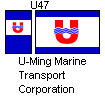
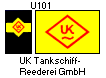
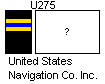
The funnel is documented on Cape Cathay in July 2006 and Cemtex Prudence at Newcastle in March 2010. Brown 1995 supplies the funnel and flag; the original adds no separate verbal design description.
The company account traces the business to Yue Ming Transportation, formed on 29 August 1968, with U-Ming established in June 1984 to carry cement, dry commodities and industrial raw materials. Lloyds instead gives a 1980 formation. Part of the Far Eastern Group, it was listed on the Taiwan Stock Exchange on 18 December 1990.
The Singapore subsidiary was formed in January 1994. The Hong Kong company is dated February 2003 by the website and 2004 by Lloyds. The original also lists OSPL and Global Maritime, a joint venture formed in August 2010 with CPC and Chinese Maritime Transport.
Taiwan, Taipei.
U-SEA BULK SHIPPING A/S.
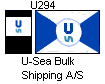
The funnel is documented on the chartered U-Sea Sakatchewan in December 2010, with the flag taken from the company website logo.
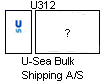
Ultra Corbita’s April 2012 port-side photograph appears to show another chartered vessel retaining old colours after the 2011 name change.
Eitzen Bulk became U-Sea Bulk on 17 September 2010 after Ultragas acquired the Eitzen Group’s 74.5 per cent holding. The U signalled the principal shareholder’s involvement. By the end of 2011 Ultragas held over 90 per cent, and the company was to be delisted while joining a common dry-bulk marketing platform as Ultrabulk Shipping.
Denmark, Copenhagen.
U. MATSUMOTO.
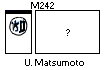
Kaho Maru No. 12 was recorded in July 1963 with a white funnel, very narrow black top and black ring enclosing black Japanese characters. No flag is noted.
Matsumoto appears in the 1963–64, 1970–71 and 1978–79 registers.
Japan, Muroto.
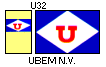
UBEM N.V.
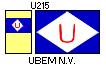
UBEM N.V.
image by Jarig Bakker, 13 March 2006
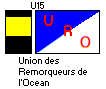
Brown 1978 attributes U32 to Union Belge d’Enterprises Maritimes. Brown 1995 and Tielrode’s November 1966 funnel show a plain U, corresponding with U215. Rosanoski considers the published U215 flag’s side points, placed inside the field, incorrect.
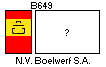
NV Boelwerf SA
Mitchell assigns this funnel to Naess Leopard, which Rosanoski could not locate, and presumes its emblem represents a ship. The livery is associated with shipbuilder and owner Boelwerf. Registers suggest a Boelwerf–Cobelfret venture operated by UBEM, later listing Stolt Boel under Boelwerf and UBEM and a different vessel under Bocimar. Stolt Boel’s name is taken to indicate chartering.
Marcel Cigrang founded Union Belge d’Enterprises Maritimes, UBEM, in the early 1950s to manage ships for owners worldwide. He also founded Cobelfret. UBEM appears in successive registers as operator and later manager; by 1996–1997 most of its vessels were listed under European Maritime Services of the Ahlers group.
Belgium: Antwerp, later Wilrijk.
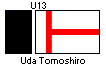
UDA TOMOSHIRO.
The flag comes from a 1902 chart republished in Fune to Hata in 1994; the funnel comes from a 1903 chart. The original gives no separate verbal design description.
Alan Watt identifies Uda Tomoshiro as the founder of Hakuyo Shosen/Kisen.
Japan.
UDDEHOLMS AKTIEBOLAG.
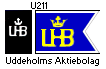
The flag is a blue swallowtail with a narrow white border except at the hoist, bearing a crown above yellow UB letters joined by a dash. Rosanoski interprets them as Uddeholms Bolag. Brown makes the dash distinct, while US Navy’s closer junction can look like joined UHB letters. Mitchell omits the dash and colours the crown’s inner base red, where the other sources retain the funnel or flag’s base colour.
Uddeholms worked in iron and steel, chemicals and forestry, with ships operated by Sune Tamm of Gothenburg into the late 1950s. The main note gives its limited-company period as apparently 1870–1985, whereas the published comment says 1970–1985; the discrepancy remains unresolved.
Sweden, Uddevalla.
UDDEVALLA TURISTTRAFFIK A/B.
The website provides the funnel evidence. Rosanoski describes its logo as resembling a very long-nosed face, presumed to represent a geographical feature; the identification is not established.
Founded in 1925 as Uddevalla Trafik, the company became a shipowner in 1951 and merged with Uddevalla Turistbyrå in 1967 as Uddevalla Turisttrafik. The later council-run company owned De vita båtarna, the white boats, with Uddevalla Event assigned to operate services along the Bohus coast.
Sweden, Uddevalla.
UECHI KISEN K.K.
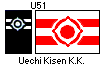
The funnel was noted on Nissoh Maru in the NJK Collection; Alan Watt supplies the flag evidence. No separate verbal design description is given.
The company appears in Lloyds from 1958–1959 through 1970–1971.
Japan, Kobe.
UGLANA CO. LTD.
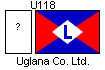
The flag is quartered diagonally, blue above and below and red at hoist and fly. A central white lozenge bears a blue L, whose meaning the contributor could not explain.
The company’s former website placed it in Klaipeda. Rosanoski’s later search suggested freight logistics and/or crewing, but the link was no longer working.
Lithuania, Klaipeda.
UGLAND.
image by Jarig Bakker, 23 January 2006
image by Jorge Candeias, None
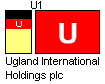
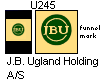
The bright-red flag has a large central white U and is recorded under several Ugland companies. U1’s funnel is confirmed on Fermita, and Mitchell also records it for Aall Shipping under Ugland Brothers. The JBU logo retained a U flag on a green design, though Rosanoski did not know whether it remained in use. The logo note describes a lighter, bluer teal flag and the legends Farming Trade Shipping and Tradition since 1290; these are logo wording, not independently established company dates.
The earlier funnel is documented by Jordan and the wartime sources, without a separate verbal comparison in the notes.
JBU Sincerity’s April 2010 photograph supplies this funnel. Its yellow appears greenish, while a distant view of JBU Orient looks normally light yellow.
Documentary images — company attribution uncertain
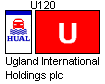
This livery is explicitly reconstructed as an assumption: HUAL vessels appear to have retained their individual house flags while sharing a common funnel.
Joint venture existence does not verify this actual combination.
Offshore operations
Ugland Offshore, renamed from Ugland Oilfields Services in 1989, merged with Det Söndenfjelds-Norske in 1995 as DSND Ugland Offshore. It became DSND Offshore in 1997, DSND Subsea in 2000 and Siem Offshore in 2004. The group included the acquired Brazilian Norsul Offshore, renamed DSND Consub; Halliburton Subsea and DSND combined resources as Subsea 7 in 2002. Hays Ships is recorded as acquired by DSND in October 1969, and PGS Production later appears under Andreas Ugland & Sons.
Keep the explicit scope label independent; no alias or company identity is inferred.
Management companies
Ugland Tankers, Car Carriers and Bulk Carriers combined in 1992 as Ugland Maritime Services. In August 1996 it became Interocean Ugland Management and split off Ugland Marine Services; the former became IUM Shipmanagement in 1999 and Teekay Marine Services in 2005. Teekay had acquired control of Ugland Nordic in March 2001 and later held 51 per cent of IUM. The American Interocean Ugland company became Interocean American Shipping in 2005.
Keep the explicit scope label independent; no alias or company identity is inferred.
Andreas Ugland branch
Andreas Ugland’s holding concern is dated 1985, with Autoliners as its inferred original name, later appearing as Andreas Ugland & Sons in George Town. Ugland International Holdings became Ugland Capital Partners in 2000 and AUS Shipping in 2002. The latter and Andreas Ugland & Sons are recorded as ceasing shipping activity on 31 March 2005.
Keep the explicit scope label independent; no alias or company identity is inferred.
J.B. Ugland and other family branches
Johan Benad Ugland formed J.B. Ugland Holding in September 2000 after the family division, with interests including shipping and industry. He and Andreas Ove had previously established a London management company, later a listed shipowner, and a Cayman shipping bank. J.B. Ugland Shipping was sold to India’s SIVA Ventures in February 2008; the retained J.M. Ugland business still operated two chemical carriers in the cited account. Johan Martin became group president and chief executive in November 2008. Other branches included Andreas Ugland Ventures and Knut Axel’s holding, with a 10 per cent Tailwind interest.
Keep the explicit scope label independent; no alias or company identity is inferred.
Ugland family shipping interests began in 1772, but Jøgen H. Ugland sold his ships in 1888. Captain Johan M. Ugland began the modern involvement in 1930; the later family account identifies the founders of J.M. Ugland & Co. as Johan Milmar and his wife Sarita. Sons Johan Jørgen and Andreas K.L. were on the board by 1955. A 1989 demerger created Bergshav, and Andreas began dividing his estate among his three sons in 1992, effective in 2000. A/S Uglands Rederi and its subsidiaries, owned by Johan Jorgen, operated collectively as the J.J. Ugland Companies.
UB Shipping, formed in 1992, was sold to Allco in December 2002 and renamed Allocean. Other operations included Ugland Shipping from 1964, Ugland Construction from 1982 and Ugland Bulk Transport from 2004. Joint ventures included Canship Ugland, dated 1995 or 1996; Progress Ugland; and HUAL with Höegh from 1970 until Ugland sold its share in March 2000. Its Swan Reefer interest increased from 10.4 per cent in 1998 to 33.8 per cent in 1999.
Norway, Grimstad; Cayman Islands, George Town, for the international holding-company context.
UK TANKSCHIFF-REEDEREI GMBH.
Mobil’s chart colours the diamond frame and lettering dark purple.
Recorded in Lloyds from 1966–1967 through 1980–1981, the company used Phs. Van Ommeren (Hamburg) as manager for part of its fleet in the 1970s.
Germany, Hamburg.
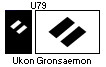
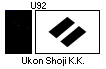
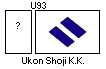
Ukon Shoji K.K.
Documentary material — company attribution not established
The flag comes from a 1902 chart republished in Fune to Hata in 1994, and the funnel from 1901 and 1910 sheets. Early Meiji photographs, dated about 1870, show a very faded flag and a vessel whose name is uncertainly read Nan?etsu? Maru. The device could be black or blue; its bars appear slightly longer than on the 1903 sheet. Both views show the same diagonal direction, raising the possibility of a double-sided flag or identical marks on both funnel sides, but fading prevents a firm conclusion.
The later evidence includes a 1926 flag with no funnel and a 1930 sheet. The narrative assigns U93 to both, while the source list distinguishes U93’s flag from U92’s funnel and flag. The diagonal orientation conflicts with the earlier evidence; Alan Watt leaves open which charts, if any, are wrong.
Originally Ukon Gronsaemon, the concern had become Ukon Shoji K.K. by 1926.
Japan, Osaka.
UKRAINIAN DANUBE SHIPPING CO.
The funnel is documented in Galati’s starboard photograph of 2 September 2013, alongside the company website logo. No separate verbal design description is supplied.
The company traces its origins to Prince Yuriy Gagarin & Co., founded on the lower Danube on 8 November 1883 and reorganised as Black Sea–Danube Shipping in 1886. The Soviet Danube Shipping Co. was founded on 14 October 1944 and became Ukrainian Danube Shipping in 1992. Rosanoski explicitly corrects the cited account’s use of the Ukrainian name for 1944. A transport-ministry order of 29 October 2001 granted National Carrier No. 1 status.
The company was controlled by the Ukrainian government. Its operating companies included Vienna’s Danube Shipping Management Service, formed in 1992 and removed from the register listing by December 2003.
Ukraine, Izmail.
UKRFERRY-SHIPMANAGEMENT.
The website flag logo joins its letters with a red line. Rosanoski presumes M should align horizontally with UK, but that changes its join to F, so he questions the rendering rather than treating the arrangement as certain.
Known as UKFM, the company became separate and independent from rail/ro-pax operator UKRFerry Shipping in 2003, specialising in crew and technical management.
Ukraine, Odessa.
UKSNØY & CO. A/S.
Rig Andromeda’s November 2013 port-side photograph provides this funnel. The contributor notes that Uksnøy retained its predecessor Sandoy Supply’s SS logo.
The company account dates its offshore and deep-sea fishing business to 1972; Lloyds gives a 1973 formation as K/S Sandoy Supply A/S & Co. It became Rederiet Uksnøy in 1981 and Uksnoy & Co. in 1988.
The Australian operating subsidiary Galerace was listed under management of the Australian Government Department of Transport & Communications.
Norway, Brattvag.
Uljanik RO Plovidba.
Uljanik Shipmanagement Inc.
Pula’s port and starboard photographs document this funnel, with the company logo retained in the source.
Istra’s starboard photograph of 20 April 2012 supplies this variant; the original gives no further verbal comparison.
Uljanik RO Plovidba was formed in 1988 and listed under Croatian government control. Its operating company Uljanik Shipmanagement, founded in 1997, is also apparently known as Uljanik Ploviba DD or Uljanik Cruising and belongs to the group containing Uljanik Shipyard.
The shipyard’s separate history begins in 1856 as an Austro-Hungarian naval yard, with Empress Elizabeth laying the foundation stone on 9 December and the first launch on 5 October 1858. Named after an inlet, it became a joint-stock company under Croatia from 1990. Rosanoski notes that this yard history says nothing about shipowning or operation, so it does not replace the shipping company’s 1988 origin.
Croatia, Pula.
ULONGA SHIPPING PTY. LTD.
The funnel is documented in The Log, February 1986; the original supplies no verbal design description.
Ulonga was registered on 6 February 1948 and deregistered on 10 July 1999.
Australia, Port Adelaide.
Ultramar.
ULTRAMAR AGENCIA MARITIMA LTDA.
image by António Martins, 1 May 2004
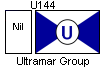
A website version has a black ring and, according to Rosanoski’s correction of the quoted description, a black U. Its proportions are 5:8 rather than approximately 2:3, with thinner ring and letter. Rosanoski suggests this may supersede U144 for the group. The common funnel is confirmed on Ultra Gujarat; Puma’s photograph suggests a more golden yellow.
Founded by Albert von Appen, who died in 1971, the Chilean agency owned tugs named Ultramar followed by Roman numerals. By 1988–1989 the tug fleet appeared under Sociedad Naviera Ultragas, leaving the agency apparently concentrated on port services. Ultraport and Ultragas are listed as sister companies.
Chile, Santiago.
GROUPO ULTRAMAR
The Lima-based Groupo Ultramar operated Peruvian shipping services, including tugs and barges, through Agemar Transportes, Agencia de Aduana Ultramar, Agenciamientos Maritimos, Metropolitana Corredores de Seguros, Servicos de Distribucion and Servicos Navieros del Sur. Rosanoski considers its component companies evidence that it is not connected with the other Ultramar Group.
Peru, Lima.
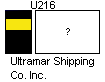
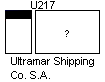
ULTRAMAR SHIPPING CO. INC.
image by Jarig Bakker, 5 February 2006
Mitchell’s funnel appears to be for Maureen, owned by managed company Ultramar Betyca.
The New York Ultramar Shipping managed six similarly named vessel-owning companies in 1988–1989. It was the shipping arm of the British Ultramar group acquired by Lasmo in December 1991, with the shipping activities intended for sale.
USA, New York.
Documentary images — company attribution uncertain
Do not infer international corporate identity from Ultramar name.
Documentary material — company attribution not established
image by António Martins, 1 May 2004
Chilean Ultramar group
Captain Albert von Appen founded Ultramar in 1952 as agent for Hamburg-Amerika and Norddeutscher Lloyd. Ultragas began gas-carrier operations in 1960, Transmares opened Chile–Brazil liner services in 1969 and dry-bulk work followed in 1982. Expansion brought a Peruvian Petrola Transoceanica venture and an Antares interest in 1993, SONAP in 1995, full Antares ownership in 1997, Othello in 2006 and Eitzen Bulk in 2010. In 2012 the shipping divisions became Ultranav, alongside Ultratug for towage and Ultramar for ports and logistics. The full shipping name is Naviera Ultranav.
Chile, Santiago.
Keep the explicit scope label independent; no alias or company identity is inferred.
Ultramar Group agency network
The agency flag is divided diagonally into blue and white quarters, with a central white disc enclosed by a blue ring and bearing a blue U. A salvage-directory account assigns it to Remocaldores Ultragas; the website also shows it crossed with signal flag Zulu. The Argentine headquarters suggestion is qualified.
The agency network served Peru, Chile, Argentina, Ecuador, Uruguay and Brazil. Its members included Buenos Aires’ Agencia Marítima Internacional, founded in 1957; Guayaquil’s Grupo Transoceanica and Transoceanica Cia., the latter founded in 1953; Mercotrade in São Paulo; Trans Total in Lima; and Ultramar Agencia Maritima in Santiago.
Argentine, as stated in the source.
Keep the explicit scope label independent; no alias or company identity is inferred.
North American oil-company context
The golden eagle is the Canadian Ultramar banner. Brown 1995 supplies this funnel and flag version.
The separate Canadian refining and marketing account uses Golden Eagle or Aigle d’or and dates operations as Ultramar Ltd. from 1961. Ultramar acquired Diamond Shamrock in 1996; Valero acquired the resulting parent on 31 December 2001, apparently including all North American activities. The original does not establish a single corporate relationship linking every Ultramar entity in this document.
Keep the explicit scope label independent; no alias or company identity is inferred.
Uncertain Italian Ultrama/Ultramar context
Mitchell’s funnel apparently belongs to Valparaiso, recorded under Genoa’s Ultrama Shipping in 1963–1964 through Mariano Maresca. A later Ultramar entry under the same agent may be the same concern. Mitchell’s Monrovia location is presumed to be vessel registration.
Keep the explicit scope label independent; no alias or company identity is inferred.
Ultrapetrol (Bahamas) Ltd.
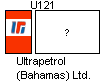
ULTRAPETROL (BAHAMAS) LTD.
Princess Marina provides this orange-red funnel. The ship was not located in Rosanoski’s Lloyds check but is listed under Ultrapetrol in the cited financial account.
ULTRAOCEAN S.A.
Mitchell’s funnel apparently comes from Amadeo, with the original correcting its listed build year from 1975 to 1971.
Ultraocean was formed in 1982 and acted as agent for Ultrapetrol. It ceased appearing separately around 2001–2002, apparently continuing through Oceanmarine.
Argentina, Buenos Aires.
OCEANMARINE S.A.
Oceanmarine was formed in 1988 at its parent’s address. By December 2003 it apparently handled Ultraocean’s shipping operations, including Ultrapetrol, UABL and UP Offshore. In April 2008 its previously listed vessels appeared under Ravenscroft within Ultrapetrol (Bahamas).
Argentina, Buenos Aires.
UABL SA
Concepcion’s port and close-up starboard photographs show a flag design on the funnel; lettering disappears in some distant views. Rosanoski suggests that this may once have been flown as the joint venture’s flag, later replaced while the funnel mark remained, but that sequence is not established.
The flown flag is documented in port and starboard photographs dated 26 July 2011.
Members of the Menéndez family formed Ultrapetrol S.A. in 1992 and began river operations in 1993. The Bahamian holding company was incorporated on 23 December 1997 to consolidate Ultrapetrol, Panamanian Princely International Finance and their subsidiaries. Its own role was holding shares rather than independent operations. By 2004 the business included tankers, tugs, river barges and pushboats, plus interests in Ultrascape and UP Offshore.
The UABL venture with American Commercial Barge Lines began in October 2000, although Lloyds gives 2002; Ultrapetrol bought out the American partner in 2004. Ravenscroft Shipping (Bahamas), parent of Ravenscroft and Elysian managers, was purchased in March 2006 with an option to reverse the transaction by September. Other operating companies included Ship Management Services and Brazil’s UP Offshore Apoio Maritimo, formed in 2004.
Bahamas, Nassau.
UN RO-RO ISLETMELERI A/S.
UN Marmara’s port-side photograph supplies this funnel.
UN Saffet Ulusoy’s port-side photograph of 30 January 2007 documents this variant.
UN Aksemiz’s starboard photograph of 17 April 2013 supplies this version. The original gives no further verbal comparison of the three funnels.
Also called UN Ro-Ro Management, the company was established in 1994 by a group of international transport companies and Turkish road hauliers. Majority shares and management of the company and its subsidiaries passed to Kohlberg Kravis & Roberts in December 2007.
Turkey, Istanbul.
UNI-ASIA SHIPPING LTD.
Uni Challenge’s port-side photograph supplies this funnel. A glint suggests the dark bands are blue, although both the photograph and logo can appear black.
Uni-Asia Shipping was established in 2010 as a wholly owned subsidiary of Uni-Asia Holdings, a Cayman-incorporated group founded in 1997 with a Hong Kong business arranging finance for transport companies. The group launched ship-investment funds from 2004, acquired full control of Uni Ships and Management in 2008 and operated Uni-Asia Shipping as owner, operator and charterer-out. Rosanoski notes that its financial pages begin with 2012 figures, apparently marking the start of business.
China, Hong Kong.
UNI-TANKERS A/S.
Arctic Swan’s January 1997 photograph shows the logo with UNI-TANKERS beneath it. Arctic Swan demonstrates that a narrow black funnel top could accompany this and the later version.
Arctic Swan and Euro Swan provide port-side funnel evidence, while Fionia Swan’s 2006 starboard view also shows the flag. A July 2009 port-side view of Fionia Swan reverses the symbol and appears darker blue, possibly because the funnel is in shadow.
The source lists a further photographic funnel version without explicitly assigning the nearby reversal observation to this ID; no additional individual relationship is invented.
The sources give different beginnings: Lloyds states 1991, the company calls itself a 1995 subsidiary of A/S United Shipping & Trading, and the parent account traces Uni-Tankers to 1989, operating in its later form from 1995. The group’s owner and managing director Tørben Østergaard-Nielsen had become co-owner of several smaller tankers.
Denmark, Middelfart.
UNIBALTIC SP Z OO.
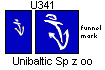
This funnel belongs to the first Amaranth, IMO 6930336, photographed from starboard on 30 March 2006.
The later Amaranth, IMO 7816484, was acquired in 2006. An August photograph shows a plain blue funnel before the logo was added; December evidence supplies this version, with the port side confirmed in July 2013.
Anthracyth’s June 2013 starboard photograph and Ametysth’s port side document this version. Earlier Anthracyth evidence and photographs of Azuryth show a black funnel top.
Founded in February 2003, Unibaltic began with two leased tank vessels and bought its first ship that year. Its ships changed from Polish to Norwegian flags in 2004 for economic reasons. The business expanded into full shipping services; Unibaltic Agro was formed in 2005 for fertiliser trading and distribution.
Poland, Szczecin.
UNICARGO TRANSPORT GMBH.
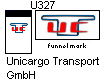
The funnel logo, abbreviated TUC in the notes, is Unicargo’s. Atlantic Tramp provides starboard and port photographs. A Pacific Tramp view without a black top was initially attributed to Korkyra; Rosanoski’s comment identifies its commercial manager’s logo, distinct from Korkyra’s website mark.
Unicargo, abbreviated UCT, acted as commercial manager for Korkyra Shipping and was described by the cited port source as the largest carrier loading in West Africa. Rosanoski found the companies’ stated roles confusing: Korkyra appeared to provide ship management, while Unicargo also seemed to have a financial interest in construction. Those latter relationships remain qualified.
Germany, Hamburg.
Unicorn Shipping (Pty) Ltd.
UNICORN SHIPPING (PTY) LTD.
image by Martin Grieve, 27 September 2009
image by Martin Grieve, 27 September 2009
image by Martin Grieve, 27 September 2009
image by Jarig Bakker, 29 December 2005
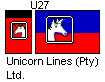
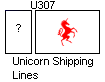
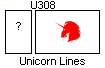
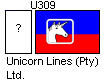
The published Unicorn flag has blue over red horizontal bands, with a white-framed white unicorn’s head towards the hoist, facing the fly. U309 derives from Brown 1995, which Rosanoski says actually shows U27 with a slightly enhanced panel. These renderings are subject to the later correction by company participant Syd Oram.
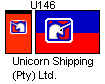
Syd Oram, involved in revising the logo and later a director, supplied desk-flag evidence for the stylised head and rejected the earlier published rendering. A June 2006 company-magazine table flag supports U146. The unicorn and panel have blue outlines with an outer white border. Wildebeest’s 2009 photographs confirm an air-sea-rescue funnel shade and mirrored sides, with the head facing forward on both. Oram says modified forms continued in Unicorn Shipping divisions after the Unicorn Lines name ceased.
Oram describes an initial mid-1960s logo showing the whole rampant red unicorn in profile facing right, derived from Union Corporation’s emblem, and an early-1970s revision to the stylised head. The published U307 and U308 renderings are retained, but Rosanoski cautions that the evidence discusses logos and does not clearly establish either as a flown flag.
ISLAND VIEW SHIPPING.
Island View’s funnel is confirmed on IVS Kite’s starboard side in March 2006 and IVS Kwela’s port side in June 2008.
Island View Shipping, IVS, was formed in 1976 and appears principally as a charterer. It participated in Singapore’s Island Trading & Shipping and the Lauritzen/Island View handysize pool. Its acquisition date differs between the cited Grindrod accounts.
South Africa, Durban.
SOUTHERN TANKERS (PTY) LTD.
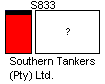
The website funnel appears to be Unicorn’s without the emblem, in a shade resembling the lifeboat’s air-sea-rescue colour. Its unnamed vessel’s connection is unclear because the company’s listed ships bore Stolt names.
Southern Unity is separately photographed with the Southern Tankers logo and a reddish air-sea-rescue funnel, though listed under Unicorn. This source-only S1102 reference is not added to the approved image group.
Southern Tankers was a Unicorn/Dudula joint venture, described as a black-empowerment company. Its formation is given as 2003 in Lloyds and 2001 in another account. It later appeared under Grindrod rather than Unicorn.
South Africa, Durban.
Grindrod Unicorn Group Ltd. / Grincor
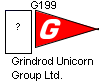
The published Grincor flag is a red triangle with a bold italic white G. Rosanoski tentatively relates it to the earlier group identity, contrasting the grey G approved in 1987 with the flowing-style logo adopted in 2001; the original website images could not be recovered.
No exclusive fleet-wide use or unrecorded corporate equivalence is asserted.
Documentary images — company attribution uncertain
No attribution from website placement alone.
Captain John Edward Grindrod began his agency in 1910, followed by the SS Frontier company in 1922 with Leon Renaud. African Coasters, regarded as Unicorn’s direct ancestor, is dated 1933 by one account but about nine years after Frontier’s purchase in another. Following the founders’ deaths, their sons consolidated operations. The 1966 combination of African Coasters and Smith’s Coasters, with Thesen’s acquisition, produced Unicorn Shipping Lines; other register accounts fold all three into the merger. The Unicorn Lines rename is dated 1975 or 1977, and Unicorn Shipping followed in 2001.
Safmarine obtained an interest in exchange for Thesen’s, later holding 40 per cent against the Grindrod-controlled 60 per cent. Another contemporary note attributes a Thesen share exchange to Coast Lines. Grindrod gained majority control in 1986 and acquired Safmarine’s remaining interest in August 1999. Durban Lines became wholly owned in 1974; later expansion included Griffin, Norse Shipping, Ellerman & Bucknall and the Unifeeder venture. Grincor adopted Grindrod Ltd. at its May 2001 AGM. The Island View acquisition is variously dated 1998, 1999 and 2000 across the document.
The operating structure included New Boundary, New Frontier and Unicorn Marine Management Services, with part-fleet arrangements involving Sea Containers. By 2011–2012 Unicorn Shipping was listed as a division of Grindrod Shipping (South Africa). Southern Tankers later appeared directly under Grindrod; the last separately listed Zambezi was sold by late 2007.
South Africa, Durban.
Unidentified Liveries.
UNIDENTIFIED 1.
UNIDENTIFIED 2.
UNIDENTIFIED 3.
UNIDENTIFIED 5.
UNIDENTIFIED 8.
UNIDENTIFIED 9.
UNIDENTIFIED 10.
UNIDENTIFIED 13.
UNIDENTIFIED 19.
UNIDENTIFIED 20.
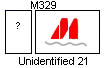
UNIDENTIFIED 21.
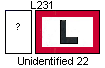
UNIDENTIFIED 22.
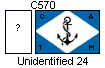
UNIDENTIFIED 24.
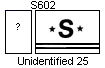
UNIDENTIFIED 25.
UNIDENTIFIED 26.
UNIDENTIFIED 27.
UNIDENTIFIED 28.
UNIDENTIFIED 31.
INDENTIFIED 32.
UNIDENTIFIED 33.
UNIDENTIFIED 34.
UNIDENTIFIED 35.
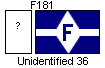
UNIDENTIFIED 36.
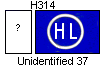
UNIDENTIFIED 37.
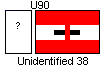
UNIDENTIFIED 38.
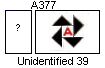
UNIDENTIFIED 39.
UNIDENTIFIED 41.
UNIDENTIFIED 44.
UNIDENTIFIED 45.
UNIDENTIFIED 46.
UNIDENTIFIED 49.
UNIDENTIFIED 50.
UNIDENTIFIED 52.
UNIDENTIFIED 54.
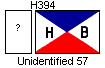
UNIDENTIFIED 57.
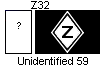
UNIDENTIFIED 59.
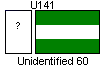
UNIDENTIFIED 60.
image by Jarig Bakker, 3 June 2004; 27 August 2008
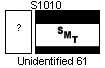
UNIDENTIFIED 61.
image by Bill Sullivan, 27 November 2000
UNIDENTIFIED 62.
image by António Martins, 10 May 2006
UNIDENTIFIED 63.
UNIDENTIFIED 65.
UNIDENTIFIED 67.
UNIDENTIFIED 68.
UNIDENTIFIED 69.
UNIDENTIFIED 71.
UNIDENTIFIED 72.
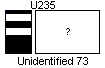
UNIDENTIFIED 73.
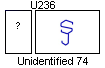
UNIDENTIFIED 74.
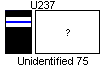
UNIDENTIFIED 75.
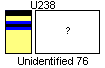
UNIDENTIFIED 76.
ÜNIDENTIFIED 77.
UNIDENTIFIED 78.
UNIDENTIFIED 80.
UNIDENTITIED 81.
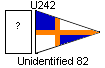
UNIDENTIFIED 82.
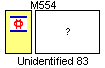
UNIDENTIFIED 83.
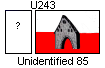
UNIDENTIFIED 85.
image by Klaus-Michael Schneider, 4 September 2008; 21 April 2009; 30 March 2012
image by Jarig Bakker, 3 June 2004; 27 August 2008
UNIDENTIFIED 108.
image by Jarig Bakker, 3 June 2004; 27 August 2008
UNIDENTIFIED 109.
image by Jarig Bakker, 3 June 2004; 27 August 2008
UNIDENTIFIED 110.
image by Jarig Bakker, 3 June 2004; 27 August 2008
UNIDENTIFIED 111.
UNIDENTIFIED 112.
UNIDENTIFIED 113.
UNIDENTIFIED 114.
UNIDENTIFIED 115.
UNIDENTIFIED 116.
UNIDENTIFIED 117.
UNIDENTIFIED 118.
UNIDENTIFIED 119.
UNIDENTIFIED 120.
UNIDENTIFIED 122.
image by Klaus-Michael Schneider, 4 September 2008; 21 April 2009; 30 March 2012
UNIDENTIFIED 123.
UNIDENTIFIED 125.
UNIDENTIFIED 127.
UNIDENTIFIED 129 TO UNIDENTIFIED 133.
image by Klaus-Michael Schneider, 4 September 2008; 21 April 2009; 30 March 2012
image by Klaus-Michael Schneider, 4 September 2008; 21 April 2009; 30 March 2012
image by Klaus-Michael Schneider, 4 September 2008; 21 April 2009; 30 March 2012
image by Klaus-Michael Schneider, 4 September 2008; 21 April 2009; 30 March 2012
image by Klaus-Michael Schneider, 4 September 2008; 21 April 2009; 30 March 2012
UNIDENTIFIED 144.
image contributed by Scott Olsen, 5–6 June 2012
UNIDENTIFIED 145.
UNIDENTIFIED 146.
UNIDENTIFIED 148 & 149.
UNIDENTIFIED 150.
UNIDENTIFIED 151.
UNIDENTIFIED 152.
UNIDENTIFIED 153.
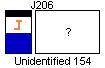
UNIDENTIFIED 154.
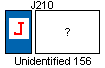
UNIDENTIFIED 156.
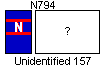
UNIDENTIFIED 157.
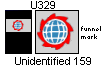
UNIDENTIFIED 159.
UNIDENTIFIED 163, 164 & 165.
UNIDENTIFIED 167 & 168.
UNIDENTIFIED 169.
UNIDENTIFIED 171.
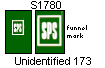
UNIDENTIFIED 173.
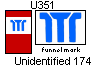
UNIDENTIFIED 174.
UNIDENTIFIED 177.
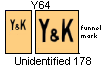
UNIDENTIFIED 178.
UNIDENTIFIED 179.
UNIDENTIFIED 180.
UNIDENTIFIED 181.
UNIDENTIFIED 182.
UNIDENTIFIED 183.
UNIDENTIFIED 184.
UNIDENTIFIED 186.
Documentary material — company attribution not established
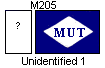
Unidentified 1
Josef Nüsse’s collection records this unidentified flag under reference MUT.
Keep the explicit scope label independent; no alias or company identity is inferred.
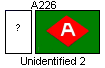
Unidentified 2
An unidentified flag from Josef Nüsse’s collection; the source gives no further description.
Keep the explicit scope label independent; no alias or company identity is inferred.
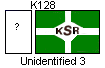
Unidentified 3
Josef Nüsse’s collection records this flag under reference KSR, without an established identity.
Keep the explicit scope label independent; no alias or company identity is inferred.
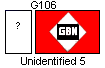
Unidentified 5
An unidentified flag from Josef Nüsse’s collection.
Keep the explicit scope label independent; no alias or company identity is inferred.
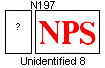
Unidentified 8
An unidentified flag from Josef Nüsse’s collection.
Keep the explicit scope label independent; no alias or company identity is inferred.
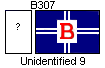
Unidentified 9
An unidentified flag from Josef Nüsse’s collection.
Keep the explicit scope label independent; no alias or company identity is inferred.
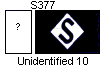
Unidentified 10
An unidentified flag from Josef Nüsse’s collection.
Keep the explicit scope label independent; no alias or company identity is inferred.
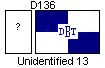
Unidentified 13
An unidentified flag from Josef Nüsse’s collection.
Keep the explicit scope label independent; no alias or company identity is inferred.
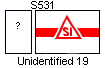
Unidentified 19
David Warwick supplied the evidence in October 2002. Hoist characters suggest Japanese, Chinese or a related origin, without establishing a country.
Keep the explicit scope label independent; no alias or company identity is inferred.
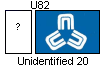
Unidentified 20
An unidentified flag from Josef Nüsse’s collection.
Keep the explicit scope label independent; no alias or company identity is inferred.
Unidentified 21
An unidentified flag from Josef Nüsse’s collection.
Keep the explicit scope label independent; no alias or company identity is inferred.
Unidentified 22
An unidentified flag from Josef Nüsse’s collection; no additional verbal design description is supplied.
Keep the explicit scope label independent; no alias or company identity is inferred.
Unidentified 24
An unidentified flag from Josef Nüsse’s collection.
Keep the explicit scope label independent; no alias or company identity is inferred.
Unidentified 25
An unidentified flag from Josef Nüsse’s collection.
Keep the explicit scope label independent; no alias or company identity is inferred.
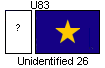
Unidentified 26
The field of Nüsse’s flag looks grey, but blue highlights make its colour uncertain.
Keep the explicit scope label independent; no alias or company identity is inferred.
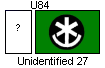
Unidentified 27
An unidentified flag from Josef Nüsse’s collection.
Keep the explicit scope label independent; no alias or company identity is inferred.
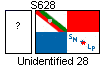
Unidentified 28
David Warwick’s June 2002 photograph is recorded under Portugal. A badge appears over the diagonal bicolour in the first quarter; in the fourth, a red star partly overlaps a blue star.
Keep the explicit scope label independent; no alias or company identity is inferred.
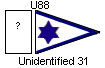
Unidentified 31
Collectors Corner places this under the UK. A porcelain ashtray and a flag pin show a white triangular pennant with a six-pointed blue star. Tom Pountney suspected a shipping company; Pete Loeser identified the pin as the same design, without naming its owner.
Keep the explicit scope label independent; no alias or company identity is inferred.
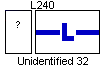
Unidentified 32
Collectors Corner places this flag under Finland; no company identity is supplied.
Keep the explicit scope label independent; no alias or company identity is inferred.
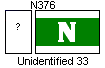
Unidentified 33
An unidentified flag placed under Finland by Collectors Corner.
Keep the explicit scope label independent; no alias or company identity is inferred.
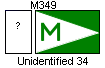
Unidentified 34
An unidentified flag placed under Finland by Collectors Corner.
Keep the explicit scope label independent; no alias or company identity is inferred.
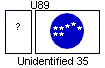
Unidentified 35
Collectors Corner places this under Finland and shows it crossed with John Nurminen O/Y’s flag; the juxtaposition does not establish ownership.
Keep the explicit scope label independent; no alias or company identity is inferred.
Unidentified 36
An unidentified flag placed under Finland by Collectors Corner.
Keep the explicit scope label independent; no alias or company identity is inferred.
Unidentified 37
An unidentified flag placed under Finland by Collectors Corner.
Keep the explicit scope label independent; no alias or company identity is inferred.
Unidentified 38
An unidentified flag placed under Finland by Collectors Corner.
Keep the explicit scope label independent; no alias or company identity is inferred.
Unidentified 39
An unidentified flag placed under Finland by Collectors Corner.
Keep the explicit scope label independent; no alias or company identity is inferred.
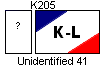
Unidentified 41
An unidentified flag placed under Finland by Collectors Corner.
Keep the explicit scope label independent; no alias or company identity is inferred.
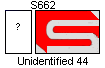
Unidentified 44
Collectors Corner places the badge under Norway and specifies a silver letter. The badge itself is not depicted as a flag: the flag form is Rosanoski’s assumption.
Keep the explicit scope label independent; no alias or company identity is inferred.
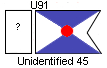
Unidentified 45
An unidentified design from Collectors Corner; no fuller verbal description is supplied.
Keep the explicit scope label independent; no alias or company identity is inferred.
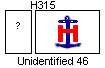
Unidentified 46
An unidentified design from Collectors Corner.
Keep the explicit scope label independent; no alias or company identity is inferred.
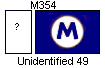
Unidentified 49
An unidentified design from Collectors Corner.
Keep the explicit scope label independent; no alias or company identity is inferred.
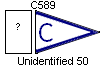
Unidentified 50
An unidentified design from Collectors Corner.
Keep the explicit scope label independent; no alias or company identity is inferred.
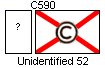
Unidentified 52
An unidentified design from Collectors Corner.
Keep the explicit scope label independent; no alias or company identity is inferred.
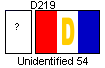
Unidentified 54
The source combines a pin badge for Captain Cook with a report of the design on a large sailing vessel in Victoria Harbour, British Columbia, in October 2003. Captain Cook was managed by Donaldson Bros. & Black for New Zealand’s Ministry of Transport & Civil Aviation in 1951 and chartered by Donaldson Line in 1955, presumed back to the owners until scrapping in 1960. The country and relationship between the two sightings remain unknown.
Keep the explicit scope label independent; no alias or company identity is inferred.
Unidentified 57
The image comes from agents Stuewe’s website in September 2004 and is assumed German; no company identity is established.
Keep the explicit scope label independent; no alias or company identity is inferred.
Unidentified 59
The image comes from agents Stuewe’s website in September 2004 and is assumed German; no company identity is established.
Keep the explicit scope label independent; no alias or company identity is inferred.
Unidentified 60
M.V. Sany in Bangladesh carried three equal horizontal stripes, green-white-green. In response to Winfried Schroeder, the Bangladesh embassy confirmed only that it was the company’s flag, without supplying an identity.
Keep the explicit scope label independent; no alias or company identity is inferred.
Unidentified 61
Bill Sullivan’s November 2000 image was published under unknown countries; no further evidence is supplied.
Keep the explicit scope label independent; no alias or company identity is inferred.
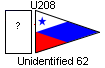
Unidentified 62
Rolf Penzias’s possibly maritime captain’s patches carry a blue, red and white pennant or ensign with a blue star. Their age and shipping-company connection were not established.
Keep the explicit scope label independent; no alias or company identity is inferred.
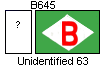
Unidentified 63
Josef Nüsse supplied the unknown flag in December 2006, suggesting Scandinavia from its marble pole. Rosanoski had no identification; the geographical suggestion remains unconfirmed.
Keep the explicit scope label independent; no alias or company identity is inferred.
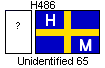
Unidentified 65
NJK recalled this flag at a Geo. H. Scales function in Christchurch in February 1987; the recollection does not establish its owner.
Keep the explicit scope label independent; no alias or company identity is inferred.
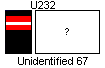
Unidentified 67
Bansei Maru of Kasakabe Kisen wore the funnel of an unknown charterer. The record gives a late-1960s estimate and a separate March 1965 date.
Keep the explicit scope label independent; no alias or company identity is inferred.
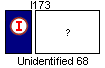
Unidentified 68
The funnel was noted on Betty in June 1967 in the NJK Collection; no identity is established.
Keep the explicit scope label independent; no alias or company identity is inferred.
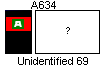
Unidentified 69
Blaise Pascal’s funnel, recorded around the 1960s, is presumed to belong to a charterer rather than owner Compagnie Maritime de Transports de Goudron.
Keep the explicit scope label independent; no alias or company identity is inferred.
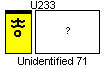
Unidentified 71
Observed on a wooden fishing vessel at Suva in July 1963, the livery is possibly Japanese. The recorded vessel name itself may be wrong.
Keep the explicit scope label independent; no alias or company identity is inferred.
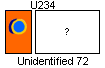
Unidentified 72
The chemical tanker belonged to Yahata Trader under Yahata Kisen, but the mark differed from earlier sightings of the principal’s livery. Whether it belonged to an owner or charterer is unknown, as is the sighting date.
Keep the explicit scope label independent; no alias or company identity is inferred.
Unidentified 73
Recorded in April 1964 under O/Y Henry Nielsen, the funnel was explicitly noted as not Nielsen’s. Because Nielsen managed companies with separate liveries, another managed owner is possible, but the vessel was not located.
Keep the explicit scope label independent; no alias or company identity is inferred.
Unidentified 74
Pearl Prosperity’s shabby flag was seen at Lyttelton on 24 February 1990, with uncertain colours. Its funnel carried Jebsen markings; the owner was A.J. Marine Services of Bergen. JLL suggested the apparent letters might be lower-case aj, with a mistaken a reading as s. The correspondence date printed in the source precedes the stated sighting.
Keep the explicit scope label independent; no alias or company identity is inferred.
Unidentified 75
Penny was noted in June 1967, possibly the vessel renamed that year from Spartan, built in 1942. The identification remains tentative.
Keep the explicit scope label independent; no alias or company identity is inferred.
Unidentified 76
Pistis was recorded as a Vinke subsidiary vessel. The possible history runs from Hilversum under Oostzee to Rossum in 1959 and Pistis in 1966. The funnel resembles Oostzee’s equal red-black-red band, but the relationship is not settled.
Keep the explicit scope label independent; no alias or company identity is inferred.
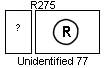
Unidentified 77
River City was noted at Lyttelton in November 1976; Rosanoski could not locate the vessel.
Keep the explicit scope label independent; no alias or company identity is inferred.
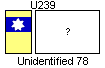
Unidentified 78
Saint Patrick’s June 1967 funnel may belong to the vessel renamed from Polluce that year and to Allobrogia in 1969, with B. Rappaport under those other names. The identification remains tentative.
Keep the explicit scope label independent; no alias or company identity is inferred.
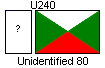
Unidentified 80
The mark was noted on China Navigation’s Shansi at Lyttelton on 8 September 1976; no further attribution is given.
Keep the explicit scope label independent; no alias or company identity is inferred.
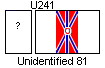
Unidentified 81
The mark was noted on Shinkai Maru at Lyttelton in January 1977.
Keep the explicit scope label independent; no alias or company identity is inferred.
Unidentified 82
The mark was noted on Straat Franklin at Lyttelton on 12 March 1977.
Keep the explicit scope label independent; no alias or company identity is inferred.
Unidentified 83
Teressa wore this funnel in May 1965 while owned by Socoa Shipping of Ramon de la Sota Jr. It is probably a charterer’s mark: a red M over an undefined elongated O or oval ring.
Keep the explicit scope label independent; no alias or company identity is inferred.
Unidentified 85
Klaus-Michael Schneider saw this table flag in a Hamburg St. Pauli pub on 28 May 2004: white over red, with a grey masonry gate, open doorway, eight windows and triangular roof. He estimated it at about sixty years old and questioned the stone-grey shade. Nüsse doubted a shipping identity and suggested a municipal flag; neither suggestion is confirmed.
Keep the explicit scope label independent; no alias or company identity is inferred.
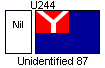
Unidentified 87
A painting of a three-masted merchantman shows a blue flag with a white Y at the mainmast, according to closer examination reported to the editor. Rodney Russell tentatively dated the vessel to about 1850; owner, place and vessel identity remain unknown.
Keep the explicit scope label independent; no alias or company identity is inferred.
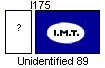
Unidentified 89
One of Julian Purser’s unidentified flag pins has a blue field and white oval with IMT. Peter Hans van den Muijzenberg suggested Internationaal Motor Transportbedrijf, but also questioned the published company flag details; the identification is not confirmed.
Keep the explicit scope label independent; no alias or company identity is inferred.
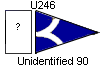
Unidentified 90
Another flag pin submitted by Julian Purser in September 2007 remains unidentified; the source supplies no further verbal description.
Keep the explicit scope label independent; no alias or company identity is inferred.
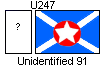
Unidentified 91
Recorded under the USA, RF’s cap-badge reference is USA-White Star+Saltire. Great Northern Steamship is suggested as a possibility, not an identification; the supplied date is printed 7.8.3008.
Keep the explicit scope label independent; no alias or company identity is inferred.
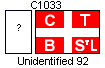
Unidentified 92
Possibly USA or Canada. RF’s August 2008 cap-badge reference is US-Can-CTBSTL; no owner is established.
Keep the explicit scope label independent; no alias or company identity is inferred.
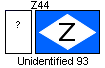
Unidentified 93
RF’s August 2008 cap-badge reference is Euro-Z; the country and company remain unknown.
Keep the explicit scope label independent; no alias or company identity is inferred.
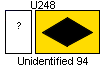
Unidentified 94
Recorded under the USA, RF’s August 2008 cap-badge reference is USA-Black Diamond.
Keep the explicit scope label independent; no alias or company identity is inferred.
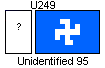
Unidentified 95
RF’s August 2008 badge is referenced UK-Euro-Swas-Cross, but the Country field remains unknown.
Keep the explicit scope label independent; no alias or company identity is inferred.
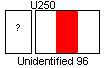
Unidentified 96
Recorded under the UK, the badge reference is UK-R&W Verticals, supplied in August 2008 by FR as printed in this note.
Keep the explicit scope label independent; no alias or company identity is inferred.
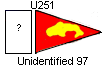
Unidentified 97
Recorded under the UK, RF’s August 2008 badge reference is UK-Pennant-Fish.
Keep the explicit scope label independent; no alias or company identity is inferred.
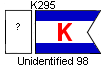
Unidentified 98
Recorded under the USA, RF’s August 2008 badge reference is K-USA.
Keep the explicit scope label independent; no alias or company identity is inferred.
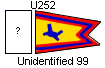
Unidentified 99
RF supplied the Unknown-2 badge in July 2008. Rosanoski interprets its emblem as a bird; the country and identity remain unknown.
Keep the explicit scope label independent; no alias or company identity is inferred.
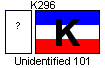
Unidentified 101
Possibly UK. RF’s July 2008 badge reference is K-maybe UK, without an established identity.
Keep the explicit scope label independent; no alias or company identity is inferred.
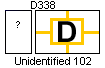
Unidentified 102
Recorded under the UK, RF’s July 2008 badge reference is UK-D.
Keep the explicit scope label independent; no alias or company identity is inferred.
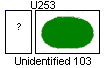
Unidentified 103
Recorded under the USA, RF’s USA-6 badge has an oval initially taken as black. It differs from the black cap background and has a green tint, but the actual colour is uncertain.
Keep the explicit scope label independent; no alias or company identity is inferred.
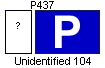
Unidentified 104
RF’s July 2008 cap-badge reference is USA-Cuban; the source nevertheless leaves the country unknown.
Keep the explicit scope label independent; no alias or company identity is inferred.
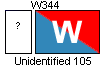
Unidentified 105
RF’s July 2008 badge reference is Unknown-W, with no country or company established.
Keep the explicit scope label independent; no alias or company identity is inferred.
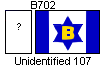
Unidentified 107
Bengt Engblom supplied the badge scan and Jarig Bakker drew the flag in August 2008. A possible Finnish origin and a ninety-per-cent identification are mentioned, but no company name is supplied.
Keep the explicit scope label independent; no alias or company identity is inferred.
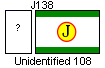
Unidentified 108
Drawn by Jarig Bakker from Bengt Engblom’s August 2008 badge scan, the flag is possibly Finnish; the identity remains unknown.
Keep the explicit scope label independent; no alias or company identity is inferred.
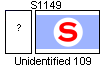
Unidentified 109
Jarig Bakker’s image follows Bengt Engblom’s August 2008 badge scan. The note suggests Finland and mentions two ninety-per-cent identifications without saying which flags or naming the companies.
Keep the explicit scope label independent; no alias or company identity is inferred.
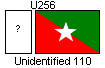
Unidentified 110
Drawn by Jarig Bakker from Bengt Engblom’s August 2008 badge scan, the flag is possibly Finnish but unidentified.
Keep the explicit scope label independent; no alias or company identity is inferred.
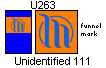
Unidentified 111
New Activity’s March 2009 photograph shows colours presumed to belong to an unknown charterer; the vessel was owned by Hong Kong Ming Wah.
Keep the explicit scope label independent; no alias or company identity is inferred.
Unidentified 112
Mitchell records this on the Rhein-Maas-und-See card without naming a vessel. Germany is assumed rather than established.
Keep the explicit scope label independent; no alias or company identity is inferred.
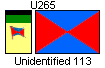
Unidentified 113
Mitchell’s Rhein-Maas-und-See card names no vessel; Germany is assumed. The flag is reconstructed from the funnel. A possible RMS Lübeck connection is suggested, but that company’s R456 differs by having a white central circle.
Keep the explicit scope label independent; no alias or company identity is inferred.
Unidentified 114
Mitchell records this on the Rhein-Maas-und-See card without a vessel name. Germany is assumed.
Keep the explicit scope label independent; no alias or company identity is inferred.
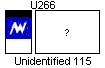
Unidentified 115
Mitchell records this on the Rhein-Maas-und-See card without a vessel name. Germany is assumed.
Keep the explicit scope label independent; no alias or company identity is inferred.
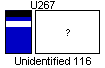
Unidentified 116
Mitchell records this on the Rhein-Maas-und-See card without a vessel name. Germany is assumed.
Keep the explicit scope label independent; no alias or company identity is inferred.
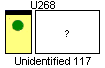
Unidentified 117
Mitchell records this on the Rhein-Maas-und-See card without a vessel name. Germany is assumed.
Keep the explicit scope label independent; no alias or company identity is inferred.
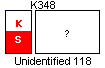
Unidentified 118
Sea Bulker was photographed at Lyttelton on 28 November 2009 in colours seen since at least 2008. Far-East Transport owned it through Muse Maritime, and it had previously been on Lauritzen charter. No local identification was known.
Keep the explicit scope label independent; no alias or company identity is inferred.
Unidentified 119
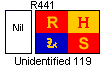
Raffaele Corsini’s painting shows Bezaleel under H. Morgan entering Smyrna Bay in 1864, with a Red Ensign and a quartered house flag: red with yellow R at upper hoist, yellow with red H at upper fly, blue with an uncertain yellow symbol below the hoist, and red with yellow S at lower fly. Mike Turner suggested a fish for the symbol; Rosanoski considered an ampersand more logical. James Dignan’s Royal Standard comparison and Royal expansion of R are expressly guesses. Rosanoski tentatively identifies an 1856 Salcombe-built Bezaleel, wrecked in 1884 under William Mackay and master William Francis Weymouth; if the same ship, the flag may represent earlier owners.
Keep the explicit scope label independent; no alias or company identity is inferred.
Unidentified 120
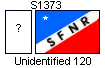
A binnenschifferforum member logo, reference SFNR, is presumed to be a company flag. Its country and owner are unknown.
Keep the explicit scope label independent; no alias or company identity is inferred.
Unidentified 122
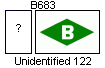
Klaus-Michael Schneider saw this white flag at Billwerder Bucht, Hamburg, on 30 March 2007. A central green lozenge bears a white B. It was said to belong to a co-owner or partner, a Partikulier, but no name was established.
Keep the explicit scope label independent; no alias or company identity is inferred.
Unidentified 123
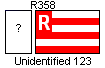
Recorded under the Netherlands, the flag appears on Smaragd in December 2006 alongside De Bock’s house flag and the manager’s flag; its separate identity is not given.
Keep the explicit scope label independent; no alias or company identity is inferred.
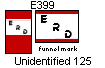
Unidentified 125
Recorded under Turkey, Ahmet Erdogdu’s photographed letters do not reconcile with Aset Ithalat Ihracat Denizcilik or the registered owner.
Keep the explicit scope label independent; no alias or company identity is inferred.
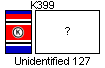
Unidentified 127
Boa Rhino’s April 2007 funnel resembles Taubåtkompaniet’s T609 but has a blue base and K instead of the earlier B seen in T611. The Boa Offshore vessel was managed by International Shipping & Trading and apparently chartered. T.A. Kittilsen was the only associate found beginning with K, but no connection to the ship was established.
Keep the explicit scope label independent; no alias or company identity is inferred.
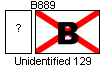
Unidentified 129
Seen at Billwerder on 6 November 2010: a white flag crossed by a red saltire with a black B overall. The company remains unknown.
Keep the explicit scope label independent; no alias or company identity is inferred.
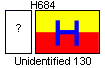
Unidentified 130
Seen at Billwerder on 6 November 2010: yellow over red with a large blue H in the centre. The company remains unknown.
Keep the explicit scope label independent; no alias or company identity is inferred.
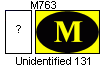
Unidentified 131
Seen at Billwerder on 6 November 2010: yellow with a black ellipse touching all edges, enclosing a yellow M. The company remains unknown.
Keep the explicit scope label independent; no alias or company identity is inferred.
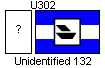
Unidentified 132
Seen at Billwerder on 6 November 2010: red with a central white diamond containing a black steaming ship.
Keep the explicit scope label independent; no alias or company identity is inferred.
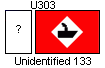
Unidentified 133
Seen at Billwerder on 6 November 2010: blue-white-blue, with a central white square edged black and bearing a black ship. Its resemblance to Rhenus does not establish an identity. Rosanoski cautions that flags on unnamed inland vessels need not identify their owners.
Keep the explicit scope label independent; no alias or company identity is inferred.
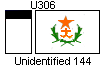
Unidentified 144
A painting supplied by Scott Olsen shows a combined sailing and paddle vessel with a post-1801 Red Ensign and a house flag at the foremast. Rob Raeside identified the distant cliffs as Dover and questioned inconsistent wind directions in sails, smoke and flags. André Coutanche pointed out that the cliffs could instead be French, reversing the assumed view. The vessel, flag and painting’s reliability remain unresolved; the general Atlantic-crossing comparison does not date this ship securely.
Keep the explicit scope label independent; no alias or company identity is inferred.
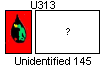
Unidentified 145
Bituma was on long-term Johnson charter from 1986, but these are not Johnson colours and may belong to a sub-charterer. Port and starboard photographs show a green winged dragon with a tail, breathing yellow flame, facing forward on both sides; something red appears at bottom left. Mitchell’s related drawing under Knut Lundgren appears to include an oil drop and differs in colour. The narrative calls the design T445, while the approved image is U313.
Keep the explicit scope label independent; no alias or company identity is inferred.
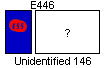
Unidentified 146
Arctic’s December 2010 funnel probably represents a charterer. The ship remained under Arcturia Navigation, previously in Seatrade Groningen colours, while management shifted to Busan’s Sea Road Shipping & Agency, also called Seh Dong Shipping, in 2009–2010.
Keep the explicit scope label independent; no alias or company identity is inferred.
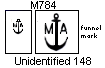
Unidentified 148
The first Dudu Express, later Georgina, retained this funnel through its name change and later ownership changes from Sherin to BIA Shipping. That continuity and the MA lettering suggest a charterer rather than the owners. The emblem may be dark blue instead of black; Romania is only a possible country context.
Keep the explicit scope label independent; no alias or company identity is inferred.
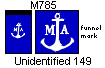
Unidentified 149
The later Dudu Express has a similar mark in its October 2012 photograph. BIA Shipping of Constanta is the only connection found, but Rosanoski again suspects a charterer, with colours adjusted to the funnel’s base.
Keep the explicit scope label independent; no alias or company identity is inferred.
Unidentified 150
Sher-E Punjab’s August 2011 Lyttelton photograph shows a B that does not match registered owner Patriotic Services or manager Ship Management Services. Rosanoski presumes a charterer.
Keep the explicit scope label independent; no alias or company identity is inferred.
Unidentified 151
Van Orchid’s September 2011 Lyttelton funnel differs from manager Northstar’s logo. The Rupert Investment vessel was recorded in the New Zealand log trade, suggesting an unknown charterer.
Keep the explicit scope label independent; no alias or company identity is inferred.
Unidentified 152
Safi’s August 2004 funnel is probably a charterer’s. Equasis lists Kaddourah/Trabolsi/Shkaiefh ownership and management through 2002–2007; Lloyds names Mrs. Soumaiya Kaddour, Abdoulah Trabolsi and Mrd. Asmaa Shkaiefh. The ship was Cambodian-registered at this stage, with a later possible Syrian connection, neither establishing the livery’s country.
Keep the explicit scope label independent; no alias or company identity is inferred.
Unidentified 153
Safi’s later funnel appears by January 2005 and clearly by October 2006, continuing in September 2007 while the same owners were recorded. Rosanoski presumes another charterer rather than a confirmed ownership change.
Keep the explicit scope label independent; no alias or company identity is inferred.
Unidentified 154
Safi’s March 2013 funnel was attributed by the photograph source to Hamza Shipping of Beirut, but Equasis records GMZ Ship Management from November 2012. It may be unchanged paint or continuity of the ultimate owner. Rosanoski considers the plain band and lighter blue seen in October 2011 more likely Hamzah’s colours; no firm attribution is made.
Keep the explicit scope label independent; no alias or company identity is inferred.
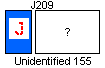
Unidentified 155
Soumaya J, IMO 7118870, is photographed from both sides in 2008–2009, under Mariposa Maritime and later Hamza management. It is a different ship from the namesake listed under Jendi, although similar J logos leave a possible ultimate-owner link open. The narrative refers onward to J215, with inconsistent later case numbering.
Keep the explicit scope label independent; no alias or company identity is inferred.
Unidentified 156
The funnel comes from Schooner’s starboard photograph of 24 March 2011; the source gives no attribution.
Keep the explicit scope label independent; no alias or company identity is inferred.
Unidentified 157
Golden Bridge’s April 2012 starboard photograph supplies this funnel. Mumbai manager Hermes suggests a possible Indian context if N refers to an ultimate owner, but an unknown charterer is also considered likely.
Keep the explicit scope label independent; no alias or company identity is inferred.
Unidentified 159
Laksamana Sejatui’s June 2011 Singapore funnel does not match the cited Andhika mark despite changing managers. Rosanoski leaves the registered owner, Cakra Manunggal Semesta, or an unknown charterer as possibilities. The band first appeared white, then grey in another view; silver is possible, but not established.
Keep the explicit scope label independent; no alias or company identity is inferred.
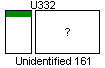
Unidentified 161
The Rio de Janeiro-registered tug Aral had this funnel in March 2008, before changing to B994 by the 2013 evidence.
Keep the explicit scope label independent; no alias or company identity is inferred.
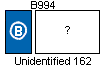
Unidentified 162
Aral’s April 2013 photograph shows this replacement for U332. Its name stayed the same; a change of owner is presumed rather than documented.
Keep the explicit scope label independent; no alias or company identity is inferred.
Unidentified 163–165
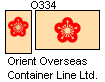
The Seacaravel-owned container ship originally sailed as OOCL Hope with O334. Renamed Hope in 2000, it appears in 2002 as U335, with the OOCL logo removed. As YM Yantian it used U333 rather than Yang Ming colours; it retained U333 after becoming Hope again in July 2011 while reportedly chartered to MSC. A January 2013 Port Botany photograph shows U334. Rosanoski questions a simple owner-colour interpretation and suggests U334 may belong to another charterer.
Keep the explicit scope label independent; no alias or company identity is inferred.
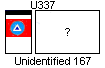
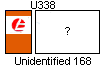
Unidentified 167–168
Mitchell records both under Fuyo Kaiun, presumed charterer markings. U337 is assigned to Rich Duke. No vessel is named for U338, though line drawings of Rich Star and Pacific Memory show orange funnels with white bands and are possible examples. Japan is assumed.
Keep the explicit scope label independent; no alias or company identity is inferred.
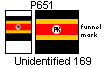
Unidentified 169
Rubicone’s July 2006 port-side funnel has apparent PK letters, with the upper black band narrower than the lower. Between March 2005 and January 2006 the hull changed from green to grey and the formerly white funnel changed too. Ownership passed from Adinius to Rubicone de Navigazione while Navimar remained manager; the livery is presumed to be a charterer’s.
Keep the explicit scope label independent; no alias or company identity is inferred.
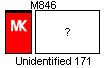
Unidentified 171
Emre Köse’s September 2013 funnel differs from other Platin-managed ships and does not fit their Good-prefix naming. Rosanoski suspects a charterer; Turkey is assumed, not established as the mark’s origin.
Keep the explicit scope label independent; no alias or company identity is inferred.
Unidentified 173
Artemis Glory’s March 2009 funnel was seen in photographs from 2008–2011. Built for Dr. Peters’ DS-Rendite-Fonds Nr. 114, the ship also carries SPS on its bow, suggesting to Rosanoski an investment-fund subscriber identity rather than charterer colours.
Keep the explicit scope label independent; no alias or company identity is inferred.
Unidentified 174
Raindrop, formerly Lena, changed hands in January 2013. The October funnel photograph was attributed to former manager United Marine Management, but Rosanoski rejects that as current evidence. Neither Vento’s nor Polaris’s logo matches; Patara Shipping ownership was initially suggested by default. Subsequent discussion of Patara/Polaris and another vessel’s Cafiservice markings led him to consider an unknown charterer instead. No final identity is established.
Keep the explicit scope label independent; no alias or company identity is inferred.
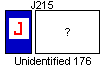
Unidentified 176
Soumaya J’s December 2013 funnel closes the gaps in the J209 letter design. It may simply be repainting or follow the November 2012 change to Manessa Martitime and Global Management & Trading. Rosanoski suggests the J may identify the ultimate owner, without establishing who that is.
Keep the explicit scope label independent; no alias or company identity is inferred.
Unidentified 177
Hai Wang Xing and Tian Wang Xing show this funnel. Although the former belongs to COSCO through Haiwangxing Maritime, Rosanoski suspects a possibly German charterer rather than COSCO; the country remains an assumption.
Keep the explicit scope label independent; no alias or company identity is inferred.
Unidentified 178
Karma, named from March 2012, is photographed under Amazon Shipping ownership and Lebanon’s Moon Light Shipping management. The livery itself remains unidentified.
Keep the explicit scope label independent; no alias or company identity is inferred.
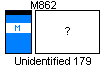
Unidentified 179
The tug Dias’s port and starboard photographs accompany evidence of a blue diamond with a white M on the forward superstructure. The M matches neither Kerkyra Naftiki Eteria nor the listed Avlon/K. Adamopoulos management. The source records Greece but leaves the mark unresolved.
Keep the explicit scope label independent; no alias or company identity is inferred.
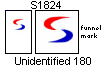
Unidentified 180
The funnel was photographed on an unnamed vessel at Singapore on 15 June 2011; no attribution is supplied.
Keep the explicit scope label independent; no alias or company identity is inferred.
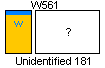
Unidentified 181
Bau Rui’s June 2011 Singapore photograph shows a W. Dalian Master Well, manager for Han Lord Shipping, is a possibility, but other checked vessels did not use it, so Rosanoski favours an unknown charterer.
Keep the explicit scope label independent; no alias or company identity is inferred.
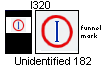
Unidentified 182
Al Hani was bought and renamed in September 2012 by Al Hani Shipping under Global Management & Trading. The photographed I does not fit either name.
Keep the explicit scope label independent; no alias or company identity is inferred.
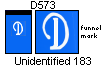
Unidentified 183
Anousska, bought and renamed in January 2012, belonged to Marshall Islands company Fila Shipholding under Seadar’s Piraeus management. The funnel letter does not fit the named parties; its country remains unknown in the source.
Keep the explicit scope label independent; no alias or company identity is inferred.
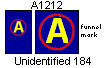
Unidentified 184
Nathan Brandon’s February 2014 port-side funnel is probably a charterer’s; the named owner and manager were Nathan Brandon Pte. Ltd. of Singapore.
Keep the explicit scope label independent; no alias or company identity is inferred.
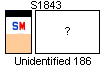
Unidentified 186
An unnamed vessel at Singapore on 20 June 2011 supplies this funnel, preserved from NJK disc photograph 5451.
Keep the explicit scope label independent; no alias or company identity is inferred.
Unie van Redding-en Sleepdienst N.V.
UNIE VAN REDDING-EN SLEEPDIENST N.V.
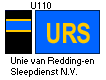
image by Ivan Sache, 24 June 2001
Brown shows U110 under Union de Remorquage et de Sauvetage S.A. Ivan Sache’s FOTW illustration of 24 June 2001 was based on the marine-salvage website; Rosanoski notes that its letters are narrower than the source. The marine-salvage image also differs from that on the company website.
The company website supplied the U140 flag and funnel material. Rosanoski’s selection included Anton V of URS Nederland B.V.; Banckert of URS Belgie N.V., retaining the former van den Akker funnel without its emblem; Boxer of the Smit Union Salvage joint venture; and Schelde 10 of URS Belgie N.V. He omitted an apparently plain black funnel for Goliath because its relationship to the group was unclear.
REMORQUAGE LETZER S.A.
Remorquage Letzer S.A., Antwerp, was established in 1923. Its name resulted from the 1928 alliance between S.A.R.H. and Letzer towage Cy; it amalgamated into Union de Remorquage et de Sauvetage S.A. in 1974.
SOCIÉTÉ ANONYME DE REMORQUAGE À HÉLICE.
Société Anonyme de Remorquage à Hélice originated in 1870 when Captain Henri Gerling began operating six tugs on the Scheldt under the name Remorquage à Hélice s.a. (S.A.R.H.), meaning propeller tugboats.
UNION DE REMORQUAGE ET DE SAUVETAGE S.A.
Union de Remorquage et de Sauvetage S.A., also called Towage & Salvage Union Ltd., arose from the 1928 alliance. The constituent concerns retained separate identities until their full amalgamation in 1974. URS subsequently took control of other Scheldt operators, including Willem Muller and Scheldt Towage. Rosanoski tentatively identifies these as Willem Muller Sleepdienst (Belgie) N.V. and N.V. Scheldte Towage Co. S.A. Lloyd’s recorded CMB control in 1998–2000 and Alphonse Letzer as operator of part of the fleet in 1978–1979.
Known as URS, the group used Unie van Redding-en Sleepdienst N.V. alongside Union de Remorquage et de Sauvetage S.A. and Towage & Salvage Union Ltd.; Rosanoski could not establish when the Dutch name was adopted. N.V. CMB S.A. controlled it in the 2003–2004 Lloyd’s listings. Smit International acquired 25% in 1999; Smit and Fairplay Schleppdampfschiffes-Reederei Richard Borchard GmbH acquired the business jointly in 2004, retaining its identity, and Smit gained full control in 2008.
B.V. Bergings-en Transportbedrijf van Den Akker was an operating company. URS acquired a 7% interest in Smit Internationale Nederland B.V. in 1999; Targe Towing Ltd. managed part of its fleet.
Belgium, Antwerpen.
UNIGAS INTERNATIONAL B.V.
image by Jarig Bakker, 6 January 2006
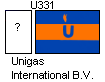
The U73 flag is Jarig Bakker’s illustration of 6 January 2006 from Brown 1995. U72 and U331 derive from Josef Nüsse table flags. Rosanoski ultimately considered the colour difference in U72, and presumably the difference in the later scan U331, to result from scanning resolution. Mitchell shows a red funnel band and a yellow flame with a red core; camera effects may also account for apparent colour differences.
U218 is based on photographs of Lady Barbara and Epsilongas, belonging to different pool members. Lady Barbara’s band and flame look red, whereas those of Epsilongas look orange. In both cases the flame extends to the band, unlike the U73 portrayal and the Nüsse flags.
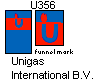
The text identifies a funnel photographed on Kappagas on 5 July 2013 as U365, while its source list calls the photographic funnel U456. These conflicting identifiers are retained in the source record; no individual description is assigned to the associated U356 on that basis.
Brown notes that Anchor Line vessels operated mainly in the Unigas pool and wore its markings.
Unigas was founded in 1969 as a pool, with vessels controlled by B.V. United Gas Carriers. Its 2007 website named Othello Shipping Co. ApS, the Schulte Group and Sloman Neptun Schiffahrts-Aktiengesellschaft as members. By 2013 Ultragas ApS had replaced Othello, which had joined that group and been absorbed.
Mitchell lists Coraal S/V of Rotterdam, D.D.G. Neptun of Hamburg, A/B Transmarin of Göteborg and Gibson-Rankin, identified by Rosanoski as George Gibson & Co. Ltd. of Lissy, as pool members. Rosanoski also notes a website connection with Unigas Kosan Ltd. and Lloyd’s associations with Anthony Veder & Co. B.V. and Anchor Line PLC, the latter through George Gibson & Co. Ltd.
Netherlands, Rotterdam.
UNIGLORY MARINE CORPORATION.
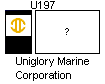
The funnel illustration U197 comes from the Mitchell collection; the document supplies no separate description of its design.
Formed in 1984, Uniglory was associated with Evergreen Marine Corporation (Taiwan) Ltd., which held 37.96% in the 1998 and 2000 listings. In 2002 it merged into Evergreen International Storage & Transport Corporation, which Rosanoski cross-references to Evergreen Marine Corporation (Taiwan) Ltd., and ceased liner operations. Its vessels used the prefix “Uni-”.
Taiwan, Taipei.
Unimar Shipmanagement Services S.A.
Documentary images — company attribution uncertain
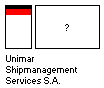
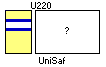
U20 is based on a photograph of Streamer, owned by Streamer Maritime Ltd., a reported Northern Shipping Co. subsidiary. It has a white funnel with a narrow black top separated by a red band. Since this was not the Northern funnel, Rosanoski assumed it represented the managers.
Nonmatching owner logo does not prove manager attribution.
Also called Unimar Maritime Services S.A., this management company collapsed in November 1997. A report of the subsequent fleet sale led Rosanoski to suggest that it was an associate of the Russian government-owned companies holding the vessels.
Its managed vessels included those of Chalka Maritime Ltd., Eastern Maritime Ltd. and U.A. Shipping Co. Ltd., subsidiaries of Far Eastern Shipping Co.; and Daria Navigation Ltd., Horizon Maritime Co. Ltd., Stavroula Navigation Ltd., Streamer Maritime Ltd. and Sunset Navigation Co. Ltd., subsidiaries of Northern Shipping Co.
Greece.
Unimarine Management Co.
UNIMARINE MANAGEMENT CO.
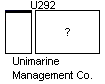
U292 comes from Jimmy A on 14 November 2007. The source records Unimarine ownership from 1 September 2001; on 1 July 2008 the owner changed to Condor Co. and the ship became Condor 1, retaining Unimarine management and the same funnel.
Affera Shipping Inc. — Alferdawi1
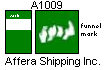
A1009 was photographed on Alferdawi 1 on 17 August 2010, following acquisition on 1 July by Affera Shipping Inc., care of Unimarine. Affera was reported as a Marshall Islands company. The white markings appear to be Arabic and are placed forward on both sides; Rosanoski could not determine their order on the port side.
Dated vessel association only; no inference of exclusive company-wide livery. Existing QA2 and spelling variants retained.
Documentary images — company attribution uncertain
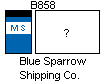
B858 was photographed on Nadia of Blue Sparrow Shipping Co. on 10 March 2009. The letters could not be connected with that name, leaving open whether they represented a charterer or the actual owner.
Blue Sparrow ownership does not explain mark.
Crest Shipping & Trading SA — Sky Hope
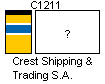
C1211 comes from Sky Hope of Crest Shipping & Trading Co., photographed on 15 January 2010.
Dated vessel association only; no inference of exclusive company-wide livery. Existing QA2 and spelling variants retained.
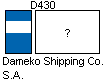
Dameko Shipping Co. SA — Marmara-M
The narrative identifies D430 with Marmara-M of DamekoShipping Co. S.A., photographed on 13 November 2009. The source list instead prints D420.
Dated vessel association only; no inference of exclusive company-wide livery. Existing QA2 and spelling variants retained.
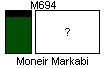
Moneir/Monier Markabi — Manzala
M694 comes from Manzala of Monier Markabi, photographed on 7 October 2008.
Dated vessel association only; no inference of exclusive company-wide livery. Existing QA2 and spelling variants retained.
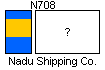
Nadu/Nado Shipping Co. — Lady Mariam
Nadu Shipping Co.
N708 comes from Lady Mariam, photographed on 6 April 2007. Lloyd’s names Nadu Shipping Co. as registered owner, whereas Equasis gives Nado Shipping Co.
Dated vessel association only; no inference of exclusive company-wide livery. Existing QA2 and spelling variants retained.
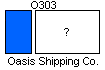
Oasis Shipping Co. — Uranus
O303 comes from Uranus of Oasis Shipping Co., photographed on 21 July 2008.
Dated vessel association only; no inference of exclusive company-wide livery. Existing QA2 and spelling variants retained.
Ahmed Abdulrazzak Osman — Itidal1
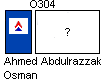
O304 comes from Itidal 1 of Ahmed Abdulrazzak Osman, photographed on 15 October 2009. The triangles are enlarged in the illustration to make them discernible. The funnel matches B962, recorded for Barhoum Maritime Co., but Rosanoski knew of no connection between them.
Dated vessel association only; no inference of exclusive company-wide livery. Existing QA2 and spelling variants retained.
Except for U292, which applied to a vessel actually in Unimarine’s name, the ultimate owners were unclear. Because the funnels differed, Rosanoski treated them as liveries of separate owners rather than variants of a common Unimarine design.
Other indistinct photographs show additional liveries. Sea Hope of Diamar Shipping & Trading S.A. has a blue funnel and narrow black top, separated by a broad yellow band with two unreadable blue letters. Star Hope, attributed to Unimarine by the photographic website but not found in Equasis or Lloyd’s, appears blue with a broad yellow top, or a very narrow top and broad band, possibly bearing blue letters. Irina D of Mina Shipping Co. appears pale yellow, edged red, with very narrow red bands near the top and bottom and possibly an emblem towards the stern touching the lower band.
Unimarine was recorded as formed in 2004, with a fleet under its own name and name companies in 2008, and as managers only in 2011–2012. The account of Jimmy A nevertheless dates Unimarine ownership to 2001; the source does not resolve this discrepancy.
Syria, Tartous.
UNION BARGE LINE CORPORATION.
image by Joe McMillan, 29 November 2001
Joe McMillan’s FOTW flag illustration U126, dated 29 November 2001, was based on steamship.net, which Rosanoski records as no longer available.
The FOTW account places this barge line on the Mississippi–Ohio river system, a conclusion drawn from its name and home port. Its 150th tow between Pittsburgh and New Orleans was celebrated in 1934, and a barge photograph documents operation in November 1965. Rosanoski distinguishes it from a New York company of the same name listed as in business from 2001, while noting an apparently Pittsburgh-domiciled company of that name in a 1951 court case; the identity evidence remains qualified.
USA, Pittsburgh.
Union Commercial Inc.
UNION COMMERCIAL INC.
The company website shows different sides of the funnel, the starboard design being a mirror image. U213’s broken chain spells “UC”. A correspondent, identified as RGT, describes its later replacement by an unevenly slanted “M” in the same iron-oxide red. Photographs of Mark at Wellington on 27 February 2003 and Loyal Union on 2 May 2013 confirm the port-side U213 design; Loyal Union on 5 May 2007 confirms the mirrored starboard version. A photograph of Ken instead displays the port-side view. Mitchell also assigns U213 to Arnica Shipping Co. Ltd., apparently owner of Fropadan[o], which Rosanoski could not locate in Lloyd’s.
Mitchell uses U214 in drawings of nine vessels, including some, but not all, of the operated or agency companies’ ships. He also assigns it to Twenty Five March Shipping Co. S.A., owner of Annunciation Bay from 1966 to 1969, which Rosanoski did not locate in Lloyd’s.
Aegean Sunset Inc.
Mitchell gives A964 for Aegean Sunset Inc., without connecting it to Union Commercial’s agency. Lloyd’s records the agency for Swede Maria, owned from 1976 to 1980.
No exclusive fleet-wide use or unrecorded corporate equivalence is asserted.
Documentary images — company attribution uncertain
M522 apparently relates to Atenalia of Manamar Compañia Naviera S.A., bought from Rederi A/B Fraternitas in 1973 and sold in 1976. The “G” fits none of these parties and may identify a charterer.
S1059 apparently comes from Lefkipos, bought from Rederi A/B Rex in 1964 by Skarasteel Shipping Co. and sold in 1972. It appears under Union Commercial in 1966–1967 and under its own name at the same Piraeus address in 1970–1971. The colours are not Rex’s, but their connection to Union Commercial or another party is unclear.
U52 was noted on Heraclitos during 1964–1969, when the vessel belonged to the operated Skaramanga Shipping Co. The “F” fits none of the known parties. Rosanoski retains the source’s Union Commercial attribution but suggests charterer’s colours; it was not the livery of the previous owner, Palm Line.
Exact user unproved.
Source ship/company association tentative.
Company represented by F unknown.
Panous Shipping Co. Inc.
Panous Shipping Co. Inc.
P397 represents Panous Shipping Co. Inc., listed under Union Commercial’s agency in 1978–1981.
No exclusive fleet-wide use or unrecorded corporate equivalence is asserted.
The document also records T454 for Tonia Maritime Co. Ltd., apparently from Marytonia, listed as an operated company’s vessel in 1973–1974.
Lloyd’s dates Union Commercial Steamship Co. to 1962 and its change to Union Commercial Inc. to 1992; the company website instead gives 1960 as the foundation year. Founder Mark Scufalos, originally a London Greek, established the business in Greece. The account supplied by RJT describes an initial Greek agency under his name and a London office as Union Commercial Shipping. Union Commercial International Ltd. followed in 1969, then Container & Cargo Services International Inc. After Scufalos’s death in 2000, his sons Michael and Pantelis managed the group, whose policy was to employ vessels on period time charters. Lloyd’s continued to list the deceased founder as president in 2007.
The agency list includes Aegean Sundet Inc., printed as Aegean Sunset Inc. in the livery account, and Elnimar Shipping Co. S.A.
Greece, Piraeus.
UNION COMMERCIALE ET DE NAVIGATION CALÉDONIENNE.
The funnel and flag U60 are sourced to The Log, November 1989; no separate design description is supplied.
Armement Ballande, cross-referenced as Ballande et Fils, formed the company in 1882; it ceased in 1935.
France (assumed).
UNION DES REMORQUEURS DE L’OCEAN.
The funnel is black with a broad yellow band. The flag has diagonal blue and white halves, described in the source as “Pbds”, with the red letters “URO” overall on a diagonal line described as “Pbd”.
The company is recorded in Lloyd’s List of Shipowners for 1963–1964 and 1970–1971.
France.
UNION FERRY CO.
Henry Pierrepont commissioned paintings of the ferries between about 1840 and 1865. Peconic was painted by Joseph B. Smith, and Montauk by James and John Bard; the latter painting is dated about 1846–1849 and described as a Fulton Ferry Company steamboat formerly in Union Ferry’s collection. The Montauk image confirms an “M” on a blue flag and the vessel’s name with two stars on a red flag. Blue at the end is unclear: it could be another flag behind, or blue tails. Its funnel corresponds to U296, shared by the other paintings.
Other ferry paintings suggest a practice of flying a blue bow flag with the vessel’s initial and a red stern flag with its full name. Rosanoski questions how far these were real flags rather than additions to please patrons: accounts of Bard’s careful measurement of vessels do not necessarily settle the accuracy of the flags. FOTW illustrates two blue flags for Brooklyn from a black-and-white photograph of a Bard painting dated 1846–1849; blue was chosen only as a reasonably likely colour. Other flags in the paintings may include a house flag.
The company’s origins lay in the Fulton Ferry Co. of Robert Fulton and William Cutting, whose New York & Brooklyn Steam boat Ferry Associates began East River steamboat services with Nassau in 1814. Following the founders’ deaths in 1815 and 1821, ownership passed to New York stockholders and the widow of George Cutting, as the source names her. South Ferry was formed in 1836 and merged with Fulton Ferry in 1839. Financial difficulties in buying out the Fulton shareholders delayed settlement until the New York & Brooklyn Ferry Co.’s managing lease ended on 1 May 1844. Brooklyn Union Ferry Co. was constituted on 1 July 1844 to conduct the Fulton and South ferries. Brooklyn operated between Brooklyn and Manhattan in the 1840s.
On 10 November 1854 the Union Ferry Company of Brooklyn incorporated the Fulton, Catharine, South, Wall and Hamilton Avenue ferries. Catharine originated as the New Ferry in 1795, passing through several owners before Smith & Bulkley acquired it in 1852 and subsequently joined Union Ferry; Hamilton dated from 1847 and Wall from 1853. Another passage instead credits Henry Evelyn Pierrepont and Jacob R Leroy with combining five Brooklyn ferries in 1844. It describes the resulting service as more frequent and regular, effectively monopolising the East River crossing before Brooklyn Bridge opened in 1883.
The remaining fleet appears to have been sold to the City of New York in 1922. Rosanoski cautions that a shipbuilding history’s attribution of Nassau directly to Union Ferry in 1814 may overlook the company’s origins. He also notes an apparently separate Union Ferry Co. operating at New Orleans from at least 1903.
USA, New York.
UNION LINE OF HAVRE PACKETS.
image by Joe McMillan, 12 October 2001
image by Joe McMillan, 29 November 2001
Joe McMillan’s FOTW illustrations U75, dated 29 November 2001, and F201, dated 12 October 2001, both derive from Private Signals of the Merchants of New York. F201 represents Fox & Livingston Union Line’s blue “U” on white after 1845. The U75 commentary notes the similar designs and questions whether there were really two different flags, since Fox & Livingston had already been consolidated into Union Line by the chart’s publication.
Francis Depau founded the first Havre packet line about 1822. Bolton, Fox & Livingston continued the business, becoming Fox & Livingston after Curtis Bolton’s death; Samuel M. Fox and Mortimer Livingston were Depau’s sons-in-law. Originally the Havre Line, then the Old Havre Line, it became part of the Union Line when three New York–Le Havre services were consolidated in the 1840s, with one account specifying 1845.
Fox & Livingston became agents and principal proprietors of the New York & Havre Steam Navigation Co. until financial failure in 1857. By securing their captains against losses on the ships, they enabled some to acquire substantial Havre Line holdings before its eventual liquidation. William H. Whitlock Jr. merged into the line in 1853. FOTW attributes the eventual end of the Union Line to the American Civil War.
USA, New York.
UNION MARITIME DU PACIFIQUE SUD.
The basic funnel came from Karlander, from which vessels were chartered: yellow or buff, with a broad red band edged white above and below, bearing a white-outlined panel of the flag. The flag follows Messageries Maritimes’ design, replacing its letters with the Southern Cross. It is red with a white diamond extending throughout, its points flattened, containing five blue stars.
Also known as South Pacific United Lines, the company was formed in 1972 and belonged to Compagnie Messageries Maritimes. It operated between Australia and the USA’s west coast in the mid-1970s.
New Caledonia (assumed).
UNION MARITIME ET MINIERE.
The funnel and flag U86 are documented in Brown 1995, No. 780; the source provides no separate written design description.
The company appears in Lloyd’s listings from 1978–1979 to 1992–1993 under Compagnie Chérifienne d’Armament as managers.
Morocco, Casablanca.
UNION NAVALE S.A.
The funnel is black with a broad blue band edged white above and below, bearing a red diamond containing a black “H”-like figure formed from interlocking “u” and “n”. The flag is blue with the same red diamond and black interlocking letters.
A web photograph of Dowlais dated 4 August 2000 shows a black funnel with what appears to be a red band.
Union Navale appears in Lloyd’s from 1963–1964 to 1985–1986 and again in 2000, when it is described as formed in 1955. Cie. Maritime des Chargeurs Reunis is listed as a shareholder, but the holding is printed ambiguously as “605”. Campbell Maritime Ltd. managed the company in 2000. Its subsidiaries included London-based Franco British Chartering Agency Ltd., formed in 1979, and Franco British Chartering & Singa Shipping Co. Ltd., formed in 1995.
It operated joint ventures with Cie. Nantaise des Chargeurs de l’Ouest and Société Navale Delmas-Vieljeux in 1963–1964, and with Société Maritime Nationale and Société Navale Caennaise in 1963–1964 and 1970–1971. It also managed vessels for Consortium Européen de Transportes Maritimes in the 1970s and 1980s and for Ponderex S.A. in 1985–1986.
France, Paris.
UNION NAVIGATION CORPORATION.
The NJK Collection records a black funnel for Union Pacific. No flag was noted.
The company is recorded in Lloyd’s for 1963–1964.
Hong Kong.
UNION OIL CO. OF CALIFORNIA.
image by Joe McMillan, 29 November 2001
image by Joe McMillan, 29 November 2001
image by Joe McMillan, 29 November 2001
A black-and-white photograph of Warwick confirms U30’s funnel. Stewart’s 1953 and 1957 flags enlarge the “o” and omit its dot. Loughran’s 1971 article extends the diamond throughout, but his 1979 book does not repeat this, so Rosanoski treats it as an error. Merchant Ships 1949 records the flag as unknown. Joe McMillan’s FOTW illustration of 29 November 2001 cites Wedge, Stewart and the US Navy hydrographic reference.
The livery changed in 1966, the company’s 76th anniversary, to the U29 funnel and blue-and-white diagonally striped flag. The U28 funnel followed from 1970, possibly in response to adverse publicity after the Torrey Canyon disaster. Loughran’s 1979 illustration omits white edging around the U29 circle; his 1971 article specifies it without showing it. Mitchell likewise omits the funnel edging. McMillan’s U29 flag is based on Styring 1971.
McMillan’s U127 flag is based on a photograph of house flags in the dining hall of the US Merchant Marine Academy at Kings Point, apparently taken in the late 1970s.
Union Oil Co. of California, also known as Unocal, was formed on 17 October 1890 by the merger of Hardison & Stewart Oil Company, Sespe Oil Company and Torrey Canyon Oil Company. Its fleet dates from 1899. It acquired Pinal-Dome Oil Company in 1917 and Pure Oil Co. in 1965. The source account states that Shell bought 25% and formed Shell Oil Corporation in 1922 to consolidate its operations and those of Union Oil Company of Delaware.
Union Oil became Unocal Corporation in 1983, though Rosanoski notes that Lloyd’s retained the Union Oil shipping name until withdrawal around 1998, when the last tankers passed to Crowley Petroleum Transport Inc., and only recorded the name change in 2006. Ashland Chemical acquired most of the chemical distribution business in 1992. Unocal merged with Chevron on 10 August 2005, ceasing to be independent; Rosanoski flags an identity conflict in the account that it continued operations for Union Oil Company of California. Atlantic Union Oil Co. Ltd. was a joint marketing venture which became Mobil.
USA: Los Angeles, subsequently Wilmington, California, and again Los Angeles in the later listings.
UNION PARTENREEDEREI.
The flag is red with a white diamond bearing a black “U”. The white funnel carries a broad band of the flag.
Union Partenreederei appears to have been a trading or shipowning name of Scipio & Co. Lloyd’s lists Scipio as fleet manager in 1963–1964; in 1970–1971 the ships of both concerns were owned by individual companies named “Union-Partenreederei” followed by the vessel’s style and name. Livery sources give Union Partenreederei with Scipio & Co. in brackets.
Germany.
Union Shipping Corporation (1).
UNION SHIPPING CORPORATION (1).
The NJK Collection records a lightish buff funnel on Beatrice in January 1966.
The London company appears in Lloyd’s 1966–1967 with P.B. Pandelis Ltd. as agents. Beatrice was acquired in 1964 and broken up in 1967.
UK, London.
UNION SHIPPING CORPORATION (2).
A separate Tokyo company appears as agents in 1985–1986 and managers in 1992–1993. By 1998 it was an operating company of Kawasaki Kisen K.K., with Anjo Shipping Co. Inc., formed in Manila in 1988, and Galaxy Naviera Maritime S.A., formed in 1976, as subsidiaries. It apparently merged into “K” Line Ship Management Co. Ltd.; Galaxy appears under that company in 2000. Anjo had previously been listed under both Union and Overseas Maritime Agency Ltd. as managers.
Japan, Tokyo.
UNION SHIPPING GROUP.
image by Alvin Fisher, 21 March 2000
image by António Martins, 21 March 2000
image by Jarig Bakker, 27 January 2006
Rosanoski checked U18 against an actual flag: the central Union Flag panel has no separate edging, its red merging with the surrounding red field. The “o” in “Co” is slightly smaller and raised, without a dot beneath. Brown 1951 and 1958, LJC 1885 and 1909 and Sea Breezes 1979 wrongly add a dot; the latter’s black-and-white hatching also indicates red letters instead of white. The Log 1985 incorrectly fails to raise the “o”. Canadian Union Line also used this flag, as did managed New Zealand Oil Consortium vessels. The FOTW image is credited to Alvin Fisher and António Martins, 21 March 2000.
Reed 1891’s U277 is labelled Union S.S. Co. of Dunedin. The 1901 version U279 improves the name but places the company in London, omits the blue saltire and misplaces the funnel bands. Reed 1912 omits the company entirely.
Mitchell also gives U278 for Union Steamship Co. (UK) Ltd., registered in London in 1971 and owner of Rangatira. His funnel is based on that ship, but Rosanoski considers it clearly wrong from vessel sightings.
With the 1987 change to Union Shipping New Zealand Ltd., the letters became “U” at the hoist, “S” at the fly and “N.Z.” at the base. Rosanoski checked these details against an actual flag. U31 also derives from photographs of Union Rotorua at Wellington on 14 May 1997 and Union Auckland on 23 August 1997; Jarig Bakker’s FOTW image of 27 January 2006 follows Brown 1995. In response to António Martins’s question about the central Union Flag’s proportions, Rosanoski supplied an actual-flag photograph. He described sewn coloured components, with long red border strips above and below and shorter pieces at hoist and fly. The opaque letters were sewn separately on each side. He had not examined a Union Shipping flag as closely, but expected the same construction with changed letters; his photograph did not show the fly “S”, although he confirmed it was present.
U19’s funnel is sourced to NZMN, volume 48, number 1, 1999, page 35; no separate design description is supplied.
Union Steam Ship Co. of New Zealand Ltd. was formed at Dunedin in 1875 and began operations on 1 July. Rosanoski describes it as, at one stage, the Southern Hemisphere’s largest shipping company. It acquired New Zealand Steam Shipping Co. Ltd. on 23 June 1876, the remaining Oamaru & Dunedin Steam Co. Ltd. interests on 30 June 1879, and Auckland Steam Ship Co. Ltd. on 17 September 1881; the latter had been formed early in 1878.
Expansion continued with Black Diamond Line on 1 August 1885; the Brunner Coal Co. Ltd. fleet and mine interests of Martin Kennedy on 11 August 1888 and James Kilgour’s mine and fleet on 23 August; Peninsula & Akaroa Steam Navigation Co. Ltd. on 25 March 1890; Tasmanian Steam Navigation Co. on 1 April 1891; and T.A. Reynolds & Co. on 1 September 1896. It acquired half of Canadian Australian Royal Mail Line on 1 January 1901 and the remainder in 1910, took over Grining Bros. of Port Macquarie Harbour in August 1901, and bought half of Canterbury Steam Shipping Co. Ltd. in November 1905. A joint Australasian mail venture with Oceanic Steamship Co. ran from 1885 until Union withdrew in 1900.
Union jointly formed Wairau Steam Ship Co. Ltd. with Johnson & Co. Ltd. on 28 March 1907, holding 25%, and took a quarter of Invercargill Shipping Co. Ltd. on 1 April. It controlled Anchor Shipping & Foundry Co. Ltd. from 1908, acquired a third of the William Holyman & Sons Ltd. companies in 1909 and held 25% of Richardson & Co. Ltd. from 3 October 1912 until 1978. An interest in Opouri Shipping Co. Ltd. followed on 1 December 1912. On 1 October 1913 Union was wound up and a new company of the same name incorporated. It bought the remaining half of Maoriland Steamship Co. Ltd. from Ferdinand Holm on 19 May 1915, having acquired the first half in 1908. An R.S. Lamb & Co. Ltd. interest, first acquired on 21 October 1909, became wholly owned on 19 February 1930.
P&O acquired all ordinary shares on 28 November 1917. Earlier British and Scottish shareholders included the shipbuilders William Denny & Bros., although Union had remained independent. Tasmanian Steamers Pty. Ltd. was formed on 22 December 1921 and the Blackball Coal Co. Ltd. fleet acquired on 1 April 1922. The Canadian Australasian Line joint venture with Canadian Pacific was formed on 2 July 1931, with its equal ownership announced on 4 August. Union Royal Mail services, operated in 1885–1900 and from 1910, ended on 12 December 1936. Union bought 25% of Eastern & Australian Steamship Co. Ltd. on 1 November 1946; P&O took that company over on 26 September 1966. Canadian Union Line Ltd. was formed at Vancouver on 29 January 1947, and Captain A.F. Watchlin’s remaining shipping interests were bought on 5 December. A Holm Shipping interest acquired in the 1930s became controlling by the 1950s; Holm traded independently until Union assumed management on 1 March 1972. Its last vessel changed ownership in 1981 and the company was sold in 1982. Union was also a major Huddard Parker shareholder in 1959.
Land & Mortgage Securities Ltd., formed on 17 October 1928, held interests in other companies; Mercantile Investments Ltd. replaced it on 11 February 1936 and was dissolved on 28 May 1981. Indo-Pacific Shipping Co. Ltd. was formed in London on 1 May 1929 and ceased that year. The source also records involvement with Gisborne Sheepfarmers’ Frozen Meat & Mercantile Co. Ltd.
Ownership transferred on 1 January 1972 to Tasman Union Ltd., a renamed Kaipara Steam Ship Co. Ltd., jointly held by N.Z. Maritime Holdings and TNT Shipping (NZ) Ltd. Australian offices merged with Associated Steamships on 1 September 1972 to form Union Bulkships Pty. Ltd. Abel Tasman Shipping Co. Ltd. was formed at the same time and sold its last vessel in 1975. The source gives conflicting dates, 29 June 1979 and 26 March 1980, for its change to Union Steam Ship Co. of Australia Pty. Ltd.; it also places Australian vessels under that name on 20 December 1977. Tasman Union became Union Shipping Group Ltd. on 28 March 1980. New Zealand Offshore Services Ltd. was formed on 25 August 1977 with a 60% holding; the remaining 40% was acquired in July 1991. Ron Brierley obtained control of N.Z. Maritime Holdings in August 1986, and Brierley Investments bought TNT’s half on 3 December 1996.
Through South Seas Shipping Ltd., formed on 6 May 1983, Union acquired 25% of Pacifica Shipping on 16 June, gained control on 21 August 1984 and sold it on 7 November 1985. Following the four-division restructuring of April 1980, Union Steam Ship Co. of New Zealand became Union Shipping New Zealand Ltd. on 1 December 1987. A further reorganisation on 1 January 1991 transferred most subsidiaries to South Pacific Passenger Services Ltd., which adopted the Union Shipping Group name, while the former group company became Union Corporate Services Ltd. and retained the Australian company. Registry records and later notes complicate this account: they record BIL Maritime Holdings Ltd. taking the Union Shipping Group name on 28 July 1997, while another company of that name became Holyman (New Zealand) Ltd. The source leaves this succession unreconciled.
Union Shipping Australia acquired full ownership of its Coastal Express Line joint venture on 31 January 1996. Ocean Bulk Ltd. was formed jointly with Ocean Towing & Salvage (Cook Island) Ltd. on 16 March 1996, became wholly owned on 9 July 1998 and transferred its assets to Union Shipping Bulk Ltd., incorporated on 13 October 1998 and struck off on 4 October 2000. Union Direct Line began on 7 January 1997 with Groupe Bolloré Technologies as an Australia–New Zealand Direct Line subsidiary, passing with that company to CP Ships. Australian operations were sold to Holyman on 3 September 1997. The Australasian Shipping joint venture with ANL had ended on 1 October 1994; a merger of Union and Owens stevedoring interests formed New Zealand Stevedoring Co. Ltd. The last vessels were sold in July 1999. Rosanoski’s flag commentary dates the end of operations to 2001; Union Shipping Group Ltd. was struck off on 28 February 2007.
New Zealand: originally Dunedin; head office moved to Wellington in 1922 and Auckland in 1983. Dunedin remained the registered office until June 1945.
UNION STEAM SHIP CO.
Griffin 1895 records a change from U69 to U71. The Ships List chronology gives black funnels in 1858–1863, buff with black tops in 1863–1870, black again in 1870–1891, and all buff in 1891–1900. Red Duster instead dates the cream-buff change to 1892. The U71 flag description in MN, April 1970, is verbal only; Rosanoski assumes its “saltire” extends throughout the white field.
Red Duster’s vessel accounts differ from that general chronology. Dane, built in 1854, received a red funnel with a broad black top, U70, for the first Cape Colony mail voyage in 1857; this livery was applied to all Cape mail ships. Roman began as a red-funnelled mail steamer in November 1863, transferred to the Intermediate service in 1869, and received the black funnel U305 when lengthened and re-engined in 1872.
U304 is documented by Lloyd’s 1882, Griffin 1891 and Flags of the World 1915. Rosanoski notes a bluer flag image on the Red Duster website.
The company was formed in 1853 as Southampton Steam Shipping Co. to carry South Wales coal to Southampton for P&O and Royal Mail, both represented on its board. One account credits P&O founder Arthur Anderson with inspiring the venture. It became Union Steam Collier Co. later that year. Its ships were requisitioned for the Crimean War in 1854 and returned in 1856; one account then dates re-registration as Union Line to 1857, while Merchant Ships gives 1856. Rosanoski preserves these passages despite their later removal from the Ships List website, and notes another uncertain account of reconstitution as Union Steamship Co. after a war. Other names recorded are Union Line and Union Mail Co.; a plate’s logo confirms “Union Steam Ship Co.”
Union competed with Castle Line on the Cape mail route. Their merger followed expiry of the mail contract in 1899: in March 1900 Union’s assets were transferred to Castle Mail Packets Co., which was restructured as Union-Castle Mail Steamship Co. Ltd. Fleet names referred to peoples, such as Saxon.
UK, Southampton.
UNION STEAMSHIP CO. OF SOUTH AFRICA LTD.
The flag is blue with white sans-serif initials “USC”. Klaus-Michael Schneider’s image, sent to the Yahoo flag group on 5 January 2014, is based on the US Navy Hydrographic Office’s 1961 Merchant Marine House Flags and Stack Insignia. Rosanoski records a blue value of 255. Stewart’s 1953 and 1957 funnel illustrations show a narrow black top.
The company is reported to have begun with the renamed General George Brink in 1946; Lloyd’s 1953 also lists Ovambo, built in 1939. Its last ship, Pondo, was sold in 1971. A possible Coast Lines connection is noted, and the 1970–1971 listing places it under Grindrod Gersigny & Co. (Pty) Ltd. Earlier newspaper references describe Anglian in 1894–1895 under Union Steamship Co. of South Africa, South African Union Company or Union (Cape) Company, before sale to Huddart Parker. Rosanoski cautions that these may refer to an earlier, similarly named concern.
South Africa, Cape Town.
UNION TRANSPORT GROUP PLC.
image by Jarig Bakker, 3 November 2005
Mitchell adds black shading to the U24 funnel letters and also shows U23 alongside the Bromley funnel, with the latter separately recorded on its own card. Jarig Bakker’s U23 flag image of 3 November 2005 follows Brown 1995.
U293’s funnel comes from Union Diamond on 2 April 2010; its flag comes from Union Pearl of Bromley Shipping in November 2006. No shading appears on the flag, although it is distant. Despite the website logo, Rosanoski considered an actual flag change quite likely because the funnel had changed.
Union Saturn, photographed on 17 January 2007, has a grey pipe-like exhaust rather than a conventional funnel, with the red logo on its white bridge.
Union Transport (London) Ltd. was incorporated on 14 August 1946 and became Union Transport Group plc in 1987. Its website described it as independent of any other group. It entered administration on 2 May 2013; a subsequent account states that the remaining management formed Absolute Shipping Ltd.
Bromley Shipping Plc was formed in 1987 under the UK Government’s Business Expansion Scheme and floated on the London Stock Exchange. Despite its connection with Union Transport, it was not an actual subsidiary. Union Pearl moved between the recorded parent fleet and Bromley listings. “Union” was a common vessel-name prefix, although not universal among operated companies.
UK: London, later Bromley.
UNION-REEDEREI GMBH.
image by Klaus-Michael Schneider, 6 April 2009
Klaus-Michael Schneider’s FOTW flag illustration of 6 April 2009 follows Deutsche Reedereien und ihre Erkennungszeichen, second edition, Hamburg, 1956, page 41. The same source is listed for U291’s funnel and flag.
Union-Reederei owned Peka, built in 1952 and sold without a name change in 1956. Lloyd’s lists Walter Martens as operator in 1953–1954.
Germany, Hamburg.
UNIQUE SHIPPING (HK) LTD.
U342 is based on port and starboard photographs of Unique Sunshine, dated 19 September 2006 and 26 February 2010 respectively. Other ship photographs seem to show a darker blue, but Rosanoski suggests photographic manipulation as a possible explanation. The recorded retrieval date for the first photograph precedes its stated photograph date.
The original accounts differ over the company’s beginnings. Its archived website dates establishment as a private shipowning and management company to 1966; another account credits Robert Chen and friends with founding it in 1967, cross-referencing Grand Seatrade Shipping Co. Ltd. Lloyd’s instead dates Unique Shipping Agencies Ltd. to 1960 and its change to Unique Shipping (HK) Ltd. to 1996.
Unique Shipping (Canada) Inc., formed in Vancouver in 1996, closed its office on 26 September 2003 during restructuring. Another operating company was Hong Kong-based Neptune Navigation Corporation Ltd.; its formation year is incompletely printed as “200”.
China, Hong Kong.
UNISEA SHIPPING B.V.
U358’s funnel comes from a starboard photograph of Beaumaiden on 18 June 2010. The flag is seen in a starboard photograph of Beaumagic, whose date is printed “6.4.1007”; that date is not silently corrected.
U359 comes from a starboard photograph of Beaumont on 1 February 2007.
U360 comes from a port-side photograph of Beautriton and was also used by Beautriumph. Rosanoski records the latter observation but did not retain its photograph.
Formed in January 2005, Unisea appears to have a connection with Focus Ship Management B.V.; the source does not establish its nature.
Netherlands: Schamegoutum, later Sneek.
UNISEA SHIPPING LTD.
The logo on the pool website is the same as that given for Unisea Philippines Inc. U315’s funnel comes from Aqualiberty on 29 May 2012 and is confirmed by a photograph of Aqualegacy.
Unisea was involved in the pool named “Afromax International” in the source. Clarksons associated it with nine vessels; Equasis listed five under management in July 2012: Aqualeader, Aqualegacy, Aqualegend, Aqualiberty and Aqualoyalty. Lloyd’s also records it as managers for Ceres LNG Services Ltd., although the reference year is malformed.
Greece, Piraeus.
Unitas Schiffahrtsgesellschaft mbH.
UNITAS SCHIFFAHRTSGESELLSCHAFT MBH.
image by Ivan Sache, 12 June 2009
U138’s funnel is based on German in a photograph dated 6 November 2005, although the recorded retrieval date precedes that date. The flag is sourced to the agents’ website and Ivan Sache’s FOTW image of 12 June 2009 from the company website.
Mitchell shows a “U” in dark green or possibly teal, without identifying the origin of his illustration. The U280 flag is assumed from the funnel, rather than independently documented.
Securitas Schiffahrts GmbH
S1340’s funnel comes from Iduna on 23 July 2007. The Unitas website gives the related image for Securitas Schiffahrts GmbH. The source list derives the flag from the funnel; the FOTW note supplies no artist’s name.
Formed in 1991, Unitas was connected with Kapitän Hermann Schepers and Stefan Schepers. The source’s translations disagree over their deputy managing director and fleet manager roles. FOTW describes the Schepers family as founders, but Rosanoski notes that the company website claims only a connection.
Germany, Haren/Ems.
Uniteam Management Group.
UNITEAM MANAGEMENT GROUP.
image by Ivan Sache, None
U135 is Ivan Sache’s FOTW image from information supplied by Dov Gutterman on 1 December 2003, based on the company website. Because the colours seemed not to agree, Rosanoski prepared U136 from the website logo. A website photograph of an actual flag also appeared not to have yellow letters.
UNITEAM MARINE SHIPPING GMBH.
The Hamburg company, Uniteam Marine Shipping GmbH, was formed in 2000 and held its fleet through name companies in 2003–2004.
The group engaged in chartering and ship management. FOTW gives 1978 as its foundation, apparently from the website’s date for operations from Cyprus; Lloyd’s instead traces it to Josef Roth (Cyprus) Shipping Co. Ltd. in 1974, renamed Uniteam Marine Ltd. in 1986. Josef Roth Reederei was listed as manager in 1985–1986, and K.G. Reederei Roth GmbH & Co. as owner in 2003–2004.
Uniteam managed vessels for Andes Management Co. Ltd., cross-referenced to Rickmers Reederei, and part of the Roth fleet. The 2004 group comprised Uniteam Marine Ltd. in Limassol and Klaipeda, Uniteam Marine (Yangon) Ltd. in Myanmar, and Uniteam Marine Shipping GmbH in Hamburg.
Cyprus, Limassol.
UNITED AFRICA CO. LTD.
Loughran’s presentation places U122 first, apparently suggesting it was the original flag, but Merchant Ships 1942 states that U123 had been used “until a few years ago”. The sequence is therefore uncertain. Harnack angles the letters in U122’s lower segments.
United Africa Co. Ltd. was formed in 1929 as a successor to Niger Co. Ltd., combining Lever Brothers interests including African & Eastern Trade Corporation Ltd., Bathurst Trading Co. Ltd., Gambia Trading Co. Ltd., Miller Bros. Ltd., Niger Co. Ltd., Palmine Ltd. and Seychelles Co. Ltd. It belonged to Lever Brothers and was associated with the Unilever Group. Loughran describes its absorption into Palm Line, while Liverpool Shipping instead lists Palm Line, formed in 1949, as an operating company; Rosanoski notes the disagreement. Vessel names referred to African peoples with the suffix “ian”.
UK, London.
UNITED ARAB SHIPPING CO (S.A.G.).
image by Jorge Candeias, None
image by Ivan Sache, 5 May 2012
image contributed by Josef Nüsse, None
image by Jarig Bakker, 3 September 2005
image contributed by Josef Nüsse, None
Ivan Sache’s U7 flag image of 5 May 2012 follows a Josef Nüsse table flag and is described as the probable former flag. Brown 1982 and Mitchell provide the associated funnel sources.
U8 has a black outline of a ship’s wheel, with a black ring enclosing two black anchors in saltire. Jarig Bakker’s FOTW image of 3 September 2005 shows a light bright green band; Rosanoski considered Brown 1995 its probable source.
Jorge Candeias’s U6 flag has horizontal dark purple, red, white, very dark green and black stripes, with narrow white lines separating the dark colours. The central white stripe is about four times wider than the others. A golden wheel extends beyond it and bears two brown crossed anchors joined by a brown chain.
U324’s funnel comes from a starboard photograph of Addiyrijah on 15 January 2006, and its flag from a Josef Nüsse table flag. The flag’s purple is rendered to match the funnel, although Rosanoski cautions that it may actually be softer.
Mitchell’s funnel, numbered U342 in the narrative, shows the purple band as red and dates the new colours to 1992. His logo source has a thick yellow ring, Arabic script above and the English name below, enclosing a grey centre with two black anchors in saltire. The U342 narrative identifier differs from the U324 source-list identifier.
United Arab Shipping Co., or UASC, was formed in 1976 jointly by Bahrain, Iraq, Kuwait, Qatar, Saudi Arabia and the United Arab Emirates. Lloyd’s describes a 1977 renaming from Kuwait Shipping Co. (S.A.K.); Rosanoski interprets this as that company’s merger into the new concern. Arabian Chemical Tankers was formed in 1984 in partnership with The National Shipping Co. of Saudi Arabia.
Kuwait.
United Baltic Corporation Ltd.
UNITED BALTIC CORPORATION LTD.
The funnel came from Andrew Weir and the flag from A/S Det Östasiatiske Kompagni. Talbot-Booth describes the funnel as cream. Loughran dates U105’s adoption for motor ships to the 1950s, but Merchant Ships 1959 and 1963 instead give U104 for motor ships and U105 for steamships. Stewart 1953 and 1957 offer U105 without a black top as an alternative, while Merchant Ships 1949 gives only the plain funnel. Talbot-Booth and Harnack omit dots after the U105 flag letters. U104’s funnel circle contains red “U.B.C.”; Harnack notes the addition of flag markings on new motor ships. The circle has no outline in Brown 1951, a red outline in Brown 1982 and 1995, and normally black but sometimes gold according to Loughran; Merchant Ships 1959 uses gold. Coastal Ships & Ferries 1999 describes cream, a black top and a black anchor within a black ring, also in the Finnanglia account. Rosanoski treats this unsupported anchor description as erroneous.
Anglo-Estonian Shipping Co. Ltd.
Anglo-Latvian Shipping Co. Ltd.
Anglo-Lithuanian Shipping Co. Ltd.
Anglo-Estonian company
A383 uses Estonia’s national colours. Merchant Ships 1949 gives a plain funnel without a top.
Keep the explicit scope label independent; no alias or company identity is inferred.
Anglo-Latvian company
A384 uses Latvia’s national colours. Merchant Ships 1944 calls the red crimson, which Rosanoski suggests may mean dark crimson.
Keep the explicit scope label independent; no alias or company identity is inferred.
Anglo-Lithuanian company
A385 uses Lithuania’s national colours. Loughran colours the anchor blue, which Rosanoski considers probably erroneous on that basis.
Keep the explicit scope label independent; no alias or company identity is inferred.
Also known as Anglo-Baltic Line, United Baltic was formed as a joint venture of Andrew Weir & Co. and A/S Det Östasiatiske Kompagni. The accounts give 1920 for formation or first steamship ownership and 1919 for registration; an earlier Lloyd’s subscription date of 1910 is also recorded. By 1996–1997 the only vessel Rosanoski traced was listed under Andrew Weir. The services were sold to CMA CGM around 2003.
MacAndrews & Co. Ltd. was acquired in 1935 following the Royal Mail collapse and sold to CMA CGM in 2002 as part of Andrew Weir’s sale. Three shipowning subsidiaries, Anglo-Lithuanian, Anglo-Estonian and Anglo-Latvian Shipping Co. Ltd., also styled S.S. Co. Ltd., were registered in 1937–1938. None outlasted the steam era.
United Baltic and O/Y Finncarriers A/B jointly operated Finnanglia Ferries. Company vessels commonly used the prefix “Balt”, especially “Baltic”; Rosanoski suggests differently named vessels were chartered.
U.K., London.
UNITED BULK CARRIERS LLC.
U264 comes from UBC Sydney at Wellington on 25 June 2003. Athena Marine Co. Ltd. uses the same funnel, both on vessels chartered to UBC and elsewhere in its fleet. Rosanoski suggests an associate-company connection through the Hartmann Group.
Also recorded as UBC, UBCU and United Bulk Carriers USA, the company was incorporated in Delaware in April 1999 as United Bulk Carriers (USA) LLC. Another account dates formation to 1995. Its website dates establishment in its then-current capacity as commercial manager of a dry-cargo fleet to 1 April 2001. Sources variously describe Trygve Knutsen as owner, managing director or operations manager from December 2000 to January 2006. The Hartmann Group lists the company as charterers only.
USA, Wayne, Pennsylvania.
UNITED CROSS NAVIGATION CORPORATION.
The funnel is black with a very broad white band, two very narrow blue bands inset near its upper and lower edges by equal widths, and a red “K” between them. The flag is blue with a very broad white horizontal band bearing a red “K”. The funnel was noted on Pleione in July 1962 and Leto in September 1963. The US Navy reference places the livery under Liberia, whereas Rosanoski’s Country section gives Greece.
Listed in Lloyd’s for 1963–1964, United Cross was part of the J.M. Carras group according to Bill Black’s information in the NJK Collection. Hellenic General Shipping Enterprises Ltd. acted as agents. The fleet subsequently appears under Alma Shipping Corporation.
Greece, Piraeus.
UNITED EUROPEAN CAR CARRIERS (NORWAY) A/S.
U106’s funnel and flag are listed against Brown 1982, No. 907. That reference predates the stated formation of the Norwegian company; the existing illustration association is retained without inventing a chronology.
A shipspotting contributor writing on 21 June 2009 reported that Autosun had changed livery at Falmouth during the previous December. The contributor had also seen a photograph of one other ship in new funnel markings, but could identify it only tentatively as a P or R type.
Lloyd’s dates United European Car Carriers (Norway) to 1992 as a joint venture of Nippon Yusen Kaisha and Walleniusrederierna A/B. NYK had bought Ugland’s coastal car-carrying operations in mid-1990 and sold half to Wallenius in mid-1991. The company website confirms equal ownership by NYK of Tokyo and Wallenius Lines of Stockholm.
Operating companies included Carline S.A., formed in 1990 and based at Courbevoie, France, and United European Car Carriers (U.K.) Ltd. of London. The latter was previously Ugland European Car Carriers (U.K.) Ltd., described as jointly formed by NYK and Wallenius in 1990 and renamed in 1991. Barber Ship Management Sendirian Berhad managed part of the fleet.
Norway, Grimstad.
UNITED LINES.
image by Jarig Bakker, 7 July 2004
The livery changed with the company name. Loughran enlarges U102’s letters, and the FOTW version enlarges them further while placing the band and flower lower. Mitchell shows a solid blue flower on the funnel.
Jarig Bakker’s FOTW flag image of 7 July 2004 follows the undated chart Vlaggen in de haven van Amsterdam.
U143’s funnel and flag are sourced to Suomi ja meri, 1981, page 33; the document gives no separate description of this variant.
The consortium was formed in 1960 as United Owners Co. and later became United Lines. Its principal members were Rederi A/B Gustaf Erikson, Lennart Karlsson, cross-referenced to Rederia A/B Astra, and Lundqvist Rederierna.
Finland, Mariehamn.
UNITED MARINE AGGREGATES LTD.
U96’s funnel and flag are documented in Brown 1995, No. 662.
Documentary sourced funnel / assumed flag composite
U97’s funnel comes from Coastal Ships & Ferries 1999. That source does not give a flag; Rosanoski assumes the company flag also applies.
The United Marine Dredging funnel is sourced separately. The flag is explicitly assumed; shared parent/subsidiary flag use and use of the complete composite are not established.
Flag shared-use unproved; do not assert composite verified aboard.
United Marine Aggregates was formed in September 1987 by an equal amalgamation of Pioneer Aggregates Ltd. and Tarmac Marine Ltd., cross-referenced to Tarmac Roadstone Holdings Ltd. Its operating subsidiary, United Marine Dredging Ltd., was renamed in 1987 from Tarmac Roadstone Holdings Ltd.; Lloyd’s also lists the form United Marine Dredgers Ltd. in 1992–1993. The fleet ultimately adopted names beginning “City of”.
U.K., Chichester.
UNITED MARINE MANAGEMENT LTD.
The logo and funnel were shown on the archived company website. U350 is supported by port and starboard photographs of Lena; the starboard photograph is dated 26 July 2008. The flag emblem points forward on both sides of the funnel, with the letters reading correctly as though the flag were double-sided. The flag illustration is derived from the funnel logo.
United Marine Management was established on 1 November 2005 by separating the operational department of Euro-Baltic Shipping Services Ltd., which had provided maritime and transit services since 1994. The new company drew on the predecessor’s staff and experience.
Estonia, Tallinn.
UNITED MARITIME CORPORATION.
U67 was noted on Eagle Voyager of Sea Transport Corporation in the NJK Collection; the Mitchell collection also supplies the funnel illustration.
United Maritime operated Eagle Terminal Tankers Inc. and Sea Transport Corporation, which Rosanoski considered apparent subsidiaries because of their “Eagle” vessel names. The first newbuildings date from 1958 and the last ships were sold in 1979.
USA, New York, NY.
UNITED MARITIME GROUP LLC.
U344 comes from a port-side photograph of Sheila McDevitt on 6 June 2013. The funnel retained TECO Transport’s base and bands, adding the United Maritime logo; it remained after International Shipholding’s takeover. The archived website used the same logo with different names for U.S. United Ocean Services, U.S. United Barge Line of Metropolis, Illinois, and U.S. United Bulk Terminal of Davant, Louisiana. Rosanoski presumed similar use by U.S. United Bulk Logistics, but the archive lacked those images.
United Maritime Group, or UMG, succeeded TECO Transport after its sale by TECO Energy to an unaffiliated investment group in 2007. Lloyd’s dates TECO Transport to 1989, whereas another account gives 1959; United Ocean Services is separately dated to 1959. The source also differs over the sale date, giving 12 April and December 2007. The investors included Greenstreet Equity Partners, Jefferies Capital Partners, AMCI Capital and First Reserve affiliates. UMG is described as a subsidiary of GS Maritime Intermediate Holding LLC, formed on 27 January 2007.
The group combined three dry-bulk businesses. United Barge Line provided inland towboat and barge transport for coal, petroleum coke and grain; United Bulk Terminal transferred, stored and blended cargoes; and United Ocean Services carried coal, phosphate rock and other bulk materials.
On 19 April 2012 UMG announced the sale of US United Barge Line LLC to Ingram Barge Company. Shareholders approved the sale of US United Bulk Terminal LLC to Bulk Handling USA Inc. on 11 June, and International Shipholding Corporation’s acquisition of U.S. United Ocean Services LLC was announced on 11 October, with plans to retain it as a separate unit. After the three disposals and the apparent disappearance of the website in 2013, Rosanoski assumed the group had ceased operations, while United Ocean Services continued under its new owner.
USA, Tampa, Florida.
UNITED MERCHANTS SHIPPING CO. LTD.
U100 is reconstructed from a brief verbal description in Ocean Ships 1967 and may not be correctly portrayed.
U98’s funnel and flag are documented in Brown 1978, No. 194.
The source list records MN, May 1969, page 143(5), under U69. This differs from the associated U99 identifier and is retained without assuming a correction.
United Merchants appears under Michalinos & Co. Ltd. as managers in Lloyd’s from 1963–1964 to 1973–1974. Ship names led Rosanoski to suggest it was a subsidiary, although Loughran’s 1969 account does not say so.
U.K., London.
United Ocean Enterprise Ltd.
United Ocean Ship Management Pte. Ltd.
U271 comes from an emailed photograph of Ocean Paradise in January 2010. The arrangement is unusual: the port-side marking is replaced by a panel of the charterer NYK Global Bulk Corporation’s funnel band, cross-referenced in the original to N648 under Nippon Yusen Kaisha. A photograph at Newcastle on 25 March 2011 confirms the port-side arrangement.
Singapore company listings
The Singapore listings give United Ocean Enterprise Pte. Ltd. as formed in 1998, with an operating company, United Ocean Ship Management Pte. Ltd., formed in 1996 to provide management services. Fleet counts vary between the accounts; Rosanoski retains these Tokyo and Singapore descriptions without fully reconciling them.
Keep the explicit scope label independent; no alias or company identity is inferred.
United Ocean Enterprise is described as a privately owned ship operator, manager and owner established in September 1995. One fleet account lists ships that Lloyd’s places under the Singapore company.
Japan, Tokyo.
UNITED OCEAN SHIPPING S.A.
U352 comes from a port-side photograph of Ocean Joy on 8 November 2013.
A company of this name was incorporated in Panama on 14 December 1995; the source does not conclusively establish the identity relationship. Ocean Joy appears to have been its first vessel, from 1 September 2013.
Taiwan, Taipei.
UNITED ORIENTAL STEAMSHIP CO.
The NJK Collection records the U68 funnel on Maqboolbaksh. Brown 1978 supplies the funnel and flag, and Flagmaster 110 also records the flag.
Recorded in Lloyd’s from 1953–1954 to 1973–1974, United Oriental was taken over by the Pakistan Government in January 1974 and merged into Pakistan Shipping Corporation. Vessel names used the suffix “baksh”; briefly, by 1966, small vessels used “United” followed by a number written out.
Hong Kong.
UNITED PHILIPPINE LINES INC.
The U33 funnel, noted on Philippine President Magsaysay, is grey with a black top and a broad blue band edged white above and below. A white shield on the band bears red “UPL”. The flag is blue with a broad white band carrying the same red letters.
United Philippine Lines, or UPL, was formed in 1958 by Robert C.F. Ho, Miguel A. Magsaysay and other Filipino shipowners. It managed part of National Development Co.’s fleet and vessels of Ocean Carriers Inc. Northsouth Shipmanagement Pte. Ltd. managed one UPL vessel in the 1992–1993 listing.
Philippines, Manila.
UNITED SEVEN GMBH & CO. K.G.
U316 is based on a starboard photograph of United Tenorio on 7 July 2012: the star and wavy line are grey and the “7” white. In a port-side photograph of United Milos on 31 March 2012, the seven-pointed star and line look white, possibly because of backlighting. A port-side photograph of United Jalua on 15 May 2013 confirms grey.
United Seven operated independently as a technical and commercial manager for shipping companies. It is listed as managers in 2011–2012, and the website records a Liberian Document of Compliance dated 4 May 2012; this is not treated as a formation date.
Germany, Hamburg.
UNITED SHIPPING & TRADING CO. OF GREECE S.A.
image by Jarig Bakker, 31 January 2006
Brown associates the livery with G. P. Goulandris. From the funnel colours, Rosanoski places him in the Goulandris Brothers branch, as an interpretation rather than a proven relationship. Jarig Bakker’s FOTW flag image of 31 January 2006 follows Brown 1995.
The U108 funnel source list cites Christies I59; the existing I59 illustration association is preserved without a separate invented design description.
One account dates the company to 1928 under Petros Goulandris, cross-referenced to Petros Goulandris Sons. Lloyd’s instead gives 1947, which Rosanoski considers more likely because he found no pre-war mention. The business appears to have become, or been taken over by, Cavodoro Shipping Corporation in 2000 at the same address.
It acted as agents for Adriatic Shipping Corporation, General Maritime Enterprises Corporation, Marine General Transporters Corporation and Viadora Compañia Naviera S.A.
Greece, Piraeus.
Preserve the original prose, but do not illustrate or link it to the withheld GIF(s): I59. Source reference codes do not establish an image association.
UNITED SHIPPING AGENCIES A/S.
image contributed by Josef Nüsse, None
image contributed by Josef Nüsse, None
Josef Nüsse shows two flags. U36’s dark blue is almost black in the website image. Mitchell shows funnels with a darker and a lighter blue circle; his U36 funnel is identified with Unifeeder, and Rosanoski assumes that the flag applies. The company website also supplied a flag image.
Also known as UniFeeder, United Shipping Agencies was formed in 1977, with UniFeeder Container Service A/S as a division. Lloyd’s websites described it as port agents.
Denmark, Aarhur.
UNITED STATES LINES INC.
image by Joe McMillan, 26 August 2001
image by Joe McMillan, 26 August 2001
image contributed by Mark H. Goldberg, 28–29 December 2013
image by Joe McMillan, 26 August 2001
image by Joe McMillan, 26 August 2001
image by Jarig Bakker, None
Bonsor assigns U129 to 1921–1929: a white legend “UNITED STATES LINES” around an annulet, with a red delta triangle enclosing a three-bladed propeller. His wording calls the propeller red, whereas the illustration has it white. Joe McMillan’s image of 26 August 2001 interprets this verbal description. Mark H. Goldberg later disputed any USL propeller flag, and FOTW moved the illustrations under a qualified “erroneous reports” heading. Rob Raeside suggested that a propeller might be a misreading of rounded USL letters; Rosanoski objected that the field colours also differ.
Bonsor’s verbal description for 1929–1931 produces U131. McMillan’s U130 retains lettering and a propeller even though that description mentions neither; Rosanoski warns that this presumed retention may be wrong.
U76 is a blue swallowtail with a white disc near the hoist and red serif letters arranged U and S above a lower L. Larousse Commercial Illustré angles the letters, including the lower arm of the L, whereas Brown 1929 makes that arm horizontal. Jan Mertens reported the Larousse flag in December 2003; Rosanoski’s image was subsequently posted. Goldberg supplied a similar image in December 2013, but his stated period, “late summer of 1929 through spring of 1929”, is chronologically suspect. Rosanoski found stronger evidence for U76 as the original flag in a 1922 timetable, 1927 cruise brochure, period flag books and a museum cap badge described as used in 1923–1929. The museum’s 1923 origin differs from the 1921 foundation given elsewhere.
Rosanoski argues that a new Chapman-era emblem was used in 1929–1931: a red delta-triangle frame wholly enclosing a red “Y” or heraldic pall, rather than a white propeller. A poster, cap badge and reported butter plate support the emblem. A Time account of 22 April 1929 describes Joanna Chapman hoisting a small triangular flag bearing a “Y” aboard Leviathan when her father completed the purchase. Rosanoski considers this suggestive, not conclusive, evidence that Bonsor’s flags relate to the Chapman period. He explicitly calls a possible connection to Chapman’s earlier utility businesses speculative and regards dismissal of both flags as premature. He subsequently found F. Reid Corson’s The Atlantic Ferry in the Twentieth Century showing a white flag with a blue annulet inscribed “UNITED STATES LINES”, enclosing the red triangular frame and red pall. Corson’s chapter states that it was written in September 1929, providing contemporary support for U355.
The eagle flag U38 was first hoisted on Leviathan on 10 December 1931. Apart from its letters, it replicated the flag first flown by American Line in 1893. McMillan’s image, based on Barraclough & Crampton, shows a blue eagle on white with the line’s initials in the upper hoist, upper fly and lower centre. Rosanoski questions the combination: the date of a black-to-blue change is not supplied, while the letters are said to have been discarded during the 1930s. A 1939 souvenir pin supports use of the eagle design.
The FOTW account dates removal of the initials to 1937, restoring the simple blue eagle on white. U40 appears to have uplifted wings, although Stewart 1963 retains the drooping version. The Book of Flags gives U40 under American Line. McMillan’s illustration of 26 August 2001 cites National Geographic 1934, an earlier reference than the stated removal date.
The National Maritime Museum’s flag, dated about 1951, is white with a blue American eagle and “UNITED STATES LINES” below. It is printed nylon with a cotton hoist, machine sewn and fitted with a cord, measuring 1168.4 by 1879.6 mm. Jarig Bakker’s illustration follows the museum website; the source asks whether this was a special flag, since it differs from the other recorded versions.
U39’s funnel and flag are documented in Brown 1934 and Loughran 1979, with the flag also in the Observor Book of Flags 1959. No separate narrative description is supplied.
Panama Pacific Steamship Line vessels adopted the USL funnel in 1936. A black-and-white photograph of American Banker shows a dark funnel with a white band, the old American Line funnel.
United States Lines, or USL, began in August 1921 as the trading name for the failed United States Mail Steamship Co. fleet taken over by the United States Shipping Board. Moore & McCormack, Roosevelt Steamship Co. and United American Lines initially operated the service; United American withdrew in March 1922 and the others in early 1923, leaving USL to manage its affairs. Paul Wadsworth Chapman acquired the fleet in March 1929 and traded as United States Lines Inc. of Delaware. Sources give both 20 and 21 March for the sale.
Chapman’s financial difficulties led to the announced takeover on 31 October 1931 by a Nevada company controlled by Roosevelt Steamship Co., International Mercantile Marine Co. (IMM), R. Stanley Dollar and Kenneth D. Dawson. Loughran simplifies this as an IMM takeover; Bonsor and the passenger-liner history describe the new company. IMM acquired Dollar’s 25% on 5 July 1934, giving it 85% of common and 60% of preferred stock. Roosevelt operated the line until December 1934, then IMM, although Jordan still lists Roosevelt in 1939. The source disagrees over the corporate absorption: Bonsor dates the merger into IMM and adoption of United States Lines Co. of New Jersey to May 1934, whereas the Historical Dictionary dates the subsidiary’s absorption of the holding company to May 1943.
American Merchant Lines was absorbed in 1937, American-France Line around the Second World War and American Hampton Roads Line in 1946. American Pioneer Lines was taken over as a trade name in 1940 and sold to Farrell Lines in 1965. The source also lists Panama Pacific Line and South Atlantic Steamship Co. as subsidiaries, and Baltimore Mail Steamship Co. under USL control and operation from 1938. North Atlantic Steamship Corporation and Transatlantic Steamship Corporation were one-ship companies within the business. USL became a leading US-flag operator; its flagship United States is described as the largest passenger ship built in the country and the fastest, but never profitable. Losses on passengers and a slow response to containerisation contributed to financial difficulties; all passenger operations ended in 1969.
In 1966 the company became a holding concern, with a new United States Lines Inc. subsidiary operating the fleet. Walter Kidde acquired it in 1968 according to the Historical Dictionary, or 1969 according to Bonsor. The former account describes container ships chartered to Sea-Land and a proposed 1970 sale blocked by the Justice Department and finally withdrawn in 1976. Mitchell instead records acquisition by R.J. Reynolds Industries of Sea-Land in August 1972. The later takeover is also variously dated: sale to Malcolm McLean in 1977, or complete control by First Colony Farms, mainly through McLean, in 1978. These accounts are not reconciled.
Moore-McCormack’s fleet and routes were acquired in December 1982, becoming United States Lines (S.A.) Inc. Most “Mormac” prefixes changed to “American”; earlier USL naming had shifted from state nicknames to Presidents in 1932, and then chiefly “American” or “Pioneer”. USL sought creditor protection in late 1986, variously November or December, and withdrew from shipping. Sea-Land took the Pacific trade and American Transport Lines the South American operations, although the company remained in Lloyd’s 1988–1989. A later cruise operator purchased the “United States Line” name, and a five-ship weekly transpacific USL service was proposed in 2003; the source does not establish continuity of flag use.
USA, New York.
UNITED STATES NAVIGATION CO. INC.
U275’s funnel is sourced to Merchant Ships 1942 and 1944 and the Mitchell collection. No separate design description is supplied.
Lloyd’s records United States Navigation as a subscriber since 1919 and lists its telegraphic address in 1937–1938. Rosanoski found no fleet list, but its appearance in Mitchell suggests post-war operation. Panama & Greek Ships 1958 describes operations through Compañia de Navegacion Robell S.A. of Panama and Continental Shipping Corporation of Balboa, Panama Canal Zone. Three ships are listed, but their ownership does not align clearly with Miramar; Lloyd’s 1958–1959 lists Continental without mentioning United States Navigation.
USA, New York.
United States Steel Corporation.
UNITED STATES STEEL CORPORATION.
Mitchell treats U223 as the principal funnel but supplies no origin for the other two versions. U224’s panel appears incompletely coloured; Rosanoski reads it as a horizontal triband with triangles extending inward from hoist and fly without meeting.
The earlier Pittsburgh fleet used a red, white and blue swallowtail with a large white “P”. Accounts of the 1960s reorganisation describe adoption of a light blue flag with “USS” in a circle, initially called white but reported as silver by an owner of an actual flag. U274 represents a swallowtail seen on cap badges, while a contributor had seen the rectangular U273 form; Rosanoski notes that the account does not establish whether that rectangular flag was flown ashore or aboard ship. The original later labels a blue-and-silver flag outside the Pittsburgh headquarters on 28 April 2009 as U274. The recorded forms and identifiers are retained without resolving that distinction.
USS Great Lakes Fleet, separately incorporated operation
USS Great Lakes Fleet Inc. / Great Lakes Fleet Inc.
image by Rob Raeside, 26 December 2005; subsequently amended
image by Rob Raeside, 26 December 2005; subsequently amended
The U228 funnel’s silver shade is confirmed by a photograph of Roger Blough. Its flag has a red hoist triangle and a horizontal upper band above white. Jan Mertens initially described the upper band as green, leading to the FOTW U272 illustration. Rosanoski instead read the photographs as black and found black in six Know Your Ships editions. He initially reserved judgement because of an eBay flag report, then found clearer chart photographs. Mertens acknowledged that his later message and the eBay photographs supported black; the green illustration was amended. The suggested connection of red, white and black with steelmaking remained only a recollection, not an established symbolism.
The black–white–red flag is documented on Great Lakes ships and in a reported flag bought at Duluth in the 1990s, approximately 7 feet 9 inches by 4 feet 7 inches and made of nylon. Its precise origin remained unclear. Know Your Ships 2007 instead shows the flag of the managers, Key Lakes Inc., cross-referenced to Keystone Shipping Co. and Chas. Kurz & Co.; Rosanoski therefore suggests the earlier flag may have ceased to be used.
U226 and U227 are successive documentary funnel variants in Know Your Ships: U226 in the 1978–1984 editions listed, and U227 in 1992 and 1994. The document supplies no separate written description of their differences.
United States Steel Corporation, or USS, was formed in 1901 and became USX Corporation in late 1986. Following an October 2001 shareholder vote, the steel and related businesses resumed the original identity on 1 January 2002, while the energy businesses became Marathon Oil Corporation. Ohio Barge Lines Inc. had been sold to Ingram Industries in 1984.
Pittsburgh Steamship was formed as part of the new steel corporation in 1901; its fleet became part of the Great Lakes Fleet division on 1 July 1967. The detailed corporate account gives a change to USS Lake Transport Inc. in 1981, followed by merger with USS Great Lakes Fleet Services Inc. in 1983 to form USS Great Lakes Fleet Inc. A later contributor instead describes 1981 as the merger date. Blackstone Transportation acquired the remaining interest in March 2001, when the name became Great Lakes Fleet Inc. Canadian National Railroad announced its intended purchase at the end of 2003 and completed it in May 2004. The fleet carried bulk commodities including taconite, salt and coal.
A 50% interest in Navios Corporation was sold to Fednav in August 1989. Mitchell also records a 50% holding by Federal Commerce & Navigation Co. Ltd. without clarifying its context. The source lists Isthmian Lines as an associate. It gives conflicting accounts of Argonaut S.S. Line: Loughran attributes ownership to USS president James A. Farrell, whereas René de la Pedraja describes his son John J. Farrell as owner, with the father supplying moral and commercial support.
USA: Pittsburgh, Pennsylvania, and later Duluth, Minnesota; Mitchell gives Buffalo.
UNITED STATES TRANSPORTATION CO.
image by Joe McMillan, 26 August 2001
U132 is Joe McMillan’s FOTW flag image of 26 August 2001. Its stated source, Wedge 1951, is disputed by Rosanoski, who could not find it there or in other Brown editions.
The FOTW account infers a Great Lakes company from the home port but supplies no further history.
USA, Cleveland.
UNITED STEAMSHIPS LTD.
The funnel U43 is sourced to The Log, May 1993, page 59(3).
United Steamships is recorded with Samoan Bay in 1973–1974. Lloyd’s uses Cobargo, the vessel’s previous name; Rosanoski notes that Miramar confirms Samoan Bay.
Western Samoa, Apia.
UNITED TANKERS A/B.
image by Jarig Bakker, 7 February 2006
Mitchell shows U202 and U201; Rosanoski infers U202 was earlier because it was recorded first, but Mitchell’s line drawings mix white, blue and yellow. The source list gives photograph 119A for U201.
The narrative instead identifies photograph 119A of United Transporter as the source of U107. Jarig Bakker’s FOTW flag image of 7 February 2006 follows Brown 1995. The photograph’s differing U107/U201 references are retained without reassignment.
United Tankers was formed in May 1990 by merging the tanker fleets of Shipinvest A/B and Erik Thun A/B. It acquired Vingatank in June 1991 and entered a strategic partnership with Rederi A/B Donsötank in 1992. Broström acquired the Kallström family’s holding in 1995, and United became its subsidiary that December. It was delisted in 1997 and renamed Broström Tankers A/B on 1 March 2000. Vingatank later reappears independently in Lloyd’s 2003, suggesting disposal after its fleet had been absorbed.
Parts of the fleet were managed by OT Shipping A/B, Erik Thun A/B and its Thun Ship Management form, and Ferm International Ship Management A/B. Vessel names commonly began “United”.
Sweden, Gothenburg.
United Thai Shipping Corporation Ltd.
UNITED THAI SHIPPING CORPORATION LTD.
image by Jarig Bakker, 24 January 2006
The logo represents three seagulls in the Thai flag’s colours flying east to west. The company explanation associates them with teamwork and the Thai Government’s vision of a national line linking Thailand with Europe. A starboard photograph of Chainat Navee, dated 15 October 2005, appears to show the emblem mirrored so that it faces forward. Jarig Bakker’s FOTW flag image of 24 January 2006 follows Brown 1995.
UniSaf
U220’s funnel is sourced to Safmarine Group Funnel Markings in this document, which records the UniSaf joint venture. No separate written design description is supplied.
The company website dates formation to 1976, while Lloyd’s gives 1979. Unithai Plc Ltd. was formed in 1987 for liner trade and Unithai Shipyard & Engineering Ltd. in 1990. The subsidiary accounts include The Unithai Line Ltd., formed in 1986 as Far East Navee International Co. Ltd. and renamed in 1990; Unithai Line Public Company Ltd., dated 1993; and Singapore-based Unithai Shipping Pte. Ltd., formed in 1988.
Lloyd’s records a 27% Thai Government holding. IMC’s website instead places its acquisition and restructuring in 1972, before the other stated foundation dates, and credits it with privatisation as Unithai Line Public Co. Ltd. in 1992. The source does not reconcile these dates.
UniSaf was a joint venture with South African Marine Corporation Ltd. Uniwise Offshore Ltd. was formed in Bangkok in 2000 between the company named “Uniline Line Ltd.” in the source and SvitzerWijsmuller A/S. Fleet names commonly ended in “Navee”.
Thailand, Bangkok.
Univan Ship Management Ltd.
UNIVAN SHIP MANAGEMENT LTD.
Mitchell assigns U198 to Eastern Academy, which Rosanoski did not locate in Lloyd’s. A small “U” surmounts the larger white “S”.
Stetworth Co. Ltd. — Nova Europa source panel
Mitchell identifies S933 with Nova Europa, located in Lloyd’s 1992–1993.
No exclusive fleet-wide use or unrecorded corporate equivalence is asserted.
Documentary images — company attribution uncertain
Rosanoski considered U199 an owner’s livery, but no vessel is definitely identified. He suggests a possible connection with Repulse Bay of Bay Park Transport Ltd., listed elsewhere on Mitchell’s card.
No definite Bay Park company allocation.
Univan was formed in 1973 by Captain Charles Arthur JosephVanderperre. Its activities included shipbroking, marine asset valuation and demolition-related services.
Operating companies included Hong Kong-based Uniram Ship Management Ltd., formed in 1996, and Univan India Shipping Services Pvt Ltd., formed in Chennai in 1995. Gulf Oceanic Shipmanagement (Pte) Ltd. was a Singapore joint venture with Inter Maritime Managament S.A., formed in 1984. Horace Clarkson acquired 50% in August 1999; a later Clipper Group source records a 50% acquisition by Clipper Group (Management) Ltd.
Managed vessels included those of Adonis Maritime Line Inc., Anchor Line Ltd., A/S Billabong, Salgaocar Shipping Co. Pvte. Ltd. and Vesta Co. Ltd., the latter cross-referenced to Chung Gai Ship Management Co. Ltd.
Hong Kong; China in the later Lloyd’s listing.
UNIVERSAL BULK CARRIER INC.
Mitchell assigns U325 to the company while noting an Ogden Marine association, cross-referenced to Omi Corporation. The funnel is essentially the same, with small source differences that may be insignificant. An NJK observation of Oriental Clipper is recorded as O109 and taken to represent Oriental Exporters as agents; its resemblance to Omi’s funnel depends partly on whether the sighting was after 1968, though Rosanoski recalls NJK’s principal trip as earlier.
Universal Bulk Carrier appears to have owned one vessel, built as Oriental Clipper in 1963, renamed Ogden Clipper in 1970 and sold in 1983. Lloyd’s lists Oriental Exporters Inc. as agents in 1963–1964 and A. Baker & Co. Ltd. in 1978–1979.
USA, New York, NY; later UK, London.
UNIVERSAL MARINE B.V.
The funnels appear on Rederij C. Vermeulen vessels managed by Universal Shipping. U219 comes from Bosphorus, photographed to starboard on 2 November 2013, and Amazon River, later Papuan Gulf under the same owner. The flag is assumed from an ownership panel painted on CMA CGM Santos’s superstructure in a starboard photograph of 16 October 2007; that photograph shows no actual funnel.
Formed in 2001 as Upstream Marine B.V., the company became Universal Marine B.V. in 2004. Its group provided vessel finance, construction and management through Universal Shipping, Universal Crew Management, Universal Marine Investments and the brokers Euroteam Chartering. Universal Shipping handled day-to-day operation of the sailing fleet, while individual vessels belonged to limited partnerships whose limited partners participated directly.
Universal Shipping B.V. was formed in Groningen in 2006. The Lloyd’s entries alternately describe management and operating relationships between the Universal companies and Rederij C. Vermeulen; by 2008 they appear as Vermeulen operating companies. These changing listings are retained without imposing a simpler ownership structure.
Netherlands, IJssel.
UNIÃO DOS EXPORTADORES DE FRANGO S.A.
Halifax Star’s October 1980 port and starboard photographs provide the funnel. Malcolm identifies it as UNEF’s; because the photograph was taken at Durban, he suggests a Brazilian voyage to the Arabian Gulf or Red Sea, not a confirmed itinerary. The logo remained visible on frozen-chicken branding, while the cited trademark expired on 5 June 1985.
UNEF was an exporters’ pool for the Brazilian chicken trade, incorporated on 16 March 1977. The cited account links it to the expansion of Brasil Foods exports and describes a central office handling sales, credit and logistics among producers, including Perdigao. It comprised ten slaughterhouses when dissolution began in 1985.
A former Blue Star master, Malcolm, recalls supervising Star Reefers’ UNEF contract at Itajai in the 1980s. UNEF chartered rather than owned ships; he worked with eight reefers, including Greek and Blue Star vessels, on Brazilian–Russian Black Sea traffic. None changed funnel markings during his involvement, and he had not known UNEF had its own design.
Brazil, Sao Paulo.
UNLIMITED SEATRADE.
U317 comes from a starboard photograph of Shokland on 28 June 2012. The funnel is a very dark blue, with lettering on a scroll of the same colour attached to it. The company website supplied the logo.
Unlimited Seatrade had been active in overseas transport since 1996, specialising in heavy, project, general and bulk cargoes. The vessel current in the 2012 account had been built in 2010.
Netherlands, Urk.
UNTER-ELBE FÄHR BETRIEB.
U137 is Rosanoski’s interpretation of Peter Hans van den Muijzenberg’s verbal report. The flag is divided per saltire, white over blue, with black letters described as “U over E before F over B”. After seeing it on a company ship on the Kiel Canal, the observer spoke to a ferry captain who confirmed that a cloth flag existed. His report is dated 27 August 2001.
Germany.
UNTERWESSER-REEDEREI GMBH.
image by Jorge Candeias, None
image contributed by Josef Nüsse, None
image by Klaus-Michael Schneider, 16 September 2008
The flag is divided saltirewise in blue and red with white “URAG”. Victor Lomantsov reported it painted on Weser from a photograph in Guten Tag, 1989. The FOTW image is by Jorge Candeias; the company website and Josef Nüsse table flags provide further evidence. Sources differ in letter shapes and blue shade. Rosanoski notes that the original flag had the same format with “SGUW” instead of “URAG”, and that website colour shades differ from the earlier portrayal.
U139 is the early flag documented by Lloyd’s 1912. Klaus-Michael Schneider’s FOTW image of 16 September 2008 specifies “G” at the hoist, “U” at the fly and “W” below; Rosanoski’s historical account gives the full original lettering as “SGUW”.
U41 and U5 preserve additional documented funnel-and-flag versions. U41 is sourced to Brown 1934 and Lloyd Reedereiflaggen 1933; U5 is represented in numerous 1928–1963 publications. The text does not establish a separate chronology for their design differences.
Known as URAG, the company was formed by Bremen merchants in 1890 as Schleppschiffahrts-Gesellschaft Unterwesser, operating tugs, barges and lighters. Metallgesellschaft bought shares after the First World War and held a majority by 1920, when two cargo vessels were added. Lloyd’s dates the change to Unterwesser Reederei A.G. to 1923, while the company website gives 1922. The change to GmbH is similarly dated 1963 by Lloyd’s and 1 January 1960 by the website.
Reduced to tug operations after the Second World War, the company returned to cargo shipping with seagoing lighters in 1949 and rebuilt its fleet from 1951. It formed Unterwesser Reederei Beteiligungs GmbH in 1966, then joint ventures Roland Linie Schiffahrtsgesellschaft mbH in 1970 and Unterwesser Frachtschiffahrts-GmbH & Co. K.G. in 1973. Rosanoski tentatively identifies the “Lloyd” partner in the first venture as Hapag-Lloyd. Hapag-Lloyd acquired URAG’s shares in 1975, ending its cargo shipping. Metallgesellschaft transferred its holding to Lehnkering Montan Transport A.G. in 1989.
Another source describes Hapag-Lloyd obtaining full control in 1975. In 2001 VTG-Lehnkering sold URAG to Linnhoff Schiffahrt GmbH & Co. of Buxtehude, with the sale on 28 February backdated to 1 January. Lloyd’s places it within the Klaus Thesenfitz construction group. Operating companies included KGL & R Lutgens & Reimers GmbH & Co. and RF Reedereigemeinschaft Forschungsschiffahrt GmbH. A minority stake in Transport & Service GmbH & Co., formed in 1994, was sold in 2004.
Germany, Bremen.
UPM-KYMMENE OY.
The griffin logo was designed by Hugo Simberg in 1899, a date Rosanoski marks “[sic]”. It resulted from a Kymmene competition and was approved for official use a couple of years later. One cited account suggests the griffin was chosen as a guardian of the northern forests. U322’s funnel is documented on Misida in port and starboard photographs dated 24 April 2010 and 14 April 2008. The flag appears on Mimer on 4 January 2008 as a charterer’s flag, while the ship retained the funnel of its owner, Godby Shipping A/B.
UPM was established in autumn 1995 and began operations on 1 May 1996 through the merger of Kymmene Corporation, Repola Ltd. and its subsidiary United Paper Mills Ltd. Its business was pulp, paper and timber manufacture.
Finland, Helsinki.
UPPER DNEPR STATE RIVER SHIPPING AUTHORITY.
A pennant was authorised by decree on 29 August 1924; the source gives no further detail beyond the lettering “C.C.C.P.” Victor Lomantsov recalled seeing the design in 1970s magazines, understood it to have been adopted in the 1920s, and thought it remained in use until the 1990s.
Also called Verhne-Dneprovskoe gosudarstvennoe rechnoe parohodstvo, and Upper Dnepr State River Steamship Co. by FOTW, the authority’s relationship to the Dnepr or Dnieper River Shipping Co. in Lloyd’s 1978–1979 is unknown. Rosanoski likewise leaves any Upper/Lower Dnepr relationship open.
USSR.
UTÖ REDERI A/B.
The flag is a yellow swallowtail with a broad white horizontal band bearing a blue “U”. A photograph of Mysing confirms that it was flown, although the fork is indistinct; a painted panel appears to confirm the website logo. Mysing has no funnel, so the funnel illustration comes from a small website photograph labelled Havsörnas, in which yellow bands can just be discerned. Rosanoski supplied the FOTW image and description on 12 March 2007.
The Årsta–Utö passenger service dates from 1969, initially operated by Jan and Eva Schröder’s Utö Sjötaxi. After a small taxi boat, three successive ships named Mysing served the route. Utö Rederi, founded by Jan Schröder, Kar-Olof Jönsson and Tomas Tesch, bought Kosterö from A/B Kostertraffik in 1994, renamed her Mysing and put her into service in 1995. The 2007 account lists Mysing, Havsörnen, Utö Express and Waxholm II. Cooperation with Waxholmsbolaget on the route began in 2000.
Sweden, Utö.
UWAJIMA UNYU K.K.
U80’s flag comes from a 1902 chart reproduced in Fune to Hata in 1994, reported by Phil Nelson. Its funnel comes from the 1901 sheet, supplied by Alan Watt.
U26 is documented in the US Navy 1961 and Stewart 1963 references, while U25 comes from Brown 1995; both flags also appear on FOTW. The document supplies no separate written explanation of their differences.
Uwajima Unyu, also called Uwajima Transportation Co. Ltd., was formed in 1891. The source records a joint venture with Tokutei Senpaku Kodan and an association with Yamashita Kisen K.K. Rosanoski described it as still independent in March 2003.
Japan, Uwajima.
UWE WITT.
Mitchell gives the funnel for Latona, identified in the note as 993/1968. Rosanoski could not trace the vessel.
Uwe Witt is listed as an agent in Lloyd’s 1988–1989.
Germany, Langen.
UYENO STOLT TANKERS AUSTRALIA PTY. LTD.
U85’s flag is red with a white border and large connected “UST” letters in Stolt format, as described in The Log, August 1987. A black-and-white photograph of Stolt Australia confirms the funnel. From 1996 the vessel used Stolt-Nielsen colours, cross-referenced in the source to S116.
The company was registered on 11 July 1986 as a joint venture between Uyeno Unyu Shokai K.K. and Stolt-Nielsen to operate Stolt Australia. The vessel was built for Stolt-Nielsen Australia Pty. Ltd., with De Uyeno (Bermuda) Ltd. as registered owner, and arrived on 14 October 1986 under Howard Smith Industries management. In 1996 the company became Stolt NYK Australia Pty. Ltd., with NYK apparently replacing Uyeno’s interest and the ship’s management transferred to the renamed company.