Documentary images — company attribution uncertain
L560 is based on C-Truc No. 5’s starboard side in July 2013. The photograph’s Cheramie Brothers attribution may be guesswork: Rosanoski notes that the letters also fit the original Cheramie Bo-Truc vessel-company names.
Minor Cheramie bought his first tug in 1949, and the company described itself as third-generation-owned in 2013. Lloyds dates formation to 1961 and records an amalgamation of Express Boat and L&M Bo-Truc in 1984, while also saying the last individual vessel companies were consolidated in 1983. Earlier vessels had companies such as Cheramie Bo Truc 11 named after them. Registers also place the business at Golden Meadow.
Cheramie Brothers Offshore is listed at the same Galliano address, with Minor Cheramie Jr. as president and the Botruc website, but Rosanoski treats wider Cheramie family-company relationships cautiously.
USA, Galliano, Louisiana.
L. Bureau & Fils.
L. BUREAU & FILS.
The yellow in the earlier depiction was questioned. Ivan Sache explained that his modern postcard reproduced an older house-flag poster of unidentified origin, and thought aged white paper had become yellow without subsequent users checking the original.
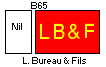
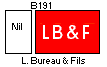
Lloyds 1904 and 1912 give a red flag with white “LB&F”.
The sailing-ship records use L. Bureau & fils for Léon Bureau in 1904–14, Léon Bureau et fils for Duchess Anne in 1891–1901 and Dugesclin in 1894–1905, and Bureau & fils for several Saint ships from 1899. Another account dates formation to 1897 and considers closure after the First World War very probable. Family links with Bureau Frères et Baillargeau are suggested, not established.
France, Nantes.
LOUIS BUREAU ET FILS.
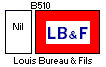
Les Derniers Grand Voiliers shows black letters.
The separate Louis Bureau et Fils section dates Messieurs Louis Bureau & Fils to 1897 in Nantes. Grands Voiliers Français records Louis Bureau & fils for Beaumanoir in 1899–1911. Ivan Sache considers post-war closure very probable and a family connection with Bureau Frères et Baillergeau likely.
France, Nantes.
L. BUT.
Panta Rhei has an exhaust rather than a funnel; these markings were on the rear superstructure. B1030 is recorded in July 2009 and remains visible in a photograph of 1 April 2010. A photograph of 6 December 2010 instead shows the B1031 cartoon character, removed between 12 September 2012 and 9 July 2013. A Zeeland-flag panel is recorded throughout. The source also cites a photograph dated 2 May 2007 showing Zeeland and Wagenborg flags flying, a date earlier than the stated 2009 construction.
L. But built Panta Rhei in 2009 and is listed under Wagenborg Shipping B.V. management in 2011–12.
Netherlands, Flushing.
L. FIGUEIREDO NAVEGAÇÂO S.A.
image contributed by Josef Nüsse, None
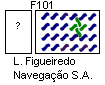
Nüsse’s table flag has 22 slightly curved blue daubs, angled “Pbds”, in horizontal rows of 6, 4, 6 and 6. A break near the fly in the second row contains four green daubs arranged as a wheel.
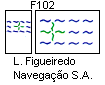
This version has slightly curved blue daubs angled horizontally in rows of 4, 2 and 4. A space at the hoist in the second row contains four green daubs arranged as a cross.
The company changed its name to Frota Amazonica S.A. in 1976. Until the early 1970s its vessel names began with Santa or Sâo.
Brazil, Rio de Janeiro, Sao Paulo and Para, as recorded in different sources.
L. GILL-JOHANNESSEN A/S.
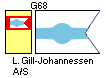
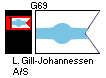
The flag is a white swallowtail with a narrow blue horizontal band and an otherwise undefined blue circle over the band. Most sources centre the circle; Brown 1978 moves it towards the hoist. Brown 1958 calls the blue pale Cambridge blue, broadly consistent with Nüsse’s image, though perhaps a little darker. Funnels are either black or yellow/buff, with a red band bearing the flag. Loughran alone shows the flag fluttering; Loughran and Brown 1951 and 1958 show a pole, while the others use a panel.
Stewart 1963 and Brown 1978 document the second, yellow or buff funnel version.
Established in 1915 as L. Gill-Johannessen, the concern became L. Gill-Johannessen & Co. in 1957 and L. Gill-Johannessen A/S in 1987. It operated through named subsidiaries, participated in Anco Shipping, and jointly formed V. Ships Norway with V. Ships Group in 1989.
Norway, Oslo.
Preserve the original prose, but do not illustrate or link it to the withheld GIF(s): G88. Source reference codes do not establish an image association.
L. HARBOE JENSEN & CO.
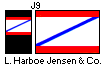
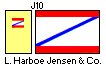
The later black funnel retained the red-edged white band but added a narrow blue diagonal, recorded as “Pbds”. The corresponding white flag has red borders at top and bottom and the same narrow blue diagonal.
A buff funnel followed, presumably, carrying the later flag as a panel. J10 omits the black top, while Brown’s source-only J7 includes it. Rosanoski questions whether this is an illustrator’s variation or a distinction connected with trades such as Gulftrade.
The early livery combined a black funnel with a white band broadly edged red and a red flag with a broad white horizontal band.
A/S Gulftrade is recorded as a subsidiary.
Norway.
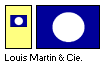
L. MARTIN & CIE.
The yellow funnel carries a band of the blue flag with its white circle.
The alternative yellow funnel carries the flag as a panel rather than a band.
Recorded as Louis Martin S.a.r.l. and fleet manager in the 1939 account, L. Martin later also appears as owner. Managed concerns included Armement L. Martin–C.F.C.N., Armement Nicolardot, Compagnie Franco-Camerounaise de Navigation and Compagnie Franco-Coloniale de Navigation. The company was amalgamated into SCAC Delmas Vieljeux in 1991.
France, Paris.
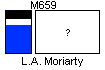
L.A. MORIARTY.
The funnel follows The Log, May 1997, illustration 77(10).
L.A. Moriarty briefly operated a New Zealand-based service in 1967–68 with Captain Athol Rusden, apparently using Colorado Del Mar. New Zealand Marine News instead records the purchase of Holmlea and renaming as Mark Rusmor, while Miramar gives Wallisian under their joint ownership and a wreck on 8 May 1967. Rosanoski could not establish whether one or two ships were involved.
Vanuatu, Port Vila.
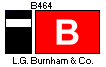
L.G. BURNHAM & CO.
USA, Boston.
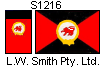
L.W. SMITH PTY. LTD.
The flag has diagonal quarters of black and red, with a white circle within a yellow rope tied in a reef knot. The circle bears what appears to be Tasmania’s red lion.
The wool-scouring firm, described as the Southern Hemisphere’s largest, planned a ship in 1940 but wartime delay postponed delivery of Merino until 1949. After brief wool-trade service, its only vessel moved into general cargo under F.H. Stephens’s management until 1963, then was chartered out before sale in 1969.
Australia, Launceston.
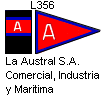
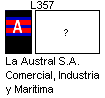
LA AUSTRAL S.A. COMERCIAL, INDUSTRIA Y MARITIMA.
The flag is a red pennant with a narrow blue border and a white A with a square top.
L357 is retained from US Navy 1961.
La Austral was formed on 7 December 1943 to trade between Argentine, Brazil and Chile. Rosanoski describes it as lasting until the beginning of the 1960s.
Argentine, Buenos Aires.
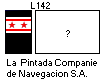
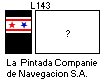
LA PINTADA COMPANIA DE NAVEGACION S.A.
La Pintada in January 1966 had a black funnel with a broad white band, two very narrow red stripes towards its edges, and two red stars side by side between them.
The Seattle report gives a red star point-up and a blue star point-down between the stripes, with the blue aft on the observed starboard side. Another report suggests multipointed stars, possibly eight-pointed, but Rosanoski considers the later letter to clarify the situation. No flag was noted.
La Pintada appears in Lloyds from 1963–64 to 1978–79, with Carlo Cameli and later E. Ciurlo & Co. as agents.
Italy, Genoa.
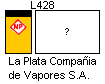
LA PLATA COMPAÑIA DE VAPORES S.A.
The funnel’s NP letters presumably refer to Pateras.
La Plata acquired Pontoporos in 1949. It appears under the London agency of N. J. Pateras & Sons in the 1950s registers, later listed only at that UK address.
Panama.
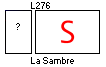
LA SAMBRE.
image by Ivan Sache, 24 November 2003
The FOTW flag is based on a 1914 bearer bond reproduced by the Scriptophily website.
The company was named after the Sambre and probably did not survive the First World War. Societe Anonyme Belge de Navigation Interieure is given as an alias, though Rosanoski questions whether it merely describes the business.
Belgium, Antwerp.
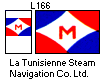
LA TUNISIENNE STEAM NAVIGATION CO. LTD.
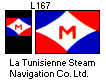
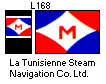
The flag has blue and red quarters and a white, concave-sided diamond bearing a red M. L166 shows the flag as a broad band on a white funnel; Rosanoski considers the white a probable printing error, stating that the funnel was never white.
L167 shows a black funnel with the flag reversed, apparently omitting the white edging to the band.
L168 adds the white edging above and below the band and appears to be the correct version. The WSS history describes a square containing a white lozenge with a red M and alternate red and blue triangular corners. Rosanoski notes that a square would imply a panel or a very narrow funnel.
La Tunisienne was formed in 1910 and belonged to Frank C. Strick & Co. The 1939 account calls it La Tunisienne Steamship Co. Ltd.
UK, London.
La Veloce Navigazione Italiana à Vapore.
LA VELOCE NAVIGAZIONE ITALIANA À VAPORE.
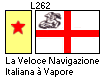
L262 covers 1884–1922. The canton emblem appears to be St. George and double-sided.
M. Bruzzi & Co.
B511 is the funnel used by M. Bruzzi in 1883.
The company traced its origins to Giovanni Lavarello in 1865. M. Bruzzi & Co. took over in 1883 and formed La Veloce Linea di Navigazione à Vapore in 1884, absorbing Fratelli Lavarell, the founder’s sons, in 1891. German banks acquired shares from 1889 and controlled the business by 1899. Italian banks and Navigazione Generale Italiana began buying them out in 1900; by 1901 the latter controlled the company, whose official name became La Veloce Navigazione Italiana à Vapore. It was liquidated and absorbed into Navigazione Generale Italiana in 1924.
Italy, Genoa.
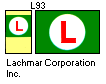
LACHMAR CORPORATION INC.
The funnel is yellow or buff with a very broad band of the flag: green with a large white circle bearing a red L.
Lachmar was formed in 1980 and belonged to Panhandle Eastern Corporation. Ahrenkiel Ship Management (U.S.) Inc. appears as fleet manager in March 1998, followed by Denholm Ship Management Ltd. in July 2000.
USA, Lake Charles, LA.
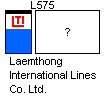
LAEMTHONG INTERNATIONAL LINES CO. LTD.
L575 comes from a starboard photograph of Laemthong Pride dated 4 May 2011.
Laemthong was formed in 1995. That year it also formed Thai International Tankers Co. Ltd. as a joint venture with Thai Petrochemical Industry plc; later registers list vessels under both names.
Thailand, Bangkok.
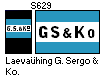
LAEVAÜHING G. SERGO & KO.
The funnel references show equal bands, unlike the cap-badge flag, and slightly different lettering. Ships & The Sea 1942 specifies light blue.
Estonia, Tallin.
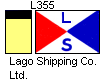
LAGO SHIPPING CO. LTD.
L355 is retained from Loughran’s funnel and flag illustration and the 1942 and 1944 Merchant Ships funnel entries.
Lago Oil & Transport was registered in Canada in 1924, with ships in Lago Shipping’s name managed by Andrew Weir. The operation carried Lake Maracaibo crude to ocean-going tankers through Aruba’s San Nicolas terminal, officially opened in November 1927. Rosanoski’s second account describes Lago Petroleum and British Mexican Petroleum jointly organising Lago Oil & Transport in 1924, and Pan American obtaining control of Lago and its affiliates in 1926.
In 1932 Standard Oil of New Jersey acquired Lago Petroleum from Standard Oil of Indiana and also acquired Lago Shipping’s fleet, most of which remained under Andrew Weir. Lago Petroleum, the producing concern, must be distinguished from the similarly named British shipping business. Creole disposed of its lake tankers in 1932 so that Lago Shipping could carry the crude of both Standard Oil affiliates. Management passed to Anglo-American Oil in 1937.
Most Standard Oil interests in Venezuela were consolidated into Creole Petroleum in 1943. After the war the fleet was gradually disposed of by 1954, although the cited fleet lists still show Lago Shipping as owner in 1947 and Lago Oil & Transport in 1954. Merchant Ships 1942 lists British Mexican Petroleum as operator. Rosanoski also records the associations with Anglo-American Oil and Standard Oil of New Jersey.
Dutch West Indies, Aruba; UK, London.
Lagoven S.A.
Documentary material — company attribution not established
image by Jarig Bakker, 14 September 2005
image by Eugene Ipavec, 16 December 2009
The Nüsse flag, L92, shows the panel more clearly and is probably the earlier version. Rosanoski presumes that Brown’s stylised logo version, L4, replaced it, but does not know when. The red shade was taken from the website image. Dov Gutterman’s 2001 FOTW reference points to Nüsse; a later image is credited to Eugene Ipavec, and Jarig Bakker’s L4 follows Brown 1995.
Mitchell’s L402 funnel appears to be based on Lagoven Guanoco, for which the collection includes a line drawing.
Rosanoski doubted that Lagoven or the associated Maraven did much flag flying. He considered PDV Marina more likely to do so, but had found only its funnel design, not a flag.
Lagoven was created in January 1976 to take over Exxon’s nationalised local assets, although Lloyds gives a formation date of 1943. It absorbed Amoven and its former Amoco assets in 1978. Rosanoski distinguishes the 1992 transfer of Lagoven’s tankers and tugs to the newly formed PDV Marina from the Mitchell collection’s account of a name change. Lagoven remained a Petróleos de Venezuela subsidiary with pontoons and offshore crew and supply vessels.
Venezuela, Caracas.
LAGUNA NAVIGATION INC.
Philippine Sampaguita’s funnel was noted in April 1967. It is blue with a black top and a white diamond containing a red L enclosing smaller red N and i, both of the same size. No flag was noted.
Laguna Navigation is recorded in Lloyds 1970–71 and 1978–79.
Philippines, Pasay City.
LAIRD LINE LTD.
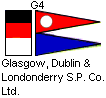
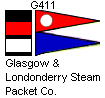
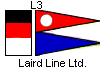
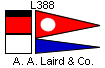
The colours continued through the succession. Griffin’s L3, attributed to A.A. Laird, has a narrower black funnel top and, like Loughran, a narrower lower blue pennant, as in L388. Other sources give the two pennants equal sizes. Lloyds and Reed 1912 also show L3 for the Ayr company. Wotherspoon documents A.A. Laird’s livery.
G411 is retained from Lloyds 1882; G4 from LJC 1885 and Loughran.
Laird Line traced its beginnings to a partnership managed by Lewis MacLellan in 1814 and the Glasgow & Londonderry S.P. Co., founded in 1835. T. Cameron & Co. were agents from 1827, succeeded by Alexander Laird in 1867. Laird’s family had earlier shipping interests: his father was the St. George S.P. Co.’s Greenock agent from 1822, and in 1853 Laird acquired McConnell & Laird, successors to Kemp & Co. of Fleetwood. The Glasgow & Dublin Screw S.P. Co., founded in 1853, was acquired in 1858; after McConnell’s death the business became A.A. Laird & Co.
The Laird and Cameron interests merged in 1867 and were consolidated as the Glasgow, Dublin & Londonderry S.P. Co. in 1885, managed by Alexander A. Laird. Laird Line was the popular name by 1892 and became official in January 1907. The Ayr Steam Shipping Co. came under control in 1908 but was not fully integrated until 1921. In 1922 Laird merged with G. & J. Burns as Burns & Laird Lines, under Coast Lines control.
UK, Glasgow.
LAIVA O/Y.
L238 is recorded by the Collectors Corner website.
Finland, Helsinki.
LAKE MICHIGAN CARFERRY SERVICE INC.
L520 comes from a portside photograph of Badger on 23 September 2012.
Lake Michigan Carferry Service was formed in 1991. Badger, described as Lake Michigan’s largest car ferry, entered service in 1953 and was laid up in November 1990 as the traditional car-ferry operation became uneconomic. In 1991 Charles Conrad revived the ship to carry leisure passengers and their vehicles.
USA, Ludington, MI.
LAKES NAVIGATION CO.
L426 is noted for Tanjil [II] during 1885–1928.
Lakes Navigation operated on the Gippsland Lakes and rivers and was eventually taken over by William Holyman & Sons.
Australia.
LAMBERT BROTHERS LTD.
Lambert Bros. Ltd.
image by Al Fisher, 29 Jan 1999
image by James Dignan, 8 October 2003
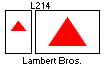
The shared livery was retained from Lambert, Barnett and used by companies under Lambert’s control; Merchant Ships also records earlier use by Commercial S.S. The flag is white with a red triangle pointing upwards. Funnels are black with the triangle on a white band. FOTW repeats the flag under Dornoch and Temple, but the illustrations differ in the triangle’s size and geometry. James Dignan’s Sampson-based version has a smaller triangle; Peter Hans van den Muijzenberg drew attention to the difference from Brown 1943.
L214 preserves Griffin’s 1895 version.
Lambert Brothers owned steamships from 1880 and also worked as brokers and coal exporters. Loughran gives an earlier name, Lambert, Barnett & Co., lasting until David P. Barnett left in the 1920s, but Rosanoski notes that Lloyds already used Lambert Brothers in 1904. The firm was Wallem’s London agent, formed Wallem Lambert Brothers in Hong Kong for insurance in 1946 and acquired a 25% Wallem holding in 1965. Hill, Samuel & Co. took over Lambert in 1968; in 1981 it became part of Wescol International Marine Services. Loughran also records an association with Scottish Ship Management shortly after that firm’s formation in 1968, with Lambert apparently continuing as agent.
Lambert controlled Eros S.S. during 1929–34 and operated for Dornoch Shipping, Middleton Steamship, Primrose Hill Steamship and Temple Steamship. Temple ships used Temple as the first word of their names; Dornoch used Coul as a prefix.
UK, London.
LAMNALCO LTD.
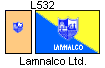
The flag is sourced to the company website.
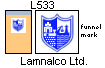
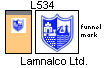
Rosanoski cites portside photographs of Lamnalco Eider and Lamnalco Heron on 24 November 2008, with Heron’s funnel top greyish blue, and a starboard view of Lamnalco Puma on 9 March 2006, whose funnel top looks dark grey. These observations use L352–L354 in the prose, while the source list uses L532–L534.
Lamnalco’s website dates its formation to 1963 to operate the Jebel Dhanna Oil Terminal for Abu Dhabi National Oil, with Royal Boskalis Westminster and Rezayat holding equal shares from the outset. Lloyds instead gives 1992 and names Koninklijke Boskalis Westminster and Aliriza Organisation as joint founders. Lamnalco Sharjah is separately dated to 1990. In 2012 the acquisition of SMIT Terminals and AHTS activities led to the Smit Lamnalco brand.
Sharjah, United Arab Emirates.
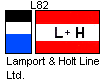
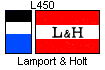
Lamport & Holt Line Ltd.
LAMPORT & HOLT LINE LTD.
image by Phil Nelson, 9 April 2000
Reed 1912 makes the ampersand equal in height to the letters.
L82 is confirmed by Churchill in 1988. Reed also attributes the livery to the Liverpool, Brazil and River Plate company, and Lloyds to the Belgian subsidiary. Vessel exchanges within the Blue Star group caused ships to appear in other markings; funnel colours were interchanged with Blue Star and Booth. Phil Nelson’s FOTW flag follows Stewart 1963.
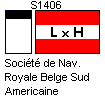
Société Anonyme de Navigation Royale Belge Sud-Americaine
The ampersand is said to represent the founders’ partnership. The black, white and blue funnel portions had proportions of 2:2:3. The company also used a stemjack with Liverpool’s arms on a white circle, a privilege granted in the 1930s by Lord Mayor Miss Beaver in recognition of work provided for Liverpool seamen during the Depression.
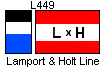
L449 is retained from LJC 1909, S1407 from Lloyds 1882 and S1406 from Griffin 1883.
William James Lamport and George Holt founded the business in 1845 and owned steamships from 1857. The Liverpool, Brazil and River Plate Steam Navigation Company was formed around 1865; early expansion included the Rathbone sailing fleet and Malcomson Line. A controlling interest passed to Sir Owen Philipps, Lord Kyslant, through Royal Mail in 1911, when the business became a public company. The source differs over whether its 1911 name included Line. Following the Kyslant collapse in 1930, a new Lamport & Holt Line was formed in 1934, ending the Liverpool, Brazil and River Plate name. A second account calls this the “1835 reconstruction”; that date is not reconciled.
Frederick Leyland acquired the entire stock in 1944, bringing Lamport & Holt into the Vestey group with Blue Star. Inter-company ship transfers and temporary renamings became frequent from 1947. The last ship, Churchill, passed to Blue Star as Argentina Star in 1991 and the Lamport & Holt name disappeared. Ships had names of artists, dramatists and composers. Earlier subsidiaries included Argentine Steam Lighter, founded in 1884 and sold to Albert Dodero in 1930, and the Belgian Société Anonyme de Nav. Royale Belge Sud-Americaine, founded in 1877, to which eight ships were transferred in 1878.
UK, Liverpool.
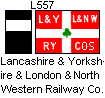
LANCASHIRE & YORKSHIRE AND LONDON & NORTH WESTERN RAILWAY CO.
The joint fleet adopted the earlier North Lancashire funnel in 1870, but widened its band to half the funnel diameter, retaining its position three-quarters of a diameter down.
Reed 1901 and 1912 omit the stops beneath the letters.
Reed 1912 attributes L557 to Lancashire & Yorkshire Railway.
L556 is retained from Lloyds 1904 and 1912.
The two railways established a joint Fleetwood–Belfast/Londonderry service under an Act of 1870. North Lancashire Steam Navigation, previously used as nominal owner, operated the service. The account dates ownership in the railway companies’ own right to 1874. On 1 January 1922 the undertaking became part of London & North Western Railway.
UK, Manchester and Fleetwood.
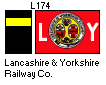
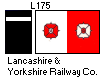
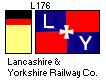
Lancashire & Yorkshire Railway Co.
LANCASHIRE & YORKSHIRE RAILWAY CO.
The Liverpool and Drogheda livery has a black funnel with a yellow band. Its red flag bears a badge with the legend LANCASHIRE & YORKSHIRE RAILWAY between white L and Y. Haws dates the added yellow funnel band to 1905, which Rosanoski notes conflicts with Lloyds 1904.
The Fleetwood livery has a black funnel with a narrow white band and a vertically divided white and red flag, each half bearing a counterchanged rose. It continued after the 1922 merger until London & North Western itself entered London, Midland & Scottish on 1 January 1923.
The Goole livery derives from Goole Steam Shipping: a yellow or buff funnel with a black top separated by a red band. The flag is quartered blue and red with a small white cross paty at the centre and white L and Y in the blue quarters.
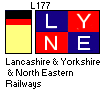
Lancashire & Yorkshire and North Eastern Railways joint service
L177 appears to represent a joint Hull–Zeebrugge service. It uses the third funnel type and a blue-and-red quartered flag with the white letters LYNE.
The railway was formed in 1847 by amalgamation. Restrictions on railway shipowning led it to work through North Lancashire Steam Navigation, in which it made a substantial investment. Joint services with London & North Western began in 1859; Parliament authorised shipowning and operation in 1870, and joint ownership followed in 1874, though North Lancashire continued to appear in the documents. The railway retained its identity until merging into London & North Western on 1 January 1922.
Four Drogheda Steam Packet ships were taken over for Liverpool–Belfast and Drogheda services, alongside the joint Fleetwood–Belfast route. Goole Steam Shipping was acquired on 1 January 1905 and effectively became manager after its ships transferred to railway ownership.
UK, Manchester; west-coast operations at Liverpool and east-coast operations at Goole.
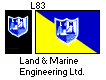
LAND & MARINE ENGINEERING LTD.
The funnel is black with the shield from the flag. The flag is a diagonal blue-and-yellow biband, its direction recorded as “Pbd”. The shield is divided vertically, essentially blue and white, with a land drilling rig in dexter and a sea drilling rig in sinister. L&M appears counterchanged in the chief.
Rosanoski considers this probably the Land & Marine Contractors listed in Lloyds 1963–64. Land & Marine Engineering also appears in the 1985–86 and 1992–93 registers.
UK, Bromborough.
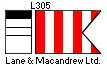
LANE & MACANDREW LTD.
In Lloyds 1904 the swallowtail cut takes the whole of the third red band.
L305 preserves the LJC 1909 version.
The livery, or a slight variation, is later shown for Davies & Newman.
Lane & Macandrew sold Petroleum Steamship Co. to British Tanker Co. in June 1917.
UK, London.
LANGELAND-KIEL LINIEN I/S.
image by Ivan Sache, 15 September 2002
image by Michael Wilson, None
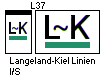
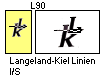
L90 is white with black L and K on either side of a short black line. Nüsse does not explain the second flag, but it fits a 1975 funnel description, suggesting that it was the original livery.
L37 appears to be the later flag, also shown by Brown 1995. Its shades follow the website image; Ivan Sache’s FOTW illustration follows Nüsse.
Langeland-Kiel Linien was formed in 1965 at Bagenkop on southern Langeland, across Kiel Bay from Kiel. G. Drøhse appears as operator in 1966–67. Registers describe ro-ro cargo and passenger ferry operations. The last vessel, Langeland III, was sold in 1998.
Denmark, Bagenkop.
LANGLEY BROS LTD.
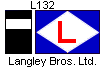
The Log shows a blue flag with a white diamond extending to the edges and bearing a red L.
Langley began trading in 1902. Accounts place North Coast Steam Navigation’s takeover in 1925 or 1925–26, while The Log records Langley Bros. S.S. Co. operating until 1927. The business also appears as Langley Bros. Steamship Co. and Langley Steamship Co.
Australia, Sydney.
LARRINAGA STEAMSHIP CO. LTD.
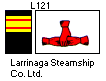
The white flag bears three red hands shaking. The design recalls the partners tossing a coin after the Suez Canal opened to decide between retaining sail and investing in steam, the coin favouring steam. The black funnel has yellow and red bands, with narrow red bands towards the edges, recalling the company’s Spanish origins. Several charts and photographs of Niceto de Larrinaga and Telesfora Larrinaga support these proportions; other sources make the bands equal.
The founder’s vessels were registered at Bilbao from 1773 and sailed under the Spanish flag. By the 1860s the business was based in Liverpool with three partners, remaining owned by the founder’s descendants. The last vessels were sold in 1974. Loughran describes absorption by Valiant S.S. of the Vergottis group, while a contemporary notice names Vergocean S.S. as the acquirer in November 1974. Early sources call it Larringa & Co.
UK, Liverpool.
LARSEN & TOUBRO LTD.
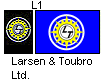
L1 has a compass star of sixteen points. Its core is outlined black and bears a black ring enclosing the black “LT” monogram.
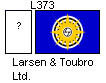
The photographed flag discussed with L373 differs in several ways: darker blue, a smaller ratio of about 5:8, a smaller outer ring with star tips projecting beyond it, a much smaller central “LT” disc, black rather than blue inner discs, and no outer black edging around the central disc. Nüsse’s old site also assigned the table flag to Irgens Larsen A/S, an attribution Rosanoski considered apparently incorrect because of the letters.
Mitchell’s L372 funnel is simplified, apparently because the illustration is too small for fine detail. Its centre nevertheless shows “LT”, consistent with the other versions.
The engineering business was founded in 1938 by Henning Holck-Larsen and Soren Kristian Toubro. It became Larsen & Toubro Pte. Ltd. on 7 February 1946 and a public company in December 1950. Rosanoski presumes that Lloyds’ 1982 formation date concerns shipping, which ceased around 2000 while the company continued. Reliance Industries appears first as a managed company and later as an operating company, but no financial link was found on either website; Larsen & Toubro may merely have operated its vessels.
India, Bombay/Mumbai.
LARSEN REEDEREI GMBH.
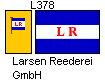
image by Klaus-Michael Schneider, 29 Mar 2009
Klaus-Michael Schneider’s FOTW flag follows Deutsche Reedereien und ihre Erkennungszeichen, second edition, Hamburg 1956, page 26.
Larsen built Harnis in 1953; the ship sank on 24 February 1975. The company also appears as K.R. Karl-Friedrich Larsen and Karl Friedrich Larsen, initially under Brink & Wolffel’s operation and later under its own name.
Germany, Flensburg.
LARSSONS SKEPPSMÄKLERI AKTIEBOLAG.
Mitchell instead places the funnel under Arne Larsson A/B of Göteborg, in connection with Atlantic Friend, formerly Atlanttbris, recorded operating in 1960. Arne Larsson’s account describes his departure from the family firm in 1954 after working there from 1938, followed by the growth of his shipbroking business. Rosanoski suggests a possible connection, through the funnel, with Rederiaktiebolaget Bris and its operator John Larsson; he does not establish it.
Larssons Skeppsmäkleri is recorded as a shipbroking concern in 1937–38.
Sweden, Stockholm.
Larvik Line A/S.
LARVIK LINE A/S.
Skipet shows L171 for Larvik Fredrikshavnfergen without a black funnel top. A photograph of Peter Wessel supplies funnel evidence, and Nüsse records a table flag.
K/S A/S Admiral Shipping
A700 is retained from the Mitchell collection.
Larvik Fredrikshavnferjen was formed in 1936. Lloyds records acquisition by Kloster Cruise in 1988 and reconstitution as Larvik Line, while another source dates the name change to 1986. Mitchell places it in the Vard Group. Color Line’s takeover is dated September or October 1996, with integration given as 1997; by 2000 Peter Wessel was in Color Line’s fleet.
Registers place the company under Scandi Line management in 1996–97 and as an operating company of B. Skaugen Shipping in 1998. Admiral Shipping Services is listed as a subsidiary, at Larvik or Oslo, later appearing as K/S A/S Admiral Shipping.
Norway, Oslo.
LARVIK SHIPPING A/S.
image by Ivan Sache, 1 December 2003
Ivan Sache’s FOTW flag follows the company website but uses a brighter blue.
John Tollevik founded Larvik Shipping in September 1988 for ship management, brokerage and gas-operation consultancy. Its management work included Hydrogas, later listed as Hydrogas Ship, within the Norsk Hydro context.
Norway, Larvik.
LAS MINAS COMPANIA NAVIERA PANAMENA S.A.
Bill Black noted the funnel on Las Minas in October 1965 and associated it with the Cameli group. It is black with three narrow red bands separated by gaps of equal width. No flag was noted.
Las Minas appears in Lloyds 1963–64 and 1970–71 with Corner Banco as agent.
Switzerland.
LASCO SHIPPING CO.
The black funnel has a yellow band overlaid by a yellow circle outlined red and bearing a flowing black L. The white flag carries the same yellow circle, red border and black letter. Photographs of PacPrince on 17 December 1997 and PacSun on 11 November 1998 confirm the funnel.
Lasco was formed in 1963. Subsidiaries included Pacific Coast Shipping, also formed in 1963, and Trans-Pacific Shipping, formed in 1966, for which Lasco acted as agent. It also managed one vessel for Burma Navigation. Following acquisition on 2 December 2003, it became Clipper Bulk (Portland), within Clipper Group (Management).
USA, Portland, OR.
LASER LINES A/B.
image by Jarig Bakker, 8 October 2005
Jarig Bakker’s FOTW flag follows Brown 1995.
L563 is Nüsse’s table flag.
Laser Lines was formed as a joint venture of Finncarriers, Axel Axelson Johnson and Wilh. Wilhelmsen, reported in 1986. Johnson, holding 70%, bought out its partners in 1989. Sources date the subsequent sale to Hamburg Süd to 1990 or 1991. Broströms appears as manager in 1992–93.
Sweden, Stockholm.
LASKARIDIS SHIPPING CO. LTD.
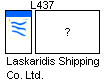
Mitchell labels L437 the “official funnel” lower down his card and uses it in drawings of five Frio-named ships. Rosanoski assumes that its three batons match L438.
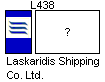
L438 is retained as a photographic funnel source.
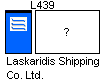
L439 apparently represents an alternative, photographed on Frio Marathon on 11 April 2006.
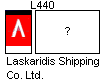
Mitchell’s initial funnel, L440, uses the Greek lambda, linking it to the company, and may have been worn by Frio Agean and Frio Antarctic.
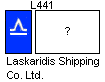
L441 also uses lambda and may relate to Mitchell’s Frio Adriatic drawing.
The source’s Frio Kyknos photograph, dated 2 February 2006, is labelled L348 in the prose, rather than L438. This number is retained as documentary context without a new assignment.
Mitchell’s P550 belongs to Pacific Express, a managed bulk/oil carrier outside the normal reefer operation. Rosanoski does not assume it to be a Laskaridis funnel.
Laskaridis Shipping is the ship-management arm of Lavinia Corporation, run by the Laskaridis family. Sources give formation as 1969 or 1977, with Lavinia formed in 1978; the account also describes establishment in Greece from 1977 and incorporation in Liberia without a complete date. Thanassis and Panos Laskaridis developed a major refrigerated-shipping business, managing both owned and chartered tonnage.
The fleet focused on high-seas reefer transhipments, loading in the South Atlantic and Falklands, Far East Russia and Sea of Ochotsk, and the Pacific and Indian oceans. A 2013 account notes refrigerated voyages along the Northern Sea Route. Laskaridis participated in Alpha Reefer Transport, chartering through FSC Frigoship, with Lavinia as a cargo provider. Related interests included Lavinia Shipping, formed in 2004, and Rigas Transporta Flote, in which Lavinia became the main shareholder.
Greece, Piraeus; later Athens.
Latsis Group.
LATSIS GROUP.
image by Jarig Bakker, 25 December 2005
L146 was noted on Gregory, a managed-company vessel. Brown assigns it to John S. Latsis (London), while Mitchell gives it under both John S. Latsis and Bilinder. Jarig Bakker’s FOTW flag follows Brown 1995.
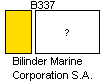
B337 comes from Hellas Serenity at Wellington on 20 March 2001, owned by an agency company under CMM.
C1022 is supported by Hellas Glory at Sydney on 6 July 2008 and Hellas Progress on 5 January 2014. A further Hellas Symphony photograph names Latsco London as ship manager and CMM as ISM manager. Rosanoski considers the funnel applicable to both, but more appropriately Latsco because its website displays the logo.
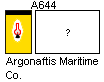
A644 is photographed on Alexander 5.
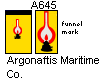
A645 is photographed on Ifestos I on 1 July 2007 and Alexander 1 on 15 September 2006; the latter flies the N.E. Vernicos flag.
S1809 comes from King Philippos on 25 June 2013. Contributors also reported the logo on King Gregory, Lady Malou and Lady Henrietta. An initial suggestion of Star Ships was followed by confirmation from CMM’s newbuilding details: Hyundai hull 2472 was King Philippos, registered to Breakers Holdings, treated as the vessel’s name company.
Yiannis, or John S., Latsis bought his first freighter in 1938 and had a fleet by the 1960s. He diversified into construction, oil and later banking, while retaining a small tanker fleet. Son Spiro ran the group from 1999; John died on 17 April 2003. Lloyds dates John S. Latsis S.A. to 1949 and its change to Bilinder Marine Corporation to 1983.
The Consolidated Marine Management account instead dates the technical manager’s Bilinder name to 1982 and its change to CMM to 1997. CMM managed for Latsco London, Star Ships and Hellenic Light Shipping. Latsco (London), established in 2006, operated product carriers and very large liquefied petroleum gas carriers.
Maritime & Commercial Co. Argonaftis, formed in 1977, operated tugs in conjunction with N.E. Vernicos Salvage & Towage and later appears as Argonaftis Maritime. Adrian Shipping & Trading was probably a subsidiary under Latsis/Bilinder control, but Rosanoski treats it separately because it apparently had a different funnel.
Greece, Athens; later Piraeus.
LATVIAN STATE SHIPPING BOARD.
The flag is the Latvian national and merchant flag: dark crimson with a narrow white horizontal band. The yellow or buff funnel carries a band of the flag. Brown draws equal stripes on the funnel, but Rosanoski considers proportions matching the flag more likely.
Latvia, Riga.
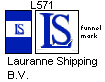
LAURANNE SHIPPING B.V.
L571 is supported by port and starboard photographs of LS Eva. LS Jamie carried a logo panel on its superstructure on 31 July 2013. Some vessels appear to be chartered out, with the full logo retained on a superstructure panel.
The company website dates establishment as a vessel manager to 1996; Lloyds gives 1997.
Netherlands, Sas van Gent.
LAUREL NAVIGATION CO.
Laurel was noted in 1965 with a black funnel. No flag was recorded.
Laurel Navigation appears in Lloyds 1966–67.
Bahamas, Nassau.
Laurel Sea Transport Ltd.
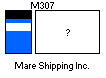
Mare Shipping Inc. / Prestige observed livery
M307 comes from the Dominion Post photograph of Prestige sinking in November 2002. It differs from the funnel photographed on 21 August 2002 and published in Marine News, which appears to show the owner Mare Shipping’s colours.
Laurel Sea Transport was formed in 1951. Earlier registers list it as manager and later accounts as agent, including for Mare Shipping, formed in 1994.
Greece, Piraeus; later Athens.
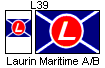
LAURIN MARITIME.
image by Ivan Sache, None
The website flag and funnel photograph support the livery. Corrido’s starboard funnel on 6 June 2013 appears a little lighter blue; Cavatina provides a portside view. Ivan Sache’s FOTW flag, from Dov Gutterman’s contribution, also uses a lighter, brighter blue. A photograph of Tintomara confirms the flag in use, though almost entirely obscured.
Agneta and Hans Laurin founded the business in Sweden in 1980, taking delivery of its first two tankers in 1982. The family-controlled group operated chiefly from the US Gulf to the eastern coasts of North and South America and to Europe. Laurin Maritime A/B is dated to 1982 and Laurin Maritime (America) to 1995; the latter is listed as a subsidiary of the UK company.
Swedish ownership syndicates and companies created by the Laurins in the early 1980s were streamlined during the 1990s into Anglo-Atlantic Steamship, with individual ship subsidiaries. Laurin Maritime continued as commercial and technical manager. Lloyds instead places the ship companies under Laurin Maritime (America).
Founded in Sweden, with group companies in Gothenburg, Houston, Singapore, Quezon City and London.
Lauritz Kloster.
LAURITZ KLOSTER.
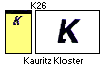
K26 has a buff funnel with a black top and combined black KL letters set at an angle, with the source notation Pbds. Its white flag also has angled black KL letters.
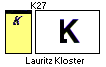
K27 follows Stewart 1963, pairing the first funnel form with a white flag carrying the unangled combined KL.
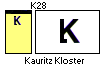
K28 uses a white funnel with black top and combined black KL, together with the unangled flag.
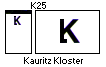
K25 uses a buff funnel with black top and unangled combined black KL; Brown 1982 assigns this livery to cargo vessels.
Lloyds 1963–64 and 1970–71 describes Lauritz Kloster as manager for Klosters Rederi. The March 1998 account instead says Lauritz Kloster became Klosters Rederi in 1983, which Rosanoski finds inconsistent with the earlier owner–manager distinction.
Norway, Oslo.
KLOSTERS REDERI A/B.
Norway.
KLOSTER CRUISE A/S.
Probably Norway; not clear in the original.
Later group companies
The later account says Klosters Rederi merged with Kloster Cruise in 1987 as Vard, renamed NCL Holding early in 1996. It also describes another Klosters Rederi becoming Norwegian Caribbean Lines in 1984 and Kloster Cruise in 1986. Norwegian Caribbean acquired Royal Viking in 1984, and Larvik Fredrikshavnferjen is recorded as acquired in 1988. Rosanoski explicitly leaves the repeated Klosters Rederi identities unresolved.
Keep the explicit scope label independent; no alias or company identity is inferred.
Mitchell associates Kloster Rederi with his Norman International card without further explanation.
LAURO & MONTELLA.
image by Jarig Bakker, 14 July 2004
Jarig Bakker’s FOTW flag follows Brown 1951, with the letters rendered as turned L–M–L.
Lauro & Montella, also recorded as Lauro (Cugini) & Montella, appears in registers from 1937–38 to 1958–59. Vessel names mainly began with S.
Italy, Naples.
LAVAR SHIPPING CO. LTD.
The earlier flag is quartered blue and white, with an overall white circle containing a blue L. The yellow or buff funnel has a black top and a band of this design.
The website shows a different blue flag with a blue L edged white, shadowed by a white L diagonally behind it. A narrow white border may merely define the image on the webpage rather than form part of the design.
Lavar was established in 1965 with entirely Cypriot capital, soon after the island introduced shipping legislation. Founder Pantelis Tsanos also helped establish Hanseatic Shipping with German shipowners; it initially operated from Lavar’s offices. Lavar expanded into foreign ship management, brokerage, agency, liner and feeder operations. From 1982, as Somat-Sofia’s general agent, it developed multimodal links between Cyprus, Europe and the Middle East. Rosanoski later notes that the firm did not appear still to own ships.
Cyprus, Limassol.
LAW, LESLIE & CO.
L379 is documented in Lloyds 1912 and The Log.
Law, Leslie originated from John Leslie & Co. of Glasgow, managers of Shaw Savill & Albion’s sailing vessels. Leslie had Hinemoa built in 1890; Law, Leslie is recorded acquiring it in 1905 and selling the steamer Lexington in 1924.
UK, London.
LAWSON STEAM TUG-BOAT CO. LTD.
A painting of William [2] in 1873 shows the black top occupying most of the funnel, whose ground is described as light ochre. The design continued until 1920 and under the successor, though earlier use is unknown. The business was known as the Black Diamond Line of Tugs; the diamond also appeared on paddle boxes from about 1900.
John Robert Lawson began the Lawson Tug Co. around 1840. The family partnership became a private company on 1 March 1895, under the recorded name Lawson Steam-boat Co. It converted to a public company on 28 January 1920 and became Lawson-Batey Tugs on 17 April, absorbing J. Batey & Son.
UK, South Shields and Newcastle.
LAWSON-BATEY TUGS LTD.
image by Jarig Bakker, 10 January 2006
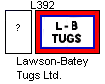
The company advertised as the Black Diamond & Blue Cross Line. Initially the tugs retained Lawson or Batey funnel colours. L392 is presumed to have been the flag from 1920 until after the Second World War; the source cautions that this flag is itself a presumption.
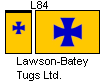
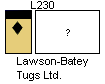
Uniformity came only after the war. Joffre in 1956 shows the disappearance of Lawson colours, while Quaysider’s 1955 delivery photograph is the first evidence of the L84 flag. Merchant Ships gives L230 as an alternative former-Lawson funnel and shows L84 without a black top. Photographs generally show no top or a very narrow one; Brown 1995 makes it deeper, while Mitchell omits it. The Maltese Cross history dates L84 after the war until 1958 and again under Tyne & Wear Tugs from 1986, with Tyne Tugs colours during the intervening charter period.
Lawson-Batey was formed on 17 April 1920 when Lawson Steam Tug-boat absorbed J. Batey & Son. It acquired a majority in the new Blyth Tug Co. in 1923, becoming sole owner by December 1976, and control of Ridley in 1945, completed in October 1958. It also participated in the 1933 purchase of Joseph Crosthwaite. Many tug names ended in sider.
Lawson-Batey and France, Fenwick Tyne & Wear formed Tyne Tugs from 1 January 1959 as an operating company, chartering some of their tugs rather than acting as a holding company. Lawson-Batey became sole owner on 5 May 1977. It registered as a public company in March 1982, then reverted to private status after Clyde Shipping acquired it in April 1983. Rosanoski deduces absorption into Cory Towage following Cory’s 1995 purchase of Clyde.
UK, Newcastle and South Shields; later South Shields.
Lawther, Latta & Co. Ltd.
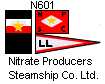
Nitrate Producers Steamship Co. Ltd.
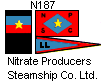
N187’s funnel bands and star adapt the Chilean flag. Reed and Talbot-Booth assign the whole Nitrate Producers livery to its managers.
Rosanoski considers Loughran’s N601 apparently a printing error.
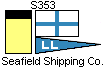
Seafield Shipping Co. Ltd.
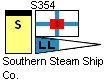
Southern Steam Ship Co. Ltd.
Each company flew its own flag above a different manager’s pennant. The colours are said to be those of nitrate magnate Colonel J.T. North’s racing stable. Sources vary in flag size and blue shade; Talbot-Booth specifies light blue, which Rosanoski assumes for the other flags and pennants. The pennants were probably longer than these illustrations suggest. The prose cross-references L132, L312, L133 and L134, retained without new image assignments.
S353 and S354 preserve the further liveries documented in Lloyds, Loughran and The Log.
John Latta and R.A. Lawther formed their shipbroking partnership in 1892. Latta established Nitrate Producers Steamship in 1895, followed by Seafield and Southern Steam Shipping, uniting the three fleets under Nitrate Producers in 1907. The firm became limited in 1921. After Latta decided to retire in 1942, ships were sold and the company wound up in 1943.
The subsidiary accounts are not wholly consistent: Nitrate Producers is also described as wound up in 1942, with an earlier account giving the last ship sale as 1948 before amendment to 1943. Its fleet passed to Reardon Smith. Seafield is recorded operating during 1898–1912 and Southern during 1897–1912.
UK, London.
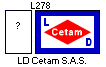
LD CETAM S.A.S.
image by Ivan Sache, 14 December 2003
The flag derives from LDA’s house flag. Ivan Sache’s FOTW image follows the company website.
LD Cetam was a short-sea ro-ro joint venture between Louis Dreyfus Armateurs, Hual Oslo of the Leif Hoegh group, and CSA SARL, representing key LD Cetam employees. After LDA bought its partner’s shares, the company became Louis Dreyfus Lines S.A.S. on 1 August 2004.
France, Paris.
LEANDER TANKER CORPORATION.
Maria Isabella’s funnel, noted in October 1965, resembles Niarchos’s. Rosanoski suggests that the agency relationship might indicate a subsidiary, although the ship names do not follow Niarchos’s usual pattern.
Leander appears in registers from 1966–67 to 1980–81. Its agents were Niarchos (London), later International Operations and International Maritime Agencies within the Niarchos group.
UK, London; later Greece, Athens and Piraeus.
LEANDROS SHIPPING CO. S.A.
image by Jarig Bakker, 6 September 2005
Leandros used Diamantis Pateras’s flag, but Nüsse’s table flag has a diamond wholly within the field and the bottom of P angled parallel to its side. Rosanoski found no evidence of this table flag being used in another capacity. Mitchell sometimes places the funnel cross inside the diamond, without identifying the vessels.
Brown gives the Pateras livery under Leandros, and Jarig Bakker’s FOTW flag follows it. Rosanoski suggests the principal flag might also have an angled P. He doubts a separate Caltex-style version on FOTW, having found no corroboration, while allowing that it might belong to another branch of the large family.
The Pateras account dates Leandros to 1969 as the group’s new shipping headquarters and manager; Lloyds gives 1972. Its management role later passed to Kyvernitis Shipping.
UK, London; later Greece, Piraeus.
LEDUMA COMPAÑIA MARITIMA S.A.
Bill Black noted Costaflora’s funnel in July and December 1967 and associated it with Lentoudis Brothers. It is yellow or buff with a black top, a large dark-blue L superimposed on a smaller, lighter-blue B, both angled “Pbds”. No flag was noted.
Leduma appears in the 1970–71 and 1978–79 registers, with Glentmar as agent in the latter.
Greece, Piraeus.
LEECHO STEAMSHIP CO. S.A.
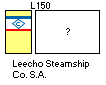
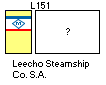
City of Victoria carried a yellow or buff funnel with a broad white band edged blue above and red below. A blue diamond frame touches both coloured edges and encloses a blue C.
Documentary images — company attribution uncertain
Company allocation unproved; image matches original L151 despite textual L152 typo.
The second version encloses M instead of C and was noted on Phoenician Star in August 1966, although Lloyds did not list that vessel under Leecho’s ownership. The prose calls it L152, whereas the accepted second association is L151. No flag was noted.
Leecho appears in Lloyds 1963–64 and 1970–71, with Yong & Lee Timber Shipping as agent in the earlier register.
Hong Kong.
LEGA NAVALE ITALIANA.
image by Jarig Bakker, 11 July 2004
Jarig Bakker’s FOTW image follows the Anzio website.
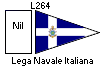
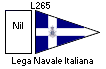
L265 is sourced to the cruise timetable and Lega Navale websites.
Two badges are documented. The earlier bears MARE NOSTRUM on its annulet; the FOTW account describes a crowned anchor, star, fasces, ornamental L and a band with that legend. LEGA NAVALE ITALIANA subsequently replaces the inscription. The sources also include an alternative badge and a flag from a 1938 poster.
Lega Navale Italiana was formed in 1897. Before the Second World War it appears to have helped organise cruises, being named with Lloyd Triestino for Giulio Ceasare’s 1933 cruise.
Italy, Rome from 1903.
LEIF ERICHSEN’S REDERI A/S.
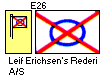
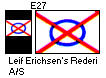
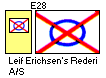
The flag is white with a red saltire over a blue horizontal oval ring. Brown 1978 instead makes the ring circular on the flag while retaining an oval on the funnel flag. Loughran suggests an original black funnel with a white band.
The funnel is black with a broad band displaying the flag.
This version has a buff funnel with the flag as a panel.
The buff funnel instead displays the flag flying from a pole.
Norway.
Leif Höegh & Co. Ltd.
LEIF HÖEGH & CO. LTD.
image by Jorge Candeias, None
image by Jarig Bakker, None
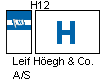
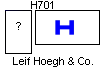
Rosanoski considers the FOTW H700 flag incorrect because the H is too close to the hoist and its crossbar is raised. Both letter and crossbar should be centred, as on Josef Nüsse’s flag and on Hual Trekker when sighted on 14 November 2003.
H701 follows a National Maritime Museum flag recorded as 939.8 × 1778 mm. Rosanoski notes that the displayed image does not match those dimensions, nor does its blue match the FOTW version.
The company website’s black-and-white photograph of Alexandra Höegh shows the H13 funnel. Hual Trident’s flag, sighted on 1 June 2012, confirms H13; Josef Nüsse also supplies a table-flag reference.
The white funnel band is interrupted by blue descending from the funnel top, with a white flag on a pole angled “Pbd”. Stewart shows the pole vertical; Brown 1951 and 1958 angle it backwards, while later Brown editions again show it erect. Loughran’s angle is correct but the band too narrow: it should equal the flag. Portside Hoegh Tracer and starboard Hoegh Trooper photographs confirm a mirrored arrangement with the flag pointing forward. These photographs show a darker bright blue; the illustration uses the website’s mid-blue, confirmed by Nüsse. Jordan’s white funnel with blue-white-blue bands near the top presumably represents this version. Mitchell omits the pole and uses the upright panel. NJK dates the funnel change to 1938.
H445 comes from a starboard photograph of Hoegh Gandria, owned in a joint venture with Mitsui OSK Lines. Its blue appears different, though lighting may account for this. The band positions are probably coincidental: Norman Lady, in another joint venture with the same company, had H12. Application of the flag to H445 is assumed in the source.
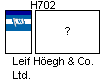
H702 comes from a portside photograph of Hoegh Oslo dated 9 September 2012.
Ace Transportation Co.
Mitchell gives A861 for Ace Transportation Co., based in Monrovia, Liberia, as a free-flag Höegh subsidiary in the car-carrying trade.
Höegh-Ugland Auto Liners / HUAL / Höegh Autoliners
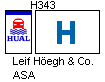
H343 is confirmed by Hual Trekker at Wellington on 14 November 2003 and Hual Tracer on 16 March 2005.
Mitchell does not identify the vessel or vessels using H446. H447 appears to relate to a drawing of Hual Trooper, later Hoegh Trooper.
A 26 January 2006 announcement described two ro-ro ships ordered jointly with Louis Dreyfus Armateurs for charter to Airbus. Their funnels combined the partners’ liveries; the illustration is documented separately under Louis Dreyfus.
Leif Höegh founded the business in 1927, with Atlantica as the first company; Loughran instead gives 1928. Earlier trading names also differ: Lloyds gives Leif Høegh until 1938, while Merchant Ships records Leif Höegh & P. Holm until March 1939. Per Holm remained associated with the group, managing Höegh Carrier, which carried the Höegh funnel.
Expansion included Société Navale de l’Ouest in 1970 and the Höegh-Ugland Auto Liners joint venture with Ugland in the same year. Höegh acquired HUAL outright in March 2000; it became Höegh Autoliners in 2005. The shipowning entities were merged for the December 1987 Oslo listing. Tanker and combined-carrier activities were separated as Bona Shipholding in 1992, linked in the account to US oil-pollution legislation. Cool Carriers was acquired in 1994, although another account describes a staged acquisition through the Avrista consortium completed by September 1996. It developed into the Safmarine joint venture Unicool in 1997, passed wholly to Höegh at the end of 1999, and was sold to J. Lauritzen effective 2001. Höegh also sold its Gorthon Lines holding in 2001.
Cousins Leif O. Höegh and Morten Höegh took the company private in 2003. In 2006 the group divided into Höegh Autoliners and Höegh LNG under the common holding company, with ship management by Höegh Fleet Service. The Autoliners account also records a 2004 combination with Kiwi Car Carriers. A.P. Möller-Maersk acquired 37.5 per cent of Höegh Autoliners in 2008, leaving Höegh the majority shareholder. Shipowning activities moved from Bermuda to Oslo that year following Norway’s new shipping-tax scheme.
Other interests included Aries Shipping with Bond Corporation, the consortium behind Europafaergen, LD Cetam, a ten per cent interest in Norwegian American Cruises from 1980, and the West African service consortium. Höegh participated in the Saga Forest Carriers Pool from May 2002 until 2010. It also managed Maritime Trading, formerly Compañia Maritima Escandinavia. Höegh was the characteristic first part of ship names, later joined by Hual.
Norway, Oslo.
LEMISSOLER SHIPPING GROUP PCL.
Forest Venture’s photograph on 24 March 2010 supplies the funnel, with another apparently showing the flag. Forest Costa Rica, renamed from Ingrid Gorthon in January 2012 after charter service, appeared with a plain blue funnel that October. Rosanoski presumes a return to L442 with the emblem not yet added.
Lemissoler’s formation was first recorded as 1997, later amended to 1996. It began shipowning with Lem Alpha in 1997 and became Lemissoler Shipping Group PCL in 2005. Philip Larkos was co-founder and chief executive; SFS Group was the majority owner. The management company’s dates and location vary between register accounts: 2000 or 1997, and Limassol or Hamburg.
Inter Marine Container Lines was formed in 1996, followed by Polish operations in 2001 and German and Kuwaiti companies in 2004. Baltic Container Line was acquired in September 2007. Lemissoler Maritime was formed with Venture Capital Bank on 5 March 2008. IMCL Holdings was sold to Unifeeder in 2009.
Cyprus, Limassol.
LEMOS & PATERAS LTD.
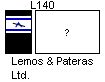
Kaptanpantelis, owned by the single-ship Compañia Naviera Somelga, was observed with L140’s mourning band. The vessel was wrecked on 4 June 1963.
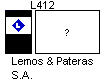
Mitchell places L412 at Chios, but its L rather than a Greek lambda indicates non-Greek-registered ships in Rosanoski’s account. Mitchell also gives L139 for Compañia Naviera Spalmatori vessels.
The Lemos and Pateras families formed the company in 1937, with Diamantis John Pateras represented by his son John. After Diamantis died in 1951, his six sons are said to have left to establish Diamantis Pateras Ltd. The concern owned vessels through Liberian and Panamanian companies, chiefly sailing under the Greek flag. Mitchell records winding-up after a Pateras death in March 1987, but does not identify which Pateras; Rosanoski questions this in light of the six brothers’ earlier departure.
UK, London.
Lemos.
LEMOS.
image by Jarig Bakker, 21 February 2006
image by Jarig Bakker, 15 January 2006
image by Jarig Bakker, 16 January 2006
This is a composite family document containing many distinct partnerships, branches and name companies. General family evidence does not establish every linked flag or subsidiary jurisdiction. Full image-by-image entity attribution remains necessary.
Family background and G. Lemos/Leon Lemos branch
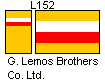
The Lemos family originated in Chios and had been involved in shipping since the eighteenth century. Christos M. Lemos became part-owner of a steamer in 1905. His sons George, Michael and Leon joined Pateras relatives to form Lemos & Pateras in London in 1937. The brothers bought the Liberty ship Hellas and established an American office in 1947; G. Lemos Brothers followed in London in 1948. Captain Leon formed Efploia in 1967, with his son-in-law Spyros Patitsas entering the business in 1968. A later family account adds that fifteen of seventeen ships were sold in 1980 before the market crash and Leon returned in 1985.
Keep the explicit scope label independent; no alias or company identity is inferred.
Costa Lemos context
Costa Lemos, known as “Goldfinger”, began after the Second World War with three Liberty ships. The account also records his sister Maria’s marriage to John Goulandris in 1942 and the Triton Shipping & Trading connection.
Keep the explicit scope label independent; no alias or company identity is inferred.
Atlas Maritime
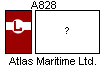
A828 is photographed on Atlas Explorer at Sydney on 15 November 2009. Atlas Valor shows a more ordinary red; the L is explained by the Lemos connection, with Valor Maritime as registered owner and Atlas Maritime as agent in the source, which queries whether owner is more appropriate.
Atlas Maritime Holding was formed in 2008 by L.C. Lemos and Efploia. Registers list Atlas Maritime Ltd., formed in 2007, as its operating company, later at Athens.
Keep the explicit scope label independent; no alias or company identity is inferred.
Blossom and Alert
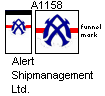
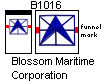
Blossom Maritime, formed in 1999 and trading as Geomar until 2000, is described as an offspring of G. Lemos Brothers, L.C. Lemos and Efploia, managed by Captain George P. Lemos. Alert Shipmanagement, registered in the Marshall Islands with executive offices in Greece, is described as an arm of the Christos P. Lemos group and appears as manager for Blossom.
Keep the explicit scope label independent; no alias or company identity is inferred.
C.M. Lemos and Nereus
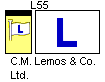
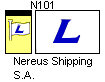
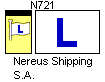
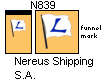
L55’s yellow funnel was also used by subsidiaries. Brown’s N721 repeats the C.M. Lemos version, whereas Nüsse’s N101 for Nereus has a slanting L. An unnamed observation, possibly Liryc in April 1966, supports the slanted letter. Marine News and Mitchell also incline the funnel flagstaff, recorded as “Pbd”.
C.M. Lemos, formed in 1950 and based in London, operated through Nereus Shipping of Piraeus, formed in 1967.
Keep the explicit scope label independent; no alias or company identity is inferred.
Other recorded family concerns
The registers distinguish G. Ch. Lemos and Lemos S.A. at Chios, P.A. Lemos & Associates in London, John Lemos & Sons in Piraeus, and the London concerns G. Lemos Brothers and Christos Lemos & Sons. These entries are retained as distinct identities rather than combined into a single company.
Keep the explicit scope label independent; no alias or company identity is inferred.
Diamantis Lemos and Diamlemos
Diamantis Lemos was formed in London in 1962. Its Piraeus operation appears as Diamlemos Shipping, which changed from Shipping Co. Ltd. to Shipping Corporation in 1986. Registers reverse which of the London and Piraeus parties is principal and representative; the contemporary website merely gives both addresses.
Keep the explicit scope label independent; no alias or company identity is inferred.
N.S. Lemos and Enesel
N.S. Lemos and Avra Shipmanagement were formed in 1984, in London and Piraeus respectively. Avra later became Enesel, possibly following absorption of Sealuck on 17 March 2003. Nikolas S. Lemos and his son Andonis are named as owners.
Keep the explicit scope label independent; no alias or company identity is inferred.
Lemos Brothers context
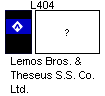
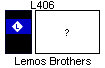
Mitchell places L406 at Monrovia, but Rosanoski considers this more likely the vessel registry and tentatively treats it as L404’s non-Greek-registry version for Lemos Brothers.
Keep the explicit scope label independent; no alias or company identity is inferred.
L60 observations
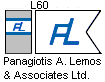
Oinoussai and Oinoussian Hope were noted in April 1967 with an extremely narrow black funnel top. Mitchell also gives a narrow top and upright letters. Jarig Bakker’s FOTW flag follows Brown 1995.
Keep the explicit scope label independent; no alias or company identity is inferred.
G. Ch. Lemos/G. Lemos Brothers
Hellas of G. Ch. Lemos wore its London agent G. Lemos Brothers’ colours in September 1965. Mitchell separately gives Apostolos Andreas a white funnel with a black top; its register and name details are not fully reconciled.
Keep the explicit scope label independent; no alias or company identity is inferred.
Diamlemos
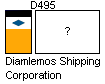
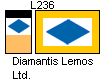
D495, photographed on Angelic Peace on 28 February 2008, is described as L236 under the Daimlemos Shipping Corporation name. The principal difference is diamond size. A 2012 view looks pinker or more orange-buff, apparently because of the camera. Jarig Bakker’s L236 flag follows Brown 1995.
Keep the explicit scope label independent; no alias or company identity is inferred.
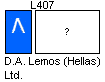
D.A. Lemos (Hellas)
Mitchell assigns L407 to D.A. Lemos (Hellas), Piraeus, with Nostos Athene, acquired in 1976 and broken up in 1978.
Keep the explicit scope label independent; no alias or company identity is inferred.
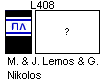
M. & J. Lemos & G. Nikolos
L408 is assigned to M. & J. Lemos & G. Nikolos, Piraeus. Rosanoski identifies Mitchell’s misnamed vessel as Maritsa P. Lemos, recorded during 1972–87.
Keep the explicit scope label independent; no alias or company identity is inferred.
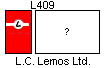
L.C. Lemos and Efploia
Mitchell gives L409 to L.C. Lemos, with Oinoussian-prefixed ships and an Efploia association. The slanted L is drawn black. This passage dates Efploia to 1969, differing from 1967 in the family history, and separately records a Marshall Islands operating company formed in 2000.
Keep the explicit scope label independent; no alias or company identity is inferred.
M.J. Lemos/Sampsa
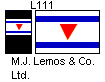
L111 was noted on Prodromos in April 1967 under Sampsa Compañia Naviera, for which M.J. Lemos was apparently London agent. Mitchell also shows a black funnel with two red bands beside a Prodomos entry that Rosanoski could not locate.
Keep the explicit scope label independent; no alias or company identity is inferred.
N.S. Lemos context
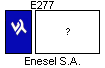
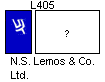
E277 is confirmed on Thalassini Avra and Antonis. Mitchell’s slightly different L405 indicates that the emblem belonged to N.S. Lemos. His Compañia Pacifica Financiera card also contains the Lemos & Pateras funnel, possibly for Maria P. Lemos, while other vessels have Thalassini-prefixed names.
Keep the explicit scope label independent; no alias or company identity is inferred.
Nereus
Ionic’s portside funnel on 21 January 2014 confirms the sloping staff; the L narrows towards the centre of its two limbs.
Keep the explicit scope label independent; no alias or company identity is inferred.
Joint-venture comparisons
T223 is recorded for ventures in which Lemos had an interest, such as Triton, possibly the Goulandris partnership formed around 1942. Mitchell also assigns it to Adamastos. T79 appears in US Navy’s Liberian section.
Keep the explicit scope label independent; no alias or company identity is inferred.
A1158 observations
Sea Resolute and Sea Urchin show the same funnel despite different registered owners and common managers, which Rosanoski takes as evidence of the manager’s livery.
Keep the explicit scope label independent; no alias or company identity is inferred.
Blossom context
C Harmony’s portside view on 17 May 2010 shows B1016. The delta star is definitely dark blue, but the panel frame and other lines may be a darker blue or black.
Keep the explicit scope label independent; no alias or company identity is inferred.
Additional recorded variants
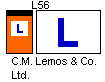
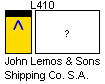
L410 is retained from Mitchell and L56 from Brown 1971; the source supplies no separate verbal design descriptions.
Keep the explicit scope label independent; no alias or company identity is inferred.
Greece and UK.
LEMURA SHIPPING.
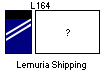
The funnel is blue with a black band and two very narrow white bands set diagonally “Pbds”, separated by an equal width of funnel and meeting the top aft. No flag was noted.
The source associates Lemura with Maritime Associates and its agency companies.
USA, New York, NY.
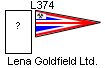
LENA GOLDFIELD LTD.
image by Victor Lomantsov, 02 Nov 2003
A 1926 shipping-authority decision confirmed the ships’ pennant. Victor Lomantsov describes it as resembling a quarter of the Union Jack, with a mallet and hammer crossed in the canton. His FOTW note questions whether the company was Soviet-British or British.
Lena Goldfield, also recorded as Лена - Гольдфильд Лимитед, operated during 1924–34. The account describes a British company investing in Soviet gold mining under agreement with the Russian government, followed by harassment and seizure of its property, apparently in 1930. In the 1933 Commons debate, Eden said bearer securities prevented a precise national breakdown but most stock was British-held. Williams challenged this with claims of German and Soviet holdings, while Davison stressed British incorporation. These competing statements remain part of the source context.
USSR.
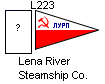
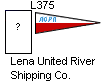
LENA UNITED RIVER SHIPPING CO.
image by Victor Lomantsov, 09 Sep 2000
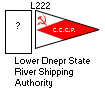
Victor Lomantsov’s L223 carries Cyrillic lettering rendered LURP. He saw it in 1970s magazines and believed it remained in use until the 1990s.
L375 has light-blue Cyrillic ЛОРП, transliterated LORP, from the Riverships website.
Also known as LORP and Ленское речное пароходство, the company appears to have changed its English name from Lena River Steamship to Lena United River Shipping. It carried passengers and cargo on the Lena and its tributaries, Yana, Indigirka and Kolyma, with Arctic river-sea services and operations also reported in the Far East, Black Sea and Mediterranean.
USSR; later Russia, Yakutsk.
LENNART KARLSSON.
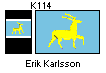
Erik Karlsson
The funnel is black with a broad blue band edged white above and below, bearing a yellow stag trippant towards the stern. The blue flag has a yellow stag trippant towards the fly. Brown 1978 reverses these directions, showing the stag forward on the funnel and towards the hoist on the flag, and indicates light blue.
Karlsson managed Rederi A/B Asta, described by Loughran as a subsidiary, and participated in the consortium forming United Owners Co., or United Lines. The registers use Lennart Karlsson; Loughran gives Erik Karlsson.
Finland, Mariehamn.
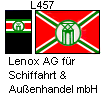
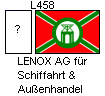
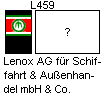
Lenox Aktiengesellschaft für Schiffahrt & Außenhandel mbH.
Documentary material — company attribution not established
image by Klaus-Michael Schneider, 16 Apr 2009
Fenton based L457 on I.G. Nichelson, a coaster frequently visiting the UK. A Hamburg correspondent suggested that its symbol might be a sand-funnel, perhaps indicating origins in the sand and gravel trade.
Schneider instead describes a green signal house on a white disc edged green. His version has wider green areas than L457 and the symbol’s top does not touch the ring, though both cite the same source.
Mitchell gives no source for L459. Its ring lies wholly on the red, unlike the other versions where it extends between the outer green stripes; Rosanoski considers smaller symbol differences attributable to scale.
Lenox began with Jan Keiken, built in 1953, and sold its last vessel, Papenburg, in 1974. Registers variously give Lenox A.G., Gesellschaft für Schiffahrt & Außenhandel mbH, and the latter with & Co.
Germany, Hamburg.
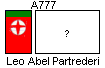
LEO ABEL PARTREDERI.
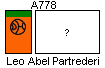
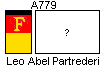
The source says that the funnels are not expressly assigned to vessels, but proposes associations from the designs: A777 with Star, built in 1965; A778 with Ditta Holmø, also built in 1965; and A779 with Finlandia, built in 1967. All three vessels appear in Lloyds 1973–4. These remain Rosanoski’s suggested identifications.
The first ship recorded for Leo Abel Partrederi is Ditta Holmø, built in 1965; the fleet was sold in 1991. Mitchell describes the company as manager and agent for individual shipowners. Rosanoski notes that two vessels listed as owned in Lloyds 1985–6 appear as managed in 1988–9, suggesting to him that the company was in fact the owner.
Denmark, Fredrikshavn.
Leo Adams Reederei.
Documentary images — company attribution uncertain
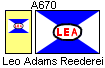
US Navy 1961 attributes the livery to LEA Schiffahrts GmbH. The FOTW flag is based on an auction photograph of a cream jug, with the oval ring in blue. Jan Mertens relates “Lea Shipping” to Leo Adams but asks whether LEA Schiffahrts GmbH and Leo Adams Reederei were distinct, related companies.
No verified legal identity boundary.
The register records LEA Schiffahrtsges mbH under the operators Ahrenkiel & Bene in 1953–4, and Leo Adams Reederei, also shown as Leo Adams Import-Export, in 1963–4. Leada was built for LEA in 1952 and is recorded as transferred to Ahrenkiel & Bene in 1961, although Lloyds shows them only as operators. The last ship was apparently Leanna, bought in 1965 and sold in 1972. Vessel names used the prefix “Lea”.
The Hamburg Chicago Line joint service with A. Kirsten and Sartori & Berger began on 15 April 1961, succeeding the Kirsten Lea Linie service of A. Kirsten and Leo Adams. A December 1966 account records the withdrawal of Lea Linie GmbH, a Leo Adams subsidiary, from Hamburg Chicago Linie while Leo Adams continued elsewhere.
Germany, Hamburg.
LEOND MARITIME INC.
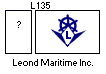
The white flag has a blue ship’s wheel, partly overlaid at the bottom by a white diamond outlined in blue and bearing a blue L. The diamond forms part of the head of an arrow-like object. No funnel is given.
The company was formed in 1973 as Leonkali Compania Naviera and changed name in 1985. It appears as ship manager and later agent.
Greece, Athens.
LEONHARDT & BLUMBERG.
image by Jorge Candeias, 22 Dec 2004
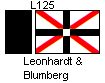
Lotte Leonhardt’s photograph confirms that L125’s funnel band extends all the way round.
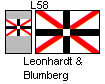
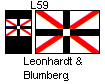
Luise Leonhardt’s photograph shows L59’s white rectangle, omitted from the accompanying verbal description. Hansa Regensburg and Hansa Riga confirm the funnel. Superstructure flag depictions vary: Hansa Riga shows a forward-leaning staff, Hansa Kristiansand an aft-leaning flag without a staff, and Hansa Commodore a forward-leaning flag and staff.
The flag is white, with a narrow red saltire beneath a black cross of the same width. A white square occupies their intersection, rather than revealing the red beneath. Nüsse supplies a table flag; Jorge Candeias’s FOTW account notes difficulty reading the original company caption.
The concern was formed as Leonhardt & Heeckt in 1899 and became Leonhardt & Blumberg in 1903. The account names Adolf Leonhardt and Arthur Blumberg as partners, with Leonhardt family management continuing after Adolf’s death in 1992 and Frank Leonhardt representing the third generation. Shipping resumed in 1952 after the war. Later operations included Leonhardt & Blumberg Reederei, whose formation is recorded first as 2004 and later as 1997, with Hansa Treuhand listed as an associate.
Germany, Hamburg.
Les Abeilles SAS.
LES ABEILLES SAS.
image by Ivan Sache, 10 June 2001
image by Ivan Sache, 20 February 2004
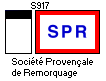
NOUVELLE SOCIÉTÉ PROVENÇALE DE REMORQUAGE.
S917 is documented by Lloyds 1912 and the later French livery sources.
Société Provençale originated at the end of the nineteenth century, dated 1899 by Pavillon. It helped form Venture-Weir in 1923 and Société Alegéro-Provençale de Remorquage in Algiers in 1930. A 1967 reorganisation into Progemar absorbed other towing businesses, with the parent becoming Nouvelle Société Provençale; the wider history gives Progemar’s formation as 1968. By 1996–97 the local concern was Les Abeilles Marseilles. A port-authority towing joint venture with Chambon is recorded in 1971.
France, Marseilles.
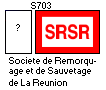
SOCIETE DE REMORQUAGE ET DE SAUVETAGE DE LA REUNION.
Documentary material — company attribution not established
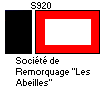
Societe de Remorquage Les Abeilles
Les Abeilles
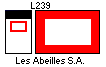
L239’s FOTW flag follows the company website and Hamon’s L’Abeille d’Ouessant. Abeille Gascogne’s photograph on 17 August 2005 confirms the funnel.
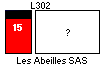
Abeille Risdan shows L302, which may represent a harbour-versus-seagoing tug difference.
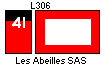
L306 comes from Adventureux in 2004, with the flag appearing as a superstructure panel. The different funnel treatment probably reflects its short funnel.
A new logo was adopted in 2002. Website use and Abeille Bourbon photographs suggest Bourbon’s logo was adopted for newbuildings; the photograph of 13 January 2006 confirms that adoption.
Les Abeilles originated at Le Havre in 1864. The later group emerged from consolidation of towage companies as Société Provencale de Gestion Maritime, or Progemar, in 1968, becoming G7 in 1990, G7 Les Abeilles in 1991 and Les Abeilles in 1996; the SAS form appears by 2003. It belonged to Groupe Bourbon. Acquisition by Grupo Boluda was announced on 1 October 2007.
France, Le Havre; later Marseillles, Clichy and Paris.
Keep the explicit scope label independent; no alias or company identity is inferred.
Société de Remorquage et de Sauvetage de la Reunion
The Réunion house flag is similar to that of Les Abeilles in European France, also within Bourbon.
The Réunion towage and salvage company, also called Soresauv, was based at Le Port and belonged to Bourbon Maritime. The parent group originated in 1948 from family businesses rebuilding Réunion’s sugar industry.
Reunion, Le Port.
Keep the explicit scope label independent; no alias or company identity is inferred.
Group operations
The operating network included Bordeaux, Boulogne, Brest, Calais, Dieppe, Dunkerque, La Rochelle, Le Havre, Marseilles, Nantes and St. Nazaire, often retaining former local-company identities before adopting Les Abeilles names. Overseas operations included Abidjan, Dakar, Port Gentil and Réunion. Other companies included Auxport and SRPAM, with Société Oceanienne de Remorquage et d’Assistance a joint venture whose partners differ between register accounts. Tugs commonly had Abeille followed by a number.
Keep the explicit scope label independent; no alias or company identity is inferred.
Les Abeilles International
Les Abeilles International, created in 1976, undertook salvage, deep-sea towage and underwater work. The source places it under Les Abeilles and describes the Compagnie Chambon/Bourbon relationship.
Keep the explicit scope label independent; no alias or company identity is inferred.
Earlier group liveries
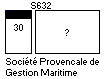
S632 bore the individual tug number; Mitchell assigns it to Les Abeilles.
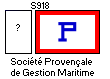
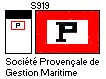
Ivan Sache’s S918 follows a stated Armements Marseillais source, but Rosanoski says Bois actually shows S919. Randier gives S919 a narrower flag border and records it under Progemar Les Abeilles International.
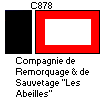
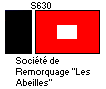
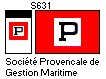
S630 is retained from Lloyds 1912 and the French company-flag website, C878 from La Marine Marchande Française and S631 from Brown 1995.
Keep the explicit scope label independent; no alias or company identity is inferred.
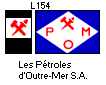
LES PÉTROLES D’OUTRE-MER S.A.
The black funnel has a broad white band containing a red hammer and flaming torch crossed in saltire. The blue flag has a white diamond extending to the edges, with the same crossed devices above red PMO arranged in the remaining diamond points. Loughran explains the hammer and torch as the power and light obtained from oil. Aragaz’s photograph confirms the funnel; it was also noted on Ashtarak.
The company is recorded in the historical merchant-fleet account and Lloyds 1963–64.
France, Paris.
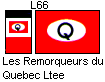
LES REMORQUEURS DU QUEBEC LTEE.
image by Jarig Bakker, 7 November 2005
Jarig Bakker’s FOTW flag follows Brown 1995. The source notes that Brown incorrectly uses de Quebec instead of du Quebec in the name.
Quebec Tugs was formed in 1976 under Power Corporation of Canada and took the French name in 1982. It subsequently appears under Canada Steamship Lines/CSL and by 2000 as an operating company of Groupe Ocean. By 2005–06 its separate register entry had disappeared and two traced vessels were listed under Groupe Ocean, though the website still mentioned the company and its status was unclear.
Canada, Quebec.
Leth & Co.
LETH & CO.
image by Klaus-Michael Schneider, 19 Sep 2010
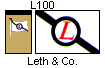
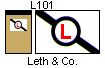
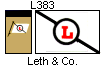
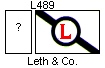
The flag is white with a black diagonal band from upper hoist to lower fly and a white disc edged black containing a red L. Rosanoski’s illustration follows German sources; his commentary says Brown reverses the design and changes the letter when assigning it to Eberhardt. Schneider dates the L flag to 1939.
Stewart’s L101 has a straight L; Brown’s L100 has its spine leaning towards the fly.
Mitchell’s Portsmouth observation in March 1980 gives blue rather than black for the funnel flag markings.
L489 is retained from the marcollect sources.
Ludwig Müller, personal/operator flag
image by Klaus-Michael Schneider, 19 Sep 2010
Schneider’s M723 cites Klaus-Peter Bühne’s webpage, but Rosanoski could not find it there in October 2011. Its FOTW placement under Reederei Lehmann is marked erroneous in the source.
Eberhard later wore the common Carl F. Peters managers’ livery, replacing L with E. Rosanoski could not reconcile E, though he suspected an Eberhardt investment connection. P481 remains the source cross-reference.
Leth was formed in 1922 and worked in agency and shipping. It acquired Kylemore for breaking in November 1936 and managed Norwegian vessels during the war from 1940. Post-war registers record it as owner and manager; Carl F. Peters appears as manager from 1998.
The source distinguishes Horst-Eberhard Eberhardt, a name-company subsidiary formed in 1989 whose last ship was sold in 2005. Schneider’s separate account, published under erroneous Lehmann/Leht headings, gives Ludwig Müller as sole owner during 1933–58, an early fishing business and later tanker shipping, then an apparent disappearance after 1970 and a reported Peters connection by 2000. Rosanoski’s account still records Leth operating in 2008.
Germany, Hamburg.
LETOCART & CIE.
L288 comprises the funnel and flag sourced from Armements Marseillais. The flag was also reproduced on FOTW; the document contains no written colour or geometry description.
Letocart & Cie. was founded to carry pilgrims to Palestine. The source gives foundation in 1894 but also an operating period of 1876–1902; these dates are not reconciled. Pavillon records the spelling Letocard & Cie.
France, Marseille.
Letten Brothers.
Anchor Steam Fishing Co. Ltd.
A902 has a white anchor funnel mark. Olsen’s 1911 illustrations are black and white and do not clarify the funnel colours.
Atlas Steam Fishing Co. Ltd.
A903 is retained from Lloyds 1912 and Olsen’s Almanac, with the same limitation on colours in the latter.
A website posting describes Atlas’s funnel as a white A on yellow above blue bands, bounded by white rings on black. Rosanoski considers this possibly consistent with A904.
Letten Brothers were fish salesmen, steam-fishing-vessel owners and shipbrokers. Registers place Atlas Steam Fishing under Letten Brothers and Anchor Steam Fishing under G.S. Letten at the same address. G.S. & W.S. Letten also appear in partnership with Grant & Windeatt.
UK, Grimsby.
LEVANTINE SEA TRANSPORT CO. LTD.
Doris was noted in 1965 with a black funnel and a broad white band bearing three evenly spaced, very narrow bands: blue outside and red in the middle. The company identification is assumed because Lloyds did not confirm the vessel. No flag was noted.
The company appears in Lloyds 1963–64.
Malta, Valletta.
LEVEN SHIPPING CO. PTY. LTD.
L368 is documented in The Log, November 1985.
Leven acquired Blythe Star in 1949 and is recorded as selling its last vessel, Leven Star, in 1950, though the company still appears in later registers. It changed name to Seven Shipping and was deregistered on 8 April 1965.
Australia, Melbourne.
Lever Brothers Ltd.
LEVER BROTHERS LTD.
L370 resulted from an internal design competition around 1930 and was published in the group magazine Progress. It became the basis of Palm Line’s flag, but does not appear to have been adopted and flown itself. Its funnel colours were used on some lighters until 1974, and Mitchell assigns the funnel to Unilever Merseyside.
Lever’s Pacific Plantations Ltd.
L371 preserves the earlier livery documented from Lloyds 1904 onwards.
Unilever Merseyside Ltd. / UML Ltd.
The U255 funnel apparently followed in 1974. After a few months the roundel from the new house flag was added, showing an extended hand with UML, the ML yellow. The company was also known as UML Ltd.
William Hesketh and James Lever founded the business at Warrington in 1885, later moving to Port Sunlight. It merged with the Dutch Margerine Unie in 1930 to form Unilever, retaining Lever Brothers as an imprint and in subsidiaries. Australian operations began after incorporation in 1894, with the Sydney factory working from 1895 to 1988; Lever’s Pacific Plantations also appears in the shipping register.
Shipping interests included Bromport Steamship during 1916–23, Ölhandel und Transport, Southern Whaling & Sealing and United Africa. Palm Line, formed in 1949, became the group’s principal shipowning company. One account describes United Africa merging into Palm Line; Liverpool Shipping says United Africa formed it. Unilever later continued without shipping operations.
UK, Port Sunlight near Birkenhead.
LEVIN & CO. LTD.
The flag is white with a red saltire and an overall small blue panel, as shown in The Log.
L429 is retained from Sea Breezes 1979.
Nathaniel William Levin began trading at Wellington on 2 August 1841. The drapery business expanded into stock and station agency, with son William Hort succeeding him in 1868. The firm owned ships during 1899–1929, running coastal feeder services for its clients. Rosanoski rejects Sea Breezes’ alternative account of formation as W.H. Levin in 1877, cessation in 1893 and reappearance in 1899.
The corporate accounts give a 1961 merger with NMA, followed by inclusion in Challenge Corporation in 1972, while another records National Mortgage & Agency acquiring 47% in 1896 and the remaining shares in 1964. These stages are not reconciled in the source.
New Zealand, Wellington.
LEWIS CLAPIER.
Lewis Clapier was a sailing-ship owner in 1800.
USA, Philadelphia.
LEÂO E CIA.
The website documents the livery as of 1950.
Brazil, Algoas.
LEÂO JUNIOR E CIA.
The 1950 livery’s emblem is unclear. Its annulet bears a black inscription; the green centre appears to contain two crossed yellow flags, with poles meeting at their bases and attached at the flag centres.
Brazil, Paraná.
LIAMARE SHIPPING B.V.
L463 comes from the sole vessel Liamare’s starboard funnel on 4 March 2011. It differs from the company logo in its darker-blue Ks; lighter shades also appear around the outer porthole motif.
Liamare was founded in 2000, with Adriaan Kok as owner and captain and chartering through Flinter. The company described its Christian observance of Sunday rest, avoiding port work and anchoring when possible.
Netherlands, Maartensdijk.
Lian Huat Shipping Co. (Pte) Ltd.
Documentary images — company attribution uncertain
image by Jorge Candeias, None
NJK describes a dark-red funnel, with occasional ships having a black top. The flag is assumed to use the normal red shade from the website image. Jorge Candeias’s FOTW flag is associated with the Hong Kong agency subsidiary and assumed to apply to the Singapore shipping company.
Do not claim shared flag use by both entities without evidence.
Lian Huat was formed in 1974 and later appears as an operating company of Unison Shipping. Rosanoski notes apparent representation through branches in several Asian countries and a later emphasis on agency work.
Singapore.
LIAN SOON SHIPPING & TRADING CO. (PTE) LTD.
The funnel is red with a black top and yellow L.S. The flag has unequal diagonal red and blue quarters, with a white diamond containing a blue S touching its top and bottom. The red quarters are enlarged so that the diamond lies only on red, its horizontal points meeting the blue segments.
Lian Soon appears in registers from 1970–71 to 1985–86. Brown 1995 gives Madam Dolly Seah as owner, which Rosanoski suggests may be a later development because Lloyds does not record it. Brown also assigns the livery to Seah; Rosanoski considers the flag compatible but the funnel different.
Singapore.
Libby, McNeil & Libby.
Documentary images — company attribution uncertain
The evidence is a cap badge showing a red pennant with LIBBY in white. Michael Faul identified it as the Libby Line, but Rosanoski strongly disputed that explanation, believing it confused Libby with Liverpool’s Bibby Line. Bibby’s flag is rectangular, not a pennant. Rosanoski considered Libby, McNeil & Libby a stronger possibility because it owned ships, while allowing that the badge might instead refer to a vessel named Libby. FOTW subsequently placed it under this company.
Libby McNeil & Libby remains candidate, not established proprietor.
Archibald McNeil and brothers Arthur and Charles Libby founded the food business in 1868. Swift controlled it during 1888–1920. Libby bought Alaska Salmon in 1917, when it owned four sailing ships carrying cannery supplies. The motor ship Libby Main was built in 1918; steamers began replacing older sail vessels in 1925 and were themselves described as obsolete by 1940. Nestlé acquired the company in 1971. An Alaska Packers association is recorded, possibly through ownership or management.
USA, Chicago, ILL.
LIBERATION STEAMSHIP. CO. INC.
L108 is documented in Brown 1978.
Liberation Steamship appears in registers from 1963–64 to 1996–97, initially as operator and later also owner. Its work included operating for the Philippines Government.
Philippines, Manila.
LIBERIAN MARITIME CORPORATION.
Island Skipper and Island Engineer were noted with a green-blue funnel bearing three widely spaced, very narrow white bands and an undefined white diamond with a green-blue L. Bill Black associated the company with G.M. Livanos. A similar Tramp Tankers funnel used a circle; the diamond and letter may later have been removed, as with Aethalia Shipping. No flag was noted.
Liberian Maritime appears in Lloyds 1963–64 with Ocean Shipbrokerage as agent.
UK, London.
LIBERIAN STEAMSHIP CORPORATION RAVALA.
Lorna’s funnel is black with a broad red band containing two evenly spaced, very narrow white bands. A blue panel reaches the red band’s top and bottom and bears a white saltire. No flag was noted.
The company appears in Lloyds 1963–64 with Neill & Hannah as agent.
UK, Edinburgh.
LIBERTY MARITIME CORPORATION.
L518 is photographed on Liberty Star and also recorded on Liberty Sun at Singapore on 7 June 2011.
L519 comes from Liberty Dream’s starboard side on 26 August 2012.
Philip J. Shapiro founded Liberty Maritime in 1988 according to the company website; Lloyds gives 1989. Registers list it as manager, with ships held through name companies.
USA, Lake Success, New York.
LIBERTY NAVIGATION & TRADING CO. INC.
The funnel is yellow or buff with a broad blue band edged white above and below, containing a straight-sided white O. The observation compares it with a Stewart design but with a lightish-buff ground instead of black. Rosanoski interprets the citation as Stewart 1957’s Ore Steamship entry, rather than the stated 1963 edition. No flag was noted.
Liberty Navigation & Trading appears in Lloyds 1963–64 with J.H. Winchester as agent.
USA, New York, NY.
LIBERTY SHIPPING CO. LTD.
The livery was noted on Fortune Lory. The black funnel has a very broad white band with a red L. The blue flag has a white triangle extending from the hoist across the field, bearing a red L whose lower stroke is angled “Pbds” in line with the triangle.
Liberty Shipping appears in Lloyds 1963–64.
Hong Kong.
LIBERTY SHIPS INC.
L233 is documented in Brown 1978.
Liberty Ships appears in registers from 1966–67 to 1978–79. Mediterranean Agencies acted as agent in the earlier accounts, with E. Hayman listed in 1978–79.
USA, New York; later Geneva, Switzerland.
LIGNES MARITIMES DU DETROIT S.A.
L512 comes from Ibn Batouta in October 2003 and had been changed by 2 April 2006. The ship also carried Limadet in green on the hull.
Trading as LIMADET, the company traced its services to Compagnie Paquet’s routes between Marseilles, Tangier and Casablanca. One account makes it a separate entity after Moroccan independence in 1956, its website dates establishment to 25 July 1964, and Lloyds gives 1966. Following financial difficulties it became a BDNE subsidiary and was sold to Compagnie Marocaine de Navigation in October 2003, initially continuing independently. Ibn Batouta appears under the buyer in the 2008 register.
Morocco, Tangier.
LIHAI INTERNATIONAL SHIPPING CO. LTD.
L500 is based on portside photographs of Sea Success at Wellington on 21 August 2002 and Sea Glory at Sydney on 4 December 2011.
Lihai was formed in 1989 as a ship-management concern and subsidiary of COFCO, China National Cereals, Oils & Foodstuffs Corporation, which became COFCO Ltd. in April 2007.
China, Hong Kong.
LILLBACKA POWERCO OY.
Global Freighter wore L570 in port and starboard photographs from 2004 and 2005. The funnels merge into the white superstructure, with a narrow blue base like the top portion, giving the impression of a white ground and unequal blue-white-red bands.
The change to L569 occurred shortly before Global Freighter resumed service on 6 October 2008 after docking and repainting. A portside photograph on 30 April 2011 records the later version.
Lillbacka Powerco was formed in 2002 and later appears under ASP Ship Management Scandinavia.
Finland, Harma.
LIMARKO SHIPPING COMPANY AB.
image by Jarig Bakker, 12 August 2005
The flag is horizontally orange over blue, with a central blue disc inside a narrow white ring containing a slanted white L. Jarig Bakker’s FOTW blue was adjusted towards the photographs and website. Libra and Astra supply funnel evidence. Astra’s orange looks like air-sea-rescue orange and its blue more like dark sky blue, while the indistinct flag seems closer to the website colours. Another photograph repeats those shades, but Rosanoski allows for camera or lighting effects. A black funnel top is optional: Pluto lacks one.
L436 is retained as a photographic funnel-and-flag source.
Limarko originated as Klaipeda Transport Fleet on 1 January 1987, although Lloyds initially gave 1988 before revising it. It became a public stock company in 1995 and was publicly listed from June 1998. Rosanoski distinguishes that listing from the later name change: after Limarko UAB and Vilnius Bank Venture Capital Management participated in privatisation in 2003, the company became Limarko Shipping Company on 14 May 2004. It also appears as AB Limarko Laivinikystès Kompanija, LLK and LSCO.
Limarko UAB was the parent, holding 87.2% in June 2009, and the shipping company held 20% in Alpha Reefer Transport.
Lithuania, Klaipeda.
LIMERICK STEAMSHIP CO. LTD.
image by Jarig Bakker, None
Jarig Bakker’s FOTW flag is sourced to Lloyds 1926.
The other retained variants are L497 from Lloyds 1904, L496 from Lloyds 1912 and later fleet books, and L498 from Stewart 1963.
Limerick Steamship was formed in 1892 and owned steamships from 1893. It entered receivership in the 1960s and ceased operations in 1970. Mitchell records a December 1969 merger with Palgrave, Murphy to form Hibernian Transport for an Ireland–UK–Continent container service. Limerick also held 1.75% of Irish Shipping at its formation in March 1941, transferring the stake to Grain Importers in October 1943.
Ireland (Eire), Limerick.
LINEA REGULARE SURAMERIKA.
The Brazilian website records this livery as of 1950.
Italy.
LINEAS AGROMAR S.A.
Mitchell shows two funnels with an apparent combined LA logo, but does not explain their use. Four of his five vessel drawings have blue funnels and one black.
L453 comes from Corain I in the mid-1980s.
The website dates formation to 1963, while Lloyds gives 1964 as Companhia Agropecuaria y Maritima Santa Rosa and the Lineas Agromar name from 1974. Bankruptcy is reported in 1999 and the company is marked ceased trading in 2000. Rosanoski considers Agromar Shipping C.A. its apparent replacement.
Colombia, Barranquila.
LINEAS NAVIERAS BOLIVIANAS S.A.M.
Both logos appear to combine LNB, though L285 looks more like NB.
Mitchell notes Bolivia at Liverpool in January 1994 with a blue funnel and emblem, presumed to be L232.
Known as Linabol, the company appears in registers from 1980–81 to 1992–93. It participated in Eurosal alongside European and South American owners, including Johnson, Deppe, Marasia, Sud-Americana de Vapores, Hapag-Lloyd, Nedlloyd, Pacific Steam Navigation and Transportes Navieros Ecuatorianos. Empremar and CNP joined the consortium in 1987.
A starboard photograph of Bass Reefer confirms the funnel.
The retrieved text did not expose the full legal-name definition, and the ABN lookup was inaccessible. The earlier Bass Express/Bass Reefer agency and 1981 registration are not established by the 2008 corporate context alone. Retained as review without conflating service, agent and vessel owner.
Linerbulk was registered in Victoria as Arakeen on 27 May 1981. In late 1990 it entered the Stanley–Victoria trade as Bass Express, a service lasting just over a year. It acted as agent for Bass Express Ships, within Sea Containers, for Bass Reefer, which entered service on 30 September 1990 under BHP management. Ownership changed to Bass Reefer Pty. Ltd. in 1991, and Howard Smith managed the vessel from 31 January to July 1992.
The vessel companies had separate histories: Bass Express Ships originated as Grovesound in April 1990 and was deregistered in 2005; Bass Reefer originated as Roseball in May 1991, later became Rent-A-Box Depot and was deregistered in 1997.
Australia, Outer Harbor, Adelaide, SA; also Melbourne.
LINHA DE NAVEGAÇAO DE J. H. ANDRESEN.
Bonsor describes cobalt blue in the flag and blue lettering, whereas Lloyds shows black letters, possibly a later change. L275’s funnel appears on the first steamer Olinda in 1877; Bonsor also records A477 but does not date the change.
The Andresen Line was founded by Jan Hinrick Andresen, born in Denmark in 1826 and settled in Portugal from 1841 as Joáo Henrique Andresen. He died in March 1894; later sources call the concern J.H. Andresen Successors. Transatlantic passenger operations ended in 1905 and its last vessel, a paddle tug, was sold in 1915. Linha de Vapores Portuguezes was an occasional advertising description rather than the formal title.
Portugal, Oporto.
LINHAS MARITIMAS DE ANGOLA U.E.E.
The black funnel has four narrow light-blue wavy bands in two widely separated pairs. Over them is a red upright panel whose sinister side slopes “Pbd”, making the base wider than the top. It carries a black upright anchor surmounted by a yellow half-cogwheel and machete, taken from the national flag. The black house flag repeats the bands and devices.
Also known as ANGONAVE, the company appears in the 1985–86 and 1992–93 registers and belonged to the Angolan Government.
Angola, Luanda.
LINJEBUSS INTERNATIONAL A/B.
image by Jarig Bakker, 13 August 2005
Rosanoski could not establish the source of Bryggan’s L74 funnel, since its photographs show L320. The FOTW version was initially confused with the later SFL flag and an unrelated Donsötank description, subsequently amended.
Pendula provides the portside funnel view and Betula the starboard view; the arrow points forward on both. The Collectors Corner flag comes from a cap badge.
Linjebuss was formed in 1954 as a wholly owned Svea subsidiary and acquired Skaninavisk Linietrafik in 1961. It operated Helsingborg–Helsingör services. A translated account dates a change to Scandinavian Ferry Lines to 1969, but Rosanoski rejects this as a corporate renaming: the contemporary fleet account treats SFL as a service name, with ships still owned by Linjebuss and Svea until around 1980. Another source instead calls Linjebuss an SFL subsidiary. The vessels appear under SFL by the 1985–86 register.
The Trave Line partnership with Lion Ferry began in 1965 and ended when Lion left in 1969. Ultimate owner Axel Axelson Johnson’s account records a stock-exchange listing in 1992.
Sweden, Helsingborg.
LINK LINE LTD.
The flag has four unequal horizontal dark-blue and light-blue bands and white stylised letters described as JL. Rosanoski reads them as a reversed L and an ordinary L, possibly suggesting an anchor. No funnel is given.
Link Line was formed in 1978 and appears as manager and later agent.
Greece, Piraeus.
LINK LINES LTD.
The flag is based on International Code signal L: yellow and black quarters with a black L on the yellow. The funnel is black with a green-red-green chevron.
Link Lines operated in the 1960s and belonged to Coast Lines.
UK, Liverpool.
LINNHOFF SCHIFFAHRT GMBH & CO. K.G.
image by Klaus-Michael Schneider, 24 Feb 2009; observation 5 April 2008
The green flag has a white central diamond touching the top and bottom edges. Dark-blue bold LS in the diamond are joined along their bottom line. Schneider observed the design on the company’s doorplate at Alster lake, Hamburg, on 5 April 2008.
Linnhoff was established in 2001 after acquiring eight specialist marine-service companies from Preussag. Its interests included towage, pilot transport, research shipping, helicopters and marine equipment, with companies such as Lütjens & Reimers, Unterwesser-Reederei, RF Forschungsschiffahrt and Wiking Helikopter Service.
Germany, Buxtehude.
LION FERRY A/B.
image by Jarig Bakker, 9 August 2005; 12 January 2006
L76 is described as the original funnel and is associated with the Maine ferries; Prins Line used a similar livery. The lion flag was introduced in 1970, while the Germany–England service used a stylised P. Joint operations could wear their partners’ funnel colours. Mitchell’s Gustav Vasa drawing supports L76.
Europafarjan IV photographs from 1978–81 confirm L75, with a narrow black funnel-top cowl. FOTW initially also attributes the flag to Bonnier Rederierna. Rosanoski questions that direct connection, describing Bonnier’s founding investment and a later sale to Erik Kekonius. The same flag is retained under Lion Ferry.
Nüsse’s L128 initially appears darker blue than the Collectors Corner cap badges, with a better shade on the newer website.
Lion Princess and Lion Queen show differing degrees of flap in the painted flag. On both funnel sides it points forward, with the lion facing aft.
L323 contains two seahorses within a diamond frame on Europafarjen IV. A postcard supports its suggested use on the Helsingborg–Grenå service. It was retained after the ship became Europafarjan Syd in 1984, so may belong to Helsingborg-Grenå Linjen.
L78 is retained from Loughran and L318 from Mitchell’s website; no separate verbal design account is supplied.
Documented shared associations — A/B Billingsfors / Lion Steamship Co. A/B — US Navy 1961 funnel
US Navy assigns B632 to both A/B Billingsfors and Lion Steamship. Rosanoski did not locate the former in Lloyds but found a reference concerning Nore of 1905.
Following Stena’s takeover the lion faced backwards. Rosanoski records an ordinary swallowtail for the North American and Prins Line ventures and a black-lion, fly-facing version found on a website but not corroborated elsewhere. Nüsse’s tapered blue swallowtail has a yellow lion facing the fly in a more salient pose. An undated Lion Queen photograph has less-raised forelegs; the flying flag looks rectangular, probably because of its movement, while the painted funnel flag is clearly forked.
Bonnier’s late-1950s shipping investment produced Lion Steamship and Lion Ferry, the latter registered in 1959 with Prins Bertil entering service in 1960. Lion acquired Europafergen in 1965, retaining that trading name but changing the funnel. Stena bought the remaining Varberg operation and Europafärjan brand in 1982. The source also gives a separate register history beginning as Varberg-Grena Linjen in 1954, renamed in 1985. These accounts are not fully reconciled.
A 1981 liquidation apparently marks the end of Lion as a shipowner rather than the immediate disappearance of its service identity. The Lion name was withdrawn in 1985, revived for a Karlskrona–Gdynia service in 1995, and finally absorbed into Stena in 1998 according to Lloyds. Another source gives incorporation into Stena on 1 December 1997.
Lion operated several joint services. Gustav Vaasa entered Trelleborg–Travemünde under charter to the Swedish State Railway in 1965, followed by Halmstad–Copenhagen–Travemünde and the short-lived Trave Line partnership with Linjebuss. Lion left in 1969 to join the railway’s Malmö–Travemünde service. A Bremerhaven–Harwich venture with Wallenius began in 1966, later marketed with German partners as Prinzen Linien; it was sold to DFDS after 1981. Loughran also describes a Harwich–Hamburg Prins Line service. The Portland–Yarmouth venture with Fred Olsen ran from 1970 to 1976. Lion held 25% of Irish Continental.
Sweden, Halmstad and Varberg; Stockholm is also recorded for operator Erik Kekonius.
LIQUEFIED GAS CARRIERS (FIJI) LTD.
The original livery matched the associated Liquefied Gas Carriers operation and its L419 flag. Fiji Gas’s photograph confirms the funnel, though its narrow white bands cannot be made out. The later flag is identified as the owner’s, and the funnel bears white LGC with G larger.
The company was incorporated in 1971–72 with Gas Supply holding 70% and Fiji Gas 30%; Boral also owned half of Fiji Gas from July 1972. Rosanoski records an earlier 1970–71 Lloyds appearance, which is not reconciled with incorporation. Later agency was through Gas Supply in Brisbane.
Fiji, Suva.
LIQUEFIED GAS CARRIERS PTY. LTD.
L418 applied only to Guinea Gas.
The other vessels used L419, also adopted by the associated Fiji company.
The company was formed in 1968 as an equal partnership between Gas Supply and Botany Bay Shipping. Gas Supply bought its partner out in October 1971. It carried gas for Boral, beginning with Guinea Gas in 1968; its second and last vessel, Pacific Gas, was sold in 1986.
Papua New Guinea, Port Moresby.
Liquid Gas Tankers Ltd.
Documentary images — company attribution uncertain
The recorded funnel is black with a white panel edged red and containing a blue cross; cross and border have equal widths. It derives from a Cape Corso observation in July 1966, but Rosanoski could not trace the vessel in Lloyds and doubts the interpretation of the original shorthand comparison. No flag was noted.
Company and reconstructed band/panel uncertain.
Liquid Gas Tankers appears under Cory Maritime’s management in 1970–71 and 1978–79. Rosanoski considers it an apparent subsidiary, with the fleet previously in Cory’s own name.
UK.
LIQUIGAS LTD.
image by Jarig Bakker, 19 Feb 2006
The original flag is white with narrow deep-sky-blue bands at hoist and fly and a blue ring enclosing a white L with a slanted upright, outlined and shaded blue. Rosanoski’s actual flag measured 72 by 36 inches: the end bands were 8 inches wide, the circle 30 inches in diameter and its ring 1 inch wide. The L was 4 inches wide, with 1-inch blue shading above, on the hoist side and above its horizontal stroke, and 3 inches elsewhere. Black outlines around the ring, letter and shading were actually one-eighth-inch stitching, visible only close up.
Mitchell’s Tarihiko funnel is presumably an interpretation of the air-sea-rescue orange-red shade.
Tarihiko adopted the new funnel after its Lyttelton survey on 25 January 1990, but initially kept the old flag. The new flag was seen at the Christchurch LPG depot in August 1991 and on the ship in November. LPG refers to the cargo. The funnel has five horizontal lines, while the flag has six. Funnel lines point aft on both sides, with letters arranged to read normally; the starboard pattern was confirmed at New Plymouth on 31 August 1994, as was the flag. Its blue seemed darker than the original flag, but Rosanoski could not inspect it closely enough to be certain.
Brown 1995’s L433 is reversed and has five horizontal lines instead of six. Rosanoski explains that the information originated with him but the funnel’s five-line pattern was incorrectly transferred to the flag, and the side arrangement was confused. Jarig Bakker’s FOTW image follows Brown.
Liquigas was registered on 26 June 1981. Lloyds instead gives 1992, possibly referring to P&O’s involvement. Tarihiko was chartered during 1984–93 and owned during 1993–99. Earlier management was by Shipping Corporation of N.Z.; later registers place the company under P&O Maritime Services (NZ). Shareholders included Offshore Mining, Fletcher Challenge, Todd Petrogas, N.Z. Industrial Gases, B.P. and Shell; the Crown-owned Offshore Mining holding is recorded as 25%.
New Zealand, New Plymouth and Wellington.
LIQUIMAR TANKERS MANAGEMENT INC.
L494 carries the website logo, supported by distant photographs of Frixos and Elli. Dark details were interpreted as black, but Rosanoski allows that this may be wrong or that the design later changed. Sabine and Brazos 1 instead had plain black funnels, apparently in a charter context with Anglo-Eastern management.
Afroditi’s close starboard photograph on 25 November 2012 shows different funnel and arrow shades, possibly from light or camera effects. Enlargement nevertheless confirms that the dots and lines on yellow are black.
Liquimar was formed in 1995 and appears under Diroyx Maritime in the 1998 register. Ships sold to Worldwide Green Tankers continued to be operated by their former owner to maintain charter arrangements, explaining retention of their markings.
Greece, Athens.
LIRO SHIPPING A/B.
Mitchell assigns the funnel to Liro Marin for Liro Sun. The Collectors Corner cap badge shows a white flag with a blue schooner whose sails form LIRO.
The related Liro businesses acquired Bore Sky as Liro Sun on 26 June 1992. It remained chartered to Bore until September, then to Finncarriers, and was sold to Engship on 6 April 1993. Liro later managed a Stena vessel until around the end of the century. The source distinguishes Liro Shipping, Liro Marin and Rederi A/B Liro, the last apparently renamed from A/B Grundstenen 49009.
Sweden, Malmö and Klagerup.
LITHUANIAN SHIPPING CO.
image by Jarig Bakker, 29 December 2005
image by Jarig Bakker, 16 July 2004
L246’s yellow emblems are small circles. Rosanoski doubts this flag because no record was kept and the archived source could not be accessed in 2012.
Jarig Bakker’s FOTW L40 follows Brown 1995.
L522 is based on Daina’s starboard funnel.
L280 is documented on Akvile and Daina, with a flag from company photographs. Its yellow devices are small circles. Jan Mertens considered the field white or light blue; the FOTW rendition is darker than Rosanoski’s version, lightened to match the photographs.
L521 comes from Asta’s starboard funnel on 20 May 2010.
Lithuanian Shipping, also Lietuvos Juru Laivininkyste or LISCO, was formed in 1969 and initially came under the USSR’s North-West Shipping State Corporation. After Lithuanian government control, the 27 June 2001 reorganisation separated DFDS Lisco/Lisco Baltic Service from the Lithuanian Shipping Company. The source describes the latter as owner and operator in its own right but gives differing government holdings: 66.67% in a 2003 website account, 79.9% in Lloyds and 55.6% in a later website passage. An earlier account also mentions sale of about 76% during reorganisation; these figures are not reconciled.
Lithuania, Klaipeda.
Livanos Family.
LIVANOS FAMILY.
image by Jarig Bakker, 5 January 2005
image by Jarig Bakker, 5 January 2005
image by Jarig Bakker, 14 September 2005
LIVANOS GROUP.
Livanos Group is dated to 1920. Its operating companies include N.G. Livanos Maritime and Sun Enterprises, the latter established at Piraeus in 1968 with roots traced to 1902, consolidating operation of chartered-out tankers and bulk carriers. Dos Oceanos is also listed, and Southern Shipping as a joint venture between S. Livanos and Niarchos.
Greece, Piraeus.
LIVANOS BROTHERS.
Greece, Chios.
G.M. LIVANOS.
The G.M. Livanos section associates Aethalia Shipping, Liberian Maritime and Tramp Tankers with that concern, without establishing its country.
Unknown.
JOHN LIVANOS & SONS LTD.
MICHAEL G. LIVANOS.
image by Jarig Bakker, 27 December 2004
image by Jarig Bakker, 27 December 2004
Bakker’s Caltex-based L314 and L315 are retained in the Michael G. section, with L315 specified for foreign-flagged ships.
Michael G. Livanos appears in pre-war and post-war registers, later through Ocean Shipbrokerage as agent; Euroshipping is listed as an associate.
Greece, Chios and Athens; later UK, London.
N.G. LIVANOS MARITIME CO. LTD.
image by Jarig Bakker, 14 September 2005
George S. Livanos
No exclusive fleet-wide use or unrecorded corporate equivalence is asserted.
Documentary material — company attribution not established
Exact source allocation unresolved.
John Livanos & Sons
John Livanos’s livery appears to have changed after the war. L160 is noted for agency vessels; Mitchell’s assignment of Georgios to Livanos Bros. Maritime differs from Lloyds’ placement under S. Livanos & Co.
L309 is retained from Mitchell’s funnel evidence.
UK, London.
Keep the explicit scope label independent; no alias or company identity is inferred.
N.G. Livanos Maritime
N.G. Livanos shared the Livanos Group address and is later listed as its operating company. Agency interests included Carreto and the Monrovia Bulkers, Carriers, Tanker and Tramp concerns; Stratos Gerodimos also appears as agent.
Greece, Piraeus.
Keep the explicit scope label independent; no alias or company identity is inferred.
S. Livanos & Co.
UK, London; Greece, Piraeus.
Keep the explicit scope label independent; no alias or company identity is inferred.
S. Livanos Shipbrokers
UK, London.
Keep the explicit scope label independent; no alias or company identity is inferred.
Theofano Maritime
Theofano Maritime appears under the Livanos manager in 1939 and N.G. Livanos in 1942, with later separate register entries.
Greece, Piraeus; also UK, London.
Keep the explicit scope label independent; no alias or company identity is inferred.
Family background
Livanos shipping began in the 1880s. The source places family origins at Kardamyla on Oinoussai in one passage and at Chios in another, and distinguishes several branches rather than one company. Stavros G. Livanos’s son George P. founded Ceres Hellenic Shipping in 1949 and shortly afterwards inherited his father’s fleet. George’s sisters Eugenia and Tina married Stavros Niarchos and Aristotle Onassis respectively. On George’s death in 1997 the business passed to his son Peter.
Keep the explicit scope label independent; no alias or company identity is inferred.
Livanos Brothers and John Livanos & Sons
Livanos Brothers became John Livanos & Sons in 1939. Accounts say Michael J. and George became independent owners, but use differing initials for George. The firm operated Greek and UK fleets and later acted as agent for concerns including Amfitriti, Anatolian Maritime, Lamda Shipping, North Europe & Persian Gulf Transport and West End Shipping.
Keep the explicit scope label independent; no alias or company identity is inferred.
S. Livanos concerns
S. Livanos & Co. operated the UK Trent Maritime fleet and managed Greek ships. The separately headed S. Livanos Shipbrokers acted for Livanos Maritime, Atlantic and Ocean companies, Theofano Shipping and United Cargo Lines. Atlantic-prefixed names were widespread, though some fleets adopted Livanos family or other Greek names.
Keep the explicit scope label independent; no alias or company identity is inferred.
Shared Livanos liveries
The source distinguishes Greek lambda and Latin L versions, apparently for Greek- and British-registered vessels. The L22 and L23 drawings simplify the repeated border motif to three horizontal and two vertical sets, whereas Nüsse’s Sun Enterprises table flag has five and three. Rosanoski does not know whether motif counts change with flag size. Books vary between continuous chains and separate units and in the border’s distance from the edge.
Amazon Brilliance and Athina Zakirakis show a white funnel band narrowly edged blue, only clear close up, with a slight difference at the lambda’s top and a wider sinister arm. Amazon Guardian confirms the starboard treatment. Tubarao instead has a chain resembling connected upright and inverted Ls, whereas the other photographs resemble connected Ps and Js. Eugenie Livanos confirms the older funnel. Blue shades range from the light shade specified in Merchant Ships to darker or sky blue in photographs.
L473 follows Brown 1995 in Bakker’s FOTW illustration.
Keep the explicit scope label independent; no alias or company identity is inferred.
Shared usage
Sources distribute the common funnels among several Livanos concerns. Brown gives L23 to Livanos Brothers, US Navy to S. Livanos, and Jordan to John Livanos and related Greek companies. L22 is assigned to S. Livanos’s Atlantic and Ocean agency companies and to Trent. L23 also appeared on Panagiotis Lemos, Pantelis A. Lemos and Irene S. Lemos, presumed chartered. These overlapping attributions are retained without assigning every variant to a single branch.
Keep the explicit scope label independent; no alias or company identity is inferred.
Vessel-specific observations
Other observations vary further: Atlantic Sunrise, Atlantic Empress and Atlantic Sun had a red L; Atlantic Falcon, Atlantic Guardian and Meandros had blue bands without a recorded letter. Mesros had an additional edged band and blue between outer and inner white, making nine bands. Atlantic Queen carried a red lambda, and Demos dark bands with a red lambda; the latter’s owner identification does not agree with Mitchell.
Keep the explicit scope label independent; no alias or company identity is inferred.
Sun Enterprises
Nüsse attributes S1467 to Sun Enterprises. It has a gold fringe except at the hoist. Its letter and pattern relationship to published funnels is not straightforward: Rosanoski notes that Nüsse supplies the L22 type and that Christies also shows L22 where he expected L23.
Keep the explicit scope label independent; no alias or company identity is inferred.
Michael G./N.G. attribution difference
Rosanoski considers Stewart’s L25 wrongly attributed to N.G. Livanos and says it should be Michael G.’s. Christies gives a black lambda with normal blue bands, differing from Mitchell. Jordan instead gives a red lambda, as for other Livanos companies, while Ships & the Sea uses the normal Livanos funnel.
Keep the explicit scope label independent; no alias or company identity is inferred.
N.G. and related Livanos usage
L24 is noted for Monrovia Shipping and Monrovia Tanker. Mitchell also associates this funnel with Michael J. in one passage and George S. in another, without sufficient vessel detail to reconcile the branches.
Keep the explicit scope label independent; no alias or company identity is inferred.
N.G. Livanos context
Mitchell associates L310 with Michalos in an unclear capacity, possibly through John Michalos. Oana’s starboard photograph on 21 March 2012 confirms the funnel.
Keep the explicit scope label independent; no alias or company identity is inferred.
Further recorded variants
L311 is retained from Christies and L313 from Mitchell, without additional verbal vessel identifications.
Keep the explicit scope label independent; no alias or company identity is inferred.
N.G. Livanos
Bakker’s L474 follows Brown 1995.
Keep the explicit scope label independent; no alias or company identity is inferred.
LIVERPOOL & MARANHAM STEAMSHIP CO.
image by Klaus-Michael Schneider, 29 May 2012
The flag is quartered blue and white. Two FOTW chart-based identifications attach an additional “Silvain Steamship” name. Rosanoski accepts Liverpool & Maranham but suspects the second name is an agent, not another company title; its reading remains uncertain.
The company was established by 1870 and acquired by Booth Steamship in 1903. It also appears as Maranham Steamship, with Hugh Evans recorded as owner or operator.
UK, Liverpool.
LIVERPOOL & NORTH WALES STEAMSHIP CO. LTD.
The funnel is yellow or buff. The white swallowtail bears a blue cross surmounted by yellow Prince of Wales feathers.
The company appears in Lloyds List of Shipowners 1963–64.
UK, Liverpool.
LIVERPOOL SCREW TOWING CO.
L413 follows a Merseyside illustration. British Steam Tugs gives a cowl top, and ABC British Tugs describes the funnel as yellow for both Liverpool Screw and North West.
Mitchell’s N463 is orange, although Rosanoski considers it should be the same as L413.
W. Beckett Hill founded Liverpool Screw Towing & Lighterage in 1877. Known as the Cock Tugs, its vessels used cock as the second part of their names. Management passed through Nicholson and Edwards interests; North West Tugs, a subsidiary, appears after 1948 and by 1953. Later registers show both under Brian S. Clarke.
The takeover accounts differ: the museum source gives 1962, the ordinary-share acquisition by Alexandra Towing was announced on 1 December 1966, and British Steam Tugs associates 1970 with the takeover and disappearance of the cock names. In 1973–74 the concern remained under Clarke’s management within Alexandra’s operation.
UK, Liverpool.
LIVERPOOL STEAM TUG CO.
L414 is documented by Lloyds and British Steam Tugs.
Liverpool Steam Tug was formed in 1836 and ceased business in 1910.
UK, Liverpool.
Lloyd A.G.
LLOYD A.G.
image by Eugene Ipavec, 1 September 2008
Switzerland, Basel.
Hamburger Lloyd Dr. Jürgen Bernhold GmbH & Co. KG
Panocean Lloyd Tankschiffahrt GmbH
Panocean Lloyd Tankschiffahrt GmbH
Rhein-Lloyd GmbH, Mannheim
N.V. Rijn-Lloyd Scheepvaart en Expeditiebedrijf
Rheinischer Lloyd, Duisburg-Ruhrort historical company
image by Eugene Ipavec, 30 Aug 2008
Lloyd and Hamburger Lloyd
Louis Groschupf established Lloyd at Basel in 1928, with towage and tanker branches. Kurt Bernhold and Carl-Heinz Laß left in 1948 with permission to establish the connected Hamburger Lloyd. After Kurt’s death in 1962, Jürgen Bernhold took over and formed a new Hamburger Lloyd in 1963. The account describes a further re-establishment in January 1981 following disputes and a takeover of Basel Lloyd; other statements qualify the Basel sale date. Lloyd Schleppschiffahrt had already been wound up in 1961.
Keep the explicit scope label independent; no alias or company identity is inferred.
Hamburger Lloyd
Bernhold added a black stripe for the new Hamburger Lloyd in 1963. Four- and five-black-stripe flags were used alongside each other until 1981, presumed here to mean L432 and H672.
Related Tietjens companies were established in Berlin-Spandau and Hamburg in 1971. Hamburger Lloyd’s headquarters moved to Basel in 1983. Bernhold left in 1997; the companies were removed from the Hamburg and Basel registers and the remainder passed to Stolt-Nielsen.
Keep the explicit scope label independent; no alias or company identity is inferred.
Rhine concerns
Rhein-Lloyd at Mannheim was probably formed in 1936, with Rheinischer Lloyd at Duisburg-Ruhrort later established as a local branch. The Rotterdam concern is identified as N.V. Rijn-Lloyd. Rosanoski questions whether some earlier Mannheim/Rotterdam names were companies or divisions and whether later Lehnkering colours imply a takeover; he does not resolve the relationship.
Keep the explicit scope label independent; no alias or company identity is inferred.
Panocean Lloyd
Panocean Lloyd Tankschiffahrt was formed in Hamburg in 1971 as a 50:50 venture with Panocean Shipping & Terminals.
Keep the explicit scope label independent; no alias or company identity is inferred.
Basel Lloyd
The 1952 Flaggen auf dem Rhein gives the same Lloyd Seeschiffahrt-pattern flag for Lloyd A.G., Lloyd Schleppschiffahrt and Lloyd Tanker.
Keep the explicit scope label independent; no alias or company identity is inferred.
Rhein-Lloyd Mannheim
The seven-stripe Rhein-Lloyd flag is also shown for Rhein-Fracht. Its yellow canton’s red diagonal represents Baden, while black and yellow are suggested to recall Württemberg. Mertens explicitly leaves the corporate succession between Rhein-Lloyd and Rhein-Fracht unproved.
Keep the explicit scope label independent; no alias or company identity is inferred.
Rijn-Lloyd Rotterdam
R376 is documented for N.V. Rijn-Lloyd of Rotterdam through Piet Hein. A monochrome photograph from 1966–67 appears to show a slightly wider white diagonal.
Keep the explicit scope label independent; no alias or company identity is inferred.
Rheinischer Lloyd
Rheinischer Lloyd’s flag has seven black and yellow horizontal stripes and a red canton four stripes high, containing part of Duisburg’s arms in white outline. The roughly drawn castle may be an incomplete representation or a deliberate selection. Mertens does not establish a connection with the later Duisburg namesake.
Keep the explicit scope label independent; no alias or company identity is inferred.
Panocean Lloyd source context
P588 is retained from Flaggen der Binnenschiffahrt 1973.
Keep the explicit scope label independent; no alias or company identity is inferred.
LLOYD AUSTRIACO.
Griffin makes L193 an ordinary flag and attributes it to Austro Hungarian Lloyd.
Reed attributes L195 to Austrian Lloyds; the Lloyd Triestino website version has a red bishop’s crown.
L270 is retained from Reed 1891, L194 from Lloyds 1904 and L269 from Bonsor.
Ferdinand I granted the passenger ships the post flag in December 1842. The company’s blue flags vary in their yellow device: a fouled anchor topped by a bishop-style crown, upright or diagonal, or a more elaborate upright crown and a scroll reading VORWÆRTS, “Forward”. The motto followed the Vorwärts begun in 1848. A Marienbad postcard shows the 1869–1918 merchant ensign above a presumed blue house flag.
Seven Trieste insurers established Austrian Lloyd in 1833, following Karl Ludwig Freiherr von Bruck’s proposal for reliable steamship mail services. The shipping department was authorised on 20 April 1836 and the decision to build six steamers followed on 2 August; the first arrived in April 1837. These events account for 1836 as the shipping company’s founding date. It acquired DDSG’s Constantinople–Smyrna line in 1844 and became part of the monarchy’s postal service in 1845.
The name became Austrian Hungarian Lloyd in 1872 and reverted in 1891 according to one account, or 1892 in a later name list. An Italian government commissioner replaced the board in November 1918, and the concern became Lloyd Triestino on 3 January 1919. A separate post-war Austrian Lloyd was constituted in 1951 and acquired its first ship in 1978.
Austro-Hungarian Empire, Trieste.
LLOYD ITALIANO SOCIERTÀ DI NAVIGAZIONE.
Jan Mertens describes a blue disc on a white diamond, with initials LIL, the first L reversed, possible yellow laurel branches around it and a yellow anchor behind. The emblem is uncertain. Bonsor calls the diamond large, suggesting it may lie within the field, but a company document shows it extending to the edges; Rosanoski’s undated note does not resolve this.
Erasmo Piaggio formed Lloyd Italiano on 7 November 1904 and sailings began on 18 September 1905. Navigazione Generale Italiana acquired a substantial share in 1907 and control in 1910 according to Bonsor, or 1911 according to The Ships List. Absorption was decided on 24 May 1918 and confirmed on 1 June.
Italy, Genoa.
LLOYD MEDITERRANEO S.P.A.
Two funnels are recorded: black with a broad white band described as edged white above and below; and black with a red top separated by white and red bands, each as wide as the top. The flag has seven red-and-white horizontal bands with an undefined white panel bearing green LM.
The company probably originated as Società Italiana di Navigazione “Lloyd Mediterraneo”. It appears as Mediteraneo S.p.A. in the 1953–54 and 1958–59 registers.
Italy, Naples; later Rome and Venice.
LLOYD NACIONAL SOCIEDADE ANONYMA.
The Brazilian website records the livery in 1950 as Lloyde Nacional and identifies the flag emblem as the Southern Cross.
L219 is retained from the Talbot-Booth and related sources, and L220 from Brown 1943.
Lloyd Nacional was a coastal company controlled by Companhia Nacional de Navegaçâo Costeira.
Brazil, Rio de Janeiro.
LLOYD ROYAL BELGE S.A.
image by Jarig Bakker, 11 January 2005
Later sources continue to show the old livery under the merged company, with Ships & The Sea specifying some cargo vessels. Rosanoski therefore suggests it remained in use for a time. Jarig Bakker’s FOTW flag follows Brown 1926.
L492 is retained from Larousse Commercial Illustré 1930.
Lloyd Royal Belge was formed in 1916 and merged into Compagnie Maritime Belge (Lloyd Royal) in February 1930. Ships used the suffix vier.
Belgium, Antwerp.
LLOYD SABAUDO SOCIETÀ ANONIMA PER AZIONI.
image by Jarig Bakker, 14 July 2004
image by Jarig Bakker, 14 July 2004
L227 was the original livery, replaced in 1914 according to Bonsor. Its eagle is that of Savoy. Bonsor gives yellow LI and does not describe the wreath surrounding the circle in Lloyds; Lloyds’ lettering is indistinct but appears white.
Loughran gives the eagle a proper shield rather than a circle. The emblem varies between sources, and the cross is not clearly specified as white. Larousse 1930 shows a blue Savoy eagle with a red oval breast shield and a small yellow crown on white. Company postcards show light-blue funnel bands and eagles facing different directions. Rosanoski considers the company-document illustration consistent with L228.
Bakker’s first illustration used a military flag in the Piemonte Sabaudo museum as its model; his second followed Loughran’s white flag with a blue eagle, red triangular shield and a red crown above. Rosanoski questions this reconstruction: the museum flag has a blue field and black eagle, unlike the company evidence. L267’s eagle design and colouring are therefore suspect, and its unrecorded funnel is only assumed to be the same.
A menu dated 1910 shows a different flag: divided diagonally from upper hoist to lower fly, white and green with green uppermost, and a black LS monogram on the white triangle. Mertens asks whether the more patriotic eagle flag followed the First World War; this remains a suggestion.
Lloyd Sabaudo was formed on 21 June 1906 as Lloyd Sabaudo Società Anonima di Navigazione. Following Banca Commerciale Italiana’s intervention in Cosulich’s affairs in 1929, Cosulich was placed under Lloyd Sabaudo’s control, together with Lloyd Triestino, Società Marittima Italiana and Adria. A merger with Navigazione Generale Italiana and Cosulich was announced in November 1931 and took effect on 2 January 1932 as Italia (Flotte Riunite Cosulich-Lloyd Sabaudo-NGI). Government reorganisation in 1936 led to Società per Azioni di Navigazione “Italia” from 1 January 1937.
La Polare, bought in 1917, was wound up in 1929. Holdings in Società Marittima Italiana, formed in 1913, had been disposed of by 1925.
Italy, Turin; Genoa from 1912.
LLOYD TRIESTINO DI NAVIGAZIONE S.P.A.
image by Sandy Hook, None
image by Jorge Candeias, 12 Febuary 1999
The early blue flag bears white emblems: a crowned fouled anchor, accompanied by L and T, in the upper hoist, and Trieste’s spearhead in the lower fly. Larousse 1930 and a 1928 brochure support this arrangement despite doubts about its unusual placement. Brown 1929 reverses it. Flaggenbuch 1928 instead gives the crowned anchor the whole hoist, without initials. A cap emblem places the device within a rope with a Savoy knot and a possibly naval crown. Loughran’s end date of 1935 is questioned because Brown 1934 already shows the subsequent flag; the proposed range is 1919–1934 or 1935.
The later flag is a red-and-white vertical bicolour: Trieste’s white halberd on red and Genoa’s red St George cross on white. Candeias describes a very dark red and a slender fleur-de-lys-like device. The website likewise uses dark red, but Martins-Tuválkin points to ordinary red in postcards and suggests the darker shade may be artistic licence. Brown 1934 also attributes L47 to the two absorbed companies, Società Italiana di Servizzi Marittimi and Società Marittima Italiana. A 1940 source confirms replacement of the blue flag.
The L7 and L46 funnels are recorded in 1939. Brown 1934 identifies L46 with the Eastern Express Service. A monochrome photograph of Africa confirms the L8 funnel.
Mitchell dates L10 to 1989, with sloping letters and a black band apparently joining them. Photographs of LT Greet suggest that connection may be an optical effect. L316 is supported by LT Usodimare in May 2004 and LT Greet; LT Cortesia in May 2005 shows very dark blue, which may explain the black rendering or indicate a later brighter-blue change. Its indistinct flags cannot be identified. LT Usodimare in December 2000 carries the red-and-white design as a bow jack.
L9 is retained from Brown 1951 and Loughran.
An unnamed contributor suggests that the whole-hoist anchor began in 1919 and the initials and upper-hoist arrangement followed in 1925, lasting perhaps to 1931 or 1937. These dates are conjectural.
Lloyd Austriaco began as an insurance organisation in 1833, with a shipping section established on 2 August 1836. It became Lloyd Triestino and passed from Austria to Italy on 3 January 1919, although Lloyds gives 1918. Cosulich controlled it until the 1936 government reorganisation brought it into Finmare. Società Marittima Italiana and Società Italiana de Servizi Marittimi were absorbed in that reorganisation, followed in 1947 by parts of the Veniziana and Navigazione Libera Triestina fleets. The source also records an intended Lloyd Orientale name without a clear chronology.
The name changed repeatedly. A timetable quoted from the Trieste forum records Società di Navigazione a Vapore del Lloyd Triestino in 1919, Lloyd Triestino Società di Navigazione a Vapore in 1925, Lloyd Triestino – Flotte Riunite in 1931, Lloyd Triestino S.A. di Navigazione in 1937, “Oriens” Linee Triestine per l’Oriente S.A. in 1940, restoration of Lloyd Triestino S.A. di Navigazione in 1946, S.p.A. in 1950 and Lloyd Triestino di Navigazione S.p.A. in 1975. The name became Italia Marittima SpA on 1 March 2006.
After state control, shares passed from Finmare to Balsam Estate B.V. in 1998; the Evergreen sale is dated October 1998. The company’s container services included MAFECS between the Mediterranean and Far East, 1973–93, followed by the Evergreen joint Medway service from 1993, and PACWAY from 1994. It participated in ASA, ANZECS, A Plus, SAECS, NZESA and the Australian and New Zealand Seabridge arrangements.
Italy, Trieste; the Country note gives “from 1883”.
LLOYD-LIBRA NAVEGAÇÁO S.A.
image by Jarig Bakker, 20 February 2006
The yellow flag carries red and blue italic L letters. The funnel yellow is assumed to match the flag.
Lloyd-Libra built L L Equador, L L Chile and L L Peru in 1973. Its last vessels, L/L Brasil and L/L Colombia, were sold in 1995.
Brazil, Rio de Janiero.
LMZ Transoil Group.
LMZ TRANSOIL GROUP.
The website flag shows a readable logo on the reverse, but an incorrectly reversed Cyprus flag alongside it leads Rosanoski to question whether the digital image is reliable.
The group was formed in 1999 and is listed as acting through operating companies: LMZ Transoil Shipmanagers and LMZ Transoil Shipping Enterprises.
Greece, Athens.
LMZ TRANSOIL SHIPMANAGERS LTD.
LMZ Transoil Shipmanagers was formed in 2001 and listed as an agent.
Cyprus, Nicosia.
LMZ TRANSOIL SHIPPING ENTERPRISES S.A.
The website logo uses darker red and blue than its flag illustrations; LMZ Artemis photographed on 10 March 2005 supports lighter colours. The white angled device on the funnel and lower flag oval consists of stylised lmz letters with very short horizontal arms. This appears to be the tanker livery; an indistinct bulk-carrier photograph shows a blue funnel.
LMZ Transoil Shipping Enterprises was formed in 2000 as an agent.
Greece, Athens.
LNG CARRIERS LTD.
The black funnel carries three triangles, white, red and blue, arranged as a triangle. The white flag has a black disc containing the same group. Alan Watt recorded the colours on Pollenger on 29 May 1983: the triangles represent the three original partners, although Fernley & Eger had withdrawn.
LNG Carriers appears in the 1978–79 and 1985–86 registers under P&O Bulk Shipping’s management.
Denmark, Copenhagen.
LOBITOS OILFIELDS LTD.
L257’s funnel was replaced by L258 around 1960.
Lobitos Oilfields was formed in 1908, with vessels operated by C.T. Bowring and using El as the first part of their names. Burmah Oil Trading acquired the company in the early 1960s. By the 1966–67 register, its vessel appears under Burmah rather than the cross-referenced Lobitos name.
UK, London.
LOCAT LOCAZIONE ATTREZZATURE SPA.
L462 comes from Alea Tony on 3 June 2007. One photograph appears to show blue letters and funnel top, but other views support black. Rosanoski suspects the letters refer to Alea Tony itself: formerly Bro Tony, it was acquired by Locat in 2005 and none of the intervening company names he found fits the letters. He provisionally classes it as a funnel relating to Locat. Without photographs of Peterpaul, he cannot establish whether the leasing fleet had individual or managers’ colours.
Founded in 1965 by Leonardo Del Vecchio within the Luxottica group, the leasing company became Locat SpA in 1998 and merged with Findata, Quercia Leasing and later Capitalia L&F. Credito Italiona acquired the remaining interest from Cassa di Risparmio di Torino and Istituto Bancaria San Paola. In January 2009 it became UniCredit Leasing SpA through a reverse merger with parent UniCredit Global Leasing SpA. The later commentary also calls it UniCredit Global Leasing; the naming difference is left unresolved.
Lloyds gives 1991 as a formation date, which Rosanoski suggests may refer to its shipping involvement. The 2008 fleet included eight yachts, a container ship and the chemical tankers Alea Tony and Peterpaul. Alea Tony was managed by EBS Management, Peterpaul by Interorient; the container ship wore charterers’ colours.
Italy, Bologna.
LOG-IN LOGISTICA INTERMODAL S.A.
L468 records Log-in Macau on 12 April 2008, on charter from Frota Oceanica e Aamazonica. It shows the basic Log-In funnel; whether wording was subsequently added is unknown. The ship was among three laid up in the second half of 2009.
L469 follows Log-in Rio on 23 November 2008. A flag apparently matching this design appears in coverage of Log-in Jacandara’s launch on 15 June 2010.
L470 follows distant photographs of Log-in Jacaranda on 1 April 2011. A narrow strip of funnel green may separate the white and blue bands, as close views show on Log-in Rio. The letters appear to have changed to all white and to occur on the front as well as the side; no stern view was available.
Log-In Amazonia has an exhaust rather than a conventional funnel. Port and starboard photographs from 2008 and 2013 show the company logo on the superstructure without the small lettering beneath.
Formed in 2007, Log-in was a subsidiary of Companhia Vale do Roce Vale [Vale S.A.]. It held 30 per cent of Log.Star Navegacào, a venture with TBS International in Brazilian coastal and Amazon cabotage. Its three ships were Brazilian-built, owned and crewed.
Brazil, Rio de Janeiro.
Logimaris - Logistíca e Navegação Lda.
Documentary material — company attribution not established
image by Jorge Candeias, 05 Jan 1998
Jorge Candeias described the company logo as a flag-like rectangle matching his illustration. Rosanoski could not locate it on the website or find an earlier archived site in July 2011.
Logimaris was formed in 1994 as a shipping agency.
Portugal, Parede.
Lohmann family of Haren-Ems.
Documentary material — company attribution not established
L573 follows Helen Anna photographed to port on 28 July 2013; Rosanoski records the starboard side as the same. The website supplies the company and shipping-company logo.
The Lohmann family’s shipping developed from punts on the Ems to modern coasters. Santa Helena, built in 1984, was the first company vessel financed through a KG limited partnership. Its profitable sale in 1997 led to Hermann Bereederungen GmbH & Co. K.G. in 1998, when Kapitän Hermann Lohmann took over management of the Haren business.
Registers record several Lohmann family concerns, including Gebina, Bernhard, Hermann, Wilhelm, Engelbert, Heinrich and Helena, and partnerships between them. Later entries distinguish Hermann Lohmann, Hermann Schiffahrtsverwaltungs and Hermann Lohmann Bereederungen. Lloyds gives 1998 for Schiffahrtsverwaltungs and 2004 for Bereederungen; the latter differs from the website’s 1998 account.
Germany, Haren-Ems.
LOLLI-GHETTI CARBONAVI S.A.
L244 is documented by Brown 1995.
Glauco LolliGhetti was associated with Monte Carlo-based Scorpio Ship Management and became a son-in-law of Giovanni Bibolini. He controlled Premuda from 1973 to 1980.
Italy, Palermo.
LOMAR CORPORATION.
Mitchell associates L516 with Michael Logothetis and gives Limassol, presumed by Rosanoski to be the port of registry. A portside photograph of Hamburg Trader supplies the recorded funnel, although its stated October 2014 photograph date postdates the January 2014 access date.
L517 follows Ocean Primus photographed to port on 17 June 2012.
Lomar originated as ship managers in 1976 and operated reefers until 1994. After expansion and a substantial fleet sale in 1997, it entered container and timber trades in 1998, tankers in 1999 and bulk carriers from 2002, while rebuilding its reefer fleet. Most vessels were sold in 2005–07; it re-entered shipping through the Allocean acquisition in 2009 and expanded again to 2012. The group belongs to Libra, established by the Logothetis family in 2003.
The source distinguishes London’s Lomar Shipping, the Piraeus-based Lomar Shipping & Management and operating company Lagoa Shipping Corporation. Atlantic Ice Carriers was formed jointly with Lumar in 1999 at Rhoon; its last vessel, Arctic Star, was sold on 22 December 2003.
The emblem is a reef knot. Many vessels had no funnel; the cited illustrations show those with funnels without a black top. Names commonly ended in Bluff or Creek.
The source traces the concern through Fishing Industries of Australia, registered on 21 March 1968, Lombardo Holdings, Lombardo Marine, Finbar Marine and Guardian Marine Services, deregistered after liquidation on 4 June 1999. Other accounts begin with Marine Charters and give differing sequences for Finbar and Lombardo. The group operated trawlers, tugs and oil-rig supply vessels through numerous subsidiaries.
In 1985 the recorded shareholders were Lombardo Group, 50 per cent; Chuan Hup, 30 per cent; Forsayth Oil & Gas, 15 per cent; and a Singapore investor, 5 per cent. Chuan Hup’s later Finbar interest is described as 50 per cent and was sold to Stirling Marine Services, probably the other half-owner. A Singapore subsidiary, the Golden Swan Cruises venture with Precision Marine, and an association with Hong Kong’s Tolo Holdings are also recorded.
Australia, Fremantle.
LONDON & NORTH EASTERN RAILWAY CO.
image by António Martins-Tuválkin, 21 February 2007
image by António Martins-Tuválkin, 8 August 2007
image by António Martins-Tuválkin, 8 August 2007
image by António Martins-Tuválkin, 9 August 2007
David Prothero’s National Archives account gives 24 April 1923 for three flags: Harwich, a St Andrew’s flag with a red dragon’s left wing on a central white disc; Grimsby, a white star on a red pennant; and Scottish services, a thistle on a white shield on a red pennant. It dates the common flag with a distinguishing hoist emblem to 17 February 1932. Rosanoski notes disagreement with Haws and Brown and asks whether these were retained predecessor flags before later LNER designs. The Harwich disc differs from the Great Eastern flag; the Grimsby pennant’s shape and star position are unspecified.
Haws assigns L179 to Harwich, L180 to Grimsby and L181 to Scotland, the last retaining the North British funnel and shield. The later common flag distinguishes Harwich as L182 and Scotland as L183. Liveries initially survived nationalisation; Haws places stops after the initials. The Great Eastern crest and Great Central star carried into the LNER flags, although the text’s star reference is numbered L189.
L543 is blue with a white saltire, overlaid by a white, red-edged lens-shaped panel bearing red sans-serif LNER, the middle two letters larger. Dixon suggests the saltire refers to the London–Edinburgh connection.
The postcard version for former Great Central ships, dated 1923–33, adds an upright white five-pointed star edged red.
The postcard version for former Great Eastern ships, also dated 1923–33, has a red wing crest on a torse. It resembles the City of London crest, but the wing is plain red rather than bearing St George’s cross.
L546 is retained from Martins-Tuválkin’s postcard-based illustration.
The LNER was formed on 1 January 1923 by railway amalgamation and organised its shipping in Southern, North Eastern and Scottish divisions. It served eastern England and Scotland, including the London–Edinburgh route. Nationalisation on 1 January 1948 brought it into the British Transport Commission. Haws also records the North Eastern shipping and Wilson’s & North Eastern Railway under Associated Humber Lines, but the date in the transcription is malformed.
UK, Marylebone and Kings Cross.
LONDON & NORTH WESTERN RAILWAY CO.
L187 retains the Chester & Holyhead funnel; L186 is buff.
The badge shows Britannia facing the fly, with a train trailing smoke across a viaduct. The surrounding ring reads LONDON & NORTH WESTERN RAILWAY CO.
L186 includes Britannia facing the hoist and a ship. Badge details and the definition of its circular boundary vary; Lloyds gives a tapered swallowtail.
Reed 1891 shows Britannia’s body towards the hoist while she looks back towards the fly. The indistinct background includes a lion. Later Reed editions retain the outline but make the facial details less clear.
Lloyds 1904 likewise has Britannia looking back over her shoulder, apparently with a ship and tower behind.
The Lloyds 1912 account has Britannia facing the hoist and no defined circle, whereas the postcard defines it. The narrative calls this L544, while the corresponding source entry is L554.
The company acquired North Western Railway in 1848 to develop Morecombe–Ireland steamer services. Chester & Holyhead Railway followed in 1858 or 1859, with its fleet taken over on 18 March 1859. The Dundalk & Greenore subsidiary became Dundalk, Newry & Greenore in 1873. On 1 January 1923 the company joined the London, Midland & Scottish Railway.
UK, London.
London & Overseas Freighters Ltd.
LONDON & OVERSEAS FREIGHTERS LTD.
image by Jarig Bakker, None
LOF shared Counties Ship Management’s livery. The flag is a pennant divided white over blue with a central red five-pointed star; the National Maritime Museum example is dated 1955–67. Stewart gives a buff funnel, but Fenton specifies yellow. Rosanoski considers Brown 1951’s slightly different Kulukundis/Counties flag probably erroneous.
London & Overseas Bulk Carriers Ltd.
L297 is retained from the Mitchell collection.
London & Overseas Freighters, or LOF, was incorporated on 8 April 1948. Rethymnis & Kulukundis entrusted Basil Mavrolean with establishing the tanker concern; Putney, Dorset and Tower Steamship exchanged their shares for LOF shares and were wound up. Counties Ship Management continued managing the vessels, which adopted London prefixes. LOF was publicly listed in 1951 and was later run by Basil’s son Manuel.
Bermudian operations followed in 1956 through London & Overseas Tankers and a half-interest in London & Overseas Bulk Carriers. LOF acquired half of Austin & Pickersgill in 1956 and the remainder in 1970; the shipbuilder was later nationalised. The Gibbs-family Welsh Ore Carriers venture began in 1960, with the remaining 49 per cent acquired in 1982. London Shipowning was acquired in stages from 1969 to 1977. Accounts date the plc change to 1980 or 1981; it reverted to Ltd. in 1992, when tanker operations moved to Bermuda.
The Frontline merger deed is dated 1 November 1997, while Lloyds records amalgamation and absorption in 1998. The source qualifies the description of a last-tanker sale as the acquisition of the company itself.
UK, London; later Bermuda, Hamilton.
LONDON & ROCHESTER TRADING CO. LTD.
image by Jarig Bakker, 10 August 2004
image by Jarig Bakker, 10 August 2004
The National Maritime Museum’s Crescent Shipping flag, dated 1955–67, supplies L29’s elongated form; book sources show a normal rectangle. A 1983 Lyttelton sighting confirmed the crescent’s bias towards the hoist but not the depicted horn angles or proportions. Its position on the funnel varies: Faience shows it farther forward, nearly filling the red band. Tug references call it silver, while other vessel descriptions use white. Mitchell’s small white circle, possibly a star, has no supporting evidence here; his blue-band version belongs to former Bowker & King tankers under Crescent.
Bakker’s FOTW versions differ in proportions: the London & Rochester illustration follows Loughran at 2:3, while the museum-based version uses 1:2.
The additional variants are retained from the US Navy and Stewart sources.
Founded in 1907 as London & Rochester Barge, the company became London & Rochester Trading in 1924 and Crescent Shipping in 1986, formalising its familiar trading name. Cunard acquired it in 1968. Offshore Marine, formed in 1964, was also sold to Cunard that year.
UK, Rochester.
LONDON TUGS LTD.
The rectangular white flag has a broad red border and a blue cross. At the centre, a white rectangle bears two black towing hooks on a bar, joined below by a shallow V of wire. The black funnel has a broad red band edged white at the top and a depicted white flag on a pole angled slightly “Pbd”. This flag has a red cross with the same central hook emblem. Loughran’s relationship to the new owners’ funnel may imply white edging below the band as well, but this is uncertain.
London Tugs emerged from Ship Towage (London), W.H.J. Alexander and proposed amalgamation with William Watkins. Accounts give 1968 for the rename and 27 January 1969 for formation. Alexandra Towing’s takeover and the rename to Alexandra Towing Co. (London) are dated 1974, while the National Archives account gives 1975 for control.
UK, London.
LONDON WELSH STEAMSHIP CO. LTD.
L295 is documented by Lloyds 1912.
Formed in 1908, London Welsh was acquired by Furness, Withy in 1911 and sold to Coast Lines in 1922. Liverpool Shipping gives 1924 for absorption. Vessel names ended in Trader.
UK, London.
LONDON, BRIGHTON & SOUTH COAST RAILWAY.
The funnel was black in 1847–67, represented by L367; white with a black top in 1867–1922, L41; and buff with a black top from 1923.
L365 was also used for the Western of France Railways’ Newhaven–Dieppe service and subsequently the French State Railways service.
Rosanoski records a cap badge as confirming L366’s flag.
L364 is retained from Reed 1901.
The Brighton Line, or LB&SCR, was formed on 27 July 1846 by amalgamating the London & Brighton and London & Croydon railways. Brighton–Dieppe steamers began in 1847, followed by Newhaven–Dieppe. Littlehampton–Honfleur services started in 1870 and later changed to Dieppe; Southampton sailings followed. The company joined Southern Railway on 1 January 1923.
UK, London.
LONDON, MIDLAND & SCOTTISH RAILWAY CO.
L184’s 1923–25 funnel is dark buff with a black top separated by a red band. From 1925 to 1948 the L185 version has a black top without that band and a yellower buff ground. Rosanoski considers Brown 1943’s funnel depiction incorrect.
The red flag has a white cross, surmounted by an undefined white disc with a yellow badge above a green laurel wreath. L184 follows Haws and L185 the Brown version. Brown 1943 supplies a more detailed, mainly red emblem in its earlier format and specifies the Goole–Copenhagen service.
The LMS was formed on 1 January 1923 by railway amalgamation, bringing together shipping interests of the Midland, London & North Western, Caledonian, Glasgow & South Western and other constituent concerns. The source lists differ in their constituent names. Goole services came under Associated Humber Lines in 1935. Nationalisation on 1 January 1948 made it the London Midland Region of the British Transport Commission. The later shipping succession is traced through Sealink in 1979 to Sealink Stena Line after the 1990 fleet sale.
Caledonian Steam Packet became an operating subsidiary on 1 July 1923 and ultimately passed to the Scottish Transport Group in 1969. LMS acquired half of David MacBrayne in 1928 and formed Société Anonyme de Navigation Angletere-Lorraine-Alsace jointly with Société Anonyme de Gérance et d’Armement in 1926.
UK, London.
LONG LINE FISHERIES AUSTRALIA PTY. LTD.
At Newcastle the F was observed to be light blue.
Registered in New South Wales on 20 April 1989, the company was deregistered on 2 September 1994. The Compendium nevertheless records Halcyon II as operated from 1990 to 1996; the difference is unresolved.
Australia, Newcastle (?)
LONGSHENG SHIPPING CO. LTD,
L537 follows Beilun Whale photographed to port at Lyttelton on 18 March 2011. The same mark is supported by Ningbo Seal and Beilun Sea Lion photographs. Beilun Whale was registered to Hong Kong Whale Shipping and managed by Tosco Keymax; earlier photographs apparently show a plain blue funnel, which Rosanoski tentatively compares with the manager’s T643 attribution.
The company appears under Longshen and Longsheng, with the fuller form Ningbo Economic & Technological Development Zone Longsheng Shipping Co. Rosanoski finds no direct link resolving the name variants or the assumed development-zone relationship. It was seeking to buy Gem in 2006 and acquired former Torm vessels in 2009–10, including Torm Marta, Torm Baltic and Torm Rotna, the latter renamed Beilun Sea Lion. Later bulkers appear under individual ship companies or managers, making the parent relationship difficult to follow.
China, Ningbo.
LORD HOWE ISLAND SHIPPING CO.
Sitka’s mark represents Mounts Lidgbird and Gower, Lord Howe Island’s prominent peaks. The mountains are blue; the palm’s colour is unspecified, but apparent blue hatching on its leaves led Rosanoski to presume the whole design blue. The Log attributes this funnel to Lord Howe Island Shipping, while a similar mark in different colours on Maasmond is assigned to Roslyndale. Sitka appears to have been bought by Roslyndale in 1986, possibly renamed Sitka II in 2000 and reverted in 2002.
Lord Howe Island Shipping was registered as a New South Wales business name on 20 September 1992. It may be connected with Lord Howe Shipping, registered in 1984 and deregistered in February 1992. Lloyds lists management for Malcolm Burns Reid, while the Compendium names Roslyndale Shipping as owner. The accounts also differ over Kuri Pearl, disposed of in 1987 according to the Compendium but still appearing in Lloyds in 2005–06.
Australia, Sydney.
LORD LINE LTD.
The L298 funnel is supported by a monochrome photograph of Lord Wavel.
Christopher Pickering and Samuel Leeth Haldane founded the concern in 1888 as Pickering & Haldanes Steam Fishing, also recorded as Pickering & Haldane’s Steam Trawling. It became Lord Line in 1944, passed to Associated Fisheries Trawling in 1950 and became Lord Line Ltd. in 1953. Hellyer Brothers took over in 1966. T.W. Boyd is recorded as operator, and Lord Line also operated for West Dock Steam Fishing. Its vessels used Lord as their first name.
UK, Hull.
Lorentzens Rederi Co.
LORENTZENS REDERI CO.
Nüsse’s L172 table flag has what appears to be a very dark blue upper band. The funnel is supported by a monochrome Caledonia photograph. Mitchell gives buff, while other sources use yellow; GIF conversion made the buff rendering appear yellow. Brown 1951 and 1958 have a narrow L, while Brown 1971 widens and outlines it in black on funnel and flag and adds a black funnel top. Skipet gives funnels with and without that top and small extensions to the letter ends. Its centred L differs from Nüsse’s placement.
Bulkship (Nigeria) Ltd.
B881 follows Yola on 30 June 2000, registered to Lagos-based Bulkship (Nigeria), a minor operating company of Lorentzen Marine.
L479 follows the account and illustration of Nicolai’s green replacement for the red livery. The precise date and duration of its use are unclear.
Ross Chemical II A/S
Oceanic Cobalt on 24 September 2009 supplies R373’s air/sea-rescue red-orange. Its owner Ross Chemical II was a minor operating subsidiary of Lorentzens Rederi.
The Lorentzen/Stove family account traces its maritime roots to Shetland around 1650 and its later settlement in Norway. It identifies the 1930 acquisition of Braathens Rederiaktieselskap and the brokers Lorentzen & Co. as the basis of Lorentzen Skibs. Other source strands give 1933 as a formation date, a 1926–1976 jubilee, and an earlier sequence from Hans Ludvig Lorentzen’s 1891 operations through Brazilian company names to Lorentzen & Co. and Lorentzens Rederi in 1913. These accounts are not reconciled.
Belship and Christen Smith interests were acquired in 1937–38. The family split in 1959: the James Stave/Jørgen/Tiedeman branch took Belship, Stove Shipping, Lorentzen & Co., Fraternitas and the coastal tanker concern; Frithjof and his sons retained Lorentzen Skibs, Lorentzens Rederi and F.H. Lorentzen & Sons. Jørgen had bought Fraternitas in 1954 and sold it to the Bell Stove group in 1984.
After Frithjof’s death in 1965, his sons ran the company and acquired Rosshavet in 1975–78. Nicolai E. Lorentzen joined the leadership in 1995 after his father Eirik’s death. Rosshavet was sold to Transocean and the Daiichi-Lorentzen Bulk Carriers venture was established in Singapore. A further division on 1 November 1997 gave the established E.H. Lorentzen & Sons business, including its brokerage and old livery, to Fridtiof and his son. Nicolai retained Lorentzen Skibs and Rosshavet Tankers, subsequently changing red to green. E.H. Lorentzen later closed its shipping operations.
The source also records Lorentzen Maritime, Lorentzens Skibs Management and F.H. Lorentzen. Lloyds describes F.H. Lorentzen as the 1998 renaming of Lorentzens Skibs, whereas a later profile still names Nicolai as head of Lorentzen Skibs. Norsul is described as part of the group, although the cited item could not be linked.
Norway, Oslo.
LORENZO SHIPPING CORPORATION.
L499 follows a distant, overcast photograph of Lorcon Luzon on 2 July 1999. The colours are uncertain: the logo may be lighter sky blue, and Rosanoski cannot establish whether its apparently green components are green or the whole emblem is one colour.
Lorenzo Shipping, or LSC, is dated to 17 October 1972 in one account, which names Jose D. Go Sr. as founder. Another names Lorenzo Gothong and describes a joint operation with Carlos A. Gothong until independence in 1978. Lloyds first gave 1973, later amending this to 1972. Neptune Orient Lines invested in 1980; the company was publicly listed in July 1996, and National Marine Corporation acquired NOL’s holding in 2005.
Philippines, Cebu City; later Manila.
LORILLARD LINE.
McMillan’s attribution comes from Manning’s 1874 chart, which gives no home ports. He assumed an American, New York concern from the prominence of the Lorillard family there, while explicitly saying he was not certain.
USA, New York, as assigned in the source; the underlying attribution is tentative.
LOS ANGELES STEAMSHIP CO.
The FOTW interpretation from a photograph of shipboard porcelain has a white flag edged green, with a yellow stripe from lower hoist to upper fly bearing three blue stars and blue L and A on either side. The colours are expressly uncertain, and Rosanoski marks the stated count of three stars with sic.
Stindt’s Matson book gives green letters and stars rather than blue, with black funnels. The lategreatliners reference is described as supporting FOTW while also being numbered L352 in the notes; the source wording is not reconciled.
A postcard of Yale dated about 1922 shows two black funnels, the forward one apparently bearing two yellow chevrons pointing upwards.
Other pamphlet logos are inconclusive. A 1922 Harvard letterhead has a green-and-white logo with a green diagonal stripe and white letters.
LASSCO was formed on 10 June 1920 by Los Angeles businessmen backed by the Chamber of Commerce, whose Yale-Harvard Syndicate bought two vessels from the US Navy. It also acquired Los Angeles Pacific Navigation in 1920. Initially successful in coastal trade, it overextended in the Hawaii market and was absorbed by Matson on 20 October 1930, with transfer effective 1 January 1931. It continued as a Los Angeles subsidiary; the last ships passed to Matson in December 1934 and the company was dissolved on 30 December 1937.
USA, Los Angeles CA.
LOSINJSKA PLOVIDBA BRODARSTVO OOUR D.D.
image by Zeljko Heimer, 15 June 2001; 20 October 2004
image by Zeljko Heimer, 15 June 2001; 20 October 2004
US Navy 1961 gives a green pennant with a white disc bearing black LP, a completely different design.
The blue flag has two thin white horizontal stripes and a white disc with a red five-pointed star. Nüsse displays the star pointing down. Heimer suspects this is inverted but acknowledges his initial judgement lacked firm evidence; Rosanoski agrees and states that other sources support the upright version. Mitchell gives the earlier funnel a lighter blue than L190, with its letters lighter still.
The later flag replaces the star with tricolour LP initials. Heimer dates this to 1990 or after 1990, while another note links it with Croatian independence in 1991; the original explicitly flags the discrepancy. Both flags appear to be 3:5. Brown spreads L190’s bands more widely and enlarges the disc and letters; Rosanoski follows Nüsse’s flag and assumes the funnel matches. Lošinj also supplies photographic funnel evidence.
The source gives both 1956 and 1958 for establishment. The company history dates its formation to the 1958 amalgamation of Obalna Plovidba “Rijeka” and Losinjska Plovidba, followed in 1962 by Kvarnerska Plovidba and Kvarner of Umag. Ship repair and tourism became separate activities in 1974, with the three companies subsequently held by Losinjska Plovidba Holding. Lloyds records a name change in 1992 and Croatian government control.
Yugoslavia, Malij Losinj and Rijeka; later Croatia, Mali Losinj.
LOTSBETRIEB GMBH.
image by Klaus-Michael Schneider, 3 Jul 2012
The flag is divided vertically white and red, the pilots’ colours. In the upper hoist is Mecklenburg’s blue–yellow–red horizontal tricolour; in the upper fly, Hither Pomerania’s blue-over-white bicolour. Black L and B stand at the bottom centre, respectively on the white and red halves.
Lotsbetrieb provides pilot taxi-boat services, originally in the Meclenburg-Warnemündern area and later across the Baltic. It was part of VEB Bagger-, Bugsier- und Bergungsreederei until 1990. When pilots entered the West German organisational system, the taxi service remained a separate branch of the successor company. Linnhoff Schiffahrt took it over on 1 January 1995.
Germany, Rostock.
Lotus Shipping Co.
Documentary images — company attribution uncertain
Marine Discoverer was recorded with a yellow or buff funnel and black top. The collection ascribes it to the agent, but the attribution is uncertain. No flag is noted.
Lotus versus Wheelock/Marden association unresolved; QA2 excluded P397 unchanged.
Lotus Shipping appears in Lloyds 1963–64 with Wheelock, Marden & Co. as agent.
Hong Kong.
LOUCAS NOMICOS (ENGLAND) CO. LTD.
The original funnel is red with a black top and a broad green intervening band. It bears a white saltire with splayed arms, overlaid by an undefined white circle containing a red N.
The alternative replaces green with blue. It apparently became general, being recorded for agency companies in the 1960s.
The later red, black-topped funnel has a broad blue band with a white couped saltire resembling propeller blades and a white disc with red N. The blue flag repeats the splayed, couped saltire and lettered disc. Rosanoski presumes this version belongs to the subsidiary.
The business originated with Loucas Nomicos as shipowner and apparently moved to Britain as shipping agents. Its operating subsidiary Nomicos Lines was formed in Piraeus in 1990. The firm represented Prodromos Lines and acted for Aegean Navigation, Bluebird Maritime, Lebanesa and Manfiba Shipping. Brown’s Loukas Nomikos at Piraeus is presumed by Rosanoski to refer to the founder.
Greece, Piraeus; later U.K., London.
LOUIS CARLINI & CIE.
The Moor’s head recalls Carlini’s Corsican origins.
Louis Carlini entered an alliance with Société Provençale d’Affrêtement et d’Armement in 1925, began operating independently in 1930 and lost his ship in August 1944.
France, Corsica.
LOUIS CASTALDI & FILS.
Louis Castaldi & Fils was formed in 1888 and sold off in 1898.
France, Marseilles.
LOUIS PUBLIC CO. LTD.
Mitchell associates C.P. Scordilis and shows L347 on drawings of ships with Princesa as their first name.
Subsidiaries shared the colours, as Sea Diamond of Core Marine and Orient Queen demonstrate in 2006–07 photographs. Some chartered-out ships instead wore their charterers’ colours.
Louis Laizou founded the Louis Group in 1935. It chartered passenger vessels after the Second World War and became a shipowner in 1987. Louis Cruise Lines Ltd. was incorporated on 31 December 1998 to acquire the group’s shipowning and related activities, and was listed in August 1999. Louis Cruise Lines remained a trading name; the later company appears as Louis Public Co. In 2000 it bought 51 per cent of ROC Holdings, itself holder of 51.4 per cent of Royal Olympia Cruises.
Operating concerns included Athens-based Arielle Investment & Shipping and Core Marine, and Louis Shipmanagement, earlier recorded under Louis Cruise Line and Louis Shipping names.
Cyprus, Nicosia.
LOUIS SICARD & CIE.
image by Ivan Sache, 20 February 2004
Louis Sicard was formed in 1907 and sold off in 1937. Rosanoski suggests a possible connection with Compagnie Nouvelle de Navigation Sicard, operating at Marseilles in 1939, but notes that the same work’s index calls it Compagnie Nationale de Navigation Sicard.
France, Marseilles.
LOUISA SHIPPING CO. INC.
The flag is black with a red diamond bearing white LSC. The funnel is yellow or buff with a black top; its additional feature is described only as “a panel of the funnel”, leaving the wording unclear.
The company appears in the 1970–71 register care of Compañia de Transportes Edna S.A.
Hong Kong; Monrovia, Liberia also recorded.
LOVETT, MCCRACKEN & BRAY PTY. LTD.
The emblem’s circle is described as golden buff. The object inside has a pointed top and a base, but the hatching does not establish whether the intervening area is golden buff or a white structure joining them.
Lovett, McCracken & Bray was a joint venture of Adelaide Steamship and Stannard Bros. A seaman’s employment claim places it in operation from 1951. Registered in 1963, it later became Lombsar and was deregistered on 27 February 1992. It operated Goyder, apparently on charter: the Compendium lists the tug under Coastal Tug & Barge for 1970–90.
Australia, Newcastle.
LOWDEN, EDGAR & CO.
The flag is red with a white saltire; no funnel is recorded.
Lowden, Edgar & Co. operated sailing ships.
UK.
LOWER DNEPR STATE RIVER SHIPPING AUTHORITY.
Lomantsov recalls the flag in 1970s magazines, states that it was adopted in the 1920s and believes it lasted into the 1990s. A separate reference records authorisation of a pennant by decree on 29 August 1924 without further detail.
Also named Nizhne-Dneprovskoe gosudarstvennoe rechnoe parohodstvo, the concern appears in FOTW as Lower Dnepr State River Steamship Co. Its relationship to the Dnepr [Dnieper] River Shipping Co. listed in 1978–79, or to Upper Dnepr, is unknown.
USSR.
Luciano Castro y Companhia Ltda.
Documentary images — company attribution uncertain
Rosanoski assumes this is the L. Castro y Cia. Ltd. that US Navy 1961 places in Buenos Aires, Argentina. Mitchell also gives Buenos Aires but omits lettering. The company was not found in La Marina Mercante Argentina 1961, so the identification remains qualified.
Brazilian company equivalence with Argentine chart attribution is not proved.
The company appears in Lloyd’s in 1953–54 and 1966–67.
Brazil, Santos.
Luckenbach Overseas Corporation.
LUCKENBACH OVERSEAS CORPORATION.
The L-shaped funnel mark varies between sources but is supported by a monochrome photograph. Rosanoski rejects Jordan’s white band between narrow white bands with a white L as an impossible description. Stewart also attributes L200 to Luckenbach Gulf Steamship, which the source has not traced.
Luckenbach Gulf Steamship Co. Inc.
No exclusive fleet-wide use or unrecorded corporate equivalence is asserted.
L202 is retained from Lloyds 1912 and L201 from Stewart 1957.
Lewis Luckenbach began with a New York tug and built the business through tug-and-barge coal transport from Norfolk to New England. The concern became a major intercoastal carrier, linking East Coast and Gulf ports with the West Coast. Sources date its history to 1850–1974 and steamship ownership from 1889, under earlier L. Luckenbach and Edgar F. Luckenbach names. By 1939 its 22 vessels, built in 1913–19, carried family names.
The post-war fleet was replaced with 1943–46 tonnage and generally continued the Luckenbach naming pattern. Marine Leopard and Marine Snapper later became Audrey J. Luckenbach and Edgar F. Luchenbach, but the source does not identify which became which. By 1963–64 the company was Luckenbach Overseas Corporation under Maritime Overseas’ agency. Rosanoski suspects the final four vessels passed to Overseas Carriers with Overseas prefixes and concludes shipowning ended before the cited 1974 endpoint; the register chronology in his note is internally inconsistent.
USA, New York; Philadelphia PA also recorded.
LUDV. G. BRAATHEN.
Ludv. G. Braathen
Ludv. G. Braathen
The funnels are yellow or buff with a flag flapping from a pole; one version points aft at an angle described as “pbds”. The flag is quartered blue and red with a white diamond bearing black “B”. One diamond extends to the edges; another version has a white border around the field. Brown 1951 and 1958 show a white border on the flag painted on the funnel.
Ludv. G. Braathen managed fleets for A/S Bralanta, A/S Bramora, Rederi A/S Freikoll and a partnership of these companies. The registers list management from 1958–59 and ownership as well by 1978–79.
Norway, Oslo.
LUEDTKE ENGINEERING CO.
L456 follows the tug Kurt R. Luedtke photographed on 28 August 2010. The panel is actually very dark grey, nearly black; it was lightened in the illustration for contrast.
E.R. “Duke” Luedtke bought the family business’s first vessel in 1930. Its 2009 website describes nearly eighty years of Great Lakes operations; Rosanoski therefore presumes 1930 was also its formation year.
USA, Frankfort MI.
LUGGATE GAME PACKERS LTD.
L416 is documented by The Log, November 1995.
Luggate Game Packers was incorporated on 23 August 1965. It operated Kiore-One as a barge from 1975.
New Zealand, Dunedin.
LULEÅ BOGSERBÅTS A/B.
The funnel follows Valkryia photographed on 11 August 2007 and uses the logo shown by the Lulea website. Viscaria appears to fly a blue flag with a broad white horizontal band bearing the logo’s ship and immediate sea, the sea extending across the flag. The photograph is too small to establish this securely.
Luleå Bogserbåts was formed in 1971, initially chartering tugs.
Sweden, Lysekil; later Lulea.
LUMAR S.A.
Atlantic Project on 19 September 2007 supplies the portside funnel, with small www.lumarsa.com lettering beneath. Atlantic Action’s March 2006 starboard view confirms the panel but not the inscription, perhaps because of distance. General use of the lettering needs closer evidence.
L515 follows the animated flapping flag on the company website. Its proportions may be inaccurate.
The website identifies Lumar concerns in Geneva and Barcelona and Lumar Shipmanagement at Riga, offering management and associated services while also claiming shipownership. Lloyds lists Lumar (Odessa), formed in 2000 and based at Kaliningrad, with Barcelona’s Lumar, formed in 1996, as an operating company. Rosanoski suggests the Kaliningrad office moved to Riga. Lumar and Lomar jointly formed Atlantic Ice Carriers in 1999; its last vessel, Arctic Star, was sold on 22 December 2003.
Switzerland, Geneva and/or Spain, Barcelona.
LUMBER OPERATORS PTY. LTD.
L385 is documented by The Log, August 1992.
Lumber Operators is recorded as a shipowner from 1951 to 1954.
Australia, Sydney.
LUNDGREN & BÖRJESSONS REDERIER.
image by Jarig Bakker, 18 August 2005
Lundgren’s flag resembles Börjesson’s yellow flag with a blue shield and yellow disc, but carries a blue S instead of A. US Navy 1961 attributes L81 to Sigyn.
The combined livery is recorded for Silken in 1957–63 under Lundgren & Börjesson, although Lloyds lists Hans Lundgren. NJK’s funnel and Bakker’s Bryggan-based flag give green letters; the US Navy’s Alfa Sigyn attribution and the Collectors Corner cap badge give blue. Rosanoski considers the apparent green an optical effect of blue over yellow. The merger and the colour interpretation remain distinct questions.
There appears to have been a union of Hans or B. Lundgren and Allan Börjesson’s interests, although Lloyds continued to list them separately. Börjesson operated through Alfa and Atos; Lundgren, at the same address, through Sigyn and Skane. Hans appears to have been replaced by B. Lundgren shortly before both concerns apparently ceased operating in the early to mid-1960s. Neither the date nor the extent of the union is clear.
Sweden, Helsingborg.
LUNDQVIST REDERIERNA.
image by Pekka Aarniaho, 8 December 2002
K101 is recorded for Hildegaard during 1935–60.
Suomi ja meri gives a golden-yellow funnel with brighter yellow in the band and flag. Its centrally placed flag emblem is contradicted by the company website. Loughran places the funnel diamond forward, while other sources centre it; Brown varies the band widths and uses a smaller diamond.
The flag was designed by Capt. Unto Lindberg in 1952. Aarniaho gives vertical proportions 17:4:5:4:17 and horizontal divisions 30:30:23; the L is 17:11 with strokes four units wide, and the diamond 37:30. Rosanoski observes that other sources show a normal rectangular flag.
Mitchell’s principal funnel, L282, refers to Alfa, Hildegaard and Shinobu Shipping. L283, with the hexagon defined, has no further identification. L284 is labelled Hildegaard, without establishing whether this means ship or company.
Lloyds traces the succession from Hugo Lundqvist in 1917 through Arthur Karlsson in 1937 and Fraenk Lundqvist in 1955 to Lundqvist Rederierna in 1959. The company’s present form is instead dated to 1927, with roots in the 1850s. Its website defines Lundqvist Rederierna as the common name for Ångfartygs Aktiebolaget Alfa, established in 1927, and Rederiaktiebolaget Hildegaard, established in 1936. Other managed concerns included Dagmar and Marga, and it participated in the United Owners consortium.
Finland, Mariehamn.
LUNHAM & MOORE STEAMSHIPS LTD.
The green swallowtail bears an orange disc containing a green maple leaf. The funnel is green with a black top and the same disc and leaf. The orange may actually be deep yellow.
Canada, Montreal.
LUNMAR S.A.
Berna was recorded in April 1965 with a yellow or buff funnel and a broad blue band. No flag is noted.
Lunmar appears in the 1963–64 and 1970–71 registers with Società per Azioni Industria Armamento as agent. Société d’Etudes et de Gestion is recorded as agent in 1978–79.
Italy, Genoa; later Monaco, Monte Carlo.
Lutamar Prestaçâo de Serviços a Navegaçâo Lda.
Resistência Serviços à Navegaçâo Lda.
R455 follows Lutamar photographed to starboard on 7 November 2013. Lloyds 2011–12 places the tug under Lutamar, but Rosanoski interprets its funnel as Resistência’s, possibly reflecting a recent change. The website apparently ceased operating after 2011.
António Almeida and Cremilde Nunes Gato formed Lutamar in 1994, also described as Grupo Lutamar Towage. Resistência Serviços à Navegaçâo shared its address, telephone numbers and website.
Portugal, Setubal.
LUZON STEVEDORING CORPORATION.
image by Jarig Bakker, 29 October 2005
Brown 1982 gives wider blue funnel bands than Brown 1995. Bakker’s FOTW flag is a blue-and-white horizontal triband, probably based on Brown 1995, although no source is quoted.
A model of the tug Thresher provides a further colour comparison. Rosanoski assumes company ownership and thinks the model may have been made by Luzon, but the citation is unclear and the tug was not located in Lloyds. His resulting doubt about L17b’s shade is therefore qualified.
Luzon Stevedoring was formed in 1915 and is recorded as a shipowner and operator in later registers.
Panama and Philippines, Manila; later Philippines, Manila.
LYDIA MAR SHIPPING CO. S.A.
image by Ivan Sache, 9 November 2009
The flag is based on the parent company’s. Sache’s FOTW illustration follows Nüsse, while the company website depicts the L and its surrounding ring in black.
L445 follows Naxos photographed on 21 November 2008.
L446 follows Skros on 11 July 2008.
L448 follows Dorothea on 29 July 2006.
Documentary images — company attribution uncertain
L447 probably follows Mitchell’s Felicity drawing, associated with managed company Castano Shipping. The precise relationship is unclear.
Vessel and livery proprietor unresolved.
A further possible funnel under Aug. Bolten carries LM. Mitchell also shows the panel emblem wholly dark blue without explaining the context.
Lydia Mar was established in 1981 as a shipmanagement company, including chartering and operations, wholly owned by Aug. Bolten Wm. Miller’s Nachfolger. Lloyds originally gave 1978 but amended the formation date to 1981.
Greece, Piraeus; later Athens.
LYGMAR SHIPPING INC.
L380 is retained from Mitchell. His Lygnos card also shows Agiogalusena’s A234 funnel, a documentary cross-reference rather than an additional image association here.
Peter N. Lygnos founded Lygnos Brothers Shipping, presumably with his brother George, and had operated and managed dry-bulk vessels for over forty-five years by his death in July 1998. Lloyds instead dates an Apollo Shipping formation and change to Lyngos Brothers to 1975, followed by Lygmar in 1995, while also recording an earlier Apollo agency entry. The Piraeus office and operating arrangements appear under Zephyros names.
Mitchell associates Apollo, Zephyros Maritime and Pronoia Marine Agency. A February 1999 report describes Lygmar and Pronoia as concerns controlled by different Lyngos family branches in financial difficulty; it reports a threatened collapse, not a completed closure.
USA, Englewood Cliffs, NJ.
LYKES BROS. STEAMSHIP CO. INC.
image by Jarig Bakker, 17 September 2005
image by Rob Raeside, 23 November 2003
Southern States Line’s white swallowtail has a smaller blue diamond without a letter. Some sources assign it directly to Lykes; Ships & The Sea 1938 notes addition of L to form L213. Merchant Ships’ discussion of lettering while showing the unlettered version is internally unclear.
Dixie Mediterranean and Dixie U.K. shared a white tapered swallowtail, blue-bordered except at the hoist, with red DIXIE. Their precise corporate relationship to the Lykes concerns remains uncertain.
The lettered diamond appears under both Lykes Bros. Steamship and Lykes Bros.-Ripley. Photographs of Almeria Lykes and Aimee Lykes support a horizontally elongated funnel diamond and an L shaped like the flag’s letter rather than a plain form. Merchant Ships also suggests replacement by the unlettered Southern States funnel, adding to the chronology’s uncertainty.
The flag later becomes an ordinary rectangle. Brown 1995 calls this recent, yet Talbot-Booth 1949 and Stewart 1957 already show it; Stewart 1963 returns to the swallowtail. Stewart 1957 puts the diamond towards the hoist. Brown gives L13 as an alternative funnel, and Bakker’s L13 flag follows that source.
Small website photographs and Lykes Hero on 10 August 2005 suggest a later funnel change to L303. The top may be light sky blue like the logo or the teal blue apparent in the photograph.
Texas Star Line used a red flag with a yellow star, documented separately in the source.
A white E on a black funnel top marked the annual efficiency winner in its ship class. A cross on a white disc marked the vessel with the fewest accidents in the preceding year. As LASH and semi-container vessels replaced funnels with vertical uptakes, the logo moved to the superstructure.
Lykes Hunter, presumed chartered from its name, appears in July 2005 with a buff funnel and narrow black top, rather than the other recorded liveries.
Lykes Lines’ beginnings are variously dated to 1898, 1899, 1900, 1906 or 1907. Accounts describe Lykes Bros. Lines and Lykes Bros.-Ripley merging in 1938, but the later company name occurs earlier and the constituent names continue to appear in the same sources. Rosanoski leaves their exact relationship unresolved.
The Lykes family sold the business to LTV in 1979 and repurchased it through Interocean Steamship in early 1983. Farrell Lines was acquired in 1989. After Chapter XI bankruptcy the container operation passed to Canadian Pacific in July 1997 as Lykes Lines Ltd. L.L.C. The source also records Lykes-Coastwise, Tampa Interocean and a 2001 report of a recent Ivarans acquisition. Vessel names commonly honoured family members or company partners.
The remaining four-ship fleet is recorded as sold during 1998. In January 1999 CP Ships and Grupo TMM formed the equal Americana Ships venture, combining Lykes and TMM Lines; CP took full ownership in 2001 and dropped the Americana name. In 2005 CP announced replacement of its separate brands with one identity, and Lloyds records the name CP Ships USA LLC. Mertens anticipated retirement of the subsidiary house flags; this was his expectation, not confirmation of an observed final lowering.
USA, New Orleans; later Tampa FL.
Lykiardopulos.
LYKIARDOPULOS.
image by Jarig Bakker, 10 January 2005
image by Ivan Sache, 27 December 2005
The star’s size varies. Rosanoski’s notes favour L51, supported by Spartia in February 2005; US Navy 1961 assigns its funnel to Cephalonian Maritime. Bakker’s flag follows the Caltex book.
The earlier Lloyds 1904 flag was quartered yellow and black with black N and L in the yellow quarters. Lloyds 1912 changes to white with a red star; Sache’s L307 records the later flag.
Jordan describes a black Cephalonian funnel bearing the house flag without specifying the flag, apparently referring to Lykiardopulo’s. Merchant Ships instead photographs Nicolas D.L. with the L50 arrangement and does not mention this version.
L50’s band may actually be a panel which appears continuous because of the funnel’s width. Merchant Ships gives L308 as an alternative; its Nicolas D.L. photograph, identified as Cephalonian’s vessel, appears to show a panel spanning the visible width. The band/panel interpretation remains uncertain.
The Cephalonian Lykiardopoulos family had maritime interests from the mid-eighteenth century, including the Danube grain trade. The first steamship is dated to 1888 and a Cardiff office to 1892. Sources disagree on the London opening, giving 1895, 1910 or expansion in 1925; Lloyds dates Lykiardopulo & Co. to 1914. The name appears in several spellings.
Nikolaos Dionysios Lykiardopulos worked with sons Panagis and Gerasimos between the wars, and the family entered tankers after the Second World War. Photis P. Lykiardopulos joined in the 1950s, followed by the generation represented by Michael Ph. Lykiardopulos. Restructuring in the 1970s moved activities to Piraeus and created Neda Maritime Agency, later listed as the London company’s operating concern.
Cephalonian Maritime appears separately in Athens and London records, alongside N.D. Lykiardopulo. Sache calls the company also known as Drake Shipping; Rosanoski qualifies this as management, for which he has evidence, without evidence of ownership.
Greece.
LYLE SHIPPING CO. LTD.
Lyle Shipping Co. Ltd.
The blue flag has a white disc bearing a blue L. The funnel is described as yellow or light buff. Loughran says the light-buff shade survived the management amalgamation with a new emblem, while the house flag continued as a stem jack.
Lyle combined its management with Hugh Hogarth & Sons in 1968 as Scottish Ship Management. Hogarth’s recorded 29.66 per cent holding was later sold. The source gives both 1967 and 15 May 1987 for receivership; Lyle Ship Management was sold to Acomarit in June 1987 following the parent’s receivership.
UK, Glasgow.
Lyras Brothers Ltd.
Documentary images — company attribution uncertain
L30 has a black funnel with a broad band of the blue flag, whose white phi consists of a circle and vertical baton. Rosanoski warns that these are Fafalios colours and probably an error here; he also questions the phi’s precise form. The accepted illustration is retained with that original reservation.
No proof of exclusive or shared use.
The other recorded livery has a yellow or buff funnel with black top and a blue, ornate candlestick-like emblem, reversed in yellow on the blue flag. Rosanoski identifies the emblem as a Greek lira or harp and thinks this version belonged to Greek-registered vessels. UK-registered vessels seemed to use a simpler white horizontal oval ring and upright stem. Phoevos suggests a lighter blue, but the register-based distinction is tentative.
Lyras Brothers is recorded as agent for Atlas Maritime Finance. In a later George Lyras discussion, Rosanoski identifies registered owner Granikos ENE and agent Paralos Maritime, formerly Granicos Shipping, with John C. Lyras as managing director.
UK, London.
LYS-LINE A/S.
image by Ivan Sache, 1 December 2003
The funnel emblem is a flapping flag, although Mitchell shows a panel and small website images do not resolve the distinction. Most funnels appear white, one perhaps with a narrow black top; another is black with a red top and flag panel. Mitchell’s alternative panel version appears associated with Lys Sky and Lystind. The blue shade is uncertain; Sache’s website-based L107 uses bright blue.
S365 may show the obverse or may be reversed: what looks like a sleeve could be a sewn edge, and the emblem may be applied separately on both sides. Lysfoss in December 2002 flies this version. Lysvik’s port funnel in August 2006 shows L107 while its starboard side shows S365.
The website adopted DFDS logos after full acquisition, but ship photographs still show the old livery in August 2006.
Lys-Line began as Simonsen & Slang, dated 1970 by the company but 1971 or 1972 in successive Lloyds entries, and took the Lys-Line name in 1997. DFDS Tor Line acquired 66 per cent in January 2002 according to most cited entries, though one gives 2003, and the remaining 34 per cent on 12 December 2005. Lys-Line Rederi became DFDS Lys-Line Rederi; by 2011–12 the company appears as DFDS Logistics AS.
The source distinguishes the operating company from a Lys-Line shipowning concern, later Lys-Line Rederi. Partrederiet Lysskog’s vessel passed to that company.
Norway, Oslo.
LYTTELTON PORT CO. LTD.
image by Jarig Bakker, 27 Jan 2006
The Harbour Board’s white flag bore large arms occupying much of the field. Granted in 1961, they incorporated Lyttelton family features with Lord Cobham’s permission. The shield is quartered yellow and four white-and-blue waves, crossed by blue and red counterchanged so blue adjoins the first and fourth quarters and red the second and third. White crosses on the arms represent the Southern Cross. A flaming brazier in the first quarter denotes beacon services, a black fouled anchor in the fourth marine activities, and the waved quarters the sea.
White sea-lion supporters have golden fins and manes and each holds a boathook. A merman holding a single-masted galley forms the crest, above land surrounded by sea and the motto MORE ILLUSTRIOUS BY SERVICE. The reproduced scan muted the colours, particularly blue.
The later emblem represents the Christchurch–Lyttelton Road Tunnel portal opening towards the harbour, symbolised by three blue wavy bands. The flag was first observed over the company administration building on 8 June 1992. Dignan independently suggested a road through a chain-like stylised tunnel, and Rosanoski confirmed the tunnel interpretation from the 1991 company review.
Lyttelton Harbour Board originated in 1907 and was privatised on 30 September 1988; Rosanoski rejects Lloyds’ 1989 date against the company register. Local councils held the shares, with Christchurch’s holding rising from 53.85 per cent in the 1991 review to 65.6 per cent in the 1997 account.
New Zealand, Lyttelton.
LÜBECK LINIE A.G.
image by Klaus-Michael Schneider, 13 June 2007
The white flag has two red horizontal stripes, each doubled in width at the hoist to suggest LL. Mitchell dates his sighting to Seton in 1979.
The grouped variants retain the Flaggenbuch/Massary, 1937–38 and Stewart 1963 evidence alongside the later L523 sources.
One reference places Lübeck Linie in operation by 1924; Lloyds and Miramar instead indicate post-war commencement with two ships built in 1950. The last ships were sold in 1990. Mitchell names L. Possehl & Co. as managers; the 1988–89 register places the company under Christian F. Ahrenkiel.
Germany, Lübeck.
LÜBECK-WYBURGER DAMPFSCHIFFAHRTS-GESELLSCHAFT.
image by Klaus-Michael Schneider, 13 June 2007
Mitchell records light blue from an Eschenbrug sighting at London in August 1959. Schneider’s flag follows Deutsche Reedereien und ihre Erkennungszeichen.
The company built Wiborg in 1891. Miramar gives Eschenburg as its last vessel, broken up in 1954, but Mitchell’s later sighting creates an unresolved date discrepancy.
Germany, Lübeck.
LÜDER BISCHOFF GMBH & CO.
FOTW places the Brown-based flag among “Bischoff firms”, but Rosanoski found no evidence establishing a connection with those other firms.
Mitchell bases the funnel on a line drawing of Weserberg, named “Weserborg” in his record.
The business is described as a shipbroker and is listed as a manager in 1992–1993.
Germany, Bremen; Hamburg.
ÖLHANDEL UND TRANSPORT GMBH.
The company used the Palm Line funnel after the Second World War.
Owned by Lever Brothers, the company had two ships built under the German flag in 1953. They transferred to the British flag under Palm Line in 1960.
Germany, Hamburg.
“La Columbia” Società Marittima per Azioni.
"LA COLUMBIA" SOCIETÀ MARITTIMA PER AZIONI.
Merchant Ships 1944 notes that the number of stars on the L198 flag may once have been smaller.
L199 is retained from the 1930s Talbot-Booth and Ships & The Sea sources.
Ocean Ships 1967 indicates use of Esso’s E12 funnel.
La Columbia appears in 1917–18 as Società Marittima per Transporto di Petrolio e Derivati and later as Società Marittima per Azioni. It belonged to Standard Oil of New Jersey, later identified as Esso. In Lloyds 1978–79 it appears as Esso Italiana.