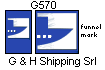
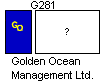
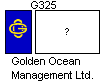
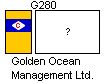
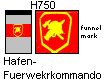
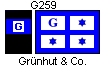
The funnel is documented in a starboard photograph of Scali del Pontino taken on 21 June 2013.
G & H was a joint venture of Gas & Heat of Leghorn, owned by Claudio and Mauro Evangelisti, and MES Marine Engineering Services of Trieste, owned by Giorgio La Valle. The source records their first newbuilding contact in 2009. Lloyds lists the company under Lauritzen Kosan as manager.
Italy, Pisa.
G BULK CORPORATION.
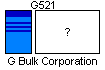
The funnel is documented in a port-side photograph of Alkestis taken on 11 April 2011.
The source records purchase of Ariadne in 2010 and lists G Bulk as manager in Lloyds 2011–12.
Greece, Athens.
G. & J. BURNS LTD.
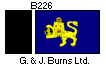
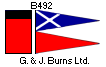
B492 is the original sailing-ship house flag. Shipping Wonders of the World says Samuel Cunard adopted it for his British & North American Royal Mail Steam Packet Co. in recognition of George Burns’s help, and that Burns returned the compliment in 1880 by adopting B226, based on Cunard’s new flag. Loughran treats that connection only as a possible explanation. LJC 1885 also gives the flag for Glasgow, Belfast & Liverpool Steamers, apparently a Burns trading name. B226 follows the National Maritime Museum’s Burns & Laird flag, with the emblem towards the hoist.
Loughran describes an initially black funnel, apparently unchanged at the merger.
The brothers George and James founded the company in 1824. Owned by Coast Lines, it merged with Laird Line in 1922 to form Burns & Laird Lines.
U.K., Glasgow.
G. BRODIN.
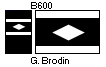
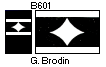
B600 follows Brown 1926. The 1929, 1934 and 1943 editions instead show a diamond with concave sides, represented by B601.
G. Brodin operated Rederi A/B Disa and is listed at Erik Brodin’s address in 1917–18. In 1937–38 G. and O. Brodin shared an address and the telegraphic name “Disa”, while Erik was nearby. Disa’s history is traced to O.A. Brodin’s 1898 Gävle foundation and 1914 move to Stockholm, operating through subsidiaries. Rosanoski thinks the concerns were connected and Erik took over operations, but does not establish the relationship. The later Erik concern passed to Salénsrederierna in 1971.
Sweden, Stockholm.
G. Bros. Maritime S.A.
G. BROS. MARITIME S.A.
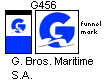
The funnel is documented on Porto Cayo, starboard on 29 June 2008.
G. Lines S.A.
This funnel is documented on Santa Maria I, starboard on 6 May 2010.
George D. and Stathis D. Gourdomichalis established G. Bros. Maritime and G. Lines after selling their FreeSeas shares. The narrative dates formation to 2007 as part of G. Bros. S.A., while Lloyds gives 2006 for G. Bros. Maritime and 2007 for G. Lines. The concerns acted as ship managers and operators, with Lloyds listing agency roles.
Greece, Pireaeus, as spelt in the country entry; the narrative uses Piraeus.
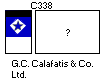
G. C. CALAFATIS & CO. LTD.
Recorded for Annita in 1965, the funnel is white with a black top, separated by a broad blue band bearing a white diamond charged with a blue star. No flag is noted.
Greece, Piraeus.
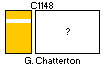
G. CHATTERTON.
The funnel derives from a black-and-white photograph of Commodore I.
G. Chatterton built Commodore I, initially used between Lindidsfarne and Hobart after the Tasman Bridge disaster of 5 January 1975.
Australia, Hobart, assumed.
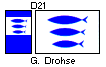
G. DROHSE.
The white flag shows three blue fish, one above another in descending size. The blue funnel has a broad white band bearing the same arrangement.
Denmark.
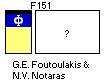
G. E. FOUTOULAKIS & N.V. NOTARAS.
Panagia Vrysiani was recorded with this funnel in April 1967. It is yellow or buff, with a black top separated by a broad blue band bearing a white Greek phi. No flag is recorded.
Greece, Piraeus.
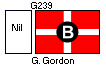
G. GORDON.
image by Joe McMillan, 14 October 2001
Joe McMillan thought the flag might imply a Black Ball Line connection, while stating that he did not believe the company was affiliated. The illustration follows Private Signals of the Merchants of New York.
G. Gordon was a mid-nineteenth-century concern.
USA, New York.
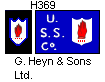
G. HEYN & SONS LTD.
image by Jarig Bakker, 2 September 2004
image by Jarig Bakker, 2 September 2004
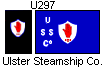
The National Maritime Museum example discussed as U297 is dated about 1951 and measures 889 by 1422.4 mm. It has three blood drops, the middle one larger. LJC 1885 shows a more elongated shield with black blood spots; LJC 1966 gives the funnel shield a blue border.
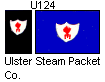
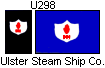
The early versions omit letters even though Lloyds 1882 had shown them. The source gives conflicting counts of two or three drops for Griffin’s U298. Reed 1891 labels U124 “Ulster Steam Packet”, which Rosanoski suspects is an error; Reed 1901 corrects the name and shows two drops. He also questions Griffin 1895’s U124 attribution against LJC’s earlier version.
LJC 1909 spreads H369’s charges across the field. Lloyds 1904 and 1912 give the funnel shield a blue edge. Rosanoski’s Loughran note gives four blood drops and no dots after the letters, without a blue funnel-shield border; the quoted FOTW account instead says Loughran has dots after all letters. The copied National Maritime Museum credit for Bakker’s H369 is identified as erroneous; Rosanoski gives Loughran as its source.
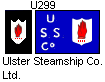
A black-and-white photograph of Torr Head shows U299’s smaller shield halfway down the funnel. Talbot-Booth and Harnack put dots after all flag letters except “U”. The US Navy version gives the shield a blue orle and three drops. Bakker’s FOTW U299 derives from the National Maritime Museum.
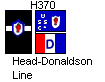
After the 1967 acquisition of Donaldson’s Montreal service, its flag was flown below Head Line’s, as H370. Santona, the sole surviving Donaldson ship, retained her white funnel band and reversed the flag order. A year or two later the other two ships on the service received the white band together with the red hand; Rosanoski presumes that the latter also applied to Santona.
The flag is blue with a white shield bearing the red Hand of Ulster, blood drops below it and white “USSCo” lettering. The funnel shield normally has a narrow blue border, sometimes omitted. Sources differ over the number of blood drops, and some omit them entirely. The same livery is variously listed under Head Line, Lord Line, G. Heyn & Sons and Ulster Steamship.
G. Heyn & Sons, dated 1823 in the FOTW account, managed the Ulster Steamship Co., or Head Line, formed in 1877. The Ships List gives Dublin, while Lloyds places it in Belfast. In 1917 it bought the last two Irish Shipowners Co. vessels as that company entered liquidation; this qualifies the broader description of a takeover. Rosanoski considers an earlier Ulster Steam Packet name possible but doubtful.
A 1919 agreement pooled vessels with Palgrave, Murphy and Hudig & Veder. Ulster Steamship was re-registered at Belfast in 1924. The interests also included Mountain Steamship, formed in 1933 and stated to have ceased in 1954, North Continental Shipping and Cargo Forwarding. Head Line ships took Irish headland names, while Mountain ships were named for Ulster mountains. The Donaldson shares were acquired in 1967, leading to Head-Donaldson Line. Its last ship was sold in 1979 and the services entered Canadian Pacific’s operations.
By the 2003 FOTW account, Heyn continued as ship agent for Orient Overseas Container Line, Ellerman, Finnlines, ECS and Shipping Corporation of India.
UK, Belfast.
G. M. STEEVES & CO.
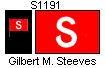
The Log gives this livery for Larnaca, owned by Larnaca S.S. Co. and operated by G. M. Steeves & Co. on the Australian coast.
Gilbert Steeves & Co. operated sailing ships before ordering a steamer in 1881. Sail continued for another twenty years, and the last steamer was sold in 1913.
UK, Liverpool.
G. MENGWALL.
Mitchell apparently associates the funnel with the later Bellona, recorded under Mengwall in 1978–79. His vessel particulars differ in build year, and he does not mention Castor, so Rosanoski assumes the funnel applies around that period. Later colours are recorded under Rederi A/B Castor; the earlier, smaller Bellona belonged to operated R/A Alpen.
Formed in 1967, the concern appears in earlier registers as A.E. Mengwall and from April 2004 as G. Mengwall. It operated and managed for Rederi A/B Castor, later listed as its name or operating company.
Sweden, Uddevalla.
G.A. FERRIES.
image by Jarig Bakker, 3 December 2005
Brown’s flag is divided horizontally blue–white–blue in proportions 1:4:1, with the company logotype in the centre. Sache notes that the logotype appears to have changed slightly since the book’s publication.
Marina’s port-side photograph shows the funnel with an upright logo.
A branch of the Agoudimos shipping family established G.A. Ferries in 1988, although Lloyds dates formation to 1990. The detailed account says a major holding was sold to Hellas Flying Dolphins in 1999, leaving Minoan and NEL with 46% and 54% respectively; Lloyds instead describes a 1999 purchase by NEL. Gerassimos Agoudimos’s family repurchased its holding in October 2002, which Rosanoski interprets as buying out Hellas Flying Dolphins. Creditors halted the ships in 2009 and all operations were suspended.
Greece, Piraeus.
G.C. LORD & CO.
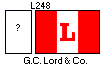
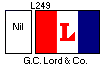
Flaggenbuch 1905 gives a red–white–red vertical triband with a red L in the centre.
Griffin 1895 instead makes the fly band blue, as Rosanoski points out.
Griffin identifies G.C. Lord as sailing-ship operators.
USA, Boston.
G.C.H. NEWELL & J.R. EINARSON.
Newell and Einarson owned Jap from 1931 to 1934.
Australia, Sydney.
G.H. FLETCHER & CO.
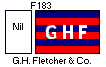
The sailing-ship operator apparently had Compañia La Flecha as a subsidiary.
UK, Liverpool.
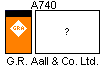
G.R. AALL & CO. LTD.
No merger assumed with Aall & Co. or modern AAL vessels. Retain Japan as source-only, without a guessed external country. The local record coherently identifies a Kobe operator of Rosewood in 1980–1985. Searches of initials, full name, Kobe and vessel did not establish an independent matching source.
G.R. Aall & Co. Ltd. operated Rosewood, built in 1958, from 1980 to 1985.
Japan, Kobe.
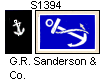
G.R. Sanderson & Co.
G.R. SANDERSON & CO.
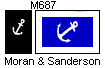
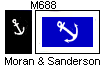
Moran & Sanderson
Also recorded as Anchor Line, G.R. Sanderson’s shipping interests began around 1880 through the sailing-ship partnership Moran & Sanderson. He set up independently in 1891 through East Riding S.N. Co. and Hull S.S. Co., liquidated in 1900 and 1908 respectively. Inverness, built in 1890, was owned by Hull Steam Shipping Co. under G.R. Sanderson & Co. and sold in 1899.
UK, Hull.
G.T. GILLIE & BLAIR LTD.
image by Jorge Candeias, 24 February 1999
image by Rob Raeside, None
image by Rob Raeside, None
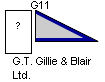
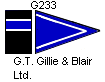
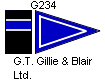
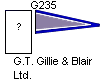
The funnel bands are called silver and blue by Merchant Ships, grey and blue in LJC, and grey or silver in Ships & the Sea. Rosanoski considers the pale band white in a photograph of Northern Coasters’ Sea Kestrel. Talbot-Booth 1944 shows a blue pennant with a white orle; Brown 1951 and Stewart 1963 extend the white to the hoist, with Brown making it thicker. Stewart attributes the livery to Firth Shipping. Rosanoski cannot say whether these differences reflect actual changes or artistic variation.
Jorge Candeias describes a triangular flag with a horizontal lower edge, purplish blue with a dark-blue border except at the hoist. Rosanoski observes that the illustrated field is only very lightly tinged blue.
The company website shows a mauve field and very dark blue border except at the hoist, separated by white fimbriation. Although the image suggests a right-angled triangle, Rosanoski thinks an ordinary long pennant may be intended, consistent with earlier flags. The field is recorded as mauve but looks grey to him.
The coastal-tramp concern began as G.T. Gillie Ltd. in 1911, trading through Ferrum Steamship. It became G.T. Gillie & Co. in 1914, G.T. Gilllie & Blair in 1919 as the source spells it, and G.T. Gillie & Blair Ltd. in 1925. Its broader maritime activities included management and time-chartered tonnage; much of its own shipping apparently worked under charter.
Associated companies included Border Coasters, formed in 1913, Cheviot Coasters in 1915 and Firth Shipping in 1923. Northern Coasters is dated to either 1923 or 1924; Lloyds records a 1989 change to Stena Offshore and a re-formation in 2004. Boddingtons Shipping, formed in 2001 at Braintree, later appears under the combined name Boddingtons Shipping Ltd. & The Firth Shipping Co. Ltd.
UK, Newcastle.
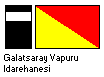
GALATSARAY VAPURU IDAREHANESI.
The black funnel has a white band. The flag is divided diagonally into red and yellow halves, with the diagonal recorded as “Pbd”.
Roumania; the source tentatively equates Gatalta with Galati.
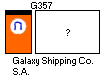
Galaxy Shipping Co. S.A.
Documentary images — company attribution uncertain
The funnel emblem is the Greek pi. Rosanoski suspects that Mitchell confused Galaxy’s tanker Majestic with Union Commercial’s bulk carrier of the same name, since the funnel appears on Union Commercial’s card.
Which Majestic and which operator remain unresolved.
Galaxy’s tanker Majestic was listed through C.M. Lemos in London and Nereus in Piraeus, with later entries under Nereus Shipping Tourism Hotels Real Estate.
UK, London, and Greece, Piraeus; later listings give London alone.
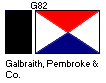
GALBRAITH, PEMBROKE & CO.
The funnel is black. The flag is quartered diagonally red–white–white–blue.
The concern operated through Austin Friars Steam Shipping and Basra Steam Shipping. It ceased shipowning about 1954 but continued as an agency, later acting for St. James Line.
UK, London.
Ganship International Ltd.
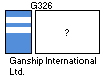
GANSHIP INTERNATIONAL LTD.
The funnel comes from a January 2006 photograph of Anatolia Star, managed by BP Petrolleri of Istanbul.
Formed in 1973 as Ganmount Shipping, the company became Ganship International in 1994. It managed Dunya Denizcilik, later listed as a major operating company. Ganmar Denizcilik, formed in Istanbul in 1995, subsequently took over the ships previously listed under Ganship.
UK, London.
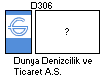
DUNYA DENIZCILIK VE TICARET A.S.
Photographs of Gonen at Wellington on 18 June 2003 and a later JB contribution support this version. Mitchell also shows a solid letter, whereas NJK reports that the three or four vessels he had seen carried an open S.
Lloyds dates Dunya’s formation to 1985 as Dunya Petrol Nakliyat, followed by absorption of Umutsay Denizcilik and a name change in 1988. The company’s account instead traces its London beginnings under Suay Umat back more than thirty years before 2006, with headquarters moved to Istanbul in 1984. Dunya means “the Globe”, reflecting its worldwide oil and chemical shipping market. Managed by Ganmount and then Ganship, it entered co-operation with Broström in 2005.
Turkey, Istanbul.
Documentary material — company attribution not established
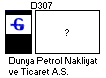
Ganship / Dunya documentary comparison
Mitchell records this funnel under Ganmount and also says D306 applies. His D307 G follows the shape of D306 but is solid. The vessel basis appears to be Geaze, which Rosanoski thinks means Gebze.
Keep the explicit scope label independent; no alias or company identity is inferred.
Ganymed Shipping GmbH.
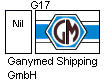
GANYMED SHIPPING GMBH.
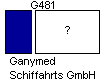
No funnel is recorded with this flag, the vessels being chartered to Abu Dhabi Container Lines or Norasia. Nüsse’s later table-flag scan may not have been straightened, making the letters appear slightly angled.
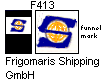
Frigomaris Shipping GmbH [1111461]
The central design is unclear. Rosanoski suggests a gold outline of a globe and tentatively interprets it with the blue as indicating worldwide sea trade.
Ganymed Schiffahrtsgesellschaft mbH [0209737]
Mitchell shows this funnel on only one of his three vessel drawings.
The management business traces its beginnings to conventional reefers operated as Frigomaris Shipping in the 1970s, with the first fully managed container vessel contracted under Ganymed in 1987. The register account describes Frigomaris taking over Ganymed Schiffahrtsgesellschaft in January 1985 to avert liquidation, and Frigomaris Reefer Schiffahrt changing its name to Ganymed Shipping in 1990. Frigomaris Shipping later appears as parent of Ganymed Shipping and Ganymed (Malta), formed in 1996. Bremer Bereederungsgesellschaft was set up in 2002 and took over all management contracts and activities on 1 January 2003.
Germany, Hamburg.
GARD SHIPPING A/S.
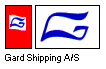
The red funnel bears a white flapping flag with a stylised blue G. The house flag is white with the same stylised blue G.
Gard Shipping was formed in 1981, with its fleet held through Gards Rederi, formed in 1982.
Norway.
GARDLINE SHIPPING LTD.
image by Jarig Bakker, 29 January 2006
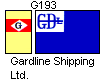
The funnel letter is black; the FOTW flag is based on Brown 1995.
The earlier Ocean Seeker funnel is documented in port and starboard photographs; the starboard view is dated 6 October 2007, while the port-side date is malformed in the source.
Ocean Seeker’s starboard photograph of 14 March 2013 shows the new Gardline logo.
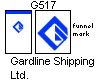
Ocean Observer’s port-side photograph of 8 December 2013 shows a bluish symbol, compared with the Hydro logo. The design retains three waves or lines below the stylised G, omitted from the newer group logo. Discussion initially calls it an older version, then notes continued use by Gardline Shipping, Gardline Lankelma Middle East and Gardline Australia. A suggestion that Mediterranean location implied Middle East affiliation is countered with an archived Marine Sciences ownership reference.
Rosanoski distinguishes two basic designs on white funnels, with and without waves. Gardline Surveys apparently used the version without waves, and restructuring seemed likely to bring a common group design. Sea Explorer and Ocean Seeker had changed, while Ocean Researcher showed a plain white funnel, possibly awaiting a new logo. Archived logos also vary in the tint of the lower lines.
Lloyds dates formation to 1966, while the company account says Gardline Shipping was established in 1969 as the group holding company, supplying marine support to the North Sea oil and gas industry. The international marine-geosciences business reorganised on 1 May 2003, creating subsidiaries focused on particular markets.
T.G. Darling appears as manager and later chairman and managing director. A Singapore branch managed part of the fleet. Wholly owned Gardline Marine Sciences had three operating companies taking over work formerly done by Gardline Surveys. The latter, formed in 1995, became Gardline Geosurvey in the 2003 restructuring; Gardline Hydro was its seabed-mapping division. Rosanoski identifies Geosurvey as fleet operator, with ownership apparently spread among divisions.
UK: Lowestoft, later Great Yarmouth.
GARIBALDI S.R.L. COOPERATIVA DI NAVIGAZIONE.
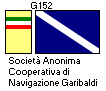
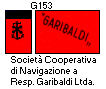
The source records four funnel forms: black with a broad band of the blue anchor-and-propeller flag; black with a green–white–red band; yellow or buff with the same tricolour band; and red with a black top and a black vertical anchor surmounted by an angled propeller without a defined outline. Three flags accompany them: blue with a yellow anchor and angled propeller; blue with a narrow white diagonal band; and red with black GARIBALDI set diagonally. The diagonal direction is recorded as “Pbd”.
Brown 1951 distinguishes G151 for general cargo vessels from G152 for liners and tankers.
Brown 1958 shows the red GARIBALDI flag below a green–white–red national-colour pennant.
The co-operative was formed in 1920 as Società Anonima Co-operativa fra Lavoratori del Mare per L’Esercizio della Navigazione con Naviglio Nazionale Garibaldi and changed its name in 1932. It also managed Esperia Mare.
Italy, Genova.
GARLAND TRANSPORTS INC.
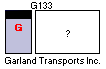
The funnel was recorded on Garland at Lyttelton on 18 February 1972. Mitchell uses an ordinary darker blue and a larger letter.
Japan Marine Services acted as agent.
Japan, Tokyo, in the NJK account; Mitchell instead records Garland Tankers of Monrovia.
GARRY BALKIN,
Garry Balkin began Brisbane River cruises with the launch of Kookaburra Queen I in 1986. Club Crocodile Holdings took over the operation in 1994.
Australia, Brisbane.
GASCHEM SERVICES GMBH & CO. K.G.
Gaschem Ben Flor supplies this funnel reference while chartered from Vorsetzen Bereedungs und Schiffahrtskontor of the Bernhard Schulte group.
Gaschem Ice supplies the April 2008 funnel reference while chartered from HCI Hanseatische Schiffstreuhand.
Group vessels appear to have retained Hartmann colours, as shown by Gaschem Baltic in 2005 and Gaschem Isa in September 2006.
Hartmann Schiffahrt and Tankreederei Ahrenkiel established GasChem in 1990 for the development, marketing and management of gas tankers. Its tanker pool began in 1991, and it managed the German–Italian GasChem-Gasmare Pool. Hartmann bought Ahrenkiel’s shares in 2006. Vessel names began with Gaschem.
Coastal Ships 1967 gives this livery for Gaselee & Knight, while noting that some vessels retained their earlier colours.
Some vessels retained prior liveries; do not generalise to the entire fleet.
British Coastal Ships, Tugs & Trawlers 1975 describes an added Dick & Page house flag superimposed on the funnel. Rosanoski presumes this refers to Elliott Steam Tug, but had no photographs to support it.
The tug concern is recorded as Gaselee & Son and later Gaselee & Son (Felixstowe), which Rosanoski assumes to be the same firm. Gaselee & Son (Towage) merged with J.P. Knight (London) on 1 October 1966 as Gaselee & Knight, though its absence from Lloyds suggests a possibly brief existence. The business apparently became Alexandra Towing (Felixstowe), under which its last vessel, Sauria, appears in 1978–79. Allantone Supplies was an associate.
UK: London, later Greenwich.
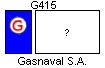
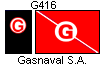
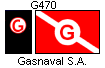
GASNAVAL S.A.
Marine Mercante en el País Vasco shows two slightly different forms of the G used as the flag’s basis.
Berceo’s funnel has a G whose upper curve does not extend as far as in the flag. On Gongora in January 2007 it is cut shorter still. The website also shows this difference between funnel and flag lettering.
Gasnaval was formed in 1980 to transport liquefied gas and petroleum, although Lloyds gives 1981. Its original shareholders were Naviera Artola, Marítima del Litoral and Gazocéan; Gazocéan subsequently withdrew. J. Lauritzen bought half in December 1989 and the remainder in February 1993. Promoter Don Fernando Clariana died in 1990.
Spain: Madrid, later Vizcaya, also recorded as Bizkaia.
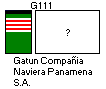
GATUN COMPAÑIA NAVIERA PANAMENA S.A.
Gatun Locks had a green funnel with a very narrow black top and a broad seven-band white-and-red marking. No flag is recorded.
Corner Banca acted as agent. The funnel record for Gatun Locks notes an association with the Cameli group.
Switzerland, Lugano.
GAVRION SHIPPING CORPORATION
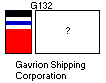
Gavrion was recorded at Boston on 19 October 1971 with a red funnel and black top separated by a white–blue–white band. No flag is recorded.
Simbouras Brothers acted as agent.
Greece, Piraeus.
GAZ ATLANTIQUE.
image by Ivan Sache, 2 December 2002
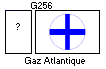
Sache interprets the flag as white with blue fimbriation around the central disc, although the small source image appears to have a light-grey field.
Lloyds dates formation to 1997, while Pavillon describes small gas-ship operations before the May 1997 sale by Worms to Société Financière Neptune. Rosanoski suggests either a sale soon after formation or earlier chartering. A France Shipmanagement listing might reflect the Worms merger history or simply a management role; France Shipmanagement and Tecto Belgium later appear as managers.
After Fouquet-Sacop’s acquisition in 1998, the two concerns worked together. The 2002 restructuring account describes Fouquet Sacop Maritime for management and crewing and Fouquet Sacop as shipowner. Lloyds nevertheless continues Gaz Atlantique as a separate owner of Fouquet-Sacop Maritime, while FOTW places it within the Fouquet-Sacop group. Its sole ship, Touraine, was absent from Fouquet’s fleet list and appeared in Exmar colours on the website.
France, Marseille.
GAZ DE FRANCE.
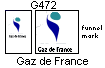
G472 is based on a stern photograph of Provalys showing the same logo on port and starboard. Its appearance on the forward face is presumed rather than observed.
Gaz de France, or GDF, was formed in 1946 under French government control and was later partly privatized. It merged with Suez in 2008 to create GDF Suez Group, recorded as the majority shareholder in Gazocean.
France, Paris.
Gazocean.
GAZOCEAN.
image by Ivan Sache, 8 December 2002; later replacement noted
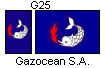
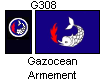
The house flag is dark blue with a curved white dolphin detailed or outlined in black and emitting a red flame. Loughran reproduces the emblem in detail from an official 1970 drawing, which Rosanoski assumes may date the flag. Nüsse’s newer table-flag image gives a better blue.
This funnel is recorded for the chartered Max Planck, built in 1992.
The Brigham slide is thought to show Fridjof Nansen at Brisbane in August 1970. The vessel belonged to A.I. Langfeldts, but the underlying funnel colours are not that owner’s. The flame points forwards on the starboard funnel, perhaps indicating a mirror image of the port side. The tail is smaller than the official version and does not curve back over the body.
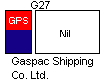
Documented shared associations — Gaspac observed funnel with shared Gazocean group flag
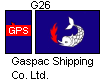
The funnel is documented on James Cook in a photograph dated 21 February 2007.
Gaspac Shipping Co. Ltd. — Bruce Reid ownership period
No exclusive fleet-wide use or unrecorded corporate equivalence is asserted.
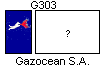
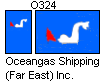
Documentary images — company attribution uncertain
Rosanoski considers this probably an incorrect rendering of the emblem. Mitchell also draws a correct version on a blue circle without cross-referencing them; G303 may have been intended as O324.
Do not equate companies from motif similarity.
Port/starboard reconstruction, flags and company assignment unresolved.
Gaspac Shipping Co. Ltd.
Gaspac used the group flag with its own funnel. This funnel is recorded under Bruce Reid & Sons ownership.
Keep the explicit scope label independent; no alias or company identity is inferred.
Oceangas / Gazocean documentary comparison
A black-and-white starboard photograph of Arago shows the fish facing forwards; Rosanoski assumes a mirrored port-side arrangement from a partly obscured Magellan photograph, which also supports sky blue. Magellan flies two flags: one in the funnel’s shade, tentatively taken as the depicted flag, and a dark-blue one with what may be a white fish tail at the hoist. Arago’s tail is definite, but Magellan is in Gazocean mode, so Rosanoski warns that the connections may be wrong.
Keep the explicit scope label independent; no alias or company identity is inferred.
The dolphin was commonly added to a chartered ship’s existing funnel design: on a Houlder vessel it shared the red band with the Maltese cross moved aside, and on a Tung vessel it shared a blue funnel with a gold star. A Port of New York sheet describes the funnel as dark blue-grey.
René Boudet began in liquefied petroleum gas with Italy’s Oceangas in 1956. A charter opportunity with Shell Maritime enabled him to establish Société Gazocean in Paris in 1957; the shipping subsidiary Gazocean Armement followed in 1968. Financial difficulties in 1977–1978 brought restructuring with French Government and Moroccan help, and Boudet left to form Geogas Trading. One account describes continued LPG trading followed by a looser General Gas Carriers pool in 1983 and eventual dissolution; Rosanoski suggests the last statement may instead concern Gaz de France’s involvement.
The recovery involved Furness Withy, Compagnie Générale Maritime, Gunther Schulz and Friedrich A. Detjen alongside existing shareholders. The plan is undated in Lloyds; Rosanoski places it before 1991 from the company timeline. The company account gives Gaz de France a 25% interest in Gazocean Armement in 1991, rising to 75% in 1997, and Geogas 25% from 1993. Gazocean Armement became Gazocean in 2003. NYK replaced Geogas in 2004 as Gaz de France’s interest rose to 80%; the 2008 Gaz de France–Suez merger left GDF Suez as majority shareholder.
The operating structure included Comargaz Management, formed in 2003 and apparently ending with Philippine’s sale to Geogas in 2006. Marima, formed in 1994, became part of Gazocean Armement et Marima, which included Messigaz and later appeared as a Compagnie Marocaine de Navigation–Gazocean joint venture under CMA CGM. Lloyds applies the 1957 formation date to Armement, which Rosanoski identifies as an error.
Associates included Gaspac Shipping, formed by Bruce Reid & Sons in 1973 and based at Port Villa, Vanuata as spelt in the source, and Nisa Navegacion. Gazocean participated in Gasnaval’s formation in 1980 before selling out, and held an interest in Messigaz, formed in 1974.
The Oceangas links are qualified. Rosanoski associates Oceangas Hellas with Socrates, formerly Gazocean’s, and connects Hong Kong’s Oceangas Shipping (Far East) through Arago, also formerly Gazocean’s. The latter source also records Magellan under Tongan registry and Helen managed by Oceangas Australia, providing a Geogas connection; Rosanoski could not locate Magellan in the cited ship registers.
France, Marseilles.
GBS-Shipmanagement GmbH & Co. K.G.
GBS-SHIPMANAGEMENT GMBH & CO. K.G.
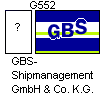
The flag is based on the website image and appears flying on Norrvik in a starboard photograph dated 10 March 2008, while chartered to Jönsson Novabolagen. The blue looks lighter; only the first two letters are clear, but their arrangement agrees with the image and the narrow yellowish-green bands can be distinguished.
Guido Buck Schiffahrts K.G.
Simon B, photographed to starboard on 29 August 2007, appears to be the only fleet vessel wearing the company’s funnel colours and seems to have been chartered in.
The business began as Guido Buck Schiffahrts in 1998 with Figaros, although Lloyds gives formation in 1999. Guido Buck Bereederungs was formed in 2006. In 2008 the Buck and Schiffahrtskontor Groß interests consolidated as Groß/Buck Bereederungs, which was liquidated in 2009 and replaced by GBS-Shipmanagement. Guido Buck subsequently became sole shareholder; the source’s date is malformed.
Schiffahrtskontor Groß specialised in managing coasters in the North and Baltic Seas and the Mediterranean and Black Sea. Its later website redirected to GBS, confirming the amalgamation described in the company account.
Germany, Cuxhaven.
GDYNIA-AMERIKA LINJE ZEGLUGOWE SPÓLKA AKCYJNA.
Merchant Ships 1942 shows a black trident on the funnel but blue on the flag; Ships & the Sea instead specifies blue on the funnel.
Jordan does not specify the funnel-shield details. The Brazilian website’s 1950 livery account shows a black trident.
Brown 1943 shows a narrow red band on the flag. Rosanoski deliberately uses a darker funnel yellow than may have applied to make the white edging visible.
Also known as Gdynia-America Shipping Lines, the company was formed in 1930, previously using Polskie Transatlantyckie Towarzystwo Okretowe during part of the 1930s. It eventually became Polskie Linie Oceaniczne in 1951. The source also records absorption of Zegluga Pólska and Polsko Brytyjskie Towarzystwo Okretowe.
Ownership was mainly Polish Government through Zegluga Pólska. Merchant Ships initially calls Det Östasiatiske Kompagni a controller and joint manager with Zegluga Pólska, later redefining the Danish company’s role as having held an interest.
Poland: Gdynia and Warsaw are recorded.
GEARBULK LTD.
image by Jarig Bakker, 5 September 2005
The logo is registered to Gearbulk Holdings and apparently used by Gearbulk Shipowning. The funnel is confirmed on Tinamou Arrow, port side on 23 July 2013, and Bulk Jupiter, starboard on 16 February 2014.
Gearbulk was formed in 1968 according to Lloyds, or 1969 according to Mitchell, as an equal partnership of Kristian Jebsens Rederi, Louis Dreyfus, Buries Markes and J. Ludwig Mowinckels Rederi. Jebsens bought out Dreyfus and Buries Markes in 1990, then Mowinckel. Mitsui OSK’s purchase of a quarter interest was announced for May 1991, or June in Mitchell; later ownership was 60% Jebsens and 40% Mitsui. Rosanoski suggests subsequent incorporation into Gearbulk Shipowning, formed in 1991.
Dublin Shipping and Canadian Transport were acquired in 1998, the latter on behalf of Kristian Gerhard Jebsen. On 20 March 2006 Gearbulk Shipping of Bermuda bought Borgestad Shipping and renamed it Gearbulk Shipping A.S. The group also included New Zealand’s Transpacific Container Service.
Norway, Bergen; Hamilton, Bermuda, is recorded in the intervening 2005 listing.
GEBRÜDER AHRENS K.G.
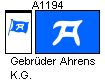
Rosanoski explicitly calls A1194 guesswork. Photographs of Larissa show a plain white funnel with a narrow black top and the logo painted on the superstructure. Placing that logo on the funnel is an imagined arrangement for operation in the company’s own name, since the ships appear to be chartered out; the flag is likewise assumed from the logo, with no actual flag recorded. A port-side photograph of Hanna dated 13 July 2006 shows the Unifeeder name on the hull and Unifeeder’s logo on the funnel, supporting the charter-colour context rather than proving the hypothetical company design.
Gebrüder Ahrens was formed in 1996. Rosanoski suggests from the livery that it may have succeeded J.E. Ahrens K.G. The operating company Reederei Gebrüder Ahrens GmbH & Co. K.G. was formed at the same address in 2004, and Lloyds records Gebrüder Ahrens as manager in 2011–12.
Germany, Grünendeich.
GEBRÜDER ELFRING.
image by Klaus-Michael Schneider, 8–9 April 2009
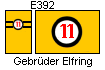
The yellow flag has a central white disc edged black, containing red 11. Schneider explains it as a canting design because Elf means eleven in German. Rosanoski recommends a larger emblem when following Flaggen & Schornsteine and identifies Gerhard Elfring as the vessel for which the livery is given.
Gebrüder Elfring built Herman Litmeyer in 1938 or 1939, with entry into service recorded on 29 June 1939. Maria Litmeyer managed it; the relationship between her and the builders is unclear. The Allies seized the vessel in 1945. Gerhard Elfring followed in 1956 and was sold in 1965. Rosanoski corrects the Elfering spelling in Flaggen & Schornsteine from Lloyds and Die Deutsche Handelsflotte.
Germany, Haren/Ems.
GEBRÜDER GRIESHABER GMBH & CO. K.G.
image by Eugene Ipavec, 17 April 2009
image by Eugene Ipavec, 17 April 2009
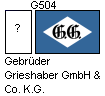
The website flag is blue with a white diamond stopping short of the edges, bearing blue Gothic G.G. initials.
The Flaggen auf dem Rhein version makes the initials and dots black. A new table flag offered for sale confirmed black, with a slightly different dot shape.
The sand-and-gravel concern originated with Georg Grieshaber’s barge transport of construction materials in 1854. His sons Sebastian and Wilhelm founded Gebrüder Grieshaber in 1900. It remained family-owned until Becker & Grieshaber succeeded it in 2010.
Germany, Ludwigshafen.
GEBRÜDER LÖFFLER.
image by Klaus-Michael Schneider, 16 Apr 2009
Schneider’s FOTW version L481 follows Deutsche Reedereien und ihre Erkennungszeichen, but Rosanoski notes differences from L480: the anchor is angled farther, the letter is wider and outlined black instead of blue, and the circle should be outlined black. He suggests the skewed flag illustration led to the anchor-angle discrepancy.
Gebrüder Löffler operated Christine from its purchase in 1951 until sale in 1956.
Germany, Hamburg.
GEBRÜDER PETERSEN.
image by Jorge Candeias, 6 May 2004
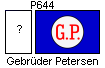
Jorge Candeias’s version is blue with a central white roundel, possibly edged black, and apparently red G.P. initials. Its source was initially unstated. A later response named Gustav-Adolf Wolter’s See und Seefahrt (1968), but Rosanoski reports that the flag does not appear there.
Lloyd’s 1904 and 1912 instead show a blue flag with a white circle and black G.P. letters. Rosanoski identifies another image on the FOTW page as belonging to Kohlenberg & Putz Seefischerei of Geestermunde, distinguishing its number 1879 from Petersen’s 934 in Lloyd’s 1912.
The brothers owned Konigsau in 1904–13, operating through Norddeutsche Frachdampfs. Ges.; two ships are recorded in 1910. The later account describes Konigsau as built in 1903 for Norddeutscher Frachtdampfs Ges., with the brothers as main owner, and subsequently interned as a British prize. Rosanoski suggests that the company did not survive the First World War.
Germany, Flensburg.
GEBRÜDER SPECHT.
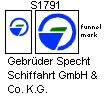
BBC Niteroi’s September 2009 starboard photograph documents the funnel.
Johann Philipp and Johannes Specht founded the business in 1874 as shipbrokers, owners and agents. Johann’s son Christian joined in 1901, followed later by Christian’s sons Walter, Heinz and Hans. The business recovered after near-collapse in the Second World War. The source describes a fourth-generation withdrawal from management in 2000 and leadership by Hans-Christian Specht and Eduard Dubbers-Albrecht. Chartering and ship management transferred to Gebrüder Specht Schiffahrt in 2007. A later register places Johann Philipp Specht Schiffahrtsgesellschaft under Bremer Lloyd management.
Germany, Bremen.
GEBRÜDER ULMANN.
image by Klaus-Michael Schneider, 6 April 2009
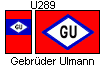
The 1956 source describes the diamond frame as celestial blue, but Rosanoski’s rendering follows the darker blue of the company logo. Flaggen auf dem Rhein confirms the black letters. Mitchell’s funnel is taken to be Fisser & van Doornum’s F35 rather than independent evidence of a new Ulmann design.
Founded in 1891, Gebrüder Ulmann worked in forwarding, shipping and warehousing, including inland, dry-bulk and tanker business. Mitchell records its routes and ships passing to Fisser & van Doornum.
Germany: Hamburg, later Winsen (Luhe) in the company account.
GEEST PLC.
Geest Line Ltd.
image by Jorge Candeias, 21 March 1999
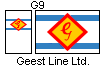
The white flag has two light-blue horizontal stripes near the upper and lower edges. A central yellow lozenge has a thick red border and an ornate red G. The Netherlands concern Waling van Geest en Zonen used the same flag. During the 1960s vessels of several other companies wore Geest colours, including Laeisz, Compagnie General Transatlantique, Sloman, Brovig, Klaveness and Bruns.
Brown’s notes date an altered funnel to 1994, but Rosanoski is uncertain whether the bands disappeared and whether the lettering was GEEST or Geest. He also questions whether the change occurred at all, since the old format appears to have continued. The corresponding company website design is only a logo, with no evidence there of funnel use.
The funnel and flag appear on chartered Klipper Stream, port side on 16 August 2013, with the starboard funnel confirmed by a photograph of 26 September 2010.
The company website showed Santa Maria in what appeared to be Seatrade Groningen funnel colours.
Geest Horticultural Products was formed at Spalding in 1935 by the Van Geest brothers, Jan, Leen and Maarten, from a Dutch family engaged in nurseries and fruit and vegetable trading. Shipping began in 1945, with banana traffic from 1953 in chartered vessels and owned ships from 1960. Another family account traces a Spalding transport company to about 1930.
The shipping company is dated to 1964 as the British subsidiary of Waling van Geest & Zoonen, carrying deep-sea bananas from the West Indies to Barry and general cargo and passengers westbound. Later Geest Line operated through Geest Ltd., formed in 1993. Ship names used the prefix Geest.
Diversification brought the name Geest Holdings in 1972, followed by Geest plc and stock-market flotation in 1986, when the family sold its holdings. British port operations briefly moved to Avonmouth in 1982, returned to Barry and shifted to Southampton in 1993. The banana business was sold in 1996 to a Fyffes–Windward Islands joint venture; Geest Bananas became Geest Line in 2008.
Rosanoski presumes the banana-business sale ended shipowning, noting the final two vessels, named Dominca and St. Luicia in the source, under separate registered owners and later DMK Leasing.
UK: Barry, Spalding, Bristol and Peterborough are recorded.
GEESTEMUNDE HERINGS & HOCHSEEFISCHEREI A.G.
Germany, Geestemunde.
GEFION SHIPPING APS.
Formed in 1987, Gefion apparently sold its last vessel in 1998.
Denmark, Naestved.
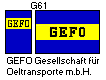
GEFO GESELLSCHAFT FÜR OELTRANSPORTE MBH & CO.
The blue funnel has a broad yellow band bearing squarish black GEFO. The flag is blue with a yellow horizontal band and the same black lettering. The Mobil Flag Chart differs, showing dark blue with letters that appear to be the same shade.
The company was formed in 1968.
Germany, Hamburg.
GEISHU KAIUN K.K.
Lloyds first lists the company as Geishu Kaiun Y.K., later K.K. It remained a Japanese Shipowners Association member after its vessels became too small for Lloyds Shipowning Groups.
Japan, Kurahashi.
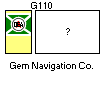
GEM NAVIGATION CO.
Dea Maris was recorded in April 1965 with a yellow or buff funnel and a very broad green band edged white at top and bottom. A white saltire is surmounted by a white circle without a defined outline, containing a black ring around a red delta star overlaid with black DEA. Rosanoski asks whether DEA was vessel-specific and whether Gem Star instead carried GEM. No flag is recorded.
Cheshire Shipping acted as agent.
Bermuda, Hamilton.
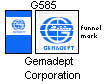
GEMADEPT CORPORATION.
Great Pride supplies the funnel reference, photographed to starboard at Singapore on 16 June 2011.
This funnel comes from a starboard photograph of Pacific Gloria on the company’s ocean-shipping website.
Also recorded as Công Ty Cô phân Dai Ly Lien Hiep Van Chuyen, Gemadept was formed in 1990 under the Vietnam Maritime Bureau. It became a joint-stock company in 1993 and listed in 2002. Singapore and Malaysian subsidiaries followed in 2004. Its maritime activities included port operations and ocean shipping through Gemadept Shipping within a wider logistics business.
Vietnam, Ho Chi Min City.
GEMCO SCHIFFAHRTS-UND HANDELSGESELLSCHAFT MBH.
image by Eugene Ipavec, 12 April 2006
An auction flag is green with a white ascending diagonal stripe bearing the short company name in green sans-serif letters.
The company website instead shows the letters in black.
Founded in the 1950s as the towing concern G. Möller OHG, the company became Gerd Möller & Co. in the 1960s. Günter Ohm joined in 1987 and took over in 1995 under the GEMCO name. It arranged both individual transport runs and longer-term contracts for private shippers carrying a wide range of cargo. The 2010 sources describe its acquisition by Imperial Reederei, with an earlier report still calling the transaction pending.
Germany, Duisburg.
GEMEINWIRTSCHAFTLICHE HOCHSEEFISCHEREI GMBH.
A photograph of a model of Rendsburg confirms the funnel.
Known as GHG, the company is dated to 1949 as a venture of GEG, a union and northern German states, although shipbuilding records indicate operations from 1948. Hanseatische Hochseefischerei took it over in 1970, and the fleet passed to Reederei Söhle in 1972. The FOTW account uses the different name Gemeinnützige Hochseefischerei.
Germany, Bremerhaven.
GEMEINWIRTSCHAFTLICHE KOHLEN HANDELS GMBH.
image by Klaus-Michael Schneider, 29 March 2009
Brown shows the red funnel band narrower than the other band, while the US Navy source gives them equal widths.
The company operated Heinrich Lorenz, built in 1954 and sold in 1959. Both the German fleet directory and Lloyds place it under Fisser & van Doornum, the former also naming that concern as correspondence company.
Germany, Hamburg.
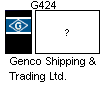
GENCO SHIPPING & TRADING LTD.
Genco Marine on 9 June 2005 still carried the underlying Top Glory funnel, with its letters covered over.
Genco Knight on 25 February 2006 shows the new design based on General Maritime’s. Some vessels, including Genco Challenger, lack a black top and have a smaller G and a diamond frame that does not span the full funnel width. Blue shades appear to vary, with Genco Wisdom looking darker.
The smaller-G variant is documented on Genco London at Newcastle, port side on 11 October 2009, and Genco Spirit, starboard on 27 June 2013.
Formed in 2004, Genco incorporated Top Glory’s fleet after General Maritime acquired it in November that year. General Maritime’s founder, Peter C. Georgiopoulos, was also Genco’s chairman. The source records General Maritime ownership and Genco Ship Management as an operating company formed in 2004. Baltic Trading was established in 2009.
USA, New York.
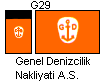
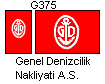
GENEL DENIZCILIK NAKLIYATI A.S.
image by Jarig Bakker, 13 February 2006
Cake supplies the funnel reference, with bright red confirmed on Buddy at Sydney on 3 November 2010 and Marka on 12 June 2013. The flag is explicitly a guess: the website photograph is too indistinct, so Rosanoski assumes the funnel-and-flag design relationship shown by Brown continues to apply.
Known as Geden Line or Geden Lines, the company was formed in 1975 within the Cukurova Group. Sache renders its Turkish name as Genel Denizcilik Naklyatı A.Ş., meaning Genel Shipping. Geden Operations was formed in September 2005 in Malta for a handymax operating presence; Lloyds later lists it in London.
Turkey, Istanbul.
GENERAL KAIUN K.K.
Gohshu Maru was recorded in April 1965 with a black funnel bearing three white bands separated by equal widths of black. A red G with white edging lies over the bands. No flag is recorded.
Also recorded as General Shipping, the company was formed in 1959.
Japan, Tokyo.
GENERAL MARITIME CORPORATION.
Genmar Commander in 2002 and Genmar Trust in January 2005 show ordinary yellow rather than gold. NJK reports roughly half the observed fleet in this version.
Genmar Hector on 3 February 2006 shows the alternative with white diamonds and bands, agreeing with the company logo and funnel depiction.
Also called Genmar, General Maritime was founded by Peter C. Georgiopoulos in 1997, although an earlier Lloyds entry gives 1998. Georgiopoulos also chaired Genco Shipping & Trading. General Maritime acquired Top Glory’s fleet in November 2004 and placed it under Genco. Vessel names began with Genmar.
A report describes a Frontline merger approach, but General Maritime’s December 2004 statement says only that Frontline had acquired stock and expressed interest in a combination: no offer or proposal had been made, and General Maritime was not seeking a sale or merger.
Management companies included General Maritime Management in New York, formed in 2003, and the Piraeus concern founded in 2000 as United Oversea Tankers and renamed in 2003. The Portuguese management business followed acquisition of Soponata’s fleet and technical operations in March 2004, recorded as April by Lloyds.
USA, New York.
GENERAL MARITIME ENTERPRISES CORPORATION.
Panaghia P was recorded with this funnel in March 1967. Its top is barely noticeable, though Mitchell makes it more prominent. Rosanoski suggests that it either formed the basis of the Papangelopoulos funnel or was modified when the agency changed.
United Shipping & Trading of Greece acted as agent, followed by Th. Papangelopoulos. Rosanoski suggests that Papangelopoulos may have owned or acquired the company.
Greece, Piraeus.
General National Maritime Transport Co.
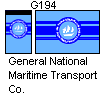
GNMTC.
image by Jarig Bakker, 2 January 2006
The FOTW description calls this a bright-blue flag with white and blue traces, based on Brown 1995.
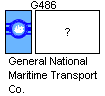
Mitchell’s funnel appears to derive from Hanaa in November 1980.
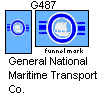
Libya shows the funnel without an inscription. Port and starboard photographs demonstrate a mirrored design, with the bow pointing forwards on both sides.
Adafera at Singapore on 7 June 2011 has white L.MC.C. added below the emblem. The letters occupy less width than the circle, although enlarged in the illustration for visibility. The middle dark-blue band appears slightly wider than the outer two, and the intervening funnel spaces slightly wider again.
EBN Batuta supplies the port-side view and close-up detail, excluding colour shades. Maetiga on 19 July 2013 confirms a mirrored starboard design, with the depicted vessel sailing forwards on both sides.
Known as GNMTC, the concern was formed in 1971 according to its agent’s website, while Lloyds later gives 1987 despite earlier listings. A 2003 report proposed reorganisation or winding-up; Rosanoski concludes that reorganisation followed. The company appears under the Libyan Government and later as owner and manager in its own name.
Libya, Tripoli.
GENERAL NAVIGATION LTD. OF MONROVIA.
African Night was recorded with a blue funnel, a narrow black top and two white bands separated by a wider blue space. No flag is recorded.
Successive agents were T.J. Verrando Shipping, Transamerican S.S. and Transtrade Shipping.
USA, New York; later UK, London.
GENERAL ORE INTERNATIONAL CORPORATION.
Shigoe Nagano in January 1968 and Bomvu’s Sligbarge carried this funnel, incorporating the Berge Sigval Bergesen logo. A yellow or buff ground bears an aft-facing swallowtailed panel divided white–blue–white, the lower white half occupying half the panel. Two lower-case bs are stacked and counterchanged across the upper bands; slightly italic blue GOIC appears below.
The other funnel is yellow or buff with a black top and a panel of the flag. The white flag has two narrow blue bendlets in the upper fly, a black upright anchor between two black Bs in the canton, the first B reversed, and black GOIC in the lower part.
Initially associated with Berge Sigval Bergesen as agent, the concern later came under Sig. Bergesen d.y. as manager. Rosanoski reads the later Berge vessel name as evidence of a subsidiary relationship and a changed connection before 1985. It participated in a joint venture with International Marine Owners, managed by Sig. Bergesen d.y., and was associated with Bomvu Ore Shipping.
Norway, Oslo; Liechtenstein, Vaduz, is also recorded.
GENERAL SHIPPING CO. INC.
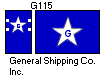
The funnel is recorded for the Philippine Government’s General Lim.
Mitchell’s alternative appears also to be assigned to General Lim, but his notation is unclear.
General Shipping operated vessels for the Philippine Government and was associated with Botelho Bulk Transport. Ship names began with General.
Philippines, Manila.
GENERAL STEAM NAVIGATION CO. LTD.
image by Jarig Bakker, 18 October 2003
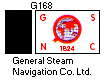
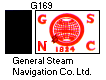
The earliest flag is described as red, with a yellow ring enclosing a yellow disc marked by blue longitude lines and an upright red cross. It was reputedly flown on Trident during Queen Victoria’s voyage in 1842 or 1847 and rediscovered in 1944. Rosanoski doubts the account because he found no other mention of the flag.
The globe and encircling riband represented the original intention to trade worldwide, despite the later emphasis on coastal and short-sea work. This undated version is still shown in sources after 1880, when 1824 was reportedly added; Rosanoski therefore questions its dating and omission of the riband. Reed uses a red globe with black lines and an African outline, while LJC shows no land outline.
The dated form is placed between the reported 1842/1847 flag and the 1880 addition of the date. Griffin appears to outline Europe and Asia; Reed attempts more extensive continental outlines and gives the date in black, while most sources omit land outlines.
Thames excursion steamers used the buff or yellow funnel, sometimes with a narrow black top. Royal Eagle acquired the top in 1939. Several such buff/yellow and black-top combinations are grouped in this version.
Adopted in 1938 for Adjutant, Heron and Philomel, this funnel is confirmed by a Philomel photograph and later appears in general use. A report says it was abandoned about 1969 in favour of a plain funnel, but a 1975 publication still assigns it to General Steam Navigation (Trading). Brown 1951 depicts its panel as a band, while Coastal Ships 1967 does not specify the flag ring.
A narrow black funnel top is an alternative.
This version follows the National Maritime Museum flag, dated about 1951 and measuring 1092.2 by 1752.6 mm. Mitchell omits the funnel date, which Rosanoski assumes is an omission. Talbot-Booth lacks the ring’s Q-like effect, but a Woodwren photograph appears to show it on the funnel emblem.
Brown 1978 appears to change the emblem by adding red continents, which Rosanoski considers probably incorrect against the museum specimen. He notes that small reproductions vary widely in globe colour, outlines, geographical and grid lines, riband and date colour; Stewart and Brown reintroduce continents absent from most intervening depictions.
This funnel was used by Isle of Arran.
The fleet commodore’s pennant places the emblem at the hoist, leaving a long white fly to distinguish it from the house flag. Its different-looking globe is probably a printing effect.
General Steam Navigation, or G.S.N.C., was incorporated in 1824 in East London. Claiming to be the world’s oldest steamship company, it traced its first vessel to 1821. It obtained European mail-service contracts in 1834 and acquired London & Edinburgh Steam Packet and Margate Steam Packet in 1836.
Its expanding interests included Great Yarmouth Shipping, Rhine-London, Turner, Edwards, Grand Union and London & Dunkirk. Moss Hutchinson was acquired in 1934 or 1935 and New Medway Steam Packet in December 1936. A Bennett service continued after the Second World War into the 1960s, apparently retaining its old livery. Normandy Ferries was formed jointly in 1967; Southern Ferries operated in 1971–1975, and other subsidiaries included European Unit Routes and Three Quays Marine Services.
P&O acquired the company in 1920 and completed its share acquisition in 1972. Rosanoski disputes the claim that absorption was already complete in 1960, citing later register entries. The remaining fleet appears as General Steam Navigation (Trading) under P&O Short Sea Shipping, with its flag still reported in 1975 and a surviving vessel under P&O Normandy Ferries in 1978–79. Mitchell instead dates disposal of the ships to the 1980s.
The company managed vessels for the Ministry of Transport & Civil Aviation. Willoughby K. John was an earlier manager, and Moss Hutchison later managed part of the fleet. Ship names were mainly birds.
UK, London.
GENERAL STEAM NAVIGATION CO. LTD. OF GREECE.
image by António Martins, 14 September 2006
image by Jarig Bakker, 4 July 2004
image by San Pavlos, 27 December 2002
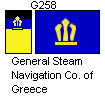
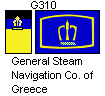
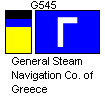
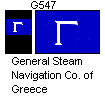
The early livery was that of Goulandris Brothers. A blue flag with white Greek gamma is confirmed by postcard evidence. Rosanoski notes that Talbot-Booth’s wartime books instead show white with blue gamma. Greek-registered ships used gamma, while British- or Liberian-registered vessels used a white Latin G. The line adopted its own livery in 1954.
Brown 1951 shows a minute difference from its adjacent Goulandris livery and places the company in New York.
Bonsor describes the 1954 flag as blue with a yellow trident and a yellow-and-light-blue ropework base. Rosanoski initially assumed gamma forms on either side to match the funnel, since the verbal description does not mention them. An unframed postcard version instead appears as a stylised yellow crown with an arrow-like central stem and a yellow-and-white wreath or rope base. Ocean Ships places the funnel device on the blue band, while a pamphlet extends it onto the black top.
Olympia’s postcard confirms the funnel. Harnack’s notes of 2 January 1957 appear to draw on a flag measuring twelve by eight feet and show a yellow frame around a gamma and reversed gamma with a yellow-and-blue wreath. A Dutch chart depicts a yellow inner border and an arrow-like central element between mirrored gammas, above a short yellow rope, together forming a crown. Harnack does not describe the central element; Rosanoski thinks it resembles a spear or harpoon more than Bonsor’s trident.
Leonidas Goulandris formed the company in 1938, with operations beginning in 1939. Marketed as the Greek Line, it ran transatlantic services from Greece under the Goulandris brothers. As air travel reduced passenger traffic in the 1960s, its ships increasingly cruised. Following Basil Goulandris’s death, the business encountered difficulties and announced withdrawal from cruising and bankruptcy proceedings in January 1975. The 2002 account notes Olympia and Queen Anna Maria still sailing as Regal Empress and Topaz.
Subsidiaries included London’s Arcadia Steamship and Transatlantic Shipping, both under Ormos Shipping as agent, and Panama’s Compañia Maritima del Este. The cited Ormos account also describes it as a Goulandris subsidiary and owner of Lakonia.
Greece, Piraeus.
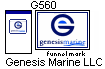
GENESIS MARINE LLC.
Gayolyn Ann Griffin’s starboard photograph of 10 June 2013 shows lettering and a frame that look very dark blue, almost black. The funnel top is similar but definitely blue.
Incorporated in 2004, Genesis Marine was the inland-barge subsidiary of Genesis Energy. Its transport services chiefly supported refineries and storage terminals on the Gulf Coast, Intracoastal Canal and western river systems, including the Red, Ouachita and Mississippi. It bought a small tug-and-barge fleet from Hornbeck Offshore in July 2013.
USA, Houston, Texas.
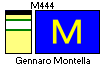
GENNARO MONTELLA.
image by Jarig Bakker, 4 January 2004
Bakker’s FOTW flag follows Scott’s 1959 Caltex book, No. 83.
Gennaro Montella is recorded in Lloyds from 1958–59 to 1966–67.
Italy, Naples.
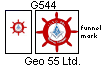
GEO 55 LTD.
The funnel logo is documented in a port-side photograph of Bykhov taken on 27 April 2013.
Registered on 11 February 2008, Geo 55 chiefly carried inland water freight and also undertook sea transport.
Russia, Omsk.
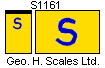
GEO. H, SCALES LTD.
The funnel is recorded for George H Scales while chartered from German owners in 1986–87. The flag is yellow with a blue S. A photograph at the Wellington wharf entrance on 6 September 1996 appears to show it attached incorrectly, with the letter reading correctly on the reverse. Auckland Express of Tasman Express Line flew it on 30 October 1985 at Ross Fast’s request while shippers visited; the master, Robbie, then kept it flying for the rest of his period aboard.
The Scales venture originated in 1897 when sheep farmers in central New Zealand organised a freight-reduction committee to challenge British shipping rates. After an agreement with a Dunedin firm collapsed, they sought assistance from auctioneer and insurance broker George Herbert Scales, who chartered sailing ships for the wool trade. The business became a private company, registered on 22 July 1912, with shareholding restricted to sheep farmers apart from Scales himself. It became known as Scales Line and later operated principally as a shipping agent, under Scales Corporation Ltd.
Scales participated in the formation of Kiwi Shipping and Tasman Express Line and held shares in Sabre Line. Its interest in Euro Pacific New Zealand Line increased from 20 to 25 per cent in July 1988.
New Zealand, Christchrurch.
Geogas Trading S.A.
GEOGAS TRADING S.A.
Jeanne-Marie shows a dark-blue funnel with the emblem apparently on a white circle. Summit Terra on 28 May 2006 confirms the detail, though in lighter blue, with globe lines barely visible even close up. Its partly flapping flag suggests the same design as the funnel.
Philippine shows a black G and lines on the globe.
Oceangas Services Australia Pty. Ltd.
Arago supplies starboard and port-side funnel photographs dated 10 March 2005 and 23 October 2001.
Hebe’s photograph of 24 May 2003 shows a differently coloured funnel and a reversed-facing emblem. Although the website calls it owned and operated, Lloyds lists management only; Rosanoski suggests chartering may explain the differences.
Oceangas / Geogas
Astrid on 17 July 2011 has the same design on both sides. Oceangas Australia managed it for registered owner Geogas Maritime, which Rosanoski suggests may explain the changed name and a design representing both parties.
Keep the explicit scope label independent; no alias or company identity is inferred.
Mitchell also assigns the funnel to Citigaz for Jean Alleaume. Register entries place Citigaz under Langfeldt Skaugen and later Norwegian Ship Management.
René Boudet founded Geogas in 1979 after leaving Gazocean following its reconstruction. Lloyds initially gave 1993, later amending formation to 1979. By 2006 Jacques Boudet headed the company. Geogas acquired a quarter interest in Gazocean Armement in 1993, replaced by Nippon Yusen Kaisha in 2004.
The operating structure included Geneva’s Geogas Shipping and Paris-based Oceangas Maritime, formed in 2005. Wholly owned Oceangas Services Australia at Sydney managed ships and was linked as successor to Oceangas Shipping (Far East). Lloyds dates its beginnings as Oceangas Australia to 1994 and the name change to 2000, while the registration source gives 16 December 1997.
Switzerland, Geneva.
GEORG FREYMANN K.G.
image by Klaus-Michael Schneider, 11 April 2009
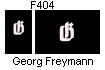
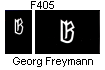
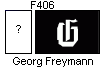
Schneider’s FOTW image is a black flag with a central white logo of connected Gothic GF initials. He suggests that the form can be imagined as a ship with a large funnel emitting steam. Rosanoski comments that the cited source should instead have produced F404.
Alice Freymann was acquired in 1940 and broken up in 1956. Its replacement, Seevogel, was wrecked on 6 December 1959.
Germany, Hamburg.
GEORG GRIBEL.
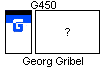
The funnel may be based on Altmark, although Mitchell’s line drawing shows a yellow funnel.
Gribel acquired Nordmark in 1971 and sold it in 1978. The second and last vessel, Altmark, is listed for Claus Georg Gribel of Ulsnis, likewise acquired in 1971 and sold in 1978. Lloyds continued to record the concern as operators in 1980–81 after earlier owner-and-operator listings.
Germany, Kiel.
GEORG PETERSON.
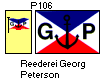
The flag has diagonal quarters of blue, white, white and red, with a black vertical anchor overall and black G and P respectively on the white quarters. The funnel is yellow or buff and depicts the flag flying from a pole. Mobil is unclear, appearing instead to show a white funnel with a yellow top and a flag panel.
Formed in 1955, the company operated through Reederei Johanna Claussen, established at Breiholz in 1983, with vessels held by name subsidiaries.
Germany, Rendsberg; Elsdorf; Breiholz.
GEORG VEFLING.
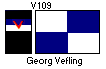
V109’s funnel and flag come from Stewart 1963, No. 424.
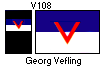
V108’s funnel and flag come from Brown 1978 and 1982. The document gives no separate written comparison of the two versions.
Lloyd’s records Georg Vefling as a manager from 1953–1954; the 1978–1979 entry is under George Veflings R/A.
Norway, Tonsberg.
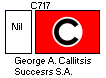
GEORGE A. CALLITSIS SUCCESRS S.A.
The apparent swallowtail in the company website image results from the flag’s movement.
George A. Callitsis senior opened the shipping office in 1905. His sons Nassos and Peter reopened it in 1948, owning it jointly and renaming it George A. Callitsis Succsrs S.A. Its activities included agency, stevedoring and management.
Greece, Piraeus.
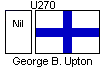
GEORGE B. UPTON.
image by Ivan Sache, 5 September 2005
Jan Mertens identified Upton’s flag among those carried by McKay-built clippers. Ivan Sache supplied the FOTW image on 5 September 2005; the original also cites Mystic Seaport’s Directory of Private Signals Flown by American Sail.
George B. Upton is recorded as a sailing-ship owner in 1840. Donald McKay built Romance of the Sea for him in 1853, and Upton was involved in forming Boston & European Steamship Co. in 1855.
USA, Boston.
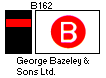
GEORGE BAZELEY & SONS LTD.
Reed shows a smaller disc on the flag.
Formed in 1875, the business operated from about 1885 as Little Western Steamship Co. It was absorbed into the Coast Lines group in 1920.
U.K., Penzance.
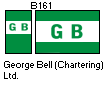
George Bell Group.
GEORGE BELL GROUP.
The earlier livery had a green funnel with a broad white band carrying green “GB”, and a green flag with the same broad white horizontal band and lettering. The illustration follows the narrower band in Marine News rather than Loughran’s later rendering.
BELL LINES LTD.
Bell Lines was formed in 1963 and became bankrupt in 1997. It appears to have been the group’s shipping division. George Bell & Co. sold it to HES Behees in 1986.
Documented shared associations — Bell Lines Ltd. / George Bell group — documented common livery
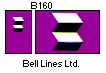
This was replaced early in 1967 by purple livery. The flag emblem resembles four horizontal oblongs unfolding downwards in a concertina, white–black–white–black, with the sides angled as in the source drawing. It possibly represents containers in transit. The funnel carries the emblem near its top. Loughran’s 1979 funnel reverses the design relative to the flag, which Rosanoski regards as an error because it disagrees with the other portrayals. Bell Lines is recorded using this livery; Jan Kahrs provides a photographic reference dated 6 October 1995.
The group began as George Bell (Chartering) Ltd. It is recorded operating as Bell Lines Ltd. in 1978–1985 and as Bell Ship Management Ltd. by 1992. Its management interests included Bell Lines and one James Fisher & Sons vessel.
Ireland, Dublin.
GEORGE DUNCAN & CO.
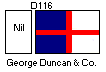
The flag is divided vertically blue and white with an overall red cross.
George Duncan operated sailing ships from 1856 to 1910, when the fleet and flag passed to Cook & Dundas.
U.K., London.
GEORGE DUNCAN.
George Duncan
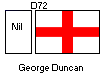
The flag is white with a red cross.
George Duncan operated sailing vessels.
U.K., Liverpool.
George Gibson & Co. Ltd.
GEORGE GIBSON & CO. LTD.
image by Phil Nelson, 11 April 2000
image by Jarig Bakker, 16 December 2004
image by Phil Nelson, 12 April 2000
image by Jarig Bakker, 6 July 2004
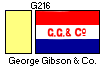
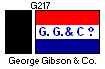
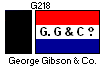
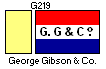
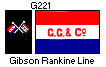
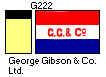
Published flags disagree over black, red or, in an 1895 source, blue letters, and over whether dots follow some, all or none of them. Buff funnels were reportedly used occasionally on passenger vessels before 1914. Brown gives G218 a narrow white flag band, as does Reed 1901, whereas Reed 1891 makes it wider. A photograph of Eildon confirms the G218 funnel. Almanacco combines the G217 flag with G219’s buff funnel. Rosanoski identifies the National Maritime Museum version, G216, with red letters and dots; his notes give differing dates of about 1951 and about 1955–1967. He contrasts Wedge’s narrow white band in 1926, 1929 and 1934 with the equal bands shown by most other contemporary publications.
Ships & The Sea describes the funnel as now black, identifying the change with G218.
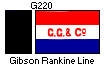
The former Rankine ships retained these funnels after the 1920 merger until Bowling was sunk in 1939. Rosanoski omitted a flag here because its versions were uncertain.
British Coastal Ships, Tugs & Ferries illustrates this funnel but warns that some vessels may carry charterers’ colours.
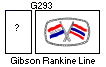
The funnel carries the crossed flags of Gibson and Jas. Rankine & Son, following Stewart’s placement. Stewart omits dots after the letters; LJC makes the white flag band very broad. Coastal Ships identifies the funnel with Gibson-Rankine routes.
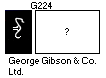
Marinart’s wording calls the “flag” black, with or without the houseflag, but Rosanoski notes that its illustration does not fit this description. Mitchell appears to identify the emblem as a yellow seahorse.
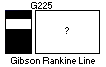
An undated Amsterdam harbour flagchart shows Gibson Rankine Line’s white flag with a TV-screen-shaped rope surrounding two crossed, masted flags. The hoist-side flag is Gibson’s. Rosanoski identifies the other as Rankine’s: five horizontal bands, red, white, blue, white and red, with white letters on the blue. His adjacent notes give the letters as both GR&AS and GR&SA, contrasting them with FOTW’s GG&Co. Sources differ between equal bands and a wider blue band, and also over the relative widths of red and white. Rosanoski found this composite flag in no other source, although the crossed flags appeared on funnels on certain routes.
Deutsche Geo. Gibson & Co. Gastanker GmbH Reederei
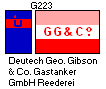
For the German subsidiary of the late 1970s and early 1980s, Mobil shows a flag with a pink upper band and red lower band.
Liquid Gas Equipment Ltd.
Mitchell attributes the livery to the managed company Liquid Gas Equipment. The discussion calls it G299, whereas the source list identifies L299; that numbering discrepancy is retained.
George Gibson, also known as Gibson Line, was formed in 1797. Merchant Ships dates its first steamship to 1859; Rosanoski juxtaposes a Lloyds date of 1850 without clarifying that alternative. Sailings were rationalised with James Rankine & Son in 1861, followed by amalgamation with Rankine Line on 14 January 1920. Gibson-Rankine Line apparently served for a period as a trading name, while Gibson’s own name seems to have continued.
Walter Runciman owned the concern from 1965 and became Anchor Line PLC in 1995. Rosanoski questions a separate account dating an Anchor Line acquisition to 1972. Eitzen Group bought the company in December 2004.
The German operating companies included Deutsche Geo. Gibson und Gastanker GmbH entities for Durward, based in Singapore, and Bucklaw, based in Edinburgh. Gibson Gas Tankers has a confused chronology: Lloyds gives formation in 1935 and a change from Anchor Line in 1993, although the Gibson Gas Tankers name already appears in its 1978–79 register. Energy Shipping acquired 50% from Liquid Gas International in 1974; Belships obtained 60% in 1996. Gibson Gas Tankers was deleted from Lloyds in 2005 after the Eitzen takeover.
Gibson participated in the Unigas International pool and bought Brussels Steam Ship in partnership in 1962, selling it in 1964.
UK: Leith and Edinburgh.
GEORGE GORDON & CO.
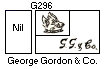
Ivan Sache’s FOTW description from Lloyds 1912 calls the emblem a pig’s head; Rosanoski distinguishes it as a boar’s head.
The sailing-ship operator was still recorded in Lloyds’ 1937–38 telegraphic addresses.
UK, Glasgow.
GEORGE HALLETT.
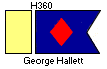
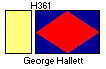
Griffin suggests a change of flag and shows a much larger diamond in H360.
George Hallett operated as the Jacket Line.
United Kingdom, Cardiff.
GEORGE HAMMOND PLC.
image by Jorge Candeias, 2 March 1999
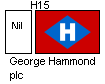
Founded in 1767 as George Hammond Company, the concern began as shipping agents. George Hammond (Shipping) was formed during the 1960s and 1970s as activities expanded into transport, warehousing and ro-ro clearance. The company was reconstituted as a public limited company in 1992. Maritime services included agency work, consultancy, surveying, pilotage and stevedoring.
United Kingdom, Dover.
GEORGE HOWES & CO.
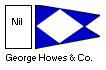
The flag is a blue tapered swallowtail with a white diamond extending to the edges. No funnel is given, as the vessels were sailing ships.
Rosanoski describes George Howes & Co. as sailing-ship owners of the “1970s”, citing Loughran; that date is retained as printed.
U.S.A.
GEORGE JAQUES & CO.
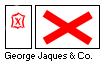
The white funnel bears a red shield outline enclosing a red X or couped saltire. The white flag bears the red X or couped saltire without the shield.
U.K.
GEORGE KEARON LTD.
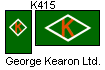
The funnel and flag are sourced to Turn of the Tide.
George Kearon operated from 1944 and sold its last vessel, Reginald Kearon, in 1974. A 2011 directory describes the surviving business as a hardware retailer.
Ireland (Eire), Arklow.
GEORGE NISBET & CO.
image by Phil Nelson, 11 April 2000
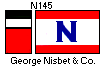
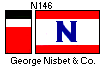
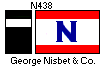
Reed gives black flag letters, while Merchant Ships 1942 describes blue letters with stops.
This funnel appears to represent a post-war change.
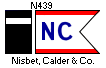
Founded in 1905 as Nisbet, Calder & Co., the firm sold its fleet after the First World War, resumed operations in 1922 and ceased trading in the early 1960s. It operated general tramp ships, using Blair-prefixed names, for Clydesdale Navigation, formed in 1906; Nisbet Shipping, formed in 1925; and Northern Navigation, formed in 1909 and distinct from its Canadian namesake. The Ministry of Transport is also listed as a principal.
U.K., Glasgow.
George Pyman & Co.
GEORGE PYMAN & CO.
George Pyman & Co.
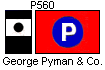
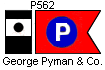
George Pyman (1822–1900) began as a ship chandler with his brother-in-law Francis English after moving to West Hartlepool in 1850. Around 1854 he partnered Thomas Scurr as shipbroker and coal fitter or agent, acquiring shares in sailing vessels. Scurr’s death in 1861 brought the name George Pyman & Co.; the first steamship followed in 1865. In 1868 Pyman and shipbuilder William Grey formed the East Coast Iron Steamship Association. Another account dates the chandlery to 1855. From 1894 new ships were registered under Pyman S.S. Co. Ltd. Heavy wartime losses led to liquidation in 1918.
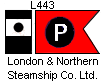
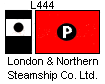
London & Northern Steamship Co. Ltd.
Reed 1901’s funnel and charge colours are unclear: the scan looks reddish, but Rosanoski assumes black to match the other liveries. Reed 1901 and 1912 do not identify the Pyman connection.
Lloyds attributes London & Northern Steamship’s livery to Pyman Brothers Ltd.
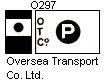
Oversea Transport Co. Ltd.
Lloyds places Oversea Transport under J.S. Pyman of London. John Sutcliffe Pyman, born in 1878, was employed by Pyman Bros.
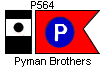
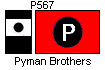
Pyman Brothers
Pyman Brothers
Related firms included Pyman, Bell and Pyman, Watson. Sons Francis and Frederick established Pyman Brothers in 1881 as agents for the three shipowning companies. Their ships were placed under London & Northern S.S. Co. Ltd., and the fleet was sold to Pyman, Watson in 1916. Re-formed as Pyman Bros. (1917) Ltd., they resumed shipowning in 1928 and ceased business in 1940.
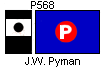
J.W. Pyman / Raithwaite Steamship Co. Ltd.
J.W. Pyman’s connection is unclear. Raithwaite Steamship of Cardiff shares the general livery format except for the flag field. G. Pyman built Raithwaite in 1899, while Southwaite was built for J.W. Pyman in 1904; Rosanoski found the latter absent from his Pyman histories. Raithwaite Steamship entered voluntary liquidation in 1918.
UK, West Hartlepool.
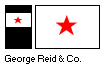
GEORGE REID & CO.
The black funnel has a white band bearing a red star. The flag is white with a red star.
U.K.
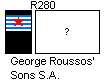
GEORGE ROUSSOS' SONS S.A.
A Roussos Brothers subsidiary formed in 1970, George Roussos’ Sons split on 1 February 1991 into J.G. Roussos Shipping and Stavros Roussos Management & Chartering. It apparently incorporated George, Stavros & Jack Roussos, listed with Smaro in 1970–71. Two differently addressed Roussos & Sons listings in 1978–79 were combined as George Roussos’ Sons S.A. in 1980–81.
Greece, Piraeus.
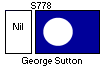
GEORGE SUTTON.
image by Joe McMillan, 25 November 2001
Rosanoski assumes that the flag belongs to the agent rather than an individual vessel because it appears among the Private Signals of the Merchants of New York.
George Sutton is recorded around the 1820s as agent for the Charleston Packets Ship Line. The contributed account identifies a New York–Charleston service in the 1850s. A later development into Sutton & Co. is possible but unconfirmed.
USA, New York.
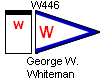
GEORGE W. WHITEMAN.
The cigarette-lighter illustration has a red W and a border that may be dark blue or black; Rosanoski’s preference for blue rests on a bluish tint seen under magnification. The funnel is white with a black top and a red W.
The concern operated as George W. Whiteman Towing. George W. Whitman was acquired in 1947; the last vessel, G.W. Whiteman, was deleted in 1979. Register references continue through 1980–1981.
USA: New Orleans La, later Gretna LA.
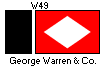
GEORGE WARREN & CO.
W49 continued Enoch Train’s White Diamond livery until Furness, Withy colours were adopted in 1921. The flag diamond’s size varies among sources. Lloyd’s also assigns it to Liverpool & Boston Line and later George Warren & Co. (Liverpool) Ltd.
The Warren Line originated in 1857 when George Warren acquired ships after the failure of Enoch Train’s American White Diamond Line, operating Liverpool–Boston packets. At the outbreak of the American Civil War in 1861 he transferred the ships to British registry and made Liverpool the headquarters. The first steamship was employed in 1863; sources give 1865 or 1866 for steamship ownership. The last sailing ship left service in 1877.
George Warren died in 1880 and was succeeded by his son. White Diamond Steamship Co. Ltd. was registered on 19 July 1898. Furness, Withy and British Maritime Trust acquired control in 1912, forming George Warren & Co. (Liverpool) Ltd. That company was liquidated in 1922 and replaced by Warren Line (Liverpool) Ltd., which merged into Johnston-Warren Lines at the end of 1934.
U.K., Liverpool.
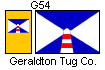
GERALDTON TUG CO.
The Log shows a flag quartered diagonally blue and white, with a white lighthouse rising from the base and bearing two red bands.
Operating privately at Geraldton from about 1966, the company was owned by Haltone, in turn owned by K&M Newbold and KC & RJ Mildwaters. It held the port authority’s tug contract and unsuccessfully sought a public flotation in 1986. Rosanoski records its closure a few years later.
Australia, Geraldton.
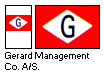
GERARD MANAGEMENT CO. A/S.
The white funnel carries a broad band of the flag: red with a white diamond bearing a black G.
Norway.
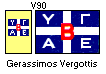
GERASSIMOS VERGOTTIS.
The funnel is yellow or buff with a flag panel. The flag is blue with a white cross and a red “B” extending slightly over it. The blue quarters bear, respectively, the white letters Y, Greek Gamma, A and E. Ships & The Sea places the B at the cross’s fesse point rather than overall.
Greece, Athens and Argostoli.
GERD BARTELS.
The flag is yellow with a red diamond extending throughout and bearing combined white “GWB”.
The business was formed as Walter Bartels in 1966. Lloyds gives succession by Gerd in 1990, although earlier entries already name Gerd in 1984–1985 while also listing Walter in Hamburg. Rosanoski considers the flag evidence of trading under both names. Johs. Thode is recorded as fleet manager in 1970–1971.
Germany, Neu Wulmsdorf.
GERD ERNST DE BUHR K.G.
image by Klaus-Michael Schneider, 8 April 2009
The FOTW flag, following the 1957 German flag and funnel source, uses very dark blue.
Documentary images — company attribution uncertain
Mitchell’s funnel may relate to Heinrich Brand, built in 1958, the sole vessel mentioned on his card. If so, it may be the colours of her owners, Partenreederi Heinrich Brand.
Partnership versus de Buhr user unresolved; D406 source typo preserved.
The first vessel was Oldenburg, built for Küstenschiffbaugemeinschaft in 1953. The last operated vessel, Osternburg, was sold in 1971. Lloyds lists the business variously as operator and owner, latterly operating for partnerships.
Germany: Hamburg, later Loga bei Leer and Oldenburg.
GERHARD AHRENS.
Rosanoski considers that vessels under Wagenborg’s management would probably use that company’s colours.
Kapitän Gerhard Ahrens began with Magula, built in 1962 and sold in 1970. Her name combined Magdalene, his wife, and Ulf, his son. After Ulf’s death, Frank Dahl was engaged as mate and later invited to take shares in Gerhard Ahrens K.G. Reederei m.s. “Magula”. From 1984 Ahrens and Dahl jointly managed the company and ship. Dahl increased his holding and became general partner in the two shipowning companies after Gerhard’s death in 1987.
Lloyds continued listing Gerhard Ahrens as agent or manager and only noted the takeover in 2000; Rosanoski regards the register as late in recording the change. The Magula company appears under Wagenborg Shipping management in 1992–3 and 1996–7. Ulf’s vessel interest is listed as m.s. “Merlan” Ulf Ahrens K.G., under Gerhard’s agency or management in the 1980s.
Germany, Assel, Stade; subsequently Drochtersen.
Gerhard Wessels.
GERHARD WESSELS.
image by Jorge Candeias, 10 February 1999
Gerhard Wessels
Nüsse’s Wessels flag turns the W into a ship with light-blue horizontal superstructure lines and vertical and diagonal derricks. The older W10 table-flag scan has letters along a wavy line, unlike W498 on the newer site, probably because the fabric was wrinkled. Nüsse assigns it to Wessels Bereederungs-und Befrachtungsgesellschaft; application to the principal and other subsidiaries is assumed.
Jorge Candeias’s W238 flag similarly transforms the W into a navigating ship, adding light-blue ship features and a wavy line below. Its angled letters may interpret Nüsse’s older scan. Mitchell’s funnel seems to show black letters on a white panel, while his separate flapping flag and dark-blue logo drawing are ambiguous; they do not confirm the slanted lettering. The difference between flag and funnel remains unclear.
Mitchell attributes W501’s funnel to the tug Fritzen 2.
W502’s funnel is from Mitchell and its flag is derived from that funnel. The accompanying descriptive sentence is incomplete, so no additional specification can be established.
W554 records Pasadena’s funnel from port-side and starboard photographs dated 16 February 2006 and 9 December 2013.
River-Liner Befrachtungs- und Bereederungsgesellschaft mbH
River-Liner is represented by the R406 image from trade.mar.cx and Nüsse’s R407 table flag. The document gives no separate written comparison.
No exclusive fleet-wide use or unrecorded corporate equivalence is asserted.
Rederij Wessels BV/NV — Dutch company source panel
Rederij Wessels’s W499 table flag forms the masts and other details by inserted white pieces or horizontal lines.
Legal suffix discrepancy BV/NV retained; no German-company equivalence.
Documentary images — company attribution uncertain
Nüsse’s W-O Shipping table flag W500 is assumed to concern the Netherlands subsidiary, despite its stated Haren-Ems domicile.
Do not infer Nederland legal identity from short branding.
Komarno was photographed with Inok’s funnel and an unreconciled blue flag bearing a white cross paty. Rosanoski suggests a charter as a possible explanation, without resolving the flag.
Kapitän Gerhard Wessels began the family business in 1977. Later known as Wessels Reederei, it and River-Liner, together with the independently operating Rotterdam subsidiary Rederij Wessels, managed about forty vessels in 2000.
The group’s recorded operating concerns include Wolfgang Grimpe, later listed separately with a management connection; River-Liner, formed in 1991; W-O Nederland, formed in Rotterdam in 2003; and Wesco Shipping, formed at Haren/Ems in 1998. Wessels Bereederungsgesellschaft was formed in 1989. Although apparently absorbed into River-Liner by 2000, it is also recorded as renamed Wessels Befrachtungs-u Bereederungsdges. in 1994 and Wessels Reederei in 2005. River-Liner’s fleet appeared under Wessels Befrachtungs-und Bereederungsges from 2005.
Rederij Wessels was formed at Rotterdam in 1997 and listed independently. The association was no longer noted by 2007. Rosanoski considers Komarno apparently its last vessel, still operating under Inok management in 2012 although absent from Inok’s website.
Germany: Berlin, later Haren/Ems.
GERMAN TANKER SHIPPING GMBH & CO. K.G.
The flag is quartered diagonally blue and white, with red G and T on the respective white quarters. No funnel is given.
The company was listed as a manager, including for Emil Hartmann.
Germany, Bremen.
GERNER MATHISEN REDERI A/S.
The first flag is a white swallowtail with a narrow red bend sinister between yellow G and M letters. On the yellow or buff funnel it is shown flying straight from a pole.
The second version uses black letters, with the M’s top also angled as described by the source notation “Pbds”. Its yellow or buff funnel has a black top and a panel of the flag.
Gerner Mathisen is recorded in the 1963–64 and 1970–71 registers.
Norway, Oslo.
GERRIT J. EERLAND LCM ZOON B.V SLEEPDIENST & TRANSPORTONDERNEMING.
image by Jarig Bakker, 3 September 2005
image contributed by Josef Nüsse, None
image by Jorge Candeias, 18 March 1999
image contributed by Josef Nüsse, None
image by Jarig Bakker, 5 October 2003
The flag is green and white with a black E: the dark green was mistaken for black on the company website. A white slanting band crosses the green field, but its direction differs among depictions. Rosanoski initially used Nüsse against Brown’s opposite slope; the source subsequently notes that the Nüsse display was upside down. E23 was later removed from FOTW. Photographs cited by Mertens support the version labelled “other version”. The funnel is considered probably correct, though E may have its middle arm low, as in E150.
Nüsse’s newer E5 table-flag display corrects the earlier upside-down presentation represented by E150.
Eerland appears in the register from 1970–71 under several forms of its name. By the 1988 Duwvaart account it belonged to Smit Internationaal but retained its own flag and funnel. It was later listed under Smit Tak and changed its name to Smit Transport Europe in 2004.
Netherlands, Rotterdam.
GESELLSCHAFT FÜR KERNENERGIEVERWERTUNG IN SCHIFFBAU & SCHIFFAHRT MBH.
The nuclear symbol refers to the nuclear-powered research vessel Otto Hahn.
Gemany, Hamburg, as written in the source.
GESTION C.T.M.A. INC.
The funnel and its colours are taken from the company website image. Madeleine appears to have a different funnel in a black-and-white photograph, which Rosanoski relates to its government ownership.
CTMA, also recorded as Cooperative de Transport Maritime et Arien, was formed in 1987. It operated the Cap-aux-Meules–Souris ferry service, using Madeleine from July 1997. The passenger-and-cargo vessel C.T.M.A. Voyageur served Matane in winter and Montreal from April to December. Madeleine belonged to the Canadian Government and was managed by CTMA.
Canada, Iles de la Madeleine, Quebec.
GESTION MARITIME SAM.
The funnel is documented in a port-side photograph of Francesco Corrado from September 2008.
The family-owned management company was formed in 1976 and began operations in 1977, the formation year used by Lloyds. It provided services through Monaco and Croatian subsidiaries. Rosanoski infers shipowning from a 1994 newbuilding programme, while allowing that it may have owned vessels earlier.
Francesco Corrado’s presidency, vessel names and a website shield lead Rosanoski to suggest Corrado family involvement and probable succession to Società di Navigazione “Corrado”.
Monaco, Monte Carlo.
GESTIONE GOVERNATIVA NAVIGAZIONE LAGHI MAGGIORE, GARDA, COMO.
Italia’s starboard photograph of 15 September 2013 shows a funnel that appears to predate government operation.
This funnel comes from a port-side website photograph of Milano.
The website photograph does not name the vessel.
The website identifies the photographed catamaran as Galileo Galilei.
Apparently shortened to Gestione Navigazione Laghi, the organisation operated ferries on Lakes Maggiore, Garda and Como. Private firms served the lakes until 1948, when the state intervened after severe wartime damage. A special law brought reorganisation in 1957 under the transport ministry’s M.C.T.C. direction and a government manager.
Italy, Milan.
GESTIONI ARMATORIALI SPA.
The funnel is documented in a port-side photograph of Cyrenaica G taken on 22 July 2013.
Nicola Coccia, Bruno Castaldo and the Bazzi family began the oil-and-chemical marine transport venture in 1993, while Lloyds dates the company to 1996. Initially charterers, they became tanker owners and managers in 1999. The company appears under Navimar with ships managed by Fulltankers, which it subsequently absorbed.
Italy, Ravenna.
GETTY OIL CO.
These were experimental funnels, G64 carrying a yellow drop of oil on its band. Wilmington Getty wore G64 in April 1968. Rosanoski suggests the accompanying flag may have been G66, but the source does not state this.
Mitchell’s yellow-drop version is presumably another experiment, shown on George F Getty, Alaska Getty and Washington Getty. The yellow is darkened in Rosanoski’s illustration for contrast, not as a historical colour claim.
Loughran dates adoption of this funnel and flag to about 1968. The funnel’s orange oil drop and flag’s nuclear device symbolise the power of oil and its by-products. Brown reverses the charge colours, giving an orange G with the drop and remaining letters red; Rosanoski suspects printing errors and leaves the actual colours uncertain.
Brown’s notes confirm the nuclear device on the flag, bringing it into line with flags ashore, while the funnel retains the orange oil drop. Loughran colours the flag device orange, but a table flag has it red. Most sources render the drop as a circle.
This version began replacing the others in 1969 according to Maritime News. Its marks are shown as drops rather than circles, and Rosanoski assumes the source’s colours are also correct.
Pacific Western Oil, originally a holding company for Edward L. Doherty and family, became a Getty subsidiary in 1928 and was renamed Getty Oil in the 1956 consolidation of the Getty holdings. The source records absorption of Mission Corporation and its Skelly and Tidewater interests in 1977, marked sic, but Rosanoski questions whether this means Tidewater itself or only Mission’s holding. Another account dates Tide Water’s acquisition to 1953 and incorporation to 30 September 1967. Texaco acquired Getty in 1984.
The shipping structure included Getty Oil (Eastern Operations), Getty Refining & Marketing, Getty Marine and Getty Fleet. Later Getty Marine listings appear under Texaco Marine Services.
USA: New York, Los Angeles and Wilmington, Delaware, are recorded.
GIAVRIDIS.
Mitchell’s funnel bears the Greek gamma.
The apparently shared funnel appears on John Giavridis’s Katharina, port side on 11 November 2005, and Anthony Giavridis Maritime’s Gant Flair, starboard on 1 January 2013. Gant Star’s port-side photograph of 2 January 2006 gives better colour confirmation.
Captains John and Anthony Giavridis established Th. Giavridis Bros. in 1967, according to the family company account, later moving from Piraeus to Voula, Athens. Lloyds instead gives formation in 1968 and a 1989 change to Theodore Giavridis. Another source records Theodore Gavridis’s registration on 23 December 1978. The business included shipbroking and cargo chartering.
Anthony Giavridis Maritime and John Giavridis Inc. were both formed in 2000 at Athens. The former is listed as an operating company of Theodore Giavridis.
Greece: Piraeus, later Athens.
GIBBS & CO. (SHIP MANAGEMENT) LTD.
The sources record a red funnel with a black top, and a second version adding a white G. Lloyds, Reed and Talbot-Booth outline the flag’s G in black. Stewart also assigns the livery to West Wales.
Gibbs operated West Wales Steamship and later managed Welsh Ore Carriers, which became Welsh Overseas Freighters.
UK: Cardiff and Newport are recorded.
GIBSON MURDOCH LTD.
The flour merchants were registered as W.G. Gibson Ltd. on 14 December 1910, later becoming Gibson & Murdoch Ltd. and then Gibson’s Ltd. They operated Musgrave from 1920 to 1924; the vessel was subsequently laid up and eventually scuttled. The registry account consulted in 2008 still showed the business operating.
Australia, apparently Tasmania.
GIDEON ALLEN & SON.
Gideon Allen, born in 1791 and deceased in 1878, was a whaling agent. The firm was part-owner of the whaler Frances II, registered at New Bedford in 1831. Gideon is recorded as an agent in 1844 and Gideon Allen & Son in 1857. His son Gilbert took over after his father’s death and is recorded as a whaling agent in 1879.
USA, New Bedford, Massachusetts.
Gido Luhrs Schiffahrts K.G.
L & L Shipping GmbH
L510 follows Apollo Hawk photographed to port on 12 May 2009 and to starboard on 4 June 2010.
L511 follows Apollo Lynx to port on 7 July 2008.
L538 follows Dulcinea to port on 28 September 2006.
L568 follows Lion to starboard on 25 February 2012. A close view on 24 June 2013 shows the diamond frame as wavy, like a flapping flag, although the letters are not distorted.
Founded as Gido Luhrs in 1986, the concern became Gido Luhrs Schiffahrts K.G. in 1999. Its operating company L & L Shipping was formed that year at the same address and later appears as L & L Shipping GmbH at Stade.
Germany, Wischhafen.
Gilbert Coffin & Sons
GILBERT COFFIN & SONS.
Documentary images — company attribution uncertain
A watercolour of Nantucket whaleship signals dated 1840–50 assigns this flag to Enterprise, confirmed as a Coffin ship.
Exact Gilbert versus Sons allocation of this rendition unresolved.
Gilbert Coffin
No exclusive fleet-wide use or unrecorded corporate equivalence is asserted.
Some associated ships had their own flags, including Planter.
Gilbert Coffin & Sons were whaling owners and agents from about 1828 to about 1844.
USA, Nantucket.
GILCHRIST, WATT & SANDERSON PTY. LTD.
The launches and lighters flew a flag quartered red and blue, with a white diamond bearing the blue inscription G,W&SLTD. The Log draws particular attention to the unusual comma after the G.
The Sydney shipping agency grew from John Gilchrist’s general-merchant business, begun in 1835. John Alexander joined in October 1838, forming Gilchrist & Alexander, and Gilchrist’s nephew John Watt became a partner in July 1852 under Gilchrist, Alexander & Co. Alexander retired in 1853; Thomas Andrew joined the remaining partners on 1 January 1854 as Gilchrist, Watt & Co., later Gilchrist, Watt & Sanderson. The agency operated launches and lighters and was deregistered on 5 August 1977.
Australia, Sydney.
GILES W. PRITCHARD-GORDON & CO. LTD.
image by Jarig Bakker, 20 September 2005
The flag has seven horizontal red and white stripes, approximately in proportions 1:1:1:2:1:1:1, with an overall white diamond edged blue and bearing blue GPG.
Georgina PG in April 2008 shows a white funnel base aligned with the superstructure, leaving the lowest blue area looking like a slightly narrower band beneath the pink. Panda PG’s starboard view of 5 September 2012 confirms this arrangement. The blue is very dark and could be mistaken for black; Rosanoski’s colour sampling indicates dark blue. Georgina’s flag differs from the P618 website logo because its diamond does not reach throughout, and its colour looks more purple or very bright pink.
Giles Pritchard-Gordon left H. Clarkson in 1973 to establish a shipbroking company, diversifying into shipowning in 1978 with two dry-cargo coasters and a tanker chartered to Shell. Lloyds dates formation to 1978, and the business also appears as Giles W. Pritchard-Gordon (Shipowning) Ltd. Pritchard-Gordon Tankers was formed in 1998. The privately owned company named ships after female family members.
David Campbell joined in 1983 to manage the coasters, then founded Campbell Maritime at South Shields in 1984, retaining their technical management. Campbell subsequently managed the whole fleet until his company was incorporated into Pritchard-Gordon Tankers on 1 March 2010, when he joined the board as technical director.
UK, London; Slaugham in 1996–97.
GINO GARDELLA S.P.A.
The grey funnel has a white-over-red band: black G.G. on the white, and a black hammer and grip pliers crossed in saltire on the red. The flag has eleven horizontal bands, with wider blue bands at top and bottom and four red bands separated from each other and the blue by narrow white bands.
The concern appears in Lloyds as Gino Gardella and later Gino Gardella Officine Navali.
Italy, Genoa.
GIPPSLAND STEAM NAVIGATION CO.
The flag is red with a white saltire between the white letters GSNCo. The Log specifies a darker shade of red for the funnel.
The origins are variously dated to 1864 or July 1865, the latter account describing an amalgamation of rivals trading between Melbourne, Port Albert and the lakes. Australian Coastal Shipping instead records businessmen and traders forming Gippsland Lakes Navigation Co. in 1864 and changing its name in June 1865.
The records also associate Charles Edward with the concern in 1856–57, earlier than those foundation accounts. Wyrallah is recorded from 1900 to 1924 and described as the last vessel, which sank. The business was eventually sold to William Holyman & Sons. The registry dates deregistration of Gippsland Steam Navigation Co. Pty. Ltd. to 30 June 1915; Gippsland Steamers Pty. Ltd., connected through Wyrallah and also linked to Huddart Parker, appears in Lloyds 1917–18 and was deregistered on 7 March 1927. These dates and entities are not reconciled in the source.
Australia.
GIRALDA COMPAÑIA NAVIERA S.A.
US Navy 1961 places a funnel in its Liberian section and identifies it as the agents’ livery. Mitchell’s separate version is not tied to any particular ship.
Giralda is listed in Lloyds 1958–59 with Orion Shipping & Trading as agents.
USA, New York; the source also records domicile in Panama.
GISBORNE SHEEPFARMERS' FREEZING CO. LTD.
The flag is white with a red saltire and the letters GSFCo. The Log gives the livery under the longer Frozen Meat & Mercantile name; Loughran in Sea Breezes relates the letters to an eventual shortened name and says that only the initials changed throughout the flag’s history.
The Gisborne concern combined meat freezing and mercantile activities with shipowning, controlling local lighterage and operating coasters to Auckland. The companies register dates establishment to 19 March 1902. Another account describes formation in 1901 to acquire Gisborne Freezing Co.’s assets, with operations beginning in January 1902. Sources use varying names, including Gisborne Sheep Farmers Frozen Meat & Mercantile Co.; Rosanoski leaves open whether these reflect actual name changes or shortened usage.
Union Steam Ship Co. of N.Z. contributed towards vessel costs. The last vessel, Turihaua, was sold in 1955. Newton King acquired the concern in 1960; that group became Crown Consolidated in 1977, merged into Dalgety Crown Corporation in 1983 and was acquired by Wrightsons NMA in 1986.
The register records ownership by Affco New Zealand and striking-off on 26 September 1996.
New Zealand, Gisborne.
Giuseppe Bottiglieri di Navigazione SpA.
GIUSEPPE BOTTIGLIERI DI NAVIGAZIONE SPA.
This version is assumed from a photographed table flag. The blue shade is unclear, but the white panels appear to extend to the edges as bands.
The archive combines the 1850 family lineage, 1993 company, 2005 division and separate di Navigazione/Shipping Company entities. Exact legal continuity and vessel assignment are not established; the exact-name registry page was inaccessible.
Giuseppe Bottiglieri Shipping Co. SpA
This funnel appears to have been used from the beginning. It follows a portside photograph of Paola Bottiglieri dated 20 March 2013 and is also documented by Mitchell. Rizzo-Bottiglieri-De Carlini uses the same design, recorded separately as R422.
The archive combines the 1850 family lineage, 1993 company, 2005 division and separate di Navigazione/Shipping Company entities. Exact legal continuity and vessel assignment are not established; the exact-name registry page was inaccessible.
Bottiglieri di Navigazione SpA, later Rizzo-Bottiglieri-De Carlini Armatori SpA
This flag is based on a website photograph of an actual flag.
The archive combines the 1850 family lineage, 1993 company, 2005 division and separate di Navigazione/Shipping Company entities. Exact legal continuity and vessel assignment are not established; the exact-name registry page was inaccessible.
These flags follow flag logos on the company website.
Captain Giovanni Bottiglieri founded the family shipping business in 1850. Michele Bottiglieri (1883–1951) rebuilt the fleet after the First World War, and Giovanni Battista Bottiglieri (1917–2003) did so after the Second. The company moved to Naples in 1951. Giuseppe joined in 1968, when it was Giovanni Bottiglieri Armatore srl. In 1976 Giuseppe and Michele moved the business to Athens as Intermar Ship Management S.A. The account describes an 18-year stay but dates their return with Giovanni Battista to 1993, when Bottiglieri di Navigazione SpA was established in Torre del Greco and old ships were replaced by newbuildings.
Giuseppe expanded into time-chartering and South African coal carriage in 1997, and entered the tanker market in 2000 as president of Bottiglieri Tankers. A February 2005 reorganisation placed the entire tanker fleet under his sole ownership through Giuseppe Bottiglieri di Navigazione and Giuseppe Bottiglieri Shipping Company, the latter active in tankers and dry cargo. The business returned to its former Naples address in 2007. Lloyd’s separately dates Bottiglieri Tankers to 2002 and its renaming to Giuseppe Bottiglieri di Navigazione to 2004; it records the 1993 Bottiglieri di Navigazione company becoming Rizzo-Bottiglieri-De Carlini Armatori in 2007.
Italy, Toro del Greco; later Naples.
GIUSEPPE MESSINA.
image by Jarig Bakker, 11 July 2004
The flag letters look like CM, but Rosanoski identifies the intended initials as GM. Bakker’s website-based version differs by giving the first letter a square form and the M a deeper V.
The unclear photograph of the last vessel, Bacco, laid up at Genoa, appears to show only a small funnel logo.
This is explicitly a different concern from the Giuseppe Messina in Ignazio Messina’s history. It began with Arnica, built in 1946, and appears as Giuseppe Messina di Marcello and later Giuseppe Messina Srl. The 2009 account suggests that it was still operating.
Italy, Genoa.
GL Monaco Corporation S.A.M.
GL MONACO CORPORATION S.A.M.
Golar Siri, under Gotaas-Larsen Inc., is recorded with a very narrow black top to this funnel.
Mitchell shows the funnel, with a corresponding flag assumed rather than illustrated. An undated photograph of Golar Nor supports the funnel design, though Rosanoski could not locate the vessel in Lloyds and presumes charter employment. The photograph was uploaded in April 2005 under Gotaas-Larsen, by which time he places it with Golar LNG.
Gotaas-Larsen Srl / Gotaas-Larsen Argentina — Argentine historical livery
Retain source’s Srl/S.A. naming variation; no equivalence with GL Monaco asserted.
Gotaas-Larsen Srl
The Buenos Aires concern’s flag differs from the swallowtailed group flag, which lacked a central emblem. It is a white rectangle bearing a blue ring and blue star; on the star is a black delta-triangle frame enclosing yellow, with a black design resembling someone driving a go-cart or miniature basic racing car. This is an appearance-based description in Rosanoski’s account, not an established interpretation of the emblem.
Keep the explicit scope label independent; no alias or company identity is inferred.
Golar LNG inherited the livery after investment in Osprey and acquisition of its LNG shipping interests on 21 May 2001. Rosanoski records the related G47 flag on its website.
Formed in 1940 as Gotaas-Larsen Shipping Corporation, the company became GL Monaco Corporation SAM in 1993. It formed part of an international group whose related Gotaas-Larsen names appear in several countries. David and Frederick Barclay acquired it in November 1988 and sold it to Osprey Maritime in 1997.
The source records Gotaas-Larsen concerns in Oslo, New York, Bermuda, the Bahamas, London and Buenos Aires. Gotaas-Larsen Ltd., later based in London, was GL Monaco’s operating company in 1998 and became Osprey Maritime (Europe) that year following the sale. Separate gas-carrier and LNG-management concerns are also recorded.
Gotaas-Larsen Inc. was owned by International Utilites Corp., acquired Eastern Steamship Lines, and held a one-third interest in Royal Caribbean Cruise Line. The source also records a 13.75% holding in Osprey Maritime acquired in 1997, increasing to 23.63% in October 1998.
Monaco, Monte Carlo.
GLASGOW STEAM SHIPPING CO. LTD.
Reed records the livery under the managers’ name.
The company’s South American services merged into Donaldson South American Line in 1919; Bonsor calls it Glasgow Steamship Co. Ltd. John Black & Co. managed Kelvinbrae in 1915–20.
UK, Glasgow.
GLEAMRAY MARITIME INC.
The funnel is documented in starboard and port-side photographs of Ecostar G.O., including one dated 9 March 2008, and in Geosand Max at Sydney on 31 May 2011.
Formed in 1998, Gleamray provides shipmanagement, operation and worldwide dry-bulk transportation. G. Economou is recorded as managing director. Lloyds lists it as agents in 2000 and managers in 2011–12.
Greece, Athens.
GLEN LINE LTD.
image by James Dignan, None
Shire ships adopted Glen’s colours and houseflag when their operations combined. Glen retained its livery after the Alfred Holt takeover, but the Ben-Ocean move in 1974 brought Ben Line’s pale-yellow funnels. The last conventional red funnel with black top disappeared with a vessel disposal in 1978.
Merchant Ships 1944 confirms that this pennant was formerly used.
Stewart 1963 enlarges the Union Flag panel. The FOTW illustration is based on Sampson 1957.
Ships of the London River specifies dark red for the funnel. Originally the blue pennant flown above the flag had a white hoist bearing a blue saltire, reflecting the founders’ Scottish origins. Books of 1912 show the Maltese-cross version, although some sources depict only a couped cross. Early Union Flag panels lacking white are regarded by Rosanoski as printing errors.
Glen Line grew from the Glasgow cargo and voyage brokerage of the Gow and McGregor families in the mid-1850s. Alan C. Gow was in partnership with James McGregor by 1860; a formal partnership owned Glenavon in 1868, and Glen Line advertisements followed Glenaray in 1869. Alan C. Gow & Company was formed in 1870, with McGregor transferring his remaining business into it in 1874. As senior partner, McGregor’s name led the firm from 1880 as McGregor, Gow & Company. Glen Line Ltd. was incorporated in 1910.
Elder Dempster of the Royal Mail Group took over in 1911. Glen and Shire Line, already close collaborators, integrated operations about that time and properly amalgamated their activities in 1920, although the ships remained with their former owners. Their combined brokers were McGegor, Gow, Norris & Joyner Ltd., as spelt in the source; the handling agency became McGregor, Gow & Holland when Charles Holland became managing director in 1917.
Glen’s separate operations limited the effects of the Kylsant Group’s collapse, but mortgaged ships and funds withdrawn by head office left it short of capital. Trustees arranged bank loans partly underwritten by the Government. It came under Alfred Holt through Ocean Steam Ship in 1935, retaining Cameron McGregor and Ernest Hills as managers; ship registration moved to Liverpool while management remained in London.
In 1974 Ocean Transport & Trading, comprising Blue Funnel, Glen and N.S.M. Oceaan, joined Ben Line to form Ben-Ocean Services. Glen had ceased shipowning by 1978, a date qualified in the source. Curnow Shipping bought the name and corporate assets in 1990 for a proposed Scottish passenger/cruise operation; nothing appears to have developed, leaving the registered name dormant.
UK, London.
Glencore International A.G.
Glenda International Shipping Ltd., using the documented Glenda management brand
The funnel is supported by starboard photographs of Glenda Megan at Port Botany on 9 May 2011 and on 22 November 2013, and a port-side photograph of Glenda Melissa dated 28 September 2013. The latter shows darker blue and yellow. Rosanoski assigns it to the registered owner, care of the management company.
Formed in 1974 with an initial focus on marketing ores and oil, Glencore became a public company in May 2011. The source describes it as the world’s largest ship charterer and records entry into shipowning through a stake in Quintana Maritime. Rosanoski’s account dates a merger with Xstrata and adoption of Glencore/Xstrata plc to May 2005; that source date is retained without historical correction.
A strategic alliance with d’Amico Tankers created Glenda International Management in Singapore in 2005, operating d’Amico–Glencore/ST Shipping vessels under the Glenda Management name. Glenda International Shipping followed in 2007 as a shipowning joint venture. Glenda Megan is recorded under that owner, care of the management company.
ST Shipping & Transport Pte. Ltd. is recorded as formed in Singapore in 2007, also based in London, while ST Shipping & Transport Inc. was already operating by 2002. The subsidiary Topley Corporation participated in joint ventures with Omega Navigation, including Megacore Shipping.
Switzerland, Baar.
GLENFIELD SHIPPING SERVICES LTD.
G203’s colour is uncertain because it was derived from black-and-white hatchings for red and yellow. Rosanoski suggests that a shade between the two illustrated versions may be intended. The account accompanying G204 records no flag.
Mr Esgate’s concern apparently acquired its sole vessel, Glenelg, in 1977. It was sold from his estate to Glenelg Ltd. on 17 May 1979 and subsequently became involved in theft and court proceedings. The Log discusses thefts but does not record the sale.
New Hebrides.
GLENLIGHT SHIPPING LTD.
Both funnels are specified as dark red.
The source does not specify this funnel’s shade. Brown 1978 makes the flag’s lower half a lighter red or pink, which Rosanoski assumes to be a printing error; Brown 1982 may also show a slightly lighter shade.
Hay Hamilton and Ross & Marshall formed Glenlight, combining the Glen and light elements of their respective vessel names. The concern also managed part of Clyde Shipping’s fleet.
UK: Glasgow, later Greenock.
GLENTMAR COMPANIA MARITIMA S.A.
The flag is blue with a very broad yellow horizontal band bearing a blue G, surmounted at its base by an L. No funnel is given.
Formed in 1974, Glentmar acted as agents, including for Leduma Compañia Maritima.
Greece, Piraeus.
GLIDDEN & WILLIAMS.
image by Joe McMillan, 14 October 2001
A clipper card appears to show a triangular pennant, white over blue with a red star overall. Joe McMillan allows that the flag may instead have been rectangular, or that a rectangular variant existed.
Loughran records this flag for the clipper Witch of the Wave.
Glidden & Williams operated sailing ships. Samuel Eliot Morison’s Maritime History of Massachusetts describes it as the leading Boston–California clipper firm of the 1840s and 1850s.
USA, Boston, Massachusetts.
GLOBAL BULK TRANSPORT INC.
The NJK Collection identifies the funnel as the same as States Marine Lines’ funnel.
Global Bulk Transport appears in Lloyds from 1963–64, later as agents only. It represented Merchant Transport and Tankore, and operated two Tankore ships, one also appearing under Tankore’s separate listing. Isthmian Lines and States Marine Lines shared its address.
USA, New York.
GLOBAL MARINE SYSTEMS LTD.
Global Marine Systems
Pacific Guardian carried this livery at Wellington on 7 November 2000, with the top occupying most of the funnel, in line with the flag proportions. Later observations show a narrower top: Wave Sentinel on 20 September 2004 supports this, while other photographs show a half-and-half division.
Global Marine Systems was renamed in 1999 from Cable & Marine Wireless (Marine) Ltd., as the source gives the name, after acquisition by Global Crossing that July. Bridgehouse Marine acquired it in 2004: Lloyds initially gives 14 September, amended in a later edition to 16 August. The account describes restructuring into an independent, self-funded concern outside telecommunications-company ownership; a separate Maritime News report records administration in December 2004.
Joint ventures included International Cableship, with 30% held by Global Marine, 40% by Singapore Telecommunications and 30% by the connected ASEAN Cableship; SB Marine Submarine Systems, formed with the Chinese Government/China Telecom in 1995; and NTT World Engineering Marine.
UK, Chelmsford.
Keep the explicit scope label independent; no alias or company identity is inferred.
NTT World Engineering Marine
A company-website photograph of Subaru shows a white logo on a sky-blue funnel, with white lettering below apparently reading NTT over WE MARINE.
NTT World Engineering Marine was formed in 1998 as a joint venture with Nippon Denwa Kosha, identified as Japan Telegraph & Telephone Corporation. Lloyds initially lists it under Global Marine, then separately by December 2005, and as managers only in 2011–12.
Japan, Tokyo.
Keep the explicit scope label independent; no alias or company identity is inferred.
Preserve the original prose, but do not illustrate or link it to the withheld GIF(s): N406. Source reference codes do not establish an image association.
Photographs of Delphin Voyager show the dolphin facing forward on both sides of the funnel. The evidence includes starboard views dated 6 June 2007 and 12 March 2008 at Sydney, and a port-side view of 5 July 2010. Blue shades vary between cameras; Rosanoski cannot determine whether the top and base match the lower band or are slightly darker.
Formed in 2005, Global Maritime Group supplied shipping services through eight independent companies, including Narwhal Maritime Enterprises for cargo-ship management and Global Cruise Lines for cruise ships. Cruise One, operated by Delphin Seeriesen, was renamed Delphin Voyager on 18 May 2007 in an arrangement involving Delphin Kreuzfahrten of Offenbach and Hansa Kreuzfahrten of Bremen.
Greece, Piraeus.
GLOBAL OFFSHORE SERVICES LTD.
image by Jarig Bakker, 7 February 2006
Mitchell’s funnel is probably based on Rishi Valmiki, for which he supplies a line drawing.
The flag is yellow with a red G. A starboard photograph of Rishi Atri from June 1984 supports the funnel.
This funnel derives from a starboard photograph of Meghna dated 29 November 2013.
Padma Bhushan Shri B.S. Garware founded the concern as Garware Shipping Corporation. The archived company account dates incorporation to 20 September 1976 and the change to Garware Offshore Services to 16 January 2006; Lloyds instead gives formation in 1977 and renaming in 2005. It became Global Offshore Services in March 2011. Dvb Bank subscribed for 31% of the equity in July 2012.
Vessel names initially used Rishi; supply vessels later carried Garware followed by Roman numerals, while cargo ships used general names.
India: Bombay, later recorded as Mumbai.
GLOBALGAS S.A.
The funnel is documented on Celanova in both port and starboard views, including a port-side photograph dated 28 August 2013.
Mara A, formerly Compañia Valenciana de Navegación’s Maria Delores, was bought in 2004. Its funnel may continue the previous livery: an August 2007 photograph shows a panel fixed to the band, apparently obscuring something faintly visible beneath. The funnel remained in photographs taken in 2009.
Lloyds dates formation to 2002, while Seasearcher gives incorporation of the private company in October 2000. Its fleet appears under named companies in 2004 and under its own name by 2008; it is listed as owners and managers in 2011–12.
Spain, Madrid.
GLOBALIA CORPORACION EMPRESARIAL S.A.
Ocean Countess’s port-side funnel, photographed on 18 August 2005, is mirrored on the starboard side in a 29 June view. Rosanoski compares the starboard emblem with Elysian’s New Flamenco design, which is the same on both sides. In G366 the dexter horn curves further round, the sinister tip is lower, and the ball is blue with a touch of white rather than wholly white. He presumes the emblems ought to be the same, without resolving the differences.
Juan Jose Hidalgo’s travel and leisure group apparently dates from 1965. In 2005 its Travelplan subsidiary chartered Ocean Countess, operating as Globalia Tours, also called Globalia Cruises in some accounts. The source records a 20% interest in Happy Cruises.
New Flamenco is attributed to Globalia in the 2005 and 2006 Cruise Ship Guides, but to Elysian Cruises as owners/managers in the 2007 guide. Another account places it with Elysian throughout, leaving the operating relationship differently described.
Spain: Madrid, also recorded as Llucmajor.
GLOBE NAVIGATION CO.
image by Joe McMillan, 14 October 2001
The emblem resembles that in the fly of American Export Line’s last flag, but no connection is known.
Globe Navigation is described as one of the last sailing-ship lines. Rosanoski therefore finds Lloyds 1904’s funnel illustration surprising, especially since the 1912 edition gives only a sailing-vessel flag.
USA, Seattle.
GLOBE TANKERS INC.
Cuyama Valley carried this funnel in January 1966, associated in the record with San Marine Tankers. It is black with a broad white band bearing a blue shield frame enclosing a red S partly surmounted by a blue M. The source drawing used black where the annotation specifies blue. No flag is recorded.
Globe Tankers appears in Lloyds 1963–64 and 1970–71 with Rector Shipping as agents.
USA, New York.
GLOBUS REEDEREI AKTIENGESELLSCHAFT.
A share certificate shows the flag, described by Jan Mertens as apparently red with a blue globe bearing white latitude and longitude lines, centred within a blue double-barred cross encircling it, with white between the bars. Rosanoski follows the FOTW description for colours, making the outer ring edging blue although it may appear black in the certificate. He rejects the presentation of this evidence under Globus Reederei GmbH, whose different name and operating period distinguish it from the Aktiengesellschaft.
Bremen shipping companies formed Globus on 19 December 1921 to run inexpensive tramp ships, a sector in which the dominant partner Norddeutscher Lloyd was poorly represented. Starting with four vessels, it paid dividends from 1925, but suffered in the 1930 slump. Liquidation was proposed on 28 June 1932 and the entire capital was lost.
Germany, Bremen.
Globus Reederei GmbH.
GLOBUS REEDEREI GMBH (1).
Roland Linie formed the tramp concern Hafenbetriebs Gesellschaft Chile in 1914 and renamed it Globus Reederei GmbH in 1915. Its surviving ships passed to the Allies after the First World War, but business resumed by 1920. It obtained a majority in Dampfschiffahrtsgesellschaft Argo at the end of 1922; Argo merged into Roland at the beginning of 1923, and Globus was subsequently renamed Mare–Reederei Gesellschaft.
Germany, Bremen.
GLOBUS REEDEREI GMBH (2).
image by Klaus-Michael Schneider, 16 May 2009
The flag is divided by saltire into white and green, with a central white oval outlined red containing a red capital G. Schneider’s illustration follows a photograph of Klaus-Peter Bühne’s table flag. His accompanying label says Hamburg; Rosanoski also warns that FOTW incorrectly includes Globus Reederei A.G.
Henkel formed the later Globus in 1951. Listed under Erste Deutsche Walfang-Gesellschaft’s operation in 1953–54, it took over that dissolved operator in 1956. In 1972 the concern was in disarray: accounts record most of its fleet passing to SAF Marine and a controlling interest acquired by South African Marine Corporation. It later appears under Transocean Liners, with its last vessel, Sabie, listed under South African Marine in 1985–86.
Germany, Düsseldorf.
GLOCAL JAPAN INC.
The funnel is documented on GL Lan Xiu at Sydney on 27 May 2011, apparently while under charter.
The company website dates formation to 1 June 2004, while Lloyds gives 2008. Its maritime activities included ship construction, chartering and management through Glocal Maritime, with Glocal Hong Kong as a shipowner. The translated account also lists a domestic affiliate under the uncertain wording Merchant Marine Co. Ltd. Ever.
Japan, Onomichi.
GLORY NAVIGATION CO. LTD.
The company website shows a red flag with a white G, apparently placed towards the hoist. Rosanoski relates its letter shape to the funnel photographed on Global Challenger on 7 April 2010 and traced in photographs back to 2005. A photograph of Glory Harvest subsequently confirmed the funnel’s company attribution.
The older drawing shows a red funnel with black top, separated by a narrow white band, and a white G on the red. Rosanoski suggests that photographic reproduction may have caused a black top and blue band to look alike in the source used for the drawing.
Formed on 20 August 1968, Glory Navigation specialised in log transportation.
Global Challenger, built as Glory Challenger and managed by Glory Navigation, was bought by NYK in 2004 and renamed. Its registered owner became NYK’s Ocean Chain subsidiary. Rosanoski considers the Taiwanese seller to have been Glory Challenger Shipping Corp. and suggests that the ship was sold and chartered back; he does not establish the charter as fact.
Taiwan, Taipeh.
GLOVER BROTHERS (LONDON) LTD.
image by Jarig Bakker, 16 December 2004
Glover Brothers began as shipbrokers in 1853 and became shipowners in 1871. It formed Shakespear Shipping Co. in 1898, with that spelling confirmed by Lloyds 1912, and Ornis S.S. Co. in 1920. The London title dates to 1935 in British Ocean Tramps or 1936 in Merchant Ships. Bolton Steam Shipping acquired Glover in 1943. After the war, Shakespeare Shipping, as the later account spells it, passed to B. & S. Shipping. The fleet used English poets’ names.
UK, London.
Gläfcke & Hennings.
GLÄFCKE & HENNINGS.
image by Eugene Ipavec, 5 August 2008
The flag is described as red with a large white central star charged with a white castle outlined in black. An initially tentative identification as Gläfke & Hennings was supported by the Massary album, which gives the spelling Gläfcke & Hennings; the castle was associated with Hamburg.
Furness Dampf Linie, source-qualified Furness Withy flag association
image by Ivan Sache, 17 March 2004
Furness Dampf Linie, shown with Gläfcke & Hennings in the 1897 chart, has a blue flag with a white capital F. Rosanoski presumes this is Furness, Withy’s flag and that the Hamburg firm acted as its German agent.
A different 1897 chart flag, posted as an unidentified Gläfcke & Hennings line ensign, prompted conflicting interpretations: a red flag with a blue object and a partly legible white inscription, perhaps a shield, perhaps a special service. Schneider later identified it as Knotts Prince Line, with Gläfcke & Hennings as Hamburg agent. Rosanoski was reasonably, but not completely, sure that the indistinct wording meant Knotts Prince Line. He describes that British company’s flag as red with white Prince of Wales plumes: rectangular in Lloyds 1882 and Griffin 1891 and 1895, but a tapered swallowtail by Lloyds 1904. He allows possible early emblem changes and notes the difficulty that Prince Line was not recorded in regular Baltic service; tramping or its sailing ships, operated until 1886, might explain the connection. He emphasises that this image is unrelated to the Massary flag.
Gläfcke & Hennings appears in connection with Bahrenfeld, built in 1882 for Gebr. Lange of Neumühlen, apparently as Hamburg managers. The records also connect the firm with Mexico’s sale in 1899 and Altona, owned from 1887 and sold in 1899. Polynesia is recorded in its ownership from 1904 to 1921.
Germany, Hamburg.
Glücksburger Reederei GmbH.
GLÜCKSBURGER REEDEREI GMBH.
image by Klaus-Michael Schneider, 4 April 2009
The derivation is described differently by the sources. Schneider traces the flag to the Gottorp civil ensign of 1696, but without its split fly: a crown-like white zigzag replaces the golden crown above the shield, and a golden G occupies the canton. Rosanoski’s reading of Der Spiegel instead connects it with the Prince of Schleswig-Holstein’s flag in the 1848 revolt against Denmark, later the battle flag of Schleswig-Holstein, replacing the ducal crown with G for Glücksburg. He leaves his interpretation of the translation open to correction.
Rosanoski finds G427 imperfectly drawn from Esso. The source lions face the fly; the white feature above the shield seems to be a single object, and the letter G also differs slightly, though stylisation may explain some differences. He suggests that the two duchies’ arms are combined: Holstein’s white nettle leaf forms the surrounds, with a yellow oval containing Schleswig’s lions facing sinister. G428 preserves the scanned source evidence.
Reederei Gotthardt Schwarzlose & Söhne
The older Schwarzlose companies retained a black-white-red horizontal flag with Sch & S on the white band. Flaggen auf dem Rhein gives this same flag for Reederei Gotthardt Schwarzlose & Söhne of Duisburg, leading Rosanoski to infer inland-shipping activity, although he could find no vessel details.
The 1848 revolt and later Schleswig wars provide the source’s historical context for the design. In the post-election dispute, Schwarzlose intended to fly three flags for three days: federal black-red-gold in the centre, his older black-white-red company flag on the left, and the modified Glücksburger flag on the right. Hansen-Schmidt objected, but the court ruled against him.
Gotthard Schwarzlose moved from Stettin to Glücksburg before the end of the Second World War and operated from a house belonging to Hans Hansen-Schmidt. Alongside two existing shipping companies he formed Glücksburger Reederei with Prince Friedrich Ferdinand of Schleswig-Holstein-Sonderburg-Glücksburg. Rosanoski interprets the later account of a flag dispute following Adenauer’s election as evidence, qualified by a question mark, that the company existed by 1949. Emder Verkehrsgesellschaft participated, and Holstein was launched in 1953 and sold in 1964. Don Roberto, acquired in 1963, was sold in 1965, apparently ending operations.
Germany, Glücksburg.
GO FUELS LTD.
A starboard photograph of Bawa I on 1 June 2013 shows a new company logo. Rosanoski relates the change to GO Fuels’ assumption of the former Salvu Zammit fleet, but leaves Mario Zammit’s status as owner or employee unclear.
Mario Zammit, recorded as ship operator at Salvu Zammit & Sons from August 2011 to June 2012, became operator of GO Fuels and Gaulos Shipping in July 2012. Transport Malta’s fleet listing moved from Salvu Zammit in May 2012 to GO Fuels by October. It included the bunker barges Elaura, San Bert II, Vanna and Salvatur, the flat-deck barge Bawa I, and the workboats Sea Storm and Jane S.
Malta.
GO MARINE GROUP PTY. LTD.
The funnel derives from a port-side photograph of Go Enif at Newcastle on 2 November 2012.
The privately owned group provides integrated marine oil-and-gas logistics. Go Offshore was registered on 16 October 2007 and began operations in Australia that year and Singapore in 2008. Go Marine Group was registered on 30 March 2009; the company account describes Go Offshore as its wholly owned entity.
The source records Otto Marine’s investment through Otto Ventures, initially described as 19% with an option for the remaining 81%, and separately gives a 70.9% holding as of January 2012. In May 2012 Otto announced that its subsidiary Go Offshore had incorporated Go Sirius to own and operate vessels.
Australia, Perth.
Godby Shipping A/B.
GODBY SHIPPING A/B.
Mitchell’s funnel is presumed to be the original Mikkola livery from his investor-management period. The connection may extend to Minicarriers, formed in 1973, and Miniland under Bror Husell’s management; Mitchell supplies no vessel line drawing to establish this.
A port-side photograph of Mistral dated 11 March 2008 documents this funnel.
Minicarriers A/B
Mitchell appears to derive the design from Mini Star and Link Star line drawings. Rosanoski doubts the latter attribution because another funnel is also assigned to Link Star, and suggests that M791 may be an early version of G489.
The chartered vessels appear to retain owners’ funnel colours; Mimer is photographed flying UPM-Kymmene’s flag. Rosanoski assigns Link Star’s related S-marked funnels to SCA Transforest, the only involved company with an S name, while expressly noting that the emblem is not its known logo. Earlier SCA employment through Transfennica is probable in his account, not proven.
Alpo Mikkola, a Finn domiciled in the Aland Islands, established the private shipowning, management and chartering concern, initially managing ships for investors. The company account dates establishment to 1973, while Lloyds gives 1972. Dan Mikkola succeeded him as managing director on 31 March 2000; Alpo remained chairman.
The early fleet used Mini names. Two ro-ro ships ordered in 1997 through Minicarriers and Oy Trailer-Link were due in 1999 for Transfennica charter; earlier vessels also appear in Transfennica employment. A December 1999 announcement placed Link Star, Mimer and Midas with UPM-Kymmene, leaving Mistral and Miranda with Transfennica. Miranda transferred to Finnlines Cargo Services in 2001 and to UPM in January 2005, as did Mistral. Link Star’s SCA Transforest charter was announced in December 2003, with earlier SCA employment suspected rather than established.
Finland, Godby.
GOLAR LNG LTD.
The website retains Gotaas-Larsen’s swallowtailed flag, and the funnels likewise continue its design. A starboard photograph of Golar Nor shows a black pole; a port-side photograph of Golar Freeze on 1 November 2007 demonstrates that the design is mirrored between sides. Golar Nor’s charter status is only a possibility, as Rosanoski could not locate it in Lloyds.
Vessels chartered to the principal customers could carry those customers’ colours, including Methane-Princess for BG and Grandis for Shell.
Golar LNG was formed in 2001 as the holding company for Golar Management, half owned by Hemen Holding and half by private investors in the cited Lloyds account. It acquired Osprey Marine’s LNG interests in May 2001 and is also described as part of Farahead Holdings. Its charter business included long-term relationships with BG Group, Royal Dutch Shell and Pertamina, from which most revenue had been derived.
Golar Management (UK), based in London, changed its name from Osprey Maritime (Europe) on 2 July 2001. Lloyds initially lists it under Frontline, later under Golar LNG. Golar acquired 9.9% of Korea Line late in 2003, increasing to 14.6% early in 2004, and a 20% interest in OLT Offshore Toscana in November 2006.
Bermuda, Hamilton.
GOLD BRIDGE SHIPPING LTD.
Gold Bridge was established on 27 January 1990 as a half-share joint venture between Ocean Tramping, later Cosco Hong Kong, and Indonesia’s BSG Corporation, the holding group of P.T. Berlian Laju Tanker. BSG took full control in 1995. The business served the Asian petrochemical and petroleum industries. Lloyds initially dated formation to 1991, subsequently amending it to 1990.
On 4 November 2010 it became part of BLT Chembulk Group in a consolidation of commercial management across P.T. Berlian Laju Tanker’s four chemical-tanker units.
China, Hong Kong; later Indonesia, Jakarta.
GOLD STAR LINE LTD.
image by Jorge Candeias, 8 February 1999
Sahar is recorded with this funnel while chartered from Zim Israel.
A photograph of Therica’s Jakarta Star II dated 13 November 2006 supports the funnel, identified by NJK as the correct version. The FOTW flag uses dark blue.
Australia Star carried this funnel at Port Botany on 6 August 2006 while under charter. It had been Kota Sejati until 24 May and became Novorossiysk Star on 24 December, remaining under Therica through all three names. Rosanoski thinks the funnel may have been peculiar to this vessel, perhaps only while it bore the Australia Star name; colours come from a verbal description.
A photograph of Jakarta Star II on 16 November 2005 records this version, presumably under charter.
Funnels vary with the chartered vessels, including liveries listed under Therica; ultimate ownership versus charter employment is not always clear.
Gold Star Line was incorporated in Hong Kong on 24 April 1958, followed by Gold Star Line (Japan) on 27 May. Therica was established as its management company in January 1979, appearing as Therica Shipping Co. in the website account and Therica Shipping Corporation in the listings. The source later lists Therica under Zim Integrated Shipping Services; Gold Star’s website remained active in January 2008.
Hong Kong, China.
GOLDEN FLAME SHIPPING S.A.
The flag is a vertical white-and-yellow biband, with white occupying most of the field and bearing a blue couped cross. No funnel is given.
Formed in 1989, Golden Flame acted as agents and was owned by John Samonas & Sons.
Greece, Piraeus.
Golden Ocean Group Ltd.
GOLDEN OCEAN MANAGEMENT LTD.
Documentary images — company attribution uncertain
Vessel identity and company behind C not resolved by name matches.
Golden Ocean Group
Frontline began buying Golden Ocean notes early in 2000 and, following bankruptcy filing on 14 January, obtained court approval for a takeover on 16 October. Golden Ocean Group, also called GOGL, was incorporated on 8 November 2004 and spun off to Frontline shareholders, with Oslo listing on 15 December. John Fredriksen became president and chairman in November. Golden Ocean Management A/S was formed in Oslo in February 2005. Lloyds instead gives formation in December 2000 and demerger in December 2005; these differing dates are retained.
Liquidity difficulties in 2008–09 led to restructuring, with Hemen Holding purchasing two-thirds of outstanding bonds and a share offer oversubscribed in April 2009. A Singapore listing followed in March 2010, and the group acquired 10% of Knightsbridge Tankers that year.
Bermuda, Hamilton.
Keep the explicit scope label independent; no alias or company identity is inferred.
Golden Ocean Management
The funnel derives from a starboard photograph of Golden Dena; the source’s date reads 12.5.6.2006 and is not resolved here.
Channel Enterprise is listed under Unitrans Shipping ownership and Golden Ocean (UK) management. The apparent C on its funnel leaves the connection unclear.
Orient Pioneer, owned by Rada Maritime and managed by Golden Ocean (UK), is given this funnel. Mitchell supplies only letter outlines, without specifying their colour or the funnel colour, so Rosanoski’s interpretation is assumed.
After coming under Frontline, the ships appear to use Frontline livery.
Golden Ocean Management is dated to 1979 and appears initially as Golden Ocean Development. It became part of Frontline after financial reconstruction. Its operating concerns included Dakila Ocean Navigation, formed in Manila in 1989, and Golden Ocean Services U.K. The latter began as Golden Ocean (UK) in 1981, changed name in 1997 and was acquired by Frontline in September 2000.
Taiwan, Taipei/Taipeh, and Bermuda, Hamilton, in successive listings.
Keep the explicit scope label independent; no alias or company identity is inferred.
Golden Ocean Management Japan
Golden Ocean Management Japan appears as agents in 1985–86 and managers in 1988–89.
Japan, Tokyo.
Keep the explicit scope label independent; no alias or company identity is inferred.
GOLDEN OCEAN SHIPPING GROUP.
A starboard photograph of Silver Smooth at Singapore on 24 June 2011 documents the funnel, with Silver Smooth Shipping given as registered owner. The central part of the symbol appears light brown in the photograph, rather than the yellow of the logo.
The group provided shipmanagement, agency and brokerage through branches including Yantai Golden Ocean International Ship Management and Yantai Golden Ocean International Shipping Agency. The management company began in 1994 as Yantai Golden Ocean Shipping and is described on the website as private and approved by the Ministry of Transportation. Lloyds instead lists it in 2000 and 2008 as a major operating company of the Government of the People’s Republic of China. The accounts are retained without resolving that ownership distinction.
China, Yantai, Shandung.
GOLDEN UNION SHIPPING CO. S.A.
Mitchell initially drew the three rings touching, then noted that they should interlock.
The centre of the rings contains a propeller. The funnel is supported by photographs of Cape Providence on 3 October 2006, Rini at Newcastle on 20 May 2011, and Jewel’s starboard side on 17 June 2013. Nüsse’s old and new websites provide the table flag.
Golden Union was formed in Panama on 22 February 1977 and established operations in Piraeus under chairman and managing director Theordore Veniamis. Lloyds lists World Management as an operating company; the website displays both fleets without explaining their relationship.
Greece, Piraeus.
GOLDSWORTHY MINING PTY. LTD.
The funnel’s orange was fluorescent.
Registered on 8 June 1965, Goldsworthy Mining Pty. Ltd. later became Goldsworthy Mining Ltd., BHP Iron Ore (Goldsworthy) Ltd. and ultimately Pilbara Gas Pty. Ltd., still operating in the registry account consulted in 2009. Its tugs operated from 1967 until takeover by Adelaide Steam and Swan River Shipping in 1969; the Compendium lists the operation as Mt. Goldsworthy Mining Associates.
Australia, Perth.
GOLIAT SHIPPING A/S.
The flag is red with a green horizontal band. No funnel is given.
Lloyds 1992–93 lists Goliat as managers only.
Norway, Oslo.
GOOD FAITH SHIPPING CO. S.A.
Mitchell records a Birkenhead sighting in 1973; a photograph of Mana on 9 July 2006 confirms the funnel.
Alan Watt records a buff funnel for Good Luck. Rosanoski presumes this to be the vessel registered under the operated company Franicons Naviera, but qualifies that identification.
Formed in 1965, Good Faith is connected in the records with N. Frangos and Nicholas G. Moundreas Shipping. Mitchell identifies Nicolaos Frangos, while Lloyds names Nicolaos and Nicholas Frangos as joint managing directors and Captain Nikolaos Frangos as chairman. Rosanoski presumes a Frangos family connection rather than establishing the relationship between these named individuals.
Greece, Piraeus.
GOODHUE & CO.
image by Joe McMillan, 14 October 2001
Joe McMillan suggests that the flag may refer to the Black Ball Line; its source is the chart Private Signals of the Merchants of New York.
Jonathan Goodhue and Mr Swett established Goodhue and Swett as merchants in 1809. After dissolution in 1811, Goodhue continued alone until about 1816, when Goodhue & Ward was formed. His 1819 partnership with Pekatiah Perit became Goodhue & Co., with shipowning recorded by 1822. The firm operated transatlantic packets and acted for Russell and Co. of Canton.
Goodhue was a Black Ball Line agent from 1834 and joined other owners in taking control in 1836, later selling its interest to Charles H. Marshall. FOTW describes a later merger with Charles Marshall & Co., whereas South Street describes a sale; Rosanoski does not confirm the merger account.
USA, New York.
Goodwood Ship Management Pte. Ltd.
Documentary images — company attribution uncertain
Solar Arion’s starboard funnel was photographed at Newcastle on 6 March 2011. Initially attributed to owner NHR Shipping, it was later thought by Rosanoski to be a survival from the vessel’s previous identity, Merilla, owned by Madliena Shipping care of Goodwood. Yet a photograph dated 7 February 2011 showed Polaris Shipping’s funnel, and a charterer’s colours remained another possibility. Madliena had bought the vessel as Tien Shan from Sincere Navigation on 6 May 2009, with delivery on 27 May. No photograph as Merilla had been found, so Rosanoski explicitly calls the proposed attribution a guess.
No Merilla photograph verifies the proposed former-owner allocation.
Captain A.R. Sabnis founded the independent shipmanagement company and served as managing director. It appears as managers in Lloyds 2008 and 2011–12.
Singapore.
GOOLE & WEST RIDING STEAM SHIPPING CO. LTD.
Hunter & Ezard managed Nell Jess, built in 1896, although Miramar lists them as owners. The management name subsequently became H.W. Ezard and then H.W. & C.M. Ezard. The same concern managed Yorkshire Coal & Steam Shipping, with vessels transferred between the two companies. Other early vessels included Wreathier, built in 1897, and Lisette, built in 1899.
Operations apparently continued until the last two ships, Edie in 1917 and Edwin Hunter in 1918, were sold or transferred to Yorkshire Coal & Steam Shipping.
UK, Goole.
GOOLE STEAM SHIPPING CO.
Rosanoski regards the yellow cross in the consulted copy as later colouring of a white area, supported by the black-and-white reprint. It is not presented as a confirmed yellow-cross variant.
Haws specifies the red band as three-quarters of the funnel diameter, touching the black top; the original wording for the top’s dimension is incomplete. After the 1905 takeover, L and Y were added to the flag, producing the version used as the basis for Lancashire & Yorkshire Railway’s flag.
The buff, black and red funnel gave the line its local nickname, Soot, Blood and Suet.
Founded in 1864, the company initially named ships after rivers and began passenger services in 1879. It absorbed Humber Steam Shipping in 1895 and acquired Yorkshire Coal & Shipping, managed by Alexander Meek & Sons, in 1895 or possibly 1894 following Meek’s death. Lancashire & Yorkshire Railway took over on 1 January 1905, registering the vessels to the railway while Goole continued under its own name as effective managers. It merged into Associated Humber Lines in May 1935.
UK, Goole.
GOOLE-FINLAND LINE A/B.
image by Jarig Bakker, 10 February 2006
The yellow flag bears a black outlined rectangle open at the hoist, with black Gf above LINE. Brown gives the funnel the same yellow as the flag; Mitchell omits Brown’s black top. A starboard photograph of Pingo on 4 July 1985 shows no black top and a very pale yellowish funnel, almost white.
A black-and-white photograph of Labore shows a funnel band similar in tone to the hull, possibly yellow. Mitchell describes the funnel without providing a drawing.
Goole-Finland operated chartered ships on a Goole–Finland service carrying containers and conventional cargo. It was registered on 24 September 1976 and ceased on 2 July 2002.
Finland, Helsinki.
Gordon & Talbot.
Documentary material — company attribution not established
image by Joe McMillan, 16 October 2001
Gordon & Talbot was a mid-nineteenth-century firm.
USA, New York.
GORRISSEN & CO. A/S.
The funnel is yellow or buff with a black band. The flag is a white swallowtail with a blue cross surmounted by a white circle inside a red ring, bearing a blue G.
The concern operated through Skibs. A/S Karaibien. Rosanoski suggests possible descent from Willy Gorrisen, as that passage spells the name, because Jordan assigns the earlier funnel to this company.
Norway, Oslo.
GORTHON LINES A/B.
image by Jarig Bakker, None
A black-and-white photograph of Herma Gorthon confirms the funnel. Brown 1958 also assigns the livery to the managed companies, and the Collectors Corner flag is taken from a cap badge.
Merchant Ships 1942 and 1944 omit the second funnel from the illustrations, but photographs show both in use; Brown 1943 illustrates both. The Merchant Ships index references Activ’s funnel without showing it, and links Gefion to G51.
The flag bears a cipher compared in one source passage with King Gustav’s and in another with King Olav’s; the names are not reconciled. Jarig Bakker’s FOTW image adds a white horizontal line joining the emblem’s centre. Rosanoski found no source supporting that line.
B&N colours were adopted between 1990 and 1997.
Accounts agree on origins in 1915 but differ over the first company. One dates Gefion to that year; another describes B.O. Börjesson, his son Frans and son-in-law Johan E. Gorthon forming Rederi A/B Activ in 1915, with Gefion following later under Gorthon. Frans’s death in 1928 brought an inheritance to Gorthon. Aurora, formed in 1921 and associated with Gylfe in 1924, merged with Active, as the source then spells it, in 1935. Active became Gylfe’s subsidiary in 1936; Gylfe acquired Gefion in 1945. Subsequent amalgamation led to Rederi A/B Gorthon in 1960, initially a paper company until taking part of Gylfe’s trade in 1974. Gorthon Invest became the shipping parent in 1973.
The business began in timber and paper, added tankers during 1949–71, then concentrated again on forest and paper products. Gorthons Rederi became Gorthon Lines in 1987. Bilspedition acquired it in December 1988, or 1989 in another account, and sold it to Bylock & Nordsjöfrakt in November 1990. The B&N Gorthon Lines name was adopted in 1995 and dropped upon independence in 1997. Leif Hoegh took 34.8%, selling that holding to B&N in June 2001. The separate Gorthon International Shipping, formed in 1987 and later renamed B&N Gorthon International Shipping, also reverted its ships to Gorthon Lines.
Scan American Line was formed with Nordsjöfrakt in 1984. Sea Partner began as a joint venture with Bylock & Nordsjöfrakt in 1992 and became Gorthon Fleet Services in 2001. Lloyds retained a joint-venture allocation among B&N, Gorthon and Swedish Orient, whereas the company account says it became wholly owned by Gorthon.
A half-share Gorthon–B&N Transatlantic venture was formed in April 2004, followed by a proposed full merger in October. On 1 April 2005 Gorthon and B&N Nordsjöfrakt merged as Rederi A/B Transatlatic, the spelling in that source passage. Fleet Services became Transatlantic Fleet Services in 2005.
Sweden, Helsingborg.
GOSHI KAISHA SANIN SHOKAI.
The FOTW version from Fune To Hata, dated 1916 and captioned Sanin Kisen, shows the diamond’s outer arms wider than its inner arms, with a vertical arm extending above the diamond to a point. Alan Watt identifies this as incorrect: all white lines should be equally wide, the vertical line should not extend outside the diamond, and its top is described as chamfered. Rosanoski interprets that last term as a groove.
Japan.
Goshi Kaisha Suehiro Gumi.
Documentary images — company attribution uncertain
The flag comes from a 1902 chart republished in Fune to Hata in 1994. Alan Watt supplied a 1901 funnel reference and mentioned a flag for Nakai Hakuai, but the relationship is unclear. He also advised the separated company-name form rather than Suehirogumi.
Meaning of Nakai Hakuai and exact flag user unknown.
Japan.
Gottfried Steinmeyer GmbH & Co. K.G.
Franconia Reederei
Founded on 7 December 1857 as a shipbroker, Steinmeyer became an agent in the late 1860s. In 1991 it withdrew from liner agency work to concentrate on chartering, sale and purchase, and newbuilding contracts.
Ownership and operating records differ. Lloyds lists Alice under Steinmeyer in 1953–1954 and Eva Maria in 1958–1959, while other records assign Alice to Buttelmann & Konsorten and later Erste Bremer Partredeerei; Eva Maria’s records are unclear, and Mitchell associates her with Franconia Reederei. By 1963–1964 Steinmeyer operated for the Rolf Faulbaum companies. The last vessel was transferred to Sielwall-Reederei H. Renzell by 1970–1971 and sold in 1972.
Germany, Bremen.
Goulandris.
GOULANDRIS BROTHERS.
image by Jarig Bakker, 6 January 2005
image by Jarig Bakker, 6 January 2005
image by Klaus-Michael Schneider & Ivan Sache, 25 March 2009
The managed Kydoniefs concerns had their own funnels. For the Goulandris group, Greek-registered ships used the Greek gamma, while British- or Liberian-registered ships used the Latin G. Pre-war Talbot-Booth books give a white flag with blue gamma; post-war sources show a blue field with white gamma or G. Rosanoski considers the blue and yellow shades possibly the same as those of N.J. Goulandris. He describes the Greek Line as initially using the group flag and qualifies ultimate family ownership behind later agency companies.
Differences in the G between Brown and Maritime News may be printing variations. The FOTW version from the Caltex book has a slightly different letter; Brown 1951 shows the London agency’s blue flag with a Latin G.
The funnel is recorded on Merlin of San Pedro Compañia Armadora, and by Mitchell for Villaviosa Compañia Naviera and Triton Steamship. It continued on chartered tonnage, including Eiko Kisen’s Crest Voyager under Goulandris Brothers (Chartering) in July 2011.
Stewart, Bonsor and FOTW attribute this version to General Steam Navigation Co. of Greece.
FOTW describes this as a post-war version. Rosanoski identifies Caltex, rather than the cited Brown 1951 illustration G548, as its apparent basis.
Brown’s illustration differs minutely from the adjacent General Steam Navigation version.
Jordan shows these funnels in contemporary use; Rosanoski suggests that a version without a letter may also have occurred.
FOTW labels this a pre-war flag but gives no source.
Red Rose of Euro-Maritime Chartering is photographed at Newcastle on 27 January 2013 without a letter on the band. Lavadara of the Hellas operating company likewise lacks a letter. Mitchell records this funnel under both the London and Hellas concerns.
A black-and-white Katoomba photograph suggests that the starboard gamma may be mirrored, with its vertical stroke forward.
Goulandris Brothers is apparently associated with Basil J.J., Leonidas J. and Nicholas J. in the 1920s, with Lloyds specifying 1924. Rosanoski questions where Leonidas fits in the family account. Jordan’s 1939 listings suggest operation for the whole family, including Petros’s heirs, whereas Merchant Ships 1942 and 1944 restrict the listed vessels to Goulandris Brothers, heirs of Michael J. Goulandris and Michael Spyros Polemis. The company became Goulandris Brothers (Hellas).
The group operated the General Steam Navigation Co. of Greece, or Greek Line. Triton Steamship was formed for Canadian surplus wartime tonnage sold in 1946, initially using Tri-prefixed ship names before transfers to flag-of-convenience subsidiaries. A connection with the Lemos-associated Triton is possible, but not resolved.
Greece, Piraeus, and UK, London.
GOULANDRIS BROTHERS LTD.
Compañia Ultramarine and Compañia Mare Nostrum are connected in the source with the separately discussed Louloudris livery.
The London Goulandris Brothers Ltd. was formed in 1929. It ceased British-flag shipowning in favour of free-flag companies at an unspecified date. Later records show agency work through Hellas and Euro-Maritime Chartering, the latter formed in 1985 as Atlantic Agencies and renamed in 2005.
UK, London.
GOULANDRIS BROTHERS (CHARTERING) LTD.
Goulandris Brothers (Chartering) was established in 1968, with incorporation dated 12 November, to provide chartering and brokerage for clients of the family’s Greek management service. It subsequently offered chartering, brokerage and operational services alongside its sister company Goulandris Brothers Ltd.
UK, London.
GOULANDRIS BROTHERS (HELLAS) LTD.
The Piraeus company formerly called Goulandris Brothers is listed as an operating company of the London firm. C.B. Goulandris is recorded as managing director and also a London-company director. Aquila Tankers shared its address; that fact alone does not establish ownership.
Greece, Piraeus.
G. GOULANDRIS (HELLAS) AGENCY.
The separately named agency appears as managers in Lloyds 1992–93.
Greece, Piraeus.
MILITIADES P. GOULANDRIS.
Militiades P. Goulandris is listed in 1963–64 and 1966–67 with Kronos Shipping as agents.
UK, London.
N.J. GOULANDRIS (AGENCIES) LTD.
Amphion’s funnel, photographed on 24 August 2005, confirms the lower end of the G resembling an arrowhead. Its elongated lettering follows US Navy, whose flag lettering is less elongated; other sources use the latter form for both. The funnel also occurs under subsidiary names and Ormos agency companies, including Cresta of Villaviosa in April 1965. Mitchell connects the livery with United Operators Shipping Agencies.
N.J. Goulandris (Agencies) was formed in 1953, later acting through Andriaki Shipping, recorded at Piraeus and then Athens. The fleet used names ending in ia.
Liberia, Monrovia, and UK, London, in the cited sources.
PETROS J. GOULANDRIS & SONS.
Rosanoski suggests that this concern may represent Petros’s younger twins before they joined their brothers in America. A Maritime News account, however, reads as though Petros himself was alive to form United Shipping & Trading in 1928 and Andros Shipping after the Second World War, conflicting with the earlier family account. The company is also connected with Orion and Canada-Asiatic Line.
Greece, Piraeus.
Demetrios A. Kydoniefs
Petros A. Kydoniefs
Documentary material — company attribution not established
Family branches
The family came from Andros. Rosanoski’s account traces one branch from John’s sons Nicholas and Basil, who moved to London and operated the Greek Line, with United Operators Shipping Agencies as their New York concern; Mitchell instead connects that agency with N.J. Goulandris. A second branch descends from Petros, said here to have died during the First World War. His sons John and Costa moved to New York. John’s marriage to Maria Lemos connected him with Costa Lemos, with whom he formed a Triton shipping concern; Rosanoski leaves its precise identity among similarly named Triton companies uncertain. The younger twins Nicholas and Basil later joined them, and the four brothers formed Orion. George Embericos and their uncle Demosthenes Dampasis joined by 1950. After John’s death that year, the remaining brothers managed the family’s half interest, with Maria holding the other half. Orion was renamed Global Chartering.
Jordan lists D.J. Goulandris of Athens and John N. Goulandris of Andros under S.G. Embiricos. Brown associates G.P. Goulandris with United Shipping & Trading Co. of Greece; Rosanoski tentatively places him in the Goulandris Brothers branch and equates him with G. Goulandris (Hellas), but does not establish that identity.
Keep the explicit scope label independent; no alias or company identity is inferred.
GOURDOMICHALIS MARITIME S.A.
Kavo Grosso is recorded with G104 in September 1967; Bill Black noted the alteration represented by G105 on Kavo Delfini at New York in March 1972. Rosanoski assumes the space between the blue bands was widened to accommodate the G.
Port-side Kavo Alexandros II and starboard Kavo Emerald photographs document this funnel. Mitchell shows the bands touching the G, whereas breaks may be indiscernible at a distance.
A photograph of the chartered Kavo Matapas and Kavo Maleas on 16 October 2007 supplies this version.
Documentary images — company attribution uncertain
Rosanoski assumes this attribution because the source gives no company titles.
Exact untitled plate attribution unresolved.
The website uses a funnel logo rather than a flag; Rosanoski treats this as suggesting, not establishing, that there is no houseflag.
Formed in 1969, Gourdomichalis managed ships and arranged charters through Gourdomichalis & Co. (Chartering) of London, formed in the same year. The affiliated but separate shipbrokers Anglo-Greek Chartering shared the London office. Gourdomichalis Naftiki Eteria shared the Piraeus address. Fleet names began with Kavo.
Greece, Piraeus.
Govan Shipbuilders Ltd.
Documentary material — company attribution not established
image by Jarig Bakker, 13 August 2004
The FOTW illustration derives from the National Maritime Museum flag, dated 1955–67. That dating precedes the 1972 formation in the same document; the discrepancy remains explicit.
Govan Shipbuilders was formed in 1972 to manage the remaining Govan, Linthouse and Scotstoun yards after Upper Clyde Shipyards entered liquidation in 1971. It later became Kvaerner Govan and then part of British Aerospace. Rosanoski distinguishes it from the earlier Govan Shipbuilding concern formerly called Dobie & Co.
UK, Glasgow.
GOVERNMENT OF THE COMMONWEALTH OF AUSTRALIA DEPARTMENT OF TRANSPORT & COMMUNICATIONS.
The Log shows a blue flag with a yellow disc bearing three black arrows. This livery was used at various periods by three lighthouse vessels built in 1963–1964 with names beginning Cape.
Loughran’s version has a narrower, more readily recognisable blue arrow device and is dated to the 1972 departmental merger. The arrows represent land, sea and air transport, the department’s three areas of responsibility.
The Cape Don funnel device has a thin dark-blue ring enclosing dark yellow, with the departmental three-arrow emblem and the surrounding inscription “DEPARTMENT OF TRANSPORT. AUSTRALIA”, both in dark blue inside the ring.
The Department of Transport was formed in 1972 by amalgamating Civil Aviation and Shipping & Transport. The registers record the earlier Department of Shipping & Transport and, by 1992–1993, the Department of Transport & Communications.
Australia, Canberra; also recorded in Melbourne.
Government of the Democratic Republic of Germany.
Hafen-Feuerwehrkommando — Rostock and Wismar harbour command
Port-side photographs of FLB-40-1 on 2 October 1992 and 21 September 2013 show the badge of the former GDR harbour fire command at Rostock and Wismar.
Historic GDR command association; later photograph date does not imply current GDR ownership.
The government owned Deutsche Seereederei until the 1990 merger of the German states. Its register entries also cover FLB-40-1 to FLB-40-3, built in 1981–1983; the first is identified with the harbour fire command serving Rostock and Wismar.
Germany Democratic Republic [East Germany], East Berlin, as classified in the source.
Government of the Federal Republic of Germany.
Alfred Wegener Institute — Polarstern
Polarstern bears the emblem of the Alfred Wegener Institute, founded in 1980. The funnel is documented at Lyttelton on 30 January 2010. Two flags are flying in the photograph, but neither can be identified.
No exclusive fleet-wide use or unrecorded corporate equivalence is asserted.
The source records the 1990 amalgamation of the two German states. The German Government owns the research vessel Polarstern and provides it to the Alfred Wegener Institute, whose principal financing comes from the federal research ministry.
Germany, Berlin.
GOVERNMENT OF THE GILBERT & ELLICE ISLANDS COLONY.
G425 is reconstructed from black-and-white hatching, without a specified shade of blue. Rosanoski suggests that the intended arms may combine elements of G425 and the conjectural G426: the black edging of the yellow rising sun may represent yellow rays, while G426’s white areas may instead be red. This remains a supposition. The funnel is attributed to Nei Nimanoa, registered to the Commissioner late in 1949 and wrecked in January 1951.
Ninikoria carried this funnel in July 1963. Its shield varies the colonial arms by giving the shield proper a red field; a gold frigate bird appears above blue-and-white sea with a rising yellow sun. The arms were granted in 1937. Rosanoski presumes that the vessels used the Government Blue Ensign, with the shield in the lower fly and no white disc.
Lloyds records the Government of the Gilbert & Ellis Islands Colony in 1963–64 and the Government of the Gilbert Islands in 1978–79.
Gilbert Islands, Tarawera.
GOVERNMENT OF THE KINGDOM OF BELGIUM.
The funnel reference is Ter Streep on 4 September 2012, recorded under the waterway and maritime administration. The ship also flies a white flag apparently carrying the Vloot public-fleet logo, part of it or a simplified version; only part of the reverse is visible. This observed flag is distinguished from B921’s Government Vessels Ensign. Brown portrays the ensign’s crown as yellow outlined black, which Rosanoski reports as incorrect according to Flags of the World 1969.
The document combines national government departments, a regional public fleet, port bodies and the separate ferry undertaking RMT. Evidence for one body does not establish common legal identity or common livery across the composite. Historical IMO PDFs were not readable or exceeded limits.
The government is recorded as owner of small craft, with maritime vessels appearing under the Port of Antwerp Authority, the waterway and maritime administration and the Ministry of Defence. Administration de la Marine is an alternative designation in Brown.
The source also lists Regie des Transports Maritimes or Regie voor Maritiem Transport, with a takeover by Holyman Sally dated 1 March 1997.
Belgium, Antwerp; Brussels.
GOVERNMENT OF THE NEW HEBRIDES.
Both red and blue were dark shades which appeared black at a distance.
The Government had the tug Roimata from 1974. Her subsequent history and fate were unknown to the source.
New Hebrides.
Government of the People's Republic of China.
GOVERNMENT OF THE PEOPLE'S REPUBLIC OF CHINA.
Documentary images — company attribution uncertain
Exact company attribution remains unestablished; retain vessel/source qualification and unchanged document mapping.
ZPMC brand is Port Machinery’s; do not equate the shipping subsidiary with its parent.
Shanghai Chang Hsin Shipping Co. Ltd.
Original colour, name/date and charter qualifications remain where stated.
Shanghai Jin Jiang Shipping Co. Ltd. — documented name succession
Original colour, name/date and charter qualifications remain where stated.
Shanghai Jihai Shipping Co. Ltd.
Original colour, name/date and charter qualifications remain where stated.
Shanghai International Ferry Co. Ltd.
Original colour, name/date and charter qualifications remain where stated.
Shekou Shipping & Transportation Co. Ltd.
Original colour, name/date and charter qualifications remain where stated.
Shanghai Deep Sea Fisheries Co.
Original colour, name/date and charter qualifications remain where stated.
Shanghai CP International Ship Management & Broker Co.
Original colour, name/date and charter qualifications remain where stated.
Wei Fong Shipping Co. Ltd.
Original colour, name/date and charter qualifications remain where stated.
General state-shipping liveries
The early system assigned C355 to foreign-trade vessels, C356 to general ships, chiefly older Second World War types, C357 to coastal tankers and C358 to cargo and cargo-passenger ships. Mitchell attributes C355 to China Ocean Shipping, C356 to Chinese Coastal Shipping and C358 to Chinese Coastal Passenger Shipping. Zhe Hai 3 in July 1979 confirms C356, although Rosanoski did not trace the ship in Lloyd’s.
C253 became the standard government merchant livery, also used by COSCO until it introduced its own in the early 1990s. Brown 1995 makes the flag areas light blue where Rosanoski says they should be white, probably a printing error copied into Jarig Bakker’s drawing. Rosanoski supplied an additional corrected image. The funnel has two vertically arranged rows of three short wavy horizontal batons, each with two points as on the flag.
Keep the explicit scope label independent; no alias or company identity is inferred.
VCR KT photographs
Both Rosenkranz photographs are labelled VCR KT. C939 apparently belongs to a vehicle carrier; its emblem looks possibly reddish but is assumed yellow, and its wavy lines have three points rather than C253’s two. C953 appears very dark blue against the black exhaust and top edging, with red charges in a different arrangement, perhaps because the funnel is narrower.
Keep the explicit scope label independent; no alias or company identity is inferred.
Cheng Gong 57
Cheng Gong 57 has NL lettering; the vessel was not located in Lloyd’s.
Keep the explicit scope label independent; no alias or company identity is inferred.
Qian Jin 5
Qian Jin 5 has two gold rings surrounding what may be a stylised junk over three blue and three red lines. White ADVANCE appears in the lower space between the rings.
Keep the explicit scope label independent; no alias or company identity is inferred.
Jin Hung Yiu 1
Jin Hung Yiu 1’s apparent black top is actually ventilated cowling. Its name is supported by another bow photograph. A connection with the Tianjin Waterway Bureau is suggested only from the name and remains unconfirmed.
Keep the explicit scope label independent; no alias or company identity is inferred.
Jin Hao
C945 follows Jin Hao in February 2005; the vessel was not located in Lloyd’s.
Keep the explicit scope label independent; no alias or company identity is inferred.
Jia Ri
Jia Ri’s band and emblem were enlarged, yet the drawing still cannot show all detail. The upper circle contains three horizontal lines, not two; the lower right has four, not three, and the lower left has four angled lines. Together they may form Z.
Keep the explicit scope label independent; no alias or company identity is inferred.
Ji An
The photograph is captioned Ji An Pearl, August 1988, but the visible name is Ji An. The cited vessel index records a 1979 sale and renaming; a similar Rosenkranz portside view has apparent differences from the starboard photograph. Identification remains uncertain.
Keep the explicit scope label independent; no alias or company identity is inferred.
Shang Hai 907
C948 follows Shang Hai 907, not located in Lloyd’s.
Keep the explicit scope label independent; no alias or company identity is inferred.
Shang Dian vessels
Shang Dian 101, described as a Shanghai tug, has characters matching C948. The emblem appears to combine SOR, with a taller O, into a stylised ship on yellow sea with two green wavy lines. Additional detail is placed in the flag-image area for clarity; this is not evidence of a separate flag. Shang Dian Mei 3 appears more like a coaster.
Keep the explicit scope label independent; no alias or company identity is inferred.
Zhong Guo Yu Zheng 201
Zhong Guo Yu Zheng 201’s panel contains Y; surrounding yellow forms merging into the upper edging may also be letters, perhaps making ZYS.
Keep the explicit scope label independent; no alias or company identity is inferred.
Xin Shi Ji
Rosenkranz identifies Xin Shi Ji as a tanker, unlike the refrigerated cargo vessel of that name in Lloyd’s. The emblem appears to include a stylised junk; port and starboard views show a mirror image.
Keep the explicit scope label independent; no alias or company identity is inferred.
Donghai Rescue Bureau
Dong Hai Jiu 131 of the Donghai Rescue Bureau carries a gold ship’s wheel over a blue scarf-like form made of five strips, on a white panel. Rosanoski assumes this applies across the Ministry of Communications divisions, without confirming every vessel.
Keep the explicit scope label independent; no alias or company identity is inferred.
Pilot vessels
C957 is recorded for pilot vessels from a Rosenkranz photograph.
Keep the explicit scope label independent; no alias or company identity is inferred.
China-Japan International Ferry
C952 follows Xin Jian Zhen of China-Japan International Ferry Co., CHINJIF.
Keep the explicit scope label independent; no alias or company identity is inferred.
China Marine Bunker Supply
Hai Gong Shui 8 of China Marine Bunker Supply, Chimbusco, shows an oval C with B in its opening. Inside is a basic ship with fore- and afterdecks and two Chinese characters above, described as slightly angled Pbds. The Shanghai-branch design, or its basis, is presumed to apply to other branches.
Keep the explicit scope label independent; no alias or company identity is inferred.
Chinese-Polish Joint Stock Shipping
Chinese-Polish Joint Stock Shipping was formed in 1951 by the two governments. Jia Xing on 19 November 2005 supplies C955; the dash between its letters is divided vertically yellow and white.
Keep the explicit scope label independent; no alias or company identity is inferred.
COESS
COESS (Singapore) began in 1994 as a China Ocean Engineering Services Shanghai–KSH Shipping venture. In May 2004 the Shanghai partner, a Shanghai Salvage Bureau subsidiary, acquired all shares. De Da’s funnel has O enclosing a brighter yellow globe outline with three longitude and three latitude lines. Rosanoski assumes no COSCO connection.
Keep the explicit scope label independent; no alias or company identity is inferred.
Dalian Jilian Shipping
Dalian Jilian Shipping was formed in 2002. D282 follows Joy Victory at Wellington on 16 April 2005, registered to Joy Victory Shipping. Its use as company livery is assumed and needs confirmation from other vessels.
Keep the explicit scope label independent; no alias or company identity is inferred.
Fujian Shipping
Mitchell attributes F287 to Fujian Province Shipping, with what appears to be a bird between letters. The Fuzhou company and its former Xiamen branch are recorded before a stated 1988 formation date, which Rosanoski flags as inconsistent.
Keep the explicit scope label independent; no alias or company identity is inferred.
Hainan Lianchang
Hainan Lianchang Marine Shipping was formed in Haikou in 1989. H477 follows Lian Xing on 19 November 2005.
Keep the explicit scope label independent; no alias or company identity is inferred.
Hua Hai Petroleum Transport & Marketing
Hua Hai Petroleum Transport & Marketing is given a 2002 formation date despite listings from 1985–86. Hua Hai 6 at Wellington on 2 August 2004 appeared to have an entirely black device. An enlarged photograph suggested dark-blue letters and black lines, but RJT’s closer photographs support black.
Keep the explicit scope label independent; no alias or company identity is inferred.
J Lucky / Lucky Shipping
J Lucky at Wellington on 5 June 2003 first suggested red or orange-red; later photographs confirm red. Its initial attribution to a similarly named Jilian Star vessel was erroneous. The former Diamond Bulker had passed to Lucky Shipping, later listed under Dalian Jiyuan. The J may merely survive from Lauritzen markings, so the letter’s actual ownership significance remains unknown.
Keep the explicit scope label independent; no alias or company identity is inferred.
Shanghai Chang Hsin Shipping
Shanghai Chang Hsin Shipping, formed in 1998, is associated with Cattle carrier Chang Xin 101 in the Rosenkranz photograph supplying S1016.
Keep the explicit scope label independent; no alias or company identity is inferred.
Shanghai CP International Ship Management & Broker
Shanghai CP International Ship Management & Broker is dated 2002 in Lloyd’s; its website dates CISMC to 2000 and links investment to the Chinese shareholder of Chinese-Polish Joint Stock Shipping. S1674 follows starboard Golden Bridge, IMO 8616582, on 25 January 2006.
Keep the explicit scope label independent; no alias or company identity is inferred.
Shanghai Deep Sea Fisheries
Shanghai Deep Sea Fisheries was formed in 1989. S1022 follows Kai Feng in February 2005.
Keep the explicit scope label independent; no alias or company identity is inferred.
Shanghai International Ferry
Shanghai International Ferry, formed in 1993, operated Su Zhou Hao. Portside photographs show a widening grey band reaching the funnel base and wrapping around the front, presumably rising on the other side. Very narrow dark-red edging borders the funnel top and lower angled band. An apparent stem jack may reproduce the lower design with the band starting at the hoist, but this is not securely established.
Keep the explicit scope label independent; no alias or company identity is inferred.
Shanghai Jihai Shipping
Shanghai Jihai Shipping is dated to 2000. Ji Hai Yang Shun carries JHCO on the hull and an emblem apparently resembling a ship sailing aft: J, looking like a black d, forms the stern, sc forms the deck and an unidentified sign the bow. Two wavy sea lines differ in thickness; the ship is angled slightly Pbds as if rising on a wave.
Keep the explicit scope label independent; no alias or company identity is inferred.
Shanghai Jinjiang Shipping
Shanghai Jinjiang, formed in 1983 and associated with Shanghai Haixing, supplies S1017 from Jin Jiang in November 1986. S971 follows J J Nagoya, chartered from Moon Keung. Its oval was enlarged to show marks flanking the letters, matching those on C253’s flag; an apparent straight dash above is uncertain because the photograph is angled.
Keep the explicit scope label independent; no alias or company identity is inferred.
Shanghai Jinhua Shipping
Bao Shan in February 2005 supplies S1019 for Shanghai Jinhua Shipping. A second photograph confirms the blue funnel ground.
Keep the explicit scope label independent; no alias or company identity is inferred.
Shanghai Zhenhua
Shanghai Zhenhua Port Machinery, ZPMC, transported cranes and large structures fully erected on converted bulk carriers. Shanghai Zhenhua Shipping is described as a partner, with the precise relationship unclear. S972 follows Zhen Hua 13 and Zhen Hua 4 in 2006. The emblem appears welded on, with some connecting welds mistakenly painted as part of the lettering.
Keep the explicit scope label independent; no alias or company identity is inferred.
Shekou Shipping & Transportation
Shekou Shipping & Transportation was formed in Shenzhen in 1986. S1021 follows Fu Tian on 19 November 2005.
Keep the explicit scope label independent; no alias or company identity is inferred.
Tianjin Navigation
Tianjin Navigation, formed in 1989, is associated with Jin Run’s separately catalogued T443. The band and emblem have been enlarged for clarity.
Keep the explicit scope label independent; no alias or company identity is inferred.
Wei Fong Shipping
Wei Fong Shipping was formed in Zhoushan in 2001. W555 follows portside Wei Fong on 9 February 2010 and starboard on 2 January 2013.
Keep the explicit scope label independent; no alias or company identity is inferred.
The People’s Republic was formed on 1 October 1949. This document brings together state shipping and several distinct companies and vessel markings. Register groupings changed over time: many ships moved to China Ocean Shipping listings by 1978–79; Shenzhen Ocean Shipping transferred to that group, while Adani, Hebei and Sinochem gained separate listings. In 1997 the Shanghai, Dalian and Guangzhou transport branches and other marine organisations combined as China Shipping Group. Dalian and Shanghai passenger operations formed China Shipping Passenger Liner.
The recorded state interests span ocean, river, coastal, tanker and regional shipping, including Changjiang, Sinotrans, COSCO, China Shipping, Chu Kong and numerous provincial companies. Joint interests included China Merchants, Chinese-Polish and Chinese-Tanzanian shipping and SB Marine Submarine Systems, the last described as a 1995 venture with Global Marine Systems and either the government or China Telecom. These listings do not establish a single common corporate identity for every illustration.
China, Peking; later Beijing.
GOVERNMENT OF THE REPUBLIC OF ALBANIA.
Mitchell does not date either funnel. A788 appears to be treated as the principal version. Rosanoski suggests A787 might belong after the March 1992 elections and the end of Communist rule, but notes that the collection itself appears to predate that event.
The document combines the government, state fishing and shipping enterprises, and successive political periods. Which enterprise and date each of A240/A787/A788 represents remains unresolved; country agreement does not identify a single company.
Rosanoski traces the Government of the People’s Socialist Republic to 1944, describes Communist rule as continuing until 1992 and dates the Republic of Albania to 1998. The shipping records distinguish the Albanian State Fishing Enterprise and Albanian State Shipping Enterprise, the latter called Drejtfllot by 2005–6. The government fleet is recorded under those two enterprises in 1998; by 2000 its only large vessel had been disposed of and it was omitted from the Groups listing.
Albania, Tirana and Durrês.
GOVERNMENT OF THE RUSSIAN FEDERATION.
Government of the Republic of Russia
Brown 1995 describes black funnels with a white-blue-red horizontal triband, sometimes edged above and below by narrow yellow bands on fishing vessels. It states that these colours were used by many Russian vessels regardless of their individual company control, with the Russian white-blue-red ensign rather than a separate house flag.
Lloyds dates this government fleet entry to 1991, first as Government of the Republic of Russia and subsequently under the Russian Federation name.
The fleet was listed through government departments and name subsidiaries, including Bering Trawlers, formed in 1992. The latter appears under Fishing & Trawling Agencies in 1998 and Frigo Fischtechnik in 2000.
The source’s control records include qualifications: Far East Shipping is listed for a February 2006 auction although other accounts date independence to the 1990s or 1991. Northern Shipping appears as a joint venture with Norchart before the government is listed alone in December 2004. A proposed privatisation of 25.5% of Pechora River Shipping is recorded in 2009.
Russia, Moscow.
Government of the United States of America.
GOVERNMENT OF THE UNITED STATES OF AMERICA.
Jordan describes the government funnels collectively as “various”. U50’s funnel comes from the NJK Collection and its flag from Flags of the World 1981; the document does not give a separate written design description.
U147’s funnel and badge come from Kilo Moana photographed at Wellington on 16 February 2005.
COAST & GEODETIC SURVEY.
The Coast & Geodetic Survey flag U148 is sourced to A Handbook of Flags 1958, No. 654.
The Coast & Geodetic Survey, based in Washington, was formed in 1807. Later listings place its fleet under the Department of Commerce, National Oceanic & Atmospheric Administration and National Marine Fisheries Service.
Rosanoski’s government entry follows successive maritime listings under the United States Maritime Commission, Department of Commerce, Department of Transportation and individual departments. It includes the Coast & Geodetic Survey and National Science Foundation, and records a controlling interest in Sealift Inc. through the Navy’s Military Sealift Command. Listed operators included First Atomic Ship Transport Inc. and the Bureau of Commercial Fisheries.
USA, Washington.
GOVERNO DO ESTADO DO ESPÍRITO SANTO.
Jorge Candeias describes intertwined black T and C, possibly referring to the state motto Trabalha e Confia. He leaves the flag’s function uncertain, asking whether it is a state merchant or government ensign and doubting a state-owned navigation-company attribution because such companies usually had distinctive names. His source is a houseflag chart of about 1950.
Lloyds 1953–54 lists the Government of the State of Espírito Santo.
Brazil, Espírito Santo.
GOW, HARRISON & CO.
The livery was based on the preceding company’s. Reed shows a small undefined circle at the crossing point of the cross, and LJC also shows a circle. Merchant Ships notes that the circle may lack an outline: Talbot-Booth’s 1936 and 1937 books omit it, while 1942, 1944 and 1949 show it. Reed and Brown 1943 and 1951 omit black edging to the letters.
Dr L. Gow, described in this account as a descendant of Allan C. Gow, and J.R. Harrison, formerly of P.H. Harrison & Dixon, formed the concern in 1895. Its vessels mainly used Latin names beginning with V. The company was wound up in 1951.
UK, Glasgow.
GOZO CHANNEL CO. LTD.
A 1980 photograph of Ghawdex, bought by Sea Malta, documents this funnel.
Another Ghawdex photograph supplies this version. Mitchell gives the words clockwise from the top as CHANNEL LTD MALTA GOZO, although his funnel differs.
A narrow white band separates the yellow from the blue.
The funnel derives from a photograph of Gaudos on 16 April 2004.
Formed in 1979 after the Government’s tendering process for the Malta–Gozo service failed, Gozo Channel began as a joint venture between state-owned Sea Malta and Malta Development Corporation. Following Sea Malta’s bankruptcy in 2005, the website describes it as wholly owned by Malta Government Investments; Lloyds records government control through the Ministry of the Enviroment & Protection Department, preserving the source’s departmental wording.
Malta: Floriana, later Mellieha.
GOZO MARITIME LTD.
Mitchell’s funnel is apparently based on Gozo Engineer, for which a line drawing is supplied.
Gozo Maritime operated coastal tankers and appears in Lloyds 1992–93 under North Africa-Middle East Shipping & Engineering, or NAMESCO, as managers.
Malta, Valetta; UK, London, in Lloyds.
GPC TUGS SAS.
The funnel derives from a port-side photograph of GPC Baru dated 8 December 2013.
GPC Tugs is recorded as part of Sociedad Portuaria Regional de Cartegena, or SPRC.
Bolivia, Cartagena, as given in Rosanoski’s country field.
GRACE LINE INC.
image by Joe McMillan, 16 October 2001
Santa Paula’s photograph confirms the funnel, whose band and top are described as equal. Panama Mail used the same funnel, although Brown 1929 also gives it a separate design and flag. New York & Pacific used the G90 flag with a slightly different funnel, which Rosanoski suggests may explain its appearance under Grace.
Harnack’s 1938, 1949, 1959 and 1964 texts give G90 while the illustrations show G241 with blue orle and letters, without explaining the discrepancy. Ships & the Sea 1938 notes a change from G90.
Almanacco 1925 makes the flag letters black. National Geographic’s version has serif letters, one of the sources used for the FOTW illustration.
National Geographic makes the diamond nearly reach the flag’s edges; Rosanoski considers that possibly closer to the actual flag than either of his G89 or G241 versions.
W.R. Grace began in Peru’s guano trade in the mid-nineteenth century; William R. Grace moved to New York in 1866. The later Grace Line originated in an 1882 sailing service between Peru and New York. Regular steamship service followed in 1893 through New York & Pacific Steamship under the British flag, explained in the source by American restrictions on foreign-built ships. Atlantic and Pacific Steamship began US-flag service in 1912, and the parent and subsidiary shipping activities were consolidated into Grace Steamship from 1916.
Separate accounts date shipowning to 1913 or 1915 and the Grace Line name to 1938, although earlier registers and flag books already use it. Pacific Mail was bought from Southern Pacific in 1912, or 1916 in another source, and sold to Robert Dollar in 1925. Atlantic & Caribbean Steam Navigation was acquired in 1937 according to FOTW or 1938 according to Merchant Ships, and its fleet was absorbed.
The business focused on South America’s west coast, later extending into the Caribbean. Associated operations included Panama Mail, New Orleans & South American Steamship, formed in 1918, and New York & Pacific, managed around the turn of the century as Grace Brothers. Pacific Republics Line was acquired from Moore McCormack in 1966. The later fleet consistently used Santa names.
After the Second World War the parent gradually withdrew from Latin American holdings and abandoned shipping to concentrate on chemicals in 1969. The sale is linked in the sources to Admiralty Enterprises/Skouras; Spyros P. Skouras announced the takeover on 19 December 1969. Merger with Prudential is dated September 1970, although another account gives 1969, producing Prudential-Grace Lines. Grace’s half interest in Gulf & South American was sold to co-owner Lykes in 1971.
USA, New York.
GRACECHURCH CONTAINER LINE LTD.
image by Jorge Candeias, 30 January 1998
image by Jorge Candeias, 30 January 1998
Jorge Candeias records both deep- and light-blue versions of the flag/logo and does not know which, if either, is correct.
Borchard’s website logo shows the red band edged white, consistent with Mitchell’s funnel account.
Photographs of Gracechurch-named vessels from 2005 onwards appear to show owners’ colours.
Gracechurch was formed on 22 June 1983 and acquired by Borchard Lines in 1989. It operated as charterers only, with vessels bearing Gracechurch names.
UK: Liverpool and Lodon, as the second location is spelt in the source.
Gracie, Beazley & Co.
GRACIE, BEAZLEY & CO.
Lloyds 1912 uses less colour in the emblem, chiefly black and white with a little green vegetation.
Australasian Line / Australasian Shipping Co.
LJC 1909 ends the kangaroo’s tail at the circle’s edge rather than extending it onto the field.
The business originated with Edmund Thompson & Co. in 1845. William Gracie joined as an apprentice in 1859; the firm became Thompson, May in 1865 and Thompson, Gracie when he became a partner in 1870, later William Gracie & Co., loading brokers. Edwin A. Beazley’s arrival in 1882 established Gracie, Beazley.
Joseph Heap & Sons’ ships, previously placed under Thames & Mersey Line and managed for a time by Thompson, May, were bought in 1882. Accounts call the owning concern Australian Shipping, apparently Australasian Shipping or Australasian Line of Liverpool. The Colonial Clippers attributes the purchase to Beazley to establish his son; Rosanoski presumes James Beazley but does not confirm the identity.
Gracie, Beazley became managers of British Shipowners’ Co. in 1895. After that company’s voluntary liquidation in 1906, the firm continued as loading brokers and was later better known for agency and allied interests.
UK, Liverpool.
GRAND BASSA TANKERS INC.
Mitchell records initial use of Cities Service’s C563 funnel as well as G212. Marinart supplies a verbal description for the latter, without that description being transcribed in this document.
Grand Bassa was wholly owned and operated by Cities Service Tankers. Its vessels flew the Liberian flag, while agents, offices and its principal business location were in New York. Lloyds records it from 1958–59 through 1980–81.
USA, New York.
GRAND SEATRADE SHIPPING CO. LTD.
The funnel is documented in a port-side photograph of Happy Clipper at Newcastle on 4 October 2012.
Robert Chen and Richard Hsin established Grand Seatrade Shipping Agencies, with Lloyds dating the company to 1976 and later recording the Shipping Co. name. Chen’s earlier maritime career included management of Shanghai Hsin Chun and formation of Taiping Steamship in 1929. He formed Chung Tung Maritime with C.Y. Tung during the war and China Fu Hsing Maritime with him in 1946. After moving to Hong Kong in 1949, he co-founded Wah Kwong with T.Y. Chao in 1952 and Unique Shipping Agencies with friends in 1967.
China, Hong Kong.
GRAND UNION (SHIPPING) LTD.
image by Jarig Bakker, 25 August 2004
Brown 1951 places dots after the funnel letters. Stewart, and possibly Brown, shows the blue-and-white stripes within the circle as wavy. FOTW attributes the illustration to Regents Line.
Also known as Regent Line, Grand Union (Shipping) appears to have been a coastal-shipping offshoot of the canal concern. Regent’s Canal absorbed the Grand Junction and Warwick companies on 1 January 1929, becoming Grand Union Canal and continuing until nationalisation in 1948. The source relates the shipping company to the earlier listings by their shared address and records takeover by General Steam Navigation. Mitchell calls it Grand Union Canal Shipping. Vessel names ended in worth.
UK, London.
GRANDI CHARTERING & INTERNATIONAL TRADING CO. LTD.
Lore’s port-side photograph of 2 February 2007 shows what appears to be the initial funnel, used during Grandi’s management from acquisition in 2005.
The funnel apparently changed during 2007. Port-side and starboard photographs dated June and 18 July respectively document this version.
Established in mid-2005 by three partners, Grandi worked in shipbroking, tug management, ocean towage and vessel sale and purchase. The management is named as Captain Ali Burcin Eke, Captain Keremancan Aykac and Olgu Sahin. ATA Offshore Services was established in 2009. Rosanoski questions the precise connection with Solar Chartering & Towage: Solar describes continuity in its tug management, but does not name these people. Lore passed from Grandi’s management to Solar in July 2009.
Turkey, Istanbul.
GRANSTRÖMS REDERI A/B.
Ornö’s funnel on 20 September 2000 appears to continue its earlier livery as Terttu II of E.J. Süra Ky, Helsingfors.
A photograph of Ornö on 24 July 2002 documents the later funnel.
The company bought a tug on 1 May 2000, renamed it Ornö, and sold it on 11 November 2003.
Sweden, Ornö.
Gratsos.
GEORGE D. GRATSOS CO. LTD.
The funnel is black with a broad band displaying the flag: white with a very broad blue horizontal band bearing a white star. The funnel is recorded for Kastor and Polyxenen G; Rosanoski says it was incorrectly placed under Hector C. Dracoulis.
George D. Gratsos Co. appears in the account of the 1939 merchant fleets under Dracoulis management. Kastor later appears under Constantine G. Gratsos in Lloyds 1963–64. The document also records agency relationships with Gratsos Brothers and Constantine G. Gratsos.
Greece, Athens.
Gratsos interests
Costa Gratsos joined Ari Onassis and Stavros Niarchos in Pacific-Mediterranean Line in 1946; the venture was dissolved about November 1947.
Keep the explicit scope label independent; no alias or company identity is inferred.
GRAY, MACKENZIE & CO. LTD.
Gray, Mackenzie’s predecessors were merchant and ship-agency partnerships in Persian Gulf ports in the 1860s; one account dates formation to 1862. They were associated with Karoon Navigation in Iran and Euphrates & Tigris Steam Navigation in Mesopamia, as spelt in the source, as well as the formation of British India Steam Navigation. The firm became part of Inchcape. A later account identifies it with Dubai-based Maritime & Mercantile International, a marketing and sales company.
UK, London.
GREAT AMERICAN LINES INC.
The funnel is based on a starboard photograph of Sunbelt Dixie. Mitchell describes the band as normal, without a further specification in this document.
Great American Lines, or GALI, was formed in 1978 to promote Japan–USA trade as a subsidiary of Maruha and Fairfield-Maxwell. Later records place it among Fairfield-Maxwell’s named companies while retaining Maruha management; the website subsequently names Fairfield-Maxwell Services as ship managers without explaining another connection.
Panama, Panama City; USA, Roseland, New Jersey; Mitchell also gives domicile as Monrovia.
GREAT CENTRAL RAILWAY CO.
Haws describes a red pennant with a white five-pointed star.
The funnel was adopted in 1897 according to Haws.
Other sources retain the Manchester, Sheffield & Lincolnshire flag. An archival account cited by David Prothero identifies the red pennant and white star as the original London & North Eastern Railway flag for the Grimsby service.
Great Grimsby & Sheffield Junction Railway originated on 30 June 1845 and took over Humber Ferries in 1846. It merged as Manchester, Sheffield & Lincolnshire Railway on 1 January 1847. An Act of 29 July 1864 permitted shipownership; the Anglo-French Steamship fleet was acquired in July 1865, alongside shares in Liverpool & Dublin S.N. South Yorkshire & River Don followed in 1874. The Great Central name dates to 1 August 1897, and merger into London & North Eastern Railway to 1 January 1923.
UK, Grimsby.
GREAT EASTERN RAILWAY CO.
Haws describes the funnel as buff.
The earlier emblem appears to be a shell. The later red emblem is identified in the archival account as a dragon’s left wing, resembling the City of London crest, and varies in size between publications. David Prothero’s cited record gives the St Andrew’s flag with a red dragon’s wing on a central white circle as the original LNER Harwich-service flag.
Great Eastern Railway, or GER, took over Lowestoft Railway & Harbour in 1864 and leased London & Blackwall Railway with its ferry service in January 1866. European passenger services began from Harwich in 1864 to Rotterdam and Antwerp, later Hamburg. It merged into London & North Eastern Railway on 1 January 1923.
UK, Parkeston Quay, Harwich.
GREAT LAKES BULK CARRIERS INC.
The ships appear to have retained owners’ funnels. Nüsse’s table flag places the emblem towards the fly, though Rosanoski allows that the flag may have been photographed back to front.
Canada Steamship Lines, Misener Holdings and Pioneer Shipping pooled operations as Great Lakes Bulk Carriers from 1991 to 1994. The consortium dissolved after Misener’s failure. Participating owners retained ownership, with the pool handling operations only.
Canada: Toronto and St. Catherines, Ontario, in the cited sources.
Great Northern Railroad.
Great Northern Steamship Co.
Great Northern Steamship Co.
image by Joe McMillan, 16 October 2001
Rosanoski suggests a possible connection with an unidentified flag, recorded as Unidentified 91/U247, without establishing it.
Great Northern Pacific Steamship Co.
image by Joe McMillan, 16 October 2001
Great Northern Steamship’s flag is blue with a white saltire and an overall red disc containing a white star. Great Northern Pacific Steamship reverses the red and blue. Rosanoski disputes the common Lloyds 1912 reference: it contains only Great Northern Steamship, and the Pacific subsidiary was not formed until 1913.
The Great Northern line was completed on 6 January 1893 and merged into Burlington Northern in 1970. Its shipping subsidiaries were Great Northern Steamship, dated 1900–17, and Great Northern Pacific Steamship, dated 1913–17. The source names their founder as John Jay Hill. Both operated from Portland: the former across the Pacific, the latter coastwise to San Francisco. Despite heavy promotion, both failed; the cited account attributes this to Hill’s lack of understanding of shipping.
USA.
GREAT OCEAN STEAMSHIP CO. LTD.
New Country is recorded with a black funnel. No flag is noted.
Great Ocean appears in Lloyds 1963–64 and acted as agents for Welcome Shipping Corporation.
Taiwan, Taipeh.
GREAT WESTERN RAILWAY COMPANY.
The buff funnel with black top was adopted in 1872 and replaced in 1873 by red with black top. That red livery lasted through 1964, followed by British Rail colours from 1965.
Reed 1891 and 1901 omit lettering on the annulet; it appears in the corrected 1912 version.
Haws’s charges and the larger Talbot-Booth illustrations differ in clarity: Merchant Ships 1942 and 1944 distinctly separate the two shields and crests, in line with G533. Merchant Ships specifies yellow edging to the annulet and black lettering.
Tenders used this funnel from 1909, with the letters also displayed across the bridge front.
David Prothero describes the 1930s flag as white with red borders at top and bottom, centred with the shields and crests of Bristol and London within a garter bearing the company name.
Great Western Railway, or GWR, was founded in 1833 to link London with the west and south-west. After reaching Neyland in 1856 it co-operated with Ford and Jackson on Cork and Waterford steamers, acquiring their ships in 1872. Bristol & South Wales Union Railway, with the New Ferry Passage, was acquired in 1868; an 1871 Act authorised three shipping routes. Weymouth & Channel Islands S.P. was taken over on 1 August 1889, adding services to the Channel Islands and French ports.
Alexandra (Newport & South Wales) Docks & Railway joined in 1922. GWR retained its name in the 1923 railway grouping, then was nationalised on 1 January 1948 as the Western Region of British Railways. One account says shipping services ended in 1967; Haws more specifically records the end of shipowning and replacement by chartered tonnage.
Fishguard & Rosslare originated as Fishguard Bar Railway & Pier on 29 June 1883, jointly owned by GWR and the Irish Great Southern & Western Railway, and was renamed on 31 July 1894. The source includes both a 1923 amalgamation account and Haws’s account of unchanged status at nationalisation, with London Midland taking over routes, ports and ships in 1950 and ownership passing to British Transport Commission and C.I.E. control in 1962.
UK, London.
GREAT YARMOUTH SHIPPING CO. LTD.
image by Phil Nelson, 6 April 2000
image by Ron Raeside, None
image by Jarig Bakker, 6 July 2004
Brown 1943 and 1951 show a blue flag with two widely spaced narrow white horizontal bands and a white S between them. Rosanoski doubts the attribution because the letter seems inappropriate. Stewart 1953 shows the yellow-and-black flag, but whether this was an actual change remains uncertain.
Rosanoski assumes the funnel yellow matches the flag. Phil Nelson’s FOTW illustration follows Stewart 1963.
This version comes from the undated Amsterdam harbour flagchart.
The source describes formation or takeover by General Steam Navigation jointly with P&O about the 1920s. The company operated coasters, often with Trader as the second part of their names. It ceased shipowning in the 1960s and continued with chartered tonnage as Great Yarmouth–Rotterdam Line until operations ended in 1970–71.
UK, Great Yarmouth.
GRECOMAR SHIPPING AGENCY LTD.
Formed in 1959, Grecomar appears in later Lloyds registers as managers and subsequently as agents only.
Greece, Piraeus.
GREEK TANKERSHIPPING CO. LTD.
The funnel is yellow or buff, with a black top and a red band above a red star. It was recorded on Thermopylae in March 1965, with the vessel spelt Thermopylai in Lloyds. No flag is noted.
Greek Tankershipping is recorded in Lloyds from 1963–64 through 1992–93.
Greece, Piraeus.
GREEN & CO.
image by Joe McMillan, 17 October 2001
Documentary images — company attribution uncertain
Exact firm identity remains unproved.
Green & Co. operated sailing ships in the nineteenth century, including Severn, recorded in 1864. Mystic Sea Port suggests that Greene & Co. may be the same concern because of similar flags; this remains a possibility rather than a demonstrated identity.
USA, New York.
Greenship Holdings.
Evergas
JS Jaguar, built in 2012 and owned by Greenship Gas 4 Pte Ltd., supplies the funnel evidence. A port-side photograph of 24 January 2013 and a starboard view at Port Botany on 21 January confirm its appearance.
Jaccar Holdings of Luxembourg formed its wholly owned Greenship Holdings in 2012 to manage gas and bulk shipping interests. Jaccar had acquired Eitzen Ethylene Carriers in 2011, reached full ownership and rebranded it Evergas; Greenship then assumed full ownership. Greenship Gas also acquired Eitzen Gas, while Greenship Bulk acquired Setaf-Saget from J.L. Bottaro & Associates, with founder Jean-Louis Botaro, as spelt in that account, continuing to manage it.
Evergas Solvang Ethylene was a joint venture with Solvang ASA.
Singapore.
GREENSTAR STEAMSHIP COMPANY GMBH & CO. K.G.
Thor Libra, formerly CEC Vision, was photographed port side at Darwin on 4 April 2012. The GreenStar logo replaced the Clipper C on the existing band. The associated flag illustration is derived from the funnel image, rather than independent flag evidence.
Thor Pioneer’s photograph of 7 February 2012 shows the former white Dania-logo band painted black and replaced by a green star. Rosanoski thinks the old and new black paint remain visibly different.
Maple Ingrid retained its owner Auerbach’s colours, having previously carried Thorco colours as Honest Rays.
Founded in 2011 as a wholly owned Held Bereederungs subsidiary led by Bernard and Jan Held, GreenStar appears as manager of Thor Libra from 27 October 2011, with Dania Marine representing the registered owner. Thor Pioneer shows a similar connection, while Maple Ingrid is also listed under GreenStar management. All three appear on Thorco’s fleet list, but Rosanoski leaves open whether this reflects chartering or an outdated earlier management record.
Germany, Haren-Ems.
GREGORY MARITIME LTD.
Eirini is recorded with a blue funnel and black top separated by a narrow white band. Below is a white circle containing a blue T surmounted by a smaller, otherwise undefined blue C. No flag is noted.
Gregory Maritime appears in Lloyds 1963–64 and 1970–71.
UK, London.
GRENEHURST SHIPPING CO.
The funnel is yellow or buff with a black top. The flag is a red swallowtail with a white circle containing a blue G.
The company name may have been connected with its vessel. Hadjilias is listed as owner, although Rosanoski also considers a management relationship possible because Hadjilias used a separate livery. Rex Shipping is recorded as an associate.
UK, London.
GRIEG SHIPPING GROUP A/S.
Nüsse records this flag for Grieg Shipping, formed in 1994, giving Oslo rather than the later Bergen group address. Star Istind is photographed flying it as a second flag on 24 October 2008.
Billabong and later Grieg operations retained Star Shipping livery. Star Hidra’s port-side photograph of 31 March 2012 documents this funnel and flag. Rosanoski finds the apparently darker buff funnel on Star Fraser in August 2012 suspect as a colour change, because other photographers’ March views appear yellowish. Star Istind’s 2008 photograph also shows dark buff; photographic colour remains uncertain.
Documentary images — company attribution uncertain
The flag was recorded on Star Nitsa at Wellington on 29 January 1990, initially for A/S Greig Finans. Rosanoski assumes confusion with A/S Grieg Finans, recorded for Star Dieppe, and says the word on the illustration was altered accordingly. It is deeper than wide, with a red/orange upper panel; the funnel was Star Shipping’s S196. The flag attribution remains an assumption.
Original name reading and company assignment unresolved.
Captain Joachim Grieg established shipbroking in 1884, with younger brother Halfdan joining as partner in 1920 and the firm reorganised as Joachim Grieg & Co. Grieg Transport was created in 1969 for agency and freight work. Grieg increased its Billabong interest in the late 1970s and 1980s; Billabong participated in Star Shipping.
The source accounts differ over Billabong’s early dates and relationship with Star. One describes Billabong’s 1971–94 operation, possibly overlooking an earlier Kommandant Billabong beginning about 1965, and a 1971 merger not supported elsewhere. Lloyds instead dates Billabong Ship Management to 1981, a name change to Billabong in 1991, Grieg Billabong in 2002 and Grieg Shipping Group in 2006. The company account describes a 1994 division into Grieg Shipping, Grieg International and Billabong; a 2002 reorganisation made the first two owners and Billabong manager, before their 2006 merger.
Star Shipping became Grieg Star Shipping in 2008. Its foundation is given as 1961 in that account and 1962 elsewhere in the document; Rosanoski questions the early Grieg connection. Halfdan Grieg is separately recorded as an associate.
Norway, Bergen.
GRIFFITHS, LEWIS STEAM NAVIGATION CO. LTD.
Rosanoski takes the emblem to be the Prince of Wales feathers.
E.T. Griffiths and J.E. Lewis formed Griffiths, Lewis & Co. in 1906 to manage Manoravon Steamship. Registration in 1913 brought the Steam Navigation name. Griffiths’s ill health led J.C. Gould to acquire a controlling fleet interest in 1917, and the company entered voluntary liquidation by 1920.
UK, Cardiff.
Grimaldi Group.
GRIMALDI GROUP.
image by Jarig Bakker, 11 July 2004
This appears to be the original livery. Brown 1958 makes the flag’s white band narrower than Stewart; the blue shade is uncertain. Mitchell adds a black funnel top.
The older group logo was a blue swallowtail with white GG. FOTW’s G347 uses straight letter strokes, but Rosanoski suspects a more flowing form and considers G186 more likely; the surviving website download is too unclear for certainty. He also doubts whether the logo flag was used at sea.
The later group logo is a blue swallowtail with a single white G, documented in Grimaldi News in 2006. Its use as a sea flag is likewise doubted. Repubblica di Genova is recorded in these colours in an October 1999 photograph.
Eurostar Valencia’s port-side photograph of 14 January 2006 supplies this funnel.
The group is dated to 1947 by the company account, although Lloyds initially gives 1941 and the Naples account gives 1945. The brothers’ interests divided in 1966 into bulk shipping under Mario, ferries under Aldo and ro-ro under Guido. Rosanoski describes Genoa and Naples divisions, with Genoa including Grandi Navi Veloci, Grandi Traghetti, Gilnavi and Sicula Oceanica, and Naples including Atlantica, Grimaldi Compagnia di Navigazione and Industria Armamento Meridionale. Accounts of the brothers’ leadership are not fully consistent. Fratelli Grimaldi Armatori remained the trading name until 1993. Costa Container Lines acquired Grandi Traghetti/Gilnavi on 1 January 2004.
The Atlantic Container Line interest rose from 45% in 2000 to 50.09% in 2001; an apparent additional 10% may instead concern ACL Ship Management, and Rosanoski leaves that distinction open. Minoan’s holding increased by 26.71% in February 2005 from 3.05%, with majority control recorded in 2008 and 87% in the later account. A 46% controlling Finnlines interest is recorded in 2007. Grimaldi & Louis Dreyfus Lines was a half-share partnership with Louis Dreyfus Armateurs.
Atlantica became Grimaldi Euromed in February 2015. Acquisition of Sea Malta apparently led to Malta Motorways of the Sea’s incorporation on 25 November 2005, owned 60% by Atlantica and 40% by Grimaldi Compagnia; Sea Malta still appeared separately for one vessel. The group also included Grimaldi Crociere, formed in 1997 as Ausonia Crociere’s trading name before its vessel was sold, and two entries for Grimaldi Compagnia di Navigazione. Industria Armamento Meridionale was jointly owned by Grimaldi Compagnia and Atlantica.
Italy: Genoa and Naples.
GRANDI NAVI VELOCI SPA.
GRANDI TRAGHETTI SPA DI NAVIGAZIONE.
GRIMALDI COMPAGNIA DI NAVIGAZIONE SPA.
Documentary material — company attribution not established
Grandi Navi Veloci
The website logo’s direction differs from the funnels: port-side Fantastic and starboard Excellent photographs in 2005 show the motif pointing forward on both sides.
Grandi Navi Veloci, or Grannavi, was formed in 1992 according to its website or 1993 in Lloyds, operating passenger/cargo ro-ro ferries. Permira sold it in November 2006 to Italian funds led by Invetitori Associati; the source leaves open whether Grimaldi would retain its 20%.
Italy, Genova.
Keep the explicit scope label independent; no alias or company identity is inferred.
Grandi Traghetti
Repubblica Argentina’s photograph of 29 March 2005 documents this funnel.
Repubblica di Genova carried this version in an October photograph apparently dated 1997, while owned by Atlantica and marked for the Grimaldi–Cobelfret service. The year is not clear in the original evidence.
Grandi Traghetti, also called Granferry, was formed in 1968. After the Grandi Traghetti/Gilnavi acquisition by Costa in 2004, Lloyds 2005 lists its fleet as part of Grimaldi Compagnia.
Italy: Palermo, later Genova.
Keep the explicit scope label independent; no alias or company identity is inferred.
Grimaldi Compagnia di Navigazione
The ordinary rectangular blue flag with one white G is distinguished from the group’s swallowtails. A Grande Napoli stem-jack photograph confirms a more spread-out G than the conventional flowing funnel letter; Brown’s letter does not quite match it. The funnel on Orsa in April 1964 and Mitchell’s drawing has a black top, while modern photographs omit it. Letter size also varies, including a smaller version on Eurocargo Venezia in August 2012. Because ships interchange between subsidiaries, Rosanoski regards this as a group funnel.
Grimaldi Compagnia, or Grinavi, is usually dated to 1960, although a 2003 named-company entry gives 1999 before reverting to 1960. The later group website describes it as both shipowner and holding company, owning interests in group shipping and terminals. Sicula Oceanica is listed as an operating company, with interests also in Industria Armamento Meridionale and Malta Motorways.
Italy: Palermo, later Genova.
Keep the explicit scope label independent; no alias or company identity is inferred.
Gilnavi
The agency-derived G7 logo has dark red above dark blue, a white dividing stripe and an overall white G. The company website instead gives a swallowtail of ordinary red over dark blue with white G, represented by G185. Rosanoski identifies Gilnavi as part of the Genoa division and distinguishes the agency logo from company evidence.
Keep the explicit scope label independent; no alias or company identity is inferred.
Malta Motorways of the Sea
Euroferry Malta’s port-side photograph of 29 May 2006 documents the funnel and flag; the Malta Motorways website showed contrasting logos, with the photographed marking identifying the one used on the vessel.
Eurocargo Africa’s funnel photographs of 30 June 2013 and 12 July 2011 show mirrored designs, with the flagpole forward on both sides. The associated flag is derived from the funnel.
Keep the explicit scope label independent; no alias or company identity is inferred.
GRINNELL, MINTURN & CO.
image by Joe McMillan, 17 October 2001
image by Joe McMillan, 17 October 2001
image by Joe McMillan, 17 October 2001
The Liverpool line’s distinctive blue-and-white swallowtail had a colour division following the shape of its cut fly. Rosanoski regards G161 and G251 as competing versions; Loughran associates G251 with the service beginning with Robert Fulton in 1822, while South Street instead assigns G248 to Liverpool.
G162 is associated with the London Red Swallowtail service of 1823–80; Loughran makes its red area slightly larger. South Street gives G249 for the London line.
The California service combined the earlier colours into a blue, red and white swallowtail. Sources differ in version: G160 is assigned by the houseflag chart, G163 by Loughran and G250 by South Street. The Clipper Ships describes Flying Cloud’s maiden-voyage flag on 2 June 1851 as white-red-blue and illustrates it in a painting. A black-and-white Flying Cloud lithograph may show South Street’s version, but Rosanoski leaves that reading tentative.
This flag is assigned to the China service.
The firm grew from partnerships involving Preserved Fish and the Grinnell family. South Street describes a short-lived Fish–Cornelius Grinnell partnership in 1810 and Fish’s partnership with Joseph Grinnell in 1815, joining Thadeus Phelps in the Liverpool packets in 1822. Fish withdrew in 1825; Joseph, Henry and Moses Howland Grinnell continued, with Joseph retiring on 1 January 1829. Robert Bowne Minturn became a partner in 1832 when the firm reorganised as Grinnell, Minturn. Loughran instead dates the Minturn family’s entry to 1826 and uses Grinnel. Rosanoski acknowledges conflicting South Street passages and prefers its fuller summary.
The New York–Liverpool service, originally the Fourth Line of Liverpool Packets with Thaddeus Phelps, became the Blue & White Swallow Tail Line. It sailed monthly and carried substantial Irish immigration traffic. The London service was the Red & White Swallow Tail Line. Following the 1849 gold rush, the firm expanded into California clippers; the packet and clipper business continued to about 1880.
USA, New York.
GRONA SHIPPING GMBH & CO. K.G.
Ships appear with varying funnels, presumably reflecting charter employment. On Grona Biessum’s starboard photograph of 29 July 2013, the logo is painted on the superstructure below the bridge side. Its colours are darker than the website version and difficult to reproduce accurately.
The company account gives foundation at Hamburg in 2005, a move to Leer in summer 2006 and to Papenburg in December 2010. Lloyds instead dates formation to 2007 and later lists the concern as managers only.
Germany: Leer, later Papenburg.
GRONLANDS HANDEL REDERIET.
The flag is the Danish swallowtailed national flag with two white harpoons crossed in the canton; a version also has gold or yellow K.G.H. at the centre of the cross. The historical accounts differ. A Handbook of Flags is described as dating the ensign to 1795 and addition of the harpoons to 1846. The FOTW account instead dates the harpoons to 1781, addition of K.G.H. to 1795, and a royal resolution confirming the harpoons alone to 28 June 1846. It evolved from a trading-company flag into an ensign for Ministry for Greenland ships and subdivisions. One comment presumes obsolescence after Greenland’s flag and home-rule transfer, whereas Rosanoski’s note presumes that it was taken over; neither outcome is established here. No funnel is given.
The Royal Greenland trading concern appears under successive Danish names, including Den Kongelige Gronlandske Handel Trafikkavdelingen. The source dates the Gronlands Handel name to 1986 and Royal Arctic Line to 1993. Jan Oskar Engene’s cited presentation gives 1795–1986 for the trading company’s operation.
The company also managed part of J. Lauritzen’s fleet.
Denmark: Copenhagen and Aalborg.
GROUP DE CLOEDT.
The funnel is documented on DC Vlaanderen 3000 in a port-side photograph and a logo close-up dated 27 June 2013.
The group traces its origins to Johannes De Cloedt at Ostend in 1876. The family established an aggregate company at Nieuwpoort in 1981, and Gery De Cloedt began shaping the wider international group in 2000. Its businesses include aggregates, concrete and environmental services, with dredging undertaken by DC Dredging at Breskens in the Netherlands.
Belgium, Brussels.
Groupe ERMEWA S.A.
ERMEFER S.A.
image by Ivan Sache, 23 August 2002
image contributed by Josef Nüsse, None
Rosanoski presumes Vinalmar used Ermefer’s flag, if it flew one, because its funnel had the same colours. Whether this was a group flag or only Ermefer’s is unknown. ERMEWA’s different website logo does not establish a flag.
Mitchell associates this funnel with Ermefer, apparently basing it on Rhin’s line drawing.
Groupe ERMEWA
ERMEWA began in 1956 transporting wine in railway wagons and entered maritime activity with shipping partners in 1978. French national railway interests progressively acquired stakes, followed by IPES’s majority acquisition in 2003 and disposal of the shipping activity. By 2010 SNCF-GEODIS held the whole group.
Switzerland, Mont-Blanc, Geneva.
Keep the explicit scope label independent; no alias or company identity is inferred.
Ermefer
Ermefer transported liquid foodstuffs. Commercial registration is dated 12 July 1970, while Lloyds gives formation in 1973. The group’s shipping disposal is dated 2003, consistent with the sale of apparently its last vessel, Leman IV; another source records Ermefer’s sale to Stolt-Nielsen around May 2005. It was deleted following liquidation on 13 November 2007. Nüsse and FOTW describe a change of name to Vinalmar, but Lloyds treats Vinalmar as a subsidiary.
Italy, Genova, and Switzerland, Geneva.
Keep the explicit scope label independent; no alias or company identity is inferred.
Ermewa Maritime
Ermewa Maritime was formed in 1999, with fleet entries in 2003–04. Operating companies included Navale Française and Tankafrica.
France, Puteaux.
Keep the explicit scope label independent; no alias or company identity is inferred.
Vinalmar
Geneva’s Vinalmar was formed in 1974 and held the ships when maritime operations began in 1978. It was liquidated in December 2007, presumably having formed part of the Stolt-Nielsen takeover.
Keep the explicit scope label independent; no alias or company identity is inferred.
Groupe Eurotunnel S.A.
MyFerryLink — ferry-service branded livery
Rodin’s port- and starboard-side photographs of 3 May and 17 August 2013 document the funnel. The logo also appears on the hull before MY FERRY LINK: FERRY has taller red letters, while the remaining words are blue.
Panel is service branding; no claim that Eurotunnel ownership, MyFerryLink SAS and SCOP are one entity.
Formed on 13 August 1986 to build and operate the Channel Tunnel, Eurotunnel entered bankruptcy on 2 August 2006 and was restructured in May 2007. Its June 2012 bid for three ferries from bankrupt SeaFrance was accepted, with the intention of leasing them to another operator. The ships are recorded from 1 July 2012 under Euro-Transmanche ownership, care of Eurotunnel management.
France, Paris.
Groupe Rodrigues-Ely.
GROUPE RODRIGUES-ELY.
image by Ivan Sache, 28 February 2004
FOTW places the livery under Compagnie Phocéenne, while Bois identifies it as the group colours. The upper part of the lettering is light, bright blue and the lower part dark blue. The upper portion of the R contains a ship’s wheel with a white central circle.
LUCIEN RODRIGUES-ELY S.A.
Lucien Rodrigues-Ely apparently operated from 1966 to 1984 and managed part of Compagnie Phocéenne’s fleet. Both companies used vessel names comprising a forename followed by R.E.
France, Marseilles.
Compagnie Phocéenne d’Armement Maritime
The group founded Compagnie Phocéenne in 1966. It ceased business in 1984 and was absorbed by Compagnie Méridionale de Navigation; Lucien Rodrigues-Ely had operated part of its fleet.
France, Marseilles.
Keep the explicit scope label independent; no alias or company identity is inferred.
Ely L. Rodrigues and Lucien Rodrigues were listed at the same address in 1937–38. The group’s operating companies included Lucien Rodrigues-Ely and Compagnie Phocéenne d’Armement Maritime.
France, Marseilles.
GROUPEMENT DES ARMATEURS CÔTIERS MARSEILLAIS.
image by Ivan Sache, 2 December 2002
The flag is flown over the company’s floating headquarters in the Vieux-Port of Marseilles.
The company owns the boats linking Marseilles and the Frioul islands.
France.
GROVES, MACLEAN & CO.
The established shipowners operated Aberfeldy by 1875 and owned eight steamers by 1884. British Ocean Tramps dates the change to Maclean, Doughty & Co. to 1882, but Rosanoski doubts this because James Groves and other ship histories record the ownership change only in 1888.
UK, West Hartlepool.
GRS ROHDEN SHIPPING GMBH & CO. K.G.
Nüsse’s old and new table-flag images for Rohden Bereederung are presumed to show green.
Nüsse’s newer website attributes this table flag to Rohden Schiffsbetriebs.
A port-side photograph of Shirkan C on 15 June 2013 documents the funnel.
Mitchell records a shield which may have appeared on the bow. The website flag logo’s green shade is unclear.
Kapitän Gerhard Rohden founded the concern, dated by Lloyds to 1959, and bought his first vessel in February 1960, renaming it Seeadler II and selling it after eight months. He stopped sailing as master in 1974. The business operated as Rohden Schiffahrtsbetriebs until 1996. Later sources record the Bereederung and Shipmanagement names, while GRS Rohden Shipping was renamed from AEWS Shipping on 9 February 2007. An August 2008 company account places Gerda Rohden at the head of management, with Gerhard available to advise.
Elbe Trans Schiffahrts, formed in 1995, is listed as a major operating company at the same address.
Germany: Brake, Duisburg-Ruhrort, Emmerich, Moers and Hamburg in successive listings.
GRUNDMANN & GRÖSCHEL HOCHSEEFISCHERIE K.G.
image by Jarig Bakker, 23 December 2004
Bernhard Grundmann and Karl Ernst Gröschel began trawler ownership on 19 October 1904. Grundmann retired in 1918, leaving Gröschel sole chief executive. The next generation rebuilt the fleet after the Second World War with help from the Homman family. The company merged with rivals in 1961.
Germany: Geetemunde, as spelt in the country field, and Bremerhaven.
Grundstads Rederi A/S.
GRUNDSTADS REDERI A/S.
Oddmund Grundstad
Formed in 1968, Grundstads appears initially as Oddmund Grundstad’s subsidiary. Its operating subsidiary Grundstad Maritime Overseas, also formed in 1968, was based at Boca Raton, Florida, with a named fleet company managed by Commodore Cruise Line. Viking Supply Ships managed part of the fleet in the 1978–79 listing.
Norway: Stavanger and Madla.
GRUPO BOLUDA.
image by Jarig Bakker, 4 November 2003
image by Eugene Ipavec, 8 April 2009
image by Eugene Ipavec, 8 April 2009
image by Eugene Ipavec, 8 April 2009
image by Eugene Ipavec, 8 April 2009
image by Eugene Ipavec, 8 April 2009
image by Jarig Bakker, 4 November 2003
image by Eugene Ipavec, 8 April 2009
image by Jarig Bakker, 4 November 2003
The former flag is white with a blue St George’s cross and the company logo at the centre, also used by Naviceuta. A photograph in the 2006 annual report shows V B Algericas with a pennant based on this design, but funnel markings resembling the later G385 design.
An office flag appears to be white with a logo of a flapping flag above a ring. The flags are draped and their details unclear: identifying this illustration with the second front flag is expressly guesswork. Other obscured flags may have different versions of the logo, including a red cross.
Funnel evidence comes from V B Artico, photographed to starboard on 17 May 2007, and Boluda Set, photographed to port on 12 October 2006.
The change announced on 28 February 2008 introduced a B within a double circle and the colour red. Singladura No. 2, winter 2008, illustrated the new identity, although the 2006 photograph of V B Algericas already shows a funnel in line with this design.
The new flag is red with a dark blue cross and a white canton bearing a red B within two red rings, the outer ring thinner. The rings merge in small or distant images. G387 is documented flying ashore on 14 April 2009; ships show the pennant form G388. Macarena B carried it at the bow in March 2008, an unusual position which Rosanoski presumed served for the house flag because none was visible in the usual positions. Photographs generally do not resolve the fine detail. G388’s funnel is documented on V B La Heve on 26 October 2008; an unnamed vessel photographed on 26 January 2014 shows that a narrow black top can occur.
The funnel of V B Supernacho in the 2006 annual report has a colour scheme unsupported by other photographs. The vessel, owned by Remolques del Mediterraneo, appears in the older Boluda colours in several photographs through March 2008.
This conjectural office flag appears red with a blue cross and a white canton, apparently bearing the old logo without its ring. The arm issuing from the red frame seems to start at the corner rather than midway. Rosanoski considered the flag unlikely; company magazines from winter 2008 to summer 2010 did not clarify it.
Mitchell gives white CIERSA letters. As AUXMASA was a subsidiary of Compañia Iberica de Remolcadores del Estrecho, Rosanoski considered CIRESA the probable reading.
The former Naviceuta flag is gyronny blue and white with the group logo at the centre. In October 2008 Lidon B had the G388 funnel but a bow pennant apparently red with a narrow dark blue horizontal band rather than a cross. Its white canton may have been edged blue and seemed to bear the old flag-and-ring logo. The photograph is insufficiently clear: old stock or a variation are possible explanations.
Before Lidon B passed to Naviceuta in 2007, the Naviera Fos flag was painted on its superstructure with Boluda funnel markings. On 25 February 2004 the vessel had CEUTA UNIVERSAL on the hull and the C1058 funnel; on 17 March 2006 it had NAVIERA FOS on the hull and the N579 funnel.
A photograph of V B Antartico on 4 August 2006 shows Sociedad de Salvamento y Seguridad Mariritma colours.
Vicente Boluda Mari founded a towage company at Valencia in 1920. The group was consolidated in 1991 and acquired the Miller and Ciresa groups in 1994. In 1997 it acquired an interest in Naviera Pinillos stated as 98%, although Lloyds gives 87%. Expansion included Servicos Auxiliaries du Pertos in March 1998, Compañia Maritima de Panamá in July 1998 and the fuel supplier Enviroment Protection Services in February 2000. A holding company, Grupo Boluda Corparacion Marítima S.L., was formed in 2004, when Compañia Naviera Remolques y Lanchas was also acquired. The acquisition of Les Abeilles from Bourbon was announced on 1 October 2007. By January 2009 the website used Boluda Corporación Marítima, operating as Boluda Lines.
The group developed shipbuilding and repair interests through Sociedad Universal Yards in 1999, alongside terminals and agency businesses. Boluda Internacional dates from 1995 and Ocean Going from 2000. Boluda Off Shore, formerly Fuera Costa Iberica, was constituted in April 1987 by Off-Shore Espana and Buques de Apoyo & Remolques Maritimos. Its restructuring combined newer fleets while older vessels were disposed of or their owners left offshore work; Boluda acquired it in July 1990. Ciresa Bunker was formed in 1998 and became Boluda Tankers in 2006; Naviera Pinillos became Boluda Lines in 2008. The Panama company, founded in 1981, operated barges, tugs, supply vessels, floating cranes and launches. The 1998 acquisition of Servicos Auxiliaries du Pertos was made with Izaizabal.
Naviera Fos, formed in 2000 at Las Palmas de Gran Canaria, operated Lidon B before the vessel passed to its operating company Naviceuta. Naviceuta’s formation is given as 2001, whereas Lloyds gives 2007, perhaps the date it became a shipowner. Fos also had Ocean Express, formed in 2002. The chronology contains other differences: an interest in Nenufar Shipping was extended in 2001, but Lloyds dates its formation to 2008; Marítima Lucía appears among the companies formed in 2000 and is elsewhere dated 2008. These differences remain unresolved.
Auxiliar Marítima del Sur, or AUXMASA, is dated 1992 in Lloyds, with origins in a tug-service company formed by friends in 1966. Compañia Maritima Mexicana at Vera Cruz was a joint venture from 17 October 1997. Boat Service of Cadiz appears independently in Lloyds and was presumably acquired by the group.
Spain, Valencia.
GRUPO CCR.
On an unnamed ferry photographed on 8 March 2013, the logo appears on the front of the bridge superstructure between black CCR and BARCAS lettering, although only the B of BARCAS is visible. With presumably no actual funnel, the logo on the starboard side of the superstructure occupies an equivalent position; this is also documented on Harpia on 10 April 2013.
CCR was formed in 2000 to administer highway concessions held by its controlling shareholders. The infrastructure company entered maritime transport by acquiring an 80% interest in Barcas in April 2012. CCR Barcas became concessionaire of the Guanabara Bay ferries in July 2012.
Brazil, Rio de Janeiro (assumed).
GRUPO COREMAR.
The funnel is documented on Bahia Malaga in starboard photographs of 15 March 2013, with SOTRAMAR named as owner and Retramar as manager. The group website listed the tug under Coremar and showed its logo as owner identification. Rosanoski suggested it was a recent acquisition and that group branding might be new, since most website photographs, including this vessel’s, lacked the logo. Captain Ted likewise had not previously noticed the markings; he noted Barranquilla’s operation at Barranquilla and the tugs serving Santa Marta, Rio Cordoba and Puerto Drummond.
Founded in 1958 as a maritime and port business, Coremar developed harbour towage, offshore vessels, maritime transport, ports, terminals and fuel distribution. Coremar Ltda became Coremar S.A. in 2006. Its operating companies included Remolques Transportes Maritimos, or Retramar, formed in 1984, and Sociedad de Transportes Maritimos, or SOTRAMAR, formed in 1993. Lloyds places SOTRAMAR under Coremar and later also under Retramar.
Colombia: Cartagena de Indias and Bogata in successive listings.
GRÄNGES A/B.
image by Phil Nelson, None
image by Jarig Bakker, None
The earlier flag is a white swallowtail with a small canton of Swedish colours and black L-O in the middle. Bryggan dates this livery’s use to 1916–21, followed by G55.
Jordan, Ocean Ships and Mitchell do not specify the arrowhead on the funnel emblem’s outer ring; the Nikkala photograph is too indistinct to settle it. Rosanoski regards Stewart 1957’s white funnel emblem as a printing error. Collectors Corner provides a cap-badge flag, and Phil Nelson’s FOTW illustration follows Stewart 1963.
The concern began steamship ownership in 1899 as Rederi A/B Lulea-Ofoten, subsequently appearing as Grängesberg-Oxelösund Trafik and adopting Gränges A/B by the early 1970s. P.A. Welin is recorded as operator and Erland Waldenström as manager in later registers. It decided to withdraw from shipowning in June 1978, with its half interest in Providence Shipping also to be sold.
Sweden, Stockholm.
GRÜNHUT & CO.
image by Zeljko Heimer, 1 January 2004
image by Zeljko Heimer, None
The flag is white with a blue border and a blue cross throughout, a blue G in the canton and a blue six-pointed star in each other quarter. Heimer’s account records an alternative report of red lettering and stars, possibly a misunderstanding of Ian Sumner’s information, whereas the scanned Lloyds illustration shows blue. The G itself is assumed: in Lloyds 1912 its thin upper and lower lines are absent, producing what looks like a decrescent and an i on both flag and funnel.
A black-and-white photograph of Magyar shows the I119 funnel of Indeficienter Sea Navigation Co., presumably from its period under the Hungarian Bank & Commercial Co. with Indeficienter management.
Grünhut és Tsa is recorded in the Austro-Hungarian Empire in 1911–14. One account gives its ownership of Magyar as 1911–12, followed by the Hungarian Bank & Commercial Co. until transfer to Italian ownership in 1925. Lloyds 1917–18 nevertheless still lists Magyar under Grünhut, together with Indeficienter of the Indeficienter Sea Navigation Co. This discrepancy is unresolved.
Austro-Hungarian Empire, Fiume; Hungary in the 1917–18 listing. FOTW places the port under present-day Croatia.
GSD DENIZCILIK GAYRIMENKUL İNŞAAT SANAYI VE TICARET A.Ş.
Cano was photographed to port on 5 September 2013 and to starboard on 19 November 2013. Above the D is the registered trademark symbol, an R within a ring, all white.
Trading as GSD Marin, the company’s own account traces it to Tekstil Finansal Kiralama Anonim Şirketi in 1992. The name change approved on 24 August 2011 accompanied expansion into maritime transport, with the first newbuilding through a subsidiary in 2012. A separate account dates its foundation to 1996 and identifies it as a subsidiary of GSD Holding. The holding company traces its origin to 8 October 1986 and adopted the GSD Holding name on 21 November 1996.
Turkey, Istanbul.
GUAN GUAN SHIPPING (PTE) LTD.
The plain blue funnel was noted on Kuda Mas and retained after the takeover.
The other funnel is blue with a black top and broad orange band. Brown 1982 pairs it with a white flag bordered red, bearing a red diamond frame enclosing red GG letters. Brown 1995 shows the diamond frame throughout and the letters punctuated G.G.
Formed in 1956 as Guan Guan Ltd., the company became Guan Guan Shipping Ltd. in 1962 and adopted Guan Guan Shipping (Pte) Ltd. in 1968. The NJK collection records its takeover by Hong Kong South Seas Shipping. Its operating subsidiary Guan Guan Shipping Sendirian Berhad was formed in 1976 at Kuala Lampur, Malaysia. Golden Grace Shipping was renamed from Shanghai Gulf Shipping in 1994. The group and its operating subsidiary appear in Lloyds in March 1998 but are omitted in July 2000.
Singapore.
GUANGDONG YUDEAN SHIPPING CO. LTD.
This funnel is documented on Yue Dian 2 to starboard on 27 November 2012 and Yue Dian 53 to port on 21 March 2012, both recorded under Guangdong Yudean Shipping.
This form is documented on Yue Dian 81 on 22 December 2011 and Yue Dian 85 on 25 May 2011, in the group of vessels listed under UHI companies.
Yue Dian 102, built in 2012, was photographed to port on 14 June 2013. Its logo is the same, but the logo and funnel colours differ.
The website shows Yue Dian 51 with the logo on a white band on a blue funnel. The tug appears to have a grey funnel and possibly the logo, but the view is unclear. A passenger vessel on the introduction page has a funnel like G559.
Registered in Shenzhen in 2005 and operating from 2006, Guangdong Yudean Shipping was established by Guangdong Yudean Group and subordinate companies to carry thermal coal for the group, alongside domestic and international bulk shipping. The parent group was formed on 8 August 2001 to take over Guangdong Electric Power Holding Company’s generation business. Formerly Guangdong Yuedian Assets Management, it adopted the Yudean Group name in 2003; the provincial government and Huaneng held 76% and 24% respectively.
The shipping website claimed twenty bulk carriers and a tug but supplied no fleet list. Some Yue Dian vessels were separately registered under UHI companies. A further account names Yudean among the participants forming Guangdong Ocean Shipping in 1995, with operations beginning that October with Yu Qi Hai; the chronology is retained as recorded.
China: Shenzhen, Guangdong.
GUIDO ANDALO.
The funnel was recorded on Alphard at Antwerp in August 1973. Mitchell draws both vessels with blue funnels, which Rosanoski takes as an indication that they shared the livery.
The document connects several ships, owners and German/Swiss agents; these relationships require corroboration. Guido Grimaldi and other near-name results were rejected. Italy is not independently verified.
Guido Andalo operated Hurricanesea Compañia Naviera, whose Alphard was acquired and renamed in 1969 and sold in 1975. He also acted for Compañia de Navegacion Artico’s Merak, renamed Mira in 1973 and sold in 1974. Hurricanesea’s listed agents were Peter W. Lampke at Bremen in 1970–1 and Fianciera Global Maracaibo at Lugano in 1973–4.
Italy, Genoa in Mitchell; Naples in Lloyds 1970–1.
GUINOMAR INTERNATIONAL.
image by Jarig Bakker, 9 January 2006
A cufflink provides a possible flag: it was described as the Klaveness flag with the Guinean insignia superimposed, apparently black and white. Rosanoski disputed the Klaveness identification because that flag had only three bands, but considered it possible evidence for blue in an actual flag.
Mitchell places this funnel under both Klaveness and Guinomar, apparently for Guinomar Bastion, managed for Baumare. The Guinomar version has a black top. Mitchell shows the anchor over the G, with its shaft visible across the letter, unlike his G35 version.
Mitchell records this funnel for Guinomar Baraka, managed by Klaveness for Baraka. The anchor shaft is not visible throughout the letter area, agreeing with Brown. The flag is white with a blue G over a grey upright anchor in Brown 1995; Mitchell gives no indication that the anchor is grey.
Guinomar International was established in 1978 as a joint venture between Torvald Klaveness and the Government of Guinea, transporting 50% of the bauxite. Guinomar and Klaveness formed the Baumarine Pool of Panamax vessels. Rosanoski presumed the fleet was chartered.
Guinea, Conakry.
Guion & Co.
Liverpool & Great Western Steamship Co. / Guion Line (1866–1894)
The Ships List emblem is presented under the Liverpool & Great Western Steamship Co. name.
Stephen Barker Guion controlled Guion & Co. The sources distinguish two services known as the Guion Line, without a direct connection. The first operated for Fernie Brothers of Liverpool in 1862–63 before the fleet passed to the British & American Southern Steam Navigation Co. Williams and Guion had also owned or managed the old Black Star Line, which ceased during the American Civil War, in 1863 in one account. In 1866 they formed the Guion Steamship Line under the registered name Liverpool & Great Western Steamship Co.; this service ended in 1894.
Joe McMillan explains the use of British registration by the restriction, until 1912, of US registry to American-built ships, while leading steamer technology came from Glasgow. Reed and Griffin give Liverpool as the domicile, appropriate to the vessels rather than Guion himself.
USA, New York.
GULF & SOUTH AMERICAN STEAMSHIP CO. INC.
The US Navy’s 1961 publication depicts the company twice, once using blue in place of green on the flag. Both documentary variants are retained.
Formed in June 1947, Gulf & South American operated until 1971. W.R. Grace and Lykes each held half, with Lykes taking full control in 1971. Its vessels used Gulf as the first element of their names.
USA, New Orleans, Louisiana.
Gulf Energy Maritime PJSC.
GULF ENERGY MARITIME PJSC.
Photographs of Gulf Crystal to port on 16 February 2011 and Gulf Moon to starboard on 14 September 2008 show blue so dark that it could be mistaken for black.
A starboard photograph of Gulf Progress on 25 August 2006 clearly shows the blue.
No merger or exclusive later use inferred from shared officers/address.
Documentary images — company attribution uncertain
Mitchell appears to base this funnel on the chartered Britta Leonhardt, for which he gives a line drawing.
Legal identity and charter-period livery ownership unresolved.
Gulf Energy Maritime, or GEM, was formed in 2004 as a joint venture: Emirates National Oil held 35%, International Petroleum Investment Company 30%, Osman Oil Company 30% and Thales 5%. Rosanoski traces its predecessor to Dubai Maritime Transport, renamed Dubai Shipping in 1997. Lloyds also gives a 1998 formation date in one edition, omitting it later. The new company’s fleet, address and officers matched Dubai Shipping’s, suggesting that the earlier concern had been incorporated into GEM.
United Arab Emirates, Dubai.
Gulf Line Ltd.
GULF LINE LTD.
Greenock Steam Ship Co. Ltd.
Gulf Line Association Ltd.
Reed 1912 gives Furness, Withy livery, appropriate to the company’s position at that date.
W. Lindsay formed the Greenock Steam Ship Co. in 1879. An apparently associated Gulf Line Association was operating by 1896; both transferred their assets to the new Gulf Line Ltd. in 1899 and were wound up. D. McDougall had managed the business from 1883, and vessels used Gulf of names. Sir Christopher Furness took control in 1903. The last ships were sold in 1904, after which the company remained a name company until it was wound up in 1929.
United Kingdom: Greenock, later London.
GULF NAVIGATION HOLDING PJSC.
Gulf Riyad was photographed to port on 30 September 2007 and to starboard at Singapore on 16 June 2011. Its emblem is mirrored so that the ship faces forward on both sides. A starboard photograph of Gulf Jash instead shows the ship facing aft.
Gulf Navigation began trading as a limited-liability operation in Dubai in 2003 and owned and operated crude and chemical tankers. It was listed on the Dubai Financial Market in February 2007. Its ship-management joint venture was Gulf Stolt Ship Management. Lloyds dates Gulf Navigation Ship Management to 2004 and later lists Gulf Navigation Holding as manager.
United Arab Emirates, Dubai.
GULF OFFSHORE N.S. LTD.
After the takeover the company appears to have adopted the GulfMark logo, initially on a white funnel base and later in a panel on a deeper black top. A starboard photograph of Highland Champion on 27 July 1998 shows only a discernible G. This is probably GulfMark’s logo, but could be the older G18 funnel with a black top, its globe indistinct. Rosanoski also notes an FOTW updating error which substituted Guinea Gulf Line’s G299 livery.
Formed as North Sea Logistics in 1979, the company ceased trading in mid-1987 but returned to North Sea business in early 1988 after acquiring Wimpey Marine. Gulf Applied Technologies, later GulfMark International, acquired it from Offshore Logistics in 1990, and it became Gulf Offshore N.S. on 1 November that year. In July 1993 it bought BP Shipping Offshore’s business and vessels, although BP Shipping’s Offshore Group apparently began again in 2004.
United Kingdom: London, later Aberdeen.
Gulf Oil Corporation.
GULF OIL CORPORATION.
image by Joe McMillan, 18 October 2001
The modified Guffey livery was retained until the 1950s: the flag remained red but had a white Roman-style G instead of the earlier block letter. Afran Transport also used this livery.
The orange-disc trademark registered in 1920 had Gulf in shaded blue block letters. In 1963 a white centre made the word clearer while orange remained at the top and bottom.
Loughran dates G102 to 1957–July 1964, whereas Mitchell dates G101 to 1962 under the Belgian company. Loughran illustrates the disc yellow but specifies orange. The letters are shown shaded white, though Brown 1958 specifies black for G102 and Brown 1978 shows black for G101. Ocean Ships calls the G102 funnel blue-grey, with an uncertain illustration identification noted by Rosanoski; black-and-white photographs of Gulf Italian and Begulf Enterprise confirm G102. Marinart calls G101’s funnel haze grey. The G101 FOTW flag follows a photograph in a 1970s US Merchant Marine Academy yearbook.
Gulf Refining was formed in 1901 to refine and market J.M. Guffey Petroleum’s oil and was a steamship owner from that year. In 1907 Mellon bought out Guffey and reorganised the enterprise: accounts differ between Andrew and William Mellon and between Gulf Oil Company, Gulf Oil Corporation and Gulf Oil Refining Corporation as the resulting name. Gulf expanded through Eastern Gulf Oil in 1922, Paragon Refining in 1929 and the Kuwait Oil joint venture with Anglo-Iranian in 1934, when it sold its Iraq Petroleum interest to Socal. Warren Petroleum was acquired in 1955 or 1956 in differing accounts, followed in 1963 by Spencer Chemical and P&M Coal Mining. Financial difficulties and a threatened takeover preceded the 1984 acquisition by Standard Oil of California, subsequently Chevron. The merger of the Chevron and Gulf fleets was announced in May 1985.
The maritime group included Afran Bahamas, Afran Transport, Argo Tankers, Fuel Transport, Compañia Maritima Gulf and Refineria de Petroleos del Norte, with Netherlands-flag Nedgulf Tankers also recorded. Gulf controlled Venezuela Gulf Oil and managed the US-flag subsidiaries Blackships and Delships. Gulf Trading & Transportation acted for Afran and Gulf Oil Marine Agency; Gulf Refining & Marketing later managed part of the parent fleet. Many vessels used the Gulf prefix.
USA: New York, Pittsburgh and later Philadelphia.
GULF OIL (BELGIUM) S.A.
Documentary material — company attribution not established
image by Joe McMillan, 18 October 2001
image by Joe McMillan, 18 October 2001
Belgulf Tankers / Gulf Oil (Belgium)
The Belgian business was formed in 1933 as Belgian Gulf Oil by amalgamating Société Anonyme Belge d’Huiles et Vaselines and Société Anonyme pour l’Importation des huiles de Graissage. Mitchell states that it adopted the Belgulf Tankers name in 1963; it appears to have reverted to Gulf Oil (Belgium) in the late 1970s. Gulf Oil Marine Agency operated Belgulf and acted as agent for the Belgian company, while UBEM operated part of the latter’s fleet. Ships generally used Belgulf names.
Belgium, Antwerp.
Keep the explicit scope label independent; no alias or company identity is inferred.
Compañia Maritima Gulf
Compañia Maritima Gulf is recorded as a Spanish subsidiary.
Spain, Madrid.
Keep the explicit scope label independent; no alias or company identity is inferred.
Gulf Oil Canada
Gulf Oil Canada’s subsidiary status is assumed from its name and Gulf-prefixed vessels.
Canada, Toronto.
Keep the explicit scope label independent; no alias or company identity is inferred.
Gulf Oil Marine Agency
Gulf Oil Marine Agency’s group relationship is inferred from its name and associations. It operated Britama Tankers and Belgulf Tankers, acted for Gulf Oil (Belgian), and used Gulf Trading & Transportation as agent.
Belgium, Antwerp; Philadelphia, USA, for ship operations only in the 1978–79 listing.
Keep the explicit scope label independent; no alias or company identity is inferred.
Gulf Petroleum
Gulf Petroleum’s subsidiary status is assumed from its vessel’s Gulf prefix. Seoul Gas Industry acted as agent.
Panama; Seoul, South Korea, in the 1973–74 listing.
Keep the explicit scope label independent; no alias or company identity is inferred.
Gulf Refining & Marketing
Gulf Refining & Marketing is listed in 1985–86 as manager and agent, managing Blackships and part of Gulf Oil Corporation’s fleet and acting for part of Afran Bahamas’ fleet and for Gulf Oil Trading.
USA, Houston, Texas.
Keep the explicit scope label independent; no alias or company identity is inferred.
Gulf Oil (Belgium)
The Belgian company originally used Société Anonyme d’Armament d’Industrie et de Commerce livery, followed by a scheme similar in colour to Gulf’s but different in design. The common group G102 livery replaced it in the 1950s and was restyled as G101 in July 1964 according to Loughran; Mitchell instead dates G101’s adoption to 1962. Merchant Ships 1959 still gives the B509 funnel.
Keep the explicit scope label independent; no alias or company identity is inferred.
GULF STEAMSHIPS LTD.
The funnel was noted on Zohra in December 1963.
Recorded in Lloyds from 1953–54, Gulf Steamships was nationalised in January 1974 and became part of Pakistan Shipping Corporation.
Pakistan, Karachi.
GULFCOAST TRANSIT CO.
image by Jarig Bakker, 5 February 2006
The flag follows Brown 1995. FOTW initially attributed it to Gulfcoast Trading Co.; Rosanoski pointed out that the source says Gulfcoast Transit Co., and the name was corrected in October 2013.
Gulfcoast Transit acquired Martha Mac in 1959 and appears to have begun that year. By 1998 it was part of TECO Transport within TECO Energy, although it is unclear whether it had always belonged to the group or was acquired. On 28 January 2002 its renaming as TECO Ocean Shipping was announced, alongside Mid-South Towing’s change to TECO Barge Line. Mid-South is dated 1990 in Lloyds and apparently took over another company’s fleet.
USA, Tampa.
GULFEAST SHIP MANAGEMENT LTD.
Brown 1995 records this funnel as a variation used by some vessels.
Another flag seen at Lyttelton was blue with a yellow stylised ship containing blue details. Three yellow wavy vertical lines descended in the canton for about one-third of the depth, with three more rising similarly at the fly. No further detail was recorded, so the value of this sighting is uncertain.
Gulfeast is recorded as a ship manager in Lloyds’ 1978–79, 1980–81 and 1985–86 listings.
Hong Kong, China.
GULFMARK OFFSHORE INC.
This funnel is documented on Gulf Offshore N.S.’s Highland Navigator, photographed to starboard on 27 July 2005.
This livery follows a port-side photograph of Highland Spirit.
The funnel came into use between 2008 and 2010 and is documented on Highland Champion to port on 6 March 2011.
The basic logo is used across the group.
The group began in 1990 with marine assets acquired from Offshore Logistics. Gulf Applied Technologies bought North Sea Logistics, renamed Gulf Offshore N.S. on 1 November 1990, and itself became GulfMark International in 1991. Expansion included BP’s offshore business in 1993, Brøvig’s Norwegian supply companies in 1998, Sea Truck Shipping in 2001 and Rigdon Marine in 2008. The Brøvig companies were amalgamated as GulfMark Norge. Lloyds separately dates GulfMark Offshore Inc. to 1998.
Operating companies included Gulf Marine Far East in Singapore, formed in 1990, Gulf Offshore Marine International in Houston, formed in 1991, and Gulf Marine (Servicos Maritimos) do Brasil, formed in 2004. Gulf Offshore Norge took that name in 2002 from Sea Truck Shipping, which had begun as I/S Larsen & Hagen Shipping in 1969 and changed name in 1984.
USA, Houston, Texas.
GUMERSINDO JUNQUERA S.A.
The black funnel carries a broad band of the flag: white with crossed flags, one a yellow-blue vertically divided pennant, the other a blue-white-blue horizontal triband whose white band occupies half the field. A photograph of Maruja y Aurora supports the broad white band. The pennant is indistinct but appears to lack a white division.
The alternative also uses a black funnel with a broad flag band, but its crossed pennant is yellow-white-blue; the accompanying flag is again blue-white-blue.
The company is also recorded as Compañia Mercantil Gumersindo Junquera and Gumersindo Junquera Blanco, with the fleet under a named subsidiary.
Spain, Gijon.
GUNERLER TURIZM VE NAKLIYATI TICARET LTD. SIRKETI.
Gunerler Turizm ve Nakliyati Ticaret Ltd. Sirketi; printed ID G573
The source documents the funnel of Guliza Ana in a port-side photograph of 21 October 2013 and a starboard photograph of 14 May 2007, numbering it G573.
Gunerler is first noted as manager of Gunerler I from 1997. Lloyds lists the company as owner and manager in 2005–06 and manager only in 2011–12.
Turkey, Istanbul.
GUSTAV SPECK.
The funnel is yellow or buff, with a blue top and a depiction of the flag flying straight from a pole. The flag is a blue-white-red horizontal triband with overall yellow GS letters, their arrangement recorded as Pbd.
Gustav Speck is recorded in Lloyds 1970–1971, with Zerssen & Co. as fleet managers.
Germany, Hamburg.
GYPSUM TRANSPORTATION LTD.
The funnel is yellow or buff with a red-edged white circle bearing a red stylised g. It was noted on Gypsum Duchess under the name Gypsum Transportation (U.K.) Ltd., a form not supported by Lloyds, which gives Gypsum Transportation Ltd. No flag was noted.
Formed in 1961, Gypsum Transportation belonged to United States Gypsum Corporation. Its operating subsidiary Canadian Mining was formed in 1992 by amalgamating Fundy Gypsum and Little Narrow Gypsum, at Windsor, Ontario. Gypsum had also managed Fundy Gypsum; Beltship Management managed one of its vessels in the July 2000 listing.
Bermuda, Hamilton.
GÄVLE SJÖFARTS A/B.
Photographs including Brage suggest a light-buff funnel with a narrow black top and a blue flapping flag or panel bearing GSA, presumably in white. No pole is apparent. Rosanoski explicitly describes the reconstruction as supposition.
The tug and passenger business originated in 1898 as Gefle Stufveri Aktiebolag, later directed by Erik Brodin. After its liquidation, a shareholders’ meeting on 29 December 1910 established Gefle Nya Stufveri, registered on 11 December 1911. Stakeholders included Erik A. Brodin, O.A. Brodin and Carl V. Åkersson. Initially it chartered rather than owned vessels, later deciding to acquire its own tonnage. A 1951 resolution adopted Gefle Stuferiaktiebolag; the name became Gävle Sjöfarts in the mid-1970s.
The account says its last vessel was sold in 1999 and cargo handling continued. It also dates acquisition of the last two tugs by Röda Bolaget to 1990, which Rosanoski finds unclear: Frej is said to have remained until 1999 but appears under Röda Bolaget in Lloyds 1996–97. Brage’s fate and the purported continued operation of Järven are also questioned.
Sweden: Gävle or Gefle, with a Stockholm listing in 1917–18.
GÖTEBORGS BOGSERINGS & BÄRGNINGS A/B.
image by Jarig Bakker, 5 August 2005
The red funnel band carried each tug’s name in white. On early steam tugs with narrow funnels, the name ran all the way round; later motor tugs with broad, flat-sided funnels carried it on each side. Photographs, including Knut, confirm the funnel. The flag evidence includes a Collectors Corner badge and the Bryggan illustration.
The towage concern began in 1872 with three new tugs and became known as Röda Bolaget, the Red Company, from their red funnel bands. It absorbed smaller competitors and the rival White Company, Göteborgs Gamla Bogserings, in 1891 according to most of the cited accounts, or 1889 in From Lake & River to Distant Oceans. Broström acquired a majority through Tirfing in 1918. Accounts variously place adoption of the towage-and-salvage name in 1889 or 1920.
Later acquisitions included Bogserkompaniet, Stormking and J.A. Eriksson & Son, followed by Stockholms Transport & Bogserings in 1977. Röda Bolaget became the group’s port-operations name in the 1970s. One account records a 1984 combination with the Johnson group’s C.L. Hanssons and the name Scan Tugs; Lloyds instead records A/B Neptun Roda Bolaget in 1984 and Röda Bolaget A/B in 1987, although its register already used Roda Bolaget by 1980–81.
Malmö Bogser was acquired in 1938 and Neptun Salvage in 1943, or 1942 in another account. The 1964 group also included Fryan, Röda Bolaget, Västanflakt, Paddans Båt, Paddans Varv, Bogserkompaniet and J.A. Ericsson. Rosanoski presumes most were operated through the parent following earlier acquisitions.
V. Brusewitz is listed as operator in 1917–18 and Gösta Bothén in the 1950s.
Sweden, Gothenburg.
GÜNTER FELDMANN.
The funnel is assumed to be based on Nord Elbe, although Mitchell provides no line drawing.
Mitchell records operation of Nord Elbe, which Rosanoski had not located.
Germany; Mitchell gives the uncertain location “Sereety [?]”.
GÜNTHER & ANNALIESE WEHLEN.
W174’s funnel and flag are documented by Brown 1978; no separate written design is supplied.
The concern appears in Lloyd’s 1966–1967 and 1970–1971 under manager Johs. Thode, then under its own name in 1973–1974.