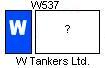
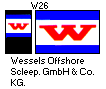
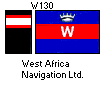
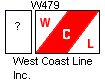
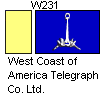
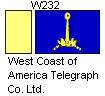
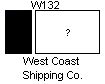
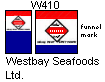
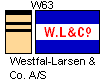
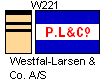
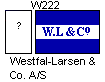
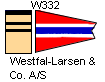
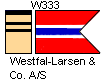
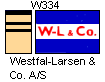
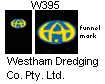
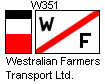
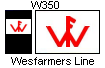
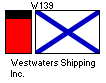
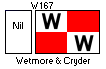
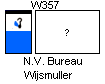
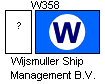
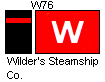
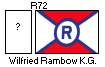
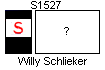
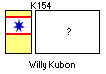
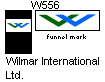
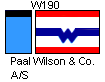
W537 comes from a starboard photograph of Compassion on 18 May 2013. The previous NewLead Holdings band and markings, referenced in the source as N791, had been painted over.
W Tankers bought the renamed Compassion on 1 January 2012. BW Maritime Pte. Ltd. acted as agent and listed the vessel on the BW group website.
Singapore.
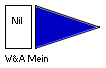
W. & A. MEIN.
The sailing vessels had no funnel; their flag was a blue pennant.
UK, Liverpool.
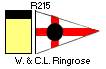
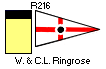
W. & C.L. RINGROSE.
The company merged into Hull & Netherlands Steam Ship Co. Ltd. on 1 March 1894.
U.K., Hull.
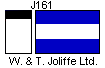
W. & T. JOLLIFFE LTD.
The funnel and flag are documented in Lloyds 1912 and the Merseyside source.
Sources date the towage business to 1852, 1853 or 1854, with Lion given as its first tug in 1852. Alexandra Towing’s takeover is usually dated 1908, but British Steam Tugs gives fleet absorption in 1901. Jolliffe remains in registers after those dates, including 1917–18 and 1924–25. Rosanoski distinguishes a possible Johnston & Joliffe name from the Liverpool firm, suggesting that it concerns South Shields owners instead.
UK, Liverpool.
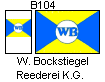
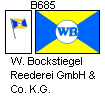
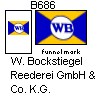
W. BOCKSTIEGEL REEDEREI GMBH & CO. K.G.
B687 is presumed to be the original funnel, possibly based on Mitchell’s drawing of Neil B with a blue funnel at Antwerp in June 1987.
The source associates neither B104 nor B688 with a specific vessel.
BBC Peru shows a black funnel top, whereas Nils B on 2 April 2006 does not. Nils B’s flying flag has lighter blue than the funnels and blue letters, matching the website logo. Starboard views show the flag pointing forwards. Letter colour is unclear on several vessels, but AB Bilbao on 16 March 2014 and AB Dublin on 3 July 2010 show black letters and darker-blue flag panels.
B686 follows BBC Portugal on 13 December 2007, with letters appearing the same dark blue as the funnel quarters.
Captain Werner Bockstiegel founded Bockstiegel Bereederungs in 1983, changing the name to W. Bockstiegel Reederei GmbH & Co. K.G. in 2000.
Germany, Emden.
W. BRUNS.
W. Bruns is recorded in 1917–18 and again in 1963–64, presumably after resuming operations following the Second World War. Some ships had become partnerships by 1966–67. From 1973–74 the Bremen listing identifies the firm as an operator only, continuing through 1980–81.
Germany, Leer; Bremen is recorded later.
W. J. Woodside & Co.
Documentary images — company attribution uncertain
The flag is based on a cap badge supplied as unidentified British material. Rosanoski considered this company the likely attribution because he found no other British firm to match; the identification remains tentative.
Do not turn elimination by surname into identification.
Woodside operated sailing ships and the County Steamship Co. Bawnmore was owned from 1889 to 1895 and converted from a cargo ship to a tanker in 1894.
United Kingdom, Belfast.
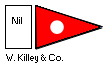
W. KILLEY & CO.
The sailing-vessel flag is a red pennant with a white circle. No funnel is given.
U.K.
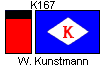
W. KUNSTMANN.
image by Klaus-Michael Schneider, 16 Sep 2008
The FOTW flag follows Lloyds 1912.
Kunstmann was a steamship owner from 1870 and merged into Fritzen & Sohn, dated to 1938 by Merchant Ships but to 1936 by another cited source. Vessels bore the Kunstmann name, though some websites spell the company Kuntsmann.
Germany, Stettin.
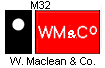
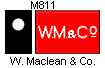
W. MACLEAN & CO.
The two versions are retained from Lloyds 1904 and the Lloyds/Reed 1912 sources.
Previously part of Groves, Maclean and then Maclean, Doughty, the concern became independent in 1900. The source records W. Maclean & Co., W.S. Maclean and operation as Maclean Shipping Co. Ltd. Duart sank on 31 August 1916, and with Tantallon sold that year the company ceased business.
UK, West Hartlepool.
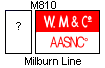
W. MILBURN & CO.
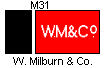
image by Ivan Sache, 9 December 2005
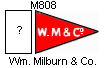
image by Ivan Sache, 9 December 2005
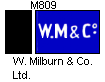
image by Ivan Sache, 9 December 2005
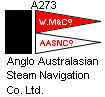
Lloyds 1882 gives M31 for both J.D. Milburn and Wm. Milburn. The Liverpool Journal of Commerce also assigns it to Anglo Australian in 1885, omitting dots and making the ampersand shorter.
The Anglo-Australasian sources show a pennant. Griffin places dots between letters at mid-height and Reed at the baseline. The reported combination of two pennants into one rectangular flag in 1890 conflicts with the earlier 1885 portrayal.
The historical Red Duster pages showed a different flag version, later removed in favour of M808 throughout the site. Mertens cites the account of the pennants’ 1890 amalgamation; Sache illustrated both website versions.
M809 follows the Talbot-Booth, Ships & The Sea and Merchant Ships references.
William Milburn’s independent concern is dated to 1879 after the Watts, Milburn partnership dissolved. The alternative 1872 date is associated by Rosanoski with Edmund H. Watts’s separate business. Milburn’s sons William and Charles ran London, while John ran Newcastle. Anglo-Australasian Steam Navigation was established for an Australian service via Antwerp, using Port-prefixed ships; in 1890 the businesses came together as the Milburn Line. A relationship with George Tyser had developed from the late 1880s.
The name became Milburn & Co. Ltd. in 1912, and the concern helped form Commonwealth & Dominion in 1914 while continuing at Newcastle. Shipowning resumed with Benwell Tower and Fowberry Tower in 1927 according to one account, or 1929 in Merchant Ships. Fowberry Tower sank on 12 May 1941. A company record gives Wm. Milburn & Co.’s establishment as 23 September 1919; a November 1951 resolution provided for winding up and registering a new company of that name, whose subsequent activity is unclear.
Milburn had earlier joined August Bolten in Hamburg-Brazil Steam Navigation and held shares in Hamburg-Sud. The Australian-service company is variously dated 1883 or 1884. One account says it never traded, while another describes sailings advertised as Australasian Steam Navigation and a return to the original name in 1887. Rosanoski explicitly distinguishes it from the unrelated company otherwise known by the Australasian name.
UK, Newcastle.
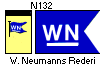
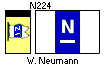
W. NEUMANNS REDERI.
The yellow or buff funnel has a black top and a swallowtailed white-blue-white vertical triband flying from a pole; a white N above a white horizontal baton occupies the blue stripe. The separate flag has the same stripes and emblem, though its description does not specify the shape.
The second version uses a blue swallowtail with white WN above a white horizontal baton, also flown from a pole on the yellow or buff, black-topped funnel. Wevan’s funnel in July 1966 appears to show a rectangular flapping flag instead. Rosanoski notes disagreement about whether the flags were swallowtailed, including inconsistency in the US Navy source.
Listed as W. Neumann, managers only, in 1963–64, the company appears as W. Neumanns Rederi by 1973–74. It managed Skibs A/S Widan.
Norway, Bergen.
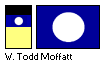
W. TODD MOFFATT.
The flag is blue with a white circle. The yellow or buff funnel has a black top separated from the body by a broad band of the flag.
U.K., Aberdeen.
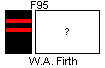
W.A. FIRTH.
W.A. Firth operated Pareora between Port Kembla and Sydney from 1908. The sale is dated 1919 in The Log and 1918 in the Compendium. Lloyds lists William A. Firth in 1917–18 with the vessel named “Pareor”.
Australia, Sydney.
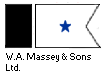
W.A. MASSEY & SONS LTD.
The flag is a white swallowtail with a small blue star. The funnel is given as black, although The Worlds Merchant Fleets provides no funnel colours.
The concern is recorded in The Worlds Merchant Fleets 1939.
UK.
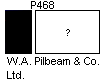
W.A. PILBEAM & CO. LTD.
The timber-trading concern operated Hillmeads from 1918 to 1924.
Australia, Tasmania; possibly Hobart.
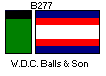
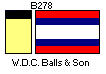
W.D.C. BALLS & SON.
Griffin’s version has a yellow or buff funnel with a black top and a five-striped red–blue–white–blue–red flag. The white stripe is twice each other stripe’s width, occupying one-third of the field. Rosanoski is uncertain of the funnel’s base colour, inferred from its position among yellow funnels, and regards both funnel and flag as suspect.
The other version has a green funnel with a black top and blue–red–white–red–blue flag stripes, again with the white stripe twice as wide as each other stripe.
U.K., North Shields.
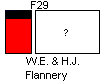
W.E. & H.J. FLANNERY.
W.E. & H.J. Flannery owned Idant from 1924 to 1935.
Australia, Stroud.
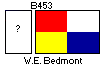
W.E. BEDMONT.
USA.
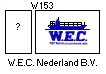
W.E.C. NEDERLAND B.V.
The flag is white with a blue container ship on a blue sea line, above blue W.E.C and the smaller blue legend “WEST EUROPEAN CONTAINER LINES”. No funnel is given.
Netherlands, Rotterdam.
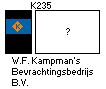
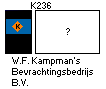
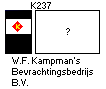
W.F. Kampman's Bevrachtingsbedrijs B.V.
W.F. KAMPMAN'S BEVRACHTINGSBEDRIJS B.V.
Oosterdok of the operated Rederij Oosterdok is shown by Mitchell with K237.
K235 resembles the livery recorded separately for Phoenix Lijn. FOTW connects Phoenix with cargo handling by Kampman; the only apparently connected ship belonged to operated company N.V. Zeevaart Maatschappij Navigare. Mitchell seems to use a darker blue for the funnel letter than the band, while FOTW uses a standard blue for the flag.
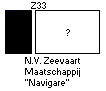
N.V. Zeevaart Maatschappij Navigare
Mitchell indicates that Bern of N.V. Fegro and Roelf Buisman, called Roelof Buisman by Lloyds, of N.V. Kustvaart Onderneming Zwartsluis used the Kampman funnel.
A black-and-white photograph of Nieuwe Waterweg appears to show a black funnel with a white band and an uncertain letter.
K236 and Z33 are preserved from the Mitchell collection without separate verbal descriptions.
The business appears in Lloyds from 1953–54 as W. F. Kampman’s Bevrachtings-en Controlbedrijf and later as W. K. Kampman’s Bevrachtingsbedrijfs, with B.V. added by 1978–79. It operated for several owning companies, between five and ten in the cited registers.
Netherlands, Amsterdam; Mitchell gives Delfjzl.
W.F. WALKER & CO.
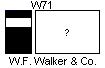
W71’s funnel is recorded for Titus. A house flag is known to have existed, but its details were not confirmed.
W.F. Walker operated Titus during 1884–1891. Sydney Akhurst became a partner on 1 January 1889.
Australia.
W.H. COCKERLINE & CO. LTD.
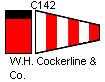
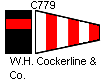
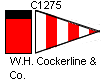
image by Al Fisher, 27 January 1999
image by Ivan Sache, 8 March 2004
The flag is trapezoidal, with six vertical stripes alternating white and red.
Steamship owners from 1885, W.H. Cockerline & Co. became a limited company in November 1941. It traded until at least 1954 and was wound up in 1957. The records also use Walter H. Cockerline and Sir Walter H. Cockerline. Fleet names ending in “ic” began with Pacific in 1894 and were an established practice by 1911.
UK, Hull.
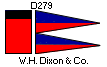
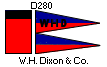
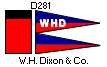
W.H. DIXON & CO.
U.K., Liverpool.
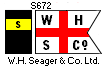
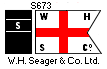
W.H. SEAGER & CO. LTD.
Rosanoski describes S673 as the Brown 1926–1943 form and S672 as that of other sources, with variations in the dot and in whether the o is emphasised. The funnel S may also differ in shape.
Formed in 1904, W.H. Seager operated as Tempus Shipping Co. Ltd. until disposing of its last ship in 1963.
U.K., Cardiff.
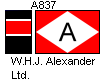
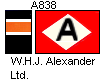
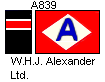
W.H.J. ALEXANDER LTD.
Lloyds 1912 shows the initial off-centre and the diamond’s top and bottom points askew, which Jan Mertens and Rosanoski consider printing errors; Lloyds 1904 and Loughran centre the “A”. A model of Sun XVI supports a diamond extending throughout the field, provided the model is accurate.
The Thames Tugs website instead places the diamond within the field, particularly at the sides, and colours the funnel band orange rather than the generally recorded red. Tug photographs suggest a broader main band and narrower white bands than A838. The colour photograph of Sun XVII could be read as orange or reddish-orange. The Sun XVI model adds further uncertainty with two orange bands against one red; a black-and-white Sunbird photograph shows black with a broad white band.
The Liverpool Chamber of Commerce chart of 1966 also places the diamond inside the field but gives a blue “A”.
William Henry James Alexander began lighterage at Wapping in 1883; craft towing is separately dated from 1884. The fleet used “Sun” names from 1899 and became known as Sun Tugs. After his death in 1929 the business passed to six sons and two daughters, with eldest son George running it. The family supplied tugs and barges to the Silvertown Services consortium in 1938 and thereafter concentrated on ship towing.
A proposed merger with William Watkins gave way to combination with Ship Towage (London) as London Tugs. One account dates this to 27 January 1969; Loughran describes a 1968 takeover of Ship Towage by Alexander followed by renaming. The differing dates and descriptions remain unresolved.
UK, London.
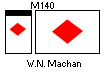
W.N. MACHAN.
The livery matches Dundee Steam Navigation apart from a funnel variation. The white funnel has a black top and red diamond; the white flag bears a red diamond.
W.N. Machan is recorded as owner or manager of Dundee Steam Navigation.
UK, Dundee.
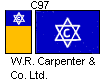
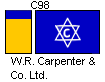
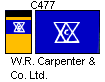
W.R. CARPENTER & CO. LTD.
The original C97 funnel was last seen on Admiral Chase, sold in May 1951. C98 was the final funnel, recorded by Mitchell under Pacific Shipowners.
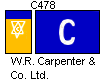
The main flag is blue with a white Star of David enclosing white C. Brown 1951’s C477 has upper and lower star points that do not extend; Rosanoski considers it possibly incorrect, though Mitchell supports it on a funnel drawing. Brown 1943’s C478 has only white C on blue, despite showing the star on the funnel, with its upper point not extending.
Registered on 9 September 1914, the company was founded by Sir Walter Randolph Carpenter with P.A. Morris and Maynard Hedstrom, who later formed Morris Hedstrom Ltd. It entered shipowning in 1920 and expanded across Australia, Fiji, New Guinea and the Solomon Islands. The Solomon Islands subsidiary has conflicting dates: the source says formed in 1935 but registered in 1922. The Fiji company followed in 1951, and W.R. Carpenter Holdings took over in 1957. Ships were commandeered at the start of the Second World War; Carpenter bought two US ships in 1940 under terms allowing operation outside European control. His sons succeeded him and bought control of Morris Hedstrom in 1956. Shipowning ended with Lakemba’s loss in 1967.
Shipping subsidiaries included W.R. Carpenter Overseas Shipping and Suva-based Pacific Shipowners, apparently the principal post-war operation. The family relinquished its interests in 1983. One account dates Malaysian MBf acquisition to 1994, also supported by the June 1994 sale report, while Rosanoski’s FOTW comment says the year after 1983. The registration history later uses Claude Neon (Australia), Enity Group and Claude Group names.
Australia, Sydney.
W.R. CHAMBERLAIN & CO.
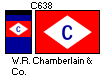
W.R. Chamberlain & Co. appears in Lloyd’s from 1953–54 through 1973–74.
USA, Portland OR.
W.S. KENNAUGH & CO.
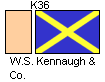
image by Peter Hans van den Muijzenberg, 30 September 2010
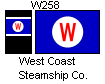
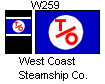
The funnel is described as yellow, but the Holme Force plate shows pale buff. The 1930 Liverpool sheet and Talbot-Booth give the flag a broad saltire. Merchant Ships 1942 and 1944 also index the funnel under West Coast S.S. Co., though that name is absent beneath the illustration.
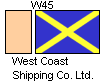
W45 follows US Navy 1961.
Kennaugh’s first steamer, Scale Force, was built in 1883. West Coast Shipping Co. was formed in 1905 to take over the fleet and single-ship companies managed by Kennaugh. Ships retained Whitehaven registration after the move to Liverpool and commonly had Force as their second name. Brothers Willie and John Kennaugh decided to retire in 1958, and the company ceased in 1959. This West Coast company was distinct from the Australian concern involved in forming Coast Steamships.
UK, Whitehaven; moved to Liverpool in the 1890s.
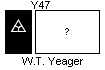
W.T. YEAGER.
The funnel is documented in Log, August 1994; no verbal design is supplied.
William Tudor Yeager carried timber in his own vessels on the Richmond River and bought its first working tug in 1883. He sold his fleet in late 1898. The source describes him as an immigrant from the USA, born in 1839 in Lubeck, Canada, and notes the alternative initials W.G. in another account.
Australia, Coraki.
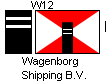
Wagenborg Shipping B.V.
WAGENBORG SHIPPING B.V.
image by Jorge Candeias, 21 March 1999
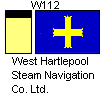
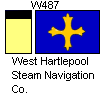
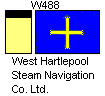
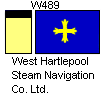
Sources vary in the gap between W12’s two white funnel bands. Most show a wider intervening space, while Brown 1982 and 1995 make the bands and gap equal. Photographs of Vanessa and Reggeborg show narrower separations of differing widths; Albanyborg on 3 December 2013 shows equal white bands and black gap. Candeias’s FOTW flag follows the company website supplied by Al Fisher.
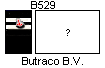
Butraco BV — Polarborg
B529 is assigned to Polarborg of managed company Butraco B.V. The emblem is unclear, possibly connected with flames.
Vessel/source-specific allocation only; no exclusive fleet-wide use inferred.
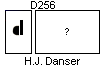
H.J. Danser — Marietje Andrea
D256 is assigned to Marietje Andrea of H.J. Danser.
Vessel/source-specific allocation only; no exclusive fleet-wide use inferred.
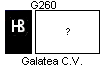
Galatea CV — Galatea
G260 is assigned to managed Galatea of Galatea C.V., although the funnel letters do not seem to agree.
Vessel/source-specific allocation only; no exclusive fleet-wide use inferred.
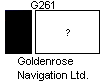
Goldenrose Navigation Ltd. — Concord source panel
G261 is assigned to Concord, which Mitchell links to a company of that name; Rosanoski instead identifies the vessel with Lloyd’s Goldenrose Navigation Ltd. entry.
Vessel/source-specific allocation only; no exclusive fleet-wide use inferred.
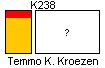
Temmo K. Kroezen — Quo Vadis
K238 is assigned to Quo Vadis of Temmo K. Kroezen.
Vessel/source-specific allocation only; no exclusive fleet-wide use inferred.
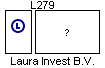
Laura Invest BV — Laura II
L279 appears related to Laura and Laura 11, under Laura Shipinvest 1 B.V. and Laura Invest B.V. respectively. Mitchell notes only the latter vessel and lists the funnel as Laura Invest.
Vessel/source-specific allocation only; no exclusive fleet-wide use inferred.
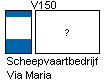
Scheepvaartbedrijf Via Maria — Deo Juvante
V150 is assigned to Deo Juvante of Scheepvaartbedrijf Via Maria.
Vessel/source-specific allocation only; no exclusive fleet-wide use inferred.
Documentary images — company attribution uncertain
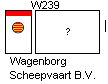
W239 may belong to a managed company, but Mitchell names no vessel.
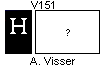
V151 is assigned to Klazina. Mitchell gives no owner; Rosanoski assumes A. Visser from Lloyd’s, although the letter does not fit.
Undated owner and meaning unknown.
Wagenborg caption is not proof of company use.
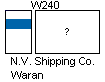
NV Shipping Co. Waran — Waran
W240 is assigned to Waran of N.V. Shipping Co. Waran.
Vessel/source-specific allocation only; no exclusive fleet-wide use inferred.
Further document-only examples illustrate the diversity among managed vessels. The BD-Shipsnavo example has the owner’s circular logo, outlined white, above Wagenborg bands, with the owner’s flag forward; it is numbered B998 in the text and B988 in Sources. P331 for Pax I, not otherwise located, has a bird carrying a twig. For T348 on Elfenmeer of J.V. Ten Hoor, the source calls the band white but also describes it, the shield edges and the unidentified symbol as darker blue, with a lighter-blue sinister shield half. Rederij Salomans & Wildeman is said to use varied colours incorporating SW. These references do not add images to this entry.
Founded in 1898 as E. Wagenborg’s Scheepvaart en Expeditiebedrijf N.V., the company became Wagenborg Scheepvaart B.V. in 1972 and Wagenborg Shipping B.V. in 1987. Royal Wagenborg received the royal seal in its centenary year, 1998. The business combined shipowning with management for captain-owners and small individual companies; its own fleet commonly used names ending borg.
Associates included C.V. “Flardinga” Scheepvaartbederij Doorduin B.V., H.J. Held and Vuurborg. Vuurborg’s Amy and Namai were managed by Wagenborg under separate registered owners. Wagenborg Kazakhstan was formed in 1998; Wagenborg Passagiersdiensten is separately recorded as a manager at Nes Gem Dongqaredeel.
Netherlands, Delfzijl.
WAH KWONG MARITIME TRANSPORT HOLDINGS LTD.
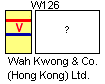
W126 is recorded on Union Venture of Global Navigation Co. Inc. in March 1965.
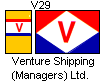
V29’s flag was first recorded on Summit Venture at Lyttelton on 24 February 1982. Its funnel was seen on Fjord Star there on 24 January 1987, and JLL confirmed both funnel and flag. Forest Venture flew the flag at Wellington on 25 September 1997 with an unrelated funnel. Tianjin Venture’s port-side photograph on 29 August 2013 confirms the V29 funnel.
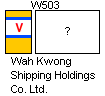
W503 comes from African Venture on 15 August 2012. Rosanoski considers it possibly mistaken, noting the red upper band of the first vessel under their name, Magdalena, matching V29, and the apparent normal use of V29 by management-company vessels such as Ardenne Venture.
T.Y. Chao established the group’s shipping business in Hong Kong in 1952; another cited account identifies Robert Chen as co-founder of Wah Kwong Shipping Co. T.Y.’s son George is named as chairman in the website account. Wah Kwong Shipping Agency Co. Ltd. was formed in 1962 and was previously Wah Kwong & Co. (Hong Kong) Ltd. Fleet names commonly ended Venture, marking subsidiary ownership.
Related companies included Venture Shipping (Managers) Ltd., Wah Kwong Ship Management (Hong Kong) Ltd. and Wah Kwong Shipping Holdings Co. Ltd., the last formed in 2001.
The group joined the Cape Asia Newbuildings venture on 9 October 2005. It had acquired 25% of Transinsular at privatisation in 1990, disposing of it to CMB by 1993. CMB Transport bought 18.2% of Wah Kwong in May 1999, bringing CMB’s stake to 27.8%.
China, Hong Kong.
Wah Tung Shipping Agency Co. Ltd.
WAH TUNG SHIPPING AGENCY CO. LTD.
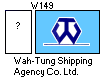
W149’s flag comes from Josef Nüsse’s website and FOTW; no separate verbal design description is supplied.
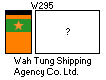
Mitchell’s W295 is possibly Trade Friend of Trade Friend S.A. The subsequent JLL account also uses W295 for an orange-buff funnel apparently common on Worlder-managed ships until at least 1985. Both statements remain as written.
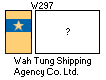
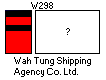
JLL records two normal funnel patterns for Wah Tung-controlled ships. W298 is reported for Great Amnity and Great Cheer in the correspondence of 15 November 1999, while the source list separately identifies W297 as another JLL funnel. The prose does not securely specify W297’s individual design.
Documentary images — company attribution uncertain
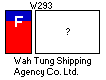
The source list identifies W293 as a Mitchell funnel. The narrative instead prints W283, tentatively associated with Wah Tat Navigation and perhaps Far East Vanguard. The discrepancy is preserved without asserting a corrected individual attribution.
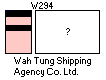
W294 may relate to Cason Navigation’s Cason or Crownson Shipping’s vessel named Hibsicus in the source.
Wah Tat attribution remains tentative.
No proof of either specific allocation or shared use.
Herwang Shipping SA — Herwang
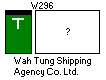
W296 is assigned to Herwang of Herwang Shipping S.A.
No exclusive fleet-wide use or unrecorded corporate equivalence is asserted.
Ships mainly appear to have used owners’ colours: the regular Sinotrans livery on Great-prefixed vessels, while Fareast Victory wore Far East Enterprising’s funnel in January 1999.
Formed in 1981 jointly by Far East Enterprising Co. (H.K.) Ltd. and China National Foreign Trade Transportation Corporation, Wah Tung used Worldtrend Shipping Ltd. to manage part of its fleet. Rosanoski considers that Far East had disposed of its interest by December 2003, when the fleet appeared under Sinotrans Shipping.
China, Hong Kong.
WAIHEKE SHIPPING CO. LTD.
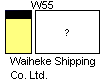
W55’s funnel comes from The Log, February 1986. No separate written design description is provided.
Incorporated on 17 December 1936 as Waiheke Passenger Service Ltd., the company became Waiheke Shipping Co. Ltd. in 1950. The later company record shows it struck off, with Fullers Group holding all but one share; Lloyd’s 2001–2002 places its last vessel in Fullers’ fleet.
New Zealand, Auckland.
WAIROA STEAMSHIP CO. LTD.
The flag is blue with a narrow red saltire between the white letters WSSCo, documented in The Log of May 1988 and August 1989.
Captain James Pearce formed the company in 1905. It ceased in 1907 when taken over by Kaipara Steamship Co. An earlier reference called it Wairoa Shipping, but the subsequent Log correction and Koeke Junction website confirm Wairoa Steamship Co. Ltd.
New Zealand, Hellensville; Mangawhare is also given.
WAIT & PIERCE.
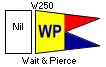
image by Joe McMillan, 30 November 2001
W250 is illustrated by Joe McMillan from a painting cited at pem.org/archive. No separate written flag description is supplied.
Wait & Pierce was a sailing line operating from Salem, Massachusetts, in the early nineteenth century; McMillan provides no fuller history.
USA, Salem.
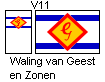
WALING VAN GEEST EN ZONEN.
The livery was also used by Geest Line Plc. Marinart’s 1975 coastal-fleet reference describes a white funnel with a red “G”; Stewart 1963, Brown 1971 and Mitchell provide the other V11 sources.
Waling Van Geest gave nurseries to his sons Jan, Leen and Maarten, from which the later British Geest business developed. Shipping interests began in 1946 between Holland and east-coast UK ports. The UK subsidiary Geest Line Ltd. was established in 1964 to manage deep-sea banana shipments. Rosanoski traces the fleet apparently from Geeststroom, built in 1954, to a second Geeststroom and Geesdduin, both sold in 1976. Vessel names used the prefix “Geest”.
Netherlands, ’S Gravenzande.
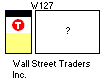
WALL STREET TRADERS INC.
Recorded for Aldina in October 1965, the funnel is yellow or buff with a black top separated from the base by a broad white band bearing a red circle with a white T. No flag is noted.
Wall Street Traders appears in Lloyd’s from 1963–1964, later as manager for Marine Traders Inc. Its agent in 1970–1971 was Management & Shipping Transport Inc.
USA, New York NY.
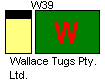
WALLACE TUGS PTY. LTD.
The flag is green with a red W, as shown by The Log in November 1986. The funnel is additionally documented in August 1991.
Registered on 28 November 1939 and originally James Wallace & Co., the business combined towing interests with J. & J. Daley before the Second World War. The Wallace shares subsequently passed to Waratah/Adelaide Steamship and the Daley family shares to J. Fenwick & Co., with the company reconstituted as Wallace Tugs. By 1967–1968 Waratah and Fenwick held equal shares. Lloyd’s instead names Brambles as co-founder; the later account identifies Brambles’ interest as held through Fenwick.
The source gives conflicting dates for Brambles’ disposal to Adsteam: 1996 in one account, but an announcement on 13 April 1995 effective 12 May 1995 in The Log. Wallace became Adsteam Towage in 1997, subsequently Adsteam Harbour and finally Svitzer Australia. The Port Kembla operation appears as Adsteam Harbour Port Kembla in 2005–2006.
Australia, Sydney; later Port Kembla.
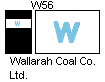
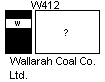
WALLARAH COAL CO. LTD.
The flag is white with a light-blue W. The funnel W is explicitly described as light blue; Rosanoski assumes the flag used the same shade.
On takeover the only stated funnel change was removal of the W. W412 is sourced to The Log of 29 August 1981 in this context.
Incorporated in the UK in the 1880s, Wallarah operated in Sydney from 1891 to 1957. J. & A. Brown & Abermain Seaham Collieries bought all its issued capital in 1956 and absorbed the company in 1957.
Australia, Sydney.
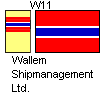
Wallem Group Ltd.
WALLEM GROUP LTD.
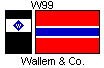
Jordan assigns W11 to the Hong Kong company’s Panamanian ships and W99 to its British ships, while Ships & The Sea 1942 applies W99 to all Hong Kong ships. Merchant Ships 1949 makes the diamond extend throughout the band. Brown 1951 and 1958 use W11 for both. Band widths differ: Jordan’s Solviken photograph and Brown 1982 and 1995 support equal bands, unlike the FOTW and Hong Kong images. Nego Nomis in 1998 confirms a yellowish-buff funnel with dark-blue band but unequal proportions; Pacific Logger in 2000 confirms the flag. The white-blue-white triband occupies one-third of the main funnel band or flag, with relatively less blue on the funnel. Mitchell also shows sky-blue bands, sometimes without a black top and sometimes with a narrow top on Panamanian vessels.
Nüsse supplies table flags, while FOTW credits Jorge Candeias as the flag source. Rosanoski traces the original flag to the Norwegian Wallem concern and distinguishes the later Norwegian variation.
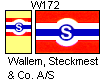
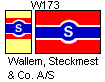
Wallem, Steckmest’s variation widens and bulges the blue band into an undefined circle bearing a white S, retaining white between red and blue. The respective widths are uncertain, with Brown editions differing; Mitchell’s W172 funnel has wider red. W172 and W173 remain the separately documented variants.
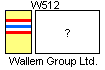
W512 comes from GH Fortune’s starboard side, showing equal-width bands and a sky-blue shade.
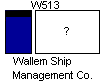
Mitchell first lists W513 under Catherine Ann Shipping, presumably connected with Catherine Ann in 1981–1983, then adds Wallem Ship Management. Several drawings show the dark funnel, but whether all had the black top is uncertain. Cape Star is another possible source.
The Great Circle Shipping Co. SA
The Great Circle Shipping Co. S.A.
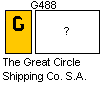
G488 is shown on Gracious Fountain, managed for The Great Circle Shipping Co. S.A. in Lloyd’s 1985–1986. Other drawings suggest plain funnels as well, without establishing whether those were vessel-specific.
Lloyd’s first dated Wallem’s origins to 1898, later amending this to 1903; the website account places the 1903 origin in Shanghai. Haakon J. Wallem’s steamship activity dates from 1907, with distinct Bergen and Hong Kong companies. Sources variously give 1916, 1918 and an apparent 1922 formation for Wallem & Co. A/S. Its reported 1956 renaming as Wallem, Steckmest & Co. A/S did not immediately remove the older name from the registers.
Haakon’s daughter Rita Steckmest continued the Norwegian business. Tom C. Steckmest acquired the family holdings in Wallem Steckmest in 1993; the company later held only property interests. Ownership described as leaving the family in 1968 returned in 2006 through Viken Shipping and co-investors, including Wallem management. Rosanoski considers that ownership passage apparently to concern the non-Norwegian shipping business. Viken is later listed separately from Wallem Steckmest.
As part of Wescol International, Wallem was sold by Hill Samuel to TSB in 1988. TSB sold it in August 1992 to a consortium led by Caledonia Investments, with Seattle Shipping, A.J. Hardy and management; the shipbroking and agency business had gone to Inchcape in May 1992. From early 2006 ownership was through Netherlands-registered Woodstreet Investments, controlled equally by Viken Shipping and Clearwater Investments.
The group’s operating entities included Wallem Shipmanagement Ltd., formed in 1971, Wallem Shipping (Hong Kong), formed in 1993, Singapore businesses, London and Slough management companies, and a Hamburg company formed in 2004. Viken Ship Management became Wallem Shipmanagement Norway in 2006. The Isle of Man management company became Marine Management Services in 1992 and merged into Celtic Marine in 1995.
Joint ventures included COSCO Wallem, formed with Qingdao Ocean Shipping in 2005; Fesco-Wallem in 2008; and ID Wallem with ID Maritime Singapore in 2009. Westcot Norway began in early 1989 as a 60/40 venture with Jørgen Jahre Shipping, became Jahre-Wallem Management in 1992, Jahre-Skaugen-Wallem after B. Skaugen took 10% in 1995, and Jahre-Wallem in 1996. Its sole vessel Cascade was sold in 2003; it held 25% of Thor Dahl Management. Wallem was also a Sabre Line shareholder.
China, Hong Kong.
WALLENIUS WILHELMSEN LOGISTICS
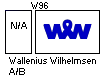
image by Jarig Bakker, 3 August 2003
W96 is white with two connected blue Ws, the connection forming a loop. Bakker initially described the centre as resembling an uppercase O; Rosanoski clarified the looped connection. The double-W flag remained unchanged after the logistics renaming and is confirmed on company websites. Ships continued to use the individual companies’ funnel liveries; the joint flag does not establish a merged fleet livery.
Wallenius Wilhelmsen, WWL, began on 1 July 1999 as Wallenius Wilhelmsen Lines A/B, combining the operating activities of Wallenius and Wilh. Wilhelmsen on a 50/50 basis. Rosanoski explicitly clarifies that this was a joint operating venture: the two principals remained separate companies. It became Wallenius Wilhelmsen Logistics on 1 January 2006, reflecting expansion from ocean transport into outbound logistics.
The partners had separate histories: Wallenius was founded in 1934, while Wilh. Wilhelmsen was private from 1861 until restructuring as a public company in 1985, adopting its then-current name in 1997.
Sweden, Stockholm; Norway, Lysaker.
WALLENIUSREDERIERNA A/B.
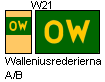
image by Jarig Bakker, 3 August 2003
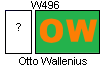
image by Klaus-Michael Schneider, 16 April 2009; 24 August 2012
image by Klaus-Peter, None
image by Jorge Candeias, March 1999
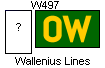
W21 is based on Nüsse’s table flag: green with yellow OW. Collectors Corner supplies cap-badge evidence. Stewart 1953 and 1957 appear to render the letters white in black-and-white hatching. The same livery was used by Bremen and the Soya, Wallstar and Walltank companies. Figaro’s funnel photograph shows yellowish buff distinct from the yellow/gold letters. Merchant Ships 1959 and 1963 show a black top.
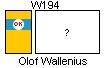
Merchant Ships 1959 and 1963 give W194 as an alternative funnel; no additional separate design description is supplied.
Schneider’s Bremen flag, W496, shows light-orange OW on green. Rosanoski objects that the letters should be yellow, the green dark, and the “Otto Wallenius” attribution erroneous: the founder was Olof, and Kludas referred to the German subsidiary, which used the parent’s colours. Schneider replied that he had used a flag in Klaus-Peter’s dossier, with yellow lettering and grassy rather than bluish green. The exchange leaves shade reproduction qualified by photographs, printing and screens rather than claiming absolute colour certainty.
W497 is Jorge Candeias’s March 1999 flag, discussed by Bakker as green with yellow OW. The accompanying reference to the joint company’s white double-W flag concerns a separate operating-company flag, not a replacement description of this image.
Olof Wallenius’s business, also known as Wallenius Lines or OW, was founded in 1934. Ships were registered through Rederi A/B Soya, Wallenco, Wallship, Wallstar, Walltank, NUP, Manjoma and partnerships involving Bertil Bernadotte of Wisborg or Olof’s daughter Margareta Kleberg. Bremen operations began in 1962 and were liquidated in the early 1980s. Japanese and Singapore subsidiaries followed; the narrative gives 1982 and 1983, while Lloyd’s dates Wallenius Lines (Japan) to 1984.
The 50/50 operating combination with Wilh. Wilhelmsen on 1 July 1999 created Wallenius Wilhelmsen Lines, renamed Logistics from 1 January 2006. The joint company handled marketing and operations, leaving Wallenius focused on owning and managing ships. It was owned by the family holding company Rederi AB Soya, with Margareta Wallenius-Kleberg the largest shareholder alongside Jonas Kleberg and Annika Bootsman Kleberg. Wallenius Marine A/B was formed in Stockholm in 2003; the Singapore management company, formed in 1998, became Wallenius Marine Singapore in 2007.
Interests included Argonaut, whose recorded percentage holdings differ between sources; 50% of United European Car Carriers, acquired from Nippon Yusen Kaisha in 1991; Atlantic Container Line, a mid-1960s consortium in which Wallenius was a prime mover, with the interest dissolved in 1989–1990; American Roll-On Roll-Off Carrier; and Eukor Car Carriers, formed from Hyundai’s car-carrier division in December 2002.
Fleet names used Soya and opera themes, beginning the latter with Rigoletto in 1941. Rosanoski notes a chronological inconsistency: one account reserves Soya for tankers into the 1960s but also says that only opera or music names followed Soya-Elizabeth in 1958. The separately listed Wallenius Margareta’s sole vessel later appeared under Olof Wallenius.
Sweden, Stockholm.
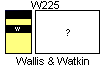
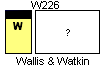
Wallis & Watkin.
Documentary images — company attribution uncertain
Both W225 and W226 are attributed to Duchess in The Log, but the conflicting ownership and acquisition accounts prevent a secure sequence for the two funnels.
Cannot assign variants to owner periods.
Wallis & Watkin operated ferries before the Second World War. Duchess is variously described as acquired in 1932 and owned in 1931–1932. One account then places her with Duchess Steamship Co. before RNZN acquisition in 1940, while another describes two colour changes before a 1950 acquisition without specifying ownership changes.
New Zealand, Auckland.
Walt Disney World Corporation.
Disney Cruise Line / Magical Cruise Co. Ltd.
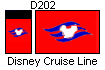
The funnel bears a blank Mickey Mouse face above three blue wavy lines, probably representing the sea. It follows Disney Magic from port on 26 April 2010 and Disney Dream from starboard on 1 December 2010. A separate Disney Magic photograph shows the flag flying.
Walt Disney World Corporation was reincorporated on 7 December 1964. Disney Cruise Line was formed in 1995 and later appears in Lloyds as Magical Cruise Co. Ltd., based in Celebration, Florida, retaining Disney Cruise Line as its trading name.
USA, Orlando FL.
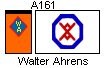
WALTER AHRENS
Nüsse supplies a table flag. Mitchell also records the flag emblem without defining how it was used.
Kapitän Walter Ahrens succeeded Adolf Ahrens, traced through the vessels in Lloyds. Adolf is recorded in 1953–4 with Martha Ahrens, given as 237 tons and built in 1939, which Rosanoski did not find in Miramar. Walter later had Käthe Ahrens, sold in 1977, and acted as agent for Tinto, sold in 1996. Lloyds later lists him as agent.
Germany, Bützfleth; Nüsse identifies Stade, written as equivalent to Büttzfleth.
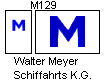
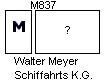
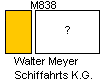
WALTER MEYER SCHIFFAHRTS K.G.
Mitchell links M838 to Cuxhaven, operated by Walter Meyer in 1978–79, but the funnel may have been the owner’s.
Mitchell gives M837 for Scot Trader while drawing her with M838, possibly indicating a later change. The M may be black or very dark blue; Wotan’s starboard photograph looks black but does not settle the distinction.
The funnel follows Priwall in October 2006; the flag is recorded among Nüsse’s table flags.
Walter Meyer is recorded as operator and manager, later within the Johs. Thode and Marconsult/Thode operating structures. Vessels included Scot Trader, Wotan and Priwall. Priwall, built in 1997, changed names on charter without changing registered owner; the 2011–12 entry places her under Wessels management.
Germany, Wischhafen.
Walter Runciman PLC.
WALTER RUNCIMAN PLC.
image by James Dignan, 11 October 2003
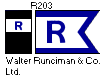
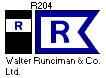
Following the Anchor acquisition in 1965, its funnel began replacing Moor Line colours across the combined fleets. Early in 1968 the Anchor flag flew at the mainmast and Runciman’s at the fore; later that year a smaller Runciman flag was flown above Anchor’s.
The FOTW flag derived from Sampson has a shallow fork.
LJC 1966 attributes this livery to Moor Line.
RUNCIMAN (LONDON) LTD.
The London company was listed as operator for Anchor Line and Barberry’s S.S. Co.
U.K., London.
The Runciman shipping business dates from steamship ownership in 1886. Moor Line originated as South Shields Steamship Co. in 1889 and took the Moor name in 1897. Its ships were sold to Western Counties after the First World War, and a new Moor Line was registered in 1920. Runciman Shipping Co., formed in 1922, took over its management in January 1938. The source also records W. Runciman & Co. Ltd. from 1938 and earlier registrations through Lord Runciman Shipping Co.
Anchor Line was acquired in 1965 as a wholly owned Moor Line subsidiary. Its vessel names replaced the previous moor suffix. Moor Line became Walter Runciman PLC in 1968 according to Lloyds, while operating names included Runciman Shipping and later Anchor Line Ship Management. Walter Runciman changed its name to Anchor Line PLC in 1995.
A takeover offer from Forvaltnings Avena was accepted in April 1990, with the family retaining a substantial shareholding. After Forvaltnings’s bankruptcy in September 1992, Erik Thun and Transmark acquired the group equally.
Interests included Geo. Gibson & Co. and Velefa Shipping, for which Runciman operated Crenella in 1920–23. It also operated Barberry’s S.S. Co., formerly Pachesham, until 1958. The James Fisher holding rose from 4.86% to 15.8% between January and July 1988.
U.K., Newcastle; later Glasgow.
WALTER SPORLEDER SCHIFFS. G.M.B.H.
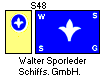
The funnel is buff with a blue circle edged white and bearing a white fleur-de-lis. The flag is blue with a white fleur-de-lis and small white WSSG letters in the respective corners.
Germany.
WALTER T. GOULD & CO.
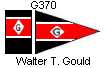
Jordan describes a narrow red band between two narrow white bands, a description Rosanoski doubts. Mitchell records the funnel under both Cardigan and Walter T. Gould.
Walter T. Gould, a cousin of J.C. Gould, moved from shipping insurance into shipowning and coal exports, with steamship ownership recorded from 1931. He formed Haenton Shipping in 1932 and acquired Cardigan Steamship from J. Jenkins, Sons in 1937, dropping the earlier name. Other listings spell it Heanton and continue to show it separately. Cardigan’s name was dropped during wartime Ministry of Transport management and revived afterwards. Gould operated the Grel Line and was also associated with Barry Shipping and Darwen, later spelt Derwen, Shipping. Shipowning ended with sale of the ships and assets in 1959, and Cardigan passed to John Cory & Sons.
UK, Cardiff.
Walther Möller & Co. (GmbH & Co. K.G.).
WALTHER MÖLLER & CO. (GMBH & CO. K.G.).
WECO Shipping Services GmbH
WECO Shipping Services
Associated WECO Shipping Services shared the address and offered agency, chartering, bunker brokerage, stevedoring and forwarding.
Keep the explicit scope label independent; no alias or company identity is inferred.
The document preserves the company flag logos from Walther Möller’s and WECO Shipping Services’ websites.
Walther Möller had been a shipbroker since 1941 and was described in 2013 as chartering manager for container ships. Its operating relationships included Bernd Bartels, Rolf R. Fischer, Reinhold Nibbe, Reederei Martin Spaleck and Viamare. Viamare, formed in 1986, later received the Nibbe vessel Ocean. Gebruder Winter was an associate.
Germany, Hamburg.
WAN HAI LINES LTD.
image by Ivan Sache, None
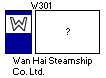
W301 is apparently based on Fu Chun, 8,078 tons, built in 1981, from the Mitchell collection.
The FOTW description calls W223 black W on white, but Rosanoski identifies the lettering as very dark blue from the company website and a photograph of the bow jack on Wan Hai 162. He describes the flag colours as the reverse of the funnel’s; Wan Hai 305 confirms the funnel. The dark blue can look black in the source image.
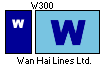
Wan Hai 307 carries W300 as a bow jack: light blue with a dark-blue W. Its funnel cannot be seen and is assumed to match, rather than confirmed.
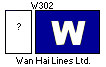
W302 is blue with a white W, painted on the raised structure near the bow of the vessel named Wan Hai1 265 in the source and on Wan Hai 162. No actual flown flag of this design had been observed.
The website traces Wan Hai to Wan Hai Steamship Co. Inc. in February 1965 and stock-market listing in May 1996. Lloyd’s instead dates Wan Hai Lines to 1992 and the earlier steamship company to 1966, later listing it among the managed companies. Rosanoski suggests that the older date may concern this subsidiary. Wan Hai obtained management rights over the National Shipping Corporation of the Philippines in March 1994. Most ships use Wan Hai followed by a three-digit number.
Taiwan: Taipeh, then Keelung, and later Taipeh again in the cited registers.
WANI SHIPPING A/S.
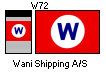
The funnel is grey with a black top and a very broad flag band. The flag is red with a white circle bearing a blue W.
Formed in 1994, Wani operated through two single-ship subsidiaries, with Torvald Klaveness & Co. as fleet manager.
Norway, Oslo.
WAPPEN REEDEREI GMBH & CO. K.G.
image by Klaus-Michael Schneider, 3 June 2007; observed 16 March 2007
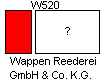
W520 comes from Wappen von Frankfurt while still under construction in November 2005. The vessel was apparently delivered on 1 December, and a photograph uploaded in March 2006 shows the panel added; the unpanelled funnel may never have been used in trade.
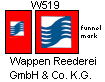
W519 comes from Wappen von Augsburg and Wappen von Berlin. On Berlin the blue border lies inside the panel, leaving a white outer edge; Wappen von Flensburg instead shows the panel edged blue.
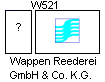
The flag is white with a dark-blue-edged white square containing five greenish-blue S-shaped waves touching in the middle. Schneider saw it above the company’s Johannisbollwerk building on 16 March 2007 and reconstructed the waves from the doorplate image.
Hamburg shipping professionals and businessmen founded Wappen Reederei in 2002 as a tanker-management specialist. Hansa Hamburg Shipping International is recorded as an associate. Its ships have names beginning “Wappen von”.
Germany, Hamburg.
Wappäus Family.
WAPPÄUS FAMILY.
image by Klaus-Michael Schneider, 26 Mar 2007
image by Klaus-Michael Schneider, 8 April 2012
image by Klaus-Michael Schneider, 8 April 2012
image by Klaus-Michael Schneider, 8 April 2012
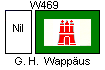
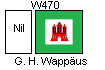
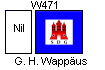
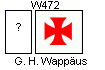
G.H. Wappäus
Mathies shows G.H. Wappäus’s flag as white with a broad green border, or equivalently green with a large white panel, bearing the red Hamburg castle. Meyer describes a red three-towered Hamburg gate on white with green edging. Rosanoski cautions that Meyer cites Mathies and may not provide independent corroboration. He favours this account but considers the competing painted version worth recording.
Schneider’s three 2012 illustrations document the competing flags collectively: white with a blue border, a red nineteenth-century Hamburg castle and black SDG beneath; white with a green border and red castle; and white with a red cross pattée. The reported proportions are approximately 11:12. The blue-bordered SDG and cross flags come from Lorenz Petersen’s 1854 painting, shown in Hamburgmuseum. Enlargements confirm blue and SDG, whereas the monochrome reproduction leaves the lettering unclear; the painted castle also seems to have an open gate. Schneider’s corrected account places the SDG flag on the foremast, the cross flag on the mizzen, name pennants on the mainmast and the Hamburg ensign aft. Earlier correspondence reverses some mast positions and tentatively reads Flora, while the later summary names Gloria. The painting postdates the father’s 1836 death and fleet disposal, so the accuracy and source of its retrospective details remain uncertain.
SDG is tentatively interpreted as Soli Deo Gloria, “Glory to God alone”, in view of the family’s Protestant background and heraldic motto. The cited genealogy actually prints the motto in English as “In God is All”, and the correspondence recognises that difficulty. The interpretation is plausible in the source, not proved by the painting alone.
The cross flag’s purpose is unknown. Schneider suggests an earlier form of the son’s flag or a Hanseatic cross flag; Rosanoski instead identifies a cross pattée and distinguishes the later Hanseatic award with a city-arms medallion. A similar flag recorded for C.J. Reidel in 1869–1879 is explicitly considered unrelated. The son’s use of a cross suggests a possible family connection without establishing it.
Georg Heinrich, also written Hinrich, Wappäus became a Hamburg merchant in 1805 after a career at sea. He took over the Jörst linen business in 1810 and bought his first ship in 1818, developing Hamburg–Caribbean trade. His stepson J.W.A. Lorenzen represented the business at La Guaria from the mid-1820s to the mid-1830s. The fleet grew from five ships in 1825 to thirteen in 1827. On Wappäus’s death in 1836 the business was liquidated and the ten remaining ships sold.
Keep the explicit scope label independent; no alias or company identity is inferred.
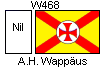
A.H. Wappäus
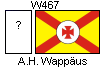
A.H. Wappäus used a yellow flag with a red saltire and a white central roundel containing a red cross, described in the FOTW account as Hanseatic. Rosanoski says that Schneider’s W467 makes the cross too small; the Mathies and Meyer illustrations, retained as W468 evidence, show the intended larger proportions.
His son Adolph Heinrich, also written Hinrich, returned to Hamburg after time in the USA and Venezuela, including partnership in Blohm & Co. at Ciudad Bolivar. In 1857 he founded an import-export and shipping business trading with the former Great Colombia and Guayana. Starting with three ships, it grew after the 1870–1871 war and reached twelve sailing ships in 1883, trading on the Orinoco into inland Venezuela. The final two ships were sold after his death in 1904.
Keep the explicit scope label independent; no alias or company identity is inferred.
Germany, Hamburg.
WARATAH TOWAGE PTY. LTD.
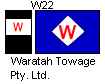
image by Jarig Bakker, 5 October 2005
The later Waratah Towage company retained the livery of Waratah Tug & Salvage. Black-and-white photographs show varying band widths with the letter unchanged; Bullara and Beltana photographs also confirm the funnel. Bakker’s FOTW flag follows Brown 1995.
Waratah Tug & Salvage Co. Ltd. was incorporated on 18 May 1931 as an Adelaide Steamship subsidiary to acquire J. & A. Brown’s towage interests. On 1 April 1968 it ceased owning tugs, transferring assets to Adelaide Steamship Industries while the Waratah Towage Division managed and operated them. The former company and Waratah Towage (Port Kembla) continued as non-operating subsidiaries until sale in 1972–1973.
A 50/50 Adelaide Steamship–Howard Smith towage venture was proposed in 1975 but blocked by the Trade Practices Commission. Following a change in the law, Waratah Towage Pty. Ltd. was formed in July 1977, registered on 13 July, to take over the division’s services. By 2005–2006 its fleet appeared absorbed into Adsteam. The source also contains a 1967–1968 reduction from two-thirds to half ownership and ambiguous later registration-status wording, neither of which is used to replace this documented formation sequence.
Related interests included Wallace Tugs, acquired with Fenwick after the Second World War; Harbour Lighterage, acquired equally with Fenwick from 1 April 1968; and Newcastle Port Towage Services operated with Fenwick. The Port Kembla subsidiary’s sole tug transferred in the 1968 reorganisation. Waratah managed part of Adelaide Steamship Industries’ fleet and acted as agent for Abho Pty. Ltd.
Australia, Sydney.
WARBLER SHIPPING LTD.
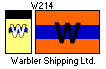
W214’s funnel and flag come from Brown 1995, No. 912. No separate written design description is supplied.
The company is recorded as Warbler Fishing Co. Ltd. in 1978–1979 and 1980–1981, and as Warbler Shipping Ltd. by 1985–1986. After the name change, vessel names began Dawn.
U.K., Lowestoft.
Waried Tankschiff Rhederei GmbH.
WARIED TANKSCHIFF RHEDEREI GMBH.
image by Jorge Candeias, 21 Jan 2005
image by Klaus-Michael Schneider, 17 Nov 2010
image by Klaus-Michael Schneider, 17 Nov 2010
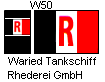
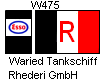
W50 is assigned to Deutsch-Amerikanische by Massary and Lloyd Reedereiflaggen. Jordan describes a black funnel with a red R interrupting a band, black to the left and red to the right, on a broad white band; Rosanoski notes that the white may merge. He considers the flag to have continued after the Esso renaming. The Biedenkarten example likewise shows a black-white-red tricolour for Esso Tankschiffreederei.
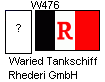
W475 is described as a vertical black-white-red tricolour with a red serifed R on white. Rosanoski says Schneider’s flowing R, like that in W476, differs from the basic R in the 1956 source. W476, from marcollect, has a broader red stripe. From 1957 the livery is catalogued under Esso as E54, retained here as a contextual reference.
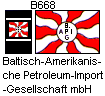
Baltisch-Amerikanische’s earlier flag, B668, is gyronny wavy of fourteen red and white, with a white central circle bearing black B, possibly followed by a dot, over API over G. Brown 1929 wrongly assigns it to Deutsch-Amerikanische in Rosanoski’s account. Massary shows the funnel panel as a band, and neither Massary nor Lloyd Reedereiflaggen puts a dot after B.
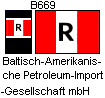
B669 replaced the earlier Baltisch-Amerikanische flag with a pattern resembling the parent’s, but with red in place of the black stripe. Brown 1934 and 1943 and the Talbot-Booth books of 1936–1944 record it.
The R denotes Riedemann. Earlier Deutsch-Amerikanische flags are described as black-yellow-red with a red R, documented from Griffin 1895 onwards; Rosanoski tentatively relates the colours to earlier German colours. The later black-white-red form was presumably adopted after the First World War. Loughran’s account links Riedemann to Standard Oil’s formation and states that the Riedemann mark was replaced by Esso, while the flag continued for some years and occasionally as a memorial. These earlier source references remain contextual without adding their image IDs.
The document also preserves Panama Transport references: Talbot-Booth’s P417 has red horizontal bars reaching the funnel edges, while Merchant Ships 1949 uses P416, suggesting an earlier error or a narrow-funnel effect. That edition calls the flag unknown, whereas the later source discussion identifies a Standard-Vacuum-type flag from Loughran. Neither contextual ID is added to this entry’s eligible images.
Wilhelm Anton Riedemann began as a commission agent at Geestemunde in February 1863, entered petroleum importing with Franz Schütte in 1866 and bought his first ship in 1876. They helped found Deutsch-Amerikanische Petroleum Gesellschaft in 1890. Standard Oil of New Jersey disposed of its shares in 1917 but had evidently reacquired them by 1940, when a 94% holding is recorded.
Waried’s formation is generally placed around 1928, although Rosanoski questions how securely that date is established. Accounts of Baltisch-Amerikanische Petroleum-Import-Gesellschaft at Danzig differ: one suggests 1928, while World Tankers gives 1919 and links it to Standard Oil’s reluctance to restore a large German-registered fleet after the First World War. The latter account dates transfer to Panama Transport Co., established in 1930 for tax reasons, to May 1935, with some tankers under Waried; other references give 1938 or 1939 and differ on transfer versus renaming. Waried became Esso Tankschiff Reederei GmbH in June 1956.
Panama Transport is recorded under Waried operation in 1937–1938, later under Standard Oil of Jersey and subsequently in its own name in Panama, with Balboa C.Z. also given. It came under Esso’s New York tanker organisation in the early 1960s and was apparently absorbed by 1966.
Germany, Hamburg.
WARNER PACIFIC LINE.
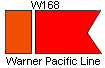
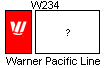
W168 is described as the original livery with a dark-orange funnel, replaced about 1984 by W234, a stylised W on a wave.
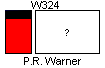
Mitchell assigns W324 to P.R. Warner from Tasi. He also gives Sami’s S1081 funnel as an alternative for Warner Pacific; that separate source reference is retained without adding an image.
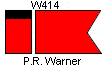
W414’s funnel and flag come from Sea Breezes, June 1979; no separate written comparison is supplied.
Warner Pacific Line was a trading name of Fathom Fisheries, operating by at least 1976 when Kemphaan was acquired and still reported active in 2002. The register’s P.R. Warner entry apparently became Warner Pacific Line at the same address. The concern was associated with Cook Island Line, managed and possibly owned Sami Ltd., and acted as agent for Fathom Fisheries (Tonga) Ltd.
Tonga, Nukualofa.
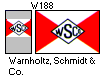
WARNHOLTZ, SCHMIDT & CO.
W188’s funnel and flag are documented by the Mobil Chart and Brown 1982. Rosanoski notes that Marinart does not specify a black outline to the funnel diamond.
Formed in 1929, the concern later operated through three named subsidiaries. Many ships and related companies bore the surname Matthiesen, also that of the managing director.
Germany, Hamburg.
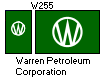
WARREN PETROLEUM CORPORATION.
image by Joe McMillan, 1 December 2001
W255 is documented by US Navy 1961 and illustrated by Joe McMillan for FOTW; no separate written design description is provided.
William K. Warren established the business in Oklahoma in 1922. McMillan dates its acquisition by Gulf Oil to 1956, while Eric V. Thompson gives 1955. McMillan considered it apparently still operating in 2001 as a Chevron division after the 1984 Gulf merger, chiefly in natural-gas distribution, and doubted that it still operated ships.
The vessels were operated by Petroleum Navigation Corporation of Houston in Lloyd’s 1953–1954 and J.M. Cook Co. in 1956–1957 and 1958–1959. The original references also use Warren Petroleum Co. and Warren Petroleum Co. Inc.
USA: Houston TX in FOTW; Tulsa OK in Lloyd’s.
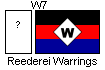
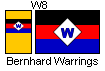
Warrings Family.
WARRINGS FAMILY.
image by Jorge Candeias, 10 March 1999
W7 is Jorge Candeias’s FOTW flag. Rosanoski notes that Brown 1995 shows a blue W under Bernhard Warrings’s name, identifying him as the apparent originator of the family group.
W8’s funnel and flag come from Brown 1971, with Marinart as an additional funnel reference.
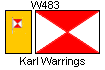
W483’s funnel comes from Mitchell; its flag is sourced only as “Funnel” in the document and is therefore not independently established here.
The later chartered Wangerooge wears the manager’s colours, identified as DB AutoZug’s Wangerooge branch within Deutsche Bahn, rather than necessarily the family’s own livery.
Bernhard Warrings began with the acquired Harle Riff in August 1962, operating coasters and ferries. The registers separately name Hillern, Rita and Karl Warrings and Harle Warrings Reederei. Rita’s fleet included a vessel formerly under Hillern; Karl’s sole vessel and Harle’s business were described by Marinart as operated by Bernhard. Rosanoski considers the original concern apparently to have continued through Rita and Harle.
Germany, Bad Schwartau; later Carolinensiel.
WASA LINE O/Y A/B.
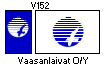
V152’s funnel and flag are documented by Suomijameri 1981.
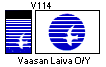
V114’s funnel and flag come from Brown 1995, with Mitchell as an additional funnel source.
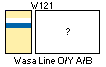
W121 is the Wasa Express funnel from Suzannes ferry gallery; Rosanoski notes the vessel in Lloyd’s 1985–1986.
Formed in 1948 as Vaasanlaivat O/Y–Vasabatarna A/B, the company was acquired by Effjohn International in 1990 and renamed Wasa Line in 1991. Its operations merged into Silja Line in January 1993. The ownership references subsequently name Neptun Maritime and Silja.
The register records a transition from general cargo to ferries during the 1980s. Related names include A/B Vasa Shipping O/Y and Rederi Wasa-Umeå, which shared an address and later a register identity. Silja managed the company, which itself managed part of Sally’s fleet. In February 2006 the sole vessel, then under Wasa Dredging, was sold to Koninklijke Boskalis Westminster; Wasa Line continued to be listed as a Silja subsidiary.
Finland, Vaasa.
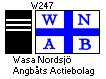
WASA NORDSJÖ ANGBÅTS ACTIEBOLAG.
image by Jarig Bakker, 21 December 2004
W247’s funnel and flag appear in Lloyd’s 1904 and 1912 and Brown 1926. Merchant Ships attributes the funnel to O/Y Wasa Steamship Co. Ltd.; that attribution does not settle the possible distinction between the companies. Jarig Bakker’s FOTW image is based on Brown 1926.
Wasa Nordsjö appears in Lloyd’s 1937–1938. Rosanoski tentatively relates it to O/Y Wasa Steamship Co. Ltd., operated by Verner A. Ojst in 1953–1954, on the basis of the funnel. He explicitly allows that these may be different companies.
Finland: Wasa in 1937–1938; Mariehamn in 1953–1954.
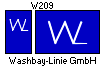
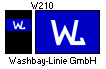
WASHBAY-LINIE GMBH.
W210’s funnel and flag are recorded in Brown 1978.
W209’s funnel and flag are recorded in Brown 1995. No written explanation of the difference is supplied.
Washbay-Linie is recorded in Lloyd’s from 1963–1964 to 1973–1974, appearing as manager only in 1970–1971. It managed two companies in the 1970–1971 and 1973–1974 references.
Germany, Hamburg.
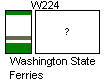
WASHINGTON STATE FERRIES.
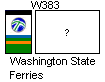
Mitchell dates W383’s new colours to 1972. Rosanoski suggests that the emblem incorporates the route rather than a T.
W224 records Quinalt’s funnel on 12 December 2006. Rosanoski notes that the band colour may be peculiar to this vessel.
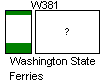
W381 records Wenatchee on 29 July 2009. The same livery was observed on Puyalluop, although that photograph was not retained.
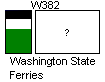
W382 is a further funnel illustration from Mitchell; no separate description is given.
On 30 December 1949 the state announced that it would buy most of Puget Sound Navigation Co.’s equipment and operations. Service began on 1 June 1951 with reflagged Black Ball ferries. The registers first use Washington State Ferry System and later Washington State Ferries, acting for the State of Washington Department of Transportation, or WSDOT.
USA, Seattle WA.
WATANABE MASAJIRO.
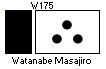
The flag is from a 1902 chart republished in Fune to Hata in 1994. It resembles Akita Kisen K.K.’s flag but has smaller discs. The funnel is from a 1903 chart supplied by Alan Watt.
Japan.
WATERFRONT SHIPPING CO. LTD.
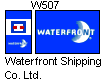
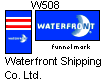
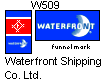
Marinex’s port-side funnel photograph, downloaded on 14 March 2011, shows a double marking: Marinvest’s band emblem with Waterfront’s logo below it. The light-blue portion of the globe represents lines in the main blue shade and white; the small terminal dot is actually a circled R trade-mark sign. W507’s flag is shown flying on a ship on Waterfront’s website.
World Navigator, photographed on 27 April 2011 and apparently chartered from Nippon Yusen Kaisha, adds the Waterfront logo at the funnel base. Scarlet Ibis, by contrast, retains the ordinary black-based NYK funnel.
Tamiat Navigator, photographed on 25 October 2011, carries owner Iino Kaiun’s funnel with Waterfront’s logo added at the base, whose colour differs from the owner’s normal black.
Most of the fleet retains the owners’ funnels without differencing.
A wholly owned Methanex subsidiary, Waterfront Shipping transports bulk chemicals and clean petroleum products. Its website, dated 2008, gives no formation date. Methanex has joint ventures with Marinvest; otherwise the fleet appears to be chartered.
Canada, Vancouver.
Waterman Steamship Corporation.
WATERMAN STEAMSHIP CORPORATION.
image by Joe McMillan, 1 December 2001
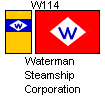
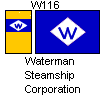
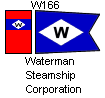
The early Waterman flag has a red field. Talbot-Booth records its change to blue in Ships & The Sea 1938, the change Rosanoski identifies from W114 to W116. Flag-diamond sizes vary. Talbot-Booth shows a narrow black funnel top or cowl for W114.
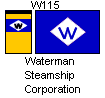
W115’s funnel and flag are documented in Merchant Ships; Jordan does not specify the colour of the funnel letter.
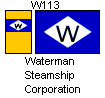
Ocean Ships 1967 notes that some vessels had plain funnels but confirms W113 with a photograph of Topa Topa showing a very narrow black top. Rosanoski assumes Mitchell intends this funnel although Mitchell omits the letter within the diamond.
The company website shows a slightly tapered blue swallowtail with a black W on a white lozenge; other sources show a rectangular flag. Joe McMillan’s FOTW image is W166. The website funnel appears red, although Rosanoski allows orange.
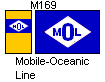
M169 is the Mobile Oceanic Line variant. Jordan and Talbot-Booth show a narrow black funnel top.
John B. Waterman organised the company on 6 June 1919. Other sources give 1920 or 1926, and these dates remain distinct. Mobile Oceanic Line was the service name for ships visiting Europe; WSC is another recorded abbreviation.
McLean Industries acquired the company after 1955 and resold it to Cornelius S. and Edward P. Walsh in May 1965, although one history gives 1960. The brothers saved the nearly bankrupt company in 1966 by selling half to U.S. Freight Company, later Transway, and moving the headquarters to New York.
Waterman filed for bankruptcy in November 1983 and received a Treasury debt moratorium that December. Rosanoski’s ownership account dates the sale to International Shipholding Corporation to October 1988; other references date acquisition to 1989 and differ between International Shipholding and Central Gulf Lines. Lloyd’s later calls it a major operating company of International Shipholding. Ships were named after Confederate army personnel.
USA: Mobile AL, later New York, and subsequently New Orleans LA.
PAN-ATLANTIC STEAMSHIP CORPORATION.
Pan-Atlantic Steamship Corporation
image by Joe McMillan, 11 November 2001
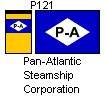
Pan-Atlantic’s flag is blue with a white diamond bearing black P-A, resembling Waterman’s design with different lettering. Brown 1958, US Navy and Mitchell show no funnel top; Jordan leaves the funnel-letter colour unspecified.
Waterman established Pan-Atlantic in 1933 for coastwise operations, leaving overseas routes to the parent. Malcolm McLean bought it in 1955 and subsequently acquired Waterman, converted the operation to container ships, and renamed it Sea-Land in 1960. Mitchell instead gives formation by McLean in 1956, renaming to Sea Land Industries in 1958 and sale in 1977. Rosanoski preserves these differences; the Historical Dictionary supports the 1960 renaming.
USA, Mobil; the same address as Waterman.
WATSON BROTHERS SHIPPING CO. LTD.
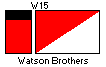
The funnel is red with a black top. The flag is divided diagonally into red and white halves, described in the source as “Pbds”.
Early references use Watson Brothers, changing to Watson Brothers Shipping Co. Ltd. by Brown 1926. LJC 1885 connects the concern with Ben Line, which used its flag.
U.K., Glasgow.
WATSON MUNRO & CO.
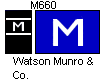
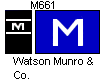
This livery is recorded for Lodorer while registered at Sydney for the Australian coast, September 1913 to April 1914.
The other funnel-and-flag version follows Lloyds 1912.
Watson Munro chartered Maria for five years in 1912, with offices at Cork, Belfast and London; she sank on 21 September 1914. It also operated Lodorer, bought in 1909 and sold in 1919. The source separately records Lodaner, bought in 1911 for Lochore Steamship and sunk on 16 April 1918. Lloyds lists Watson Munro, Cornforth & Co. as Lochore’s operator, while another account gives Watson, Munro, Cornforth & Co. Ltd. as owner.
UK, London and Cork.
WATSON'S BAY & SOUTH SHORE STEAM FERRY CO. LTD.
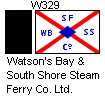
Rosanoski describes the flag from The Log as white with a red saltire, surmounted at the centre by a blue diamond. Blue letters occupy the quarters: WB at the hoist, SF above, SS at the fly and Co. below. Sydney Ferry Fleets states that the flag records available to it were black and white.
The formation date is inconsistent: the history paragraph gives 1887, while the heading and Rosanoski’s later FOTW account give 1877. The company served Sydney’s eastern suburbs until Sydney Ferries took it over in 1920. The Log gives service dates of 1912–1920, but Sydney Ferry Fleets describes 1912 as the start of an experimental Watson’s Bay–Manly route additional to existing services.
Australia, Sydney.
WATTIE INDUSTRIES LTD.
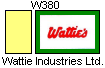
The flag is white with a green border and the red written name “Wattie’s”. The Log supplies W380’s funnel and flag.
James Wattie founded J. Wattie Canneries in September 1934. A merger with General Foods in 1968 produced Wattie’s Industries, reorganised in 1971. James Wattie died in 1974. The history account makes Wattie’s a holding company for five divisions in 1987 and dates the Goodman Fielder merger to the following year, expressly marked sic; the delisting reference instead gives 1987. Goodman Fielder sold the Wattie interests to H.J. Heinz in 1992.
The canned and frozen foods concern participated in the consortium forming Tasman Express Line through Venture Shipping. Rosanoski tentatively connects a later 25% interest with Refrigerated Freight Lines. Wattie operated the trawler Janet D in 1973–1983 according to the Compendium, although The Log gives 1978 for its acquisition.
New Zealand, Hastings and Auckland.
WATTS, WARD & CO.
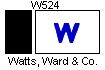
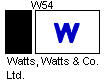
The livery illustrated as W524 was subsequently used by Watts, Watts & Co., whose separate document identifies it as W54.
Watts, Ward & Co. was formed in 1872. One account describes it as replacing Watts, Milburn & Co.; another says it enabled Edmund H. Watts to enter the coal trade while that partnership continued, selling ships from 1877 and ending in 1879. By the early 1880s Newcastle controlled coastal trade and London deep-sea operations. Britain Steamship Co. was formed to own most of the ships in 1884, with 1885 also quoted. The management company became Watts, Watts & Co. in 1896.
UK: Newcastle and London.
WATTS, WATTS & CO. LTD.
image by Phil Nelson, 6 April 2000
image by Jarig Bakker, 16 December
W54 continues the livery of Watts, Ward & Co. and was also used by Britain Steamship. Phil Nelson’s FOTW flag followed Stewart 1963; Jarig Bakker’s replacement, based on Brown 1926, uses a lighter blue. Jan Mertens also identifies Larousse Commercial Illustré as a source.
Edmund H. Watts changed the name from Watts, Ward & Co. in 1896. The fleet was held through Britain Steamship Co., and the business also managed Dominion Shipping Co. of Montreal from 1928. It participated in Alexandria Navigation Co.; Merchant Ships gives Red Rose Line both as a Watts alias and as an occasional Alexandria name. Watts Shipping Co. Ltd. is another recorded name.
An account dates the decision to leave shipowning to 1968, when the ships had been or were being sold and Britain Steamship passed to Bibby Line. Watts continued for a time managing its former vessels and sold its Seabridge Shipping interest to Bibby in 1968. Other references date the Britain Steamship takeover to 1967; Rosanoski notes that its extent is unclear because the companies remained associated in Lloyd’s 1970. Britain Steamship’s formation is likewise inconsistent: 1884 in the subsidiary note, but 1894/5 in the FOTW comment.
UK, London.
WAXHOLMS ÅNGFARTYGS A/B.
image by Jorge Candeias, 28 March 2001
image by NDR, None
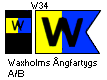
Collectors Corner shows W34’s version and a second, described as “aldre version”, with a smaller yellow area and letter. This older-model flag is W198. Jorge Candeias is credited for W34 and NDR for W198; W34 also has funnel references.
Waxholmsbolaget operates passenger services from Stockholm into the archipelago, including Vaxholm, formerly spelt Waxholm. The registers call it Waxholms Nya Ångfartygs A/B in the 1950s and Waxholms Ångfartygs A/B by 1966–1967; Rederi A/B Waxholm is another recorded form. W. Rosendahl managed it in the earlier references.
Sweden: Vaxholm, later Stockholm.
Wayo Kisen K.K.
Documentary images — company attribution uncertain
Mitchell attributes W401 to an Osaka company and Hoyo Maru, a vessel of 37,579 tons built in 1977. Miramar records that name in 1977–1984, but Rosanoski could not find it in Lloyd’s. Its size is inconsistent with the small vessels recorded for this concern, and the date also conflicts with the alleged 1968 merger. The funnel may therefore belong to another company of the same name.
No corporate continuity established.
The registers show the small Wayo Maru from 1958 through 1973–1974, then Nikko Maru without an address in 1978–1979 and different vessels at Tanabe under the same company number in 1980–1981. A later Tanabe listing concerns boat and ship rental and leasing. The reported 1968 merger into Inui Kisen may refer to another company.
Japan: Osaka, subsequently no address, then Tanabe.
WAYWISER MARINE SHIPPING AGENCY CO. LTD.
Hwa Lee’s funnel is noted as black, in line with the agent’s colours. W400, from a photograph of Welly, shows no change. Mitchell attributes the funnel to Waywiser Navigation and names Eddie Steamship as manager.
Waywiser Marine Shipping Agency and Waywiser Navigation were owned or controlled by Hsu-Chih-Chien and his family; Hsu was a Courage Marine director. Lloyd’s dates the agency’s formation first to 2001 and later to 1999. By 2006 its fleet appeared under Eddie Steamship and named companies, while Courage Marine’s newly listed group contained ships previously under Waywiser. Waywiser Navigation is separately recorded from 1963–1964, often through Eddie Steamship as agent.
Taiwan, Taipeh.
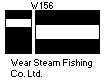
WEAR STEAM FISHING CO. LTD.
The funnel is black with a broad white band; the flag is black with a horizontal white band.
U.K., Sunderland.
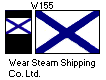
Wear Steam Shipping Co. Ltd.
WEAR STEAM SHIPPING CO.LTD.
The flag is white with a blue saltire. The black funnel has a broad band carrying the flag design.
The concern may have preceded Thomas Rose & Co., also of Sunderland and using the same livery.
U.K., Sunderland.
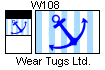
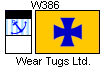
WEAR TUGS LTD.
Brown 1982 describes adoption of France, Fenwick Tyne & Wear’s livery. The Maltese Cross history specifies that the tugs transferred in 1978 retained their old funnel colours but flew the Lawson-Batey Tugs flag. W108 follows Brown; W386 follows the later history.
Ridley Tugs became Wear Tugs on 24 January 1978, although the same history also dates the retitling to December 1977. It incorporated the assets of France, Fenwick Tyne & Wear, acquired in May 1977. On 1 April 1986 its business and assets passed to Tyne Tugs, thereafter operating as Tyne & Wear Tugs. Later register entries lagged behind these changes.
UK, South Shields.
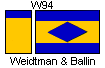
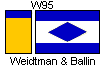
WEIDTMAN & BALLIN.
image by Klaus-Michael Schneider, 8 April 2009
US Navy’s W95 has a white central flag band, whereas Brown 1971 and the German sources agree on yellow in W94. Klaus-Michael Schneider’s FOTW W94 image follows Deutsche Reedereien und ihre Erkennungszeichen, but Rosanoski notes that its lozenge is narrower than the source’s.
Shipbroker Hugo Ballin was established in 1912. On 31 October 1945 his son Hans became chairman and Max Weidtman joined as partner, the concern becoming Weidtman & Ballin. Its first Alsterdamm was built in 1952 and sold in 1965. The second, built in 1960, was acquired in either 1969 or 1972 and sold in 1973. The shipping branch closed in 1972; Ballin died in 1974 and Weidtman in 1983. The business apparently continued in industrial supplies.
Rosanoski allows a possible family connection between Hugo and Albert Ballin, but explicitly distinguishes their companies.
Germany, Hamburg.
Weiße Flotte GmbH.
WEIΒE FLOTTE GMBH.
WEIΒE FLOTTE DRESDEN.
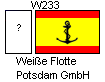
WEIΒE FLOTTE POTSDAM GMBH.
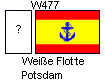
image by António Martins-Tuválkin, 3 January 2009
Stralsund
Rosanoski considers the wider Weiße Flotte organisation unclear: it appears to have designated river and inland passenger fleets, perhaps initially under central control. The Stralsund concern appears as Fahrgastschiffahrt Stralsund in the registers and later as Weiße Flotte GmbH. With subsidiary Reederei Hiddensee, it became part of the FRS group in 1991. Earlier ships used Seebad names, followed by Stoertebeker and Roman numerals.
Germany, Stralsund.
Keep the explicit scope label independent; no alias or company identity is inferred.
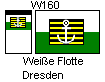
Dresden
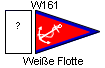
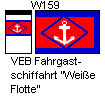
W159’s colours were allocated from a black-and-white drawing and may be wrong. W160’s anchor is more modern than those on earlier flags under the operation’s previous names.
The Elbe operation became VEB Fahrgastschiffahrt “Weiß Flotte” in 1956, then Weiße Flotte Dresden after reunification in 1990. Reederei von der Cosmos of Munich acquired it in 1993 and it became Sächsische Dampfschiffahrts GmbH & Co. Conti Elbschiffahrts-K.G. The 1992–1993 reorganisation concerned what the cited account describes as the world’s largest operating paddle-steamer fleet.
Germany, Dresden.
Keep the explicit scope label independent; no alias or company identity is inferred.
Potsdam
The website flag logo appears to show an anchor and cable, but Rosanoski could not establish whether the anchor is fouled or plain.
W477 is a yellow flag with narrow red horizontal edges and a central upright blue fouled anchor. António Martins-Tuválkin’s FOTW image has proportions 2:3.
At Potsdam, Weiße Flotte passenger ships and restored Havel Dampfschiffahrt steamers operated circular trips.
Germany, Potsdam.
Keep the explicit scope label independent; no alias or company identity is inferred.
White Fleet, East Germany
The FOTW account dates the East German flag’s use to 1989. Volker Moerbitz Keith describes the White Fleet as operating pleasure ships on inland and coastal waters and ferries between East Germany and Poland: inland it used the same jack as DBR, while the triangular flag served as a coastal house flag. An older claim that the company had dissolved and surviving ships might retain its flag was disputed by Rosanoski and removed from the cited page; it does not establish the fate of every regional undertaking.
Keep the explicit scope label independent; no alias or company identity is inferred.
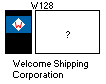
WELCOME SHIPPING CORPORATION.
Welcome’s funnel was noted in February 1967. It is black with a broad blue band bearing a white diamond charged with a red W. No flag is noted.
Great Ocean Steamship Co. is recorded as agent.
Taiwan, Taipeh — assumed in the original.
WELLARD GROUP.
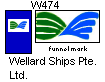
W474’s funnel is documented from Ocean Swagman at Darwin, in a photograph dated “6.4.20112” in the source, and a port-side photograph of Ocean Outback on 19 June 2013.
Emilio Balzarini formed the family business in 1979. The group combined livestock exports with wool, grain, cattle and sheep interests and was associated with Siba Ships through the Balzarini family. Before a 2011 Standard Chartered investment the family held 95%. Contemporary reports disagree whether the investor became the largest or second-largest shareholder; Rosanoski also qualifies its precise Standard Chartered identity.
Shipowning began in 2009. The company releases record acquisition of Becrux as Ocean Drover and Stella Deneb as Ocean Shearer for subsidiary Oceanic Livestock. A later release instead names “Öcean Driver” in the account of the beginning of shipowning. Singapore-based Wellard Ships is listed with four vessels in 2012.
Australia, Fremantle, with shipping based in Singapore.
WELSH OVERSEAS FREIGHTERS LTD.
The red funnel has a black top and a white diamond containing a red lion rampant setting out to climb a black ladder. The red flag carries the same device on a white diamond extending throughout the field.
Welsh Ore Carriers was formed in 1960 as a joint venture between London & Overseas Freighters and the Gibbs family. Gibbs & Co. (Ship Management) managed it in the 1970s, and the registers later use Welsh Overseas Freighters. In 1982 London & Overseas bought the remaining 49% from West Wales Steamship Co.
U.K., Newport.
WERNER PETERS K.G.
image by Klaus-Michael Schneider, 11 Apr 2009
The FOTW image follows a scan of Esso 1956 and consequently lacks the edging around the diamond, according to Rosanoski’s private correspondence.
Rosanoski regards the US Navy version as an apparent printing error.
Werner Peters became a shipowner with Werner II in 1940; the last vessel, Hammonia, was sold in 1965.
Germany, Hamburg.
WERNER RAMM.
Ramm operated Lothar in the 1973–74 register. The vessel appears under I. Richters in 1970–71, with Miramar recording purchase in 1965 and sale in 1976 for that owner.
Germany, Bremen in Lloyds; Hamburg in Mitchell.
WESEMEYER & CO. MBH.
image by Klaus-Michael Schneider, 6 April 2009
Klaus-Michael Schneider’s FOTW flag W478 follows Deutsche Reedereien und ihre Erkennungszeichen 1956. Rosanoski notes that it has wider green bands than the source and his W419 illustration.
The concern operated Trostbrücke, built in 1952 and taken over by its operator in 1956. Lloyd’s lists Wesemeyer under Aug. Bolten, Wm. Miller’s Nachfolger. Erich Wesemeyer, head of both Erich Wesemeyer and Wesemeyer & Co., died in 1954.
Germany, Hamburg.
Wessels Offshore Schleep. GmbH & Co. K.G.
WESSELS OFFSHORE SCHLEEP. G..M.B.H. & CO. K.G.
The black funnel has a broad white band edged blue above and below and bearing a red W. The flag is blue with a broad white horizontal band bearing a red W.
Germany.
WEST AFRICA NAVIGATION LTD.
The funnel is black with a broad white band edged red above and below. The flag is blue with a red horizontal band bearing a white W; a white crown defined in black occupies the upper blue band. The funnel was noted on African Count. A suggestion that its use on Searaven of Cia. de Nav. Almirante indicated an agent’s livery is rejected by Rosanoski from comparisons with other agency companies in the collection.
The concern appears in Lloyd’s 1963–1964 and 1966–1967, with T.J. Verrando Shipping Corporation and then Transamerican Steamship Corporation as agents.
USA, New York NY.
WEST AFRICAN CARRIERS CORPORATION.
Ebro’s funnel is yellow or buff with a red band. No flag is noted.
The concern is recorded in Lloyd’s 1963–1964 and 1966–1967, with Marine Department as agent.
Switzerland, Lugano.
WEST AFRICAN OIL CARRIERS CORPORATION.
Nalon’s funnel is yellow or buff with a black top and a very broad red band. No flag is noted.
The concern appears in Lloyd’s 1966–1967, with Marine Department as agent.
Switzerland, Lugano.
WEST ASIA MARITIME LTD.
The funnel follows the company logo, supported by Gem of Safaga at Sydney on 11 November 2009. Its lettering is thinner than the logo’s and has a white dash between two legs of the M. Gem of Goa, photographed on 22 September 2007, lacks that dash, as does Gem of Kilakarai on other occasions. Rosanoski suggests that its absence may relate to chartering, without establishing this explanation.
West Asia Maritime, or WAM, was incorporated in October 1993. Lloyd’s initially gives 1995 but later amends it to 1993. Its wholly owned subsidiaries were West Asia Maritime Overseas and WAM Singapore. The company also established EC Ship Management, although that concern is separately described as an Emirates Trading Agency subsidiary. Emirates Trading Agency is recorded as an associate. Ships began their names with Gem of.
India: Madras, later recorded as Chennai.
WEST COAST LINE INC.
image by Joe McMillan, 2 December 2001
The flag is red with a white H shadowed black. Wessel, Duval’s website identifies the H as honouring founder A. Hemenway, although the earlier FOTW account did not know its meaning. Talbot-Booth does not indicate shading on the funnel letter.
W479 is from a matchbook offered as a possible 1930s West Coast Line cruise-ship item. Rosanoski considers that it might instead relate to the post-war joint venture, but notes that its funnel resembles W257. He suggests, without establishing, that partners might have used their own funnels with a common flag.
W338 comes from a 1960s photograph of the chartered Istina. Rosanoski connected its funnel with a drawing attributed to West Coast Line of New Orleans and the joint service with Rederiet Ocean. Marc reported similar information from a Chilean contact in support of that identification.
W339 is a further funnel from Mitchell, with no separate written description.
Edward Augustus Hemenway, a Salem mariner, traded between Boston and Chile. His business is dated to 1825, 1826 or 1836 by different accounts. It was later conducted by Wessel, Duval & Co. of New York, but Rosanoski leaves the precise succession unresolved. Pedro M. Wessel and George L. Duval’s concern is recorded by at least 1868 with clippers, later operating steamships as West Coast Line.
West Coast Line’s steamers served South America, including Colombia, Ecuador, Peru and Chile through the Panama Canal. Wessel, Duval carried more than half of US nitrate imports in the early 1900s. Regular services were suspended during the Second World War while the firm operated fifteen Liberty ships for the War Shipping Administration. The service resumed at the end of 1945; the parent later shifted towards agriculture and energy in Virginia.
The post-war revival apparently relates to a joint service with Rederiet Ocean, later within J. Lauritzen. Wessel, Duval had long acted as its agent, and wartime co-operation placed responsibility with a trusted New York employee. Surviving ships were centralised under Rederiet Ocean on 1 April 1944. Argentinean Reefer was chartered by West Coast Line in 1948, and a 1951 reference explicitly records the joint service. West Coast Line also acted as general agent in New Orleans, Houston, Galveston and New York.
USA, New York.
WEST COAST OF AMERICA TELEGRAPH CO. LTD.
image by Michael Wilson, None
W231 is blue with a white grapnel and cable or rope. W232 gives a yellow grapnel as an alternative; the cable presumably remains white. Talbot-Booth’s 1937–1938 white oblong below the emblem is treated by Rosanoski as a printing error because other sources omit it. These are pre-1939 flags; Cable & Wireless livery was used from 1939.
Formed in 1875 by interests associated with India Rubber, Gutta Percha & Telegraph Works, the company sought to link Valparaiso and Lima. Financial difficulties led to rescue by John Pender’s Eastern Group and reincorporation under the same name in 1877. Liquidation and another new company followed on 12 April 1897. It later entered the Cable & Wireless group; its own cableship joined the common fleet under Imperial & International Communications in 1929.
UK, London.
WEST COAST SHIPPING CO.
W132’s funnel was observed on Madonna in June 1966; the document gives no separate verbal design.
West Coast Shipping bought Maaskerk in 1966, renamed it Madonna and sold it in 1969. Miramar names V.K. Eddie Hsu as owner; the cited account records his death in 2007 at the age of 101 as a retired British Columbia shipping magnate.
Panama.
WEST COAST STEAMSHIP CO.
image by Joe McMillan, 2 December 2001
image by Ivan Sache, None
Brown 1958’s W259 has red T/O letters in place of W, which Rosanoski relates to the original Trans-Oceanic name. Ivan Sache is credited for W259. Joe McMillan’s W258 follows US Navy 1961; Stewart and Mitchell provide additional references.
Originally West Coast Trans-Oceanic Steamship Line, the company operated after the Second World War. Portland Trader was acquired in 1947, and Miramar dates the last sales, Columbia Trader and Portland Victory, to 1965. A historical dictionary places the end about 1969, while Rosanoski’s earlier FOTW note says the early 1960s. This was distinct from the nineteenth-century namesake acquired by Pacific Coast Steamship in 1889.
USA, Portland OR.
WEST COAST TUG & BARGE LTD.
W522’s funnel is taken from a starboard photograph of an unnamed vessel on 6 February 2013. The document also retains the company logo and a funnel-logo photograph without adding a verbal design.
Thomas Olsen incorporated the company in 1976 to tow logs in Johnstone Strait and its adjoining inlets. Services expanded in the 1980s and 1990s. Following reorganisation by the mid-2000s, Thomas and his sons Lukas and Layne held equal shares; the 2013 account gives a fleet of three tugs and six barges.
Canada, Vancouver Island BC.
WEST HARTLEPOOL STEAM NAVIGATION CO. LTD.
The funnels are described as buff, W112 being used in 1856–1899 and W111 thereafter. Loughran attributes the 1899 change to J.E. Guthe and identifies the patonce cross with St. Hilda, Abbess of Whitby. Rosanoski considers Brown 1926’s older funnel incorrect and questions whether the cross’s identification is more nominal than literal.
The other documented variants are W487 from Lloyd’s 1882; W488 from Reed 1891; W492 from LJC 1885; W489 from Reed 1901; W490 from Lloyd’s 1904/1912 and Reed 1912; W491 from LJC, Brown and Talbot-Booth; W494 from Stewart 1953/1957; and W493 from later Stewart, Brown and Loughran references. The text gives no separate design comparison for these illustrations.
Documentary images — company attribution uncertain
image by Klaus-Michael Schneider, 29 May 2012; 4 June 2012
Klaus-Michael Schneider’s flag is blue with a central yellow Greek cross. The chart’s title was interpreted as Steam Navigation Co. (Gläfcke & Hennings), but Rosanoski could find no such company and proposes that limited space caused West Hartlepool’s name to be shortened. Its flag has a yellow cross patonce with split ends, details which the chart’s quality neither establishes nor rules out. The company’s Baltic trade, including Hamburg where Gläfcke & Hennings were based, supports his hypothesis without settling it.
Agent Glafcke/Hennings does not establish identity.
Ships chartered to Anchor Line continued to carry that line’s black funnel.
Established in 1856, the company began in coal and was chiefly a tramp concern. It also served Hamburg, St. Petersburg and later Gothenburg until 1914. J.E. Guthe gained control in 1899, and the family managed it until its demise in 1985; another cited post spells the name Gouthie.
UK, West Hartlepool.
WEST INDIA & PANAMA TELEGRAPH CO.
W307’s funnel and flag come from LJC 1885.
W308’s funnel and flag are documented by Lloyd’s 1882, 1904 and 1912, with Cableships & Submarine Cables as an additional flag source. No separate written comparison is supplied.
Sir Charles Bright, General W.F. Smith, Cyrus Field and Mathew Gray formed the company alongside Cuba Submarine Telegraph and Panama & South Pacific Telegraphic. Its prospectus appeared in 1869. Liquidation in January 1877 was followed by a replacement company, renamed Cable & Wireless (West Indies) in 1938. Shipping operations ran from 1870 to 1929.
UK, London.
WEST INDIES SHIPPING CORPORATION.
Federal Palm’s white funnel has a panel of eight blue wavy lines surmounted by a golden-yellow circle.
Federal Monarch’s black funnel is described with sixteen blue-and-white wavy horizontal bands and a golden-yellow circle. Rosanoski assumes these form a white-backed panel rather than lie directly on black; he could not locate the vessel in Lloyd’s.
The devices resemble the Federation flag, although that had four narrow white wavy bands on blue with an orange-golden-yellow sun. Sources vary over the blue shade. No company flag is noted.
The corporation appears under Furness, Withy management in Lloyd’s 1963–1964 and 1966–1967. Rosanoski notes that the Federation itself was formed on 3 January 1958 and collapsed in 1962.
Federation of West Indies, Port of Spain, Trinidad.
WEST PACIFIC SHIPPING PTE. LTD.
North Sky’s funnel is blue with a black top, separated by a broad white band bearing a very narrow black band. No flag is given, although the bibliography line is headed Funnel & Flag.
Operating about 1990, West Pacific Shipping was managed by Pacific Salt Pty. Ltd. of Guildford, Australia.
Singapore.
WESTBAY SEAFOODS LTD.
Westbay’s funnel emblem is a black diamond frame crossed by a red band bearing white WESTBAY. Above is a modern trawler at sea; below, a fish, possibly a salmon, swimming through weed. The source gives no colours for these pictures. At the base of the white funnel band is HOME PORT GREYMOUTH, presumed black, although the vessel was registered at Nelson.
Westbay Seafoods was incorporated on 20 February 1979. Charles Peter Eggeling and Harold Francis Lonie, appointed directors in May 1992, each owned half. Liquidation began on 19 December 2000 and was completed on 29 January 2005.
New Zealand: Hokitika and Nelson.
WESTBRIS.
W200’s flag is sourced to Collectors Corner. The document supplies no separate history or verbal design.
Sweden, Skärhamn.
WESTCOTT & LAURANCE LINE LTD.
image by Jarig Bakker, 3 September 2004
The funnel is described as very deep pink-buff. W73 follows the National Maritime Museum flag, with an enhanced ampersand and no dots after the pennant letters; Stewart 1953 instead shows white letters on the main flag. The museum dates its examples about 1951, giving the pennant as 711.2 × 1778 mm and flag as 1168.4 × 1879.6 mm.
W207’s funnel and flag are documented by Griffin 1895; the document supplies no separate verbal comparison.
Ellerman acquired Westcott & Laurance in 1901. It retained its name and flag while using the group funnel and operating part of Ellerman’s fleet. Ships generally bore City names or names ending ian. The company merged into Ellerman City Liners during the 1970s group reorganisation. Some sources spell the name Laurence, but Rosanoski follows Lloyd’s Laurance.
U.K., London.
WESTDEUTSCHE REEDEREI GMBH.
image by Klaus-Michael Schneider, 15 August 2010
image by Klaus-Michael Schneider, 6 April 2009
W388 follows the German recognition-book sources. Rosanoski notes the FOTW image’s erroneous placement under WDR and associates this version with Anna and a reference back to Franz.
US Navy’s W387 has a narrower white band and letters without dots, angled with the band. Klaus-Michael Schneider’s FOTW image is based on an image located by Rosanoski.
Westdeutsche operated Mercator, built in 1954 and sold in 1965, and apparently subsequently became an inland-waterways concern. Franz and Anna are noted in connection with 1962. Its deep-sea register entries appear under Westfälische Transport and later Helmut Thimm as operators.
Germany, Duisburg.
WESTERGAARD & CO.
W484’s funnel and flag appear in Griffin 1891 and 1895.
Westergaard is recorded as owning the bark Admiral by 1888 and acquiring Waimea in 1895. Newspaper notices apparently identify it as manager or agent of Jelø-Linien between 1891 and 1902, but not in the cited 1906 issue. The source accounts state that its operation of ships for the German occupants led to state takeover in May 1945 and administration thereafter. L. Hannevig is mentioned in 1945, presumed to be manager or agent. Lloyd’s 1953–1954 places the concern in liquidation; Fanafjord is tentatively identified as the last vessel.
Norway: Christiania, later recorded as Oslo.
WESTERN & BRAZILIAN TELEGRAPH CO.
W447’s funnel and flag are documented by Lloyd’s and LJC 1882, with Cableships & Submarine Cables as an additional flag reference.
Reformed in 1873 from the Great Western Group, originally Great Western Telegraph, the company promoted Central American Telegraph. In 1879 it acquired Companhia Telegrafica Platino-Brasiliera and renamed it London-Platino-Brazilian Telegraph. It also acquired Montevideon & Brazilian Telegraph and River Plate Telegraph at unspecified dates, and formed Amazon Telegraph in 1895.
Western & Brazilian and Brazilian Submarine Telegraph operated closely as one concern while remaining legally separate. On 10 November 1899 Brazilian Submarine became Western Telegraph and acquired Western & Brazilian’s share capital, with the last vessel passing to the new company.
UK, London.
WESTERN AUSTRALIAN COASTAL SHIPPING COMMISSION.
image by Jarig Bakker, 30 August 2004
W283’s funnel is supported by a photograph of Koolama. The cited early sources do not show a flag, so its application is presumed.
MN describes the crown as black, whereas the National Maritime Museum artefact shows it proper. That museum flag, titled State Shipping, West Australia, is dated 1955–1967 and measures 1346.2 × 1778 mm. Jarig Bakker’s FOTW image follows it.
Merchant Ships records government steamship ownership from 1897. Rosanoski distinguishes the State Steamships Service of 1912–1918 from its successor State Shipping Service, established in 1919, rejecting an account that applies the latter name to 1912. Alfred Holt took control of most overseas services in 1938. The Western Australian Coastal Shipping Commission was created in 1965 to control the service, which became known as Stateships in 1979. The commission still existed in April 2005, apparently without ships.
Australia, Fremantle.
WESTERN BULK A/S.
W504 records Western Maple’s funnel from a starboard photograph of 12 August 2012.
W505 records Western Santiago’s starboard funnel on 24 February 2011.
W506 records Western Seattle’s funnel from a port-side photograph of 11 June 2008 and a further starboard view downloaded in September 2009.
Western Bulk A/S took that name in 2004 from Western Bulk Carrier Holding, with Kistefos becoming sole shareholder. A new structure followed in 2005, WB Chartering operating the fleet; WB Shipholding was established in 2009. Western Bulk ASA listed on the Oslo Stock Exchange in October 2013. The group’s operations included Norway, Singapore, Seattle, Chile, Australia and Houston.
Norway, Oslo.
Western Bulk Shipping ASA.
Western Bulk Carriers AS
W443’s funnel is sourced to Mitchell.
Documentary material — company attribution not established
image by Jorge Candeias, None
W1 is Jorge Candeias’s FOTW flag, for which that credit gives no source; Nüsse is separately listed as a flag reference.
W66’s funnel was observed on Stove Tradition at Lyttelton on 20 February 1986 and later on chartered Western Osprey, Grumant and Kapitan Betkher at Wellington in 1997 and 2000. Nüsse also provides the flag.
W122 was recorded from a brief flag observation on Western Tiger at Lyttelton on 20 July 1987. Rosanoski considers that report probably misinterpreted and likely to have meant W66.
A nearby note labels a possibly mistaken funnel W433, warning that very dark blue could be confused at a distance. Mitchell’s three line drawings all have blue bases. The differing number is retained rather than assigned to W443 without explicit evidence.
The group comprised a shipowning holding company and Western Bulk Carriers, the operating pool. The company history dates Western Bulk Shipping and Western Bulk Carriers to 1982; Lloyd’s gives 1993, also the year of stock-exchange listing. Kistefos acquired 23% in 1998. Western Bulk Carriers Holding was founded in 1999, with activity and subsidiaries transferred to Western Bulk Carriers.
Financial difficulty brought restructuring in 1999–2004. A Tradewinds report describes a courthouse settlement dividing assets between Belstove’s 41.4% holding and Kistefos, Sjoinvest and Gesualdo’s combined 49.08%, leaving smaller holders a choice. The company history separately records delisting in 2001, when Kistefos and another principal shareholder took it private with 84%. In 2004 the holding concern was renamed, given here as Western Bulk A/S Holding A/S.
Mitchell instead describes a pool formed in 1986 by Belships, Lorentzen and Jahre, co-operating with Ugland Management in 1987. He dates Belships’ majority control to November 1991 after acquiring I.M. Skaugen’s 24%, taking its holding to 55%. Rosanoski leaves the exact Lorentzen and Jahre identities qualified and notes the apparent connection with a 1960s Western Bulk pool. The records also give Panama and Goteborg, in contrast with the website’s Oslo.
Later registers place Western Bulk Shipping within the Belships group. The last vessel, Western Island, was sold in 2004 without a change of name.
Norway, Oslo.
WESTERN DISTRICTS STEAM SHIP CO.
The company used Howard Smith’s funnel; W31 is documented by The Log.
Western Districts operated Eumeralia from 1908 until the First World War interrupted trade and the vessel was laid up. The Log considers a Howard Smith connection likely; Australian Coastal Shipping explicitly describes the concern as a Howard Smith subsidiary. By 1920 the vessel was owned by Australian Steamships within that group.
Australia, Melbourne.
WESTERN FERRIES LTD.
Both blue funnel and flag bear a white circle containing a red horizontal double-headed arrow. Its centre curves into a circle, with the forward head uppermost and the after head lowermost.
The registers record Western Ferries in 1970–1971, Western Ferries (Argyll) by 1978–1979 and Western Ferries (Clyde) by 1992–1993. It later appears as a named subsidiary of Stirling Shipmanagement, disappearing with its fleet from Lloyd’s 2000. Harrisons (Clyde) managed the fleet, or part of it, in the earlier entries.
U.K., Glasgow.
Western Pacific Shipping Corporation.
Documentary images — company attribution uncertain
Seoul’s funnel, noted in August 1966, is yellow or buff with a narrow black top. A blue flag bearing white SS flies straight from a black pole on the funnel. The colours may be a charterer’s; no separate house flag is noted.
Western Pacific ownership does not establish meaning.
The concern is recorded in Lloyd’s 1966–1967, with Ocean Freighting & Brokerage Corporation as agent.
USA, New York NY.
WESTERN TANKERS A/B.
Nüsse’s table flag is white with a dark-blue panel bearing a white W above a white anchor and stylised t joined by their horizontal arms.
Western Tankers was a Broström Tankers subsidiary within the Broström Group. Its exact function is unknown; Rosanoski considers that it apparently did not own or operate ships.
Sweden, Gothenburg.
WESTERN TELEGRAPH CO. LTD.
Western Telegraph Co. Ltd.
image by Michael Wilson, None
image by Michael Wilson, None
The flag is a blue swallowtail with an ornate yellow-and-black double-rope border except at the hoist. A yellow-and-black angled zigzag flash accompanies white WTC in the lower fly, with a taller T.
Brown 1943 removes the border and changes the letters to WTCo. This differs despite Talbot-Booth’s account that Cable & Wireless flags replaced the constituent-company flags in 1939.
Michael Wilson’s FOTW W449 squares the border divisions like two rows of bricks instead of angling them as rope. W450 reuses the earlier flag’s flash, which Rosanoski considers probably correct, although Brown 1943 depicts a variant.
Cable & Wireless livery is recorded from 1939, while wartime books continue to list the constituent companies under their own names.
Brazilian Submarine Telegraph was incorporated on 8 January 1873 and initially had no shipping. It worked closely with Western & Brazilian Telegraph while remaining legally separate. The Brazilian Government approved their merger on 6 June 1899; Brazilian Submarine adopted Western Telegraph on 10 November 1899, and the share acquisition is dated 1 January 1900. The last Western & Brazilian vessel passed to the new concern. In 1929 Imperial & International Communications took over the fleet, becoming Cable & Wireless in 1934.
UK, London.
WESTERN TRANSPORTATION CO.
image by Joe McMillan, 2 December 2001
W261’s funnel and flag are documented by Lloyd’s 1904.
Joe McMillan’s W260 flag follows the 1909 supplement to Flaggenbuch 1905. No verbal comparison of the two variants is supplied.
Organised on 31 December 1855 as Western Transportation, the company was reorganised on 4 December 1883 as Western Transit, a New York Central Railroad subsidiary. It became part of Great Lakes Transit Corporation in spring 1916.
USA, Buffalo NY.
Westfal-Larsen & Co. A/S.
WESTFAL-LARSEN & CO. A/S.
image by Jarig Bakker, 20 January 2006
image by Jan Oskar Engene, None
image by James Dignan, 15 October 2003
image by James Dignan, None
The original flag was a red swallowtailed pennant with a narrow blue horizontal band edged by narrower white bands. It was in use about the turn of the century and, according to Loughran, replaced by the end of the First World War. Its design, though not necessarily proportions, matches the Norwegian naval Commodore’s broad pennant adopted on 7 June 1906.
The later lettered flag has red lettering in the principal sources. Brown, Talbot-Booth and Loughran omit the dot after L; Stewart omits all dots and US Navy retains only one beneath o. Loughran makes the white band wider than the blue. A photograph shows W63 hoisted on Ravnanger at Bergen. Rosanoski questions the existence of a differently lettered FOTW version and rejected its separate placement under Germany.
Brown 1926 substitutes P for W without an apparent reason; Rosanoski considers it a likely error repeated by the 1933 Lloyds Reedereiflaggen cards.
Loughran dates adoption of plain red WL to 1963. W61 is also the company website’s flag logo, and its funnel is confirmed by Ravnanger in May 2007. Jarig Bakker’s FOTW flag follows Brown 1995; Loughran again gives a wider white band.
These additional funnel and flag variants are documented by skipet, without separate verbal design comparisons.
W335’s funnel is assigned to the Star Bulk Shipping service in 1962–1972 and assumed to apply only to Westfal-Larsen ships.
W336’s funnel is assigned to Star Shipping from 1972, again assumed to concern only Westfal-Larsen ships.
W337’s funnel is assigned to the Fred Olsen Interocean service in 1966–1970; Rosanoski assumes both partners used it.
James Dignan’s version comes from The Dumpy Book of Ships and the Sea. Jan Oskar Engene argues for red letters from 1953 plates and personal observation; Rosanoski notes that Sampson 1959 appears to show black, perhaps because the small image obscures hatching. He regards blue lettering as highly suspect because the principal references do not support it.
Masterbulk Pte Ltd.
Masterbulk’s flag is from its website and M553’s funnel is listed as photographic. The accompanying paragraph calls a group funnel M533 and identifies a starboard photograph of Oshimana on 31 July 2008; that differing number is retained rather than silently corrected.
Funnel-band spacing varies. Hardanger’s photograph shows a substantial gap with a narrow black top, while Moldanger has closely spaced bands and a very narrow top. Merchant Ships 1942 also gives a second version with a normal black top.
The separate S1131 source reference describes a white star at each point of the funnel cross. It remains documentary context without adding an image to this entry.
H. Westfal-Larsen began in 1905 by investing in other owners’ ships. Georg von Erpecom joined in 1916; another source dates use of Westfal-Larsen & Co. to 1918. Lloyd’s initially presents Westfal-Larsen Management as a 1996 renaming, but the original company continued in the registers. Rosanoski therefore considers Management apparently a new company rather than a change of name.
Liner involvement began with other Bergen owners in County Line, trading between the North American east coast and Europe. Sources date the consortium to 1920 or the start of liner trade to 1921. International Line followed in 1930 on the American west coast–Europe route. The company website dates Southern Cross Line with J. Ludwig Mowinckel to 1939, while skipet gives differing 1921 and 1946 starts. Westfal-Larsen left County Line in 1958; Southern Cross ended in 1960, International in 1970 and its own Company Line in 1982.
The company website places the Star Shipping venture with Per Waaler in 1962 and formation of Star Bulk Shipping in July 1964. Other records give Star Bulk in 1962–1972 followed by Star Shipping, or a single association in 1965–1994. Holdings passed to the new Singapore-based Masterbulk in July 1995, with Star Shipping then owned by Masterbulk and the Grieg Group.
Westfal-Larsen specialised increasingly in tankers from about 1960. Co-operation with Odfjell began in 1964 and was formalised as Odfjell Westfal-Larsen Tankers in 1980; Mitchell also records an Odfjell Westfal-Larsen Chartering pool in 1985. Westfal-Larsen withdrew and sold its tankers in 1990. Other interests included Fred Olsen-Interocean Lines. Ship names commonly ended anger, with Star names also used.
Norway, Bergen.
Westfalen A.G.
WESTFALEN A.G.
image by Klaus-Michael Schneider, 5 April 2009
W417’s flag image is credited to Klaus-Michael Schneider from information supplied by Klaus-Peter Bühne; the company website also supplies logos and flags.
Ernst Rückwarth GmbH & Co. KG
image by Klaus-Michael Schneider, 5 April 2009
R442’s logo modifies the Westphalian arms with the Saxon horse and a shield cotized in company colours. Above is a yellow plate edged blue with the company name in blue capitals. The W resembles a square-root sign preceded by V. The whole logo is placed in a white rectangle.
Wilhelm Albert founded Sauerstoffwerke in October 1923 as an oxygen producer. It became Sauerstoffwerk Münster in 1925, added benzene and opened its first petrol station in 1927. The name changed in 1938, given in the source as Sauerstiffwerke Westfalen. Wartime state control and destruction were followed by recovery; LPG activities began in 1954. The name Westfalen A.G. and a new brand were adopted in July 2001.
Ernst Rückwarth was acquired on 1 October 1989, initially as a subsidiary and then integrated. The business, formerly at Minden/Westfalen, combined tanker shipping, petrol stations, fuel trading and property, using both Ernst Rückwarth and Berthold Rückwarth Binnenreederei names. Its twelve Arminius-built inland tankers and petrol stations passed to Westfalen in 1993 after incorporation by 1992. Rückwarth’s property business alone remained separately at Bielefeld-Dornberg.
Germany, Münster.
WESTHAM DREDGING CO. PTY. LTD.
As Westminster Dredging Australia the company used Westminster’s W64 livery. W395’s later logo has yellow letters on blue, but the letters are undefined and the rendering may be inaccurate. Rosanoski sees a possible A, H and perhaps W without establishing the reading.
Lloyd’s gives formation in 1959 as Westminster Dredging Australia, a half-owned joint venture of Hollandsche Aaneming Maatschappij and Koninklijke Boskalis Westminster. The registration evidence separately records a 12 November 1963 registration and 15 September 1979 deregistration, and a New South Wales registration on 10 October 1960 followed by a voluntary-liquidation application in January 2009. Both accounts record the Westham name; they are retained without conflating their dates.
Later ownership is described as a 50/50 Ballast Ham Baggeren–Boskalis venture, then under Van Oord with Boskalis’s half interest still noted. Rosanoski considers that the venture subsequently ended, its last vessel appearing under Boskalis Australia by August 2005.
Australia, Sydney.
WESTLAKE S.A.
W549’s funnel comes from a starboard photograph of Western Lucruzia. The original dates it “17.10.2103”, with a download reference of 16 October 2013; the anomalous dates are not silently corrected.
Westlake specialises in commercial-vessel chartering and is wholly owned by privately held Western Maritime (Cyprus). The Western Group began in 1992 as a crude-oil trader, ceased that activity in 2003 and invested in nine product tankers. Those were subsequently sold as the group moved chiefly into property; a new fleet of six bulk carriers was acquired in 2010.
Switzerland, Geneva.
WESTLAND SHIPPING CO. LTD.
W38’s funnel is documented by The Log; no verbal design is supplied.
Operated by J.G. Robertson, Westland used Defender in 1904–1918 and Tees in 1924–1940.
New Zealand, Greymouth.
WESTMINSTER DREDGING CO. LTD.
W64 was also used by Westminster Dredging Australia, later Westham. The flag was common to the group. Rosanoski considers that the blue may be a sky shade, noting that different scans of Nüsse’s Boskalis table flags show both shades.
W65’s funnel and flag come from Brown 1971, without a separate verbal comparison.
Boskalis partners Kobus (J.J.), Bertus (E.D.) and Wout Kalis registered the British company in 1933 to pursue expansion from the Netherlands. J.J. Kalis returned after the Second World War and continued managing it. The James Company of Southampton was integrated in 1954. Beaver Dredging undertook Canadian work; John Holt Westminster Dredging was formed in Ghana in 1963 and re-registered as Westminister Nigeria in 1964. The group was international by the late 1960s. Westminster moved to Southampton in 1984 and Fareham in 1990.
Subsidiaries included James Contracting & Shipping and Tilbury Contracting & Dredging, acquired in 1964. Westminster Gravels was a joint venture with Holland-Amerika Lijn.
UK: London, Alton, Southampton and Fareham in successive registers.
WESTMINSTER GRAVELS LTD.
The livery combines Westminster Dredging’s colours with the black Holland-Amerika device. The flag is a diagonal yellow-blue biband, described as Pbd, with an overall narrow black horizontal oblong whose end edges alone slope Pbds. The black funnel carries a panel of the flag.
A joint venture of Westminster Dredging and Holland-Amerika Lijn, Westminster Gravels was probably formed about 1967, when its first vessel acquisitions are recorded. One source dates acquisition by Hanson Aggregates Marine to 1982; Miramar records vessel ownership transferring in 1986. Nevertheless, the concern remains listed within Boskalis in the 2011 annual review. In 1997 it acquired Norwood (Fareham) jointly with Redland.
UK, Southampton.
WESTMOUNT SHIPPING CORPORATION.
Rappahannock’s funnel, noted in July 1966, is yellow or buff with a narrow black top. Its shield has three red and three blue vertical bands separated by white, making eleven stripes in all. No flag is noted.
Westmount appears in Lloyd’s 1966–1967 to 1973–1974 and acted as agent for Eastmount Shipping. The observation of Rappahannock’s funnel associates it with E. Panagopoulos of New York.
USA, New York NY.
WESTPORT COAL CO. LTD.
Sea Breezes gives W360 as red with black WCC. The Log gives W359 as red with a narrow black saltire and white WCCL. Rosanoski considers that, if both are correct, the latter was presumably the replacement.
Westport Coal entered shipowning with Kangaroo in 1883. It sold the fleet in 1887 to concentrate on mining, returned to shipping in 1903 and continued until 1940.
New Zealand, Dunedin.
Westralian Farmers Transport Ltd.
WESTRALIAN FARMERS TRANSPORT LTD.
The British subsidiary’s flag was white with a narrow red diagonal band from lower hoist to upper fly, black W at the hoist and F at the fly. After the return to chartering, vessels apparently retained their owners’ colours.
W351’s funnel and flag are separately illustrated by The Log, without an individual verbal comparison.
Westralian Farmers Ltd. trading as Wesfarmers Line
The early Wesfarmers Line flag was white with a combined red WF logo.
The parent Westralian Farmers began in June 1914 as a produce co-operative and chartered ships from 1926. Its Wesfarmers Line operated in the early 1930s, with Westralian Farmers Transport established in London in 1937 to handle British affairs. The service ended during the Second World War when charters were returned. Another source dates the transport company’s formation to 1951 for acquisition of five British cargo ships; the parent history instead begins shipowning in 1952. The ships used Swan names and British articles.
The owned fleet was sold in 1955–1956. Rosanoski tentatively identifies the successor as the Australian Westralian Farmers Transport Pty. Ltd., registered in August 1957, continuing chartering at least until 1974. The parent became a co-operative under its revised name in 1946 and was reorganised as Wesfarmers in 1984; it acquired Howard Smith in 2001.
UK, London.
Westriver Ore Transports Ltd.
Documentary images — company attribution uncertain
Lubeck’s funnel, observed in May 1965, is black with a broad white band. No flag is noted.
No proof that Oil and Ore names identify same company.
The concern is recorded in Lloyd’s 1966–1967 to 1978–1979, with Management & Shipping Transport as agent in the earliest reference.
USA, New York NY; later Canada, St. Josef de Sorel QU.
WESTWATERS SHIPPING INC.
The funnel is red with a black top; the flag is white with a blue saltire. The livery is noted for Carib Trader, which Rosanoski could not locate in Lloyd’s.
The concern appears in Lloyd’s 1966–1967 and 1970–1971, with Ship Services and later Westwaters Management Corporation as agents.
Bermuda, Hamilton; later USA, New York NY.
WESTWOOD SHIPPING LINES INC.
Mitchell describes the service as eastbound containers and westbound bulk with charters from Leif Hoegh. W269’s funnel is based on a panel shown in his drawings as a deep funnel top. He also assigns Weyerhaeuser’s W271 funnel to the operation.
The source separately documents a white flag with a stylised W, orange in Brown 1995 but apparently red on the company website; Rosanoski later allows an air-sea-rescue red/orange shade. It is numbered W59 in the document. Joe McMillan’s earlier comment was uncertain whether Weyerhaeuser’s W106 remained in use. Further source-only funnels are W559 on Westwood Olympia in September 2005, with a Weyerhaeuser superstructure logo, and W560 on Westwood Ranier on 28 December 2013.
Lloyd’s originally gives formation in 1987, later amended to 1981. Company accounts likewise differ on commencement, giving 1981 or 1982. Westwood was a Weyerhaeuser operating company before sale to J-WeSco in 2011. Ships began their names with Westwood followed by Pacific Northwest landmarks; Federal Way is another recorded location.
USA: Tacoma WA, later Puyallup WA.
WESTWOOD SHIPPING LINES INC.
image by Ivan Sache, None
Brown 1995 shows a white flag with an orange stylised W. The website logo appears red, although Rosanoski later considers an air-sea-rescue red/orange possible. The earlier FOTW comment had been uncertain whether Weyerhaeuser’s W106 flag continued in use. Ivan Sache is credited for W59.
W559 is Westwood Olympia’s port-side funnel in September 2005; the Weyerhaeuser logo appears on the superstructure.
W560 is Westwood Ranier’s starboard funnel on 28 December 2013.
The document additionally describes Mitchell’s W269 as a deep-top funnel panel for an eastbound-container, westbound-bulk service chartering from Leif Hoegh, and assigns Weyerhaeuser’s W271 funnel to Westwood. Those references remain context outside this entry’s verified image group.
Westwood was a Weyerhaeuser operating company, sold to J-WeSco in 2011. Lloyd’s revised its formation date from 1987 to 1981; company accounts give operations commencing in either 1981 or 1982. Federal Way is another recorded base. Ships carry Westwood names drawn from Pacific Northwest landmarks.
USA: Tacoma WA, later Puyallup WA.
WETMORE & CRYDER.
image by Joe McMillan, 4 December 2001
Joe McMillan’s flag follows the chart Private Signals of the Merchants of New York. Mystic Seaport dates its East Indies Line reference to 1850. No separate verbal design is supplied.
William S. Wetmore helped found Alsop, Wetmore & Cryder at Valparaiso in 1824, principally in the Peruvian guano trade. He retired in 1831 and soon moved to Canton, founding Wetmore & Co. with Joseph Archer of Philadelphia, then returned to New York in 1839. The FOTW account also describes his New York shipping activity from the 1820s and wealth from the China trade; he died in 1862.
USA, New York.
Weyerhaeuser Co.
WEYERHAEUSER CO.
image by Joe McMillan, 4 December 2001
image by Joe McMillan, 4 December 2001
image by Rob Raeside, None
image by Joe McMillan, 4 December 2001
W103’s funnel is documented by Jordan. A separate descriptive note calls a possibly inaccurate tree emblem W013; that numbering is retained without silently assigning the note to W103.
Rosanoski doubts W104 and possibly W105 in light of an undated company photograph placed in its 1947–1962 history. The photograph has an ornate W and supports W268 as the more likely funnel; a matching flag is assumed. Joe McMillan illustrates W104 from Brown 1951 and Rob Raeside W268.
Joe McMillan’s W557 flag is credited to US Navy 1961 and Stewart 1953. Stewart’s illustration is separately numbered W558 because its funnel differs.
W102’s funnel and flag are recorded by Brown 1958; no separate written comparison is supplied.
The tree-in-a-triangle emblem was adopted in 1959 according to the company. Stewart gives a narrower triangle in W270 than the FOTW W106 image attributed to Stewart; W106 instead agrees with USA Houseflags. The blue shade is uncertain, Mitchell indicating medium blue for the funnel. USA Houseflags dates W106 to 1923–1968 and 1991 onwards, conflicting with the logo’s stated adoption date.
Mitchell also assigns W271’s funnel to Westwood Shipping.
Weyerhaeuser (Aust) Pty Ltd.
Each Australian tug had its own colour scheme: W368 belongs only to F. Lowry Wyatt, W369 to George H. Weyerhaeuser and W370 to Weyco Logger.
The tree shape described under the source number W013 may be incorrect because it was reconstructed from the words “tree emblem”.
Shipping transportation began with Weyerhaeuser & Denkin in 1892. Frederick Weyerhauser and fifteen partners formed a timber concern in January 1900; establishment of Weyerhauser Timber at Tacoma is dated 1900 or 1902. The company became Weyerhaeuser in 1959 and went public in 1963. It entered ocean shipping between the east coast and Pacific Northwest in 1923.
Marine headquarters moved from Tacoma to Newark in 1933. After purchase of Pacific Coast Direct Line in 1950, Weyerhaeuser Steamship moved to San Francisco. Weyerhaeuser Line was established in 1962 after the steamship concern became a company division, returning headquarters to Tacoma in 1966.
Owned shipping ended in 1968 and chartered ships carried the products thereafter. Westwood Shipping was established in 1981 to manage long-term charters, although its operating start is also given as 1982; it was sold in 2011. The Sydney-based Australian subsidiary operated three tugs until April 1987: F. Lowry Wyatt and George H. Weyerhaeuser from 1966, and Weyco Logger from 1970.
USA: Newark NJ, San Francisco CA, Tacoma WA and Federal Way WA in successive sources.
WEYMOUTH & CHANNEL ISLANDS STEAM PACKET CO.
Haws dates W528’s livery to 1857, when ships also flew a white pennant bearing their name in red. W529 followed in 1866, and the GWR funnel was adopted as W530 in 1878. No flag change is mentioned, so Rosanoski presumes it remained the same.
W527’s funnel and flag are documented by Lloyd’s 1882, without a separate written comparison.
London & South Western Railway initiated the Weymouth–Channel Islands service in 1857, but restrictions on railway shipowning led to formation of the separate packet company. Of 4,000 shares, Jersey held 2,000, Guernsey 1,000 and Weymouth and Great Western Railway 500 each. After shipowning became permissible in 1872, GWR took up mortgages on three ships in 1873 following the mortgage bank’s failure.
GWR continued underwriting the concern until 30 June 1889. The remaining two ships were sold, and GWR took over its affairs on 1 August. The company was wound up in February 1891 and funds distributed to shareholders.
UK, Weymouth.
WHALE PRODUCTS PTY. LTD.
W41 is identified as the original funnel; W40 is the other documented version. Both are sourced to The Log, without a separate verbal design comparison.
Whale Products was established on 15 December 1950 and operated from Tangalooma near Brisbane. One source gives operations beginning in 1951, while The Log gives 1952, distinguishing Sydney holding company Whale Industries from Brisbane operator Whale Products. Operations ceased on 5 August 1962. Vessels bore Kos followed by a Roman numeral.
Australia, Sydney.
WHEELOCK, MARDEN & CO. LTD.
The 1939 fleet reference gives no funnel for Wheelock or Marden. Rosanoski suggests a possible black funnel from Dorinthia of Vega, observed in February 1967; the attribution remains tentative.
Rosanoski considers the concern apparently formed by amalgamating China-based Wheelock & Co. with G.E. Marden, for whom Wheelock had acted as manager, and subsequently moving to Hong Kong after the Second World War. Subsidiary Wheelock Maritime International required financial support in 1983. Hong Kong & Kowloon Wharf of the Y.K. Pao group acquired the group in March 1985.
Managed fleets included Clipper, Far Eastern & Panama Transport, Golden Dragon, Panamanian Oriental, Quebracho, South East Asia, Transportes Maritimos Atlantida and Atlas, and Vega. The concern also acted as agent for Lotus Shipping.
Hong Kong.
WHITE PEARL NAVAL SERVICES S.A.
Stacia’s port-side photograph of 27 September 2011 appears to show a red funnel ring; the starboard photograph of 19 August 2011 gives a more pinkish shade.
Registered on 9 November 2009, White Pearl is listed as manager for Stacia, acquired and renamed on 1 February 2010 under Stacia Corporation. Another reference calls White Pearl owner/manager, while Lloyd’s 2011–2012 lists management only.
Panama, Panama City.
WHITE SEA & ONEGA SHIPPING CO.
image by Victor Lomantsov, 3 September 2000
Victor Lomantsov’s Soviet house-flag image follows magazine sightings from the 1970s; he believed it remained in use until the 1990s.
Amur 2504’s funnel photograph of 27 November 2006 shows both the white logo and red oval outlined black, agreeing with the logo. A later photograph of 22 April 2007 showed that the earlier image had been mirrored, the port-side view reversing the logo. Website images also show the logo against blue.
W361’s funnel comes from Mitchell, without a separate description.
W362’s flag is sourced to riverships.ru, without a separate description.
Formed in June 1940, the concern traded as White Sea & Onega River Shipping until 1992 and appears under several English and Russian name forms. It carried passengers and cargo on Onega Lake, the Whitesea-Balt canal and Volga-Balt waterway, and undertook river-sea shipping in the Baltic, White, Azov and Black Seas. Onega Stevedoring and Onega Shipbuilding Yard were established in November 2002. After the government’s 14.39% holding was sold in 2007, a merger with Neva Shipping was announced as approved that August.
Recorded operating companies include Maridian Shipmanagement, formed in 1996 at Limassol, and Joint Stock Co. Onego Shipping, formed in 1999 at Petrozavodsk.
USSR: Leningrad, later Petrozavodsk; Russia in the later register.
White Star Line.
WHITE STAR LINE (1).
image by Jorge Candeias, 14 February 1999
WHITE STAR LINE (2).
The Stockholm cap-badge flag is a blue swallowtail bearing a white star. An NDR image was later replaced by António Martins-Tuválkin’s.
Collectors Corner identifies a Stockholm White Star Line, but Rosanoski could not trace it. It may have been a trading name inferred from the cap-badge flag.
Sweden, Stockholm.
WHITE STAR LINE (3).
WHITE STAR LINE (6).
A Tashmoo cream-soup plate supports the Lloyd’s flag design in teal blue, but perhaps without a swallowtail and with a squatter star.
Remy Champt’s Tashmoo art print shows yellow funnels with black tops, a blue bow flag, a white foremast flag with red lettering, and a house flag with a different letter arrangement and possible taper. Rosanoski considers the lettering and funnel differences possible artistic licence, contrasting a postcard’s white funnel with black top and an unclear, apparently light-blue bow flag.
Detroit’s White Star Line was incorporated on 14 April 1896 and spent three years in a pool with Star-Cole Line. B.W. Parker is recorded as operator. Bankruptcy in 1925 was followed by White Star Navigation; the old company was dissolved by court order on 27 December 1940.
USA, Detroit MI.
Documentary images — company attribution uncertain
image by António Martins-Tuválkin, 18 October 2007
Do not infer British White Star or agent identity.
Oceanic Steam Navigation / White Star Line (1)
The White Star flag is a two-tailed broad pennant bearing a white five-pointed star; W18’s funnel is described as very pale pink buff. The flag was inherited from the earlier line, although Lubbock’s six-pointed predecessor contradicts accounts implying unchanged design. White Star ships initially flew it above Cunard’s flag after merger; Cunard ships and new tonnage reversed that order. Georgic and Britannic retained White Star colours until scrapping in 1956 and 1960. Rosanoski notes an account claiming dual flags until a 1957 share purchase and disappearance in 1958, conflicting with the 1947/1949 chronology. Another source dates discontinuance of routine White Star flag use to 1968. The annual 20 April joint display is explained either as the merger anniversary or the birthday of the last surviving White Star officer; neither explanation is silently preferred. The source also records Teutonic and Majestic as the first armed merchant cruisers to fly house flags in the First World War.
The fleet commodore used a white-bordered version of the house flag.
Additional variants are documented by Lloyd’s 1882 (W458), Griffin 1883 (W459), LJC 1885 (W19), Harnack 1934 (W457) and Reed 1901 (W249). The text supplies no separate design comparison for these illustrations.
Ron Lahav reported seeing the flag on the Cunard Building in Liverpool on apparently irregular occasions.
Thomas Henry Ismay bought the earlier White Star goodwill and flag for £1,000, dated 1867 in Bonsor and January 1868 in another account. He formed Oceanic Steam Navigation on 6 September 1869 for the North Atlantic trade, arranging ships from Harland and Wolff. International Mercantile Marine acquired the line in 1902. Royal Mail Steam Packet bought it on 1 January 1927, restoring British ownership after its American-controlled period.
During the Depression both White Star and Cunard faced financial difficulty, and government assistance was conditional on merger. The 1934 combination concerned the transatlantic passenger trade; Cunard continued its Mediterranean cargo business separately and initially held 62% of Cunard-White Star. It bought the remaining interest in 1947 and brought activities under its own name in 1949. The contributor account dates the merger to 10 May 1934; other flag-use accounts refer to 20 April as its anniversary.
White Star was associated with Atlantic Transport and in 1905 became joint owner with Shaw Savill & Albion of Aberdeen White Star Line. The source also records acquisition of Shaw Savill after negotiations with the Ellerman group in 1910. The New Zealand joint service with Shaw Savill ran in 1884–1933, White Star ships flying both flags.
UK, Liverpool.
Keep the explicit scope label independent; no alias or company identity is inferred.
Earlier White Star Line (3)
Lubbock’s earlier White Star flag has a six-pointed star. It was included in the sale to Ismay, although the successor’s flag has five points.
The earlier Australian-trade concern was founded by Henry Threlfall Wilson and John Pilkington in 1845; Liverpool Shipping gives 1852, perhaps its first sailing. Pilkington was replaced by James Chambers, dated 1863 or 1865, and Chambers by John Cunningham in 1865. Principally a sailing concern, it also operated steamships in 1862–1866. Its short-lived 1864 combination with Black Ball and Eagle Lines is called Australian and Eastern Navigation in this account.
Another contributor account instead calls the combination Liverpool, Melbourne and Oriental Steam Navigation and uses Aberdeen White Star for the earlier concern. The source records failure of the Royal Bank of Liverpool in October 1867, revealing White Star’s £527,000 debt, followed by bankruptcy and sale in January 1868. These differing names and dates are retained rather than reconciled.
UK, Liverpool.
Keep the explicit scope label independent; no alias or company identity is inferred.
Other source cross-references
Other White Star references in the document are aliases of Aberdeen & Commonwealth Line and the antecedents of Wm. Holyman & Sons. They are cross-references, not additional histories or image assignments.
Keep the explicit scope label independent; no alias or company identity is inferred.
White Star Navigation Co.
WHITE STAR NAVIGATION CO. (1)
image contributed by Jan Walls, 2 December 2011
Detroit company
A playing card shows white funnels with black tops and a black bow flag with a white star, assumed to be the house flag. Red flags or a pennant presumably carry the vessel’s name. Rosanoski considers the depicted vessel more consistent with Detroit than Idaho and, comparing a 1907 Tashmoo print, identifies it tentatively as Tashmoo, supporting Jan Mertens’s allocation.
Incorporated on 25 May 1925 as successor to Detroit’s White Star Line, White Star Navigation operated apparently on the Detroit and St. Clair Rivers until 1930 and was automatically dissolved in 1933.
USA, Detroit MI.
Keep the explicit scope label independent; no alias or company identity is inferred.
Idaho namesake
The Idaho namesake is separate. Rosanoski’s sources describe its acquisition in 1908 by J.C. White’s Red Collar Line and the two lines’ part in Lake Couer d’Alene steamboat traffic. Red Collar entered receivership in 1922; the name was revived in October 1929 for log towing to Rutledge Sawmill and became part of Potlach Forests in 1931.
USA, Lake Couer d’Alene.
Keep the explicit scope label independent; no alias or company identity is inferred.
Earlier Detroit White Star Line comparison
The crockery and art-print comparisons concern the earlier Detroit White Star Line. A soup plate supports Lloyd’s WS over L lettering, whereas the print has W over SL. The print shows yellow funnels with black tops, a blue bow flag and a white pennant with red lettering, unlike the playing card. The correspondence also describes a red-field, blue-disc flag with red letters in the print; these comparisons do not establish the card’s colours independently.
Keep the explicit scope label independent; no alias or company identity is inferred.
WHITEHOUSE BROTHERS.
The flag is red with a white cross paty, documented in The Log.
The brothers were boatbuilders in 1874–1908 and operated a Norfolk Island service from the 1880s until 1938. Lloyd’s 1917–1918 lists Mrs. Martha Whitehouse, who died in 1927.
Australia, Hobart.
WICANDERS REDERIAKTIEBOLAG.
image by Jarig Bakker, 18 August 2005
The funnel W is shaded yellow. W312 on the Bryggan site follows Lloyd’s 1912.
Jarig Bakker’s FOTW W473 is based on Bryggan’s Vidar and Ymer material. It uses dark blue, although Rosanoski describes the website’s treatment as neutral.
Wicanders Korkfabriker began the shipping concern in 1896 to carry raw materials and finished products between its factories. Stockholms Rederi A/B Svea acquired the fleet in January 1913 with a five-year contract to carry Wicander products.
Sweden, Stockholm.
WIFSTAVARFS A/B.
The funnel is reconstructed from a black-and-white photograph of Pehr Hellsén, so the W’s colour is guessed. It appears lighter than the black top, as does the hull. Later photographs after return to Wirén as Eon show a black hull in July 1967 and red by the late 1970s. Rosanoski considers a prior red-to-black-to-red sequence unlikely, but the comparison does not establish the letter colour.
Wifstavarfs bought Eol as Pehr Hellsén on 17 December 1958 and sold her to Wiréns Rederi on 4 June 1965. Erik Sundblad is recorded as operator for this concern.
Sweden, Timrå.
WIGHTLINK LTD.
image by Jorge Candeias, 2 April 1999
image by Roy Stilling, 1–2 April 1999
Roy Stilling describes the red lozenge as the diamond-shaped Isle of Wight, with a small nick for the River Medina estuary. The design adapts International Code W; former ferries spelt WIGHTLINK in painted signal flags, substituting the house flag for W. Rosanoski notes that neither St. Clare’s photograph nor the company website shows the nick. Mitchell omits it from his funnel drawing but includes it in a separate emblem drawing. The St. Clare starboard view confirms the funnel, with the port-side design assumed, and shows a larger flag image on the superstructure.
The Isle of Wight ferries passed from British Railways to Sealink UK, privatised in 1984 as Sealink British Ferries. When Stena bought Sealink in 1990, the Isle of Wight operation remained with Sea Containers and became Wightlink. Lloyd’s records the legal renaming from Passro (Shipping) in that year.
Sea Containers sold Wightlink in June 1995 to a Cinven-led investment group, described as a management buy-in in the company history and a buyout in another account. In October 2001 chairman M. Aitken and fifteen managers acquired 65%, the Royal Bank of Scotland holding the balance. Macquarie’s European Infrastructure Fund bought the business in 2005.
U.K., Portsmouth.
WIGRAM & GREEN.
image by Klaus-Michael Schneider, 24 October 2010
The “Paget Patch” story dates the flag to Sir Edward Paget at Spithead in 1824. Ordered to lower a St. George’s Cross, the master supposedly covered the cross with a blue patch and rehoisted it. Accounts variously identify a handkerchief, sailors’ trousers or an officer’s coat-tail as the material. The flag passed to Money, Wigram & Sons and Federal Steam Navigation, with a variant used by Frederick Green. No funnel is given because the concern operated sailing ships.
Rosanoski tentatively dates the concern to Robert Wigram’s activity in 1788, noting that accounts differ over whether this founded Money, Wigram & Sons or led to partnership with Green. The shipbuilding and shipowning partnership, also called Green & Wigram, split in 1843. Richard Green’s successors formed Frederick Green & Co.; Wigram took the flag to Money, Wigram & Sons.
The changed flag is dated April 1968 and numbered both W517 and W13 in the source discussion. It is a white-and-orange triband with two narrow bent white lines on the orange, white W at the hoist and B at the fly. Brown has wider white bands; the website logo omits them, while a waving flag on the site shows red rather than orange with visible edge stripes. Jorge Candeias’s W517 FOTW image was replaced by Jarig Bakker’s W13. Marinart gives WB funnel lettering without photographic support; Coastal Ships & Ferries notes owners’ markings as variations.
The red version in Brown might otherwise be dismissed as a printing error, but Nüsse’s table flag makes its existence possible. The newer website scan is less definite; Rosanoski does not settle red versus orange.
The new house flag was formally adopted on 22 August 2009 and illustrated on the company website. Lady Inger’s photograph of 26 August confirms W518; its funnel is shown on Lady Isabel on 11 July 2012. By January 2013, website photographs appeared to suggest another flag, probably a black-and-white logo on orange, but this remains uncertain.
Documentary images — company attribution uncertain
W241’s source does not explicitly assign it to the company or name a vessel. Rosanoski assumes the attribution, consistent with ABC’s description of yellow funnels with various devices.
I123 is assigned to the managed Normandie, presumed to belong to Shipping Co. Intertrade, although the letters do not fit.
I122 is assigned to the managed Isabel, presumed to belong to Rederij Isabel.
Undated mark not allocated to ownership period.
Company identity unresolved.
Generic colours do not prove company.
Johan Herman Wijnne and Barend Barends founded the company at Groningen in 1855. Samuel Barends converted it into a company limited by shares in 1919; it became a private limited company in 1972. Spliethoff acquired 13% in 2001 and full control in July 2003. Rederij C.T. Drent en Zoon was a recorded operating company, later listed directly under Spliethoff.
Netherlands: Groningen, later Delfzijl.
WIJSMULLER.
image by Jarig Bakker, 6 January 2006
image by Jarig Bakker, 22 October 2003
W215’s livery is supported by a monochrome photograph of Amsterdam, whose funnel base looks lighter blue. Jarig Bakker is credited for the FOTW flag.
Loughran dates the change from W177 to W179 to about 1976, followed roughly two years later by W178. The device is a chain link.
The placement of W355 in the sequence is unclear. Rosanoski considers it theoretically later than Loughran’s 1979 account, although its funnel resembles the original with a wider version indicated. Mitchell’s newer logo differs slightly.
Jarig Bakker’s W180 flag follows Brown 1995 with a darker blue.
Titan’s funnel while its hull still bore GOEDKOOP is presumed an earlier Bureau Wijsmuller version. The symbol’s ball may be dark blue, but the colour is unclear. Mitchell’s square rendering, treated as the W358 flag with a different letter colour, could instead be a funnel panel.
Titan’s photograph of 20 May 2000 is labelled old colours, presumed to mean before Svitzer. Rosanoski identifies it as W357 and notes that, compared with W356, the hull wording has become WIJSMULLER.
Rosanoski revised his rendered blue to dark sky blue after comparing the Dockwise logo and Netherlands flag shades. A later account describes medium-blue painting even on tugs with only uptakes.
The company history begins in 1906 with Captain Jan Wijsmuller’s ship-delivery business, acquiring its first ship in 1913 and Amsterdam Tug & Salvage in 1918. A register account instead dates Bureau Wijsmuller to 1914. After the founder’s death in 1923 his widow continued the business; headquarters settled at IJmuiden in 1930. Goedkoop acquired the shares and management in 1936 or 1939. The founder’s sons established a separate delivery concern after the war; John F. returned to lead Bureau Wijsmuller in 1955, joined by Arthur in December 1957.
Bureau Wijsmuller operated Goedkoop’s concern in the 1960s. Wijsmuller acquired half in 1975 and the remainder in 1979; its Amsterdam towage operation later took a Wijsmuller name. Willem Muller Zeesleepdienst was acquired in 1984, renamed Willem Muller Nederland in 1990 and later transferred to Dockwise.
The heavy-lift business passed through Wijsmuller Ship Management and Wijsmuller Transport into Dockwise with Dock Express, dated 1993 or 1994 in different accounts. This affected heavy lift only; the towage fleet continued through one-ship companies and later Wijsmuller Holding. Heerema’s involvement is dated variously from a 1989 co-operation agreement, 1990 group membership and a 1991 stake acquisition. The source preserves these separate accounts. Rederij Gebr. Wijsmuller, the delivery concern, later appears under Dockwise and became Redwise Mtme Serv in 2004.
Cory Towage was acquired around the end of the 1990s, with the company renamed Wijsmuller Marine on 12 January 2000 and Svitzer Marine in 2002. Svitzer acquired Wijsmuller on 31 May 2001; other accounts describe sale to A.P. Möller. The Svitzer-Wijsmuller name lasted until 2007, when the holding company became Svitzer Europe Holding.
Regional interests included Wijsmuller Groningen; Wijsmuller Marine Services, formerly Fleet Services; and the Singapore business, formerly CW Marine Services, with Uniwise Offshore in Thailand. Other ventures were Oceanwijs in Mumbai, Riverwijs with Riverside Marine in Australia, S.W.I. with Internationale Nederland and Smitwijs with Smit International. Wijsmuller Scheepsholding became Svitzer Ocean Towage in 2007.
Netherlands: The Hague, later IJmuiden.
WILDER’S STEAMSHIP CO.
W76’s funnel and flag are documented by Lloyd’s 1904 and Loughran.
Samuel Gardner Wilder formed Wilder & Co. with C.H. Lewers in 1872 for shipping and related businesses. His brother William joined in 1873. The concern, operating steam schooners, was incorporated as Wilder Steamship in 1883; Claus Spreckles had invested by 1895. Inter-Island Steam Navigation acquired control and absorbed the company in 1905.
USA, Honolulu.
WILFRIED RAMBOW K.G.
The flag is diagonally quartered red and white with a narrow blue saltire, overlaid by a white circle edged blue containing a blue R. Shades follow the website image, also obtained from the agents’ website. No funnel is given.
Formed in 1995, Wilfried Rambow K.G. apparently developed from Helmuth & Wilfried Rambow. Lloyds later combines the entries, with the fleet held through named companies. Wagenborg managed the earlier business, and subsequently part of the fleet.
Germany, Droctersen.
Wilh. Wilhelmsen ASA.
WILH. WILHELMSEN ASA.
image by Al Fisher, None
image by Jorge Candeias, 2 June 2002
Wilh. Wilhelmsen
image by Jarig Bakker, 11 February 2005
WILHELMSEN LINES A/S.
image by Jarig Bakker, 11 October 2005
Wilhelmsen Lines’ white flag has a large black W at the hoist, leaning towards the fly and broken by three very narrow light-blue lines, two near the top and one near the bottom. Small slanting black WILHELMSEN over LINES appears beside its base; the colour note specifies Cambridge blue. Brown 1995 and Nüsse document it, but Armacup Patricia flew the plain parent-company flag in 1998, leaving actual seagoing use uncertain.
Wilhelmsen Lines A/S began operating on 1 January 1989 with Wilh. Wilhelmsen as majority shareholder alongside Transatlantic, Det Östasiatiske Kompagni, Hollming, TR Shipping and BS Finanace. Its services included Barber Blue Sea, ScanCarriers, Willine and Barber West Africa. It merged with Nosac (UK) to form Barwil Agencies while trading as Wilhelmsen Lines from June 1996, and amalgamated with Den Norske Amerikalinje that year while retaining its own name. Interests included Car Carrier Inc., Laser Lines, Open Bulk Carriers, RoSa Line and Pride K/S.
Norway, Lysaker.
Wilh. Wilhelmsen
W2 is white with a blue W. Rosanoski’s 1986 Toranus and 1998 Armacup Patricia sightings show dark-blue lettering, unlike the lighter blue funnel bands; Nüsse’s scan looks nearly black. Sources often give both the same shade. The funnel bands are closely spaced in photographs, while US Navy spreads them widely. Al Fisher’s FOTW image uses bright light blue without serifs; Jorge Candeias’s later image is dark blue. Rosanoski rejects the Brazilian website’s Swedish classification, preserving the Norwegian company’s distinction from its Swedish partner. Talbot-Booth 1937 has a printing blemish.
Griffin 1895 and Reed 1912 show a red W. Rosanoski notes that no other cited source mentions such use.
The FOTW serifed-W image is credited to Jarig Bakker from Brown 1926. Rosanoski says the original serifs are much thinner and the attribution reads W. Wilhelmsen. The descriptive note numbers it W533, while the source list and verified association use W553.
Morten Wilhelm Wilhelmsen founded the company at Tønsberg on 1 October 1861. His son Halfdan drove the acquisition of the first steam freighter, Talabot, in 1887; Captain Wilhelm succeeded Halfdan in 1923. Wilhelmsen Lines was introduced as a title in 1920, and the group entered car transportation in 1983. The private business was liquidated and transferred to a new company in the 1985 restructuring, becoming Wilh. Wilhelmsen ASA in 1997. Ships commonly began with T. The fleet note gives Talabot a 1998 construction date, inconsistent with the earlier acquisition chronology and retained as a source discrepancy.
The group acquired and integrated Den Norske Amerikalinje in 1995, following earlier collaboration in Norwegian Specialised Auto Carriers. On 1 July 1999 Wilhelmsen and Wallenius combined operating activities equally in Wallenius Wilhelmsen Lines, renamed Wallenius Wilhelmsen Logistics from January 2006. This was a joint operating company; the principals retained their identities and individual liveries.
Service development included Norwegian Africa and Australia Line with Fearnley & Eger from 1911, the Norway Mexico Gulf acquisition about 1913–1914, and the South African collaboration with Transatlantic that ended in the late 1980s under Nordic anti-apartheid penalties. Later consortia included Scanservice, subsequently ScanDutch, and ScanAustral, dated 1969 or 1970. Barber Lines began with Fearnley & Eger and A.F. Klaveness in 1969 and later became wholly owned. Barber Blue Sea is dated 1974 or 1975; Wilhelmsen took its operations in 1989 and discontinued the name in 1991. Ship management expanded through Barber International and its regional concerns.
Other interests included American Roll-On Roll-Off Carrier, Josal, Laser Lines, Wilsea with Vale do Rio Doce and WLB with Broken Hill and the Lynn family. Eukor acquired Hyundai’s car-carrier division in December 2002, Wilhelmsen and Wallenius each holding 40% and Hyundai and Kia 20%. Abeer’s offshore ventures evolved into Express Offshore Transport with SvitzerWijsmuller, whose interest was later sold. Dockwise and Wilrig holdings were disposed of, and Det Söndenfjelds-Norske merged with Ugland Offshore in 1995. The sources date Wilhelmsen Maritime Services variously to 2005, the 2006 Barwil–Unitor combination and a 2007 subsidiary formation; Rosanoski marks the accounts as conflicting.
Norway: Tonsberg at foundation, Oslo after the First World War and Lysaker from 1995.
Keep the explicit scope label independent; no alias or company identity is inferred.
Barwil Agencies
Barwil expanded from exclusive agency for Wilhelmsen liners into an international agency network in the early 1970s, remaining wholly owned but with independent local agencies serving other principals. It acquired Hydro Agri’s agency operations in September 2002 and 40% of Denholm Ships Service in 2005, forming Denholm Wilhelmsen. Omega Ship Management was a joint venture with Nortrans from 1988.
Norway, Oslo.
Keep the explicit scope label independent; no alias or company identity is inferred.
Wallenius Wilhelmsen joint operation
The joint Wallenius Wilhelmsen flag is described as white with two connected Ws joined by a loop. Rosanoski’s later observations indicate that the principals also retained their individual liveries; this supersedes the earlier contributor’s uncertainty over whether the joint concern used a single blue W.
Keep the explicit scope label independent; no alias or company identity is inferred.
WILHELM & OTTO GRIGOLEIT.
The concern is recorded with a Heimwärts built in 1931, which Rosanoski could not trace, followed by a replacement built in 1962 and sold in 1971. Later Lloyds listings place it under Küstenschiffahrt Bauer & Hauschildt as operators.
Germany, Hamburg.
WILHELM E.F. SCHMID GMBH.
image by Jorge Candeias, 22 March 1999
The FOTW image uses darker blue and different lettering from the company logo. Its small source image appeared to show a red stripe about twice as wide as the blue, but the proportions were uncertain.
The flag source is the company website. Mitchell’s reference to Webtke in April 1991 may concern the managed Wiebke 1, listed for Eckhard J. Nehis; the identification is unconfirmed.
Managed vessels used their own colours, including those of Jens Boysen and Karl Meyer Gruppe.
Wilhelm E.F. Schmid established the business in 1949 to supply the Wadden Sea islands and islets with small coasters, often converted sailing vessels. An own shipping company and two newbuildings followed in 1981 for timber from Sweden and Finland to Germany and Great Britain. After reunification in 1990 the business expanded into stone, scrap and fertiliser transport. Lloyds separately gives a formation date of 1984.
The later company appears principally as manager, with uncertainty over whether vessels belonged to or were chartered to other owners. Karl Meyer is among the named management clients.
Germany, Husum.
WILHELM EHLERS.
The red flag has a broad white horizontal band bearing a green leaf, or possibly a tree. The yellow or buff funnel has a black top separated by a broad band of the flag.
Germany, Hamburg.
WILHELM JOERK JR.
image by Klaus-Michael Schneider, 30 Mar 2009
The FOTW flag follows Deutsche Reedereien und ihre Erkennungszeichen, second edition, 1956. Mitchell shows a blank funnel.
Wilhelm Joerk Jr. is recorded in Lloyds 1953–54 and 1963–64.
Germany, Hamburg.
WILHELM LÜHRS.
The blue flag has a white saltire and an undefined white disc bearing a blue L. On the yellow or buff funnel it is shown flapping from a largely obscured white pole. Rosanoski changed that pole to brown in the illustration for clarity; Brown’s source colour remains white.
Germany, Hamburg.
WILHEM HARMS GMBH & CO. K.G.
The flag is white with a blue border and a blue G.
The fleet was held through Reederei Harms, formed in 1981 at Jork, and a vessel-owning subsidiary. Niederelbe Schiffahrtsgesellschaft is listed as an associate.
Germany, Jork.
WILKINSON BROS. & CO.
The flag is quartered diagonally in red and blue, with an overall white circle containing black W.W.
The company owned sailing ships and operated Australian Commercial Line.
Australia, Melbourne.
WILLAM LUND & CO.
The FOTW flag was located by Jan Mertens; the narrative calls it W490, while its source entries give L490.
L491 and L261 retain the earlier Lloyds/LJC and Reed versions.
The funnel is documented through Waratah, and The Ships List describes a blue anchor and chain on the band. The illustrations vary between sources.
Known as Blue Anchor Line or Lund’s Line, the company is dated to 1866 in The Log and to 1869 in The Ships List. Its founder appears as William or Wilhelm Lund; Rosanoski suggests German origins without establishing them. The first steamship was bought in 1880 and the last sailing ship sold in 1890. P&O bought the fleet and goodwill in 1910, after which the company went into liquidation.
UK, London.
WILLEM MULLER NEDERLAND B.V.
image by Jarig Bakker, 10 November 2003
The flag is blue with a thick yellow M. The illustration follows Nüsse’s table flag; Brown uses a different letter form. Rosanoski distinguishes this company from potentially confused Muller-named towing concerns.
Wijsmuller took over the Terneuzen towing company in early 1984, later transferring it to Dockwise. Lloyds dates the change from Willem Muller Zeesleepdienst to Willem Muller Nederland to 1990, although the register summary also records the Nederland name in 1978–79. The last listed vessel was Ella, and the company disappeared from the August 2004 register. Marinart also uses Terneuzen Tug-boat Co.
Netherlands, Terneuzen.
Willem Van Driel’s Stoomboot en Transportondernemingen N.V.
WILLEM VAN DRIEL'S STOOMBOOT EN TRANSPORTONDERNEMINGEN N.V.
image by Jarig Bakker, 26 January 2005
Jarig Bakker’s V285 flag image of 26 January 2005 follows Brown 1926. The successor group’s archived website also supplied a flag logo.
V304 comes from a starboard photograph of Graafstroom on 18 May 2009.
V305 comes from a starboard photograph of Graafstroom on 23 September 2010.
Also called Willem van Driel Steamer & Forwarder N.V. and WVD, the company is dated to 1888 in one account and 1910 in another. The latter names Willem van Driel as founder, succeeded after his death in 1911 by his sons William Jr. and Anton. It records seagoing vessels from 1913 and part-ownership of a shipyard; the ships were sold in 1928, leaving Rhine vessels. A 1967 note uses “opgeheven”, whose meaning Rosanoski leaves uncertain.
The business apparently became a tug company. On 17 March 1998 Van de Graaf & Meeusen Watertransport acquired its barges, personnel and customers from DSM of Limburg, retaining the concern within its group.
Netherlands, Rotterdam.
WILLI HOLM.
image by Klaus-Michael Schneider, 11 Apr 2000
The US Navy 1961 version places the diamond inside the flag field but extends it fully across the funnel depiction.
The first recorded vessel was delivered to Kapitän Will Holm on 7 April 1937. Registers also use Kapitän Wilh. Holm, Willi Holm and later Willi Holm K.G.
Germany, Moorrege; later Hamburg.
WILLI VOLLMERS.
image by Klaus-Michael Schneider, 14 Apr 2009
V258’s funnel is supported by a black-and-white photograph of Elke Brigitte in 1970. Schneider’s flag illustration follows Flaggen & Schornsteine 1957; US Navy 1961 also records the livery.
The fleet included Charlotte, acquired in 1939 and sold in 1963, Lucie Vollmers, built in 1956, and Elke Brigitte, built in 1962. Irmgard Vollmers & Others took over Lucie in 1964 and Elke Brigitte in 1965, selling the last vessel, named Luci Vollmers in that part of the source, in 1973. Both Willi and Irmgard appear under Robert Ruge’s operation. Die Deutsche Handelsflotte also spells the name Willy.
Germany, Moorrege.
WILLIAM & CO. PTY. LTD.
The flag is blue with a red diamond. The FOTW comment cites The Log 11/1998, whereas the source list specifies 11/1986; both original references are retained.
Although based in Sydney, William & Co. operated tugs from Brisbane from 1927 into the late 1960s. Chesterford served in 1927–1932 and Fearless was sold in 1961. Registry evidence dates incorporation to 18 February 1927 and deregistration after liquidation to 27 June 2003; another account gives a name change to William & Co. Pty. Ltd. on 31 May 1997.
Australia, Sydney.
William B. Coffin
WILLIAM B. COFFIN.
Nantucket Signals assigns the flag to both Coffins.
Associated ships with their own flags included Peruvian, Phebe and Planter.
William B. Coffin and Gorham Coffin were involved in whaling from about 1834 to about 1844. William was a ship chandler with an active interest in several whaling voyages; the cited library account covers 1827–44.
USA, Nantucket.
WILLIAM BROWN, ATKINSON & CO. LTD.
Wm. Brown, Atkinson & Co. Ltd.
The funnel is black with a white band; this flag version is a blue pennant with four white vertical bands.
B136 is a pennant of sixteen vertical blue and white bands.
The later blue pennant is described with six white vertical bands, although Talbot-Booth 1936 shows seven against Brown’s six.
Another version is black with eight white vertical bands. Both colours and band counts remain uncertain. Rosanoski deduces that Ford and Sea Steamship used the same livery.
The business originated in 1849 and appears to have ceased shipowning around 1950, having operated through Ford S.S. and Sea S.S. It continued as shipping, port and freight agents until P&O’s takeover. Sea Steamship is specifically recorded under its management.
U.K., Hull.
WILLIAM COLLIN & SONS PTY. LTD.
William Collins (1834–1914), a master mariner engaged in lightering, salvage and Queensland coastal trade, became a shipowner in 1862. His early vessels were sail-powered. The sources date his acquisition of Norseman to either 1874 or 1875; the business became W. Collins & Son in 1900. It operated coasters, and its last vessel, Kaione, was broken up in July 1969.
Australia, Brisbane.
WILLIAM COOPER & SONS LTD.
This is an alternative funnel. Its flag association is uncertain because the source supplies no flags.
William Cooper & Sons is recorded from 1953–54 through 1978–79, under W. Cooper, later named as Wallace Cooper. Ready Mixed Concrete acquired all issued capital other than the 5% cumulative preference shares during 1963.
U.K., Liverpool; later Widnes.
William Crosby (Holdings) Ltd.
WILLIAM CROSBY (HOLDINGS) LTD.
Australia.
WILLIAM CROSBY & CO. PTY. LTD.
image by Jarig Bakker, 20 Feb 2005
The flag is identical to that of the associated William France, Fenwick & Co. The FOTW rendering follows Brown 1926.
Captain William Crosbie and his eldest son William founded William Crosbie & Co. as merchants and agents at the end of 1853. They held interests in vessels and owned Seashell in 1875. After the captain retired in 1878, William and Charles continued at Hobart and Melbourne. Their partnership ended in 1885, but both offices continued separately under the same name. The Melbourne business became William Crosby & Co. Pty. Ltd. in 1926 and acquired the dissolved Hobart business in 1934.
The company acted for Devitt & Moore, Hine Bros., Holme Line and other overseas concerns. Its phosphate trade is dated to 1906 in one account, while another gives Wonganella in 1909 as the first vessel acquired for that trade. The last ship was sold in 1946.
Australia, Melbourne.
The holding-company name history could not be retrieved directly, and the archive also includes the older nineteenth-century shipping firm. The 1954 company is not assumed to be legally identical to every William Crosby shipping predecessor.
The business became public with the incorporation of William Crosby (Holdings) Ltd. on 8 February 1954, with William Crosby & Co. among its subsidiaries. Jardine, Matheson acquired about a quarter of the holding company through 1964 and 1967 share issues. Océ-Van der Griten acquired shares in 1970 and bought Jardine, Matheson’s stake to gain control. The name became Océ-Crosby in December 1973 and later Oce-Australia. The original operating company ultimately became Oce Australia Finance.
WILLIAM CROSTHWAITE & SON.
A photograph of Ormesby Cross dated 26 March 1983 confirms the funnel and appears to indicate a darker red.
William Crosthwaite operated Tees Tug Co., formed in 1911 with Graham & Lister’s tugs as its nucleus. It became Tees Towing in 1920 after combining Robinson Tug Co. vessels and began using Cross as the second word in tug names, hence Cross Line Tugs. The business became Cory Towage (Tees) Ltd. in 1990.
UK, Middlesborough.
WILLIAM F. PALMER.
image by Joe McMillan, 11 November 2001
William F. Palmer operated schooners from 1904 to 1923, also appearing as The Palmer Fleet. Loughran distinguishes him from the unconnected Nathaniel T. Palmer of Bath.
USA, Boston MAS.
William France, Fenwick & Co. Ltd.
WILLIAM FRANCE, FENWICK & CO. LTD.
image by Phil Nelson, 6 April 2000
The 1901 livery combined William France’s funnel with the Fenwick flag. H.C. Pelly, principally involved in chartering, probably had no separate markings. Sources vary the panel size and the length of the lower arms of the Fs; a photograph of Gwynwood supports shorter lower arms. Merchant Ships calls the funnel deep buff. The flag was identical to William Crosby’s, with whom close ties existed, and was last flown by a sailing vessel when Ethel was sold in 1904. This funnel lasted from 1901 to 1956.
The revised funnel, used from 1956 to 1975, followed entry into deep-sea trading, where the old markings were thought to have little significance for customers. Brown 1958 notes the changed lettering; LJC 1966 adds dots after the letters.
The lighter-blue cross variant was used in the Goole–Yorkshire coal trade.
Reed 1912 shows red WF on the panel. Rosanoski finds no supporting source and relates the lettering to the William France constituent company.
Harnack’s white cross is considered probably a printing error.
This funnel is recorded for tugs on the London River.
R. Fenwick & Co. was trading by 1834. Ralph Fenwick was an investor in Wearmouth colliery and its London sales agent, and owned the coal-carrying brig Fume in 1835. The business became Fenwick, Laroche & Co. in 1850, then Fenwick & Co. after Laroche’s death in 1861. It bought William France & Co. in 1890. Following C.R. Fenwick’s death in February 1888, Fenwick & Co. was liquidated in 1893 and the business passed to Fenwick, Stobart & Co.; another source dates that change to 1894.
On 10 July 1901 the concern became William France, Fenwick & Co. after taking over H.C. Pelly & Co. and its subsidiaries East London Steamship Co. and Steam Colliers. William France was already a Fenwick subsidiary, although other accounts describe the transaction as a merger of Fenwick, France and Pelley.
The towage business became Sunderland Towage Co. in 1900. In 1918 France, Fenwick bought out some shareholders, while the others transferred their holdings to the new subsidiary France, Fenwick Tyne & Wear, formed on 1 March. That company handled coal-agency work and supplied tugs to berth the colliers. William France, Fenwick (London/Goole) was another associated company.
Washington Coal Co. was taken over in June 1923, followed in November by a controlling interest in Denaby & Cadeby Main Collieries and its Denaby Shipping & Commercial fleet. Wearmouth Coal Co., linked through the Fenwick and Stobart families, was nationalised after the Second World War. The concern also participated in Coastwise Colliers, wound up in 1949, and the 1930s Fenwick, Fisher joint venture with James Fisher, dissolved at the end of the war. It operated for Shoreham Shipping & Coal, which Rosanoski considers a possible subsidiary because its vessel shared the fleet’s wood name suffix.
Jessel Securities bought the concern and its Tyne & Wear subsidiary in April 1968. Attempts to sell them in 1969 and 1975 were unsuccessful; Jessel entered voluntary liquidation in January 1976. Loughran dates the shipping company’s winding-up to 1975 after its final three vessels were sold. Lawson-Batey bought the tug assets in May 1977.
UK, London.
WILLIAM FRANCE & CO. LTD.
image by Ivan Sache, None
Before 1895 William France used a blue flag with white WF.
The 1895 replacement has a blue field and white cross, surmounted by a blue circle outlined in black and bearing white WF, according to Loughran.
Griffin 1895 instead shows a white circle outlined in blue, with red WF.
William France’s origins extend at least to 1765 in the East Coast coal trade.
UK: originally Leeds, then Goole and London.
Shoreham Shipping & Coal Co. Ltd.
Both Shoreham funnels have smaller S and C letters within the curves of a large S; S711’s band is grey or silver. Merchant Ships lists only S710 under William France, Fenwick, but both under Shoreham Shipping & Coal.
Sunderland Towage Co. Ltd.
The blue is specified as pale. The design was based on Taylor & Sanderson’s, reflecting an earlier association, and was initially retained by France, Fenwick Tyne & Wear.
Fenwick & Co.
Lloyds, Reed and Griffin record this livery for Fenwick & Co.; Rosanoski considers it unchanged after the 1893 name change.
Keep the explicit scope label independent; no alias or company identity is inferred.
WILLIAM H. WHITLOCK JR.
image by Joe McMillan, 4 December 2001
Joe McMillan’s flag follows Private Signals of the Merchants of New York. Mystic Seaport dates its reference to 1825 and apparently gives a five-pointed-star alternative.
W265 is documented in South Street.
W266 and W267 are separate Mystic Seaport flag references without individual verbal comparisons.
Whitlock formed a Savannah packet line in 1824, later continued by Scott & Morell, and organised successive Havre packet lines, adding a third about 1832. The company merged into Union Line of Havre Packets in 1853.
USA, New York.
WILLIAM HANSEN.
The funnel is yellow with a black top and red star; the flag is white with a red star. Reed angles the stars so that a point faces forward on the funnel and towards the fly on the flag. The 1939 fleet account confirms yellow for the funnel.
William Hansen managed Dampsk. A/S Sekstant and the William Hansens Rederi companies, which Rosanoski identifies as subsidiaries. The 1939 account also connects M. Johansen with the concern.
Norway.
WILLIAM HOLYMAN & SONS PTY. LTD.
The White Star Line house flag is red with a white star.
William Holyman began shipowning in 1861, developing the Tasmanian family fleet known as the White Star Line. His sons Thomas Henry, William and James worked in the business; William junior became its driving force. The elder William retired ashore in 1886, headquarters moved to Launceston in 1899, and the younger William took management in 1901. James succeeded him after his death in 1921. Bass Strait services had begun in the 1890s.
The corporate chronology differs between accounts. Merchant Ships gives formation in 1897; the more detailed account records Wm. Holman & Sons and Holymans in October 1904, followed by the parent’s conversion to Wm. Holyman & Sons Pty. Ltd. in April 1921. A registry account applies the latter name to the 1904 registration. Related family companies included Holyman Brothers, Holymans and James Holyman. The main company later passed through the names Holyman Townsend, Holyman Transport, Patrick Tasmania and Toll (Prk) Tasmania.
Union Steam Ship and Huddart Parker held substantial interests alongside the family. The 1924 reconstruction left the Holymans half the capital, with the balance divided between those two shareholders. Huddart Parker sold its share to Union in 1962. The interests later passed through Trucape and Bulkships, with Union selling its shares to Bulkships on 22 September 1978. The business acquired Belfast & Koroit in 1939 and also took over Gippsland Steam Navigation and Lakes Navigation.
The last owned ship was sold in 1975, but the chartered Mary Holyman continued until 1987. The 1993–94 management buyout of TNT’s shipping interests appears to have included the remains of the William Holyman business, continuing the name but not its old livery.
Australia, Launceston; later Alberton.
William J. Allen.
Allen Steam Fishing Co. Ltd.
The illustration in Olsen’s Fisherman’s Almanac 1911 is black and white, and gives no funnel colours.
William J. Allen is recorded as owner of Abbey Steam Fishing Company and, in Lloyds 1917–18, as operator of Allen Steam Fishing Company.
UK, Grimsby.
WILLIAM LINES INC.
image by Jarig Bakker, 23 February 2006
W117’s funnel and flag are documented by Brown 1995; Jarig Bakker’s FOTW image is credited to Loughran 1995, and Mitchell supplies an additional funnel reference.
Formed in 1930 and owned by the Chionbian family, William Lines amalgamated into WG & A Philippines in 1996. The earliest register reference spells the name Williams Lines.
Philippines, Cebu.
WILLIAM NELSON & SON.
This flag is dated 1839 for the New Orleans Line and also attributed to Nelson & Co. of New York in 1850, probably the same concern.
Both other flags are dated 1850; N677 is specifically associated with the New Orleans service.
William Nelson & Son is recorded trading from 1839 to 1850.
USA, New York.
WILLIAM ROBERTSON SHIPOWNERS LTD.
image by Phil Nelson, 6 April 2000
The earliest sources show R117, suggesting a subsequent change to R53. The livery is also attributed to Gem Line in Stewart’s index.
William Robertson owned steamships from 1870. The fleet is described as coastal tankers in Merchant Ships 1942 and coastal tramps in 1949, with names drawn from minerals and semi-precious stones. By 1958–59 William Robertson Shipowners operated as Gem Line Ltd.; the fleet was again listed under its own name in 1973–74. Rosanoski considers that the company had apparently been absorbed by Stephenson Clarke by 1978–79, while an earlier coastal-shipping source still shows a management association.
U.K., Glasgow.
William Sloan & Co. Ltd.
WILLIAM SLOAN & CO. LTD.
image by James Dignan, 19 October 2003
image by Jarig Bakker, 4 September 2004
The first Sloan flag was a blue pennant with white W.S.Co lettering, the o enhanced and the other letters equal in height. It was also associated with St. Rollox, presumably through management. Griffin additionally assigns it to Glasgow & Bristol Channel Steamers and Dublin, Silloth & Isle of Man Steamers; Lloyds puts a dot under the o. Merchant Ships 1944 calls it the previous flag.
The later flag appears by Lloyds 1912. Brown 1934 omits dots after the letters; Brown 1951 and 1958 stop the diamond short of the edges, though Rosanoski assumes it was intended throughout. Brora’s photograph confirms funnel and flag, and a contributor recalls a broad funnel band. The National Maritime Museum’s example is dated about 1955–67 and measures 1117.6 by 1803.4 mm.
St. Rollox Shipping Company
The early St. Rollox flag is described as blue with white St.R above Co.; Rosanoski associates it with sailing vessels.
Rosanoski regards the blue pennant with white WS in Brown 1926 and the blue WS&Co version in the 1966 Journal of Commerce chart as probably incorrect.
The business traces its origins to St. Rollox Shipping in 1825, carrying chemicals for Charles Tennant’s works; Tennant was William Sloan’s uncle. St. Rollox acquired Glasgow Packet, in which Sloan had an interest, in 1831. David Sloan took over his brother William’s interests in October 1848, trading as William Sloan & Co. as agents while some vessels remained under St. Rollox ownership. Sloan became agent for Glasgow Screw Steam Ship in 1851, then manager of Thames & Clyde Screw Shipping, which it took over in 1852.
The Glasgow–Bristol–Swansea service via Belfast began in 1858, the formation date given by Mitchell. Mark Whitwill of Bristol and Robert Henderson of Belfast joined the shareholders that year. The family retained control after a new limited company took over the assets in 1955, until Coast Lines bought the share capital in June 1958. The services were integrated, and the remaining fleet transferred to Burns & Laird on 1 January 1965 without changing funnel colours. The company history gives cessation in 1968; the ownership note also records Coast Lines’ later passage to P&O in 1971.
UK, Glasgow.
WILLIAM T. MITCHELL.
The funnel and flag follow Lloyds 1912, No. 1338.
William T. Mitchell operated Cherbury Steamship Co. Ltd. and Grahamtson Shippping Co. Ltd. The latter’s goodwill was sold to Coast Lines Ltd. in 1923.
U.K., Glasgow.
William Thomson & Co.
BEN LINE GROUP LTD.
Ben Line Group belonged to William Thomson and operated through Ben Line Containers and Benmarine. Its register origin is 1825, contrasted in the source with the 1820 date for the owners. It participated in ACT, and a 1989 report proposed acquisition of a major Killick Martin interest.
UK, Edinburgh.
BEN LINE CONTAINERS LTD.
Ben Line Containers replaced the group anchor with a black arrow bent round three sides, open towards the fly, enclosing black BLC letters. Rosanoski compares this with ACT’s design.
Ben Line Containers was formed in 1972 as an 80/20 venture between Ben Line Steamers and Ellerman. Ben Line later bought the 20 per cent from P&O. The source suggests subsequent absorption into the group, while Lloyds 1992–1993 used Ben Line Container Holdings. Its 34 per cent EacBen Container Line stake was sold to partner East Asiatic in 1992.
UK.
BEN LINE STEAMERS LTD.
Ben Line Steamers belonged to William Thomson. Its origin is variously given as 1820 and 1919; the document does not reconcile those dates with the group’s 1825 origin. It acquired Sheaf Steam Shipping and Bamburgh Shipping in 1976, participated in Ben Ocean Service from early 1975 and partnered Domino Container Ships. Management was shared at different times among the owners, Atlantic Drilling and Benmarine.
UK, Leith.
BENMARINE LTD.
Benmarine began in 1972 as Ben Line Ship Management, in partnership with Galbraith Wrightson, and adopted its later name in 1987. Its operating subsidiaries included Celtic Tankers, formed in 1992, and Forth Tankers, formed in 1991, both using Campbell Maritime as vessel manager. It also managed for Ben Line Container Holdings, Ben Line Steamers, Sea Containers and E.G. Thomson.
UK, Edinburgh and Barking.
The group flag has a blue anchor on a white field framed by red; proportions vary enough that it may also be described as a red flag with a white rectangle. Rosanoski specifies dark blue, questioning the black anchor on the Hong Kong agency website and Griffin 1895’s black fouled anchor. The museum example, under Ben Line, is dated about 1955–1967 and measures 1422.4 by 2082.8 mm. The same livery served William Thomson, Ben Line Steamers and the later group, although source attributions differ. Brown’s E.G. Thompson entry instead gives Thompson Steamshipping’s livery.
William Thomson, known as Ben Line, is dated from 1820, with its first steamship in 1871; another account gives 1825 and the end of shipowning in 1992. Fleet names mainly began with Ben. It was a founding participant in Associated Container Transportation in 1966 and Japan/Straits Container Line in November 1978, and formed Edinburgh Tankers with B.G.S. Investments in 1986. Later operations passed through Benmarine and Ben Line Group.
The management network included Ben Line Steamers, its Domino partnership, Avon, Benlarig, Chine, Petrograd, E.G. Thomson shipping and bulk-carrier companies, and Thomson family partnerships. Rosanoski infers subsidiary status for several from their Ben-named ships, rather than establishing it. Banburgh and Sheaf are also listed.
UK, Edinburgh and Leith.
WILLIAM WATKINS LTD.
The funnel is black with a red band; the flag is a red swallowtail with a white W. Loughran states that the livery survived the merger until 1965. Photographs of Fossa and Cervia appear to show a funnel panel corresponding to Mitchell’s Ship Towage (London) illustration.
Established in 1833, this tug concern amalgamated into Ship Towage (London) Ltd. in 1950. Rosanoski notes that the later registers still retain its identity, possibly until the combined undertaking was taken over in 1974. Another account describes an amalgamation with W.J.J. Alexander to form London Tugs. Watkins incorporated the fleet of its associate Elliott Steam Tug by Lloyd’s 1966–1967.
U.K., London.
WILLIAMS & GUION.
image by Joe McMillan, 4 December 2001
The Williams & Guion flag is blue with a white lozenge bearing a black star, commonly shown with five points but sometimes six. An 1856 Currier & Ives print of Adelaide, built in 1854, shows the blue-and-white flag on the Liverpool–New York route. This vessel is expressly distinct from City of Adelaide, built in 1864.
Loughran records W274 as an alternative given by some authorities but regards it as doubtful, specifying a six-pointed star as for Guion & Co.
Mystic Seaport dates its W273 reference to 1850, as it does W272. The same note calls a six-pointed-star reference W168; that identifier is not silently reassigned.
McMillan could not identify which Black Star Line used the red swallowtail with a black star in his source. Rosanoski distinguishes the American concern from James Dowie’s Liverpool Black Star Line, formed in 1855, and tentatively suggests chartering might explain the flag’s Atlantic use. He acknowledges that Chandler mentions Dowie’s Australian trade only, leaving the proposed explanation uncertain.
Established by the 1840s, Williams & Guion operated Black Star and Patriotic packets to Liverpool around 1850. The Liverpool line is also dated to 1851. Chandler places the end of its sailing-emigrant trade in 1863, followed first by chartered steamers and then its own British-flagged ships as Guion Steamship Line in 1866. South Street records a refused request to restore American registry; McMillan explains the British registry by the restrictions on foreign-built ships and British steamer technology.
USA, New York.
WILLIAMSTOWN BAY & RIVER CRUISES PTY. LTD.
The funnel’s lower bands are three black and two gold.
Registered in Victoria on 4 September 1990, the company operated Little Gem from 1995.
Australia, Southbank.
WILLY BRUNS GMBH.
The flag is white with two horizontal red stripes and a black “W” superimposed on “B”. Schneider describes the B as twice the width of the W; Rosanoski observes that the cited 1956 source instead uses similarly designed letters with mixed thick and thin strokes, as in B783.
US Navy 1961 shows narrow red flag bands and larger, thicker black letters. Its funnel bands follow the illustrated style. The Mitchell funnel is indistinct, but the B appears to fit within the width of the W rather than extend beyond it.
The version used when acting as corresponding shipowner for Partenreederei has a white flag with red stripes along the top and bottom. At the centre are two vertically arranged, broken black rings and two horizontally arranged, complete red rings. Rosanoski places the black rings over the red ones, with the upper ring’s break on the dexter side towards the hoist and the lower break on the upper sinister side towards the upper fly; none touches at the centre. Mitchell’s funnel differs: the red rings touch, the black rings nestle outside them and the rings do not overlap.
Operations apparently began with Brunsbüttel, launched in August 1952. The firm is listed as Willy Bruns GmbH in 1953–54 and as W. Bruns & Co. in 1958–59. By 1970–71 it was operating partnerships only. Financial difficulties were reported in January 1978, with withdrawal from shipholding and the fleet’s sale for $40 million to Intercontinental Transportation Services Ltd. [Dole Food Company], under the Liberian flag. The firm remained listed as an operator in 1980–81.
Germany, Hamburg.
WILLY FRETER.
A flag image appears on an envelope posted on 13 April 1971, also bearing a drawing of Wappen von Heiligenhafen. The FOTW account is based on a photograph taken at the DLRG main rescue station in Dahme in August 1976.
Kapitän Willy Freter operated a Baltic tourist-ship service, probably from Fehmarn Island or the Bay of Hohwacht towards the Bay of Neustadt, with a confirmed stop at Dahme. Lloyds later listed Willy Freter and Willy Freter Jr separately at the same address, the younger owning the original vessel. The company became bankrupt on 1 December 1980.
Germany, Heiligenhafen, Holstein.
WILLY GORRISSEN.
The black funnel bears bands of red, white, blue, white and red; Jordan assigns this funnel to Gorrissen & Co. A/S. The flag has diagonal quarters of white, blue, red and white, with an overall white circle outlined black containing a black G.
The concern may have become Gorrissen & Co. A/S.
Norway, Christiania [Oslo].
WILLY H. SCHLIEKER & CO.
Stewart 1963 shows a narrower S on the flag.
Schlieker’s post-war steelmaking, shipbuilding and trading business began in 1952 with an ironworks purchase. A fleet was acquired that year, initially appearing under Robert M. Sloman Jr.’s operation and later under Schlieker’s own name. The business faced financial trouble and receivership in the 1962 account. Its last vessel, Marga, was broken up in 1971.
Germany, Hamburg.
WILLY KUBON.
Tobon was noted with a yellow or buff funnel and broad white band edged red above and below, bearing a blue seven-pointed star. No flag was recorded.
Kubon managed D/S A/S Flint, apparently a subsidiary, in the 1963–64 and 1970–71 registers.
Norway, Bergen.
WILMAR INTERNATIONAL LTD.
W556’s funnel follows a port-side photograph of Theresa Libra at Singapore on 14 June 2011. Poor light makes the colour shades uncertain.
Founded in 1991 as a palm-oil trader, the company bought its first vessel in 1995 and adopted Wilmar International on 14 July 2006. It expanded into sugar in 2010. The fleet served primarily the group’s own needs and was managed by subsidiary Raffles Shipping Corporation.
Singapore.
Wilson ASA
WILSON ASA
image by Ivan Sache, 1 December 2003
Coastal Ships & Ferries describes a light-blue funnel without a top, but a monochrome Kinso photograph appears to show a dark top. Mitchell gives black tops to W190 and W191, unlike Brown. Plato’s photograph also documents W190; Ivan Sache’s flag is sourced to the company website.
Brown gives W191 as an alternative without mentioning a top. Mitchell’s vessel name Cuimo may refer to Chimo; Rosanoski leaves that identification tentative.
W192’s funnel and flag are documented by Brown 1978/1982 without a separate written comparison.
WILSON MANAGEMENT A/S.
Altnacraig Shipping plc
A1050’s funnel is sourced to Mitchell; no separate verbal attribution or design is supplied.
No exclusive fleet-wide use or unrecorded corporate equivalence is asserted.
Documentary images — company attribution uncertain
Mitchell attributes W242 to Dalgo, then managed for Dalgo K/S, which may explain the letters. The vessel later appears under Paal Wilson itself.
No dated continuity of use across owners.
Wilson / Paal Wilson
Paal Wilson began as a charterer in 1942, became a manager in 1943 and developed shipowning from 1958, with Reiber & Sønn holding 40%. After his death in 1985, Reiber withdrew and IPG Shipping acquired 67%; another account dates the family’s exit to 1988. Kristian Eidesvik joined in 1995 as Tor Johan Stuve left. Paal Wilson Management was formed in 1988; Norge-Rhin Linjen dates to 1958. Ships commonly ended their names in o, and Bongo, the last Paal Wilson vessel, was sold in 2004.
Jebsen and Paal Wilson combined short-sea operations in January 1993 as Jebsen Wilson Euro Carriers. During the subsequent ownership struggle, Wilson exchanged its Euro Carriers interest for control of Actinor, which acquired 70% of Jebsens SA in 1997 and thereby regained control of Euro Carriers. Wilson’s holding in Actinor rose towards the reported 97.6% in 2000, including Hafslund’s 36.6% stake. By 2000–2001 In Ship, controlled by Eidesvik, and Ole Henrik Nesheim held equal interests; Wilson ASA listed in Oslo on 17 March 2005. A separate reported 1999 merger with Continental Ship Management is not corroborated by the other original sources Rosanoski consulted.
The operating structure separated Wilson EuroCarriers’ chartering from Wilson Shipowning and Wilson Ship’s ownership and charter functions. Bergen Shipping Chartering handled broking and self-discharging bulk operations. Euro Container Line linked German ports with southern and western Norway, while Nesskip’s owned and part-owned bulkers sailed within the Wilson system. Altnacraig and Unistar were further vessel-holding or chartering interests.
Norway: Hop per Bergen, Haugesund and Dreggen in successive sources.
Keep the explicit scope label independent; no alias or company identity is inferred.
Wilson Management
W347 appears to be the normal later funnel, documented on Lindo and Wilson Tyne. The flag is shown on Wilson Main on 16 January 2007.
W348’s funnel is photographed on Wilson Clyde.
W445’s funnel is photographed on Wilson Garsten on 19 June 2010.
Wilson Management took its name from Jebsens Management in 1998, following Actinor’s acquisition of the Jebsens group. Related concerns included Aboitiz Jebsen Ship Management Bergen, AJShip Management in Leer and Jebsens Ship Management in London. The Bergen technical-management company and EuroCarriers also received Wilson names in 1998. Euro Container Line became a joint venture with Eimskip. Another website account describes the group through In Ship and Wilson Holdings with three private investors holding 41%, 41% and 18%; this ownership snapshot is retained separately from the public-listing account.
Norway, Bergen.
Keep the explicit scope label independent; no alias or company identity is inferred.
WILSON'S & NORTH EASTERN RAILWAY SHIPPING CO. LTD.
image by António Martins-Tuválkin, 11 May 2010
The flag is white with a large central red disc bearing three white bell-like objects, one above two, and is approximately 2:3 in the postcard image. Haws instead appears to draw open containers, one split vertically. The Associated Humber funnel was adopted from May 1935; Mitchell gives a wider white funnel band.
Thos. Wilson and North Eastern Railway formed the joint company in March 1906 according to Haws; another account describes Wilson absorbing the railway fleet in 1908. It came under London & North Eastern Railway control in January 1923, with the remaining concern transferred to Associated Humber Lines in May 1935. Wilson’s continued operating the ships until the last were sold in 1957. Mitchell records nationalisation under the 1947 Transport Act and Associated Humber management, although Lloyd’s retains the earlier ownership names.
UK, Hull.
WILSONS (NZ) PORTLAND CEMENT LTD.
W407 was introduced on the new John Wilson in 1961. The Log appears to imply that earlier vessels, all below 500 gross tons, retained the predecessor Wilsons Portland Cement colours.
W408 was used by the last vessel, Cement King.
Incorporated on 30 May 1918, the company combined Wilsons Portland Cement, New Zealand Portland Cement and Dominion Portland Cement, which were then liquidated. New Zealand Portland originated in Rutherford’s 1895 works, acquired by Alan Hall in 1896; Dominion was formed in 1912 by W.J. Wilson and George Winstone. The accounts describe Wilsons and New Zealand Portland as buying Dominion before the combination.
Golden Bay Cement acquired Wilsons in 1982. The company had also been a Blue Circle subsidiary and was presumably included in Golden Bay’s 1987 sale to Winstone. Its last ship, Cement King, was sold in 1989; the company was struck off on 15 August 2000.
New Zealand, Auckland.
WILSONS PORTLAND CEMENT CO. LTD.
The flag is white with a black W within a black ring. Rosanoski knew no flag for the successor company. The descriptive comment identifies W406, while the bibliography line says W408; both source identifiers are retained.
Nathaniel Wilson and his brothers began a lime business in 1878, built concrete buildings from 1880 and produced Portland cement in 1883. Shipowning began with the ketch Clifton in 1907, followed by construction of the steamer Mahurangi, sold in 1925. The concern joined Wilsons (NZ) Portland Cement in 1918.
New Zealand, Auckland.
WINCO TANKERS INC.
Windsor Victory’s funnel is black with a broad blue band edged white above and below and bearing a white W. No flag is noted.
Winco is recorded in Lloyd’s 1963–1964 through 1973–1974, with Windsor Navigation as agent.
USA, New York NY.
WINDROSE SCHIFFAHRTSGESELLSCHAFT WOLTER & CO.
W465’s funnel comes from Mitchell, without a written design description.
The concern operated Windrose, acquired in 1982, and appears in Lloyd’s 1985–1986.
Germany, Hamburg.
WINDSTAR CRUISES LTD.
W510’s funnel is documented on Wind Surf from port-side and starboard photographs of 19 July 2005 and 2 October 2012.
Formed in 1984 as Windstar Sail Cruises, the company took the shorter Windstar Cruises name in 1990. Holland America bought half in June 1987 and the remainder in September 1988. Carnival sold it to Ambassadors International in February 2007.
USA, Seattle WA.
Wing Steamship Co. Ltd.
WING STEAMSHIP CO. LTD.
W398’s funnel and flag are documented by Lloyd’s 1912.
W397’s funnel and flag follow The Log.
Norman Hallett & Co.
H560 follows Reed 1912, which does not mention Wing Steamship by name.
Rosanoski selected the funnel-band blue to stand out from black; he explicitly states that the shade is not based on information.
Norman Hallett formed Wing Steamship in 1909, selling its last ships in 1917. Two arrived in Australia in 1914 on three-year BHP ore charters. Hallett subsequently formed Severn Shipping in 1919 with Cosmos, disposed of in 1920, and that company entered voluntary liquidation in 1922.
UK, London.
Wing Tak Co.
Wing Tak Steamship Co. (Panama) S.A.
Wing Tak Steamship Co. Panama SA
Sun Pink’s black funnel has a red-white-blue triband surmounted by a yellow W; the band is not visible behind the letter. No flag is noted.
The registers list Wing Tak as agent for the Hong Kong and Panama Wing Tak Steamship concerns in 1963–1964, with the Hong Kong steamship company identified as principal by 1966–1967.
Hong Kong.
WING TAK SHIPPING AGENCY LTD.
W150’s flag comes from Josef Nüsse’s website and FOTW. No verbal design is supplied.
Formed in 1985, the agency’s fleet was held through named and operating subsidiaries. Triumph Sea was established in 1988 and New Asia Shipping Agency in 1995, both at Hong Kong, with several external ship managers employed.
China, Hong Kong.
WINGATE INTERNATIONAL SHIPPING CO.
Teaxada’s funnel, noted in September 1966, is red with a very narrow black top and a broad blue band carrying a white ring enclosing a white W. No flag is noted.
The concern appears in Lloyd’s 1970–1971.
Bahamas, Nassau.
WINNER SHIPPING CORPORATION LTD.
Winner’s funnel is black with a green panel containing a white diamond extending throughout, charged with a red W. No flag is noted.
Associated Maritime Industries is recorded as agent.
Unknown.
WINNOVA LÄNSIRANNIKON KOULUTUS OY.
W533 follows Fanny’s port- and starboard-side photographs of 23 May 2013. Hukuni’s starboard photograph of 19 March 2013 differs by having a black funnel top.
Also called WinNova West Coast Education, the organisation began operations on 1 January 2010 following an educational merger. It used Fanny and Hukuni for maritime training. The alternative vessel name Hakunia is noted, but Rosanoski says a photograph confirms Hukuni.
Finland, Rauma.
WINSTONE LTD.
The funnel illustration is recorded in Log, May 1991.
The business became the partnership W. & G. Winstone, coal merchants and carriers, in 1869 and Winstone Ltd. in 1904. Shipowning began with the schooner Combine in 1910; the steamer Zingara was operated with W. Parkinson from 1919 to 1925.
Winstone listed on the New Zealand Stock Exchange in 1964. Through N.Z. Wallboards it had acquired a majority interest in J.J. Craig about 1942, integrating that company in 1969. Brierley Investments took control in 1984 and sold Winstone to Fletcher Challenge in 1988, where it was assimilated.
New Zealand, Auckland.
WINTON SHIPPING CO. LTD.
Southwick’s funnel is black with a white-blue-white triband, the blue band broader than the others. The blue is described as slightly lighter than Argo Shipping Co.’s. No flag is noted.
Winton appears in Lloyd’s 1963–1964 and is associated with the Ivanovic Group.
Bahamas, Nassau.
Wiréns Rederi A/B.
WIRÉNS REDERI A/B.
Brown 1995 supplies the flag and funnel. A photograph of Frej confirms the funnel, but with a narrow black top; the flag is blue.
Josef Nüsse’s blue table flag has a gold W and narrow gold border.
The cap-badge variants are attributed to Wiréns Bogser. W181 shows a yellow W on black, but the black may be merely the cloth surrounding a sewn emblem; a narrow yellow border is also uncertain. W182 appears more convincing as a black-over-yellow bicolour with the W counterchanged and is also shown on the Swedish Cap Badges website.
Anton Wirén formed the tug business in 1901. After his death in 1953 his sons Axel, Torsten and Hans established Wiréns Mudderverk, which operated from 1954 to 1967 before its activity was sold to Skanska Cementgjuteriet. Hans continued Wiréns Rederi’s tug business until his death in 1974, when Thomas Wirén took over. Subsidiaries included Wirship, Rederi Nestor and Piteå Bogserbåts. Nilsson Bogserbåtar was acquired in 1978 and Bengt Rönnbäck Partrederi in 1982. Following the bankruptcy of the Kalix Sjötjänst joint venture, Gottfrid Åström & Söner was taken over in 1992.
The account describes bankruptcy in 1987 and reconstruction in 1988 as Marine Carrier, but Rosanoski qualifies this because Wiréns continued to appear in Lloyd’s. The register records a name change from Wiréns R/A to Wiréns Rederi in 1989. A 2006 commentary instead describes Marine Carrier as established in 2005 to conduct shipping operations. By 2007 operations were listed under Marine Carrier, yet Wiréns reappeared separately in 2008 at the same address and with the same contact details.
Sweden: Piteá, with Strömberg given in Lloyd’s 1956–1957.
MARINE CARRIER A/B.
The company website’s logo is dark blue. M499’s funnel derives from a photograph of Herkules taken on 22 January 2006.
Tug Mercur’s May 2004 port-side photograph was initially taken to show a new Wiréns emblem. Rosanoski subsequently identifies it as Marine Carrier’s logo, revising his earlier interpretation in January 2009. The vessel’s owner Porto Shipping was later listed as a Marine Carrier subsidiary, though the formation chronology is inconsistent. A 9 January 2009 starboard photograph shows the emblem mirrored so that it points forward on both sides.
Marine Carrier traces its roots to about 1900. Lloyd’s gives formation in 2005, while Rosanoski considers about 1989 more likely from the tugboatlars account; the register’s later date of 1900 is understood to refer to Wiréns’ origins. Thomas Wirén is listed as chairman, although the 2008 register does not explicitly connect the two companies. Marine Crane, formed in 2004, was an operating concern at the same address.
Sweden, Pitea.
Wisdom Marine Group.
Documentary material — company attribution not established
The document includes a funnel image from the company website; W495 derives from a starboard photograph of Genius Star II taken on 17 August 2011.
Founded in 1999, Wisdom Marine is described as one of Taiwan’s largest bulk shipowners. Lloyd’s lists Wisdom Marine Lines S.A. under Shih Wei Navigation, initially as a named company and then as an operating company. Rosanoski notes that Wisdom’s website neither mentions that subsidiary relationship nor lists Shih Wei as a business partner.
Taiwan, Taipeh.
Witherington & Everett.
WITHERINGTON & EVERETT.
Crackshot Steamship Co. Ltd.
Crackshot Steamship Co. Ltd.
The principal funnel is black with a deep band of vertical white and black bars. A second funnel is yellow or buff with two red bands. The source says Crackshot’s separate funnel was known only from a verbal description and may therefore be depicted incorrectly. Sprightly, listed under Granta, was the last vessel to carry Witherington & Everett’s colours.
The flag is red with white W&E, the ampersand smaller than the letters. Several references place the ampersand halfway up between them.
Witherington & Everett managed colliers, including the Crackshot Steamship and Granta Steam Shipping companies, and ceased in the 1960s. In 1920 they adopted Hill S.S. Co. Ltd. as the name of John George Hill S.S. Co. Ltd.; the earlier Hill company associated with Hugh Evans had entered voluntary liquidation in 1913.
United Kingdom, Newcastle.
Wm. H. Müller & Co. N.V.
WM. H. MÜLLER & CO. N.V.
WM. H. MÜLLER & CO.'S TRANSPORT MAATSCHAPPI N.V.
N.V. SCHEEPVAARTBEDRIJF KROONBURGH.
Documentary material — company attribution not established
Wm. H. Müller & Co.
Netherlands: Antwerp and Rotterdam; U.K., London, as recorded in the original Country section.
Keep the explicit scope label independent; no alias or company identity is inferred.
London company
The London company managed Vianda Steamship and later appeared as Wm. H. Müller & Co. (Batavier) Ltd. E.R. Cooper is recorded as manager for Viandra in 1923–24, followed by Vianda Steamship in 1924–27.
U.K., London.
Keep the explicit scope label independent; no alias or company identity is inferred.
Transport Maatschappi
Wyt’s Digest associates the Transport company with M282. Ocean Ships gives a verbal description of red and blue diagonal stripes on a white panel, but its Forest Town photograph shows a light-coloured funnel, narrow black top and a dark diamond frame enclosing white with an S. The different evidence is retained without harmonisation.
The Hague-based Transport Maatschappi was associated with tanker operations and is recorded as a manager through 1970–71. Its precise relationship to the other Müller companies is not fully explained.
Netherlands, The Hague.
Keep the explicit scope label independent; no alias or company identity is inferred.
Kroonburgh
The Kroonburgh funnel follows the Mitchell collection.
Kroonburgh appears with much of the former Batavier fleet at a different Rotterdam address. Mitchell links Kroonburgh and KNSM-Kroonburgh in his records; the latter name appears in Lloyds 1985–86.
Netherlands, Rotterdam.
Keep the explicit scope label independent; no alias or company identity is inferred.
Principal company and services
Founded by William H. Müller from Germany, the concern is also recorded as Erts-en Scheepvaart Bedrijf, or Ore & Shipping Co. Its Batavier cargo-passenger service linked Rotterdam and London until 1958, alongside smaller cargo services to European and U.K. ports. Ship names commonly ended burgh. It controlled Koninklijke Hollandsche Lloyd and managed Algemeene Scheepvaart Maatschappij, Nederlandsche Stoomboot and, from 1938, Zeeland. The Batt Line joint venture with Tyne Tees began in May 1967. Five of eight ships listed in 1970–71 appeared under Kroonburgh in 1973–74.
Keep the explicit scope label independent; no alias or company identity is inferred.
Müller and Batavier versions
FOTW describes white-red-white horizontal bands, with white Wm. H M & Co lettering and two narrow white bands on the red. The sources variously name Algemeene Scheepvaart Maatschappij, Batavier Line and the principal or Transport company. Reed makes the bands equal; Batavier III and Batavier V photographs confirm the funnel forms.
The alternative FOTW description is white with a broad red horizontal stripe bearing white WMHM&Co lettering, with the o small. Rosanoski notes that the sources present differing versions without explaining a sequence or showing both, and suggests that separate services might account for them.
Keep the explicit scope label independent; no alias or company identity is inferred.
Diagonal variant
The Liverpool Journal of Commerce 1909 chart instead makes the band diagonal; Rosanoski supplied the FOTW reference image.
Keep the explicit scope label independent; no alias or company identity is inferred.
Identity distinction
Rosanoski cautions against confusing this concern with Willem Muller Nederland of Terneuzen, whose blue flag with a thick yellow M belongs to a separate towing operation.
Keep the explicit scope label independent; no alias or company identity is inferred.
WM. JOHNSTON & CO. LTD.
Lloyds 1882 also labels J108 as Black Sea Line. LJC 1909 is the first cited source to use Wm. Johnston & Co. for it.
Rosanoski considers the J107 funnel apparently erroneous.
Furness, Withy’s funnel was adopted in 1922; Rosanoski presumes that the full livery changed with it.
William Johnston founded the line in 1872, later supported by his brother Edmund, and styled its service St. Andrews Steam Ship Co. in 1876. Ship names adopted the more suffix in 1874. Furness, Withy acquired half the business in 1914 and the remainder in 1916. Johnston entered Johnston Warren Line in 1934 and was liquidated that November.
UK, Liverpool.
WM. ROPES & CO.
The blue pennant has what Rosanoski describes as a red canton at the upper fly, edged white below. A black ball was flown beneath the flag. No funnel is recorded.
Wm. Ropes & Co. operated sailing ships.
USA, Boston, Mass.
WO FAT SING LTD.
The funnel is yellow or buff with a black top. The flag is diagonally quartered blue and red, with a white saltire overall.
Hong Kong.
WOERMANN LINIE A.G.
The original flag is dated to 1837 and appears in references from 1885. FOTW’s W482, following Brown 1926, has a much narrower blue border than the source portrayal W304. Reed 1901, LJC 1909 and Larousse 1930 show versions with the blue as an inset frame. The later company website retains the original flag; the dal-jte-sammlung website shows W28 with a narrower border. Band widths vary among sources.
The changed flag appears in sources from Brown 1929. The Massary and Lloyd cigarette-card albums instead show blue as a border rather than an inset frame and black rather than blue letters. On the dal-jte-sammlung version of W305 the green touches the blue.
Photographs of Woermann Sassandra and Woermann Ulanga confirm the funnel band. Some larger vessels could operate in Deutsche Ost-Afrika colours. The dal-jte-sammlung depiction appears to use grey rather than white bands. Rosanoski presumes the Woermann livery ended with the 1990 title sale, while noting that Woermann ship names continued another decade; the cited Woermann Ulanga photograph concerns a vessel owned from 1990 to 2003.
Carl Woermann founded C. Woermann on 1 October 1837. Adolph became a partner in 1874 and separated transport from trading through Actiengesellschaft Woermann Linie on 15 June 1885. F. Laeisz was involved in the formation. Sailing operations are dated to 1847 in one account and the first dispatch to West Africa to 1849 in another; steamships followed in 1879.
The line was closely associated with Deutsche Ost-Afrika Linie, formed in 1890. The document connects the shipping company with East African trade and the original trading concern with the west coast. Société Maritime du Congo was formed in February 1895 and worked with Compagnie Belge Maritime du Congo until withdrawal in 1901. Woermann held a 20 per cent interest in the latter in 1911, lost after the First World War. Woermann Linie became a K.G. company in 1902.
Hamburg-Amerika gained control in 1907. In 1916 Eduard Woermann sold his Deutsche Ost-Afrika stake to a consortium of HAPAG, Norddeutscher Lloyd and Hugo Stinnes. Woermann was absorbed into the Hamburg-Amerika–Norddeutscher Lloyd combine after the First World War, regaining independence with the 1935 decentralisation. Menzell’s attempt to take over its West African trade through Hamburg-Bremer Afrika-Linie failed; the later Hamburg-Bremer concern is described as a joint venture with Deutsche Ost-Afrika, apparently arising from the 1934 reorganisation.
Kurt Woermann began rebuilding after the First World War in 1920, but the Second World War brought renewed loss or confiscation. Post-war shipping appears to have resumed in 1950 under Deutsche Afrikanische Schiffahrts Gmbh, using Woermann ship names. The account places these activities under Deutsche Afrika-Linien rather than the former Woermann-Linie A.G. The group’s Woermann title was sold to CMB in April 1990; Woermann Expert was photographed in CMB colours in 1997. Earlier joint operations included Deutsche Afrika-Linien and Deutsche-Afrikanische Navigation, while Transocean Liners is associated through its livery and Mitchell’s collection.
The trading business was rebuilt by Kurt Woermann and Otto Breckwoldt from 1949 under British and Belgian umbrellas. An office reopened in Monrovia, followed by C. Woermann (Ghana) in Accra in 1953 and the Nigerian and Liberian concerns in 1966. Headquarters moved to Hamburg in 1974; reconstruction as C. Woermann GmbH & Co. K.G. followed in 1985. The importing concern continued to display the original flag in its website logo.
Germany, Hamburg.
WOLFGANG GRIMPE MARINE CONSULTING & CO.
Clare Christine demonstrates use of the flag by managed vessels. Photographs dated 6 April 2009 for the starboard funnel and 3 February 2010 for the flag provide the livery evidence; the source also records Nüsse’s table flag and an actual flag on the company website.
Wolfgang Grimpe, a master and chief engineer, founded Wolfgang Grimpe Schiffahrts in 1991. It became Wolfgang Grimpe Marine Consulting – Bruchhausen in 2004. Julia Isabel was sold in 2005 and the firm subsequently concentrated on management, although Rosanoski leaves possible continuing shipownership open because Clare Christine’s registered owner was care of the managers. Daughter Isabel joined in 2007 as his intended successor.
Germany: Haren-Emns, Schwayme and Bruchhausen-Vilsen, retaining the source’s spellings.
WONG'S SHIPPING CO. LTD.
The funnel and flag are documented in Log, May 1991; no verbal design is supplied.
Operated by Jules Wong’s family, the concern is recorded as Wong Shipping Ltd. in 1980–1981 and Wong’s Shipping Co. Ltd. by 1985–1986. Later registers list it as a shipowner.
Fiji, Suva.
Wonsild & Søn A/S.
Documentary material — company attribution not established
Brown 1978 shows a white flag with a blue monogram. By 1995 Brown shows the green version, but in both cases Rosanoski disputes Brown’s W shape on the evidence of the company website and Josef Nüsse’s table flag. W85’s shades follow the website, with green recorded as RGB 000, 089, 019.
Vessels bearing Wonsild family names appear to have been chartered or operated in partnerships. Rosanoski suggests that green funnels carried the Wonsild panel at the base and the other party’s emblem above, citing Marittima Etnea of the Amoretti Armatori Group as an example.
Valdemar L. Wonsild and his son Jorgen established the concern on 20 April 1904. It combined shipbroking and shipowning. Copenhagen Tankers was formed in 1992, with part of the holding subsequently sold. In 2005 the shipping division and its interest in Copenhagen Tankers were sold to Clipper and incorporated into Clipper Wonsild Tankers. A simultaneous management buyout preserved the brokerage, which later dropped Son from its name and traded simply as Wonsild.
The company’s agency connections included Arned Agencies, Cela Shipping and Triship, with BR Marine also recorded as an associate. Triship, formed in 1977, brought together the agency activities of Jørgen Schultz, Wonsild and Wrist. Wonsild joined its ownership in 2002 and Wrist followed on 1 June 2003.
Denmark, Copenhagen.
WOODS HOLE OCEANOGRAPHIC INSTITUTE.
Atlantis II’s funnel is blue, with a broad white band separating it from a very narrow black top. No flag is noted.
The institute appears in the cited Lloyd’s registers from 1963–1964 through 1992–1993.
USA, Woods Hole, Massachusetts.
WOODWARD GROUP OF COMPANIES.
C1342 follows port- and starboard-side photographs of Tuvaq. Company logos are also reproduced in the document.
Traversten was photographed on 7 August 2013 after its Rigel R logo had been removed. The source records a change of ownership to Coastal Shipping on 13 March 2013 and expects the stylised W and C1342 livery to follow. That later change is an expectation, not a documented observation.
Melvin Woodward established Woodward’s Oil in the 1960s, expanding into trucking and stevedoring. Coastal Shipping was established to deliver fuel to coastal Newfoundland and Labrador communities, later extending into the Canadian Arctic. The company history dates this to 1973; Lloyd’s gives formation in 1969. Coastal Labrador Marine Services began freight and passenger operations in 1998, and Labrador Marine followed in 2000. The marine group comprises Coastal Shipping and Labrador Marine.
Canada, Happy Valley-Goose Bay, Newfoundland and Labrador.
WORKSHIPS CONTRACTORS B.V.
The stylised red W is photographed on Offshore West Hinder’s superstructure on 10 February 2013. Rosanoski attributes the red emblem to managers Workships Contractors and considers Offshore Wind Services the probable owner. Although catalogued as a funnel illustration, no photograph of the complete vessel is shown and the presence of a funnel is uncertain. A contributor notes that the company webpage shows the red W alone, whereas its Facebook page includes the wind turbine seen in the photograph.
Workships manages offshore platforms and vessels. Its website dates establishment to 1988, while Lloyd’s gives Workships B.V. as formed in 1982 and renamed Workships Contractors in 1991.
The group’s offshore connections include BMO-Offshore’s measurement systems and Combifloat’s pontoons. Offshore Wind Services is a vessel-owning joint venture with Koninklijke Doeksen, managed by Workships; in 2012 it acquired Offshore Wind Power Marine Services, which had operated crew-transfer vessels since 2006. Workships Group is described as the parent of Workships Holdings, formed in Rotterdam in 1988. The associated Workfox, established in April 1991 at Hoofddorp, manages Seafox Contractors’ fleet and offshore accommodation and multi-support units.
Netherlands, Rotterdam.
WORLD MANAGEMENT INC.
The funnel follows SD Nova’s photograph of 26 December 2005. The black top is absent from a photograph of Ilse taken on 15 August 2007.
Formed in 1994, World Management was listed by Lloyd’s in 2006 as an operating company of Golden Union Shipping, with Theodore E. Veniamis becoming managing director. Rosanoski notes that Golden Union’s website lists both fleets without explaining their relationship.
Greece, Piraeus.
WORLD MARINE CO. LTD.
The flag appears as a company website logo. The document’s W372 funnel note apparently relates to Port Headland Maru, 123958/1986, whose registered owner Katon Shosen was listed as an agency company.
The funnel may be connected with Robin, 2989/1971, registered to Sun Cecilia Shipping, likewise listed as an agency company.
Mitchell supplies this funnel illustration; no separate verbal identification is supplied.
The document also reproduces Leonis Navigation’s logo as associated-company context.
Established on 14 November 1972 as a Japanese manning company, World Marine subsequently undertook ship management. Lloyd’s initially gave formation in 1974, later amending it to 1972. Mitchell also calls it World Marine Cargo, describing charter management of ships under flags of convenience, financed and supported by trading houses.
Operating concerns included Ciba Shipping and Kashima Naviera, both formed in 1986 at Tokyo; Kashima had earlier been listed under Ciba. The associate Leonis Navigation, established in 1977 at Manila, supplied crews.
Japan, Tokyo.
WORLD MARINE OFFSHORE A/S.
World Mistral’s photograph of 16 September 2013 shows the complete company logo on the superstructure. The vessel has no actual funnel, although the illustration is catalogued as a funnel marking.
Established in 2012, World Marine Offshore transports personnel and cargo to offshore installations and provides general offshore support.
Denmark, Esbjerg.
WORLD TANKERS MANAGEMENT PTE. LTD.
The funnel follows Omodos’s photograph of 13 January 2012. The same marking is used by Cyclops Ships and Polyar Tankers, also controlled by Polys Hadji-Ioannou.
Known as WTM, the company provides technical management for Polys Haji-Ioannou’s tanker fleet, while World Tankers (UK) handles commercial management and charters, including vessels under other technical managers. Polys is identified as the eldest son of Loucas Haji-Ioannou of Altis Compañia Naviera. Lloyd’s initially dated WTM’s formation to 1994, amending it to 1993.
Singapore.
WORLD WIDE TRANSPORT INC.
Continental IV’s funnel is orange with a white globe carrying black lines. The observation associates it with Continental Oil of New York. No flag is noted.
The company is recorded in London in the 1960s with Continental Oil as agent. Rosanoski presumes that the later New York company of the same name is the same concern, noting a change in vessel naming.
United Kingdom, London; later USA, New York.
WORLD-WIDE SHIPPING GROUP LTD.
Sources differ in the width of the flag’s white area. W77 follows Josef Nüsse’s table flag, later supported by the company website. The website funnel image is used for design rather than colour.
Brown 1995’s notes supply these funnel and flag variants; Mitchell also records W78’s funnel.
The NJK observation concerns Golden Zeta, owned by Keystone Shipping in Lloyd’s 1963–1964.
Josef Nüsse’s website supplies this table flag.
Rosanoski notes possible connections with Acklin Navigation and, from flag resemblance, Worldwide Ocean Chartering. The latter’s blue appears slightly different; neither relationship is established here.
Yue-Kong Pao bought his first vessel, a 27-year-old coal-burning freighter, in 1955. By 1980 the World-Wide flag flew over nearly 200 vessels, described as the largest privately owned fleet assembled. His son-in-law and heir Helmut Sohmen took over. Sohmen gained control of Nordström & Thulin in 1996; it became N&T Argonaut in 1998, was delisted in 2000, and its renamed ships passed to World-Wide Shipping Managers (Pte), formed in 2001. The company website describes the transaction as a 2000 takeover and renaming of N&T Argonaut.
Successive operating identities included World-Wide S.S., World-Wide Co. (Managers), World-Wide (Shipping), and World-Wide Shipping Agency. The registers trace Hong Kong and London operations, followed by management entities in Bermuda and Singapore. The Singapore agency incorporated the Bermuda managers in 1998 and operated through International United Shipping Agency, formed in 1983, and other group companies. The later register entries rearrange these entities under World-Wide Shipping Group.
Bergesen d.y. was acquired in April 2003 with The Green Tankers and Norchart. The gas business became Bergesen Worldwide Gas; Bergesen d.y. Offshore, formed in 2001, became Bergesen Worldwide Offshore or BW Offshore in 2005. These businesses were held through Bergesen Worldwide Group. Lloyd’s dates World-Wide Shipping Group to 2004, distinct from the shipping business’s 1955 origins. The source records a formal change to BW Shipping Managers Pte. Ltd. on 28 November 2005, referring onward to BW Shipping Group.
China, Hong Kong.
WORLDFAST INTERNATIONAL SHIPPING CO. LTD.
The flag-panel logo comes from the company website; no separate verbal design is supplied.
Worldfast is described as an international shipping and supply company with more than thirty years’ experience. Its activities apparently include agency and freight forwarding.
Uganda, Kampala.
WORLDFAST LTD.
The FOTW flag follows the company website; no separate verbal design is supplied.
Worldfast specialises in liner and port agency services within the independently British-owned WHL Group. The group traces its origins to an agency formed in London in 1830 for a new steam-packet service to Rotterdam. Wm. H. Muller acquired the business in the late nineteenth century; it joined Internatio Muller in 1970 and returned to private ownership in January 1984. Worldfast is also recorded as an owner’s representative for India Steamship.
United Kingdom, London.
WORLDWIDE CARRIERS LTD.
Mitchell attributes the funnel to World Wide Carriers and associates it with Evie W, although his line drawing shows only a black funnel.
Worldwide Carriers chartered Evie W from Aris Steamship for a voyage in 1967. Both companies were defendants in proceedings involving Associated Metals & Minerals.
Canada — an assumption in the original source.
Worldwide Green Tankers Ltd.
Documentary images — company attribution uncertain
The funnel follows Elli’s photograph of 29 August 2009; Worldwide Green Tankers is recorded as manager from 25 February that year. Attribution of the green funnel to the company remains tentative.
The starboard photograph of Siempre Adorado, taken on 7 June 2008, shows a mirrored design with the band levelling as it passes around the funnel front. Rosanoski only tentatively links it to the company because of its green colour.
Worldwide ownership/management and green colour do not establish mark identity.
Rosanoski found no two ships with the same funnel: Vera Cruz A appeared to have a black funnel and Aetos a blue one with a narrow white band. He explicitly warns that the proposed company attribution may be mistaken.
The concern was formed as Worldwide Services in 2006 and renamed Worldwide Green Tankers in 2007. An April 2008 report identified Marios Iliopoulos as the buyer behind a rapidly expanding tanker fleet. It dated his entry into the tanker market with Vera Cruz A to 2004, whereas Lloyd’s gives 2006. Vessels acquired from Economou and Liquimar continued under their former owners’ management to preserve chartering arrangements.
Greece, Piraeus.
WORLDWIDE OCEAN CHARTERING S.A.
The flag from Josef Nüsse’s original website appears the same as World-Wide Shipping Group’s, leading Rosanoski to suggest a probable connection. The flag resemblance does not establish that relationship.
Nüsse’s later table flag agrees with the logo and funnel recorded for Worldwide Shipmanagement S.A.
Formed in 1982, Worldwide Ocean Chartering is recorded as an agent. Worldwide ShipManagement S.A. is listed as an associate at the same address.
Greece, Piraeus.
WORLDWIDE SHIP MANGEMENT PTE. LTD.
The website flag is red with a broad white band, approximately half the field, bearing blue WWSM. Rosanoski describes the letter strokes sloping like a backslash as wider than those sloping like a forward slash.
Based in Mumbai since 1992, the company supplies officers and crews. Worldwide Industrial Marine & Oilfield Services is a subsidiary.
India, Mumbai.
Worldwide Shipmanagement S.A.
Documentary images — company attribution uncertain
The funnel is based on Dover’s starboard photograph of 10 July 2010 and its similarity to the company logo. A white circle is not clear against the very pale cream or possibly dirty white funnel. Achilleas’s September 2012 photograph instead shows a yellow funnel and white circle without an apparent X. Distance, lighting and photographic colour make the portrayal only a possibility.
Exact company use and accuracy of rendered detail unknown.
Rosanoski suggests that Worldwide Ocean Chartering’s W532 flag, consistent with the logo, might also apply to this company.
Founded in 1975, Worldwide Shipmanagement undertook shipbroking, chartering, sale and purchase, management, demolition and agency work. Worldwide Ocean Chartering is an associate. The company website appeared to claim ownership of Vorios Ipiros, registered to Aquaroots Shipping of Monrovia, but Rosanoski could not locate the vessel in the registers he consulted and leaves ownership uncertain.
Greece, Piraeus.
WULF HOFFMANN.
Wulf Hoffmann appears in Lloyds 1992–93 under Walther Moller & Co. as manager.
Germany, Hamburg.
WYKER DAMPFSCHIFFS-REEDEREI FÖHR-AMRUN GMBH.
The old flag is a black-white-red triband with black W.D.R. lettering, recorded in Massary 1930 and Lloyd Reedereiflaggen 1933. Rosanoski rejects its placement with Westdeutsche Reederei or Wesemeyer in an FOTW index: it belongs to Wyker. The accompanying cigarette-album research supports the old flag’s source, although the exact position of the image in the album was not known to the contributor.
The later flag retains the tricolour of Germany’s pre-First World War merchant flag and adds a canton described as an East Frisian tricolour. Klaus-Michael Schneider believed the canton was added no earlier than 1945 but did not know the date. The company history did not establish when the change occurred.
WDR was founded on 14 March 1885 as Wyker Rhederei-Gesellschaft and became Wyker Dampfschiffs-Rhederei-Gesellschaft with limited liability in 1889. The city of Wyk acquired 75 per cent in 1918. The company, providing passenger and freight services, merged with Amrumer Schiffahrts in 1971 and had adopted its present name by at least that year. Later major shareholders included AG Reederei Norden-Frisia, the city and Nieu Pellwormer Dampfschiffahrts, alongside many island families.
CAT NO. 1 was a joint venture with A.G. Ems, A.G. Reederei Norden Frisia and Förde Reederei.
Germany, Wyk auf Föhr.
WYRE TRAWLERS LTD.
A monochrome photograph of Wyre Defence confirms the funnel. The National Maritime Museum flag is dated 1955–1967 and measures 1422.4 × 2108.2 mm; it is the source of the FOTW flag image.
Lloyd’s 1912 supplies this funnel and flag variant; no separate verbal comparison is given.
The company is listed as Wyre Steam Trawling under an operator in 1953–1954 and as Wyre Trawlers in its own right by 1958–1959. John N. Ward & Son acted as operator and may also have been owner; Merchant (Fleetwood) is recorded as operator in 1953–1954. British United Trawlers is an associate.
United Kingdom: Fleetwood, later Aberdeen.
“Weichsel” Dampfschiffahrt A.G.
"WEICHSEL" DAMPFSCHIFFAHRT A.G.
W328’s funnel and flag are documented by Flaggen und Schornsteine 1959 and US Navy 1961.
Weichsel built Norderholm and Süderholm in 1955 and sold both without renaming in 1959. It appears in Lloyd’s 1956–1957 and 1958–1959 and was under the same roof as A.H. Schwedersky Nachfolger, Nordische Schiffahrts and Nordische Reederei.