T


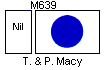
T. & P. MACY.

M639

The flag is also assigned to Thomas Macy. The Nantucket Whale Ship Signals painting dated 1840–50 identifies it by the vessel Aurora.

T. & P. Macy operated whalers in 1831–45. Thomas Macy also operated under his own name in 1836–37.

USA, Nantucket.

T. & W. SMITH.

S498

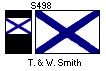
The original flag is white with a blue saltire, repeated on a broad white band around the black funnel.

The later design replaces the saltire with a blue cross on both flag and funnel band. Rosanoski’s text dates replacement towards the end of the twentieth century, although the source list includes the cross design in Lloyds 1904.

Also called Blue Cross Line, the business began as shipbuilder William Smith & Co. in 1810 and became a shipowner in 1832. In 1899 its building and repair interests merged with Harry S. Edwards as Smith’s Dock, after which shipbuilding became the main concern.

UK, Newcastle.

T. DEN BREEJEN VAN DEN BOUT.

D509

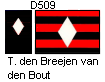
A black-and-white photograph of Mico from the port stern seems to divide the diamond into two triangles with a horizontal black line. Mitchell does not divide it. In view of the presumed flag logo, Rosanoski warns that the photograph may be misleading.

Also recorded as Breebot, Breejenbout and Aannemingsmaatschappij T. den Breejen van den Bout, the business is given a 1906–85 span. Its holding was sold to Koninklijke Boskalis Westminister on 19 November 1985. It owned Mico in 1939–47, interrupted by wartime requisition in 1941–46, and Carla in 1954–62. Rosanoski assumes Lloyds’ Materieel Exploitatie Mij. Breejenbout is the same business, noting that dredgers Johanna Jacoba and Flevo later appear under Boskalis.

Netherland: Aerdenhout, also given as Aardenhout or Ardenhout; Papendrecht and Bloemendaal in other sources.

T. ECKFORD & CO. LTD.

E273

The flag is white with a red saltire between black TA&Co. The funnel evidence includes a black-and-white photograph of Wairau, owned from 1912 to 1954.

Thomas Eckford bought Mohaka in 1881, though another account dates shipowning at Blenheim from 1882. His sons Alec and Sugden succeeded him after his death in 1917, and the business became T. Eckford & Co. Ltd. in 1924. Operations ended in August 1965, with the source connecting closure to the rail ferries. The last vessel, Echo, was hulked in 1967.

New Zealand, Wellington; Blenheim.

T. Gargour & Fils.

T. GARGOUR & FILS.

The family business began in Jaffa, Palestine, in 1928 as an orange trader. Shipping became a principal activity, conducted through Associated Levant Lines from the early 1960s to the late 1990s, followed by shipping-agency work. Lloyds dates T. Gargour & Fils to 1968 and records it as agent and later operator for the line.

Lebanon, Beirut.

ASSOCIATED LEVANT LINES SAL.

A289
image by Jarig Bakker, 22 December 1999

The document combines the group with Associated Levant Lines and Lebanon/Cyprus entries. A present-day Jordan profile cannot decide the historic Lebanese shipping entity's jurisdiction. Country and entity/period assignment remain open.

Associated Levant Lines S.A.L.

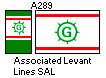
The G represents the manager and owner. A photograph of Beryte on 14 June 1994 confirms the funnel. Brown and FOTW use several erroneous or shortened forms of the line’s name; Brown 1995’s index gives it correctly.

Lloyds also dates Associated Levant Lines to 1968. Listings include T. Gargour et Fils as agent and operator, Gargour & Fils (U.K.) as agent, and the temporary name Associated Levant Lines (Cyprus) at Limassol before the Beirut S.A.L. listing resumes.

Lebanon, Beirut; a Cyprus, Limassol listing intervenes in 1985–86.

Keep the explicit scope label independent; no alias or company identity is inferred.

T. HOGAN & SONS.

H350
image by Joe McMillan, 26 October 2001

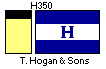
Griffin shows a black letter. Lloyds 1904 assigns the livery to North Atlantic Steamship Co. at Bristol; its 1912 edition gives North Atlantic Steamship Co. Ltd. at New York and names T. Hogan & Sons. Reed lists it under Hogan and Manhanset.

T. Hogan & Sons operated the Manhanset Line between Bristol and Swansea and New York and Baltimore.

USA, New York.

T. HUSSEY & SONS.

H547

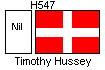
Nantucket Signals assigns the flag to Timothy Hussey, T. Hussey & Sons, S. & T. Hussey and F.W. Hussey. One vessel, North America, also had a separate ship signal, although another section calls her North American and does not mark a separate flag.

T. Hussey & Sons operated as whalers from 1820 to 1840.

USA, Nantucket.

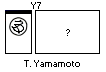
T. YAMAMOTO.

Y7

Taka Maru No. 11’s funnel, observed on 25 July 1963, is white with a very narrow black top and a black ring enclosing a black symbol. No flag is noted.

T. Yamamoto appears in the cited Lloyd’s registers from 1963–1964 to 1978–1979.

Japan, Muroto.

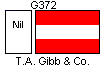
T.A. GIBB & CO.

G372

Thomas A. Gibb’s concern operated tea clippers, including Spirit of the Age, built in 1864. It is recorded operating in 1865.

UK, London.

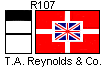
T.A. REYNOLDS & CO.

R107

The flag was red with a narrow white cross, overlaid by a Union Flag edged white; the white areas merge without a defined boundary. Black-and-white photographs of Bellinger and Glenelg confirm the livery.

T.A. Reynolds and Captain E.T. Miles formed the company in 1890. The Union Steam Ship Co. of N.Z. Ltd. took it over on 1 August 1896.

Australia, Hobart.

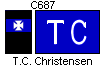
T.C. CHRISTENSEN.

C687
T.C. Christensen
T.C. Christensen

Talbot-Booth specifically attributes C687’s funnel to D/S Hafnia. Coastal Ships 1967 likewise assigns C688 to Hafnia, without mentioning Christensen.

T.C. Christensen managed Alssund of A/D Gylfe in 1921 until her breaking-up in 1923, and is recorded with Brosund in 1925 and another Alssund in 1929. Ships used Sund-suffixed names. Rosanoski assumes Gylfe and D/S Hafnia were subsidiaries from naming, management and address evidence, but Hafnia continued after Christensen disappeared from Lloyd’s, leaving any later connection unclear.

Denmark, Copenhagen.

T.G. IRVING LTD.

I75

The red-star funnel mark was common to the associated companies in Andrew Marshall’s account.

Shareholders in East Coast Timber formed T. G. Irving to act for them. Andrew Marshall and Tom Irving operated the company for many years, carrying coal principally to the Moray Firth, Orkney and Shetland into the 1970s. The business declined with the coal trade, as did East Coast Timber’s pitwood business. The companies were closely associated with R. L. Cook Towage of Sunderland until its absorption into France Fenwick.

UK, Sunderland.

T.H. DOCTOR.

D388

The sloping red band was unevenly spaced, leaving D off-centre on the red but centred on the yellow.

T.H. Doctor operated Havanah from the late 1960s to 1973.

Australia, Sydney.

T.J. STEVENSON & CO. INC.

S775
image by Joe McMillan, 23 November 2001

The published FOTW image gives equal-width bands, whereas its US Navy source shows narrower white bands.

Also called Stevenson Lines, the company is recorded from 1953–1954 to 1970–1971. Its owner bought Ward Line, prominent in the New York–Cuba trade, from the Atlantic, Gulf and West Indies group shortly before the Cuban Revolution and US boycott ended that trade.

USA, New York.

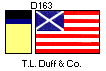
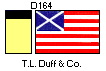
T.L. DUFF & CO.

D163
D164

The flag has eleven horizontal red and white bands and a blue canton bearing a white saltire. Two funnels are recorded: yellow or buff with a black top separated by a blue band, and yellow or buff with a black top but no intervening blue band.

U.K., Glasgow.

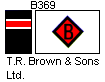
T.R. BROWN & SONS LTD.

B369

Mitchell records the same funnel for Holms Sand & Gravel.

Several targeted searches returned mostly unrelated results, weak director listings or Wikipedia-derived summaries. No adequate independent source was established for the exact historical maritime entity. The contemporary property company must not be substituted. The local history is coherent for the Bristol shipowning/lighterage business and distinguishes the 1926 corporation from the 1985 name/company changes.

T.R. Brown & Sons worked as shipowners, lightermen and stevedores, operating Holms Sand & Gravel. The company incorporated on 21 December 1926 later became T.R. Brown & Sons (1985) and was dissolved on 8 April 2003. A private company incorporated on 14 March 1985 was subsequently active in property. Rosanoski presumes this transition coincided with withdrawal from earlier activities; ARC Marine acquired Holms Sand & Gravel on 18 November 1986.

UK, Bristol.

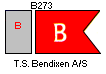
T.S. BENDIXEN A/S.

B273
B274
B275

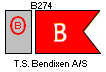
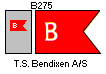
The flag is a red swallowtail with a white “B”, placed towards the hoist by Stewart and more centrally by Brown. Three grey funnel versions are described: a red “B”; a red ring enclosing a red “B”; and a panel of the flag. The source does not explicitly match each numbered funnel description to an individual illustration.

Norway, Lillesand.

Preserve the original prose, but do not illustrate or link it to the withheld GIF(s): B272. Source reference codes do not establish an image association.

T.W. Boyd.

T.W. BOYD.

Thomas W. Boyd, son of Boyd Line’s founder, became managing director of both Boyd Line and Lord Line in 1950. He resigned from Lord Line in 1963 to concentrate on the family company and was succeeded by his son Thomas Boyd. The business operated for Associated Fisheries Trawling, subsequently Lord Line, as well as Boyd Line, Grenaa Fishing, West Dock Steam Fishing and single-ship companies.

U.K., Hull.

BOYD LINE LTD.

B549
B550

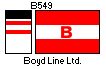
Monochrome photographs show a pale, probably white funnel with a dark, probably black top. Two narrow darkish bands, probably not black, are well separated, with the upper one close to the top. A later vessel has less space between the bands.

Thompson spaces the funnel bands equally from each other and the top, whereas photographs of Arctic Pioneer and Arctic Warrior support the illustrated version. The National Maritime Museum flag is dated about 1955 and measures 1219.2 × 1828.8 mm.

Boyd Line

Thomas Boyd founded Boyd Line in October 1936 after managing another family’s fleet; Lloyd’s gives 1937, which Rosanoski suggests may mark the start of operations. The ships generally began with “Arctic”. Operators included T.W. Boyd and, for part of the fleet, William Liston. Listed operating companies included Boyd Line Management Services, Fugro-Geoteam in Oslo (formed 1998) and North Sea Shipping at Steinsland (formed 1997). Boyd Line itself is listed as manager for T.W. Boyd in 1985–86.

U.K., Hull.

Keep the explicit scope label independent; no alias or company identity is inferred.

Boyd Line Management Services

Boyd Line Management Services was formed in 1985 and subsequently operated through named and operating companies.

U.K., Hull.

Keep the explicit scope label independent; no alias or company identity is inferred.

TAGE BERGLUND.

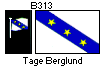
B313
B314
B631

The cap badge attributed by Collectors Corner to Rederi A/B Majviken shows a white flag with a blue diagonal band from lower hoist to upper fly, bearing three gold stars. Rosanoski considers this the more likely version. A funnel report for Majviken’s Dagmar has the top star point angled forwards.

US Navy 1961 reverses the band from upper hoist to lower fly and gives smaller stars with their top points aligned with the band. Funnel reports support both versions, suggesting a possible change.

Mitchell represents the funnel stars as oblong panels, their sides at the same angle as the band.

Tage Berglund operated Rederi A/B Majviken and appears in registers from 1956–1957, following a 1953–1954 entry as C.A. Berglund. Rosanoski’s FOTW comment instead describes him as apparently succeeding C.H. Berglund; the differing initials are retained as a source discrepancy.

Sweden, Gothenburg.

TARBIT SHIPPING A/B.

H479

Mitchell uses a lighter blue for the circle on this funnel.

The later T446 funnel is documented on Bitflower, Oktavius and Bit Red. Mitchell records it under Hermansson, indicating adoption before the 1995 name change. The flag has narrow white horizontal bands near the top and bottom of a blue field, with white TBS letters across the broad central blue band. Rosanoski calls its shade Swedish blue, unlike the brighter funnel blue, although Oktavius’s photograph appears to show matching shades. Some website vessel photographs show differing colours, presumed to reflect chartering.

Lloyds dates the concern to 1953 as Knut Holger Hermansson, renamed Tarbit Shipping in 1995. The company account instead describes the joint business founded by Knut Hermansson and Sture Svanström in 1962, following Hermansson’s ownership of Redön from 1956. It remained owned by the two families, with Hermansson family members managing Tarbit and Svanström heading associate TSA Tanker Shipping. The business carried bitumen, chemicals and petroleum; Rosanoski connects Tarbit, also written TarBit, with tar and bitumen.

The purchase of Vopak’s Theodora bitumen fleet was completed on 14 June 2001; its company became Tarbit Tankers B.V. on 1 January 2011. The original also records Bitumen Tanker A/B and Bituma, later appearing through Seahorse under TSA Tanker Shipping.

Sweden, Skärhamn.

Target Marine S.A.

Horizon Tankers Ltd. SA

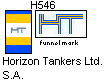
H546

Horizon’s funnel is documented by the port side of Horizon Athena in October 2010 and the starboard side of Horizon Diana. The original also supplies Horizon’s funnel logo.

The separate Target funnel reference T524 comes from Antiope and Nikolaos A. Most of Target’s container ships were chartered and therefore wore charterers’ colours, so one livery should not be assumed for all vessels.

Anthony Comninos established Target Marine in 1986 after a career in his family’s coastal-shipping business and partnership with his brother Costas. The family’s shipping involvement is traced to 1838; his own start is given as either 1960 or 1964. The brothers formed Comninos Brothers in 1972 before Anthony established Target. A separate register account dates the company to 1990 as P.M.T. Shipping and gives an incomplete rename year, 199. It took over management of Transcontinental Marine & Trading’s vessels. These accounts are not reconciled.

The group included Eurotrust Holdings, formed in 1999, and Horizon Tankers, established in 2007 at the same address to manage Target’s tankers. Omega Navigation is also listed as an associate.

Greece, Piraeus.

TAUBÅTKOMPANIET A/S.

B873

Boa Pride’s September 1992 photograph provides this funnel; Lloyds then listed Boa Ltd. as a managed company.

The original records several further group liveries. It questions the field colour of the published T6 flag and presumes turquoise or teal rings and lettering for Mitchell’s T607 drawing of Boa Power. T608 is documented on Boa Master, T609 on Boa Deep C and T610 on Boa Mighty, the latter managed by Greenway Offshore. Boa Rhino’s T611 may have black bands only half as wide as the white, but the photographs are too distant to establish that. A charter-period variation appears as K399; no connection between the vessel and the suggested Kittilsen name was found.

Formed in 1975, Taubåtkompaniet was part of the family-owned Boa Group, providing offshore services since the 1970s. Boa Offshore is dated 2003 in Lloyds, but the company account traces it to the early 1980s as Boa Ltd. Other operations included Greenway Offshore in Singapore from 2007 and Nye Kystlink, founded as Kystlink in 1999 and renamed in 2005. Ships generally bore the Boa prefix.

Norway, Trondheim.

TBS International Ltd.

Roymar Ship Management Inc.

Roymar Ship Management Inc.

Tuscarora Belle’s January 2006 photograph, supported by other vessels, documents this funnel. Its partly obscured flag shows the S and narrow borders of the second website table-flag version. The oval is a globe with white latitude and longitude lines; the flag carries TBS identity despite the register placing ships under Roymar.

Website flags differ in borders, field colour and letter arrangement: the larger flag appears probably light blue and differs from the one seen at sea. The later T606 funnel on Montauk Maiden has very narrow white letter fimbriation, visible only close up. Apache Maiden shows a black funnel top. Kiowa Princess lacked letters in 2005 but had them in 2008, suggesting to Rosanoski that Arkadia-registered ships became differentiated from those registered through Roymar.

Log.Star’s funnels are green with white LogStar lettering on two levels, possibly with a star or similar mark at either end.

TBS International was formed in 2001 by amalgamating TBS Shipping International, founded in 1998, and the earlier TBS International, founded in 1997.

Roymar Ship Management, formed in 1992 and based first at Yonkers and later Scarsdale, was part of the TBS group. The registers show it earlier under B + H Maritime Services and by 2007 as TBS’s major operating company. TBS Shipping Services had been separately listed as a Yonkers concern formed in 2000.

The Brazilian Log.Star Navegacào joint venture with Log-In Logistica Intermodal operated Brazilian-built, owned and crewed ships Angara Star, Recife Star and Jari Star on coastal and Amazon cabotage trades. The cited material gives Log-In a 30 per cent interest.

Bermuda, Hamilton.

TC-BEFRACHTUNGSKONTOR SCHONING GMBH & CO. K.G.

S612
image by Jarig Bakker, 27 November 2005
S1530

Documentary images — company attribution uncertain

S1528
S1529

No participant named for either exact mark.

Mitchell shows a principal funnel, called S1628 in the text, but Rosanoski suggests that it and S1529 may belong to individual pool members. The S1530 flag panel may instead be a funnel band, since it occurs in a funnel collection. Blue shades are undefined. A funnel may be based on Silke Reidner, which Mitchell notes without a drawing; the vessel’s cited ownership and management period is 1981–1985.

The business was a pool of short-sea traders formed by Haren/Ems owners. Lloyds lists it as manager in 1985–86 and agent in 1992–93, including for Seawisp, which Rosanoski could not identify in the ship index.

Germany, Haren.

Technical Marine Planning Inc.

Peace Boat

P653

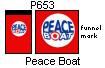
Ocean Dream’s port-side photograph of 28 August 2013 documents this funnel. The vessel had been chartered by Peace Boat since May 2012.

The Scholar Ship

S1074

Oceanic II supplies this funnel photograph, received from JB in November 2007.

Mona Lisa’s dark-red L354 funnel is presumed to be an owner’s mark rather than a charterer’s, with matching port and starboard evidence. The Topaz’s P408 funnel represents the charterer: its blue lettering appears slightly darker than the funnel, supported by a close-up Sydney photograph in December 2007.

Technical Marine Planning appears as an agent in 2004–2008, apparently for or through Kyma Ship Management. Rosanoski suggests it may be an offshoot of the London naval-architecture and marine-engineering company acquired by Carnival in 1995, but does not establish the connection.

Leonardo Shipping’s Mona Lisa served Holiday Kreuzfahrten until that company’s September 2006 bankruptcy, then worked as a Dubai hotel ship before joining Royal Caribbean as Oceanic II. Refitted for The Scholar Ship, it offered sixteen-week academic voyages from September 2007 through a Royal Caribbean initiative involving universities in seven countries. It reverted to Mona Lisa before a 2008 Lord Nelson Seereisen charter and subsequently worked for Peace Boat.

Topaz International Shipping owned The Topaz, managed by Kyma and appearing through Technical Marine Planning from 2004. It was chartered to Tokyo’s Peace Boat, recorded in the historical note from 2006, although the livery evidence includes a December 2005 photograph.

USA, Miami, Florida.

Teekay Corporation.

Documentary images — company attribution uncertain

D419

Orana’s October 2009 photograph documents this funnel, already seen in June 2007 after the vessel’s name change. Its registered owner, Diablo Shipping, was a Teekay Australia company, and Lloyds listed it as the group’s sole woodchip carrier. Rosanoski suggests either a charterer’s funnel or a Teekay distinction for this trade; neither explanation is established.

Diablo registered ownership does not prove mark identity; QA2 retained.

Brown assigns the separate T62 livery to Teekay Shipping Ltd., but photographs indicate group-wide use. Navion Clipper confirms the funnel in April 2006. The published flag was placed under the Bahamas, reflecting that company context rather than resolving the group’s several locations.

Torben Karlshoej founded Teekay in 1973. After the West Coast move, Palm Shipping was established as a chartering affiliate, followed by Viking Star Shipping in 1979. The business restructured as Teekay Shipping Corporation in 1993, went public in 1995 and became Teekay Corporation in 2007.

Expansion brought Australian Tankships in June 1998, Bona Shipholding in March 1999, Ugland Nordic in 2001, Navion and half of Skaugen Petrotrans in 2003, and Naviera F. Tapias on 30 April 2004. These acquisitions produced Teekay-branded Australian, Norwegian, American and Spanish operations. Teekay bought a 16 per cent Torm interest in July 2003; in April 2007 the two announced an acquisition and division of OMI. The Swift Tankers pool was formed with A.P. Moller-Maersk in 2006.

Regional identities also changed over time. The Los Angeles company became Western Marine Agencies in 1990 and Teekay Shipping Canada on its November 1991 move. Teekay Bahamas, founded in 1982, became Teekay Shipping in 1990; the Japanese concern dated from 1988. IUM Shipmanagement, 51 per cent owned, became Teekay Marine Services in 2005. The Tapias gas company became Naviera Teekay Gas. Petrojarl and its production arm adopted Teekay names in 2006–2007 after acquisition: the source gives 40 per cent initially in September 2006, also described elsewhere as a majority, and the balance in December. The 2001 BHP/Teekay Marine venture was initially 30/70; BHP’s later buyout is printed with the malformed date 7/2994.

Founded in New York, USA; moved to the US West Coast in 1975 and Vancouver, Canada, in 1991. Nassau, Bahamas, appears in Lloyds 2003. The 2010 fact sheet distinguishes Bermuda corporate headquarters, Vancouver operational headquarters and Marshall Islands incorporation.

Texaco Inc.

Regent Petroleum Tankship Co. Ltd. / recorded Regent Tankships style

R251
image by Jarig Bakker, 25 August 2004
R252
R253

Regent

The Regent flag follows the National Maritime Museum’s printed example, with lettering on both sides and very dark blue that looks black. Its recorded dimensions are 1346.2 by 2133.6 mm. The document gives its date once as about 1955 and again as about 1855; that discrepancy is not resolved. The fleet’s absorption into Texaco ended the livery.

Mitchell’s Regent Tankships funnel shows a stretched H. Rosanoski suggests that this was probably intended to represent REGENT, though Mitchell supplies no explanation.

US Navy 1961 pairs this funnel with the R251 flag. In Rosanoski’s illustration the flag space instead enlarges the funnel emblem, resembling a ground sandwich-board sign with black REGENT lettering.

Regent’s antecedent Trinidad Leaseholds was formed in 1913 and acquired distributor Burt Boulton & Haywood with the Regent brand in 1930. In 1947 Trinidad Leaseholds and Texaco combined British interests under Regent; Texaco transferred its share to Caltex within a year. Acquisition of Trinidad Oil later brought Texaco’s Regent stake to 75 per cent. The breakup of European Caltex in 1967 replaced Regent branding at most outlets. The notes date absorption of Regent’s tanker fleet both to 1967 and 1968. The brand returned to independent British retailers selling Texaco products in 2004.

Keep the explicit scope label independent; no alias or company identity is inferred.

The original Texas symbol was a five-pointed red star, created in 1903 from the state flag’s star. A 1907 delivery-wagon logo added Made in Texas on white, a blue enclosing circle and The Texas Co. at its base. The green T within the red star was registered in 1909; black TEXACO lettering crossed the upper point in 1913. The 1936 banjo sign retained the green T, whose black outline became white in 1948. A hexagonal identification system followed in 1963. In 1981 a red T appeared within a white star and red circle; in 2000 the Texaco name was dropped from that streamlined symbol.

T146 is described as presumably the first flag, documented by Lloyds 1912 and later sources. The contributor dates its trademark registration to 1906, distinct from the logo chronology above. The early design gave way during the 1930s to T323.

For T324, Rosanoski considers a black T incorrect and expects green edged white. Mitchell gives arched funnel lettering and a 1926–1959 period. Jordan does not mention lettering on T322, while Talbot-Booth seems to show a black letter and assigns that flag to the Norwegian company, contrasting it with T324 for the parent. Several sources also place the livery under H.C. Mathiesen.

T323’s flag circle is outlined black, unlike the funnel rendering; the T also appears black-edged, while published versions outline TEXACO in green. The later flag is described as white with a red hexagonal frame enclosing the star-and-T and black company name. Loughran dates T323 from the 1930s to late 1968, noting that fleet-wide replacement took nearly a decade. T109’s white-edged T agrees with the 1948 emblem change. Although Stewart and Loughran make the star fill its circle, photographs of Texaco Caribbean and Texaco Rhode Island show it generously sized but short of the circumference.

T152 succeeded the earlier markings in late 1968. Brown associates it with Texaco Overseas Tankship in London, while Texaco Baltic confirms use by the Norwegian company. Mitchell’s Norwegian version arches the lettering.

Mitchell dates the T8 funnel to 1990. A contributor describes the newer red disc, white star and red T logo on black, but was unsure of flag use; Rosanoski cites Brown 1995 for its appearance on a white flag.

Texaco Canada and Regent are identified as the only subsidiaries with their own funnel variants, eventually replaced by group livery. The T150 emblem includes a small red ring enclosing a red star outline at its base.

The main account begins with Texas Fuel in March 1901 and the Texas Co., formed by J.S. Cullinan and Arnold Schlaet in 1902 to absorb its assets. Texas law allowed buying, transport, refining and marketing but prohibited production by an integrated company. A published contributor instead gives a 1897 foundation. The register’s Texas Corp. name from 1926 is questioned against company histories using Texas Co.; Mitchell records a 1926 incorporation and the Texaco Inc. name from 1 May 1959. Rosanoski considers the 1932 foundation in Merchant Ships likely to refer to the Norwegian subsidiary.

Expansion included California Petroleum in 1928, Indian Refining in 1931, Trinidad Oil and an interest in Regent in 1956, Seaboard in 1958 and Paragon in 1959. The 1941 Delaware reorganisation preceded operation throughout the 48 states and District of Columbia. The later published account adds White Fuel, Superior Oil in Venezuela, Getty Oil in 1984, Star Enterprise with Saudi Refining, Monterey Resources and Hydro Texaco with Norsk Hydro.

Overseas flagging began in 1932 through Texas Company (Norway), managed by H.C. Mathiesen, and renamed Texaco Norway in 1959. Texaco Panama originated in 1938; its rename is given as 1959 or 1960, although earlier register entries already use Texaco forms. Canadian interests initially appear through individual ship companies, later as Texaco Canada. In Britain the Regent fleet appears under Texaco Ltd., while Overseas Tankship (UK) became Texaco Overseas Tankship after acquisition in 1967.

Texaco merged with Chevron on 9 October 2001 as ChevronTexaco, although some Texaco companies continued under the group. Its former large US-flag fleet had only two US-registered vessels in the cited 2001 register. Earlier international links included Caltex, Aramco and its Casoc predecessor, Bahrain Petroleum, the Indonesian Pacific Petroleum concern and a majority interest in Deutsch Erdol. The ACT venture with Agip and Chevron later appeared as CACT with Eni, Chevron and Texaco.

USA: New York and later White Plains, New York. A contributor specifies that New York in the shipping context was a port of registry, not the headquarters.
TH. AHRENBERG.

A561

Lloyds 1912 gives the same livery to Th. Ahrenberg and Werner Lundqvist of Gothenburg without explaining their relationship. It is also recorded for AB Maritime’s Aina in 1920–22, with Gothenburg becoming her home port in 1922. The flag letters “AL” are tentatively expanded as Ahrenberg Linie. Rosanoski instead suggests that the shared Ahrenberg/Lundqvist attribution may explain them and that an operator’s colours could account for the AB Maritime connection.

Ahrenberg is listed as an operator in Lloyds 1917–18, serving Nornan Linien, identified with Rederi A/B Nornan, and one unnamed company. A further reference appears among the 1937–8 telegraphic addresses.

Sweden, Gothernburg, as written in the original Country field.

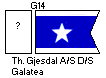
TH. GJESDAL A/S D/S GALATEA.

G14

The flag is a white swallowtail with a very broad blue horizontal band bearing a white star. No funnel is recorded.

Norway.

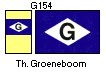
TH. GROENEBOOM.

G154

The funnel is yellow or buff with a broad band displaying the flag: blue with a white diamond bearing a black G.

Netherlands, Rotterdam.

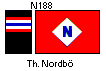
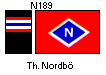
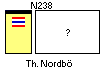
TH. NORDBÖ.

N188
N189
N238

The later funnel, apparently from the mid-1960s, is yellow or buff with a narrow black top and a panel of the same five red-white-blue-white-red stripes.

The original black funnel has five bands, red-white-blue-white-red. Two red flag versions are recorded: one with a white-edged blue diamond and white N, the other with a white diamond and blue N.

Recorded as Th. Norbö Jr., manager only, in the account of 1939 fleets, Nordbö appears as an owner as well by 1963–64. It managed D/S A/S Falkeid.

Norway, Haugesund.

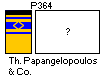
Th. Papangelopoulos & Co.

Documentary images — company attribution uncertain

P364

Mitchell’s version under General Maritime Enterprises apparently relates to Pinto and varies its earlier livery. The same design with an orange funnel base appears under “E. [sic] Papangelopoulos”, annotated Marine General Transport Corporation. His line drawings seem to associate it with Angelo P, owned by that company but previously under United Shipping & Trading Co. of Greece. As both agency companies had previously been under United, Rosanoski suggests a connection and that P364 may originally have belonged to Marine General.

Papangelopoulos ownership of the mark unproved.

Theodoros Papangelopoulos appears as an agent in 1978–79 and as Theodoros A. Papangelopoulos, apparently trading as General Marine Enterprises, in 1980–81. By 1985–86 the name is Th. Papangelopoulos & Co., acting for General Maritime Enterprises Corporation and Marine General Transporters Corporation. Rosanoski suggests that it may have owned or acquired the former.

Greece, Piraeus.

Thai International Tankers Co. Ltd.

Documentary images — company attribution uncertain

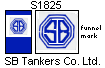
S1825
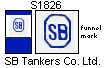
S1826

Danai 6’s February 2008 starboard photograph supplies this funnel. It also flies a blue flag whose unclear detail appears to fit T726. Several fleet funnels bear SB; Rosanoski assumes this indicates S.B. Tankers as operator regardless of registered ownership, rather than treating it as proven.

Danai 7’s port-side photograph of 24 May 2008 supplies this version.

Exact livery user unknown.

SB Tankers Co. Ltd. — Danai3/Danai1 observation

S1827

This funnel is documented on the port side of Danai 3 and also on Danai 1. The photograph date is printed 8.3.3009 in the original.

Observation-specific allocation; no claim for all managed ships.

The separate T726 funnel is documented on Orapin 3 in June 2011 and also on Orapin 1, 2 and 4. Its flag is probably the one flown by Danai 6 in February 2008.

Formed in 1995, Thai International Tankers was a joint venture between Laemthong International Lines and Thai Petrochemical Industry. Rosanoski considers that the latter’s 1997 financial difficulties and 2007 sale probably changed the holdings, but the nature of those changes is unclear. The company continued operating.

Its network included S.B. Tankers, Thai Original Tankers, Thai Oga Trading, Thai Petroleum Tankers, Thai Tankers Trading and Thai Quality Tankers, the last established on 4 August 2006. S.B. acquired Danai 1 in July 2004 and Danai 3 in February 2005; Thai Original acquired Danai 2, 4 and 5 in November 2004, September 2005 and May 2006. Thai Quality acquired Danai 6–8 in February 2007. Later registered ownership differed: the 2011–2012 register placed Danai 4, Danai 8 and Orapin 1–2 under Thai International itself and the remaining vessels under managed companies.

Thailand, Bangkok.

THE (CHARLES) NELSON CO.

N421
N422
N423

The Lloyds 1904 flag has narrower red bands, while the funnel diamond’s emblems appear yellow. This descriptive passage labels the image B421; the Sources list gives N421.

Charles Nelson was a steamship owner from 1888 until services ceased in 1938. Primarily a Pacific-coast operator, it also entered the intercoastal trade. In 1934 it was excluded from the rate-setting group for Pacific-to-Gulf of Mexico traffic because it was considered too small to maintain a regular schedule.

USA, San Francisco.

The Adelaide Steamship Co. Ltd.

THE ADELAIDE STEAMSHIP CO. LTD.

A437
A1025

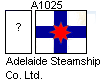
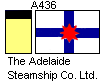
The flag is based on International Code flag “X” with an added star. A black-and-white photograph of Moonta confirms the A436 funnel; a drawing of Acco Transport’s Maltara shows that managed ships also used it.

The Sampson-based FOTW portrayal by James Dignan and the Brown 1926-based portrayal by Jarig Bakker are both recorded for A436. Rosanoski notes that sources generally show a larger star; Jonathan Dixon describes the Wedge 1926 version as apparently intermediate.

The National Maritime Museum’s actual flag, dated about 1951, has the star filling the cross’s fesse point, with its diagonal points extending slightly onto the field. The dimensions are given as 914.4 × 1092.2 mm, with the order reversed in the accompanying comment. Rosanoski considers Peter Hans van den Muijzenberg’s portrayal almost exact; its source is not stated, but he thinks it resembles the museum flag.

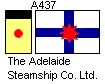
Rosanoski identifies the A437 funnel as an error, citing confirmation from NJK on 12 April 2004. The illustration remains associated with the source record, with that qualification.

The Adelaide Steamship Co. Ltd., also known as ASC, was formed on 9 October 1875 and began services in December 1876. It amalgamated with Spencer's Gulf Steamship Co. Ltd. in December 1882. The Adelaide Steamship Company Limited was registered on 15 December 1910 and deregistered on 3 February 1920, when the company was reconstituted under the same name; the register gives The Adelaide Steamship Co. Ltd. for the new registration.

Phil Nelson’s account records reorganisations following liquidation in 1900 and 1920. Rosanoski corrects that account’s “Gulf Steamship Company” to Spencer’s Gulf Steam Ship Co. Ltd. and its 1977 date for the end of maritime operations to 1997. A shareholders’ meeting on 1 April 1997 approved the name Residual Assco Group Ltd. and transfer of the maritime interests to Adsteam Marine Ltd. The change took effect on 23 April, when the wholly owned Adsteam subsidiary was floated; its share offer closed oversubscribed on 26 May.

Adelaide was a founding member of Associated Steamship Companies in 1901, with Huddart Parker, McIlwraith McEacharn, Howard Smith and AUSN; Melbourne Steam Ship Co. joined in 1902. The association ended in 1910, although cooperation continued. Associated Steamship Owners, formed on 24 May 1921, brought together Adelaide, McIlwraith McEacharn’s Line, Howard Smith, Australian Steamships, James Paterson, Melbourne Steamship, Huddart Parker and AUSN. Howard Smith and AUSN withdrew in August 1960; by the end of 1961 only McIlwraith McEacharn and Adelaide remained. Their merger to form Associated Steamships Pty. Ltd. was agreed in 1963 and became operative in January 1964 on a 40/60 basis, ending the association. Adelaide’s additional capital brought parity in October 1967.

Howard Smith acquired 10% of Adelaide’s shares in 1977, but the proposed merger that year was refused. Its holding reached 18.3% before being sold late in 1983; clearance to acquire Adelaide’s towage interests was subsequently reported in 1991. In the other direction, an Adelaide holding of 27.28% in Howard Smith was reported in 1989, probably through Petersville Sleigh, and disposal of the Howard Smith holdings was reported in 1991.

The group included Adelaide Cement Co., later Adelaide Brighton Cement Ltd. Adelaide Ship Construction, formed in July 1957 with Adelaide as a major shareholder, became wholly owned in 1962 and a division of Adelaide Steamship in March 1968; its cessation was reported in 1991. Coast Steamships was acquired in 1915. Sources date the purchase of Adelaide Steam Tug Co. to either 1915 or 1918, after earlier indirect association; an unreferenced note says it became a management company only in 1958. Ritch & Smith was acquired about 1928 jointly with Huddard Parker and was a division by 1973. Waratah Tug & Salvage was formed as a wholly owned subsidiary on 18 May 1931. Other interests included Pacific Tug, bought from the Peters brothers, and Petersville Sleigh. A further entry records the absorption of “Spencer’s Gulf Marine Services Pty. Ltd.” in December 1882.

Adelaide helped found Bulkships in June 1958 and sold its remaining interest early in 1977. Its towage ventures included ABHO with Brambles and Howard Smith; Adstan Tug Charters, Lovett, McCracken & Bray and Moreton Tug & Lighter with Stannard interests; and Fremantle Tug Operators with Swan River Shipping from 1970. Howard Smith partnerships included Cawby, later called Gladstone Tug Services, Charter Craft & Marine Services, Hedland Marine Services, United Salvage, and the second Waratah Towage company, formed in July 1977. Stirling Marine Services, renamed from Elder-Prince Marine Services in August 1988, had been jointly owned with Howard Smith from January 1986. Queensland Tug & Salvage is described both as jointly acquired in March 1972 and as jointly formed. Wallace Tugs was owned equally with J. Fenwick until Adelaide announced the purchase of Fenwick’s share in April 1995. Harbour Lighterage, owned equally with Brambles, ceased in 1992; Osmarine (Australia) was an associate.

The fleet chiefly used Australian names ending in “a”.

Australia, Adelaide.

ADSTEAM MARINE LTD.

A684

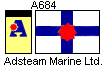
Adsteam inherited the house flag and the shield and motto designed for the original company seal in 1875: “Festina Lente”, translated as “make haste slowly”. Wholly owned Adsteam tugs, Ritch & Smith vessels at Adelaide and Wallace vessels at Port Kembla adopted the A436 funnel, described as pale buff. They displayed the house flag on the front of the wheelhouse and flew it; the Wallace vessels also flew their own flag.

The basic flag is white with a blue cross, described as the first hoist of the signal “shall I take you in tow” before adoption of the current International Code. On the funnel, white edging separates the star from the “A”. Maritime News supplies the A684 funnel and flag reference.

Adsteam Marine was formed to take over the maritime interests of Residual Assco Group, previously Adelaide Steamship. The source gives 28 February 1997 as the effective transfer date and 23 April as the flotation date, with the offer closing oversubscribed on 26 May.

Purchases included Barbican Marine Agencies, announced in August 1997, and the Burns Philp shipping division, announced on 1 January 1998. Howard Smith Towage Ltd. was acquired in May 2001 and renamed Adsteam Towage Ltd., becoming Svitzer Towage Ltd. in 2007. Red Funnel Towage was acquired in 2002 from Southampton. Isle of Wight & South of England Royal Mail Steam Packet Plc. The separately listed Adsteam Towage Pty. Ltd. was the renamed Wallace Tugs and was wholly owned, as were Ritch & Smith and Fremantle Towage. Adsteam Offshore, formed in 1990 at Fremantle, became Svitzer Offshore in 2007. Queensland Tug & Salvage became Adsteam Harbour-Brisbane. Adsteam and Howard Smith bought P&O’s half of Medina Maritime Services effective 30 December 1996; Port Lincoln Tugs was jointly owned with N.D. Hegarty & Son.

Bowen Towage was a venture with MIM Holdings and Howard Smith in which Adsteam held 25%. The Marine Pacific Group was owned equally with Howard Smith through United Salvage.

The Svitzer takeover chronology is inconsistent in the original account. Rosanoski gives 3 July 2007 for SvitzerWijsmuller’s bid, explicitly rejecting Maritime News’ July 2006 date, but also records acquisition of 90% on 23 March 2007 and adoption of the Svitzer identity on 11 April 2007. A later website reference gives 23 March 2008 for receipt of 90%. Adsteam companies appeared among Svitzer’s operators in December 2007 and were absorbed into Svitzer-named companies in April 2008. These conflicting dates remain unresolved.

Australia, Sydney.

THE ALVA STEAMSHIP CO. LTD.

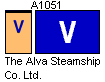
A1051

Rosanoski identifies the livery with that of Vlassov, cross-referenced as V47. Stewart 1953 and 1957 also assign A1051 to Navigation & Coal Trade, which Rosanoski considers inappropriate because that firm acted only as manager. Jordan and Mitchell neither mention nor show a black funnel top.

In 1937 Alexandre Vlasov decided to establish two British companies: Alva as shipowner and Navigation & Coal Trade as manager and broker. Alva was registered in 1938 under the latter’s management. British Ocean Tramps records its last two steamers as transferred to a Bermuda associate in 1958; Lloyds nevertheless shows continued operation until 1971, when Alva Star passed to Alva Star Shipping under the same name.

Mitchell records a later title, Alva Shipping (Holdings). The source places the company in V Group as a Sitmar subsidiary and finds no apparent connection with the Panamanian Alva company. In 1970–1 Lloyds lists it under its own name without a manager, though Navigation & Coal Trade still cross-references it.

UK, London.

The Anglo-Eastern Group.

THE ANGLO-EASTERN GROUP.

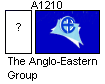
A1210

Josef Nüsse identifies this table flag as the second flag for Anglo-Eastern Ship Management Ltd.

Anglo-Eastern Ship Management Ltd.

Anglo-Eastern Ship Management Ltd.

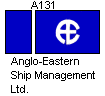
The flag device is described as a white ring divided by a white cross, with parts of the ring omitted. António Martins-Tuválkin interprets it as a stylised “Æ”, combining the company’s initials. Brown shows a larger emblem with a shorter middle arm on the sinister side. A photograph of City of Amsterdam dated 12 May 2007 demonstrates use by a managed vessel.

Historical qualifications remain; no exclusive fleet-wide use asserted.

Documentary images — company attribution uncertain

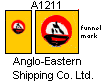
A1211

Mitchell first assigned the funnel to Panama’s Kinderry Investment Corporation, then changed the card to Anglo-Eastern Shipping Co. Ltd. and supplied details of Hong Kong’s Anglo-Eastern Management Services. The emblem appears to contain a stylised ship.

Shipping Co. versus Management Services allocation remains open.

Jeff Thoresen reported purchasing an Anglo-Eastern flag on eBay from an Indian shipbreaker; his photograph is retained as source evidence without assigning it an unsupported image ID.

The source separately discusses Mineral Nippon’s T727 funnel, based on a portside photograph. Built for Toppenish Ltd. in 1986, the ship was managed by Anglo-Eastern and sold in June 1996. Rosanoski considers this funnel apparently specific to that vessel, with no connection to similarly named managed ships. T727 remains a documentary cross-reference, outside this entry’s accepted image associations.

The Anglo-Eastern Group was formed in 2001 by the merger of Denholm Ship Management (Holdings) Ltd. and Anglo-Eastern Ship Management Ltd. Only Denholm’s ship-management business was involved: Rosanoski rejects register groupings that also placed Denholm Line Steamers and Denholm Fishselling under Anglo-Eastern.

Peter Nash founded the Anglo-Eastern chartering and management business. Lloyds dates Anglo-Eastern Management Services Ltd. to 1974 and its change to Anglo-Eastern Ship Management Ltd. to 1988. Compagnie Maritime Belge (Lloyd Royal) S.A. bought it in 1985. Accounts disagree on the management buyout: Lloyds gives December 1992, while the company website dates the purchase by Peter Cremers, Marcek Liedts and Richard Wong to 1998. Konsortium Perkapalan Berhad is recorded as putting it on the market in 1998. The company remained an operating subsidiary after the 2001 merger.

The group’s management offices included Antwerp, Bremen, Glasgow, Mumbai and Singapore. The Glasgow company had originally been Denholm Ship Management Ltd., later Anglo-Eastern Ship Management (UK) Ltd., becoming Anglo-Eastern (UK) Ltd. in 2003. The Antwerp business was formed in 2004 and the Singapore company in 1996.

The source also records an Athens business formed in May 2001 from Mare Maritime Co. S.A. and Denholm Ship Management (Holdings) Ltd. as Mare Ltd. It became Mare International Ltd. in 2002 and Maregulf International Ltd. in 2003. A later register apparently identifies a 2004 change to Evalend Shipping Co. S.A.; Rosanoski leaves that identification qualified.

China, Hong Kong.

The Atlantic Refining Co.

The business traces its roots to Atlantic Petroleum Storage Co., founded in Philadelphia in 1866, which established Atlantic Refining in 1870. Standard Oil acquired it in 1874; it became independent again with Standard Oil’s breakup in 1911. Merchant Ships gives a conflicting formation date of 1916. In 1966 Atlantic merged with Richfield Oil Corporation to form Atlantic Richfield, subsequently known as Arco.

The sources disagree over the name Atlantic Oils Refining Co. and a supposed 1950s change, since earlier accounts already use The Atlantic Refining Co. It controlled and operated Atlantic Oil Shipping Co., formed in 1927 and absorbed by the time of Talbot-Booth’s 1949 account. Atlantic Union Oil Co. was formed with Union Oil in December 1927.

USA, Philadelphia.

The Booth Steamship Co. Ltd.

THE BOOTH STEAMSHIP CO. LTD.

B126
B127
B151
B584

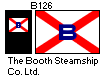
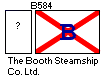
The later flag, in use by 1885, had a small “B” wholly on the red saltire, with red visible behind it, and a black funnel. Letter size and saltire width vary among sources. Sampson’s black “B” is considered a confusion with very dark blue. Rosanoski also rejects the letterless Lloyd Reedereiflaggen rendering.

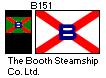
The larger-letter version has white behind the blue “B”, with the red diagonal cross radiating from it rather than continuing behind. A.C. Fidgen’s 1957 description and photographs support this. Loughran dates the change to after the outbreak of the Second World War; Bonsor gives a funnel flag-panel and larger “B” from 1947, followed by a still larger letter in 1950. Older renderings persisted in books. Liverpool Shipping draws a band rather than a panel, and the Ships List slants the letter.

Liverpool Shipping gives a “white or green” alternative without explanation. NJK confirms B126 but calls B151 a mystery.

B584 follows a letterhead’s fluttering flag between “BOOTH” and “LINE”, with very dark blue. Harnack dates it from 1 January 1952.

Iquitos Steamship Co. Ltd., with original Red Cross Iquitos attribution

I141

Iquitos connection

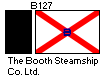
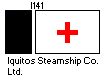
I141 is attributed to Red Cross Iquitos. The red-cross emblem required Army Council consent under the Geneva Convention Act of 1911, and the livery apparently did not survive the First World War, being replaced by Booth’s B127. Rosanoski considers the cited Red Cross Iquitos Line to mean Iquitos Steamship.

Keep the explicit scope label independent; no alias or company identity is inferred.

The original 1866 flag depicted a bee, but its colours are unknown.

Booth’s origins lay in the US importing partnership Walden & Booth, formed in 1860, followed by Booth & Co. and the Liverpool office Alfred Booth & Co. in 1863. The first steamer was ordered in 1865 and service began on 15 February 1866. Another account calls Alfred and Charles Booth the founders in 1866. Early vessels were owned in sixty-fourth shares, mainly by the Booth firm and related Holt family. Booth Steamship Co. was incorporated in 1881 and reorganised in 1901.

Booth helped establish Booth Iquitos Steamship in 1898; its ships entered Iquitos Steamship in 1901 through amalgamation with Red Cross Iquitos. Liverpool & Maranham Steamship was acquired in 1903. The Vestey Group bought Booth in 1946, linking it with Blue Star. Group ships were pooled under Blue Star Ship Management in 1975, ending Booth as a separate entity. Ships traditionally bore saints’ names.

U.K., Liverpool.

THE BROWN TUG CO. LTD.

B754

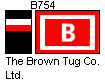
The flag is described as only probable, perhaps dating from George Brown’s earliest tug interests. Funnel bands are called narrow, though the photographs agree with the illustrated widths. President’s monochrome photograph does not clearly show the flag letter; any red outer border appears much narrower than the white, unlike the equal widths in the drawing.

George Brown’s tug business began in 1888. Ships registered to him and his successors were actually owned by shipbuilder John Readhead & Sons. Brown converted the operation into The Brown Tug Co. Ltd. in 1923 and died in 1925. France, Fenwick Tyne & Wear took it over in 1930.

UK, South Shields.

THE CARRON CO.

C792
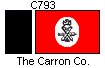
C793
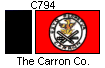
C794
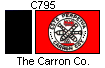
C795
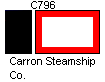
C796
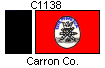
C1138

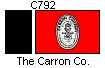
The original flag was white with a red border. Reed 1891 shows it under Carron Steamship Co., although the red flag bearing the company seal seems to have replaced it about the mid-1850s. The late appearance therefore remains unexplained.

Lloyds 1882 shows blue ESTO PERPETUA lettering and lines of black ground.

LJC 1885 shows the arms alone on a white oval, without lettering.

Griffin 1895 has a rounded background and some colour in the phoenix. Rosanoski’s descriptions differ between ESTD PERPETUA above CARRON and ESTO PERPETUA above CARRON CO. He explicitly acknowledges that his CO in the base of the annulet, reproduced in the FOTW image, was a mistake.

Reed 1901 and Lloyds 1904 add COY at the base. The upper red feature looks like a crown but is probably a flaming phoenix; Lloyds 1904 shows the bird rising from red, possibly flames. There is also red ground below.

The later seal shows a phoenix rising above crossed carronades and a pile of cannonballs, with ESTD PERPETUA above and FOUNDED over 1759 below. A dotted inner orle is surrounded by CARRON COMPANY and, in smaller letters, INCORPORATED BY ROYAL CHARTER 1773; a double black orle forms the outer oval. Loughran’s rendering is more ornate than Lloyds 1912, whose lettering is clearer. Talbot-Booth and Book of Flags use an oval with flat sides. The FOTW flag originally drawn from Brown 1926 was replaced in 2008.

Founded in 1759 by John Robuck, Samuel Garbett and William Cadell, Carron acquired a barge in 1760 and its first ship in 1765, receiving a Royal Charter in 1773. Samuel Garbett & Co. managed the ships from 1763 until its winding-up in 1772, when they passed to Carron Shipping Co., predominantly owned by William Elphinstone. Carron took over his interests in 1782, reportedly when he turned to privateering. It became a steamship owner in 1851, using river names from about the middle of that century. Carron became a London Scottish Lines shareholder in October 1945 and sold its last ship, Forth, in 1947. Liquidation followed in 1983.

The company’s munitions manufacture, particularly carronades, explains the gun barrels and cannonballs in its emblem. A cannonball at the mainmast head signified ownership and, from the Crimean War, carriage of munitions; an earlier origin as a privateering signal against the French is also suggested.

UK, Carron.

The Century Spinning & Manufacturing Co. Ltd.

Documentary images — company attribution uncertain

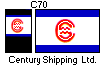
C70

Shipping Co. Ltd. versus Shipping Ltd. identity remains open.

The archive mixes Spinning & Manufacturing, Shipping & Manufacturing and Century Shipping Ltd., including a 1990 entity. Evidence for the division does not establish that these are all one legal company or validate the operating-company hierarchy.

Century Spinning & Manufacturing

The group’s fleet was held through operating companies, including Century Shipping Ltd. and Century Shipping & Manufacturing Co. Ltd., the latter formed in Mumbai in 1990. Later Lloyd’s entries give the parent as The Century Shipping & Manufacturing Co. Ltd.

India, Mumbai.

Keep the explicit scope label independent; no alias or company identity is inferred.

Century Shipping

Rosanoski presumes Brown’s Century Shipping Co. Ltd. to be the same company despite the slight variation in name.

Century Shipping Ltd. was formed in 1982. It appears variously as a vessel-owning and operating company; Tomoe Shipping Co. (S) Pte. Ltd. managed part of its fleet in 1992–93. Vessel names began with Aditya.

India, Mumbai [Bombay].

Keep the explicit scope label independent; no alias or company identity is inferred.

THE CHINA NAVIGATION CO. LTD.

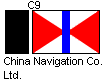
C9
image by Sandy Hook, None
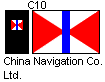
C10
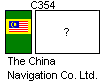
C354
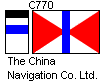
C770
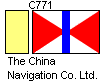
C771
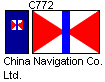
C772
C773
C1201

The livery belongs to the Swire group, initially operating mainly through China Navigation. Earlier flag books often list only Swire. C770 is Pekin’s original funnel in 1873, when she became the first owned ship to arrive in the East.

C9 remained standard until late 1966. The flag is white and red quartered diagonally, with a central blue vertical stripe. Larousse 1930 shows the red triangles’ tips meeting the stripe, while Sampson and other sources show the stripe covering their intersection. A 1993 Wellington flag photograph apparently supports the former arrangement; Nüsse’s Swire table flag supports the latter. The difference is retained rather than reduced to one definitive geometry.

Cargo ships and bulk carriers used C10 after late 1966. It is supported by Pacific Freedom in September 2007, assumed to be an Oldendorff charter to China Navigation, and a starboard Chengtu photograph whose year is malformed in the source. The different treatment from C1201 may reflect a longer charter, but this is only suggested.

Kuala Lampur used C771 while cruising in the early 1960s, replacing it with C773 later that decade.

The pilgrim-vessel funnel used after 1961 bears the Federation of Malaya’s national flag. Ashun is shown with it in a black-and-white photograph.

Coral Princess used C772, with the funnel described as dark blue.

Pacific Chief on 14 May 2009 shows a Swire panel on an Oldendorff grey funnel, with the Oldendorff flag painted on the bridge superstructure. She was chartered from Oldendorff from October 2008; the recorded end date is malformed as 1.7.2.2010.

Formed in 1872, China Navigation was managed by Butterfield & Swire until John Swire & Sons took over on 1 January 1974. Alfred Holt acquired an interest around 1926. An Ocean S.S. offer in 1967 envisaged equal Ocean and Swire ownership with Swire continuing management; the source records the proposal rather than its completion. Later Lloyd’s lists the company within John Swire & Sons, alongside a separate Singapore-based China Navigation Co. Pte. Ltd. entry in 2011–12.

Taikoo Chinese Navigation was formed in 1930 as an intended Anglo-Chinese venture, operated until 1941 and was revived in 1975, becoming Taikoo Navigation in 1977. Australian-Oriental Line was an associate. Chief Container Lines is called a subsidiary, but another account gives a 39% Swire holding.

Container interests included Australia Japan Container Line; Asia Australia Express, formed in April 1973 and later P&O Swire Containers; Dong Young with Cho Yang from 1975; Japan/Straits Container Line from November 1978; and New Zealand Unit Express from 1969. The company also had interests in Overseas Containers (Pacific), Tasman Orient with Mistsui OSK Lines and Victorian International Container Terminal.

UK, London, and Hong Kong, China.

THE CITY LINE LTD.

C199
C200
C484
C774

C484 was used under George Smith & Sons. Rosanoski also associates C200 with that period, provided its funnel is correct.

Reed’s mixture of red and yellow funnel lines presumably represents a pinkish-buff shade, comparable with Talbot-Booth’s description of C199.

Ships & the Sea 1942 and Merchant Ships 1942 and 1944 describe a very deep pinkish-buff funnel. LJC 1909 omits the dots after the pennant’s letters.
James Dignan’s FOTW drawing, credited to Sampson 1957, appears to omit the Ellerman pennant; Rosanoski notes that Sampson 1959 shows it.

Jan Mertens describes Larousse Commercial Illustré 1930’s red flag with white, sans-serif SS, the letters about half the flag’s height. Above it is the elongated Ellerman pennant, one-quarter longer than the flag and half its height.

Founded in 1839, the City Line was also recorded as City S.S. Co. and became a limited company in 1892. George Smith & Sons owned and managed it; London, Liverpool & Ocean Shipping Co., later Ellerman Lines, acquired 50 per cent in 1901. Known as Ellerman’s City Line, it managed part of Ellerman’s fleet, with Ellerman also acting as agent. It was incorporated into Ellerman City Liners in 1973.

U.K.: Glasgow in Lloyd’s 1958–59 and London in 1966–67.

THE CLAN LINE STEAMERS LTD.

C172

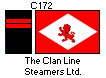
The house flag is red with a white diamond containing a red lion rampant. Sources differ over whether the diamond reaches the edges. Rosanoski follows the National Maritime Museum flag, dated about 1951, in which it does not. Jan Mertens describes Larousse 1930’s diamond points as about one-fifth of the flag height from the edges, while noting a smaller diamond in the compared illustration. Evans and former deck officer G.H. Watt favour a very large diamond; Watt recalled its points close to, or touching, all four edges. The museum flag measures 1219.2 by 1701.8 mm.

Black-and-white photographs confirm a narrow gap between the two funnel bands, narrower than most printed references show. Stewart 1953’s black funnel with a red band is corrected in that book’s errata.

King Line, Hector Whaling, Neptune Shipping, Scottish Shire Line and Scottish Tanker used Clan livery, while Houston Line retained its own flag.

G.H. Watt recalled each British & Commonwealth company flying its own house flag below the group flag on the mainmast. At anchor or alongside, a smaller house flag commonly served as the jack, except where a company preferred the pilot jack. On Clan-named vessels, the red ground of the individual jack was replaced by the vessel’s name tartan. Watt dates discontinuation to 1966–67 because of cost. Evans also records tartan jacks. Watt’s account dates the merger to 1953–54, differing from the 1956 company history.

Almanacco Marine Mercantili assigns a Clan flag and a black funnel with two white bands to Asiatic Steam Navigation Co.; Rosanoski finds that attribution inexplicable.

The Clan Line Association of Steamers was formed in 1881, with new ships built and managed by Cayzer, Irvine while Cayzer retained the original six Clan ships. The business moved to Glasgow and became The Clan Line of Steamers Limited on 25 June 1890, with Cayzer holding a majority interest. Steamers distinguished it from Thomas & Dunlop & Sons’ Clan sailing ships. Also called the Scots Navy, it merged with Union Castle in 1956 to form British & Commonwealth Shipping, with the component companies retaining separate identities for a time. Clan Macgregor made the final Clan Line sailing in 1981, when trading ceased.

The group acquired Houston Line and a controlling interest in Scottish Shire Line in 1918, and controlled Thesen’s Steamship Co. from 1935. It acquired the Hector Whaling name in June 1961 and reconstructed that company. Clan participated in the Dolphin Line consortium and managed King Line.

U.K.: Glasgow, moving to London after the First World War.

THE COLNE SHIPPING CO. LTD.

C595
C596

C596 is shown for a tug; the fishing vessels used the C595 funnel, recorded under G.D. Claridge.

The register sequence begins with G.D. Claridge as manager in 1953–54, uses Colne Fishing Co. in 1978–79, and The Colne Shipping Co. by 1985–86. By 1992–93 the previously managed fleets had been incorporated, and the company remained listed in 1996–97. Management interests included Clan Steam Fishing (Grimsby), Claridge Trawlers, Colne Fishing, Huxley Fishing Cop., Drifter Trawlers and Dragon Fishing. Sir John D. Mardsen Bt. managed part of the fleet in 1978–79.

U.K., Lowestoft and London Colney.

THE COULSON TUG CO. LTD.

C1105
W384

John Coulson’s earlier funnel colours are unknown. John White’s colours were used from 1918. The tugs were known as the Tombstone Fleet because four white panels were placed on their deep black funnel tops. From a photograph of Corsair (3), Rosanoski reads this as two panels on each side.

John Coulson, involved in tug ownership from about 1866, absorbed John White’s business, which dated from 1852. The Coulson Tug Co. was formed in 1918 and taken over by France, Fenwick Tyne & Wear in 1925. Coulson is recorded as owning Star of Hope from 1892.

UK, Newcastle.

The CSL Group Inc.

THE CSL GROUP INC.

C61
image by Jorge Candeias, None
C62
image by Ivan Sache, 24 March 2001
C63
image by Al Fisher, None
C1261
C1263

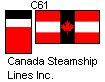
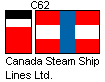
The sequence is not entirely settled. FOTW dates C62 to 1958 and C63 from 1958, but Rosanoski finds C62 in Brown through 1958 and C63 already in Stewart 1953. He assumes succession rather than two separate companies. The blue was taken as mid-blue from Know Your Ships 1959; Al Fisher’s C63 rendering uses pale colours. A Sir James Dunn photograph confirms the C63 funnel.

The later flag appears on the company website and in a CSL Pacific photograph. Nüsse’s example is described as 2:1, while the FOTW rendering is longer; Know Your Ships shows an ordinary rectangle. A CSL Atlas photograph dated 19 January 2006 supports the funnel, leading Rosanoski to suggest a change about 2005–06, although the sources also document the design earlier.

The funnel bands follow the funnel’s shape. On Atlantic Erie they run level at the top and slope down the aft edge; on Birchglen they follow both the sloping top and aft edge. Cedarglen appears to have a white base, perhaps because the design stops part-way down. A CSL Laurentien photograph confirms the starboard arrangement. Know Your Ships shows a rectangular flag. CSL Tadoussac is photographed flying C1261 from the starboard mast and another flag from the port mast.

Mitchell describes this funnel as the new colours of 1980.

CSL Norway A/S

C1262

This livery follows photographs of CSL Thames dated 21 November 2011, then given under CSL Norway A/S.

Ocean Lines Ltd.

O331

Royal Trustco Ltd.

R386

Mitchell attributes this funnel to Royal Trustco’s Arctic, confirmed as a managed ship in Lloyds 1985–86. The charge within the circle is unclear. Royal Trustco was an Ottawa holding company incorporated in 1978; Royal Bank acquired most of its assets in 1993.

CSL traces its history to St. Lawrence riverboat operations and antecedents dating to 1845. Canada Transportation Lines was incorporated on 17 June 1913 and became Canada Steamship Lines on 4 December. The merger included Northern Navigation, Richelieu & Ontario, Compagnie du Richelieu, Canada Interlake Lines, Ontario & Quebec Navigation, Lake Ontario & Bay of Quinte Steamboat, Quebec Steamship and related subsidiaries; another account also names Niagara Navigation. A later note gives 1917, illustrating the source’s inconsistent corporate chronology.

Sir James Dunn gained control in 1951; after his death in 1956 Paul Desmarais took a major position. Power Corporation acquired a holding in 1963, control in 1969 and the remaining shares in 1971. Reorganisation in 1976 produced Canada Steamship Lines (1975) Ltd.; The CSL Group name followed in 1981. Paul Martin and Lawrence Pathy announced their purchase in August 1981. The accounts date the later buyout to 1988 or, for Fednav’s half interest, 1989. Martin’s holdings passed to his sons in 2003. The source records a merger of Canada Steamship Lines Inc. with the parent group in March 2007.

The major divisions included Canada Steamship Lines, CSL International, CSL Australia, CSL Asia and CSL Europe. CSL International managed non-domestic interests and international self-unloading bulk carriers; its formation is dated April 1992 or 1994, with Montreal and Beverly, Massachusetts appearing as locations. The 2001 acquisition of Asia Pacific Marine Container Lines is presumed to have become CSL Asia. CSL Australia was formed in Sydney in 2000. CSL Europe’s Norwegian subsidiary handled European commercial and operational work. Les Remorqueurs du Quebec appears among the operating companies and was apparently later sold.

Australian interests included Auscan Self Unloaders, formed in 1998 with Intercontinental Ship Management. When CSR Shipping ceased in 2007, CSL Australia took over its gypsum shipments and acquired Cementco Shipping from Cement Australia.

Ocean Lines operated Coverdale from 1961 until 1971 or 1972 and Gleneagles from 1964 until 1973, before their transfer to Pipe Line Tankers and Canadian registry. Pipe Line Tankers also operated Nipigon Bay from 1959; its fleet appeared under CSL Group by 1985–86.

Other interests included the Great Lakes Bulk Carriers consortium with Misener and Pioneer, operating from 1991 to 1994 and dissolved after Misener’s failure; a half share in Marbulk acquired in 2000; and Provmar Fuels, formed jointly with Upper Lakes in 1984. CSL was a founding member of St. Lawrence Seaway Management Corporation and acquired 49% of Atlantic Freight Lines. The relationship with Labrador Steamship is not clear.

Canada, Montreal.

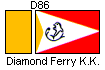
THE DIAMOND FERRY CO. LTD..

D86
image by Jarig Bakker, 19 December 2005

The flag is red with a white triangle extending from the hoist to the fly and a narrow yellow triangle at the hoist. On the white is a black-outlined creature, tentatively described as a dolphin, above what may be black seaweed. Mitchell shows the fish as grey.

Formed in 1970 as K.K. Diamond Ferry, the company amalgamated with Blue Highway Line West Japan on 1 July 2007 and continued as The Diamond Ferry Co. Ltd. Lloyds places it under Mitsui OSK Lines. Earlier vessel names began with Ferry, later replaced by names ending in Diamond.

Japan, Kobe; later Oita.

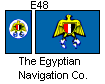
THE EGYPTIAN NAVIGATION COMPANY.

E48
image by Jarig Bakker, 12 December 2005
E49
E491
E492
E493
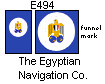
E494
U65

Brown records both funnel forms in use. The flag is blue with a yellow eagle bearing a red-white-black shield; its white claws each hold a hemisphere.

This blue funnel has a black top and white circle bearing a version of the eagle or hawk emblem. The head faces left, forward; rectangular yellow wings carry three narrow blue vertical bands each. Two green stars stand vertically in the shield’s white band. The indistinct feet appear within black rings, and the black top may overlap the shield or vice versa. The form was also noted on General Petroleum’s Bakr in April 1965.

Ebn Al Waleed, also written Ibn Alwaleed, shows a red mark below the shield in older photographs which later disappears. The bird faces forward on both sides, with shield colours in the same order, opposite to the arms, and a white border. Rosanoski relates the design to the golden Hawk of Quarish and Egypt’s vertical tricolour shield adopted with the Federation of Arab Republics in 1972, adding two globes. The hemispheres’ fine detail was initially presumed but is clearer on Alexandria in April 2007.

Photographs show an attached emblem with shadows: the wings appear as two yellow stripes on black, with black outer edging and marks below the shield. Continents are displayed differently. Al Munufiyah has the attached globes painted over in funnel blue; a starboard view points the head aft, while another port view points it forward.

A starboard Ebn Al Waleed photograph shows the head forward, assumed also on the port side. Ras Sedr in April 2006 probably carries this form, but its wings or surrounding area appear light blue.

Al Hussein appears with the bird’s body missing in one photograph and fully painted in April 2009. Ikhnaton’s starboard head points aft. Ras Sedr has E494 with an aft-facing head in January 2010. Most shields are black-white-red, but Taba has red-white-black on a white-bordered shield, confirmed in 2006 and 2013, with the head aft on its starboard side.

The blue shade is uncertain.

ENC began in 1958 as Societe Generale pour la Navigation Maritime, became United Arab Maritime in 1961 and Egyptian Navigation in 1972. Its website instead gives establishment as an association company in 1961. Government-controlled, it was affiliated first to Maritime Transport and later National Navigation, which acquired 90% in 2005. ENC held 40% of MISR Shipping.

Egypt, Alexandria.

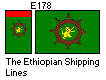
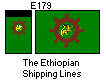
THE ETHIOPIAN SHIPPING LINES.

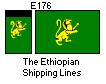
E176
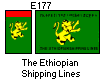
E177
E178
E179

The earlier E177 flag has an upper inscription described as Arabic or similar, above THE ETHIOPIAN SHIPPING LINES. Loughran places E178 later.

The company was formed in 1966. Olie Scheepsvaart managed part of its fleet in the early 1970s.

Ethiopia, Addis Ababa; Rotterdam, Netherlands, is recorded in 1978–79 before the return to Addis Ababa.

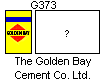
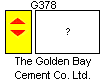
THE GOLDEN BAY CEMENT CO. LTD.

G206
G373
G378
G379

Golden Bay flew a yellow flag with a red diamond interrupted by a band of the field bearing the black inscription GOLDEN BAY at Lyttelton on 20 June 1987. The funnel is also confirmed in a Wellington photograph dated 28 October 1994.

Golden Bay’s February 2007 funnel, also seen at the beginning of its July survey, has no lettering.

The funnel photographed on Golden Bay on 9 March 2008 follows the company’s website logo, though the website version lacks the yellow background and has black lettering.

Earlier livery versions also appear under Tarakohe Shipping.

The business traces origins to Northland ventures of the 1870s. Sources date the Tarakohe works’ operation to 1908 or establishment to 1910, with acquisition by Golden Bay Cement Co. in 1919. Wilson’s New Zealand Portland Cement was acquired in 1982, and the Tarakohe plant closed in 1988 as the business became known as Golden Bay Cement. The companies register separately records incorporation on 21 May 1920, a 1992 change adding The to the name, and striking-off on 15 August 2000. Lloyds gives formation in 1982; these dates refer to differently described stages and are not fully reconciled.

Cement shipping initially passed through Tarakohe Shipping, formed in 1954 as a joint venture with Anchor Shipping & Foundry; vessels operated under Golden Bay’s own name from about 1980. Blue Circle sold 70.4% to Winstone, and Fletcher took full ownership in April 1988 following its Winstone takeover. Rosanoski notes that Lloyds continued to list Blue Circle control until correcting the entry in August 2004.

New Zealand: Wellington, later Auckland.

THE GREAT EASTERN SHIPPING CO. LTD.

G122
image by Rob Raeside, None
G123
image by Rob Raeside, None
G135
image by Ivan Sache, 31 August 2002
G577
G578
G579

AHB refers to promoter and financier Ardeshir Hormusji Bhiwandiwalla. LJC 1966 places the letters on a white diamond, a design also appearing as a funnel panel. Jag Vijay and a black-and-white photograph of Jag Darshan support the funnel. Rosanoski enlarged the drawn diamond slightly to fit the letters. Marinart describes black lettering but leaves the funnel’s base colour and top unspecified; Ocean Ships does not specify the letters’ colour, and LJC gives no top. Mitchell attributes it under Great Eastern Steam Navigation.
Nüsse’s table flag has the AHB letters on a square panel rather than a diamond. The older image appears red; the newer one looks more orange. Rosanoski considers orange, perhaps an air-sea-rescue shade difficult to reproduce photographically, more likely, but leaves the panel version’s place in the sequence unresolved.

Brown 1995 changes red to orange, makes the white diamond smaller and uses blue lettering, but reverses the field division to run from upper hoist to lower fly. Rosanoski says the actual division is per bend sinister and the diamond has no black outline.

The diamond logo appeared on the website from 1998, initially more reddish and distinctly orange by at least 2006. Rosanoski suspects enhancement to clarify the orange, perhaps darker or nearer air-sea-rescue orange in reality. He also thinks the logo’s diamond too small.

Funnel photographs of Jag Lok on 27 December 2006 and Jag Panna on 29 October 2007, and flags on Jag Pradip and Jag Prakash, document the photographic version. In the later discussion, using the spellings Jag Pranna and Jag Pradig, Rosanoski finds flag and funnel colours alike and the actual diamond larger than the logo’s but smaller than the funnel panel’s. He warns that the flag photograph may have been lightened; a close panel photograph appears more orange than distant or poorly lit views.

Documented shared associations — Great Eastern London flag / parent-associated funnel — component-specific panel

G34
image by Rob Raeside, None

The Great Eastern Shipping Co. London Ltd.

Brown gives the London subsidiary an orange-and-green diagonal biband running from lower hoist to upper fly with an overall G. Mitchell also attributes its funnel to Great Eastern Shipping and associates Great Eastern Steam Navigation. Rosanoski allows that the London flag may still exist with the company despite its absence from Lloyds after 2006.

Keep the explicit scope label independent; no alias or company identity is inferred.

Great Eastern, also called GE Shipping and GESCO, was formed on 13 August 1948. Promoters included Ardeshir Hormusji Bhiwandiwalla of A.H. Bhiwandiwalla & Co. and Manekal Ujamshi Mulji, Jagjivan Ujamshi Maulji and Vasant J. Sheth. The source describes the latter as apparently of the Sheth family, involved from incorporation. In 1956 it became, in the company account, the first Indian private-sector owner and operator of oil tankers. Its maritime business comprised bulk carriers, tankers and offshore oil-and-gas services.
The offshore division began in 1982 through GAL Offshore Services, merged into GESCO from April 1995. London operations began in 1975, with a London shipowning subsidiary incorporated in 1985; Singapore followed in 1994 and Jujairah in 1999, retaining that source spelling. The London company disappeared from Lloyds after 2006 and from the later website but apparently still existed in 2013.
Greatship (India) was formed on 26 June 2002, with Greatship Group operations beginning in 2006. Singapore concerns included Greatship Global Offshore Services, formed in 2007, and Greatship Global Offshore Management Services. Ship names commonly began with Jag, which the source translates as World.

India: Bombay, later Mumbai.

THE GREAT LAKES TOWING CO.

G209
image by Ivan Sache, None

The tugs have red cabins, green hulls and squared white G letters on their funnels. Photographic evidence confirms an upright letter, unlike the angled flag version, but leaves a possible white funnel band uncertain. The website and FOTW suggest a longer flag than Rosanoski’s illustrated proportions.

Incorporated in New Jersey on 7 July 1899, the concern was popularly called The Towing Company and maintained its headquarters at Cleveland throughout the century described in its website history. Affiliates included Admiral Towing & Barge, Puerto Rico Towing & Barge and Tugz International.

USA, Cleveland, Ohio.

The Hadley Shipping Co. Ltd.

HSC.

H79
H80
image by Jarig Bakker, None
H764
H765
H766
H767

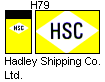
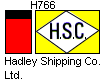
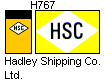
The flag is yellow with a white diamond containing black HSC letters. The National Maritime Museum example is dated about 1951.
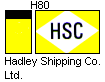
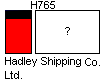
The early publications label this livery tankers. Its funnel was still used on Otterhound in a starboard photograph of 3 May 2012; another photograph shows an unidentified blue swallowtailed flag.
The 1942 source labels this funnel tankers but also supplies an unrelated funnel number under the company. The 1942 and 1944 publications list the livery under both Hadley and Immingham Agency, without naming the latter beside the actual illustration.

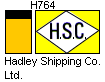
Stewart also gives this livery for Houlder Brothers. The funnel is confirmed on Cymberline in a port-side photograph of 21 February 1981.
Iranian Tanker Co. Ltd.

I306

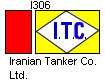
This livery is recorded for Iranian Tanker Co., formed in London in 1929 and listed under Immingham Agency with no ships owned at the time. Ships & The Sea labels it coastal tankers.
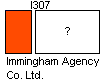
Immingham Agency Co. Ltd.
I307

Mitchell’s Immingham Agency funnel is not supported by vessel names.

A contributor traces a varied early sequence: Cepolis, Corato and Cerinthuus carried red and black funnels, while Bassethound, Jamaica Planter and Daxhound also lacked Hadley’s yellow and black. Cerinthus (II) carried Houlder colours throughout its time charter. Corato (II), delivered in March 1952, appears to have been the first with the proper yellow Hadley funnel and diamond, although the house flag may have been used from the start.

W.J. Harvey’s Hadley history, quoted by Dave Edge, gives Immingham Agency a yellow funnel with black top and a yellow pennant bearing black IAC on a white diamond. Coastal Tankers had a red funnel with black top and a yellow flag with black CT on a white diamond; Iranian Tankers had a plain red funnel and a similar flag with ITC. Esplen Trust had a black funnel with a quartered yellow-and-black band or panel, its form unclear, and a yellow flag with black E on a white diamond. Leadenhall Shipping had either red with a white band and blue top, or a white cross on a red disc within a white square on black.

The source separately assigns C1401 to Coastal Tankers, giving formation in 1927 but also an establishment date of 1926 as steamship owner.

The Hadley Shipping Co., or HSC, was founded on 18 December 1926, with Houlder Brothers holding 5%. Its name came from Walter Warwick’s home at Hadley Wood. It was founded by Immingham Agency, which Lloyds says became Warwick & Esplen in 1965; another account describes Warwick & Esplen as a separate agency created soon after Hadley, naming Mr Lewis [?] Warwick and Graham Esplen as the founders. These accounts do not coincide. Hadley shared Houlder’s London offices until moving to Wapping in 1987.

The business began by buying a tanker from Anglo-Saxon Petroleum and chartering it back. Further tankers were mainly chartered out; coastal tanker operations began in 1934, and a refrigerated banana carrier bought in 1935 was chartered to Jamaica Banana Producers. Two ships were lost in the Second World War. A Liberty ship bought in 1947 was chartered to Houlder Brothers, followed by new tankers in the 1950s. Hadley withdrew from coastal tankers in 1956, returning to dry cargo in 1967 with bulk carriers and short-sea traders. The family-owned concern later had a 9% Denholm interest. Its Foreland Shipping holding was recorded as 25%, subsequently amended to 75%.

United Kingdom, London.

THE HAIN STEAMSHIP CO. LTD.

H212
image by Jarig Bakker, None
H213
image by Jarig Bakker, 17 October 2003
H214
image by Phil Nelson, None
H215
H500

The earlier flag is red with white EH letters. Griffin adds stops after them; Lloyds 1904 outlines them black. Larousse shows sans-serif letters about one-third the flag’s height, while the 1912 Lloyds letters are much bolder. The initials are understood as Edward Hain’s. The WSS history dates this form to 1878–1937, whereas Rosanoski’s Loughran-based account gives its use until 1938.

The E was then dropped, leaving a white H on red. The WSS history dates this version from 1937 to about 1948.

A black panel was added after the Second World War. The WSS history gives this version as about 1948–1965 before replacement by Hain-Nourse’s flag; Loughran ties replacement to the 1964 merger.

Loughran records a swallowtailed version of the later flag for the fleet commodore, without mentioning an equivalent for the earlier designs.

Edward Hain founded the concern in 1878 according to Loughran; another account dates the Cardiff company to 1901 with roots in 1881. It appeared as E. Hain & Co., then E. Hain & Son trading as Hain Steamship Co. P&O took over in 1917, when the head office moved to London. Tramp ships used Cornish Tre names, with B names also recorded. The merger into Hain-Nourse is dated 1964 or 1 October 1965; a further account records incorporation into P&O’s General Cargo Division in 1972.

United Kingdom: St. Ives, with the head office in London from 1917. Cardiff is also recorded, probably as an operating port.

THE HOLMS SAND & GRAVEL CO. LTD.

H718

The company used T.R. Brown & Sons’ funnel. Mitchell notes their connection without explicitly identifying the colours as the operator’s.

The sources give incorporations on 6 March 1924 and 14 March 1985. ARC Marine acquired the company on 18 November 1986. It apparently remained active but dormant and was included in Hanson’s acquisition of ARC Marine. Earlier registers place it under T.R. Brown & Sons as operator.

UK, Bristol; Maidenhead is also given.

THE INDO-CHINA STEAM NAVIGATION CO. LTD.

I20
I21
image by Al Fisher, 31 Jan 1999
image by Ivan Sache, 6 March 2004
I22
I243

I21 was also assigned to Jardine, Matheson and is treated by Rosanoski as the owners’ group livery.

Rosanoski regards I20’s funnel as suspect and I22’s pink-buff shade as doubtful.

The funnel changed in January 1982 to the Jardine Ship Management livery, referenced separately as J27, though the note does not mention a black top.

Formed in 1882 by combining the Jardine group’s river, coastal and cargo interests, Indo-China Steam Navigation was owned by Jardine, Matheson. In 1951 it took over Common Brothers’ interest in Australia China Line, for which it had supplied ships, presumably also operating Jardine’s share. Ocean and coastal ships used sang or shing suffixes and Yangtze vessels wo; Eastern became a common first name after the war. Later register names include Indo-China Steam Navigation (Hong Kong), and the business became Jardine Ship Management in 1985.

Hong Kong.

THE INTERLAKE STEAMSHIP CO.

I71
I72
image by Joe McMillan, 23 October 2001
I221
image by Joe McMillan, 23 October 2001
I222
I223

Know Your Ships originally showed a red funnel band, but Herbert C. Jackson’s photograph confirms orange; the publication corrected it by 1996.

I71 was recorded for Samuel Mather, with a black L within a block O.

A photographed flag confirms an orange-white-black tricolour with the company logo, leading to the FOTW colour modification.

The Mitchell drawing associated with William J de Lancey is regarded as highly unlikely. The comment prints “I122”, while the source list identifies I222; that discrepancy remains explicit.

Rosanoski states that I223’s flag is wrong, without supplying a fuller explanation in this document.

Pickands, Mather organised four vessel companies into Interlake in 1913. It was incorporated on 1 April as successor to Lackawanna Steamship, formed in 1906. The source records purchases of Cleveland Steamship and Youngstown Steamship in 1929, with separate earlier disposal dates for Cleveland. Interlake reincorporated in Delaware in 1931 and merged with Pickands, Mather on 31 August 1966.

Moore McCormack Resources acquired Pickands, Mather in 1973. Following the failure of its shipping activities, Interlake was sold in 1987 to former chairman James Rex Barker and appears as a Mormac Marine Group operating company. The former Ford/Rouge Steel fleet was acquired in 1989 through Lakes Shipping, formed that year.

USA, Cleveland, Ohio.

THE LAMBTON, HETTON & JOICEY COLLIERIES LTD.

L389

The livery appears in Lloyds 1882 for the Lambton Line, spelt Lampton beside the illustration, operated by Thomas J. Reay, the Earl’s coal-trade agent. The Maltese Cross history assigns it to the successive Lambton companies before 1911, in 1911–24 and in 1924–45, describing the red as dark. Lloyds and British Steam Tugs show very narrow funnel bands with much wider gaps; photographs in the Maltese Cross history instead show gaps equal to the bands’ width.

Loughran relates the red bands to the coils of the Lambton Worm and attributes the colours to the Earls of Durham, rather than Joicey. In the legend, an ancestor caught the young worm in the Wear, threw it into a well, and returned from the Crusades to kill the monster it had become. The markings continued under Lambton & Hetton and Tanfield; Merchant Ships notes their earlier use on the Earl’s registered ships.

The Earls of Durham owned collieries and, from 1858, tugs. In 1896 the Earl sold his collieries to Sir James Joicey, who named the business The Lambton Collieries Ltd. and kept it separate from his original concern. Hetton Coal’s operations were added in 1911 as The Lambton & Hetton Collieries Ltd.; Joicey’s original company joined in 1924 to form The Lambton, Hetton & Joicey Collieries Ltd.

France, Fenwick Tyne & Wear acquired the business in November 1945, apparently only its towage operation. The coasting fleet, originally managed by H.T. Morton, had mostly been sold in the early 1920s, with remaining vessels placed under Tanfield Steamship, which built larger ships and was sold to Stephenson Clarke in 1952. Rosanoski questions Tanfield’s ownership before that sale, especially after 1945, and whether its formation relates to the 1924 consolidation.

UK, Newcastle.

THE LOWLAND TANKER CO. LTD.

L102
L103
L104
L162

Border Lass and Border Reiver carried the recorded L162 variant, with a differently shaped BP shield top and a differently placed, undefined white-edged flag shield. A Common Bros. management pennant flew above the house flag. Brown 1978 gives black edges to the band on the red funnel and white funnel letters, which Rosanoski calls incorrect.

The blue flag has a white saltire surmounted by a white, red-edged shield bearing a green thistle with a reddish top. Funnel variants retain the King’s Own Scottish Borderers tartan: a red-and-green chequered band between white-and-red chequered bands. The first funnel is black without a BP shield; a later black version adds a yellow-edged green shield with yellow BP; a third is red with a black top and the same band and shield. The tartan apparently came from Border Regiment, one of the original ships, and the fleet used Border names.

Rosanoski assumes the original shieldless funnel was black and places the addition of the BP device from 1955, when it originated. The source itself calls the addition “latterly”.

Common Bros. managed Lowland’s fleet in the 1963–64 and 1970–71 registers, followed by BP Tanker in 1978–79. BP also held an interest, but the source’s percentage is transcribed as 505 and is not silently interpreted.

UK, Newcastle.

THE MEXICO SHIPPING & TRADING CO. INC.

M71
image by Joe McMillan, 31 October 2001

McMillan’s FOTW flag follows Wedge 1951, with the funnel and flag also recorded in Brown 1951.

USA, New York.

THE NATIONAL SHIPPING COMPANY OF SAUDI ARABIA.

N87

The funnel is white with a black top and two widely separated, very narrow green bands. Between them is the yellow national-arms badge of a palm tree above two crossed swords. The website photograph confirms a minimal black top. The flag is green with the funnel design as a panel.

NSCSA is dated by Lloyds to 1981 as Saudi National Shipping Co., with Government ownership of 25%. The cited company website instead gives October 1999 and Government ownership of 29%, the balance being privately held. That same account says its wholly owned NSCSA Asia subsidiary was established in Hong Kong in 1993 and opened a Singapore subsidiary office in 1997. These dates and percentages are retained as conflicting source statements.

Its fleet was held directly and through subsidiaries, with much of it under outside management. Maritime interests included National Chemical Carriers, formed in 1990; Arabian Chemical Carriers, formed jointly with United Arab Shipping in 1984; and Mideast Ship Management, jointly formed with V. Ships (UK) in 1996 at Dubai. A 30.3% interest in Petredec was acquired in 2005.

Saudi Arabia, Riyadh.

The National Shipping Corporation.

NATIONAL SHIPPING CORPORATION (THE).

N679

Mitchell indicates that the Aden Coasters vessels used a different funnel.

Lloyds lists the organisation as National Shipping Co. in 1978–79 and The National Shipping Corporation in 1980–81. Vessels also appear under Aden Coasters and, in the latter edition, The Yemen Ports & Shipping Organisation.

Yemen, Aden.

THE OSM GROUP.

O187

The flag and logo come from the company website. The logo’s blue has been assumed for the flag, although the flag looks darker.

Group

Bjørn Tore Larsen formed the ship-management group in 1989 with Jan Morten Eskilt, Jan Ove Dalsøren and Erling Bjørn Wik. It acquired CH Sørensen Management in 2000, Sea Partner International in 2001 and shuttle-tanker and offshore-rig operator Rasmussen Maritime Services in 2003. Recorded shareholders included C.H. Sörensen & Sönner with 26% and P.D. Gram’s owners with 20%. OSM Schiffahrt was formed jointly with Nordcapital in January 2007 and was listed under ER Schiffahrts from April 2008.

Norway, Arendal.

Keep the explicit scope label independent; no alias or company identity is inferred.

OSM Maritime Services

Orient Ship Management was renamed OSM Maritime Services in 2001. V. Ships (UK) managed part of its fleet.

China, Hong Kong.

Keep the explicit scope label independent; no alias or company identity is inferred.

OSM Sea Partner

Sea Partner International was formed and renamed OSM Sea Partner in 2001. Its listed fleet included Svenska Orient Linien vessels.

Sweden, Gothenburg.

Keep the explicit scope label independent; no alias or company identity is inferred.

OSM Ship Management

OSM Ship Management was formed on 27 October 2003 by renaming Rasmussen Maritime Services and amalgamating it with C.H. Sorenesen Management. Polyar Tankers managed part of the fleet.

Norway, Kristiansand S.

Keep the explicit scope label independent; no alias or company identity is inferred.

The Pasha Group.

THE PASHA GROUP.

P679

The drawing follows a portside photograph of Jean Anne dated 5 February 2014. Although the photographer describes the funnel as obstructed, Rosanoski sees one lower star point extending onto the buff, possibly khaki, deckhouse, while a second is cut off as though passing behind it. A starboard photograph is dated 30 April 2010.

George W. Pasha Jr. founded the family-owned logistics and transportation business, serving customers since 1947. Maritime Services International was formed in 1972 for vehicle stevedoring and terminal services, later becoming Pasha Maritime Services and, in 1987, Pasha Stevedoring & Terminals. Pasha Hawaii Transport Lines was formed in 1999, or 2000 according to Lloyd’s, to operate a roll-on/roll-off ship between San Diego and Hawaii. Lloyd’s 2005 account identifies it as a joint venture with Strong Vessel Operators, formerly Van Ommeren Shipping (USA), previously shown as the manager.

USA, Corte Madera CA.

THE PORT JACKSON & MANLY STEAM SHIP CO. LTD.

P116
P424

The 1907 name change replaced C with M and added a second S in the third quarter, treating Steam Ship as two words.

By 1923 the extra S had been removed, treating Steamship as one word. This version is photographed at South Steyne’s bow. Loughran records replacement of the funnel from 1974 following the merger.

The 1877 flag had a dark saltire on a light field, with colours unknown. By the 1890s a red flag with white cross and white PJSCo letters in the quarters was used, referenced as P117. Its cross appears smaller than P116’s and no stop appears below the o. In 1896 a red C was placed on the white cross, the source-only P423.

The business began on 23 January 1877 as Port Jackson Steam Boat Co., described as Sydney’s first limited-liability company. It was reincorporated as Port Jackson Steamship Co. in 1881, became Port Jackson Co-operative Steamship Co. in 1896 after absorbing Manly Co-operative Steam Ferry, and was reincorporated under the Port Jackson & Manly name in 1907. Government records use Steamship as one word, unlike the two-word form in Lloyd’s; a further registration is dated 28 June 1920.

The source records transfer of vessels and plant to Sydney Harbour Ferries in 1951, with Port Jackson continuing to operate them. Brambles acquired the company in 1972. Its withdrawal from ferries led to Government management effective 1 July 1974 in one account, while The Log dates the New South Wales takeover to 1975.

Australia, Sydney.

THE PURE OIL CO.

P308
image by Joe McMillan, 14 November 2001
P309
image by Joe McMillan, 14 November 2001

The emblem’s ring is serrated inside and out. Around the inner white centre, small blue lettering reads THE PURE OIL above and COMPANY U.S.A. below, both upright. The MN illustration omits this small lettering.

The separately referenced P310 funnel was at one time an alternative for Great Lakes vessels.

The Pure Oil name originated in 1895, with the company itself dating to 1917. Established in Pennsylvania before moving its headquarters to Chicago, it marketed mainly in the Midwest, so tanker operations centred on the Great Lakes and Midwestern rivers. Pure Transportation was formed by 1935 to manage shipping. Pure Oil amalgamated with Union Oil of California in 1965, but David D Irwin continued to appear under it in later registers. The 1960s entries show operations mainly through Delnor Corporation.

USA: New York, later Chicago and Palatine, Illinois, in successive sources.

THE QUEENSLAND CEMENT & LIME CO. LTD.

Q4
image by Jarig Bakker, 18 December 2005
Q5
Q6
Q7
Q8

Kaione used Q6 in 1945–60 and Morib Q7 in 1953–67, apparently without flags. Seagoing vessels used Q5.

The device within the Q is a map of Queensland. Rosanoski’s account of The Log gives a green map and no lettering on the flag. A photograph of the first Cementco suggests coastal vessels may also have flown it. The second, seagoing Cementco had a narrow funnel top; much of the remaining fleet consisted of hoppers or barges without funnels.

The second Cementco was initially reported with letters between two black rings, without mention of the Queensland map. A photograph taken after the fitting of cargo cranes in 1990 shows Q5.

Brown 1995 gives QCL above Queensland, with a rough map inside the upper Q, all red-brown. Rosanoski questions the simplified colours and differing flag because The Log records no change, while allowing that they could relate to the 1988 renaming.

Coral appears to have a plain funnel, but the photograph’s angle makes this uncertain.

QCL was formed on 2 June 1914 and began shipowning in October 1932, the date Lloyds gives as formation. It became Queensland Cement Ltd. on 8 February 1988, although a separate delisting account uses that name in April 1987, and later Queensland Cement Pty. Ltd. In its later shipping years the vessel operated through subsidiary Cementco Shipping. The company merged into Cement Australia in 2003, while later register evidence continued to show the legal company.

Holderbank Financiere Glaris and Queensland’s State Government Insurance Office became major shareholders in 1979. Adelaide Steamship announced a 10% holding in July 1986.

Australia, Darra, Brisbane; later Brisbane.

THE SARAWAK STEAMSHIP CO. BERHAD.

S831
image by Jarig Bakker, 24 January 2002
S832

The yellow band’s width and exact position vary between sources. Lloyds 1904 and 1912 attribute the flag to Sarawak & Singapore Steam-Ship Company. The later website logo suggests a possible change, but a photograph of Auby flying the flag confirms use of S831 at that time.

The company was formed in 1897 and appears in the older registers as Sarawak Steamship Co. Ltd. By the 2005 website account it had diversified into travel and tours, advertising, gallery and air-cargo services.

It is described as a Straits Steamship subsidiary by the late 1930s and again in 1965. Rosanoski considers it apparently part of the Keppel Group’s 1983 takeover of Straits Steamship, although the company website supplies no such association.

Malaysia, Sarawak, Kuching.

THE SCOTTISH TANKER CO. LTD.

S292
image by Jarig Bakker, 27 August 2004
S858

The National Maritime Museum flag is dated 1955–1967 and measures 1168.4 by 1828.8 mm. Ocean Ships describes the light-blue funnel band as narrower than the two red bands. It also attributes the funnel to Hector Whaling’s tankers, while its cargo vessels used Clan Line’s funnel.

Scottish Tanker’s vessels appear under Huntley, Cook and later Cayzer, Irvine or Cayzer Irvine Shipping. The register evidence overlaps with Thompson Steamshipping: Scottish Lion and Scottish Eagle were separately attributed in 1953–54, while four Scottish-named tankers appeared under Thompson in 1958–59 and Scottish Tanker was omitted. Scottish Hawk and Scottish Ptarmigan reappear under Scottish Tanker in 1963–64. The source does not establish a fuller corporate explanation.

Ship names originally began with Scottish and later with King.

U.K., London; Mitchell gives Glasgow.

The Shipping Corporation of New Zealand Ltd.

The state-owned Shipping Corporation of New Zealand, known as SCNZ or SCONZ, was established in 1973, following a Labour election commitment in 1972, to operate New Zealand Line and a coastal service. Coastal Ranger replaced the withdrawn Union vessel Wanaka on the Auckland–Lyttelton–Dunedin run. New Zealand Line originated in 1974 and became the corporation’s trading name on 1 September 1985. The company-register account gives registration on 7 February 1974.

Former shore employee Diana Mexsom describes New Zealand Line as formed and managed by SCNZ. Shaw Savill initially acted as agent, but withdrew its New Zealand branches; on 1 December 1974 SCNZ took over the staff and became Shaw Savill’s agent. She stresses that the corporation had no connection with New Zealand Shipping Co.

The corporation announced purchase of Bank & Savill Line in March 1984, using Eckington for Weka and Fuday for Tui. Australia–New Zealand Container Line, formed in March 1984, merged with Transatlantic’s Australia/New Zealand/West Coast North America service as Australia–New Zealand Direct Line, effective 1 January 1988; SCNZ sold its half-share to Sofrana in April. The Tranztaz venture with Australian National Line ended on 28 February 1989, ANL retaining the name.

The unprofitable corporation was privatised in 1989. Its UK subsidiary and sole vessel New Zealand Caribbean were sold that January, and sale to ACT (New Zealand) was announced in March. Associated Container Transportation (Australia) assumed operations and marketing on 1 January 1990.

UK, London; later New Zealand, Wellington.

THE SHIPPING CORPORATION OF SAUDI ARABIA LTD.

S141
S784

The emblem is a red outline ship’s wheel enclosing a vertical blue foul anchor, with a blue star on either side.

The agent’s website shows a different funnel.

Also called Arab Line, the company is dated to 1966 by its agent’s website and to 1974 by Lloyds.

Saudi Arabia, Jeddah.

THE SIAM STEAM NAVIGATION CO.

S646

The funnel was described as cream. The livery was a variation of that of A/S Det Östasiatiske Kompagni.

Also called Thai Steam Navigation, the company was owned and managed by A/S Det Östasiatiske Kompagni, which sold a majority of its shares to the Thai government in 1941. It appears to have become Thai Navigiation Co. Ltd.: Rosanoski traced one vessel between the two in the 1953–54 register.

Denmark; Thailand [Siam], Bangkok.

THE SOUTH AMERICAN SAINT LINE LTD.

S537
S538
S539
S726
image by Jarig Bakker, 17 October 2003; 27 August 2004

Brown 1951 leaves the funnel colour unclear, possibly dark yellow or buff.

Merchant Ships 1959 shows a defined funnel panel.

The emblem is described as the upper half of a gold five-pointed star above an orange six-wavy-pointed star, with a gold lower wheel-like outline. Rosanoski questions the US Navy use of orange rather than red.

The flag is white with a red saltire and a central white shield edged red. Some sources stop the saltire short of the edges, others extend it throughout. The emblem has been described as a yellow flower or a rising sun over a Tudor rose. Rosanoski’s clearer black-and-white Talbot-Booth scan appears to show a gold upper star, red wavy star and shield frame, a touch of red at the base, and a gold lower frame; a Tudor rose would fit the Welsh context but is not established. The National Maritime Museum flag measures 1320.8 by 685.8.

Photographs of St. Arvans and St. Helena suggest a couped funnel saltire. St. Essylt and St. Thomas instead appear to have tapering, unequal arms, with the crossing displaced forward on both sides; all panels lie near the funnel top. St. Merriel later used the Houlder funnel.

The company is recorded as a May 1939 renaming of Barry Shipping, although another source says Barry became B. & S. Shipping, a version Rosanoski doubts. Ships were disposed of and operations ceased in July 1966, with sale to Houlder Bros. Later registers refer the company to Houlder, suggesting absorption.

Operators included B. & S. Shipping and later South American Saint Line (Management) with King Line. Subsidiaries included B. & S., Shakespeare and St. Quentin Shipping. Vessels were named after saints.

UK, Cardiff.

THE UNION CASTLE MAIL STEAM SHIP CO. LTD.

U10
image by Jorge Candeias, 1 April 1999
U11
U12

The house flag combined the founding companies’ designs. The Union Steamship flag was white with a blue border and a red saltire; the Castle flag was blue with a white saltire and white diamond bearing a red “C”. In the combined design, the red saltire replaced the “C”, while the Castle blue field absorbed the Union border. Sources differ over whether the Union saltire extended throughout the white or was couped, and whether the Castle diamond was separately defined or merged with the white; Rosanoski considered the latter more likely. One passage calls the Union contributor “Union Collier Co.”, whereas the later explanation names Union Steamship Co. U11’s funnel is unsupported by other sources and is therefore suspect.

The funnel followed Castle Line colours. The Great Liners Part 2 sometimes appears to show buff with a black top, which Rosanoski attributes to lighting and the video recording. It confirms a dark blue flag field, a large white diamond and a small lion on the British & Commonwealth group flag; sources vary in diamond size. The funnel red appears fairly light, consistent with a photograph of Windsor Castle. A black-and-white photograph of Llandovery Castle seems to reverse the funnel tones, showing a lighter top and darker base. Saxon, scrapped in 1935, was described as the last old Union vessel, whose funnels had been yellow; Rosanoski doubted that she retained that colour.

U12 is the fleet commodore’s swallowtailed flag. Two accounts by Loughran differ: one shows the tail extending across the fly, the other a V-shaped cut confined to the blue fly portion, leaving the saltire ends undisturbed. The precise design remains uncertain.

The FOTW flag illustration is credited to Jorge Candeias, 1 April 1999.

The film shows the British & Commonwealth group flag in use from at least Pendennis Castle’s time in 1958. Rosanoski saw two flags on Transvaal Castle and considered the second possibly the group or commodore’s flag. Former deck officer George Watt replied that each constituent company retained its house flag and always flew it below the group flag on the mainmast. He disputed Transvaal Castle’s supposed flagship status: Pendennis Castle was flagship, and although Windsor Castle was built for that role in 1960, the commodore preferred Pendennis, which retained it well into the 1960s. Watt also recalled Transvaal Castle’s transfer to Safmarine as S.A.Vaal after two or three years, remaining on the mail service to its end.

The Union Castle Line resulted from the merger of Union Steamship Co. and Castle Mail Packet Co. Ltd., the Castle Line of Donald Currie & Co., registered on 8 March 1900. Their joint South African mail contract, dating from 1876, had prohibited amalgamation. When the late-1899 tender proposed awarding the contract to one company, neither bid, since their fleets had been built for complementary sailings. A joint contract was eventually awarded, but Donald Currie proposed the merger. The combined fleet adopted the Castle Line’s lavender-grey hulls and vermilion funnels.

Royal Mail took control in April 1912, with Sir Owen Philipps, later Lord Kylsant, on the board. Bullard King & Co.’s Natal Direct Line was acquired in 1919. The Royal Mail collapse left Union-Castle with heavy financial commitments: the Ships List account dates the collapse to 1931, while the other account describes Royal Mail in liquidation and Kylsant’s resignation by 1934. Government involvement helped separate Union-Castle from its parent and supported a five-year rebuilding programme. King Line was acquired in 1949.

The proposed merger with the Cayzer family’s Clan Line was announced on 4 October 1955, and the history describes British & Commonwealth as formed early in 1956, consolidating Union-Castle, Clan Line and Bullard King. Management, routes and colours remained unchanged, while internal competition was removed and cargoes interchanged. Other passages instead date the group relationship to 1953 or 1953–1954; these dates are not reconciled. Cayzer, Irvine & Co. Ltd. appear as managers in the 1966–1974 listings.

Pacific Steam Navigation Co.’s Reina del Mar received Union-Castle colours in 1964 and was managed by the company until purchase in 1973. A joint mail service with South African Marine Service began in 1966. Air competition, containerisation and rising fuel costs brought the traditional service to an end; Southampton Castle rang “finished with engines” on 24 October 1977. Fleet names ended in “Castle”, referring to British and South African castles.

The name was briefly revived for P&O’s millennium “Round Africa” cruise. Victoria, the former Kungsholm, sailed from Southampton on 11 December 1999 with her funnel painted Union-Castle vermilion, celebrated New Year at Cape Town and returned in February 2000.

U.K., London and Southampton.

THE UNION SULPHUR & OIL CORPORATION INC.

U74
image by Joe McMillan, 29 November 2001

Brown renders the emblem entirely red. Talbot-Booth’s 1937 and 1938 versions give the funnel a darker yellow than the flag. Joe McMillan’s FOTW flag illustration of 29 November 2001 follows Talbot-Booth 1937.

Formed in New Jersey in 1896, Union Sulphur operated along the US east coast, principally mining sulphur deposits on the Louisiana and Texas coasts. It later extracted sulphur from sour crude, selling both sulphur and oil, and operated its own ships by 1920. It became Union Sulphur and Oil in 1950, Union Oil and Gas in 1955 and Union Texas Natural Gas in 1960, before merging with Allied Chemical Company in 1962.

USA, New York.

THE WANGANUI SHIPPING CO. LTD.

W36
W413

W36’s flag is blue with a red diamond bearing a white W, documented in The Log, May 1991.

W413’s funnel and flag come from Marine News, July 1970; no separate written design comparison is supplied.

The company operated the single vessel River City from 1952 according to The Log, or 1951 according to the Compendium and Marine News, until voluntary liquidation in 1964.

New Zealand, Wanganui; Wellington is also given.

THE WESTERN UNION TELEGRAPH CO.

W80
W262
image by Joe McMillan, 2 December 2001
W263

W80’s funnel and flag are documented by Brown and Stewart, with Talbot-Booth’s attribution to British Western Union.

Joe McMillan’s W262 flag is credited by FOTW, but its underlying source was unavailable.

W263’s flag comes from Cableships & Submarine Cables. Its funnel is not shown there and is assumed to apply.

Western Union Telegraph

The predecessor was formed in 1851 as New York and Mississippi Valley Printing Telegraph Company of Rochester, adopting Western Union Telegraph in 1856. Rosanoski names Ezra Cornell in its formation. A merger into Western Union Corporation on 30 December 1987 avoided bankruptcy.

Western Union acquired a majority of International Ocean Telegraph in 1873 and the remainder in 1957. It acquired Mexican Telegraph in 1927, retaining it until nationalisation. Postal Telegraph was absorbed in 1945 on condition that international operations be divested, achieved in 1963 through Western Union International. The principal vessel is listed under British Western Union, with Western Union recorded as the last vessel for 1939–1974.

U.K., London, and USA, New York.

Keep the explicit scope label independent; no alias or company identity is inferred.

British Western Union

British Western Union appears in the wartime books and later registers, its sole vessel being sold in 1966. Rosanoski leaves open whether this company is the same as Western Union Telegraph.

U.K., London.

Keep the explicit scope label independent; no alias or company identity is inferred.

A black-and-white photograph of Robert C. Clowry appears to show a plain funnel with an emblem.

THE WHOLESALE SOCIETY OF BETIO, TARAWA, GILBERT & ELLICE ISLANDS.

W323

W323’s funnel comes from The Log. A small, indistinct photograph of Moana Roa in 1966 does not show a black band, but Rosanoski does not treat that absence as conclusive.

The registers use The Wholesale Society in 1963–1964 and the fuller Betio, Tarawa, Gilbert & Ellice Islands name by 1970–1971, continuing in 1973–1974.

Gilbert & Ellice Islands, Tarawa.

The “Star” Ferry Co. Ltd.

THE "STAR" FERRY CO. LTD.

S152
image by Jarig Bakker, 25 January 2006
S1619

Rosanoski questions the recorded recolouring of the FOTW image. Comparing the website logo, he considers its blue probably too dark and the white bands apparently wavy rather than straight.

Night Star’s January 2009 funnel has a white band between black reinforcing bands; the lower one forms narrow black edging above a pale-cream base. The star appears three-dimensional in black and grey.

Dorabjee Naorojee Mithaiwala began the Kowloon Ferry service across Victoria Harbour in 1880. Sir Catchick Paul Chater subsequently bought the fleet, and Star Ferry became a public company in May 1898. Its name derives from the ferries’ Star names.

China, Kowloon, Hong Kong.

Thenamaris (Ships Management) Inc.

Grandseas Shipping Ltd.

G390

Mitchell assigns this funnel to Ocean Joy of Grandseas Shipping, a managed company recorded in 1985–1986.

The early T509 livery combined Greek blue and white with the founder’s M; the funnel and flag blues are shown in different shades. Mitchell also gives a black-funnel version, not separately drawn by Rosanoski because no line drawing supports it, although Loughran mentions black with a white band. As control passed to the sons, the initial disappeared from the funnel and a modern flag replaced it. The M became two light-blue triangles above dark-blue reflections, separated by white waves. Whether the funnel and flag changes coincided is unknown; the suggestion that the triangles symbolise the two remaining brothers is tentative, and Rosanoski remarks that the narrower shape scarcely qualifies as a triangle.

T46 is described as blue with a broad white band, whose width varies in photographs but is not as deep as T510. Seapromise and Mitchell show a narrow black top; most examples, including Seaboxer II, lack it. Nüsse supplies table-flag evidence.

Founded by J.A. Martinos in 1970 as Thenamaris Corporation, the concern became Thenamaris Maritime in 1972 and Thenamaris (Ships Management) in 1982. It began with two Greek-flag vessels registered to Panamanian companies. After Martinos retired, his sons Athanasios, Andreas and Constantinos succeeded him. Athanasios left in 1990 to form Eastern Mediterranean Maritime, and Andreas in 1996 to form Minerva Marine.

Greece: Piraeus, later Athens.

THEODOR A. RENDTORFF.

R370

Mitchell places the funnel in his German section without a home port. Rosanoski regards that placement as a guess; the source’s Country remains Danish.

Rendtorff operated Beth, listed in 1963–64 as a 1908 vessel of 225 tons. Mitchell gives a 1957 vessel of 300 tons, matching the later Lloyds entries. Rosanoski did not locate either in Miramar.

Denmark, Svendborg; later Vindeby.

THOMAS COWAN.

C632

Dundee, Perth & London Shipping Co. Ltd. took over Thomas Cowan in the 1920s.

U.K., Leith.

THOMAS DIXON & SONS LTD.

D471
D472
D473
D474

Griffin 1895 gives this flag for sailing vessels.

Rosanoski considers this version suspect.

Thomas Dixon began as timber merchant and ironmonger, joined by sons Thomas S. and Daniel, the latter in 1864. Shipowning began with the Lord Line in 1879, initially a steamship but then sailing vessels as well. By 1896 ships were held both in Dixon’s own name and through Irish Shipowners Co. The latter entered voluntary liquidation in 1917, with its last two ships and goodwill bought by G. Heyn & Sons in 1918. Rosanoski suggests Dixon continued separately; Allanton, owned directly since 1911, was sunk on 3 January 1918. The common Belfast address also indicates a connection with John E. Wellwood.

UK, Belfast.

THOMAS DUNLOP & SONS.

D271
image by Jarig Bakker, 13 December 2004
D272

Sources differ in the size of the diamond frame; Stewart’s version is close to D272.

Thomas Dunlop founded the business in 1851 and entered shipowning in the early 1870s. Its early Clan-prefixed names changed to Queen after Clan Line adopted the former system in 1878. Operating interests included Cadogan Steamship, Lomand Shipping, formed in 1937, and Queen Line. Shipowning ended in 1957, with winding-up dated 1956–57.

U.K., Glasgow.

THOMAS HAMLING & CO. LTD.

H191
image contributed by David Warwick, 18 September 2001

The flag is blue with a white horizontal band.

Thomas Hamling appears in Lloyds’ shipowner listings from 1963–64 through 1985–86.

United Kingdom, Hull.

THOMAS J. METCALF.

M176
M177

The funnel is supported by a monochrome Christopher M photograph.

M177 is an alternative funnel; its flag is not separately shown and is assumed to continue.

Metcalf managed for C. Crawley, Mac Shipping, Metcalf Motor Coasters and Wimaisia Shipping. Vessel names usually combined a personal name with M, leading Rosanoski to regard the latter three as subsidiaries. S. William Coe appears as manager in 1973–74. An earlier register account describes amalgamation through Metcalf Motor Coasters into James Fisher; a later account amends this to Coe Metcalf Shipping in 1978.

UK, London and later Gravesend.

THOMAS L. WEISS.

W208

W208’s funnel and flag are documented by Lloyd’s 1912.

Weiss is recorded as manager for Ångfartygs A/B Swanbridge of Strömstad, Sweden.

U.K., Newcastle.

THOMAS LAW & CO.

L120

The funnel is red with a black top separated by a white-black-white triband. The flag is diagonally quartered blue and red with an overall white saltire.

Also known as The Law Shipping Co., Thomas Law entered steam in 1907 and sold its last ship in 1934.

UK, Glasgow.

THOMAS OWEN & CO.

O184
image by Joe McMillan, 9 September 2001

Thomas Owen & Co. is placed in the mid-nineteenth century.

USA, New York.

THOMAS ROSE & CO.

R142

The black funnel has a broad band carrying the flag design. The flag is white with a blue saltire.

Thomas Rose managed Deeside Shipping Co. and The Rose Line. Rosanoski suggests an origin in Wear S.S. Co., also of Sunderland, because it used the same livery.

U.K., Sunderland.

THOMAS W. BASCOMB.

B803

Olsen’s Fisherman’s Almanac 1911 shows a long pennant. In the surviving monochrome copy, the funnel emblem looks more birdlike than Lloyds’ version, on which the illustration is based.

Thomas W. Bascomb is recorded in Lloyds 1917–1918. The fleet was sold on 22 October 1935 to Fred Parkes [Sir Basil A. Parkes] of Blackpool.

UK, Grimsby.

THOMAS WARDLE.

W253
image by Joe McMillan, 1 December 2001
W254

W253 is illustrated by Joe McMillan from Private Signals of the Merchants of New York, with Mystic Seaport and The Clipper Ships also cited.

W254 is the alternative flag from the cited Mystic Seaport item. No separate written design comparison is provided.

The line is described as Thomas Wardle & Co. by FOTW, but the Private Signals chart and Mystic Seaport use Thomas Wardle. Mystic records an East Indies and California service in 1840 and alternative flags.

USA, New York.

THOMAS WATSON (SHIPPING) LTD.

W118
W119
image by Phil Nelson, 9 April 2000

Coastal Ships 1967 and ABC Coastal Cargo Ships 1973 call W118’s funnel blue light; Mitchell uses a darkish blue.

W119’s funnel and flag come from Stewart 1963. Phil Nelson’s FOTW flag image follows that source.

The company changed its name from D.J. & S.A.J. Bradley in 1953, with D.J. Bradley subsequently recorded as operator. Later ships were held through named companies, while Watson appeared as agent. Ship names continued to begin Lady, initially with a second name starting S; other second names appear by Lloyd’s 1980–1981.

U.K., Rochester.

THOS. & JAS. HARRISON LTD.

C1400
image by Jarig Bakker, 8 August 2004
H16
H17
H18
image contributed by Neale Rosanoski, None
H751
image by Jarig Bakker, None
H752
image by Al Fisher, 9 February 1999
H753
H754
H755
H756
H757

The Ships List dates H757’s funnel to 1860–65, followed by H753.

LJC 1909 records this form for T & J Harrison.

The house flag is white with a large red cross formy, but sources vary greatly in cross breadth and in straight or curved sides. Rosanoski treats the actual National Maritime Museum flag, recorded as Charente and dated 1955–67, as the strongest guide: its cross has straight sides. H756 and H16 represent published variations rather than proven stages in a sequence. Larousse’s cross almost fills the field. The C1400 funnel follows an Inanda photograph with bands in proportions 5:4:5. Other funnel illustrations also vary in band widths.

The square flag illustration leaves more white than Larousse’s version. Rosanoski traced its old reference to a flag logo used with freight schedules, rather than an actual flag.

This funnel is given as an alternative.

The commodore’s flag is a red swallowtail with four white cones in saltire at the hoist. Depictions again differ: the Scott/Caltex version and its Marine News reproduction have straight sides, while Loughran’s version has curved sides, without the same narrow points where the arms meet. Rosanoski could not establish whether these differences represented changes or simply differing illustrations.

The brothers Thomas and James Harrison became partners in the Brown shipping business, which took the Thomas & James Harrison name after George Brown’s death in 1853. Other sources give 1830, when Thomas was apprenticed, or 1860, associated with specially built steamships, rather than the partnership’s actual formation. The first iron ship, Philosopher, had been acquired in 1857. The business continued through the next Harrison generation and the Hughes family. It was commonly called Harrison Line, with Harrison-Star also recorded; the date of incorporation as a limited company is unclear.

Star Line was bought in 1889, its vessels retaining their names. Aberdeen Direct Line followed in 1911, apparently operating as Harrison-Rennie until the First World War ended. Crown Line and Scrutton fleets were bought in 1920, and Harrison financed the Blairdale purchase in 1986. Charente Steam-Ship Co. owned the fleet under Harrison management; its formation is dated 1884 or 1871, the name recalling the port from which brandy was imported. Harrison joined the ACT consortium in 1966 and formed Bibby-Harrison Management Services in 1997, with a full takeover recorded in 2003. Liner-trade rights passed to P&O Nedlloyd in October 2000. Cargo vessels generally bore names of professions or occupations; passenger ships retained Zulu In names recalling the Rennie connection.

United Kingdom, Liverpool.

THOS. & JNO. BROCKLEBANK LTD.

B119
B120

An 1819 Perseverance painting confirms B120. It was replaced by B119 in 1820. The flag was always flown at the foremast, possibly because early privateers reserved the mainmast for a letters-of-marque pennant.

The later flag is divided vertically white at the hoist and blue at the fly. The funnel-band blue stands out from black in monochrome photographs, while a February 1977 Lyttelton observation describes the flag as dark blue. References also attribute the livery to Anchor-Brocklebank and Brocklebank & Well Lines. The museum flag, dated about 1951, measures 1828.8 × 2514.6 mm.

Daniel Brocklebank founded a shipyard at Sheepscutt, Mass., in 1770 and moved to Britain in 1775. His sons Thomas and John succeeded him on his death in 1800, with Thos. & Jno. Brocklebank dated to 1801. The company was also known as Brocklebank Line. It entered the pooled Cunard-Brocklebank fleet in 1968 and disappeared after the last two Brocklebank-liveried ships were sold in 1983.

Edward Bates & Sons bought 50% in 1911 and sold to Cunard in 1919, but accounts variously date the Cunard relationship to 1911, an indirect interest in 1912, the 1919 buyout or acquisition in 1940. Well Line’s purchase is dated 1915, 1916 or 1919. Anchor-Brocklebank was a joint venture formed in 1911 or 1912. Brocklebank invested in Shire Line in 1906 and sold its remaining holding to Royal Mail in 1911.

The company operated Anchor-Brocklebank and Brocklebank & Well Lines and managed Holt Maritime Enterprises and Guinea Gulf, the latter from 1962. Gosman & Smith acted as agent until ceasing business in December 1967. Fleet names were mainly Indian names beginning with “M”.

U.K., Whitehaven; Liverpool from 1820.

THOS. B. ROYDEN & CO. LTD.

R141
R382
image by Ivan Sache, 28 February 2004
R383
R384

Thomas Royden and the timber merchant Bland began building small sailing ships at Liverpool in 1800, on the later Brunswick Dock site. Iron construction began in 1864. The business became Thos. B. Royden & Son under Thomas Bland Royden; the Bland family no longer had a commercial involvement.

The first steamers built for the company’s own account, Indra and Indrani, entered the India trade in 1888 under McVicar, Marshall & Co., advertised as the Indra Line. Tyser chartered Indra for New Zealand in 1891, while James P. Corry coordinated her with the Star Line schedule. The developing relationship led to Commonwealth & Dominion Line in 1914. Royden sold its yard to the Mersey Docks & Harbour Board in 1893 and left shipbuilding.

Indra Line Ltd. was incorporated in 1901 with Thomas Bland Royden as manager. The managed Santa Clara Steam Ship Co. provided a West Indies–New York feeder service. In 1915 the remaining New York service was sold to Alfred Holt’s Blue Funnel Line and Indra Line was wound up, leaving Santa Clara as Royden’s only independent shipping interest. Thomas Royden also became a Cunard director and later chairman. Shipowning ended in 1930 with Pinar del Rio’s sale to Bristol City Line.

U.K., Liverpool.

THOS. WILSON, SONS & CO. LTD.

W204
W205
W206
W281
W409
W444
image by António Martins-Tuválkin, 19 May 2010
W480

The earlier flag appears as a white pennant with a red disc; Reed 1891 makes W204 long and narrow. Loughran contrasts a triangular form with the later tapered swallowtail.

Rosanoski considers Griffin 1883’s W409 probably erroneous, with W205 in Griffin 1891 apparently correcting it.

Reed 1901’s W281 has a small circle. Comparison with the National Maritime Museum flag leads Rosanoski to question whether the tapered versions are correct.

The burgee appears by the turn of the century. Lloyd’s 1904 shows a long swallowtail, while 1912 has only a tiny split; a proposed progression between these forms remains tentative. The line retained its livery in 1973 with the Ellerman pennant above, unlike other Ellerman constituent companies. The source correspondence suggests the superior pennant was not flown immediately at takeover.

The postcard shows two approximately 1:3 pennants on one line, their hoist tips touching: plain dark blue above and white with a red disc below. Rosanoski considers the blue pennant probably intended as Ellerman’s with omitted lettering and tentatively dates it around the 1916 takeover. The FOTW credit calls this E444 and the discussion also cross-refers to E417; the verified W444 association remains unchanged.

The origins are variously dated. One account begins Beckington, Wilson & Company in 1822, importing Swedish iron ore, followed by Wilson, Hudson in 1831 and Thos. Wilson, Sons after the Hudsons’ withdrawal in 1841. Merchant Ships instead gives 1843 after Beckington’s retirement; other accounts give an 1835 foundation or Thomas Wilson’s family firm in 1840. The company became private limited in 1891. Thomas’s sons Charles and Arthur took over in 1861, followed after their deaths in 1907 and 1909 by their sons Tommy and Kenneth.

The company acquired Brownlow, Marsdin’s seven ships in 1878, with Merchant Ships giving the name as Brownlow Barsden. Bailey & Leetham’s twenty-three ships followed in 1903, along with a joint London–Baltic service with DFDS. The Wilson-Furness service existed by 1887, possibly 1885. The North Eastern Railway connection is dated as a joint company in March 1906 or fleet absorption in 1908.

Ellerman bought Wilson in 1916 according to the principal accounts, although FOTW gives 1919. It became Ellerman’s Wilson Line in 1917 while largely retaining separate operations. In 1973 all but North Sea services entered Ellerman City Liners; competition and reduced trade led to sale of the remaining ships by 1978.

UK, Hull.

Thr. Kramer.

A/B Mare livery, also documented on some Bore vessels

M342

Bore and Mare have separate liveries, but Jordan calls the M342 funnel emblem the house flag without separately illustrating a flag or defining whether the emblem was a band or panel. The funnel’s M has sloping sides. Merchant Ships 1942 says some Bore vessels also used this funnel.

Kramer is recorded as manager for Angfartygs A/B Bore, A/B Mare and Orient A/B in the 1939 account.

Finland, Turku (Abo).

ThyssenKrupp A.G.

Howaldtswerke-Deutsche Werft GmbH

H743

HDW Herkules’s port and starboard photographs document the funnel, whose white panel may be an attachment. The tug also flies a white flag with a blue emblem above blue lettering, possibly the ThyssenKrupp logo and name; the identification is tentative.

The 1967 open-T logo allowed acquired companies’ traditional marks to be combined with Thyssen’s identity. After the 1973 Rheinstahl acquisition, the group instead adopted the Rheinstahl arch in January 1976, replacing yellow Rheinstahl lettering with blue Thyssen lettering. Rheinstahl’s 1958 design was by Hamburg graphic artist Schierning, based on its Hanover exhibition pavilion; blue and yellow were Essen’s colours. The later ThyssenKrupp brand preserves both the Thyssen arch and Krupp’s three rings.

The Thyssen group dates its foundation to acquisition of all Gewerkschaft Deutscher Kaiser shares and the first steel production in 1891, following August Thyssen’s earlier 1871 business. Much of the group entered Vereingte Stahlwerke in 1926, and August Thyssen-Hütte was founded in 1934. After post-war liquidation, a new company was established in Duisburg in 1953; former associated companies returned during the 1950s and 1960s. The name changed to Thyssen in 1977. Steel activities combined with Krupp in 1997, followed by the full group merger effective 17 March 1999.

The 1989 logistics venture with Haniel passed wholly to Thyssen in 1998 and was sold, including Krupp logistics and inland shipping, to Imperial Holdings on 1 October 1999. Veerhaven became ThyssenKrupp Veerhaven in 2002. Howaldtswerke-Deutsche Werft, HDW, joined ThyssenKrupp Marine Systems in January 2005; Atlas-Elektronic was held 60 per cent with EADS holding 40 per cent from December 2005.

Germany, Dusseldorf.

THYSSENKRUPP VEERHAVEN B.V.

V9
image by Jorge Candeias, 16 March 1999

The flag is described as green and white. Ertslijn used essentially the same design with ERTS-LIJN. on the white stripe, including the dash and final point; the letter colour is not stated in Jansen & Van Heck. A 2006 auction example has italic company lettering and an unusual black border round the whole flag. Fischbach’s version adds B.V. before the name. Jan Mertens questions the bright green of some published renderings because photographed examples are darker, without fixing an exact shade.

The company account dates Veerhaven’s start as a Thyssen dry-bulk Rhine push-tow concern to 1967. Another account gives a 1966 foundation under Raab Karcher and a Thyssen takeover in 1967. Also known as Ertslijn, or Ore Line, it moved to Brielle in 1984; notes give both May and 1 June for the change and describe a separation of shipping and agency activities. Veerhaven means Ferry Harbour. The name became ThyssenKrupp Veerhaven in 2002, and Europese Waterweg Transporten was acquired in 2003.

Netherlands: Brielle; Rotterdam in Mitchell’s collection.

TIDE ASA.

N693

Tidesund’s June 2008 photograph provides the funnel evidence; the company logo is painted on the side superstructure.

Two Fjordveien photographs dated 19 April 2009 differ: one inboard funnel view is black with a broad white band edged yellow-green, while another appears plain white.

Tide was formed by merging Hardanger Sunnhordlandske and Gaia Trafik in November 2006, though Skipet gives 2007 and the spelling Gaia Traffik. Det Stavangerske held about 75 per cent. Ferries operated through Tide Sjø, renamed from HSD Sjø in 2006, while buses used Tide Buss. Tide Sjø later became Norled, wholly owned by Det Stavangerske, from the beginning of 2011/2012 as the source puts it.

The operating group included Bergen’s Nor-Ferjer, founded in 2005 and presumed unrelated to the earlier Narvik company of that name. Stavangerske joined in 2007; its origin is given both as 2005 in Lloyds and as Rogaland Trafikkelskap in 1990, renamed in 2003, in the cited historical account.

Norway, Bergen.

TORDENSKJOLD ASA.

C1240
image by Ivan Sache, 1 December 2003
O162
O311
O312

The Olsen/Tordenskjold flag is red with a white X throughout. Lloyds 1912 records O311 under Rasmus F. Olson; Stewart’s O162 has a straight X without serifs, a difference Rosanoski doubts is significant. Skipet later shows a wider, thicker X as O312. The O311 and O312 funnels use a serifed X of uniform thickness, whereas the flags and website-based T4 give the dexter arm thinner. Rosanoski favours the website evidence over printing variations.

The 2003 CEM website flag differs slightly in X thickness from the earlier Tordenskjold website version. It may simply be the parent flag flown by managed ships, rather than a separate CEM identity; a deliberate distinction has not been established. Skipet supplies no independent CEM livery.

Other group funnels appear on Cem Crusher and the ex-Aalborg Kongsdal, the latter with a narrow black top. Rafnes’s differing design and name suggest a Jebsens connection, probably chartering. Mitchell’s orange T4 funnel for Federal Bergen may be a confusion with red.

Rasmus F. Olsen, a shipowner from 1876, formed D/S Tordenskjold in 1888, taking its first delivery in 1889. Reorganised as a share company in 1930, it remained under four generations of Olsen control until outside shareholders entered in 1989. Olsen also operated separately until selling the last ship in 1965, with a reactivation noted in 1990. The later commentary uses Rasmus S. instead of F.; that variation is not resolved.

The group acquired ships through limited partnerships in 1989–1991 and established Tordenskjold Rederi as an investment company. The source records a 1993 Nordenskjold/Tordenskjold merger. Runciman bought 51 per cent early in 1995, but a Tor Johan Stuve-linked syndicate returned it to Norwegian ownership by year-end. Tordenskjold ASA was founded on 20 September 1996 according to the account, which explicitly rejects a later website date of 20 December. Share exchanges followed with vessel partnerships, and CEM Bulk Carriers was acquired in 1997.

CEM remained the marketing and operating subsidiary despite descriptions of its 1997 absorption. Other interests included Euro Fleet, Portland, Paper Sea, Euro Quarts and Fana Cement; the 2003 notes record bankruptcies among several of these and a suspension of Tordenskjold. The Euro Fleet chronology juxtaposes winter 1998 with convertible notes in autumn 1989, and the December 2000 Paper Seas sentence is incomplete. Later fleet management appears through CEM Bulk Management, Temaco and the Haugesund and Polish Tordenskjold Marine companies; the latter two registrations disappeared by 2005–2006.

Norway: Bergen, Haugesund in the 1953–1954 register, later Bergen again.

TORE ULFF A/B.

U209
U210

The flag is blue with two very narrow yellow horizontal bands. The resulting central blue band is wider than the outer blue bands and bears a yellow U.

Mitchell supplies this additional funnel version without a separate verbal comparison in the original.

Tore Ulff was active from the late 1930s into at least the 1970s, appearing variously as operator and owner.

Sweden: Stockholm in the original Country field; Gothenburg in the published historical comment.

TORKIL WIKSTRÖM.

W318

W318’s funnel is taken from a photograph of Vikingen in November 2004.

Wikström bought the tug Vikingen in 1992.

Sweden, Karlsborg.

Torquato Vecchiarelli.

TORQUATO VECCHIARELLI.

Torquato Vecchiarelli’s business was probably formed in 1944 and is recorded in Lloyd’s from 1970–1971 to 1992–1993. By 1978 several ships had names beginning “Vetor”. Vetor S.r.l. was listed as a subsidiary and under his management; by 1985–1986 most of the fleet was with the subsidiary.

Italy, Anzio.

VETOR S.R.L.

V139
image by Jarig Bakker, 14 July 2004

The company website appeared to show a light bright blue flag with a large white “V”, although the letter’s font remained unclear. Jorge Candeias had described a white logo on blue but found the small image illegible. Jarig Bakker’s illustration of 14 July 2004 treated it as a large V while questioning whether it was a house flag at all; Rosanoski’s clearer website view supported the V reading without resolving the font.

Vetor S.r.l. was formed by Torquato Vecchiarelli in 1971. Rosanoski states in July 2004 that it then incorporated all his shipping, correcting the identification “Vetor Aliscafi” to Vetor S.r.l.

Italy, Anzio.

Torvald Klaveness & Co. A/S.

TORVALD KLAVENESS & CO. A/S.

K49
image by Ivan Sache, 1 December 2003
K129
image by Jarig Bakker, 20 January 2006

Nüsse’s flag places the circle slightly towards the hoist, whereas it appears central on funnels. Rosanoski finds the white stripe narrower than the blue ones, contrary to Loughran’s equal bands and the initial FOTW rendering. He says the circle should not be outlined or as small as Brown’s version. A distant Banasol photograph makes the K look black, considered misleading; a close KCL Bardu photograph confirms blue. Both show buff bases, while Barkald has a bright-yellow base. Mitchell adds a black top.

FOTW’s K129 follows Brown 1995 and is described as differing slightly from the then-current flag. Rosanoski questions Brown’s outlined, undersized circle and notes that the company’s small, wavy website image does not clearly establish the table flag’s off-centre placement.

Documentary images — company attribution uncertain

C914

Mitchell assigns C914 to Comanesti without specifying the vessel; Rosanoski could not locate the company in Lloyds.

Exact company and livery identity unresolved.

Norcem A/S — Conberria cement livery

N499

Cement vessels apparently use the Norcem logo, shown on Conberria in February 2005. Norcem had been wholly within Heidelberg Cement Group since 1999.

No exclusive fleet-wide use or unrecorded corporate equivalence is asserted.

Skibs A/S Orenor — Bomi Hills

O204

O204 is assigned to the managed Skibs A/S Orenor and Bomi Hills.

No exclusive fleet-wide use or unrecorded corporate equivalence is asserted.

Some ships used Geest Line colours in the 1960s.

Torvald Klaveness founded Görrissen & Klaveness in 1946 for technical and commercial management and competitive broking. It became Torvald Klaveness & Co. in 1958 and expanded into dry-bulk shipping. The private group’s maritime arm became Klaveness Maritime Logistics; Lloyds first dates the merger to 2005, then amends it to 1 February 2006.

Cementa was taken over on 1 September 2003. Its ships later appear under Klaveness Cement Logistics, formed in 2003, a change Rosanoski thinks may have applied from takeover. Joint ventures included Guinomar International with Guinea’s government in 1978, Novoklav with Novorossiysk Shipping, and Scandinavian Bulkers with RS Platou Finans in August 2005.

Norway, Oslo.

TOTAL TRANSPORT MARITIME.

Total Compagnie Francaise de Navigation

The predecessor’s funnel with its comet emblem was retained.

Also known as T.T.M., the concern appears as Total Compagnie Francaise de Navigation in 1985–1986, succeeding Compagnie Navale des Pétroles, and as Total Transport Maritime by 1996–1997. It managed Marine Transport Coporation.

France, Neuilly-sur-Seine.

TRANSNET LTD.

S398
image by Martin Grieve, 24 March 2004
S789
image by Martin Grieve, 24 March 2004

Flags of the World gives proportions of 4 by 3 and a leaping springbok in natural colours. Loughran instead shows a white springbok and omits a black funnel top.

Loughran dates the flag change to 1979 and calls the new emblem a modern symbol, while stating that the funnel bands remained unchanged. The original gives no fuller verbal description of the symbol.

The government-owned South African Railways & Harbours Administration later appeared as South African Transport Services and adopted the Transnet name in 1990. Portnet Dredging Services managed part of its fleet in 1996–1997.

South Africa: Cape Town, Pretoria and Johannesburg in successive register entries.

Trelleborgs Ångfartygs A/B.

Svenska Hamburg Linien AB

S986
image by Jarig Bakker, 12 August 2005

Svenska Hamburglinjen’s flag derives from that of its sister company Trelleborgs Ångfartygs. The published description connects its post-First World War formation with Frans Malmros, Jarl’s father.

Several early sources outline the parent livery’s diamond in black. Contributors describe the flag as closer to a yellow cross on blue than a blue saltire on yellow, with the yellow cross set more towards the hoist, like Sweden’s national flag. Vessels chartered to Hunting & Son used a different funnel; the narrative calls it T228, while the source list uses T288.

Frans Malmros and others founded Trelleborgs Ångfartygs in 1870, followed by a separate Nya company in 1872 and Merkurius in 1901. All three combined as Trelleborgs Ångfartygs Nya in 1902. Frans Jr. succeeded his father in 1904, and Jarl succeeded him in 1931. The company dropped Nya in 1944 and formally adopted its long-used Malmros name in 1968.

The unprofitable post-war Hamburg service passed to the newly formed Svenska Hamburglinjen, with Frans Malmros on its board; Trelleborg’s vessels mainly tramped or worked on charter. A 1931 Forsgren partnership became the Malmros Line before ending during the Spanish Civil War. Svenska Hamburglinjen continued through the Second World War, moving mainly into tankers; through Flykapitalbyrån it was sold back to Trelleborg in 1946, with the trade passing to Hillerströms in 1960. The source implies earlier ownership but leaves the precise succession qualified. Trelleborg also held half of Atlantraffik, formed with Broström in 1946, and an Ernst Russ association is recorded.

Sweden, Trelleborg.

Tritea Maritime Ltd.

Fragga Shipping Co.

F366

Mitchell assigns this funnel to Golemi of Fragga Shippin Co., shown as a managed company in Lloyds 1985–1986.

The later T596 design, documented on Hiona, has a broad black circle bearing white NTP letters. The outer letters follow the circle, especially the curved outer leg of N, and T joins both at the top. Rosanoski says an apparently orange base gave way to red. Fragga’s November 2010 photograph shows the previous Pan circle painted over; completion with the new circle and perhaps a black top is presumed, not observed. The letters cannot be reconciled positively: suggested links to managers’ names or the Greek company name remain speculation, and P might be Greek rho.

Tritea was incorporated in Liberia in July 1981 and operated from Piraeus as a manager and later an agent. The directory names Vasilios Nkavoyannis and John Tsoukatos as managing directors; Konstantinos and Christopher Nkavoyannis and financial controller George Pavlopoulos also appear in the notes.

Greece, Piraeus.

TRUCKLINE FERRIES FRANCE S.A.

B29
image by Jorge Candeias, 18 March 1999

The published image, based on Público’s Carga e Transportes supplement, is a yellow flag with a large central black disc and a narrow grey ring near its edge. Rosanoski could not assess its accuracy without knowing the original source. Brown 1995 instead describes a white flag bearing a panel resembling a waving yellow flag, crossed by a narrow white band and carrying a black-and-white target.

The original records successive funnels: T692 from an apparent 1978 Poole sighting; T695 on Coutances in 1989; T48 on Normandie Shipper in May 1992; T694 on Coutances; and T696 on Barfleur in May 1992. These preceded adoption of the owner’s livery; no fuller verbal comparison is provided.

Truckline Ferries was formed in 1978 by Compagnie Générale Maritime and Compagnie Maritime Worms & Charrbonnière. They sold to Brittany Ferries in 1984 or July 1985 according to differing sources. The freight operation began passenger sailings in 1986 and also appeared as Brittany Ferries Truckline.

Barfleur adopted Brittany Ferries colours in 1999 and was listed directly under the parent by December 2005. The cited account says the Truckline service ended when the original ships were sold and replaced by larger vessels in 2006.

France: Paris, later Roscoff; no address in Lloyds 2000.

TRYGVE ERIKSEN.

E135

One funnel version is yellow or buff with a red-white-red triband and a white diamond, otherwise undefined. The June 1966 Aggi sighting instead gives five alternating white-red bands with a white diamond. Rosanoski notes that accepting this version could also affect the flag. The recorded flag has five horizontal white-red bands, with an undefined white diamond extending across the red bands.

Eriksen appears as manager in the 1963–64 and 1970–71 registers, acting for D/S A/S Aslaug.

Norway, Haugesund.

TRYGVE MATLAND JR.

Trygve Matland Jr.
Trygve Matland Jr.
Trygve Matland Jr.
Trygve Matland Jr.

The flag is a red swallowtail with a very broad white horizontal band and blue M. The first funnel is black, the second yellow or buff; each has a broad white band edged red above and below, with a blue M. The second was recorded for Svanholm. Its flag is assumed still to apply, allowing for the different form of M.

Matland is listed as manager for D/S A/S Svanholm, probably a subsidiary, in 1963–64.

Norway, Haugesund.

TSA TANKER SHIPPING A/B.

M775

Margaron’s January 2001 starboard photograph shows this version, with earlier evidence from June 2000. Later photographs uploaded in 2008 are undated, so subsequent changes cannot be established.

Documentary images — company attribution uncertain

M773
M774

An undated Margot photograph shows the entire emblem white. An early monochrome view also appears to show a light M and waves below a very narrow dark band. Rosanoski considers possible continuity from J.A. Johansson: the M may refer to the margarine-oil trade, client Margarinbolaget, the vessel names or a combination.

A second undated Margot photograph documents a different colour version. Its place in the sequence is uncertain: Margot may earlier have shared Margita’s T447 colours, or changed to the separately illustrated M773 and M774 versions.

No definite operator-period allocation.

Margot’s July 1994 colour photograph shows the T447 arrangement shared with Margita, including a yellow M; another image appears white, possibly through photographic lightening. T447 stayed with Margita when its registered owner became Chemveg in 2005. A separate T635 flag is preserved as a company website logo, contributed to FOTW in 2011.

TSA was founded in 1992 by experienced brokers for tanker chartering, operation and agency work. Its management included Sture Svanström, co-founder of the Tarbit partnership in 1962. The notes also give a 2 May 1997 registration against an SH Tankships reference without clarifying the relationship. Margaron passed from J.A. Johansson management to TSA by 1996–1997. Margita later appeared under Chemveg, then Neta, with SH Tankships as manager from March 2009. Shared addresses suggest associated companies, but Rosanoski does not establish their precise legal relationships.

Sweden, Gothenburg.

Tsangaris Bros. Ltd.

Aghios Georgios / Captain Michael Tsangaris, 1917 vessel pennant

A598

The flag derives from a 1917 painting of Captain Michael Tsangaris’s Aghios Georgios. Its Greek lettering is transcribed as AГ. ГEōPГIOΣ for AG. GEORGIOS; Rosanoski specifies that the printed ō should be inverted, so the transcription is qualified.

The modern T465 funnel on Niki T has blue between the upper white band and funnel top. Nestor shows a similar arrangement placed lower, with comparable upper and lower blue areas and a wider central blue section. T466 on Kalliopi T follows the website logo.

The family traces its shipping roots to Michael Tsangaris’s first sailing boat around the turn of the twentieth century. Later shipowning began in 1965. After George M. Tsangaris died in 1984, Nikolaos took control and, with George’s heirs, formed Tsangaris Bros. in 1989 according to the company account. Lloyds instead gives 1985.

A 2005 division of family interests created Anemi Maritime Services, whose fleet was sold to Eagle Bulk in August 2007.

Greece, Piraeus.

Tsvi Rosenfeld.

TSVI ROSENFELD.

Tsvi Rosenveld
Tsvi Rosenveld
Tsvi Rosenveld
Tsvi Rosenveld

Charters could account for different funnel colours. The symbol is based on an anchor.

Mitchell adds a black funnel top and associates the livery with Sea Lanes, placing it on the same card as Antwerp Bulk Carriers’ A99.

Deep Sea Shipping Co., as captioned

Deep Sea Shipping Co.

Mitchell assigns this funnel to Deep Seas Shipping Co.; the broader corporate relationship remains uncertain.

Sea Lanes N.V.

S1715

Mitchell depicts Prestigious with this funnel in a line drawing.

The source also uses the names Rosenveld and Rosenfield. It dates his shipping activity to 1945–1999 and records his move to Antwerp in 1966. He established Maritime Carriers (NZ) Ltd. at Auckland in 1972 and Sea Lanes N.V. in 1973. Maritime Carriers announced its withdrawal from shipping on 26 November 1982. The New Zealand Maritime Index records Rosenfield’s arrest in Belgium in 1999 on fraudulent-bankruptcy charges.

Other interests included Antwerp Bulk Carriers, trading as ABC Container Line, and Combo Carriers Luxembourg. Martha II was arrested at Melbourne on 14 February 1996, after which the cited account says its true owner was revealed.

The possible Deep Sea connection is unresolved. Rosanoski considers Deep Sea Shipping Co. Ltd., incorporated in Bermuda on 27 October 1971 and possibly the concern managed by Maritime Carriers New Zealand; Mitchell instead names Deep Seas Shipping of Monrovia for Ocean Blue. A further possibility is Deep Sea Trading of Rotterdam, recorded with an Ocean Blue in 1973–77. The vessel particulars differ, so these names are not treated as interchangeable.

Netherlands, Rotterdam; Belgium in the NZMN account.

TUI A.G.

I308
I309

Island Cruises

Island Escape’s photographs show I309 in 2004–2005 and the I308 arrangement in later evidence. The logo sits towards the rear except on I308’s port side, where it moves forward so the lettering can follow. The change also replaced the earlier hull logo with the funnel design and is dated between 20 January 2006 and 2 January 2007.

Island Cruises was founded in 2001 as a Royal Caribbean/First Choice venture and began service in 2002. TUI acquired First Choice, then Royal Caribbean’s share in October 2008. Island Escape passed to Thomson Cruises. The cited article says both that Island branding remained and that sailings were sold under Thomson; Rosanoski notes the old funnel still present in November 2013.

Keep the explicit scope label independent; no alias or company identity is inferred.

The separate T678 funnel is documented on Thomson Celebration, with the flag from Thomson Spirit in 2005. T711 comes from Mein Schiff, later Mein Schiff 1. The original provides no additional verbal design descriptions.

TUI’s antecedent was the mining concern incorporated on 9 October 1923 as Preußische Bergwerks- und Hütten-Aktiengesellschaft. The original describes a 1927 combination into VEBA, later privatisation in 1959 and transformation of Preussag through travel and shipping acquisitions. Its TUI rename is dated 26 June 2002 in Lloyds and effective 1 July in the historical account.

Preussag acquired VTG in 1961 and later offered Offshore Supply Association for sale in 1989. Hapag-Lloyd was acquired in 1997, though the cited initial holdings differ between 69 and 99.2 per cent; full ownership is dated June 2002. Thomas Cook investments were disposed of after the Thomson Travel acquisition in 2000. Later Hapag-Lloyd ownership changes left a reported 33 per cent interest. TUI Travel was formed in 2007 and TUI Cruises in 2008, alongside hotels and resorts; Thomson Cruises was another operating brand.

Germany, Hannover.

Tuncmete Denizcilik Ticaret ve Sanayi A.S.

Fuden Denizcilik Ticaret ve Sanayi AS

F428

Hilmi K’s May 2006 port-side photograph supplies this funnel. The letters appear to be KO, which Rosanoski connects with Kuruoglu.

Zelek Shipping Ltd.

Z63
Z64

Zelek Star and Kemal Karu photographs provide this version, broadly following the Kuruoglu logo. The circle may not always have been solid: one view suggests a white panel, while a later view looks like a globe with blue continents, reversing the logo’s colours, and a red tick and line.

Kemal Karu changed funnel colour between the cited 2010 and June 2011 photographs. The notes call the Z64 view port-side in one passage and starboard in the next. The tick is described as aft and to the viewer’s left, with a possible white dash on the circle. Without comparable opposite-side photographs, a reversed design or mispainting cannot be established. Earlier apparent charter colours included a buff funnel with a design in 2007 and two widely separated narrow red bands with a design between them in 2008.

The separate T659 funnel is documented on Bora Mete and Ilke Mete; it is not substituted for the Fuden and Zelek variants.

Tuncmete, also called Tuncmete Shipping & Trading, was formed in 1993 and worked in mining and shipment of scrap and metal products. It initially managed Ilke Mete for Fuden and Bora Mete for Vakif Deniz Finasai Kiralama; later both were listed under Tuncmete ownership. Fuden, formed in 1994, subsequently owned Hilmi K, with subsidiary Zelek Shipping owning Kemal Karu and Zelek Star. Rosanoski links the latter companies to a website apparently belonging to Kuruoglu Group, also naming Akden, but could not translate it fully.

Turkey, Istanbul.

TURNBULL, MARTIN & CO.

S335
image by Jarig Bakker, 27 August 2004

The Clan Line funnel was adopted in 1936 after the T366 version introduced in 1935. Most sources show its red bands separated by an equal width of funnel. Merchant Ships 1942 places the Clan flag at the foremast; the 1944 edition reverses the flag order. Brown 1951 illustrates T158 while noting that S335 should apply. The museum flag is dated about 1951 and measures 1143 by 1727.2 mm.

Earlier livery sources appear under Turnbull, Martin, Shire Line and Scottish Shire Line. The original lists T157, T156, T158 and T366 without further verbal design comparisons.

The Glasgow cargo concern is dated to 1874 in one account and 1867 in Merchant Ships. Frozen-meat and passenger services to New Zealand began in 1884; Scottish Shire Line was used from 1893 for the route via South Africa and Australia, distinct from the Shire Line of Steamers. Clan Line acquired control in 1918, but the ships retained their naming and livery traditions. The 1956 Clan/Union-Castle merger formed British & Commonwealth.

Federal-Houlder-Shire was formed in 1904 with Federal Steam Navigation and Houlder, following the earlier New Zealand & South African service. It became Federal & Shire in May 1912 after New Zealand Shipping acquired Houlder’s Australasian business. Later Scottish Shire operations passed through Cayzer, Irvine and Container Fleets within the container-shipping group. Ships bore Scottish shire names; by 1978–1979 the original fleet had gone and Scottish Shire served as the owning company for Encounter Bay.

UK: Glasgow, later London.

TYZACK & BRANFOOT STEAM SHIPPING CO. LTD.

W280

Lloyds and Reed 1912 record the funnel and flag. The original gives no separate verbal design description.

Earlier sources list T377, T378 and T376; the narrative also ascribes T375 to Well Line without a matching source-list entry. These references are retained without inventing equivalence.

W.J. Branfoot began in sail, bought his first steamship in 1883 and joined Tyzack in 1884 to form the company. It became Well Line in 1911, with ship names ending in well. The fleet was sold to Thos. & Jno. Brocklebank and the company entered voluntary liquidation; the sale is dated 1919 in one source and 1916 in another.

Newcastle, as stated in the original.

ÉTABLISSEMENTS MAUREL & PROM.

M312
M313
M314
M315
M316
M453
image by Ivan Sache, 15 January 2005
M454
M455
M465

The ampersand differs between sources: Lloyd Reedereiflaggen places a smaller one at mid-height, while La Marine Marchande Française puts it at the baseline. Ships & The Sea treats this funnel as an alternative to M314; Jordan’s “HP” monogram description is unclear.

No separate flag is given for M314; continuation of the earlier flag is assumed because the funnel is described as an alternative.

Rosanoski considers the M316 flag suspect.

The remaining historical variants are retained from US Navy, Brown, Mitchell and Pavillon Compagnies Maritimes Françaises.

For the later flag, FOTW treats the emblem as an upright ampersand within an orange frame. Rosanoski regards that portrayal as incorrect: the animated website image has an orange rather than blue outline, and allowance for the flag’s angle suggests a different symbol, possibly connected with the oil business. He does not establish its meaning.

The size of the funnel lettering is not known.

Maurel & Prom originated as exporters in 1813, establishing the shipping concern in 1830. The website history says shipping ended in 1970 during a maritime crisis, but the register sequence continues through 1985–86. Another source reports acquisition by Delmas Vieljeux around 1980, absent from the company’s own history. The original firm continued: Electricité et Eaux de Madagascar acquired 76 per cent in 1995, and the companies separated in 1999 as Maurel & Prom concentrated on oil. Earlier records use Maurel & H. Prom, with H. identified as Hubert.

France, Bordeaux.