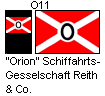
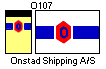
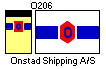
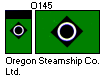
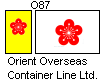
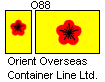
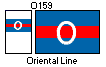
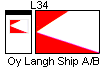
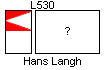
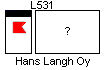
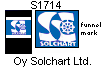
The flag is red with a white saltire and a central upright white oval bearing a black O. Stewart shows a circle instead of an oval. Portside photographs of Banzai in February 2010 and Concordia in February 2014 confirm the pronounced oval of both the panel and letter on the funnel. Jordan records the funnel flag without specifying a band. The earlier FOTW drawing uses dark red, but Nüsse and a later museum-ticket source show ordinary red.
Formed in 1931 as Orion Schiffahrts GmbH, the tramp operator adopted the Reith & Co. name in 1952. In June 2005, under Dr. Mathias-Kaspar Reith and his brother, it split into Orion Bulkers and Johann M.K. Blumenthal. Its operating companies had included Orlanda Reederei, formed in Hamburg in 1978.
Germany, Rostock; Hamburg from 1939.
O'MAY BROTHERS.
image by Eugene Ipavec, 10 August 2009
image by Eugene Ipavec, 19 August 2009
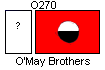
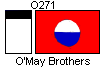
The red flag has a disc divided white above blue. The Log version has a larger disc than the surviving State Library of Tasmania flag. That actual flag initially looks white-and-black, but Rosanoski sees blue tints suggesting very dark blue. A 1910 Christmas card and other pre-1912 images also show white over blue; Mertens describes them as evidence for a conjectural pre-merger flag. The livery was retained after the 1912 merger.
Robert, Thomas and James O’May began a Hobart Town–Kangaroo Bay ferry service in 1863 according to The Log; Mertens instead believed operations began in 1870. After Robert and Thomas died, James managed the business with Robert’s sons Henry and George Elwin. A 1912 merger created Rosny Estates & Ferry Co., which entered liquidation in 1926 and passed to Reemere Steamship in 1927. Henry and George reconstituted O’May Bros., restarting ferries in February 1927 and buying Reemere in 1929. Hobart Bridge Co. took over on 1 May 1939 under exclusive Derwent transport rights granted by the Tasmanian Government.
Australia, Hobart.
O. & H.HOLTA A/S.
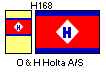
The flag is blue with a very broad red horizontal band, carrying a white diamond charged with a blue “H”. The funnel originally was black with a broad flag band; Brown’s 1958 notes record the change to a yellow or buff funnel with the same band.
O. & H.Holta managed the fleets of A/S Havilde and A/S Herdebred.
Norway, Skien.
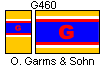
O. GARMS & SOHN.
image by Klaus-Michael Schneider, 11 April 2009
Mitchell labels the funnel H. Garms & Sohne. Schneider estimates the flag’s stripe proportions as 2:1:1:12:1:1:2, but Rosanoski states that the cited 1957 source actually gives 3:1:1:5:1:1:3, matching his illustration.
Otto Garms had Antiope built in 1950; it passed to H. Garms & Sohn in 1956 and was sold in 1963. The fleet directory uses O. Garms & Sohn, while Lloyds successively records Otto, Hermann and Helen Garms.
Germany, Königreich.
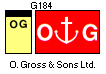
O. GROSS & SONS LTD.
Brown 1958 outlines the flag’s charges in black.
Gross managed Power Steamship, whose vessels used Hunts-prefixed names, in the Lloyds listings from the 1950s through 1970–71. A compulsory winding-up order for Power was made in March 1973. Rosanoski leaves its possible connection with the pre-war company of the same name unresolved.
UK, London.
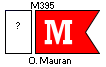
O. MAURAN.
image by Joe McMillan, 29 October 2001
The flag follows the chart Private Signals of the Merchants of New York.
O. Mauran was a nineteenth-century firm.
USA, New York.
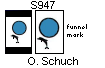
O. SCHUCH.
The fish emblem is presumed to be a dolphin.
Schuch operated the trawler Dolphin 5 from Sydney before moving to northern waters. J.F. Conway had registered her under that name around 1980 and later sold her to Schuch, although Rosanoski could not trace the later ownership in the cited registers.
Australia.
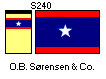
O.B. SØRENSEN & CO.
The flag is red with a very broad blue horizontal band bearing a white star. The yellow or buff funnel has a black top and a broad band of the flag. The Worlds Merchant Fleets mentions but does not describe the emblem; Stewart attributes the same livery to S.H. Smith Sørensen.
O.B. Sørensen managed D/S A/S Ora, appearing in the 1939, 1963–1964 and 1970–1971 sources. Its managing director was S.H. Smith Sørensen.
Norway, Arendal.
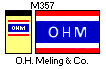
O.H. MELING & CO.
The funnel and flag are recorded in Brown 1982 and 1995.
Formed in 1947, O.H. Meling operated through name subsidiaries. The register also uses O.H. Meling Rederi and O.H. Meling, with management and ownership roles varying over time.
Norway, Stavanger.
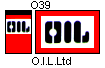
O.I.L. LTD.
image by Jarig Bakker, 3 November 2005
Oil Tiger confirms the funnel. Mitchell recorded the livery at Dundee in October 1973 under Ocean Inchcape, and Marinart also gives that name and mentions breaks in the lettering. The FOTW flag follows Brown 1995.
Ocean Inchcape was formed in 1973 according to Lloyds, or 1972 in the Ships and Oil account. It became O.I.L. in 1983 when Ocean Transport & Trading acquired Inchcape’s remaining 40% and took complete control. Offshore Supply Association’s acquisition is dated 1988 in one account and June 1989 in Lloyds. O.I.L. passed to Tidewater on 18 November 1997 as Ocean Group withdrew from shipping.
Subsidiaries included O.I.L. Marine, O.I.L. (Nigeria) at Apapa, and the OSA Marine Services group, which also passed to Tidewater. VTG Supply Boats Liberia appears among the name companies. Ship names commonly began Oil.
UK, London and Woking; later USA, New Orleans, Louisiana.
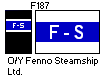
O/Y FENNO STEAMSHIP LTD.
image by Phil Nelson, None
Mitchell shows black letters, but Rosanoski assumes they should be white.
Lloyds lists O/Y Fenno Shipping Co. in 1953–54, operating through O/Y Fenno Steamship by 1958–59, with the latter name used in subsequent editions through 1966–67.
Finland, Helsingfors.
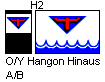
O/Y HANGON HINAUS A/B.
image by Jarig Bakker, 1 October 2005
The black funnel has a broad white band bearing a blue pile charged with a red Latin cross shaded black. The broad vertical shaft ends in a point. The shorter, narrower horizontal arm ends in arrowheads with diagonal undersides and horizontal upper edges, corresponding to the pile’s edge. The flag has the company logo at the top centre.
Finska Ångfartygs Aktiebolaget acquired Hangon Hinaus in 1981; it absorbed that group’s O/Y Neptun in 1983. Alfons Håkans bought it in 1988.
Finland, Hanko/Hango.
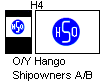
O/Y HANGÖ SHIP-OWNERS A/B.
Mitchell’s pencilled letters appear to read HSI. He also shows a funnel under T. Nyman, associated with Hangö, with a white circle outlined black and black letters. With no vessels named, Rosanoski assumes that it is intended as H4.
Documentary images — company attribution uncertain
Mitchell’s panel is assumed to stand on a white band. It is given for Nongard, listed as managed for Rederi A/B Hogship, so the funnel may belong to that company; its relationship to Hangö is unknown. The vessel was bought in 1982 and sold in 1985 in the cited index, without owners named.
Hangö versus Hogship and band reconstruction unresolved.
Hangö bought Hangete in 1965 and sold its last vessel, Borgo, in 1984. Mitchell names Tage Nyman as manager, a connection Rosanoski did not locate in Lloyds. Mirabooka, built in 1961, was bought by Hangö in 1979 and appears under the company in the 1980–81 register.
Finland, Hangö.
O/Y PULPSHIPS A/B.
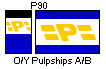
The flag is blue with a broad white horizontal band bearing a yellow P between two pairs of yellow horizontal batons. The blue funnel has a black top above the same white band and charges. All charges are described as angled “Pbd”. Brown labels the design under the manager with Pulpships in brackets, but Rosanoski considers the initial and treatment of another managed company evidence that it belongs to Pulpships.
Pulpships was registered on 3 November 1961 and associated with O/Y Henry Nielsen A/B, recorded as its operator. The website history also records Oy Ab Tank Ships on 4 February 1972, financial difficulties from autumn 1977, and a change to Oy Ab Åxtaliamari on 19 December 1980. Liquidation followed on 31 December 1980 and deletion from the commercial register on 17 December 1981.
Finland, Helsingfors/Helsinki.
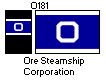
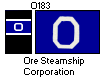
O/Y Rettig A/B.
O/Y RETTIG A/B.
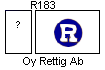
The R183 flag is documented by a Finnish cap badge on the Collectors Corner website.
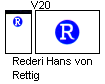
Rederi Hans von Rettig — Lloyds1971 No652
No inferred rename or exclusive family-wide use.
The vessels listed under Strömma Turism & Sjöfart continued to use the S655 livery of Strömma Kanalbolaget.
Rettig is dated to 1870, with earlier roots in the family’s tobacco businesses in Sweden and Finland. Per Christian Rettig also engaged in shipbuilding and shipping. The Finnish business merged as Oy Rettig-Strengberg Ab in 1976 and moved its head office to Helsinki; it became Oy Rettig Ab in 1983, with Rettig-Group Ltd. established as parent in 1989. Hans von Rettig was succeeded on his death in 1979 by Gilbert, who died in 1994. The tobacco division was sold to R.J. Reynolds in 1995.
Hans von Rettig became the principal shareholder in Bore in 1926. Founded at Turku in 1897 to maintain winter traffic with Stockholm, Bore developed into a leading Finnish passenger and liner owner, a Silja Line associate and a pioneer of Finnish ro-ro traffic. The company history places Bore Line’s incorporation into Rettig Strengberg in 1987. Cargo traffic was sold to Finnlines in 1992, after which Bore Shipowners chartered six vessels to outside Baltic and North Sea liner operators.
The Lloyds accounts differ: one dates a merger of Oy Rettig Ab into O/Y Bore Line A/B to 31 December 1986, another to 31 December 1987. The name Oy Rettig Ab Bore is recorded from 1996. Engship was acquired in January or February 2006 and merged, with Bror Hussel Chartering, into Rettig Group Bore in February 2007. Shipping subsequently operated through Bore Ltd.
The von Rettig family also owned Strömma Turism & Sjöfart AB. In 1999 Bore Line AB took that name and merged with August Lindholm AB, following acquisitions in tourism and shipping. The listed Stockholm relates to Strömma Kanalbolaget A/B.
Finland, Åbo-Turku; later Helsinki.
O/Y SAIMAA LINES LTD.
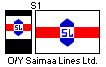
Saimaa Lines appears in the 1973–74 register as a manager only, managing Saimaan Kanavalaivat O/Y. It is also recorded in the 1978–79 and 1980–81 registers.
Finland, Helsinki.
O/Y Sally Line A/B.
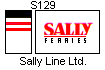
Documentary material — company attribution not established
image by Jarig Bakker, 28 October 2005
Sally Line Ltd.
Brown’s flag has smaller FERRIES lettering than the illustration here. Mitchell omits a black funnel top in one portrayal but shows versions both with and without it in his line drawings, suggesting it may have been optional.
Sally Line Ltd. was apparently established as the British company for Rederi A/B Sally. It was listed as manager for Sally Vessel Management and apparently ceased operations when its sole vessel was sold to Transeuropa Lines around 1999, retaining its name.
UK, Ramsgate.
Keep the explicit scope label independent; no alias or company identity is inferred.
Sally Vessel Management Ltd.
Sally Vessel Management was formed in 1996 and listed as an Effjohn operating company, with its fleet under a name company and managed by Sally Line Ltd. The name company appeared directly under Neptun Maritime OJY in 2000 and subsequently under Silja OYJ ABP [Tallink Silja Oy].
UK, Ramsgate.
Keep the explicit scope label independent; no alias or company identity is inferred.
Suomi ja meri records use of Algot Johansson’s flag, consistent with his role as operator. Sally also used Viking Line’s funnel as a member of that consortium. Mitchell attributes another funnel, as well as S129, to Sally Line Ltd., although his drawings show it only for Viking 6 and The Viking under Rederi A/B Sally. His drawing of the Jugoslav charter Njegos, whose charter ended in 1985, shows a white funnel.
Rederi A/B Sally was listed under Algot Johansson in 1953–54 and later appeared as O/Y Sally Line A/B. It acquired Rederi A/B Solstad at an unspecified date and apparently joined the original Viking Line consortium at its formation in 1966, leaving in 1988. In 1987 a partnership of Johnson Line, EFFOA and Union Bank acquired 67 per cent, with Sally retaining 33 per cent. The partnership obtained full ownership in 1988. The passenger trades of Johnson Line, EFFOA and Sally were merged into Effjohn International in 1990.
Finland, Mariehamn.
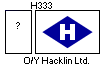
O/Y Werner Hacklin.
O/Y WERNER HACKLIN.
image by Jorge Candeias, 18 March 1999
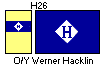
The main flag appears to be blue with a white diamond containing a blue H, also used on the funnel band. Brown 1951 shows a smaller diamond, considered somewhat incorrect by Rosanoski; Jordan does not specify the funnel diamond’s size.
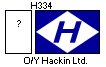
O/Y Hacklin Ltd. — truck/website graphic variants
image by Jorge Candeias, 18 March 1999
image by Phil Nelson, 4 February 2000
Another website image has a simple blue italic H in a white diamond lozenge on blue. Rosanoski cautions that the other forms may relate to non-shipping activities or be logos rather than flags.
Actual flown-flag status and legal continuity remain open. Do not present these as verified historical ship flags.
Jorge Candeias’ original reference showed the principal flag and a reverse-colour flag painted on a truck. The latter could be a used variation.
The Hacklin group dates its foundation to 28 December 1908, when Werner Hacklin, a Reposaari sailing-ship stevedore, and his elder brother contracted to begin stevedoring in Meri-Pori. Operations gradually moved to Mäntyluoto. Shipping appears to have been conducted through O/Y Werner Hacklin, recorded in Lloyds until about 1960, with vessel names consisting of a Christian name followed by H. By 2003 O/Y Hacklin Ltd. was no longer directly engaged in shipowning or operation, its activities including forwarding, stevedoring and storage.
Finland: Bjorneborg (Pori) and Reposaari (Räfsö).
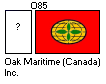
OAK MARITIME (CANADA) INC.
The red flag bears a gold globe with black lines, surmounted by a cross of four green oak leaves. No funnel is given.
Oak Steamship was formed in 1947. The group’s shipowning operation moved from Hong Kong to Canada in May 1994, with the names Oak Maritime (H.K.) and Oak Maritime (Canada) recorded that year. The Hong Kong Oak Steamship company remained the parent but ceased shipowning, while a management base remained there. Correspondence attributes the move to the Tsai Y Hsu families and places Luminous Navigation within the group, though no vessels could be traced against that company.
Operating interests included Confidence Maritime Industries in Taipeh and its Singapore subsidiary Genie Shipping, both formed in 1996; a Hong Kong Oak Maritime company formed in 1996; and Sincere Navigation, formed in Taipeh in 1961. Oak joined the consortium forming Eurasia Shipping & Management, later Eurasia International (China). Wallem managed one vessel in the 2000 register.
Canada, Vancouver.
OAKI KIKUSABURO.
The name is recorded in a 1916 book supplied through Alan Watt.
Japan.
OAO Kaliningradskaya Rybopromyshlennaya Kompaniya “Rybflot-For”.
OAO KALININGRADSKAYA RYBOPROMYSHLENNAYA KOMPANIYA "RYBFLOT-FOR".
The funnel follows a photograph of Tyulen, reference 382B.
Formed in 2003, the company combined JSC Kaliningrad Fishing Industry Co. Zapryba with Kaliningrad Industry Fishing Co. “Fishing Fleet-FOR” Plc. The latter English form is also given as an alias. Lloyds records Russian government control and a fleet operated in its own name and through JSC Fishing Fleet at the same address.
Russia, Kaliningrad.
OAO SIBUR HOLDING.
The funnel rendering follows the port side of Sibur Voronezh photographed on 7 October 2013 and the starboard side of Sibur Tobol on 8 December 2013.
Founded in 1995, Sibur was a gas-processing and petrochemicals company. Following Gazprombank’s phased sale from December 2010, SIBUR Holding was wholly owned by SIBUR Ltd. by autumn 2011, with Leonid Mikhelson holding 57.5%, Gennady Timchenko 37.5% and smaller holders 5%. In 2013 Sibur received Sibur Tobol, its second gas carrier after Sibur Voronezh, operating under a long-term charter agreement with Sovcomflot.
Russia, Moscow; St. Petersburg in the charter dated 25 April 2013.
OAO “Sovcomflot”.
OAO "SOVCOMFLOT".
Brown gives the Russian national and merchant flag. The funnel combines it with a blue S symbol above, on a light-grey or blue base, with variations.
Maxim Gorkiy at Wellington in February 1999 had a different base colour, possibly because she was a passenger vessel. Projecting red bands define the Russian flag arrangement. She flew the charterer’s flag.
Mitchell’s rendering may represent S173, with a darker-blue symbol; a separating black band may have been added only for drawing clarity.
The company website shows a white flag with a blue logo above blue SOVCOMFLOT lettering. An actual flag appears in an office photograph, but use at sea is uncertain.
Romny’s funnel has a longer tail on the logo’s S, a detail varying between vessels.
Aleksandrov’s November 2006 photograph provides this variant.
Okhta Bridge supplies the apparent basic design with a turquoise base. Other vessels range towards blue: Bering Sea appears teal, though its print looks bluer, and Petropavlovsk has a light-blue funnel. The logo colours remain constant, supported on both sides.
Petropavlovsk was photographed with this version in November 2009. Okhotsk Sea at Botany Bay in February 2010 lacked a black top.
Documentary images — company attribution uncertain
Soviet origin does not establish company identity.
Mitchell assigns S1336 to the first Soviet vessels under free flags, with the hammer and sickle removed from the funnel band. Yamburg is identified under a one-ship owner and Acomarit management. His fourth listed vessel, Salacgriva, built and renamed in 1991, instead has S1335 colours.
Sovcomflot, rendered in English as Joint Stock Company Sovcomflot and explained as Modern Commercial fleet, grew from measures permitting bareboat chartering outside the Soviet foreign-trade monopoly. A 1973 resolution led to the Fund for Commercial Operations in 1976. The enterprise was established in 1988 with the Ministry Marine and major shipping companies, then transformed into a wholly Russian Federation-owned joint-stock company under the resolution of 26 June 1995.
The 2007 combination with Novoship added the state’s holding to Sovcomflot while retaining legally separate companies; Novorossiysk Shipping joined as SCF Novoship in December. Group companies included Cyprus-based Sovcomflot and Unicom, the UK chartering agency, Madrid-based W.W. Marpetrol and Moscow’s Rosnefteflot. Marpetrol had been jointly acquired with Novorossiysk in August 2006; Unicom originated as a 1990 joint venture.
USSR, later Russia, Moscow.
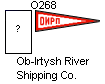
OB-IRTYSH RIVER SHIPPING CO.
The flag bears the Cyrillic letters ОИРП.
Ob-Irtysh, also recorded as Ob-Irtyshshkoye Rechnoye Parokhodstvi, operated passenger and cargo services on the Ob and Irtysh and Arctic river-sea shipping. It is recorded for Kapitan Evdokimov at construction in 1983. Lloyds 1992–93 places it under Eurostar Navigation, with later listings under its own name and Russian government control. Earlier City of vessel names gave way to Russian names, while part of the previously listed fleet remained with the manager under individual companies.
USSR; Greece, Piraeus, in the 1992–93 register; Russia, Tyumen, in 1996–97.
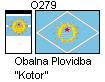
OBALNA PLOVIDBA "KOTOR".
Yugoslavia, Kotor.
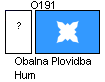
OBALNA PLOVIDBA HUM.
image by Zeljko Heimer, 18 October 2004
Isaić shows a light-blue house flag with a white steamship emblem at the centre.
Hum Coastal Shipping operated the steamship Petar Zrinski between 1915 and 1925. During the World War it served routes linking Korèula, Split and Dubrovnik.
Yugoslavia, Korèula.
Obsea ApS.
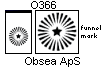
OBSEA APS.
Arne Tiselius has two funnels on opposite sides of the hull, with the logo placed at the base. Port and starboard photographs dated 30 June 2012 document the arrangement.
FOGA ApS
The same vessel is photographed flying the charterer FOGA’s flag. Its shape is not definite in the photograph; Rosanoski considers it approximately 4:3 rather than the usual rectangle.
Obsea was established in February 2007 for offshore operations and owned Arne Tiselius. The vessel was chartered by FOGA of Esbjerg, Fiskernes Orientering om Olie-og Gasaktiviteter, founded in 1982 to provide fisheries and offshore consultancy and charter vessels for those activities.
Denmark, Svendborg.
Occhetti.
OCCHETTI.
Pietro Occhetti owned the 345-grt Leneo before the Second World War. Lloyds separately lists Giuseppe Occhetti fu Pietro and Pietro Occhetti in 1953–54 at different Genoa addresses. In 1958–59 the Giuseppe entry drops fu Pietro and both have the same address; both names continue in the 1973–74 register.
Italy, Genoa.
OCCIDENTAL & ORIENTAL STEAMSHIP CO.
Occidental & Oriental was formed in November 1874 by the Central Pacific and Union Pacific railroads after Pacific Mail refused their transcontinental cargoes. Pacific Mail’s owners also controlled the Panama Railroad, threatened by the direct continental routes. O&O initially operated British-flagged ships with Chinese crews and British officers. It competed with Pacific Mail until Southern Pacific acquired both companies in 1893 and merged their businesses, retaining the O&O trade name and flag until 1908.
USA, San Francisco.
OCCITAN BULKERS LTD.
The funnel follows a port-side photograph of Occitan Star. All three ships carried the mark. As the manager used a different logo, Rosanoski presumes this is the owner’s emblem, containing the first two letters of Occitan.
Occitan Bulkers owned Occitan Star, Occitan Barsac and Occitan Sky, managed by SGM Shipping Services of Geneva. Star and Sky were bought in April 2012; the recorded Barsac purchase date is 5/2103.
Bahamas, Nassau.
OCEAN BULK CARRIERS LTD.
The funnel follows Meridian Navigator photographed from starboard on 8 April 2006.
Ocean Bulk Carriers, or OBC, was founded in September 2000 as the principal company in a group owning and managing ships and trading freight. Lloyds initially gave 1989, later amending the formation date to 2000. The group’s shipping interests transferred to British Marine in the 2007 reorganisation, with OBC’s incorporation into British Marine dated 1 February 2007.
UK, London.
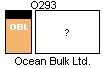
OCEAN BULK LTD.
The funnel is deep buff.
Ocean Bulk was formed on 4 March 1997 as a venture between Union Shipping New Zealand and Ocean Towing & Salvage (Cook Island). Union Shipping bought full ownership on 9 July 1998 and transferred the assets to Union Shipping Bulk; Ocean Bulk was struck off on 4 October 2000. Other cited accounts call the venture Ocean Bulkships and describe long-distance tug-and-barge transport. Tugs bore names of male members of the Brown family, owners of Ocean Towage, and barges were numbered Ocean Bulk 1 and so on.
New Zealand, Auckland.
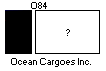
Ocean Cargoes Inc.
Documentary images — company attribution uncertain
The black funnel is recorded on Elie V under Elie V Steamship Corp.; Rosanoski considers it probably the managers’ livery. No flag is recorded.
No exclusive company livery established.
Ocean Cargoes appears as managers in Lloyds 1963–64 for three single-ship companies, which Rosanoski considers probable subsidiaries.
USA, New York, NY.
Ocean Carriers Shipping Ltd.
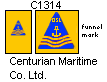
Centurian Maritime Co.Ltd.
Fortune Pearl photographed from port on 21 September 2008 shows clear letters and a different colouring of the emblem, also seen on Turnberry Glory in March 2008. Rosanoski considers the difference a possible distinction between ships of the two subsidiaries.
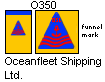
Oceanfleet Shipping Ltd.
Ocean Crown photographed from starboard on 9 October 2012 supplies this funnel. The photograph is poor and the letters are unclear; Rosanoski judges OSL a logical reading, using the clearer lettering on the related livery as support.
Ocean Carriers was formed in 1994 and appears initially as managers, later as agents. Operating company Centurian Maritime was formed in 2003 as Falcon Shipmanagement and renamed that year to avoid confusion with Falkon Maritime. Oceanfleet Shipping was formed in 2005 at the same address as Centurian.
Greece, Athens.
OCEAN DOMINION STEAMSHIP CORPORATION.
image by Al Fisher, 3 February 1999
image by Ivan Sache, 18 March 2004
The funnel is described as aluminium or silver. National Geographic shows a grey letter on the funnel band.
Ocean Dominion was a trading name used by the Aluminium Company of America for bauxite services from British Guiana to Canada from the early 1920s. Marine News describes chartered vessels and consolidation with Aluminium Line and American Caribbean Line into Alcoa Steamship in 1940. Talbot-Booth, however, lists owned vessels and continues to show Ocean Dominion independently in 1942 and 1944 without an Alcoa reference.
USA, New York.
OCEAN FREEWAY PTY. LTD.
The silver funnel is recorded on Freeway North under charter.
Ocean Freeway operated from 1986 to the end of 1988 under Australian National Line management. Rosanoski found two possible registration histories: a company registered in Perth as Jocon on 28 February 1983 and still existing in 2008, and one registered as Ocean Freeway Ltd. on 5 December 1985, later Ocean Freeway Pty. Ltd. and Bellway Equipment, deregistered on 24 June 1997. He considers the latter more likely.
Australia, Fremantle.
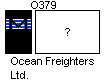
OCEAN FREIGHTERS LTD.
The funnel follows Pontonostos photographed from port on 10 August 2007. A Watermark Pacific image is presented as the house flag by mcole, although Rosanoski’s introductory note leaves its flag status tentative.
Pontonikis photographed from port in July 2013 and starboard in March 2006 supplies the version Rosanoski considers normal. Davidships identifies the M with president Panagiotis G. Moustakas.
Ocean Freighters is dated 1973 by Lloyds and registered on 22 March 1977 in the cited registration record. Registers list it as agents, later managers, with Metron Shipping & Agencies, formed in 1989 at the same address, as a major operating company. Mitchell associates it with L. Moustakas; a later contributor identifies president Panagiotis G. Moustakas.
Greece, Piraeus.
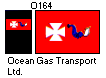
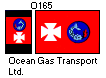
OCEAN GAS TRANSPORT LTD.
The livery places Gazocean’s flame-emitting dolphin, in altered colours, beside the Houlder Brothers cross representing the owners. O164’s white flame is outlined yellow. On later tankers with funnels too narrow for the flag’s side-by-side arrangement, the two devices were placed vertically.
Ocean Gas Transport was owned by Houlder Brothers, which managed part and later all of its fleet in the cited 1966–81 register sequence. Ocean Gas also managed part of Nile Steamship’s fleet. Gazocean supplied specialist knowledge and experience in establishing and operating the business.
U.K., London.
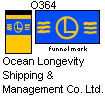
OCEAN LONGEVITY SHIPPING & MANAGEMENT CO. LTD.
The funnel follows Ocean Princess photographed from port on 12 February 2006 and Ocean Baby from starboard at Singapore on 8 June 2011. The blue shade varies between photographs.
The company was formed in 1994 as Ocean Longevity Co. and adopted Ocean Longevity Shipping & Management in 2002. Lloyds records management activity and vessels under name companies.
China, Hong Kong.
OCEAN MARINE SERVICES INC.
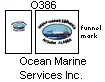
The funnel follows Sovereign photographed from starboard on 5 February 2013.
Ocean Marine Services, or OMSI, serves oil and gas platforms and provides oil-spill-response support. Ocean Marine Services Partnership No. 1 is recorded with its first vessel, Ocean Dolphin, in 1975. Lloyds separately lists the principal business and Partnerships Nos. 1, 2 and 4 at the same address.
USA: Kirkland, Washington; Houston, Texas; Dutch Harbour, Alaska; later Kirkland again. A Kenai office is recorded at Nikiski, Alaska.
Ocean Shipping & Enterprises Ltd.
Ocean Shipping & Enterprises(Panama)S.A.
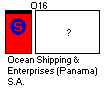
The red funnel has a narrow black top and a blue circle bearing a red S. Rosanoski considers Ocean Enterprise the probable vessel source, but the original image source is not specified. No flag is recorded.
The register sequence names Ocean Shipping & Enterprises (Panama) S.A. in 1963–64 and Ocean Shipping & Enterprises Ltd. in later editions, with management and agency roles. The Ltd. company managed several companies including the Panama firm.
Hong Kong.
OCEAN SHIPPING & TRADING CORPORATION.
Ocean Shipping & Trading acted as operator or agent for Compañia Naviera Continental’s Transcarib from 1956 to 1960. Lloyds later lists it as agents. The livery record concerns agency companies and associates it with Pack & Kahn, linked in the source to Hudson Waterways.
USA, New York, NY.
OCEAN SPACE LINE LTD.
image by Girard Pisiou, 31 December 2005
image by António Martins, 31 December 2005; 23 April 2006
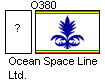
The white flag bears a large dark-blue, vertically symmetrical outline described as vaguely floral. Narrow stripes at the top are red, yellow and green. The bottom sequence is ambiguously written as “green, yellow and red, yellow” in Martins’s account. McGee suggests a fleur-de-lys-like form made from palm leaves; this remains a comparison rather than established symbolism.
Ocean Space Line is described as an accounting company handling last-hand vessel purchases and sales for demolition, dealing with shipowners and shipbreakers worldwide. Pisiou identifies its maritime flag with a St Vincent registration; that account is retained alongside the original Guadeluope location.
Guadeluope, Leeward Islands, as recorded in the source.
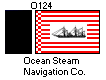
OCEAN STEAM NAVIGATION CO.
image by Joe McMillan, 1 September 2001
The FOTW illustration follows Bonsor and represents the company’s first vessel, Washington.
Ocean Steam Navigation was floated in May 1846 by Edward Mills, C.H. Sand, Mortimer Livingston, John L. Stephens and others. It began operating on 1 June 1847 as the Bremen Line and suspended operations in July 1857.
USA; New York is assumed in the source.
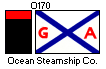
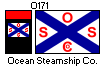
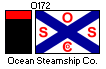
OCEAN STEAMSHIP CO.
image by Joe McMillan, 7 November 2001
The original O170 flag carried the managers’ initials. The flag changed by the beginning of the twentieth century and the funnel by the 1930s. Rosanoski notes that FOTW assigns the original flag to New York & Brazil Mail Line, preserving an attribution difference between the sources.
Ocean Steamship of Savannah, also the Savannah Line, owned steamships from 1877. It operated coastal passenger and freight services in the south-eastern United States under Central of Georgia Railway ownership, feeding freight to the Savannah railway terminus. Ship names began City of.
USA, New York.
OCEAN TOKYU FERRY K.K.
Ocean Ferry began operating in 1972. One account dates its change to Ocean Tokyo Ferry and the renaming of its ships to 1976; Lloyds gives a 1973 amalgamation of Ocean Ferry and Tokyu Ferry. Later registers use Ocean Tokyu Ferry. New vessels built in 1991 had names beginning Ocean.
Japan, Tokushima, later Tokyo.
OCEAN TRAMP TANKERS CORPORATION S.A.
Eugenia carried the funnel in July 1966: yellow or buff with a black band. No flag is recorded.
The company is recorded in Lloyds 1963–64 and 1970–71. Its agents were Marcou & Sons Shipbrokers, subsequently N.E. Marcou Shipping Agencies; Tramp Shipping Corporation appears as agent in 1978–79.
U.K., London; later Belgium.
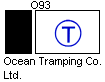
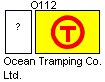
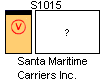
Ocean Tramping Co. Ltd.
Documentary material — company attribution not established
image by Jarig Bakker, 23 December 2005
image by Ivan Sache, 25 August 2002
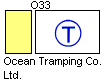
The livery appears on managed companies’ vessels, sometimes with a narrow black funnel top; ships with names ending ford had black funnels. Mitchell records a black top at Liverpool in 1963. Aleslevada, photographed on 12 March 2006 under China Ocean Shipping, confirms the narrow top and a buff-like yellow less bright than the crane bases. Rosanoski records continuing use by COSCO ships with names beginning Joyous or Mass.
No separate flag is given for this funnel; its application is assumed.
The original flag is white with a blue ring, or O, enclosing a blue T.
This funnel is assigned to Hang Wan of Breton Shipping, later listed under China Ocean Shipping and presumed by Rosanoski to have been under Ocean Tramping at the end of its operations.
This funnel is assigned to Santaway of Santa Maritime Carriers, listed as an Ocean Tramping-managed company in 1992–93.
The source also records Lake Progress of Perfect Properties among the managed companies.
Ocean Tramping was formed in 1957 and was Chinese-controlled. Bob Scott describes it and Yick Fung as Hong Kong intermediaries through which Western owners could sell older tonnage during embargoes affecting China. Hemisphere and Peninsular Shipping were associated operated companies and possible subsidiaries. Ocean Tramping acquired half of Gold Bridge Shipping, formed in 1990, and sold its interest in 1995. The company account dates its merger into COSCO (Hong Kong) Shipping to 1996, while Lloyds gives 1 November 1994 as the latter’s formation date.
Hong Kong.
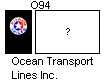
Ocean Transport Lines Inc.
OCEAN TRANSPORT LINES INC.
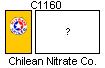
The black funnel bears a white circle containing a smaller circle divided vertically blue and red, charged throughout with a white star. Red NITRATO follows the upper arc of the outer circle and blue CHILEO the lower arc, both inscriptions the same way up.
Mitchell assigns this funnel to Ocean Transport Lines Ltd. of Monrovia, associated with Wilson Shipping. Rosanoski considers the funnel more likely Wilson’s, supported by John Wilson appearing in the fleet.
Chilean Nitrate Co.
Mitchell assigns this funnel to Chilean Nitrate Co. of Valparaiso without establishing a connection to Ocean Transport Lines. Rosanoski keeps it in the document for convenience because of the shared marking, with no named vessels or further company evidence.
Ocean Transport Lines is listed under agents Hvide Shipping in 1958–59 and Wilson Shipping in 1963–64. It was described as mainly charterers. The livery uses Chilean Nitrate Corporation’s emblem, but Rosanoski could not establish whether its trade was exclusively nitrate.
USA, New York, NY; later Chile, Santiago.
OCEAN TRANSPORTATION CO. INC.
image by Joe McMillan, 7 November 2001
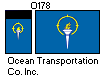
The US Navy version shows red in the flames. Mitchell also assigns these markings to Maritime Overseas as its principal livery. Aurelia was seen with the funnel at New York in August 1973 while owned by Nautical Tanker at Maritime Overseas’ address. Unless Ocean Transportation operated the ship, Rosanoski considers Maritime Overseas the more appropriate attribution.
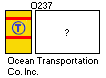
This separate Mitchell funnel is presumed to concern Ocean Nora or Overseas Aleutian, for which he provides line drawings.
Ocean Transportation appears in Lloyds from 1953–54 to 1985–86, often under Maritime Overseas Corporation as agents. NJK identifies it with Maritime Overseas, leading Rosanoski to presume a shipping-subsidiary relationship. Ship names changed from an Ocean prefix to Overseas.
USA, New York.
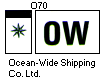
OCEAN-WIDE SHIPPING CO. LTD.
The white flag bears black OW letters. The white funnel has a black top and an eight-pointed black-and-white compass star.
Liberia, Monrovia.
OCEANA SHIPPING A.G.
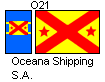
Oceana Shipping S.A.
Stewart 1963 records the name as Oceana Shipping S.A.
Switzerland, Chur.
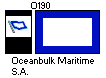
Oceanbulk Maritime S.A.
OCEANBULK MARITIME S.A.
image by Ivan Sache, 10 November 2003
A starboard photograph of Strange Attractor dated 31 May 2003 confirms the funnel emblem, with the flagpole facing forward. Rosanoski assumes a mirrored arrangement on the other side. The company website supplies the flag.
Oceanbulk was formed in 1989 and owned by Petros Pappas. He joined members of the Pittas family in 1991, greatly increasing the fleet. After an amicable separation in 1994, Oceanbulk continued managing some Pittas vessels under their new Eurobulk company. Registers describe Oceanbulk as managers and later agents, with Combine Marine as an operating company.
Greece, Athens.
COMBINE MARINE INC.
Combine Marine was formed in 1994 and appears as agents in the 2000–05 register entries.
Greece, Athens.
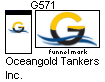
OCEANGOLD TANKERS INC.
The funnel follows Ocean Schooner photographed from starboard on 8 July 2011.
Oceangold was established in 2007 as a ship-management company; Lloyds 2011–12 lists it as managers only.
Greece, Athens.
OCEANIA CRUISES INC.
The funnel is documented on Nautica, Insignia and Regatta. Regatta photographed on 13 August 2006 flies the flag as a stem jack; its poor spread could suggest a pennant, with the emblem towards the hoist. Insignia on 6 October 2007 appears to show a straight lower edge, and another house-flag photograph also suggests a rectangle. Rosanoski therefore favours rectangular form while acknowledging the incomplete views.
Oceania was formed in 2002 by former Renaissance Cruises chairman Frank Del Rios and Joe Watters. Apollo Management acquired it in February 2007. Lloyds records ships under name companies and later lists Oceania as managers only.
USA, Doral, Florida.
OCEANIC & ORIENTAL NAVIGATION CO.
image by Al Fisher, 3 February 1999
image by Joe McMillan, 7 November 2001
FOTW formerly presented this flag under a British attribution without detail; the entry was subsequently deleted.
The China Coaster’s Tide Book 1934 gives a square flag, a slightly wider white band and apparently more widely spaced letters because of the proportions. McMillan’s FOTW illustration follows National Geographic.
Matson’s history spreads the letters somewhat more widely. A company-website funnel photograph also has wider lettering and a small ampersand at mid-height, possibly repeated on the flag.
Oceanic & Oriental was a Matson and American Hawaiian venture formed to take over government-owned transpacific freighters from Swayne and Hoyt. Oceanic-Matson managed the California–Australia–New Zealand services and American Hawaiian the China services. The accounts differ on dates: a historical dictionary gives formation in 1928 and dissolution in 1937, Matson’s history mentions a 1926 purchase, Merchant Ships prints a queried 1878 formation, and McMillan dates the end to 1938. The ships were divided between the two owners when operations ceased, government subsidies having failed to sustain the line.
USA, San Francisco.
OCEANIC STEAMSHIP CO. INC.
Documentary material — company attribution not established
image by Joe McMillan, 7 November 2001
image by Joe McMillan, 7 November 2001
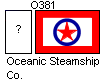
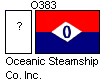
Lloyd Reedereiflaggen makes the ring touch the flag border and the star extend throughout the ring. McMillan’s FOTW drawing follows Lloyds 1912 and Wedge 1926.
Harnack describes the yellow funnel as pale buff. Stewart 1953 and 1957 instead assign Matson livery. American Passenger Liners dates the flag to 1882. NJK considers the O more elliptical than some illustrations show.
An actual flag found for sale on eBay appears black in the photograph, but Rosanoski’s colour examination reads very dark blue. The O should be elliptical. He marks the accompanying funnel as suspect.
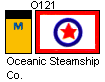
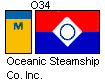
These funnels are Matson’s. The source says the three ships adopted Matson livery at the 1926 takeover but retained the Oceanic flag; another reference dates O34 to 1932. Rosanoski takes the blue and yellow shades from Matson’s colours.
Oceanic, also the Spreckels Line, grew from Claus Spreckles’s sailing fleet carrying Hawaiian sugar to California from 1878. The company was incorporated in December 1881 with John Spreckels as president; its first owned ships sailed in July 1883. It served New Zealand and Australia via Hawaii. The source describes initial Hawaiian registration and a change to the American flag on annexation in 1898. Mail contracts were central to its fortunes, including an Australasian-mail venture with Union Steam Ship from 1885 until Union withdrew in 1900. Declining sugar interests and uneven mail-contract income preceded the 1926 sale to Matson, after which Oceanic continued as a subsidiary. The remaining fleet was sold in 1970, while other accounts give service spans extending to 1976. The Spreckles brothers also operated San Francisco’s Black Stack tugs, selling to Red Stack in 1907.
USA, San Francisco.
Oceanica Transports Co. Ltd.
OCEANICA TRANSPORTS CO. LTD.(1)
Oceanica Transports Co. Ltd. (1)
The funnel is recorded on Kirman in June 1967.
The Greek entry is recorded for Kirman, given as 7158/1944, renamed in 1967 and arriving for breaking up in June 1969.
Greece.
Keep the explicit scope label independent; no alias or company identity is inferred.
Oceanica Transports Co. Ltd. (2)
A separate Malta entry appears in Lloyds 1966–67.
Malta, Valetta.
Keep the explicit scope label independent; no alias or company identity is inferred.
ODD BERG (OSLO).
Rosanoski identifies Brown 1982’s attribution of this livery to Odd Berg in Tromso as an error.
The Oslo company is distinct from the firm of the same name in Tromso. Brown 1951 calls it Odd Berg Skibsrederi.
It managed Odd Bergs Tankrederi A/S and A/S Kollbjørg, with A/S Berat and A/S Berpa also listed in 1970–1971.
Norway, Oslo.
ODD. K. MORTENSEN.
The flag is yellow with a red circle containing a yellow M. The funnel is yellow or buff with a black top and the same emblem. Its yellow is assumed to match the flag.
Mortensen managed the one-ship Rederi A/S Almora in 1970–71; Rosanoski considers it probably a subsidiary.
Norway, Oslo.
Odfjell.
ODFJELL ASA.
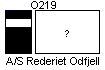
Jordan’s funnel lacks support from other sources, including Skipet, and Rosanoski classifies it as doubtful.
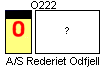
Skipet’s funnel is presumed to represent the original version.
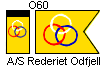
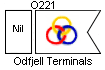
Brown 1934 omits the black funnel top. Brown 1951 omits the flag’s swallowtail, which Rosanoski regards as an error. Skipet and the O221 source clarify the interlocking rings; the flag books are less clear. A change in ring positioning is possible, although the O221 evidence suggests otherwise.
Mitchell gives no explanation for this funnel.
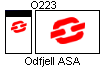
This funnel may relate to the Storli name change. Mitchell shows the emblem as drawn and also angled as in O224. The company-logo arrangement is on starboard, with a mirror image on port. The flag was photographed over a Wellington building on 18 March 1993.
Bow Century and Bow Sun photographs confirm that the starboard side follows the company logo and port mirrors it, reversing the usual arrangement noted by Rosanoski. Bow Sirius and Bow Saga photographs document the flag, with dark blue.
Captains Abraham and Fredrik Odfjell founded the shipping business, drawing on family companies of the early twentieth century. The sources give 1914 and 1915 as its foundation year, a consolidation in the 1930s, and entry into tankers in either the 1960s or 1970s. The family business split in 1978 between Abraham and his second cousin Dan. A third of the shares was publicly listed in 1985 or 1986. The later company sequence runs from Odfjell Rederiet to Storli in 1993, back to Odfjell in 1998, and a 2000 merger with Seachem Tankers. Carl Henrik Odfjell acquired Jacob Christensen in 1985.
The group acquired Chemical Tankers of America in 1997, subsequently recorded as Odfjell America. It acquired a half-interest in Flumar in 1999 and the other half by the 2008 register, although the company account also calls the earlier holding a majority. Crystal Pool commercially operated European chemical tankers. Odfjell Seachem, initially described as a Ceres–Odfjell venture, is called wholly owned on the company website; it apparently reverted to Odfjell Tankers as commercial operator. Odfjell SE was formed in 2007. The 1985 Odfjell Westfal-Larsen pool later lost Westfal-Larsen as a partner. Ships mainly used Bow-prefixed names.
Norway, Bergen.
FREDERICK ODJFELL.
Frederick Odjfell appears in Lloyds 1970–71 as operator of Frederick Odjfell A/S under agents Tore R. Stensaker, with an otherwise unexplained cross-reference from Frendo.
Norway, Bergen.
J.O. ODFJELL A/S.
image by Jarig Bakker, 21 November 2005
Mitchell places O229 on the Rederiet Odfjell card, but Rosanoski presumes it was intended for, or is a version of, O226.
The FOTW flag follows Brown 1995 under the name J.O. Odfjell Chemical Car Carriers.
Jo Calluna shows the JO emblem attached to the funnel, creating an apparent narrow grey shadow. Jo Oak’s starboard view reveals the three-dimensional edge as white, also supported by Jo Kiri’s port-side view.
J.O. Odfjell is dated 1977 by Lloyds and 1978 by Skipet, which records shipping transferred from Rederiet Odfjell. Abraham later left this group to Johan Odvar Odfjell and the drilling business to Helene and Marianne, while remaining a JO Tankers director. The Jo Tankers pool developed in the 1980s, with ownership and management separated in the 1990s and a Knutsen OAS pool arrangement in 2000. JO Management in Norway was formed in 1989 and became JO Tankers in 1996. The Dutch operation originated as Winterport Tankers in 1981, becoming JO Management in 1990 and Jo Tankers in 1996; a UK company followed in Dundee in 2003. Jo-prefixed ship names followed by trees commemorated the family’s original timber trade.
Norway: Minde, Bergen; Blomsterdalen; later Bergen.
Documentary images — company attribution uncertain
Talbot-Booth assigns this funnel to J.A. Odfjell beneath the image but J.O. Odfjell in the index, describing a Bergen tanker operator without a country-section entry.
Cannot assign to ASA or later JO branch from surname.
Exact branch/vessel unconfirmed.
Odfjell Terminals — website flag graphic
The flag logo comes from Granel Quimica, associated with Odfjell Seachem, and is labelled Odfjell Terminals. Rosanoski presumes it flies at terminals in different countries, perhaps including associates; Skipet does not define its use.
Actual flown use at every terminal/associate not established.
Odfjell family
The Odfjell family produced the Odfjell ASA branch and the separate J.O. Odfjell branch.
Norway, Bergen.
Keep the explicit scope label independent; no alias or company identity is inferred.
Odfjell (Overseas) Liberia Ltd.
Odfjell (Overseas) Liberia appears under agents Odfjell Nederland in the Netherlands and is listed as part of J.O. Odfjell by 1985–86.
Netherlands, Spijkenisse.
Keep the explicit scope label independent; no alias or company identity is inferred.
For the Westfal-Larsen pool, Mitchell shows the member companies’ funnels, including J.O. Odfjell’s.
The chartered Bow de Feng appeared to have a light-cream funnel at Botany Bay in January 2012; Rosanoski could not determine whether this apparent colour had significance.
ODIN-REEDEREI GMBH.
image by Klaus-Michael Schneider, 12 April 2009
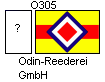
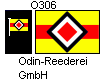
Schneider describes a yellow-red-yellow horizontal triband with a full-height central diamond in dark blue, white and red. Rosanoski’s later comment, supported by a scan, corrects the outer diamond colour to black rather than dark blue.
Odin owned Joanna Katz, built for it in 1952 and sold in 1958.
Germany, Lubeck.
ODYSEA CARRIERS S.A.
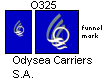
Amfialos photographed from starboard on 20 July 2011 supplies the funnel, while Okialos photographed from port on 24 June 2010 shows a narrow top, written as back in the original.
Odysea was formed in 2007, with all Eurocarriers business transferred on 1 January. The source describes it as Eurocarriers’ new name, apparently registered in Monrovia. Its management history is traced back to a predecessor established in 1991, which Rosanoski interprets as Eurocarriers. Lloyds first lists agency work and later management. Allseas Marine and Eurocarriers share its address, but their association is explicitly assumed.
Greece, Athens.
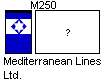
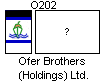
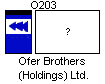
Ofer Brothers (Holdings) Ltd.
OFER BROTHERS (HOLDINGS) LTD.
The funnel was observed in March 1967, without a vessel name.
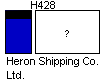
Heron Shipping — agency company
Mitchell assigns this funnel to agency company Heron Shipping, explicitly distinguished from the later Fijian namesake under Sofrana.
No exclusive fleet-wide use or unrecorded corporate equivalence is asserted.
Documentary images — company attribution uncertain
The funnel appears on Mitchell’s Ofer card without a specific company identification. Because two accompanying funnels concern agency companies, Rosanoski considers that possibility here too.
Definite company unavailable.
The source also records a Transatlantic Shipping funnel under Ofer Shipping’s agency.
The group grew from Joseph Herschovici’s Haifa chandlery and shipping agency, managed by his sons David, Sammy and Yuli. Sammy became a shipowner in the 1950s with Eyal, named after his eldest son. The family adopted Ofer in the 1960s. Lloyds traces the company from Mediterranean Seaways in 1957 through Mediterranean Lines in 1967 to Ofer Brothers (Holdings) in 1970. A 1969 agreement merged its liner operations into Zim, allowing expansion elsewhere.
Yuli remained in Israel, while Sammy established a separate European shipping group, based by the late 1970s in Monaco as SAMAMA, with day-to-day operations through London’s Zodiac. Maritime interests included Tanker Pacific, a quarter of Royal Caribbean, the Kotani joint venture and Associated Bulk Carriers; Lloyds attributes the latter acquisition to Zodiac. The family held Zim through Israel Corporation, which became majority shareholder in 1999 and bought the state’s share in 2004, while public shareholders retained an interest in Israel Corporation. Ofer Brothers’ management and ships companies merged into Ofer (Ships Holding) in 2001. The family division is dated tentatively to 2005 in one account and announced on 29 September 2002 in another. Sammy and Yuli died in 2011; the later account names half-owner Udi Angel as chairman and identifies the brothers with the XT Shipping Group.
Israel, Haifa.
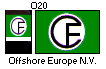
OFFSHORE EUROPE N.V.
The green flag has a large white circle containing a large black C around a smaller black E. The E’s upper arm meets the C’s upper end, and its lower arm merges into the C’s lower curve. Rosanoski notes that E might be read as F and C as part of O, or the letters might relate to a native-language name. The black funnel carries a broad band of the flag design, edged white below.
Belgium.
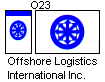
OFFSHORE LOGISTICS INC.
image by Jarig Bakker, 15 October 2005
Lloyds separately lists Offshore Logistics, Offshore Logistics Services and Offshore Logistics International at the same address. The source records a helicopter-transport business and considers it likely to be the Offshore Logistics which sold North Sea Logistics in 1988. Its corporate identification remains uncertain: one reference describes an International company founded in 1969 and owned by Bristow, while another gives Panamanian incorporation on 9 June 1970 and a later Wright Maritime connection.
USA, Lafayette, Louisiana.
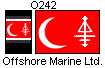
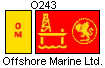
OFFSHORE MARINE LTD.
The 1964–68 livery used a crescent from the original owners and an oil-drilling-rig symbol in the flag’s fly.
After joining Offshore Supply Association, vessels used its markings until Offshore Marine severed the connection in 1973. This is Loughran’s version; OSA markings differ among sources.
Adopted after the 1968 Cunard takeover, the livery substitutes Cunard’s logo for Rochester’s and shows the drilling rig more realistically. The funnel design represents an oil drop rising from an undersea gusher; Canadian Offshore Marine used a similar funnel. Marinart incompletely describes and depicts the O-over-M logo.
Offshore Marine was formed in 1964 under London & Rochester Trading. It passed to Cunard with Rochester in March 1968 and to Zapata in 1980, then was absorbed into Tidewater Marine (UK) in 1995. It helped form Offshore Supply Association in 1966. Early ship names combined a compass point with Shore; later prefixes varied, and Zapata changed the second element to Service.
UK, Rochester, later London and Great Yarmouth.
OFFSHORE SEISMIC INC.
Panama.
Offshore Supply Association.
OFFSHORE SUPPLY ASSOCIATION.
image by Jarig Bakker, 22 February 2006
Consortium vessels initially retained their owners’ liveries before wider adoption of OSA colours. Some ships outside consortium service kept their original markings. Rosanoski cannot determine whether differences between Loughran and later Brown versions are errors or subsequent modifications. The FOTW O40 flag follows Brown 1995.
Boltentor shows black markings and a black-edged circle, with fleet number 852 below; Marinart confirms the all-black emblem and adds a black funnel top. Burgtor has grey funnels, black tops, a black emblem on a white black-ringed circle, and fleet number 804. Osa Ravensturm appears to have red letters, possibly rust, on the otherwise similar white circle.
OSA was formed in 1966 by D.D.G. Hansa, VTG and Offshore Marine, the last withdrawing in 1973. It had a Singapore subsidiary and joined Ocean S.r.l. in the OSA Marine Services venture. The ownership accounts differ: one gives purchase by O.I.L. in 1988, while Mitchell says Preussag offered the company for sale in 1989.
UK, London; Germany, Hamburg and Bremen.
OSA MARINE SERVICES.
Under Tidewater, the company used Tidewater colours.
OSA Marine Services was formed in 1988 as an equal Ocean–OSA venture and acquired by O.I.L. in June 1989; its office closed in April 1993. Mitchell records Preussag transferring VTG ships in 1988 for foreign registration. Registers separately list OSA Marine at Woking and OSA Marine Services Asia at Singapore. By 2000 the remaining vessels appear dispersed through Tidewater’s fleet, although later registers again list OSA Marine Services under Tidewater.
Germany, Bremen.
Documentary material — company attribution not established
Mitchell places O247 on the VTG Supply Boat Liberia card. The significance of the additional blue sea lines in it and O248 is unknown.
OFOTENS OG VESTERAALENS DAMPSKIBSSELSKAB ASA.
image by Jarig Bakker, 23 January 2006
image by Jorge Candeias, None
The Ofotens livery appears to have continued, with small source differences. Brown 1995 gives narrow white bands along the flag’s top and bottom; Bakker’s version slightly widens them and stretches the diamond horizontally. Mitchell widens the red funnel band and makes the O black. Rosanoski later suggests the Brown flag either predates the photographed version or mistakenly repeats the white edging of the funnel.
Lofoten’s wide funnel has a horizontally elongated diamond and an O with straight sides and angled corners. Its tattered flag has a generous diamond and a rounder, zero-like O, appearing black but probably worn blue. The fly’s damage lets the diamond reach the edge. Photographs do not clearly establish white edge bands: a white sky could conceal them, although later darker-background views still suggest their absence. Rosanoski’s later comment accepts Candeias’s version as an actual flag documented in 1995 and 2005, distinct from Brown’s.
OVDS was formed in 1987 by merging Ofotens and Vesteraalens, absorbed Nord-Ferjer in 1989, and merged into Hurtigruten Group in 2006.
Norway, Narvik.
OGLEBAY NORTON CO.
The Lore of the Lakes illustration is difficult to read: the band is taken as red but looks orange against the brown background. Rosanoski suspects the intended colours are those of C1029.
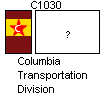
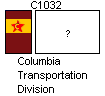
Lighter images and ship photographs document the Columbia star-and-C markings. A black appearance can conceal a purple-brown or dark-maroon ground, and some reproductions have been lightened to make that hue visible. Altfeltis’s hand-painted 1965 Edmund Fitzgerald lighter is offered as strong colour evidence; photographs nevertheless differ in the star’s size and position within the band. C1030 is supported by several vessel photographs. Sylvania shows a white C attached to the star, whose top touches the band’s upper edge while leaving space below, combining features of C1029 and C1030. Lighting also affects the apparent base colour.
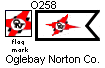
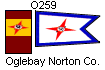
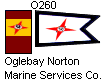
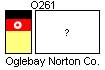
The white swallowtail has a broad black border. A small slanted black rectangle at the centre carries an equally slanted red four-pointed star, with a white central disc bearing interwoven black O and N.
The Columbia star and C were removed in 1994 while the vessel colours remained; the new offset-compass trademark was added in 1995. Courtney Burton photographs document the funnel on both sides. Middletown’s partly obscured flag in September 2002 appears tapered, but its border colour is unclear; the source notes a change to black in 2003.
Documentary images — company attribution uncertain
Mitchell’s drawings suggest William A Reiss and another unnamed vessel. William A Reiss belonged to Erie Sand Steamship, but the funnel resembles none of that company’s other recorded markings.
Vessel, date and exact company remain unconfirmed.
The business began in 1851 as the Cleveland iron-ore house Hewitt & Tuttle. Earl W. Oglebay joined Tuttle in 1884; after Tuttle’s death David Z. Norton joined, producing Oglebay, Norton & Co. in 1890. The source gives competing incorporation dates of 1924 and 15 March 1932, and Lloyds gives 1906 as formation. Columbia Steamship was created for its own ore transport in 1920 or 1921, named for the first vessel through the Soo Locks in 1855. It became Columbia Transportation in 1931 and acquired Valley Camp’s fleet in 1935. The group consolidated in October 1957, with the cited accounts giving both 17 and 31 October. Columbia continued as its shipping division until the 1994–95 reorganisation under the Oglebay name.
Oglebay and American Steamship pooled their fleets as United Shipping Alliance in January 2002; Oglebay also acquired Erie Sand & Gravel that month. Bankruptcy followed in early 2004. To reduce debt, eleven ships were sold: two to Integrated Shipping, six to American Steamship and three to Wisconsin & Michigan. Agreements with Lower Lakes included a long-term freight contract and operation of the Wisconsin & Michigan vessels. Mertens regarded the sales as ending the Oglebay flag’s sea-going use. By 2008 Rosanoski inferred absorption into Carmeuse from the company website’s redirection.
USA, Cleveland, Ohio.
OHLROGGE SCHIFFAHRTS K.G.
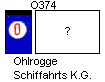
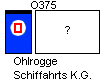
Mitchell’s Brake funnel broadly agrees with the photographed O375 version, differing in blue shade and the shape of the Ö. The second cited photograph has a lighter blue, possibly due to photographic processing.
Lloyds dates Ohlrogge’s formation to 1991, though Brake is recorded as bought and renamed in 1990. The vessel was sold without renaming in 2005. Later registers place Ohlrogge under J.H. Barr’s management and as a minor operating company.
Germany, Brake.
OIL TRANSPORT INC.
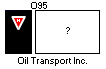
Alaskan carried a black funnel with a downward-pointing red triangle, edged white and containing a white H. No flag is recorded.
Oil Transport appears in Lloyds 1963–64 and 1970–71 under agents Joshua Hendy Corporation, subsequently Hendy International.
USA, Los Angeles, California.
OINOUSSAI SHIPPING CORPORATION.
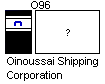
The funnel is recorded on Zoodohospigi and associated with Th. Papapateras. Rosanoski considers the emblem probably the Greek letter pi.
Lloyds 1963–64 lists Oinoussai under N.J. Pateras & Sons for Zoodohospigi. Miramar gives T. Papapateras as owner under that vessel name from 1962 to 1965, followed by a renaming under the same owner.
UK, London.
OKAWA UNYU K.K.
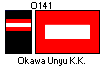
The flag comes from a 1902 chart republished in Fune to Hata in 1994 and also appears on the 1901 and 1910 sheets supplied through Alan Watt.
Japan.
OKAZAKI HONTEN K.K.
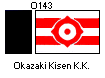
Tokichi Okazaki became a shipowner in the late 1890s and formed Okazaki Kisen, also Okazaki Steamship, in April 1910. Rosanoski identifies an apparent later form as Okazaki Honten Kisen-bu within Okazaki Honten. The business merged into Mitsubishi Kisen in June 1943.
Japan, Kobe.
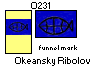
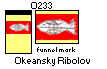
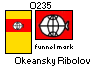
OKEANSKI RIBOLOV LTD.
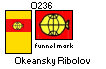
The original book warns that its hatchings are neither consistent nor definite colours. Rosanoski therefore treats this reconstruction as uncertain: the funnel may be a lighter yellow than the adjacent Bulgarian merchant example, and blue is assumed for a band which appears not to be red. A black fish outline is difficult to distinguish against blue, leaving open whether the band or fish colour is misread; a white fish is only a theory.
This appears to be the standard Bulgarian merchant funnel with a black top added.
Jane’s describes the normal funnel as dark buff and notes that the insignia may be yellow. Rosanoski interprets that as a yellow body in O236 instead of white, rather than yellow replacing the black lines, but the source itself is in black-and-white hatching.
Okeanski Ribolov, also Bulgarian Ocean Fishing, controlled Bulgaria’s distant-water fishing fleet and operated in the six main Atlantic fishing areas. It was under government control. Financial difficulties were reported from at least 1994, and a court-appointed team was announced in May 1998 to restructure and try to sell the business as a going concern. A 2002 report attributes cessation and liquidation to declining Black Sea fish resources, with an indication that closure had occurred by 2000.
Bulgaria, Bourgas.
OKINAWA KAIUN K.K.
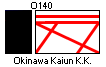
The flag comes from a 1902 chart republished in Fune to Hata in 1994. Alan Watt identifies its presentation under Ohki Kikusaburo as incorrect.
Japan.
OKÄNT SVENSKT REDERI.
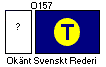
Do not identify Thore or any company from similar T alone.
Rosanoski considers this apparently a maritime institution.
Sweden.
OLAF PERREY.
Olaf Perrey
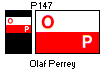
The flag is a white-over-red horizontal biband, with a red O in the upper hoist and a white P in the lower fly. The black funnel carries a broad band of the flag.
Germany, Hamburg.
OLAF RINGDAL.
The sources do not separately give a flag for this funnel. Rosanoski assumes the house flag applies, since Jordan describes the funnel emblem as the house flag without saying whether it appears as a panel or a band.
Stewart does not show a black funnel top for this version.
Olaf Ringdal appears as a ship manager in the 1939 account and later registers, also as an owner in 1958–59. Many vessels had names beginning with Ring.
Norway, Oslo.
OLAU LINE.
image by Jarig Bakker, 3 October 2005
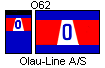
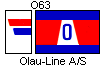
Olau Kent postcards supply the flag and funnel colours. Olau Gorm in July 1964 confirms the livery except for the absence of a black top and a lighter, possibly weathered funnel shade.
Rosanoski considers Brown 1982’s Sheerness–Vlissingen funnel incorrect when compared with photographs, which support O31.
After the final sale to TT-Line in 1980, its logo was adopted in Olau red and blue; the red-white-blue colours were described as representing Britain and the Netherlands. Photographs show bands reaching the funnel’s after edge on both sides. With sloping sides and the same angles, the port blue band is longer, while the starboard bands are equal in length; individual vessels show varying lengths. The colours apparently gave way to P&O’s in 1994.
The Dunkerque–Ramsgate logo appears on the hull and perhaps on its red, black-topped funnel, although the timetable view is unclear.
Ole Lauritzen formed Olau in 1956, combining the initial of his first name with part of his surname because he could not use the family name. Initially chartering tankers and cargo ships, it ran UK–Netherlands ferries from 1974 to 1994. Lauritzen sold half to TT-Line in 1979 and the rest in 1980. New ships operated through Olau Line (UK), formed at Sheerness in 1980. Following industrial action the service closed in April 1994 and the two ships went on charter to P&O, later being sold in 2005 under SNAV names. Lauritzen’s subsequent Dunkerque–Ramsgate venture failed after a port blockade and the arrest of Olau Kent on 9 September; the source gives no year for that event.
Denmark, Hellerup and Copenhagen.
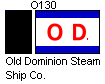
OLD DOMINION STEAM SHIP CO.
image by Joe McMillan, 8 November 2001
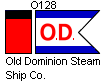
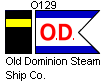
The flag is a white swallowtail with blue upper and lower edges and red OD initials at the centre, sometimes punctuated with periods. A July 1895 Cosmopolitan advertisement shows dots after the initials. Rosanoski considers O130 probably intended to include a dot after O as well; McMillan’s O129 drawing omits the dots while acknowledging punctuated versions.
Old Dominion was organised in February 1867 to continue Atlantic Coast Mail’s New York–Norfolk–Richmond passenger and freight services. Four months later it absorbed New York & Virginia Steamship, founded in 1850. The name refers to Virginia’s Old Dominion nickname, explained in the source by loyalty to the Stuarts during the English Commonwealth. Eastern Steamship acquired the company in 1923 and continued it as a division until American entry into the Second World War ended operations, which were not revived.
image by Klaus-Michael Schneider, 15 February 2007
The date of this funnel is uncertain: Merchant Ships 1942 describes it as a former design, whereas Ships & The Sea 1936 says it then applied. Rosanoski doubts the latter date because Talbot-Booth’s 1937 and 1938 publications do not mention it.
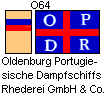
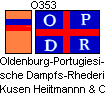
The funnel shade follows OPDR Las Palmas, photographed on 26 May 2005 while employed by FOCS. Website flag illustrations include a dark blue version. The FOTW description gives a blue flag with a red St George’s cross and white initials, transcribed there as OPDG.
The blue flag has a red cross extending to the edges, with its intersection towards the hoist. These are Oldenburg’s state colours. White O, P, D and R occupy the upper hoist, upper fly, lower hoist and lower fly respectively, close to the crossbars. The proportions are estimated at 1:2.
The Mobil chart shows an orange funnel.
OPDR was formed in 1882 by August Schultze and Hermann Burmester, moving its head office to Hamburg in 1915. Lloyd’s later amended the foundation date to 1880. The company became Oldenburg-Portugiesische Dampfschiffs-Rhederei Kusen, Heitmann & Compagnie K.G. in 1953 and adopted the GmbH & Co. K.G. name in 1983. Haniel’s account places its initial interest in 1882, near-total ownership in 1952 and sale in 1995; OPDR instead gives 1895 for the initial shareholding and 1996 for sale as sole shareholder. The Schulte Group bought the company in 1996.
The company operated mainly to Spain and Portugal. FOCS Container Service was established in April 2003.
Germany, Oldenburg and subsequently Hamburg.
OLE ABRAHAMSEN.
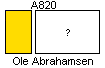
The funnel is apparently based on Solöy, for which Mitchell supplies a line drawing.
Ole Abrahamsen is recorded with Solöy, built in 1943, in Lloyds 1953–4 and as Ole Abrahamsen P/R in 1978–9. The latter entry’s last vessel is named Saaoy. Rosanoski initially reports that he could not locate these vessels in Miramar Ship Index.
A later note describes an apparent connection with Kåre Abrahamsen Partrederi at the same address and with Solöy, previously listed under Ole Abrahamsen in 1970–1. That note cites Miramar for a purchase in 1961 and a wreck on 23 August 1987, without further intervening detail.
Norway, Vedevåg.
OLEA TANKSCHIFFAHRTS GMBH.
image by Klaus-Michael Schneider, 12 April 2009
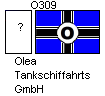
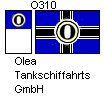
The flag is blue with a centred black cross edged in white, thin black lines running through the white edging. At the centre is a white circular area containing a black O. Rosanoski’s correction to the published description specifies that the white circle has no defining outline: a narrow black ring lies within it around the O, whose strokes are thinner at the top and bottom.
The funnel source appears to show the white circle outlined in black around the O. Rosanoski thinks the line more likely represents a ring within the circle, as on the flag.
Olea operated two ships between 1953 and 1962. Palma was built in 1953 and sold in 1961. Petra was acquired in 1954 under the operated company Regia Reederei & Handelsges. mbH and sold in 1962; Lloyd’s listed Olea as her owner in 1958–59.
Germany, Hamburg.
OLISSIPO COMPAÑIA NAVIERA S.A.
The funnel is recorded on Irena in July 1965.
Recorded in Lloyd’s in 1966–67, Olissipo had Franco Shipping Co. Ltd. [Franco Compañia Naviera S.A.] as agents.
Greece, Athens.
OLISTIM NAVIGATION CO. S.A.
The account of Port Halifax’s 1962 purchase and renaming as Ilena places Olistim in Beirut, with Turkish money behind the purchase, and says operations moved to Famagusta in 1969 under Sanspyridon Shipping. Rosanoski finds this unsupported by Lloyd’s 1963–64 Piraeus entry unless a further move occurred. The register subsequently distinguishes a Lisbon Ltd. company and an Athens Sp. Mar. S.A., whose relationship is unclear. In 1970 the S.A. operated vessels previously listed under the Lisbon company. Mitchell associates Olistim with Eft. Athanassion.
Franco Shipping appears as agent in 1963–64. Olistim was itself Piraeus agent for Alfa Shipping, which Miramar lists as owner of the sole vessel.
Greece, Piraeus; also Lisbon, Portugal, and Athens in the 1966–67 register. Mitchell gives Araeus or Arreus, which Rosanoski could not locate.
OLIVER J. OLSON & CO.
The website supplies a flag image. Two black-and-white Virginia Olson photographs differ: one suggests a dark funnel with an attached band of a similarly dark shade, perhaps black and blue rather than grey and blue; another shows a white band with a darker O on a dark funnel.
A postcard dated 13 May 1916 says the funnel O was being retained: it had first stood for Olson, then Otis and now Orth. The message is signed Wm. W. Hutton.
The barge operator originated in Olson & Mahoney’s steam-schooner business. A share certificate records Oliver Olson Steamship Co. without a formation date. Family-named vessels included Virginia Olson, built in 1917, and Florence Olson, acquired on 24 July 1918. Cynthia Olson was sunk on 7 December 1941. Rosanoski notes a source describing her and other vessels as schooners, although some photographs appear to show ordinary steamships; George Olson is described as becoming a towed lumber barge. In the 1950s the company and Crowley formed Pacific Barging Company, dissolved two years later.
USA, San Francisco and subsequently San Mateo, California.
OLJEKSUMENTERNA-OK.
image by Phil Nelson, None
image by Jarig Bakker, None
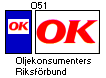
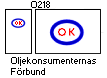
Brown 1978 and Loughran show a circular rather than oval ring. Phil Nelson’s FOTW drawing follows Stewart 1963.
The funnel follows a black-and-white photograph of the tug Oktan, bought in 1962, renamed Oktan I in 1966 and sold on 21 March 1967. No flag is visible; its applicability is assumed.
The livery changed in 1969, possibly to avoid confusion with Esso. The flag became white with large red OK letters angled slightly per bend sinister. Brown 1978 uses smaller letters set on a diagonal slope rather than angled, while the 1982 and 1995 editions use smaller ordinary letters. Brown 1995 labels this OK Petroleum A/B.
The later filling-station account describes a merger with Kuwait Petroleum and the OK Q8 name. Its logo, also used on flags, consists of blue and red semicircles side by side, with their open ends facing away from one another.
The Oil Consumers Association was formed in 1945 as Sveriges Oljekonsumenters Riksförbund OK by Kooperativa Förbundet, Bilägarnas Inköpscentral, Svenska Lantmännens Riksförbund, Svenska Andelsfisk and Västkustfiskernas Centralförbund. The source traces Kooperativa Förbundet to a 1939 formation by Superfosfat Fabriks, Svea and Saturnus. A 1956 division between Svea and Superfosfat transferred two ships to OK, establishing its independent shipowning. The name changed to Oljekonsumenternas Förbund in 1963 and apparently later to the heading’s form.
Attempts to liquidate shipping in the 1980s brought in Svenska Varv and led to Rederi A/B Oktetten, which retained OK’s naming pattern and funnel. Ships had Ok-prefixed names. The 1988–89 register lists OK Petroleum under Nordstöm & Thulin’s management; Oktavius was sold in 1989 and apparently chartered back. Shipping appears to have ended in the later 1980s. A later reorganisation account mentions Preem’s formation in 1996 and Texaco taking over parts of the business, but places the wider reorganisation at the end of the 1990s. Mitchell calls it a state oil company, while other accounts describe a co-operative.
Sweden, Stockholm.
OLOF AXEL MELIN.
The funnel follows a monochrome photograph of Svea, whose recorded period is 1917–55. Its colours are therefore assumed.
Melin became a shipowner by buying a towing vessel in 1895. On 26 December 1946 he gave his ships to his son Olof Erland and daughter Hildeborg Katarina. He died in an accident on 9 September 1949; the last vessel was sold in 1955.
Sweden, Örnsköldsvik.
OLSON & MAHONEY.
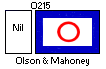
Olson & Mahoney operated steam schooners and preceded Oliver J. Olson & Co. The partnership is recorded in Lloyd’s 1917–18. Rosanoski suggests it may not have continued after 1918, when Olson is recorded buying a ship.
USA, San Francisco, California; San Mateo in Loughran.
OLYMPIA NAVIGATION INC.
Olympia Faith is recorded with a blue funnel and black top. No flag is noted.
Recorded in Lloyd’s 1963–64, Olympia Navigation used United Venture Navigation Co. Ltd. as agents.
Hong Kong.
OLYMPIC STEAMSHIP CO. INC.
image by Joe McMillan, 8 November 2001
The horizontal part of the funnel panel is angled, described in the original as “Pbd”, with the letters following the same slant.
Olympic was a small Pacific Northwest line, with four ships in 1949 and Olympic-prefixed names. The FOTW account derives its name from Washington’s Olympic Mountains rather than Greece.
USA, Seattle, Washington.
OLYPHANT, TALBOT & CO.
image by Joe McMillan, 8 November 2001
A leading house in the mid-nineteenth-century China trade, Olyphant, Talbot was parent to Olyphant & Co. of Canton. The account calls its offices “Zion’s Corner” because it refused to trade in opium, describing it as the only major trading house then taking that position.
USA, New York.
OMAN SHIPPING CO. SAOC.
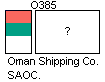
The funnel follows a starboard photograph of Mazyonah taken on 4 July 2013.
Incorporated in 2003 as a closed joint-stock company, Oman Shipping was government-owned through the Ministry of Finance, with 80%, and Oman Oil Co., with 20%. Oman Charter Co. handled chartering and Oman Ship Management Co. ship management. Joint ventures contributed to fleet development.
Sultanate of Oman, Al Khuwair and Muscat.
OMC Shipping Pte. Ltd.
Documentary images — company attribution uncertain
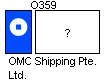
The funnel is based on Orient Star’s starboard side at Lyttelton on 12 October 2011. Rosanoski assigned it to the owner for want of other evidence, but explicitly doubts that it belongs either to OMC or manager MMS of the Meiji Shipping Group, considering a charterer more likely. Other ships likewise appear in the colours of companies to which they were chartered.
Charterer and mark proprietor unknown.
OMC was incorporated on 10 October 2010 and began operations in April 2011 as the Mitsui & Co. group’s Singapore shipowning arm. Its website describes ownership and management, although Lloyd’s does not list it as manager and places the fleet under other managers.
Singapore.
OMEGA NAVIGATION ENTERPRISES INC.
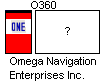
The funnel follows portside Omega Prince on 26 January 2013 and starboard Omega Theordore on 27 February 2010.
Omega Navigation Enterprises, or ONE, was formed in 2005 by George Kassiotis, a nephew of Anthony Comninos. Incorporated in the Marshall Islands with offices in Greece, it owned and operated ships and formed joint ventures with Topley Corporation of Glencore, including Megacore Shipping. The source lists Omega Management for technical and operating services and ST Shipping & Transport for commercial management. Target Marine was an associate at the same address.
Greece, Piraeus.
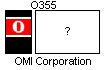
OMI CORPORATION.
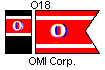
image by Jarig Bakker, 17 September 2005
Mitchell shows black shading on the O.
Jarig Bakker’s FOTW drawing follows Brown 1995.
A starboard photograph of Ohio confirms the funnel.
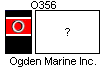
The livery appears to retain its connection with Ogden Marine and Oriental Exporters, although shading in some images suggests minor differences. Ned Smith noted that the funnel markings and logo derived from Oriental Exporters’ flag but could not find a photograph of OMI’s actual house flag in use.
OMI traced its origins to Oriental Exporters, whose founders included Michael Klebanoff. Its website says Ogden established Ogden Marine in 1968 to acquire Oriental affiliates, renamed it OMI Corp. in late 1983 and spun it off on 4 January 1984. Lloyd’s instead gives 1960 as the foundation and 1984 for the name change, while Mitchell places the separation in 1986. In June 1998 the international-flag business was spun off into a Marshall Islands OMI Corporation. The remaining US-flag vessels, lightering and management business acquired Marine Transport Lines and became Marine Transport Corporation. A later interview describes the acquisition and spin-off in the reverse sequence, while confirming the separation of foreign and US businesses.
A joint acquisition and division of OMI by Torm and Teekay was announced on 18 April 2007, with completion expected in the second quarter. Earlier subsidiaries included OMI Bulk Management and OMI Offshore Marine Services; the latter continued under Marine Transport Corporation. OMI Marine Services was formed in 1998.
USA, New York and subsequently Stamford, Connecticut.
ON THAI NAVIGATION CO. LTD.
Blissful was recorded in April 1965 with a yellow or buff funnel and black top. No flag is noted.
The company is recorded in Lloyd’s 1963–64.
Hong Kong.
ONASSIS GROUP.
image by James Dignan, 14 October 2003
image by António Martins, 11 February 2008
This livery was used until the mid-1960s and is also recorded for Sociedad Armadora Aristomenis.
The diamond carries the Greek omega. On Calliroe Patronicola at Lyttelton on 26 January 1991, the funnel looked dark mustard or brown buff, though NJK advised orange. Its white circle had a mustard ring near the edge. The wavy funnel flag substituted mustard for yellow and had a mustard diamond with a slightly lighter edge; the actual flag had a red diamond edged gold, filling the cross. Rosanoski suggests weathering explains the difference. The upper Olympic rings ran blue–gold–black–green–red, and the lower red–green–black–gold–blue, the reverse of Brown 1982’s order. NJK confirmed that sequence and a yellow cross; Brown 1995 shows only four rings in each sector with inaccurate colours. Olympic Legend in October 2009 had a red diamond edged yellow, whereas Olympic Loyalty showed orange without edging. Mitchell omits the black funnel top. Know Your Ships shows a red funnel and an aft-pointing pennant with a yellow cross.
The FOTW account describes a dark blue triangular pennant edged yellow, a white cross edged yellow and a red diamond edged yellow bearing a yellow omega. Rosanoski cautions that the book’s actual drawing is black-and-white, with long 1:2 pennant proportions, no specified blue shade and the symbol shown as blue.
An unsourced postcard series shows an O27-style funnel with a different flag. No other source supports that flag.
A separate Alexander Onassis Shipping funnel is recorded under Victory Carriers’ agency and later for Condor Finaciera Panama and Rosedale Navigation. Its band may be a shade of red.
Aristotle Socrates Onassis, born in Smyrna in 1906, emigrated to Argentina in 1923 and entered tobacco importing. He became a shipowner in 1931, initially laying the ships up for two years. Vessels were registered in Greece or Argentina, with the Greek registrations transferred to Panama in 1932. He died in 1975.
Olympic Shipping & Management is recorded as formed in 1951 as Panama Maritime, subsequently becoming Olympic Maritime and taking its later name in 1982. Another account dates its establishment to 1932. The group’s interests included Olympic Whaling, sold to Kyokuyo in March 1956, and a brief Pacific-Mediterranean Line venture with Stavros Niarchos and Costa Gratsos from 1946 to about November 1947. Associates included El Grupo Arisona and Victory Carriers. Springfield Shipping was formed in 2004. Ships generally had Olympic-prefixed names.
Monaco, Monte Carlo.
ONESIMUS DOREY (SHIPOWNERS) LTD.
image by Jarig Bakker, 11 August 2004
The National Maritime Museum’s flag is dated 1955–67. Coastal Ships & Ferries 1999 indicates that the company subsequently used James Fisher & Sons livery.
Accounts differ over the firm’s beginnings: an establishment date of 1874 is stated without support on the cited website, while the museum account places Onesimus Dorey’s founding of the Plymouth, Channel Islands & Brittany Steamship concern in the 1880s. Other evidence connects him with it from 1877 to 1898 and records ownership of Commerce in 1878. After a wreck and forced sale in 1898, a new company was formed; further loss led to chartering before bank assistance enabled another purchase. Services ended during the Depression, but Dorey continued by managing coal transport to the islands. The fleet moved to London in 1940.
The business used Onesimus Dorey & Sons from 1907 and an incorporated form from 1930. Peter Dorey, the founder’s grandson, acquired two-thirds of Condor in 1963. A 1972 reorganisation separated the holding interests from cargo shipping, operated by Onesimus Dorey (1972); the Shipowners name is dated 1976 by Lloyds and 1977 in another account. Peter’s widow continued after his death in the Fastnet Race, eventually offering the business for sale before a Fisher takeover. Another note apparently dates that takeover to 1972, leaving the chronology uncertain. Operations ceased in March 1983, but the name was retained and registered as a Dublin shipowner in 1989; later Lloyds listings continued.
Channel Islands/U.K., St. Peter’s Port, Guernsey.
Onstad Shipping A/S.
ONSTAD SHIPPING A/S.
Merchant Ships 1942 appears to show a white O on the funnel panel. Marine News places the flag’s panel nearer the hoist; a Kungsoil cap badge supports that position but also outlines the hexagon in blue. US Navy uses the Kungsoil version with equal bands and a blue panel outline. Jordan describes a yellow funnel with a red and gold shield on a blue band.
Rosanoski considers Stewart’s funnel probably erroneous, with its panel intended to resemble the flag’s.
Mitchell’s emblem probably represents a red O edged blue with a blue centre, although it can look like a blue-edged red panel bearing a blue I.
In 1967 Onstad adopted a flag divided horizontally red over grey.
REDERI A/B KUNGSOIL.
Documentary material — company attribution not established
image by Jarig Bakker, 6 August 2005
Onstad
Norway, Oslo; Haakon Onstad’s Swedish operation was at Kungsbacka.
Keep the explicit scope label independent; no alias or company identity is inferred.
Kungsbacka-Rederierna and Rederi A/B Kungsoil
Sweden, Kungsbacka.
Keep the explicit scope label independent; no alias or company identity is inferred.
Swedish companies
By the early 1970s the Swedish companies Kungsoil, Monacus and Pagota were listed under Kungsbacka-Rederierna. Kungsoil had operated part of Munkedals’ fleet; earlier named operators and managers included B. Lénberg and Tord Selden.
Keep the explicit scope label independent; no alias or company identity is inferred.
Kungsoil and associated Swedish companies
The central emblem is an O for Onstad. NJK associates it with Nils, while the FOTW account names Haakon. The flag was shared across the Swedish companies and apparently the Norwegian operation. Sources differ over blue edging around the hexagonal panel: all Kungsoil sources show it, but some Onstad sources omit it. The cap badge places the break in the blue band and the panel nearer the hoist. K266 has equal white and blue bands; other sources make the blue band narrower, perhaps only slightly. Rosanoski leaves open whether such differences intentionally distinguished the companies.
Keep the explicit scope label independent; no alias or company identity is inferred.
Haakon Onstad formed A/S Moltzaus Tankrederi II in 1932 with Pan Gothia. The vendors retained an interest, and Rederi A/B Pagota was established for Swedish registration. He and his brother Niels formed Onstad Shipping in 1935. After Norway’s occupation in 1940, Haakon moved to Kungsbacka and formed Kungsoil, followed by Monacus in 1943. Niels ran both Norwegian and Swedish businesses, using Onstad family names for their ships. Pan American Steamship probably ceased in 1962 when its sole vessel transferred to Onstad. Other operated interests included Aamodts and Niels Onstads Tankrederi.
The late-1970s tanker Nanny was built as a venture with Uddevallavaret, held 75% by Onstad and 25% by the yard. Munkedals took over Onstad’s share, and ownership later passed to the state concern named Zenith, which Rosanoski could not identify. The Norwegian company was liquidated in 1985.
OOO “Terminal”.
OOO DV Ryboprodukt
Aleksandr Ksenofontov’s February 2006 photograph shows a white funnel with a black top, separated by a band of national colours. Below a ship emblem near the base is the Cyrillic inscription recorded as ДВРЬбопрдукт, which Rosanoski renders DVRyboproduket, or DV Fishproduct.
Also listed as Terminal Co. Ltd., the company was formed in 2004 and shown as controlled by the Government of the Russian Federation. Its operating company OOO DV Ryboprodukt, formed in 2000, shared the address.
Russia, Vladivostok.
OOST ATLANTIC LIJN B.V.
The flag has horizontal red, white, green and red bands, the white and green occupying most of its field, with red O-A-L overall. The outer letters slant in opposite directions, described as “Pbds” and “Pbd”. The red funnel has a broad green-over-white band bearing the same lettering. Brown omits the dashes; the funnel lettering has been assumed to follow Nüsse’s flag.
Founded in 1960, Oost Atlantic Lijn operated through name subsidiaries and managed other companies. Initially recorded as an N.V., it appears as a B.V. by 1973–74. Yemen Gulf Line was an associate.
Netherlands, Rotterdam; also Antewerp, Belgium, in Lloyd’s 1970–71, with Rotterdam alone in 1978–79.
OPEN JOINT STOCK CO. BELAYA RIVER SHIPPING CO.
Rosanoski notes a website image but found no supporting flag evidence in the photographs on that site.
The corresponding external pages repeatedly failed retrieval. The normalized Soviet Union label cannot be extended automatically to the post-Soviet joint-stock company. Historical legal continuity and the relevant period of the livery remain unresolved; returned snippets are retained as discovery leads.
Also recorded as Belskoe Rechnoe Parakhodstvo or Belsk River Shipping, the government-controlled company operated passenger and cargo vessels, tugs and other craft on rivers and in the Azov and Black Seas. Rosanoski found references suggesting continued operation in March 2009.
USSR; Russia, Ufa; Republic of Bashkortostan.
ORE STEAMSHIP CORPORATION.
image by Joe McMillan, 7 September 2001
Rosanoski considers Brown 1951’s O183 flag probably wrong. Brown amended it in 1958, under the Ore Navigation Corporation name.
Formed in 1917, Ore Steamship was a Bethlehem Steel subsidiary carrying only its parent’s cargoes: ore to the mills and steel to markets. Calmar operated it, and vessel names had an ore suffix. By 1958–59 it was recorded as Ore Navigation Corporation, acting as manager, with the fleet appearing under Marven Steamship Corporation.
USA, New York.
OREGON STEAMSHIP CO. LTD.
Oregon Steamship appears in Lloyd’s from 1963–64 to 1980–81. NJK identifies Continental Grain as owner. Vessel names began with L.
U.K., London.
ORGANISATION OF THE ISLAMIC SHIPOWNERS’ ASSOCIATION.
image by Zoltan Horvath, 20 February 2011
image contributed by Neale Rosanoski, None
The flag appears green with a white disc bearing the association’s seal. A chain surrounds a steering wheel, ship and anchor, with the organisation’s name around them and a further inscription below the central device. Jan Mertens describes black inscriptions, a principally black central design with blue in the upper part of the wheel, and a yellow chain, qualifying what he could discern. Rosanoski records the lower wording exactly as OGANISATION OF THE ISLAMIC SHIPOWNER’ ASSOCIATION and considers the upper text probably its Arabic equivalent.
The association was founded in 1981. Saudi Arabia approved and ratified its statute. In 1993 the Islamic Conference of Foreign Ministers asked it to establish a shipping company to carry cargo between Islamic ports and promote trade. The Islamic summits in Tehran and Doha supported the proposal, and resolutions acknowledged permission to establish the company’s headquarters in Jeddah under the name Bakkah Shipping Company, or BASCO.
Saudi Arabia, Jedah.
Orient Line Y.K.
Documentary images — company attribution uncertain
The chartered-out fleet sometimes carried charterers’ colours, including Mitsui’s on Akagisan and IMC’s on Maritime Sirinant. Bellflower and African Robin instead showed an emblem on blue which Rosanoski assumed to be the owner’s, without confirmation on its website. O205 follows Bellflower on 14 April 2006, then under Shinwa charter. The central device resembles a bellflower; possible comparisons include Campanula and the Chinese or Japanese bellflower, but its identity was not confirmed by an enquiry aboard Bellflower. An enlargement was later taken from Orient Vesta’s port side on 4 June 2012.
Observation date and owner versus charterer livery unresolved.
Haruyuki Hirose began the coastal service Hirose Unyu in 1946, incorporating Hirose Unyu K.K. at Tsushima-cho in March 1967. Orient Line Ltd. followed in February 1986 and became Orient Line Co. Ltd. in November 1993. Both offices moved to Matsuyama in October 1999. After Hirose’s 2001 reorganisation, the two merged in April 2003 as Hirose Unyu Co. Ltd., then renamed Orient Line Co. Ltd.; the office moved to Ichiban-cho, Matsuyama, in August 2005. Lloyd’s separately gives a 1987 foundation, later amended to 1973, which Rosanoski thinks may refer to the first ocean-going acquisitions in August 1973.
Japan, Tsushima.
Orient Mid-East (U.K.) Ltd.
Documentary material — company attribution not established
U.K. agency and Great Lakes Service
U.K., London.
Keep the explicit scope label independent; no alias or company identity is inferred.
Orient Mideast Lines
The separate Orient Mideast entry describes a yellow funnel with a white-red band and a black O overall. Its flag has horizontal yellow, red and white bands, likewise carrying a black O.
The separately listed Orient Mideast Lines may be the Orient Mid-East Lines Inc. mentioned in the agency list.
Liberia, Monrovia.
Keep the explicit scope label independent; no alias or company identity is inferred.
Great Lakes Service
Orient Liner carried a yellow or buff funnel with a narrow black top and a broad white band bearing a flag flying from a black pole. The pennant is divided yellow over red with a white circle containing stylised black GL letters arranged “Pbd”. A separate flag was not observed and is assumed from the funnel. The livery is also given for vessels under the agent, including Angeliki L of Evernia, as spelt in that observation.
Keep the explicit scope label independent; no alias or company identity is inferred.
Orient Mid-East (U.K.) acted as agent for Evermia Compañia Naviera, Orient Marine, Orient Mid-East Great Lakes Service and Orient Mid-East Lines. The Great Lakes company is recorded in 1963–64 and 1970–71.
Orient Overseas (International) Ltd.
Orient Overseas Container Line Ltd.
O332 is listed with Nüsse and FOTW as its sources, but the source provides no separate written description identifying its differences.
Documentary material — company attribution not established
The O87 flag is supported by a company logo. Loughran shows the first flag with a white field, while the later Brown illustration is yellow. Vessels sometimes flew the flag of Island Navigation Corporation Ltd.
The earlier Nüsse illustration used for O333 was displayed upside down; his later site corrected it. Rosanoski considered the correctly oriented design the same as O88. The flower has five petals, one long stamen along the middle of each petal, and five pairs of shorter stamens between them, converging on a small white central disc. O88 has white stamens; Brown depicts them in black, which Rosanoski regarded as presumably a printing error.
The flag dated 1993 is yellow with red “OOCL” lettering. A flower occupies the second “O”; its orientation differs from the earlier flower and its petals are yellow with red stamens.
John Ma identified the flower as a plum blossom stylized in the Republic of China–Taiwan manner, and related that symbolism to C.Y. Tung’s alignment with the Taiwanese cause.
Photographs of flags at sea between at least 2005 and 2010 suggest a creamy-yellow field matching the funnel and a larger emblem than on the table flags. Rosanoski allowed for fading and suggested that there might instead have been separate sea and shore versions. His OOCL Europe photograph is referenced as O334 in the text; it is not an additional image in this gallery.
Orient Overseas is dated to 1946. Its founder, C.Y. Tung, developed international services as Orient Overseas Line after a ship with an all-Chinese crew reached the Atlantic coasts of the United States and Europe in 1947. Containerization brought the Orient Overseas Container Line name in 1969. The early ships appear to have operated through Chinese Maritime Trust Ltd., later Chinese Maritime Transport Ltd., with Orient Overseas Line apparently a trade name. C H Tung succeeded his father in 1982, and C C Tung succeeded him in 1996.
China, Hong Kong; the registered office was at Hamilton, Bermuda, and the principal office in Hong Kong.
ORIENT SHIP MANAGEMENT LTD.
The red lines meet only at the tip.
Founded in 1984, Orient Ship Management became OSM Maritime Services Ltd. in 2001. Its fleet included name companies such as Chang Bai Shan Shipping and Hang Yip Shipping. Acomarit (U.K.) managed most of the fleet by 2000. Orient’s own management clients had included Cargill International and Chang Bai Shan before the latter was listed as a name company.
China, Hong Kong.
ORIENT SHIPPING LINE LTD.
image by Eugene Ipavec, 2 September 2008
The house flag is white with a blue Magen David containing the letter O. It was flown alongside the Nazi flag on the voyage from Germany in summer 1933. The source cites a photograph held by the maritime museum.
Orient Shipping Line was founded in 1933 and dissolved in 1934. The FOTW account describes five German Jews establishing it to take their money out of Nazi Germany, buying Dora and Carola and sending them from Hamburg to Haifa under German command. Kashtan’s account identifies the founders as the Elsner brothers of Haifa and says German captains were required for the departure. After arrival, the German crews or captains were replaced. Kashtan specifies registration under British Mandatory Palestine and Jewish captains; the FOTW account says the vessels then sailed only with the house flag. The ships were sold when the business closed.
Germany; British Mandate of Palestine, Haifa.
ORIENT STEAM NAVIGATION CO. LTD.
image by António Martins-Tuválkin, 8 May 2010
image by James Dignan, 15 October 2003
The first flag combined Anderson’s blue flag and white saltire with Green’s red cross over a blue panel on white. The composite was blue with a white saltire and an undefined white diamond carrying the red cross and blue panel. Stewart omits the panel, producing the O133 variant which Rosanoski considers apparently incorrect. The design was apparently adopted in 1878 and lasted to about 1880. O132’s black funnel is surmised from the stated early colour and possible chartered vessels retaining their own funnels.
The next design was white with a cross and crown, described in Rosanoski’s development account as a red cross, and red O, S, N and C in the quarters. Its introduction is placed about 1880. The end is variously given as 1888, about 1892 or 1906; Rosanoski rejects 1906 because Reed 1891 already shows the next version.
A small o was added after C. Loughran dates this change to 1888 and Stewart to about 1892, although Reed 1891 already records it. Both accounts place removal of the letters in 1908.
The letterless flag may instead date to 1909 if tied to the end of Royal Mail’s influence. Lloyd’s 1904 already shows O136 without letters for Orient and also Pacific Steam Navigation, possibly a printing error. LJC 1909 assigns O135 to the Orient Royal Mail service. Harnack shows both black-cowled and plain funnels.
These drawings represent sources whose crown details vary.
The FOTW description gives a white flag with a blue St George’s cross and central gold crown. Rosanoski notes that the illustrated crown differs from Sampson’s source, which more closely resembles O337.
This was an unofficial port signal used from 1926 for a vessel undergoing fumigation, reconstructed from a verbal description.
The sources disagree over whether the crown lies wholly on the flag’s cross or extends beyond it. Black funnels are dated 1877–1906 and buff 1906–65; another account says buff was first adopted for passenger ships and then throughout the fleet. Early buff funnels had black Admiralty-type “clergymen’s hat” tops, replaced in post-war ships by black “Welsh hat” tops.
The Orient Line name dated to 1863, while Orient Steam Navigation was formed in 1877 or 1878 for the Australian service of Anderson, Anderson & Co., F. Green & Co. and Pacific Steam Navigation. Accounts differ over whether the Anderson and Green firms formally merged in 1874 or only in 1918–19. Closer co-operation with Pacific after the 1898 depression brought the Orient Pacific name. Royal Mail acquired Pacific’s Australian interests in 1905 or 1906 and the service became Orient-Royal Mail, incorporated in February 1906; its end is variously dated 1909 and 1910.
P&O acquired 51% in 1919. An Orient & Pacific service was jointly established in 1958. P&O’s ownership became complete in 1965, with the P&O-Orient name, and Orient was dropped in 1966. Ship names generally began with O, later specified as Or, though exceptions occurred.
U.K., London.
ORIENT STEAMSHIP CO. LTD.
The livery bears the family K.
John and Philip Koo, third-generation members of the Koo shipping family, formed Orient Steamship in 2003. Its headquarters were in Hong Kong and ship management in Vancouver. The source notes indications of recent integration with Valles Steamship (Canada), without confirming it.
China, Hong Kong.
ORIENTAL EXPORTERS INC.
image by Joe McMillan, 9 September 2001
The flag is red with white stripes along its upper and lower edges and a white O in the centre. OMI claimed corporate descent from Oriental Exporters and used funnel markings and a logo based on this flag. The contributor could not find an actual OMI house flag in use.
Documentary images — company attribution uncertain
The funnel, with blue shading, was recorded on Oriental Clipper of Universal Bulk Carrier, for which Oriental Exporters acted as agent. Rosanoski considers the design apparently OMI-related but cannot reconcile the presumed post-1968 attribution with his recollection of a mid-1960s observation. Mitchell likewise links Universal Bulk Carriers with Ogden Marine without a date.
No definite company allocation.
Oriental Exporters appears to have begun operations in 1961, taking Hudson as an example. Michael Klebanoff was a founder. Ogden Marine bought affiliates in 1968, possibly the individual shipowning companies. Oriental Exporters remained listed as agent for Oriental Transport’s Ogden Exporter in 1980–81; that vessel appears under OMI’s agency in 1985–86.
USA, New York.
ORIENTAL LINE.
Kotakinabalu was observed at Hong Kong in September 1972, or possibly 1971, with a black funnel, matching chartered Kamishima Maru in February 1965. Kuching had a white funnel on 20 May 1971. The source suggests the charterer added its band to each vessel’s normal funnel. Use of a separate flag is presumed.
Oriental Line operated as charterer.
Japan.
Original document: ABC Maritime A.G.docx
Documentary material — company attribution not established
The extracted document lacks a title and Country section. External evidence strongly supports the filename identity and Switzerland, but the incomplete source and blank pipeline country require mapping/source review; Randa's acquisition year also differs.
Two funnels are described: a black one on Adfines Sky, photographed on 13 March 2014, and a blue one on San Pietro, photographed on 15 June 2014.
The document records the purchase of the first vessel, Randa, in 1986, followed by investment in the first tankers and Fast Support Intervention Vessels in 1998. An Odessa office opened in 2002. Suisse-Outremer was founded in 2004 to group vessel ownership, and Bayside Services S.A. was acquired in 2005 for shipbroking and financial services.
ORION EXPEDITION CRUISES PTY. LTD.
The flag is blue with a white O whose sides appear narrowed to create a three-dimensional effect. A spear crosses it diagonally with its point towards the upper fly. Photographs show the funnel spear pointing aft on both starboard and port sides.
Orion Expedition Cruises, or OEC, was registered on 11 March 2004 and founded by Sarina Bratton. The Australian-owned operator began cruises in 2005 with chartered Orion, owned by Explorer Maritime with Helios Shipping of Piraeus as agent.
Australia, Sydney.
ORION SHIPPING & TRADING CO. INC.
image by Joe McMillan, 9 September 2001
Gherania of Adriatic Shipping carried the Petros J. Goulandris funnel common to the group. US Navy also assigns it to Giralda, disputed by Mitchell, and to Gothom, whose connection Rosanoski could not establish except through a possible agency link. Stewart gives it to States Cargo Carriers. Mitchell records it under Orion & Global Chartering with Andros-named ships but no dates.
US Navy and FOTW place a smaller star in the lower fly corner.
Fenton prefers US Navy’s flag over Brown 1958’s Andros Shipping version. US Navy includes it in the Liberian section while giving New York as its domicile.
Founded after the Second World War by the Goulasdris brothers descended from Peter (Petros), Orion later became Global Chartering & Brokerage. Their brother-in-law George Embiricos and uncle Demosthenes Dampasis joined in 1950. Agency clients included Adriatic, Alora, Bilmar, Giralda and Overseas Carrying.
USA, New York.
ORION-REDERIERNA A/S.
image by Ivan Sache, 16 November 2002
The funnel star has eight points and the flag star seven. A black-and-white Venus photograph does not appear to support the funnel drawing.
Shades follow the website image. Funnel photographs suggest a blue top, but the colour is unclear and black remains possible.
Orion
Denmark, Copenhagen and later Soborg.
Keep the explicit scope label independent; no alias or company identity is inferred.
P.E.P. and Pepnautica
Poul Erik Petersen founded the trading, agency and shipping business in the mid-1960s. Troels Busk and John Bent Larsen bought it on 1 April 1971; Larsen became sole shareholder on 1 January 1974 and changed the name to P.E.P. A part-owned shipping company established in 1971 bought Seehausersand, renamed PEP SEA, followed by twenty-two PEP vessels. The register account describes Pepnautica as reformed in 1974, with part becoming P.E.P. Shipping (Scandanavia), while that company’s own section dates its formation and takeover of part of Pepnautica to 1984.
Denmark, Copenhagen; later Soborg for P.E.P. Shipping (Scandanavia).
Keep the explicit scope label independent; no alias or company identity is inferred.
Orion group
The group included shipbroker P.E.P. Shipping, the shipping companies Birte, Lyra and Cetus, and P.E.P. Shipping (Scandanavia).
Keep the explicit scope label independent; no alias or company identity is inferred.
The FOTW commentary explains Orion as the hunter killed by Artemis and made into a constellation, whose three diagonal central stars form Orion’s Belt.
The Shipping Co. Orion was founded in 1912 and long managed by C.P. Jensen. Its three steamships were Venus, Astra and Orion, the last delivered in 1919 and sold in 1957. The dormant company was taken over in 1986 by businessmen who renamed it Orion Ltd.; Lloyd’s gives 1986 as its formation. After selling its last asset in 1997, it was acquired and reorganised by B.E.L. Holding & Investment, parent of P.E.P. Shipping. Camillo Eitzen acquired 93.1% in September 2007.
ORKNEY ISLANDS SHIPPING CO. LTD.
The red funnel has two white bands separated by a narrow red interval; beneath them is a white ring with thickened sides enclosing a white I. The flag is red with white horizontal batons, located by the source “in hoist and base”, and between them the same thick-sided ring and I.
The company appears in Lloyd’s 1963–64 and 1970–71 as fleet manager for the Secretary of State, specified in the latter edition as the Secretary of State for Scotland for one vessel.
U.K., Kirkwall.
OROSOL CO. LTD.
Orico was noted in April 1965 with a yellow or buff funnel, black top and blue star. The observation associates it with A.I. Romano and describes a white R in the star as part of Transpetrol’s livery. No flag is recorded.
Orosol is listed in 1963–64 with Mathews, Wrightson, Burbidge as agents, and in 1970–71 with Transpetrol.
U.K., London; Greece, Athens by 1970–71.
ORPHEUS MARINE TRANSPORT CORPORATION.
The source cites Chrysantheum’s starboard side at Singapore on 7 June 2011 and Alkaios’s port side on 23 May 2009. Alkaios appears more yellowish with a darker blue emblem. The descriptive paragraph labels the funnel O210, while the bibliography and current association use O201.
Formed in 1996, Orpheus appears as agent in the 1998 register and as manager in 2011–12.
Greece, Piraeus.
Osaka Asahi Kaiun K.K.
OSAKA ASAHI KAIUN K.K.
Mitchell bases this funnel on a line drawing of the Panamanian-flagged Success Hope, which Rosanoski did not locate in Lloyd’s.
Asahi Marine (Panama) S.A.
Osaka Asahi Kaiun, also Osaka Asahi Marine Transportation, was formed in 1960. It acted as agent for Asahi Marine (Panama), subsequently listed as a name company formed in 1985. The fleet initially used Asahi Maru names, with other names appearing later.
Japan, Tokyo and Osaka in successive registers; Kobe according to Mitchell.
Osaka Senpaku K.K.
OSAKA SENPAKU K.K. (1)
The funnel follows the previous company’s design, but with its bands moved to the top. The earlier flag is not shown here; continued use is assumed likely.
Principal company
Also called Osaka Shipping, this appears to have been a renaming of Kotani Kisen, with the former fleet at the same address in 1970–71. By 2000 it was an operating company of Mitsui OSK Lines. Kotani Kaiun, formed in 1981, moved from operating-company to name-company status in the registers. Kotani Steamship, formed in 1988, operated a joint venture with Osaka Senpaku and was subsequently listed under Mitsui O.S.K.
Japan, Osaka.
Keep the explicit scope label independent; no alias or company identity is inferred.
Second register entry
A second Osaka Senpaku entry appears in Lloyd’s 1992–93 under a different registration identifier.
Japan, Osaka.
Keep the explicit scope label independent; no alias or company identity is inferred.
OSAKA SHOSEN KAISHA.
image by Phil Nelson, None
Some sources show a blue flag before the 1930s, but Alan Watt states that the field was always white, supported by Lloyd’s. Merchant Ships records a former blue flag with red device and red funnel markings. Rosanoski treats the red funnel design in the 1925 Almanacco as an assumed error.
The design represents the kanji O used for Osaka. Brown 1958 rounds the flag’s bands and makes their angles less definite. Photographs confirm the funnel design, although Horai Maru appears with a single narrow white band on a dark funnel. The Brazilian website enhances the flag device. Phil Nelson’s revised FOTW drawing corrected an earlier version with equal bands, but Rosanoski still finds the bands too high, leaving unequal gaps above and below.
Osaka Shosen, also Osaka Mercantile Steamship or OSK, began in May 1884 as an amalgamation involving fifty-five shipowners. Loughran instead gives 1913. It merged into Mitsui OSK Lines on 1 January 1964, following a contract signed on 19 December 1963; the source accounts name the other party as Mitsui Sempaku and Mitsui Kinkai respectively.
Merchant Ships lists Nippon Yusen as owner. The recorded subsidiary and associated interests include Kokusai Kisden, taken over in 1937, Settsyu Kisen, Harada Kisen from 1938, and controlled Taiyo Kaiun.
Japan, Osaka.
OSAKA ZOSENSHO K.K.
The new moon and baby elephant represented a young, expanding shipowning activity; the source also explains that Zo-zen and the Japanese word for elephant sound alike. The funnel was noted on Fukazaki Maru at Lyttelton on 31 March 1972. A starboard Minami Maru slide confirms the elephant facing forward, and the Japanese chart places it on an orange moon. The flag device combines the character for “Big”, also Osaka’s first syllable, stylised as an engineering tool, within a Roman O.
Brown 1995 records this as an alternative funnel.
The shipbuilder expanded into shipowning. Loughran dates this to the early 1970s, but Rosanoski notes disagreement with earlier Lloyd’s entries beginning in 1953–54.
Japan, Osaka.
OSCO SHIPPING SERVICES A/S.
The livery resembles that of Scröder & Farstad. The flag is blue with two interlocking white diamond frames, separated from each other by the blue field. The funnel is dark buff with a broad band bearing the flag. Osco Sailor, seen at Lyttelton on 20 March 1987, had a funnel base described as khaki orange.
The company appears to have originated from Schröder & Farstad, a partnership operating from 1965 to 1975. Ole Schröder & Co. branched out independently. The later company account dates Ole Schröder & Co. A/S to 1967, its change to Osco Shipping A/S to 1982, to Osco Shipping Services A/S to 1989, and its return to Ole Schröder & Co. A/S to 1991. The register listings do not align exactly with this sequence.
Norway, Oslo.
OSKAR WEHR K.G. (GMBH & CO.)
image by Jarig Bakker, 2 February 2006
image by Klaus-Michael Schneider, 11 June 2007
W100’s funnel and flag follow Brown; Jarig Bakker’s FOTW image uses Brown 1995, whose index misspells Oskar as Ockar.
The flag described as current in 2007 is dark blue with a yellow horizontal stripe and a central yellow roundel carrying intertwined dark-blue OW. The source leaves open which letter overlays the other. Klaus-Michael Schneider observed it on a Hamburg-Süd building doorplate on 18 May 2007. Nüsse’s table flag appears to have a slightly wider gold stripe.
Wehr Altona’s starboard photographs of 18 September 2007 show dark-blue flag bands. Another partly obscured, flapping view appears to make the central gold band much wider than the blue bands, but Rosanoski warns that the flap may explain this.
Most funnel tops appear black; W541 records the port-side view of Wehr Koblenz on 7 September 2013.
Mitchell assigns W542 to Antigua-flag vessels.
W543 is another funnel illustration from Mitchell, without a separate written description.
Oskar Wehr began in 1945 with the motor-sailer Anne. In the mid-1960s Kapitän Wehr decided to operate ashore through the newly founded Oskar Wehr K.G. The company history calls Janne Wehr, commissioned in 1968, that firm’s first vessel; Rosanoski notes that the registers already list Helga Wehr, purchased and renamed in 1954, which the history omits. By 2013 the third generation under Jürgen Wehr was engaged in tramp chartering, operational management and freight agency, with ships built through investment partnerships.
The registers separately listed Reederei Oskar Wehr K.G. at the same address in 1978–1979, combining the entries by 1980–1981. Later fleets were held through named subsidiaries and the company’s own name.
Germany: Hamburg-Altona, Hamburg-Rissen and Hamburg; Schenefeld in Lloyd’s 1998.
OSLO BULK PTE. LTD.
The funnel follows a portside photograph of Oslo Bulk 4 taken on 8 March 2012.
Oslo Bulk was a privately owned Norwegian holding company, also known as Oslobulk Shipping AS and Oslo Bulk Shipping AS, with bases in Singapore and Kaliningrad. One account describes five investors, while the listed investors number six. It acquired half of HAV Ship Management in 2010, and International Shipholding acquired 25% of Oslo Bulk that year. Vessels used Oslo Bulk followed by a number.
Norway, Oslo.
OSLO SHIPHOLDING A/S.
The white flag has a very narrow red diagonal band, described as “Pbds”, separated by a white gap of similar width from a slightly broader blue band. No funnel is given.
Formed in 1988 as Invest 2000, the company changed its name in 1989. Its operating subsidiaries included Northern Navigation Norway, formed in 1989 as Pan Shipping and renamed in 1992, and K/S VLCC Invest 1, formed in 1988 with its vessel managed by C.H. Sorensen & Sonner.
Norway, Oslo.
OSMARINE (AUSTRALIA) PTY. LTD.
Originally Port Jackson Wool Dumping Pty. Ltd., the company became Osmarine (Australia) and was deregistered on 7 January 1983. Cunard is recorded as owner in 1969, and Adelaide Steamship as an associate.
Australia, Sydney.
OSPREY MARITIME LTD.
Osprey was formed in 1993. Debt-financed acquisitions of Petrobulk and Gotaas Larsen in the later 1990s led to a credit watch in October 1998. Gotaas-Larsen, bought in mid-1997, became Osprey Maritime (Europe) in 1998. The Petrobulk purchase is variously dated 1996, early 1997 and 1998–99. John Fredriksen’s World Shipholding began acquiring Osprey in August 2000, passed 50% in November, reached 90% in January 2001 and completed acquisition in May. Golar LNG acquired the LNG interests on 21 May 2001; the European management company was sold to Frontline on 2 July and became Golar Management (UK).
Osprey bought half of Thome Ship Management in early 1995 and sold it to Olav Eek Thortensen and an associated investment company in August 1999. GL Monaco’s shareholding in Osprey rose from 13.75% in 1997 to 23.63% in October 1998.
Singapore.
Ost-West-Handel und Schiffahrt GmbH.
OWH
The funnel follows Electra’s starboard side on 14 July 2012 and Baltic Sun’s port side on 3 April 2011. In the latter photograph the blue is a darkish sky shade.
OWH was formed in 1996 as Ost-West-Handel Bruno Bischoff and adopted the later name in 2000. Lloyd’s lists it as a Samskip operating company in 2000 and as manager in 2011–12.
Germany, Bremen.
OSTERWISCH & SOHN SCHIFFAHRTSBETRIEBE.
The flag is red with a stepped white panel carrying black O above S. The black funnel has a broad band of the flag.
Recorded as F. Osterwisch & Co. K.G. in 1953–54, the business subsequently appears under Friedrich Osterwisch and Friedrich Osterwisch & Son before the later heading. Peter Döhle managed it in 1963–64. It later managed partnerships and individual ship companies, also appearing as owner in 1980–81 and as manager and agent in 1985–86.
Germany, Hamburg.
OSWEGO GROUP.
Oswego Petroleum Carriers Inc.
The funnel was noted on Oswego Reliance.
Brown describes this livery as common to the group. It was also observed on Oswego Peace of Oswego Transportation and listed by Brown 1982 for Oswego Shipping. Mitchell associates the livery with Marine Transport Lines.
Oswego appears to have been a group of Liberian companies operating chartered vessels. A later account dates Marine Transport Lines’ merger with the Trinity/Oswego Group to 1958; Rosanoski identifies Trinity Marine as the probable reference because it used the same emblem. Oswego Leader is recorded from at least 1959. Many Oswego companies used Marine Transport Lines as agent, including Oswego Chemical Carriers, formed in 1963 and later listed as its name company.
Oswego Shipping is recorded as merging into American Steamship on 1 March 1967, though it also appears in the 1978–79 register listing.
Liberia, Monrovia.
OT AFRICA LINE.
image by Jorge Candeias, 3 February 1999
image by Jarig Bakker, 12 January 2006
Brown’s notes describe added white lettering outlined blue across the centre of the OT flag, printed as “OT African Line” in one passage and “OT AFRICA LINE” in the later quotation. The website instead shows the wording superimposed on the flag image and extending outside its borders. Rosanoski’s reconstruction of the lettered flag is therefore an interpretation of Brown.
The funnel follows Kamina and may be a darker yellow. FOTW versions of the flag appear under both British OT Africa Line and Swedish O.T. Shipping, one in 2:1 proportions. The original flag appears to have belonged to O.T. Rederierna, as supported by a cap badge. The precise relationship between the Swedish successor and OT Africa Line remains unclear.
Rosanoski considers it possible that the Swedish company’s name and flag were sold with its assets after the 1982 liquidation, but does not establish the later context of the flag’s continued website use.
OTAL’s website dates its formation to 1975, while Mitchell gives 1974, when former BFI management established it with Johansson Group ships. After Johansson’s 1982 bankruptcy, management bought the line with Nigerian interests and Stena; Stena sold to BFI in 1984, leaving it wholly owned by BFI’s parent Antrak. In January 1998 OTAL Holdings brought together OT Africa Line, Antrak Marine and Antrak Logistics. African Ro Ro, Antrak Liner Services and Crosstrades were merged into OT Africa Line. OTAL and Antrak International were sold to Bolloré in October 1999, remaining organisationally separate from Delmas, and were bought by CMA-CGM in 2006. OTAL France had been established in 1995.
Nigeria; Birmingham, U.K., in the later website account.
OTHELLO SHIPPING CO. APS.
Ships with Happy or Lady prefixes used the Unigas pool funnel. O234 instead follows Arctic Gas’s port side on 28 May 2007, with the flag logo taken from Othello’s website.
Formed in 2002, Othello owned and operated specialised LPG and chemical-gas carriers. Ultragas International acquired it in 2006. Rosanoski infers a change to Ultragas ApS during Ultramar’s 2012 rebranding, from the old website redirecting to the new name. It participated in the Unigas International Pool.
Denmark, Copenhagen.
OTTO A. MÜLLER.
Early livery
The early black funnel has green-white-red bands with black OAM on the white, confirmed by a photograph of Gretchen Müller. The flag is green with a white-edged red Iron Cross and an overall black-edged white diamond bearing black OAM.
Keep the explicit scope label independent; no alias or company identity is inferred.
Post-war livery
After the Second World War, the funnel carried a white vertical oval over the green-white-red bands, with stylised OA above M arranged like a man carrying a sack. The flag became horizontally green over red with a black-edged white diamond and black OAM. Loughran instead leaves the diamond unoutlined and extending throughout.
Keep the explicit scope label independent; no alias or company identity is inferred.
1976 livery
Some 1960s vessels had narrow yellow uptakes. A new flag adopted in 1976 was also painted on their white superstructures: white with a blue square frame enclosing horizontal blue lines above O.A.M. The sixth line rises to a point, the sixth to eighth change in small steps, and the ninth is straight again. The design represents a growing mound of bulk cargo in the hold and changing methods of bulk carriage.
Keep the explicit scope label independent; no alias or company identity is inferred.
Otto Alfred Müller founded OAM on 1 November 1890 to import English coal. Growing demand for Bolsover coal led to construction of Gretchen Müller at Rostock in 1908. On his death in 1929, Otto Franz Jacob became managing director and Friedrich Sauerland a partner with a one-third interest. Further coal businesses were acquired in 1936–38.
After the war Otto A. Ottmüller joined the partnership, followed by Gert Ottmüller in the early 1950s. OAM withdrew from deep-sea fishing in 1956 and from American coal imports that year, concentrating on privately mined coal outside the National Coal Board. Maritime associates included Delphin Schiffahrt, Bulkmaster Shipping and Bulktrader Shipping.
Germany, Hamburg.
OTTO BANCK’S REDERI A/B.
Mitchell places Otto Banck under Erik Bancks Rederi and shows a line drawing with the B422 funnel but a blue top. Rosanoski cautions that such small drawings are not always accurate, leaving it unclear whether Mitchell intended the Erik Banck funnel instead.
Percy Banck is listed as manager in 1953–1954, 1958–1959 and 1963–1964.
Sweden, Helsingfors.
OTTO CANDIES LLC.
The funnel follows a starboard photograph of Celia Candies dated 14 July 2013.
The business originated in 1942 when Captain Otto B. Candies was asked to supply small-craft support to an oil rig, clearing water lilies from an access canal. Earlier registers use Otto Candies Inc.; later listings use Otto Candies LLC, as owners and managers in 2011–12.
USA, Des Allemands LA.
OTTO FAHJE & SOHN.
Listed as Kapitän Otto Fahje in 1953–54, the concern appears as Otto Fahje & Sohn by 1958–59 and later as manager. It managed the subsidiary Helfried Fahje, which was listed in its own right in 1985–86.
Fleet names used the suffix “stein”.
Germany, Hamburg.
OTTO GIESE.
image by Klaus-Michael Schneider, 11 April 2009
The flag is white with a centred black cross and a central white disc outlined in black, containing a red capital G. Rosanoski qualifies the G461 illustration: the central outline should match the cross’s width and the disc should be more oval, though not quite as elongated as the US Navy-derived G462 image.
Philipp Otto Giese, born on 8 November 1914, obtained his master’s licence after wartime U-boat service and established a line trading in the North Sea, Baltic, Caribbean and Far East. He began with Ann-Christen, built in 1952. He left the sea for Florida in 1964, became a US citizen in 1968, and managed the [Filletee] Green Steamship Agency at Pensacola until retiring in 1981.
Germany, Bremen.
OTTO HELLSTEN A/B.
Otto Hellsten appears in the 1937–38, 1953–54 and 1958–59 registers. The first records a Lloyds subscription dating from 1911; this is not a stated formation date.
Sweden, Stockholm.
Otto Kihlström.
Documentary images — company attribution uncertain
The livery’s ownership is uncertain. The flag derives from a cap badge labelled Bel Mare and the funnel from that vessel, listed in 1953–54 under August Leffler & Son. Since Leffler had its own livery, Rosanoski suggests the manager may explain it. Bryggan places Bel Mare under Rederi A/B Jan and says it was built for Kihlström; Mitchell assigns Jan a different funnel, J114. US Navy and Mitchell label K126 Rederi A/B Bel Mare, with Mitchell placing it at Oslo and using a red circle rather than a star.
Exact legal proprietor unresolved.
The Bryggan account places the start of Kihlström’s Gothenburg shipping activities in the early 1950s, involving Dalen, Fraternitas, August Leffler & Son and Rederi A/B Jan. Another source records Glomdal delivered to Dalen under Kihlström in July 1940. Jörgen Lorentsen bought the business in 1954 but retained Swedish registration and offices; Rosanoski thinks Dalen and Fraternitas were owned while the others were managed. Mitchell describes a takeover by August Leffler & Sons, whereas Bryggan’s Jan account gives absorption by Broström in 1965, consistent with Broström’s Leffler takeover.
Sweden, Gothenburg.
Otto Wulf GmbH & Co. K.G.
OTTO WULF GMBH & CO. K.G.
The flag is documented by the company website, Josef Nüsse and photographs. A 16 × 24 cm table flag offered on eBay in July 2007 shows stripe proportions of 1:2:1. Taucher O Wulf 10’s port-side photograph shows a narrower funnel W, with the band and letter following the sloping top. The red bands slope inward at the top, leaving the white narrower above than below.
Taucher O Wulf 4 has a straight funnel top but sloping sides; its bands are angled as shown in W514.
Wulf Seetransporte GmbH & Co. K.G.
The document introduces Wulf Seetransporte’s logo before the Kugelbake funnel photographs. Port- and starboard-side photographs from 2012 show the band divisions and W leaning forward on both sides.
On Taucher O Wulf 8, the rear edge of the white band follows the funnel top, but its forward edge follows the W, making the white narrower at the bottom. Taucher O Wulf 5 instead has equal white-band width at top and bottom, with the red widths varying according to the funnel’s sloping sides.
Kapitän Otto Wulf, born in 1887, founded his salvage company in 1921. The business is described as managed by the fourth generation. Wulf Seetransporte is a subsidiary operated jointly with Reederei Frank Dahl. Nüsse records the family name as Wulff.
Germany, Cuxhaven.
OUTOKUMPU O/Y.
Outokumpu was observed in November 1967 with a yellow or buff funnel, black top, and a black circle with a black cross hanging from its base between black O and K letters. No flag was noted.
Outokumpu’s shipping was managed by Finnlines in 1978–79 and 1985–86. Listed as Outokumpu Transport by 1992–93, it was then managed by Henry Nielsen, later Nielsen Shipping Services. Its sole vessel subsequently passed to Engship.
Finland, Helsinki.
Ove Skou.
OVE SKOU.
image by Phil Nelson, 24 June 2000
The flag’s shades follow Nüsse’s image, and the funnel is confirmed by a photograph of Diana Skou.
Dampskibs af 1937 A/S
Merchant Ships 1942 gives two flags without explanation; the 1944 edition identifies the additional flag with Dampskibs af 1937.
Formed in 1929, the business became Skou International in 1989, SITE International in 1991 and Tschudi & Eitzen International in 1993. Its operated interests included D/S AF 1937 and Ove Skou Rederi, also recorded under management.
Denmark, Copenhagen.
OVERSEAS CARRYING CORPORATION.
Pagastikos carried a blue funnel with a narrow black top, separated from the body by a broad white band bearing a black O. No flag was noted.
Overseas Carrying used Orion Shipping & Trading as agent. Rosanoski considers it apparently one of several companies with former Andros Shipping vessels and similar funnels distinguished by their initial letters.
USA, New York.
OVERSEAS CONTAINERS LTD.
image by Jarig Bakker, 23 August 2004
A Discovery Bay photograph confirms the funnel arrangement. Although the funnel first looked blue, Rosanoski accepted green in light of other sources, distinguishing it from the blue-looking hull.
A Discovery Bay photograph of 12 August 1984 likewise resolves on closer inspection as dark green rather than blue. Rosanoski nevertheless qualifies the assumed funnel arrangement and unconfirmed letter shapes, so the drawing may not be exact.
The National Maritime Museum flag, used for the FOTW drawing, is catalogued as 1955–67 and measures 1143 × 1828.8 mm.
New colours were adopted in January 1987.
Overseas Containers was formed in 1965 by a consortium of P&O, Furness Withy, Ocean Transport & Trading and British & Commonwealth. Mitchell also names Shaw Savill & Albion and Scottish Shire Line alongside P&O. Container Fleets was established as manager, with all its activities taken over by Overseas Containers on 31 May 1981. P&O gained full control in mid-1986, buying Ocean’s 32% and British & Commonwealth’s 20%, and renamed the company P&O Containers from 1 January 1987.
The Australian company was an initial shareholder in Seatainer Terminals, incorporated in May 1966. Swire Straits Container Line was formed jointly with John Swire in November 1978, with Overseas Containers holding 74%.
Hong Kong in Lloyd’s 1978–79; U.K., London, in 1980–81.
OVERSEAS MARITIME CO. INC.
The funnel was noted on Hong Kong Mariner, Hong Kong Importer and Pacific Telstar.
The company began with Hongkong Clipper, bought in 1961 and broken up in 1974 along with Pacific Telstar. Its agents were Associated Maritime Industries in New York and Island Navigation in Tokyo, with the latter alone listed in 1970–71.
USA, New York, and Japan, Tokyo; Tokyo alone in Lloyd’s 1970–71.
OVERSEAS SHIPHOLDING GROUP INC.
The funnel follows Overseas Silvermar’s port side on 7 March 2006 and Overseas New York’s starboard side on 6 June 2013. Three blue wavy lines interrupt the bottom of the S.
OSG was formed in 1969 with a general-services agreement with Maritime Overseas Corporation. It comprised companies previously listed individually as single-ship concerns. It disposed of all its Double Hull Tankers holdings on 22 June 2007.
The group included wholly owned Aqua Tanker and acquired Maritrans Operating Company. OSG Ship Management in New York was formed in 1998; Souter Shipping became OSG Ship Management (UK) in 2001, and acquired Stelmar Tanker (Management) became OSG Ship Management (Gr) on 21 January 2005. Joint ventures included Celebrity Cruises (Management), formed in October 1992, and Alaska Tanker, formed in 1999. Archer Daniels Midland remained a substantial long-term shareholder until early 2007.
USA, New York.
OVERSEAS TANKERS INC.
The funnel was noted on the sole vessel, Nebo. Mitchell depicts the same vessel without a black funnel top.
The company used Maritime Overseas Corporation as agent in 1963–64 and Maritime Overseas Co. Ltd. in 1970–71. By 1973–74 it was listed under its own name at both agents’ addresses.
USA, New York; U.K., London in the later register.
OVERZEESE SCHEEPVAART MAATSCHAPPIJ N.V.
image by Jarig Bakker, 10 January 2005
Also translated as Overseas Shipping Society, the company is recorded in Lloyd’s 1958–59.
Netherlands, Rotterdam.
Owens Group Ltd.
New Zealand Sea Transport Ltd.
The Log shows a blue flag with a white S resting on a small design with a white base and black undercarriage-like detail. Its meaning is unknown; Rosanoski only suggests a possible Maori or similar influence. Black-and-white hatchings suggest dark blue, but a lighter shade was used in the reconstruction to keep the black detail visible, and may be incorrect.
Sir Robert Owens founded the group in 1953 as a shipping and stevedoring agency. His backing of Mogal Transportation in 1977 developed into full control and a substantial trucking business. Listed in 1985, the group restructured in 1987. Mainfreight’s 2003 takeover reached 80% by October and full ownership in July 2005, after which Owens delisted but continued operating. Its stevedoring interests also combined with Union Shipping’s in New Zealand Stevedoring.
In 1969 Owens arranged to bareboat-charter Aotearoa through New Zealand Sea Transport, incorporated on 11 August that year. The ship belonged to Mitsui-OSK’s wholly owned New Zealand Eastern Line. Operating losses led to withdrawal from the trade in mid-1972. New Zealand Sea Transport apparently later became Nedlloyd Owen Agencies.
New Zealand, Tauranga at formation.
OXELÖSUNDS HAMN A/B.
The funnel follows a photograph of Arctic Helios.
The port was registered as a separate company in 1990, owned by the municipality and SSAB Oxelösund, although Lloyd’s entries precede that date. Its tugs were sold to Röda Bolaget in 1999 to remain stationed at Oxelösund.
Sweden, Oxelösund.
OY LANGH SHIP A/B.
image by Jarig Bakker, 1 October 2005
Mitchell places L530 on a Godby Shipping card. Rosanoski suggests it may date from Godby’s management and represent the original colours, or merely be an error in the design.
Although Coastal Ships & Ferries 1999 indicates Engship colours, Mitchell has a separate Hans Hangh Oy card showing L531 and naming Engship as manager.
Laura photographs confirm L34 on both sides, with the red panels forward. The funnel flag is an attached panel without an outline; shadows may suggest a faint border. The company logo’s upper red triangle reaches the midpoint of the top edge. Jarig Bakker’s FOTW flag follows Brown 1995, which names the company Langship A/S.
The business grew from Hans Langh’s industrial cleaning activities, established in 1973 and serving shipyards and shipping companies by 1975. He bought a share in a company restoring a fire-damaged ship in 1980 and acquired his first vessel, renamed Laura, in 1983. Lloyds gives 1989 as the company’s formation date. Earlier listings place Hans Langh under Godby Shipping’s management and later the company under Rederi A/B Engship; by 2001–02 it appears under its own name.
Finland, Piikkio.
OY SOLCHART LTD.
A starboard photograph of Arctic Sky documents this funnel.
Victor Matveev founded Solchart in 1996. Its Russian managing director was based in Finland from that year, and the company focused on timber transport.