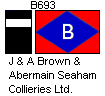
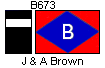
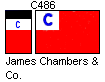
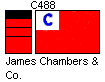
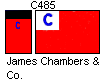
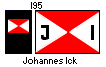
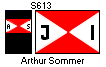
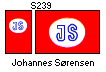
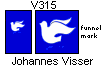
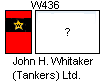
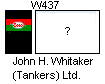
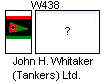
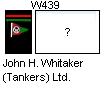
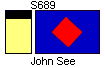
J. & A. Brown’s livery continued after the amalgamation and Coal & Allied takeover. The Coal & Allied logo was added to the funnel band in 1979 but apparently lacked board approval and was soon removed. Camira’s arrival in 1980 brought a replacement livery.
The amalgamation of J & A Brown and Abermain Seaham Collieries was registered on 19 January 1931. It absorbed Wallarah Coal in 1957 and Jones Bros. Coal in 1965. Coal & Allied’s takeover is dated 5 October 1960, with the Coal & Allied Industries title recorded by 1977, although Lloyd’s retained the earlier name through 1980–81. By 1985–86 the vessels appeared under Coal & Allied Operations.
Australia, Sydney.
J & A BROWN.
The flag is red with a blue diamond extending to the edges and a white “B”. It continued through the 1931 amalgamation and into Coal & Allied until 1980. The chartered Prophet retained John Gaff’s owner colours in 1912–15, later adding Brown’s white band.
A long blue pennant with white “STEPHEN BROWN” is catalogued as a paying-off pennant. Jan Mertens doubts that description, and Rosanoski thinks it was more likely supplied after the 1954-built ship became an Australian Maritime College training vessel in 1983. Its excellent condition led him to doubt that it dated from her coal-trade service; the explanation remains conjectural.
James and Alexander Brown established the colliery and merchant business after the family emigrated to Australia. The biographical account gives arrival in 1842, work together from 1843, partnership by 1852 and shipping involvement by 1857; The Log instead gives 1839 arrival and the first vessel in 1861. James’s sons John and William succeeded them. John developed Newcastle and Sydney tug fleets, and after a dispute the partnership dissolved in November 1909 with him appointed manager and receiver. Following his death in 1930, the tug interests went to Waratah Tug & Salvage and the mining interests entered the 1931 Abermain Seaham amalgamation, with Trevor Brown a partner.
Australia, Newcastle.
J & J DALEY.
The business appears to have used several colour schemes over the years.
J & J Daley is listed in 1917–18 and recorded operating in 1946. Accounts differ on its combination with Wallace: one places a merger of towing interests with James Wallace before the Second World War, followed by Fenwick’s acquisition of the family shares and inclusion in reconstituted Wallace Tugs. Another places the merger after 1946, with the Daley name retained, followed by separation and Fenwick’s share acquisition.
Australia, Sydney.
J. & A. GARDNER & CO. LTD.
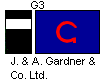
image by Jarig Bakker, 18 August 2004
Sources vary the G’s shape; the illustration follows the National Maritime Museum flag, dated about 1951 and measuring 1193.8 by 1803.4 mm. Mitchell records a Glasgow sighting in 1950. Talbot-Booth and Stewart contain erroneous company initials, with Talbot-Booth correcting its image caption in 1938.
John Gardner founded J. Gardner & Co. in 1895; it became J. & A. Gardner in 1906. The group later included J. & A. Gardner & Co. (Management) and Gardner Shipping (Scotland), both at Glasgow. Ship names initially used the Ard prefix, later Saint as the first word.
UK, Glasgow.
J. & C. HARRISON LTD.
Early depictions show the flag emblem entirely blue. Other sources give it a red spear, with later yellow also reported; Rosanoski’s wording does not clearly identify the source meant by “the former” in that change. The flag lettering is recorded as blue.
Brown’s 1958 notes record the change to H359. Some depictions use a plain funnel letter, but a photograph of Harpalycus confirms forked ends and a broad band. FOTW supplies a written description rather than an individually credited image for this variant.
J. & C. Harrison began operations in 1887; another account dates steamship ownership from 1888. It sold its ships in 1896, returned to ownership in 1905 and re-formed after the First World War as J. & C. Harrison (1920) Ltd. It apparently reverted to the original name by the 1930 source. On withdrawing from shipowning, it proposed the name Harrison Trust Ltd. and a future in non-shipping activities.
United Kingdom, London.
J. & G. ALWARD LTD.
The source illustration in Olsen’s Fisherman’s Almanac 1911 is black and white; the funnel colours are therefore assumed.
The company was operating by at least 1902.
UK, Grimsby.
J. & H. AALDRING.
J. & H. Aaldring
The Aaldring display spelling is corrected. The existing external register still does not establish the specific J. & H. partnership or the presumed 1962–1977 ownership interval. No further company identity or chronology is invented.
Rosanoski tentatively identifies J. & H. Aaldring with H. Aaldring, listed in Lloyds 1973–4 under the manager Wagenborg Scheepvaart B.V. It was apparently a single-ship company for Avenir, recorded by Miramar Ship Index under this name from her construction in 1962 until sale in 1977, although Rosanoski did not find it in the earlier Lloyds volumes.
Netherlands, Rotterdam.
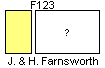
J. & H. FARNSWORTH.
J. & H. Farnsworth began a ferry service between Queenscliff and Sorrento on Port Phillip Bay in 1953.
Australia, Melbourne.
J. & J. Denholm Ltd.
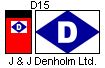
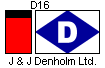
J. & J. DENHOLM LTD.
image by Phil Nelson, 10 April 2000
Merchant Ships 1949 depicts a wavy panel on the funnel. Later editions assign it to J. & J. Denholm (Management), explaining that different owners’ flag designs appeared on managed ships’ funnels; Ocean Ships 1982 consequently calls the funnels various.
DENHOLM SHIP MANAGEMENT (HOLDINGS) LTD.
Formed in Glasgow in 1985, the holding company merged into Anglo-Eastern in 2001. Its operating interests included overseas and UK management companies, Serco Denholm and George Walker & Sons. Mare-Denholm, apparently a joint venture with Mare Maritime, was formed in May 2001, becoming Mare Ltd. that year, Mare International in 2002 and Maregulf International in 2003.
UK, Glasgow.
DENHOLM FISHSELLING LTD.
Fishselling used the trading name George Walker & Sons (Fr) and belonged to Denholm Seafoods, acquired in 1986. Lloyds later lists it as a major operating company of Denholm Shipping Co. Ltd.
UK, Peterhead; later Fraserburgh.
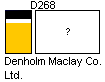
DENHOLM MACLAY CO. LTD.
Listed as managers in 1978–79 and 1980–81, Denholm Maclay subsequently became Denholm (IOM) Ltd.
UK, Glasgow.
DENHOLM SHIP MANAGEMENT (BERMUDA) LTD.
Lloyds lists Denholm (Bermuda) Ltd. as managers in 1985–86 and Denholm Ship Management (Bermuda) Ltd. in 1992–93.
Bermuda, Hamilton.
DENHOLM SHIP MANAGEMENT (I.O.M) LTD.
DENHOLM SHIP MANAGEMENT (SINGAPORE) PTE. LTD.
The Singapore company is listed as managers in Lloyds from 1985–86 through 1996–97.
Singapore.
DENHOLM SHIP MANAGEMENT (U.K.) LTD.
The UK company appears as managers from 1992–93 and with a minor operating company in 1998. Rosanoski explicitly questions his earlier conclusion that it was simply the former Denholm Ship Management Ltd.
UK.
SERCO DENHOLM LTD.
Serco Denholm was formed in 1996 and is listed as managers in 1998.
Mitchell white drawing conflicts with red/black line drawing.
Denholm Line Steamers Ltd.
No exclusive fleet-wide use or unrecorded corporate equivalence is asserted.
Equinox Shipping Co. Ltd. — Aldgate
No Denholm relationship asserted.
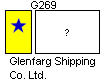
Glenfarg Shipping Co. Ltd.
No exclusive fleet-wide use or unrecorded corporate equivalence is asserted.
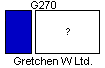
Gretchen W Ltd.
No exclusive fleet-wide use or unrecorded corporate equivalence is asserted.
Documentary material — company attribution not established
Advanport/Scotstoun allocation and Southern Shipping charter chronology remain open.
J. & J. Denholm (Management) Ltd.
The Denholm pennant was flown above the Troll Carriers A/B flag.
The separately referenced B328 funnel is noted for Port St. Catherine in June 1967 and Fort Warwick, associated with the managed Buckingam Tanker Co.
Formed in 1958, this company took over the management role previously listed under J. & J. Denholm Ltd. and later became Denholm Ship Management Ltd. Cottesbrooke Shipping Co. Ltd. is listed as a subsidiary.
UK, Glasgow.
Keep the explicit scope label independent; no alias or company identity is inferred.
Denholm Ship Management Ltd. — Glasgow
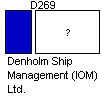
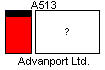
Mitchell associates this funnel with Kyoto Forest and the managed Advanport. A later photograph of the ship as Advara shows a darkish funnel with a light cross paty, subsequently identified as Southern Shipping Lines charter colours. A513 may therefore be Scotstoun Shipping’s funnel, as Lloyds names that company as owner of Kyoto Forest, although Mitchell gives Scotstoun a different funnel.
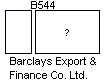
Mitchell’s drawings for Barclays Export & Finance show a white funnel for Muirfield, but the line drawing has a red funnel with black top.
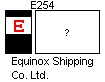
This funnel is given for Aldgate of Equinox Shipping Co. Ltd., but Rosanoski found neither that listing nor a connection with Denholm.
This is recorded for Loch Lomand of Glernfarg Shipping Co. Ltd., a managed company in Lloyds 1978–79 and 1980–81.
The Glasgow company succeeded J. & J. Denholm (Management), appearing as operator in 1973–74 and later as manager. The source then identifies a change to Denholm Ship Management (U.K.) Ltd., but elsewhere questions that succession.
UK, Glasgow.
Keep the explicit scope label independent; no alias or company identity is inferred.
Denholm Ship Management (I.O.M.) Ltd.
Mitchell’s line drawings suggest Gallic Minch as the funnel’s source, but Rosanoski did not trace the vessel in Lloyds.
Previously Denholm Maclay, the company appears as Denholm (I.O.M.) Ltd. in 1985–86 and later under the Ship Management name.
Isle of Man, Douglas.
Keep the explicit scope label independent; no alias or company identity is inferred.
Denholm Ship Management Ltd. — Hong Kong
The funnel is recorded for Gretchen W of Gretchen W Ltd., listed as a managed company in 1992–93.
The Hong Kong section gives formation in 1969, later amended to 1958, and records the former Denholm Ship Management (Overseas) name. It also gives a 2001 change to Anglo-Eastern Ship Management (UK) Ltd.; the overlapping UK succession is not consistently explained.
Hong Kong, China.
Keep the explicit scope label independent; no alias or company identity is inferred.
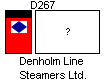
Ocean Ships 1967 gives D15 for Denholm Line Steamers, while Rosanoski directs comparison with Mitchell’s D267.
J. & J. Denholm began as a ship agency in 1866 and became a limited company in 1916. Accounts give entry into shipping in 1872 or purchase of the first vessel in 1873, with the first steamship in 1882. Six individual steamship companies were consolidated as Denholm Line Steamers Ltd., registered on 11 October 1909. Park Line appears to have been a trading name; park became a characteristic vessel-name ending, with Mount Park recorded in 1897. A Denholm Shipping Co. Ltd. was formed in Glasgow in 1919, while a later Lloyds entry dates a London company of that name to 1986.
The privately held Denholm Group remained controlled by John Denholm’s descendants, with shipping, logistics, seafood and industrial interests. It diversified into fishing in 1986. Barwill acquired 40% of Denholm Shipping Services in 2004, creating Denholm Barwill. A 2013 account records a 9% interest in Hadley Shipping. Rosanoski considers Lloyds’ placement of Denholm Line Steamers and Fishselling under Anglo-Eastern erroneous: only the ship-management division was involved, with Denholm retaining an Anglo-Eastern interest.
UK, Greenock and Glasgow.
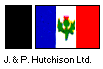
J. & P. HUTCHISON LTD.
The French Government authorised the company to fly the French tricolour defaced with a Scottish thistle in recognition of its free carriage of medical supplies during the Franco-Prussian War. The flag is vertically blue, white and red, with a green Scotch thistle flowering red on the white stripe. The funnel is black.
Royal Mail Steam Packet acquired J. & P. Hutchison through Moss Steamship in 1919. Following the financial crisis, Hutchison and Moss merged in 1934 to form Moss Hutchison Line.
U.K.
J. BATEY & SON LTD.
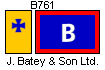
A letterhead dated 1 December 1899 documents a buff or light-yellow funnel with a blue Maltese cross and a blue flag bearing a white “B” within a narrow red border. Paddle boxes carried a black “B”, also recorded about 1905.
John Batey began with a tug about 1840, probably as part-owner. He was involved with Montrose Steam Tug around 1862–1863 and a later Montrose partnership in the 1870s, whose identity and ownership are uncertain. His son Francis joined him as J. Batey & Son in 1874. The business became a limited company on 26 June 1906, and Frank Batey took control after Francis’s death in 1915. Operations merged with Lawson Steam Tug-Boat on 17 April 1920, the assets passing to Lawson-Batey Tugs and J. Batey & Son entering voluntary liquidation.
UK, Newcastle.
J. BUTCHER & SONS LTD.
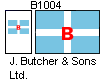
The marking is a superstructure panel on a tug without a funnel. The source first names Guy James, then identifies the photographed tug as Gary James, not found in Lloyd’s. Portside and starboard photographs are dated 15 March 2006 and 20 June 2013. No flag was sighted; possible flag use is only assumed.
Incorporated on 24 March 1961 in sea and coastal water transport, the company principally provided boatmen’s services, recorded in 1977. J. Butcher was involved in Portsmouth Harbour Tours in 2005. The firm built the tug Guy James in 1995. A June 2013 comment reported that it was closing, with all vessels for sale.
UK, Portsmouth.
J. Chastellain & Cie.
J. CHASTELLAIN & CIE.
Compagnie des Affrêteurs Français
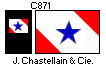
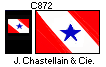
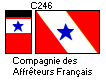
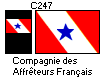
The flag is a version of that of Prentout-Leblond, Leroux & Cie. Brown 1951 and 1958 attributes the livery to operated company Compagnie des Affrêteurs Français. Pavillon lists it under Prentout-Leblond and shows a funnel-panel emblem differing from the flag.
Heuzey & Chastellain became J. Chastellain & Cie. in 1950 and ceased in 1967. It operated Compagnie des Affrêteurs Français and other companies.
France, Rouen.
J. DUTHIE, SONS & CO.
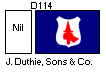
The blue flag has a white shield bearing a red hand holding a red dagger.
J. Duthie, Sons & Co. operated sailing ships in the wool and tea trades.
U.K., Aberdeen and London.
J. FENWICK & CO. PTY. LTD.
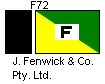
The flag is divided diagonally from upper hoist to lower fly, green over yellow, with an overall white panel bearing a black F. A photograph of Heroine confirms the funnel.
Founded in 1883 and registered in Sydney on 23 March 1916, the tug company joined Brambles in the late 1960s or early 1970. It acquired J. & J. Daly. BHP Transport took over the Hay Point operation on 1 August 1992, and the Sydney business passed to Waratah Towage on 23 January 1996.
Fenwick and the Waratah/Adelaide Steamship group acquired Harbour Lighterage in equal shares from 1 April 1968, and Fenwick operated Newcastle Port Towage Services with Waratah. Its half-share in Wallace Tugs was bought by Adsteam in 1995. From the 1950s the tugs used Cove as their second name.
Australia, Sydney.
J. HAY & CO.
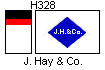
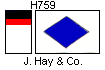
J. Hay & Co. built Benclutha in 1876 and sold her in 1880. Stuart and Overdale followed in 1877; Stuart was sold in 1883. The company owned Abbey Town in 1889–90.
UK, Liverpool.
J. Hay & Sons Ltd.
J. HAY & SONS LTD.
image by James Dignan, 12 October 2003
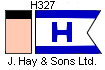
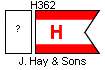
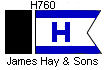
Some sources show a yellow or red funnel, but Merchant Ships and ABC give the actual colour as pink buff. Brown 1951 omits the flag’s letter, which Rosanoski assumes is an error. LJC shows narrow blue bands and places the “H” towards the hoist.
James Dignan’s H362 FOTW illustration, based on Sampson, shows red where Rosanoski says the bands and “H” should be blue. His later examination of Sampson’s hatchings confirmed blue, in agreement with the other cited sources: horizontal lines denote blue in these house flags, unlike the separate code for national ensigns. The earlier suggestion that Sampson itself was wrong was thus superseded by Rosanoski’s reading of the original hatchings.
James Hay & Sons — historical flag
No exclusive fleet-wide use or unrecorded corporate equivalence is asserted.
Merchant Ships 1959 notes that some Everard ships carried the Hay funnel, while British Coastal Ships, Tugs & Trawlers 1975 indicates that the fleet was then in Everard colours. Rosanoski supposes that the Hay livery gradually disappeared after the takeover.
The Hay interests originated about 1862. J. Hay & Sons, representing the family’s coaster business, and J. & J. Hay, representing its “Puffers”, amalgamated in 1920. John Hay bought his first steamers in the 1890s. Another family connection, James Hay, left J. & J. Hay about 1880 and operated independently until financial difficulties in 1890. F.T. Everard & Sons took over in 1956, though the Hay company continued to appear in registers into the early 1980s.
Both original companies used names of races, creeds or tribes. By 1892 John Hay was using “The” followed by a title of nobility or government; Everard’s naming system followed the takeover.
UK, Glasgow.
J. HEINRICH RECKMANN.
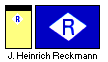
The buff funnel has a black top and a white diamond bearing a blue R. The flag is blue with a white diamond and blue R.
Reckmann appears in Lloyds List of Shipowners 1963–64, but not in the 1970–71 edition consulted.
Germany.
J. JOHANNSEN & SOHN.
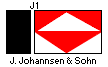
J1 is recorded in Brown 1958.
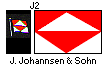
J2 is recorded in Brown 1995.
J. Johannsen & Sohn appears in Lloyds from 1953–54, later as a tug operator and as J. Johannsen & Sohn Schleppschiffahrt. The management name is J. Johannsen & Sohn Seeschleppund Transport GmbH.
Germany, Lübeck.
J. JOST.
image by Jorge Candeias, 2 May 2004
Massary 1930 names E. Jost, probably an initial error.
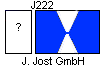
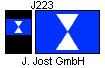
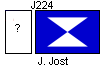
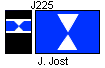
Jorge Candeias’s J224 rendition is blue with two white triangles facing one another. Jarig Bakker identifies J. Jost from Wolter’s 1968 book, though Rosanoski notes that its J225 version is not quite the same. The book indicates very dark blue, almost black.
The Bremer Schiffahrtskontor Brink & Wölffel flag is almost the same, but its white hourglass reaches the upper and lower flag edges.
The additional variants remain documented in the respective flag books and charts, without a separate verbal design description in this source.
Hans Peter Jost founded the Flensburg business in 1874. His brother Jens succeeded him in 1887 and brought Captain Jörgen Brink into partnership in 1903. After Jens died in 1908, Brink owned J. Jost; Brink’s death in 1911 led to management by Hans Wölffel for his widow Jenny. Otto Jost rebuilt after the Second World War, with Kurt Wölffel managing brokerage and agency. Bremer Schiffahrtskontor Brink & Co. was established in Bremen in 1950, while Brink & Wölffel continued cargo service from Flensburg. The company also acted for Amisia and HERA. The history says Bremen activities ended in 1961, but Lloyds continues the company record and its last ship Gratia was sold in 1977.
After the death of Otto’s son Jürgen in 1969, Otto allied with Atle Jebsen. Reorganisation in 1971 produced J. Jost GmbH and Jebsen Hamburg–J. Jost, the latter becoming Jebsen Hamburg–Kristian Jebsen in 1974. The business moved to Hamburg in 1975; Otto died in 1976. A later continuation is named Christian Jürgensen und Brink & Wölffel & Co. of Flensburg.
Germany; Flensburg and later Hamburg.
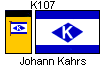
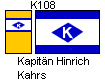
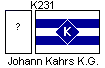
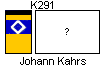
J. KAHRS K.G.
Brown shows a white mast supporting the funnel flag; Rosanoski omitted it from the drawing for visibility.
The website’s flag logo is discussed as K108. Mobil’s chart does not distinguish shades of blue, so Rosanoski rendered it consistently with the other Kahrs colours.
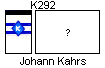
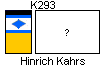
Mitchell specifically associates K292 with Uwe Kahrs, 3737/1985. K293 may be based on Elke Kahrs and probably has a white K on the diamond, although Mitchell does not mention it. Mitchell uses a lighter blue for K293. Rosanoski records an apparent Hamburg sighting in November 1981 without deciding which version it concerns.
K231 is sourced to the company website.
K291 is preserved from the Mitchell collection.
Later ships presumably wore charterers’ colours: Sleipner was photographed in July 2011 with the funnel of Containerships Ltd. O/Y.
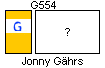
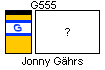
The family’s shipping history began in April 1886 when Johann Kahrs bought a sailing barge. Heinrich bought another in 1891, while Johann’s other son, also Johann, began shipowning with a galeot in 1925. A third Johann joined his father in 1943 and his brother Hinrich followed in 1963. The fleet was chartered to Bell Lines for many years in the 1980s. Later websites used Johann Kahrs K.G. Ostetrans Schiffahrt and Ostetrans Schiffahrt GmbH & Co. K.G., apparently under Capt. Jan Kahrs; their fleet information was dated and incomplete. Stüwe & Co. handled chartering. Slidur was delivered to Reederei Jan Kahrs of Jork in January 2007 for charter as BG Dublin.
Lloyds records Johann and Hinrich separately. Johann appears under Johs. Thode from 1998 and under Marconsult & Thode in 2003, with Johann Kahrs K.G. and J. Kahrs among the forms used. Hinrich was based at Bremervörde in 1978–79, while J. Kahrs Bereederungs GmbH & Co. K.G. appears at Jork as manager in 2011–12.
Germany: Hamburg, later Stade, Estorf and Estorf-Grapel.
J. LAIDLAW & WHITLOCK.
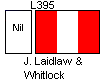
L395 is documented by Clipper Ships & Yachts and the Mystic Seaport directory of American sailing private signals.
J. Laidlaw & Whitlock operated sailing ships in 1820.
USA, New York.
J. Lauritzen Holding A/S.
J. LAURITZEN A/S.
image by Ivan Sache, 16 November 2002
image by Phil Nelson, 24 June 2000
J. Lauritzen
image by James Dignan, 9 October 2003
image contributed by Jan Mertens, 24 January 2008
Motor vessels were placed in Ocean in 1938. That year Lauritzen established a New York headquarters for inter-American trade; a trusted employee arrived in September 1939 to cooperate with the long-standing agents Wessel, Duval and prepare to control ships cut off from Copenhagen. On 1 April 1944 Ocean took over Vesterhavet’s remaining vessels except training ships. Ocean became the shipping company and Vesterhavet a holding company, both under Lauritzen’s managing ownership. Many ships had Dan as their second name, others Reefer.
Later operating businesses included Gasnaval, Lauritzen Bulkers, Fleet Management, Kosan, Offshore Services, Reefers, Singapore and Tankers. Fleet Management was formed in 2003, Tankers in 2004 and the Singapore company in 2005.
LAURITZEN BULKERS A/S.
LAURITZEN KOSAN A/S.
image by Jarig Bakker, 14 February 2006
LAURITZEN REEFERS A/S.
Documentary material — company attribution not established
J. Lauritzen group
Ditlev Lauritzen founded the business on 15 April 1884. Described as under age at 24, he registered it in his father Jørgen’s name, hence J. Lauritzen. The group developed bulk, reefer and gas-tanker divisions. Later accounts distinguish J. Lauritzen Holding from the operating J. Lauritzen A/S, with shipping again shown under the latter in 2003.
Denmark, originally Esbjerg, later Copenhagen.
Keep the explicit scope label independent; no alias or company identity is inferred.
Lauritzen Bulkers
Athena on 3 October 2003 carried combined markings of Lauritzen and its South African Island View Shipping pool partner. Rosanoski considers this to supersede the earlier recorded Scan Bulker livery, while that ship carried Lauritzen Bulkers on its hull. The paragraph calls the earlier version L16, unlike the L15 references elsewhere.
Lauritzen Bulkers was formed in 1997 and participated in the Lauritzen/Island View Shipping Handysize Pool. It also had associated-company interests in Meridian Bulk Carriers, formed in 2000 with interests linked to A.M. Nomikos, Dileship and J.G. Goumas/Fortuna.
Denmark.
Keep the explicit scope label independent; no alias or company identity is inferred.
Lauritzen Kosan and Lauritzen Reefers
Denmark, Copenhagen.
Keep the explicit scope label independent; no alias or company identity is inferred.
Group relationships
Related interests included Aalborg Vaerft, acquired in 1937 and later merged into the Dan-Vaerft joint venture with DFDS; Gasnaval, half acquired in 1989 and wholly in 1993; and Mols-Linien, bought from DFDS in 1984 and sold in 1988. Lauritzen-Peninsular Reefers was formed with Federal Steam Navigation/P&O in 1971 and ended in 1983. Further ventures included Narwhal-Lauritzen and Pearl Cruises with I.M. Skaugen. The LauritzenCool combination with Cool Carriers is dated to January 2001 in one account and 1 January 2000 in Lloyds. NYK joined in 2005, producing NYKLauritzenCool; Lauritzen later sold its half and the name became NYKCool.
Keep the explicit scope label independent; no alias or company identity is inferred.
Lauritzen Kosan
Tessa Kosan’s funnel shows a deep golden yellow. JB describes Kinna’s blue as mid-shade; Telma Kosan looks orange, with its diamond within the band. Some ships wore Sigas Kosan colours. Jarig Bakker’s FOTW flag follows Brown 1995.
Kosan Tankers, formed in 1953, was acquired from the Tholstrup family on 1 July 1989. A merger produced Lauritzen Kosan Tankers on 1 January 1990, shortened to Lauritzen Kosan in 1999. Ships commonly used Kosan as a second name. Sigas Kosan was formed jointly with Eitzen in 2001, with Lauritzen’s share sold in August 2006; Unigas Kosan was formed with Exmar effective November 2005. Management also included Kosan Tankers (Singapore).
Keep the explicit scope label independent; no alias or company identity is inferred.
Lauritzen Reefers
Italian Reefer at Wellington on 28 May 2005 wore L390 and an unreadable red-based flag. Sister ships Iberian Reefer and Indian Reefer show the same funnel. They apparently passed to RS Platau Finans through Agder Ocean Reefer and were presumably chartered back to Lauritzen. The letters were painted out, which Rosanoski treats as a chartered version.
Lauritzen Reefers was formed in 1985. Its name company Lauritzen Shipping (Bahamas) had originated as Frigg Shipping in 1981 and changed name in 1989, though Lloyds 1992–93 still lists both. Mediterranean Reefer Lines was a joint venture with Cool Carriers.
Keep the explicit scope label independent; no alias or company identity is inferred.
Group liveries
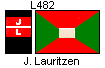
L482 is also assigned to Damskibs Vesterhavet in Lloyds and Brown.
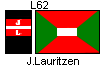
L62 is likewise attributed to Vesterhavet and supported by photographs of Australian Reefer and Marna. Ocean Ships’ reference to some L63 funnels with black tops and bases suggests to Rosanoski that L62 remained in use.
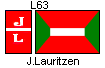
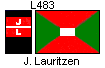
The L63 funnel was adopted in 1957 and is supported by Manja Dan. The earlier flag is described as red with green hoist and fly triangles of about 80 degrees and a central white bar one-third of the flag’s depth long, its width one-third of its length, on a 2:3 flag. Published versions differ in the central white field and green shade.
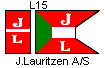
The lettered L15 flag was adopted on 1 October 1974. Ships on polar runs were permitted to use the United Nations flag as a stemjack. Scan Bulker confirms the funnel; Aurora Bulker shows a narrow black top, while Signe Bulker lacks one. Nüsse supplies a table flag, followed by Ivan Sache’s FOTW image.
L16 omits L15’s green segment. It was reported on Reefer Beaver at Lyttelton on 18 October 1982, but Rosanoski has no other confirmation of the observation.
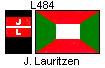
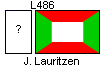
The flag panel’s size varies between publications. James Dignan’s L486 is based on Sampson, but Rosanoski says Sampson’s panel is not so large and should be represented by L484.
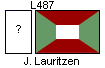
L487 was found by Jan Mertens on 24.flotilla.com. Mertens remarked on the white field’s different size; Rosanoski considered the original website’s striking difference to be colour shades, though the size comment applied to the FOTW displays. The green appears greyish.
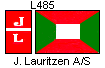
L485 is retained from Marine News, November 2007, figure 2.
Keep the explicit scope label independent; no alias or company identity is inferred.
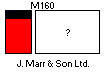
J. MARR & SON LTD.
The funnel is red with a black top. No flag is given.
J. Marr operated for Pegasus Trawling, The City Steam Fishing Company and Dinas Steam Trawling. A minority interest in CAM Shipping is also recorded.
UK, Hull and Fleetwood.
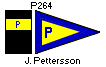
J. PETTERSSON.
Sweden, Helsingborg.
J. Poulsen.
J. POULSEN.
J. Poulsen was formed in 1930, with J. Poulsen Shipping A/S as its operating company.
Denmark, Korsor.
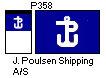
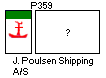
J. POULSEN SHIPPING A/S.
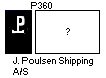
Mitchell attributes this funnel to J. Paulsen K/S. Line drawings suggest a connection with Moon Bird and Sea Bird, listed in 1992–93 as separately managed companies.
P360 has no identified vessel. A pencilled Star Bird note instead indicates the P358 funnel without its black top. P358’s livery follows a photograph of Star Bird. Blue Bird is also mentioned, without identifying its funnel.
J. Poulsen Shipping was formed in 1981 as J. Poulsen Chartering A/S and adopted the Shipping name in 1987. Brown gives the designation A/B. Jürgen Stahmer K.G. managed part of the fleet. In 2000 Poulsen and Harren & Partner established the joint venture K/S Combi Lift.
Denmark, Korsor.
Brown warns that the basic funnel or band colour may vary. The company website showed a flag flying from its building and a logo. Mitchell separately attributes P374 to Rederi A/B VäderöTank without comment; the Brown/FOTW image is referenced as P46.
J. S. LEE & SONS.
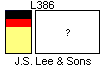
L386 is documented by The Log.
J. S. Lee & Sons operated Coomonderry in the timber trade during 1921–47 and had a mill at Leesville, Tasmania, which closed in 1974. Rosanoski suggests identification with J.S. Lee & Sons (Melbourne) Pty. Ltd., registered in Victoria on 26 November 1926 and later named Marbut-Gunnersen Floors.
Australia, Melbourne.
J. S. WINSLOW & CO.
J.S. Winslow & Co.
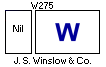
W275 is documented by Loughran, FOTW and the Mystic Seaport website.
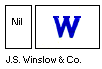
The FOTW text describes a red W and cites Flaggenbuch 1905.
J. S. Winslow & Co. operated sailing schooners by 1884 and continued at least until 1918.
USA, Portland, Maine.
J. SHEPHERD & CO.
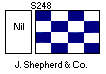
Solent flew a flag chequered blue and white in sixteen squares. Two flags were known in concurrent use, but the second design is left undescribed in the source. No funnel is recorded.
The firm operated sailing ships.
U.K., London.
J. STEEL & SON.
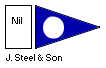
The flag is a blue pennant with a white circle.
The firm operated sailing ships.
U.K.
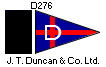
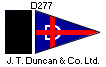
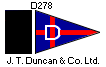
J. T. DUNCAN & CO. LTD.
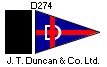
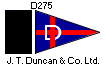
The source note says the white D passes over the vertical red and beneath the horizontal red, but the illustration shows the opposite arrangement.
The Mitchell account dates J.T. Duncan’s coal-trade business to 1853, its last ship sale to 1963 and continuation as shipbrokers until sale of the company in 1978. Steam Coasters & Short Sea Traders instead begins the story in the 1890s and dates the last sales to the 1950s. Merchant Ships records steamship ownership from 1891, and Rosanoski suggests earlier sailing ships might explain the different starting dates. The coastal business managed Angus Duncan and J. Duncan steamship companies and operated Francis Duncan S.S. Co., formed in 1907.
U.K., Cardiff.
J. Van Bussel.
Documentary images — company attribution uncertain
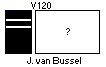
V120 is derived from a black-and-white photograph and assumed to belong to Van Bussel. Rosanoski notes that the vessel’s only other owner was Rederij Antonie Kooren & Zoonen, whose livery it did not match.
Cannot assign from exclusion of another known livery alone.
J. Van Bussel owned the tug Corrie from 1947 to 1950.
Netherlands, Maasbracht.
J. VAN URK JR C.V.
J. van Urk Jr.
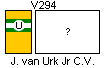
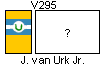
V294 comes from a starboard photograph of Roelof on 18 July 2003. The “U” colour is unclear and may be green; Rosanoski suggests a design based on the operator’s funnel with a changed letter.
Mitchell’s version is based on the same vessel and shows the “U” green. Rosanoski suggests that other colour differences probably arise from the photographic sources.
Formed in 1992 as J. van Urk Jr, the company bought the renamed Roelof that year and sold her in 2005, under Kustvaartbedrijf Moerman management. Scheepvaartbedrijf R. van Urk later reused the ship name but not the livery. Rosanoski presumes a relationship, while noting that Lloyd’s continued the same formation date under a different number.
Netherlands, Kampen, specified as the vessel’s port of registry.
J. WHARTON (SHIPPING) LTD.
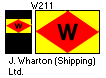
The funnel is black with a broad yellow band bearing a red diamond charged with a black W. The cited bibliography also documents the flag, without a separate verbal description.
Recorded from the wartime merchant-ship books into Lloyd’s 1992–1993, Wharton was acquired by F.T. Everard & Sons in 1952. Everard later managed part of the fleet and then all of it. Ship names ended onia.
U.K.: Keadby, later Scunthorpe.
J.A. BILLMEIR & CO. LTD.
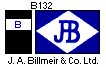
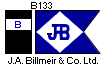
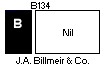
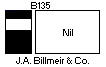
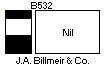
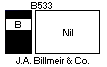
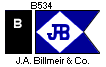
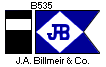
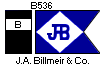
B134 and B135 are recorded as alternative funnels. From 1942 Talbot-Booth narrows B135’s band and adds B533 as another alternative, repeated in 1944 with flag versions. Earlier Talbot-Booth entries specify no flag.
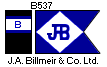
Merchant Ships 1949 gives B133 and B537 as alternatives.
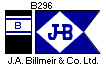
Brown 1951 and 1958 print “JHB” in error; the 1958 notes correct the letters and specify a swallowtail rather than that edition’s rectangle. Stewart and the 1966 Liverpool Journal of Commerce chart also show a rectangle. The WSS history and National Maritime Museum support B133, but Rosanoski records continuing uncertainty over the correct version. The flag presumably ceased with the 1964 sale, although a 1967 book still gives the old Billmeir funnel.
Jack Albert Billmeir formed Stanhope Steamship in 1934. The business was also known as Stan Line, with “Stanwell S.S. Co.” appearing in one index, and ships commonly had “Stan” names. It operated Stanhope, Lamorna Shipping and Duff, Herbert & Mitchell, the latter acquired in 1954. After Billmeir died on 22 December 1963, Stanhope was sold to George Nott Industries in 1964.
Whether that sale also included Billmeir is unclear. Rosanoski’s later account says Stanhope’s title was acquired around the 1980s as a shell company by Townsend Thorensen, becoming a registered ferry owner first in that company’s colours and then P&O’s, before absorption in the early 1990s. A listed association with Zubi Shipping is supported only by evidence of one or two pre-war ship transactions.
U.K., London.
J.A. HENSCHIEN & CO.
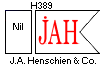
image by Ivan Sache, 24 January 2004
J.A. Henschien & Co., also listed simply as J.A. Henschien, operated sailing ships.
Norway, Lillesand.
J.A. Johansson.
Documentary images — company attribution uncertain
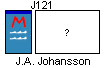
Mitchell associates J121 with Margot and Margaron, perhaps through later annotations. Rosanoski suggests that the funnel may predate ownership changes or that different emblem colours distinguished the ships. The M and waves might refer to the oil-for-margarine trade, Margarinbolaget, the ship names or a combination. An undated black-and-white Margot photograph shows a light funnel, very narrow dark band and a pale M above waves. Other photographs suggest initial retention of Svea colours followed by a change, but the sequence cannot be dated securely.
Period-specific livery owner unresolved.
The earliest dated Margot photograph, July 1994, belongs to its later partnership and management period, so those variants are treated in that entry. Margaron’s earliest photograph, January 2001, is treated under TSA. Margita later used the same emblem in different colours, discussed under TSA and Chemveg.
John Algot Johansson joined Wilhelm Bertil Johansson and Torsten Henriksson in buying Nytank in June 1949. Following Henriksson’s death, the brothers acquired his share in January 1967 and formed Bunkertransporter, retaining the vessel until scrapping in 1987. The later tanker operation included Margot, Benida and Zephry under their respective owning arrangements.
Margot was bought in 1978 according to one source, or 1979 in Miramar, and continued carrying oil for the Lidingö margarine factory for which Sveabolaget had built it. The factory passed through Margarinbolaget to Unilever’s Van den Bergh business, and the trade ended with its closure. Margaron joined Johansson in 1984, presumably for the same trade. By 1988–89 both ships stood under named partnerships, Margot managed by K. Lundgren and Margaron still by Johansson. Both later came under TSA Tanker Shipping. The document gives conflicting Margot transfer dates, including 1988 and 1998, and a final sale in 2003.
Sweden, Gothenburg.
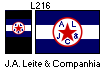
J.A. LEITE & COMPANHIA.
Jorge Candeias suggests that the flag was influenced by Amazonas’s flag, sharing its colours, general structure and a star. His source is a house-flag chart from about 1950.
Brazil, Amazonas.
J.A. Reinecke GmbH & Co.
Documentary material — company attribution not established
image by Jorge Candeias, 10 January 2005
image by Klaus-Michael Schneider, 22 March 2007
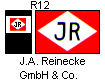
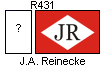
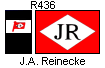
The flag is red with a white lozenge that does not touch the edges, containing black serifed JR. It follows Jürgen Meyer’s account of Hamburg sailing ships.
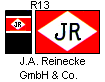
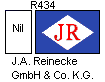
This red version has a white lozenge reaching the edges and black serifed JR. The FOTW contributor was unsure of the caption’s spelling. See und Seefahrt attributes this livery to both J.A. Reinecke and the Bremen GmbH.
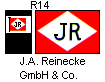
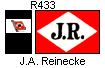
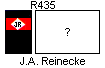
Brown’s versions give the J no sinister upper arm. A black-and-white photograph of Kapt. Jan Reinecke supports the funnel.
J.A. REINECKE GMBH & CO. K.G. [2]
Historical shipowning business
The historical company was active before 1914 and appears in accounts of Hamburg sailing ships. J.A. Reinecke ordered the roll-on/roll-off ferry Nils Holgersson, which began the Travemünde–Trelleborg service on 28 March 1962 as Fährgesellschaft TT-Line. The founder withdrew in 1967. Registers also distinguish a J.A. Reinecke GmbH based in Bremen.
Germany, Hamburg.
Keep the explicit scope label independent; no alias or company identity is inferred.
Later shipping agency
The later agency website shows a blue field with red sans-serif initials. Jan Mertens suggested the red flag might be earlier and wondered whether the blue flag was also nearing the end of use following the agency announcement. Neither sequence nor withdrawal is established.
The later Bargteheide agency J.A. Reinecke GmbH & Co. K.G. represented Minoan Lines, Grandi Navi Veloci and Norfolk Lines from at least 2004 until 1 January 2007. Its subsequent website announced reduced office hours; the source does not establish that the agency had closed.
Germany, Bargteheide.
Keep the explicit scope label independent; no alias or company identity is inferred.
J.C. DAHLSEN & CO.
John Christian Dahlsen founded the company in 1877, initially supplying mining tools and later timber and hardware, and soon became a steamship owner. The late-1880s–1936 trading period appears to refer to shipping rather than the continuing family-owned merchandising business. Jane Louisa Dahlsen is listed in Lloyds 1917–18.
Australia, Bairnsdale.
J.C. GILCHRIST.
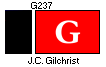
image by Joe McMillan, 12 October 2001
Rosanoski bases the flag on FOTW’s version from the 1909 update to Flaggenbuch 1905. Lloyds depicts the G in a different shape.
J.C. Gilchrist traded on the Great Lakes.
USA, Cleveland.
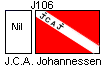
J.C.A. JOHANNESSEN.
image by Ivan Sache, 24 Jan 2004
The flag’s Js have dots above them. Its initial FOTW attribution treated the home port as uncertain Boon, prompting a possible Swedish identification. Rosanoski checked that Lloyds actually gives Soon and located it on the Oslo Fjord, confirming Norway. Jan Mertens suggests modern Son, now in Vestby.
Johannessen operated sailing ships and owned Inverdruie from 1896 to 1915.
Norway, Soon.
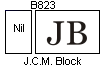
J.C.M. BLOCK.
J.C.M. Block operated sailing ships in 1889–1897.
Germany, Hamburg.
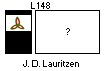
J.D. LAURITZEN.
J.D. Lauritzen
Birgitte Cord was noted in September 1966 and in 1967 with a black funnel and a very broad white band bearing a symbol in green on the outside and red. As Concord Line owned the vessel, Rosanoski warns that these may be the owner’s markings. The original adds an unclear “loipp at the center point” of the emblem. No flag was noted.
J.D. Lauritzen appears as manager in the 1963–64 and 1970–71 registers, managing Concord Line and Rederiet Dania in the earlier account.
Denmark, Hellerup.
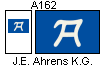
J.E. AHRENS K.G.
Mitchell describes a “blue flag, white A” for the funnel design. His drawing suggests a panel, but the word “flag” leaves Rosanoski uncertain. Nüsse provides a table flag.
The company built Schwinge in 1977, renamed her Bremer Flagge in the same year and apparently sold her in 1995. It appears in Lloyds from 1978–9 through 1992–3. Rosanoski suggests from the livery that it may have become Gebrüder Ahrens K.G. in 1996.
Germany, Hamburg; subsequently Bützfleth.
J.E. MANNE & CO.
image contributed by NDR, None
The flag resembles Heimdal’s. US Navy makes the central disc smaller and gives it a narrow black outline. The FOTW image is displayed under Heimdal; a cap badge supplies another comparison.
J.E. Manne bought Ångfartygs A/B Heimdal in 1918 and reorganised it as Nya Ångfartygs A/B Heimdal, which lasted into the mid-1960s. Lloyds later lists it under Rudolf Hellberg at the same address, suggesting an unconfirmed connection. Manne also operated for Sven Olof Christensson in 1957–62.
Sweden, Gothenburg.
J.G. Goumas Group.
J.G. GOUMAS GROUP.
Captain John G. Goumas began the group’s operations in 1971, continuing a family business traced through his father to his grandfather nearly a century earlier. Fortuna Bulk Carriers was formed in February 1997, employing chartered vessels and ships owned or managed within the group, with Fortuna Chartering of Geneva as general agent. Meridian Bulk Carriers, formed in 2000, brought together interests associated with Lauritzen Bulkers, A.M. Nomikos, Dileship and the Goumas/Fortuna group.
Greece.
J.G. GOUMAS (SHIPPING) CO. S.A.
Ghikas carried this funnel at Lyttelton on 3 June 1985. JLL confirmed it as the normal Goumas funnel, without clarifying whether its lines should be angled or horizontal as in G338. Christies also shows angles, suggesting an earlier version followed by a change, but Mitchell leaves the chronology uncertain.
A photograph of Alaska Rainbow dated 16 May 2005 documents this funnel.
Lloyds separately dates J.G. Goumas (Shipping) to 1911, with John Ghikas Goumas as president. Operating companies included Spetsai Shipping, formed at Piraeus in 1989, and Equinox Maritime, formed at Athens in 2002 as a joint venture with Dileship Marine.
Greece: Piraeus, later Athens.
Equinox Maritime Ltd.
The funnel is documented on Equinox Dawn on 11 August 2006.
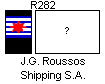
J.G. ROUSSOS SHIPPING S.A.
The funnel is recorded on Furia R in August 2008 and on Alia R in later photographs. Both ships, with Sovi R, were registered through one-ship companies. Rosanoski’s earlier drawing had a five-pointed star, while the photographed emblem has eight points; despite that difference, he considered the Roussos identification reasonably confident. A further starboard photograph of Alia R on 11 May 2013 supported the attribution.
J.G. Roussos was formed on 1 February 1991 when George Roussos’ Sons S.A. split into two. Lloyds alternately listed it as manager and agent.
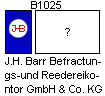
The funnel follows a starboard photograph of Süderfeld dated 5 February 1999.
The retrieved client page does not establish the historical Brake location, 1995 establishment or Süderfeld/Ohlrogge management relationship. Register discovery alone is insufficient to settle the full identity.
J.H. Barr was formed in 1995. A directory after 2010 still describes sea-chartering and general-cargo ownership, but Rosanoski considers that direct shipping involvement appears to have ended in 2005 with management of Ohlrogge Schiffahrts and Brake.
Germany, Brake.
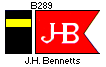
J.H. BENNETTS.
U.K., Penzance.
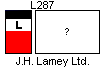
J.H. LAMEY LTD.
L287 is confirmed by a photograph of Anita Lamey.
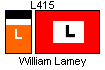
The flag colours in L415 are unclear: the red appears lighter, possibly pinkish.
The family reputedly flew a pirate flag presented by rivals in response to their unorthodox behaviour. After the sale, British Coastal Ships, Tugs & Trawlers records Alexandra Towing’s colours.
Alfred Lamey began a tug fleet in 1916, described as the Hero Tug Co. Another account gives J.H. Lamey from 1916 and incorporation as J.H. Lamey Ltd. on 25 May 1939. A separate account places James Lamey’s operations at New Ferry in the 1930s. The records use differing William Laney and Lamey forms. The tugs were mainly named after family members.
One account dates Alexandra Towing’s substantial share purchase to 1963 and acquisition of the remainder to 1967; other sources give the takeover as 1968 or 1969. Lamey appears under Alexandra’s operation by 1973–74 and the fleet had been absorbed by 1978–79. The company was renamed Alexandra Marine Consultancy on 18 December 1986 and dissolved on 1 October 1995.
UK, Liverpool.
J.H. WELSFORD & CO.
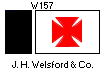
The funnel is black. The flag is white with a red cross paty, also attributed to Leyland Shipping in Lloyd’s 1912. Reed gives two versions, the second thinner; Brown shows a squat cross.
The concern also used the name Gulf Transport Line.
U.K., Liverpool.
J.H.T. SCHUPP.
image by Klaus-Michael Schneider, 9 April 2009
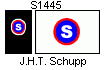
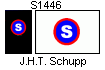
Mitchell renders the funnel’s S in black pencil.
Schupp began buying ships in 1951 and is later recorded as owner and operator, then operator only in 1973–74. Vessel names included family names.
Germany, Hamburg.
J.J. Colocotronis & Others
J.J. COLOCOTRONIS & OTHERS.
Seen on Katingo in October 1965, this funnel is white with a black top and a broad red band. A narrow white band crosses the red, surmounted by a red disc with an undefined white edge and a white K occupying the disc.
The alternative, seen on other vessels, has a black funnel with the same broad red band, narrow white band, white-edged red disc and white K. The band resembles that of Colocotronis Ltd.
No flag is noted.
Listed in 1970–71, J.J. Colocotronis & Others apparently succeeded the Josef Colocotronis entry of 1963–64. Colocotronis Ltd. is recorded as an associate.
Greece, Piraeus.
J.J. CRAIG LTD.
The sailing-vessel flag is blue with a broad white border and the white legend CRAIG.
For the move into steam in 1910 the company adopted a vertical blue-and-yellow bicolour, the reverse of International Code flag K.
The business originated with Joseph Craig’s carrying enterprise in 1866. His son Joseph James succeeded him in 1885 and bought the sizeable sailing ship Notero in 1887. The firm moved into steam in 1910, had sold out of sail by 1916 and became limited in 1919. Shipping later dwindled to a few towing launches. A group of businessmen acquired a majority holding in 1942 and subsequently sold it to N.Z. Wallboards, a Winstone subsidiary; the company was integrated into Winstone in 1969.
Its interests included R.S. Lamb & Co. and James Smith & Co.
New Zealand, Auckland.
J.J. SIETAS K.G. SCHIFFSWERFT GMBH & CO.
image contributed by Jan Mertens, 28 August 2007
The blue pennant bears white “J.J. Sietas” lettering; Jan Mertens tentatively expands the initials as Johann Jacob. A photographed example differs in colour from the drawing, possibly through ageing. Rosanoski regards the Fischer flag as apparently the only actual example shown and leaves the precise proportions and shade uncertain.
The family shipyard was founded in 1635 by Cartsen Sietas where the Este joins the Elbe. The First World War stopped construction, leaving repair work until coaster building resumed in 1933; its first container ship followed in 1966. The later group included crane builder Neuenfelder Maschinenfabrik, repair yard Nordenwerft and Neuenfelder Wohnungsgesellschaft. Hinrich Sietas handed management to Rüdiger Fuchs in 2009, becoming advisory-council chairman. After an insolvency filing and Hamburg Senate assistance in 2009, another insolvency petition followed on 18 November 2011.
Germany, Hamburg.
J.M. GUFFEY PETROLEUM CO.
image by Joe McMillan, 18 October 2001
The illustration follows FOTW; Lloyds shows a block-style G. Gulf retained a modified version of the red Guffey flag, using a white Roman-style G instead of the earlier block letter.
J.M. Guffey Petroleum was organised in 1901 to buy out the developers of the Spindletop oil well in Texas. Guffey held seven-fifteenths, with the Mellon family and associates holding the remainder. In 1907 William Mellon reorganised it and Gulf Refining into a single company, a forerunner of Gulf Oil Corporation.
USA, New York.
J.P. KNIGHT GROUP LTD.
Sources differ over white or silver funnel details. The 1975 coastal book gives white for the tug fleet and silver for London’s effluent tankers; Coastal Ships 1967 also gives silver for effluent tankers, but ABC British Tugs 1960 gives silver for tugs. Brown separates the funnel bands by their own width and draws a different K. Rosanoski bases the image on a black-and-white photograph of Keston.
The group originated in 1892 as James Percy Knight’s Kaiser Steam Tug Co. P. H. P. Knight appears as operator in the 1950s. Howard Smith acquired J. P. Knight (Rochester), effective 21 June 1991, and renamed it Medway Towage; later records continue a separate J. P. Knight and group listing.
Caledonian Towage became Caledonian Towage & Marine Services in 1986 and J. P. Knight (Caledonian) in 1991. Other operating companies included J. P. Knight (Paranam) and the Offshore company, formed in 1991. The London company merged with Gaselee & Son (Towage) on 1 October 1966 as Gaselee & Knight, although Rosanoski suggests the arrangement may have been short-lived because Lloyds does not show it. Knight co-founded Orkney Towage with Orkney Islands Council in 1976. Fleet names began with K; London used Kings until taking over part of the other Knight fleet by 1992–93.
U.K., London, then London and Rochester, Rochester, and Chatham.
J.P. SAMARTZIS MARITIME ENTERPRISES CO. S.A.
image by Jarig Bakker, 16 January 2006
Mitchell shows a blue funnel top, apparently for Dido, for which he also provides a line drawing.
Also known as JPS, the company is dated to 1979 by Lloyds 1998, which names J.P. Samartzis as chairman, and to 1977 by Lloyds 2008, which names Ioannis P. Samartzis as president. It appears successively as operator, manager and agent in the registers; the 2008 account records a chartered fleet.
Greece, Piraeus.
J.P. STROM SHIPPING CO.
The funnel is white with a black top and a blue diamond bearing a white S. The flag is blue with white JPS.
Norway.
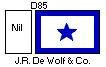
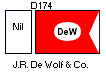
J.R. DE WOLF & CO.
One flag is white with a blue border and blue star. LJC 1909 makes the border so broad that the flag is effectively blue with a white rectangle containing the star.
The other flag is red with a white triangle issuing from the fly and, on the red field, a horizontal white oval bearing black DeW lettering.
This sailing-vessel firm appears in LJC 1909 under C.E. De Wolf.
U.K., Liverpool.
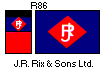
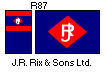
J.R. RIX & SONS LTD.
The blue flag has a red diamond containing a white J over a white R as a combined emblem. Brown 1951 shows a smaller diamond than the other sources. Two funnels are described: one blue with a very broad red top and a broad flag band; the other red with a black top above a broad flag band. In each, the diamond touches the band’s upper and lower edges.
The blue funnel band may have a narrow edging against the red: Stewart and Brown 1982 show black, while Brown 1995 shows white.
Founded in 1947, J.R. Rix operated through its own and subsidiary companies. Rix Shipping Co. Ltd. was formed in 1950 and T & S Rix Ltd. in 1980, both at Hull. The company also managed Whitehaven Shipping Co. Ships generally had names ending in rix; Rosanoski therefore suggests that the managed companies were subsidiaries.
Robert Rix & Sons may have been connected, sharing the Hull base and rix naming suffix, although the liveries differed.
U.K., Hull.
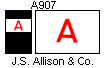
J.S. ALLISON & CO.
The company is recorded for Lizzie Cory, built in 1890 and sold in 1904, and Katherine, built in 1904 and scuttled in 1917.
UK, West Hartlepool.
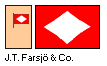
J.T. Farsjö & Co.
Documentary images — company attribution uncertain
The buff funnel bears the flag depicted flying straight from a pole. The flag is red with a white diamond whose sides curve inwards.
Stewart initial discrepancy remains unresolved.
Lloyds lists J.T. Farsjö in 1963–64, whereas Stewart gives J.F. Farsjö. Both are placed in Oslo, and Rosanoski assumes they represent the same firm, preferring the Lloyds initials.
Norway, Oslo.
J.W. ALEXANDER LTD.
A suggested connection to Harbour Land & Transport’s black funnel with a red band is questioned by Rosanoski: that concern is also described with an identical red funnel and black top, and had operated from 1918, apparently disproving the proposed sequence. Victorian Lighterage, which had acquired J.W. Alexander, adopted the funnel shortly after that vessel’s loss.
John William Alexander appears to have begun shipowning in February 1909 in his own name; vessels were registered to J.W. Alexander Ltd. from July 1910. One account presumes liquidation in 1918, but T. Martin remembered Bondi and Antarctic operating in the 1920s. In 1929 the fleet became part of Sydney Ferries/Harbour Land & Transport.
Australia, Sydney.
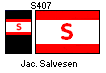
JAC. SALVESEN.
The funnel recorded for Hilde in October 1965 is black with a broad band of the flag.
Jac. Salvesen is listed as a manager in the 1963–64 and 1966–67 registers.
Norway, Farsund.
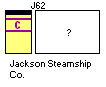
JACKSON STEAMSHIP CO.
Penguin was noted with a yellow or buff funnel, narrow black top and two very narrow purple bands set well apart, enclosing a purple C. Its association with Jackson is assumed because the vessel was not found in Lloyds. No flag is noted.
Jackson Steamship is recorded in Lloyds 1963–64, with Suwannee Steamship as agent.
USA, Jacksonville FA, as written in the source.
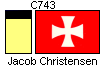
JACOB CHRISTENSEN.
The Skipet website states that the flag was originally square.
The business was formed in 1876 and acquired in 1985 by Cark Henrik Odfjell, as named in the source. It may be the J. Christensen operating Act. D/S Hercules in 1904. Later register forms include Jacob Christensen Rederiet and Rederiet Jacob Christensen. Brown 1943 links it with County Line, but Rosanoski says the other sources do not include Christensen in that consortium.
Norway, Bergen.
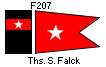
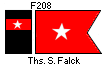
JACOB FALCK AMS.
image by Ivan Sache, 2 December 2003
Lloyds and Brown show a longer flag; Reed gives the star a larger size.
The business originated in Ths. S. Falck, founded by Thomas S. Falck in 1862. His son Christian Fredrik succeeded him in 1889. Shipowning was dropped after the First World War, but wholesale trading and shipping agency continued. Jacob Falck took control in 1936; his son, named Thomas S. Fack in the source, became co-owner in 1953. Jacob died in 1980. Thomas S. Falck Jr became co-owner in 1983 of the concern then styled Jacob Falck ANS, and Falck Shipping A/S was formed in 1984. Both continued in shipping agency.
Norway, Stavanger.
JACOB KJØDE A/S.
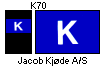
K70 has a black funnel with a broad band of the blue flag and white K. Brown 1978 says some vessels still used it.
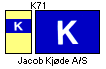
K71 has a yellow or buff funnel with the same flag band.
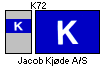
K72 uses a grey funnel; Brown 1958 notes occasional use.
Jacob Kjøde managed A/S Inger, Johan Horns Rederi and Norwegian Talc, the last only partly by 1970–71. The records span the 1939 fleet account and later registers through 1978–79.
Norway, Bergen.
JACOB NATVIG & CO.
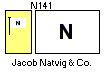
The flag is white with a black N. The yellow or buff funnel shows the flag flying straight from a pole.
Jacob Natvig managed the fleet of Ragnar Natvig & Co., apparently a subsidiary.
Norway, Oslo.
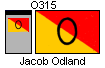
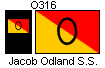
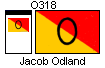
JACOB ODLAND S.S.
Merchant Ships 1942 and 1944 place this funnel against Jacob Odland S.S. in the fleet section without mentioning the other company.
Skipet dates the company to 1938–87, though Lloyds already lists Jacob Odland & Sön in 1937–38. Jacob Odland appears as operator of Dampsk. A/S Produce in Jordan, and later registers distinguish Jacob Odland S.S. and Jacob Odland & Son. Anna Odland appears to have been the last ship, sold in 1975. A separate family account says descendants still ran the business in 1996, differing from the 1987 discontinuation date.
Norway, Haugesund.
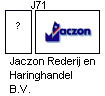
JACZON B.V.
Josef Nüsse’s table flag shows very dark blue and a red-shaded area; the corresponding part of the archived company logo appears orange.
The family business dates its establishment to 1954, while Lloyds gives 1955 as Jaczon N.V. Vess Maats. It subsequently became Jaczon Rederij en Haringhandel B.V. and adopted Jaczon B.V. in 1997. The later website redirected to Cornelis Vrolijc, which described Jaczon as a subsidiary.
Netherlands, Scheveningen (’s Gravenhage).
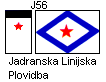
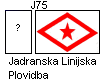
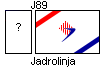
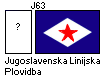
JADRANSKA LINIJSKA PLOVIDBA.
image by Zeljko Heimer, 16 June 2001
A photograph of Ilirija supports the funnel, with a very narrow black top.
Josef Nüsse’s original flag photograph was upside down, corrected on his newer site. Rosanoski notes a more substantial difference: Stewart and Brown show the diamond frame blue rather than red and extending throughout the flag.
Established on 20 January 1947 following nationalisation of Jadranska Plovidba, the company mainly operated passenger ferries. It was known as Adriatic Line and informally Jadrolinija before formally adopting Jadrolinija in 1991. Intermediate register forms include Jadrolinja P.O. and Javno Poduzece Jadrolinja P.O. It also acted as agent for Mid-Adriatic Shipping & Trading.
Yugoslavia; Rijeka, Split in Lloyds 1978–79, and Rijeka again in 1985–86.
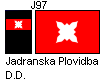
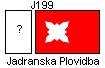
JADRANSKA PLOVIDBA D.D.
image by Zeljko Heimer, 19 October 2004
The FOTW flag is red with a white steamship emblem placed towards the hoist. Its reported readoption on privatisation is subject to the same unresolved company-history question.
J97 is recorded by the pre-war and wartime ship books and Brown 1943.
Jadranska Plovidba, or Adriatic Navigation Co., was formed in 1922 by combining Austro-Hrvatsko Parobrodarsko Društvo na Dionice, Dalmatia d.p.d., Hrvatsko Parobrodarsko Društvo, Obalna Parobrodarsko Plovidba S.O.J. and Oceania Brodarsko a.d. FOTW also traces origins to the Ungaro-Croata company. It operated sixty-seven steamships in Adriatic coastal service and began tourist cruises in 1934. Nationalisation in 1947 led to succession by Jadranska Linijska Plovidba, later Jadrolinija. A further claim of privatisation in the 1990s is unclear: Rosanoski suggests it may refer to Jadrolinija rather than the earlier company.
Yugoslavia, Susak and later Rijeka; FOTW and FAME place the entry under Croatia.
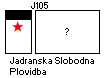
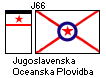
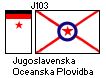
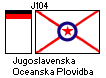
JADRANSKA SLOBODNA PLOVIDBA.
image by Zeljko Heimer, 1 November 2004
The house flag was black with a white diamond reaching the edges and a red star. The funnel was noted on Sava.
Rosanoski considers Mitchell’s J105 funnel suspect because all the accompanying line drawings indicate J30.
Established in Rijeka in 1947, Jadranska Slobodna Plovidba moved to Split in 1956 and incorporated Opća plovidba in 1962. It specialised in cargo transport and was also known as Adriatic Tramp Shipping, Jadroslobodna and JSP Line. Mid Adriatic Shipping & Trading is recorded as a subsidiary and managed company, and Maritenia Shipping as an operated company. In 1992 it became Jadroplov International Maritime Transport.
Yugoslavia; Rijeka, then Split.
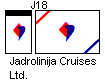
JADROLINIJA.
image by Zeljko Heimer, 16 June 2001 and 22 November 2004; observations in 1999
Željko Heimer dates the new visual identity to 1990. The flag he saw at headquarters and on ships in Rijeka in summer 1999 was white, approximately 2:3, with a central lozenge made of red vertical lines and a blue J. A red diagonal occupies the upper hoist corner and a blue diagonal the lower fly. The rendition has fifteen red and fourteen white vertical bands; a 2005 website logo is recorded with sixteen red bands.
Brown 1995 assigns a version with a solid red diamond to Jadrolinija Cruises. Rosanoski interprets that as a limitation of small-scale reproduction, referring in those comments to a design of nineteen red and white stripes.
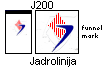
The J200 funnel on Vis in June 2010 shows thirteen red bands, one fewer on the viewer’s right than the website logo cited in that passage. Premuda’s starboard view in April 2013 agrees, while Liburnija in August 2013 shows fifteen. Rosanoski presumes the count has no significance and emphasises the slightly different overall diamond shape. The small flag image uses only six bands to represent the striped pattern.
Jadrolinija formally adopted its familiar short name in 1991, replacing Jadranska Linijska Plovidba, also known as Adriatic Line. Lloyds initially used Jadrolinja P.O. and Javno Poduzece Jadrolinja P.O. The company was organised as a joint-stock company in 1996 and remained controlled by the Croatian government. Jadrolinija Cruises, formed in Rijeka in 1991, appears as an operating company until its later deletion from the register.
Croatia, Rijeka.
Jadropov International Maritime Transport.
JADROPOV INTERNATIONAL MARITIME TRANSPORT.
image by Zeljko Heimer, 16 June 2001 and 22 November 2004
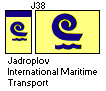
The yellow flag carries a blue emblem and appears higher than it is long. Heimer questions whether it is a vertical display flag, a differently proportioned house flag or a wrongly rotated scan; the spiral might suggest J. Rosanoski thinks the banner unlikely to be a sea flag. The matched funnel comes from Ist: its lower wave is hidden, the narrow band is assumed dark blue like the top, and the symbol is rendered in a medium shade.
Brown 1995 shows a conventional horizontal rectangular house flag. Rosanoski considers the table flag a possible variant, noting that such flags sometimes differ from sea flags.
SPLIT SHIP MANAGEMENT LTD.
Split Ship Management was formed in 1994 and managed vessels for Jadroplov, part of Canada Maritime’s fleet and other companies. Its named owning companies subsequently appear under Jadroplov.
Croatia, Split.
The predecessor used a black flag with a red star on a white diamond.
Jadranska Slobodna Plovidba adopted the Jadroplov International Maritime Transport name in 1992; the source heading and one historical passage spell it Jadropov. Also recorded as Jadroplov d.d. and Adriatic Australia Line, it was controlled by the Croatian government. Its cargo-shipping predecessor was founded in Rijeka in 1947, moved to Split in 1956 and incorporated Opca plovidba in 1962. It apparently took over Mid Adriatic Shipping and Trading’s fleet. Operating interests included Split Ship Management and Valetta Mediterranean Shipping, formed in 1992 with bases in Hamrun and Rijeka.
Croatia, Split.
JAGUAR SHIPPING.
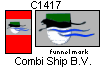
The earlier Jaguar’s funnel is documented in port and starboard photographs during construction in 2006. The animal faces forward on both sides, making the two marks mirror images. The body labels this C417, whereas the source list gives C1417; the original discrepancy is retained.
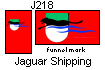
J218 is based on port photographs identified as the later Jaguar, IMO 9613628. Their written date, 23 June 2008, conflicts with the 2010 building-contract chronology and is not silently corrected.
Photographs of 23 June 2013 appear to show a light-grey flag field against which the shield’s white base stands out. Rosanoski consequently assumes a relationship to the C1417 funnel band; a second photograph supports the grey appearance.
Jaguar Shipping built Jaguar, IMO 9613628, under a contract signed in 2010. Shipowners Support is listed as ISM manager by Equasis and owner by Shipspotting. The vessel appears in Amasus Shipping’s fleet, but Rosanoski is unsure whether this denotes a corporate link or only a shipbuilding association.
The business appears to have roots in Combi Ship, formed in 2007 and owner of an earlier Jaguar, IMO 9341768, built in 2006. Equasis records Combi’s ownership from January 2007 to May 2008. G. Gorter and J. Klos of Vieland are named as owners elsewhere. The common vessel name, logo and a Captain Klos connection suggest continuity, but do not establish it. Lloyds places Combi Ship under Wagenborg management.
Netherlands, Farmsum.
JAMAICA BANANA PRODUERS STEAMSHIP CO. LTD.
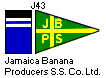
The funnel is blue with a black top separated by a white-blue-white triband. The green pennant bears a yellow cross with yellow JBPS letters in the respective quarters. Vessels of Afrikanische Frucht Compagnie sometimes used the livery.
The company is recorded in the 1939 fleet account and later Lloyds lists, with Kaye Son & Co. as fleet manager in 1963–64 and 1970–71.
U.K., London in The Worlds Merchant Fleets and Brown; Stewart gives Kingston.
JAMAICA PLANTERS SHIPPING CO.
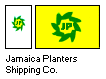
The white funnel bears a yellow circle edged with a green circular-saw ring and containing green JP letters. The yellow flag carries the same green ring and initials.
Jamaica.
JAMES BELL & CO. PTY. LTD.
War Spray was operated by J. Bell & Co. in 1921–1924 and Bell S.S. Pty. Ltd. in 1924–1929, the two being assumed connected. Another source names Bell Steamships Ltd. and dates the change to 1925. Company records give deregistration in 1936 for an entry without location, or 1943 for a Victorian company; Rosanoski does not resolve the alternatives.
Australia, Melbourne.
JAMES CHAMBERS & CO.
Documentary material — company attribution not established
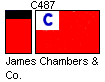
The flag’s C was sometimes black. Ships in the American Barber Line service used Barber colours instead. C487 is recorded on the Australian coast in 1897–1900.
The lettering shown by LJC 1885 may be very dark blue.
LJC 1885 gives the flag canton one-quarter of the field; Lloyd’s makes it slightly smaller.
James Chambers left a firm managing the Australian White Star Line in 1865 before its collapse and continued under his own name, operating the new Lancaster Shipowners’ Co. Ltd. Lancaster Shipping Co. Ltd. succeeded it: one account dates incorporation to 1896 and liquidation of the predecessor to 1897, while Merchant Ships gives 1893 for Lancaster Shipping. Mollers Trust bought control in 1944, and James Chambers & Co. ceased in 1946. Another account describes Mollers buying trading rights and goodwill when Chambers withdrew.
The business operated under Lancaster Shipping, Dodwell-Castle Line and Castle Line names; Jordan instead gives Lancashire Shipping. The source also records Barber service connections. Chambers managed Ship Wulsty Castle Ltd., concerning William Beardmore’s Wulsty Castle from 1918. Fleet names used North Country castles.
UK, Liverpool.
JAMES CONTRACTING & SHIPPING CO. LTD.
The J119 funnel is supported by the report that Southampton, Isle of Wight & South of England RMSP changed its similar funnels in 1936 to avoid confusion with James, named there as James Dredging & Contracting.
After the takeover the company used Westminster Dredging colours, identified as W64 in Marinart and W65 in Mitchell.
The earlier name James Dredging, Towage & Transport appears in Lloyds, which records subscription from 1917 and a Southampton branch from 1923. The business joined Westminster Dredging in 1954. A later company-directory entry gives incorporation on 1 January 1970, non-trading status and a Dublin address; that date is not reconciled with the earlier operating record.
UK; London and Southampton in the cited registers.
JAMES CORMACK & CO. LTD.
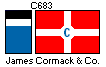
From a black-and-white photograph of Calabria, Rosanoski suggests that the blue was a lighter shade, possibly Scottish sky blue. The Marine News description does not mention the flag diamond or specify the letter’s colour. Brown 1934 and 1943 attribute the livery to Cormack Steamhip Co. Ltd.
The company’s formation is given as 1870 in Merchant Ships and 1872 in Marine News; it operated as Cormack Steamship Co. Ltd. James Cormack died in 1922 and was succeeded by his sons James Jr. and A.C. The company became limited on 14 March 1928. The sons died in 1929 and 1931 respectively and were succeeded by Alistair J. Marine News dates the company’s end to 1936, although Merchant Ships 1942 still lists it with no ships then owned.
From 1922 its vessels adopted names ending in “ton”, after districts in the east of Scotland.
U.K., Leith.
JAMES DOWIE & CO. LTD.
image by Joe McMillan, 15 and 20 September 2001
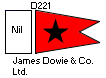
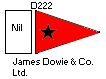
The flag is a red burgee with a black star. Rosanoski treats Griffin’s blue star as a printing error. Joe McMillan initially suggested that a similar red pennant was used collectively by several transatlantic lines returning from Liverpool, but later withdrew confidence in that explanation after finding different Williams & Guion flags. Rosanoski suggests Dowie’s chartering practice might explain the reports, while noting that Chandler records only Australian services and does not establish a transatlantic trade.
Rosanoski considers this variant erroneous, since Liverpool Shipping says the company retained the red burgee with black star.
James Dowie formed his Black Star Line in 1855, mainly using chartered ships. Its last sailing vessel was sold in 1904, after which the business continued in shipbroking. Chandler describes Australian services. Rosanoski distinguishes it from Williams & Guion’s American Black Star sailing packets, whose emigrant trade ended in 1863 before the development of the Liverpool-based Guion steam service in 1866.
U.K., Liverpool.
James E. Ward & Co.
JAMES E. WARD & CO.
image by Joe McMillan, 1 December 2001
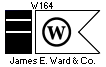
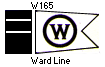
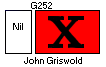
The earlier Ward livery is also assigned by several sources to New York & Cuba Mail. W164 and W165 preserve the separately published versions, while Ships & The Sea 1938 says the W164 livery had been discontinued.
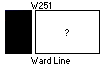
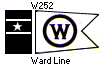
The narrative prints W250 for the replacement funnel, whereas the source list gives W251. Merchant Ships dates the change to 1936 and then describes a 1939 replacement of white bands by a white star in wording Rosanoski finds unclear; a Mexico photograph confirms the latter format. The flag changes from W164 to W252, but the statement that the old Ward flag was done away with does not clearly distinguish replacement design from abandonment. Alderson records a flag change after the 1934 Morro Castle disaster and at least two more under AGWI.
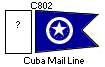
Rosanoski presumes C802 was flown by whichever vessel served the route, with its normal funnel, and tentatively links it to Alderson’s account of later flags.
NEW YORK & CUBA MAIL STEAMSHIP CO.
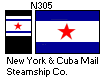
N305 is blue with a broad white horizontal band bearing a red star. It was also used by the former associate Clyde-Mallory Lines; Brown may show a broader white band than the illustration.
The registers separately record Ward Line and New York & Cuba Mail as operators in the AGWI network, with Agwi Navigation, Atlantic Gulf & West Indies Steamship Lines and Cuba Mail Line among the related operations. The original document retains a separate New York & Cuba section, rather than making every register name a new independent company.
USA, New York.
Ward Line
James E. Ward founded the Ward Line in 1856 for scheduled cargo and passenger sailing services. Its post-Civil War move to steam brought the official name New York & Cuba Mail Steamship Company, although Ward Line remained in use; Merchant Ships dates steamship ownership to 1881. It acquired New York, Havana & Mexican Steamship Co. in 1888. After Ward’s death in 1894, his successors sold to Charles W. Morse’s Consolidated Steamship Company in 1907. Consolidated collapsed in 1908, and Ward passed to Atlantic, Gulf & West Indies Lines, retaining its own name.
The line briefly regained independence after the Second World War. McMillan dates AGWI liquidation to 1954 and a sale to outside investors, who shifted away from the US flag rather than accept subsidy conditions and diversified as Ward Industries. In 1956 the shipping assets and name went to Cia Naviera García, becoming Ward-García, which ceased in 1959 amid falling demand and the Cuban Revolution. Another source instead records acquisition by T.J. Stevenson shortly before the revolution, while Alderson gives liquidation in 1953. These differing accounts remain unresolved.
USA, New York.
Keep the explicit scope label independent; no alias or company identity is inferred.
JAMES FINDLAY.
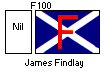
The flag is blue with a white saltire and an overall red F. No funnel is recorded.
James Findlay operated clipper ships.
UK, Glasgow.
JAMES FISHER & SONS PLC.
image by Ivan Sache, 6 March 2004
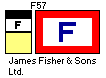
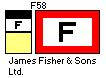
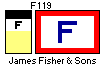
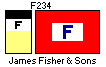
Sources differ over a narrow black band beneath the broad white funnel band. Photographs suggest the white originally lay between hoops, with the lower hoop outlined, leaving its interpretation as a separate band uncertain. Firth Fisher appears without it. Later sources from Brown 1958 show a band wider than a hoop, and the 1973 and 1975 coastal-fleet references explicitly describe broad white over narrow black. Stewart gives buff rather than yellow; some early sources remain unclear about the lower black edge.
The flag’s F may be blue or black, or may have been both. Brown 1951 uses black, later editions blue, then black again, suggesting any blue was dark. Coastal Ships 1967 gives both colours on different pages. Brown 1943 also shows a blue F on the funnel.
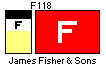
The later flag appears based on the funnel-style company logo, confirmed in a photograph of managed vessel Steersman. Forth Fisher and Humber Fisher also confirm the livery. Chartsman, managed for the same Baum company as Steersman, appears both with a plain blue funnel and with lettering added.
Plain blue funnels are documented on Chartsman and Solway Fisher. Solway Fisher appears royal blue in August 2000, and a black-and-white photograph at her 2001 sale confirms the absence of lettering. Rosanoski leaves open whether this was an option or a stage before letters were added.
Coastal Ships & Ferries 1999 gives this as an alternative funnel; no flag is supplied, and Rosanoski assumes the company flag applies.
Parent company
James Fisher & Sons was formed in 1847 and became a limited company in 1926. Its coastal ships used Fisher as their second name. Acquisitions included Hunting Stag Management, Westfield Shipping and Coe Metcalf; Onesimus Dorey was an operating company. It also operated vessels for Albright & Wilson, Astoria Shipping, British Nuclear Fuels and Pacific Nuclear Transport.
UK, Barrow-in-Furness.
Keep the explicit scope label independent; no alias or company identity is inferred.
James Fisher & Sons (Liverpool)
UK, Liverpool.
Keep the explicit scope label independent; no alias or company identity is inferred.
Shipping Services
UK, London.
Keep the explicit scope label independent; no alias or company identity is inferred.
Tankships
James Fisher Tankships was acquired from P&O in December 1996, previously P&O Tankships. Shipping Services managed it.
UK, London.
Keep the explicit scope label independent; no alias or company identity is inferred.
Group relationships
The company’s ventures included Fenwick, Fisher S.S., formed with William France, Fenwick in the 1930s and dissolved after the Second World War, and Vectis Shipping, formed with Carisbrooke in 1993, to which Fisher sold its half in December 1996. It held 25% of Foreland Shipping, formed in 2011, and an Isle of Man Steam Packet interest described first as 5%, later 10%, repurchased in March 1986. Walter Runciman increased its Fisher holding from 4.86% to 15.8% during 1988. R&H Hall was an associate.
Keep the explicit scope label independent; no alias or company identity is inferred.
Liverpool and Shipping Services
James Fisher & Sons (Liverpool) was formed in 1995 by combining Metcalf Motor Coasters, S. William Coe and Coe Metcalf, the latter bought from Booker in August 1984. It managed part of the Onesimus Doret fleet, as that name is spelt in this section. Renaming to James Fisher (Shipping Services) is dated 2000, replacing an earlier register claim of formation in 1999. Shipping Services managed part of Nordenhamer Bereederungs’ fleet, with related vessel-owning names also appearing under the parent; Global Marine Services managed part of its own fleet.
Keep the explicit scope label independent; no alias or company identity is inferred.
JAMES GARDINER & CO. LTD.
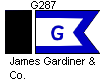
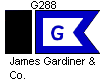
The shape of the G varies between sources.
Founded in 1878, James Gardiner operated through several shipowning companies, including Caledonia, Gairloch, Indian, Kincraig and Western. Caledonia was liquidated in 1910. The remaining ships were sold in 1917 to form Rio Cape Line, after which Gardiner managed vessels for the British Government. It again undertook government management during the Second World War, continuing until 1947. Fleet names began with Glen.
UK, Glasgow.
James Little & Co. Ltd.
JAMES LITTLE & CO. LTD.
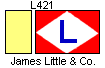
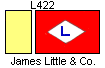
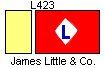
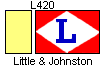
Reed 1891 assigns L421 to T. Little of Greenock. The Log gives it for Indianapolis, then the company’s sole overseas vessel, on the Australian coast during 1896–99.
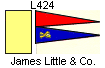
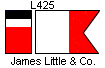
L424 is assigned to James Little of Barrow-in-Furness, with a device resembling crossed bones.
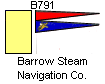
Barrow Steam Navigation Co. — historical variant
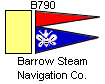
B791’s device appears to be a yellow bird soaring towards the fly.
B790’s insect is taken as a bee; the source describes the company as operated by James Little.
No exclusive fleet-wide use or unrecorded corporate equivalence is asserted.
Little & Johnston — pre-1919 operation
No exclusive fleet-wide use or unrecorded corporate equivalence is asserted.
Documentary images — company attribution uncertain
Reed gives L425 for James Little of Morecambe, operating Midland steamers through the Barrow connection. The funnel is Midland’s, but Rosanoski cannot explain the flag, which belongs to neither Little nor Midland.
Flag proprietor unknown; no blanket assignment of composite.
James Little & Co.
The account dates the business to 1806, running steamers to the Isle of Man; another first records steamship agency in 1819 and later ownership. By 1886 it traded overseas and had a Barrow office. Its fleet was subsequently divided among James Little, Argyll & Wigton, Border Union and Riverdale, with Little & Johnston operating London coasters. A 1919 consolidation is described as James Little & Co. Ltd. taking over itself, Little & Johnston and James Little (Glasgow); the repeated name remains unexplained.
UK, Greenock.
Keep the explicit scope label independent; no alias or company identity is inferred.
James Little & Sons
James Little & Sons of Saltcoats appears for Buffalo in 1917–18, but Rosanoski does not establish a connection with the Greenock company.
UK, Saltcoats, Ayrshire.
Keep the explicit scope label independent; no alias or company identity is inferred.
Related operations
The business also established Leith Salvage & Towage, taken over by the harbour authority in 1953. Barrow Steam Navigation had been formed jointly with Furness and Midland railways in 1867 and passed to Midland in 1907. By 1937–38 James Little is cross-referenced to Joseph Constantine, while Little & Johnston is listed at Terneuzen.
Keep the explicit scope label independent; no alias or company identity is inferred.
B789, L420, L422 and L423 remain as the additional versions documented in Lloyds, Reed and LJC.
JAMES NOURSE LTD.
The flag is white with a blue saltire surmounted by a red diamond. The source describes two yellow or buff funnel versions with black tops. In the first, a red separating band has a serrated upper edge forming interlocking yellow-over-red triangles. In the second, a broad red band bears a blue zigzag line throughout.
James Nourse, also the Nourse Line, was acquired by P&O in 1917. Its management merged into Hain-Nourse Management in 1964, which took over fleet operation. Nourse also managed one vessel for Charter Shipping in the 1963–64 register.
U.K., London.
JAMES P. CORRY & CO. LTD.
The funnel is yellow or buff, with a black top. The recorded buff is RGB 254, 170, 021.
The flag is red with a broad white horizontal band bearing a red heart.
Star Line was the company’s trading name. Accounts differ on the early history: NZMN describes James P. Corry & Son as formed in 1851 from the partnership of John Corry and William Montgomery. Ships & Shipping instead traces the business to Robert Corry, a timber importer who bought his first sailing vessel in 1826; his son William joined Corry & Co. in 1851. Expansion into the India trade from 1859 led to the eventual transfer of shipowning from Belfast to London. By 1887 Robert’s grandson James P. Corry chaired James P. Corry & Co. Ltd. HM Merchant Navy gives 1903 for Star Line.
On 23 January 1914, J.P. Corry’s Star Line, Thos. B. Royden’s Indra Line, Tyser & Co. and Wm. Milburn’s Anglo-Australian S.N. Co. incorporated Commonwealth & Dominion Line, which became Port Line in 1937.
The timber and construction business continued, acquiring East Downshire Ltd. about 1979.
U.K., Belfast; later London.
JAMES PATERSON & CO. PTY. LTD.
The flag is blue with a yellow cross surmounted by a red cross paty. White letters JP&Co occupy the field’s corners.
James Paterson arrived in Melbourne in 1853, or 1852 elsewhere in Australian Coastal Shipping, and entered coal importing with Edward Newbigin. A fleet of small sailing vessels followed, with the first steamer dated 1875 in one account and 1864 in another. The business became Melbourne’s largest coal importer and expanded into bay towage. Loughran gives formation in 1854; registration in 1909 presumably concerns the later company name. Paterson’s nephew Henry Masteron succeeded him after his death in 1906.
Huddart Parker acquired the company in 1929. Boral Gas took over through Huddart Parker in 1961, with the remaining ships transferred to McIlwraith, McEacharn in 1962. Mitchell describes the latter as taking ownership and control in 1962.
Paterson was a founding member of Associated Steamship Owners in May 1921. The association ultimately narrowed to McIlwraith McEacharn and Adelaide Steamship before their shipping merger in January 1964. It also joined the consortium that built the tug Batman in 1954; the combined funnel is recorded under Huddart Parker, which operated the tug.
Australia, Melbourne.
JAMES PATRICK & CO. PTY. LTD.
The flag has Scottish associations: yellow with a red thistle within a double tressure flory counter flory. It is said to have survived several company reformations, but its use from the beginning is unconfirmed. Brown 1943 and 1951 attribute it to Patrick Steamship Co.
A new funnel replaced the original red-thistle design, separately referenced as P144, after the 1923 reformation.
James Patrick founded Patrick Steamship Co. in 1919. It entered liquidation in mid-1923; one account describes reformation later that year, while the later comment dates James Patrick & Co. Ltd. to 1925, matching the registration of 2 January. The name became James Patrick & Co. Pty. Ltd. in 1938. An Australian coastal shipowner, it sold its last two ships in 1962 and developed agency and stevedoring activities. Howard Smith took it over. The 2008 government record showed voluntary liquidation under an administrator.
The company held 40% in both Brisbane Gateway Terminals and National Terminals (Australia), alongside Australian National Line’s 60%; National Terminals began in November 1988. Both became equal ventures on 3 June 1992, with Howard Smith’s participation apparently through James Patrick.
Australia, Sydney.
JAMES R. CUTHBERTSON & CO.
The funnel is yellow or buff.
The flag is blue with a white saltire.
The company had a vessel on the Australian coast between 1895 and 1897.
U.K., Glasgow.
JAMES ROWE & SONS LTD.
The flag was white with a blue cross paty.
Shipowners and orchardists, James Rowe & Sons bought Lintrose in 1918. The source records a Bass Steamship joint venture in 1920. In 1931 Rowe merged with Huon Channel & Peninsular S.S. Co. to form Huon Transport Co.
Australia, Hobart.
JAMES SMITH & CO. LTD.
Coal merchant James Smith acquired Glenelg in 1904 and transferred her to James Smith & Co. in 1911. The Compendium instead records joint acquisition with J.J. Craig, followed by joint company ownership from 1911 and disposal in 1933. Rosanoski tentatively identifies the Craig interest with J.J. Craig Ltd.
New Zealand, Auckland.
JAMES SMITH & ZOONEN.
The red flag bears intertwined yellow JS capitals. The FOTW comment leaves continued use uncertain.
James Smith & Zoonen was listed from 1953–54 to 1966–67.
Netherlands, Rotterdam.
JAN DE NUL N.V.
image by Jarig Bakker, 7 October 2005
The white house flag bears a red circle containing red DJN letters, with J larger than D and N. The accompanying FOTW text suggests that the circle may refer to nul, Dutch for zero.
Rosanoski’s separately referenced D588 funnel follows Boussoule on 19 March 2014. A port-side photograph of Codralux’s Francis Beaufort on 22 April 2007 supports its use as a group livery, including the flag.
Jan Frans Jozef De Nul began civil contracting in 1938 and dredging in 1951. The business, also known as JDN, appears in Lloyds under N.V. Ondernemingen Jan De Nul and later Jan de Nul N.V. Lloyds initially dates formation to 1968, amended to 1938 in 2008.
Major operating companies include Luxembourg-based Dredging & Maritime Management S.A., formed in 1998, and Codralux S.A., formed in 2004. A 2006 joint venture with Koninklijke Boskalis Westminster was named Jan De Nul Dredging Ltd./Boskalis Westminster Middle East Ltd.
Belgium, Aalst.
Jan Nagel Schiffahrts K.G.
Documentary material — company attribution not established
The shades follow Nüsse’s table flag, supported by the agent’s website flag logo. Grimm carried a metal version in a 30 September 2007 photograph; another view showed two tall exhausts rather than a funnel. Kalina, of Reederei Nagel, displayed the full livery in a 5 November 2011 photograph.
Founded in 1989, Jan Nagel Schiffahrts was managed by and later listed as an operating company of Pohl Shipping Schiffahrtsgsellschaft mbH. The registers alternate the parent and subsidiary roles of Jan Nagel Schiffahrts and Reederei Nagel, the latter formed in 1991 at the same address. By 2008 Jan Nagel again appears under its own name with operating companies. Nüsse uses the alias Küstenschiffahrt Nagel & Co. K.G.
Jan Nagel joined Elbe Shipping and Jens & Meyer Schiffahrts in forming Global Mare Shipping at Osten in 2007.
Germany, Drochtersen.
JAN-ERIK DYVI.
The funnel is white with a black top, a narrow blue band below the top and another lower down. Between the bands is the contemporary flag depicted flying from a pole angled “Pbd”. One flag is blue with a broad white horizontal band bearing a blue D; the other is white with a blue D originating at and occupying the whole hoist.
D48 follows Nüsse’s flag; Brown limits the D’s extension to half the flag. The appropriate flag version appears on the funnel of its period.
The business was formed in 1957, with vessels held through name subsidiaries. It also managed I/S Europafergen, associated with Lion Ferry. Offshore Heavy Transport, formed in Oslo in 1997, was an operating subsidiary.
Norway, Oslo.
JANFIELD SHIPPING LTD.
The website flag image was assessed as very dark blue. Since the company managed individual ships, Rosanoski did not expect a separate funnel livery.
Janfield provided ship management and agency services and is listed by Lloyds as a manager.
China, Hong Kong.
JAPAN KINKAI K.K.
The company apparently used Japan Line’s funnel and inherited it when that company merged into Navix Line in 1989.
Japan Kinkai, also called Japan Line-Near Seas, appears in Lloyds from 1966–67 to 1996–97, when it is named Japan Kinkai Ltd. Japan Line acted as agent in the earlier registers.
Japan, Tokyo.
Japan Line Ltd.
JAPAN LINE LTD.
Loughran remarks on the unusual use of green for a Japanese company. A photograph of Japan Ambrose supports the narrow black funnel top. The J in J57 follows Alan Watt; other sources make it narrower.
JASMIN SHIPPING (TOKYO) CORPORATION.
Jasmin appears as Jasmin Shipping Co. in 1978–79 and Jasmin Shipping (Tokyo) Corporation in 1980–81. Its agents included International Marine Services, Japan Line, Sumitomo Shoji and later Navix; JL Shipping managed it in 1988–89.
Japan, Tokyo.
Japan Line Ltd. & Mitsui O.S.K. Lines Ltd., documented joint operation
Mitchell places J100 and J101 on a joint Japan Line and Mitsui O.S.K. card for Godwit and also refers to Jasmin Shipping. Japan Stork and Japan Margaret are named, the latter possibly meaning Japan Marguerite. The Godwit line drawing instead shows a red funnel, leaving the variant relationships unclear.
Japan Line, also called Japan Line K.K., arose from the government-instigated merger of Nitto Shosen and Daido Kaiun on 1 January 1964. It merged into Navix Line on 1 June 1989. Its interests included Green Investments and several joint ventures. It operated and managed part of Kumiai Senpaku’s fleet and acted for Japan Kinkai and Jasmin Shipping. Japan-prefixed ship names presumably applied to new tonnage.
Japan, Tokyo.
Japan Reefers.
Documentary images — company attribution uncertain
The funnel is recorded in the Mitchell collection.
Date and precise livery operator unverified.
Rosanoski did not locate the company. Mitchell apparently links it with Ikoma Maru, built in 1979, but that vessel belonged to Nippon Suisan, so the connection may have been a charter.
Japan, Tokyo.
JAPP & KIRBY.
J25 is recorded in LJC 1909.
J177 is recorded in Lloyds 1912.
R. Japp & Kirby were shipowners and brokers operating by at least 1893, when they enquired about emigration from India to Réunion. The earliest ship Rosanoski located was Otterspool, built in 1896. The business ended in 1912 when Russell Japp retired; F. Japp, T. Hatch and O. Hatch formed Japp, Hatch & Co.
UK; Liverpool in LJC 1909 and London in Lloyds 1912.
Jardine, Matheson & Co. Ltd.
JARDINE SHIP MANAGEMENT LTD.
Jardine Ship Management Ltd.
The later funnel is blue with a black top and a white rectangular frame, surmounted by a white detailed Scotch thistle base and a red flower rising above it. Mitchell dates the Indo-China adoption to January 1982 but does not mention the black top. The accompanying flag is blue with a white saltire.
J70 may have been a shore flag. It is red, with a white-outlined panel divided blue over red, the blue occupying two-thirds. A white outlined stylized Scotch thistle extends above the panel; the red lower part bears “Jardines” in white. The small white objects are inverted delta triangles.
JARDINE SHIP MANAGEMENT (U.K.) LTD.
The U.K. ship-management section is based at Chelsmford.
Documentary material — company attribution not established
Jardine, Matheson & Co.
The main flag is blue with a white saltire. A swallowtail pennant with the same saltire appears in several paintings of the clipper Falcon and may have been a commodore’s flag, although company records do not mention it. Eagle Arrow’s flag, seen at Lyttelton on 21 July 1983, supplied the blue shade and had a narrow saltire. The red funnel with black top is associated with Indo-China and may not have been used by Jardine, Matheson directly; a report making Indo-China a subsidiary would instead make it a group livery. Rosanoski describes the Stewart funnel version as incorrect.
Jardine Shipping Ltd. and Fleet Trans International Co. Ltd.
Jardine Shipping Ltd., owned by Jardine, Matheson, was formed in 1918 and held its fleet through operating subsidiaries. These included Fleet Trans International, formed in 1992, and the Hong Kong and U.K. ship-management companies.
Keep the explicit scope label independent; no alias or company identity is inferred.
Jardine ship-management companies
The Hong Kong ship-management business formerly traded as The Indo-China Steam Navigation Co. (Hong Kong) Ltd., taking the Jardine name in 1985 and the IndoChina Ship Management (H.K.) name in 2001. The U.K. company, formed in 1994, likewise became IndoChina Ship Management (U.K.) Ltd. in 2001.
Keep the explicit scope label independent; no alias or company identity is inferred.
Jardine, Matheson was formed at Canton in 1832 by William Jardine and James Matheson. Originally associated with London and the opium trade, it adopted the Chinese name Ewo, “happy harmony”, in the 1840s. Its river, coastal and cargo interests were combined as the Indochina Steam Navigation Company in 1882, and it helped establish Star Ferry in 1898. It became a limited company in 1906 and a public company in 1961. The 1985 withdrawal announcement retained ship management and agency, leaving Rosanoski uncertain whether the decision had changed or concerned ownership in its own name.
The source lists the United Kingdom, Hong Kong and China for the parent group.
The Jardine Shipping, Fleet Trans and Hong Kong ship-management sections concern Hong Kong, China.
JAVA-BENGAL LINE.
Consortium vessels apparently retained their owners’ funnels, adding the flag’s diamond and letters. The J88 funnel top was very narrow on Koninklijke Paketvaart Maatschappij vessels.
Stoomvaart Maatschappij Nederland, Rotterdam Lloyd and Koninklijke Paketvaart Maatschappij formed Java-Bengal in 1906. It merged with Java-Pacific in 1931 to form Pacific Java Bengal.
Netherlands.
Java-China-Japan Lijn N.V.
J.C.J.L. (MN 7/1977).
B. E. Roys proposed a flag on 19 January 1903: a white lozenge with J.C.J.L. letters between red at the hoist and blue. It was adopted, then changed within months to red above and blue below, relating it to the Dutch flag. Jarig Bakker’s account instead explains the original colours through KPM’s white diamond on red and KNSM’s white diamond on blue, with the new initials replacing the royal crowns. That account gives use of the initialled flag as 1902–47.
Sources differ over whether the funnel mark is a panel or a band. Brown 1943 specifies a band, as does Ships & The Sea, and a photograph of De Schelde could support that appearance, while Wij Varen Weer shows a panel. Talbot-Booth and Harnack split the letters into JC and JL with a gap.
Java-China-Japan Lijn, or J.C.J.L., was formed in 1902 by Nederland, Rotterdam Lloyd and Koninklijke Paketvaart Maatschappij, beginning operations in 1903. It participated in the consortium controlling Vereenigde Nederlandsche Scheepvaartmaatschappij. Ships bore Javanese names beginning Tji, meaning river. In 1947 it combined with part of Koninklijke Paketvaart Maatschappij to become Koninklijke Java-China Paketvaart Linjen, or Royal Interocean Lines.
Netherlands, Amsterdam.
JAVA-NEW YORK LINJE.
Rosanoski considers it probably a consortium service whose vessels may have retained their original funnels.
Merchant Ships records a Nederland-operated service from 1915. Fenton instead dates formation to 1916 by Nederland, Rotterdam Lloyd and Koninklijke Paketvaart Maatschappij, continuing until 1960.
Netherlands.
JAVA-PACIFIC LIJN.
image by Jarig Bakker, 13 Oct 2003
The flag is red over blue with a white diamond bearing intertwined black JPL letters. Jarig Bakker’s FOTW account dates this form to 1915–23. Rosanoski finds the Marine News funnel association unclear: it suggests the J86 combination, though he considers the funnel more appropriate to J85.
Java-Pacific was formed in 1915 by Nederland, Rotterdam Lloyd and Koninklijke Paketvaart Maatschappij. One account says it merged with Java-Bengal in 1931 to form Pacific Java Bengal; another places its fleet in Silver Java Pacific in 1930. Rosanoski considers these accounts apparently contradictory.
Netherlands.
JAY SHREE TEA & INDUSTRIES LTD.
image by Jarig Bakker, 18 November 2005
The FOTW flag follows Brown 1995, whose title uses Jayshree Tea & Industries, although the FOTW quotation adds an s to Tea.
Jay Shree was part of the B K Birla Group. Lloyds records it as Jayshree Tea & Industries in 1978–79 and Jay Shree Tea & Industries in 1985–86. The subsidiary Jay Shree Shipping later appears as manager for the owner. Vessel names began Jay.
India, Calcutta.
JAYANTI SHIPPING CO. LTD.
The company adopted Shipping Corporation of India livery on coming under its management. The emblem discussed in the source is called a whelk shell by the NJK Collection and a conch shell by Loughran. J64’s funnel was noted on Krishna Janati; its flag was not observed, although Rosanoski considers it undisputed.
Jayanti was placed under Shipping Corporation of India management in 1966 and appears under the manager in Lloyds 1970–71.
India, Bombay.
JCE GROUP.
image by Jarig Bakker, 15 August 2005
Rosanoski questions the role of the funnel illustrated on the Bryggan website because the fleet consists of platforms. The FOTW image follows that site.
JCE originated in Container Safe J. C. Ericsson, formed by Christer Ericsson in 1971. From containers it expanded into offshore accommodation and construction support, beginning with Safe Astoria in 1978. In March 2004 it bought the drilling rigs Sedco 600 and Sedco 602 for conversion, renaming them Safe Bristolia and Safe Astoria. That July it acquired an indirect fifteen per cent interest in the venture building Safe Concordia.
Consafe Offshore, based in Gothenburg, is dated to 2001 by Lloyds and 2000 by the company account. It was listed on the Oslo Stock Exchange in September 2005. The source traces its operational experience through Concordia, Safe Partners, Safe Offshore and Prosafe.
Sweden, Gothenburg.
JEAN NÉGRI.
image by Ivan Sache, 26 February 2004
Jean Négri specialised in refloating and salvage and appears to have become a shipowner with Osuro (I) in 1941. Auguste Marcellin became a shipowner in 1947; together they formed Société Marseillaise de Travaux, Somatra, in 1949. Lloyd’s lists Somatra in 1953–54. The source dates scrapping of the last ship to 1957.
France, Marseilles.
Jebmai Shipping Management Co. Ltd.
Documentary images — company attribution uncertain
Sea Coral was noted in 1965 with a yellow or buff funnel and broad blue band. The markings may belong to the owner rather than the manager, depending on their relationship. No flag is noted.
Jebmai is recorded as a manager in Lloyds 1966–67 and 1970–71, managing four companies in the earlier register and one in the later.
Hong Kong.
Jebsens SA Group.
JEBSENS SA GROUP.
image by Jorge Candeias, 4 April 1999
image by Klaus-Michael Schneider, 28 Apr 2009
Loughran dates J5’s funnel to the period before 1949 and again 1969–74, with J6 between 1949 and 1969. J6 is also recorded for Dillingham Jebsen and Jebsen (U.K.). The older flag is blue, divided vertically by a white dancetty line, bearing black K over J sharing a diagonal stroke. It continued to appear on a Hong Kong agency website; Rosanoski suspects acquisition of the name and perhaps the old flag, but does not know whether it still flew.
The later group livery dates from 1974. Its flag is a blue-white-blue horizontal triband, with white occupying about two-thirds of the field and bearing a narrow blue zigzag of three complete and one half upward points. This brought the flag into line with the funnel bands. Socofl Lake on charter at Wellington in August 1998 showed a dark-blue shade.
J133 is recorded in the Mitchell collection.
JEBSENS MANAGEMENT A/S.
Jebsens Management was formed as Jebsens Thun Management in 1991, renamed in 1995 and became Wilson Management in 1998. Associates included W.G. & A Philippines and Aboitiz Jebsens Shipmangement. The London management subsidiary began as Chelston in 1988 and adopted its Jebsen name in 1992; after the Wilson takeover its office closed, with Lothian Shipping Services continuing from the address. The Bergen management subsidiary began in 1986, renamed in 1989 and became Wilson Ship Management (Bergen) in 1998.
Norway, Bergen.
Kristian Jebsen founded the business in 1929 as Kristian Jebsens Rederi. It became Jebsens Thun Shipping Group in 1992 and Jebsens SA Group in 1995, although Lloyds 1998 instead uses Jebsens Management. Otto Jost’s alliance with Atle Jebsen developed into Jebsen Hamburg–J. Jost in 1971 and Jebsen Hamburg–Kristian Jebsen in 1974. R. S. Dalgliesh was bought in April 1974. Short-sea operations combined with Paal Wilson in Jebsen Wilson EuroCarriers in January 1993. Wilson sold its share to Jebsen in 1996, but Actinor acquired seventy per cent of Jebsens in 1997, regaining control of EuroCarriers. Management then passed to Wilson. Interests also included Jebsens Industrial Shipping Services, formed in 1987, and MISR Edco. A Tordenskjord connection is inferred from vessel names and the funnel. Ship names commonly ended nes.
Jebsen held twenty per cent of Euro Pacific New Zealand Line before withdrawing in July 1988. Its 1987 venture with Tasman Pulp & Paper, Tasman Jebsen New Zealand Line, gave notice to Union Steam Ship as manager; Jebsen withdrew at the end of 1988.
Norway, Bergen.
JEBSHUN SHIPPING CO. LTD.
The yellow or buff funnel has a black top and a flag panel. The blue flag carries a red diamond reaching the edges and white JSCo letters.
Jebshun appears in Lloyds from 1970–71 to 1978–79 and acted as fleet manager for Chan Moo Chu.
Hong Kong.
JELØ-LINIEN.
image by Klaus-Michael Schneider, 25 June 2012
The flag is red with a centred blue cross and white border. A black-and-white newspaper advertisement appears to match Carly’s coloured chart. Rich. Peterson’s flag in Lloyds 1912 adds a white diamond at the cross intersection. Rosanoski sees two flags for connected Norwegian businesses, while Peter Hans van den Muijzenberg leaves open whether the plain-cross flag belonged specifically to Jelø-Linien or to all R. M. Peterson operations.
Jelø-Linien served Christiania and Hamburg with Jelø and Erna, appearing in Aftenposten advertisements from 1891. Westergaard acted at the Norwegian end and S. Stein as Expeditør in Hamburg. An April 1904 notice says R. M. Peterson’s son, engineer Rich. Peterson, replaced Westergaard as agent. This supported the interpretation that R. M. Peterson owned the line. Three successive Jeløs are traced: the 1890 vessel wrecked in 1899, a replacement bought in 1901 and sold in 1905, and a new vessel in 1907. Erna was built in 1894 and wrecked in 1915; the ownership note varies between R. M. and R. N. Peterson. Rich. Peterson later combined ship companies as A/S D/S Nordsjøen in 1912. A/S Jelølinjen, associated with Fred Olsen, took over in July 1923.
Norway, Christiana, as written in the Country field.
JENDI GROUP SHIPPING CO.
J207 is based on Zeina J’s port funnel in February 2008 and a starboard view from March 2006.
Jendi Group was formed in 2003 and appears with ships in its own and named owning companies.
Syria, Tartous.
JENS & MEYER SCHIFFAHRTS K.G.
The blue flag has a very narrow white saltire beneath a large blue circle outlined in white. The circle bears a white horizontal oblong with slightly curved ends. Colour shades follow the website image; no funnel is given.
Jens & Meyer joined Elbe Shipping and Jan Nagel Schiffahrts in establishing Global Mare Shipping at Osten in 2007.
Germany, Drochtersen.
JENS & WALLER GMBH & CO. K.G.
image by Klaus-Michael Schneider, 12 Jul 2012
The flag is yellow over white, identified as the colours of the former Hannover province. A central diamond is dark blue above and light green below, with handwritten white J and W respectively. The fleet appears chartered out: Helmut carried SCA on the hull, a plain funnel and a flag panel on the superstructure. Ruth had the same funnel and panel without hull lettering; WEC Goya carried W.E.C. LINES.
Wilhelm Waller operated ships before the Second World War. His son Dieter went to sea in 1959 and became a captain in 1967; the first container ship was acquired in 1978. Dieter and his engineer nephew Ulf Jens conducted the business from 2005. Lloyds dates Jens & Waller’s formation to 1994, distinct from the earlier Waller operation. Ruth-Dieter was built in 1950, and the last vessel managed under Wilhelm’s name, Westwind, was sold in 1985.
Germany, Stade; Lloyds gives Bützfelth, State.
JENS BOYSEN.
The funnel follows a portside view of Steenborg.
The source does not resolve the archive’s 1995 move to Denmark, the jurisdiction of the later operation, or the 1978 acquisition. A personal move, ship flag and manager’s address are not interchangeable.
Born on Pellworm in 1946, Jens Boysen became a seaman and then a teacher involved with young people. He returned to seafaring in 1972, training as a captain in coastal and inshore fisheries. His interest in training troubled young people at sea led to the purchase of the coaster Süderoog in 1978. He moved to Pellworm in 1979 and Denmark in 1995.
Wilhelm E.F. Schmid GmbH is recorded as manager in 1988–89.
Germany, Hamburg and Pellworm; Denmark from 1995.
JENS HETLAND.
The funnel is yellow or buff with a panel of the flag. The flag is a horizontally divided red-over-blue swallowtail, with a white circle bearing a blue “H”.
Jens Hetland was involved in a joint venture with K. Nilsen, recorded under their own names at the Hetland address.
Norway, Egersund.
JENS JAKOBSEN A/S.
Tina Jakobsen photographed in February 2006 provides J178. A later photograph shows a plain white funnel with a narrow black top, the anchor’s removal presumably following the takeover. The vessel was sold in October 2007.
Jens Jakobsen was formed in 1989 with Jens Jakobsen as chairman and managing director. It appears as an operating company of Rederiet Benskov, formed in 1988 at Ronnede. Erria acquired and absorbed it in 2006.
Denmark, Fakse and Ronnede.
JENS MARCUSSEN.
image by Jarig Bakker, 22 December 2003
The flag is recorded in Bakker’s FOTW illustration.
Norway, Askerøyen; the location is explicitly tentative in the source.
Jens Toft A/S.
DS Jutlandia AS
image by Phil Nelson, 24 June 2000
Brown 1958 suggests that the apparent funnel band is only a panel. The funnel and flag are also documented in wartime sources, US Navy 1961 and Stewart; the original supplies no fuller verbal design description.
Jens Toft appears in records from 1937 through 1963, first as operator and later as owner and manager. D/S Jutlandia is treated as a probable subsidiary from its ship names, which combine family names with Toft.
Denmark, Copenhagen.
JIANGSU OCEAN SHIPPING CO. LTD.
J205 is based on Josco Taicang’s port funnel in February 2013 and Josco Nanjing’s starboard view in February 2011. The latter has darker blue and a very narrow black top. Photographs of Josco Taizhou show a much lighter, almost cream base.
Jiangsu Ocean Shipping, also called COSCO Jiangsu and JOSCO, was formed in 1997. Lloyds initially places it under China Ocean Shipping; the later account says that venture ended and lists Jiangsu under the Chinese government, with fleets also recorded in its own and associated companies. JOSCO Yuansheng Shipping Management was formed in Nanjing in 2004.
China, Nanjing.
JIANGSU STEAMSHIP CO. LTD.
Spring Breeze’s starboard funnel on 30 May 2013 provides J212. Small JSS letters, apparently grey, occupy successive white areas of the globe.
Jiangsu Steamship was affiliated to JiangSu HuaXi Group. Its website is dated 2010, and Lloyds 2011–12 lists it as a manager.
China, Zhangjiagang, Jiangsu, in Lloyds; Hong Kong on the company website.
Jin Yang Shipping Co. Ltd.
JIN YANG SHIPPING CO. LTD. (1)
The earlier Seoul company became K.S. Line Corporation in 1982 and merged into Korea Shipping Corporation in 1984.
South Korea, Seoul.
JIN YANG SHIPPING CO. LTD. (2)
J129 is based on Seto Iris, managed and probably also chartered. Website funnel versions show dark blue.
J130 shows Naxos on 14 July 2007.
J131 shows Jin Prince on 25 March 2007.
A later Seoul entry is dated to 1984 by Lloyds and 15 March 1989 by the company website, which also uses Jinyang Shipping. Rosanoski wonders whether it is the same company at a changed address, but distinguishes it from the Yosu namesake under KSS Line. Ocean Star Line, formed in 2000, is listed as a subsidiary.
South Korea, Seoul.
Jin Yang Shipping Co. Ltd., China
The Chinese namesake was formed in 1996 and is listed as a named owning company of the Chinese government.
China.
Keep the explicit scope label independent; no alias or company identity is inferred.
JINHUI SHIPPING & TRANSPORTATION LTD.
G321 was frequently seen in Singapore on Jin-named ships. It is supported by Jin Yang and Jin Ping in April 2006, a starboard Jin Ping view in 2003 and Jin Xing at Newcastle in October 2008.
G322 is based on Jin Shun in December 2005, possibly on charter.
G323 is recorded in the Mitchell collection.
Shipping activities began in the mid-1980s. The annual report dates incorporation in Bermuda to 16 May 1994 and reorganisation that June as the shipping and investment holding company, with Hong Kong correspondence offices. Lloyds instead gives formation in 2001. Jinhui Holdings owned approximately 50.21 per cent at the 2005 reporting date. Goldbeam Shipping Inc. was wholly owned, while the separately named Goldbeam International operating company began as Goldbeam Shipping in 1987 and was renamed in 1991. Vessel names characteristically began Jin.
China, Hong Kong.
JIVRAJ’S NAVIGATION CO. LTD.
image by Jarig Bakker, 31 Dec 2004
The FOTW flag follows Scott’s Caltex book of 1959, with use stated as 1966–68. Mitchell supplies the funnel without naming a vessel.
The fleet began with Akbari, bought in 1946 and scrapped in 1958. El Karim was acquired in 1949, renamed Sher in 1953 and also scrapped in 1958. Lloyds additionally lists Carabao in 1956–57 and 1958–59, whereas Miramar retains a Rogers & Co. history without mentioning Jivraj. Rosanoski presumes a sale omitted from Miramar; Lloyds 1953–54 had placed the ship with Colonial Steamships under Rogers management in Mauritius.
Kenya, Mombasa.
JOB BROTHERS & CO. LTD.
Sources vary the relative sizes of the two flags and the amounts of blue and white in the upper one. LJC 1909 assigns J148’s upper flag to sailing ships and J149’s to steamships. A Maritime History Archive letterhead appears closest to J149.
J147 is recorded in LJC 1885.
The business originated around 1750 with John Bulley of Teignmouth and passed to his son Samuel. John Job joined the fish-trading partnership, which transferred its English operations to Liverpool in 1809 while maintaining Newfoundland activity. Reorganisation in 1839 divided the St. John’s and Liverpool partnerships within the Job family. Job Brothers & Co. Ltd. united the Liverpool and St. John’s interests in 1909. Hudson’s Bay acquired a majority in 1927, bought back in 1943; Northlantic Fisheries acquired sixty per cent in 1945. The company is said to have ceased in 1964, while the 1967 date used by FOTW refers to closure of the last Job plant, whose ownership then is unclear.
UK, Liverpool, and St. John’s, Newfoundland, Canada.
Joelle B. & Josiane B. El Adem.
Documentary images — company attribution uncertain
Anna’s port-side photograph dated 7 August 2013 supplies the funnel. Rosanoski questions its attribution to Riga Brothers and provisionally gives it to the registered owners. A link to the first manager remains possible, though the marking’s survival under subsequent management is unexplained.
No relationship inferred from Adem surname or retained lettering.
Anna was acquired without a name change by M. Boulos Vacoub El Adem in 1988 and passed to Joelle B. El Adem and Josiane B. El Adem in 1990. The owners were listed under Establissement Paul Adem management in 1992–93 and Riga Brothers in later registers.
Lebanon, Beirut.
JOH. LEONARD.
The blue flag has narrow white bands at top and bottom and a white star containing a blue L, as shown in US Navy 1961.
L338 is retained from Merchant Ships 1942 and 1944.
Joh. Leonard operated before the Second World War and through the late 1950s. Ship names used the suffix borg.
Sweden, Landskrona.
JOHAN RASMUSSEN & CO.
The Collectors Corner badge shows a flapping flag, so Rosanoski cannot determine whether it represents R180 or R182.
Johan Rasmussen & Co., also recorded as Johan Rasmussen and Torger Moe, managed shipping interests including Viking Corporation, Tanker Corporation, Hvalf-A/S Vestfold, Hvalf-A/S Rosshavet and Hvalf.-A/S Sydhavet. The accounts also name Vestvold Corporation in Panama and Vestfold Corporation in agency and associate entries. Viking Tanker of London and its subsidiary Viking Corporation were associates.
Norway, Sandefjord.
JOHANN M.K. BLUMENTHAL GMBH & CO. K.G.
Pollux’s tall funnel has thicker outer white and red bands, particularly the white. On the shorter Papua funnel, photographed on 30 December 2010, the red bands remain thick while the outer white bands are slightly narrower, compensating for the different height.
The family account dates the business to 1901, founded by Johann M.K. Blumenthal. The fleet was destroyed during the Second World War and rebuilt by his grandson Hans-Edwin Reith. The fourth generation, Dr. Matthais-Kaspar Reith and his brother, later owned and managed Orion Schiffahrts-Gesellschaft Reith & Co., split in June 2005 into Orion Bulkers and Johann M.K. Blumenthal. Lloyd’s instead dates the business to 1904, trading as Orion Schiffahrts GmbH, renamed in 1952 and again in 2005.
Germany, Altona; Hamburg.
JOHANNES BARTELS.
The funnel is yellow or buff with a black top and a flag panel. The flag is blue with white “JB”; the “J” lacks a sinister arm at the top.
Lloyds 1963–1964 records Johannes Bartels and a second Hamburg company named Johs. Bartels; the source does not establish their relationship.
Germany, Hamburg.
JOHANNES ICK.
Talbot-Booth 1937 and 1938 assign the livery to Arthur Sommer.
Documented shared associations — Arthur Sommer funnel / Johannes Ick flag — composite panel
The J lacks a top arm extending towards the fly, except in Brown 1951; Stewart shows a crossed continental-style form. Ships & The Sea, Merchant Ships and Flaggen & Schornsteine show I1’s funnel panel as a band, as with S613.
Johannes Ick appears in wartime sources under operator Arthur Sommer and in post-war registers through 1963–64. It reappears as agent in the 1990s. Lloyds dates formation to 1987, which Rosanoski takes as an apparent return to shipping rather than the beginning of the earlier business. Later ownership is assigned to Mathies Reederei, conflicting with the 1942 account’s description of Ick as a part-controller of Mathies from 1934.
Germany, Hamburg.
JOHANNES SØRENSEN.
The flag is red with a white horizontal oval bearing white JS letters outlined in blue. The red funnel carries the flag emblem.
Johannes Sørensen was listed solely as a fleet manager in 1963–1964 and 1970–1971, managing one vessel-owning company in the earlier register and three in the later one.
Denmark, Odense.
JOHANNES VISSER.
V315 is reconstructed from Henny’s bow logo and port- and starboard-side photographs. The dove faces forward on both sides, forming mirror images. The early January 2014 correspondence initially assumes continuity from the build; the later identification connects the funnel to Johannes Visser’s 1982 vessel through Mitchell’s collection. Rosanoski records the marking as surviving subsequent sales and renamings. Whether the design was included in the sales or simply left unchanged is unknown.
Visser acquired and renamed the 1953-built Dependent in 1963 in partnership with F. Bruins, replacing it in 1970 with the 1964-built vessel of the same name. New Dependents followed in 1977 and 1982. The register instead names the earlier partnership J. Bruins & J. Visser and later records J. Visser under Wijne & Barends operation; the differing initials are retained.
The 1982 Dependent passed to Rederij Dependent in 1984, returned to Johannes Visser in 1986, and was sold to Gerardus J. & Peter Schalk in 1995. In 2000 Scheepvaartbedrijf A.J. Kok renamed her Liamare; Vink Scheepvaart B.V. acquired her on 8 April 2004 and renamed her Henny. She subsequently passed unchanged in name to Fornax B.V. on 13 May 2013 under Geuze Shipping management. The cited Miramar sequence omits the 1995 sale.
Netherlands, Delfzjil.
Johansson Group.
JOHANSSON GROUP.
J116 and O209 appear related to OT Rederierna, though J116 may also have applied to other vessels; Mitchell supplies no supporting details.
O.T. REDERIERNA.
O278 is documented in Brown 1982.
Collectors Corner assigns a cap-badge flag with a yellow field to OT Shipping, recorded elsewhere as O15.
O.T. Rederierna belonged to Johansson Brothers and was included in the 1982 bankruptcy. Rosanoski believes it may have continued as OT Shipping under Shipinvest and notes an apparent OT Africa Line connection.
Sweden, Skarhamn.
Documentary images — company attribution uncertain
Atlant Cargo and Mid East Cargo were not located in Lloyds and may be service names. M493’s letter is shaded on its sinister sides.
Corporate versus service identity and group relationship unresolved.
Lars G. Johansson managed the group, with A/B Skarhamns Oljetransp as agent. Its fleet appears under single-ship companies and OT-Rederierna by 1973–74 and under O.T. ownership in 1980–81. The Johansson Brothers business became bankrupt in 1982, and A/B Shipinvest was formed to take over the shipping activities. Mitchell instead describes acquisition by OT Rederi.
Sweden, Skarhamn.
JOHN ANDERSSON.
John Andersson operated as Rederi A/B Signe in 1953–54. By 1958–59 Lloyds listed him under his own name with a different vessel, Signe; in 1963–64 he again operated as Rederi A/B Signe, with a new vessel.
Sweden, Helsingborg.
JOHN B. OSGOOD.
The sailing fleet used a blue flag with a white circle, the same design as T&J Brocklebank’s original flag. No funnel applies.
John B. Osgood was an American whaling owner well established by the 1820s.
USA, Salem.
JOHN BACON LTD.
The two associated companies also used this livery. Sources vary in the space between the funnel bands, from a gap equal to their width to a broad interval. Some show the ends of the flag’s “B” extending beyond its stem.
Bacon Line was apparently a trading name, formed about 1850. It merged into Powell, Bacon & Hough Lines in 1913, which became Coast Lines in 1917. John Bacon is recorded as owner or manager of Bristol, Swansea, Milford, Wexford S.S. Co. and Liverpool & Bristol Channel S.N. Co.
U.K., Liverpool.
JOHN BRECKENRIDGE & SONS LTD.
The Breckenridge family came from Forster and combined timber milling with ownership of small coastal sailing vessels and two steamers. Commonwealth was held from 1901 to an unspecified year, and Jap from 1911 to 1931. The business changed from John Breckenridge to John Breckenridge & Sons Ltd. in 1924.
Australia, Sydney.
John Burke Pty. Ltd.
JOHN BURKE PTY. LTD.
B303 is the original funnel. The ships’ original Irish-green livery changed in 1935 to black hulls and green funnels, B87, after repeated union black bans. Mitchell gives sea green. A narrow white funnel band, B89, appeared on Kuranda around 1960 and was broadened after the 1968 takeover. The original flag was green with a central vertical red band bearing an ornate white B. US Navy 1961 already shows a block B, while Rosanoski dates the later simplified B89 letter to the takeover.
Sid McGrath wore this final livery in its last months of service: a plum funnel and a white flag with green JB placed diagonally. The recorded plum is R179 G0 B45.
Mason Shipping Co. Ltd.
Captain John Burke (1842–1919) began the business in 1887, although Rosanoski’s later FOTW comment gives 1877. It traded as John Burke and then John Burke & Co. before incorporation in 1915. One account calls the incorporated company John Burke Ltd.; the registration record gives John Burke Pty. Ltd., registered on 22 March 1915, later John Burke (Queensland) Pty. Ltd. His son John Edward Burke (1871–1947), probably a part-owner from the beginning, succeeded as manager, followed by John Augustine Burke (1896–1972). Many employees became shareholders despite frequent union disputes.
Dillingham acquired the company in 1968, with John Burke Shipping becoming a division of its Australian company. Dillingham sought to dispose of its shipping interests in 1984; ADCO Ltd. of New York was reported as controlling the business in 1988. Trading ceased in December 1989 and liquidators were appointed. John Burke Shipping, registered on 10 January 1978, was deregistered on 10 January 1990; John Burke (Queensland) Pty. Ltd. was deregistered on 20 October 1992.
Mason Shipping Co. was a Cairns subsidiary from 1965, later renamed Portsmith Stevedoring Co. Pty. Ltd. and deregistered in 1992. Poroman Shipping Co. was bought in June 1989. Papua New Guinea-based Coral Sea Shipping was another Dillingham-group associate.
Australia, Brisbane; Fortituse Valley, Queensland, is recorded in 1980–81.
JOHN C. HADJIPATERAS & SONS LTD.
One livery has a grey funnel with two widely spaced narrow white bands and, between them, a flag flying from a pole. That flag is blue with a very broad white horizontal band bearing blue JCH letters in a diagonal line described as Pbd.
The other has two widely spaced narrow blue-white-blue tribands on the grey funnel, again with the flag between them. This flag is white with a narrow blue border and blue JCH letters in a diagonal line described as Pbd.
Formed in 1946, John C. Hadjipateras & Sons acted as agent, including for Evermia Compañia Naviera. Its operating subsidiary Archipelago Shipping, based at Piraeus, performed agency work for vessel-owning companies.
United Kingdom, London.
JOHN C. HELMSING.
The company used its parent’s livery: a white funnel with a black top and an indented joining line, and a white pennant with a blue circle.
John C. Helmsing was owned and managed by Helmsing & Grimm. The 1970–71 register specifies management of two vessels.
Germany.
JOHN CHRISTENSEN JESPERGAARD.
The blue funnel and flag carry a white horizontal band edged red above and below, with red JCJ letters. The Js lack the sinister upper arm; the funnel’s band is described as broad.
The business was formed in 1939. Its single-ship subsidiaries included P/R Idalith, formed in 1982, and P/R Finlith, formed in 1985. Fabricius & Co. managed Idalith.
Denmark.
JOHN COOPER (BELFAST) LTD.
The company began in 1908 and was acquired by Cory Ship Towage, merging in 1970. Its fleet appears as Cory Ship Towage (N.I.) by 1973–74.
UK, Belfast.
JOHN CORY & SONS LTD.
image by Jarig Bakker, 13 December 2004
The FOTW flag illustration follows Brown 1926.
John Cory & Sons was formed in 1874; Rosanoski rejects Mitchell’s 1895 date as disproved by earlier sources. It operated tramp vessels through British Steam Shipping Co. Ltd. and Orders & Handford Steamship Co. Ltd. Cardigan Shipping Co. Ltd. was acquired in 1959. The last ship appears to have been sold in 1966.
U.K., Cardiff.
JOHN DALTON.
John Dalton was a tug operator who died in 1898.
Australia, Newcastle.
JOHN DARLING & SON.
The same livery is also attributed to James Darling & Co., recorded in South Australian coastal trade from about 1884 to after 1920 with Jessie Darling. A 1905 photograph shows Grace Darling; Lloyds 1917–18 lists both vessels under John Darling & Son.
John Darling arrived from Scotland in 1855 and took over a grain and flour merchant in 1867. His son John became a partner in 1872, forming John Darling & Son, later active in South Australian coastal shipping. The younger John succeeded his father in 1897; after his death in March 1914, Harold Gordon succeeded him and moved headquarters to Melbourne.
Later registrations include John Darling & Son Ltd. in 1953, subsequently a proprietary company and then Nilred Pty. Ltd., deregistered after liquidation in 1994. John Darling & Son Australia Ltd., registered in 1958, was taken over by Allied Mills on 2 April 1962 and deregistered after liquidation in 1997.
Australia, Adelaide.
John Dry Steam Tugs Ltd.
JOHN DRY STEAM TUGS LTD.
The funnel applied from 1908 and probably earlier. Some tugs also carried Prince of Wales feathers on the bow or paddle box.
Robert Stephenson Allen
Robert Stephenson Allen’s funnel was used from before 1905 until the 1914 takeover.
Thomas Allan Dry was part-owner of a tug by about 1857. His son John inherited the towing business in 1889 and incorporated The John Dry Steam Tugs in 1908. Robert Stephenson Allen’s Newcastle business, operating since 1873, was acquired in April 1914, with Allen becoming manager. John Dry died on 4 October 1921. In September 1929 a merger with Robert Redhead & Son was agreed, forming Redhead & Dry’s Tugs.
U.K., South Shields.
JOHN DUNCAN, SON & CO.
U.K., Liverpool.
JOHN FENWICK & SON.
image by Ivan Sache, 22 March 2008
Some contemporary references assign Cory’s livery to Fenwick because he managed the Cory colliers.
Lloyds 1912 describes a red flag with the white letters JF&S.
The collier concern was operating by 1873 and was associated with William Cory. By the 1880s it was the largest manager in that trade, but the formation of William Cory & Son in 1896 brought the Cory-interest vessels under that company’s management. Fenwick’s reduced operation lost its last managed collier to Lambton & Hetton at the end of the First World War, although ownership continued. The Sibylla wreck report names John Fenwick as owner in 1888. A voluntary winding-up notice appeared on 30 May 1947.
UK, London.
JOHN FENWICK & SONS.
The funnel is black. The flag is red with a white diamond.
UK.
JOHN GAFF & CO.
image by Ivan Sache, 20 March 2008
Towards the end of Prophet’s 1912–1915 charter to J. & A. Brown, the funnel acquired the Brown band.
The Log uses the name J. & H.F. Gaff for Prophet’s Australian operations in 1912–1915.
UK, Glasgow.
JOHN GRISWOLD.
image by Joe McMillan, 30 August 2001
The flag gives the Black X service its name; South Street specifies a crimson field.
The Griswolds’ sailing packets served New York–London as the Black Cross or Black X Line, the name derived from the flag design. South Street dates the London packet line’s origin to 1823.
USA, New York.
JOHN H. SHAW.
The flag served both John H. Shaw and Shaw & Folger. It may also have been used by Mount Vernon rather than the reversed colours shown elsewhere. Some associated ships, including Barclay and Mount Vernon, had their own flags.
John H. Shaw operated whalers from 1839 to 1855 and also traded as Shaw & Folger in 1844.
USA, Nantucket.
John H. Whitaker (Holdings) Ltd.
JOHN H. WHITAKER (HOLDINGS) LTD.
image by Jarig Bakker, 20 September 2005
Brown variously assigns the livery to the parent, John H. Whitaker Ltd. and Tankers. W434 in Brown 1971 reverses the funnel bands to green over red, which Rosanoski presumes an error. W32 follows Brown 1982/1995, with Jarig Bakker credited for the FOTW flag.
Mitchell notes Hoo Venture, probably chartered from R. Lapthorn. W436 is that concern’s funnel with a W added to the star.
W437 is associated with Clyde Venture and Clyde Enterprise on charter to Esso. Neither was located in Lloyd’s or Miramar; they may have been inland vessels.
Mitchell supplies no explanation for W438. Rosanoski suspects a white W in the black circle but notes that it is not specified.
Jaynee W’s starboard photograph of 5 February 2011 shows the pennant pointing forward and apparently less wavy than the logo. Because the view is distant, Rosanoski doubts this rendering.
W440 follows a port-side photograph of Whitonia and a starboard view of Whitavigator at Sydney on 12 November 2010.
W441 is the company’s website flag logo, assumed also to represent an actual flag.
John H. Whitaker Holdings Ltd. & Bayford & Co. Ltd. joint venture
Mitchell assigns W435 to the Whitaker–Bayford joint venture, apparently from Bowcliffe.
Both John H. Whitaker (Holdings) and John H. Whitaker (Tankers) are dated to 1949. The 2011 company account describes a fifth-generation family bunkering business with 129 years’ experience, operating inland barges and seagoing tankers. Whit names began with Whitonia in 1950, lapsed and returned in 1968; Tankers had also used Humber names.
John Harker was acquired after its 1982 liquidation with the name retained. A joint venture with Bayford was formed in 1985 and appears under Lapthorn management. The last-vessel entry gives Bowcliffe, while Miramar records a 1994 renaming to Fast Ken and sale in 2005.
UK, Hull.
JOHN HARKER LTD.
H125 replaced H124, with H126 sometimes used as a variation.
Mitchell apparently associates this funnel with Grovedale H. Rosanoski presumes LL refers to Lyon & Lyon.
John Harker became responsible for lighterage at Stainsby & Lyon after becoming a shareholder and director in 1893. Following his death in 1911, his son James and son-in-law James William Kipping continued the business. Stainsby & Lyon bought Harker & Kipping in 1918 and formed John Harker Ltd. Shipbuilding began in 1926 and lasted until 1979. A new Lyon & Lyon holding company was formed in 1936, retaining the Harker name for barges and the yard; John Harker (Coasters) followed in 1937. A separate account describes a Lyon & Lyon takeover in 1976. Shipping ceased that year, with sale to Whitaker also dated 1976, while Lloyds places liquidation and acquisition by Whitaker Holdings in 1982. The name survived, later appearing for a Runcorn freight forwarder; Deepdale H and Teesdale H were listed under Whitaker.
Early vessels were named for family and company connections. A naming competition led to the dale names with H suffix, beginning with Darleydale H in 1937.
United Kingdom: Knottingley, Hull and Runcorn in successive accounts.
JOHN HARRISON LTD.
Formed in 1880, John Harrison owned colliers from the 1890s. In 1920 the business, then owned by Harold Harrison and E.T. Lindley, was sold.
United Kingdom, London.
JOHN HARRISON.
image contributed by Neale Rosanoski, 3 November 2010
image contributed by Neale Rosanoski, 3 November 2010
The Log gives a blue squared pennant with white JH letters, whereas Sea Breezes shows a rectangular flag. Rosanoski considers the surviving evidence insufficient to choose between them. A late-career black-and-white photograph of Ohinemuri may support the H581 funnel, but the vessel may still have retained Northern Steam Ship colours.
John Harrison operated sawmills, tugs and sailing vessels, with shipping recorded from 1894 until shortly after the First World War. He ran Wairoa River steamers in competition with Northern Rivers, bought a half-interest in that company in 1897 and later became managing director; he also managed Northern Union Steam Boat. He participated in the trans-Tasman timber trade until 1908. Rosanoski considers him probably the J. Harrison listed elsewhere for 1894–1914.
New Zealand, Aratapu.
JOHN HAY & CO.
John Hay was a Melbourne timber and shipping agent involved in building Hay’s Mill in 1919. Operations began in 1920, with sawn timber carried by the company steamer Gundiah, and the cited mill account says they ceased in 1921. The Compendium of Australasian Merchant Ships records Gundiah under John Hay of Hobart in 1921–30; the source also says she served the Melbourne–Lorne route throughout the 1930s, a discrepancy Rosanoski marks “[sic]”.
Australia, Melbourne; Hobart is also given.
JOHN HERRON & CO.
The small object in H570 may be a fish. In H571 it resembles either a fish skeleton or a stem with about six leaves.
The Log calls H576’s bird a swan. It records Lord Derby as registered in Sydney for eighteen months in 1914–15 while on the Australian coast.
Rosanoski assumes the bird to be a heron, despite a different identification in The Log.
Captain John Herron, born in 1820, came ashore in the late 1860s as marine superintendent to R.S. Graves. When Graves sold his ships to enter Parliament, Herron acquired them, first with his brother as William & John Herron and later as John Herron & Co. His son-in-law Captain Isaiah Weaver was a partner. The John Herron Line is dated 1877. It operated the Lord Line of sailing ships, buying its last sailing vessel in 1892 and first steamship in 1896. Herron died in 1898 and was presumably succeeded by his son John. The last ship was sold in 1920.
UK, Liverpool.
John Holt & Co. (Liverpool) Ltd.
JOHN HOLT & CO. (LIVERPOOL) LTD.
Brown places dots after H275’s letters. This livery was replaced following the 1954 change to Guinea Gulf Line.
John Holt Line Ltd. / Guinea Gulf Line Ltd.
Guinea Gulf Line Ltd.
Guinea Gulf Line Ltd.
image by Jarig Bakker, 13 August 2004
The National Maritime Museum flag, dated 1955–67 and measuring 431.8 by 609.6 mm, was initially described as black. Rosanoski queried it, and Barbara Tomlinson confirmed on 30 July 2005 that the field was blue; the catalogue was corrected. He therefore identifies the G300 version as correct in place of the museum-derived G299 FOTW rendering. Liverpool Shipping does not specify the letter colours.
Stewart’s flag has a small star; Brown 1958 shows a larger, normally shaped star like H275’s.
A black-and-white photograph of Mano confirms the funnel.
John Holt’s business originated with the purchase of a small concern on Fernando Po in 1862. His brother Captain Jonathon C. Holt helped establish trading posts around the Gulf of Guinea. Accounts differ on the later company dates: Sea Breezes gives establishment of John Holt & Co. (Liverpool) in 1910, whereas Liverpool Shipping records a first vessel in 1868, John Holt & Co. in 1884, and incorporation after Jonathon’s death in 1896. Merchant Ships dates steamship ownership to 1895.
The fleet became John Holt Line in 1950 and Guinea Gulf Line in 1954. It joined the West African Lines Conference in 1950. Brocklebank took management in 1962; Elder Dempster, through Liner Holdings, bought the fleet in March 1965, later bringing it under Ocean Steam Ship. Red Rose Navigation at Bermuda and Holt Maritime Enterprises were subsidiary interests. Family “Holt” vessel names gave way to African names after the Elder Dempster takeover. Delmas Vieljeaux acquired the share capital in April 1989, though Rosanoski questions continued operation because the last ships had been sold in 1979.
U.K., Liverpool.
JOHN HOWARD & CO. (NORTHERN) LTD.
H298 was the original funnel, superseded by H297 by 1968. About 1973 an incorrect batch of flags was made with the letters separated; the error was subsequently remedied.
John Howard & Co. was a civil engineering company which built up a tug fleet in the late 1960s.
U.K., Liverpool.
John J. Eagle & Co.
Documentary images — company attribution uncertain
image by Joe McMillan, 6 October 2001
The flag illustration was based on steamship.net, subsequently unavailable.
John J., John T. and John I. Earle remain distinct competing readings.
Joe McMillan suggested descent from Eagle & Hazard’s mid-nineteenth-century Eagle Line, engaged in the New York–Mobile cotton trade. Rosanoski’s later investigation found that partnership dissolved in November 1859, with Horatio Eagle transferring his interest to William H. Hazard. He concluded that the John J. Eagle attribution appeared to be confusion with John I. Earle, with no established Eagle & Hazard connection.
USA, New York.
JOHN JOYCE & CO.
image by Ivan Sache, 24 January 2004
LJC 1909 shows a black J. Ivan Sache’s FOTW rendition follows Lloyds 1912.
John Joyce operated sailing ships as Galgate Shipping Co., called Galgate Co. Ltd. in Lloyds 1912.
U.K., Liverpool.
JOHN KELLY LTD.
The principal funnel is black with red, white and blue horizontal bands and a small black K on the white. Brown 1958 instead gives a blue K. ABC Coastal Cargo Ships confirms the small letter, and a black-and-white photograph of Ballygrainey supports the funnel.
The second funnel is white with a very narrow black top and the same red-white-blue bands and small black K. Rosanoski considers this version suspect.
The flag is a blue swallowtail with a very broad red horizontal band bearing a white K.
The company is recorded in Lloyds 1963–64 and 1970–71, with E. W. P. King and then John Kelly Wilson as managers.
U.K., Belfast.
JOHN L. BALDWIN.
This strongly supports the Australian operator context but does not independently establish the exact John L. Baldwin name. The walk gives a 1903 launch and eighteen years of operation; local sources vary between 1904–1919 and about 1924. Preserve the chronology and name uncertainty.
John L. Baldwin operated Olga as a passenger ferry on the Macleay River from 1904. One account ends the period about 1924; another gives 1919.
Australia, Kempsey.
John Manners & Co. Ltd.
JOHN MANNERS & CO. LTD.
Brown also records the livery as Manners Navigation, while US Navy assigns it to San Jeronimo and San Roberto subsidiaries. Photographs in Sold East support the M317 funnel.
Cronulla Shipping Co. Ltd.
C721 is supported by a separate Sold East photograph.
The business was incorporated in Hong Kong on 27 December 1916. Backhouse sold his interest in July 1922, after which it became John Manners & Co.; Manners withdrew in 1936. Robert Perez de LaSala acquired a large holding in 1938 and shipownership began that October. After de LaSala’s death in 1967, ship buying ended in 1971 and owning operations were wound down.
Cambay Prince, formed in 1938, became the principal shipowning subsidiary. Carrington began as the Manners Godowns venture in 1947, became wholly owned in 1959–60 and was renamed in 1962. China Shipping became Compass in 1967; Samarinda Coal & Trading became Cronulla in 1961. Manners Navigation and several San-named companies also operated separately. The San Antonio, Fernando, Jeronimo and Roberto Ltd. concerns appear to have been replaced or reformed as S.A. companies in 1952.
San names, recalling Spanish saints and de LaSala’s origins, generally belonged to Panamanian-registered vessels. Breeze names were usual for Hong Kong or British registry, often prefixed by the river where the vessel was built. Isabel Navigation’s vessels instead used female family names.
Hong Kong.
JOHN MCCALLUM & CO.
The funnel and flag are recorded in Lloyds 1912 and Brown 1926.
John McCallum merged with Martin Orme & Son in 1929 to form McCallum, Orme & Co. David MacBrayne took over the combined concern in 1947.
UK, Glasgow.
JOHN MORRISON & SON.
The flag is white with a red cross paty, usually drawn squat. The black funnel bears a broad band of the flag. Lloyds 1904 also attributes the livery to Waverly Steamship, while Jordan gives the funnel for the two subsidiaries.
The fleet was held through Cliffside Shipping and Morrison Steamship, the latter also recorded as Morrison Shipping.
U.K., North Shields; later Newcastle.
JOHN NURMINEN O/Y.
Stewart leaves it unclear whether dots follow the funnel letters. Merchant Ships 1942 and 1944 omit dots and make the funnel bands equal, as in the flag. Collectors Corner shows the flag crossed with an unidentified flag; the source does not establish a corporate connection from that pairing.
John Nurminen appears in Lloyds editions from 1953–54 to 1966–67. Its ships used family names.
Finland, Helsingfors.
JOHN OGDEN.
image by Joe McMillan, 8 November 2001
Mystic Seaport gives this flag both for Ogden’s Pioneer Line and Cameron’s Australia Line, which Rosanoski considers possible confirmation of their joint Pioneer Line of Australian Packets.
Mystic Seaport also assigns this flag to Sampson & Tappan.
Mystic Seaport identifies this flag with the East Indies and California service.
Ogden’s sailing packets served New York–San Francisco during the California gold rush. In 1852 he joined R.W. Cameron in an Australian clipper service for the gold rush there, known as the Pioneer Line. Antelope and Onward are recorded among his ships, the latter from 1852 to 1861.
USA, New York.
JOHN P. BRUCE.
The funnel is yellow or buff. The flag is a red swallowtail with white “A”.
Multiple exact-name and historical shipping searches did not establish useful independent evidence. Modern people-search results were rejected. The red flag and its A device remain source-only. The Rosanoski record is internally plausible for John P. Bruce of Dundee and cites Reed’s 1912 flag listing.
U.K., Dundee.
JOHN P. PEDERSEN & SON A/S.
The funnel is yellow or buff, with a black top and a red band bearing a white diamond. A black-and-white photograph of Dagfred confirms a very narrow yellow band separating the red from the top. The flag is red with a broad white horizontal band bearing blue JPP&S lettering, with the ampersand smaller.
Founded in 1897 as John P. Pedersen & Son, the company became JPP Shipping A/S in 1986 and adopted the stated name in 1990. The fleet operated through name subsidiaries, including A/S Ocean. Norbulk Shipping UK managed one vessel in the 1998 account.
Norway, Oslo.
JOHN S. MONKS LTD.
The black funnel has a white band bearing black JM letters. In the Rockville photograph, the J appears square in form and the middle strokes of the M stop above the baseline. The flag is white with black J.M.; Brown 1958 omits the dots.
The company was reported in liquidation when Rockville was sold for demolition in March 1963.
U.K.
JOHN SEE & CO.
Hardwick’s account gives the impression that the S689 livery survived the name changes. Rosanoski instead considers it likely that this flag followed Nipper’s withdrawal, with S688 introduced later.
The Log traces the business to Nipper & See, formed about 1875 by George Nipper and John See. Nipper withdrew in 1884 and See continued as John See & Co., a sequence supported by one biography. Another biography instead describes See’s arrival in Sydney in 1865 as a produce merchant, the firm becoming John See & Co. in 1884 and a later partnership in the coastal line Nipper & See. Rosanoski leaves the conflicting sequence visible.
The business merged into North Coast Steam Navigation Co. Ltd. in 1891.
Australia, Sydney.
JOHN STEWART & CO. SHIPPING LTD.
image by James Dignan, 11 October 2003
The funnel blue is specified as lighter than the flag blue in some sources, and Yewhill’s monochrome photograph confirms its arrangement. Stewart 1957 incorrectly puts the lower white band into the middle of the blue, producing white–blue–white–blue bands. Sampson and Merchant Ships 1949 show a vertically elongated lozenge on the flag, while other sources use a conventional diamond.
Established in 1899, John Stewart became a steamship owner in 1910 and is recorded through 1973–1974. Albert Chester is listed as an associate, without explanation of the connection.
U.K., Glasgow.
John Swire & Sons Ltd.
JOHN SWIRE & SONS LTD.
image by Nathan Augustine, 18 April 1996
John Swire & Sons Ltd.
These respective early funnel and flag versions are documented in Lloyds 1882 and the 1885 Liverpool chart, and in Griffin and Reed editions from 1883 to 1901. No separate verbal comparison is supplied.
The standard funnel version includes a black top, confirmed on Pacific Spear of Swire Pacific Offshore Operations in September 2006. Nüsse supplies a group table flag under Singapore; the published flag image appeared under Swire Group in the Hong Kong section.
This livery is used on uptakes, exemplified by Pacific Pilot of 1978, rather than the standard funnel arrangement.
Swire Straits Container Line
This funnel was recorded on the chartered Cherry Bunga in 1981.
The flag is common to the group and associated with China Navigation. Rosanoski notes that earlier sources used the Swire name alone, Griffin 1895 named both companies and Reed continued with Swire alone through 1901. The related company livery appears under China Navigation as C10; Ocean Ships 1982 also allows blue funnels bearing the panel. The group’s international operations do not change the original UK company context.
The source also records a change from tug colours T369 to T370 in 1966. These remain documentary cross-references rather than additions to the approved image group.
The group began with John Swire’s Liverpool import-export business in 1816, becoming John Swire & Sons about 1832. After his death in 1847, John Samuel and William Hudson expanded overseas. John Samuel’s Australian Swire Bros. venture lasted from 1854 until his return in 1859, and the brothers helped found Ocean Steamship in 1865. Butterfield & Swire began in Shanghai in 1866; the notes describe its dissolution within eighteen months but also date the partner’s buyout to 1 August 1868. The name continued for the Asian business into the 1970s. Lloyds gives 1875 as the formation date, whose meaning Rosanoski leaves unclear.
China Navigation was formed in 1872, and Union Steam Navigation was bought in 1872–1873. Coast Boats Ownery, founded jointly with John Scott and H.J. Butterfield in November 1874, merged into China Navigation in 1883. Further maritime interests included Tienstin Lighter with Ocean Steamship from 1904 and Taikoo Dockyard from May 1908, whose fleet joined Hongkong Salvage & Towage in December 1972. John Kidston Swire became chairman in 1946; a 2006 account gives the family holding as 63 per cent.
From 1 January 1974 the Hong Kong interests were placed under Swire Pacific. The overseas headquarters adopted John Swire & Sons, ending the Butterfield & Swire name. Swire Pacific Offshore Services was formed in 1975, later appearing in Singapore, with an Australian offshore company founded in 1992 at Fremantle. Many fleet names began with Pacific. The original gives the Offshore Operations company’s formation year incompletely as 199.
Container interests included Australia Japan Container Line, in which a 26 per cent holding is recorded in 1968; Australia Straits with P&O and Straits Steamship; Chief Container Lines; New Guinea Pacific Line; Polynesia Line; Swire Orient; and Swire Straits with Overseas Containers from November 1978. Some holdings are alternatively attributed to China Navigation. Crusader Swire’s formation is given as either 1971 or 1977. P&O Swire Containers is separately recorded as formed in 1973 under the Australia Japan name and renamed in 1993, leaving differing dates in the original. South Pacific Line was another service, and an earlier minority interest was held in Hongkong, Canton & Macao Steamboat.
Other operations included Dong Young Shipping, Swire Navigation from 2005 and Swire Sita Waste Services, founded in 1991 as Swire BFI and renamed in 1998. Prisco Swire Offshore was formed with Primorsk in 2005. Accounts differ over Steamships Trading: one traces a small holding from the early 1960s, reaching one-third by the mid-1980s and acquiring another third through Collins & Leahy in May 2005; the company account instead dates initial acquisitions to 1976–1977, later becoming the major shareholder.
UK, London.
JOHN T. ESSBERGER GMBH & CO. K.G.
image contributed by Neale Rosanoski, 18 October 2004
image contributed by Neale Rosanoski, 18 October 2004
image contributed by Neale Rosanoski, 18 October 2004
image contributed by Josef Nüsse, None
image by Jorge Candeias, 7 March 1999
The early white flag bore combined ATR. Brown 1929 assigns it to Bremer Öltransport, apparently operating Atlantic Tank Rhederei; Brown 1934 names John T. Essberger as operator. Brown 1934 and Talbot-Booth 1936 round the A and R differently, with Talbot-Booth naming J.T. Essberger’s tankers.
The E flag appears by Talbot-Booth 1942 with a black letter; in 1944 blue is also allowed. Merchant Ships 1942 gives blue on the funnel and black on the flag. Brown 1971, 1982 and 1995 draw E with very short arms, while other sources use ordinary arms.
Documentary images — company attribution uncertain
image contributed by Neale Rosanoski, 18 October 2004
image contributed by Neale Rosanoski, 18 October 2004
image contributed by Neale Rosanoski, 18 October 2004
image contributed by Neale Rosanoski, 18 October 2004
Rosanoski sees confusion between Atlantic Tank Rhederei and Atlantic Rhederei, later F. & W. or J. & W. Joch in the source accounts. The latter’s white flag has an old German black-white-red canton and blue A in the lower fly, but was attributed to Atlantic Tank. He traces the apparent confusion through Lloyds Reedereiflaggen and Talbot-Booth. Talbot-Booth 1942 notes that the A484 funnel may already have been discontinued.
Atlantic Tank versus Atlantic Rhederei allocation and actual shared use remain unresolved.
John Theodor Essberger established the business in 1924. One account gives J.T. Essberger as its original name, changed to John T. Essberger in 1938 and GmbH & Co. in 1986. Another traces it to an Atlantic-Tank-Rhederei partnership with Friedrich Joch: the partners separated in 1930, Joch retaining Atlantic and Essberger registering his own company, although joint tanker ownership and Essberger operation continued. Other sources call the original partnership Atlantic Rhederei, leaving its precise identity uncertain.
Essberger was succeeded by daughter Liselotte von Rantzau-Essberger and, in the 1980s, Dr. Eberhart and Heinrich von Rantzau. The Rantzau-controlled group included Deutsche Afrika-Linien, acquired in 1941, West-Afrika Linien-Dienste and Transocean Liners, with Transocean Shipmanagement managing group and third-party vessels. Earlier operating subsidiaries included Bremer Öl Transport and Öl Transport, both active until 1938.
Broere Shipping was bought in February 2004 and renamed John T. Essberger B.V. in 2009, based at Dordrecht. Transocean Shipmanagement merged into John T. Essberger in 2005. In 2008 the tanker-broking team combined with Frachtcontor Junge’s tanker department as Frachtcontor-Essberger Tanker Brokers.
Germany, Hamburg.
JOHN T. RENNIE & SON.
Reed and Lloyds 1912 attribute the livery to the Aberdeen service with references to Harrison; Reed prints the initials F. & J.
The flag’s star lies within a black ring.
Rennie operated the Aberdeen Line to Natal, founded in 1856 and also known as the Aberdeen Direct Line. Thos. & Jas. Harrison bought it in 1911. The fleet continued as Harrison-Rennie Line until the end of the First World War, when the Rennie identity ceased.
U.K., London.
JOHN W. STONE OIL DISTRIBUTOR LLC.
Stone Buccaneer’s portside photograph of 6 June 2013 supplies this funnel, which appears peculiar to that ship.
Bunker King’s portside photograph of 28 September 2008 shows a ventilation panel where a logo might otherwise appear. John W Stone also carries this version without an obstructing panel. Bunker King flies the US flag above Louisiana’s state flag.
Photographs of Custom in April 2011 and July 2010 show mirrored sides, with the design pointing forward on both. The state and national flags also appear. This may be the normal tug funnel.
John W. Stone began by fitting oil tanks to two surplus government trucks, later expanding into maritime fuel supply on the Mississippi and Gulf of Mexico. The concern pioneered midstream fuelling at New Orleans. Stone Buccaneer, built in 1985, is described as the Gulf’s first floating fuelling vessel capable of delivering more than 700,000 gallons in one trip.
USA, Gretna LA.
JOHN WILLIS & SON.
The two documented flags are blue with a white diamond bearing a red saltire. In one version the diamond is smaller; in the other it extends throughout the field. No funnel is given.
Willis operated sailing ships in the clipper era, including Cutty Sark.
U.K., London.
JOHNSON MARINE SALVAGE PTY, LTD. (W.)
The mark has a small blue anchor in chief. A small J sits above M, with S below; the letters are blue outlined red.
Registered on 3 June 1982, the business belonged to Billy Johnson and operated the small motor tug Betts Bay.
Australia, Dora Creek.
JOHNSON SCANSTAR.
image by Neale Rosanoski, 12 March 2007 and April 2011
Partners retained their own funnels but flew the joint-venture flag: a white swallowtail with a blue diamond bearing a small white diamond point and two white chevrons directed towards the fly.
Rosanoski briefly replaced his swallowtail rendition with a rectangle because the very pale green background filling the fork in Nüsse’s photograph was invisible on his monitors. Peter Hans van den Muijzenberg identified that area as background, and comparison on another display confirmed the original swallowtail. Rosanoski withdrew the rectangular correction, although it remained on FOTW at the time of his note.
Johnson ScanStar, or JSS, was formed in 1972 by Sweden’s Johnson, Denmark’s East Asiatic and Britain’s Blue Star. By its closure announcement in June 1990, East Asiatic owned eighty per cent and Blue Star twenty. Since 1988 it had used chartered Evergreen capacity instead of its own ships.
Sweden, Stockholm.
JOHS. LARSEN.
L254 is documented in Stewart, Brown and Loughran, with funnel entries in Merchant Ships 1942 and 1944.
Johs. Larsen was formed in 1915 and appears as a ship manager in the post-war registers through 1980–81. The address moves from Bergen to Paradis.
Norway, Bergen; later Paradis.
Johs. Presthus.
Documentary material — company attribution not established
The funnel bears a white bow-on outline of a ship and sea, with white J and P on opposite sides of the bow.
Johs. Presthus
Johs. Presthus appears in registers from 1953–54, later operating through Johs. Presthus Rederi, subsequently Presthus Shipping A/S. Management entries also include Arne Presthus R/S for part of the fleet. Early ship names mostly incorporated Presthus.
Norway, Bergen; Nestun in 1978–79.
Keep the explicit scope label independent; no alias or company identity is inferred.
Presthus Shipping A/S
Johs. Presthus Rederi is recorded under its owner from 1963–64 and as Presthus Shipping A/S by 1985–86. Johs. Presthus managed part of its fleet. By the 1970s, names included royal titles followed by “of the Waves” and names beginning Edda.
Norway, Bergen.
Keep the explicit scope label independent; no alias or company identity is inferred.
The separately referenced P250 funnel was confirmed on Anna Presthus in September 1966.
JOINT STOCK CO. NORTHERN RIVER SHIPPING LINES.
image by Victor Lomantsov, 12 August 2000
A pennant was authorised by decree on 29 August 1924, without design detail in the cited note. Lomantsov recalls this flag in 1970s magazines, dates its adoption to the 1920s, and believes it remained in use into the 1990s.
This flag is supplied by riverships.ru.
Mitchell shows the ensign, possibly indicating its use as a house flag. His three vessel line drawings omit the funnel.
Dubai Fortune of the Gulfruss Shipping subsidiary, photographed from starboard on 7 February 2006, appears to carry a very dark-blue marking with CP letters, although the C could be G. STK 1026 of the parent company shows a brighter blue in a starboard photograph dated 14 December 2005.
Amur 2526 photographed from port on 29 June 2008 supplies a possible replacement or alternative design. Rosanoski transcribes the website lettering as CPN for Cebephoe peyhoe napoxogcmbo, without translating the last word. STK 1029 photographed from starboard on 6 September 2012 shows the emblem in light sky blue.
The company traces its origin to Alexander II’s approval of the Northern Dvina Steamship Society charter on 3 October 1858. Northern River Shipping was formed on 30 January 1923, apparently as the Northern State River Shipping Authority; it is also recorded as Northern State River Steamship. Lloyds dates a change from Northern River Shipping Co. to 1995. The company account describes reorganisation as an open joint-stock company but prints the year as 993. Its principal shareholders are given as Murmansk Shipping and the Federal Agency for Federal Property Management, while Lloyds records Russian government control.
USSR, Arkhangelsk; later Russia, Arkhangelsk.
JOINT STOCK KAMA RIVER SHIPPING CO.
Photographs from 1995 and 1997 show white funnels with narrow black tops and the Russian triband, possibly bearing an emblem. Mary 2 in November 2005 shows K303 without any visible emblem.
Palladiy of the subsidiary company was photographed with K304 in January 2006. Rosanoski interprets this as old group colours remaining in use with the emblem removed.
K305 is sourced to the Riverships website.
The joint-stock company was formed in 1993 and also appears as A/O Kama Rechnoye Parokhodstvo and A/O Kamskoye Rechnoye Parokhodstvo. It carried passengers and cargo on the Kama and Volga and operated river-sea services on the Azov, Black and Mediterranean seas. Lloyds identifies Russian government control. A 32.13% holding of the Federal Agency for State Property Management was put up for sale in October 2010. The Perm-based operating company Kama Shipping Co. Ltd., OOO Kamskaya Sudokhodnaya Kompaniya, was formed in 1998.
USSR; later Russia, Perm.
Joint Stock Northern Shipping Co.
JOINT STOCK NORTHERN SHIPPING CO.
image by Jarig Bakker, 9 August 2004
image by António Martins, 9 August 2004
The Soviet-period funnel is recorded on Kapitan Glazachyev on 17 May 1985.
The blue shade is uncertain: white-funnel photographs can appear lighter, but closer examination suggests a darker blue matching the company logo. Brown draws upright letters, whereas photographs show them slanted as on the flag. Rosanoski considers Brown’s red placement probably incorrect and would follow the logo, with red on the first N; he presumes the N comprises two strokes and the other letters one each.
Kapitan Kuroptev photographs from both sides show a blue lighter than the logo on the superstructure. The closer port-side view gives a dark sky-blue shade.
Pioneer Yakutii photographed on 11 August 2005 has dark-blue funnel bands matching the logo.
The company website shows a white flag with stylised red and blue company initials.
Mitchell shows this funnel together with the Russian ensign.
Lomantsov gives adoption of the Northern Steamship pennant on 30 July 1923 and use until 1926. The Flag Bulletin reference instead records approval for the Northern State Maritime Shipping Authority on 29 August 1925 and abolition on 15 January 1926. Martins suggests the historical company is the present Northern Shipping, but its pre-Soviet house flag remained unknown.
Authority equivalence and decree-date discrepancy retained; no modern JSC attribution.
Northern Shipping, also JSC NSC or NSC Arkhangelsk, originated on 16 May 1870 as the Belomorsk-Murmansk Regular Shipping Line Partnership. It entered the State Merchant Marine Fleet in July 1922 and came under North-West Shipping State Corporation until the USSR’s breakup. The company history dates its re-establishment as an open joint-stock company to 23 December 1992; Mitchell describes it as independent from 1991. Lloyds records Russian government control, with Norchart also involved in the 2000–04 entries, then government control alone. Northern Shipping co-founded JSC Bunker.
Russia, Arkhangelsk.
JONASSONS REDERIER.
image by Neale Rosanoski, 9 February 2007
image by Neale Rosanoski, 9 February 2007
Collectors Corner shows two blue cap-badge flags with a yellow horizontal band: J36 bears a yellow J, while J35 has a larger yellow J over a smaller yellow R.
J120’s funnel is recorded in the Mitchell collection.
The family business grew from Jonas Olsson’s command and part-ownership of Neptun and passed through his daughter’s marriage to Captain Anders Theodor Jonasson. Steamers were initially held in partnerships. Rederi A/B Othalia was formed in March 1915, taking Dowlais from Rederi A/B Råå and renaming it Othalia. Ownership changed in 1918, and liquidation was called in February 1921. Anders Theodor became a director when the business moved from Gothenburg to Helsingborg in 1917, took Ethel into his own ownership in 1921 and used Rederi AB A. Th. Jonasson from 1924. Råå Rederi followed in 1930 with his son Mauritz, and Jonita operated from 1933 to liquidation in 1937. The last ship was bought in 1947 and vessels sold in 1948–51, reportedly ending the business, although Lloyds later lists a possibly connected Jonassons Befraktnings A/B.
Sweden, Råå.
Jonathan Thompson.
Documentary images — company attribution uncertain
The Clipper Ships gives the flag under Jonathon & Thompson. Rosanoski assumes a connection with the separately recorded T488, but the name is unclear: the apparent ampersand might instead be an initial. His searches had not resolved the identity by November 2008.
Preserve literal source name; no inferred partnership/person identity.
The Mystic Seaport material is dated 1850.
USA, New York.
JONES BROTHERS COAL PTY. LTD.
Abersea, the longest-serving vessel, carried J134 for most of its life. The Log gives a blue flag with a white panel edged red and bearing red JB letters.
J135 was used by the last ship, Koorine, acquired in 1960.
The US Navy book gives a different livery and a blue flag with white JB letters. Without further evidence, Rosanoski prefers the Australian Log account.
The company sold its last ship in 1964 and was taken over by J. & A. Brown & Abermain Seaham Collieries in 1965. Rosanoski records a seventy-year existence but also infers formation around 1915; those figures do not agree. Bealiba was built for Jones Brothers in 1920 according to one source, or 1921 in Miramar.
Australia, Sydney.
JONNY GÄHRS.
Mitchell presumably based the funnel on his Jork drawing. A 1979 black-and-white photograph suggests a yellow funnel with a band quartered diagonally white and an unidentified dark colour. White G and H occupy the dark quarters, with an anchor between them in a shade similar to those quarters. Jork does not appear under Gährs in Lloyds 1978–79.
Documentary images — company attribution uncertain
Mitchell associates this funnel with Nimbus Holding.
No Nimbus/Gährs relationship or allocation inferred.
Paul Gahrs was built in 1937. Later registers contain several Gährs entries, including an association with Willem Harms and a concern managed by Küstenschiffahrt Bauer & Hauschildt. Gothia, the last vessel shown in Lloyds 1980–81, was sold that year. Mitchell records Jork as sold in 1986, but the cited vessel history instead follows its 1975 renaming as Scol Valiant, return to Jork in 1977 and sinking on 27 May 1986 during a Bombay–Suez voyage.
Germany: Stade, later Hamburg.
JONNY PETERSEN.
Jonny Petersen
The blue flag has a yellow horizontal band, overlaid by a white diamond edged black. Black JP letters share a spine and follow an angled line described as Pbd; the J has no sinister arm. Colours follow the website image. No funnel is given.
Founded in 1970, the company is recorded with one vessel through a name partnership.
Germany, Lühe; Jork.
JOON SHIPPING & TRADING B.V.
image by Eugene Ipavec, 6 May 2009
The dark-blue flag has a white rectangular panel with a blue disc bearing white stylised waves and a buoy. A staff rises from the buoy with a small flag or pennant; buoy and staff, excluding the flaglet, lie within two circles, the outer thicker. A short line extends below the waves. The emblem is centred within the panel, but the panel appears nearer the hoist in some images, possibly because a white sleeve affects its apparent position. A book-cover flag looks more evenly bordered. The photographed actual flag measures 110 by 170 cm. The design recalls joon, a small signal flag attached to a fishing-net marker buoy. Rosanoski notes an extra narrow white zigzag in the FOTW version, while the prose’s contributor name differs from the image credit.
Peter Joon founded the business in 1981, acquiring Koala Line in 1988 and Holland Canada Line in 1989. It adopted the Netherlands Antilles flag in 1989, cooperated with Contship and transformed Rederij de Nieuwe Waterweg into Joon Shipping in 1990. The companies entered bankruptcy in June and July 1991 amid debts to Nigoco, high oil prices and low freight rates. Related trading names included Joon Ship Services, Joon Chartering and Joon Liner Services.
Netherlands, Rotterdam.
JOONG ANG SHIPPING CO. LTD.
J126 is recorded in the Mitchell collection.
J127 may be associated with Mascot, built in 1967 and listed in Lloyds 1980–81.
Ever Young photographed on 15 April 2006 provides J128. The character might be G or S, but Rosanoski finds neither satisfactory and notes a resemblance to J127.
Joong Ang was formed in 1975 and became affiliated with Korea Line after that group’s formation in mid-1984. Its fleet appeared in its own and named owning companies.
South Korea, Seoul.
JORG HENNIG BEREEDERUNGS UND SCHIFFAHRTS K.G.
The company appears in Lloyds 1992–93 as manager for one company.
Germany, Duisburg.
JOSEPH B. MACY.
M643 is documented by Nantucket Signals.
Joseph B. Macy, 1821–1888, is recorded as a whaler from 1855 to 1869.
USA, Nantucket.
JOSEPH CONSTANTINE STEAMSHIP LINE LTD.
image by James Dignan, 14 October 2003
image by Jarig Bakker, 9 August 2004
Reed 1912 omits dots after the flag’s letters.
This variant was reconstructed from a verbal description. No funnel was mentioned, so its applicability was assumed.
Brown 1951 shows a blue C. LJC 1966 assigns the livery to both Constantine Lines of Glasgow and Constantine Shipping of Middlesbrough.
A black-and-white photograph of Wearwood confirms the funnel, though Mitchell gives a wider band.
The business originated in the sailing-ship era and became a steamship owner about 1890, at one time using the name Constantine & Pickering Steamship Co. It acquired Norton Liners in 1947. Its Canadian subsidiary, Constantine Lines (Canada), managed Argonaut Navigation and Dingwall Shipping; the account also records a 1948 renaming as Quebec Steamship Lines without making the antecedent clear. British interests included Constantine Shipping at Middlesbrough, Constantine Lines at Glasgow, and Wood Lines, apparently later Constantine Lines (Operations). Teesdale and Tynedale were operated companies, and James Little an associate. The fleet developed from tramps with wood names into coasters.
U.K., Middlesbrough.
JOSEPH CROSTHWAITE (TUGS) LTD.
The new company adopted this funnel in 1924, and it is believed to have remained in use throughout.
The business originated with Joseph Crosthwaite Sr. about 1854; Joseph Jr. began in 1894. Joseph Crosthwaite (Tugs) Ltd. was incorporated on 17 March 1924 to acquire Joseph Crosthwaite’s assets. The family was unrelated to William H. Crosthwaite of the Tees operation.
A consortium of Lawson-Batey, France, Fenwick Tyne & Wear and Redhead & Dry’s acquired the company in July 1933, retaining its name. France, Fenwick increased its holding when it took over Redhead & Dry’s in May 1944. The notes also give a 50/50 division between France, Fenwick and Lawson-Batey, but date it May 1994, inconsistent with the later winding-up chronology. Winding-up was agreed in April 1949 and the final board meeting held on 10 November 1950.
UK, North Shields; South Shields by 1944.
JOSEPH FISHER & SONS LTD.
image by Phil Nelson, 8 April 2000
Brown 1958 angles the F in F68 to match the bands, which Rosanoski considers an error, as he does the F69 flag and F196 funnel versions. FOTW gives a blue F despite deriving its image from Stewart 1963.
Steamship owners from 1897, Joseph Fisher & Sons later belonged to Cawood Holdings. They operated Frontier Town Steamship and Newry & Kilkeel S.S., which Rosanoski regards as probably subsidiaries. Ships had short tree, shrub and flower names.
UK, Newry, Northern Ireland.
JOSEPH HEAP & SONS.
Griffin 1895 places the diamond centrally.
Joseph Heap & Sons, Liverpool rice millers, built up a small fleet during the 1870s and 1880s, known as the Diamond H Line after its house flag. The ships were placed under the Thames & Mersey Line, managed for a time by Thompson, May & Co., identified in the source with Gracie, Beazley & Co. In 1882 the fleet was sold to Mr. Beazley of Liverpool to establish his son, a member of Gracie, Beazley & Co.; it became the Australian Shipping Co., also called the Australasian Line.
UK, Liverpool.
JOSEPH ROBINSON & SONS.
image by Jarig Bakker, 31 August 2004
The stag emblem derives from the crest of a North Country branch of the Robinson family and the first vessel’s name. The flag was used by the early steamers in 1871 and may have been adopted in 1846, but its adoption date is unknown.
Zinna used a funnel variation while chartered to Central Soya Corporation. Brown 1926–43 and Talbot-Booth 1936–38 show the funnel stag facing aft; a photograph of Photinia shows it facing forward on the starboard side. Talbot-Booth places the stag on a white-and-red wreath, while the 1959 and 1963 funnel accounts show it on white ground. The National Maritime Museum flag, attributed to Stag Line and dated about 1951, has the stag standing on a white rope. Sources assign the livery to both Robinson and Stag Line.
Captain Joseph Robinson began the business with Stag in 1846, subsequently forming Joseph Robinson & Co. Shipping operated through Stag Line Ltd. The limited company is dated to 1895 by the National Maritime Museum and 1896 by Merchant Ships. One account describes tramp-steamship ownership from 1876, while the flag history refers to the first steamers in 1871.
The fleet’s names were flowers, generally ending in ia. G.T. Gillie & Blair operated part of it in the late 1970s. Hunting Gibson took over in March 1981; the joint management company passed to James Fisher & Sons in 1982, and the remaining coasters were sold by 1983.
U.K., North Shields.
JOSEPH WESTON.
W405’s funnel is documented by The Log; no verbal design is supplied.
Weston operated six coastal steamers between Sydney and the Central Coast from 1900 to the First World War. Rock Lily, the sole vessel in the 1917–1918 register entry, was apparently jointly owned by J. Weston, R. Saddington and J. Dixon. Queen Bee had the same ownership in 1907–1914, with M. Weston replacing J. Weston for 1914–1922.
Australia, Sydney.
JOSIAH MACY & SON.
image by Joe McMillan, 26 October 2001
McMillan notes that the flag is identical to the modern International Code of Signals A flag.
M638 is retained from the separate Mystic Seaport directory entry.
The source dates Josiah Macy & Son to 1830.
USA, New York.
JOSÉ PEISCI S.A. DE NAVEGACIÓN.
La Marina Mercante Argentina 1961 gives a white-over-light-blue horizontal biband. Overall is a light-blue circle with a narrow white vertical band, enclosed by a gold ring and crossed by a horizontal gold arrow pointing to the hoist. The resulting quarters contain a gold J in the first and P in the fourth.
US Navy 1961, under José Peisci & Cia., instead shows a white flag with a blue circle crossed by a narrow white diagonal band per bend sinister, enclosed by a gold ring. The overall gold arrow points to the fly; J and P retain their positions. Rosanoski references this alternative as P421.
Formed on 20 August 1958 for coastal shipping and trade between Argentine and Brazil, the company remained recorded into the mid-1980s. Lloyd’s initially gives José Peisci & Cia., later José Peisci S.A. de Navegación; La Marina Mercante Argentina uses José Peisci S.A., suggesting possible name changes.
Argentine, Buenos Aires.
JOSÉ RIBEIRO COELHO.
The source website records this livery for 1950.
Brazil, Bahia.
JR SHIPPING B.V.
image by Eugene Ipavec, 18 Apr 2009
The actual flag is white with italic red J and blue R separated by the voided form of a bird, probably a seagull, flying from J to R. Website drawings appear to place the staff on the right, suggesting the reverse. J196’s funnel is documented on OOCL St. Petersburgh and Perceiver; Energizer shows a more conventional black top and makes the emblem’s lean clearer.
Jan Reier Arends founded JR Shipping in 1993; Sander Schakelaar became a partner in 2000. From 2001 fleet expansion was financed through Dutch CV limited partnerships. Confeeder Shipping & Chartering handled charter brokerage, and JR Ship Management operated the fleet. A separate Lloyds note gives formation in 2000 but cites the 1998 register, leaving its chronology unclear. Bankruptcy petitions were filed in January 2012 for the single-ship companies of Elusive and Electra.
Netherlands, NS Harlingen.
JSC "Dalrybprom".
Documentary images — company attribution uncertain
This attribution is explicitly a guess. Rosanoski assumes that Yantar, photographed from starboard at Lyttelton on 18 November 2011, is the vessel of that name belonging to this company.
Same-named registered vessel does not prove this photograph’s identity.
Lloyds records Dalrybprom as formed in 2001 under the control of the Russian Federation government. Its earlier background is unclear, as previous editions list the fleet under other companies. The operating company Dalrybprom-PK Co. Ltd. was formed in 2005 at the same address.
Russia, Vladivostok.
JSC BUNKER COMPANY.
The funnel follows a portside photograph of Dvina dated 3 May 2013. The logo consists of stylised “bc”.
Established in March 1996 with JSC Northern Shipping Company and Arkhangelkj Lestorg Ltd. of Moscow as shareholders, the company principally supplied bunkers at Arkhanglesk. It later obtained a sea-cargo licence and began delivering bunker oil to White and Barents Sea ports; the source gives the licence year as “12005”, which is retained as uncertain. Lloyd’s 2011–12 lists it as Bunkering Co. [Zao “Bunkernaya Kompaniya].
Russia, Arkhanglesk (assumed).
JSC DALMORNEFTEGEOPHYSICA.
The funnel follows Zephyr 1 in photographs from the port side on 21 November 2008 and starboard on 3 December 2013. The port-side logo is more oval, while that on starboard is more circular.
Also known as DMNG, the business gives its origin as 1965 in hydrocarbon exploration. Lloyds instead gives formation in 1992 and a change to JSC Dalmorneftegeophysica in 2006. It was listed as Trest Dalmorneftegeofizika (Dalmorneftegeofizika Trust) in 1996–97 and under Russian government control in 1998. Nordic Maritime Pte. Ltd. appears as manager in 2011–12.
Russia, Yuzhno-Sakhalinsk.
JSC Latvian Shipping Co..
JSC LATVIAN SHIPPING CO..
image by Željko Heimer, 31 December 2005
image by Jarig Bakker, 31 December 2005
The logo contains stylised Lat. A photograph of Krisjanis Valdemars on 20 June 2012 confirms L44 without a black funnel top. Heimer and Bakker’s FOTW flag has red-brown, white and red-brown horizontal bands in approximately 3:4:3 proportions. Rosanoski questions whether Brown intended the Latvian ensign: if so, the white band should be narrower. He also questions the dark-crimson shade, for which the web logo was used.
Some refrigerated vessels wore the logo on a white funnel with a black top, as L45.
Latmar Columbia (Cyprus) Ltd.
L529 is the Latmar Columbia managers’ funnel, photographed on Asari on 11 January 1999. The cross’s horizontal arm is wider than its vertical arm.
Latvian Shipping, also Latvijas Kugnieciba or LSC, dates its foundation to 29 October 1940, when the USSR established the Latvian National Naval Shipping Company. Operations ceased during German occupation and resumed in 1944. After Latvian independence it became a state enterprise on 29 August 1991, based on 87 inherited Soviet ships, and a state joint-stock company in 1996. Privatisation regulations were approved in September 1999. It became a public joint-stock company on 5 June 2002; JSC Ventspils bought 49.94% on 26 June.
Latmar Columbia (Cyprus) was formed jointly with Columbia Shipmanagement in 1993. The Riga management company formed as LSC Ship Management, or Kuga Menedzments, in 1999 is listed as LSA Shipmanagement SIA after a 2004 name change.
Latvia, Riga.
JSC MASCO.
The funnel follows port and starboard photographs of Dvina, with the company website logo as reference.
The register traces Murmansk Port Authority to JSC Murmansk Port in 1992 under Russian government control, later listing Masco JSC. The shipping company describes itself as the former port fleet of Murmansk Commercial Seaport and regards 1 June 1995 as its foundation date, initially using vessels rented from the seaport. Recorded aliases include A/O “Murmansk Port”, Zao “Malaya Sudokhodnaya Kompaniya” and Macko.
Russia, Murmansk.
JSC MINING & METALLURGICAL COMPANY "NORILSK NICKEL".
The funnel follows a port-side photograph of Monchegrosk dated 9 June 2013.
The business traces its origin to the Soviet decision of 23 June 1935 to build the Norilsk Combine under the NKVD. The first copper-nickel matte was produced in 1939. A state concern formed in November 1989 brought together mining, processing and related enterprises, and became RAO Norilsk Nickel on 30 June 1993. Swift, representing Uneximbank, acquired the controlling 38% share in 1997. Restructuring in 2000 transferred the capitalisation centre to Norilsk Mining Company, named Mining and Metallurgical Company Norilsk Nickel in February 2001; subsequent share exchanges and buy-backs consolidated ownership. Lloyds gives different corporate dates: formation in 2001, later amended to 1984 with a 2002 name change.
The international nickel and other metals producer operated transport branches at Dudinka, Murmansk, Arkhangelsk and Krasnoyarsk, with Norilsk Nickel Logistics in Rotterdam. Lloyds 2011–12 places the fleet under the Murmansk Transport Branch as managers.
Russia, Moskva.
JSC Murmansk Shipping Co.
Documentary material — company attribution not established
The Soviet-period funnel variation is recorded on Aleksandr Surorov in a starboard photograph from 1988.
Kapitan Chukhchin photographed to port on 8 July 2003 provides this version.
This funnel follows Novaya Zemlya to port on 24 July 2013 and a starboard photograph of Grumant.
Kapitan Bochek and Kaptian Vodenko provide starboard and portside references. Vakula, photographed to starboard on 9 January 2010, lacks a black funnel top.
Murmansk State Dry-cargo & Passenger Shipping Company originated on 22 September 1939, taking bulk and passenger-cargo vessels from Northern and Baltic Shipping. It became Murmansk Shipping in 1967 and was reorganised from a state enterprise into a joint-stock company on 15 January 1993. Previously operated through North-West Shipping State Corporation, it came under a controlling LUKoil interest in 1998.
NB Shipping at Limassol was formed in 1994. The source tentatively connects Helsingborg’s NB Shipping Services Group with NB Maritime Management’s transfer to Cyprus in February 1999. Dates of 1995 and 1996 also occur for the management concern, without a clear reconciliation.
USSR, Murmansk; subsequently Russia, Murmansk.
JSC VOLGA SHIPPING.
image by Victor Lomantsov, 12 Aug 2000
Lomantsov recalls V30 in magazines of the 1970s and believes it continued into the 1990s. António Martins saw it on the topmasts of passenger ferries at Cheboksary in the years preceding August 2000, and the company website was recorded as confirming continued use in January 2003.
V207 comes from starboard photographs of Rusich-4 and Rusich-8. The emblem appears dark blue in one and black in the other. Its Cyrillic B corresponds to the English V. The flag is sourced from website logos.
V284 comes from a starboard photograph of Semen Budeniy.
V209 is sourced to riverships.ru; no separate written design description is supplied.
A decree of 29 August 1924 authorised a pennant for the Volga State River Shipping Authority, but the cited passage gives no design details.
Volga Shipping is also recorded as A/O Volzhskoye Parakhodstvo, Sudokhodnaya Kompaniya Volzhskoye Parakhodstvo and Volzhskoe ob`edinyonnoe parohodstvo. Lloyd’s gives origins in 1843 and use of the United Volga River Shipping name until 1984. The website dates Volga steamship operations to 1848 and describes nationalisation in 1918, followed by the 1954 combination of the Gorky cargo-passenger and Kuibyshev cargo fleets as United Volga-River Shipping Co. JSC Volga Shipping succeeded it in 1994. The differing end dates for the earlier name are not reconciled.
The company operates passenger and cargo services on the Volga and other Russian inland waterways, and river-sea services in Europe. Volga-Flot-Tour was formed in 1999 and Volga-Flot-Tanker in 2001. Volga Shipping joined Joint Stock Volga-Baltic Company Holding in 2004 and came under Transport Assents Management Ltd. in 2009. Volga Flot Tour later became general partner to its successor Vodohod.
The Soviet-era pennant is triangular in 1:2 proportions, with a central lozenge touching the fly tip and hoist midpoint. Its fly edges coincide with the pennant’s, leaving yellow triangles at the upper and lower hoist. A red hammer and sickle without a star occupies the upper hoist. A white anchor in the lozenge is flanked by white sans-serif ЕУ on the hoist side and РП towards the fly, adjusted to the available space.
The two official alternatives are a blue logo, Pantone 3005C, on white, and a white logo on darker blue, Pantone 286C. The company specifies proportions of 3:2 and supplies a construction sheet. The FOTW accounts identify these with the joint-stock company operating in Central Siberia and the Arctic.
Y44 is documented by riverships.ru; no separate verbal design is supplied.
The company website introduced a new logo in March 2009, described as expressing movement and dynamism.
Yenisey Shipping was formed on 5 February 1931 for Western Siberian shipping and incorporated as a joint-stock company on 14 April 1994. It carries passengers and cargo on the Yenisey and its tributaries and conducts Arctic river-sea operations. The names Eniseĭskoe Upravlenie reĉnogo paroqodstva, A/O Eniseyskoe Parokhodstvo and A/O Yeniseyskoe Parokhodstvo also appear in the sources. The Russian government is recorded as controller.
A contributor wondered whether North-West State River Steamship was a predecessor. Rosanoski instead suggests the Yenisey River Steamship Administration, consistent with the company’s 1931 foundation account; he traces the North-West concern separately from 1923 towards North-Western Shipping.
USSR; later Russia, Krasnoyarsk.
JSC YUGREFTRANSFLOT.
The funnel follows Taganrogskiy Zaliv’s photograph of 8 August 2012.
Documentary images — company attribution uncertain
The funnel follows Zapadnyy’s photograph of 24 August 2007. Its lettering may indicate another company, perhaps a tanker charterer.
No named charterer or verified corporate mark.
Much of the fleet carries Alpha Reefer Transport or Laskaridis charterers’ colours.
Known as YFT, the concern was formed as Yugrybtranssbyt in 1994 and renamed JSC Yugreftransflot that year. The Ukrainian government is recorded as controller. Its operating concerns included Salonia Maritime, formed in 2004 at Nicosia, and it participated in Alpha Reefer Transport’s ART Pool. Two wholly owned Maltese subsidiaries sought financing for new multipurpose dry-cargo ships in 2012; Rosanoski identifies these apparently as Taganrogskiy Zaliv and Amurskiy Zaliv, under Yustat Shipping 1 and 2.
Ukraine, Sevastopol.
JSM-SHIPPING GMBH & CO. K.G.
Reederei Hans-Peter Eckhoff, also identified as Reederei Eckhoff, is listed as an associate.
Germany, Jork.
JSW Ispat Steel Ltd.
ArcelorMittal Shipping Ltd.
A1085 is based on the chartered Tarang on 29 June 2012.
A1086 is based on the owned Bulk Leher.
CONTRADICTORY EVIDENCE: the document reverses the UK company's Ispat/Mittal name sequence and nests that shipping business under JSW Ispat without establishing the relationship. The linked M477 and A1085/A1086 funnels are described as Mittal/ArcelorMittal, so assigning all three to the Indian JSW company conflates distinct corporate contexts. Split and verify the image ownership periods before reuse.
Mittal Shipping Ltd.
M477 shows the chartered Ocean Preface on 3 December 2005. Its two Ts join at the top, and the A is an inverted V.
CONTRADICTORY EVIDENCE: the document reverses the UK company's Ispat/Mittal name sequence and nests that shipping business under JSW Ispat without establishing the relationship. The linked M477 and A1085/A1086 funnels are described as Mittal/ArcelorMittal, so assigning all three to the Indian JSW company conflates distinct corporate contexts. Split and verify the image ownership periods before reuse.
International shipping interests recorded in the source
The document also covers the international shipping interests. It dates Ispat Shipping in the UK to 1995 in one account and 1997 in another. Ispat International acquired Inland Steel in 1998, renaming it Ispat Inland, and completed the LNM Holdings acquisition in December 2004 to become Mittal Steel. Mittal and Arcelor merged in 2006. Lloyds gives the shipping-company sequence as Mittal Shipping from 1995, Ispat Shipping from 2004 and ArcelorMittal Shipping from 2007, although it already records Ispat Shipping in 2000. These name and date differences remain unresolved.
Keep the explicit scope label independent; no alias or company identity is inferred.
Ispat Gaurav in July 2003 has a blue funnel and white band with an indistinct symbol. Rosanoski tentatively reads a vertically divided blue/grey circle with a white i, but found no matching logo in the archived company website.
M. L. Mittal entered iron and steel in 1952, and the Ispat name, meaning steel in Hindi, was adopted in 1974. Nippon Denro Ispat was incorporated in May 1984; Rosanoski interprets Lloyds’ 1994 formation date as the start of shipping. The name became Ispat Industries in 1997. In 1994 L. N. Mittal took the international interests, while Pramod and Vinod concentrated on India. JSW Steel’s purchase of a controlling interest was announced in December 2010, and the company became JSW Ispat Steel. Ships commonly used Ispat as their first name.
India, Bombay, later Mumbai in the cited registers.
JUBILEE STEAMSHIP CO.
The blue flag has a narrow white saltire beneath a red oval inscribed JUBILEE in white, with the first and last letters extending onto the field. A yellow crown stands in chief.
The New Zealand Seamen’s Union formed Jubilee in February 1888 during its dispute with Northern Steamship. The dispute appears to have ended later that year, but the company’s duration is unclear. The source records Stormbird as operated and Bellinger as chartered; another reference places Bellinger with Northern Steamship in 1888, implying a charter from the company involved in the dispute.
New Zealand, Auckland.
JUGOLINIJA.
image by Zeljko Heimer, 15 June 2001 and 1 November 2004
Mitchell indicates a lighter blue funnel. Brown 1951 appears to interchange this company’s livery with Jugoslavenska Slobodna Plovidba, showing a red flag with a white diamond reaching the edges and red star. Later sources give blue, still with an edge-to-edge diamond that Rosanoski considers questionable. He leaves open whether the original red represented an error or a change.
Željko Heimer’s Nüsse-based flag is more elongated, interpreted as 1:2.
Jugolinija, or Yugoslav Line, emerged from post-war nationalisation as Jugoslavenska Linijska Plovidba. Sources give formation or vessel transfers in 1946 and 1947, with further absorption, including Jugoslavenska Slobodna Plovidba, in 1949. Rosanoski traces connections with Dubrovacka and Oceania through individual ships. During the 1950s more than two dozen ships passed to newly formed Splošna plovidba, Tankerska, Atlantska and Oceanska companies. The adoption of Jugolinija is variously dated late 1979, 1980 and 1986. Around 1980 operations were divided into eastern, western and tramp OOUR organisations, later listed together again. It became Croatia Line in 1992 and had also acted for Cross Seas Shipping.
Yugoslavia, Rijeka.
JUGOSLAVENSKA OCEANSKA PLOVIDBA.
image by Zeljko Heimer, 16 June 2001
The FOTW flag follows Nüsse’s example.
Mitchell gives no flags for these funnels; their application is assumed. J104 is assigned to Boka Ocean Shipping and Ocean Bulk Shipping, both managed in the later registers. Boka’s fleet included Zeta, formerly owned by the principal, leading Rosanoski to suggest subsidiary status.
Jugoslavenska Oceanska Plovidba, also known as Jugooceanija, was formed in the 1950s with ships from Jugolinija. It was controlled by the Yugoslav government. Operating subsidiaries included Malta-based Ocean Lines, formed in 1994, and Grant Carrier, formed in 1996, with the fleet also held in named owning companies.
Yugoslavia, Kotor; later Serbia & Montenegro, Kotor, in Lloyds 2003.
Jugoslavenska Slobodna Plovidba.
JUGOSLAVENSKA SLOBODNA PLOVIDBA (1).
image by Zeljko Heimer, 1 November 2004
Brown 1951 appears to exchange this livery with Jugoslavenska Linijska Plovidba’s, placing each under the other company’s name.
The state-owned Rijeka company was formed in 1947 and merged into Jugoslavenska Linijska Plovidba in 1949.
Yugoslavia, Rijeka.
JUGOSLAVENSKA SLOBODNA PLOVIDBA (2).
The later Ploce company was formed in 1961 and merged with Šibenska plovidba in 1963.
Yugoslavia, Ploce.
JUGOSLAVENSKA TANKERSKA PLOVIDBA.
The flag has five horizontal stripes, blue-white-red-white-blue, with a white square turned as a diamond interrupting the central red stripe. Its diagonal spans three stripes and encloses an upright red five-pointed star. Heimer gives approximately 3:5 proportions. Brown makes the red band very narrow, while Nüsse’s example suggests equal coloured bands with the white slightly broader. The company removed Yugoslav from its name and changed the flag entirely in the early 1990s.
The company was formed in 1955 with ships from Jugolinija and adopted Tankerska Plovidba d.d. in 1992. Register forms include Jugotanker, Jugotanker-Turisthotel and separate shipping and Turisthotel OOUR entries. It operated part of Maritenia Shipping’s fleet and acted as manager and agent for other companies.
Yugoslavia, Zadar; FOTW and FAME place the entry under Croatia.
JUGOSLAVENSKO-AMERIKANSKA PLOVIDBA D.D.
image by Zeljko Heimer, 19 October 2004
The flag is recorded by FOTW as Jugoamerikanska and also appears on a contemporary company stock certificate.
Jugoslav American Navigation was established in 1924 by B. Banac, P. Baburica, the Mihanoviæ brothers and F. Petrinoviæ. It operated nine steamships totalling more than 48,000 gross tons in 1927.
Yugoslavia, Split; the cited flag sources place it under Croatia.
JUHL & EHRHORN APS.
The flag is described as red with J and E combined into a white anchor. Karen Clipper’s funnel photograph is unclear beyond its general colour.
Juhl & Ehrhorn appears as an operator and manager from the late 1970s, with named owning companies. Mitchell indicates chartering activity. Nordane Shipping managed part of the fleet in 2004, and vessel names used Clipper as the second word.
Denmark, Esbjerg.
JULIUS KRÜMLING.
image by Klaus-Michael Schneider, 6 Apr 2009
The FOTW flag follows Carsten Prange’s Hamburg history.
Krümling operated inland shipping to major German ports and is recorded on the Elbe in 1921.
Germany, Hamburg.
JULIUS PENNS.
Anne Marie, also recorded as Annemarie, was built in 1930 for Kapitän Julius Penns and sold to Wilfried Kruse in 1963; the later register form is Wilfred Krüse. In the 1950s Annemarie and Bökelnberg appeared under operator Johs. Thode. By 1970–71 Thode operated Hogeberg for Julius Penns & Sohn; in 1973–74 the ship was under Wilhelm Penns, presumed to be the son.
Germany, Hamburg.
JUTHA MARITIME PUBLIC CO. LTD.
image by Jarig Bakker, 24 Jan 2006
J69 was noted on Jutha Parichart in July 1997.
The FOTW flag follows Brown 1995.
J204 is based on Nordana Andrea’s starboard funnel in November 2007 and Nordana Sophie’s port side in December 2011.
J203 is recorded in the Mitchell collection.
Jutha Maritime was formed in 1976 and later appears as Jutha Maritime Public Co., owning and managing its fleet.
Thailand, Bangkok.
JÖKLAR H/F.
Both funnel and flag are white with two very narrow red bands set well apart.
Jöklar is recorded in Lloyds 1963–64 and 1970–71, with Olafur Thordarson as fleet manager in the earlier register.
Iceland, Reykjavik.
JÖNSSON NOVABOLAGEN A.B.
The fleet appears chartered in and generally retains owners’ markings. Norrvik is an exception, providing J211 in port and starboard photographs. It also flies the managers’ GBS-Shipmanagement flag, recorded elsewhere as G552.
Rudolf Jönsson established his own shipbroking firm in Norrköping in 1933. Jönsson Nova Line later operated Sweden–UK services and regular Mediterranean sailings. The website described four vessels but listed Antonia B, Najade and Norrvik; Anicia’s time charter had ended in 2012. An agreement signed in June 2012 provided for sale to Ahlmarks Lines from 1 August, subject to competition approval.
Sweden, Norrköpping.
JÖRGEN BANG.
The funnel letters are blue. Jordan describes the panel as a band.
Jörgen Bang managed A/S Athene. Merchant Ships 1942 instead records direct ownership of vessels previously listed under Athene, while later registers again describe management. Ships bore names from Greek mythology beginning with A.
Norway, Kristiansand S.
JÖRGEN KRAG.
Mui Ann was noted with a yellow or buff funnel bearing a blue-white-blue horizontal panel. The broad white stripe carries blue KJ letters. No flag was recorded.
Krag is recorded in Lloyds 1963–64 as manager of the one-ship A/S Norfinn, probably a subsidiary.
Norway, Oslo.
JÜNGERHANS MARITIME SERVICES GMBH & CO. K.G.
image by Jarig Bakker, 13 Nov 2003
image by Klaus-Michael Schneider, None
The early FOTW image misread white outlining used to distinguish the flag from a blue website background. Rosanoski explains that the actual flag is white with narrow blue borders above and below and a blue diamond frame enclosing a blue J; the earlier rendering is considered incorrect.
Herm J’s older funnel has a rounded Gothic J. The 1961 website flag and Nüsse’s table flag support the early letterform, although the table example squares the bottom while another logo curves it. Funnel evidence suggests dull dark blue, but the scan complicates the flag shade.
Later Herm J and Deneb J photographs show J173. The website flag has a smaller diamond frame and a Roman rather than Gothic J, tentatively linked to the 2000 name change. Rosanoski had not found a ship flying the flag, so its full format remained unconfirmed.
Industrial Diamond and Industrial Destiny retain a rounded Gothic J but omit the two funnel bands, despite being recent vessels. They appear to operate for Intermarine, named on the hull. Rosanoski raises, but does not establish, a possible blue flag with white diamond frame and letter for this separate use.
Documentary images — company attribution uncertain
Mitchell’s yellow funnel with a distinctly black T is supported by three line drawings, but the letter is unexplained. The card combines Stephen, Heinrich and W. Jungerhans references with P/R Stephan J and Sirius Schiffahrts, apparently linked through the managed Stephan J.
Exact company/partnership and origin of T unknown.
The family traces seafaring to an Atlantic voyage in Helene in 1890 and the business foundations to Heinrich Jüngerhans’s purchase of Maria in 1931. Stefan took command in 1940 according to the history, or 1941 in Rosanoski’s later comment. Stefan Jüngerhans und Söhne was formed in 1961, limited-partnership shipowning began in 1971 and a shipping group was established in 1982. Cooperation followed with MPC Marine in 1991 and the Oltmann group in 1992; Akron Shipping was founded with Torsten Westphal and Wessels in 1995. The website dates Maritime Services to 2000, while Lloyds traces Reederei Heinrich Jüngerhans from 1983 through a 1995 rename to the current name in 2003. Mitchell connects Heinrich with Markab Reederei. Ships commonly have J as their second name.
Germany, Haren/Ems.
JÜRGEN BLÖCKERT.
The flag is a horizontal yellow–celestial-blue–yellow triband, the blue stripe slightly wider, bearing connected white “JB”. Both image makers guessed the shades. Rosanoski considers B824’s lettering inexact and refers instead to B825.
Mitchell omits the letters from his funnel drawing but annotates it “white B”, apparently his interpretation of the actual monogram.
Jürgen Blöckert acquired Dörte II in 1954.
Germany, Flensburg.
JÜRGEN FROMMANN K.G.
image by Jorge Candeias, 11 March 1999
Mitchell gives the funnel and flag under Jürgen Frommann, but Rosanoski questions whether the flag merely clarifies the funnel: its diamond lacks the F, and Mitchell does not outline the cross in black. The flag panel appears on Friedrich G. Frommann’s website, and a table flag is also recorded under that name. The FOTW image was labelled Herhard Frommann und Söhne, changed to Gerhard and later reverted, a name history Rosanoski disputes. Photographs of Seeve and Aue do not show a house flag flying.
Jürgen and Gerhard Frommann bought Süderelv in June 1964 and sold it on 1 June 1969. The FOTW comment renders the names as Gerthard and Süderely and assumes the brothers were Friedrich’s sons. Jürgen became the principal shipping operator, later listed as Jürgen Frommann K.G. He appears to have ceased owning ships around the end of the 1980s but continued operating Friedrich G. Frommann’s vessels until Seevetal was sold in 1998.
Friedrich G. Frommann GmbH & Co. K.G.
Friedrich G. Frommann’s bunkering business apparently dates from a 1928 partnership with Machunsky Mineralöle associated with Rhenania-Ossag. After the partner’s financial difficulties, Frommann took control of Shell 5 and Shell 8 on 12 May 1932 and established his own concern. It subsequently built Seeve and continued supplying bunker fuels to German shipowners.
By 2012 Gerhard was senior managing director of Friedrich G. Frommann, with Martin and Stefan managing marine fuels; Rosanoski assumes they were his sons. The website’s 2006–2007 additions, Kösterberg and Süllberg, were chartered from Vega-Reederei Friedrich Dauber and retained that manager’s colours. Rosanoski identifies Seeve and Aue as the remaining owned oil barges.
Keep the explicit scope label independent; no alias or company identity is inferred.
Germany, Hamburg.
JÜRGEN HEINRICH BREUER K.G.
The funnel is yellow or buff with a black top and a green circle bearing combined white “JHB”. Rosanoski assumes its yellow matches the flag. The flag is black with a broad yellow horizontal band containing the green circle and white monogram.
Jürgen Heinrich Breuer is recorded from 1958–59 to 1985–86 and managed single-ship partnerships.
Germany, Hamburg.
JÜRGEN OHLE.
The flag has diagonal quarters of white and yellow, overlaid by blue JO letters placed diagonally, described as Pbd, and overlapping. The J has no sinister arm. Rosanoski takes the colour shades from the website image. No funnel is given.
The business was formed in 1983, with the fleet under name subsidiaries.
Germany, Drochtersen.
JÜRGEN STAHMER K.G.
The white flag bears a red S edged blue touching an upright blue anchor, their arrangement recorded as Pbd. Shades follow the website image; no funnel is given.
Stahmer managed two one-ship partnerships operated by J. Poulsen Shipping, later reduced to one.
Germany, Jork.
JÜRGEN WEITERT TANKREEDEREI.
image by Klaus-Michael Schneider, 31 March 2009
The flag is a horizontal blue-white-red tricolour, identified with Schleswig Holstein’s colours. Rosanoski notes that the documentary source uses a lighter blue than Klaus-Michael Schneider’s FOTW version, and follows that lighter shade in the illustration.
The concern began in 1950 with Maria Weitert, or possibly earlier with Louise Weitert. Ships bore family names. Rosanoski considers Auguste Weitert apparently the last vessel but could not locate it in Miramar.