
Last modified: 2026-10-10 by martin karner
Keywords: ukraine | lugansk | luhansk |
Links: FOTW homepage |
search |
disclaimer and copyright |
write us |
mirrors
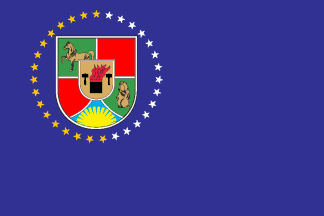 (2:3)
image by Pascal Gross, 18 June 2003
(2:3)
image by Pascal Gross, 18 June 2003
See also:
A region on the East of Ukraine. Soviet era name:
Voroshilovgrad in 1935–1958 and 1970–1992(?).
António Martins, 10 July 1999
The flag of the region (oblast) of Lugans'k can be seen at
www.viva.lugansk.ua [retrieved without images].
Pascal Gross, 9 November 2001
I have a photo from Conference of Ukrainian Heraldry Society:
man holding the paper with analogous image. The foto is very
small, but all stars around the shield look like white.
Victor Lomantsov, 2 December 2001
On 9 November 2001, I sent an image of the flag of Lugans'k
oblast. Later Victor Lomantsov expressed a doubt about the colors of the stars.
Today I stumbled across the page about the flag of Lugans'k oblast on the
regional server available at
oblrada.lg.ua [retrieved]
and the image there also shows stars yellow and white.
I think that, from the information above, we can definitely
conclude that the stars are yellow and white.
Pascal Gross, 18 June 2003
lg.gif) image from the site of Ukrainian Heraldry
image from the site of Ukrainian Heraldry
From the site of Ukrainian Heraldry:
"There is a cobalt rectangular with the side ratio 100×165 cm
(1:1.5). In the left-top quarter is circle with radius of 20 cm.
The circle's center is on 49 cm from the left side and 39 cm from the top
side. On the circle are 17 yellow and 14 white stars with 4 cm
side. It symbolizes 17 regions and 14 cities of the Oblast. In the center
of the circle there is a little oblast emblem."
Dov Gutterman, 10 September 2003
Quartered Vert a horse passant Or followed by Gules then again Gules followed by Vert a creature
sejant of the Second on a base embowed
triangular Azure a rising sun with rays also of the Second then an inescutcheon of this Last charged with
a block Sable flamed of the Third accosted by two mallets also Sable the whole (individually) bordered
Argent and supported by a demi-garland of cereal stalks leaves and curlicues of the Second and entwined
with a ribbon scroll in the national colours beating an inscription Sable.
Christopher Southworth