Last modified: 2026-11-28 by olivier touzeau
Keywords: ris-orangis | essonne |
Links: FOTW homepage |
search |
disclaimer and copyright |
write us |
mirrors
See also:
Ris-Orangis (31,189 inhabitants, 861 ha) is a commune in the southern suburbs of Paris, France. It was created in 1793 by the merger of the commune of Ris with the commune of Orangis.
Human presence in the area is documented as far back as the Stone and
Bronze Ages.
Merovingian graves were discovered there in 1919.
In 922, King Robert I granted the parish of Ris, dedicated to Saint
Blaise, to the Abbey of Saint-Magloire. By the 12th century, the two
separate villages were recorded under the Latinized names Regis and Orengiacum; the old Church of Saint Blaise dated from this period.
A charter from 1194, issued by Queen Alix of France, records a
donation made by Fouques d'Orangis and his brother Regnaut, comprising
60 arpents of land, while entrusting their estate at Orangis
(including all its lands, woods, and meadows) to the care of the
Knights Templar. A few years later, the Templars inherited the
property and established the Commandery of Orangis.
From the 13th century onwards, a Templar commandery and farm were
built in Ris; both were subsequently razed on the orders of Louis XIV.
Following the dissolution of the Knights Templar in 1312, the
Hospitallers of the Order of Saint John of Jerusalem took possession
of all the Order's assets.
The date of the Fromont commandery's establishment is unknown. As
early as 1173, the Knights Templar held properties in Fromont,
acquired from Gaudy de Savigny. Upon the devolution of Templar assets,
the commandery was transferred as a dependency to the Hospitallers of
the Order of Saint John of Jerusalem; it was managed on behalf of the
prior by brothers of the Order, with varying degrees of profitability.
The commandery ceased to be part of the Order's holdings in the 17th
century.
An initial château on the site of the Dranem Foundation is documented
as early as 1159. From the 16th century onwards, the lordship of Ris
belonged to the Faucon family, known as Faucon de Ris. Ris boasted
several châteaux, one of which was frequently visited by Henry IV. In
the 17th century, the Chevalier Philippe de Lorraine commissioned the
construction of the Château de Ris on the site of the former Templar
commandery.
Falco Falconi (Faulcon or Faucon), of Italian origin, arrived in
France in the retinue of King Charles VIII in 1495. In a document
dated December 3, 1529, he is recorded as attending the Assembly of
Provence regarding the release of King Francis I. He married Charlotte
Bucelli, a member of an illustrious Florentine family. The family coat
of arms combined the lion's paw of the Faulcons with the ox of the
Bucellis. The Faucons remained lords of Ris for several decades. The
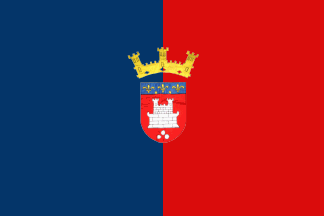
coat of arms of the town of Ris-Orangis was derived from the Faucon
family arms.
Around 1700, the seigneury of Ris passed to the
Anisson-Dupéron family, printers from Lyon, and remained in their
possession until the last lord, Étienne-Alexandre-Jacques
Anisson-Dupéron, was guillotined in 1794. During the French
Revolution, in 1793, the residents of Ris chose to rename the new
commune "Brutus" after the founder of the Roman Republic.
In the 18th century, the officer Charles-René de Bombelles had the
Château d’Orangis built.
In 1790, the commune of Ris-Orangis became the first in France to
elect its own mayor. In 1802, General Michel Ordener acquired the
Château de Trousseau.
The commune was also home to the Château de la Briqueterie, which
belonged to the Count of Saint-Priest in the 18th century.
The Ris-Orangis railway station was built in 1840. In 1874, the
western part of the municipality was altered by the construction of
the Vanne and Loing aqueduct, particularly along the site of the
former racecourse.
In 1927, the municipality acquired the Château de Ris to house the town hall.
The Évry racecourse was inaugurated in 1973, occupying a vast site on
the southern edge of the municipal territory. It closed permanently in
1996 and has remained disused ever since.
Olivier Touzeau, 12 October 2026
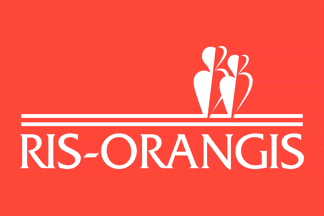
Former flag of Ris-Orangis - Image by Olivier Touzeau, 12 October 2026
The flag of Ris-Orangis before 2026 was orange with the logo: photo (2018).
A new logo was adopted in March 2026, no flag observed yet with the new logo.
The current logo is based on the coat of arms: Gules, a lion's leg Or
erased, bendwise, claws towards the chief.
Olivier Touzeau, 12 October 2026