
Last modified: 2026-11-28 by olivier touzeau
Keywords: rhone | mornant |
Links: FOTW homepage |
search |
disclaimer and copyright |
write us |
mirrors
Flag of Mornant - Image by Olivier Touzeau, 20 October 2026
See also:
Mornant (6,282 inhabitants, 1,585 ha) is a commune in the Rhône department.
The existence of certain archaeological remains suggests that the Mornant region was inhabited as early as the Gallic period. During the reign of Hadrian, the Romans constructed an aqueduct that originated in the Pilat massif and transported water to Lugdunum (modern-day Lyon) over a distance of approximately 75 kilometers. The Gier Aqueduct passes through the commune of Mornant for a stretch of 6.4 kilometers. While almost entirely underground, it emerged above ground to cross five valleys via bridges. Today, three remnants of these bridges are still visible.
Following the barbarian invasions, the Burgundians occupied the
region. An abbey was built at Monteclare, but it was destroyed around
855 during the conflicts between the heirs of Charlemagne.
It is believed that the town of Mornant was defended during this
period by a fortified enclosure, constructed using stones from the
abbey.
The castle, which adjoined the church to the northwest, was demolished
around 1910.
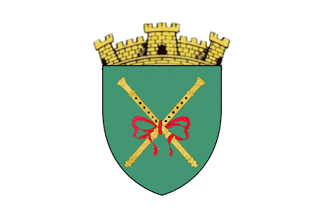
On April 6, 1362, the inhabitants of Mornant distinguished themselves
at the Battle of Brignais by fighting to the sound of fifes. This led
to the commune being granted a coat of arms featuring golden fifes
arranged in a saltire (cross-shape) on a green background.
A new church, built in the ogival (Gothic) style, was constructed in
the 15th century. It underwent numerous modifications over the
centuries, up until the 19th century (for instance, the bell tower was
rebuilt in the 18th century).
In the 16th century, the poet Pierre de Ronsard served as one of the
priors of Mornant.
In 1596, Henry IV established three annual fairs and a market in
Mornant, while also granting the commune the status of a "town"
(ville).
In the mid-19th century, Mornant experienced a kind of
heyday, with a population of nearly 2,500. During this period, the
weaving, velvet, and hat-making industries flourished.
Agriculture was also thriving. It was at this time (1860–1861) that
the town hall was built, on the edge of the old town center. By 1920,
following the First World War, the population of Mornant had fallen to
1,614.
During the Second World War, on August 30, 1944, fighting took place
at Pont-Rompu between members of the Resistance and the Nazi
occupiers.
Olivier Touzeau, 20 October 2026
The flag of Mornant is white with the coat of arms, blazoned Vert, two
fifes Or saltirewise tied toegether of Gules.
Photo from this page.
Olivier Touzeau, 20 October 2026