
Last modified: 2026-11-28 by  zachary harden
Keywords: lyganuse | luganuse | ida-virumaa | fire | book |
Links: FOTW homepage |
search |
disclaimer and copyright |
write us |
mirrors
 (7:11)
image by Tomislav Šipek, 01 October 2026
See also:
Adopted: 7 June 1997. Prop.:7:11. Lyganuse is a rural
municipality (vald) in Ida Virumaa County (maakond).
Dov Gutterman, 12 November 1999
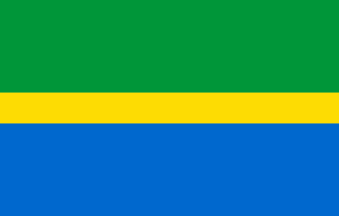
Lüganuse vald - Colors refer to sea and fields. Symbols refer
to farming, home and education.
Source: <www.virumaa.ee>.
Erki Kurrikoff, 6 April 2001
In the meantime, Lüganuse has merged with surrounding municipalities twice. First, in 2013, with the municipality of Maidla and the town of Püssi. It was then decided that the municipality would be named Lüganuse, that the flag of the town of Püssi would be adopted as the municipal flag, and that the coat of arms of the Maidla municipality would be adopted as the municipal coat of arms.
A second merger took place in 2017, involving the municipality of Sonda and the town of Kiviõli. At that time, new symbols were adopted that today represent the current municipality of Lüganuse.
Tomislav Šipek, 01 October 2026
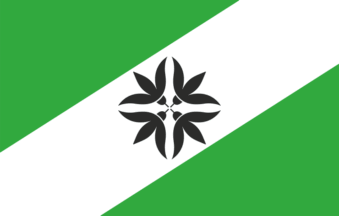
Flag description: On a green background, a white stylized hill shape with a broad base and a black cluster of marsh tea blossoms.
Explanation: The cluster of blossoms symbolizes strength, serves as an ancient protective symbol, and signifies cooperation; it also alludes to the sacred hill (*hiiemägi*)—a holy site of the ancient Estonians—and to ancient settlements (Askele, Uljaste). Marsh tea symbolizes the municipality's marshy terrain and nature conservation areas, as well as strength and vitality, being a well-known medicinal plant. The silver hill shape symbolizes the municipality's hills. Representing a sloping hillside, it alludes to the promotion of sports—the municipality boasts exceptionally strong sporting facilities known nationwide and beyond, such as the Kiviõli Adventure Center, the motor sports center, and the Aidu Water Sports Center. The color green refers to forests and agriculture. The color black represents industry, mines, and the settlements that emerged due to industrial development. The color silver signifies light and spirituality. Colors:
white (silvery)
green (C77 M0 Y100 K0; R49 G169 B62)
black
The ratio of the flag's width to its length is 7:11; the standard size is 105 x 165 cm.
Tomislav Šipek, 01 October 2026
 (7:11)
image by Tomislav Šipek, 01 October 2026
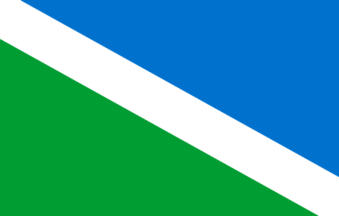
The first former flag of Lüganuse Municipality was approved on June 9, 1997. It consisted of a rectangular cloth traversed diagonally by a white stripe—two units in width—running from the upper corner at the hoist to the lower corner at the fly. The triangular field above the stripe was blue, while the lower field was green. The blue color symbolized the sky and water, as well as spirituality, while green represented nature, youth, and hope. The standard dimensions were 105 x 165 cm, with a width-to-length ratio of 7:11.
 (7:11)
image by Tomislav Šipek, 01 October 2026
luganuse.gif) (7:11)
image by Tomislav Šipek, 01 October 2026
lygan.gif)
image from <www.riigikantselei.ee>,
located by Dov Gutterman
Coat of arms description: On a green shield, a silver/white stylized hill shape with a broad base and a black cluster of marsh tea blossoms.
Tomislav Šipek, 01 October 2026
luganuse_old.gif)
image by Tomislav Šipek, 01 October 2026
The first former coat of arms of Lüganuse Municipality was approved on June 9, 1997. It featured a shield divided into blue and green fields by a silver chevron, raised and with its ends turned back at the apex. The lower green field displayed a three-pronged flame and an open book beneath it—both silver. The upper field was blue. The elements of the municipal coat of arms symbolized values deeply inherent to Estonians: the chevron represented the home (farmstead) and farming; the flame symbolized the warmth of the home and the strong Estonian family enduring through generations; and the open book represented education and the light of the spirit in general. The color blue symbolizes the sky and water (the sea) as well as spirituality, while green symbolizes nature, youth, and hope.
luganuse1317.gif)
image by Tomislav Šipek, 01 October 2026