Last modified: 2026-04-25 by martin karner
Keywords: switzerland |
Links: FOTW homepage |
search |
disclaimer and copyright |
write us |
mirrors
![[Swiss peace flag]](../images/c/ch_pea.gif) image by Evan Rolfe
image by Evan Rolfe![[Flag of Switzerland-Iceland Association]](../images/c/ch_chisa.gif)
The Switzerland-Iceland Association (Association Suisse-Islande) was founded
in 1988 in Geneva (Switzerland) by Léonard Pierre Closuit. Sent in 1978 to
Iceland by the Botanical Garden of Geneva, Closuit fell in love with Iceland and
founded an association "to promote cultural and artistic exchanges between the
two countries". On 25 October 2008, the association held its 19th General
Assembly in Martigny (Valais, Switzerland). Reporting the event on 27 October
2008, the newspaper "Le Nouvelliste" shows a photograph of the board members of
the association, with the association's flag hanging on the wall. The flag is a
combination of the symbols of the two countries. The perspective does not allow
to restore the specification of the flag, which appears to be made of an
Icelandic flag with the cross centered and a Swiss "cross" superimposed in the
middle. The Swiss "cross" is indeed disk-shaped, even if the disk seems to have
been "cut" along the outer edges of the cross arms.
http://www.lenouvelliste.ch/fr/news/valais/sur-un-meme-drapeau_9-114114
More on the banker-explorer Léonard-Pierre Closuit (b. 1931) in the
Encyclopaedia of Valais:
http://www.vs.ch/encyclo/navig.asp?mnu=know&idRubrique=1771&idLangue=1
Ivan Sache, 3 November 2008
![[Decorative Swiss flag]](../images/c/ch-fla.jpg)
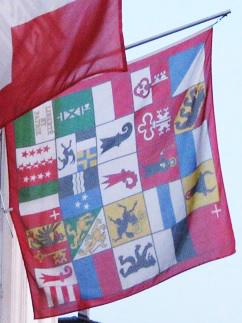
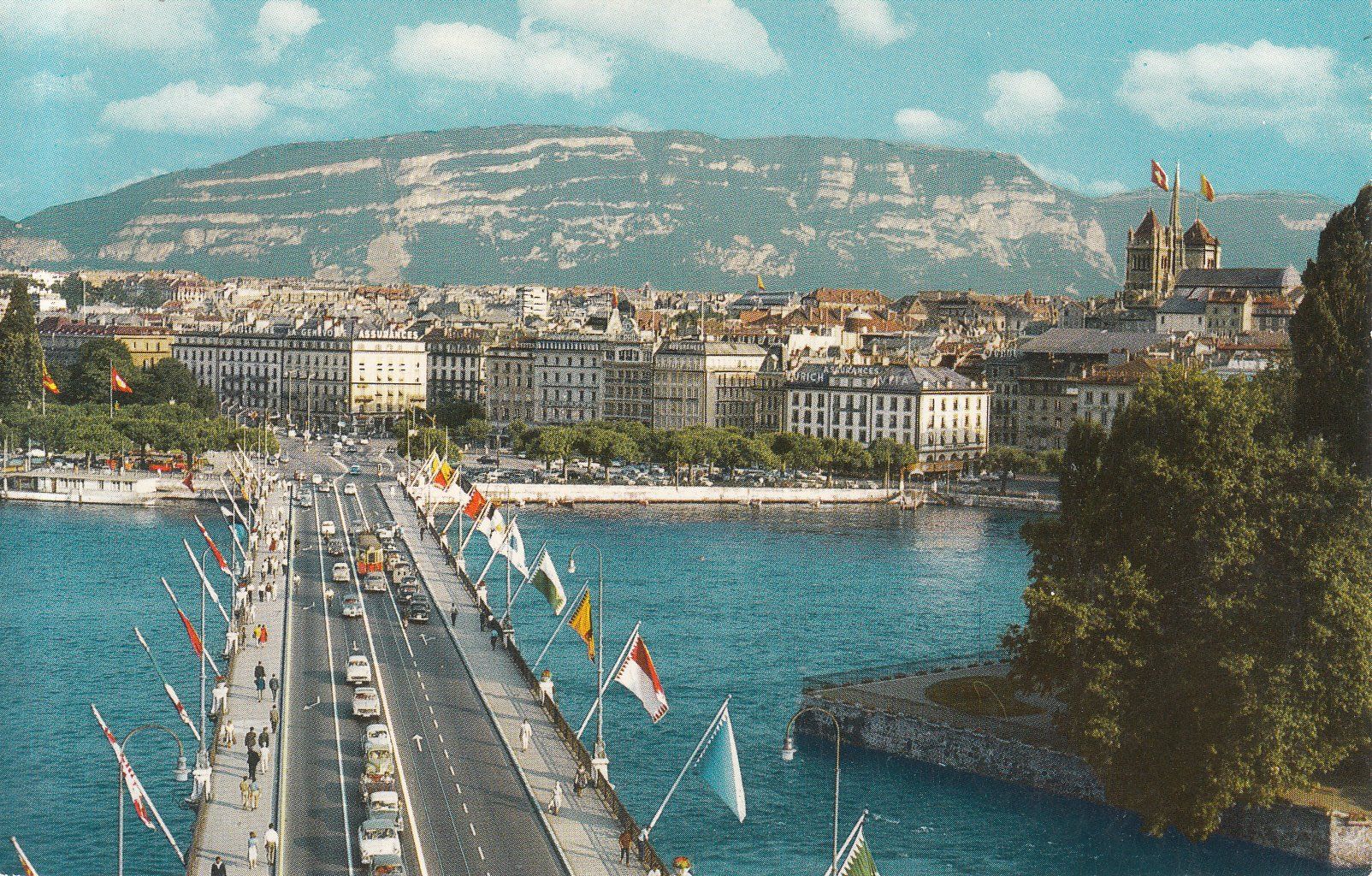
![[Decor. Swiss cantons flags - postcard]](../images/c/ch_fla70.jpg)
![[Decorative Swiss cantons flags]](../images/c/ch-ge_pmb.jpg)
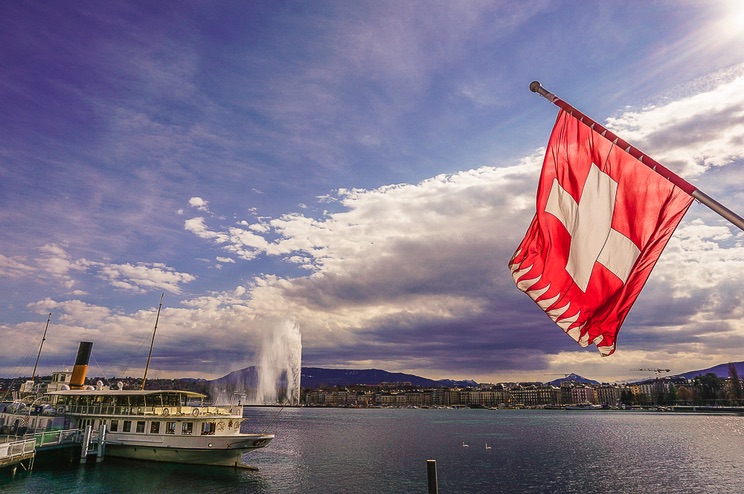
Aleksandar Nemet noted photographs of the Swiss flag with flames along one
edge (picture #1 [source],
picture [source]). This is a decorative Swiss
national flag, which is (as far as I know) only hoisted on a bridge in Geneva city.
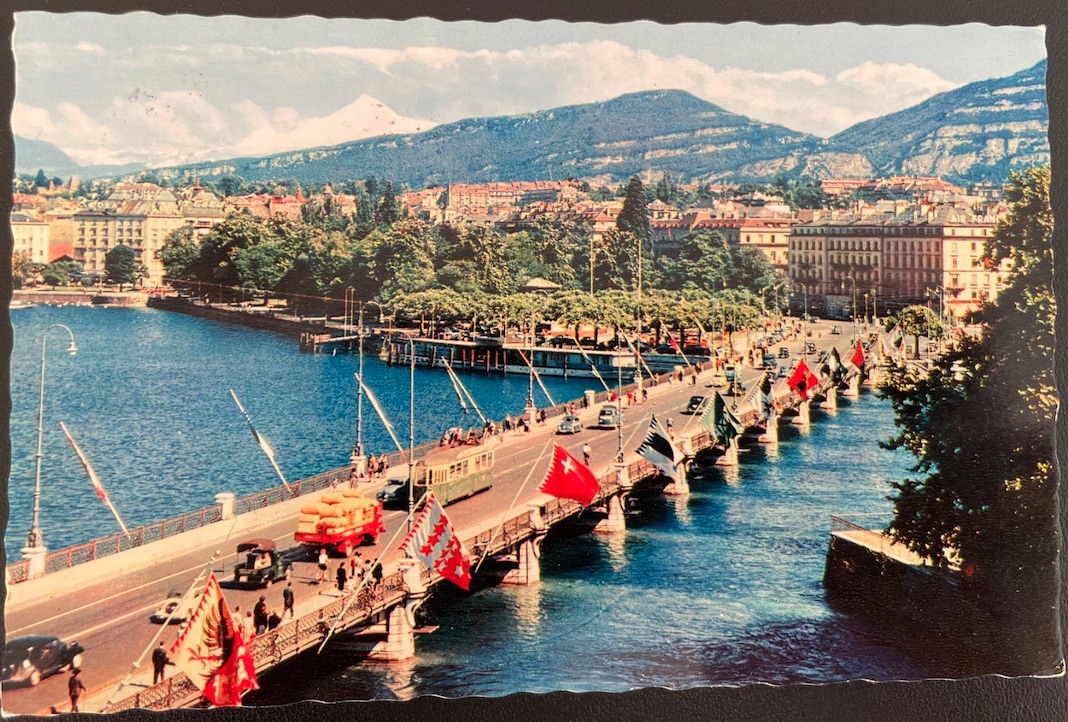
On this bridge all the [cantonal] flags fly together with the Swiss flag for a mere
decorative purpose. All these flags on this specific bridge over the Rhodan
river, at the outflow from Geneva Lake, show a special pattern, which consists
of little flames along one or more borders of the flag (see also postcards from 1950s,
1960s and 1970s [#2] with cantonal flags). Flames, though also sometimes seen
in 17th and 18th century military flags all across Europe, are a specific Swiss flag design element since
the 17th century until today. Flames may be placed across the flag or in the four areas separated by a
white cross in varied ways, or at the edges of a flag or at the edges of a cross, or in any other possible
way (like for instance in our case here).
[The referenced pictures here show both the same kind of flag. The flags may be wrapped around the
pole like here and thus give the wrong impression to have the flames only on one side.]
Emil Dreyer, 21 November 2008
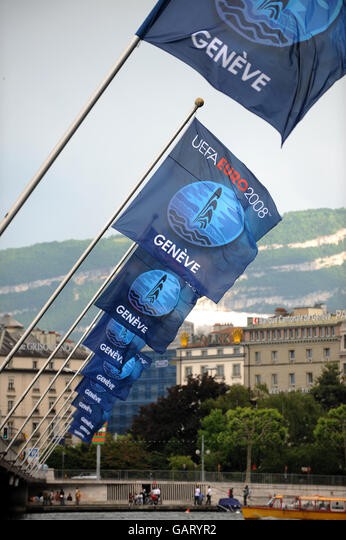
The bridge is the famous Mont-Blanc bridge ("pont du
Mont-Blanc"), built in 1902–1903 and enlarged in 1964–1965. Photo
showing the flag display here (picture #3).
During the last football European championship the
flags were replaced by the official UEFA Euro 2008 Genève flags.
Ivan Sache, 22 November 2008
See also: FLAMMULETS in Dictionary of Vexillology
![[Swiss flagge]](../images/c/ch_oly1948.jpg) image located by Martin Karner
image located by Martin Karner
A Swiss newspaper published an article about the use of airplanes at the Winter Olympic Games of 1928
and 1948 in St. Moritz (Grisons). One photo from 1948 shows a so-called
"Flagge" (vertical banner) with the Swiss cross on red, a vertical flag hoisted from a crossbar in
the manner of a gonfanon. The lower end of the flag is not visible. The special thing about the flag is
the cross, which is not centered or placed in the hoist as usual with these flags, but offset towards the
upper end. It has neither the design of "Flaggen" we present on FOTW with
the cross in the hoist and a bicolour fly part. The airplane with the HB-ARU marking is a "Fieseler
Storch" Fi-156. These planes could fly very slow and were well suited for photography.
(Source: Südostschweiz am Wochenende/Bündner Zeitung, suedostschweiz.ch, 25 February 2023)
Martin Karner, 3 March 2023
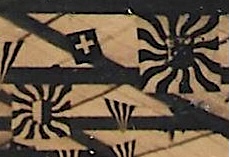
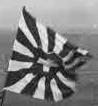
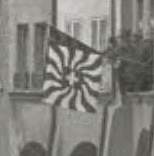
 images located by Martin Karner
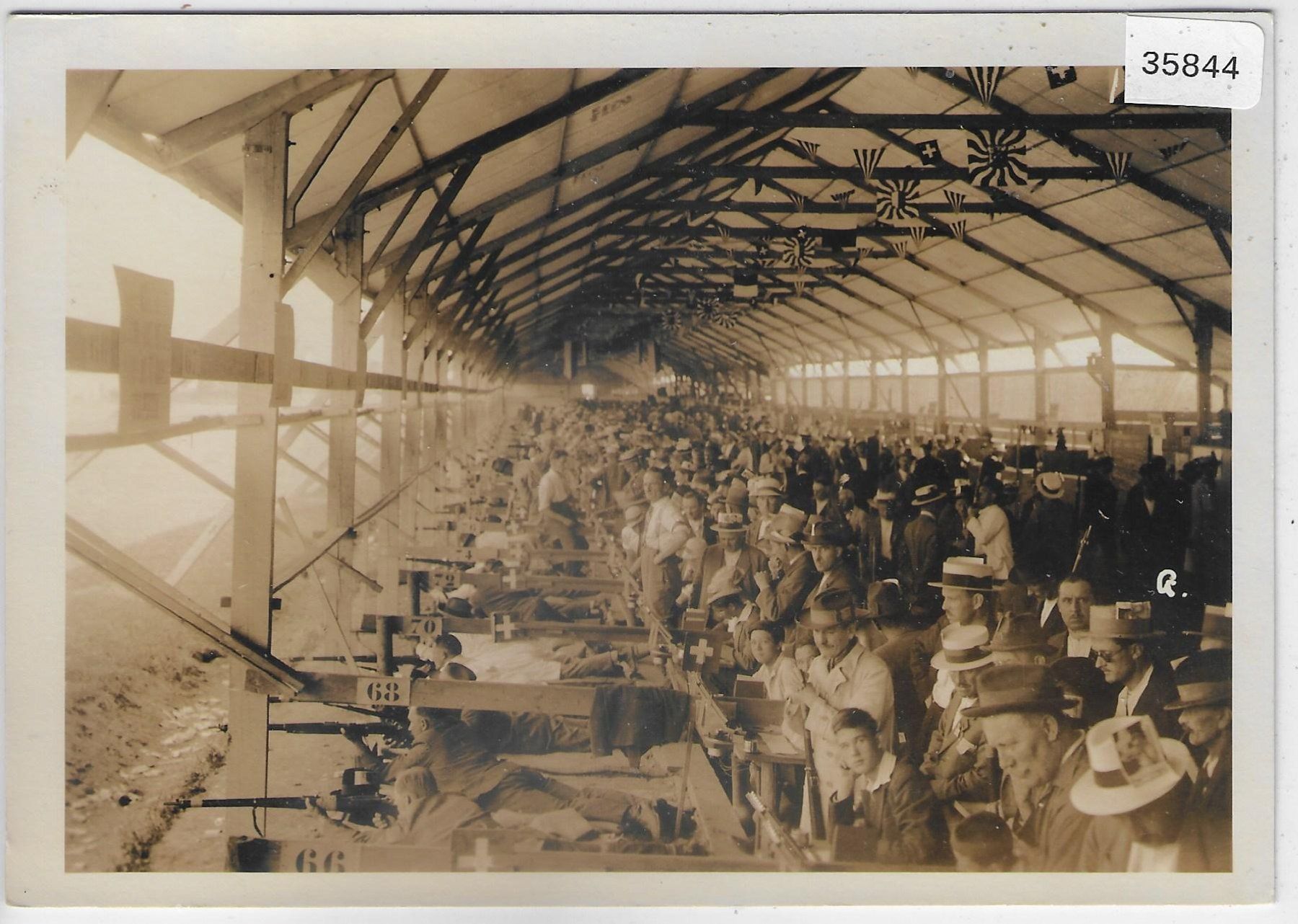
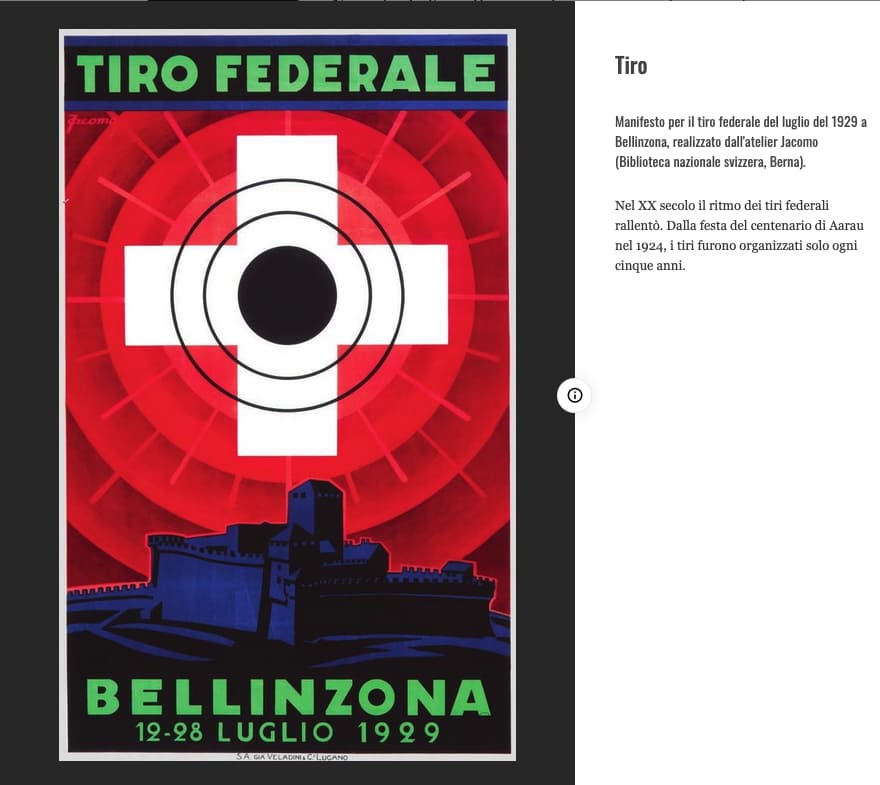
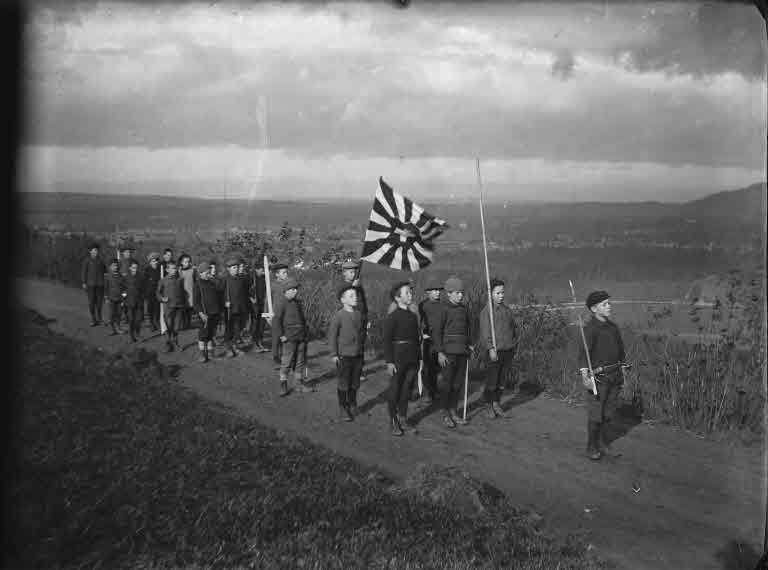
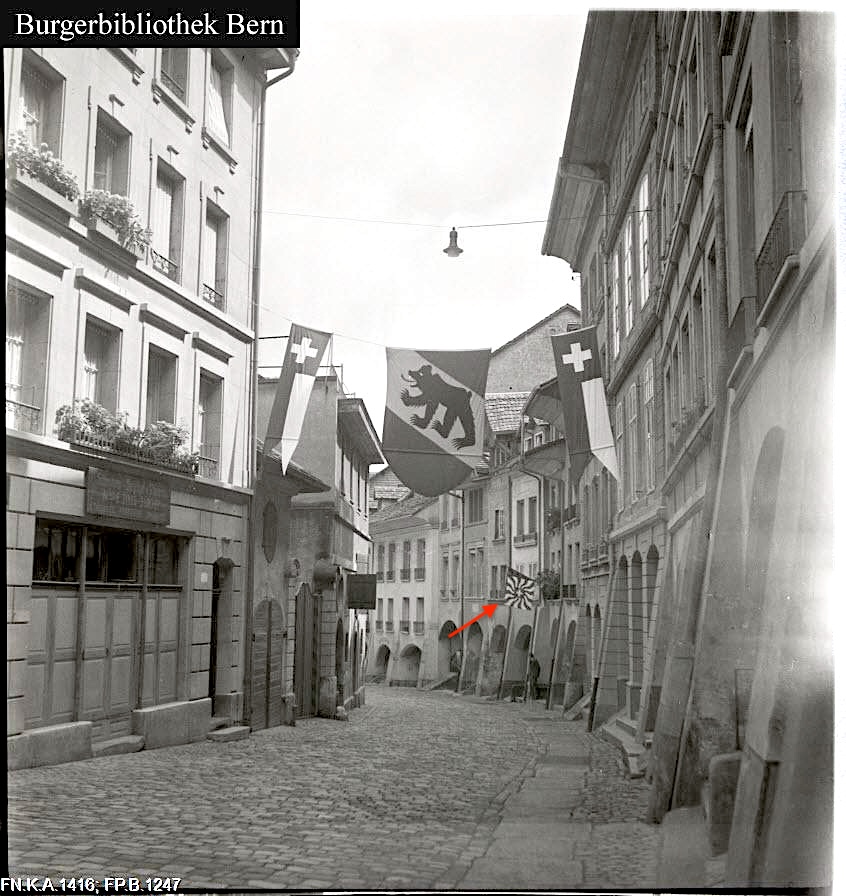
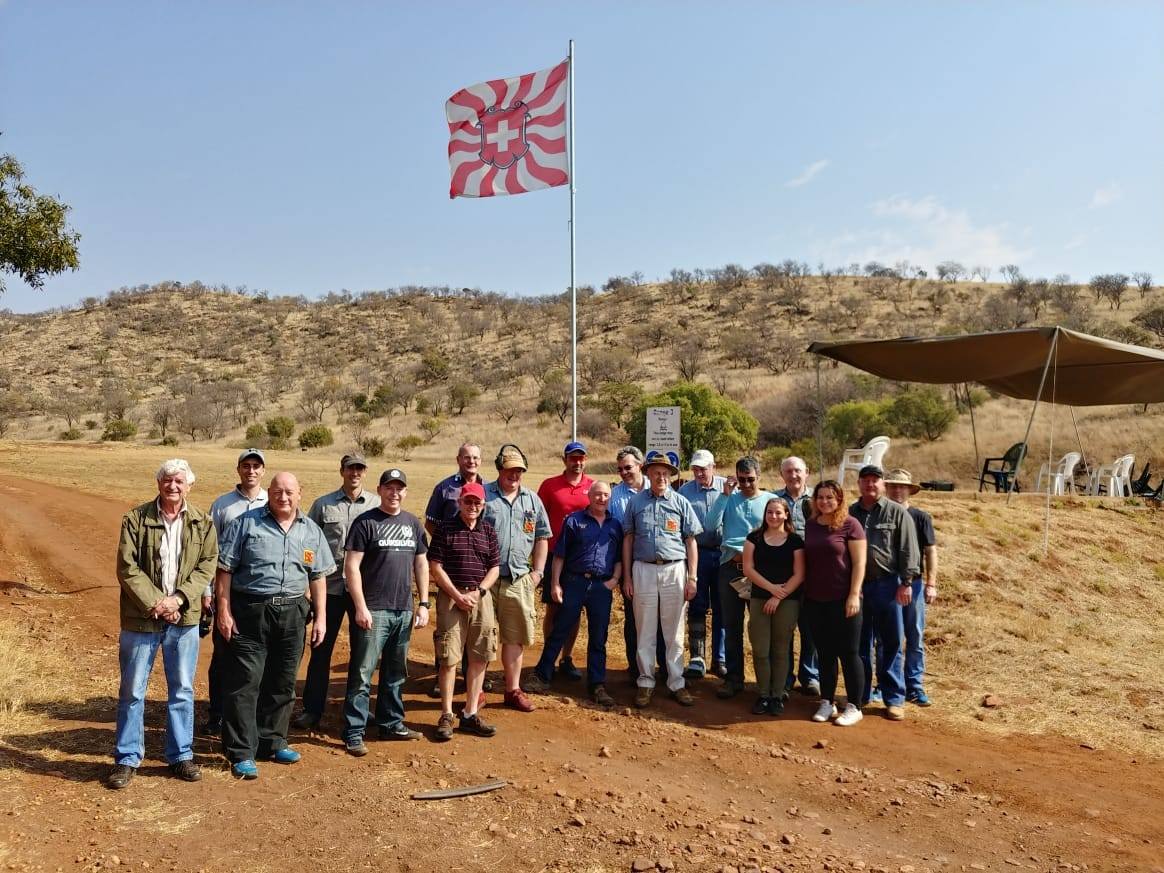
At the beginning of the 20th century, flamed flags were still in use, with the white cross replaced by
a (baroque) shield in the centre of the flag. These decorative flags had been used until WWII and then
somewhat forgotten in preference of the current cantonal flags. Not only cantonal flags were made with
this design, but also the Swiss national flag.
Photo #1 above shows cantonal flags with the flame pattern (detail of postcard of the Federal Shooting 1929 in
Bellinzona TI).
Photo #2 shows a flamed Swiss national flag, used by playing school children in
Wabern BE, ca. 1914 (picture, source).
Photo #3 was made in Bern on 1.8.1936 (national holiday | picture, source).
Today this kind of flags are being produced again (photo #4: club members at 300m shooting range Pelindaba,
South Africa, 2018 | picture, source).
Pascal Gross, 30 June 2002 / Martin Karner, 6 December 2023
See also:
![[Flag of ASSA]](../images/c/ch_assa.jpg) image located by Martin Karner
image located by Martin Karner
The flag of the national Asscociation of Artillery clubs (introduced 1937), French version
(Association suisse des Sociétés d'Artillerie). (source)
Website National Association (VSAV/ASSA): https://vsav.info
Martin Karner, 6 December 2023
See also: Artillerie-Verein Baselland
![[All cantons flag]](../images/c/ch_5x5.gif) image by António Martins, 22 August 2024
image by António Martins, 22 August 2024
This is a makeshift flag and not an official flag at all, but it sure does portray a
colorful design, and it seems that it is used quite often (Photo by Esteban Rivera, 2011).
The flag is a red background square featuring 25 (26) Cantons in five rows of five, from top to bottom, from
left to right, as follows [in the official order]:
1st row: Zürich, Bern, Luzern, Uri, Schwyz
2nd row: Obwalden, Nidwalden, Glarus, Zug, Fribourg
3rd row: Solothurn, Basel-Stadt, Basel-Landschaft, Schaffhausen, Appenzell (AI+AR)*
4th row: St. Gallen, Graubünden, Aargau, Thurgau, Ticino
5th row: Vaud, Valais, Neuchâtel, Genève, Jura
* The half-cantons AI and AR have to share a field with their common flag
Esteban Rivera, 7 January 2024
See also: PATCHWORK FLAG in Dictionary of Vexillology